EP1525458B1 - Strömungsverfahren und -vorrichtung zum screening von chemikalien mithilfe von mikroröntgenfluoreszenz - Google Patents
Strömungsverfahren und -vorrichtung zum screening von chemikalien mithilfe von mikroröntgenfluoreszenz Download PDFInfo
- Publication number
- EP1525458B1 EP1525458B1 EP03748920.0A EP03748920A EP1525458B1 EP 1525458 B1 EP1525458 B1 EP 1525458B1 EP 03748920 A EP03748920 A EP 03748920A EP 1525458 B1 EP1525458 B1 EP 1525458B1
- Authority
- EP
- European Patent Office
- Prior art keywords
- ray
- flow
- pharmaceutical chemicals
- potential pharmaceutical
- separated
- Prior art date
- Legal status (The legal status is an assumption and is not a legal conclusion. Google has not performed a legal analysis and makes no representation as to the accuracy of the status listed.)
- Expired - Lifetime
Links
- 239000000126 substance Substances 0.000 title claims description 57
- 238000000034 method Methods 0.000 title claims description 38
- 238000012216 screening Methods 0.000 title claims description 21
- 238000004876 x-ray fluorescence Methods 0.000 title description 30
- 239000011230 binding agent Substances 0.000 claims description 37
- 230000005284 excitation Effects 0.000 claims description 24
- 239000000203 mixture Substances 0.000 claims description 23
- 238000002149 energy-dispersive X-ray emission spectroscopy Methods 0.000 claims description 7
- ZAMOUSCENKQFHK-UHFFFAOYSA-N Chlorine atom Chemical compound [Cl] ZAMOUSCENKQFHK-UHFFFAOYSA-N 0.000 claims description 4
- NINIDFKCEFEMDL-UHFFFAOYSA-N Sulfur Chemical compound [S] NINIDFKCEFEMDL-UHFFFAOYSA-N 0.000 claims description 4
- 229910052801 chlorine Inorganic materials 0.000 claims description 4
- 239000000460 chlorine Substances 0.000 claims description 4
- 229910052731 fluorine Inorganic materials 0.000 claims description 4
- 239000011737 fluorine Substances 0.000 claims description 4
- 229910052717 sulfur Inorganic materials 0.000 claims description 4
- 239000011593 sulfur Substances 0.000 claims description 4
- WKBOTKDWSSQWDR-UHFFFAOYSA-N Bromine atom Chemical compound [Br] WKBOTKDWSSQWDR-UHFFFAOYSA-N 0.000 claims description 3
- OAICVXFJPJFONN-UHFFFAOYSA-N Phosphorus Chemical compound [P] OAICVXFJPJFONN-UHFFFAOYSA-N 0.000 claims description 3
- GDTBXPJZTBHREO-UHFFFAOYSA-N bromine Substances BrBr GDTBXPJZTBHREO-UHFFFAOYSA-N 0.000 claims description 3
- 229910052794 bromium Inorganic materials 0.000 claims description 3
- PNDPGZBMCMUPRI-UHFFFAOYSA-N iodine Chemical compound II PNDPGZBMCMUPRI-UHFFFAOYSA-N 0.000 claims description 3
- 229910052698 phosphorus Inorganic materials 0.000 claims description 3
- 239000011574 phosphorus Substances 0.000 claims description 3
- 229910052684 Cerium Inorganic materials 0.000 claims description 2
- 229910052692 Dysprosium Inorganic materials 0.000 claims description 2
- 229910052691 Erbium Inorganic materials 0.000 claims description 2
- 229910052693 Europium Inorganic materials 0.000 claims description 2
- 229910052688 Gadolinium Inorganic materials 0.000 claims description 2
- 229910052689 Holmium Inorganic materials 0.000 claims description 2
- 229910052765 Lutetium Inorganic materials 0.000 claims description 2
- 229910052779 Neodymium Inorganic materials 0.000 claims description 2
- 229910052777 Praseodymium Inorganic materials 0.000 claims description 2
- 229910052772 Samarium Inorganic materials 0.000 claims description 2
- BUGBHKTXTAQXES-UHFFFAOYSA-N Selenium Chemical compound [Se] BUGBHKTXTAQXES-UHFFFAOYSA-N 0.000 claims description 2
- 229910052771 Terbium Inorganic materials 0.000 claims description 2
- 229910052775 Thulium Inorganic materials 0.000 claims description 2
- 229910052769 Ytterbium Inorganic materials 0.000 claims description 2
- 229910052787 antimony Inorganic materials 0.000 claims description 2
- WATWJIUSRGPENY-UHFFFAOYSA-N antimony atom Chemical compound [Sb] WATWJIUSRGPENY-UHFFFAOYSA-N 0.000 claims description 2
- 229910052785 arsenic Inorganic materials 0.000 claims description 2
- RQNWIZPPADIBDY-UHFFFAOYSA-N arsenic atom Chemical compound [As] RQNWIZPPADIBDY-UHFFFAOYSA-N 0.000 claims description 2
- 229910052797 bismuth Inorganic materials 0.000 claims description 2
- JCXGWMGPZLAOME-UHFFFAOYSA-N bismuth atom Chemical compound [Bi] JCXGWMGPZLAOME-UHFFFAOYSA-N 0.000 claims description 2
- KBQHZAAAGSGFKK-UHFFFAOYSA-N dysprosium atom Chemical compound [Dy] KBQHZAAAGSGFKK-UHFFFAOYSA-N 0.000 claims description 2
- UYAHIZSMUZPPFV-UHFFFAOYSA-N erbium Chemical compound [Er] UYAHIZSMUZPPFV-UHFFFAOYSA-N 0.000 claims description 2
- OGPBJKLSAFTDLK-UHFFFAOYSA-N europium atom Chemical compound [Eu] OGPBJKLSAFTDLK-UHFFFAOYSA-N 0.000 claims description 2
- UIWYJDYFSGRHKR-UHFFFAOYSA-N gadolinium atom Chemical compound [Gd] UIWYJDYFSGRHKR-UHFFFAOYSA-N 0.000 claims description 2
- KJZYNXUDTRRSPN-UHFFFAOYSA-N holmium atom Chemical compound [Ho] KJZYNXUDTRRSPN-UHFFFAOYSA-N 0.000 claims description 2
- 229910052746 lanthanum Inorganic materials 0.000 claims description 2
- FZLIPJUXYLNCLC-UHFFFAOYSA-N lanthanum atom Chemical compound [La] FZLIPJUXYLNCLC-UHFFFAOYSA-N 0.000 claims description 2
- OHSVLFRHMCKCQY-UHFFFAOYSA-N lutetium atom Chemical compound [Lu] OHSVLFRHMCKCQY-UHFFFAOYSA-N 0.000 claims description 2
- QEFYFXOXNSNQGX-UHFFFAOYSA-N neodymium atom Chemical compound [Nd] QEFYFXOXNSNQGX-UHFFFAOYSA-N 0.000 claims description 2
- PUDIUYLPXJFUGB-UHFFFAOYSA-N praseodymium atom Chemical compound [Pr] PUDIUYLPXJFUGB-UHFFFAOYSA-N 0.000 claims description 2
- KZUNJOHGWZRPMI-UHFFFAOYSA-N samarium atom Chemical compound [Sm] KZUNJOHGWZRPMI-UHFFFAOYSA-N 0.000 claims description 2
- 229910052711 selenium Inorganic materials 0.000 claims description 2
- 239000011669 selenium Substances 0.000 claims description 2
- GZCRRIHWUXGPOV-UHFFFAOYSA-N terbium atom Chemical compound [Tb] GZCRRIHWUXGPOV-UHFFFAOYSA-N 0.000 claims description 2
- NAWDYIZEMPQZHO-UHFFFAOYSA-N ytterbium Chemical compound [Yb] NAWDYIZEMPQZHO-UHFFFAOYSA-N 0.000 claims description 2
- GWXLDORMOJMVQZ-UHFFFAOYSA-N cerium Chemical compound [Ce] GWXLDORMOJMVQZ-UHFFFAOYSA-N 0.000 claims 1
- 125000001153 fluoro group Chemical group F* 0.000 claims 1
- RMRCNWBMXRMIRW-BYFNXCQMSA-M cyanocobalamin Chemical compound N#C[Co+]N([C@]1([H])[C@H](CC(N)=O)[C@]\2(CCC(=O)NC[C@H](C)OP(O)(=O)OC3[C@H]([C@H](O[C@@H]3CO)N3C4=CC(C)=C(C)C=C4N=C3)O)C)C/2=C(C)\C([C@H](C/2(C)C)CCC(N)=O)=N\C\2=C\C([C@H]([C@@]/2(CC(N)=O)C)CCC(N)=O)=N\C\2=C(C)/C2=N[C@]1(C)[C@@](C)(CC(N)=O)[C@@H]2CCC(N)=O RMRCNWBMXRMIRW-BYFNXCQMSA-M 0.000 description 24
- 102000004169 proteins and genes Human genes 0.000 description 16
- 108090000623 proteins and genes Proteins 0.000 description 16
- 239000000243 solution Substances 0.000 description 16
- 210000004027 cell Anatomy 0.000 description 14
- 229960002104 cyanocobalamin Drugs 0.000 description 12
- 235000000639 cyanocobalamin Nutrition 0.000 description 12
- 239000011666 cyanocobalamin Substances 0.000 description 12
- 239000000523 sample Substances 0.000 description 8
- 238000005251 capillar electrophoresis Methods 0.000 description 7
- XLJKHNWPARRRJB-UHFFFAOYSA-N cobalt(2+) Chemical compound [Co+2] XLJKHNWPARRRJB-UHFFFAOYSA-N 0.000 description 7
- 238000000926 separation method Methods 0.000 description 7
- 102000004190 Enzymes Human genes 0.000 description 6
- 108090000790 Enzymes Proteins 0.000 description 6
- 102000008857 Ferritin Human genes 0.000 description 6
- 108050000784 Ferritin Proteins 0.000 description 6
- 238000008416 Ferritin Methods 0.000 description 6
- HEMHJVSKTPXQMS-UHFFFAOYSA-M Sodium hydroxide Chemical compound [OH-].[Na+] HEMHJVSKTPXQMS-UHFFFAOYSA-M 0.000 description 6
- 239000007864 aqueous solution Substances 0.000 description 5
- UFMZWBIQTDUYBN-UHFFFAOYSA-N cobalt dinitrate Chemical compound [Co+2].[O-][N+]([O-])=O.[O-][N+]([O-])=O UFMZWBIQTDUYBN-UHFFFAOYSA-N 0.000 description 5
- 238000011010 flushing procedure Methods 0.000 description 4
- 239000000463 material Substances 0.000 description 4
- 244000005700 microbiome Species 0.000 description 4
- 238000004846 x-ray emission Methods 0.000 description 4
- PXGOKWXKJXAPGV-UHFFFAOYSA-N Fluorine Chemical compound FF PXGOKWXKJXAPGV-UHFFFAOYSA-N 0.000 description 3
- XUIMIQQOPSSXEZ-UHFFFAOYSA-N Silicon Chemical compound [Si] XUIMIQQOPSSXEZ-UHFFFAOYSA-N 0.000 description 3
- 239000008280 blood Substances 0.000 description 3
- 210000004369 blood Anatomy 0.000 description 3
- 150000001875 compounds Chemical class 0.000 description 3
- 239000007788 liquid Substances 0.000 description 3
- 239000010948 rhodium Substances 0.000 description 3
- 229910052710 silicon Inorganic materials 0.000 description 3
- 239000010703 silicon Substances 0.000 description 3
- 238000001228 spectrum Methods 0.000 description 3
- RNMCCPMYXUKHAZ-UHFFFAOYSA-N 2-[3,3-diamino-1,2,2-tris(carboxymethyl)cyclohexyl]acetic acid Chemical compound NC1(N)CCCC(CC(O)=O)(CC(O)=O)C1(CC(O)=O)CC(O)=O RNMCCPMYXUKHAZ-UHFFFAOYSA-N 0.000 description 2
- 241000894006 Bacteria Species 0.000 description 2
- XEEYBQQBJWHFJM-UHFFFAOYSA-N Iron Chemical compound [Fe] XEEYBQQBJWHFJM-UHFFFAOYSA-N 0.000 description 2
- 238000005481 NMR spectroscopy Methods 0.000 description 2
- 102000029797 Prion Human genes 0.000 description 2
- 108091000054 Prion Proteins 0.000 description 2
- 229910004489 SiLi Inorganic materials 0.000 description 2
- VYPSYNLAJGMNEJ-UHFFFAOYSA-N Silicium dioxide Chemical compound O=[Si]=O VYPSYNLAJGMNEJ-UHFFFAOYSA-N 0.000 description 2
- 241000700605 Viruses Species 0.000 description 2
- 125000000539 amino acid group Chemical group 0.000 description 2
- 238000004458 analytical method Methods 0.000 description 2
- 210000004102 animal cell Anatomy 0.000 description 2
- 230000015572 biosynthetic process Effects 0.000 description 2
- 239000000872 buffer Substances 0.000 description 2
- FDJOLVPMNUYSCM-WZHZPDAFSA-L cobalt(3+);[(2r,3s,4r,5s)-5-(5,6-dimethylbenzimidazol-1-yl)-4-hydroxy-2-(hydroxymethyl)oxolan-3-yl] [(2r)-1-[3-[(1r,2r,3r,4z,7s,9z,12s,13s,14z,17s,18s,19r)-2,13,18-tris(2-amino-2-oxoethyl)-7,12,17-tris(3-amino-3-oxopropyl)-3,5,8,8,13,15,18,19-octamethyl-2 Chemical compound [Co+3].N#[C-].N([C@@H]([C@]1(C)[N-]\C([C@H]([C@@]1(CC(N)=O)C)CCC(N)=O)=C(\C)/C1=N/C([C@H]([C@@]1(CC(N)=O)C)CCC(N)=O)=C\C1=N\C([C@H](C1(C)C)CCC(N)=O)=C/1C)[C@@H]2CC(N)=O)=C\1[C@]2(C)CCC(=O)NC[C@@H](C)OP([O-])(=O)O[C@H]1[C@@H](O)[C@@H](N2C3=CC(C)=C(C)C=C3N=C2)O[C@@H]1CO FDJOLVPMNUYSCM-WZHZPDAFSA-L 0.000 description 2
- 230000001143 conditioned effect Effects 0.000 description 2
- 239000008367 deionised water Substances 0.000 description 2
- 238000010586 diagram Methods 0.000 description 2
- 229940079593 drug Drugs 0.000 description 2
- 239000003814 drug Substances 0.000 description 2
- 238000000921 elemental analysis Methods 0.000 description 2
- 238000001943 fluorescence-activated cell sorting Methods 0.000 description 2
- 239000005350 fused silica glass Substances 0.000 description 2
- 210000005260 human cell Anatomy 0.000 description 2
- 150000002611 lead compounds Chemical class 0.000 description 2
- 238000004949 mass spectrometry Methods 0.000 description 2
- 239000002207 metabolite Substances 0.000 description 2
- 238000012986 modification Methods 0.000 description 2
- 230000004048 modification Effects 0.000 description 2
- 102000039446 nucleic acids Human genes 0.000 description 2
- 108020004707 nucleic acids Proteins 0.000 description 2
- 150000007523 nucleic acids Chemical class 0.000 description 2
- 230000005855 radiation Effects 0.000 description 2
- 230000005526 G1 to G0 transition Effects 0.000 description 1
- WQZGKKKJIJFFOK-GASJEMHNSA-N Glucose Natural products OC[C@H]1OC(O)[C@H](O)[C@@H](O)[C@@H]1O WQZGKKKJIJFFOK-GASJEMHNSA-N 0.000 description 1
- 238000004566 IR spectroscopy Methods 0.000 description 1
- WHXSMMKQMYFTQS-UHFFFAOYSA-N Lithium Chemical compound [Li] WHXSMMKQMYFTQS-UHFFFAOYSA-N 0.000 description 1
- 241001465754 Metazoa Species 0.000 description 1
- 239000004480 active ingredient Substances 0.000 description 1
- 150000001413 amino acids Chemical class 0.000 description 1
- 239000012062 aqueous buffer Substances 0.000 description 1
- 239000012620 biological material Substances 0.000 description 1
- 239000006227 byproduct Substances 0.000 description 1
- 238000004113 cell culture Methods 0.000 description 1
- ZMIGMASIKSOYAM-UHFFFAOYSA-N cerium Chemical compound [Ce][Ce][Ce][Ce][Ce][Ce][Ce][Ce][Ce][Ce][Ce][Ce][Ce][Ce][Ce][Ce][Ce][Ce][Ce][Ce][Ce][Ce][Ce][Ce][Ce][Ce][Ce][Ce][Ce][Ce][Ce][Ce][Ce][Ce][Ce][Ce][Ce][Ce] ZMIGMASIKSOYAM-UHFFFAOYSA-N 0.000 description 1
- 230000009920 chelation Effects 0.000 description 1
- 229910052729 chemical element Inorganic materials 0.000 description 1
- 238000004587 chromatography analysis Methods 0.000 description 1
- 239000010941 cobalt Substances 0.000 description 1
- 229910017052 cobalt Inorganic materials 0.000 description 1
- GUTLYIVDDKVIGB-UHFFFAOYSA-N cobalt atom Chemical compound [Co] GUTLYIVDDKVIGB-UHFFFAOYSA-N 0.000 description 1
- 229910001429 cobalt ion Inorganic materials 0.000 description 1
- 229910001981 cobalt nitrate Inorganic materials 0.000 description 1
- 238000002485 combustion reaction Methods 0.000 description 1
- 239000000470 constituent Substances 0.000 description 1
- 238000012258 culturing Methods 0.000 description 1
- 230000001066 destructive effect Effects 0.000 description 1
- 238000001514 detection method Methods 0.000 description 1
- 230000005281 excited state Effects 0.000 description 1
- 238000011049 filling Methods 0.000 description 1
- 239000012634 fragment Substances 0.000 description 1
- 238000004817 gas chromatography Methods 0.000 description 1
- 238000002523 gelfiltration Methods 0.000 description 1
- 239000008103 glucose Substances 0.000 description 1
- 230000005283 ground state Effects 0.000 description 1
- 238000004128 high performance liquid chromatography Methods 0.000 description 1
- 238000003018 immunoassay Methods 0.000 description 1
- 238000002347 injection Methods 0.000 description 1
- 239000007924 injection Substances 0.000 description 1
- 238000011835 investigation Methods 0.000 description 1
- 150000002500 ions Chemical class 0.000 description 1
- 229910052742 iron Inorganic materials 0.000 description 1
- 230000001678 irradiating effect Effects 0.000 description 1
- 238000004811 liquid chromatography Methods 0.000 description 1
- 229910052744 lithium Inorganic materials 0.000 description 1
- 230000014759 maintenance of location Effects 0.000 description 1
- 230000002503 metabolic effect Effects 0.000 description 1
- 238000002493 microarray Methods 0.000 description 1
- 239000004005 microsphere Substances 0.000 description 1
- 150000002894 organic compounds Chemical class 0.000 description 1
- 229920001184 polypeptide Polymers 0.000 description 1
- 238000002360 preparation method Methods 0.000 description 1
- 102000004196 processed proteins & peptides Human genes 0.000 description 1
- 108090000765 processed proteins & peptides Proteins 0.000 description 1
- 238000012545 processing Methods 0.000 description 1
- 230000006798 recombination Effects 0.000 description 1
- 238000005215 recombination Methods 0.000 description 1
- 229910052703 rhodium Inorganic materials 0.000 description 1
- MHOVAHRLVXNVSD-UHFFFAOYSA-N rhodium atom Chemical compound [Rh] MHOVAHRLVXNVSD-UHFFFAOYSA-N 0.000 description 1
- 230000011664 signaling Effects 0.000 description 1
- 229940126586 small molecule drug Drugs 0.000 description 1
- 150000003384 small molecules Chemical class 0.000 description 1
- 239000007787 solid Substances 0.000 description 1
- 238000011895 specific detection Methods 0.000 description 1
- 238000004611 spectroscopical analysis Methods 0.000 description 1
- 238000003786 synthesis reaction Methods 0.000 description 1
- 238000012360 testing method Methods 0.000 description 1
- 230000001988 toxicity Effects 0.000 description 1
- 231100000419 toxicity Toxicity 0.000 description 1
- 230000001960 triggered effect Effects 0.000 description 1
- 238000000870 ultraviolet spectroscopy Methods 0.000 description 1
- XLYOFNOQVPJJNP-UHFFFAOYSA-N water Substances O XLYOFNOQVPJJNP-UHFFFAOYSA-N 0.000 description 1
Images


Classifications
-
- G—PHYSICS
- G01—MEASURING; TESTING
- G01N—INVESTIGATING OR ANALYSING MATERIALS BY DETERMINING THEIR CHEMICAL OR PHYSICAL PROPERTIES
- G01N23/00—Investigating or analysing materials by the use of wave or particle radiation, e.g. X-rays or neutrons, not covered by groups G01N3/00 – G01N17/00, G01N21/00 or G01N22/00
- G01N23/22—Investigating or analysing materials by the use of wave or particle radiation, e.g. X-rays or neutrons, not covered by groups G01N3/00 – G01N17/00, G01N21/00 or G01N22/00 by measuring secondary emission from the material
- G01N23/223—Investigating or analysing materials by the use of wave or particle radiation, e.g. X-rays or neutrons, not covered by groups G01N3/00 – G01N17/00, G01N21/00 or G01N22/00 by measuring secondary emission from the material by irradiating the sample with X-rays or gamma-rays and by measuring X-ray fluorescence
-
- G—PHYSICS
- G01—MEASURING; TESTING
- G01N—INVESTIGATING OR ANALYSING MATERIALS BY DETERMINING THEIR CHEMICAL OR PHYSICAL PROPERTIES
- G01N2223/00—Investigating materials by wave or particle radiation
- G01N2223/07—Investigating materials by wave or particle radiation secondary emission
- G01N2223/076—X-ray fluorescence
Definitions
- the present invention relates generally to detecting binding events and more particularly to a flow method for detecting binding events between a potential pharmaceutical chemical and a target binder using micro-x-ray fluorescence spectroscopy.
- Pharmaceutical chemicals are the active ingredients in drugs such as the now popular PrilosecTM, LipitorTM, ZocorTM, ProzacTM, ZoloftTM, and CelebrexTM, and it is believed that their pharmaceutical properties are linked to their ability to bind to the "binding site" of one or more proteins.
- the binding properties of a protein largely depend on the exposed surface amino acid residues of the polypeptide chain (see, for example, Bruce Alberts et al., "Molecular Biology of the Cell", 2nd edition, Garland Publishing, Inc., New York, 1989 ; and H. Lodish et al., "Molecular Cell Biology", 4th edition, W. H. Freeman and Company, 2000 ). These amino acid residues can form weak noncovalent bonds with ions and other molecules.
- binding site generally requires the formation of many weak bonds at the "binding site" of the protein.
- the binding site is usually a cavity in the protein formed by a specific arrangement of amino acids. There must be a precise fit with the binding site for effective binding to occur.
- the shapes of binding sites may differ greatly among different proteins, and even among different conformations of the same protein. Even slightly different conformations of the same protein may differ greatly in their binding abilities. For these reasons, it is extremely difficult to predict which chemicals will bind effectively to proteins.
- Screening methods generally involve combining potential pharmaceutical chemicals with target binders and determining which, if any, of the potential pharmaceutical chemicals bind to any of the target binders.
- Potential pharmaceutical chemicals are preferably water-soluble organic compounds that can dissolve into the blood stream.
- Target binders are generally biological materials such as enzymes, non-enzyme proteins, DNA, RNA, microorganisms (e.g..prions, viruses, bacteria, and the like), human cells, plant cells, animal cells, and the like.
- Potential pharmaceutical chemicals that bind to at least one target binder are likely candidates for further investigation of pharmaceutical properties (e.g. efficacy and toxicity).
- Tagging may involve attaching a labeled chemical portion to a chemical.
- An example of a screening method requiring tags is fluorescence activated cell sorting.
- An example of this method involves preparing a solution of cells and antibodies bearing a fluorescent tag. Some of the antibodies bind to some of the cells. One at a time, the cells flow past a laser beam and a detector (such as a ultraviolet/visible fluorescence detector).
- Cells that fluoresce are determined to be bound to the tagged antibodies, and are then deflected into a collector (see, for example, Bruce Alberts et al., "Molecular Biology of the Cell", 2nd edition, Garland Publishing, Inc., New York, 1989, pages 159-160 ).
- an object of the present invention is to provide an efficient method of evaluating the binding properties of potential pharmaceutical chemicals.
- Another object of the present invention is an efficient method for screening binding events between potential pharmaceutical chemicals and target binders.
- Yet another object of the present invention is a screening method that detects binding events between target binders and potential pharmaceutical chemicals that contain at least one atom with an atomic number of nine or higher.
- the present invention includes a method for screening a mixture of chemicals for binding to at least one target binder.
- the method includes preparing a solution of a mixture of chemicals by combining a mixture of chemicals with at least one target binder.
- the solution is flow- separated into at least two separated components. At least one of the flow- separated components is exposed to an x-ray excitation beam.
- the method also includes detecting an x-ray fluorescent signal emitted from at least one exposed, flow-separated component and isolating the flow-separated component having the detectable x-ray fluorescent signal. The identity of the isolated, flow-separated component can then be determined.
- an energy dispersive x-ray fluorescence spectrometer equipped with a microfocus x-ray tube, is used.
- the invention also includes an apparatus for screening a mixture of potential pharmaceutical chemicals for binding to at least one target binder.
- the apparatus includes a container for containing a solution of a mixture of chemicals and at least one target binder.
- the apparatus also includes a flow separator for separating the solution into at least two separated components.
- the apparatus also includes an x-ray excitation source for exposing at least one of the flow-separated components to an x-ray excitation beam.
- the x-ray excitation source is an energy dispersive x-ray fluorescence spectrometer, equipped with a microfocus x-ray tube.
- the apparatus also includes an x-ray detector for detecting an x-ray fluorescent signal emitted from a flow- separated component, a diverter for diverting a chosen flow-separated component, and a container for isolating the chosen, flow-separated component.
- the present invention includes a method for identifying binding events between potential pharmaceutical chemicals and target binders.
- the method involves modifying a mixture of potential pharmaceutical chemicals by adding at least one target binder to the mixture. After allowing sufficient time for any bound complex between any of the potential pharmaceutical chemicals and any of the target binders to form, if such a complex can form, the resulting solution is flow separated into at least two components. Each component is exposed to an x-ray excitation beam. If the exposed component emits a detectable x-ray fluorescence signal, that component is isolated.
- any isolated component can be determined using one or more standard analytical techniques, such as gas chromatography, liquid chromatography, mass spectrometry, nuclear magnetic resonance spectroscopy, infrared spectroscopy, ultraviolet spectroscopy, visible spectroscopy, elemental analysis, cell culturing, immunoassaying, and the like.
- standard analytical techniques such as gas chromatography, liquid chromatography, mass spectrometry, nuclear magnetic resonance spectroscopy, infrared spectroscopy, ultraviolet spectroscopy, visible spectroscopy, elemental analysis, cell culturing, immunoassaying, and the like.
- the method of the invention uses x-ray fluorescence as a probe to detect binding events.
- X-ray fluorescence is a powerful technique that has been used to determine the chemical elements that are present in a chemical sample, and to determine the quantity of those elements in the sample.
- the underlying physical principle of the method is that when an atom of a particular element is irradiated with x-ray radiation, the atom ejects a core electron such as a K shell electron. The resulting atom is in an excited state, and it can return to the ground state by replacing the ejected electron with an electron from a higher energy orbital. This is accompanied by the emission of a photon, i.e. x-ray fluorescence, and the photon energy is equal to the difference in the energies of the two electrons.
- Each element has a characteristic set of orbital energies and therefore, a characteristic x-ray fluorescence spectrum.
- PrilosecTM, LipitorTM, ZocorTM, ProzacTM, ZoloftTM, and CelebrexTM contain the elements fluorine, chlorine, and/or sulfur.
- X-ray fluorescence is especially suited for detecting potential pharmaceutical chemicals because it can be used to detect and quantify these elements, and in general, to detect and quantify any element with an atomic number of nine or higher.
- the invention also includes an apparatus for screening a mixture of potential pharmaceutical chemicals for binding to at least one target binder.
- the apparatus includes a container for containing a solution of a mixture of chemicals and at least one target binder.
- the apparatus also includes a flow separator for separating the solution into at least two separated components.
- the apparatus also includes an x-ray excitation source for exposing at least one of the flow- separated components to an x-ray excitation beam.
- the x-ray excitation source is an energy dispersive x-ray fluorescence spectrometer, equipped with a microfocus x-ray tube.
- the apparatus also includes an x-ray detector for detecting an x-ray fluorescent signal emitted from a flow- separated component, a diverter for diverting a chosen flow-separated component, and a container for isolating the chosen, flow-separated component.
- An x-ray fluorescence spectrometer includes an x-ray excitation source and an x-ray detector. It is capable of irradiating a sample with an x-ray beam, detecting the x-ray fluorescence from the sample, and using the x-ray fluorescence to determine which elements are present in the sample and providing the quantity of these elements.
- the x-ray fluorescence spectrometer used to demonstrate the invention was the commercially available EDAX Eagle XPL energy dispersive x-ray fluorescence spectrometer, equipped with a microfocus x- ray tube, lithium drifted silicon solid state detector, processing electronics, and vendor supplied operating software.
- Figure 1 shows a typical process flow diagram for the invention.
- potential pharmaceutical chemicals from reservoir 12 are combined with at least one target binder from target binder reservoir 14 to form a solution in reservoir 16.
- Potential pharmaceutical chemicals used with the invention are typically water soluble organic chemicals, and have at least one element with an atomic number of nine or greater.
- Target binders that can be used with the invention include enzymes, non-enzyme proteins, DNA, RNA, plant cells, animal cells, human cells, and microorganisms (e.g. comprise prions, viruses, bacteria) and the like.
- the solution of the mixture of potential pharmaceutical chemicals and target binder(s) enters flow separator 18, which uses a mobile phase to flow separate the solution into at least two components.
- Flow separators that can be used with the invention include, but are not limited to, centrifuges, cell sorters, or chromatographs (e.g. liquid chromatographs such as high performance liquid chromatographs; electrophoretic separators such as capillary electrophoretic separators, gel filtration chromatographs, gel permeation chromatographs, and the like).
- the separator is a capillary electrophoresis separator, i.e. a long thin tube with a mobile phase (e.g. an aqueous buffer solution) inside the tube, and an electric potential across the length of the tube.
- x-ray excitation source 20 preferably a rhodium target x-ray tube
- x-ray excitation source 20 delivers an x-ray beam 22 to a separated component, that component may or may not emit an x-ray fluorescent signal 24, which is detected by x-ray fluorescence detector 26.
- X-ray detectors that can be used with the invention include, but are not limited to, lithium-drifted silicon detectors, silicon drift detectors, or PIN diodes. If the exposed component does not emit an x-ray fluorescence signal, that component is directed to first collector 28. If the exposed component emits a fluorescence signal that is detected by x-ray fluorescence detector 26, it is directed to second collector 30. This component is expected to include at least one bound complex of potential pharmaceutical chemical and target binder.
- a first collector and a second collector are shown in Fig. 1 , it should be understood that more collectors may be used, depending on the number of separated components that are isolated from the mixture.
- the separated component that emits a detectable x-ray fluorescence signal may then be sent to analyzer 32.
- Analyzers that can be used with the invention include, but are not limited to, gas chromatographs, liquid chromatographs, mass spectrometers, nuclear magnetic resonance spectrometers, infrared spectrometers, ultraviolet-visible (UV-VIS) spectrometers, fluorimeters, combustion analyzers (for elemental analysis), cell cultures, immunoassays, and the like.
- the choice of analyzer will depend on the nature of the potential pharmaceutical chemicals and/or binders being analyzed.
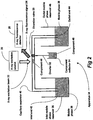
- FIG. 2 shows a schematic view of an embodiment of a screening apparatus of the invention.
- screening apparatus 34 includes inlet mobile phase reservoir 36, which provides the mobile phase 38 for capillary separator 40.
- Inlet end 42 of separator resides in inlet mobile phase reservoir 36, while outlet end 44 resides in outlet mobile phase reservoir 46.
- After mobile phase 38 fills separator 40 an amount of a mixture of potential pharmaceutical chemicals and at least one target binder is introduced into inlet end 42 of separator 40.
- Inlet end 42 is then replaced into mobile phase reservoir 36.
- An electric potential between inlet end 42 and outlet end 44 of separator 40 which drives the flow of the mobile phase 38 and of the mixture through separator 40.
- Figure 2 shows that component 48 has separated from the mixture.
- Figure 2 shows x-ray excitation source 20 directing x-ray excitation beam 22 at separated component 48, which then emits x-ray fluorescence signal 24 that is detected by x-ray fluorescence detector 26.
- the detection of an emitted x-ray fluorescence signal triggers diversion valve 50, which diverts the flow of mobile phase 36 and separated component 48 to diverter 52, which directs mobile phase 36 and separated component 48 to component collector 54:
- the separation previously described was achieved using an electric potential, which provided an electric gradient across the length of capillary separator 40.
- the separation can also be achieved by applying a pressure gradient along the length of the tube.
- the tube would include a stationary phase; a sample injection inlet would be used to introduce the solution into the tube, and a pump would provide the pressure gradient, as it does for high performance liquid chromatography.
- FIG. 2 shows, component 48 is separated along a horizontal portion of capillary separator 40.
- This particular configuration is likely not optimal for separating complexes derived from using microorganism or cell target binders.
- a separator/sorter that separates along a vertical portion is preferred.
- Figure 3 shows an embodiment of such a separator/sorter that can be used with the invention:
- Separator/sorter 56 can be used for separating and sorting mixtures derived from cells, microorganisms, microspheres having attached proteins or nucleic acids, and the like.
- Separator/sorter 56 includes vertical separator 58 through which separation occurs. As Fig. 3 shows, the mixture has been separated into component 48 and component 60.
- Component 48 is had been subjected to x-ray beam 22 from x-ray excitation source 20 has emitted an x-ray fluorescence signal, which was detected by x-ray fluorescence detector 26. This triggered a response in applied voltage source 62, which applies a voltage that deflects component 48 into collector 64. If component 60 does not emit a detectable x-ray fluorescence signal, no voltage will be applied to deflect component 60 and it will flow into collector 66. However, if component 60 emits a detectable x-ray fluorescence signal, a voltage will be applied to deflect component 60 and it will flow into collector 68.
- Separator/sorter 56 may include a laser source and associated detectors for performing conventional fluorescence activated cell sorting of the type described by Bruce Alberts et al., "Molecular Biology of the Cell", 2nd edition, Garland Publishing, Inc., New York, 1989, pages 159-160 .
- a pharmaceutical chemical is needed to bond to a specific target binder protein, for example, a large number of different potential pharmaceutical chemicals can be screened according to the invention for binding to that protein.
- the invention can be used to distinguish which of the potential pharmaceutical chemicals bind strongly to the protein from those that bind weakly or not at all.
- the protein would be combined with about 10 to 10,000 potential pharmaceutical chemicals, wherein each of the potential pharmaceutical chemicals includes at least one element having an atomic number of nine or higher.
- the potential pharmaceutical chemicals include an element having an atomic number of nine or higher that is not found in the target binder to simplify the screening method.
- the invention could be used to, for example, determine whether either cobalt ion (Co 2+ ) and/or cyanocobalamin bind to the known, biologically active protein Ure2p (see Finny G. Kuruvilla et al., "Dissecting Glucose Signaling With Diversity-Oriented Synthesis and Small-Molecule Microarrays," Nature, Vol. 416, pp. 653-657 ).
- An aqueous solution of cobalt (II) nitrate and cyanocobalamin would be added to Ure2p.
- the resulting aqueous solution would be flow separated according to the invention using, for example, a capillary electrophoresis separator.
- Any complex formed between the Ure2p and Co 2+ and/or cyanocobalamin should have a retention time that differs from either Co 2+ or cyanocobalamin, would emit a detectable x-ray fluorescence signal, and would be isolable using the invention.
- the separation could be performed using, for example, a fused silica capillary tube (Polymicro TechnologiesTM) having the following dimensions: 70 cm in length, 100 ⁇ m inner diameter (id), 170 ⁇ m outer diameter (od), and a BertanTM Model ARB-30 high voltage power supply to provide the electric potential.
- the tube could be conditioned by first flushing it with a 1.0 molar (M) solution of NaOH for 15 min, then rinsing with distilled, de-ionized water for 15 min, and then flushing and filling with 75 mM Trisma run buffer (pH 8.0) for an additional 15 min.
- M 1.0 molar
- a baseline was obtained by introducing an aqueous mixture of cobalt nitrate (Co(NO 3 ) 2 , 200 ppm Co 2+ ) and cyanocobalamin (10.2 mM) into the capillary tube, applying a potential of 10 kV between the ends of the tube, and separating the mixture into its components.
- An EDAXTM Eagle II micro x-ray fluorescence system equipped with a Rh target excitation source and a SiLi detector was used to interrogate each separated component and measure any emitted x-ray fluorescence signal.
- the x-ray tube of the system was operated at 40 kV and 1000 ⁇ A.
- the CoK ⁇ x-ray emission was monitored to detect unbound Co 2+ and cyanocobalamin.
- the spectrum acquisition time was about 10 seconds (s).
- the peak due to unbound Co 2+ was detected at about 4.5 min with a full-width-at-half-maximum (FWHM) of about 1 min.
- the cyanocobalamin peak was detected at about 8.5 min with a FWHM of about 1.5 min.
- the invention could be used to determine whether ferritin and/or cyanocobalamin bind to Ure2p.
- An aqueous solution of ferritin and cyanocobalamin would be added to Ure2p.
- the resulting aqueous solution could be flow separated using a capillary electrophoresis separator.
- the iron in ferrritin and the cobalt in cyanocobalamin each emit distinct and detectable x-ray fluorescence signals that could be used to determine whether a complex between ferritin and/or cyanocobalamin and Ure2p is formed..
- a baseline was obtained as follows: A capillary electrophoresis separator was prepared using a BertanTM Model ARB-30 high voltage power supply to provide the separation potential and a fused silica capillary tube (Polymicro TechnologiesTM) having the following dimensions: 70 cm in length, 100 ⁇ m inner diameter (id), 170 ⁇ m outer diameter (od). The tube was conditioned by first flushing it with a 1.0 molar (M) solution of NaOH for 15 min, then rinsing with distilled, de-ionized water for 15 min, and then flushing with 100 mM Trisma run buffer (pH 8.0) for an additional 15 min.
- M 1.0 molar
- the spectrum acquisition time was about 10 seconds (s).
- the peak due to Fe 3+ of ferritin was detected at about 9.3 min with a full-width-at-half-maximum (FWHM) of about 1.7 min.
- the cyanocobalamin peak was detected at about 6.3 min with a FWHM of about 1 min.
- the invention can be used in pharmaceutical metabolite studies to detect dangerous metabolic byproducts of a potential pharmaceutical chemical.
- a potential pharmaceutical chemical having at least one atom with an atomic number of nine or higher could be given to a rat (or other test animal).
- a blood sample would be taken from the rat before administering the potential pharmaceutical chemical to provide a baseline. After administering the potential pharmaceutical, blood from the rat would be examined for the presence of metabolites using the method of the invention.
- the present invention provides an apparatus and method for detecting binding events between potential pharmaceutical chemicals and target binders.
- the present invention uses micro-x-ray fluorescence to determine the presence and relative amounts of elements such as fluorine, chlorine, bromine, iodine, phosphorus, and sulfur, the latter two being important constituents of enzymes, non-enzyme proteins, DNA, and RNA.
- the invention provides a non-destructive method of screening the binding of potential pharmaceutical chemical with a target binder such as a protein or a nucleic acid. While known methods often require that the binder and/or potential pharmaceutical chemical include a covalently-bound tag that fluoresces upon exposure to ultraviolet excitation radiation, the invention does not require tagged materials.
Landscapes
- Physics & Mathematics (AREA)
- Health & Medical Sciences (AREA)
- Life Sciences & Earth Sciences (AREA)
- Chemical & Material Sciences (AREA)
- Analytical Chemistry (AREA)
- Biochemistry (AREA)
- General Health & Medical Sciences (AREA)
- General Physics & Mathematics (AREA)
- Immunology (AREA)
- Pathology (AREA)
- Analysing Materials By The Use Of Radiation (AREA)
- Investigating Or Analysing Biological Materials (AREA)
- Investigating Or Analysing Materials By The Use Of Chemical Reactions (AREA)
Claims (9)
- Ein Verfahren für das Screening potentieller pharmazeutischer Chemikalien auf Bindung an mindestens einen Ziel-Bindungspartner, umfassend die Schritte von:(a) Vorbereitung einer Lösung von potentiellen pharmazeutischen Chemikalien und mindestens einem Ziel-Bindungspartner;(b) Fluss-Trennung der Lösung in mindestens zwei getrennte Komponenten;(c) Exposition mindestens einer der Fluss-getrennten Komponenten gegenüber einem Röntgen-Anregungsstrahl; und(d) Detektion eines Röntgen-Fluoreszenzsignals, das von der mindestens einen exponierten, Fluss-getrennten Komponente emittiert wurde;dadurch charakterisiert, dass das Verfahren zusätzlich den Schritt von(e) Isolierung jeglicher Fluss-getrennter Komponenten mit einem detektierbaren Röntgen-Fluoreszenz-Signalumfasst und dass ein energiedispersives Röntgenfluoreszenz-Spektrometer, ausgestattet mit einer Mikrofokus-Röntgenröhre, verwendet wird.
- Das Verfahren von Anspruch 1, wobei der Röntgen-Anregungsstrahl Röntgenstrahlen mit Energien größer als 10 keV umfasst.
- Das Verfahren von Anspruch 1, wobei der Röntgen-Anregungsstrahl eine Leistung von weniger als etwa 100 Watt umfasst.
- Das Verfahren von Anspruch 1, außerdem umfassend den Schritt von Bestimmung der Identität der isolierten Fluss-getrennten Komponenten.
- Das Verfahren von Anspruch 1, wobei die potentiellen pharmazeutischen Chemikalien mindestens ein Element mit einer Ordnungszahl größer als Acht umfassen.
- Das Verfahren von Anspruch 5, wobei das mindestens eine Element mit einer Ordnungszahl größer als Acht ausgewählt ist aus Fluor, Chlor, Brom, Iod, Schwefel, Phosphor, Selen, Lanthan, Cer, Praseodym, Neodym, Samarium, Europium, Gadolinium, Terbium, Dysprosium, Holinium, Erbium, Thulium, Ytterbium, Lutetium, Antimon, Bismut und Arsen.
- Eine Vorrichtung für das Screening potentieller pharmazeutischer Chemikalien auf Bindung an mindestens einen Ziel-Bildungspartner, in Kombination umfassend:(a) einen Behälter für eine Lösung von potentiellen pharmazeutischen Chemikalien und mindestens einem Ziel-Bindungspartner, wobei jene potentiellen pharmazeutischen Chemikalien ein Element mit einer Ordnungszahl von mindestens Neun umfassen;(b) einen Fluss-Separator zum Trennen jener Lösung in mindestens zwei getrennte Komponenten;(c) eine Röntgen-Anregungsquelle zur Exposition mindestens einer jener Fluss-getrennten Komponenten gegenüber einem Röntgen-Anregungsstrahl; und(d) einen Röntgen-Detektor zur Detektion eines Röntgen-Fluoreszenzsignals, das von einer Fluss-getrennten Komponenten emittiert wurde;dadurch charakterisiert, dass die Vorrichtung zusätzlich(e) einen Ableiter zur Ableitung jener ausgewählten Fluss-getrennten Komponente von der verbleibenden Mischung umfasst,und das die Röntgen-Anregungsquelle ein energiedispersives Röntgen-Fluoreszenz-Spektrometer ist, ausgestattet mit einer Mikrofokus-Röntgenröhre.
- Die Vorrichtung von Anspruch 7, wobei jener Röntgen-Anregungsstrahl Röntgenstrahlen mit Energien größer als 10 keV umfasst.
- Die Vorrichtung von Anspruch 7, wobei jener Röntgen-Anregungsstrahl eine Leistung von weniger als etwa 100 Watt umfasst.
Applications Claiming Priority (3)
| Application Number | Priority Date | Filing Date | Title |
|---|---|---|---|
| US10/206,524 US20040017884A1 (en) | 2002-07-25 | 2002-07-25 | Flow method and apparatus for screening chemicals using micro x-ray fluorescence |
| US206524 | 2002-07-25 | ||
| PCT/US2003/020103 WO2004011898A2 (en) | 2002-07-25 | 2003-06-24 | Flow method and apparatus for screening chemicals using micro x-ray fluorescence |
Publications (3)
| Publication Number | Publication Date |
|---|---|
| EP1525458A2 EP1525458A2 (de) | 2005-04-27 |
| EP1525458A4 EP1525458A4 (de) | 2009-08-19 |
| EP1525458B1 true EP1525458B1 (de) | 2017-03-08 |
Family
ID=30770310
Family Applications (1)
| Application Number | Title | Priority Date | Filing Date |
|---|---|---|---|
| EP03748920.0A Expired - Lifetime EP1525458B1 (de) | 2002-07-25 | 2003-06-24 | Strömungsverfahren und -vorrichtung zum screening von chemikalien mithilfe von mikroröntgenfluoreszenz |
Country Status (7)
| Country | Link |
|---|---|
| US (2) | US20040017884A1 (de) |
| EP (1) | EP1525458B1 (de) |
| JP (1) | JP4560403B2 (de) |
| AU (1) | AU2003267973A1 (de) |
| DK (1) | DK1525458T3 (de) |
| ES (1) | ES2623296T3 (de) |
| WO (1) | WO2004011898A2 (de) |
Families Citing this family (12)
| Publication number | Priority date | Publication date | Assignee | Title |
|---|---|---|---|---|
| US20080220441A1 (en) | 2001-05-16 | 2008-09-11 | Birnbaum Eva R | Advanced drug development and manufacturing |
| US9157875B2 (en) * | 2001-05-16 | 2015-10-13 | Benjamin P. Warner | Drug development and manufacturing |
| JP2006029921A (ja) * | 2004-07-14 | 2006-02-02 | Institute Of Physical & Chemical Research | フローサイトメーター |
| US7581130B2 (en) | 2004-11-12 | 2009-08-25 | Hewlett-Packard Development Company, L.P. | Power management system and method |
| JP5143841B2 (ja) * | 2006-10-10 | 2013-02-13 | ロス アラモス ナショナル セキュリティー,エルエルシー | 高度な薬物開発及び製造 |
| US7892492B2 (en) * | 2006-12-07 | 2011-02-22 | University Of Connecticut | Flow-through apparatus for microscopic investigation of dissolution of pharmaceutical solids |
| US8687189B2 (en) * | 2008-03-03 | 2014-04-01 | Ajjer, Llc | Analysis of arrays by laser induced breakdown spectroscopy |
| CA2882003C (en) * | 2012-08-17 | 2020-11-10 | Japan Science And Technology Agency | Method and apparatus for analyzing biomolecules using raman spectroscopy |
| JP5437525B1 (ja) | 2012-12-28 | 2014-03-12 | 株式会社ナード研究所 | チロシン誘導体およびチロシン誘導体の製造方法 |
| WO2017024035A1 (en) * | 2015-08-03 | 2017-02-09 | UHV Technologies, Inc. | Metal analysis during pharmaceutical manufacturing |
| WO2021016795A1 (en) * | 2019-07-29 | 2021-02-04 | Shenzhen Xpectvision Technology Co., Ltd. | Biological imaging method using x-ray fluorescence |
| CN110608981A (zh) * | 2019-09-09 | 2019-12-24 | 中国科学院高能物理研究所 | 一种测定植物中硫化汞纳米颗粒的方法 |
Citations (1)
| Publication number | Priority date | Publication date | Assignee | Title |
|---|---|---|---|---|
| WO1996040398A1 (en) * | 1995-06-07 | 1996-12-19 | Biosepra Inc. | On line detection of a desired solute in an effluent stream using fluorescence spectroscopy |
Family Cites Families (14)
| Publication number | Priority date | Publication date | Assignee | Title |
|---|---|---|---|---|
| US4745285A (en) * | 1986-08-21 | 1988-05-17 | Becton Dickinson And Company | Multi-color fluorescence analysis with single wavelength excitation |
| US5252743A (en) * | 1989-11-13 | 1993-10-12 | Affymax Technologies N.V. | Spatially-addressable immobilization of anti-ligands on surfaces |
| US5854084A (en) * | 1996-07-12 | 1998-12-29 | Biotraces, Inc. | Enhanced chromatography using multiphoton detection |
| US5493122A (en) * | 1994-02-04 | 1996-02-20 | Nucleonics Development Company | Energy resolving x-ray detector |
| US5660703A (en) * | 1995-05-31 | 1997-08-26 | The Dow Chemical Company | Apparatus for capillary electrophoresis having an auxiliary electroosmotic pump |
| US6027890A (en) * | 1996-01-23 | 2000-02-22 | Rapigene, Inc. | Methods and compositions for enhancing sensitivity in the analysis of biological-based assays |
| US5668373A (en) * | 1996-04-26 | 1997-09-16 | Trustees Of Tufts College | Methods and apparatus for analysis of complex mixtures |
| US5982847A (en) * | 1996-10-28 | 1999-11-09 | Utah State University | Compact X-ray fluorescence spectrometer for real-time wear metal analysis of lubrucating oils |
| US6207861B1 (en) * | 1998-01-05 | 2001-03-27 | Neogenesis, Inc. | Method for producing and screening mass coded combinatorial libraries for drug discovery and target validation |
| US6344330B1 (en) * | 1998-03-27 | 2002-02-05 | The Regents Of The University Of California | Pharmacophore recombination for the identification of small molecule drug lead compounds |
| US6054047A (en) * | 1998-03-27 | 2000-04-25 | Synsorb Biotech, Inc. | Apparatus for screening compound libraries |
| US6147344A (en) * | 1998-10-15 | 2000-11-14 | Neogenesis, Inc | Method for identifying compounds in a chemical mixture |
| US6496562B1 (en) * | 1999-01-23 | 2002-12-17 | Merck Patentgesellschaft Mit Beschrankter Haftung | Energy dispersion x-ray fluorescence analysis of chemical subtances |
| US6697454B1 (en) * | 2000-06-29 | 2004-02-24 | X-Ray Optical Systems, Inc. | X-ray analytical techniques applied to combinatorial library screening |
-
2002
- 2002-07-25 US US10/206,524 patent/US20040017884A1/en not_active Abandoned
-
2003
- 2003-06-24 EP EP03748920.0A patent/EP1525458B1/de not_active Expired - Lifetime
- 2003-06-24 DK DK03748920.0T patent/DK1525458T3/en active
- 2003-06-24 WO PCT/US2003/020103 patent/WO2004011898A2/en not_active Ceased
- 2003-06-24 JP JP2004524531A patent/JP4560403B2/ja not_active Expired - Fee Related
- 2003-06-24 ES ES03748920.0T patent/ES2623296T3/es not_active Expired - Lifetime
- 2003-06-24 AU AU2003267973A patent/AU2003267973A1/en not_active Abandoned
-
2005
- 2005-05-09 US US11/125,036 patent/US20050214847A1/en not_active Abandoned
Patent Citations (1)
| Publication number | Priority date | Publication date | Assignee | Title |
|---|---|---|---|---|
| WO1996040398A1 (en) * | 1995-06-07 | 1996-12-19 | Biosepra Inc. | On line detection of a desired solute in an effluent stream using fluorescence spectroscopy |
Also Published As
| Publication number | Publication date |
|---|---|
| WO2004011898A3 (en) | 2004-12-02 |
| EP1525458A4 (de) | 2009-08-19 |
| US20040017884A1 (en) | 2004-01-29 |
| AU2003267973A8 (en) | 2004-02-16 |
| EP1525458A2 (de) | 2005-04-27 |
| US20050214847A1 (en) | 2005-09-29 |
| DK1525458T3 (en) | 2017-04-24 |
| AU2003267973A1 (en) | 2004-02-16 |
| JP2006503268A (ja) | 2006-01-26 |
| ES2623296T3 (es) | 2017-07-10 |
| JP4560403B2 (ja) | 2010-10-13 |
| WO2004011898A2 (en) | 2004-02-05 |
Similar Documents
| Publication | Publication Date | Title |
|---|---|---|
| US7929662B2 (en) | Flow method and apparatus for screening chemicals using micro x-ray fluorescence | |
| US6858148B2 (en) | Method and apparatus for detecting chemical binding | |
| Klepárník et al. | Recent advances in the development of single cell analysis—A review | |
| US7858385B2 (en) | Method for detecting binding events using micro-X-ray fluorescence spectrometry | |
| US7767407B2 (en) | Elemental analysis of tagged biologically active materials | |
| Giesen et al. | History of inductively coupled plasma mass spectrometry-based immunoassays | |
| DK1525458T3 (en) | FLOW METHOD AND DEVICE FOR SCREENING CHEMICALS USING MICRO X-ray Fluorescence | |
| Alanazi | Recent advances in liquid chromatography–mass spectrometry (LC–MS) applications in biological and applied sciences | |
| Gao et al. | Advanced nuclear analytical techniques for metalloproteomics | |
| Li et al. | Metallomics, elementomics, and analytical techniques. | |
| Ahuja et al. | Modern instrumental analysis | |
| WO2010033452A2 (en) | Mono-and multi-element coded libs assays and methods | |
| JP2007538262A (ja) | 質量分析を使用する発現の定量化 | |
| US6328700B1 (en) | Locating marker/tracer elements detectable by neutron activated analysis within or on carrier microspheres, including microspheres used in biological experimentation | |
| US20040235059A1 (en) | Drug development and manufacturing | |
| Zhou et al. | Metal-detection based techniques and their applications in metallobiology | |
| Stanberry et al. | Mapping of lanthanide-tagged proteins on western blot paper using microextraction-inductively coupled plasma-mass spectrometry | |
| Smith et al. | In vivo measurement and speciation of nephrotoxic metals | |
| Warner et al. | Method And Apparatus For Detecting Chemical Binding | |
| J. Reis et al. | Evaluation of post-surgical cognitive function and protein fingerprints in the cerebro-spinal fluid utilizing surface-enhanced laser desorption/ionization time-of-flight mass-spectrometry (SELDI-TOF MS) after coronary artery bypass grafting: review of proteomic analytic tools and introducing a new syndrome | |
| Gajula et al. | Advanced Analytical Techniques for Biologics Characterization | |
| Reyzer et al. | Imaging mass spectrometry | |
| Aebersold et al. | Isotope-coded affinity tagging of proteins | |
| EP3176581A1 (de) | Baukasten für ein multiplex-drug discovery system mit high-throughput eigenschaften | |
| Minogue et al. | High-throughput screening of metal chelating compounds |
Legal Events
| Date | Code | Title | Description |
|---|---|---|---|
| PUAI | Public reference made under article 153(3) epc to a published international application that has entered the european phase |
Free format text: ORIGINAL CODE: 0009012 |
|
| 17P | Request for examination filed |
Effective date: 20050118 |
|
| AK | Designated contracting states |
Kind code of ref document: A2 Designated state(s): AT BE BG CH CY CZ DE DK EE ES FI FR GB GR HU IE IT LI LU MC NL PT RO SE SI SK TR |
|
| AX | Request for extension of the european patent |
Extension state: AL LT LV MK |
|
| DAX | Request for extension of the european patent (deleted) | ||
| RIN1 | Information on inventor provided before grant (corrected) |
Inventor name: WELLS, CYNDI, A. Inventor name: LEWIS, CRIS, L. Inventor name: WARNER, BENJAMIN, P. Inventor name: MILLER, THOMASIN, C. Inventor name: MAHAN, CYNTHIA, A. Inventor name: HAVRILLA, GEORGE, J. |
|
| A4 | Supplementary search report drawn up and despatched |
Effective date: 20090722 |
|
| 17Q | First examination report despatched |
Effective date: 20091110 |
|
| RAP1 | Party data changed (applicant data changed or rights of an application transferred) |
Owner name: THE REGENTS OF THE UNIVERSITY OF CALIFORNIA |
|
| RAP1 | Party data changed (applicant data changed or rights of an application transferred) |
Owner name: XRPRO SCIENCES, INC. |
|
| RAP1 | Party data changed (applicant data changed or rights of an application transferred) |
Owner name: ICAGEN, INC. |
|
| GRAP | Despatch of communication of intention to grant a patent |
Free format text: ORIGINAL CODE: EPIDOSNIGR1 |
|
| GRAJ | Information related to disapproval of communication of intention to grant by the applicant or resumption of examination proceedings by the epo deleted |
Free format text: ORIGINAL CODE: EPIDOSDIGR1 |
|
| GRAP | Despatch of communication of intention to grant a patent |
Free format text: ORIGINAL CODE: EPIDOSNIGR1 |
|
| GRAJ | Information related to disapproval of communication of intention to grant by the applicant or resumption of examination proceedings by the epo deleted |
Free format text: ORIGINAL CODE: EPIDOSDIGR1 |
|
| INTG | Intention to grant announced |
Effective date: 20160804 |
|
| INTG | Intention to grant announced |
Effective date: 20160817 |
|
| GRAP | Despatch of communication of intention to grant a patent |
Free format text: ORIGINAL CODE: EPIDOSNIGR1 |
|
| INTC | Intention to grant announced (deleted) | ||
| INTG | Intention to grant announced |
Effective date: 20160926 |
|
| STAA | Information on the status of an ep patent application or granted ep patent |
Free format text: STATUS: GRANT OF PATENT IS INTENDED |
|
| GRAS | Grant fee paid |
Free format text: ORIGINAL CODE: EPIDOSNIGR3 |
|
| GRAA | (expected) grant |
Free format text: ORIGINAL CODE: 0009210 |
|
| STAA | Information on the status of an ep patent application or granted ep patent |
Free format text: STATUS: THE PATENT HAS BEEN GRANTED |
|
| AK | Designated contracting states |
Kind code of ref document: B1 Designated state(s): AT BE BG CH CY CZ DE DK EE ES FI FR GB GR HU IE IT LI LU MC NL PT RO SE SI SK TR |
|
| REG | Reference to a national code |
Ref country code: GB Ref legal event code: FG4D |
|
| REG | Reference to a national code |
Ref country code: CH Ref legal event code: EP Ref country code: AT Ref legal event code: REF Ref document number: 873969 Country of ref document: AT Kind code of ref document: T Effective date: 20170315 |
|
| REG | Reference to a national code |
Ref country code: IE Ref legal event code: FG4D |
|
| REG | Reference to a national code |
Ref country code: NL Ref legal event code: FP |
|
| REG | Reference to a national code |
Ref country code: DE Ref legal event code: R096 Ref document number: 60349973 Country of ref document: DE |
|
| REG | Reference to a national code |
Ref country code: DK Ref legal event code: T3 Effective date: 20170420 |
|
| REG | Reference to a national code |
Ref country code: SE Ref legal event code: TRGR |
|
| REG | Reference to a national code |
Ref country code: CH Ref legal event code: NV Representative=s name: PATENTANWALT MATTHIAS W. SCHAEFER, CH |
|
| REG | Reference to a national code |
Ref country code: FR Ref legal event code: PLFP Year of fee payment: 15 |
|
| REG | Reference to a national code |
Ref country code: ES Ref legal event code: FG2A Ref document number: 2623296 Country of ref document: ES Kind code of ref document: T3 Effective date: 20170710 |
|
| PG25 | Lapsed in a contracting state [announced via postgrant information from national office to epo] |
Ref country code: GR Free format text: LAPSE BECAUSE OF FAILURE TO SUBMIT A TRANSLATION OF THE DESCRIPTION OR TO PAY THE FEE WITHIN THE PRESCRIBED TIME-LIMIT Effective date: 20170609 |
|
| REG | Reference to a national code |
Ref country code: AT Ref legal event code: MK05 Ref document number: 873969 Country of ref document: AT Kind code of ref document: T Effective date: 20170308 |
|
| PG25 | Lapsed in a contracting state [announced via postgrant information from national office to epo] |
Ref country code: BG Free format text: LAPSE BECAUSE OF FAILURE TO SUBMIT A TRANSLATION OF THE DESCRIPTION OR TO PAY THE FEE WITHIN THE PRESCRIBED TIME-LIMIT Effective date: 20170608 |
|
| PG25 | Lapsed in a contracting state [announced via postgrant information from national office to epo] |
Ref country code: RO Free format text: LAPSE BECAUSE OF FAILURE TO SUBMIT A TRANSLATION OF THE DESCRIPTION OR TO PAY THE FEE WITHIN THE PRESCRIBED TIME-LIMIT Effective date: 20170308 Ref country code: SK Free format text: LAPSE BECAUSE OF FAILURE TO SUBMIT A TRANSLATION OF THE DESCRIPTION OR TO PAY THE FEE WITHIN THE PRESCRIBED TIME-LIMIT Effective date: 20170308 Ref country code: AT Free format text: LAPSE BECAUSE OF FAILURE TO SUBMIT A TRANSLATION OF THE DESCRIPTION OR TO PAY THE FEE WITHIN THE PRESCRIBED TIME-LIMIT Effective date: 20170308 Ref country code: EE Free format text: LAPSE BECAUSE OF FAILURE TO SUBMIT A TRANSLATION OF THE DESCRIPTION OR TO PAY THE FEE WITHIN THE PRESCRIBED TIME-LIMIT Effective date: 20170308 Ref country code: CZ Free format text: LAPSE BECAUSE OF FAILURE TO SUBMIT A TRANSLATION OF THE DESCRIPTION OR TO PAY THE FEE WITHIN THE PRESCRIBED TIME-LIMIT Effective date: 20170308 |
|
| PG25 | Lapsed in a contracting state [announced via postgrant information from national office to epo] |
Ref country code: PT Free format text: LAPSE BECAUSE OF FAILURE TO SUBMIT A TRANSLATION OF THE DESCRIPTION OR TO PAY THE FEE WITHIN THE PRESCRIBED TIME-LIMIT Effective date: 20170710 |
|
| REG | Reference to a national code |
Ref country code: DE Ref legal event code: R097 Ref document number: 60349973 Country of ref document: DE |
|
| PLBE | No opposition filed within time limit |
Free format text: ORIGINAL CODE: 0009261 |
|
| STAA | Information on the status of an ep patent application or granted ep patent |
Free format text: STATUS: NO OPPOSITION FILED WITHIN TIME LIMIT |
|
| PG25 | Lapsed in a contracting state [announced via postgrant information from national office to epo] |
Ref country code: MC Free format text: LAPSE BECAUSE OF FAILURE TO SUBMIT A TRANSLATION OF THE DESCRIPTION OR TO PAY THE FEE WITHIN THE PRESCRIBED TIME-LIMIT Effective date: 20170308 |
|
| 26N | No opposition filed |
Effective date: 20171211 |
|
| PG25 | Lapsed in a contracting state [announced via postgrant information from national office to epo] |
Ref country code: SI Free format text: LAPSE BECAUSE OF FAILURE TO SUBMIT A TRANSLATION OF THE DESCRIPTION OR TO PAY THE FEE WITHIN THE PRESCRIBED TIME-LIMIT Effective date: 20170308 |
|
| REG | Reference to a national code |
Ref country code: IE Ref legal event code: MM4A |
|
| PG25 | Lapsed in a contracting state [announced via postgrant information from national office to epo] |
Ref country code: IE Free format text: LAPSE BECAUSE OF NON-PAYMENT OF DUE FEES Effective date: 20170624 Ref country code: LU Free format text: LAPSE BECAUSE OF NON-PAYMENT OF DUE FEES Effective date: 20170624 |
|
| REG | Reference to a national code |
Ref country code: CH Ref legal event code: PCAR Free format text: NEW ADDRESS: SPLUEGENSTRASSE 10, 8002 ZUERICH (CH) |
|
| REG | Reference to a national code |
Ref country code: FR Ref legal event code: PLFP Year of fee payment: 16 |
|
| PG25 | Lapsed in a contracting state [announced via postgrant information from national office to epo] |
Ref country code: HU Free format text: LAPSE BECAUSE OF FAILURE TO SUBMIT A TRANSLATION OF THE DESCRIPTION OR TO PAY THE FEE WITHIN THE PRESCRIBED TIME-LIMIT; INVALID AB INITIO Effective date: 20030624 |
|
| PGFP | Annual fee paid to national office [announced via postgrant information from national office to epo] |
Ref country code: FI Payment date: 20190620 Year of fee payment: 17 Ref country code: NL Payment date: 20190619 Year of fee payment: 17 Ref country code: DK Payment date: 20190621 Year of fee payment: 17 |
|
| PGFP | Annual fee paid to national office [announced via postgrant information from national office to epo] |
Ref country code: CH Payment date: 20190619 Year of fee payment: 17 |
|
| PG25 | Lapsed in a contracting state [announced via postgrant information from national office to epo] |
Ref country code: CY Free format text: LAPSE BECAUSE OF NON-PAYMENT OF DUE FEES Effective date: 20170308 |
|
| PGFP | Annual fee paid to national office [announced via postgrant information from national office to epo] |
Ref country code: GB Payment date: 20190619 Year of fee payment: 17 Ref country code: ES Payment date: 20190719 Year of fee payment: 17 |
|
| PG25 | Lapsed in a contracting state [announced via postgrant information from national office to epo] |
Ref country code: TR Free format text: LAPSE BECAUSE OF FAILURE TO SUBMIT A TRANSLATION OF THE DESCRIPTION OR TO PAY THE FEE WITHIN THE PRESCRIBED TIME-LIMIT Effective date: 20170308 |
|
| PGFP | Annual fee paid to national office [announced via postgrant information from national office to epo] |
Ref country code: FR Payment date: 20200512 Year of fee payment: 18 |
|
| PGFP | Annual fee paid to national office [announced via postgrant information from national office to epo] |
Ref country code: BE Payment date: 20200515 Year of fee payment: 18 Ref country code: IT Payment date: 20200512 Year of fee payment: 18 |
|
| REG | Reference to a national code |
Ref country code: DE Ref legal event code: R119 Ref document number: 60349973 Country of ref document: DE |
|
| REG | Reference to a national code |
Ref country code: FI Ref legal event code: MAE |
|
| REG | Reference to a national code |
Ref country code: DK Ref legal event code: EBP Effective date: 20200630 |
|
| PG25 | Lapsed in a contracting state [announced via postgrant information from national office to epo] |
Ref country code: FI Free format text: LAPSE BECAUSE OF NON-PAYMENT OF DUE FEES Effective date: 20200624 |
|
| REG | Reference to a national code |
Ref country code: CH Ref legal event code: PL |
|
| REG | Reference to a national code |
Ref country code: NL Ref legal event code: MM Effective date: 20200701 |
|
| GBPC | Gb: european patent ceased through non-payment of renewal fee |
Effective date: 20200624 |
|
| PG25 | Lapsed in a contracting state [announced via postgrant information from national office to epo] |
Ref country code: CH Free format text: LAPSE BECAUSE OF NON-PAYMENT OF DUE FEES Effective date: 20200630 Ref country code: LI Free format text: LAPSE BECAUSE OF NON-PAYMENT OF DUE FEES Effective date: 20200630 Ref country code: GB Free format text: LAPSE BECAUSE OF NON-PAYMENT OF DUE FEES Effective date: 20200624 Ref country code: NL Free format text: LAPSE BECAUSE OF NON-PAYMENT OF DUE FEES Effective date: 20200701 |
|
| PG25 | Lapsed in a contracting state [announced via postgrant information from national office to epo] |
Ref country code: DE Free format text: LAPSE BECAUSE OF NON-PAYMENT OF DUE FEES Effective date: 20210101 Ref country code: SE Free format text: LAPSE BECAUSE OF NON-PAYMENT OF DUE FEES Effective date: 20200625 |
|
| PG25 | Lapsed in a contracting state [announced via postgrant information from national office to epo] |
Ref country code: DK Free format text: LAPSE BECAUSE OF NON-PAYMENT OF DUE FEES Effective date: 20200630 |
|
| REG | Reference to a national code |
Ref country code: SE Ref legal event code: EUG |
|
| REG | Reference to a national code |
Ref country code: ES Ref legal event code: FD2A Effective date: 20211103 |
|
| PG25 | Lapsed in a contracting state [announced via postgrant information from national office to epo] |
Ref country code: ES Free format text: LAPSE BECAUSE OF NON-PAYMENT OF DUE FEES Effective date: 20200625 |
|
| REG | Reference to a national code |
Ref country code: BE Ref legal event code: MM Effective date: 20210630 |
|
| PG25 | Lapsed in a contracting state [announced via postgrant information from national office to epo] |
Ref country code: FR Free format text: LAPSE BECAUSE OF NON-PAYMENT OF DUE FEES Effective date: 20210630 |
|
| PG25 | Lapsed in a contracting state [announced via postgrant information from national office to epo] |
Ref country code: IT Free format text: LAPSE BECAUSE OF NON-PAYMENT OF DUE FEES Effective date: 20210624 Ref country code: BE Free format text: LAPSE BECAUSE OF NON-PAYMENT OF DUE FEES Effective date: 20210630 |