EP1524865A1 - Multi-plane display for displaying overlapping images - Google Patents
Multi-plane display for displaying overlapping images Download PDFInfo
- Publication number
- EP1524865A1 EP1524865A1 EP03078288A EP03078288A EP1524865A1 EP 1524865 A1 EP1524865 A1 EP 1524865A1 EP 03078288 A EP03078288 A EP 03078288A EP 03078288 A EP03078288 A EP 03078288A EP 1524865 A1 EP1524865 A1 EP 1524865A1
- Authority
- EP
- European Patent Office
- Prior art keywords
- image
- state
- screen
- displaying
- normal appearance
- Prior art date
- Legal status (The legal status is an assumption and is not a legal conclusion. Google has not performed a legal analysis and makes no representation as to the accuracy of the status listed.)
- Withdrawn
Links
Images


Classifications
-
- G—PHYSICS
- G09—EDUCATION; CRYPTOGRAPHY; DISPLAY; ADVERTISING; SEALS
- G09G—ARRANGEMENTS OR CIRCUITS FOR CONTROL OF INDICATING DEVICES USING STATIC MEANS TO PRESENT VARIABLE INFORMATION
- G09G3/00—Control arrangements or circuits, of interest only in connection with visual indicators other than cathode-ray tubes
- G09G3/20—Control arrangements or circuits, of interest only in connection with visual indicators other than cathode-ray tubes for presentation of an assembly of a number of characters, e.g. a page, by composing the assembly by combination of individual elements arranged in a matrix no fixed position being assigned to or needed to be assigned to the individual characters or partial characters
-
- H—ELECTRICITY
- H04—ELECTRIC COMMUNICATION TECHNIQUE
- H04N—PICTORIAL COMMUNICATION, e.g. TELEVISION
- H04N13/00—Stereoscopic video systems; Multi-view video systems; Details thereof
- H04N13/30—Image reproducers
- H04N13/398—Synchronisation thereof; Control thereof
-
- H—ELECTRICITY
- H04—ELECTRIC COMMUNICATION TECHNIQUE
- H04N—PICTORIAL COMMUNICATION, e.g. TELEVISION
- H04N13/00—Stereoscopic video systems; Multi-view video systems; Details thereof
-
- H—ELECTRICITY
- H04—ELECTRIC COMMUNICATION TECHNIQUE
- H04N—PICTORIAL COMMUNICATION, e.g. TELEVISION
- H04N13/00—Stereoscopic video systems; Multi-view video systems; Details thereof
- H04N13/30—Image reproducers
- H04N13/346—Image reproducers using prisms or semi-transparent mirrors
-
- H—ELECTRICITY
- H04—ELECTRIC COMMUNICATION TECHNIQUE
- H04N—PICTORIAL COMMUNICATION, e.g. TELEVISION
- H04N13/00—Stereoscopic video systems; Multi-view video systems; Details thereof
- H04N13/30—Image reproducers
- H04N13/388—Volumetric displays, i.e. systems where the image is built up from picture elements distributed through a volume
- H04N13/395—Volumetric displays, i.e. systems where the image is built up from picture elements distributed through a volume with depth sampling, i.e. the volume being constructed from a stack or sequence of two-dimensional [2D] image planes
Definitions
- the invention relates to a multi-plane display for the display of images.
- the invention further relates to a method of displaying images on a multi-plane display.
- Multi-plane displays are presently known in the art. Usually they comprise a light source, which can be planar, and a plurality of interspaced, overlapping, translucent image screens, which can be simultaneously controlled to display images that have a spatial or three-dimensional character.
- a multi-plane display is described in the patent publication WO011 S 127. Such displays can be used for various purposes like for amusement, games, but also for showing complex information like in military applications, where it is desirable to show overlapping graphical information in one three dimensional view.
- the plurality of image screens comprises liquid crystal displays (LCD's). These LCD's can be black-and-white or colour displays.
- the plurality of image screens can be viewed using a light source, whereby the image screens are placed between the light source and the viewer.
- the light source can be planar such as a LCD backlighting device, placed in parallel close to the image screens, but the light source can also be the daylight or a daylight lit background placed in the line of sight and viewable through the image screens.
- each image screen may present a plurality of images. A first image, having a first appearance on a first image screen, may be occluded by a second image having a second appearance on a second image screen.
- An appearance may be a colour or a grey tone.
- An appearance may have a brightness ranging from transparent to full saturation, so for example in case of the colour red from transparent to fully saturated red, or in the case of grey tones from transparent to black, where black means that the light source is fully occluded by the image screen.
- An appearance may also include a pattern and the pattern may represent a texture.
- the resulting image when viewed from a viewpoint mainly perpendicular with respect to the front plane of the display, than shows, where the first and second image overlap, an appearance which corresponds to the mixed appearance of the first and second appearance.
- the mixed appearance arises from the absorption or subtraction of colour components of the first image by the colour of the second image.
- grey tone the appearance of the overlapping image parts is darker.
- pattern the overlapping parts appear to have a mixed pattern.
- a multi-layer display may comprise a light source, a first translucent image screen, whereby the first image screen can overlap and be placed substantially parallel with the light source, arranged for displaying a first image, having a first appearance, e.g.
- the first screen is capable of displaying the first image in one of a transparent state, a normal appearance state and an occluded state
- the display further comprising a second translucent image screen , whereby the second image screen can be placed spatially separated along a viewing axis perpendicular to the light source and placed substantially parallel to and overlapping with the first image screen, arranged for displaying a second image, having a second appearance, e.g.
- the second screen is capable of displaying the second image in one of a transparent state, a normal appearance state and an occluded state
- the first image screen is controllable to alternate at least part of the first image between transparent state and a normal appearance state
- the second image screen is controllable to synchronously with the first image screen alternate at least part of the second image between an occluded state and a normal appearance state
- the normal appearance state of the first image occurs simultaneously with the occluded state of the second image and the transparent state of the first image occurs simultaneously with the normal appearance state of the second image.
- displayed images on the first and second image screen that overlap from a viewing point which is usually more or less along an axis perpendicular to the light source, retain their correct appearance. Images appear as opaque. No undesired interference occurs. So even a white image can appear correctly on top of a black image.
- the alternation of images or part of the image screens has to be fast, preferably at rates from 20 Hz or more in order to minimize the perceived flicker by a viewer.
- the phenomenon of flicker is well known form for example television sets or data monitor using cathode ray tubes.
- a first embodiment according to the invention wherein the first image screen can be controllable to occlude at least part of the first image screen not belonging to the first image, while displaying the first image in the normal appearance state, has the advantage that the background of the images when viewed together appears darker. In this way a trade-off is achieved between image brightness and appearance preservation of the overlapping images.
- a second and preferred embodiment according to the invention wherein the second image screen can be controllable to occlude at least part of the second image screen not belonging to the second image, while displaying the second image in the normal appearance state, also has the advantage that the background of the images when viewed together appears darker. In this embodiment the best perceived result is obtained. The luminance ratios is best preserved, since all features visible through the combined image screen are mixed with occluded or "black".
- the first and second embodiment combined give when viewed together an occluded or black appearing background, whereas the first and second image appear overlapping with their appearance preserved.
- the colour saturation of overlapping images is preserved optimally, and also there is less flicker, because the background remains occluded.
- first and second image screen are arranged to synchronously alternate only the overlapping part of the first and second images, as viewable along the viewing axis perpendicular to the light source, the area that needs alternation is minimised thereby substantially reducing flicker of the image screens.
- the third image is displayable in an occluded state simultaneously with the first image in a normal appearance state and the second image in an occluded state, and wherein the third image is displayable in a normal appearance state simultaneously with the first image in a transparent state and the second image in an occluded state, and wherein the third image is displayable in a transparent state simultaneously with the first image in a transparent state and the second image in a normal appearance state and wherein the simultaneous states of the first second and third images are alterable synchronously, it is possible to display more than two overlapping images retaining their appearance.
- the object is also achieved according to the invention by means of a method for displaying coloured images on a multi-layer display, the multi-layer display having a light source, a first translucent image screen, whereby the first image screen overlaps with and is placed substantially parallel with the light source, arranged for displaying a first image, having a first appearance, e.g.
- the first screen can be capable of displaying the first images in one of a transparent state, a normal appearance state and an occluded state, and a second translucent image screen , whereby the second image screen can be placed spatially separated along a viewing axis perpendicular to the light source and placed substantially parallel to and overlapping with the first image screen, arranged for displaying a second image, having a second appearance, e.g.
- the second screen can be capable of displaying the second image in one of a transparent state, a normal appearance state and an occluded state, the method comprising alternating at least part of the first image between a transparent state and a normal appearance state and synchronously alternating at least part of the second image between an occluded state and a normal appearance state.
- displayed images on the first and second image screen that overlap from a viewing point, which is usually more or less along an axis perpendicular to the light source, retain their correct appearance. Images appear as opaque. No undesired interference occurs. So even a white image can appear correctly on top of a black image.
- an fourth embodiment according to the invention further comprising occluding at least part of the second image screen not belonging to the second image, when the second image is displayed in the normal appearance state, also has the advantage that the background of the images when viewed together appears darker.
- the third and fourth embodiment combined give when viewed together an occluded or black appearing background, whereas the first and second image appear overlapping with their appearance preserved. The colour saturation of overlapping images is preserved optimally.
- each plane comprises a image screen which can be a liquid crystal display.
- each image screen is transparent.
- Fig 1 shows a basic construction of a multi-plane display 1 according to the state of the art.
- a light source 2 may constructively be part of the display 1, but this is not necessarily the case.
- the light source 2 may also be a light emitting or light reflecting surface remote from the display 1.
- the display 1 further comprises at least a first 3 and a second image screen 4, placed more or less parallel and overlapping from a viewer's position 13.
- the relative positions of the image screens 3,4 are between the viewer's position 13 and the light source 2.
- the image screens 3, 4 are placed substantially perpendicular to the viewing axis 14 between the viewing point 13 and the light source 2.
- the image screens 3, 4 are transparent and fit for displaying images having an appearance in at least one of colour and grey tone.
- image screens 3,4 can in whole or in part be occluded, which means that viewed from a viewers position towards the light source 2, the occluded part of either of the image screens 3,4 appears as black.
- image screens 3, 4 can be liquid crystal displays (LCD's), but other technologies can be possible.
- the image screens 3, 4 can be constructively integrated into a display by means of supporting means 5.
- the supporting means 5 may comprise supports, props, frames etc..
- the relative distance between the image screens may vary depending on the image screen diameters and is not essential for the invention. Essential is that images can be viewed as overlapping. Additional image screens may be mounted to the image screens 3, 4 using additional supporting means 5.
- Fig 2 shows a basic architecture for controlling a multi-plane display.
- Each image screen 3,4 is electronically controllable, by means of a control device 6, connected to and cooperating with each image screen respectively.
- Control devices 6 may be shared between image screens 3, 4.
- the control devices 6 can be connected to an image generator 7.
- This image generator 7 may be a computer or PC arranged for generating images.
- a computer has a processor, memory and a graphics adaptor, whereby the processor can be programmed to perform control of the graphics adaptor.
- the connection between display 1 and image generator 7 may be hard-wired or wireless.
- Various implementations are possible, readily available for the person skilled in the art.
- Fig 3a - 3c show the display of two images on two image screens according to the state of the art.
- Fig 3a separately shows a first image 8 having a first appearance, depicted by a first pattern, displayed on the first image screen 3
- fig 3b separately shows a second image 9 having a second appearance, depicted by a second pattern, displayed on the second image screen 4.
- Fig 3c shows the two image screens 3 and 4 overlapping, viewed from the viewer's position 13, whereby the images 8 and 9 also overlap.
- the image 9 appears as being on top of image 8, but the appearances of the image 8 in the overlapping part 10 is interfered by the appearance of image 9, since both image screens 3 and 4 are transparent.
- Figs 4a - 4e show the display of two images on two image screens according to the invention.
- Fig 4a shows the first image 8 having a first appearance, in a normal appearance state depicted by the first pattern, displayed on the first image screen 3.
- Fig 4b shows the second image 9 having a second appearance, but in an occluded state, displayed on the second image screen 4.
- Fig 4c shows the first image 8 having a first appearance, but in a transparent state, displayed on the first image screen 3
- Fig 4d shows the second image 9 having the second appearance, in a normal appearance state depicted by the second pattern, displayed on the second image screen 4.
- the screens 3 and 4 are controlled such that the states of the images 8 and 9 as shown in fig 4a and 4b occur simultaneously in a first timeframe.
- the screens 3 and 4 are further controlled such that the states of the images 8 and 9 as shown in fig 4c and 4d occur simultaneously in a second timeframe.
- the time frames with the states of the images 8 and 9 in fig 4a and fig 4b are synchronously alternated with the timeframes with the states of the images 8 and 9 in fig 4c and fig 4d.
- Fig 4e shows the two image screens 3 and 4 overlapping, viewed from the viewers position 13, whereby the images 8 and 9 partially overlap, the image 9 is viewed as being on top of image 8, and the appearances of the two images in the overlapping part 10 no interfere.
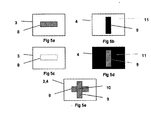
- Figs 5a - 5e show the display of two images on two image screens according to the preferred embodiment according to the invention.
- Fig 5a shows the first image 8 having a first appearance, in normal appearance state depicted by the first pattern, displayed on the first image screen 3.
- Fig 5b shows the second image 9 having a second appearance, but in an occluded state, displayed on the second image screen 4.
- Fig 5c shows the first image 8 having a first appearance, but in a transparent state, displayed on the first image screen 3.
- Fig 5d shows the second image 9 having the second appearance, in normal appearance state depicted by the second pattern, with an occluded background displayed on the second image screen 4.
- the screens 3 and 4 are controlled such that the states of the images 8 and 9 as shown in fig 5a and 5b occur simultaneously in the first timeframe.
- the screens 3 and 4 are further controlled such that the states of the images 8 and 9 as shown in fig 5c and 5d occur simultaneously in the second timeframe.
- the time frames with the states of the images 8 and 9 in fig 5a and fig 5b are synchronously alternated with the time frames with the states of the images 8 and 9 in fig 5c and fig 5d.
- a variant, not shown here but also an embodiment according to the invention, is to occlude the background of screen 3 in the case of fig 5a having image 8 in the normal appearance state.
- the combined image in fig 5e would than appear as having a black or occluded background with the images 8 and 9 whereby image 9 appears on top of image 8.
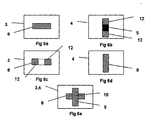
- Figs 6a - 6e show the display of two images on two image screens according to another embodiment of the invention.
- Fig 6a shows the first image 8 having a first appearance, in normal appearance state depicted by the first pattern, displayed on the first image screen 3.
- Fig 6b shows the second image 9 having a second appearance, but the overlapping part of image 9 in an occluded state, displayed on the second image screen 4.
- Fig 6c shows the first image 8 having a first appearance, but the overlapped part of image 8 in a transparent state, displayed on the first image screen 3.
- Fig 6d shows the second image 9 having the second appearance, in normal appearance state depicted by the second pattern, displayed on the second image screen 4.
- the screens 3 and 4 are controlled such that the states of the images 8 and 9 as shown in fig 6a and 6b occur simultaneously in the first timeframe.
- the screens 3 and 4 are further controlled such that the states of the images 8 and 9 as shown in fig 6c and 6d occur simultaneously in the second timeframe.
- the time frames with the states of the images 8 and 9 in fig 5a and fig 5b are synchronously alternated with the time frames with the states of the images 8 and 9 in fig 6c and fig 6d.
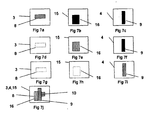
- Figs 7a - 7j show the display of three images on three image screens according to another embodiment of the invention.
- An intermediate image screen 15, with its own controller can be placed in between the first 3 and second 4 screen.
- Fig 7a shows the first image 8 having a first appearance, in normal appearance state depicted by the first pattern, displayed on the first image screen 3.
- Fig 7b shows a third image 16 having a third appearance, but in an occluded state, displayed on the intermediate image screen 15.
- Fig 7c shows the second image 9 having the second appearance, but in an occluded state, displayed on the second image screen 4.
- Fig 7d shows the first image 8 having a first appearance, but in a transparent state, displayed on the first image screen 3.
- Fig 7e shows the third image 16 having a third appearance, in normal appearance state depicted by a third pattern, displayed on the intermediate image screen 15.
- Fig 7f shows the second image 9 having the second appearance, but in an occluded state, displayed on the second image screen 4.
- Fig 7g shows the first image 8 having a first appearance, but in a transparent state, displayed on the first image screen 3.
- Fig 7h shows the third image 16 having a third appearance, but in a transparent state, displayed on the intermediate image screen 15.
- Fig 7i shows the second image 9 having the second appearance, in normal appearance state depicted by the second pattern, displayed on the second image screen 4.
- the screens 3, 4 and 15 are controlled such that the states of the images 8 , 9 and 16 as shown in fig 7a, 7b and 7c occur simultaneously in the first timeframe.
- the screens 3, 4 and 15 are further controlled such that the states of the images 8 , 9 and 16 as shown in fig 7d, 7e and 7f occur simultaneously in the second timeframe.
- the screens 3, 4 and 15 are further controlled such that the states of the images 8 , 9 and 16 as shown in fig 7g, 7h and 7i occur simultaneously in a third timeframes.
- the timeframes with the states of the images 8 and 9 in figures 7a, 7b and 7c are synchronously alternated successively with the time frames with the states of the images 8 and 9 in figures 7d, 7e and 7f and with the time frames with the states of the images 8 and 9 in figures 7g, 7h and 7i.
- the resulting image is shown in fig 7j, where image 9 appears on top of images 16 and 8 and where image 16 appears on top of image 8.
- the order in which the image states are altered is can be chosen arbitrarily.
- a person skilled in the art can easily derive the general case with at least two intermediate screens 15 having intermediate overlapping images 16.
- the alternating only has to take place between overlapping images.
- an image 16 is shown in an occluded state when a screen behind the intermediate screen is showing an image in normal appearance state.
- an image 16 is shown in a transparent state when a screen before the intermediate screen is showing an image in normal appearance state.
- an image 16 is shown in normal appearance state when no other screen before or behind the intermediate screen is showing an image in normal appearance state.
- the invention can be realised by arranging the image generator 7 to perform the alternating function required. It is also possible to arrange, in case of the use of a computer, to arrange the graphics adaptor for the alternating function. Furthermore it also possible to arrange the control devices 6 for the alternating functions according to the here above described embodiments.
- the viewer may perceive the alternating images or parts thereof as flickering.
- the alternating frequency should be as high as possible. It is known in from experiments with the invention that an alternating rate of approximately 20 Hz suffices to adequately perform such that displayed overlapping images no longer interfere. At this rate however flicker is perceived strongly. At higher rates, for 2 image screens preferably at 70 Hz or higher, a common viewer perceives no flicker.
- each pair can be alternated at a different timing or at a different rate. Also the alternating rates of the various couples can vary in time, for example at random.
Landscapes
- Engineering & Computer Science (AREA)
- Multimedia (AREA)
- Signal Processing (AREA)
- Theoretical Computer Science (AREA)
- Computer Hardware Design (AREA)
- General Physics & Mathematics (AREA)
- Physics & Mathematics (AREA)
- Control Of Indicators Other Than Cathode Ray Tubes (AREA)
- Controls And Circuits For Display Device (AREA)
- Devices For Indicating Variable Information By Combining Individual Elements (AREA)
- Liquid Crystal Display Device Control (AREA)
- Testing, Inspecting, Measuring Of Stereoscopic Televisions And Televisions (AREA)
- Liquid Crystal (AREA)
Abstract
The invention relates to a multi-layer display (1) for displaying coloured images comprising a light source (2), a first image screen (3), arranged for displaying a first image (8), whereby the first image screen (3) overlaps with and is placed substantially parallel with the light source (2), and a second translucent image screen, arranged for displaying a second image (8), whereby the second image screen (4) is placed spatially separated along a viewing axis perpendicular to the light source (2) and placed substantially parallel to and overlapping with the first image screen (3), whereby the first image screen (3) is controllable to alternate at least part of the first image (8) between transparent and a first appearance and the second image screen (4) is controllable to synchronously with the first image screen (3) alternate at least part of the second image (8) between occluded and a second appearance. <IMAGE> <IMAGE> <IMAGE> <IMAGE> <IMAGE>
Description
The invention relates to a multi-plane display for the display of images. The invention further relates
to a method of displaying images on a multi-plane display.
Multi-plane displays are presently known in the art. Usually they comprise a light source, which can
be planar, and a plurality of interspaced, overlapping, translucent image screens, which can be
simultaneously controlled to display images that have a spatial or three-dimensional character.
An example of a multi-plane display is described in the patent publication WO011 S 127.
Such displays can be used for various purposes like for amusement, games, but also for showing complex information like in military applications, where it is desirable to show overlapping graphical information in one three dimensional view.
An example of a multi-plane display is described in the patent publication WO011 S 127.
Such displays can be used for various purposes like for amusement, games, but also for showing complex information like in military applications, where it is desirable to show overlapping graphical information in one three dimensional view.
Usually the plurality of image screens comprises liquid crystal displays (LCD's). These LCD's can be
black-and-white or colour displays.
The plurality of image screens can be viewed using a light source, whereby the image screens are placed between the light source and the viewer. The light source can be planar such as a LCD backlighting device, placed in parallel close to the image screens, but the light source can also be the daylight or a daylight lit background placed in the line of sight and viewable through the image screens.
When displaying colours on a multi-plane display each image screen may present a plurality of images. A first image, having a first appearance on a first image screen, may be occluded by a second image having a second appearance on a second image screen. An appearance may be a colour or a grey tone. An appearance may have a brightness ranging from transparent to full saturation, so for example in case of the colour red from transparent to fully saturated red, or in the case of grey tones from transparent to black, where black means that the light source is fully occluded by the image screen. An appearance may also include a pattern and the pattern may represent a texture.
The plurality of image screens can be viewed using a light source, whereby the image screens are placed between the light source and the viewer. The light source can be planar such as a LCD backlighting device, placed in parallel close to the image screens, but the light source can also be the daylight or a daylight lit background placed in the line of sight and viewable through the image screens.
When displaying colours on a multi-plane display each image screen may present a plurality of images. A first image, having a first appearance on a first image screen, may be occluded by a second image having a second appearance on a second image screen. An appearance may be a colour or a grey tone. An appearance may have a brightness ranging from transparent to full saturation, so for example in case of the colour red from transparent to fully saturated red, or in the case of grey tones from transparent to black, where black means that the light source is fully occluded by the image screen. An appearance may also include a pattern and the pattern may represent a texture.
The resulting image, when viewed from a viewpoint mainly perpendicular with respect to the front
plane of the display, than shows, where the first and second image overlap, an appearance which
corresponds to the mixed appearance of the first and second appearance.
In colour, the mixed appearance arises from the absorption or subtraction of colour components of the first image by the colour of the second image. In grey tone, the appearance of the overlapping image parts is darker.
In pattern, the overlapping parts appear to have a mixed pattern.
In colour, the mixed appearance arises from the absorption or subtraction of colour components of the first image by the colour of the second image. In grey tone, the appearance of the overlapping image parts is darker.
In pattern, the overlapping parts appear to have a mixed pattern.
While displaying images on different planes or image screen in this way the appearances of
overlapping image parts thus interfere because of the interaction of the translucent screens. For
example, it is not possible to display a white image on top of a black image.
It is an object of the present invention to provide a multi-layer display capable of simultaneously
displaying images on at least two image screens that may overlap from a viewing position and that
retain their appearance regardless the overlap of the images.
The object is achieved according to the invention by means of a multi-layer display that may
comprise a light source, a first translucent image screen, whereby the first image screen can overlap
and be placed substantially parallel with the light source, arranged for displaying a first image, having
a first appearance, e.g. at least one of a colour, grey tone and a pattern, and wherein the first screen is
capable of displaying the first image in one of a transparent state, a normal appearance state and an
occluded state, the display further comprising a second translucent image screen , whereby the second
image screen can be placed spatially separated along a viewing axis perpendicular to the light source
and placed substantially parallel to and overlapping with the first image screen, arranged for
displaying a second image, having a second appearance, e.g. at least one of a colour, grey tone and a
pattern, wherein the second screen is capable of displaying the second image in one of a transparent
state, a normal appearance state and an occluded state, and wherein the first image screen is
controllable to alternate at least part of the first image between transparent state and a normal
appearance state and the second image screen is controllable to synchronously with the first image
screen alternate at least part of the second image between an occluded state and a normal appearance
state, and wherein the normal appearance state of the first image occurs simultaneously with the
occluded state of the second image and the transparent state of the first image occurs simultaneously
with the normal appearance state of the second image.
According to this embodiment according the invention, displayed images on the first and second image screen that overlap from a viewing point, which is usually more or less along an axis perpendicular to the light source, retain their correct appearance. Images appear as opaque. No undesired interference occurs. So even a white image can appear correctly on top of a black image. The alternation of images or part of the image screens has to be fast, preferably at rates from 20 Hz or more in order to minimize the perceived flicker by a viewer. The phenomenon of flicker is well known form for example television sets or data monitor using cathode ray tubes.
According to this embodiment according the invention, displayed images on the first and second image screen that overlap from a viewing point, which is usually more or less along an axis perpendicular to the light source, retain their correct appearance. Images appear as opaque. No undesired interference occurs. So even a white image can appear correctly on top of a black image. The alternation of images or part of the image screens has to be fast, preferably at rates from 20 Hz or more in order to minimize the perceived flicker by a viewer. The phenomenon of flicker is well known form for example television sets or data monitor using cathode ray tubes.
A first embodiment according to the invention, wherein the first image screen can be controllable to
occlude at least part of the first image screen not belonging to the first image, while displaying the first
image in the normal appearance state, has the advantage that the background of the images when
viewed together appears darker. In this way a trade-off is achieved between image brightness and
appearance preservation of the overlapping images.
A second and preferred embodiment according to the invention, wherein the second image screen can
be controllable to occlude at least part of the second image screen not belonging to the second image,
while displaying the second image in the normal appearance state, also has the advantage that the
background of the images when viewed together appears darker. In this embodiment the best
perceived result is obtained. The luminance ratios is best preserved, since all features visible through
the combined image screen are mixed with occluded or "black".
The first and second embodiment combined give when viewed together an occluded or black
appearing background, whereas the first and second image appear overlapping with their appearance
preserved. The colour saturation of overlapping images is preserved optimally, and also there is less
flicker, because the background remains occluded.
In yet a further embodiment according to the invention, wherein the first and second image screen are
arranged to synchronously alternate only the overlapping part of the first and second images, as
viewable along the viewing axis perpendicular to the light source, the area that needs alternation is
minimised thereby substantially reducing flicker of the image screens.
In yet a further embodiment according to the invention, further comprising an at least one intermediate
image screen, placed between the first and the second image screens, wherein the at least one
intermediate image screen is controllable for displaying a third image , which overlaps at least in part
with the first image on the first image screen , and which is overlapped by at least in part by the image
on the second image screen, it is possible to display even more complex image combinations in more
than two layers or image screens.
In yet a further embodiment according to the invention, wherein the third image is displayable in an
occluded state simultaneously with the first image in a normal appearance state and the second image
in an occluded state, and wherein the third image is displayable in a normal appearance state
simultaneously with the first image in a transparent state and the second image in an occluded state,
and wherein the third image is displayable in a transparent state simultaneously with the first image in
a transparent state and the second image in a normal appearance state and wherein the simultaneous
states of the first second and third images are alterable synchronously, it is possible to display more
than two overlapping images retaining their appearance.
The object is also achieved according to the invention by means of a method for displaying coloured
images on a multi-layer display, the multi-layer display having a light source, a first translucent image
screen, whereby the first image screen overlaps with and is placed substantially parallel with the light
source, arranged for displaying a first image, having a first appearance, e.g. at least one of a colour,
grey tone and a pattern, and wherein the first screen can be capable of displaying the first images in
one of a transparent state, a normal appearance state and an occluded state, and a second translucent
image screen , whereby the second image screen can be placed spatially separated along a viewing
axis perpendicular to the light source and placed substantially parallel to and overlapping with the first
image screen, arranged for displaying a second image, having a second appearance, e.g. at least one of
a colour, grey tone and a pattern, wherein the second screen can be capable of displaying the second
image in one of a transparent state, a normal appearance state and an occluded state, the method
comprising alternating at least part of the first image between a transparent state and a normal
appearance state and synchronously alternating at least part of the second image between an occluded
state and a normal appearance state.
According to this embodiment according the invention, displayed images on the first and second image screen that overlap from a viewing point, which is usually more or less along an axis perpendicular to the light source, retain their correct appearance. Images appear as opaque. No undesired interference occurs. So even a white image can appear correctly on top of a black image.
According to this embodiment according the invention, displayed images on the first and second image screen that overlap from a viewing point, which is usually more or less along an axis perpendicular to the light source, retain their correct appearance. Images appear as opaque. No undesired interference occurs. So even a white image can appear correctly on top of a black image.
In an third embodiment according to the invention, further comprising occluding at least part of the
first image screen not belonging to the first image, when the first image is displayed in the normal
appearance state. In this way a trade-off is achieved between image brightness and appearance
preservation of the overlapping images.
In an fourth embodiment according to the invention, further comprising
occluding at least part of the second image screen not belonging to the second image, when the second image is displayed in the normal appearance state, also has the advantage that the background of the images when viewed together appears darker.
The third and fourth embodiment combined give when viewed together an occluded or black appearing background, whereas the first and second image appear overlapping with their appearance preserved. The colour saturation of overlapping images is preserved optimally.
occluding at least part of the second image screen not belonging to the second image, when the second image is displayed in the normal appearance state, also has the advantage that the background of the images when viewed together appears darker.
The third and fourth embodiment combined give when viewed together an occluded or black appearing background, whereas the first and second image appear overlapping with their appearance preserved. The colour saturation of overlapping images is preserved optimally.
In a further embodiment according to the invention, further comprising
synchronously alternating in the first and second image screen only the overlapping part of the first and second images, as viewable from the viewpoint, the area that needs alternation is minimised thereby substantially reducing flicker of the image screens.
synchronously alternating in the first and second image screen only the overlapping part of the first and second images, as viewable from the viewpoint, the area that needs alternation is minimised thereby substantially reducing flicker of the image screens.
In a further embodiment according to the invention, further comprising
displaying a third image on an at least one intermediate image screen , placed between the first and the second image screens , whereby the third image overlaps at least in part with the first image on the first image screen, and which is overlapped by at least in part by the image on the second image screen, it is possible to display even more complex image combinations in more than two layers or image screens..
displaying a third image on an at least one intermediate image screen , placed between the first and the second image screens , whereby the third image overlaps at least in part with the first image on the first image screen, and which is overlapped by at least in part by the image on the second image screen, it is possible to display even more complex image combinations in more than two layers or image screens..
In a further embodiment according to the invention, further comprising displaying the third image in
an occluded state simultaneously with the first image in a normal appearance state and the second
image in an occluded state,
displaying the third image in a normal appearance state simultaneously with the first image in a transparent state and the second image in an occluded state,
displaying the third image in a transparent state simultaneously with the first image in a transparent state and the second image in a normal appearance state and wherein the simultaneous states of the first, second and third images are alterable synchronously, it is possible to display more than two overlapping images retaining their appearance.
displaying the third image in a normal appearance state simultaneously with the first image in a transparent state and the second image in an occluded state,
displaying the third image in a transparent state simultaneously with the first image in a transparent state and the second image in a normal appearance state and wherein the simultaneous states of the first, second and third images are alterable synchronously, it is possible to display more than two overlapping images retaining their appearance.
In all drawings, an appearance, colour or grey tone, is for technical reasons represented by a pattern.
The embodiments given should be read with an appearance in mind and not the pattern in the drawing.
The invention can be embodied in any multi-plane colour display known in the art, where each plane
comprises a image screen which can be a liquid crystal display. However the invention applies to any
type of multi-plane display whereby each image screen is transparent.
Fig 1 shows a basic construction of a multi-plane display 1 according to the state of the art.
Alight source 2 may constructively be part of the display 1, but this is not necessarily the case. The
light source 2 may also be a light emitting or light reflecting surface remote from the display 1.
Thedisplay 1 further comprises at least a first 3 and a second image screen 4, placed more or less
parallel and overlapping from a viewer's position 13. The relative positions of the image screens 3,4
are between the viewer's position 13 and the light source 2. The image screens 3, 4 are placed
substantially perpendicular to the viewing axis 14 between the viewing point 13 and the light source 2.
The image screens 3, 4 are transparent and fit for displaying images having an appearance in at least
one of colour and grey tone. Furthermore the image screens 3,4 can in whole or in part be occluded,
which means that viewed from a viewers position towards the light source 2, the occluded part of
either of the image screens 3,4 appears as black. Such image screens 3, 4 can be liquid crystal displays
(LCD's), but other technologies can be possible.
The image screens 3, 4 can be constructively integrated into a display by means of supportingmeans
5. The supporting means 5 may comprise supports, props, frames etc.. The relative distance between
the image screens may vary depending on the image screen diameters and is not essential for the
invention. Essential is that images can be viewed as overlapping.
Additional image screens may be mounted to the image screens 3, 4 using additional supporting means 5.
A
The
The image screens 3, 4 can be constructively integrated into a display by means of supporting
Additional image screens may be mounted to the image screens 3, 4 using additional supporting means 5.
Fig 2 shows a basic architecture for controlling a multi-plane display.
Each image screen 3,4 is electronically controllable, by means of a control device 6, connected to and
cooperating with each image screen respectively. Control devices 6 may be shared between image
screens 3, 4. The control devices 6 can be connected to an image generator 7. This image generator 7
may be a computer or PC arranged for generating images. A computer has a processor, memory and a
graphics adaptor, whereby the processor can be programmed to perform control of the graphics
adaptor. The connection between display 1 and image generator 7 may be hard-wired or wireless.
Various implementations are possible, readily available for the person skilled in the art.
Each
Fig 3a - 3c show the display of two images on two image screens according to the state of the art.
Fig 3a separately shows a first image 8 having a first appearance, depicted by a first pattern, displayed
on the first image screen 3, fig 3b separately shows a second image 9 having a second appearance,
depicted by a second pattern, displayed on the second image screen 4.
Fig 3c shows the two image screens 3 and 4 overlapping, viewed from the viewer's position 13,
whereby the images 8 and 9 also overlap. The image 9 appears as being on top of image 8, but the
appearances of the image 8 in the overlapping part 10 is interfered by the appearance of image 9, since
both image screens 3 and 4 are transparent.
Fig 3c shows the two
Figs 4a - 4e show the display of two images on two image screens according to the invention.
Fig 4a shows thefirst image 8 having a first appearance, in a normal appearance state depicted by the
first pattern, displayed on the first image screen 3.
Fig 4b shows thesecond image 9 having a second appearance, but in an occluded state, displayed on
the second image screen 4.
Fig 4c shows thefirst image 8 having a first appearance, but in a transparent state, displayed on the
first image screen 3,
Fig 4d shows thesecond image 9 having the second appearance, in a normal appearance state depicted
by the second pattern, displayed on the second image screen 4.
The screens 3 and 4 are controlled such that the states of the images 8 and 9 as shown in fig 4a and 4b
occur simultaneously in a first timeframe.
The screens 3 and 4 are further controlled such that the states of the images 8 and 9 as shown in fig 4c
and 4d occur simultaneously in a second timeframe.
The time frames with the states of the images 8 and 9 in fig 4a and fig 4b are synchronously alternated
with the timeframes with the states of the images 8 and 9 in fig 4c and fig 4d.
Fig 4e shows the two image screens 3 and 4 overlapping, viewed from the viewers position 13,
whereby the images 8 and 9 partially overlap, the image 9 is viewed as being on top of image 8, and
the appearances of the two images in the overlapping part 10 no interfere.
Fig 4a shows the
Fig 4b shows the
Fig 4c shows the
Fig 4d shows the
The
The
The time frames with the states of the
Fig 4e shows the two
Figs 5a - 5e show the display of two images on two image screens according to the preferred
embodiment according to the invention.
Fig 5a shows thefirst image 8 having a first appearance, in normal appearance state depicted by the
first pattern, displayed on the first image screen 3.
Fig 5b shows thesecond image 9 having a second appearance, but in an occluded state, displayed on
the second image screen 4.
Fig 5c shows thefirst image 8 having a first appearance, but in a transparent state, displayed on the
first image screen 3.
Fig 5d shows thesecond image 9 having the second appearance, in normal appearance state depicted
by the second pattern, with an occluded background displayed on the second image screen 4.
The screens 3 and 4 are controlled such that the states of the images 8 and 9 as shown in fig 5a and 5b
occur simultaneously in the first timeframe.
The screens 3 and 4 are further controlled such that the states of the images 8 and 9 as shown in fig 5c
and 5d occur simultaneously in the second timeframe.
The time frames with the states of the images 8 and 9 in fig 5a and fig 5b are synchronously alternated
with the time frames with the states of the images 8 and 9 in fig 5c and fig 5d.
Fig 5a shows the
Fig 5b shows the
Fig 5c shows the
Fig 5d shows the
The
The
The time frames with the states of the
A variant, not shown here but also an embodiment according to the invention, is to occlude the
background of screen 3 in the case of fig 5a having image 8 in the normal appearance state. The
combined image in fig 5e would than appear as having a black or occluded background with the
images 8 and 9 whereby image 9 appears on top of image 8.
The difference of this embodiment with the invention as disclosed in figs 4a - fig 4e is that the non-image
part 11 of image screen 4 is alternated between transparent as shown in fig 5b and occluded as
shown in fig 5d.
The result as shown in fig 5e is that 1) what is perceived as background, the non-image parts of image
screens 3 and 4 combined is darker and 2) the objects appear with the proper occlusion.
In order to reduce the alternating part of theimage screen 4 it is possible to alternate only part of the
non-image part of image screen 4. By this reduction of alternating part of image screen 4 a reduction
of flicker can be perceived.
If part of the non-image part ofimage screen 4 is alternated, the non-alternating and non-image part of
image screen 4 can be kept at a brightness level comparable with the brightness level of the alternating
non-image part 11 of image screen 4.
The result as shown in fig 5e is that 1) what is perceived as background, the non-image parts of
In order to reduce the alternating part of the
If part of the non-image part of
Figs 6a - 6e show the display of two images on two image screens according to another embodiment
of the invention.
Fig 6a shows thefirst image 8 having a first appearance, in normal appearance state depicted by the
first pattern, displayed on the first image screen 3.
Fig 6b shows thesecond image 9 having a second appearance, but the overlapping part of image 9 in
an occluded state, displayed on the second image screen 4.
Fig 6c shows thefirst image 8 having a first appearance, but the overlapped part of image 8 in a
transparent state, displayed on the first image screen 3.
Fig 6d shows thesecond image 9 having the second appearance, in normal appearance state depicted
by the second pattern, displayed on the second image screen 4.
The screens 3 and 4 are controlled such that the states of the images 8 and 9 as shown in fig 6a and 6b
occur simultaneously in the first timeframe.
The screens 3 and 4 are further controlled such that the states of the images 8 and 9 as shown in fig 6c
and 6d occur simultaneously in the second timeframe.
The time frames with the states of the images 8 and 9 in fig 5a and fig 5b are synchronously alternated
with the time frames with the states of the images 8 and 9 in fig 6c and fig 6d.
Fig 6a shows the
Fig 6b shows the
Fig 6c shows the
Fig 6d shows the
The
The
The time frames with the states of the
In this embodiment only the overlapping parts of images 8 and 9 are alternated, thereby minimizing
the area per image screen 3, 4 to be alternated.
Thenon-overlapping parts 12 of the images 8, 9 can be corrected for brightness, so that a uniform
brightness distribution can be perceived for each of the images 8, 9.
The
The invention can be used with more than two image screens.
Figs 7a - 7j show the display of three images on three image screens according to another embodiment of the invention.
Anintermediate image screen 15, with its own controller can be placed in between the first 3 and
second 4 screen.
Fig 7a shows thefirst image 8 having a first appearance, in normal appearance state depicted by the
first pattern, displayed on the first image screen 3.
Fig 7b shows athird image 16 having a third appearance, but in an occluded state, displayed on the
intermediate image screen 15.
Fig 7c shows thesecond image 9 having the second appearance, but in an occluded state, displayed on
the second image screen 4.
Fig 7d shows thefirst image 8 having a first appearance, but in a transparent state, displayed on the
first image screen 3.
Fig 7e shows thethird image 16 having a third appearance, in normal appearance state depicted by a
third pattern, displayed on the intermediate image screen 15.
Figs 7a - 7j show the display of three images on three image screens according to another embodiment of the invention.
An
Fig 7a shows the
Fig 7b shows a
Fig 7c shows the
Fig 7d shows the
Fig 7e shows the
Fig 7f shows the second image 9 having the second appearance, but in an occluded state, displayed on
the second image screen 4.
Fig 7g shows thefirst image 8 having a first appearance, but in a transparent state, displayed on the
first image screen 3.
Fig 7h shows thethird image 16 having a third appearance, but in a transparent state, displayed on the
intermediate image screen 15.
Fig 7i shows thesecond image 9 having the second appearance, in normal appearance state depicted
by the second pattern, displayed on the second image screen 4.
The screens 3, 4 and 15 are controlled such that the states of the images 8 , 9 and 16 as shown in fig
7a, 7b and 7c occur simultaneously in the first timeframe.
The screens 3, 4 and 15 are further controlled such that the states of the images 8 , 9 and 16 as shown
in fig 7d, 7e and 7f occur simultaneously in the second timeframe.
The screens 3, 4 and 15 are further controlled such that the states of the images 8 , 9 and 16 as shown
in fig 7g, 7h and 7i occur simultaneously in a third timeframes.
The timeframes with the states of the images 8 and 9 in figures 7a, 7b and 7c are synchronously
alternated successively with the time frames with the states of the images 8 and 9 in figures 7d, 7e and
7f and with the time frames with the states of the images 8 and 9 in figures 7g, 7h and 7i.
The resulting image is shown in fig 7j, whereimage 9 appears on top of images 16 and 8 and where
image 16 appears on top of image 8.
The order in which the image states are altered is can be chosen arbitrarily.
Fig 7g shows the
Fig 7h shows the
Fig 7i shows the
The
The
The
The timeframes with the states of the
The resulting image is shown in fig 7j, where
The order in which the image states are altered is can be chosen arbitrarily.
A person skilled in the art can easily derive the general case with at least two intermediate screens 15
having intermediate overlapping images 16.
The alternating only has to take place between overlapping images.
On anintermediate screen 15 an image 16 is shown in an occluded state when a screen behind the
intermediate screen is showing an image in normal appearance state.
On anintermediate screen 15 an image 16 is shown in a transparent state when a screen before the
intermediate screen is showing an image in normal appearance state.
On anintermediate screen 15 an image 16 is shown in normal appearance state when no other screen
before or behind the intermediate screen is showing an image in normal appearance state.
The notions 'before' and 'behind' are to be interpreted from the viewer's point ofview 13.
The alternating only has to take place between overlapping images.
On an
On an
On an
The notions 'before' and 'behind' are to be interpreted from the viewer's point of
The invention can be realised by arranging the image generator 7 to perform the alternating function
required. It is also possible to arrange, in case of the use of a computer, to arrange the graphics adaptor
for the alternating function. Furthermore it also possible to arrange the control devices 6 for the
alternating functions according to the here above described embodiments.
By alternating images or parts thereof, the viewer may perceive the alternating images or parts thereof
as flickering.
In order to counteract this phenomenon, the alternating frequency should be as high as possible. It is known in from experiments with the invention that an alternating rate of approximately 20 Hz suffices to adequately perform such that displayed overlapping images no longer interfere. At this rate however flicker is perceived strongly. At higher rates, for 2 image screens preferably at 70 Hz or higher, a common viewer perceives no flicker.
In order to counteract this phenomenon, the alternating frequency should be as high as possible. It is known in from experiments with the invention that an alternating rate of approximately 20 Hz suffices to adequately perform such that displayed overlapping images no longer interfere. At this rate however flicker is perceived strongly. At higher rates, for 2 image screens preferably at 70 Hz or higher, a common viewer perceives no flicker.
In the case that a plurality of overlapping images pairs is to be displayed, each pair can be alternated at
a different timing or at a different rate. Also the alternating rates of the various couples can vary in
time, for example at random.
Claims (12)
- A multi-layer display (1) for displaying overlapping images comprisingcharacterised in thata light source (2),a first translucent image screen (3), whereby the first image screen (3) overlaps with and is placed substantially parallel with the light source (2), arranged for displaying a first image (8), having a first appearance, e.g. at least one of a colour, grey tone and a pattern, and wherein the first screen (3) is capable of displaying the first images (8) in one of a transparent state, a normal appearance state and an occluded state,a second translucent image screen (4), whereby the second image screen (4) is placed spatially separated along a viewing axis (14) perpendicular to the light source and placed substantially parallel to and overlapping with the first image screen (3), arranged for displaying a second image(9), having a second appearance, e.g. at least one of a colour, grey tone and a pattern, wherein the second screen (4) is capable of displaying the second image (9) in one of a transparent state, a normal appearance state and an occluded state,
the first image screen (3) is controllable to alternate at least part of the first image (8) between transparent state and a normal appearance state and the second image screen (4) is controllable to synchronously with the first image screen (3) alternate at least part of the second image (8) between an occluded state and a normal appearance state and wherein the normal appearance state of the first image(8) occurs simultaneously with the occluded state of the second image (9) and the transparent state of the first image (8) occurs simultaneously with the normal appearance state of the second image (9). - The multi-layer display (1) according to claim 1, wherein the first image screen (3) is controllable, while displaying the first image in the normal appearance state, to occlude at least part of the first image screen (3), the at least part of the first image screen (3) not belonging to the first image (8) in the normal appearance state.
- The multi-layer display (1) according to claim 1 or 2, wherein the second image screen (4) is controllable, while displaying the second image in the normal appearance state, to occlude at least part of the second image screen (4), the at least part of the second image screen (4) not belonging to the second image (9) in the normal appearance state.
- The multi-layer display (1) according to claim 1, wherein the first and second image screen (4) are arranged to synchronously with the first image screen (3) alternate only the overlapping part (10) of the first and second images (8, 9), as viewed from the viewpoint (13) to the light source (2).
- The multi-layer display (1) according to any of the preceding claims, further comprising an at least one intermediate image screen (15), placed between the first and the second image screens (3, 4), wherein the at least one intermediate image screen (15) is controllable for displaying a third image (16), which overlaps at least in part with the first image (8) on the first image screen (3), and which is overlapped by at least in part by the image on the second image screen (4).
- The multi-layer display (1) according to claim 5, wherein the third image (16) is displayable in an occluded state simultaneously with the first image (8) in a normal appearance state and the second image (8) in an occluded state, and wherein the third image (16) is displayable in a normal appearance state simultaneously with the first image (8) in a transparent state and the second image (8) in an occluded state, and wherein the third image (16) is displayable in a transparent state simultaneously with the first image (8) in a transparent state and the second image (8) in a normal appearance state and wherein the simultaneous states of the first second and third images (8, 9, 16) are alterable synchronously.
- A method for displaying coloured images on a multi-layer display (1),the multi-layer display (1) having a light source (2), a first translucent image screen (3), whereby the first image screen (3) overlaps with and is placed substantially parallel with the light source (2), arranged for displaying a first image (8), having a first appearance, e.g. at least one of a colour, grey tone and a pattern, and wherein the first screen (3) is capable of displaying the first images (8) in one of a transparent state, a normal appearance state and an occluded state, and a second translucent image screen (4), whereby the second image screen (4) is placed spatially separated along a viewing axis (14) perpendicular to the light source and placed substantially parallel to and overlapping with the first image screen (3), arranged for displaying a second image(9), having a second appearance, e.g. at least one of a colour, grey tone and a pattern, wherein the second screen (4) is capable of displaying the second image (9) in one of a transparent state, a normal appearance state and an occluded state,
the method comprising
alternating at least part of the first image (8) between a transparent state and a normal appearance state and synchronously alternating at least part of the second image (8) between an occluded state and a normal appearance state and wherein the normal appearance state of the first image(8) occurs simultaneously with the occluded state of the second image (9) and the transparent state of the first image (8) occurs simultaneously with the normal appearance state of the second image (9). - The method according claim 7, further comprisingoccluding at least part of the first image screen (3) not belonging to the first image (8), when the first image (8) is displayed in the normal appearance state.
- The method according claim 7 or 8, further comprisingoccluding at least part of the second image screen (4) not belonging to the second image (9), when the second image (9) is displayed in the normal appearance state.
- The method according to claim 7, further comprisingsynchronously alternating in the first and second image screen (4) only the overlapping part of the first and second images (8, 9), as viewable from the viewpoint (13).
- The method according to any of the preceding claims 7 - 10 , further comprisingdisplaying a third image (16) on an at least one intermediate image screen (15), placed between the first and the second image screens (3, 4), whereby the third image (16) overlaps at least in part with the first image (8) on the first image screen (3), and which is overlapped by at least in part by the image (9) on the second image screen (4).
- The method according to claim 11, further comprisingdisplaying the third image (16) in an occluded state simultaneously with the first image (8) in a normal appearance state and the second image (8) in an occluded state,displaying the third image (16) in a normal appearance state simultaneously with the first image (8) in a transparent state and the second image (8) in an occluded state,displaying the third image (16) in a transparent state simultaneously with the first image (8) in a transparent state and the second image (8) in a normal appearance state and wherein the simultaneous states of the first, second and third images (8, 9, 16) are alterable synchronously.
Priority Applications (8)
| Application Number | Priority Date | Filing Date | Title |
|---|---|---|---|
| EP03078288A EP1524865A1 (en) | 2003-10-17 | 2003-10-17 | Multi-plane display for displaying overlapping images |
| DE602004005887T DE602004005887D1 (en) | 2003-10-17 | 2004-10-15 | MULTI-PANEL DISPLAY FOR DISPLAYING OVERLAPPING PICTURES |
| PCT/NL2004/000725 WO2005036889A1 (en) | 2003-10-17 | 2004-10-15 | Multi-plane display for displaying overlapping images |
| EP04775019A EP1683367B1 (en) | 2003-10-17 | 2004-10-15 | Multi-plane display for displaying overlapping images |
| KR1020067008773A KR20060120073A (en) | 2003-10-17 | 2004-10-15 | Multi-plane display for displaying superimposed images |
| US10/576,136 US20070024642A1 (en) | 2003-10-17 | 2004-10-15 | Multi-plane display for displaying overlapping images |
| AT04775019T ATE359675T1 (en) | 2003-10-17 | 2004-10-15 | MULTI-LEVEL DISPLAY TO SHOW OVERLAPPING IMAGES |
| JP2006535291A JP2007517236A (en) | 2003-10-17 | 2004-10-15 | Multi-sided display that displays overlapping images |
Applications Claiming Priority (1)
| Application Number | Priority Date | Filing Date | Title |
|---|---|---|---|
| EP03078288A EP1524865A1 (en) | 2003-10-17 | 2003-10-17 | Multi-plane display for displaying overlapping images |
Publications (1)
| Publication Number | Publication Date |
|---|---|
| EP1524865A1 true EP1524865A1 (en) | 2005-04-20 |
Family
ID=34354531
Family Applications (2)
| Application Number | Title | Priority Date | Filing Date |
|---|---|---|---|
| EP03078288A Withdrawn EP1524865A1 (en) | 2003-10-17 | 2003-10-17 | Multi-plane display for displaying overlapping images |
| EP04775019A Expired - Lifetime EP1683367B1 (en) | 2003-10-17 | 2004-10-15 | Multi-plane display for displaying overlapping images |
Family Applications After (1)
| Application Number | Title | Priority Date | Filing Date |
|---|---|---|---|
| EP04775019A Expired - Lifetime EP1683367B1 (en) | 2003-10-17 | 2004-10-15 | Multi-plane display for displaying overlapping images |
Country Status (7)
| Country | Link |
|---|---|
| US (1) | US20070024642A1 (en) |
| EP (2) | EP1524865A1 (en) |
| JP (1) | JP2007517236A (en) |
| KR (1) | KR20060120073A (en) |
| AT (1) | ATE359675T1 (en) |
| DE (1) | DE602004005887D1 (en) |
| WO (1) | WO2005036889A1 (en) |
Families Citing this family (13)
| Publication number | Priority date | Publication date | Assignee | Title |
|---|---|---|---|---|
| US20050134945A1 (en) * | 2003-12-17 | 2005-06-23 | Canon Information Systems Research Australia Pty. Ltd. | 3D view for digital photograph management |
| US7659913B2 (en) * | 2004-12-17 | 2010-02-09 | Nokia Corporation | Method and apparatus for video editing with a minimal input device |
| NZ542843A (en) * | 2005-10-05 | 2008-08-29 | Pure Depth Ltd | Method of manipulating visibility of images on a volumetric display |
| US20080122865A1 (en) * | 2006-11-29 | 2008-05-29 | Arthur Vanmoor | Method of Showing Images at Different Depths and Display Showing Images at Different Depths |
| US9524700B2 (en) | 2009-05-14 | 2016-12-20 | Pure Depth Limited | Method and system for displaying images of various formats on a single display |
| US8928682B2 (en) * | 2009-07-07 | 2015-01-06 | Pure Depth Limited | Method and system of processing images for improved display |
| KR101538659B1 (en) * | 2012-11-20 | 2015-07-22 | 삼성메디슨 주식회사 | Apparatus and method for outputting image and system and method for providing image using the same, and recording medium |
| CN104714769B (en) * | 2013-12-11 | 2020-01-31 | 联想(北京)有限公司 | data processing method and electronic equipment |
| US20150228229A1 (en) * | 2014-02-07 | 2015-08-13 | Christie Digital Systems Usa, Inc. | System and method for displaying layered images |
| US10621898B2 (en) * | 2016-11-23 | 2020-04-14 | Pure Depth Limited | Multi-layer display system for vehicle dash or the like |
| DE102022125368A1 (en) * | 2022-09-30 | 2024-04-04 | Keba Industrial Automation Gmbh | Display device and control system for potentially dangerous technical systems |
| JP2025168947A (en) * | 2024-04-30 | 2025-11-12 | 株式会社Jvcケンウッド | display device |
| WO2025229970A1 (en) * | 2024-04-30 | 2025-11-06 | 株式会社Jvcケンウッド | Display device |
Citations (2)
| Publication number | Priority date | Publication date | Assignee | Title |
|---|---|---|---|---|
| EP0959377A2 (en) * | 1998-05-21 | 1999-11-24 | Nippon Telegraph and Telephone Corporation | A three-dimensional representation method and an apparatus thereof |
| US20020126396A1 (en) * | 1996-08-16 | 2002-09-12 | Eugene Dolgoff | Three-dimensional display system |
Family Cites Families (10)
| Publication number | Priority date | Publication date | Assignee | Title |
|---|---|---|---|---|
| US3566391A (en) * | 1968-09-06 | 1971-02-23 | Hartman Systems Co Inc | Multilayer electroluminescent display apparatus having multiple,selectively energizable electrode elements forming composite electrodes of predetermined configuration |
| US6020894A (en) * | 1990-08-16 | 2000-02-01 | Canon Kabushiki Kaisha | Full-color desktop publishing system |
| US5956180A (en) * | 1996-12-31 | 1999-09-21 | Bass; Robert | Optical viewing system for asynchronous overlaid images |
| US6377229B1 (en) * | 1998-04-20 | 2002-04-23 | Dimensional Media Associates, Inc. | Multi-planar volumetric display system and method of operation using three-dimensional anti-aliasing |
| US6466185B2 (en) * | 1998-04-20 | 2002-10-15 | Alan Sullivan | Multi-planar volumetric display system and method of operation using psychological vision cues |
| US6369830B1 (en) * | 1999-05-10 | 2002-04-09 | Apple Computer, Inc. | Rendering translucent layers in a display system |
| US6445362B1 (en) * | 1999-08-05 | 2002-09-03 | Microvision, Inc. | Scanned display with variation compensation |
| US6900802B2 (en) * | 2000-08-04 | 2005-05-31 | Pts Corporation | Method of determining relative Z-ordering in an image and method of using same |
| AU2002246714A1 (en) * | 2000-12-18 | 2002-08-06 | Sara L. Johnson | 3d display devices with transient light scattering shutters |
| JP2004029750A (en) * | 2002-05-09 | 2004-01-29 | Pioneer Electronic Corp | Stereoscopic display device and method |
-
2003
- 2003-10-17 EP EP03078288A patent/EP1524865A1/en not_active Withdrawn
-
2004
- 2004-10-15 KR KR1020067008773A patent/KR20060120073A/en not_active Withdrawn
- 2004-10-15 WO PCT/NL2004/000725 patent/WO2005036889A1/en not_active Ceased
- 2004-10-15 DE DE602004005887T patent/DE602004005887D1/en not_active Expired - Lifetime
- 2004-10-15 JP JP2006535291A patent/JP2007517236A/en active Pending
- 2004-10-15 EP EP04775019A patent/EP1683367B1/en not_active Expired - Lifetime
- 2004-10-15 US US10/576,136 patent/US20070024642A1/en not_active Abandoned
- 2004-10-15 AT AT04775019T patent/ATE359675T1/en not_active IP Right Cessation
Patent Citations (2)
| Publication number | Priority date | Publication date | Assignee | Title |
|---|---|---|---|---|
| US20020126396A1 (en) * | 1996-08-16 | 2002-09-12 | Eugene Dolgoff | Three-dimensional display system |
| EP0959377A2 (en) * | 1998-05-21 | 1999-11-24 | Nippon Telegraph and Telephone Corporation | A three-dimensional representation method and an apparatus thereof |
Also Published As
| Publication number | Publication date |
|---|---|
| KR20060120073A (en) | 2006-11-24 |
| US20070024642A1 (en) | 2007-02-01 |
| ATE359675T1 (en) | 2007-05-15 |
| EP1683367B1 (en) | 2007-04-11 |
| JP2007517236A (en) | 2007-06-28 |
| DE602004005887D1 (en) | 2007-05-24 |
| EP1683367A1 (en) | 2006-07-26 |
| WO2005036889A1 (en) | 2005-04-21 |
Similar Documents
| Publication | Publication Date | Title |
|---|---|---|
| US9628782B2 (en) | Bandwidth improvement for 3D display | |
| EP0721130B1 (en) | Display | |
| JP3581745B2 (en) | 3D image display device | |
| EP1683367B1 (en) | Multi-plane display for displaying overlapping images | |
| TWI524321B (en) | Color display device and method | |
| US20110157167A1 (en) | Coordinated driving of adaptable light manipulator, backlighting and pixel array in support of adaptable 2d and 3d displays | |
| US20120194660A1 (en) | Image display device and stereo image display system | |
| RU2313191C2 (en) | Method and system for generation of a stereo image | |
| TWI417571B (en) | Stereoscopic display device | |
| WO2004001486A1 (en) | Dual layer stereoscopic liquid crystal display | |
| US9116357B2 (en) | Hybrid multiplexed 3D display and displaying method thereof | |
| JP2004054273A (en) | Autostereoscopic display | |
| CN102187385A (en) | Image display system, image control device, method for controlling image and light shutter | |
| US12526398B2 (en) | Naked-eye 3D display method and related device | |
| US20150228229A1 (en) | System and method for displaying layered images | |
| JPH0678342A (en) | Stereoscopic display | |
| TWI422863B (en) | Stereoscopic display | |
| US20070035555A1 (en) | Display device, method of controlling the same, and game machine | |
| US7932874B2 (en) | Display device | |
| CN103176277B (en) | Hybrid multiplexing stereoscopic display and display method thereof | |
| JP3778893B2 (en) | Game machine | |
| JP3940663B2 (en) | Game machine | |
| JP4060865B2 (en) | Game machine | |
| JP4252820B2 (en) | Game machine | |
| JP2003098471A (en) | Head-mount type video display device |
Legal Events
| Date | Code | Title | Description |
|---|---|---|---|
| PUAI | Public reference made under article 153(3) epc to a published international application that has entered the european phase |
Free format text: ORIGINAL CODE: 0009012 |
|
| AK | Designated contracting states |
Kind code of ref document: A1 Designated state(s): AT BE BG CH CY CZ DE DK EE ES FI FR GB GR HU IE IT LI LU MC NL PT RO SE SI SK TR |
|
| AX | Request for extension of the european patent |
Extension state: AL LT LV MK |
|
| AKX | Designation fees paid | ||
| REG | Reference to a national code |
Ref country code: DE Ref legal event code: 8566 |
|
| STAA | Information on the status of an ep patent application or granted ep patent |
Free format text: STATUS: THE APPLICATION IS DEEMED TO BE WITHDRAWN |
|
| 18D | Application deemed to be withdrawn |
Effective date: 20051021 |