EP1523779B1 - Elektrode für eine elektrochemische zelle und verfahren zur herstellung der elektrode - Google Patents
Elektrode für eine elektrochemische zelle und verfahren zur herstellung der elektrode Download PDFInfo
- Publication number
- EP1523779B1 EP1523779B1 EP03765589.1A EP03765589A EP1523779B1 EP 1523779 B1 EP1523779 B1 EP 1523779B1 EP 03765589 A EP03765589 A EP 03765589A EP 1523779 B1 EP1523779 B1 EP 1523779B1
- Authority
- EP
- European Patent Office
- Prior art keywords
- particles
- active material
- electrochemically active
- electrochemical cell
- weight percent
- Prior art date
- Legal status (The legal status is an assumption and is not a legal conclusion. Google has not performed a legal analysis and makes no representation as to the accuracy of the status listed.)
- Expired - Lifetime
Links
Images


Classifications
-
- H—ELECTRICITY
- H01—ELECTRIC ELEMENTS
- H01M—PROCESSES OR MEANS, e.g. BATTERIES, FOR THE DIRECT CONVERSION OF CHEMICAL ENERGY INTO ELECTRICAL ENERGY
- H01M4/00—Electrodes
- H01M4/02—Electrodes composed of, or comprising, active material
- H01M4/62—Selection of inactive substances as ingredients for active masses, e.g. binders, fillers
-
- H—ELECTRICITY
- H01—ELECTRIC ELEMENTS
- H01M—PROCESSES OR MEANS, e.g. BATTERIES, FOR THE DIRECT CONVERSION OF CHEMICAL ENERGY INTO ELECTRICAL ENERGY
- H01M4/00—Electrodes
- H01M4/02—Electrodes composed of, or comprising, active material
- H01M4/06—Electrodes for primary cells
-
- H—ELECTRICITY
- H01—ELECTRIC ELEMENTS
- H01M—PROCESSES OR MEANS, e.g. BATTERIES, FOR THE DIRECT CONVERSION OF CHEMICAL ENERGY INTO ELECTRICAL ENERGY
- H01M4/00—Electrodes
- H01M4/02—Electrodes composed of, or comprising, active material
- H01M2004/021—Physical characteristics, e.g. porosity, surface area
-
- H—ELECTRICITY
- H01—ELECTRIC ELEMENTS
- H01M—PROCESSES OR MEANS, e.g. BATTERIES, FOR THE DIRECT CONVERSION OF CHEMICAL ENERGY INTO ELECTRICAL ENERGY
- H01M4/00—Electrodes
- H01M4/02—Electrodes composed of, or comprising, active material
- H01M4/36—Selection of substances as active materials, active masses, active liquids
- H01M4/38—Selection of substances as active materials, active masses, active liquids of elements or alloys
- H01M4/42—Alloys based on zinc
-
- H—ELECTRICITY
- H01—ELECTRIC ELEMENTS
- H01M—PROCESSES OR MEANS, e.g. BATTERIES, FOR THE DIRECT CONVERSION OF CHEMICAL ENERGY INTO ELECTRICAL ENERGY
- H01M4/00—Electrodes
- H01M4/02—Electrodes composed of, or comprising, active material
- H01M4/62—Selection of inactive substances as ingredients for active masses, e.g. binders, fillers
- H01M4/621—Binders
-
- H—ELECTRICITY
- H01—ELECTRIC ELEMENTS
- H01M—PROCESSES OR MEANS, e.g. BATTERIES, FOR THE DIRECT CONVERSION OF CHEMICAL ENERGY INTO ELECTRICAL ENERGY
- H01M6/00—Primary cells; Manufacture thereof
- H01M6/04—Cells with aqueous electrolyte
- H01M6/06—Dry cells, i.e. cells wherein the electrolyte is rendered non-fluid
-
- Y—GENERAL TAGGING OF NEW TECHNOLOGICAL DEVELOPMENTS; GENERAL TAGGING OF CROSS-SECTIONAL TECHNOLOGIES SPANNING OVER SEVERAL SECTIONS OF THE IPC; TECHNICAL SUBJECTS COVERED BY FORMER USPC CROSS-REFERENCE ART COLLECTIONS [XRACs] AND DIGESTS
- Y02—TECHNOLOGIES OR APPLICATIONS FOR MITIGATION OR ADAPTATION AGAINST CLIMATE CHANGE
- Y02E—REDUCTION OF GREENHOUSE GAS [GHG] EMISSIONS, RELATED TO ENERGY GENERATION, TRANSMISSION OR DISTRIBUTION
- Y02E60/00—Enabling technologies; Technologies with a potential or indirect contribution to GHG emissions mitigation
- Y02E60/10—Energy storage using batteries
Definitions
- This invention generally relates to electrochemical cells that utilize an electrode having an electrochemically active material in particulate form. More specifically, this invention pertains to electrochemical cells having a quantity of agglomerated zinc particles in the anode.
- Cylindrically shaped electrochemical cells are suitable for use by consumers in a wide variety of devices such as flashlights, radios and cameras. Batteries used in these devices typically employ a cylindrical metal container to house two electrodes, a separator, a quantity of electrolyte and a closure assembly that includes a current collector. Typical electrode materials include manganese dioxide as the cathode and zinc as the anode. An aqueous solution of potassium hydroxide is a common electrolyte. A separator, conventionally formed from one or more strips of paper, is positioned between the electrodes. The electrolyte is readily absorbed by the separator and anode.
- anode that includes zinc in particulate form.
- the anode is a gel that has absorbed an aqueous electrolyte.
- the zinc particles are uniformly dispersed within the gel so that particle-to-particle contact establishes an electrically conductive matrix throughout the anode.
- a current collector contacts the zinc and provides an electrically conductive path between the anode and one of the cell's terminals.
- JP Kokai 57[1982]-182972 discloses that the high discharge characteristic of a battery can be improved by incorporating 5-30 weight percent of the zinc as particles with a particle size of 25 ⁇ m or smaller.
- problems associated with increasing the quantity of zinc dust or fines are problems associated with increasing the quantity of zinc dust or fines.
- One disadvantage is that an increase in the percentage of zinc dust and/or zinc fines results in increased gassing within the cell.
- Another disadvantage is that the increase in the quantity of zinc dust causes a corresponding increase in the viscosity of the anode gel which results in processing problems in high speed manufacturing processes.
- An alternative to adding zinc dust or fines to an anode gel is to decrease the average diameter of the zinc particles whereby the total surface area of the zinc increases proportionally.
- the average diameter of the zinc particles decreases, there is a corresponding increase in the percentage of zinc fines or dust.
- One disadvantage to increasing the quantity of zinc dust by decreasing the average particle size is that the dust may become separated from the larger zinc particles during transit and storage of the zinc prior to its incorporation into an anode gel.
- the zinc dust particles also tend to become separated from the larger zinc particles during the manufacture and transit of the anode gel. Unintended separation of the large particles from the small particles can negatively impact the quality of the anode gel and the quality of the cell containing the anode gel. Consequently, although battery manufacturers would like to improve the battery's service by including greater quantities of zinc dust or fines in the anode formulation, the above described problems limit the quantity of zinc dust that can be incorporated into the anode formula.
- the present invention provides an electrochemical cell with an electrode comprising electrochemically active material in particulate form that enhances the cell's service performance on high drain tests.
- the electrochemically active material includes a variety of particle sizes that do not become segregated in an undesirable manner prior to or during the electrode manufacturing process.
- the present invention also provides a process for incorporating small particles, such as fines or dust, into the cell's electrode.
- the present invention relates to an electrochemical cell according to claim 9.
- the present invention also relates to a process for manufacturing an electrochemical cell, according to claim 1.
- agglomerate when used as a noun, means an assemblage of particles which are either loosely or rigidly joined together. Particles may be joined together via the presence of an agglomerant or, if an agglomerant is not present, each particle is physically secured to at least one other particle in the agglomerate. Agglomerates may be manually crushed thereby disassociating the particles from one another. Particles that are in close proximity to one another but are not associated via an agglomerant or physical connection are not considered to form an agglomerate.
- agglomerated particles means two or more particles that form an agglomerate.
- nanonagglomerated particles means two or more particles that are not physically associated with each other.
- fines as in “zinc fines”, means particles that pass through a 200 mesh opening in a sieving screen.
- dust means particles that pass through a 44 ⁇ m (325 mesh) opening in a sieving screen. Dust is considered to be a subset of fines.
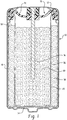
- FIG. 1 there is shown a cross-sectional view of a conventional electrochemical cell.
- the cell's components are the container 10, first electrode 50 positioned adjacent the interior surface of container 10, separator 20 contacting the interior surface 56 of first electrode 50, second electrode 60 disposed within the cavity defined by separator 20, and closure member 70 which is secured to container 10.
- Container 10 has an open end 12, a closed end 14 and a sidewall 16 therebetween. The closed end 14, sidewall 16 and closure member 70 define a volume in which the cell's electrodes are housed.
- Second electrode 60 includes a gelling agent that swells upon absorption of the cell's electrolyte.
- a gelling agent suitable for use in a cell of this invention is a crosslinked polyacrylic acid, such as Carbopol 940®, which is available from Noveon of Cleveland, Ohio, USA.
- Carboxymethyylcellulose, polyacrylamide and sodium polyacrylate are examples of other gelling agents that are suitable for use in an alkaline electrolyte solution.
- the zinc powder is pure zinc or an alloy comprising an appropriate amount of one or more of the metals selected from the group consisting of indium, lead, bismuth, lithium, calcium and aluminum. The zinc particles are suspended in the gelled medium.
- Closure member 70 is secured to the open end of the container thereby sealing the electrochemically active ingredients within the cell.
- the closure member includes a seal member 72 and a current collector 76.
- the seal body could be a ring shaped gasket.
- the seal member includes a vent that will allow the seal member to rupture if the cell's internal pressure becomes excessive.
- the seal member may be made from Nylon 6,6 or another material, such as a metal, provided the current collector is electrically insulated from the container which serves as the current collector for the first electrode.
- Current collector 76 is an elongated nail shaped component made of brass. The collector is inserted through a centrally located hole in the seal member.
- the cell's electrolyte is a thirty-seven percent by weight aqueous solution of potassium hydroxide.
- the electrolyte may be incorporated into the cell by disposing a quantity of the fluid electrolyte into the cavity defined by the first electrode.
- the electrolyte may also be introduced into the cell by allowing the gelling medium to absorb an aqueous solution of potassium hydroxide during the process used to manufacture the second electrode.
- the method used to incorporate electrolyte into the cell is not critical provided the electrolyte is in contact with the first electrode 50, second electrode 60 and separator 20.
- second electrode 60 comprises particulate zinc as the electrochemically active material.
- a portion of the zinc particles exist as individual free flowing particles 62 which are known herein as nonagglomerated particles 62.
- Another portion of the electrochemically active material in second electrode 60 is comprised of agglomerated particles 64 that make up agglomerates 66.
- the agglomerates 66 and nonagglomerated particles 62 are suspended in gel 68 that includes absorbed electrolyte.
- the agglomerated particles of zinc and the nonagglomerated particles of zinc form an electrically interconnected network of particles.
- Agglomerates 66 may include an agglomerant, such as polyvinyl alcohol, but an agglomerant is not required.
- the particles may be caused to form agglomerates by the use of pressure, for example.
- the agglomerant must be stable in the conditions that exist within the sealed cell or to which the agglomerate is exposed during the manufacturing process. In particular, the agglomerant must not be soluble in the electrolyte contained within the cell.
- the weight of the agglomerant is typically less than five weight percent based on the weight of the agglomerated particles.
- the agglomerant represents less than one weight percent of the agglomerated particles.
- inorganic agglomerants such as a metal with a low melting point may be used.
- an alloy of indium and bismuth or an alloy of indium and tin can be used to form agglomerates of zinc particles.
- Agglomerates suitable for use in a cell of this invention may include particles that represent essentially the entire population of electrochemically active particles or, preferably, the agglomerated particles may be selected so as to represent only a portion of the population of electrochemically active particles.
- the agglomerates include only fines which are particles that pass through 76 ⁇ m (200 mesh) opening in a sieving screen.
- the agglomerates include only fines which are particles embodiment, the agglomerates include only dust particles which are particles that pass through a 44 ⁇ m (325 mesh) opening in a sieving screen.
- the agglomerates include a wide range of particle sizes but the total quantity of agglomerated particles in the electrode is limited to less than fifty percent by weight based on the weight of the electrochemically active particles in the cell. Alternatively, the quantity of agglomerated particles is less than twenty-five percent by weight based on the weight of the electrochemically active particles in the cell. In an even more preferred embodiment, the quantity of agglomerated particles is less than five weight percent based on the weight of the electrochemically active particles in the cell. In yet another embodiment, the quantity of agglomerated particles is less than one weight percent based on the weight of the electrochemically active particles in the cell.
- the agglomerated particles may be physically and/or chemically distinguishable from the nonagglomerated particles.
- the agglomerated particles may be made from a zinc alloy that includes bismuth, indium and aluminum while the nonagglomerated particles are made from a zinc alloy that includes only bismuth and indium.
- the agglomerated particles may include only particles made in an air atomization process while the nonagglomerated particles include only particles made in a centrifugally atomized process.
- Nonagglomerated particles may be irregularly shaped particles or flakes as disclosed in US-A-6,022,639 , or spherical particles as disclosed in US-A-4,606,869 , or various other shapes as disclosed in WO-A-98/50,969 .
- the nonagglomerated particles may be selected based on particle size. For example, the nonagglomerated particles may be those particles that will not pass through a 76 ⁇ m (200 mesh) opening in a sieving screen. Alternatively, the nonagglomerated particles may be those particles that will not pass through a 44 ⁇ m (325 mesh) opening in a sieving screen.
- the percentage of nonagglomerated particles 62 in second electrode 60 is preferably greater than 50 weight percent, more preferably greater than 75 weight percent, even more preferably greater than 90 weight percent and most preferably greater than 95 weight percent.
- step 100 an open ended container is provided.
- the container houses a first electrode that defines a cavity which is lined by a separator.
- Step 110 includes providing a second electrode comprising a mixture of nonagglomerated particles of electrochemically active material and agglomerates of electrochemically active material.
- step 120 the mixture of nonagglomerated particles and agglomerates is disposed into the separator lined cavity.
- the mixture may form part of a gelled anode that includes a binder, electrolyte and various additives.
- step 130 a closure member is secured to the open end of the container.
- the mixture of nonagglomerated particles and agglomerates can be provided via different processes.
- a quantity of electrochemically active particles is sieved to separate the particles that flow through a 76 ⁇ m (200 mesh) sieving screen from the particles that are too large to flow through the same screen.
- the smaller particles which may comprise less than one weight percent of the total weight of particles prior to sieving, are then agglomerated thereby forming agglomerates.
- the agglomerates are then mixed with the nonagglomerated particles that were too large to flow through a 76 ⁇ m (200 mesh) screen thereby forming a mixture of nonagglomerated particles and agglomerates.
- a mixture of nonagglomerated particles and agglomerates is achieved by providing a first quantity of irregularly shaped particles and a second quantity of spherically shaped particles.
- the irregularly shaped particles are then agglomerated to form agglomerates.
- the agglomerates and nonagglomerated spherically shaped particles are then mixed prior to disposing the second electrode into the container's separator lined cavity.
- Step 110 may also include mixing the zinc particles, both the agglomerated particles and the nonagglomerated zinc particles, with a binder and an aqueous solution of potassium hydroxide to form a paste like composition.
- step 120 the mixture of agglomerated zinc particles and nonagglomerated zinc particles is disposed into the container's separator lined cavity so that the cavity is essentially filled with the mixture. If the mixture includes zinc particles but no binder or electrolyte, then the mixture may be poured into the container. If the mixture includes zinc particles, a binder and electrolyte, thereby forming a viscous mixture, then the mixture may need to be pumped or otherwise forcefully displaced into the container's cavity.
- closure member 70 may include an elastomeric seal member 72, current collector 76 and terminal cover 77.
- the closure member may be secured to the container by crimping the container over the peripheral portion of the seal member and/or by using an adhesive to secure the seal member to the container.
Landscapes
- Chemical & Material Sciences (AREA)
- Chemical Kinetics & Catalysis (AREA)
- Electrochemistry (AREA)
- General Chemical & Material Sciences (AREA)
- Battery Electrode And Active Subsutance (AREA)
- Primary Cells (AREA)
Claims (22)
- Verfahren zur Herstellung einer elektrochemischen Zelle, umfassend die Schritte:(a) Bereitstellen eines offenendigen Behälters (10) mit einer ersten Elektrode (50), der einen Hohlraum definiert, welcher mit einem Separator (20) ausgekleidet ist;(b) Bereitstellen einer zweiten Elektrode (60), die ein Gemisch von nichtagglomerierten Teilchen (62) aus elektrochemisch aktivem Material und Agglomerate (66) aus elektrochemisch aktivem Material umfasst, wobei das elektrochemisch aktive Material aus reinem Zink und Zinklegierung, die eines oder mehrere der Metalle, die aus der Gruppe ausgewählt sind, die aus Indium, Blei, Bismut, Lithium, Calcium und Aluminium besteht, ausgewählt ist, und gegebenenfalls einen organischen Agglomeranten umfasst;(c) Ausgeben des Gemischs in den mit Separator ausgekleideten Hohlraum; und(d) Befestigen eines Verschlusselements (70) am offenen Ende (12) des Behälters (10);dadurch gekennzeichnet, dass die Agglomerate (66) aus agglomerierten Teilchen (64) bestehen, die eine Öffnung von 76 µm (200 mesh) in einem Sieb passieren.
- Verfahren gemäß Anspruch 1, wobei die agglomerierten Teilchen (64) weniger als 50 Gew.-% des elektrochemisch aktiven Materials ausmachen.
- Verfahren gemäß Anspruch 1, wobei die agglomerierten Teilchen (64) weniger als 25 Gew.-% des elektrochemisch aktiven Materials ausmachen.
- Verfahren gemäß Anspruch 1, wobei die agglomerierten Teilchen (64) weniger als 5 Gew.-% des elektrochemisch aktiven Materials ausmachen.
- Verfahren gemäß Anspruch 1, wobei die agglomerierten Teilchen (64) weniger als 1 Gew.-% des elektrochemisch aktiven Materials ausmachen.
- Verfahren gemäß Anspruch 1, wobei die Agglomerate (66) aus agglomerierten Teilchen (64) bestehen, die eine Öffnung von 44 µm (325 mesh) in einem Sieb passieren.
- Verfahren gemäß Anspruch 1, wobei die nichtagglomerierten Teilchen (62) eine Öffnung von 76 µm (200 mesh) in einem Sieb nicht passieren können.
- Verfahren gemäß Anspruch 1, wobei die nichtagglomerierten Teilchen (62) eine Öffnung von 44 µm (325 mesh) in einem Sieb nicht passieren können.
- Elektrochemische Zelle, umfassend:(a) einen offenendigen Behälter (10), der einen Hohlraum definiert;(b) eine erste Elektrode (50), die sich in dem Hohlraum befindet;(c) eine zweite Elektrode (60), die sich in dem Hohlraum befindet, wobei die zweite Elektrode (60) ein Gemisch von nichtagglomerierten Teilchen (62) aus elektrochemisch aktivem Material und Agglomerate (66) aus elektrochemisch aktivem Material, wobei das elektrochemisch aktive Material aus reinem Zink und Zinklegierung, die eines oder mehrere der Metalle umfasst, die aus der Gruppe ausgewählt sind, die aus Indium, Blei, Bismut, Lithium, Calcium und Aluminium besteht, ausgewählt ist, und gegebenenfalls einen organischen Agglomeranten umfasst;(d) einen Separator (20), der eine ionendurchlässige und elektrisch nichtleitende Sperre zwischen der ersten Elektrode (50) und der zweiten Elektrode (60) bildet; und(e) ein Verschlusselement (70), das am offenen Ende (12) des Behälters (10) befestigt ist,dadurch gekennzeichnet, dass die Agglomerate (66) aus agglomerierten Teilchen (64) bestehen, die eine Öffnung von 76 µm (200 mesh) in einem Sieb passieren.
- Elektrochemische Zelle gemäß Anspruch 9, wobei die agglomerierten Teilchen (64) weniger als 50 Gew.-% des elektrochemisch aktiven Materials ausmachen.
- Elektrochemische Zelle gemäß Anspruch 9, wobei die agglomerierten Teilchen (64) weniger als 25 Gew.-% des elektrochemisch aktiven Materials ausmachen.
- Elektrochemische Zelle gemäß Anspruch 9, wobei die agglomerierten Teilchen (64) weniger als 15 Gew.-% des elektrochemisch aktiven Materials ausmachen.
- Elektrochemische Zelle gemäß Anspruch 9, wobei die agglomerierten Teilchen (64) weniger als 5 Gew.-% des elektrochemisch aktiven Materials ausmachen.
- Elektrochemische Zelle gemäß Anspruch 9, wobei die agglomerierten Teilchen (64) weniger als 2 Gew.-% des elektrochemisch aktiven Materials ausmachen.
- Elektrochemische Zelle gemäß Anspruch 9, wobei die nichtagglomerierten Teilchen (62) wenigstens 50 Gew.-% des elektrochemisch aktiven Materials ausmachen.
- Elektrochemische Zelle gemäß Anspruch 9, wobei die nichtagglomerierten Teilchen (62) wenigstens 75 Gew.-% des elektrochemisch aktiven Materials ausmachen.
- Elektrochemische Zelle gemäß Anspruch 9, wobei die nichtagglomerierten Teilchen (62) wenigstens 90 Gew.-% des elektrochemisch aktiven Materials ausmachen.
- Elektrochemische Zelle gemäß Anspruch 9, wobei die nichtagglomerierten Teilchen (62) wenigstens 95 Gew.-% des elektrochemisch aktiven Materials ausmachen.
- Elektrochemische Zelle gemäß Anspruch 9, wobei die Agglomerate (66) aus agglomerierten Teilchen (64) bestehen, die eine Öffnung von 44 µm (325 mesh) in einem Sieb passieren.
- Elektrochemische Zelle gemäß Anspruch 9, wobei die nichtagglomerierten Teilchen (62) eine Öffnung von 76 µm (200 mesh) in einem Sieb nicht passieren können.
- Elektrochemische Zelle gemäß Anspruch 9, wobei die nichtagglomerierten Teilchen (62) eine Öffnung von 44 µm (325 mesh) in einem Sieb nicht passieren können.
- Elektrochemische Zelle gemäß Anspruch 9, wobei die zweite Elektrode (60) ein Gel (68) umfasst.
Applications Claiming Priority (3)
| Application Number | Priority Date | Filing Date | Title |
|---|---|---|---|
| US10/199,702 US7332247B2 (en) | 2002-07-19 | 2002-07-19 | Electrode for an electrochemical cell and process for making the electrode |
| US199702 | 2002-07-19 | ||
| PCT/US2003/022095 WO2004010513A2 (en) | 2002-07-19 | 2003-07-14 | Electrode for an electrochemical cell and process for making the electrode |
Publications (2)
| Publication Number | Publication Date |
|---|---|
| EP1523779A2 EP1523779A2 (de) | 2005-04-20 |
| EP1523779B1 true EP1523779B1 (de) | 2017-04-05 |
Family
ID=30443381
Family Applications (1)
| Application Number | Title | Priority Date | Filing Date |
|---|---|---|---|
| EP03765589.1A Expired - Lifetime EP1523779B1 (de) | 2002-07-19 | 2003-07-14 | Elektrode für eine elektrochemische zelle und verfahren zur herstellung der elektrode |
Country Status (6)
| Country | Link |
|---|---|
| US (1) | US7332247B2 (de) |
| EP (1) | EP1523779B1 (de) |
| JP (1) | JP4564845B2 (de) |
| CN (1) | CN100361327C (de) |
| AU (1) | AU2003249263A1 (de) |
| WO (1) | WO2004010513A2 (de) |
Families Citing this family (9)
| Publication number | Priority date | Publication date | Assignee | Title |
|---|---|---|---|---|
| US7005213B2 (en) * | 2001-05-24 | 2006-02-28 | Rayovac Corporation | Ionically conductive additive for zinc-based anode in alkaline electrochemical cells |
| US7273680B2 (en) | 2002-08-28 | 2007-09-25 | The Gillette Company | Alkaline battery including nickel oxyhydroxide cathode and zinc anode |
| US6991875B2 (en) | 2002-08-28 | 2006-01-31 | The Gillette Company | Alkaline battery including nickel oxyhydroxide cathode and zinc anode |
| US7435395B2 (en) | 2003-01-03 | 2008-10-14 | The Gillette Company | Alkaline cell with flat housing and nickel oxyhydroxide cathode |
| US7413703B2 (en) * | 2003-01-17 | 2008-08-19 | Eveready Battery Company, Inc. | Methods for producing agglomerates of metal powders and articles incorporating the agglomerates |
| US7556888B2 (en) * | 2004-02-13 | 2009-07-07 | Eveready Battery Company, Inc. | Electrochemical cell |
| US7364819B2 (en) | 2004-06-28 | 2008-04-29 | Eveready Battery Company, Inc. | Alkaline electrochemical cell with a blended zinc powder |
| US7563537B2 (en) * | 2005-11-30 | 2009-07-21 | Rovcal, Inc. | Ionically conductive clay additive for use in electrochemical cells |
| US10177375B2 (en) | 2016-08-10 | 2019-01-08 | Energizer Brands, Llc | Alkaline battery cathode structures incorporating multiple carbon materials and orientations |
Family Cites Families (10)
| Publication number | Priority date | Publication date | Assignee | Title |
|---|---|---|---|---|
| US2480839A (en) | 1945-12-03 | 1949-09-06 | Us Sec War | Alkaline primary cell |
| US3655447A (en) | 1969-09-08 | 1972-04-11 | Mallory & Co Inc P R | Means and method for making porous bodies of integral structure |
| US4470939A (en) | 1980-09-25 | 1984-09-11 | Duracell Inc. | Method of electrode formation |
| JPS57182972A (en) | 1981-05-06 | 1982-11-11 | Matsushita Electric Ind Co Ltd | Alkaline battery |
| JP3215446B2 (ja) * | 1991-03-12 | 2001-10-09 | 三洋電機株式会社 | 亜鉛アルカリ電池 |
| US5445908A (en) * | 1991-10-17 | 1995-08-29 | Matsushita Electric Industrial Co., Ltd. | Alkaline dry cell |
| US6022639A (en) * | 1996-11-01 | 2000-02-08 | Eveready Battery Company, Inc. | Zinc anode for an electochemical cell |
| WO1998041476A1 (en) | 1997-03-14 | 1998-09-24 | Eveready Battery Company, Inc. | Lithiated metal oxides |
| US6284410B1 (en) * | 1997-08-01 | 2001-09-04 | Duracell Inc. | Zinc electrode particle form |
| US6300011B1 (en) | 2000-01-25 | 2001-10-09 | The Gillete Company | Zinc/air cell |
-
2002
- 2002-07-19 US US10/199,702 patent/US7332247B2/en not_active Expired - Lifetime
-
2003
- 2003-07-14 CN CNB038220482A patent/CN100361327C/zh not_active Expired - Fee Related
- 2003-07-14 EP EP03765589.1A patent/EP1523779B1/de not_active Expired - Lifetime
- 2003-07-14 WO PCT/US2003/022095 patent/WO2004010513A2/en not_active Ceased
- 2003-07-14 JP JP2004523151A patent/JP4564845B2/ja not_active Expired - Lifetime
- 2003-07-14 AU AU2003249263A patent/AU2003249263A1/en not_active Abandoned
Non-Patent Citations (1)
| Title |
|---|
| None * |
Also Published As
| Publication number | Publication date |
|---|---|
| WO2004010513A3 (en) | 2004-12-02 |
| JP4564845B2 (ja) | 2010-10-20 |
| EP1523779A2 (de) | 2005-04-20 |
| AU2003249263A1 (en) | 2004-02-09 |
| US20040013940A1 (en) | 2004-01-22 |
| CN100361327C (zh) | 2008-01-09 |
| WO2004010513A2 (en) | 2004-01-29 |
| AU2003249263A8 (en) | 2004-02-09 |
| CN1682394A (zh) | 2005-10-12 |
| JP2005534148A (ja) | 2005-11-10 |
| US7332247B2 (en) | 2008-02-19 |
Similar Documents
| Publication | Publication Date | Title |
|---|---|---|
| JP5453243B2 (ja) | アルカリ化学電池 | |
| US8017271B2 (en) | Alkaline electrochemical cell with a blended zinc powder | |
| US6300011B1 (en) | Zinc/air cell | |
| EP1203417B1 (de) | Alkalische zelle mit verbesserte anode | |
| US7332247B2 (en) | Electrode for an electrochemical cell and process for making the electrode | |
| US6936079B2 (en) | Process for assembling an electrochemical cell | |
| US20120009465A1 (en) | Alkaline battery | |
| EP1645000B1 (de) | Anode für eine batterie | |
| CN101438435A (zh) | 电池阳极 | |
| US6333127B1 (en) | Electrochemical cell and cell assembly process | |
| JP3315530B2 (ja) | アルカリ電池 | |
| JP2006012493A (ja) | アルカリ電池 | |
| HK1138435B (en) | Alkaline electrochemical cell |
Legal Events
| Date | Code | Title | Description |
|---|---|---|---|
| PUAI | Public reference made under article 153(3) epc to a published international application that has entered the european phase |
Free format text: ORIGINAL CODE: 0009012 |
|
| 17P | Request for examination filed |
Effective date: 20050117 |
|
| AK | Designated contracting states |
Kind code of ref document: A2 Designated state(s): AT BE BG CH CY CZ DE DK EE ES FI FR GB GR HU IE IT LI LU MC NL PT RO SE SI SK TR |
|
| AX | Request for extension of the european patent |
Extension state: AL LT LV MK |
|
| DAX | Request for extension of the european patent (deleted) | ||
| 17Q | First examination report despatched |
Effective date: 20070223 |
|
| RAP1 | Party data changed (applicant data changed or rights of an application transferred) |
Owner name: ENERGIZER BRANDS, LLC |
|
| REG | Reference to a national code |
Ref country code: DE Ref legal event code: R079 Ref document number: 60350087 Country of ref document: DE Free format text: PREVIOUS MAIN CLASS: H01M0004240000 Ipc: H01M0004060000 |
|
| RIC1 | Information provided on ipc code assigned before grant |
Ipc: H01M 4/06 20060101AFI20160908BHEP Ipc: H01M 4/42 20060101ALN20160908BHEP Ipc: H01M 4/62 20060101ALI20160908BHEP Ipc: H01M 4/02 20060101ALN20160908BHEP Ipc: H01M 6/06 20060101ALN20160908BHEP |
|
| GRAP | Despatch of communication of intention to grant a patent |
Free format text: ORIGINAL CODE: EPIDOSNIGR1 |
|
| INTG | Intention to grant announced |
Effective date: 20161019 |
|
| GRAS | Grant fee paid |
Free format text: ORIGINAL CODE: EPIDOSNIGR3 |
|
| STAA | Information on the status of an ep patent application or granted ep patent |
Free format text: STATUS: GRANT OF PATENT IS INTENDED |
|
| GRAA | (expected) grant |
Free format text: ORIGINAL CODE: 0009210 |
|
| STAA | Information on the status of an ep patent application or granted ep patent |
Free format text: STATUS: THE PATENT HAS BEEN GRANTED |
|
| AK | Designated contracting states |
Kind code of ref document: B1 Designated state(s): AT BE BG CH CY CZ DE DK EE ES FI FR GB GR HU IE IT LI LU MC NL PT RO SE SI SK TR |
|
| REG | Reference to a national code |
Ref country code: GB Ref legal event code: FG4D |
|
| REG | Reference to a national code |
Ref country code: CH Ref legal event code: EP |
|
| REG | Reference to a national code |
Ref country code: AT Ref legal event code: REF Ref document number: 882573 Country of ref document: AT Kind code of ref document: T Effective date: 20170415 |
|
| REG | Reference to a national code |
Ref country code: IE Ref legal event code: FG4D |
|
| REG | Reference to a national code |
Ref country code: DE Ref legal event code: R096 Ref document number: 60350087 Country of ref document: DE |
|
| REG | Reference to a national code |
Ref country code: NL Ref legal event code: MP Effective date: 20170405 |
|
| REG | Reference to a national code |
Ref country code: AT Ref legal event code: MK05 Ref document number: 882573 Country of ref document: AT Kind code of ref document: T Effective date: 20170405 |
|
| PG25 | Lapsed in a contracting state [announced via postgrant information from national office to epo] |
Ref country code: NL Free format text: LAPSE BECAUSE OF FAILURE TO SUBMIT A TRANSLATION OF THE DESCRIPTION OR TO PAY THE FEE WITHIN THE PRESCRIBED TIME-LIMIT Effective date: 20170405 |
|
| PG25 | Lapsed in a contracting state [announced via postgrant information from national office to epo] |
Ref country code: AT Free format text: LAPSE BECAUSE OF FAILURE TO SUBMIT A TRANSLATION OF THE DESCRIPTION OR TO PAY THE FEE WITHIN THE PRESCRIBED TIME-LIMIT Effective date: 20170405 Ref country code: GR Free format text: LAPSE BECAUSE OF FAILURE TO SUBMIT A TRANSLATION OF THE DESCRIPTION OR TO PAY THE FEE WITHIN THE PRESCRIBED TIME-LIMIT Effective date: 20170706 Ref country code: ES Free format text: LAPSE BECAUSE OF FAILURE TO SUBMIT A TRANSLATION OF THE DESCRIPTION OR TO PAY THE FEE WITHIN THE PRESCRIBED TIME-LIMIT Effective date: 20170405 Ref country code: FI Free format text: LAPSE BECAUSE OF FAILURE TO SUBMIT A TRANSLATION OF THE DESCRIPTION OR TO PAY THE FEE WITHIN THE PRESCRIBED TIME-LIMIT Effective date: 20170405 |
|
| PG25 | Lapsed in a contracting state [announced via postgrant information from national office to epo] |
Ref country code: SE Free format text: LAPSE BECAUSE OF FAILURE TO SUBMIT A TRANSLATION OF THE DESCRIPTION OR TO PAY THE FEE WITHIN THE PRESCRIBED TIME-LIMIT Effective date: 20170405 Ref country code: BG Free format text: LAPSE BECAUSE OF FAILURE TO SUBMIT A TRANSLATION OF THE DESCRIPTION OR TO PAY THE FEE WITHIN THE PRESCRIBED TIME-LIMIT Effective date: 20170705 Ref country code: PT Free format text: LAPSE BECAUSE OF FAILURE TO SUBMIT A TRANSLATION OF THE DESCRIPTION OR TO PAY THE FEE WITHIN THE PRESCRIBED TIME-LIMIT Effective date: 20170807 |
|
| REG | Reference to a national code |
Ref country code: DE Ref legal event code: R097 Ref document number: 60350087 Country of ref document: DE |
|
| PG25 | Lapsed in a contracting state [announced via postgrant information from national office to epo] |
Ref country code: CZ Free format text: LAPSE BECAUSE OF FAILURE TO SUBMIT A TRANSLATION OF THE DESCRIPTION OR TO PAY THE FEE WITHIN THE PRESCRIBED TIME-LIMIT Effective date: 20170405 Ref country code: SK Free format text: LAPSE BECAUSE OF FAILURE TO SUBMIT A TRANSLATION OF THE DESCRIPTION OR TO PAY THE FEE WITHIN THE PRESCRIBED TIME-LIMIT Effective date: 20170405 Ref country code: RO Free format text: LAPSE BECAUSE OF FAILURE TO SUBMIT A TRANSLATION OF THE DESCRIPTION OR TO PAY THE FEE WITHIN THE PRESCRIBED TIME-LIMIT Effective date: 20170405 Ref country code: EE Free format text: LAPSE BECAUSE OF FAILURE TO SUBMIT A TRANSLATION OF THE DESCRIPTION OR TO PAY THE FEE WITHIN THE PRESCRIBED TIME-LIMIT Effective date: 20170405 Ref country code: DK Free format text: LAPSE BECAUSE OF FAILURE TO SUBMIT A TRANSLATION OF THE DESCRIPTION OR TO PAY THE FEE WITHIN THE PRESCRIBED TIME-LIMIT Effective date: 20170405 |
|
| REG | Reference to a national code |
Ref country code: DE Ref legal event code: R119 Ref document number: 60350087 Country of ref document: DE |
|
| PLBE | No opposition filed within time limit |
Free format text: ORIGINAL CODE: 0009261 |
|
| STAA | Information on the status of an ep patent application or granted ep patent |
Free format text: STATUS: NO OPPOSITION FILED WITHIN TIME LIMIT |
|
| PG25 | Lapsed in a contracting state [announced via postgrant information from national office to epo] |
Ref country code: IT Free format text: LAPSE BECAUSE OF FAILURE TO SUBMIT A TRANSLATION OF THE DESCRIPTION OR TO PAY THE FEE WITHIN THE PRESCRIBED TIME-LIMIT Effective date: 20170405 |
|
| REG | Reference to a national code |
Ref country code: CH Ref legal event code: PL |
|
| 26N | No opposition filed |
Effective date: 20180108 |
|
| GBPC | Gb: european patent ceased through non-payment of renewal fee |
Effective date: 20170714 |
|
| REG | Reference to a national code |
Ref country code: IE Ref legal event code: MM4A |
|
| REG | Reference to a national code |
Ref country code: FR Ref legal event code: ST Effective date: 20180330 |
|
| PG25 | Lapsed in a contracting state [announced via postgrant information from national office to epo] |
Ref country code: DE Free format text: LAPSE BECAUSE OF NON-PAYMENT OF DUE FEES Effective date: 20180201 Ref country code: GB Free format text: LAPSE BECAUSE OF NON-PAYMENT OF DUE FEES Effective date: 20170714 Ref country code: LI Free format text: LAPSE BECAUSE OF NON-PAYMENT OF DUE FEES Effective date: 20170731 Ref country code: CH Free format text: LAPSE BECAUSE OF NON-PAYMENT OF DUE FEES Effective date: 20170731 Ref country code: IE Free format text: LAPSE BECAUSE OF NON-PAYMENT OF DUE FEES Effective date: 20170714 |
|
| PG25 | Lapsed in a contracting state [announced via postgrant information from national office to epo] |
Ref country code: FR Free format text: LAPSE BECAUSE OF NON-PAYMENT OF DUE FEES Effective date: 20170731 Ref country code: SI Free format text: LAPSE BECAUSE OF FAILURE TO SUBMIT A TRANSLATION OF THE DESCRIPTION OR TO PAY THE FEE WITHIN THE PRESCRIBED TIME-LIMIT Effective date: 20170405 |
|
| REG | Reference to a national code |
Ref country code: BE Ref legal event code: MM Effective date: 20170731 |
|
| PG25 | Lapsed in a contracting state [announced via postgrant information from national office to epo] |
Ref country code: LU Free format text: LAPSE BECAUSE OF NON-PAYMENT OF DUE FEES Effective date: 20170714 |
|
| PG25 | Lapsed in a contracting state [announced via postgrant information from national office to epo] |
Ref country code: BE Free format text: LAPSE BECAUSE OF NON-PAYMENT OF DUE FEES Effective date: 20170731 |
|
| PG25 | Lapsed in a contracting state [announced via postgrant information from national office to epo] |
Ref country code: MC Free format text: LAPSE BECAUSE OF FAILURE TO SUBMIT A TRANSLATION OF THE DESCRIPTION OR TO PAY THE FEE WITHIN THE PRESCRIBED TIME-LIMIT Effective date: 20170405 Ref country code: HU Free format text: LAPSE BECAUSE OF FAILURE TO SUBMIT A TRANSLATION OF THE DESCRIPTION OR TO PAY THE FEE WITHIN THE PRESCRIBED TIME-LIMIT; INVALID AB INITIO Effective date: 20030714 |
|
| PG25 | Lapsed in a contracting state [announced via postgrant information from national office to epo] |
Ref country code: CY Free format text: LAPSE BECAUSE OF NON-PAYMENT OF DUE FEES Effective date: 20170405 |
|
| PG25 | Lapsed in a contracting state [announced via postgrant information from national office to epo] |
Ref country code: TR Free format text: LAPSE BECAUSE OF FAILURE TO SUBMIT A TRANSLATION OF THE DESCRIPTION OR TO PAY THE FEE WITHIN THE PRESCRIBED TIME-LIMIT Effective date: 20170405 |