EP1523219A2 - Method for training and operating a hearingaid and corresponding hearingaid - Google Patents
Method for training and operating a hearingaid and corresponding hearingaid Download PDFInfo
- Publication number
- EP1523219A2 EP1523219A2 EP04022104A EP04022104A EP1523219A2 EP 1523219 A2 EP1523219 A2 EP 1523219A2 EP 04022104 A EP04022104 A EP 04022104A EP 04022104 A EP04022104 A EP 04022104A EP 1523219 A2 EP1523219 A2 EP 1523219A2
- Authority
- EP
- European Patent Office
- Prior art keywords
- hearing aid
- input signal
- situation
- hearing
- acoustic input
- Prior art date
- Legal status (The legal status is an assumption and is not a legal conclusion. Google has not performed a legal analysis and makes no representation as to the accuracy of the status listed.)
- Granted
Links
Images
Classifications
-
- H—ELECTRICITY
- H04—ELECTRIC COMMUNICATION TECHNIQUE
- H04R—LOUDSPEAKERS, MICROPHONES, GRAMOPHONE PICK-UPS OR LIKE ACOUSTIC ELECTROMECHANICAL TRANSDUCERS; ELECTRIC HEARING AIDS; PUBLIC ADDRESS SYSTEMS
- H04R25/00—Electric hearing aids
- H04R25/50—Customised settings for obtaining desired overall acoustical characteristics
- H04R25/505—Customised settings for obtaining desired overall acoustical characteristics using digital signal processing
- H04R25/507—Customised settings for obtaining desired overall acoustical characteristics using digital signal processing implemented by neural network or fuzzy logic
-
- H—ELECTRICITY
- H04—ELECTRIC COMMUNICATION TECHNIQUE
- H04R—LOUDSPEAKERS, MICROPHONES, GRAMOPHONE PICK-UPS OR LIKE ACOUSTIC ELECTROMECHANICAL TRANSDUCERS; ELECTRIC HEARING AIDS; PUBLIC ADDRESS SYSTEMS
- H04R2225/00—Details of deaf aids covered by H04R25/00, not provided for in any of its subgroups
- H04R2225/41—Detection or adaptation of hearing aid parameters or programs to listening situation, e.g. pub, forest
Definitions
- the present invention relates to a method for exercising at night a hearing aid by providing an acoustic Input signal, providing a plurality of listening situation identifiers and assigning the acoustic input signal to a the Hörsituationskenneptungen by a hearing aid wearer. Moreover, the present invention relates to a corresponding Hearing aid, which is nachtrainierbar, and a method for operating such a hearing aid after a Retraining.
- Classifiers are found in hearing aids for detecting different Situations use.
- the default parameters for the appropriate situations in an individual hearing aid wearer not necessarily be optimal.
- the detection rate regarding the individual framework conditions are increased. This is especially true for the situation of the performance of the own voice of great importance.
- the classifier on certain noise situations typical of the acoustic environment of the hearing aid wearer are optimally adjusted become.
- the document EP 0 681 411 A1 a programmable hearing aid known that independently adapts to changing environmental situations.
- the hearing aid parameters be continuously connected to the present Ambient noise adjusted, with "blurred” inputs from Hearing aid wearers in addition to the measured input signals can be used.
- the objective here is the parameters to optimize directly, taking into account the listening situation is not explicitly stated.
- the document EP 0 814 634 A1 further describes a method described with which the hearing aid wearer the hearing aid optimally adjusts itself by a caused by the hearing aid wearer Night training is performed.
- the hearing aid wearer gets a lot of predefined parameter sets for that one Listening situation, which he tells the hearing aid to choose from. Out this limited set of parameter sets, each one Hearing aid preset, it selects the one he feels as optimal for himself.
- the appropriate hearing aid setting is learned from a set of rules, so that for a similar acoustic input signal, the same hearing aid setting he follows. This means that the rules a picture of the acoustic input variables on the optimal Hearing aid parameter set.
- the object of the present invention is therefore to the night training of a hearing aid for the hearing aid wearer Simplify and operate the hearing aid accordingly improve.
- this object is achieved by a method for training a hearing aid by providing a Acoustic input signal, providing multiple Hörsituationskennache and assigning the acoustic input signal to one of the Hörsituationskennache by a hearing aid wearer as well as automatic learning of the assignment of the acoustic Input signal to the one of the Hörsituationskennache.
- the invention provides a hearing aid with a Recording device for recording an acoustic input signal, a memory device for storing a plurality of Listening situation identifiers and an input device for assigning the acoustic input signal to one of the Hörsituationskennonne by a hearing aid wearer and a learning device to automatically learn the assignment of the acoustic Input signal to the one of the Hörsituationskennonne through the input device.
- the above object is achieved by a method for operating a hearing aid by receiving a hearing aid acoustic input signal, automatic assignment of a a hearing situation characterizing Hörsituationskennung to the acoustic input signal and automatic setting of the Hearing aid as a function of Hörsituationskennung.
- the invention is based on the knowledge that for the hearing aid wearer although the differentiation between different Parameter sets is difficult, whereas calling a acoustic situation that is currently occurring, e.g. For example, the situation "own voice” or “entertainment in the car", in the Most cases very reliable by the hearing aid wearer is possible. These situations go beyond the conventional ones Hearing aids used hearing situations such as “speech at rest” and “speech in noise”. Ie. the more differentiated Listening situations can turn on for signal processing relevant aspects of these "classic” situations Respectively.
- the acoustic representations that this novel, may be based on more diverse situations simple manner individually trained by specific naming become.
- the sound of your own Voice or the specific sound of your own car from the hearing aid for example, be learned by a neural network.
- the neural network thus takes in contrast to the mentioned Prior art according to EP 0 813 634 A1 an illustration the acoustic input variables do not affect the resulting Overall setting (parameter set) of the hearing aid, but on the internal situation representation (hearing situation identification) in front. This will then be based on audiological Expert knowledge of the hearing aid parameter set to be used derived or the relevant parameters varied and / or supplemented. In particular, the adaptive algorithms reuse this information without the hearing aid wearer evaluate the result.
- a specific embodiment according to the invention can one of the listening situations of the performance of one 's own voice Hearing aid wearer, so after the automatic Learning your own voice can be recognized. This is in many situations, for example, for the directional microphone setting of great importance.
- the automatic learning of the at least one Hörellaeinstellparameters for the assigned listening situation on the Basis of automatic evaluation can be during (online) or after (offline) the presentation of the acoustic input signal respectively.
- online night training the acoustic Input signal can not be completely saved, however
- the hearing aid requires more computing power to the night training perform. There is no need for offline night training this additional computing needs in the hearing aid, however, is a Memory device for the acoustic input signal needed.
- the online evaluation avoids the time-consuming reading, Processing and reprogramming the data or the Hearing aid.
- the input device for assigning the acoustic input signal An auditory situation can also be used to start and stop of the night training. This will be the Handling the hearing aid or carrying out the night training simplified for the hearing aid wearer.
- the input device may consist of one in the Hearing aid integrated receiver and an external remote control consist.
- the remote control can be for wired or wireless be designed wireless communication with the hearing aid. It is also conceivable that the remote control exclusively is used for the night training of the hearing aid. alternative can the remote control as a multifunction device, for example as a mobile phone or portable computer with radio interface speed, be designed.
- the input device may also include a programmable arithmetic unit, in particular, include a PC, so that the operation via an appropriate programming software.
- a programmable arithmetic unit in particular, include a PC, so that the operation via an appropriate programming software.
- the input device at a special Embodiment verbal and in particular by means of one or several keywords be operable. This will be the operation the hearing aid for the hearing aid wearer even more comfortable designed.
- the acoustic input signal can be a manual or automatically processed speech signal. That's it possible to train the classifier very specific.
- a parameter of the parameter set is varied by the automatic assignment and / or supplemented. This makes it possible for that acoustic input signal of a complex signal processing is subjected based on expert knowledge when the neural Net a learned hearing situation, z. B. your own Voice, recognizes. This is the currently used in the hearing aid Parameter set modified accordingly or equivalent Filtering performed.
- the hearing aid wearer or user 1 is located, as in FIG. 1 shown in a special acoustic situation, in the hearing aid an acoustic input signal 2 available stands. Since the hearing aid for the hearing aid wearer 1 is subjective not optimally adjusted, he takes a night training in front. He classifies the noise and tells the hearing aid the corresponding very general hearing situation or hearing situation identification, z. As "speech in noise", with. everyone Each of these listening situations 3 is a plurality of parameter sets 4 assigned. Due to the selected listening situation 3, the hearing aid wearer 1 has, for example, seven parameter sets to select. He can now choose the parameter set 4 with which the hearing aid is set, that in this acoustic situation the subjectively best Sound produced.
- a neural network 5 learns the desired parameter set 4 for the applied acoustic input signal 2, so it this parameter set 4 also for a similar acoustic situation will choose again after the training phase.
- the hearing aid wearer or user 1 receives the acoustic Input signal 2.
- the hearing aid wearer 1 receives the acoustic situation, in which he is currently, only one of a variety of predetermined, specific listening situations 3 'assign.
- the number of specific listening situations 3 ' is usually larger in the case of the present invention as the number of general listening situations 3 according to FIG. 1, because they should be differentiated from the beginning.
- the general listening situation "Speech in noise" for example, the specific hearing situation "own voice” includes.
- the neural network 5 does not learn the assignment of a Parameter set to the acoustic input signal 2, but the assignment of a differentiated hearing situation or one Hörsituationskennung 3 'to the acoustic input signal. 2 (see arrows with solid lines in FIG. This means, that the neural network in contrast to the prior art learns at a higher level.
- the neural network in contrast to the prior art learns at a higher level.
- this complex situation a fixed parameter set starting, for example, from assigned to the parameter set group "Language in noise”. Because only a number of parameter sets are available for selection Hearing aid wearer for such situations "speech in noise" is meaningful, certainly none of the available standing parameter sets for own voice and additionally optimized for your own car.
- These listening situations each have a specific influence the complex signal processing.
- a specific reinforcement possibly coupled with a special setting of Directivity of the hearing aid, and in the situation “in his own Auto "again a very specific noise reduction caused in the hearing aid.
- the neural network 5 is an acoustic input signal 2 one or assign a plurality of specific listening situation identifiers 3 ', so that the currently valid parameter set 4 '(including Filter parameter) is influenced accordingly.
- a complex Signal processing unit 6 z. B. with adaptive directional microphone is the signal processing based on the influenced Carry out parameter set 4 '. If the neural network according to the example above, the input signal "own Voice in your own car ", it shows this to both the Listening situation identification "own voice” as well as the Hörsituationskennung "in your own car” too, so the current parameter set for example, in terms of specific reinforcement for your own voice and specific Filtering to suppress the noise of your own car varied or supplemented.
- Example 1 An adaptive directional microphone is aimed at the Direction from which the maximum useful sound, z. B. a Speech signal, is incident. Entertains the hearing aid wearer with a person walking beside him, that should be Set directional microphone on the conversation partner, d. H. on a maximum gain at an angle of about 90 °. As soon as However, the hearing aid itself speaks, comes the useful sound signal from the own mouth, d. H. from an angle of 0 °. The own language thus draws the directional microphone characteristic away from the actual caller and usually with a certain delay.
- Example 2 A noise canceling method may specifically be used trained on a complex, time-varying noise become. This noise is then optimally suppressed, although it may have similar spectral components or a Modulation spectrum such as speech, which further processed as a useful signal should be, has.
- the noise reduction method automatically optimally adjusted by, for example special weighting factors for single spectral Tapes are set or the dynamic behavior optimally adapted to the noise characteristic. Also in this case are the differences between the settings dynamic noise canceling only difficult to assess directly, but the situation is very reliable.
- the night training as it is for the hearing aid wearer, will now be explained in more detail with reference to FIGS 3 and 4.
- the remote control 12 has a button 13 as a control on.
- an acoustic signal here your own voice
- the hearing aid wearer must now the hearing aid 10 announce the beginning and the end of the training phase. This is done by holding down the button 13 while he speaks himself. This means that he steps for both use only a single control element 13 of the training got to. If there are many hearing situation identifications, you can another design be more user-friendly, for B. with a Display and a slider (slider, trackball, etc.), with which the corresponding situation can be selected quickly can.
- the actual night training of the hearing aid 10 may be during the performance of the acoustic signal 14 take place.
- the acoustic signal 14 is recorded in the hearing aid and evaluated after the recording or the selected listening situation due to characteristic acoustic properties assigned.
- online night training is one permanent or temporary storage of the acoustic signal 14 not necessary.
- the hearing aid 10 Since the hearing aid 10 only the information about the current situation must be communicated, unlike the state the technique according to EP 0 814 634 A1 an external operating unit not necessary. It can, however, according to the 3 and 4 are used for example for reasons of comfort. However, it can also be a recording button on the hearing aid itself to be appropriate.
- the recognition rate of the Classifier for certain situations clearly opposite Increase the presetting, so that the hearing aid more reliable to adjust to this situation.
- the independent Starting and ending the night training phase by the Hearing aid wearers can also reliably relieve situations because the hearing aid wearer decides when the signal can be assigned to the situation.
Landscapes
- Physics & Mathematics (AREA)
- Engineering & Computer Science (AREA)
- Artificial Intelligence (AREA)
- Automation & Control Theory (AREA)
- Evolutionary Computation (AREA)
- Fuzzy Systems (AREA)
- Mathematical Physics (AREA)
- Software Systems (AREA)
- Health & Medical Sciences (AREA)
- General Health & Medical Sciences (AREA)
- Neurosurgery (AREA)
- Otolaryngology (AREA)
- Acoustics & Sound (AREA)
- Signal Processing (AREA)
- Electrically Operated Instructional Devices (AREA)
- Circuit For Audible Band Transducer (AREA)
- Filters That Use Time-Delay Elements (AREA)
Abstract
Das Trainieren eines Hörgeräts auf individuelle Situationen
soll für den Hörgeräteträger einfacher und umfassender gestaltet
werden. Daher ist vorgesehen, dass der Hörgeräteträger
eine aktuelle akustische Situation lediglich einer vorgegebenen
Hörsituationskennung (3') zuordnen muss. Diese Zuordnung
lernt ein Klassifikator, z. B. neuronales Netz (5). Nach
dem Training kann dann das neuronale Netz (5) einem akustischen
Eingangssignal (2) zuverlässig die entsprechende Hörsituationskennung
(3') zuordnen. Anhand dieser Zuordnung wird
ein aktueller Parametersatz (4') entsprechend variiert oder
ergänzt.

Description
Die vorliegende Erfindung betrifft ein Verfahren zum Nachtrainieren eines Hörgeräts durch Bereitstellen eines akustischen Eingangssignals, Bereitstellen mehrerer Hörsituationskennungen und Zuordnen des akustischen Eingangssignals zu einer der Hörsituationskennungen durch einen Hörgeräteträger. Darüber hinaus betrifft die vorliegende Erfindung ein entsprechendes Hörgerät, das nachtrainierbar ist, und ein Verfahren zum Betreiben eines derartigen Hörgeräts nach einem Nachtraining.The present invention relates to a method for exercising at night a hearing aid by providing an acoustic Input signal, providing a plurality of listening situation identifiers and assigning the acoustic input signal to a the Hörsituationskennungen by a hearing aid wearer. Moreover, the present invention relates to a corresponding Hearing aid, which is nachtrainierbar, and a method for operating such a hearing aid after a Retraining.
Klassifikatoren finden in Hörgeräten zur Erkennung unterschiedlicher Situationen Einsatz. Die voreingestellten Parameter müssen allerdings für die entsprechenden Situationen bei einem individuellen Hörgeräteträger nicht notwendigerweise optimal sein. Durch Nachtraining, wie es üblicherweise bei sprecherbezogenen Spracherkennungssystemen eingesetzt wird, kann in bestimmten Situationen die Erkennungsrate bezüglich der individuellen Rahmenbedingungen erhöht werden. Dies ist insbesondere für die Situation der Darbietung der eigenen Stimme von großer Bedeutung. Ebenso kann der Klassifikator auf bestimmte Lärmsituationen, die typisch für das akustische Umfeld des Hörgeräteträgers sind, optimal eingestellt werden.Classifiers are found in hearing aids for detecting different Situations use. The default parameters However, for the appropriate situations in an individual hearing aid wearer not necessarily be optimal. By night training, as is usual used in speaker-related speech recognition systems can, in certain situations, the detection rate regarding the individual framework conditions are increased. This is especially true for the situation of the performance of the own voice of great importance. Likewise, the classifier on certain noise situations, typical of the acoustic environment of the hearing aid wearer are optimally adjusted become.
In diesem Zusammenhang ist aus der Druckschrift EP 0 681 411 A1 ein programmierbares Hörgerät bekannt, das sich eigenständig den wechselnden Umgebungssituationen anpasst. Die Hörgeräteparameter werden dabei kontinuierlich an die vorliegenden Umgebungsgeräusche angepasst, wobei "unscharfe" Eingaben vom Hörgeräteträger zusätzlich zu den gemessenen Eingangssignalen verwendet werden können. Die Zielsetzung hierbei ist, die Parameter direkt zu optimieren, wobei auf die Hörsituation nicht explizit eingegangen wird.In this connection, the document EP 0 681 411 A1 a programmable hearing aid known that independently adapts to changing environmental situations. The hearing aid parameters be continuously connected to the present Ambient noise adjusted, with "blurred" inputs from Hearing aid wearers in addition to the measured input signals can be used. The objective here is the parameters to optimize directly, taking into account the listening situation is not explicitly stated.
In der Druckschrift EP 0 814 634 A1 ist ferner ein Verfahren beschrieben, mit dem der Hörgeräteträger das Hörgerät optimal auf sich einstellt, indem ein durch den Hörgeräteträger veranlasstes Nachtraining durchgeführt wird. Der Hörgeräteträger erhält eine Menge vordefinierter Parametersätze für diejenige Hörsituation, die er dem Hörgerät mitteilt, zur Auswahl. Aus dieser begrenzten Menge an Parametersätzen, die jeweils einer Hörgerätevoreinstellung entsprechen, wählt er denjenigen aus, den er als optimal für sich empfindet. Die entsprechende Hörgeräteeinstellung wird von einem Regelwerk gelernt, so dass bei einem ähnlichen akustischen Eingangssignal dieselbe Hörgeräteeinstellung erfolgt. Dies bedeutet, dass das Regelwerk eine Abbildung der akustischen Eingangsgrößen auf den optimalen Hörgeräte-Parametersatz vornimmt. Bei diesem Nachtraining wird die Hörsituation nur indirekt dadurch berücksichtigt, dass ausschließlich die dieser Hörsituation entsprechenden Parametersätze zur Auswahl zur Verfügung gestellt werden. Eine direkte Anpassung der Hörsituation an die akustischen Eingangsdaten erfolgt jedoch nicht. Nachteilig dabei ist, dass der Hörgeräteträger bei derartigem Nachtraining den Klang des Hörgeräts, der durch den verwendeten Parametersatz festgelegt ist, beurteilen muss. Er muss beispielsweise beurteilen, ob er das Geräusch heller oder dunkler dargeboten bekommen will. Für bestimmte komplexe Algorithmen und dynamische, adaptive Parameter, wie z. B. die Steuerung eines adaptiven Richtmikrofons, ist jedoch die Differenzierung zwischen verschiedenen Parametersätzen für den Hörgeräteträger schwierig, wenn nicht sogar unmöglich.The document EP 0 814 634 A1 further describes a method described with which the hearing aid wearer the hearing aid optimally adjusts itself by a caused by the hearing aid wearer Night training is performed. The hearing aid wearer gets a lot of predefined parameter sets for that one Listening situation, which he tells the hearing aid to choose from. Out this limited set of parameter sets, each one Hearing aid preset, it selects the one he feels as optimal for himself. The appropriate hearing aid setting is learned from a set of rules, so that for a similar acoustic input signal, the same hearing aid setting he follows. This means that the rules a picture of the acoustic input variables on the optimal Hearing aid parameter set. At this night training if the hearing situation is taken into account indirectly, that only those corresponding to this hearing situation Parameter sets are made available for selection. A direct adaptation of the listening situation to the acoustic Input data does not occur. The disadvantage is that the hearing aid wearer during such night training the Sound of the hearing aid, by the parameter set used is determined, must judge. For example, he has to judge whether he gets the sound brighter or darker want. For certain complex algorithms and dynamic, adaptive parameters, such as B. the control of an adaptive Directional microphones, however, is the differentiation between different parameter sets difficult for the hearing aid wearer, if not impossible.
Die Aufgabe der vorliegenden Erfindung besteht somit darin, das Nachtraining eines Hörgeräts für den Hörgeräteträger zu vereinfachen und das Betreiben des Hörgeräts entsprechend zu verbessern. The object of the present invention is therefore to the night training of a hearing aid for the hearing aid wearer Simplify and operate the hearing aid accordingly improve.
Erfindungsgemäß wird diese Aufgabe gelöst durch ein Verfahren zum Nachtrainieren eines Hörgeräts durch Bereitstellen eines akustischen Eingangssignals, Bereitstellen mehrerer Hörsituationskennungen und Zuordnen des akustischen Eingangssignals zu einer der Hörsituationskennungen durch einen Hörgeräteträger sowie automatisches Lernen der Zuordnung des akustischen Eingangssignals zu der einen der Hörsituationskennungen.According to the invention, this object is achieved by a method for training a hearing aid by providing a Acoustic input signal, providing multiple Hörsituationskennungen and assigning the acoustic input signal to one of the Hörsituationskennungen by a hearing aid wearer as well as automatic learning of the assignment of the acoustic Input signal to the one of the Hörsituationskennungen.
Ferner ist erfindungsgemäß vorgesehen ein Hörgerät mit einer Aufnahmeeinrichtung zum Aufnehmen eines akustischen Eingangssignals, einer Speichereinrichtung zum Speichern mehrerer Hörsituationskennungen und einer Eingabeeinrichtung zum Zuordnen des akustischen Eingangssignals zu einer der Hörsituationskennungen durch einen Hörgeräteträger sowie einer Lerneinrichtung zum automatischen Lernen der Zuordnung des akustischen Eingangssignals zu der einen der Hörsituationskennungen durch die Eingabeeinrichtung.Furthermore, the invention provides a hearing aid with a Recording device for recording an acoustic input signal, a memory device for storing a plurality of Listening situation identifiers and an input device for assigning the acoustic input signal to one of the Hörsituationskennungen by a hearing aid wearer and a learning device to automatically learn the assignment of the acoustic Input signal to the one of the Hörsituationskennungen through the input device.
Darüber hinaus wird die obige Aufgabe gelöst durch ein Verfahren zum Betreiben eines Hörgeräts durch Empfangen eines akustischen Eingangssignals, automatisches Zuordnen einer eine Hörsituation kennzeichnenden Hörsituationskennung zu dem akustischen Eingangssignal und automatisches Einstellen des Hörgeräts in Abhängigkeit von der Hörsituationskennung.Moreover, the above object is achieved by a method for operating a hearing aid by receiving a hearing aid acoustic input signal, automatic assignment of a a hearing situation characterizing Hörsituationskennung to the acoustic input signal and automatic setting of the Hearing aid as a function of Hörsituationskennung.
Der Erfindung liegt die Kenntnis zugrunde, dass für den Hörgeräteträger zwar die Differenzierung zwischen verschiedenen Parametersätzen schwierig ist, hingegen das Benennen einer akustischen Situation, die gerade vorliegt, z. B. die Situation "eigene Stimme" oder "Unterhaltung im Auto", in den meisten Fällen sehr zuverlässig durch den Hörgeräteträger möglich ist. Diese Situationen gehen über die herkömmlich in Hörgeräten verwendeten Hörsituationen wie "Sprache in Ruhe" und "Sprache in Störgeräusch" hinaus. D. h. die differenzierteren Hörsituationen können sich auf für die Signalverarbeitung relevanten Teilaspekte dieser "klassischen" Situationen beziehen. Die akustischen Repräsentationen, die diesen neuartigen, vielfältigeren Situationen zugrunde liegen, können auf einfache Weise durch spezifisches Benennen individuell nachtrainiert werden. Beispielsweise kann der Klang der eigenen Stimme oder der spezifische Klang des eigenen Autos vom Hörgerät beispielsweise durch ein neuronales Netz erlernt werden. Das neuronale Netz nimmt somit im Gegensatz zu dem erwähnten Stand der Technik gemäß EP 0 813 634 A1 eine Abbildung der akustischen Eingangsgrößen nicht auf die resultierende Gesamteinstellung (Parametersatz) des Hörgeräts, sondern auf die interne Situationsrepräsentation (Hörsituationskennung) vor. Aus dieser wird dann basierend auf audiologischem Expertenwissen der zu verwendende Hörgeräteparametersatz abgeleitet bzw. die einschlägigen Parameter variiert und/oder ergänzt. Insbesondere können die adaptiven Algorithmen diese Information weiterverwerten, ohne dass der Hörgeräteträger das Resultat bewerten muss. Dieses einfache Zuweisen des akustischen Eingangssignals zu vorgegebenen Hörsituationen ist wegen der Adaptivität der Algorithmen und der damit verbundenen zeitlichen Dynamik bei weitem weniger schwierig für den Hörgeräteträger als die direkte Klangbewertung, wie beispielsweise des Frequenzgangs oder der Kompressionsverhältnisse/-kniepunkte, gemäß dem Stand der Technik.The invention is based on the knowledge that for the hearing aid wearer although the differentiation between different Parameter sets is difficult, whereas calling a acoustic situation that is currently occurring, e.g. For example, the situation "own voice" or "entertainment in the car", in the Most cases very reliable by the hearing aid wearer is possible. These situations go beyond the conventional ones Hearing aids used hearing situations such as "speech at rest" and "speech in noise". Ie. the more differentiated Listening situations can turn on for signal processing relevant aspects of these "classic" situations Respectively. The acoustic representations that this novel, may be based on more diverse situations simple manner individually trained by specific naming become. For example, the sound of your own Voice or the specific sound of your own car from the hearing aid for example, be learned by a neural network. The neural network thus takes in contrast to the mentioned Prior art according to EP 0 813 634 A1 an illustration the acoustic input variables do not affect the resulting Overall setting (parameter set) of the hearing aid, but on the internal situation representation (hearing situation identification) in front. This will then be based on audiological Expert knowledge of the hearing aid parameter set to be used derived or the relevant parameters varied and / or supplemented. In particular, the adaptive algorithms reuse this information without the hearing aid wearer evaluate the result. This simple assignment the acoustic input signal to predetermined listening situations is because of the adaptivity of the algorithms and the so associated temporal dynamics are far less difficult for the hearing aid wearer as the direct sound evaluation, such as for example, the frequency response or the compression ratios / knee points, according to the prior art.
Bei einer erfindungsgemäßen speziellen Ausgestaltung kann eine der Hörsituationen der Darbietung der eigenen Stimme des Hörgeräteträgers entsprechen, so dass nach dem automatischen Lernen die eigene Stimme erkannt werden kann. Dies ist in vielen Situationen beispielsweise für die Richtmikrofoneinstellung von großer Bedeutung.In a specific embodiment according to the invention can one of the listening situations of the performance of one 's own voice Hearing aid wearer, so after the automatic Learning your own voice can be recognized. This is in many situations, for example, for the directional microphone setting of great importance.
Das automatische Lernen des mindestens einen Hörgeräteeinstellparameters für die zugeordnete Hörsituation auf der Grundlage der automatischen Auswertung kann während (online) oder nach (offline) der Darbietung des akustischen Eingangssignals erfolgen. Beim Online-Nachtraining muss das akustische Eingangssignal nicht vollständig gespeichert werden, jedoch benötigt das Hörgerät mehr Rechenleistung, um das Nachtraining durchzuführen. Beim Offline-Nachtraining entfällt dieser zusätzliche Rechenbedarf im Hörgerät, jedoch wird eine Speichervorrichtung für das akustische Eingangssignal benötigt. Die Online-Auswertung vermeidet das zeitaufwendige Auslesen, Prozessieren und Reprogrammieren der Daten bzw. des Hörgeräts.The automatic learning of the at least one Hörgeräteeinstellparameters for the assigned listening situation on the Basis of automatic evaluation can be during (online) or after (offline) the presentation of the acoustic input signal respectively. In online night training, the acoustic Input signal can not be completely saved, however The hearing aid requires more computing power to the night training perform. There is no need for offline night training this additional computing needs in the hearing aid, however, is a Memory device for the acoustic input signal needed. The online evaluation avoids the time-consuming reading, Processing and reprogramming the data or the Hearing aid.
Die Eingabeeinrichtung zum Zuordnen des akustischen Eingangssignals zu einer Hörsituation kann auch zum Starten und Stoppen des Nachtrainings verwendet werden. Dadurch wird die Handhabung des Hörgeräts bzw. die Durchführung des Nachtrainings für den Hörgeräteträger vereinfacht.The input device for assigning the acoustic input signal An auditory situation can also be used to start and stop of the night training. This will be the Handling the hearing aid or carrying out the night training simplified for the hearing aid wearer.
Darüber hinaus kann die Eingabeeinrichtung aus einem in das Hörgerät integrierten Empfänger und einer externen Fernbedienung bestehen. Die Fernbedienung kann für drahtgebundene oder drahtlose Kommunikation mit dem Hörgerät ausgestaltet sein. Denkbar ist des Weiteren, dass die Fernbedienung ausschließlich für das Nachtraining des Hörgeräts verwendet wird. Alternativ kann die Fernbedienung als Multifunktionsgerät, beispielsweise als Mobiltelefon oder tragbarer Rechner mit Funkschnittschnelle, ausgestaltet sein.In addition, the input device may consist of one in the Hearing aid integrated receiver and an external remote control consist. The remote control can be for wired or wireless be designed wireless communication with the hearing aid. It is also conceivable that the remote control exclusively is used for the night training of the hearing aid. alternative can the remote control as a multifunction device, for example as a mobile phone or portable computer with radio interface speed, be designed.
Die Eingabeeinrichtung kann außerdem eine programmierbare Recheneinheit, insbesondere einen PC umfassen, so dass die Bedienung über eine entsprechende Programmiersoftware erfolgt.The input device may also include a programmable arithmetic unit, in particular, include a PC, so that the operation via an appropriate programming software.
Schließlich kann die Eingabeeinrichtung bei einer speziellen Ausführungsform verbal und insbesondere mittels eines oder mehrerer Schlüsselworte bedienbar sein. Dadurch wird die Bedienung des Hörgeräts für den Hörgeräteträger noch komfortabler gestaltet.Finally, the input device at a special Embodiment verbal and in particular by means of one or several keywords be operable. This will be the operation the hearing aid for the hearing aid wearer even more comfortable designed.
Ferner kann das akustische Eingangssignal ein manuell oder automatisch aufbereitetes Sprachsignal umfassen. Damit ist es möglich, den Klassifikator sehr spezifisch zu trainieren. Furthermore, the acoustic input signal can be a manual or automatically processed speech signal. That's it possible to train the classifier very specific.
Beim Betrieb des Hörgeräts, d. h. nach dem Nachtraining, kann ein momentan geltender Parametersatz durch das automatische Zuordnen der aktuellen Hörsituation zu einer Hörsituationskennung beeinflusst werden. Insbesondere kann ein Parameter des Parametersatzes durch das automatische Zuordnen variiert und/oder ergänzt werden. Dadurch ist es möglich, dass das akustische Eingangssignal einer komplexen Signalverarbeitung basierend auf Expertenwissen unterzogen wird, wenn das neuronale Netz eine gelernte Hörsituation, z. B. die eigene Stimme, erkennt. Dabei wird der im Hörgerät momentan verwendete Parametersatz entsprechend abgeändert bzw. entsprechende Filterungen durchgeführt.When operating the hearing aid, d. H. after the night training, can a currently valid parameter set by the automatic Assigning the current hearing situation to a hearing situation identifier to be influenced. In particular, a parameter of the parameter set is varied by the automatic assignment and / or supplemented. This makes it possible for that acoustic input signal of a complex signal processing is subjected based on expert knowledge when the neural Net a learned hearing situation, z. B. your own Voice, recognizes. This is the currently used in the hearing aid Parameter set modified accordingly or equivalent Filtering performed.
Die vorliegende Erfindung wird nun anhand der beigefügten Zeichnungen näher erläutert, in denen zeigen:
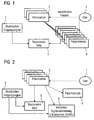
- FIG 1
- ein Blockschaltbild zum Verfahren gemäß dem Stand der Technik;
- FIG 2
- ein Blockschaltbild des erfindungsgemäßen Verfahrens;
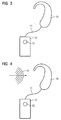
- FIG 3
- eine prinzipielle Darstellung eines Hörgeräts mit Fernbedienung zum Eingeben einer Hörsituation in einem ersten Schritt; und
- FIG 4
- die Situation des Hörgeräts gemäß FIG 3 während der Trainingsphase.
- FIG. 1
- a block diagram of the method according to the prior art;
- FIG. 2
- a block diagram of the method according to the invention;
- FIG. 3
- a schematic representation of a hearing aid with remote control for entering a hearing situation in a first step; and
- FIG. 4
- the situation of the hearing aid according to FIG 3 during the training phase.
Das nachfolgend näher beschriebene Ausführungsbeispiel stellt eine bevorzugte Ausführungsform der vorliegenden Erfindung dar. Zum besseren Verständnis der Erfindung wird jedoch zunächst das Verfahren zum Nachtraining gemäß dem Stand der Technik anhand von FIG 1 nochmals näher erläutert.The embodiment described in more detail below a preferred embodiment of the present invention For better understanding of the invention, however, first the procedure for night training according to the state of Technique explained in more detail with reference to FIG 1.
Der Hörgeräteträger bzw. User 1 befindet sich, wie in FIG 1
dargestellt, in einer speziellen akustischen Situation, in
der dem Hörgerät ein akustisches Eingangssignal 2 zur Verfügung
steht. Da das Hörgerät für den Hörgeräteträger 1 subjektiv
nicht optimal eingestellt ist, nimmt er ein Nachtraining
vor. Dazu klassifiziert er das Geräusch und teilt dem Hörgerät
die entsprechende sehr allgemeine Hörsituation bzw. Hörsituationskennung,
z. B. "Sprache in Störgeräusch", mit. Jeder
dieser Hörsituationen 3 ist jeweils eine Vielzahl an Parametersätzen
4 zugeordnet. Aufgrund der ausgewählten Hörsituation
3 hat der Hörgeräteträger 1 beispielsweise sieben Parametersätze
zur Auswahl. Er kann nun denjenigen Parametersatz
4 auswählen, mit dem das Hörgerät so eingestellt ist,
dass es in dieser akustischen Situation den subjektiv besten
Klang erzeugt.The hearing aid wearer or user 1 is located, as in FIG. 1
shown in a special acoustic situation, in
the hearing aid an
Ein neuronales Netz 5 lernt den gewünschten Parametersatz 4
für das anliegende akustische Eingangssignal 2, so dass es
diesen Parametersatz 4 auch für eine ähnliche akustische Situation
nach der Trainingsphase wieder wählen wird.A
Die subjektive Beurteilung der Klänge, hervorgerufen durch die unterschiedlichen Parametersätze für die Hörgeräteeinstellung, ist für den Hörgeräteträger 1 jedoch sehr schwierig, da dies viel Detailwissen über die Auswirkungen der Hörgeräteparameter voraussetzt.The subjective assessment of the sounds caused by the different parameter sets for the hearing aid setting, is very difficult for the hearing aid wearer 1, since this has a lot of detailed knowledge about the effects of hearing aid parameters presupposes.
Gemäß der vorliegenden Erfindung soll daher vom Hörgerät
nicht die Verwendung spezieller Parametersätze, sondern lediglich
das Erkennen der augenblicklichen Situation trainiert
werden. Dies erfolgt entsprechend dem Verfahren von FIG 2.
Auch hier erhält der Hörgeräteträger bzw. User 1 das akustische
Eingangssignal 2. Zum Nachtraining des neuronalen Netzes
5 im Hörgerät muss der Hörgeräteträger 1 die akustische Situation,
in der er sich momentan befindet, lediglich einer von
einer Vielzahl von vorgegebenen, spezifischen Hörsituationen
3' zuordnen. Die Anzahl der spezifischen Hörsituationen 3'
ist im Fall der vorliegenden Erfindung üblicherweise größer
als die Anzahl der allgemeinen Hörsituationen 3 gemäß FIG 1,
da sie von vorne herein differenzierter sein sollen. Der
Grund hierfür liegt darin, dass die allgemeine Hörsituation
"Sprache in Störgeräusch" beispielsweise die spezielle Hörsituation
"eigene Stimme" beinhaltet.According to the present invention is therefore intended by the hearing aid
not the use of special parameter sets, but only
the recognition of the current situation trains
become. This is done according to the method of FIG. 2.
Again, the hearing aid wearer or user 1 receives the
Das neuronale Netz 5 lernt damit nicht die Zuordnung eines
Parametersatzes zu dem akustischen Eingangssignal 2, sondern
die Zuordnung einer differenzierten Hörsituation bzw. einer
Hörsituationskennung 3' zu dem akustischen Eingangssignal 2
(vgl. Pfeile mit durchgezogenen Linien in FIG 2). Dies bedeutet,
dass das neuronale Netz im Gegensatz zum Stand der Technik
auf einer höheren Ebene lernt. An dem Beispiel der Hörsituation
"eigene Stimme im eigenen Auto" sei dies näher erläutert.
Nach dem Stand der Technik wird dieser komplexen Situation
ein fester Parametersatz ausgehend beispielsweise von
der Parametersatzgruppe "Sprache in Störgeräusch" zugeordnet.
Da nur eine Anzahl an Parametersätzen zur Auswahl für den
Hörgeräteträger für derartige Situationen "Sprache in Störgeräusch"
sinnvoll ist, ist sicherlich keiner der zur Verfügung
stehenden Parametersätze für die eigene Stimme und zusätzlich
für das eigene Auto optimiert.The
Erfindungsgemäß wird dagegen die Situation "eigene Stimme" und die weitere Situation "im eigenen Auto" getrennt gelernt. Diese Hörsituationen nehmen jeweils spezifischen Einfluss auf die komplexe Signalverarbeitung. So wird beispielsweise bei der Situation "eigene Stimme" eine spezifische Verstärkung, eventuell gekoppelt mit einer speziellen Einstellung der Richtwirkung des Hörgeräts, und bei der Situation "im eigenen Auto" eine wiederum sehr spezifische Störgeräuschunterdrückung im Hörgerät veranlasst.According to the invention, on the other hand, the situation "own voice" and learned the other situation "in your own car" separately. These listening situations each have a specific influence the complex signal processing. For example, at the situation "own voice" a specific reinforcement, possibly coupled with a special setting of Directivity of the hearing aid, and in the situation "in his own Auto "again a very specific noise reduction caused in the hearing aid.
Besonders vorteilhaft ist, dass die eigene Stimme vom Hörgerät gelernt werden kann. Dies erfolgt dadurch, dass das akustische Eingangssignal mit der eigenen Stimme einer speziellen Verarbeitung unterzogen wird und entsprechende Parameter für das Hörgerät spezifisch gesetzt und der Hörsituation "eigene Stimme" zugeordnet werden. Ähnliches gilt für das Lernen beispielsweise der Hörsituation "eigenes Auto", wodurch eine sehr spezifische Störgeräuschunterdrückung erzielt werden kann. Es werden hier also beim Lernen nicht nur das Eingangssignal einer Hörsituation zugeordnet, sondern es findet auch eine sehr spezifische Ermittlung von Parametern, wie beispielsweise Filter- oder Verstärkungsparameter, statt.It is particularly advantageous that your own voice from the hearing aid can be learned. This is done by the acoustic Input signal with the voice of a special one Processing is subjected and appropriate parameters for the hearing aid specifically set and the hearing situation "own The same applies to learning, for example the listening situation "own car", creating a very specific noise suppression can be achieved can. So here, learning is not just the input signal assigned to a listening situation, but it also finds a very specific determination of parameters, such as Filter or gain parameter, instead.
Beim Gebrauch des Hörgeräts nach dem Nachtraining wird das
neuronale Netz 5 ein akustisches Eingangssignal 2 einer oder
mehreren spezifischen Hörsituationskennungen 3' zuweisen, so
dass der momentan geltende Parametersatz 4' (einschließlich
Filterparameter) entsprechend beeinflusst wird. Eine komplexe
Signalverarbeitungseinheit 6 z. B. mit adaptivem Richtmikrofon
wird die Signalverarbeitung auf der Basis des beeinflussten
Parametersatzes 4' durchführen. Falls das neuronale Netz
gemäß dem obigen Beispiel nun das Eingangssignal "eigene
Stimme im eigenen Auto" erhält, weist es diesem sowohl die
Hörsituationskennung "eigene Stimme" als auch die Hörsituationskennung
"im eigenen Auto" zu, so dass der aktuelle Parametersatz
beispielsweise hinsichtlich der spezifischen Verstärkung
für die eigenen Stimme und bezüglich der spezifischen
Filterung zur Unterdrückung der Störgeräusche des eigenen Autos
variiert oder ergänzt wird.When using the hearing aid after night training is the
Nachfolgend werden zwei konkrete Anwendungsbeispiele der vorliegenden Erfindung aufgezeigt:Below are two concrete application examples of the present Invention shown:
Beispiel 1: Ein adaptives Richtmikrofon richtet sich auf die Richtung aus, aus der der maximale Nutzschall, z. B. ein Sprachsignal, einfällt. Unterhält sich der Hörgeräteträger mit einer neben ihm herlaufenden Person, sollte sich das Richtmikrofon auf den Gesprächespartner einstellen, d. h. auf eine maximale Verstärkung in einem Winkel um ca. 90°. Sobald jedoch der Hörgeräteträger selbst spricht, kommt das Nutzschallsignal aus dem eigenen Mund, d. h. aus einem Winkel von 0°. Die eigene Sprache zieht somit die Richtmikrofoncharakteristik vom eigentlichen Gesprächspartner weg und zwar üblicherweise mit einer gewissen zeitlichen Verzögerung. Wenn das Hörgerät hingegen auf die eigene Stimme trainiert ist, und somit der adaptiven Mikrofonsteuerung bekannt ist, welche akustischen Eigenschaften zur eigenen Stimme gehören, können Signale, die als "eigene Stimme" klassifiziert werden, für die Nachführung der Richtcharakteristik unberücksichtigt bleiben. Demgegenüber wäre die Einstellmöglichkeit des Hörgeräts nach dem Stand der Technik von EP 0 814 634 A1 gemäß FIG 1, wonach der Hörgeräteträger mehrere Parametersätze beurteilen müsste, aufgrund der Dynamik und Adaptivität der Vorgänge wenig Erfolg versprechend. Insbesondere könnte die eigene Stimme nicht erkannt werden.Example 1: An adaptive directional microphone is aimed at the Direction from which the maximum useful sound, z. B. a Speech signal, is incident. Entertains the hearing aid wearer with a person walking beside him, that should be Set directional microphone on the conversation partner, d. H. on a maximum gain at an angle of about 90 °. As soon as However, the hearing aid itself speaks, comes the useful sound signal from the own mouth, d. H. from an angle of 0 °. The own language thus draws the directional microphone characteristic away from the actual caller and usually with a certain delay. If that Hearing aid, however, is trained on one's own voice, and thus the adaptive microphone control is known which acoustic properties can belong to one's own voice Signals classified as "own voice" for the tracking of the directional characteristic is disregarded stay. In contrast, the adjustment of the hearing aid would be according to the prior art of EP 0 814 634 A1 according to FIG 1, after which the hearing aid wearer assess several sets of parameters would have, due to the dynamics and adaptivity of the processes little promise. In particular, your own could Voice can not be recognized.
Beispiel 2: Ein Störgeräuschunterdrückungsverfahren kann speziell auf ein komplexes, zeitlich variables Geräusch trainiert werden. Dieses Geräusch wird dann optimal unterdrückt, obwohl es eventuell ähnliche spektrale Komponenten oder ein Modulationsspektrum wie Sprache, die als Nutzsignal weiterverarbeitet werden soll, aufweist. Durch individuelles Training auf diese akustische Situation, z. B. die oben erwähnte Situation "im Auto", kann das Störgeräuschunterdrückungsverfahren automatisch optimal eingestellt werden, indem beispielsweise spezielle Gewichtungsfaktoren für einzelne spektrale Bänder eingestellt werden oder das dynamische Verhalten optimal auf die Störgeräuschcharakteristik angepasst wird. Auch in diesem Fall sind die Unterschiede zwischen den Einstellungen der dynamischen Störgeräuschunterdrückung nur schwer direkt zu bewerten, die Situation hingegen sehr zuverlässig.Example 2: A noise canceling method may specifically be used trained on a complex, time-varying noise become. This noise is then optimally suppressed, although it may have similar spectral components or a Modulation spectrum such as speech, which further processed as a useful signal should be, has. Through individual training to this acoustic situation, z. B. the above-mentioned Situation "in the car", can the noise reduction method automatically optimally adjusted by, for example special weighting factors for single spectral Tapes are set or the dynamic behavior optimally adapted to the noise characteristic. Also in this case are the differences between the settings dynamic noise canceling only difficult to assess directly, but the situation is very reliable.
In gewissen akustischen Situationen kann es vorteilhaft sein, wenn zusätzlich zu dem erfindungsgemäßen Nachtraining ein Nachtraining gemäß dem Stand der Technik unter Beurteilung verschiedener Parametersätze durch den Hörgeräteträger erfolgt. In certain acoustic situations it may be advantageous if in addition to the night training according to the invention Night training according to the state of the art under assessment various parameter sets done by the hearing aid wearer.
Das Nachtraining, wie es sich für den Hörgeräteträger darstellt,
sei nun anhand der FIG 3 und 4 näher erläutert. Der
Hörgeräteträger will beispielsweise die Situation "eigene
Stimme" in sein Hörgerät 10 eintrainieren. Dazu schließt er
über eine Leitung 11 eine Fernbedienung 12 an das Hörgerät 10
an. Die Fernbedienung weist als Bedienelement einen Taster 13
auf.The night training, as it is for the hearing aid wearer,
will now be explained in more detail with reference to FIGS 3 and 4. Of the
Hearing aid wearer wants, for example, the situation "own
Voice "into his
In dem Klassifikator sind mehrere Hörsituationen abgelegt.
Der Hörgeräteträger weiß, dass die Hörsituation "eigene
Stimme" beispielsweise der Situation 3 entspricht. Daher
drückt er den Taster 13 dreimal, um dem Klassifikator mitzuteilen,
dass Situation 3 nachtrainiert werden soll.In the classifier several listening situations are stored.
The hearing aid wearer knows that the hearing situation "own
Voice "for example corresponds to
In einem anschließenden Schritt wird ein akustisches Signal,
hier die eigene Stimme, zur Aufnahme für das Hörgerät 10 gemäß
FIG 4 dargeboten. Der Hörgeräteträger muss nun dem Hörgerät
10 den Beginn und das Ende der Trainingsphase mitteilen.
Dies erfolgt, indem er den Taster 13 gedrückt hält, während
er selbst spricht. Dies bedeutet, dass er für beide Schritte
des Trainings nur ein einziges Bedienelement 13 verwenden
muss. Wenn sehr viele Hörsituationskennungen vorliegen, kann
ein anderes Design bedienerfreundlicher sein, z. B. mit einem
Display und einem Regler (Schieberegler, Trackball, etc.),
mit dem die entsprechende Situation schnell angewählt werden
kann.In a subsequent step, an acoustic signal,
here your own voice, for recording for the
Das tatsächliche Nachtraining des Hörgeräts 10 kann während
der Darbietung des akustischen Signals 14 erfolgen. Alternativ
wird das akustische Signal 14 im Hörgerät aufgezeichnet
und nach der Aufzeichnung ausgewertet bzw. der gewählten Hörsituation
aufgrund charakteristischer akustischer Eigenschaften
zugeordnet. Im Falle des Online-Nachtrainings ist eine
dauerhafte oder temporäre Speicherung des akustischen Signals
14 nicht unbedingt notwendig. The actual night training of the
Da dem Hörgerät 10 nur die Information über die momentane Situation
mitgeteilt werden muss, ist im Unterschied zum Stand
der Technik gemäß EP 0 814 634 A1 eine externe Bedieneinheit
nicht unbedingt notwendig. Sie kann jedoch entsprechend den
FIG 3 und 4 beispielsweise aus Komfortgründen verwendet werden.
Es kann jedoch auch ein Aufnahmeknopf am Hörgerät selbst
angebracht sein.Since the
Durch das Nachtraining lässt sich die Erkennungsrate des Klassifikators für bestimmte Situationen deutlich gegenüber der Voreinstellung erhöhen, so dass sich das Hörgerät zuverlässiger auf diese Situation einstellt. Durch das selbständige Starten und Beenden der Nachtrainingsphase durch den Hörgeräteträger können Situationen ferner zuverlässig nachtrainiert werden, da der Hörgeräteträger selbst entscheidet, wann das Signal der Situation zugeordnet werden kann.By night training, the recognition rate of the Classifier for certain situations clearly opposite Increase the presetting, so that the hearing aid more reliable to adjust to this situation. By the independent Starting and ending the night training phase by the Hearing aid wearers can also reliably relieve situations because the hearing aid wearer decides when the signal can be assigned to the situation.
Claims (27)
Applications Claiming Priority (2)
| Application Number | Priority Date | Filing Date | Title |
|---|---|---|---|
| DE10347211 | 2003-10-10 | ||
| DE10347211A DE10347211A1 (en) | 2003-10-10 | 2003-10-10 | Method for training and operating a hearing aid and corresponding hearing aid |
Publications (3)
| Publication Number | Publication Date |
|---|---|
| EP1523219A2 true EP1523219A2 (en) | 2005-04-13 |
| EP1523219A3 EP1523219A3 (en) | 2007-08-08 |
| EP1523219B1 EP1523219B1 (en) | 2008-08-20 |
Family
ID=34306363
Family Applications (1)
| Application Number | Title | Priority Date | Filing Date |
|---|---|---|---|
| EP04022104A Revoked EP1523219B1 (en) | 2003-10-10 | 2004-09-16 | Method for training and operating a hearing aid and corresponding hearing aid |
Country Status (6)
| Country | Link |
|---|---|
| US (1) | US7742612B2 (en) |
| EP (1) | EP1523219B1 (en) |
| AT (1) | ATE406073T1 (en) |
| AU (1) | AU2004218632B2 (en) |
| DE (2) | DE10347211A1 (en) |
| DK (1) | DK1523219T3 (en) |
Cited By (7)
| Publication number | Priority date | Publication date | Assignee | Title |
|---|---|---|---|---|
| EP1744589A2 (en) | 2005-07-11 | 2007-01-17 | Siemens Audiologische Technik GmbH | Hearing device and corresponding method for ownvoices detection |
| WO2007110073A1 (en) * | 2006-03-24 | 2007-10-04 | Gn Resound A/S | Learning control of hearing aid parameter settings |
| EP1670285A3 (en) * | 2004-12-09 | 2008-08-20 | Phonak Ag | Method to adjust parameters of a transfer function of a hearing device as well as a hearing device |
| WO2008084116A3 (en) * | 2008-03-27 | 2009-03-12 | Phonak Ag | Method for operating a hearing device |
| EP2063663A1 (en) * | 2007-11-22 | 2009-05-27 | myWORLDofHEARING e.K. | Method for individually modifying a hearing device |
| WO2020007478A1 (en) | 2018-07-05 | 2020-01-09 | Sonova Ag | Supplementary sound classes for adjusting a hearing device |
| CN112911478A (en) * | 2019-12-03 | 2021-06-04 | 西万拓私人有限公司 | Method for training a hearing situation classifier of a hearing device |
Families Citing this family (39)
| Publication number | Priority date | Publication date | Assignee | Title |
|---|---|---|---|---|
| US20050090372A1 (en) * | 2003-06-24 | 2005-04-28 | Mark Burrows | Method and system for using a database containing rehabilitation plans indexed across multiple dimensions |
| WO2005002431A1 (en) * | 2003-06-24 | 2005-01-13 | Johnson & Johnson Consumer Companies Inc. | Method and system for rehabilitating a medical condition across multiple dimensions |
| WO2005002433A1 (en) * | 2003-06-24 | 2005-01-13 | Johnson & Johnson Consumer Compagnies, Inc. | System and method for customized training to understand human speech correctly with a hearing aid device |
| DE10347211A1 (en) | 2003-10-10 | 2005-05-25 | Siemens Audiologische Technik Gmbh | Method for training and operating a hearing aid and corresponding hearing aid |
| WO2005125281A1 (en) * | 2004-06-14 | 2005-12-29 | Johnson & Johnson Consumer Companies, Inc. | System for and method of optimizing an individual’s hearing aid |
| US20080298614A1 (en) * | 2004-06-14 | 2008-12-04 | Johnson & Johnson Consumer Companies, Inc. | System for and Method of Offering an Optimized Sound Service to Individuals within a Place of Business |
| WO2005125278A2 (en) * | 2004-06-14 | 2005-12-29 | Johnson & Johnson Consumer Companies, Inc. | At-home hearing aid training system and method |
| EP1765153A4 (en) * | 2004-06-14 | 2009-07-22 | Johnson & Johnson Consumer | SYSTEM AND METHOD FOR SIMPLE AND AUTOMATIC VERIFICATION OF THE HEARING OF A PERSON |
| EP1767058A4 (en) * | 2004-06-14 | 2009-11-25 | Johnson & Johnson Consumer | ACOUSTIC SIMULATION SYSTEM AND METHOD OF USE |
| EP1767053A4 (en) * | 2004-06-14 | 2009-07-01 | Johnson & Johnson Consumer | SYSTEM AND METHOD FOR INCREASING USERS 'COMFORT FOR THE PURPOSES OF PROVIDING THE METHOD OF PURCHASING A HEARING SYSTEM WHICH RESULTS IN THE PURCHASE OF A HEARING CORRECTION DEVICE |
| US20080167575A1 (en) * | 2004-06-14 | 2008-07-10 | Johnson & Johnson Consumer Companies, Inc. | Audiologist Equipment Interface User Database For Providing Aural Rehabilitation Of Hearing Loss Across Multiple Dimensions Of Hearing |
| WO2005125276A1 (en) * | 2004-06-14 | 2005-12-29 | Johnson & Johnson Consumer Companies, Inc. | At-home hearing aid testing and cleaning system |
| US20080041656A1 (en) * | 2004-06-15 | 2008-02-21 | Johnson & Johnson Consumer Companies Inc, | Low-Cost, Programmable, Time-Limited Hearing Health aid Apparatus, Method of Use, and System for Programming Same |
| US7599500B1 (en) * | 2004-12-09 | 2009-10-06 | Advanced Bionics, Llc | Processing signals representative of sound based on the identity of an input element |
| DK1906700T3 (en) * | 2006-09-29 | 2013-05-06 | Siemens Audiologische Technik | Method of timed setting of a hearing aid and corresponding hearing aid |
| WO2008083315A2 (en) * | 2006-12-31 | 2008-07-10 | Personics Holdings Inc. | Method and device configured for sound signature detection |
| WO2009006418A1 (en) | 2007-06-28 | 2009-01-08 | Personics Holdings Inc. | Method and device for background noise mitigation |
| US20100293227A1 (en) * | 2007-10-02 | 2010-11-18 | Phonak Ag | Hearing system, method for operating a hearing system, and hearing system network |
| US9129291B2 (en) | 2008-09-22 | 2015-09-08 | Personics Holdings, Llc | Personalized sound management and method |
| DE102009007074B4 (en) | 2009-02-02 | 2012-05-31 | Siemens Medical Instruments Pte. Ltd. | Method and hearing device for setting a hearing device from recorded data |
| USRE48462E1 (en) * | 2009-07-29 | 2021-03-09 | Northwestern University | Systems, methods, and apparatus for equalization preference learning |
| ATE524028T1 (en) * | 2009-08-28 | 2011-09-15 | Siemens Medical Instr Pte Ltd | METHOD FOR FINE ADJUSTMENT OF A HEARING AID AND HEARING AID |
| DE102010018877A1 (en) * | 2010-04-30 | 2011-06-30 | Siemens Medical Instruments Pte. Ltd. | Method and arrangement for voice control of hearing aids |
| DK2472907T3 (en) * | 2010-12-29 | 2017-06-19 | Oticon As | Listening system comprising an alarm device and a listening device |
| US9814879B2 (en) * | 2013-05-13 | 2017-11-14 | Cochlear Limited | Method and system for use of hearing prosthesis for linguistic evaluation |
| US9883300B2 (en) * | 2015-02-23 | 2018-01-30 | Oticon A/S | Method and apparatus for controlling a hearing instrument to relieve tinitus, hyperacusis, and hearing loss |
| DK3082350T3 (en) * | 2015-04-15 | 2019-04-23 | Starkey Labs Inc | USER INTERFACE WITH REMOTE SERVER |
| US10492008B2 (en) | 2016-04-06 | 2019-11-26 | Starkey Laboratories, Inc. | Hearing device with neural network-based microphone signal processing |
| US20170311095A1 (en) | 2016-04-20 | 2017-10-26 | Starkey Laboratories, Inc. | Neural network-driven feedback cancellation |
| CN106714062B (en) * | 2016-11-30 | 2020-02-18 | 天津大学 | An intelligent fitting method for digital hearing aids based on BP artificial neural network |
| WO2019099699A1 (en) * | 2017-11-15 | 2019-05-23 | Starkey Laboratories, Inc. | Interactive system for hearing devices |
| US10795638B2 (en) | 2018-10-19 | 2020-10-06 | Bose Corporation | Conversation assistance audio device personalization |
| CN110473567B (en) * | 2019-09-06 | 2021-09-14 | 上海又为智能科技有限公司 | Audio processing method and device based on deep neural network and storage medium |
| EP3806496A1 (en) * | 2019-10-08 | 2021-04-14 | Oticon A/s | A hearing device comprising a detector and a trained neural network |
| DE102019216100A1 (en) * | 2019-10-18 | 2021-04-22 | Sivantos Pte. Ltd. | Method for operating a hearing aid and hearing aid |
| US11601765B2 (en) * | 2019-12-20 | 2023-03-07 | Sivantos Pte. Ltd. | Method for adapting a hearing instrument and hearing system therefor |
| JP2023548670A (en) | 2020-10-15 | 2023-11-20 | ドルビー ラボラトリーズ ライセンシング コーポレイション | Audio processing method and device using neural network |
| US20220312126A1 (en) * | 2021-03-23 | 2022-09-29 | Sonova Ag | Detecting Hair Interference for a Hearing Device |
| DE102021204974A1 (en) | 2021-05-17 | 2022-11-17 | Fraunhofer-Gesellschaft zur Förderung der angewandten Forschung eingetragener Verein | Apparatus and method for determining audio processing parameters |
Family Cites Families (21)
| Publication number | Priority date | Publication date | Assignee | Title |
|---|---|---|---|---|
| DE68920060T2 (en) | 1988-03-30 | 1995-09-14 | 3M Hearing Health Ab | Ear prosthesis with data acquisition options. |
| US4972487A (en) * | 1988-03-30 | 1990-11-20 | Diphon Development Ab | Auditory prosthesis with datalogging capability |
| US5303306A (en) * | 1989-06-06 | 1994-04-12 | Audioscience, Inc. | Hearing aid with programmable remote and method of deriving settings for configuring the hearing aid |
| DK0681411T3 (en) * | 1994-05-06 | 2003-05-19 | Siemens Audiologische Technik | Programmable hearing aid |
| DE4419901C2 (en) * | 1994-06-07 | 2000-09-14 | Siemens Audiologische Technik | Hearing aid |
| DK0712263T3 (en) * | 1994-11-10 | 2003-05-26 | Siemens Audiologische Technik | Programmable hearing aid. |
| EP0712261A1 (en) * | 1994-11-10 | 1996-05-15 | Siemens Audiologische Technik GmbH | Programmable hearing aid |
| SE504091C2 (en) | 1995-03-06 | 1996-11-11 | Expandi Systems Ab | Device for self-expanding links |
| EP0814636A1 (en) * | 1996-06-21 | 1997-12-29 | Siemens Audiologische Technik GmbH | Hearing aid |
| DE59609754D1 (en) * | 1996-06-21 | 2002-11-07 | Siemens Audiologische Technik | Programmable hearing aid system and method for determining optimal parameter sets in a hearing aid |
| US6674867B2 (en) * | 1997-10-15 | 2004-01-06 | Belltone Electronics Corporation | Neurofuzzy based device for programmable hearing aids |
| EP1273205B1 (en) * | 2000-04-04 | 2006-06-21 | GN ReSound as | A hearing prosthesis with automatic classification of the listening environment |
| US6895098B2 (en) * | 2001-01-05 | 2005-05-17 | Phonak Ag | Method for operating a hearing device, and hearing device |
| DE10114015C2 (en) | 2001-03-22 | 2003-02-27 | Siemens Audiologische Technik | Method for operating a hearing aid and / or hearing protection device and hearing aid and / or hearing protection device |
| US20030032681A1 (en) * | 2001-05-18 | 2003-02-13 | The Regents Of The University Of Clifornia | Super-hydrophobic fluorine containing aerogels |
| DE10152197B4 (en) | 2001-10-23 | 2009-07-09 | Siemens Audiologische Technik Gmbh | Method for programming a hearing aid, programming device and remote control for the hearing aid |
| US7158931B2 (en) * | 2002-01-28 | 2007-01-02 | Phonak Ag | Method for identifying a momentary acoustic scene, use of the method and hearing device |
| EP1359787B1 (en) * | 2002-04-25 | 2015-01-28 | GN Resound A/S | Fitting methodology and hearing prosthesis based on signal-to-noise ratio loss data |
| US20040190737A1 (en) * | 2003-03-25 | 2004-09-30 | Volker Kuhnel | Method for recording information in a hearing device as well as a hearing device |
| US20060078139A1 (en) * | 2003-03-27 | 2006-04-13 | Hilmar Meier | Method for adapting a hearing device to a momentary acoustic surround situation and a hearing device system |
| DE10347211A1 (en) | 2003-10-10 | 2005-05-25 | Siemens Audiologische Technik Gmbh | Method for training and operating a hearing aid and corresponding hearing aid |
-
2003
- 2003-10-10 DE DE10347211A patent/DE10347211A1/en not_active Withdrawn
-
2004
- 2004-09-16 AT AT04022104T patent/ATE406073T1/en not_active IP Right Cessation
- 2004-09-16 DE DE502004007878T patent/DE502004007878D1/en not_active Expired - Lifetime
- 2004-09-16 EP EP04022104A patent/EP1523219B1/en not_active Revoked
- 2004-09-16 DK DK04022104T patent/DK1523219T3/en active
- 2004-10-06 AU AU2004218632A patent/AU2004218632B2/en not_active Ceased
- 2004-10-08 US US10/961,696 patent/US7742612B2/en not_active Expired - Lifetime
Cited By (13)
| Publication number | Priority date | Publication date | Assignee | Title |
|---|---|---|---|---|
| EP1670285A3 (en) * | 2004-12-09 | 2008-08-20 | Phonak Ag | Method to adjust parameters of a transfer function of a hearing device as well as a hearing device |
| EP1744589A3 (en) * | 2005-07-11 | 2010-01-20 | Siemens Audiologische Technik GmbH | Hearing device and corresponding method for ownvoices detection |
| EP1744589A2 (en) | 2005-07-11 | 2007-01-17 | Siemens Audiologische Technik GmbH | Hearing device and corresponding method for ownvoices detection |
| US9351087B2 (en) | 2006-03-24 | 2016-05-24 | Gn Resound A/S | Learning control of hearing aid parameter settings |
| WO2007110073A1 (en) * | 2006-03-24 | 2007-10-04 | Gn Resound A/S | Learning control of hearing aid parameter settings |
| US9408002B2 (en) | 2006-03-24 | 2016-08-02 | Gn Resound A/S | Learning control of hearing aid parameter settings |
| EP2063663A1 (en) * | 2007-11-22 | 2009-05-27 | myWORLDofHEARING e.K. | Method for individually modifying a hearing device |
| US8477972B2 (en) | 2008-03-27 | 2013-07-02 | Phonak Ag | Method for operating a hearing device |
| WO2008084116A3 (en) * | 2008-03-27 | 2009-03-12 | Phonak Ag | Method for operating a hearing device |
| WO2020007478A1 (en) | 2018-07-05 | 2020-01-09 | Sonova Ag | Supplementary sound classes for adjusting a hearing device |
| US11284207B2 (en) | 2018-07-05 | 2022-03-22 | Sonova Ag | Supplementary sound classes for adjusting a hearing device |
| CN112911478A (en) * | 2019-12-03 | 2021-06-04 | 西万拓私人有限公司 | Method for training a hearing situation classifier of a hearing device |
| CN112911478B (en) * | 2019-12-03 | 2022-10-21 | 西万拓私人有限公司 | Method for training a hearing situation classifier of a hearing device |
Also Published As
| Publication number | Publication date |
|---|---|
| AU2004218632A1 (en) | 2005-04-28 |
| DE502004007878D1 (en) | 2008-10-02 |
| US20050105750A1 (en) | 2005-05-19 |
| ATE406073T1 (en) | 2008-09-15 |
| DE10347211A1 (en) | 2005-05-25 |
| US7742612B2 (en) | 2010-06-22 |
| EP1523219B1 (en) | 2008-08-20 |
| EP1523219A3 (en) | 2007-08-08 |
| AU2004218632B2 (en) | 2009-04-09 |
| DK1523219T3 (en) | 2009-01-05 |
Similar Documents
| Publication | Publication Date | Title |
|---|---|---|
| EP1523219B1 (en) | Method for training and operating a hearing aid and corresponding hearing aid | |
| EP3840418B1 (en) | Method for fitting a hearing aid and corresponding hearing system | |
| EP3809724B1 (en) | Hearing device and method for operating a hearing device | |
| DE102019206743A1 (en) | Hearing aid system and method for processing audio signals | |
| EP3451705B1 (en) | Method and apparatus for the rapid detection of own voice | |
| EP0681411B1 (en) | Programmable hearing aid | |
| EP2306756B1 (en) | Method for fine tuning a hearing aid and hearing aid | |
| EP3873108B1 (en) | Hearing system with at least one hearing instrument worn in or on the ear of the user and method for operating such a hearing system | |
| EP1453356B1 (en) | Method of adjusting a hearing system and corresponding hearing system | |
| DE60307576T2 (en) | A method for adjusting a hearing aid to a current acoustic environment situation and a hearing aid system | |
| EP3445067B1 (en) | Hearing aid and method for operating a hearing aid | |
| DE102008004659A1 (en) | Method and device for configuring setting options on a hearing aid | |
| EP1906700B1 (en) | Method for time-controlled adaptation of a hearing device and corresponding hearing device | |
| EP2070384B1 (en) | Hearing device controlled by a perceptive model and corresponding method | |
| EP3386215B1 (en) | Hearing aid and method for operating a hearing aid | |
| EP2991379B1 (en) | Method and device for improved perception of own voice | |
| EP2302952B1 (en) | Self-adjustment of a hearing aid | |
| DE102019218808B3 (en) | Method for training a hearing situation classifier for a hearing aid | |
| DE102007035171A1 (en) | Method for adapting a hearing aid by means of a perceptive model | |
| EP2182741A1 (en) | Hearing aid with special situation recognition unit and method for operating a hearing aid | |
| DE102019203786A1 (en) | Hearing aid system | |
| WO2011103934A1 (en) | Method for training speech recognition, and training device | |
| EP1881738A2 (en) | Method of operating a hearing aid and assembly with a hearing aid | |
| EP2658289B1 (en) | Method for controlling an alignment characteristic and hearing aid | |
| DE102016207936A1 (en) | Method for operating a hearing device |
Legal Events
| Date | Code | Title | Description |
|---|---|---|---|
| PUAI | Public reference made under article 153(3) epc to a published international application that has entered the european phase |
Free format text: ORIGINAL CODE: 0009012 |
|
| AK | Designated contracting states |
Kind code of ref document: A2 Designated state(s): AT BE BG CH CY CZ DE DK EE ES FI FR GB GR HU IE IT LI LU MC NL PL PT RO SE SI SK TR |
|
| AX | Request for extension of the european patent |
Extension state: AL HR LT LV MK |
|
| PUAL | Search report despatched |
Free format text: ORIGINAL CODE: 0009013 |
|
| AK | Designated contracting states |
Kind code of ref document: A3 Designated state(s): AT BE BG CH CY CZ DE DK EE ES FI FR GB GR HU IE IT LI LU MC NL PL PT RO SE SI SK TR |
|
| AX | Request for extension of the european patent |
Extension state: AL HR LT LV MK |
|
| 17P | Request for examination filed |
Effective date: 20071106 |
|
| GRAP | Despatch of communication of intention to grant a patent |
Free format text: ORIGINAL CODE: EPIDOSNIGR1 |
|
| RTI1 | Title (correction) |
Free format text: METHOD FOR TRAINING AND OPERATING A HEARING AID AND CORRESPONDING HEARING AID |
|
| AKX | Designation fees paid |
Designated state(s): AT BE BG CH CY CZ DE DK EE ES FI FR GB GR HU IE IT LI LU MC NL PL PT RO SE SI SK TR |
|
| GRAS | Grant fee paid |
Free format text: ORIGINAL CODE: EPIDOSNIGR3 |
|
| GRAA | (expected) grant |
Free format text: ORIGINAL CODE: 0009210 |
|
| AK | Designated contracting states |
Kind code of ref document: B1 Designated state(s): AT BE BG CH CY CZ DE DK EE ES FI FR GB GR HU IE IT LI LU MC NL PL PT RO SE SI SK TR |
|
| REG | Reference to a national code |
Ref country code: GB Ref legal event code: FG4D Free format text: NOT ENGLISH |
|
| REG | Reference to a national code |
Ref country code: CH Ref legal event code: NV Representative=s name: SIEMENS SCHWEIZ AG Ref country code: CH Ref legal event code: EP |
|
| REG | Reference to a national code |
Ref country code: IE Ref legal event code: FG4D Free format text: LANGUAGE OF EP DOCUMENT: GERMAN |
|
| REF | Corresponds to: |
Ref document number: 502004007878 Country of ref document: DE Date of ref document: 20081002 Kind code of ref document: P |
|
| REG | Reference to a national code |
Ref country code: DK Ref legal event code: T3 |
|
| PG25 | Lapsed in a contracting state [announced via postgrant information from national office to epo] |
Ref country code: ES Free format text: LAPSE BECAUSE OF FAILURE TO SUBMIT A TRANSLATION OF THE DESCRIPTION OR TO PAY THE FEE WITHIN THE PRESCRIBED TIME-LIMIT Effective date: 20081201 Ref country code: NL Free format text: LAPSE BECAUSE OF FAILURE TO SUBMIT A TRANSLATION OF THE DESCRIPTION OR TO PAY THE FEE WITHIN THE PRESCRIBED TIME-LIMIT Effective date: 20080820 |
|
| PG25 | Lapsed in a contracting state [announced via postgrant information from national office to epo] |
Ref country code: SI Free format text: LAPSE BECAUSE OF FAILURE TO SUBMIT A TRANSLATION OF THE DESCRIPTION OR TO PAY THE FEE WITHIN THE PRESCRIBED TIME-LIMIT Effective date: 20080820 Ref country code: FI Free format text: LAPSE BECAUSE OF FAILURE TO SUBMIT A TRANSLATION OF THE DESCRIPTION OR TO PAY THE FEE WITHIN THE PRESCRIBED TIME-LIMIT Effective date: 20080820 |
|
| BERE | Be: lapsed |
Owner name: SIEMENS AUDIOLOGISCHE TECHNIK G.M.B.H. Effective date: 20080930 |
|
| PGFP | Annual fee paid to national office [announced via postgrant information from national office to epo] |
Ref country code: IT Payment date: 20080924 Year of fee payment: 5 |
|
| REG | Reference to a national code |
Ref country code: CH Ref legal event code: PCAR Free format text: SIEMENS SCHWEIZ AG;INTELLECTUAL PROPERTY FREILAGERSTRASSE 40;8047 ZUERICH (CH) |
|
| REG | Reference to a national code |
Ref country code: IE Ref legal event code: FD4D |
|
| PG25 | Lapsed in a contracting state [announced via postgrant information from national office to epo] |
Ref country code: BG Free format text: LAPSE BECAUSE OF FAILURE TO SUBMIT A TRANSLATION OF THE DESCRIPTION OR TO PAY THE FEE WITHIN THE PRESCRIBED TIME-LIMIT Effective date: 20081120 Ref country code: MC Free format text: LAPSE BECAUSE OF NON-PAYMENT OF DUE FEES Effective date: 20080930 Ref country code: IE Free format text: LAPSE BECAUSE OF FAILURE TO SUBMIT A TRANSLATION OF THE DESCRIPTION OR TO PAY THE FEE WITHIN THE PRESCRIBED TIME-LIMIT Effective date: 20080820 |
|
| PG25 | Lapsed in a contracting state [announced via postgrant information from national office to epo] |
Ref country code: RO Free format text: LAPSE BECAUSE OF FAILURE TO SUBMIT A TRANSLATION OF THE DESCRIPTION OR TO PAY THE FEE WITHIN THE PRESCRIBED TIME-LIMIT Effective date: 20080820 Ref country code: PT Free format text: LAPSE BECAUSE OF FAILURE TO SUBMIT A TRANSLATION OF THE DESCRIPTION OR TO PAY THE FEE WITHIN THE PRESCRIBED TIME-LIMIT Effective date: 20090120 Ref country code: SK Free format text: LAPSE BECAUSE OF FAILURE TO SUBMIT A TRANSLATION OF THE DESCRIPTION OR TO PAY THE FEE WITHIN THE PRESCRIBED TIME-LIMIT Effective date: 20080820 Ref country code: CZ Free format text: LAPSE BECAUSE OF FAILURE TO SUBMIT A TRANSLATION OF THE DESCRIPTION OR TO PAY THE FEE WITHIN THE PRESCRIBED TIME-LIMIT Effective date: 20080820 |
|
| PLBI | Opposition filed |
Free format text: ORIGINAL CODE: 0009260 |
|
| 26 | Opposition filed |
Opponent name: OTICON A/S(DK)/WIDEX A/S(DK)/ GN RESOUND A/S(DK)/P Effective date: 20090520 |
|
| PG25 | Lapsed in a contracting state [announced via postgrant information from national office to epo] |
Ref country code: BE Free format text: LAPSE BECAUSE OF NON-PAYMENT OF DUE FEES Effective date: 20080930 Ref country code: EE Free format text: LAPSE BECAUSE OF FAILURE TO SUBMIT A TRANSLATION OF THE DESCRIPTION OR TO PAY THE FEE WITHIN THE PRESCRIBED TIME-LIMIT Effective date: 20080820 |
|
| PLAX | Notice of opposition and request to file observation + time limit sent |
Free format text: ORIGINAL CODE: EPIDOSNOBS2 |
|
| PG25 | Lapsed in a contracting state [announced via postgrant information from national office to epo] |
Ref country code: AT Free format text: LAPSE BECAUSE OF NON-PAYMENT OF DUE FEES Effective date: 20080916 |
|
| PLBB | Reply of patent proprietor to notice(s) of opposition received |
Free format text: ORIGINAL CODE: EPIDOSNOBS3 |
|
| PG25 | Lapsed in a contracting state [announced via postgrant information from national office to epo] |
Ref country code: SE Free format text: LAPSE BECAUSE OF FAILURE TO SUBMIT A TRANSLATION OF THE DESCRIPTION OR TO PAY THE FEE WITHIN THE PRESCRIBED TIME-LIMIT Effective date: 20081120 |
|
| PG25 | Lapsed in a contracting state [announced via postgrant information from national office to epo] |
Ref country code: PL Free format text: LAPSE BECAUSE OF FAILURE TO SUBMIT A TRANSLATION OF THE DESCRIPTION OR TO PAY THE FEE WITHIN THE PRESCRIBED TIME-LIMIT Effective date: 20080820 |
|
| PG25 | Lapsed in a contracting state [announced via postgrant information from national office to epo] |
Ref country code: LU Free format text: LAPSE BECAUSE OF NON-PAYMENT OF DUE FEES Effective date: 20080916 Ref country code: CY Free format text: LAPSE BECAUSE OF FAILURE TO SUBMIT A TRANSLATION OF THE DESCRIPTION OR TO PAY THE FEE WITHIN THE PRESCRIBED TIME-LIMIT Effective date: 20080820 Ref country code: HU Free format text: LAPSE BECAUSE OF FAILURE TO SUBMIT A TRANSLATION OF THE DESCRIPTION OR TO PAY THE FEE WITHIN THE PRESCRIBED TIME-LIMIT Effective date: 20090221 |
|
| PG25 | Lapsed in a contracting state [announced via postgrant information from national office to epo] |
Ref country code: TR Free format text: LAPSE BECAUSE OF FAILURE TO SUBMIT A TRANSLATION OF THE DESCRIPTION OR TO PAY THE FEE WITHIN THE PRESCRIBED TIME-LIMIT Effective date: 20080820 |
|
| PG25 | Lapsed in a contracting state [announced via postgrant information from national office to epo] |
Ref country code: GR Free format text: LAPSE BECAUSE OF FAILURE TO SUBMIT A TRANSLATION OF THE DESCRIPTION OR TO PAY THE FEE WITHIN THE PRESCRIBED TIME-LIMIT Effective date: 20081121 |
|
| RDAF | Communication despatched that patent is revoked |
Free format text: ORIGINAL CODE: EPIDOSNREV1 |
|
| APBM | Appeal reference recorded |
Free format text: ORIGINAL CODE: EPIDOSNREFNO |
|
| APBP | Date of receipt of notice of appeal recorded |
Free format text: ORIGINAL CODE: EPIDOSNNOA2O |
|
| APAH | Appeal reference modified |
Free format text: ORIGINAL CODE: EPIDOSCREFNO |
|
| PG25 | Lapsed in a contracting state [announced via postgrant information from national office to epo] |
Ref country code: IT Free format text: LAPSE BECAUSE OF NON-PAYMENT OF DUE FEES Effective date: 20090916 |
|
| APBQ | Date of receipt of statement of grounds of appeal recorded |
Free format text: ORIGINAL CODE: EPIDOSNNOA3O |
|
| PGFP | Annual fee paid to national office [announced via postgrant information from national office to epo] |
Ref country code: CH Payment date: 20131210 Year of fee payment: 10 Ref country code: DE Payment date: 20131120 Year of fee payment: 10 |
|
| REG | Reference to a national code |
Ref country code: DE Ref legal event code: R064 Ref document number: 502004007878 Country of ref document: DE Ref country code: DE Ref legal event code: R103 Ref document number: 502004007878 Country of ref document: DE |
|
| APBU | Appeal procedure closed |
Free format text: ORIGINAL CODE: EPIDOSNNOA9O |
|
| PGFP | Annual fee paid to national office [announced via postgrant information from national office to epo] |
Ref country code: DK Payment date: 20140919 Year of fee payment: 11 |
|
| RDAG | Patent revoked |
Free format text: ORIGINAL CODE: 0009271 |
|
| STAA | Information on the status of an ep patent application or granted ep patent |
Free format text: STATUS: PATENT REVOKED |
|
| REG | Reference to a national code |
Ref country code: CH Ref legal event code: PLX |
|
| PGFP | Annual fee paid to national office [announced via postgrant information from national office to epo] |
Ref country code: GB Payment date: 20140908 Year of fee payment: 11 |
|
| 27W | Patent revoked |
Effective date: 20141006 |
|
| GBPR | Gb: patent revoked under art. 102 of the ep convention designating the uk as contracting state |
Effective date: 20141006 |
|
| REG | Reference to a national code |
Ref country code: DE Ref legal event code: R107 Ref document number: 502004007878 Country of ref document: DE Effective date: 20150115 |
|
| PG25 | Lapsed in a contracting state [announced via postgrant information from national office to epo] |
Ref country code: LI Free format text: LAPSE BECAUSE OF THE APPLICANT RENOUNCES Effective date: 20080820 Ref country code: CH Free format text: LAPSE BECAUSE OF THE APPLICANT RENOUNCES Effective date: 20080820 |
|
| PGFP | Annual fee paid to national office [announced via postgrant information from national office to epo] |
Ref country code: FR Payment date: 20140917 Year of fee payment: 11 |
|
| REG | Reference to a national code |
Ref country code: AT Ref legal event code: MA03 Ref document number: 406073 Country of ref document: AT Kind code of ref document: T Effective date: 20141006 |
|
| REG | Reference to a national code |
Ref country code: DE Ref legal event code: R082 Ref document number: 502004007878 Country of ref document: DE Representative=s name: FDST PATENTANWAELTE FREIER DOERR STAMMLER TSCH, DE |
|
| REG | Reference to a national code |
Ref country code: DE Ref legal event code: R082 Ref document number: 502004007878 Country of ref document: DE Representative=s name: FDST PATENTANWAELTE FREIER DOERR STAMMLER TSCH, DE Ref country code: DE Ref legal event code: R081 Ref document number: 502004007878 Country of ref document: DE Owner name: SIVANTOS GMBH, DE Free format text: FORMER OWNER: SIEMENS AUDIOLOGISCHE TECHNIK GMBH, 91058 ERLANGEN, DE |