EP1522943A1 - Verfahren und System zur Messung der Logistik-Dienstleistungsgüte unter Verwendung von GPS - Google Patents
Verfahren und System zur Messung der Logistik-Dienstleistungsgüte unter Verwendung von GPS Download PDFInfo
- Publication number
- EP1522943A1 EP1522943A1 EP04103904A EP04103904A EP1522943A1 EP 1522943 A1 EP1522943 A1 EP 1522943A1 EP 04103904 A EP04103904 A EP 04103904A EP 04103904 A EP04103904 A EP 04103904A EP 1522943 A1 EP1522943 A1 EP 1522943A1
- Authority
- EP
- European Patent Office
- Prior art keywords
- lld
- gps
- log data
- shipping
- interface
- Prior art date
- Legal status (The legal status is an assumption and is not a legal conclusion. Google has not performed a legal analysis and makes no representation as to the accuracy of the status listed.)
- Withdrawn
Links
Images


Classifications
-
- G—PHYSICS
- G06—COMPUTING OR CALCULATING; COUNTING
- G06Q—INFORMATION AND COMMUNICATION TECHNOLOGY [ICT] SPECIALLY ADAPTED FOR ADMINISTRATIVE, COMMERCIAL, FINANCIAL, MANAGERIAL OR SUPERVISORY PURPOSES; SYSTEMS OR METHODS SPECIALLY ADAPTED FOR ADMINISTRATIVE, COMMERCIAL, FINANCIAL, MANAGERIAL OR SUPERVISORY PURPOSES, NOT OTHERWISE PROVIDED FOR
- G06Q10/00—Administration; Management
- G06Q10/08—Logistics, e.g. warehousing, loading or distribution; Inventory or stock management
-
- G—PHYSICS
- G01—MEASURING; TESTING
- G01S—RADIO DIRECTION-FINDING; RADIO NAVIGATION; DETERMINING DISTANCE OR VELOCITY BY USE OF RADIO WAVES; LOCATING OR PRESENCE-DETECTING BY USE OF THE REFLECTION OR RERADIATION OF RADIO WAVES; ANALOGOUS ARRANGEMENTS USING OTHER WAVES
- G01S5/00—Position-fixing by co-ordinating two or more direction or position line determinations; Position-fixing by co-ordinating two or more distance determinations
- G01S5/0009—Transmission of position information to remote stations
- G01S5/0018—Transmission from mobile station to base station
- G01S5/0027—Transmission from mobile station to base station of actual mobile position, i.e. position determined on mobile
Definitions
- the present invention relates to supply chain management. More specifically, it relates to supply chain monitoring and to a method and device for monitoring the quality of service of logistic services according to the preamble of claim 1.
- Point-in-time-delivery is a major task for providers of logistic services as this is increasingly demanded by their clients. This is in particular true for manufacturing companies, where the successful supply of raw materials to make components, and components to make goods, is essential to the business goal of the manufacturing company. Thus, it is an important issue to monitor goods which are shipped from their source location to their destination location.
- the international patent application WO 02/47048 discloses a method for real-time tracking of goods in a supply chain wherein a radio-frequency-ID tag is affixed to each good to be tracked or to each conveyance that is used to store or carry the goods, and in which the location of such good is marked at a few fixed service points en route by way of a contact less RF-ID marking between the tag affixed at the good and a so-called data appliance, i.e. a tag reader device which is provided at the service point.
- service points include intermediate stations, in which the goods are reloaded from one carrier device to another one when distributing the goods for example in a typical grocery supply chain.
- a data set is generated including a time stamp, the tag-ID and the service point-ID.
- data are collected in a respective site server located at said service point and may be uploaded to a centralised "data centre" which is used for billing purposes for example.
- a disadvantageous, manually-initiated marking is required according to said prior art method, because for marking the location of a good a passive RF-ID-tag must be passed a respective RF-ID-tag reader device in a near distance, in order to generate a marking data set correctly.
- An active RF-ID tag can tolerate a wider distance to the reader, but is even more expensive. Any manual, human intervention, however which is necessary en route increases the costs of the logistic services provider.
- GPS global positioning service
- GPS-indoor-receiver a device which is able to receive GPS-data even when they are encapsulated nearly totally by a metal casing as it is the case for example when the goods are transported by way of a lorry or by way of a container as they are used in railway shipping.
- Such "indoor-GPS-systems” are commercially available as reveals from the website www.globallocate.com.
- the type and the size of the storage device may vary according to the actual needs, in particular according to the granularity desired for the monitoring process. It must of cause be larger the longer is the awaited travel time, or the higher the log data rate is desired.
- a Secure Digital or other low cost consumer memory card (RAM) may be used for this purpose.
- LLD device location logging device
- LLD host device which is able to readout the log data
- the remarkable advantage is obtained that no infrastructure is needed along the route, as it is required in prior art in form of the RF-ID reader devices at the above-mentioned service points.
- Such inventional LLD host devices are located for example at the source location of the travel and at the destination location of the travel and such host devices are able to initialise the log storage of the LLD device with the GPS compliant geographic coordinates of the source location and the destination location, and when they are programmed to perform a respective reset in order to enable such LLD device to be reshipped for the next travel, then a precise monitoring within the scope of the present invention is provided without any other infrastructure being required. This results in a considerable decrease of costs and increase in monitoring quality.
- the addressing of the correct GPS satellites for receiving the GPS data is simplified and no need for assisted GPS (A-GPS) is needed.
- A-GPS assisted GPS
- a log data rate can be set in order to adjust the precision of the monitoring process to the actual needs of the monitoring person and to the total time of the travel.
- the LLD device should comprise at least the above-mentioned GPS-indoor-receiver, the storage facility, an autonomous power supply, for example in form of batteries and an I/O-interface, for example USB, or any other which matches the current needs of post processing computer devices.
- the time information can basically be obtained by extracting it from the received GPS signal.
- the LLD device may only optionally be provided with an autonomous system clock arranged for generating a time stamp for a respective log data set in an autonomous way independently of the GPS data.
- the LLD host device may further be implemented other than in the obvious form of a PC computer in form of a small scale computing device with strongly reduced I/O-facilities, i.e. without a major display and without the classic keypad, but instead with an interface to a network, for example the Internet in order to be able to automatically forward the log data after being readout from the LLD device to a dedicated log data evaluation server, which is dedicated to receive such log data from all over the world store the data in a respective data base and run a respective log data evaluation application from the collected log data.
- the LLD host device has advantageously also the capability to recharge the LLD.
- the inventional monitoring method can be performed easily and without major costs in a large-scale manner collecting and processing the log data from many different locations all over the world.
- the LLD log data can be analysed for knowing, whether or not they have left an allowed, predetermined geographical region.
- a LLD can be affixed to it at a secret place, and after bringing back the car to the rent station, it can be checked, whether or not the car has left an allowed geographical region.
- an inventional electronic GPS data logger device (LLD 10) is shown during the travel between a source location 12 and a destination location 14.
- the dotted lines of frame 10 indicate the situations, in which its initialisation at the source location 12 and the data readout at the destination location takes place in cooperation with an LLD host device 30 situated exemplarily at both, start location 12 and destination location 14.
- the LLD device 10 is shown to receive GPS data as indicated in the drawing.
- the LLD host devices may be connected via a remote connection to a log data evaluation server 16. Said server 16 may receive log data when they are readout by an LLD host device 30 and may update the software implemented therein, if necessary.
- the travel route is depicted with the freehand line 11 between locations 12 and 14 and the LLD device 10, respectively.
- an inventional LLD 10 comprises as basic components a GPS-indoor-receiver-unit 20 in form of a GPS chip, which needs only GPS data receive capability.
- a control logic 22 is the central processing unit of the LLD device 10. It is operatively connected to said receiver unit 20, further to a storage facility 24 for example in form of e.g. a "Secure Digital" memory card which is able to store data processed by control unit 22 permanently preferably, even if a power supply 26 connected to all components has a breakdown.
- the processing unit 22 may be implemented by a low performance processor, for example a "Strong Arm processor", as it is commercially available from Altera (www.altera.com).
- an input / output (I/O-interface) 28 is provided for data exchange with a respective LLD host device 30 further described with reference to fig. 3. All components depicted in fig. 2 are mounted on a respective processor card which is intern packed within a flat plastic casing. The device will be as small as possible, e.g. the size of a PCMCIA card. In this embodiment the LLD 10 is shown to be implemented without an own system clock as the time information can also be extracted from the GPS signal.
- an LLD host device 30 Basically an of the shelf personal computer (PC) can be used as LLD host device 30.
- the functional components required specifically for the interaction with the LLD 10 as described above are a central control logic 32 in form of a processor unit which is programmed such that the log data from storage 24 of the LLD device may be readout via a common interface depicted as 28, and as shown with the dotted lines connecting between fig. 2 and fig. 3.
- a common interface depicted as 28, and as shown with the dotted lines connecting between fig. 2 and fig. 3.
- such interface may be for example an USB (Universal Serial Bus) interface.
- USB Universal Serial Bus
- the LLD host device 30 comprises a functional program component 34 which may be used for adjusting the time rate, according to which the log data will be stored, further to set a particular start time of the logging procedure and other initialisation of the storage 24 of LLD 10.
- a functional program component 34 which may be used for adjusting the time rate, according to which the log data will be stored, further to set a particular start time of the logging procedure and other initialisation of the storage 24 of LLD 10.
- an interface to a network communication 36 is provided in order to enable the LLD host device to forward the data to the above-mentioned evaluation server 16, for example via a public network, for example the Internet.
- the means for setting the log data storing frequency as mentioned above may be implemented in form of a key pad or other appropriate input device.
- a feedback output device is provided in order to control the setting (not depicted in the drawing for sake of improve clarity).
- a step 500 the LLD 10 is initialised, which is also indicated in fig. 1, dotted frame, left margin.
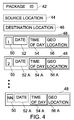
- a shipping device ID 42 is input telling the operator the identity of the parcel or any other conveyance, in which the LLD 10 is transported within the shipping process, step 510.
- This ID 42 may be an integer, a character string or any other appropriate key.
- the source location and in a field 46 the destination location is entered into the LLD device during its initialisation. At least the destination device is preferably entered in a data format which is compliant to or can easily be derived from GPS geographic coordinates in order to enable for a simple matching when the end of the data logging procedure shall be determined, see step 523 further below. This is true only for embodiments, in which the destination location is used for deciding to continue logging or not. In the embodiment depicted in fig. 5, a different criterion is used therefore, see further below.
- step 505 the store rate is adjusted for example to a frequency of 2 per minute, i.e. all 30 seconds a log data set will be generated.
- this selection may be varied in a large range in order to match best the actual needs of the person who wants to monitor the shipping process.
- the start time is set, at which the logging of the GPS location and the current time will begin. This of cause is an optional step, which is recommended because of the time delay between initialisation of the LLD and the actual start of the shipping process after having put the LLD into a suited test package, which is depicted as step 510 in fig. 5.
- the LLD 10 begins to receive the GPS data, step 520.
- the GPS data is only received but not stored.
- the start time for beginning the logging procedure is determined by comparing, step 523, the current time as it is extracted from the GPS signal with a preceding, predetermined time. If the difference is greater than a predetermined delta value, for example one (1) minute, or if the current location has exceeded a respectively defined distance from a previously stored geographic location, e.g., it is more than a distance of 1 km, then the current time and current geo-location is stored.
- a predetermined delta value for example one (1) minute
- the current location has exceeded a respectively defined distance from a previously stored geographic location, e.g., it is more than a distance of 1 km
- said time information can be used alone or in combination with the GPS time information.
- step 525 on criterion of said both is depicted true in the YES branch of decision 523, and the first log data set is generated and stored into the storage device 24 of the LLD 10.
- Such log data set is depicted in fig. 4 with reference sign 48. It comprises an integer index field 50 increasing from a value of 1 to an indefinite value, which is yielded when the LLD 10 has arrived at its destination location. This is depicted with NN at the bottom of fig. 4.
- a date field 52 is provided in order to determine at least the current date of the beginning of the shipping procedure. In the following data sets, which are created according the preset repetition rate as mentioned above the date field 52 need not necessarily be stored in order to save storage space.
- a time of day field is provided in the log data set indicated with reference sign 54. This may be in the format of hh:mm:ss in order to indicate hours, minutes and seconds.
- the geographic location is stored preferably in the format given by the GPS, e.g. latitude and longitude. Possibly the altitude above sea level (which is available, if at least 4 satellites can be detected by the GPS) can also be stored. Also the time for logging the second and all next log data sets can thus be determined by extraction of the GPS time information. Thus, during the long travel the log data is stored sequentially.
- delta values are stored in the data fields 54 A for the time of day and for the geographic location 56 A, in order to save storage space, as it will be appreciated by a person skilled in the art.
- the LLD is removed from the test package, step 528.
- no more log data shall be stored.
- the LLD test device is connected with the before-mentioned LLD host device 30, which triggers the end of the logging loop, and the log data can be readout in a step 530 from the LLD 10 via the interfaces 28.
- different criteria can be implemented to quit from the logging loop, which depends of the actual application of the inventional method. For instance, the logging can be stopped, when the current geo-location coincides within predetermined tolerances with the destination location stored in the LLD.
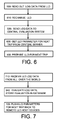
- the LLD- host device 30 reads out the log data from a LLD, step 530. Further it recharges the accumulator devices of the LLD, step 610. Further, the log data is sent in a step 535 via Internet to a dedicated Log data Evaluation Server in order to enable a global evaluation of such LLD log data all over the world.
- step 620 the LLD parameter needed for initialisation of the just processed LLD is requested and is received, if existent. After receiving that the LLD 10 can be prepared for the next trip, see step 500 above.
- step 710 said server receives the log data. This is true for a plurality of LLD from all over the world. The Internet may be used if appropriate.
- step 540 all such log data is evaluated, statistics are calculated and the most interesting parts thereof are assembled into an adequate report form.
- step 720 new LLD parameters are pushed to the actual LLD in order to prepare it for the next trip.
- the present invention can be basically implemented as described above or in various modifications thereof in order to monitor the quality of service of a logistic services provider as it was detailed in the introductory part above.
- a remarkable advantage should reveal from the above description saying that it is possible to secretly monitor the shipping procedure with fairly low cost, reusable devices, which enables for large scale use of the inventional method both, large in space and large in time, i.e. logistic services providers can be monitored very extensively.
- shipping services of shorter distance for example within the geographic region of one and the same city can be excellently monitored due to the high spatial resolution of GPS in the order of 10 meter and due to the free adjustment facility of the data logging rate, and due to the fact that large storage capacities are commercially available in the low cost sector, already.
- the present invention can be realized in hardware, software, or a combination of hardware and software.
- a tool according to the present invention can be realized in a centralized fashion in one computer system, or in a distributed fashion where different elements are spread across several interconnected computer systems.
- the Internet can be used to communicate the data between the LLW and the host. Any kind of computer system or other apparatus adapted for carrying out the methods described herein is suited.
- a typical combination of hardware and software could be a general-purpose computer system with a computer program that, when being loaded and executed, controls the computer system such that it carries out the methods described herein.
- the present invention can also be embedded in a computer program product, which comprises all the features enabling the implementation of the methods described herein, and which - when loaded in a computer system - is able to carry out these methods.
- Computer program means or computer program in the present context mean any expression, in any language, code or notation, of a set of instructions intended to cause a system having an information processing capability to perform a particular function either directly or after either or both of the following
Landscapes
- Business, Economics & Management (AREA)
- Engineering & Computer Science (AREA)
- Economics (AREA)
- Quality & Reliability (AREA)
- Tourism & Hospitality (AREA)
- Human Resources & Organizations (AREA)
- Marketing (AREA)
- Operations Research (AREA)
- Development Economics (AREA)
- Strategic Management (AREA)
- Entrepreneurship & Innovation (AREA)
- Physics & Mathematics (AREA)
- General Business, Economics & Management (AREA)
- General Physics & Mathematics (AREA)
- Theoretical Computer Science (AREA)
- Position Fixing By Use Of Radio Waves (AREA)
- Traffic Control Systems (AREA)
Priority Applications (1)
| Application Number | Priority Date | Filing Date | Title |
|---|---|---|---|
| EP04103904A EP1522943A1 (de) | 2003-10-09 | 2004-08-12 | Verfahren und System zur Messung der Logistik-Dienstleistungsgüte unter Verwendung von GPS |
Applications Claiming Priority (2)
| Application Number | Priority Date | Filing Date | Title |
|---|---|---|---|
| EP31037369 | 2003-10-09 | ||
| EP04103904A EP1522943A1 (de) | 2003-10-09 | 2004-08-12 | Verfahren und System zur Messung der Logistik-Dienstleistungsgüte unter Verwendung von GPS |
Publications (1)
| Publication Number | Publication Date |
|---|---|
| EP1522943A1 true EP1522943A1 (de) | 2005-04-13 |
Family
ID=34307097
Family Applications (1)
| Application Number | Title | Priority Date | Filing Date |
|---|---|---|---|
| EP04103904A Withdrawn EP1522943A1 (de) | 2003-10-09 | 2004-08-12 | Verfahren und System zur Messung der Logistik-Dienstleistungsgüte unter Verwendung von GPS |
Country Status (1)
| Country | Link |
|---|---|
| EP (1) | EP1522943A1 (de) |
Citations (5)
| Publication number | Priority date | Publication date | Assignee | Title |
|---|---|---|---|---|
| US6115655A (en) * | 1998-01-27 | 2000-09-05 | Keith; W. Curtis | Method for monitoring and reporting vehicular mileage |
| CA2305633A1 (en) * | 2000-04-25 | 2001-10-25 | Gerald Plamondon | Outdoor competitor gps-based data logger |
| US6408233B1 (en) * | 2000-09-18 | 2002-06-18 | Axiom Navigation, Inc. | GPS data logger with automatic wireless download |
| US20020111819A1 (en) * | 2000-12-07 | 2002-08-15 | Savi Technology, Inc. | Supply chain visibility for real-time tracking of goods |
| US20030083815A1 (en) * | 2001-11-01 | 2003-05-01 | Denton Jack A. | System and method of monitoring cargo container mobility and efficiency |
-
2004
- 2004-08-12 EP EP04103904A patent/EP1522943A1/de not_active Withdrawn
Patent Citations (5)
| Publication number | Priority date | Publication date | Assignee | Title |
|---|---|---|---|---|
| US6115655A (en) * | 1998-01-27 | 2000-09-05 | Keith; W. Curtis | Method for monitoring and reporting vehicular mileage |
| CA2305633A1 (en) * | 2000-04-25 | 2001-10-25 | Gerald Plamondon | Outdoor competitor gps-based data logger |
| US6408233B1 (en) * | 2000-09-18 | 2002-06-18 | Axiom Navigation, Inc. | GPS data logger with automatic wireless download |
| US20020111819A1 (en) * | 2000-12-07 | 2002-08-15 | Savi Technology, Inc. | Supply chain visibility for real-time tracking of goods |
| US20030083815A1 (en) * | 2001-11-01 | 2003-05-01 | Denton Jack A. | System and method of monitoring cargo container mobility and efficiency |
Similar Documents
| Publication | Publication Date | Title |
|---|---|---|
| US7216037B2 (en) | Method and system for logistics quality of service measurements using GPS | |
| EP1745416B1 (de) | Aufzeichnung von standortereignisinformationen bei rfid-etiketten | |
| CN101197077B (zh) | 一种汽车行驶路线分析、统计方法 | |
| JP5369845B2 (ja) | 配車計画作成方法 | |
| Hannan et al. | Intelligent bus monitoring and management system | |
| US20130268191A1 (en) | Systems and methods for managing a cargo transaction | |
| US20130241701A1 (en) | System and method for updating parameters and firmware on rfid readers | |
| CN102122400A (zh) | 智能道路收费系统 | |
| CN109146023A (zh) | 基于资产实物id智能识别的运输质量监控方法 | |
| CN108090722A (zh) | 一种基于gps的物流网络站点识别设备与识别方法 | |
| WO2012125947A2 (en) | Methods and systems for securing chattels | |
| US7571178B2 (en) | Process controller, product information collector, and process tracer | |
| US11823114B1 (en) | Apparatus and method for global supply chain real-time tracking and establishment of immutable geographic chain-of-custody information | |
| CN113592411B (zh) | 一种基于区块链及pit技术的文物运输云追踪系统 | |
| US8779897B2 (en) | Location information based upon electronic tags | |
| CN111967886A (zh) | 一种基于rfid数据采集的防伪溯源防窜货方法 | |
| KR100708927B1 (ko) | 지피에스와 인터넷을 통한 컨테이너의 위치추적방법 및 그시스템 | |
| EP1522943A1 (de) | Verfahren und System zur Messung der Logistik-Dienstleistungsgüte unter Verwendung von GPS | |
| Laxmi et al. | Automation in supply chain management system using Internet of Things (IoT) | |
| CN108665219A (zh) | 共享物流容器寻容器方法及其系统 | |
| Arebey et al. | Integrated communication for truck monitoring in solid waste collection systems | |
| EP0984418A2 (de) | Verfahren zur Verfolgung und Nachführung von Waren | |
| CN112862382A (zh) | 物流跟踪方法及系统 | |
| US20230273288A1 (en) | System and method for intregrated wireless data transmission with implicit location and timestamp with a location symbol | |
| AU2016201116A1 (en) | A system for generating parking register data in accordance with in-car data received from a plurality of location tracking devices |
Legal Events
| Date | Code | Title | Description |
|---|---|---|---|
| PUAI | Public reference made under article 153(3) epc to a published international application that has entered the european phase |
Free format text: ORIGINAL CODE: 0009012 |
|
| AK | Designated contracting states |
Kind code of ref document: A1 Designated state(s): AT BE BG CH CY CZ DE DK EE ES FI FR GB GR HU IE IT LI LU MC NL PL PT RO SE SI SK TR |
|
| AX | Request for extension of the european patent |
Extension state: AL HR LT LV MK |
|
| AKX | Designation fees paid | ||
| STAA | Information on the status of an ep patent application or granted ep patent |
Free format text: STATUS: THE APPLICATION IS DEEMED TO BE WITHDRAWN |
|
| 18D | Application deemed to be withdrawn |
Effective date: 20051014 |
|
| REG | Reference to a national code |
Ref country code: DE Ref legal event code: 8566 |