EP1522680B1 - Kühlungssystem für eine konvergent-divergente Schubdüse - Google Patents
Kühlungssystem für eine konvergent-divergente Schubdüse Download PDFInfo
- Publication number
- EP1522680B1 EP1522680B1 EP04292285A EP04292285A EP1522680B1 EP 1522680 B1 EP1522680 B1 EP 1522680B1 EP 04292285 A EP04292285 A EP 04292285A EP 04292285 A EP04292285 A EP 04292285A EP 1522680 B1 EP1522680 B1 EP 1522680B1
- Authority
- EP
- European Patent Office
- Prior art keywords
- flaps
- divergent
- convergent
- ring
- fact
- Prior art date
- Legal status (The legal status is an assumption and is not a legal conclusion. Google has not performed a legal analysis and makes no representation as to the accuracy of the status listed.)
- Expired - Lifetime
Links
- 238000001816 cooling Methods 0.000 title claims description 30
- 238000011144 upstream manufacturing Methods 0.000 claims description 9
- 230000036555 skin type Effects 0.000 claims description 4
- 230000001360 synchronised effect Effects 0.000 claims description 3
- 238000005553 drilling Methods 0.000 claims 3
- 238000006073 displacement reaction Methods 0.000 claims 1
- 238000002485 combustion reaction Methods 0.000 description 4
- 230000004907 flux Effects 0.000 description 4
- 238000005192 partition Methods 0.000 description 4
- 238000005070 sampling Methods 0.000 description 4
- 238000009423 ventilation Methods 0.000 description 3
- 239000007789 gas Substances 0.000 description 2
- 230000001105 regulatory effect Effects 0.000 description 2
- 230000000295 complement effect Effects 0.000 description 1
- 230000001276 controlling effect Effects 0.000 description 1
- 230000010354 integration Effects 0.000 description 1
- 239000000203 mixture Substances 0.000 description 1
- 238000010079 rubber tapping Methods 0.000 description 1
- 238000007789 sealing Methods 0.000 description 1
Images



Classifications
-
- F—MECHANICAL ENGINEERING; LIGHTING; HEATING; WEAPONS; BLASTING
- F01—MACHINES OR ENGINES IN GENERAL; ENGINE PLANTS IN GENERAL; STEAM ENGINES
- F01D—NON-POSITIVE DISPLACEMENT MACHINES OR ENGINES, e.g. STEAM TURBINES
- F01D9/00—Stators
- F01D9/06—Fluid supply conduits to nozzles or the like
- F01D9/065—Fluid supply or removal conduits traversing the working fluid flow, e.g. for lubrication-, cooling-, or sealing fluids
-
- F—MECHANICAL ENGINEERING; LIGHTING; HEATING; WEAPONS; BLASTING
- F01—MACHINES OR ENGINES IN GENERAL; ENGINE PLANTS IN GENERAL; STEAM ENGINES
- F01D—NON-POSITIVE DISPLACEMENT MACHINES OR ENGINES, e.g. STEAM TURBINES
- F01D9/00—Stators
- F01D9/06—Fluid supply conduits to nozzles or the like
-
- F—MECHANICAL ENGINEERING; LIGHTING; HEATING; WEAPONS; BLASTING
- F02—COMBUSTION ENGINES; HOT-GAS OR COMBUSTION-PRODUCT ENGINE PLANTS
- F02K—JET-PROPULSION PLANTS
- F02K1/00—Plants characterised by the form or arrangement of the jet pipe or nozzle; Jet pipes or nozzles peculiar thereto
- F02K1/06—Varying effective area of jet pipe or nozzle
- F02K1/12—Varying effective area of jet pipe or nozzle by means of pivoted flaps
- F02K1/1223—Varying effective area of jet pipe or nozzle by means of pivoted flaps of two series of flaps, the upstream series having its flaps hinged at their upstream ends on a fixed structure and the downstream series having its flaps hinged at their upstream ends on the downstream ends of the flaps of the upstream series
-
- F—MECHANICAL ENGINEERING; LIGHTING; HEATING; WEAPONS; BLASTING
- F02—COMBUSTION ENGINES; HOT-GAS OR COMBUSTION-PRODUCT ENGINE PLANTS
- F02K—JET-PROPULSION PLANTS
- F02K1/00—Plants characterised by the form or arrangement of the jet pipe or nozzle; Jet pipes or nozzles peculiar thereto
- F02K1/28—Plants characterised by the form or arrangement of the jet pipe or nozzle; Jet pipes or nozzles peculiar thereto using fluid jets to influence the jet flow
- F02K1/30—Plants characterised by the form or arrangement of the jet pipe or nozzle; Jet pipes or nozzles peculiar thereto using fluid jets to influence the jet flow for varying effective area of jet pipe or nozzle
-
- F—MECHANICAL ENGINEERING; LIGHTING; HEATING; WEAPONS; BLASTING
- F02—COMBUSTION ENGINES; HOT-GAS OR COMBUSTION-PRODUCT ENGINE PLANTS
- F02K—JET-PROPULSION PLANTS
- F02K1/00—Plants characterised by the form or arrangement of the jet pipe or nozzle; Jet pipes or nozzles peculiar thereto
- F02K1/78—Other construction of jet pipes
- F02K1/80—Couplings or connections
-
- F—MECHANICAL ENGINEERING; LIGHTING; HEATING; WEAPONS; BLASTING
- F02—COMBUSTION ENGINES; HOT-GAS OR COMBUSTION-PRODUCT ENGINE PLANTS
- F02K—JET-PROPULSION PLANTS
- F02K1/00—Plants characterised by the form or arrangement of the jet pipe or nozzle; Jet pipes or nozzles peculiar thereto
- F02K1/78—Other construction of jet pipes
- F02K1/82—Jet pipe walls, e.g. liners
- F02K1/822—Heat insulating structures or liners, cooling arrangements, e.g. post combustion liners; Infrared radiation suppressors
-
- Y—GENERAL TAGGING OF NEW TECHNOLOGICAL DEVELOPMENTS; GENERAL TAGGING OF CROSS-SECTIONAL TECHNOLOGIES SPANNING OVER SEVERAL SECTIONS OF THE IPC; TECHNICAL SUBJECTS COVERED BY FORMER USPC CROSS-REFERENCE ART COLLECTIONS [XRACs] AND DIGESTS
- Y02—TECHNOLOGIES OR APPLICATIONS FOR MITIGATION OR ADAPTATION AGAINST CLIMATE CHANGE
- Y02T—CLIMATE CHANGE MITIGATION TECHNOLOGIES RELATED TO TRANSPORTATION
- Y02T50/00—Aeronautics or air transport
- Y02T50/60—Efficient propulsion technologies, e.g. for aircraft
Definitions
- the invention relates to a ventilation system of a convergent divergent nozzle equipping a turbojet engine for military use.
- turbofan engine comprising an X-axis post-combustion chamber delimited by an annular wall located radially inside an annular casing, said annular wall and said casing defining an annular passage in which circulates a cooling air flow, a convergent divergent axisymmetrical nozzle disposed downstream of said post-combustion chamber and comprising a ring of convergent flaps articulated at the downstream end of said casing and a ring of divergent flaps articulated at the downstream end; said convergent flaps, each flap ring alternately comprising a plurality of controlled flaps and a plurality of follower flaps, a ring of cold flaps disposed radially outside said nozzle and articulated at their upstream end to a conical shell connected to the flange. downstream portion of said housing, means for creating a film of cooling air isme on the inner faces of said convergent flaps and means for cooling said divergent flaps.
- US5,435,127 relates to a turbojet engine of the type mentioned above in which the cooling of the divergent flaps is carried out by a mixture of the nacelle air flow with a sample of air in the downstream portion of the annular channel in which circulates the cooling flow of the annular wall.
- EP 1 333 172 and EP 0 541 346 are an example of the state of the art concerning the ventilation system for convergent-divergent nozzles.
- Air sampling is performed directly by tapping the channel with a control valve at the outlet of the nozzle. Downstream of the stitching elbow is placed a jet trunk which mixes between high pressure engine air and non-pressurized aerial platform.
- the exact conformation of the sample is not indicated in this document.
- the direct sampling on the channel may not be effective in taking large amounts of flow on the cooling stream because it disrupts the operation of the ventilation. There is a risk of reintroductions of hot gases under the annular wall and a poor supply of the cooling film of the convergent flaps.
- the object of the invention is to efficiently and uniformly feed the divergent flaps of a cooled divergent converging nozzle with a device that has a high integration rate with existing parts.
- the structure of the plenum and cells is constituted by the conical shell and by complementary walls that reinforce the conical ferrule.
- the follower divergent flaps are fed by a pressurized cooling air from the annular channel defined by the annular wall and the casing.
- the plenum makes it possible to slow the speed of the air received and to increase the cooling air pressure of the diverging follower flaps.
- the cooling means of the divergent flaps further comprise means for adjusting the cooling air flow rate of said flaps.
- the flow control means preferably comprise a ring mounted to move in a drawer secured to the boundary wall, said ring and said slide each comprising a plurality of flow rate adjustment holes that can be matched with the holes in the wall. border by moving said ring.
- the ring is rotatably mounted about the X axis and is rotated by a rack and pinion system by means of an actuator driving said pinion.
- the ring is mounted mobile in translation parallel to the X axis and is moved by a plurality of synchronized cylinders.
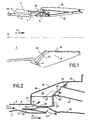
- the figure 1 shows the rear body 1 of a turbofan aviation turbojet engine which has an X-axis post-combustion chamber 2 in which the hot primary flow F1 circulates.
- This post-combustion chamber 2 is delimited by an annular wall 3 of axis X disposed radially inside a casing 4.
- the annular wall 3 and the casing 4 delimit between them an annular channel 6 in which circulates a secondary flow.
- cold F2 used for cooling the annular wall 3 and a convergent divergent nozzle 10 disposed downstream of the afterburner chamber 2.
- This convergent divergent nozzle 10 comprises a first ring of convergent flaps comprising controlled convergent flaps 11, articulated on the downstream end of the casing 4 and alternating circumferentially with convergent follower flaps 12 also articulated on the downstream end of the casing 4, and a second ring of divergent flaps alternately having controlled divergent flaps 13 hinged at the downstream end of the controlled convergent flaps 11, and follower divergent flaps 14 articulated at the downstream end of the follower convergent flaps 12, the number of convergent flaps being equal to and equal to the number of divergent flaps.
- a ring 20 which divides the cold secondary flow F2 into a radially inner flow F3 which opens through a slot tangentially to the inner wall of the convergent flaps, so as to form a film of air cold driven by the hot stream F1 and licking the convergent flaps, the latter can thus be of the single skin type, and a radially external flow F4 for cooling the divergent flaps.
- the flow F4 enters through openings 21 formed in the end wall 22 of the housing 4 located downstream of the conical shell 16, in an annular plenum chamber 23 of axis X, delimited upstream by the radially inner portion 17 the conical shell 16, and downstream by the latching structure 24 of the convergent divergent nozzle 10, integral with the casing 4.
- the end wall 22, having the openings 21, forms the boundary between the annular channel 6 and the still room 23.
- Each compartment 30 is delimited upstream by a median portion 18 of the conical shell 16, and circumferentially by two substantially parallel walls 19 coming from the forming of the conical shell 16, as is visible on the figure 4 . It is delimited downstream by a closure wall 31 which connects the attachment structure 24 to the upper part 32 of the conical shell 16, this closure wall 31 having an orifice 33 whose use will be explained later in this memoir.
- the plenum 23 is closed by a substantially axial wall 34, visible on the figure 4 which connects the radially inner ends of two adjacent walls 19.
- the conical shell 16 further has a wall 35, strongly inclined which extends between the downstream edge of the axial wall 34, the downstream edges of said two adjacent walls 19 and the upstream edge of the upper portion 32, between two adjacent cells 30.
- This wall 35 has a plurality of orifices 36 allowing the circulation of the non-pressurized nacelle F5 air to cool the various flap control devices of the divergent convergent nozzle 10.
- the orifice 33 of each cell has a connector 40 for fixing the upstream end of a pipe or telescopic tube 41 connected to the diverging follower flap 14 located in the same axial plane passing through the axis X.
- the follower divergent flaps 14 are box-type and the interior of these flaps 14 receives a part of the air flow F4 which is pressurized. Suitable orifices make it possible to evacuate this air in the flow F1 and towards the inner wall of the controlled divergent flaps 13 which may advantageously be of the simple skin type.
- the radially external flow F4 is injected into the plenum chamber 23 through the perforated boundary partition 22.
- the flow F4 then divides out of the chamber 23 between the different cells 30 for feeding the telescopic tubes 41 and the follower diverging flaps 14.
- the plenum 23 allows a regular sampling at the end of the annular channel 6 and supply cells 30 with uniform pressure and flow. In this way, the cooling film of the inner walls of the convergent flaps 11 and 12 is not disturbed even in the case of a strong flow sampling F4.
- the shape given to the conical ferrule 16 as it is visible on the figure 4 makes it possible to carry out the cooling circuit of the divergent flaps 13, 14 without excessive space and makes it possible to stiffen this conical shell 16, thanks to the partitions 19 delimiting the cells 30 and to the walls 35.
- This device 50 comprises a controlled ring 51 for closing the inlet of the plenum 23 according to the flight conditions.
- the shutter does not need to be tight because the purpose is to reduce appreciable F4 cooling flow, which is costly for performance under certain engine operating conditions.
- it will be desired to cool the nozzle with a high flow rate in order to obtain the lowest temperature possible on the flaps, to reduce the infra-red signature for example, even if it means to lose a little on the performance of the motor.
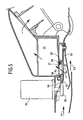
- the figure 5 shows a first embodiment of the device 50.
- the ring 51 is rotatably mounted about the axis X and its position is regulated by an actuator 52.
- the ring 51 is located radially inside the boundary wall 22 in With regard to the openings 21.
- On its underside, the ring 51 is held in place by another fixed partition 53 in which openings 54 are formed opposite the openings 21.
- a pinion 55 mounted on the rod of the actuator 52 drives the ring 51 rotates through a rack integral with the ring 51. Sealing segments 56 limit leaks between the ring 51 and the plenum 23 when it is closed.
- the ring 51 also has openings 57 which, in the maximum flow position, are aligned with the openings 21 and 54. During the rotation of the ring 51 about the X axis, the openings 57 are circumferentially offset. compared to the openings 21 and 54, as shown on the figure 7 , between the maximum open position and a total closure position, in which there is practically no flow, except for leaks. It is thus possible to dose the flow continuously.
- the figure 6 shows a second embodiment of the device 50 which also comprises a ring 51 having openings 57 capable of being disposed opposite the openings 21 of the boundary wall 22 and the openings 54 of a fixed partition 53 integral with the downstream end of the casing 4.
- the ring can be moved parallel to the axis X by means of a plurality of synchronized jacks 60, for example three jacks, of which the shafts 61 slide in guides 62.
- the connection between the shafts 61 and the ring is done by means of rods 63 passing through the casing 4 via sealed passages 64.
- the openings 57 are arranged opposite the openings 21 and 54 and the system is moving.
- the openings 21 and 54 are closed by the ring 51 and there is virtually no flow, except leak rates.
- an intermediate position shown on the figure 8 it is possible to dose the air flow continuously.
- the seals between the ring 51 and the fixed parts can be provided by segments, to delay rapid wear of the seals.
- the device 50 offers the possibility of regulating the flow taken in a certain range to adapt it to the operating conditions of the engine and to the operating circumstances.
Landscapes
- Engineering & Computer Science (AREA)
- Mechanical Engineering (AREA)
- General Engineering & Computer Science (AREA)
- Chemical & Material Sciences (AREA)
- Combustion & Propulsion (AREA)
- Physics & Mathematics (AREA)
- Fluid Mechanics (AREA)
- Structures Of Non-Positive Displacement Pumps (AREA)
- Turbine Rotor Nozzle Sealing (AREA)
- Cylinder Crankcases Of Internal Combustion Engines (AREA)
Claims (9)
- Zweistrom-Turbostrahltriebwerk umfassend eine Nachverbrennungskammer (2) mit der Achse X, die durch eine radial innerhalb eines ringförmigen Gehäuses (4) gelegene ringförmige Wand (3) begrenzt ist, wobei die ringförmige Wand und das Gehäuse einen ringförmigen Durchgang (6) definieren, in dem ein Kühlluftstrom (F2) zirkuliert, eine axialsymmetrische konvergent-divergente Düse (10), die stromabwärts der Nachverbrennungskammer (2) angeordnet ist und die einen Kranz konvergenter Klappen (11, 12), welche an dem stromabwärtigen Ende des Gehäuses (4) angelenkt sind, sowie einen Kranz divergenter Klappen (13, 14), welche an dem stromabwärtigen Ende der konvergenten Klappen (11, 12) angelenkt sind, umfaßt, wobei jeder Klappenkranz abwechselnd eine Vielzahl gesteuerter Klappen (11, 13) und eine Vielzahl von Folgeklappen (12, 14) umfaßt, einen Kranz kalter Klappen (15), die radial außerhalb der Düse (10) angeordnet und an ihrem stromaufwärtigen Ende an einen mit dem stromabwärtigen Teil des Gehäuses (4) verbundenen konischen Ring (16) angelenkt sind, Mittel zur Erzeugung eines Kühlluftfilms an den Innenseiten der konvergenten Klappen (11, 12) sowie Mittel zum Kühlen der divergenten Klappen (13, 14), dadurch gekennzeichnet, daß die Mittel zum Kühlen der divergenten Klappen (13, 14) folgendes umfassen:eine ringförmige Beruhigungskammer (23), die stromabwärts durch den konischen Ring (16) begrenzt ist und die über Bohrungen (21), welche in einer Grenzwand (22) zwischen der Beruhigungskammer (23) und dem stromabwärtigen Ende des ringförmigen Durchgangs (6) ausgebildet sind, mit Kühlluft versorgt wird,eine Vielzahl von Verteilerzellen (30), welche die Beruhigungskammer (23) umgeben und mit letzterer verbunden sind, wobei die Zellen (30) stromabwärts durch den konischen Ring (16) begrenzt sind und um die Achse X in den Symmetrieebenen der Folgeklappen (12, 14) angeordnet sind, sowieTeleskoprohrleitungen (41), die jeweils eine Zelle (30) mit der in der gleichen Symmetrieebene wie die Zelle (30) gelegenen divergenten Folgeklappe (14) verbinden.
- Turbostrahltriebwerk nach Anspruch 1, dadurch gekennzeichnet, daß die divergenten Folgeklappen (14) kastenförmig sind und durch die über die Teleskoprohrleitungen (41) gelieferte Luft gekühlt werden, während die divergenten gesteuerten Klappen (13) einschalig sind.
- Turbostrahltriebwerk nach einem der Ansprüche 1 oder 2, dadurch gekennzeichnet, daß die konvergenten Klappen (11, 12) einschaliger Art sind.
- Turbostrahltriebwerk nach irgendeinem der Ansprüche 1 bis 3, dadurch gekennzeichnet, daß die konische Wand (16) Öffnungen zwischen den Zellen aufweist, um das Zirkulieren einer Gondelluft in dem die konvergent-divergente Düse umgebenden Raum zu ermöglichen.
- Turbostrahltriebwerk nach irgendeinem der Ansprüche 1 bis 4, dadurch gekennzeichnet, daß der in dem ringförmigen Kanal (6) zirkulierende Kühlluftstrom (F2) mittels eines festen Rings (20), der mit der Grenzwand (22) fest verbunden ist, in zwei Ströme aufgeteilt wird, wobei der radial innere Strom (F3) stromaufwärts der konvergenten Klappen (11, 12) über einen Schlitz eingeleitet wird und der radial äußere Strom (F4) über die Bohrungen (21) der Grenzwand (22) in die Beruhigungskammer (23) eingeleitet wird.
- Turbostrahltriebwerk nach Anspruch 5, dadurch gekennzeichnet, daß die Mittel zum Kühlen der divergenten Klappen (13, 14) ferner Mittel (50) zum Einstellen der Kühlluftmenge (F4) der Klappen umfassen.
- Turbostrahltriebwerk nach Anspruch 6, dadurch gekennzeichnet, daß die Mengeneinstellmittel (50) einen Ring (51) umfassen, der in einem mit der Grenzwand (22) fest verbundenen Schieber (53) beweglich angebracht ist, wobei der Ring (51) und der Schieber (53) jeweils eine Vielzahl von Mengeneinstellöchern (54, 57) aufweisen, die geeignet sind, durch Bewegen des Rings (51) mit den Bohrungen (21) der Grenzwand (22) in Deckung gebracht zu werden.
- Turbostrahltriebwerk nach Anspruch 7, dadurch gekennzeichnet, daß der Ring (51) um die Achse X drehbeweglich angebracht ist und durch ein Ritzel (55)-Zahnstangen-System, mittels eines das Ritzel (55) antreibenden Aktuators (52) drehangetrieben wird.
- Turbostrahltriebwerk nach Anspruch 7, dadurch gekennzeichnet, daß der Ring (51) parallel zur Achse X verschiebebeweglich angebracht ist und durch eine Vielzahl synchronisierter Zylinder (60) bewegt wird.
Applications Claiming Priority (2)
| Application Number | Priority Date | Filing Date | Title |
|---|---|---|---|
| FR0311187A FR2860045B1 (fr) | 2003-09-24 | 2003-09-24 | Systeme de ventilation pour une tuyere d'ejection convergente divergente |
| FR0311187 | 2003-09-24 |
Publications (2)
| Publication Number | Publication Date |
|---|---|
| EP1522680A1 EP1522680A1 (de) | 2005-04-13 |
| EP1522680B1 true EP1522680B1 (de) | 2008-04-09 |
Family
ID=34224442
Family Applications (1)
| Application Number | Title | Priority Date | Filing Date |
|---|---|---|---|
| EP04292285A Expired - Lifetime EP1522680B1 (de) | 2003-09-24 | 2004-09-23 | Kühlungssystem für eine konvergent-divergente Schubdüse |
Country Status (4)
| Country | Link |
|---|---|
| US (1) | US7296397B2 (de) |
| EP (1) | EP1522680B1 (de) |
| ES (1) | ES2308126T3 (de) |
| FR (1) | FR2860045B1 (de) |
Families Citing this family (18)
| Publication number | Priority date | Publication date | Assignee | Title |
|---|---|---|---|---|
| US7581382B2 (en) * | 2005-04-28 | 2009-09-01 | United Technologies Corporation | Gas turbine engine air valve assembly |
| US7207352B2 (en) * | 2005-05-02 | 2007-04-24 | United Technologies Corporation | Bushing for thermally independent bypass air metering valve |
| FR2900444B1 (fr) * | 2006-04-28 | 2008-06-13 | Snecma Sa | Turboreacteur comprenant un canal de post combustion refroidi par un flux de ventilation a debit variable |
| US7854124B2 (en) * | 2006-10-27 | 2010-12-21 | United Technologies Corporation | Combined control for supplying cooling air and support air in a turbine engine nozzle |
| US7757477B2 (en) * | 2007-02-20 | 2010-07-20 | United Technologies Corporation | Convergent divergent nozzle with slot cooled nozzle liner |
| FR2915550B1 (fr) * | 2007-04-27 | 2012-05-11 | Snecma | Vanne a clapet pour un systeme de refroidissement dans une turbomachine |
| US8096104B2 (en) * | 2007-05-31 | 2012-01-17 | United Technologies Corporation | Fluidic vectoring for exhaust nozzle |
| FR2933127B1 (fr) * | 2008-06-25 | 2015-04-24 | Snecma | Dispositif de prelevement d'air de refroidissement dans une turbomachine |
| FR2933128B1 (fr) * | 2008-06-25 | 2010-09-17 | Snecma | Dispositif de prelevement d'air de refroidissement dans une turbomachine |
| FR2937679B1 (fr) * | 2008-10-24 | 2010-12-03 | Snecma | Dispositif de prelevement d'air de refroidissement dans une turbomachine |
| FR2952434B1 (fr) * | 2009-11-12 | 2012-06-29 | Snecma | Grille de distorsion apte a regler l'obstruction d'un flux d'air dans un turboreacteur |
| US10087884B2 (en) * | 2014-12-15 | 2018-10-02 | United Technologies Corporation | Stepped fairing modulated exhaust cooling |
| FR3100286B1 (fr) * | 2019-08-30 | 2021-09-17 | Safran Aircraft Engines | Couple volet convergent-volet divergent pour tuyère de turboréacteur à géométrie variable comprenant des conduits de circulation d’air de refroidissement raccordés au travers de surfaces de contact |
| FR3129987B1 (fr) * | 2021-12-03 | 2025-04-11 | Safran Aircraft Engines | Tuyere d’echappement de gaz de combustion pour une turbomachine d’aeronef |
| CN114526175B (zh) * | 2022-04-24 | 2022-07-26 | 中国航发四川燃气涡轮研究院 | 一种用于加力燃烧室的齿轮传动后涵道引射器 |
| CN115013182B (zh) * | 2022-06-17 | 2025-12-05 | 中国航发贵阳发动机设计研究所 | 一种高效冷却的喷气发动机 |
| FR3146712B1 (fr) * | 2023-03-13 | 2025-03-14 | Safran Aircraft Engines | Turboréacteur comportant une chambre de postcombustion ayant un diaphragme coopérant avec une chemise pour conditionner sa section de passage à la dilatation axiale de la chemise |
| FR3146711A1 (fr) * | 2023-03-13 | 2024-09-20 | Safran Aircraft Engines | Turboréacteur comportant une chambre de postcombustion ayant une chemise maintenue radialement par des pontets intégrés à diaphragme |
Family Cites Families (13)
| Publication number | Priority date | Publication date | Assignee | Title |
|---|---|---|---|---|
| US4000612A (en) * | 1975-07-28 | 1977-01-04 | General Electric Company | Cooling system for a thrust vectoring gas turbine engine exhaust system |
| US5255849A (en) * | 1991-11-05 | 1993-10-26 | General Electric Company | Cooling air transfer apparatus for aircraft gas turbine engine exhaust nozzles |
| US5720434A (en) * | 1991-11-05 | 1998-02-24 | General Electric Company | Cooling apparatus for aircraft gas turbine engine exhaust nozzles |
| US5435127A (en) * | 1993-11-15 | 1995-07-25 | General Electric Company | Method and apparatus for boosting ram airflow to an ejection nozzle |
| US5603531A (en) * | 1994-12-06 | 1997-02-18 | United Technologies Corporation | Blind assembly-swivel crossover tube |
| US5586431A (en) * | 1994-12-06 | 1996-12-24 | United Technologies Corporation | Aircraft nacelle ventilation and engine exhaust nozzle cooling |
| US5593112A (en) * | 1994-12-06 | 1997-01-14 | United Technologies Corporation | Nacelle air pump for vector nozzles for aircraft |
| US6301877B1 (en) * | 1995-11-13 | 2001-10-16 | United Technologies Corporation | Ejector extension cooling for exhaust nozzle |
| US5799874A (en) * | 1995-11-30 | 1998-09-01 | United Technologies Corporation | Aerodynamically controlled ejector |
| US6021637A (en) * | 1997-09-29 | 2000-02-08 | General Electric Company | Integrated fluidic CD nozzle for gas turbine engine |
| US5996936A (en) * | 1997-09-29 | 1999-12-07 | General Electric Company | Fluidic throat exhaust nozzle |
| FR2835288B1 (fr) * | 2002-01-31 | 2006-04-28 | Snecma Moteurs | Systeme de refroidissement pour une tuyere de post-combustion de turbomachine |
| FR2865000B1 (fr) * | 2004-01-12 | 2006-06-09 | Snecma Moteurs | Dispositif d'alimentation en air de refroidissement de volets de tuyere |
-
2003
- 2003-09-24 FR FR0311187A patent/FR2860045B1/fr not_active Expired - Fee Related
-
2004
- 2004-09-22 US US10/945,917 patent/US7296397B2/en not_active Expired - Lifetime
- 2004-09-23 EP EP04292285A patent/EP1522680B1/de not_active Expired - Lifetime
- 2004-09-23 ES ES04292285T patent/ES2308126T3/es not_active Expired - Lifetime
Also Published As
| Publication number | Publication date |
|---|---|
| US20050091964A1 (en) | 2005-05-05 |
| US7296397B2 (en) | 2007-11-20 |
| ES2308126T3 (es) | 2008-12-01 |
| EP1522680A1 (de) | 2005-04-13 |
| FR2860045A1 (fr) | 2005-03-25 |
| FR2860045B1 (fr) | 2006-01-06 |
Similar Documents
| Publication | Publication Date | Title |
|---|---|---|
| EP1522680B1 (de) | Kühlungssystem für eine konvergent-divergente Schubdüse | |
| EP2021610B1 (de) | Mit mitteln zur minderung des durch den turbojet erzeugten lärms ausgestattete turbojetgondel | |
| EP4166771B1 (de) | Antriebseinheit für ein flugzeug | |
| CA2416251C (fr) | Dispositif de refroidissement de la tuyere commune sur une nacelle de turboreacteur | |
| EP2859200B1 (de) | Abgaswärmerückgewinnungssystem | |
| CA2933353A1 (fr) | Turbomachine d'aeronef comportant un echangeur de chaleur du type pre-refroidisseur | |
| FR2692936A1 (fr) | Appareil et procédé pour la canalisation d'air dans un turbomoteur. | |
| FR2689567A1 (fr) | Injecteur de carburant pour chambre de post-combustion d'une turbomachine. | |
| EP4124738B1 (de) | Antriebsanordnung für luftfahrzeug | |
| EP1482127B1 (de) | Dichtungssystem für den Nebenstrom am Einlass der Nachbrennerdüse einer Turbomaschine | |
| EP1553282B1 (de) | Vorrichtung zur Anbringung von Kühlluft an Düseklappen | |
| EP0972930B1 (de) | Zweidimensionale konvergierende Düse mit verschiebbaren kalten Klappen | |
| FR2721693A1 (fr) | Procédé et dispositif pour alimenter en carburant et refroidir l'injecteur de décollage d'une chambre de combustion à deux têtes. | |
| EP3732360A1 (de) | Gitterartiger schubumkehrer für einen turbostrahlmotor | |
| EP1956226B1 (de) | Entladevorrichtung für Turbostrahltriebwerk und damit ausgestattetes Turbostrahltriebwerk | |
| FR3009027A1 (fr) | Ensemble turbomachine d'aeronef a bruit de jet attenue. | |
| FR3072127B1 (fr) | Conduit de decharge d'un moyeu de carter intermediaire pour turboreacteur d'aeronef comportant des canaux de refroidissement | |
| FR3107086A1 (fr) | Vanne de décharge avec porte et ailette actionnées de manière coordonnée | |
| WO2019102170A1 (fr) | Nacelle de turboreacteur comportant un cadre mobile unique d'inverseur de poussee a grilles et des passages de servitudes | |
| FR2933128A1 (fr) | Dispositif de prelevement d'air de refroidissement dans une turbomachine | |
| WO2013171393A1 (fr) | Systeme de recuperation d'energie dans un circuit de gaz d'echappement | |
| FR3008500A1 (fr) | Trompe de melange de gaz destinee notamment a un systeme de chauffage | |
| WO2021001621A1 (fr) | Echangeur thermique pour une installation de conditionnement d'air d'un véhicule comprenant un dispositif de distribution d'un fluide réfrigérant configuré pour assurer la détente du fluide réfrigérant dans l'échangeur thermique | |
| EP0887538A1 (de) | Ausfahrbarer Ejektor-Mischer für eine Turbomaschine | |
| WO2021038172A1 (fr) | Couple volet convergent-volet divergent pour tuyère de turboréacteur à géométrie variable comprenant des conduits de circulation d'air de refroidissement raccordés au travers de surfaces de contact |
Legal Events
| Date | Code | Title | Description |
|---|---|---|---|
| PUAI | Public reference made under article 153(3) epc to a published international application that has entered the european phase |
Free format text: ORIGINAL CODE: 0009012 |
|
| 17P | Request for examination filed |
Effective date: 20041001 |
|
| AK | Designated contracting states |
Kind code of ref document: A1 Designated state(s): AT BE BG CH CY CZ DE DK EE ES FI FR GB GR HU IE IT LI LU MC NL PL PT RO SE SI SK TR |
|
| AX | Request for extension of the european patent |
Extension state: AL HR LT LV MK |
|
| RAP1 | Party data changed (applicant data changed or rights of an application transferred) |
Owner name: SNECMA |
|
| AKX | Designation fees paid |
Designated state(s): ES FR GB |
|
| REG | Reference to a national code |
Ref country code: DE Ref legal event code: 8566 |
|
| GRAP | Despatch of communication of intention to grant a patent |
Free format text: ORIGINAL CODE: EPIDOSNIGR1 |
|
| GRAS | Grant fee paid |
Free format text: ORIGINAL CODE: EPIDOSNIGR3 |
|
| GRAA | (expected) grant |
Free format text: ORIGINAL CODE: 0009210 |
|
| AK | Designated contracting states |
Kind code of ref document: B1 Designated state(s): ES FR GB |
|
| REG | Reference to a national code |
Ref country code: GB Ref legal event code: FG4D Free format text: NOT ENGLISH |
|
| REG | Reference to a national code |
Ref country code: ES Ref legal event code: FG2A Ref document number: 2308126 Country of ref document: ES Kind code of ref document: T3 |
|
| PLBE | No opposition filed within time limit |
Free format text: ORIGINAL CODE: 0009261 |
|
| STAA | Information on the status of an ep patent application or granted ep patent |
Free format text: STATUS: NO OPPOSITION FILED WITHIN TIME LIMIT |
|
| 26N | No opposition filed |
Effective date: 20090112 |
|
| PGFP | Annual fee paid to national office [announced via postgrant information from national office to epo] |
Ref country code: ES Payment date: 20120910 Year of fee payment: 9 |
|
| REG | Reference to a national code |
Ref country code: ES Ref legal event code: FD2A Effective date: 20150406 |
|
| PG25 | Lapsed in a contracting state [announced via postgrant information from national office to epo] |
Ref country code: ES Free format text: LAPSE BECAUSE OF NON-PAYMENT OF DUE FEES Effective date: 20130924 |
|
| REG | Reference to a national code |
Ref country code: FR Ref legal event code: PLFP Year of fee payment: 13 |
|
| REG | Reference to a national code |
Ref country code: FR Ref legal event code: PLFP Year of fee payment: 14 |
|
| REG | Reference to a national code |
Ref country code: FR Ref legal event code: CD Owner name: SAFRAN AIRCRAFT ENGINES Effective date: 20170719 |
|
| REG | Reference to a national code |
Ref country code: FR Ref legal event code: PLFP Year of fee payment: 15 |
|
| PGFP | Annual fee paid to national office [announced via postgrant information from national office to epo] |
Ref country code: GB Payment date: 20230823 Year of fee payment: 20 |
|
| PGFP | Annual fee paid to national office [announced via postgrant information from national office to epo] |
Ref country code: FR Payment date: 20230822 Year of fee payment: 20 |
|
| PG25 | Lapsed in a contracting state [announced via postgrant information from national office to epo] |
Ref country code: GB Free format text: LAPSE BECAUSE OF EXPIRATION OF PROTECTION Effective date: 20240922 |
|
| REG | Reference to a national code |
Ref country code: GB Ref legal event code: PE20 Expiry date: 20240922 |
|
| PG25 | Lapsed in a contracting state [announced via postgrant information from national office to epo] |
Ref country code: GB Free format text: LAPSE BECAUSE OF EXPIRATION OF PROTECTION Effective date: 20240922 |