EP1521069B1 - Colorimeter for true colour measurement - Google Patents
Colorimeter for true colour measurement Download PDFInfo
- Publication number
- EP1521069B1 EP1521069B1 EP04023051.8A EP04023051A EP1521069B1 EP 1521069 B1 EP1521069 B1 EP 1521069B1 EP 04023051 A EP04023051 A EP 04023051A EP 1521069 B1 EP1521069 B1 EP 1521069B1
- Authority
- EP
- European Patent Office
- Prior art keywords
- color
- sensor chip
- spectral
- photosensor according
- filter
- Prior art date
- Legal status (The legal status is an assumption and is not a legal conclusion. Google has not performed a legal analysis and makes no representation as to the accuracy of the status listed.)
- Expired - Lifetime
Links
Images




Classifications
-
- G—PHYSICS
- G01—MEASURING; TESTING
- G01J—MEASUREMENT OF INTENSITY, VELOCITY, SPECTRAL CONTENT, POLARISATION, PHASE OR PULSE CHARACTERISTICS OF INFRARED, VISIBLE OR ULTRAVIOLET LIGHT; COLORIMETRY; RADIATION PYROMETRY
- G01J3/00—Spectrometry; Spectrophotometry; Monochromators; Measuring colours
- G01J3/46—Measurement of colour; Colour measuring devices, e.g. colorimeters
- G01J3/50—Measurement of colour; Colour measuring devices, e.g. colorimeters using electric radiation detectors
- G01J3/51—Measurement of colour; Colour measuring devices, e.g. colorimeters using electric radiation detectors using colour filters
-
- G—PHYSICS
- G01—MEASURING; TESTING
- G01J—MEASUREMENT OF INTENSITY, VELOCITY, SPECTRAL CONTENT, POLARISATION, PHASE OR PULSE CHARACTERISTICS OF INFRARED, VISIBLE OR ULTRAVIOLET LIGHT; COLORIMETRY; RADIATION PYROMETRY
- G01J3/00—Spectrometry; Spectrophotometry; Monochromators; Measuring colours
- G01J3/46—Measurement of colour; Colour measuring devices, e.g. colorimeters
- G01J3/50—Measurement of colour; Colour measuring devices, e.g. colorimeters using electric radiation detectors
- G01J3/51—Measurement of colour; Colour measuring devices, e.g. colorimeters using electric radiation detectors using colour filters
- G01J3/513—Measurement of colour; Colour measuring devices, e.g. colorimeters using electric radiation detectors using colour filters having fixed filter-detector pairs
-
- G—PHYSICS
- G01—MEASURING; TESTING
- G01J—MEASUREMENT OF INTENSITY, VELOCITY, SPECTRAL CONTENT, POLARISATION, PHASE OR PULSE CHARACTERISTICS OF INFRARED, VISIBLE OR ULTRAVIOLET LIGHT; COLORIMETRY; RADIATION PYROMETRY
- G01J3/00—Spectrometry; Spectrophotometry; Monochromators; Measuring colours
- G01J3/02—Details
- G01J3/0256—Compact construction
-
- G—PHYSICS
- G01—MEASURING; TESTING
- G01J—MEASUREMENT OF INTENSITY, VELOCITY, SPECTRAL CONTENT, POLARISATION, PHASE OR PULSE CHARACTERISTICS OF INFRARED, VISIBLE OR ULTRAVIOLET LIGHT; COLORIMETRY; RADIATION PYROMETRY
- G01J3/00—Spectrometry; Spectrophotometry; Monochromators; Measuring colours
- G01J3/02—Details
- G01J3/0291—Housings; Spectrometer accessories; Spatial arrangement of elements, e.g. folded path arrangements
-
- G—PHYSICS
- G01—MEASURING; TESTING
- G01J—MEASUREMENT OF INTENSITY, VELOCITY, SPECTRAL CONTENT, POLARISATION, PHASE OR PULSE CHARACTERISTICS OF INFRARED, VISIBLE OR ULTRAVIOLET LIGHT; COLORIMETRY; RADIATION PYROMETRY
- G01J3/00—Spectrometry; Spectrophotometry; Monochromators; Measuring colours
- G01J3/46—Measurement of colour; Colour measuring devices, e.g. colorimeters
- G01J3/465—Measurement of colour; Colour measuring devices, e.g. colorimeters taking into account the colour perception of the eye; using tristimulus detection
Definitions
- the invention relates to a photosensor for colorimetry based on three spectral components, for the detection of which the sensor chip has three differently sensitive subareas by an upstream interference filter structure, wherein the subareas provide measured values which are converted into color values in a suitable color space, in particular for highly accurate colorimetry ( Point measurement) when checking and ensuring the color consistency of technical surfaces and any consumer goods.
- the tristimulus method is primarily used, although this is associated with significant limitations because, as a result, wavelength-integral color values are obtained which are only valid for the illumination used.
- metamerism indexes can only be determined by a series of measurements on different illuminations (reference light and test light type), which must always be physically present. Such a color sensor is out of the DE 19 638 693 known.
- the basic principle of a spectrally adjusted semiconductor sensor is already out of the US 3,996,461 known.
- a thin film optical filter based on an interference multilayer system is described for a silicon photosensor, in order to limit the sensitivity of the sensor to the spectral sensitivity of the human eye.
- the high refractive index layers are made of titanium oxide and the low refractive index silicon oxide.
- the resulting filter system corresponds to a Y characteristic of the spectral sensitivity curve of the human eye, without allowing a spectrally selective resolution of the color spectrum in terms of the assignment of color values or standard spectral colors, since the filter layers are not structured, but are applied to several sensor elements at the same time.
- a disadvantage of this solution is that it is pure bandpass or edge filters, so that point measurements with narrowband color stimuli in the off-band range of the color filter regularly lead to the measurement of falsified color values or require a special reference light calibration.
- the invention is based on the object, a new way of color measurement based on a tri-range method with three, by upstream different To find spectrally selective interference filters color measured values, which allows with simple means an almost standard true color measurement without complex reference light calibration.
- the object in a photosensor for colorimetry based on three spectral components, for the detection of which a sensor chip has at least three differently spectrally sensitive partial surfaces with intermediate passive webs by an upstream interference filter structure, wherein the interference filter structure transmits three different alternating layer systems of silicon dioxide and titanium dioxide for selective transmission includes incident light in the different sub-areas of the sensor chip and the sub-areas provide separate color readings, characterized in that the covered with different interference filters faces, which are adapted to the standard spectral functions of the human eye for three different coordinates of a normalized color space, each distributed in a sector of a circle about a central point are for a central location of the point of incident light a triple color segment for detecting
- Each of the interference filters is adapted in its transmission characteristic over the wavelength of the light to be measured spectrally to the sensitivity of the human eye such that the product of basic sensitivity of the photosensor and transmission of the interference filter proportional to the normal spectral value of the human eye is for the relevant coordinate of the color
- the transmission characteristic of each interference filter is advantageously prepared with a tolerance of the layer thicknesses of less than 2%.
- a linear correction of the measured values output by the partial surfaces is undertaken to the extent that the accuracy of the color measurement for the desired application requires compensation for the production-related layer thickness deviations. This can be done firstly by global matrixing to correct the output measured values for the entire color space, and secondly, with increased accuracy requirements, e.g. for outputting accurate colorimetric values - by linear correction of the output measured values by means of local matrixing of suitable tetrahedral regions of the color space.
- the interference filter are applied directly to the semiconductor diodes of the sensor chip.
- the interference filters are preferably applied directly to silicon diodes of the sensor chip.
- the Si diodes are best produced in a specially adapted for the visual spectral range PIN diode technology to already achieve an advantageous basic sensitivity of the Si diodes of the entire sensor chip.
- the interference filters can also be suitably applied to Si diodes which have been produced in a CMOS technology adapted to the visual spectral range.
- the interference filters can also be applied to a sensor chip with germanium diodes or with diodes based on InGaAs.
- the interference filters can also be advantageously applied over the Si diodes (partial surfaces) of the sensor chip on a separate glass plate or by using lift-off techniques.
- the differently sensitive partial surfaces on the sensor chip are preferably formed as a circle segment (circular area third) due to applied interference filters and arranged uniformly distributed about a central point.
- Another embodiment, with which a scaling of the spectral characteristics of the partial surfaces of the photosensor to the sensitivity distribution of the eye is at least partially realizable hardware, is that the covered with the matched interference filters, different sensitive sub-areas on the sensor chip as a circular area sectors of different surface area around a central point are arranged, wherein the different surface areas are tuned to that a lower base sensitivity of a partial surface, which comes about due to limited wavelength transmission of the associated interference filter, is compensated by a correspondingly larger surface area of the partial surface of the photosensor.
- the partial surfaces coated with different interference filters are distributed uniformly around a central point in the form of rhombi with a 120 ° angle, so that they form a regular hexagon as a triple color segment.
- these hexagonal triple color segments can be arranged on the sensor chip in a manner arranged around a plurality of central points with the same webs and distributed uniformly, so that the triple color segments form a honeycomb structure. wherein faces of equal spectral sensitivity have no adjacent side edges with each other.
- the photosensor according to the invention it is possible to realize color measurements on the basis of a tristimulus method with three color measurement values generated by different spectrally selective interference filters, which allow an almost standard true color measurement without elaborate reference light calibration by means of interference filters adapted to the standard spectral function of the human eye. As a result, color differences can be separated into quality comparable to the human eye. Furthermore, the measured photocurrents of the three partial areas of the sensor can be converted directly into standardized color spaces for specific accuracy classes of the color measurement. With the invention, inexpensive color sensors can be realized and integrated into powerful compact colorimeters.
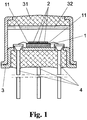
- the color sensor according to the invention consists in its basic structure - as in Fig. 1 shown schematically - from a sensor chip 1 with photosensitive partial surfaces 11, and an interference filter structure 2 with spectrally differently sensitive interference filters 21, 22, and 23 (only in FIGS. 5 and 6 designated) a housing 3 with entrance window 31 and thereon existing infrared filter layer 32 and the terminal electrodes. 4
- the interference filter system 2 has in each case as triple element three differently dimensioned alternating layer systems of silicon dioxide and titanium dioxide layers whose spectral transmission is adapted to the standard spectral functions of the human eye.
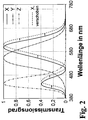
- Fig. 2 shows the normalized standard spectral functions of the interference filters 21, 22 and 23 for the respective coordinate of the selected CIE color space.
- the spectral transmission of the interference filters 21, 22 and 23 is so dimensioned that the product of basic sensitivity S (in Fig. 3 represented for Si diodes according to PIN technology) and transmission characteristic of the respective interference filter 21, 22 or 23 is proportional to the desired normal spectral value curve.
- the product of basic sensitivity S and filter transmission X, Y, Z is always used, as it is in Fig. 4 for a special case (based on Fig. 3 ) is shown.
- the base material of the sensor chip 1 is equipped with Si diodes, in a specially for the visual spectral range adapted PIN diode technology were produced and thus in their spectral sensitivity of the human eye best approximated.
- the sensitivity curve of a PIN diode manufactured in this way is shown in FIG Fig. 3 , With similarly shaped basic sensitivity S, Ge or InGaAs diodes can also be used instead of Si diodes.
- Fig. 4 represents the entire spectral sensitivity distribution of the color sensor when the interference filter structure 2 with its three different interference filters 21, 22 and 23 for the X, Y and Z components on a sensor chip 1 according to the sensitivity function of Fig. 3 (eg based on PIN diodes) Fig. 4
- the interference filters 21, 22 and 23 are suitable to vary with respect to the layer thicknesses of the alternating layers.
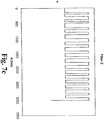
- Such a suitably optimized related system of interference filters 21, 22, 23 is in the Fig. 7a (X-filter), 7b (Y-filter) and Fig. 7c (Z-filter) for the coordinates of the color space.
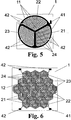
- Fig. 5 shows a variant of the sensor chip 1 for a selectively measurable color sensor.
- the black area is the cathode 41 of the complete triple element of the color sensor.
- the white areas represent the anodes 42 of the three partial areas 11 of the photosensor, from which the occurring photocurrents are derived as measured values.
- the striped subarea 11 should in the selected case the X-transmission function generated with the interference filter 21 (according to FIG Fig. 2 ), while the checkered and the brick patterned sub-area 11, the Y- and Z-transmission functions of the interference filters 22 and 23 (according to Fig. 2 ) symbolize.
- FIG. 6 A particular design of the color sensor according to the invention for areal color measurements is in Fig. 6 shown in a plan view of the sensor chip 1.
- the sensor chip 1 has a plurality of honeycomb-shaped triple elements 12, each consisting of three Si diodes with the different interference filters 21, 22 and 23.
- the triple elements 12 are arranged relative to one another such that an interference filter 21, 22 or 23 has no common edge with the same interference filter 21, 22 or 23 of each of the adjacent triple elements 12. This results in a regular structure on the entire sensor chip 1, which is able to make a measurement of the uniformity of a color impression of a surface.
- the layer thickness d of the individual interference filters 21, 22 and 23 was set at less than 4 ⁇ m and preferably set at 3000 nm ⁇ d ⁇ 3500 nm.
- the interference filters 21, 22 and 23 computed by computer-aided optimization have between 30 and 40 layers.
- the X-filter 35, the Y-filter 37 and the Z-filter 34 include alternating layers of TiO 2 and SiO 2 .
- the interference filters 21, 22 and 23 thus calculated can be applied directly to the Si diodes of the sensor chip 1 by plasma-assisted coating (after application of a passivation layer). On the other hand, they can also be applied to a glass substrate or manufactured with lift-off techniques and subsequently adjusted over the silicon chip in order to avoid wasting valuable semiconductor material if layer tolerances are not met for the complicated interference filter structure 2.
- Self-luminous color stimuli are therefore advantageous to reinterpret as body color, e.g. whose emission spectrum is scaled to values ⁇ 1 and thus interpreted as the transmission spectrum of an equivalent filter.
- Scaling ie matching the sensor channels to one another (ie a white balance of the signals / measured values of the subareas 11 of the three-channel photosensor to the standard spectral functions of the human eye) is, of course, essential. Apart from this scaling, no correction of the measured values is required under normal conditions.
- a narrowband color stimulus can be simulated as a bandpass spectral interference filter, with a typical measure of the spectral bandwidth of a conventional 15 nm interference filter can be assumed.
- Fig. 8a shows the spectral transmission (or remission) of such an object for a centroid wavelength of 555 nm.
- the transmittance is set at 15 nm spectral width and a 1 / e drop and examined with variable centroid wavelength.
- the filter curve is shifted from 12 nm to +12 nm in 0.5 nm steps for error estimation and determined for each shift ⁇ E of the emission spectrum of target color and measured color in CIELAB space, depending on the centroid wavelength of the target transmission.
- the maximum value of ⁇ E over all centroid wavelengths was calculated as a function of the filter curve shift in Fig. 8b entered.
- the total result of the error calculation is in Fig. 8c as a function of the centroid wavelength and the shift of the filter function of the model target in the CIELAB space in case only the X-filter function has been moved.
- the measured color deviation for each centroid wavelength is approximately proportional to the amount of filter curve shift.
- Y and Z shifts give qualitatively equivalent results.
- Local maxima of the color deviations which are comparable in magnitude to the absolute maximum, have their center of gravity wavelength approximately at the inflection points of the filter function. This statement is applicable to transmissive and reflective objects, assuming maximum brightness, because the CIELAB space evaluates greater brightness with greater color separation.
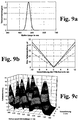
- LEDs can be simulated by specifying a transmission filter with a filter width of 40 nm, because this approach closely approximates the spectral behavior of typical LEDs. It is therefore assumed as an alternative to an object with appropriate transmission.
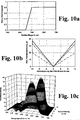
- the transition area of the ramp function is defined as 50 nm wide and its center position (referred to below as the ramp position), which in Fig. 10a at 555 nm Fig. 10a shown varies over the entire visible spectrum.
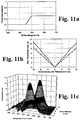
- a flatter ramp function (low color contrast) will be used according to Fig. 11 a examines by again varying the ramp position with a transition range of 50 nm over the entire visible spectrum.
- the maximum color deviation ⁇ E in the CIELAB space is characterized by the fact that, due to the reduced color saturation according to FIG Fig. 11b significantly reduce the sensory-adapted color deviations.
- Fig. 11c shows about the same qualitative behavior as Fig. 10c but small amounts of mistakes.
- the standard spectral value of x j is a multiplicative composed of the filter transmission T j (desired value) and the base sensitivity S of the sensor.
- test color stimuli contained a free parameter that was varied virtually continuously (centroid wavelength or ramp position, respectively).
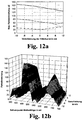
- Fig. 12a is to be read that the maximum errors in the previous filter variant exceed the inventive solution by about a factor of 4. Even more meaningful is the comparison of Fig. 12b With Fig. 8c , While for the considered narrow-band stimuli in the new filter curves an error of 20 only for extreme tolerances and only in a relatively small range of center wavelengths is exceeded, the errors in the previous filter curves fall only at about 580 nm and at 625 nm in very small Frequency intervals below this value. Also, the maximum deviations of the new filter variant, which occur almost only in 8 special measurement situations (displacement, wavelength), are almost always significantly exceeded for narrowband stimuli.
- the color sensor according to the invention should still be able to achieve a clear leap in quality.
- the local linear correction is still capable of further development and can become even more profound in order to create sensor specifications with peak parameters in a large number of applications.
- the optimization criterion has to be determined carefully according to the measurement tasks to be solved.
Landscapes
- Physics & Mathematics (AREA)
- Spectroscopy & Molecular Physics (AREA)
- General Physics & Mathematics (AREA)
- Spectrometry And Color Measurement (AREA)
Description
Die Erfindung betrifft einen Photosensor zur Farbmessung auf Basis von drei Spektralanteilen, zu deren Erfassung der Sensorchip durch eine vorgelagerte Interferenzfilterstruktur drei unterschiedlich empfindliche Teilflächen aufweist, wobei die Teilflächen Messwerte bereitstellen, die in einem geeigneten Farbraum in Farbwerte umgesetzt werden, insbesondere für die hochgenauen Farbmessung (Punktmessung) bei der Prüfung und Sicherung der Farbkonstanz von technischen Oberflächen und beliebigen Konsumgütern.The invention relates to a photosensor for colorimetry based on three spectral components, for the detection of which the sensor chip has three differently sensitive subareas by an upstream interference filter structure, wherein the subareas provide measured values which are converted into color values in a suitable color space, in particular for highly accurate colorimetry ( Point measurement) when checking and ensuring the color consistency of technical surfaces and any consumer goods.
Im Zuge der allgemeinen technisch-technologischen Entwicklung haben sich auch die Anforderungen an einfache Einzelfarbsensoren, Farbsensorarrays und Farbkameras stark erhöht. Das hängt einerseits mit gestiegenen Erwartungen an das Design (vor allem Farbkonstanz) von industriellen Produkten und Konsumgütern und andererseits mit den ständig steigenden Qualitätsansprüchen bei der Mensch-Maschine-Kommunikation zusammen. Insbesondere letzterer Teilbereich der Technik ist durch ständig steigende Ansprüche der modernen Medien allgemein und des e-Commerce im Besonderen geprägt und muss bei einer Vielzahl unterschiedlicher Display- und Druckersysteme befriedigende Ergebnisse liefern. Deshalb wird bei applikationsspezifisch jeweils unterschiedlichen Anforderungen an die Genauigkeit der Drang nach normgerechter Farmessung ("True Colour") immer größer.In the course of general technical and technological development, the requirements for simple Einzelelfarbsensoren, color sensor arrays and color cameras have greatly increased. On the one hand, this is due to increased expectations of the design (above all color consistency) of industrial products and consumer goods and, on the other hand, to the constantly increasing quality demands in man-machine communication. In particular, the latter part of the technology is characterized by ever-increasing demands of modern media in general and e-commerce in particular and must deliver satisfactory results in a variety of display and printer systems. Therefore, with application-specific in each case different demands on the accuracy of the urge for standard-compliant Farmessung ("True Color") always larger.
Für die Farbmessung sind grundsätzlich drei unterschiedliche Methoden bekannt geworden:
- Vergleichsverfahren,
- Spektralverfahren und
- Dreibereichsverfahren.
- Comparison method,
- Spectral method and
- Three area method.
Aus Aufwands- und Kostengründen wird vornehmlich auf das Dreibereichsverfahren zurückgegriffen, obwohl dieses mit wesentlichen Einschränkungen verbunden ist, weil damit im Ergebnis wellenlängenintegrale Farbwerte erhalten werden, die nur für die verwendete Beleuchtung gültig sind. So lassen sich Metamerie-Indizes beispielsweise nur durch eine Abfolge von Messungen bei unterschiedlichen Beleuchtungen (Bezugslichtart und Testlichtart), die stets physisch vorhanden sein müssen, bestimmen. Ein solcher Farbsensor ist aus der
Das grundlegende Prinzip eines spektral angepassten Halbleiter-Sensors ist bereits aus der
In der
Nachteilig an dieser Lösung ist, dass es sich um reine Bandpass- bzw. Kantenfilter handelt, so dass Punktmessungen bei schmalbandigen Farbreizen im off-bandBereich der Farbfilter regelmäßig zur Messung von verfälschten Farbwerten führen oder eine spezielle Bezugslichtkalibrierung benötigen.A disadvantage of this solution is that it is pure bandpass or edge filters, so that point measurements with narrowband color stimuli in the off-band range of the color filter regularly lead to the measurement of falsified color values or require a special reference light calibration.
Der Erfindung liegt die Aufgabe zugrunde, eine neue Möglichkeit zur Farbmessung auf Basis eines Dreibereichsverfahrens mit drei, durch vorgelagerte unterschiedlich spektral selektive Interferenzfilter erzeugten Farbmesswerten zu finden, die mit einfachen Mitteln eine nahezu normgerechte Echtfarben-Messung ohne aufwendige Bezugslichtkalibrierung gestattet.The invention is based on the object, a new way of color measurement based on a tri-range method with three, by upstream different To find spectrally selective interference filters color measured values, which allows with simple means an almost standard true color measurement without complex reference light calibration.
Erfindungsgemäß wird die Aufgabe bei einem Photosensor zur Farbmessung auf Basis von drei Spektralanteilen, zu deren Erfassung ein Sensorchip mindestens drei durch eine vorgelagerte Interferenzfilterstruktur unterschiedlich spektral empfindliche Teilflächen mit dazwischen liegenden passiven Stegen aufweist, wobei die Interferenzfilterstruktur drei unterschiedliche Wechselschichtsysteme aus Siliziumdioxid und Titandioxid zum selektiven Transmittieren einfallenden Lichts in die unterschiedlichen Teilflächen des Sensorchips beinhaltet und die Teilflächen separate Farbmesswerte bereitstellen, dadurch gekennzeichnet, dass die mit unterschiedlichen Interferenzfiltern bedeckten Teilflächen , die an die Normspektralfunktionen des menschlichen Auges für drei verschiedene Koordinaten eines normierten Farbraumes angepasst sind, jeweils kreissektorförmig um einen Zentralpunkt verteilt sind, um für einen dem Zentralpunkt zugeordneten Ort einfallenden Lichts ein Tripelfarbsegment zur Erfassung der drei Farbkoordinaten des Farbraumes zu bilden, und jedes Interferenzfilter ein in seiner Transmissionscharakteristik über die Wellenlänge des spektral zu messenden Lichts der Empfindlichkeit des menschlichen Auges derart angepasst ist, dass das Produkt aus Basisempfindlichkeit des Photosensors und Transmission des lnterferenzfilters proportional dem Normalspektralwertverlauf des menschlichen Auges für die betreffende Koordinate des Farbraumes ist, so dass die durchgelassenen Spektralanteile in den Teilflächen Messwerte erzeugen, die bei einfacher Skalierung zueinander in Spektralfarbwerte im normierten Farbraum umsetzbar sind.According to the invention, the object in a photosensor for colorimetry based on three spectral components, for the detection of which a sensor chip has at least three differently spectrally sensitive partial surfaces with intermediate passive webs by an upstream interference filter structure, wherein the interference filter structure transmits three different alternating layer systems of silicon dioxide and titanium dioxide for selective transmission includes incident light in the different sub-areas of the sensor chip and the sub-areas provide separate color readings, characterized in that the covered with different interference filters faces, which are adapted to the standard spectral functions of the human eye for three different coordinates of a normalized color space, each distributed in a sector of a circle about a central point are for a central location of the point of incident light a triple color segment for detecting Each of the interference filters is adapted in its transmission characteristic over the wavelength of the light to be measured spectrally to the sensitivity of the human eye such that the product of basic sensitivity of the photosensor and transmission of the interference filter proportional to the normal spectral value of the human eye is for the relevant coordinate of the color space, so that the transmitted spectral components in the sub-areas produce measured values which, with simple scaling to one another, can be converted into spectral color values in the normalized color space.
Dadurch dass das Produkt aus der Basisempfindlichkeit des Photosensors (Photodiode) und Transmissionscharakteristik jedes Interferenzfilters proportional dem Normalspektralwertverlauf des menschlichen Auges für die betreffende Koordinate des Farbraumes ist, entspricht die spektrale Empfindlichkeit des erfindungsgemäßen Photosensors nahezu exakt dem Farbempfinden des menschlichen Auges und ermöglicht die Separation von Farbunterschieden in gleicher und besserer Qualität wie das menschliche Auge.The fact that the product of the basic sensitivity of the photosensor (photodiode) and transmission characteristic of each interference filter is proportional to the normal spectral value curve of the human eye for the relevant coordinate of the color space corresponds to the spectral sensitivity of the photosensor according to the invention almost exactly the color perception of the human eye and allows the separation of color differences in the same and better quality as the human eye.
Bei der technologischen Umsetzung eines als computersimuliertes Wechselschichtsystem (mit alternierenden Schichten aus TiO2 und SiO2 unterschiedlicher Schichtdicken) ideal angepassten Interferenzfilters für die jeweilige Farbkoordinate im Farbraum wird die Transmissionscharakteristik jedes Interferenzfilters zweckmäßig mit einer Toleranz der Schichtdicken von weniger als 2 % hergestellt.In the technological implementation of a computer simulated alternating-layer system (with alternating layers of TiO 2 and SiO 2 of different layer thicknesses) ideally matched interference filter for the respective color coordinate in the color space, the transmission characteristic of each interference filter is advantageously prepared with a tolerance of the layer thicknesses of less than 2%.
Da die Einhaltung deutlich geringerer Schichtdickentoleranzen (etwa < 1 %) aus technologischer Sicht derzeit unrealistisch ist, wird - soweit das die Genauigkeit der Farbmessung für die gewünschte Anwendung erfordert zur Kompensation der herstellungsbedingten Schichtdickenabweichungen eine lineare Korrektur der von den Teilflächen ausgegebenen Messwerte vorgenommen. Das kann zum einen durch eine globale Matrizierung zur Korrektur der ausgegebenen Messwerte für den gesamten Farbraum und zum anderen - bei gesteigerten Genauigkeitsanforderungen, z.B. zur Ausgabe von genauen Farbmaßzahlen - durch lineare Korrektur der ausgegebenen Messwerte mittels lokaler Matrizierung geeigneter Tetraederbereiche des Farbraumes geschehen.Since adherence to significantly lower layer thickness tolerances (for example <1%) is currently unrealistic from a technological point of view, a linear correction of the measured values output by the partial surfaces is undertaken to the extent that the accuracy of the color measurement for the desired application requires compensation for the production-related layer thickness deviations. This can be done firstly by global matrixing to correct the output measured values for the entire color space, and secondly, with increased accuracy requirements, e.g. for outputting accurate colorimetric values - by linear correction of the output measured values by means of local matrixing of suitable tetrahedral regions of the color space.
Für die Realisierung einer kompakten Bauweise des Farbsensors ist es von Vorteil, dass die Interferenzfilter direkt auf den Halbleiterdioden des Sensorchip aufgebracht sind. Dabei werden die Interferenzfilter vorzugsweise direkt auf Siliziumdioden des Sensorchip aufgebracht. Am besten sind die Si-Dioden dazu in einer speziell für den visuellen Spektralbereich angepassten PIN-Dioden-Technologie hergestellt worden, um bereits eine vorteilhafte Basisempfindlichkeit der Si-Dioden des gesamten Sensorchip zu erreichen. In diesem Fall ergibt sich der besondere Zusatzvorteil, dass die Alterung und Temperaturabhängigkeit des Gesamtsystems aus Photodiode und Interferenzfilter vernachlässigbar sind. Weiterhin ist es für bestimmte Genauigkeitsklassen sogar möglich, die Photoströme als ausgelesene Farbmesswerte direkt in einen genormten Farbraum zu überführen.For the realization of a compact design of the color sensor, it is advantageous that the interference filter are applied directly to the semiconductor diodes of the sensor chip. In this case, the interference filters are preferably applied directly to silicon diodes of the sensor chip. The Si diodes are best produced in a specially adapted for the visual spectral range PIN diode technology to already achieve an advantageous basic sensitivity of the Si diodes of the entire sensor chip. In this case, there is the special additional advantage that the aging and temperature dependence of the entire system of photodiode and interference filter are negligible. Furthermore, it is even possible for certain accuracy classes to convert the photocurrents as read-out color measurement values directly into a standardized color space.
Die Interferenzfilter können aber auch zweckmäßig auf Si-Dioden aufgebracht werden, die in einer auf den visuellen Spektralbereich angepassten CMOS-Technologie hergestellt wurden.However, the interference filters can also be suitably applied to Si diodes which have been produced in a CMOS technology adapted to the visual spectral range.
Weiterhin können die Interferenzfilter aber auch auf einem Sensorchip mit Germaniumdioden oder mit Dioden auf Basis von InGaAs aufgebracht sein.Furthermore, the interference filters can also be applied to a sensor chip with germanium diodes or with diodes based on InGaAs.
Unter technologischen Aspekten der einzuhaltenden Schichtdickentoleranzen, d.h. um bei Toleranzüberschreitungen nicht den gesamten Sensorchip zu verderben, können die Interferenzfilter über den Si-Dioden (Teilflächen) des Sensorchip auch vorteilhaft auf einer separaten Glasplatte aufgebracht werden oder auch durch Anwendung von Lift-Off-Techniken eingesetzt werden.Under technological aspects of the layer thickness tolerances to be maintained, i. in order not to spoil the entire sensor chip in case of tolerance overshoots, the interference filters can also be advantageously applied over the Si diodes (partial surfaces) of the sensor chip on a separate glass plate or by using lift-off techniques.
Für Remissionsmessungen von Oberflächen, bei denen eine gleichmäßige Ausleuchtung des Photosensors gegeben ist, sind die aufgrund aufgebrachter Interferenzfilter unterschiedlich empfindlichen Teilflächen auf dem Sensorchip vorzugsweise als Kreissegment (Kreisflächendrittel) geformt und um einen Zentralpunkt gleichverteilt angeordnet.For remission measurements of surfaces in which a uniform illumination of the photosensor is given, the differently sensitive partial surfaces on the sensor chip are preferably formed as a circle segment (circular area third) due to applied interference filters and arranged uniformly distributed about a central point.
Eine weitere Ausgestaltung, mit der eine Skalierung der spektralen Charakteristiken der Teilflächen des Photosensors auf die Empfindlichkeitsverteilung des Auges mindestens teilweise hardwaremäßig realisierbar ist, besteht darin, dass die mit den angepassten Interferenzfiltern bedeckten, unterschiedlich empfindlichen Teilflächen auf dem Sensorchip als Kreisflächensektoren unterschiedlichen Flächeninhalts um einen Zentralpunkt angeordnet sind, wobei die unterschiedlichen Flächeninhalte darauf abgestimmt sind, dass eine niedrigere Basisempfindlichkeit einer Teilfläche, die aufgrund eingeschränkter Wellenlängen-Transmission des zugehörigen Interferenzfilters zustande kommt, durch einen entsprechend größeren Flächeninhalt der Teilfläche des Photosensors kompensiert wird.Another embodiment, with which a scaling of the spectral characteristics of the partial surfaces of the photosensor to the sensitivity distribution of the eye is at least partially realizable hardware, is that the covered with the matched interference filters, different sensitive sub-areas on the sensor chip as a circular area sectors of different surface area around a central point are arranged, wherein the different surface areas are tuned to that a lower base sensitivity of a partial surface, which comes about due to limited wavelength transmission of the associated interference filter, is compensated by a correspondingly larger surface area of the partial surface of the photosensor.
Als weitere zweckmäßige Form der Teilflächen des Photosensors sind die mit unterschiedlichen Interferenzfiltern beschichteten Teilflächen in Form von Rhomben mit 120°-Winkel gleichverteilt um einen Zentralpunkt angeordnet, so dass sie als ein Tripelfarbsegment ein regelmäßiges Sechseck bilden.As a further expedient form of the partial surfaces of the photosensor, the partial surfaces coated with different interference filters are distributed uniformly around a central point in the form of rhombi with a 120 ° angle, so that they form a regular hexagon as a triple color segment.
Diese sechseckigen Tripelfarbsegmente lassen sich vorteilhafte jeweils um eine Vielzahl von Zentralpunkten mit gleichen Stegen und gleichverteilt geordnet auf dem Sensorchip aufbringen, so dass die Tripelfarbsegmente eine Wabenstruktur bilden, wobei Teilflächen gleicher spektraler Empfindlichkeit keine benachbarten Seitenkanten miteinander haben.Advantageously, these hexagonal triple color segments can be arranged on the sensor chip in a manner arranged around a plurality of central points with the same webs and distributed uniformly, so that the triple color segments form a honeycomb structure. wherein faces of equal spectral sensitivity have no adjacent side edges with each other.
Mit dem erfindungsgemäßen Photosensor ist es möglich, Farbmessungen auf Basis eines Dreibereichsverfahrens mit drei, durch unterschiedlich spektral selektive Interferenzfilter erzeugten Farbmesswerten zu realisieren, die mittels an die Normspektralfunktion des menschlichen Auges angepasster Interferenzfilter eine nahezu normgerechte Echtfarben-Messung ohne aufwendige Bezugslichtkalibrierung gestattet. Im Ergebnis können Farbunterschiede in mit dem menschlichen Auge vergleichbarer Qualität separiert werden. Weiterhin sind die gemessenen Photoströme der drei Teilflächen des Sensors für bestimmte Genauigkeitsklassen der Farbmessung direkt in genormte Farbräume überführbar. Mit der Erfindung lassen sich preiswerte Farbsensoren realisieren und in leistungsfähige kompakte Farbmessgeräte integrieren.With the photosensor according to the invention, it is possible to realize color measurements on the basis of a tristimulus method with three color measurement values generated by different spectrally selective interference filters, which allow an almost standard true color measurement without elaborate reference light calibration by means of interference filters adapted to the standard spectral function of the human eye. As a result, color differences can be separated into quality comparable to the human eye. Furthermore, the measured photocurrents of the three partial areas of the sensor can be converted directly into standardized color spaces for specific accuracy classes of the color measurement. With the invention, inexpensive color sensors can be realized and integrated into powerful compact colorimeters.
Die Erfindung soll nachstehend anhand von Ausführungsbeispielen näher erläutert werden. Die Zeichnungen zeigen:
- Fig. 1:
- eine Gestaltung des erfindungsgemäßen Photosensors zur Farbmessung in schematischer Schnittdarstellung,
- Fig. 2:
- eine Prinzipdarstellung der Transmissionsfunktionen des erfindungsgemäßen Dreifiltersystems für die unterschiedlichen Koordinaten im CIE-Farbraum als Adaption an die Normalspektralwertfunktion des menschlichen Auges,
- Fig. 3:
- ein Schema der Basisempfindlichkeit des Sensormaterials,
- Fig. 4:
- eine Darstellung des idealen Transmissionsgrades der Interferenzfilter unter Berücksichtigung der Basisempfindlichkeit des Photosensors,
- Fig. 5:
- eine erste Variante des erfindungsgemäßen Farbsensors (Draufsicht) als Einzelsensor mit drei durch unterschiedliche Interferenzfilterfunktionen verschieden empfindlichen Teilflächen,
- Fig. 6:
- eine zweite Ausgestaltung des erfindungsgemäßen Farbsensors als Mehrelementsensor mit einer Vielzahl von Tripelfarbelementen in einer Wabenstruktur,
- Fig. 7a:
- ein optimiertes Interferenzfilter aus einem SiO2- und TiO2-Wechselschicht-system für die adaptierte Rotempfindlichkeitsfunktion des Photosensors als X-Koordinate des Farbraumes,
- Fig. 7b:
- ein optimiertes SiO2/TiO2-Interferenzfilter für die adaptierte Grünempfindlich--keitsfunktion des Photosensors (Y-Koordinate im Farbraum),
- Fig. 7c:
- ein optimiertes SiO2/TiO2-Interferenzfilter für die adaptierte Blauempfindlich-keitsfunktion des Photosensors (Z-Koordinate im Farbraum),
- Fig. 8a:
- die spektrale Transmission (oder Remission) eines schmalbandigen Modelltargets
mit 15 nm spektraler Breite und 1/e-Abfall für eine Schwerpunktwellenlänge von 555 nm, - Fig. 8b:
- den Maximalwert von ΔE über alle Schwerpunktwellenlängen als Funktion der Filterkurvenverschiebung des Modelltargets nach
Fig. 8a , - Fig. 8c:
- das Gesamtresultat der Fehlerrechnung als Funktion der Schwerpunktwellenlänge und der Verschiebung der Filterfunktion des Modelltargets nach
Fig. 8a , - Fig. 9a:
- die spektrale Transmission (oder Remission)
eines Modelltargets mit 40 nm spektraler Breite und 1/e-Abfall für die Schwerpunktwellenlänge von 555 nm, - Fig. 9b:
- den Maximalwert von ΔE über alle Schwerpunktwellenlängen als Funktion der Filterkurvenverschiebung des Modelltargets nach
Fig. 9a , - Fig. 9c:
- das Gesamtresultat der Fehlerrechnung als Funktion der Schwerpunktwellenlänge und der Verschiebung der Filterfunktion des Modelltargets nach
Fig. 9a , - Fig. 10a:
- Remissionsgrad eines Modelltargets mit rampenförmigem Remissionsverlauf mit einer Breite des
Übergangsbereiches von 50 nm, - Fig. 10b:
- Maximale Farbabweichung für Modelltargets gemäß
Fig. 10a als Funktion der Verschiebung der X-Filterkurve, - Fig. 10c:
- Gesamtergebnis der Fehlerrechnung bei Verschiebung der X-Filterfunktion für Targets,
- Fig. 11a:
- Remissionsgrad eines Modelltargets mit rampenförmigem Remissionsverlauf mit einer Breite des
Übergangsbereiches von 50 nm bei geringerem Farbkontrast, - Fig. 11b:
- Maximale Farbabweichung für Modelltargets nach
Fig. 11 a als Funktion der Verschiebung der X-Filterkurve, - Fig. 11c:
- Gesamtergebnis der Fehlerrechnung bei Verschiebung der X-Filterfunktion für Targets gemäß
Fig. 11 a, - Fig. 12a:
- Maximale Farbabweichung für 15 nm breite. Farbreize als Funktion der Verschiebung der X-Filterkurve, ermittelt für herkömmliche Sensoren mit Drei-Bandpass-Filtersystem (hier: MSC3-Sensor der Fa. MAZeT, DE),
- Fig. 12b:
- Gesamtergebnis der Fehlerrechnung bei Verschiebung der X-Filterfunktion für 15 nm Spektralbreite des Farbreizes (gemäß
Fig. 8a ), ermittelt für herkömmliche Sensoren mit Drei-Bandpass-Filtersystem (MSC3-Sensoren).
- Fig. 1:
- a design of the photosensor according to the invention for color measurement in a schematic sectional view,
- Fig. 2:
- a schematic diagram of the transmission functions of the three-filter system according to the invention for the different coordinates in the CIE color space as an adaptation to the normal spectral value function of the human eye,
- 3:
- a schematic of the basic sensitivity of the sensor material,
- 4:
- a representation of the ideal transmittance of the interference filter taking into account the basic sensitivity of the photosensor,
- Fig. 5:
- a first variant of the color sensor according to the invention (top view) as a single sensor with three differently sensitive by different interference filter functions faces,
- Fig. 6:
- a second embodiment of the color sensor according to the invention as a multi-element sensor with a plurality of triple color elements in a honeycomb structure,
- Fig. 7a:
- an optimized interference filter made of a SiO 2 and TiO 2 alternating-layer system for the adapted red-sensitivity function of the photosensor as X-coordinate of the color space,
- Fig. 7b:
- an optimized SiO 2 / TiO 2 interference filter for the adapted green sensitivity function of the photosensor (Y-coordinate in the color space),
- Fig. 7c:
- an optimized SiO 2 / TiO 2 interference filter for the adapted blue sensitivity function of the photosensor (Z-coordinate in the color space),
- 8a:
- the spectral transmission (or remission) of a narrowband model target with 15 nm spectral width and 1 / e drop for a centroid wavelength of 555 nm,
- 8b:
- the maximum value of ΔE over all centroid wavelengths as a function of the filter curve displacement of the model target
Fig. 8a . - 8c:
- the overall result of the error calculation as a function of the centroid wavelength and the shift of the filter function of the model target
Fig. 8a . - Fig. 9a:
- the spectral transmission (or remission) of a model target with 40 nm spectral width and 1 / e drop for the centroid wavelength of 555 nm,
- Fig. 9b:
- the maximum value of ΔE over all centroid wavelengths as a function of the filter curve displacement of the model target
Fig. 9a . - Fig. 9c:
- the overall result of the error calculation as a function of the centroid wavelength and the shift of the filter function of the model target
Fig. 9a . - Fig. 10a:
- Remission degree of a model target with a ramped remission curve with a width of the transition region of 50 nm,
- Fig. 10b:
- Maximum color deviation for model targets according to
Fig. 10a as a function of the shift of the X-filter curve, - Fig. 10c:
- Overall result of the error calculation when shifting the X-filter function for targets,
- Fig. 11a:
- Remission degree of a model target with a ramped remission curve with a width of the transition region of 50 nm with a lower color contrast,
- Fig. 11b:
- Maximum color deviation for model targets
Fig. 11 a as a function of the shift of the X-filter curve, - Fig. 11c:
- Total result of the error calculation when shifting the X-filter function for targets according to
Fig. 11 a, - Fig. 12a:
- Maximum color deviation for 15 nm wide. Color stimuli as a function of the shift of the X-filter curve, determined for conventional sensors with three band pass filter system (here: MSC3 sensor from MAZeT, DE),
- Fig. 12b:
- Total result of the error calculation with shifting of the X-filter function for 15 nm spectral width of the color stimulus (acc
Fig. 8a ), determined for conventional sensors with three band pass filter system (MSC3 sensors).
Der erfindungsgemäße Farbsensor besteht in seinem Grundaufbau - wie in
Das Interferenzfiltersystem 2 weist jeweils als Tripelelement drei unterschiedlich dimensionierte Wechselschichtsysteme aus Siliziumdioxid- und Titandioxidschichten auf, deren spektrale Transmission an die Normspektralfunktionen des menschlichen Auges angepasst sind.
Die spektrale Transmission der Interferenzfilter 21, 22 und 23 wird so bemessen, dass das Produkt aus Basisempfindlichkeit S (in
Im Folgenden wird - ohne Beschränkung der Allgemeinheit - angenommen, dass das Basismaterial des Sensorchip 1 mit Si-Dioden bestückt ist, die in einer speziell für den visuellen Spektralbereich angepassten PIN-Dioden-Technologie hergestellt wurden und somit in ihrer spektralen Empfindlichkeit der des menschlichen Auges am besten angenähert sind. Die Empfindlichkeitskurve einer so gefertigten PIN-Diode zeigt in
Eine besondere Gestaltung des erfindungsgemäßen Farbsensors für flächige Farbmessungen ist in
Wie
Die durch rechnergestützte Optimierung (der zur Annäherung der Normspektralfunktion des Auges geforderten Transmissionsfunktionen) errechneten Interferenzfilter 21, 22 und 23 weisen zwischen 30 und 40 Schichten auf. Im in
Die so berechneten Interferenzfilter 21, 22 und 23 können zum einen durch plasmagestütztes Beschichten (nach Auftrag einer Passivierungsschicht) direkt auf die Si-Dioden des Sensorchip 1 aufgebracht werden. Andererseits können sie - zur Vermeidung der Vergeudung von wertvollem Halbleitermaterial bei nicht eingehalten Schichttoleranzen für die komplizierten Interferenzfilterstruktur 2 - aber auch auf ein Glassubstrat aufgetragen oder mit Lift-Off-Techniken hergestellt und nachträglich über dem Siliziumchip justiert werden.The interference filters 21, 22 and 23 thus calculated can be applied directly to the Si diodes of the
Die weiteren Ausführungen beschäftigen sich mit der erzielbaren Genauigkeit der Farbmessung für eine erfindungsgemäß einzuhaltende Toleranz der Schichtdicken von weniger 2%. Es wurde herausgefunden, dass eine variierte Schichtdicke in dieser Größenordnung im Wesentlichen lediglich eine Verschiebung der theoretisch berechneten Filterfunktion um maximal ± 12 nm (bei 600 nm) bewirkt. Diese Verschiebung infolge von Schichtdickenvarianzen ist zusätzlich in
Bei den folgenden Betrachtungen ist stets die Umsetzung der Messwerte des Dreibereichs-Photosensors in einen normierten CIE-Farbraum vorgesehen. Ein Überblick über die Eigenschaften von CIE-Farbräumen kann den Vorschriften der ISO 7724 (bzw. DIN 5033) entnommen werden. Zur Fehlerabschätzung wird - ohne Beschränkung der Anwendung der Erfindung mit anderen CIE-Farbräumen - der LAB-Farbraum genutzt. Man beachte, dass im CIELAB-Raum aufgrund der Nichtlinearität keine sinnvolle Normierung der Farbwerte wie im XYZ-Raum möglich ist.In the following considerations, the conversion of the measured values of the tristimulus photosensor into a normalized CIE color space is always provided. An overview of the properties of CIE color spaces can be found in the regulations of ISO 7724 (or DIN 5033). For error estimation - without limiting the application of the invention with other CIE color spaces - the LAB color space is used. Note that in the CIELAB space due to the non-linearity no meaningful normalization of the color values as in XYZ space is possible.
Zur Darstellung eines selbstleuchtenden Objekts benötigt man dessen Leuchtdichte in Bezug auf die Hintergrundleuchtdichte. Es fällt jedoch ohne weitere Information schwer, einen repräsentativen Wert für die Leuchtdichte vorzugeben. Daher werden häufig nur remittierte und transmittierte Farbreize angenommen. Selbstleuchtende Farbreize sind deshalb vorteilhaft als Körperfarbe umzudeuten, indem man z.B. dessen Emissionsspektrum auf Werte ≥ 1 skaliert und somit als Transmissionsspektrum eines äquivalenten Filters interpretiert.To represent a self-luminous object, one needs its luminance in relation to the background luminance. However, without further information, it is difficult to specify a representative value for the luminance. Therefore, often only remittierte and transmitted color stimuli are assumed. Self-luminous color stimuli are therefore advantageous to reinterpret as body color, e.g. whose emission spectrum is scaled to values ≥ 1 and thus interpreted as the transmission spectrum of an equivalent filter.
Eine Skalierung, d.h. ein Abgleich der Sensorkanäle zueinander (d.h. ein Weißabgleich der Signale/Messwerte der Teilflächen 11 des dreikanaligen Photosensors auf die Normspektralfunktionen des menschlichen Auges), ist selbstverständlich unerlässlich. Außer dieser Skalierung soll unter Normalbedingungen keine Korrektur der Messwerte erforderlich sein.Scaling, ie matching the sensor channels to one another (ie a white balance of the signals / measured values of the
Ein schmalbandiger Farbreiz kann als spektrales Bandpass-Interferenzfilter simuliert werden, wobei ein typisches Maß für die spektrale Bandbreite eines herkömmlichen Interferenzfilters mit 15 nm angenommen werden kann.A narrowband color stimulus can be simulated as a bandpass spectral interference filter, with a typical measure of the spectral bandwidth of a conventional 15 nm interference filter can be assumed.
-
Das Gesamtresultat der Fehlerrechnung ist in
LED's können durch Vorgabe eines Transmissionsfilters mit einer Filterbreite von 40 nm simuliert werden, weil damit das spektrale Verhalten von typischen LED's gut angenähert wird. Es wird also ersatzweise von einem Objekt mit entsprechender Transmission ausgegangen.LEDs can be simulated by specifying a transmission filter with a filter width of 40 nm, because this approach closely approximates the spectral behavior of typical LEDs. It is therefore assumed as an alternative to an object with appropriate transmission.
Das Ergebnis für ein solches Modelltarget mit 40 nm spektraler Breite ist dem der Filterfunktion mit 15 nm Bandbreite sehr ähnlich, wie
Bei einer Dickentoleranz von ± 2 % je Schicht des Filtersystems kann - wie Variationsrechnungen ergeben - eine maximale Kurvenverschiebung von ca. ± 12 nm auftreten. Bei einer solchen Verschiebung werden schon deutlich spürbare Farbabweichungen gemessen, wie aus
Bei standardisierten Testfarben kann die spektrale Remission häufig durch eine "steigende" Rampenfunktion angenähert werden, wobei die Rampenfunktion gekennzeichnet ist durch:
- ein Intervall mit konstanter minimaler Remission,
- ein folgendes Intervall mit positivem Anstieg und
- ein anschließendes Intervall mit konstanter maximaler Remission.
- an interval with constant minimal remission,
- a following interval with positive increase and
- a subsequent interval with constant maximum remission.
Für dieses dritte Beispiel wird unter Verwendung der Normallichtart D65 vorausgesetzt, dass außer einer Skalierung keine Korrektur der Messwerte vorgenommen wird. Der Übergangsbereich der Rampenfunktion wird mit 50 nm Breite vorgegeben und seine Mittenposition (nachfolgend Rampenposition genannt), die in
Es zeigt sich wiederum eine maximale Farbabweichung ΔE im CIELAB-Raum bei Verschiebung der X-, Y- und Z-Filterkurve. Im Gegensatz zu schmalbandigen Farbreizen tritt hier für jede X-Filter-Verschiebung lediglich ein deutliches Maximum der Farbabweichung bei ca. 630 nm auf, wie es
Insgesamt ist die Farbabweichung wesentlich geringer als bei schmalbandigen Farbreizen.Overall, the color deviation is much lower than with narrowband color stimuli.
Als weiteres Beispiel wird eine flachere Rampenfunktion (geringer Farbkontrast) gemäß
Schlussfolgernd kann also festgestellt werden, dass sich die empfundenen Farbabweichungen mit zunehmender Bandbreite und abnehmender Sättigung verringern.In conclusion, it can be stated that the perceived color deviations decrease with increasing bandwidth and decreasing saturation.
Im relevanten Bereich (±12 nm) von auftretenden Verschiebungen der idealen Filterfunktion, der infolge herstellungsbedingter Abweichungen der Schichtdicken der Interferenzfilter 21, 22 und 23 von den theoretisch berechneten Schichtdicken d einkalkuliert werden muss, kann zwischen Filterkurvenverschiebung und Farbabweichung eine lineare Abhängigkeit angenommen werden. Damit ergibt sich die Möglichkeit der Beschränkung auf eine lineare (differentielle) Toleranzrechnung, soweit dies aus Gründen der geforderten Genauigkeit der Farbmessung erforderlich ist.In the relevant range (± 12 nm) of occurring displacements of the ideal filter function, which must be calculated as a result of production-related deviations of the layer thicknesses of the interference filters 21, 22 and 23 of the theoretically calculated layer thicknesses d, a linear dependence can be assumed between the filter curve shift and color deviation. This results in the possibility of limiting to a linear (differential) tolerance calculation, as far as this is necessary for reasons of the required accuracy of the color measurement.
In den obigen Beispielen wurden die zu erwartenden Messfehler anhand ausgewählter Remissions- bzw. Transmissionsverläufe analysiert. Die Frage, welche Farbreizfunktion zu maximalen Messfehlern führt (kritischer Remissionsverlauf), ist damit noch nicht beantwortet. Eine echte, von der Applikation unabhängige Worst-Case-Betrachtung ist jedoch nur auf der Grundlage der kritischen Farbreize möglich.In the above examples, the expected measurement errors were analyzed on the basis of selected remission or transmission profiles. The question as to which color-stimulus function leads to maximum measurement errors (critical remission process) is not yet answered. However, a true worst-case view independent of the application is only possible on the basis of the critical color stimuli.
Die Theorie dazu ist anspruchsvoll und wird im Folgenden nur grob skizziert. Für die Verschiebung AE eines Farbwertes im CIELAB-Raum gilt 

Eine maximale Verschiebung ΔE kann nur dann auftreten, wenn alle Einzelfehler Δtk (vorausgesetzt, dass die Einzelfehler unabhängig voneinander sind) ihren vorzugebenden Maximalwert annehmen: 
Die CIELAB-Farbkoordinaten sind differenzierbare Funktionen der Normfarbwerte X, Y, Z. Schreibt man ausnahmsweise X = X 1 , Y = X 2 , Z = X 3 , so erhält man aus Gleichung (3) 
In dieser Formel sind nur noch die Terme ∂Xj /∂tk unbekannt. Mit den Normspektralwerten 
Der Normspektralwert von 
Es gilt nun, eine Funktion β(λ) so zu finden, dass mittels Gleichung (6) die rechte Seite von (4) maximiert wird. Wegen 0 ≤ β(λ) ≤ 1 existiert eine Lösung dieser Variationsaufgabe.The task now is a function β (λ) to find such a way that by means of equation (6) the right side of (4) is maximized. Because 0 ≤ β ( λ ) ≤ 1, there is a solution to this variation problem.
Der Lösungsansatz besteht darin, die gesuchte Funktion β zu diskretisieren, indem man das Integral in Gleichung (6) durch die Näherungssumme ersetzt. Dadurch wird die Variationsaufgabe in ein nichtlineares Optimierungsproblem mit z.B. 81 freien Parametern überführt (bei einem Stützstellenabstand von 5 nm). Ohne a-prioriWissen ist jedoch eine solche Aufgabe nur lokal durch Iterationsverfahren lösbar. Es bleibt somit ungewiss, ob eine der lokalen Lösungen mit dem globalen Optimum übereinstimmt. Es ist jedoch abhebbar, dass sich ein kritischer Remissionsverlauf nicht für obige Modellfunktionen (schmalbandige und rampenförmige Farbreize) oder einfache Kombinationen davon ergibt.The approach is to discretize the unknown function β by in equation (6) replacing the integral by the approximate sum. This converts the variational task into a nonlinear optimization problem with, for example, 81 free parameters (at a interpolation point distance of 5 nm). Without a priori knowledge, however, such a task can only be solved locally by iterative methods. It thus remains uncertain whether one of the local solutions matches the global optimum. However, it is possible to claim that a critical remission course does not result for the above model functions (narrow-band and ramp-shaped color stimuli) or simple combinations thereof.
Vorstehend wurden die Messergebnisse eines erfindungsgemäßen Dreibereichssensors, der die oben beschriebenen Anforderungen (Aufgabe) erfüllt, anhand von Testfarbreizen simuliert, die durch einige praktisch relevante Modellfunktionen (Modelltargets) erzeugt wurden.In the foregoing, the measurement results of a tristimulus sensor according to the present invention satisfying the above-described requirements, using test color stimuli generated by some practically relevant model functions (model targets).
Jeder dieser Testfarbreize enthielt einen freien Parameter, der praktisch kontinuierlich variiert wurde (Schwerpunktwellenlänge bzw. Rampenposition).Each of these test color stimuli contained a free parameter that was varied virtually continuously (centroid wavelength or ramp position, respectively).
Als grundsätzliche Methode wurde die Simulation und farbmetrische Bewertung der Messergebnisse bei Variation von geeignet gewählten Modellparametern verwendet. Im Vordergrund stand dabei die Fehleranalyse bei Variation (herstellungsbedingten Abweichungen) der Filterfunktionen, nicht die Korrektur von systematischen Messfehlern.As a fundamental method, the simulation and colorimetric evaluation of the measurement results was used with variation of suitably chosen model parameters. The focus was on the error analysis with variation (production-related deviations) of the filter functions, not the correction of systematic measurement errors.
Zu den systematischen Messfehlern des erfindungsgemäßen Sensors ist kurz anzumerken, dass diese in ungünstigen Fällen eine Größenordnung zu hoch sind für eine präzise Messung von Farbwerten ("true color"). Eine Verringerung der Schichtdickentoleranzen des Interferenzfilters auf etwa 1 % ändert an dieser Situation nur sehr wenig. Daher ist zusätzlich eine exemplarabhängige Korrektur der Messfehler durch Software sinnvoll. Es ist festzustellen, dass mit einer globalen linearen Korrektur (Matrizierung) bereits deutliche Verbesserungen erreicht werden.Concerning the systematic measurement errors of the sensor according to the invention, it should be noted briefly that in unfavorable cases they are one order of magnitude too high for a precise measurement of color values ("true color"). A reduction of the layer thickness tolerances of the interference filter to about 1% changes very little in this situation. Therefore, a copy-dependent correction of measurement errors by software is also useful. It can be seen that with a global linear correction (matrixing) already significant improvements are achieved.
Falls eine gleichmäßige und genaue Korrektur des gesamten Farbraumes erforderlich ist, kann man bei Bedarf auf eine lokale lineare Korrektur zurückgreifen. Darunter versteht man die Zerlegung des Farbraumes in Tetraeder und Anwendung einer getrennten linearen Korrektur auf jeden Tetraeder, wobei an den Grenzflächen stetige Übergangsbedingungen einzuhalten sind. Dieser (pessimistische) Ansatz hat jedoch nur für sehr anspruchsvolle Farbmessaufgaben seine Bedeutung, nämlich wenn mit der Annäherung der XYZ-Kurven die Ausgabe genauer Farbmaßzahlen zu realisieren ist.If a uniform and accurate correction of the entire color space is required, one can resort to a local linear correction if necessary. This is the decomposition of the color space into tetrahedrons and the application of a separate linear correction to each tetrahedron, whereby constant transition conditions must be observed at the interfaces. However, this (pessimistic) approach has its meaning only for very demanding color measurement tasks, namely, if the output of exact color scales can be achieved with the approximation of the XYZ curves.
Die Simulationen zur Auswirkung von Farbverschiebungen bei den erfindungsgemäßen Filterfunktionen X, Y, Z der Interferenzfilter 21, 22 und 23 zeigen aber im direkten Vergleich zu den "alten" Filterfunktionen (Rot-, Grün-, Blau-Bandpässe) von Dreibereichssensoren, dass der erfindungsgemäße Photosensor zur Farbmessung auch ohne Messwertkorrektur zu deutlich geringeren Messfehlern führt als bisherige Farbsensoren mit herkömmlichen RGB-Filtersystemen. Wenn man z.B. die Farbabweichung mit herkömmlichen Filtern in der gleichen Weise berechnet, erhält man Ergebnisse, die deutlich größere Maximalabweichungen ergeben (
Aus
Die bisherigen Ergebnisse zeigen jedoch bereits deutlich, dass ein linearer Ansatz für die Einzelfehler sowie lineare Superposition ausreichen.The results so far, however, already clearly show that a linear approach is sufficient for the single errors as well as the linear superposition.
Aufgrund des so belegten Linearitätsansatzes ist es möglich, aus vorgegebenen maximalen Messfehlern die maximalen Fertigungstoleranzen für die Filtersysteme zur Annäherung an die Normspektralfunktion des menschlichen Auges zu berechnen und bei der Fertigung einzustellen.Because of the linearity approach thus established, it is possible to calculate the maximum manufacturing tolerances for the filter systems for approaching the standard spectral function of the human eye from given maximum measurement errors and to set them during production.
- 11
- Sensorchipsensor chip
- 1111
- Teilflächensubareas
- 1212
- Tripelelementetriple elements
- 22
- InterferenzfilterstrukturInterference filter structure
- 2121
- Interferenzfilter (X)Interference filter (X)
- 2222
- Interferenzfilter (Y)Interference filter (Y)
- 2323
- Interferenzfilter (Z)Interference filter (Z)
- 2424
- StegeStege
- 33
- Gehäusecasing
- 3131
- Eintrittsfensterentrance window
- 3232
- Infrarotfilterinfrared filter
- 44
- Anschlusselektrodenterminal electrodes
- 4141
- Katodecathode
- 4242
- Anodenanodes
- SS
- Basisempfindlichkeitbased sensitivity
- X, Y, ZX, Y, Z
- Filterfunktionen/FiltercharakteristikenFilter functions / filter characteristics
Claims (16)
- Photosensor for colour measurement based on three spectral components, comprising a sensor chip having at least three partial surfaces of different spectral sensitivities with passive webs located therebetween for detecting the three spectral components through a preceding interference filter structure, wherein the interference filter structure contains three different alternating layer systems of silicon dioxide and titanium dioxide for selective transmission of incident light into the different partial surfaces of the sensor chip and the partial surfaces provide separate colour measurement values, characterized in that- the partial surfaces (11) covered by different interference filters (21, 22, 23), being adapted to the normal spectral functions of the human eye for three different coordinates of a normalized colour space, are arranged so as to be distributed in a circle-sector-shaped manner around a central point, in order to form a tricolour segment for a location of incident light associated with the central point for detecting the three colour coordinates of the colour space, and- the transmission characteristic of each interference filter (21; 22; 23) over the wavelength of the light to be measured spectrally is adapted to the sensitivity of the human eye in such a way that the product of the base sensitivity of the photosensor and the transmission of the interference filter (21; 22; 23) is proportional to the normal spectral value curve of the human eye for the relevant coordinate of the colour space, so that the passed spectral components generate measurement values in the partial surfaces (11), which measurement values can be converted into spectral colour values with simple scaling relative to one another in the normalized colour space.
- Photosensor according to claim 1, characterized in that the transmission characteristic for each partial surface of the sensor chip having different sensitivities is produced as a computer-simulated alternating layer system with different layer thicknesses of TiO2 and SiO2 with a tolerance of the layer thicknesses of at most 2%.
- Photosensor according to claim 2, characterized in that an arrangement is provided for linear correction of the measurement values put out by the partial surfaces to compensate for deviations in layer thickness caused by manufacture.
- Photosensor according to claim 3, characterized in that the arrangement for linear correction of the output measurement values involves a global matrixing.
- Photosensor according to claim 3, characterized in that the arrangement for linear correction of the output measurement values involves a local matrixing for the selected colour space.
- Photosensor according to claim 1, characterized in that the interference filters are arranged directly on semiconductor diodes of the sensor chip.
- Photosensor according to claim 6, characterized in that the interference filters are arranged directly on silicon diodes of the sensor chip.
- Photosensor according to claim 7, characterized in that the interference filters are arranged on Si diodes which were produced by PIN diode technology specially adapted for the visual spectral region.
- Photosensor according to claim 7, characterized in that the interference filters are arranged on Si diodes which were produced by CMOS technology specially adapted for the visual spectral region.
- Photosensor according to claim 6, characterized in that the interference filters are arranged directly on a sensor chip with germanium diodes.
- Photosensor according to claim 6, characterized in that the interference filters are arranged directly on a sensor chip with diodes based on InGaAs.
- Photosensor according to claim 1, characterized in that the interference filters are arranged over the semiconductor diodes of the sensor chip on a separate glass plate.
- Photosensor according to claim 1, characterized in that the partial surfaces on the sensor chip which are covered with adapted interference filters and have different sensitivities are shaped as thirds of a circle area and are arranged around a central point.
- Photosensor according to claim 1, characterized in that the partial surfaces on the sensor chip which are covered with the adapted interference filters and have different sensitivities are arranged around a central point as sectors of a circle area with different surface contents, wherein the different surface contents are adapted in such a way that a lower base sensitivity of one partial surface which comes about because of limited wavelength transmission of the respective interference filter is compensated by a correspondingly greater surface content of the partial surface of the photosensor.
- Photosensor according to claim 1, characterized in that the partial surfaces on the sensor chip which have different sensitivities because of adapted interference filters are shaped as rhombuses with a 120-degree angle and are arranged around a central point, so that they form a regular hexagon as a tricolour segment.
- Photosensor according to claim 15, characterized in that the tricolour segments are arranged on the sensor chip so as to be uniformly distributed around a plurality of central points with identical webs, so that the tricolour segments are arranged in a honeycombed manner, wherein partial surfaces having identical spectral sensitivities do not share any adjacent lateral edges.
Applications Claiming Priority (2)
| Application Number | Priority Date | Filing Date | Title |
|---|---|---|---|
| DE10346595 | 2003-10-02 | ||
| DE10346595 | 2003-10-02 |
Publications (3)
| Publication Number | Publication Date |
|---|---|
| EP1521069A2 EP1521069A2 (en) | 2005-04-06 |
| EP1521069A3 EP1521069A3 (en) | 2007-01-24 |
| EP1521069B1 true EP1521069B1 (en) | 2016-06-29 |
Family
ID=34306310
Family Applications (1)
| Application Number | Title | Priority Date | Filing Date |
|---|---|---|---|
| EP04023051.8A Expired - Lifetime EP1521069B1 (en) | 2003-10-02 | 2004-09-28 | Colorimeter for true colour measurement |
Country Status (2)
| Country | Link |
|---|---|
| US (1) | US7132644B2 (en) |
| EP (1) | EP1521069B1 (en) |
Families Citing this family (32)
| Publication number | Priority date | Publication date | Assignee | Title |
|---|---|---|---|---|
| DE10345410A1 (en) * | 2003-09-30 | 2005-05-04 | Osram Opto Semiconductors Gmbh | radiation detector |
| CN1938864B (en) * | 2004-03-31 | 2011-03-23 | 奥斯兰姆奥普托半导体有限责任公司 | Radiation detector |
| CN101095043A (en) * | 2004-11-16 | 2007-12-26 | 数据色彩控股股份公司 | Method for designing a colorimeter having integral cie color-matching filters |
| EP1812781A4 (en) * | 2004-11-17 | 2010-04-07 | Datacolor Holding Ag | Tristimulus colorimeter having integral dye filters |
| US20060146330A1 (en) * | 2005-01-04 | 2006-07-06 | Selvan Maniam | Color measurements of ambient light |
| US7580130B2 (en) * | 2005-03-23 | 2009-08-25 | Datacolor Holding Ag | Method for designing a colorimeter having integral illuminant-weighted CIE color-matching filters |
| US7474402B2 (en) * | 2005-03-23 | 2009-01-06 | Datacolor Holding Ag | Reflectance sensor for integral illuminant-weighted CIE color matching filters |
| WO2007022213A2 (en) * | 2005-08-15 | 2007-02-22 | X-Rite, Incorporated | Spectrophotometer with light guiding element |
| EP1979726B1 (en) * | 2006-01-19 | 2013-11-06 | Philips Intellectual Property & Standards GmbH | Color-controlled illumination device |
| US20070194212A1 (en) * | 2006-02-23 | 2007-08-23 | National Taiwan University | Ambient light photodetector |
| DE102006022530B4 (en) * | 2006-05-15 | 2014-06-26 | Koenig & Bauer Aktiengesellschaft | Web-fed rotary press with at least one inking unit and with an in-line inspection system |
| DE102006022529B4 (en) * | 2006-05-15 | 2009-05-20 | Koenig & Bauer Aktiengesellschaft | Web-fed rotary press with at least one inking unit and with an in-line inspection system |
| US7777915B2 (en) * | 2006-06-15 | 2010-08-17 | Eastman Kodak Company | Image control system and method |
| DE102006028672B3 (en) * | 2006-06-22 | 2007-10-18 | Infineon Technologies Ag | Single chip semiconductor-opto component e.g. optothyristor, for e.g. controlling infrared lighting system, has optodiode exhibiting relative spectral sensitivity, which is adapted to relative spectral sensitivity of eye |
| DE102007012115A1 (en) * | 2006-11-30 | 2008-06-05 | Osram Opto Semiconductors Gmbh | radiation detector |
| TW200832687A (en) * | 2007-01-30 | 2008-08-01 | Univ Nat Taiwan | Ambient light sensor |
| US7894064B2 (en) * | 2008-01-10 | 2011-02-22 | Hewlett-Packard Development Company, L.P. | Optical device for dispersing light |
| AU2009253152A1 (en) * | 2008-05-28 | 2009-12-03 | Akzo Nobel Coatings International B.V. | Method for determination of a matching colour variant |
| US20100208266A1 (en) * | 2009-02-17 | 2010-08-19 | Colman Shannon | Tristimulus colorimeter having integral dye filters |
| JP2010258110A (en) * | 2009-04-22 | 2010-11-11 | Panasonic Corp | Solid-state image sensor |
| JP5696843B2 (en) * | 2011-03-23 | 2015-04-08 | 株式会社リコー | Method for evaluating electrophotographic overcoat composition, electrophotographic overcoat composition, electrophotographic forming method, and electrophotographic forming apparatus |
| KR20140007583A (en) * | 2012-07-09 | 2014-01-20 | 삼성디스플레이 주식회사 | Display panel detecting apparatus and method thereof |
| DE102013112906B4 (en) * | 2013-11-22 | 2020-08-20 | Schott Ag | Regulated colored light source |
| USD733599S1 (en) * | 2014-02-04 | 2015-07-07 | Hamamatsu Photonics K.K. | Spectrometer |
| US9823131B2 (en) * | 2015-06-02 | 2017-11-21 | X-Rite Switzerland GmbH | Sample target for improved accuracy of color measurements and color measurements using the same |
| EP3214483A1 (en) * | 2016-03-04 | 2017-09-06 | ESSILOR INTERNATIONAL (Compagnie Générale d'Optique) | Method for determining a value quantifying the effect of an optical filter on a parameter linked to an eye |
| ITUA20161497A1 (en) * | 2016-03-09 | 2017-09-09 | Ger Elettr S R L | DEVICE FOR DETECTION OF THE COLOR OF LEATHER AND AFFINE |
| EP3404382A1 (en) | 2017-05-16 | 2018-11-21 | ams AG | Optical sensor and method for detecting electromagnetic radiation |
| KR102411607B1 (en) | 2017-10-13 | 2022-06-22 | 삼성디스플레이 주식회사 | Inspecting method of display panel |
| WO2021130155A1 (en) * | 2019-12-26 | 2021-07-01 | ams Sensors Germany GmbH | Integrated uv radiation sensor |
| CN115398191A (en) * | 2020-03-19 | 2022-11-25 | ams传感器德国有限公司 | Multi-channel color sensor |
| CN114166345A (en) * | 2021-11-24 | 2022-03-11 | 江苏联格科技有限公司 | Circular array chip with spectral resolution |
Family Cites Families (10)
| Publication number | Priority date | Publication date | Assignee | Title |
|---|---|---|---|---|
| US3996461A (en) * | 1975-03-31 | 1976-12-07 | Texas Instruments Incorporated | Silicon photosensor with optical thin film filter |
| DE2920773A1 (en) * | 1979-05-22 | 1980-12-04 | Siemens Ag | Opto-electronic sensor circuit - has two separately adjusted photodiodes controlling integrated evaluation loop |
| US4562356A (en) * | 1983-11-28 | 1985-12-31 | Midac Corporation | Apparatus and method for photoluminescence analysis |
| US5246803A (en) * | 1990-07-23 | 1993-09-21 | Eastman Kodak Company | Patterned dichroic filters for solid state electronic image sensors |
| US5272518A (en) * | 1990-12-17 | 1993-12-21 | Hewlett-Packard Company | Colorimeter and calibration system |
| FR2701318B1 (en) * | 1993-02-09 | 1995-03-17 | Inst Francais Du Petrole | Improved device and method for optically measuring characteristics of a substance. |
| US6133954A (en) * | 1996-03-14 | 2000-10-17 | Tritech Microelectronics, Ltd. | Integrated circuit color chip with cells with integral color filters including triplets of photodiodes with each having integrated therewith transistors for reading from and writing to the photodiode and methods of manufacture and operation thereof |
| DE19638693C2 (en) * | 1996-09-20 | 1998-12-17 | Fraunhofer Ges Forschung | Photodetector and color filter using a photodetector |
| US6507401B1 (en) * | 1999-12-02 | 2003-01-14 | Aps Technology, Inc. | Apparatus and method for analyzing fluids |
| DE20315422U1 (en) * | 2003-10-02 | 2003-12-18 | Mazet Gmbh | Photosensor comprises partial surfaces covered with different interference filters suitable for the spectral characteristics of the human eye and each arranged around a central point having passive bars lying between them |
-
2004
- 2004-02-20 US US10/783,079 patent/US7132644B2/en not_active Expired - Lifetime
- 2004-09-28 EP EP04023051.8A patent/EP1521069B1/en not_active Expired - Lifetime
Also Published As
| Publication number | Publication date |
|---|---|
| EP1521069A2 (en) | 2005-04-06 |
| EP1521069A3 (en) | 2007-01-24 |
| US20050072908A1 (en) | 2005-04-07 |
| US7132644B2 (en) | 2006-11-07 |
Similar Documents
| Publication | Publication Date | Title |
|---|---|---|
| EP1521069A2 (en) | Colorimeter for true colour measurement | |
| EP2593819B1 (en) | Optical bandpass filter system, in particular for multichannel spectral-selective measurements | |
| DE19962779B4 (en) | Device for the quantified determination of the quality of surfaces | |
| DE102008016167A1 (en) | Color sensor with infrared correction | |
| DE19622748A1 (en) | Interference filter based on porous silicon | |
| DE102013104968B4 (en) | Sensor arrangement with a silicon-based optical sensor and a substrate for functional layer systems | |
| DE202016006906U1 (en) | Ambient light sensor window coatings for electronic devices | |
| DE69506013T2 (en) | Method and device for simulating a color print | |
| DE3311815A1 (en) | METHOD FOR THE PRODUCTION OF SUN PROTECTION WINDOWS WITH NEUTRAL TRANSMISSION COLOR, PRESET REFLECTION COLOR, AND PRESET HEAT REFLECTION PROPERTIES AND WINDOWS PRODUCED BY THE METHOD | |
| DE112019003967T5 (en) | PICTURE CAPTURE DEVICE AND PICTURE CAPTURE SYSTEM | |
| EP1775565A1 (en) | Method for the colour measurement of printed samples comprising optical brighteners | |
| DE112021001719T5 (en) | MULTI-CHANNEL COLOR SENSOR | |
| EP2381280A1 (en) | IR neutral filter with a substrate transparent for infra-red radiation | |
| WO1997012212A1 (en) | Multispectral sensor device | |
| EP2381230A1 (en) | Method for creating over-printing forecasts | |
| DE102018122444A1 (en) | Optical element with a stack of layer packages and method for producing the optical element | |
| DE69316105T2 (en) | Optical filter made of impurity semiconductor | |
| EP4451039B1 (en) | System of coating installations for producing layer systems | |
| DE20315422U1 (en) | Photosensor comprises partial surfaces covered with different interference filters suitable for the spectral characteristics of the human eye and each arranged around a central point having passive bars lying between them | |
| DE102008006025A1 (en) | A method and apparatus for estimating the intensity of a light spectrum in a mixed light in response to the detected intensities of one or more other light spectra in the mixed light | |
| WO2007115628A1 (en) | Spectrometric measurement system and method for compensating for false light | |
| DE102015122835B4 (en) | Method and device for correcting production-related specimen scattering of spectral-filtered optical sensors (Ultra MTCS) | |
| EP4453522A2 (en) | Colorimetry method and system | |
| DE3217227A1 (en) | Device for determining colour | |
| EP2944931B1 (en) | Method for sorting light sources into a colour class |
Legal Events
| Date | Code | Title | Description |
|---|---|---|---|
| PUAI | Public reference made under article 153(3) epc to a published international application that has entered the european phase |
Free format text: ORIGINAL CODE: 0009012 |
|
| AK | Designated contracting states |
Kind code of ref document: A2 Designated state(s): AT BE BG CH CY CZ DE DK EE ES FI FR GB GR HU IE IT LI LU MC NL PL PT RO SE SI SK TR |
|
| AX | Request for extension of the european patent |
Extension state: AL HR LT LV MK |
|
| PUAL | Search report despatched |
Free format text: ORIGINAL CODE: 0009013 |
|
| RIC1 | Information provided on ipc code assigned before grant |
Ipc: G01J 3/51 20060101AFI20050121BHEP Ipc: G01J 1/42 20060101ALI20061212BHEP |
|
| AK | Designated contracting states |
Kind code of ref document: A3 Designated state(s): AT BE BG CH CY CZ DE DK EE ES FI FR GB GR HU IE IT LI LU MC NL PL PT RO SE SI SK TR |
|
| AX | Request for extension of the european patent |
Extension state: AL HR LT LV MK |
|
| 17P | Request for examination filed |
Effective date: 20070713 |
|
| AKX | Designation fees paid |
Designated state(s): AT BE BG CH CY CZ DE DK EE ES FI FR GB GR HU IE IT LI LU MC NL PL PT RO SE SI SK TR |
|
| 17Q | First examination report despatched |
Effective date: 20080122 |
|
| GRAP | Despatch of communication of intention to grant a patent |
Free format text: ORIGINAL CODE: EPIDOSNIGR1 |
|
| INTG | Intention to grant announced |
Effective date: 20160119 |
|
| GRAS | Grant fee paid |
Free format text: ORIGINAL CODE: EPIDOSNIGR3 |
|
| GRAA | (expected) grant |
Free format text: ORIGINAL CODE: 0009210 |
|
| AK | Designated contracting states |
Kind code of ref document: B1 Designated state(s): AT BE BG CH CY CZ DE DK EE ES FI FR GB GR HU IE IT LI LU MC NL PL PT RO SE SI SK TR |
|
| REG | Reference to a national code |
Ref country code: GB Ref legal event code: FG4D Free format text: NOT ENGLISH |
|
| REG | Reference to a national code |
Ref country code: CH Ref legal event code: EP |
|
| REG | Reference to a national code |
Ref country code: DE Ref legal event code: R081 Ref document number: 502004015237 Country of ref document: DE Owner name: AMS SENSORS GERMANY GMBH, DE Free format text: FORMER OWNER: MAZET GMBH, 07745 JENA, DE |
|
| REG | Reference to a national code |
Ref country code: AT Ref legal event code: REF Ref document number: 809480 Country of ref document: AT Kind code of ref document: T Effective date: 20160715 |
|
| REG | Reference to a national code |
Ref country code: IE Ref legal event code: FG4D Free format text: LANGUAGE OF EP DOCUMENT: GERMAN |
|
| REG | Reference to a national code |
Ref country code: DE Ref legal event code: R096 Ref document number: 502004015237 Country of ref document: DE |
|
| REG | Reference to a national code |
Ref country code: FR Ref legal event code: PLFP Year of fee payment: 13 |
|
| PG25 | Lapsed in a contracting state [announced via postgrant information from national office to epo] |
Ref country code: FI Free format text: LAPSE BECAUSE OF FAILURE TO SUBMIT A TRANSLATION OF THE DESCRIPTION OR TO PAY THE FEE WITHIN THE PRESCRIBED TIME-LIMIT Effective date: 20160629 |
|
| REG | Reference to a national code |
Ref country code: NL Ref legal event code: MP Effective date: 20160629 |
|
| PG25 | Lapsed in a contracting state [announced via postgrant information from national office to epo] |
Ref country code: GR Free format text: LAPSE BECAUSE OF FAILURE TO SUBMIT A TRANSLATION OF THE DESCRIPTION OR TO PAY THE FEE WITHIN THE PRESCRIBED TIME-LIMIT Effective date: 20160930 Ref country code: NL Free format text: LAPSE BECAUSE OF FAILURE TO SUBMIT A TRANSLATION OF THE DESCRIPTION OR TO PAY THE FEE WITHIN THE PRESCRIBED TIME-LIMIT Effective date: 20160629 Ref country code: SE Free format text: LAPSE BECAUSE OF FAILURE TO SUBMIT A TRANSLATION OF THE DESCRIPTION OR TO PAY THE FEE WITHIN THE PRESCRIBED TIME-LIMIT Effective date: 20160629 |
|
| PG25 | Lapsed in a contracting state [announced via postgrant information from national office to epo] |
Ref country code: SK Free format text: LAPSE BECAUSE OF FAILURE TO SUBMIT A TRANSLATION OF THE DESCRIPTION OR TO PAY THE FEE WITHIN THE PRESCRIBED TIME-LIMIT Effective date: 20160629 Ref country code: CZ Free format text: LAPSE BECAUSE OF FAILURE TO SUBMIT A TRANSLATION OF THE DESCRIPTION OR TO PAY THE FEE WITHIN THE PRESCRIBED TIME-LIMIT Effective date: 20160629 Ref country code: EE Free format text: LAPSE BECAUSE OF FAILURE TO SUBMIT A TRANSLATION OF THE DESCRIPTION OR TO PAY THE FEE WITHIN THE PRESCRIBED TIME-LIMIT Effective date: 20160629 Ref country code: RO Free format text: LAPSE BECAUSE OF FAILURE TO SUBMIT A TRANSLATION OF THE DESCRIPTION OR TO PAY THE FEE WITHIN THE PRESCRIBED TIME-LIMIT Effective date: 20160629 Ref country code: IT Free format text: LAPSE BECAUSE OF FAILURE TO SUBMIT A TRANSLATION OF THE DESCRIPTION OR TO PAY THE FEE WITHIN THE PRESCRIBED TIME-LIMIT Effective date: 20160629 |
|
| PG25 | Lapsed in a contracting state [announced via postgrant information from national office to epo] |
Ref country code: ES Free format text: LAPSE BECAUSE OF FAILURE TO SUBMIT A TRANSLATION OF THE DESCRIPTION OR TO PAY THE FEE WITHIN THE PRESCRIBED TIME-LIMIT Effective date: 20160629 Ref country code: BE Free format text: LAPSE BECAUSE OF NON-PAYMENT OF DUE FEES Effective date: 20160930 Ref country code: PL Free format text: LAPSE BECAUSE OF FAILURE TO SUBMIT A TRANSLATION OF THE DESCRIPTION OR TO PAY THE FEE WITHIN THE PRESCRIBED TIME-LIMIT Effective date: 20160629 Ref country code: PT Free format text: LAPSE BECAUSE OF FAILURE TO SUBMIT A TRANSLATION OF THE DESCRIPTION OR TO PAY THE FEE WITHIN THE PRESCRIBED TIME-LIMIT Effective date: 20161031 |
|
| REG | Reference to a national code |
Ref country code: DE Ref legal event code: R097 Ref document number: 502004015237 Country of ref document: DE |
|
| PG25 | Lapsed in a contracting state [announced via postgrant information from national office to epo] |
Ref country code: MC Free format text: LAPSE BECAUSE OF FAILURE TO SUBMIT A TRANSLATION OF THE DESCRIPTION OR TO PAY THE FEE WITHIN THE PRESCRIBED TIME-LIMIT Effective date: 20160629 |
|
| REG | Reference to a national code |
Ref country code: CH Ref legal event code: PL |
|
| PLBE | No opposition filed within time limit |
Free format text: ORIGINAL CODE: 0009261 |
|
| STAA | Information on the status of an ep patent application or granted ep patent |
Free format text: STATUS: NO OPPOSITION FILED WITHIN TIME LIMIT |
|
| GBPC | Gb: european patent ceased through non-payment of renewal fee |
Effective date: 20160929 |
|
| PG25 | Lapsed in a contracting state [announced via postgrant information from national office to epo] |
Ref country code: DK Free format text: LAPSE BECAUSE OF FAILURE TO SUBMIT A TRANSLATION OF THE DESCRIPTION OR TO PAY THE FEE WITHIN THE PRESCRIBED TIME-LIMIT Effective date: 20160629 |
|
| 26N | No opposition filed |
Effective date: 20170330 |
|
| REG | Reference to a national code |
Ref country code: IE Ref legal event code: MM4A |
|
| PG25 | Lapsed in a contracting state [announced via postgrant information from national office to epo] |
Ref country code: LI Free format text: LAPSE BECAUSE OF NON-PAYMENT OF DUE FEES Effective date: 20160930 Ref country code: IE Free format text: LAPSE BECAUSE OF NON-PAYMENT OF DUE FEES Effective date: 20160928 Ref country code: GB Free format text: LAPSE BECAUSE OF NON-PAYMENT OF DUE FEES Effective date: 20160929 Ref country code: CH Free format text: LAPSE BECAUSE OF NON-PAYMENT OF DUE FEES Effective date: 20160930 |
|
| PG25 | Lapsed in a contracting state [announced via postgrant information from national office to epo] |
Ref country code: BG Free format text: LAPSE BECAUSE OF FAILURE TO SUBMIT A TRANSLATION OF THE DESCRIPTION OR TO PAY THE FEE WITHIN THE PRESCRIBED TIME-LIMIT Effective date: 20160929 Ref country code: SI Free format text: LAPSE BECAUSE OF FAILURE TO SUBMIT A TRANSLATION OF THE DESCRIPTION OR TO PAY THE FEE WITHIN THE PRESCRIBED TIME-LIMIT Effective date: 20160629 Ref country code: LU Free format text: LAPSE BECAUSE OF NON-PAYMENT OF DUE FEES Effective date: 20160928 |
|
| REG | Reference to a national code |
Ref country code: FR Ref legal event code: PLFP Year of fee payment: 14 |
|
| REG | Reference to a national code |
Ref country code: DE Ref legal event code: R082 Ref document number: 502004015237 Country of ref document: DE Representative=s name: PROCK, THOMAS, DR., GB Ref country code: DE Ref legal event code: R082 Ref document number: 502004015237 Country of ref document: DE Representative=s name: OEHMKE & KOLLEGEN PATENTANWAELTE, DE Ref country code: DE Ref legal event code: R081 Ref document number: 502004015237 Country of ref document: DE Owner name: AMS SENSORS GERMANY GMBH, DE Free format text: FORMER OWNER: MAZET GMBH, 07745 JENA, DE |
|
| REG | Reference to a national code |
Ref country code: BE Ref legal event code: MM Effective date: 20160930 |
|
| REG | Reference to a national code |
Ref country code: FR Ref legal event code: CD Owner name: AMS SENSORS GERMANY GMBH, DE Effective date: 20180112 |
|
| PG25 | Lapsed in a contracting state [announced via postgrant information from national office to epo] |
Ref country code: CY Free format text: LAPSE BECAUSE OF FAILURE TO SUBMIT A TRANSLATION OF THE DESCRIPTION OR TO PAY THE FEE WITHIN THE PRESCRIBED TIME-LIMIT Effective date: 20160629 Ref country code: HU Free format text: LAPSE BECAUSE OF FAILURE TO SUBMIT A TRANSLATION OF THE DESCRIPTION OR TO PAY THE FEE WITHIN THE PRESCRIBED TIME-LIMIT; INVALID AB INITIO Effective date: 20040928 |
|
| PG25 | Lapsed in a contracting state [announced via postgrant information from national office to epo] |
Ref country code: TR Free format text: LAPSE BECAUSE OF FAILURE TO SUBMIT A TRANSLATION OF THE DESCRIPTION OR TO PAY THE FEE WITHIN THE PRESCRIBED TIME-LIMIT Effective date: 20160629 |
|
| REG | Reference to a national code |
Ref country code: AT Ref legal event code: HC Ref document number: 809480 Country of ref document: AT Kind code of ref document: T Owner name: AMS SENSORS GERMANY GMBH, DE Effective date: 20180724 |
|
| REG | Reference to a national code |
Ref country code: FR Ref legal event code: PLFP Year of fee payment: 15 |
|
| REG | Reference to a national code |
Ref country code: DE Ref legal event code: R082 Ref document number: 502004015237 Country of ref document: DE Representative=s name: VIERING, JENTSCHURA & PARTNER MBB PATENT- UND , DE Ref country code: DE Ref legal event code: R082 Ref document number: 502004015237 Country of ref document: DE Representative=s name: PROCK, THOMAS, DR., GB |
|
| REG | Reference to a national code |
Ref country code: DE Ref legal event code: R082 Ref document number: 502004015237 Country of ref document: DE Representative=s name: PROCK, THOMAS, DR., GB |
|
| P01 | Opt-out of the competence of the unified patent court (upc) registered |
Effective date: 20230821 |
|
| PGFP | Annual fee paid to national office [announced via postgrant information from national office to epo] |
Ref country code: AT Payment date: 20230921 Year of fee payment: 20 |
|
| PGFP | Annual fee paid to national office [announced via postgrant information from national office to epo] |
Ref country code: FR Payment date: 20230927 Year of fee payment: 20 Ref country code: DE Payment date: 20230920 Year of fee payment: 20 |
|
| REG | Reference to a national code |
Ref country code: DE Ref legal event code: R082 Ref document number: 502004015237 Country of ref document: DE Representative=s name: VIERING, JENTSCHURA & PARTNER MBB PATENT- UND , DE |
|
| REG | Reference to a national code |
Ref country code: DE Ref legal event code: R071 Ref document number: 502004015237 Country of ref document: DE |
|
| REG | Reference to a national code |
Ref country code: AT Ref legal event code: MK07 Ref document number: 809480 Country of ref document: AT Kind code of ref document: T Effective date: 20240928 |