EP1519289A1 - Methode für das Beibehalten von Informationen über mehrfache Fälle einer Tätigkeit - Google Patents
Methode für das Beibehalten von Informationen über mehrfache Fälle einer Tätigkeit Download PDFInfo
- Publication number
- EP1519289A1 EP1519289A1 EP04103299A EP04103299A EP1519289A1 EP 1519289 A1 EP1519289 A1 EP 1519289A1 EP 04103299 A EP04103299 A EP 04103299A EP 04103299 A EP04103299 A EP 04103299A EP 1519289 A1 EP1519289 A1 EP 1519289A1
- Authority
- EP
- European Patent Office
- Prior art keywords
- records
- record
- instances
- instance
- data
- Prior art date
- Legal status (The legal status is an assumption and is not a legal conclusion. Google has not performed a legal analysis and makes no representation as to the accuracy of the status listed.)
- Ceased
Links
Images




Classifications
-
- G—PHYSICS
- G06—COMPUTING OR CALCULATING; COUNTING
- G06Q—INFORMATION AND COMMUNICATION TECHNOLOGY [ICT] SPECIALLY ADAPTED FOR ADMINISTRATIVE, COMMERCIAL, FINANCIAL, MANAGERIAL OR SUPERVISORY PURPOSES; SYSTEMS OR METHODS SPECIALLY ADAPTED FOR ADMINISTRATIVE, COMMERCIAL, FINANCIAL, MANAGERIAL OR SUPERVISORY PURPOSES, NOT OTHERWISE PROVIDED FOR
- G06Q10/00—Administration; Management
- G06Q10/10—Office automation; Time management
-
- G—PHYSICS
- G06—COMPUTING OR CALCULATING; COUNTING
- G06Q—INFORMATION AND COMMUNICATION TECHNOLOGY [ICT] SPECIALLY ADAPTED FOR ADMINISTRATIVE, COMMERCIAL, FINANCIAL, MANAGERIAL OR SUPERVISORY PURPOSES; SYSTEMS OR METHODS SPECIALLY ADAPTED FOR ADMINISTRATIVE, COMMERCIAL, FINANCIAL, MANAGERIAL OR SUPERVISORY PURPOSES, NOT OTHERWISE PROVIDED FOR
- G06Q30/00—Commerce
- G06Q30/06—Buying, selling or leasing transactions
Definitions
- the present invention relates to methods and computer systems for monitoring a workflow of a business or other organization. More particularly, the present invention relates to methods for viewing information about multiple instances of an activity and for maintaining that information.
- Computers, and in particular, computer database applications, are used by businesses and other organizations to monitor and record information about an organization's activities. Often, the organization will have various processes or activities that must be performed, and which recur frequently. Indeed, it is common for an organization to have numerous instances of an activity in various stages of completion at any given time.
- a business may sell goods based on orders received from customers. An activity of interest may be fulfilling those customer orders; each purchase order represents a separate instance of that activity. At any particular time, that business may have multiple instances of the activity (i.e., multiple orders from multiple customers) in various stages of completion.
- a fmancial institution may loan funds to customers based on applications from those customers.
- An activity of interest may be the processing of a loan application to completion (i.e., approval or rejection), with each application representing a separate instance of the activity.
- each application representing a separate instance of the activity.
- there may be multiple loan application instances in various stages of processing.
- a governmental entity responsible for issuing permits may have multiple permit applications in various stages of being processed.
- a record or other data object can be created for each instance of the activity.
- a separate field or other component of the record is then established to hold a value for some type of information common to each instance.
- a business selling goods may create a separate database record for each customer order. Within that record may be separate fields for the time the order was received, where the order was received, what was ordered, when the order was shipped, etc.
- Such use of a database program is often conceptualized as a table. Each instance of the activity is assigned a separate row (or tuple) of the table. Each type of information common to multiple instances is then assigned a separate column of the table.
- FIGS. 1-3 provide a more detailed illustration of this problem, and also provide an example to build upon in the subsequent Detailed Description of the Preferred Embodiments.
- FIG. 1 is a flow chart showing processing of customer purchase orders by a hypothetical wholesale business which sells goods to customers based on customer purchase orders. For convenience, the business will be referred to herein as "Business A.”
- Business A receives a purchase order and creates a database record for the purchase order; the time of order receipt is also entered.
- additional data is input for record fields corresponding to quantity of product ordered and the purchaser's city.
- a decision is made regarding whether the purchase order will be accepted. If not, an appropriate field of the record is populated at block 5 and the time of denial recorded.
- the purchase order is approved, the approval is noted. If the purchase order is approved, additional information may be entered (blocks 6 and 7). When the order is shipped (block 8), another field is populated with the time of shipment. Further data may be input at blocks 9 and 10 (e.g., the type of shipping container and the carrier). When the order is delivered, the time of delivery is input (block 11)
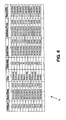
- FIG. 2 is a table representing a portion of the database for purchase order instances of Business A. Each order is on a separate row, and each column corresponds to a type of data for an order. For simplicity, FIG. 2 only shows columns for some of the information collected in the flow chart of FIG. 1. Certain fields contain NULL values, indicating (in this example) that the value for a particular event is unknown because it has not yet transpired as to that particular purchase order.
- a typical query of this database might be "which purchase orders above $1000, and that were submitted last week, have not yet been approved or denied?" Such a query could be implemented via a SQL (structured query language) query on the table.
- SQL structured query language
- Appendix A shows an implementation of SQL code to create the table of FIG. 2 ("create table PO_InstanceData”) and a stored procedure to update the rows of the table in FIG. 2 ("create procedure PO_PrimaryImport").
- This stored procedure accepts a PONum argument that uniquely identifies a record corresponding to one activity instance (in this example, a particular purchase order), and one parameter for each column in the table.
- Multiple arguments of the stored procedure allow the name-value pairs for the call to be accumulated in memory (based on the transactional logic of the application program collecting the data) before attempting to update or insert a record. Because of the processing overhead required for locking and accessing a database record, it is more efficient to update (or insert) in one command as much of a record as possible.
- the stored procedure first tries to override the non-null columns of the record by issuing an "update” statement, assuming that some data for a PO exists in the table.
- a stored procedure such as in Appendix A is satisfactory when relatively few users or programming threads are attempting to write to a table and when there are relatively few records.
- performance degrades over time as the number of records in a table grows.
- the solid line represents write performance, or the number of records that can be written per second, and rapidly drops to a low level.
- the average Queue Length for disk I/O (dashed line) soon increases beyond acceptable limits. This performance degradation results from the increase in table size.
- performance is initially limited by the speed with which the database server can perform transactions, which is in turn dependent upon the capacity of the server's central processing unit(s).
- the present invention addresses the above and other challenges associated with maintaining information about multiple instances of an activity.
- separate database tables are maintained for data corresponding to active instances of an organization's activities and for data corresponding to inactive instances of an organization's activities.
- multiple database tables can be maintained for data corresponding to inactive instances of an activity.
- data from the active instances table and one or more inactive instances tables are processed to generate combined analysis data.
- the invention includes a method for maintaining information regarding multiple instances of an activity.
- Each instance of the activity has an active condition in which information about the instance is modified or an inactive condition in which information about the instance is not modified.
- the method includes creating a record in a first database table for each of the multiple instances that are in the active condition; each record contains a field for each of a plurality of data types, one or more of the fields in each active instance record having a value indicative of the active condition.
- the method further includes assigning, for each record of the multiple instances in the inactive condition, values to the one or more fields indicative of the inactive condition.
- the method also includes deleting from the first table records of the multiple instances having values in the one or more fields indicative of the inactive condition, as well as creating, for each of the records deleted from the first table, a corresponding record in a second database table.
- the method includes creating third and subsequent database tables, as well as ceasing, upon creation of a subsequent table, creation of records in the previously-created table. For each of the records deleted from the first table after creation of the last-created table but before creation of another subsequent table, a corresponding record is created in the last-created table.
- the method includes generating a first Online Analytical Processing (OLAP) cube for records in the first table, generating a second OLAP cube for records in the second table, and combining the first and second cubes into a virtual OLAP cube.
- OLAP Online Analytical Processing
- FIG. 1 is a flow chart showing processing of customer purchase orders by a hypothetical business.
- FIG. 2 is a table representing a portion of a database for a hypothetical business.
- FIG. 3 is a graph showing degradation in database system performance over time.
- FIG. 4 is a block diagram showing separate tables for active and completed instances data according to at least one embodiment of the invention.
- FIG. 5 is an example, according to at least one embodiment of the invention, of a portion of a database table containing records for activities that are still in progress.
- FIG. 6 is an example, according to at least one embodiment of the invention, of a portion of a database table containing records for completed activities.
- FIG. 7 is a block diagram showing separate tables for active and completed instances data according to another embodiment of the invention.
- FIG. 8 is a chart showing flow of data processing for combined OLAP analysis of active and completed instances data according to at least one embodiment of the invention.
- SQL Structured Query Language
- RDBMS relational database management system
- OLAP Online Analytical Processing
- SQL SERVERTM 2000 RDBMS software and associated OLAP services software can be obtained from various sources, including Inside Microsoft® SQL SERVERTM 2000 by Karen Delaney (2001 Microsoft Press) and Microsoft® SQL SERVERTM 2000 Books Online, available at ⁇ http://www.microsoft.com/sql/techinfo/productdoc/2000/>.
- the invention is not limited to implementation using SQL SERVERTM 2000 RDBMS software and associated OLAP services software, and may be implemented using other types of RDBMS and OLAP software.
- RDBMS software such as the aforementioned SQL SERVERTM 2000 software
- SQL SERVERTM 2000 software operating on a server and accessed by one or more clients.
- Such configurations are known in the art and described in, e.g., the previously-incorporated U.S. patent application 10/157,968.
- a client-server configuration is only one example of a manner in which the invention can be implemented.
- the invention can also be implemented in other physical system configurations.
- the present invention addresses many of the problems discussed above by maintaining separate tables for data corresponding to active instances of an organization's activities, as well as for a limited number of inactive instances.
- the most important activities are those which are currently pending or which were recently completed.
- managers of Business A are most interested in purchase orders that are still being processed, i.e., for which goods have not yet been delivered.
- Those managers are also interested in purchase orders that were completed within a relatively recent period (i.e., the ordered goods delivered were delivered within the last several months).
- Business A is a hypothetical example created for purposes of describing the invention, it is common for actual businesses to be concerned with instances that are still in process or recently completed.
- FIG. 4 is a block diagram illustrating this concept.
- Table 10 holds records for data pertaining to active purchase orders.
- a purchase order is active if goods ordered by a purchase order have not yet been delivered to a customer.
- Active instances of an organizational activity could be defined differently in other contexts.
- data for that purchase order is moved to table 12.
- a purchase order is completed when ordered goods are delivered to a customer.
- completed instances of an organizational activity could be defined differently in other contexts.
- table 10 As a new purchase order is received, a record is created in table 10.
- Table 10 is shown in block form in FIG. 4, and FIG. 5 shows a portion of table 10 in more detail. Similar to the table of FIG. 2, table 10 has individual records (e.g., rows) for each purchase order and individual fields (columns) for various types of data.
- "PONum” is a purchase order number.
- "RecvTime” is the date and time the purchase order was received
- “City” is the city in which the customer issuing a purchase order is located
- “Quantity” is the number of items ordered.
- ShipTime is the date and time goods for a purchase order were shipped
- “DeliveryTime” is the date and time those goods were delivered.
- Orders for which goods have not yet been shipped have a ⁇ NULL> entry in the ShipTime field.
- Some of the records in FIG. 5 show purchase orders for which goods have not been shipped (PONum 8680 and 8685-87). As goods for these purchase orders are shipped, the "ShipTime" field is updated. Unlike the table of FIG. 2, table 10 is limited to data for purchase orders that are currently active, i.e., for which goods have not been delivered. Accordingly, the "DeliveryTime" field for each record has a NULL entry. Table 10 also has an additional field for an "IsCompleted" flag. An IsCompleted value of 0 indicates that the corresponding purchase order has not been completed. In some embodiments, IsCompleted is a "system" flag that is not displayed to a user querying the table.
- FIG. 6 shows a portion of table 12 in more detail. Similar to the tables of FIGS. 2 and 5, table 12 has individual records for each completed purchase order and individual fields for the various types of data previously described (PONum, RecvTime, City, Quantity, ShipTime and DeliveryTime). Because a purchase order is defined in the example to be complete when the ordered goods are delivered, each of the DeliveryTime fields in table 12 has a non-NULL value.
- Table 12 has an additional field for "RecordID.” As described in more detail below, this value is incrementally generated as each record for a completed purchase order is created in table 12. As seen by comparison of the PONum and RecordID fields of FIG. 6, purchase orders are not necessarily completed in the same order in which purchase order numbers are assigned.
- the RecordID field thus provides a mechanism for indexing records of table 12 in the order in which the records were created. This ensures that insert performance will be independent of the table size, and therefore will not decrease over time.
- completed instances data table 12 will grow in size as more purchase orders change from an Active/Incomplete state to an Inactive/Complete state. However, the growth of completed instances data table 12 is less of a concern than is the growth of a single database table containing records for both active and inactive instances (such as that of FIG. 2). Because records are only inserted into table 12 and are not subsequently updated, there is no need to seek a particular record each time table 12 is accessed. In other words, because a record is not being updated, it is not necessary find a particular record within table 12 before inserting a record.
- One example of SQL code to create and update the tables of FIGS. 4-6 is included at Appendices B and C.
- the first statement in Appendix B (“create table PO_Active_InstanceData”) creates table 10 for active instances data and establishes columns for PONum, RecvTime, City, Quantity, ShipTime, DeliveryTime and IsCompleted. PONum is designated as the primary key. In other words, each row of table 10 is uniquely identified by the purchase order number, or PONum.
- the next statement (“create table PO_Completed_InstanceData”) creates table 12 for completed instances data and establishes columns for PONum, RecvTime, City, Quantity, ShipTime, DeliveryTime and RecordID.
- create procedure PO_PrimaryImport creates a Stored Procedure named PO_PrimaryImport that is used to either create new records in table 10 or to update existing records in table 10.
- the PO_PrimaryImport Stored Procedure has 5 arguments that correspond to the columns of a row in table 10. For example, upon receiving purchase order 8680 in FIG. 5, a client computer would issue the following stored procedure call to the database server:
- the PO_PrimaryImport stored procedure accepts values from the call to the stored procedure and assigns those values to one or more of the local variables @PONum, @RecvTime, @City, @Quantity, @ShipTime, @DeliveryTime and @IsCompleted.
- the Stored Procedure attempts to insert those local variable values into the PO_Active_InstanceData table (table 10) via the "insert" statement. Instead of inserting those local variables as a new record in table 10, however, the trigger of Appendix C ("PO_CompletedTrigger") is then fired.
- the trigger assigns values to those variables from the "inserted" system table.
- the inserted table is automatically generated by the database server, and temporarily stores (in RAM or other system memory) copies of the rows affected during the preceding insert statement of the PO_PrimaryImport stored procedure.
- the inserted table contains copies of the arguments passed in the PO_PrimaryImport stored procedure.
- the inserted table contains the values that a user is currently attempting to insert or update into table 10.
- the trigger first tests to see if the passed value of the IsCompleted bit is equal to 1, which would indicate that the record for the passed PONum value is completed. If the IsCompleted bit equals 1, the trigger then inserts the values for the completed purchase order record into a new record of the PO_Completed_InstanceData table 12). The PONum value for the new table 12 record is obtained from the inserted table ("select inserted.PONum"). The "coalesce” function is used to obtain values of the new table 12 record for RecvTime, City, Quantity, ShipTime and DeliveryTime. In particular, the coalesce function returns the first non-NULL expression from among its arguments.
- “coalesce (inserted.RecvTime, po.RecvTime)” provides the value for RecvTime in the new table 12 record.
- the trigger first checks to see if the value of RecvTime in the inserted table is non-NULL. If so, that value is used for the RecvTime value in the new table 12 record. If the value of RecvTime in the inserted table is NULL, the trigger then obtains the value of RecvTime from the record in table 10 which the user was attempting to insert or update with a call to the PO_PrimaryImport stored procedure.
- the value of RecvTime for the new table 12 record would come from the inserted table. If, however, the PO_PrimaryImport stored procedure was called to update an existing record in table 10 for which there already exists a value for RecvTime (i.e., a value for RecvTime was not passed in the PO_PrimaryImport stored procedure call), the value of RecvTime in the new table 12 record would come from the existing record in table 10.
- this portion of the trigger code specifies that the values for the coalesce function arguments will be obtained from a set consisting of all of the rows of the PO_Active_InstanceData table (table 10) and of the "inserted" table having the same value for PONum.
- the @@rowcount function returns a value of 0 if is no rows were affected in the preceding update statement. If the @@rowcount function returns a 0, the "insert PO_Active_InstanceData select * from inserted" portion of the trigger code inserts a new record in table 10 with values from the "inserted" table.
- the amount of data in the completed instances data table is limited. As indicated above, the growth of this table (table 12 in FIG. 4) is less of a concern than is the growth of a table such as table 2. However, table 4 will nonetheless continue to grow over time. Even if no records in the table are ever updated (i.e., records are only inserted), the table will eventually become so large that system disk capacity will be exceeded or queries against the data in the table will require an unacceptably long time to complete. As previously indicated, the managers of Business A have determined that completed purchase order data is only needed for purchase orders that have been relatively recently completed. However, deletion of records from table 12 can be time-consuming. In many software environments, such deletion must be performed on a row-by-row basis; a row-lock must be acquired on each record, and the row marked as deleted. In effect, deleting a row can require as much time as inserting or updating a row.
- multiple tables are created for Completed Instance Data.
- the code of Appendices B and C operates as previously described to delete completed purchase order records from table 10 and create corresponding new records in table 12.
- table 12 is not allowed to grow without limit.
- table 12 is renamed with a unique partition name, and no further records are added to that renamed table.
- a new (and empty) table 12 having the old name of the renamed table (“PO_Completed_InstanceData”) is then created. From this point on, the trigger inserts records into the new table. After another month (or other preselected time period), this table is also renamed, and another table 12 created.
- a renamed table After a renamed table has been retained for a selected time period (e.g., six months), the entire table is deleted. Unlike deleting individual records, entire tables can be deleted quickly. In one embodiment, tables are removed using a SQL "drop table" command. When a completed instance data table is deleted, the data in that table is not necessarily lost. For example, the deleted table can be archived by transferring the data in the table to tape or other type of storage medium prior to calling the drop table function. In other embodiments, instead of creating a new table 12 at periodic intervals, a new table 12 is created when the size of table 12 reaches a certain level.
- the active and completed instances tables can be combined into a partitioned view.
- the tables can be combined with a "union all select * " SQL statement. This view combining the tables could be recreated each time one of the completed instance data tables is dropped (or alternatively, each time a new completed instance data table is created).
- data from the active and completed instances tables are further processed to provide additional analysis data.
- Business A may wish to collectively analyze currently active purchase order data and data for recently completed purchase orders.
- Business A may, for example, wish to generate one or more OLAP cubes for the combined data.
- actual organizations also have a need to generate OLAP cubes reflecting both active and completed instances of an organization's activity.
- FIG. 8 shows, in at least one embodiment, a flow of data processing for combined OLAP analysis of active and completed instance data.
- a stored procedure (“BeginDataProcessing") is executed at periodic intervals, e.g. nightly. This procedure first creates a copy of the active instances data table (table 10). Because this table is kept relatively small, this copy can be created relatively quickly. The data in the copy is then passed to a Data Transformation Service (DTS)(not shown) to be placed into a star-schema and then fully processed into an OLAP cube 30 for the active instance data.
- DTS Data Transformation Service
- the BeginDataProcessing stored procedure also obtains a portion of the completed instances data that lies in an incremental window.
- the database server stores the RecordID value of the last record obtained. As previously discussed, this value was incrementally assigned by the server when the record was created. By referencing the stored RecordID value for the last completed instances data record obtained during the prior execution of the BeginDataProcessing procedure, only records that have been created since that prior execution are obtained in the current operation.
- the incremental window is implemented as a special view created on top of the partitioned view containing multiple tables/partitions for active and completed instances data. In this manner, the incremental window can contain data from more than one partition.
- the BeginDataProcessing stored procedure obtains a copy of the active instances data table and records from the completed instances data table at the same time. Otherwise, purchase orders could be moved from the active instances data table after copying by the BeginDataProcessing procedure, but prior to obtaining records from the completed instances data table. Were this to occur, the same purchase orders would be processed twice and undermine the accuracy of the data analysis.
- the BeginDataProcessing procedure passes the incremental completed instances data records created since the prior BeginDataProcessing execution to the DTS.
- the DTS then places that incremental data into a star-schema that already contains data from prior processing of completed instances data.
- the star-schema for completed instances data (which now contains the incremental data from recent completed instances data records) is then used to update completed instances OLAP cube 32.
- OLAP cube 32 contains information about records that were processed in previous sessions.
- OLAP cubes 30 and 32 are then combined into a single virtual OLAP cube 34. The number of completed records for which OLAP cube 32 contains information may become very large over time.
- OLAP cube 32 (and hence, virtual OLAP cube 34) can be generated in a relatively small amount of time. In other words, reprocessing of completed instances data can be avoided.
- Virtual OLAP cube 34 provides a user with a "snapshot" of the business containing information about both historical and in-progress (i.e., active) purchase orders.
- Data Transformation Services (DTS) packages that process cubes 30-34 can be scheduled to run at night or during other off-peak hours.
Landscapes
- Business, Economics & Management (AREA)
- Engineering & Computer Science (AREA)
- Strategic Management (AREA)
- Marketing (AREA)
- Entrepreneurship & Innovation (AREA)
- Human Resources & Organizations (AREA)
- Finance (AREA)
- Physics & Mathematics (AREA)
- General Business, Economics & Management (AREA)
- General Physics & Mathematics (AREA)
- Accounting & Taxation (AREA)
- Theoretical Computer Science (AREA)
- Economics (AREA)
- Data Mining & Analysis (AREA)
- Development Economics (AREA)
- Operations Research (AREA)
- Quality & Reliability (AREA)
- Tourism & Hospitality (AREA)
- Information Retrieval, Db Structures And Fs Structures Therefor (AREA)
- Debugging And Monitoring (AREA)
Applications Claiming Priority (2)
| Application Number | Priority Date | Filing Date | Title |
|---|---|---|---|
| US10/670,276 US8315972B2 (en) | 2003-09-26 | 2003-09-26 | Method for maintaining databases information about multiple instances of an activity generating, updating virtual OLAP cube based on modified star-schema |
| US670276 | 2003-09-26 |
Publications (1)
| Publication Number | Publication Date |
|---|---|
| EP1519289A1 true EP1519289A1 (de) | 2005-03-30 |
Family
ID=34194820
Family Applications (1)
| Application Number | Title | Priority Date | Filing Date |
|---|---|---|---|
| EP04103299A Ceased EP1519289A1 (de) | 2003-09-26 | 2004-07-12 | Methode für das Beibehalten von Informationen über mehrfache Fälle einer Tätigkeit |
Country Status (5)
| Country | Link |
|---|---|
| US (1) | US8315972B2 (de) |
| EP (1) | EP1519289A1 (de) |
| JP (2) | JP2005108187A (de) |
| KR (1) | KR20050030848A (de) |
| CN (1) | CN100437567C (de) |
Families Citing this family (21)
| Publication number | Priority date | Publication date | Assignee | Title |
|---|---|---|---|---|
| US7149736B2 (en) * | 2003-09-26 | 2006-12-12 | Microsoft Corporation | Maintaining time-sorted aggregation records representing aggregations of values from multiple database records using multiple partitions |
| US8234623B2 (en) * | 2006-09-11 | 2012-07-31 | The Mathworks, Inc. | System and method for using stream objects to perform stream processing in a text-based computing environment |
| US8095474B2 (en) * | 2006-11-29 | 2012-01-10 | Caterpillar Inc. | Method for processing advanced ship notices (ASNs) |
| US9715710B2 (en) | 2007-03-30 | 2017-07-25 | International Business Machines Corporation | Method and system for forecasting using an online analytical processing database |
| US7870110B2 (en) * | 2008-02-27 | 2011-01-11 | International Business Machines Corporation | Method and system for generating a transaction-bound sequence of records in a relational database table |
| CN102708416B (zh) * | 2012-05-10 | 2015-11-25 | 华为软件技术有限公司 | 一种用户订购业务的方法、设备和系统 |
| US9747313B2 (en) * | 2012-12-19 | 2017-08-29 | Sap Se | Timeline index for managing temporal data |
| US9128965B1 (en) * | 2013-08-07 | 2015-09-08 | Amazon Technologies, Inc. | Configurable-capacity time-series tables |
| US10395198B2 (en) | 2013-10-04 | 2019-08-27 | International Business Machines Corporation | Forecasting a time series based on actuals and a plan |
| US10318970B2 (en) | 2013-10-04 | 2019-06-11 | International Business Machines Corporation | Generating a succinct approximate representation of a time series |
| CN104008133B (zh) * | 2014-05-06 | 2017-08-01 | 烽火通信科技股份有限公司 | 基于碰撞探测的行级锁定集合实现装置及方法 |
| US10339467B2 (en) | 2015-06-02 | 2019-07-02 | International Business Machines Corporation | Quantitative discovery of name changes |
| US10262054B2 (en) * | 2016-01-21 | 2019-04-16 | Microsoft Technology Licensing, Llc | Database and service upgrade without downtime |
| JP6963433B2 (ja) * | 2017-07-21 | 2021-11-10 | 株式会社日立情報通信エンジニアリング | 行動特徴量解析システムおよび行動特徴量解析方法 |
| US10853349B2 (en) | 2017-08-09 | 2020-12-01 | Vmware, Inc. | Event based analytics database synchronization |
| US11687567B2 (en) * | 2017-09-21 | 2023-06-27 | Vmware, Inc. | Trigger based analytics database synchronization |
| CN108595541A (zh) * | 2018-04-08 | 2018-09-28 | 上海康斐信息技术有限公司 | 一种数据抽取质量的测试方法及系统 |
| US12602392B2 (en) | 2022-02-14 | 2026-04-14 | Insight Direct Usa, Inc. | Scalable metadata-driven data ingestion pipeline |
| US12056143B2 (en) | 2022-03-31 | 2024-08-06 | Insight Direct Usa, Inc. | Data processing with integrated metadata generation and storage |
| US12056159B2 (en) * | 2022-03-31 | 2024-08-06 | Insight Direct Usa, Inc. | Dimension and fact table creation using templates |
| US12299119B2 (en) | 2022-05-16 | 2025-05-13 | Microsoft Technology Licensing, Llc | Event-triggered forensics capture |
Citations (2)
| Publication number | Priority date | Publication date | Assignee | Title |
|---|---|---|---|---|
| WO1997044745A1 (en) * | 1996-05-22 | 1997-11-27 | Universitaire Ziekenhuizen Leuven | Relational database compiled/stored on a memory structure |
| US20020107878A1 (en) * | 2000-09-08 | 2002-08-08 | Masashi Tsuchida | Method and system for managing multiple database storage units |
Family Cites Families (68)
| Publication number | Priority date | Publication date | Assignee | Title |
|---|---|---|---|---|
| JPH0754485B2 (ja) | 1987-07-15 | 1995-06-07 | 富士通株式会社 | データセット管理装置 |
| US5319780A (en) * | 1987-10-19 | 1994-06-07 | International Business Machines Corporation | System that implicitly locks a subtree or explicitly locks a node based upon whether or not an explicit lock request is issued |
| US5713020A (en) * | 1993-09-02 | 1998-01-27 | Microsoft Corporation | Method and system for generating database queries containing multiple levels of aggregation |
| US5537589A (en) * | 1994-06-30 | 1996-07-16 | Microsoft Corporation | Method and system for efficiently performing database table aggregation using an aggregation index |
| US6519601B1 (en) * | 1996-05-22 | 2003-02-11 | Universitaire Ziekenhuizen Leuven | Relational database compiled/stored on a memory structure providing improved access through use of redundant representation of data |
| US5819293A (en) * | 1996-06-06 | 1998-10-06 | Microsoft Corporation | Automatic Spreadsheet forms |
| US5822751A (en) * | 1996-12-16 | 1998-10-13 | Microsoft Corporation | Efficient multidimensional data aggregation operator implementation |
| US5852818A (en) * | 1996-12-23 | 1998-12-22 | Oracle Corporation | Non-recursive method for parameter evaluation within an information management system |
| US6643696B2 (en) * | 1997-03-21 | 2003-11-04 | Owen Davis | Method and apparatus for tracking client interaction with a network resource and creating client profiles and resource database |
| US6301616B1 (en) * | 1997-04-11 | 2001-10-09 | Microsoft Corporation | Pledge-based resource allocation system |
| US5940818A (en) * | 1997-06-30 | 1999-08-17 | International Business Machines Corporation | Attribute-based access for multi-dimensional databases |
| US5905985A (en) * | 1997-06-30 | 1999-05-18 | International Business Machines Corporation | Relational database modifications based on multi-dimensional database modifications |
| US6205447B1 (en) * | 1997-06-30 | 2001-03-20 | International Business Machines Corporation | Relational database management of multi-dimensional data |
| US5943668A (en) * | 1997-06-30 | 1999-08-24 | International Business Machines Corporation | Relational emulation of a multi-dimensional database |
| US5978796A (en) * | 1997-06-30 | 1999-11-02 | International Business Machines Corporation | Accessing multi-dimensional data by mapping dense data blocks to rows in a relational database |
| US5926818A (en) * | 1997-06-30 | 1999-07-20 | International Business Machines Corporation | Relational database implementation of a multi-dimensional database |
| US6070165A (en) * | 1997-12-24 | 2000-05-30 | Whitmore; Thomas John | Method for managing and accessing relational data in a relational cache |
| US6594653B2 (en) * | 1998-03-27 | 2003-07-15 | International Business Machines Corporation | Server integrated system and methods for processing precomputed views |
| US6477525B1 (en) * | 1998-12-28 | 2002-11-05 | Oracle Corporation | Rewriting a query in terms of a summary based on one-to-one and one-to-many losslessness of joins |
| US6502086B2 (en) * | 1999-01-04 | 2002-12-31 | International Business Machines Corporation | Mapping binary objects in extended relational database management systems with relational registry |
| SE515459C2 (sv) * | 1999-02-10 | 2001-08-06 | Ericsson Telefon Ab L M | Metod för att synkronisera en värddatabas och en fjärrdatabas |
| US6438537B1 (en) * | 1999-06-22 | 2002-08-20 | Microsoft Corporation | Usage based aggregation optimization |
| US6430565B1 (en) * | 1999-06-22 | 2002-08-06 | Microsoft Corporation | Path compression for records of multidimensional database |
| US6442560B1 (en) * | 1999-06-22 | 2002-08-27 | Microsoft Corporation | Record for multidimensional databases |
| US6374263B1 (en) * | 1999-07-19 | 2002-04-16 | International Business Machines Corp. | System for maintaining precomputed views |
| US6801915B1 (en) * | 1999-07-28 | 2004-10-05 | Robert Mack | Paired keys for data structures |
| US6581054B1 (en) * | 1999-07-30 | 2003-06-17 | Computer Associates Think, Inc. | Dynamic query model and method |
| US6408292B1 (en) * | 1999-08-04 | 2002-06-18 | Hyperroll, Israel, Ltd. | Method of and system for managing multi-dimensional databases using modular-arithmetic based address data mapping processes on integer-encoded business dimensions |
| US6542895B1 (en) * | 1999-08-30 | 2003-04-01 | International Business Machines Corporation | Multi-dimensional restructure performance when adding or removing dimensions and dimensions members |
| US6546395B1 (en) * | 1999-08-30 | 2003-04-08 | International Business Machines Corporation | Multi-dimensional restructure performance by selecting a technique to modify a relational database based on a type of restructure |
| CA2281331A1 (en) * | 1999-09-03 | 2001-03-03 | Cognos Incorporated | Database management system |
| US6647415B1 (en) | 1999-09-30 | 2003-11-11 | Hewlett-Packard Development Company, L.P. | Disk storage with transparent overflow to network storage |
| JP2001125811A (ja) | 1999-10-27 | 2001-05-11 | Itoki Crebio Corp | 情報ネットワークシステム |
| US6700590B1 (en) * | 1999-11-01 | 2004-03-02 | Indx Software Corporation | System and method for retrieving and presenting data using class-based component and view model |
| US7328233B2 (en) * | 2000-01-19 | 2008-02-05 | Corybant, Inc. | Method and apparatus for implementing an active information model |
| US6516322B1 (en) * | 2000-04-28 | 2003-02-04 | Microsoft Corporation | XML-based representation of mobile process calculi |
| US20030061506A1 (en) * | 2001-04-05 | 2003-03-27 | Geoffrey Cooper | System and method for security policy |
| US6601062B1 (en) * | 2000-06-27 | 2003-07-29 | Ncr Corporation | Active caching for multi-dimensional data sets in relational database management system |
| JP4895437B2 (ja) | 2000-09-08 | 2012-03-14 | 株式会社日立製作所 | データベース管理方法およびシステム並びにその処理プログラムおよびそのプログラムを格納した記録媒体 |
| US6603839B1 (en) * | 2000-09-13 | 2003-08-05 | International Business Machines Corporation | Automatic transfer of electronic directory entries from directory assistance service to a directory within an electronic communication device |
| US6725287B1 (en) * | 2000-11-09 | 2004-04-20 | Elity Systems, Inc. | Method and system for capturing streaming data by an actionable information engine |
| US20020138316A1 (en) * | 2001-03-23 | 2002-09-26 | Katz Steven Bruce | Value chain intelligence system and methods |
| US20020178077A1 (en) * | 2001-05-25 | 2002-11-28 | Katz Steven Bruce | Method for automatically invoking a software module in response to an internal or external event affecting the procurement of an item |
| US6996567B2 (en) * | 2001-05-31 | 2006-02-07 | Heuristic Physics Laboratories, Inc. | Automatic generation of join graphs for relational database queries |
| US7325193B2 (en) * | 2001-06-01 | 2008-01-29 | International Business Machines Corporation | Automated management of internet and/or web site content |
| US20030009705A1 (en) * | 2001-07-09 | 2003-01-09 | Michael Thelander | Monitoring and synchronization of power use of computers in a network |
| US8526751B2 (en) | 2001-08-24 | 2013-09-03 | International Business Machines Corporation | Managing image storage size |
| US20030055677A1 (en) * | 2001-09-14 | 2003-03-20 | Automated Energy, Inc. | Utility monitoring and management system |
| CN1438596A (zh) * | 2002-02-10 | 2003-08-27 | 宫本保 | 进度表管理方法 |
| US6691102B2 (en) * | 2002-03-26 | 2004-02-10 | International Business Machines Corporation | Query processing method of name-value pairs in relational databases |
| CA2425297A1 (en) * | 2002-04-15 | 2003-10-15 | Exchange Synergism Ltd. | Method, system and apparatus for measuring and analyzing business volume |
| US7080081B2 (en) * | 2002-04-15 | 2006-07-18 | International Business Machines Corporation | Multidimensional data clustering scheme for query processing and maintenance in relational databases |
| US6748288B2 (en) * | 2002-04-30 | 2004-06-08 | Macronix International Co., Ltd. | Semiconductor wafer manufacturing execution system with recipe distribution management database |
| JP4214712B2 (ja) * | 2002-05-16 | 2009-01-28 | 株式会社日立製作所 | データベースのページ確保処理方法 |
| US7249118B2 (en) * | 2002-05-17 | 2007-07-24 | Aleri, Inc. | Database system and methods |
| US7249152B2 (en) * | 2002-05-24 | 2007-07-24 | Oracle International Corporation | Dynamic disk space management by multiple database server instances in a cluster configuration |
| US7107340B2 (en) * | 2002-05-31 | 2006-09-12 | Microsoft Corporation | System and method for collecting and storing event data from distributed transactional applications |
| US7571187B2 (en) * | 2002-05-31 | 2009-08-04 | Microsoft Corporation | Support for real-time queries concerning current state, data and history of a process |
| US7010542B2 (en) * | 2002-07-20 | 2006-03-07 | Microsoft Corporation | Result set formatting and processing |
| US7318056B2 (en) * | 2002-09-30 | 2008-01-08 | Microsoft Corporation | System and method for performing click stream analysis |
| US7467125B2 (en) * | 2002-12-12 | 2008-12-16 | International Business Machines Corporation | Methods to manage the display of data entities and relational database structures |
| US7181450B2 (en) * | 2002-12-18 | 2007-02-20 | International Business Machines Corporation | Method, system, and program for use of metadata to create multidimensional cubes in a relational database |
| US7953694B2 (en) * | 2003-01-13 | 2011-05-31 | International Business Machines Corporation | Method, system, and program for specifying multidimensional calculations for a relational OLAP engine |
| US7149736B2 (en) * | 2003-09-26 | 2006-12-12 | Microsoft Corporation | Maintaining time-sorted aggregation records representing aggregations of values from multiple database records using multiple partitions |
| US7693916B2 (en) * | 2004-01-05 | 2010-04-06 | Microsoft Corporation | Correlating process instance data across multiple applications |
| US8086607B2 (en) * | 2004-04-26 | 2011-12-27 | Right90, Inc. | Annotation of data in an operating plan data aggregation system |
| US20110029478A1 (en) * | 2009-05-20 | 2011-02-03 | Broeker Stephen A | Stream Star Schema and Nested Binary Tree for Data Stream Analysis |
| US8204901B2 (en) * | 2009-09-02 | 2012-06-19 | International Business Machines Corporation | Generating query predicates for processing multidimensional data |
-
2003
- 2003-09-26 US US10/670,276 patent/US8315972B2/en not_active Expired - Fee Related
-
2004
- 2004-07-12 EP EP04103299A patent/EP1519289A1/de not_active Ceased
- 2004-07-15 JP JP2004209176A patent/JP2005108187A/ja active Pending
- 2004-07-16 KR KR1020040055660A patent/KR20050030848A/ko not_active Withdrawn
- 2004-07-19 CN CNB200410058914XA patent/CN100437567C/zh not_active Expired - Fee Related
-
2010
- 2010-07-15 JP JP2010160909A patent/JP5209001B2/ja not_active Expired - Fee Related
Patent Citations (2)
| Publication number | Priority date | Publication date | Assignee | Title |
|---|---|---|---|---|
| WO1997044745A1 (en) * | 1996-05-22 | 1997-11-27 | Universitaire Ziekenhuizen Leuven | Relational database compiled/stored on a memory structure |
| US20020107878A1 (en) * | 2000-09-08 | 2002-08-08 | Masashi Tsuchida | Method and system for managing multiple database storage units |
Non-Patent Citations (1)
| Title |
|---|
| No Search * |
Also Published As
| Publication number | Publication date |
|---|---|
| US8315972B2 (en) | 2012-11-20 |
| JP2010262670A (ja) | 2010-11-18 |
| CN1601527A (zh) | 2005-03-30 |
| JP5209001B2 (ja) | 2013-06-12 |
| US20050071341A1 (en) | 2005-03-31 |
| KR20050030848A (ko) | 2005-03-31 |
| CN100437567C (zh) | 2008-11-26 |
| JP2005108187A (ja) | 2005-04-21 |
Similar Documents
| Publication | Publication Date | Title |
|---|---|---|
| JP5209001B2 (ja) | アクティビティの複数のインスタンスに関する情報を維持する方法 | |
| JP4828102B2 (ja) | 自己維持型リアルタイム・データ集約 | |
| US7308704B2 (en) | Data structure for access control | |
| US7350237B2 (en) | Managing access control information | |
| US6081810A (en) | Report database system | |
| US6185555B1 (en) | Method and apparatus for data management using an event transition network | |
| US6157928A (en) | Apparatus and system for an adaptive data management architecture | |
| US9971827B2 (en) | Subscription for integrating external data from external system | |
| US8548954B2 (en) | Archiving system for massive databases using pre-computed data lifecycles | |
| WO2008061254A1 (en) | Storing, maintaining and locating information | |
| AU2003263565A1 (en) | Transaction processing system | |
| EP1503298B1 (de) | Methode und Computersystem zum Archivieren von Datenobjekten | |
| Joshi | Method of metadata management in Data warehouses. | |
| JP2006106991A (ja) | データベース再編成方式および管理方法 | |
| IE84056B1 (en) | Transaction processing | |
| IE20030694A1 (en) | Transaction processing | |
| IES83228Y1 (en) | Transaction processing |
Legal Events
| Date | Code | Title | Description |
|---|---|---|---|
| PUAI | Public reference made under article 153(3) epc to a published international application that has entered the european phase |
Free format text: ORIGINAL CODE: 0009012 |
|
| AK | Designated contracting states |
Kind code of ref document: A1 Designated state(s): AT BE BG CH CY CZ DE DK EE ES FI FR GB GR HU IE IT LI LU MC NL PL PT RO SE SI SK TR |
|
| AX | Request for extension of the european patent |
Extension state: AL HR LT LV MK |
|
| 17P | Request for examination filed |
Effective date: 20050823 |
|
| AKX | Designation fees paid |
Designated state(s): AT BE BG CH CY CZ DE DK EE ES FI FR GB GR HU IE IT LI LU MC NL PL PT RO SE SI SK TR |
|
| 17Q | First examination report despatched |
Effective date: 20060714 |
|
| RAP1 | Party data changed (applicant data changed or rights of an application transferred) |
Owner name: MICROSOFT TECHNOLOGY LICENSING, LLC |
|
| STAA | Information on the status of an ep patent application or granted ep patent |
Free format text: STATUS: THE APPLICATION HAS BEEN REFUSED |
|
| 18R | Application refused |
Effective date: 20160312 |