EP1519286A1 - Content providing method, content providing system, content providing apparatus, and content reproduction apparatus - Google Patents
Content providing method, content providing system, content providing apparatus, and content reproduction apparatus Download PDFInfo
- Publication number
- EP1519286A1 EP1519286A1 EP02741361A EP02741361A EP1519286A1 EP 1519286 A1 EP1519286 A1 EP 1519286A1 EP 02741361 A EP02741361 A EP 02741361A EP 02741361 A EP02741361 A EP 02741361A EP 1519286 A1 EP1519286 A1 EP 1519286A1
- Authority
- EP
- European Patent Office
- Prior art keywords
- content
- purchaser
- user
- identification information
- section
- Prior art date
- Legal status (The legal status is an assumption and is not a legal conclusion. Google has not performed a legal analysis and makes no representation as to the accuracy of the status listed.)
- Withdrawn
Links
Images








Classifications
-
- G—PHYSICS
- G06—COMPUTING OR CALCULATING; COUNTING
- G06F—ELECTRIC DIGITAL DATA PROCESSING
- G06F21/00—Security arrangements for protecting computers, components thereof, programs or data against unauthorised activity
- G06F21/30—Authentication, i.e. establishing the identity or authorisation of security principals
- G06F21/31—User authentication
- G06F21/32—User authentication using biometric data, e.g. fingerprints, iris scans or voiceprints
-
- G—PHYSICS
- G06—COMPUTING OR CALCULATING; COUNTING
- G06F—ELECTRIC DIGITAL DATA PROCESSING
- G06F21/00—Security arrangements for protecting computers, components thereof, programs or data against unauthorised activity
- G06F21/10—Protecting distributed programs or content, e.g. vending or licensing of copyrighted material ; Digital rights management [DRM]
-
- G—PHYSICS
- G06—COMPUTING OR CALCULATING; COUNTING
- G06F—ELECTRIC DIGITAL DATA PROCESSING
- G06F21/00—Security arrangements for protecting computers, components thereof, programs or data against unauthorised activity
- G06F21/30—Authentication, i.e. establishing the identity or authorisation of security principals
- G06F21/31—User authentication
-
- G—PHYSICS
- G06—COMPUTING OR CALCULATING; COUNTING
- G06F—ELECTRIC DIGITAL DATA PROCESSING
- G06F2221/00—Indexing scheme relating to security arrangements for protecting computers, components thereof, programs or data against unauthorised activity
- G06F2221/21—Indexing scheme relating to G06F21/00 and subgroups addressing additional information or applications relating to security arrangements for protecting computers, components thereof, programs or data against unauthorised activity
- G06F2221/2135—Metering
-
- G—PHYSICS
- G06—COMPUTING OR CALCULATING; COUNTING
- G06F—ELECTRIC DIGITAL DATA PROCESSING
- G06F2221/00—Indexing scheme relating to security arrangements for protecting computers, components thereof, programs or data against unauthorised activity
- G06F2221/21—Indexing scheme relating to G06F21/00 and subgroups addressing additional information or applications relating to security arrangements for protecting computers, components thereof, programs or data against unauthorised activity
- G06F2221/2137—Time limited access, e.g. to a computer or data
Definitions
- the present invention relates to a content providing method, content providing system, content providing apparatus, and content reproducing apparatus which authenticate the user (purchaser) only who has officially paid the content to use the digital content such as music, images, applications or the like which run on a personal computer.
- music and other content are stored in music media (records, cassette tapes, CD (Compact Disk), or the like), and a user who wants to listen to the music purchases a music medium.
- the cost which the user paid at a shop is handed to an original copyright owner (song-writer, composer, performing musician, singer, or the like) via a shop, music sales company, or the like.
- the user is granted the right to use the music by purchasing a music medium.
- the user obtains content and the original copyright owner obtains the content cost, and the shop, music sales company, or the like who mediate between the user and the original copyright owner obtain a profit margin.
- SCMS is a digital copy generation control technique. That is, it is a system that allows copying of one generation only when digital data is copied in a digital form. For example, when the user creates digital data from a CD the user purchased, the user is allowed to create digital data (child data) from the CD but the user is not allowed to create digital data (grandchild data) from the digital data (child data). By carrying out this kind of generation control, the digital data is prevented from being copiedwithout limit.
- SCMS is adopted for MD (Mini Disc), DAT (Digital Audio Tape), or the like for household apparatus.
- SDMI is a project established with initiative taken by the Recording Industry Association of America (RIAA) to protect the copyright in distributing and selling music on the Internet.
- SDMI adopts a system for permitting the use of the data on the terminal (cellular phone, PC, or the like) only, which has downloaded the music data from the network.
- OpenMG radio-controlled trademark
- This OpenMG allows copying pursuant to the predetermined rule (restriction to copy-to points, restriction of number of times of copies, or the like) when data is copied between recording media (magic gate memory stick) that conform to OpenMG.
- a private key and a public key are created in conformity to the identification information (ID) specific to the apparatus, the music data is encrypted by the public key and the encrypted music data (encrypted content) is recorded.
- ID identification information
- the encrypted data is decrypted by the private key stored in the apparatus. Because the music data is encrypted by ID specific to the apparatus, the encrypted content cannot be decrypted by any reproducing apparatus with different ID and naturally, the data cannot be reproduced.
- content is encrypted by the first encryption means and recorded in a medium and at the same time, the license information including the use conditions to restrict the use of the relevant content and the first decryption key for decrypting the encrypted content is encrypted by the second encryption means and stored in the media.
- the second decryption key stored in the reproducing apparatus is used to decrypt the license information, and based on the use conditions in the license information, the adequacy of the use of content is judged, and if the use is accepted, the first decryption key in the license information is used to decrypt and reproduce the content.
- SCMS restricts preparation of grandchild copies but as far as child copies are concerned, child copies can be prepared with no restriction. Consequently, even if an evil-minded content user prepares child copies in a large quantity and sells them to any third party, SCMS cannot prevent the action.
- a user who officially purchased content for example, CD
- can copy content in a CD into an MD but is not allowed to copy the content from the MD further to other MD even within the range of private use.
- copies are permitted within the range of private use, but SCMS restricts copying only (to prepare child copies from the master content medium) by a specific procedure. In this way, SCMS has problems in that SCMS cannot prevent illicit use of content, protection of a copyright owner is not sufficient, and a legal use of a content user is restricted.
- SDMI restricts the number of times of copy preparations. That is, it does not control copy generations as is the case of SCMS but controls the number of copying times, but the problems of SDMI are the same as those of SCMS. That is, because copying can be carried out in the number of times licensed by SDMI, even if an illicit content user prepares copies in the number licensed by SDMI and sells to any third party, SDMI cannot prevent the action.
- the private recording compensation is added to prices of specific music media and apparatus provided by the government ordinance.
- digital content is stored not only in the music media but also general digital recording media.
- digital recording media in addition to general media such as floppy disk (registered trademark), hard disk, MO, CD-R. CD-RW, or the like
- new media such as DVD-R, DVD-RAM, DVD-RW, DVD+RW, or the like have come onstage one after another, and in recording media such as Compact Flash (registered trademark), Smart Media (registered trademark), or the like which are used for image storage media for digital cameras, apparatus which can store various data have appeared.
- the music media and apparatus provided by the government ordinance cover only part of the apparatus and media which utilize music content, and it is difficult to say that the right of the copyright owner is thoroughly secured.
- a decryption key for decrypting the encrypted content is used for the license information of the content user.
- This license information is further encrypted by the second encryption key to be stored in the content.
- the decryption key for decrypting the license information is stored in the reproducing apparatus. Consequently, the method (5), too, the same as the method (4), cannot utilize content in a specific apparatus only and has the same problems as the method (4) has.
- the present invention is made in view of the above-mentioned problems and it is an object of the present invention to secure the user right by ensuring the execution of operations (reproduction, copy, or the like) permitted under the Copy Right Law for the content user (purchaser) while thoroughly protecting the right of the copyright owner, and in addition, to collect the content charge from the user of the copy content, from whom the content charge has been unable to be collected.
- the content providing method is a method for a content manager to supply content to a purchaser, comprises the steps of: paying price for the use of the content to the content manager by the purchaser; incorporating, on the content manager side, purchaser identification information, which can identify the purchaser individual who paid the price, in the content or a medium which stores the content ; providing the content or the medium, in which the purchaser identification information is incorporated, from the content manager side to the purchaser; and authenticating whether or not user of the content is the legitimate purchaser using the purchaser identification information incorporated in the content or the medium in order to permit the user of the content to use the content only when the user of the content is the legitimate purchaser.
- the content providing method may further comprise a step of acquiring the purchaser identification information from the purchaser who has paid the price in order to incorporate the purchaser identification information in the content or the medium.
- the content providing method may further comprise a step of acquiring user identification information, which can identify the user individual, from the user of the content for carrying out the authentication, wherein the authentication is carried out by comparing the acquired user identification information with the purchaser identification information incorporated in the content or the medium.
- the content providing method may further comprise a step of acquiring user identification information, which can identify the user individual, from the user of the content for carrying out the authentication and registering in advance the user identification information to the instrument which is used when the user uses the content, wherein the authentication is carried out by comparing the user identification information registered in advance to the instrument with the purchaser identification information incorporated in the content or the medium when the user uses the content with the instrument.
- the content providing method may further comprise the steps of: generating an encryption key from the purchaser identification information; and encrypting the content by the encryption key to obtain the encrypted content, wherein the purchaser identification information is incorporated in the encrypted content or the medium, and the encrypted content or the medium, in which the purchaser identification information is incorporated, is provided from the content manager side to the purchaser who paid the price.
- the content providing method further comprises the steps of: generating a decryption key from the purchaser identification information incorporated in the encrypted content or the medium in the event that the user of the content is authenticated as the legitimate purchaser; and decrypting the encrypted content by the decryption key to obtain the original content.
- a content providing system is for providing content to a purchaser who has paid price for the use of the content, and comprises: a content management server which controls the content to be provided to the purchaser; a purchaser identification information incorporating apparatus which incorporates purchaser identification information, whichcan identify the purchaser individual who has paid the price, in the content to be provided from the content management server to the purchaser or in a medium in which the content is stored; an instrument which is used when a user of the content uses the content; and an authentication apparatus which authenticates whether or not a user of the content is the legitimate purchaser using the purchaser identification information incorporated in the content or the medium in order to allow the use of the content by the instrument only when the user of the content is the legitimate purchaser.
- the content providing system may be configured in such a way that the authentication apparatus is incorporated in the instrument, and comprise a purchaser identification information input section for the purchaser to input the purchaser identification information.
- the content providing system may further comprise a user identification information input section for the user of the content to input user identification information that can identify the user individual in order to carry out the authentication by the authentication apparatus, wherein the authentication apparatus carries out the authentication by comparing the user identification information input from the user identification information input section with the purchaser identification information incorporated in the content or the medium.
- the content providing system may further comprise a user identification information writing apparatus for acquiring user identification information that can specify the user individual from the user of the content to carry out the authentication by the authentication apparatus and for writing and registering the user identification information in the instrument in advance, wherein the authentication apparatus carries out authentication by comparing the user identification information registered in the instrument with the purchaser identification information incorporated in the content or in the medium when the user uses the content with the instrument.
- a user identification information writing apparatus for acquiring user identification information that can specify the user individual from the user of the content to carry out the authentication by the authentication apparatus and for writing and registering the user identification information in the instrument in advance, wherein the authentication apparatus carries out authentication by comparing the user identification information registered in the instrument with the purchaser identification information incorporated in the content or in the medium when the user uses the content with the instrument.
- multiple pieces of user identification information which can identify multiple user individuals, respectively, are written and registered in the instrument by the user identification information writing apparatus, and the' authentication apparatus compares the multiple pieces of user identification information registered in the instrument with the purchaser identification information incorporated in the content or in the medium and allows the use of the content in the instrument upon accreditation in which any one of the multiple pieces of user identification information coincides with the purchaser identification information.
- the user identification information writing apparatus is installed in a store that sells the instrument, when a user who uses the instrument purchases the instrument at the store, the user identification information of the user is written and registered in the instrument by the user identification information writing apparatus. Further, in the content providing system an initialization apparatus, which initializes and deletes the user identification information written and registered to the instrument is equipped in the instrument.
- the use of the content with the instrument is allowed within the range which conforms to the trial use information.
- Information concerning a procedure for receiving the content from the content management server is added to the content.
- content providing system may further comprise a purchaser identification information changing apparatus which changes the purchaser identification information which has already been incorporated in the content or in the medium to another purchaser identification information, wherein in the event that an owner of the content is not a legitimate purchaser, the purchaser identification information changing apparatus changes, in exchange of the price paid by the owner, the purchaser identification information which has already been incorporated in the content or in the medium to the identification information that can identify the owner individual.
- the content providing system may further comprise a purchaser management table for holding a list of purchasers who purchased the content, and a content distribution management apparatus that counts, on the basis of the purchaser management table, the number of changes of the purchase identification information on each content provided from the content management server according to the original purchaser of each content, wherein the price that complies with the number of changes counted by the content distribution management apparatus is paid to the original purchaser.
- the content providing system may further comprise an encryption key generating apparatus which generates an encryption key from the purchaser identification information, and an encryption apparatus which encrypts the content by the encryption key generated by the encryption key generating apparatus and obtains the encrypted content, wherein the encrypted content or the medium with the purchaser identification information incorporated by the purchaser identification information incorporating apparatus is provided to the purchaser who has paid the price.
- the content providing system further comprises a decryption key generating apparatus which generates a decryption key from the purchaser identification information incorporated in the encrypted content or in the medium when a user of the content is authenticated as the legitimate purchaser by the authentication apparatus, and decryption apparatus which decrypts the encrypted content by the decryption key generated by the decryption key generating apparatus and obtains the original content.
- a decryption key generating apparatus which generates a decryption key from the purchaser identification information incorporated in the encrypted content or in the medium when a user of the content is authenticated as the legitimate purchaser by the authentication apparatus, and decryption apparatus which decrypts the encrypted content by the decryption key generated by the decryption key generating apparatus and obtains the original content.
- a content providing apparatus if for providing content to a purchaser who has paid price for the use of the content and which comprises a content holding section which holds the content to be provided to the purchaser, and a purchase identification information incorporating section which incorporates the purchaser identification information which can identify the purchaser individual in the content to be provided to the purchaser or in the medium which stores the content.
- the content providing apparatus may further comprise a purchaser identification information input section for inputting the purchaser identification information.
- the content providing apparatus further comprises an encryption key generating section which generates an encryption key from the purchaser identification information, and an encryption section which encrypts the content by the encryption key generated by the encryption key generating section and obtains the encrypted content, wherein the encrypted content or the medium with the purchaser identification information incorporated by the purchaser identification information incorporating section is provided to the purchaser who has paid the price.
- a content reproducing apparatus is for reproducing content with purchaser identification information which can identifies the purchaser, or reproducing content in a medium with the purchaser identification information incorporated in advance, and which comprises a user identification information input section for inputting user identification information which can identify the user individual who reproduces the content, and an authentication section that authenticates whether or not a user of the content is a legitimate purchaser by comparing the purchaser identification information with the user identification information input from the user identification information input section, wherein reproduction of the content is allowed only when the user of the content is authenticated as the legitimate purchaser by the authentication section.
- the content reproducing apparatus is for reproducing content with purchaser identification information which can identifies the purchaser, or reproducing content in the medium with the purchaser identification information incorporated in advance, and which comprise a user identification information storing section for storing user identification information which can identify the user individual who uses the content reproducing apparatus and which is written and registered in advance, and an authentication section which authenticates whether or not a user of the content is a legitimate purchaser by comparing the purchaser identification information with the user identification information input from the user identification information input section, wherein reproduction of the content is allowed only when the user of the content is authenticated as the legitimate purchaser by the authentication section.
- the content reproducing apparatus multiple pieces of user identification information, which can identify multiple user individuals, respectively, are written and registered in the user identification information storing section, and the authentication section compares the purchaser identification information with the multiple pieces of user identification information registered to the user identification information storing section, and allows the reproduction of the content upon accreditation in which the purchaser identification information coincides with any one of the multiple pieces of user identification information,.
- the content reproducing apparatus may further comprise a user identification information writing section which acquires the user identification information and writes and registers to the user identification information storing section, and an initializing section which initializes and deletes the user identification information written and registered to the user identification information storing section.
- the content is provided as encrypted content which is encrypted by an encryption key generated from the purchaser identification information.
- the content reproducing apparatus may further comprise a decryption key generating section which generates a decryption key from the purchaser identification information when the user of the content is authenticated as the legitimate purchaser by the authentication section, and a decryption section which decrypts the encrypted content by the decryption key generated by the decryption key generating section and obtains the original content.
- biometric information of the purchaser or minutia data extracted from the biometric information of the purchaser is used as the purchaser identification information
- biometric information of the user or minutia data extracted from the biometric information of the user is used as the user identification information.
- the content providing method, content providing system, content providing apparatus, and content reproducing apparatus when a purchaser pays a counter value (content use charge) to a content manager and purchases content, on the content manager (content management server, content providing apparatus) side, in the content or in a medium that stores the content, purchaser identification information that can identify the purchaser individual is incorporated and the content or the medium is provided to the purchaser. And only when it is authenticated by the use of the purchaser identification information that the content user is a legitimate purchaser, the use of the content is permitted.
- a counter value content use charge
- the copy content can be used, but because any one other than the legitimate purchaser cannot be authenticated as the legitimate purchaser, the copy content cannot be used. Consequently, if any one other than the legitimate purchaser hopes to use the copy content, she/he must pay the content use charge, and therefore, it becomes possible to collect the content use charge even from the copy content users from whom no content use charge has been collected, and the right of the original copyright owner can be definitely protected.
- an authentication apparatus authentication section
- an apparatus content reproducing apparatus
- the apparatus by providing the apparatus with a function to initialize and delete the user identification information in the apparatus, when the apparatus is sold to any third party, the user identification information in the apparatus can be deleted by the use of the function. Consequently, if ever content remains in the apparatus, the third party cannot use the content and the right of the original copyright owner can be protected.
- the trial information (number of permissible trial use times, trial use allowable time, or the like) which define the trial use allowable range of the content is added to the content and it is recognized that the content user is not the legitimate purchaser
- by configuring to permit the use of the content in the apparatus within the range that conforms to the trial use information it is possible to permit the user who failed the authentication to use the content in the specified trial use allowable range.
- the user who is not a legitimate purchaser can trially use content.
- the user hopes to officially purchase the content as a result of trially using the content, the user does the legitimate purchase procedure to the content manager (content management server, content providing apparatus).
- the content manager content management server, content providing apparatus
- the content manager such as the original copyright owner, or the like can officially collect the content use charge (counter value) not only from the person who officially purchased content but also a user who indirectly possessed content such as file sharing software or the like.
- the number of changes of the purchaser identification information for each content is counted for every original purchase of each content and the counter value that corresponds to the counted number of changes may be paid to the original purchaser, and by this, the profit will be restored to purchasers who contributed to promotion of selling content and brought about profits to the content manager.
- the present invention intends to allow the user (purchaser) only who has officially paid the content use charge and purchased content to use digital content with an intelligent property right (for example, music and images, or applications or the like that run on PC).
- biometric information for example, fingerprint data or the like
- the user legitimate purchaser only who can officially use content is allowed for the use.
- the right owner of the content collects the content use charge from the user and in exchange of the content use charge, the user biometric information is stored in content (copy data).
- content manager such as original copyright owner or the like
- the content right owner is able to collect the content use charge from the user of the copy content.
- the user is able to copy content if the user is the purchaser him/herself (legitimate purchaser) and use the copy content. This act is the act permitted for the legitimate purchaser under the Copyright Law and is permitted if the present invention is used and the right of the legitimate purchaser under the Copyright Law is secured.
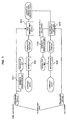
- Fig. 1 is a flow chart (Steps S1 through S7) for describing a flow of basic processing (Example 1) in a content providing system according to the present invention.
- a content reproducing apparatus for example, a music player, VTR, DVD player, or the like
- a section to input the user identification information (hereinafter, referred to as the "user ID") that can identify the owner (content user) individual of the apparatus should be equipped.
- Step S1 the content purchaser chooses content to be purchased (Step S1), pays the counter value for the use of the content to a content manager (for example, a music distribution company or the like) and at the same time notifies the purchaser identification information (purchaser ID) that can identify the purchaser individual (Step S2).
- a content manager for example, a music distribution company or the like
- the purchaser ID obtained from the purchaser is stored in content or a medium (CD, DVD, MD or the like) in which the content is stored, and the content or the medium with the purchaser ID incorporated is offered to the purchaser (Step S3).
- Step S4 When the user uses the content, the user stores the content or the medium with the purchaser ID incorporated in the content reproducing apparatus (Step S4) , and enters the user ID in the content reproducing apparatus through the user identification information input section (Step S5). And in the content reproducing apparatus, by comparing the user ID obtained in Step S5 with the purchaser ID incorporated in the content or in the medium, whether the user is the legitimate purchaser or not is authenticated (Step S6).
- Step S7 When the user ID coincides with the purchaser ID, it is authenticated that the user is the purchaser ("authentication" route of Step 6), and the content is reproduced in the content reproducing apparatus (Step S7). On the other hand, in the event that the user ID does not coincide with the purchaser ID, it is judged that the user is not the purchaser ("refused" route of Step 6) and the process is finished without carrying out reproduction. In the event that the access is refused, an error notice may be given to notify the user of the denial.
- the content which the user purchased is allowed to be reproduced only on the apparatus (content reproducing apparatus) which the user owns, and even if any third party owns a copy of the content, she/he cannot use the content.
- the content which the user purchased can be reproduced in any apparatus as far as it is the apparatus the user owns that can reproduce the content.
- biometric information for example, fingerprints, face image, iris of the eyes, palm pattern, voice, signature or the like
- the personal identification number, password, or the like can be distributed as data as it is. Consequently, in the event that the personal identification number or password is used as the purchaser ID, it is possible to distribute together with the content, and illicit use of any third party who is not authorized to use the content cannot be prevented.
- biometric information is the information which cannot be separated from the user, it is possible to ensure that the user exists on the spot. By using biometric information for the purchaser ID to be incorporated in content or a medium, even if the content is passed into the hands of any third party, the third party cannot use the content unless the legitimate purchase is present on the spot.
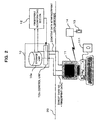
- FIG. 2 is a block diagram that describes a basic configuration example and operation of the content providing system according to the present invention.
- the content providing system shown in Fig. 2 provides content to the purchaser who paid the counter value for the use of the content, and comprises a content management server 10, personal computer (user terminal, hereinafter, referred to as "PC") 11, fingerprint incorporating section 12, player 14, and network 20.
- PC personal computer
- FIG. 2 there shown is a case in which a user who is a content purchaser and user purchases music data (musical composition) from the content management server 10 which a content dealer (content manager) installs on the Internet using the PC 11.
- the PC 11 and the player 14 are those which the user owns at home and the PC 11 is connected communicatably with the content management server 10 via the network 20.
- a fingerprint sensor 111 is attached, and fingerprint data of the user (purchaser) read by this fingerprint sensor 111 is notified to the content management server 10 via the PC 11 and the network 20. That is, these PC 11 and fingerprint sensor 111 function as the user identification information input section to enter the purchaser ID.
- the content management server (content providing apparatus) 10 is installed by the content dealer on the Internet and controls the content (digital content data) to be offered to the user.
- This content management server 10 comprises a storage unit (content holding section) 10a which holds the content to be offered to the purchaser and a control unit 10b which carries out access control to the storage unit 10a.
- the control unit 10b achieves the interface functions to transmit and deliver the data with the network 20 and the fingerprint incorporating section 12 later discussed.
- a fingerprint incorporating section 12 is attached to the content management server 10.
- This fingerprint incorporating section 12 incorporates (embeds) fingerprint data as the purchaser ID received by the control unit 10b in the content to be offered from the content management server 10 to the purchaser.
- the player 14 is used when the content user uses content.
- This player 14 stores content received by the PC 11 via the network 20 and reproduces the content (music data).
- a fingerprint sensor (user identification information input section) 13 to read fingerprint data, as the user ID, of the user who uses content and enters into the player 14 is attached.
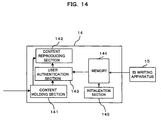
- a function is provided as an authentication section which authenticates whether or not the content user is the legitimate purchaser by comparing the purchaser ID incorporated in content and the user ID entered from the fingerprint sensor 13 (see the user authentication section 143 of Fig. 11 and Fig. 14), and by this function, the content reproduction use is permitted only when the content user is authenticated as the legitimate purchaser.
- a content providing system configured as described above, there described is a procedure when the user who is both content purchase and user purchases and reproduces the music data (music composition) from the content management server 10 using the PC 11.
- the user gains access from the PC 11 at home to the content management server 10 on the Internet.
- a fingerprint sensor 111 to read the user fingerprint is connected, and when the user purchases a music composition in the content management server 10, the user enters the user credit card number from the PC 11 and at the same time enters his/her own fingerprint from the fingerprint sensor 111.
- the PC 11 transmits the user credit card number and fingerprint data and the number of music composition which the user chose to purchase to the content management server 10 through the network 20.
- the server 10 When the content management server 10 receives a purchase request from the PC 11, the server reads the music data for the music composition which the user chose and transmits to the fingerprint incorporating section 12, and transmits fingerprint data sent from the PC 11 to the fingerprint incorporating section 12.
- the fingerprint incorporating section 12 stores fingerprint data in the music data and returns the music data with fingerprint data incorporated to the content management server 10. And the content management server 10 transmits the music data with fingerprint data embedded to the PC 11 through the network 20.
- USB Universal Serial Bus
- the fingerprint sensor 13 is connected, and when the user reproduces the music composition on the player 14, the user enters fingerprint data from the fingerprint sensor 13 as the user ID.
- the user by making contrivances to eliminate the trouble of input of the user such as combining the fingerprint sensor 13 with the reproduction button of the player 14 or the like, user-friendliness at the time of authentication can be improved.
- the player 14 uses the functions as the authentication section as described above, compares fingerprint data (user ID) entered from the fingerprint sensor 13 with fingerprint data (purchaser ID) in the music data, and carries out authentication. In the event that as a result of the authentication, it is judged that the user and the purchaser are the same person, the player 14 reproduces the music composition. On the other hand, in the event that the user and the purchaser are not the same person, the player 14 does not carry out reproduction.
- the content which the user purchased can be reproduced only by the apparatus which the user possesses, and any third party who has no right to use the content cannot utilize the content.
- the right of the original copyright owner of the content can be protected.
- the user can copy content and reproduce it on other players. This copy is the reproduction for private use which is approved by the Copyright Law and the right which is granted the user.
- the present invention can protect the right of the content copyright owner as well as can secure the right of the user to use the content.
- the content was music data but may be images (animations) such as movies, photographs (still pictures), PC software, or the like, and in all cases, the present invention is applied in the same manner as is the case of the music data described above.
- Fig. 3 shows a specific example for such case.
- Fig. 3 is a schematic view to explain a basic configuration example and operation of the content providing apparatus according to the present invention.
- the automatic content vending machine (content providing apparatus) 10A shown in this Fig. 3 is installed in a store and provides content, and the user (purchaser) can purchase a desired content (music data in this case) by dropping a specified charge into the automatic content vending machine 10A.
- a storage unit (content holding section) 10a to hold content to be provided to the purchaser, and in addition, functions as the fingerprint incorporating section (purchaser identification information incorporating section) 12 are built in, and furthermore, on the surface, a display unit 10c, operation key 10d, coin slot 10e, fingerprint sensor 10f, and medium release 10g are equipped.
- the display unit 10c displays various kinds of information for the user to choose and purchase content, while the operation key 10d is operated by the user to enter directions for choosing and specifying content referring to the display unit 10c.
- the coin slot 10e is for the user to put the content use charge (counter value, medium purchasing charge)
- the fingerprint sensor (purchaser identification information input section) 10f reads the user (purchaser) fingerprint data as the purchaser ID.
- fingerprint data from the fingerprint sensor 10f is incorporated in the content chosen by the user or the medium 30 that stores the content.
- the medium release 10g is the place where the user takes out the medium 30 that stores the content with fingerprint data incorporated.
- the content may be stored in the storage unit 10a in the automatic content vending machine 10A as shown in Fig. 3 or the automatic vending machine 10A may be connected to the network 20 (see Fig. 2) and the content may be stored in the storage unit 10a in the content management server 10 (see Fig. 2) on this network 20. In the latter case, the content specified by the purchaser is downloaded from the content management server 10 to the automatic content vending machine 10A.
- the user chooses the music composition which the user wants to purchase by operating the operation key 10d referring to the information displayed on the display unit 10c. After choosing, the user puts cash corresponding to the counter value for the use of the music composition into the coin slot 10e and enters his/her own fingerprint data from the fingerprint sensor 10f. And the automatic content vending machine 10A incorporates fingerprint data from the fingerprint sensor 10f by the function as the fingerprint incorporating section 12 into the content chosen, stores the content with fingerprint data incorporated into the medium 30, and discharges the medium 30 to the medium release 10g to offer it to the user. The user takes out the medium 30 from the medium release 10g and brings it back.
- the user In the event the user reproduces the purchased music data by the player 14, after the user sets the medium 30 to the player 14, the same as is the case explained in Fig. 2, the user enters fingerprint data from the fingerprint sensor 13 connected to the player 14 as the user ID. And the player 14 compares fingerprint data (user ID) entered from the fingerprint sensor 13 with fingerprint data (purchaser ID) in the music data and carries out authentication by the function as the authentication apparatus. In the event that the user is judged to be the same person as the purchaser as a result of the authentication, the player 14 reproduces the music composition.
- the user In the above-mentioned player 14, the user must enter fingerprint data from the fingerprint sensor 13 every time the content is reproduced. However, the fingerprint is not entered in the player 14 at the time of content reproduction but fingerprint data as the user ID may be stored in the player 14 in advance. In such event, a memory (see reference numeral 144 in Fig. 14) to store the user ID (biometric information) is equipped in the layer 14 and by comparing the user ID in this memory with the purchaser ID in content, the user is authenticated. By this, it is possible to eliminate the trouble to enter the user ID every time the content is used and at the same time, it is no longer necessary to equip a special function (for example, fingerprint sensor) to enter the user ID into the player 14.
- a special function for example, fingerprint sensor
- Steps S11 and S12 are the procedures executed when a player is purchased
- Steps S13 through S15 are the procedures executed when content is purchased, and they correspond to Steps S1 through S3 in Fig. 1, respectively
- Steps S16 through S18 are the procedures executed when content is used (reproduced), and correspond to steps S4, S6, and S7 of Fig. 1, respectively.
- the user purchases a player 14 as an apparatus for using and reproducing content (Step S11).
- the user enters and registers the user ID (for example, fingerprint data and other biometric information) for the user (content user) of the player 14 in memory of the player 14 (Step S12).
- a user identification information writing apparatus (see reference numeral 15 of Fig 14) for acquiring the user ID and writing and registering it to the memory is installed at the shop (sales counter)which sells the player 14 and the shop attendant may carry out registration processing of Step S12 in the shop when the user purchases the player 14.
- the function as the user identification information writing apparatus is equipped to the player 14 and the user him/herself who purchases the player 14 may carry out the registration processing of Step S12.
- Step S13 the user chooses content to purchase (Step S13), pays the counter value for the use of the content to the content manager, and notifies the purchaser ID which can identify the purchaser individual (Step S14).
- Step S14 the purchaser ID obtained from the purchaser is stored in the content or in a medium in which the content is stored, and then, offers the content or the medium with the purchaser ID incorporated to the purchaser (Step S15).
- Step S16 the user stores the content or the medium with the purchaser ID incorporated in the player 14 (Step S16), operates the reproduction switch; then, by the function as an authentication apparatus in the player 14, the user ID registered to memory of the player 14 is automatically compared with the purchaser ID incorporated in the content or the medium, and authentication whether or not the user is the legitimate purchaser is executed (Step S17).
- the user In the event that the user ID and the purchaser ID coincides, the user is authenticated to be the same as the purchaser ("Authentication" route of Step S17) and the content is reproduced by the player 14 (Step S18). On the other hand, in the event that the user ID does not coincide with the purchaser ID, the user is judged not to be the purchaser ("refused" route of Step S17), and the processing is ended without carrying out reproduction.
- the fingerprint, face image, iris of the eyes, palm print, or the like are used.
- the data obtained by reading these pieces of biometric information by a sensor is the image data.
- minutiae which represent the fingerprint characteristics are extracted from the fingerprint image data, and judgment is made as to whether or not the fingerprints are the same by determining whether or not the shape, size, or relative position of the minutiae coincide.
- the biometric information itself is not required but as shown in Fig. 5, information concerning the minutiae (ridge bifurcation, ridge ending, or the like in the case of fingerprint data) extracted from the biometric information is required.
- a fingerprint incorporating section 12 (see Fig. 2) or the user identification information writing apparatus (see numerical reference 44 of Fig. 14) extracts minutiae necessary for authentication from the biometric information (image data of fingerprints ) , and the information concerning the minutiae may be used for purchaser ID or user ID.
- the capacity of the fingerprint image data ranges from several kilo bytes to scores of kilo bytes, whereas the capacity of the minutiae data ranges from scores of bytes to several hundred bytes. Consequently, the data capacity of purchaser ID or user ID can be greatly reduced, the minutiae extraction processing at the time of authentication can be eliminated, and the speed of authentication processing can be increased.
- biometric information which is different every time the user enters is entered.
- the fingerprint image read by the fingerprint sensor 13 varies in accordance with the finger position and gradient, humidity, presence of sweat, pressure when the finger is pressed against the sensor surface or the like. Consequently, in the event that authentication is carried out by comparing the biometric information in content with the biometric information inside the player 14 (or biometric information collectedwhen content is used), there is no case in that these biometric information (image data, minutia data, or the like) perfectly coincide because they are collected in different periods of time.
- these pieces of biometric information are recognized identical when the specified coincidence conditions (for example, the conformity ratio exceeds the specified value) are satisfied. Conversely, in the event that these pieces of biometric information perfectly coincide bit by bit, there is a high possibility in that some kind of fraudulence (for example, the biometric information in content is extracted by reverse engineering and embedded in memory of the player 14 and the content is forcibly made reproducible or the like) would have been possibly done.
- the specified coincidence conditions for example, the conformity ratio exceeds the specified value
- the present invention is configured that when the personal authentication is carried out by the biometric information, if the biometric information as the purchaser ID and the biometric information as the user ID perfectly coincide, the user is recognized not to be the legitimate purchaser (authentication refused) by the function as the authentication apparatus in the player 14, and reproduction and use of content are refused. By this, the right of the original copyright owner can be more definitely protected.
- the user terminal for example, PC which gains access to the content management server 10
- the user fingerprint data is registered in advance and the data is transmitted when content is purchased.
- the two kinds of biometric information would perfectly coincide. It is not appropriate to carry out authentication denial as described above in this kind of apparatus. Therefore, the authentication denial function as described above should be incorporated in the authentication processing executed in the apparatus other than the user terminal, which uses content by copying the content from the user terminal.
- the player 14 In general, at home, the player 14 is used by all the family members. Consequently, it is desirable to store and register the biometric information of all the family members as the users ID in memory of the player 14.
- the authentication function in player 14 compares the multiple user IDs with the purchaser ID (biometric information) incorporated in content (or a medium), and if the function recognizes that the purchaser ID coincides with any one of the multiple user IDs, reproduction of content in the player 14 is allowed.
- the content which a husband purchased can be reproduced by a wife on the player 14.
- This kind of use of content is the right approved for the user of the copyright products under the Copyright Law, and the present invention not only protects the right of the original copyright owner but also ensures this kind of user right.
- each user of the player it is desirable for each user of the player to own a user identification information writing apparatus (see reference numeral 15 of Fig. 14) but depending on the requirements such as the price of the apparatus or the like, there may be cases in which each user is unable to own one. In such event, as described in item [ 1-4 ] , it is desirable to install a user identification information writing apparatus at a shop where the player 14 is sold and when the user purchases the player 14 , the user ID is able to be written and registered to memory of the player 14 at the shop.
- the purchaser of the player 14 may prepare a storage medium in which the biometric information of the multiple users is stored in advance, for example, an IC card, and bring this IC card to the sales counter of the shop when the player 14 is purchased, and the IC card is inserted into the IC card reader installed at the sales counter, and a plurality of biometric information read from the IC card by the IC card reader may be registered to the player 14.
- the biometric information of the all the family members can be stored and registered to the player 14, even if all the family members are not reported to the shop at the time of purchasing the player.
- the user may sell the apparatus such as a player to any third party.
- Players of recent years have a recording medium inside and of those, there are players which can have copied content inside (for example, harddisk built-in type car navigation system or the like).
- the copied content is sold when the player is sold to the third party. Because selling the copied content inside the apparatus violates the Copyright Law, the user is unable to sell the player which has the copied content.
- the player 14 which authenticates by comparing the content purchaser ID with the user ID registered in memory is sold to any third party with the content and user ID held, the third party who is not the legitimate purchaser can easily reproduce the content in the player 14.
- an initialization section (see reference numeral 145 of Fig. 14) which initializes and deletes the user ID (biometric information) written and registered to memory (see reference numeral 144 of Fig. 14) of the player 14 is equipped to the player 14.
- the initialization section When the player 14 is sold or transferred to any third party, using the initialization section, the content stored in the player 14 cannot be reproduced or used in the player 14 by deleting the user ID in memory (biometric information). By this, the player 14 can be sold without violating the Copyright Law. Needless to say, the content itself may be deleted, but the original copyright owner and content dealer would have better chance of business as described later if the content is not deleted.
- the data exchange software which has the above-mentioned features (a) and (b) is extremely useful software if the condition in which the copyright is illegally violated can be solved.
- the content offered to the user can be used only by the apparatus (player 14) which the user possesses, even if the content is distributed to any third party by the data exchange software, the third party cannot use the content. However, under such circumstances, the content becomes worthless for the third party and there is no meaning to share the file (exchange data) for the content.
- trial use information that prescribes the content trial use allowable range is added in advance to the content and even when the content user is recognized not to be a legitimate purchaser by the authentication function (see the user authentication section 143 of Fig. 11 or Fig. 14) in the player 14, the use of the content at the player 14 is permitted within the range that conforms to the trial use information.
- the trial use information prescribes the trial use allowable range of the content as described above, and the trial use allowable range is defined as the conditions to allow the content trial use. For specific conditions, restriction to the number of times such as “3 times for previewing” or restriction to reproduction such as “first 10 seconds for previewing” or the like can be considered.
- the player 14 fails to authenticate the biometric information in content as the biometric information in the player 14, the player 14 regards the latest use as “trial use” and carries out “trial use reproduction. " If the trial use condition is the restriction to the number of use, the player 14 subtracts the number of times for trial use stored in content by one every time the content is trially used and prohibits reproduction after the number of times for trial use reaches zero. In addition, when the trial use condition is restriction to reproduction, the player 14 suspends reproduction after the trial-use allowable time is passed.
- the Internet is a passive type network
- the person interested in purchase in order for the person interested in purchase to go through procedure of officially purchasing content, the person must know the address (URL) of the content management server 10, content purchasing method, or the like.
- information concerning the procedure to receive the content from the content management server 10 (that is, the licensing procedure) is added or stored in content in advance.
- the data exchange software has a role to introduce content to any third party and can bring about expanded business chances to the content manager or copyright owner.
- the user of the data exchange software can rightfully use the content within the range of trial use without violating the Copyright Law.
- the user may be allowed to officially use the content not by purchasing the content newly but by rewriting the purchaser ID (biometric information) in the content which the user already possesses to the biometric information of the user.
- the content manager (content right owner, original copyright owner) has a purchaser identification information changing section (see ID changing server 16 of Fig. 15 and Fig. 16) that changes the purchaser ID (biometric information) already incorporated in content or a media to other purchaser ID (biometric information), and when the content owner is not a legitimate purchaser, the content manager changes the purchaser ID already incorporated in content or a medium by the purchaser identification information changing section to ID (biometric information) which can identify the owner individual in exchange of the counter value paid by the owner and provides the owner with the content after the purchaser ID is changed.
- ID changing server 16 of Fig. 15 and Fig. 16 changes the purchaser ID (biometric information) already incorporated in content or a media to other purchaser ID (biometric information)
- ID biometric information
- User A original legitimate purchaser pays the counter value to the content manager in compliance with the procedure explained by Fig. 1 or Fig. 4 and purchases content with fingerprint data of user A incorporated (see arrow marks A1, A2 of Fig. 6). For the content purchased in this way, user A can freely copy the content and can use the copied content in various kinds of equipment (PC, portable player, player 1, player 2 in Fig. 6) which user A possesses.
- PC portable player, player 1, player 2 in Fig. 6
- user B If user B hopes to officially use the content, user B transmits the content, content charge (specified use charge) , and user B biometric information (fingerprint data) to the content manager (see arrowmark A4 of Fig. 6). And the content manager changes the biometric information (fingerprint data of user A) in the content to that of user B by the purchaser identification information changing section and sends the content to the user (see arrow mark A5 of Fig. 6).
- user B can officially use the content as a legitimate purchaser of content.
- the content manager can collect the content use charge not only from the user who officially purchased the content from the content right owner but also even from the user who acquired the content by the data exchange software or the like.
- the user can legally acquire content by the use of data exchange software.
- the content manager no longer needs to continue holding the content. That is, the content manager can officially provide the content to the user who acquired an old content by the use of data exchange software by collecting the content use charge as described above and rewriting the purchaser ID in the content even if old contents (for example, music compositions one or more years before) are deleted from the content management server 10.
- the dealer who first sold content to user A is the same as the dealer who changed the purchaser ID (biometric information) in the content and provided the content to user B, but different dealers may handle the content selling service and purchaser ID changing service.
- a dedicated agent for example, an organization such as JASRAC in the music industry
- the content manager may hold the purchaser ID of user A who sold the content, the content distribution control section counts the degree of contributing to the sales as described above as the number of changes of purchaser ID (number of distribution times), and pay the counter value (for example, discount tickets for purchasing content) to user A in accordance with the count results.
- the configuration to achieve this kind of function will be discussed later referring to Fig. 16.
- biometric information When the biometric information is simply added as purchaser ID in content, content may be reproduced if the biometric information in the content is removed or the biometric information is ignored without using it for authentication. That is, in the event that the content format and a method for storing the biometric information in content are known, forming a program on PC in accordance with the information enables illegal reproduction of content by removing the biometric information or ignoring the biometric information as described above.
- the content manager (content encryption server: see reference numeral 10B of Fig. 17 and Fig. 18) generates an encryption key (see Step S21 of Fig. 7) on the basis of fingerprint data A (purchaser ID) which the user (content user) entered at the time of purchase, and using the encryption key, encrypts the content data to generate the encrypted content (see Step S22 of Fig. 7), and adds fingerprint data A to the encrypted content and generates the encrypted content with fingerprint data (see Step S23 of Fig. 7), and provides this encrypted content with fingerprint data to the user.
- fingerprint data A purchaser ID
- fingerprint data A purchaser ID
- the player When the user reproduces the encrypted content with fingerprint data attached on a player (encrypted content player: see reference numeral 14A of Fig. 17 and Fig. 19), the player authenticates by comparing fingerprint data B entered by the user when content is used or fingerprint data B of the user registered in advance in the player with fingerprint data A added to the encrypted content (see Step S24 of Fig. 7).
- fingerprint data A, B are authenticated to be of the same person (that is, when the content user is authenticated to be the same as a legitimate purchaser)
- the player generates a decryption key using fingerprint data A (purchaser ID) attached to the encrypted content (see Step S25 of Fig. 7).
- fingerprint data A purchaser ID
- the player decrypts the encrypted content by the use of the decryption key generated and obtains the original content data (see Step S26 of Fig. 7), and reproduces the content data.
- fingerprint data purchaser ID
- the third party can be subject to authentication of fingerprint data but since fingerprint data that generates the decryption key differs from the original fingerprint data, the third party cannot decrypt the encrypted content to the original content, and the third party cannot use the content. Consequently, even if the purchaser ID (biometric information) stored in the content is rewritten, it is able to definitely prevent the content from being used on a player of a user who is not the legitimate user.
- biometric information in addition to fingerprint data, iris of eyes, palm prints, face image, signature, or the like may be used.
- examples of content include photographs (still picture), movies (animation), software of PC, or the like in addition to music data (music composition ) , and all of them can applicable to the following embodiments.
- the content providing system as the first embodiment according to the present invention corresponds to systems and functions discussed in items [1-1], [1-2], [1-5] and [1-6] , and this first embodiment will be described referring to Fig. 8 through Fig. 13.
- Fig. 8 is a block diagram that indicates a configuration of content providing system as the first embodiment according to the present invention, and as shown in Fig. 8, the content providing system of the first embodiment provides content to a purchaser who has paid the counter value for the use of the content, and comprises a content management server 10, user terminal 110, player 14, and network 20.
- the content management server 10 which the content dealer (content manager) installed on the Internet is shown.
- Fig. 10 is a block diagram that shows the configuration of user terminal 110 in the first embodiment.
- the PC 11 is communicably connected to the content management server 10 via the communication apparatus 112 and the network 20, and in addition, to this PC 11, the fingerprint sensor 111 is attached, and fingerprint data of the user (purchaser) read by this fingerprint sensor 111 is notified to the content management server 10 as the purchaser ID via the PC 11, communication apparatus 112 and network 20. That is, the user terminal 110 including these PC 11, fingerprint sensor 111 and communication apparatus 112 functions as a purchaser identification information input apparatus for entering the purchaser ID.
- the content management server (content providing apparatus) 10 is installed on the Internet by the content dealer as described above, and controls the content (digital content data) to be presented to the purchaser, and as shown in Fig. 9, comprises a WWW server 100, content control table 101, minutiae extraction section 102, accounting control table 103, accounting database 104, and fingerprint incorporating section 12.
- Fig. 9 is a block diagram that indicates a configuration of content management server 10 in the first embodiment.
- a fingerprint incorporating section 12 externally mounted to the content management server 10 in Fig. 2 is included in the content management server 10 as the fingerprint incorporating section 12.
- the WWW server 100 is an interface to carry out communication with a user terminal 110 via the network 20.
- This WWW server 100 carries out a function to notify a content table which the content management server 10 possesses, the charge of each content in the content management server 10, procedures when the user (person who hopes to purchase) purchases content (entry procedure of credit card information or the like) or the like to the user terminal 110.
- the content control table 101 functions as a content holding section that holds content to be provided to the purchaser, and the minutia extraction section 102 extracts minutiae from fingerprint data received by the WWW server 100.
- the accounting control table 103 controls the content purchase procedures (price, settlement method, or the like) and the user content purchase condition, and the accounting database 104 has the user content purchase history registered by the accounting control table 103 and stores.
- the fingerprint incorporating section (purchase identification information incorporating section) 12 incorporates minutia data extracted by the minutia extraction section 102 in the content (or a media which stores the relevant content) to be presented to the purchaser as the purchaser ID.
- the content with the purchaser ID incorporated by this fingerprint incorporating section 12 is transmitted to the user terminal 110 through the WWW server 100 and the network 20.
- the player (equipment, content reproducing apparatus) 14 is used when the content user uses the content the same as that shown in Fig. 2, and has the content received by the PC 11 from the content management server 10 via the network 20 stored and reproduces the content (music data).
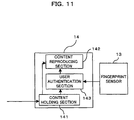
- This player 14 comprises a content holding section 141, content reproducing section 142, and user authentication section 143 as shown in Fig. 11, with the fingerprint sensor 13 attached.
- Fig. 11 is a block diagram that indicates a configuration of the player 14 in the first embodiment.
- the fingerprint sensor (user identification information input apparatus) 13 reads fingerprint data of the user who uses the content as the user ID and enters it in the player 14.
- the content holding section 141 holds the content subject to reproduction purchased by the user terminal 11 and the content reproducing section 142 reproduces the content held in the content holding section 141 in accordance with the authentication result of the user authentication section 143.
- the user authentication section (authentication apparatus, authentication section) 143 first extracts the minutia data from fingerprint data entered from the fingerprint sensor 13 as the user ID, and then, authenticates whether or not the content user is a legitimate purchaser by comparing the extracted minutia data (fingerprint data) with the minutia data (purchaser ID) incorporated in the content. And it is configured to enable reproduction of the content by the content reproducing section 142 only when the content user is authenticated as the legitimate purchaser by the user authentication section 143.
- the first embodiment it is configured to recognize that the content user is not the legitimate purchaser in the event the minutia data as the purchaser ID completely coincides with the minutia data as the user ID, as a result of the comparison in the user authentication section 143 and to refuse the content reproduction.
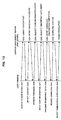
- Fig. 12 is a communication sequence diagram between the user terminal 110 and the content management server 10 (WWW server 100) in the first embodiment
- Fig. 13 is a diagram that explains fingerprint data storing technique (operation of the fingerprint incorporating section 12) in content in the first embodiment.
- the user accesses the content management server 10 (WWW server 100) from the user terminal 110 which the user possesses via the network 20 (see S31 of Fig. 12).
- the WWW server 100 responds to access from the user terminal 110 and sends back a table of contents in the content control table 101 to the user terminal 110 (see S32 of Fig. 12).
- the user refers to the content table on the user terminal 110 (PC 11), chooses content desired to purchase, and transmits the content No. to the content management server 10 (see S33 of Fig. 12).
- the WWW server 100 receives the content No. , it refers to the purchase procedures (price, settlement method, or the like) that support the number on the accounting control table 103, and notifies the content to the user terminal 110 (see S34 of Fig. 12).
- examples of the settlement method include settlement by credit card, bank transfer, postal transfer, a postal note of a fixed amount, cash remittance, or the like, but in this case, description will be made with the settlement by credit card used as an example.
- the user decides whether or not to purchase the content from the purchase procedures displayed on the user terminal 110.
- the user approves to purchase the content, the effect is transmitted to the content management server 10 (see S35 of Fig. 12).
- the WWW server 100 receives the purchase approval notice from the user terminal 110, the WWW server 100 transmits a request for entering credit card information (kind of card, card No., expiration date, or the like) necessary for carrying out credit card settlement to the user terminal 110 (see S36 of Fig. 12).
- the user enters the credit card information and transmits to the WWW server 100 at the request of entering the credit card information (see S37 of Fig. 12).
- the WWW server 100 transmits the credit card information transmitted from the user terminal 110 to the accounting control table 103 and the accounting control table 103 stores the content purchase history in the accounting database 104. Later, the content manager collects the content use charge (counter value) from the user through the credit card company.
- the WWW server 100 requests the user terminal 110 to transmit fingerprint data (see S38 of Fig. 12).
- the user enters fingerprint data from the fingerprint sensor 111 in conformity to the announcement of the WWW server 100 and transmits to the WWW server 100 (see S39 of Fig. 12).
- the WWW server 100 sends the transmitted fingerprint data to the minutia extraction section 102, and in this minutia extraction section 102, the minutia data is extracted from fingerprint data.
- the minutia data from the minutia extraction section 102 is incorporated in the content which the user hopes to purchase as the purchaser ID (biometric information).
- the minutia data may be added to the content as the header information but because there is a high possibility for the evil-minded third party to tamper fingerprint data when the addition position is fixed, specifically, for example, as shown in Fig. 13, the n-byte-long fingerprint data is incorporated in the content data.
- the n-byte-long fingerprint data is incorporated in the content data.
- the WWW server 100 When storing of fingerprint data in the content is completed as described above, the WWW server 100 notifies the user terminal 110 to the effect that the content is ready to be transmitted (see S40 of Fig. 12) .
- the user who received this notice sends a file transfer request (download request) to the WWW server 100 (see S41 of Fig. 12), and the WWW server 100 transmits the content with fingerprint data stored to the user terminal 110 when it receives the transfer request (see S42 of Fig. 12).
- the user terminal 110 transmits a notice of completion of transaction to the WWW server 100 after downloading is finished (see S43 of Fig. 12). When the transaction completion notice is received by the WWW server 100, the purchase transaction of this content is finished.
- the content itself is stored in the player 14 or the content copy is stored in the player 14.
- the content stored in the player 14 is held in the content holding section 141. And the user enters the user fingerprint data from the fingerprint sensor 13.
- the minutia data are extracted as the user ID from fingerprint data entered from the fingerprint sensor 13, and at the user authentication section 143, the extracted user ID is compared with the purchaser ID (minutia data) incorporated in the content, and authentication whether or not the content user is a normal purchaser is carried out.
- the content user is authenticated to be the same as the legitimate purchaser by the user authentication section 143, content reproduction by the content reproducing section 142 is permitted, and the content held in the content holding section 141 is reproduced (performed) by the content reproducing section 142.
- the fingerprint sensor 13 is arranged on the "reproduction button" of the player 14.
- the fingerprint sensor 13 is configured not to request the entry of fingerprint for each content but to hold fingerprint data first entered on the storage apparatus of the player 14, and thereafter, carry out authentication using fingerprint data on the storage apparatus as the user ID until the power supply of the player 14 is turned off so that the user labor could be saved.
- duplication can be prepared in the range in which the user uses by him/herself for the content which the user purchased, and at the same time can use the content on a plurality of equipment which the user have.
- the content cannot be used by any other person than the user who officially purchased the content, and the original copyright owner can be definitely protected.
- the user ID fingerprint data
- the content or a medium
- the purchaser ID fingerprint data
- the user can use the copied content but because the people other than the legitimate purchaser are not authenticated to be the same as the legitimate purchasers, they cannot use the copied content. Consequently, if anyone other than the legitimate purchaser wants to use the copied content, she/he must pay the content use charge, and therefore, the content use charge can be collected from users of copied content, from whom the content use charge has never been collected before, and the right of the original copyright owner can be definitely protected.
- biometric information in this case, minutia data extracted from fingerprint data
- fingerprint data as the purchaser ID or user ID
- the purchaser biometric information cannot coincide completely with the user biometric information even if they are of the same person, if they were collected at different periods of time. Consequently, in the event that the user authentication section 143 recognizes that the purchaser biometric information completely coincides with the user biometric information, conversely, there is a high possibility that some kind of illegality takes place, and in such event, by configuring to recognize the user not a legitimate purchaser and to refuse the use of the content, the right of the original copyright owner can be more definitely protected.
- fingerprint data biometric information
- a trial use enabling function of the content explained in Item [1-10] may be further provided. That is, to the content, trial-use information (number of trial-use enabling times, trial-use allowable time, or the like) that specifies the content trial use allowable range is added, and even when the content user is recognized as not a legitimate purchaser by the user authentication section 143, it is configured to permit the content reproduction by the player 14 (content reproducing section 142) within the range that conforms to the trial-use information. By this, even for the user who failed for authentication, the use of the content can be permitted within the specified trial-use allowable range. Consequently, even a user who is not a legitimate purchaser can use content trially. If the user hopes to officially purchase content as a result of the trial use, the user goes through procedure to the content management server 10.
- trial-use information number of trial-use enabling times, trial-use allowable time, or the like
- Fig. 14 is a block diagram that indicates a player 14 in the second embodiment according to the present invention.
- the player 14 in the second embodiment is formed with memory 144 and an initialization section 145 further equipped in addition to a content holding section 141, content reproducing section 142, and user authentication section 143, the same as the first embodiment as shown in Fig. 14.
- an ID writing apparatus (user identification information writing apparatus) 15 is connected by USB.
- This ID writing apparatus 15 acquires fingerprint data from the person who wants to use content on the player 14, extracts minutia data from fingerprint data as the user ID, and writes and registers the minutia data (user ID) in memory 144 of the player 14.
- the ID writing apparatus 15 may be owned by the owner of the player 14 as described before or may be installed at the sales counter or the like of a shop where the player 14 is sold.
- the memory (user identification information storage section) 144 in the player 14 has the user of player 14 written in advance by the ID writing apparatus 15 as described above and holds it.
- FRAM Feroelectoric Random Access Memory
- FRAM is a read/write memory and the same as the flash memory used for digital cameras or the like, it is a non-volatile memory that holds data stored when power is turned off.
- FRAM has features of being able to write and read data noncontactly (requiring no terminal for connecting to reader/writer) and of requiring no power supply. Because FRAM requires no terminal and no power supply in this way, the use of FRAM can lower the cost of whole apparatus as compared to the case with flash memory used.
- the user authentication section 143 authenticates whether or not the content user is a legitimate purchaser by comparing the minutia data (user ID) registered to memory 144 and the minutia data (purchaser ID) incorporated in content when content is reproduced. And it is configured to allow content reproduction by the content reproducing section 142 only when it is authenticated that the content user is the legitimate purchaser by the user authentication section 143.
- the minutia data for multiple users may be written and registered to memory 144 as the user ID by the ID writing apparatus 15.
- the user authentication section 143 compares the minutia data (purchaser ID) in content with multiple minutia data (user ID) in memory 144 and allows content regeneration when the purchaser ID coincides with any one of the multiple user IDs.
- the initialization section (initialization apparatus) 145 initializes and deletes theminutia data (user ID) written and registered to memory 144.
- the owner of the player 14 can save labor for entering fingerprint data when content is reproduced by registering his/her own fingerprint data (minutia data) in advance as user ID to memory 144 of the player 14 using the ID writing apparatus 15, and in addition, there is no need to equip a fingerprint sensor to the player 14, achieving downsizing and cost reduction of the player 14.
- the ID writing apparatus 15 when the ID writing apparatus 15 is standardized, it can be shared in, for example, CD players, headphone stereos, VTRs, DVDs, and other various kinds of content reproducing apparatus.
- registering the minutia data extracted from fingerprint data (biometric information) to memory 144 as user ID can not only greatly reduce the data capacity of user ID as compared to the case in which fingerprint data itself is registered but also can eliminate a need of carrying out minutia extraction processing at the time of authentication at the user authentication section 143, speed of authentication processing can be increased.
- the initialization section 145 that initializes and deletes user ID in memory 144 to the player 14
- user ID in memory 144 can be deleted by the use of the initialization section 145 when the player 14 is sold to any third party. Consequently, should any content remain in the player 144 (content holding section 141), the third party cannot use the content and the right of the original copyright owner can be protected.
- the content providing system as the third embodiment according to the present invention corresponds to the system explained in item [1-11], and referring now to Fig. 15 and Fig. 16, the third embodiment will be described.
- Fig. 15 is a block diagram that indicates a configuration of a content providing system as the third embodiment of the present invention, and as shown in Fig. 15, the content providing system of the third embodiment is configured with an ID changing server (purchaser identification information changing apparatus) 16 newly equipped in addition to the content management server 10, user terminal 110, player 14, and network 20 the same as the first embodiment or the second embodiment.
- This ID changing server 16 is installed on the network 20 and is configured to enable communication between this user terminal 110 and network 20 in response to access from the user terminal 110.
- the ID changing server 16 changes the purchaser ID (fingerprint data/minutia data) already incorporated in content (medium) to other purchaser ID (fingerprint data/minutia data), and in the event that the content owner is not a legitimate purchaser, this ID changing server 16 changes the purchaser ID already incorporated in content to ID (fingerprint data/minutia data) that can identify the owner individual in exchange of the counter value paid by the owner.
- the ID changing server 16 comprises a WWW server 160, purchaser ID deleting section 161, minutia extracting section 162, accounting control table 163, accounting database 164, fingerprint incorporating section 165, purchaser control table 166, content distribution control section 167, and change frequency database 168 as shown in Fig. 16.
- Fig. 16 is a block diagram that indicates a configuration of the ID changing server in the third embodiment.
- the WWW server 160, minutia extracting section 162, accounting control table 163, accounting database 164, and fingerprint incorporating section 165 function in the same manner as the WWW server 100, minutia extracting section 102, accounting control table 103, and accounting database 104, and fingerprint incorporating section 12 in the first embodiment.
- the WWW server 160 is an interface that communicates with the user terminal 110 via the network 20.
- the purchaser ID deleting section 161 deletes the purchaser ID from content with the purchaser ID written which is received by the WWW server 160 and transmits content with the purchaser ID deleted (that is, content only) to the fingerprint incorporating section 165.
- the minutia extracting section 162 extracts minutiae from fingerprint data received at the WWW server 160, and the accounting control table 163 controls purchaser ID changing procedure (price, settlement method, or the like) and the accounting condition for changes in purchaser ID, and the accounting database 164 stores the content use charge accounting history in accordance with changes of purchaser ID, which is registered by the accounting control table 163.
- the fingerprint incorporating section 165 incorporates the minutia data extracted by the minutia extracting section 162 in content with purchaser ID deleted from the purchase ID deleting section 161 as purchaser ID, similarly to the fingerprint incorporating section 12 of the first embodiment.
- the content with purchaser ID incorporated by the fingerprint incorporating section 165 is transmitted to the user terminal 110 which requested change of purchaser ID through the WWW server 160 and network 20.
- the purchaser control table 166 holds a table of purchasers who purchased content
- the content distribution control section (content distribution control apparatus) 167 counts the number of changes of purchaser ID with respect to each content provided from the content management server 10 for each original purchaser of each content on the basis of the purchaser control table 166
- the change frequency database 168 stores the counting result by the content distribution control section 167 to achieve one-for-one correspondence with original purchaser of each content.
- the content manager or purchaser ID change manager or the like refer to the counting results stored in the change frequency database 168 and pays the counter value corresponding to the counting result (change frequency) to the original purchaser.
- the user can trially use the content but is not allowed to use the content officially.
- the user does not purchase content newly but is allowed to officially use the content by changing the fingerprint data in the content which the user already possesses to the finger print data of his/her own in exchange of the counter value. This kind of procedure of changing the fingerprint data (purchaser ID) will be described as follows.
- the user accesses the ID changing server 16 (WWW server 160) via the network 20 from the user terminal 110 which the user possesses, and transmits the credit card information to pay the counter value and the fingerprint data of the user him/herself to the ID changing server 16 together with the content to have ID to be changed in accordance with the directions from the ID changing server 16.
- WWW server 160 the ID changing server 16
- the WWW server 160 transmits the credit card information transmitted from the user terminal 110 to the accounting control table 163, and this accounting control table 163 stores the accounting history of content use charge in accordance with changes of purchaser ID in the accounting database 164. Later, the content manager (or purchaser ID change manager) or the like collect content use charge (counter value) from the user through a credit card company.
- the WWW server 160 transmits the content to have ID to be changed which was transmitted from the user terminal 110 to the purchase ID deleting section 161, and by this purchaser ID deleting section 161, the original purchaser ID (fingerprint data/minutia data) is deleted from the content to have ID to be changed.
- the WWW server 160 transmits the user fingerprint data transmitted from the user terminal 110 to the minutia extracting section 162 and extracts the minutia data from the fingerprint data in this minutia extracting section 102.
- the minutia data from the minutia extracting section 162 is incorporated in content with purchaser ID deleted from the purchaser ID deleting section 161 as purchaser ID (biometric information) .
- purchaser ID biometric information
- the content providing system as the third embodiment of the present invention, working effects the same as those obtained with the first and the second embodiments can be obtained, and in addition, in the event that the content owner is not a legitimate purchaser, purchaser ID (fingerprint data) already incorporated in content (medium) can be changes to ID (fingerprint data) that can identify the owner individual in exchange of the counter value paid by the owner. Therefore, the content manager such as original copyright owner or the like can officially collect the content use charge (counter value) even from users who indirectly obtain content by data exchange software (file sharing software) or the like in addition to the people who officially purchase content.
- the number of change times of purchaser ID for each content provided by content management server 10 is counted for each original purchaser of each content by the content distribution control section 167 in accordance with the purchaser control table 166 and the counting result is stored in the change frequency database 168. Consequently, the content manager (or the purchaser ID change manager) or the like pay the counter value associated with the accounting result stored in the change frequency database 168 to the original purchaser, and therefore the profit is restored to the purchaser who has contributed to content sales promotion and has brought profit to the content manager.
- the content management server 10 and the ID changing server 16 are constructed separately, but a server may be constructed by integrating the functions of these servers 10, 16 into one.
- a content providing system as the forth embodiment of the present invention corresponds to the system described in item [1-12] and referring now to Fig. 17 through Fig. 19, the fourth embodiment will be described.
- Fig. 17 is a block diagram that indicates a configuration of a content providing system as the fourth embodiment of the present invention, and as shown in Fig. 17, the content providing system of the fourth embodiment is configured in the same manner as the content providing system of the first embodiment, but in this fourth embodiment, a content encryption server 10B and encrypted content player 14A are equipped in place of the content management server 10 and player 14 of the first embodiment.
- the user terminal 110 and the encrypted content player 14A are possessed by the user at home, and because the user terminal 110 is configured in the same manner as in the first embodiment, the description will be omitted.
- the content encryption server (content providing apparatus) 10B is installed on the Internet by the content dealer in the same manner as the content providing server 10 and controls content (digital content data) provided to purchasers, and comprises an encryption key generating section 105 and an encryption section 106, as shown in Fig. 18, in addition to the WWW server 100, content control table 101, minutia extracting section 102, accounting control table 103, accounting database 104, and fingerprint incorporating section 12 which are same as those in the first embodiment.
- Fig. 18 is a block diagram that indicates a configuration of a content encryption server 10B in the fourth embodiment.
- the encryption key generating section (encryption key generating apparatus) 105 generates an encryption key from the minutia data (purchaser ID) extracted by the minutia extracting section 102, and the encryption section (encryption apparatus) 106 encrypts content to be provided to purchasers and generates encrypted content by the encryption key generated by the encryption key generating section 105.
- the fingerprint incorporating section 12 in the fourth embodiment incorporates the minutia data from the minutia extracting section 102 as the purchaser ID in the same manner as in the first embodiment for the encrypted content from the encryption section 106.
- the encrypted content with purchaser ID incorporated is transmitted to the user terminal 110 from the WWW server 100 through the network 20 and provided to the purchaser who has paid the counter value.
- the encrypted content player (equipment, content reproducing apparatus) 14A is used when the content user uses content in the same manner as the player 14 of the first and the second embodiments, but in the fourth embodiment, the encrypted content player stores the encrypted content received by the PC 11 from the content encryption server 10B via the network 20 and reproduces this encrypted content (music data).
- the encrypted content player 14A is configured by adding a decryption key generating section 146 and a decryption section 147 to a player 14 (see Fig. 11) same as that of the first embodiment, as shown in Fig. 19, or by adding a decryption key generating section 146 and a decryption section 147 to a player 14 (see Fig. 14) same as that of the second embodiment.
- Fig. 19 is a block diagram that indicates a configuration of the encrypted content player 14A in the fourth embodiment.
- an encrypted content player 14A with the encryption key generating section 146 and the encryption section 147 added to the player 14 of the first embodiment is shown, but as shown in the chain double-dashed line in Fig. 19, the encrypted content player 14A may be configured with memory 144, initialization section 145, or ID writing apparatus 15 equipped in place of the fingerprint sensor 13.
- the decryption key generating section (decryption key generating apparatus) 146 generates a decryption key from purchase ID (fingerprint data/minutia data) incorporated in the encrypted content when the content user is authenticated to be the same as a legitimate purchaser by the user authentication section 143, and the decryption section (decryption apparatus) 147 decrypts the encrypted content by the decryption key generated by the decryption key generating section 146 and generates the original content.
- the content reproducing section 142 in the fourth embodiment reproduces the original content obtained by the decryption section 147.
- an encryption key is generated by the encryption key generating section 105 from the minutia data of fingerprint data transmitted by the user, and the content is encrypted by the use of the encryption key by the encryption section 106.
- the minutia data is incorporated in the encrypted content generated by the encryption section 106 as purchaser ID, and the encrypted content with minutia data incorporated is provided to the user. In such event, the minutia data is incorporated in the encrypted content and is not encrypted.
- the user authentication section 143 carries out authentication by the use of the user fingerprint data entered from the fingerprint sensor 13 or the minutia data registered to memory 144 and the minutia data in the encrypted content. And when the user is authenticated to be the same as a legitimate purchaser by the user authentication section 143, a decryption key is generated from the minutia data in the encrypted content by the decryption key generating section 146, and by the decryption section 147, the encrypted content is decrypted by the use of the decryption key and the original content is obtained. The content obtained by the decryption key is reproduced by the content reproducing section 142.
- the purchaser identification information which can identify the purchaser individual is incorporated in the content to be provided from the content manager side to the purchaser, and the use of content is allowed only when the content user is authenticated to be the same as the legitimate purchaser by the use of the purchaser identification information.
- the purchaser only who has officially paid the content use charge and purchased the digital content such as music and images, or applications or the like that run on a personal computer to use such content, and the right of the original copyright owner is sufficiently protected, while for the legitimate purchaser, implementation of operations (reproduction, copying, or the like) approved under the Copyright Law can be secured to guarantee the right of the purchaser, too. It is therefore assumed that the applicability of the present invention is remarkably high.
Landscapes
- Engineering & Computer Science (AREA)
- Theoretical Computer Science (AREA)
- Computer Security & Cryptography (AREA)
- Software Systems (AREA)
- Computer Hardware Design (AREA)
- Physics & Mathematics (AREA)
- General Engineering & Computer Science (AREA)
- General Physics & Mathematics (AREA)
- Multimedia (AREA)
- Technology Law (AREA)
- Management, Administration, Business Operations System, And Electronic Commerce (AREA)
- Storage Device Security (AREA)
Abstract
In order to secure the right of a legitimate purchaser of
a content by ensuring the execution of operations (reproduction,
copying, or the like) permitted by the Copyright Law while
thoroughly protecting the rights of the original copyright owner,
purchaser identification information that can identify the
purchaser individual is incorporated in the content (or the
medium which stores the content) provided from the content
manager side to the purchaser and the use of the content is allowed
only when a user of content is authenticated to be a legitimate
purchaser by the use of the purchaser identification information.
Description
The present invention relates to a content providing
method, content providing system, content providing
apparatus, and content reproducing apparatus which
authenticate the user (purchaser) only who has officially
paid the content to use the digital content such as music,
images, applications or the like which run on a personal
computer.
In general, for example, music and other content are
stored in music media (records, cassette tapes, CD (Compact
Disk), or the like), and a user who wants to listen to the
music purchases a music medium. The cost which the user
paid at a shop is handed to an original copyright owner
(song-writer, composer, performing musician, singer, or the
like) via a shop, music sales company, or the like. The
user is granted the right to use the music by purchasing
a music medium. By this kind of flow of content and counter
value, the user obtains content and the original copyright
owner obtains the content cost, and the shop, music sales
company, or the like who mediate between the user and the
original copyright owner obtain a profit margin.
In recent years, by digitization of content and
popularization of personal computer (hereinafter, referred
to as the "PC") and the Internet at home, the people have
had the environment in which music and other content can
be easily obtained as digital data. Under this kind of
environment, the user is allowed by Copyright Law Article
30 to create digital data (for example, MP3 (MPEG Layer 3)
data) from a music CD which the user purchased as a copy
for private use as far as the user individual uses the data
noncommercially, but the user is not allowed to provide the
copied data to unspecified third parties. However, nowadays,
by the advent of data exchange software such as Napstar
(registered trademark), Gnutella (registered trademark),
or the like, the content data can be easily exchanged between
users, and illegally copied content data are flooding on
the Internet.
Therefore, many mechanisms have been proposed to protect
the copyright of digital content. For existing copyright
protection methods, for example, the following can be
mentioned:
These existing copyright protection methods (1) through
(5) will be explained as follows:
SCMS is a digital copy generation control technique.
That is, it is a system that allows copying of one generation
only when digital data is copied in a digital form. For
example, when the user creates digital data from a CD the
user purchased, the user is allowed to create digital data
(child data) from the CD but the user is not allowed to create
digital data (grandchild data) from the digital data (child
data). By carrying out this kind of generation control,
the digital data is prevented from being copiedwithout limit.
SCMS is adopted for MD (Mini Disc), DAT (Digital Audio Tape),
or the like for household apparatus.
SDMI is a project established with initiative taken by
the Recording Industry Association of America (RIAA) to
protect the copyright in distributing and selling music on
the Internet. SDMI adopts a system for permitting the use
of the data on the terminal (cellular phone, PC, or the like)
only, which has downloaded the music data from the network.
For a technique with this SDMI applied, there is OpenMG
(regiatered trademark) which Sony Corporation developed.
This OpenMG allows copying pursuant to the predetermined
rule (restriction to copy-to points, restriction of number
of times of copies, or the like) when data is copied between
recording media (magic gate memory stick) that conform to
OpenMG.
In Copyright Law Article 30, Item 2, even for the purpose
of privately using data, if copying is carried out by the
use of apparatus or media (MD, DAT, or the like) of a digital
system provided by the government ordinance, payment of
compensation to copyright owners is made compulsory. In
the Compensation System for Digital Private Recording, the
right of copyright owner is secured not by the technique
but by the rule. That is, the manufacturer adds a specified
amount (compensation for digital private recording) to the
prices of digital data recording apparatus and recording
media and sells them to users, and distributes the
compensation obtained when these pieces of apparatus and
media are sold to copyright owners of content.
In the technique disclosed in the Publication, a private
key and a public key are created in conformity to the
identification information (ID) specific to the apparatus,
the music data is encrypted by the public key and the encrypted
music data (encrypted content) is recorded. When the music
data is reproduced, the encrypted data is decrypted by the
private key stored in the apparatus. Because the music data
is encrypted by ID specific to the apparatus, the encrypted
content cannot be decrypted by any reproducing apparatus
with different ID and naturally, the data cannot be
reproduced.
In the technique disclosed in the Publication, content
is encrypted by the first encryption means and recorded in
a medium and at the same time, the license information
including the use conditions to restrict the use of the
relevant content and the first decryption key for decrypting
the encrypted content is encrypted by the second encryption
means and stored in the media. When the content is used,
the second decryption key stored in the reproducing apparatus
is used to decrypt the license information, and based on
the use conditions in the license information, the adequacy
of the use of content is judged, and if the use is accepted,
the first decryption key in the license information is used
to decrypt and reproduce the content.
As described above, in recent years, as digitization of
content progresses, the content is easily copied and
distributed, and the right of the copyright owner has become
threatened. Consequently, as a method for protecting the
right of copyright owner, various methods as described above
(for example, above-mentioned Copyright Protection Methods
(1) through (5)) have been proposed, but in the conventional
method, there are problems in which the official content
use charge cannot be collected from the user who copied and
the right allowed for official users (reproduction of private
use, or the like) is restricted, too.
The relevant problems of the above-mentioned copyright
protection methods (1) through (5) will be described as
follows:
SCMS restricts preparation of grandchild copies but as
far as child copies are concerned, child copies can be
prepared with no restriction. Consequently, even if an
evil-minded content user prepares child copies in a large
quantity and sells them to any third party, SCMS cannot
prevent the action. On the other hand, even a user who
officially purchased content (for example, CD) can copy
content in a CD into an MD, but is not allowed to copy the
content from the MD further to other MD even within the range
of private use. Under the Copyright Law, copies are
permitted within the range of private use, but SCMS restricts
copying only (to prepare child copies from the master content
medium) by a specific procedure. In this way, SCMS has
problems in that SCMS cannot prevent illicit use of content,
protection of a copyright owner is not sufficient, and a
legal use of a content user is restricted.
SDMI restricts the number of times of copy preparations.
That is, it does not control copy generations as is the case
of SCMS but controls the number of copying times, but the
problems of SDMI are the same as those of SCMS. That is,
because copying can be carried out in the number of times
licensed by SDMI, even if an illicit content user prepares
copies in the number licensed by SDMI and sells to any third
party, SDMI cannot prevent the action. On the other hand,
even if a user who has officially downloaded content intends
to use the downloaded content in a plurality of reproducing
apparatus which the user him/herself possesses such as PC,
cellular phone, PDA (Personal Digital Assistant), portable
music reproducing apparatus (MP3 player or the like), or
the like, the user is only allowed to prepare a limited number
of copies and can only use the content on limited apparatus
only. This restricts the private use of the user, too. In
this way, though the restriction is put in a wider range
than SCMS but since SDMI cannot prevent the unauthorized
use of content, SDMI has problems in that protection of the
copyright owner is not sufficient and the legal use of the
content user is restricted.
In the Compensation System for Digital Private Recording,
the private recording compensation is added to prices of
specific music media and apparatus provided by the government
ordinance. However, nowadays, digital content is stored
not only in the music media but also general digital recording
media. In this kind of digital recording media, it is
possible to store data other than content, and for digital
recording media, in addition to general media such as floppy
disk (registered trademark), hard disk, MO, CD-R. CD-RW,
or the like, in recent years, new media such as DVD-R, DVD-RAM,
DVD-RW, DVD+RW, or the like have come onstage one after
another, and in recording media such as Compact Flash
(registered trademark), Smart Media (registered trademark),
or the like which are used for image storage media for digital
cameras, apparatus which can store various data have appeared.
Today under these circumstances, the music media and
apparatus provided by the government ordinance cover only
part of the apparatus and media which utilize music content,
and it is difficult to say that the right of the copyright
owner is thoroughly secured.
In the technique (method (4)) disclosed in the
publication, regeneration of content is controlled by the
use of ID specific to the apparatus. That is, if ID specific
to the apparatus which is registered in advance coincides
with ID specific to the apparatus used for reproduction,
decryption of content is enabled and the reproduction of
content is enabled, too, whereas if it does not coincide,
decryption is refused and reproduction cannot be carried
out, either. By this, for example, content can be reproduced
and utilized only on the cellular phone or PC which has
downloaded the content. However, by this method (4), only
one apparatus is allowed to use the content which the user
purchased. Even when the user has purchased the content,
the user is not allowed to utilize the content in any apparatus
other than the apparatus. PC, cellular phone, or the like
are replaced by purchase in units of several years, but if
the apparatus is replaced, by the method (4), the content
which has been purchased before cannot be utilized in the
new apparatus. In this way, the method (4) excessively
restricts the right of the user to utilize content and the
conditions disadvantageous to the user are imposed in
exchange of protection of the right of the content right
owner.
By the technique (method (5)) disclosed in the
publication, a decryption key for decrypting the encrypted
content is used for the license information of the content
user. This license information is further encrypted by the
second encryption key to be stored in the content. The
decryption key for decrypting the license information is
stored in the reproducing apparatus. Consequently, the
method (5), too, the same as the method (4), cannot utilize
content in a specific apparatus only and has the same problems
as the method (4) has.
As described above, it cannot be said that the existing
copyright protection techniques thoroughly protect the right
of the copyright owner and on the other hand, restriction
is unilaterally imposed to the content user in such a manner
as to prevent the user from carrying out operations which
should be originally allowed for the content user.
The present invention is made in view of the
above-mentioned problems and it is an object of the present
invention to secure the user right by ensuring the execution
of operations (reproduction, copy, or the like) permitted
under the Copy Right Law for the content user (purchaser)
while thoroughly protecting the right of the copyright owner,
and in addition, to collect the content charge from the user
of the copy content, from whom the content charge has been
unable to be collected.
In order to achieve the above-mentioned object, the
content providing method according to the present invention
is a method for a content manager to supply content to a
purchaser, comprises the steps of: paying price for the use
of the content to the content manager by the purchaser;
incorporating, on the content manager side, purchaser
identification information, which can identify the purchaser
individual who paid the price, in the content or a medium
which stores the content ; providing the content or the medium,
in which the purchaser identification information is
incorporated, from the content manager side to the purchaser;
and authenticating whether or not user of the content is
the legitimate purchaser using the purchaser identification
information incorporated in the content or the medium in
order to permit the user of the content to use the content
only when the user of the content is the legitimate purchaser.
In such event, the content providing method may further
comprise a step of acquiring the purchaser identification
information from the purchaser who has paid the price in
order to incorporate the purchaser identification
information in the content or the medium.
Further, the content providing method may further
comprise a step of acquiring user identification information,
which can identify the user individual, from the user of
the content for carrying out the authentication, wherein
the authentication is carried out by comparing the acquired
user identification information with the purchaser
identification information incorporated in the content or
the medium.
Further, the content providing method may further
comprise a step of acquiring user identification information,
which can identify the user individual, from the user of
the content for carrying out the authentication and
registering in advance the user identification information
to the instrument which is used when the user uses the content,
wherein the authentication is carried out by comparing the
user identification information registered in advance to
the instrument with the purchaser identification information
incorporated in the content or the medium when the user uses
the content with the instrument.
Further, the content providing method may further
comprise the steps of: generating an encryption key from
the purchaser identification information; and encrypting
the content by the encryption key to obtain the encrypted
content, wherein the purchaser identification information
is incorporated in the encrypted content or the medium, and
the encrypted content or the medium, in which the purchaser
identification information is incorporated, is provided from
the content manager side to the purchaser who paid the price.
In this case, the content providing method further comprises
the steps of: generating a decryption key from the purchaser
identification information incorporated in the encrypted
content or the medium in the event that the user of the content
is authenticated as the legitimate purchaser; and decrypting
the encrypted content by the decryption key to obtain the
original content.
A content providing system according to the present
invention is for providing content to a purchaser who has
paid price for the use of the content, and comprises: a content
management server which controls the content to be provided
to the purchaser; a purchaser identification information
incorporating apparatus which incorporates purchaser
identification information, whichcan identify the purchaser
individual who has paid the price, in the content to be
provided from the content management server to the purchaser
or in a medium in which the content is stored; an instrument
which is used when a user of the content uses the content;
and an authentication apparatus which authenticates whether
or not a user of the content is the legitimate purchaser
using the purchaser identification information incorporated
in the content or the medium in order to allow the use of
the content by the instrument only when the user of the content
is the legitimate purchaser.
In this case, the content providing system may be
configured in such a way that the authentication apparatus
is incorporated in the instrument, and comprise a purchaser
identification information input section for the purchaser
to input the purchaser identification information.
Further, the content providing system may further
comprise a user identification information input section
for the user of the content to input user identification
information that can identify the user individual in order
to carry out the authentication by the authentication
apparatus, wherein the authentication apparatus carries out
the authentication by comparing the user identification
information input from the user identification information
input section with the purchaser identification information
incorporated in the content or the medium.
Further, the content providing system may further
comprise a user identification information writing apparatus
for acquiring user identification information that can
specify the user individual from the user of the content
to carry out the authentication by the authentication
apparatus and for writing and registering the user
identification information in the instrument in advance,
wherein the authentication apparatus carries out
authentication by comparing the user identification
information registered in the instrument with the purchaser
identification information incorporated in the content or
in the medium when the user uses the content with the
instrument.
In this case, in the content providing system, multiple
pieces of user identification information, which can
identify multiple user individuals, respectively, are
written and registered in the instrument by the user
identification information writing apparatus, and the'
authentication apparatus compares the multiple pieces of
user identification information registered in the instrument
with the purchaser identification information incorporated
in the content or in the medium and allows the use of the
content in the instrument upon accreditation in which any
one of the multiple pieces of user identification information
coincides with the purchaser identification information.
In this case, in the content providing system, the user
identification information writing apparatus is installed
in a store that sells the instrument, when a user who uses
the instrument purchases the instrument at the store, the
user identification information of the user is written and
registered in the instrument by the user identification
information writing apparatus. Further, In the content
providing system an initialization apparatus, which
initializes and deletes the user identification information
written and registered to the instrument is equipped in the
instrument.
In the content providing system trial use information
which prescribes trial use allowable range of the content
is added in the content, even when it is accredited that
the user of the content is not a legitimate purchaser by
the authentication apparatus, the use of the content with
the instrument is allowed within the range which conforms
to the trial use information. Information concerning a
procedure for receiving the content from the content
management server is added to the content.
Further, content providing system may further comprise
a purchaser identification information changing apparatus
which changes the purchaser identification information which
has already been incorporated in the content or in the medium
to another purchaser identification information, wherein
in the event that an owner of the content is not a legitimate
purchaser, the purchaser identification information
changing apparatus changes, in exchange of the price paid
by the owner, the purchaser identification information which
has already been incorporated in the content or in the medium
to the identification information that can identify the owner
individual.
Further, the content providing system may further
comprise a purchaser management table for holding a list
of purchasers who purchased the content, and a content
distribution management apparatus that counts, on the basis
of the purchaser management table, the number of changes
of the purchase identification information on each content
provided from the content management server according to
the original purchaser of each content, wherein the price
that complies with the number of changes counted by the
content distribution management apparatus is paid to the
original purchaser.
Further, the content providing system may further
comprise an encryption key generating apparatus which
generates an encryption key from the purchaser
identification information, and an encryption apparatus
which encrypts the content by the encryption key generated
by the encryption key generating apparatus and obtains the
encrypted content, wherein the encrypted content or the
medium with the purchaser identification information
incorporated by the purchaser identification information
incorporating apparatus is provided to the purchaser who
has paid the price. In this case, the content providing system
further comprises a decryption key generating apparatus
which generates a decryption key from the purchaser
identification information incorporated in the encrypted
content or in the medium when a user of the content is
authenticated as the legitimate purchaser by the
authentication apparatus, and decryption apparatus which
decrypts the encrypted content by the decryption key
generated by the decryption key generating apparatus and
obtains the original content.
On the other hand, a content providing apparatus
according to the present invention if for providing content
to a purchaser who has paid price for the use of the content
and which comprises a content holding section which holds
the content to be provided to the purchaser, and a purchase
identification information incorporating section which
incorporates the purchaser identification information which
can identify the purchaser individual in the content to be
provided to the purchaser or in the medium which stores the
content. In this case, the content providing apparatus may
further comprise a purchaser identification information
input section for inputting the purchaser identification
information. Further, the content providing apparatus
further comprises an encryption key generating section which
generates an encryption key from the purchaser
identification information, and an encryption section which
encrypts the content by the encryption key generated by the
encryption key generating section and obtains the encrypted
content, wherein the encrypted content or the medium with
the purchaser identification information incorporated by
the purchaser identification information incorporating
section is provided to the purchaser who has paid the price.
Further, a content reproducing apparatus according to
the present invention is for reproducing content with
purchaser identification information which can identifies
the purchaser, or reproducing content in a medium with the
purchaser identification information incorporated in
advance, and which comprises a user identification
information input section for inputting user identification
information which can identify the user individual who
reproduces the content, and an authentication section that
authenticates whether or not a user of the content is a
legitimate purchaser by comparing the purchaser
identification information with the user identification
information input from the user identification information
input section, wherein reproduction of the content is allowed
only when the user of the content is authenticated as the
legitimate purchaser by the authentication section.
The content reproducing apparatus according to the
present invention is for reproducing content with purchaser
identification information which can identifies the
purchaser, or reproducing content in the medium with the
purchaser identification information incorporated in
advance, and which comprise a user identification
information storing section for storing user identification
information which can identify the user individual who uses
the content reproducing apparatus and which is written and
registered in advance, and an authentication section which
authenticates whether or not a user of the content is a
legitimate purchaser by comparing the purchaser
identification information with the user identification
information input from the user identification information
input section, wherein reproduction of the content is allowed
only when the user of the content is authenticated as the
legitimate purchaser by the authentication section.
In this case, in the content reproducing apparatus,
multiple pieces of user identification information, which
can identify multiple user individuals, respectively, are
written and registered in the user identification
information storing section, and the authentication section
compares the purchaser identification information with the
multiple pieces of user identification information
registered to the user identification information storing
section, and allows the reproduction of the content upon
accreditation in which the purchaser identification
information coincides with any one of the multiple pieces
of user identification information,.
Further, the content reproducing apparatus may further
comprise a user identification information writing section
which acquires the user identification information and
writes and registers to the user identification information
storing section, and an initializing section which
initializes and deletes the user identification information
written and registered to the user identification
information storing section.
Further, in the content reproducing apparatus, the
content is provided as encrypted content which is encrypted
by an encryption key generated from the purchaser
identification information. The content reproducing
apparatus may further comprise a decryption key generating
section which generates a decryption key from the purchaser
identification information when the user of the content is
authenticated as the legitimate purchaser by the
authentication section, and a decryption section which
decrypts the encrypted content by the decryption key
generated by the decryption key generating section and
obtains the original content.
Further, In the content providing system, biometric
information of the purchaser or minutia data extracted from
the biometric information of the purchaser is used as the
purchaser identification information, and biometric
information of the user or minutia data extracted from the
biometric information of the user is used as the user
identification information. When the purchaser
identification information completely coincides with the
user identification information, the authentication
apparatus accredits that the user is not a legitimate
purchaser and refuses the use of the content.
According to the content providing method, content
providing system, content providing apparatus, and content
reproducing apparatus according to the present invention,
when a purchaser pays a counter value (content use charge)
to a content manager and purchases content, on the content
manager (content management server, content providing
apparatus) side, in the content or in a medium that stores
the content, purchaser identification information that can
identify the purchaser individual is incorporated and the
content or the medium is provided to the purchaser. And
only when it is authenticated by the use of the purchaser
identification information that the content user is a
legitimate purchaser, the use of the content is permitted.
By this, the use of digital content such as music or image,
or applications or the like that run on PC is able to be
permitted to the purchaser only who has officially paid the
content use charge and purchased, and it is able to ensure
the execution of operations (reproduction, copying, or the
like) approved by the Copyright Law for the legitimate
purchaser while the right of the original copyright owner
is thoroughly protected.
That is, because the purchaser identification
information is incorporated in the copied content, too, as
far as the user is the legitimate purchaser, the copy content
can be used, but because any one other than the legitimate
purchaser cannot be authenticated as the legitimate
purchaser, the copy content cannot be used. Consequently,
if any one other than the legitimate purchaser hopes to use
the copy content, she/he must pay the content use charge,
and therefore, it becomes possible to collect the content
use charge even from the copy content users from whom no
content use charge has been collected, and the right of the
original copyright owner can be definitely protected.
In addition, by configuring in such a manner as to
incorporate an authentication apparatus (authentication
section) to authenticate that the content user is a legitimate
purchaser in an apparatus (content reproducing apparatus)
used for using the content, at the same time, write and
register the user identification information in advance in
the above-mentioned apparatus and authenticate by comparing
the user identification information and the purchaser
identification information registered to the apparatus when
the content is used in the above-mentioned apparatus, it
becomes possible to eliminate the inconvenience for the user
to enter the user identification information every time the
user uses content and it becomes no longer necessary to
provide a special function to enter the user identification
information in the apparatus.
In such event, by configuring in such a manner as to write
and register in advance multiple pieces of user
identification information in the apparatus, and permit the
use of content in the apparatus when the purchaser
identification information coincides with any one of the
multiple pieces of user identification information, for
example, a wife can use content which a husband has purchased.
This kind of use is the right permitted for the purchaser
of the literary works according to the Copyright Law, and
by the above-mentioned configuration, the right for the
purchaser can be secured while the right of the original
copyright owner is protected.
In addition, by configuring to install a device for
entering the user identification information into the above
apparatus to a shop where the above-mentioned apparatus is
sold, and enter and register the user identification
information into the apparatus at the shop in the event that
the user purchases the apparatus, it is no longer necessary
to equip any special function to enter the user identification
information to the apparatus.
Furthermore, by providing the apparatus with a function
to initialize and delete the user identification information
in the apparatus, when the apparatus is sold to any third
party, the user identification information in the apparatus
can be deleted by the use of the function. Consequently,
if ever content remains in the apparatus, the third party
cannot use the content and the right of the original copyright
owner can be protected.
In addition, in the event that the trial information
(number of permissible trial use times, trial use allowable
time, or the like) which define the trial use allowable range
of the content is added to the content and it is recognized
that the content user is not the legitimate purchaser, by
configuring to permit the use of the content in the apparatus
within the range that conforms to the trial use information,
it is possible to permit the user who failed the
authentication to use the content in the specified trial
use allowable range. By this, even the user who is not a
legitimate purchaser can trially use content. In the event
the user hopes to officially purchase the content as a result
of trially using the content, the user does the legitimate
purchase procedure to the content manager (content
management server, content providing apparatus). In such
event, by adding the information on the procedure for
receiving the content providing service from the content
management server, even a user who has never used the content
management server can officially and immediately purchase
the content from the content management server by referring
to the information.
By using the purchaser biometric information or minutia
data extracted from the purchaser biometric information for
the purchaser identification information, and at the same
time, by using the user biometric information or the minutia
data extracted from the user biometric information for the
user identification information, an illicit use of any third
party who has no right to use the content can be definitely
prevented. However, purchaser biometric information
cannot completely coincide with the user biometric
information even if they are the information of the same
person, if they are collected in different periods.
Consequently, if they coincide with each other completely
bit by bit, conversely, there is a high possibility that
some kind of fraudulence has been committed. In such event,
by configuring to recognize the user as a illegitimate
purchaser and to refuse the use of content, the right of
the original copyright owner can be still more definitely
protected.
On the other hand, in the event that the content owner
is not a legitimate purchaser, by configuring to change the
purchaser identification information already incorporated
in content or a medium to the identification information
that can identify the owner individual in exchange of the
counter value to be paid by the owner, the content manager
such as the original copyright owner, or the like can
officially collect the content use charge (counter value)
not only from the person who officially purchased content
but also a user who indirectly possessed content such as
file sharing software or the like. In such event, the number
of changes of the purchaser identification information for
each content is counted for every original purchase of each
content and the counter value that corresponds to the counted
number of changes may be paid to the original purchaser,
and by this, the profit will be restored to purchasers who
contributed to promotion of selling content and brought about
profits to the content manager.
In addition, by configuring to decrypt the encrypted
content by the decryption key generated from the purchaser
identification information to obtain the original content
when the content user is authenticated to be the legitimate
purchaser while the content is encrypted by an encryption
key generated from the purchaser identification information
to provide to the user, even if purchaser information
incorporated in content or a medium is rewritten, it is unable
to recover the encrypted content to the original condition
by the rewritten purchaser identification information, and
it is possible to definitely prevent any ill-willed third
party (person other than the legitimate purchase) from using
the content.
Referring now to drawings, embodiments according to the
present invention will be described as follows.
Referring to Fig. 1 through Fig. 7, a flow of basic
processing and basic configuration of the present invention
will be described.
The present invention intends to allow the user
(purchaser) only who has officially paid the content use
charge and purchased content to use digital content with
an intelligent property right (for example, music and images,
or applications or the like that run on PC). In order to
achieve this, in the present invention, biometric
information (for example, fingerprint data or the like) of
the purchaser (user) is stored in content as the purchaser
identification information, and by authenticating the
content user using the biometric information at the time
of using content, the user (legitimate purchaser) only who
can officially use content is allowed for the use. And in
the present invention, in the event that the user possesses
the copy data (data in which biometric information of a person
other than the user or data in which no biometric information
is stored), the right owner of the content (content manager
such as original copyright owner or the like) collects the
content use charge from the user and in exchange of the content
use charge, the user biometric information is stored in
content (copy data). By this, the content right owner is
able to collect the content use charge from the user of the
copy content. On the other hand, the user is able to copy
content if the user is the purchaser him/herself (legitimate
purchaser) and use the copy content. This act is the act
permitted for the legitimate purchaser under the Copyright
Law and is permitted if the present invention is used and
the right of the legitimate purchaser under the Copyright
Law is secured.
Fig. 1 is a flow chart (Steps S1 through S7) for describing
a flow of basic processing (Example 1) in a content providing
system according to the present invention. In the embodiment,
to a content reproducing apparatus (for example, a music
player, VTR, DVD player, or the like) which the content user
possesses, a section to input the user identification
information (hereinafter, referred to as the "user ID") that
can identify the owner (content user) individual of the
apparatus should be equipped.
In the event that a content purchaser purchases content
to be reproduced at the content reproducing apparatus, as
shown in Fig. 1, the content purchaser chooses content to
be purchased (Step S1), pays the counter value for the use
of the content to a content manager (for example, a music
distribution company or the like) and at the same time
notifies the purchaser identification information
(purchaser ID) that can identify the purchaser individual
(Step S2). On the content manager side, in exchange of the
counter value, the purchaser ID obtained from the purchaser
is stored in content or a medium (CD, DVD, MD or the like)
in which the content is stored, and the content or the medium
with the purchaser ID incorporated is offered to the purchaser
(Step S3).
When the user uses the content, the user stores the content
or the medium with the purchaser ID incorporated in the
content reproducing apparatus (Step S4) , and enters the user
ID in the content reproducing apparatus through the user
identification information input section (Step S5). And
in the content reproducing apparatus, by comparing the user
ID obtained in Step S5 with the purchaser ID incorporated
in the content or in the medium, whether the user is the
legitimate purchaser or not is authenticated (Step S6).
When the user ID coincides with the purchaser ID, it is
authenticated that the user is the purchaser
("authentication" route of Step 6), and the content is
reproduced in the content reproducing apparatus (Step S7).
On the other hand, in the event that the user ID does not
coincide with the purchaser ID, it is judged that the user
is not the purchaser ("refused" route of Step 6) and the
process is finished without carrying out reproduction. In
the event that the access is refused, an error notice may
be given to notify the user of the denial.
By providing and reproducing content in conformity with
the procedure as shown in Fig. 1, the content which the user
purchased is allowed to be reproduced only on the apparatus
(content reproducing apparatus) which the user owns, and
even if any third party owns a copy of the content, she/he
cannot use the content. In addition, the content which the
user purchased can be reproduced in any apparatus as far
as it is the apparatus the user owns that can reproduce the
content.
In such event, as the purchaser ID and the user ID, it
is desirable to use biometric information (for example,
fingerprints, face image, iris of the eyes, palm pattern,
voice, signature or the like) which are physical
characteristics of the purchaser individual or user
individual and that can uniquely identify a purchaser or
a user. The personal identification number, password, or
the like can be distributed as data as it is. Consequently,
in the event that the personal identification number or
password is used as the purchaser ID, it is possible to
distribute together with the content, and illicit use of
any third party who is not authorized to use the content
cannot be prevented. On the contrary, since the biometric
information is the information which cannot be separated
from the user, it is possible to ensure that the user exists
on the spot. By using biometric information for the
purchaser ID to be incorporated in content or a medium, even
if the content is passed into the hands of any third party,
the third party cannot use the content unless the legitimate
purchase is present on the spot.
Referring now to Fig. 2, a system configuration example
when fingerprint data is used for biometric information is
described. Fig. 2 is a block diagram that describes a basic
configuration example and operation of the content providing
system according to the present invention.
The content providing system shown in Fig. 2 provides
content to the purchaser who paid the counter value for the
use of the content, and comprises a content management server
10, personal computer (user terminal, hereinafter, referred
to as "PC") 11, fingerprint incorporating section 12, player
14, and network 20. In Fig. 2, there shown is a case in
which a user who is a content purchaser and user purchases
music data (musical composition) from the content management
server 10 which a content dealer (content manager) installs
on the Internet using the PC 11.
Here, the PC 11 and the player 14 are those which the
user owns at home and the PC 11 is connected communicatably
with the content management server 10 via the network 20.
To this PC 11, a fingerprint sensor 111 is attached, and
fingerprint data of the user (purchaser) read by this
fingerprint sensor 111 is notified to the content management
server 10 via the PC 11 and the network 20. That is, these
PC 11 and fingerprint sensor 111 function as the user
identification information input section to enter the
purchaser ID.
The content management server (content providing
apparatus) 10 is installed by the content dealer on the
Internet and controls the content (digital content data)
to be offered to the user. This content management server
10 comprises a storage unit (content holding section) 10a
which holds the content to be offered to the purchaser and
a control unit 10b which carries out access control to the
storage unit 10a. The control unit 10b achieves the
interface functions to transmit and deliver the data with
the network 20 and the fingerprint incorporating section
12 later discussed. In addition, to the content management
server 10, a fingerprint incorporating section 12 is attached.
This fingerprint incorporating section 12 incorporates
(embeds) fingerprint data as the purchaser ID received by
the control unit 10b in the content to be offered from the
content management server 10 to the purchaser.
The player 14 is used when the content user uses content.
This player 14 stores content received by the PC 11 via the
network 20 and reproduces the content (music data). In
addition, to the player 14, a fingerprint sensor (user
identification information input section) 13 to read
fingerprint data, as the user ID, of the user who uses content
and enters into the player 14 is attached. And to the player
14, a function is provided as an authentication section which
authenticates whether or not the content user is the
legitimate purchaser by comparing the purchaser ID
incorporated in content and the user ID entered from the
fingerprint sensor 13 (see the user authentication section
143 of Fig. 11 and Fig. 14), and by this function, the content
reproduction use is permitted only when the content user
is authenticated as the legitimate purchaser.
In a content providing system configured as described
above, there described is a procedure when the user who is
both content purchase and user purchases and reproduces the
music data (music composition) from the content management
server 10 using the PC 11.
The user (purchaser) gains access from the PC 11 at home
to the content management server 10 on the Internet. To
the PC 11, a fingerprint sensor 111 to read the user
fingerprint is connected, and when the user purchases a music
composition in the content management server 10, the user
enters the user credit card number from the PC 11 and at
the same time enters his/her own fingerprint from the
fingerprint sensor 111. The PC 11 transmits the user credit
card number and fingerprint data and the number of music
composition which the user chose to purchase to the content
management server 10 through the network 20.
When the content management server 10 receives a purchase
request from the PC 11, the server reads the music data for
the music composition which the user chose and transmits
to the fingerprint incorporating section 12, and transmits
fingerprint data sent from the PC 11 to the fingerprint
incorporating section 12. The fingerprint incorporating
section 12 stores fingerprint data in the music data and
returns the music data with fingerprint data incorporated
to the content management server 10. And the content
management server 10 transmits the music data with
fingerprint data embedded to the PC 11 through the network
20.
When the user (purchaser) receives the music data by the
PC 11, the user transfers the music data from the PC 11 to
the player 14. For a method to transmit the content on the
PC 11 to the player 14, USB (Universal Serial Bus) connection
is popularly accepted. That is, the PC 11 and the player
14 are connected by USB and the music data on the PC 11 is
downloaded onto the player 14.
To the player 14, the fingerprint sensor 13 is connected,
and when the user reproduces the music composition on the
player 14, the user enters fingerprint data from the
fingerprint sensor 13 as the user ID. In this occasion,
by making contrivances to eliminate the trouble of input
of the user such as combining the fingerprint sensor 13 with
the reproduction button of the player 14 or the like,
user-friendliness at the time of authentication can be
improved.
Thereafter, the player 14 uses the functions as the
authentication section as described above, compares
fingerprint data (user ID) entered from the fingerprint
sensor 13 with fingerprint data (purchaser ID) in the music
data, and carries out authentication. In the event that
as a result of the authentication, it is judged that the
user and the purchaser are the same person, the player 14
reproduces the music composition. On the other hand, in
the event that the user and the purchaser are not the same
person, the player 14 does not carry out reproduction.
Consequently, the content which the user purchased can
be reproduced only by the apparatus which the user possesses,
and any third party who has no right to use the content cannot
utilize the content. By this, the right of the original
copyright owner of the content can be protected. On the
other hand, in the event that there are multiple players
which the user owns, the user can copy content and reproduce
it on other players. This copy is the reproduction for
private use which is approved by the Copyright Law and the
right which is granted the user. The present invention can
protect the right of the content copyright owner as well
as can secure the right of the user to use the content.
In the example explained as above, the content was music
data but may be images (animations) such as movies,
photographs (still pictures), PC software, or the like, and
in all cases, the present invention is applied in the same
manner as is the case of the music data described above.
In the content providing system shown in Fig. 2, the user
purchases content from content management server 10 on the
network 20, and the present invention can be applied to the
case in which content is purchased at shops as is the case
of purchasing CDs at record shops. Fig. 3 shows a specific
example for such case. Fig. 3 is a schematic view to explain
a basic configuration example and operation of the content
providing apparatus according to the present invention.
The automatic content vending machine (content providing
apparatus) 10A shown in this Fig. 3 is installed in a store
and provides content, and the user (purchaser) can purchase
a desired content (music data in this case) by dropping a
specified charge into the automatic content vending machine
10A.
To the automatic content vending machine 10A, a storage
unit (content holding section) 10a to hold content to be
provided to the purchaser, and in addition, functions as
the fingerprint incorporating section (purchaser
identification information incorporating section) 12 are
built in, and furthermore, on the surface, a display unit
10c, operation key 10d, coin slot 10e, fingerprint sensor
10f, and medium release 10g are equipped.
In this case, the display unit 10c displays various kinds
of information for the user to choose and purchase content,
while the operation key 10d is operated by the user to enter
directions for choosing and specifying content referring
to the display unit 10c. In addition, the coin slot 10e
is for the user to put the content use charge (counter value,
medium purchasing charge), the fingerprint sensor (purchaser
identification information input section) 10f reads the user
(purchaser) fingerprint data as the purchaser ID. And by
the function as the fingerprint incorporating section 12
in the automatic content vending machine 10A, fingerprint
data from the fingerprint sensor 10f is incorporated in the
content chosen by the user or the medium 30 that stores the
content. The medium release 10g is the place where the user
takes out the medium 30 that stores the content with
fingerprint data incorporated.
The content (music data) may be stored in the storage
unit 10a in the automatic content vending machine 10A as
shown in Fig. 3 or the automatic vending machine 10A may
be connected to the network 20 (see Fig. 2) and the content
may be stored in the storage unit 10a in the content management
server 10 (see Fig. 2) on this network 20. In the latter
case, the content specified by the purchaser is downloaded
from the content management server 10 to the automatic content
vending machine 10A.
In the automatic vending machine 10A configured as above,
the user chooses the music composition which the user wants
to purchase by operating the operation key 10d referring
to the information displayed on the display unit 10c. After
choosing, the user puts cash corresponding to the counter
value for the use of the music composition into the coin
slot 10e and enters his/her own fingerprint data from the
fingerprint sensor 10f. And the automatic content vending
machine 10A incorporates fingerprint data from the
fingerprint sensor 10f by the function as the fingerprint
incorporating section 12 into the content chosen, stores
the content with fingerprint data incorporated into the
medium 30, and discharges the medium 30 to the medium release
10g to offer it to the user. The user takes out the medium
30 from the medium release 10g and brings it back.
In the event the user reproduces the purchased music data
by the player 14, after the user sets the medium 30 to the
player 14, the same as is the case explained in Fig. 2, the
user enters fingerprint data from the fingerprint sensor
13 connected to the player 14 as the user ID. And the player
14 compares fingerprint data (user ID) entered from the
fingerprint sensor 13 with fingerprint data (purchaser ID)
in the music data and carries out authentication by the
function as the authentication apparatus. In the event that
the user is judged to be the same person as the purchaser
as a result of the authentication, the player 14 reproduces
the music composition.
In the above-mentioned player 14, the user must enter
fingerprint data from the fingerprint sensor 13 every time
the content is reproduced. However, the fingerprint is not
entered in the player 14 at the time of content reproduction
but fingerprint data as the user ID may be stored in the
player 14 in advance. In such event, a memory (see reference
numeral 144 in Fig. 14) to store the user ID (biometric
information) is equipped in the layer 14 and by comparing
the user ID in this memory with the purchaser ID in content,
the user is authenticated. By this, it is possible to
eliminate the trouble to enter the user ID every time the
content is used and at the same time, it is no longer necessary
to equip a special function (for example, fingerprint sensor)
to enter the user ID into the player 14.
As described above, the flow of basic processing in the
content providing system configured to register the user
ID (fingerprint data) to the player 14 in advance (example
2) will be described in accordance with the flow chart (Steps
S11 through S18) shown in Fig. 4.
In Fig. 4, Steps S11 and S12 are the procedures executed
when a player is purchased, Steps S13 through S15 are the
procedures executed when content is purchased, and they
correspond to Steps S1 through S3 in Fig. 1, respectively.
In addition, Steps S16 through S18 are the procedures executed
when content is used (reproduced), and correspond to steps
S4, S6, and S7 of Fig. 1, respectively.
Before purchasing content, the user purchases a player
14 as an apparatus for using and reproducing content (Step
S11). In such event, the user enters and registers the user
ID (for example, fingerprint data and other biometric
information) for the user (content user) of the player 14
in memory of the player 14 (Step S12). In such event, a
user identification information writing apparatus (see
reference numeral 15 of Fig 14) for acquiring the user ID
and writing and registering it to the memory is installed
at the shop (sales counter)which sells the player 14 and
the shop attendant may carry out registration processing
of Step S12 in the shop when the user purchases the player
14. In addition, the function as the user identification
information writing apparatus is equipped to the player 14
and the user him/herself who purchases the player 14 may
carry out the registration processing of Step S12.
Thereafter, the procedures same as Steps S1 through S4,
S6, and S7 of Fig. 1 are executed. That is, the user chooses
content to purchase (Step S13), pays the counter value for
the use of the content to the content manager, and notifies
the purchaser ID which can identify the purchaser individual
(Step S14). On the content manager side, in exchange of
the counter value, the purchaser ID obtained from the
purchaser is stored in the content or in a medium in which
the content is stored, and then, offers the content or the
medium with the purchaser ID incorporated to the purchaser
(Step S15).
And the user stores the content or the medium with the
purchaser ID incorporated in the player 14 (Step S16),
operates the reproduction switch; then, by the function as
an authentication apparatus in the player 14, the user ID
registered to memory of the player 14 is automatically
compared with the purchaser ID incorporated in the content
or the medium, and authentication whether or not the user
is the legitimate purchaser is executed (Step S17).
In the event that the user ID and the purchaser ID coincides,
the user is authenticated to be the same as the purchaser
("Authentication" route of Step S17) and the content is
reproduced by the player 14 (Step S18). On the other hand,
in the event that the user ID does not coincide with the
purchaser ID, the user is judged not to be the purchaser
("refused" route of Step S17), and the processing is ended
without carrying out reproduction.
For the biometric information used for purchaser ID or
user ID, as described above, the fingerprint, face image,
iris of the eyes, palm print, or the like are used. The
data obtained by reading these pieces of biometric
information by a sensor is the image data. However, in the
individual authentication by fingerprints, minutiae which
represent the fingerprint characteristics are extracted from
the fingerprint image data, and judgment is made as to whether
or not the fingerprints are the same by determining whether
or not the shape, size, or relative position of the minutiae
coincide.
Referring now to Fig. 5, the minutiae of fingerprint data
will be described.
In general, in the event that individual authentication
is carried out using the biometric information, the biometric
information (image data) itself is not required but as shown
in Fig. 5, information concerning the minutiae (ridge
bifurcation, ridge ending, or the like in the case of
fingerprint data) extracted from the biometric information
is required.
Then, when the biometric information as the purchaser
ID is incorporated in content or when the biometric
information as the user ID is registered to the player 14,
a fingerprint incorporating section 12 (see Fig. 2) or the
user identification information writing apparatus (see
numerical reference 44 of Fig. 14) extracts minutiae
necessary for authentication from the biometric information
(image data of fingerprints ) , and the information concerning
the minutiae may be used for purchaser ID or user ID. As
shown in Fig. 5, the capacity of the fingerprint image data
ranges from several kilo bytes to scores of kilo bytes,
whereas the capacity of the minutiae data ranges from scores
of bytes to several hundred bytes. Consequently, the data
capacity of purchaser ID or user ID can be greatly reduced,
the minutiae extraction processing at the time of
authentication can be eliminated, and the speed of
authentication processing can be increased.
In general, biometric information which is different
every time the user enters is entered. For example, even
if the fingerprint itself is the same, the fingerprint image
read by the fingerprint sensor 13 varies in accordance with
the finger position and gradient, humidity, presence of sweat,
pressure when the finger is pressed against the sensor surface
or the like. Consequently, in the event that authentication
is carried out by comparing the biometric information in
content with the biometric information inside the player
14 (or biometric information collectedwhen content is used),
there is no case in that these biometric information (image
data, minutia data, or the like) perfectly coincide because
they are collected in different periods of time.
In general, these pieces of biometric information are
recognized identical when the specified coincidence
conditions (for example, the conformity ratio exceeds the
specified value) are satisfied. Conversely, in the event
that these pieces of biometric information perfectly
coincide bit by bit, there is a high possibility in that
some kind of fraudulence (for example, the biometric
information in content is extracted by reverse engineering
and embedded in memory of the player 14 and the content is
forcibly made reproducible or the like) would have been
possibly done.
Therefore, in the present invention, it is configured
that when the personal authentication is carried out by the
biometric information, if the biometric information as the
purchaser ID and the biometric information as the user ID
perfectly coincide, the user is recognized not to be the
legitimate purchaser (authentication refused) by the
function as the authentication apparatus in the player 14,
and reproduction and use of content are refused. By this,
the right of the original copyright owner can be more
definitely protected.
However, such a case could be thought that to the user
terminal (for example, PC) which gains access to the content
management server 10, the user fingerprint data is registered
in advance and the data is transmitted when content is
purchased. In such event, when the content purchased from
the content management server 10 is reproduced on the user
terminal, the two kinds of biometric information would
perfectly coincide. It is not appropriate to carry out
authentication denial as described above in this kind of
apparatus. Therefore, the authentication denial function
as described above should be incorporated in the
authentication processing executed in the apparatus other
than the user terminal, which uses content by copying the
content from the user terminal.
In general, at home, the player 14 is used by all the
family members. Consequently, it is desirable to store and
register the biometric information of all the family members
as the users ID in memory of the player 14. When a plurality
of biometric information are registered in memory of the
player 14 in this way, it is configured that the
authentication function in player 14 (see user
authentication section 143 of Fig. 11 and Fig. 14) compares
the multiple user IDs with the purchaser ID (biometric
information) incorporated in content (or a medium), and if
the function recognizes that the purchaser ID coincides with
any one of the multiple user IDs, reproduction of content
in the player 14 is allowed.
By this, for example, the content which a husband
purchased can be reproduced by a wife on the player 14. This
kind of use of content is the right approved for the user
of the copyright products under the Copyright Law, and the
present invention not only protects the right of the original
copyright owner but also ensures this kind of user right.
In such event, if a large number of people are allowed
to be registered to memory of the player 14, people who deviate
from the use range permitted under the Copyright Law such
as family members and relatives may be able to use content
only by registering to memory. Therefore, it is desirable
to set the number of biometric information (user ID) which
can be registered to the player 14 to the number (for example,
about 10 people) generally assumed the number of specific
people (family, relative, or the like.) approved by the
Copyright Law. In addition, in the Compensation System for
Digital Private Recording provided in Copyright Law Article
30, Item 2, the compensation is added to the selling price
of a recorder of digital data to restore it to the original
copyright owner. Consequently, by increasing and reducing
the amount of compensation in accordance with the registrable
number of people to the player 14, the compensation amount
to be restored to the original copyright owner may be the
amount that proportionates to the number of users.
It is desirable for each user of the player to own a user
identification information writing apparatus (see reference
numeral 15 of Fig. 14) but depending on the requirements
such as the price of the apparatus or the like, there may
be cases in which each user is unable to own one. In such
event, as described in item [ 1-4 ] , it is desirable to install
a user identification information writing apparatus at a
shop where the player 14 is sold and when the user purchases
the player 14 , the user ID is able to be written and registered
to memory of the player 14 at the shop.
In such event, when the biometric information is
registered as the user ID, all the members (for example,
all the family members) who may possibly use the player must
go to the shop when the player 14 is purchased and the biometric
information must be collected from all the people concerned.
However, this kind of registration method is extremely
troublesome for the purchase of the player 14.
Therefore, when the biometric information of multiple
users is registered to the player 14, the purchaser of the
player 14 may prepare a storage medium in which the biometric
information of the multiple users is stored in advance, for
example, an IC card, and bring this IC card to the sales
counter of the shop when the player 14 is purchased, and
the IC card is inserted into the IC card reader installed
at the sales counter, and a plurality of biometric information
read from the IC card by the IC card reader may be registered
to the player 14. By this, the biometric information of
the all the family members can be stored and registered to
the player 14, even if all the family members are not reported
to the shop at the time of purchasing the player.
On the other hand, the user may sell the apparatus such
as a player to any third party. Players of recent years
have a recording medium inside and of those, there are players
which can have copied content inside (for example, harddisk
built-in type car navigation system or the like). In such
players, the copied content is sold when the player is sold
to the third party. Because selling the copied content
inside the apparatus violates the Copyright Law, the user
is unable to sell the player which has the copied content.
However, when the player 14 which authenticates by comparing
the content purchaser ID with the user ID registered in memory
is sold to any third party with the content and user ID held,
the third party who is not the legitimate purchaser can easily
reproduce the content in the player 14.
Therefore, in the present invention, an initialization
section (see reference numeral 145 of Fig. 14) which
initializes and deletes the user ID (biometric information)
written and registered to memory (see reference numeral 144
of Fig. 14) of the player 14 is equipped to the player 14.
When the player 14 is sold or transferred to any third party,
using the initialization section, the content stored in the
player 14 cannot be reproduced or used in the player 14 by
deleting the user ID in memory (biometric information). By
this, the player 14 can be sold without violating the
Copyright Law. Needless to say, the content itself may be
deleted, but the original copyright owner and content dealer
would have better chance of business as described later if
the content is not deleted.
As described before, in recent years, by the advent of
Napstar (registered trademark), Gnutella (registered
trademark), or other data exchange software (file sharing
software), the content data can be easily exchanged between
users. These pieces of data exchange software are software
which enables sharing of files in PC which the user possesses
without using a server, and there are not a few cases in
which contents having music data, PC applications, and other
intelligent property rights are shared by these kinds of
software. Sharing of these contents is frequently practiced
without prior consent of the original copyright owner, and
is an illegal act under the Copyright Law.
However, the data exchange software as described above
has the following features (a) and (b):
The data exchange software which has the above-mentioned
features (a) and (b) is extremely useful software if the
condition in which the copyright is illegally violated can
be solved.
However, because in the present invention described above,
the content offered to the user can be used only by the
apparatus (player 14) which the user possesses, even if the
content is distributed to any third party by the data exchange
software, the third party cannot use the content. However,
under such circumstances, the content becomes worthless for
the third party and there is no meaning to share the file
(exchange data) for the content.
Therefore, in the present invention, trial use
information that prescribes the content trial use allowable
range is added in advance to the content and even when the
content user is recognized not to be a legitimate purchaser
by the authentication function (see the user authentication
section 143 of Fig. 11 or Fig. 14) in the player 14, the
use of the content at the player 14 is permitted within the
range that conforms to the trial use information.
The trial use information prescribes the trial use
allowable range of the content as described above, and the
trial use allowable range is defined as the conditions to
allow the content trial use. For specific conditions,
restriction to the number of times such as "3 times for
previewing" or restriction to reproduction such as "first
10 seconds for previewing" or the like can be considered.
And if the player 14 fails to authenticate the biometric
information in content as the biometric information in the
player 14, the player 14 regards the latest use as "trial
use" and carries out "trial use reproduction. " If the trial
use condition is the restriction to the number of use, the
player 14 subtracts the number of times for trial use stored
in content by one every time the content is trially used
and prohibits reproduction after the number of times for
trial use reaches zero. In addition, when the trial use
condition is restriction to reproduction, the player 14
suspends reproduction after the trial-use allowable time
is passed.
By this, even if the content user is not a legitimate
purchaser of the content, the content can be "trially used. "
As a result of trial use, if the user hopes to officially
purchase the content, the user will access the content
management server 10 and go through procedure of official
purchase.
In such event, as described above, since the Internet
is a passive type network, in order for the person interested
in purchase to go through procedure of officially purchasing
content, the person must know the address (URL) of the content
management server 10, content purchasing method, or the like.
Therefore, in order to enable the person who wants to
purchase the content as a result of trial use to immediately
purchase the content, in the present invention, information
concerning the procedure to receive the content from the
content management server 10 (that is, the licensing
procedure) is added or stored in content in advance.
By this, even the person interested in purchasing the
content who has never used the content management server
10 can immediately purchase the content. Consequently,
distribution by the data exchange software has a role to
introduce content to any third party and can bring about
expanded business chances to the content manager or copyright
owner. In addition, the user of the data exchange software
can rightfully use the content within the range of trial
use without violating the Copyright Law.
As described in item [1-10] , even if the userhas possessed
content by the data exchange software (file sharing software),
the user can use the content only within the trial use range
unless the purchaser ID incorporated in the content is of
the user him/herself. Consequently, the above-mentioned
user must access the content management server 10 anew and
purchase the content in order to officially utilize the
content even if the user possesses the content.
Therefore, the user may be allowed to officially use the
content not by purchasing the content newly but by rewriting
the purchaser ID (biometric information) in the content which
the user already possesses to the biometric information of
the user.
In such event, the content manager (content right owner,
original copyright owner) has a purchaser identification
information changing section (see ID changing server 16 of
Fig. 15 and Fig. 16) that changes the purchaser ID (biometric
information) already incorporated in content or a media to
other purchaser ID (biometric information), and when the
content owner is not a legitimate purchaser, the content
manager changes the purchaser ID already incorporated in
content or a medium by the purchaser identification
information changing section to ID (biometric information)
which can identify the owner individual in exchange of the
counter value paid by the owner and provides the owner with
the content after the purchaser ID is changed.
The flow of basic processing in the content providing
system configured to carry out purchaser ID change processing
as described above (example 3) will be described referring
to Fig. 6.
User A (original legitimate purchaser) pays the counter
value to the content manager in compliance with the procedure
explained by Fig. 1 or Fig. 4 and purchases content with
fingerprint data of user A incorporated (see arrow marks
A1, A2 of Fig. 6). For the content purchased in this way,
user A can freely copy the content and can use the copied
content in various kinds of equipment (PC, portable player,
player 1, player 2 in Fig. 6) which user A possesses.
Assume that user B (third party) acquires the content
(with fingerprint data of user A incorporated) which user
A possesses by the use of, for example, data exchange software
or the like (see arrow mark A3 of Fig. 6). In such event,
the biometric information in the content (fingerprint data
in Fig. 6) differs from the biometric information of the
equipment which user B possesses, and the content cannot
be officially used on the equipment of user B.
If user B hopes to officially use the content, user B
transmits the content, content charge (specified use charge) ,
and user B biometric information (fingerprint data) to the
content manager (see arrowmark A4 of Fig. 6). And the content
manager changes the biometric information (fingerprint data
of user A) in the content to that of user B by the purchaser
identification information changing section and sends the
content to the user (see arrow mark A5 of Fig. 6).
By this, user B can officially use the content as a
legitimate purchaser of content. On the other hand, the
content manager can collect the content use charge not only
from the user who officially purchased the content from the
content right owner but also even from the user who acquired
the content by the data exchange software or the like. In
addition, the user can legally acquire content by the use
of data exchange software.
When this kind of content providing system is used, the
content manager no longer needs to continue holding the
content. That is, the content manager can officially provide
the content to the user who acquired an old content by the
use of data exchange software by collecting the content use
charge as described above and rewriting the purchaser ID
in the content even if old contents (for example, music
compositions one or more years before) are deleted from the
content management server 10.
In the example shown in Fig. 6, the dealer who first sold
content to user A is the same as the dealer who changed the
purchaser ID (biometric information) in the content and
provided the content to user B, but different dealers may
handle the content selling service and purchaser ID changing
service. If the purchaser ID in content (biometric
information) is standardized in the industry, a dedicated
agent (for example, an organization such as JASRAC in the
music industry) can change the user of content.
User A who is the original legitimate purchaser of content
has promoted the sales of the content and brought profits
to the content manager. Therefore, the content manager may
hold the purchaser ID of user A who sold the content, the
content distribution control section counts the degree of
contributing to the sales as described above as the number
of changes of purchaser ID (number of distribution times),
and pay the counter value (for example, discount tickets
for purchasing content) to user A in accordance with the
count results. The configuration to achieve this kind of
function will be discussed later referring to Fig. 16.
When the biometric information is simply added as
purchaser ID in content, content may be reproduced if the
biometric information in the content is removed or the
biometric information is ignored without using it for
authentication. That is, in the event that the content
format and a method for storing the biometric information
in content are known, forming a program on PC in accordance
with the information enables illegal reproduction of content
by removing the biometric information or ignoring the
biometric information as described above.
Therefore, it is desirable to encrypt content using the
biometric information and refuse reproduction of the content
should the biometric information attached to content be
rewritten.
Referring now to Fig. 7, the flow of basic processing
in the content providing system configured to carry out
encryption of content as described above (example 4) will
be describe as follows.
The content manager (content encryption server: see
reference numeral 10B of Fig. 17 and Fig. 18) generates an
encryption key (see Step S21 of Fig. 7) on the basis of
fingerprint data A (purchaser ID) which the user (content
user) entered at the time of purchase, and using the
encryption key, encrypts the content data to generate the
encrypted content (see Step S22 of Fig. 7), and adds
fingerprint data A to the encrypted content and generates
the encrypted content with fingerprint data (see Step S23
of Fig. 7), and provides this encrypted content with
fingerprint data to the user.
When the user reproduces the encrypted content with
fingerprint data attached on a player (encrypted content
player: see reference numeral 14A of Fig. 17 and Fig. 19),
the player authenticates by comparing fingerprint data B
entered by the user when content is used or fingerprint data
B of the user registered in advance in the player with
fingerprint data A added to the encrypted content (see Step
S24 of Fig. 7).
In the event that these fingerprint data A, B are
authenticated to be of the same person (that is, when the
content user is authenticated to be the same as a legitimate
purchaser), the player generates a decryption key using
fingerprint data A (purchaser ID) attached to the encrypted
content (see Step S25 of Fig. 7). And the player decrypts
the encrypted content by the use of the decryption key
generated and obtains the original content data (see Step
S26 of Fig. 7), and reproduces the content data.
By providing the encrypted content using fingerprint data
(purchaser ID) in this way, even if any evil-minded third
party tampers fingerprint data in content into his/her
fingerprint data, the third party can be subject to
authentication of fingerprint data but since fingerprint
data that generates the decryption key differs from the
original fingerprint data, the third party cannot decrypt
the encrypted content to the original content, and the third
party cannot use the content. Consequently, even if the
purchaser ID (biometric information) stored in the content
is rewritten, it is able to definitely prevent the content
from being used on a player of a user who is not the legitimate
user.
Referring now to Fig. 8 through Fig. 19, description will
be made on more specific embodiments achieved by combining
the basic processing and configurations of the present
invention described above in Item [1].
In the following embodiments, the same as Item [1] , cases
in which fingerprint data is used for the biometric
information (purchaser ID, user ID) and music data (music
composition) is handled for content will be discussed. For
biometric information, in addition to fingerprint data, iris
of eyes, palm prints, face image, signature, or the like
may be used. In addition, examples of content include
photographs (still picture), movies (animation), software
of PC, or the like in addition to music data (music
composition ) , and all of them can applicable to the following
embodiments.
The content providing system as the first embodiment
according to the present invention corresponds to systems
and functions discussed in items [1-1], [1-2], [1-5] and
[1-6] , and this first embodiment will be described referring
to Fig. 8 through Fig. 13.
Fig. 8 is a block diagram that indicates a configuration
of content providing system as the first embodiment according
to the present invention, and as shown in Fig. 8, the content
providing system of the first embodiment provides content
to a purchaser who has paid the counter value for the use
of the content, and comprises a content management server
10, user terminal 110, player 14, and network 20. In Fig.
8, too, the same as the example shown in Fig. 2, the case
in which the user who is both purchaser and user of content
uses the user terminal 110 and purchases music data (music
composition) from the content management server 10 which
the content dealer (content manager) installed on the
Internet is shown.
In this case, the user terminal 110 and player 14 are
possessed by the user at home, and the user terminal 110
comprises PC 11, fingerprint sensor 111, and communication
apparatus 112 as shown in Fig. 10. Fig. 10 is a block diagram
that shows the configuration of user terminal 110 in the
first embodiment.
The PC 11 is communicably connected to the content
management server 10 via the communication apparatus 112
and the network 20, and in addition, to this PC 11, the
fingerprint sensor 111 is attached, and fingerprint data
of the user (purchaser) read by this fingerprint sensor 111
is notified to the content management server 10 as the
purchaser ID via the PC 11, communication apparatus 112 and
network 20. That is, the user terminal 110 including these
PC 11, fingerprint sensor 111 and communication apparatus
112 functions as a purchaser identification information
input apparatus for entering the purchaser ID.
The content management server (content providing
apparatus) 10 is installed on the Internet by the content
dealer as described above, and controls the content (digital
content data) to be presented to the purchaser, and as shown
in Fig. 9, comprises a WWW server 100, content control table
101, minutiae extraction section 102, accounting control
table 103, accounting database 104, and fingerprint
incorporating section 12. Fig. 9 is a block diagram that
indicates a configuration of content management server 10
in the first embodiment. In addition, in the present
embodiment, a fingerprint incorporating section 12
externally mounted to the content management server 10 in
Fig. 2 is included in the content management server 10 as
the fingerprint incorporating section 12.
The WWW server 100 is an interface to carry out
communication with a user terminal 110 via the network 20.
This WWW server 100 carries out a function to notify a content
table which the content management server 10 possesses, the
charge of each content in the content management server 10,
procedures when the user (person who hopes to purchase)
purchases content (entry procedure of credit card
information or the like) or the like to the user terminal
110.
The content control table 101 functions as a content
holding section that holds content to be provided to the
purchaser, and the minutia extraction section 102 extracts
minutiae from fingerprint data received by the WWW server
100. The accounting control table 103 controls the content
purchase procedures (price, settlement method, or the like)
and the user content purchase condition, and the accounting
database 104 has the user content purchase history registered
by the accounting control table 103 and stores.
The fingerprint incorporating section (purchase
identification information incorporating section) 12
incorporates minutia data extracted by the minutia
extraction section 102 in the content (or a media which stores
the relevant content) to be presented to the purchaser as
the purchaser ID. The content with the purchaser ID
incorporated by this fingerprint incorporating section 12
is transmitted to the user terminal 110 through the WWW server
100 and the network 20.
The player (equipment, content reproducing apparatus)
14 is used when the content user uses the content the same
as that shown in Fig. 2, and has the content received by
the PC 11 from the content management server 10 via the network
20 stored and reproduces the content (music data).
This player 14 comprises a content holding section 141,
content reproducing section 142, and user authentication
section 143 as shown in Fig. 11, with the fingerprint sensor
13 attached. Fig. 11 is a block diagram that indicates a
configuration of the player 14 in the first embodiment.
The fingerprint sensor (user identification information
input apparatus) 13 reads fingerprint data of the user who
uses the content as the user ID and enters it in the player
14.
The content holding section 141 holds the content subject
to reproduction purchased by the user terminal 11 and the
content reproducing section 142 reproduces the content held
in the content holding section 141 in accordance with the
authentication result of the user authentication section
143.
The user authentication section (authentication
apparatus, authentication section) 143 first extracts the
minutia data from fingerprint data entered from the
fingerprint sensor 13 as the user ID, and then, authenticates
whether or not the content user is a legitimate purchaser
by comparing the extracted minutia data (fingerprint data)
with the minutia data (purchaser ID) incorporated in the
content. And it is configured to enable reproduction of
the content by the content reproducing section 142 only when
the content user is authenticated as the legitimate purchaser
by the user authentication section 143.
In the first embodiment, it is configured to recognize
that the content user is not the legitimate purchaser in
the event the minutia data as the purchaser ID completely
coincides with the minutia data as the user ID, as a result
of the comparison in the user authentication section 143
and to refuse the content reproduction.
Next discussed is the procedure for the user to purchase
content and reproduce it in the content providing system
according to the first embodiment configured as described
above, referring to Fig. 12 and Fig. 13. Fig. 12 is a
communication sequence diagram between the user terminal
110 and the content management server 10 (WWW server 100)
in the first embodiment, while Fig. 13 is a diagram that
explains fingerprint data storing technique (operation of
the fingerprint incorporating section 12) in content in the
first embodiment.
When the user purchases content, in the first place, the
user accesses the content management server 10 (WWW server
100) from the user terminal 110 which the user possesses
via the network 20 (see S31 of Fig. 12). The WWW server
100 responds to access from the user terminal 110 and sends
back a table of contents in the content control table 101
to the user terminal 110 (see S32 of Fig. 12).
The user refers to the content table on the user terminal
110 (PC 11), chooses content desired to purchase, and
transmits the content No. to the content management server
10 (see S33 of Fig. 12). When the WWW server 100 receives
the content No. , it refers to the purchase procedures (price,
settlement method, or the like) that support the number on
the accounting control table 103, and notifies the content
to the user terminal 110 (see S34 of Fig. 12). In this event,
examples of the settlement method include settlement by
credit card, bank transfer, postal transfer, a postal note
of a fixed amount, cash remittance, or the like, but in this
case, description will be made with the settlement by credit
card used as an example.
The user decides whether or not to purchase the content
from the purchase procedures displayed on the user terminal
110. When the user approves to purchase the content, the
effect is transmitted to the content management server 10
(see S35 of Fig. 12). When the WWW server 100 receives the
purchase approval notice from the user terminal 110, the
WWW server 100 transmits a request for entering credit card
information (kind of card, card No., expiration date, or
the like) necessary for carrying out credit card settlement
to the user terminal 110 (see S36 of Fig. 12).
The user enters the credit card information and transmits
to the WWW server 100 at the request of entering the credit
card information (see S37 of Fig. 12). The WWW server 100
transmits the credit card information transmitted from the
user terminal 110 to the accounting control table 103 and
the accounting control table 103 stores the content purchase
history in the accounting database 104. Later, the content
manager collects the content use charge (counter value) from
the user through the credit card company.
Then, the WWW server 100 requests the user terminal 110
to transmit fingerprint data (see S38 of Fig. 12). The user
enters fingerprint data from the fingerprint sensor 111 in
conformity to the announcement of the WWW server 100 and
transmits to the WWW server 100 (see S39 of Fig. 12).
The WWW server 100 sends the transmitted fingerprint data
to the minutia extraction section 102, and in this minutia
extraction section 102, the minutia data is extracted from
fingerprint data.
And in the fingerprint incorporating section 12, the
minutia data from the minutia extraction section 102 is
incorporated in the content which the user hopes to purchase
as the purchaser ID (biometric information). In such event,
the minutia data may be added to the content as the header
information but because there is a high possibility for the
evil-minded third party to tamper fingerprint data when the
addition position is fixed, specifically, for example, as
shown in Fig. 13, the n-byte-long fingerprint data is
incorporated in the content data. In the example shown in
this Fig. 13, based on the 1-byte fingerprint data f(x) (x
is a storage address in the content) and the content data
before and after it f(x-1) and f(x+1), the next storage
address is calculated by the hash function F(x-1, x, x+1).
Let 1, x1, x2, ... , xn-1 denote the first byte, second byte,
third byte, ..., nth byte data storage address in the
n-byte-long fingerprint data, respectively, we have:
F(0,1,2)=x1
F((x1)-1,x1,(x1)+1)=x2
F((x2)-1,x2,(x2)+1)=x3 :
F((xn-2)-1,xn2,(xn-2)+1)=xn-1
In this event, for the hash function F(a, b, c) , for example,
the following equation is used.
F(a, b, c) = b + a(+)b(+)c
where, (+) is an exclusive OR.
In this way, by dividing fingerprint data by increments
of one byte and incorporating them by constellating them
in the content, tampering of fingerprint data becomes still
more difficult.
When storing of fingerprint data in the content is
completed as described above, the WWW server 100 notifies
the user terminal 110 to the effect that the content is ready
to be transmitted (see S40 of Fig. 12) . The user who received
this notice sends a file transfer request (download request)
to the WWW server 100 (see S41 of Fig. 12), and the WWW server
100 transmits the content with fingerprint data stored to
the user terminal 110 when it receives the transfer request
(see S42 of Fig. 12). The user terminal 110 transmits a
notice of completion of transaction to the WWW server 100
after downloading is finished (see S43 of Fig. 12). When
the transaction completion notice is received by the WWW
server 100, the purchase transaction of this content is
finished.
Thereafter, when the user uses the content, the content
itself is stored in the player 14 or the content copy is
stored in the player 14. The content stored in the player
14 is held in the content holding section 141. And the user
enters the user fingerprint data from the fingerprint sensor
13.
In the player 14, the minutia data are extracted as the
user ID from fingerprint data entered from the fingerprint
sensor 13, and at the user authentication section 143, the
extracted user ID is compared with the purchaser ID (minutia
data) incorporated in the content, and authentication
whether or not the content user is a normal purchaser is
carried out. When the content user is authenticated to be
the same as the legitimate purchaser by the user
authentication section 143, content reproduction by the
content reproducing section 142 is permitted, and the content
held in the content holding section 141 is reproduced
(performed) by the content reproducing section 142.
Because it is quite troublesome for the user to enter
fingerprint data every time the content is used, it is
preferable to incorporate the fingerprint sensor 13 at the
position where the user is sure to have his/her fingers
touched at the time of reproduction. Specifically, the
fingerprint sensor 13 is arranged on the "reproduction
button" of the player 14. In addition, in the event that
a plurality of contents are stored in the player 14, it is
configured not to request the entry of fingerprint for each
content but to hold fingerprint data first entered on the
storage apparatus of the player 14, and thereafter, carry
out authentication using fingerprint data on the storage
apparatus as the user ID until the power supply of the player
14 is turned off so that the user labor could be saved. By
configuring in this way, the user can enter fingerprint data
without particularly being aware of when the content is
reproduced on the player 14, and furthermore, the contents
thereafter can be authenticated only by entering fingerprint
data once.
By using the content providing system according to the
first embodiment as described above, duplication can be
prepared in the range in which the user uses by him/herself
for the content which the user purchased, and at the same
time can use the content on a plurality of equipment which
the user have. On the other hand, since the content cannot
be used by any other person than the user who officially
purchased the content, and the original copyright owner can
be definitely protected.
In this way, according to the content providing system
as the first embodiment of the present invention, when the
purchaser pays the counter value (content use charge) to
the content manager to purchase content, in the content
management server 10, the user ID (fingerprint data) that
can identify the purchaser individual is incorporated in
the content (or a medium), and the content (or a medium)
is provided to the purchaser. And only when the content
user is authenticated to be the same as the legitimate
purchaser by the use of the purchaser ID, the use of the
content is allowed. By this, the use of digital content
such as music or images, or applications or the like that
run on the PC 11 can be allowed only for the purchaser who
officially paid the content use charge and purchased the
content, and while thoroughly protecting the original
copyright owner right, execution of the operations
(reproduction, copying, or the like) which are allowed under
the Copyright Law can be ensured for the legitimate purchasers,
and the right of the purchaser can be secured.
That is, because the purchaser ID (fingerprint data) is
incorporated in the copied content, as long as the user is
the legitimate purchaser, the user can use the copied content
but because the people other than the legitimate purchaser
are not authenticated to be the same as the legitimate
purchasers, they cannot use the copied content.
Consequently, if anyone other than the legitimate purchaser
wants to use the copied content, she/he must pay the content
use charge, and therefore, the content use charge can be
collected from users of copied content, from whom the content
use charge has never been collected before, and the right
of the original copyright owner can be definitely protected.
Using the biometric information (in this case, minutia
data extracted from fingerprint data) as the purchaser ID
or user ID, illicit use of any third party who has no right
to use the content can be definitely prevented.
However, the purchaser biometric information cannot
coincide completely with the user biometric information even
if they are of the same person, if they were collected at
different periods of time. Consequently, in the event that
the user authentication section 143 recognizes that the
purchaser biometric information completely coincides with
the user biometric information, conversely, there is a high
possibility that some kind of illegality takes place, and
in such event, by configuring to recognize the user not a
legitimate purchaser and to refuse the use of the content,
the right of the original copyright owner can be more
definitely protected.
In addition, using minutia data extracted from
fingerprint data (biometric information) as the purchaser
ID or user ID can greatly reduce the data capacity of purchaser
ID and user ID as compared to the case in which fingerprint
data (biometric information) itself is used.
In addition, to the content providing system of the first
embodiment described above, a trial use enabling function
of the content explained in Item [1-10] may be further
provided. That is, to the content, trial-use information
(number of trial-use enabling times, trial-use allowable
time, or the like) that specifies the content trial use
allowable range is added, and even when the content user
is recognized as not a legitimate purchaser by the user
authentication section 143, it is configured to permit the
content reproduction by the player 14 (content reproducing
section 142) within the range that conforms to the trial-use
information. By this, even for the user who failed for
authentication, the use of the content can be permitted within
the specified trial-use allowable range. Consequently,
even a user who is not a legitimate purchaser can use content
trially. If the user hopes to officially purchase content
as a result of the trial use, the user goes through procedure
to the content management server 10.
Consequently, by equipping the trial-use enabling
function as described above, distribution by the data
exchange software will play a role to introduce the content
to the third party, bringing about the expanded business
chances to the content manager and copyright owner. In
addition, the user of the data exchange software can legally
use the content within the trial use range without violating
the Copyright Law.
In such event, by adding to the content the information
concerning the procedure to receive provision of content
(procedure to be licensed) from the content management server
10, even a user who has never used the content management
server 10 can purchase officially and immediately the content
from the content management server 10 by referring to the
information.
The content providing system as the second embodiment
of the present invention support the systems and functions
described in item [1-4] and [1-7] through [1-9]. Because
the content providing system of the second embodiment is
configured in the same manner as the first embodiment except
the configuration of the player 14, the description is made
on the configuration of the player 14 only referring to Fig.
14. Fig. 14 is a block diagram that indicates a player 14
in the second embodiment according to the present invention.
The player 14 in the second embodiment is formed with
memory 144 and an initialization section 145 further equipped
in addition to a content holding section 141, content
reproducing section 142, and user authentication section
143, the same as the first embodiment as shown in Fig. 14.
To this player 14, an ID writing apparatus (user
identification information writing apparatus) 15 is
connected by USB. This ID writing apparatus 15 acquires
fingerprint data from the person who wants to use content
on the player 14, extracts minutia data from fingerprint
data as the user ID, and writes and registers the minutia
data (user ID) in memory 144 of the player 14. The ID writing
apparatus 15 may be owned by the owner of the player 14 as
described before or may be installed at the sales counter
or the like of a shop where the player 14 is sold.
The memory (user identification information storage
section) 144 in the player 14 has the user of player 14 written
in advance by the ID writing apparatus 15 as described above
and holds it. For this memory 144, for example, FRAM
(Ferroelectoric Random Access Memory) is used. FRAM is a
read/write memory and the same as the flash memory used for
digital cameras or the like, it is a non-volatile memory
that holds data stored when power is turned off. However,
FRAM has features of being able to write and read data
noncontactly (requiring no terminal for connecting to
reader/writer) and of requiring no power supply. Because
FRAM requires no terminal and no power supply in this way,
the use of FRAM can lower the cost of whole apparatus as
compared to the case with flash memory used.
And in the second embodiment, the user authentication
section 143 authenticates whether or not the content user
is a legitimate purchaser by comparing the minutia data (user
ID) registered to memory 144 and the minutia data (purchaser
ID) incorporated in content when content is reproduced. And
it is configured to allow content reproduction by the content
reproducing section 142 only when it is authenticated that
the content user is the legitimate purchaser by the user
authentication section 143.
In addition, in the second embodiment, the minutia data
for multiple users (for example, all the family members who
use the player 14) may be written and registered to memory
144 as the user ID by the ID writing apparatus 15. In such
case, the user authentication section 143 compares the
minutia data (purchaser ID) in content with multiple minutia
data (user ID) in memory 144 and allows content regeneration
when the purchaser ID coincides with any one of the multiple
user IDs.
The initialization section (initialization apparatus)
145 initializes and deletes theminutia data (user ID) written
and registered to memory 144.
In the content providing system (player 14) of the second
embodiment configured as described above, the owner of the
player 14 can save labor for entering fingerprint data when
content is reproduced by registering his/her own fingerprint
data (minutia data) in advance as user ID to memory 144 of
the player 14 using the ID writing apparatus 15, and in
addition, there is no need to equip a fingerprint sensor
to the player 14, achieving downsizing and cost reduction
of the player 14.
In addition, when the ID writing apparatus 15 is
standardized, it can be shared in, for example, CD players,
headphone stereos, VTRs, DVDs, and other various kinds of
content reproducing apparatus.
Furthermore, because registering the minutia data
extracted from fingerprint data (biometric information) to
memory 144 as user ID can not only greatly reduce the data
capacity of user ID as compared to the case in which
fingerprint data itself is registered but also can eliminate
a need of carrying out minutia extraction processing at the
time of authentication at the user authentication section
143, speed of authentication processing can be increased.
In addition, as described above, by carrying out
authentication by comparing multiple user IDs registered
to memory 144 with the content purchaser ID, it becomes
possible, for example, for a wife to use content which a
husband purchased. This kind of use is the right approved
for the purchaser of copyright products under the Copyright
Law, and the right of original copyright owner can be
protected and at the same time, the right for the purchaser
can be ensured.
Furthermore, by equipping the initialization section 145
that initializes and deletes user ID in memory 144 to the
player 14, user ID in memory 144 can be deleted by the use
of the initialization section 145 when the player 14 is sold
to any third party. Consequently, should any content remain
in the player 144 (content holding section 141), the third
party cannot use the content and the right of the original
copyright owner can be protected.
The content providing system as the third embodiment
according to the present invention corresponds to the system
explained in item [1-11], and referring now to Fig. 15 and
Fig. 16, the third embodiment will be described.
Fig. 15 is a block diagram that indicates a configuration
of a content providing system as the third embodiment of
the present invention, and as shown in Fig. 15, the content
providing system of the third embodiment is configured with
an ID changing server (purchaser identification information
changing apparatus) 16 newly equipped in addition to the
content management server 10, user terminal 110, player 14,
and network 20 the same as the first embodiment or the second
embodiment. This ID changing server 16 is installed on the
network 20 and is configured to enable communication between
this user terminal 110 and network 20 in response to access
from the user terminal 110.
The ID changing server 16 changes the purchaser ID
(fingerprint data/minutia data) already incorporated in
content (medium) to other purchaser ID (fingerprint
data/minutia data), and in the event that the content owner
is not a legitimate purchaser, this ID changing server 16
changes the purchaser ID already incorporated in content
to ID (fingerprint data/minutia data) that can identify the
owner individual in exchange of the counter value paid by
the owner.
To achieve this kind of function, the ID changing server
16 comprises a WWW server 160, purchaser ID deleting section
161, minutia extracting section 162, accounting control
table 163, accounting database 164, fingerprint
incorporating section 165, purchaser control table 166,
content distribution control section 167, and change
frequency database 168 as shown in Fig. 16. Fig. 16 is a
block diagram that indicates a configuration of the ID
changing server in the third embodiment. In addition, the
WWW server 160, minutia extracting section 162, accounting
control table 163, accounting database 164, and fingerprint
incorporating section 165 function in the same manner as
the WWW server 100, minutia extracting section 102,
accounting control table 103, and accounting database 104,
and fingerprint incorporating section 12 in the first
embodiment.
The WWW server 160 is an interface that communicates with
the user terminal 110 via the network 20.
The purchaser ID deleting section 161 deletes the
purchaser ID from content with the purchaser ID written which
is received by the WWW server 160 and transmits content with
the purchaser ID deleted (that is, content only) to the
fingerprint incorporating section 165.
The minutia extracting section 162 extracts minutiae from
fingerprint data received at the WWW server 160, and the
accounting control table 163 controls purchaser ID changing
procedure (price, settlement method, or the like) and the
accounting condition for changes in purchaser ID, and the
accounting database 164 stores the content use charge
accounting history in accordance with changes of purchaser
ID, which is registered by the accounting control table 163.
The fingerprint incorporating section 165 incorporates
the minutia data extracted by the minutia extracting section
162 in content with purchaser ID deleted from the purchase
ID deleting section 161 as purchaser ID, similarly to the
fingerprint incorporating section 12 of the first embodiment.
The content with purchaser ID incorporated by the fingerprint
incorporating section 165 is transmitted to the user terminal
110 which requested change of purchaser ID through the WWW
server 160 and network 20.
In addition, the purchaser control table 166 holds a table
of purchasers who purchased content, and the content
distribution control section (content distribution control
apparatus) 167 counts the number of changes of purchaser
ID with respect to each content provided from the content
management server 10 for each original purchaser of each
content on the basis of the purchaser control table 166,
and the change frequency database 168 stores the counting
result by the content distribution control section 167 to
achieve one-for-one correspondence with original purchaser
of each content. And in the third embodiment, the content
manager (or purchaser ID change manager) or the like refer
to the counting results stored in the change frequency
database 168 and pays the counter value corresponding to
the counting result (change frequency) to the original
purchaser.
In the event that a user possesses content with
fingerprint data of other person incorporated, the user can
trially use the content but is not allowed to use the content
officially. In such event, in the content providing system
of the third embodiment configured as above, the user does
not purchase content newly but is allowed to officially use
the content by changing the fingerprint data in the content
which the user already possesses to the finger print data
of his/her own in exchange of the counter value. This kind
of procedure of changing the fingerprint data (purchaser
ID) will be described as follows.
When a user hopes to change the fingerprint data
(purchaser ID) of content, in the first place, the user
accesses the ID changing server 16 (WWW server 160) via the
network 20 from the user terminal 110 which the user possesses,
and transmits the credit card information to pay the counter
value and the fingerprint data of the user him/herself to
the ID changing server 16 together with the content to have
ID to be changed in accordance with the directions from the
ID changing server 16.
The WWW server 160 transmits the credit card information
transmitted from the user terminal 110 to the accounting
control table 163, and this accounting control table 163
stores the accounting history of content use charge in
accordance with changes of purchaser ID in the accounting
database 164. Later, the content manager (or purchaser ID
change manager) or the like collect content use charge
(counter value) from the user through a credit card company.
On the other hand, the WWW server 160 transmits the content
to have ID to be changed which was transmitted from the user
terminal 110 to the purchase ID deleting section 161, and
by this purchaser ID deleting section 161, the original
purchaser ID (fingerprint data/minutia data) is deleted from
the content to have ID to be changed. In addition, the WWW
server 160 transmits the user fingerprint data transmitted
from the user terminal 110 to the minutia extracting section
162 and extracts the minutia data from the fingerprint data
in this minutia extracting section 102.
And in the fingerprint incorporating section 165, the
minutia data from the minutia extracting section 162 is
incorporated in content with purchaser ID deleted from the
purchaser ID deleting section 161 as purchaser ID (biometric
information) . In this way, the content with the fingerprint
data incorporated, of the user who requested the ID change
is transmitted from the WWW server 160 to the user terminal
110, and the purchaser ID changing transaction in content
is completed.
As described above, according to the content providing
system as the third embodiment of the present invention,
working effects the same as those obtained with the first
and the second embodiments can be obtained, and in addition,
in the event that the content owner is not a legitimate
purchaser, purchaser ID (fingerprint data) already
incorporated in content (medium) can be changes to ID
(fingerprint data) that can identify the owner individual
in exchange of the counter value paid by the owner. Therefore,
the content manager such as original copyright owner or the
like can officially collect the content use charge (counter
value) even from users who indirectly obtain content by data
exchange software (file sharing software) or the like in
addition to the people who officially purchase content.
Furthermore, in the ID changing server 16 of the third
embodiment, the number of change times of purchaser ID for
each content provided by content management server 10 is
counted for each original purchaser of each content by the
content distribution control section 167 in accordance with
the purchaser control table 166 and the counting result is
stored in the change frequency database 168. Consequently,
the content manager (or the purchaser ID change manager)
or the like pay the counter value associated with the
accounting result stored in the change frequency database
168 to the original purchaser, and therefore the profit is
restored to the purchaser who has contributed to content
sales promotion and has brought profit to the content manager.
In the third embodiment described above, the content
management server 10 and the ID changing server 16 are
constructed separately, but a server may be constructed by
integrating the functions of these servers 10, 16 into one.
A content providing system as the forth embodiment of
the present invention corresponds to the system described
in item [1-12] and referring now to Fig. 17 through Fig.
19, the fourth embodiment will be described.
Fig. 17 is a block diagram that indicates a configuration
of a content providing system as the fourth embodiment of
the present invention, and as shown in Fig. 17, the content
providing system of the fourth embodiment is configured in
the same manner as the content providing system of the first
embodiment, but in this fourth embodiment, a content
encryption server 10B and encrypted content player 14A are
equipped in place of the content management server 10 and
player 14 of the first embodiment.
In the fourth embodiment, too, the user terminal 110 and
the encrypted content player 14A are possessed by the user
at home, and because the user terminal 110 is configured
in the same manner as in the first embodiment, the description
will be omitted.
In addition, the content encryption server (content
providing apparatus) 10B is installed on the Internet by
the content dealer in the same manner as the content providing
server 10 and controls content (digital content data)
provided to purchasers, and comprises an encryption key
generating section 105 and an encryption section 106, as
shown in Fig. 18, in addition to the WWW server 100, content
control table 101, minutia extracting section 102,
accounting control table 103, accounting database 104, and
fingerprint incorporating section 12 which are same as those
in the first embodiment. Fig. 18 is a block diagram that
indicates a configuration of a content encryption server
10B in the fourth embodiment.
The encryption key generating section (encryption key
generating apparatus) 105 generates an encryption key from
the minutia data (purchaser ID) extracted by the minutia
extracting section 102, and the encryption section
(encryption apparatus) 106 encrypts content to be provided
to purchasers and generates encrypted content by the
encryption key generated by the encryption key generating
section 105.
And the fingerprint incorporating section 12 in the
fourth embodiment incorporates the minutia data from the
minutia extracting section 102 as the purchaser ID in the
same manner as in the first embodiment for the encrypted
content from the encryption section 106. In this way, the
encrypted content with purchaser ID incorporated is
transmitted to the user terminal 110 from the WWW server
100 through the network 20 and provided to the purchaser
who has paid the counter value.
On the other hand, the encrypted content player
(equipment, content reproducing apparatus) 14A is used when
the content user uses content in the same manner as the player
14 of the first and the second embodiments, but in the fourth
embodiment, the encrypted content player stores the
encrypted content received by the PC 11 from the content
encryption server 10B via the network 20 and reproduces this
encrypted content (music data).
The encrypted content player 14A is configured by adding
a decryption key generating section 146 and a decryption
section 147 to a player 14 (see Fig. 11) same as that of
the first embodiment, as shown in Fig. 19, or by adding a
decryption key generating section 146 and a decryption
section 147 to a player 14 (see Fig. 14) same as that of
the second embodiment. Fig. 19 is a block diagram that
indicates a configuration of the encrypted content player
14A in the fourth embodiment. In addition, in Fig. 19, an
encrypted content player 14A with the encryption key
generating section 146 and the encryption section 147 added
to the player 14 of the first embodiment is shown, but as
shown in the chain double-dashed line in Fig. 19, the
encrypted content player 14A may be configured with memory
144, initialization section 145, or ID writing apparatus
15 equipped in place of the fingerprint sensor 13.
The decryption key generating section (decryption key
generating apparatus) 146 generates a decryption key from
purchase ID (fingerprint data/minutia data) incorporated
in the encrypted content when the content user is
authenticated to be the same as a legitimate purchaser by
the user authentication section 143, and the decryption
section (decryption apparatus) 147 decrypts the encrypted
content by the decryption key generated by the decryption
key generating section 146 and generates the original content.
And the content reproducing section 142 in the fourth
embodiment reproduces the original content obtained by the
decryption section 147.
Next, the procedure for a user to purchase and reproduce
content in the content providing system of the fourth
embodiment configured as above is basically the same as that
in the first embodiment.
However, in the content encryption server 10B, an
encryption key is generated by the encryption key generating
section 105 from the minutia data of fingerprint data
transmitted by the user, and the content is encrypted by
the use of the encryption key by the encryption section 106.
And by the fingerprint incorporating section 12, the minutia
data is incorporated in the encrypted content generated by
the encryption section 106 as purchaser ID, and the encrypted
content with minutia data incorporated is provided to the
user. In such event, the minutia data is incorporated in
the encrypted content and is not encrypted.
On the other hand, in the encrypted content player 14A,
the user authentication section 143 carries out
authentication by the use of the user fingerprint data entered
from the fingerprint sensor 13 or the minutia data registered
to memory 144 and the minutia data in the encrypted content.
And when the user is authenticated to be the same as a
legitimate purchaser by the user authentication section 143,
a decryption key is generated from the minutia data in the
encrypted content by the decryption key generating section
146, and by the decryption section 147, the encrypted content
is decrypted by the use of the decryption key and the original
content is obtained. The content obtained by the decryption
key is reproduced by the content reproducing section 142.
In this way, according to the content providing system
as the fourth embodiment of the present invention,
working-effects same as those of the first and the second
embodiments can be obtained, and in addition, even if any
evil-minded third party tampers the fingerprint data in
content to the fingerprint data of his/her own, it is possible
for the evil-minded third party to undergo authentication
of the fingerprint data, but by providing the encrypted
content using the fingerprint data (purchaser ID), the
encrypted content is unable to be decrypted to the original
content and the content is unable to be used because the
fingerprint data to generate the decryption key differs from
the original fingerprint data. Consequently, even if
purchaser ID (fingerprint data/minutia data) stored in
content is rewritten, it is possible to definitely prevent
the content from being used on a player of a user who is
not the legitimate user and the right of the original
copyright owner can be definitely protected.
The effects or advantages obtained by the content
providing system of the present invention as described above
can be summarized as follows:
By this, business to copy content users can be established
and at the same time, both protection of original copyright
owner right and securing of user right guaranteed under the
Copyright Law are achieved.
The present invention shall not be limited to the
embodiments described above but can be implemented with
various changes and modifications made without departing
from the spirit and scope of the invention.
As described above, according to the present invention,
the purchaser identification information which can identify
the purchaser individual is incorporated in the content to
be provided from the content manager side to the purchaser,
and the use of content is allowed only when the content user
is authenticated to be the same as the legitimate purchaser
by the use of the purchaser identification information. By
this, it becomes possible to allow the purchaser only who
has officially paid the content use charge and purchased
the digital content such as music and images, or applications
or the like that run on a personal computer, to use such
content, and the right of the original copyright owner is
sufficiently protected, while for the legitimate purchaser,
implementation of operations (reproduction, copying, or the
like) approved under the Copyright Law can be secured to
guarantee the right of the purchaser, too. It is therefore
assumed that the applicability of the present invention is
remarkably high.
Claims (36)
- A content providing method for a content manager to supply content to a purchaser, comprising the steps of:paying price for the use of the content to the content manager by the purchaser;incorporating, on the content manager side, purchaser identification information, which can identify the purchaser individual who paid the price, in the content or a medium which stores the content;providing the content or the medium, in which the purchaser identification information is incorporated, from the content manager side to the purchaser; andauthenticating whether or not user of the content is the legitimate purchaser using the purchaser identification information incorporated in the content or the medium in order to permit the user of the content to use the content only when the user of the content is the legitimate purchaser.
- The content providing method according to claim 1, further comprising a step of acquiring the purchaser identification information from the purchaser who has paid the price in order to incorporate the purchaser identification information in the content or the medium.
- The content providing method according to claim 2, further comprising a step of acquiring user identification information, which can identify the user individual, from the user of the content for carrying out the authentication,
wherein the authentication is carried out by comparing the acquired user identification information with the purchaser identification information incorporated in the content or the medium. - The content providing method according to claim 2, further comprising a step of acquiring user identification information, which can identify the user individual, from the user of the content for carrying out the authentication and registering in advance the user identification information to the instrument (14) which is used when the user uses the content,
wherein the authentication is carried out by comparing the user identification information registered in advance to the instrument (14) with the purchaser identification information incorporated in the content or the medium when the user uses the content with the instrument (14). - The content providing method according to claims 3 or 4, wherein biometric information of the purchaser or minutia data extracted from the biometric information of the purchaser is used as the purchaser identification information, and,
biometric information of the user or the characteristics point data extracted from the biometric information of the user is used as the user identification information. - The content providing method according to any one of claims 1-5, further comprising the steps of:wherein the purchaser identification information is incorporated in the encrypted content or the medium, and the encrypted content or the medium, in which the purchaser identification information is incorporated, is provided from the content manager side to the purchaser who paid the price.generating an encryption key from the purchaser identification information; andencrypting the content by the encryption key to obtain the encrypted content,
- The content providing method according to claim 6, further comprising the steps of:generating a decryption key from the purchaser identification information incorporated in the encrypted content or the medium in the event that the user of the content is authenticated as the legitimate purchaser; anddecrypting the encrypted content by the decryption key to obtain the original content.
- A content providing system for providing content to a purchaser who has paid price for the use of the content, comprising:a content management server (10) which controls the content to be provided to the purchaser;a purchaser identification information incorporating section (12) which incorporates purchaser identification information, which can identify the purchaser individual who has paid the price, in the content to be provided from the content management server (10) to the purchaser or in a medium in which the content is stored;an instrument (14) which is used when a user of the content uses the content; andan authentication apparatus which authenticates whether or not a user of the content is the legitimate purchaser using the purchaser identification information incorporated in the content or the medium in order to allow the use of the content by the instrument (14) only when the user of the content is the legitimate purchaser.
- The content providing system according to claim 8, wherein the authentication apparatus is incorporated in the instrument (14).
- The content providing system according to claim 9, further comprising:a purchaser identification information input section (11) for the purchaser to input the purchaser identification information.
- The content providing system according to claim 10, further comprising:wherein the authentication apparatus carries out the authentication by comparing the user identification information input from the user identification information input section (13) with the purchaser identification information incorporated in the content or the medium.a user identification information input section (13) for the user of the content to input user identification information that can identify the user individual in order to carry out the authentication by the authentication apparatus,
- The content providing system according to claim 10, further comprising:wherein the authentication apparatus carries out authentication by comparing the user identification information registered in the instrument (14) with the purchaser identification information incorporated in the content or in the medium when the user uses the content with the instrument (14).a user identification information writing apparatus for acquiring user identification information that can specify the user individual from the user of the content to carry out the authentication by the authentication apparatus and for writing and registering the user identification information in the instrument (14) in advance,
- The content providing system according to claim 12, wherein multiple pieces of user identification information, which can identify multiple user individuals, respectively, are written and registered in the instrument (14) by the user identification information writing apparatus, and
the authentication apparatus compares the multiple pieces of user identification information registered in the instrument (14) with the purchaser identification information incorporated in the content or in the medium and allows the use of the content in the instrument (14) upon accreditation in which any one of the multiple pieces of user identification information coincides with the purchaser identification information. - The content providing system according to claims 12 or 13, wherein the user identification information writing apparatus is installed in a store that sells the instrument (14),
when a user who uses the instrument (14) purchases the instrument (14) at the store, the user identification information of the user is written and registered in the instrument (14) by the user identification information writing apparatus. - The content providing system according to any one of claims 12-14, wherein an initialization apparatus, which initializes and deletes the user identification information written and registered to the instrument (14), is equipped in the instrument (14).
- The content providing system according to any one of claims 12-15, wherein trial use information which prescribes trial use allowable range of the content is added in the content,
even when it is accredited that the user of the content is not a legitimate purchaser by the authentication apparatus, the use of the content with the instrument (14) is allowed within the range which conforms to the trial use information. - The content providing system according to claim 16, wherein information concerning a procedure for receiving the content from the content management server (10) is added to the content.
- The content providing system according to any one of claims 11-17, wherein biometric information of the purchaser or minutia data extracted from the biometric information of the purchaser is used as the purchaser identification information, and,
biometric information of the user or minutia data extracted from the biometric information of the user is used as the user identification information. - The content providing system according to claim 18, wherein, when the purchaser identification information completely coincides with the user identification information, the authentication apparatus accredits that the user is not a legitimate purchaser and refuses the use of the content.
- The content providing system according to any one of claims 8-19, further comprising:wherein in the event that an owner of the content is not a legitimate purchaser, the purchaser identification information changing apparatus changes, in exchange of the price paidbytheowner, the purchaser identification information which has already been incorporated in the content or in the medium to the identification information that can identify the owner individual.a purchaser identification information changing apparatus which changes the purchaser identification information which has already been incorporated in the content or in the medium to another purchaser identification information,
- The content providing system according to claim 20, further comprising:wherein the price that complies with the number of changes counted by the content distribution management apparatus is paid to the original purchaser.a purchaser management table for holding a list of purchasers who purchased the content; anda content distribution management apparatus that counts, on the basis of the purchaser management table, the number of changes of the purchase identification information on each content provided from the content management server (10) according to the original purchaser of each content,
- The content providing system according to any one of claims 8-21, further comprising:wherein the encrypted content or the medium with the purchaser identification information incorporated by the purchaser identification information incorporating section (12) is provided to the purchaser who has paid the price.an encryption key generating apparatus which generates an encryption key from the purchaser identification information; andan encryption apparatus which encrypts the content by the encryption key generated by the encryption key generating apparatus and obtains the encrypted content,
- The content providing system according to claim 22, further comprising:a decryption key generating apparatus which generates a decryption key from the purchaser identification information incorporated in the encrypted content or in the medium when a user of the content is authenticated as the legitimate purchaser by the authentication apparatus; anda decryption apparatus which decrypts the encrypted content by the decryption key generated by the decryption key generating apparatus and obtains the original content.
- A content providing apparatus which provides content to a purchaser who has paid price for the use of the content, comprising:a content holding section which holds the content to be provided to the purchaser; anda purchase identification information incorporating section which incorporates the purchaser identification information which can identify the purchaser individual in the content to be provided to the purchaser or in the medium which stores the content.
- The content providing apparatus according to claim 24, further comprising:a purchaser identification information input section for inputting the purchaser identification information.
- The content providing apparatus according to claims 24 or 25, further comprising:wherein the encrypted content or the medium with the purchaser identification information incorporated by the purchaser identification information incorporating section is provided to the purchaser who has paid the price.an encryption key generating section which generates an encryption key from the purchaser identification information; andan encryption section which encrypts the content by the encryption key generated by the encryption key generating section and obtains the encrypted content,
- The content providing apparatus according to any one of claims 24-26, wherein biometric information of the purchaser orminutia data extracted from the biometric information of the purchaser is used as the purchaser identification information.
- A content reproducing apparatus which reproduces content with purchaser identification information which can identifies the purchaser, or which reproduces content in a medium with the purchaser identification information incorporated in advance, comprising:wherein reproduction of the content is allowed only when the user of the content is authenticated as the legitimate purchaser by the authentication section.a user identification information input section for inputting user identification information which can identify the user individual who reproduces the content; andan authentication section that authenticates whether or not a user of the content is a legitimate purchaser by comparing the purchaser identification information with the user identification information input from the user identification information input section,
- The content reproducing apparatus according to claim 28, wherein the content is provided as an encrypted content which is encrypted by an encrypted key generated from the purchaser identification information, further comprising:a decryption key generating section that generates a decryption key from the purchaser identification information when a user of the content is authenticated as the legitimate purchaser by the authentication section; anda decryption section which decrypts the encrypted content by the decryption key generated by the decryption key generating section and obtains the original content.
- The content reproducing apparatus according to claims 28 or 29, wherein biometric information of the purchaser or minutia data extracted from the biometric information of the purchaser is used as the purchaser identification information and,
biometric information of the user or minutia data extracted from the biometric information of the user is used as the user identification information. - A content reproducing apparatus which reproduces content with purchaser identification information which can identifies the purchaser, or which reproduces content in the medium with the purchaser identification information incorporated in advance, comprising:wherein reproduction of the content is allowed only when the user of the content is authenticated as the legitimate purchaser by the authentication section.a user identification information storing section for storing user identification information which can identify the user individual who uses the content reproducing apparatus and which is written and registered in advance; andan authentication section which authenticates whether or not a user of the content is a legitimate purchaser by comparing the purchaser identification information with the user identification information input from the user identification information input section,
- The content reproducing apparatus according to claim 31, wherein multiple pieces of user identification information, which can identify multiple user individuals, respectively, are written and registered in the user identification information storing section, and
the authentication section compares the purchaser identification information with the multiple pieces of user identification information registered to the user identification information storing section, and allows the reproduction of the content upon accreditation in which the purchaser identification information coincides with any one of the multiple pieces of user identification information. - The content reproducing apparatus according to claims 31 or 32, further comprising a user identification information writing section which acquires the user identification information and writes and registers to the user identification information storing section.
- The content reproducing apparatus according to any one of claims 31-33, further comprising an initializing section which initializes and deletes the user identification information written and registered to the user identification information storing section.
- The content reproducing apparatus according to any one of claims 31-34, wherein the content is provided as encrypted content which is encrypted by an encryption key generated from the purchaser identification information, further comprising:a decryption key generating section which generates a decryption key from the purchaser identification information when the user of the content is authenticated as the legitimate purchaser by the authentication section; anda decryption section which decrypts the encrypted content by the decryption key generated by the decryption key generating section and obtains the original content.
- The content providing system according to any one of claims 31-35, wherein biometric information of the purchaser or minutia data extracted from the biometric information of the purchaser is used as the purchaser identification information, and,
biometric information of the user or minutia data extracted from the biometric information of the user is used as the user identification information.
Applications Claiming Priority (1)
| Application Number | Priority Date | Filing Date | Title |
|---|---|---|---|
| PCT/JP2002/006581 WO2004003806A1 (en) | 2002-06-28 | 2002-06-28 | Content providing method, content providing system, content providing apparatus, and content reproduction apparatus |
Publications (2)
| Publication Number | Publication Date |
|---|---|
| EP1519286A1 true EP1519286A1 (en) | 2005-03-30 |
| EP1519286A4 EP1519286A4 (en) | 2008-04-02 |
Family
ID=29808166
Family Applications (1)
| Application Number | Title | Priority Date | Filing Date |
|---|---|---|---|
| EP02741361A Withdrawn EP1519286A4 (en) | 2002-06-28 | 2002-06-28 | CONTENT PROVIDING METHOD, CONTENT PROVIDING SYSTEM, CONTENT PROVIDING APPARATUS, AND CONTENT REPRODUCING APPARATUS |
Country Status (3)
| Country | Link |
|---|---|
| EP (1) | EP1519286A4 (en) |
| JP (1) | JPWO2004003806A1 (en) |
| WO (1) | WO2004003806A1 (en) |
Cited By (1)
| Publication number | Priority date | Publication date | Assignee | Title |
|---|---|---|---|---|
| EP1635265A3 (en) * | 2004-06-23 | 2006-03-22 | Nec Corporation | System for downloading, encrypting based on user biometric data and storing contents data, method and mobile communications terminal used for the same |
Families Citing this family (3)
| Publication number | Priority date | Publication date | Assignee | Title |
|---|---|---|---|---|
| US20070033414A1 (en) * | 2005-08-02 | 2007-02-08 | Sony Ericsson Mobile Communications Ab | Methods, systems, and computer program products for sharing digital rights management-protected multimedia content using biometric data |
| JP2009515270A (en) * | 2005-11-09 | 2009-04-09 | コーニンクレッカ フィリップス エレクトロニクス エヌ ヴィ | Digital rights management using biometric data |
| KR100857850B1 (en) * | 2006-05-26 | 2008-09-10 | 엔에이치엔(주) | Method for performing DDR and tracking using virus characteristics and system for performing the method |
Family Cites Families (7)
| Publication number | Priority date | Publication date | Assignee | Title |
|---|---|---|---|---|
| JP2000503154A (en) * | 1996-01-11 | 2000-03-14 | エムアールジェイ インコーポレイテッド | System for controlling access and distribution of digital ownership |
| JP3408492B2 (en) * | 2000-03-30 | 2003-05-19 | 日本サイバーサイン株式会社 | Personal authentication method |
| JP2002016597A (en) * | 2000-06-30 | 2002-01-18 | Victor Co Of Japan Ltd | Data generation method and data separation method |
| JP4736216B2 (en) * | 2000-07-17 | 2011-07-27 | ソニー株式会社 | Data input / output apparatus and method |
| JP4305593B2 (en) * | 2000-07-17 | 2009-07-29 | ソニー株式会社 | DATA RECORDING / REPRODUCING METHOD AND DEVICE, DATA RECORDING DEVICE AND METHOD |
| JP2002032137A (en) * | 2000-07-18 | 2002-01-31 | Hudson Soft Co Ltd | System for preventing illegal use of software |
| JP3784635B2 (en) * | 2000-11-10 | 2006-06-14 | 富士通株式会社 | Data operation method |
-
2002
- 2002-06-28 EP EP02741361A patent/EP1519286A4/en not_active Withdrawn
- 2002-06-28 JP JP2004517216A patent/JPWO2004003806A1/en active Pending
- 2002-06-28 WO PCT/JP2002/006581 patent/WO2004003806A1/en not_active Ceased
Cited By (1)
| Publication number | Priority date | Publication date | Assignee | Title |
|---|---|---|---|---|
| EP1635265A3 (en) * | 2004-06-23 | 2006-03-22 | Nec Corporation | System for downloading, encrypting based on user biometric data and storing contents data, method and mobile communications terminal used for the same |
Also Published As
| Publication number | Publication date |
|---|---|
| EP1519286A4 (en) | 2008-04-02 |
| JPWO2004003806A1 (en) | 2005-10-27 |
| WO2004003806A1 (en) | 2004-01-08 |
Similar Documents
| Publication | Publication Date | Title |
|---|---|---|
| US20050144136A1 (en) | Content providing system and content reproducing apparatus | |
| JP4305593B2 (en) | DATA RECORDING / REPRODUCING METHOD AND DEVICE, DATA RECORDING DEVICE AND METHOD | |
| CN100511453C (en) | Method and device for supplying a data set stored in a database | |
| US7020636B2 (en) | Storage-medium rental system | |
| US7062468B2 (en) | Licensed digital material distribution system and method | |
| TWI429257B (en) | Method, system and article for dynamic authorization of access to licensed content | |
| US7788271B2 (en) | Content distribution server, content distribution method, and program | |
| US8126813B2 (en) | Information processing apparatus and method, and data communication system and method | |
| US20030028489A1 (en) | Method and apparatus for legitimate sharing of electronic content | |
| US20080314974A1 (en) | Data storage and access systems | |
| US20070276760A1 (en) | Digital Copyright Management Using Secure Device | |
| US10586221B1 (en) | Regulating access to content using a multitiered rule base | |
| JP4389129B2 (en) | Information transmission system, information transmission device, information reception device, and information transmission method | |
| US20090300772A1 (en) | Methods for preventing software piracy | |
| JP3332361B2 (en) | Data conversion device, data conversion method, and program storage medium in data copyright protection system | |
| JP2856595B2 (en) | Software storage medium, software reader and software management system | |
| JP2003132623A (en) | Computerized information processing management device | |
| KR20050085351A (en) | System for preventing unauthorized use of digital content | |
| EP2336965B1 (en) | Large capacity data sales mediation system, server, and method | |
| EP1519286A1 (en) | Content providing method, content providing system, content providing apparatus, and content reproduction apparatus | |
| US7373658B1 (en) | Electronic loose-leaf remote control for enabling access to content from a media player | |
| KR20060020629A (en) | Appraisal of copyrights for indirect trade | |
| WO2012162739A1 (en) | System and method for encrypted media distribution | |
| JP2001148156A (en) | Digital content distribution / use method and method | |
| JP2002318630A (en) | Software processing apparatus, method, and program |
Legal Events
| Date | Code | Title | Description |
|---|---|---|---|
| PUAI | Public reference made under article 153(3) epc to a published international application that has entered the european phase |
Free format text: ORIGINAL CODE: 0009012 |
|
| 17P | Request for examination filed |
Effective date: 20050117 |
|
| AK | Designated contracting states |
Kind code of ref document: A1 Designated state(s): AT BE CH CY DE DK ES FI FR GB GR IE IT LI LU MC NL PT SE TR |
|
| RBV | Designated contracting states (corrected) |
Designated state(s): DE FR GB |
|
| A4 | Supplementary search report drawn up and despatched |
Effective date: 20080305 |
|
| STAA | Information on the status of an ep patent application or granted ep patent |
Free format text: STATUS: THE APPLICATION IS DEEMED TO BE WITHDRAWN |
|
| 18D | Application deemed to be withdrawn |
Effective date: 20080604 |