EP1519284B1 - Verfahren und System um die Konsistenz und die Vollständigkeit von Auswahlbedingungen in einem Produktkonfigurationsystem zu prüfen - Google Patents
Verfahren und System um die Konsistenz und die Vollständigkeit von Auswahlbedingungen in einem Produktkonfigurationsystem zu prüfen Download PDFInfo
- Publication number
- EP1519284B1 EP1519284B1 EP04022865.2A EP04022865A EP1519284B1 EP 1519284 B1 EP1519284 B1 EP 1519284B1 EP 04022865 A EP04022865 A EP 04022865A EP 1519284 B1 EP1519284 B1 EP 1519284B1
- Authority
- EP
- European Patent Office
- Prior art keywords
- bit
- selection conditions
- representing
- conditions
- values
- Prior art date
- Legal status (The legal status is an assumption and is not a legal conclusion. Google has not performed a legal analysis and makes no representation as to the accuracy of the status listed.)
- Expired - Lifetime
Links
Images



Classifications
-
- G—PHYSICS
- G06—COMPUTING OR CALCULATING; COUNTING
- G06F—ELECTRIC DIGITAL DATA PROCESSING
- G06F30/00—Computer-aided design [CAD]
-
- G—PHYSICS
- G06—COMPUTING OR CALCULATING; COUNTING
- G06F—ELECTRIC DIGITAL DATA PROCESSING
- G06F2111/00—Details relating to CAD techniques
- G06F2111/20—Configuration CAD, e.g. designing by assembling or positioning modules selected from libraries of predesigned modules
Definitions
- Embodiments of the present invention relate generally to computer-based product configuration systems, and more particularly to a method and system for efficiently checking for consistency and completeness in the specification of selection conditions for components in a product being configured.
- One aspect of the complexity involved in the design and manufacture of an automobile is the great number and variability of its constituent parts.
- an automobile model is assembled from a catalogue of parts according to a particular set of design specifications. Because of the number and variability of parts, it can be difficult for designers to ensure that the combinations of the parts are correct.
- a complex product such as an automobile may be represented in terms of a hierarchical data structure.
- a top or highest node of the data structure represents the end product (e.g., a compact car), while lower or subordinate nodes represent the components of the end product and associated production processes.
- a data structure of this kind used in conjunction with, for example, a graphical user interface (GUI) with various different "views" tailored to specific user needs, helps to simplify design and production.
- GUI graphical user interface
- the GUI may enable users, e.g., designers, to specify particular values for characteristics of a desired end product.
- the characteristics act to select particular variants of components of the end product. That is, a component may be represented in terms of its function within a product or as an abstraction of materials that may be used for the component, and there may be a number of possible variants associated with the component.
- the variants may be actual concrete realizations of the function or abstraction of the component: for example, one concrete realization of a component abstracted as a "seat" could be a leather, bucket seat, while another might a be a vinyl, bench-type seat. Based on the characteristics of a desired end product, only one of these realizations might be suitable for inclusion in the end product.
- a selection condition defines a set of conditions under which a particular variant of a component may be selected for inclusion into a product.
- US 6,405,308 discloses a method for configuring a system.
- a definition of a system is provided.
- the definition comprises a plurality of graphically displayed components.
- a set of component relationships are defined.
- the set of component relationships identify classifications for the plurality of graphically displayed components.
- User input is obtained, wherein the user input identifies at least one selected component from the plurality of graphically displayed components.
- the at least one selected component is analyzed in order to determine, if activating the set of component relationships associated with the at least one selected component results in system configuration.
- selection conditions are typically very numerous, and change frequently. To prevent errors, the selection conditions need to be "consistent” and “complete,” meaning, as explained in more detail further on, that at least one and at most one variant of a component should be selected.
- a software-implemented method used in the prior art evaluates a group of selection conditions for compliance with a set of rules and constraints.
- this prior art method uses a two-step process that first converts selection conditions into a somewhat lengthy and cumbersome form of logical expression, and then applies constraints to the converted expressions. Execution of the method can be comparatively slow, especially as the number of selection conditions increases. This may be frustrating to users when selection conditions change frequently, as they typically do.
- Embodiments of the present invention relate to a method and system for evaluating selection conditions associated with variants of components of a multicomponent configurable product for consistency and completeness.
- the embodiments may include forming a bit matrix corresponding to combinations of values of characteristics of the product, and applying the selection conditions to the bit matrix to form bit strings or vectors representing the selection conditions.
- Logical operations may then be performed on the bit strings to determine whether the corresponding selection conditions are consistent and complete.
- Bit strings representing "forbidden" combinations of characteristics and combinations not covered by the selection conditions may also be formed.
- Results of the logical operations may be output to a user in the form of, among other things, a list of inconsistent selection conditions, allowing him or her to make the appropriate corrections. Because the evaluation of the selection conditions uses bit operations, it is significantly faster than prior art methods.
- Embodiments of the present invention could be implemented as part of software for product design and manufacture as described above.
- embodiments of the present invention could be used in association with a product configuration system that uses a hierarchical data structure.
- FIG. 1 shows an example of a hierarchical data structure 10 corresponding to a "configurable product.”
- Configurable here means, among other things, that by entering specific values for characteristics of an end product, an end product tailored to, for example, particular customers or markets may be defined.
- the configuring process may generate a list of components referred to as an "order bill of materials" (order BOM) that describes everything needed to produce a given end product according to some specific customer or production order.
- order BOM order bill of materials
- the overall structure of nodes and variants from which an order BOM may be configured may be referred to as a "super" BOM.
- the specific values for the characteristics could be entered, for example, via a GUI as described above, or some other form of user input.
- high-level nodes 100 include a top-level node that may represent an end product, such as a compact car, and high-level variants such as a model "A" and a model "B" of the compact car.
- the node structure 10 may further comprise intermediate nodes 101, not illustrated in detail, below the high level nodes 100.
- a structure of additional intermediate nodes 102, below nodes 101, is shown with some particularity as an illustrative example.
- the node structure 10 may further comprise still more nodes 103, not shown in detail, at a lower level.
- nodes may be viewed as representing components of the end product at progressively finer levels of granularity.
- node 104 could represent, generically, "an engine” while nodes 105-107 represent specific components of the engine and associated variants thereof.
- node 105 could represent a specific engine component, and associated variants 105.1 could represent three different possible concrete realizations of that specific engine component.
- nodes 106 and 107 could represent components of component 105, and associated variants 106.1 and 107.1, respectively.
- Node 105 may be referred to as a "structure" node: i.e., a node that represents a function in a product or an abstraction of concrete materials corresponding to a component.
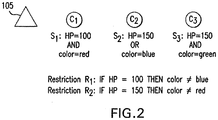
- FIG. 2 shows a more detailed view of structure node 105 and associated variants 105.1, or more specifically, variants C 1 , C 2 and C 3 .
- Variants C 1 , C 2 and C 3 represent three different possible concrete realizations for the component represented by structure node 105. Further, there are selection conditions S 1 , S 2 and S 3 each respectively associated with variants C 1 , C 2 and C 3 .
- the selection conditions S 1 , S 2 and S 3 are user-defined criteria for determining whether or not to allow a given variant to be included in an order bill of materials.
- the selection conditions are illustrated as logical expressions using Boolean operators, but the selection conditions could take other forms.
- a configuration of a product involves assigning specific values for characteristics of the product. Particular variants may then be selected based on the values specified, as they are applied to selection conditions.
- “HP” (horsepower) and “color” are characteristics; “100” and “150” are specific values that may be assigned to the HP characteristic, and “red,” “blue,” and “green” are specific values that may be assigned to the color characteristic.
- the Boolean operators linking the specific values assigned to the characteristics evaluate to logic "TRUE,” a corresponding variant will be included in the bill of materials; otherwise, it will not be.
- C 1 may be the only suitable variant of structure node 105 based on the combination of values of the characteristics that HP is to be 100, and the car color is to be red, as required for selection condition S 1 to evaluate to TRUE.
- C 2 may be the only suitable variant of structure node 105 based on the combination of values of characteristics that HP is to be 150, or the car color is to be blue, as required for selection condition S 2 to evaluate to TRUE.
- C 3 may be the only suitable variant based on the combination of values of the characteristics that HP is to be 150, and the car color is to be green, as required for selection condition S 3 to evaluate to TRUE.
- the selection conditions serve to prevent incompatible variants from being included in a design. For instance, if a product being designed is a car, designers want to ensure it has only one engine, of a certain type.
- the selection conditions help to ensure this.
- the selection conditions help to guarantee that at most one variant is selected for a component. When the selection conditions have this property, they are said to be “consistent.” Further, selection conditions help to guarantee that at least one variant is selected for a component. When the selection conditions have this property, they are said to be "complete.”
- Each variant C 1 , ..., C n of a structure node may have a corresponding selection condition S 1 , ..., S n , as shown in FIG. 2 .
- Restrictions R may need to be accounted for when determining consistency and completeness. More specifically, when values or combination of values of V linked by logical operators meet conditions defining forbidden space F, they are not subject to consistency and completeness requirements.
- selection conditions may be evaluated for consistency and completeness by forming a "variance space" bit matrix that encodes all possible combinations contained in the variance space. Then, bit strings or vectors representing selection conditions and restrictions may be formed for all the combinations in the variance space, by an application of logical operations to information in the variance space matrix. More specifically, bit strings s 1 ..., s n representing the allowed combinations of values of characteristics of respective selection conditions S 1 , ..., S n , and bit strings r 1 , ..., r m representing restrictions R 1 , ..., R m , may be formed.
- bit strings s 1 , ..., s n may be formed by applying the logical operations defined in the selection conditions S 1 , ...., S n to the information in the variance space matrix.
- variance space S(V) ⁇ (100, red), (100, blue), (100, green), (150, red), (150, blue), (150, green) ⁇ .
- FIG. 3 shows a corresponding variance space bit matrix 300. More specifically, for characteristics HP and color, all possible combinations of assigned values 100, 150 and red, blue, green are shown. That is, a logic "1" in a given row/column indicates a possible combination of specific values 302 assigned to characteristics 301.
- a bit string f corresponding to all the elements of the forbidden space, may be formed.
- the f bit string may be applied to other bit strings, as described in more detail below, to eliminate elements that are in forbidden space from a result of the consistency and completeness evaluations.
- bit strings s 1 , ..., s n and r 1 , ..., r m may be performed as follows, to form bit string f (corresponding to forbidden space F), bit string n (corresponding to "free space”), and bit string i ij , to efficiently check for consistency and completeness:
- FIG. 5 shows a results matrix 500 where all the selection conditions corresponding to variants shown in FIG. 2 have been applied to the variance space matrix 300 to form bit strings s 1 , s 2 and s 3 , and operations (i), (ii) and (iii) have been carried out.
- Bit string n formed by the logical operation NOT (s 1 OR ... OR s n OR f) corresponds to "free space”: i.e., those combinations which are neither covered by a selection condition nor part of forbidden space F.
- the information in the results matrix could be reported to a user.
- the information reported could include pairs of inconsistent selection conditions, and lists of combinations that are neither covered by a selection condition nor forbidden by a restriction ("free space").
- the information could be output to a computer display screen, for example, or to print.
- the information could enable a user to correct errors in the formulation of his/her selection conditions.
- a user could formulate a set of selection conditions, for example using a GUI, and then invoke, via the GUI, software implementing embodiments of a method according to the present invention to check the selection conditions for consistency and completeness.
- a method is illustrated in flowchart form in FIG. 6 .
- a plurality of selection conditions for example, formulated by a user pursuant to the configuration of some product, is received.
- the selection conditions define permissible combinations of values of characteristics of the product.
- a bit matrix is formed containing information representing combinations of the values of the characteristics, block 601.
- bit strings or vectors are formed by applying the selection conditions to the bit matrix; the bit strings represent the permissible combinations of a corresponding selection condition.
- bit strings 600-603 may be output to a user, as shown in block 604.
- bit operations may be significantly faster than prior art methods.
- bit operations like multiplying or shifting of bit strings may be used. Such operations can take advantage of machine architecture for enhanced speed of execution.
- formation of bit strings s 1 , ..., s n and r 1 , ..., r m may be done very quickly, because all the combinations in the variance space matrix may be processed substantially simultaneously using bit string operations.
- the characteristics when forming the variance space matrix, the characteristics may be sorted by the greatest power of 2 that divides the number of the corresponding values. This may make the best use of machine architecture, because the built-in operations for bit strings actually work on byte strings (i.e., groups of 8 bits).
- variance space is large, in forming the variance space bit matrix, memory could be conserved by compressing the m i matrix rows corresponding to characteristics C i into approximately log 2 m i rows by numbering the values of C i with 1, ..., m i and storing the binary representation of the value's number in the variance space bit matrix.
- the variance space bit matrix could be split into a plurality of sub-matrices.
- the matrices could be processed in parallel to save time, or serially to save memory.
- One way to split the variance space bit matrix would be to choose a characteristic with a number of values that equals (at least approximately) the desired number of sub-matrices, and to create a sub-matrix for every value of the characteristic.
- the bit pattern for the chosen characteristic is very simple for the sub-matrices: all bits are set in the row of the value corresponding to the sub-matrix; no bit is set in the other rows. The patterns of all other characteristics do not change, but they are repeated less often.
- FIG. 7 shows a high-level representation of a computer system for implementing embodiments of the present invention, such as might be realized by a variety of known and commercially available hardware and software elements.
- the system comprises a memory 700 including ROM and RAM, processor 710 and user interface 711 comprising a video display 712, keyboard 713 and mouse 714. Elements may communicate via system bus 706.
- the system may further comprise a network 717 connected by a network medium 718 and network interface 715.
- a computer program or collection of programs comprising computer-executable instructions for performing a method according to embodiments of the present invention may be stored and transported on computer-usable media such as diskette 701, CD-ROM 702, magnetic tape 703 and fixed disk 704.
- computer instructions may be retrieved from the computer-usable media 701-704 using their respective drives 705-708 into memory 700, and executed by a processor 710.
- the functionality disclosed hereinabove for performing the embodiments may find specific implementations in a variety of forms, which are considered to be within the abilities of a programmer of ordinary skill in the art after having reviewed the specification.
Landscapes
- Engineering & Computer Science (AREA)
- Physics & Mathematics (AREA)
- Theoretical Computer Science (AREA)
- Computer Hardware Design (AREA)
- Evolutionary Computation (AREA)
- Geometry (AREA)
- General Engineering & Computer Science (AREA)
- General Physics & Mathematics (AREA)
- Information Retrieval, Db Structures And Fs Structures Therefor (AREA)
- Management, Administration, Business Operations System, And Electronic Commerce (AREA)
- Stored Programmes (AREA)
Claims (5)
- Computerimplementiertes Verfahren zur Evaluierung von Auswahlbedingungen, die Varianten von Komponenten in einem konfigurierbaren Produkt während der Herstellung des konfigurierbaren Produkts betreffen, wobei die Auswahlbedingungen verhindern sollen, dass inkompatible Varianten in das konfigurierbare Produkt aufgenommen werden, wobei das Verfahren umfasst:Empfangen mehrerer Auswahlbedingungen (S1, S2, S3), die logische Operationen umfassen, welche zulässige Kombinationen von Werten eines endlichen Satzes von Eigenschaften des Produkts definieren, wobei von dem Satz aus allen Kombinationen der Werte ein Varianz-Raum definiert wird;Bilden einer Bit-Matrix (300), die Informationen enthält, die Kombinationen der Werte der Eigenschaften darstellt, durch Kodieren aller möglichen Kombinationen, die in dem Varianz-Raum enthalten sind, als Matrix, wobei die Bit-Matrix (300) Zeilen und Spalten umfasst, wobei jedem Wert, der mit einer Eigenschaft assoziiert ist, eine der Zeilen zugeordnet wird, wobei jeder Kombination der Werte eine der Spalten zugeordnet wird;Teilen der Bit-Matrix in eine gewünschte Anzahl von Bit-Submatrizes, wobei jede Bit-Submatrix einem Varianz-Subraum entspricht, das Teilen ein Auswählen einer gewünschten Eigenschaft des Satzes von Eigenschaften mit einer Anzahl von Werten, die der gewünschten Anzahl von Sub-Matrizes zumindest nahe kommt, und das Erzeugen einer Sub-Matrix für jeden Wert der gewünschten Eigenschaft umfasst;Bilden von Bitfolgen (s1, s2, s3), welche die Auswahlbedingungen für alle Kombinationen in jedem Varianz-Subraum darstellen, durch Anwenden der in den Auswahlbedingungen definierten logischen Operationen auf die Bit-Submatrizes, wobei das Bilden der Bitfolgen durch parallele Verarbeitung durchgeführt wird, wobei jede Bitfolge, welche die Auswahlbedingungen darstellt, Bits aufweist, die einzigartige Kombinationen der Werte der Eigenschaften darstellen, wobei jede der zulässigen Kombinationen der Werte der Eigenschaften von einem Bit mit dem Wert einer logischen "1" ausgedrückt wird, während alle anderen Bits in den Bitfolgen, welche die Auswahlbedingungen darstellen, den Wert einer logischen "0" aufweisen;Empfangen einer Mehrzahl von Restriktionsbedingungen (R1, R2), die logische Operationen darstellen, die verbotene Kombinationen der Werte des endlichen Satzes der Eigenschaften des Produkts definieren;Bilden von Bitfolgen (r1, r2), die Restriktionsbedindungen für alle Kombinationen in jedem Varianz-Subraum darstellen, durch Anwenden der in den Restriktionsbedindungen definierten logischen Operationen auf die Bit-Submatrizes, wobei das Bilden der Bitfolgen durch parallele Verarbeitung durchgeführt wird, wobei jede Bitfolge, welche die Restriktionsbedindungen darstellt, Bits aufweist, die einzigartige Kombinationen der Werte der Eigenschaften darstellen, wobei für jede verbotene Kombination jede der Restriktionsbedindungen von einem Bit mit dem Wert einer logischen "1" ausgedrückt wird, während alle anderen Bits in der Bitfolge den Wert einer logischen "0" aufweisen;Bestimmen inkonsistenter Paare der Auswahlbedingungen (S1, S2, S3) für jeden Varianz-Subraum durch Berechnen von Inkonsistenz-Bitfolgen für Paare der Auswahlbedingungen (S1, S2, S3) und Bestimmen der inkonsistenten Paare der Auswahlbedingungen (S1, S2, S3) in einem Fall, wo die Inkonsistenz-Bitfolge des Paares der Auswahlbedingungen (S1, S2, S3) mindestens ein Bit aufweist, das einen Wert einer logischen "1" aufweist, wobei die Inkonsistenz-Bitfolge des Paares der Auswahlbedingungen (S1, S2, S3) durch Kombinieren der entsprechenden Bitfolgen, die das Paar von Auswahlbedingungen darstellen, und einer vereinigten Bitfolge, die Restriktionsbedindungen darstellt, unter Verwendung einer logischen AND-Operation gebildet wird, wobei die vereinigte Folge, die Restriktionsbedindungen darstellt, durch Kombinieren aller Bitfolgen, die Restriktionsbedindungen darstellen, unter Verwendung einer logischen OR-Operation mit einer anschließenden Anwendung einer logischen NOT-Operation gebildet wird, wobei das Bestimmen der inkonsistenten Paare der Auswahlbedingungen durch parallele Verarbeitung durchgeführt wird; undAusgeben der inkonsistenten Paare der Auswahlbedingungen an einen Anwender.
- Verfahren nach Anspruch 1, ferner umfassend:Bilden einer Bitfolge (n) für jede Bit-Submatrix, wobei jede Bitfolge (n) Informationen enthält, die Kombinationen von Werten der Eigenschaften darstellen, die weder von den Auswahlbedingungen abgedeckt werden noch einer Restriktion unterworfen sind, wobei die Bitfolge (n) durch Anwenden logischer NOT-Operationen auf eine Kombination der mehreren Bitfolgen (s1, s2, s3), welche die Auswahlbedingungen darstellen, und der mehreren Bitfolgen (r1, r2), welche die Restriktionsbedindungen darstellen, gebildet wird, wobei die Kombination durch Kombinieren der Bitfolgen, die Auswahlbedingungen darstellen, und der Bitfolgen, welche die Restriktionsbedindungen darstellen, unter Verwendung logischer OR-Operationen erzeugt wird, wobei das Bilden der Bitfolge für jede Bit-Submatrix durch parallele Verarbeitung durchgeführt wird; undAusgeben von Informationen, die Kombinationen von Werten der Eigenschaften darstellen, die weder von den Auswahlbedingungen abgedeckt werden noch einer Restriktion unterworfen sind, an den Anwender.
- Computersystem zur Evaluierung von Auswahlbedingungen, die Varianten von Komponenten in einem konfigurierbaren Produkt betreffen, und zur Unterstützung der Herstellung des konfigurierbaren Produkts, wobei die Auswahlbedingungen verhindern sollen, dass inkompatible Varianten in das konfigurierbare Produkt aufgenommen werden, wobei das System umfasst:einen Speicher (700), der computerausführbare befehle enthält; undeinen Prozessor (710), der mit dem Speicher gekoppelt ist, um die Befehle auszugeben, wobei die Befehle bei ihrer Ausführung einen Prozess durchführen, der umfasst:Empfangen mehrerer Auswahlbedingungen (S1, S2, S3), die logische Operationen umfassen, welche zulässige Kombinationen von Werten eines endlichen Satzes von Eigenschaften des Produkts definieren, wobei ein Varianz-Raum von dem Satz aus allen Kombinationen der Werte definiert wird;Bilden einer Bit-Matrix (300), die Informationen enthält, die Kombinationen der Werte der Eigenschaften darstellt, durch Kodieren aller möglichen Kombinationen, die in dem Varianz-Raum enthalten sind, als Matrix, wobei die Bit-Matrix (300) Zeilen und Spalten umfasst, wobei jedem Wert, der mit einer Eigenschaft assoziiert ist, eine der Zeilen zugeordnet wird, wobei jeder Kombination der Werte eine der Spalten zugeordnet wird;Teilen der Bit-Matrix in eine gewünschte Anzahl von Bit-Submatrizes, wobei jede Bit-Submatrix einer Varianz entspricht, das Teilen ein Auswählen einer gewünschten Eigenschaft des Satzes von Eigenschaften mit einer Anzahl von Werten, die der gewünschten Anzahl von Sub-Matrizes zumindest nahe kommt, und das Erzeugen einer Sub-Matrix für jeden Wert der gewünschten Eigenschaft umfasst;Bilden von Bitfolgen (s1, s2, s3), welche die Auswahlbedingungen für alle Kombinationen in jedem Varianz-Subraum darstellen, durch Anwenden der in den Auswahlbedingungen definierten logischen Operationen auf die Bit-Submatrizes, wobei das Bilden der Bitfolgen durch parallele Verarbeitung durchgeführt wird, wobei jede Bitfolge, welche die Auswahlbedingungen darstellt, Bits aufweist, die einzigartige Kombinationen der Werte der Eigenschaften darstellen, wobei jede der zulässigen Kombinationen der Werte der Eigenschaften von einem Bit mit dem Wert einer logischen "1" ausgedrückt wird, während alle anderen Bits in den Bitfolgen, welche die Auswahlbedingungen darstellen, den Wert einer logischen "0" aufweisen;Empfangen einer Mehrzahl von Restriktionsbedingungen (R1, R2), die logische Operationen darstellen, die verbotene Kombinationen der Werte des endlichen Satzes der Eigenschaften des Produkts definieren;Bilden von Bitfolgen (r1, r2), welche die Restriktionsbedindungen für alle Kombinationen in jedem Varianz-Subraum darstellen, durch Anwenden der in den Restriktionsbedindungen definierten logischen Operationen auf die Bit-Submatrizes, wobei das Bilden der Bitfolgen durch parallele Verarbeitung durchgeführt wird, wobei jede Bitfolge, welche die Restriktionsbedindungen darstellt, Bits aufweist, die einzigartige Kombinationen der Werte der Eigenschaften darstellen, wobei für jede verbotene Kombination jede der Restriktionsbedindungen von einem Bit mit dem Wert einer logischen "1" ausgedrückt wird, während alle anderen Bits in der Bitfolge den Wert einer logischen "0" aufweisen;Bestimmen inkonsistenter Paare der Auswahlbedingungen (S1, S2, S3) für jeden Varianz-Subraum durch Berechnen von Inkonsistenz-Bitfolgen für Paare der Auswahlbedingungen (S1, S2, S3) und Bestimmen der inkonsistenten Paare der Auswahlbedingungen (S1, S2, S3) in einem Fall, wenn die Inkonsistenz-Bitfolge des Paares der Auswahlbedingungen (S1, S2, S3) mindestens ein Bit aufweist, das einen Wert einer logischen "1" aufweist, wobei die Inkonsistenz-Bitfolge des Paares der Auswahlbedingungen (S1, S2, S3) durch Kombinieren der entsprechenden Bitfolgen, die das Paar von Auswahlbedingungen darstellen, und einer vereinigten Bitfolge, die Restriktionsbedindungen darstellt, unter Verwendung einer logischen AND-Operation, wobei die vereinigte Folge, die Restriktionsbedindungen darstellt, durch Kombinieren aller Bitfolgen, die Restriktionsbedindungen darstellen, unter Verwendung einer logischen OR-Operation mit einer folgenden Anwendung einer logischen NOT-Operation gebildet wird, wobei das Bestimmen der inkonsistenten Paare der Auswahlbedingungen durch parallele Verarbeitung durchgeführt wird; undAusgeben der inkonsistenten Paare der Auswahlbedingungen an einen Anwender.
- Computersystem nach Anspruch 3, wobei das Verfahren ferner umfasst:Bilden einer Bitfolge (n) für jede Bit-Submatrix, wobei jede Bitfolge (n) Informationen enthält, die Kombinationen von Werten der Eigenschaften darstellen, die weder von den Auswahlbedingungen abgedeckt werden noch einer Restriktion unterworfen sind, wobei die Bitfolge (n) durch Anwenden logischer NOT-Operationen auf eine Kombination der mehreren Bitfolgen (s1, s2, s3), welche die Auswahlbedingungen darstellen, und der mehreren Bitfolgen (r1, r2), welche die Restriktionsbedindungen darstellen, gebildet wird, wobei die Kombination durch Kombinieren der Bitfolgen, die Auswahlbedingungen darstellen, und der Bitfolgen, welche die Restriktionsbedindungen darstellen, unter Verwendung logischer OR-Operationen erzeugt werden, wobei das Bilden der Bitfolge für jede Bit-Submatrix durch parallele Verarbeitung durchgeführt wird; undAusgeben von Informationen, die Kombinationen von Werten der Eigenschaften darstellen, die weder von den Auswahlbedingungen abgedeckt werden noch einer Restriktion unterworfen sind, an den Anwender.
- Maschinenlesbares Medium, das computerausführbare Befehle speichert, wobei die Befehle, wenn sie ausgeführt werden, einen Prozess nach einem der vorangehenden Ansprüche 1 bis 2 zum Evaluieren von Auswahlbedingungen, die Varianten von Komponenten in einem konfigurierbaren Produkt betreffen, durchführen.
Applications Claiming Priority (2)
| Application Number | Priority Date | Filing Date | Title |
|---|---|---|---|
| US670602 | 2003-09-26 | ||
| US10/670,602 US7225038B2 (en) | 2003-09-26 | 2003-09-26 | Method and system for checking consistency and completeness of selection conditions in a product configuration system |
Publications (2)
| Publication Number | Publication Date |
|---|---|
| EP1519284A1 EP1519284A1 (de) | 2005-03-30 |
| EP1519284B1 true EP1519284B1 (de) | 2019-11-06 |
Family
ID=34194830
Family Applications (1)
| Application Number | Title | Priority Date | Filing Date |
|---|---|---|---|
| EP04022865.2A Expired - Lifetime EP1519284B1 (de) | 2003-09-26 | 2004-09-24 | Verfahren und System um die Konsistenz und die Vollständigkeit von Auswahlbedingungen in einem Produktkonfigurationsystem zu prüfen |
Country Status (2)
| Country | Link |
|---|---|
| US (1) | US7225038B2 (de) |
| EP (1) | EP1519284B1 (de) |
Families Citing this family (14)
| Publication number | Priority date | Publication date | Assignee | Title |
|---|---|---|---|---|
| US6983187B2 (en) * | 2003-08-14 | 2006-01-03 | Sap Aktiengesellschaft | Method and system for automatically generating selection conditions in a product configuration system |
| US7739080B1 (en) * | 2004-04-19 | 2010-06-15 | Versata Development Group, Inc. | Consolidation of product data models |
| US9824183B1 (en) | 2005-05-12 | 2017-11-21 | Versata Development Group, Inc. | Augmentation and processing of digital information sets using proxy data |
| US10410221B2 (en) * | 2008-02-07 | 2019-09-10 | Urban Science Applications, Inc. | System and method for determining a grouping of segments within a market |
| US9524506B2 (en) | 2011-10-21 | 2016-12-20 | Bigmachines, Inc. | Methods and apparatus for maintaining business rules in a configuration system |
| US8578265B2 (en) * | 2008-10-07 | 2013-11-05 | Bigmachines, Inc. | Methods and apparatus for generating a dynamic document |
| US20100161366A1 (en) * | 2008-12-19 | 2010-06-24 | Achim Clemens | Product requirement specification in production model |
| US9767495B2 (en) * | 2008-12-19 | 2017-09-19 | Sap Se | Different sales and planning product options |
| US20100281429A1 (en) * | 2009-04-30 | 2010-11-04 | Bigmachines, Inc. | Methods and apparatus for configuring a product using an array of configuration sets |
| US20140372083A1 (en) * | 2013-06-13 | 2014-12-18 | International Business Machines Corporation | Derived restrictions in a combinatorial model |
| US20150213154A1 (en) * | 2014-01-28 | 2015-07-30 | Stephan Toebben | Transitioning cad model data into variant configurations |
| US9442968B2 (en) | 2014-03-31 | 2016-09-13 | Sap Se | Evaluation of variant configuration using in-memory technology |
| US10318702B2 (en) | 2016-01-19 | 2019-06-11 | Ford Motor Company | Multi-valued decision diagram reversible restriction |
| US10824498B2 (en) | 2018-12-14 | 2020-11-03 | Sap Se | Quantification of failure using multimodal analysis |
Family Cites Families (8)
| Publication number | Priority date | Publication date | Assignee | Title |
|---|---|---|---|---|
| US5119307A (en) * | 1989-12-22 | 1992-06-02 | General Electric Company | Method and system for automated bill-of-material generation |
| US5825651A (en) * | 1996-09-03 | 1998-10-20 | Trilogy Development Group, Inc. | Method and apparatus for maintaining and configuring systems |
| JP3569409B2 (ja) | 1997-01-17 | 2004-09-22 | ペンタックス株式会社 | Gpsを利用した望遠鏡 |
| US6223094B1 (en) * | 1998-08-21 | 2001-04-24 | Sap Aktiengesellschaft | Multi-tiered structure for storing and displaying product and process variants |
| US7584079B2 (en) * | 2000-12-08 | 2009-09-01 | Configit Software A/S | Method of configuring a product |
| US7139750B2 (en) * | 2002-03-13 | 2006-11-21 | Agile Software Corporation | System and method for where-used searches for data stored in a multi-level hierarchical structure |
| US7085776B2 (en) * | 2002-04-24 | 2006-08-01 | The Boeing Company | Logical hierarchical data model for sharing product information across product families |
| US7038677B2 (en) * | 2003-01-21 | 2006-05-02 | The Boeing Company | Apparatus and method for managing multivariant assembly data models |
-
2003
- 2003-09-26 US US10/670,602 patent/US7225038B2/en not_active Expired - Lifetime
-
2004
- 2004-09-24 EP EP04022865.2A patent/EP1519284B1/de not_active Expired - Lifetime
Non-Patent Citations (1)
| Title |
|---|
| None * |
Also Published As
| Publication number | Publication date |
|---|---|
| US20050071146A1 (en) | 2005-03-31 |
| EP1519284A1 (de) | 2005-03-30 |
| US7225038B2 (en) | 2007-05-29 |
Similar Documents
| Publication | Publication Date | Title |
|---|---|---|
| US6983187B2 (en) | Method and system for automatically generating selection conditions in a product configuration system | |
| US7225038B2 (en) | Method and system for checking consistency and completeness of selection conditions in a product configuration system | |
| US6594808B1 (en) | Structural regularity extraction and floorplanning in datapath circuits using vectors | |
| US7058621B1 (en) | Method for extracting information from a database | |
| JP2972540B2 (ja) | Lsi自動設計システム及びlsi自動設計方法 | |
| JP2004171576A (ja) | 高速チップ管理システム | |
| US20100318476A1 (en) | Rule processing method and apparatus providing automatic user input selection | |
| WO1998010360A1 (en) | Method and apparatus for maintaining and configuring systems | |
| US7103519B2 (en) | Virtual manufacturing system | |
| WO2000028444A1 (en) | A systematic approach for regularity extraction | |
| CN111797125A (zh) | 报表的创建方法、装置、电子设备及计算机可读存储介质 | |
| Sauer | Marking optimization of weighted marked graphs | |
| US7735028B2 (en) | Logic circuit redesign program, logic circuit redesign apparatus, and logic circuit redesign method | |
| US7882114B2 (en) | Data processing method and data processing program | |
| CN101441742A (zh) | 物料资源的管理方法及装置 | |
| Perkowski et al. | Kuai-exact: a new approach for multi-valued logic minimization in VLSI synthesis | |
| US7844919B1 (en) | Method and apparatus for maintaining and configuring systems | |
| Romero et al. | Feature in product engineering with single and variant design approaches. A comparative review | |
| CN113642828A (zh) | 一种基于性能指标达成情况的产品开发成熟度评价方法 | |
| CN113505438A (zh) | 技术状态驱动的航天器总装工艺模板化编制方法及系统 | |
| Jozwiak et al. | High-quality sub-function construction in functional decomposition based on information relationship measures | |
| Martínez et al. | An algorithm for face-constrained encoding of symbols using minimum code length | |
| JP3195467B2 (ja) | セルリダクション装置 | |
| De Almeida et al. | Designing domain-specific software architecture (DSSA): Towards a new approach | |
| Da Cunha et al. | Improving manufacturing quality by re-sequencing assembly operations: a data-mining approach |
Legal Events
| Date | Code | Title | Description |
|---|---|---|---|
| PUAI | Public reference made under article 153(3) epc to a published international application that has entered the european phase |
Free format text: ORIGINAL CODE: 0009012 |
|
| AK | Designated contracting states |
Kind code of ref document: A1 Designated state(s): AT BE BG CH CY CZ DE DK EE ES FI FR GB GR HU IE IT LI LU MC NL PL PT RO SE SI SK TR |
|
| AX | Request for extension of the european patent |
Extension state: AL HR LT LV MK |
|
| 17P | Request for examination filed |
Effective date: 20050506 |
|
| RAP1 | Party data changed (applicant data changed or rights of an application transferred) |
Owner name: SAP AG |
|
| AKX | Designation fees paid |
Designated state(s): AT BE BG CH CY CZ DE DK EE ES FI FR GB GR HU IE IT LI LU MC NL PL PT RO SE SI SK TR |
|
| 17Q | First examination report despatched |
Effective date: 20061219 |
|
| APBK | Appeal reference recorded |
Free format text: ORIGINAL CODE: EPIDOSNREFNE |
|
| APBN | Date of receipt of notice of appeal recorded |
Free format text: ORIGINAL CODE: EPIDOSNNOA2E |
|
| APBR | Date of receipt of statement of grounds of appeal recorded |
Free format text: ORIGINAL CODE: EPIDOSNNOA3E |
|
| APAF | Appeal reference modified |
Free format text: ORIGINAL CODE: EPIDOSCREFNE |
|
| RAP1 | Party data changed (applicant data changed or rights of an application transferred) |
Owner name: SAP SE |
|
| APBT | Appeal procedure closed |
Free format text: ORIGINAL CODE: EPIDOSNNOA9E |
|
| RIC1 | Information provided on ipc code assigned before grant |
Ipc: G06F 17/50 20060101AFI20190605BHEP |
|
| GRAP | Despatch of communication of intention to grant a patent |
Free format text: ORIGINAL CODE: EPIDOSNIGR1 |
|
| STAA | Information on the status of an ep patent application or granted ep patent |
Free format text: STATUS: GRANT OF PATENT IS INTENDED |
|
| INTG | Intention to grant announced |
Effective date: 20190716 |
|
| GRAS | Grant fee paid |
Free format text: ORIGINAL CODE: EPIDOSNIGR3 |
|
| GRAA | (expected) grant |
Free format text: ORIGINAL CODE: 0009210 |
|
| STAA | Information on the status of an ep patent application or granted ep patent |
Free format text: STATUS: THE PATENT HAS BEEN GRANTED |
|
| AK | Designated contracting states |
Kind code of ref document: B1 Designated state(s): AT BE BG CH CY CZ DE DK EE ES FI FR GB GR HU IE IT LI LU MC NL PL PT RO SE SI SK TR |
|
| REG | Reference to a national code |
Ref country code: GB Ref legal event code: FG4D |
|
| REG | Reference to a national code |
Ref country code: AT Ref legal event code: REF Ref document number: 1199749 Country of ref document: AT Kind code of ref document: T Effective date: 20191115 Ref country code: CH Ref legal event code: EP |
|
| REG | Reference to a national code |
Ref country code: DE Ref legal event code: R079 Ref document number: 602004054344 Country of ref document: DE Free format text: PREVIOUS MAIN CLASS: G06F0017500000 Ipc: G06F0030000000 |
|
| REG | Reference to a national code |
Ref country code: IE Ref legal event code: FG4D |
|
| REG | Reference to a national code |
Ref country code: DE Ref legal event code: R096 Ref document number: 602004054344 Country of ref document: DE |
|
| REG | Reference to a national code |
Ref country code: NL Ref legal event code: MP Effective date: 20191106 |
|
| PG25 | Lapsed in a contracting state [announced via postgrant information from national office to epo] |
Ref country code: PT Free format text: LAPSE BECAUSE OF FAILURE TO SUBMIT A TRANSLATION OF THE DESCRIPTION OR TO PAY THE FEE WITHIN THE PRESCRIBED TIME-LIMIT Effective date: 20200306 Ref country code: GR Free format text: LAPSE BECAUSE OF FAILURE TO SUBMIT A TRANSLATION OF THE DESCRIPTION OR TO PAY THE FEE WITHIN THE PRESCRIBED TIME-LIMIT Effective date: 20200207 Ref country code: PL Free format text: LAPSE BECAUSE OF FAILURE TO SUBMIT A TRANSLATION OF THE DESCRIPTION OR TO PAY THE FEE WITHIN THE PRESCRIBED TIME-LIMIT Effective date: 20191106 Ref country code: ES Free format text: LAPSE BECAUSE OF FAILURE TO SUBMIT A TRANSLATION OF THE DESCRIPTION OR TO PAY THE FEE WITHIN THE PRESCRIBED TIME-LIMIT Effective date: 20191106 Ref country code: NL Free format text: LAPSE BECAUSE OF FAILURE TO SUBMIT A TRANSLATION OF THE DESCRIPTION OR TO PAY THE FEE WITHIN THE PRESCRIBED TIME-LIMIT Effective date: 20191106 Ref country code: SE Free format text: LAPSE BECAUSE OF FAILURE TO SUBMIT A TRANSLATION OF THE DESCRIPTION OR TO PAY THE FEE WITHIN THE PRESCRIBED TIME-LIMIT Effective date: 20191106 Ref country code: BG Free format text: LAPSE BECAUSE OF FAILURE TO SUBMIT A TRANSLATION OF THE DESCRIPTION OR TO PAY THE FEE WITHIN THE PRESCRIBED TIME-LIMIT Effective date: 20200206 Ref country code: FI Free format text: LAPSE BECAUSE OF FAILURE TO SUBMIT A TRANSLATION OF THE DESCRIPTION OR TO PAY THE FEE WITHIN THE PRESCRIBED TIME-LIMIT Effective date: 20191106 |
|
| PG25 | Lapsed in a contracting state [announced via postgrant information from national office to epo] |
Ref country code: DK Free format text: LAPSE BECAUSE OF FAILURE TO SUBMIT A TRANSLATION OF THE DESCRIPTION OR TO PAY THE FEE WITHIN THE PRESCRIBED TIME-LIMIT Effective date: 20191106 Ref country code: RO Free format text: LAPSE BECAUSE OF FAILURE TO SUBMIT A TRANSLATION OF THE DESCRIPTION OR TO PAY THE FEE WITHIN THE PRESCRIBED TIME-LIMIT Effective date: 20191106 Ref country code: CZ Free format text: LAPSE BECAUSE OF FAILURE TO SUBMIT A TRANSLATION OF THE DESCRIPTION OR TO PAY THE FEE WITHIN THE PRESCRIBED TIME-LIMIT Effective date: 20191106 Ref country code: EE Free format text: LAPSE BECAUSE OF FAILURE TO SUBMIT A TRANSLATION OF THE DESCRIPTION OR TO PAY THE FEE WITHIN THE PRESCRIBED TIME-LIMIT Effective date: 20191106 |
|
| REG | Reference to a national code |
Ref country code: DE Ref legal event code: R097 Ref document number: 602004054344 Country of ref document: DE |
|
| REG | Reference to a national code |
Ref country code: AT Ref legal event code: MK05 Ref document number: 1199749 Country of ref document: AT Kind code of ref document: T Effective date: 20191106 |
|
| PG25 | Lapsed in a contracting state [announced via postgrant information from national office to epo] |
Ref country code: SK Free format text: LAPSE BECAUSE OF FAILURE TO SUBMIT A TRANSLATION OF THE DESCRIPTION OR TO PAY THE FEE WITHIN THE PRESCRIBED TIME-LIMIT Effective date: 20191106 |
|
| PLBE | No opposition filed within time limit |
Free format text: ORIGINAL CODE: 0009261 |
|
| STAA | Information on the status of an ep patent application or granted ep patent |
Free format text: STATUS: NO OPPOSITION FILED WITHIN TIME LIMIT |
|
| 26N | No opposition filed |
Effective date: 20200807 |
|
| PG25 | Lapsed in a contracting state [announced via postgrant information from national office to epo] |
Ref country code: AT Free format text: LAPSE BECAUSE OF FAILURE TO SUBMIT A TRANSLATION OF THE DESCRIPTION OR TO PAY THE FEE WITHIN THE PRESCRIBED TIME-LIMIT Effective date: 20191106 Ref country code: SI Free format text: LAPSE BECAUSE OF FAILURE TO SUBMIT A TRANSLATION OF THE DESCRIPTION OR TO PAY THE FEE WITHIN THE PRESCRIBED TIME-LIMIT Effective date: 20191106 |
|
| PG25 | Lapsed in a contracting state [announced via postgrant information from national office to epo] |
Ref country code: IT Free format text: LAPSE BECAUSE OF FAILURE TO SUBMIT A TRANSLATION OF THE DESCRIPTION OR TO PAY THE FEE WITHIN THE PRESCRIBED TIME-LIMIT Effective date: 20191106 |
|
| PG25 | Lapsed in a contracting state [announced via postgrant information from national office to epo] |
Ref country code: MC Free format text: LAPSE BECAUSE OF FAILURE TO SUBMIT A TRANSLATION OF THE DESCRIPTION OR TO PAY THE FEE WITHIN THE PRESCRIBED TIME-LIMIT Effective date: 20191106 |
|
| REG | Reference to a national code |
Ref country code: CH Ref legal event code: PL |
|
| REG | Reference to a national code |
Ref country code: BE Ref legal event code: MM Effective date: 20200930 |
|
| PG25 | Lapsed in a contracting state [announced via postgrant information from national office to epo] |
Ref country code: LU Free format text: LAPSE BECAUSE OF NON-PAYMENT OF DUE FEES Effective date: 20200924 |
|
| PG25 | Lapsed in a contracting state [announced via postgrant information from national office to epo] |
Ref country code: CH Free format text: LAPSE BECAUSE OF NON-PAYMENT OF DUE FEES Effective date: 20200930 Ref country code: BE Free format text: LAPSE BECAUSE OF NON-PAYMENT OF DUE FEES Effective date: 20200930 Ref country code: IE Free format text: LAPSE BECAUSE OF NON-PAYMENT OF DUE FEES Effective date: 20200924 Ref country code: LI Free format text: LAPSE BECAUSE OF NON-PAYMENT OF DUE FEES Effective date: 20200930 |
|
| PG25 | Lapsed in a contracting state [announced via postgrant information from national office to epo] |
Ref country code: TR Free format text: LAPSE BECAUSE OF FAILURE TO SUBMIT A TRANSLATION OF THE DESCRIPTION OR TO PAY THE FEE WITHIN THE PRESCRIBED TIME-LIMIT Effective date: 20191106 Ref country code: CY Free format text: LAPSE BECAUSE OF FAILURE TO SUBMIT A TRANSLATION OF THE DESCRIPTION OR TO PAY THE FEE WITHIN THE PRESCRIBED TIME-LIMIT Effective date: 20191106 |
|
| PGFP | Annual fee paid to national office [announced via postgrant information from national office to epo] |
Ref country code: GB Payment date: 20230920 Year of fee payment: 20 |
|
| PGFP | Annual fee paid to national office [announced via postgrant information from national office to epo] |
Ref country code: FR Payment date: 20230927 Year of fee payment: 20 Ref country code: DE Payment date: 20230920 Year of fee payment: 20 |
|
| REG | Reference to a national code |
Ref country code: DE Ref legal event code: R071 Ref document number: 602004054344 Country of ref document: DE |
|
| PG25 | Lapsed in a contracting state [announced via postgrant information from national office to epo] |
Ref country code: GB Free format text: LAPSE BECAUSE OF EXPIRATION OF PROTECTION Effective date: 20240923 |
|
| REG | Reference to a national code |
Ref country code: GB Ref legal event code: PE20 Expiry date: 20240923 |
|
| PG25 | Lapsed in a contracting state [announced via postgrant information from national office to epo] |
Ref country code: GB Free format text: LAPSE BECAUSE OF EXPIRATION OF PROTECTION Effective date: 20240923 |