EP1519158B1 - Position measuring device - Google Patents
Position measuring device Download PDFInfo
- Publication number
- EP1519158B1 EP1519158B1 EP04014425A EP04014425A EP1519158B1 EP 1519158 B1 EP1519158 B1 EP 1519158B1 EP 04014425 A EP04014425 A EP 04014425A EP 04014425 A EP04014425 A EP 04014425A EP 1519158 B1 EP1519158 B1 EP 1519158B1
- Authority
- EP
- European Patent Office
- Prior art keywords
- graduation
- detector
- period
- measuring
- sensing
- Prior art date
- Legal status (The legal status is an assumption and is not a legal conclusion. Google has not performed a legal analysis and makes no representation as to the accuracy of the status listed.)
- Expired - Lifetime
Links
Images


Classifications
-
- G—PHYSICS
- G01—MEASURING; TESTING
- G01D—MEASURING NOT SPECIALLY ADAPTED FOR A SPECIFIC VARIABLE; ARRANGEMENTS FOR MEASURING TWO OR MORE VARIABLES NOT COVERED IN A SINGLE OTHER SUBCLASS; TARIFF METERING APPARATUS; MEASURING OR TESTING NOT OTHERWISE PROVIDED FOR
- G01D5/00—Mechanical means for transferring the output of a sensing member; Means for converting the output of a sensing member to another variable where the form or nature of the sensing member does not constrain the means for converting; Transducers not specially adapted for a specific variable
- G01D5/26—Mechanical means for transferring the output of a sensing member; Means for converting the output of a sensing member to another variable where the form or nature of the sensing member does not constrain the means for converting; Transducers not specially adapted for a specific variable characterised by optical transfer means, i.e. using infrared, visible, or ultraviolet light
-
- G—PHYSICS
- G01—MEASURING; TESTING
- G01D—MEASURING NOT SPECIALLY ADAPTED FOR A SPECIFIC VARIABLE; ARRANGEMENTS FOR MEASURING TWO OR MORE VARIABLES NOT COVERED IN A SINGLE OTHER SUBCLASS; TARIFF METERING APPARATUS; MEASURING OR TESTING NOT OTHERWISE PROVIDED FOR
- G01D5/00—Mechanical means for transferring the output of a sensing member; Means for converting the output of a sensing member to another variable where the form or nature of the sensing member does not constrain the means for converting; Transducers not specially adapted for a specific variable
- G01D5/26—Mechanical means for transferring the output of a sensing member; Means for converting the output of a sensing member to another variable where the form or nature of the sensing member does not constrain the means for converting; Transducers not specially adapted for a specific variable characterised by optical transfer means, i.e. using infrared, visible, or ultraviolet light
- G01D5/32—Mechanical means for transferring the output of a sensing member; Means for converting the output of a sensing member to another variable where the form or nature of the sensing member does not constrain the means for converting; Transducers not specially adapted for a specific variable characterised by optical transfer means, i.e. using infrared, visible, or ultraviolet light with attenuation or whole or partial obturation of beams of light
- G01D5/34—Mechanical means for transferring the output of a sensing member; Means for converting the output of a sensing member to another variable where the form or nature of the sensing member does not constrain the means for converting; Transducers not specially adapted for a specific variable characterised by optical transfer means, i.e. using infrared, visible, or ultraviolet light with attenuation or whole or partial obturation of beams of light the beams of light being detected by photocells
- G01D5/347—Mechanical means for transferring the output of a sensing member; Means for converting the output of a sensing member to another variable where the form or nature of the sensing member does not constrain the means for converting; Transducers not specially adapted for a specific variable characterised by optical transfer means, i.e. using infrared, visible, or ultraviolet light with attenuation or whole or partial obturation of beams of light the beams of light being detected by photocells using displacement encoding scales
- G01D5/34707—Scales; Discs, e.g. fixation, fabrication, compensation
-
- G—PHYSICS
- G01—MEASURING; TESTING
- G01D—MEASURING NOT SPECIALLY ADAPTED FOR A SPECIFIC VARIABLE; ARRANGEMENTS FOR MEASURING TWO OR MORE VARIABLES NOT COVERED IN A SINGLE OTHER SUBCLASS; TARIFF METERING APPARATUS; MEASURING OR TESTING NOT OTHERWISE PROVIDED FOR
- G01D5/00—Mechanical means for transferring the output of a sensing member; Means for converting the output of a sensing member to another variable where the form or nature of the sensing member does not constrain the means for converting; Transducers not specially adapted for a specific variable
- G01D5/26—Mechanical means for transferring the output of a sensing member; Means for converting the output of a sensing member to another variable where the form or nature of the sensing member does not constrain the means for converting; Transducers not specially adapted for a specific variable characterised by optical transfer means, i.e. using infrared, visible, or ultraviolet light
- G01D5/32—Mechanical means for transferring the output of a sensing member; Means for converting the output of a sensing member to another variable where the form or nature of the sensing member does not constrain the means for converting; Transducers not specially adapted for a specific variable characterised by optical transfer means, i.e. using infrared, visible, or ultraviolet light with attenuation or whole or partial obturation of beams of light
- G01D5/34—Mechanical means for transferring the output of a sensing member; Means for converting the output of a sensing member to another variable where the form or nature of the sensing member does not constrain the means for converting; Transducers not specially adapted for a specific variable characterised by optical transfer means, i.e. using infrared, visible, or ultraviolet light with attenuation or whole or partial obturation of beams of light the beams of light being detected by photocells
- G01D5/36—Forming the light into pulses
- G01D5/38—Forming the light into pulses by diffraction gratings
Definitions
- the invention relates to a position-measuring device according to the preamble of claim 1.
- Such a position measuring device for determining the relative position of two objects (angle measuring device) which are movable relative to each other along a measuring direction comprises a periodic measuring graduation arranged on an annular carrier in the form of a measuring tape; a scanning unit for optically scanning the measuring graduation by means of electromagnetic radiation (in particular by means of light) which is produced in a lighting device (light source) of the scanning unit, wherein the measuring tape and the scanning unit are movable relative to one another along the measuring direction; a scanning plate of the scanning unit having a periodic pitch (scanning pitch) disposed in the beam path of the electromagnetic radiation for measuring the measurement pitch, so that this electromagnetic radiation interacts with both the scanning pitch and the measuring pitch; and a detector of the scanning unit, the detector surface of which serves to detect the electromagnetic radiation modified by the scanning graduation and the measuring graduation and is designed to detect an intensity pattern formed by this modified electromagnetic radiation with a period P D.
- the period P D is chosen so that it coincides with the linear arrangement of the tape along a straight line with the period of the stripe pattern (Vernier pattern), by the interaction of the radiation used for scanning the tape on the one hand with the scanning graduation and on the other hand with the measuring graduation is produced.
- This stripe pattern corresponds to a beat, caused by the combination of two periodic processes, namely, on the one hand, the interaction of the electromagnetic radiation with the scanning graduation and, on the other hand, the interaction of the electromagnetic radiation with the measuring graduation.
- the measuring principle which is the basis of the aforementioned position measuring device is, for example, from EP 1 081 457 A2 , of the EP 1 028 309 A1 and the EP 0 754 933 B1 known.
- an optical position measuring device for determining the relative position of two along a measuring direction to each other movable objects specified.
- This comprises at least one periodic measuring graduation connected to one of the two objects as well as a scanning unit connected to the other object and thus movable relative to the measuring graduation along the measuring direction.
- the scanning unit has a light source, at least one scanning graduation and a detector arrangement in a detector plane, which consists of a plurality of radiation-sensitive detector elements, which are arranged one behind the other in the measuring direction.
- the measuring tape serving as a carrier for the measuring graduation is arranged in an annular manner, in particular by applying the measuring tape to a cylindrical body in the form of a drum, then the position-measuring device can be used in particular for angle measurement.
- the position-measuring device can be used in particular for angle measurement.
- One effect is that with ring-like arrangement of the measuring tape due to the associated curvature of the measuring tape, the inner surface of the measuring tape slightly compressed and the outer surface of the tape measure is slightly stretched.
- the extent of this compression or elongation depends on the thickness of the measuring tape and is of course the greater ever greater than its thickness.
- this effect leads to an increase in the period of the measuring graduation, since the outer surface of the measuring tape is stretched (compared with its linear arrangement).
- the two aforementioned effects are opposite, but the projection effect depends exclusively on the curvature of the measuring tape, while the stretching effect on the outer surface of the measuring tape depends both on its curvature and on its thickness.
- the two opposing effects compensate each other over a wide range of different curvatures so that the identity pattern generated on the radiation-sensitive surface of the detector has sufficient contrast for subsequent evaluation.
- the elongation effect on the outer surface of the tape is only so small that he can no longer sufficiently compensate for the projection effect at high curvatures.
- the detected by the detector signal size can be so small because of the poor contrast of the intensity pattern that a reliable evaluation for position determination is not possible.
- the invention is based on the problem to provide a position measuring device of the type mentioned, the combination of an annular tape measure with a scanning plate with a flat, Two-dimensional surface and with an associated detector with a two-dimensional radiation-sensitive surface allows.
- the period of the scanning pitch P A on the one hand and the period of the measuring pitch P M on the other hand are matched to each other such that 1 / (1 / P A -1 / P M ) ⁇ P D.
- a linear pattern of the measuring tape would produce a fringe pattern whose period (given by the expression 1 / (1 / P A -1 / P M )) smaller than would be the period P D of a stripe pattern, is formed for the scanning of the radiation-sensitive surface of the detector and provided.
- the apparent reduction of the period of the measuring tape (which leads locally to an increase in the period of the stripe pattern) is to be compensated, in particular for very thin measuring tapes, due to the above-mentioned projection effect in a ring-like arrangement.
- this can advantageously be achieved on the one hand by increasing the period of the measuring tape such that P M > 1 / (1 / P A -1 / P D ) or by correspondingly reducing the period of the scanning plate so that P A ⁇ 1 / (1 / P D + 1 / P M ). It is assumed that P M > P A (including the limiting case PA ⁇ P M explained below). The reverse case is also possible, but of lesser practical relevance.
- the same detector (with a planar radiation-sensitive surface) can be used as part of the movable relative to the tape measure scanning unit, as in linear arrangement of the tape measure.
- the detector can be produced inexpensively in correspondingly larger numbers.
- the detector is preferably a so-called structured detector (such as in the EP 1 028 309 A1 whose radiation-sensitive surface is formed by periodically successively arranged detector areas, in particular in the form of individual detector elements (photoelements), wherein in the present case the period P D of the arrangement of the detector areas or detector elements is greater than the period 1 / (1 / P A - 1 / P M) of the fringe pattern that is generated (the case of inventive modification of the period of the measuring graduation and / or the scanning plate with the used for scanning the electromagnetic radiation after interaction of both the scanning grating as well as with the measuring graduation in the case of a flat arrangement of the measuring tape) would.
- a so-called structured detector such as in the EP 1 028 309 A1 whose radiation-sensitive surface is formed by periodically successively arranged detector areas, in particular in the form of individual detector elements (photoelements)
- the period P D of the arrangement of the detector areas or detector elements is greater than the period 1 / (1 / P A - 1 / P M)
- the period P D of the detector areas or detector elements of the detector is selected to be for a measuring tape having a certain period of the measuring graduation and a scanning plate having a certain period of scanning pitch, this measuring tape being provided for linear arrangement along a straight line is exactly coincident with the period of the fringe pattern produced by interaction of the radiation used for scanning with the scanning pitch and the measuring pitch.
- the period of the measurement graduation and / or the period of scanning graduation modified so that in a linear arrangement of said (intended for a ring-like arrangement) tape measure the period of the detector elements would be greater than that of the stripe pattern which occurred in the case of a linear arrangement of the measuring tape and modification of the period of the measuring graduation and / or the scanning plate according to the invention.
- the period of the scanning pitch and / or the period of the measuring graduation - in a position measuring system with an annularly arranged tape measure and an associated detector with a flat, two-dimensional radiation-sensitive surface - are compared with a Position measuring device with a linear measuring tape and an identical detector - modified so that the signal size of the scanning signals is significantly greater than if the measuring tape of a linear position measuring device would be used directly to form an angle measuring system, without modification of the period of the scanning or the measurement graduation.
- the linear position measuring system used for comparison should in each case be designed in such a way that the strip pattern occurring at the radiation-sensitive surface of the detector has the period for a linear arrangement of the measuring tape, for the scanning of which the corresponding detector for achieving a maximum intensity of the electromagnetic radiation the Strahluhgswen surface is formed and provided.
- the required modification of the period of the scanning graduation or of the measuring graduation amounts to at least 0.05% and at most 2% for typical thicknesses and radii of a measuring tape used for angle measurement; in particular, it is between 0.1% and 1%.
- the period of the detector does not necessarily mean the period of the geometric arrangement of the individual detector areas or detector elements. Rather, in this case also the electrical interconnection of the individual detector areas or detector elements is to be considered.
- a structured detector it is usually provided that four detector elements are arranged on a length corresponding to the period of the stripe pattern received on the radiation-sensitive surface of the detector, each of which has a phase, in particular one of the phases 0%, 90%, 180 %, 270%.
- several groups of four detectors are then arranged one behind the other, wherein in each case those detector areas or detector elements are interconnected from the individual detector groups, which are assigned to the same phase.
- the period of such a structured detector is then defined by the width of a respective detector group which comprises a plurality of detector areas, in particular four detector areas.
- the detector When using a detector with a two-dimensional, planar radiation-sensitive surface for scanning the measurement graduation on the arranged ring-like tape, the detector extends in a defined (radial) distance from the provided with the measuring graduation surface of the tape measure in the tangential direction (ie parallel to a tangent to the outer periphery of the ring-like tape measure). Accordingly, in the case of a structured detector, the individual detector regions or detector elements are arranged one behind the other along a direction parallel to a tangent of the annular measuring tape.
- the period of the ring-shaped tape measure ie the distance between the individual marks or lines of the measurement division
- the period of the measurement graduation seems to be smaller.
- the tuning according to the invention of the period of the scanning graduation on the one hand and the period of the measuring graduation on the other hand takes place in such a way that the deviations of the fringe pattern generated on the radiation-sensitive surface from the period P D of that fringe pattern for the detection of which the radiation-sensitive surface of the detector (in particular with respect to the periodic arrangement of Detector areas or detector elements in the case of a structured detector) is designed as little as possible.
- the invention can also be applied in the case where the measuring graduation is provided on the inner surface (inner ring surface) of the measuring tape. In this case, in addition to the projection effect, a compression effect acting in the same direction on the inner annular surface comes to bear, with the compensation period to increase the period of the measurement graduation or to reduce the period of the scanning graduation.
- Both the scanning pitch and the measuring graduation can be formed by so-called amplitude gratings, which interact with electromagnetic radiation (in particular light) such that - corresponding to the period of the respective grating - a periodic sequence of lighter and darker ones Light areas is generated.
- electromagnetic radiation in particular light
- markings (lines) of greater and smaller reflectivity with respect to the electromagnetic radiation (light) used for scanning are provided in the corresponding grid.
- the periodically successively arranged markings (lines) on the other hand differ in the permeability for the electromagnetic radiation (light) used for scanning.
- the scanning can also be designed in particular as a so-called MAP grid ("Mixea Amplitude Phase" grid), such. B. from Figures 2a and 2b of EP 1 081 457 A2 known.
- MAP grid Matea Amplitude Phase
- the scanning pitch can also be formed by a phase grating.
- collimated (parallelized) electromagnetic radiation in the form of light is preferably used in the context of the present invention.
- FIG. 1a schematically shows a position measuring device for angle measurement with a measuring tape 1 arranged annularly along a circular arc and a scanning unit comprising a scanning 2 and a detector 3 in the form of a photodetector.
- the measuring tape 1 and the scanning unit 2, 3 are movable relative to each other, for. B. in that the tape measure 1 is set on the outer circumference of a rotatable about an axis D drum and the scanning unit 2, 3 stationarily in front of the outer surface 11 (outer annular surface) of the tape measure 1 (and spaced from this in the radial direction R) is.
- the measuring tape 1 of thickness d arranged annularly along a circular arc 10 of radius R has an outer annular surface 11 provided with a periodic measuring graduation 15 in the form of a graduated graduation and an inner surface 12 (inner annular surface). Due to the annular arrangement of the flexible measuring tape 1 whose outer annular surface 11 - compared to a linear arrangement of the measuring tape 1 along a straight line - stretched while the inner annular surface 12 is compressed.
- the period P M of the periodic measuring graduation 15 of the measuring tape 1, ie the distance between adjacent lines of graduation 15 formed as a graduation division is slightly larger due to the elongation of the outer annular surface 11 of the annularly arranged tape measure 1 as in a linear, flat arrangement of the tape along a straight line ( "stretching effect").
- a measuring tape 1 associated scanning 2 of the scanning unit 2, 3 is arranged in front of the outer annular surface 11 of the tape measure 1 and spaced therefrom and is provided at its the outer annular surface 11 facing surface 21 with a periodic scanning graduation 25.
- the surface 21 of the scanning plate 2 facing the outer ring surface 11 of the measuring tape 1 and the scanning graduation 25 formed there extend in each case parallel to a tangent t on the outer annular surface 11 of the measuring tape 1.
- a detector 3 with a radiation-sensitive surface 31 is arranged, which is a so-called structured photodetector.
- Its radiation-sensitive surface 31 is according to FIG. 1b formed by a plurality of successively arranged detector elements in the form of photo elements of a width b.
- four detector elements form a detector group, wherein the four detector elements of a detector group are each assigned to one of the four phases 0 °, 90 °, 180 ° and 270 °.
- the period P D of this arrangement of detector elements is four times the width b of a single detector element of phase 0 °, 90 °, 180 ° or 270 °.
- electrical connections 300 of the individual photoelements are schematically illustrated which form the radiation-sensitive surface 31 of the photodetector 3, wherein in each case the same phase 0 ° or 90 ° or 180 ° or 270 ° associated photo elements of different detector groups are interconnected, so that their output signals together to Evaluation of an evaluation can be supplied.
- FIG. 1b From the radiation-sensitive surface 31 of the photodetector 3 are in FIG. 1b three detector groups consisting of four detector elements (photo elements) of the phase 0 ° or 90 ° or 180 ° or 270 ° shown. This is only a section of the radiation-sensitive surface 31 of the photodetector 3, which typically has ten to fourteen such detector groups consisting of four photoelements each and arranged periodically one behind the other.
- the above-described scanning unit 2, 3 in the FIGS. 1a and 1b shown position measuring device is used for optical scanning of the measuring graduation 15 on the outer annular surface 11 of the ring along a circular arc section 10 arranged tape measure 1.
- the light L used for scanning the measuring graduation 15 on the outer annular surface 11 of the measuring tape 1 interacts both with the scanning graduation 25 of the transparent scanning 2, which is in a known manner in the beam path of the light L as well as with the measuring graduation 15 on the outer annular surface 11 of Tape measure 1 at which the light L is reflected.
- the modified by both the scanning 25 and the measuring graduation 15 light beams L form on the radiation-sensitive surface 31 of the photodetector 3 is a so-called Vernier fringe pattern having a period through the period P A of the scanning pitch 25 and the period P M of the measurement division 15th is fixed.
- the photo elements arranged on the radiation-sensitive surface 31 of the photodetector 3 generate an electrical signal corresponding to this stripe pattern, which is fed to an evaluation unit which determines the extent of a relative movement between the measuring tape 1 and the scanning unit 2, 3 by evaluating the electrical output signals of the photodetector 3.
- This projection effect is opposite to the above-described stretching effect as a result of the elongation of the outer annular surface 11 of the tape measure 1 in the annular arrangement.
- the stretching effect is not location-dependent.
- P V is called the Vernier period, cf. EP 1 028 309 A1 ,
- each photo element has an extent (along the direction of extension of the radiation-sensitive surface of the photodetector) of 200 microns and a certain phase, for. B. 0 °, 90 °, 180 ° or 270 °, is assigned.
- the extent of the active surface of the respective photoelement is slightly smaller than the mentioned 200 .mu.m, since in each case an edge for isolation must be provided between the individual photoelements,
- the vernier period P V of the light generated by the interaction of the light used for scanning on the one hand with the scanning graduation and on the other hand with the measuring graduation exactly coincides with the period P D to which the radiation-sensitive surface of the detector is tuned.
- the same detector type ie a photodetector with a two-dimensional planar surface formed by periodically successively arranged photo elements used as part of a scanning unit for a ring-like tape measure
- the two effects described above namely the so-called elongation effect on the one hand and the projection effect on the other hand
- the effective Vernier period P eff acting on the radiation-sensitive surface of the photodetector is location-dependent. Namely, in the middle region of the radiation-sensitive surface, because of the stretching effect, it is smaller in magnitude than the vernier period P V in the linear case because of the stretching effect, but increases towards the edges because of the projection effect. This is in FIG.
- the effective Vernier period P eff is understood to mean the locally variable extent of a pair of light-dark stripes of the Vernier fringe pattern.
- phase of the fringe pattern which increases linearly in the case of a linear tape measure by 2 * Pi within a detector period, thus coincides with the detector phase and thus provides an optimal contrast in the detector signals
- the phase for a curved tape measures in the middle the detector first something of the phase of the detector ahead (because the effective Vernier period P eff here is smaller than the detector period) as it lags towards the edge of the detector (since the effective vernier period P eff here is greater than the detector period). This phase difference degrades the contrast in the detector signals.
- the phase of the fringe pattern can be determined from the local pitch periods of the scan pitch and the measurement pitch, as well as the geometric relationships, such as the curvature of the measurement pitch and the distance of the detector from the measurement pitch.
- the increase of the effective vernier period P eff at the two edges of the radiation-sensitive surface of the photodetector is a consequence of the projection effect, which leads to the edges towards a reduction of the period of the measurement pitch P M and thus to a reduction of the difference 1 / P A - 1 / P M , which in turn leads to an increase in the vernier period according to the above equation.
- An optimal correction value for the period P M of the measuring graduation 15 can now be z. B. thereby determine that for different periods P M, the intensity of the incoming in the detector areas of the same phase light is summed. With the knowledge of the phase position of the fringe pattern relative to the detector phase, this can be done in a simple manner by a vector addition. By iteratively changing the period P M of the measuring graduation 15, a maximum of the scanning signals can thus be determined.
- FIGS. 3a and 3b is for a thickness d of the measuring tape 1 of 300 microns ( FIG. 3a ) and for a thickness d of the measuring tape 1 of 75 ⁇ m ( FIG. 3b ) in each case the intensity of the scanning signals (for normalization with respect to the linear case) as a function of the radius R i of a drum represented on which the measuring tape 1 is wound, in each case for different periods P M of the measuring graduation 15th
- the intensity of the scanning signals for normalization with respect to the linear case
- either the period P M of the measuring graduation is to be corrected, so that P M > 1 / ( 1 / P A -1 / P D ), or the period P A of the scanning pitch is to be corrected so that P A ⁇ 1 / (1 / P D + 1 / P M ).
Landscapes
- Physics & Mathematics (AREA)
- General Physics & Mathematics (AREA)
- Optical Transform (AREA)
- Length Measuring Devices By Optical Means (AREA)
Description
Die Erfindung betrifft eine Positionsmesseinrichtung nach dem Oberbegriff des Anspruchs 1.The invention relates to a position-measuring device according to the preamble of
Eine derartige Positionsmesseinrichtung zur Bestimmung der Relativlage zweier entlang einer Messrichtung zueinander beweglicher Objekte (Winkelmesseinrichtung) umfasst eine auf einem ringartigen Träger in Form eines Maßbandes angeordnete periodische Messteilung; eine Abtasteinheit zum optischen Abtasten der Messteilung mittels elektromagnetischer Strahlung (insbesondere mittels Licht), die in einer Beleuchtungseinrichtung (Lichtquelle) der Abtasteinheit erzeugt wird, wobei das Maßband und die Abtasteinheit entlang der Messrichtung relativ zueinander bewegbar sind; eine Abtastplatte der Abtasteinheit mit einer periodischen Teilung (Abtastteilung), die im Strahlengang der zum Abtasten der Messteilung dienenden elektromagnetischen Strahlung angeordnet ist, so dass diese elektromagnetische Strahlung sowohl mit der Abtastteilung als auch mit der Messteilung wechselwirkt; und einen Detektor der Abtasteinheit, dessen Detektorfläche zur Detektion der durch die Abtastteilung und die Messteilung modifizierten elektromagnetischen Strahlung dient und zur Detektion eines durch diese modifizierte elektromagnetische Strahlung gebildeten Intensitätsmusters mit einer Periode PD ausgebildet ist.Such a position measuring device for determining the relative position of two objects (angle measuring device) which are movable relative to each other along a measuring direction comprises a periodic measuring graduation arranged on an annular carrier in the form of a measuring tape; a scanning unit for optically scanning the measuring graduation by means of electromagnetic radiation (in particular by means of light) which is produced in a lighting device (light source) of the scanning unit, wherein the measuring tape and the scanning unit are movable relative to one another along the measuring direction; a scanning plate of the scanning unit having a periodic pitch (scanning pitch) disposed in the beam path of the electromagnetic radiation for measuring the measurement pitch, so that this electromagnetic radiation interacts with both the scanning pitch and the measuring pitch; and a detector of the scanning unit, the detector surface of which serves to detect the electromagnetic radiation modified by the scanning graduation and the measuring graduation and is designed to detect an intensity pattern formed by this modified electromagnetic radiation with a period P D.
Die Periode PD ist so gewählt, dass sie bei linearer Anordnung des Maßbandes entlang einer Geraden mit der Periode des Streifenmusters (Vernier-Muster) übereinstimmt, das durch die Wechselwirkung der zur Abtastung des Maßbandes verwendeten Strahlung einerseits mit der Abtastteilung und andererseits mit der Messteilung erzeugt wird. Dieses Streifenmuster entspricht einer Schwebung, hervorgerufen durch die Kombination zweier periodischer Vorgänge, nämlich einerseits der Wechselwirkung der elektromagnetischen Strahlung mit der Abtastteilung und andererseits der Wechselwirkung der elektromagnetischen Strahlung mit der Messteilung.The period P D is chosen so that it coincides with the linear arrangement of the tape along a straight line with the period of the stripe pattern (Vernier pattern), by the interaction of the radiation used for scanning the tape on the one hand with the scanning graduation and on the other hand with the measuring graduation is produced. This stripe pattern corresponds to a beat, caused by the combination of two periodic processes, namely, on the one hand, the interaction of the electromagnetic radiation with the scanning graduation and, on the other hand, the interaction of the electromagnetic radiation with the measuring graduation.
Das Messprinzip, welches der vorgenannten Positionsmesseinrichtung zugrunde liegt, ist beispielsweise aus der
So ist in der
Wird bei einer Positionsmesseinrichtung der eingangs genannten Art das als Träger der Messteilung dienende Maßband ringartig angeordnet, insbesondere durch Aufbringen des Maßbandes auf einem zylindrischen Körper in Form einer Trommel, so kann die Positionsmesseinrichtung insbesondere zur Winkelmessung verwendet werden. Verglichen mit einer linearen Anordnung des Maßbandes (so dass sich dieses nach Art eines Maßstabes entlang einer Geraden erstreckt) treten bei der ringartigen Anordnung des Maßbandes, insbesondere entlang eines Kreisbogens, Effekte auf, die die Intensität der am Detektor der Abtasteinheit empfangenen Strahlung beeinträchtigen. Ein Effekt besteht darin, dass bei ringartiger Anordnung des Maßbandes aufgrund der hiermit verbundenen Krümmung des Maßbandes die innere Oberfläche des Maßbandes etwas gestaucht und die äußere Oberfläche des Maßbandes etwas gedehnt wird. Der Umfang dieser Stauchung bzw. Dehnung hängt von der Dicke des Maßbandes ab und ist selbstverständlich umso größer je größer dessen Dicke ist. Bei einer auf der äußeren Oberfläche eines ringartig angeordneten Maßbandes vorgesehenen Messteilung führt dieser Effekt zu einer Vergrößerung der Periode der Messteilung, da ja die äußere Oberfläche des Maßbandes (verglichen mit dessen linearer Anordnung) gedehnt wird.If, in a position-measuring device of the type mentioned above, the measuring tape serving as a carrier for the measuring graduation is arranged in an annular manner, in particular by applying the measuring tape to a cylindrical body in the form of a drum, then the position-measuring device can be used in particular for angle measurement. Compared with a linear arrangement of the measuring tape (so that it extends along a straight line in the manner of a scale) occur in the ring-like arrangement of the measuring tape, in particular along a circular arc, effects that affect the intensity of the radiation received at the detector of the scanning unit. One effect is that with ring-like arrangement of the measuring tape due to the associated curvature of the measuring tape, the inner surface of the measuring tape slightly compressed and the outer surface of the tape measure is slightly stretched. The extent of this compression or elongation depends on the thickness of the measuring tape and is of course the greater ever greater than its thickness. In a measuring graduation provided on the outer surface of a measuring tape arranged in a ring-like manner, this effect leads to an increase in the period of the measuring graduation, since the outer surface of the measuring tape is stretched (compared with its linear arrangement).
Umgekehrt tritt bei der Abtastung eines ringförmig angeordneten Maßbandes mittels einer Abtasteinheit, die in einem definierten Abstand vor der äußeren, mit der Messteilung versehenen Oberfläche des Maßbandes angeordnet ist, ein Projektionseffekt auf, der bewirkt, dass - von der Oberfläche der Abtastplatte her gesehen - der Abstand, zwischen den einzelnen Markierungen (insbesondere Teilung'sstrichen) der Messteilung zu den äußeren Rändern der Abtastplatte hin scheinbar immer geringer wird. Dies ist auf die Projektion der gekrümmten, mit der Messteilung versehenen äußeren Ringfläche des Maßbandes auf die ebene, zweidimensionale, mit der Abtastteilung versehene Oberfläche der Abtastplatte zurückzuführen.Conversely, occurs in the scanning of an annularly arranged tape measure by means of a scanning unit, which is arranged at a defined distance in front of the outer, provided with the measuring graduation surface of the tape measure, a projection effect, which causes - seen from the surface of the Abtasther - the Distance, between the individual marks (in particular Teilungsabsstrichen) of the measuring graduation to the outer edges of the scanning towards seemingly ever smaller. This is due to the projection of the curved, graduated outer ring surface of the measuring tape onto the flat, two-dimensional scanning graduated surface of the scanning plate.
Die beiden vorgenannten Effekte sind gegenläufig, wobei jedoch der Projektionseffekt ausschließlich von der Krümmung des Maßbandes abhängt, während der Dehnungseffekt an der äußeren Oberfläche des Maßbandes sowohl von dessen Krümmung als auch von dessen Dicke abhängt. Bei vergleichsweise dicken Maßbändern mit einer Dicke von beispielsweise 300 µm, hat sich gezeigt, dass sich die beiden gegenläufigen Effekte über einen großen Bereich verschiedener Krümmungen soweit kompensieren, dass das an der strahlungsempfindlichen Oberfläche des Detektors erzeugte Identitätsmuster einen hinreichenden Kontrast für eine nachfolgende Auswertung aufweist. Bei sehr dünnen Maßbändern mit einer Dicke von deutlich weniger als 300 µm. insbesondere weniger als 100 µm, ist jedoch der Dehnungseffekt an der äußeren Oberfläche des Maßbandes nur noch so gering, dass er den Projektionseffekt bei starken Krümmungen nicht mehr hinreichend ausgleichen kann. Die vom Detektor detektierte Signalgröße kann wegen des schlechten Kontrastes des intensitätsmusters so klein werden, dass eine zuverlässige Auswertung zur Positionsbestimmung nicht möglich ist.The two aforementioned effects are opposite, but the projection effect depends exclusively on the curvature of the measuring tape, while the stretching effect on the outer surface of the measuring tape depends both on its curvature and on its thickness. In the case of comparatively thick measuring tapes with a thickness of, for example, 300 μm, it has been shown that the two opposing effects compensate each other over a wide range of different curvatures so that the identity pattern generated on the radiation-sensitive surface of the detector has sufficient contrast for subsequent evaluation. For very thin tapes with a thickness of significantly less than 300 microns. In particular, less than 100 microns, however, the elongation effect on the outer surface of the tape is only so small that he can no longer sufficiently compensate for the projection effect at high curvatures. The detected by the detector signal size can be so small because of the poor contrast of the intensity pattern that a reliable evaluation for position determination is not possible.
Der Erfindung liegt das Problem zugrunde, eine Positionsmesseinrichtung der eingangs genannten Art zu schaffen, die bei einfachem Aufbau die Kombination eines ringförmigen Maßbandes mit einer Abtastplatte mit einer ebenen, zweidimensionalen Oberfläche sowie mit einem zugehörigen Detektor mit einer zweidimensionalen strahlungsempfindlichen Oberfläche ermöglicht.The invention is based on the problem to provide a position measuring device of the type mentioned, the combination of an annular tape measure with a scanning plate with a flat, Two-dimensional surface and with an associated detector with a two-dimensional radiation-sensitive surface allows.
Danach sind die Periode der Abtastteilung PA einerseits und die Periode der Messteilung PM andererseits so aufeinander abgestimmt, dass 1/(1/PA - 1/PM) < PD ist. Dies bedeutet, dass durch die Wechselwirkung des Lichtes mit der periodischen Abtastteilung einerseits und der periodischen Messteilung andererseits bei linearer Anordnung des Maßbandes ein Streifenmuster erzeugt würde, dessen Periode (gegeben durch den Ausdruck 1/(1/PA - 1/PM)) kleiner wäre als die Periode PD eines Streifenmusters, für deren Abtastung die strahlungsempfindliche Oberfläche des Detektors ausgebildet und vorgesehen ist. Hierdurch soll insbesondere bei sehr dünnen Maßbändern die durch den oben genannten Projektionseffekt bei ringartiger Anordnung auftretende scheinbare Reduzierung der Periode des Maßbandes (die lokal zu einer Vergrößerung der Periode des Streifenmusters führt) kompensiert werden.On the other hand, the period of the scanning pitch P A on the one hand and the period of the measuring pitch P M on the other hand are matched to each other such that 1 / (1 / P A -1 / P M ) <P D. This means that, due to the interaction of the light with the periodic scanning graduation on the one hand and the periodic measuring graduation on the other hand, a linear pattern of the measuring tape would produce a fringe pattern whose period (given by the
Dies kann erfindungsgemäß vorteilhaft einerseits dadurch erreicht werden, dass die Periode des Maßbandes vergrößert wird, so dass PM > 1/(1/PA - 1/PD), oder dadurch dass die Periode der Abtastplatte entsprechend verkleinert wird, so dass PA < 1/(1/PD + 1/PM). Hierbei wird davon ausgegangen, dass PM > PA (einschließlich des nachfolgend erläuterten Grenzfalles PA → PM). Der umgekehrte Fall ist ebenfalls möglich, jedoch von geringerer praktischer Relevanz.According to the invention, this can advantageously be achieved on the one hand by increasing the period of the measuring tape such that P M > 1 / (1 / P A -1 / P D ) or by correspondingly reducing the period of the scanning plate so that P A <1 / (1 / P D + 1 / P M ). It is assumed that P M > P A (including the limiting case PA → P M explained below). The reverse case is also possible, but of lesser practical relevance.
Die nachfolgenden Ausführungen, betreffend die Ausgestaltung der erfindungsgemäßen Positionsmesseinrichtung - auch in quantitativer Hinsicht - sind jeweils auch im Grenzfall PA→ PM gültig. Die Erfindung lässt sich daher auch für diesen Grenzfall verwirklichen, wobei die Periode PD des zu detektierenden Streifenmusters gegen unendlich geht.The following statements regarding the design of the position-measuring device according to the invention - also in quantitative terms - are also valid in each case in the limiting case P A → P M. The invention can therefore also be realized for this limiting case, with the period P D of the strip pattern to be detected approaching infinity.
Mit der erfindungsgemäßen Lösung wird erreicht, dass bei ringartiger Anordnung des Maßbandes, insbesondere entlang eines Kreisbogens, der gleiche Detektor (mit einer ebenen strahlungsempfindlichen Oberfläche) als Bestandteil der relativ zu dem Maßband beweglichen Abtasteinheit verwendet werden kann, wie bei linearer Anordnung des Maßbandes. Hierdurch kann der Detektor in entsprechend größeren Stückzahlen kostengünstig hergestellt werden.With the solution according to the invention it is achieved that in a ring-like arrangement of the measuring tape, in particular along a circular arc, the same detector (with a planar radiation-sensitive surface) can be used as part of the movable relative to the tape measure scanning unit, as in linear arrangement of the tape measure. As a result, the detector can be produced inexpensively in correspondingly larger numbers.
Hierbei soll ausdrücklich auch der Grenzfall umfasst sein, in dem die Periode der Abtastteilung gegen die Periode der Messteilung strebt, so dass die Periode des erzeugten Vernier-Streifenmusters (im linearen Fall) gegen unendlich strebt, vergleiche
Bei dem Detektor handelt es sich vorzugsweise um einen sogenannten strukturierten Detektor (wie z.B. in der
Erfindungsgemäß werden also bei einem Positionsmesssystem mit einem ringartig angeordneten Maßband und einem zugeordneten Detektor mit ebener, zweidimensionaler strahlungsempfindlicher Oberfläche die Periode der Abtastteilung und/oder die Periode der Messteilung - verglichen mit einer Positionsmesseinrichtung mit einem geradlinig angeordneten Maßband und einem identischen Detektor - so modifiziert, dass die Signalgröße der Abtastsignale deutlich größer ist, als wenn das Maßband einer linearen Positionsmesseinrichtung unmittelbar zur Bildung eines Winkelmesssystems verwendet würde, ohne Modifikation der Periode der Abtastteilung oder der Messteilung. Das zum Vergleich herangezogene lineare Positionsmesssystem soll dabei jeweils derart gestaltet sein, bei linearer Anordnung des Maßbandes entlang einer Geraden das an der strahlungsempfindlichen Oberfläche des Detektors auftretende Streifenmuster gerade die Periode hat, für deren Abtastung der entsprechende Detektor zur Erzielung einer maximalen Intensität der elektromagnetischen Strahlung an der strahluhgsempfindlichen Oberfläche ausgebildet und vorgesehen ist. Im Falle eines periodisch strukturierten Detektors bedeutet dies insbesondere, dass die strahlungsempfindliche Oberfläche des Detektors eine Periode aufweist, die bis auf ein ganzzahliges Vielfaches mit der Periode des Streifenmusters übereinstimmt.According to the invention, the period of the scanning pitch and / or the period of the measuring graduation - in a position measuring system with an annularly arranged tape measure and an associated detector with a flat, two-dimensional radiation-sensitive surface - are compared with a Position measuring device with a linear measuring tape and an identical detector - modified so that the signal size of the scanning signals is significantly greater than if the measuring tape of a linear position measuring device would be used directly to form an angle measuring system, without modification of the period of the scanning or the measurement graduation. The linear position measuring system used for comparison should in each case be designed in such a way that the strip pattern occurring at the radiation-sensitive surface of the detector has the period for a linear arrangement of the measuring tape, for the scanning of which the corresponding detector for achieving a maximum intensity of the electromagnetic radiation the Strahluhgsempfindlichen surface is formed and provided. In the case of a periodically structured detector, this means, in particular, that the radiation-sensitive surface of the detector has a period which, except for an integral multiple, coincides with the period of the fringe pattern.
Die hierfür erforderliche Modifikation der Periode der Abtastteilung bzw. der Messteilung beträgt für typische Dicken und Radien eines zur Winkelmessung verwendeten Maßbandes mindestens 0.05 % und höchstens 2 %; sie liegt insbesondere zwischen 0.1 % und 1 %.The required modification of the period of the scanning graduation or of the measuring graduation amounts to at least 0.05% and at most 2% for typical thicknesses and radii of a measuring tape used for angle measurement; in particular, it is between 0.1% and 1%.
Unter der Periode des Detektors wird dabei nicht zwingend die Periode der geometrischen Anordnung der einzelnen Detektorbereiche bzw. Detektorelemente verstanden. Vielmehr ist hierbei auch die elektrische Verschaltung der einzelnen Detektorbereiche bzw. Detektorelemente zu berücksichtigen. So ist bei einem strukturierten Detektor üblicherweise vorgesehen, dass auf einer Länge, die der Periode des an der strahlungsempfindlichen Oberfläche des Detektors empfangenen Streifenmusters entspricht, .vier Detektorelemente angeordnet sind, wobei jedes einer Phase, insbesondere einer der Phasen 0 %, 90 %, 180 %, 270 %, zugeordnet ist. Hierbei werden dann mehrere Gruppen von jeweils vier Detektoren hintereinander angeordnet, wobei aus den einzelnen Detektorgruppen jeweils diejenigen Detektorbereiche bzw. Detektorelemente miteinander verschaltet werden, die der gleichen Phase zugeordnet sind. Die Periode eines solchen strukturierten Detektors wird dann definiert durch die Breite jeweils einer Detektorgruppe, die mehrere Detektorbereiche, insbesondere vier Detektorbereiche, umfasst.The period of the detector does not necessarily mean the period of the geometric arrangement of the individual detector areas or detector elements. Rather, in this case also the electrical interconnection of the individual detector areas or detector elements is to be considered. Thus, in a structured detector, it is usually provided that four detector elements are arranged on a length corresponding to the period of the stripe pattern received on the radiation-sensitive surface of the detector, each of which has a phase, in particular one of the phases 0%, 90%, 180 %, 270%. Here, several groups of four detectors are then arranged one behind the other, wherein in each case those detector areas or detector elements are interconnected from the individual detector groups, which are assigned to the same phase. The period of such a structured detector is then defined by the width of a respective detector group which comprises a plurality of detector areas, in particular four detector areas.
Bei Verwendung eines Detektors mit einer zweidimensionalen, ebenen strahlungsempfindlichen Oberfläche zur Abtastung der Messteilung auf dem ringartig angeordneten Maßband erstreckt sich der Detektor in einem definierten (radialen) Abstand von der mit der Messteilung versehenen Oberfläche des Maßbandes in tangentialer Richtung (d.h. parallel zu einer Tangente am äußeren Umfang des ringartig angeordneten Maßbandes). Bei einem strukturierten Detektor sind dementsprechend die einzelnen Detektorbereiche bzw. Detektorelemente entlang einer Richtung parallel zu einer Tangentialen des ringförmigen Maßbandes hintereinander angeordnet. Die beiden eingangs genannten Störeffekte, nämlich die Dehnung der mit der Messteilung versehenen äußeren Oberfläche des Maßbandes einerseits sowie der Projektionseffekt andererseits kompensieren sich selbst bei erfindungsgemäßer Korrektur der Abtastteilung und/oder der Periode der Messtellung nicht vollständig. Vielmehr überwiegt im (in tangentialer Richtung betrachtet) mittleren Bereich der strahlungsempfindlichen Oberfläche des Detektors der Dehnungseffekt, da die Projektion hier keine so große Rolle spielt. D. h., im mittleren Bereich der strahlungsempfindlichen Oberfläche des Detektors scheint (aufgrund des Dehnungseffektes) die Periode des ringförmig angeordneten Maßbandes (also der Abstand zwischen den einzelnen Markierungen bzw. Strichen der Messteilung) größer zu sein als vorgesehen, während an den - in tangentialer Richtung betrachtet - Randbereichen des Detektors aufgrund des Überwiegens des Projektionseffektes die Periode der Messteilung kleiner zu werden scheint. Die erfindungsgemäße Abstimmung der Periode der Abtastteilung einerseits und der Periode der Messteilung andererseits erfolgt derart, dass die Abweichungen des an der strahlungsempfindlichen Oberfläche erzeugten Streifenmusters von der Periode PD desjenigen Streifenmusters, für dessen Detektion die strahlungsempfindliche Oberfläche des Detektors (insbesondere hinsichtlich der periodischen Anordnung von Detektorbereichen bzw. Detektorelementen im Fall eines strukturierten Detektors) ausgelegt ist, möglichst wenig abweicht.
Zu beachten ist, dass sich die Erfindung auch in dem Fall anwenden lässt, in dem die Messteilung auf der inneren Oberfläche (inneren Ringfläche) des Maßbandes vorgesehen ist. In diesem Fall kommt neben dem Projektionseffekt ein in die gleiche Richtung wirkender Stauchungseffekt an der inneren Ringfläche zum tragen, wobei zur Kompensation die Periode der Messteilung zu vergrößern oder die Periode der Abtastteilung zu reduzieren wäre.When using a detector with a two-dimensional, planar radiation-sensitive surface for scanning the measurement graduation on the arranged ring-like tape, the detector extends in a defined (radial) distance from the provided with the measuring graduation surface of the tape measure in the tangential direction (ie parallel to a tangent to the outer periphery of the ring-like tape measure). Accordingly, in the case of a structured detector, the individual detector regions or detector elements are arranged one behind the other along a direction parallel to a tangent of the annular measuring tape. The two interference effects mentioned at the outset, namely the elongation of the outer surface of the measuring tape provided with the measuring graduation on the one hand, and the projection effect on the other hand, do not completely compensate each other even if the scanning graduation and / or the period of the measuring position are corrected according to the invention. Rather, in the (in the tangential direction considered) central region of the radiation-sensitive surface of the detector outweighs the stretching effect, since the projection does not play such a major role here. D. h., In the central region of the radiation-sensitive surface of the detector seems (due to the stretching effect), the period of the ring-shaped tape measure (ie the distance between the individual marks or lines of the measurement division) to be greater than intended, while at the - in Tangent direction considered - edge regions of the detector due to the preponderance of the projection effect, the period of the measurement graduation seems to be smaller. The tuning according to the invention of the period of the scanning graduation on the one hand and the period of the measuring graduation on the other hand takes place in such a way that the deviations of the fringe pattern generated on the radiation-sensitive surface from the period P D of that fringe pattern for the detection of which the radiation-sensitive surface of the detector (in particular with respect to the periodic arrangement of Detector areas or detector elements in the case of a structured detector) is designed as little as possible.
It should be noted that the invention can also be applied in the case where the measuring graduation is provided on the inner surface (inner ring surface) of the measuring tape. In this case, in addition to the projection effect, a compression effect acting in the same direction on the inner annular surface comes to bear, with the compensation period to increase the period of the measurement graduation or to reduce the period of the scanning graduation.
Sowohl die Abtastteilung als auch die Messteilung können durch sogenannte Amplitudengitter gebildet werden, die mit elektromagnetischer Strahlung (insbesondere Licht) derart wechselwirken, dass - entsprechend der Periode des jeweiligen Gitters - eine periodische Abfolge von helleren und dunkleren Lichtbereichen erzeugt wird. Wird die Positionsmesseinrichtung im sogenannten Reflektionsverfahren betrieben, so sind in dem entsprechenden Gitter jeweils Markierungen (Striche) von größerer und kleinerer Reflektivität im Hinblick auf die zum Abtasten verwendete elektromagnetische Strahlung (Licht) vorgesehen. Bei Anwendung des sogenannten Durchlichtverfahrens unterscheiden sich die periodisch hintereinander angeordneten Markierungen (Striche) demgegenüber in der Durchlässigkeit für die zum Abtasten verwendete elektromagnetische Strahlung (Licht).Both the scanning pitch and the measuring graduation can be formed by so-called amplitude gratings, which interact with electromagnetic radiation (in particular light) such that - corresponding to the period of the respective grating - a periodic sequence of lighter and darker ones Light areas is generated. If the position-measuring device is operated in the so-called reflection method, then markings (lines) of greater and smaller reflectivity with respect to the electromagnetic radiation (light) used for scanning are provided in the corresponding grid. When using the so-called transmitted-light method, the periodically successively arranged markings (lines) on the other hand differ in the permeability for the electromagnetic radiation (light) used for scanning.
Die Abtastteilung kann zudem insbesondere auch als sogenanntes MAP-Gitter ("Mixea Amplitude Phase"-Gitter) ausgebildet sein, wie z. B. aus den Figuren 2a und 2b der
Alternativ kann die Abtastteilung auch durch ein Phasengitter gebildet werden.Alternatively, the scanning pitch can also be formed by a phase grating.
Zur Abtastung des Maßbandes wird im Rahmen der vorliegenden Erfindung bevorzugt kollimierte (parallelisierte) elektromagnetische Strahlung in Form von Licht verwendet.For scanning the tape measure, collimated (parallelized) electromagnetic radiation in the form of light is preferably used in the context of the present invention.
Weitere Merkmale und Vorteile der Erfindung werden bei der nachfolgenden Beschreibung eines Ausführungsbeispiels anhand der Figuren deutlich werden.Further features and advantages of the invention will become apparent in the following description of an embodiment with reference to the figures.
Es zeigen:
- Fig. 1a
- eine schematische Darstellung eines Ausschnittes eines ringförmig angeordneten Maßbandes mit einer periodischen Messteilung sowie einer zugeordneten Abtastplatte mit einer periodischen Abtastteilung und einem Detektor;
- Fig. 1b
- die strahlungsempfindliche Oberfläche eines strukturierten Detektors einer Abtasteinheit gemäß
Figur 1a ; - Fig. 2
- eine grafische Darstellung des Einflusses des Dehnungseffektes und des Projektionseffektes auf die Periode eines an der strahlungsempfindlichen Oberfläche des Detektors erzeugten Streifenmusters bei einer Positionsmesseinrichtung gemäß den
Figuren 1a und 1b aufgrund einer ringförmigen Anordnung des Maßbandes; - Fig. 3a und 3b
- Auswirkungen des Dehnungseffektes sowie des Projektionseffektes auf die normierten Signalgrößen einer Positionsmesseinrichtung gemäß den
Figuren 1a und 1b in Abhängigkeit von dem Radius des ringförmig angeordneten Maßbandes für zwei verschiedene Dicken des Maßbandes.
- Fig. 1a
- a schematic representation of a section of a ring-shaped measuring tape with a periodic measuring graduation and an associated scanning with a periodic scanning and a detector;
- Fig. 1b
- the radiation-sensitive surface of a structured detector of a scanning unit according to
FIG. 1a ; - Fig. 2
- a graphical representation of the influence of the stretching effect and the projection effect on the period of a generated at the radiation-sensitive surface of the detector strip pattern in a position measuring device according to the
FIGS. 1a and 1b due to an annular arrangement of the tape measure; - Fig. 3a and 3b
- Effects of the stretching effect and the projection effect on the normalized signal quantities of a position measuring device according to the
FIGS. 1a and 1b depending on the radius of the ring-shaped tape measure for two different thicknesses of the tape measure.
Das Maßband 1 und die Abtasteinheit 2, 3 sind relativ zueinander beweglich, z. B. dadurch, dass das Maßband 1 am äußeren Umfang einer um eine Achse D drehbaren Trommel festgelegt ist und die Abtasteinheit 2, 3 stationär vor der äußeren Oberfläche 11 (äußere Ringfläche) des Maßbandes 1 (und von dieser in radialer Richtung R beabstandet) angeordnet ist.The measuring
Das ringförmig entlang eines Kreisbogens 10 mit dem Radius R angeordnetet Maßband 1 der Dicke d weist eine mit einer periodischen Messteilung 15 in Form einer Strichteilung versehene äußere Ringfläche 11 sowie eine innere Oberfläche 12 (innere Ringfläche) auf. Durch die ringförmige Anordnung des flexiblen Maßbandes 1 ist dessen äußere Ringfläche 11 - verglichen mit einer linearen Anordnung des Maßbandes 1 entlang einer Geraden - gedehnt, während die innere Ringfläche 12 gestaucht ist.The measuring
Die Periode PM der periodischen Messteilung 15 des Maßbandes 1, also der Abstand benachbarter Striche der als Strichteilung ausgebildeten Messteilung 15, ist aufgrund der Dehnung der äußeren Ringfläche 11 des ringförmig angeordneten Maßbandes 1 etwas größer als bei linearer, flacher Anordnung des Maßbandes entlang einer Geraden ("Dehnungseffekt").The period P M of the
Eine dem Maßband 1 zugeordnete Abtastplatte 2 der Abtasteinheit 2, 3 ist vor der äußeren Ringfläche 11 des Maßbandes 1 und von dieser beabstandet angeordnet und ist an ihrer der äußeren Ringfläche 11 zugewandten Oberfläche 21 mit einer periodischen Abtastteilung 25 versehen. Die der äußeren Ringfläche 11 des Maßbandes 1 zugewandte Oberfläche 21 der Abtastplatte 2 sowie die dort ausgebildete Abtastteilung 25 erstrecken sich jeweils parallel zu einer Tangente t an der äußeren Ringfläche 11 des Maßbandes 1.A measuring
Von dem Maßband 1 her gesehen ist hinter der Abtastplatte 2 ein Detektor 3 mit einer strahlungsempfindlichen Oberfläche 31 angeordnet, bei dem es sich um einen sogenannten strukturierten Fotodetektor handelt. Dessen strahlungsempfindliche Oberfläche 31 wird gemäß
In
Von der strahlungsempfindlichen Oberfläche 31 des Fotodetektors 3 sind in
Die vorbeschriebene Abtasteinheit 2, 3 der in den
Die sowohl durch die Abtastteilung 25 als auch durch die Messteilung 15 modifizierten Lichtstrahlen L bilden auf der strahlungsempfindlichen Oberfläche 31 des Fotodetektors 3 ein sogenanntes Vernier-Streifenmuster mit einer Periode, die durch die Periode PA der Abtastteilung 25 und die Periode PM der Messteilung 15 festgelegt ist.The modified by both the
Die auf der strahlungsempfindlichen Oberfläche 31 des Fotodetektors 3 angeordneten Fotoelemente erzeugen ein diesem Streifenmuster entsprechendes elektrisches Signal, welches einer Auswerteeinheit zugeführt wird, die durch Auswertung der elektrischen Ausgangssignale des Fotodetektors 3 das Ausmaß einer Relativbewegung zwischen Maßband 1 und Abtasteinheit 2, 3 ermittelt.The photo elements arranged on the radiation-
Anhand
Dieser Projektionseffekt ist gegenläufig zu dem weiter oben beschriebenen Dehnungseffekt als Folge der Dehnung der äußeren Ringfläche 11 des Maßbandes 1 bei dessen ringförmiger Anordnung. Im Gegensatz zu dem Projektionseffekt ist jedoch der Dehnungseffekt nicht ortsabhängig.This projection effect is opposite to the above-described stretching effect as a result of the elongation of the outer
Im Folgenden werden die Wirkungen des Dehnungseffektes sowie des Projektionseffektes quantitativ etwas näher beschrieben werden, indem die Auswirkungen dieser beiden Effekte auf das an der strahlungsempfindlichen Oberfläche 31 des Fotodetektors 3 erzeugte Streifenmuster erläutert werden, wobei das bei Abtastung eines linear, entlang einer Geraden angeordneten Maßbandes mit dem Streifenmuster eines ringartig angeordneten Maßbandes verglichen wird.In the following, the effects of the stretching effect as well as the projection effect will be described in more detail quantitatively by explaining the effects of these two effects on the fringe pattern generated on the radiation-
Bei einem linearen Positionsmesssystem mit einem flach entlang einer Geraden angeordneten Maßband, dessen periodische Messteilung die Periode PM aufweist, und mit einer dem Maßband zugeordneten, sich parallel zu diesem erstreckenden Abtastplatte, deren Abtastteilung die Periode PA (Amplitudenperiode) aufweist, gilt für die Periode des Streifenmusters, das dem weiter oben beschriebenen Intensitätsmuster entspricht und das durch Wechselwirkung des zur Abtastung des Maßbandes verwendeten Lichtes einerseits mit der Abtastteilung und andererseits mit der Messteilung erzeugt wird: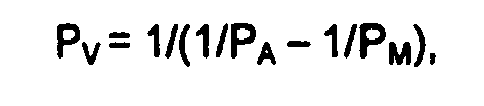
Aus der obigen Gleichung geht hervor, dass die Vemier-Periode PV umso kleiner ist, je stärker sich die Teilungsperioden PA und PM der Abtastteilung einerseits und der Messteilung andererseits unterscheiden.From the above equation, it is apparent that the more the division periods P A and P M of the scanning pitch on the one hand and the measurement pitch on the other hand, the smaller the Vemier period P V.
So ergibt sich beispielsweise bei einer Periode der Abtastteilung PA = 19,512 µm und einer Periode der Messteilung PM = 20 µm für die Vernier-Periode PV des erzeugten Streifenmusters ("Hell-Dunkel-Muste") PV = 800 µm. Diese Periode des Streifenmusters ist bei der Auslegung eines strukturierten Fotodetektors zu berücksichtigen, mit dem aus dem Streifenmuster elektrische Ausgangssignale erzeugt werden sollen, die einer Auswerteeinheit zuzuführen sind. Hierzu werden beispielsweise bei einem Fotodetektor, der aus einer Vielzahl hintereinander angeordneter Fotoelemente besteht, pro Periode des Streifenmusters vier Fotoelemente hintereinander angeordnet, wobei jedes Fotoelement eine Ausdehnung (entlang der Erstreckungsrichtung der strahlungsempfindlichen Oberfläche des Fotodetektors) von 200 µm aufweist und einer bestimmten Phase, z. B. 0°, 90°, 180° oder 270°, zugeordnet wird. Die Ausdehnung der aktiven Fläche des jeweiligen Fotoelementes ist dabei etwas kleiner als die genannten 200 µm, da zwischen den einzelnen Fotoelementen jeweils ein Rand zur Isolation vorgesehen sein muss,Thus, for example, for a period of the scanning pitch P A = 19.512 μm and a period of the measuring graduation P M = 20 μm for the vernier period P V of the generated fringe pattern ("light-dark pattern") P V = 800 μm. This period of the fringe pattern has to be taken into account in the design of a structured photodetector with which electrical output signals are to be generated from the fringe pattern which are to be supplied to an evaluation unit. For this purpose, for example, in a photodetector of a plurality of consecutive arranged photo elements consists, arranged per period of the stripe pattern four photo elements in succession, each photo element has an extent (along the direction of extension of the radiation-sensitive surface of the photodetector) of 200 microns and a certain phase, for. B. 0 °, 90 °, 180 ° or 270 °, is assigned. The extent of the active surface of the respective photoelement is slightly smaller than the mentioned 200 .mu.m, since in each case an edge for isolation must be provided between the individual photoelements,
In diesem Fall stimmt also die Vernier-Periode PV des durch Wechselwirkung des zur Abtastung verwendeten Lichtes einerseits mit der Abtastteilung und andererseits mit der Messteilung erzeugten Streifenmusters genau mit der Periode PD überein, auf die die strahlungsempfindliche Oberfläche des Detektors hin abgestimmt ist.In this case, therefore, the vernier period P V of the light generated by the interaction of the light used for scanning on the one hand with the scanning graduation and on the other hand with the measuring graduation exactly coincides with the period P D to which the radiation-sensitive surface of the detector is tuned.
Wird nun derselbe Detektortyp, also ein Fotodetektor mit einer zweidimensionalen ebenen Oberfläche, gebildet durch periodisch hintereinander angeordnete Fotoelemente als Bestandteil einer Abtasteinheit für ein ringartig angeordnetes Maßband verwendet, so führen die beiden oben beschriebenen Effekte, nämlich der sogenannte Dehnungseffekt einerseits und der Projektionseffekt andererseits, dazu dass die an der strahlungsempfindlichen Oberfläche des Fotodetektors wirksame effektive Vernier-Periode Peff ortsabhängig ist. Und zwar ist sie im mittleren Bereich der strahlungsempfindlichen Oberfläche wegen des Dehnungseffektes vom Betrag her kleiner als die Vernier-Periode PV im linearen Fall, nimmt jedoch zu den Rändern hin wegen des Projektionseffektes zu. Dies ist in
Betrachtet man die Phase des Streifenmusters, die im Falle eines linearen Maßbandes linear um 2*Pi innerhalb einer Detektorperiode zunimmt, sich also mit der Detektorphase deckt und damit einen optimalen Kontrast in den Detektorsignalen liefert, so eilt die Phase für ein gekrümmtes Maßband in der Mitte des Detektors zunächst etwas der Phase des Detektors voraus (da die effektive Vernier-Periode Peff hier kleiner ist als die Detektorperiode), während sie zum Rand des Detektors hin nacheilt (da die effektive Vernier-Periode Peff hier größer ist als die Detektorperiode). Durch diese Phasendifferenz wird der Kontrast in den Detektorsignalen verschlechtert. Die Phase des Streifenmusters lässt sich aus den lokalen Teilungsperioden der Abtastteilung und der Messteilung sowie den geometrischen Verhältnissen, wie der Krümmung der Messteilung und dem Abstand des Detektors von der Messteilung, bestimmen.Considering the phase of the fringe pattern, which increases linearly in the case of a linear tape measure by 2 * Pi within a detector period, thus coincides with the detector phase and thus provides an optimal contrast in the detector signals, the phase for a curved tape measures in the middle the detector first something of the phase of the detector ahead (because the effective Vernier period P eff here is smaller than the detector period) as it lags towards the edge of the detector (since the effective vernier period P eff here is greater than the detector period). This phase difference degrades the contrast in the detector signals. The phase of the fringe pattern can be determined from the local pitch periods of the scan pitch and the measurement pitch, as well as the geometric relationships, such as the curvature of the measurement pitch and the distance of the detector from the measurement pitch.
Die Zunahme der effektiven Vernier-Periode Peff zu den beiden Rändern der strahlungsempfindlichen Oberfläche des Fotodetektors hin ist eine Folge des Projektionseffektes, welcher zu den Rändern hin zu einer Reduzierung der Periode der Messteilung PM führt und damit zu einer Verringerung der Differenz 1/PA - 1/PM, welche wiederum entsprechend der obigen Gleichung zu einer Zunahme der Vernier-Periode führt.The increase of the effective vernier period P eff at the two edges of the radiation-sensitive surface of the photodetector is a consequence of the projection effect, which leads to the edges towards a reduction of the period of the measurement pitch P M and thus to a reduction of the
Da von den beiden oben angegebenen Effekten der Dehnungseffekt ortsunabhängig, der Projektionseffekt jedoch ortsabhängig ist, können sich diese beiden gegenläufigen Effekte nicht vollständig kompensieren. Es ist jedoch möglich, die Perioden PA und PM der Abtastteilung 25 einerseits und der Messteilung 15 andererseits so aufeinander abzustimmen, dass ein optimiertes Abtastsignal für eine nachfolgende Auswertung erhalten wird.Because of the two effects mentioned above the stretching effect is location-independent, but the projection effect is location-dependent, these two opposing effects can not be fully compensated. However, it is possible to match the periods P A and P M of the
Eine einfache analytische Berechnung eines Korrekturwertes für die Periode PM der Messteilung 15 oder die Periode PA der Abtastteilung 25 ist nicht möglich. Denn zum einen hängen der Dehnungseffekt einerseits und derProjektionseffekt andererseits in unterschiedlicher Weise von der Krümmung des Maßbandes 1, d. h. von dessen Radius R ab und zum anderen ist der Dehnungseffekt darüber hinaus noch stark von der Dicke d des Maßbandes 1 (vergleiche
Ein optimaler Korrekturwert für die Periode PM der Messteilung 15 lässt sich nun z. B. dadurch bestimmen, dass für verschiedene Perioden PM die Intensität des in den Detektorbereichen gleicher Phase ankommenden Lichtes aufsummiert wird. Mit der Kenntnis der Phasenlage des Streifenmusters relativ zur Detektorphase kann dies in einfacher Weise durch eine Vektoraddition erfolgen. Durch iteratives Verändern der Periode PM der Messteilung 15 kann so ein Maximum der Abtastsignale ermittelt werden.An optimal correction value for the period P M of the measuring
In den
Es ist anhand der
Ferner ist erkennbar, dass in beiden Fällen bei kleinen Trommelradien deutlich höhere Intensitäten des Detektorsignals erzielt werden können, wenn die Periode PM der Messteilung um 0.1 % (Kurve K2), um 0.2 % (Kurve K3) oder um 0.3 % (Kurve K4) gegenüber dem linearen Fall vergrößert wird. In Abhängigkeit von der Banddicke d gibt es für jeden Trommeldurchmesser Ri einen eindeutigen Wert, um den die Periode PM der Messteilung 15 korrigiert (vergrößert) werden muss, um eine möglichst große Intensität der Abtastsignale zu erhalten. Vergleicht man etwa in den
Selbstverständlich kann anstelle einer Korrektur der Periode PM der Messteilung 15, verglichen mit dem linearen Fall, auch eine Korrektur der Periode PA der Abtastteilung 25 erfolgen. Während im Fall einer Korrektur der Periode PM der Messteilung 15 die Korrektur durch Addition eines Korrekturwertes erfolgt; ist im Fall einer Korrektur der Periode PA des Abtastgitters die Periode PA etwas zu vermindern, entsprechend der Subtraktion eines Korrekturwertes. Denn, wie aus der obigen Gleichung für die Vernier-Periode Pv hervorgeht, kommt es für die Einstellung der Vemier-Periode und damit auch der effektiven Vernier-Periode Peff auf die Differenz zwischen den Kehrwerten von PA und PM an.Of course, instead of a correction of the period P M of the measuring
Konkret gilt, dass bei einem auf die Periode PD des Vernier-Streifenmusters abgestimmten Fotodetektor zur Korrektur der effektiven Vernier-Periode Peff bei ringartiger Anordnung des Maßbandes entweder die Periode PM der Messteilung zu korrigieren ist, so dass PM > 1/(1/PA - 1/PD), oder die Periode PA der Abtastteilung so zu korrigieren ist, dass PA < 1/(1/PD + 1/PM).Specifically, in the case of a photodetector tuned to the period P D of the Vernier fringe pattern for correcting the effective vernier period P eff in the case of a ring-like arrangement of the measuring tape, either the period P M of the measuring graduation is to be corrected, so that P M > 1 / ( 1 / P A -1 / P D ), or the period P A of the scanning pitch is to be corrected so that P A <1 / (1 / P D + 1 / P M ).
Claims (13)
- A position measuring device comprising- a measuring graduation provided on a measuring tape, which is arranged in a ring-like manner,- a sensing unit for optically sensing the measuring graduation by means of electromagnetic radiation,- a sensing plate comprising a periodic sensing graduation, which is arranged in the path of rays of the electromagnetic radiation used for sensing the measuring graduation, so that said sensing plate interacts with the sensing graduation as well as with the measuring graduation and- a detector of the sensing unit, the detector surface of which serves to detect the electromagnetic radiation after interaction with the sensing graduation and the measuring graduation and which detector is embodied for detecting electromagnetic radiation in the form of a stripe pattern comprising a period PD,
characterized in
that the period PM of the measuring graduation (15) and the period PA of the sensing graduation (25) are matched in such a manner that 1/(1PA - 1/PM) < PD, wherein either PM is 0.05% to 2% greater than 1/(1/PA - 1/P0) or PA is 0.05% to 2% smaller than 1/(1/P0 + 1/PM). - The position measuring device according to claim 1, characterized in that the period PM of the measuring graduation (15) is chosen such that PM > 1(1/PA - 1/PD), wherein the deviation of the period PM of the measuring graduation (15) from the term 1/(1/PA - 1/PD) lies between 0.1% and 1%.
- The position measuring device according to claim 1 or 2, characterized in that the period PA of the sensing graduation (25) is chosen such that PA < 1/(1/PD = 1/PM), wherein the deviation of the period PA of the sensing graduation (25) from the term 1/(1/PD + 1/PM) lies between 0.1% and 1%.
- The position measuring device according to one of the preceding claims, characterized in that the detector surface (31) of the detector (3) is formed by means of a periodic arrangement of detector areas, the period (PD) of which corresponds to that strip pattern, for the detection of which the detector (3) is embodied.
- The position measuring device according to claim 4, characterized in that the detector areas are formed by means of detector elements, in particular in the form of photovoltaic cells.
- The position measuring device according to claim 4 or 5, characterized in that four detector areas (0°, 90°, 180°, 270°) are in each case combined into a detector group and in that the detector groups are arranged behind one another periodically with a defined period (PD).
- The position measuring device according to claim 6, characterized in that the individual detector areas (0°, 90°, 180°, 270°) of a detector group are in each case assigned to one phase and in that detector areas, which are in phase, of different detector groups are electrically interconnected.
- The position measuring device according to one of the preceding claims, characterized in that the detector (3) encompasses a plane, substantially two-dimensional detector surface (31).
- The position measuring device according to one of the preceding claims, characterized in that the measuring graduation (15) and/or the sensing graduation (25) are formed by means of an amplitude grid.
- The position measuring device according to one of the preceding claims, characterized in that the scanning grid (25) is formed by means of a MAP grid.
- The position measuring device according to one of claims 1 to 8, characterized in that the sensing graduation (25) is formed by means of a phase grid.
- The position measuring device according to one of the preceding claims, characterized in that the measuring graduation (15) of the measuring tape (1) is sensed by means of electromagnetic radiation in the form of collimated light.
- The position measuring device according to one of the preceding claims, characterized in that the period PM of the measuring graduation (15) and the period PA of the sensing graduation (25) are matched such that the intensity of an output signal, which is generated by the detector (3), is maximized.
Applications Claiming Priority (4)
| Application Number | Priority Date | Filing Date | Title |
|---|---|---|---|
| DE10345018 | 2003-09-23 | ||
| DE10345018 | 2003-09-23 | ||
| DE10424581 | 2004-05-12 | ||
| DE102004024581A DE102004024581A1 (en) | 2003-09-23 | 2004-05-12 | Position measuring device |
Publications (3)
| Publication Number | Publication Date |
|---|---|
| EP1519158A2 EP1519158A2 (en) | 2005-03-30 |
| EP1519158A3 EP1519158A3 (en) | 2008-03-05 |
| EP1519158B1 true EP1519158B1 (en) | 2010-08-11 |
Family
ID=34314999
Family Applications (1)
| Application Number | Title | Priority Date | Filing Date |
|---|---|---|---|
| EP04014425A Expired - Lifetime EP1519158B1 (en) | 2003-09-23 | 2004-06-19 | Position measuring device |
Country Status (4)
| Country | Link |
|---|---|
| US (1) | US7271920B2 (en) |
| EP (1) | EP1519158B1 (en) |
| CN (1) | CN100401020C (en) |
| SG (1) | SG110220A1 (en) |
Families Citing this family (6)
| Publication number | Priority date | Publication date | Assignee | Title |
|---|---|---|---|---|
| DE102004035172A1 (en) * | 2004-07-16 | 2006-02-09 | Dr. Johannes Heidenhain Gmbh | Position measuring device |
| JP4724496B2 (en) * | 2005-08-29 | 2011-07-13 | キヤノン株式会社 | Optical encoder |
| DE102011075286A1 (en) * | 2011-05-05 | 2012-11-08 | Dr. Johannes Heidenhain Gmbh | Optical position measuring device |
| DE102011082663A1 (en) * | 2011-09-14 | 2013-03-14 | Dr. Johannes Heidenhain Gmbh | Scanning module of a position measuring system |
| CN102490165A (en) * | 2011-11-28 | 2012-06-13 | 苏州普思自动化科技有限公司 | Direct-drive circular arc movement platform structure |
| DE102012222077A1 (en) * | 2012-12-03 | 2014-06-05 | Dr. Johannes Heidenhain Gmbh | Position measuring device |
Family Cites Families (15)
| Publication number | Priority date | Publication date | Assignee | Title |
|---|---|---|---|---|
| US4912322A (en) | 1986-08-15 | 1990-03-27 | Mitutoyo Mfg. Co., Ltd. | Optical type displacement detecting device |
| DE3818218A1 (en) * | 1988-04-16 | 1989-10-26 | Heidenhain Gmbh Dr Johannes | LIGHT ELECTRIC ANGLE MEASURING DEVICE |
| DE4013566A1 (en) * | 1990-04-27 | 1991-11-07 | Heidenhain Gmbh Dr Johannes | Photoelectric angle-measuring device esp. for machine tool |
| JP3471971B2 (en) * | 1995-05-10 | 2003-12-02 | キヤノン株式会社 | Composite rotary encoder |
| DE19525874A1 (en) | 1995-07-15 | 1997-01-16 | Heidenhain Gmbh Dr Johannes | Position measuring device |
| GB9522491D0 (en) * | 1995-11-02 | 1996-01-03 | Renishaw Plc | Opto-electronic rotary encoder |
| JP3429007B2 (en) * | 1996-11-13 | 2003-07-22 | ドクトル・ヨハネス・ハイデンハイン・ゲゼルシャフト・ミット・ベシュレンクテル・ハフツング | Optical position measuring device |
| DE69904338T2 (en) * | 1998-08-21 | 2003-10-16 | Olivier M. Parriaux | DEVICE FOR MEASURING TRANSLATION, ROTATION OR SPEED BY INTERFERENCE OF LIGHT BEAMS |
| EP1028309B1 (en) | 1999-02-04 | 2003-04-16 | Dr. Johannes Heidenhain GmbH | Optical encoder |
| DE19918101A1 (en) * | 1999-04-22 | 2000-10-26 | Heidenhain Gmbh Dr Johannes | Optical position measurement device, has scanning unit with detector arrangement with blocks of detector elements in measurement direction with period derived from Vernier period |
| DE19941318A1 (en) | 1999-08-31 | 2001-03-15 | Heidenhain Gmbh Dr Johannes | Optical position measuring device |
| DE19962278A1 (en) * | 1999-12-23 | 2001-08-02 | Heidenhain Gmbh Dr Johannes | Position measuring device |
| US6713756B2 (en) * | 2000-05-09 | 2004-03-30 | Olympus Corporation | Optical encoder and optical rotary encoder |
| DE10347604A1 (en) * | 2003-10-14 | 2005-05-12 | Heidenhain Gmbh Dr Johannes | Optical position measuring device |
| DE102004035172A1 (en) * | 2004-07-16 | 2006-02-09 | Dr. Johannes Heidenhain Gmbh | Position measuring device |
-
2004
- 2004-06-19 EP EP04014425A patent/EP1519158B1/en not_active Expired - Lifetime
- 2004-09-02 SG SG200407930A patent/SG110220A1/en unknown
- 2004-09-21 US US10/946,872 patent/US7271920B2/en not_active Expired - Lifetime
- 2004-09-23 CN CNB2004100798516A patent/CN100401020C/en not_active Expired - Fee Related
Also Published As
| Publication number | Publication date |
|---|---|
| EP1519158A3 (en) | 2008-03-05 |
| SG110220A1 (en) | 2005-04-28 |
| EP1519158A2 (en) | 2005-03-30 |
| US7271920B2 (en) | 2007-09-18 |
| CN1601234A (en) | 2005-03-30 |
| US20050061961A1 (en) | 2005-03-24 |
| CN100401020C (en) | 2008-07-09 |
Similar Documents
| Publication | Publication Date | Title |
|---|---|---|
| DE2642170C2 (en) | spectrophotometer | |
| EP2388558B1 (en) | Optical positioning device | |
| DE3786318T2 (en) | ROTATING OPTICAL ENCODER. | |
| DE69120337T2 (en) | Highly sensitive zero marking for optical coding | |
| EP1519158B1 (en) | Position measuring device | |
| EP0669518A2 (en) | Device to generate position dependant signals | |
| EP1617182B1 (en) | Position measuring device | |
| EP1477774B1 (en) | Position measuring device | |
| EP0747674A2 (en) | Photo-electric position measuring device | |
| EP1467185A1 (en) | Lens assembly for an optical encoder | |
| DE19908328A1 (en) | Optical position measurement equipment has scanning unit and measurement scale having at least two measurement divisions | |
| DE69218376T2 (en) | Digital position detector with improved resolution | |
| EP2963391B1 (en) | Position measuring device | |
| DE102004024581A1 (en) | Position measuring device | |
| EP0767359B1 (en) | Photo-electrical length or angle measuring device | |
| DE102014215633A1 (en) | Position measuring device | |
| EP0385386B1 (en) | Method and device to measure a rotation angle | |
| DE102019211665B4 (en) | Method for determining a total spectrum of a sample and method for recording a total spectrum of a sample using a Fourier transform spectrometer | |
| EP2502087A1 (en) | Device and method for localizing modulated optical radiation sources | |
| DE102018127676B4 (en) | Photoelectric sensor | |
| EP2908099B1 (en) | Device for measuring the angle of rotation of two objects rotating relative to each other | |
| DE2223054C3 (en) | Measuring arrangement for force measurement | |
| DE202018106310U1 (en) | Optoelectronic sensor | |
| DE4303161C2 (en) | Photoelectric length or angle measuring system with a device for detecting guide errors | |
| DE3234948A1 (en) | METHOD AND DEVICE FOR CONTACTLESS MOTION MEASUREMENT |
Legal Events
| Date | Code | Title | Description |
|---|---|---|---|
| PUAI | Public reference made under article 153(3) epc to a published international application that has entered the european phase |
Free format text: ORIGINAL CODE: 0009012 |
|
| AK | Designated contracting states |
Kind code of ref document: A2 Designated state(s): AT BE BG CH CY CZ DE DK EE ES FI FR GB GR HU IE IT LI LU MC NL PL PT RO SE SI SK TR |
|
| AX | Request for extension of the european patent |
Extension state: AL HR LT LV MK |
|
| PUAL | Search report despatched |
Free format text: ORIGINAL CODE: 0009013 |
|
| AK | Designated contracting states |
Kind code of ref document: A3 Designated state(s): AT BE BG CH CY CZ DE DK EE ES FI FR GB GR HU IE IT LI LU MC NL PL PT RO SE SI SK TR |
|
| AX | Request for extension of the european patent |
Extension state: AL HR LT LV MK |
|
| RIC1 | Information provided on ipc code assigned before grant |
Ipc: G01D 5/26 20060101AFI20050118BHEP Ipc: G01D 5/38 20060101ALI20080131BHEP |
|
| 17P | Request for examination filed |
Effective date: 20080905 |
|
| AKX | Designation fees paid |
Designated state(s): AT BE BG CH CY CZ DE DK EE ES FI FR GB GR HU IE IT LI LU MC NL PL PT RO SE SI SK TR |
|
| 17Q | First examination report despatched |
Effective date: 20081028 |
|
| GRAP | Despatch of communication of intention to grant a patent |
Free format text: ORIGINAL CODE: EPIDOSNIGR1 |
|
| GRAS | Grant fee paid |
Free format text: ORIGINAL CODE: EPIDOSNIGR3 |
|
| GRAA | (expected) grant |
Free format text: ORIGINAL CODE: 0009210 |
|
| AK | Designated contracting states |
Kind code of ref document: B1 Designated state(s): AT BE BG CH CY CZ DE DK EE ES FI FR GB GR HU IE IT LI LU MC NL PL PT RO SE SI SK TR |
|
| REG | Reference to a national code |
Ref country code: GB Ref legal event code: FG4D Free format text: NOT ENGLISH |
|
| REG | Reference to a national code |
Ref country code: CH Ref legal event code: EP |
|
| REG | Reference to a national code |
Ref country code: IE Ref legal event code: FG4D Free format text: LANGUAGE OF EP DOCUMENT: GERMAN |
|
| REF | Corresponds to: |
Ref document number: 502004011504 Country of ref document: DE Date of ref document: 20100923 Kind code of ref document: P |
|
| REG | Reference to a national code |
Ref country code: NL Ref legal event code: VDEP Effective date: 20100811 |
|
| PG25 | Lapsed in a contracting state [announced via postgrant information from national office to epo] |
Ref country code: NL Free format text: LAPSE BECAUSE OF FAILURE TO SUBMIT A TRANSLATION OF THE DESCRIPTION OR TO PAY THE FEE WITHIN THE PRESCRIBED TIME-LIMIT Effective date: 20100811 Ref country code: FI Free format text: LAPSE BECAUSE OF FAILURE TO SUBMIT A TRANSLATION OF THE DESCRIPTION OR TO PAY THE FEE WITHIN THE PRESCRIBED TIME-LIMIT Effective date: 20100811 |
|
| PG25 | Lapsed in a contracting state [announced via postgrant information from national office to epo] |
Ref country code: PL Free format text: LAPSE BECAUSE OF FAILURE TO SUBMIT A TRANSLATION OF THE DESCRIPTION OR TO PAY THE FEE WITHIN THE PRESCRIBED TIME-LIMIT Effective date: 20100811 Ref country code: SI Free format text: LAPSE BECAUSE OF FAILURE TO SUBMIT A TRANSLATION OF THE DESCRIPTION OR TO PAY THE FEE WITHIN THE PRESCRIBED TIME-LIMIT Effective date: 20100811 Ref country code: PT Free format text: LAPSE BECAUSE OF FAILURE TO SUBMIT A TRANSLATION OF THE DESCRIPTION OR TO PAY THE FEE WITHIN THE PRESCRIBED TIME-LIMIT Effective date: 20101213 Ref country code: BG Free format text: LAPSE BECAUSE OF FAILURE TO SUBMIT A TRANSLATION OF THE DESCRIPTION OR TO PAY THE FEE WITHIN THE PRESCRIBED TIME-LIMIT Effective date: 20101111 Ref country code: CY Free format text: LAPSE BECAUSE OF FAILURE TO SUBMIT A TRANSLATION OF THE DESCRIPTION OR TO PAY THE FEE WITHIN THE PRESCRIBED TIME-LIMIT Effective date: 20100811 |
|
| REG | Reference to a national code |
Ref country code: IE Ref legal event code: FD4D |
|
| PG25 | Lapsed in a contracting state [announced via postgrant information from national office to epo] |
Ref country code: SE Free format text: LAPSE BECAUSE OF FAILURE TO SUBMIT A TRANSLATION OF THE DESCRIPTION OR TO PAY THE FEE WITHIN THE PRESCRIBED TIME-LIMIT Effective date: 20100811 Ref country code: GR Free format text: LAPSE BECAUSE OF FAILURE TO SUBMIT A TRANSLATION OF THE DESCRIPTION OR TO PAY THE FEE WITHIN THE PRESCRIBED TIME-LIMIT Effective date: 20101112 |
|
| PG25 | Lapsed in a contracting state [announced via postgrant information from national office to epo] |
Ref country code: IE Free format text: LAPSE BECAUSE OF FAILURE TO SUBMIT A TRANSLATION OF THE DESCRIPTION OR TO PAY THE FEE WITHIN THE PRESCRIBED TIME-LIMIT Effective date: 20100811 Ref country code: DK Free format text: LAPSE BECAUSE OF FAILURE TO SUBMIT A TRANSLATION OF THE DESCRIPTION OR TO PAY THE FEE WITHIN THE PRESCRIBED TIME-LIMIT Effective date: 20100811 |
|
| PG25 | Lapsed in a contracting state [announced via postgrant information from national office to epo] |
Ref country code: EE Free format text: LAPSE BECAUSE OF FAILURE TO SUBMIT A TRANSLATION OF THE DESCRIPTION OR TO PAY THE FEE WITHIN THE PRESCRIBED TIME-LIMIT Effective date: 20100811 Ref country code: RO Free format text: LAPSE BECAUSE OF FAILURE TO SUBMIT A TRANSLATION OF THE DESCRIPTION OR TO PAY THE FEE WITHIN THE PRESCRIBED TIME-LIMIT Effective date: 20100811 Ref country code: SK Free format text: LAPSE BECAUSE OF FAILURE TO SUBMIT A TRANSLATION OF THE DESCRIPTION OR TO PAY THE FEE WITHIN THE PRESCRIBED TIME-LIMIT Effective date: 20100811 Ref country code: CZ Free format text: LAPSE BECAUSE OF FAILURE TO SUBMIT A TRANSLATION OF THE DESCRIPTION OR TO PAY THE FEE WITHIN THE PRESCRIBED TIME-LIMIT Effective date: 20100811 |
|
| PLBE | No opposition filed within time limit |
Free format text: ORIGINAL CODE: 0009261 |
|
| STAA | Information on the status of an ep patent application or granted ep patent |
Free format text: STATUS: NO OPPOSITION FILED WITHIN TIME LIMIT |
|
| PG25 | Lapsed in a contracting state [announced via postgrant information from national office to epo] |
Ref country code: ES Free format text: LAPSE BECAUSE OF FAILURE TO SUBMIT A TRANSLATION OF THE DESCRIPTION OR TO PAY THE FEE WITHIN THE PRESCRIBED TIME-LIMIT Effective date: 20101122 |
|
| 26N | No opposition filed |
Effective date: 20110512 |
|
| REG | Reference to a national code |
Ref country code: DE Ref legal event code: R097 Ref document number: 502004011504 Country of ref document: DE Effective date: 20110512 |
|
| BERE | Be: lapsed |
Owner name: DR. JOHANNES HEIDENHAIN G.M.B.H. Effective date: 20110630 |
|
| REG | Reference to a national code |
Ref country code: CH Ref legal event code: PL |
|
| PG25 | Lapsed in a contracting state [announced via postgrant information from national office to epo] |
Ref country code: BE Free format text: LAPSE BECAUSE OF NON-PAYMENT OF DUE FEES Effective date: 20110630 |
|
| PG25 | Lapsed in a contracting state [announced via postgrant information from national office to epo] |
Ref country code: CH Free format text: LAPSE BECAUSE OF NON-PAYMENT OF DUE FEES Effective date: 20110630 Ref country code: LI Free format text: LAPSE BECAUSE OF NON-PAYMENT OF DUE FEES Effective date: 20110630 |
|
| REG | Reference to a national code |
Ref country code: AT Ref legal event code: MM01 Ref document number: 477475 Country of ref document: AT Kind code of ref document: T Effective date: 20110619 |
|
| PG25 | Lapsed in a contracting state [announced via postgrant information from national office to epo] |
Ref country code: AT Free format text: LAPSE BECAUSE OF NON-PAYMENT OF DUE FEES Effective date: 20110619 |
|
| PG25 | Lapsed in a contracting state [announced via postgrant information from national office to epo] |
Ref country code: MC Free format text: LAPSE BECAUSE OF NON-PAYMENT OF DUE FEES Effective date: 20110630 |
|
| PG25 | Lapsed in a contracting state [announced via postgrant information from national office to epo] |
Ref country code: LU Free format text: LAPSE BECAUSE OF NON-PAYMENT OF DUE FEES Effective date: 20110619 |
|
| PG25 | Lapsed in a contracting state [announced via postgrant information from national office to epo] |
Ref country code: TR Free format text: LAPSE BECAUSE OF FAILURE TO SUBMIT A TRANSLATION OF THE DESCRIPTION OR TO PAY THE FEE WITHIN THE PRESCRIBED TIME-LIMIT Effective date: 20100811 |
|
| PG25 | Lapsed in a contracting state [announced via postgrant information from national office to epo] |
Ref country code: HU Free format text: LAPSE BECAUSE OF FAILURE TO SUBMIT A TRANSLATION OF THE DESCRIPTION OR TO PAY THE FEE WITHIN THE PRESCRIBED TIME-LIMIT Effective date: 20100811 |
|
| REG | Reference to a national code |
Ref country code: FR Ref legal event code: PLFP Year of fee payment: 13 |
|
| REG | Reference to a national code |
Ref country code: FR Ref legal event code: PLFP Year of fee payment: 14 |
|
| REG | Reference to a national code |
Ref country code: FR Ref legal event code: PLFP Year of fee payment: 15 |
|
| PGFP | Annual fee paid to national office [announced via postgrant information from national office to epo] |
Ref country code: PT Payment date: 20190502 Year of fee payment: 9 |
|
| PGFP | Annual fee paid to national office [announced via postgrant information from national office to epo] |
Ref country code: FR Payment date: 20190619 Year of fee payment: 16 |
|
| PGFP | Annual fee paid to national office [announced via postgrant information from national office to epo] |
Ref country code: GB Payment date: 20190619 Year of fee payment: 16 |
|
| GBPC | Gb: european patent ceased through non-payment of renewal fee |
Effective date: 20200619 |
|
| PG25 | Lapsed in a contracting state [announced via postgrant information from national office to epo] |
Ref country code: FR Free format text: LAPSE BECAUSE OF NON-PAYMENT OF DUE FEES Effective date: 20200630 Ref country code: GB Free format text: LAPSE BECAUSE OF NON-PAYMENT OF DUE FEES Effective date: 20200619 |
|
| PG25 | Lapsed in a contracting state [announced via postgrant information from national office to epo] |
Ref country code: IT Free format text: LAPSE BECAUSE OF NON-PAYMENT OF DUE FEES Effective date: 20200619 |
|
| PGFP | Annual fee paid to national office [announced via postgrant information from national office to epo] |
Ref country code: DE Payment date: 20220620 Year of fee payment: 19 |
|
| REG | Reference to a national code |
Ref country code: DE Ref legal event code: R119 Ref document number: 502004011504 Country of ref document: DE |
|
| PG25 | Lapsed in a contracting state [announced via postgrant information from national office to epo] |
Ref country code: DE Free format text: LAPSE BECAUSE OF NON-PAYMENT OF DUE FEES Effective date: 20240103 |