EP1518838A1 - Glass article - Google Patents
Glass article Download PDFInfo
- Publication number
- EP1518838A1 EP1518838A1 EP04022840A EP04022840A EP1518838A1 EP 1518838 A1 EP1518838 A1 EP 1518838A1 EP 04022840 A EP04022840 A EP 04022840A EP 04022840 A EP04022840 A EP 04022840A EP 1518838 A1 EP1518838 A1 EP 1518838A1
- Authority
- EP
- European Patent Office
- Prior art keywords
- glass article
- visible light
- film
- glass
- heat
- Prior art date
- Legal status (The legal status is an assumption and is not a legal conclusion. Google has not performed a legal analysis and makes no representation as to the accuracy of the status listed.)
- Granted
Links
- 239000011521 glass Substances 0.000 title claims abstract description 146
- 238000002834 transmittance Methods 0.000 claims abstract description 17
- 239000010410 layer Substances 0.000 claims description 44
- 230000001681 protective effect Effects 0.000 claims description 35
- VYPSYNLAJGMNEJ-UHFFFAOYSA-N Silicium dioxide Chemical compound O=[Si]=O VYPSYNLAJGMNEJ-UHFFFAOYSA-N 0.000 claims description 25
- 229910052751 metal Inorganic materials 0.000 claims description 23
- 239000002184 metal Substances 0.000 claims description 23
- 229910045601 alloy Inorganic materials 0.000 claims description 18
- 239000000956 alloy Substances 0.000 claims description 18
- 150000004767 nitrides Chemical class 0.000 claims description 15
- 229910010038 TiAl Inorganic materials 0.000 claims description 14
- 229910052719 titanium Inorganic materials 0.000 claims description 14
- 229910052804 chromium Inorganic materials 0.000 claims description 13
- 229910052759 nickel Inorganic materials 0.000 claims description 13
- 229910052758 niobium Inorganic materials 0.000 claims description 13
- 229910052709 silver Inorganic materials 0.000 claims description 13
- GWEVSGVZZGPLCZ-UHFFFAOYSA-N Titan oxide Chemical compound O=[Ti]=O GWEVSGVZZGPLCZ-UHFFFAOYSA-N 0.000 claims description 12
- VNNRSPGTAMTISX-UHFFFAOYSA-N chromium nickel Chemical compound [Cr].[Ni] VNNRSPGTAMTISX-UHFFFAOYSA-N 0.000 claims description 12
- 229910052681 coesite Inorganic materials 0.000 claims description 12
- 229910052906 cristobalite Inorganic materials 0.000 claims description 12
- 229910052735 hafnium Inorganic materials 0.000 claims description 12
- 229910000856 hastalloy Inorganic materials 0.000 claims description 12
- 229910001120 nichrome Inorganic materials 0.000 claims description 12
- 239000000377 silicon dioxide Substances 0.000 claims description 12
- 229910052682 stishovite Inorganic materials 0.000 claims description 12
- 229910052905 tridymite Inorganic materials 0.000 claims description 12
- 229910052726 zirconium Inorganic materials 0.000 claims description 12
- XLOMVQKBTHCTTD-UHFFFAOYSA-N Zinc monoxide Chemical compound [Zn]=O XLOMVQKBTHCTTD-UHFFFAOYSA-N 0.000 claims description 8
- XOLBLPGZBRYERU-UHFFFAOYSA-N tin dioxide Chemical compound O=[Sn]=O XOLBLPGZBRYERU-UHFFFAOYSA-N 0.000 claims description 8
- 229910001887 tin oxide Inorganic materials 0.000 claims description 8
- 229910052581 Si3N4 Inorganic materials 0.000 claims description 6
- 229910052737 gold Inorganic materials 0.000 claims description 6
- 229910052697 platinum Inorganic materials 0.000 claims description 6
- 229910017083 AlN Inorganic materials 0.000 claims description 5
- 239000012790 adhesive layer Substances 0.000 claims description 5
- 239000005368 silicate glass Substances 0.000 claims description 5
- 239000002313 adhesive film Substances 0.000 claims description 4
- 239000005388 borosilicate glass Substances 0.000 claims description 4
- 229910003437 indium oxide Inorganic materials 0.000 claims description 4
- PJXISJQVUVHSOJ-UHFFFAOYSA-N indium(iii) oxide Chemical compound [O-2].[O-2].[O-2].[In+3].[In+3] PJXISJQVUVHSOJ-UHFFFAOYSA-N 0.000 claims description 4
- 239000011787 zinc oxide Substances 0.000 claims description 4
- 239000010936 titanium Substances 0.000 description 13
- 238000009413 insulation Methods 0.000 description 12
- 230000000052 comparative effect Effects 0.000 description 11
- 230000001012 protector Effects 0.000 description 10
- 238000007499 fusion processing Methods 0.000 description 6
- 230000005855 radiation Effects 0.000 description 6
- 230000002349 favourable effect Effects 0.000 description 5
- 239000013078 crystal Substances 0.000 description 3
- 238000004544 sputter deposition Methods 0.000 description 3
- 229910000500 β-quartz Inorganic materials 0.000 description 3
- 238000005299 abrasion Methods 0.000 description 2
- 230000005540 biological transmission Effects 0.000 description 2
- 230000015572 biosynthetic process Effects 0.000 description 2
- 230000006866 deterioration Effects 0.000 description 2
- 230000035939 shock Effects 0.000 description 2
- OGIDPMRJRNCKJF-UHFFFAOYSA-N titanium oxide Inorganic materials [Ti]=O OGIDPMRJRNCKJF-UHFFFAOYSA-N 0.000 description 2
- ATJFFYVFTNAWJD-UHFFFAOYSA-N Tin Chemical compound [Sn] ATJFFYVFTNAWJD-UHFFFAOYSA-N 0.000 description 1
- PNEYBMLMFCGWSK-UHFFFAOYSA-N aluminium oxide Inorganic materials [O-2].[O-2].[O-2].[Al+3].[Al+3] PNEYBMLMFCGWSK-UHFFFAOYSA-N 0.000 description 1
- 239000000378 calcium silicate Substances 0.000 description 1
- 229910052918 calcium silicate Inorganic materials 0.000 description 1
- OYACROKNLOSFPA-UHFFFAOYSA-N calcium;dioxido(oxo)silane Chemical compound [Ca+2].[O-][Si]([O-])=O OYACROKNLOSFPA-UHFFFAOYSA-N 0.000 description 1
- 238000006243 chemical reaction Methods 0.000 description 1
- 239000000567 combustion gas Substances 0.000 description 1
- 238000001816 cooling Methods 0.000 description 1
- 230000032798 delamination Effects 0.000 description 1
- 230000000694 effects Effects 0.000 description 1
- 239000007789 gas Substances 0.000 description 1
- 238000007733 ion plating Methods 0.000 description 1
- 239000000463 material Substances 0.000 description 1
- 238000000034 method Methods 0.000 description 1
- 238000012986 modification Methods 0.000 description 1
- 230000004048 modification Effects 0.000 description 1
- 230000003647 oxidation Effects 0.000 description 1
- 238000007254 oxidation reaction Methods 0.000 description 1
- RVTZCBVAJQQJTK-UHFFFAOYSA-N oxygen(2-);zirconium(4+) Chemical compound [O-2].[O-2].[Zr+4] RVTZCBVAJQQJTK-UHFFFAOYSA-N 0.000 description 1
- 230000002265 prevention Effects 0.000 description 1
- 235000019633 pungent taste Nutrition 0.000 description 1
- 239000000126 substance Substances 0.000 description 1
- 238000007740 vapor deposition Methods 0.000 description 1
- 229910001928 zirconium oxide Inorganic materials 0.000 description 1
Classifications
-
- C—CHEMISTRY; METALLURGY
- C03—GLASS; MINERAL OR SLAG WOOL
- C03C—CHEMICAL COMPOSITION OF GLASSES, GLAZES OR VITREOUS ENAMELS; SURFACE TREATMENT OF GLASS; SURFACE TREATMENT OF FIBRES OR FILAMENTS MADE FROM GLASS, MINERALS OR SLAGS; JOINING GLASS TO GLASS OR OTHER MATERIALS
- C03C17/00—Surface treatment of glass, not in the form of fibres or filaments, by coating
- C03C17/34—Surface treatment of glass, not in the form of fibres or filaments, by coating with at least two coatings having different compositions
- C03C17/36—Surface treatment of glass, not in the form of fibres or filaments, by coating with at least two coatings having different compositions at least one coating being a metal
- C03C17/3602—Surface treatment of glass, not in the form of fibres or filaments, by coating with at least two coatings having different compositions at least one coating being a metal the metal being present as a layer
- C03C17/3626—Surface treatment of glass, not in the form of fibres or filaments, by coating with at least two coatings having different compositions at least one coating being a metal the metal being present as a layer one layer at least containing a nitride, oxynitride, boronitride or carbonitride
-
- C—CHEMISTRY; METALLURGY
- C03—GLASS; MINERAL OR SLAG WOOL
- C03C—CHEMICAL COMPOSITION OF GLASSES, GLAZES OR VITREOUS ENAMELS; SURFACE TREATMENT OF GLASS; SURFACE TREATMENT OF FIBRES OR FILAMENTS MADE FROM GLASS, MINERALS OR SLAGS; JOINING GLASS TO GLASS OR OTHER MATERIALS
- C03C10/00—Devitrified glass ceramics, i.e. glass ceramics having a crystalline phase dispersed in a glassy phase and constituting at least 50% by weight of the total composition
- C03C10/0018—Devitrified glass ceramics, i.e. glass ceramics having a crystalline phase dispersed in a glassy phase and constituting at least 50% by weight of the total composition containing SiO2, Al2O3 and monovalent metal oxide as main constituents
- C03C10/0027—Devitrified glass ceramics, i.e. glass ceramics having a crystalline phase dispersed in a glassy phase and constituting at least 50% by weight of the total composition containing SiO2, Al2O3 and monovalent metal oxide as main constituents containing SiO2, Al2O3, Li2O as main constituents
-
- C—CHEMISTRY; METALLURGY
- C03—GLASS; MINERAL OR SLAG WOOL
- C03C—CHEMICAL COMPOSITION OF GLASSES, GLAZES OR VITREOUS ENAMELS; SURFACE TREATMENT OF GLASS; SURFACE TREATMENT OF FIBRES OR FILAMENTS MADE FROM GLASS, MINERALS OR SLAGS; JOINING GLASS TO GLASS OR OTHER MATERIALS
- C03C17/00—Surface treatment of glass, not in the form of fibres or filaments, by coating
- C03C17/06—Surface treatment of glass, not in the form of fibres or filaments, by coating with metals
-
- C—CHEMISTRY; METALLURGY
- C03—GLASS; MINERAL OR SLAG WOOL
- C03C—CHEMICAL COMPOSITION OF GLASSES, GLAZES OR VITREOUS ENAMELS; SURFACE TREATMENT OF GLASS; SURFACE TREATMENT OF FIBRES OR FILAMENTS MADE FROM GLASS, MINERALS OR SLAGS; JOINING GLASS TO GLASS OR OTHER MATERIALS
- C03C17/00—Surface treatment of glass, not in the form of fibres or filaments, by coating
- C03C17/22—Surface treatment of glass, not in the form of fibres or filaments, by coating with other inorganic material
- C03C17/225—Nitrides
-
- C—CHEMISTRY; METALLURGY
- C03—GLASS; MINERAL OR SLAG WOOL
- C03C—CHEMICAL COMPOSITION OF GLASSES, GLAZES OR VITREOUS ENAMELS; SURFACE TREATMENT OF GLASS; SURFACE TREATMENT OF FIBRES OR FILAMENTS MADE FROM GLASS, MINERALS OR SLAGS; JOINING GLASS TO GLASS OR OTHER MATERIALS
- C03C17/00—Surface treatment of glass, not in the form of fibres or filaments, by coating
- C03C17/34—Surface treatment of glass, not in the form of fibres or filaments, by coating with at least two coatings having different compositions
- C03C17/3411—Surface treatment of glass, not in the form of fibres or filaments, by coating with at least two coatings having different compositions with at least two coatings of inorganic materials
- C03C17/3429—Surface treatment of glass, not in the form of fibres or filaments, by coating with at least two coatings having different compositions with at least two coatings of inorganic materials at least one of the coatings being a non-oxide coating
- C03C17/3435—Surface treatment of glass, not in the form of fibres or filaments, by coating with at least two coatings having different compositions with at least two coatings of inorganic materials at least one of the coatings being a non-oxide coating comprising a nitride, oxynitride, boronitride or carbonitride
-
- C—CHEMISTRY; METALLURGY
- C03—GLASS; MINERAL OR SLAG WOOL
- C03C—CHEMICAL COMPOSITION OF GLASSES, GLAZES OR VITREOUS ENAMELS; SURFACE TREATMENT OF GLASS; SURFACE TREATMENT OF FIBRES OR FILAMENTS MADE FROM GLASS, MINERALS OR SLAGS; JOINING GLASS TO GLASS OR OTHER MATERIALS
- C03C17/00—Surface treatment of glass, not in the form of fibres or filaments, by coating
- C03C17/34—Surface treatment of glass, not in the form of fibres or filaments, by coating with at least two coatings having different compositions
- C03C17/36—Surface treatment of glass, not in the form of fibres or filaments, by coating with at least two coatings having different compositions at least one coating being a metal
-
- C—CHEMISTRY; METALLURGY
- C03—GLASS; MINERAL OR SLAG WOOL
- C03C—CHEMICAL COMPOSITION OF GLASSES, GLAZES OR VITREOUS ENAMELS; SURFACE TREATMENT OF GLASS; SURFACE TREATMENT OF FIBRES OR FILAMENTS MADE FROM GLASS, MINERALS OR SLAGS; JOINING GLASS TO GLASS OR OTHER MATERIALS
- C03C17/00—Surface treatment of glass, not in the form of fibres or filaments, by coating
- C03C17/34—Surface treatment of glass, not in the form of fibres or filaments, by coating with at least two coatings having different compositions
- C03C17/36—Surface treatment of glass, not in the form of fibres or filaments, by coating with at least two coatings having different compositions at least one coating being a metal
- C03C17/3602—Surface treatment of glass, not in the form of fibres or filaments, by coating with at least two coatings having different compositions at least one coating being a metal the metal being present as a layer
- C03C17/3644—Surface treatment of glass, not in the form of fibres or filaments, by coating with at least two coatings having different compositions at least one coating being a metal the metal being present as a layer the metal being silver
-
- C—CHEMISTRY; METALLURGY
- C03—GLASS; MINERAL OR SLAG WOOL
- C03C—CHEMICAL COMPOSITION OF GLASSES, GLAZES OR VITREOUS ENAMELS; SURFACE TREATMENT OF GLASS; SURFACE TREATMENT OF FIBRES OR FILAMENTS MADE FROM GLASS, MINERALS OR SLAGS; JOINING GLASS TO GLASS OR OTHER MATERIALS
- C03C17/00—Surface treatment of glass, not in the form of fibres or filaments, by coating
- C03C17/34—Surface treatment of glass, not in the form of fibres or filaments, by coating with at least two coatings having different compositions
- C03C17/36—Surface treatment of glass, not in the form of fibres or filaments, by coating with at least two coatings having different compositions at least one coating being a metal
- C03C17/3602—Surface treatment of glass, not in the form of fibres or filaments, by coating with at least two coatings having different compositions at least one coating being a metal the metal being present as a layer
- C03C17/3649—Surface treatment of glass, not in the form of fibres or filaments, by coating with at least two coatings having different compositions at least one coating being a metal the metal being present as a layer made of metals other than silver
-
- C—CHEMISTRY; METALLURGY
- C03—GLASS; MINERAL OR SLAG WOOL
- C03C—CHEMICAL COMPOSITION OF GLASSES, GLAZES OR VITREOUS ENAMELS; SURFACE TREATMENT OF GLASS; SURFACE TREATMENT OF FIBRES OR FILAMENTS MADE FROM GLASS, MINERALS OR SLAGS; JOINING GLASS TO GLASS OR OTHER MATERIALS
- C03C17/00—Surface treatment of glass, not in the form of fibres or filaments, by coating
- C03C17/34—Surface treatment of glass, not in the form of fibres or filaments, by coating with at least two coatings having different compositions
- C03C17/36—Surface treatment of glass, not in the form of fibres or filaments, by coating with at least two coatings having different compositions at least one coating being a metal
- C03C17/3602—Surface treatment of glass, not in the form of fibres or filaments, by coating with at least two coatings having different compositions at least one coating being a metal the metal being present as a layer
- C03C17/3657—Surface treatment of glass, not in the form of fibres or filaments, by coating with at least two coatings having different compositions at least one coating being a metal the metal being present as a layer the multilayer coating having optical properties
-
- C—CHEMISTRY; METALLURGY
- C03—GLASS; MINERAL OR SLAG WOOL
- C03C—CHEMICAL COMPOSITION OF GLASSES, GLAZES OR VITREOUS ENAMELS; SURFACE TREATMENT OF GLASS; SURFACE TREATMENT OF FIBRES OR FILAMENTS MADE FROM GLASS, MINERALS OR SLAGS; JOINING GLASS TO GLASS OR OTHER MATERIALS
- C03C17/00—Surface treatment of glass, not in the form of fibres or filaments, by coating
- C03C17/34—Surface treatment of glass, not in the form of fibres or filaments, by coating with at least two coatings having different compositions
- C03C17/36—Surface treatment of glass, not in the form of fibres or filaments, by coating with at least two coatings having different compositions at least one coating being a metal
- C03C17/3602—Surface treatment of glass, not in the form of fibres or filaments, by coating with at least two coatings having different compositions at least one coating being a metal the metal being present as a layer
- C03C17/3686—Surface treatment of glass, not in the form of fibres or filaments, by coating with at least two coatings having different compositions at least one coating being a metal the metal being present as a layer the multilayer coating being used for ovens
-
- C—CHEMISTRY; METALLURGY
- C03—GLASS; MINERAL OR SLAG WOOL
- C03C—CHEMICAL COMPOSITION OF GLASSES, GLAZES OR VITREOUS ENAMELS; SURFACE TREATMENT OF GLASS; SURFACE TREATMENT OF FIBRES OR FILAMENTS MADE FROM GLASS, MINERALS OR SLAGS; JOINING GLASS TO GLASS OR OTHER MATERIALS
- C03C2217/00—Coatings on glass
- C03C2217/20—Materials for coating a single layer on glass
- C03C2217/25—Metals
- C03C2217/251—Al, Cu, Mg or noble metals
- C03C2217/254—Noble metals
-
- C—CHEMISTRY; METALLURGY
- C03—GLASS; MINERAL OR SLAG WOOL
- C03C—CHEMICAL COMPOSITION OF GLASSES, GLAZES OR VITREOUS ENAMELS; SURFACE TREATMENT OF GLASS; SURFACE TREATMENT OF FIBRES OR FILAMENTS MADE FROM GLASS, MINERALS OR SLAGS; JOINING GLASS TO GLASS OR OTHER MATERIALS
- C03C2217/00—Coatings on glass
- C03C2217/20—Materials for coating a single layer on glass
- C03C2217/25—Metals
- C03C2217/251—Al, Cu, Mg or noble metals
- C03C2217/254—Noble metals
- C03C2217/255—Au
-
- C—CHEMISTRY; METALLURGY
- C03—GLASS; MINERAL OR SLAG WOOL
- C03C—CHEMICAL COMPOSITION OF GLASSES, GLAZES OR VITREOUS ENAMELS; SURFACE TREATMENT OF GLASS; SURFACE TREATMENT OF FIBRES OR FILAMENTS MADE FROM GLASS, MINERALS OR SLAGS; JOINING GLASS TO GLASS OR OTHER MATERIALS
- C03C2217/00—Coatings on glass
- C03C2217/20—Materials for coating a single layer on glass
- C03C2217/25—Metals
- C03C2217/251—Al, Cu, Mg or noble metals
- C03C2217/254—Noble metals
- C03C2217/256—Ag
-
- C—CHEMISTRY; METALLURGY
- C03—GLASS; MINERAL OR SLAG WOOL
- C03C—CHEMICAL COMPOSITION OF GLASSES, GLAZES OR VITREOUS ENAMELS; SURFACE TREATMENT OF GLASS; SURFACE TREATMENT OF FIBRES OR FILAMENTS MADE FROM GLASS, MINERALS OR SLAGS; JOINING GLASS TO GLASS OR OTHER MATERIALS
- C03C2217/00—Coatings on glass
- C03C2217/20—Materials for coating a single layer on glass
- C03C2217/25—Metals
- C03C2217/257—Refractory metals
- C03C2217/258—Ti, Zr, Hf
-
- C—CHEMISTRY; METALLURGY
- C03—GLASS; MINERAL OR SLAG WOOL
- C03C—CHEMICAL COMPOSITION OF GLASSES, GLAZES OR VITREOUS ENAMELS; SURFACE TREATMENT OF GLASS; SURFACE TREATMENT OF FIBRES OR FILAMENTS MADE FROM GLASS, MINERALS OR SLAGS; JOINING GLASS TO GLASS OR OTHER MATERIALS
- C03C2217/00—Coatings on glass
- C03C2217/20—Materials for coating a single layer on glass
- C03C2217/25—Metals
- C03C2217/257—Refractory metals
- C03C2217/259—V, Nb, Ta
-
- C—CHEMISTRY; METALLURGY
- C03—GLASS; MINERAL OR SLAG WOOL
- C03C—CHEMICAL COMPOSITION OF GLASSES, GLAZES OR VITREOUS ENAMELS; SURFACE TREATMENT OF GLASS; SURFACE TREATMENT OF FIBRES OR FILAMENTS MADE FROM GLASS, MINERALS OR SLAGS; JOINING GLASS TO GLASS OR OTHER MATERIALS
- C03C2217/00—Coatings on glass
- C03C2217/20—Materials for coating a single layer on glass
- C03C2217/25—Metals
- C03C2217/257—Refractory metals
- C03C2217/26—Cr, Mo, W
-
- C—CHEMISTRY; METALLURGY
- C03—GLASS; MINERAL OR SLAG WOOL
- C03C—CHEMICAL COMPOSITION OF GLASSES, GLAZES OR VITREOUS ENAMELS; SURFACE TREATMENT OF GLASS; SURFACE TREATMENT OF FIBRES OR FILAMENTS MADE FROM GLASS, MINERALS OR SLAGS; JOINING GLASS TO GLASS OR OTHER MATERIALS
- C03C2217/00—Coatings on glass
- C03C2217/20—Materials for coating a single layer on glass
- C03C2217/25—Metals
- C03C2217/261—Iron-group metals, i.e. Fe, Co or Ni
-
- C—CHEMISTRY; METALLURGY
- C03—GLASS; MINERAL OR SLAG WOOL
- C03C—CHEMICAL COMPOSITION OF GLASSES, GLAZES OR VITREOUS ENAMELS; SURFACE TREATMENT OF GLASS; SURFACE TREATMENT OF FIBRES OR FILAMENTS MADE FROM GLASS, MINERALS OR SLAGS; JOINING GLASS TO GLASS OR OTHER MATERIALS
- C03C2217/00—Coatings on glass
- C03C2217/20—Materials for coating a single layer on glass
- C03C2217/25—Metals
- C03C2217/268—Other specific metals
-
- C—CHEMISTRY; METALLURGY
- C03—GLASS; MINERAL OR SLAG WOOL
- C03C—CHEMICAL COMPOSITION OF GLASSES, GLAZES OR VITREOUS ENAMELS; SURFACE TREATMENT OF GLASS; SURFACE TREATMENT OF FIBRES OR FILAMENTS MADE FROM GLASS, MINERALS OR SLAGS; JOINING GLASS TO GLASS OR OTHER MATERIALS
- C03C2217/00—Coatings on glass
- C03C2217/20—Materials for coating a single layer on glass
- C03C2217/25—Metals
- C03C2217/27—Mixtures of metals, alloys
-
- C—CHEMISTRY; METALLURGY
- C03—GLASS; MINERAL OR SLAG WOOL
- C03C—CHEMICAL COMPOSITION OF GLASSES, GLAZES OR VITREOUS ENAMELS; SURFACE TREATMENT OF GLASS; SURFACE TREATMENT OF FIBRES OR FILAMENTS MADE FROM GLASS, MINERALS OR SLAGS; JOINING GLASS TO GLASS OR OTHER MATERIALS
- C03C2217/00—Coatings on glass
- C03C2217/20—Materials for coating a single layer on glass
- C03C2217/28—Other inorganic materials
- C03C2217/281—Nitrides
-
- C—CHEMISTRY; METALLURGY
- C03—GLASS; MINERAL OR SLAG WOOL
- C03C—CHEMICAL COMPOSITION OF GLASSES, GLAZES OR VITREOUS ENAMELS; SURFACE TREATMENT OF GLASS; SURFACE TREATMENT OF FIBRES OR FILAMENTS MADE FROM GLASS, MINERALS OR SLAGS; JOINING GLASS TO GLASS OR OTHER MATERIALS
- C03C2218/00—Methods for coating glass
- C03C2218/30—Aspects of methods for coating glass not covered above
- C03C2218/365—Coating different sides of a glass substrate
Definitions
- the present invention relates to a glass article to be used for observation windows of high-temperature furnaces such as garbage incinerators, cremation furnaces, metal fusing furnaces, glass fusing furnaces and heat-treating furnaces, through which the inside condition of the furnaces is observed.
- high-temperature furnaces such as garbage incinerators, cremation furnaces, metal fusing furnaces, glass fusing furnaces and heat-treating furnaces, through which the inside condition of the furnaces is observed.
- observation windows are installed in high-temperature instruments such as stoves, so as to observe the inside condition of the instruments through them.
- transparent heat-resistant glass that is hardly broken by thermal shock even when exposed to high temperatures is used, for example, low-expansion crystallized glass (e.g., see Patent Documents 1 and 2), high silicate glass, borosilicate glass, quartz glass, etc.
- Patent Document 1 JP-A 4-214046
- Patent Document 2 JP-A 2000-247681
- protectors such as light-shielding glasses or light-shielding plates are used when the inside condition of the furnaces is observed through the observation windows, then they may be effective for dazzling prevention but are not effective for heat insulation. In addition, using the light-shielding plates worsens the operators' working efficiency. These are still other problems with the observation windows of the type.
- An object of the invention is to provide a glass article that exhibits excellent anti-dazzling and heat-insulating effects when used for observation windows of high-temperature furnaces such as glass fusing furnaces, and therefore enables long-time observation of the inside of furnaces through the observation windows without protectors, and does not detract from the thermal efficiency of the furnaces.
- the present inventors have found that, when a visible light-shielding layer having the ability to block out light and the ability to reflect heat rays is formed on the surface of transparent heat-resistant glass, and when the coated glass is used for observation windows of furnaces, then it prevents the transmission of visible light and heat rays through the observation windows and retards radiation heat through them. Therefore, the observation windows prevent from dazzle and hotness, and enable long-time observation of the inside of furnaces through them without protectors, and do not detract from the heat efficiency of furnaces.
- we have proposed the present invention On the basis of these findings, we have proposed the present invention.
- the invention has the following constitution.
- the glass article of the invention has a visible light-shielding layer formed on the surface of a transparent heat-resistant glass sheet, and an average visible light transmittance of the glass article at a wavelength of 380 - 780 nm is 0.03 - 15 % (this corresponds to a scale number of 3 - 9 in JIS T-8141). Accordingly, when the glass article is used for observation windows of high-temperature furnaces, then operators can sufficiently observe the inside of the furnaces through them, not being dazzled even though they do not use protectors.
- the inside of furnaces could not be sufficiently observed because the glass article couldnot transmit enough visible light through it; but if larger than 15 %, then the glass article may transmit too much visible light through it. Therefore, operators feel dazzling, and, if so, it will be impossible to observe the inside of the furnaces without use of protectors.
- the average visible light transmittance of the glass article at a wavelength of 380 - 780 nm is 0.05 - 10 %, more preferably 0.1 - 8 %.
- the average infrared (hereinafter, simply referred to as "IR") reflectance of the glass article at a wavelength of 1000 - 2500 nm is at least 50 %. Therefore, even when the inside of the furnaces is observed for a long period of time through the observation windows formed of the glass article without using protectors, the heat ray transmittance through the observation windows is low and the radiation heat from the observation windows is retarded. Therefore, operators do not feel hot.
- IR infrared
- an additional electronic appliance such as a video camera may be installed at around the observation window, and the inside of furnaces could be observed in a control room.
- the average IR reflectance of the glass article at a wavelength of 1000 - 2500 nm is at least 55 %, more preferably at least 60 %.
- the average IR transmittance of the glass article of the invention at a wavelength of 1000 - 2500 nm is 10% or less, then the amount of the heat rays that can pass through the observation windows formed of the glass article is small and therefore, the inside of furnaces can be readily observed through the observation windows even when no protectors are used.
- the amount of the heat rays thatmaypass through the glass article is smaller, then the total of the heat rays that are reflected by the glass article and absorbed by it is larger.
- the heat rays absorbed by the glass article can be radiated as radiation heat, but the radiation heat goes out from both surfaces of the glass article. Therefore, the quantity of heat that is radiated toward the observers from the inside of the furnaces through the glass article is the total of the transmittedheat rays and the radiation heat, and this may be relatively reduced.
- the average IR transmittance at a wavelength of 1000 - 2500 nm is 8% or less, more preferably at most 7% or less.
- the transparent heat-resistant glass sheet for the glass article of the invention has an average thermal expansion coefficient at 30 - 380°C of -20 - +50 x 10 -7 /°C, it is hardly broken by thermal shock.
- the transparent heat-resistant glass that has such an average thermal expansion coefficient falling within the range includes transparent crystallized glass such as typically LiO 2 -Al 2 O 3 -SiO 2 crystallized glass that comprises a ⁇ -quartz solid solution as the main crystal thereof; and low-expansion glass such as typicallyhigh silicate glass, borosilicate glass or quartz glass.
- high silicate glass contains SiO 2 more than 96 weight % like bycor® (manufactured by Corning Inc.).
- the transparent LiO 2 -Al 2 O 3 -SiO 2 crystallized glass that comprises a ⁇ -quartz solid solution as the main crystal thereof has an average thermal expansion coefficient at 30 - 380°C of -20 - +20 x 10 -7 /°C and is favorable, since it hardly softens and deforms even at high temperatures.
- the visible light-shielding layer of the glass article of the invention comprises one visible light-shielding film selected from the following (a) - (d):
- the glass article of the type is preferred as its ability of visible light-shielding and ability of heat insulation are good.
- the visible light-shielding film of Ti or Ti nitride is preferred as it is easy to form the film.
- Ti, Nb, Ag, Ni and Cr are more preferred because it is easy to form their film.
- Ti is especially preferred.
- TiN Ti nitride
- TiAl is more preferred because it is easy to form its film.
- TiAl nitride ismorepreferredbecause it is easy to form its film.
- the visible light-shielding layer of the glass article of the invention comprises one visible light-shielding film selected from the following (a) - (e) and a heat ray reflection film of the following (f):
- the glass article of the type is preferred as its ability of visible light-shielding and ability of heat insulation are good.
- ITO is more preferred as its formation is easy and its ability of heat ray reflection is good.
- the visible light-shielding film (e) of Si has good ability of visible light-shielding but does not have ability of heat insulation. Therefore, when it is combined with the heat ray reflection film (f) as multi-layered film, then it may additionally have the ability of heat insulation and is favorable.
- the glass article of the invention has at least a protective film adjacent to the visible light-shielding film or the heat ray reflection film thereof.
- the protective film preferably comprises at least one selected from the group consisting of SiO 2 , Si 3 N 4 , AlN, SiAlN x and TiO 2 .
- the visible light-shielding layer may have additional ability of heat resistance, abrasion resistance and oxidation resistance.
- SiO 2 and Si 3 N 4 are more preferred as they are excellent in the point of the chemical durability, the film hardness and the dense structure thereof.
- the glass article of the invention may have at least an adhesive layer formed therein for preventing delamination of the constitutive layers. Titanium oxide, zirconium oxide, alumina and the like may be used for the adhesive layer. In particular, it is desirable that the adhesive layer is formed between the heat ray reflection film and the protective film since the adhesion between the two is often poor.
- Titanium oxide is especially preferred for the adhesive film, because it is easy to form it.
- the first embodiment of the glass article of the invention comprises the first layer of a visible light-shielding film having 30 - 500 nm thick and the second layer of a protective film having 50 - 400 nm thick, on the surface of transparent heat-resistant glass, in this order.
- the visible light-shielding film in this case may be a film of any of the above-mentioned (a) - (d) and the protective film may be a film of any of SiO 2 , Si 3 N 4 , AlN, SiAlN x or TiO 2 .
- the second embodiment of the glass article of the invention comprises the first layer of a heat ray reflection film having 30 - 500 nm thick, the second layer of a protective film having 50 - 400 nm thick and the third layer of a visible light-shielding film having 30 - 500 nm thick, on the surface of transparent heat-resistant glass, in this order.
- the third embodiment of the glass article of the invention comprises the first layer of a heat ray reflection film having 30 - 500 nm thick, the second layer of a protective film having 50 - 400 nm thick, the third layer of a visible light-shielding film having 30 - 500 nm thick and the fourth layer of a protective film having 50 - 400 nm thick, on the surface of transparent heat-resistant glass, in this order.
- the second layer, the protective film in the second and the third embodiments acts to prevent the reaction between the first layer, the heat ray reflection film and the third layer, the visible light-shielding film.
- the fourth embodiment of the glass article of the invention comprises the first layer of a heat ray reflection film having 30 - 500 nm thick, the second layer of an adhesive film having 5 - 30 nm thick, the third layer of a protective film having 50 - 400 nm thick, the fourth layer of a visible light-shielding film having 30 - 500 nm thick and the fifth layer of a protective film having 50 - 400 nm thick, on the surface of transparent heat-resistant glass, in this order.
- the fifth embodiment of the glass article of the invention comprises the first layer of a visible light-shielding film having 30 - 500 nm thick and the second layer of a protective film having 50 - 400 nm thick, formed in that order on the surface of transparent heat-resistant glass, and has the first layer of a heat ray reflection film having 30 - 500 nm thick and the second layer of a protective film having 50 - 400 nm thick, formed in that order on the opposite surface of the transparent heat-resistant glass.
- the heat ray reflection film in the second - the fourth embodiments is the film (f) of any of tin-doped indium oxide, fluorine-doped tin oxide, antimony-doped tin oxide, and aluminium-doped zinc oxide;
- the protective film is a film of any of SiO 2 , Si 3 N 4 , AlN, SiAlN x or TiO 2 ;
- the visible light-shielding film may be a film of any of the above-mentioned (a) - (e).
- the visible light-shielding layer may be formed by sputtering, vapor deposition or ion plating.
- sputtering is preferred as it enables to formadense filmwhichhas good abrasion resistance.
- the glass article of the invention When the glass article of the invention is used for observation windows of glass fusing furnaces that are exposed to high temperature and when the observation window comprising it is provided with a metal shutter to cover it, then the glass article is not exposed to heat rays while the observation window is not in service. Therefore, the temperature of the glass article is prevented from being elevated.
- the visible light-shielding layer is prevented from deterioration and the glass article is prevented from being deformed and broken by heat, and in addition, heat radiation through the observation window can be retarded and therefore the thermal efficiency of the furnace is hardly lowered.
- the temperature of the glass article is more hardly elevated and therefore it is more preferable since the visible light-shielding layer is more effectively prevented from deterioration and the glass article is also more effectively prevented from being deformed and broken by heat.
- the glass article of the invention When the glass article of the invention is used for observation windows of glass fusing furnaces that are exposed to high temperature and when it has a heat ray reflection film formed in such a manner that it is more inside the furnace than the visible light-shielding layer thereof, then the glass article maymore effectively reflect heat rays and is therefore favorable since it is hardly heated and hardly transmits heat rays.
- the glass article has the visible light-shielding layer formed on one surface of the transparent heat-resistant glass sheet and when the layer doe not directly face furnaces, then it is favorable since the visible light-shielding layer is not exposed to corrosive gas contained in combustion gas and is therefore hardly deteriorated.
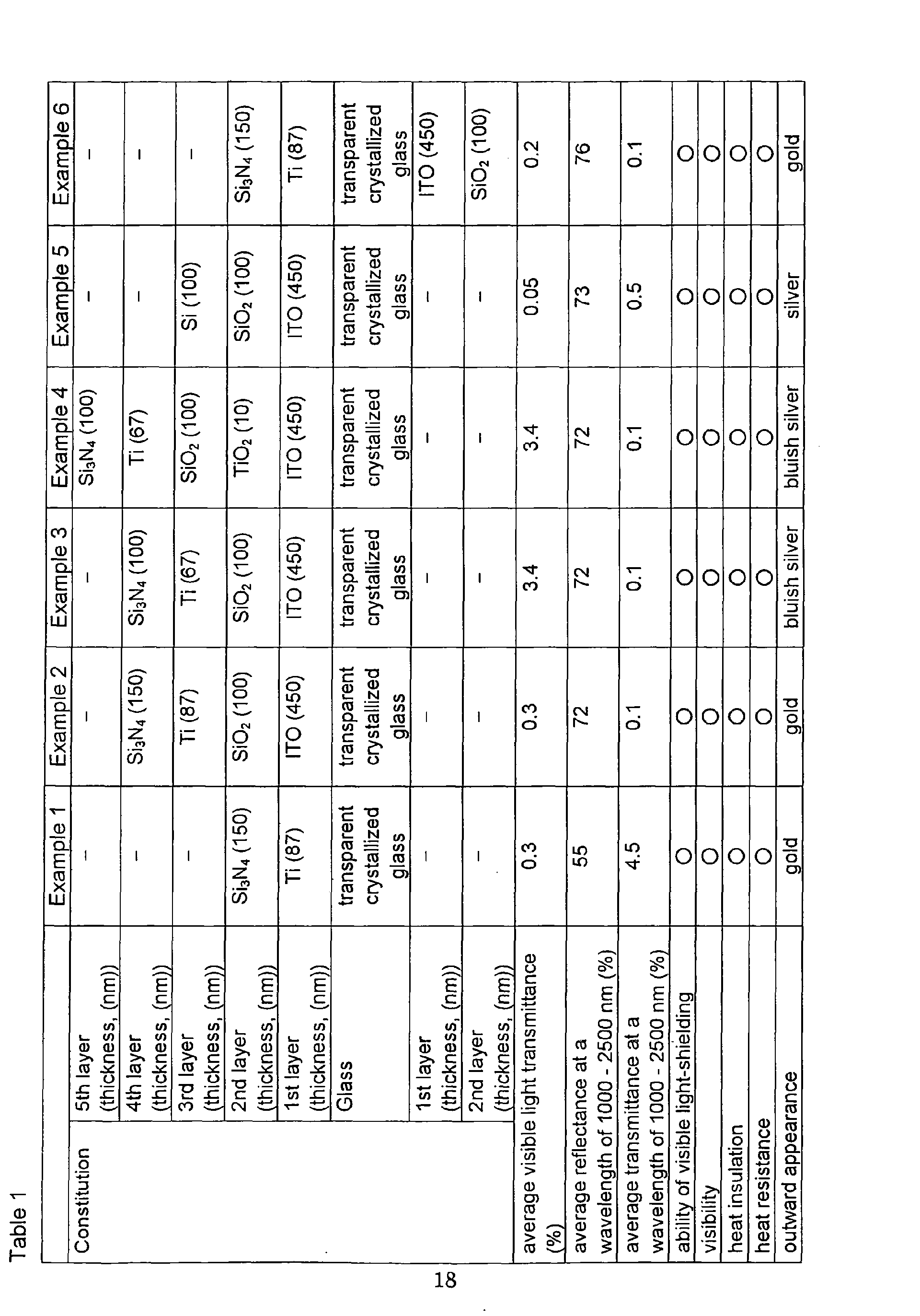
- Table 1 shows Examples of the invention (Examples 1 - 6); and Table 2 shows Comparative Examples (Comparative Examples 1 and 2).
- Comparative Example 1 Comparative Example 2 Glass color glass transparent crystallized glass average visible light transmittance (%) 1.8 89 average reflectance at a wavelength of 1000 - 2500 nm (%) 4 7 average transmittance at a wavelength of 1000 - 2500 nm (%) 0.8 87 ability of visible light-shielding ⁇ ⁇ Visibility ⁇ ⁇ heat insulation - ⁇ heat resistance ⁇ ⁇
- films were formed on a transparent crystallizedglass having 5mm thick (N-0: manufacturedbyNippon Electric Glass Co., Ltd) , by sputtering to form glass articles.
- the order of the film formation and the thickness of each film formed are as in Table 1.
- the transparent crystallized glass used is LiO 2 -Al 2 O 3 -SiO 2 crystallized glass that comprises ⁇ -quartz solid solution as the main crystal thereof, and its average thermal expansion coefficient at 30 - 380°C was -5 x 10 -7 /°C.
- Comparative Example 1 an eye protector lens having a scale number of 5 as determined according to JIS T-8141 (SOLIDA#5: manufactured by Riken Optic) was used. This is formed of color glass and has 2.2 mm thick.
- the average visible light transmittance was determined in accordance with JIS R-3106.
- the average reflectance at a wavelength of 1000 - 2500 nm and the average transmittance at a wavelength of 1000 - 2500 nm were determined at regular intervals of 2 nm by the use of a spectrophotometer (UV3100PC: manufactured by Shimadzu Corporation), and the data were averaged.
- the visible light transmittance, the reflectance and the transmittance were measured on the side of the glass surface in Examples 1 - 5, and on the SiO 2 film side in Example 6.
- the ability of visible light-shielding was evaluated as follows: The glass article having a size of 150 x 150 cm was installed into an observation window frame formed of calcium silicate plate in an electric furnace, and the electric furnace was heated at 1000°C.
- the visibility was evaluated as follows.
- the glass article was set in the same manner as in the ability of visible light-shielding test as above, and the inside of the electric furnace was observed with the naked eye through the glass article of the window, at a site spaced from the glass article by 25 cm.
- the sample is good "O”; but when the operator could not readily confirm it, then the sample is not good " ⁇ ".
- the heat insulation was evaluated as follows.
- the glass article was set in the same manner as in the ability of visible light-shielding test as above, and the inside of the electric furnace was observed with the naked eye through the glass article of the window, at a site spaced from the glass article by 25 cm.
- the sample is good "O”; but when the operator felt hot, then the sample is not good " ⁇ ".
- the heat resistance was evaluated as follows.
- the glass article having a size of 40 x 20 mm was kept in an electric furnace previously heated at 250°C, for 1 week. When the sample was neither broken nor delaminated, then it is good “O”; but when the sample was broken or delaminated, then it is not good " ⁇ ".
- the outward appearance was evaluated by observing the samples with the naked eye.
- the sample of Comparative Example 1 is good in the point of the ability of visible light-shielding but is not good in the point of the heat resistance since it was broken immediately after put into the electric furnace; and the sample of Comparative Example 2 had neither ability of visible light-shielding nor ability of heat insulation, as in Table 2.
- the glass article of the invention has a visible light-shielding layer formed on transparent heat-resistant glass, and the layer has the ability of visible light-shielding and the ability of heat ray reflection. Therefore, the glass article prevents visible light and heat ray transmission through it, and is favorable for observation windows of garbage incinerators, cremation furnaces, metal fusing furnaces, glass fusing furnaces, heat treating furnaces and other furnaces that are exposed to high temperature.
Landscapes
- Chemical & Material Sciences (AREA)
- Engineering & Computer Science (AREA)
- Materials Engineering (AREA)
- Life Sciences & Earth Sciences (AREA)
- Chemical Kinetics & Catalysis (AREA)
- General Chemical & Material Sciences (AREA)
- Geochemistry & Mineralogy (AREA)
- Organic Chemistry (AREA)
- Crystallography & Structural Chemistry (AREA)
- Dispersion Chemistry (AREA)
- Ceramic Engineering (AREA)
- Surface Treatment Of Glass (AREA)
- Waste-Gas Treatment And Other Accessory Devices For Furnaces (AREA)
Abstract
Description
[Patent Document 1] JP-A 4-214046
[Patent Document 2] JP-A 2000-247681
wherein an average visible light transmittance of the glass article at a wavelength of 380 - 780 nm is 0.03 - 15%; and
an average infrared reflectance of the glass article at a wavelength of 1000 - 2500 nm is at least 50%.
| Comparative Example 1 | Comparative Example 2 | |
| Glass | color glass | transparent crystallized glass |
| average visible light transmittance (%) | 1.8 | 89 |
| average reflectance at a wavelength of 1000 - 2500 nm (%) | 4 | 7 |
| average transmittance at a wavelength of 1000 - 2500 nm (%) | 0.8 | 87 |
| ability of visible light-shielding | ○ | × |
| Visibility | ○ | × |
| heat insulation | - | × |
| heat resistance | × | ○ |
Claims (15)
- A glass article which comprises a transparent heat-resistant glass sheet and a visible light-shielding layer on the surface thereof,
wherein an average visible light transmittance of the glass article at a wavelength of 380 - 780 nm is 0.03 - 15%; and
an average infrared reflectance of the glass article at a wavelength of 1000 - 2500 nm is at least 50%. - The glass article according to claim 1, wherein an average infrared transmittance of the glass article at a wavelength of 1000 - 2500 nm is 10% or less.
- The glass article according to claim 1, wherein an average thermal expansion coefficient at 30 - 380°C of the transparent heat-resistant glass sheet is -20 - +50 × 10-7/°C.
- The glass article according to claim 3, wherein the transparent heat-resistant glass sheet is any of transparent crystallized glass, high silicate glass, borosilicate glass or quartz glass.
- The glass article according to claim 1, wherein the visible light-shielding layer comprises a visible light-shielding film and optionally a heat ray reflection film.
- The glass article according to claim 1, wherein the visible light-shielding layer comprises a visible light-shielding film selected from the following (a) to (d):(a) one metal selected from the group consisting of Ti, Nb, Ag, Pt, Au, Zr, Hf, Ni and Cr;(b) one metal nitride with a metal selected from the group consisting of Ti, Nb, Ag, Zr, Hf, Ni and Cr;(c) one alloy selected from the group consisting of TiAl, NiCr, stainless and hastelloy;(d) one alloy nitride with an alloy selected from the group consisting of TiAl, NiCr, stainless and hastelloy.
- The glass article according to claim 1, wherein the visible light-shielding layer comprises a visible light-shielding film selected from the following (a) to (e) and a heat ray reflection film of the following (f):(a) one metal selected from the group consisting of Ti, Nb, Ag, Pt, Au, Zr, Hf, Ni and Cr;(b) one metal nitride with a metal selected from the group consisting of Ti, Nb, Ag, Zr, Hf, Ni and Cr;(c) one alloy selected from the group consisting of TiAl, NiCr, stainless and hastelloy;(d) one alloy nitride with an alloy selected from the group consisting of TiAl, NiCr, stainless and hastelloy;(e) Si;(f) one oxide selected from the group consisting of tin-doped indium oxide, fluorine-doped tin oxide, antimony-doped tin oxide, and aluminium-doped zinc oxide.
- The glass article according to claim 5, which has at least a protective film adjacent to the visible light-shielding film or the heat ray reflection film thereof.
- The glass article according to claim 8, wherein the protective film comprises at least one selected from the group consisting of SiO2, Si3N4, AlN, SiAlNx and TiO2.
- The glass article according to claim 1, which has at least an adhesive layer.
- The glass article according to claim 8, wherein the heat-resistant glass sheet comprises, on the surface thereof, the visible light-shielding film and the protective film, in this order.
- The glass article according to claim 8, wherein the heat-resistant glass sheet comprises, on the surface thereof, the heat ray reflection film, the protective film, and the visible light-shielding film, in this order.
- The glass article according to claim 8, wherein the heat-resistant glass sheet comprises, on the surface thereof, the heat ray reflection film, the protective film, the visible light-shielding film, and the protective film, in this order.
- The glass article according to claim 8, wherein the heat-resistant glass sheet comprises, on the surface thereof, the heat ray reflection film, the adhesive film, the protective film, the visible light-shielding film, and the protective film, in this order.
- The glass article according to claim 8, wherein the heat-resistant glass sheet comprises, on the surface thereof, the visible light-shielding film and the protective film, in this order; and on the opposite surface thereof, the heat ray reflection film and the protective film, in this order.
Applications Claiming Priority (4)
| Application Number | Priority Date | Filing Date | Title |
|---|---|---|---|
| JP2003331037 | 2003-09-24 | ||
| JP2003331037 | 2003-09-24 | ||
| JP2004233820 | 2004-08-10 | ||
| JP2004233820A JP4501152B2 (en) | 2003-09-24 | 2004-08-10 | Glass article |
Publications (2)
| Publication Number | Publication Date |
|---|---|
| EP1518838A1 true EP1518838A1 (en) | 2005-03-30 |
| EP1518838B1 EP1518838B1 (en) | 2009-12-16 |
Family
ID=34197237
Family Applications (1)
| Application Number | Title | Priority Date | Filing Date |
|---|---|---|---|
| EP04022840A Expired - Lifetime EP1518838B1 (en) | 2003-09-24 | 2004-09-24 | Glass article |
Country Status (4)
| Country | Link |
|---|---|
| US (1) | US20050064205A1 (en) |
| EP (1) | EP1518838B1 (en) |
| JP (1) | JP4501152B2 (en) |
| DE (1) | DE602004024625D1 (en) |
Cited By (5)
| Publication number | Priority date | Publication date | Assignee | Title |
|---|---|---|---|---|
| EP2233840A4 (en) * | 2007-12-10 | 2013-11-13 | Nippon Electric Glass Co | TOP PLATE FOR COOKING APPLIANCE |
| CN104926149A (en) * | 2015-06-16 | 2015-09-23 | 重庆大全新能源有限公司 | Silicon nitride spraying process and device of quartz crucible for polycrystalline silicon cast ingot |
| FR3022539A1 (en) * | 2014-06-24 | 2015-12-25 | Saint Gobain | ANTICONDENSATION GLAZING |
| CN111377618A (en) * | 2020-03-20 | 2020-07-07 | 山东大学 | Corrosion-resistant glass and preparation method thereof |
| WO2025157879A1 (en) | 2024-01-26 | 2025-07-31 | Saint-Gobain Sekurit France | Pane with emissivity-reducing coating |
Families Citing this family (15)
| Publication number | Priority date | Publication date | Assignee | Title |
|---|---|---|---|---|
| WO2006045835A1 (en) * | 2004-10-29 | 2006-05-04 | Glaverbel | Dichroic mirror |
| US7597938B2 (en) * | 2004-11-29 | 2009-10-06 | Guardian Industries Corp. | Method of making coated article with color suppression coating including flame pyrolysis deposited layer(s) |
| DE102008030825A1 (en) | 2008-06-30 | 2009-12-31 | Schott Ag | Device for reflecting heat radiation, a method for its production and its use |
| DE102009015086A1 (en) * | 2009-03-31 | 2010-10-07 | Schott Ag | Transparent glass or glass-ceramic pane with an infrared-reflecting layer |
| BE1019048A3 (en) * | 2009-11-18 | 2012-02-07 | Agc Glass Europe | VEGETABLE WALL AND ASSOCIATED METHOD FOR PROMOTING VEGETEAUX ANCHORAGE. |
| DE102010020676B4 (en) | 2010-05-15 | 2024-09-12 | Dr. Ing. H.C. F. Porsche Aktiengesellschaft | Electric vehicle |
| JP2012073590A (en) * | 2010-08-31 | 2012-04-12 | Canon Inc | Optical member, production method of the same, and optical system |
| JP5960385B2 (en) * | 2010-09-27 | 2016-08-02 | ショット アクチエンゲゼルシャフトSchott AG | Transparent glass or glass-ceramic window glass having a layer that reflects infrared radiation |
| DE102010046991B4 (en) | 2010-09-30 | 2016-12-29 | Schott Ag | Heat protection glazing, their use and process for their production |
| FR2999563B1 (en) * | 2012-12-19 | 2015-02-27 | Eurokera | VITROCERAMIC SHEET WITH A THIN LAYER COATING |
| US20140272217A1 (en) * | 2013-03-18 | 2014-09-18 | Apple Inc. | Methods and structures for thermal management in an electronic device |
| KR102087195B1 (en) * | 2013-09-05 | 2020-03-11 | 삼성디스플레이 주식회사 | Thin film transistor array panel for a display and manufacturing method thereof |
| JP6459373B2 (en) * | 2014-10-14 | 2019-01-30 | Agc株式会社 | Transparent substrate with laminated film and method for producing the same |
| CN111099838A (en) * | 2019-12-30 | 2020-05-05 | 华为技术有限公司 | Curved glass cover plate and preparation method and terminal thereof |
| CN114484875B (en) * | 2021-09-14 | 2023-11-10 | 沭阳华新玻璃科技股份有限公司 | Stress high temperature resistance-based single-layer glass high temperature monitoring device |
Citations (12)
| Publication number | Priority date | Publication date | Assignee | Title |
|---|---|---|---|---|
| GB599675A (en) | 1943-11-22 | 1948-03-18 | Johnson Matthey Co Ltd | Improvements in or relating to anti-glare, heat-reflecting light filters |
| GB606914A (en) | 1946-01-01 | 1948-08-23 | Johnson Matthey Co Ltd | Improvements in inspection windows for furnaces and the like |
| JPS59207856A (en) * | 1983-05-13 | 1984-11-26 | Asahi Glass Co Ltd | Glass for reflecting heat radiation |
| JPS6042253A (en) | 1983-08-19 | 1985-03-06 | Asahi Glass Co Ltd | Heat-ray reflecting glass |
| US4525462A (en) | 1982-05-27 | 1985-06-25 | Deutsche Spezialglas Ag | Dark blue dyed furnace sight glass with high infrared absorption |
| JPS60180935A (en) * | 1984-02-28 | 1985-09-14 | Asahi Glass Co Ltd | Formation of ti coated film on vitreous substrate |
| US4900630A (en) | 1987-05-29 | 1990-02-13 | Central Glass Company, Limited | Glass plate with reflective multilayer coatings to give golden appearance |
| EP0599071A1 (en) | 1992-11-24 | 1994-06-01 | Leybold Aktiengesellschaft | Transparent substrate with a transparent layer system and method for the production of such a layer system |
| FR2744116A1 (en) * | 1996-01-31 | 1997-08-01 | Eurokera | Substrate used for cooking and/or temperature maintaining devices |
| EP1026129A1 (en) | 1998-06-19 | 2000-08-09 | Nippon Electric Glass Co., Ltd | Li2O-Al2O3-SiO2 TYPE TRANSPARENT CRYSTALLIZED GLASS |
| EP1114803A1 (en) | 1999-05-28 | 2001-07-11 | Nippon Electric Glass Co., Ltd | Li2o-al2o3-sio2 type transparent crystalized glass and crystalline glass |
| US20030113550A1 (en) * | 2001-09-14 | 2003-06-19 | Millett Frederick A. | Heat barrier window utilizing a combination of coatings |
Family Cites Families (17)
| Publication number | Priority date | Publication date | Assignee | Title |
|---|---|---|---|---|
| US3149989A (en) * | 1961-12-01 | 1964-09-22 | Corning Glass Works | Radiation-reflecting medium |
| US4048978A (en) * | 1972-03-02 | 1977-09-20 | Glaverbel-Mecaniver | Heat insulating screen |
| DE2457037B2 (en) * | 1974-12-03 | 1976-09-16 | Flachglas Ag Delog-Detag, 4650 Gelsenkirchen | GLAZING UNIT, IN PARTICULAR INSULATING GLASS, FOR FIRE PROTECTION PURPOSES |
| JPS6135835U (en) * | 1984-08-08 | 1986-03-05 | 三菱自動車工業株式会社 | Blackout glass for vehicles |
| US4847157A (en) * | 1986-08-28 | 1989-07-11 | Libbey-Owens-Ford Co. | Glass coating method and resulting article |
| US5355245A (en) * | 1988-02-12 | 1994-10-11 | Donnelly Corporation | Ultraviolet protected electrochemichromic rearview mirror |
| JPH01234557A (en) * | 1988-03-16 | 1989-09-19 | Nippon Sheet Glass Co Ltd | Heat ray reflecting plate and its production |
| JPH0717409B2 (en) * | 1989-07-31 | 1995-03-01 | 鳴海製陶株式会社 | Crystallized glass with raster |
| US5513040B1 (en) * | 1994-11-01 | 1998-02-03 | Deposition Technology Inc | Optical device having low visual light transmission and low visual light reflection |
| US6231999B1 (en) * | 1996-06-21 | 2001-05-15 | Cardinal Ig Company | Heat temperable transparent coated glass article |
| US5808020A (en) * | 1996-08-12 | 1998-09-15 | Associated Universities, Inc. | Optical reaction cell and light source for 18F! fluoride radiotracer synthesis |
| JP3823431B2 (en) * | 1997-03-27 | 2006-09-20 | 鳴海製陶株式会社 | Light-shielding glass plate |
| JP3514681B2 (en) * | 1999-11-30 | 2004-03-31 | 三菱電機株式会社 | Infrared detector |
| JP2002128542A (en) * | 2000-10-17 | 2002-05-09 | Nippon Electric Glass Co Ltd | Heat-shielding fireproof glass article |
| US20030228476A1 (en) * | 2001-10-22 | 2003-12-11 | Harry Buhay | Methods of changing the visible light transmittance of coated articles and coated articles made thereby |
| US6605339B1 (en) * | 2001-12-19 | 2003-08-12 | Sandia Corporation | Micro heat barrier |
| JP2003322330A (en) * | 2002-04-30 | 2003-11-14 | Nippon Electric Glass Co Ltd | Window material for combustion apparatus |
-
2004
- 2004-08-10 JP JP2004233820A patent/JP4501152B2/en not_active Expired - Fee Related
- 2004-09-23 US US10/947,422 patent/US20050064205A1/en not_active Abandoned
- 2004-09-24 EP EP04022840A patent/EP1518838B1/en not_active Expired - Lifetime
- 2004-09-24 DE DE602004024625T patent/DE602004024625D1/en not_active Expired - Lifetime
Patent Citations (12)
| Publication number | Priority date | Publication date | Assignee | Title |
|---|---|---|---|---|
| GB599675A (en) | 1943-11-22 | 1948-03-18 | Johnson Matthey Co Ltd | Improvements in or relating to anti-glare, heat-reflecting light filters |
| GB606914A (en) | 1946-01-01 | 1948-08-23 | Johnson Matthey Co Ltd | Improvements in inspection windows for furnaces and the like |
| US4525462A (en) | 1982-05-27 | 1985-06-25 | Deutsche Spezialglas Ag | Dark blue dyed furnace sight glass with high infrared absorption |
| JPS59207856A (en) * | 1983-05-13 | 1984-11-26 | Asahi Glass Co Ltd | Glass for reflecting heat radiation |
| JPS6042253A (en) | 1983-08-19 | 1985-03-06 | Asahi Glass Co Ltd | Heat-ray reflecting glass |
| JPS60180935A (en) * | 1984-02-28 | 1985-09-14 | Asahi Glass Co Ltd | Formation of ti coated film on vitreous substrate |
| US4900630A (en) | 1987-05-29 | 1990-02-13 | Central Glass Company, Limited | Glass plate with reflective multilayer coatings to give golden appearance |
| EP0599071A1 (en) | 1992-11-24 | 1994-06-01 | Leybold Aktiengesellschaft | Transparent substrate with a transparent layer system and method for the production of such a layer system |
| FR2744116A1 (en) * | 1996-01-31 | 1997-08-01 | Eurokera | Substrate used for cooking and/or temperature maintaining devices |
| EP1026129A1 (en) | 1998-06-19 | 2000-08-09 | Nippon Electric Glass Co., Ltd | Li2O-Al2O3-SiO2 TYPE TRANSPARENT CRYSTALLIZED GLASS |
| EP1114803A1 (en) | 1999-05-28 | 2001-07-11 | Nippon Electric Glass Co., Ltd | Li2o-al2o3-sio2 type transparent crystalized glass and crystalline glass |
| US20030113550A1 (en) * | 2001-09-14 | 2003-06-19 | Millett Frederick A. | Heat barrier window utilizing a combination of coatings |
Non-Patent Citations (3)
| Title |
|---|
| PATENT ABSTRACTS OF JAPAN vol. 009, no. 074 (C - 273) 3 April 1985 (1985-04-03) * |
| PATENT ABSTRACTS OF JAPAN vol. 009, no. 171 (C - 291) 16 July 1985 (1985-07-16) * |
| PATENT ABSTRACTS OF JAPAN vol. 010, no. 028 (C - 326) 4 February 1986 (1986-02-04) * |
Cited By (8)
| Publication number | Priority date | Publication date | Assignee | Title |
|---|---|---|---|---|
| EP2233840A4 (en) * | 2007-12-10 | 2013-11-13 | Nippon Electric Glass Co | TOP PLATE FOR COOKING APPLIANCE |
| US8794227B2 (en) | 2007-12-10 | 2014-08-05 | Nippon Electric Glass Co., Ltd. | Top plate for cooking appliance |
| FR3022539A1 (en) * | 2014-06-24 | 2015-12-25 | Saint Gobain | ANTICONDENSATION GLAZING |
| WO2015197969A1 (en) * | 2014-06-24 | 2015-12-30 | Saint-Gobain Glass France | Anti-condensation glazing unit |
| CN104926149A (en) * | 2015-06-16 | 2015-09-23 | 重庆大全新能源有限公司 | Silicon nitride spraying process and device of quartz crucible for polycrystalline silicon cast ingot |
| CN111377618A (en) * | 2020-03-20 | 2020-07-07 | 山东大学 | Corrosion-resistant glass and preparation method thereof |
| CN111377618B (en) * | 2020-03-20 | 2022-04-26 | 山东大学 | Corrosion-resistant glass and preparation method thereof |
| WO2025157879A1 (en) | 2024-01-26 | 2025-07-31 | Saint-Gobain Sekurit France | Pane with emissivity-reducing coating |
Also Published As
| Publication number | Publication date |
|---|---|
| JP4501152B2 (en) | 2010-07-14 |
| US20050064205A1 (en) | 2005-03-24 |
| DE602004024625D1 (en) | 2010-01-28 |
| EP1518838B1 (en) | 2009-12-16 |
| JP2005119942A (en) | 2005-05-12 |
Similar Documents
| Publication | Publication Date | Title |
|---|---|---|
| US20050064205A1 (en) | Glass article | |
| US6770321B2 (en) | Method of making transparent articles utilizing protective layers for optical coatings | |
| EP2041040B8 (en) | Method of making coated article using rapid heating for reducing emissivity and/or sheet resistance, and corresponding product | |
| ES3012538T3 (en) | Heat treatable coated article having titanium nitride and ito based ir reflecting layers | |
| ES2927998T3 (en) | Heat treatable coated article with titanium nitride based IR reflective layer(s) | |
| EP2625554A2 (en) | Temperable three layer antireflective coating, coated article including temperable three layer antireflective coating, and/or method of making the same | |
| JP7484897B2 (en) | Optical Components | |
| WO2012030372A2 (en) | Temperable three layer antireflective coating, coated article including temperable three layer antireflective coating, and/or method of making the same | |
| JP4284694B2 (en) | Fire-resistant glass article having heat insulation and method of using the same | |
| EP1363074A2 (en) | Window member for a combustion apparatus, excellent in appearance even after long-time use | |
| AU2018225650B2 (en) | Heat treatable coated article having zirconium nitride and ITO based IR reflecting layers | |
| US7488538B2 (en) | Coated article including soda-lime-silica glass substrate with lithium and/or potassium to reduce sodium migration and/or improve surface stability and method of making same | |
| RU2675836C2 (en) | Gray coloured heat treatable coated article having low solar factor value | |
| KR20070038119A (en) | Sheets of glass material for chimney or furnace buried devices | |
| DK2517877T3 (en) | Spandril panel | |
| NO20012121D0 (en) | Heat-resistant dichroic mirror | |
| JP4461474B2 (en) | Fire glass plate | |
| US20230212065A1 (en) | Low-e material comprising a thick layer based on silicon oxide | |
| JP2006248871A (en) | Peep window member, and its production method | |
| WO2025058585A1 (en) | Low-e coated glass suitable for tempered and non-tempered use | |
| CN119866319A (en) | Reflective coating | |
| US20230174418A1 (en) | Low-emissivity material comprising a silicon nitride- or oxynitride-based layer and a zinc tin oxide-based layer | |
| JP2007003140A (en) | Window material for combustion device |
Legal Events
| Date | Code | Title | Description |
|---|---|---|---|
| PUAI | Public reference made under article 153(3) epc to a published international application that has entered the european phase |
Free format text: ORIGINAL CODE: 0009012 |
|
| AK | Designated contracting states |
Kind code of ref document: A1 Designated state(s): AT BE BG CH CY CZ DE DK EE ES FI FR GB GR HU IE IT LI LU MC NL PL PT RO SE SI SK TR |
|
| AX | Request for extension of the european patent |
Extension state: AL HR LT LV MK |
|
| AKX | Designation fees paid |
Designated state(s): DE FR |
|
| 17P | Request for examination filed |
Effective date: 20050711 |
|
| 17Q | First examination report despatched |
Effective date: 20060927 |
|
| 17Q | First examination report despatched |
Effective date: 20060927 |
|
| GRAP | Despatch of communication of intention to grant a patent |
Free format text: ORIGINAL CODE: EPIDOSNIGR1 |
|
| GRAS | Grant fee paid |
Free format text: ORIGINAL CODE: EPIDOSNIGR3 |
|
| GRAA | (expected) grant |
Free format text: ORIGINAL CODE: 0009210 |
|
| AK | Designated contracting states |
Kind code of ref document: B1 Designated state(s): DE FR |
|
| REF | Corresponds to: |
Ref document number: 602004024625 Country of ref document: DE Date of ref document: 20100128 Kind code of ref document: P |
|
| PLBE | No opposition filed within time limit |
Free format text: ORIGINAL CODE: 0009261 |
|
| STAA | Information on the status of an ep patent application or granted ep patent |
Free format text: STATUS: NO OPPOSITION FILED WITHIN TIME LIMIT |
|
| 26N | No opposition filed |
Effective date: 20100917 |
|
| REG | Reference to a national code |
Ref country code: FR Ref legal event code: PLFP Year of fee payment: 12 |
|
| PGFP | Annual fee paid to national office [announced via postgrant information from national office to epo] |
Ref country code: DE Payment date: 20150916 Year of fee payment: 12 |
|
| PGFP | Annual fee paid to national office [announced via postgrant information from national office to epo] |
Ref country code: FR Payment date: 20150811 Year of fee payment: 12 |
|
| REG | Reference to a national code |
Ref country code: DE Ref legal event code: R119 Ref document number: 602004024625 Country of ref document: DE |
|
| REG | Reference to a national code |
Ref country code: FR Ref legal event code: ST Effective date: 20170531 |
|
| PG25 | Lapsed in a contracting state [announced via postgrant information from national office to epo] |
Ref country code: FR Free format text: LAPSE BECAUSE OF NON-PAYMENT OF DUE FEES Effective date: 20160930 Ref country code: DE Free format text: LAPSE BECAUSE OF NON-PAYMENT OF DUE FEES Effective date: 20170401 |