EP1518521A2 - Four compartment knee - Google Patents
Four compartment knee Download PDFInfo
- Publication number
- EP1518521A2 EP1518521A2 EP04030369A EP04030369A EP1518521A2 EP 1518521 A2 EP1518521 A2 EP 1518521A2 EP 04030369 A EP04030369 A EP 04030369A EP 04030369 A EP04030369 A EP 04030369A EP 1518521 A2 EP1518521 A2 EP 1518521A2
- Authority
- EP
- European Patent Office
- Prior art keywords
- posterior
- box
- femoral
- articular
- condyles
- Prior art date
- Legal status (The legal status is an assumption and is not a legal conclusion. Google has not performed a legal analysis and makes no representation as to the accuracy of the status listed.)
- Granted
Links
Images

Classifications
-
- A—HUMAN NECESSITIES
- A61—MEDICAL OR VETERINARY SCIENCE; HYGIENE
- A61F—FILTERS IMPLANTABLE INTO BLOOD VESSELS; PROSTHESES; DEVICES PROVIDING PATENCY TO, OR PREVENTING COLLAPSING OF, TUBULAR STRUCTURES OF THE BODY, e.g. STENTS; ORTHOPAEDIC, NURSING OR CONTRACEPTIVE DEVICES; FOMENTATION; TREATMENT OR PROTECTION OF EYES OR EARS; BANDAGES, DRESSINGS OR ABSORBENT PADS; FIRST-AID KITS
- A61F2/00—Filters implantable into blood vessels; Prostheses, i.e. artificial substitutes or replacements for parts of the body; Appliances for connecting them with the body; Devices providing patency to, or preventing collapsing of, tubular structures of the body, e.g. stents
- A61F2/02—Prostheses implantable into the body
- A61F2/30—Joints
- A61F2/38—Joints for elbows or knees
- A61F2/3859—Femoral components
-
- A—HUMAN NECESSITIES
- A61—MEDICAL OR VETERINARY SCIENCE; HYGIENE
- A61F—FILTERS IMPLANTABLE INTO BLOOD VESSELS; PROSTHESES; DEVICES PROVIDING PATENCY TO, OR PREVENTING COLLAPSING OF, TUBULAR STRUCTURES OF THE BODY, e.g. STENTS; ORTHOPAEDIC, NURSING OR CONTRACEPTIVE DEVICES; FOMENTATION; TREATMENT OR PROTECTION OF EYES OR EARS; BANDAGES, DRESSINGS OR ABSORBENT PADS; FIRST-AID KITS
- A61F2/00—Filters implantable into blood vessels; Prostheses, i.e. artificial substitutes or replacements for parts of the body; Appliances for connecting them with the body; Devices providing patency to, or preventing collapsing of, tubular structures of the body, e.g. stents
- A61F2/02—Prostheses implantable into the body
- A61F2/30—Joints
- A61F2/38—Joints for elbows or knees
- A61F2/3886—Joints for elbows or knees for stabilising knees against anterior or lateral dislocations
-
- A—HUMAN NECESSITIES
- A61—MEDICAL OR VETERINARY SCIENCE; HYGIENE
- A61F—FILTERS IMPLANTABLE INTO BLOOD VESSELS; PROSTHESES; DEVICES PROVIDING PATENCY TO, OR PREVENTING COLLAPSING OF, TUBULAR STRUCTURES OF THE BODY, e.g. STENTS; ORTHOPAEDIC, NURSING OR CONTRACEPTIVE DEVICES; FOMENTATION; TREATMENT OR PROTECTION OF EYES OR EARS; BANDAGES, DRESSINGS OR ABSORBENT PADS; FIRST-AID KITS
- A61F2/00—Filters implantable into blood vessels; Prostheses, i.e. artificial substitutes or replacements for parts of the body; Appliances for connecting them with the body; Devices providing patency to, or preventing collapsing of, tubular structures of the body, e.g. stents
- A61F2/02—Prostheses implantable into the body
- A61F2/30—Joints
- A61F2/30721—Accessories
- A61F2/30734—Modular inserts, sleeves or augments, e.g. placed on proximal part of stem for fixation purposes or wedges for bridging a bone defect
- A61F2002/30736—Augments or augmentation pieces, e.g. wedges or blocks for bridging a bone defect
Definitions
- the present invention relates to knee prostheses for replacing the articular surfaces of a diseased or injured human knee. More particularly, the present invention relates to a knee prosthesis having an extended range of flexion.
- TKR total knee replacements
- These implants are made of materials that exhibit a low coefficient of friction as they articulate against one another so as to restore normal, pain free, knee function.
- Modem TKR's are tricompartmental designs. That is, they replace three separate articulating surfaces within the knee joint; namely the patello-femoral joint and the lateral and medial inferior tibio-femoral joints. These implants are designed to articulate from a position of slight hyperextension to approximately 115 to 130 degrees of flexion.
- TKR range of motion
- the present invention provides a fourth articulating compartment, namely the superior posterior femoral condyles.
- All prior TKR designs ignore the superior posterior condyles.
- the articulating surface of the posterior condyles of prior TKR's continue their natural curves until the posterior condylar surface meets the interior posterior wall of the TKR fixation surface. Where the two surfaces meet, an edge is formed.
- the posterior superior edge of standard TKR's may have a small fillet. If such a TKR is able to articulate beyond 130 degrees at all, then the edge directly articulates against the tibial articulating surface which is usually made of ultra high molecular weight polyethylene (UHMWPE).
- UHMWPE ultra high molecular weight polyethylene
- the superior posterior articulating surface is achieved by first increasing the thickness of the superior posterior condylar portion of the TKR femoral component to widen the superior posterior edge of the posterior condyle. Second, the newly created surface at the superior posterior condyle is smoothly rounded to provide an articular surface with no sharp changes in the surface contours.
- the fourth articular compartment of this invention is provided in a one piece femoral design. In another embodiment, it is provided as a modular addition to an existing prior art femoral component. In another embodiment, the fourth compartment is combined with a posterior stabilized (PS) TKR design that includes a tibial post and cooperating femoral cam characterized by low engagement of the cam on the spine.
- PS posterior stabilized
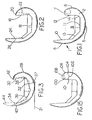
- FIGS. 1,2,3,7 and 15 show embodiments of the femoral knee component of the present invention oriented at zero degrees of flexion. Unless otherwise noted, the geometric relationships of this invention are descriptive of a femoral knee implant in this orientation.
- FIG. 1 depicts an exemplary one-piece femoral knee implant 1 according to the present invention.
- the implant 1 includes arcuate medial 2 and lateral (not shown) condyles joined together at their anterior aspects to form a patellar flange 4.
- Each of the medial 2 and lateral condyles includes a distal condyle 5, a posterior condyle 6, and a superior condyle 7.
- the patellar flange 4, the distal condyles 5, the posterior condyles 6, and the superior condyles 7 define a smooth articular surface extending around the exterior of the implant 1.
- the interior of the implant 1 is defined by a box 9.
- the box 9 includes an anterior box surface 10, a distal box surface 11 and a posterior box surface 12.
- the anterior 10 and the distal 11 box surfaces are blended by an anterior chamfer surface 13.
- the distal 11 and posterior 12 box surfaces are blended by a posterior chamfer surface 14.
- the four compartment knee of the present invention accommodates flexion
- the superior aspect of the posterior condyles 6 is extended toward the anterior flange 4 to allow the articular surface to extend further around and back anteriorly than with prior femoral implants.
- Extending the superior aspect of the posterior condyle can be done in several ways. As shown in FIG. 1, the entire posterior condyle is thickened such that the posterior box surface 12 is further from the posterior condyle 6 exterior surface and nearer the anterior box surface 10. This widens the superior aspect of the posterior condyle so that the articular surface can be extended to form the superior condyle 7.
- posterior condyle 6 can be shortened by removing material from the superior aspect where the condyle begins to taper which will have the effect of leaving a thicker superior aspect that can be shaped into a superior condyle.
- Yet another alternative is to change the angle that the posterior box surface 12 makes with the distal box surface 11. By making the included angle between these two surface smaller, the superior aspect of the posterior condyle is made wider to provide for a superior condyle 7.
- the angle between the posterior box surface 16 and the distal box surface 18 has been made less than 90 degrees to provide ample width for a superior condyle 20.
- the dashed line 22 depicts the angle of the posterior box surface of a typical prior art femoral component.
- posterior box surfaces 16 and the anterior box surface 24 must be parallel or slightly diverging toward the box opening. Therefore it may be necessary, as shown in FIG. 2, where the posterior box surface has been angled inwardly, to angle the anterior box surface 24 outwardly.
- the dashed line 26 depicts the angle of the anterior box surface of a typical prior art femoral component.
- FIG. 3 illustrates another alternative embodiment for moving the superior aspect of the posterior condyle 28 anteriorly.
- the entire box including the posterior surface 30, distal surface 32, anterior surface 34 and chamfers 36 and 38; is rotated about a medial-lateral axis thus shortening the anterior condyle 40 and extending the posterior condyle 28 anteriorly and slightly superiorly.
- a superior condyle 42 can then be formed at the superior aspect of the posterior condyle 28.
- the dashed lines 44 depict the box and articular surfaces of a typical prior art femoral component before the box is rotated.
- the distal box surface 27 (dashed) is parallel to the tangent 31 of the distal condyles at their most prominent point. This helps a surgeon orient the femoral component at full extension.
- the box is rotated so that the distal surface 32 is angled relative to the tangent 31.
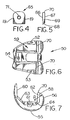
- FIGS. 4-7 depict an alternative modular embodiment of the invention.
- the use of a modular add-on allows a conventional implant to be adapted for four compartment articulation.
- the implant 50 includes arcuate medial 52 and lateral 53 condyles joined together at their anterior aspects to form a patellar flange 54.
- Each of the medial 52 and lateral 53 condyles is made up of a distal condyle 55 and a posterior condyle 56.
- the patellar flange 54, the distal condyles 55 and the posterior condyles 56 define a smooth articular surface extending around the exterior of the implant 50.
- the articular surface terminates at the apexes 58 of the posterior condyles 56.
- the terminal portion of the articular surface is defined by the radius R.
- the interior of the implant 1 is defined by a box 59.
- the box 59 includes an anterior box surface 60, a distal box surface 61 and a posterior box surface 62.
- the anterior 60 and distal 61 box surfaces are blended by an anterior chamfer surface 63.
- the distal 61 and posterior 62 box surfaces are blended by a posterior chamfer surface 64.
- FIGS. 4 and 5 depict an articular surface module 65.
- the module 65 includes a front surface 66, a back surface 67, a bottom surface 68, side surfaces 69, and a top surface 70.
- the back 67 and bottom 68 of the module 65 are shaped to seat against the posterior box surface 62 and posterior chamfer surface 64 respectively.
- the top surface 70 has an articular shape matching the articular surface of the implant 50 near the apexes 58.
- the top 70 of the module forms an extension of the articular surface, or a superior fourth compartment, as shown in FIGS. 6 and 7.
- the extended articular surface blends functionally with the articular surface to allow additional articulation of the femur relative to the tibia.
- a smooth transition is provided from articulation on the implant to articulation on the module.
- the module 65 extends the radius R.
- a module is used similarly on both the medial and lateral posterior condyles.
- a through hole 71 in the module 65 and corresponding threaded holes in the posterior condyles allow the module 65 to be securely attached to the implant 50.
- Other well known means of attachment may also be used such as cement or clips.
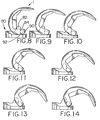
- FIGS. 8-14 illustrate the femoral component 1 of FIG. 1 articulating with a tibial component 80.
- the tibial component 80 includes a spine 82 having an articular surface 84.
- the femoral component 1 includes a cam 90 having an articular surface 92. In flexion, the cam articular surface 92 bears on the spine articular surface 84.
- This spine/cam interaction creates a center for rotation of the femoral component relative to the tibial component and prevents anterior subluxation of the femoral component relative to the tibial component.
- the distance from the spine/cam contact to the top of the spine is called the "jump height" and is a measure of the subluxation resistance of a particular spine/cam combination because the cam would have to jump over the spine for subluxation to occur.
- jump height is of increased concern.
- bending of the spine is a concern due to increased loads during activities such as squatting.
- the cam is located relatively low compared to the top of the distal condyles.
- the cam begins to ride up the spine and the jump height can be significantly shortened leading to an increased possibility of subluxation and an increased possibility of bending the spine because of the greater bending moment.
- a high cam placement is used similar to the design of the NexGen ® Complete Knee Solution manufactured and sold by Zimmer, Inc.
- the extreme flexion potential of the knee is enhanced. Extreme flexion is facilitated while maintaining a safe level of subluxation resistance.
- the jump height increases from 90 degrees, FIG. 8, to approximately 130 degrees, FIG. 12. Beyond 130 degrees, the cam rises only slightly, thus maintaining a large jump height even in deep flexion.
- FIG. 15 further enhances the jump height of the spine cam articulation.
- the exemplary cam in FIGS. 1 and 8-14 is cylindrical at its functional articulating surface. It is placed far superiorly between the superior posterior condyles to increase jump height in flexion.
- the cam in FIGS. 15-22 is made non-cylindrical, being made up of blended circles or other geometries.
- An exemplary non-cylindrical cam is shown in FIG. 15.
- the cam 100 includes a relatively flat portion 101, a first spine contact portion 102 having a first radius defining a circle, and a second spine contact portion 104 having a second radius defining a circle.
- the first spine contact portion 102 is an arc of the circle defined by the first radius.
- the second spine contact portion 104 is an arc of the circle defined by the second radius.
- the second spine contact portion extends further posteriorly than the perimeter of the circle defined by the first radius.
- the first and second spine contact portions form an ovoid articular surface 102, 104.
- the posterior extension of the cam 100 causes it to reach downwardly and contact the spine lower at higher angles of flexion as shown in FIGS. 16-20.
- the second contact portion 104 causes the femur to roll back in deep flexion to prevent the femoral bone, where it exits the posterior box, from impinging on the tibial articular surface.
- the top 108 of the cam 100 completes the cam profile.
- the cam 100 alternatively includes a third spine contact portion 106, also shown in FIG. 15, having a third radius defining a circle.
- the alternative third spine contact portion projects beyond the condyles in order to maintain the proper femoral position relative to the tibia in deep flexion.
- the radius of the third portion 106 when present, forms the posterior most cam surface and the end of the cam articular surface.
- One way to achieve the described relationships between the spine contacting portions is to increase the radius of the cam 100 posteriorly from the first spine contact portion 102 to the second spine contact portion 104.
- the third spine contacting portion 106 would be made smaller than the second spine contacting portion 104 and would articulate as shown in FIGS. 21 and 22.
- Another way to achieve the inventive relationships is to offset the centers of the first and second radii in the anterior/posterior direction. Depending on the particular radius values and offset chosen, additional radii may be necessary to smoothly blend the first and second spine contacting surfaces.
Landscapes
- Health & Medical Sciences (AREA)
- Orthopedic Medicine & Surgery (AREA)
- Physical Education & Sports Medicine (AREA)
- Cardiology (AREA)
- Oral & Maxillofacial Surgery (AREA)
- Transplantation (AREA)
- Engineering & Computer Science (AREA)
- Biomedical Technology (AREA)
- Heart & Thoracic Surgery (AREA)
- Vascular Medicine (AREA)
- Life Sciences & Earth Sciences (AREA)
- Animal Behavior & Ethology (AREA)
- General Health & Medical Sciences (AREA)
- Public Health (AREA)
- Veterinary Medicine (AREA)
- Prostheses (AREA)
Abstract
Description
Claims (3)
- A module for use with a femoral knee implant having an interior box and an articular surface for articulation with a tibial surface, the module comprising a back surface and a top surface, the back surface being shaped to seat against a portion of the box, the top surface being shaped to form an extension of the articular surface, the top surface blending functionally with the articular surface to allow further articulation of the femoral implant on the tibial surface when the back surface is seated on a portion of the box.
- A femoral knee implant for articulation with a tibial surface, the femoral knee implant comprising:an articular surface for articulation with the tibial surface;a box defining the interior surfaces of the implant; anda module comprising a back surface and a top surface, the back surface being shaped to seat against a portion of the box, the top surface being shaped to form an extension of the articular surface, the top surface blending functionally with the articular surface to allow further articulation of the femoral implant on the tibial surface when the back surface is seated on a portion of the box.
- The femoral knee implant of claim 2 further comprising arcuate medial and lateral condyles joined together to form a patellar flange, each of the medial and lateral condyles including a distal condyle and a posterior condyle, the patellar flange, the distal condyles and the posterior condyles defining the articular surface extending around the exterior of the implant, each posterior condyle including an apex at its highest point, the articular surface terminating at the apexes of the posterior condyles , the articular surface being defined by a radius R near the apexes, the top surface blending with the radius R to form a functionally smooth continuation of the articular surface.
Applications Claiming Priority (3)
| Application Number | Priority Date | Filing Date | Title |
|---|---|---|---|
| US09/037,417 US6123729A (en) | 1998-03-10 | 1998-03-10 | Four compartment knee |
| US37417 | 1998-03-10 | ||
| EP99200699A EP0941719B1 (en) | 1998-03-10 | 1999-03-09 | Four compartment knee |
Related Parent Applications (2)
| Application Number | Title | Priority Date | Filing Date |
|---|---|---|---|
| EP99200699A Division EP0941719B1 (en) | 1998-03-10 | 1999-03-09 | Four compartment knee |
| EP99200699.9 Division | 1999-03-09 |
Publications (3)
| Publication Number | Publication Date |
|---|---|
| EP1518521A2 true EP1518521A2 (en) | 2005-03-30 |
| EP1518521A3 EP1518521A3 (en) | 2005-10-12 |
| EP1518521B1 EP1518521B1 (en) | 2010-06-30 |
Family
ID=21894222
Family Applications (2)
| Application Number | Title | Priority Date | Filing Date |
|---|---|---|---|
| EP04030369A Expired - Lifetime EP1518521B1 (en) | 1998-03-10 | 1999-03-09 | Four compartment knee |
| EP99200699A Expired - Lifetime EP0941719B1 (en) | 1998-03-10 | 1999-03-09 | Four compartment knee |
Family Applications After (1)
| Application Number | Title | Priority Date | Filing Date |
|---|---|---|---|
| EP99200699A Expired - Lifetime EP0941719B1 (en) | 1998-03-10 | 1999-03-09 | Four compartment knee |
Country Status (7)
| Country | Link |
|---|---|
| US (2) | US6123729A (en) |
| EP (2) | EP1518521B1 (en) |
| JP (1) | JP4290803B2 (en) |
| AU (1) | AU737463B2 (en) |
| CA (2) | CA2629274C (en) |
| DE (2) | DE69942549D1 (en) |
| ES (2) | ES2234202T3 (en) |
Cited By (9)
| Publication number | Priority date | Publication date | Assignee | Title |
|---|---|---|---|---|
| WO2008028481A1 (en) * | 2006-09-08 | 2008-03-13 | Thomas Siebel | Knee prosthesis |
| US8192498B2 (en) | 2008-06-30 | 2012-06-05 | Depuy Products, Inc. | Posterior cructiate-retaining orthopaedic knee prosthesis having controlled condylar curvature |
| US8206451B2 (en) | 2008-06-30 | 2012-06-26 | Depuy Products, Inc. | Posterior stabilized orthopaedic prosthesis |
| US8236061B2 (en) | 2008-06-30 | 2012-08-07 | Depuy Products, Inc. | Orthopaedic knee prosthesis having controlled condylar curvature |
| US8828086B2 (en) | 2008-06-30 | 2014-09-09 | Depuy (Ireland) | Orthopaedic femoral component having controlled condylar curvature |
| US8834575B2 (en) | 2008-06-30 | 2014-09-16 | Depuy (Ireland) | Posterior stabilized orthopaedic knee prosthesis having controlled condylar curvature |
| US9119723B2 (en) | 2008-06-30 | 2015-09-01 | Depuy (Ireland) | Posterior stabilized orthopaedic prosthesis assembly |
| US9168145B2 (en) | 2008-06-30 | 2015-10-27 | Depuy (Ireland) | Posterior stabilized orthopaedic knee prosthesis having controlled condylar curvature |
| US9492280B2 (en) | 2000-11-28 | 2016-11-15 | Medidea, Llc | Multiple-cam, posterior-stabilized knee prosthesis |
Families Citing this family (113)
| Publication number | Priority date | Publication date | Assignee | Title |
|---|---|---|---|---|
| US8603095B2 (en) | 1994-09-02 | 2013-12-10 | Puget Bio Ventures LLC | Apparatuses for femoral and tibial resection |
| US6695848B2 (en) | 1994-09-02 | 2004-02-24 | Hudson Surgical Design, Inc. | Methods for femoral and tibial resection |
| US8556983B2 (en) | 2001-05-25 | 2013-10-15 | Conformis, Inc. | Patient-adapted and improved orthopedic implants, designs and related tools |
| US8882847B2 (en) | 2001-05-25 | 2014-11-11 | Conformis, Inc. | Patient selectable knee joint arthroplasty devices |
| US8480754B2 (en) | 2001-05-25 | 2013-07-09 | Conformis, Inc. | Patient-adapted and improved articular implants, designs and related guide tools |
| US8617242B2 (en) | 2001-05-25 | 2013-12-31 | Conformis, Inc. | Implant device and method for manufacture |
| US8545569B2 (en) | 2001-05-25 | 2013-10-01 | Conformis, Inc. | Patient selectable knee arthroplasty devices |
| US9603711B2 (en) | 2001-05-25 | 2017-03-28 | Conformis, Inc. | Patient-adapted and improved articular implants, designs and related guide tools |
| DE69941304D1 (en) | 1998-09-14 | 2009-10-01 | Univ R | CONDITIONAL STATEMENT OF A JOINT AND DAMAGE |
| US6443991B1 (en) | 1998-09-21 | 2002-09-03 | Depuy Orthopaedics, Inc. | Posterior stabilized mobile bearing knee |
| US6413279B1 (en) | 1999-03-01 | 2002-07-02 | Biomet, Inc. | Floating bearing knee joint prosthesis with a fixed tibial post |
| US6972039B2 (en) | 1999-03-01 | 2005-12-06 | Biomet, Inc. | Floating bearing knee joint prosthesis with a fixed tibial post |
| DE29906909U1 (en) * | 1999-03-02 | 1999-09-30 | Plus Endoprothetik Ag, Rotkreuz | Femur sledge |
| US8062377B2 (en) | 2001-03-05 | 2011-11-22 | Hudson Surgical Design, Inc. | Methods and apparatus for knee arthroplasty |
| US7776085B2 (en) | 2001-05-01 | 2010-08-17 | Amedica Corporation | Knee prosthesis with ceramic tibial component |
| US7695521B2 (en) | 2001-05-01 | 2010-04-13 | Amedica Corporation | Hip prosthesis with monoblock ceramic acetabular cup |
| EP1408874B1 (en) | 2001-06-14 | 2012-08-08 | Amedica Corporation | Metal-ceramic composite articulation |
| US6482209B1 (en) | 2001-06-14 | 2002-11-19 | Gerard A. Engh | Apparatus and method for sculpting the surface of a joint |
| US6821470B2 (en) * | 2001-06-29 | 2004-11-23 | Depuy Products, Inc. | Joint prosthesis molding method |
| US6962607B2 (en) * | 2001-06-30 | 2005-11-08 | Depuy Products, Inc. | Joint replacement prosthesis component with non linear insert |
| US6695619B2 (en) * | 2001-08-09 | 2004-02-24 | Oliver Brown-Wilkinson | Orthopaedic demonstration aid |
| FR2835738B1 (en) * | 2002-02-14 | 2004-10-01 | Jacques Afriat | TOTAL KNEE PROSTHESIS |
| CA2646389A1 (en) * | 2002-02-20 | 2003-08-28 | Donald M. Smucker | Knee arthroplasty prosthesis and method |
| US20090311795A1 (en) * | 2002-03-21 | 2009-12-17 | Hinz Martin C | Bilateral control of functions traditionally regulated by only serotonin or only dopamine |
| US20070293571A1 (en) * | 2006-06-08 | 2007-12-20 | Hinz Martin C | Adminstration of dopa precursors with sources of dopa to effectuate optimal catecholamine neurotransmitter outcomes |
| US7150761B2 (en) * | 2002-05-24 | 2006-12-19 | Medicinelodge, Inc. | Modular femoral components for knee arthroplasty |
| US7615081B2 (en) * | 2002-05-24 | 2009-11-10 | Zimmer, Inc. | Femoral components for knee arthroplasty |
| US20040054416A1 (en) | 2002-09-12 | 2004-03-18 | Joe Wyss | Posterior stabilized knee with varus-valgus constraint |
| FR2844704B1 (en) * | 2002-09-24 | 2005-06-03 | Biomet Merck France | KNEE PROSTHESIS WITH MOBILE TRAY |
| WO2004037119A2 (en) | 2002-10-23 | 2004-05-06 | Mako Surgical Corp. | Modular femoral component for a total knee joint replacement for minimally invasive implantation |
| WO2004043305A1 (en) | 2002-11-07 | 2004-05-27 | Conformis, Inc. | Methods for determing meniscal size and shape and for devising treatment |
| US6770099B2 (en) * | 2002-11-19 | 2004-08-03 | Zimmer Technology, Inc. | Femoral prosthesis |
| US6749638B1 (en) * | 2002-11-22 | 2004-06-15 | Zimmer Technology, Inc. | Modular knee prosthesis |
| US20040102852A1 (en) | 2002-11-22 | 2004-05-27 | Johnson Erin M. | Modular knee prosthesis |
| AU2003297195A1 (en) * | 2002-12-17 | 2004-07-22 | Amedica Corporation | Total disc implant |
| EP1575456B1 (en) * | 2002-12-20 | 2011-02-09 | Smith & Nephew, Inc. | High performance knee prostheses |
| ES2304601T3 (en) * | 2003-02-08 | 2008-10-16 | Depuy International Limited | KNEE ARTICULATION PROTESIS. |
| FR2855963B1 (en) * | 2003-06-13 | 2005-11-18 | X Nov | FEMORAL PROSTHESIS WITH PROTECTOR |
| WO2005037147A1 (en) * | 2003-10-17 | 2005-04-28 | Smith & Nephew, Inc. | High flexion articular insert |
| US7544209B2 (en) | 2004-01-12 | 2009-06-09 | Lotke Paul A | Patello-femoral prosthesis |
| US8002840B2 (en) | 2004-01-12 | 2011-08-23 | Depuy Products, Inc. | Systems and methods for compartmental replacement in a knee |
| US8535383B2 (en) * | 2004-01-12 | 2013-09-17 | DePuy Synthes Products, LLC | Systems and methods for compartmental replacement in a knee |
| CN1972646B (en) * | 2004-01-12 | 2010-05-26 | 德普伊产品公司 | Systems and methods for knee compartment replacement |
| US8114083B2 (en) | 2004-01-14 | 2012-02-14 | Hudson Surgical Design, Inc. | Methods and apparatus for improved drilling and milling tools for resection |
| US8021368B2 (en) | 2004-01-14 | 2011-09-20 | Hudson Surgical Design, Inc. | Methods and apparatus for improved cutting tools for resection |
| US20060015115A1 (en) | 2004-03-08 | 2006-01-19 | Haines Timothy G | Methods and apparatus for pivotable guide surfaces for arthroplasty |
| US20060030854A1 (en) | 2004-02-02 | 2006-02-09 | Haines Timothy G | Methods and apparatus for wireplasty bone resection |
| JP3915989B2 (en) | 2004-03-17 | 2007-05-16 | 徹 勝呂 | Artificial knee joint |
| US20090036993A1 (en) * | 2004-04-22 | 2009-02-05 | Robert Metzger | Patellar implant |
| US7731755B2 (en) * | 2004-06-11 | 2010-06-08 | Depuy Products, Inc. | Posterior stabilized mobile bearing knee |
| US8852195B2 (en) | 2004-07-09 | 2014-10-07 | Zimmer, Inc. | Guide templates for surgical implants and related methods |
| US20070100461A1 (en) * | 2005-04-12 | 2007-05-03 | The University Of Vermont And State Agriculture College | Knee prosthesis |
| GB0510193D0 (en) * | 2005-05-19 | 2005-06-22 | Mcminn Derek J W | Knee prosthesis |
| CN101222886B (en) * | 2005-07-14 | 2012-05-30 | 国立大学法人佐贺大学 | Artificial knee joint |
| US20070135921A1 (en) * | 2005-12-09 | 2007-06-14 | Park Kee B | Surgical implant |
| US8211181B2 (en) * | 2005-12-14 | 2012-07-03 | New York University | Surface guided knee replacement |
| US8292964B2 (en) * | 2005-12-14 | 2012-10-23 | New York University | Surface guided knee replacement |
| US8070821B2 (en) * | 2005-12-27 | 2011-12-06 | Howmedica Osteonics Corp. | Hybrid femoral implant |
| US20070179609A1 (en) * | 2006-01-27 | 2007-08-02 | Medicinelodge, Inc. | Therapeutic agent eluding implant with percutaneous supply |
| CN101431967A (en) | 2006-03-21 | 2009-05-13 | 理查德·D·科米斯泰克 | Torque-introducing total joint replacement prosthesis |
| US20070225819A1 (en) * | 2006-03-24 | 2007-09-27 | Depuy Products, Inc. | Apparatus and method for the treatment of periprosthetic fractures |
| CA2930222A1 (en) | 2006-06-30 | 2008-01-10 | Smith & Nephew, Inc. | Anatomical motion hinged prosthesis |
| US10213826B2 (en) | 2007-08-27 | 2019-02-26 | Connor E Samuelson | Systems and methods for providing prosthetic components |
| US9107769B2 (en) | 2007-08-27 | 2015-08-18 | Kent M. Samuelson | Systems and methods for providing a femoral component |
| US8382846B2 (en) | 2007-08-27 | 2013-02-26 | Kent M. Samuelson | Systems and methods for providing deeper knee flexion capabilities for knee prosthesis patients |
| US8273133B2 (en) * | 2007-08-27 | 2012-09-25 | Samuelson Kent M | Systems and methods for providing deeper knee flexion capabilities for knee prosthesis patients |
| US8366783B2 (en) | 2007-08-27 | 2013-02-05 | Samuelson Kent M | Systems and methods for providing deeper knee flexion capabilities for knee prosthesis patients |
| US9872774B2 (en) | 2007-08-27 | 2018-01-23 | Connor E. Samuelson | Systems and methods for providing a femoral component having a modular stem |
| US8292965B2 (en) * | 2008-02-11 | 2012-10-23 | New York University | Knee joint with a ramp |
| CN102006839B (en) * | 2008-02-18 | 2014-07-23 | 麦克斯外科整形公司 | Total knee replacement prosthesis |
| WO2009111626A2 (en) | 2008-03-05 | 2009-09-11 | Conformis, Inc. | Implants for altering wear patterns of articular surfaces |
| JP2011519713A (en) | 2008-05-12 | 2011-07-14 | コンフォーミス・インコーポレイテッド | Devices and methods for treatment of facet joints and other joints |
| WO2010008803A2 (en) * | 2008-06-24 | 2010-01-21 | Walker Peter S | Recess-ramp knee joint prosthesis |
| AU2015203508B2 (en) * | 2008-06-30 | 2017-08-17 | Depuy Products, Inc. | Orthopaedic knee prosthesis having controlled condylar curvature |
| US8202323B2 (en) * | 2008-07-16 | 2012-06-19 | Depuy Products, Inc. | Knee prostheses with enhanced kinematics |
| US8715358B2 (en) * | 2008-07-18 | 2014-05-06 | Michael A. Masini | PCL retaining ACL substituting TKA apparatus and method |
| US8491662B2 (en) | 2008-12-23 | 2013-07-23 | Aesculap Ag | Knee prosthesis |
| US9220600B2 (en) | 2008-12-23 | 2015-12-29 | Aesculap Implant Systems, Llc | Knee prosthesis |
| US20100161067A1 (en) * | 2008-12-23 | 2010-06-24 | Aesculap Ag | Knee prosthesis |
| EP2405865B1 (en) | 2009-02-24 | 2019-04-17 | ConforMIS, Inc. | Automated systems for manufacturing patient-specific orthopedic implants and instrumentation |
| CA2756226C (en) * | 2009-03-27 | 2017-01-24 | Smith & Nephew Orthopaedics Ag | Artificial knee joint |
| US8915965B2 (en) | 2009-05-07 | 2014-12-23 | Depuy (Ireland) | Anterior stabilized knee implant |
| EP2272466A1 (en) * | 2009-07-10 | 2011-01-12 | Medizinische Hochschule Hannover | Knee joint prosthesis and method for producing said prosthesis |
| EP2509539B1 (en) | 2009-12-11 | 2020-07-01 | ConforMIS, Inc. | Patient-specific and patient-engineered orthopedic implants |
| US8308808B2 (en) | 2010-02-19 | 2012-11-13 | Biomet Manufacturing Corp. | Latent mobile bearing for prosthetic device |
| WO2012018563A1 (en) | 2010-07-24 | 2012-02-09 | Zimmer, Inc. | Tibial prosthesis |
| BR112013001673B1 (en) | 2010-07-24 | 2021-02-09 | Zimmer, Inc | asymmetric tibia components for a knee prosthesis |
| EP2603173B1 (en) | 2010-08-12 | 2016-03-23 | Smith & Nephew, Inc. | Structures for use in orthopaedic implant fixation |
| ES2631181T3 (en) | 2010-09-10 | 2017-08-29 | Zimmer, Inc. | Tibia components that facilitate movement for a knee prosthesis |
| US8317870B2 (en) | 2010-09-30 | 2012-11-27 | Depuy Products, Inc. | Tibial component of a knee prosthesis having an angled cement pocket |
| US8603101B2 (en) | 2010-12-17 | 2013-12-10 | Zimmer, Inc. | Provisional tibial prosthesis system |
| US8403994B2 (en) | 2011-01-19 | 2013-03-26 | Wright Medical Technology, Inc. | Knee implant system |
| EP2754419B1 (en) | 2011-02-15 | 2024-02-07 | ConforMIS, Inc. | Patient-adapted and improved orthopedic implants |
| US8747479B2 (en) | 2011-04-26 | 2014-06-10 | Michael A. McShane | Tibial component |
| JP6029817B2 (en) | 2011-09-27 | 2016-11-24 | 京セラメディカル株式会社 | Total knee implant |
| AU2012227339B2 (en) * | 2011-09-30 | 2015-07-02 | Depuy Products, Inc. | Tibial component of a knee prosthesis having an angled cement pocket |
| EP2779950B1 (en) * | 2011-11-18 | 2015-12-16 | Zimmer, Inc. | Tibial bearing component for a knee prosthesis with improved articular characteristics |
| CN104093380B (en) | 2011-11-21 | 2016-08-31 | 捷迈有限公司 | Tibial baseplate with asymmetrically placed fixation structures |
| CN103126787B (en) | 2011-11-28 | 2015-03-04 | 北京纳通科技集团有限公司 | Knee-joint prosthesis |
| CN104203160B (en) | 2012-01-30 | 2016-05-11 | 捷迈有限公司 | For the asymmetric shin bone part of knee-joint prosthesis |
| US9925052B2 (en) | 2013-08-30 | 2018-03-27 | Zimmer, Inc. | Method for optimizing implant designs |
| ITMI20132154A1 (en) * | 2013-12-20 | 2015-06-21 | Adler Ortho S R L | FEMORAL COMPONENT FOR KNEE PROSTHESIS. |
| WO2015118517A1 (en) | 2014-02-10 | 2015-08-13 | Limacorporate S.P.A. | Artificial knee joint |
| JP6470541B2 (en) * | 2014-10-21 | 2019-02-13 | 京セラ株式会社 | Total knee implant |
| US10278827B2 (en) | 2015-09-21 | 2019-05-07 | Zimmer, Inc. | Prosthesis system including tibial bearing component |
| US10179052B2 (en) | 2016-07-28 | 2019-01-15 | Depuy Ireland Unlimited Company | Total knee implant prosthesis assembly and method |
| CN106580524B (en) * | 2016-12-12 | 2018-08-07 | 上海昕健医疗技术有限公司 | Posterior stabilized knee prosthesis |
| FR3060970B1 (en) * | 2016-12-26 | 2019-02-01 | X Nov Ip | FEMALE PART OF A KNEE PROSTHESIS |
| ES3025978T3 (en) | 2017-03-10 | 2025-06-10 | Zimmer Inc | Tibial prosthesis with tibial bearing component securing feature |
| CN110636818B (en) | 2017-05-12 | 2021-06-04 | 捷迈有限公司 | Femoral prosthesis with size augmentation and size reduction capabilities |
| US11426282B2 (en) | 2017-11-16 | 2022-08-30 | Zimmer, Inc. | Implants for adding joint inclination to a knee arthroplasty |
| US10307255B1 (en) | 2017-11-29 | 2019-06-04 | b-ONE Ortho, Corp. | Acetabular cup assembly |
| US10835380B2 (en) | 2018-04-30 | 2020-11-17 | Zimmer, Inc. | Posterior stabilized prosthesis system |
Family Cites Families (46)
| Publication number | Priority date | Publication date | Assignee | Title |
|---|---|---|---|---|
| GB1445684A (en) * | 1972-10-19 | 1976-08-11 | Nat Res Dev | Endoprosthetic bone joint devices |
| GB1507309A (en) * | 1974-10-14 | 1978-04-12 | Atomic Energy Authority Uk | Prosthetic knee joints |
| US4209861A (en) * | 1978-02-22 | 1980-07-01 | Howmedica, Inc. | Joint prosthesis |
| US4213209A (en) * | 1978-05-22 | 1980-07-22 | New York Society For The Relief Of The Ruptured And Crippled | Knee joint prosthesis |
| US4224697A (en) * | 1978-09-08 | 1980-09-30 | Hexcel Corporation | Constrained prosthetic knee |
| CH632151A5 (en) * | 1978-10-06 | 1982-09-30 | Sulzer Ag | ENDOPROTHESIS FOR A KNEE JOINT. |
| US4298992A (en) * | 1980-01-21 | 1981-11-10 | New York Society For The Relief Of The Ruptured And Crippled | Posteriorly stabilized total knee joint prosthesis |
| US4353136A (en) * | 1980-11-05 | 1982-10-12 | Polyzoides Apostolos J | Endoprosthetic knee joint |
| EP0103697A1 (en) * | 1982-09-22 | 1984-03-28 | GebràDer Sulzer Aktiengesellschaft | Knee joint prosthesis |
| JPS6077752A (en) * | 1983-09-30 | 1985-05-02 | 東海林 宏 | Meniscal artificial knee joint |
| US4634444A (en) * | 1984-02-09 | 1987-01-06 | Joint Medical Products Corporation | Semi-constrained artificial joint |
| GB8432267D0 (en) * | 1984-12-20 | 1985-01-30 | Thackray C F Ltd | Knee prosthesis |
| US4714474A (en) * | 1986-05-12 | 1987-12-22 | Dow Corning Wright Corporation | Tibial knee joint prosthesis with removable articulating surface insert |
| FR2615386A1 (en) * | 1987-05-21 | 1988-11-25 | Tornier Sa | TOTAL KNEE PROSTHESIS |
| FR2621243A1 (en) * | 1987-10-06 | 1989-04-07 | Cuilleron J | Total knee prothesis |
| US4888021A (en) * | 1988-02-02 | 1989-12-19 | Joint Medical Products Corporation | Knee and patellar prosthesis |
| US5011496A (en) * | 1988-02-02 | 1991-04-30 | Joint Medical Products Corporation | Prosthetic joint |
| US4959071A (en) * | 1988-02-03 | 1990-09-25 | Biomet, Inc. | Partially stabilized knee prosthesis |
| US4892547A (en) * | 1988-02-03 | 1990-01-09 | Biomet, Inc. | Partially stabilized knee prosthesis |
| US5035700A (en) * | 1988-02-03 | 1991-07-30 | Pfizer Hospital Products Group, Inc. | Prosthetic knee joint with improved patellar component tracking |
| US4950298A (en) | 1988-04-08 | 1990-08-21 | Gustilo Ramon B | Modular knee joint prosthesis |
| FR2631814A1 (en) * | 1988-05-31 | 1989-12-01 | Scernp | SLIDING KNEE PROSTHESIS |
| GB2223950B (en) * | 1988-10-18 | 1992-06-17 | Univ London | Knee prosthesis |
| US4936847A (en) * | 1988-12-27 | 1990-06-26 | Johnson & Johnson Orthopaedics, Inc. | Revision knee prosthesis |
| CA2006152C (en) * | 1988-12-27 | 1999-03-23 | John Edward Slamin | Modular knee prosthesis |
| US5007933A (en) * | 1989-01-31 | 1991-04-16 | Osteonics Corp. | Modular knee prosthesis system |
| GB8912682D0 (en) * | 1989-06-02 | 1989-07-19 | Thackray Chas F | Improvements in and relating to knee prosthesis |
| US5147405A (en) * | 1990-02-07 | 1992-09-15 | Boehringer Mannheim Corporation | Knee prosthesis |
| JPH03267055A (en) * | 1990-03-16 | 1991-11-27 | Koshino Nariko | Shank side component of artificial knee joint |
| US5116375A (en) * | 1990-08-27 | 1992-05-26 | Hofmann Aaron A | Knee prosthesis |
| US5358527A (en) * | 1991-03-22 | 1994-10-25 | Forte Mark R | Total knee prosthesis with resurfacing and posterior stabilization capability |
| US5236461A (en) * | 1991-03-22 | 1993-08-17 | Forte Mark R | Totally posterior stabilized knee prosthesis |
| US5181925A (en) * | 1991-04-22 | 1993-01-26 | Zimmer, Inc. | Femoral component for a knee joint prosthesis having a modular cam and stem |
| US5330534A (en) * | 1992-02-10 | 1994-07-19 | Biomet, Inc. | Knee joint prosthesis with interchangeable components |
| NZ243181A (en) * | 1992-04-23 | 1994-10-26 | Michael John Pappas | Prosthetic joint with guide means to limit articulation of a first element and bearing means to two degrees of freedom |
| US5370699A (en) * | 1993-01-21 | 1994-12-06 | Orthomet, Inc. | Modular knee joint prosthesis |
| FR2701387B1 (en) * | 1993-02-10 | 1995-06-23 | Reach | POSTERO-STABILIZED KNEE PROSTHESIS. |
| US5358530A (en) * | 1993-03-29 | 1994-10-25 | Zimmer, Inc. | Mobile bearing knee |
| FR2718015B1 (en) * | 1994-03-29 | 1996-07-05 | Bouvet Jean Claude | Improvement to knee prostheses. |
| US5549686A (en) * | 1994-06-06 | 1996-08-27 | Zimmer, Inc. | Knee prosthesis having a tapered cam |
| WO1996013233A1 (en) * | 1994-10-28 | 1996-05-09 | Intermedics Orthopedics, Inc. | Knee prosthesis with shims |
| US5571194A (en) * | 1994-11-14 | 1996-11-05 | Johnson & Johnson Professional, Inc. | Femoral augmentation system for artificial knee joint |
| US5984969A (en) * | 1995-06-01 | 1999-11-16 | Johnson & Johnson Professional, Inc. | Joint prosthesis augmentation system |
| AU701181B2 (en) * | 1995-06-01 | 1999-01-21 | Depuy Orthopaedics, Inc. | Augmentation device for joint prostheses |
| CA2233265C (en) | 1997-04-04 | 2004-09-14 | T. Derek V. Cooke | Deep flexion knee prosthesis |
| US6152960A (en) * | 1998-10-13 | 2000-11-28 | Biomedical Engineering Trust I | Femoral component for knee endoprosthesis |
-
1998
- 1998-03-10 US US09/037,417 patent/US6123729A/en not_active Expired - Lifetime
-
1999
- 1999-02-26 CA CA2629274A patent/CA2629274C/en not_active Expired - Lifetime
- 1999-02-26 CA CA002263086A patent/CA2263086C/en not_active Expired - Lifetime
- 1999-03-05 AU AU18595/99A patent/AU737463B2/en not_active Expired
- 1999-03-08 JP JP05964899A patent/JP4290803B2/en not_active Expired - Lifetime
- 1999-03-09 DE DE69942549T patent/DE69942549D1/en not_active Expired - Lifetime
- 1999-03-09 DE DE69922723T patent/DE69922723T2/en not_active Expired - Lifetime
- 1999-03-09 EP EP04030369A patent/EP1518521B1/en not_active Expired - Lifetime
- 1999-03-09 EP EP99200699A patent/EP0941719B1/en not_active Expired - Lifetime
- 1999-03-09 ES ES99200699T patent/ES2234202T3/en not_active Expired - Lifetime
- 1999-03-09 ES ES04030369T patent/ES2346434T3/en not_active Expired - Lifetime
-
2000
- 2000-06-29 US US09/606,608 patent/US6402786B1/en not_active Expired - Lifetime
Cited By (31)
| Publication number | Priority date | Publication date | Assignee | Title |
|---|---|---|---|---|
| US10188521B2 (en) | 2000-11-28 | 2019-01-29 | Medidea, Llc | Multiple-cam, posterior-stabilized knee prosthesis |
| US9492280B2 (en) | 2000-11-28 | 2016-11-15 | Medidea, Llc | Multiple-cam, posterior-stabilized knee prosthesis |
| WO2008028481A1 (en) * | 2006-09-08 | 2008-03-13 | Thomas Siebel | Knee prosthesis |
| US9861489B2 (en) | 2006-09-08 | 2018-01-09 | Thomas Siebel | Knee prosthesis |
| US8828086B2 (en) | 2008-06-30 | 2014-09-09 | Depuy (Ireland) | Orthopaedic femoral component having controlled condylar curvature |
| US8206451B2 (en) | 2008-06-30 | 2012-06-26 | Depuy Products, Inc. | Posterior stabilized orthopaedic prosthesis |
| US8795380B2 (en) | 2008-06-30 | 2014-08-05 | Depuy (Ireland) | Orthopaedic knee prosthesis having controlled condylar curvature |
| US8734522B2 (en) | 2008-06-30 | 2014-05-27 | Depuy (Ireland) | Posterior stabilized orthopaedic prosthesis |
| US8834575B2 (en) | 2008-06-30 | 2014-09-16 | Depuy (Ireland) | Posterior stabilized orthopaedic knee prosthesis having controlled condylar curvature |
| US9119723B2 (en) | 2008-06-30 | 2015-09-01 | Depuy (Ireland) | Posterior stabilized orthopaedic prosthesis assembly |
| US9168145B2 (en) | 2008-06-30 | 2015-10-27 | Depuy (Ireland) | Posterior stabilized orthopaedic knee prosthesis having controlled condylar curvature |
| US9204968B2 (en) | 2008-06-30 | 2015-12-08 | Depuy (Ireland) | Posterior stabilized orthopaedic prosthesis |
| US9220601B2 (en) | 2008-06-30 | 2015-12-29 | Depuy (Ireland) | Orthopaedic femoral component having controlled condylar curvature |
| US9326864B2 (en) | 2008-06-30 | 2016-05-03 | Depuy (Ireland) | Orthopaedic knee prosthesis having controlled condylar curvature |
| US9452053B2 (en) | 2008-06-30 | 2016-09-27 | Depuy (Ireland) | Orthopaedic knee prosthesis having controlled condylar curvature |
| US8236061B2 (en) | 2008-06-30 | 2012-08-07 | Depuy Products, Inc. | Orthopaedic knee prosthesis having controlled condylar curvature |
| US9539099B2 (en) | 2008-06-30 | 2017-01-10 | Depuy Ireland Unlimited Company | Orthopaedic knee prosthesis having controlled condylar curvature |
| US8784496B2 (en) | 2008-06-30 | 2014-07-22 | Depuy (Ireland) | Orthopaedic knee prosthesis having controlled condylar curvature |
| US9931216B2 (en) | 2008-06-30 | 2018-04-03 | Depuy Ireland Unlimited Company | Orthopaedic femoral component having controlled condylar curvature |
| US9937049B2 (en) | 2008-06-30 | 2018-04-10 | Depuy Ireland Unlimited Company | Orthopaedic knee prosthesis having controlled condylar curvature |
| US10179051B2 (en) | 2008-06-30 | 2019-01-15 | Depuy Ireland Unlimited Company | Orthopaedic knee prosthesis having controlled condylar curvature |
| US8192498B2 (en) | 2008-06-30 | 2012-06-05 | Depuy Products, Inc. | Posterior cructiate-retaining orthopaedic knee prosthesis having controlled condylar curvature |
| US10265180B2 (en) | 2008-06-30 | 2019-04-23 | Depuy Ireland Unlimited Company | Orthopaedic knee prosthesis having controlled condylar curvature |
| US10543098B2 (en) | 2008-06-30 | 2020-01-28 | Depuy Ireland Unlimited Company | Orthopaedic femoral component having controlled condylar curvature |
| US10729551B2 (en) | 2008-06-30 | 2020-08-04 | Depuy Ireland Unlimited Company | Orthopaedic knee prosthesis having controlled condylar curvature |
| US10849760B2 (en) | 2008-06-30 | 2020-12-01 | Depuy Ireland Unlimited Company | Orthopaedic knee prosthesis having controlled condylar curvature |
| US11337823B2 (en) | 2008-06-30 | 2022-05-24 | Depuy Ireland Unlimited Company | Orthopaedic femoral component having controlled condylar curvature |
| US11369478B2 (en) | 2008-06-30 | 2022-06-28 | Depuy Ireland Unlimited Company | Orthopaedic knee prosthesis having controlled condylar curvature |
| US11730602B2 (en) | 2008-06-30 | 2023-08-22 | Depuy Ireland Unlimited Company | Orthopaedic knee prosthesis having controlled condylar curvature |
| US12059356B2 (en) | 2008-06-30 | 2024-08-13 | Depuy Ireland Unlimited Company | Orthopaedic knee prosthesis having controlled condylar curvature |
| US12109119B2 (en) | 2008-06-30 | 2024-10-08 | Depuy Ireland Unlimited Company | Orthopaedic femoral component having controlled condylar curvature |
Also Published As
| Publication number | Publication date |
|---|---|
| DE69942549D1 (en) | 2010-08-12 |
| DE69922723T2 (en) | 2005-12-15 |
| EP1518521B1 (en) | 2010-06-30 |
| JP4290803B2 (en) | 2009-07-08 |
| CA2263086A1 (en) | 1999-09-10 |
| ES2346434T3 (en) | 2010-10-15 |
| CA2263086C (en) | 2008-07-15 |
| AU737463B2 (en) | 2001-08-23 |
| CA2629274C (en) | 2010-01-26 |
| CA2629274A1 (en) | 1999-09-10 |
| JPH11313845A (en) | 1999-11-16 |
| EP0941719A3 (en) | 2001-09-05 |
| DE69922723D1 (en) | 2005-01-27 |
| US6123729A (en) | 2000-09-26 |
| EP0941719A2 (en) | 1999-09-15 |
| AU1859599A (en) | 1999-09-23 |
| EP1518521A3 (en) | 2005-10-12 |
| EP0941719B1 (en) | 2004-12-22 |
| US6402786B1 (en) | 2002-06-11 |
| ES2234202T3 (en) | 2005-06-16 |
Similar Documents
| Publication | Publication Date | Title |
|---|---|---|
| US6123729A (en) | Four compartment knee | |
| US9642711B2 (en) | High flexion articular insert | |
| EP1333785B1 (en) | Floating bearing knee joint prosthesis with a fixed tibial post | |
| US7413577B1 (en) | Total stabilized knee prosthesis with constraint | |
| US6972039B2 (en) | Floating bearing knee joint prosthesis with a fixed tibial post | |
| US5997577A (en) | Knee joint prosthesis | |
| EP2254519B1 (en) | Total knee replacement prosthesis | |
| CA2449287C (en) | Femoral prosthesis | |
| CA1239502A (en) | Semi-constrained artificial joint | |
| US6039764A (en) | Prosthetic knee with adjusted center of internal/external rotation | |
| US9289305B2 (en) | Total knee arthroplasty with symmetric femoral implant having double Q-angle trochlear groove | |
| US8715360B2 (en) | Systems and methods for providing an asymmetrical tibial component | |
| AU2005201780A8 (en) | Prosthetic knee | |
| US20180161164A1 (en) | Posteriorly stabilized total knee joint prosthesis | |
| AU756267B2 (en) | Four compartment knee | |
| AU2014200110A1 (en) | High flexion articular insert |
Legal Events
| Date | Code | Title | Description |
|---|---|---|---|
| PUAI | Public reference made under article 153(3) epc to a published international application that has entered the european phase |
Free format text: ORIGINAL CODE: 0009012 |
|
| 17P | Request for examination filed |
Effective date: 20041221 |
|
| AC | Divisional application: reference to earlier application |
Ref document number: 0941719 Country of ref document: EP Kind code of ref document: P |
|
| AK | Designated contracting states |
Kind code of ref document: A2 Designated state(s): DE ES FR GB IT |
|
| RIN1 | Information on inventor provided before grant (corrected) |
Inventor name: OHKUNI, KYOKO Inventor name: HORI, ROY YOSHIKAZU Inventor name: WEBSTER, VINCE Inventor name: ROHR, WILLIAM Inventor name: HELDRETH, MARK Inventor name: ZAWADSKI, STEVE Inventor name: INSALL, JOHNC/OMARY V INSALL Inventor name: BECKMAN, AUDREY |
|
| RIN1 | Information on inventor provided before grant (corrected) |
Inventor name: ZAWADSKI, STEVE Inventor name: HELDRETH, MARK Inventor name: BECKMAN, AUDREY Inventor name: HORI, ROY YOSHIKAZU Inventor name: OHKUNI, KYOKO Inventor name: ROHR, WILLIAM Inventor name: INSALL, JOHNC/OMARY V INSALL Inventor name: WEBSTER, VINCE |
|
| RIN1 | Information on inventor provided before grant (corrected) |
Inventor name: ZAWADSKI, STEVE Inventor name: BECKMAN, AUDREY Inventor name: ROHR, WILLIAM Inventor name: WEBSTER, VINCE Inventor name: INSALL, JOHNC/OMARY V INSALL Inventor name: OHKUNI, KYOKO Inventor name: HELDRETH, MARK Inventor name: HORI, ROY YOSHIKAZU |
|
| PUAL | Search report despatched |
Free format text: ORIGINAL CODE: 0009013 |
|
| AK | Designated contracting states |
Kind code of ref document: A3 Designated state(s): DE ES FR GB IT |
|
| AKX | Designation fees paid |
Designated state(s): DE ES FR GB IT |
|
| 17Q | First examination report despatched |
Effective date: 20071031 |
|
| GRAP | Despatch of communication of intention to grant a patent |
Free format text: ORIGINAL CODE: EPIDOSNIGR1 |
|
| RIN1 | Information on inventor provided before grant (corrected) |
Inventor name: BECKMAN, AUDREY Inventor name: OHKUNI, KYOKO Inventor name: WEBSTER, VINCE Inventor name: ZAWADSKI, STEVE Inventor name: HELDRETH, MARK Inventor name: HORI, ROY YOSHIKAZU Inventor name: INSALL, JOHNC/OMARY V INSALL Inventor name: ROHR, WILLIAM |
|
| GRAS | Grant fee paid |
Free format text: ORIGINAL CODE: EPIDOSNIGR3 |
|
| GRAA | (expected) grant |
Free format text: ORIGINAL CODE: 0009210 |
|
| AC | Divisional application: reference to earlier application |
Ref document number: 0941719 Country of ref document: EP Kind code of ref document: P |
|
| AK | Designated contracting states |
Kind code of ref document: B1 Designated state(s): DE ES FR GB IT |
|
| REG | Reference to a national code |
Ref country code: GB Ref legal event code: FG4D |
|
| REF | Corresponds to: |
Ref document number: 69942549 Country of ref document: DE Date of ref document: 20100812 Kind code of ref document: P |
|
| REG | Reference to a national code |
Ref country code: ES Ref legal event code: FG2A Ref document number: 2346434 Country of ref document: ES Kind code of ref document: T3 |
|
| PLBE | No opposition filed within time limit |
Free format text: ORIGINAL CODE: 0009261 |
|
| STAA | Information on the status of an ep patent application or granted ep patent |
Free format text: STATUS: NO OPPOSITION FILED WITHIN TIME LIMIT |
|
| 26N | No opposition filed |
Effective date: 20110331 |
|
| REG | Reference to a national code |
Ref country code: DE Ref legal event code: R097 Ref document number: 69942549 Country of ref document: DE Effective date: 20110330 |
|
| REG | Reference to a national code |
Ref country code: FR Ref legal event code: PLFP Year of fee payment: 18 |
|
| REG | Reference to a national code |
Ref country code: FR Ref legal event code: PLFP Year of fee payment: 19 |
|
| REG | Reference to a national code |
Ref country code: FR Ref legal event code: PLFP Year of fee payment: 20 |
|
| PGFP | Annual fee paid to national office [announced via postgrant information from national office to epo] |
Ref country code: DE Payment date: 20180227 Year of fee payment: 20 Ref country code: GB Payment date: 20180307 Year of fee payment: 20 |
|
| PGFP | Annual fee paid to national office [announced via postgrant information from national office to epo] |
Ref country code: IT Payment date: 20180321 Year of fee payment: 20 Ref country code: FR Payment date: 20180223 Year of fee payment: 20 |
|
| PGFP | Annual fee paid to national office [announced via postgrant information from national office to epo] |
Ref country code: ES Payment date: 20180402 Year of fee payment: 20 |
|
| REG | Reference to a national code |
Ref country code: DE Ref legal event code: R071 Ref document number: 69942549 Country of ref document: DE |
|
| REG | Reference to a national code |
Ref country code: GB Ref legal event code: PE20 Expiry date: 20190308 |
|
| PG25 | Lapsed in a contracting state [announced via postgrant information from national office to epo] |
Ref country code: GB Free format text: LAPSE BECAUSE OF EXPIRATION OF PROTECTION Effective date: 20190308 |
|
| REG | Reference to a national code |
Ref country code: ES Ref legal event code: FD2A Effective date: 20200724 |
|
| PG25 | Lapsed in a contracting state [announced via postgrant information from national office to epo] |
Ref country code: ES Free format text: LAPSE BECAUSE OF EXPIRATION OF PROTECTION Effective date: 20190310 |