EP1518096B1 - Äusserungsabhängige-aussprachekompensation für sprachqualitätsbewertung - Google Patents
Äusserungsabhängige-aussprachekompensation für sprachqualitätsbewertung Download PDFInfo
- Publication number
- EP1518096B1 EP1518096B1 EP03762154.7A EP03762154A EP1518096B1 EP 1518096 B1 EP1518096 B1 EP 1518096B1 EP 03762154 A EP03762154 A EP 03762154A EP 1518096 B1 EP1518096 B1 EP 1518096B1
- Authority
- EP
- European Patent Office
- Prior art keywords
- articulation
- speech
- power
- speech quality
- articulation power
- Prior art date
- Legal status (The legal status is an assumption and is not a legal conclusion. Google has not performed a legal analysis and makes no representation as to the accuracy of the status listed.)
- Expired - Lifetime
Links
- 238000001303 quality assessment method Methods 0.000 title claims description 54
- 230000001419 dependent effect Effects 0.000 title description 6
- 238000000034 method Methods 0.000 claims description 34
- 238000001228 spectrum Methods 0.000 claims description 6
- 238000005303 weighing Methods 0.000 claims description 2
- 238000001914 filtration Methods 0.000 claims 1
- 230000015556 catabolic process Effects 0.000 description 2
- 238000004891 communication Methods 0.000 description 2
- 238000006731 degradation reaction Methods 0.000 description 2
- 230000008447 perception Effects 0.000 description 2
- 230000003595 spectral effect Effects 0.000 description 2
- 238000009826 distribution Methods 0.000 description 1
- 230000002093 peripheral effect Effects 0.000 description 1
Images
Classifications
-
- G—PHYSICS
- G10—MUSICAL INSTRUMENTS; ACOUSTICS
- G10L—SPEECH ANALYSIS TECHNIQUES OR SPEECH SYNTHESIS; SPEECH RECOGNITION; SPEECH OR VOICE PROCESSING TECHNIQUES; SPEECH OR AUDIO CODING OR DECODING
- G10L15/00—Speech recognition
- G10L15/08—Speech classification or search
-
- G—PHYSICS
- G10—MUSICAL INSTRUMENTS; ACOUSTICS
- G10L—SPEECH ANALYSIS TECHNIQUES OR SPEECH SYNTHESIS; SPEECH RECOGNITION; SPEECH OR VOICE PROCESSING TECHNIQUES; SPEECH OR AUDIO CODING OR DECODING
- G10L25/00—Speech or voice analysis techniques not restricted to a single one of groups G10L15/00 - G10L21/00
- G10L25/48—Speech or voice analysis techniques not restricted to a single one of groups G10L15/00 - G10L21/00 specially adapted for particular use
- G10L25/69—Speech or voice analysis techniques not restricted to a single one of groups G10L15/00 - G10L21/00 specially adapted for particular use for evaluating synthetic or decoded voice signals
-
- G—PHYSICS
- G10—MUSICAL INSTRUMENTS; ACOUSTICS
- G10L—SPEECH ANALYSIS TECHNIQUES OR SPEECH SYNTHESIS; SPEECH RECOGNITION; SPEECH OR VOICE PROCESSING TECHNIQUES; SPEECH OR AUDIO CODING OR DECODING
- G10L25/00—Speech or voice analysis techniques not restricted to a single one of groups G10L15/00 - G10L21/00
- G10L25/03—Speech or voice analysis techniques not restricted to a single one of groups G10L15/00 - G10L21/00 characterised by the type of extracted parameters
- G10L25/21—Speech or voice analysis techniques not restricted to a single one of groups G10L15/00 - G10L21/00 characterised by the type of extracted parameters the extracted parameters being power information
-
- G—PHYSICS
- G10—MUSICAL INSTRUMENTS; ACOUSTICS
- G10L—SPEECH ANALYSIS TECHNIQUES OR SPEECH SYNTHESIS; SPEECH RECOGNITION; SPEECH OR VOICE PROCESSING TECHNIQUES; SPEECH OR AUDIO CODING OR DECODING
- G10L25/00—Speech or voice analysis techniques not restricted to a single one of groups G10L15/00 - G10L21/00
- G10L25/48—Speech or voice analysis techniques not restricted to a single one of groups G10L15/00 - G10L21/00 specially adapted for particular use
- G10L25/51—Speech or voice analysis techniques not restricted to a single one of groups G10L15/00 - G10L21/00 specially adapted for particular use for comparison or discrimination
- G10L25/60—Speech or voice analysis techniques not restricted to a single one of groups G10L15/00 - G10L21/00 specially adapted for particular use for comparison or discrimination for measuring the quality of voice signals
Definitions
- the present invention relates generally to communications systems and, in particular, to speech quality assessment.
- Performance of a wireless communication system can be measured, among other things, in terms of speech quality.
- the first technique is a subjective technique (hereinafter referred to as "subjective speech quality assessment").
- subjective speech quality assessment human listeners are used to rate the speech quality of processed speech, wherein processed speech is a transmitted speech signal which has been processed at the receiver.
- This technique is subjective because it is based on the perception of the individual human, and human assessment of speech quality typically takes into account phonetic contents, speaking styles or individual speaker differences.
- Subjective speech quality assessment can be expensive and time consuming.
- the second technique is an objective technique (hereinafter referred to as "objective speech quality assessment").
- Objective speech quality assessment is not based on the perception of the individual human.
- Most objective speech quality assessment techniques are based on known source speech or reconstructed source speech estimated from processed speech. However, these objective techniques do not account for phonetic contents, speaking styles or individual speaker differences.
- EP 1187 100 A1 discloses a method for objective speech quality assessment without reference signal.
- US 4,352,182 discloses a method for testing the quality of digital speech-transmission equipment.
- the present invention is a method for objective speech quality assessment that accounts for phonetic contents, speaking styles or individual speaker differences by distorting speech signals under speech quality assessment.
- a distorted version of a speech signal By using a distorted version of a speech signal, it is possible to compensate for different phonetic contents, different individual speakers and different speaking styles when assessing speech quality.
- the amount of degradation in the objective speech quality assessment by distorting the speech signal is maintained similarly for different speech signals, especially when the amount of distortion of the distorted version of speech signal is severe.
- Objective speech quality assessment for the distorted speech signal and the original undistorted speech signal are compared to obtain a speech quality assessment compensated for utterance dependent articulation. In one embodiment, the comparison corresponds to a difference between the objective speech quality assessments for the distorted and undistorted speech signals.
- the present invention is a method for objective speech quality assessment that accounts for phonetic contents, speaking styles or individual speaker differences by distorting processed speech.
- Objective speech quality assessment tend to yield different values for different speech signals which have same subjective speech quality scores. The reason these values differ is because of different distributions of spectral contents in the modulation spectral domain.
- the amount of degradation in the objective speech quality assessment by distorting the speech signal is maintained similarly for different speech signals, especially when the distortion is severe.
- Objective speech quality assessment for the distorted speech signal and the original undistorted speech signal are compared to obtain a speech quality assessment compensated for utterance dependent articulation.
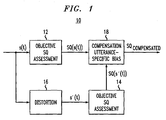
- Fig. 1 depicts an objective speech quality assessment arrangement 10 which compensates for utterance dependent articulation in accordance with the present invention.
- Objective speech quality assessment arrangement 10 comprises a plurality of objective speech quality assessment modules 12, 14, a distortion module 16 and a compensation utterance-specific bias module 18.
- Speech signal s(t) is provided as inputs to distortion module 16 and objective speech quality assessment module 12.
- distortion module 16 speech signal s(t) is distorted to produce a modulated noise reference unit (MNRU) speech signal s'(t).
- MNRU speech signal s'(t) is then provided as input to objective speech quality assessment module 14.
- MNRU modulated noise reference unit
- objective speech quality assessment modules 12, 14 speech signal s(t) and MNRU speech signal s'(t) are processed to obtain objective speech quality assessments SQ(s(t) and SQ(s'(t)).
- Objective speech quality assessment modules 12, 14 are essentially identical in terms of the type of processing performed to any input speech signals. That is, if both objective speech quality assessment modules 12, 14 receive the same input speech signal, the output signals of both modules 12, 14 would be approximately identical. Note that, in other embodiments, objective speech quality assessment modules 12, 14 may process speech signals s(t) and s'(t) in a manner different from each other. Objective speech quality assessment modules are well-known in the art. An example of such a module will be described later herein.
- Speech quality assessments SQ(s(t) and SQ(s'(t)) are then compared to obtain speech quality assessment SQ compensated , which compensates for utterance dependent articulation.
- speech quality assessment SQ compensated is determined using the difference between objective speech quality assessments SQ(s(t) and SQ(s'(t)). For example, SQ compensated is equal to SQ(s(t) minus SQ(s'(t)), or vice-versa.
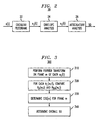
- Fig. 2 depicts an embodiment 20 of an objective speech quality assessment module 12, 14 employing an auditory-articulatory analysis module in accordance with the present invention.
- objective quality assessment module 20 comprises of cochlear filterbank 22, envelope analysis module 24 and articulatory analysis module 26.
- speech signal s(t) is provided as input to cochlear filterbank 22.
- cochlear filterbank 22 filters speech signal s(t) to produce a plurality of critical band signals s i (t), wherein critical band signal s i (t) is equal to s(t)*h i (t).
- the plurality of critical band signals s i (t) is provided as input to envelope analysis module 24.
- the plurality of envelopes a i (t) is then provided as input to articulatory analysis module 26.
- the plurality of envelopes a i (t) is processed to obtain a speech quality assessment for speech signal s(t).
- articulatory analysis module 26 does a comparison of the power associated with signals generated from the human articulatory system (hereinafter referred to as "articulation power P A (m,i)”) with the power associated with signals not generated from the human articulatory system (hereinafter referred to as "non-articulation power P NA (m,i)"). Such comparison is then used to make a speech quality assessment.
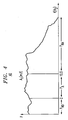
- Fig. 3 depicts a flowchart 300 for processing, in articulatory analysis module 26, the plurality of envelopes a i (t) in accordance with one embodiment of the invention.
- step 310 Fourier transform is performed on frame m of each of the plurality of envelopes a i (t) to produce modulation spectrums A i (m,f), where f is frequency.
- Fig. 4 depicts an example 40 illustrating modulation spectrum A i (m,f) in terms of power versus frequency.
- articulation power P A (m,i) is the power associated with frequencies 2 ⁇ 12.5 Hz
- non-articulation power P NA (m,i) is the power associated with frequencies greater than 12.5 Hz
- Power P No (m,i) associated with frequencies less than 2 Hz is the DC-component of frame m of critical band signal a i (t).
- articulation power P A (m,i) is chosen as the power associated with frequencies 2 ⁇ 12.5 Hz based on the fact that the speed of human articulation is 2 ⁇ 12.5 Hz, and the frequency ranges associated with articulation power P A( m,i) and non-articulation power P NA (m,i) (hereinafter referred to respectively as “articulation frequency range” and “non-articulation frequency range”) are adjacent, non-overlapping frequency ranges. It should be understood that, for purposes of this application, the term "articulation power P A (m,i)" should not be limited to the frequency range of human articulation or the aforementioned frequency range 2 ⁇ 12.5 Hz.
- non-articulation power P NA (m,i) should not be limited to frequency ranges greater than the frequency range associated with articulation power P A (m,i).
- the non-articulation frequency range may or may not overlap with or be adjacent to the articulation frequency range.
- the non-articulation frequency range may also include frequencies less than the lowest frequency in the articulation frequency range, such as those associated with the DC-component of frame m of critical band signal a i (t).
- step 320 for each modulation spectrum A i (m,f), articulatory analysis module 26 performs a comparison between articulation power P A( m,i) and non-articulation power P NA (m,i).
- the comparison between articulation power P A (m,i) and non-articulation power P NA (m,i) is an articulation-to-non-articulation ratio ANR(m,i).
- Other comparisons between articulation power P A (m,i) and non-articulation power P NA (m,i) are possible.
- the comparison may be the reciprocal of equation (1), or the comparison may be a difference between articulation power P A( m,i) and non-articulation power P NA (m,i).
- the embodiment of articulatory analysis module 26 depicted by flowchart 300 will be discussed with respect to the comparison using ANR(m,i) of equation (1). This should not, however, be construed to limit the present invention in any manner.
- ANR(m,i) is used to determine local speech quality LSQ(m) for frame m.
- Local speech quality LSQ(m) is determined using an aggregate of the articulation-to-non-articulation ratio ANR(m,i) across all channels i and a weighing factor R(m,i) based on the DC-component power P No (m,i).
- step 340 overall speech quality SQ for speech signal s(t) is determined using local speech quality LSQ(m) and a log power P s (m) for frame m.
- P s m log ⁇ t ⁇ I ⁇ ⁇ m s 2 t
- L is L p -norm
- T is the total number of frames in speech signal s(t)
- ⁇ is any value
- P th is a threshold for distinguishing between audible signals and silence.
- ⁇ is preferably an odd integer value.
- the output of articulatory analysis module 26 is an assessment of speech quality SQ over all frames m. That is, speech quality SQ is a speech quality assessment for speech signal s(t).
Landscapes
- Engineering & Computer Science (AREA)
- Multimedia (AREA)
- Computational Linguistics (AREA)
- Health & Medical Sciences (AREA)
- Audiology, Speech & Language Pathology (AREA)
- Human Computer Interaction (AREA)
- Physics & Mathematics (AREA)
- Acoustics & Sound (AREA)
- Signal Processing (AREA)
- Quality & Reliability (AREA)
- Electrically Operated Instructional Devices (AREA)
- Telephone Function (AREA)
- Mobile Radio Communication Systems (AREA)
- Machine Translation (AREA)
- Telephonic Communication Services (AREA)
- Compression, Expansion, Code Conversion, And Decoders (AREA)
Claims (20)
- Verfahren zur Bewertung der Sprachqualität, die folgenden Schritte umfassend:Bestimmen einer ersten und einer zweiten Sprachqualitätsbewertung für erste und zweite Sprachqualitätssignale, jeweils ein (SQ(s(t), SQ(s'(t))-basiertes erstes und zweites Sprachsignal, wobei das zweite Sprachsignal ein verarbeitetes Sprachsignal ist und das erste Sprachsignal eine verzerrte (MNRU)-Version des zweiten Sprachsignals ist; undGewinnen einer SQ-kompensierten Sprachqualitätsbewertung durch Vergleichen der ersten und der zweiten Sprachqualitätsbewertungen.
- Verfahren nach Anspruch 1, den folgenden zusätzlichen Schritt umfassend:Vor Bestimmen der ersten und zweiten Sprachqualitätsbewertungen, Verzerren des zweiten Sprachsignals, um das erste Sprachsignal zu erzeugen.
- Verfahren nach Anspruch 1, wobei die erste und die zweite Sprachqualität unter Verwendung einer identischen Technik für objektive Sprachqualitätsbewertung bewertet werden.
- Verfahren nach Anspruch 1, wobei die kompensierte Sprachqualitätsbewertung einer Differenz zwischen der ersten und der zweiten Sprachqualität entspricht.
- Verfahren nach Anspruch 1, wobei die kompensierte Sprachqualitätsbewertung einem Verhältnis zwischen der ersten und der zweiten Sprachqualität entspricht.
- Verfahren nach Anspruch 1, wobei die erste und die zweite Sprachqualität unter Verwendung einer auditorisch-artikulatorischen Analyse bewertet werden.
- Verfahren nach Anspruch 1, wobei der Schritt des Bewertens der zweiten und der ersten Sprachqualität die folgenden Schritte umfasst:Vergleichen der Lautbildungsleistung und der Nicht-Lautbildungsleistung für das Sprachsignal oder das verzerrte Sprachsignal, wobei die Lautbildungs- (PA) und die Nicht-Lautbildungs- (PNA)-Leistungen mit Lautbildungs- und Nicht-Lautbildungsfrequenzen des Sprachsignals oder des verzerrten Sprachsignals assoziiert werden; undBewerten der zweiten oder der ersten Sprachqualität auf der Basis des Vergleichs.
- Verfahren nach Anspruch 7, wobei die Lautbildungsfrequenzen im Bereich von ca. 2 ∼ 12.5 Hz liegen.
- Verfahren nach Anspruch 7, wobei die Lautbildungsfrequenzen in etwa der Geschwindigkeit der menschlichen Lautbildung entsprechen.
- Verfahren nach Anspruch 7, wobei die Nicht-Lautbildungsfrequenzen in etwa höher als die Lautbildungsfrequenzen sind.
- Verfahren nach Anspruch 7, wobei der Vergleich der Lautbildungsleistung und der Nicht-Lautbildungsleistung ein Verhältnis zwischen der Lautbildungsleistung und der Nicht-Lautbildungsleistung ist.
- Verfahren nach Anspruch 10, wobei das Verhältnis einen Nenner und einen Zähler umfasst, wobei der Zähler die Lautbildungsleistung und eine kleine Konstante einschließt, und wobei der Nenner die Nicht-Lautbildungsleistung plus die kleine Konstante einschließt.
- Verfahren nach Anspruch 7, wobei der Vergleich zwischen der Lautbildungsleistung und der Nicht-Lautbildungsleistung eine Differenz zwischen der Lautbildungsleistung und der Nicht-Lautbildungsleistung ist.
- Verfahren nach Anspruch 7, wobei der Schritt des Bewertens der ersten oder der zweiten Sprachqualität den folgenden Schritt umfasst:Bestimmen einer lokalen Sprachqualität und Verwendung des Vergleichs.
- Verfahren nach Anspruch 7, wobei die lokale Sprachqualität weiterhin unter Verwendung eines Gewichtungsfaktors auf der Basis einer Gleichstromkomponente-Leistung (PNO) bestimmt wird.
- Verfahren nach Anspruch 9, wobei die erste oder die zweite Sprachqualität unter Verwendung der lokalen Sprachqualität bestimmt wird.
- Verfahren nach Anspruch 7, wobei der Schritt des Vergleichens der Lautbildungsleistung und der Nicht-Lautbildungsleistung den folgenden Schritt umfasst:Durchführen einer Fourier-Transformation auf einer jeden der Vielzahl von aus einer Vielzahl von Signalen kritischer Bänder gewonnenen Hüllkurven.
- Verfahren nach Anspruch 7, wobei der Schritt des Vergleichens der Lautbildungsleistung und der Nicht-Lautbildungsleistung den folgenden Schritt umfasst:Filtern des Sprachsignals, um eine Vielzahl von Signalen kritischer Bänder zu erhalten.
- Verfahren nach Anspruch 18, wobei der Schritt des Vergleichens der Lautbildungsleistung und der Nicht-Lautbildungsleistung den folgenden Schritt umfasst:Durchführen einer Hüllkurvenanalyse auf der Vielzahl von Signalen kritischer Bänder, um eine Vielzahl von Modulationsspektren zu erhalten.
- Verfahren nach Anspruch 18, wobei der Schritt des Vergleichens der Lautbildungsleistung und der Nicht-Lautbildungsleistung den folgenden Schritt umfasst:Durchführen einer Fourier-Transformation auf einem jeden der Vielzahl von Modulationsspektren.
Applications Claiming Priority (3)
| Application Number | Priority Date | Filing Date | Title |
|---|---|---|---|
| US186862 | 1998-11-05 | ||
| US10/186,862 US7308403B2 (en) | 2002-07-01 | 2002-07-01 | Compensation for utterance dependent articulation for speech quality assessment |
| PCT/US2003/020354 WO2004003499A2 (en) | 2002-07-01 | 2003-06-27 | Compensation for utterance dependent articulation for speech quality assessment |
Publications (2)
| Publication Number | Publication Date |
|---|---|
| EP1518096A2 EP1518096A2 (de) | 2005-03-30 |
| EP1518096B1 true EP1518096B1 (de) | 2014-04-23 |
Family
ID=29779951
Family Applications (1)
| Application Number | Title | Priority Date | Filing Date |
|---|---|---|---|
| EP03762154.7A Expired - Lifetime EP1518096B1 (de) | 2002-07-01 | 2003-06-27 | Äusserungsabhängige-aussprachekompensation für sprachqualitätsbewertung |
Country Status (7)
| Country | Link |
|---|---|
| US (1) | US7308403B2 (de) |
| EP (1) | EP1518096B1 (de) |
| JP (1) | JP4301514B2 (de) |
| KR (1) | KR101052432B1 (de) |
| CN (1) | CN1307611C (de) |
| AU (1) | AU2003253742A1 (de) |
| WO (1) | WO2004003499A2 (de) |
Families Citing this family (13)
| Publication number | Priority date | Publication date | Assignee | Title |
|---|---|---|---|---|
| US7165025B2 (en) * | 2002-07-01 | 2007-01-16 | Lucent Technologies Inc. | Auditory-articulatory analysis for speech quality assessment |
| US7305341B2 (en) * | 2003-06-25 | 2007-12-04 | Lucent Technologies Inc. | Method of reflecting time/language distortion in objective speech quality assessment |
| CA2580763C (en) * | 2004-09-20 | 2014-07-29 | John Gerard Beerends | Frequency compensation for perceptual speech analysis |
| US9241994B2 (en) | 2005-06-10 | 2016-01-26 | Chugai Seiyaku Kabushiki Kaisha | Pharmaceutical compositions containing sc(Fv)2 |
| US7856355B2 (en) * | 2005-07-05 | 2010-12-21 | Alcatel-Lucent Usa Inc. | Speech quality assessment method and system |
| KR100729555B1 (ko) * | 2005-10-31 | 2007-06-19 | 연세대학교 산학협력단 | 음성 품질의 객관적인 평가방법 |
| UA101974C2 (ru) * | 2008-04-18 | 2013-05-27 | Долби Леборетериз Лайсенсинг Корпорейшн | Способ и устройство для поддержки восприятия языка во многоканальном звуковом сопровождении с минимальным влиянием на систему объемного звучания |
| CN101609686B (zh) * | 2009-07-28 | 2011-09-14 | 南京大学 | 基于语音增强算法主观评估的客观评估方法 |
| CN101894560B (zh) * | 2010-06-29 | 2012-08-15 | 上海大学 | 一种无参考源的mp3音频清晰度客观评价方法 |
| CN102157147B (zh) * | 2011-03-08 | 2012-05-30 | 公安部第一研究所 | 一种拾音系统语音质量客观评价的测试方法 |
| DE102013005844B3 (de) * | 2013-03-28 | 2014-08-28 | Technische Universität Braunschweig | Verfahren und Vorrichtung zum Messen der Qualität eines Sprachsignals |
| US9830905B2 (en) | 2013-06-26 | 2017-11-28 | Qualcomm Incorporated | Systems and methods for feature extraction |
| EP2922058A1 (de) * | 2014-03-20 | 2015-09-23 | Nederlandse Organisatie voor toegepast- natuurwetenschappelijk onderzoek TNO | Verfahren und Vorrichtung zur Bewertung der Qualität eines verschlechterten Sprachsignals |
Family Cites Families (15)
| Publication number | Priority date | Publication date | Assignee | Title |
|---|---|---|---|---|
| US3971034A (en) * | 1971-02-09 | 1976-07-20 | Dektor Counterintelligence And Security, Inc. | Physiological response analysis method and apparatus |
| IT1121496B (it) * | 1979-12-14 | 1986-04-02 | Cselt Centro Studi Lab Telecom | Procedimento e dispositivo per l effettuazione di misure oggettive di qualita su apparecchiature di trasmissione di segnali fonici |
| WO1992015090A1 (en) * | 1991-02-22 | 1992-09-03 | Seaway Technologies, Inc. | Acoustic method and apparatus for identifying human sonic sources |
| US5454375A (en) * | 1993-10-21 | 1995-10-03 | Glottal Enterprises | Pneumotachograph mask or mouthpiece coupling element for airflow measurement during speech or singing |
| JPH09505701A (ja) * | 1993-11-25 | 1997-06-03 | ブリテイッシュ・テレコミュニケーションズ・パブリック・リミテッド・カンパニー | 電気通信装置の試験 |
| US5848384A (en) * | 1994-08-18 | 1998-12-08 | British Telecommunications Public Limited Company | Analysis of audio quality using speech recognition and synthesis |
| DE69626115T2 (de) * | 1995-07-27 | 2003-11-20 | British Telecommunications P.L.C., London | Signalqualitätsbewertung |
| GB9604315D0 (en) * | 1996-02-29 | 1996-05-01 | British Telecomm | Training process |
| DE19647399C1 (de) * | 1996-11-15 | 1998-07-02 | Fraunhofer Ges Forschung | Gehörangepaßte Qualitätsbeurteilung von Audiotestsignalen |
| US6052662A (en) * | 1997-01-30 | 2000-04-18 | Regents Of The University Of California | Speech processing using maximum likelihood continuity mapping |
| US6246978B1 (en) * | 1999-05-18 | 2001-06-12 | Mci Worldcom, Inc. | Method and system for measurement of speech distortion from samples of telephonic voice signals |
| US6609092B1 (en) * | 1999-12-16 | 2003-08-19 | Lucent Technologies Inc. | Method and apparatus for estimating subjective audio signal quality from objective distortion measures |
| EP1187100A1 (de) * | 2000-09-06 | 2002-03-13 | Koninklijke KPN N.V. | Verfahren und Vorrichtung für die objektive Bewertung der Sprachqualität ohne Referenzsignal |
| US7165025B2 (en) * | 2002-07-01 | 2007-01-16 | Lucent Technologies Inc. | Auditory-articulatory analysis for speech quality assessment |
| US7305341B2 (en) * | 2003-06-25 | 2007-12-04 | Lucent Technologies Inc. | Method of reflecting time/language distortion in objective speech quality assessment |
-
2002
- 2002-07-01 US US10/186,862 patent/US7308403B2/en not_active Expired - Lifetime
-
2003
- 2003-06-27 WO PCT/US2003/020354 patent/WO2004003499A2/en not_active Ceased
- 2003-06-27 KR KR1020047003130A patent/KR101052432B1/ko not_active Expired - Fee Related
- 2003-06-27 AU AU2003253742A patent/AU2003253742A1/en not_active Abandoned
- 2003-06-27 CN CNB038009366A patent/CN1307611C/zh not_active Expired - Fee Related
- 2003-06-27 JP JP2004517987A patent/JP4301514B2/ja not_active Expired - Fee Related
- 2003-06-27 EP EP03762154.7A patent/EP1518096B1/de not_active Expired - Lifetime
Also Published As
| Publication number | Publication date |
|---|---|
| AU2003253742A1 (en) | 2004-01-19 |
| WO2004003499A3 (en) | 2004-04-01 |
| CN1550000A (zh) | 2004-11-24 |
| WO2004003499A2 (en) | 2004-01-08 |
| JP2005531990A (ja) | 2005-10-20 |
| US20040002857A1 (en) | 2004-01-01 |
| US7308403B2 (en) | 2007-12-11 |
| KR20050012712A (ko) | 2005-02-02 |
| EP1518096A2 (de) | 2005-03-30 |
| JP4301514B2 (ja) | 2009-07-22 |
| CN1307611C (zh) | 2007-03-28 |
| AU2003253742A8 (en) | 2004-01-19 |
| KR101052432B1 (ko) | 2011-07-29 |
Similar Documents
| Publication | Publication Date | Title |
|---|---|---|
| EP1518096B1 (de) | Äusserungsabhängige-aussprachekompensation für sprachqualitätsbewertung | |
| US20040267523A1 (en) | Method of reflecting time/language distortion in objective speech quality assessment | |
| US7165025B2 (en) | Auditory-articulatory analysis for speech quality assessment | |
| EP1465456B1 (de) | Binaurales System zur Signalverbesserung | |
| US20110188671A1 (en) | Adaptive gain control based on signal-to-noise ratio for noise suppression | |
| EP2048657B1 (de) | Verfahren und System zur Messung der Sprachverständlichkeit eines Tonübertragungssystems | |
| US20060008101A1 (en) | Spectral enhancement using digital frequency warping | |
| Hermansky et al. | Speech enhancement based on temporal processing | |
| US7313517B2 (en) | Method and system for speech quality prediction of an audio transmission system | |
| US7689406B2 (en) | Method and system for measuring a system's transmission quality | |
| Crochiere et al. | An interpretation of the log likelihood ratio as a measure of waveform coder performance | |
| CN101256776A (zh) | 语音信号处理方法 | |
| US7013266B1 (en) | Method for determining speech quality by comparison of signal properties | |
| Chanda et al. | Speech intelligibility enhancement using tunable equalization filter | |
| Grimm et al. | Implementation and evaluation of an experimental hearing aid dynamic range compressor | |
| US9659565B2 (en) | Method of and apparatus for evaluating intelligibility of a degraded speech signal, through providing a difference function representing a difference between signal frames and an output signal indicative of a derived quality parameter | |
| Levitt et al. | Evaluation of orthogonal polynomial compression | |
| EP3718476B1 (de) | Systeme und verfahren zur beurteilung der hörgesundheit | |
| US10993050B2 (en) | Joint spectral gain adaptation module and method thereof, audio processing system and implementation method thereof | |
| EP1343145A1 (de) | System und Verfahren zur Messung der Qualität eines Übertragungssystems | |
| Sonawane et al. | Reconfigurable Filter Design and Testing with ISTS Standard for Proposed Hearing Aid Application. | |
| Atti | Perceptual Modeling of Speech | |
| Alghamdi | Objective Methods for Speech Intelligibility Prediction | |
| de Perez et al. | Noise reduction and loudness compression in a wavelet modelling of the auditory system | |
| Leijon | Predicted speech intelligibility and loudness in model-based preliminary hearing-aid fitting |
Legal Events
| Date | Code | Title | Description |
|---|---|---|---|
| PUAI | Public reference made under article 153(3) epc to a published international application that has entered the european phase |
Free format text: ORIGINAL CODE: 0009012 |
|
| 17P | Request for examination filed |
Effective date: 20040301 |
|
| AK | Designated contracting states |
Kind code of ref document: A2 Designated state(s): AT BE BG CH CY CZ DE DK EE ES FI FR GB GR HU IE IT LI LU MC NL PT RO SE SI SK TR |
|
| RBV | Designated contracting states (corrected) |
Designated state(s): AT BE BG CH CY DE FI FR GB LI SE |
|
| RAP3 | Party data changed (applicant data changed or rights of an application transferred) |
Owner name: KIM, DOH-SUK Owner name: LUCENT TECHNOLOGIES INC. |
|
| 17Q | First examination report despatched |
Effective date: 20130301 |
|
| RAP1 | Party data changed (applicant data changed or rights of an application transferred) |
Owner name: KIM, DOH-SUK Owner name: ALCATEL-LUCENT USA INC. |
|
| REG | Reference to a national code |
Ref country code: DE Ref legal event code: R079 Ref document number: 60346053 Country of ref document: DE Free format text: PREVIOUS MAIN CLASS: G01L0001000000 Ipc: G10L0025690000 |
|
| RIC1 | Information provided on ipc code assigned before grant |
Ipc: G10L 25/69 20130101AFI20130816BHEP |
|
| 111Z | Information provided on other rights and legal means of execution |
Free format text: AT BE BG CH CY DE FI FR GB LI SE Effective date: 20130410 |
|
| GRAP | Despatch of communication of intention to grant a patent |
Free format text: ORIGINAL CODE: EPIDOSNIGR1 |
|
| INTG | Intention to grant announced |
Effective date: 20131030 |
|
| RBV | Designated contracting states (corrected) |
Designated state(s): DE FI FR GB SE |
|
| GRAS | Grant fee paid |
Free format text: ORIGINAL CODE: EPIDOSNIGR3 |
|
| GRAA | (expected) grant |
Free format text: ORIGINAL CODE: 0009210 |
|
| AK | Designated contracting states |
Kind code of ref document: B1 Designated state(s): DE FI FR GB SE |
|
| RAP1 | Party data changed (applicant data changed or rights of an application transferred) |
Owner name: ALCATEL LUCENT |
|
| REG | Reference to a national code |
Ref country code: GB Ref legal event code: FG4D |
|
| REG | Reference to a national code |
Ref country code: DE Ref legal event code: R096 Ref document number: 60346053 Country of ref document: DE Effective date: 20140528 |
|
| RAP2 | Party data changed (patent owner data changed or rights of a patent transferred) |
Owner name: ALCATEL LUCENT |
|
| PG25 | Lapsed in a contracting state [announced via postgrant information from national office to epo] |
Ref country code: FI Free format text: LAPSE BECAUSE OF FAILURE TO SUBMIT A TRANSLATION OF THE DESCRIPTION OR TO PAY THE FEE WITHIN THE PRESCRIBED TIME-LIMIT Effective date: 20140423 |
|
| PG25 | Lapsed in a contracting state [announced via postgrant information from national office to epo] |
Ref country code: SE Free format text: LAPSE BECAUSE OF FAILURE TO SUBMIT A TRANSLATION OF THE DESCRIPTION OR TO PAY THE FEE WITHIN THE PRESCRIBED TIME-LIMIT Effective date: 20140423 |
|
| REG | Reference to a national code |
Ref country code: DE Ref legal event code: R097 Ref document number: 60346053 Country of ref document: DE |
|
| PLBE | No opposition filed within time limit |
Free format text: ORIGINAL CODE: 0009261 |
|
| STAA | Information on the status of an ep patent application or granted ep patent |
Free format text: STATUS: NO OPPOSITION FILED WITHIN TIME LIMIT |
|
| 26N | No opposition filed |
Effective date: 20150126 |
|
| REG | Reference to a national code |
Ref country code: DE Ref legal event code: R097 Ref document number: 60346053 Country of ref document: DE Effective date: 20150126 |
|
| REG | Reference to a national code |
Ref country code: FR Ref legal event code: PLFP Year of fee payment: 14 |
|
| REG | Reference to a national code |
Ref country code: FR Ref legal event code: PLFP Year of fee payment: 15 |
|
| PGFP | Annual fee paid to national office [announced via postgrant information from national office to epo] |
Ref country code: DE Payment date: 20170621 Year of fee payment: 15 Ref country code: FR Payment date: 20170621 Year of fee payment: 15 Ref country code: GB Payment date: 20170620 Year of fee payment: 15 |
|
| REG | Reference to a national code |
Ref country code: DE Ref legal event code: R119 Ref document number: 60346053 Country of ref document: DE |
|
| GBPC | Gb: european patent ceased through non-payment of renewal fee |
Effective date: 20180627 |
|
| PG25 | Lapsed in a contracting state [announced via postgrant information from national office to epo] |
Ref country code: FR Free format text: LAPSE BECAUSE OF NON-PAYMENT OF DUE FEES Effective date: 20180630 Ref country code: GB Free format text: LAPSE BECAUSE OF NON-PAYMENT OF DUE FEES Effective date: 20180627 Ref country code: DE Free format text: LAPSE BECAUSE OF NON-PAYMENT OF DUE FEES Effective date: 20190101 |