EP1517481A1 - Verfahren zur Vorhersage der Ansprechzeit für Pakete über einen seriellen Bus - Google Patents
Verfahren zur Vorhersage der Ansprechzeit für Pakete über einen seriellen Bus Download PDFInfo
- Publication number
- EP1517481A1 EP1517481A1 EP03020937A EP03020937A EP1517481A1 EP 1517481 A1 EP1517481 A1 EP 1517481A1 EP 03020937 A EP03020937 A EP 03020937A EP 03020937 A EP03020937 A EP 03020937A EP 1517481 A1 EP1517481 A1 EP 1517481A1
- Authority
- EP
- European Patent Office
- Prior art keywords
- frame
- time
- transaction
- frames
- serial bus
- Prior art date
- Legal status (The legal status is an assumption and is not a legal conclusion. Google has not performed a legal analysis and makes no representation as to the accuracy of the status listed.)
- Granted
Links
- 238000000034 method Methods 0.000 title claims abstract description 44
- 230000004044 response Effects 0.000 title claims abstract description 36
- 230000005540 biological transmission Effects 0.000 claims description 31
- 230000001419 dependent effect Effects 0.000 claims description 3
- 230000008569 process Effects 0.000 abstract description 19
- 238000004458 analytical method Methods 0.000 abstract description 17
- 238000013459 approach Methods 0.000 abstract description 4
- 238000012545 processing Methods 0.000 description 14
- 238000004891 communication Methods 0.000 description 5
- 238000004422 calculation algorithm Methods 0.000 description 3
- 238000004364 calculation method Methods 0.000 description 3
- 230000001934 delay Effects 0.000 description 3
- 230000000694 effects Effects 0.000 description 3
- 238000005516 engineering process Methods 0.000 description 3
- CCEKAJIANROZEO-UHFFFAOYSA-N sulfluramid Chemical group CCNS(=O)(=O)C(F)(F)C(F)(F)C(F)(F)C(F)(F)C(F)(F)C(F)(F)C(F)(F)C(F)(F)F CCEKAJIANROZEO-UHFFFAOYSA-N 0.000 description 3
- 230000000903 blocking effect Effects 0.000 description 2
- 230000000737 periodic effect Effects 0.000 description 2
- 102000003712 Complement factor B Human genes 0.000 description 1
- 108090000056 Complement factor B Proteins 0.000 description 1
- 238000005094 computer simulation Methods 0.000 description 1
- 230000003111 delayed effect Effects 0.000 description 1
- 238000013461 design Methods 0.000 description 1
- 230000006872 improvement Effects 0.000 description 1
- 230000007246 mechanism Effects 0.000 description 1
- 238000012986 modification Methods 0.000 description 1
- 230000004048 modification Effects 0.000 description 1
- 238000012856 packing Methods 0.000 description 1
- 230000001360 synchronised effect Effects 0.000 description 1
Images




Classifications
-
- H—ELECTRICITY
- H04—ELECTRIC COMMUNICATION TECHNIQUE
- H04L—TRANSMISSION OF DIGITAL INFORMATION, e.g. TELEGRAPHIC COMMUNICATION
- H04L12/00—Data switching networks
- H04L12/28—Data switching networks characterised by path configuration, e.g. LAN [Local Area Networks] or WAN [Wide Area Networks]
- H04L12/40—Bus networks
- H04L12/407—Bus networks with decentralised control
- H04L12/413—Bus networks with decentralised control with random access, e.g. carrier-sense multiple-access with collision detection [CSMA-CD]
- H04L12/4135—Bus networks with decentralised control with random access, e.g. carrier-sense multiple-access with collision detection [CSMA-CD] using bit-wise arbitration
Definitions
- the present invention relates to a method for predicting the worst case response time for a fixed priority frame in a frame queuing system in a serial bus network, such as a CAN.
- serial bus networks are used for communication between digital devices; one example is a CAN network in a vehicle. Further, the communication between these devices is typically associated with specific timing requirements, stating a maximum delay from the time a certain event takes place to the time when a corresponding function is performed. For example, it is normally appreciated if the automatic breaking system (ABS) responds quickly to a sensor signal even when the network is occupied with several other tasks (like engine control, transmission control, etc).
- ABS automatic breaking system
- Such timing requirements translate into a maximum response time for frames, i.e. a maximum time period between arrival of a frame transmission request and completed transmission of the same frame.
- the network is modulated in a software design tool, and maximum response times are predicted. If the network is deemed to be too slow under present circumstances, it will have to be redesigned, or, if possible, the band width of the network bus can be improved.
- the mechanism assigning priorities and handling the distribution of frames on a serial bus is referred to as scheduling, and resembles the process of scheduling tasks in e.g. a centralized computer processing system.
- the design tools mentioned above are based on response time analysis, in short a way to mathematically determine the delay between a request (e.g. for sending a frame on a serial bus) is made and when it is treated.
- nodes in a serial bus network may be restricted to only enter a given number of frames into the arbitration process.
- Such restrictions normally referred to as node budgets, are imposed in order to allow the node processor to handle other tasks apart from scheduling and transmitting frames. These budgets are not considered in conventional scheduling analysis.
- An object of the present invention is therefore to provide a more correct way to estimate delivery times of frames on a serial bus network, and to overcome at least some of the shortcomings of prior art methods.
- a method of the kind mentioned by way of introduction comprising the steps of: defining the period of the transaction as the least common multiplier (LCM) of the frame periods of the included frames; identifying a set of starting points, representing the latest possible release times for all frames in the transaction having higher or equal priority as said frame; for each starting point (s), determining a maximum duration of a sequence of frames having a higher priority as said frame that can occur starting at this starting point, identifying the next frame instance having a latest possible release time equal to or greater than this starting point, and calculating the difference between the end of said sequence and the arrival time of said frame instance, and selecting the longest of said differences for determining the frame response time.
- LCM least common multiplier
- the method according to the invention provides a more accurate prediction of frame response times in different stages of the processing, enabling a more efficient utilization of the network.
- the queuing system can for example be the serial bus of a serial bus network, or a transmit or receive queue connected to this bus.
- the queuing system can for example be the serial bus of a serial bus network, or a transmit or receive queue connected to this bus.
- the step of determining the frame response time can include calculating a sum of the longest of said differences and a frame transmission time.
- the set of starting points is divided into subsets, each being associated with one frame instance, and said difference is then calculated for the starting points in one such subset at a time.
- the step of calculating said maximum duration can be performed by setting a current duration to an initial value and iterating the following steps until the duration converges: determining a maximum contribution from each transaction by identifying a set of time lags between a given transaction and said starting point, determining the contribution from this particular transaction with this particular time lag, and selecting the largest contribution; determining an updated duration including a sum of all such maximum contributions; and replacing the current duration with the updated duration.
- the initial value is preferably set to the longest possible transmission time of a frame with lower priority than said frame. This represents the longest possible delay that can be caused by a lower priority frame released before the frame of interest. This delay is due to the non-preemptive character of the system. Further, this delay can be included as a constant term in each updated duration, in order to make the estimation more accurate.
- an error term is also included as a term in each updated duration.
- the error term can represents the probable duration of transmission errors on the serial bus, and is typically dependent on the current busy period duration. Accordingly, the error term is recalculated for each iteration.
- each transmit queue is arranged to transmit a limited number of frames onto said serial bus during a given period of time
- frames originating from the same transmit queue being referred to as a batch
- the step of determining a maximum contribution is performed for one batch at a time
- This embodiment modifies the method according to the invention to handle budgets, which is an important feature of e.g. some CAN systems.
- a frame refers to a class of frames having the same fixed priority.
- An individual frame in the queuing system is instead referred to as a frame instance.
- the arrival time is the point in time when a frame instance is notionally created
- the release time is the point in time when this frame instance actually enters the arbitration process of the queuing system. In a perfect system, these times would coincide, but in practice there is a delay, referred to as release jitter.
- release jitter The latest possible release time of an instance is the arrival time plus the maximum possible jitter.
- Frame instances are expected to arrive periodically, and the expected period between such arrivals is called the frame period.
- Sporadic frames i.e. frames not having a periodic behavior, are treated as having a period equal to the shortest time between two sporadic arrivals.
- a transmission time will be required to complete the transmission of the frame, and this will be dependent on the amount of data placed in the body of the frame.
- a frame may not be interrupted when transmission has started.
- each frame is related to the start of the transaction with an offset.
- the transaction is periodic with a transaction period , and each transaction occurrence is referred to as a transaction invocation. Note that it is not necessary that all frames having a common time relationship are grouped in the same transaction. In fact, according to preferred embodiments of the invention, it may be advantageous to let the frame of interest per definition be the frame with lowest priority in its transaction. This can be accomplished by grouping frames with lower priority in a separate transaction.
- a sporadic frame cannot have a time relationship with other frames, and thus forms a transaction by itself.
- Such a sporadic transaction is treated as having a period equal to the shortest time between two sporadic arrivals.
- the transmission of any frame with a higher priority j ⁇ i must be completed (N.B. that a higher priority is denoted with a lower index).
- the period of time during which the bus is occupied with such frames is referred to as the level i-1 busy period.
- the delay between the arrival of the frame instance and the completed transmission of the instance is referred to as the response time.
- Fig 1 shows an example of a network 1 in which the present invention is applicable.
- the network 1 comprises a plurality of nodes 2, connected by a serial bus 3 carrying information contained in frames 4.
- a network is a CAN, Controller Area Network which is a simple communications standard that has gained widespread use in automotive and control applications.
- the CAN standard is described in detail in "CAN specification version 2.0", Robert Bosch GmbH, Stuttgart, 1991.
- Each node 2 has a node controller 5, and a transmit queue 6 and a receive queue 7. Frames that are ready for transmission are inserted into the transmit queue they are allocated to, and the transmit queues are ordered by frame priorities.
- the node controller places frames that are waiting in the transmit queue on the serial bus by calling a frame processing routine.
- every transmit queue can have a budget , i.e. a maximum number of frames instances that can be included in a frame processing call.
- the period between frame processing calls is referred to as a frame processing period.
- a call to the frame procssing routine is made periodically, and each time the number of frames allowed by the transmit queue budget (in priority order) are taken out of the queue and copied to the controller for transmission.
- the transmit queue budget in priority order
- multiple queues can be allocated to a single node controller, but a frame can only be allocated to one transmit queue.
- the situation is similar on the side of a receiving node. Frames received by the receiving controller are inserted into a local receive queue, and a call to a frame processing routine is made periodically. Each time, the number of frames allowed by the receive queue budget are taken out of the receive queue and processed.
- the nodes in the CAN system and similar types of serial bus networks are not synchronized, which means that predefined time relationships between different frames (offsets, see above) only can exist between frames originating from the same node, and, if a node has several transmit queues, from the same transmit queue. Therefore, the frames in a transaction all originate from the same transmit queue.
- the collection of all transactions from a transmit queue is referred to as a batch. Consequently, a particular budget is always related to one particular batch.
- CAN uses an arbitration protocol to resolve contention on the bus when more than one frame is ready for transmission.
- the arbitration protocol works in the following way: Each frame 4 starts with a unique arbitration field of 11 or 29 bits. If a CAN controller transmits a zero, the bus will reflect a zero regardless of what the other controllers have transmitted. If a CAN controller transmits a one, the bus will reflect a one only if no other controller transmitted a zero.
- a controller begins to transmit the arbitration field of the highest priority frame queued in the controller starting with the most significant bit. For each bit that is transmitted the controller waits for the signals to propagate along the bus and then reads the value of the bus. If the controller transmitted a one but receives a zero this indicates that another controller is transmitting a frame with a lower value encoded into the arbitration field and therefore the controller drops out of contention and stops transmitting. After the last bit of the arbitration field has been transmitted only one controller may still be transmitting since the arbitration field is unique. In this way the value of the arbitration field is equal to a priority where a lower value means higher priority.
- Middleware provided by Volcano Communication Technology AB provides an interface to the application programmer which is completely signal-based and guarantees that when a signal is written the new value will be distributed throughout the system within a certain guaranteed amount of time.
- VNA Volcano Network Architect
- Another module referred to as a frame compiler, is adapted to compile a network configuration based on the timing requirements of different signals. The process involves packing the signals into frames and assigning parameters such as periods, priority and offset. A response time analysis is carried out in the process in order to verify that the configuration satisfies the constraints specified.
- the end-to-end response time (i.e. application to application) thus contains two additional parts, corresponding to the time a frame can spend waiting in the transmit and receive queues.
- Figure 2 illustrates the process.
- the data (a signal originating from an application) is sent, i.e. placed in a frame intended to be transmitted on the serial bus.
- the frame is placed in the transmit queue, and after a certain time D1, the frame is included in a frame processing call and enters the bus scheduling process (arbitration).
- the time D2 it takes for the frame to be transmitted on the bus is the response time described above.
- the frame spends a certain time D3 in the receive queue before being included in a frame processing call that finally communicates the data to the receiving application.
- step S51 periods and offsets are determined based on the currently available data. Then, in three consecutive steps (S52-S54), transmit queue delays, bus response times, and receive queue delays are calculated respectively.
- step S55 the results are analyzed, and it is determined if the results can be improved by a further iteration. Depending on this determination, program control is returned to step S51, or the process is terminated. In practical implementations, it may be advantageous to perform the calculations in steps S52-S54 for different subsets of frames, each such subset being relevant in a particular mode of operation.
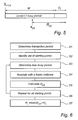
- Fig 4 shows three frames F i , F j , F g with priorities i > j > g, and periods p i , p j , p g .
- Frames F j and F g have offsets O j and O g compared to the beginning of the transaction, which in this case coincides with the arrival of frame F i .
- Each instance k of a frame F i,k is illustrated by two joined arrows, a first arrow indicating the arrival time of the instance, a i,k , and a second indicating the latest possible release time, r i,k .
- the time between the arrows is the jitter, J i .
- a level i-1 busy period (w) must be determined for this instance.
- a set of candidate starting points is determined in step S2 (fig 6). It can be shown that the worst case level i-1 busy period must start on one of the latest possible release times of one of the frames instances with priority j ⁇ i (higher or equal priority).
- these candidate starting points are denoted r i,1 - r i,4 , r j,1 - r j,3 and r g,1 - r g,6 .
- the length of the corresponding maximum level i-1 busy period w is determined (step S3), and the frame instance k having a latest possible release time r i,k on or after the corresponding starting point s (r i,k ⁇ s) is identified (step S4).
- the points r i,2 , r j,1 , r g,1 and r g,2 are associated with instance 2
- r i,3 , r j,2 and r g,3 are associated with instance 3
- r i,1 , r j,3 and r g,6 with instance 1.
- r j,3 and r g,6 are associated with instance 1 of the next invocation of the transaction, but due to the definition of the transaction period made above, the association between starting points and instances is allowed to "wrap around" the same transaction.
- equation 1 assumes that the busy period starts before the latest release of the frame instance, the skilled person realizes that in this case, the correct start of the busy period ⁇ i-1,k is in fact the point r j,3 or r g,6 subtracted by the transaction period p T .
- step S5 The difference D i,k between s+w and a i,k , which is the first term of equation 1, is calculated in step S5, and the steps S3 to S5 are repeated for all starting points (step S6).
- step S11 An alternative, but entirely equivalent, approach is shown in fig 7, where the steps S11 to S16 replace the steps S2 to S6 in fig 6.
- the frame instances of the transaction are determined first (step S11), and then a set of candidate starting points associated with this instance is determined (step S12).
- This set is of course a subset to the complete set in step S2.
- the steps S13 to S15 correspond to the steps S3, S5 and S6, the step S4 being unnecessary as the instance is known.
- step S16 the steps S12 to S15 must be repeated for each instance.
- the step of determining the duration of the maximum busy period (S3 and S13) will be described more in detail with reference to fig 8.
- the routine described here will be called upon with input variables i (priority of the frame) and s (starting point of interest).
- an initial value for the duration w is chosen.
- This value corresponds to the blocking factor B during which the bus may be blocked by a lower priority frame, and is equal to the longest transmission time for a frame with priority j > i.
- this blocking factor may result also from a non-real-time frame (which is not part of the analysis), and thus should be set to the longest possible transmission time for the serial bus. On a typical CAN bus, this is the transmission time of an eight byte frame.
- step S22 a set of candidate time lags between a particular transaction T and the busy period starting point s is identified in step S22. Similar to the situation with starting points above, it can be shown that the transaction will have the greatest impact on the busy period if the starting point s occurs on the latest possible release time of a frame with priority j ⁇ i in the transaction.
- step S23 to S26 a contribution i(T) from this particular transaction to the duration of the busy period w is determined for each candidate time lag.
- step S23 and S24 it is determined how many frames with priority j ⁇ i belonging to the transaction T that can be released within the busy period of duration w. Note that it is possible that several invocations of the transaction may occur within the busy period.
- step S25 all released frames (priority j ⁇ i) are summated, to generate the contribution i(T), and the process is repeated for all time lags in the set (step S26).
- the maximum possible contribution from a transaction, I(T) is selected in step S27, and the steps S22 to S27 are repeated for all transactions (step S28).
- steps S22 to S28 are performed also for the transaction to which the frame of interest belongs. In this particular case, however, there is only one possible time lag (the starting point s is fixed in the transaction), and the steps S23 and S25 are only repeated once.
- the steps S30 to S32 correspond to an iteration of the process until the duration w converges.
- T BIT When comparing wn and w, differences smaller than the time required to transmit one bit on the serial bus, T BIT , will not considered.
- the method is advantageously implemented using only integer numbers (instead of float numbers), where each integer step represents T BIT .
- wn can include a third term, E(w+C i ), which represents the time required for all types of errors on the bus during the time period w+C i .
- E(w+C i ) represents the time required for all types of errors on the bus during the time period w+C i .
- the skilled person will be familiar with different ways to estimate E.
- each iteration is based on the current value, w.
- the determination in step S23 can be based on the new duration, wn, which is updated for each transaction.
- step S21 requires some further initializations in step S21, namely that the new duration value, wn, is set to B, and that the set of maximum contributions I are set to zero.
- the busy period duration used in step S23 can be compensated for the contribution from the transaction currently being investigated.
- simply subtracting the contribution I(T) calculated in the previous iteration will risk resulting in a too optimistic busy period. Instead, a more elaborate compensation must be performed.
- Fig 9 illustrates a sequence that can replace the steps S28 and S29 of the process in fig 8, in order to handle the effect of budgets and thereby further shorten the worst case response time.
- Step S41 replacing step S28 in fig 8, repeats step S22 to S26 for all transactions in a batch.
- step S42 a limitation on the total contribution from this batch (I B ) is determined in the following way.
- the frame processing period fp B is defined as the time between two consecutive frame processing calls, the time between actual release of frames (i.e. completion of these calls) may be shorter, if the first call is delayed more than the next. Therefore, the maximum possible delay, J B , must be added to the current duration in order not to result a too optimistic limitation.
- limit B (w) is then calculated as the maximum transmission time of n B frames.
- the transmission time of each transmitted frame can be approximated with the maximum transmission time of any frame in the batch with priority j ⁇ i, but more elaborate calculations can be envisaged.
- the method can easily be adapted to e.g. transmit queues and receive queues in a CAN, in order to provide a complete response time analysis.
- the effect of budgets is not present in these cases, a similar restriction due to the transmission rate will be present in the receive queues.
Landscapes
- Engineering & Computer Science (AREA)
- Computer Networks & Wireless Communication (AREA)
- Signal Processing (AREA)
- Small-Scale Networks (AREA)
- Bus Control (AREA)
- Data Exchanges In Wide-Area Networks (AREA)
Priority Applications (6)
| Application Number | Priority Date | Filing Date | Title |
|---|---|---|---|
| DE60303335T DE60303335T2 (de) | 2003-09-16 | 2003-09-16 | Verfahren zur Vorhersage der Ansprechzeit für Pakete über einen seriellen Bus |
| EP03020937A EP1517481B1 (de) | 2003-09-16 | 2003-09-16 | Verfahren zur Vorhersage der Ansprechzeit für Pakete über einen seriellen Bus |
| AT03020937T ATE316729T1 (de) | 2003-09-16 | 2003-09-16 | Verfahren zur vorhersage der ansprechzeit für pakete über einen seriellen bus |
| JP2006526569A JP4680194B2 (ja) | 2003-09-16 | 2004-09-13 | シリアル・バス・フレームの応答時間予測方法 |
| US10/571,945 US20070189179A1 (en) | 2003-09-16 | 2004-09-13 | Response time prediction method for frames on a serial bus |
| PCT/EP2004/010204 WO2005027426A1 (en) | 2003-09-16 | 2004-09-13 | Response time prediction method for frames on a serial bus |
Applications Claiming Priority (1)
| Application Number | Priority Date | Filing Date | Title |
|---|---|---|---|
| EP03020937A EP1517481B1 (de) | 2003-09-16 | 2003-09-16 | Verfahren zur Vorhersage der Ansprechzeit für Pakete über einen seriellen Bus |
Publications (2)
| Publication Number | Publication Date |
|---|---|
| EP1517481A1 true EP1517481A1 (de) | 2005-03-23 |
| EP1517481B1 EP1517481B1 (de) | 2006-01-25 |
Family
ID=34178409
Family Applications (1)
| Application Number | Title | Priority Date | Filing Date |
|---|---|---|---|
| EP03020937A Expired - Lifetime EP1517481B1 (de) | 2003-09-16 | 2003-09-16 | Verfahren zur Vorhersage der Ansprechzeit für Pakete über einen seriellen Bus |
Country Status (6)
| Country | Link |
|---|---|
| US (1) | US20070189179A1 (de) |
| EP (1) | EP1517481B1 (de) |
| JP (1) | JP4680194B2 (de) |
| AT (1) | ATE316729T1 (de) |
| DE (1) | DE60303335T2 (de) |
| WO (1) | WO2005027426A1 (de) |
Cited By (2)
| Publication number | Priority date | Publication date | Assignee | Title |
|---|---|---|---|---|
| CN105245423A (zh) * | 2015-08-28 | 2016-01-13 | 中国航天科工集团第三研究院第八三五七研究所 | 基于最大分配距离算法的1553b总线消息传输优化方法 |
| CN112737761A (zh) * | 2019-10-28 | 2021-04-30 | 意法半导体(格勒诺布尔2)公司 | 用于经由总线确认通信的装置和方法 |
Families Citing this family (3)
| Publication number | Priority date | Publication date | Assignee | Title |
|---|---|---|---|---|
| JP5050653B2 (ja) * | 2007-05-28 | 2012-10-17 | 株式会社デンソー | 電子制御装置 |
| US9660927B2 (en) * | 2015-04-22 | 2017-05-23 | Accedian Networks Inc. | Preemptive packet transmission |
| DE102015116419A1 (de) | 2015-09-28 | 2017-03-30 | Bayerische Motoren Werke Aktiengesellschaft | Robuste Prioritätsreihenfolge für Nachrichten auf einem Bussystem |
Family Cites Families (3)
| Publication number | Priority date | Publication date | Assignee | Title |
|---|---|---|---|---|
| JP3503321B2 (ja) * | 1996-01-16 | 2004-03-02 | 株式会社デンソー | デ−タ送信装置 |
| JP3815873B2 (ja) * | 1997-11-25 | 2006-08-30 | 株式会社日本自動車部品総合研究所 | 多重通信システムにおけるデータ送信制御方法及び装置 |
| JPH11261611A (ja) * | 1998-03-12 | 1999-09-24 | Mitsubishi Electric Corp | 送信用バスインタフェース装置 |
-
2003
- 2003-09-16 DE DE60303335T patent/DE60303335T2/de not_active Expired - Lifetime
- 2003-09-16 EP EP03020937A patent/EP1517481B1/de not_active Expired - Lifetime
- 2003-09-16 AT AT03020937T patent/ATE316729T1/de not_active IP Right Cessation
-
2004
- 2004-09-13 US US10/571,945 patent/US20070189179A1/en not_active Abandoned
- 2004-09-13 JP JP2006526569A patent/JP4680194B2/ja not_active Expired - Lifetime
- 2004-09-13 WO PCT/EP2004/010204 patent/WO2005027426A1/en not_active Ceased
Non-Patent Citations (4)
| Title |
|---|
| HANSSON H ET AL: "Integrating reliability and timing analysis of CAN-based systems", FACTORY COMMUNICATION SYSTEMS, 2000. PROCEEDINGS. 2000 IEEE INTERNATIONAL WORKSHOP ON PORTO, PORTUGAL 6-8 SEPT. 2000, PISCATAWAY, NJ, USA,IEEE, US, 6 September 2000 (2000-09-06), pages 165 - 172, XP010521808, ISBN: 0-7803-6500-3 * |
| HEFFERNAN D ET AL: "Real-time design in a distributed control network application layer environment", IEE PROCEEDINGS: SOFTWARE, IEE, STEVENAGE, GB, vol. 148, no. 5, 26 October 2001 (2001-10-26), pages 149 - 155, XP006017605, ISSN: 1462-5970 * |
| NAVET N ET AL: "Validation of in-vehicle real-time applications", COMPUTERS IN INDUSTRY, ELSEVIER SCIENCE PUBLISHERS. AMSTERDAM, NL, vol. 46, no. 2, September 2001 (2001-09-01), pages 107 - 122, XP004306472, ISSN: 0166-3615 * |
| SJODIN M ET AL: "Improved response-time analysis calculations", REAL-TIME SYSTEMS SYMPOSIUM, 1998. PROCEEDINGS. THE 19TH IEEE MADRID, SPAIN 2-4 DEC. 1998, LOS ALAMITOS, CA, USA,IEEE COMPUT. SOC, US, 2 December 1998 (1998-12-02), pages 399 - 408, XP010318766, ISBN: 0-8186-9212-X * |
Cited By (4)
| Publication number | Priority date | Publication date | Assignee | Title |
|---|---|---|---|---|
| CN105245423A (zh) * | 2015-08-28 | 2016-01-13 | 中国航天科工集团第三研究院第八三五七研究所 | 基于最大分配距离算法的1553b总线消息传输优化方法 |
| CN105245423B (zh) * | 2015-08-28 | 2018-06-26 | 中国航天科工集团第三研究院第八三五七研究所 | 基于最大分配距离算法的1553b总线消息传输优化方法 |
| CN112737761A (zh) * | 2019-10-28 | 2021-04-30 | 意法半导体(格勒诺布尔2)公司 | 用于经由总线确认通信的装置和方法 |
| CN112737761B (zh) * | 2019-10-28 | 2024-01-12 | 意法半导体(格勒诺布尔2)公司 | 用于经由总线确认通信的装置和方法 |
Also Published As
| Publication number | Publication date |
|---|---|
| DE60303335D1 (de) | 2006-04-13 |
| US20070189179A1 (en) | 2007-08-16 |
| WO2005027426A1 (en) | 2005-03-24 |
| EP1517481B1 (de) | 2006-01-25 |
| ATE316729T1 (de) | 2006-02-15 |
| DE60303335T2 (de) | 2006-10-19 |
| JP2007506312A (ja) | 2007-03-15 |
| JP4680194B2 (ja) | 2011-05-11 |
Similar Documents
| Publication | Publication Date | Title |
|---|---|---|
| US6138200A (en) | System for allocating bus bandwidth by assigning priority for each bus duration time slot to application using bus frame and bus duration | |
| US20100333102A1 (en) | Distributed Real-Time Operating System | |
| US7076781B2 (en) | Resource reservation for large-scale job scheduling | |
| EP1593009B1 (de) | Industrielles steuernetzwerk, das ein mit einer übertragungsablaufsteuerung überlagertes ethernet-protokoll bereitstellt | |
| Tindell et al. | Analysing real-time communications: controller area network (CAN) | |
| Strosnider et al. | The deferrable server algorithm for enhanced aperiodic responsiveness in hard real-time environments | |
| US20180270164A1 (en) | Adaptive resource scheduling for data stream processing | |
| CN100585564C (zh) | 在时间触发的分布式嵌入式系统中可扩展调度任务的系统和方法 | |
| US20030187907A1 (en) | Distributed control method and apparatus | |
| US6473780B1 (en) | Scheduling of direct memory access | |
| CN101473306A (zh) | 基于资源的调度器 | |
| US7360216B2 (en) | Method and system for real-time multitasking | |
| US5768572A (en) | Timer state control optimized for frequent cancel and reset operations | |
| CN110413210B (zh) | 用于处理数据的方法、设备和计算机程序产品 | |
| Grenier et al. | Fine-tuning MAC-level protocols for optimized real-time QoS | |
| EP1517481B1 (de) | Verfahren zur Vorhersage der Ansprechzeit für Pakete über einen seriellen Bus | |
| US20050089063A1 (en) | Computer system and control method thereof | |
| Pop et al. | Schedulability-driven frame packing for multicluster distributed embedded systems | |
| Henderson et al. | Improving the accuracy of scheduling analysis applied to distributed systems computing minimal response times and reducing jitter | |
| US8473563B2 (en) | Extensible scheduling of messages on time-triggered busses | |
| US20130174172A1 (en) | Datacenter data transfer management system and method | |
| Mundhenk et al. | Policy-based message scheduling using FlexRay | |
| Landman | Design and analysis of CAN networks for vehicles | |
| Chokshi et al. | Performance analysis of FlexRay-based systems using real-time calculus, revisited | |
| CN109964206B (zh) | 用于处理任务的设备和方法 |
Legal Events
| Date | Code | Title | Description |
|---|---|---|---|
| PUAI | Public reference made under article 153(3) epc to a published international application that has entered the european phase |
Free format text: ORIGINAL CODE: 0009012 |
|
| 17P | Request for examination filed |
Effective date: 20040309 |
|
| AK | Designated contracting states |
Kind code of ref document: A1 Designated state(s): AT BE BG CH CY CZ DE DK EE ES FI FR GB GR HU IE IT LI LU MC NL PT RO SE SI SK TR |
|
| AX | Request for extension of the european patent |
Extension state: AL LT LV MK |
|
| GRAP | Despatch of communication of intention to grant a patent |
Free format text: ORIGINAL CODE: EPIDOSNIGR1 |
|
| GRAS | Grant fee paid |
Free format text: ORIGINAL CODE: EPIDOSNIGR3 |
|
| GRAA | (expected) grant |
Free format text: ORIGINAL CODE: 0009210 |
|
| AKX | Designation fees paid |
Designated state(s): AT BE BG CH CY CZ DE DK EE ES FI FR GB GR HU IE IT LI LU MC NL PT RO SE SI SK TR |
|
| AK | Designated contracting states |
Kind code of ref document: B1 Designated state(s): AT BE BG CH CY CZ DE DK EE ES FI FR GB GR HU IE IT LI LU MC NL PT RO SE SI SK TR |
|
| PG25 | Lapsed in a contracting state [announced via postgrant information from national office to epo] |
Ref country code: IT Free format text: LAPSE BECAUSE OF FAILURE TO SUBMIT A TRANSLATION OF THE DESCRIPTION OR TO PAY THE FEE WITHIN THE PRESCRIBED TIME-LIMIT;WARNING: LAPSES OF ITALIAN PATENTS WITH EFFECTIVE DATE BEFORE 2007 MAY HAVE OCCURRED AT ANY TIME BEFORE 2007. THE CORRECT EFFECTIVE DATE MAY BE DIFFERENT FROM THE ONE RECORDED. Effective date: 20060125 Ref country code: SI Free format text: LAPSE BECAUSE OF FAILURE TO SUBMIT A TRANSLATION OF THE DESCRIPTION OR TO PAY THE FEE WITHIN THE PRESCRIBED TIME-LIMIT Effective date: 20060125 Ref country code: SK Free format text: LAPSE BECAUSE OF FAILURE TO SUBMIT A TRANSLATION OF THE DESCRIPTION OR TO PAY THE FEE WITHIN THE PRESCRIBED TIME-LIMIT Effective date: 20060125 Ref country code: AT Free format text: LAPSE BECAUSE OF FAILURE TO SUBMIT A TRANSLATION OF THE DESCRIPTION OR TO PAY THE FEE WITHIN THE PRESCRIBED TIME-LIMIT Effective date: 20060125 Ref country code: NL Free format text: LAPSE BECAUSE OF FAILURE TO SUBMIT A TRANSLATION OF THE DESCRIPTION OR TO PAY THE FEE WITHIN THE PRESCRIBED TIME-LIMIT Effective date: 20060125 Ref country code: FI Free format text: LAPSE BECAUSE OF FAILURE TO SUBMIT A TRANSLATION OF THE DESCRIPTION OR TO PAY THE FEE WITHIN THE PRESCRIBED TIME-LIMIT Effective date: 20060125 Ref country code: BE Free format text: LAPSE BECAUSE OF FAILURE TO SUBMIT A TRANSLATION OF THE DESCRIPTION OR TO PAY THE FEE WITHIN THE PRESCRIBED TIME-LIMIT Effective date: 20060125 Ref country code: LI Free format text: LAPSE BECAUSE OF FAILURE TO SUBMIT A TRANSLATION OF THE DESCRIPTION OR TO PAY THE FEE WITHIN THE PRESCRIBED TIME-LIMIT Effective date: 20060125 Ref country code: CH Free format text: LAPSE BECAUSE OF FAILURE TO SUBMIT A TRANSLATION OF THE DESCRIPTION OR TO PAY THE FEE WITHIN THE PRESCRIBED TIME-LIMIT Effective date: 20060125 Ref country code: RO Free format text: LAPSE BECAUSE OF FAILURE TO SUBMIT A TRANSLATION OF THE DESCRIPTION OR TO PAY THE FEE WITHIN THE PRESCRIBED TIME-LIMIT Effective date: 20060125 |
|
| REG | Reference to a national code |
Ref country code: GB Ref legal event code: FG4D |
|
| REG | Reference to a national code |
Ref country code: CH Ref legal event code: EP |
|
| REG | Reference to a national code |
Ref country code: IE Ref legal event code: FG4D |
|
| REF | Corresponds to: |
Ref document number: 60303335 Country of ref document: DE Date of ref document: 20060413 Kind code of ref document: P |
|
| PG25 | Lapsed in a contracting state [announced via postgrant information from national office to epo] |
Ref country code: BG Free format text: LAPSE BECAUSE OF FAILURE TO SUBMIT A TRANSLATION OF THE DESCRIPTION OR TO PAY THE FEE WITHIN THE PRESCRIBED TIME-LIMIT Effective date: 20060425 Ref country code: DK Free format text: LAPSE BECAUSE OF FAILURE TO SUBMIT A TRANSLATION OF THE DESCRIPTION OR TO PAY THE FEE WITHIN THE PRESCRIBED TIME-LIMIT Effective date: 20060425 |
|
| PG25 | Lapsed in a contracting state [announced via postgrant information from national office to epo] |
Ref country code: ES Free format text: LAPSE BECAUSE OF FAILURE TO SUBMIT A TRANSLATION OF THE DESCRIPTION OR TO PAY THE FEE WITHIN THE PRESCRIBED TIME-LIMIT Effective date: 20060506 |
|
| REG | Reference to a national code |
Ref country code: SE Ref legal event code: TRGR |
|
| PG25 | Lapsed in a contracting state [announced via postgrant information from national office to epo] |
Ref country code: PT Free format text: LAPSE BECAUSE OF FAILURE TO SUBMIT A TRANSLATION OF THE DESCRIPTION OR TO PAY THE FEE WITHIN THE PRESCRIBED TIME-LIMIT Effective date: 20060626 |
|
| NLV1 | Nl: lapsed or annulled due to failure to fulfill the requirements of art. 29p and 29m of the patents act | ||
| REG | Reference to a national code |
Ref country code: CH Ref legal event code: PL |
|
| PG25 | Lapsed in a contracting state [announced via postgrant information from national office to epo] |
Ref country code: IE Free format text: LAPSE BECAUSE OF NON-PAYMENT OF DUE FEES Effective date: 20060918 |
|
| ET | Fr: translation filed | ||
| PG25 | Lapsed in a contracting state [announced via postgrant information from national office to epo] |
Ref country code: MC Free format text: LAPSE BECAUSE OF NON-PAYMENT OF DUE FEES Effective date: 20060930 |
|
| PLBE | No opposition filed within time limit |
Free format text: ORIGINAL CODE: 0009261 |
|
| STAA | Information on the status of an ep patent application or granted ep patent |
Free format text: STATUS: NO OPPOSITION FILED WITHIN TIME LIMIT |
|
| 26N | No opposition filed |
Effective date: 20061026 |
|
| REG | Reference to a national code |
Ref country code: GB Ref legal event code: 732E |
|
| REG | Reference to a national code |
Ref country code: FR Ref legal event code: TP |
|
| PG25 | Lapsed in a contracting state [announced via postgrant information from national office to epo] |
Ref country code: CZ Free format text: LAPSE BECAUSE OF FAILURE TO SUBMIT A TRANSLATION OF THE DESCRIPTION OR TO PAY THE FEE WITHIN THE PRESCRIBED TIME-LIMIT Effective date: 20060125 Ref country code: GR Free format text: LAPSE BECAUSE OF FAILURE TO SUBMIT A TRANSLATION OF THE DESCRIPTION OR TO PAY THE FEE WITHIN THE PRESCRIBED TIME-LIMIT Effective date: 20060426 |
|
| PG25 | Lapsed in a contracting state [announced via postgrant information from national office to epo] |
Ref country code: EE Free format text: LAPSE BECAUSE OF FAILURE TO SUBMIT A TRANSLATION OF THE DESCRIPTION OR TO PAY THE FEE WITHIN THE PRESCRIBED TIME-LIMIT Effective date: 20060125 |
|
| PG25 | Lapsed in a contracting state [announced via postgrant information from national office to epo] |
Ref country code: TR Free format text: LAPSE BECAUSE OF FAILURE TO SUBMIT A TRANSLATION OF THE DESCRIPTION OR TO PAY THE FEE WITHIN THE PRESCRIBED TIME-LIMIT Effective date: 20060125 Ref country code: HU Free format text: LAPSE BECAUSE OF FAILURE TO SUBMIT A TRANSLATION OF THE DESCRIPTION OR TO PAY THE FEE WITHIN THE PRESCRIBED TIME-LIMIT Effective date: 20060726 Ref country code: LU Free format text: LAPSE BECAUSE OF NON-PAYMENT OF DUE FEES Effective date: 20060916 |
|
| PG25 | Lapsed in a contracting state [announced via postgrant information from national office to epo] |
Ref country code: CY Free format text: LAPSE BECAUSE OF FAILURE TO SUBMIT A TRANSLATION OF THE DESCRIPTION OR TO PAY THE FEE WITHIN THE PRESCRIBED TIME-LIMIT Effective date: 20060125 |
|
| REG | Reference to a national code |
Ref country code: FR Ref legal event code: PLFP Year of fee payment: 14 |
|
| REG | Reference to a national code |
Ref country code: FR Ref legal event code: PLFP Year of fee payment: 15 |
|
| REG | Reference to a national code |
Ref country code: DE Ref legal event code: R082 Ref document number: 60303335 Country of ref document: DE Representative=s name: MAIER, DANIEL OLIVER, DIPL.-ING. UNIV., DE |
|
| REG | Reference to a national code |
Ref country code: FR Ref legal event code: PLFP Year of fee payment: 16 |
|
| REG | Reference to a national code |
Ref country code: DE Ref legal event code: R082 Ref document number: 60303335 Country of ref document: DE Representative=s name: MAIER, DANIEL OLIVER, DIPL.-ING. UNIV., DE Ref country code: DE Ref legal event code: R081 Ref document number: 60303335 Country of ref document: DE Owner name: SIEMENS LNDUSTRY SOFTWARE INC., PLANO, US Free format text: FORMER OWNER: MENTOR GRAPHICS CORP., WILSONVILLE, OREG., US |
|
| REG | Reference to a national code |
Ref country code: GB Ref legal event code: 732E Free format text: REGISTERED BETWEEN 20210617 AND 20210623 |
|
| PGFP | Annual fee paid to national office [announced via postgrant information from national office to epo] |
Ref country code: SE Payment date: 20220915 Year of fee payment: 20 |
|
| PGFP | Annual fee paid to national office [announced via postgrant information from national office to epo] |
Ref country code: FR Payment date: 20220921 Year of fee payment: 20 |
|
| PGFP | Annual fee paid to national office [announced via postgrant information from national office to epo] |
Ref country code: GB Payment date: 20221011 Year of fee payment: 20 Ref country code: DE Payment date: 20221118 Year of fee payment: 20 |
|
| REG | Reference to a national code |
Ref country code: DE Ref legal event code: R071 Ref document number: 60303335 Country of ref document: DE |
|
| REG | Reference to a national code |
Ref country code: GB Ref legal event code: PE20 Expiry date: 20230915 |
|
| PG25 | Lapsed in a contracting state [announced via postgrant information from national office to epo] |
Ref country code: GB Free format text: LAPSE BECAUSE OF EXPIRATION OF PROTECTION Effective date: 20230915 |
|
| REG | Reference to a national code |
Ref country code: SE Ref legal event code: EUG |