EP1517387B1 - Supporting electrolyte for cell and method for production thereof, and cell - Google Patents
Supporting electrolyte for cell and method for production thereof, and cell Download PDFInfo
- Publication number
- EP1517387B1 EP1517387B1 EP03736121A EP03736121A EP1517387B1 EP 1517387 B1 EP1517387 B1 EP 1517387B1 EP 03736121 A EP03736121 A EP 03736121A EP 03736121 A EP03736121 A EP 03736121A EP 1517387 B1 EP1517387 B1 EP 1517387B1
- Authority
- EP
- European Patent Office
- Prior art keywords
- group
- formula
- phosphazene derivative
- cell
- electrolyte
- Prior art date
- Legal status (The legal status is an assumption and is not a legal conclusion. Google has not performed a legal analysis and makes no representation as to the accuracy of the status listed.)
- Expired - Lifetime
Links
- 239000003115 supporting electrolyte Substances 0.000 title abstract 4
- 238000004519 manufacturing process Methods 0.000 title description 2
- 150000001875 compounds Chemical class 0.000 claims abstract description 147
- 229920000642 polymer Polymers 0.000 claims abstract description 108
- 229910052731 fluorine Inorganic materials 0.000 claims abstract description 92
- 239000011255 nonaqueous electrolyte Substances 0.000 claims abstract description 83
- GKTNLYAAZKKMTQ-UHFFFAOYSA-N n-[bis(dimethylamino)phosphinimyl]-n-methylmethanamine Chemical class CN(C)P(=N)(N(C)C)N(C)C GKTNLYAAZKKMTQ-UHFFFAOYSA-N 0.000 claims description 251
- 239000003792 electrolyte Substances 0.000 claims description 150
- QVGXLLKOCUKJST-UHFFFAOYSA-N atomic oxygen Chemical compound [O] QVGXLLKOCUKJST-UHFFFAOYSA-N 0.000 claims description 120
- 229910052760 oxygen Inorganic materials 0.000 claims description 120
- 239000001301 oxygen Substances 0.000 claims description 120
- 150000003839 salts Chemical class 0.000 claims description 117
- 239000011737 fluorine Substances 0.000 claims description 73
- 229910052744 lithium Inorganic materials 0.000 claims description 73
- -1 lithium alkoxide Chemical class 0.000 claims description 71
- YCKRFDGAMUMZLT-UHFFFAOYSA-N Fluorine atom Chemical compound [F] YCKRFDGAMUMZLT-UHFFFAOYSA-N 0.000 claims description 70
- 125000001424 substituent group Chemical group 0.000 claims description 70
- IJGRMHOSHXDMSA-UHFFFAOYSA-N Atomic nitrogen Chemical compound N#N IJGRMHOSHXDMSA-UHFFFAOYSA-N 0.000 claims description 55
- 229910052736 halogen Inorganic materials 0.000 claims description 54
- 150000002367 halogens Chemical class 0.000 claims description 52
- NINIDFKCEFEMDL-UHFFFAOYSA-N Sulfur Chemical compound [S] NINIDFKCEFEMDL-UHFFFAOYSA-N 0.000 claims description 51
- 229910052717 sulfur Inorganic materials 0.000 claims description 51
- 239000011593 sulfur Substances 0.000 claims description 51
- 125000000217 alkyl group Chemical group 0.000 claims description 50
- 125000003545 alkoxy group Chemical group 0.000 claims description 46
- 125000003118 aryl group Chemical group 0.000 claims description 46
- BUGBHKTXTAQXES-UHFFFAOYSA-N Selenium Chemical compound [Se] BUGBHKTXTAQXES-UHFFFAOYSA-N 0.000 claims description 43
- 229910052711 selenium Inorganic materials 0.000 claims description 43
- 239000011669 selenium Substances 0.000 claims description 43
- 239000003960 organic solvent Substances 0.000 claims description 38
- OKTJSMMVPCPJKN-UHFFFAOYSA-N Carbon Chemical compound [C] OKTJSMMVPCPJKN-UHFFFAOYSA-N 0.000 claims description 35
- 125000002252 acyl group Chemical group 0.000 claims description 33
- OIFBSDVPJOWBCH-UHFFFAOYSA-N Diethyl carbonate Chemical compound CCOC(=O)OCC OIFBSDVPJOWBCH-UHFFFAOYSA-N 0.000 claims description 29
- KMTRUDSVKNLOMY-UHFFFAOYSA-N Ethylene carbonate Chemical compound O=C1OCCO1 KMTRUDSVKNLOMY-UHFFFAOYSA-N 0.000 claims description 29
- 229910052698 phosphorus Inorganic materials 0.000 claims description 28
- 239000011574 phosphorus Substances 0.000 claims description 28
- PXHVJJICTQNCMI-UHFFFAOYSA-N Nickel Chemical compound [Ni] PXHVJJICTQNCMI-UHFFFAOYSA-N 0.000 claims description 27
- OAICVXFJPJFONN-UHFFFAOYSA-N Phosphorus Chemical compound [P] OAICVXFJPJFONN-UHFFFAOYSA-N 0.000 claims description 27
- 229910052757 nitrogen Inorganic materials 0.000 claims description 27
- XEEYBQQBJWHFJM-UHFFFAOYSA-N Iron Chemical compound [Fe] XEEYBQQBJWHFJM-UHFFFAOYSA-N 0.000 claims description 26
- WYURNTSHIVDZCO-UHFFFAOYSA-N Tetrahydrofuran Chemical compound C1CCOC1 WYURNTSHIVDZCO-UHFFFAOYSA-N 0.000 claims description 26
- XTHFKEDIFFGKHM-UHFFFAOYSA-N Dimethoxyethane Chemical compound COCCOC XTHFKEDIFFGKHM-UHFFFAOYSA-N 0.000 claims description 25
- 125000003178 carboxy group Chemical group [H]OC(*)=O 0.000 claims description 25
- XUIMIQQOPSSXEZ-UHFFFAOYSA-N Silicon Chemical compound [Si] XUIMIQQOPSSXEZ-UHFFFAOYSA-N 0.000 claims description 24
- 229910052799 carbon Inorganic materials 0.000 claims description 24
- 229910052710 silicon Inorganic materials 0.000 claims description 24
- 239000010703 silicon Substances 0.000 claims description 24
- 239000000460 chlorine Substances 0.000 claims description 23
- 239000011135 tin Substances 0.000 claims description 23
- 229910052718 tin Inorganic materials 0.000 claims description 23
- PAYRUJLWNCNPSJ-UHFFFAOYSA-N Aniline Chemical compound NC1=CC=CC=C1 PAYRUJLWNCNPSJ-UHFFFAOYSA-N 0.000 claims description 22
- ATJFFYVFTNAWJD-UHFFFAOYSA-N Tin Chemical compound [Sn] ATJFFYVFTNAWJD-UHFFFAOYSA-N 0.000 claims description 22
- 229910052787 antimony Inorganic materials 0.000 claims description 22
- WATWJIUSRGPENY-UHFFFAOYSA-N antimony atom Chemical compound [Sb] WATWJIUSRGPENY-UHFFFAOYSA-N 0.000 claims description 22
- 229910052785 arsenic Inorganic materials 0.000 claims description 22
- RQNWIZPPADIBDY-UHFFFAOYSA-N arsenic atom Chemical compound [As] RQNWIZPPADIBDY-UHFFFAOYSA-N 0.000 claims description 22
- 229910052797 bismuth Inorganic materials 0.000 claims description 22
- JCXGWMGPZLAOME-UHFFFAOYSA-N bismuth atom Chemical compound [Bi] JCXGWMGPZLAOME-UHFFFAOYSA-N 0.000 claims description 22
- 229910052732 germanium Inorganic materials 0.000 claims description 22
- GNPVGFCGXDBREM-UHFFFAOYSA-N germanium atom Chemical compound [Ge] GNPVGFCGXDBREM-UHFFFAOYSA-N 0.000 claims description 22
- 229910052699 polonium Inorganic materials 0.000 claims description 22
- HZEBHPIOVYHPMT-UHFFFAOYSA-N polonium atom Chemical compound [Po] HZEBHPIOVYHPMT-UHFFFAOYSA-N 0.000 claims description 22
- 229910052714 tellurium Inorganic materials 0.000 claims description 22
- PORWMNRCUJJQNO-UHFFFAOYSA-N tellurium atom Chemical compound [Te] PORWMNRCUJJQNO-UHFFFAOYSA-N 0.000 claims description 22
- 238000000034 method Methods 0.000 claims description 20
- 229910052782 aluminium Inorganic materials 0.000 claims description 18
- RUOJZAUFBMNUDX-UHFFFAOYSA-N propylene carbonate Chemical compound CC1COC(=O)O1 RUOJZAUFBMNUDX-UHFFFAOYSA-N 0.000 claims description 18
- 229910052801 chlorine Inorganic materials 0.000 claims description 17
- 150000003141 primary amines Chemical class 0.000 claims description 16
- XAGFODPZIPBFFR-UHFFFAOYSA-N aluminium Chemical compound [Al] XAGFODPZIPBFFR-UHFFFAOYSA-N 0.000 claims description 15
- 229910052738 indium Inorganic materials 0.000 claims description 15
- 229910052742 iron Inorganic materials 0.000 claims description 14
- 229910052759 nickel Inorganic materials 0.000 claims description 14
- APFVFJFRJDLVQX-UHFFFAOYSA-N indium atom Chemical compound [In] APFVFJFRJDLVQX-UHFFFAOYSA-N 0.000 claims description 13
- YLQBMQCUIZJEEH-UHFFFAOYSA-N tetrahydrofuran Natural products C=1C=COC=1 YLQBMQCUIZJEEH-UHFFFAOYSA-N 0.000 claims description 13
- ZOXJGFHDIHLPTG-UHFFFAOYSA-N Boron Chemical compound [B] ZOXJGFHDIHLPTG-UHFFFAOYSA-N 0.000 claims description 12
- VYZAMTAEIAYCRO-UHFFFAOYSA-N Chromium Chemical compound [Cr] VYZAMTAEIAYCRO-UHFFFAOYSA-N 0.000 claims description 12
- GYHNNYVSQQEPJS-UHFFFAOYSA-N Gallium Chemical compound [Ga] GYHNNYVSQQEPJS-UHFFFAOYSA-N 0.000 claims description 12
- ZOKXTWBITQBERF-UHFFFAOYSA-N Molybdenum Chemical compound [Mo] ZOKXTWBITQBERF-UHFFFAOYSA-N 0.000 claims description 12
- RTAQQCXQSZGOHL-UHFFFAOYSA-N Titanium Chemical compound [Ti] RTAQQCXQSZGOHL-UHFFFAOYSA-N 0.000 claims description 12
- QCWXUUIWCKQGHC-UHFFFAOYSA-N Zirconium Chemical compound [Zr] QCWXUUIWCKQGHC-UHFFFAOYSA-N 0.000 claims description 12
- 229910052796 boron Inorganic materials 0.000 claims description 12
- 229910052804 chromium Inorganic materials 0.000 claims description 12
- 239000011651 chromium Substances 0.000 claims description 12
- 229910017052 cobalt Inorganic materials 0.000 claims description 12
- 239000010941 cobalt Substances 0.000 claims description 12
- GUTLYIVDDKVIGB-UHFFFAOYSA-N cobalt atom Chemical compound [Co] GUTLYIVDDKVIGB-UHFFFAOYSA-N 0.000 claims description 12
- 229910052733 gallium Inorganic materials 0.000 claims description 12
- 229910052746 lanthanum Inorganic materials 0.000 claims description 12
- FZLIPJUXYLNCLC-UHFFFAOYSA-N lanthanum atom Chemical compound [La] FZLIPJUXYLNCLC-UHFFFAOYSA-N 0.000 claims description 12
- 229910052750 molybdenum Inorganic materials 0.000 claims description 12
- 239000011733 molybdenum Substances 0.000 claims description 12
- 229910052758 niobium Inorganic materials 0.000 claims description 12
- 239000010955 niobium Substances 0.000 claims description 12
- GUCVJGMIXFAOAE-UHFFFAOYSA-N niobium atom Chemical compound [Nb] GUCVJGMIXFAOAE-UHFFFAOYSA-N 0.000 claims description 12
- 229910052706 scandium Inorganic materials 0.000 claims description 12
- SIXSYDAISGFNSX-UHFFFAOYSA-N scandium atom Chemical compound [Sc] SIXSYDAISGFNSX-UHFFFAOYSA-N 0.000 claims description 12
- 229910052715 tantalum Inorganic materials 0.000 claims description 12
- GUVRBAGPIYLISA-UHFFFAOYSA-N tantalum atom Chemical compound [Ta] GUVRBAGPIYLISA-UHFFFAOYSA-N 0.000 claims description 12
- 229910052716 thallium Inorganic materials 0.000 claims description 12
- BKVIYDNLLOSFOA-UHFFFAOYSA-N thallium Chemical compound [Tl] BKVIYDNLLOSFOA-UHFFFAOYSA-N 0.000 claims description 12
- 229910052719 titanium Inorganic materials 0.000 claims description 12
- 239000010936 titanium Substances 0.000 claims description 12
- WFKWXMTUELFFGS-UHFFFAOYSA-N tungsten Chemical compound [W] WFKWXMTUELFFGS-UHFFFAOYSA-N 0.000 claims description 12
- 229910052721 tungsten Inorganic materials 0.000 claims description 12
- 239000010937 tungsten Substances 0.000 claims description 12
- 229910052720 vanadium Inorganic materials 0.000 claims description 12
- GPPXJZIENCGNKB-UHFFFAOYSA-N vanadium Chemical compound [V]#[V] GPPXJZIENCGNKB-UHFFFAOYSA-N 0.000 claims description 12
- 229910052727 yttrium Inorganic materials 0.000 claims description 12
- VWQVUPCCIRVNHF-UHFFFAOYSA-N yttrium atom Chemical compound [Y] VWQVUPCCIRVNHF-UHFFFAOYSA-N 0.000 claims description 12
- 229910052726 zirconium Inorganic materials 0.000 claims description 12
- JBTWLSYIZRCDFO-UHFFFAOYSA-N ethyl methyl carbonate Chemical compound CCOC(=O)OC JBTWLSYIZRCDFO-UHFFFAOYSA-N 0.000 claims description 11
- YEJRWHAVMIAJKC-UHFFFAOYSA-N 4-Butyrolactone Chemical compound O=C1CCCO1 YEJRWHAVMIAJKC-UHFFFAOYSA-N 0.000 claims description 10
- 229920003171 Poly (ethylene oxide) Polymers 0.000 claims description 8
- 239000004411 aluminium Substances 0.000 claims description 8
- GAEKPEKOJKCEMS-UHFFFAOYSA-N gamma-valerolactone Chemical compound CC1CCC(=O)O1 GAEKPEKOJKCEMS-UHFFFAOYSA-N 0.000 claims description 8
- 239000007787 solid Substances 0.000 claims description 8
- IEJIGPNLZYLLBP-UHFFFAOYSA-N dimethyl carbonate Chemical compound COC(=O)OC IEJIGPNLZYLLBP-UHFFFAOYSA-N 0.000 claims description 7
- 229910003819 NPF2 Inorganic materials 0.000 claims description 5
- ROORDVPLFPIABK-UHFFFAOYSA-N diphenyl carbonate Chemical compound C=1C=CC=CC=1OC(=O)OC1=CC=CC=C1 ROORDVPLFPIABK-UHFFFAOYSA-N 0.000 claims description 4
- 229920000058 polyacrylate Polymers 0.000 claims description 4
- 229920001451 polypropylene glycol Polymers 0.000 claims description 4
- 239000000010 aprotic solvent Substances 0.000 claims description 2
- 238000002485 combustion reaction Methods 0.000 abstract description 33
- 230000000694 effects Effects 0.000 abstract description 22
- 102220217844 rs747356389 Human genes 0.000 abstract 1
- 210000004027 cell Anatomy 0.000 description 238
- WHXSMMKQMYFTQS-UHFFFAOYSA-N Lithium Chemical compound [Li] WHXSMMKQMYFTQS-UHFFFAOYSA-N 0.000 description 56
- 239000005518 polymer electrolyte Substances 0.000 description 41
- 238000006243 chemical reaction Methods 0.000 description 38
- WEVYAHXRMPXWCK-UHFFFAOYSA-N Acetonitrile Chemical compound CC#N WEVYAHXRMPXWCK-UHFFFAOYSA-N 0.000 description 30
- 230000015572 biosynthetic process Effects 0.000 description 30
- 238000001556 precipitation Methods 0.000 description 30
- 238000003786 synthesis reaction Methods 0.000 description 27
- 210000001787 dendrite Anatomy 0.000 description 21
- 125000001301 ethoxy group Chemical group [H]C([H])([H])C([H])([H])O* 0.000 description 19
- 239000000463 material Substances 0.000 description 19
- BWHMMNNQKKPAPP-UHFFFAOYSA-L potassium carbonate Chemical compound [K+].[K+].[O-]C([O-])=O BWHMMNNQKKPAPP-UHFFFAOYSA-L 0.000 description 18
- 238000011156 evaluation Methods 0.000 description 17
- 125000000956 methoxy group Chemical group [H]C([H])([H])O* 0.000 description 16
- 238000010304 firing Methods 0.000 description 14
- 239000002904 solvent Substances 0.000 description 13
- ZAMOUSCENKQFHK-UHFFFAOYSA-N Chlorine atom Chemical compound [Cl] ZAMOUSCENKQFHK-UHFFFAOYSA-N 0.000 description 12
- 230000009471 action Effects 0.000 description 12
- NUJOXMJBOLGQSY-UHFFFAOYSA-N manganese dioxide Chemical compound O=[Mn]=O NUJOXMJBOLGQSY-UHFFFAOYSA-N 0.000 description 12
- 239000011259 mixed solution Substances 0.000 description 12
- 239000004810 polytetrafluoroethylene Substances 0.000 description 11
- 229920001343 polytetrafluoroethylene Polymers 0.000 description 11
- ONCCWDRMOZMNSM-FBCQKBJTSA-N compound Z Chemical compound N1=C2C(=O)NC(N)=NC2=NC=C1C(=O)[C@H]1OP(O)(=O)OC[C@H]1O ONCCWDRMOZMNSM-FBCQKBJTSA-N 0.000 description 10
- GNTDGMZSJNCJKK-UHFFFAOYSA-N divanadium pentaoxide Chemical compound O=[V](=O)O[V](=O)=O GNTDGMZSJNCJKK-UHFFFAOYSA-N 0.000 description 10
- JILPJDVXYVTZDQ-UHFFFAOYSA-N lithium methoxide Chemical compound [Li+].[O-]C JILPJDVXYVTZDQ-UHFFFAOYSA-N 0.000 description 10
- 125000001997 phenyl group Chemical group [H]C1=C([H])C([H])=C(*)C([H])=C1[H] 0.000 description 10
- 238000012360 testing method Methods 0.000 description 10
- WKBOTKDWSSQWDR-UHFFFAOYSA-N Bromine atom Chemical compound [Br] WKBOTKDWSSQWDR-UHFFFAOYSA-N 0.000 description 9
- HBBGRARXTFLTSG-UHFFFAOYSA-N Lithium ion Chemical compound [Li+] HBBGRARXTFLTSG-UHFFFAOYSA-N 0.000 description 9
- GDTBXPJZTBHREO-UHFFFAOYSA-N bromine Substances BrBr GDTBXPJZTBHREO-UHFFFAOYSA-N 0.000 description 9
- 229910052794 bromium Inorganic materials 0.000 description 9
- 230000008859 change Effects 0.000 description 9
- 238000003682 fluorination reaction Methods 0.000 description 9
- 229910001416 lithium ion Inorganic materials 0.000 description 9
- 125000000951 phenoxy group Chemical group [H]C1=C([H])C([H])=C(O*)C([H])=C1[H] 0.000 description 9
- 229910000027 potassium carbonate Inorganic materials 0.000 description 9
- 235000011181 potassium carbonates Nutrition 0.000 description 9
- VEXZGXHMUGYJMC-UHFFFAOYSA-N Hydrochloric acid Chemical compound Cl VEXZGXHMUGYJMC-UHFFFAOYSA-N 0.000 description 8
- 229910000733 Li alloy Inorganic materials 0.000 description 8
- 239000003795 chemical substances by application Substances 0.000 description 8
- 239000002131 composite material Substances 0.000 description 8
- 150000002500 ions Chemical class 0.000 description 8
- NROKBHXJSPEDAR-UHFFFAOYSA-M potassium fluoride Chemical compound [F-].[K+] NROKBHXJSPEDAR-UHFFFAOYSA-M 0.000 description 8
- 238000002360 preparation method Methods 0.000 description 8
- 125000003506 n-propoxy group Chemical group [H]C([H])([H])C([H])([H])C([H])([H])O* 0.000 description 7
- 238000006467 substitution reaction Methods 0.000 description 7
- LFQSCWFLJHTTHZ-UHFFFAOYSA-N Ethanol Chemical compound CCO LFQSCWFLJHTTHZ-UHFFFAOYSA-N 0.000 description 6
- XEKOWRVHYACXOJ-UHFFFAOYSA-N Ethyl acetate Chemical compound CCOC(C)=O XEKOWRVHYACXOJ-UHFFFAOYSA-N 0.000 description 6
- 229910032387 LiCoO2 Inorganic materials 0.000 description 6
- 238000010521 absorption reaction Methods 0.000 description 6
- 239000011230 binding agent Substances 0.000 description 6
- 238000009835 boiling Methods 0.000 description 6
- 239000007795 chemical reaction product Substances 0.000 description 6
- 238000001914 filtration Methods 0.000 description 6
- 239000012634 fragment Substances 0.000 description 6
- 229910002804 graphite Inorganic materials 0.000 description 6
- 239000010439 graphite Substances 0.000 description 6
- 238000002955 isolation Methods 0.000 description 6
- 239000007788 liquid Substances 0.000 description 6
- 239000001989 lithium alloy Substances 0.000 description 6
- 238000005259 measurement Methods 0.000 description 6
- 238000002156 mixing Methods 0.000 description 6
- 239000011698 potassium fluoride Substances 0.000 description 6
- 238000000746 purification Methods 0.000 description 6
- VYPSYNLAJGMNEJ-UHFFFAOYSA-N silicon dioxide Inorganic materials O=[Si]=O VYPSYNLAJGMNEJ-UHFFFAOYSA-N 0.000 description 6
- XLYOFNOQVPJJNP-UHFFFAOYSA-N water Substances O XLYOFNOQVPJJNP-UHFFFAOYSA-N 0.000 description 6
- 0 *P(*)(*)=NP(*)(*)=O Chemical compound *P(*)(*)=NP(*)(*)=O 0.000 description 5
- UFHFLCQGNIYNRP-UHFFFAOYSA-N Hydrogen Chemical compound [H][H] UFHFLCQGNIYNRP-UHFFFAOYSA-N 0.000 description 5
- 229910001290 LiPF6 Inorganic materials 0.000 description 5
- 239000006230 acetylene black Substances 0.000 description 5
- 239000012298 atmosphere Substances 0.000 description 5
- 239000011245 gel electrolyte Substances 0.000 description 5
- 238000010438 heat treatment Methods 0.000 description 5
- 229910052739 hydrogen Inorganic materials 0.000 description 5
- 239000001257 hydrogen Substances 0.000 description 5
- 229910001496 lithium tetrafluoroborate Inorganic materials 0.000 description 5
- 239000007774 positive electrode material Substances 0.000 description 5
- 125000002572 propoxy group Chemical group [*]OC([H])([H])C(C([H])([H])[H])([H])[H] 0.000 description 5
- 238000001953 recrystallisation Methods 0.000 description 5
- 229910000552 LiCF3SO3 Inorganic materials 0.000 description 4
- 229910003005 LiNiO2 Inorganic materials 0.000 description 4
- 229910002097 Lithium manganese(III,IV) oxide Inorganic materials 0.000 description 4
- 239000002033 PVDF binder Substances 0.000 description 4
- 239000004698 Polyethylene Substances 0.000 description 4
- 125000003277 amino group Chemical group 0.000 description 4
- MMCPOSDMTGQNKG-UHFFFAOYSA-N anilinium chloride Chemical compound Cl.NC1=CC=CC=C1 MMCPOSDMTGQNKG-UHFFFAOYSA-N 0.000 description 4
- 239000003575 carbonaceous material Substances 0.000 description 4
- 238000004821 distillation Methods 0.000 description 4
- RTZKZFJDLAIYFH-UHFFFAOYSA-N ether Substances CCOCC RTZKZFJDLAIYFH-UHFFFAOYSA-N 0.000 description 4
- 239000011888 foil Substances 0.000 description 4
- 230000006872 improvement Effects 0.000 description 4
- 125000002496 methyl group Chemical group [H]C([H])([H])* 0.000 description 4
- JKQOBWVOAYFWKG-UHFFFAOYSA-N molybdenum trioxide Chemical compound O=[Mo](=O)=O JKQOBWVOAYFWKG-UHFFFAOYSA-N 0.000 description 4
- 229920000573 polyethylene Polymers 0.000 description 4
- 229920002981 polyvinylidene fluoride Polymers 0.000 description 4
- 229910000028 potassium bicarbonate Inorganic materials 0.000 description 4
- 235000015497 potassium bicarbonate Nutrition 0.000 description 4
- 239000011736 potassium bicarbonate Substances 0.000 description 4
- 235000003270 potassium fluoride Nutrition 0.000 description 4
- TYJJADVDDVDEDZ-UHFFFAOYSA-M potassium hydrogencarbonate Chemical compound [K+].OC([O-])=O TYJJADVDDVDEDZ-UHFFFAOYSA-M 0.000 description 4
- 229940086066 potassium hydrogencarbonate Drugs 0.000 description 4
- 230000009257 reactivity Effects 0.000 description 4
- 238000010992 reflux Methods 0.000 description 4
- 125000003652 trifluoroethoxy group Chemical group FC(CO*)(F)F 0.000 description 4
- 229910052725 zinc Inorganic materials 0.000 description 4
- 239000011701 zinc Substances 0.000 description 4
- ZMXDDKWLCZADIW-UHFFFAOYSA-N N,N-Dimethylformamide Chemical compound CN(C)C=O ZMXDDKWLCZADIW-UHFFFAOYSA-N 0.000 description 3
- 239000004743 Polypropylene Substances 0.000 description 3
- 229910003092 TiS2 Inorganic materials 0.000 description 3
- 239000013543 active substance Substances 0.000 description 3
- 239000000654 additive Substances 0.000 description 3
- 125000004106 butoxy group Chemical group [*]OC([H])([H])C([H])([H])C(C([H])([H])[H])([H])[H] 0.000 description 3
- 239000001913 cellulose Substances 0.000 description 3
- 229920002678 cellulose Polymers 0.000 description 3
- 238000000354 decomposition reaction Methods 0.000 description 3
- 150000002170 ethers Chemical class 0.000 description 3
- 239000000706 filtrate Substances 0.000 description 3
- 239000012025 fluorinating agent Substances 0.000 description 3
- 125000001153 fluoro group Chemical group F* 0.000 description 3
- 239000007789 gas Substances 0.000 description 3
- 125000003253 isopropoxy group Chemical group [H]C([H])([H])C([H])(O*)C([H])([H])[H] 0.000 description 3
- 229910052751 metal Inorganic materials 0.000 description 3
- 239000002184 metal Substances 0.000 description 3
- VLKZOEOYAKHREP-UHFFFAOYSA-N n-Hexane Chemical compound CCCCCC VLKZOEOYAKHREP-UHFFFAOYSA-N 0.000 description 3
- IFVGFQAONSKBCR-UHFFFAOYSA-N n-[bis(aziridin-1-yl)phosphoryl]pyrimidin-2-amine Chemical class C1CN1P(N1CC1)(=O)NC1=NC=CC=N1 IFVGFQAONSKBCR-UHFFFAOYSA-N 0.000 description 3
- 229920001155 polypropylene Polymers 0.000 description 3
- 239000000126 substance Substances 0.000 description 3
- GEWWCWZGHNIUBW-UHFFFAOYSA-N 1-(4-nitrophenyl)propan-2-one Chemical compound CC(=O)CC1=CC=C([N+]([O-])=O)C=C1 GEWWCWZGHNIUBW-UHFFFAOYSA-N 0.000 description 2
- QPLDLSVMHZLSFG-UHFFFAOYSA-N Copper oxide Chemical compound [Cu]=O QPLDLSVMHZLSFG-UHFFFAOYSA-N 0.000 description 2
- 229910010584 LiFeO2 Inorganic materials 0.000 description 2
- 229910052493 LiFePO4 Inorganic materials 0.000 description 2
- 229910010750 LiFexCoyNi(1-x-y)O2 Inorganic materials 0.000 description 2
- 229910015006 LiMnxFeyO2-x-y Inorganic materials 0.000 description 2
- CDBYLPFSWZWCQE-UHFFFAOYSA-L Sodium Carbonate Chemical compound [Na+].[Na+].[O-]C([O-])=O CDBYLPFSWZWCQE-UHFFFAOYSA-L 0.000 description 2
- FAPWRFPIFSIZLT-UHFFFAOYSA-M Sodium chloride Chemical compound [Na+].[Cl-] FAPWRFPIFSIZLT-UHFFFAOYSA-M 0.000 description 2
- RAHZWNYVWXNFOC-UHFFFAOYSA-N Sulphur dioxide Chemical compound O=S=O RAHZWNYVWXNFOC-UHFFFAOYSA-N 0.000 description 2
- 238000000862 absorption spectrum Methods 0.000 description 2
- 125000002777 acetyl group Chemical group [H]C([H])([H])C(*)=O 0.000 description 2
- 239000003513 alkali Substances 0.000 description 2
- 229910000288 alkali metal carbonate Inorganic materials 0.000 description 2
- 150000008041 alkali metal carbonates Chemical class 0.000 description 2
- 125000000484 butyl group Chemical group [H]C([*])([H])C([H])([H])C([H])([H])C([H])([H])[H] 0.000 description 2
- 239000012295 chemical reaction liquid Substances 0.000 description 2
- 229910052681 coesite Inorganic materials 0.000 description 2
- 238000013329 compounding Methods 0.000 description 2
- 229920001940 conductive polymer Polymers 0.000 description 2
- 229910052906 cristobalite Inorganic materials 0.000 description 2
- 239000013078 crystal Substances 0.000 description 2
- 230000007423 decrease Effects 0.000 description 2
- 239000007772 electrode material Substances 0.000 description 2
- 150000002148 esters Chemical class 0.000 description 2
- 125000001495 ethyl group Chemical group [H]C([H])([H])C([H])([H])* 0.000 description 2
- 238000004880 explosion Methods 0.000 description 2
- 125000002485 formyl group Chemical group [H]C(*)=O 0.000 description 2
- 238000007710 freezing Methods 0.000 description 2
- 230000008014 freezing Effects 0.000 description 2
- 230000004927 fusion Effects 0.000 description 2
- 238000005227 gel permeation chromatography Methods 0.000 description 2
- 230000020169 heat generation Effects 0.000 description 2
- 229910052745 lead Inorganic materials 0.000 description 2
- 229910003002 lithium salt Inorganic materials 0.000 description 2
- 159000000002 lithium salts Chemical class 0.000 description 2
- 229910052749 magnesium Inorganic materials 0.000 description 2
- 229910052748 manganese Inorganic materials 0.000 description 2
- 239000011572 manganese Substances 0.000 description 2
- 229910044991 metal oxide Inorganic materials 0.000 description 2
- 150000004706 metal oxides Chemical class 0.000 description 2
- 229910052976 metal sulfide Inorganic materials 0.000 description 2
- QLOAVXSYZAJECW-UHFFFAOYSA-N methane;molecular fluorine Chemical compound C.FF QLOAVXSYZAJECW-UHFFFAOYSA-N 0.000 description 2
- 239000012046 mixed solvent Substances 0.000 description 2
- 229910052961 molybdenite Inorganic materials 0.000 description 2
- CWQXQMHSOZUFJS-UHFFFAOYSA-N molybdenum disulfide Chemical compound S=[Mo]=S CWQXQMHSOZUFJS-UHFFFAOYSA-N 0.000 description 2
- 229910052982 molybdenum disulfide Inorganic materials 0.000 description 2
- 125000001624 naphthyl group Chemical group 0.000 description 2
- 239000007773 negative electrode material Substances 0.000 description 2
- 239000012454 non-polar solvent Substances 0.000 description 2
- 125000001147 pentyl group Chemical group C(CCCC)* 0.000 description 2
- 239000002798 polar solvent Substances 0.000 description 2
- 229920000767 polyaniline Polymers 0.000 description 2
- 229920001707 polybutylene terephthalate Polymers 0.000 description 2
- 229920000139 polyethylene terephthalate Polymers 0.000 description 2
- 239000005020 polyethylene terephthalate Substances 0.000 description 2
- 239000002244 precipitate Substances 0.000 description 2
- 239000000047 product Substances 0.000 description 2
- 125000001501 propionyl group Chemical group O=C([*])C([H])([H])C([H])([H])[H] 0.000 description 2
- 125000001436 propyl group Chemical group [H]C([*])([H])C([H])([H])C([H])([H])[H] 0.000 description 2
- 102000004169 proteins and genes Human genes 0.000 description 2
- 108090000623 proteins and genes Proteins 0.000 description 2
- 238000004080 punching Methods 0.000 description 2
- 239000012264 purified product Substances 0.000 description 2
- 239000010453 quartz Substances 0.000 description 2
- 239000012048 reactive intermediate Substances 0.000 description 2
- 229920005989 resin Polymers 0.000 description 2
- 239000011347 resin Substances 0.000 description 2
- 238000007789 sealing Methods 0.000 description 2
- 238000007493 shaping process Methods 0.000 description 2
- 239000000377 silicon dioxide Substances 0.000 description 2
- 239000000243 solution Substances 0.000 description 2
- 229910052682 stishovite Inorganic materials 0.000 description 2
- 230000008961 swelling Effects 0.000 description 2
- FYSNRJHAOHDILO-UHFFFAOYSA-N thionyl chloride Chemical compound ClS(Cl)=O FYSNRJHAOHDILO-UHFFFAOYSA-N 0.000 description 2
- 125000003944 tolyl group Chemical group 0.000 description 2
- 230000001988 toxicity Effects 0.000 description 2
- 231100000419 toxicity Toxicity 0.000 description 2
- 229910052723 transition metal Inorganic materials 0.000 description 2
- 150000003624 transition metals Chemical class 0.000 description 2
- 229910052905 tridymite Inorganic materials 0.000 description 2
- 125000003774 valeryl group Chemical group O=C([*])C([H])([H])C([H])([H])C([H])([H])C([H])([H])[H] 0.000 description 2
- 238000004804 winding Methods 0.000 description 2
- RNFJDJUURJAICM-UHFFFAOYSA-N 2,2,4,4,6,6-hexaphenoxy-1,3,5-triaza-2$l^{5},4$l^{5},6$l^{5}-triphosphacyclohexa-1,3,5-triene Chemical compound N=1P(OC=2C=CC=CC=2)(OC=2C=CC=CC=2)=NP(OC=2C=CC=CC=2)(OC=2C=CC=CC=2)=NP=1(OC=1C=CC=CC=1)OC1=CC=CC=C1 RNFJDJUURJAICM-UHFFFAOYSA-N 0.000 description 1
- ZCYVEMRRCGMTRW-UHFFFAOYSA-N 7553-56-2 Chemical compound [I] ZCYVEMRRCGMTRW-UHFFFAOYSA-N 0.000 description 1
- BVKZGUZCCUSVTD-UHFFFAOYSA-L Carbonate Chemical compound [O-]C([O-])=O BVKZGUZCCUSVTD-UHFFFAOYSA-L 0.000 description 1
- IAYPIBMASNFSPL-UHFFFAOYSA-N Ethylene oxide Chemical group C1CO1 IAYPIBMASNFSPL-UHFFFAOYSA-N 0.000 description 1
- KRHYYFGTRYWZRS-UHFFFAOYSA-N Fluorane Chemical compound F KRHYYFGTRYWZRS-UHFFFAOYSA-N 0.000 description 1
- KRHYYFGTRYWZRS-UHFFFAOYSA-M Fluoride anion Chemical compound [F-] KRHYYFGTRYWZRS-UHFFFAOYSA-M 0.000 description 1
- 229910007003 Li(C2F5SO2)2 Inorganic materials 0.000 description 1
- 229910001560 Li(CF3SO2)2N Inorganic materials 0.000 description 1
- 229910001559 LiC4F9SO3 Inorganic materials 0.000 description 1
- 229910006124 SOCl2 Inorganic materials 0.000 description 1
- HCHKCACWOHOZIP-UHFFFAOYSA-N Zinc Chemical compound [Zn] HCHKCACWOHOZIP-UHFFFAOYSA-N 0.000 description 1
- 230000002159 abnormal effect Effects 0.000 description 1
- 230000002378 acidificating effect Effects 0.000 description 1
- 230000000996 additive effect Effects 0.000 description 1
- 239000000853 adhesive Substances 0.000 description 1
- 230000001070 adhesive effect Effects 0.000 description 1
- 150000001298 alcohols Chemical class 0.000 description 1
- 229910052783 alkali metal Inorganic materials 0.000 description 1
- 150000001340 alkali metals Chemical class 0.000 description 1
- 150000001412 amines Chemical class 0.000 description 1
- 229910052793 cadmium Inorganic materials 0.000 description 1
- 150000003841 chloride salts Chemical class 0.000 description 1
- 125000001309 chloro group Chemical group Cl* 0.000 description 1
- OMZSGWSJDCOLKM-UHFFFAOYSA-N copper(II) sulfide Chemical compound [S-2].[Cu+2] OMZSGWSJDCOLKM-UHFFFAOYSA-N 0.000 description 1
- 229910052955 covellite Inorganic materials 0.000 description 1
- 238000005520 cutting process Methods 0.000 description 1
- 229910001873 dinitrogen Inorganic materials 0.000 description 1
- 238000007599 discharging Methods 0.000 description 1
- 238000001035 drying Methods 0.000 description 1
- 239000000835 fiber Substances 0.000 description 1
- 239000003063 flame retardant Substances 0.000 description 1
- 150000004673 fluoride salts Chemical class 0.000 description 1
- 150000002222 fluorine compounds Chemical class 0.000 description 1
- 230000006870 function Effects 0.000 description 1
- 238000004817 gas chromatography Methods 0.000 description 1
- 239000011521 glass Substances 0.000 description 1
- 229910052737 gold Inorganic materials 0.000 description 1
- 230000005484 gravity Effects 0.000 description 1
- 229910000040 hydrogen fluoride Inorganic materials 0.000 description 1
- 238000005470 impregnation Methods 0.000 description 1
- 229910052740 iodine Inorganic materials 0.000 description 1
- 239000011630 iodine Substances 0.000 description 1
- 238000004898 kneading Methods 0.000 description 1
- 238000004811 liquid chromatography Methods 0.000 description 1
- 229910001540 lithium hexafluoroarsenate(V) Inorganic materials 0.000 description 1
- MHCFAGZWMAWTNR-UHFFFAOYSA-M lithium perchlorate Chemical compound [Li+].[O-]Cl(=O)(=O)=O MHCFAGZWMAWTNR-UHFFFAOYSA-M 0.000 description 1
- 229910001486 lithium perchlorate Inorganic materials 0.000 description 1
- AZVCGYPLLBEUNV-UHFFFAOYSA-N lithium;ethanolate Chemical compound [Li+].CC[O-] AZVCGYPLLBEUNV-UHFFFAOYSA-N 0.000 description 1
- 229910000473 manganese(VI) oxide Inorganic materials 0.000 description 1
- 229910052960 marcasite Inorganic materials 0.000 description 1
- 238000002844 melting Methods 0.000 description 1
- 230000008018 melting Effects 0.000 description 1
- 150000002739 metals Chemical class 0.000 description 1
- 230000005012 migration Effects 0.000 description 1
- 238000013508 migration Methods 0.000 description 1
- 239000000203 mixture Substances 0.000 description 1
- 230000003472 neutralizing effect Effects 0.000 description 1
- 239000004745 nonwoven fabric Substances 0.000 description 1
- 230000020477 pH reduction Effects 0.000 description 1
- 239000002245 particle Substances 0.000 description 1
- 229910052697 platinum Inorganic materials 0.000 description 1
- 229920002239 polyacrylonitrile Polymers 0.000 description 1
- 125000002924 primary amino group Chemical group [H]N([H])* 0.000 description 1
- NIFIFKQPDTWWGU-UHFFFAOYSA-N pyrite Chemical compound [Fe+2].[S-][S-] NIFIFKQPDTWWGU-UHFFFAOYSA-N 0.000 description 1
- 229910052683 pyrite Inorganic materials 0.000 description 1
- 238000011084 recovery Methods 0.000 description 1
- 238000004064 recycling Methods 0.000 description 1
- 230000003014 reinforcing effect Effects 0.000 description 1
- 230000000717 retained effect Effects 0.000 description 1
- 238000007086 side reaction Methods 0.000 description 1
- 229910052709 silver Inorganic materials 0.000 description 1
- 229910000029 sodium carbonate Inorganic materials 0.000 description 1
- 239000011780 sodium chloride Substances 0.000 description 1
- 239000007784 solid electrolyte Substances 0.000 description 1
- 238000003756 stirring Methods 0.000 description 1
- 125000005415 substituted alkoxy group Chemical group 0.000 description 1
- 229920003002 synthetic resin Polymers 0.000 description 1
- 239000000057 synthetic resin Substances 0.000 description 1
Classifications
-
- H—ELECTRICITY
- H01—ELECTRIC ELEMENTS
- H01M—PROCESSES OR MEANS, e.g. BATTERIES, FOR THE DIRECT CONVERSION OF CHEMICAL ENERGY INTO ELECTRICAL ENERGY
- H01M6/00—Primary cells; Manufacture thereof
- H01M6/14—Cells with non-aqueous electrolyte
- H01M6/16—Cells with non-aqueous electrolyte with organic electrolyte
- H01M6/162—Cells with non-aqueous electrolyte with organic electrolyte characterised by the electrolyte
- H01M6/166—Cells with non-aqueous electrolyte with organic electrolyte characterised by the electrolyte by the solute
-
- H—ELECTRICITY
- H01—ELECTRIC ELEMENTS
- H01M—PROCESSES OR MEANS, e.g. BATTERIES, FOR THE DIRECT CONVERSION OF CHEMICAL ENERGY INTO ELECTRICAL ENERGY
- H01M10/00—Secondary cells; Manufacture thereof
- H01M10/05—Accumulators with non-aqueous electrolyte
- H01M10/056—Accumulators with non-aqueous electrolyte characterised by the materials used as electrolytes, e.g. mixed inorganic/organic electrolytes
- H01M10/0564—Accumulators with non-aqueous electrolyte characterised by the materials used as electrolytes, e.g. mixed inorganic/organic electrolytes the electrolyte being constituted of organic materials only
- H01M10/0565—Polymeric materials, e.g. gel-type or solid-type
-
- C—CHEMISTRY; METALLURGY
- C07—ORGANIC CHEMISTRY
- C07F—ACYCLIC, CARBOCYCLIC OR HETEROCYCLIC COMPOUNDS CONTAINING ELEMENTS OTHER THAN CARBON, HYDROGEN, HALOGEN, OXYGEN, NITROGEN, SULFUR, SELENIUM OR TELLURIUM
- C07F9/00—Compounds containing elements of Groups 5 or 15 of the Periodic Table
- C07F9/02—Phosphorus compounds
- C07F9/06—Phosphorus compounds without P—C bonds
- C07F9/062—Organo-phosphoranes without P-C bonds
- C07F9/065—Phosphoranes containing the structure P=N-
-
- C—CHEMISTRY; METALLURGY
- C07—ORGANIC CHEMISTRY
- C07F—ACYCLIC, CARBOCYCLIC OR HETEROCYCLIC COMPOUNDS CONTAINING ELEMENTS OTHER THAN CARBON, HYDROGEN, HALOGEN, OXYGEN, NITROGEN, SULFUR, SELENIUM OR TELLURIUM
- C07F9/00—Compounds containing elements of Groups 5 or 15 of the Periodic Table
- C07F9/02—Phosphorus compounds
- C07F9/547—Heterocyclic compounds, e.g. containing phosphorus as a ring hetero atom
- C07F9/6564—Heterocyclic compounds, e.g. containing phosphorus as a ring hetero atom having phosphorus atoms, with or without nitrogen, oxygen, sulfur, selenium or tellurium atoms, as ring hetero atoms
- C07F9/6581—Heterocyclic compounds, e.g. containing phosphorus as a ring hetero atom having phosphorus atoms, with or without nitrogen, oxygen, sulfur, selenium or tellurium atoms, as ring hetero atoms having phosphorus and nitrogen atoms with or without oxygen or sulfur atoms, as ring hetero atoms
- C07F9/65812—Cyclic phosphazenes [P=N-]n, n>=3
- C07F9/65815—Cyclic phosphazenes [P=N-]n, n>=3 n = 3
-
- H—ELECTRICITY
- H01—ELECTRIC ELEMENTS
- H01B—CABLES; CONDUCTORS; INSULATORS; SELECTION OF MATERIALS FOR THEIR CONDUCTIVE, INSULATING OR DIELECTRIC PROPERTIES
- H01B1/00—Conductors or conductive bodies characterised by the conductive materials; Selection of materials as conductors
- H01B1/06—Conductors or conductive bodies characterised by the conductive materials; Selection of materials as conductors mainly consisting of other non-metallic substances
- H01B1/12—Conductors or conductive bodies characterised by the conductive materials; Selection of materials as conductors mainly consisting of other non-metallic substances organic substances
- H01B1/122—Ionic conductors
-
- H—ELECTRICITY
- H01—ELECTRIC ELEMENTS
- H01M—PROCESSES OR MEANS, e.g. BATTERIES, FOR THE DIRECT CONVERSION OF CHEMICAL ENERGY INTO ELECTRICAL ENERGY
- H01M10/00—Secondary cells; Manufacture thereof
- H01M10/05—Accumulators with non-aqueous electrolyte
- H01M10/052—Li-accumulators
-
- H—ELECTRICITY
- H01—ELECTRIC ELEMENTS
- H01M—PROCESSES OR MEANS, e.g. BATTERIES, FOR THE DIRECT CONVERSION OF CHEMICAL ENERGY INTO ELECTRICAL ENERGY
- H01M10/00—Secondary cells; Manufacture thereof
- H01M10/05—Accumulators with non-aqueous electrolyte
- H01M10/052—Li-accumulators
- H01M10/0525—Rocking-chair batteries, i.e. batteries with lithium insertion or intercalation in both electrodes; Lithium-ion batteries
-
- H—ELECTRICITY
- H01—ELECTRIC ELEMENTS
- H01M—PROCESSES OR MEANS, e.g. BATTERIES, FOR THE DIRECT CONVERSION OF CHEMICAL ENERGY INTO ELECTRICAL ENERGY
- H01M10/00—Secondary cells; Manufacture thereof
- H01M10/05—Accumulators with non-aqueous electrolyte
- H01M10/056—Accumulators with non-aqueous electrolyte characterised by the materials used as electrolytes, e.g. mixed inorganic/organic electrolytes
- H01M10/0564—Accumulators with non-aqueous electrolyte characterised by the materials used as electrolytes, e.g. mixed inorganic/organic electrolytes the electrolyte being constituted of organic materials only
- H01M10/0566—Liquid materials
- H01M10/0568—Liquid materials characterised by the solutes
-
- H—ELECTRICITY
- H01—ELECTRIC ELEMENTS
- H01M—PROCESSES OR MEANS, e.g. BATTERIES, FOR THE DIRECT CONVERSION OF CHEMICAL ENERGY INTO ELECTRICAL ENERGY
- H01M10/00—Secondary cells; Manufacture thereof
- H01M10/42—Methods or arrangements for servicing or maintenance of secondary cells or secondary half-cells
- H01M10/4235—Safety or regulating additives or arrangements in electrodes, separators or electrolyte
-
- H—ELECTRICITY
- H01—ELECTRIC ELEMENTS
- H01M—PROCESSES OR MEANS, e.g. BATTERIES, FOR THE DIRECT CONVERSION OF CHEMICAL ENERGY INTO ELECTRICAL ENERGY
- H01M6/00—Primary cells; Manufacture thereof
- H01M6/14—Cells with non-aqueous electrolyte
- H01M6/18—Cells with non-aqueous electrolyte with solid electrolyte
- H01M6/181—Cells with non-aqueous electrolyte with solid electrolyte with polymeric electrolytes
-
- Y—GENERAL TAGGING OF NEW TECHNOLOGICAL DEVELOPMENTS; GENERAL TAGGING OF CROSS-SECTIONAL TECHNOLOGIES SPANNING OVER SEVERAL SECTIONS OF THE IPC; TECHNICAL SUBJECTS COVERED BY FORMER USPC CROSS-REFERENCE ART COLLECTIONS [XRACs] AND DIGESTS
- Y02—TECHNOLOGIES OR APPLICATIONS FOR MITIGATION OR ADAPTATION AGAINST CLIMATE CHANGE
- Y02E—REDUCTION OF GREENHOUSE GAS [GHG] EMISSIONS, RELATED TO ENERGY GENERATION, TRANSMISSION OR DISTRIBUTION
- Y02E60/00—Enabling technologies; Technologies with a potential or indirect contribution to GHG emissions mitigation
- Y02E60/10—Energy storage using batteries
Definitions
- This invention relates to use of certain compunds as a support salt for a non-aqueous electrolyte cell as well as a non-aqueous electrolyte cell and a polymer cell using such a support salt, and more particularly to a combustion suppressing effect of such a support salt.
- a non-aqueous electrolyte cell using lithium as an active substance for negative electrode is known as one of the cells having a high energy density because an electrode potential of lithium is lowest among metals and an electric capacity per unit volume is large.
- Many kinds of such a cell are actively studied irrespectively of primary cell and secondary cell, and a part thereof is practiced and supplied to markets.
- the non-aqueous electrolyte primary cells are used as a power source for cameras, electronic watches and various memory backups
- the non-aqueous electrolyte secondary cells are used as a driving power source for note-type personal computers, mobile phones and the like.
- an electrolyte used in these cells is limited to an aprotic organic solvent such as ester-based organic solvent or the like.
- a separator is used in the non-aqueous electrolyte secondary cell for preventing the contact between positive electrode and negative electrode.
- the separator is used a porous thin-layer film or the like for obstructing no inonic migration in the electrolyte.
- the thin-layer film has not an ability of holding the electrolyte, so that there is a risk of liquid leakage in the cells using the thin-layer film as a separator.
- polymer cells using a polymer as an electrolyte are recently developed as a cell having no fear of liquid leakage.
- the polymer cell is recently and increasingly studied because the formation of film is possible and the assembling property onto an electronics device is good and the effective utilization of spaces is possible in addition to no fear of liquid leakage.
- an electrolyte used in the polymer cell there are known a true polymer electrolyte formed by carrying a lithium salt on a polymer, and a gel electrolyte formed by swelling a polymer with an organic solvent.
- the true polymer electrolyte has a problem that an ion conductivity is considerably lower than that of the gel electrolyte.
- the negative electrode violently reacts with a compound having an active proton such as water, alcohol or the like, so that the organic solvent used in the gel electrolyte is limited to an aprotic organic solvent such as an ester based organic solvent or the like likewise the electrolyte of the above non-aqueous electrolyte cell.
- lithium salts such as LiClO 4 , LiCF 3 SO 3 , LiAsF 6 , LiC 4 F 9 SO 3 , Li(CF 3 SO 2 ) 2 N, Li(C 2 F 5 SO 2 ) 2 N, LiBF 4 , LiPF 6 and the like as a support salt for giving a sufficient conduction to the electrolyte and a solid electrolyte.
- the non-aqueous electrolyte cell has a merit that the energy density is high, while the polymer cell has merits that there is no fear of the electrolyte leakage and the assembling property onto the electronics device is good and the effective utilization of spaces is possible, but the material for negative electrode in these non-aqueous electrolyte cell and polymer cell is the lithium metal or lithium alloy and is very high in the activity to water, so that there is a problem that when the sealing of the cell is incomplete and water penetrates thereinto or the like, the material for negative electrode reacts with water to generate hydrogen or cause ignition or the like and hence the risk becomes high.
- the lithium metal is low in the melting point (about 170°C)
- the non-aqueous electrolyte based on the organic solvent or the organic solvent in the electrolyte of the polymer cell is vaporized and decomposed accompanied with the heat generation of the above non-aqueous electrolyte cell and polymer cell to generate gas, or the explosion-ignition of the cell is caused by the generated gas.
- the support salt containing oxygen among the above conventional support salts releases oxygen in the heating-burning to promote the combustion of the cell.
- the support salt containing no oxygen such as LiBF 4 , LiPF 6 or the like does not promote the combustion but is low in the effect of suppressing the combustion.
- the risk of ignition and the like is still high.
- an object of the invention to provide a combustion suppressing effect for a non-aqueous electrolyte cell and a polymer cell. Also, it is another object of the invention to provide a safety non-aqueous electrolyte cell using a support salt. Further, it is the other object of the invention to provide a safety polymer cell reducing the risk of ignition-firing by using a support salt.
- the inventors have made various studies in order to achieve the above objects and found that a compound having a phosphazene derivative as a basic skeleton and containing lithium in its molecule can be used as a support salt to provide safety non-aqueous electrolyte cell and polymer cell being low in the risk of ignition-firing because this compound has a combustion suppressing effect.
- the invention is as follows.
- a compound represented by the following formula (I) or (II) is used as a support salt for a non-aqueous electrolyte cell: (in the formulae (I) and (II), A 1 is independently NRLi or F, and at least one A 1 is NRLi, and R is an alkyl or an aryl group).
- a phenyl group particularly a phenyl group containing an electron absorbing group, or methyl group is preferable from a viewpoint of the reactivity.
- the compound represented by the formula (I) or (II) contains lithium in its molecule and is dissolved in an aprotic organic solvent mentioned later to release lithium ion, so that it functions as an ion source of lithium ion and can improve the conductivity of an electrolyte. Also, the above compound has a phosphazene derivative as a basic skeleton, so that it has an action of suppressing combustion.
- the support salt in which at least one of all A 1 s is F is high in the action of suppressing the combustion of the electrolyte as compared with the support salt containing no fluorine. Moreover, the action of suppressing the combustion increases as the number of fluorine contained in the support salt increases.
- the support salt for the cell according to the invention can be produced by the following method.
- a phosphazene derivative represented by the following formula (III) or (VI) is reacted with a primary amine represented by the following formula (IV) to produce a phosphazene derivative represented by the following formula (V) or (VII) at a first step.
- a 2 is F or C1
- R - NH 2 (IV) wherein R is a monovalent substituent)
- a 3 is independently NHR or F, and at least one A 3 is NHR, and R is an akyl group or a phenyl group).
- the number of amino groups to be introduced can be changed by varying the amount of the primary amine of the formula (IV) used.
- the amount of the primary amine of the formula (VI) used is suitable to be 1.5-2 times the substitution number of amino group to be introduced.
- the primary amine is used in an amount of 1.5-2.0 mol per 1 mol of the phosphazene derivative of the formula (III) or (VI) in case of one amino substitution, 3.0-4.0 mol in case of two substitution, or 4.5-6.0 mol in case of three substitution.
- the reaction can be promoted by adding a carbonate of an alkali metal such as potassium carbonate, sodium carbonate or the like.
- the amount of the alkali metal carbonate used is preferable to be 1.2-3 times mol of the amine used.
- the alkali metal carbonate has an action of neutralizing HF or HCl produced by the reaction and preventing acidification of the system. If the system becomes acidic, the yield lowers and there is caused a bad influence such as progress of side-reaction or the like.
- the phosphazene derivative in which all A 2 s in the formulae (III) and (VI) are F is obtained by reacting the phosphazene derivative in which all A 2 s in the formulae (III) and (VI) are Cl with a fluorinating agent.
- a fluorinating agent are mentioned alkali fluorides such as NaF, KF and the like, in which NaF is preferable in a point that it is cheap, but there is no problem on the use of KF in performance.
- the amount of the fluorinating agent used is 7 mol per 1 mol of the phosphazene derivative of the formula (III), and 6 mol per 1 mol of the phosphazene derivative of the formula (VI), but the amount used somewhat increases or decreases in accordance with the reaction conditions. As the amount becomes too large, it tends to lower the yield, while as the amount becomes too small, the fluorination may not be partly conducted.
- the inventors have made various studies and found that it is preferable to use the alkali fluoride in an amount of 6.5-8 mol on the phosphazene derivative of the formula (III) or 5.4-6.8 mol on the phosphazene derivative of the formula (VI).
- the fluorination reaction is preferable to be carried out in acetonitrile while refluxing at 60-80°C in case of the phosphazene derivative of the formula (III) or at about 90°C in case of the phosphazene derivative of the formula (VI).
- the amount of acetonitrile used is 100-1000 mL per 1 mol of the phosphazene derivative of the formula (III) or (VI).
- the amount of the primary amine used os preferable to be 9 mol per 1 mol of the phosphazene derivative of the formula (III), while in case of producing the phosphazene derivative in which all A 3 s in the formula (VII) are NHR, the amount of the primary amine used is preferable to be 7.5 mol per 1 mol of the phosphazene derivative of the formula (VI).
- the first step is carried out in a solvent.
- polar solvent such as tetrahydrofuran (THF), N,N-dimethylformamide, acetonitrile and the like
- non-polar solvents such as hexane and the like.
- the amount of the solvent used is preferable to be 100-1000 mL per 1 mol of the phosphazene derivative of the formula (III) or (VI).
- the solvent used can be again used after the recovery.
- environment-friendliness there are mentioned environment-friendliness, fast proceed of the reaction and the like.
- the heating temperature is preferable to be 50-80°C.
- the reaction is controlled to hold at about 60°C because it is an exothermic reaction.
- a heating time a time of sufficiently proceeding the reaction is properly selected with the above heating time in mind. For example, when THF is used as a solvent, it is preferable that the reaction is carried out at about 60°C for about 10 hours.
- the reaction liquid is aged for about 1 day and thereafter hydrogen fluoride or hydrochloric acid produced by the above reaction is removed from the reaction system. Also, a fluoride salt or chloride salt of the primary amine precipitated is filtered.
- a lithium alkoxide is added to the phosphazene derivative of the formula (V) or (VII) to produce a compound represented by the formula (I) or (II).
- lithium alkoxide As the lithium alkoxide are mentioned lithium methoxide, lithium ethoxide and the like. Among them, lithium methoxide is preferable because the reactivity is high.
- the amount of the lithium alkoxide used is preferable to be 1.5-12 mol per 1 mol of the phosphazene derivative of the formula (V) or (VII). This amount is properly selected with respect to the lithium substitution number to be targeted and is preferable to be 1.5-2 equivalent times the substitution number.
- the second step is an exothermic reaction, so that it is preferable to conduct the reaction while maintaining the temperature of the reaction system at 20-50°C.
- the compound represented by the formula (I) or (II) can be isolated, for example, by a recrystallization method.
- the non-aqueous electrolyte cell of the invention comprises a positive electrode, a negative electrode and an electrolyte comprising an aprotic organic solvent and the aforementioned support salt, and is provided with members usually used in the technical field of the non-aqueous electrolyte cell such as separator and the like, if necessary.
- the materials for positive electrode in the non-aqueous electrolyte cell of the invention partly differ between the primary cell and the secondary cell.
- a positive electrode for the non-aqueous electrolyte primary cell are preferably mentioned graphite fluoride ((CF x ) n ), MnO 2 (which may be synthesized electrochemically or chemically), V 2 O 5 , MoO 3 , Ag 2 CrO 4 , CuO, CuS, FeS 2 , SO 2 , SOCl 2 , TiS 2 and the like.
- MnO 2 , V 2 O 5 and graphite fluoride are preferable because they are high in the capacity, good in the safety, high in the discharge potential and excellent in the wettability to the electrolyte, and MnO 2 and V 2 O 5 are more preferable in a point of the cost.
- These materials may be used alone or in a combination of two or more.
- metal oxides such as V 2 O 5 , V 6 O 13 , MnO 2 , MnO 3 and the like; lithium-containing composite oxides such as LiCoO 2 , LiNiO 2 , LiMn 2 O 4 , LiFeO 2 , LiFePO 4 and the like; metal sulfides such as TiS 2 , MoS 2 and the like; electrically conductive polymers such as polyaniline and the like.
- the lithium-containing composite oxide may be a composite oxide containing two or three transition metals selected from the group consisting of Fe, Mn, Co and Ni.
- the composite oxide is represented by LiFe x Co y Ni (1-x-y) O 2 (wherein 0 ⁇ x ⁇ 1, 0 ⁇ y ⁇ 1, 0 ⁇ x+y ⁇ 1), LiMn x Fe y O 2-x-y or the like.
- LiCoO 2 , LiNiO 2 , LiMn 2 O 4 are particularly preferable because they are high in the capacity, high in the safety and excellent in the wettability to the electrolyte. These materials may be used alone or in a combination of two or more.
- the positive electrode may be mixed with an electrically conducting agent and a binding agent, if necessary.
- an electrically conducting agent are mentioned acetylene black and the like
- the binding agent are mentioned polyvinylidene fluoride (PVDF), polytetrafluoroethylene (PTFE) and the like.
- PVDF polyvinylidene fluoride
- PTFE polytetrafluoroethylene
- the form of the positive electrode is not particularly limited and can be properly selected from the well-known forms as the electrode.
- the electrode for example, there are mentioned a sheet form, a column form, a plate form, a spiral form and the like.
- the materials for negative electrode in the non-aqueous electrolyte cell of the invention partly differ between the primary cell and the secondary cell.
- a negative electrode for the non-aqueous electrolyte primary cell are mentioned lithium metal itself, lithium alloys and the like.
- a metal to be alloyed with lithium are mentioned Sn, Pb, Al, Au, Pt, In, Zn, Cd, Ag, Mg and the like.
- Al, Zn and Mg are preferable from a viewpoint of a greater amount of deposit and toxicity.
- These materials may be used alone or in a combination of two or more.
- a negative electrode for the non-aqueous electrolyte secondary cell are preferably mentioned lithium metal itself, an alloy of lithium with Al, In, Pb, Zn or the like, a carbonaceous material such as graphite doped with lithium, and the like.
- the carbonaceous material such as graphite or the like is preferable in a point that the safety is higher. These materials may be used alone or in a combination of two or more.
- the form of the negative electrode is not particularly limited and may be properly selected from the well-known forms likewise the form of the positive electrode.
- the electrolyte for the non-aqueous electrolyte cell of the invention comprises an aprotic organic solvent and the aforementioned support salt.
- the electrolyte comprising the support salt of the invention and the aprotic organic solvent suppresses the vaporization-decomposition at a relatively low temperature of not higher than about 200°C and reduces the risk of ignition-firing because the support salt is the compound having the phosphazene derivative as the basic skeleton and has an action of suppressing the combustion.
- the electrolyte added with the support salt is preferable to have a limit oxygen index of not less than 21 volume%.
- limit oxygen index means a value of a minimum oxygen concentration required for maintaining the combustion of the material under given test conditions defined in JIS K7201 and represented by volume percentage, in which the lower the limit oxygen index, the higher the risk of ignition-firing and inversely the higher the limit oxygen index, the lower the risk of ignition-firing.
- the risk of ignition-firing is evaluated by the measurement of the limit oxygen index according to JIS K7201.
- the limit oxygen index of 20.2 volume% means that combustion occurs in the atmosphere.
- the inventors have made various studies and found that the self-extinguishing property is developed at the limit oxygen index of not less than 21% by volume, and the flame retardance is developed at not less than 23% by volume, and the incombustibility is developed at not less than 25% by volume.
- the terms "self-extinguishing property, flame retardance, incombustibility" used herein are defined in the method according to UL 94HB method, wherein when a test piece of 127 mm x 12.7 mm is prepared by impregnating 1.0 mL of an electrolyte into an incombustible quartz fiber and is ignited under atmospheric environment, the self-extinguishing property indicates a case that the ignited flame is extinguished in a line between 25 mm and 100 mm and an object fallen down from a net is not fired, and the flame retardance indicates a case that the ignited flame does not arrive at a line of 25 mm of the apparatus and the object fallen down from the net is not fired, and the incombustibility indicates a case that no ignition is observed (combustion length: 0 mm).
- the aprotic organic solvent constituting the electrolyte in the non-aqueous electrolyte cell in which the support salt is used in the invention does not react with lithium or lithium alloy used in the negative electrode.
- the aprotic organic solvent is not particularly limited, but includes ether compounds, ester compounds and so on from a view point that the viscosity of the electrolyte is controlled to a low value.
- DME 1,2-dimethoxyethane
- DEC diethyl carbonate
- EC diethyl carbonate
- PC propylene carbonate
- GBL ⁇ -butyrolactone
- ⁇ -valerolactone methylethyl carbonate, ethylmethyl carbonate and so on.
- cyclic ester compounds such as propylene carbonate, ⁇ -butyrolactone and the like, chain ester compounds such as dimethyl carbonate, methylethyl carbonate and the like, and chain ether compounds such as 1,2-dimethoxyethane and the like are preferable in case of using in the non-aqueous electrolyte primary cell
- cyclic ester compounds such as ethylene carbonate, propylene carbonate, ⁇ -butyrolactone and the like
- chain ester compounds such as dimethyl carbonate, ethylmethyl carbonate, diethyl carbonate and the like
- chain ether compounds such as 1,2-dimethoxyethane and the like
- the cyclic ester compound is preferable in a point that the dielectric constant is high and the solubility to the aforementioned support salt is excellent, and the chain ester compound and ether compound are preferable in a point that the viscosity is low and hence the viscosity of the electrolyte is made low. They may be used alone or in a combination of two or more.
- the content of the support salt in the electrolyte is preferably 0.1-1 mol, more preferably 0.2-1 mol per 1 L of the aprotic organic solvent.
- the content is less than 0.1 mol, the sufficient electric conduction of the electrolyte can not be ensured, and hence troubles may be caused in the discharge characteristics of the cell, while when it exceeds 1 mol, the viscosity of the non-aqueous electrolyte rises and the sufficient mobility of lithium ion can not be ensured, and hence the sufficient electric conduction of the electrolyte can not be ensured likewise the above case and as a result, the solution resistance rises and troubles may be caused in the discharge characteristics of the primary cell or in the discharge-recharge characteristics of the secondary cell.
- the aprotic organic solvent is preferable to be added with a phosphazene derivative and/or an isomer of a phosphazene derivative.
- the phosphazene derivative and the isomer of the phosphazene derivative lower the risk of ignition-firing of the cell by the same reasons as in the support salt. Further, the phosphazene derivative and the isomer of the phosphazene derivative containing a halogen (e.g. fluorine) acts as an agent for catching active radical even in an accidental combustion, and the phosphazene derivative and the isomer of the phosphazene derivative having an organic substituent(s) has an effect of shielding oxygen because a carbide (char) is produced on the electrode material and the separator in the combustion. In addition, the phosphazene derivative and the isomer of the phosphazene derivative has an effect of suppressing the formation of dendrite even in the recharging, so that the safety becomes higher as compared with the system of no addition.
- a halogen e.g. fluorine
- the phosphazene derivative added to the aprotic organic solvent is not particularly limited.
- the phosphazene derivative having a viscosity at 25°C of not more than 300 mPa ⁇ s (300 cP) and represented by the following formula (VIII) or (IX) is preferable from a viewpoint that the viscosity is relatively low and the support salt is well dissolved.
- a phosphazene derivative having a viscosity of not more than 5 mPa ⁇ s is most preferable.
- R 1 , R 2 and R 3 are independently a monovalent substituent or a halogen element, and X 1 is a substituent containing at least one element selected from the group consisting of carbon, silicon, germanium, tin, nitrogen, phosphorus, arsenic, antimony, bismuth, oxygen, sulfur, selenium, tellurium and polonium, and Y 1 , Y 2 and Y 3 are independently a bivalent connecting group, a bivalent element or a single bond) (NPR 4 2 ) n (IX) (wherein R 4 is independently a monovalent substituent or a halogen element, and n is 3-15)
- the viscosity at 25°C of the phosphazene derivative represented by the formula (VIII) or (IX) is required to be not more than 300 mPa ⁇ s, and is preferably not more than 100 mPa ⁇ s (100 cP), further preferably not more than 5 mPa ⁇ s (5 cP).
- the viscosity is particularly preferable to be not more than 20 mPa ⁇ s (20 cP), and further preferably not more than 5 mPa ⁇ s (5 cP).
- the support salt When the viscosity is more than 300 mPa ⁇ s (300 cP), the support salt is hardly dissolved, and the wettability to the positive electrode material, separator and the like lowers, and the ion electric conduction is considerably lowered by the increase of the viscous resistance of the electrolyte and particularly performances are lacking in the use under a lower temperature condition of not higher than freezing point or the like.
- R 1 , R 2 and R 3 are not particularly limited unless they are a monovalent substituent or a halogen element.
- the monovalent substituent are mentioned an alkoxy group, an alkyl group, a carboxyl group, an acyl group, an aryl group and the like.
- the alkoxy group is preferable in a point that the viscosity is low and the viscosity of the electrolyte is made low.
- the halogen element are preferably mentioned fluorine, chlorine, bromine and the like. All of R 1 -R 3 may be the same kind of the substituent, or some of them may be different kinds of substituents.
- alkoxy group examples methoxy group, ethoxy group, propoxy group, butoxy group, and an alkoxy-substituted alkoxy group such as methoxyethoxy group, methoxyethoxyethoxy group and the like.
- R1-R3 are preferable to be methoxy group, ethoxy group, methoxyethoxy group or methoxyethoxyethoxy group, and particularly methoxy group or ethoxy group is preferable from a viewpoint of low viscosity and high dielectric constant.
- alkyl group examples methyl group, ethyl group, propyl group, butyl group, pentyl group and the like.
- acyl group are mentioned formyl group, acetyl group, propionyl group, butylyl group, isobutylyl group, valeryl group and the like.
- aryl group are mentioned phenyl group, tolyl group, naphthyl group and the like.
- a hydrogen element is preferable to be substituted with a halogen element.
- halogen element fluorine, chlorine and bromine are preferable, and among them fluorine is particularly preferable and chlorine is next preferable.
- the monovalent substituent in which a hydrogen element is substituted with fluorine tends to be large in the effect of improving the cycle characteristic of the secondary cell as compared with the chlorine substitution.
- bivalent connecting group shown by Y 1 , Y 2 and Y 3 of the formula (VIII) are mentioned CH 2 group and a bivalent connecting group containing at least one element selected from the group consisting of oxygen, sulfur, selenium, nitrogen, boron, aluminum, scandium, gallium, yttrium, indium, lanthanum, thallium, carbon, silicon, titanium, tin, germanium, zirconium, lead, phosphorus, vanadium, arsenic, niobium, antimony, tantalum, bismuth, chromium, molybdenum, tellurium, polonium, tungsten, iron, cobalt and nickel.
- CH 2 group and the bivalent connecting group containing at least one element selected from the group consisting of oxygen, sulfur, selenium and nitrogen are preferable, and the bivalent connecting group containing sulfur and/or selenium is particularly preferable.
- Y 1 , Y 2 and Y 3 may be a bivalent element such as oxygen, sulfur, selenium or the like, or a single bond. All of Y 1 -Y 3 may the same kind, or some of them may be different kinds from each other.
- X 1 is preferable to be a substituent containing at least one element selected from the group consisting of carbon, silicon, nitrogen, oxygen and sulfur from a viewpoint of the harmfulness, environment-friendliness and the like.
- substituents a substituent having a structure shown by the following formula (XV), (XVI) or (XVII) is more preferable.
- R 10 -R 14 are independently a monovalent substituent or a halogen element
- Y 10 -Y 14 are independently a bivalent connecting group, a bivalent element or a single bond
- Z 1 is a bivalent group or a bivalent element.
- R 10 -R 14 in the formulae (XV), (XVI) and (XVII) are preferably mentioned the same monovalent substituents or halogen elements as described in R 1 -R 3 of the formula (VIII). Also, they may be the same kind in the same substituent, or some of them may be different kinds from each other.
- R 10 and R 11 in the formula (XV), and R 13 and R 14 in the formula (XVII) may be bonded with each other to form a ring.
- Y 10 -Y 14 in the formulae (XV), (XVI) and (XVII) are mentioned the same bivalent connecting groups, bivalent elements or the like as described in Y 1 -Y 3 of the formula (VIII).
- the group containing sulfur and/or selenium is particularly preferable because the risk of ignition-firing of the electrolyte is reduced. They may be the same kind in the same substituent, or some of them may be different kinds from each other.
- Z 1 in the formula (XV) are mentioned CH 2 group, CHR' group (R' is an alkyl group, an alkoxyl group, a phenyl group or the like, and so forth on), NR' group, and a bivalent group containing at least one element selected from the group consisting of oxygen, sulfur, selenium, boron, aluminum, scandium, gallium, yttrium, indium, lanthanum, thallium, carbon, silicon, titanium, tin, germanium, zirconium, lead, phosphorus, vanadium, arsenic, niobium, antimony, tantalum, bismuth, chromium, molybdenum, tellurium, polonium, tungsten, iron, cobalt and nickel.
- R' is an alkyl group, an alkoxyl group, a phenyl group or the like, and so forth on
- NR' group and a bivalent group containing at least one element selected from the group consisting
- CH 2 group, CHR' group, NR' group and the bivalent group containing at least one element selected from the group consisting of oxygen, sulfur and selenium are preferable.
- the group containing sulfur and/or selenium is preferable because the risk of ignition-firing of the electrolyte is reduced.
- Z 1 may be a bivalent element such as oxygen, sulfur, selenium or the like.
- a phosphorus-containing substituent as shown by the formula (XV) is particularly preferable in a point that the risk of ignition-firing can be effectively reduced.
- the substituent is a sulfur-containing substituent as shown by the formula (XVI)
- it is particularly preferable in a point that the interfacial resistance of the electrolyte is made small.
- R 4 is not particularly limited unless it is a monovalent substituent or a halogen element.
- the monovalent substituent are mentioned an alkoxy group, an alkyl group, a carboxyl group, an acyl group, an aryl group and the like. Among them, the alkoxy group is preferable in a point that the viscosity of the electrolyte can be made low.
- the halogen element are preferably mentioned fluorine, chlorine, bromine and the like.
- the alkoxy group are mentioned methoxy group, ethoxy group, methoxyethoxy group, propoxy group, phenoxy group and the like.
- methoxy group, ethoxy group, n-propoxy group, phenoxy group are particularly preferable in case of using in the non-aqueous electrolyte primary cell
- methoxy group, ethoxy group, methoxyethoxy group and phenoxy group are particularly preferable in case of using in the non-aqueous electrolyte secondary cell.
- a hydrogen element is preferable to be substituted with a halogen element.
- the halogen element are preferably mentioned fluorine, chlorine, bromine and the like.
- a substituent substituted with fluorine is mentioned, for example, trifluoroethoxy group.
- a phosphazene derivative represented by the following formula (X) is particularly preferable from a viewpoint that the viscosity of the electrolyte is made low to improve the low-temperature characteristic of the cell and further improve the safety of the electrolyte: (NPF 2 ) n (X) (wherein n is 3-13).
- the phosphazene derivative of the formula (X) is a low viscosity liquid at room temperature (25°C) and has an action of lowering a freezing point.
- n is preferably 3-4, more preferably 3 in a point that the excellent low-temperature characteristic can be given to the electrolyte and the viscosity of the electrolyte cam be made low.
- the value of n is small, the boiling point is low and a property of preventing ignition in the approaching to a flame can be improved. While, as the value of n becomes large, the boiling point becomes high and the electrolyte can be stably used even at a high temperature. In order to obtain target performances utilizing the above nature, it is possible to properly select and use plural phosphazene derivatives.
- n in the formula (X) By properly selecting the value of n in the formula (X), it is possible to prepare an electrolyte having a more preferable viscosity, a solubility suitable for mixing, a low-temperature characteristic and the like.
- These phosphazene derivatives may be used alone or in a combination of two or more.
- the viscosity of the phosphazene derivative of the formula (X) is not particularly limited unless it is not more than 20 mPa ⁇ s (20 cP), but it is preferably not more than 10 mPa ⁇ s (10 cP), more preferably not more than 5 mPa ⁇ s (5 cP) from a viewpoint of the improvements of the electric conduction and low-temperature characteristic.
- the viscosity according to the invention is determined by using a viscosity measuring meter (R-type viscometer Model RE500-SL, made by Toki Sangyo Co., Ltd.) and conducting the measurement at each revolution rate of 1 rpm, 2 rpm, 3 rpm, 5 rpm, 7 rpm, 10 rpm, 20 rpm and 50 rpm for 120 seconds to measure a viscosity under the revolution rate when an indication value is 50-60% as an analytical condition.
- a viscosity measuring meter R-type viscometer Model RE500-SL, made by Toki Sangyo Co., Ltd.
- a phosphazene derivative represented by the following formula (XI) is particularly preferable from a viewpoint that the safety of the electrolyte is improved: (NPR 5 2 ) n (XI) (wherein R 5 is independently a monovalent substituent or a halogen element, and at least one of all R 5 s a fluorine-containing monovalent substituent or a fluorine, and n is 3-8, provided that all R 5 s are not fluorine).
- the excellent self-extinguishing property or flame retardance can be given to the electrolyte to improve the safety of the electrolyte.
- the excellent self-extinguishing property or flame retardance can be given to the electrolyte to improve the safety of the electrolyte.
- the phosphazene derivative of the formula (XI) in which at least one of all R 5 s is a fluorine-containing monovalent substituent it is possible to give a more excellent safety to the electrolyte.
- a phosphazene derivative of the formula (XI) in which at least one of all R 5 s is fluorine it is possible to give a further excellent safety.
- the phosphazene derivative of the formula (XI) in which at least one of all R 5 s is a fluorine-containing monovalent substituent or fluorine has an effect of hardly burning the electrolyte as compared with the phosphazene derivative containing no fluorine, and a further excellent safety can be given to the electrolyte.
- the cyclic phosphazene derivative of the formula (XI), in which all R 5 s are fluorine and n is 3, is incombustible and has a large effect of preventing ignition in the approaching to the flame, but the boiling point is very low, and if it is completely vaporized, the remaining aprotic organic solvent or the like is burnt out.
- an alkoxy group As the monovalent substituent in the formula (XI) are mentioned an alkoxy group, an alkyl group, an acyl group, an aryl group, a carboxyl group and the like, and the alkoxy group is preferable in a point that the improvement of the safety of the electrolyte is excellent.
- the alkoxy group are mentioned methoxy group, ethoxy group, n-propoxy group, i-propoxy group, butoxy group, and an alkoxy group substituted alkoxy group such as methoxyethoxy group or the like.
- methoxy group, ethoxy group and n-propoxy group are preferable in a point that the improvement of the safety of the electrolyte is excellent.
- methoxy group is preferable im a point that the viscosity of the electrolyte is made low.
- n is preferably 3-4 in a point that the excellent safety can be given to the electrolyte.
- the monovalent substituent is preferable to be substituted with fluorine.
- all R 5 s in the formula (XI) are not fluorine, at least one monovalent substituent contains fluorine.
- the content of fluorine in the phosphazene derivative is preferably 3-70% by weight, more preferably 7-45% by weight.
- excellent safety can be preferably given to the electrolyte.
- a halogen element such as chlorine, bromine or the like may be included in addition to fluorine.
- fluorine is most preferable, and chlorine is net preferable.
- the fluorine containing derivative tends to have a large effect of improving the cycle characteristic of a secondary cell as compared with the chlorine containing derivative.
- the viscosity of the phosphazene derivative of the formula (XI) is not particularly limited unless it is not more than 20 mPa ⁇ s (20 cP), but it is preferably not more than 10 mPa ⁇ s (10 cP), more preferably not more than 5 mPa ⁇ s (5 cP) from a viewpoint of the improvements of the electric conduction and low-temperature characteristic.
- a phosphazene derivative being a solid at 25°C (room temperature) and represented by the following formula (XII) is preferable from a viewpoint that the safety of the electrolyte is improved while controlling the viscosity rise of the electrolyte: (NPR 6 2 ) n (XII) (wherein R 6 is independently a monovalent substituent or a halogen element, and n is 3-6).
- the phosphazene derivative of the formula (XII) is a solid at room temperature (25°C), when it is added to the electrolyte, it is dissolved in the electrolyte to raise the viscosity of the electrolyte. However, if the addition amount is a given value as mentioned later, a ratio of raising the viscosity of the electrolyte is low and there is provided a non-aqueous electrolyte cell having a low internal resistance and a high electric conductivity. Also, the phosphazene derivative of the formula (XII) is dissolved in the electrolyte, the long-life stability of the electrolyte is excellent.
- R6 is not particularly limited unless it is a monovalent substituent or a halogen element.
- the monovalent substituent are mentioned an alkoxy group, an alkyl group, a carboxyl group, an acyl group, an aryl group and the like.
- the halogen element are preferably mentioned halogen elements such as fluorine, chlorine, bromine, iodine and the like.
- the alkoxy group is particularly preferable in a point that the viscosity rise of the electrolyte can be suppressed.
- alkoxy group are preferable methoxy group, ethoxy group, methoxyethoxy group, propoxy group (isopropoxy group, n-propoxy group), phenoxy group, trifluoroethoxy group and the like, and methoxy group, ethoxy group, propoxy group (isopropoxy group, n-propoxy group), phenoxy group and trifluoroethoxy group are more preferable in a point that the viscosity rise of the electrolyte can be suppressed.
- the monovalent substituent is preferable to contain the above halogen element.
- n is particularly preferable to be 3 or 4 in a point that the viscosity rise of the electrolyte can be suppressed.
- phosphazene derivative of the formula (XII) are particularly preferable a structure in which R 6 is methoxy group and n is 3 in the formula (XII), a structure in which R 6 is at least either methoxy group or phenoxy group and n is 4 in the formula (XII), a structure in which R 6 is ethoxy group and n is 4 in the formula (XII), a structure in which R 6 is isopropoxy group and n is 3 or 4 in the formula (XII), a structure in which R 6 is n-propoxy group and n is 4 in the formula (XII), a structure in which R 6 is trifluoroethoxy group and n is 3 or 4 in the formula (XII), a structure in which R 6 is phenoxy group and n is 3 or 4 in the formula (XII) in a point that the viscosity rise of the electrolyte can be suppressed.
- the isomer of the phosphazene derivative to be added to the aprotic organic solvent is not particularly limited, but an isomer represented by the following formula (XIII) and of a phosphazene derivative represented by the following formula (XIV) is preferable from a viewpoint that the low-temperature characteristic of the non-aqueous electrolyte cell is improved and further the safety of the electrolyte is improved:
- R 7 , R 8 and R 9 are independently a monovalent substituent or a halogen element
- X 2 is a substituent containing at least one element selected from the group consisting of carbon, silicon, germanium, tin, nitrogen, phosphorus, arsenic, antimony, bismuth, oxygen, sulfur, selenium, tellurium and polonium
- Y 7 and Y 8 are independently a bivalent connecting group, a bivalent element or a single bond).
- R 7 , R 8 and R 9 are not particularly limited unless they are a monovalent substituent or a halogen element.
- the monovalent substituent are mentioned an alkoxy group, an alkyl group, a carboxyl group, an acyl group, an aryl group and the like.
- the halogen element are preferably mentioned halogen elements such as fluorine, chlorine, bromine and the like. Among them, fluorine, alkoxy group and the like are particularly preferable in a point of the low-temperature characteristic and electrochemical stability of the electrolyte.
- fluorine, alkoxy group, fluorine-containing alkoxy group and the like are preferable in a point that the viscosity of the electrolyte is made low.
- All of R 7 -R 9 may be the same kind of the substituent, or some of them may be different kinds of the substituent.
- alkoxy group for example, methoxy group, ethoxy group, propoxy group, butoxy group, and alkoxy-substituted alkoxy groups such as methoxyethoxy group, methoxyethoxyethoxy group and the like.
- R 7 -R 9 are preferable to be methoxy group, ethoxy group, methoxyethoxy group or methoxyethoxyethoxy group, and all of them are particularly preferable to be methoxy group or ethoxy group from a viewpoint of low viscosity and high dielectric constant.
- alkyl group are mentioned methyl group, ethyl group, propyl group, butyl group, pentyl group and the like.
- acyl group are mentioned formyl group, acetyl group, propionyl group, butylyl group, isobutylyl group, valeryl group and the like.
- aryl group are mentioned phenyl group, tolyl group, naphthyl group and the like.
- hydrogen element is preferable to be substituted with a halogen element.
- this halogen element are preferably mentioned fluorine, chlorine, bromine and the like.
- bivalent connecting group shown by Y 7 and Y 8 are mentioned CH 2 group and bivalent connecting group containing at least one element selected from the group consisting of oxygen, sulfur, selenium, nitrogen, boron, aluminum, scandium, gallium, yttrium, indium, lanthanum, thallium, carbon, silicon, titanium, tin, germanium, zirconium, lead, phosphorus, vanadium, arsenic, niobium, antimony, tantalum, bismuth, chromium, molybdenum, tellurium, polonium, tungsten, iron, cobalt and nickel.
- CH 2 group and the bivalent connecting group containing at least one element selected from the group consisting of oxygen, sulfur, selenium and nitrogen are preferable.
- Y 7 and Y 8 may be a bivalent element such as oxygen, sulfur, selenium or the like, or a single bond.
- the bivalent connecting group containing sulfur and/or oxygen, oxygen element and sulfur element are preferable in a point that the safety of the electrolyte is improved, while the bivalent connecting group containing oxygen and oxygen element are preferable in a point that the low-temperature characteristic of the electrolyte is excellent.
- Y 7 and Y 8 may be the same kind or different kinds.
- X 2 in the formula (XIII) is preferable a substituent containing at least one element selected from the group consisting of carbon, silicon, nitrogen, oxygen and sulfur from a viewpoint of consideration on toxicity, environment and the like, and a substituent having a structure represented by the following formula (XVIII), (XIX) or (XX) is more preferable.
- R 15 -R 19 are independently a monovalent substituent or a halogen element
- Y 15 -Y 19 are independently a bivalent connecting group, a bivalent element or a single bond
- Z 2 is a bivalent group or a bivalent element.
- R 15 -R 19 in the formulae (XVIII), (XIX) and (XX) are preferably mentioned the same monovalent substituents or halogen elements as described in R 7 -R 8 of the formula (XIII). Also, they may be the same kind in the same substituent, or some of them may be different kinds from each other. Further, R 15 and R 16 in the formula (XVIII) and R 18 and R 19 in the formula (XX) may be bonded with each other to form a ring.
- the bivalent connecting group containing sulfur and/or oxygen, oxygen element or sulfur element is particularly preferable in a point that the safety of the electrolyte is improved.
- the bivalent connecting group containing oxygen or oxygen element is preferable in a point that the low-temperature characteristic of the electrolyte is excellent. They may be the same kind in the same substituent, or some of them may be different kinds from each other.
- CH 2 group, CHR' group R' is an alkyl group, an alkoxyl group, a phenyl group or the like, and so forth on
- NR' group a bivalent group containing at least one element selected from the group consisting of oxygen, sulfur, selenium, boron, aluminum, scandium, gallium, yttrium, indium, lanthanum, thallium, carbon, silicon, titanium, tin, germanium, zirconium, lead, phosphorus, vanadium, arsenic, niobium, antimony, tantalum, bismuth, chromium, molybdenum, tellurium, polonium, tungsten, iron, cobalt and nickel.
- CH 2 group, CHR' group, NR' group and the bivalent group containing at least one element selected from the group consisting of oxygen, sulfur and selenium are preferable.
- Z 2 may be a bivalent element such as oxygen, sulfur, selenium or the like.
- the bivalent group containing sulfur and/or selenium, sulfur element or selenium element is preferable in a point that the safety of the electrolyte is improved.
- the bivalent group containing oxygen or oxygen element is preferable in a point that the low-temperature characteristic of the electrolyte is excellent.
- a phosphorus-containing substituent as shown by the formula (XVIII) is particularly preferable in a point that the safety can be effectively improved.
- each of Z 2 , Y 15 and Y 16 in the formula (XVIII) is oxygen element, it is particularly possible to develop a very excellent low-temperature characteristic in the electrolyte.
- the substituent is a sulfur-containing substituent as shown in the formula (XIX), it is preferable in a point that the interfacial resistance of the electrolyte is made small.
- the isomer represented by the formula (XIII) is an isomer of a phosphazene derivative represented by the formula (XIV), which can be produced by adjusting a vacuum degree and/or a temperature in the formation of the phosphazene derivative of the formula (XIV).
- the content of the isomer in the electrolyte (volume%) can be measured by the following measuring method.
- GPC gel permeation chromatography
- a high-speed liquid chromatography comparing the found peak area with a previously found area per mole of the isomer to obtain a molar ratio, and further converting into a volume while considering a specific gravity. Also, it may be determined through a gas chromatography.
- the viscosity is relatively low and the support salt can be well dissolved.
- R 7 -R 9 , Y 7 -Y 8 and X 2 in the formula (XIV) are preferably mentioned the same as described in the explanation on R 7 -R 9 , Y 7 -Y 8 and X 2 of the formula (XIII).
- the phosphazene derivative represented by the formula (VIII), (IX), (XII) or (XIV) or the isomer represented by the formula (XIII) it is preferable to contain a halogen element containing substituent in its molecular structure.
- the halogen element containing substituent is existent in the molecular structure, even if the content of the phosphazene derivative or the isomer is small, it is possible to effectively reduce the risk of ignition-fire of the electrolyte by a halogen gas derived therefrom.
- the occurrence of halogen radical may come into problem in case of the compound containing a halogen element in its substituent.
- the content of the halogen element in the phosphazene derivative or the isomer of the phosphazene derivative is preferably 2-80% by weight, more preferably 2-60% by weight, further preferably 2-50% by weight.
- the content is less than 2% by weight, the effect by including the halogen element may not sufficiently be developed, while when it exceeds 80% by weight, the viscosity becomes higher and the electric conductivity may lower in the addition to the electrolyte.
- the halogen element fluorine, chlorine, bromine and the like are preferable, and fluorine is particularly preferable from a viewpoint that good cell characteristics are obtained.
- a flash point is not particularly limited, but it is preferably not lower than 100°C, more preferably not lower than 150°C, further preferably not lower than 300°C from a viewpoint of the control of fire and the like.
- the phosphazene derivative represented by the formula (X) has no flash point.
- flash point used herein means such a temperature that a flame is broadened on a surface of a substance and covers at least 75% of the surface of the substance. The flash point is a scale looking a tendency of forming a combustible mixture with air.
- the phosphazene derivative has a flash point of not lower than 100°C or has no flash point, the fire or the like is suppressed, and also if the fire or the like is caused in an interior of a cell, it is possible to reduce the risk of outblazing over the surface of the electrolyte by ignition.
- the content of the phosphazene derivative and the isomer of the phosphazene derivative in the non-aqueous electrolyte is shown below.
- the content of the phosphazene derivative represented by the formula (VIII) or (IX) to the electrolyte is preferably not less than 5 volume%, more preferably 10-50 volume%.
- the content of the phosphazene derivative of the formula (X) is preferably not less than 5 volume%, and the content of the phosphazene derivative of the formula (XI) is preferably not less than 10 volume%, more preferably not less than 15 volume%, and the content of the phosphazene derivative of the formula (XII) is preferably not less than 20 volume%, and the total content of the isomer of the formula (XIII) and the phosphazene derivative of the formula (XIV) is preferably not less than 20 volume%.
- the safety of the electrolyte can be preferably improved.
- the content of the phosphazene derivative of the formula (X) is preferably not less than 1 volume%, more preferably not less than 3 volume%, further preferably not less than 5 volume%, and the total content of the isomer of the formula (XIII) and the phosphazene derivative of the formula (XIV) is not less than 1 volume%, more preferably not less than 2 volume%, further preferably not less than 5 volume%.
- the content is less than 1 volume%, the low-temperature characteristics in the electrolyte are not sufficient.
- the content of the phosphazene derivative of the formula (X) is preferably not less than 3 volume%, more preferably 3-80 volume%. When the content is less than 3 volume%, the viscosity of the electrolyte can not be sufficiently made low.
- the content of the phosphazene derivative of the formula (XII) is preferably not more than 40% by weight, more preferably not more than 35% by weight, further preferably not more than 30% by weight.
- the viscosity rise of the electrolyte becomes remarkably large and the internal resistance becomes high and the electric conductivity becomes low.
- a separator interposed between the positive and negative electrodes in the non-aqueous electrolyte cell and acting to prevent short-circuiting of current due to the contact between the electrodes.
- materials capable of surely preventing the contact between the electrodes and passing or impregnating the electrolyte such as non-woven fabrics, thin-layer films and the like made of synthetic resin such as polytetrafluoroethylene, polypropylene, polyethylene, cellulose based resin, polybutylene terephthalate, polyethylene terephthalate or the like.
- microporous film having a thickness of about 20-50 ⁇ m and made of polypropylene or polyethylene, and a film made of cellulose based resin, polybutylene terephthalate, polyethylene terephthalate or the like are particularly preferable.
- non-aqueous electrolyte cell is not particularly limited, and there are preferably mentioned various well-known forms such as coin type, button type, paper type, pentagon, cylindrical type of spiral structure and so on.
- button type a non-aqueous electrolyte cell can be prepared by preparing sheet-shaped positive and negative electrodes, and sandwiching the separator between the positive and negative electrodes and the like.
- spiral structure a non-aqueous electrolyte cell can be prepared by preparing a sheet-shaped positive electrode, sandwiching between collectors, piling the negative electrode (sheet-shaped) thereon and then winding them or the like.
- the polymer cell according to the invention comprises a positive electrode, a negative electrode and a polymer electrolyte comprising the above support salt and a polymer, and is provided with other members usually used in the technical field of the polymer cell, if necessary.
- the positive electrode in the polymer cell of the invention is not particularly limited and can be properly selected from well-known positive electrode materials.
- metal oxides such as V 2 O 5 , V 6 O 13 , MnO 2 , MoO 3 and the like
- lithium-containing composite oxides such as LiCoO 2 , LiNiO 2 , LiMn 2 O 4 , LiFeO 2 , LiFePO 4 and the like
- metal sulfides such as TiS 2 , MoS 2 and the like
- electrically conductive polymers such as polyaniline and the like, and so on.
- the lithium-containing composite oxide may be a composite oxide containing two or three transition metals selected from the group consisting of Fe, Mn, Co and Ni.
- the composite oxide is represented by LiFe x Co y Ni (1-x-y) O 2 (wherein 0 ⁇ x ⁇ 1, 0 ⁇ y ⁇ 1, 0 ⁇ x+y ⁇ 1), LiMn x Fe y O 2-x-y or the like.
- LiCoO 2 , LiNiO 2 and LiMn 2 O 4 are particularly preferable in a point that the capacity is high and the safety is high and the wettability of the electrolyte is excellent.
- These materials may be used alone or in a combination of two or more.
- the positive electrode may be mixed with an electrically conducting agent and a binding agent, if necessary.
- an electrically conducting agent are mentioned acetylene black and the like
- the binding agent are mentioned polyvinylidene fluoride (PVDF), polytetrafluoroethylene (PTFE) and the like.
- PVDF polyvinylidene fluoride
- PTFE polytetrafluoroethylene
- the form of the positive electrode is not particularly limited and can be properly selected from the well-known forms as the electrode.
- a sheet form, a column form, a plate form, a spiral form and the like are mentioned.
- the sheet form or the like is preferable in a point of the thin-shaping of the cell.
- the negative electrode in the polymer cell of the invention is possible to occlude and release lithium, lithium ion or the like. Therefore, the material thereof is not particularly limited unless lithium, lithium ion or the like may be occluded and released, and can be properly selected from well-known negative electrode materials. For example, there are preferably mentioned lithium-containing materials, concretely lithium metal itself, an alloy of lithium with aluminum, indium, lead, zinc or the like, and a carbonaceous material such as graphite doped with lithium or the like. Among them, the carbonaceous material such as graphite or the like is preferable in a point that the safety is higher. These materials may be used alone or in a combination of two or more.
- the form of the negative electrode is not particularly limited and may be properly selected from the well-known forms likewise the form of the positive electrode.
- the polymer electrolyte used in the polymer cell of the invention comprises a support salt of a compound represented by the above formula (I) or (II) and a polymer, and may contain other components, if necessary.
- the compound of the formula (I) or (II) acts as an ion source for lithium ion because it contains lithium in its molecule and releases lithium ion in the polymer electrolyte, and can improve the electric conduction of the polymer electrolyte. Also, this compound has a phosphazene derivative as a basic skeleton, so that it has an action of controlling the combustion.
- the polymer electrolyte containing the above support salt brings about the self-extinguishing property or flame retardance based on the action of nitrogen gas derived from the phosphazene derivative, so that the risk of ignition-fire is reduced and the safety is improved. Furthermore, since phosphorus has an action of suppressing the chain decomposition of the high molecular weight material constituting a part of the cell, the self-extinguishing property or flame retardance can be effectively given to reduce the risk of ignition-fire.
- the polymer electrolyte added with the above support salt is preferable to have a limit oxygen index of not less than 21 volume%.
- the limit oxygen index is less than 21 volume%, the effect of suppressing the ignition-fire may be insufficient.
- the definition of the limit oxygen index and the measuring method thereof are as previously mentioned.
- the polymer used in the electrolyte for the polymer cell of the invention is not particularly limited, and there can be mentioned all polymers usually used in the polymer cell.
- polymers usually used in the polymer cell there are polyethylene oxide, polyacrylate, polypropylene oxide, polyacrylonitrile, polyacrylate containing ethylene oxide unit and the like.
- polyethylene oxide and polypropylene oxide are particularly preferable in a point that they are electrically stable.
- the polymer is preferable to have a weight average molecular weight of not less than 100000, particularly not less than 5000000.
- the weight average molecular weight is less than 100000, the strength is weak, and it may become at a state near to sol rather than gel.
- the amount of the polymer to a total amount of the polymer and the support salt in the polymer electrolyte is preferably 80-95% by mass, more preferably about 90% by mass.
- the amount of the polymer is less than 80% by mass, the strength of the electrolyte lowers, while when it exceeds 95% by mass, the electric conductivity may lower.
- an aprotic organic solvent is particularly preferable. Since lithium or lithium alloy is used in the negative electrode of the polymer cell as previously mentioned, the reactivity with water is vary high, and hence it is necessary to use an aprotic organic solvent not reacting with lithium or lithium alloy as a solvent impregnated in the polymer electrolyte. Also, an ion conduction can be easily improved by including the aprotic organic solvent in the polymer electrolyte.
- the aprotic organic solvent is not particularly limited, and includes an ether compound, an ester compound and the like.
- an ether compound an ester compound and the like.
- 1,2-dimethoxyethane (DME) 1,2-dimethoxyethane
- DEC diethyl carbonate
- DPG diphenyl carbonate
- EC ethylene carbonate
- PC propylene carbonate
- GBL ⁇ -butyrolactone
- ⁇ -valerolactone methylethyl carbonate, ethylmethyl carbonate and the like.
- a cyclic ester compound such as ethylene carbonate, propylene carbonate, ⁇ -butyrolactone or the like, a chain ester compound such as dimethyl carbonate, ethylmethyl carbonate, diethyl carbonate or the like, and a chain ether compound such as 1,2-dimethoxyethane or the like are preferable.
- the cyclic ester compound is preferable in a point that the dielectric constant is high and the solubility of the above support salt is excellent, while the chain ester compound and ether compound are preferable in a point that the viscosity is low and the impregnation is easy. They may be used alone or in a combination of two or more.
- the viscosity at 25°C of the aprotic organic solvent is not particularly limited, but is preferably not more than 10 mPa ⁇ s (10 cP), more preferably not more than 5 mPa ⁇ s (5 cP).
- the above polymer electrolyte is preferable to further contain a phosphazene derivative and/or an isomer of a phosphazene derivative.
- a phosphazene derivative and/or an isomer of a phosphazene derivative By constituting the polymer electrolyte with the above support salt having an action of suppressing combustion can be reduced the risk of ignition-fire of the polymer cell provided with such an electrolyte, but this risk can be more surely reduced by further including the phosphazene derivative and/or the isomer of the phosphazene derivative in such an electrolyte as mentioned below.
- the phosphazene derivative and the isomer of the phosphazene derivative reduce the risk of ignition-fire of the polymer cell based on the same reasons as mentioned in the support salt.
- the halogen (e.g. fluorine)-containing phosphazene derivative and the isomer of the phosphazene derivative act as an active radical catching agent in an accidental combustion
- the phosphazene derivative and the isomer of the phosphazene derivative having an organic substituent have an effect of shielding oxygen for forming a carbide (char) on the electrode material and the separator in the combustion.
- the phosphazene derivative and the isomer of the phosphazene derivative included in the electrolyte for the polymer cell of the invention can be mentioned the same compounds as described in the aforementioned non-aqueous electrolyte cell. Among them, they are preferable to be liquid at room temperature (25°C), and further the chain phosphazene derivative of the formula (VIII) and the cyclic phosphazene derivative of the formula (IX) are preferable in a point that the effect of suppressing the precipitation of dendrite and the safety are excellent.
- preferable ones for the electrolyte of the non-aqueous electrolyte cell are preferable for the polymer electrolyte, and particularly preferable ones for the non-aqueous electrolyte secondary cell are preferable for the polymer electrolyte.
- the phosphazene derivatives of the formula (IX) in which R 4 is at least one of alkoxy group, phenoxy group and fluorine and at least one of all R 4 s is fluorine and at least the other one is either alkoxy group or phenoxy group are preferable from a viewpoint that the precipitation of dendrite in the polymer cell can be particularly effectively suppressed and the like.
- a total amount of the phosphazene derivative and the isomer of the phosphazene derivative in the polymer electrolyte is shown below.
- a first amount capable of "preferably suppressing the precipitation of dendrite” is mentioned.
- a second amount capable of "preferably controlling combustion” is mentioned.
- the total amount of the phosphazene derivative and the isomer of the phosphazene derivative in the electrolyte is preferable to be not less than 0.5% by mass.
- the total amount is less than 0.5% by mass, the effect of suppressing the precipitation of dendrite is insufficient.
- the total amount of the phosphazene derivative and the isomer of the phosphazene derivative in the electrolyte is preferable to be not less than 2.5% by mass.
- the total amount is less than 2.5% by mass, the effect of controlling the combustion of the electrolyte is insufficient.
- the method of preparing the polymer electrolyte of the invention is not particularly limited, and there is mentioned a method wherein the polymer and the support salt are mixed at a mass ratio (polymer/support salt) of 9/1 and added and uniformly mixed with a volatile solvent and uniformly dissolved at about 80°C and heated to about 40°C under vacuum to vaporize the volatile solvent and dried and impregnated and swollen with the aprotic organic solvent and at least one of the phosphazene derivatives and the isomers of the phosphazene derivative to obtain a polymer electrolyte.
- the volatile solvent are mentioned acetonitrile, alcohols and the like. Acetonitrile is preferable in a point of excellent solubility and the like.
- the form of the polymer electrolyte is not particularly limited, but the sheet form or the like is preferable in a point of the thin-shaping of the cell.
- the form of the polymer cell of the invention is not particularly limited, and there are preferably mentioned various well-known forms such as coin type, button type, paper type, pentagon, cylindrical type of spiral structure and so on.
- a polymer cell can be prepared by preparing a sheet-shaped positive electrode, sandwiching between collectors, piling the negative electrode (sheet-shaped) thereon and then winding them or the like.
- a compound represented by the following formula (XXI) is synthesized as follows. At first, a phosphazene derivative of the formula (III) in which all A 2 s are Cl [made by Protein Chemical Co., Ltd.] (50.3 g, 0.2 mol) and aniline (167 g, 1.8 mol) are added to 150 mL of THF and reacted at 60°C for 10 hours. After the completion of the reaction, they are aged for 1 day and then a by-produced hydrochloric acid is evaporated off by heating and thereafter a hydrochloride of aniline is removed off through filtration. The resulting filtrate is sufficiently dehydrated and added with lithium methoxide (76 g, 2 mol) and reacted at 45°C for 5 hours.
- the compound of the formula (XXI) has a molecular weight of 723 and also a mass of a fragment after the slip of 6 Li or 1-6 NPhLi from the compound is coincident with the above analytical value, so that the compound obtained by this synthesis example is judged to be the compound of the formula (XXI).
- a compound represented by the following formula (XXII) is synthesized as follows. At first, a phosphazene derivative of the formula (VI) in which all A 2 s are Cl [made by Nippon Kagaku Kogyo Co., Ltd.](54 g, 0.2 mol) and aniline (139 g, 1.5 mol) are added to 150 mL of THF and reacted at 60°C for 10 hours. After the completion of the reaction, the reaction liquid is aged for 1 day and a by-produced hydrochloric acid is distilled off and added with lithium methoxide (57 g, 1.5 mol), which are reacted at 50°C for 5 hours.
- the compound of the formula (XXII) has a molecular weight of 582 and also a mass of a fragment after the slip of 5 Li or 2-5 NPhLi from the compound is coincident with the above analytical value, so that the compound obtained by this synthesis example is judged to be the compound of the formula (XXII).
- the phosphazene derivative of the formula (III) in which all A 2 s are F (24.9 g, 0.1 mol), aniline (14 g, 0.15 mol) and potassium carbonate (27.6 g, 0.2 mol) are added to 75 mL of THF and reacted at 80°C for 10 hours.
- the reaction product is aged for 1 day and then by-produced potassium fluoride, potassium hydrogen carbonate and aniline salt and excessively added potassium carbonate are removed off by filtration.
- the filtrate is sufficiently dehydrated and added with lithium methoxide (5.7 g, 0.15 mol) and reacted at 45°C for 5 hours.
- the compound of the formula (I) in which one of six A 1 s is NPhLi and five thereof are F has a molecular weight of 328 and also a mass of a fragment after the slip of 1 Li and 5 fluorine from the compound is coincident with the above analytical value, so that the compound obtained by this synthesis example is judged to be a compound of the formula (I) in which one of six A 1 s is NPhLi and five thereof are F.
- the compound of the formula (I) in which three of six A 1 s are NPhLi and three thereof are F has a molecular weight of 486 and also a mass of a fragment after the slip of 3 Li or 1-3 NPhLi from the compound is coincident with the above analytical value, so that the compound obtained by this synthesis example is judged to be a compound of the formula (I) in which three of six A 1 s are NPhLi and three thereof are F.
- the reaction product is purified by distillation at about 96°C to obtain a phosphazene derivative of the formula (VI) in which all of A 2 s are F.
- the phosphazene derivative of the formula (VI) in which all of A 2 s are F (37.4 g, 0.2 mol), aniline (28 g, 0.3 mol) and potassium carbonate (27.6 g, 0.2 mol) are added to 150 mL of THF and reacted at 60°C for 12 hours.
- the reaction product is aged for 1 day and then by-produced potassium fluoride, potassium hydrogen carbonate and aniline salt and excessively added potassium carbonate are removed off by filtration, and added with lithium methoxide (11.4 g, 0.3 mol) and reacted at 60°C for 5 hours.
- the compound of the formula (II) in which one of five A 1 s is NPhLi and four thereof are F has a molecular weight of 266 and also a mass of a fragment after the slip of 1 Li, 1 NPhLi or four fluorine from the compound is coincident with the above analytical value, so that the compound obtained by this synthesis example is judged to be a compound of the formula (II) in which one of five A 1 s is NPhLi and four thereof are F.
- the phosphazene derivative of the formula (VI) in which all of A 2 s are F obtained at a fluorination step of Synthesis Example 5 (37.4 g, 0.2 mol), aniline (84 g, 0.9 mol) and potassium carbonate (138 g, 1.0 mol) are added to 150 mL of THF and reacted while refluxing for 16 hours. After the completion of the reaction, the reaction product is aged for 1 day and then by-produced potassium fluoride, potassium hydrogen carbonate and aniline salt and excessively added potassium carbonate are removed off by filtration, and added with lithium methoxide (34.2 g, 0.9 mol) and reacted at 60°C for 5 hours.
- the compound of the formula (II) in which three of five A 1 s are NPhLi and two thereof are F has a molecular weight of 424 and also a mass of a fragment after the slip of 3 Li or 1-3 NPhLi from the compound is coincident with the above analytical value, so that the compound obtained by this synthesis example is judged to be a compound of the formula (II) in which three of five A 1 s are NPhLi and two thereof are F.
- a positive electrode is prepared by mixing and kneading manganese dioxide [EMD, made by Mitsui Mining Co., Ltd.], acetylene black and polytetrafluoroethylene (PTFE) at a ratio of 8:1:1 (mass ratio), applying the kneaded mass with a doctor blade, drying in hot air (100-120°C) and cutting out through a punching machine of ⁇ 16 mm. Moreover, a mass of the positive electrode is 20 mg.
- EMD manganese dioxide
- PTFE polytetrafluoroethylene
- a negative electrode is used by punching a lithium foil (thickness: 0.5 mm) at ⁇ 16 mm, and a nickel foil is used as a collector.
- a separator As a separator is used a cellulose separator [TF4030, made by Nippon Kodo Kami-kogyo Co., Ltd.], through which are set the above positive and negative electrodes opposite to each other, and the electrolyte is poured thereinto and sealed to prepare a lithium primary cell of CR2016 model (non-aqueous electrolyte primary cell).
- TF4030 made by Nippon Kodo Kami-kogyo Co., Ltd.
- lithium primary cell initial cell characteristics at 25°C (voltage, internal resistance) are measured and evaluated, and thereafter average discharge potential and discharge capacity at room temperature are measured and evaluated by the following evaluation methods. Also, limit oxygen index of the electrolyte used in the cell is measured by the following evaluation method according to JIS K7201. The results are shown in Table 1.
- a discharge capacity at room temperature is measured by discharging the cell to 1.5 V (lower limit voltage) in an atmosphere of 25°C at a constant current of 1 mA (0.2C).
- a test specimen is prepared by reinforcing a SiO 2 sheet (quartz filter paper, incombustible) of 127 mm x 12.7 mm with U-shaped aluminum foil into a self-supported state and impregnating such a SiO 2 sheet with 1.0 mL of the electrolyte.
- the test specimen is vertically attached to a test specimen supporting member so as to position at a distance separated from an upper end portion of a combustion cylinder (inner diameter: 75 mm, height: 450 mm, equally filled with glass particles of 4 mm in diameter from a bottom to a thickness of 100 ⁇ 5 mm, and placed a metal net thereon) to not less than 100 mm.
- oxygen (equal to or more than JIS K1101) and nitrogen (equal to or more than grade 2 of JIS K1107) are flown through the combustion cylinder and the test specimen is ignited in air (heat source is Type 1, No. 1 of JIS K2240) to examine combustion state. Moreover, a total flow amount in the combustion cylinder is 11.4 L/min. The test is repeated three times to measure an average value.
- the oxygen index means a value of a minimum oxygen concentration required for maintaining combustion of a material under given test conditions defined in JIS K7201 and represented by a volume percentage.
- the limit oxygen index according to the invention is calculated form minimum oxygen flow amount required for continuing the combustion of the test specimen over 3 minutes or more or continuing the combustion after the firing so as to maintain the combustion length of not less than 50 mm and minimum nitrogen flow amount at this time.
- Limit oxygen index Oxygen flow amount / Oxygen flow amount + Nitrogen flow amount x 100 volume %
- a lithium primary cell is prepared in the same manner as in Example 1 except that the compound of the formula (XXII) is used instead of the compound of the formula (XXI) as a support salt, and various cell characteristics and limit oxygen index are measured and evaluated in the same manner. The results are shown in Table 1.
- PC propylene carbonate
- DME dimethoxyethane
- the results are shown in Table 1.
- a lithium primary cell is prepared in the same manner as in Example 3 except that the phosphazene derivative B (a cyclic phosphazene derivative compound of the formula (XI) in which n is 4 and one of eight R 5 s is ethoxy group and seven thereof are fluorine, viscosity at 25°C: 1.3 mPa ⁇ s (1.3 cP)) is used instead of the phosphazene derivative A in the preparation of the electrolyte, and various cell characteristics and limit oxygen index are measured and evaluated in the same manner. The results are shown in Table 1.
- the phosphazene derivative B a cyclic phosphazene derivative compound of the formula (XI) in which n is 4 and one of eight R 5 s is ethoxy group and seven thereof are fluorine, viscosity at 25°C: 1.3 mPa ⁇ s (1.3 cP)
- a lithium primary cell is prepared in the same manner as in Example 3 except that the compound of the formula (XXII) is used instead of the compound of the formula (XXI) as a support salt, and various cell characteristics and limit oxygen index are measured and evaluated in the same manner. The results are shown in Table 1.
- a lithium primary cell is prepared in the same manner as in Example 4 except that the compound of the formula (XXII) is used instead of the compound of the formula (XXI) as a support salt, and various cell characteristics and limit oxygen index are measured and evaluated in the same manner. The results are shown in Table 1.
- a lithium primary cell is prepared in the same manner as in Example 1 except that each of compounds described in Table 2 is used instead of the compound of the formula (XXI) as a support salt and a concentration of this support salt is a concentration shown in Table 2, and various cell characteristics and limit oxygen index are measured and evaluated in the same manner. The results are shown in Table 2.
- a lithium primary cell is prepared in the same manner as in Example 3 except that each of compounds described in Table 2 is used instead of the compound of the formula (XXI) as a support salt and a concentration of this support salt is a concentration shown in Table 2, and various cell characteristics and limit oxygen index are measured and evaluated in the same manner. The results are shown in Table 2.
- a lithium primary cell is prepared in the same manner as in Example 4 except that each of compounds described in Table 2 is used instead of the compound of the formula (XXI) as a support salt and a concentration of this support salt is a concentration shown in Table 2, and various cell characteristics and limit oxygen index are measured and evaluated in the same manner. The results are shown in Table 2.
- LiCoO 2 made by Nippon Kagaku Kogyo Co., Ltd.
- acetylene black 10 parts by mass of acetylene black
- PTFE polytetrafluoroethylene
- an aluminum foil (corrector) coated on its surfaces with an electrically conductive adhesive and having a thickness of 25 ⁇ m is sandwiched between the two positive electrode sheets and a lithium metal foil having a thickness of 150 ⁇ m is piled thereof through a separator (microporous film, made of polypropylene) having a thickness of 25 ⁇ m, which are wound to prepare a cylinder type electrode.
- a length of the positive electrode in the cylinder type electrode is about 260 mm.
- An electrolyte is prepared by dissolving the compound of the formula (XXI) (support salt) in a mixed solution of 50 volume% of diethyl carbonate (DEC)and 50 volume% of ethylene carbonate (EC) at a concentration of 0.25 mol/L(M). This electrolyte is poured into the cylinder type electrode and sealing is carried out to prepare a size AA lithium secondary cell (non-aqueous electrolyte secondary cell).
- DEC diethyl carbonate
- EC ethylene carbonate
- the cell is repeatedly subjected to discharge-recharge of 50 cycles in an atmosphere of 25°C under conditions of upper limit voltage: 4.3 V, lower limit voltage: 3.0 V, discharge current: 100 mA and recharge current: 50 mA to measure initial discharge-recharge capacity and discharge-recharge capacity after 50 cycles.
- a lithium secondary cell is prepared in the same manner as in Example 19 except that the compound of the formula (XXII) is used instead of the compound of the formula (XXI) as a support salt, and various cell characteristics and limit oxygen index are measured and evaluated in the same manner. The results are shown in Table 3.
- a lithium secondary cell is prepared in the same manner as in Example 19 except that an electrolyte is prepared by dissolving LiBF 4 in a mixed solution of 50 volume% of diethyl carbonate (DEC) and 50 volume% of ethylene carbonate (EC) at a concentration of 0.75 mol/L(M), and various cell characteristics and limit oxygen index are measured and evaluated in the same manner. The results are shown in Table 3.
- DEC diethyl carbonate
- EC ethylene carbonate
- a lithium secondary cell is prepared in the same manner as in Example 19 except that an electrolyte is prepared by dissolving the compound of the formula (XXI) in a mixed solution of 10 volume% of a phosphazene derivative C (a cyclic phosphazene derivative compound of the formula (XI) in which n is 3 and one of six R 5 s is ethoxy group and five thereof are fluorine, viscosity at 25°C: 1.2 mPa ⁇ s (1.2 cP)), 45volume% of diethyl carbonate (DEC) and 45 volume% of ethylene carbonate (EC) at a concentration of 0.25 mol/L(M), and various cell characteristics and limit oxygen index are measured and evaluated in the same manner.
- the results are shown in Table 3.
- a lithium secondary cell is prepared in the same manner as in Example 21 except that a phosphazene derivative D (a cyclic phosphazene derivative compound of the formula (XI) in which n is 3 and one of six R 5 s is n-propoxy group and five thereof are fluorine, viscosity at 25°C: 1.1 mPa ⁇ s (1.1 cP)) is used instead of the phosphazene derivative C in the preparation of the electrolyte, and various cell characteristics and limit oxygen index are measured and evaluated in the same manner.
- a phosphazene derivative D a cyclic phosphazene derivative compound of the formula (XI) in which n is 3 and one of six R 5 s is n-propoxy group and five thereof are fluorine, viscosity at 25°C: 1.1 mPa ⁇ s (1.1 cP)
- a lithium secondary cell is prepared in the same manner as in Example 21 except that the compound of the formula (XXII) is used instead of the compound of the formula (XXI) as a support salt, and various cell characteristics and limit oxygen index are measured and evaluated in the same manner. The results are shown in Table 3.
- a lithium secondary cell is prepared in the same manner as in Example 22 except that the compound of the formula (XXII) is used instead of the compound of the formula (XXI) as a support salt, and various cell characteristics and limit oxygen index are measured and evaluated in the same manner. The results are shown in Table 3.
- a lithium secondary cell is prepared in the same manner as in Example 19 except that each of compounds described in Table 4 is used instead of the compound of the formula (XXI) as a support salt and a concentration of this support salt is a concentration shown in Table 4, and various cell characteristics and limit oxygen index are measured and evaluated in the same manner. The results are shown in Table 4.
- a lithium secondary cell is prepared in the same manner as in Example 21 except that each of compounds described in Table 4 is used instead of the compound of the formula (XXI) as a support salt and a concentration of this support salt is a concentration shown in Table 4, and various cell characteristics and limit oxygen index are measured and evaluated in the same manner. The results are shown in Table 4.
- a lithium secondary cell is prepared in the same manner as in Example 22 except that each of compounds described in Table 4 is used instead of the compound of the formula (XXI) as a support salt and a concentration of this support salt is a concentration shown in Table 4, and various cell characteristics and limit oxygen index are measured and evaluated in the same manner. The results are shown in Table 4.
- the limit oxygen index of the electrolyte is raised and the safety of the cell is improved by use of the support salt according to the invention.
- the support salt of the invention sufficiently acts as an ion source for lithium ion and can improve the electric conduction of the electrolyte, so that the cell characteristics of the cell using such a support salt are equal to the cell characteristics of the cell of the conventional example.
- the limit oxygen index of the electrolyte is further raised and the safety of the cell is more improved by adding the phosphazene derivative to the electrolyte.
- LiCoO 2 made by Nippon Kagaku Kogyo Co., Ltd.
- acetylene black 10 parts by mass of acetylene black
- PTFE polytetrafluoroethylene
- an organic solvent mixed solution of 50/50 volume% of ethyl acetate and ethanol
- a graphite sheet having a thickness of 150 ⁇ m is used as a negative electrode.
- polyethylene oxide sol is prepared in the same manner as in the preparation of the above polymer electrolyte, and this sol is applied onto both surfaces of a polyethylene separator with a doctor blade so as to have a thickness of 150 ⁇ m and then acetonitrile is vaporized to prepare polyethylene oxide-lithium gel electrolyte (dry gel).
- a length of the positive electrode in the cell is about 260 mm.
- the discharge-recharge is repeated 50 cycles in an atmosphere of 25°C under conditions of upper limit voltage: 4.3 V, lower limit voltage: 3.0 V, discharge current: 100 mA and recharge current: 50 mA.
- a capacity reducing ratio after 50 cycles is calculated by comparing a discharge-recharge capacity with initial discharge-recharge capacity. The same measurement and evaluation are carried out on three cells in total to provide an average value, which is an evaluation of the discharge-recharge cycle performance.
- the cell is recharged at room temperature (25°C) and discharged at a low temperature (-20°C), and a discharge capacity at such a low temperature is compared with a discharge capacity of the cell subjected to discharge-recharge at 25°C to calculate a reducing ratio of discharge capacity bu the following equation.
- a discharge characteristic at room temperature 25°C
- discharge capacity discharge capacity (mAh/g) or the like
- an internal resistance ⁇ , 25°C, 1 kHz impedance
- 50% discharge depth state that 50% of full capacity is discharged
- a polymer electrolyte and a polymer cell are prepared in the same manner as in Example 37 except that the compound of the formula (XXII) is used instead of the compound of the formula (XXI) as a support salt, and the limit oxygen index and various cell characteristics are measured and evaluated. Further, the presence or absence of dendrite precipitation is observed in the same manner as in Example 37 and as a result, the precipitation of lithium is not particularly observed to cause no change. These results are shown in Table 5.
- a polymer electrolyte and a polymer cell are prepared in the same manner as in Example 37 except that LiPF 6 is used instead of the compound of the formula (XXI) as a support salt, and the limit oxygen index and various cell characteristics are measured and evaluated. Further, the presence or absence of dendrite precipitation is observed in the same manner as in Example 37 and as a result, the growth of lithium crystal (dendrite) is confirmed on the surface of the negative electrode. Also, fine irregularity due to the precipitation of granular lithium is observed on the surface of the positive electrode. These results are shown in Table 5.
- a phosphazene derivative A a cyclic phosphazene derivative compound of the formula (XI) in which n is 3 and two of six R 5 s are ethoxy group and four thereof are fluorine, viscosity at 25°: 1.2 mPa ⁇ s (1.2 cP)
- DEC diethyl carbonate
- EC ethylene carbonate
- DEC diethyl carbonate
- EC ethylene carbonate
- a polymer electrolyte and a polymer cell are prepared in the same manner as in Example 37 except that a phosphazene derivative C (a cyclic phosphazene derivative compound of the formula (XI) in which n is 3 and one of six R 5 s is ethoxy group and five thereof are fluorine, viscosity at 25°C: 1.2 mPa ⁇ s (1.2 cP)) is used instead of the phosphazene derivative A, and the limit oxygen index and various cell characteristics are measured and evaluated. Further, the presence or absence of dendrite precipitation is observed in the same manner as in Example 37 and as a result, the precipitation of lithium is not particularly observed to cause no change. These results are shown in Table 5.
- a phosphazene derivative C a cyclic phosphazene derivative compound of the formula (XI) in which n is 3 and one of six R 5 s is ethoxy group and five thereof are fluorine, viscosity at 25°C:
- a polymer electrolyte and a polymer cell are prepared in the same manner as in Example 39 except that the compound of the formula (XXII) is used instead of the compound of the formula (XXI) as a support salt, and the limit oxygen index and various cell characteristics are measured and evaluated. Further, the presence or absence of dendrite precipitation is observed in the same manner as in Example 37 and as a result, the precipitation of lithium is not particularly observed to cause no change. These results are shown in Table 5.
- a polymer electrolyte and a polymer cell are prepared in the same manner as in Example 40 except that the compound of the formula (XXII) is used instead of the compound of the formula (XXI) as a support salt, and the limit oxygen index and various cell characteristics are measured and evaluated. Further, the presence or absence of dendrite precipitation is observed in the same manner as in Example 37 and as a result, the precipitation of lithium is not particularly observed to cause no change. These results are shown in Table 5.
- a polymer electrolyte and a polymer cell are prepared in the same manner as in Example 37 except that each of compounds described in Table 6 is used instead of the compound of the formula (XXI) as a support salt and a concentration of this support salt is a concentration shown in Table 6, and the limit oxygen index and various cell characteristics are measured and evaluated. Further, the presence or absence of dendrite precipitation is observed in the same manner as in Example 37 and as a result, the precipitation of lithium is not particularly observed to cause no change. These results are shown in Table 6.
- a polymer electrolyte and a polymer cell are prepared in the same manner as in Example 39 except that each of compounds described in Table 6 is used instead of the compound of the formula (XXI) as a support salt and a concentration of this support salt is a concentration shown in Table 6, and the limit oxygen index and various cell characteristics are measured and evaluated. Further, the presence or absence of dendrite precipitation is observed in the same manner as in Example 37 and as a result, the precipitation of lithium is not particularly observed to cause no change. These results are shown in Table 6.
- a polymer electrolyte and a polymer cell are prepared in the same manner as in Example 40 except that each of compounds described in Table 6 is used instead of the compound of the formula (XXI) as a support salt and a concentration of this support salt is a concentration shown in Table 6, and the limit oxygen index and various cell characteristics are measured and evaluated. Further, the presence or absence of dendrite precipitation is observed in the same manner as in Example 37 and as a result, the precipitation of lithium is not particularly observed to cause no change. These results are shown in Table 6.
- the support salt consisting of the compound shown by the formula (I) or (II) is raised the limit oxygen index of the polymer electrolyte and the safety of the polymer cell provided with such an electrolyte is improved. Also, since the support salt consisting of the compound of the formula (I) or (II) sufficiently acts as an ion source for lithium ion and can improve the electric conduction of the polymer electrolyte, it has been understood that the cell characteristics of the polymer cell using this support salt are equal to the cell characteristics of the polymer cell of the conventional example. Furthermore, it has been seen that the limit oxygen index of the electrolyte is further raised and the safety of the cell is more improved by impregnating and swelling with the aprotic organic solvent added with the phosphazene derivative.
- a support salt which can be used in a non-aqueous electrolyte and a polymer electrolyte to suppress the combustion of the non-aqueous electrolyte and the polymer electrolyte.
- a non-aqueous electrolyte cell having a high safety can be provided by constituting the non-aqueous electrolyte cell with such a support salt.
- a non-aqueous electrolyte cell having a considerably high safety can be provided by adding a phosphazene derivative and/or an isomer of a phosphazene derivative to the electrolyte of such a cell.
- a polymer cell more surely reducing the risk of ignition-fire and improving the safety can be provided by including a phosphazene derivative and/or an isomer of a phosphazene derivative into the polymer electrolyte.
Landscapes
- Chemical & Material Sciences (AREA)
- Engineering & Computer Science (AREA)
- Manufacturing & Machinery (AREA)
- Chemical Kinetics & Catalysis (AREA)
- Electrochemistry (AREA)
- General Chemical & Material Sciences (AREA)
- Organic Chemistry (AREA)
- Physics & Mathematics (AREA)
- General Physics & Mathematics (AREA)
- Condensed Matter Physics & Semiconductors (AREA)
- Inorganic Chemistry (AREA)
- Health & Medical Sciences (AREA)
- Life Sciences & Earth Sciences (AREA)
- Biochemistry (AREA)
- General Health & Medical Sciences (AREA)
- Molecular Biology (AREA)
- Dispersion Chemistry (AREA)
- Spectroscopy & Molecular Physics (AREA)
- Materials Engineering (AREA)
- Secondary Cells (AREA)
- Battery Electrode And Active Subsutance (AREA)
Abstract
Description
- This invention relates to use of certain compunds as a support salt for a non-aqueous electrolyte cell as well as a non-aqueous electrolyte cell and a polymer cell using such a support salt, and more particularly to a combustion suppressing effect of such a support salt.
- Recently, cells having a small size, a light weight, a long service life and a high energy density are particularly demanded as a power source for small-size electronics devices with a rapid advance of electronics. A non-aqueous electrolyte cell using lithium as an active substance for negative electrode is known as one of the cells having a high energy density because an electrode potential of lithium is lowest among metals and an electric capacity per unit volume is large. Many kinds of such a cell are actively studied irrespectively of primary cell and secondary cell, and a part thereof is practiced and supplied to markets. For example, the non-aqueous electrolyte primary cells are used as a power source for cameras, electronic watches and various memory backups, and the non-aqueous electrolyte secondary cells are used as a driving power source for note-type personal computers, mobile phones and the like.
- In these non-aqueous electrolyte cells, since lithium as an active substance for negative electrode violently reacts with a compound having an active proton such as water, alcohol or the like, an electrolyte used in these cells is limited to an aprotic organic solvent such as ester-based organic solvent or the like.
- Heretofore, a separator is used in the non-aqueous electrolyte secondary cell for preventing the contact between positive electrode and negative electrode. As the separator is used a porous thin-layer film or the like for obstructing no inonic migration in the electrolyte. However, the thin-layer film has not an ability of holding the electrolyte, so that there is a risk of liquid leakage in the cells using the thin-layer film as a separator.
- On the contrary, polymer cells using a polymer as an electrolyte are recently developed as a cell having no fear of liquid leakage. Particularly, the polymer cell is recently and increasingly studied because the formation of film is possible and the assembling property onto an electronics device is good and the effective utilization of spaces is possible in addition to no fear of liquid leakage. As an electrolyte used in the polymer cell, there are known a true polymer electrolyte formed by carrying a lithium salt on a polymer, and a gel electrolyte formed by swelling a polymer with an organic solvent. However, the true polymer electrolyte has a problem that an ion conductivity is considerably lower than that of the gel electrolyte.
- On the other hand, in the polymer cell using the gel electrolyte, since a lithium metal or a lithium alloy is used as a material for negative electrode likewise the aforementioned non-aqueous electrolyte secondary cell, the negative electrode violently reacts with a compound having an active proton such as water, alcohol or the like, so that the organic solvent used in the gel electrolyte is limited to an aprotic organic solvent such as an ester based organic solvent or the like likewise the electrolyte of the above non-aqueous electrolyte cell.
- In general, in the non-aqueous electrolyte of the non-aqueous electrolyte cell or the electrolyte of the polymer cell are used lithium salts such as LiClO4, LiCF3SO3, LiAsF6, LiC4F9SO3, Li(CF3SO2)2N, Li(C2F5SO2)2N, LiBF4, LiPF6 and the like as a support salt for giving a sufficient conduction to the electrolyte and a solid electrolyte.
- Lee et al. disclose the use of [NP(OCH3)2]3 as a flame-retardant additive for lithium batteries (Electrochemical and Solids State Letters 2000, 3(2), 63-65).
- As mentioned above, the non-aqueous electrolyte cell has a merit that the energy density is high, while the polymer cell has merits that there is no fear of the electrolyte leakage and the assembling property onto the electronics device is good and the effective utilization of spaces is possible, but the material for negative electrode in these non-aqueous electrolyte cell and polymer cell is the lithium metal or lithium alloy and is very high in the activity to water, so that there is a problem that when the sealing of the cell is incomplete and water penetrates thereinto or the like, the material for negative electrode reacts with water to generate hydrogen or cause ignition or the like and hence the risk becomes high. Also, since the lithium metal is low in the melting point (about 170°C), there is a problem that if a large current violently flows in the short-circuiting or the like, very risky states such as abnormal heat generation of the cell, fusion of the cell and the like are caused. Further, there is a problem that the non-aqueous electrolyte based on the organic solvent or the organic solvent in the electrolyte of the polymer cell is vaporized and decomposed accompanied with the heat generation of the above non-aqueous electrolyte cell and polymer cell to generate gas, or the explosion-ignition of the cell is caused by the generated gas.
- In addition, there is a problem that the support salt containing oxygen among the above conventional support salts releases oxygen in the heating-burning to promote the combustion of the cell. On the other hand, the support salt containing no oxygen such as LiBF4, LiPF6 or the like does not promote the combustion but is low in the effect of suppressing the combustion. In the electrolyte of the non-aqueous electrolyte cell and polymer cell using the above support salt, the risk of ignition and the like is still high.
- It is, therefore, an object of the invention to provide a combustion suppressing effect for a non-aqueous electrolyte cell and a polymer cell. Also, it is another object of the invention to provide a safety non-aqueous electrolyte cell using a support salt. Further, it is the other object of the invention to provide a safety polymer cell reducing the risk of ignition-firing by using a support salt.
- The inventors have made various studies in order to achieve the above objects and found that a compound having a phosphazene derivative as a basic skeleton and containing lithium in its molecule can be used as a support salt to provide safety non-aqueous electrolyte cell and polymer cell being low in the risk of ignition-firing because this compound has a combustion suppressing effect.
- That is, the invention is as follows.
- 1. The use of a compound represented by the following formula (I) for a support salt of a non-aqueous electrolyte cell or a polymer cell, wherein the compound represented by the formula (I) is produced by a method which comprises the steps of:
- (i) a step of reacting a phosphazene derivative represented by the following formula (III) with a primary amine represented by the following formula (IV) to produce a phosphazene derivative represented by the following formula (V); and
- (ii) a step of adding the phosphazene derivative of the formula (V) with a lithium alkoxide to produce the compound represented by the formula (I):


R - NH2 (IV)
(wherein R is an alkyl group or an aryl group)
- 2. The use of the compound represented by the formula (I) for the support salt as set out in item 1, wherein the primary amine of the formula (IV) is aniline.
- 3. The use of a compound represented by the following formula (II) for a support salt of a non-aqueous electrolyte cell or a polymer cell, wherein the compound represented by the formula (II) is produced by a method which comprises the steps of:
- (i) a step of reacting a phosphazene derivative represented by the following formula (VI) with a primary amine represented by the following formula (IV) to produce a phosphazene derivative represented by the following formula (VII); and
- (ii) a step of adding the phosphazene derivative of the formula (VII) with a lithium alkoxide to produce the compound represented by the formula (II):


R - NH2 (IV)
(wherein R is an alkyl group or an aryl group)
- 4. The use of the compound represented by the formula (II) for the support salt as set out in item 3, wherein the primary amine of the formula (IV) is aniline.
- 5. A non-aqueous electrolyte cell comprising a positive electrode, a negative electrode and a non-aqueous electrolyte comprising at least one aprotic organic solvent and a support salt, wherein the aprotic organic solvent is selected from the group consisting of 1,2-dimethoxyethane, tetrahydrofuran, dimethyl carbonate, diethyl carbonate, diphenyl carbonate, ethylene carbonate, propylene carbonate, γ-butyrolactone, γ-valerolactone, methylethyl carbonate and ethylmethyl carbonate, and wherein the support salt comprises a compound represented by the following formula (I) or (II):


- 6. A non-aqueous electrolyte cell as set out in item 5, wherein a phosphazene derivative is added to the aprotic organic solvent and the phosphazine derivative has a viscosity at 25°C of not more than 300 mPa·s (300 cP) and is represented by the following formula (VIII) or (IX):

(NPR4 2)n (IX)
(wherein R4 is independently an alkoxy group, an alkyl group, a carboxyl group, an acyl group or an aryl group or a halogen element, and n is 3-15). - 7. A non-aqueous electrolyte cell as set out in item 6, wherein the phosphazene derivative of the formula (IX) is represented by the following formula (X):
(NPF2)n (X)
(wherein n is 3-13). - 8. A non-aqueous electrolyte cell as set out in item 6, wherein the phosphazene derivative of the formula (IX) is represented by the following formula (XI):
(NPR5 2)n (XI)
(wherein R5 is independently an alkoxy group, an alkyl group, an acyl group, an aryl group, a carboxyl group or fluorine, and at least one of all R5s is a fluorine containing alkoxy group, a fluorine containing alkyl group, a fluorine containing acyl group, a fluorine containing aryl group or fluorine, and n is 3-8, provided that all of R5s are not fluorine). - 9. A non-aqueous electrolyte cell as set out in item 5, wherein a phosphazine derivative is added to the aprotic solvent and the phosphazene derivative is a solid at 25°C and is represented by the following formula (XII):
(NPR6 2)n (XII)
(wherein R6 is independently an alkoxy group, an alkyl group, a carboxyl group, an acyl group, an aryl group or a halogen element, and n is 3-6). - 10. A non-aqueous electrolyte cell as set out in item 5, wherein an isomer of a phosphazine derivative is added to the aprotic organic solvnet, and the isomer of the phosphazene derivative is represented by the following formula (XIII) and is an isomer of a phosphazene derivative represented by the following formula (XIV):


- 11. A polymer cell comprising a positive electrode, a negative electrode, an electrolyte comprising a support salt and a polymer, wherein the support salt comprises a compound represented by the following formula (I) or (II):

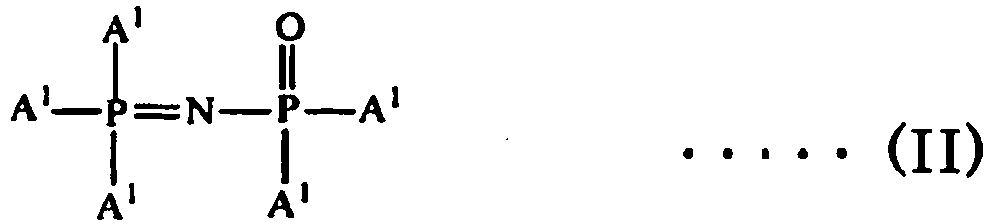
- 12. A polymer cell as set out in item 11, wherein the polymer is at least one of polyethylene oxide, polyacrylate and polypropylene oxide.
- 13. A polymer cell as set out in item 11 or 14, wherein the polymer has a weight average molecular weight of not less than 10000.
- 14. A polymer cell as set out in item 13, wherein the weight average molecular weight of the polymer is not less than 5000000.
- 15. A polymer cell as set out in any of items 11 to 14, wherein an amount of the polymer to a total amount of the polymer and the support salt is 80-95% by mass.
- 16. A polymer cell as set out in any of items 11 to 15, wherein the electrolyte furtehr contians a phosphazene derivative, and the phosphazene derivative has a viscosity at 25°C of not more than 300 mPa·s (300 cP) and is represented by the following formula (VIII) or (IX):
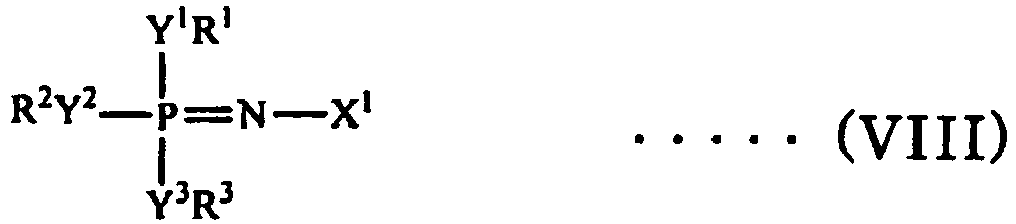
(NPR4 2)n (IX)
(wherein R4 is independently an alkoxy group, an alkyl group, a carboxyl group, an acyl group, an aryl group or a halogen element, and n is 3-15). - 17. A polymer cell as set out in item 16, wherein the phosphazene derivative of the formula (IX) is represented by the following formula (X):
(NPF2)n (X)
(wherein n is 3-13). - 18. A polymer cell as set out in item 1, wherein the phosphazene derivative of the formula (IX) is represented by the following formula (XI):
(NPR5 2) n (XI)
(wherein R5 is independently an alkoxy group, an alkyl group, an acyl group, an aryl group, a carboxyl group or fluorine, and at least one of all R5s is a fluorine containing alkoxy group, a fluorine containing alkyl group, a fluorine containing acyl group, a fluorine containing aryl group or fluorine, and n is 3-8, provided that all of R5s are not fluorine). - 19. A polymer cell as set out in any of items 11 to 15, wherein the electrolyte further contains a phosphazene derivative, and the phosphazene derivative is a solid at 25°C and is represented by the following formula (XII):
(NPR6 2)n (XII)
(wherein R6 is independently an alkoxy group, an alkyl group, a carboxyl group, an acyl group, an aryl group or a halogen element, and n is 3-6). - 20. A polymer cell as set out in any of items 11 to 15, wherein the electrolyte further contains an isomer of a phosphazene derivative, and the isomer of the phosphazene derivative is represented by the following formula (XIII) and is an isomer of a phosphazene derivative represented by the following formula (XIV):


- 21. A polymer cell as set out in any of items 16 to 20, wherein a total content of the phosphazene derivative and the isomer of the phosphazene derivative in the electrolyte is at least 0.5% by mass.
- 22. A polymer cell as set out in item 21, wherein the total content of the phosphazene derivative and the isomer of the phosphazene derivative in the electrolyte is at least 2.5% by mass.
- The invention will be described in detail below.
- According to the invention a compound represented by the following formula (I) or (II) is used as a support salt for a non-aqueous electrolyte cell:


- As the monovalent substituent in R of the formulae (I) and (II), a phenyl group, particularly a phenyl group containing an electron absorbing group, or methyl group is preferable from a viewpoint of the reactivity.
- The compound represented by the formula (I) or (II) contains lithium in its molecule and is dissolved in an aprotic organic solvent mentioned later to release lithium ion, so that it functions as an ion source of lithium ion and can improve the conductivity of an electrolyte. Also, the above compound has a phosphazene derivative as a basic skeleton, so that it has an action of suppressing combustion.
- In the formula (I) or (II), the support salt in which at least one of all A1s is F is high in the action of suppressing the combustion of the electrolyte as compared with the support salt containing no fluorine. Moreover, the action of suppressing the combustion increases as the number of fluorine contained in the support salt increases.
- The support salt for the cell according to the invention can be produced by the following method. At first, a phosphazene derivative represented by the following formula (III) or (VI) is reacted with a primary amine represented by the following formula (IV) to produce a phosphazene derivative represented by the following formula (V) or (VII) at a first step.


R - NH2 (IV)
(wherein R is a monovalent substituent)

- As the monovalent substituent in R of the formulae (IV), (V) and (VII) are mentioned the same ones as described in the monovalent substituent of the formulae (I) and (II). Similarly, phenyl group or methyl group is preferable from a viewpoint of the reactivity.
- In the formulae (III) and (VI), when all A2s are F, the number of amino groups to be introduced can be changed by varying the amount of the primary amine of the formula (IV) used. The amount of the primary amine of the formula (VI) used is suitable to be 1.5-2 times the substitution number of amino group to be introduced. For example, the primary amine is used in an amount of 1.5-2.0 mol per 1 mol of the phosphazene derivative of the formula (III) or (VI) in case of one amino substitution, 3.0-4.0 mol in case of two substitution, or 4.5-6.0 mol in case of three substitution. In the first step, the reaction can be promoted by adding a carbonate of an alkali metal such as potassium carbonate, sodium carbonate or the like. The amount of the alkali metal carbonate used is preferable to be 1.2-3 times mol of the amine used. The alkali metal carbonate has an action of neutralizing HF or HCl produced by the reaction and preventing acidification of the system. If the system becomes acidic, the yield lowers and there is caused a bad influence such as progress of side-reaction or the like.
- The phosphazene derivative in which all A2s in the formulae (III) and (VI) are F is obtained by reacting the phosphazene derivative in which all A2s in the formulae (III) and (VI) are Cl with a fluorinating agent. As the fluorinating agent are mentioned alkali fluorides such as NaF, KF and the like, in which NaF is preferable in a point that it is cheap, but there is no problem on the use of KF in performance. The amount of the fluorinating agent used is 7 mol per 1 mol of the phosphazene derivative of the formula (III), and 6 mol per 1 mol of the phosphazene derivative of the formula (VI), but the amount used somewhat increases or decreases in accordance with the reaction conditions. As the amount becomes too large, it tends to lower the yield, while as the amount becomes too small, the fluorination may not be partly conducted. The inventors have made various studies and found that it is preferable to use the alkali fluoride in an amount of 6.5-8 mol on the phosphazene derivative of the formula (III) or 5.4-6.8 mol on the phosphazene derivative of the formula (VI).
- Considering that a boiling point of the phosphazene derivative in which all A2s in the formula (III) is 51°C and a boiling point of the phosphazene derivative in which all A2s in the formula (VI) is 97°C and further the fluorination reaction is an exothermic reaction, the fluorination reaction is preferable to be carried out in acetonitrile while refluxing at 60-80°C in case of the phosphazene derivative of the formula (III) or at about 90°C in case of the phosphazene derivative of the formula (VI). The amount of acetonitrile used is 100-1000 mL per 1 mol of the phosphazene derivative of the formula (III) or (VI). However, this solvent amount is a mere indication, and since the reaction is a solid-liquid reaction, the amount is sufficient to cause no precipitation of solid through the stirring. These phosphazene derivatives can be purified by distilling in the vicinity of the respective boiling points. Moreover, when a solvent recovered by filtering a salt by-produced through the fluorination reaction such as NaCl or the like from a solution of removing the phosphazene derivative through distillation is recycled in the fluorination reaction, the reaction rate becomes faster than the use of new solvent because a small amount of the phosphazene derivative not removed by the distillation is retained in the solvent and such a phosphazene derivative form a nucleus of the fluorination reaction.
- In case of producing the phosphazene derivative in which all A3s in the formulae (V) and (VII) are NHR, it is preferable to use the phosphazene derivative in which all A2s in the formulae (III) and (VI) are Cl. In this case, the above fluorination reaction step can be omitted, and a target compound is obtained in a lower cost. In case of producing the phosphazene derivative in which all A3s in the formula (V) are NHR, the amount of the primary amine used os preferable to be 9 mol per 1 mol of the phosphazene derivative of the formula (III), while in case of producing the phosphazene derivative in which all A3s in the formula (VII) are NHR, the amount of the primary amine used is preferable to be 7.5 mol per 1 mol of the phosphazene derivative of the formula (VI).
- The first step is carried out in a solvent. As the solvent are mentioned polar solvent such as tetrahydrofuran (THF), N,N-dimethylformamide, acetonitrile and the like, and non-polar solvents such as hexane and the like. When the number of amino group to be introduced is large, the use of the polar solvent is preferable because the target product can be synthesized in a high yield, while when the number of amino group to be introduced is small, the use of the non-polar solvent is preferable because the target product can be synthesized in a high yield. The amount of the solvent used is preferable to be 100-1000 mL per 1 mol of the phosphazene derivative of the formula (III) or (VI). Moreover, the solvent used can be again used after the recovery. As a merit of the recycling, there are mentioned environment-friendliness, fast proceed of the reaction and the like.
- In order to promote the reaction of the phosphazene derivative of the formula (III) or (VI) with the primary amine of the formula (IV), it is necessary to conduct the heating at a start of the reaction. The heating temperature is preferable to be 50-80°C. Once the reaction starts, it is desirable that the reaction is controlled to hold at about 60°C because it is an exothermic reaction. As a heating time, a time of sufficiently proceeding the reaction is properly selected with the above heating time in mind. For example, when THF is used as a solvent, it is preferable that the reaction is carried out at about 60°C for about 10 hours. After the completion of the reaction, the reaction liquid is aged for about 1 day and thereafter hydrogen fluoride or hydrochloric acid produced by the above reaction is removed from the reaction system. Also, a fluoride salt or chloride salt of the primary amine precipitated is filtered.
- In the second step, a lithium alkoxide is added to the phosphazene derivative of the formula (V) or (VII) to produce a compound represented by the formula (I) or (II).
- As the lithium alkoxide are mentioned lithium methoxide, lithium ethoxide and the like. Among them, lithium methoxide is preferable because the reactivity is high. The amount of the lithium alkoxide used is preferable to be 1.5-12 mol per 1 mol of the phosphazene derivative of the formula (V) or (VII). This amount is properly selected with respect to the lithium substitution number to be targeted and is preferable to be 1.5-2 equivalent times the substitution number.
- Moreover, the second step is an exothermic reaction, so that it is preferable to conduct the reaction while maintaining the temperature of the reaction system at 20-50°C.
- After the completion of the reaction between the phosphazene derivative of the formula (V) or (VII) and the lithium alkoxide, the compound represented by the formula (I) or (II) can be isolated, for example, by a recrystallization method.
- The non-aqueous electrolyte cell of the invention comprises a positive electrode, a negative electrode and an electrolyte comprising an aprotic organic solvent and the aforementioned support salt, and is provided with members usually used in the technical field of the non-aqueous electrolyte cell such as separator and the like, if necessary.
- The materials for positive electrode in the non-aqueous electrolyte cell of the invention partly differ between the primary cell and the secondary cell. For example, as a positive electrode for the non-aqueous electrolyte primary cell are preferably mentioned graphite fluoride ((CFx)n), MnO2 (which may be synthesized electrochemically or chemically), V2O5, MoO3, Ag2CrO4, CuO, CuS, FeS2, SO2, SOCl2, TiS2 and the like. Among them, MnO2, V2O5 and graphite fluoride are preferable because they are high in the capacity, good in the safety, high in the discharge potential and excellent in the wettability to the electrolyte, and MnO2 and V2O5 are more preferable in a point of the cost. These materials may be used alone or in a combination of two or more.
- As a positive electrode for the non-aqueous electrolyte secondary cell are preferably mentioned metal oxides such as V2O5, V6O13, MnO2, MnO3 and the like; lithium-containing composite oxides such as LiCoO2, LiNiO2, LiMn2O4, LiFeO2, LiFePO4 and the like; metal sulfides such as TiS2, MoS2 and the like; electrically conductive polymers such as polyaniline and the like. The lithium-containing composite oxide may be a composite oxide containing two or three transition metals selected from the group consisting of Fe, Mn, Co and Ni. In the latter case, the composite oxide is represented by LiFexCoyNi(1-x-y)O2 (wherein 0≤x<1, 0≤y<1, 0<x+y≤1), LiMnxFeyO2-x-y or the like. Among them, LiCoO2, LiNiO2, LiMn2O4 are particularly preferable because they are high in the capacity, high in the safety and excellent in the wettability to the electrolyte. These materials may be used alone or in a combination of two or more.
- The positive electrode may be mixed with an electrically conducting agent and a binding agent, if necessary. As the electrically conducting agent are mentioned acetylene black and the like, and as the binding agent are mentioned polyvinylidene fluoride (PVDF), polytetrafluoroethylene (PTFE) and the like. In case of using these additives, they may be compounded in the same compounding ratio as in the conventional case, for example, positive electrode material:electrically conducting agent:binding agent = 8:1:1-8:1:0.2 (mass ratio).
- The form of the positive electrode is not particularly limited and can be properly selected from the well-known forms as the electrode. For example, there are mentioned a sheet form, a column form, a plate form, a spiral form and the like.
- The materials for negative electrode in the non-aqueous electrolyte cell of the invention partly differ between the primary cell and the secondary cell. For example, as a negative electrode for the non-aqueous electrolyte primary cell are mentioned lithium metal itself, lithium alloys and the like. As a metal to be alloyed with lithium are mentioned Sn, Pb, Al, Au, Pt, In, Zn, Cd, Ag, Mg and the like. Among them, Al, Zn and Mg are preferable from a viewpoint of a greater amount of deposit and toxicity. These materials may be used alone or in a combination of two or more.
- As a negative electrode for the non-aqueous electrolyte secondary cell are preferably mentioned lithium metal itself, an alloy of lithium with Al, In, Pb, Zn or the like, a carbonaceous material such as graphite doped with lithium, and the like. Among them, the carbonaceous material such as graphite or the like is preferable in a point that the safety is higher. These materials may be used alone or in a combination of two or more.
- The form of the negative electrode is not particularly limited and may be properly selected from the well-known forms likewise the form of the positive electrode.
- The electrolyte for the non-aqueous electrolyte cell of the invention comprises an aprotic organic solvent and the aforementioned support salt. Heretofore, in the electrolyte based on the aprotic organic solvent has been caused a problem in the safety as previously mentioned. However, the electrolyte comprising the support salt of the invention and the aprotic organic solvent suppresses the vaporization-decomposition at a relatively low temperature of not higher than about 200°C and reduces the risk of ignition-firing because the support salt is the compound having the phosphazene derivative as the basic skeleton and has an action of suppressing the combustion. Also, even if ignition is caused inside the cell through the fusion of the negative electrode material or the like, the risk of catching fire is low. Furthermore, since phosphorus has an action of suppressing the chain decomposition of a high molecular weight material constituting the cell, the risk of ignition-firing is effectively reduced.
- The electrolyte added with the support salt is preferable to have a limit oxygen index of not less than 21 volume%. When the limit oxygen index is less than 21 volume%, the effect of suppressing the ignition-firing may be insufficient. The term "limit oxygen index" used herein means a value of a minimum oxygen concentration required for maintaining the combustion of the material under given test conditions defined in JIS K7201 and represented by volume percentage, in which the lower the limit oxygen index, the higher the risk of ignition-firing and inversely the higher the limit oxygen index, the lower the risk of ignition-firing. In the invention, the risk of ignition-firing is evaluated by the measurement of the limit oxygen index according to JIS K7201.
- Since the limit oxygen index under an atmosphere condition corresponds to 20.2 volume%, the limit oxygen index of 20.2 volume% means that combustion occurs in the atmosphere. The inventors have made various studies and found that the self-extinguishing property is developed at the limit oxygen index of not less than 21% by volume, and the flame retardance is developed at not less than 23% by volume, and the incombustibility is developed at not less than 25% by volume. Moreover, the terms "self-extinguishing property, flame retardance, incombustibility" used herein are defined in the method according to UL 94HB method, wherein when a test piece of 127 mm x 12.7 mm is prepared by impregnating 1.0 mL of an electrolyte into an incombustible quartz fiber and is ignited under atmospheric environment, the self-extinguishing property indicates a case that the ignited flame is extinguished in a line between 25 mm and 100 mm and an object fallen down from a net is not fired, and the flame retardance indicates a case that the ignited flame does not arrive at a line of 25 mm of the apparatus and the object fallen down from the net is not fired, and the incombustibility indicates a case that no ignition is observed (combustion length: 0 mm).
- The aprotic organic solvent constituting the electrolyte in the non-aqueous electrolyte cell in which the support salt is used in the invention does not react with lithium or lithium alloy used in the negative electrode. The aprotic organic solvent is not particularly limited, but includes ether compounds, ester compounds and so on from a view point that the viscosity of the electrolyte is controlled to a low value. Concretely, there are preferably mentioned 1,2-dimethoxyethane (DME), tetrahydrofuran, dimethyl carbonate, diethyl carbonate (DEC), diphenyl carbonate, ethylene carbonate (EC), propylene carbonate (PC), γ-butyrolactone (GBL), γ-valerolactone, methylethyl carbonate, ethylmethyl carbonate and so on. Among them, cyclic ester compounds such as propylene carbonate, γ-butyrolactone and the like, chain ester compounds such as dimethyl carbonate, methylethyl carbonate and the like, and chain ether compounds such as 1,2-dimethoxyethane and the like are preferable in case of using in the non-aqueous electrolyte primary cell, while cyclic ester compounds such as ethylene carbonate, propylene carbonate, γ-butyrolactone and the like, chain ester compounds such as dimethyl carbonate, ethylmethyl carbonate, diethyl carbonate and the like, and chain ether compounds such as 1,2-dimethoxyethane and the like are preferable in case of using in the non-aqueous electrolyte secondary cell. The cyclic ester compound is preferable in a point that the dielectric constant is high and the solubility to the aforementioned support salt is excellent, and the chain ester compound and ether compound are preferable in a point that the viscosity is low and hence the viscosity of the electrolyte is made low. They may be used alone or in a combination of two or more.
- The content of the support salt in the electrolyte is preferably 0.1-1 mol, more preferably 0.2-1 mol per 1 L of the aprotic organic solvent. When the content is less than 0.1 mol, the sufficient electric conduction of the electrolyte can not be ensured, and hence troubles may be caused in the discharge characteristics of the cell, while when it exceeds 1 mol, the viscosity of the non-aqueous electrolyte rises and the sufficient mobility of lithium ion can not be ensured, and hence the sufficient electric conduction of the electrolyte can not be ensured likewise the above case and as a result, the solution resistance rises and troubles may be caused in the discharge characteristics of the primary cell or in the discharge-recharge characteristics of the secondary cell.
- The aprotic organic solvent is preferable to be added with a phosphazene derivative and/or an isomer of a phosphazene derivative. By using the above support salt having a combustion suppressing action can be lowered the risk of ignition-firing of the cell, while such a risk can be further lowered by adding the phosphazene derivative and/or the isomer of the phosphazene derivative to the aprotic organic solvent.
- The phosphazene derivative and the isomer of the phosphazene derivative lower the risk of ignition-firing of the cell by the same reasons as in the support salt. Further, the phosphazene derivative and the isomer of the phosphazene derivative containing a halogen (e.g. fluorine) acts as an agent for catching active radical even in an accidental combustion, and the phosphazene derivative and the isomer of the phosphazene derivative having an organic substituent(s) has an effect of shielding oxygen because a carbide (char) is produced on the electrode material and the separator in the combustion. In addition, the phosphazene derivative and the isomer of the phosphazene derivative has an effect of suppressing the formation of dendrite even in the recharging, so that the safety becomes higher as compared with the system of no addition.
- The phosphazene derivative added to the aprotic organic solvent is not particularly limited. However, the phosphazene derivative having a viscosity at 25°C of not more than 300 mPa · s (300 cP) and represented by the following formula (VIII) or (IX) is preferable from a viewpoint that the viscosity is relatively low and the support salt is well dissolved. Among such phosphazene derivatives, a phosphazene derivative having a viscosity of not more than 5 mPa·s is most preferable.

(NPR4 2)n (IX)
(wherein R4 is independently a monovalent substituent or a halogen element, and n is 3-15) - The viscosity at 25°C of the phosphazene derivative represented by the formula (VIII) or (IX) is required to be not more than 300 mPa·s, and is preferably not more than 100 mPa·s (100 cP), further preferably not more than 5 mPa·s (5 cP). In case of using in the non-aqueous electrolyte primary cell, the viscosity is particularly preferable to be not more than 20 mPa·s (20 cP), and further preferably not more than 5 mPa·s (5 cP). When the viscosity is more than 300 mPa·s (300 cP), the support salt is hardly dissolved, and the wettability to the positive electrode material, separator and the like lowers, and the ion electric conduction is considerably lowered by the increase of the viscous resistance of the electrolyte and particularly performances are lacking in the use under a lower temperature condition of not higher than freezing point or the like.
- In the formula (VIII), R1, R2 and R3 are not particularly limited unless they are a monovalent substituent or a halogen element. As the monovalent substituent are mentioned an alkoxy group, an alkyl group, a carboxyl group, an acyl group, an aryl group and the like. Among them, the alkoxy group is preferable in a point that the viscosity is low and the viscosity of the electrolyte is made low. On the other hand, as the halogen element are preferably mentioned fluorine, chlorine, bromine and the like. All of R1-R3 may be the same kind of the substituent, or some of them may be different kinds of substituents.
- As the alkoxy group are mentioned methoxy group, ethoxy group, propoxy group, butoxy group, and an alkoxy-substituted alkoxy group such as methoxyethoxy group, methoxyethoxyethoxy group and the like. Among them, all of R1-R3 are preferable to be methoxy group, ethoxy group, methoxyethoxy group or methoxyethoxyethoxy group, and particularly methoxy group or ethoxy group is preferable from a viewpoint of low viscosity and high dielectric constant.
- As the alkyl group are mentioned methyl group, ethyl group, propyl group, butyl group, pentyl group and the like. As the acyl group are mentioned formyl group, acetyl group, propionyl group, butylyl group, isobutylyl group, valeryl group and the like. As the aryl group are mentioned phenyl group, tolyl group, naphthyl group and the like.
- In these monovalent substituents, a hydrogen element is preferable to be substituted with a halogen element. As the halogen element, fluorine, chlorine and bromine are preferable, and among them fluorine is particularly preferable and chlorine is next preferable. The monovalent substituent in which a hydrogen element is substituted with fluorine tends to be large in the effect of improving the cycle characteristic of the secondary cell as compared with the chlorine substitution.
- As the bivalent connecting group shown by Y1, Y2 and Y3 of the formula (VIII) are mentioned CH2 group and a bivalent connecting group containing at least one element selected from the group consisting of oxygen, sulfur, selenium, nitrogen, boron, aluminum, scandium, gallium, yttrium, indium, lanthanum, thallium, carbon, silicon, titanium, tin, germanium, zirconium, lead, phosphorus, vanadium, arsenic, niobium, antimony, tantalum, bismuth, chromium, molybdenum, tellurium, polonium, tungsten, iron, cobalt and nickel. Among them, CH2 group and the bivalent connecting group containing at least one element selected from the group consisting of oxygen, sulfur, selenium and nitrogen are preferable, and the bivalent connecting group containing sulfur and/or selenium is particularly preferable. Also, Y1, Y2 and Y3 may be a bivalent element such as oxygen, sulfur, selenium or the like, or a single bond. All of Y1-Y3 may the same kind, or some of them may be different kinds from each other.
- In the formula (VIII), X1 is preferable to be a substituent containing at least one element selected from the group consisting of carbon, silicon, nitrogen, oxygen and sulfur from a viewpoint of the harmfulness, environment-friendliness and the like. Among these substituents, a substituent having a structure shown by the following formula (XV), (XVI) or (XVII) is more preferable.


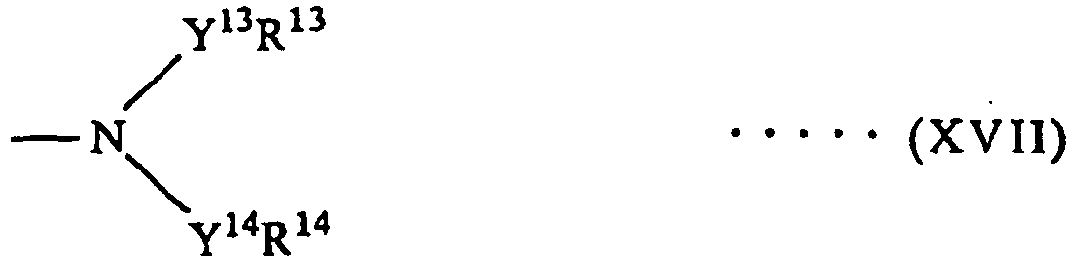
- As R10-R14 in the formulae (XV), (XVI) and (XVII) are preferably mentioned the same monovalent substituents or halogen elements as described in R1-R3 of the formula (VIII). Also, they may be the same kind in the same substituent, or some of them may be different kinds from each other. R10 and R11 in the formula (XV), and R13 and R14 in the formula (XVII) may be bonded with each other to form a ring.
- As the group shown by Y10-Y14 in the formulae (XV), (XVI) and (XVII) are mentioned the same bivalent connecting groups, bivalent elements or the like as described in Y1-Y3 of the formula (VIII). Similarly, the group containing sulfur and/or selenium is particularly preferable because the risk of ignition-firing of the electrolyte is reduced. They may be the same kind in the same substituent, or some of them may be different kinds from each other.
- As Z1 in the formula (XV) are mentioned CH2 group, CHR' group (R' is an alkyl group, an alkoxyl group, a phenyl group or the like, and so forth on), NR' group, and a bivalent group containing at least one element selected from the group consisting of oxygen, sulfur, selenium, boron, aluminum, scandium, gallium, yttrium, indium, lanthanum, thallium, carbon, silicon, titanium, tin, germanium, zirconium, lead, phosphorus, vanadium, arsenic, niobium, antimony, tantalum, bismuth, chromium, molybdenum, tellurium, polonium, tungsten, iron, cobalt and nickel. Among them, CH2 group, CHR' group, NR' group and the bivalent group containing at least one element selected from the group consisting of oxygen, sulfur and selenium are preferable. Particularly, the group containing sulfur and/or selenium is preferable because the risk of ignition-firing of the electrolyte is reduced. Also, Z1 may be a bivalent element such as oxygen, sulfur, selenium or the like.
- Among such substituents, a phosphorus-containing substituent as shown by the formula (XV) is particularly preferable in a point that the risk of ignition-firing can be effectively reduced. Also, when the substituent is a sulfur-containing substituent as shown by the formula (XVI), it is particularly preferable in a point that the interfacial resistance of the electrolyte is made small.
- In the formula (IX), R4 is not particularly limited unless it is a monovalent substituent or a halogen element. As the monovalent substituent are mentioned an alkoxy group, an alkyl group, a carboxyl group, an acyl group, an aryl group and the like. Among them, the alkoxy group is preferable in a point that the viscosity of the electrolyte can be made low. As the halogen element are preferably mentioned fluorine, chlorine, bromine and the like. As the alkoxy group are mentioned methoxy group, ethoxy group, methoxyethoxy group, propoxy group, phenoxy group and the like. Among them, methoxy group, ethoxy group, n-propoxy group, phenoxy group are particularly preferable in case of using in the non-aqueous electrolyte primary cell, while methoxy group, ethoxy group, methoxyethoxy group and phenoxy group are particularly preferable in case of using in the non-aqueous electrolyte secondary cell. In these monovalent substituents, a hydrogen element is preferable to be substituted with a halogen element. As the halogen element are preferably mentioned fluorine, chlorine, bromine and the like. As a substituent substituted with fluorine is mentioned, for example, trifluoroethoxy group.
- It is possible to prepare an electrolyte having a more preferable viscosity, a solubility suitable for addition and mixing and the like by properly selecting R1-R4, R10-R14, Y1-Y3, Y10-Y14 and Z1 in the formulae (VIII), (IX), (XV)-(XVII). These phosphazene derivatives may be used alone or in a combination of two or more.
- Among the phosphazene derivatives of the formula (IX), a phosphazene derivative represented by the following formula (X) is particularly preferable from a viewpoint that the viscosity of the electrolyte is made low to improve the low-temperature characteristic of the cell and further improve the safety of the electrolyte:
(NPF2)n (X)
(wherein n is 3-13). - The phosphazene derivative of the formula (X) is a low viscosity liquid at room temperature (25°C) and has an action of lowering a freezing point. By adding this phosphazene derivative to the electrolyte, it is made possible to give excellent low-temperature characteristic to the electrolyte, and also it is attained to make the viscosity of the electrolyte low, and there can be provided a non-aqueous electrolyte cell having a low internal resistance and a high electric conductivity. Therefore, it is possible to provide a non-aqueous electrolyte cell developing an excellent discharge characteristic over a long time even if it is particularly used under a low-temperature condition in low-temperature areas or season.
- In the formula (X), n is preferably 3-4, more preferably 3 in a point that the excellent low-temperature characteristic can be given to the electrolyte and the viscosity of the electrolyte cam be made low. When the value of n is small, the boiling point is low and a property of preventing ignition in the approaching to a flame can be improved. While, as the value of n becomes large, the boiling point becomes high and the electrolyte can be stably used even at a high temperature. In order to obtain target performances utilizing the above nature, it is possible to properly select and use plural phosphazene derivatives.
- By properly selecting the value of n in the formula (X), it is possible to prepare an electrolyte having a more preferable viscosity, a solubility suitable for mixing, a low-temperature characteristic and the like. These phosphazene derivatives may be used alone or in a combination of two or more.
- The viscosity of the phosphazene derivative of the formula (X) is not particularly limited unless it is not more than 20 mPa·s (20 cP), but it is preferably not more than 10 mPa·s (10 cP), more preferably not more than 5 mPa·s (5 cP) from a viewpoint of the improvements of the electric conduction and low-temperature characteristic. Moreover, the viscosity according to the invention is determined by using a viscosity measuring meter (R-type viscometer Model RE500-SL, made by Toki Sangyo Co., Ltd.) and conducting the measurement at each revolution rate of 1 rpm, 2 rpm, 3 rpm, 5 rpm, 7 rpm, 10 rpm, 20 rpm and 50 rpm for 120 seconds to measure a viscosity under the revolution rate when an indication value is 50-60% as an analytical condition.
- Among the phosphazene derivatives of the formula (IX), a phosphazene derivative represented by the following formula (XI) is particularly preferable from a viewpoint that the safety of the electrolyte is improved:
(NPR5 2)n (XI)
(wherein R5 is independently a monovalent substituent or a halogen element, and at least one of all R5s a fluorine-containing monovalent substituent or a fluorine, and n is 3-8, provided that all R5s are not fluorine). - When the phosphazene derivative of the formula (XI) is included, the excellent self-extinguishing property or flame retardance can be given to the electrolyte to improve the safety of the electrolyte. When using a phosphazene derivative of the formula (XI) in which at least one of all R5s is a fluorine-containing monovalent substituent, it is possible to give a more excellent safety to the electrolyte. When using a phosphazene derivative of the formula (XI) in which at least one of all R5s is fluorine, it is possible to give a further excellent safety. That is, the phosphazene derivative of the formula (XI) in which at least one of all R5s is a fluorine-containing monovalent substituent or fluorine has an effect of hardly burning the electrolyte as compared with the phosphazene derivative containing no fluorine, and a further excellent safety can be given to the electrolyte.
- Moreover, the cyclic phosphazene derivative of the formula (XI), in which all R5s are fluorine and n is 3, is incombustible and has a large effect of preventing ignition in the approaching to the flame, but the boiling point is very low, and if it is completely vaporized, the remaining aprotic organic solvent or the like is burnt out.
- As the monovalent substituent in the formula (XI) are mentioned an alkoxy group, an alkyl group, an acyl group, an aryl group, a carboxyl group and the like, and the alkoxy group is preferable in a point that the improvement of the safety of the electrolyte is excellent. As the alkoxy group are mentioned methoxy group, ethoxy group, n-propoxy group, i-propoxy group, butoxy group, and an alkoxy group substituted alkoxy group such as methoxyethoxy group or the like. Particularly, methoxy group, ethoxy group and n-propoxy group are preferable in a point that the improvement of the safety of the electrolyte is excellent. Also, methoxy group is preferable im a point that the viscosity of the electrolyte is made low.
- In the formula (XI), n is preferably 3-4 in a point that the excellent safety can be given to the electrolyte.
- The monovalent substituent is preferable to be substituted with fluorine. When all R5s in the formula (XI) are not fluorine, at least one monovalent substituent contains fluorine.
- The content of fluorine in the phosphazene derivative is preferably 3-70% by weight, more preferably 7-45% by weight. When the content is within the above numerical range, "excellent safety" can be preferably given to the electrolyte.
- As a molecular structure of the phosphazene derivative of the formula (XI), a halogen element such as chlorine, bromine or the like may be included in addition to fluorine. However, fluorine is most preferable, and chlorine is net preferable. The fluorine containing derivative tends to have a large effect of improving the cycle characteristic of a secondary cell as compared with the chlorine containing derivative.
- By properly selecting R5 and the value of n in the formula (XI), it is possible to prepare an electrolyte having more preferable safety and viscosity, a solubility suitable for mixing and the like. These phosphazene derivatives may be used alone or in a combination of two or more.
- The viscosity of the phosphazene derivative of the formula (XI) is not particularly limited unless it is not more than 20 mPa·s (20 cP), but it is preferably not more than 10 mPa·s (10 cP), more preferably not more than 5 mPa·s (5 cP) from a viewpoint of the improvements of the electric conduction and low-temperature characteristic.
- As the phosphazene derivative added to the aprotic organic solvent, a phosphazene derivative being a solid at 25°C (room temperature) and represented by the following formula (XII) is preferable from a viewpoint that the safety of the electrolyte is improved while controlling the viscosity rise of the electrolyte:
(NPR6 2)n (XII)
(wherein R6 is independently a monovalent substituent or a halogen element, and n is 3-6). - Since the phosphazene derivative of the formula (XII) is a solid at room temperature (25°C), when it is added to the electrolyte, it is dissolved in the electrolyte to raise the viscosity of the electrolyte. However, if the addition amount is a given value as mentioned later, a ratio of raising the viscosity of the electrolyte is low and there is provided a non-aqueous electrolyte cell having a low internal resistance and a high electric conductivity. Also, the phosphazene derivative of the formula (XII) is dissolved in the electrolyte, the long-life stability of the electrolyte is excellent.
- In the formula (XII), R6 is not particularly limited unless it is a monovalent substituent or a halogen element. As the monovalent substituent are mentioned an alkoxy group, an alkyl group, a carboxyl group, an acyl group, an aryl group and the like. As the halogen element are preferably mentioned halogen elements such as fluorine, chlorine, bromine, iodine and the like. Among them, the alkoxy group is particularly preferable in a point that the viscosity rise of the electrolyte can be suppressed. As the alkoxy group are preferable methoxy group, ethoxy group, methoxyethoxy group, propoxy group (isopropoxy group, n-propoxy group), phenoxy group, trifluoroethoxy group and the like, and methoxy group, ethoxy group, propoxy group (isopropoxy group, n-propoxy group), phenoxy group and trifluoroethoxy group are more preferable in a point that the viscosity rise of the electrolyte can be suppressed. The monovalent substituent is preferable to contain the above halogen element.
- In the formula (XII), n is particularly preferable to be 3 or 4 in a point that the viscosity rise of the electrolyte can be suppressed.
- As the phosphazene derivative of the formula (XII) are particularly preferable a structure in which R6 is methoxy group and n is 3 in the formula (XII), a structure in which R6 is at least either methoxy group or phenoxy group and n is 4 in the formula (XII), a structure in which R6 is ethoxy group and n is 4 in the formula (XII), a structure in which R6 is isopropoxy group and n is 3 or 4 in the formula (XII), a structure in which R6 is n-propoxy group and n is 4 in the formula (XII), a structure in which R6 is trifluoroethoxy group and n is 3 or 4 in the formula (XII), a structure in which R6 is phenoxy group and n is 3 or 4 in the formula (XII) in a point that the viscosity rise of the electrolyte can be suppressed.
- By properly selecting each substituent and value of n in the formula (XII), it is possible to prepare an electrolyte having a more preferable viscosity, a solubility suitable for mixing and the like. These phosphazene derivatives may be used alone or in a combination of two or more.
- The isomer of the phosphazene derivative to be added to the aprotic organic solvent is not particularly limited, but an isomer represented by the following formula (XIII) and of a phosphazene derivative represented by the following formula (XIV) is preferable from a viewpoint that the low-temperature characteristic of the non-aqueous electrolyte cell is improved and further the safety of the electrolyte is improved:


- In the formula (XIII), R7, R8 and R9 are not particularly limited unless they are a monovalent substituent or a halogen element. As the monovalent substituent are mentioned an alkoxy group, an alkyl group, a carboxyl group, an acyl group, an aryl group and the like. As the halogen element are preferably mentioned halogen elements such as fluorine, chlorine, bromine and the like. Among them, fluorine, alkoxy group and the like are particularly preferable in a point of the low-temperature characteristic and electrochemical stability of the electrolyte. Also, fluorine, alkoxy group, fluorine-containing alkoxy group and the like are preferable in a point that the viscosity of the electrolyte is made low. All of R7-R9 may be the same kind of the substituent, or some of them may be different kinds of the substituent.
- As the alkoxy group are mentioned, for example, methoxy group, ethoxy group, propoxy group, butoxy group, and alkoxy-substituted alkoxy groups such as methoxyethoxy group, methoxyethoxyethoxy group and the like. Among them, all of R7-R9 are preferable to be methoxy group, ethoxy group, methoxyethoxy group or methoxyethoxyethoxy group, and all of them are particularly preferable to be methoxy group or ethoxy group from a viewpoint of low viscosity and high dielectric constant. As the alkyl group are mentioned methyl group, ethyl group, propyl group, butyl group, pentyl group and the like. As the acyl group are mentioned formyl group, acetyl group, propionyl group, butylyl group, isobutylyl group, valeryl group and the like. As the aryl group are mentioned phenyl group, tolyl group, naphthyl group and the like. In these substituents, hydrogen element is preferable to be substituted with a halogen element. As this halogen element are preferably mentioned fluorine, chlorine, bromine and the like.
- In the formula (XIII), as the bivalent connecting group shown by Y7 and Y8 are mentioned CH2 group and bivalent connecting group containing at least one element selected from the group consisting of oxygen, sulfur, selenium, nitrogen, boron, aluminum, scandium, gallium, yttrium, indium, lanthanum, thallium, carbon, silicon, titanium, tin, germanium, zirconium, lead, phosphorus, vanadium, arsenic, niobium, antimony, tantalum, bismuth, chromium, molybdenum, tellurium, polonium, tungsten, iron, cobalt and nickel. Among them, CH2 group and the bivalent connecting group containing at least one element selected from the group consisting of oxygen, sulfur, selenium and nitrogen are preferable. Also, Y7 and Y8 may be a bivalent element such as oxygen, sulfur, selenium or the like, or a single bond. Particularly, the bivalent connecting group containing sulfur and/or oxygen, oxygen element and sulfur element are preferable in a point that the safety of the electrolyte is improved, while the bivalent connecting group containing oxygen and oxygen element are preferable in a point that the low-temperature characteristic of the electrolyte is excellent. Y7 and Y8 may be the same kind or different kinds.
- As X2 in the formula (XIII) is preferable a substituent containing at least one element selected from the group consisting of carbon, silicon, nitrogen, oxygen and sulfur from a viewpoint of consideration on toxicity, environment and the like, and a substituent having a structure represented by the following formula (XVIII), (XIX) or (XX) is more preferable.


- As R15-R19 in the formulae (XVIII), (XIX) and (XX) are preferably mentioned the same monovalent substituents or halogen elements as described in R7-R8 of the formula (XIII). Also, they may be the same kind in the same substituent, or some of them may be different kinds from each other. Further, R15 and R16 in the formula (XVIII) and R18 and R19 in the formula (XX) may be bonded with each other to form a ring.
- As the group shown by Y15-Y19 in the formulae (XVIII), (XIX) and (XX) are mentioned the same bivalent connecting groups, bivalent elements and the like as described in Y7-Y8 of the formula (XIII). Similarly, the bivalent connecting group containing sulfur and/or oxygen, oxygen element or sulfur element is particularly preferable in a point that the safety of the electrolyte is improved. Also, the bivalent connecting group containing oxygen or oxygen element is preferable in a point that the low-temperature characteristic of the electrolyte is excellent. They may be the same kind in the same substituent, or some of them may be different kinds from each other.
- As Z2 in the formula (XVIII) are mentioned CH2 group, CHR' group (R' is an alkyl group, an alkoxyl group, a phenyl group or the like, and so forth on), NR' group, and a bivalent group containing at least one element selected from the group consisting of oxygen, sulfur, selenium, boron, aluminum, scandium, gallium, yttrium, indium, lanthanum, thallium, carbon, silicon, titanium, tin, germanium, zirconium, lead, phosphorus, vanadium, arsenic, niobium, antimony, tantalum, bismuth, chromium, molybdenum, tellurium, polonium, tungsten, iron, cobalt and nickel. Among them, CH2 group, CHR' group, NR' group and the bivalent group containing at least one element selected from the group consisting of oxygen, sulfur and selenium are preferable. Also, Z2 may be a bivalent element such as oxygen, sulfur, selenium or the like. Particularly, the bivalent group containing sulfur and/or selenium, sulfur element or selenium element is preferable in a point that the safety of the electrolyte is improved. Furthermore, the bivalent group containing oxygen or oxygen element is preferable in a point that the low-temperature characteristic of the electrolyte is excellent.
- Among these substituents, a phosphorus-containing substituent as shown by the formula (XVIII) is particularly preferable in a point that the safety can be effectively improved. Further, when each of Z2, Y15 and Y16 in the formula (XVIII) is oxygen element, it is particularly possible to develop a very excellent low-temperature characteristic in the electrolyte. Also, when the substituent is a sulfur-containing substituent as shown in the formula (XIX), it is preferable in a point that the interfacial resistance of the electrolyte is made small.
- By properly selecting R7-R9, R15-R19, Y7-Y8, Y15-Y19 and Z2 in the formulae (XIII), (XVIII), (XIX) and (XX), it is possible to prepare an electrolyte having a more preferable viscosity, a solubility suitable for adding-mixing, a low-temperature characteristic and the like. These compounds may be used alone or in a combination of two or more.
- The isomer represented by the formula (XIII) is an isomer of a phosphazene derivative represented by the formula (XIV), which can be produced by adjusting a vacuum degree and/or a temperature in the formation of the phosphazene derivative of the formula (XIV). The content of the isomer in the electrolyte (volume%) can be measured by the following measuring method.
- It can be measured by finding a peak area of a sample through a gel permeation chromatography (GPC) or a high-speed liquid chromatography, comparing the found peak area with a previously found area per mole of the isomer to obtain a molar ratio, and further converting into a volume while considering a specific gravity. Also, it may be determined through a gas chromatography.
- As the phosphazene derivative represented by the formula (XIV), it is preferable that the viscosity is relatively low and the support salt can be well dissolved. As R7-R9, Y7-Y8 and X2 in the formula (XIV) are preferably mentioned the same as described in the explanation on R7-R9, Y7-Y8 and X2 of the formula (XIII).
- As the phosphazene derivative represented by the formula (VIII), (IX), (XII) or (XIV) or the isomer represented by the formula (XIII), it is preferable to contain a halogen element containing substituent in its molecular structure. When the halogen element containing substituent is existent in the molecular structure, even if the content of the phosphazene derivative or the isomer is small, it is possible to effectively reduce the risk of ignition-fire of the electrolyte by a halogen gas derived therefrom. Moreover, the occurrence of halogen radical may come into problem in case of the compound containing a halogen element in its substituent. However, such a problem is not caused in case of the above phosphazene derivative or the isomer of the phosphazene derivative because phosphorus element in the molecular structure catches the halogen radical to form a stable phosphorus halide.
- The content of the halogen element in the phosphazene derivative or the isomer of the phosphazene derivative is preferably 2-80% by weight, more preferably 2-60% by weight, further preferably 2-50% by weight. When the content is less than 2% by weight, the effect by including the halogen element may not sufficiently be developed, while when it exceeds 80% by weight, the viscosity becomes higher and the electric conductivity may lower in the addition to the electrolyte. As the halogen element, fluorine, chlorine, bromine and the like are preferable, and fluorine is particularly preferable from a viewpoint that good cell characteristics are obtained.
- In the phosphazene derivatives represented by the formulae (VIII), (IX), (XI), (XII) and (XIV), a flash point is not particularly limited, but it is preferably not lower than 100°C, more preferably not lower than 150°C, further preferably not lower than 300°C from a viewpoint of the control of fire and the like. On the other hand, the phosphazene derivative represented by the formula (X) has no flash point. The term "flash point" used herein means such a temperature that a flame is broadened on a surface of a substance and covers at least 75% of the surface of the substance. The flash point is a scale looking a tendency of forming a combustible mixture with air. When the phosphazene derivative has a flash point of not lower than 100°C or has no flash point, the fire or the like is suppressed, and also if the fire or the like is caused in an interior of a cell, it is possible to reduce the risk of outblazing over the surface of the electrolyte by ignition.
- The content of the phosphazene derivative and the isomer of the phosphazene derivative in the non-aqueous electrolyte is shown below. From a viewpoint of "limit oxygen index", the content of the phosphazene derivative represented by the formula (VIII) or (IX) to the electrolyte is preferably not less than 5 volume%, more preferably 10-50 volume%. By adjusting the content to a value within the above numerical range is effectively reduced the risk of ignition-fire of the electrolyte. Although the risk of fire is effectively reduced, the range of the content differs in accordance with the kind of the support salt and the kind of the electrolyte used. Concretely, the system used is optimized by properly selecting the content so as to control the viscosity to a lowest value and render the limit oxygen index into not less than 21 volume%.
- From a viewpoint of "safety" in the electrolyte, the content of the phosphazene derivative of the formula (X) is preferably not less than 5 volume%, and the content of the phosphazene derivative of the formula (XI) is preferably not less than 10 volume%, more preferably not less than 15 volume%, and the content of the phosphazene derivative of the formula (XII) is preferably not less than 20 volume%, and the total content of the isomer of the formula (XIII) and the phosphazene derivative of the formula (XIV) is preferably not less than 20 volume%. When the content is within the above numerical range, the safety of the electrolyte can be preferably improved.
- From a viewpoint of "low-temperature characteristics" in the electrolyte, the content of the phosphazene derivative of the formula (X) is preferably not less than 1 volume%, more preferably not less than 3 volume%, further preferably not less than 5 volume%, and the total content of the isomer of the formula (XIII) and the phosphazene derivative of the formula (XIV) is not less than 1 volume%, more preferably not less than 2 volume%, further preferably not less than 5 volume%. When the content is less than 1 volume%, the low-temperature characteristics in the electrolyte are not sufficient.
- From a viewpoint of "decrease of viscosity" in the electrolyte, the content of the phosphazene derivative of the formula (X) is preferably not less than 3 volume%, more preferably 3-80 volume%. When the content is less than 3 volume%, the viscosity of the electrolyte can not be sufficiently made low.
- From a viewpoint of "control of viscosity rise" in the electrolyte, the content of the phosphazene derivative of the formula (XII) is preferably not more than 40% by weight, more preferably not more than 35% by weight, further preferably not more than 30% by weight. When the content is more than 40% by weight, the viscosity rise of the electrolyte becomes remarkably large and the internal resistance becomes high and the electric conductivity becomes low.
- As the other member used in the non-aqueous electrolyte cell of the invention is mentioned a separator interposed between the positive and negative electrodes in the non-aqueous electrolyte cell and acting to prevent short-circuiting of current due to the contact between the electrodes. As a material of the separator are mentioned materials capable of surely preventing the contact between the electrodes and passing or impregnating the electrolyte such as non-woven fabrics, thin-layer films and the like made of synthetic resin such as polytetrafluoroethylene, polypropylene, polyethylene, cellulose based resin, polybutylene terephthalate, polyethylene terephthalate or the like. Among them, a microporous film having a thickness of about 20-50 µm and made of polypropylene or polyethylene, and a film made of cellulose based resin, polybutylene terephthalate, polyethylene terephthalate or the like are particularly preferable.
- In the invention, various well-known members usually used in the cell can be favorably used in addition to the above separator.
- The form of the aforementioned non-aqueous electrolyte cell according to the invention is not particularly limited, and there are preferably mentioned various well-known forms such as coin type, button type, paper type, pentagon, cylindrical type of spiral structure and so on. In case of the button type, a non-aqueous electrolyte cell can be prepared by preparing sheet-shaped positive and negative electrodes, and sandwiching the separator between the positive and negative electrodes and the like. Also, in case of the spiral structure, a non-aqueous electrolyte cell can be prepared by preparing a sheet-shaped positive electrode, sandwiching between collectors, piling the negative electrode (sheet-shaped) thereon and then winding them or the like.
- The polymer cell according to the invention comprises a positive electrode, a negative electrode and a polymer electrolyte comprising the above support salt and a polymer, and is provided with other members usually used in the technical field of the polymer cell, if necessary.
- The positive electrode in the polymer cell of the invention is not particularly limited and can be properly selected from well-known positive electrode materials. For example, there are preferably mentioned metal oxides such as V2O5, V6O13, MnO2, MoO3 and the like; lithium-containing composite oxides such as LiCoO2, LiNiO2, LiMn2O4, LiFeO2, LiFePO4 and the like; metal sulfides such as TiS2, MoS2 and the like; electrically conductive polymers such as polyaniline and the like, and so on. The lithium-containing composite oxide may be a composite oxide containing two or three transition metals selected from the group consisting of Fe, Mn, Co and Ni. In the latter case, the composite oxide is represented by LiFexCoyNi(1-x-y)O2 (wherein 0≤x<1, 0≤y<1, 0<x+y≤1), LiMnxFeyO2-x-y or the like. Among them, LiCoO2, LiNiO2 and LiMn2O4 are particularly preferable in a point that the capacity is high and the safety is high and the wettability of the electrolyte is excellent. These materials may be used alone or in a combination of two or more.
- The positive electrode may be mixed with an electrically conducting agent and a binding agent, if necessary. As the electrically conducting agent are mentioned acetylene black and the like, and as the binding agent are mentioned polyvinylidene fluoride (PVDF), polytetrafluoroethylene (PTFE) and the like. In case of using these additives, they may be compounded in the same compounding ratio as in the conventional case, for example, positive electrode material:electrically conducting agent:binding agent = 8:1:1-8:1:0.2 (mass ratio).
- The form of the positive electrode is not particularly limited and can be properly selected from the well-known forms as the electrode. For example, there are mentioned a sheet form, a column form, a plate form, a spiral form and the like. Among them, the sheet form or the like is preferable in a point of the thin-shaping of the cell.
- The negative electrode in the polymer cell of the invention is possible to occlude and release lithium, lithium ion or the like. Therefore, the material thereof is not particularly limited unless lithium, lithium ion or the like may be occluded and released, and can be properly selected from well-known negative electrode materials. For example, there are preferably mentioned lithium-containing materials, concretely lithium metal itself, an alloy of lithium with aluminum, indium, lead, zinc or the like, and a carbonaceous material such as graphite doped with lithium or the like. Among them, the carbonaceous material such as graphite or the like is preferable in a point that the safety is higher. These materials may be used alone or in a combination of two or more. The form of the negative electrode is not particularly limited and may be properly selected from the well-known forms likewise the form of the positive electrode.
- The polymer electrolyte used in the polymer cell of the invention comprises a support salt of a compound represented by the above formula (I) or (II) and a polymer, and may contain other components, if necessary.
- The compound of the formula (I) or (II) acts as an ion source for lithium ion because it contains lithium in its molecule and releases lithium ion in the polymer electrolyte, and can improve the electric conduction of the polymer electrolyte. Also, this compound has a phosphazene derivative as a basic skeleton, so that it has an action of controlling the combustion. Although there is a problem in the safety in the conventional polymer electrolyte impregnated and swollen with the aprotic organic solvent as previously mentioned, the polymer electrolyte containing the above support salt brings about the self-extinguishing property or flame retardance based on the action of nitrogen gas derived from the phosphazene derivative, so that the risk of ignition-fire is reduced and the safety is improved. Furthermore, since phosphorus has an action of suppressing the chain decomposition of the high molecular weight material constituting a part of the cell, the self-extinguishing property or flame retardance can be effectively given to reduce the risk of ignition-fire.
- The polymer electrolyte added with the above support salt is preferable to have a limit oxygen index of not less than 21 volume%. When the limit oxygen index is less than 21 volume%, the effect of suppressing the ignition-fire may be insufficient. Moreover, the definition of the limit oxygen index and the measuring method thereof are as previously mentioned.
- The polymer used in the electrolyte for the polymer cell of the invention is not particularly limited, and there can be mentioned all polymers usually used in the polymer cell. For example, there are polyethylene oxide, polyacrylate, polypropylene oxide, polyacrylonitrile, polyacrylate containing ethylene oxide unit and the like. Among them, polyethylene oxide and polypropylene oxide are particularly preferable in a point that they are electrically stable.
- The polymer is preferable to have a weight average molecular weight of not less than 100000, particularly not less than 5000000. When the weight average molecular weight is less than 100000, the strength is weak, and it may become at a state near to sol rather than gel.
- The amount of the polymer to a total amount of the polymer and the support salt in the polymer electrolyte is preferably 80-95% by mass, more preferably about 90% by mass. When the amount of the polymer is less than 80% by mass, the strength of the electrolyte lowers, while when it exceeds 95% by mass, the electric conductivity may lower.
- As the other component included in the electrolyte for the polymer cell of the invention, an aprotic organic solvent is particularly preferable. Since lithium or lithium alloy is used in the negative electrode of the polymer cell as previously mentioned, the reactivity with water is vary high, and hence it is necessary to use an aprotic organic solvent not reacting with lithium or lithium alloy as a solvent impregnated in the polymer electrolyte. Also, an ion conduction can be easily improved by including the aprotic organic solvent in the polymer electrolyte.
- The aprotic organic solvent is not particularly limited, and includes an ether compound, an ester compound and the like. There are concretely and preferably mentioned 1,2-dimethoxyethane (DME), tetrahydrofuran, dimethyl carbonate, diethyl carbonate (DEC), diphenyl carbonate, ethylene carbonate (EC), propylene carbonate (PC), γ-butyrolactone (GBL), γ-valerolactone, methylethyl carbonate, ethylmethyl carbonate and the like. Among them, a cyclic ester compound such as ethylene carbonate, propylene carbonate, γ-butyrolactone or the like, a chain ester compound such as dimethyl carbonate, ethylmethyl carbonate, diethyl carbonate or the like, and a chain ether compound such as 1,2-dimethoxyethane or the like are preferable. Particularly, the cyclic ester compound is preferable in a point that the dielectric constant is high and the solubility of the above support salt is excellent, while the chain ester compound and ether compound are preferable in a point that the viscosity is low and the impregnation is easy. They may be used alone or in a combination of two or more.
- The viscosity at 25°C of the aprotic organic solvent is not particularly limited, but is preferably not more than 10 mPa·s (10 cP), more preferably not more than 5 mPa·s (5 cP).
- The above polymer electrolyte is preferable to further contain a phosphazene derivative and/or an isomer of a phosphazene derivative. By constituting the polymer electrolyte with the above support salt having an action of suppressing combustion can be reduced the risk of ignition-fire of the polymer cell provided with such an electrolyte, but this risk can be more surely reduced by further including the phosphazene derivative and/or the isomer of the phosphazene derivative in such an electrolyte as mentioned below.
- That is, the phosphazene derivative and the isomer of the phosphazene derivative reduce the risk of ignition-fire of the polymer cell based on the same reasons as mentioned in the support salt. Also, the halogen (e.g. fluorine)-containing phosphazene derivative and the isomer of the phosphazene derivative act as an active radical catching agent in an accidental combustion, and the phosphazene derivative and the isomer of the phosphazene derivative having an organic substituent have an effect of shielding oxygen for forming a carbide (char) on the electrode material and the separator in the combustion.
- In the conventional polymer cell containing lithium metal or the like as an active substance for negative electrode, lithium dissolved in the electrolyte in the form of an ion during the discharge is partly precipitated as dendrite (dendric crystal) in the recharge to cause a problem bringing about internal short-circuiting, explosion and the like. However, by including the phosphazene derivative and/or the isomer of the phosphazene derivative in the electrolyte, there can be provided a safe and long-life cell in which the precipitation of dendrite is effectively suppressed and there is no risk of internal short-circuiting, explosion and the like in the cell.
- As the phosphazene derivative and the isomer of the phosphazene derivative included in the electrolyte for the polymer cell of the invention can be mentioned the same compounds as described in the aforementioned non-aqueous electrolyte cell. Among them, they are preferable to be liquid at room temperature (25°C), and further the chain phosphazene derivative of the formula (VIII) and the cyclic phosphazene derivative of the formula (IX) are preferable in a point that the effect of suppressing the precipitation of dendrite and the safety are excellent. Also, preferable ones for the electrolyte of the non-aqueous electrolyte cell are preferable for the polymer electrolyte, and particularly preferable ones for the non-aqueous electrolyte secondary cell are preferable for the polymer electrolyte.
- Moreover, the phosphazene derivatives of the formula (IX) in which R4 is at least one of alkoxy group, phenoxy group and fluorine and at least one of all R4s is fluorine and at least the other one is either alkoxy group or phenoxy group are preferable from a viewpoint that the precipitation of dendrite in the polymer cell can be particularly effectively suppressed and the like.
- A total amount of the phosphazene derivative and the isomer of the phosphazene derivative in the polymer electrolyte is shown below. As the total amount of the phosphazene derivative and the isomer of the phosphazene derivative in the polymer electrolyte are mentioned a first amount capable of "preferably suppressing the precipitation of dendrite" and a second amount capable of "preferably controlling combustion" in accordance with the effects obtained by including the phosphazene derivative and/or the isomer of the phosphazene derivative in the electrolyte.
- From a viewpoint of "suppressing the precipitation of dendrite", the total amount of the phosphazene derivative and the isomer of the phosphazene derivative in the electrolyte is preferable to be not less than 0.5% by mass. When the total amount is less than 0.5% by mass, the effect of suppressing the precipitation of dendrite is insufficient.
- From a viewpoint of "controlling combustion", the total amount of the phosphazene derivative and the isomer of the phosphazene derivative in the electrolyte is preferable to be not less than 2.5% by mass. When the total amount is less than 2.5% by mass, the effect of controlling the combustion of the electrolyte is insufficient.
- The method of preparing the polymer electrolyte of the invention is not particularly limited, and there is mentioned a method wherein the polymer and the support salt are mixed at a mass ratio (polymer/support salt) of 9/1 and added and uniformly mixed with a volatile solvent and uniformly dissolved at about 80°C and heated to about 40°C under vacuum to vaporize the volatile solvent and dried and impregnated and swollen with the aprotic organic solvent and at least one of the phosphazene derivatives and the isomers of the phosphazene derivative to obtain a polymer electrolyte. As the volatile solvent are mentioned acetonitrile, alcohols and the like. Acetonitrile is preferable in a point of excellent solubility and the like.
- The form of the polymer electrolyte is not particularly limited, but the sheet form or the like is preferable in a point of the thin-shaping of the cell.
- As the other member used in the polymer cell of the invention are mentioned well-known various members usually used in the polymer cell.
- The form of the polymer cell of the invention is not particularly limited, and there are preferably mentioned various well-known forms such as coin type, button type, paper type, pentagon, cylindrical type of spiral structure and so on. In case of the spiral structure, a polymer cell can be prepared by preparing a sheet-shaped positive electrode, sandwiching between collectors, piling the negative electrode (sheet-shaped) thereon and then winding them or the like.
- The following examples are given in illustration of the invention and are not intended as limitations thereof.
- A compound represented by the following formula (XXI) is synthesized as follows. At first, a phosphazene derivative of the formula (III) in which all A2s are Cl [made by Protein Chemical Co., Ltd.] (50.3 g, 0.2 mol) and aniline (167 g, 1.8 mol) are added to 150 mL of THF and reacted at 60°C for 10 hours. After the completion of the reaction, they are aged for 1 day and then a by-produced hydrochloric acid is evaporated off by heating and thereafter a hydrochloride of aniline is removed off through filtration. The resulting filtrate is sufficiently dehydrated and added with lithium methoxide (76 g, 2 mol) and reacted at 45°C for 5 hours. After the completion of the reaction, the isolation and purification are carried out by a recrystallization method to obtain the compound of the formula (XXI) (70.3 g, 96 mmol, yield: 48%):

- In this synthesis example, a broad absorption of NH-deformation vibration are observed at 1600-1700 cm-1 in an infrared absorption spectrum of the reactive intermediate (before the reaction with lithium methoxide), but such an absorption is disappeared in the final purified product and an absorption based on C-N stretching vibration is strongly developed at 1080 cm-1. Also, when the compound of this synthesis example is analyzed within a mass number range of 50-1000 under an ESI ionization condition by means of a Mariner TOF-MS apparatus made by PerSeptive Biosystem Corp., large mass number peaks are observed at 681, 625, 527, 429, 331, 233 and 135. The compound of the formula (XXI) has a molecular weight of 723 and also a mass of a fragment after the slip of 6 Li or 1-6 NPhLi from the compound is coincident with the above analytical value, so that the compound obtained by this synthesis example is judged to be the compound of the formula (XXI).
- A compound represented by the following formula (XXII) is synthesized as follows. At first, a phosphazene derivative of the formula (VI) in which all A2s are Cl [made by Nippon Kagaku Kogyo Co., Ltd.](54 g, 0.2 mol) and aniline (139 g, 1.5 mol) are added to 150 mL of THF and reacted at 60°C for 10 hours. After the completion of the reaction, the reaction liquid is aged for 1 day and a by-produced hydrochloric acid is distilled off and added with lithium methoxide (57 g, 1.5 mol), which are reacted at 50°C for 5 hours. After the completion of the reaction, the isolation and purification are carried out by a recrystallization method to obtain the compound of the formula (XXII) (69.8 g, 0.12 mmol, yield: 60%):

- In this synthesis example, a broad absorption of NH-deformation vibration are observed at 1600-1700 cm-1 in an infrared absorption spectrum of the reactive intermediate (before the reaction with lithium methoxide), but such an absorption is disappeared in the final purified product and an absorption based on C-N stretching vibration is strongly developed at 1080 cm-1. Also, when the compound of this synthesis example is analyzed by means of the same apparatus as in Synthesis Example 1, large mass number peaks are observed at 547, 386, 288, 190 and 92. The compound of the formula (XXII) has a molecular weight of 582 and also a mass of a fragment after the slip of 5 Li or 2-5 NPhLi from the compound is coincident with the above analytical value, so that the compound obtained by this synthesis example is judged to be the compound of the formula (XXII).
- To 150 mL of acetonitrile are added a phosphazene derivative of the formula (III) in which all A2s are Cl [made by Protein Chemical Corp.](50.3 g, 0.2 mol) and NaF [made by Kanto Kagaku Co., Ltd.] (58.8 g, 1.4 mol), which are reacted while refluxing at 60-80°C for 8 hours. After the completion of the reaction, the reaction product is purified by distillation at 50°C to obtain a phosphazene derivative of the formula (III) in which all A2s are F.
- Then, the phosphazene derivative of the formula (III) in which all A2s are F (24.9 g, 0.1 mol), aniline (14 g, 0.15 mol) and potassium carbonate (27.6 g, 0.2 mol) are added to 75 mL of THF and reacted at 80°C for 10 hours. After the completion of the reaction, the reaction product is aged for 1 day and then by-produced potassium fluoride, potassium hydrogen carbonate and aniline salt and excessively added potassium carbonate are removed off by filtration. The filtrate is sufficiently dehydrated and added with lithium methoxide (5.7 g, 0.15 mol) and reacted at 45°C for 5 hours. After the completion of the reaction, the isolation and purification are carried out by a recrystallization method to obtain a compound Z of the formula (I) in which one of six A1s is NPhLi and five thereof are F (19.7 g, 0.06 mol, yield: 60%).
- When the compound of this synthesis example is analyzed by the same apparatus as in Synthesis Example 1, large mass number peaks are observed at 321, 233 and 230. The compound of the formula (I) in which one of six A1s is NPhLi and five thereof are F has a molecular weight of 328 and also a mass of a fragment after the slip of 1 Li and 5 fluorine from the compound is coincident with the above analytical value, so that the compound obtained by this synthesis example is judged to be a compound of the formula (I) in which one of six A1s is NPhLi and five thereof are F.
- The phosphazene derivative of the formula (III) in which all of A2s are F obtained at a fluorination step of the above Synthesis Example 3 (24.9 g, 0.1 mol), aniline (42 g, 45 mol) and potassium carbonate (69 g, 0.5 mol) are added to 75 mL of THF and reacted at 80°C for 8 hours. After the completion of the reaction, the reaction product is aged for 1 day and then by-produced potassium fluoride, potassium hydrogen carbonate and aniline salt and excessively added potassium carbonate are removed off by filtration. The filtrate is sufficiently dehydrated and added with lithium methoxide (19.0 g, 0.5 mol) and reacted at 45°C for 5 hours. After the completion of the reaction, the isolation and purification are carried out by a recrystallization method to obtain a compound Y of the formula (I) in which three of six A1s are NPhLi and three thereof are F (32.6 g, 0.067 mol, yield: 67%).
- When the compound of this synthesis example is analyzed by the same apparatus as in Synthesis Example 1, large mass number peaks are observed at 465, 388, 290 and 192. The compound of the formula (I) in which three of six A1s are NPhLi and three thereof are F has a molecular weight of 486 and also a mass of a fragment after the slip of 3 Li or 1-3 NPhLi from the compound is coincident with the above analytical value, so that the compound obtained by this synthesis example is judged to be a compound of the formula (I) in which three of six A1s are NPhLi and three thereof are F.
- To 150 mL of acetonitrile are added a phosphazene derivative of the formula (VI) in which all of A2s are Cl [made by Nippon Kagaku Kogyo Co., Ltd.](54 g, 0.2 mol) and NaF [made by Kanto Kagaku Co., Ltd.](58.8 g, 1.4 mol), which are reacted while refluxing at 90°C for 10 hours. After the completion of the reaction, the reaction product is purified by distillation at about 96°C to obtain a phosphazene derivative of the formula (VI) in which all of A2s are F.
- Then, the phosphazene derivative of the formula (VI) in which all of A2s are F (37.4 g, 0.2 mol), aniline (28 g, 0.3 mol) and potassium carbonate (27.6 g, 0.2 mol) are added to 150 mL of THF and reacted at 60°C for 12 hours. After the completion of the reaction, the reaction product is aged for 1 day and then by-produced potassium fluoride, potassium hydrogen carbonate and aniline salt and excessively added potassium carbonate are removed off by filtration, and added with lithium methoxide (11.4 g, 0.3 mol) and reacted at 60°C for 5 hours. After the completion of the reaction, the isolation and purification are carried out by a recyrstallization method to obtain a compound X of the formula (II) in which one of five A1s is NPhLi and four thereof are F (22.3 g, 0.084 mol, yield: 42%).
- When the compound of this synthesis example is analyzed by the same apparatus as in Synthesis Example 1, large mass number peaks are observed at 259, 190 and 168. The compound of the formula (II) in which one of five A1s is NPhLi and four thereof are F has a molecular weight of 266 and also a mass of a fragment after the slip of 1 Li, 1 NPhLi or four fluorine from the compound is coincident with the above analytical value, so that the compound obtained by this synthesis example is judged to be a compound of the formula (II) in which one of five A1s is NPhLi and four thereof are F.
- The phosphazene derivative of the formula (VI) in which all of A2s are F obtained at a fluorination step of Synthesis Example 5 (37.4 g, 0.2 mol), aniline (84 g, 0.9 mol) and potassium carbonate (138 g, 1.0 mol) are added to 150 mL of THF and reacted while refluxing for 16 hours. After the completion of the reaction, the reaction product is aged for 1 day and then by-produced potassium fluoride, potassium hydrogen carbonate and aniline salt and excessively added potassium carbonate are removed off by filtration, and added with lithium methoxide (34.2 g, 0.9 mol) and reacted at 60°C for 5 hours. After the completion of the reaction, the isolation and purification are carried out by a recyrstallization method to obtain a compound W of the formula (II) in which three of five A1s are NPhLi and two thereof are F (59.4 g, 0.14 mol, yield: 70%).
- When the compound of this synthesis example is analyzed by the same apparatus as in Synthesis Example 1, large mass number peaks are observed at 403, 326, 228 and 130. The compound of the formula (II) in which three of five A1s are NPhLi and two thereof are F has a molecular weight of 424 and also a mass of a fragment after the slip of 3 Li or 1-3 NPhLi from the compound is coincident with the above analytical value, so that the compound obtained by this synthesis example is judged to be a compound of the formula (II) in which three of five A1s are NPhLi and two thereof are F.
- A positive electrode is prepared by mixing and kneading manganese dioxide [EMD, made by Mitsui Mining Co., Ltd.], acetylene black and polytetrafluoroethylene (PTFE) at a ratio of 8:1:1 (mass ratio), applying the kneaded mass with a doctor blade, drying in hot air (100-120°C) and cutting out through a punching machine of φ 16 mm. Moreover, a mass of the positive electrode is 20 mg.
- A negative electrode is used by punching a lithium foil (thickness: 0.5 mm) at φ 16 mm, and a nickel foil is used as a collector. Also, an electrolyte is prepared by dissolving the compound of the formula (XXI) (support salt) into a mixed solution of propylene carbonate (PC) and dimethoxyethane (DME) (volume ratio: PC/DME=50/50) at a concentration of 0.25 mol/L(M).
- As a separator is used a cellulose separator [TF4030, made by Nippon Kodo Kami-kogyo Co., Ltd.], through which are set the above positive and negative electrodes opposite to each other, and the electrolyte is poured thereinto and sealed to prepare a lithium primary cell of CR2016 model (non-aqueous electrolyte primary cell).
- With respect to the thus obtained lithium primary cell, initial cell characteristics at 25°C (voltage, internal resistance) are measured and evaluated, and thereafter average discharge potential and discharge capacity at room temperature are measured and evaluated by the following evaluation methods. Also, limit oxygen index of the electrolyte used in the cell is measured by the following evaluation method according to JIS K7201. The results are shown in Table 1.
- In a discharge curve obtained when discharge is conducted to the positive electrode material under a condition of 0.2C, a potential in the holding of flat state on the curve is evaluated as an average discharge potential.
- A discharge capacity at room temperature is measured by discharging the cell to 1.5 V (lower limit voltage) in an atmosphere of 25°C at a constant current of 1 mA (0.2C).
- A test specimen is prepared by reinforcing a SiO2 sheet (quartz filter paper, incombustible) of 127 mm x 12.7 mm with U-shaped aluminum foil into a self-supported state and impregnating such a SiO2 sheet with 1.0 mL of the electrolyte. The test specimen is vertically attached to a test specimen supporting member so as to position at a distance separated from an upper end portion of a combustion cylinder (inner diameter: 75 mm, height: 450 mm, equally filled with glass particles of 4 mm in diameter from a bottom to a thickness of 100±5 mm, and placed a metal net thereon) to not less than 100 mm. Then, oxygen (equal to or more than JIS K1101) and nitrogen (equal to or more than grade 2 of JIS K1107) are flown through the combustion cylinder and the test specimen is ignited in air (heat source is Type 1, No. 1 of JIS K2240) to examine combustion state. Moreover, a total flow amount in the combustion cylinder is 11.4 L/min. The test is repeated three times to measure an average value.
- The oxygen index means a value of a minimum oxygen concentration required for maintaining combustion of a material under given test conditions defined in JIS K7201 and represented by a volume percentage. The limit oxygen index according to the invention is calculated form minimum oxygen flow amount required for continuing the combustion of the test specimen over 3 minutes or more or continuing the combustion after the firing so as to maintain the combustion length of not less than 50 mm and minimum nitrogen flow amount at this time.

- A lithium primary cell is prepared in the same manner as in Example 1 except that the compound of the formula (XXII) is used instead of the compound of the formula (XXI) as a support salt, and various cell characteristics and limit oxygen index are measured and evaluated in the same manner. The results are shown in Table 1.
- A lithium primary cell is prepared in the same manner as in Example 1 except that an electrolyte is prepared by dissolving LiCF3SO3 in a mixed solution of propylene carbonate (PC) and dimethoxyethane (DME) (volume ratio: PC/DME = 50/50) at a concentration of 0.75 mol/L(M), and various cell characteristics and limit oxygen index are measured and evaluated in the same manner. The results are shown in Table 1.
- A lithium primary cell is prepared in the same manner as in Example 1 except that an electrolyte is prepared by dissolving the compound of the formula (XXI) (support salt) in a mixed solution of 10 volume% of the phosphazene derivative A (a cyclic phosphazene derivative compound of the formula (XI) in which n is 3 and two of six R5s are ethoxy group and four thereof are fluorine, viscosity at 25°C: 1.2 mPa · s (1.2 cP)) and 90 volume% of a mixed solution of propylene carbonate (PC) and dimethoxyethane (DME)(volume ratio: PC/DME = 50/50) at a concentration of 0.25 mol/L(M), and various cell characteristics and limit oxygen index are measured and evaluated in the same manner. The results are shown in Table 1.
- A lithium primary cell is prepared in the same manner as in Example 3 except that the phosphazene derivative B (a cyclic phosphazene derivative compound of the formula (XI) in which n is 4 and one of eight R5s is ethoxy group and seven thereof are fluorine, viscosity at 25°C: 1.3 mPa · s (1.3 cP)) is used instead of the phosphazene derivative A in the preparation of the electrolyte, and various cell characteristics and limit oxygen index are measured and evaluated in the same manner. The results are shown in Table 1.
- A lithium primary cell is prepared in the same manner as in Example 3 except that the compound of the formula (XXII) is used instead of the compound of the formula (XXI) as a support salt, and various cell characteristics and limit oxygen index are measured and evaluated in the same manner. The results are shown in Table 1.
- A lithium primary cell is prepared in the same manner as in Example 4 except that the compound of the formula (XXII) is used instead of the compound of the formula (XXI) as a support salt, and various cell characteristics and limit oxygen index are measured and evaluated in the same manner. The results are shown in Table 1.
Table 1 Support salt Phosphazene included in electrolyte Initial potential (V) Internal resistance (Ω) Average discharge potential (V) Discharge capacity at room temperature (mAh/g) Limit oxygen index (volume %) Conventional Example 1 LiCF3SO3 - 3.46 0.12 2.80 225 18.6 Example 1 Formula (XXI) - 3.57 0.13 2.94 231 22.4 Example 2 Formula (XXII) - 3.61 0.10 2.95 238 22.2 Example 3 Formula (XXI) Phosphazene A 3.64 0.12 2.95 239 24.8 Example 4 Formula (XXI) Phosphazene B 3.65 0.12 2.97 241 25.8 Example 5 Formula (XXII) Phosphazene A 3.62 0.12 2.96 239 24.6 Example 6 Formula (XXII) Phosphazene B 3.61 0.13 2.94 245 25.6 - A lithium primary cell is prepared in the same manner as in Example 1 except that each of compounds described in Table 2 is used instead of the compound of the formula (XXI) as a support salt and a concentration of this support salt is a concentration shown in Table 2, and various cell characteristics and limit oxygen index are measured and evaluated in the same manner. The results are shown in Table 2.
- A lithium primary cell is prepared in the same manner as in Example 3 except that each of compounds described in Table 2 is used instead of the compound of the formula (XXI) as a support salt and a concentration of this support salt is a concentration shown in Table 2, and various cell characteristics and limit oxygen index are measured and evaluated in the same manner. The results are shown in Table 2.
- A lithium primary cell is prepared in the same manner as in Example 4 except that each of compounds described in Table 2 is used instead of the compound of the formula (XXI) as a support salt and a concentration of this support salt is a concentration shown in Table 2, and various cell characteristics and limit oxygen index are measured and evaluated in the same manner. The results are shown in Table 2.
Table 2 Support salt Concentration of support salt (mol/L) Phosphazene included in electrolyte Initial potential (V) Internal resistance (Ω) Average discharge potential (V) Discharge capacity at room temperature (mAh/g) Limit oxygen index (volume %) Conventional Example 1 LiCF3SO3 0.75 - 3.46 0.12 2.80 225 18.6 Example 7 Compound Z 1 - 3.54 0.12 2.91 241 23.1 Example 8 Compound Y 0.5 - 3.55 0.13 2.95 243 22.9 Example 9 Compound X 1 - 3.52 0.11 2.96 242 23.3 Example 10 Compound W 0.5 - 3.57 0.13 2.96 246 22.6 Example 11 Compound Z 1 Phosphazene A 3.61 0.12 2.95 248 25.7 Example 12 Compound Y 0.5 Phosphazene A 3.59 0.11 2.94 241 25.1 Example 13 Compound X 1 Phosphazene A 3.58 0.12 2.95 242 25.3 Example 14 Compound W 0.5 Phosphazene A 3.52 0.12 2.94 242 25.7 Example 15 Compound Z 1 Phosphazene B 3.57 0.13 2.96 242 26.1 Example 16 Compound Y 0.5 Phosphazene B 3.56 0.13 2.97 243 25.9 Example 17 Compound X 1 Phosphazene B 3.59 0.12 2.95 242 25.8 Example 18 Compound W 0.5 Phosphazene B 3.61 0.11 2.96 245 26.0 - To 100 parts by mass of LiCoO2 [made by Nippon Kagaku Kogyo Co., Ltd.] are added 10 parts by mass of acetylene black and 10 parts by mass of polytetrafluoroethylene (PTFE) and kneaded in an organic solvent (mixed solvent of 50/50 volume% of ethyl acetate and ethanol), which is rolled through rollers to prepare a thin-layer shaped positive electrode sheet having a thickness of 100 µm and a width of 40 mm. Thereafter, an aluminum foil (corrector) coated on its surfaces with an electrically conductive adhesive and having a thickness of 25 µm is sandwiched between the two positive electrode sheets and a lithium metal foil having a thickness of 150 µm is piled thereof through a separator (microporous film, made of polypropylene) having a thickness of 25 µm, which are wound to prepare a cylinder type electrode. A length of the positive electrode in the cylinder type electrode is about 260 mm.
- An electrolyte is prepared by dissolving the compound of the formula (XXI) (support salt) in a mixed solution of 50 volume% of diethyl carbonate (DEC)and 50 volume% of ethylene carbonate (EC) at a concentration of 0.25 mol/L(M). This electrolyte is poured into the cylinder type electrode and sealing is carried out to prepare a size AA lithium secondary cell (non-aqueous electrolyte secondary cell).
- With respect to the thus obtained lithium secondary cell, initial cell characteristics at 25°C (voltage, internal resistance) are measured and evaluated, and thereafter discharge-recharge cycle performance is measured and evaluated by the following evaluation method. Also, limit oxygen index of the electrolyte used in this cell is measured in the same manner as in Example 1. The results are shown in Table 3.
- The cell is repeatedly subjected to discharge-recharge of 50 cycles in an atmosphere of 25°C under conditions of upper limit voltage: 4.3 V, lower limit voltage: 3.0 V, discharge current: 100 mA and recharge current: 50 mA to measure initial discharge-recharge capacity and discharge-recharge capacity after 50 cycles.
- A lithium secondary cell is prepared in the same manner as in Example 19 except that the compound of the formula (XXII) is used instead of the compound of the formula (XXI) as a support salt, and various cell characteristics and limit oxygen index are measured and evaluated in the same manner. The results are shown in Table 3.
- A lithium secondary cell is prepared in the same manner as in Example 19 except that an electrolyte is prepared by dissolving LiBF4 in a mixed solution of 50 volume% of diethyl carbonate (DEC) and 50 volume% of ethylene carbonate (EC) at a concentration of 0.75 mol/L(M), and various cell characteristics and limit oxygen index are measured and evaluated in the same manner. The results are shown in Table 3.
- A lithium secondary cell is prepared in the same manner as in Example 19 except that an electrolyte is prepared by dissolving the compound of the formula (XXI) in a mixed solution of 10 volume% of a phosphazene derivative C (a cyclic phosphazene derivative compound of the formula (XI) in which n is 3 and one of six R5s is ethoxy group and five thereof are fluorine, viscosity at 25°C: 1.2 mPa·s (1.2 cP)), 45volume% of diethyl carbonate (DEC) and 45 volume% of ethylene carbonate (EC) at a concentration of 0.25 mol/L(M), and various cell characteristics and limit oxygen index are measured and evaluated in the same manner. The results are shown in Table 3.
- A lithium secondary cell is prepared in the same manner as in Example 21 except that a phosphazene derivative D (a cyclic phosphazene derivative compound of the formula (XI) in which n is 3 and one of six R5s is n-propoxy group and five thereof are fluorine, viscosity at 25°C: 1.1 mPa·s (1.1 cP)) is used instead of the phosphazene derivative C in the preparation of the electrolyte, and various cell characteristics and limit oxygen index are measured and evaluated in the same manner. The results are shown in Table 3.
- A lithium secondary cell is prepared in the same manner as in Example 21 except that the compound of the formula (XXII) is used instead of the compound of the formula (XXI) as a support salt, and various cell characteristics and limit oxygen index are measured and evaluated in the same manner. The results are shown in Table 3.
- A lithium secondary cell is prepared in the same manner as in Example 22 except that the compound of the formula (XXII) is used instead of the compound of the formula (XXI) as a support salt, and various cell characteristics and limit oxygen index are measured and evaluated in the same manner. The results are shown in Table 3.
Table 3 Support salt Phosphazene included in electrolyte Initial potential (V) Internal resistance (Ω) Average discharge potential (V) Initial discharge-recharge capacity (mAh/g) Discharge-recharge capacity after 50 cycles (mAh/g) Limit oxygen index (volume %) Conventional Example 2 LiBF4 - .86 0.12 4.1 143 130 19.0 Example 19 Formula (XXI) - 2.84 0.13 4.1 143 141 21.8 Example 20 Formula (XXII) - 2.82 0.12 4.1 144 141 21.4 Example 21 Formula (XXI) Phosphazene C 2.84 0.12 4.1 144 143 24.8 Example 22 Formula (XXI) Phosphazene D 2.84 0.11 4.1 144 143 25.0 Example 23 Formula (XXII) Phosphazene C 2.86 0.12 4.1 144 142 24.6 Example 24 Formula (XXII) Phosphazene D 2.84 0.11 4.1 144 143 24.8 - A lithium secondary cell is prepared in the same manner as in Example 19 except that each of compounds described in Table 4 is used instead of the compound of the formula (XXI) as a support salt and a concentration of this support salt is a concentration shown in Table 4, and various cell characteristics and limit oxygen index are measured and evaluated in the same manner. The results are shown in Table 4.
- A lithium secondary cell is prepared in the same manner as in Example 21 except that each of compounds described in Table 4 is used instead of the compound of the formula (XXI) as a support salt and a concentration of this support salt is a concentration shown in Table 4, and various cell characteristics and limit oxygen index are measured and evaluated in the same manner. The results are shown in Table 4.
- A lithium secondary cell is prepared in the same manner as in Example 22 except that each of compounds described in Table 4 is used instead of the compound of the formula (XXI) as a support salt and a concentration of this support salt is a concentration shown in Table 4, and various cell characteristics and limit oxygen index are measured and evaluated in the same manner. The results are shown in Table 4.
Table 4 Support salt Concentration of support salt (mol/L) Phosphazene included in electrolyte Initial potential (V) Internal resistance (Ω) Average discharge potential (V) Initial discharge-recharge capacity (mAh/g) Discharge-recharge capacity after 50 cycles (mAh/g) Limit oxygen index (volume %) Conventional Example 2 LiBF4 0.75 - 2.86 0.12 4.1 143 130 19.0 Example 25 Compound Z 1 - 2.84 0.11 4.1 144 143 22.4 Example 26 Compound Y 0.5 - 2.86 0.12 4.1 144 142 21.8 Example 27 Compound X 1 - 2.87 0.12 4.1 143 141 22.4 Example 28 Compound W 0.5 - 2.88 0.13 4.1 145 141 21.6 Example 29 Compound Z 1 Phosphazene C 2.89 0.13 4.1 143 139 24.9 Example 30 Compound Y 0.5 Phosphazene C 2.91 0.12 4.1 145 140 25.1 Example 31 Compound X 1 Phosphazene C 2.91 0.13 4.1 144 141 25.1 Example 32 Compound W 0.5 Phosphazene C 2.92 0.12 4.1 146 141 25.1 Example 33 Compound Z 1 Phosphazene D 2.93 0.13 4.1 145 140 25.8 Example 34 Compound Y 0.5 Phosphazene D 2.90 0.12 4.1 147 143 25.8 Example 35 Compound X 1 Phosphazene D 2.93 0.13 4.1 146 143 26.1 Example 36 Compound W 0.5 Phosphazene D 2.93 0.13 4.1 145 142 26.1 - As seen from these results, the limit oxygen index of the electrolyte is raised and the safety of the cell is improved by use of the support salt according to the invention. Also, the support salt of the invention sufficiently acts as an ion source for lithium ion and can improve the electric conduction of the electrolyte, so that the cell characteristics of the cell using such a support salt are equal to the cell characteristics of the cell of the conventional example. Further, it has been understood that the limit oxygen index of the electrolyte is further raised and the safety of the cell is more improved by adding the phosphazene derivative to the electrolyte.
- 15 g of polyethylene oxide [made by Ardrich](Mw = 5000000-6000000) and 5 mmol of the compound of the formula (XXI) (support salt) are mixed and added with 10 mL of acetonitrile, which are uniformly mixed and dissolved at 80°C to obtain polyethylene oxide sol (containing polyethylene oxide and the compound of the formula (XXI)). This sol is heated to 40°C under vacuum to vaporize acetonitrile and dried. Thereafter, it is swollen by impregnating with 1 mL of a mixed solution of diethyl carbonate (DEC) and ethylene carbonate (EC) (DEC/EC = 1/1 (volume ratio)) to obtain a gel-like polymer electrolyte. A limit oxygen index of the polymer electrolyte is measured by a method defined in JIS K7201. The result is shown in Table 5.
- To 100 parts by mass of LiCoO2 [made by Nippon Kagaku Kogyo Co., Ltd.] are added 10 parts by mass of acetylene black and 10 parts by mass of polytetrafluoroethylene (PTFE) and kneaded with an organic solvent (mixed solution of 50/50 volume% of ethyl acetate and ethanol), which is rolled through rollers to prepare a thin layer-shaped positive electrode sheet having a thickness of 100 µm and a width of 40 mm. Also, a graphite sheet having a thickness of 150 µm is used as a negative electrode.
- Then, polyethylene oxide sol is prepared in the same manner as in the preparation of the above polymer electrolyte, and this sol is applied onto both surfaces of a polyethylene separator with a doctor blade so as to have a thickness of 150 µm and then acetonitrile is vaporized to prepare polyethylene oxide-lithium gel electrolyte (dry gel). This gel is sandwiched between the positive electrode sheet and the negative electrode (graphite sheet) and wound and further swollen by impregnating with a mixed solution of diethyl carbonate (DEC) and ethylene carbonate (EC) (DEC/EC = 1/1 (volume ratio)) to prepare a size AA polymer cell. A length of the positive electrode in the cell is about 260 mm.
- With respect to the thus obtained cell, initial cell characteristics (voltage, internal resistance) are measured and evaluated, and then discharge-recharge cycle performance, low-temperature discharge characteristic, high-temperature storing property and effect of suppressing precipitation of dendrite are measured and evaluated by the following evaluation methods. The results are shown in Table 5.
- The discharge-recharge is repeated 50 cycles in an atmosphere of 25°C under conditions of upper limit voltage: 4.3 V, lower limit voltage: 3.0 V, discharge current: 100 mA and recharge current: 50 mA. A capacity reducing ratio after 50 cycles is calculated by comparing a discharge-recharge capacity with initial discharge-recharge capacity. The same measurement and evaluation are carried out on three cells in total to provide an average value, which is an evaluation of the discharge-recharge cycle performance.
- The cell is recharged at room temperature (25°C) and discharged at a low temperature (-20°C), and a discharge capacity at such a low temperature is compared with a discharge capacity of the cell subjected to discharge-recharge at 25°C to calculate a reducing ratio of discharge capacity bu the following equation. The same measurement and evaluation are carried out on three cells in total to provide an average value, which is an evaluation of the low-temperature discharge characteristic.

- After the cell is stored at 80°C for 10 days, a discharge characteristic at room temperature (25°C) (discharge capacity (mAh/g) or the like) is measured and evaluated. In the measurement-evaluation of this discharge characteristic, an internal resistance (Ω, 25°C, 1 kHz impedance) at 50% discharge depth (state that 50% of full capacity is discharged) is also measured.
- After the discharge-recharge of 1C is repeated at 25°C 30 times, the cell is deconstructed to visually observe inner surfaces of the positive electrode and negative electrode. As a result, the precipitation of lithium is not particularly observed to cause no change.
- A polymer electrolyte and a polymer cell are prepared in the same manner as in Example 37 except that the compound of the formula (XXII) is used instead of the compound of the formula (XXI) as a support salt, and the limit oxygen index and various cell characteristics are measured and evaluated. Further, the presence or absence of dendrite precipitation is observed in the same manner as in Example 37 and as a result, the precipitation of lithium is not particularly observed to cause no change. These results are shown in Table 5.
- A polymer electrolyte and a polymer cell are prepared in the same manner as in Example 37 except that LiPF6 is used instead of the compound of the formula (XXI) as a support salt, and the limit oxygen index and various cell characteristics are measured and evaluated. Further, the presence or absence of dendrite precipitation is observed in the same manner as in Example 37 and as a result, the growth of lithium crystal (dendrite) is confirmed on the surface of the negative electrode. Also, fine irregularity due to the precipitation of granular lithium is observed on the surface of the positive electrode. These results are shown in Table 5.
- A non-aqueous electrolyte is prepared by adding 2.5 mL of a phosphazene derivative A (a cyclic phosphazene derivative compound of the formula (XI) in which n is 3 and two of six R5s are ethoxy group and four thereof are fluorine, viscosity at 25°: 1.2 mPa·s (1.2 cP)) to a mixed solvent of diethyl carbonate (DEC) and ethylene carbonate (EC) (DEC/EC = 1/1 (volume ratio)).
- A polymer electrolyte is prepared in the same manner as in Example 37 except that 1 mL of the above prepared non-aqueous electrolyte is impregnated instead of the mixed solution of diethyl carbonate (DEC) and ethylene carbonate (EC) (DEC/EC = 1/1 (volume ratio)), and the limit oxygen index of the polymer electrolyte is measured. The result is shown in Table 5.
- A polymer ell is prepared in the same manner as in Example 37 except that the above prepared non-aqueous electrolyte is impregnated and swollen instead of the mixed solution of diethyl carbonate (DEC) and ethylene carbonate (EC) (DEC/EC = 1/1 (volume ratio)), and various cell characteristics are measured and evaluated. Further, the presence or absence of dendrite precipitation is observed in the same manner as in Example 37 and as a result, the precipitation of lithium is not particularly observed to cause no change. These results are shown in Table 5.
- A polymer electrolyte and a polymer cell are prepared in the same manner as in Example 37 except that a phosphazene derivative C (a cyclic phosphazene derivative compound of the formula (XI) in which n is 3 and one of six R5s is ethoxy group and five thereof are fluorine, viscosity at 25°C: 1.2 mPa·s (1.2 cP)) is used instead of the phosphazene derivative A, and the limit oxygen index and various cell characteristics are measured and evaluated. Further, the presence or absence of dendrite precipitation is observed in the same manner as in Example 37 and as a result, the precipitation of lithium is not particularly observed to cause no change. These results are shown in Table 5.
- A polymer electrolyte and a polymer cell are prepared in the same manner as in Example 39 except that the compound of the formula (XXII) is used instead of the compound of the formula (XXI) as a support salt, and the limit oxygen index and various cell characteristics are measured and evaluated. Further, the presence or absence of dendrite precipitation is observed in the same manner as in Example 37 and as a result, the precipitation of lithium is not particularly observed to cause no change. These results are shown in Table 5.
- A polymer electrolyte and a polymer cell are prepared in the same manner as in Example 40 except that the compound of the formula (XXII) is used instead of the compound of the formula (XXI) as a support salt, and the limit oxygen index and various cell characteristics are measured and evaluated. Further, the presence or absence of dendrite precipitation is observed in the same manner as in Example 37 and as a result, the precipitation of lithium is not particularly observed to cause no change. These results are shown in Table 5.
Table 5 Support salt Phosphazene included in electrolyte Limit oxygen index (volume %) Initial potential (V) Initial internal resistance (Ω) Cycle performance Low-temperature discharge characteristic High-temperature storing characteristics Precipitation of dendrite Ratio of reducing discharge-recharge capacity (%) Ratio of reducing discharge capacity (%) Discharge capacity (mAh/g) 1 kHz impedance (Ω) Conventional Example 3 LiPF6 - 17.4 3.02 0.12 12 68 78 122.1 precipitate Example 37 Formula (XXI) - 21.8 2.89 0.12 5 55 112 71.5 not precipitated Example 38 Formula (XXII) - 21.4 2.87 0.12 5 53 106 73.2 not precipitated Example 39 Formula (XXI) Phosphazene A 23.2 2.80 0.11 4 38 118 58.1 not precipitated Example 40 Formula (XXI) Phosphazene C 24.1 2.79 0.10 3 32 121 55.8 not precipitated Example 41 Formula (XXII) Phosphazene A 23.0 2.81 0.10 4 35 119 59.0 not precipitated Example 42 Formula (XXII) Phosphazene C 23.9 2.79 0.09 3 31 120 55.1 not precipitated - A polymer electrolyte and a polymer cell are prepared in the same manner as in Example 37 except that each of compounds described in Table 6 is used instead of the compound of the formula (XXI) as a support salt and a concentration of this support salt is a concentration shown in Table 6, and the limit oxygen index and various cell characteristics are measured and evaluated. Further, the presence or absence of dendrite precipitation is observed in the same manner as in Example 37 and as a result, the precipitation of lithium is not particularly observed to cause no change. These results are shown in Table 6.
- A polymer electrolyte and a polymer cell are prepared in the same manner as in Example 39 except that each of compounds described in Table 6 is used instead of the compound of the formula (XXI) as a support salt and a concentration of this support salt is a concentration shown in Table 6, and the limit oxygen index and various cell characteristics are measured and evaluated. Further, the presence or absence of dendrite precipitation is observed in the same manner as in Example 37 and as a result, the precipitation of lithium is not particularly observed to cause no change. These results are shown in Table 6.
- A polymer electrolyte and a polymer cell are prepared in the same manner as in Example 40 except that each of compounds described in Table 6 is used instead of the compound of the formula (XXI) as a support salt and a concentration of this support salt is a concentration shown in Table 6, and the limit oxygen index and various cell characteristics are measured and evaluated. Further, the presence or absence of dendrite precipitation is observed in the same manner as in Example 37 and as a result, the precipitation of lithium is not particularly observed to cause no change. These results are shown in Table 6.
Table 6 Support salt Phosphazene included in electrolyte Limit oxygen index (volume %) Initial potential (V) Initial internal resistance (Ω) Cycle performance Low-temperature discharge characteristic High-temperature storing characteristics Precipitation of dendrite Ratio of reducing discharge-recharge capacity (%) Ratio of reducing discharge capacity (%) Discharge capacity (mAh/g) 1 kHz impedance (Ω) Conventional Example 3 LiPF6 - 17.4 3.02 0.12 12 68 78 122.1 precipitate Example 43 Compound Z - 23.0 2.84 0.11 3 35 111 26.8 not precipitated Example 44 Compound Y - 22.9 2.84 0.11 2 38 119 27.2 not precipitated Example 45 Compound X - 22.6 2.86 0.11 4 35 115 27.8 not precipitated Example 46 Compound W - 22.0 2.85 0.11 3 26 121 22.0 not precipitated Example 47 Compound Z Phosphazene A 24.6 2.87 0.12 3 26 121 22.0 not precipitated Example 48 Compound Y Phosphazene A 24.9 2.85 0.11 4 24 120 22.2 not precipitated Example 49 Compound X Phosphazene A 24.9 2.83 0.11 4 27 123 20.0 not precipitated Example 50 Compound W Phosphazene A 25.0 2.83 0.10 3 25 122 23.1 not precipitated Example 51 Compound Z Phosphazene C 25.0 2.83 0.10 2 20 126 19.5 not precipitated Example 52 Compound Y Phosphazene C 25.0 2.80 0.10 3 18 127 18.4 not precipitated Example 53 Compound X Phosphazene C 24.9 2.80 0.10 2 19 125 19.0 not precipitated Example 54 Compound W Phosphazene C 25.2 2.76 0.09 2 18 128 18.6 not precipitated - As seen from these results, by using the support salt consisting of the compound shown by the formula (I) or (II) is raised the limit oxygen index of the polymer electrolyte and the safety of the polymer cell provided with such an electrolyte is improved. Also, since the support salt consisting of the compound of the formula (I) or (II) sufficiently acts as an ion source for lithium ion and can improve the electric conduction of the polymer electrolyte, it has been understood that the cell characteristics of the polymer cell using this support salt are equal to the cell characteristics of the polymer cell of the conventional example. Furthermore, it has been seen that the limit oxygen index of the electrolyte is further raised and the safety of the cell is more improved by impregnating and swelling with the aprotic organic solvent added with the phosphazene derivative.
- According to the invention, it is possible to provide a support salt which can be used in a non-aqueous electrolyte and a polymer electrolyte to suppress the combustion of the non-aqueous electrolyte and the polymer electrolyte. Also, a non-aqueous electrolyte cell having a high safety can be provided by constituting the non-aqueous electrolyte cell with such a support salt. Furthermore, a non-aqueous electrolyte cell having a considerably high safety can be provided by adding a phosphazene derivative and/or an isomer of a phosphazene derivative to the electrolyte of such a cell.
- By using the above support salt in an electrolyte of a polymer cell can be provided a polymer cell in which the flame retardance is excellent, and the risk of ignition-fire is not caused and the safety is high, and the leakage of the electrolyte is not caused, and the miniaturization and thinning are possible, and the assembling onto various equipments is easy. Moreover, a polymer cell more surely reducing the risk of ignition-fire and improving the safety can be provided by including a phosphazene derivative and/or an isomer of a phosphazene derivative into the polymer electrolyte.
Claims (22)
- The use of a compound represented by the following formula (I) for a support salt of a non-aqueous electrolyte cell or a polymer cell, wherein the compound represented by the formula (I) is produced by a method which comprises the steps of:(i) a step of reacting a phosphazene derivative represented by the following formula (III) with a primary amine represented by the following formula (IV) to produce a phosphazene derivative represented by the following formula (V); and(ii) a step of adding the phosphazene derivative of the formula (V) with a lithium alkoxide to produce the compound represented by the formula (I):


R-NH2 (IV)
(wherein R is an alkyl group or an aryl group)
- The use of the compound represented by the formula (I) for the support salt as claimed in claim 1, wherein the primary amine of the formula (IV) is aniline.
- The use of a compound represented by the following formula (II) for a support salt of a non-aqueous electrolyte cell or a polymer cell, wherein the compound represented by the formula (II) is produced by a method which comprises the steps of:(i) a step of reacting a phosphazene derivative represented by the following formula (VI) with a primary amine represented by the following formula (IV) to produce a phosphazene derivative represented by the following formula (VII); and(ii) a step of adding the phosphazene derivative of the formula (VII) with a lithium alkoxide to produce the compound represented by the formula (II):


R-NH2 (IV)
(wherein R is an alkyl group or an aryl group)
- The use of the compound represented by the formula (II) for the support salt as claimed in claim 3, wherein the primary amine of the formula (IV) is aniline.
- A non-aqueous electrolyte cell comprising a positive electrode, a negative electrode and a non-aqueous electrolyte comprising at least one aprotic organic solvent and a support salt, wherein the aprotic organic solvent is selected from the group consisting of 1,2-dimethoxyethane, tetrahydrofuran, dimethyl carbonate, diethyl carbonate, diphenyl carbonate, ethylene carbonate, propylene carbonate, γ-butyrolactone, γ-valerolactone, methylethyl carbonate and ethylmethyl carbonate, and
wherein the support salt comprises a compound represented by the following formula (I) or (II):

- A non-aqueous electrolyte cell as claimed in claim 5, wherein a phosphazene derivative is added to the aprotic organic solvent and the phosphazene derivative has a viscosity at 25°C of not more than 300 mPa·s (300 cP) and is represented by the following formula (VIII) or (IX):

X1 is a substituent containing at least one element selected from the group consisting of carbon, silicon, germanium, tin, nitrogen, phosphorus, arsenic, antimony, bismuth, oxygen, sulfur, selenium, tellurium and polonium, and Y1, Y2 and Y3 are independently CH2 group, a bivalent connecting group containing at least one element selected from the group consisting of oxygen, sulfur, selenium, nitrogen, boron, aluminium, scandium, gallium, yttrium, indium, lanthanum, thallium, carbon, silicon, titanium, tin, germanium, zirconium, lead, phosphorus, vanadium, arsenic, niobium, antimony, tantalum, bismuth, chromium, molybdenum, tellurium, polonium, tungsten, iron, cobalt and nickel, a bivalent element which is oxygen, sulfur or selenium or a single bond)
(NPR4 2)n (IX)
(wherein R4 is independently an alkoxy group, an alkyl group, a carboxyl group, an acyl group or an aryl group or a halogen element, and n is 3-15). - A non-aqueous electrolyte cell as claimed in claim 6, wherein the phosphazene derivative of the formula (IX) is represented by the following formula (X):
(NPF2)n (X)
(wherein n is 3-13). - A non-aqueous electrolyte cell as claimed in claim 6, wherein the phosphazene derivative of the formula (IX) is represented by the following formula (XI):
(NPR5 2)n (XI)
(wherein R5 is independently an alkoxy group, an alkyl group, an acyl group, an aryl group, a carboxyl group or fluorine, and at least one of all R5s is a fluorine containing alkoxy group, a fluorine containing alkyl group, a fluorine containing acyl group, a fluorine containing aryl group or fluorine, and n is 3-8, provided that all of R5s are not fluorine). - A non-aqueous electrolyte cell as claimed in claim 5, wherein a e phosphazene derivative is added to the aprotic solvent and the phosphazene derivative is a solid at 25°C and is represented by the following formula (XII):
(NPR6 2)n (XII)
(wherein R6 is independently an alkoxy group, an alkyl group, a carboxyl group, an acyl group, an aryl group or a halogen element, and n is 3-6). - A non-aqueous electrolyte cell as claimed in claim 5, wherein an isomer of a phosphazene derivative is added to the aprotic organic solvnet, and the isomer of the phosphazene derivative is represented by the following formula (XIII) and is an isomer of a phosphazene derivative represented by the following formula (XIV):


- A polymer cell comprising a positive electrode, a negative electrode, an electrolyte comprising a support salt and a polymer, wherein the support salt comprises a compound represented by the following formula (I) or (II):


- A polymer cell as claimed in claim 11, wherein the polymer is at least one of polyethylene oxide, polyacrylate and polypropylene oxide.
- A polymer cell as claimed in claim 11 or 12, wherein the polymer has a weight average molecular weight of not less than 10000.
- A polymer cell as claimed in claim 13, wherein the weight average molecular weight of the polymer is not less than 5000000.
- A polymer cell as claimed in any of claims 11 to 14, wherein an amount of the polymer to a total amount of the polymer and the support salt is 80-95% by mass.
- A polymer cell as claimed in any of claims 11 to 15, wherein the electrolyte further contains a phosphazene derivative, and the phosphazene derivative has a viscosity at 25°C of not more than 300 mPa·s (300 cP) and is represented by the following formula (VIII) or (IX):

(NPR42)n (IX)
(wherein R4 is independently an alkoxy group, an alkyl group, a carboxyl group, an acyl group, an aryl group or a halogen element, and n is 3-15). - A polymer cell as claimed in claim 16, wherein the phosphazene derivative of the formula (IX) is represented by the following formula (X):
(NPF2)n (X)
(wherein n is 3-13). - A polymer cell as claimed in claim 1, wherein the phosphazene derivative of the formula (IX) is represented by the following formula (XI):
(NPR5 2)n (XI)
(wherein R5 is independently an alkoxy group, an alkyl group, an acyl group, an aryl group, a carboxyl group or fluorine, and at least one of all R5s is a fluorine containing alkoxy group, a fluorine containing alkyl group, a fluorine containing acyl group, a fluorine containing aryl group or fluorine, and n is 3-8, provided that all of R5s are not fluorine). - A polymer cell as claimed in any of claims 11 to 15, wherein the electrolyte further contains a phosphazene derivative, and the phosphazene derivative is a solid at 25°C and is represented by the following formula (XII):
(NPR6 2)n (XII)
(wherein R6 is independently an alkoxy group, an alkyl group, a carboxyl group, an acyl group, an aryl group or a halogen element, and n is 3-6). - A polymer cell as claimed in any of claims 11 to 15, wherein the electrolyte further contains an isomer of a phosphazene derivative, and the isomer of the phosphazene derivative is represented by the following formula (XIII) and is an isomer of a phosphazene derivative represented by the following formula (XIV):


- A polymer cell as claimed in any of claims 16 to 20, wherein a total content of the phosphazene derivative and the isomer of the phosphazene derivative in the electrolyte is at least 0.5% by mass.
- A polymer cell as claimed in claim 21, wherein the total content of the phosphazene derivative and the isomer of the phosphazene derivative in the electrolyte is at least 2.5% by mass.
Applications Claiming Priority (5)
| Application Number | Priority Date | Filing Date | Title |
|---|---|---|---|
| JP2002178772 | 2002-06-19 | ||
| JP2002178772 | 2002-06-19 | ||
| JP2002178693 | 2002-06-19 | ||
| JP2002178693 | 2002-06-19 | ||
| PCT/JP2003/007352 WO2004001882A1 (en) | 2002-06-19 | 2003-06-10 | Supporting electrolyte for cell and method for production thereof, and cell |
Publications (3)
| Publication Number | Publication Date |
|---|---|
| EP1517387A1 EP1517387A1 (en) | 2005-03-23 |
| EP1517387A4 EP1517387A4 (en) | 2007-09-12 |
| EP1517387B1 true EP1517387B1 (en) | 2012-08-08 |
Family
ID=30002235
Family Applications (1)
| Application Number | Title | Priority Date | Filing Date |
|---|---|---|---|
| EP03736121A Expired - Lifetime EP1517387B1 (en) | 2002-06-19 | 2003-06-10 | Supporting electrolyte for cell and method for production thereof, and cell |
Country Status (7)
| Country | Link |
|---|---|
| US (1) | US20050164093A1 (en) |
| EP (1) | EP1517387B1 (en) |
| JP (1) | JP4450732B2 (en) |
| KR (1) | KR100656724B1 (en) |
| CN (1) | CN1300880C (en) |
| AU (1) | AU2003242210A1 (en) |
| WO (1) | WO2004001882A1 (en) |
Families Citing this family (23)
| Publication number | Priority date | Publication date | Assignee | Title |
|---|---|---|---|---|
| US20080153005A1 (en) * | 2004-10-05 | 2008-06-26 | Bridgestone Corporation | Non-Aqueous Electrolyte and Non-Aqueous Electrolyte Battery Comprising the Same |
| JP2006185829A (en) * | 2004-12-28 | 2006-07-13 | Bridgestone Corp | Non-aqueous electrolyte secondary battery |
| US7670724B1 (en) * | 2005-01-05 | 2010-03-02 | The United States Of America As Represented By The Secretary Of The Army | Alkali-hydroxide modified poly-vinylidene fluoride/polyethylene oxide lithium-air battery |
| JP4939836B2 (en) * | 2005-11-08 | 2012-05-30 | 株式会社ブリヂストン | Ionic compounds |
| JP5134783B2 (en) * | 2005-12-26 | 2013-01-30 | 株式会社ブリヂストン | Nonaqueous electrolyte for battery and nonaqueous electrolyte battery provided with the same |
| JP2008123898A (en) * | 2006-11-14 | 2008-05-29 | Bridgestone Corp | Nonaqueous electrolyte for battery and nonaqueous electrolyte battery equipped with it |
| KR101117699B1 (en) * | 2009-11-19 | 2012-02-24 | 삼성에스디아이 주식회사 | Electrolytic solution for lithium battery and lithium battery employing the same |
| US9123973B2 (en) | 2010-12-22 | 2015-09-01 | Samsung Sdi Co., Ltd. | Electrolyte for lithium secondary battery and lithium secondary battery comprising the same |
| JP5780481B2 (en) * | 2011-01-24 | 2015-09-16 | 積水化学工業株式会社 | Electrolyte, electrolyte membrane, lithium ion secondary battery and phosphazene compound |
| CN103765662B (en) * | 2011-09-26 | 2016-03-30 | 富士胶片株式会社 | Electrolyte solution for non-aqueous secondary battery and secondary battery |
| US9406972B2 (en) | 2012-05-04 | 2016-08-02 | Samsung Sdi Co., Ltd. | Flame retardant monosubstituted pentafluorocyclotriphosphazene electrolyte additive and electrolyte including the same and rechargeable lithium battery including the same |
| US20140030590A1 (en) * | 2012-07-25 | 2014-01-30 | Mingchao Wang | Solvent-free process based graphene electrode for energy storage devices |
| KR20140065768A (en) * | 2012-11-21 | 2014-05-30 | 삼성에스디아이 주식회사 | Rechargeable lithium battery and negative electrode for same |
| US9362593B2 (en) * | 2012-12-19 | 2016-06-07 | Toyota Motor Engineering & Manufacturing North America, Inc. | Borohydride solvo-ionic liquid family for magnesium battery |
| EP3353844B1 (en) | 2015-03-27 | 2022-05-11 | Mason K. Harrup | All-inorganic solvents for electrolytes |
| CN105206873B (en) * | 2015-07-28 | 2018-08-17 | 东莞市凯欣电池材料有限公司 | A kind of electrolyte containing phosphonitrile oroalkane sulfonyl imine lithium and the battery using the electrolyte |
| CN105153205B (en) * | 2015-09-10 | 2017-06-13 | 华中科技大学 | The phosphonitrile hexacarboxylic acid derivative of copper ring three is coordinated frame material and its preparation and application |
| US10707531B1 (en) | 2016-09-27 | 2020-07-07 | New Dominion Enterprises Inc. | All-inorganic solvents for electrolytes |
| US10910672B2 (en) | 2016-11-28 | 2021-02-02 | Toyota Motor Engineering & Manufacturing North America, Inc. | High concentration electrolyte for magnesium battery having carboranyl magnesium salt in mixed ether solvent |
| FR3070532B1 (en) * | 2017-08-22 | 2024-12-13 | Commissariat Energie Atomique | ELECTROLYTIC COMPOSITION COMPRISING AN ADDITIVE OF THE PHOSPHAZENE FAMILY USABLE FOR SUPERCAPACITORS |
| JP7223221B2 (en) * | 2017-09-12 | 2023-02-16 | セントラル硝子株式会社 | Additive for non-aqueous electrolyte, non-aqueous electrolyte, and non-aqueous electrolyte battery |
| US10680280B2 (en) | 2017-09-26 | 2020-06-09 | Toyota Jidosha Kabushiki Kaisha | 3D magnesium battery and method of making the same |
| KR102654654B1 (en) * | 2021-11-03 | 2024-04-03 | 성균관대학교산학협력단 | Synthesis of triple hydrogen-bonding donor bearing n-triflylphosphoramide and derivatives thereof |
Family Cites Families (7)
| Publication number | Priority date | Publication date | Assignee | Title |
|---|---|---|---|---|
| JP3055536B2 (en) * | 1992-04-09 | 2000-06-26 | 株式会社ブリヂストン | Non-aqueous electrolyte battery |
| JPH07240233A (en) * | 1994-02-25 | 1995-09-12 | Shin Kobe Electric Mach Co Ltd | Polymer solid electrolyte lithium secondary battery |
| DE19607832A1 (en) * | 1996-03-01 | 1997-09-04 | Merck Patent Gmbh | Process for the preparation of cyclic perfluoroalkane bis (sulfonyl) imides and their salts |
| US6346351B1 (en) * | 1996-09-30 | 2002-02-12 | Danionics A/S | Lithium salt/carbonate electrolyte system, a method for the preparation thereof, the use thereof and a battery containing the electrolyte system |
| JP4314503B2 (en) * | 1999-08-04 | 2009-08-19 | 株式会社豊田中央研究所 | Lithium secondary battery |
| JP4512233B2 (en) * | 2000-05-26 | 2010-07-28 | ソニー株式会社 | Non-aqueous electrolyte battery |
| JP5095883B2 (en) * | 2000-09-07 | 2012-12-12 | 株式会社ブリヂストン | Non-aqueous electrolyte secondary battery additive and non-aqueous electrolyte secondary battery |
-
2003
- 2003-06-10 WO PCT/JP2003/007352 patent/WO2004001882A1/en not_active Ceased
- 2003-06-10 EP EP03736121A patent/EP1517387B1/en not_active Expired - Lifetime
- 2003-06-10 AU AU2003242210A patent/AU2003242210A1/en not_active Abandoned
- 2003-06-10 CN CNB038171864A patent/CN1300880C/en not_active Expired - Fee Related
- 2003-06-10 KR KR1020047020673A patent/KR100656724B1/en not_active Expired - Fee Related
- 2003-06-10 US US10/518,634 patent/US20050164093A1/en not_active Abandoned
- 2003-06-10 JP JP2004515485A patent/JP4450732B2/en not_active Expired - Fee Related
Non-Patent Citations (1)
| Title |
|---|
| "McGraw-Hill Dictionary of Scientific and Technical Terms Sixth Edition" * |
Also Published As
| Publication number | Publication date |
|---|---|
| JP4450732B2 (en) | 2010-04-14 |
| EP1517387A1 (en) | 2005-03-23 |
| CN1669165A (en) | 2005-09-14 |
| CN1300880C (en) | 2007-02-14 |
| EP1517387A4 (en) | 2007-09-12 |
| JPWO2004001882A1 (en) | 2005-10-27 |
| AU2003242210A1 (en) | 2004-01-06 |
| US20050164093A1 (en) | 2005-07-28 |
| KR100656724B1 (en) | 2006-12-13 |
| KR20050013144A (en) | 2005-02-02 |
| WO2004001882A1 (en) | 2003-12-31 |
Similar Documents
| Publication | Publication Date | Title |
|---|---|---|
| EP1517387B1 (en) | Supporting electrolyte for cell and method for production thereof, and cell | |
| JP4588319B2 (en) | Non-aqueous electrolyte battery and electrode stabilizer for non-aqueous electrolyte battery | |
| US8257870B2 (en) | Non-aqueous electrolyte for battery and non-aqueous electrolyte battery comprising the same | |
| US7524439B2 (en) | Positive electrode for non-aqueous electrolyte battery and method of producing the same as well as non-aqueous electrolyte battery | |
| US20080020276A1 (en) | Non-aqueous electrolyte for battery and non-aqueous electrolyte battery comprising the same | |
| US7429433B2 (en) | Positive electrode for non-aqueous electrolyte battery and method of producing the same and non-aqueous electrolyte battery | |
| EP1699105B1 (en) | Nonaqueous liquid electrolyte for battery, nonaqueous liquid electrolyte battery containing the same, electrolyte for polymer battery and polymer battery containing the same | |
| EP1603175B1 (en) | Separator for nonaqueous electrolyte cell | |
| EP1970990B1 (en) | Non-aqueous electrolyte solution for battery, non-aqueous electrolyte battery comprising the same, electrolyte solution for electric double layer capacitor and electric double layer capacitor comprising the same | |
| US20060046151A1 (en) | Additive for nonaqueous electrolyte solution of secondary battery and nonaqueous electrolyte secondary battery | |
| JP2005190873A (en) | Nonaqueous electrolyte for battery, and nonaqueous electrolyte battery equipped with it | |
| JP2004006301A (en) | Positive electrode for non-aqueous electrolyte secondary battery and its manufacturing method, and non-aqueous electrolyte secondary battery having the same | |
| JP4373207B2 (en) | Polymer secondary battery and polymer electrolyte | |
| JP4785735B2 (en) | Nonaqueous electrolyte for battery and nonaqueous electrolyte battery provided with the same | |
| JP2006127839A (en) | Separator for battery and nonaqueous electrolyte battery having it | |
| JP4666540B2 (en) | Non-aqueous electrolyte secondary battery | |
| US20070183954A1 (en) | Additive for non-aqueous electrolyte in battery, non-aqueous electrolyte for battery and non-aqueos electrolyte battery | |
| JP2006134739A (en) | Gel electrolyte for polymer battery and polymer battery equipped with it |
Legal Events
| Date | Code | Title | Description |
|---|---|---|---|
| PUAI | Public reference made under article 153(3) epc to a published international application that has entered the european phase |
Free format text: ORIGINAL CODE: 0009012 |
|
| 17P | Request for examination filed |
Effective date: 20041231 |
|
| AK | Designated contracting states |
Kind code of ref document: A1 Designated state(s): AT BE BG CH CY CZ DE DK EE ES FI FR GB GR HU IE IT LI LU MC NL PT RO SE SI SK TR |
|
| AX | Request for extension of the european patent |
Extension state: AL LT LV MK |
|
| DAX | Request for extension of the european patent (deleted) | ||
| RBV | Designated contracting states (corrected) |
Designated state(s): DE FR |
|
| A4 | Supplementary search report drawn up and despatched |
Effective date: 20070809 |
|
| 17Q | First examination report despatched |
Effective date: 20071123 |
|
| GRAP | Despatch of communication of intention to grant a patent |
Free format text: ORIGINAL CODE: EPIDOSNIGR1 |
|
| RIC1 | Information provided on ipc code assigned before grant |
Ipc: H01M 10/0568 20100101ALI20120103BHEP Ipc: H01M 10/052 20100101ALI20120103BHEP Ipc: H01M 10/0565 20100101ALI20120103BHEP Ipc: H01M 10/42 20060101ALI20120103BHEP Ipc: H01B 1/12 20060101ALI20120103BHEP Ipc: C07F 9/6581 20060101ALI20120103BHEP Ipc: C07F 9/06 20060101ALI20120103BHEP Ipc: C07F 1/02 20060101ALI20120103BHEP Ipc: C07F 9/6593 20060101ALI20120103BHEP Ipc: C07F 9/26 20060101ALI20120103BHEP Ipc: C07F 19/00 20060101ALI20120103BHEP Ipc: H01B 1/06 20060101ALI20120103BHEP Ipc: H01M 6/18 20060101ALI20120103BHEP Ipc: H01M 6/16 20060101AFI20120103BHEP |
|
| GRAS | Grant fee paid |
Free format text: ORIGINAL CODE: EPIDOSNIGR3 |
|
| GRAA | (expected) grant |
Free format text: ORIGINAL CODE: 0009210 |
|
| AK | Designated contracting states |
Kind code of ref document: B1 Designated state(s): DE FR |
|
| REG | Reference to a national code |
Ref country code: DE Ref legal event code: R096 Ref document number: 60341757 Country of ref document: DE Effective date: 20121011 |
|
| PLBE | No opposition filed within time limit |
Free format text: ORIGINAL CODE: 0009261 |
|
| STAA | Information on the status of an ep patent application or granted ep patent |
Free format text: STATUS: NO OPPOSITION FILED WITHIN TIME LIMIT |
|
| 26N | No opposition filed |
Effective date: 20130510 |
|
| PGFP | Annual fee paid to national office [announced via postgrant information from national office to epo] |
Ref country code: DE Payment date: 20130620 Year of fee payment: 11 |
|
| PGFP | Annual fee paid to national office [announced via postgrant information from national office to epo] |
Ref country code: FR Payment date: 20130703 Year of fee payment: 11 |
|
| REG | Reference to a national code |
Ref country code: DE Ref legal event code: R097 Ref document number: 60341757 Country of ref document: DE Effective date: 20130510 |
|
| REG | Reference to a national code |
Ref country code: FR Ref legal event code: CA Effective date: 20140812 |
|
| REG | Reference to a national code |
Ref country code: DE Ref legal event code: R119 Ref document number: 60341757 Country of ref document: DE |
|
| REG | Reference to a national code |
Ref country code: FR Ref legal event code: ST Effective date: 20150227 |
|
| REG | Reference to a national code |
Ref country code: DE Ref legal event code: R119 Ref document number: 60341757 Country of ref document: DE Effective date: 20150101 |
|
| PG25 | Lapsed in a contracting state [announced via postgrant information from national office to epo] |
Ref country code: DE Free format text: LAPSE BECAUSE OF NON-PAYMENT OF DUE FEES Effective date: 20150101 |
|
| PG25 | Lapsed in a contracting state [announced via postgrant information from national office to epo] |
Ref country code: FR Free format text: LAPSE BECAUSE OF NON-PAYMENT OF DUE FEES Effective date: 20140630 |