EP1516855A1 - Cerium-Zirconium composite metal oxide with a cerium oxide core surrounded by zirconium oxide - Google Patents
Cerium-Zirconium composite metal oxide with a cerium oxide core surrounded by zirconium oxide Download PDFInfo
- Publication number
- EP1516855A1 EP1516855A1 EP03020939A EP03020939A EP1516855A1 EP 1516855 A1 EP1516855 A1 EP 1516855A1 EP 03020939 A EP03020939 A EP 03020939A EP 03020939 A EP03020939 A EP 03020939A EP 1516855 A1 EP1516855 A1 EP 1516855A1
- Authority
- EP
- European Patent Office
- Prior art keywords
- metal oxide
- composite metal
- cerium
- zirconium
- zirconium composite
- Prior art date
- Legal status (The legal status is an assumption and is not a legal conclusion. Google has not performed a legal analysis and makes no representation as to the accuracy of the status listed.)
- Granted
Links
Images
Classifications
-
- B—PERFORMING OPERATIONS; TRANSPORTING
- B01—PHYSICAL OR CHEMICAL PROCESSES OR APPARATUS IN GENERAL
- B01D—SEPARATION
- B01D53/00—Separation of gases or vapours; Recovering vapours of volatile solvents from gases; Chemical or biological purification of waste gases, e.g. engine exhaust gases, smoke, fumes, flue gases, aerosols
- B01D53/34—Chemical or biological purification of waste gases
- B01D53/92—Chemical or biological purification of waste gases of engine exhaust gases
- B01D53/94—Chemical or biological purification of waste gases of engine exhaust gases by catalytic processes
- B01D53/9445—Simultaneously removing carbon monoxide, hydrocarbons or nitrogen oxides making use of three-way catalysts [TWC] or four-way-catalysts [FWC]
- B01D53/945—Simultaneously removing carbon monoxide, hydrocarbons or nitrogen oxides making use of three-way catalysts [TWC] or four-way-catalysts [FWC] characterised by a specific catalyst
-
- B—PERFORMING OPERATIONS; TRANSPORTING
- B01—PHYSICAL OR CHEMICAL PROCESSES OR APPARATUS IN GENERAL
- B01J—CHEMICAL OR PHYSICAL PROCESSES, e.g. CATALYSIS OR COLLOID CHEMISTRY; THEIR RELEVANT APPARATUS
- B01J21/00—Catalysts comprising the elements, oxides, or hydroxides of magnesium, boron, aluminium, carbon, silicon, titanium, zirconium, or hafnium
- B01J21/06—Silicon, titanium, zirconium or hafnium; Oxides or hydroxides thereof
- B01J21/066—Zirconium or hafnium; Oxides or hydroxides thereof
-
- B—PERFORMING OPERATIONS; TRANSPORTING
- B01—PHYSICAL OR CHEMICAL PROCESSES OR APPARATUS IN GENERAL
- B01J—CHEMICAL OR PHYSICAL PROCESSES, e.g. CATALYSIS OR COLLOID CHEMISTRY; THEIR RELEVANT APPARATUS
- B01J23/00—Catalysts comprising metals or metal oxides or hydroxides, not provided for in group B01J21/00
- B01J23/10—Catalysts comprising metals or metal oxides or hydroxides, not provided for in group B01J21/00 of rare earths
-
- B—PERFORMING OPERATIONS; TRANSPORTING
- B01—PHYSICAL OR CHEMICAL PROCESSES OR APPARATUS IN GENERAL
- B01J—CHEMICAL OR PHYSICAL PROCESSES, e.g. CATALYSIS OR COLLOID CHEMISTRY; THEIR RELEVANT APPARATUS
- B01J23/00—Catalysts comprising metals or metal oxides or hydroxides, not provided for in group B01J21/00
- B01J23/38—Catalysts comprising metals or metal oxides or hydroxides, not provided for in group B01J21/00 of noble metals
- B01J23/54—Catalysts comprising metals or metal oxides or hydroxides, not provided for in group B01J21/00 of noble metals combined with metals, oxides or hydroxides provided for in groups B01J23/02 - B01J23/36
- B01J23/56—Platinum group metals
- B01J23/63—Platinum group metals with rare earths or actinides
-
- B—PERFORMING OPERATIONS; TRANSPORTING
- B01—PHYSICAL OR CHEMICAL PROCESSES OR APPARATUS IN GENERAL
- B01J—CHEMICAL OR PHYSICAL PROCESSES, e.g. CATALYSIS OR COLLOID CHEMISTRY; THEIR RELEVANT APPARATUS
- B01J37/00—Processes, in general, for preparing catalysts; Processes, in general, for activation of catalysts
- B01J37/02—Impregnation, coating or precipitation
- B01J37/0236—Drying, e.g. preparing a suspension, adding a soluble salt and drying
-
- C—CHEMISTRY; METALLURGY
- C01—INORGANIC CHEMISTRY
- C01G—COMPOUNDS CONTAINING METALS NOT COVERED BY SUBCLASSES C01D OR C01F
- C01G25/00—Compounds of zirconium
-
- C—CHEMISTRY; METALLURGY
- C01—INORGANIC CHEMISTRY
- C01G—COMPOUNDS CONTAINING METALS NOT COVERED BY SUBCLASSES C01D OR C01F
- C01G25/00—Compounds of zirconium
- C01G25/006—Compounds containing zirconium, with or without oxygen or hydrogen, and containing two or more other elements
-
- B—PERFORMING OPERATIONS; TRANSPORTING
- B01—PHYSICAL OR CHEMICAL PROCESSES OR APPARATUS IN GENERAL
- B01J—CHEMICAL OR PHYSICAL PROCESSES, e.g. CATALYSIS OR COLLOID CHEMISTRY; THEIR RELEVANT APPARATUS
- B01J35/00—Catalysts, in general, characterised by their form or physical properties
- B01J35/30—Catalysts, in general, characterised by their form or physical properties characterised by their physical properties
-
- B—PERFORMING OPERATIONS; TRANSPORTING
- B01—PHYSICAL OR CHEMICAL PROCESSES OR APPARATUS IN GENERAL
- B01J—CHEMICAL OR PHYSICAL PROCESSES, e.g. CATALYSIS OR COLLOID CHEMISTRY; THEIR RELEVANT APPARATUS
- B01J35/00—Catalysts, in general, characterised by their form or physical properties
- B01J35/30—Catalysts, in general, characterised by their form or physical properties characterised by their physical properties
- B01J35/34—Mechanical properties
-
- C—CHEMISTRY; METALLURGY
- C01—INORGANIC CHEMISTRY
- C01P—INDEXING SCHEME RELATING TO STRUCTURAL AND PHYSICAL ASPECTS OF SOLID INORGANIC COMPOUNDS
- C01P2004/00—Particle morphology
- C01P2004/80—Particles consisting of a mixture of two or more inorganic phases
- C01P2004/82—Particles consisting of a mixture of two or more inorganic phases two phases having the same anion, e.g. both oxidic phases
- C01P2004/84—Particles consisting of a mixture of two or more inorganic phases two phases having the same anion, e.g. both oxidic phases one phase coated with the other
-
- C—CHEMISTRY; METALLURGY
- C01—INORGANIC CHEMISTRY
- C01P—INDEXING SCHEME RELATING TO STRUCTURAL AND PHYSICAL ASPECTS OF SOLID INORGANIC COMPOUNDS
- C01P2006/00—Physical properties of inorganic compounds
- C01P2006/40—Electric properties
-
- Y—GENERAL TAGGING OF NEW TECHNOLOGICAL DEVELOPMENTS; GENERAL TAGGING OF CROSS-SECTIONAL TECHNOLOGIES SPANNING OVER SEVERAL SECTIONS OF THE IPC; TECHNICAL SUBJECTS COVERED BY FORMER USPC CROSS-REFERENCE ART COLLECTIONS [XRACs] AND DIGESTS
- Y02—TECHNOLOGIES OR APPLICATIONS FOR MITIGATION OR ADAPTATION AGAINST CLIMATE CHANGE
- Y02T—CLIMATE CHANGE MITIGATION TECHNOLOGIES RELATED TO TRANSPORTATION
- Y02T10/00—Road transport of goods or passengers
- Y02T10/10—Internal combustion engine [ICE] based vehicles
- Y02T10/12—Improving ICE efficiencies
Definitions
- the present invention relates to a cerium-zirconium composite metal oxide and, more particularly, to a cerium-zirconium composite metal oxide which is suitable for use as a promoter for an exhaust gas purifying catalyst for an internal combustion engine.
- Exhaust gas emitted from an internal combustion engine such as an automobile engine includes such substances as nitrogen oxides (NOx), carbon monoxide (CO) and hydrocarbons (HC). These harmful substances can be neutralized by means of a three-way catalyst which oxidizes CO and HC and reduces NOx into O 2 .
- NOx nitrogen oxides
- CO carbon monoxide
- HC hydrocarbons
- Such a three-way catalyst is generally composed of a support made of an oxide such as ⁇ -alumina, and a catalyst component consisting of a noble metal such as platinum (Pt), palladium (Pd) or rhodium (Rh) supported on the support.
- a noble metal such as platinum (Pt), palladium (Pd) or rhodium (Rh) supported on the support.
- Ce atoms can change the valence thereof between 3 and 4.
- an oxidizing atmosphere including a relatively large amount of O 2 the Ce atom changes the valence from 3 to 4 and absorbs oxygen
- a reducing atmosphere containing a relatively large amount of CO and HC the Ce atom changes the valence from 4 to 3 and releases oxygen, thus demonstrating an oxygen storage capacity (OSC).
- OSC oxygen storage capacity
- cerium-zirconium composite metal oxide in an exhaust gas purifying catalyst has an effect of mitigating the variations in the exhaust gas composition in the vicinity of catalyst component, thereby causing the purification of exhaust gas to proceed more efficiently.
- the cerium-zirconium composite metal oxide is used as a promoter for an exhaust gas purifying catalyst
- Prior art related to the cerium-zirconium composite metal oxide includes those disclosed in Japanese Unexamined Patent Publication (Kokai) No. 10-194742 and in Japanese Unexamined Patent Publication (Kokai) No. 6-279027.
- the cerium-zirconium composite metal oxide has a drawback that the oxygen storage capacity decreases after it has been exposed to a high temperature of about 1000°C or more for a long period of time, thus showing an insufficient durability.
- an object of the present invention is to provide a cerium-zirconium composite metal oxide having improved durability at high temperature and showing a stable oxygen storage capacity.
- the object described above can be achieved by a cerium-zirconium composite metal oxide characterized in that the total mole number of Ce and Zr is at least 85% based on the total mole number of metal in the composite metal oxide, a molar ratio Ce/Zr is within a range from 1/9 to 9/1, and an isoelectric point of the composite metal oxide is more than 3.5.
- the present invention provides a cerium-zirconium composite metal oxide which has a specific composition and, especially, has an isoelectric point more than 3.5.
- isoelectric point is a characteristic value measured on the basis of electrophoresis of particles contained in a slurry, and the isoelectric point of CeO 2 is 2.4 and the isoelectric point of ZrO 2 is 4.0 according to a method specified in the present invention. Accordingly, the cerium-zirconium composite metal oxide of the present invention is characterized in that it has a value of isoelectric point near to that of ZrO 2 while containing both CeO 2 and ZrO 2 .
- the cerium-zirconium composite metal oxide of the present invention has a value of the isoelectric point significantly higher than that of the cerium-zirconium composite metal oxide of the prior art which has similar proportions of CeO 2 and ZrO 2 .
- An exhaust gas purifying catalyst which has Pt supported on such a cerium-zirconium composite metal oxide has durability significantly improved over that of the prior art.
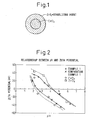
- the cerium-zirconium composite metal oxide of the present invention has such a constitution as the constituent particles thereof are made mainly of ZrO 2 in the outer layer and mainly of CeO 2 inside, as shown in Fig. 1, and this constitution is stabilized when a trace of element selected from among rare earth metals coexists with ZrO 2 .
- the present invention provides a cerium-zirconium composite metal oxide, characterized in that the total mole number of Ce and Zr is at least 85% based on the total mole number of metal in the composite metal oxide and CeO 2 forms a core surrounded by ZrO 2 .
- Fig. 1 shows a mere model and is not intended to limit the present invention.
- the present invention provides a cerium-zirconium composite metal oxide, characterized in that the total mole number of Ce and Zr is at least 85% based on the total mole number of metal in the composite metal oxide, a molar ratio Ce/Zr is within a range from 1/9 to 9/1, and an isoelectric point of the composite metal oxide is more than 3.5 and, more preferably, the molar ratio Ce/Zr is within a range from 3/7 to 7/3 and the isoelectric point is within a range from 3.8 to 5.0.
- the isoelectric point is defined as a value measured by the stop watch method, a version of the electrophoretic microscope method specified in JIS R1638.
- the cerium-zirconium composite metal oxide refers to an oxide which contains at least Ce and Zr and may also contain another additional metallic element.
- the additional metallic element may be selected from among a wide range comprising s-block metals, d-block metals, p-block metals and f-block metals, such as sodium (Na), potassium (K), magnesium (Mg), calcium (Ca), barium (Ba), strontium (Sr), lanthanum (La), yttrium (Y), cerium (Ce), praseodymium (Pr), neodymium (Nd), samarium (Sm), europium (Eu), gadolinium (Gd), titanium (Ti), tin (Sn), zirconium (zr), manganese (Mn), iron (Fe), cobalt (Co), nickel (Ni), chromium (Cr), niobium (Nb), copper (Cu), vanadium (V), molybdenum (M
- the additional metallic element mentioned above is preferably at least one of rare earth metals such as La, Y, Ce, Pr, Nd, Sm, Eu and Gd, and is contained in a concentration less than 15% based on the total mole number of metal in the cerium-zirconium composite metal oxide.
- the cerium-zirconium composite metal oxide of such a constitution is preferably produced by using a ceria sol as a source of cerium and is obtained by mixing the ceria sol and a zirconium compound solution or a zirconia sol, and preferably a solution of a compound of the additional metallic element or a sol thereof in a predetermined proportion to prepare a suspension, and then drying and firing the suspension.
- sol in ceria sol and zirconia sol refers to colloid of an oxide or hydrate which is dispersed in a liquid, particularly in water, which can produce a metal oxide such as ceria or zirconia when fired.
- the sol may be a material which is obtained by hydrolyzing alkoxide, acetylacetonato, acetate, nitrate or the like of such element as cerium or zirconium in a solution.
- the zirconium compound solution may be, for example, an aqueous solution of zirconium oxynitrate ZrO(NO 3 ) 2 ⁇ 2H 2 O, zirconium oxide ZrCl 4 or the like.
- the material is fired, for example, in an air atmosphere at a temperature from 600 to 900°C for several hours.
- the cerium-zirconium composite metal oxide thus prepared is processed in a grinding process as required, and is provided with a noble metal such as platinum, palladium or rhodium supported thereon, thereby making the exhaust gas purifying catalyst.
- the exhaust gas purifying catalyst can demonstrate high and stable exhaust gas purifying performance without degradation of the oxygen storage capacity even when exposed to a high temperature of about 1000°C.
- a solution prepared by dissolving 41.16 g of zirconium oxynitrate and 6.48 g of yttrium nitrate in 100 g of ion-exchanged water was added to 193.33 g of a ceria sol (containing 15% by weight of Needral U-15, manufactured by TAKI CHEMICAL CO., LTD. as CeO 2 ) and stirred to prepare a uniform suspension.
- cerium-zirconium composite metal oxide of the present invention having the following composition (weight ratio).
- CeO 2 /ZrO 2 /Y 2 O 3 58/38/4
- this composite metal oxide was dispersed in 300 g of ion-exchanged water to prepare a slurry. Then, 11.36 g of an aqueous solution of a diamminedinitroplatinum complex (Pt concentration: 4.4% by weight) was added to the slurry, followed by stirring for 2 hours.
- a diamminedinitroplatinum complex Pt concentration: 4.4% by weight
- the slurry was then heated at 120°C for 24 hours to evaporate water, and fired at 500°C for 2 hour to obtain an exhaust gas purifying catalyst comprising a cerium-zirconium composite metal oxide of the present invention and 1% by weight of Pt supported on the cerium-zirconium composite metal oxide.
- a solution prepared by dissolving 34.66 g of zirconium oxynitrate, 3.99 g of lanthanum nitrate and 8.94 g of praseodymium nitrate in 300 g of ion-exchanged water was added to 193.33 g of the ceria sol described above and then stirred to prepare a uniform suspension.
- a solution was prepared by dissolving 73.165 g of cerium nitrate, 41.16 g of zirconium oxynitrate and 6.48 g of yttrium nitrate in 500 g of ion-exchanged water. Ammonia water having a concentration of 1 mole/liter was added dropwise to the solution to adjust the pH value to about 9, thereby to obtain a precipitate by coprecipitation.
- a solution was prepared by dissolving 73.17 g of cerium nitrate, 34.66 g of zirconium oxynitrate, 3.99 g of lanthanum nitrate and 8.94 g of praseodymium nitrate in 500 g of ion-exchanged water.
- a precipitate was produced from the solution by coprecipitation to evaporate water in the same manner as in Example 1, and then fired at 700°C for 5 hours to obtain a cerium-zirconium composite metal oxide having the following composition (weight ratio) of the Comparative Example.
- CeO 2 /ZrO 2 /La 2 O 3 /Pr 6 O 11 58/32/3/7
- 29 g of cerium oxide powder was dispersed in 500 g of ion-exchanged water, and then a solution prepared by dissolving 41.16 g of zirconium oxynitrate and 6.48 g of yttrium nitrate in 200 g of ion-exchanged water was added dropwise and stirred to prepare a slurry.
- Ammonia water was added dropwise to the slurry to adjust the pH value to about 9 in the same manner as in Comparative Example 1 to produce a precipitate containing zirconium and yttrium.
- cerium-zirconium composite metal oxide having the following composition (weight ratio) of the Comparative Example.
- CeO 2 /ZrO 2 /Y 2 O 3 58/38/4
- cerium-zirconium composite metal oxide made in Examples 1 to 4 and Comparative Examples 1 to 3 were compressed and crushed to make pellets about 2 mm in diameter. About 2.0 g of each of the samples was taken and tested to evaluate catalyst performances.
- the exhaust gas purifying catalysts were fired at 1000°C for 3 hours for the purpose of comparing the durability, before the evaluation of catalyst performances.
- Evaluation test was conducted by measuring the rate of neutralizing the components C 3 O 6 (HC), NO and CO while raising the catalyst bed temperature at a rate of 10°C /minute up to 400°C, and changing between carbon rich gas and lean gas having compositions shown in Table 1 at intervals of one minute, so that any difference in the oxygen storage capacity can be observed distinctly.
- the catalytic performances were evaluated in terms of the temperature at which 50% of the component was neutralized. The test results are summarized in Table 2.
- a cerium-zirconium composite metal oxide having improved durability at high temperature and a stable oxygen storage capacity is provided.
- the cerium-zirconium composite metal oxide is characterized in that the total mole number of Ce and Zr is at least 85% based on the total mole number of metal in the composite metal oxide, a molar ratio Ce/Zr is within a range from 1/9 to 9/1, and an isoelectric point of the composite metal oxide is more than 3.5.
- the molar ratio Ce/Zr is within a range from 3/7 to 7/3 and the isoelectric point is within a range from 3.8 to 5.0
- the cerium-zirconium composite metal oxide contains a rare earth metal (excluding Ce) in a concentration of less than 15% by mole based on the total mole number of metal in the composite metal oxide.
- the present invention provides a cerium-zirconium composite metal oxide, characterized in that CeO 2 forms a core surrounded by ZrO 2 .
Landscapes
- Chemical & Material Sciences (AREA)
- Organic Chemistry (AREA)
- Engineering & Computer Science (AREA)
- Chemical Kinetics & Catalysis (AREA)
- Materials Engineering (AREA)
- Inorganic Chemistry (AREA)
- Combustion & Propulsion (AREA)
- Health & Medical Sciences (AREA)
- Biomedical Technology (AREA)
- Environmental & Geological Engineering (AREA)
- Analytical Chemistry (AREA)
- General Chemical & Material Sciences (AREA)
- Oil, Petroleum & Natural Gas (AREA)
- Exhaust Gas Treatment By Means Of Catalyst (AREA)
- Catalysts (AREA)
Abstract
Description
| Gas composition for evaluation | ||||||||
| N2 (%) | CO2 (%) | NO (ppm) | CO (%) | C3H6 (ppmC) | H2 (%) | O2 (%) | H2O (%) | |
| Rich gas | Balance | 10 | 2200 | 2.80 | 2500 | 0.27 | 0.77 | 10 |
| Lean gas | Balance | 10 | 2200 | 0.81 | 2500 | 0 | 1.7 | 10 |
| Results of the measurement of catalyst performances and isoelectric point | ||||||
| Composition | Weight ratio | HC | NO | CO | Isoelectric point | |
| Example 1 | Ce-Zr-Y-O | 58/38/4 | 234 | 266 | 180 | 4.2 |
| Example 2 | Ce-Zr-Y-O | 58/38/4 | 253 | 286 | 221 | 3.9 |
| Example 3 | Ce-Zr-Y-O | 58/38/4 | 263 | 301 | 216 | 4.1 |
| Example 4 | Ce-Zr-La-Pr-O | 58/32/3/7 | 245 | 270 | 201 | 4.0 |
| Comparative Example 1 | Ce-Zr-Y-O | 58/38/4 | 280 | 308 | 242 | 2.5 |
| Comparative Example 2 | Ce-Zr-La-Pr-O | 58/32/3/7 | 269 | 303 | 253 | 2.2 |
| Comparative Example 3 | Ce-Zr-Y-O | 58/38/4 | 302 | 366 | 299 | 3.3 |
Claims (7)
- A cerium-zirconium composite metal oxide, characterized in that the total mole number of Ce and Zr is at least 85% based on the total mole number of metal in the composite metal oxide, a molar ratio Ce/Zr is within a range from 1/9 to 9/1, and an isoelectric point of the composite metal oxide is more than 3.5.
- The cerium-zirconium composite metal oxide according to claim 1, wherein the molar ratio Ce/Zr is within a range from 3/7 to 7/3 and the isoelectric point is within a range from 3.8 to 5.0.
- The cerium-zirconium composite metal oxide according to claim 1 or 2, which contains rare earth metal (excluding Ce) in a concentration of less than 15% by mole based on the total mole number of metal in the composite metal oxide.
- A cerium-zirconium composite metal oxide, characterized in that the total mole number of Ce and Zr is at least 85% based on the total mole number of metal in the composite metal oxide and CeO2 forms a core surrounded by ZrO2.
- The cerium-zirconium composite metal oxide according to claim 4, wherein the CeO2 core has a diameter within a range from 5 to 20 nm.
- An exhaust gas purifying catalyst comprising the cerium-zirconium composite metal oxide of any one of claims 1 to 5 and a noble metal supported on the cerium-zirconium composite metal oxide.
- A method for synthesizing the cerium-zirconium composite metal oxide of any one of claims 1 to 4, which comprises mixing a ceria sol and a zirconium compound solution or a zirconia sol to prepare a suspension, and drying and firing the mixture.
Priority Applications (2)
| Application Number | Priority Date | Filing Date | Title |
|---|---|---|---|
| US10/661,596 US7384888B2 (en) | 2003-09-15 | 2003-09-15 | Cerium-zirconium composite metal oxide |
| EP03020939.9A EP1516855B1 (en) | 2003-09-15 | 2003-09-16 | Cerium-zirconium composite metal oxide with a cerium oxide core surrounded by zirconium oxide |
Applications Claiming Priority (2)
| Application Number | Priority Date | Filing Date | Title |
|---|---|---|---|
| US10/661,596 US7384888B2 (en) | 2003-09-15 | 2003-09-15 | Cerium-zirconium composite metal oxide |
| EP03020939.9A EP1516855B1 (en) | 2003-09-15 | 2003-09-16 | Cerium-zirconium composite metal oxide with a cerium oxide core surrounded by zirconium oxide |
Publications (2)
| Publication Number | Publication Date |
|---|---|
| EP1516855A1 true EP1516855A1 (en) | 2005-03-23 |
| EP1516855B1 EP1516855B1 (en) | 2017-03-01 |
Family
ID=34553636
Family Applications (1)
| Application Number | Title | Priority Date | Filing Date |
|---|---|---|---|
| EP03020939.9A Expired - Lifetime EP1516855B1 (en) | 2003-09-15 | 2003-09-16 | Cerium-zirconium composite metal oxide with a cerium oxide core surrounded by zirconium oxide |
Country Status (1)
| Country | Link |
|---|---|
| EP (1) | EP1516855B1 (en) |
Cited By (13)
| Publication number | Priority date | Publication date | Assignee | Title |
|---|---|---|---|---|
| WO2005102524A1 (en) | 2004-04-27 | 2005-11-03 | Toyota Jidosha Kabushiki Kaisha | Metal oxide particle, production process thereof and exhaust gas purifying catalyst |
| WO2005102516A1 (en) * | 2004-04-27 | 2005-11-03 | Toyota Jidosha Kabushiki Kaisha | Exhaust gas purifying catalyst and production process thereof |
| EP1415956A3 (en) * | 2002-10-28 | 2005-12-28 | Toyota Jidosha Kabushiki Kaisha | A method for preparing metal oxide particles and an exhaust gas purifying catalyst |
| WO2009001131A1 (en) * | 2007-06-25 | 2008-12-31 | Johnson Matthey Public Limited Company | Non-zeolite base metal scr catalyst |
| WO2008146823A3 (en) * | 2007-05-23 | 2009-03-26 | Toyota Motor Co Ltd | Core-shell structure, process for its production, and exhaust gas purification catalyst comprising core-shell structure |
| WO2009023468A3 (en) * | 2007-08-09 | 2009-07-09 | Basf Catalysts Llc | Catalyst compositions |
| US7632776B2 (en) | 2005-04-27 | 2009-12-15 | Toyota Jidosha Kabushiki Kaisha | Exhaust gas purifying catalyst and production process thereof |
| US7745371B2 (en) | 2004-03-09 | 2010-06-29 | Toyota Jidosha Kabushiki Kaisha | Exhaust gas purifying catalyst, metal oxide particle and production process thereof |
| US7879755B2 (en) | 2007-08-09 | 2011-02-01 | Basf Corporation | Catalyst compositions |
| EP2072120A4 (en) * | 2006-08-25 | 2011-04-13 | Tokyo Roki Kk | CATALYST, PROCESS AND APPARATUS FOR THE PURIFICATION OF NITROGEN OXIDE |
| US7989387B2 (en) | 2004-04-27 | 2011-08-02 | Toyota Jidosha Kabushiki Kaisha | Process for producing metal oxide particle and exhaust gas purifying catalyst |
| CN103754932A (en) * | 2014-01-28 | 2014-04-30 | 内蒙古科技大学 | Method for preparing high specific-surface-area superfine cerium-zirconium composite oxides |
| EP2930149A4 (en) * | 2012-12-07 | 2015-12-09 | Toyota Motor Co Ltd | COMPOSITE OXIDE MATERIAL AND EXHAUST PURIFYING CATALYST USING THE SAME |
Citations (5)
| Publication number | Priority date | Publication date | Assignee | Title |
|---|---|---|---|---|
| JPH0248418A (en) * | 1988-08-05 | 1990-02-19 | Catalysts & Chem Ind Co Ltd | Zirconia composite sol |
| EP0614854A1 (en) * | 1993-02-10 | 1994-09-14 | Rhone-Poulenc Chimie | Process for the synthesis of mixed zirconium und cerium oxides based compositions, the obtained compositions and use thereof |
| US5693299A (en) * | 1992-12-21 | 1997-12-02 | Rhone-Poulenc Chimie | Process for the catalytic conversion of exhaust gases using cerium/zirconium mixed oxide catalyst |
| FR2756819A1 (en) * | 1996-12-06 | 1998-06-12 | Rhodia Chimie Sa | COMPOSITION BASED ON CERIUM OXIDE OR CERIUM OXIDES AND ZIRCONIUM, IN EXTRUDED FORM, PROCESS FOR PREPARING SAME AND USE AS CATALYST |
| JPH10194742A (en) | 1996-12-27 | 1998-07-28 | Anan Kasei Kk | Zirconium-cerium composite oxide and method for producing the same |
-
2003
- 2003-09-16 EP EP03020939.9A patent/EP1516855B1/en not_active Expired - Lifetime
Patent Citations (7)
| Publication number | Priority date | Publication date | Assignee | Title |
|---|---|---|---|---|
| JPH0248418A (en) * | 1988-08-05 | 1990-02-19 | Catalysts & Chem Ind Co Ltd | Zirconia composite sol |
| US5693299A (en) * | 1992-12-21 | 1997-12-02 | Rhone-Poulenc Chimie | Process for the catalytic conversion of exhaust gases using cerium/zirconium mixed oxide catalyst |
| EP0614854A1 (en) * | 1993-02-10 | 1994-09-14 | Rhone-Poulenc Chimie | Process for the synthesis of mixed zirconium und cerium oxides based compositions, the obtained compositions and use thereof |
| JPH06279027A (en) | 1993-02-10 | 1994-10-04 | Rhone Poulenc Chim | Composition based on mixture of zirconium oxide and cerium oxide and method for synthetic production and use thereof |
| FR2756819A1 (en) * | 1996-12-06 | 1998-06-12 | Rhodia Chimie Sa | COMPOSITION BASED ON CERIUM OXIDE OR CERIUM OXIDES AND ZIRCONIUM, IN EXTRUDED FORM, PROCESS FOR PREPARING SAME AND USE AS CATALYST |
| JPH10194742A (en) | 1996-12-27 | 1998-07-28 | Anan Kasei Kk | Zirconium-cerium composite oxide and method for producing the same |
| EP0955267A1 (en) * | 1996-12-27 | 1999-11-10 | Anan Kasei Co., Ltd | Composite zirconium-cerium oxide, process for the preparation thereof, and cocatalyst for cleaning exhaust gas |
Non-Patent Citations (1)
| Title |
|---|
| PATENT ABSTRACTS OF JAPAN vol. 014, no. 211 (C - 0715) 2 May 1990 (1990-05-02) * |
Cited By (22)
| Publication number | Priority date | Publication date | Assignee | Title |
|---|---|---|---|---|
| EP1415956A3 (en) * | 2002-10-28 | 2005-12-28 | Toyota Jidosha Kabushiki Kaisha | A method for preparing metal oxide particles and an exhaust gas purifying catalyst |
| US7314846B2 (en) | 2002-10-28 | 2008-01-01 | Toyota Jidosha Kabushiki Kaisha | Method for preparing metal oxide particles and an exhaust gas purifying catalyst |
| USRE45083E1 (en) | 2002-10-28 | 2014-08-19 | Toyota Jidosha Kabushiki Kaisha | Method for preparing metal oxide particles and an exhaust gas purifying catalyst |
| US7745371B2 (en) | 2004-03-09 | 2010-06-29 | Toyota Jidosha Kabushiki Kaisha | Exhaust gas purifying catalyst, metal oxide particle and production process thereof |
| US7989387B2 (en) | 2004-04-27 | 2011-08-02 | Toyota Jidosha Kabushiki Kaisha | Process for producing metal oxide particle and exhaust gas purifying catalyst |
| WO2005102516A1 (en) * | 2004-04-27 | 2005-11-03 | Toyota Jidosha Kabushiki Kaisha | Exhaust gas purifying catalyst and production process thereof |
| WO2005102524A1 (en) | 2004-04-27 | 2005-11-03 | Toyota Jidosha Kabushiki Kaisha | Metal oxide particle, production process thereof and exhaust gas purifying catalyst |
| US8026193B2 (en) | 2004-04-27 | 2011-09-27 | Toyota Jidosha Kabushiki Kaisha | Metal oxide particle, production process thereof and exhaust gas purifying catalyst |
| US7632776B2 (en) | 2005-04-27 | 2009-12-15 | Toyota Jidosha Kabushiki Kaisha | Exhaust gas purifying catalyst and production process thereof |
| US9364792B2 (en) | 2006-08-25 | 2016-06-14 | Tokyo Roki Co., Ltd. | Catalyst, method and apparatus for removing nitrogen oxide |
| EP2072120A4 (en) * | 2006-08-25 | 2011-04-13 | Tokyo Roki Kk | CATALYST, PROCESS AND APPARATUS FOR THE PURIFICATION OF NITROGEN OXIDE |
| WO2008146823A3 (en) * | 2007-05-23 | 2009-03-26 | Toyota Motor Co Ltd | Core-shell structure, process for its production, and exhaust gas purification catalyst comprising core-shell structure |
| US8293677B2 (en) | 2007-05-23 | 2012-10-23 | Toyota Jidosha Kabushiki Kaisha | Core-shell structure, process for its production, and exhaust gas purification catalyst comprising core-shell structure |
| US7985391B2 (en) | 2007-06-25 | 2011-07-26 | Johnson Matthey Public Limited Company | Non-zeolite base metal SCR catalyst |
| US8091351B2 (en) | 2007-06-25 | 2012-01-10 | Johnson Matthey Public Limited Company | Non-zeolite base metal SCR catalyst |
| US8367578B2 (en) | 2007-06-25 | 2013-02-05 | Johnson Matthey Public Limited Company | Non-zeolite base metal SCR catalyst |
| CN101784333B (en) * | 2007-06-25 | 2014-06-04 | 约翰逊马西有限公司 | Non-zeolite base metal SCR catalyst |
| WO2009001131A1 (en) * | 2007-06-25 | 2008-12-31 | Johnson Matthey Public Limited Company | Non-zeolite base metal scr catalyst |
| US7879755B2 (en) | 2007-08-09 | 2011-02-01 | Basf Corporation | Catalyst compositions |
| WO2009023468A3 (en) * | 2007-08-09 | 2009-07-09 | Basf Catalysts Llc | Catalyst compositions |
| EP2930149A4 (en) * | 2012-12-07 | 2015-12-09 | Toyota Motor Co Ltd | COMPOSITE OXIDE MATERIAL AND EXHAUST PURIFYING CATALYST USING THE SAME |
| CN103754932A (en) * | 2014-01-28 | 2014-04-30 | 内蒙古科技大学 | Method for preparing high specific-surface-area superfine cerium-zirconium composite oxides |
Also Published As
| Publication number | Publication date |
|---|---|
| EP1516855B1 (en) | 2017-03-01 |
Similar Documents
| Publication | Publication Date | Title |
|---|---|---|
| USRE44802E1 (en) | Cerium-zirconium composite metal oxide | |
| US6569803B2 (en) | Catalyst for purifying exhaust gas | |
| JP3797313B2 (en) | Method for producing metal oxide particles and catalyst for exhaust gas purification | |
| CN101479037B (en) | Exhaust gas purifying catalyst and its manufacturing method | |
| KR100455300B1 (en) | Oxygen Absorption Storage Cerium Composite Oxide | |
| JP3861303B2 (en) | Exhaust gas purification catalyst | |
| EP1516855B1 (en) | Cerium-zirconium composite metal oxide with a cerium oxide core surrounded by zirconium oxide | |
| JP5583967B2 (en) | Exhaust gas purification catalyst, exhaust gas purification apparatus and exhaust gas purification method using the same | |
| CN108883397B (en) | Exhaust gas purification catalyst, method for producing the same, and exhaust gas purification device using the exhaust gas purification catalyst | |
| CN108136374B (en) | Exhaust gas purification catalyst, method for producing the same, and exhaust gas purification device using the same | |
| JPH10286462A (en) | Exhaust gas purification catalyst | |
| JP3956733B2 (en) | Cerium-zirconium composite metal oxide for exhaust gas purification catalyst | |
| JP5827567B2 (en) | Method for producing catalyst carrier or catalyst | |
| JP3568728B2 (en) | Oxygen storage cerium-based composite oxide | |
| JP2005254047A (en) | Exhaust gas purification catalyst, metal oxide particles and production method thereof | |
| JP4726714B2 (en) | Inorganic oxide and exhaust gas purifying catalyst using the same | |
| JP2006326478A (en) | Oxygen storage / release material for exhaust gas purification and exhaust gas purification catalyst | |
| JPH0586259B2 (en) | ||
| JP3556839B2 (en) | Oxygen storage cerium-based composite oxide | |
| JP3296141B2 (en) | Exhaust gas purification catalyst and method for producing the same | |
| US9855550B2 (en) | Exhaust gas-purifying catalyst | |
| JP2007105632A (en) | Exhaust gas purification catalyst | |
| US10279338B2 (en) | Exhaust gas-purifying catalyst | |
| JPH06106062A (en) | Exhaust gas purifying catalyst and method for producing the same | |
| JP2005342554A (en) | Catalyst carrier particles, method for producing the same, and exhaust gas purification catalyst |
Legal Events
| Date | Code | Title | Description |
|---|---|---|---|
| PUAI | Public reference made under article 153(3) epc to a published international application that has entered the european phase |
Free format text: ORIGINAL CODE: 0009012 |
|
| 17P | Request for examination filed |
Effective date: 20030916 |
|
| AK | Designated contracting states |
Kind code of ref document: A1 Designated state(s): AT BE BG CH CY CZ DE DK EE ES FI FR GB GR HU IE IT LI LU MC NL PT RO SE SI SK TR |
|
| AX | Request for extension of the european patent |
Extension state: AL LT LV MK |
|
| AKX | Designation fees paid |
Designated state(s): DE FR GB IT |
|
| RAP1 | Party data changed (applicant data changed or rights of an application transferred) |
Owner name: TOYOTA JIDOSHA KABUSHIKI KAISHA |
|
| RIC1 | Information provided on ipc code assigned before grant |
Ipc: B01J 23/10 20060101ALI20160808BHEP Ipc: B01J 23/63 20060101ALI20160808BHEP Ipc: B01J 21/06 20060101ALI20160808BHEP Ipc: B01J 35/00 20060101ALI20160808BHEP Ipc: B01D 53/94 20060101ALI20160808BHEP Ipc: C01G 25/00 20060101AFI20160808BHEP Ipc: B01J 37/02 20060101ALI20160808BHEP |
|
| GRAP | Despatch of communication of intention to grant a patent |
Free format text: ORIGINAL CODE: EPIDOSNIGR1 |
|
| INTG | Intention to grant announced |
Effective date: 20160930 |
|
| GRAS | Grant fee paid |
Free format text: ORIGINAL CODE: EPIDOSNIGR3 |
|
| GRAA | (expected) grant |
Free format text: ORIGINAL CODE: 0009210 |
|
| AK | Designated contracting states |
Kind code of ref document: B1 Designated state(s): DE FR GB IT |
|
| REG | Reference to a national code |
Ref country code: GB Ref legal event code: FG4D |
|
| REG | Reference to a national code |
Ref country code: DE Ref legal event code: R096 Ref document number: 60349936 Country of ref document: DE |
|
| REG | Reference to a national code |
Ref country code: DE Ref legal event code: R084 Ref document number: 60349936 Country of ref document: DE |
|
| REG | Reference to a national code |
Ref country code: GB Ref legal event code: 746 Effective date: 20170621 |
|
| REG | Reference to a national code |
Ref country code: FR Ref legal event code: PLFP Year of fee payment: 15 |
|
| PGFP | Annual fee paid to national office [announced via postgrant information from national office to epo] |
Ref country code: IT Payment date: 20170925 Year of fee payment: 15 Ref country code: GB Payment date: 20170913 Year of fee payment: 15 Ref country code: DE Payment date: 20170912 Year of fee payment: 15 Ref country code: FR Payment date: 20170810 Year of fee payment: 15 |
|
| REG | Reference to a national code |
Ref country code: DE Ref legal event code: R097 Ref document number: 60349936 Country of ref document: DE |
|
| PLBE | No opposition filed within time limit |
Free format text: ORIGINAL CODE: 0009261 |
|
| STAA | Information on the status of an ep patent application or granted ep patent |
Free format text: STATUS: NO OPPOSITION FILED WITHIN TIME LIMIT |
|
| 26N | No opposition filed |
Effective date: 20171204 |
|
| REG | Reference to a national code |
Ref country code: DE Ref legal event code: R119 Ref document number: 60349936 Country of ref document: DE |
|
| GBPC | Gb: european patent ceased through non-payment of renewal fee |
Effective date: 20180916 |
|
| PG25 | Lapsed in a contracting state [announced via postgrant information from national office to epo] |
Ref country code: DE Free format text: LAPSE BECAUSE OF NON-PAYMENT OF DUE FEES Effective date: 20190402 Ref country code: IT Free format text: LAPSE BECAUSE OF NON-PAYMENT OF DUE FEES Effective date: 20180916 |
|
| PG25 | Lapsed in a contracting state [announced via postgrant information from national office to epo] |
Ref country code: FR Free format text: LAPSE BECAUSE OF NON-PAYMENT OF DUE FEES Effective date: 20180930 |
|
| PG25 | Lapsed in a contracting state [announced via postgrant information from national office to epo] |
Ref country code: GB Free format text: LAPSE BECAUSE OF NON-PAYMENT OF DUE FEES Effective date: 20180916 |