EP1516230B1 - Photosensitive compositions - Google Patents
Photosensitive compositions Download PDFInfo
- Publication number
- EP1516230B1 EP1516230B1 EP03762338.6A EP03762338A EP1516230B1 EP 1516230 B1 EP1516230 B1 EP 1516230B1 EP 03762338 A EP03762338 A EP 03762338A EP 1516230 B1 EP1516230 B1 EP 1516230B1
- Authority
- EP
- European Patent Office
- Prior art keywords
- group
- composition
- substituted
- alkyl
- imide
- Prior art date
- Legal status (The legal status is an assumption and is not a legal conclusion. Google has not performed a legal analysis and makes no representation as to the accuracy of the status listed.)
- Expired - Lifetime
Links
- 239000000203 mixture Substances 0.000 title claims description 91
- 229920000642 polymer Polymers 0.000 claims description 67
- 150000001875 compounds Chemical class 0.000 claims description 40
- 239000002253 acid Substances 0.000 claims description 31
- 238000000034 method Methods 0.000 claims description 30
- 125000000217 alkyl group Chemical group 0.000 claims description 22
- 229910003844 NSO2 Inorganic materials 0.000 claims description 20
- 150000003949 imides Chemical class 0.000 claims description 20
- 239000000178 monomer Substances 0.000 claims description 20
- 230000005855 radiation Effects 0.000 claims description 20
- 239000003513 alkali Substances 0.000 claims description 18
- 239000000758 substrate Substances 0.000 claims description 15
- RTZKZFJDLAIYFH-UHFFFAOYSA-N Diethyl ether Chemical compound CCOCC RTZKZFJDLAIYFH-UHFFFAOYSA-N 0.000 claims description 14
- 125000001997 phenyl group Chemical group [H]C1=C([H])C([H])=C(*)C([H])=C1[H] 0.000 claims description 14
- 125000004122 cyclic group Chemical group 0.000 claims description 12
- 239000007787 solid Substances 0.000 claims description 12
- 239000002904 solvent Substances 0.000 claims description 12
- KZJUHXVCAHXJLR-UHFFFAOYSA-N 1,1,2,2,3,3,4,4,4-nonafluoro-n-(1,1,2,2,3,3,4,4,4-nonafluorobutylsulfonyl)butane-1-sulfonamide Chemical compound FC(F)(F)C(F)(F)C(F)(F)C(F)(F)S(=O)(=O)NS(=O)(=O)C(F)(F)C(F)(F)C(F)(F)C(F)(F)F KZJUHXVCAHXJLR-UHFFFAOYSA-N 0.000 claims description 11
- -1 alicyclic hydrocarbon Chemical class 0.000 claims description 11
- 238000000576 coating method Methods 0.000 claims description 10
- 125000004178 (C1-C4) alkyl group Chemical group 0.000 claims description 8
- DOYSIZKQWJYULQ-UHFFFAOYSA-N 1,1,2,2,2-pentafluoro-n-(1,1,2,2,2-pentafluoroethylsulfonyl)ethanesulfonamide Chemical compound FC(F)(F)C(F)(F)S(=O)(=O)NS(=O)(=O)C(F)(F)C(F)(F)F DOYSIZKQWJYULQ-UHFFFAOYSA-N 0.000 claims description 8
- 125000002723 alicyclic group Chemical group 0.000 claims description 8
- 229910052736 halogen Inorganic materials 0.000 claims description 8
- 150000002367 halogens Chemical class 0.000 claims description 8
- 229910052739 hydrogen Inorganic materials 0.000 claims description 8
- 238000011282 treatment Methods 0.000 claims description 8
- 229920001577 copolymer Polymers 0.000 claims description 7
- 125000000999 tert-butyl group Chemical group [H]C([H])([H])C(*)(C([H])([H])[H])C([H])([H])[H] 0.000 claims description 7
- XLLXMBCBJGATSP-UHFFFAOYSA-N 2-phenylethenol Chemical group OC=CC1=CC=CC=C1 XLLXMBCBJGATSP-UHFFFAOYSA-N 0.000 claims description 6
- 239000011248 coating agent Substances 0.000 claims description 6
- LTYMSROWYAPPGB-UHFFFAOYSA-O diphenylsulfanium Chemical compound C=1C=CC=CC=1[SH+]C1=CC=CC=C1 LTYMSROWYAPPGB-UHFFFAOYSA-O 0.000 claims description 6
- 125000004185 ester group Chemical group 0.000 claims description 6
- JESXATFQYMPTNL-UHFFFAOYSA-N mono-hydroxyphenyl-ethylene Natural products OC1=CC=CC=C1C=C JESXATFQYMPTNL-UHFFFAOYSA-N 0.000 claims description 6
- QYKIQEUNHZKYBP-UHFFFAOYSA-N Vinyl ether Chemical class C=COC=C QYKIQEUNHZKYBP-UHFFFAOYSA-N 0.000 claims description 5
- 125000003118 aryl group Chemical group 0.000 claims description 5
- 229920005989 resin Polymers 0.000 claims description 5
- 239000011347 resin Substances 0.000 claims description 5
- 239000004215 Carbon black (E152) Substances 0.000 claims description 4
- UFWIBTONFRDIAS-UHFFFAOYSA-N Naphthalene Chemical group C1=CC=CC2=CC=CC=C21 UFWIBTONFRDIAS-UHFFFAOYSA-N 0.000 claims description 4
- 125000003545 alkoxy group Chemical group 0.000 claims description 4
- LSSYNNOILRNWCJ-UHFFFAOYSA-N diphenyl-(2,4,6-trimethylphenyl)sulfanium Chemical compound CC1=CC(C)=CC(C)=C1[S+](C=1C=CC=CC=1)C1=CC=CC=C1 LSSYNNOILRNWCJ-UHFFFAOYSA-N 0.000 claims description 4
- 125000003709 fluoroalkyl group Chemical group 0.000 claims description 4
- 229930195733 hydrocarbon Natural products 0.000 claims description 4
- 239000001257 hydrogen Substances 0.000 claims description 4
- 150000002431 hydrogen Chemical class 0.000 claims description 4
- 125000001624 naphthyl group Chemical group 0.000 claims description 4
- UTCOSYZEYALTGJ-UHFFFAOYSA-N tris(2-tert-butylphenyl)sulfanium Chemical compound CC(C)(C)C1=CC=CC=C1[S+](C=1C(=CC=CC=1)C(C)(C)C)C1=CC=CC=C1C(C)(C)C UTCOSYZEYALTGJ-UHFFFAOYSA-N 0.000 claims description 4
- 125000004209 (C1-C8) alkyl group Chemical group 0.000 claims description 3
- 125000000113 cyclohexyl group Chemical group [H]C1([H])C([H])([H])C([H])([H])C([H])(*)C([H])([H])C1([H])[H] 0.000 claims description 3
- 125000004434 sulfur atom Chemical group 0.000 claims description 3
- 125000000391 vinyl group Chemical group [H]C([*])=C([H])[H] 0.000 claims description 3
- NQMUGNMMFTYOHK-UHFFFAOYSA-N 1-methoxynaphthalene Chemical group C1=CC=C2C(OC)=CC=CC2=C1 NQMUGNMMFTYOHK-UHFFFAOYSA-N 0.000 claims description 2
- 150000001252 acrylic acid derivatives Chemical class 0.000 claims description 2
- 125000004799 bromophenyl group Chemical group 0.000 claims description 2
- 239000012955 diaryliodonium Substances 0.000 claims description 2
- 150000002734 metacrylic acid derivatives Chemical class 0.000 claims description 2
- 125000004108 n-butyl group Chemical group [H]C([H])([H])C([H])([H])C([H])([H])C([H])([H])* 0.000 claims description 2
- 125000005003 perfluorobutyl group Chemical group FC(F)(F)C(F)(F)C(F)(F)C(F)(F)* 0.000 claims description 2
- 150000003440 styrenes Chemical class 0.000 claims description 2
- 125000002023 trifluoromethyl group Chemical group FC(F)(F)* 0.000 claims description 2
- 229920001567 vinyl ester resin Polymers 0.000 claims description 2
- 125000001495 ethyl group Chemical group [H]C([H])([H])C([H])([H])* 0.000 claims 1
- 125000002496 methyl group Chemical group [H]C([H])([H])* 0.000 claims 1
- XEKOWRVHYACXOJ-UHFFFAOYSA-N Ethyl acetate Chemical compound CCOC(C)=O XEKOWRVHYACXOJ-UHFFFAOYSA-N 0.000 description 96
- XLYOFNOQVPJJNP-UHFFFAOYSA-N water Chemical compound O XLYOFNOQVPJJNP-UHFFFAOYSA-N 0.000 description 33
- CSNNHWWHGAXBCP-UHFFFAOYSA-L Magnesium sulfate Chemical compound [Mg+2].[O-][S+2]([O-])([O-])[O-] CSNNHWWHGAXBCP-UHFFFAOYSA-L 0.000 description 32
- 238000003786 synthesis reaction Methods 0.000 description 32
- 230000015572 biosynthetic process Effects 0.000 description 31
- 239000010410 layer Substances 0.000 description 29
- GQHTUMJGOHRCHB-UHFFFAOYSA-N 2,3,4,6,7,8,9,10-octahydropyrimido[1,2-a]azepine Chemical compound C1CCCCN2CCCN=C21 GQHTUMJGOHRCHB-UHFFFAOYSA-N 0.000 description 26
- 238000009472 formulation Methods 0.000 description 25
- 229920002120 photoresistant polymer Polymers 0.000 description 24
- LLHKCFNBLRBOGN-UHFFFAOYSA-N propylene glycol methyl ether acetate Chemical compound COCC(C)OC(C)=O LLHKCFNBLRBOGN-UHFFFAOYSA-N 0.000 description 22
- 239000000243 solution Substances 0.000 description 21
- 229910052943 magnesium sulfate Inorganic materials 0.000 description 16
- 235000019341 magnesium sulphate Nutrition 0.000 description 16
- 239000008367 deionised water Substances 0.000 description 15
- 229910021641 deionized water Inorganic materials 0.000 description 13
- BBEAQIROQSPTKN-UHFFFAOYSA-N antipyrene Natural products C1=CC=C2C=CC3=CC=CC4=CC=C1C2=C43 BBEAQIROQSPTKN-UHFFFAOYSA-N 0.000 description 12
- 239000000725 suspension Substances 0.000 description 12
- WGTYBPLFGIVFAS-UHFFFAOYSA-M tetramethylammonium hydroxide Chemical compound [OH-].C[N+](C)(C)C WGTYBPLFGIVFAS-UHFFFAOYSA-M 0.000 description 12
- XGLVDUUYFKXKPL-UHFFFAOYSA-N 2-(2-methoxyethoxy)-n,n-bis[2-(2-methoxyethoxy)ethyl]ethanamine Chemical compound COCCOCCN(CCOCCOC)CCOCCOC XGLVDUUYFKXKPL-UHFFFAOYSA-N 0.000 description 11
- MTWNQMHWLWHXGH-XEUPFTBBSA-N pag 8 Chemical compound C([C@H]1O[C@H]([C@@H]([C@@H](OC(C)=O)[C@@H]1OC(C)=O)OC(C)=O)OC[C@H](C(C1O[C@H](COC(C)=O)[C@@H](OC(C)=O)[C@@H]([C@H]1OC(C)=O)O[C@@H]1O[C@H](COC(C)=O)[C@@H](OC(O)=O)[C@@H]([C@H]1OC(C)=O)O[C@@H]1O[C@H](COC(C)=O)[C@@H](OC(C)=O)[C@@H]([C@H]1OC(C)=O)O[C@@H]1O[C@@H]([C@H]([C@H](O[C@H]2[C@@H]([C@@H](OC(O)=O)[C@H](OC(C)=O)[C@@H](COC(C)=O)O2)OC(C)=O)[C@H]1OC(C)=O)OC(C)=O)COC(=O)C)C(O)=O)[C@@H](OC(C)=O)[C@@H](C(CC(C(C)=O)C(C)=O)OC(C)=O)C(C(C)=O)C(C)=O)OC(=C)O[C@@H]1O[C@H](CO)[C@@H](O)[C@H](O)[C@H]1O MTWNQMHWLWHXGH-XEUPFTBBSA-N 0.000 description 11
- SAFWZKVQMVOANB-UHFFFAOYSA-N 2-[tert-butylsulfonyl(diazo)methyl]sulfonyl-2-methylpropane Chemical compound CC(C)(C)S(=O)(=O)C(=[N+]=[N-])S(=O)(=O)C(C)(C)C SAFWZKVQMVOANB-UHFFFAOYSA-N 0.000 description 10
- 239000002585 base Substances 0.000 description 10
- 230000000052 comparative effect Effects 0.000 description 10
- 238000005160 1H NMR spectroscopy Methods 0.000 description 8
- CSCPPACGZOOCGX-UHFFFAOYSA-N Acetone Chemical compound CC(C)=O CSCPPACGZOOCGX-UHFFFAOYSA-N 0.000 description 8
- 239000000706 filtrate Substances 0.000 description 8
- 238000001914 filtration Methods 0.000 description 8
- 238000000806 fluorine-19 nuclear magnetic resonance spectrum Methods 0.000 description 8
- 238000004519 manufacturing process Methods 0.000 description 8
- 238000003756 stirring Methods 0.000 description 8
- 235000012431 wafers Nutrition 0.000 description 8
- 239000000654 additive Substances 0.000 description 7
- 238000006243 chemical reaction Methods 0.000 description 7
- HEMHJVSKTPXQMS-UHFFFAOYSA-M Sodium hydroxide Chemical compound [OH-].[Na+] HEMHJVSKTPXQMS-UHFFFAOYSA-M 0.000 description 6
- YXFVVABEGXRONW-UHFFFAOYSA-N Toluene Chemical compound CC1=CC=CC=C1 YXFVVABEGXRONW-UHFFFAOYSA-N 0.000 description 6
- 238000010438 heat treatment Methods 0.000 description 6
- 239000011541 reaction mixture Substances 0.000 description 6
- 239000000126 substance Substances 0.000 description 6
- 239000000975 dye Substances 0.000 description 5
- VLKZOEOYAKHREP-UHFFFAOYSA-N n-Hexane Chemical class CCCCCC VLKZOEOYAKHREP-UHFFFAOYSA-N 0.000 description 5
- 239000003921 oil Substances 0.000 description 5
- 239000004065 semiconductor Substances 0.000 description 5
- 159000000000 sodium salts Chemical class 0.000 description 5
- 125000000472 sulfonyl group Chemical group *S(*)(=O)=O 0.000 description 5
- DGAQECJNVWCQMB-PUAWFVPOSA-M Ilexoside XXIX Chemical compound C[C@@H]1CC[C@@]2(CC[C@@]3(C(=CC[C@H]4[C@]3(CC[C@@H]5[C@@]4(CC[C@@H](C5(C)C)OS(=O)(=O)[O-])C)C)[C@@H]2[C@]1(C)O)C)C(=O)O[C@H]6[C@@H]([C@H]([C@@H]([C@H](O6)CO)O)O)O.[Na+] DGAQECJNVWCQMB-PUAWFVPOSA-M 0.000 description 4
- AFVFQIVMOAPDHO-UHFFFAOYSA-N Methanesulfonic acid Chemical compound CS(O)(=O)=O AFVFQIVMOAPDHO-UHFFFAOYSA-N 0.000 description 4
- 239000007864 aqueous solution Substances 0.000 description 4
- LZCLXQDLBQLTDK-UHFFFAOYSA-N ethyl 2-hydroxypropanoate Chemical compound CCOC(=O)C(C)O LZCLXQDLBQLTDK-UHFFFAOYSA-N 0.000 description 4
- CATSNJVOTSVZJV-UHFFFAOYSA-N heptan-2-one Chemical compound CCCCCC(C)=O CATSNJVOTSVZJV-UHFFFAOYSA-N 0.000 description 4
- 229910052708 sodium Inorganic materials 0.000 description 4
- 239000011734 sodium Substances 0.000 description 4
- ZWEHNKRNPOVVGH-UHFFFAOYSA-N 2-Butanone Chemical compound CCC(C)=O ZWEHNKRNPOVVGH-UHFFFAOYSA-N 0.000 description 3
- YXHKONLOYHBTNS-UHFFFAOYSA-N Diazomethane Chemical compound C=[N+]=[N-] YXHKONLOYHBTNS-UHFFFAOYSA-N 0.000 description 3
- ZMANZCXQSJIPKH-UHFFFAOYSA-N Triethylamine Chemical compound CCN(CC)CC ZMANZCXQSJIPKH-UHFFFAOYSA-N 0.000 description 3
- 150000001241 acetals Chemical class 0.000 description 3
- IBDSYHHWZSNWLG-UHFFFAOYSA-M diphenyl-(2,4,6-trimethylphenyl)sulfanium;methanesulfonate Chemical compound CS([O-])(=O)=O.CC1=CC(C)=CC(C)=C1[S+](C=1C=CC=CC=1)C1=CC=CC=C1 IBDSYHHWZSNWLG-UHFFFAOYSA-M 0.000 description 3
- 238000004090 dissolution Methods 0.000 description 3
- 238000001035 drying Methods 0.000 description 3
- 239000012456 homogeneous solution Substances 0.000 description 3
- XMBWDFGMSWQBCA-UHFFFAOYSA-N hydrogen iodide Chemical compound I XMBWDFGMSWQBCA-UHFFFAOYSA-N 0.000 description 3
- 239000002952 polymeric resin Substances 0.000 description 3
- 238000006116 polymerization reaction Methods 0.000 description 3
- 108010001861 pregnancy-associated glycoprotein 1 Proteins 0.000 description 3
- 239000000047 product Substances 0.000 description 3
- 229920003002 synthetic resin Polymers 0.000 description 3
- 238000005406 washing Methods 0.000 description 3
- AUHZEENZYGFFBQ-UHFFFAOYSA-N 1,3,5-trimethylbenzene Chemical compound CC1=CC(C)=CC(C)=C1 AUHZEENZYGFFBQ-UHFFFAOYSA-N 0.000 description 2
- PGYJSURPYAAOMM-UHFFFAOYSA-N 2-ethenoxy-2-methylpropane Chemical compound CC(C)(C)OC=C PGYJSURPYAAOMM-UHFFFAOYSA-N 0.000 description 2
- JHNLZOVBAQWGQU-UHFFFAOYSA-N 380814_sial Chemical compound CS(O)(=O)=O.O=P(=O)OP(=O)=O JHNLZOVBAQWGQU-UHFFFAOYSA-N 0.000 description 2
- FUGYGGDSWSUORM-UHFFFAOYSA-N 4-hydroxystyrene Chemical compound OC1=CC=C(C=C)C=C1 FUGYGGDSWSUORM-UHFFFAOYSA-N 0.000 description 2
- JJHHIJFTHRNPIK-UHFFFAOYSA-N Diphenyl sulfoxide Chemical compound C=1C=CC=CC=1S(=O)C1=CC=CC=C1 JJHHIJFTHRNPIK-UHFFFAOYSA-N 0.000 description 2
- SECXISVLQFMRJM-UHFFFAOYSA-N N-Methylpyrrolidone Chemical compound CN1CCCC1=O SECXISVLQFMRJM-UHFFFAOYSA-N 0.000 description 2
- DHKHKXVYLBGOIT-UHFFFAOYSA-N acetaldehyde Diethyl Acetal Natural products CCOC(C)OCC DHKHKXVYLBGOIT-UHFFFAOYSA-N 0.000 description 2
- 230000000996 additive effect Effects 0.000 description 2
- 238000003776 cleavage reaction Methods 0.000 description 2
- JHIVVAPYMSGYDF-UHFFFAOYSA-N cyclohexanone Chemical compound O=C1CCCCC1 JHIVVAPYMSGYDF-UHFFFAOYSA-N 0.000 description 2
- BGTOWKSIORTVQH-UHFFFAOYSA-N cyclopentanone Chemical compound O=C1CCCC1 BGTOWKSIORTVQH-UHFFFAOYSA-N 0.000 description 2
- 230000003247 decreasing effect Effects 0.000 description 2
- 238000004821 distillation Methods 0.000 description 2
- 238000010894 electron beam technology Methods 0.000 description 2
- 229940116333 ethyl lactate Drugs 0.000 description 2
- 239000003112 inhibitor Substances 0.000 description 2
- 150000002500 ions Chemical class 0.000 description 2
- 229910003002 lithium salt Inorganic materials 0.000 description 2
- 159000000002 lithium salts Chemical class 0.000 description 2
- QJGQUHMNIGDVPM-UHFFFAOYSA-N nitrogen group Chemical group [N] QJGQUHMNIGDVPM-UHFFFAOYSA-N 0.000 description 2
- 239000012044 organic layer Substances 0.000 description 2
- 239000003960 organic solvent Substances 0.000 description 2
- 125000005010 perfluoroalkyl group Chemical group 0.000 description 2
- 238000006303 photolysis reaction Methods 0.000 description 2
- 230000015843 photosynthesis, light reaction Effects 0.000 description 2
- 239000002243 precursor Substances 0.000 description 2
- 108010001843 pregnancy-associated glycoprotein 2 Proteins 0.000 description 2
- 150000003254 radicals Chemical class 0.000 description 2
- 238000010992 reflux Methods 0.000 description 2
- 239000012266 salt solution Substances 0.000 description 2
- 150000003839 salts Chemical class 0.000 description 2
- 239000000523 sample Substances 0.000 description 2
- 230000007017 scission Effects 0.000 description 2
- 239000004094 surface-active agent Substances 0.000 description 2
- VDZOOKBUILJEDG-UHFFFAOYSA-M tetrabutylammonium hydroxide Chemical compound [OH-].CCCC[N+](CCCC)(CCCC)CCCC VDZOOKBUILJEDG-UHFFFAOYSA-M 0.000 description 2
- 238000005292 vacuum distillation Methods 0.000 description 2
- 238000010626 work up procedure Methods 0.000 description 2
- 125000004169 (C1-C6) alkyl group Chemical group 0.000 description 1
- GHYCDQZHLJYSRX-UHFFFAOYSA-N 1,2-dimethoxyethane;ethyl acetate Chemical compound CCOC(C)=O.COCCOC GHYCDQZHLJYSRX-UHFFFAOYSA-N 0.000 description 1
- RYHBNJHYFVUHQT-UHFFFAOYSA-N 1,4-Dioxane Chemical compound C1COCCO1 RYHBNJHYFVUHQT-UHFFFAOYSA-N 0.000 description 1
- SGUVLZREKBPKCE-UHFFFAOYSA-N 1,5-diazabicyclo[4.3.0]-non-5-ene Chemical compound C1CCN=C2CCCN21 SGUVLZREKBPKCE-UHFFFAOYSA-N 0.000 description 1
- LIPRQQHINVWJCH-UHFFFAOYSA-N 1-ethoxypropan-2-yl acetate Chemical compound CCOCC(C)OC(C)=O LIPRQQHINVWJCH-UHFFFAOYSA-N 0.000 description 1
- RNIPJYFZGXJSDD-UHFFFAOYSA-N 2,4,5-triphenyl-1h-imidazole Chemical compound C1=CC=CC=C1C1=NC(C=2C=CC=CC=2)=C(C=2C=CC=CC=2)N1 RNIPJYFZGXJSDD-UHFFFAOYSA-N 0.000 description 1
- SBASXUCJHJRPEV-UHFFFAOYSA-N 2-(2-methoxyethoxy)ethanol Chemical compound COCCOCCO SBASXUCJHJRPEV-UHFFFAOYSA-N 0.000 description 1
- QJQZRLXDLORINA-UHFFFAOYSA-N 2-cyclohexylethanol Chemical compound OCCC1CCCCC1 QJQZRLXDLORINA-UHFFFAOYSA-N 0.000 description 1
- SVONRAPFKPVNKG-UHFFFAOYSA-N 2-ethoxyethyl acetate Chemical compound CCOCCOC(C)=O SVONRAPFKPVNKG-UHFFFAOYSA-N 0.000 description 1
- LXBGSDVWAMZHDD-UHFFFAOYSA-N 2-methyl-1h-imidazole Chemical compound CC1=NC=CN1 LXBGSDVWAMZHDD-UHFFFAOYSA-N 0.000 description 1
- HCGFUIQPSOCUHI-UHFFFAOYSA-N 2-propan-2-yloxyethanol Chemical compound CC(C)OCCO HCGFUIQPSOCUHI-UHFFFAOYSA-N 0.000 description 1
- HLBLWEWZXPIGSM-UHFFFAOYSA-N 4-Aminophenyl ether Chemical compound C1=CC(N)=CC=C1OC1=CC=C(N)C=C1 HLBLWEWZXPIGSM-UHFFFAOYSA-N 0.000 description 1
- VHYFNPMBLIVWCW-UHFFFAOYSA-N 4-Dimethylaminopyridine Chemical compound CN(C)C1=CC=NC=C1 VHYFNPMBLIVWCW-UHFFFAOYSA-N 0.000 description 1
- LPEKGGXMPWTOCB-UHFFFAOYSA-N 8beta-(2,3-epoxy-2-methylbutyryloxy)-14-acetoxytithifolin Natural products COC(=O)C(C)O LPEKGGXMPWTOCB-UHFFFAOYSA-N 0.000 description 1
- QTBSBXVTEAMEQO-UHFFFAOYSA-M Acetate Chemical compound CC([O-])=O QTBSBXVTEAMEQO-UHFFFAOYSA-M 0.000 description 1
- LFQSCWFLJHTTHZ-UHFFFAOYSA-N Ethanol Chemical compound CCO LFQSCWFLJHTTHZ-UHFFFAOYSA-N 0.000 description 1
- XXRCUYVCPSWGCC-UHFFFAOYSA-N Ethyl pyruvate Chemical compound CCOC(=O)C(C)=O XXRCUYVCPSWGCC-UHFFFAOYSA-N 0.000 description 1
- NTIZESTWPVYFNL-UHFFFAOYSA-N Methyl isobutyl ketone Chemical compound CC(C)CC(C)=O NTIZESTWPVYFNL-UHFFFAOYSA-N 0.000 description 1
- UIHCLUNTQKBZGK-UHFFFAOYSA-N Methyl isobutyl ketone Natural products CCC(C)C(C)=O UIHCLUNTQKBZGK-UHFFFAOYSA-N 0.000 description 1
- XUIMIQQOPSSXEZ-UHFFFAOYSA-N Silicon Chemical compound [Si] XUIMIQQOPSSXEZ-UHFFFAOYSA-N 0.000 description 1
- 238000010521 absorption reaction Methods 0.000 description 1
- 239000003377 acid catalyst Substances 0.000 description 1
- 230000002378 acidificating effect Effects 0.000 description 1
- 150000007513 acids Chemical class 0.000 description 1
- 125000005073 adamantyl group Chemical group C12(CC3CC(CC(C1)C3)C2)* 0.000 description 1
- 239000002318 adhesion promoter Substances 0.000 description 1
- 230000002411 adverse Effects 0.000 description 1
- 229910052910 alkali metal silicate Inorganic materials 0.000 description 1
- 239000012670 alkaline solution Substances 0.000 description 1
- 230000003321 amplification Effects 0.000 description 1
- 150000001454 anthracenes Chemical class 0.000 description 1
- 230000001680 brushing effect Effects 0.000 description 1
- YFNONBGXNFCTMM-UHFFFAOYSA-N butoxybenzene Chemical compound CCCCOC1=CC=CC=C1 YFNONBGXNFCTMM-UHFFFAOYSA-N 0.000 description 1
- 150000004649 carbonic acid derivatives Chemical class 0.000 description 1
- 125000000753 cycloalkyl group Chemical group 0.000 description 1
- XXJWXESWEXIICW-UHFFFAOYSA-N diethylene glycol monoethyl ether Chemical compound CCOCCOCCO XXJWXESWEXIICW-UHFFFAOYSA-N 0.000 description 1
- 229940075557 diethylene glycol monoethyl ether Drugs 0.000 description 1
- SBZXBUIDTXKZTM-UHFFFAOYSA-N diglyme Chemical compound COCCOCCOC SBZXBUIDTXKZTM-UHFFFAOYSA-N 0.000 description 1
- 238000007598 dipping method Methods 0.000 description 1
- ODQWQRRAPPTVAG-GZTJUZNOSA-N doxepin Chemical compound C1OC2=CC=CC=C2C(=C/CCN(C)C)/C2=CC=CC=C21 ODQWQRRAPPTVAG-GZTJUZNOSA-N 0.000 description 1
- 230000000694 effects Effects 0.000 description 1
- 238000009713 electroplating Methods 0.000 description 1
- 150000002148 esters Chemical class 0.000 description 1
- 150000002170 ethers Chemical class 0.000 description 1
- IJUHLFUALMUWOM-UHFFFAOYSA-N ethyl 3-methoxypropanoate Chemical compound CCOC(=O)CCOC IJUHLFUALMUWOM-UHFFFAOYSA-N 0.000 description 1
- IIEWJVIFRVWJOD-UHFFFAOYSA-N ethyl cyclohexane Natural products CCC1CCCCC1 IIEWJVIFRVWJOD-UHFFFAOYSA-N 0.000 description 1
- 229940117360 ethyl pyruvate Drugs 0.000 description 1
- 238000002474 experimental method Methods 0.000 description 1
- 150000008376 fluorenones Chemical class 0.000 description 1
- 125000001475 halogen functional group Chemical group 0.000 description 1
- 150000004679 hydroxides Chemical class 0.000 description 1
- 150000002576 ketones Chemical class 0.000 description 1
- 238000003475 lamination Methods 0.000 description 1
- 239000000463 material Substances 0.000 description 1
- 239000011159 matrix material Substances 0.000 description 1
- QSHDDOUJBYECFT-UHFFFAOYSA-N mercury Chemical compound [Hg] QSHDDOUJBYECFT-UHFFFAOYSA-N 0.000 description 1
- 229910052753 mercury Inorganic materials 0.000 description 1
- 229910000000 metal hydroxide Inorganic materials 0.000 description 1
- 229910001463 metal phosphate Inorganic materials 0.000 description 1
- BDJSOPWXYLFTNW-UHFFFAOYSA-N methyl 3-methoxypropanoate Chemical compound COCCC(=O)OC BDJSOPWXYLFTNW-UHFFFAOYSA-N 0.000 description 1
- 229940057867 methyl lactate Drugs 0.000 description 1
- CWKLZLBVOJRSOM-UHFFFAOYSA-N methyl pyruvate Chemical compound COC(=O)C(C)=O CWKLZLBVOJRSOM-UHFFFAOYSA-N 0.000 description 1
- 238000003801 milling Methods 0.000 description 1
- 239000012299 nitrogen atmosphere Substances 0.000 description 1
- 238000003199 nucleic acid amplification method Methods 0.000 description 1
- 235000021317 phosphate Nutrition 0.000 description 1
- 150000003013 phosphoric acid derivatives Chemical class 0.000 description 1
- 239000002574 poison Substances 0.000 description 1
- 231100000614 poison Toxicity 0.000 description 1
- 238000002360 preparation method Methods 0.000 description 1
- 150000003220 pyrenes Chemical class 0.000 description 1
- 238000010791 quenching Methods 0.000 description 1
- 238000007763 reverse roll coating Methods 0.000 description 1
- 230000035945 sensitivity Effects 0.000 description 1
- 229910052710 silicon Inorganic materials 0.000 description 1
- 239000010703 silicon Substances 0.000 description 1
- 229910000679 solder Inorganic materials 0.000 description 1
- 230000003381 solubilizing effect Effects 0.000 description 1
- 238000004528 spin coating Methods 0.000 description 1
- 238000005507 spraying Methods 0.000 description 1
- 125000003107 substituted aryl group Chemical group 0.000 description 1
- 238000010345 tape casting Methods 0.000 description 1
- 150000005622 tetraalkylammonium hydroxides Chemical class 0.000 description 1
- 238000007669 thermal treatment Methods 0.000 description 1
- JOXIMZWYDAKGHI-UHFFFAOYSA-N toluene-4-sulfonic acid Chemical compound CC1=CC=C(S(O)(=O)=O)C=C1 JOXIMZWYDAKGHI-UHFFFAOYSA-N 0.000 description 1
- 238000012876 topography Methods 0.000 description 1
- RKBCYCFRFCNLTO-UHFFFAOYSA-N triisopropylamine Chemical compound CC(C)N(C(C)C)C(C)C RKBCYCFRFCNLTO-UHFFFAOYSA-N 0.000 description 1
- 229920002554 vinyl polymer Polymers 0.000 description 1
- 239000000080 wetting agent Substances 0.000 description 1
Classifications
-
- G—PHYSICS
- G03—PHOTOGRAPHY; CINEMATOGRAPHY; ANALOGOUS TECHNIQUES USING WAVES OTHER THAN OPTICAL WAVES; ELECTROGRAPHY; HOLOGRAPHY
- G03F—PHOTOMECHANICAL PRODUCTION OF TEXTURED OR PATTERNED SURFACES, e.g. FOR PRINTING, FOR PROCESSING OF SEMICONDUCTOR DEVICES; MATERIALS THEREFOR; ORIGINALS THEREFOR; APPARATUS SPECIALLY ADAPTED THEREFOR
- G03F7/00—Photomechanical, e.g. photolithographic, production of textured or patterned surfaces, e.g. printing surfaces; Materials therefor, e.g. comprising photoresists; Apparatus specially adapted therefor
- G03F7/004—Photosensitive materials
- G03F7/0046—Photosensitive materials with perfluoro compounds, e.g. for dry lithography
-
- G—PHYSICS
- G03—PHOTOGRAPHY; CINEMATOGRAPHY; ANALOGOUS TECHNIQUES USING WAVES OTHER THAN OPTICAL WAVES; ELECTROGRAPHY; HOLOGRAPHY
- G03F—PHOTOMECHANICAL PRODUCTION OF TEXTURED OR PATTERNED SURFACES, e.g. FOR PRINTING, FOR PROCESSING OF SEMICONDUCTOR DEVICES; MATERIALS THEREFOR; ORIGINALS THEREFOR; APPARATUS SPECIALLY ADAPTED THEREFOR
- G03F7/00—Photomechanical, e.g. photolithographic, production of textured or patterned surfaces, e.g. printing surfaces; Materials therefor, e.g. comprising photoresists; Apparatus specially adapted therefor
- G03F7/004—Photosensitive materials
- G03F7/038—Macromolecular compounds which are rendered insoluble or differentially wettable
-
- G—PHYSICS
- G03—PHOTOGRAPHY; CINEMATOGRAPHY; ANALOGOUS TECHNIQUES USING WAVES OTHER THAN OPTICAL WAVES; ELECTROGRAPHY; HOLOGRAPHY
- G03F—PHOTOMECHANICAL PRODUCTION OF TEXTURED OR PATTERNED SURFACES, e.g. FOR PRINTING, FOR PROCESSING OF SEMICONDUCTOR DEVICES; MATERIALS THEREFOR; ORIGINALS THEREFOR; APPARATUS SPECIALLY ADAPTED THEREFOR
- G03F7/00—Photomechanical, e.g. photolithographic, production of textured or patterned surfaces, e.g. printing surfaces; Materials therefor, e.g. comprising photoresists; Apparatus specially adapted therefor
- G03F7/004—Photosensitive materials
- G03F7/0045—Photosensitive materials with organic non-macromolecular light-sensitive compounds not otherwise provided for, e.g. dissolution inhibitors
-
- G—PHYSICS
- G03—PHOTOGRAPHY; CINEMATOGRAPHY; ANALOGOUS TECHNIQUES USING WAVES OTHER THAN OPTICAL WAVES; ELECTROGRAPHY; HOLOGRAPHY
- G03F—PHOTOMECHANICAL PRODUCTION OF TEXTURED OR PATTERNED SURFACES, e.g. FOR PRINTING, FOR PROCESSING OF SEMICONDUCTOR DEVICES; MATERIALS THEREFOR; ORIGINALS THEREFOR; APPARATUS SPECIALLY ADAPTED THEREFOR
- G03F7/00—Photomechanical, e.g. photolithographic, production of textured or patterned surfaces, e.g. printing surfaces; Materials therefor, e.g. comprising photoresists; Apparatus specially adapted therefor
- G03F7/004—Photosensitive materials
- G03F7/039—Macromolecular compounds which are photodegradable, e.g. positive electron resists
- G03F7/0392—Macromolecular compounds which are photodegradable, e.g. positive electron resists the macromolecular compound being present in a chemically amplified positive photoresist composition
-
- G—PHYSICS
- G03—PHOTOGRAPHY; CINEMATOGRAPHY; ANALOGOUS TECHNIQUES USING WAVES OTHER THAN OPTICAL WAVES; ELECTROGRAPHY; HOLOGRAPHY
- G03F—PHOTOMECHANICAL PRODUCTION OF TEXTURED OR PATTERNED SURFACES, e.g. FOR PRINTING, FOR PROCESSING OF SEMICONDUCTOR DEVICES; MATERIALS THEREFOR; ORIGINALS THEREFOR; APPARATUS SPECIALLY ADAPTED THEREFOR
- G03F7/00—Photomechanical, e.g. photolithographic, production of textured or patterned surfaces, e.g. printing surfaces; Materials therefor, e.g. comprising photoresists; Apparatus specially adapted therefor
- G03F7/26—Processing photosensitive materials; Apparatus therefor
- G03F7/40—Treatment after imagewise removal, e.g. baking
-
- G—PHYSICS
- G03—PHOTOGRAPHY; CINEMATOGRAPHY; ANALOGOUS TECHNIQUES USING WAVES OTHER THAN OPTICAL WAVES; ELECTROGRAPHY; HOLOGRAPHY
- G03F—PHOTOMECHANICAL PRODUCTION OF TEXTURED OR PATTERNED SURFACES, e.g. FOR PRINTING, FOR PROCESSING OF SEMICONDUCTOR DEVICES; MATERIALS THEREFOR; ORIGINALS THEREFOR; APPARATUS SPECIALLY ADAPTED THEREFOR
- G03F7/00—Photomechanical, e.g. photolithographic, production of textured or patterned surfaces, e.g. printing surfaces; Materials therefor, e.g. comprising photoresists; Apparatus specially adapted therefor
- G03F7/004—Photosensitive materials
- G03F7/039—Macromolecular compounds which are photodegradable, e.g. positive electron resists
- G03F7/0392—Macromolecular compounds which are photodegradable, e.g. positive electron resists the macromolecular compound being present in a chemically amplified positive photoresist composition
- G03F7/0397—Macromolecular compounds which are photodegradable, e.g. positive electron resists the macromolecular compound being present in a chemically amplified positive photoresist composition the macromolecular compound having an alicyclic moiety in a side chain
Definitions
- This invention relates to photosensitive compositions with high resolution, excellent photospeed and excellent depth of focus while at the same time providing for decreasing line width and film thickness useful in the manufacture of semiconductor devices, and to the process of using such photosensitive compositions for producing imaged patterns on substrates for the production of such semiconductor devices.
- Advanced resists usually employ a technique called chemical amplification in which an acid generated by photolysis catalyzes a solubility switch from alkali insoluble to alkali soluble by removal of an acid sensitive group protecting an alkali solubilizing moiety.
- Polymers frequently used in this type of photosensitive composition include acetals derived from reaction of vinyl ethers with a polymer containing hydroxystyrene units.
- Chemically amplified resists based on acetal protected polyhydroxystyrene such as found in US Patent Nos. US 5,928,818 , US 5,834,531 , and US 5,558,976 , are well known.
- Preferred characteristics and often advantages over other chemically amplified systems include lower temperature in processing conditions, and lower sensitivity to bake temperature variations.
- the objective of this invention is to provide a photosensitive composition with high resolution, excellent photospeed, and excellent DOF at the same time as decreasing line collapse and film thickness dependence.
- This invention concerns radiation sensitive compositions useful in the manufacture of semiconductor devices. These radiation sensitive compositions comprise:
- the photosensitive compositions of this invention may further comprise additives such as nitrogenous bases, dissolution inhibitors, coating additives, dyes, surfactants, and the like.
- Preferred second photoacid generator compounds P2 are those compounds of structure (B) in which R 12 is linear, branched, or cyclic C 1 -C 7 alkyl.
- compositions of this invention comprise:
- the total photoacid generator content of the photosensitive composition is .05 to 20 wt% of the solids content. The preferred range is from about 1 to about 15 wt%.
- the first photoacid generator compound P1 comprises about 25 to about 99 wt% of the total photoacid generator content.
- the second photoacid generator compound P2 comprises about 1 to about 75 wt% of the total amount of photoacid generator. Additional photoacid generators may be present.
- the first photoacid generator compound P1 comprises about 35 to about 90 wt% of the total photoacid generator content.
- the first photoacid generator compound P1 comprises about 60 to about 80 wt% of the total photoacid generator content.
- the second photoacid generator compound P2 comprises about 10 to about 65 wt% of the total amount of photoacid generator content. Most preferably, the second photoacid generator compound P2 comprises about 20 to about 40 wt% of the total amount of photoacid generator content.
- the polymer component comprising an alkali soluble resin component whose alkali solubility is suppressed by the presence of acid sensitive moieties and whose alkali solubility is returned by treatment with an acid comprises from about 75 wt% to about 99 wt% of the solids content of the photosensitive composition.
- the preferred concentration is from about 80 wt% to about 95 wt%.
- the choice of solvent for the photoresist composition and the concentration thereof depends principally on the type of functionalities incorporated in the acid labile polymer, the photoacid generator, and the coating method.
- the solvent should be inert, should dissolve all the components in the photoresist, should not undergo any chemical reaction with the components and should be re-removable on drying after coating.
- Suitable solvents for the photoresist composition may include ketones, ethers and esters, such as methyl ethyl ketone, methyl isobutyl ketone, 2-heptanone, cyclopentanone, cyclohexanone, 2-methoxy-1-propylene acetate, 2-rnethoxyethanol, 2-ethoxyothanol, 2-ethoxyethyl acetate, l-methoxy-2-propyl acetate, 1,2-dimethoxy ethane ethyl acetate, cellosoive acetate, propylene glycol monoethyl ether acetate, methyl lactate, ethyl lactate, methyl pyruvate, ethyl pyruvate, methyl 3-methoxypropionate, ethyl 3-methoxypropionate, N-methyl-2-pyrrolidone, 1,4-dioxane, ethylene glycol monoisopropyl
- the solids content of the resist may range from about 1 wt% to about 25 wt% depending on the photoresist thickness desired.
- the preferred solids content is from about 5 to about 15 wt%.
- Examples of P1 may be synthesized by reaction of a salt of (S0 2 R 1 )(S0 2 R 2 )N" with a salt of R x M + in a solvent.
- the preferred counter ion for (S0 2 R 1 )(S02R 2 )N" is sodium and the preferred counter ion for R x M + is the mesylate.
- the preferred solvent is wafer.
- Suitable (R 1 SO 2 NSO 2 R 2 )" groups include but are not limited to (CF 3 CF 2 CF 2 CF 2 CF 2 CF 2 CF 2 SO 2 NSO 2 CF 3 )" (CF 3 SO 2 NSO 2 CF 3 )" (CF 3 CF 2 SO 2 NSO 2 CF 2 CF 3 )" (CF 3 CF 2 SO 2 NSO 2 CF 2 CF 2 CF 5 )" (CF 3 CF 2 SO 2 NSO 2 CF 3 )" (CF 3 CF 2 CF 2 CF 2 SO 2 NSO 2 CF 3 )" (CF 3 CF 2 CF 2 CF 2 SO 2 NSO 2 CF 3 )" (CF 3 CF 2 CF 2 CF 2 CF 2 SO 2 NSO 2 CF 3 )" (CF 3 CF 2 CF 2 CF 2 CF 2 CF 2 SO 2 NSO 2 CF 3 )" (CF 3 CF 2 CF 2 CF 2 CF 2 CF 2 SO 2 NSO 2 CF
- Suitable substituted or unsubstituted aryl R3R4R5S+ groups include but are not limited to:
- Suitable substituted aryl R 3 R 4 R 5 S + groups with an acid sensitive group include but are not limited to:
- Suitable R 3 R 4 R 5 S + groups containing alkyl or cycloalkyl groups include but are not limited to:
- Suitable R 3 R 4 R 5 S + groups containing alpha-ketomethyl groups include but are not limited to:
- diaryl iodonium cations include but are not limited to:
- Second photoacid generator compound P2 comprises one or more compounds of the structure (B) where each R 12 is independently selected from a linear, cyclic, or branched C 1 -C 8 fluoroalkyl group, substituted or unsubstituted phenyl group, substituted or unsubstituted naphthalene group, C 6 -C 12 cyclic or alicyclic hydrocarbon, or a linear, cyclic, or branched C 1 -C 8 alkyl group.
- R 12 groups include but are not limited to Me, Et, n-Bu, t-Bu, cyclohexyl, perfluorobutyl, phenyl, methoxyphenyl, bromophenyl, 4-methoxynaphthalene, naphthalene, and adamantyl.
- P2 are commercially available from Wako Chemical.
- the polymer component of the photosensitive compositions comprises an alkali soluble resin component whose alkali solubility is suppressed by the presence of acid sensitive moieties and whose alkali solubility is returned by treatment with an acid and, optionally, heat; wherein said polymer comprises one or more polymers comprising the monomer unit (C).
- R 13 is selected from H, C 1 -C 4 lower alkyl, CN, or CH 2 CO 2 R 20 ;
- R 14 and R 15 are each independently selected from H, linear or branched C 1 -C 4 alkyl, or halogen;
- R 16 is H, or branched or linear C 1 -C 4 alkyl;
- R 17 is selected from substituted or unsubstituted phenyl, a substituted or unsubstituted linear, branched or cyclic C 1 -C 20 alkyl, optionally containing an ether or ester group, a substituted or unsubstituted phenylalkylene or a substituted or unsubstituted C 6 -C 20 cyclic alkylene;
- R 18 and R 19 are each independently selected from H, linear or branched or cyclic C 1 -C 14 alkyl, or C 7 -C 14 alicyclic;
- R 20 is a C 1 -C 14 branched
- Polymers and copolymers comprising the monomer unit (C) can be synthesized by polymerization of the corresponding styrenic precursor to monomer unit (C) using any suitable means of polymerization known to those in the art. If this method is employed, then the styrenic precursor is typically synthesized from the reaction of hydroxystyrene with the corresponding alpha halo ether under basic conditions.
- a preferred method of synthesis of polymers and copolymers comprising the monomer unit (C) is to prepare hydroxystyrene polymers and copolymers via standard polymerization methods (e.g. free radical) and then react the polymer with a vinyl ether (D) under acidic conditions.
- standard polymerization methods e.g. free radical
- D vinyl ether
- suitable syntheses may be found in U.S. patents 5670299 and 6033826 .
- An alternatively preferred method is to react the hydroxystyrene polymer or copolymer with a vinyl ether (e.g. t-butyl vinyl ether) in the presence of an alcohol (R 17 -OH) and an acid catalyst.
- a vinyl ether e.g. t-butyl vinyl ether
- R 17 -OH an alcohol
- Each polymer employed in this invention may contain more than one different monomer unit (C).
- the polymer employed in this invention may further comprise additional monomers.
- Suitable monomers include radical polymerizable vinyl monomers such as acrylates, methacrylates, vinyl ethers, vinyl esters, substituted and unsubstituted styrenes and the like.
- the preferred polymers further comprise monomer units of hydroxystyrene.
- base additives may be added to the photoresist composition.
- the purpose of the base additive is to scavenge protons present in the photoresist prior to being irradiated by the actinic radiation.
- the base prevents attack and cleavage of the acid labile groups by the undesirable acids, thereby increasing the performance and stability of the resist.
- the percentage of base in the composition should be significantly lower than the photoacid generator because it would not be desirable for the base to interfere with the cleavage of the acid labile groups after the photoresist composition is irradiated.
- the preferred range of the base compounds, when present, is about 3% to 50% by weight of the photoacid generator compound. Nitrogenous bases are preferred.
- Suitable examples of base additives are 2-methylimidazole, tetramethyl ammonium hydroxide, tetrabutylammonium hydroxide, triisopropylamine, 4-dimethylaminopryidine, 4,4'-diaminodiphenyl ether, 2,4,5-triphenylimidazole, and 1,5-diazabicyclo[4.3.0]non-5-ene, and 1,8-diazabicyclo[5.4.0]undec-7-ene.
- Dyes may be added to the photoresist to increase the absorption of the composition to the actinic radiation wavelength.
- the dye must not poison the composition and must be capable of withstanding the process conditions including any thermal treatments. Examples of suitable dyes are fluorenone derivatives, anthracene derivatives or pyrene derivatives. Other specific dyes that are suitable for photoresist compositions are described in U.S. Patent No. 5,593,812 .
- the photoresist composition may further comprise conventional additives, such as adhesion promoters, dissolution inhibitors, and surfactants.
- conventional additives such as adhesion promoters, dissolution inhibitors, and surfactants.
- the photoresist composition is applied uniformly to a substrate by known coating methods.
- the coatings may be applied by spin-coating, dipping, knife coating, lamination, brushing, spraying, and reverse-roll coating.
- the coating thickness range generally covers values of about 0.1 to more than 10 ⁇ m.
- the solvent is generally removed by drying.
- the drying step is typically a heating step called 'soft bake' where the resist and substrate are heated to a temperature of about 50°C to 150°C for about a few seconds to a few minutes; preferably for about 5 seconds to 30 minutes depending on the thickness, the heating element and end use of the resist.
- the photoresist compositions are suitable for a number of different uses in the electronics industry. For example, it can be used as electroplating resist, plasma etch resist, solder resist, resist for the production of printing plates, resist for chemical milling or resist in the production of integrated circuits.
- electroplating resist plasma etch resist
- solder resist solder resist
- resist for the production of printing plates resist for chemical milling or resist in the production of integrated circuits.
- the possible coatings and processing conditions of the coated substrates differ accordingly.
- the substrate coated with the photoresist composition is exposed imagewise.
- imagewise' exposure includes both exposure through a photomask containing a predetermined pattern, exposure by means of a computer controlled laser beam which is moved over the surface of the coated substrate, exposure by means of computer-controlled electron beams, and exposure by means of X-rays or UV rays through a corresponding mask.
- Radiation sources which can be used, are all sources that emit radiation to which the photoacid generator is sensitive. Examples include high pressure mercury lamp, KrF excimer lasers, ArF excimer lasers, electron beams and x-rays sources.
- the process described above for the production of relief structures preferably includes, as a further process measure, heating of the coating between exposure and treatment with the developer.
- post-exposure bake With the aid of this heat treatment, known as "post-exposure bake", virtually complete reaction of the acid labile groups in the polymer resin with the acid generated by the exposure is achieved.
- the duration and temperature of this post-exposure bake can vary within broad limits and depend essentially on the functionalities of the polymer resin, the type of acid generator and on the concentration of these two components.
- the exposed resist is typically subjected to temperatures of about 50°C to 150°C for a few seconds to a few minutes.
- the preferred post exposure bake is from about 80°C to 130°C for about 5 seconds to 300 seconds.
- the developer can include aqueous solutions of bases to which organic solvents or mixtures thereof may have been added.
- Particularly preferred developers are aqueous alkaline solutions. These include, for example, aqueous solutions of alkali metal silicates, phosphates, hydroxides and carbonates, but in particular of tetra alkylammonium hydroxides, and more preferably tetramethylammonium hydroxide (TMAH). If desired, relatively small amounts of wetting agents and/or organic solvents can also be added to these solutions.
- the 19 F NMR spectrum contained the following resonance bands: ⁇ -82.2(t, 3F), -114.2(t, 2F), -121.9(t, 2F), -127.1(q, 2F).
- the 1 H NMR contained: ⁇ 2.5(s, 3H), 7.7(d, 2H), 7.9(multiplet, 12H).
- the 19 F NMR spectrum contained the following resonance bands: ⁇ -80.1(s, 3F), -118.4(s, 2F).
- the 1 H NMR contained: ⁇ 2.5(s, 3H), 7.7(d, 2H), 7.9(multiplet, 12H).
- a 250 mL round-bottom, three-necked flask was equipped with a temperature probe, a magnetic stir bar and closed vacuum adapter. 134.9 g of propylene glycol monomethyl ether acetate (PGMEA) was charged into the flask. 30.0 g of powdered poly(hydroxystyrene -co-t-butylstyrene) (93:7)(MW 12780; PD 1.9) was added to the stirring solvent. The mixture was stirred for 30 minutes to form a homogeneous solution. The mixture was heated to 60°C and vacuum was applied to the solution to distill 48.92 g of the solvent. The solution was allowed to cool to room temperature under nitrogen atmosphere.
- PGMEA propylene glycol monomethyl ether acetate
- the polymer solution was transferred to a 500 mL separatory funnel and treated with 115 g of acetone, 46 g of hexanes and 46 g of de-ionized water.
- the mixture was shaken for about 30 seconds to a minute and allowed to separate into two layers. The lower, aqueous layer was discarded.
- the top organic layer was subjected to two more washings. In the second washing, 23 g of acetone, 7 g of PGMEA and 23 g of deionized water were used and in the third washing, 17 g of acetone, 7 g of PGMEA and 23 g of deionized water were used.
- the top organic layer was transferred to a 500 mL round-bottom, three-necked flask equipped with a temperature probe, magnetic stir bar and a vacuum distillation assembly.
- the flask was placed on a heating mantle.
- Acetone and hexane were removed by atmospheric distillation.
- Water and some PGMEA were removed by azeotropic vacuum distillation at 66 °C until the solids content of the distillation flask was about 30.17%.
- Analytical data is found in the table.
- Polymer P2 is [4-(1-ethoxyethoxy)styrene-co-4-hydroxystyrene 37:63] (MWP-240, a product of Wako Chemical].
- Polymer P3 is poly[(4-hydroxystyrene)-co-(tertiary-butyl acrylate)-co-(isobornyl acrylate)] (61:25:14) MW: which was custom synthesized by TriQuest, LP. The molecular weight was 16,600 daltons.
- Photoresist components as described in the examples were mixed in an amber-bottle and stirred until a homogeneous solution was obtained. The solution was filtered through a 0.2 ⁇ m filter into a clean amber-bottle.
- Silicon wafers were first spun coated with DUV42P BARC (a product of Brewer Science, Inc., Rolla, MO) and proximity baked for 70 seconds at 205°C to yield a BARC thickness of 62 nm.
- the resist samples were then applied over the BARC layer and prebaked on a hotplate for 90 seconds (temperature setting depended on the particular example) resulting in a resist film thickness of 325 nm.
- the resist samples were then exposed pattern-wise with a KrF excimer laser beam (248 nm) in a Canon FPA-3000 EX6 stepper through a photo mask containing a line / space pattern. A numerical aperture of 0.65NA was utilized, with a 2/3 annular setting.
- the exposed resist coated wafers were then subjected to PEB treatment on a 110°C hot plate for 90 seconds.
- PEB treatment on a 110°C hot plate for 90 seconds.
- the data was collected using a Hitachi Scanning Electron Microscope.
- the resist images were sheared cross-sectionally, and the images were magnified 80k times.
- General Lithographic Procedure 2 is identical to General Lithographic Procedure 1 except that the BARC thickness was 80 nm and the photoresist thickness was 360 nm.
- Formulations for Examples 1-6 were prepared as described in the General Formulation Procedure using various bis(perfluoroalkylsulfonyl)imide type PAGs, bis(t-butylsulfonyl)diazomethane (Wako Chemical), Polymer P1, Polymer P2, 1,8-diazobicyclo[5.4.0]undec-7-ene (DBU), tris[2-(2-methoxyethoxy)ethyl]amine (TMEA), antipyrene, and PGMEA according to the amounts listed in Table 1. Amounts listed in Table 1 are in units of grams. Formulations for Examples 1-6 were lithographically evaluated using General Lithographic Procedure 1.
- Formulations for Examples 7-24 were prepared as described in the General Formulation Procedure using PAG 8 (the PAG from PAG Synthesis Example 12), bis(t-butylsulfonyl)diazomethane (Wako Chemical), Polymer P1, Polymer P2, 1,8-diazobicyclo[5.4.0]undec-7-ene (DBU), tris[2-(2-methoxyethoxy)ethyl]amine (TMEA), antipyrene, and PGMEA according to the amounts listed in Table 3. Amounts listed in Table 3 are in units of grams. Formulations for Examples 7-24 were lithographically evaluated using the General Lithographic Procedure 2. Several formulations were evaluated using different softbake conditions.
- results are additionally marked with the letters a, b or c in Table 4.
- the wafers were examined in a scanning electron microscope for photospeed, resolution, DOF, and profile.
- the results are given in Table 4 with the corresponding softbake temperatures employed.
- Energy to size in Table 4 refers to the energy to resolve 130 nm line-space patterns with equal line and space widths.
- Formulation examples 25 and 26 were prepared as described in the General Formulation Procedure using PAG 8 (the PAG from PAG Synthesis Example 12), tris-(tert-butylphenyl)sulfonium bis-(perfluorobutanesulfonyl)imide (PAG 9 obtained from the 3M Corporation), Polymer P1, Polymer P2, bis(t-butylsulfonyl)diazomethane, 1,8-diazobicyclo[5.4.0]undec-7-ene (DBU), antipyrene and propylene glycol monomethyl ether acetate (PGMEA) according to the amounts listed in Table 5. Amounts listed in Table 5 are in units of grams.
- Formulation Examples 25 and 26 were lithographically evaluated using the General Lithographic Procedure 2. The wafers were examined in a scanning electron microscope for photospeed, resolution, DOF, and profile. The results are given in Table 6 with the corresponding softbake temperatures employed. Energy to size in Table 6 refers to the energy to resolve 130 nm line-space patterns with equal line and space widths. TABLE 5 Ex.
- Polymer P1 Polymer P2 Bis(tert-butylsulfonyl) diazomethane bis(perfluoro alkylsulfonyl) imide PAG bis(perfluoro alkylsulfonyl) imide PAG amount DBU Antipyrene PGMEA 25 5.796 4.742 0.242 PAG 9 0.363 0.028 0.012 89.00 26 5.796 4.742 0.242 PAG 8 0.363 0.028 0.012 89.00 TABLE 6 Ex.
- Formulations for Examples 27-30 were prepared as described in the General Formulation Procedure using PAG 8 (the PAG from PAG Synthesis Example 12), tris-(tert-butylphenyl)sulfonium bis-(perfluorobutanesulfonyl)imide (PAG 9 obtained from the 3M Corporation), Polymer P3, bis(t-butylsulfonyl)diazomethane, 1,8-diazobicyclo[5.4.0]undec-7-ene (DBU), tris[2-(2-methoxyethoxy)ethyl]amine (TMEA), antipyrene and propylene glycol monomethyl ether acetate (PGMEA) according to the amounts listed in Table 7.
- PAG 8 the PAG from PAG Synthesis Example 12
- PAG 9 tris-(tert-butylphenyl)sulfonium bis-(perfluorobutanesulfonyl)imide
- PAG 9 obtained from the 3M Corporation
- Amounts listed in Table 7 are in units of grams. Formulations for Examples 27-30 were lithographically evaluated using the General Lithographic Procedure 2. The wafers were examined in a scanning electron microscope for photospeed, resolution, DOF, and profile. The results are given in Table 8 with the corresponding softbake temperatures employed. Energy to size in Table 8 refers to the energy to resolve 130 nm line-space patterns with equal line and space widths. TABLE 7 Ex.
- Formulations for Examples 31 and 32 were prepared as described in the General Formulation Procedure using PAG 8 (the PAG from PAG Synthesis Example 12), tris-(tert-butylphenyl)sulfonium perfluorobutanesulfonate (TTBPS-nonaflate), Polymer P1, Polymer P2, bis(t-butylsulfonyl)diazomethane, 1,8-diazobicyclo[5.4.0]undec-7-ene (DBU), tris[2-(2-methoxyethoxy)ethyl]amine (TMEA), antipyrene and propylene glycol monomethyl ether acetate (PGMEA) according to the amounts listed in Table 9.
- PAG 8 the PAG from PAG Synthesis Example 12
- TTBPS-nonaflate tris-(tert-butylphenyl)sulfonium perfluorobutanesulfonate
- Polymer P1 Polymer P2, bis(t-buty
- Amounts listed in Table 9 are in units of grams. Formulations for Examples 31 and 32 were lithographically evaluated using the General Lithographic Procedure 2 and under an alternate film thickness condition of 340 nm as noted in Table 10. The wafers were examined in a scanning electron microscope for photospeed, resolution, DOF, and profile. The results are given in Table 10 with the corresponding softbake temperatures employed. Energy to size in Table 10 refers to the energy to resolve 130 nm line-space patterns with equal line and space widths. TABLE 9 Ex.
- Polymer P1 Polymer P2 Bis(tert-butylsulfonyl) diazomethane co-PAG co-PAG amount DBU TMEA Anti-pyrene PGMEA 31** 5.467 4.473 0.605 TTBPS-Nonaflate 0.403 0.03 0.005 0.015 89.00 32 5.61 4.586 0.308 PAG 9 0.462 0.039 - 0 89.00 ** Comparative Example TABLE 10 Ex.
- Example 10 The results in Table 10 illustrate the problem in prior art resists of photoresist performance change with changes in photoresist film thickness. Such film thickness differences occur when photoresist is coated over substrates with existing topography.
- the prior art formulation in Example 31 has significantly different and lower DOF at photoresist film thicknesses differing only by 20 nm. At one film thickness, the DOF is limited by bridging of the images. At the other photoresist film thickness, DOF is limited by line collapse.
- the formulation of this invention (Example 32) is not as limited by these problems and thus has higher and less variable DOF with changes in photoresist film thickness.
- Formulations for Examples 33-38 were prepared as described in the General Formulation Procedure using combinations of various bis(perfluoroalkylsulfonyl)-imide type PAGs, one of two bis(sulfonyl)diazomethane co-PAGs, Polymer P1, Polymer P2, 1,8-diazobicyclo[5.4.0]undec-7-ene (DBU), antipyrene, and 89 parts PGMEA according to the amounts listed in Table 11. Amounts listed in Table 11 are in parts. The formulations were lithographically tested employing General Lithographic Procedure 2 using a 110 °C softbake for all formulations. Results are tabulated in Table 12. TABLE 11 Ex.
Landscapes
- Physics & Mathematics (AREA)
- General Physics & Mathematics (AREA)
- Spectroscopy & Molecular Physics (AREA)
- Materials For Photolithography (AREA)
- Addition Polymer Or Copolymer, Post-Treatments, Or Chemical Modifications (AREA)
- Exposure And Positioning Against Photoresist Photosensitive Materials (AREA)
Description
- This invention relates to photosensitive compositions with high resolution, excellent photospeed and excellent depth of focus while at the same time providing for decreasing line width and film thickness useful in the manufacture of semiconductor devices, and to the process of using such photosensitive compositions for producing imaged patterns on substrates for the production of such semiconductor devices.
- Advanced resists usually employ a technique called chemical amplification in which an acid generated by photolysis catalyzes a solubility switch from alkali insoluble to alkali soluble by removal of an acid sensitive group protecting an alkali solubilizing moiety. Polymers frequently used in this type of photosensitive composition include acetals derived from reaction of vinyl ethers with a polymer containing hydroxystyrene units. Chemically amplified resists based on acetal protected polyhydroxystyrene, such as found in US Patent Nos.
US 5,928,818 ,US 5,834,531 , andUS 5,558,976 , are well known. Preferred characteristics and often advantages over other chemically amplified systems include lower temperature in processing conditions, and lower sensitivity to bake temperature variations. - As the semiconductor industry requires smaller and smaller features, the photoresists employed in the manufacture of semiconductor devices require improved resolution. As the required resolution becomes smaller, previously minor problems become more important to solve. Two such problems are a dependence of performance on film thickness and line collapse. As resolution requires increase, it is also more important to obtain as high a depth of focus as possible to help maintain processing latitude. The objective of this invention is to provide a photosensitive composition with high resolution, excellent photospeed, and excellent DOF at the same time as decreasing line collapse and film thickness dependence.
- This invention concerns radiation sensitive compositions useful in the manufacture of semiconductor devices. These radiation sensitive compositions comprise:
- a) a first photoacid generator (PAG) compound P1, which comprises one or more compounds of the structure (A);
- b) a second photoacid generator compound P2 which comprises one or more compounds of the structure (B);
- c) a polymer component comprising an alkali soluble resin component whose alkali solubility is suppressed by the presence of acid sensitive moieties and whose alkali solubility is returned by treatment with an acid and, optionally, heat; wherein said polymer comprises one or more polymers comprising the monomer unit (C); and
- d) a solvent,
- The photosensitive compositions of this invention may further comprise additives such as nitrogenous bases, dissolution inhibitors, coating additives, dyes, surfactants, and the like.
- Preferred first photoacid generator compounds P1 are those compounds of structure A in which M = S and R1 and R2 are C1-C6 perfluoroalkyl. Most preferred compounds P1 are those compounds of structure (A) in which M = S, R1 and R2 are C1-C6 perfluoroalkyl, and R1 is different from R2.
- Preferred second photoacid generator compounds P2 are those compounds of structure (B) in which R12 is linear, branched, or cyclic C1-C7 alkyl.
- Preferred polymers comprising the monomer unit (C) are those in which R13, R14, R15, R16, R18, and R19 = H. More preferred polymers comprising the monomer unit C are those in which R13, R14, R15, R16, R18, and R19 = H and R17 is selected from C1-C4 linear or branched alkyl, or a substituted or unsubstituted C6-C20 cyclic alkylene or a substituted or unsubstituted linear, branched or cyclic C1-C20 alkyl, optionally containing an ether or ester group. Most preferred polymers comprising the monomer unit (C) are those in which R13, R14, R15, R16, R18, and R19,=H and R17 is C1-C4 linear or branched alkyl, or a substituted or unsubstituted C6-C20 cyclic alkylene.
- The radiation sensitive compositions of this invention comprise:
- a) a first photoacid generator (PAG) compound P1, which comprises one or more compounds of the structure (A);
- b) a second photoacid generator compound P2 which comprises one or more compounds of the structure (B);
- c) a polymer component comprising an alkali soluble resin component whose alkali solubility is suppressed by the presence of acid sensitive moieties and whose alkali solubility is returned by treatment with an acid and, optionally, heat; wherein said polymer comprises one or more polymers comprising the monomer unit (C); and
- d) a solvent;
- The total photoacid generator content of the photosensitive composition is .05 to 20 wt% of the solids content. The preferred range is from about 1 to about 15 wt%. The first photoacid generator compound P1 comprises about 25 to about 99 wt% of the total photoacid generator content. The second photoacid generator compound P2 comprises about 1 to about 75 wt% of the total amount of photoacid generator. Additional photoacid generators may be present. Preferably, the first photoacid generator compound P1 comprises about 35 to about 90 wt% of the total photoacid generator content. Most preferably, the first photoacid generator compound P1 comprises about 60 to about 80 wt% of the total photoacid generator content. Preferably, the second photoacid generator compound P2 comprises about 10 to about 65 wt% of the total amount of photoacid generator content. Most preferably, the second photoacid generator compound P2 comprises about 20 to about 40 wt% of the total amount of photoacid generator content.
- The polymer component comprising an alkali soluble resin component whose alkali solubility is suppressed by the presence of acid sensitive moieties and whose alkali solubility is returned by treatment with an acid comprises from about 75 wt% to about 99 wt% of the solids content of the photosensitive composition. The preferred concentration is from about 80 wt% to about 95 wt%.
- The choice of solvent for the photoresist composition and the concentration thereof depends principally on the type of functionalities incorporated in the acid labile polymer, the photoacid generator, and the coating method. The solvent should be inert, should dissolve all the components in the photoresist, should not undergo any chemical reaction with the components and should be re-removable on drying after coating. Suitable solvents for the photoresist composition may include ketones, ethers and esters, such as methyl ethyl ketone, methyl isobutyl ketone, 2-heptanone, cyclopentanone, cyclohexanone, 2-methoxy-1-propylene acetate, 2-rnethoxyethanol, 2-ethoxyothanol, 2-ethoxyethyl acetate, l-methoxy-2-propyl acetate, 1,2-dimethoxy ethane ethyl acetate, cellosoive acetate, propylene glycol monoethyl ether acetate, methyl lactate, ethyl lactate, methyl pyruvate, ethyl pyruvate, methyl 3-methoxypropionate, ethyl 3-methoxypropionate, N-methyl-2-pyrrolidone, 1,4-dioxane, ethylene glycol monoisopropyl ether, diethylene glycol monoethyl ether, diethylene glycol monomethyl ether, diethylene glycol dimethyl ether, and the like. Preferred solvents are propylene glycol monomethyl ether acetate, 2-heptanone, and ethyl lactate.
- The solids content of the resist may range from about 1 wt% to about 25 wt% depending on the photoresist thickness desired. The preferred solids content is from about 5 to about 15 wt%.
- First photoacid generator compound P1 comprises one or more compounds of the structure (A).

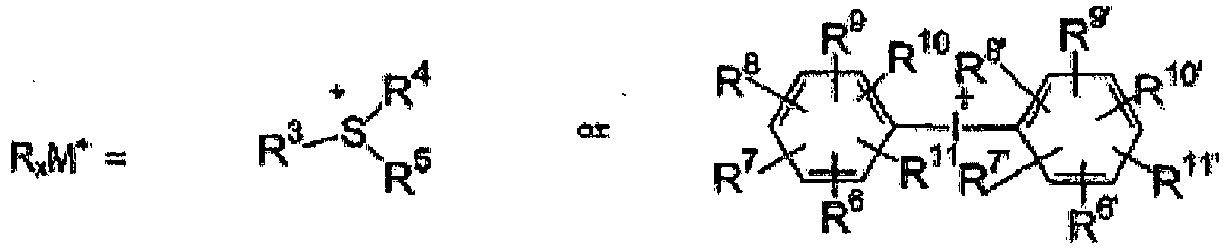
- Examples of P1 may be synthesized by reaction of a salt of (S02R1)(S02R2)N" with a salt of RxM+ in a solvent. The preferred counter ion for (S02R1)(S02R2)N" is sodium and the preferred counter ion for RxM+ is the mesylate.
- The preferred solvent is wafer.
- Suitable (R1SO2NSO2R2)" groups include but are not limited to
(CF3CF2CF2CF2CF2CF2CF2CF2SO2NSO2CF3)"
(CF3SO2NSO2CF3)"
(CF3CF2SO2NSO2CF2CF3)"

(CF3CF2CF2CF2SO2NSO2CF2CF2CF2CF5)"
(CF3CF2SO2NSO2CF3)"
(CF3CF2CF2CF2SO2NSO2CF3)"
(CF3CF2CF2CF2CF2CF2CF2CF2SO2NSO2CF2CF2CF2CF2CF2CF2CF2CF3)"
(CF3CF2CF2SO2NSO2CF2CF2CF2CF2CF3)"
(CF3(CF2)7SO2NSO2CF3)"

- Suitable substituted or unsubstituted aryl R3R4R5S+ groups include but are not limited to:


- Suitable substituted aryl R3R4R5S+ groups with an acid sensitive group include but are not limited to:


- Suitable R3R4R5S+ groups containing alkyl or cycloalkyl groups include but are not limited to:

- Suitable R3R4R5S+ groups containing alpha-ketomethyl groups include but are not limited to:

- The diaryl iodonium cations include but are not limited to:


- Second photoacid generator compound P2 comprises one or more compounds of the structure (B)

- The polymer component of the photosensitive compositions comprises an alkali soluble resin component whose alkali solubility is suppressed by the presence of acid sensitive moieties and whose alkali solubility is returned by treatment with an acid and, optionally, heat; wherein said polymer comprises one or more polymers comprising the monomer unit (C).

- Preferred polymers comprising the monomer unit (C) are those in which R13, R14, R15, R16, R18, and R19 = H. More preferred polymers comprising the monomer unit C are those in which R13, R14, R15,, R16, R18, and R19, = H and R17 is selected from C1-C4 linear or branched alkyl, or a substituted or unsubstituted C6-C20 cyclic alkylene or a substituted or unsubstituted linear, branched or cyclic C1-C20 alkyl, optionally containing an ether or ester group. Most preferred polymers comprising the monomer unit C are those in which R13, R14, R15, R16, R18, and R19, = H and R17 is selected from- C1-C4 linear or branched alkyl, or a substituted or unsubstituted C6-C20 cyclic alkylene.
- Polymers and copolymers comprising the monomer unit (C) can be synthesized by polymerization of the corresponding styrenic precursor to monomer unit (C) using any suitable means of polymerization known to those in the art. If this method is employed, then the styrenic precursor is typically synthesized from the reaction of hydroxystyrene with the corresponding alpha halo ether under basic conditions.
- A preferred method of synthesis of polymers and copolymers comprising the monomer unit (C) is to prepare hydroxystyrene polymers and copolymers via standard polymerization methods (e.g. free radical) and then react the polymer with a vinyl ether (D) under acidic conditions. Examples of suitable syntheses may be found in
U.S. patents 5670299 and6033826 .
- An alternatively preferred method is to react the hydroxystyrene polymer or copolymer with a vinyl ether (e.g. t-butyl vinyl ether) in the presence of an alcohol (R17-OH) and an acid catalyst. Examples of this synthetic process can be found in
U.S. patents 6159653 ,6133412 and6309793 , herein incorporated by reference. - Each polymer employed in this invention may contain more than one different monomer unit (C).
- The polymer employed in this invention may further comprise additional monomers. Suitable monomers include radical polymerizable vinyl monomers such as acrylates, methacrylates, vinyl ethers, vinyl esters, substituted and unsubstituted styrenes and the like. In an additional preferred embodiment, the preferred polymers further comprise monomer units of hydroxystyrene.
- In an additional embodiment, base additives may be added to the photoresist composition. The purpose of the base additive is to scavenge protons present in the photoresist prior to being irradiated by the actinic radiation. The base prevents attack and cleavage of the acid labile groups by the undesirable acids, thereby increasing the performance and stability of the resist. The percentage of base in the composition should be significantly lower than the photoacid generator because it would not be desirable for the base to interfere with the cleavage of the acid labile groups after the photoresist composition is irradiated. The preferred range of the base compounds, when present, is about 3% to 50% by weight of the photoacid generator compound. Nitrogenous bases are preferred. Suitable examples of base additives are 2-methylimidazole, tetramethyl ammonium hydroxide, tetrabutylammonium hydroxide, triisopropylamine, 4-dimethylaminopryidine, 4,4'-diaminodiphenyl ether, 2,4,5-triphenylimidazole, and 1,5-diazabicyclo[4.3.0]non-5-ene, and 1,8-diazabicyclo[5.4.0]undec-7-ene.
- Dyes may be added to the photoresist to increase the absorption of the composition to the actinic radiation wavelength. The dye must not poison the composition and must be capable of withstanding the process conditions including any thermal treatments. Examples of suitable dyes are fluorenone derivatives, anthracene derivatives or pyrene derivatives. Other specific dyes that are suitable for photoresist compositions are described in
U.S. Patent No. 5,593,812 . - The photoresist composition may further comprise conventional additives, such as adhesion promoters, dissolution inhibitors, and surfactants. A person skilled in the art will be able to choose the appropriate desired additive and its concentration.
- The photoresist composition is applied uniformly to a substrate by known coating methods. For example, the coatings may be applied by spin-coating, dipping, knife coating, lamination, brushing, spraying, and reverse-roll coating. The coating thickness range generally covers values of about 0.1 to more than 10 µm. After the coating operation, the solvent is generally removed by drying. The drying step is typically a heating step called 'soft bake' where the resist and substrate are heated to a temperature of about 50°C to 150°C for about a few seconds to a few minutes; preferably for about 5 seconds to 30 minutes depending on the thickness, the heating element and end use of the resist.
- The photoresist compositions are suitable for a number of different uses in the electronics industry. For example, it can be used as electroplating resist, plasma etch resist, solder resist, resist for the production of printing plates, resist for chemical milling or resist in the production of integrated circuits. The possible coatings and processing conditions of the coated substrates differ accordingly.
- For the production of relief structures, the substrate coated with the photoresist composition is exposed imagewise. The term 'imagewise' exposure includes both exposure through a photomask containing a predetermined pattern, exposure by means of a computer controlled laser beam which is moved over the surface of the coated substrate, exposure by means of computer-controlled electron beams, and exposure by means of X-rays or UV rays through a corresponding mask.
- Radiation sources, which can be used, are all sources that emit radiation to which the photoacid generator is sensitive. Examples include high pressure mercury lamp, KrF excimer lasers, ArF excimer lasers, electron beams and x-rays sources.
- The process described above for the production of relief structures preferably includes, as a further process measure, heating of the coating between exposure and treatment with the developer. With the aid of this heat treatment, known as "post-exposure bake", virtually complete reaction of the acid labile groups in the polymer resin with the acid generated by the exposure is achieved. The duration and temperature of this post-exposure bake can vary within broad limits and depend essentially on the functionalities of the polymer resin, the type of acid generator and on the concentration of these two components. The exposed resist is typically subjected to temperatures of about 50°C to 150°C for a few seconds to a few minutes. The preferred post exposure bake is from about 80°C to 130°C for about 5 seconds to 300 seconds.
- After imagewise exposure and any heat treatment of the material, the exposed areas of the photoresist are removed by dissolution in a developer. The choice of the particular developer depends on the type of photoresist; in particular on the nature of the polymer resin or the photolysis products generated. The developer can include aqueous solutions of bases to which organic solvents or mixtures thereof may have been added. Particularly preferred developers are aqueous alkaline solutions. These include, for example, aqueous solutions of alkali metal silicates, phosphates, hydroxides and carbonates, but in particular of tetra alkylammonium hydroxides, and more preferably tetramethylammonium hydroxide (TMAH). If desired, relatively small amounts of wetting agents and/or organic solvents can also be added to these solutions.
- In a 500 ml, round bottom flask equipped with a reflux condenser was combined n-butyl phenyl ether (40.4 g, 0.269 mol), diphenylsulfoxide (48 g, 0.237 mol) and Eaton's Reagent (154 g). An exothermic reaction occurred. The reaction mixture was maintained at 50-55°C with stirring for 5 hours. The reaction mixture was then added to deionized water (1200 ml). This mixture was stirred for 30 minutes. The mixture was extracted two times with toluene (2 x 300 ml). The pH of the lower aqueous layer was adjusted to 8-8.5 by addition of a 25% aqueous solution of tetramethylammonium hydroxide (573.0 g).
- In a 1 L, round bottom flask equipped with a reflux condenser was combined 1,3,5-trimethylbenzene (40 g, 0.333 mol), diphenylsulfoxide (67.3 g, 0.333 mol) and Eaton's Reagent (160 g). An exothermic reaction occurred. The reaction mixture was maintained at 50-55°C with stirring for 5 hours. The reaction mixture was then added to deionized water (800 ml). This mixture was stirred for 30 minutes. The mixture was extracted two times with toluene (2 x 250 ml). The pH of the lower aqueous layer was adjusted to 8-8.5 by addition of a 25% aqueous solution of tetramethylammonium hydroxide (889.6 g).
- In a 250 ml beaker equipped with a stirbar and a pH meter was combined bis-(perfluorobutanesulfonyl) amide (15 g, 60% acid w/w in water, 0.0155 mol) and deionized water (105 g). To the solution, sodium hydroxide (approximately 1.9 g, 33% w/w in water) was slowly added until the pH was above 7.0. The solution became viscous. The solution was maintained at room temperature with stirring for 15 minutes. The salt solution was used immediately and without further work-up in subsequent PAG synthesis.
- In a 250 ml beaker equipped with a stirbar and a pH meter was combined bis-(perfluoroethanesulfonyl) amide (2.0 g, 0.00525 mol) and deionized water (30 g). To the solution, sodium hydroxide (approximately 0.7 g, 33% w/w in water) was slowly added until the pH was above 7.0. The solution was maintained at room temperature with stirring for 15 minutes. The salt solution was used immediately and without further work-up in subsequent PAG synthesis.
- To a previously prepared solution containing 0.00517 mol sodium bis-(perfluorobutanesulfonyl)imide in 35 grams water was added 2.23 grams (0.00517 mol) of 4-(1-butoxyphenyl)diphenylsulfonium mesylate. A white suspension immediately formed. 50 ml of ethyl acetate was then added to the suspension. The resulting mixture was stirred for 24 hours. The bottom water layer was removed. The ethyl acetate layer was washed four times with 40 ml portions of deionized water. The ethyl acetate layer was then dried over magnesium sulfate. The magnesium sulfate was removed by filtration. Ethyl acetate was removed from the filtrate on a rotary evaporator affording 3.87 grams of a viscous oil. The 19F NMR spectrum contained the following resonance bands: δ -80.8(t, 3F), -112.7(t, 2F), - 120.6(t, 2F), -125.6(q, 2F). The 1H NMR contained: δ 1.0(t, 3H), 1.5(sextet, 2H), 1.8(pentet, 2H), 4.2(t, 2H), 7.4(d, 2H), 7.9(multiplet, 12H).
- To a previously prepared solution containing 0.00694 mol sodium salt prepared in Example 4 in 38 grams water was added 2.99 grams (0.00694 mol) of 4-(1-butoxyphenyl)diphenylsulfonium mesylate. A white suspension immediately formed. 50 ml of ethyl acetate was then added to the suspension. The resulting mixture was stirred for 24 hours. The bottom water layer was removed. The ethyl acetate layer was washed four times with 40 ml portions of deionized water. The ethyl acetate layer was then dried over magnesium sulfate. The magnesium sulfate was removed by filtration. Ethyl acetate was removed from the filtrate on a rotary evaporator affording 4.3 grams of a viscous oil. The 19F NMR spectrum contained the following resonance bands: δ -80.1 (s, 3F), -118.3(s, 2F). The 1H NMR contained: δ 1.0(t, 3H), 1.5(sextet, 2H), 1.8(pentet, 2H), 4.2(t, 2H), 7.4(d, 2H), 7.9(multiplet, 12H).
- To a previously prepared solution containing 0.00523 mol sodium salt prepared in Example 3 in 40 grams water was added 2.10 grams (0.00523 mol) of 2,4,6-trimethylphenyldiphenyl sulfonium mesylate. A white suspension immediately formed. 60 ml of ethyl acetate was then added to the suspension. The resulting mixture was stirred for 24 hours. The bottom water layer was removed. The ethyl acetate layer was washed four times with 40 ml portions of deionized water. The ethyl acetate layer was then dried over magnesium sulfate. The magnesium sulfate was removed by filtration. Ethyl acetate was removed from the filtrate on a rotary evaporator affording 3.71 grams of a viscous oil. The 19F NMR spectrum contained the following resonance bands: δ -82.2(t, 3F), -114.2(t, 2F), -121.9(t, 2F), -127.1(q, 2F). The 1H NMR contained: δ 2.2(s, 6H), 2.3(s, 3H), 7.3(s, 2H), 7.8(multiplet, 10H).
- To a previously prepared solution containing 0.00689 mol sodium salt prepared in Example 2 in 40 grams water was added 2.76 grams (0.00689 mol) of 2,4,6-trimethylphenyldiphenylsulfonium mesylate. A white suspension immediately formed. 60 ml of ethyl acetate was then added to the suspension. The resulting mixture was stirred for 24 hours. The bottom water layer was removed. The ethyl acetate layer was washed four times with 40 ml portions of de-ionized water. The ethyl acetate layer was then dried over magnesium sulfate. The magnesium sulfate was removed by filtration. Ethyl acetate was removed from the filtrate on a rotary evaporator affording 3.4 grams of a solid. The 19F NMR spectrum contained the following resonance bands: δ -80.0(s, 3F), -118.3(s, 2F). The 1H NMR contained: δ 2.2(s, 6H), 2.3(s, 3H), 7.3(s, 2H), 7.8(multiplet, 10H).
- To a previously prepared solution containing 0.00344 mol sodium salt prepared in Example 3 in 51 grams water was added 1.39 grams (0.00344 mol) of toluenediphenylsulfonium iodide. 70 grams of ethyl acetate was then added to the suspension. The resulting mixture was stirred for 48 hours. The bottom water layer was removed. The ethyl acetate layer was washed three times with 40 ml portions of deionized water. The ethyl acetate layer was then dried over magnesium sulfate. The magnesium sulfate was removed by filtration. Ethyl acetate was removed from the filtrate on a rotary evaporator affording 2.78 grams of a semi-viscous oil. The 19F NMR spectrum contained the following resonance bands: δ -82.2(t, 3F), -114.2(t, 2F), -121.9(t, 2F), -127.1(q, 2F). The 1H NMR contained: δ 2.5(s, 3H), 7.7(d, 2H), 7.9(multiplet, 12H).
- To a previously prepared solution containing 0.00525 mol sodium salt prepared in Example 4 in 60 grams water was added 2.12 grams (0.00525 mol) of toluenediphenylsulfonium iodide. 51 grams of ethyl acetate was then added to the suspension. The resulting mixture was stirred for 48 hours. The bottom water layer was removed. The ethyl acetate layer was washed three times with 40 ml portions of deionized water. The ethyl acetate layer was then dried over magnesium sulfate. The magnesium sulfate was removed by filtration. Ethyl acetate was removed from the filtrate on a rotary evaporator affording 2.56 grams of an oil. The 19F NMR spectrum contained the following resonance bands: δ -80.1(s, 3F), -118.4(s, 2F). The 1H NMR contained: δ 2.5(s, 3H), 7.7(d, 2H), 7.9(multiplet, 12H).
- To a previously prepared solution containing 0.0034 mol lithium salt of trifluoromethyl perfluorobutylsulfonyl)imide (obtained from 3M Corporation) in 50 grams water was added 1.39 grams (0.0034 mol) of toluenediphenylsulfonium iodide. 70 ml of ethyl acetate was then added to the suspension. The resulting mixture was stirred for 24 hours. The bottom water layer was removed. The ethyl acetate layer was washed four times with 40 ml portions of deionized water. The ethyl acetate layer was then dried over magnesium sulfate. The magnesium sulfate was removed by filtration. Ethyl acetate was removed from the filtrate on a rotary evaporator affording 2.8 grams of a white solid. The 19F NMR spectrum contained the following resonance bands δ -80.3(s, 3F), -82.1(tt, 3F), -114.3(s, 2F), -122.02(m, 2F), -127.01 (q, 2F). The 1H NMR contained: δ 2.5(s, 3H), 7.7(d, 2H0), 7.9(multiplet, 12H).
- To a previously prepared solution containing 0.0034 mol lithium salt of trifluoromethyl perfluorobutylsulfonyl)imide (obtained from 3M Corporation) in 50 grams water was added 1.78 grams (0.0034 mol) of tris-(tert-butylphenyl)sulfonium tetrafluoroborate.. 70 ml of ethyl acetate was then added to the suspension. The resulting mixture was stirred for 24 hours. The bottom water layer was removed. The ethyl acetate layer was washed four times with 40 ml portions of deionized water. The ethyl acetate layer was then dried over magnesium sulfate. The magnesium sulfate was removed by filtration. Ethyl acetate was removed from the filtrate on a rotary evaporator affording 2.52 grams of a white solid. The 19F NMR spectrum contained the following resonance bands δ -80.1 (s, 3F), -82.3(tt, 3F), - 114.3(s, 2F), -122.02(m, 2F), -127.01 (q, 2F). The 1H NMR contained: δ 1.4(s, 27H), 7.8(AB quartet, 12H).
- A 250 mL round-bottom, three-necked flask was equipped with a temperature probe, a magnetic stir bar and closed vacuum adapter. 134.9 g of propylene glycol monomethyl ether acetate (PGMEA) was charged into the flask. 30.0 g of powdered poly(hydroxystyrene -co-t-butylstyrene) (93:7)(MW 12780; PD 1.9) was added to the stirring solvent. The mixture was stirred for 30 minutes to form a homogeneous solution. The mixture was heated to 60°C and vacuum was applied to the solution to distill 48.92 g of the solvent. The solution was allowed to cool to room temperature under nitrogen atmosphere. 4.15 g of tertiary-butyl vinyl ether and 4.69 g 2-cyclohexylethanol were added to the homogeneous solution. 0.30 g of 1% paratoluene sulfonic acid (prepared by dissolving 1 g of acid in 99 g of PGMEA) was added. After a brief, mild exotherm, the solution was allowed to stir at 23 °C for 4 hours. 3.77 g of 1% triethylamine solution in PGMEA was added to the reaction mixture to quench the acid. The reaction mixture was stirred for an additional 30 minutes. The polymer solution was transferred to a 500 mL separatory funnel and treated with 115 g of acetone, 46 g of hexanes and 46 g of de-ionized water. The mixture was shaken for about 30 seconds to a minute and allowed to separate into two layers. The lower, aqueous layer was discarded. The top organic layer was subjected to two more washings. In the second washing, 23 g of acetone, 7 g of PGMEA and 23 g of deionized water were used and in the third washing, 17 g of acetone, 7 g of PGMEA and 23 g of deionized water were used.
- The top organic layer was transferred to a 500 mL round-bottom, three-necked flask equipped with a temperature probe, magnetic stir bar and a vacuum distillation assembly. The flask was placed on a heating mantle. Acetone and hexane were removed by atmospheric distillation. Water and some PGMEA were removed by azeotropic vacuum distillation at 66 °C until the solids content of the distillation flask was about 30.17%. Analytical data is found in the table. The structure of the polymer is given below (a = 0.76; b = 0.07; c = 0.04; d = 0.13).

- Polymer P2 is [4-(1-ethoxyethoxy)styrene-co-4-hydroxystyrene 37:63] (MWP-240, a product of Wako Chemical].
- Polymer P3 is poly[(4-hydroxystyrene)-co-(tertiary-butyl acrylate)-co-(isobornyl acrylate)] (61:25:14) MW: which was custom synthesized by TriQuest, LP. The molecular weight was 16,600 daltons.
- Photoresist components as described in the examples were mixed in an amber-bottle and stirred until a homogeneous solution was obtained. The solution was filtered through a 0.2 µm filter into a clean amber-bottle.
- Silicon wafers were first spun coated with DUV42P BARC (a product of Brewer Science, Inc., Rolla, MO) and proximity baked for 70 seconds at 205°C to yield a BARC thickness of 62 nm. The resist samples were then applied over the BARC layer and prebaked on a hotplate for 90 seconds (temperature setting depended on the particular example) resulting in a resist film thickness of 325 nm. The resist samples were then exposed pattern-wise with a KrF excimer laser beam (248 nm) in a Canon FPA-3000 EX6 stepper through a photo mask containing a line / space pattern. A numerical aperture of 0.65NA was utilized, with a 2/3 annular setting. The exposed resist coated wafers were then subjected to PEB treatment on a 110°C hot plate for 90 seconds. A 60 second puddle development treatment in a 0.262 N solution of tetramethylammonium hydroxide followed. The data was collected using a Hitachi Scanning Electron Microscope. The resist images were sheared cross-sectionally, and the images were magnified 80k times.
- General Lithographic Procedure 2 is identical to General Lithographic Procedure 1 except that the BARC thickness was 80 nm and the photoresist thickness was 360 nm.
- Formulations for Examples 1-6 were prepared as described in the General Formulation Procedure using various bis(perfluoroalkylsulfonyl)imide type PAGs, bis(t-butylsulfonyl)diazomethane (Wako Chemical), Polymer P1, Polymer P2, 1,8-diazobicyclo[5.4.0]undec-7-ene (DBU), tris[2-(2-methoxyethoxy)ethyl]amine (TMEA), antipyrene, and PGMEA according to the amounts listed in Table 1. Amounts listed in Table 1 are in units of grams. Formulations for Examples 1-6 were lithographically evaluated using General Lithographic Procedure 1. The wafers were examined in a scanning electron microscope for photospeed, resolution, DOF, and profile. The results are given in Table 2 with the corresponding softbake temperatures employed. Energy to size in Table 2 refers to the energy to resolve 130 nm line-space patterns with equal line and space widths.
TABLE 1 Ex. Polymer P1 Polymer P2 Bis(tert-butylsulfonyl) diazomethane bis(perfluoroalkylsulfonyl) imide PAG bis(perfluoro alkylsulfonyl) imide PAG Amount DBU TMEA Antipyrene PGMEA 1 5.899 4.826 0.660 PAG 1 0.552 0.033 0.006 0.017 88.00 2 5.899 4.826 0.660 PAG 2 0.552 0.033 0.006 0.017 88.00 3 5.806 4.750 0.660 PAG 3 0.720 0.033 0.006 0.017 88.00 4 5.806 4.750 0.660 PAG 4 0.720 0.033 0.006 0.017 88.00 5** 6.181 5.057 - PAG 3 0.720 0.032 - - 88.00 6** 5.806 4.750 - PAG 1 0.720 0.033 0.006 0.017 88.00 ** Comparative Examples TABLE 2 Ex. Softbake Temperature PEB Energy to Size Resolution DOF @130nm Profile (°C) (°C) (mJ/cm2) (µm) (µm) Slope Surface Quality Comments 1 130 110 60 0.13 0.1 Vertical very cuspy Slight sw's 2 130 110 63 0.13 0.3 Vertical Flat, Cusp Slight sw's 3 130 110 60 0.13 0.2 Vertical Flat, Cusp Slight sw's 4 130 110 55 0.13 0.4 Vertical Flat, Cusp Slight sw's 5** 130 110 44 0.13 0.9 Vertical round top Slight sw's 6** 130 110 46 0.13 0.6 Vertical Round Top Slight sw's **Comparative Examples - The data in Table 2 indicates that rounded profile tops obtained using bis(perfluoroalkylsulfonyl)imide type PAGs can be improved in unoptimized formulations by the use of a bissulfonyldiazomethane type PAG.
- Formulations for Examples 7-24 were prepared as described in the General Formulation Procedure using PAG 8 (the PAG from PAG Synthesis Example 12), bis(t-butylsulfonyl)diazomethane (Wako Chemical), Polymer P1, Polymer P2, 1,8-diazobicyclo[5.4.0]undec-7-ene (DBU), tris[2-(2-methoxyethoxy)ethyl]amine (TMEA), antipyrene, and PGMEA according to the amounts listed in Table 3. Amounts listed in Table 3 are in units of grams. Formulations for Examples 7-24 were lithographically evaluated using the General Lithographic Procedure 2. Several formulations were evaluated using different softbake conditions. In those cases, the results are additionally marked with the letters a, b or c in Table 4. The wafers were examined in a scanning electron microscope for photospeed, resolution, DOF, and profile. The results are given in Table 4 with the corresponding softbake temperatures employed. Energy to size in Table 4 refers to the energy to resolve 130 nm line-space patterns with equal line and space widths.
TABLE 3 Ex. Polymer P1 Polymer P2 Bis(tert-butylsulfonyl) diazomethane PAG 8 DBU TMEA Antipyrene PGMEA 7 5.796 4.742 0.176 0.264 0.015 - 0.007 89.00 8 5.796 4.742 0.176 0.264 0.019 - 0.003 89.00 9 5.796 4.742 0.176 0.264 0.022 - - 89.00 10 5.637 4.612 0.286 0.429 0.025 - 0.011 89.00 11 5.637 4.612 0.286 0.429 0.030 - 0.005 89.00 12 5.637 4.612 0.286 0.429 0.036 - - 89.00 13 5.478 4.482 0.396 0.594 0.035 - 0.015 89.00 14 5.478 4.482 0.396 0.594 0.042 - 0.007 89.00 15 5.478 4.482 0.396 0.594 0.050 - - 89.00 16 5.743 4.699 0.209 0.314 0.024 - 0.010 89.00 17 5.695 4.660 0.242 0.363 0.028 - 0.012 89.00 18 5.792 4.739 0.176 0.264 0.021 - 0.009 89.00 19** 5.669 4.638 - 0.660 0.020 0.03 0.010 89.00 20 5.605 4.586 0.077 0.693 0.023 0.004 0.012 89.00 21 5.605 4.586 0.308 0.462 0.039 - - 89.00 22 5.605 4.586 0.154 0.616 0.039 - - 89.00 23 5.764 4.716 0.099 0.396 0.025 - - 89.00 24 5.605 4.586 0.308 0.462 0.023 0.004 0.012 89.00 **Comparative Example TABLE 4 Ex. Softbake Temperature Energy to Size DOF @ 130nm Profile Comments (°C) (mJ/cm2) (µm) Slope Surface Quality Standing Wave 7a 100 31 0.6 Vertical Flat Low sw's 7b 130 32 NA Retrograde Flat, Cusp Moderate sw's 8 115 37 0.9 Vertical Flat, Rough Slight sw's 9a 100 41.5 0.75 Slight Slope Round Top Low sw's 9b 130 39 NA Retrograde Flat, Cusp Slight sw's 10 100 37 0.8 Slight Slope Round Top Low sw's 11a 115 43 0.9 Slight Slope Flat, Rough Slight sw's 11b 130 44.5 0.7 Vertical Flat, Cusp Moderate sw's 12 115 44.5 0.85 Slight Slope Flat Top Slight sw's 13a 100 41.5 0.5 Moderate Slope Round Top Low sw's 13b 115 39 0.9 Slight Slope Round Top Slight sw's 13c 130 41.5 0.7 Moderate Slope Round Top Slight sw's 14 100 53.5 0.6 Moderate Slope Round Top Low sw's 15a 100 55 0.7 Very Sloped Round Top Low sw's 15b 130 52 0.8 Slight Slope Flat, Cusp Moderate sw's 16 100 42 0.8 Vertical Flat Slight sw's 17 100 43 0.8 Vertical Flat Low sw's 18 100 41 0.8 Vertical Flat, Rough Low sw's 19** 130 37 0.4 Very Sloped Film Loss, Round Slight sw's 20 130 36 0.4 Very Sloped Film Loss, Round Slight sw's 21 130 47 0.75 Very Sloped Film Loss, Round Moderate sw's 22 130 43 0.75 Vertical Flat Moderate sw's 23 130 38 0.7 Slight Slope Flat Heavy sw's 24 130 38 0.5 Vertical Flat, Rough Moderate sw's ** Comparative Example - Data in Table 4 shows that when bis(perfluoroalkylsulfonyl)imide type PAGs were used as the sole PAG in the acetal protected PHS based formulations, (Example 19) sloped profiles with rounded tops, unexposed film thickness loss and poor DOF were obtained. However, use of the bissulfonyldiazomethane type PAG as a co-PAG resulted in obtaining a vertical profile with flat tops, no unexposed film loss, and excellent DOF (e.g. Example 11).
- Formulation examples 25 and 26 were prepared as described in the General Formulation Procedure using PAG 8 (the PAG from PAG Synthesis Example 12), tris-(tert-butylphenyl)sulfonium bis-(perfluorobutanesulfonyl)imide (PAG 9 obtained from the 3M Corporation), Polymer P1, Polymer P2, bis(t-butylsulfonyl)diazomethane, 1,8-diazobicyclo[5.4.0]undec-7-ene (DBU), antipyrene and propylene glycol monomethyl ether acetate (PGMEA) according to the amounts listed in Table 5. Amounts listed in Table 5 are in units of grams. Formulation Examples 25 and 26 were lithographically evaluated using the General Lithographic Procedure 2. The wafers were examined in a scanning electron microscope for photospeed, resolution, DOF, and profile. The results are given in Table 6 with the corresponding softbake temperatures employed. Energy to size in Table 6 refers to the energy to resolve 130 nm line-space patterns with equal line and space widths.
TABLE 5 Ex. Polymer P1 Polymer P2 Bis(tert-butylsulfonyl) diazomethane bis(perfluoro alkylsulfonyl) imide PAG bis(perfluoro alkylsulfonyl) imide PAG amount DBU Antipyrene PGMEA 25 5.796 4.742 0.242 PAG 9 0.363 0.028 0.012 89.00 26 5.796 4.742 0.242 PAG 8 0.363 0.028 0.012 89.00 TABLE 6 Ex. Softbake Temperature Resolution Energy to Size (130nm) DOF @130nm Profile Comments (°C) Dense Ln (mJ/cm2) (µm) Slope Surface Quality Standing Wave 25 130 130nm 40 0.5 Slight Slope Round Low sw's 26 130 130nm 40 0.8 Slight Slope Flat Low sw's - Results in Table 6 suggest that unsymmetric bis-(perfluorobutanesulfonyl)imides have slightly improved performance over symmetrical bis-(perfluorobutanesulfonyl)imides.
- Formulations for Examples 27-30 were prepared as described in the General Formulation Procedure using PAG 8 (the PAG from PAG Synthesis Example 12), tris-(tert-butylphenyl)sulfonium bis-(perfluorobutanesulfonyl)imide (PAG 9 obtained from the 3M Corporation), Polymer P3, bis(t-butylsulfonyl)diazomethane, 1,8-diazobicyclo[5.4.0]undec-7-ene (DBU), tris[2-(2-methoxyethoxy)ethyl]amine (TMEA), antipyrene and propylene glycol monomethyl ether acetate (PGMEA) according to the amounts listed in Table 7. Amounts listed in Table 7 are in units of grams. Formulations for Examples 27-30 were lithographically evaluated using the General Lithographic Procedure 2. The wafers were examined in a scanning electron microscope for photospeed, resolution, DOF, and profile. The results are given in Table 8 with the corresponding softbake temperatures employed. Energy to size in Table 8 refers to the energy to resolve 130 nm line-space patterns with equal line and space widths.
TABLE 7 Ex. Polymer P3 PAG 8 Bis(tert-butylsulfonyl) diazomethane PAG 9 DBU Antipyrene PGMEA 27 10.355 0.363 0.242 - 0.028 0.012 89.00 28 10.355 - 0.242 0.363 0.028 0.012 89.00 29 10.307 0.66 - - 0.02 0.01 89.00 30** 10.307 - - 0.66 0.02 0.01 89.00 ** Comparative Example TABLE 8 Ex. Softbake Temperature Energy to Size DOF @130nm Profile Comments (°C) (mJ/cm2) (µm) Slope Surface Quality Standing Wave 27 140 75* DNR Retrograde Flat, Cusp*** Low sw's*** 28 140 84* DNR Retrograde Round, Cusp*** Low sw's*** 29 140 44 0.8 Sloped Round Heavy sw's 30** 140 48 0.4 Slight Slope Round Heavy sw's ** Comparative Example * did not resolve. *** on 140 nm features - The lithographic results in Table 8 show that in an ESCAP type polymer matrix, the use of a bissulfonyldiazomethane type co-PAG blend with bis(perfluoroalkylsulfonyl)imide type PAGs had an adverse effect on the lithographic performance.
- Formulations for Examples 31 and 32 were prepared as described in the General Formulation Procedure using PAG 8 (the PAG from PAG Synthesis Example 12), tris-(tert-butylphenyl)sulfonium perfluorobutanesulfonate (TTBPS-nonaflate), Polymer P1, Polymer P2, bis(t-butylsulfonyl)diazomethane, 1,8-diazobicyclo[5.4.0]undec-7-ene (DBU), tris[2-(2-methoxyethoxy)ethyl]amine (TMEA), antipyrene and propylene glycol monomethyl ether acetate (PGMEA) according to the amounts listed in Table 9. Amounts listed in Table 9 are in units of grams. Formulations for Examples 31 and 32 were lithographically evaluated using the General Lithographic Procedure 2 and under an alternate film thickness condition of 340 nm as noted in Table 10. The wafers were examined in a scanning electron microscope for photospeed, resolution, DOF, and profile. The results are given in Table 10 with the corresponding softbake temperatures employed. Energy to size in Table 10 refers to the energy to resolve 130 nm line-space patterns with equal line and space widths.
TABLE 9 Ex. Polymer P1 Polymer P2 Bis(tert-butylsulfonyl) diazomethane co-PAG co-PAG amount DBU TMEA Anti-pyrene PGMEA 31** 5.467 4.473 0.605 TTBPS-Nonaflate 0.403 0.03 0.005 0.015 89.00 32 5.61 4.586 0.308 PAG 9 0.462 0.039 - 0 89.00 ** Comparative Example TABLE 10 Ex. Softbake Temperature Resolution Energy to Size (130nm) DOF @130nm Resist Film Thickness Profile Comments (°C) Dense Ln (mJ/cm2) (µm) (nm) Slope Surface Quality Standing Wave 31a** 130 130nm 48 0.6 340 Slight Slope Round Slight sw's 31b** 130 130nm 46 0.3 360 Vertical Flat, Cusp Moderate sw's 32a 130 130nm 48 0.7 340 Vertical Round Moderate sw's 32b 130 130nm 47 0.7 360 Vertical Flat Moderate sw's ** Comparative Example - The results in Table 10 illustrate the problem in prior art resists of photoresist performance change with changes in photoresist film thickness. Such film thickness differences occur when photoresist is coated over substrates with existing topography. The prior art formulation in Example 31 has significantly different and lower DOF at photoresist film thicknesses differing only by 20 nm. At one film thickness, the DOF is limited by bridging of the images. At the other photoresist film thickness, DOF is limited by line collapse. The formulation of this invention (Example 32) is not as limited by these problems and thus has higher and less variable DOF with changes in photoresist film thickness.
- Formulations for Examples 33-38 were prepared as described in the General Formulation Procedure using combinations of various bis(perfluoroalkylsulfonyl)-imide type PAGs, one of two bis(sulfonyl)diazomethane co-PAGs, Polymer P1, Polymer P2, 1,8-diazobicyclo[5.4.0]undec-7-ene (DBU), antipyrene, and 89 parts PGMEA according to the amounts listed in Table 11. Amounts listed in Table 11 are in parts. The formulations were lithographically tested employing General Lithographic Procedure 2 using a 110 °C softbake for all formulations. Results are tabulated in Table 12.
TABLE 11 Ex. Polymer P1 Polymer P2 Bis(sulfonyl) diazomethane/amount First bis(perfluoro-alkylsulfonyl) imide PAG First PAG amount Second bis(perfluoro-alkylsulfony l) imide PAG Second PAG Amount DBU Antipyrene 33** 5.706 4.669 t-butyl/0.605 0.014 0.006 34 5.701 4.146 t-butyl/0.121 PAG 8 0.182 PAG 3 0.182 0.021 0.009 35 10.36 5 0 t-butyl/0.242 PAG 8 0.362 0.021 0.009 36 5.696 4.142 t-butyl/0.242 PAG 6 0.363 0.027 0.012 37 5.701 4.664 Cyclohexyl/0.2 42 PAG 8 0.363 0.021 0.009 38 5.696 4.142 t-butyl/0.242 PAG 9 0.182 PAG 10* 0.182 0.027 0.012 **Comparative Example
*PAG 10 = tris-(tert-butylphenyl)sulfonium-bis-(trifluoromethanesulfonyl)imide obtained from the 3M Corporation.TABLE 12 Ex. Softbake Temperature PEB Energy to Size (130 nm) Resolution DOF @130nm Profile (°C) (°C) (mJ/cm2) (µm) (µm) Slope Surface Quality Standing Waves 33** 110 110 32 0.13 0.2 Retrograde Round Low 34 110 110 48 0.13 0.6 Slight Slope Flat Slight 35 110 110 38 0.13 0.4 Vertical Flat Low 36 110 110 35 0.13 0.6 Slight Slope Round Slight 37 110 110 45 0.13 0.6 Vertical Round Moderate 38 110 110 48 0.13 0.6 Slight Slope Round Slight ** Comparative Example - Results from these experiments show that addition of symmetrical or unsymmetrical perfluorosulfonyl imide type PAG or mixtures thereof to bis(sulfonyl) diazomethane type PAGs improves lithographic performance.


and wherein monomeric unit (C) has the formula:


Claims (12)
- A radiation sensitive composition comprising:a) a first photoacid generator (PAG) compound P1, which comprises one or more compounds of the structure (A);b) a second photoacid generator compound P2 which comprises one or more compounds of the structure (B);c) a polymer component comprising an alkali soluble resin component whose alkali solubility is suppressed by the presence of acid sensitive moieties and whose alkali solubility is returned by treatment with an acid and, optionally, heat; wherein said polymer comprises one or more polymers comprising the monomer unit (C); andd) a solvent;wherein structure (A) has the formula:


wherein structure (B) has the formula:
wherein monomeric unit (C) has the formula:
and R19 are each independently selected from the group consisting of H, linear or branched or cyclic C1-C14 alkyl, and C7-C14 alicyclic; R20 is selected from the group consisting of a C1-C14 branched, linear or cyclic alkyl, substituted or unsubstituted phenyl, and C7-C14 alicyclic group. - The radiation sensitive composition of claim 1 wherein the total amount of photoactive generator content in the composition is from about 0.05 to about 20 wt% of the solids content of the composition and photoactive generator compound P1 comprises from about 25 to about 99 wt% and the second photoactive generator compound P2 comprises from about 1 to about 75 wt% of the total photoactive generator content of the- composition.
- The radiation sensitive composition of claim 1 wherein the total amount of photoactive generator content in the composition is from about 1 to about 15 wt% of the solids content of the composition and photoactive generator compound P1 comprises from about 35 to about 90 wt% and the second photoactive generator compound P2 comprises from about 10 to about 65 wt% of the total photoactive generator content of the composition.
- The radiation sensitive composition of claim -1 wherein the total amount of photoactive generator content in the composition is from about 0.05 to about 20 wt% of the solids content of the composition and photoactive generator compound P1 comprises from about 60 to about 80 wt% and the second photoactive generator compound P2 comprises from about 20 to about 40 wt% of the total photoactive generator content of the composition.
- The radiation sensitive composition of claim 1 wherein the polymer component comprises from about 75 to about 95 wt% of the total solids content of the composition.
- The radiation sensitive composition of claim 1 wherein in structure (A) M is S and R1 and R2 are C1-C6 perfluoroaikyl and in structure (B) R12 is linear, branched or cyclic C1-C7 alkyl.
- The radiation sensitive composition of claim 6 wherein R1 and R2 are different C1-C6 perfluoroaikyl groups.
- The radiation sensitive composition of claim 1 wherein in photoactive generator compound P1 the (R1SO2NSO2R2)" group is selected from the group consisting of
(CF3SO2NSO2CF3)"
(CF3CF2CF2CF2CF2CF2CF2CF2SO2NSO2CF3)"
(CF3CF2SO2NSO2CF2CF3)"

(CF3CF2CF2CF2SO2NSO2CF2CF2CF2CF3)"
(CF3CF2SO2NSO2CF3)"
(CF3CF2CF2SO2NSO2CF2CF2CF2CF2CF3)"

(CF3CF2CF2CF2SO2NSO2CF3)"
(CF3CF2CF2CF2CF2CF2CF2CF2SO2NSO2CF2CF2CF2CF2CF2CF2CF2CF3)"
(CF3(CF2)7SO2NSO2CF3)"
and the substituted or unsubstituted R3R4R5S+ group is selected from the group consisting of:


in the polymer comprising monomeric unit (C), R13, R14, R15, R16, R18, and R19 = H and R17 is selected from the group consisting of C1-C4 linear or branched alkyl and a substituted or unsubstituted C6-C20 cyclic akkylene. - The radiation sensitive composition of claim 8 wherein the polymer component comprises an additional monomer unit selected from the group
consisting of acrylates, methacrylates, vinyl ethers, vinyl esters, substituted and unsubstituted styrenes. - The radiation sensitive composition of claim 1 wherein the polymer component comprises an additional monomeric unit that is hydroxystyrene.
- The radiation sensitive composition of claim 1 wherein photoactive generator compound P1 is selected from the group consisting of4-(1-butoxyphenyl)diphenylsulfonium bis-(perfluorobutanesulfonyl)imide,4-(1-butoxyphenyl)diphenylsuifonium bis-(perfluoroethanesulfonyl)imide,2,4,6-trimethylphenyldiphenylsulfonium bis-perfluorobutanesulfonyl)imide,2,4,6-trimethylphenyldiphenylsulfonium bis-(perfluoroethanesulfonyl)imide,toluenediphenylsulfonium bis-(perfluorobutanesulfonyl)imide,toluenediphenylsulfonium bis-(perfluoroethanesulfonyl)imide,toluenediphenylsulfonium-(trifluoromethyl perfluorobutylsulfonyl)imide,tris-(tert-butylphenyl)sulfonium-(trifluoromethyl perfluorobutylsulfonyl)imide,tris-(tert-butylphenyl)sulfonium bis-(perfluorobutanesulfonyl)imide,tris-(tert-butylphenyl)sulfonium-bis-(trifluoromethanesulfonyl)imidethe photoactive generator compound P2 is bis (tert-butylsulfonyl) imide, and
the polymer component is selected from 4-[1-(2-cyclohexylethoxy)-ethoxy]styrene-co-4-[1-(t-butoxy)-ethoxy]styrene-co-4-hydroxystyrene-co-4-t-butylstyrene copolymer, [4-(1-ethoxyethoxy)styrene-co-4-hydroxystyrene, and mixtures thereof. - A process for producing a patterned image on a substrate, the process comprising the steps of:a. coating on a suitable substrate a radiation sensitive composition of any of claims 1 to 11, thereby forming a coated substrate;b. prebaking the coated substrate;c. exposing the prebaked coated substrate to actinic radiation;.d. optionally post-baking the exposed coated substrate; ande. developing the exposed coated substrate with a developer thereby forming an uncured relief image on the coated substrate.
Applications Claiming Priority (3)
| Application Number | Priority Date | Filing Date | Title |
|---|---|---|---|
| US39185002P | 2002-06-26 | 2002-06-26 | |
| US391850P | 2002-06-26 | ||
| PCT/US2003/021031 WO2004002955A2 (en) | 2002-06-26 | 2003-06-19 | Photosensitive compositions |
Publications (3)
| Publication Number | Publication Date |
|---|---|
| EP1516230A2 EP1516230A2 (en) | 2005-03-23 |
| EP1516230A4 EP1516230A4 (en) | 2008-01-02 |
| EP1516230B1 true EP1516230B1 (en) | 2015-12-30 |
Family
ID=30000762
Family Applications (1)
| Application Number | Title | Priority Date | Filing Date |
|---|---|---|---|
| EP03762338.6A Expired - Lifetime EP1516230B1 (en) | 2002-06-26 | 2003-06-19 | Photosensitive compositions |
Country Status (6)
| Country | Link |
|---|---|
| US (1) | US6911297B2 (en) |
| EP (1) | EP1516230B1 (en) |
| JP (1) | JP4516425B2 (en) |
| KR (1) | KR101003022B1 (en) |
| TW (1) | TWI245166B (en) |
| WO (1) | WO2004002955A2 (en) |
Families Citing this family (18)
| Publication number | Priority date | Publication date | Assignee | Title |
|---|---|---|---|---|
| US6818379B2 (en) * | 2001-12-03 | 2004-11-16 | Sumitomo Chemical Company, Limited | Sulfonium salt and use thereof |
| JP4772288B2 (en) | 2003-06-05 | 2011-09-14 | 東京応化工業株式会社 | Resin for photoresist composition, photoresist composition, and resist pattern forming method |
| JP4188265B2 (en) | 2003-10-23 | 2008-11-26 | 東京応化工業株式会社 | Resist composition and resist pattern forming method |
| JP4759311B2 (en) * | 2004-05-17 | 2011-08-31 | 富士フイルム株式会社 | Pattern formation method |
| DE602005017972D1 (en) | 2004-05-17 | 2010-01-14 | Fujifilm Corp | Method of producing a pattern |
| JP2006078760A (en) * | 2004-09-09 | 2006-03-23 | Tokyo Ohka Kogyo Co Ltd | Resist composition for electron beam or euv (extreme ultraviolet radiation) and resist pattern forming method |
| JP5081151B2 (en) * | 2005-07-01 | 2012-11-21 | チバ ホールディング インコーポレーテッド | Sulfonium salt initiator |
| US7541492B2 (en) * | 2005-10-26 | 2009-06-02 | Toyota Jidosha Kabushiki Kaisha | Perfluoroalkanesulfonamide compounds |
| DE102006005103A1 (en) * | 2006-02-04 | 2007-08-09 | Merck Patent Gmbh | Oxonium and sulfonium salts |
| JP5124322B2 (en) * | 2007-04-09 | 2013-01-23 | 東京応化工業株式会社 | Compound, acid generator, resist composition, and resist pattern forming method |
| JP5141106B2 (en) * | 2007-06-22 | 2013-02-13 | 住友化学株式会社 | Chemically amplified positive resist composition and hydroxystyrene derivative |
| JP5393325B2 (en) * | 2008-08-01 | 2014-01-22 | 富士フイルム株式会社 | Positive resist composition and pattern forming method using the same |
| JP5422293B2 (en) * | 2008-08-01 | 2014-02-19 | 富士フイルム株式会社 | Positive resist composition and pattern forming method using the same |
| JP5830240B2 (en) | 2009-12-14 | 2015-12-09 | ローム アンド ハース エレクトロニック マテリアルズ エルエルシーRohm and Haas Electronic Materials LLC | Sulfonyl photoacid generator and photoresist containing the same |
| JP5141838B2 (en) * | 2012-01-17 | 2013-02-13 | 住友化学株式会社 | Chemically amplified positive resist composition |
| JP6051968B2 (en) * | 2012-03-14 | 2016-12-27 | 住友化学株式会社 | Resist composition and method for producing resist pattern |
| TWI656111B (en) * | 2015-12-31 | 2019-04-11 | Rohm And Haas Electronic Materials Llc | Photoacid generator |
| TWI662364B (en) | 2015-12-31 | 2019-06-11 | Rohm And Haas Electronic Materials Llc | Photoresist composition, coated substrate including the photoresist composition, and method of forming electronic device |
Family Cites Families (11)
| Publication number | Priority date | Publication date | Assignee | Title |
|---|---|---|---|---|
| JP3030672B2 (en) | 1991-06-18 | 2000-04-10 | 和光純薬工業株式会社 | New resist material and pattern forming method |
| US5558971A (en) | 1994-09-02 | 1996-09-24 | Wako Pure Chemical Industries, Ltd. | Resist material |
| EP0718316B1 (en) | 1994-12-20 | 2000-04-05 | Ocg Microelectronic Materials, Inc. | Crosslinked polymers |
| EP0718317B1 (en) | 1994-12-20 | 2000-02-23 | Olin Microelectronic Chemicals, Inc. | Photoresist compositions |
| US5593812A (en) | 1995-02-17 | 1997-01-14 | International Business Machines Corporation | Photoresist having increased sensitivity and use thereof |
| ATE199985T1 (en) | 1996-02-09 | 2001-04-15 | Wako Pure Chem Ind Ltd | POLYMER AND RESIST MATERIAL |
| CA2187046A1 (en) * | 1996-10-03 | 1998-04-03 | Alain Vallee | Sulfonylimides and sulfonylmethylides, use thereof as photoinitiators |
| JP4177952B2 (en) * | 2000-05-22 | 2008-11-05 | 富士フイルム株式会社 | Positive resist composition |
| JP2002031898A (en) | 2000-07-14 | 2002-01-31 | Matsushita Electric Ind Co Ltd | Pattern formation method |
| JP2002131898A (en) | 2000-10-26 | 2002-05-09 | Fuji Photo Film Co Ltd | Positive radiation sensitive composition |
| US7078148B2 (en) | 2002-06-03 | 2006-07-18 | Jsr Corporation | Radiation sensitive resin composition |
-
2003
- 2003-06-19 US US10/465,000 patent/US6911297B2/en not_active Expired - Lifetime
- 2003-06-19 JP JP2004518240A patent/JP4516425B2/en not_active Expired - Fee Related
- 2003-06-19 EP EP03762338.6A patent/EP1516230B1/en not_active Expired - Lifetime
- 2003-06-19 WO PCT/US2003/021031 patent/WO2004002955A2/en not_active Ceased
- 2003-06-19 KR KR1020047021361A patent/KR101003022B1/en not_active Expired - Fee Related
- 2003-06-25 TW TW092117274A patent/TWI245166B/en not_active IP Right Cessation
Also Published As
| Publication number | Publication date |
|---|---|
| KR101003022B1 (en) | 2010-12-22 |
| US20040072095A1 (en) | 2004-04-15 |
| TW200401168A (en) | 2004-01-16 |
| WO2004002955A2 (en) | 2004-01-08 |
| JP4516425B2 (en) | 2010-08-04 |
| EP1516230A4 (en) | 2008-01-02 |
| JP2005534956A (en) | 2005-11-17 |
| EP1516230A2 (en) | 2005-03-23 |
| KR20050024412A (en) | 2005-03-10 |
| US6911297B2 (en) | 2005-06-28 |
| WO2004002955A3 (en) | 2004-10-28 |
| TWI245166B (en) | 2005-12-11 |
Similar Documents
| Publication | Publication Date | Title |
|---|---|---|
| KR102148074B1 (en) | Resist composition and patterning process | |
| US7122294B2 (en) | Photoacid generators with perfluorinated multifunctional anions | |
| US6949325B2 (en) | Negative resist composition with fluorosulfonamide-containing polymer | |
| JP3955384B2 (en) | Chemically amplified resist composition | |
| KR101357607B1 (en) | Acid-amplifier having acetal group and photoresist composition including the same | |
| US6855476B2 (en) | Photoacid generators for use in photoresist compositions | |
| TWI526778B (en) | Resist composition and method for producing resist pattern | |
| US6723488B2 (en) | Photoresist composition for deep UV radiation containing an additive | |
| EP3497519B1 (en) | Enviromentally stable, thick film, chemically amplified resist | |
| US6911297B2 (en) | Photoresist compositions | |
| US6395450B1 (en) | Positive working photoresist composition | |
| KR100569615B1 (en) | Photoresist composition | |
| US8252503B2 (en) | Photoresist compositions | |
| JPH07140666A (en) | Micro-lithographic resist composition, acid instability compound, formation of micro-lithographic relief image and acid sensitive polymer composition | |
| JPH1152562A (en) | Photoresist composition | |
| TW588217B (en) | Positive resist composition | |
| JP2012529064A (en) | Chemically amplified positive photoresist composition | |
| JP2023082000A (en) | Actinic ray-sensitive or radiation-sensitive resin composition, resist film, pattern forming method, and method for manufacturing electronic device | |
| JP2002099089A (en) | Radiation-sensitive composition | |
| JP5039345B2 (en) | Positive resist composition and pattern forming method using the same | |
| JPH04217250A (en) | Two-color image preparation using novolak photoresist and carbodiimide | |
| US20080085463A1 (en) | Photoactive compounds | |
| JP3282394B2 (en) | Resist composition | |
| Padmanaban et al. | Performance of imide and methide onium PAGs in 193-nm resist formulations | |
| KR100251464B1 (en) | Positive photoresist polymer and chemical amplified positive photoresist composition containing the same |
Legal Events
| Date | Code | Title | Description |
|---|---|---|---|
| PUAI | Public reference made under article 153(3) epc to a published international application that has entered the european phase |
Free format text: ORIGINAL CODE: 0009012 |
|
| 17P | Request for examination filed |
Effective date: 20041224 |
|
| AK | Designated contracting states |
Kind code of ref document: A2 Designated state(s): AT BE BG CH CY CZ DE DK EE ES FI FR GB GR HU IE IT LI LU MC NL PT RO SE SI SK TR |
|
| RAP1 | Party data changed (applicant data changed or rights of an application transferred) |
Owner name: FUJIFILM ELECTRONIC MATERIALS USA, INC. |
|
| RAP1 | Party data changed (applicant data changed or rights of an application transferred) |
Owner name: FUJIFILM ELECTRONIC MATERIALS USA, INC. |
|
| RIN1 | Information on inventor provided before grant (corrected) |
Inventor name: BRZOZOWY, DAVID Inventor name: THOMAS, KOCAB, J. Inventor name: HATFIELD, JOHN, P. Inventor name: FERREIRA, LAWRENCE Inventor name: BLAKENEY, ANDREW |
|
| A4 | Supplementary search report drawn up and despatched |
Effective date: 20071130 |
|
| 17Q | First examination report despatched |
Effective date: 20140506 |
|
| RIC1 | Information provided on ipc code assigned before grant |
Ipc: G03F 7/038 20060101AFI20150515BHEP Ipc: G03F 7/004 20060101ALI20150515BHEP |
|
| GRAP | Despatch of communication of intention to grant a patent |
Free format text: ORIGINAL CODE: EPIDOSNIGR1 |
|
| INTG | Intention to grant announced |
Effective date: 20150713 |
|
| GRAS | Grant fee paid |
Free format text: ORIGINAL CODE: EPIDOSNIGR3 |
|
| GRAA | (expected) grant |
Free format text: ORIGINAL CODE: 0009210 |
|
| AK | Designated contracting states |
Kind code of ref document: B1 Designated state(s): AT BE BG CH CY CZ DE DK EE ES FI FR GB GR HU IE IT LI LU MC NL PT RO SE SI SK TR |
|
| REG | Reference to a national code |
Ref country code: GB Ref legal event code: FG4D |
|
| REG | Reference to a national code |
Ref country code: CH Ref legal event code: EP |
|
| REG | Reference to a national code |
Ref country code: AT Ref legal event code: REF Ref document number: 767738 Country of ref document: AT Kind code of ref document: T Effective date: 20160115 |
|
| REG | Reference to a national code |
Ref country code: IE Ref legal event code: FG4D |
|
| REG | Reference to a national code |
Ref country code: DE Ref legal event code: R096 Ref document number: 60348396 Country of ref document: DE |
|
| REG | Reference to a national code |
Ref country code: NL Ref legal event code: FP |
|
| REG | Reference to a national code |
Ref country code: AT Ref legal event code: MK05 Ref document number: 767738 Country of ref document: AT Kind code of ref document: T Effective date: 20151230 |
|
| PG25 | Lapsed in a contracting state [announced via postgrant information from national office to epo] |
Ref country code: FI Free format text: LAPSE BECAUSE OF FAILURE TO SUBMIT A TRANSLATION OF THE DESCRIPTION OR TO PAY THE FEE WITHIN THE PRESCRIBED TIME-LIMIT Effective date: 20151230 Ref country code: SE Free format text: LAPSE BECAUSE OF FAILURE TO SUBMIT A TRANSLATION OF THE DESCRIPTION OR TO PAY THE FEE WITHIN THE PRESCRIBED TIME-LIMIT Effective date: 20151230 Ref country code: GR Free format text: LAPSE BECAUSE OF FAILURE TO SUBMIT A TRANSLATION OF THE DESCRIPTION OR TO PAY THE FEE WITHIN THE PRESCRIBED TIME-LIMIT Effective date: 20160331 |
|
| REG | Reference to a national code |
Ref country code: FR Ref legal event code: PLFP Year of fee payment: 14 |
|
| PG25 | Lapsed in a contracting state [announced via postgrant information from national office to epo] |
Ref country code: CZ Free format text: LAPSE BECAUSE OF FAILURE TO SUBMIT A TRANSLATION OF THE DESCRIPTION OR TO PAY THE FEE WITHIN THE PRESCRIBED TIME-LIMIT Effective date: 20151230 Ref country code: ES Free format text: LAPSE BECAUSE OF FAILURE TO SUBMIT A TRANSLATION OF THE DESCRIPTION OR TO PAY THE FEE WITHIN THE PRESCRIBED TIME-LIMIT Effective date: 20151230 |
|
| PG25 | Lapsed in a contracting state [announced via postgrant information from national office to epo] |
Ref country code: EE Free format text: LAPSE BECAUSE OF FAILURE TO SUBMIT A TRANSLATION OF THE DESCRIPTION OR TO PAY THE FEE WITHIN THE PRESCRIBED TIME-LIMIT Effective date: 20151230 Ref country code: SK Free format text: LAPSE BECAUSE OF FAILURE TO SUBMIT A TRANSLATION OF THE DESCRIPTION OR TO PAY THE FEE WITHIN THE PRESCRIBED TIME-LIMIT Effective date: 20151230 Ref country code: RO Free format text: LAPSE BECAUSE OF FAILURE TO SUBMIT A TRANSLATION OF THE DESCRIPTION OR TO PAY THE FEE WITHIN THE PRESCRIBED TIME-LIMIT Effective date: 20151230 Ref country code: AT Free format text: LAPSE BECAUSE OF FAILURE TO SUBMIT A TRANSLATION OF THE DESCRIPTION OR TO PAY THE FEE WITHIN THE PRESCRIBED TIME-LIMIT Effective date: 20151230 Ref country code: PT Free format text: LAPSE BECAUSE OF FAILURE TO SUBMIT A TRANSLATION OF THE DESCRIPTION OR TO PAY THE FEE WITHIN THE PRESCRIBED TIME-LIMIT Effective date: 20160502 |
|
| REG | Reference to a national code |
Ref country code: DE Ref legal event code: R097 Ref document number: 60348396 Country of ref document: DE |
|
| PG25 | Lapsed in a contracting state [announced via postgrant information from national office to epo] |
Ref country code: DK Free format text: LAPSE BECAUSE OF FAILURE TO SUBMIT A TRANSLATION OF THE DESCRIPTION OR TO PAY THE FEE WITHIN THE PRESCRIBED TIME-LIMIT Effective date: 20151230 |
|
| PLBE | No opposition filed within time limit |
Free format text: ORIGINAL CODE: 0009261 |
|
| STAA | Information on the status of an ep patent application or granted ep patent |
Free format text: STATUS: NO OPPOSITION FILED WITHIN TIME LIMIT |
|
| 26N | No opposition filed |
Effective date: 20161003 |
|
| PG25 | Lapsed in a contracting state [announced via postgrant information from national office to epo] |
Ref country code: MC Free format text: LAPSE BECAUSE OF FAILURE TO SUBMIT A TRANSLATION OF THE DESCRIPTION OR TO PAY THE FEE WITHIN THE PRESCRIBED TIME-LIMIT Effective date: 20151230 |
|
| REG | Reference to a national code |
Ref country code: CH Ref legal event code: PL |
|
| PG25 | Lapsed in a contracting state [announced via postgrant information from national office to epo] |
Ref country code: SI Free format text: LAPSE BECAUSE OF FAILURE TO SUBMIT A TRANSLATION OF THE DESCRIPTION OR TO PAY THE FEE WITHIN THE PRESCRIBED TIME-LIMIT Effective date: 20151230 |
|
| PG25 | Lapsed in a contracting state [announced via postgrant information from national office to epo] |
Ref country code: CH Free format text: LAPSE BECAUSE OF NON-PAYMENT OF DUE FEES Effective date: 20160630 Ref country code: LI Free format text: LAPSE BECAUSE OF NON-PAYMENT OF DUE FEES Effective date: 20160630 |
|
| REG | Reference to a national code |
Ref country code: FR Ref legal event code: PLFP Year of fee payment: 15 |
|
| PG25 | Lapsed in a contracting state [announced via postgrant information from national office to epo] |
Ref country code: HU Free format text: LAPSE BECAUSE OF FAILURE TO SUBMIT A TRANSLATION OF THE DESCRIPTION OR TO PAY THE FEE WITHIN THE PRESCRIBED TIME-LIMIT; INVALID AB INITIO Effective date: 20030619 Ref country code: CY Free format text: LAPSE BECAUSE OF FAILURE TO SUBMIT A TRANSLATION OF THE DESCRIPTION OR TO PAY THE FEE WITHIN THE PRESCRIBED TIME-LIMIT Effective date: 20151230 |
|
| REG | Reference to a national code |
Ref country code: FR Ref legal event code: PLFP Year of fee payment: 16 |
|
| PG25 | Lapsed in a contracting state [announced via postgrant information from national office to epo] |
Ref country code: LU Free format text: LAPSE BECAUSE OF NON-PAYMENT OF DUE FEES Effective date: 20160619 Ref country code: TR Free format text: LAPSE BECAUSE OF FAILURE TO SUBMIT A TRANSLATION OF THE DESCRIPTION OR TO PAY THE FEE WITHIN THE PRESCRIBED TIME-LIMIT Effective date: 20151230 |
|
| PG25 | Lapsed in a contracting state [announced via postgrant information from national office to epo] |
Ref country code: BG Free format text: LAPSE BECAUSE OF FAILURE TO SUBMIT A TRANSLATION OF THE DESCRIPTION OR TO PAY THE FEE WITHIN THE PRESCRIBED TIME-LIMIT Effective date: 20151230 |
|
| PGFP | Annual fee paid to national office [announced via postgrant information from national office to epo] |
Ref country code: NL Payment date: 20220626 Year of fee payment: 20 Ref country code: IT Payment date: 20220621 Year of fee payment: 20 Ref country code: IE Payment date: 20220627 Year of fee payment: 20 Ref country code: GB Payment date: 20220628 Year of fee payment: 20 |
|
| PGFP | Annual fee paid to national office [announced via postgrant information from national office to epo] |
Ref country code: BE Payment date: 20220627 Year of fee payment: 20 |
|
| PGFP | Annual fee paid to national office [announced via postgrant information from national office to epo] |
Ref country code: FR Payment date: 20220627 Year of fee payment: 20 |
|
| PGFP | Annual fee paid to national office [announced via postgrant information from national office to epo] |
Ref country code: DE Payment date: 20220629 Year of fee payment: 20 |
|
| REG | Reference to a national code |
Ref country code: DE Ref legal event code: R071 Ref document number: 60348396 Country of ref document: DE |
|
| REG | Reference to a national code |
Ref country code: NL Ref legal event code: MK Effective date: 20230618 |
|
| REG | Reference to a national code |
Ref country code: BE Ref legal event code: MK Effective date: 20230619 |
|
| REG | Reference to a national code |
Ref country code: GB Ref legal event code: PE20 Expiry date: 20230618 |
|
| REG | Reference to a national code |
Ref country code: IE Ref legal event code: MK9A |
|
| PG25 | Lapsed in a contracting state [announced via postgrant information from national office to epo] |
Ref country code: IE Free format text: LAPSE BECAUSE OF EXPIRATION OF PROTECTION Effective date: 20230619 Ref country code: GB Free format text: LAPSE BECAUSE OF EXPIRATION OF PROTECTION Effective date: 20230618 |