EP1515988B1 - Dna-sequenz und rekombinante herstellung des graspollen-allergens phl p4 - Google Patents
Dna-sequenz und rekombinante herstellung des graspollen-allergens phl p4 Download PDFInfo
- Publication number
- EP1515988B1 EP1515988B1 EP03740216A EP03740216A EP1515988B1 EP 1515988 B1 EP1515988 B1 EP 1515988B1 EP 03740216 A EP03740216 A EP 03740216A EP 03740216 A EP03740216 A EP 03740216A EP 1515988 B1 EP1515988 B1 EP 1515988B1
- Authority
- EP
- European Patent Office
- Prior art keywords
- seq
- phl
- dna
- clone
- sequence
- Prior art date
- Legal status (The legal status is an assumption and is not a legal conclusion. Google has not performed a legal analysis and makes no representation as to the accuracy of the status listed.)
- Revoked
Links
- 108091028043 Nucleic acid sequence Proteins 0.000 title claims description 22
- 239000013574 grass pollen allergen Substances 0.000 title description 3
- 238000004519 manufacturing process Methods 0.000 title description 3
- 239000013566 allergen Substances 0.000 claims abstract description 54
- 108020004414 DNA Proteins 0.000 claims abstract description 51
- 241000746983 Phleum pratense Species 0.000 claims abstract description 49
- 108090000765 processed proteins & peptides Proteins 0.000 claims abstract description 45
- 102000004196 processed proteins & peptides Human genes 0.000 claims abstract description 34
- 239000012634 fragment Substances 0.000 claims abstract description 28
- 229920001184 polypeptide Polymers 0.000 claims abstract description 22
- 102000053602 DNA Human genes 0.000 claims abstract description 19
- 239000013604 expression vector Substances 0.000 claims abstract description 10
- 241000209504 Poaceae Species 0.000 claims abstract description 8
- 108020004511 Recombinant DNA Proteins 0.000 claims abstract description 5
- 230000002519 immonomodulatory effect Effects 0.000 claims abstract description 5
- 235000001014 amino acid Nutrition 0.000 claims description 46
- 150000001413 amino acids Chemical class 0.000 claims description 42
- 125000003275 alpha amino acid group Chemical group 0.000 claims description 21
- 239000002773 nucleotide Substances 0.000 claims description 18
- 125000003729 nucleotide group Chemical group 0.000 claims description 17
- 235000018417 cysteine Nutrition 0.000 claims description 7
- 239000001415 potassium malate Substances 0.000 claims description 6
- 150000001945 cysteines Chemical class 0.000 claims description 4
- 238000003780 insertion Methods 0.000 claims description 4
- 230000037431 insertion Effects 0.000 claims description 4
- 239000001358 L(+)-tartaric acid Substances 0.000 claims description 2
- 238000010188 recombinant method Methods 0.000 claims 1
- 238000000034 method Methods 0.000 abstract description 9
- 108020004705 Codon Proteins 0.000 abstract description 4
- 230000000694 effects Effects 0.000 abstract description 4
- 238000012360 testing method Methods 0.000 abstract description 3
- 239000013598 vector Substances 0.000 abstract description 2
- 230000003266 anti-allergic effect Effects 0.000 abstract 2
- 238000010367 cloning Methods 0.000 abstract 1
- 238000012258 culturing Methods 0.000 abstract 1
- 230000008030 elimination Effects 0.000 abstract 1
- 238000003379 elimination reaction Methods 0.000 abstract 1
- 230000010534 mechanism of action Effects 0.000 abstract 1
- 230000035772 mutation Effects 0.000 abstract 1
- 229960005486 vaccine Drugs 0.000 abstract 1
- 206010020751 Hypersensitivity Diseases 0.000 description 57
- 208000026935 allergic disease Diseases 0.000 description 55
- 230000007815 allergy Effects 0.000 description 55
- 229960004784 allergens Drugs 0.000 description 22
- 108090000623 proteins and genes Proteins 0.000 description 21
- 102000004169 proteins and genes Human genes 0.000 description 19
- 235000018102 proteins Nutrition 0.000 description 18
- 244000052363 Cynodon dactylon Species 0.000 description 17
- 210000001744 T-lymphocyte Anatomy 0.000 description 12
- 230000009257 reactivity Effects 0.000 description 11
- 241000588724 Escherichia coli Species 0.000 description 10
- 210000004027 cell Anatomy 0.000 description 10
- 229940046528 grass pollen Drugs 0.000 description 10
- 239000000284 extract Substances 0.000 description 9
- 238000002360 preparation method Methods 0.000 description 9
- 208000035285 Allergic Seasonal Rhinitis Diseases 0.000 description 8
- 101150033839 4 gene Proteins 0.000 description 7
- 238000006243 chemical reaction Methods 0.000 description 7
- 230000000774 hypoallergenic effect Effects 0.000 description 7
- 125000001429 N-terminal alpha-amino-acid group Chemical group 0.000 description 6
- 206010048908 Seasonal allergy Diseases 0.000 description 6
- 230000000692 anti-sense effect Effects 0.000 description 6
- 150000007523 nucleic acids Chemical group 0.000 description 6
- 201000004338 pollen allergy Diseases 0.000 description 6
- 238000002560 therapeutic procedure Methods 0.000 description 6
- 244000025254 Cannabis sativa Species 0.000 description 5
- 240000004296 Lolium perenne Species 0.000 description 5
- 238000001514 detection method Methods 0.000 description 5
- 108091093088 Amplicon Proteins 0.000 description 4
- 229930010555 Inosine Natural products 0.000 description 4
- UGQMRVRMYYASKQ-KQYNXXCUSA-N Inosine Chemical compound O[C@@H]1[C@H](O)[C@@H](CO)O[C@H]1N1C2=NC=NC(O)=C2N=C1 UGQMRVRMYYASKQ-KQYNXXCUSA-N 0.000 description 4
- 102000001708 Protein Isoforms Human genes 0.000 description 4
- 108010029485 Protein Isoforms Proteins 0.000 description 4
- 239000002299 complementary DNA Substances 0.000 description 4
- 230000001900 immune effect Effects 0.000 description 4
- 229960003786 inosine Drugs 0.000 description 4
- 102000039446 nucleic acids Human genes 0.000 description 4
- 108020004707 nucleic acids Proteins 0.000 description 4
- 238000012163 sequencing technique Methods 0.000 description 4
- 238000002415 sodium dodecyl sulfate polyacrylamide gel electrophoresis Methods 0.000 description 4
- 238000001262 western blot Methods 0.000 description 4
- 230000000172 allergic effect Effects 0.000 description 3
- 208000010668 atopic eczema Diseases 0.000 description 3
- 210000003651 basophil Anatomy 0.000 description 3
- 210000004899 c-terminal region Anatomy 0.000 description 3
- 230000015556 catabolic process Effects 0.000 description 3
- 230000009260 cross reactivity Effects 0.000 description 3
- XUJNEKJLAYXESH-UHFFFAOYSA-N cysteine Natural products SCC(N)C(O)=O XUJNEKJLAYXESH-UHFFFAOYSA-N 0.000 description 3
- 238000006731 degradation reaction Methods 0.000 description 3
- 238000009169 immunotherapy Methods 0.000 description 3
- 238000000338 in vitro Methods 0.000 description 3
- 238000001727 in vivo Methods 0.000 description 3
- 239000000203 mixture Substances 0.000 description 3
- 238000000734 protein sequencing Methods 0.000 description 3
- 238000000746 purification Methods 0.000 description 3
- 102220492454 2'-5'-oligoadenylate synthase 3_T35L_mutation Human genes 0.000 description 2
- 102000004127 Cytokines Human genes 0.000 description 2
- 108090000695 Cytokines Proteins 0.000 description 2
- 238000011238 DNA vaccination Methods 0.000 description 2
- 240000004585 Dactylis glomerata Species 0.000 description 2
- 102000003886 Glycoproteins Human genes 0.000 description 2
- 108090000288 Glycoproteins Proteins 0.000 description 2
- NTYJJOPFIAHURM-UHFFFAOYSA-N Histamine Chemical compound NCCC1=CN=CN1 NTYJJOPFIAHURM-UHFFFAOYSA-N 0.000 description 2
- 240000003857 Holcus lanatus Species 0.000 description 2
- PMMYEEVYMWASQN-DMTCNVIQSA-N Hydroxyproline Chemical compound O[C@H]1CN[C@H](C(O)=O)C1 PMMYEEVYMWASQN-DMTCNVIQSA-N 0.000 description 2
- 241001529936 Murinae Species 0.000 description 2
- 241000746981 Phleum Species 0.000 description 2
- 241000209049 Poa pratensis Species 0.000 description 2
- 102220642088 Prolactin-inducible protein_V26L_mutation Human genes 0.000 description 2
- 230000004913 activation Effects 0.000 description 2
- 229940074608 allergen extract Drugs 0.000 description 2
- 230000002009 allergenic effect Effects 0.000 description 2
- 210000004900 c-terminal fragment Anatomy 0.000 description 2
- 235000013339 cereals Nutrition 0.000 description 2
- 238000003776 cleavage reaction Methods 0.000 description 2
- 238000004891 communication Methods 0.000 description 2
- ATDGTVJJHBUTRL-UHFFFAOYSA-N cyanogen bromide Chemical compound BrC#N ATDGTVJJHBUTRL-UHFFFAOYSA-N 0.000 description 2
- 125000000151 cysteine group Chemical group N[C@@H](CS)C(=O)* 0.000 description 2
- 238000003745 diagnosis Methods 0.000 description 2
- PMMYEEVYMWASQN-UHFFFAOYSA-N dl-hydroxyproline Natural products OC1C[NH2+]C(C([O-])=O)C1 PMMYEEVYMWASQN-UHFFFAOYSA-N 0.000 description 2
- 239000012636 effector Substances 0.000 description 2
- 229960002591 hydroxyproline Drugs 0.000 description 2
- 229940126619 mouse monoclonal antibody Drugs 0.000 description 2
- 210000004898 n-terminal fragment Anatomy 0.000 description 2
- 102000054765 polymorphisms of proteins Human genes 0.000 description 2
- 230000008569 process Effects 0.000 description 2
- 238000005215 recombination Methods 0.000 description 2
- 230000006798 recombination Effects 0.000 description 2
- 238000011160 research Methods 0.000 description 2
- 102200148790 rs121909281 Human genes 0.000 description 2
- 102220219210 rs142454490 Human genes 0.000 description 2
- 102220111532 rs572322476 Human genes 0.000 description 2
- 102220104277 rs879254200 Human genes 0.000 description 2
- 230000007017 scission Effects 0.000 description 2
- 238000000926 separation method Methods 0.000 description 2
- 238000002741 site-directed mutagenesis Methods 0.000 description 2
- 230000001225 therapeutic effect Effects 0.000 description 2
- FGMPLJWBKKVCDB-UHFFFAOYSA-N trans-L-hydroxy-proline Natural products ON1CCCC1C(O)=O FGMPLJWBKKVCDB-UHFFFAOYSA-N 0.000 description 2
- 241000238876 Acari Species 0.000 description 1
- 102000002260 Alkaline Phosphatase Human genes 0.000 description 1
- 108020004774 Alkaline Phosphatase Proteins 0.000 description 1
- 239000010267 Allergoid Substances 0.000 description 1
- 244000036975 Ambrosia artemisiifolia Species 0.000 description 1
- 235000003129 Ambrosia artemisiifolia var elatior Nutrition 0.000 description 1
- 206010002199 Anaphylactic shock Diseases 0.000 description 1
- 241000282472 Canis lupus familiaris Species 0.000 description 1
- 206010010744 Conjunctivitis allergic Diseases 0.000 description 1
- 108091035707 Consensus sequence Proteins 0.000 description 1
- 241000196324 Embryophyta Species 0.000 description 1
- 241000282326 Felis catus Species 0.000 description 1
- 108010051815 Glutamyl endopeptidase Proteins 0.000 description 1
- CVFOYJJOZYYEPE-KBPBESRZSA-N Gly-Lys-Tyr Chemical compound [H]NCC(=O)N[C@@H](CCCCN)C(=O)N[C@@H](CC1=CC=C(O)C=C1)C(O)=O CVFOYJJOZYYEPE-KBPBESRZSA-N 0.000 description 1
- 241000282412 Homo Species 0.000 description 1
- 240000005979 Hordeum vulgare Species 0.000 description 1
- 235000007340 Hordeum vulgare Nutrition 0.000 description 1
- 235000007688 Lycopersicon esculentum Nutrition 0.000 description 1
- 101001018085 Lysobacter enzymogenes Lysyl endopeptidase Proteins 0.000 description 1
- 108010053229 Lysyl endopeptidase Proteins 0.000 description 1
- 101800000135 N-terminal protein Proteins 0.000 description 1
- 244000061176 Nicotiana tabacum Species 0.000 description 1
- 235000002637 Nicotiana tabacum Nutrition 0.000 description 1
- 239000000020 Nitrocellulose Substances 0.000 description 1
- 101800001452 P1 proteinase Proteins 0.000 description 1
- 108010033276 Peptide Fragments Proteins 0.000 description 1
- 102000007079 Peptide Fragments Human genes 0.000 description 1
- 108010030544 Peptidyl-Lys metalloendopeptidase Proteins 0.000 description 1
- 239000004793 Polystyrene Substances 0.000 description 1
- 102000007056 Recombinant Fusion Proteins Human genes 0.000 description 1
- 108010008281 Recombinant Fusion Proteins Proteins 0.000 description 1
- 206010039085 Rhinitis allergic Diseases 0.000 description 1
- 241000750241 Salix petiolaris Species 0.000 description 1
- 206010070834 Sensitisation Diseases 0.000 description 1
- MTCFGRXMJLQNBG-UHFFFAOYSA-N Serine Natural products OCC(N)C(O)=O MTCFGRXMJLQNBG-UHFFFAOYSA-N 0.000 description 1
- 240000003768 Solanum lycopersicum Species 0.000 description 1
- 244000098338 Triticum aestivum Species 0.000 description 1
- 108090000631 Trypsin Proteins 0.000 description 1
- 102000004142 Trypsin Human genes 0.000 description 1
- 240000008042 Zea mays Species 0.000 description 1
- 235000016383 Zea mays subsp huehuetenangensis Nutrition 0.000 description 1
- 235000002017 Zea mays subsp mays Nutrition 0.000 description 1
- 239000002253 acid Substances 0.000 description 1
- 239000013567 aeroallergen Substances 0.000 description 1
- 239000013572 airborne allergen Substances 0.000 description 1
- 208000002205 allergic conjunctivitis Diseases 0.000 description 1
- 201000010105 allergic rhinitis Diseases 0.000 description 1
- 238000004458 analytical method Methods 0.000 description 1
- 208000003455 anaphylaxis Diseases 0.000 description 1
- 235000003484 annual ragweed Nutrition 0.000 description 1
- 238000013459 approach Methods 0.000 description 1
- 208000006673 asthma Diseases 0.000 description 1
- 208000024998 atopic conjunctivitis Diseases 0.000 description 1
- 230000006399 behavior Effects 0.000 description 1
- 238000002306 biochemical method Methods 0.000 description 1
- 230000015572 biosynthetic process Effects 0.000 description 1
- 210000004369 blood Anatomy 0.000 description 1
- 239000008280 blood Substances 0.000 description 1
- 235000006263 bur ragweed Nutrition 0.000 description 1
- 238000012512 characterization method Methods 0.000 description 1
- 238000004140 cleaning Methods 0.000 description 1
- 235000003488 common ragweed Nutrition 0.000 description 1
- 238000010276 construction Methods 0.000 description 1
- 238000012217 deletion Methods 0.000 description 1
- 230000037430 deletion Effects 0.000 description 1
- 229940079593 drug Drugs 0.000 description 1
- 239000003814 drug Substances 0.000 description 1
- 238000005516 engineering process Methods 0.000 description 1
- 230000007515 enzymatic degradation Effects 0.000 description 1
- 230000006870 function Effects 0.000 description 1
- 230000007614 genetic variation Effects 0.000 description 1
- 229960001340 histamine Drugs 0.000 description 1
- 210000003630 histaminocyte Anatomy 0.000 description 1
- 230000002209 hydrophobic effect Effects 0.000 description 1
- 230000028993 immune response Effects 0.000 description 1
- 230000002163 immunogen Effects 0.000 description 1
- 230000001024 immunotherapeutic effect Effects 0.000 description 1
- 208000030603 inherited susceptibility to asthma Diseases 0.000 description 1
- 238000002347 injection Methods 0.000 description 1
- 239000007924 injection Substances 0.000 description 1
- 238000002955 isolation Methods 0.000 description 1
- 239000002655 kraft paper Substances 0.000 description 1
- 230000004807 localization Effects 0.000 description 1
- 210000004698 lymphocyte Anatomy 0.000 description 1
- 235000009973 maize Nutrition 0.000 description 1
- 239000003550 marker Substances 0.000 description 1
- 230000001404 mediated effect Effects 0.000 description 1
- 210000004379 membrane Anatomy 0.000 description 1
- 239000012528 membrane Substances 0.000 description 1
- 108020004999 messenger RNA Proteins 0.000 description 1
- 210000004400 mucous membrane Anatomy 0.000 description 1
- 238000007857 nested PCR Methods 0.000 description 1
- 229920001220 nitrocellulos Polymers 0.000 description 1
- 238000005457 optimization Methods 0.000 description 1
- 210000000056 organ Anatomy 0.000 description 1
- 229940094443 oxytocics prostaglandins Drugs 0.000 description 1
- 239000013573 pollen allergen Substances 0.000 description 1
- 229920002223 polystyrene Polymers 0.000 description 1
- 230000035755 proliferation Effects 0.000 description 1
- 150000003180 prostaglandins Chemical class 0.000 description 1
- 230000017854 proteolysis Effects 0.000 description 1
- 235000009736 ragweed Nutrition 0.000 description 1
- 238000003259 recombinant expression Methods 0.000 description 1
- 230000008313 sensitization Effects 0.000 description 1
- 210000002966 serum Anatomy 0.000 description 1
- 210000003491 skin Anatomy 0.000 description 1
- 238000001179 sorption measurement Methods 0.000 description 1
- 230000004936 stimulating effect Effects 0.000 description 1
- 230000000638 stimulation Effects 0.000 description 1
- 239000000126 substance Substances 0.000 description 1
- 238000006467 substitution reaction Methods 0.000 description 1
- 208000024891 symptom Diseases 0.000 description 1
- 238000003786 synthesis reaction Methods 0.000 description 1
- 230000009466 transformation Effects 0.000 description 1
- 239000012588 trypsin Substances 0.000 description 1
Images


Classifications
-
- C—CHEMISTRY; METALLURGY
- C07—ORGANIC CHEMISTRY
- C07K—PEPTIDES
- C07K14/00—Peptides having more than 20 amino acids; Gastrins; Somatostatins; Melanotropins; Derivatives thereof
- C07K14/415—Peptides having more than 20 amino acids; Gastrins; Somatostatins; Melanotropins; Derivatives thereof from plants
-
- A—HUMAN NECESSITIES
- A61—MEDICAL OR VETERINARY SCIENCE; HYGIENE
- A61K—PREPARATIONS FOR MEDICAL, DENTAL OR TOILETRY PURPOSES
- A61K31/00—Medicinal preparations containing organic active ingredients
- A61K31/70—Carbohydrates; Sugars; Derivatives thereof
- A61K31/7088—Compounds having three or more nucleosides or nucleotides
-
- A—HUMAN NECESSITIES
- A61—MEDICAL OR VETERINARY SCIENCE; HYGIENE
- A61K—PREPARATIONS FOR MEDICAL, DENTAL OR TOILETRY PURPOSES
- A61K39/00—Medicinal preparations containing antigens or antibodies
- A61K39/35—Allergens
- A61K39/36—Allergens from pollen
-
- A—HUMAN NECESSITIES
- A61—MEDICAL OR VETERINARY SCIENCE; HYGIENE
- A61K—PREPARATIONS FOR MEDICAL, DENTAL OR TOILETRY PURPOSES
- A61K39/00—Medicinal preparations containing antigens or antibodies
- A61K39/39—Medicinal preparations containing antigens or antibodies characterised by the immunostimulating additives, e.g. chemical adjuvants
-
- A—HUMAN NECESSITIES
- A61—MEDICAL OR VETERINARY SCIENCE; HYGIENE
- A61K—PREPARATIONS FOR MEDICAL, DENTAL OR TOILETRY PURPOSES
- A61K45/00—Medicinal preparations containing active ingredients not provided for in groups A61K31/00 - A61K41/00
- A61K45/06—Mixtures of active ingredients without chemical characterisation, e.g. antiphlogistics and cardiaca
-
- A—HUMAN NECESSITIES
- A61—MEDICAL OR VETERINARY SCIENCE; HYGIENE
- A61P—SPECIFIC THERAPEUTIC ACTIVITY OF CHEMICAL COMPOUNDS OR MEDICINAL PREPARATIONS
- A61P37/00—Drugs for immunological or allergic disorders
-
- A—HUMAN NECESSITIES
- A61—MEDICAL OR VETERINARY SCIENCE; HYGIENE
- A61P—SPECIFIC THERAPEUTIC ACTIVITY OF CHEMICAL COMPOUNDS OR MEDICINAL PREPARATIONS
- A61P37/00—Drugs for immunological or allergic disorders
- A61P37/08—Antiallergic agents
-
- G—PHYSICS
- G01—MEASURING; TESTING
- G01N—INVESTIGATING OR ANALYSING MATERIALS BY DETERMINING THEIR CHEMICAL OR PHYSICAL PROPERTIES
- G01N33/00—Investigating or analysing materials by specific methods not covered by groups G01N1/00 - G01N31/00
- G01N33/48—Biological material, e.g. blood, urine; Haemocytometers
- G01N33/50—Chemical analysis of biological material, e.g. blood, urine; Testing involving biospecific ligand binding methods; Immunological testing
- G01N33/68—Chemical analysis of biological material, e.g. blood, urine; Testing involving biospecific ligand binding methods; Immunological testing involving proteins, peptides or amino acids
- G01N33/6893—Chemical analysis of biological material, e.g. blood, urine; Testing involving biospecific ligand binding methods; Immunological testing involving proteins, peptides or amino acids related to diseases not provided for elsewhere
-
- A—HUMAN NECESSITIES
- A61—MEDICAL OR VETERINARY SCIENCE; HYGIENE
- A61K—PREPARATIONS FOR MEDICAL, DENTAL OR TOILETRY PURPOSES
- A61K38/00—Medicinal preparations containing peptides
-
- A—HUMAN NECESSITIES
- A61—MEDICAL OR VETERINARY SCIENCE; HYGIENE
- A61K—PREPARATIONS FOR MEDICAL, DENTAL OR TOILETRY PURPOSES
- A61K48/00—Medicinal preparations containing genetic material which is inserted into cells of the living body to treat genetic diseases; Gene therapy
-
- G—PHYSICS
- G01—MEASURING; TESTING
- G01N—INVESTIGATING OR ANALYSING MATERIALS BY DETERMINING THEIR CHEMICAL OR PHYSICAL PROPERTIES
- G01N2800/00—Detection or diagnosis of diseases
- G01N2800/24—Immunology or allergic disorders
Definitions
- the present invention relates to the provision of the gene sequence of grass pollen primary allergen Phl p 4.
- the invention also includes fragments, recombinations of partial sequences and point mutants having hypoallergenic activity.
- the recombinant DNA molecules and the deduced polypeptides, fragments, recombinations of partial sequences and variants can be used for the therapy of pollen allergic diseases.
- the recombinantly produced proteins can be used for in vitro and in vivo diagnostics of pollen allergies.
- Allergies of type 1 have worldwide significance. Up to 20% of the population in industrialized countries suffer from conditions such as allergic rhinitis, conjunctivitis or bronchial asthma. These allergies are caused by airborne allergens (aeroallergens) released from sources of various origins such as plant pollen, mites, cats or dogs. Up to 40% of these type 1 allergy sufferers show specific IgE reactivity with grass pollen allergens ( Freidhoff et al., 1986, J. Allergy Clin. Immunol. 78, 1190-2001 ).
- the type 1 allergy-causing substances are proteins, glycoproteins or polypeptides. These allergens, after uptake via the mucous membranes, react with the 1gE molecules bound to the surface of mast cells in sensitized persons. If two 1gE molecules are cross-linked by an allergen, this leads to the release of mediators (eg histamine, prostaglandins) and cytokines by the effector cell and thus to the corresponding clinical symptoms. Depending on the relative frequency with which the individual allergen molecules react with the IgE antibodies of allergy sufferers, a distinction is made between major and minor allergens.
- Phleum pratense so far Phl p 1 ( Petersen et al., 1993, J. Allergy Clin. Immunol. 92: 789-796 ), Phl p 5 ( Matthiesen and Lowenstein, 1991, Clin. Exp. Allergy 21: 297-307 ; Petersen et al., 1992, Int. Arch. Allergy Immunol. 98: 105-109 ), Phl p 6 ( Petersen et al., 1995, Int. Arch. Allergy Immunol. 108, 49-54 ).
- Phl p 2/3 Dolecek et al., 1993, FEBS 335 (3), 299-304
- Phl p 4 Haavik et al., 1985, Int. Arch. Allergy Appl. Immunol. 78: 260-268 ; Valenta et al., 1992, Int. Arch. Allergy Immunol. 97: 287-294 . Fischer et al., 1996, J. Allergy Clin. Immunol. 98: 189-198
- Phl p 13 Suck et al., 2000, Clin. Exp. Allergy 30: 324-332 ; Suck et al., 2000, Clin. Exp. Allergy 30: 1395-1402
- Phl p 13 Suck et al., 2000, Clin. Exp. Allergy 30: 324-332 ; Suck et al., 2000, Clin. Exp. Allergy 30: 1395-1402
- the Phl p 4 has been reported as a basic glycoprotein with a molecular mass between 50 and 60 kDa ( Haavik et al., 1985, Int. Arch. Allergy Appl. Immunol. 78: 260-268 ).
- the Phl p 4 molecule is trypsin resistant ( Fischer et al., 1996, J. Allergy Clin. Immunol. 98: 189-198 ) and 70-88% of grass pollen allergy sufferers have 1gE antibodies against this molecule ( Valenta et al., 1993, Int. Arch. Allergy Immunol.
- Phleum pratense Phleum pratense
- Phl p 1 Phl p 2/3, Phl 5a and 5b, Phl p 6 and Phl p 13
- the primary structure of Phl p 4 has not yet been elucidated.
- the object underlying the present invention was therefore to provide the complete DNA sequence of Phl p 4 and a corresponding recombinant DNA, based on which the Phi p 4 allergen expressed as a protein and a pharmacologically significant utilization as such or in modified form can be made accessible.
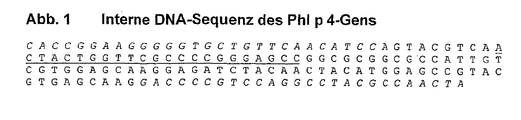
- illustration 1 Internal DNA sequence (SEQ ID NO 25) of the Phl p 4 gene The degenerate primers No. 30 (sense) and No. 37 (anti-sense), both in italics, were used to clone and sequence amplicons obtained with genomic DNA , The sequence shown represents the consensus of 6 clones. The specific sense primer # 82 created from this sequence is underlined.
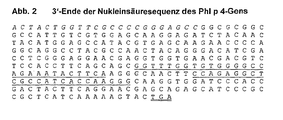
- Figure 2 3 'end of the nucleic acid sequence (SEQ ID NO 26) of the Phl p 4 gene
- SEQ ID NO 26 nucleic acid sequence of the Phl p 4 gene
- the sequence shown represents the consensus from 3 sequencing and includes the 3 'end of the Phl p 4 gene to the stop codon (underlined twice).
- the sequence regions used to construct anti-sense primers # 85 and # 86 are underlined.
- Figure 3 Localization of the Phl p 4 Peptides in the Deduced Amino Acid Sequence of the Phl p 4 Allergen (SEQ ID NO 2)
- the peptides P1-P6 (SEQ ID NOs 27-32) obtained from the amino acid sequencing of the purified and fragmented Phl p 4 allergen can be unambiguously assigned to the amino acid sequence of the Phl p 4 gene derived from the nucleic acid sequence.
- Figure 4 Detection of the identity of the recombinant Phl p 4 (rPhl p 4) by means of the nPhl p 4 specific monoclonal antibody 5H1 (Blot A) and 3C4 (Blot B) in the Western Blot.
- Lane 1 E. coli total cell extract containing rPhl p 4 fragment 1-200
- Lane 2 E. coli total cell extract containing rPhl p 4 fragment 185-500
- Lane 3 E.
- Lane 4 purified nPhl p 4 from phleum pratense (-4 ........): Termination or degradation fragments of C-terminal rPhl p 4 fragment or rPhl p 4 total molecule
- FIG. 5 Detection of the Reactivity of the Recombinant Phl p 4 (rPhl p 4) with IgE from Grass Pollen Allergic Seeds in the Western Blot. Extracts of transformed E. coli cells expressing either the complete Phl p 4 gene or the N-terminal fragment 1-200 and the C-terminal fragment 185-500, respectively, were separated by SDS-PAGE and transferred to nitrocellulose membranes. The blot was incubated with sera of grass pollen allergic donors A, B or C and subsequently bound IgE via a anti-human IgE antibody conjugated with alkaline phosphatase, detected colorimetrically. Lane 1: E.
- SEQ ID NO refers to the sequence listing attached to the description.
- the present invention therefore relates to a DNA molecule corresponding to a nucleotide sequence selected from a group consisting of SEQ ID NO 1, SEQ ID NO 3 and SEQ ID NO 5 or a DNA molecule corresponding to a nucleotide sequence which is suitable for the major allergen Phl p 4 coded from Phleum pratense .
- the group-13 allergens are of interest because they show a molecular weight very similar to group-4 allergens in SDS-PAGE and are difficult to separate by biochemical techniques ( Suck et al., 2000, Clin. Exp. Allergy 30: 324-332 . Suck et al., 2000, Clin. Exp. Allergy 30: 1395-1402 ).
- biochemical techniques Suck et al., 2000, Clin. Exp. Allergy 30: 324-332 .
- Suck et al., 2000, Clin. Exp. Allergy 30: 1395-1402 the aid of the protein and DNA sequence according to the invention for the first time, it can be clearly shown that groups 4 and 13 have distinctly different amino acid sequences.
- the corresponding recombinantly produced proteins can be used for therapy as well as for in vitro and in vivo diagnostics of pollen allergies.
- the cloned nucleic acid is ligated into an expression vector and this construct is expressed in a suitable host organism. After biochemical purification, this recombinant allergen is available for the detection of IgE antibodies in established procedures.
- the present invention therefore furthermore relates to a recombinant expression vector comprising a DNA molecule described above or below, functionally linked to an expression control sequence and a host organism, transformed with said DNA molecule or said expression vector.
- the invention can be used as an essential component in a recombinant allergen- or nucleic acid-containing preparation for specific immunotherapy.
- the unchanged protein in the primary structure can be part of the preparation.
- the invention can be used according to the invention by targeted deletion of IgE epitopes of the whole molecule or the production of individual fragments that code for T-cell epitopes, a hypoallergenic (allergoid) form of therapy to avoid unwanted side effects.
- the Nucleic acid per se when ligated with a eukaryotic expression vector, provides a preparation that directly adjusts the allergic immune status in a therapeutic sense.
- the invention thus relates to recombinant DNA molecules corresponding to SEQ ID NO 1, 3 or 5, wherein the nucleotide sequence of positions 1-69 from the amino acid sequence of the Phl p 4 N-terminus. was derived. Thereby in E. coli commonly used codons. From position 70, the DNA sequence corresponds to that identified in phleum pratense genomic and cDNA.
- the present invention therefore further provides a DNA molecule comprising a nucleotide sequence according to SEQ ID NO 1, SEQ ID NO 3 and SEQ ID NO 5, starting with the position 70, which is for a polypeptide having the properties of the major allergen Phl p 4 coded from Phleum pratense .
- the present invention is the polypeptides encoded by one or more of the previously described DNA molecules.
- polypeptides according to SEQ ID NO 2, SEQ ID NO 4 and SEQ ID NO 6, wherein the amino acid positions 1-33 were determined by N-terminal amino acid sequencing of the isolated natural Phl p 4 allergen. Positions 24-500 were derived from the DNA sequence of SEQ ID NOs 1, 3 and 5, respectively.
- Variable amino acids at positions 6, 7, 8, and 9 are derived from N-terminal protein sequencing of different preparations of the natural Phl p 4 (Table 1).
- the invention accordingly also relates to a process for producing such polypeptides by cultivating a host organism and recovering the corresponding polypeptide from the culture.
- polypeptides according to the invention or proteins which act as allergens for humans are contained in the pollen grains of Phleum architectureen se.
- the pollen grains of the other Poaceae species such as Lolium perenne, Dactylis glomerata, Poa pratensis, Cynodon dactylon, Holcus lanatus and others contain homologous allergen molecules (group-4 allergens). The homology of these molecules has been demonstrated by their immunological cross-reactivity with both murine monoclonal antibodies and human IgE antibodies.
- the invention also relates to Phl p 4 DNA sequence homologous sequences or corresponding DNA molecules of group 4 allergens from other Poaceae such as Lolium perenne, Dactylis glomerata, Poa pratensis, Cynodon dactylon, Holcus lanatus, Triticum aestivum and Hordeum vulgare, which hybridize due to the existing sequence homology with the Phl p 4 DNA under stringent conditions and with respect to Phl p 4 have an immunological cross-reactivity.
- Poaceae such as Lolium perenne, Dactylis glomerata, Poa pratensis, Cynodon dactylon, Holcus lanatus, Triticum aestivum and Hordeum vulgare
- Phl p 4 The purification and isolation of the natural allergen Phl p 4 was carried out according to described methods ( Fahlbusch et al. 1998, Clin. Exp. Allergy 28: 799-807 . Suck et al. 2000, Clin. Exp. Allergy 30: 1395-1402 ). Fine cleaning and separation of traces of group 13 allergens followed after the of Suck et al. (2000, Clin. Exp. Allergy 30: 1395-1402 ) method described. From this Phleum pratense isolated Phl p 4, the N-terminal amino acid sequence was determined by Edman degradation. With different batches of Phl p 4, the N-terminal sequences (P1a-f) shown in Table 1 were determined.
- Sense primer No. 30 and anti-sense primer No. 37 were used to prepare preamplified amplicons with phylum genomic DNA. The clones obtained from these amplicons were sequenced ( Fig.1 ) and used to construct the specific sense primer No. 82 (Table 2). With a cDNA prepared from the representative mRNA population from Phleum pratense pollen and the specific sense primer No. 82 of the invention and the anchor primer AUAP (Life Technologies, Düsseldorf, Germany) PCR was performed under stringent conditions.
- PCR was carried out with genomic phleum pratense DNA.
- This PCR product was used as the basis for a second PCR (nested PCR) with primers # 29 and # 85.
- the amplificates were inserted into the vector pGEM T-easy (Promega, Heidelberg, Germany), cloned and sequenced. This sequence begins at position 24 from the N-terminus or position 70 of the DNA sequence according to SEQ ID NO 1, 3 or 5 and extends to primer no. 85 (position 1402 in SEQ ID NO 1, 3 or 5 ) located in the already determined C-terminal portion of the Phl p 4 gene.
- the complete amino acid sequence of the Phl p 4 molecule can be determined from the first 33 amino acid positions determined by protein sequencing and the deduced amino acid sequence (477 positions) derived from those primed with primers no. 29 / no. 85 and no. 82 / anchor primer-derived clones can be constructed.
- the two clones overlap in 197 positions of their nucleotide sequence.
- the clone no. 29 / no. 85 coded peptide overlaps at 10 amino acid positions with the direct amino acid sequencing determined N-terminal sequence (positions 1-33) of Phl p 4, wherein the amino acids determined by both methods match.
- the amino acid sequence of Phl p 4 based on the directly determined N-terminal amino acids and the deduced amino acid sequence corresponds to the sequences listed under SEQ ID NO 2, 4 and 6 in the sequence listing.
- the described amino acid sequence of Phl p 4 shows that it is a basic molecule with a calculated isoelectric point of 8.99 (SEQ ID NO 2), 8.80 (SEQ ID NO 4) and 9.17 (SEQ ID NO 6) consisting of 500 amino acids.
- the quantitative amino acid composition is shown in Table 6.
- the calculated molecular weight of the recombinant Phl p 4 is 55,762 (SEQ ID NO 2), 55,734 (SEQ ID NO 4) and 55,624 (SEQ ID NO 6) daltons, respectively. This calculated molecular mass agrees well with the molecular mass of the natural Phl p 4 determined by SDS-PAGE for which 55 kDa was determined ( Fahlbusch et al., 1998, Clin. Exp. Allergy 28: 799-807 and Suck et al., 2000, Clin. Exp. Allergy 30: 1395-1402 ).
- Phl p 4-encoding DNA sequence according to SEQ ID NO 1, 3 and / or 5 was incorporated into expression vectors (eg pProEx, p ⁇ Cro, pSE 380).
- expression vectors eg pProEx, p ⁇ Cro, pSE 380.
- E. coli optimized codons used for the N-terminal amino acids known from protein sequencing.
- rPhl p 4 Upon reaction of rPhl p 4 with basophils of allergen group 4-reactive grass pollen allergy sufferers they are stimulated to increase expression of the activation marker CD 203c. This basophil activation by rPhl p 4 clearly shows that this molecule also functions functionally as an allergen.
- this rPhl p 4-allergen can be used for highly specific diagnostics of grass pollen allergy sufferers. This diagnosis can be made in vitro by detection of specific antibodies (IgE, IgG1-4, IgA) and reaction with IgE-loaded effector cells (eg basophils from the blood) or in vivo by skin test reactions and provocation on the reaction organ ,
- Figure 4 shows as an example the characterization of two such Phl p 4 fragments corresponding to amino acids 1-200 and 185-500 by binding to Phl p 4 specific mouse monoclonal antibodies.
- the C-terminal fragment 185-500 reacts only with the non-clonal antibody 5H1, while the N-terminal fragment 1-200 clearly reacts with the monoclonal antibody 3C4.
- the present invention therefore also relates to a DNA molecule described above or below, coding for a fragment 1-200, having the amino acids 1-200 of Phl p 4, and a DNA molecule encoding a fragment 285-500, with amino acids 285-500 of Phl p 4.
- Site-directed mutagenesis has altered the cysteine-encoding triplets to encode other amino acids, preferably serine. Variants were prepared in which individual cysteines were exchanged, as well as those in which different combinations of 2 cysteine residues or all 5 cysteines were changed. The expressed proteins of these cysteine point mutants show greatly reduced or absent reactivity with IgE antibodies of allergy sufferers, but react with the T lymphocytes of these patients.
- the present invention therefore furthermore relates to a DNA molecule described above or below in which one or more or all of the cysteine residues of the corresponding polypeptide have been exchanged for another amino acid by site-directed mutagenesis.
- hypoallergenic fragments corresponding to polypeptides having T-cell epitopes as well as that of the hypoallergenic point mutants is evidenced by their reaction with T-cells of grass pollen allergy sufferers.
- Such hypoallergenic fragments or point mutants of the cysteines can be used as preparations for the hyposensitization of allergy sufferers because they react with equal effectiveness with the T cells, but due to the reduced or absent IgE reactivity lead to lower IgE-mediated side effects.
- nucleic acids coding for the hypoallergenic Phl p 4 variants or the DNA coding for Phl p 4 are ligated with a human expression vector, these constructs can also be used as preparations for immunotherapy (DNA vaccination).
- Table 1 Amino Acid Sequence of Phl p 4 Peptides
- preparation Peptide batch SEQ ID NO amino acids 1 6 11 16 21 26
- AKSSP P1-c 37 YFPXX AAKED FLGXL P1-d 38 YFPXX AKKED FLGXL P1-e 39 YFPXX AAKDD FLGXL P1-f 40 YFPXX laned F Glu-C fragments P2 41 SATPF XHRKG
- nucleotide sequences of primers 82, 85, 86 and 88 are shown in the standard 4-letter code. Primers 29, 30 and 37 use the IUPAC-IUB DNA code; the letter 'N' stands for inosine.
- Table 3 Detected Single-nucleotide Exchanges ⁇ / b> Position in sequence Nucleotide according to SEQ ID NO1 Detected SNPs 85 T A 130 C A 159 G A 160 A C 169 G A 185 C T 186 C A 222 G C 226 G A 227 G C 228 T C 237 C T 273 C T 285 C T 286 C T 298 G A 299 A C 303 C T 309 C G 318 T C 320 G A 333 C G 348 G C 369 C G 409 C T 411 C T 420 T C 421 A C 423 A C 424 G A 425 T C 456 C G 462 C A 522 G C 525 C G 567 G A 618 C T 655 A C
Landscapes
- Health & Medical Sciences (AREA)
- Life Sciences & Earth Sciences (AREA)
- Chemical & Material Sciences (AREA)
- Medicinal Chemistry (AREA)
- General Health & Medical Sciences (AREA)
- Immunology (AREA)
- Molecular Biology (AREA)
- Engineering & Computer Science (AREA)
- Animal Behavior & Ethology (AREA)
- Public Health (AREA)
- Veterinary Medicine (AREA)
- Pharmacology & Pharmacy (AREA)
- Organic Chemistry (AREA)
- Epidemiology (AREA)
- Microbiology (AREA)
- Proteomics, Peptides & Aminoacids (AREA)
- Biochemistry (AREA)
- Urology & Nephrology (AREA)
- Hematology (AREA)
- Biomedical Technology (AREA)
- Chemical Kinetics & Catalysis (AREA)
- General Chemical & Material Sciences (AREA)
- Mycology (AREA)
- Gastroenterology & Hepatology (AREA)
- Botany (AREA)
- Genetics & Genomics (AREA)
- Biophysics (AREA)
- Biotechnology (AREA)
- Cell Biology (AREA)
- Food Science & Technology (AREA)
- Physics & Mathematics (AREA)
- Analytical Chemistry (AREA)
- General Physics & Mathematics (AREA)
- Pathology (AREA)
- Bioinformatics & Cheminformatics (AREA)
- Nuclear Medicine, Radiotherapy & Molecular Imaging (AREA)
- Pulmonology (AREA)
- Peptides Or Proteins (AREA)
- Medicines Containing Antibodies Or Antigens For Use As Internal Diagnostic Agents (AREA)
- Micro-Organisms Or Cultivation Processes Thereof (AREA)
Description
- Die vorliegende Erfindung betrifft die Bereitstellung der Gensequenz des Graspollenhauptallergens Phl p 4. Die Erfindung schließt auch Fragmente, Neukombinationen von Teilsequenzen und Punktmutanten mit hypoallergener Wirkung ein. Die rekombinanten DNA-Moleküle und die abgeleiteten Polypeptide, Fragmente, Neukombinationen von Teilsequenzen und Varianten können zur Therapie von pollenallergischen Krankheiten genutzt werden. Die rekombinant hergestellten Proteine können zur in vitro- und in vivo-Diagnostik von Pollenallergien eingesetzt werden.
- Allergien vom Typ 1 haben weltweite Bedeutung. Bis zu 20 % der Bevölkerung in industrialisierten Ländern leiden unter Beschwerden wie allergischer Rhinitis, Konjunktivitis oder Bronchialasthma. Diese Allergien werden durch in der Luft befindliche Allergene (Aeroallergene), die von Quellen unterschiedlicher Herkunft wie Pflanzenpollen, Milben, Katzen oder Hunden freigesetzt werden, hervorgerufen. Bis zu 40 % dieser Typ 1-Allergiker wiederum zeigen spezifische IgE-Reaktivität mit Gräserpollenallergenen (Freidhoff et al., 1986, J. Allergy Clin. Immunol. 78, 1190-2001).
- Bei den Typ 1-Allergie auslösenden Substanzen handelt es sich um Proteine, Glykoproteine oder Polypeptide. Diese Allergene reagieren nach Aufnahme über die Schleimhäute mit den bei sensibilisierten Personen an der Oberfläche von Mastzellen gebundenen 1gE-Molekülen. Werden zwei 1gE-Moleküle durch ein Allergen miteinander vernetzt, führt dies zur Ausschüttung von Mediatoren (z. B. Histamin, Prostaglandine) und Zytokinen durch die Effektorzelle und damit zu den entsprechenden klinischen Symptomen. In Abhängigkeit von der relativen Häufigkeit mit der die einzelnen Allergenmoleküle mit den IgE-Antikörpern von Allergikern reagieren, wird zwischen Major- und Minorallergenen unterschieden.
- Im Fall vom Wiesenlieschengras (Phleum pratense) sind bislang Phl p 1 (Petersen et al., 1993, J. Allergy Clin. Immunol. 92: 789-796), Phl p 5 (Matthiesen und Löwenstein, 1991, Clin. Exp. Allergy 21: 297-307; Petersen et al., 1992, Int. Arch. Allergy Immunol. 98: 105-109), Phl p 6 (Petersen et al., 1995, Int. Arch. Allergy Immunol. 108, 49-54). Phl p 2/3 (Dolecek et al., 1993, FEBS 335 (3), 299-304), Phl p 4 (Haavik et al., 1985, Int. Arch. Allergy Appl. Immunol. 78: 260-268; Valenta et al., 1992, Int. Arch. Allergy Immunol. 97: 287-294, Fischer et al., 1996, J. Allergy Clin. Immunol. 98: 189-198) und Phl p 13 (Suck et al., 2000, Clin. Exp. Allergy 30: 324-332; Suck et al., 2000, Clin. Exp. Allergy 30: 1395-1402) als Hauptallergene identifiziert worden.
- Das Phl p 4 ist als basisches Glykoprotein mit einer Molekularmasse zwischen 50 und 60 kDa angegeben worden (Haavik et al., 1985, Int. Arch. Allergy Appl. Immunol. 78: 260-268). Das Phl p 4-Molekül ist Trypsinresistent (Fischer et al., 1996, J. Allergy Clin. Immunol. 98: 189-198) und 70-88 % der Graspollenallergiker haben 1gE-Antikörper gegen dieses Molekül (Valenta et al., 1993, Int. Arch. Allergy Immunol. 97: 287-294; Rossi et al., 2001, Allergy 56:1180-1185; Mari, 2003, Clin. Exp. Allergy 33:43-51). Homologe Moleküle sind aus verwandten Grasspezies beschrieben worden (Su et al., 1991, Clin. Exp. Allergy 21: 449-455; Jaggi et al., 1989, Int. Arch. Allergy Appl. Immunol. 89: 342-348; Jaggi et al., 1989, J. Allergy Clin. Immunol. 83: 845-852; Leduc-Brodard et al., 1996, J. Allergy Clin. Immunol. 98: 1065-1072; 14 - 17). Diese homologen Moleküle der Poaceae bilden die Allergengruppe 4, deren Moleküle eine hohe immunologische Kreuzreaktivität untereinander sowohl mit monoklonalen Mausantikörpern als auch mit humanen IgE-Antikörpern aufweisen (Fahlbusch et al., 1993 Clin. Exp. Allergy 23:51-60; Leduc-Brodard et al., 1996, J. Allergy Clin. Immunol. 98:1065-1072; Su et al., 1996, J. Allergy Clin. Immunol. 97:210; Fahlbusch et al., 1998, Clin. Exp. Allergy 28:799-807; Gavrovic-Jankulovic et al., 2000, Invest. Allergol. Clin. Immunol. 10 (6): 361-367; Stumvoll et al. 2002, Biol. Chem. 383: 1383-1396; Grote et al., 2002, Biol. Chem. 383: 1441-1445; Andersson und Lidholm, 2003, Int. Arch. Allergy Immunol. 130: 87-107; Mari, 2003, Clin. Exp. Allergy, 33 (1): 43-51).
Im Gegensatz zu den oben genannten Hauptallergenen von Phleum pratense (Phl p 1, Phl p 2/3, Phl 5a und 5b, Phl p 6 und Phl p 13) ist die Primärstruktur des Phl p 4 noch nicht aufgeklärt. Ebenso gibt es keine vollständige Sequenz von Molekülen der Gruppe 4 aus anderen Grasspezies. - Die Bestimmung der N-terminalen Aminosäuresequenz war bisher nicht erfolgreich. Die Ursachen hierfür sind jedoch nicht bekannt. Fischer et al. (J. Allergy Clin. Immunol., 1996; 98: 189-198) vermuten eine N-terminale Blockierung, konnten aber ein internes Peptid nach Abbau mit Lysyl-Endopeptidase reinigen und dessen Sequenz bestimmen: IVALPXGMLK (SEQ ID NO 7).
Dieses Peptid weist Homologien zu Peptidsequenzen in den Ragweed-Allergenen Amb a1 und Amb a2 sowie Ähnlichkeiten zu Sequenzen in Proteinen von Mais (Zm58.2), Tomate (lat 59, lat 56) und Tabak (G10) auf (Fischer et al., 1996, J. Allergy Clin. Immunol. 98: 189-198). Für Lolium perenne wurden für das basische Gruppe-4 Allergen Peptidfragmente mit der folgenden Sequenz beschrieben: FLEPVLGLIFPAGV (SEQ ID NO 8) und GLIEFPAGV (SEQ ID NO 9) (Jaggi et al., 1989, Int. Arch. Allergy Appl. Immunol. 89: 342-348). - Von dem Gruppe-4 Allergen aus Dactylus glomerata sind ebenfalls Peptide durch enzymatischen Abbau gewonnen und sequenziert worden:
- DIYNYMEPYVSK (P15, SEQ ID NO 10),
- VDPTDYFGNEQ (P17, SEQ ID NO 11),
- ARTAWVDSGAQLGELSY (P20, SEQ ID NO 12) und GVLFNIQYVNYWFAP (P22, SEQ ID NO 13) (Leduc-Brodard et al., 1996, J. Allergy Clin. Immunol. 98: 1065-1072).
- KTVKPLYIITP (S, SEQ ID NO 14),
- KQVERDFLTSLTKDIPQLYLKS (V49L, SEQ ID NO 15),
- TVKPLYIITPITAAMI (T33S, SEQ ID NO 16),
- LRKYGTAADNVIDAKWDAQGRLL (T35L, SEQ ID NO 17),
- KWQTVAPALPDPNM (P2, SEQ ID NO 18),
- VTWIESVPYIPMGDK (V26L, SEQ ID NO 19),
- GTVRDLLXRTSNIKAFGKY (L25L, SEQ ID NO 20),
- TSNIKAFGKYKSDYVLEPIPKKS (T22L, SEQ ID NO 21),
- YRDLDLGVNQWG (P3, SEQ ID NO 22),
- SATPPTHRSGVLFNI (V20L, SEQ ID NO 23),
- und AAAALPTQVTRDIYAFMTPYVSKNPRQAYVNYRDLD (V14L, SEQ ID NO 24) (Liaw et al., 2001, Biochem. Biophys. Research Communication 280: 738-743).
- Diese beschriebenen Peptidsequenzen für Phl p 4 und Gruppe-4 Allergene haben jedoch bisher nicht zur Aufklärung der vollständigen Primärstruktur der Gruppe-4 Allergene geführt.
- Die der vorliegenden Erfindung zugrunde liegende Aufgabe bestand daher in der Bereitstellung der vollständigen DNA-Sequenz des Phl p 4 sowie einer entsprechenden rekombinanten DNA, auf deren Grundlage das Phi p 4-Allergen als Protein exprimiert und einer pharmakologisch bedeutsamen Verwertung als solches oder in veränderter Form zugänglich gemacht werden kann.
-
Abbildung 1 : Interne DNA-Sequenz (SEQ ID NO 25) des Phl p 4-Gens Mit den degenerierten Primern Nr. 30 (sense) und Nr. 37 (anti-sense), beide kursiv dargestellt, wurden mit genomischer DNA erhaltene Amplifikate kloniert und sequenziert. Die dargestellte Sequenz repräsentiert den Konsensus aus 6 Klonen. Der aus dieser Sequenz kreierte spezifische sense-Primer Nr. 82 ist unterstrichen dargestellt. -
Abbildung 2 : 3'-Ende der Nukleinsäuresequenz (SEQ ID NO 26) des Phl p 4-Gens
In einer 3'-RACE PCR mit Phleum pratense cDNA wurden Amplifikate mit dem spezifischen sense-Primer Nr. 82 (kursiv dargestellt) sowie einem Ankerprimer gewonnen und sequenziert. Die dargestellte Sequenz repräsentiert den Konsensus aus 3 Sequenzierungen und umfasst das 3'-Ende des Phl p 4-Gens bis zum Stopp-Codon (doppelt unterstrichen). Die Sequenzbereiche, die zur Konstruktion der anti-sense-Primer Nr. 85 und Nr. 86 herangezogen wurden, sind unterstrichen dargestellt. -
Abbildung 3 : Lokalisierung der Phl p 4- Peptide in der deduzierten Aminosäuresequenz des Phl p 4-Allergens (SEQ ID NO 2)
Die aus der Aminosäuresequenzierung des gereinigten und fragmentierten Phl p 4 Allergens erhaltenen Peptide P1 - P6 (SEQ ID NO's 27-32) lassen sich eindeutig der aus der Nukleinsäuresequenz abgeleiteten Aminosäuresequenz des Phl p 4-Gens zuordnen. -
Abbildung 4 : Nachweis der Identität des rekombinanten Phl p 4 (rPhl p 4) mittels der für nPhl p 4 spezifischen monoklonalen Antikörper 5H1 (Blot A) und 3C4 (Blot B) im Western Blot.
Bahn 1: E. coli Gesamtzellextrakt enthaltend rPhl p 4 Fragment 1-200
Bahn 2: E. coli Gesamtzellextrakt enthaltend rPhl p 4 Fragment 185-500
Bahn 3: E. coli Gesamtzellextrakt enthaltend rPhl p 4
Bahn 4: gereinigtes nPhl p 4 aus Phleum pratense
(-4 ........ ): Abbruch- oder Degradationsfragmente von C-terminalem rPhl p 4-Fragment bzw. rPhl p 4 Gesamtmolekül -
Abbildung 5 : Nachweis der Reaktivität des rekombinanten Phl p 4 (rPhl p 4) mit IgE aus Seren von Graspollenallergikern im Western Blot.
Extrakte von transformierten E. coli-Zellen, die entweder das komplette Phl p 4 Gen exprimieren oder das N-terminale Fragment 1-200 bzw. das C-terminale Fragment 185-500 wurden in der SDS-PAGE getrennt und auf Nitrozellulosemembranen transferiert. Der Blot wurde mit Seren der graspollenallergischen Spender A, B oder C inkubiert und nachfolgend gebundenes IgE über einen anti-human-IgE Antikörper, konjugiert mit alkalischer Phosphatase, kolorimetrisch detektiert.
Bahn 1: E. coli Gesamtzellextrakt enthaltend rPhl p 4 Fragment 1-200
Bahn 2: E. coli Gesamtzellextrakt enthaltend rPhl p 4 Fragment 185-500
Bahn 3: E. coli Gesamtzellextrakt enthaltend rPhl p 4
Bahn 4: gereinigtes nPhl p 4 aus Phleum pratense - Die vor- und nachstehend verwendeten Bezeichnungen für Nukleotid- bzw. Aminosäuresequenzen "SEQ ID NO" beziehen sich auf das der Beschreibung beigefügte Sequenzprotokoll.
- Mit der vorliegenden Erfindung wird die Gensequenz des Graspollenhauptallergens Phl p 4 nun erstmals bereit gestellt, wobei sich aus den aufgefundenen Einzelnukleotidaustauschen (Single Nucleotide Polymorphisms, SNP's) drei dominierende Sequenzen (SEQ ID NO 1, 3 und 5) ergeben.
- Gegenstand der vorliegenden Erfindung ist daher ein DNA-Molekül entsprechend einer Nukleotidsequenz, ausgewählt aus einer Gruppe bestehend aus SEQ ID NO 1, SEQ ID NO 3 und SEQ ID NO 5 bzw. ein DNA-Molekül entsprechend einer Nukleotidsequenz, die für das Majorallergen Phl p 4 aus Phleum pratense kodiert.
- Im Zusammenhang mit der vorliegenden Erfindung sind außer den Gruppe-4 Allergenen der anderen Grasspezies die Gruppe-13 Allergene von Interesse, da sie ein den Gruppe-4 Allergenen sehr ähnliches Molekulargewicht in der SDS-PAGE zeigen und schwer durch biochemische Techniken abzutrennen sind (Suck et al., 2000, Clin. Exp. Allergy 30: 324-332, Suck et al., 2000, Clin. Exp. Allergy 30: 1395-1402). Mit Hilfe der jetzt erstmalig vorliegenden, erfindungsgemäßen Protein- und DNA-Sequenz kann jedoch eindeutig gezeigt werden, dass die Gruppen 4 und 13 deutlich unterschiedliche Aminosäuresequenzen aufweisen.
- Mit der Kenntnis der DNA-Sequenz der natürlich vorkommenden Allergene ist es nun möglich, diese Allergene als rekombinante Proteine herzustellen, die in der Diagnostik und Therapie von allergischen Erkrankungen Verwendung finden können (Scheiner and Kraft, 1995, Allergy 50: 384-391).
- Ein klassischer Ansatz zur wirksamen therapeutischen Behandlung von Allergien stellt die Spezifische Immuntherapie oder Hyposensibilisierung dar (Fiebig, 1995, Allergo J. 4 (6): 336-339, Bousquet et al., 1998, J. Allergy Clin. Immunol. 102(4): 558-562). Dabei werden dem Patienten natürliche Allergenextrakte in steigenden Dosen subkutan injiziert. Allerdings besteht bei dieser Methode die Gefahr von allergischen Reaktionen oder sogar eines anaphylaktischen Schocks. Um diese Risiken zu minimieren, werden innovative Präparate in Form von Allergoiden eingesetzt. Dabei handelt es sich um chemisch modifizierte Allergenextrakte, die deutlich reduzierte IgE-Reaktivität, jedoch identische T-Zell-Reaktivität im Vergleich zum nicht behandelten Extrakt aufweisen (Fiebig, 1995, Allergo J. 4 (7): 377-382).
Eine noch weitergehende Therapieoptimierung wäre mit rekombinant hergestellten Allergenen möglich. Definierte, ggfs. auf die individuellen Sensibilisierungsmuster der Patienten abgestimmte Cocktails von hochreinen, rekombinant hergestellten Allergenen könnten Extrakte aus natürlichen Allergenquellen ablösen, da diese außer den verschiedenen Allergenen eine größere Zahl von immunogenen, aber nicht allergenen Begleitproteinen enthalten.
Realistische Perspektiven, die zu einer sicheren Hyposensibilisierung mit Expressionsprodukten führen können, bieten gezielt mutierte rekombinante Allergene, bei denen IgE-Epitope spezifisch deletiert werden, ohne die für die Therapie essentiellen T-Zell Epitope zu beeinträchtigen (Schramm et al., 1999, J. Immunol. 162: 2406-2414). - Eine weitere Möglichkeit zur therapeutischen Beeinflussung des gestörten TH-Zell-Gleichgewichtes bei Allergikern ist die immuntherapeutische DNA-Vakzinierung. Dabei handelt es sich um eine Behandlung mit expressionsfähiger DNA, die für die relevanten Allergene kodiert. Erste experimentelle Belege für die allergenspezifische Beeinflussung der Immunantwort konnte an Nagem durch Injektion von Allergen-kodierender DNA erbracht werden (Hsu et al., 1996, Nature Medicine 2 (5): 540-544).
- Die entsprechenden rekombinant hergestellten Proteine können zur Therapie sowie zur in vitro- und in vivo-Diagnostik von Pollenallergien eingesetzt werden.
Zur Herstellung des rekombinanten Allergens wird die klonierte Nukleinsäure in einen Expressionsvektor ligiert und dieses Konstrukt in einem geeigneten Wirtsorganismus exprimiert. Nach biochemischer Reinigung steht dieses rekombinante Allergen zur Detektion von IgE-Antikörpern in etablierten Verfahren zur Verfügung. - Gegenstand der vorliegenden Erfindung ist daher weiterhin ein rekombinanter Expressionsvektor, enthaltend ein vor- oder nachstehend beschriebenes DNA-Molekül, funktionell verbunden mit einer Expressionskontrollsequenz und ein Wirtsorganismus, transformiert mit besagtem DNA-Molekül oder besagtem Expressionsvektor.
- Wie bereits ausgeführt kann die Erfindung als eine essentielle Komponente in einem rekombinanten allergen- oder nukleinsäurehaltigen Präparat zur spezifischen Immuntherapie angewendet werden. Hierbei bieten sich mehrere Möglichkeiten. Zum einen kann das in der Primärstruktur unveränderte Protein Bestandteil des Präparates sein. Zum anderen kann durch gezielte Deletion von IgE-Epitopen des Gesamtmoleküls oder der Herstellung von einzelnen Fragmenten, die für T-Zell Epitope kodieren, erfindungsgemäß eine hypoallergene (allergoide) Form zur Therapie verwendet werden, um unerwünschte Nebenwirkungen zu vermeiden. Schließlich wird durch die Nukleinsäure an sich, wenn sie mit einem eukaryontischen Expressionsvektor ligiert wird, ein Präparat geschaffen, das direkt appliziert den allergischen Immunzustand im therapeutischen Sinne verändert.
- Bei der Erfindung handelt es sich somit um rekombinante DNA-Moleküle entsprechend den SEQ ID NO 1, 3 oder 5, wobei die Nukleotidsequenz der Positionen 1-69 aus der Aminosäuresequenz des Phl p 4 N-Terminus. abgeleitet wurde. Dabei wurden in E. coli häufig vorkommende Codons verwendet. Ab Position 70 entspricht die DNA-Sequenz derjenigen, die in genomischer und cDNA von Phleum pratense identifiziert wurde. Gegenstand der vorliegenden Erfindung ist daher weiterhin ein DNA-Molekül, umfassend eine Nukleotidsequenz gemäß SEQ ID NO 1, SEQ ID NO 3 bzw. SEQ ID NO 5, beginnend mit der Position 70, welches für ein Polypeptid mit den Eigenschaften des Majorallergens Phl p 4 aus Phleum pratense kodiert.
- Desweiteren handelt es sich bei der vorliegenden Erfindung um die von einem oder mehreren der zuvor beschriebenen DNA-Moleküle kodierten Polypeptide.
Dabei handelt es sich insbesondere um Polypeptide gemäß SEQ ID NO 2, SEQ ID NO 4 bzw. SEQ ID NO 6, wobei die Aminosäurepositionen 1-33 durch N-terminale Aminosäuresequenzierung des isolierten natürlichen Phl p 4 Allergens bestimmt wurden. Die Positionen 24-500 wurden von der DNA-Sequenz gemäß SEQ ID NO 1, 3 bzw. 5 abgeleitet. Variable Aminosäuren an den Positionen 6, 7, 8 und 9 entstammen der N-terminalen Proteinsequenzierung unterschiedlicher Präparationen des natürlichen Phl p 4 (Tab. 1).
Die Erfindung betrifft demgemäß auch ein Verfahren zur Herstellung solcher Polypeptide durch Kultivieren eines Wirtsorganismus und Gewinnung des entsprechenden Polypeptids aus der Kultur. - Diese erfindungsgemäßen Polypeptide bzw. Proteine, welche für Menschen als Allergene wirken, sind in den Pollenkörnern von Phleum prafense enthalten. Die Pollenkörner der anderen Poaceae-Spezies, wie z.B. Lolium perenne, Dactylis glomerata, Poa pratensis, Cynodon dactylon, Holcus lanatus u.a. enthalten homologe Allergenmoleküle (Gruppe-4 Allergene). Die Homologie dieser Moleküle ist durch ihre immunologische Kreuzreaktivität sowohl mit murinen monoklonalen Antikörpern als auch mit humanen IgE-Antikörpern nachgewiesen worden.
- Infolge dessen betrifft die Erfindung auch zur Phl p 4 DNA-Sequenz homologe Sequenzen bzw. entsprechende DNA-Moleküle von Gruppe-4-Allergenen aus anderen Poaceae wie beispielsweise Lolium perenne, Dactylis glomerata, Poa pratensis, Cynodon dactylon, Holcus lanatus, Triticum aestivum und Hordeum vulgare, die aufgrund der bestehenden Sequenzhomologie mit der Phl p 4-DNA unter stringenten Bedingungen hybridisieren und bezüglich Phl p 4 eine immunologische Kreuzraktivität aufweisen.
- Bei der Ermittlung der Protein- und DNA-Sequenz des Phl p 4 wurde wie folgt vorgegangen:
- Die Reinigung und Isolierung des natürlichen Allergens Phl p 4 erfolgte nach beschriebenen Methoden (Fahlbusch et al. 1998, Clin. Exp. Allergy 28: 799-807, Suck et al. 2000, Clin. Exp. Allergy 30: 1395-1402). Die Feinreinigung und die Abtrennung von Spuren des Allergens der Gruppe 13 er folgte nach der von Suck et al. (2000, Clin. Exp. Allergy 30: 1395-1402) beschriebenen Methode.
Von diesem aus Phleum pratense isolierten Phl p 4 wurde die N-terminale Aminosäuresequenz mittels Edman-Abbau bestimmt. Mit unterschiedlichen Chargen des Phl p 4 wurden die in Tabelle 1 aufgezeigten N-terminalen Sequenzen (P1a - f) bestimmt. Als Konsensussequenz für die ersten 15 Positionen wird folgende Sequenz angesehen: YFPP'P'AAKEDFLGXL (SEQ ID NO 33). Die Position 14 konnte nicht bestimmt werden, wahrscheinlich ist sie mit einem Cystein besetzt. Die unterschiedlichen Aminosäuren auf den Positionen 6, 7, 8 und 9 bei den unterschiedlichen Chargen weisen auf Variationen im Sinne von isoformen hin. Die Positionen 4 und 5 sind mit Hydroxyprolin (P') besetzt, was durch eine spezifische Analytik bei den Analysen der Präparate p1-a und -b eindeutig festgestellt wurde. - Durch Behandlung des SDS-denaturierten Phl p 4 mit der Endopeptidase Glu-C (Promega, Heidelberg, Germany) wurden verschiedene Peptide erhalten. Von zwei Peptiden (P2 und P3) wurden die in Tabelle 1 gezeigten Aminosäuresequenzen bestimmt. Durch Spaltung mit der Endopeptidase Lys-C (Roche, Mannheim, Deutschland) wurden 2 Peptide (P4 und P5) gereinigt und sequenziert (Tab. 1). Durch CNBr-Spaltung wurde ein weiteres Peptid (P6) isoliert und die Aminosäuresequenz ermittelt (Tab.1).
- Die Aminosäuresequenzen der N-terminalen Sequenz und der internen Peptide 2 und 6 wurden als Grundlage für die Konstruktion von degenerierten Primern benutzt. Mit dem Sense-Primer Nr. 30 und dem Anti-Sense-Primer Nr. 37 (Tab. 2) wurden mit genomischer DNA aus Phleum pratense Amplifikate hergestellt. Die von diesen Amplifikaten gewonnenen Klone wurden sequenziert (
Abb.1 ) und zur Konstruktion des spezifischen Sense-Primers Nr. 82 benutzt (Tab. 2). Mit einer cDNA, die aus der repräsentativen mRNA-Population aus Phleum pratense-Pollen hergestellt wurde, und dem erfindungsgemäßen spezifischen Sense-Primer Nr. 82 sowie dem Ankerprimer AUAP (Life Technologies, Karlsruhe, Deutschland) wurde eine PCR unter stringenten Bedingungen durchgeführt. Dieses Amplifikat von ca. 450 kb wurde sequenziert und somit die fehlende Sequenz bis zum 3'-Ende des Phl p 4-Genes identifiziert (Abb. 2 ). Basierend auf dieser erfindungsgemäß bestimmten C-terminalen Phl p 4-Sequenz wurden die spezifischen Anti-Sense-Primer Nr. 85 und Nr. 86 konstruiert (Tab. 2). Basierend auf der N-terminalen Aminosäuresequenz des Phl p 4-Peptids P1-a (Tab. 1) wurde der degenerierte Sense-Primer Nr. 29, abgeleitet von der DNA kodierend für die Aminosäurepositionen 24-33 (LYAKSSPAYP (SEQ ID NO 34)), konstruiert. - Mit den Primern Nr. 29 und Nr. 86 wurde mit genomischer Phleum pratense-DNA eine PCR durchgeführt. Dieses PCR-Produkt wurde als Grundlage für eine zweite PCR (nested PCR) mit den Primern Nr. 29 und Nr. 85 eingesetzt. Die Amplifikate wurden in den Vektor pGEM T-easy (Promega, Heidelberg, Deutschland) inseriert, kloniert und sequenziert. Diese Sequenz beginnt an der Position 24 vom N-Terminus gerechnet bzw. Position 70 der DNA-Sequenz gemäß SEQ ID NO 1, 3 oder 5 und reicht bis zum Primer Nr. 85, (Position 1402 in SEQ ID NO 1, 3 oder 5) der im schon bestimmten C-terminalen Abschnitt des Phl p 4-Genes lokalisiert ist. Mit diesen Daten kann die vollständige Aminosäuresequenz des Phl p 4-Moleküles aus den durch Proteinsequenzierung bestimmten ersten 33 Aminosäurepositionen und der deduzierten Aminosäuresequenz (477 Positionen), die aus den mit den Primern Nr. 29/Nr. 85 und Nr. 82/Anker-Primer hergestellten Klonen abgeleitet werden kann, konstruiert werden. Die beiden Klone überlappen in 197 Positionen ihrer Nukleotidsequenz. Das vom Klon Nr. 29/Nr. 85 kodierte Peptid überlappt auf 10 Aminosäurepositionen mit der durch direkte Aminosäuresequenzierung bestimmten N-terminalen Sequenz (Positionen 1-33) des Phl p 4, wobei die mit beiden Methoden bestimmten Aminosäuren übereinstimmen.
- Die Aminosäuresequenz des Phl p 4 basierend auf den direkt bestimmten N-terminalen Aminosäuren und der deduzierten Aminosäuresequenz entspricht den unter den SEQ ID NO 2, 4 bzw. 6 im Sequenzprotokoll aufgeführten Sequenzen.
- Mit dem spezifischen Sense-Primer Nr. 88 (Tab. 2) und dem spezifischen Anti-Sense-Primer Nr. 86 wurden sowohl mit genomischer als auch mit cDNA von Phleum pratense PCR-Produkte hergestellt und direkt sequenziert.
Hierdurch ist es möglich, PCR-Fehler auszuschliessen und genetische Variationen (single nucleotide polymorphisms) aufzudecken.
Die gefundenen Einzelnukleotidaustausche zur DNA-Sequenz SEQ ID NO 1 sind in Tabelle 3 aufgeführt. Einige dieser Einzelnukleotidaustausche führen zu veränderten Aminosäuren. Diese sind in Tabelle 4 dargestellt. Es
wurden weiterhin DNA-Klone sequenziert, die zu abweichenden Aminosäuren in Bezug auf die dominierenden Sequenzen SEQ ID NO 2, 4 und 6 führen (Tab. 5).
Diese Aminosäurevariationen sind als Isoformen des Phl p 4-Moleküles anzusehen. Die Existenz solcher Isoformen ist aufgrund des heterogenen isoelektrischen Verhaltens des natürlichen Phl p 4 zu erwarten. Alle bisher bekannten Pollenallergene weisen solche Isoformen auf. Dass das DNA-Stück, welches mit den Primern Nr. 29 und 86 bestimmt wurde, tatsächlich für ein Protein kodiert, welches mit dem natürlichen Phl p 4-Allergen identisch ist, kann unter anderem auch dadurch bewiesen werden, dass für die identifizierten internen Peptide P3, P4 und P5 (Tab. 1) des natürlichen Phl p 4 homologe Peptidsequenzen in der deduzierten Aminosäuresequenz des erfindungsgemäßen rekombinanten Phl p 4-Moleküls gefunden werden (Abb. 3 ). Die beschriebene Aminosäuresequenz des Phl p 4 zeigt, dass es sich um ein basisches Molekül mit einem kalkulierten isoelektrischen Punkt von 8,99 (SEQ ID NO 2), 8,80 (SEQ ID NO 4) bzw. 9,17 (SEQ ID NO 6), bestehend aus 500 Aminosäuren, handelt. Die quantitative Aminosäurezusammensetzung ist in Tabelle 6 dargestellt. Das berechnete Molekulargewicht des rekombinanten Phl p 4 beträgt 55.762 (SEQ ID NO 2), 55.734 (SEQ ID NO 4) bzw. 55.624 (SEQ ID NO 6) Dalton. Diese berechnete Molekularmasse stimmt sehr gut mit der durch SDS-PAGE bestimmten Molekularmasse des natürlichen Phl p 4, für das 55 kDa bestimmt wurden, überein (Fahlbusch et al., 1998, Clin. Exp. Allergy 28: 799 -807 und Suck et al., 2000, Clin. Exp. Allergy 30: 1395-1402). - Auch für die Gruppe-4 Allergene verwandter Grasspezies wurden Molekularmassen zwischen 50 und 60 kDa beschrieben (Su et al., 1991, Clin. Exp. Allergy 21: 449-455; Jaggi et al., 1989, Int. Arch. Allergy Appl. Immunol. 89: 342-348; Jaggi et al., 1989, J. Allergy Clin. Immunol. 83: 845-852; Leduc-Brodard et al., 1996, J. Allergy Clin. Immunol. 98: 1065-1072; 14 -17).
- Zur Herstellung des rekombinanten Phl p 4-Proteins wurde die für Phl p 4-kodierende DNA-Sequenz gemäß SEQ ID NO 1, 3 und/oder 5 in Expressionsvektoren (z.B. pProEx, pλCro, pSE 380) eingebaut. Für die aus der Proteinsequenzierung bekannten N-terminalen Aminosäuren wurden E. coli optimierte Codons verwendet.
- Nach der Transformation in E. coli, der Expression und der Reinigung des rekombinanten Phl p 4 durch verschiedene Trenntechniken wurde das erhaltene Protein einem Refoldingprozess unterworfen.
Dieses so gewonnene rPhl p 4-Protein ergibt eine einzelne Bande in der SDS-PAGE, die im gleichen Molekulargewichtsbereich wie das natürliche Phl p 4 wandert. Die immunologische Reaktivität des rPhl p 4 konnte durch die Reaktion mit den murinen monoklonalen Antikörpern 5H1 und 3C4, die mit natürlichem Phl p 4 induziert worden waren und mit den homologen Proteinen (Gruppe 4) der Poaceae kreuzreagieren (Fahlbusch et al., 1998, Clin. Exp. Allergy 28:799-807; Gavrovic-Jankulovic et al., 2000, Invest. Allergol. Clin. Immunol. 10 (6): 361-367), nachgewiesen werden (Abb. 4 ). Das rPhl p 4 reagiert mit IgE-Antikörpern von Allergikern, die nachgewiesene IgE-Reaktivität mit natürlichem Phl p 4 haben. Diese IgE-Reaktivität und damit die Wirkung als Allergen konnte sowohl im Dot-Test, Western-Blot als auch nach Adsorption des Allergens an Polystyren-Mikrotiterpfatten nachgewiesen werden. Der Nachweis im Western-Blot ist inAbbildung 5 gezeigt. Bei Reaktion des rPhl p 4 mit Basophilen von Allergengruppe 4-reaktiven Graspollenallergikern werden diese zur verstärkten Expression des Aktivierungsmarkers CD 203c angeregt. Diese Basophilenaktivierung durch rPhl p 4 zeigt deutlich, dass dieses Molekül auch funktionell als Allergen wirkt.
Damit kann dieses rPhl p 4-Allergen zur hochspezifischen Diagnostik von Graspollenallergikern eingesetzt werden. Diese Diagnostik kann in vitro durch die Detektion von spezifischen Antikörpern (IgE, IgG1 - 4, IgA) und die Reaktion mit IgE-beladenen Effektorzellen (z. B. Basophile aus dem Blut) oder in vivo durch Hauttest-Reaktionen und Provokation am Reaktionsorgan erfolgen. - Die Reaktion des rPhl p 4 mit T-Lymphozyten von Graspollenallergikern konnte durch die allergenspezifische Stimulierung der T-Lymphozyten zur Proliferation und Zytokinsynthese sowohl mit T-Zellen in frisch präparierten Blutlymphozyten als auch an etablierten nPhl p 4-reaktiven T-Zell-Linien und -Klonen nachgewiesen werden.
- Basierend auf der dargelegten DNA-Sequenz des rPhl p 4 wurden Teilsequenzen kodierend für Peptide von 50 bis 350 Aminosäuren in Expressionsvektoren kloniert. Diese Teilsequenzen decken sequentiell die vollständige Sequenz des rPhl p 4 ab, wobei Überlappungen von mindestens 12 Aminosäuren vorkommen. Die exprimierten Peptide entsprechen Phl p 4-Fragmenten. Diese Phl p 4-Fragmente reagieren einzeln oder als Gemisch mit den IgE-Antikörpern von Allergikern nicht oder nur in geringem Grade, so dass sie als hypoallergen eingestuft werden können. Im Gegensatz dazu ist das Gemisch dieser Fragmente in gleicher Weise wie das vollständige rekombinante oder natürliche Phl p 4 zur Stimulierung von T-Lymphozyten von Graspollenallergikern mit Phl p 4-Reaktivität fähig.
Abbildung 4 zeigt als Beispiel die Charakterisierung zweier solcher Phl p 4-Fragmente, entsprechend den Aminosäuren 1-200 und 185-500 durch die Bindung an Phl p 4-spezifische monoklonale Mausantikörper. Das C-terminale Fragment 185-500 reagiert nur mit dem nonoklonalen Antikörper 5H1, während das N-terminale Fragment 1-200 eindeutig mit dem monoklonalen Antikörper 3C4 reagiert. AusAbbildung 5 wird ersichtlich, daß das Fragment 185-500 weniger stark mit dem IgE aus den Seren der Allergiker B und C reagiert, also weniger allergen ist als das Fragment 1-200, welches zumindest gegenüber dem Patientenserum C eine herabgesetzte IgE-Reaktivität (Hypoallergenität) aufweist.
Gegenstand der vorliegenden Erfindung ist daher auch ein vor- oder nachstehend beschriebenes DNA-Molekül, kodierend für ein Fragment 1-200, mit den Aminosäuren 1-200 des Phl p 4,
sowie ein DNA-Molekül kodierend für ein Fragment 285-500, mit den Aminosäuren 285-500 des Phl p 4. - Durch ortsgerichte Mutagenese wurden die für die Cysteine kodierenden Tripletts so verändert, dass sie für andere Aminosäuren, bevorzugt Serin, kodieren. Es wurden sowohl Varianten hergestellt, bei denen einzelne Cysteine ausgetauscht wurden, als auch solche, bei denen verschiedene Kombinationen von 2 Cysteinresten bzw. alle 5 Cysteine verändert wurden. Die exprimierten Proteine dieser Cysteinpunktmutanten weisen eine stark reduzierte bzw. fehlende Reaktivität mit IgE-Antikörpern von Allergikern auf, reagieren jedoch mit den T-Lymphozythen dieser Patienten. Gegenstand der vorliegenden Erfindung ist daher weiterhin ein vor- oder nachstehend beschriebenes DNA-Molekül, bei dem durch ortsgerichtete Mutagenese einer, mehrere oder alle der Cystein-Reste des entsprechenden Polypeptids gegen eine andere Aminosäure ausgetauscht wurden.
- Die immunmodulatorische Aktivität der hypoallergenen Fragmente, die Polypeptiden mit T-Zell-Epitopen entsprechen, sowie die der hypoallergenen Punktmutanten (z.B. Cystein-Austausche) ist durch ihre Reaktion mit T-Zellen von Graspollenallergikern nachgewiesen.
- Solche hypoallergenen Fragmente bzw. Punktmutanten der Cysteine können als Präparate zur Hyposensibilisierung von Allergikern eingesetzt werden, da sie mit gleicher Effektivität mit den T-Zellen reagieren, jedoch auf grund der verminderten oder ganz fehlenden IgE-Reaktivität zu geringeren IgE-vermittelten Nebenwirkungen führen.
- Werden die für die hypoallergenen Phl p 4-Varianten kodierenden Nukleinsäuren oder die unveränderte für Phl p 4 kodierende DNA mit einem humanen Expressionsvektor ligiert, können diese Konstrukte ebenfalls als Präparate für eine Immuntherapie (DNA-Vakzinierung) angewendet wer den.
Tabelle 1 Aminosäuresequenz von Phl p 4-Peptiden Präparat Peptid Charge SEQ ID NO Aminosäuren 1 6 11 16 21 26 31 Intaktes Phl p4 P1-a 35 YFPP'P' AAKED FLGXL VKEIP PRLLY AKSSP AYP P1-b 36 YFPP'P' AAKED FLGXL VKE-P PRLLY AKSSP P1-c 37 YFPXX AAKED FLGXL P1-d 38 YFPXX AKKED FLGXL P1-e 39 YFPXX AAKDD FLGXL P1-f 40 YFPXX LANED F Glu-C-Fragmente P2 41 SATPF XHRKG VLFNI QYV P3 42 GLXYR XLXPE Lys-C-Fragmente P4 43 KXMGD DHFXA VR P5 44 APEGA VDI I CNBr-Fragment P6 45 MEPYV SINPV QAYAN Y Tabelle 2 Degenerierte und spezifische Sense- und Anti-Sense-Primer, die auf der Grundlage von Phl p 4 Peptidsequenzen und DNA-Sequenzen konstruiert wurden Primer Nr. Peptid/ DNA Sense/ Anti-Sense SEQ ID NO Nukleotidsequenz 29 Phl p 4-P1 s 46 
30 Phl p 4-P2 s 47 
37 Phl p 4-P6 as 48 
82 Phl p 4-DNA-NYW s 49 
85 Phl p 4-DNA-GLV as 50 
86 Phl p 4-DNA-QRL as 51 
88 Phl p 4-DNA-PSV s 52 
- Die Nukleotidsequenzen der Primer 82, 85, 86 und 88 ist in dem üblichen 4-Buchstaben-Code dargestellt. Bei den Primern 29, 30 und 37 wird der IUPAC-IUB-DNA-Code verwendet; der Buchstabe 'N' steht hier für Inosin.
Tabelle 3 Detektierte Einzelnukleotidaustausche Position in Sequenz Nukleotid gemäß SEQ ID NO1 Detektierte SNPs 85 T A 130 C A 159 G A 160 A C 169 G A 185 C T 186 C A 222 G C 226 G A 227 G C 228 T C 237 C T 273 C T 285 C T 286 C T 298 G A 299 A C 303 C T 309 C G 318 T C 320 G A 333 C G 348 G C 369 C G 409 C T 411 C T 420 T C 421 A C 423 A C 424 G A 425 T C 456 C G 462 C A 522 G C 525 C G 567 G A 618 C T 655 A C 657 G A 662 G A 680 C T 684 G C 690 C A 691 G A 693 G A 703 C T, A 710 A C 711 G A 713 C T 743 G A 750 G A 768 C T 773 A C 790 G A 798 G C 801 G A 804 C G 809 C A 834 G C 844 C A 859 A T 865 A G 879 G C 895 G C 900 G C, A 918 G A 961 A G 962 A C 964 A C 987 G C 994 A T 1020 G A 1023 G C 1036 , G C 1040 C T 1041 G C 1047 C A 1051 A G 1052 G A, C 1053 G A, C, T 1056 G C 1069 T C 1073 G A 1084 C G 1086 G C 1090 C T 1098 G C 1151 G C 1152 G C 1155 G C 1161 G C 1185 C G 1229 G C 1233 G C 1239 A C 1240 T C 1242 G C 1257 G C 1266 C T 1269 C T 1278 A C, G 1305 C G 1308 C T 1311 C A 1335 G C 1350 G C 1357 T A 1359 A G 1370 G C 1377 T C 1378 T A 1379 T A 1383 G C 1398 C T 1411 T C 1414 C G 1425 C A 1428 C T 1443 G C 1449 C T 1464 G A 1485 G A 1498 A C Tabelle 4 Aminosäureaustausche, infolge von Einzeinukleotidaustauschen Position in Sequenz Aminosäure gemäß SEQ ID NO 2 Detektierte Austausche 6 A L 7 A K 8 K N 9 E D 29 S T 54 I L 57 V I 62 A V 76 G T, N, S 100 E T 107 S N 137 H Y 141 T P 142 V A, T 189 T K 219 K Q 221 R K 227 P L 231 V I 235 P T, S 237 K T 238 A V 248 R K 258 D A 264 V I 270 T K 282 Q K 287 M L 289 S G 299 A P 321 N A 322 I L 332 T S 346 E Q 347 P L 351 R E, T 357 F L 358 S N 362 L V 364 P S 384 W S 410 G A 419 E D 456 F Y 457 S A, N 460 L K 468 K M 472 Q E 498 K Q Tabelle 5 Abweichende Aminosäurepositionen bei einzelnen rekombinanten Phl p 4-Klonen gegenüber SEQ ID NO 2 Beispiel Abweichende Positionen* Klon 1 L54, I57, V62, S76, T100, N107, Y137, P141, T142, K189, Q219, K221, L227, I231, S235, T237, V238, K248, A258, I264, K270, K282, L287, P299, A321, L322, S332, Q346, P347, T351, L357, N358, V362, S384, A410, D419, Y456, A457, K460, E472 Klon 2 L54, 157, V62, T76, T100, N107, Y137, P141, T142, K189, Q219, K221 , I231 , S235, T237, V238, K248, A258, I264, K270, K282, L287, P299, A321, L322, S332, Q346, P347, T351, L357, N358, V362, S384, A410, D419, Y456, A457, K460, E472 Klon 3 P141, K282, L287, P299, L347, E351 Klon 4 G289, A410, D419, Y456, A457, K460, E472 Klon 5 L347, E351, S384, A410, D419, Y456, A457, K460, E472 Klon 6 N107, Y137, P141, T142, K189, Q219, K221, I231, S235, T237, V238, K248, A258, I264, K270, K282, L287, P299, A321, L322, S332, Q346, P347, T351, L357, N358, V362, S384, A410, D419, Y456, A457, K460 Klon 7 K248, A258, I264, K270, K282, L287, P299, A321, L322, S332, Q346, P347, T351, L357, N358, V362, S384 Klon 8 Q219, K221, I231, S235, T237, V238, K248, A258, I264, K270, K282, L287, P299, E351 Klon 9 M231, T246, A251, C263, G289, L307, L309, E334 Klon 10 Q219, K221, I231, S235, T237, M238, V242, V246, K248, A258, I264, K270, K282, L287, P299, A321, L322, S332, Q346, P347, T351, N358, V362, S384, Insertion GA zwischen Position 407 und 408, N452, Y456, A457, K460, E472 Klon 11 Insertion GA zwischen Position 407 und 408 *[Aminosäure gemäß SEQ ID NO 2 / Position in Sequenz / Abweichende Aminosäure] Tabelle 6 Aminosäurezusammensetzung des Phl p 4 Aminosäuren Anzahl Gewichts-% Geladene 138/138/138 33,89/33,86/33,93 Säure 45/46/43 9,82/10,05/9,38 Basische 54/53/55 13,67/13,39/13,78 Polare 120/119/124 24,88/24,71/25,89 Hydrophobe 180/180/180 35,64/35,66/35,43 A Ala 40/40/41 5,10/5,10/5,24 C Cys 5/5/5 0,92/0,93/0,93 D Asp 24/24/24 4,95/4,96/4,97 E Glu 21/22/19 4,86/5,10/4,41 F Phe 24/24/22 6,33/6,34/5,82 G Gly 42/42/40 4,30/4,30/4,10 H His 10/10/9 2,46/2,46/2,22 I Ile 29/29/30 5,88/5,89/6,10 K Lys 29/29/33 6,67/6,67/7,60 L Leu 33/33/35 6,70/6,70/7,12 M Met 11/11/10 2,59/2,59/2,36 N Asn 22/22/23 4,50/4,50/4,72 P Pro* 38/39/39 6,62/6,80/6,81 Q Gln 15/15/15 3,45/3,45/3,46 R Arg 25/24/22 7,00/6,73/6,18 S Ser 32/32/33 5,00/5,00/5,17 T Thr 22/21/22 3,99/3,81/4,00 V Val 41/41/40 7,29/7,29/7,13 W Trp 13/13/12 4,34/4,34/4,02 Y Tyr 24/24/26 7,02/7,03/7,63 * einschließlich Hydroxyprolin - Die Werte sind für die drei dominierenden Sequenzen in der Reihenfolge SEQ ID NO 2 / SEQ ID NO 4 / SEQ ID NO 6 angegeben.
-
- <110> Merck Patent GmbH
- <120> DNA-Sequenz und rekombinante Herstellung des Graspollen-Allergens Phl p 4
- <130> P 02/101
- <140>
EP 02 013953.1 <141> 2002-06-25 - <160> 52
- <170> PatentIn version 3.1
- <210> 1
<211> 1503
<212> DNA
<213> Phleum pratense - <220>
<221> artificial_DNA_sequence
<222> (1)..(69)
<223> DNA sequence derived from sequenced protein - <220>
<221> native_DNA_sequence
<222> (70)..(1503)
<223> - <220>
<221> CDS
<222> (1)..(1503)
<223> - <400> 1


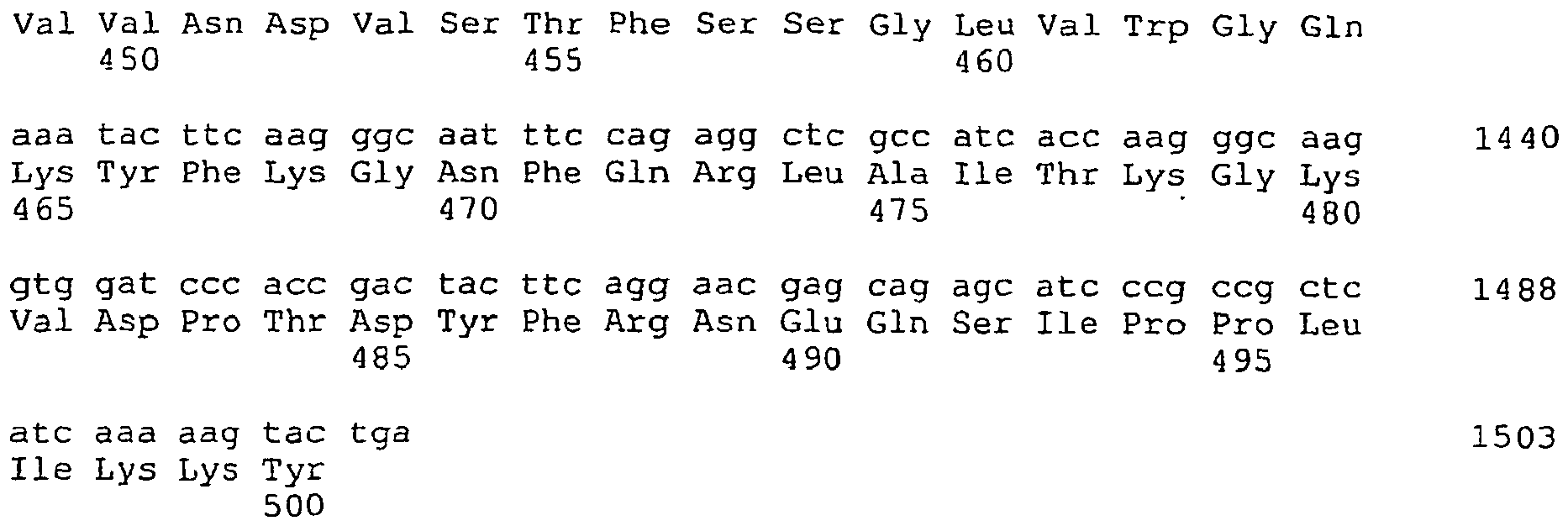
- <210> 2
<211> 500
<212> PRT
<213> Phleum pratense - <400> 2


- <210> 3
<211> 1503
<212> DNA
<213> Phleum pratense - <220>
<221> artificial_DNA_sequence
<222> (1)..(69)
<223> DNA sequence derived from sequenced protein - <220>
<221> native_DNA_sequence
<222> (70)..(1503)
<223> - <220>
<221> CDS
<222> (1)..(1503)
<223> - <400> 3


- <210> 4
<211> 500
<212> PRT
<213> Phleum pratense - <400> 4


- <210> 5
<211> 1503
<212> DNA
<213> Phleum pratense - <220>
<221> artificial_DNA_sequence
<222> (1)..(69)
<223> DNA sequence derived from sequenced protein - <220>
<221> native_DNA_sequence
<222> (70)..(1503)
<223> - <220>
<221> CDS
<222> (1)..(1503)
<223> - <400> 5
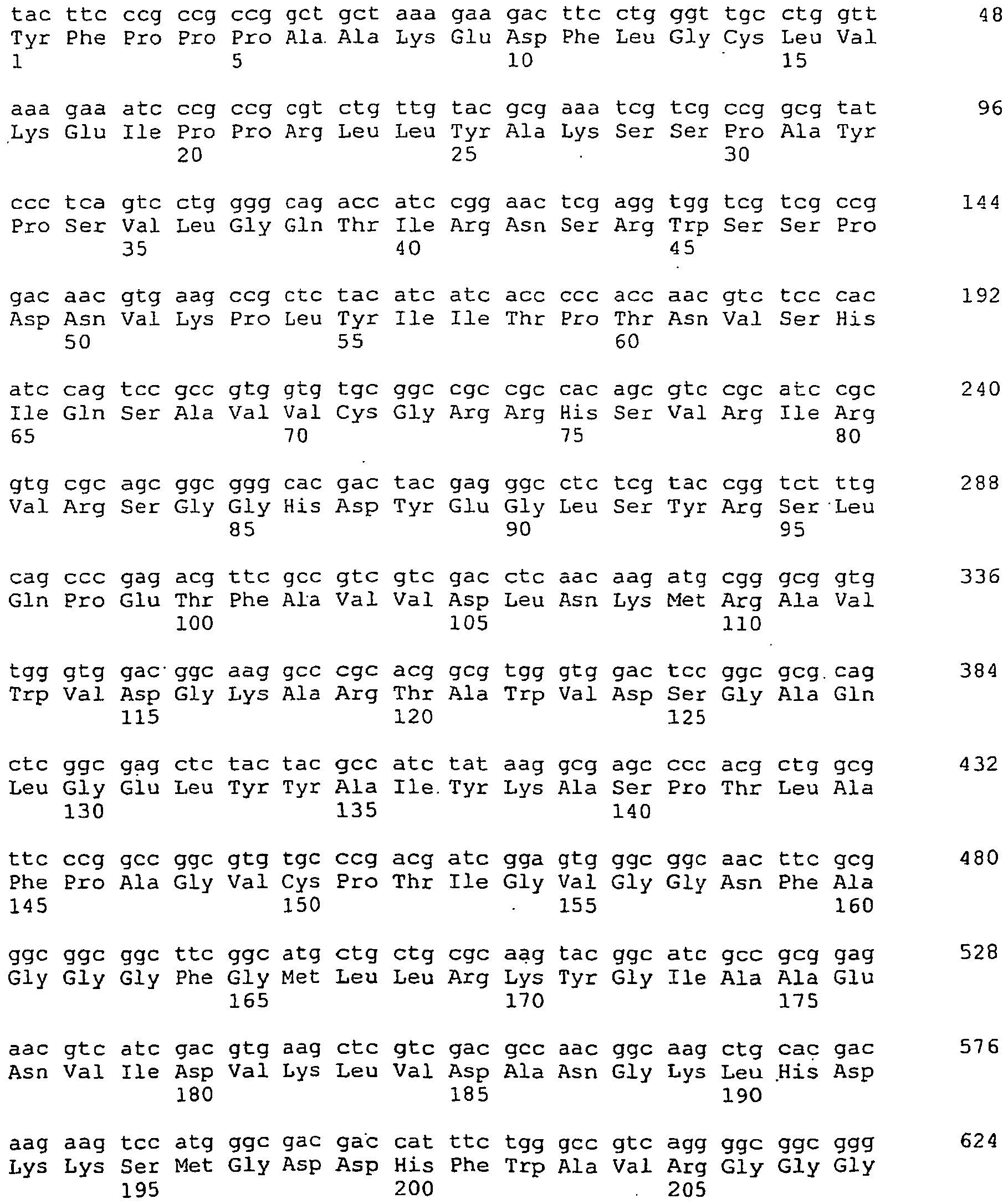


- <210> 6
<211> 500
<212> PRT
<213> Phleum pratense - <400> 6


- <210> 7
<211> 10
<212> PRT
<213> Phleum pratense - <220>
<221> MISC_FEATURE
<222> (6)..(6)
<223> undetermined amino acid - <400> 7

- <210> 8
<211> 14
<212> PRT
<213> Lolium perenne - <400> 8

- <210> 9
<211> 9
<212> PRT
<213> Lolium perenne - <400> 9

- <210> 10
<211> 12
<212> PRT
<213> Dactylus glomerata - <400> 10

- <210> 11
<211> 11
<212> PRT
<213> Dactylus glomerata - <400> 11

- <210> 12
<211> 17
<212> PRT
<213> Dactylus glomerata - <400> 12

- <210> 13
<211> 15
<212> PRT
<213> Dactylus glomerata - <400> 13

- <210> 14
<211> 11
<212> PRT
<213> Cynodon dactylon - <400> 14

- <210> 15
<211> 22
<212> PRT
<213> Cynodon dactylon - <400> 15

- <210> 16
<211> 16
<212> PRT
<213> Cynodon dactylon - <400> 16

- <210> 17
<211> 24
<212> PRT
<213> Cynodon dactylon - <400> 17

- <210> 18
<211> 14
<212> PRT
<213> Cynodon dactylon - <400> 18

- <210> 19
<211> 15
<212> PRT
<213> Cynodon dactylon - <400> 19

- <210> 20
<211> 19
<212> PRT
<213> Cynodon dactylon - <220>
<221> MISC_FEATURE
<222> (8)..(8)
<223> undetermined amino acid - <400> 20
Gly Lys Tyr

- <210> 21
<211> 23
<212> PRT
<213> Cynodon dactylon - <400> 21

- <210> 22
<211> 13
<212> PRT
<213> Cynodon dactylon - <400> 22

- <210> 23
<211> 15
<212> PRT
<213> Cynodon dactylon - <400> 23

- <210> 24
<211> 36
<212> PRT
<213> Cynodon dactylon - <400> 24

- <210> 25
<211> 149
<212> DNA
<213> Phleum pratense - <400> 25

- <210> 26
<211> 299
<212> DNA
<213> Phleum pratense - <400> 26
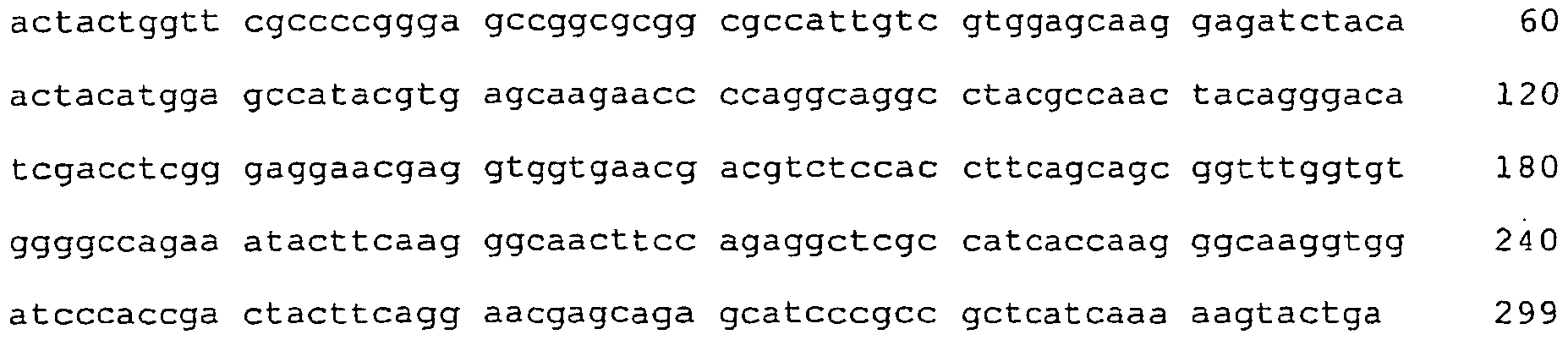
- <210> 27
<211> 33
<212> PRT
<213> Phleum pratense - <220>
<221> MISC_FEATURE
<222> (14)..(14)
<223> undetermined amino acid - <400> 27


- <210> 28
<211> 18
<212> PRT
<213> Phleum pratense - <220>
<221> MISC_FEATURE
<222> (6)..(6)
<223> undetermined amino acid - <400> 28

- <210> 29
<211> 10
<212> PRT
<213> Phleum pratense - <220>
<221> MISC_FEATURE
<222> (3) .. (8)
<223> undetermined amino acid - <400> 29

- <210> 30
<211> 12
<212> PRT
<213> Phleum pratense - <220>
<221> MISC_FEATURE
<222> (2)..(9)
<223> undetermined amino acid - <400> 30

- <210> 31
<211> 9
<212> PRT
<213> Phleum pratense - <400> 31

- <210> 32
<211> 16
<212> PRT
<213> Phleum pratense - <400> 32

- <210> 33
<211> 15
<212> PRT
<213> Phleum pratense - <220>
<221> MISC_FEATURE
<222> (14)..(14)
<223> undetermined amino acid - <400> 33

- <210> 34
<211> 10
<212> PRT
<213> Phleum pratense - <400> 34

- <210> 35
<211> 33
<212> PRT
<213> Phleum pratense - <220>
<221> MISC_FEATURE
<222> (14)..(14)
<223> undetermined amino acid - <400> 35

- <210> 36
<211> 29
<212> PRT
<213> Phleum pratense - <220>
<221> MISC_FEATURE
<222> (14)..(14)
<223> undetermined amino acid - <400> 36

- <210> 37
<211> 15
<212> PRT
<213> Phleum pratense - <220>
<221> MISC_FEATURE
<222> (4)..(14)
<223> undetermined amino acid - <400> 37

- <210> 38
<211> 15
<212> PRT
<213> Phleum pratense - <220>
<221> MISC_FEATURE
<222> (4)..(14)
<223> undetermined amino acid - <400> 38

- <210> 39
<211> 15
<212> PRT
<213> Phleum pratense - <220>
<221> MISC_FEATURE
<222> (4)..(14)
<223> undetermined amino acid - <400> 39

- <210> 40
<211> 11
<212> PRT
<213> Phleum pratense - <220>
<221> MISC_FEATURE
<222> (4)..(5)
<223> undetermined amino acid - <400> 40

- <210> 41
<211> 18
<212> PRT
<213> Phleum pratense - <220>
<221> MISC_FEATURE
<222> (6)..(6)
<223> undetermined amino acid - <400> 41

- <210> 42
<211> 10
<212> PRT
<213> Phleum pratense - <220>
<221> MISC_FEATURE
<222> (3)..(8)
<223> undetermined amino acid - <400> 42

- <210> 43
<211> 12
<212> PRT
<213> Phleum pratense - <220>
<221> MISC_FEATURE
<222> (2)..(9)
<223> undetermined amino acid - <400> 43

- <210> 44
<211> 9
<212> PRT
<213> Phleum pratense - <400> 44

- <210> 45
<211> 16
<212> PRT
<213> Phleum pratense - <400> 45

- <210> 46
<211> 29
<212> DNA
<213> Phleum pratense - <220>
<221> misc_feature
<222> (1)..(29)
<223> 'n' means inosin - <400> 46
ytntaygcna arwsnwsncc ngcntaycc 29 - <210> 47
<211> 28
<212> DNA
<213> Phleum pratense - <220>
<221> misc_feature
<222> (1)..(28)
<223> 'n' means inosin - <400> 47
caymgnaarg gngtnytntt yaayatmc 28 - <210> 48
<211> 26
<212> DNA
<213> Phleum pratense - <220>
<221> misc_feature
<222> (1)..(26)
<223> 'n' means inosin - <400> 48
tarttngcrt angcytgnac nggrtt 26 - <210> 49
<211> 23
<212> DNA
<213> Phleum pratense - <400> 49
actactggtt cgccccggga gcc 23 - <210> 50
<211> 28
<212> DNA
<213> Phleum pratense - <400> 50
tgaagtattt ctggccccac accaaacc 28 - <210> 51
<211> 24
<212> DNA
<213> Phleum pratense - <400> 51
cccttggtga tggcgagcct ctgg 24 - <210> 52
<211> 23
<212> DNA
<213> Phleum pratense - <400> 52
ctcagtcctg gggcagacca tcc 23
Claims (10)
- Ein DNA-Molekül entsprechend einer Nukleotidsequenz, ausgewählt aus einer Gruppe bestehend aus SEQ ID NO 1, SEQ ID NO 3 und SEQ ID NO 5.
- Ein DNA-Molekül, umfassend eine Nukleotidsequenz gemäß Anspruch 1 beginnend mit der Position 70, welches für ein Polypeptid mit den Eigenschaften des Majorallergens Phl p 4 aus Phleum pratense kodiert.
- Ein DNA-Molekül mit einer Nukleotidsequenz gemäß Anspruch 1 beginnend mit der Position 70, welches für ein Polypeptid mit den Eigenschaften des Majorallergens Phl p 4 aus Phleum pratense kodiert.
- Ein DNA-Molekül, das mit einem DNA-Molekül gemäß Anspruch 1 oder 2 unter stringenten Bedingungen hybridisiert und von DNA-Sequenzen von Poaceae-Spezies abstammt.
- Ein DNA-Molekül, kodierend für ein Polypeptid, dadurch gekennzeichnet, dass das Polypeptid ausgewählt ist aus der Gruppe bestehend aus- ein Polypeptid mit der Aminosäuresequenz ausgewählt aus der Gruppe bestehend aus SEQ ID NO 2, SEQ ID NO 4 und SEQ ID NO 6,- ein Polypeptid mit der Aminosäuresequenz SEQ ID NO 2 mit den Aminosäureabweichungen gemäß Klon 1 bis 11:- Klon 1: L54, I57, V62, S76, T100, N107, Y137, P141, T142, K189, Q219, K221, L227, I231, S235, T237, V238, K248, A258, I264, K270, K282, L287, P299, A321 , L322, S332, Q346, P347, T351, L357, N358, V362, S384, A410, D419, Y456, A457, K460, E472,- Klon 2: L54, I57, V62, T76, T100, N107, Y137, P141, T142, K189, Q219, K221, I231, S235, T237, V238, K248, A258, I264, K270, K282, L287, P299, A321, L322, S332, Q346, P347, T351, L357, N358, V362, S384, A410, D419, Y456, A457, K460, E472,- Klon 3: P141, K282, L287, P299, L347, E351,- Klon 4: G289, A410, D419, Y456, A457, K460, E472,- Klon 5: L347, E351, S384, A410, D419, Y456, A457, K460, E472,- Klon 6: N107, Y137, P141, T142, K189, Q219, K221, I231, S235, T237, V238, K248, A258, 1264, K270, K282, L287, P299, A321, L322, S332, Q346, P347, T351, L357, N358, V362, S384, A410, D419, Y456, A457, K460,- Klon 7: K248, A258, 1264, K270, K282, L287, P299, A321, L322, S332, Q346, P347, T351, L357, N358, V362, S384,- Klon 8: Q219, K221, 1231, S235, T237, V238, K248, A258, 1264, K270, K282, L287, P299, E351,- Klon 9: M231, T246, A251, C263, G289, L307, L309, E334,- Klon 10: Q219, K221, 1231, S235, T237, M238, V242, V246, K248, A258, I264, K270, K282, L287, P299, A321, L322, S332, Q346, P347, T351, N358, V362, S384, Insertion von GA zwischen den Positionen 407 und 408, N452, Y456, A457, K460, E472,- Klon 11: Insertion von GA zwischen den Positionen 407 und 408.
- Ein DNA-Molekül, entsprechend einer Teilsequenz oder einer Kombination von Teilsequenzen nach einem oder mehreren der Ansprüche 1 bis 5, welche für ein immunmodulatorisches, T-Zell-reaktives Fragment von Phl p 4 kodiert, ausgewählt aus der Gruppe bestehend aus- Fragment 1-200, mit den Aminosäuren 1-200 des Phl p 4 und- Fragment 185-500, mit den Aminosäuren 185-500 des Phl p 4.
- Ein DNA-Molekül, entsprechend einer Nukleotidsequenz gemäß einem oder mehreren der Ansprüche 1 bis 6, kodierend für ein immunmodulatorisches T-Zell reaktives Fragment, dadurch gekennzeichnet, dass besagte Nukleotidsequenz durch gezielten Austausch eines, mehrerer oder aller Cysteine des entsprechenden Polypeptids gegen eine andere Aminosäure gezielt verändert wurde.
- Ein rekombinanter DNA-Expressionsvektor, enthaltend ein DNA-Molekül gemäß einem oder mehreren der Ansprüche 1 bis 7, funktionell verbunden mit einer Expressionskontrollsequenz.
- Ein Wirtsorganismus, transformiert mit einem DNA-Molekül gemäß einem oder mehreren der Ansprüche 1 bis 7 oder einem Expressionsvektor gemäß Anspruch 8.
- Ein rekombinant hergestelltes Polypeptid, welches von einer DNA-Sequenz gemäß einem oder mehreren der Ansprüche 1, 3, 4, 5, 6 und 7 kodiert wird.
Priority Applications (2)
| Application Number | Priority Date | Filing Date | Title |
|---|---|---|---|
| EP03740216A EP1515988B1 (de) | 2002-06-25 | 2003-06-11 | Dna-sequenz und rekombinante herstellung des graspollen-allergens phl p4 |
| EP11005620.7A EP2392591B1 (de) | 2002-06-25 | 2003-06-11 | DNA-Sequenz und rekombinante Herstellung des Graspollen-Allergens Phl p 4 |
Applications Claiming Priority (4)
| Application Number | Priority Date | Filing Date | Title |
|---|---|---|---|
| EP02013953 | 2002-06-25 | ||
| EP02013953 | 2002-06-25 | ||
| EP03740216A EP1515988B1 (de) | 2002-06-25 | 2003-06-11 | Dna-sequenz und rekombinante herstellung des graspollen-allergens phl p4 |
| PCT/EP2003/006092 WO2004000881A1 (de) | 2002-06-25 | 2003-06-11 | Dna-sequenz und rekombinante herstellung des graspollen-allergens phl p4 |
Related Child Applications (2)
| Application Number | Title | Priority Date | Filing Date |
|---|---|---|---|
| EP11005620.7A Division EP2392591B1 (de) | 2002-06-25 | 2003-06-11 | DNA-Sequenz und rekombinante Herstellung des Graspollen-Allergens Phl p 4 |
| EP11005620.7 Division-Into | 2011-07-08 |
Publications (2)
| Publication Number | Publication Date |
|---|---|
| EP1515988A1 EP1515988A1 (de) | 2005-03-23 |
| EP1515988B1 true EP1515988B1 (de) | 2012-03-21 |
Family
ID=29797135
Family Applications (2)
| Application Number | Title | Priority Date | Filing Date |
|---|---|---|---|
| EP11005620.7A Expired - Lifetime EP2392591B1 (de) | 2002-06-25 | 2003-06-11 | DNA-Sequenz und rekombinante Herstellung des Graspollen-Allergens Phl p 4 |
| EP03740216A Revoked EP1515988B1 (de) | 2002-06-25 | 2003-06-11 | Dna-sequenz und rekombinante herstellung des graspollen-allergens phl p4 |
Family Applications Before (1)
| Application Number | Title | Priority Date | Filing Date |
|---|---|---|---|
| EP11005620.7A Expired - Lifetime EP2392591B1 (de) | 2002-06-25 | 2003-06-11 | DNA-Sequenz und rekombinante Herstellung des Graspollen-Allergens Phl p 4 |
Country Status (13)
| Country | Link |
|---|---|
| US (3) | US8128935B2 (de) |
| EP (2) | EP2392591B1 (de) |
| JP (1) | JP2006510346A (de) |
| CN (1) | CN100391970C (de) |
| AT (1) | ATE550349T1 (de) |
| AU (1) | AU2003279352B2 (de) |
| BR (1) | BR0312068A (de) |
| CA (1) | CA2491038C (de) |
| ES (2) | ES2384045T3 (de) |
| PL (2) | PL215097B1 (de) |
| PT (2) | PT1515988E (de) |
| RU (1) | RU2327739C2 (de) |
| WO (1) | WO2004000881A1 (de) |
Families Citing this family (6)
| Publication number | Priority date | Publication date | Assignee | Title |
|---|---|---|---|---|
| DE10359352A1 (de) | 2003-12-16 | 2005-07-21 | Merck Patent Gmbh | DNA-Sequenz und rekombinante Herstellung des Graspollen-Allergens Lol p 4 |
| DE10359351A1 (de) | 2003-12-16 | 2005-07-21 | Merck Patent Gmbh | DNA-Sequenz und rekombinante Herstellung von Gruppe-4 Majorallergenen aus Getreiden |
| AU2013204574B2 (en) * | 2003-12-16 | 2015-02-26 | Merck Patent Gmbh | DNA-sequence and recombinant production of group 4 major allergens from cereals |
| AU2011202726B2 (en) * | 2003-12-16 | 2012-04-26 | Merck Patent Gmbh | DNA-sequence and recombinant production of group 4 major allergens from cereals |
| EP2523684A1 (de) * | 2010-01-14 | 2012-11-21 | Merck Patent GmbH | Varianten der gruppe 6-allergene der süssgräser mit reduzierter allergenität durch mutagenese von prolinresten |
| BR112014019504A2 (pt) * | 2012-02-07 | 2017-06-27 | La Jolla Inst Allergy & Immunology | alérgenos da erva-dos-prados e métodos e usos para modulação de resposta imune |
Family Cites Families (1)
| Publication number | Priority date | Publication date | Assignee | Title |
|---|---|---|---|---|
| US20030135888A1 (en) * | 2001-09-26 | 2003-07-17 | Tong Zhu | Genes that are modulated by posttranscriptional gene silencing |
-
2003
- 2003-06-11 ES ES03740216T patent/ES2384045T3/es not_active Expired - Lifetime
- 2003-06-11 WO PCT/EP2003/006092 patent/WO2004000881A1/de not_active Ceased
- 2003-06-11 PT PT03740216T patent/PT1515988E/pt unknown
- 2003-06-11 EP EP11005620.7A patent/EP2392591B1/de not_active Expired - Lifetime
- 2003-06-11 JP JP2004514687A patent/JP2006510346A/ja active Pending
- 2003-06-11 ES ES11005620.7T patent/ES2670573T3/es not_active Expired - Lifetime
- 2003-06-11 CN CNB038151782A patent/CN100391970C/zh not_active Expired - Fee Related
- 2003-06-11 RU RU2005101744/13A patent/RU2327739C2/ru not_active IP Right Cessation
- 2003-06-11 BR BR0312068-6A patent/BR0312068A/pt not_active Application Discontinuation
- 2003-06-11 AU AU2003279352A patent/AU2003279352B2/en not_active Ceased
- 2003-06-11 US US10/518,927 patent/US8128935B2/en not_active Expired - Fee Related
- 2003-06-11 CA CA2491038A patent/CA2491038C/en not_active Expired - Fee Related
- 2003-06-11 PL PL372423A patent/PL215097B1/pl unknown
- 2003-06-11 PT PT110056207T patent/PT2392591T/pt unknown
- 2003-06-11 EP EP03740216A patent/EP1515988B1/de not_active Revoked
- 2003-06-11 AT AT03740216T patent/ATE550349T1/de active
- 2003-06-11 PL PL400683A patent/PL219272B1/pl unknown
-
2011
- 2011-02-24 US US13/034,210 patent/US9120866B2/en not_active Expired - Fee Related
-
2014
- 2014-11-21 US US14/550,370 patent/US9556241B2/en not_active Expired - Fee Related
Non-Patent Citations (3)
| Title |
|---|
| ANDERSSON ET AL: "Characteristics and immunobiology of grass pollen allergens", INTERNATIONAL ARCHIVES OF ALLERGY AND IMMUNOLOGY, KARGER AG, CH, vol. 130, 1 January 2003 (2003-01-01), pages 87 - 107, XP009137010, ISSN: 1018-2438, DOI: DOI:10.1159/000069013 * |
| LEDUC-BRODARD V ET AL: "CHARACTERIZATION OF DAC G 4, A MAJOR BASIC ALLERGEN FROM DACTYLIS GLOMERATA POLLEN", JOURNAL OF ALLERGY AND CLINICAL IMMUNOLOGY, MOSBY, INC, US, vol. 98, no. 6, PART 01, 1 January 1996 (1996-01-01), pages 1065 - 1072, XP009032626, ISSN: 0091-6749, DOI: DOI:10.1016/S0091-6749(96)80193-X * |
| NANDY A ET AL: "Primary structure, recombinant expression, and molecular characterization of Phl p 4, a major allergen of timothy grass (Phleum pratense)", BIOCHEMICAL AND BIOPHYSICAL RESEARCH COMMUNICATIONS, ACADEMIC PRESS INC. ORLANDO, FL, US, vol. 337, no. 2, 18 November 2005 (2005-11-18), pages 563 - 570, XP027218637, ISSN: 0006-291X, [retrieved on 20051011] * |
Also Published As
| Publication number | Publication date |
|---|---|
| EP1515988A1 (de) | 2005-03-23 |
| US20060177470A1 (en) | 2006-08-10 |
| JP2006510346A (ja) | 2006-03-30 |
| CA2491038A1 (en) | 2003-12-31 |
| ES2670573T3 (es) | 2018-05-31 |
| CA2491038C (en) | 2017-04-25 |
| AU2003279352A1 (en) | 2004-01-06 |
| AU2003279352B2 (en) | 2009-09-10 |
| RU2005101744A (ru) | 2005-06-27 |
| PL215097B1 (pl) | 2013-10-31 |
| US20120288526A1 (en) | 2012-11-15 |
| US9556241B2 (en) | 2017-01-31 |
| EP2392591B1 (de) | 2018-02-21 |
| PT2392591T (pt) | 2018-05-23 |
| PL219272B1 (pl) | 2015-04-30 |
| CN100391970C (zh) | 2008-06-04 |
| WO2004000881A1 (de) | 2003-12-31 |
| EP2392591A1 (de) | 2011-12-07 |
| CN1665835A (zh) | 2005-09-07 |
| US20150079120A1 (en) | 2015-03-19 |
| US8128935B2 (en) | 2012-03-06 |
| RU2327739C2 (ru) | 2008-06-27 |
| WO2004000881A9 (de) | 2004-02-26 |
| US9120866B2 (en) | 2015-09-01 |
| PT1515988E (pt) | 2012-06-25 |
| ES2384045T3 (es) | 2012-06-28 |
| PL400683A1 (pl) | 2013-02-04 |
| PL372423A1 (en) | 2005-07-25 |
| ATE550349T1 (de) | 2012-04-15 |
| BR0312068A (pt) | 2005-03-29 |
Similar Documents
| Publication | Publication Date | Title |
|---|---|---|
| US9556241B2 (en) | DNA sequence and preparation of grass pollen allergen Phl p 4 by recombinant methods | |
| EP1709064B1 (de) | Dna-sequenz und rekombinante herstellung des graspollen-allergens lol p 4 | |
| EP1171604B1 (de) | Dna-sequenz und rekombinante herstellung eines graminaen-allergens | |
| EP1629006B1 (de) | Phl p 5a-derivate mit reduzierter allergenität und erhaltener t-zellreaktivität | |
| EP1768996B1 (de) | Varianten der gruppe 1-allergene aus poaceae mit reduzierter allergenität und erhaltener t-zellreaktivität | |
| EP2261337B1 (de) | DNA-Sequenz und rekombinante Herstellung von Gruppe-4 Majorallergenen aus Getreiden | |
| DE60022069T3 (de) | Nicht-anaphylaktische formen des grasspollenallergens ph1 p 6 und deren verwendung |
Legal Events
| Date | Code | Title | Description |
|---|---|---|---|
| PUAI | Public reference made under article 153(3) epc to a published international application that has entered the european phase |
Free format text: ORIGINAL CODE: 0009012 |
|
| 17P | Request for examination filed |
Effective date: 20041110 |
|
| AK | Designated contracting states |
Kind code of ref document: A1 Designated state(s): AT BE BG CH CY CZ DE DK EE ES FI FR GB GR HU IE IT LI LU MC NL PT RO SE SI SK TR |
|
| AX | Request for extension of the european patent |
Extension state: AL LT LV MK |
|
| DAX | Request for extension of the european patent (deleted) | ||
| 17Q | First examination report despatched |
Effective date: 20090710 |
|
| DAC | Divisional application: reference to earlier application (deleted) | ||
| GRAP | Despatch of communication of intention to grant a patent |
Free format text: ORIGINAL CODE: EPIDOSNIGR1 |
|
| GRAS | Grant fee paid |
Free format text: ORIGINAL CODE: EPIDOSNIGR3 |
|
| GRAA | (expected) grant |
Free format text: ORIGINAL CODE: 0009210 |
|
| AK | Designated contracting states |
Kind code of ref document: B1 Designated state(s): AT BE BG CH CY CZ DE DK EE ES FI FR GB GR HU IE IT LI LU MC NL PT RO SE SI SK TR |
|
| REG | Reference to a national code |
Ref country code: GB Ref legal event code: FG4D Free format text: NOT ENGLISH |
|
| REG | Reference to a national code |
Ref country code: CH Ref legal event code: EP |
|
| REG | Reference to a national code |
Ref country code: IE Ref legal event code: FG4D Free format text: LANGUAGE OF EP DOCUMENT: GERMAN |
|
| REG | Reference to a national code |
Ref country code: AT Ref legal event code: REF Ref document number: 550349 Country of ref document: AT Kind code of ref document: T Effective date: 20120415 |
|
| REG | Reference to a national code |
Ref country code: DE Ref legal event code: R096 Ref document number: 50314277 Country of ref document: DE Effective date: 20120516 |
|
| REG | Reference to a national code |
Ref country code: SE Ref legal event code: TRGR |
|
| REG | Reference to a national code |
Ref country code: PT Ref legal event code: SC4A Free format text: AVAILABILITY OF NATIONAL TRANSLATION Effective date: 20120615 |
|
| REG | Reference to a national code |
Ref country code: NL Ref legal event code: T3 |
|
| REG | Reference to a national code |
Ref country code: ES Ref legal event code: FG2A Ref document number: 2384045 Country of ref document: ES Kind code of ref document: T3 Effective date: 20120628 |
|
| PG25 | Lapsed in a contracting state [announced via postgrant information from national office to epo] |
Ref country code: FI Free format text: LAPSE BECAUSE OF FAILURE TO SUBMIT A TRANSLATION OF THE DESCRIPTION OR TO PAY THE FEE WITHIN THE PRESCRIBED TIME-LIMIT Effective date: 20120321 |
|
| REG | Reference to a national code |
Ref country code: GR Ref legal event code: EP Ref document number: 20120401265 Country of ref document: GR Effective date: 20120713 |
|
| PG25 | Lapsed in a contracting state [announced via postgrant information from national office to epo] |
Ref country code: CY Free format text: LAPSE BECAUSE OF FAILURE TO SUBMIT A TRANSLATION OF THE DESCRIPTION OR TO PAY THE FEE WITHIN THE PRESCRIBED TIME-LIMIT Effective date: 20120321 |
|
| PG25 | Lapsed in a contracting state [announced via postgrant information from national office to epo] |
Ref country code: EE Free format text: LAPSE BECAUSE OF FAILURE TO SUBMIT A TRANSLATION OF THE DESCRIPTION OR TO PAY THE FEE WITHIN THE PRESCRIBED TIME-LIMIT Effective date: 20120321 Ref country code: SI Free format text: LAPSE BECAUSE OF FAILURE TO SUBMIT A TRANSLATION OF THE DESCRIPTION OR TO PAY THE FEE WITHIN THE PRESCRIBED TIME-LIMIT Effective date: 20120321 Ref country code: CZ Free format text: LAPSE BECAUSE OF FAILURE TO SUBMIT A TRANSLATION OF THE DESCRIPTION OR TO PAY THE FEE WITHIN THE PRESCRIBED TIME-LIMIT Effective date: 20120321 Ref country code: RO Free format text: LAPSE BECAUSE OF FAILURE TO SUBMIT A TRANSLATION OF THE DESCRIPTION OR TO PAY THE FEE WITHIN THE PRESCRIBED TIME-LIMIT Effective date: 20120321 |
|
| PG25 | Lapsed in a contracting state [announced via postgrant information from national office to epo] |
Ref country code: SK Free format text: LAPSE BECAUSE OF FAILURE TO SUBMIT A TRANSLATION OF THE DESCRIPTION OR TO PAY THE FEE WITHIN THE PRESCRIBED TIME-LIMIT Effective date: 20120321 |
|
| BERE | Be: lapsed |
Owner name: MERCK PATENT G.M.B.H. Effective date: 20120630 |
|
| PLBI | Opposition filed |
Free format text: ORIGINAL CODE: 0009260 |
|
| PLAX | Notice of opposition and request to file observation + time limit sent |
Free format text: ORIGINAL CODE: EPIDOSNOBS2 |
|
| PG25 | Lapsed in a contracting state [announced via postgrant information from national office to epo] |
Ref country code: DK Free format text: LAPSE BECAUSE OF FAILURE TO SUBMIT A TRANSLATION OF THE DESCRIPTION OR TO PAY THE FEE WITHIN THE PRESCRIBED TIME-LIMIT Effective date: 20120321 Ref country code: MC Free format text: LAPSE BECAUSE OF NON-PAYMENT OF DUE FEES Effective date: 20120630 |
|
| 26 | Opposition filed |
Opponent name: ALK-ABELLO A/S Effective date: 20121221 |
|
| REG | Reference to a national code |
Ref country code: IE Ref legal event code: MM4A |
|
| REG | Reference to a national code |
Ref country code: DE Ref legal event code: R026 Ref document number: 50314277 Country of ref document: DE Effective date: 20121221 |
|
| PG25 | Lapsed in a contracting state [announced via postgrant information from national office to epo] |
Ref country code: BE Free format text: LAPSE BECAUSE OF NON-PAYMENT OF DUE FEES Effective date: 20120630 Ref country code: IE Free format text: LAPSE BECAUSE OF NON-PAYMENT OF DUE FEES Effective date: 20120611 |
|
| PLBB | Reply of patent proprietor to notice(s) of opposition received |
Free format text: ORIGINAL CODE: EPIDOSNOBS3 |
|
| PG25 | Lapsed in a contracting state [announced via postgrant information from national office to epo] |
Ref country code: BG Free format text: LAPSE BECAUSE OF FAILURE TO SUBMIT A TRANSLATION OF THE DESCRIPTION OR TO PAY THE FEE WITHIN THE PRESCRIBED TIME-LIMIT Effective date: 20120621 |
|
| PG25 | Lapsed in a contracting state [announced via postgrant information from national office to epo] |
Ref country code: LU Free format text: LAPSE BECAUSE OF NON-PAYMENT OF DUE FEES Effective date: 20120611 |
|
| PG25 | Lapsed in a contracting state [announced via postgrant information from national office to epo] |
Ref country code: HU Free format text: LAPSE BECAUSE OF FAILURE TO SUBMIT A TRANSLATION OF THE DESCRIPTION OR TO PAY THE FEE WITHIN THE PRESCRIBED TIME-LIMIT Effective date: 20030611 |
|
| APBM | Appeal reference recorded |
Free format text: ORIGINAL CODE: EPIDOSNREFNO |
|
| APBP | Date of receipt of notice of appeal recorded |
Free format text: ORIGINAL CODE: EPIDOSNNOA2O |
|
| APAH | Appeal reference modified |
Free format text: ORIGINAL CODE: EPIDOSCREFNO |
|
| APAH | Appeal reference modified |
Free format text: ORIGINAL CODE: EPIDOSCREFNO |
|
| REG | Reference to a national code |
Ref country code: FR Ref legal event code: PLFP Year of fee payment: 14 |
|
| REG | Reference to a national code |
Ref country code: FR Ref legal event code: PLFP Year of fee payment: 15 |
|
| REG | Reference to a national code |
Ref country code: FR Ref legal event code: PLFP Year of fee payment: 16 |
|
| PGFP | Annual fee paid to national office [announced via postgrant information from national office to epo] |
Ref country code: CH Payment date: 20180614 Year of fee payment: 16 Ref country code: DE Payment date: 20180530 Year of fee payment: 16 Ref country code: PT Payment date: 20180608 Year of fee payment: 16 |
|
| PGFP | Annual fee paid to national office [announced via postgrant information from national office to epo] |
Ref country code: GR Payment date: 20180510 Year of fee payment: 16 Ref country code: NL Payment date: 20180514 Year of fee payment: 16 Ref country code: FR Payment date: 20180511 Year of fee payment: 16 Ref country code: TR Payment date: 20180611 Year of fee payment: 16 Ref country code: AT Payment date: 20180525 Year of fee payment: 16 |
|
| PGFP | Annual fee paid to national office [announced via postgrant information from national office to epo] |
Ref country code: SE Payment date: 20180612 Year of fee payment: 16 |
|
| PGFP | Annual fee paid to national office [announced via postgrant information from national office to epo] |
Ref country code: GB Payment date: 20180403 Year of fee payment: 16 Ref country code: IT Payment date: 20180625 Year of fee payment: 16 Ref country code: ES Payment date: 20180703 Year of fee payment: 16 |
|
| APBU | Appeal procedure closed |
Free format text: ORIGINAL CODE: EPIDOSNNOA9O |
|
| RDAF | Communication despatched that patent is revoked |
Free format text: ORIGINAL CODE: EPIDOSNREV1 |
|
| STAA | Information on the status of an ep patent application or granted ep patent |
Free format text: STATUS: THE PATENT HAS BEEN GRANTED |
|
| REG | Reference to a national code |
Ref country code: DE Ref legal event code: R064 Ref document number: 50314277 Country of ref document: DE Ref country code: DE Ref legal event code: R103 Ref document number: 50314277 Country of ref document: DE |
|
| REG | Reference to a national code |
Ref country code: DE Ref legal event code: R119 Ref document number: 50314277 Country of ref document: DE |
|
| REG | Reference to a national code |
Ref country code: SE Ref legal event code: EUG |
|
| PG25 | Lapsed in a contracting state [announced via postgrant information from national office to epo] |
Ref country code: PT Free format text: LAPSE BECAUSE OF NON-PAYMENT OF DUE FEES Effective date: 20191211 Ref country code: SE Free format text: LAPSE BECAUSE OF NON-PAYMENT OF DUE FEES Effective date: 20190612 |
|
| REG | Reference to a national code |
Ref country code: CH Ref legal event code: PL |
|
| REG | Reference to a national code |
Ref country code: NL Ref legal event code: MM Effective date: 20190701 |
|
| REG | Reference to a national code |
Ref country code: AT Ref legal event code: MM01 Ref document number: 550349 Country of ref document: AT Kind code of ref document: T Effective date: 20190611 |
|
| GBPC | Gb: european patent ceased through non-payment of renewal fee |
Effective date: 20190611 |
|
| RDAG | Patent revoked |
Free format text: ORIGINAL CODE: 0009271 |
|
| STAA | Information on the status of an ep patent application or granted ep patent |
Free format text: STATUS: PATENT REVOKED |
|
| REG | Reference to a national code |
Ref country code: FI Ref legal event code: MGE |
|
| 27W | Patent revoked |
Effective date: 20191219 |
|
| PG25 | Lapsed in a contracting state [announced via postgrant information from national office to epo] |
Ref country code: NL Free format text: LAPSE BECAUSE OF NON-PAYMENT OF DUE FEES Effective date: 20190701 Ref country code: IT Free format text: LAPSE BECAUSE OF NON-PAYMENT OF DUE FEES Effective date: 20190611 Ref country code: GB Free format text: LAPSE BECAUSE OF NON-PAYMENT OF DUE FEES Effective date: 20190611 Ref country code: AT Free format text: LAPSE BECAUSE OF NON-PAYMENT OF DUE FEES Effective date: 20190611 |
|
| PG25 | Lapsed in a contracting state [announced via postgrant information from national office to epo] |
Ref country code: LI Free format text: LAPSE BECAUSE OF NON-PAYMENT OF DUE FEES Effective date: 20190630 Ref country code: CH Free format text: LAPSE BECAUSE OF NON-PAYMENT OF DUE FEES Effective date: 20190630 |
|
| PG25 | Lapsed in a contracting state [announced via postgrant information from national office to epo] |
Ref country code: FR Free format text: LAPSE BECAUSE OF NON-PAYMENT OF DUE FEES Effective date: 20190630 |
|
| REG | Reference to a national code |
Ref country code: AT Ref legal event code: MA03 Ref document number: 550349 Country of ref document: AT Kind code of ref document: T Effective date: 20191219 |
|
| PG25 | Lapsed in a contracting state [announced via postgrant information from national office to epo] |
Ref country code: TR Free format text: LAPSE BECAUSE OF NON-PAYMENT OF DUE FEES Effective date: 20190611 |
|
| PG25 | Lapsed in a contracting state [announced via postgrant information from national office to epo] |
Ref country code: ES Free format text: LAPSE BECAUSE OF NON-PAYMENT OF DUE FEES Effective date: 20190612 |
|
| PG25 | Lapsed in a contracting state [announced via postgrant information from national office to epo] |
Ref country code: ES Free format text: LAPSE BECAUSE OF NON-PAYMENT OF DUE FEES Effective date: 20190612 |