EP1515723B1 - Substituted dihydropyrimidones and dihydropyrimidinethiones as calcium channel blockers - Google Patents
Substituted dihydropyrimidones and dihydropyrimidinethiones as calcium channel blockers Download PDFInfo
- Publication number
- EP1515723B1 EP1515723B1 EP03736988.1A EP03736988A EP1515723B1 EP 1515723 B1 EP1515723 B1 EP 1515723B1 EP 03736988 A EP03736988 A EP 03736988A EP 1515723 B1 EP1515723 B1 EP 1515723B1
- Authority
- EP
- European Patent Office
- Prior art keywords
- methyl
- ppk
- ethoxy
- group
- pentadecylphenyl
- Prior art date
- Legal status (The legal status is an assumption and is not a legal conclusion. Google has not performed a legal analysis and makes no representation as to the accuracy of the status listed.)
- Expired - Lifetime
Links
- 229940127291 Calcium channel antagonist Drugs 0.000 title description 10
- 239000000480 calcium channel blocker Substances 0.000 title description 5
- 150000001875 compounds Chemical class 0.000 claims description 123
- 125000002496 methyl group Chemical group [H]C([H])([H])* 0.000 claims description 90
- 125000000217 alkyl group Chemical group 0.000 claims description 77
- -1 methoxy, ethoxy Chemical group 0.000 claims description 58
- 239000001257 hydrogen Substances 0.000 claims description 34
- 229910052739 hydrogen Inorganic materials 0.000 claims description 34
- 125000004435 hydrogen atom Chemical group [H]* 0.000 claims description 34
- 125000001495 ethyl group Chemical group [H]C([H])([H])C([H])([H])* 0.000 claims description 22
- 125000004432 carbon atom Chemical group C* 0.000 claims description 20
- 150000003839 salts Chemical class 0.000 claims description 17
- 108090000312 Calcium Channels Proteins 0.000 claims description 14
- 102000003922 Calcium Channels Human genes 0.000 claims description 14
- 238000000034 method Methods 0.000 claims description 14
- 150000002148 esters Chemical class 0.000 claims description 13
- 239000008194 pharmaceutical composition Substances 0.000 claims description 13
- 230000000694 effects Effects 0.000 claims description 12
- QVGXLLKOCUKJST-UHFFFAOYSA-N atomic oxygen Chemical group [O] QVGXLLKOCUKJST-UHFFFAOYSA-N 0.000 claims description 11
- 229910052760 oxygen Inorganic materials 0.000 claims description 11
- 239000001301 oxygen Substances 0.000 claims description 11
- 125000001449 isopropyl group Chemical group [H]C([H])([H])C([H])(*)C([H])([H])[H] 0.000 claims description 10
- 239000003085 diluting agent Substances 0.000 claims description 8
- 201000010099 disease Diseases 0.000 claims description 8
- 208000037265 diseases, disorders, signs and symptoms Diseases 0.000 claims description 8
- 125000004108 n-butyl group Chemical group [H]C([H])([H])C([H])([H])C([H])([H])C([H])([H])* 0.000 claims description 8
- 125000001147 pentyl group Chemical group C(CCCC)* 0.000 claims description 8
- 125000002914 sec-butyl group Chemical group [H]C([H])([H])C([H])([H])C([H])(*)C([H])([H])[H] 0.000 claims description 8
- 125000000999 tert-butyl group Chemical group [H]C([H])([H])C(*)(C([H])([H])[H])C([H])([H])[H] 0.000 claims description 8
- 125000004123 n-propyl group Chemical group [H]C([H])([H])C([H])([H])C([H])([H])* 0.000 claims description 7
- 239000000546 pharmaceutical excipient Substances 0.000 claims description 7
- NINIDFKCEFEMDL-UHFFFAOYSA-N Sulfur Chemical group [S] NINIDFKCEFEMDL-UHFFFAOYSA-N 0.000 claims description 6
- 229910052717 sulfur Chemical group 0.000 claims description 6
- 239000011593 sulfur Chemical group 0.000 claims description 6
- 208000024172 Cardiovascular disease Diseases 0.000 claims description 5
- 150000001408 amides Chemical class 0.000 claims description 5
- RXDCDXXFSYRXPE-UHFFFAOYSA-N ethyl 4-(2-ethoxy-6-pentadecylphenyl)-6-methyl-2-oxo-3,4-dihydro-1h-pyrimidine-5-carboxylate Chemical compound CCCCCCCCCCCCCCCC1=CC=CC(OCC)=C1C1C(C(=O)OCC)=C(C)NC(=O)N1 RXDCDXXFSYRXPE-UHFFFAOYSA-N 0.000 claims description 4
- LWNQCSFTXXXXOA-UHFFFAOYSA-N methyl 4-(2-ethoxy-6-pentadecylphenyl)-6-methyl-2-oxo-3,4-dihydro-1h-pyrimidine-5-carboxylate Chemical compound CCCCCCCCCCCCCCCC1=CC=CC(OCC)=C1C1C(C(=O)OC)=C(C)NC(=O)N1 LWNQCSFTXXXXOA-UHFFFAOYSA-N 0.000 claims description 4
- WUFSDEIBPNGKJF-UHFFFAOYSA-N methyl 4-(2-methoxy-6-pentadecylphenyl)-6-methyl-2-oxo-3,4-dihydro-1h-pyrimidine-5-carboxylate Chemical compound CCCCCCCCCCCCCCCC1=CC=CC(OC)=C1C1C(C(=O)OC)=C(C)NC(=O)N1 WUFSDEIBPNGKJF-UHFFFAOYSA-N 0.000 claims description 4
- 125000002958 pentadecyl group Chemical group [H]C([*])([H])C([H])([H])C([H])([H])C([H])([H])C([H])([H])C([H])([H])C([H])([H])C([H])([H])C([H])([H])C([H])([H])C([H])([H])C([H])([H])C([H])([H])C([H])([H])C([H])([H])[H] 0.000 claims description 4
- 230000001413 cellular effect Effects 0.000 claims description 3
- SEIPVNHJJXERCH-UHFFFAOYSA-N ethyl 4-(2-methoxy-6-pentadecylphenyl)-6-methyl-2-oxo-3,4-dihydro-1h-pyrimidine-5-carboxylate Chemical compound CCCCCCCCCCCCCCCC1=CC=CC(OC)=C1C1C(C(=O)OCC)=C(C)NC(=O)N1 SEIPVNHJJXERCH-UHFFFAOYSA-N 0.000 claims description 3
- 125000002572 propoxy group Chemical group [*]OC([H])([H])C(C([H])([H])[H])([H])[H] 0.000 claims description 3
- 125000000547 substituted alkyl group Chemical group 0.000 claims description 2
- VEXZGXHMUGYJMC-UHFFFAOYSA-N Hydrochloric acid Chemical compound Cl VEXZGXHMUGYJMC-UHFFFAOYSA-N 0.000 description 103
- YMWUJEATGCHHMB-UHFFFAOYSA-N Dichloromethane Chemical compound ClCCl YMWUJEATGCHHMB-UHFFFAOYSA-N 0.000 description 82
- 125000003118 aryl group Chemical group 0.000 description 65
- 239000000243 solution Substances 0.000 description 64
- XEKOWRVHYACXOJ-UHFFFAOYSA-N Ethyl acetate Chemical compound CCOC(C)=O XEKOWRVHYACXOJ-UHFFFAOYSA-N 0.000 description 63
- VLKZOEOYAKHREP-UHFFFAOYSA-N n-Hexane Chemical compound CCCCCC VLKZOEOYAKHREP-UHFFFAOYSA-N 0.000 description 63
- UIIMBOGNXHQVGW-UHFFFAOYSA-M Sodium bicarbonate Chemical compound [Na+].OC([O-])=O UIIMBOGNXHQVGW-UHFFFAOYSA-M 0.000 description 62
- XLYOFNOQVPJJNP-UHFFFAOYSA-N water Substances O XLYOFNOQVPJJNP-UHFFFAOYSA-N 0.000 description 58
- PMZURENOXWZQFD-UHFFFAOYSA-L Sodium Sulfate Chemical compound [Na+].[Na+].[O-]S([O-])(=O)=O PMZURENOXWZQFD-UHFFFAOYSA-L 0.000 description 37
- 239000002904 solvent Substances 0.000 description 37
- WYURNTSHIVDZCO-UHFFFAOYSA-N Tetrahydrofuran Chemical compound C1CCOC1 WYURNTSHIVDZCO-UHFFFAOYSA-N 0.000 description 36
- XSQUKJJJFZCRTK-UHFFFAOYSA-N Urea Chemical compound NC(N)=O XSQUKJJJFZCRTK-UHFFFAOYSA-N 0.000 description 34
- 125000001743 benzylic group Chemical group 0.000 description 33
- HPALAKNZSZLMCH-UHFFFAOYSA-M sodium;chloride;hydrate Chemical class O.[Na+].[Cl-] HPALAKNZSZLMCH-UHFFFAOYSA-M 0.000 description 33
- 239000003921 oil Substances 0.000 description 32
- 235000019198 oils Nutrition 0.000 description 32
- 239000012267 brine Substances 0.000 description 31
- 239000012043 crude product Substances 0.000 description 31
- 229910000030 sodium bicarbonate Inorganic materials 0.000 description 31
- 235000017557 sodium bicarbonate Nutrition 0.000 description 31
- 238000001035 drying Methods 0.000 description 29
- 238000003818 flash chromatography Methods 0.000 description 29
- 239000000203 mixture Substances 0.000 description 28
- JUJWROOIHBZHMG-UHFFFAOYSA-N Pyridine Chemical compound C1=CC=NC=C1 JUJWROOIHBZHMG-UHFFFAOYSA-N 0.000 description 26
- 125000001424 substituent group Chemical group 0.000 description 25
- XKRFYHLGVUSROY-UHFFFAOYSA-N Argon Chemical compound [Ar] XKRFYHLGVUSROY-UHFFFAOYSA-N 0.000 description 24
- 239000007788 liquid Substances 0.000 description 24
- 238000006243 chemical reaction Methods 0.000 description 23
- 239000007787 solid Substances 0.000 description 23
- 235000019439 ethyl acetate Nutrition 0.000 description 22
- 238000010992 reflux Methods 0.000 description 22
- 229940093499 ethyl acetate Drugs 0.000 description 19
- 239000011541 reaction mixture Substances 0.000 description 19
- YLQBMQCUIZJEEH-UHFFFAOYSA-N tetrahydrofuran Natural products C=1C=COC=1 YLQBMQCUIZJEEH-UHFFFAOYSA-N 0.000 description 18
- 238000005160 1H NMR spectroscopy Methods 0.000 description 17
- 239000004202 carbamide Substances 0.000 description 17
- RTZKZFJDLAIYFH-UHFFFAOYSA-N ether Substances CCOCC RTZKZFJDLAIYFH-UHFFFAOYSA-N 0.000 description 16
- 125000000746 allylic group Chemical group 0.000 description 15
- 238000002844 melting Methods 0.000 description 15
- 230000008018 melting Effects 0.000 description 15
- 125000003545 alkoxy group Chemical group 0.000 description 13
- 229910052736 halogen Inorganic materials 0.000 description 13
- 150000002367 halogens Chemical class 0.000 description 13
- 125000001997 phenyl group Chemical group [H]C1=C([H])C([H])=C(*)C([H])=C1[H] 0.000 description 13
- UMJSCPRVCHMLSP-UHFFFAOYSA-N pyridine Natural products COC1=CC=CN=C1 UMJSCPRVCHMLSP-UHFFFAOYSA-N 0.000 description 13
- 125000004172 4-methoxyphenyl group Chemical group [H]C1=C([H])C(OC([H])([H])[H])=C([H])C([H])=C1* 0.000 description 12
- 229910052786 argon Inorganic materials 0.000 description 12
- 125000004093 cyano group Chemical group *C#N 0.000 description 12
- 239000003814 drug Substances 0.000 description 12
- RIFGWPKJUGCATF-UHFFFAOYSA-N ethyl chloroformate Chemical compound CCOC(Cl)=O RIFGWPKJUGCATF-UHFFFAOYSA-N 0.000 description 12
- 125000001072 heteroaryl group Chemical group 0.000 description 12
- 238000009472 formulation Methods 0.000 description 11
- 125000004494 ethyl ester group Chemical group 0.000 description 10
- 239000007924 injection Substances 0.000 description 10
- 238000002347 injection Methods 0.000 description 10
- IJGRMHOSHXDMSA-UHFFFAOYSA-N Atomic nitrogen Chemical group N#N IJGRMHOSHXDMSA-UHFFFAOYSA-N 0.000 description 9
- OKTJSMMVPCPJKN-UHFFFAOYSA-N Carbon Chemical group [C] OKTJSMMVPCPJKN-UHFFFAOYSA-N 0.000 description 9
- OKKJLVBELUTLKV-UHFFFAOYSA-N Methanol Chemical compound OC OKKJLVBELUTLKV-UHFFFAOYSA-N 0.000 description 9
- 229940079593 drug Drugs 0.000 description 9
- 125000001436 propyl group Chemical group [H]C([*])([H])C([H])([H])C([H])([H])[H] 0.000 description 9
- 125000004209 (C1-C8) alkyl group Chemical group 0.000 description 8
- WRQNANDWMGAFTP-UHFFFAOYSA-N Methylacetoacetic acid Chemical compound COC(=O)CC(C)=O WRQNANDWMGAFTP-UHFFFAOYSA-N 0.000 description 8
- 239000002253 acid Substances 0.000 description 8
- ADFWQBGTDJIESE-UHFFFAOYSA-N anacardic acid 15:0 Natural products CCCCCCCCCCCCCCCC1=CC=CC(O)=C1C(O)=O ADFWQBGTDJIESE-UHFFFAOYSA-N 0.000 description 8
- 229910052799 carbon Inorganic materials 0.000 description 8
- 125000005518 carboxamido group Chemical group 0.000 description 8
- 239000000651 prodrug Substances 0.000 description 8
- 229940002612 prodrug Drugs 0.000 description 8
- 238000003786 synthesis reaction Methods 0.000 description 8
- 108091006146 Channels Proteins 0.000 description 7
- 125000002947 alkylene group Chemical group 0.000 description 7
- KAOMOVYHGLSFHQ-UTOQUPLUSA-N anacardic acid Chemical compound CCC\C=C/C\C=C/CCCCCCCC1=CC=CC(O)=C1C(O)=O KAOMOVYHGLSFHQ-UTOQUPLUSA-N 0.000 description 7
- 230000015572 biosynthetic process Effects 0.000 description 7
- 229910002092 carbon dioxide Inorganic materials 0.000 description 7
- 210000004027 cell Anatomy 0.000 description 7
- 239000006184 cosolvent Substances 0.000 description 7
- 125000004925 dihydropyridyl group Chemical group N1(CC=CC=C1)* 0.000 description 7
- 229910052757 nitrogen Inorganic materials 0.000 description 7
- 239000000725 suspension Substances 0.000 description 7
- CSCPPACGZOOCGX-UHFFFAOYSA-N Acetone Chemical compound CC(C)=O CSCPPACGZOOCGX-UHFFFAOYSA-N 0.000 description 6
- IAZDPXIOMUYVGZ-UHFFFAOYSA-N Dimethylsulphoxide Chemical compound CS(C)=O IAZDPXIOMUYVGZ-UHFFFAOYSA-N 0.000 description 6
- ZMXDDKWLCZADIW-UHFFFAOYSA-N N,N-Dimethylformamide Chemical compound CN(C)C=O ZMXDDKWLCZADIW-UHFFFAOYSA-N 0.000 description 6
- 235000014398 anacardic acid Nutrition 0.000 description 6
- 239000002775 capsule Substances 0.000 description 6
- 239000000969 carrier Substances 0.000 description 6
- 125000000753 cycloalkyl group Chemical group 0.000 description 6
- 125000003754 ethoxycarbonyl group Chemical group C(=O)(OCC)* 0.000 description 6
- XYIBRDXRRQCHLP-UHFFFAOYSA-N ethyl acetoacetate Chemical compound CCOC(=O)CC(C)=O XYIBRDXRRQCHLP-UHFFFAOYSA-N 0.000 description 6
- 229940093858 ethyl acetoacetate Drugs 0.000 description 6
- 125000004356 hydroxy functional group Chemical group O* 0.000 description 6
- 125000000449 nitro group Chemical group [O-][N+](*)=O 0.000 description 6
- 239000000126 substance Substances 0.000 description 6
- 125000004178 (C1-C4) alkyl group Chemical group 0.000 description 5
- 239000004480 active ingredient Substances 0.000 description 5
- 230000004071 biological effect Effects 0.000 description 5
- 239000003795 chemical substances by application Substances 0.000 description 5
- 230000002209 hydrophobic effect Effects 0.000 description 5
- 229910052740 iodine Inorganic materials 0.000 description 5
- 235000013855 polyvinylpyrrolidone Nutrition 0.000 description 5
- 239000001267 polyvinylpyrrolidone Substances 0.000 description 5
- 229920000036 polyvinylpyrrolidone Polymers 0.000 description 5
- 238000006467 substitution reaction Methods 0.000 description 5
- 230000001225 therapeutic effect Effects 0.000 description 5
- 238000004809 thin layer chromatography Methods 0.000 description 5
- MFKWAURYACZDJG-UHFFFAOYSA-N 2-ethoxy-6-pentadecylbenzaldehyde Chemical compound CCCCCCCCCCCCCCCC1=CC=CC(OCC)=C1C=O MFKWAURYACZDJG-UHFFFAOYSA-N 0.000 description 4
- WBRBENMFSBZXOF-UHFFFAOYSA-N 2-pentadec-1-enylbenzaldehyde Chemical compound CCCCCCCCCCCCCC=CC1=CC=CC=C1C=O WBRBENMFSBZXOF-UHFFFAOYSA-N 0.000 description 4
- NNGGGFDWSBTAOQ-UHFFFAOYSA-N 2-pentadeca-1,3,5-trienylbenzaldehyde Chemical compound CCCCCCCCCC=CC=CC=CC1=CC=CC=C1C=O NNGGGFDWSBTAOQ-UHFFFAOYSA-N 0.000 description 4
- NTRJFGNACIXIQG-UHFFFAOYSA-N 2-pentadeca-1,3-dienylbenzaldehyde Chemical compound CCCCCCCCCCCC=CC=CC1=CC=CC=C1C=O NTRJFGNACIXIQG-UHFFFAOYSA-N 0.000 description 4
- LOFKUXGAPUMYOK-UHFFFAOYSA-N 4-(2-ethoxy-6-pentadecylphenyl)-6-methyl-2-sulfanylidene-1,4-dihydropyrimidine-3,5-dicarboxylic acid Chemical compound CCCCCCCCCCCCCCCC1=CC=CC(OCC)=C1C1C(C(O)=O)=C(C)NC(=S)N1C(O)=O LOFKUXGAPUMYOK-UHFFFAOYSA-N 0.000 description 4
- 108010010803 Gelatin Proteins 0.000 description 4
- AFVFQIVMOAPDHO-UHFFFAOYSA-N Methanesulfonic acid Chemical compound CS(O)(=O)=O AFVFQIVMOAPDHO-UHFFFAOYSA-N 0.000 description 4
- NBIIXXVUZAFLBC-UHFFFAOYSA-N Phosphoric acid Chemical compound OP(O)(O)=O NBIIXXVUZAFLBC-UHFFFAOYSA-N 0.000 description 4
- 229920002472 Starch Polymers 0.000 description 4
- QAOWNCQODCNURD-UHFFFAOYSA-N Sulfuric acid Chemical compound OS(O)(=O)=O QAOWNCQODCNURD-UHFFFAOYSA-N 0.000 description 4
- 239000011575 calcium Substances 0.000 description 4
- 238000004113 cell culture Methods 0.000 description 4
- PXBRQCKWGAHEHS-UHFFFAOYSA-N dichlorodifluoromethane Chemical compound FC(F)(Cl)Cl PXBRQCKWGAHEHS-UHFFFAOYSA-N 0.000 description 4
- 239000008298 dragée Substances 0.000 description 4
- 229920000159 gelatin Polymers 0.000 description 4
- 239000008273 gelatin Substances 0.000 description 4
- 235000019322 gelatine Nutrition 0.000 description 4
- 235000011852 gelatine desserts Nutrition 0.000 description 4
- 125000005843 halogen group Chemical group 0.000 description 4
- 239000002502 liposome Substances 0.000 description 4
- 239000012044 organic layer Substances 0.000 description 4
- 238000007911 parenteral administration Methods 0.000 description 4
- 230000000144 pharmacologic effect Effects 0.000 description 4
- 230000036470 plasma concentration Effects 0.000 description 4
- 229920001223 polyethylene glycol Polymers 0.000 description 4
- BWHMMNNQKKPAPP-UHFFFAOYSA-L potassium carbonate Chemical compound [K+].[K+].[O-]C([O-])=O BWHMMNNQKKPAPP-UHFFFAOYSA-L 0.000 description 4
- LEHBURLTIWGHEM-UHFFFAOYSA-N pyridinium chlorochromate Chemical compound [O-][Cr](Cl)(=O)=O.C1=CC=[NH+]C=C1 LEHBURLTIWGHEM-UHFFFAOYSA-N 0.000 description 4
- YGSDEFSMJLZEOE-UHFFFAOYSA-N salicylic acid Chemical compound OC(=O)C1=CC=CC=C1O YGSDEFSMJLZEOE-UHFFFAOYSA-N 0.000 description 4
- 239000003381 stabilizer Substances 0.000 description 4
- 238000013268 sustained release Methods 0.000 description 4
- 239000012730 sustained-release form Substances 0.000 description 4
- 239000003826 tablet Substances 0.000 description 4
- JOXIMZWYDAKGHI-UHFFFAOYSA-N toluene-4-sulfonic acid Chemical compound CC1=CC=C(S(O)(=O)=O)C=C1 JOXIMZWYDAKGHI-UHFFFAOYSA-N 0.000 description 4
- 125000002023 trifluoromethyl group Chemical group FC(F)(F)* 0.000 description 4
- 0 C*c1c(*)c(*)c(C(C(C(*(*)*)=O)=C(*)N2*)N(*)C2=*)c(*)c1* Chemical compound C*c1c(*)c(*)c(C(C(C(*(*)*)=O)=C(*)N2*)N(*)C2=*)c(*)c1* 0.000 description 3
- GOCIEYSUNQHKKP-UHFFFAOYSA-N CCCCCCCCCCCCCCCC1=CC=CC(OC(C)C)=C1C1C(C(O)=O)=C(C)NC(=O)N1C(O)=O Chemical compound CCCCCCCCCCCCCCCC1=CC=CC(OC(C)C)=C1C1C(C(O)=O)=C(C)NC(=O)N1C(O)=O GOCIEYSUNQHKKP-UHFFFAOYSA-N 0.000 description 3
- OYPRJOBELJOOCE-UHFFFAOYSA-N Calcium Chemical compound [Ca] OYPRJOBELJOOCE-UHFFFAOYSA-N 0.000 description 3
- FBPFZTCFMRRESA-FSIIMWSLSA-N D-Glucitol Natural products OC[C@H](O)[C@H](O)[C@@H](O)[C@H](O)CO FBPFZTCFMRRESA-FSIIMWSLSA-N 0.000 description 3
- FBPFZTCFMRRESA-JGWLITMVSA-N D-glucitol Chemical compound OC[C@H](O)[C@@H](O)[C@H](O)[C@H](O)CO FBPFZTCFMRRESA-JGWLITMVSA-N 0.000 description 3
- PEDCQBHIVMGVHV-UHFFFAOYSA-N Glycerine Chemical compound OCC(O)CO PEDCQBHIVMGVHV-UHFFFAOYSA-N 0.000 description 3
- GUBGYTABKSRVRQ-QKKXKWKRSA-N Lactose Natural products OC[C@H]1O[C@@H](O[C@H]2[C@H](O)[C@@H](O)C(O)O[C@@H]2CO)[C@H](O)[C@@H](O)[C@H]1O GUBGYTABKSRVRQ-QKKXKWKRSA-N 0.000 description 3
- 206010028980 Neoplasm Diseases 0.000 description 3
- 239000002202 Polyethylene glycol Substances 0.000 description 3
- 125000005631 S-sulfonamido group Chemical group 0.000 description 3
- VYPSYNLAJGMNEJ-UHFFFAOYSA-N Silicium dioxide Chemical compound O=[Si]=O VYPSYNLAJGMNEJ-UHFFFAOYSA-N 0.000 description 3
- 102000003691 T-Type Calcium Channels Human genes 0.000 description 3
- 108090000030 T-Type Calcium Channels Proteins 0.000 description 3
- 239000000443 aerosol Substances 0.000 description 3
- 150000001336 alkenes Chemical class 0.000 description 3
- 150000001345 alkine derivatives Chemical group 0.000 description 3
- 125000004414 alkyl thio group Chemical group 0.000 description 3
- 125000003368 amide group Chemical group 0.000 description 3
- 238000003556 assay Methods 0.000 description 3
- 239000002585 base Substances 0.000 description 3
- 229910052791 calcium Inorganic materials 0.000 description 3
- 125000000664 diazo group Chemical group [N-]=[N+]=[*] 0.000 description 3
- 239000012153 distilled water Substances 0.000 description 3
- 239000002552 dosage form Substances 0.000 description 3
- 239000003937 drug carrier Substances 0.000 description 3
- 239000000839 emulsion Substances 0.000 description 3
- ITFRKSITLKYIGZ-UHFFFAOYSA-N ethyl 2-ethoxy-6-pentadecylbenzoate Chemical compound CCCCCCCCCCCCCCCC1=CC=CC(OCC)=C1C(=O)OCC ITFRKSITLKYIGZ-UHFFFAOYSA-N 0.000 description 3
- 239000000706 filtrate Substances 0.000 description 3
- 125000001188 haloalkyl group Chemical group 0.000 description 3
- 125000000623 heterocyclic group Chemical group 0.000 description 3
- 238000005984 hydrogenation reaction Methods 0.000 description 3
- 238000001990 intravenous administration Methods 0.000 description 3
- 239000008101 lactose Substances 0.000 description 3
- 239000003208 petroleum Substances 0.000 description 3
- 239000000843 powder Substances 0.000 description 3
- 238000002360 preparation method Methods 0.000 description 3
- 108090000765 processed proteins & peptides Proteins 0.000 description 3
- GVIIRWAJDFKJMJ-UHFFFAOYSA-N propan-2-yl 3-oxobutanoate Chemical compound CC(C)OC(=O)CC(C)=O GVIIRWAJDFKJMJ-UHFFFAOYSA-N 0.000 description 3
- 239000000600 sorbitol Substances 0.000 description 3
- 235000019698 starch Nutrition 0.000 description 3
- 235000000346 sugar Nutrition 0.000 description 3
- 239000004094 surface-active agent Substances 0.000 description 3
- 125000003396 thiol group Chemical group [H]S* 0.000 description 3
- 231100000419 toxicity Toxicity 0.000 description 3
- 230000001988 toxicity Effects 0.000 description 3
- 125000005152 trihalomethanesulfonyl group Chemical group 0.000 description 3
- 239000003981 vehicle Substances 0.000 description 3
- 125000004191 (C1-C6) alkoxy group Chemical group 0.000 description 2
- 125000006552 (C3-C8) cycloalkyl group Chemical group 0.000 description 2
- YNGDWRXWKFWCJY-UHFFFAOYSA-N 1,4-Dihydropyridine Chemical compound C1C=CNC=C1 YNGDWRXWKFWCJY-UHFFFAOYSA-N 0.000 description 2
- WALFPMJSLHDWGW-UHFFFAOYSA-N 2-methoxy-6-pentadecylbenzaldehyde Chemical compound CCCCCCCCCCCCCCCC1=CC=CC(OC)=C1C=O WALFPMJSLHDWGW-UHFFFAOYSA-N 0.000 description 2
- BMYNFMYTOJXKLE-UHFFFAOYSA-N 3-azaniumyl-2-hydroxypropanoate Chemical compound NCC(O)C(O)=O BMYNFMYTOJXKLE-UHFFFAOYSA-N 0.000 description 2
- FLIIHIFUMSNYRB-UHFFFAOYSA-N 3-methyl-1,6-dihydropyrimidin-2-one Chemical compound CN1C=CCNC1=O FLIIHIFUMSNYRB-UHFFFAOYSA-N 0.000 description 2
- HDZBDHAHNNSQFX-UHFFFAOYSA-N 4-(2-methoxy-6-pentadecylphenyl)-6-methyl-2-oxo-1,4-dihydropyrimidine-3,5-dicarboxylic acid Chemical compound CCCCCCCCCCCCCCCC1=CC=CC(OC)=C1C1C(C(O)=O)=C(C)NC(=O)N1C(O)=O HDZBDHAHNNSQFX-UHFFFAOYSA-N 0.000 description 2
- SXCRPEBJQAGRPH-UHFFFAOYSA-N 6-methyl-4-(2-pentadecyl-6-propan-2-yloxyphenyl)-2-sulfanylidene-1,4-dihydropyrimidine-3,5-dicarboxylic acid Chemical compound CCCCCCCCCCCCCCCC1=CC=CC(OC(C)C)=C1C1C(C(O)=O)=C(C)NC(=S)N1C(O)=O SXCRPEBJQAGRPH-UHFFFAOYSA-N 0.000 description 2
- OIQYPPZLYZATER-UHFFFAOYSA-N CCCCCCCCCCCCCCCC1=CC=CC(OCC)=C1C1C(C(O)=O)=C(C)NC(=O)N1C(O)=O Chemical compound CCCCCCCCCCCCCCCC1=CC=CC(OCC)=C1C1C(C(O)=O)=C(C)NC(=O)N1C(O)=O OIQYPPZLYZATER-UHFFFAOYSA-N 0.000 description 2
- BHPQYMZQTOCNFJ-UHFFFAOYSA-N Calcium cation Chemical compound [Ca+2] BHPQYMZQTOCNFJ-UHFFFAOYSA-N 0.000 description 2
- CURLTUGMZLYLDI-UHFFFAOYSA-N Carbon dioxide Chemical compound O=C=O CURLTUGMZLYLDI-UHFFFAOYSA-N 0.000 description 2
- PXGOKWXKJXAPGV-UHFFFAOYSA-N Fluorine Chemical compound FF PXGOKWXKJXAPGV-UHFFFAOYSA-N 0.000 description 2
- WQZGKKKJIJFFOK-GASJEMHNSA-N Glucose Natural products OC[C@H]1OC(O)[C@H](O)[C@@H](O)[C@@H]1O WQZGKKKJIJFFOK-GASJEMHNSA-N 0.000 description 2
- 241000282412 Homo Species 0.000 description 2
- UFHFLCQGNIYNRP-UHFFFAOYSA-N Hydrogen Chemical compound [H][H] UFHFLCQGNIYNRP-UHFFFAOYSA-N 0.000 description 2
- 241000124008 Mammalia Species 0.000 description 2
- GRYLNZFGIOXLOG-UHFFFAOYSA-N Nitric acid Chemical compound O[N+]([O-])=O GRYLNZFGIOXLOG-UHFFFAOYSA-N 0.000 description 2
- KDLHZDBZIXYQEI-UHFFFAOYSA-N Palladium Chemical compound [Pd] KDLHZDBZIXYQEI-UHFFFAOYSA-N 0.000 description 2
- VMHLLURERBWHNL-UHFFFAOYSA-M Sodium acetate Chemical compound [Na+].CC([O-])=O VMHLLURERBWHNL-UHFFFAOYSA-M 0.000 description 2
- UIIMBOGNXHQVGW-DEQYMQKBSA-M Sodium bicarbonate-14C Chemical compound [Na+].O[14C]([O-])=O UIIMBOGNXHQVGW-DEQYMQKBSA-M 0.000 description 2
- GWEVSGVZZGPLCZ-UHFFFAOYSA-N Titan oxide Chemical compound O=[Ti]=O GWEVSGVZZGPLCZ-UHFFFAOYSA-N 0.000 description 2
- DPXJVFZANSGRMM-UHFFFAOYSA-N acetic acid;2,3,4,5,6-pentahydroxyhexanal;sodium Chemical compound [Na].CC(O)=O.OCC(O)C(O)C(O)C(O)C=O DPXJVFZANSGRMM-UHFFFAOYSA-N 0.000 description 2
- 229910000147 aluminium phosphate Inorganic materials 0.000 description 2
- 150000001413 amino acids Chemical class 0.000 description 2
- 238000010171 animal model Methods 0.000 description 2
- 239000002220 antihypertensive agent Substances 0.000 description 2
- 239000007864 aqueous solution Substances 0.000 description 2
- 125000005110 aryl thio group Chemical group 0.000 description 2
- 125000004104 aryloxy group Chemical group 0.000 description 2
- 125000004429 atom Chemical group 0.000 description 2
- WVDDGKGOMKODPV-UHFFFAOYSA-N benzyl alcohol Substances OCC1=CC=CC=C1 WVDDGKGOMKODPV-UHFFFAOYSA-N 0.000 description 2
- 239000000872 buffer Substances 0.000 description 2
- 239000008366 buffered solution Substances 0.000 description 2
- 125000000484 butyl group Chemical group [H]C([*])([H])C([H])([H])C([H])([H])C([H])([H])[H] 0.000 description 2
- 239000000801 calcium channel stimulating agent Substances 0.000 description 2
- 229910001424 calcium ion Inorganic materials 0.000 description 2
- 125000002837 carbocyclic group Chemical group 0.000 description 2
- 239000011203 carbon fibre reinforced carbon Substances 0.000 description 2
- 125000002915 carbonyl group Chemical group [*:2]C([*:1])=O 0.000 description 2
- 239000001768 carboxy methyl cellulose Substances 0.000 description 2
- 238000000576 coating method Methods 0.000 description 2
- 125000004122 cyclic group Chemical group 0.000 description 2
- 125000002704 decyl group Chemical group [H]C([H])([H])C([H])([H])C([H])([H])C([H])([H])C([H])([H])C([H])([H])C([H])([H])C([H])([H])C([H])([H])C([H])([H])* 0.000 description 2
- 230000001419 dependent effect Effects 0.000 description 2
- 239000008121 dextrose Substances 0.000 description 2
- 125000003438 dodecyl group Chemical group [H]C([H])([H])C([H])([H])C([H])([H])C([H])([H])C([H])([H])C([H])([H])C([H])([H])C([H])([H])C([H])([H])C([H])([H])C([H])([H])C([H])([H])* 0.000 description 2
- CCIVGXIOQKPBKL-UHFFFAOYSA-M ethanesulfonate Chemical compound CCS([O-])(=O)=O CCIVGXIOQKPBKL-UHFFFAOYSA-M 0.000 description 2
- DNJIEGIFACGWOD-UHFFFAOYSA-N ethanethiol Chemical compound CCS DNJIEGIFACGWOD-UHFFFAOYSA-N 0.000 description 2
- LQMVKIFTJULHFF-UHFFFAOYSA-N ethyl 2-[(2-methoxy-6-pentadecylphenyl)methylidene]-3-oxobutanoate Chemical compound CCCCCCCCCCCCCCCC1=CC=CC(OC)=C1C=C(C(C)=O)C(=O)OCC LQMVKIFTJULHFF-UHFFFAOYSA-N 0.000 description 2
- YSDGLPXYKMTIFQ-UHFFFAOYSA-N ethyl 4-(2-methoxy-6-pentadecylphenyl)-2-[(4-methoxyphenyl)methylsulfanyl]-6-methyl-1,4-dihydropyrimidine-5-carboxylate Chemical compound CCCCCCCCCCCCCCCC1=CC=CC(OC)=C1C1C(C(=O)OCC)=C(C)NC(SCC=2C=CC(OC)=CC=2)=N1 YSDGLPXYKMTIFQ-UHFFFAOYSA-N 0.000 description 2
- 239000010685 fatty oil Substances 0.000 description 2
- 239000000945 filler Substances 0.000 description 2
- 239000011737 fluorine Substances 0.000 description 2
- 229910052731 fluorine Inorganic materials 0.000 description 2
- 239000000499 gel Substances 0.000 description 2
- 125000004438 haloalkoxy group Chemical group 0.000 description 2
- 238000001802 infusion Methods 0.000 description 2
- 238000007918 intramuscular administration Methods 0.000 description 2
- 125000000959 isobutyl group Chemical group [H]C([H])([H])C([H])(C([H])([H])[H])C([H])([H])* 0.000 description 2
- 239000012280 lithium aluminium hydride Substances 0.000 description 2
- 231100000053 low toxicity Toxicity 0.000 description 2
- 102000038652 low voltage-gated calcium channel activity Human genes 0.000 description 2
- 108091092917 low voltage-gated calcium channel activity Proteins 0.000 description 2
- HQKMJHAJHXVSDF-UHFFFAOYSA-L magnesium stearate Chemical compound [Mg+2].CCCCCCCCCCCCCCCCCC([O-])=O.CCCCCCCCCCCCCCCCCC([O-])=O HQKMJHAJHXVSDF-UHFFFAOYSA-L 0.000 description 2
- 239000000463 material Substances 0.000 description 2
- 229940098779 methanesulfonic acid Drugs 0.000 description 2
- 125000001160 methoxycarbonyl group Chemical group [H]C([H])([H])OC(*)=O 0.000 description 2
- 150000007522 mineralic acids Chemical class 0.000 description 2
- 238000002156 mixing Methods 0.000 description 2
- HYIMSNHJOBLJNT-UHFFFAOYSA-N nifedipine Chemical compound COC(=O)C1=C(C)NC(C)=C(C(=O)OC)C1C1=CC=CC=C1[N+]([O-])=O HYIMSNHJOBLJNT-UHFFFAOYSA-N 0.000 description 2
- 229960001597 nifedipine Drugs 0.000 description 2
- 229910017604 nitric acid Inorganic materials 0.000 description 2
- 239000003960 organic solvent Substances 0.000 description 2
- FJKROLUGYXJWQN-UHFFFAOYSA-N papa-hydroxy-benzoic acid Natural products OC(=O)C1=CC=C(O)C=C1 FJKROLUGYXJWQN-UHFFFAOYSA-N 0.000 description 2
- 239000000825 pharmaceutical preparation Substances 0.000 description 2
- 239000012071 phase Substances 0.000 description 2
- WVDDGKGOMKODPV-ZQBYOMGUSA-N phenyl(114C)methanol Chemical compound O[14CH2]C1=CC=CC=C1 WVDDGKGOMKODPV-ZQBYOMGUSA-N 0.000 description 2
- 229920000136 polysorbate Polymers 0.000 description 2
- 229950008882 polysorbate Drugs 0.000 description 2
- 229910000027 potassium carbonate Inorganic materials 0.000 description 2
- 125000002924 primary amino group Chemical group [H]N([H])* 0.000 description 2
- 238000012545 processing Methods 0.000 description 2
- PZQSQRCNMZGWFT-QXMHVHEDSA-N propan-2-yl (z)-octadec-9-enoate Chemical compound CCCCCCCC\C=C/CCCCCCCC(=O)OC(C)C PZQSQRCNMZGWFT-QXMHVHEDSA-N 0.000 description 2
- 125000006239 protecting group Chemical group 0.000 description 2
- 108090000623 proteins and genes Proteins 0.000 description 2
- 238000012552 review Methods 0.000 description 2
- 229960004889 salicylic acid Drugs 0.000 description 2
- 239000001632 sodium acetate Substances 0.000 description 2
- 235000017281 sodium acetate Nutrition 0.000 description 2
- 235000019812 sodium carboxymethyl cellulose Nutrition 0.000 description 2
- 229920001027 sodium carboxymethylcellulose Polymers 0.000 description 2
- 229910052938 sodium sulfate Inorganic materials 0.000 description 2
- 235000011152 sodium sulphate Nutrition 0.000 description 2
- 239000008107 starch Substances 0.000 description 2
- 238000007920 subcutaneous administration Methods 0.000 description 2
- 150000008163 sugars Chemical class 0.000 description 2
- 230000002194 synthesizing effect Effects 0.000 description 2
- 239000000454 talc Substances 0.000 description 2
- 229910052623 talc Inorganic materials 0.000 description 2
- 125000002813 thiocarbonyl group Chemical group *C(*)=S 0.000 description 2
- LNAZSHAWQACDHT-XIYTZBAFSA-N (2r,3r,4s,5r,6s)-4,5-dimethoxy-2-(methoxymethyl)-3-[(2s,3r,4s,5r,6r)-3,4,5-trimethoxy-6-(methoxymethyl)oxan-2-yl]oxy-6-[(2r,3r,4s,5r,6r)-4,5,6-trimethoxy-2-(methoxymethyl)oxan-3-yl]oxyoxane Chemical compound CO[C@@H]1[C@@H](OC)[C@H](OC)[C@@H](COC)O[C@H]1O[C@H]1[C@H](OC)[C@@H](OC)[C@H](O[C@H]2[C@@H]([C@@H](OC)[C@H](OC)O[C@@H]2COC)OC)O[C@@H]1COC LNAZSHAWQACDHT-XIYTZBAFSA-N 0.000 description 1
- 125000000008 (C1-C10) alkyl group Chemical group 0.000 description 1
- 125000004169 (C1-C6) alkyl group Chemical group 0.000 description 1
- OTPDWCMLUKMQNO-UHFFFAOYSA-N 1,2,3,4-tetrahydropyrimidine Chemical compound C1NCC=CN1 OTPDWCMLUKMQNO-UHFFFAOYSA-N 0.000 description 1
- DDMOUSALMHHKOS-UHFFFAOYSA-N 1,2-dichloro-1,1,2,2-tetrafluoroethane Chemical compound FC(F)(Cl)C(F)(F)Cl DDMOUSALMHHKOS-UHFFFAOYSA-N 0.000 description 1
- QYMGRIFMUQCAJW-UHFFFAOYSA-N 1,2-dihydropyrazine Chemical compound C1NC=CN=C1 QYMGRIFMUQCAJW-UHFFFAOYSA-N 0.000 description 1
- BKWQKVJYXODDAC-UHFFFAOYSA-N 1,2-dihydropyridazine Chemical compound N1NC=CC=C1 BKWQKVJYXODDAC-UHFFFAOYSA-N 0.000 description 1
- WCFAPJDPAPDDAQ-UHFFFAOYSA-N 1,2-dihydropyrimidine Chemical compound C1NC=CC=N1 WCFAPJDPAPDDAQ-UHFFFAOYSA-N 0.000 description 1
- IXPNQXFRVYWDDI-UHFFFAOYSA-N 1-methyl-2,4-dioxo-1,3-diazinane-5-carboximidamide Chemical compound CN1CC(C(N)=N)C(=O)NC1=O IXPNQXFRVYWDDI-UHFFFAOYSA-N 0.000 description 1
- 125000004214 1-pyrrolidinyl group Chemical group [H]C1([H])N(*)C([H])([H])C([H])([H])C1([H])[H] 0.000 description 1
- NAMYKGVDVNBCFQ-UHFFFAOYSA-N 2-bromopropane Chemical compound CC(C)Br NAMYKGVDVNBCFQ-UHFFFAOYSA-N 0.000 description 1
- HZLCGUXUOFWCCN-UHFFFAOYSA-N 2-hydroxynonadecane-1,2,3-tricarboxylic acid Chemical compound CCCCCCCCCCCCCCCCC(C(O)=O)C(O)(C(O)=O)CC(O)=O HZLCGUXUOFWCCN-UHFFFAOYSA-N 0.000 description 1
- ATVJJNGVPSKBGO-UHFFFAOYSA-N 3,4-dihydro-2h-thiopyran Chemical compound C1CSC=CC1 ATVJJNGVPSKBGO-UHFFFAOYSA-N 0.000 description 1
- RGLQHOAFUBXKNS-UHFFFAOYSA-N 3-[3-[benzyl(methyl)amino]propyl]-4-(2-methoxy-6-pentadecylphenyl)-6-methyl-2-sulfanylidene-1,4-dihydropyrimidine-5-carboxylic acid Chemical compound CCCCCCCCCCCCCCCC1=CC=CC(OC)=C1C1C(C(O)=O)=C(C)NC(=S)N1CCCN(C)CC1=CC=CC=C1 RGLQHOAFUBXKNS-UHFFFAOYSA-N 0.000 description 1
- PICPFOOITYAAGR-UHFFFAOYSA-N 4-(2-dodecyl-6-ethoxyphenyl)-6-methyl-2-sulfanylidene-1,4-dihydropyrimidine-3,5-dicarboxylic acid Chemical compound CCCCCCCCCCCCC1=CC=CC(OCC)=C1C1C(C(O)=O)=C(C)NC(=S)N1C(O)=O PICPFOOITYAAGR-UHFFFAOYSA-N 0.000 description 1
- CEXLNVDLOQKPKB-UHFFFAOYSA-N 4-(2-dodecyl-6-methoxyphenyl)-6-methyl-2-sulfanylidene-1,4-dihydropyrimidine-3,5-dicarboxylic acid Chemical compound CCCCCCCCCCCCC1=CC=CC(OC)=C1C1C(C(O)=O)=C(C)NC(=S)N1C(O)=O CEXLNVDLOQKPKB-UHFFFAOYSA-N 0.000 description 1
- BZCJKDXKKXANOL-UHFFFAOYSA-N 4-(2-dodecyl-6-propan-2-yloxyphenyl)-6-methyl-2-sulfanylidene-1,4-dihydropyrimidine-3,5-dicarboxylic acid Chemical compound CCCCCCCCCCCCC1=CC=CC(OC(C)C)=C1C1C(C(O)=O)=C(C)NC(=S)N1C(O)=O BZCJKDXKKXANOL-UHFFFAOYSA-N 0.000 description 1
- HEUUTCFCACFJPV-UHFFFAOYSA-N 4-(2-ethoxy-3,5-dinitro-6-pentadecylphenyl)-6-methyl-2-sulfanylidene-1,4-dihydropyrimidine-3,5-dicarboxylic acid Chemical compound CCCCCCCCCCCCCCCC1=C([N+]([O-])=O)C=C([N+]([O-])=O)C(OCC)=C1C1C(C(O)=O)=C(C)NC(=S)N1C(O)=O HEUUTCFCACFJPV-UHFFFAOYSA-N 0.000 description 1
- FQTUQAKCUDIKQV-UHFFFAOYSA-N 4-(2-methoxy-6-pentadecylphenyl)-6-methyl-2-sulfanylidene-1,4-dihydropyrimidine-3,5-dicarboxylic acid Chemical compound CCCCCCCCCCCCCCCC1=CC=CC(OC)=C1C1C(C(O)=O)=C(C)NC(=S)N1C(O)=O FQTUQAKCUDIKQV-UHFFFAOYSA-N 0.000 description 1
- ZCYVEMRRCGMTRW-UHFFFAOYSA-N 7553-56-2 Chemical compound [I] ZCYVEMRRCGMTRW-UHFFFAOYSA-N 0.000 description 1
- 244000215068 Acacia senegal Species 0.000 description 1
- QTBSBXVTEAMEQO-UHFFFAOYSA-N Acetic acid Chemical group CC(O)=O QTBSBXVTEAMEQO-UHFFFAOYSA-N 0.000 description 1
- 229920001817 Agar Polymers 0.000 description 1
- GUBGYTABKSRVRQ-XLOQQCSPSA-N Alpha-Lactose Chemical compound O[C@@H]1[C@@H](O)[C@@H](O)[C@@H](CO)O[C@H]1O[C@@H]1[C@@H](CO)O[C@H](O)[C@H](O)[C@H]1O GUBGYTABKSRVRQ-XLOQQCSPSA-N 0.000 description 1
- 244000226021 Anacardium occidentale Species 0.000 description 1
- 239000004475 Arginine Substances 0.000 description 1
- 241000416162 Astragalus gummifer Species 0.000 description 1
- 241000283690 Bos taurus Species 0.000 description 1
- WKBOTKDWSSQWDR-UHFFFAOYSA-N Bromine atom Chemical compound [Br] WKBOTKDWSSQWDR-UHFFFAOYSA-N 0.000 description 1
- 241000244203 Caenorhabditis elegans Species 0.000 description 1
- 241000282472 Canis lupus familiaris Species 0.000 description 1
- 241000283707 Capra Species 0.000 description 1
- 241000700198 Cavia Species 0.000 description 1
- 241000282693 Cercopithecidae Species 0.000 description 1
- ZAMOUSCENKQFHK-UHFFFAOYSA-N Chlorine atom Chemical compound [Cl] ZAMOUSCENKQFHK-UHFFFAOYSA-N 0.000 description 1
- 108020004635 Complementary DNA Proteins 0.000 description 1
- 229920002261 Corn starch Polymers 0.000 description 1
- FBPFZTCFMRRESA-KVTDHHQDSA-N D-Mannitol Chemical compound OC[C@@H](O)[C@@H](O)[C@H](O)[C@H](O)CO FBPFZTCFMRRESA-KVTDHHQDSA-N 0.000 description 1
- 229920002307 Dextran Polymers 0.000 description 1
- 239000004338 Dichlorodifluoromethane Substances 0.000 description 1
- XBPCUCUWBYBCDP-UHFFFAOYSA-N Dicyclohexylamine Chemical compound C1CCCCC1NC1CCCCC1 XBPCUCUWBYBCDP-UHFFFAOYSA-N 0.000 description 1
- BUDQDWGNQVEFAC-UHFFFAOYSA-N Dihydropyran Chemical compound C1COC=CC1 BUDQDWGNQVEFAC-UHFFFAOYSA-N 0.000 description 1
- SNRUBQQJIBEYMU-UHFFFAOYSA-N Dodecane Natural products CCCCCCCCCCCC SNRUBQQJIBEYMU-UHFFFAOYSA-N 0.000 description 1
- LVGKNOAMLMIIKO-UHFFFAOYSA-N Elaidinsaeure-aethylester Natural products CCCCCCCCC=CCCCCCCCC(=O)OCC LVGKNOAMLMIIKO-UHFFFAOYSA-N 0.000 description 1
- 241000792859 Enema Species 0.000 description 1
- LFQSCWFLJHTTHZ-UHFFFAOYSA-N Ethanol Chemical compound CCO LFQSCWFLJHTTHZ-UHFFFAOYSA-N 0.000 description 1
- 241000282326 Felis catus Species 0.000 description 1
- 229920000084 Gum arabic Polymers 0.000 description 1
- 238000010268 HPLC based assay Methods 0.000 description 1
- 241001272567 Hominoidea Species 0.000 description 1
- 206010020772 Hypertension Diseases 0.000 description 1
- DGAQECJNVWCQMB-PUAWFVPOSA-M Ilexoside XXIX Chemical compound C[C@@H]1CC[C@@]2(CC[C@@]3(C(=CC[C@H]4[C@]3(CC[C@@H]5[C@@]4(CC[C@@H](C5(C)C)OS(=O)(=O)[O-])C)C)[C@@H]2[C@]1(C)O)C)C(=O)O[C@H]6[C@@H]([C@H]([C@@H]([C@H](O6)CO)O)O)O.[Na+] DGAQECJNVWCQMB-PUAWFVPOSA-M 0.000 description 1
- 108090000420 L-Type Calcium Channels Proteins 0.000 description 1
- KDXKERNSBIXSRK-UHFFFAOYSA-N Lysine Natural products NCCCCC(N)C(O)=O KDXKERNSBIXSRK-UHFFFAOYSA-N 0.000 description 1
- 239000004472 Lysine Substances 0.000 description 1
- 235000019759 Maize starch Nutrition 0.000 description 1
- 229930195725 Mannitol Natural products 0.000 description 1
- 241001465754 Metazoa Species 0.000 description 1
- NTIZESTWPVYFNL-UHFFFAOYSA-N Methyl isobutyl ketone Chemical compound CC(C)CC(C)=O NTIZESTWPVYFNL-UHFFFAOYSA-N 0.000 description 1
- UIHCLUNTQKBZGK-UHFFFAOYSA-N Methyl isobutyl ketone Natural products CCC(C)C(C)=O UIHCLUNTQKBZGK-UHFFFAOYSA-N 0.000 description 1
- 241000699670 Mus sp. Species 0.000 description 1
- HSHXDCVZWHOWCS-UHFFFAOYSA-N N'-hexadecylthiophene-2-carbohydrazide Chemical compound CCCCCCCCCCCCCCCCNNC(=O)c1cccs1 HSHXDCVZWHOWCS-UHFFFAOYSA-N 0.000 description 1
- 102000004129 N-Type Calcium Channels Human genes 0.000 description 1
- 108090000699 N-Type Calcium Channels Proteins 0.000 description 1
- MBBZMMPHUWSWHV-BDVNFPICSA-N N-methylglucamine Chemical compound CNC[C@H](O)[C@@H](O)[C@H](O)[C@H](O)CO MBBZMMPHUWSWHV-BDVNFPICSA-N 0.000 description 1
- XYQCOMPPOLPWCB-UHFFFAOYSA-N N1C(N=C(C=C1)C(=O)O)C(=O)O Chemical compound N1C(N=C(C=C1)C(=O)O)C(=O)O XYQCOMPPOLPWCB-UHFFFAOYSA-N 0.000 description 1
- 244000018764 Nyssa sylvatica Species 0.000 description 1
- 235000003339 Nyssa sylvatica Nutrition 0.000 description 1
- 241000283973 Oryctolagus cuniculus Species 0.000 description 1
- 241000282579 Pan Species 0.000 description 1
- 241001494479 Pecora Species 0.000 description 1
- 241000288906 Primates Species 0.000 description 1
- 241000700159 Rattus Species 0.000 description 1
- 229920002125 Sokalan® Polymers 0.000 description 1
- CZMRCDWAGMRECN-UGDNZRGBSA-N Sucrose Chemical compound O[C@H]1[C@H](O)[C@@H](CO)O[C@@]1(CO)O[C@@H]1[C@H](O)[C@@H](O)[C@H](O)[C@@H](CO)O1 CZMRCDWAGMRECN-UGDNZRGBSA-N 0.000 description 1
- 229930006000 Sucrose Natural products 0.000 description 1
- 229920001615 Tragacanth Polymers 0.000 description 1
- DTQVDTLACAAQTR-UHFFFAOYSA-N Trifluoroacetic acid Chemical compound OC(=O)C(F)(F)F DTQVDTLACAAQTR-UHFFFAOYSA-N 0.000 description 1
- 241000251539 Vertebrata <Metazoa> Species 0.000 description 1
- QGNMUFKTLKVUHM-UHFFFAOYSA-N [c-[(4-methoxyphenyl)methylsulfanyl]carbonimidoyl]azanium;chloride Chemical compound [Cl-].COC1=CC=C(CSC([NH3+])=N)C=C1 QGNMUFKTLKVUHM-UHFFFAOYSA-N 0.000 description 1
- 235000010489 acacia gum Nutrition 0.000 description 1
- 239000000205 acacia gum Substances 0.000 description 1
- 125000002777 acetyl group Chemical group [H]C([H])([H])C(*)=O 0.000 description 1
- 150000007513 acids Chemical class 0.000 description 1
- 210000004100 adrenal gland Anatomy 0.000 description 1
- 239000008272 agar Substances 0.000 description 1
- 235000010419 agar Nutrition 0.000 description 1
- 229940040563 agaric acid Drugs 0.000 description 1
- 235000010443 alginic acid Nutrition 0.000 description 1
- 239000000783 alginic acid Substances 0.000 description 1
- 229920000615 alginic acid Polymers 0.000 description 1
- 229960001126 alginic acid Drugs 0.000 description 1
- 150000004781 alginic acids Chemical class 0.000 description 1
- 125000001931 aliphatic group Chemical group 0.000 description 1
- 229910052783 alkali metal Inorganic materials 0.000 description 1
- 229910052784 alkaline earth metal Inorganic materials 0.000 description 1
- 150000001412 amines Chemical group 0.000 description 1
- 150000003863 ammonium salts Chemical class 0.000 description 1
- 239000005557 antagonist Substances 0.000 description 1
- 229940030600 antihypertensive agent Drugs 0.000 description 1
- 239000008346 aqueous phase Substances 0.000 description 1
- 239000008135 aqueous vehicle Substances 0.000 description 1
- ODKSFYDXXFIFQN-UHFFFAOYSA-N arginine Natural products OC(=O)C(N)CCCNC(N)=N ODKSFYDXXFIFQN-UHFFFAOYSA-N 0.000 description 1
- 125000003710 aryl alkyl group Chemical group 0.000 description 1
- 230000004888 barrier function Effects 0.000 description 1
- 230000009286 beneficial effect Effects 0.000 description 1
- VJGNLOIQCWLBJR-UHFFFAOYSA-M benzyl(tributyl)azanium;chloride Chemical compound [Cl-].CCCC[N+](CCCC)(CCCC)CC1=CC=CC=C1 VJGNLOIQCWLBJR-UHFFFAOYSA-M 0.000 description 1
- 239000011230 binding agent Substances 0.000 description 1
- 238000004166 bioassay Methods 0.000 description 1
- 229920000249 biocompatible polymer Polymers 0.000 description 1
- 239000008280 blood Substances 0.000 description 1
- 210000004369 blood Anatomy 0.000 description 1
- 210000004556 brain Anatomy 0.000 description 1
- GDTBXPJZTBHREO-UHFFFAOYSA-N bromine Substances BrBr GDTBXPJZTBHREO-UHFFFAOYSA-N 0.000 description 1
- 229910052794 bromium Inorganic materials 0.000 description 1
- 239000000337 buffer salt Substances 0.000 description 1
- 125000004369 butenyl group Chemical group C(=CCC)* 0.000 description 1
- 235000012970 cakes Nutrition 0.000 description 1
- AXCZMVOFGPJBDE-UHFFFAOYSA-L calcium dihydroxide Chemical compound [OH-].[OH-].[Ca+2] AXCZMVOFGPJBDE-UHFFFAOYSA-L 0.000 description 1
- 239000000920 calcium hydroxide Substances 0.000 description 1
- 229910001861 calcium hydroxide Inorganic materials 0.000 description 1
- 125000003917 carbamoyl group Chemical group [H]N([H])C(*)=O 0.000 description 1
- 150000001721 carbon Chemical group 0.000 description 1
- 239000001569 carbon dioxide Substances 0.000 description 1
- 229960004424 carbon dioxide Drugs 0.000 description 1
- 125000003178 carboxy group Chemical group [H]OC(*)=O 0.000 description 1
- 150000001732 carboxylic acid derivatives Chemical class 0.000 description 1
- 230000000747 cardiac effect Effects 0.000 description 1
- 235000020226 cashew nut Nutrition 0.000 description 1
- 239000003054 catalyst Substances 0.000 description 1
- 210000000170 cell membrane Anatomy 0.000 description 1
- 239000001913 cellulose Substances 0.000 description 1
- 229920002678 cellulose Polymers 0.000 description 1
- SYGWYBOJXOGMRU-UHFFFAOYSA-N chembl233051 Chemical group C1=CC=C2C3=CC(C(N(CCN(C)C)C4=O)=O)=C5C4=CC=CC5=C3SC2=C1 SYGWYBOJXOGMRU-UHFFFAOYSA-N 0.000 description 1
- 239000003153 chemical reaction reagent Substances 0.000 description 1
- 239000000460 chlorine Substances 0.000 description 1
- 229910052801 chlorine Inorganic materials 0.000 description 1
- 229940110456 cocoa butter Drugs 0.000 description 1
- 235000019868 cocoa butter Nutrition 0.000 description 1
- 238000002648 combination therapy Methods 0.000 description 1
- 238000011340 continuous therapy Methods 0.000 description 1
- 239000013078 crystal Substances 0.000 description 1
- 125000004367 cycloalkylaryl group Chemical group 0.000 description 1
- 125000001995 cyclobutyl group Chemical group [H]C1([H])C([H])([H])C([H])(*)C1([H])[H] 0.000 description 1
- 125000000113 cyclohexyl group Chemical group [H]C1([H])C([H])([H])C([H])([H])C([H])(*)C([H])([H])C1([H])[H] 0.000 description 1
- 125000001511 cyclopentyl group Chemical group [H]C1([H])C([H])([H])C([H])([H])C([H])(*)C1([H])[H] 0.000 description 1
- 125000001559 cyclopropyl group Chemical group [H]C1([H])C([H])([H])C1([H])* 0.000 description 1
- 239000003405 delayed action preparation Substances 0.000 description 1
- 230000001627 detrimental effect Effects 0.000 description 1
- 238000011161 development Methods 0.000 description 1
- 230000018109 developmental process Effects 0.000 description 1
- 235000019404 dichlorodifluoromethane Nutrition 0.000 description 1
- 229940042935 dichlorodifluoromethane Drugs 0.000 description 1
- 229940087091 dichlorotetrafluoroethane Drugs 0.000 description 1
- 235000014113 dietary fatty acids Nutrition 0.000 description 1
- DENRZWYUOJLTMF-UHFFFAOYSA-N diethyl sulfate Chemical compound CCOS(=O)(=O)OCC DENRZWYUOJLTMF-UHFFFAOYSA-N 0.000 description 1
- 229940008406 diethyl sulfate Drugs 0.000 description 1
- LOKCTEFSRHRXRJ-UHFFFAOYSA-I dipotassium trisodium dihydrogen phosphate hydrogen phosphate dichloride Chemical compound P(=O)(O)(O)[O-].[K+].P(=O)(O)([O-])[O-].[Na+].[Na+].[Cl-].[K+].[Cl-].[Na+] LOKCTEFSRHRXRJ-UHFFFAOYSA-I 0.000 description 1
- 239000002270 dispersing agent Substances 0.000 description 1
- 238000004821 distillation Methods 0.000 description 1
- 238000012377 drug delivery Methods 0.000 description 1
- 235000021463 dry cake Nutrition 0.000 description 1
- 230000001804 emulsifying effect Effects 0.000 description 1
- 239000007920 enema Substances 0.000 description 1
- 229940079360 enema for constipation Drugs 0.000 description 1
- 125000001301 ethoxy group Chemical group [H]C([H])([H])C([H])([H])O* 0.000 description 1
- KEMQJOJFPHSCOU-UHFFFAOYSA-N ethyl 3-(dimethylcarbamoyl)-4-(2-ethoxy-6-pentadecylphenyl)-6-methyl-2-sulfanylidene-1,4-dihydropyrimidine-5-carboxylate Chemical compound CCCCCCCCCCCCCCCC1=CC=CC(OCC)=C1C1C(C(=O)OCC)=C(C)NC(=S)N1C(=O)N(C)C KEMQJOJFPHSCOU-UHFFFAOYSA-N 0.000 description 1
- MYKXZZZAJDGGBS-UHFFFAOYSA-N ethyl 3-(dimethylcarbamoyl)-4-(2-methoxy-6-pentadecylphenyl)-6-methyl-2-sulfanylidene-1,4-dihydropyrimidine-5-carboxylate Chemical compound CCCCCCCCCCCCCCCC1=CC=CC(OC)=C1C1C(C(=O)OCC)=C(C)NC(=S)N1C(=O)N(C)C MYKXZZZAJDGGBS-UHFFFAOYSA-N 0.000 description 1
- ILKVDSRZKZBSHN-UHFFFAOYSA-N ethyl 3-(dimethylcarbamoyl)-6-methyl-4-(2-pentadecyl-6-propan-2-yloxyphenyl)-2-sulfanylidene-1,4-dihydropyrimidine-5-carboxylate Chemical compound CCCCCCCCCCCCCCCC1=CC=CC(OC(C)C)=C1C1C(C(=O)OCC)=C(C)NC(=S)N1C(=O)N(C)C ILKVDSRZKZBSHN-UHFFFAOYSA-N 0.000 description 1
- LXCUCEIXGHJIQP-UHFFFAOYSA-N ethyl 4-(2-ethoxy-6-pentadecylphenyl)-6-methyl-3-propanoyl-2-sulfanylidene-1,4-dihydropyrimidine-5-carboxylate Chemical compound CCCCCCCCCCCCCCCC1=CC=CC(OCC)=C1C1C(C(=O)OCC)=C(C)NC(=S)N1C(=O)CC LXCUCEIXGHJIQP-UHFFFAOYSA-N 0.000 description 1
- QKLWSVOPJANECV-UHFFFAOYSA-N ethyl 4-(2-methoxy-6-pentadecylphenyl)-6-methyl-3-propanoyl-2-sulfanylidene-1,4-dihydropyrimidine-5-carboxylate Chemical compound CCCCCCCCCCCCCCCC1=CC=CC(OC)=C1C1C(C(=O)OCC)=C(C)NC(=S)N1C(=O)CC QKLWSVOPJANECV-UHFFFAOYSA-N 0.000 description 1
- ZSNKVXLHHPHFKZ-UHFFFAOYSA-N ethyl 6-methyl-4-(2-pentadecyl-6-propan-2-yloxyphenyl)-3-propanoyl-2-sulfanylidene-1,4-dihydropyrimidine-5-carboxylate Chemical compound CCCCCCCCCCCCCCCC1=CC=CC(OC(C)C)=C1C1C(C(=O)OCC)=C(C)NC(=S)N1C(=O)CC ZSNKVXLHHPHFKZ-UHFFFAOYSA-N 0.000 description 1
- OAYLNYINCPYISS-UHFFFAOYSA-N ethyl acetate;hexane Chemical compound CCCCCC.CCOC(C)=O OAYLNYINCPYISS-UHFFFAOYSA-N 0.000 description 1
- LVGKNOAMLMIIKO-QXMHVHEDSA-N ethyl oleate Chemical compound CCCCCCCC\C=C/CCCCCCCC(=O)OCC LVGKNOAMLMIIKO-QXMHVHEDSA-N 0.000 description 1
- 229940093471 ethyl oleate Drugs 0.000 description 1
- 238000000605 extraction Methods 0.000 description 1
- 239000000194 fatty acid Substances 0.000 description 1
- 229930195729 fatty acid Natural products 0.000 description 1
- 239000011888 foil Substances 0.000 description 1
- 230000037406 food intake Effects 0.000 description 1
- 239000012458 free base Substances 0.000 description 1
- 239000007789 gas Substances 0.000 description 1
- 125000005456 glyceride group Chemical group 0.000 description 1
- 239000008187 granular material Substances 0.000 description 1
- 238000000227 grinding Methods 0.000 description 1
- 210000002216 heart Anatomy 0.000 description 1
- 125000004051 hexyl group Chemical group [H]C([H])([H])C([H])([H])C([H])([H])C([H])([H])C([H])([H])C([H])([H])* 0.000 description 1
- 102000040854 high voltage-gated calcium channel activity Human genes 0.000 description 1
- 108091092197 high voltage-gated calcium channel activity Proteins 0.000 description 1
- 229920001600 hydrophobic polymer Polymers 0.000 description 1
- 239000001866 hydroxypropyl methyl cellulose Substances 0.000 description 1
- 235000010979 hydroxypropyl methyl cellulose Nutrition 0.000 description 1
- 229920003088 hydroxypropyl methyl cellulose Polymers 0.000 description 1
- 238000002513 implantation Methods 0.000 description 1
- 238000000338 in vitro Methods 0.000 description 1
- 238000001727 in vivo Methods 0.000 description 1
- 230000000415 inactivating effect Effects 0.000 description 1
- 238000010348 incorporation Methods 0.000 description 1
- 230000002401 inhibitory effect Effects 0.000 description 1
- 239000002198 insoluble material Substances 0.000 description 1
- 230000000968 intestinal effect Effects 0.000 description 1
- 230000003834 intracellular effect Effects 0.000 description 1
- 238000010255 intramuscular injection Methods 0.000 description 1
- 239000007927 intramuscular injection Substances 0.000 description 1
- 238000007912 intraperitoneal administration Methods 0.000 description 1
- 238000007913 intrathecal administration Methods 0.000 description 1
- 238000007914 intraventricular administration Methods 0.000 description 1
- 239000011630 iodine Substances 0.000 description 1
- 239000003456 ion exchange resin Substances 0.000 description 1
- 229920003303 ion-exchange polymer Polymers 0.000 description 1
- 230000007794 irritation Effects 0.000 description 1
- 125000001261 isocyanato group Chemical group *N=C=O 0.000 description 1
- FZWBNHMXJMCXLU-BLAUPYHCSA-N isomaltotriose Chemical compound O[C@@H]1[C@@H](O)[C@H](O)[C@@H](CO)O[C@@H]1OC[C@@H]1[C@@H](O)[C@H](O)[C@@H](O)[C@@H](OC[C@@H](O)[C@@H](O)[C@H](O)[C@@H](O)C=O)O1 FZWBNHMXJMCXLU-BLAUPYHCSA-N 0.000 description 1
- 125000001810 isothiocyanato group Chemical group *N=C=S 0.000 description 1
- 238000002372 labelling Methods 0.000 description 1
- 239000004922 lacquer Substances 0.000 description 1
- 231100000518 lethal Toxicity 0.000 description 1
- 230000001665 lethal effect Effects 0.000 description 1
- 229940057995 liquid paraffin Drugs 0.000 description 1
- 239000007937 lozenge Substances 0.000 description 1
- 239000000314 lubricant Substances 0.000 description 1
- 159000000003 magnesium salts Chemical class 0.000 description 1
- 235000019359 magnesium stearate Nutrition 0.000 description 1
- 230000014759 maintenance of location Effects 0.000 description 1
- 239000000594 mannitol Substances 0.000 description 1
- 235000010355 mannitol Nutrition 0.000 description 1
- 238000004519 manufacturing process Methods 0.000 description 1
- 239000012528 membrane Substances 0.000 description 1
- 230000028161 membrane depolarization Effects 0.000 description 1
- 229910052751 metal Inorganic materials 0.000 description 1
- 239000002184 metal Substances 0.000 description 1
- 229920000609 methyl cellulose Polymers 0.000 description 1
- 150000004702 methyl esters Chemical class 0.000 description 1
- 239000001923 methylcellulose Substances 0.000 description 1
- 235000010981 methylcellulose Nutrition 0.000 description 1
- 125000002950 monocyclic group Chemical group 0.000 description 1
- 125000004573 morpholin-4-yl group Chemical group N1(CCOCC1)* 0.000 description 1
- 230000001537 neural effect Effects 0.000 description 1
- 239000012299 nitrogen atmosphere Substances 0.000 description 1
- 125000004433 nitrogen atom Chemical group N* 0.000 description 1
- QJGQUHMNIGDVPM-UHFFFAOYSA-N nitrogen group Chemical group [N] QJGQUHMNIGDVPM-UHFFFAOYSA-N 0.000 description 1
- 231100000956 nontoxicity Toxicity 0.000 description 1
- 150000007530 organic bases Chemical class 0.000 description 1
- 150000002894 organic compounds Chemical class 0.000 description 1
- 229920000620 organic polymer Polymers 0.000 description 1
- 239000003791 organic solvent mixture Substances 0.000 description 1
- 238000004806 packaging method and process Methods 0.000 description 1
- 239000002953 phosphate buffered saline Substances 0.000 description 1
- 229910052698 phosphorus Inorganic materials 0.000 description 1
- 239000002504 physiological saline solution Substances 0.000 description 1
- 239000000049 pigment Substances 0.000 description 1
- 239000006187 pill Substances 0.000 description 1
- 125000000587 piperidin-1-yl group Chemical group [H]C1([H])N(*)C([H])([H])C([H])([H])C([H])([H])C1([H])[H] 0.000 description 1
- 229920003023 plastic Polymers 0.000 description 1
- 239000004033 plastic Substances 0.000 description 1
- 239000004014 plasticizer Substances 0.000 description 1
- 229920001308 poly(aminoacid) Polymers 0.000 description 1
- 125000003367 polycyclic group Chemical group 0.000 description 1
- 229940068886 polyethylene glycol 300 Drugs 0.000 description 1
- 229920001282 polysaccharide Polymers 0.000 description 1
- 239000005017 polysaccharide Substances 0.000 description 1
- 150000004804 polysaccharides Chemical class 0.000 description 1
- XAEFZNCEHLXOMS-UHFFFAOYSA-M potassium benzoate Chemical compound [K+].[O-]C(=O)C1=CC=CC=C1 XAEFZNCEHLXOMS-UHFFFAOYSA-M 0.000 description 1
- 229920001592 potato starch Polymers 0.000 description 1
- 230000003389 potentiating effect Effects 0.000 description 1
- 239000000955 prescription drug Substances 0.000 description 1
- 239000003755 preservative agent Substances 0.000 description 1
- 230000002335 preservative effect Effects 0.000 description 1
- 239000000047 product Substances 0.000 description 1
- VSWYEXZOXCUYRA-UHFFFAOYSA-N propan-2-yl 2-pentadecyl-6-propan-2-yloxybenzoate Chemical compound CCCCCCCCCCCCCCCC1=CC=CC(OC(C)C)=C1C(=O)OC(C)C VSWYEXZOXCUYRA-UHFFFAOYSA-N 0.000 description 1
- 239000003380 propellant Substances 0.000 description 1
- 125000004368 propenyl group Chemical group C(=CC)* 0.000 description 1
- 230000001681 protective effect Effects 0.000 description 1
- 230000029983 protein stabilization Effects 0.000 description 1
- 125000000714 pyrimidinyl group Chemical group 0.000 description 1
- 230000002829 reductive effect Effects 0.000 description 1
- 230000001105 regulatory effect Effects 0.000 description 1
- 229940100486 rice starch Drugs 0.000 description 1
- 229920006395 saturated elastomer Polymers 0.000 description 1
- 238000010845 search algorithm Methods 0.000 description 1
- 230000035945 sensitivity Effects 0.000 description 1
- 210000001044 sensory neuron Anatomy 0.000 description 1
- 239000008159 sesame oil Substances 0.000 description 1
- 235000011803 sesame oil Nutrition 0.000 description 1
- 239000002002 slurry Substances 0.000 description 1
- 229910052708 sodium Inorganic materials 0.000 description 1
- 239000011734 sodium Substances 0.000 description 1
- 235000010413 sodium alginate Nutrition 0.000 description 1
- 239000000661 sodium alginate Substances 0.000 description 1
- 229940005550 sodium alginate Drugs 0.000 description 1
- 239000007901 soft capsule Substances 0.000 description 1
- 239000012439 solid excipient Substances 0.000 description 1
- 210000003594 spinal ganglia Anatomy 0.000 description 1
- 239000007921 spray Substances 0.000 description 1
- 230000000087 stabilizing effect Effects 0.000 description 1
- 238000003756 stirring Methods 0.000 description 1
- 239000005720 sucrose Substances 0.000 description 1
- 125000000475 sulfinyl group Chemical group [*:2]S([*:1])=O 0.000 description 1
- 150000003457 sulfones Chemical class 0.000 description 1
- 150000003462 sulfoxides Chemical class 0.000 description 1
- 239000006228 supernatant Substances 0.000 description 1
- 239000000829 suppository Substances 0.000 description 1
- 239000002511 suppository base Substances 0.000 description 1
- 230000004083 survival effect Effects 0.000 description 1
- 239000000375 suspending agent Substances 0.000 description 1
- 208000024891 symptom Diseases 0.000 description 1
- 239000006188 syrup Substances 0.000 description 1
- 235000020357 syrup Nutrition 0.000 description 1
- 238000007910 systemic administration Methods 0.000 description 1
- 230000009885 systemic effect Effects 0.000 description 1
- 235000012222 talc Nutrition 0.000 description 1
- 229940124597 therapeutic agent Drugs 0.000 description 1
- 231100001274 therapeutic index Toxicity 0.000 description 1
- 125000000858 thiocyanato group Chemical group *SC#N 0.000 description 1
- 150000003568 thioethers Chemical group 0.000 description 1
- 239000004408 titanium dioxide Substances 0.000 description 1
- 238000011200 topical administration Methods 0.000 description 1
- 231100000331 toxic Toxicity 0.000 description 1
- 230000002588 toxic effect Effects 0.000 description 1
- 102000035160 transmembrane proteins Human genes 0.000 description 1
- 108091005703 transmembrane proteins Proteins 0.000 description 1
- 150000003626 triacylglycerols Chemical class 0.000 description 1
- CYRMSUTZVYGINF-UHFFFAOYSA-N trichlorofluoromethane Chemical compound FC(Cl)(Cl)Cl CYRMSUTZVYGINF-UHFFFAOYSA-N 0.000 description 1
- 229940029284 trichlorofluoromethane Drugs 0.000 description 1
- LENZDBCJOHFCAS-UHFFFAOYSA-N tris Chemical compound OCC(N)(CO)CO LENZDBCJOHFCAS-UHFFFAOYSA-N 0.000 description 1
- 125000004417 unsaturated alkyl group Chemical group 0.000 description 1
- 230000002861 ventricular Effects 0.000 description 1
- 125000000391 vinyl group Chemical group [H]C([*])=C([H])[H] 0.000 description 1
- 102000038650 voltage-gated calcium channel activity Human genes 0.000 description 1
- 108091023044 voltage-gated calcium channel activity Proteins 0.000 description 1
- 229940100445 wheat starch Drugs 0.000 description 1
Classifications
-
- C—CHEMISTRY; METALLURGY
- C07—ORGANIC CHEMISTRY
- C07D—HETEROCYCLIC COMPOUNDS
- C07D239/00—Heterocyclic compounds containing 1,3-diazine or hydrogenated 1,3-diazine rings
- C07D239/02—Heterocyclic compounds containing 1,3-diazine or hydrogenated 1,3-diazine rings not condensed with other rings
- C07D239/20—Heterocyclic compounds containing 1,3-diazine or hydrogenated 1,3-diazine rings not condensed with other rings having two double bonds between ring members or between ring members and non-ring members
- C07D239/22—Heterocyclic compounds containing 1,3-diazine or hydrogenated 1,3-diazine rings not condensed with other rings having two double bonds between ring members or between ring members and non-ring members with hetero atoms directly attached to ring carbon atoms
-
- C—CHEMISTRY; METALLURGY
- C07—ORGANIC CHEMISTRY
- C07D—HETEROCYCLIC COMPOUNDS
- C07D403/00—Heterocyclic compounds containing two or more hetero rings, having nitrogen atoms as the only ring hetero atoms, not provided for by group C07D401/00
- C07D403/02—Heterocyclic compounds containing two or more hetero rings, having nitrogen atoms as the only ring hetero atoms, not provided for by group C07D401/00 containing two hetero rings
- C07D403/12—Heterocyclic compounds containing two or more hetero rings, having nitrogen atoms as the only ring hetero atoms, not provided for by group C07D401/00 containing two hetero rings linked by a chain containing hetero atoms as chain links
Definitions
- the present invention relates to certain dihydropyrimidine, dihydropyrimidone and dihydropyrimidinethione compounds that can modulate the activity of calcium channels. These compounds can also be used for the treatment of diseases, such as cardiovascular disease, that are associated with calcium channels.
- EP1193259A1 discloses dihydropyrimidones and dihydropyrimidinethiones as N-type calcium channel antagonists.
- the compounds may comprise in position 4 of the dihydropyrimid(inethi)one a phenyl ring substituent being optionally substituted with, e.g., C 1-6 alkyl and/or C 1-6 alkoxy.
- the compounds specifically mentioned in the document are dihydropyrimidones having a chlorinated phenyl substituent in position 4 and one or more cyclic and/or aryl substituents being bound to the dihydropyrimidone via an ether bond, amide bond, and/or carbamoyl group.
- WO97/21687 A1 discloses dihydropyrimidones as calcium channel antagonists.
- the compounds may comprise in position 4 of the dihydropyrimidone a phenyl ring substituent being optionally substituted with, e.g., C 1-10 alkyl and/or C 1-6 alkoxy.
- the compounds specifically mentioned in the document are dihydropyrimidones having at position a 5 methyl carboxylate group, at position 6 an ethyl group, and at position 4 a phenyl substituent which may be p-chlorinated, m,p-di-fluorinated, may have a p-methoxy substituent, or have a p- nitro group.
- Voltage-gated calcium channels are large trans-membrane proteins that regulate the intracellular concentration of calcium ions. They are classified into high (HVA) and low (LVA) voltage-activated channels, according to the membrane potential at which they are activated ( E. Carbone and H. D. Lux. "A low voltage activated, fully inactivating Ca channel in vertebrate sensory neurons nature, 310, 501-502, 1984 ; B. Nilius, P. Hess, J. B. Lansman and R W. Tsien "A novel type of cardiac calcium channel in ventricular cells.” nature, 316, 443-446,1985 ; M. C. Nowycky, A. P. Fox, R. W. Tsien.
- LVA channels open and inactivate very fast, but deactivate about 10-100 times slower than HVA calcium channels.
- HVA channels require stronger membrane depolarizations to activate and can be divided further into N, P/Q,R and L-types based on their pharmacological properties.
- LVA channels can be detected in various tissues such as heart, brain, dorsal root ganglia and adrenal gland.
- DHPs Dihydropyridines
- dihydropyrimidines dihydropyrimidines
- dihydropyrimidinones are the most widely studied. But, most of the DHPs, dihydropyrimidines and dihydropyrimidinones are not selective against T-type channels and compounds inhibiting the T-type channels from these classes of compounds are still sparse.
- the present invention relates to a compound of Formula I or a pharmaceutically acceptable salt, amide, or ester thereof, wherein
- substituent R 9 of the compound of formula I is pentadecyl.
- the present invention relates to a compound selected from the group consisting of
- the present invention relates to a compound of formula I as defined above for use in modulating the activity of a calcium channel in a cell.
- the present invention relates to a compound of formula I as defined above for use in a method of treating a disease associated with a cellular calcium channel comprising:
- said subject is a human.
- said disease is a cardiovascular disease.
- the present invention relates to a pharmaceutical composition
- a pharmaceutical composition comprising a compound of formula I as defined above, and a physiologically acceptable carrier, diluent, or excipient, or a combination thereof.
- an aspect of the present disclosure relates to a compound of Formula I or a pharmaceutically acceptable salt, amide, ester, or prodrug thereof, wherein
- pharmaceutically acceptable salt refers to a formulation of a compound that does not cause significant irritation to an organism to which it is administered and does not abrogate the biological activity and properties of the compound.
- Pharmaceutical salts can be obtained by reacting a compound as disclosed herein with inorganic acids such as hydrochloric acid, hydrobromic acid, sulfuric acid, nitric acid, phosphoric acid, methanesulfonic acid, ethanesulfonic acid, p-toluenesulfonic acid, salicylic acid and the like.
- Pharmaceutical salts can also be obtained by reacting a compound as described herein with a base to form a salt such as an ammonium salt, an alkali metal salt, such as a sodium or a potassium salt, an alkaline earth metal salt, such as a calcium or a magnesium salt, a salt of organic bases such as dicyclohexylamine, N-methyl-D-glucamine, tris(hydroxymethyl)methylamine, and salts with amino acids such as arginine, lysine, and the like.
- a salt such as an ammonium salt, an alkali metal salt, such as a sodium or a potassium salt, an alkaline earth metal salt, such as a calcium or a magnesium salt, a salt of organic bases such as dicyclohexylamine, N-methyl-D-glucamine, tris(hydroxymethyl)methylamine, and salts with amino acids such as arginine, lysine, and the like.
- esters refers to a chemical moiety with formula -(R) n -COOR', where R and R' are independently selected from the group consisting of alkyl, cycloalkyl, aryl, heteroaryl (bonded through a ring carbon) and heteroalicyclic (bonded through a ring carbon), and where n is 0 or 1.
- amide is a chemical moiety with formula -(R) n -C(O)NHR' or -(R) n -NHC(O)R', where R and R' are independently selected from the group consisting of alkyl, cycloalkyl aryl, heteroaryl (bonded through a ring carbon) and heteroalicyclic (bonded through a ring carbon), and where n is 0 or 1.
- An amide may be an amino acid or a peptide molecule attached to a molecule described herein, thereby forming a prodrug.
- Any amine, hydroxy, or carboxyl side chain on the compounds disclosed herein can be esterified or amidified.
- the procedures and specific groups to be used to achieve this end is known to those of skill in the art and can readily be found in reference sources such as Greene and Wuts, Protective Groups in Organic Synthesis, 3rd Ed., John Wiley & Sons, New York, NY, 1999 .
- prodrug refers to an agent that is converted into the parent drug in vivo .
- Prodrugs are often useful because, in some situations, they may be easier to administer than the parent drug. They may, for instance, be bioavailable by oral administration whereas the parent is not.
- the prodrug may also have improved solubility in Pharmaceutical compositions over the parent drug.
- An example, without limitation, of a prodrug would be a compound as disclosed herein which is administered as an ester (the "prodrug") to facilitate transmittal across a cell membrane where water solubility is detrimental to mobility but which then is metabolically hydrolyzed to the carboxylic acid, the active entity, once inside the cell where water-solubility is beneficial.
- a further example of a prodrug might be a short peptide (polyaminoacid) bonded to an acid group where the peptide is metabolized to reveal the active moiety.
- aromatic refers to an aromatic group which has at least one ring having a conjugated pi electron system and includes both carbocyclic aryl (e.g., phenyl) and heterocyclic aryl groups (e.g., pyridine).
- carbocyclic aryl e.g., phenyl
- heterocyclic aryl groups e.g., pyridine
- the term includes monocyclic or fused-ring polycyclic (i.e., rings which share adjacent pairs of carbon atoms) groups.
- carbocyclic refers to a compound which contains one or more covalently closed ring structures, and that the atoms forming the backbone of the ring are all carbon atoms. The term thus distinguishes carbocyclic from heterocyclic rings in which the ring backbone contains at least one atom which is different from carbon.
- heteroheteroaromatic refers to an aromatic group which contains at least one heterocyclic ring.
- alkyl refers to an aliphatic hydrocarbon group.
- the alkyl moiety may be a "saturated alkyl” group, which means that it does not contain any alkene or alkyne moieties.
- the alkyl moiety may also be an "unsaturated alkyl” moiety, which means that it contains at least one alkene or alkyne moiety.
- An “alkene” moiety refers to a group consisting of at least two carbon atoms and at least one carbon-carbon double bond
- an “alkyne” moiety refers to a group consisting of at least two carbon atoms and at least one carbon-carbon triple bond.
- the alkyl moiety, whether saturated or unsaturated may be branched, straight chain, or cyclic.
- the alkyl group may have 1 to 40 carbon atoms (whenever it appears herein, a numerical range such as “1 to 40” refers to each integer in the given range; e.g ., "1 to 40 carbon atoms” means that the alkyl group may consist of 1 carbon atom, 2 carbon atoms, 3 carbon atoms, etc ., up to and including 40 carbon atoms, although the present definition also covers the occurrence of the term "alkyl” where no numerical range is designated).
- the alkyl group may also be a medium size alkyl having 1 to 20 carbon atoms.
- the alkyl group could also be a lower alkyl having 1 to 5 carbon atoms.
- the alkyl group of the compounds described herein may be designated as "C 1 -C 4 alkyl” or similar designations.
- “C 1 -C 4 alkyl” indicates that there are one to four carbon atoms in the alkyl chain, i.e., the alkyl chain is selected from the group consisting of methyl, ethly, propyl, iso-propyl, n-butyl, iso-butyl, sec-butyl, and t-butyl.
- the alkyl group may be substituted or unsubstituted.
- the substituent group(s) is(are) one or more group(s) individually and independently selected from cycloalkyl, aryl, heteroaryl, heteroalicyclic, hydroxy, alkoxy, aryloxy, mercapto, alkylthio, arylthio, cyano, halo, carbonyl, thiocarbonyl, O-carbamyl, N-carbamyl, O-thiocarbamyl, N-thiocarbamyl, C-amido, N-amido, S-sulfonamido, N-sulfonamido, C-carboxy, O-carboxy, isocyanato, thiocyanato, isothiocyanato, nitro, silyl, trihalomethanesulfonyl, and amino, including mono- and di-substituted amino groups, and the protected derivatives thereof.
- Typical alkyl groups include, but are in no way limited to, methyl, ethyl, propyl, isopropyl, butyl, isobutyl, tertiary butyl, pentyl, hexyl, ethenyl, propenyl, butenyl, cyclopropyl, cyclobutyl, cyclopentyl, cyclohexyl, and the like.
- substituent is described as being "optionally substituted” that substituent may be substituted with one of the above substituents.
- R refers to a substituent selected from the group consisting of alkyl, cycloalkyl, aryl, heteroaryl (bonded through a ring carbon) and heteroalicyclic (bonded through a ring carbon).
- a "cyano" group refers to a -CN group.
- An “isocyanato” group refers to a -NCO group.
- a "thiocyanato" group refers to a -CNS group.
- An “isothiocyanato” group refers to a -NCS group.
- perhaloalkyl refers to an alkyl group where all of the hydrogen atoms are replaced by halogen atoms.
- halogen comprises fluorine, chlorine, bromine, and iodine.
- the subsitutent is a group that may be substituted with one or more group(s) individually and independently selected from cycloalkyl, aryl, heteroaryl, heteroalicyclic, hydroxy, alkoxy, aryloxy, mercapto, alkylthio, arylthio, cyano, halo, carbonyl, thiocarbonyl, O-carbamyl, N-carbamyl, O-thiocarbamyl, N-thiocarbamyl, C-amido, N-amido, S-sulfonamido, N-sulfonamido, C-carboxy, O-carboxy, isocyanato, thiocyanato, isothiocyanato, nitro, silyl, trihalomethanesulfonyl, and amino, including mono- and di-substituted amino groups, and
- R 1 is hydrogen or optionally substituted lower alkyl.
- R 1 is selected from the group consisting of methyl, ethyl, n-propyl, isopropyl, n-butyl, sec-butyl, tert-butyl, and pentyl. Some embodiments include those in which R 1 is methyl or ethyl.
- R 1 is where A is selected from the group consisting of oxygen, sulfur, and -NH and R 12 is selected from the group consisting of hydrogen, hydroxy, alkoxy, haloalkoxy, halogen, haloalkyl, perhaloalkyl, nitro, amino, and a diazo salt, and n is between 0-4.
- A is oxygen, in other embodiments A is sulfur, and in still other embodiments A is -NH. In certain embodiments R 12 is hydrogen.
- R 2 and R 3 are each independently hydrogen or lower alkyl. In some of these embodiments, R 2 and R 3 may each be independently selected from the group consisting of methyl, ethyl, n-propyl, isopropyl, n-butyl, sec-butyl, tert-butyl, and pentyl.
- R 5 is hydrogen or lower alkyl, In some of these embodiments R 5 may be selected from the group consisting of methyl, ethyl, n-propyl, isopropyl, n-butyl, sec-butyl, tert-butyl, and pentyl.
- R 9 is hydrogen or alkyl.
- R 9 may be a straight chain alkyl or a branched alkyl. In either case, R 9 may comprise at least 30 carbon atoms, at least 20 carbon atoms, at least 15 carbon atoms, or at least 10 carbon atoms.
- R 9 may be a pentadecyl (C 15 H 31 ) group, a dodecyl (C 12 H 25 ) group, or a decyl (C 10 H 21 ) group.
- R 10 is hydrogen
- R 11 may be selected from the group consisting of hydrogen, alkyl, and alkoxy.
- R 11 is alkoxy, it may be selected from the group consisting of methoxy, ethoxy, and propoxy.
- R 11 is COY, where Y is as defined herein.
- Y is C 1 -C 8 alkyloxy or NR 13 R 14 , where R 13 is hydrogen or C 1 -C 8 alkyl and R 14 is hydrogen, C 1 -C 8 alkyl, or C 1 -C 14 phenalkyl.
- a "phenalkyl” group is one in which an optionally substituted phenyl group is attached to an alkyl substituent.
- C 6 H 5 -CH 2 - is a C 1 phenalkyl group.
- the phenyl group may be substituted as set forth herein.
- Y may be a C 1 -C 4 alkyloxy, which may be an ethoxy.
- Y may be NR 13 R 14 , where R 13 and R 14 may each be independently C 1 -C 8 alkyl. In some of these embodiments R 13 and R 14 are each methyl.
- R 11 is selected from the group consisting of, COONHR 25 , COON(R 25 ) 2 , COOSO 2 R 28 , COONR 25 SO 2 N(R 25 ) 2 , CO 2 R 25 , COON(R 25 ) 2 , COOSO 2 N(R 25 ) 2 , and COOSO 2 R 28 .
- R 11 is X or COX, as X is defined herein, while in still other embodiments, R 11 is Z, COOZ, or C(O)(NH)Z, as Z is defined herein.
- R 11 comprises the X substituent
- p may be 0-8, 0-5, 0-3, or 0-2. In some embodiments p is 0, while in other embodiments p is 2.
- R 11 comprises the Z substituent
- p and q may each independently be 0-8, 0-5, 0-3, or 0-2. In some embodiments p and q are each independently 0, while in other embodiments p and q are each independently 2.
- R 20 is phenyl optionally substituted with one or more substituents independently selected from the group consisting of halogen, CF 3 , cyano, nitro, N(R 25 ) 2 , NR 25 CONR 27 , NR 25 CON(R 27 ) 2 , NR 25 SO 2 R 28 , NR 25 SO 2 N( 27 ) 2 , (CH 2 ) 0-4 CO 2 R 25 , (CH 2 ) 0-4 CON(R 25 ) 2 , (CH 2 ) 0-4 SO 2 N(R 25 ) 2 , (CH 2 ) 0-4 SO 2 R 28 , and C 1-4 alkyl.
- substituents independently selected from the group consisting of halogen, CF 3 , cyano, nitro, N(R 25 ) 2 , NR 25 CONR 27 , NR 25 CON(R 27 ) 2 , NR 25 SO 2 R 28 , NR 25 SO 2 N( 27 ) 2 , (CH 2 ) 0-4 CO
- the phenyl is unsubstituted, while in other embodiments it is substituted. In certain of these embodiments, the phenyl is substituted with halogen, which may be a fluorine. In other embodiments the phenyl is substituted with (CH 2 ) 0-4 CO 2 R 25 . In some of these latter embodiments, the phenyl may be substituted with -COOCH 3 .
- Q is nitrogen.
- the moiety -C(O)QR 2 R 3 may be -C(O)NH 2 .
- Q is oxygen, in which case it is singly substituted and R 3 does not exist.
- the present disclosure relates to compounds for use in a method of modulating the activity of a calcium channel in a cell comprising the step of contacting said cell with a compound of Formula I, as described above,
- the calcium channel being modulated may be a low voltage activated calcium channel or a high voltage activated calcium channel.
- the subject may be a mammal.
- the mammal may be selected from the group consisting of mice, rats, rabbits, guinea pigs, dogs, cats, sheep, goats, cows, primates, such as monkeys, chimpanzees, and apes, and humans.
- the subject is a human.
- Embodiments of the present disclosure include those in which the disease to be treated is a cardiovascular disease.
- the present disclosure relates to a pharmaceutical composition
- a pharmaceutical composition comprising a compound of Formula I, as described above, and a physiologically acceptable carrier, diluent, or excipient, or a combination thereof.
- compositions refers to a mixture of a compound as disclosed herein with other chemical components, such as diluents or carriers.
- the pharmaceutical composition facilitates administration of the compound to an organism. Multiple techniques of administering a compound exist in the art including, but not limited to, oral, injection, aerosol, parenteral, and topical administration.
- Pharmaceutical compositions can also be obtained by reacting compounds with inorganic acids such as hydrochloric acid, hydrobromic acid, sulfuric acid, nitric acid, phosphoric acid, methanesulfonic acid, ethanesulfonic acid, p-toluenesulfonic acid, salicylic acid and the like.
- carrier defines a chemical compound that facilitates the incorporation of a compound into cells or tissues.
- DMSO dimethyl sulfoxide
- carrier facilitates the uptake of many organic compounds into the cells or tissues of an organism.
- diot defines chemical compounds diluted in water that will dissolve the compound of interest as well as stabilize the biologically active form of the compound. Salts dissolved in buffered solutions are utilized as diluents in the art.
- One commonly used buffered solution is phosphate buffered saline because it mimics the salt conditions of human blood. Since buffer salts can control the pH of a solution at low concentrations, a buffered diluent rarely modifies the biological activity of a compound.
- physiologically acceptable defines a carrier or diluents that does not abrogate the biological activity and properties of the compound.
- the compounds described herein can be administered to a human patient per se , or in pharmaceutical compositions where they are mixed with other active ingredients, as in combination therapy, or suitable carriers or excipient(s).
- Techniques for formulation and administration of the compounds of the instant application may be found in " Remington's Pharmaceutical Sciences,” Mack Publishing Co., Easton, PA, 18th edition, 1990 .
- Suitable routes of administration may, for example, include oral, rectal, transmucosal, or intestinal administration; parenteral delivery, including intramuscular, subcutaneous, intravenous, intramedullary injections, as well as intrathecal, direct intraventricular, intraperitoneal, intranasal, or intraocular injections.
- compositions described herein may be manufactured in a manner that is itself known, e.g ., by means of conventional mixing, dissolving, granulating, dragee-making, levigating, emulsifying, encapsulating, entrapping or tabeleting processes.
- compositions for use in accordance with the present disclosure thus may be formulated in conventional manner using one or more physiologically acceptable carriers comprising excipients and auxiliaries which facilitate processing of the active compounds into preparations which can be used pharmaceutically. Proper formulation is dependent upon the route of administration chosen. Any of the well-known techniques, carriers, and excipients may be used as suitable and as understood in the art; e.g ., in Remington's Pharmaceutical Sciences, above.
- the agents disclosed herein may be formulated in aqueous solutions, preferably in physiologically compatible buffers such as Hanks's solution, Ringer's solution, or physiological saline buffer.
- physiologically compatible buffers such as Hanks's solution, Ringer's solution, or physiological saline buffer.
- penetrants appropriate to the barrier to be permeated are used in the formulation. Such penetrants are generally known in the art.
- the compounds can be formulated readily by combining the active compounds with pharmaceutically acceptable carriers well known in the art.
- Such carriers enable the compounds of the present disclosure to be formulated as tablets, pills, dragees, capsules, liquids, gels, syrups, slurries, suspensions and the like, for oral ingestion by a patient to be treated.
- Pharmaceutical preparations for oral use can be obtain by mixing one or more solid excipient with one or more compound of the present disclosure, optionally grinding the resulting mixture, and processing the mixture of granules, after adding suitable auxiliaries, if desired, to obtain tablets or dragee cores.
- Suitable excipients are, in particular, fillers such as sugars, including lactose, sucrose, mannitol, or sorbitol; cellulose preparations such as, for example, maize starch, wheat starch, rice starch, potato starch, gelatin, gum tragacanth, methyl cellulose, hydroxypropylmethyl-cellulose, sodium carboxymethylcellulose, and/or polyvinylpyrrolidone (PVP).
- disintegrating agents may be added, such as the cross-linked polyvinyl pyrrolidone, agar, or alginic acid or a salt thereof such as sodium alginate.
- Dragee cores are provided with suitable coatings.
- suitable coatings For this purpose, concentrated sugar solutions may be used, which may "optionally contain gum arabic, talc, polyvinyl pyrrolidone, carbopol gel, polyethylene glycol, and/or titanium dioxide, lacquer solutions, and suitable organic solvents or solvent mixtures.
- Dyestuffs or pigments may be added to the tablets or dragee coatings for identification or to characterize different combinations of active compound doses.
- compositions which can be used orally include push-fit capsules made of gelatin, as well as soft, sealed capsules made of gelatin and a plasticizer, such as glycerol or sorbitol.
- the push-fit capsules can contain the active ingredients in admixture with filler such as lactose, binders such as starches, and/or lubricants such as talc or magnesium stearate and, optionally, stabilizers.
- the active compounds may be dissolved or suspended in suitable liquids, such as fatty oils, liquid paraffin, or liquid polyethylene glycols.
- stabilizers may be added. All formulations for oral administration should be in dosages suitable for such administration.
- compositions may take the form of tablets or lozenges formulated in conventional manner.
- the compounds for use according to the present disclosure are conveniently delivered in the form of an aerosol spray presentation from pressurized packs or a nebuliser, with the use of a suitable propellant, e.g. , dichlorodifluoromethane, trichlorofluoromethane, dichlorotetrafluoroethane, carbon dioxide or other suitable gas.
- a suitable propellant e.g. , dichlorodifluoromethane, trichlorofluoromethane, dichlorotetrafluoroethane, carbon dioxide or other suitable gas.
- a suitable propellant e.g. , dichlorodifluoromethane, trichlorofluoromethane, dichlorotetrafluoroethane, carbon dioxide or other suitable gas.
- a suitable propellant e.g. , dichlorodifluoromethane, trichlorofluoromethane, dichlorotetrafluoroethane
- the compounds may be formulated for parenteral administration by injection, e.g ., by bolus injection or continuous infusion.
- Formulations for injection may be presented in unit dosage form, e.g ., in ampoules or in multi-dose containers, with an added preservative.
- the compositions may take such forms as suspensions, solutions or emulsions in oily or aqueous vehicles, and may contain formulatory agents such as suspending, stabilizing and/or dispersing agents.
- compositions for parenteral administration include aqueous solutions of the active compounds in water-soluble form. Additionally, suspensions of the active compounds may be prepared as appropriate oily injection suspensions. Suitable lipophilic solvents or vehicles include fatty oils such as sesame oil, or synthetic fatty acid esters, such as ethyl oleate or triglycerides, or liposomes. Aqueous injection suspensions may contain substances which increase the viscosity of the suspension, such as sodium carboxymethyl cellulose, sorbitol, or dextran. Optionally, the suspension may also contain suitable stabilizers or agents which increase the solubility of the compounds to allow for the preparation of highly concentrated solutions.
- the active ingredient may be in powder form for constitution with a suitable vehicle, e.g ., sterile pyrogen-free water, before use.
- a suitable vehicle e.g ., sterile pyrogen-free water
- the compounds may also be formulated in rectal compositions such as suppositories or retention enemas, e.g ., containing conventional suppository bases such as cocoa butter or other glycerides.
- the compounds may also be formulated as a depot preparation. Such long acting formulations may be administered by implantation (for example subcutaneously or intramuscularly) or by intramuscular injection.
- the compounds may be formulated with suitable polymeric or hydrophobic materials (for example as an emulsion in an acceptable oil) or ion exchange resins, or as sparingly soluble derivatives, for example, as a sparingly soluble salt.
- a pharmaceutical carrier for the hydrophobic compounds disclosed herein is a cosolvent system comprising benzyl alcohol, a nonpolar surfactant, a water-miscible organic polymer, and an aqueous phase.
- the cosolvent system may be the VPD co-solvent system.
- VPD is a solution of 3% w/v benzyl alcohol, 8% w/v of the nonpolar surfactant Polysorbate 80TM, and 65% w/v polyethylene glycol 300, made up to volume in absolute ethanol.
- the VPD co-solvent system (VPD:D5W) consists of VPD diluted 1:1 with a 5% dextrose in water solution.
- This co-solvent system dissolves hydrophobic compounds well, and itself produces low toxicity upon systemic administration.
- the proportions of a co-solvent system may be varied considerably without destroying its solubility and toxicity characteristics.
- identity of the co-solvent components may be varied: for example, other low-toxicity nonpolar surfactants may be used instead of POLYSORBATE 80TM; the fraction size of polyethylene glycol may be varied; other biocompatible polymers may replace polyethylene glycol, e.g., polyvinyl pyrrolidone; and other sugars or polysaccharides may substitute for dextrose.
- hydrophobic pharmaceutical compounds may be employed.
- Liposomes and emulsions are well known examples of delivery vehicles or carriers for hydrophobic drugs.
- Certain organic solvents such as dimethylsulfoxide also may be employed, although usually at the cost of greater toxicity.
- the compounds may be delivered using a sustained-release system, such as semipermeable matrices of solid hydrophobic polymers containing the therapeutic agent.
- sustained-release materials have been established and are well known by those skilled in the art. Sustained-release capsules may, depending on their chemical nature, release the compounds for a few weeks up to over 100 days.
- additional strategies for protein stabilization may be employed.
- salts may be provided as salts with pharmaceutically compatible counterions.
- Pharmaceutically compatible salts may be formed with many acids, including but not limited to hydrochloric, sulfuric, acetic, lactic, tartaric, malic, succinic, etc. Salts tend to be more soluble in aqueous or other protonic solvents than are the corresponding free acid or base forms.
- compositions suitable for use in the present disclosure include compositions where the active ingredients are contained in an amount effective to achieve its intended purpose. More specifically, a therapeutically effective amount means an amount of compound effective to prevent, alleviate or ameliorate symptoms of disease or prolong the survival of the subject being treated. Determination of a therapeutically effective amount is well within the capability of those skilled in the art, especially in light of the detailed disclosure provided herein.
- the therapeutically effective dose can be estimated initially from cell culture assays.
- a dose can be formulated in animal models to achieve a circulating concentration range that includes the IC 50 as determined in cell culture. Such information can be used to more accurately determine useful doses in humans.
- Toxicity and therapeutic efficacy of the compounds described herein can be determined by standard Pharmaceutical procedures in cell cultures or experimental animals, e.g., for determining the LD 50 (the dose lethal to 50% of the population) and the ED 50 (the dose therapeutically effective in 50% of the population).
- the dose ratio between toxic and therapeutic effects is the therapeutic index and it can be expressed as the ratio between LD 50 and ED 50 .
- Compounds which exhibit high therapeutic indices are preferred.
- the data obtained from these cell culture assays and animal studies can be used in formulating a range of dosage for use in human.
- the dosage of such compounds lies preferably within a range of circulating concentrations that include the ED 50 with little or no toxicity.
- the dosage may vary within this range depending upon the dosage form employed and the route of administration utilized.
- the exact formulations, route of administration and dosage can be chosen by the individual physician in view of the patient's condition. (See e.g., Fingl et al. 1975, in "The Pharmacological Basis of Therapeutics", Ch. 1 p. 1).
- the dose range of the composition administered to the patient can be from about 0.5 to 1000 mg/kg of the patient's body weigh.
- the dosage may be a single one or a series of two or more given in the course of one or more days, as is needed by the patient.
- the daily dosage regimen for an adult human patient may be, for example, an oral dose of between 0.1 mg and 500 mg, preferably between 1 mg and 250 mg, e.g. 5 to 200 mg or an intravenous, subcutaneous, or intramuscular dose of between 0.01 mg and 100 mg, preferably between 0.1 mg and 60 mg, e.g. I to 40 mg of the compound of the formula (I) or a pharmaceutically acceptable salt thereof calculated as the free base, the compound being administered 1 to 4 times per day.
- the compounds disclosed herein may be administered by continuous intravenous infusion, preferably at a dose of up to 400 mg per day.
- the total daily dosage by oral administration will be in the range 1 to 2000 mg and the total daily dosage by parenteral administration will be in the range 0.1 to 400 mg.
- the compounds will be administered for a period of continuous therapy, for example for a week or more.
- Dosage amount and interval may be adjusted individually to provide plasma levels of the active moiety which are sufficient to maintain the modulating effects, or minimal effective concentration (MEC).
- MEC minimal effective concentration
- the MEC will vary for each compound but can be estimated from in vitro data; e.g., the concentration necessary to achieve 50-90% of calcium channel blockage, using the assays known in the art. Dosages necessary to achieve the MEC will depend on individual characteristics and route of administration. However, HPLC assays or bioassays can be used to determine plasma concentrations.
- Dosage intervals can also be determined using MEC value.
- Compounds should be administered using a regimen which maintains plasma levels above the MEC for 10-90% of the time, preferably between 30-90% and most preferably between 50-90%.
- the effective local concentration of the drug may not be related to plasma concentration.
- composition administered will, of course, be dependent on the subject being treated, on the subject's weight, the severity of the affliction, the manner of administration and the judgment of the prescribing physician.
- compositions may, if desired, be presented in a pack or dispenser device which may contain one or more unit dosage forms containing the active ingredient
- the pack may for example comprise metal or plastic foil, such as a blister pack.
- the pack or dispenser device may be accompanied by instructions for administration.
- the pack or dispenser may also be accompanied with a notice associated with the container in form prescribed by a governmental agency regulating the manufacture, use, or sale of pharmaceuticals, which notice is reflective of approval by the agency of the form of the drug for human or veterinary administration. Such notice, for example, may be the labeling approved by the U.S. Food and Drug Administration for prescription drugs, or the approved product insert.
- Compositions comprising a compound described herein in a compatible pharmaceutical carrier may also be prepared, placed in an appropriate container, and labeled for treatment of an indicated condition.
- Scheme 2 shows the synthetic procedure for synthesizing compounds that are substituted at the ring nitrogen ortho to the phenyl group.
- Example 1 Extraction of ene mixture of anacardic acid (2-hydroxy-6-pentadecyl benzoic acid) from solvent extracted CNSL
- Anacardic acid ene mixture (30 g,) was dissolved in methanol (120 ml). 5% Pd/C (0.75 g, 2.5%) was added slowly and this solution were transferred to 250-mL hydrogenation flask. Initially the solution was flushed with nitrogen and then with hydrogen. Hydrogenation was carried out with 2.5 kg/cm 2 hydrogen gas pressure for 2 hrs. Then the solution was filtered through a celite bed to obtain catalyst free solution. This was evaporated under vacuum to get crude saturated anacardic acid. It was then recrystallised from petroleum ether (Yield: 25 g).
- Anacardic acid (10.11 g, 29 mmol) was dissolved in acetone (60 mL) and potassium carbonate (4.0 g, 29 mmol) was charged. Diethyl sulfate (8.93 g, 58 mmol) was added slowly under stirring. This solution was then transferred to a three-neck flask fitted with a reflux condenser and mechanical stirrer, and refluxed for 4 hrs. Progress of reaction was monitored by TLC (mobile phase:Hexane:EtOAc 9:1). After completion of reaction, it was filtered and acetone was evaporated under vacuum.
- TLC mobile phase:Hexane:EtOAc 9:1
- Anacardic acid (10.11 g, 29 mmol) was dissolved in isobutyl methyl ketone (60 mL). To this, finely powdered potassium carbonate (4.0 g, 29 mmol) and benzyl tributyl ammonium chloride (1 g) was added. Slowly, isopropyl bromide (7.13 g, 58 mmol) was added and refluxed for 8 hrs. TLC was checked in hexane:EtOAc (9:1). Solution was filtered and evaporated under vacuum to give a viscous liquid.
- Ethyl 2-ethoxy-6-pentadecyl-benzoate (10.9 g, 27 mmol) was dissolved in dry tetrahydrofuran (60 mL). This solution was transferred to dry 250 mL three neck round bottom flask fitted with reflux condenser, mechanical stirrer and it was maintained under nitrogen atmosphere through out the reaction. To this lithium aluminum hydride (2.04 g, 54 mmol) was added slowly. Reaction was highly exothermic. After addition the solution was slowly brought to the reflux temperature and maintained at that temperature for about two hours and TLC was checked in hexane:EtOAc (8:2).
- Example 7 Synthesis of 1,4-dihydro-2-[[(4-methoxyphenyl)methyl]thio]-6-methyl-4-[2-methoxy-6-pentadecylphenyl]-5-pyrimidinecarboxylic acid ethyl ester.
- Example 28 3,6-dihydro-4-methyl-6-[2-methoxy-6-pentadecylphenyl]-2-oxo-1,5-(2H)-pyrimidinedicarboxylic acid 1-ethyl 5-isopropyl diester. (PPK-32)
- Example 35 3,6-dihydro-4-2'-mercapto-1'H-benzimidazolyl) methyl -6-[2-methoxy-6-pentadecylphenyl]-2-oxo-1,5-(2H)-pyrrimidinedicarboxylic acid bis (ethyl ester).
- Example 36 3,6-dihydro-4-methyl-6-[2-isopropoxy-6-pentadecylphenyl]-2-oxo-1,5-(2H)-pyrimidinedicarboxylic acid 1,5-bis (methyl ester).
- Example 37 3,6-dihydro-4-methyl-6-(2-methoxy-6-pentadecylphenyl]-2-thioxo-1,5-(2H)-pyrimidinedicarboxylic acid bis (ethyl ester).
Landscapes
- Chemical & Material Sciences (AREA)
- Organic Chemistry (AREA)
- Pharmaceuticals Containing Other Organic And Inorganic Compounds (AREA)
Description
- The present invention relates to certain dihydropyrimidine, dihydropyrimidone and dihydropyrimidinethione compounds that can modulate the activity of calcium channels. These compounds can also be used for the treatment of diseases, such as cardiovascular disease, that are associated with calcium channels.
- The pharmacological function and importance of calcium antagonists or calcium channel blockers, has been well documented. See, for example, R. A. Janis and D. J. Triggle "New developments in Ca2+ channel antagonists" Journal of Medicinal Chemistry, 26, 775-785 (1983). Among the calcium antagonists, 4-aryl-1,4-dihydropyridine-3,5-dicarboxylic diesters (DHPs) of the nifedipine type have become almost indispensable for the treatment of cardiovascular diseases. For a review on Structure Activity Relations (SAR) see, S. Goldmann and J. Stoltefuss "1,4-Dihydropyridine: Effects of chirality and conformation on the calcium antagonist and calcium agonist activities" Angewandte Chemie International Edition (English) 30, 1559-1578 (1991 ). It was well documented that substitution on 4-phenyl ring is very crucial for pharmacological activity. Substituents at ortho or meta position improve the activity, whereas para substitution invariably decrease the activity. It was also published that bulkiness of ortho substituent, improves the calcium antagonist activity. B. Loev, M. M. Goodman, K. M. Snader, R, Tedeschi, E. Macko, " Hantzsch-Type Dihydropyridine hypotensive Agents", Journal of Medicinal Chemistry 17, 956-965 (1974 ). Though dihydropyridines of nifedipine type have been used as anti-hypertensive agents, they have a serious disadvantage in treatment of hypertension. Since their plasma half-lives are relatively short, these drugs must be administered repeatedly to achieve enough clinical efficacy (Buhler, F. R.; Hukhten, U. L.; Klowski, W. J. Cardiovase. Pharamcol. 1982, 4, 350. Belz, G. G.; Spies, G. Excerpta Med. 1986, 177). This made researchers to look for more structural variations in the dihydropyridines ring. A number of compounds were known with variation in the dihydropyridine ring like dihydropyran (
Bayer A. G. patent, DE 2235406.9, 1972 ), dihydrothiopyran (Bayer A. G. patent,DE 3212737.5, 1982 ), dihydropyridazine (Bayer A. G. patient, DE 834624, 1978 ), dihydropyrazine (Bayer A. G. patent, DE 3400765, 1984 ) and dihydropyrimidines (Baldwin et al, US patent 4,675,321, 1987 ). Among these, dihydropyrimidines was the most potent class, which offered both potency and longer bioavailability. -
EP1193259A1 discloses dihydropyrimidones and dihydropyrimidinethiones as N-type calcium channel antagonists. The compounds may comprise in position 4 of the dihydropyrimid(inethi)one a phenyl ring substituent being optionally substituted with, e.g., C1-6 alkyl and/or C1-6 alkoxy. The compounds specifically mentioned in the document are dihydropyrimidones having a chlorinated phenyl substituent in position 4 and one or more cyclic and/or aryl substituents being bound to the dihydropyrimidone via an ether bond, amide bond, and/or carbamoyl group. -
WO97/21687 A1 - Voltage-gated calcium channels are large trans-membrane proteins that regulate the intracellular concentration of calcium ions. They are classified into high (HVA) and low (LVA) voltage-activated channels, according to the membrane potential at which they are activated (E. Carbone and H. D. Lux. "A low voltage activated, fully inactivating Ca channel in vertebrate sensory neurons nature, 310, 501-502, 1984 ; B. Nilius, P. Hess, J. B. Lansman and R W. Tsien "A novel type of cardiac calcium channel in ventricular cells." nature, 316, 443-446,1985 ; M. C. Nowycky, A. P. Fox, R. W. Tsien. "Three types of neuronal calcium channels with different calcium agonist sensitivity" Nature 316, 440-443,1985). LVA channels open and inactivate very fast, but deactivate about 10-100 times slower than HVA calcium channels. HVA channels require stronger membrane depolarizations to activate and can be divided further into N, P/Q,R and L-types based on their pharmacological properties. LVA channels can be detected in various tissues such as heart, brain, dorsal root ganglia and adrenal gland. The use of different search algorithms on mammalian expressed sequence tagged cDNAs or on similar sequences of the nematode Caenorhabditis elegans led to the identification of several genes, three of which encoded LVA calcium channels (T-type channels) and they have been named as α1G, α1H, α1I; (For Review, L. Lacinova, N. Klugbauer, F. Hofmann "low voltage activated calcium channels: from genes to function" Gen. Physiol. Biophys, 19, 121-136, 2000 . Of the above stated types of calcium channels, L-type channels received wide attention. Among the L-type channel blockers, Dihydropyridines (DHPs), dihydropyrimidines and dihydropyrimidinones are the most widely studied. But, most of the DHPs, dihydropyrimidines and dihydropyrimidinones are not selective against T-type channels and compounds inhibiting the T-type channels from these classes of compounds are still sparse.
- The present invention relates to a compound of Formula I

- a)
- R1 is optionally substituted alkyl having 1 to 5 carbon atoms;
- R2 is selected from the group consisting of methyl, ethyl, n-propyl, isopropyl, n-butyl, sec-butyl, tert-butyl, and pentyl;
- R5 is selected from the group consisting of methyl, ethyl, n-propyl, isopropyl, n-butyl, sec-butyl, tert-butyl, and pentyl;
- R6 is hydrogen;
- R7 is hydrogen; and
- R8 is hydrogen;
- b) R9 is alkyl having at least 15 carbon atoms; and
- c) R10 is hydrogen;
- d) R11 is selected from the group consisting of hydrogen, methoxy, ethoxy, and propoxy
- e) X is oxygen or sulfur; and
- f) Q is oxygen; provided that R3 does not exist.
- In certain embodiments of the present invention, substituent R9 of the compound of formula I is pentadecyl.
- In a further aspect, the present invention relates to a compound selected from the group consisting of
- 5-ethoxycarbonyl-4-(2-methoxy-6-pentadecylphenyl)-6-methyl-3,4-dihydropyrimidin-2(1H)-one;
- 5-methoxycarbonyl-4-(2-ethoxy-6-pentadecylphenyl)-6-methyl-3,4-dihydropyrimidin-2(1H)-one;
- 5-methoxycarbonyl-4-(2-methoxy-6-pentadecylphenyl)-6-methyl-3,4-dihydropyrimidin-2(1H)-one; and
- 5-ethoxycarbonyl-4-(2-ethoxy-6-pentadecylphenyl)-6-methyl-3,4-dihydropyrimidin-2(1H)-one.
- In yet another aspect, the present invention relates to a compound of formula I as defined above for use in modulating the activity of a calcium channel in a cell.
- In a further aspect, the present invention relates to a compound of formula I as defined above for use in a method of treating a disease associated with a cellular calcium channel comprising:
- g) identifying a subject in need of such treatment; and
- h) administering to said subject a therapeutically effective amount of a compound of formula I as defined above.
- In some embodiments, said subject is a human.
- In further embodiments, said disease is a cardiovascular disease.
- In yet another aspect, the present invention relates to a pharmaceutical composition comprising a compound of formula I as defined above, and a physiologically acceptable carrier, diluent, or excipient, or a combination thereof.
- Here, we report a series of di- and tetrahydropyrimidine. These compounds will exhibit activity as calcium channel antagonists, and can be used for the various purposes for which these types of compounds are known.
- Thus, an aspect of the present disclosure relates to a compound of Formula I

wherein - a) R1-R3 and R5-R8, are each independently selected from the group consisting of hydrogen, halogen, perhaloalkyl, nitro, amino, a diazo salt, optionally substituted lower alkyl, alkoxy, optionally substituted lower alkylene and optionally substituted five-membered or optionally substituted six-membered heteroaryl ring or optionally substituted six-membered aryl or heteroaryl ring, wherein
said lower alkyl and said lower alkylene moieties are each independently and optionally substituted with one or more substituents selected from the group consisting of halogen, perhaloalkyl, nitro, amino, hydroxy, alkoxy, sulfhydryl, thioether, cyano, amido, ester, and
- A is selected from the group consisting of oxygen, sulfur, sulfoxide, sulfone, and -NH;
- R12 is selected from the group consisting of hydrogen, hydroxy, alkoxy, haloalkoxy, halogen, haloalkyl, perhaloalkyl, nitro, amino, and a diazo salt;
- n is between 0-4; and
- said ring moieties are each independently and optionally substituted with one or more substituents selected from the group consisting of lower alkyl, lower alkylene,
- b) R9 is selected from the group consisting of hydrogen, alkyl, alkylene, and a five-membered or six-membered heteroaryl ring or a six-membered aryl or heteroaryl ring, optionally substituted with one or more substituents selected from the group consisting of lower alkyl, lower alkylene, halogen, perhaloalkyl, nitro, amino, cyano, amido, and ester; and
- c) R10 is selected from the group consisting of hydrogen and lower alkyl
- d) R11 is selected from the group consisting of:
- i) hydrogen, alkyl, alkoxy, alkylene, and a five-membered or six-membered heteroaryl ring or a six-membered aryl or heteroaryl ring, optionally substituted with one or more substituents selected from the group consisting of lower alkyl, lower alkylene, halogen, perhaloalkyl, nitro, amino, cyano, amido, and ester;
- ii) COY wherein Y is C1-C8 alkyl, C1-C8 alkoxy or NR13R14, wherein R13 is hydrogen or C1-C8 alkyl and R14 is hydrogen, C1-C8 alkyl, or C1-C14 phenalkyl;
- iii) X or COX wherein X is

- iv) halogen, CF3, cyano, nitro, COONHR25, COON(R25)2, COOSO2R28, COONR25SO2N(R25)2, CO2R25, COON(R25)2, COOSO2N(R25)2, COOSO2R28.
- v) CONR15R16, wherein R15 is selected from the group consisting of hydrogen, alkyl, cycloalkyl, aryl, or arylalkyl and R16 is selected from the group consisting of hydrogen, alkyl, cycloalkyl, aryl, or halosubstituted alkyl, or R15 and R16 taken together with the nitrogen atom to which they are attached form 1-pyrrolidinyl, 1-piperidinyl, 1-azepinyl, 4-morpholinyl, 4-thiamorpholinyl, 1-piperazinyl, 4-diarylalkyl-1-piperazinyl, each of which is optionally substituted with one or more substituents selected from the group consisting of alkyl, alkoxy, alkylthio, halo, trifloromethyl, or hydroxy;
- vi) Z, COOZ, or C(O)(NH)Z, wherein Z is selected from the group consisting of


- A) p and q are each independently 0-10;
- B) R20 is phenyl optionally substituted with one or more substituents independently selected from the group consisting of halogen, CF3, cyano, nitro, N(R25)2, NR25CONR27, NR25CON(R27)2, NR25SO2R28, NR25SO2N(R27)2, (CH2)0-4CO2R25, (CH2)0-4CON(R25)2, (CH2)04SO2N(R25)2, (CH2)0-4SO2R28, and C1-4 alkyl;
- C) R21 is selected from the group consisting of hydrogen, cyano, OR28, COOR25, CON(R25)2, and phenyl optionally substituted with one or more substituents independently selected from the group consisting of halogen, CF3, cyano, nitro, N(R25)2, NR25CONR27, NR25CON(R27)2, NR25SO2R28, NR25SO2N(R27)2, (CH2)0-4CO2R25, (CH2)0-4CON(R25)2, (CH2)0-4SO2N(R25)2, (CH2)0-4SO2R28, and C1-4 alkyl;
- D) R25 and R27 are each independently selected from hydrogen, C1-8 alkyl, C3-8 cycloalkyl, (CH2)0-4CF3; and
- E) R28 is selected from the group consisting of hydrogen, C1-8 alkyl, C3-8 cycloalkyl, and (CH2)0-4CF3;
- e) X is oxygen or sulfur; and
- f) Q is oxygen or nitrogen; provided that when Q is oxygen R3 does not exist.
- The term "pharmaceutically acceptable salt" refers to a formulation of a compound that does not cause significant irritation to an organism to which it is administered and does not abrogate the biological activity and properties of the compound. Pharmaceutical salts can be obtained by reacting a compound as disclosed herein with inorganic acids such as hydrochloric acid, hydrobromic acid, sulfuric acid, nitric acid, phosphoric acid, methanesulfonic acid, ethanesulfonic acid, p-toluenesulfonic acid, salicylic acid and the like. Pharmaceutical salts can also be obtained by reacting a compound as described herein with a base to form a salt such as an ammonium salt, an alkali metal salt, such as a sodium or a potassium salt, an alkaline earth metal salt, such as a calcium or a magnesium salt, a salt of organic bases such as dicyclohexylamine, N-methyl-D-glucamine, tris(hydroxymethyl)methylamine, and salts with amino acids such as arginine, lysine, and the like.
- The term "ester" refers to a chemical moiety with formula -(R)n-COOR', where R and R' are independently selected from the group consisting of alkyl, cycloalkyl, aryl, heteroaryl (bonded through a ring carbon) and heteroalicyclic (bonded through a ring carbon), and where n is 0 or 1.
- An "amide" is a chemical moiety with formula -(R)n-C(O)NHR' or -(R)n-NHC(O)R', where R and R' are independently selected from the group consisting of alkyl, cycloalkyl aryl, heteroaryl (bonded through a ring carbon) and heteroalicyclic (bonded through a ring carbon), and where n is 0 or 1. An amide may be an amino acid or a peptide molecule attached to a molecule described herein, thereby forming a prodrug.
- Any amine, hydroxy, or carboxyl side chain on the compounds disclosed herein can be esterified or amidified. The procedures and specific groups to be used to achieve this end is known to those of skill in the art and can readily be found in reference sources such as Greene and Wuts, Protective Groups in Organic Synthesis, 3rd Ed., John Wiley & Sons, New York, NY, 1999.
- A "prodrug" refers to an agent that is converted into the parent drug in vivo. Prodrugs are often useful because, in some situations, they may be easier to administer than the parent drug. They may, for instance, be bioavailable by oral administration whereas the parent is not. The prodrug may also have improved solubility in Pharmaceutical compositions over the parent drug. An example, without limitation, of a prodrug would be a compound as disclosed herein which is administered as an ester (the "prodrug") to facilitate transmittal across a cell membrane where water solubility is detrimental to mobility but which then is metabolically hydrolyzed to the carboxylic acid, the active entity, once inside the cell where water-solubility is beneficial. A further example of a prodrug might be a short peptide (polyaminoacid) bonded to an acid group where the peptide is metabolized to reveal the active moiety.
- The term "aromatic" refers to an aromatic group which has at least one ring having a conjugated pi electron system and includes both carbocyclic aryl (e.g., phenyl) and heterocyclic aryl groups (e.g., pyridine). The term includes monocyclic or fused-ring polycyclic (i.e., rings which share adjacent pairs of carbon atoms) groups. The term "carbocyclic" refers to a compound which contains one or more covalently closed ring structures, and that the atoms forming the backbone of the ring are all carbon atoms. The term thus distinguishes carbocyclic from heterocyclic rings in which the ring backbone contains at least one atom which is different from carbon. The term "heteroaromatic" refers to an aromatic group which contains at least one heterocyclic ring.
- As used herein, the term "alkyl" refers to an aliphatic hydrocarbon group. The alkyl moiety may be a "saturated alkyl" group, which means that it does not contain any alkene or alkyne moieties. The alkyl moiety may also be an "unsaturated alkyl" moiety, which means that it contains at least one alkene or alkyne moiety. An "alkene" moiety refers to a group consisting of at least two carbon atoms and at least one carbon-carbon double bond, and an "alkyne" moiety refers to a group consisting of at least two carbon atoms and at least one carbon-carbon triple bond. The alkyl moiety, whether saturated or unsaturated, may be branched, straight chain, or cyclic.
- The alkyl group may have 1 to 40 carbon atoms (whenever it appears herein, a numerical range such as "1 to 40" refers to each integer in the given range; e.g., "1 to 40 carbon atoms" means that the alkyl group may consist of 1 carbon atom, 2 carbon atoms, 3 carbon atoms, etc., up to and including 40 carbon atoms, although the present definition also covers the occurrence of the term "alkyl" where no numerical range is designated). The alkyl group may also be a medium size alkyl having 1 to 20 carbon atoms. The alkyl group could also be a lower alkyl having 1 to 5 carbon atoms. The alkyl group of the compounds described herein may be designated as "C1-C4 alkyl" or similar designations. By way of example only, "C1-C4 alkyl" indicates that there are one to four carbon atoms in the alkyl chain, i.e., the alkyl chain is selected from the group consisting of methyl, ethly, propyl, iso-propyl, n-butyl, iso-butyl, sec-butyl, and t-butyl.
- The alkyl group may be substituted or unsubstituted. When substituted, the substituent group(s) is(are) one or more group(s) individually and independently selected from cycloalkyl, aryl, heteroaryl, heteroalicyclic, hydroxy, alkoxy, aryloxy, mercapto, alkylthio, arylthio, cyano, halo, carbonyl, thiocarbonyl, O-carbamyl, N-carbamyl, O-thiocarbamyl, N-thiocarbamyl, C-amido, N-amido, S-sulfonamido, N-sulfonamido, C-carboxy, O-carboxy, isocyanato, thiocyanato, isothiocyanato, nitro, silyl, trihalomethanesulfonyl, and amino, including mono- and di-substituted amino groups, and the protected derivatives thereof. Typical alkyl groups include, but are in no way limited to, methyl, ethyl, propyl, isopropyl, butyl, isobutyl, tertiary butyl, pentyl, hexyl, ethenyl, propenyl, butenyl, cyclopropyl, cyclobutyl, cyclopentyl, cyclohexyl, and the like. Wherever a substituent is described as being "optionally substituted" that substituent may be substituted with one of the above substituents.
- The substituent "R" appearing by itself and without a number designation refers to a substituent selected from the group consisting of alkyl, cycloalkyl, aryl, heteroaryl (bonded through a ring carbon) and heteroalicyclic (bonded through a ring carbon).
- An "O-carboxy" group refers to a RC(=O)O- group, where R is as defined herein.
- A "C-carboxy" group refers to a -C(=O)OR groups where R is as defined herein.
- An "acetyl" group refers to a -C(=O)CH3, group.
- A "trihalomethanesulfonyl" group refers to a X3CS(=O)2- group where X is a halogen.
- A "cyano" group refers to a -CN group.
- An "isocyanato" group refers to a -NCO group.
- A "thiocyanato" group refers to a -CNS group.
- An "isothiocyanato" group refers to a -NCS group.
- A "sulfinyl" group refers to a -S(=O)-R group, with R as defined herein.
- A "S-sulfonamido" group refers to a -S(=O)2NR, group, with R as defined herein.
- A "N-sulfonamido" group refers to a RS(=O)2NH- group with R as defined herein.
- A "trihalomethanesulfonarnido" group refers to a X3CS(=O)2NR- group with X and R as defined herein.
- An "O-carbamyl" group refers to a -OC(=O)-NR, group-with R as defined herein.
- An "N-carbamyl" group refers to a ROC(=O)NH- group, with R as defined herein.
- An "O-thiocarbamyl" group refers to a -OC(=S)-NR, group with R as defined herein.
- An "N-thiocarbamyl" group refers to an ROC(=S)NH- group, with R as defined herein.
- A "C-amido" group refers to a -C(=O)-NR2 group with R as defined herein.
- An "N-amido" group refers to a RC(=O)NH- group, with R as defined herein.
- The term "perhaloalkyl" refers to an alkyl group where all of the hydrogen atoms are replaced by halogen atoms. The term "halogen" comprises fluorine, chlorine, bromine, and iodine.
- Unless otherwise indicated, when a substituent is deemed to be "optionally substituted," it is meant that the subsitutent is a group that may be substituted with one or more group(s) individually and independently selected from cycloalkyl, aryl, heteroaryl, heteroalicyclic, hydroxy, alkoxy, aryloxy, mercapto, alkylthio, arylthio, cyano, halo, carbonyl, thiocarbonyl, O-carbamyl, N-carbamyl, O-thiocarbamyl, N-thiocarbamyl, C-amido, N-amido, S-sulfonamido, N-sulfonamido, C-carboxy, O-carboxy, isocyanato, thiocyanato, isothiocyanato, nitro, silyl, trihalomethanesulfonyl, and amino, including mono- and di-substituted amino groups, and the protected derivatives thereof. The protecting groups that may form the protective derivatives of the above substituents are known to those of skill in the art and may be found in references such as Greene and Wuts, above.
- In certain embodiments, R1 is hydrogen or optionally substituted lower alkyl. In some of these embodiments, R1 is selected from the group consisting of methyl, ethyl, n-propyl, isopropyl, n-butyl, sec-butyl, tert-butyl, and pentyl. Some embodiments include those in which R1 is methyl or ethyl.
- In other embodiments, R1 is

- While in some embodiments A is oxygen, in other embodiments A is sulfur, and in still other embodiments A is -NH. In certain embodiments R12 is hydrogen.
- In some embodiments, R2 and R3 are each independently hydrogen or lower alkyl. In some of these embodiments, R2 and R3 may each be independently selected from the group consisting of methyl, ethyl, n-propyl, isopropyl, n-butyl, sec-butyl, tert-butyl, and pentyl.
- In certain embodiments, R5 is hydrogen or lower alkyl, In some of these embodiments R5 may be selected from the group consisting of methyl, ethyl, n-propyl, isopropyl, n-butyl, sec-butyl, tert-butyl, and pentyl.
- Also described herein are compounds of Formula I, in which R6-R8 are each independently hydrogen or lower alkyl. In some embodiments R9 is hydrogen or alkyl. When R9 is alkyl, it may be a straight chain alkyl or a branched alkyl. In either case, R9 may comprise at least 30 carbon atoms, at least 20 carbon atoms, at least 15 carbon atoms, or at least 10 carbon atoms. Thus, R9 may be a pentadecyl (C15H31) group, a dodecyl (C12H25) group, or a decyl (C10H21) group.
- In some embodiments, R10 is hydrogen.
- In certain embodiments, R11 may be selected from the group consisting of hydrogen, alkyl, and alkoxy. When R11 is alkoxy, it may be selected from the group consisting of methoxy, ethoxy, and propoxy.
- In some embodiments, R11 is COY, where Y is as defined herein. In certain of these embodiments Y is C1-C8 alkyloxy or NR13R14, where R13 is hydrogen or C1-C8 alkyl and R14 is hydrogen, C1-C8 alkyl, or C1-C14 phenalkyl. A "phenalkyl" group is one in which an optionally substituted phenyl group is attached to an alkyl substituent. Thus, C6H5-CH2- is a C1 phenalkyl group. The phenyl group may be substituted as set forth herein.
- In certain embodiments, Y may be a C1-C4 alkyloxy, which may be an ethoxy. In other embodiments Y may be NR13R14, where R13 and R14 may each be independently C1-C8 alkyl. In some of these embodiments R13 and R14 are each methyl.
- In some embodiments, R11 is selected from the group consisting of, COONHR25, COON(R25)2, COOSO2R28, COONR25SO2N(R25)2, CO2R25, COON(R25)2, COOSO2N(R25)2, and COOSO2R28.
- In other embodiments, R11 is X or COX, as X is defined herein, while in still other embodiments, R11 is Z, COOZ, or C(O)(NH)Z, as Z is defined herein. When R11 comprises the X substituent, p may be 0-8, 0-5, 0-3, or 0-2. In some embodiments p is 0, while in other embodiments p is 2. When R11 comprises the Z substituent, p and q may each independently be 0-8, 0-5, 0-3, or 0-2. In some embodiments p and q are each independently 0, while in other embodiments p and q are each independently 2.
- Whether R11 comprises the X substituent or the Z substituent, R20 is phenyl optionally substituted with one or more substituents independently selected from the group consisting of halogen, CF3, cyano, nitro, N(R25)2, NR25CONR27, NR25CON(R27)2, NR25SO2R28, NR25SO2N(27)2, (CH2)0-4CO2R25, (CH2)0-4CON(R25)2, (CH2)0-4SO2N(R25)2, (CH2)0-4SO2R28, and C1-4 alkyl. In some embodiments the phenyl is unsubstituted, while in other embodiments it is substituted. In certain of these embodiments, the phenyl is substituted with halogen, which may be a fluorine. In other embodiments the phenyl is substituted with (CH2)0-4CO2R25. In some of these latter embodiments, the phenyl may be substituted with -COOCH3.
- In certain embodiments Q is nitrogen. In some of these embodiments the moiety -C(O)QR2R3 may be -C(O)NH2. In other embodiments Q is oxygen, in which case it is singly substituted and R3 does not exist.
- Thus, some of the compounds of the present disclosure are listed in Table 1.
TABLE 1 Number Name PPK-21 5-ethoxycarbonyl-4-(2-ethoxy-6-pentadecylphenyl)-6-(2'-mercapto-1'H-benzimidazolyl) methyl-3,4-dihydropyrimidin-2(1H)-one PPK-22 5-ethoxycarbonyl-4-(2-methoxy-6-pentadecylphenyl)-6-methyl-3,4-dihydropyrimidin-2(1H)-one PPK-23 5-methoxycarbonyl-4-(2-ethoxy-6-pentadecylphenyl)-6-methyl-3,4-dihydropyrimidin-2(1H)-one PPK-24 5-methoxycarbonyl-4-(2-methoxy-6-pentadecylphenyl)-6-methyl-3,4-dihydropyrimidin-2(1H)-one PPK-25 5-ethoxycarbonyl-4-(2-ethoxy-6-pentadecylphenyl)-6-methyl-3,4-dihydropyrimidin-2(1H)-one PPK-26A 5-methoxycarbonyl-4-(2-methoxy-6-(8'Z, 11'Z, 14'Z) pentadecatrienyl phenyl)-6-methyl-3,4-dihydropyrimidin-2(1H)-one PPK-26B 5-methoxycarbonyl-4-(2-methoxy-6-(8'Z, 11'Z) pentadecadienyl phenyl)-6-methyl-3,4-dihydropyrimidin-2(1H)-one PPK-26C 5-methoxycarbonyl-4-(2-methoxy-6-(8'Z) pentadecenyl phenyl)-6-methyl-3,4-dihydropyrimidin-2(1H)-one PPK-27A 5-ethoxycarbonyl-4-(2-ethoxy-6-(8'Z, 11'Z, 14'Z) pentadecatrienyl phenyl)-6-methyl-3,4-dihydropyrimidin-2(1H)-one PPK-27B 5-ethoxycarbonyl-4-(2-ethoxy-6-(8'Z, 11'Z) pentadecadienyl phenyl)-6-methyl-3,4-dihydropyrimidin-2(1H)-one PPK-27C 5-ethoxycarbonyl-4-(2-ethoxy-6-(8'Z) pentadecenyl phenyl)-6-methyl-3,4-dihydropyrimidin-2(1H)-one PPK-28A 5-methoxycarbonyl-4-(2-ethoxy-6-(8'Z, 11'Z, 14'Z) pentadecatrieny) phenyl)-6-methyl-3,4-dihydropyrimidin-2(1H)-one PPK-28B 5-methoxycarbonyl-4-(2-ethoxy-6-(8'Z, 11'Z) pentadecadienyl phenyl)-6-methyl-3,4-dihydropyrimidin-2(1H)-one PPK-28C 5-methoxycarbonyl-4-(2-ethoxy-6-(8'Z) pentadecenyl phenyl)-6-methyl-3,4-dihydropyrimidin-2(1H)-one PPK-29A 5-isopropoxycarbonyl-4-(2-ethoxy-6-(8'Z, 11'Z, 14'Z) pentadecatrienyl phenyl)-6-methyl-3,4-dihydropyrimidin-2(1H)-one PPK-29B 5-isopropoxycarbonyl-4-(2-ethoxy-6-(8'Z, 11'Z) pentadecadienyl phenyl)-6-methyl-3,4-dihydropyrimidin-2(1H)-one PPK-29C 5-isopropoxycarbonyl-4-(2-ethoxy-6-(8'Z)pentadecenyl phenyl)-6-methyl-3,4-dihydropyrimidin-2(1H)-one PPK-30 3,6-dihydro-4-methyl-6-[2-methoxy-6-pentadecylphenyl]"2-oxo-1,5-(2H)-pyrimidinedicarboxylic acid 1-ethyl 5-methyl diester PPK-31 3,6-dihydro-4-methyl-6-[2-methoxy-6-pentadecylphenyl]-2-oxo-1,5-(2H)-pyrimidinedicarboxylic acid bis (ethyl ester) PPK-32 3,6-dihydro-4-methyl-6-[2-methoxy-6-pentadecylphenyl]-2-oxo-1,5-(2H)-pyrimidinedicarboxylic acid 1-ethyl 5-isopropyl diester PPK-33 3,6-dihydro-4-methyl-6-[2-ethoxy-6-pentadecylphenyl]-2-oxo-1,5-(2H)-pyrimidinedicarboxylic acid 1-ethyl 5-methyl diester PPK-34 3,6-dihydro-4-methyl-6-[2-ethoxy-6-pentadecylphenyl]-2-oxo-1,5-(2H)-pyrimidinedicarboxylic acid 1,5-diethyl diester PPK-35 3,6-dihydro-4-methyl-6-[2-ethoxy-6-pentadecylphenyl]-2-oxo-1,5-(2H)-pyrimidinedicarboxylic acid 1-ethyl 5-isopropyl diester PPK-36 3,6-dihydro-4-methyl-6-[2-isopropoxy-6-pentadecylphenyl]-2-oxo-1,5-(2H)-pyrimidinedicarboxylic acid 1-ethyl 5-methyl diester PPK-37 3,6-dihydro-4-methyl-6-[2-isopropoxy-6-pentadecylphenyl]-2-oxo-1,5-(2H)-pyrimidinedicarboxylic acid 1,5-diethyl diester PPK-38 3,6-dihydro-4-methyl-6-[2-isopropoxy-6-pentadecylphenyl]-2-oxo-1,5-(2H)-pyrimidinedicarboxylic acid 1-ethyl, 5-isopropyl diester PPK-41 3,6-dihydro-4-methyl-6-(2-methoxy-6-pentadecylphenyl)-2-thioxo-1,5(2H)-pyrimidine dicarboxylic acid bis (ethyl ester) PPK-42 3,6-dihydro-4-methyl-6-(2-ethoxy-6-pentadecylphenyl)-2-thioxo-1,5(2H)-pyrimidine dicarboxylic acid bis (ethyl ester) PPK-43 3,6-dihydro-4-methyl-6-(2-isopropoxy-6-pentadecylphenyl)-2-thioxo-1,5(2H)-pyrimidine dicarboxylic acid bis (ethyl ester) PPK-44 3,6-dihydro-4-methyl-6-(2-methoxy-6-dodecylphenyl)-2-thioxo-1,5(2H)-pyrimidine dicarboxylic acid bis (ethyl ester) PPK-45 3,6-dihydro-4-methyl-6-(2-ethoxy-6-dodecylphenyl)-2-thioxo-1,5(2H)-pyrimidine dicarboxylic acid bis (ethyl ester) PPK-46 3,6-dihydro-4-methyl-6-(2-isopropoxy-6-dodecylphenyl)-2-thioxo-1,5(2H)-pyrimidine dicarboxylic acid bis (ethyl ester) PPK-47 3,6-dihydro-4-methyl-2-thioxo-6-[2-isopropoxy-6-pentadecylphenyl]-1,5(2H)-pyrimidine dicarboxylic acid 5-ethyl1-[1-(phenylmethyl)-4-piperidinyl]ester mono hydrochloride PPK-48 3,6-dihydro-4-methyl-2-thioxo-6-[2-ethoxy-6-pentadecylphenyl]-1,5(2H)-pyrimidine dicarboxylic acid 5-ethyl1-[1(phenylmethyl)-4-piperidinyl]ester mono hydrochloride PPK-49 1,2,3,4-tetrahydro-6-methyl-4-[2-methoxy-6-pentadecylphenyl]-3-(1-oxo-propyl)2-thioxo-5-pyrimidine carboxylic acid ethyl ester PPK-50 1,2,3,4-tetrahydro-6-methyl-4-[2-ethoxy-6-pentadecylphenyl]-3-(1-oxo-propyl)2-thioxo-5-pyrimidine carboxylic acid ethyl ester PPK-51 1,2,3,4-tetrahydro-6-methyl-4-[2-isopropoxy-6-pentadecylphenyl]-3-(1-oxo-propyl)2-thioxo-5-pyrimidine carboxylic acid ethyl ester PPK-52 1-[(dimethyl amino)carbonyl]-1,2,3,6-tetrahydro-4-methyl-6-[2-methoxy-6-pentadecylphenyl]-2-thioxo-5-pyrimidine carboxylic acid ethyl ester PPK-53 1-[(dimethyl amino)carbonyl]-1,2,3,6-tetrahydro-4-methyl-6-[2-ethoxy-6-pentadecylphenyl]-2-thioxo-5-pyrimidine carboxylic acid ethyl ester PPK-54 1-[(dimethyl amino)carbonyl]-1,2,3,6-tetrahydro-4-methyl-6-[2-isopropoxy-6-pentadecylphenyl]-2-thioxo-5-pyrimidine carboxylic acid ethyl ester PPK-55 3,6-dihydro-4-methyl-2-thioxo-6-[2-methoxy-6-pentadecylphenyl)]-1,5 (2H)-pyrimidinedicarboxylic acid, 5-ethyl-1-[1-(phenmethyl)-4-piperidinyl] ester, monohvdrochloride PPK-56 3,6-dihydro-4-methyl-2-thioxo-6-[2-methoxy-6-pentadecylphenyl)]-1,5(2H)-pyrimidinedicarboxylic acid, 5-(1-methylethyl)1-[1-(phenmethyl)-4-piperidinyl] ester, monohydrochloride PPK-57 3,6-dihydro-4-methyl-2-thioxo-6-[2-ethoxy-6-pentadecylphenyl]-1,5(2H)-pyrimidinedicarboxylic acid, 5-(1-methylethyl) 1-[1-(phenylmethyl)-4-piperidinyl] ester, monohvdrochloride PPK-58 3,6-dihydro-4-methyl-2-thioxo-6-[2-ethoxy-3,5-dinitro-6-pentadecylphenyl]-1,5(2H)-pyrimidinedicarboxylic acid, 5-(1-methylethyl) 1-[1-(phenylmethyl)-4-piperidinyl] ester, monohvdrochloride PPK-59 1,2,3,6-Tetrahydro-4-methyl-1-[3-[methyl(phenylmethyl)amino]propyl]-2-thioxo-6-[2-methoxy-6-pentadecylphenyl]-5-pyrimidinecarboxylic acid, 1-methylethyl ester, monohvdrochloride PPK-60 1,2,3,6-Tetrahydro-4-methyl-1-[2-[1-(phenylmethyl)-4-piperidinyl]ethyl]-2-thioxo-6-[2-methoxy-6-pentadecylphenyl)-5-pyrimidinecarboxylic acid, 1-methylethyl ester, monohydrochloride PPK-61 3,6-dihydro-4-methyl-2-thioxo-6-[2-ethoxy-6-pentadecylphenyl]-1,5(2H)-pyrimidinedicarboxylic acid, 1-[1-[(4-florophenyl)methyl]-4-piperidinyl] 5-(1-methylethyl) ester, monohydrochloride PPK-62 4-ethyl-5-methoxycarbonyl-1-{N-[3[4-(4-methoxycarbonyl)-4-phenylpiperidin-1-yl]propyl]carboxamido}-6-[2-methoxy-6-pentadecylphenyl]-2-oxo-1,2,3,6-tetrahydropyrimidine PPK-63 4-ethyl-5-methoxycarbonyl-1-{N-[3[4-(4-methoxycarbonyl)-4-phenylpiperidin-1-yl]propyl]carboxamido}-6-[2-ethoxy-6-pentadecylphenyl]-2-oxo-1,2,3,6-tetrahydropyrimidine PPK-64 5-carboxamido-4-ethyl-1-{N-[-[3-(4-methoxycarbonylphenylpiperidin-1-yl)-propyl]carboxamido}-6-[2-methoxy-6-pentadecylphenyl]-2-oxo-1,2,3,6-tetrahydropyrimidine PPK-65 4-ethyl-5-(N-methylcarboxamido)-1-{N-[3-(4-methoxycarbonylphenylpiperidin-1-yl)propyl]carboxamido}-6-[2-methoxy-6-pentadecylphenyl]-2-oxo-1,2,3,6-tetrahydropyrimidine PPK-66 5-methoxycarbonyl-1-{N-[3-[4-(4-methoxycarbonyl)-4-phenylpiperidin-1-yl]propyl]carboxamido}-4-methyl-6-[2-methoxy-6-pentadecylphenyl]-2-oxo-1,2,3,6-tetrahydropyrimidine PPK-67 5-ethoxycarbonyl-1-{N-[3-[4-(4-methoxycarbonyl)-4-phenylpiperidin-1-yl]propyl]carboxamido}-4-methyl-6-[2-methoxy-6-pentadecylphenyl]-2-oxo-1,2,3,6-tetrahydropyrimidine PPK-68 5-carboxamido-1-{N-[3-[4-(4-methoxycarbonyl)-4-phenylpiperidin-1-yl]propyl]carboxamido}-4-methyl-6-[2-methoxy-6-pentadecylphenyl]-2-oxo-1,2,3,6-tetrahydropyrimidine PPK-69 1-{N-[3-[4-(4-methoxycarbonyl)-4-phenylpiperidin-1-yl]propyl]carboxamido}-4-methyl-5-(N-methylcarboxamido)-6-[2-methoxy-6-pentadecylphenyl]-2-oxo-1,2,3,6-tetrahydropyrimidine - The structures of the above compounds are shown in Table 2. The substituent designation for Table 2 refers to the substituents of Formula II.

TABLE 2 Number R1 R2 R3 R4 R5 R6 R7 X PPK-21 
ethoxy ethyl C15H31 H H H O PPK-22 methyl ethoxy ethyl C15H31 H H H O PPK-23 methyl methoxy ethyl C15H31 H H H O PPK-24 methyl methoxy methyl C15H31 H H H O PPK-25 methyl ethoxy ethyl C15H31 H H H O PPK-26A methyl methoxy methyl (8'Z,11'Z,14'Z ) pentadecatrienyl H H H O PPK-26B methyl methoxy methyl (8'Z,11'Z) pentadecadienyl H H H O PPK-26C methyl methoxy methyl (8'Z) pentadecenyl H H H O PPK-27A methyl ethoxy ethyl (8'Z,11'Z,14'Z ) pentadecatrienyl H H H O PPK-27B methyl ethoxy ethyl (8'Z,11'Z) pentadecadienyl H H H O PPK-27C methyl ethoxy ethyl (8'Z) pentadecenyl H H H O PPK-28A methyl methoxy ethyl (8'Z,11'Z,14'Z ) pentadecatrienyl H H H O PPK-28B methyl methoxy ethyl (8'Z,11'Z) pentadecadienyl H H H O PPK-28C methyl methoxy ethyl (8'Z) pentadecenyl H H H O PPK-29A methyl isopropoxy ethyl (8'Z,11'Z,14'Z ) pentadecatrienyl H H H O PPK-29B methyl isopropoxy ethyl (8'Z,11'Z) pentadecadienyl H H H O PPK-29C methyl isopropoxy ethyl (8'Z) pentadecenyl H H H O PPK-30 methyl methoxy methyl C15H31 ethyl H H O PPK-31 methyl ethoxy methyl C15H31 ethyl H H O PPK-32 methyl isopropoxy methyl C15H31 ethyl H H O PPK-33 methyl methoxy ethyl C15H31 ethyl H H O PPK-34 methyl ethoxy ethyl C15H31 ethyl H H O PPK-35 methyl isopropoxy ethyl C15H31 ethyl H H O PPK-36 methyl methoxy isopropyl C15H31 ethyl H H O PPK-37 methyl ethoxy isopropyl C15H31 ethyl H H O PPK-38 methyl isopropoxy isopropyl C15H31 ethyl H H O PPK-41 methyl ethoxy methyl C15H31 COOEt H H S PPK-42 methyl ethoxy ethyl C15H31 COOEt H H S PPK-43 methyl ethoxy isopropyl C15H31 COOEt H H S PPK-44 methyl ethoxy methyl C15H25 COOEt H H S PPK-45 methyl ethoxy ethyl C15H25 COOEt H H S PPK-46 methyl ethoxy isopropyl C15H25 COOEt H H S PPK-47 methyl ethoxy isopropyl C15H31 A* H H S PPK-48 methyl ethoxy ethyl C15H31 A* H H S PPK-49 methyl ethoxy methyl C15H31 -OC3H7 H H S PPK-50 methyl ethoxy ethyl C15H31 -OC3H7 H H S PPK-51 methyl ethoxy isopropyl C15H31 -OC3H7 H H S PPK-52 methyl ethoxy methyl C15H31 CONMe2 H H S PPK-53 methyl ethoxy ethyl C15H31 CONMe2 H H S PPK-54 methyl ethoxy isopropyl C15H31 CONMe2 H H S PPK-55 methyl ethoxy methyl C15H31 A H H S PPK-56 methyl isopropoxy methyl C15H31 A H H S PPK-57 methyl isopropoxy ethyl C15H31 A H H S PPK-58 methyl isopropoxy ethyl C15H31 A -NO2 -NO2 S PPK-59 methyl isopropoxy methyl C15H31 B H H S PPK-60 methyl isopropoxy methyl C15H31 C H H S PPK-61 methyl isopropoxy ethyl C15H31 D H H S PPK-62 ethyl methoxy methyl C15H31 E H H O PPK-63 ethyl methoxy ethyl C15H31 E H H O PPK-64 ethyl -NH2 methyl C15H31 B H H O PPK-65 ethyl -NH(CH3) methyl C15H31 E H H O PPK-66 methyl methoxy methyl C15H31 E H H O PPK-67 methyl ethoxy methyl C15H31 E H R O PPK-68 methyl -NH2 methyl C15H31 E H H O PPK-69 methyl -NH(CH3) methyl C15H31 E H H O 
- In another aspect, the present disclosure relates to compounds for use in a method of modulating the activity of a calcium channel in a cell comprising the step of contacting said cell with a compound of Formula I, as described above, The calcium channel being modulated may be a low voltage activated calcium channel or a high voltage activated calcium channel.
- In a further aspect, described herein are compounds for use in a method of treating a disease associated with a cellular calcium channel comprising identifying a subject in need of such treatment, and administering to the subject a therapeutically effective amount of a compound of Formula I, as described above. In certain embodiments, the subject may be a mammal. The mammal may be selected from the group consisting of mice, rats, rabbits, guinea pigs, dogs, cats, sheep, goats, cows, primates, such as monkeys, chimpanzees, and apes, and humans. In some embodiments, the subject is a human. Embodiments of the present disclosure include those in which the disease to be treated is a cardiovascular disease.
- In another aspect, the present disclosure relates to a pharmaceutical composition comprising a compound of Formula I, as described above, and a physiologically acceptable carrier, diluent, or excipient, or a combination thereof.
- The term "pharmaceutical compositions" refers to a mixture of a compound as disclosed herein with other chemical components, such as diluents or carriers. The pharmaceutical composition facilitates administration of the compound to an organism. Multiple techniques of administering a compound exist in the art including, but not limited to, oral, injection, aerosol, parenteral, and topical administration. Pharmaceutical compositions can also be obtained by reacting compounds with inorganic acids such as hydrochloric acid, hydrobromic acid, sulfuric acid, nitric acid, phosphoric acid, methanesulfonic acid, ethanesulfonic acid, p-toluenesulfonic acid, salicylic acid and the like.
- The term "carrier" defines a chemical compound that facilitates the incorporation of a compound into cells or tissues. For example dimethyl sulfoxide (DMSO) is a commonly utilized carrier as it facilitates the uptake of many organic compounds into the cells or tissues of an organism.
- The term "diluent" defines chemical compounds diluted in water that will dissolve the compound of interest as well as stabilize the biologically active form of the compound. Salts dissolved in buffered solutions are utilized as diluents in the art. One commonly used buffered solution is phosphate buffered saline because it mimics the salt conditions of human blood. Since buffer salts can control the pH of a solution at low concentrations, a buffered diluent rarely modifies the biological activity of a compound.
- The term "physiologically acceptable" defines a carrier or diluents that does not abrogate the biological activity and properties of the compound.
- The compounds described herein can be administered to a human patient per se, or in pharmaceutical compositions where they are mixed with other active ingredients, as in combination therapy, or suitable carriers or excipient(s). Techniques for formulation and administration of the compounds of the instant application may be found in "Remington's Pharmaceutical Sciences," Mack Publishing Co., Easton, PA, 18th edition, 1990.
- Suitable routes of administration may, for example, include oral, rectal, transmucosal, or intestinal administration; parenteral delivery, including intramuscular, subcutaneous, intravenous, intramedullary injections, as well as intrathecal, direct intraventricular, intraperitoneal, intranasal, or intraocular injections.
- Alternately, one may administer the compound in a local rather than systemic manner, for example, via injection of the compound directly into a solid tumor, often in a depot or sustained release formulation. Furthermore, one may administer the drug in a targeted drug delivery system, for example, in a liposome coated with tumor-specific antibody. The liposomes will be targeted to and taken up selectively by the tumor.
- The pharmaceutical compositions described herein may be manufactured in a manner that is itself known, e.g., by means of conventional mixing, dissolving, granulating, dragee-making, levigating, emulsifying, encapsulating, entrapping or tabeleting processes.
- Pharmaceutical compositions for use in accordance with the present disclosure thus may be formulated in conventional manner using one or more physiologically acceptable carriers comprising excipients and auxiliaries which facilitate processing of the active compounds into preparations which can be used pharmaceutically. Proper formulation is dependent upon the route of administration chosen. Any of the well-known techniques, carriers, and excipients may be used as suitable and as understood in the art; e.g., in Remington's Pharmaceutical Sciences, above.
- For injection, the agents disclosed herein may be formulated in aqueous solutions, preferably in physiologically compatible buffers such as Hanks's solution, Ringer's solution, or physiological saline buffer. For transmucosal administration, penetrants appropriate to the barrier to be permeated are used in the formulation. Such penetrants are generally known in the art.
- For oral administration, the compounds can be formulated readily by combining the active compounds with pharmaceutically acceptable carriers well known in the art. Such carriers enable the compounds of the present disclosure to be formulated as tablets, pills, dragees, capsules, liquids, gels, syrups, slurries, suspensions and the like, for oral ingestion by a patient to be treated. Pharmaceutical preparations for oral use can be obtain by mixing one or more solid excipient with one or more compound of the present disclosure, optionally grinding the resulting mixture, and processing the mixture of granules, after adding suitable auxiliaries, if desired, to obtain tablets or dragee cores. Suitable excipients are, in particular, fillers such as sugars, including lactose, sucrose, mannitol, or sorbitol; cellulose preparations such as, for example, maize starch, wheat starch, rice starch, potato starch, gelatin, gum tragacanth, methyl cellulose, hydroxypropylmethyl-cellulose, sodium carboxymethylcellulose, and/or polyvinylpyrrolidone (PVP). If desired, disintegrating agents may be added, such as the cross-linked polyvinyl pyrrolidone, agar, or alginic acid or a salt thereof such as sodium alginate.
- Dragee cores are provided with suitable coatings. For this purpose, concentrated sugar solutions may be used, which may "optionally contain gum arabic, talc, polyvinyl pyrrolidone, carbopol gel, polyethylene glycol, and/or titanium dioxide, lacquer solutions, and suitable organic solvents or solvent mixtures. Dyestuffs or pigments may be added to the tablets or dragee coatings for identification or to characterize different combinations of active compound doses.
- Pharmaceutical preparations which can be used orally include push-fit capsules made of gelatin, as well as soft, sealed capsules made of gelatin and a plasticizer, such as glycerol or sorbitol. The push-fit capsules can contain the active ingredients in admixture with filler such as lactose, binders such as starches, and/or lubricants such as talc or magnesium stearate and, optionally, stabilizers. In soft capsules, the active compounds may be dissolved or suspended in suitable liquids, such as fatty oils, liquid paraffin, or liquid polyethylene glycols. In addition, stabilizers may be added. All formulations for oral administration should be in dosages suitable for such administration.
- For buccal administration, the compositions may take the form of tablets or lozenges formulated in conventional manner.
- For administration by inhalation, the compounds for use according to the present disclosure are conveniently delivered in the form of an aerosol spray presentation from pressurized packs or a nebuliser, with the use of a suitable propellant, e.g., dichlorodifluoromethane, trichlorofluoromethane, dichlorotetrafluoroethane, carbon dioxide or other suitable gas. In the case of a pressurized aerosol the dosage unit may be determined by providing a valve to deliver a metered amount. Capsules and cartridges of, e.g., gelatin for use in an inhaler or insufflator may be formulated containing a powder mix of the compound and a suitable powder base such as lactose or starch.
- The compounds may be formulated for parenteral administration by injection, e.g., by bolus injection or continuous infusion. Formulations for injection may be presented in unit dosage form, e.g., in ampoules or in multi-dose containers, with an added preservative. The compositions may take such forms as suspensions, solutions or emulsions in oily or aqueous vehicles, and may contain formulatory agents such as suspending, stabilizing and/or dispersing agents.
- Pharmaceutical formulations for parenteral administration include aqueous solutions of the active compounds in water-soluble form. Additionally, suspensions of the active compounds may be prepared as appropriate oily injection suspensions. Suitable lipophilic solvents or vehicles include fatty oils such as sesame oil, or synthetic fatty acid esters, such as ethyl oleate or triglycerides, or liposomes. Aqueous injection suspensions may contain substances which increase the viscosity of the suspension, such as sodium carboxymethyl cellulose, sorbitol, or dextran. Optionally, the suspension may also contain suitable stabilizers or agents which increase the solubility of the compounds to allow for the preparation of highly concentrated solutions.
- Alternatively, the active ingredient may be in powder form for constitution with a suitable vehicle, e.g., sterile pyrogen-free water, before use.
- The compounds may also be formulated in rectal compositions such as suppositories or retention enemas, e.g., containing conventional suppository bases such as cocoa butter or other glycerides.
- In addition to the formulations described previously, the compounds may also be formulated as a depot preparation. Such long acting formulations may be administered by implantation (for example subcutaneously or intramuscularly) or by intramuscular injection. Thus, for example, the compounds may be formulated with suitable polymeric or hydrophobic materials (for example as an emulsion in an acceptable oil) or ion exchange resins, or as sparingly soluble derivatives, for example, as a sparingly soluble salt.
- A pharmaceutical carrier for the hydrophobic compounds disclosed herein is a cosolvent system comprising benzyl alcohol, a nonpolar surfactant, a water-miscible organic polymer, and an aqueous phase. The cosolvent system may be the VPD co-solvent system. VPD is a solution of 3% w/v benzyl alcohol, 8% w/v of the nonpolar surfactant Polysorbate 80™, and 65% w/v polyethylene glycol 300, made up to volume in absolute ethanol. The VPD co-solvent system (VPD:D5W) consists of VPD diluted 1:1 with a 5% dextrose in water solution. This co-solvent system dissolves hydrophobic compounds well, and itself produces low toxicity upon systemic administration. Naturally, the proportions of a co-solvent system may be varied considerably without destroying its solubility and toxicity characteristics. Furthermore, the identity of the co-solvent components may be varied: for example, other low-toxicity nonpolar surfactants may be used instead of POLYSORBATE 80™; the fraction size of polyethylene glycol may be varied; other biocompatible polymers may replace polyethylene glycol, e.g., polyvinyl pyrrolidone; and other sugars or polysaccharides may substitute for dextrose.
- Alternatively, other delivery systems for hydrophobic pharmaceutical compounds may be employed. Liposomes and emulsions are well known examples of delivery vehicles or carriers for hydrophobic drugs. Certain organic solvents such as dimethylsulfoxide also may be employed, although usually at the cost of greater toxicity. Additionally, the compounds may be delivered using a sustained-release system, such as semipermeable matrices of solid hydrophobic polymers containing the therapeutic agent. Various sustained-release materials have been established and are well known by those skilled in the art. Sustained-release capsules may, depending on their chemical nature, release the compounds for a few weeks up to over 100 days. Depending on the chemical nature and the biological stability of the therapeutic reagent, additional strategies for protein stabilization may be employed.
- Many of the compounds disclosed herein may be provided as salts with pharmaceutically compatible counterions. Pharmaceutically compatible salts may be formed with many acids, including but not limited to hydrochloric, sulfuric, acetic, lactic, tartaric, malic, succinic, etc. Salts tend to be more soluble in aqueous or other protonic solvents than are the corresponding free acid or base forms.
- Pharmaceutical compositions suitable for use in the present disclosure include compositions where the active ingredients are contained in an amount effective to achieve its intended purpose. More specifically, a therapeutically effective amount means an amount of compound effective to prevent, alleviate or ameliorate symptoms of disease or prolong the survival of the subject being treated. Determination of a therapeutically effective amount is well within the capability of those skilled in the art, especially in light of the detailed disclosure provided herein.
- For any compound used in the methods described herein, the therapeutically effective dose can be estimated initially from cell culture assays. For example, a dose can be formulated in animal models to achieve a circulating concentration range that includes the IC50 as determined in cell culture. Such information can be used to more accurately determine useful doses in humans.
- Toxicity and therapeutic efficacy of the compounds described herein can be determined by standard Pharmaceutical procedures in cell cultures or experimental animals, e.g., for determining the LD50 (the dose lethal to 50% of the population) and the ED50 (the dose therapeutically effective in 50% of the population). The dose ratio between toxic and therapeutic effects is the therapeutic index and it can be expressed as the ratio between LD50 and ED50. Compounds which exhibit high therapeutic indices are preferred. The data obtained from these cell culture assays and animal studies can be used in formulating a range of dosage for use in human. The dosage of such compounds lies preferably within a range of circulating concentrations that include the ED50 with little or no toxicity. The dosage may vary within this range depending upon the dosage form employed and the route of administration utilized. The exact formulations, route of administration and dosage can be chosen by the individual physician in view of the patient's condition. (See e.g., Fingl et al. 1975, in "The Pharmacological Basis of Therapeutics", Ch. 1 p. 1). Typically, the dose range of the composition administered to the patient can be from about 0.5 to 1000 mg/kg of the patient's body weigh. The dosage may be a single one or a series of two or more given in the course of one or more days, as is needed by the patient.
- The daily dosage regimen for an adult human patient may be, for example, an oral dose of between 0.1 mg and 500 mg, preferably between 1 mg and 250 mg, e.g. 5 to 200 mg or an intravenous, subcutaneous, or intramuscular dose of between 0.01 mg and 100 mg, preferably between 0.1 mg and 60 mg, e.g. I to 40 mg of the compound of the formula (I) or a pharmaceutically acceptable salt thereof calculated as the free base, the compound being administered 1 to 4 times per day. Alternatively the compounds disclosed herein may be administered by continuous intravenous infusion, preferably at a dose of up to 400 mg per day. Thus, the total daily dosage by oral administration will be in the range 1 to 2000 mg and the total daily dosage by parenteral administration will be in the range 0.1 to 400 mg. Suitably the compounds will be administered for a period of continuous therapy, for example for a week or more.
- Dosage amount and interval may be adjusted individually to provide plasma levels of the active moiety which are sufficient to maintain the modulating effects, or minimal effective concentration (MEC). The MEC will vary for each compound but can be estimated from in vitro data; e.g., the concentration necessary to achieve 50-90% of calcium channel blockage, using the assays known in the art. Dosages necessary to achieve the MEC will depend on individual characteristics and route of administration. However, HPLC assays or bioassays can be used to determine plasma concentrations.
- Dosage intervals can also be determined using MEC value. Compounds should be administered using a regimen which maintains plasma levels above the MEC for 10-90% of the time, preferably between 30-90% and most preferably between 50-90%.
- In cases of local administration or selective uptake, the effective local concentration of the drug may not be related to plasma concentration.
- The amount of composition administered will, of course, be dependent on the subject being treated, on the subject's weight, the severity of the affliction, the manner of administration and the judgment of the prescribing physician.
- The compositions may, if desired, be presented in a pack or dispenser device which may contain one or more unit dosage forms containing the active ingredient The pack may for example comprise metal or plastic foil, such as a blister pack. The pack or dispenser device may be accompanied by instructions for administration. The pack or dispenser may also be accompanied with a notice associated with the container in form prescribed by a governmental agency regulating the manufacture, use, or sale of pharmaceuticals, which notice is reflective of approval by the agency of the form of the drug for human or veterinary administration. Such notice, for example, may be the labeling approved by the U.S. Food and Drug Administration for prescription drugs, or the approved product insert. Compositions comprising a compound described herein in a compatible pharmaceutical carrier may also be prepared, placed in an appropriate container, and labeled for treatment of an indicated condition.
- The compounds described herein can be divided into two general categories: those with a substitution at a nitrogen (either position 1 or position 3) of the pyrimidine ring and those without any substitution at that point, i.e., where that position is occupied by -NH. Scheme 1, below, shows the synthetic procedure for synthesizing compounds without N-substitution.

- Scheme 2 shows the synthetic procedure for synthesizing compounds that are substituted at the ring nitrogen ortho to the phenyl group.

- The examples below are illustrative of some of the embodiments of the present disclosure only and should not be construed to limit the scope of the claims.
- Commercially available solvent extracted cashew nut shell liquid (CNSL) (100 g) was dissolved in 5% aqueous methanol (600 mL). To the methanolic solution was added activated charcoal (20 g), stirred for 15 minutes, then filtered over celite bed to remove any insoluble material. The clear filtrate was transferred into three neck round bottom flask fitted with a double surface reflux condenser and mechanical stirrer. Calcium hydroxide (50 g) was added in portions at room temperature and the reaction mass temperature was raised to 50 °C and allowed to maintain for 3 hrs. Progress of the reaction was monitored by thin layer chromatography (TLC) using hexane-ethyl acetate (8:2) as mobile phase. After the completion of reaction, the precipitated calcium anacardate was filtered and washed thoroughly with methanol (200 mL). The resultant cake was dried under vacuum at 45-50 °C for 2 hrs to yield calcium anacardate (120 g).
- Dry cake (120 g) was suspended in distilled water (440 mL), added concentrated hydrochloric acid (33%, 60 mL) and stirred for 1 hr. Resultant solution was extracted with ethylacetate (2 X 150 mL). The combined organic layer was washed with distilled water (2 X 500 mL), dried over anhydrous sodium sulfate and concentrated under reduced pressure to yield an ene mixture of anacardic acid. (Yield: 60 g).
- Anacardic acid ene mixture (30 g,) was dissolved in methanol (120 ml). 5% Pd/C (0.75 g, 2.5%) was added slowly and this solution were transferred to 250-mL hydrogenation flask. Initially the solution was flushed with nitrogen and then with hydrogen. Hydrogenation was carried out with 2.5 kg/cm2 hydrogen gas pressure for 2 hrs. Then the solution was filtered through a celite bed to obtain catalyst free solution. This was evaporated under vacuum to get crude saturated anacardic acid. It was then recrystallised from petroleum ether (Yield: 25 g).
- Anacardic acid (10.11 g, 29 mmol) was dissolved in acetone (60 mL) and potassium carbonate (4.0 g, 29 mmol) was charged. Diethyl sulfate (8.93 g, 58 mmol) was added slowly under stirring. This solution was then transferred to a three-neck flask fitted with a reflux condenser and mechanical stirrer, and refluxed for 4 hrs. Progress of reaction was monitored by TLC (mobile phase:Hexane:EtOAc 9:1). After completion of reaction, it was filtered and acetone was evaporated under vacuum. Crude product was dissolved in dichloromethane (50 mL) and washed with water (2 X 50 mL), 5% sodium bicarbonate solution (50 mL), saturated brine (50 mL) and finally with distilled water (2 X 50 mL). The organic layer was dried over anhydrous sodium sulphate, and evaporated under vacuum to give ethyl 2-ethoxy-6-pentadecyl- benzoate as oil. This was then dissolved in minimum amount of petroleum ether (40-60 °C) and cooled to 0 °C to give light brownish crystals (Yield: 12 g).
- Anacardic acid (10.11 g, 29 mmol) was dissolved in isobutyl methyl ketone (60 mL). To this, finely powdered potassium carbonate (4.0 g, 29 mmol) and benzyl tributyl ammonium chloride (1 g) was added. Slowly, isopropyl bromide (7.13 g, 58 mmol) was added and refluxed for 8 hrs. TLC was checked in hexane:EtOAc (9:1). Solution was filtered and evaporated under vacuum to give a viscous liquid. Crude product was dissolved in dichloromethane (50 mL) and washed with water (2 X 50 mL), 5% sodium bicarbonate solution (50 mL), saturated brine (50 mL) and finally with water (2 X 50 mL). The organic layer was dried over anhydrous sodium sulfate and evaporated under vacuum to give_isopropyl 2-isopropoxy-6-pentadecyl- benzoate as oil (Yield: 12 g).
- Ethyl 2-ethoxy-6-pentadecyl-benzoate (10.9 g, 27 mmol) was dissolved in dry tetrahydrofuran (60 mL). This solution was transferred to dry 250 mL three neck round bottom flask fitted with reflux condenser, mechanical stirrer and it was maintained under nitrogen atmosphere through out the reaction. To this lithium aluminum hydride (2.04 g, 54 mmol) was added slowly. Reaction was highly exothermic. After addition the solution was slowly brought to the reflux temperature and maintained at that temperature for about two hours and TLC was checked in hexane:EtOAc (8:2). After completion of reaction, excess lithium aluminium hydride was decomposed by drop-wise addition of ethylacetate (80 mL). To this 5 M HCl (100 mL) was added and organic layer was separated, dried over anhydrous sodium sulphate, concentrated under vacuum to give a light brownish solid. This was recrystallised from petroleum ether (40-60 °C) to give white solid. Yield: 8 g.
- To a 250 mL round bottom flask fitted with a reflux condenser, was added pyridinium chloro chromate (PCC) (16.1 g, 75 mmol) in anhydrous dichloromethane (100 mL). 2-Ethoxy-6-pentadecyl-benzyl alcohol (18.1 g, 50 mmol) in dichloromethane (10 mL) was added in one portion to the magnetically stirred solution. After 1.5 hr dry ether (100 mL) was added and the supernatant decanted from the black gum. The insoluble residue was washed thoroughly with diethyl ether (3 X 25 mL), where upon it became black granular solid. The organic solution was passed through a short pad of celite, and the solvent was removed by distillation to obtain brownish low melting solid (Yield: 15 g).
- The reaction mixture containing 2-[[2-methoxy-6-pentadecyl phenyl] methylene]-3-oxobutanoic acid ethyl ester (3 g, 6.6 mmol), 2-((4-methoxyphenyl) methyl)-2-thiopseudourea hydrochloride (1.2 g, 6.6 mmol), and sodium acetate (0.6 g, 7 mmol) in dimethylformamide (30 mL) was heated at 70 °C for 4 h. The reaction was cooled to room temperature, diluted with ether, and filtered. The filtrate was washed with water, sodium bicarbonate, and brine and dried over anhydrous sodium sulfate. The solvent was evaporated, and the compound was obtained as brown viscous liquid.
- The reaction mixture containing 2-[[2-methoxy-6-pentadecyl phenyl] methylene]-3-oxobutanoic acid ethyl ester (3 g, 6.6 mmol), 2-((4-methoxyphenyl) methyl)-2-oxypseudourea hydrochloride (1.1 g, 6.6 mmol), and sodium acetate (0.6 g, 7 mmol) in dimethylformamide (30 mL) was heated at 70 °C for 4 h. The reaction was cooled to room temperature, diluted with ether, and filtered. The filtrate was washed with water, sodium bicarbonate, and brine and dried over anhydrous sodium sulfate. The solvent was evaporated, and the compound was obtained as brown viscous liquid.
- A solution of 4(2'-mercapto-1'H-benzimidazolyl) ethylacetoacetate (2.3 g, 8.3 mmol), 2-ethoxy-6-pentadecyl benzaldehyde (3 g, 8.3 mmol) and urea (1.0 g, 16.6 mmol) in tetrahydrofuran (20 mL) was heated to reflux (65-70 °C) in the presence of hydrochloric acid (30%) for 7 h. The reaction mixture after being cooled to room temperature was poured into crushed ice (20 g) and stirred for 5 min. The viscous liquid was extracted with ethylacetate (40 mL) and was washed with 1N hydrochloric acid, water, sodium bicarbonate and brine. After drying over anhydrous sodium sulfate, the solvent was evaporated to yield light yellow oil. This crude product was purified by flash column chromatography and recrystallised from hexane to get white crystalline solid of title compound.
- Melting point : 87-88 °C
- IR (cm-1) : 3425 (N-H), 2920 (C-H), 1694 (C=O)
- Mass (Electrospray): 663 (M+1), 661 (M-1)
- 1H NMR (δ ppm) : 8.5 (bs, 1H, D2O exchangeable, N-H) 7.7 (d, J=6 Hz, 1H, Aromatic proton) 7.5 (m, 1H, Aromatic proton) 7.25 (m, 3H, Aromatic proton, N-H, D2O exchangeable) 7.15 (t, J=8 Hz, 1H, Aromatic proton) 6.85 (d, J=8Hz, 2H, Aromatic proton) 5.8 (s, 1H, C4-H) 4.6 (s, 1H, D2O exchangeable, N-H) 4.5 (s, 2H, S-CH2) 4.0 (m, J=6 Hz, 4H, O-CH2) 3.1 (m, 1H, benzylic) 2.5 (m, 1H, benzylic) 1.85-1.1 (m, 35H, (CH2)13 from alkyl chain, CH3, CH3, allylic CH3) 0.9 (dt, 3H, terminal CH3 from alkyl chain).
-

- A solution of ethylacetoacetate (1.13 g, 8.6 mmol), 2-methoxy-6-pentadecyl benzaldehyde (3 g, 8.6 mmol) and urea (1.04 g, 17.3 mmol) in tetrahydrofuran (20 mL) was heated to reflux (65-70 °C) in the presence of hydrochloric acid (30%) for 7 h. The reaction mixture after being cooled to room temperature was poured into crushed ice (20 g) and stirred for 5 min. The viscous liquid was extracted with ethylacetate (40 mL) and was washed with 1N hydrochloric acid, water, sodium bicarbonate and brine. After drying over anhydrous sodium sulfate, the solvent was evaporated to yield light yellow oil. This crude product was purified by flash column chromatography and recrystallised from hexane to get white crystalline solid of title compound.
- Melting point : 91-93 °C
- IR (cm-1) : 3420 (N-H), 2922 (C-H), 1690 (C=O)
- Mass (Electrospray): 501 (M+1), 499 (M-1)
- 1H NMR (δ ppm) : 7.6 (bs, 1H, D2O exchangeable, N-H) 7.15 (t, J=8 Hz, 1H, aromatic proton) 6.85 (d, J=8Hz, 2H, aromatic protons) 5.95 (s, 1H, C4-H) 4.95 (s, 1H, D2O exchangeable, N-H) 4.0 (m, 2H, O-CH2) 3.8 (s, 3H, O-CH3) 3.15 (m, 1H, benzylic) 2.5 (m, 1H, benzylic) 2.25 (s, 3H, allylic) 1.85-0.95 (m, 29H, (CH2)13 from alkyl chain, CH3) 0.9 (dt, 3H, terminal CH3 from alkyl chain).
- bs-broad singlet, t-triplet, d-doublet, s-singlet, m-multiplet, dt-distorted triplet.
- A solution of methylacetoacetate (1.2 g, 8.5 mmol), 2-ethoxy-6-pentadecyl benzaldehyde (3 g, 8.5 mmol) and urea (1.00 g, 17 mmol) in tetrahydrofuran (20 mL) was heated to reflux (65-70 °C) in the presence of hydrochloric acid (30%) for 7 h. The reaction mixture after being cooled to room temperature was poured into crushed ice (20 g) and stirred for 5 min. The viscous liquid was extracted with ethylacetate (40 mL) and was washed with 1N hydrochloric acid, water, sodium bicarbonate and brine. After drying over anhydrous sodium sulfate, the solvent was evaporated to yield light yellow oil. This crude product was purified by flash column chromatography and recrystallized from hexane to get white crystalline solid of title compound.
- Melting point : 127-129 °C
- IR (cm-1) : 3426 (N-H), 2920 (C-H), 1694 (C=O)
- Mass (Electrospray): 501 (M+1), 499 (M-1)
- 1H NMR (δ ppm) : 7.6 (bs, 1H, D2O exchangeable, N-H) 7.1 (t, J=8 Hz, 1H, aromatic proton) 6.72 (d, J=8Hz, 2H, aromatic protons) 5.8 (s, 1H, C4-H) 4.8 (s, 1H, D2O exchangeable, N-H) 4.0 (q, 2H, J=6 Hz, O-CH2) 3.5 (s, 3H, O-CH3) 3.1 (m, 1H, benzylic) 2.5 (m, 1H, benzylic) 2.3 (s, 3H, allylic) 1.8-1.1 (m, 29H, (CH2)13 from alkyl chain, CH3) 0.85 (dt, 3H, terminal CH3 from alkyl chain).
- bs-broad singlet, t-triplet, d-doublet, s-singlet, m-multiplet, dt-distorted triplet, q-quartet.
-
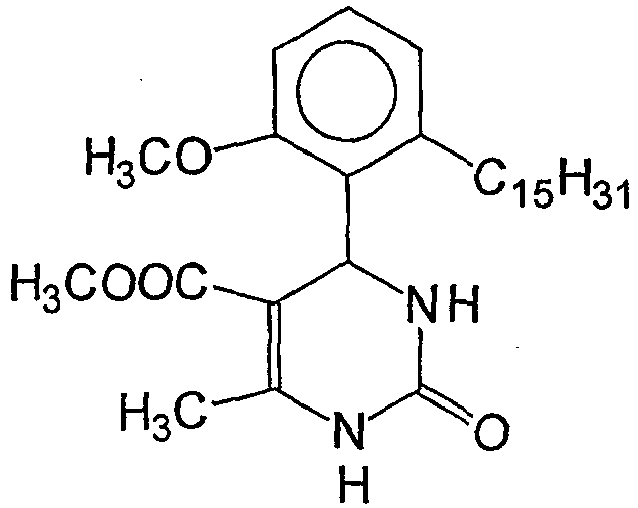
- A solution of methylacetoacetate (1.2 g, 8.5 mmol), 2-methoxy-6-pentadecyl benzaldehyde (3.1 g, 8.5 mmol) and urea (1.00 g, 17 mmol) in tetrahydrofuran (20 mL) was heated to reflux (65-70 °C) in the presence of hydrochloric acid (30%) for 7 h. The reaction mixture after being cooled to room temperature was poured into crushed ice (20 g) and stirred for 5 min. The viscous liquid was extracted with ethylacetate (40 mL) and was washed with 1N hydrochloric acid, water, sodium bicarbonate and brine. After drying over anhydrous sodium sulfate, the solvent was evaporated to yield light yellow oil. This crude product was purified by flash column chromatography and recrystallized from hexane to get white crystalline solid of title compound.
- Melting point : 101-102 °C
- IR (cm-1) : 3425 (N-H), 2918 (C-H), 1690 (C=O)
- Mass (Electrospray): 487 (M+1), 485 (M-1)
- 1H NMR (δ ppm) : 7.6 (bs, 1H, D2O exchangeable, N-H) 7.15 (t, J=8 Hz, 1H, aromatic proton) 6.73 (d, J=8Hz, 2H, aromatic protons) 5.8 (s, 1H, C4-H) 4.8 (s, 1H, D2O exchangeable, N-H) 3.78 (s, 3H, O-CH2) 3.6 (s, 3H, O-CH3) 3.1 (m, 1H, benzylic) 2.5 (m, 1H, benzylic) 2.3 (s, 3H, allylic) 1.8-1.1 (m, 26H, (CH2)13 from alkyl chain) 0.85 (dt, 3H, terminal CH3 from alkyl chain).
- bs-broad singlet, t-triplet, d-doublet, s-singlet, m-multiplet, dt-distorted triplet, q-quartet.
-

- A solution of ethylacetoacetate (1.25 g, 8.5 mmol), 2-ethoxy-6-pentadecyl benzaldehyde (3 g, 8.5 mmol) and urea (1.1 g, 17 mmol) in tetrahydrofuran (20 mL) was heated to reflux (65-70 °C) in the presence of hydrochloric acid (30%) for 7 h. The reaction mixture after being cooled to room temperature was poured into crushed ice (20 g) and stirred for 5 min. The viscous liquid was extracted with ethylacetate (40 mL) and was washed with 1N hydrochloric acid, water, sodium bicarbonate and brine. After drying over anhydrous sodium sulfate, the solvent was evaporated to yield light yellow oil. This crude product was purified by flash column chromatography and recrystallized from hexane to get white crystalline solid of title compound.
- Melting point : 99-100 °C
- IR (cm-1) : 3420 (N-H), 2924 (C-H), 1690 (C=O)
- Mass (Electrospray): 515 (M+1), 513 (M-1)
- 1H NMR (δ ppm) : 7.35 (bs, 1H, D2O exchangeable, N-H) 7.15 (t, J=8 Hz, 1H, aromatic proton) 6.72 (d, J=8Hz, 2H, aromatic protons) 5.8 (s, 1H, C4-H) 4.75 (s, 1H, D2O exchangeable, N-H) 4.0 (m, 4H, O-CH2) 3.15 (m, 1H, benzylic) 2.45 (m, 1H, benzylic) 2.3 (s, 3H, allylic) 1.8-1.1 (m, 32H, (CH2)13 from alkyl chain, CH3, CH3) 0.9 (dt, 3H, terminal CH3 from alkyl chain).
- bs-broad singlet, t-triplet, d-doublet, s-singlet, m-multiplet, dt-distorted triplet
- A solution of methylacetoacetate (1.2 g, 8.5 mmol), 2-methoxy-6-(8' Z, 11' Z, 14' Z) pentadecatrienyl benzaldehyde (3.1 g, 8.5 mmol) and urea (1.00 g, 17 mmol) in tetrahydrofuran (20 mL) was heated to reflux (65-70 °C) in the presence of hydrochloric acid (30%) for 7 h. The reaction mixture after being cooled to room temperature was poured into crushed ice (20 g) and stirred for 5 min. The viscous liquid was extracted with ethylacetate (40 mL) and was washed with 1N hydrochloric acid, water, sodium bicarbonate and brine. After drying over anhydrous sodium sulfate, the solvent was evaporated to yield light yellow oil. This crude product was purified by flash column chromatography and recrystallised from hexane to get white crystalline solid of title compound.
- IR (cm-1) : 3427 (N-H), 2922 (C-H), 1691 (C=O)
- Mass (Electrospray): 481 (M+1), 479 (M-1)
- A solution of methylacetoacetate (1.2 g, 8.5 mmol), 2-methoxy-6-(8' Z, 11' Z) pentadecadienyl benzaldehyde (3.1 g, 8.5 mmol) and urea (1.00 g, 17 mmol) in tetrahydrofuran (20 mL) was heated to reflux (65-70 °C) in the presence of hydrochloric acid (30%) for 7 h. The reaction mixture after being cooled to room temperature was poured into crushed ice (20 g) and stirred for 5 min. The viscous liquid was extracted with ethylacetate (40 mL) and was washed with 1N hydrochloric acid, water, sodium bicarbonate and brine. After drying over anhydrous sodium sulfate, the solvent was evaporated to yield light yellow oil. This crude product was purified by flash column chromatography.
- IR (cm-1) : 3426 (N-H), 2920 (C-H), 1690 (C=O)
- Mass (Electrospray): 483 (M+1), 481 (M-1)
- A solution of methylacetoacetate (1.2 g, 8.5 mmol), 2-methoxy-6-(8' Z) pentadecenyl benzaldehyde (3.1 g, 8.5 mmol) and urea (1.00 g, 17 mmol) in tetrahydrofuran (20 mL) was heated to reflux (65-70 °C) in the presence hydrochloric acid (30%) for 7 h. The reaction mixture after being cooled to room temperature was poured into crushed ice (20 g) and stirred for 5 min. The viscous liquid was extracted with ethylacetate (40 mL) and was washed with 1N hydrochloric acid, water, sodium bicarbonate and brine. After drying over anhydrous sodium sulfate, the solvent was evaporated to yield light yellow oil. This crude product was purified by flash column chromatography.
- IR (cm-1) : 3424 (N-H), 2924 (C-H), 1692 (C=O)
- Mass (Electrospray): 485 (M+1), 483 (M-1)
-

- A solution of ethylacetoacetate (1.3 g, 8.5 mmol), 2-ethoxy-6-(8' Z, 11' Z, 14' Z) pentadecatrienyl benzaldehyde (3.2 g, 8.5 mmol) and urea (1.1 g, 17 mmol) in tetrahydrofuran (20 mL) was heated to reflux (65-70 °C) in the presence of hydrochloric acid (30%) for 7 h. The reaction mixture after being cooled to room temperature was poured into crushed ice (20 g) and stirred for 5 min. The viscous liquid was extracted with ethylacetate (40 mL) and was washed with 1N hydrochloric acid, water, sodium bicarbonate and brine. After drying over anhydrous sodium sulfate, the solvent was evaporated to yield light yellow oil. This crude product was purified by flash column chromatography and recrystallised from hexane to get white crystalline solid of title compound.
- IR (cm-1) : 3422 (N-H), 2920 (C-H), 1690 (C=O)
- Mass (Electrospray): 509 (M+1), 507 (M-1)
-

- A solution of ethylacetoacetate (1.3 g, 8.5 mmol), 2-ethoxy-6-(8' Z, 11' Z) pentadecadienyl benzaldehyde (3.2 g, 8.5 mmol) and urea (1.1 g, 17 mmol) in tetrahydrofuran (20 mL) was heated to reflux (65-70 °C) in the presence of hydrochloric acid (30%) for 7 h. The reaction mixture after being cooled to room temperature was poured into crushed ice (20 g) and stirred for 5 min. The viscous liquid was extracted with ethylacetate (40 mL) and was washed with 1N hydrochloric acid, water, sodium bicarbonate and brine. After drying over anhydrous sodium sulfate, the solvent was evaporated to yield light yellow oil. This crude product was purified by flash column chromatography.
- IR (cm-1) : 3424 (N-H), 2924 (C-H), 1691 (C=O)
- Mass (Electrospray): 511 (M+1), 509 (M-1)
-

- A solution of ethylacetoacetate (1.3 g, 8.5 mmol), 2-ethoxy-6-(8' Z) pentadecenyl benzaldehyde (3.2 g, 8.5 mmol) and urea (1.1 g, 17 mmol) in tetrahydrofuran (20 mL) was heated to reflux (65-70 °C) in the presence of hydrochloric acid (30%) for 7 h. The reaction mixture after being cooled to room temperature was poured into crushed ice (20 g) and stirred for 5 min. The viscous liquid was extracted with ethylacetate (40 mL) and was washed with 1N hydrochloric acid, water, sodium bicarbonate and brine. After drying over anhydrous sodium sulfate, the solvent was evaporated to yield light yellow oil. This crude product was purified by flash column chromatography.
- IR (cm-1) : 3423 (N-H), 2923 (C-H), 1691 (C=O)
- Mass (Electrospray): 513 (M+1), 511 (M-1)
-

- A solution of methylacetoacetate (1.2 g, 8.5 mmol), 2-ethoxy-6-(8' Z, 11' Z, 14' Z) pentadecatrienyl benzaldehyde (3.2 g, 8.5 mmol) and urea (1.1 g, 17 mmol) in tetrahydrofuran (20 mL) was heated to reflux (65-70 °C) in the presence of hydrochloric acid (30%) for 7 h. The reaction mixture after being cooled to room temperature was poured into crushed ice (20 g) and stirred for 5 min. The viscous liquid was extracted with ethylacetate (40 mL) and was washed with 1N hydrochloric acid, water, sodium bicarbonate and brine. After drying over anhydrous sodium sulfate, the solvent was evaporated to yield light yellow oil. This crude product was purified by flash column chromatography and recrystallised from hexane to get white crystalline solid of title compound.
- IR (cm-1) : 3421 (N-H), 2920 (C-H), 1690 (C=O)
- Mass (Electrospray): 495 (M+1), 493 (M-1)
-

- A solution of methylacetoacetate (1.2 g, 8.5 mmol), 2-ethoxy-6-(8' Z, 11' Z) pentadecadienyl benzaldehyde (3.2 g, 8.5 mmol) and urea (1.1 g, 17 mmol) in tetrahydrofuran (20 mL) was heated to reflux (65-70 °C) in the presence of hydrochloric acid (30%) for 7 h. The reaction mixture after being cooled to room temperature was poured into crushed ice (20 g) and stirred for 5 min. The viscous liquid was extracted with ethylacetate (40 mL) and was washed with 1N hydrochloric acid, water, sodium bicarbonate and brine. After drying over anhydrous sodium sulfate, the solvent was evaporated to yield light yellow oil. This crude product was purified by flash column chromatography.
- IR (cm-1) : 3423 (N-H), 2921 (C-H), 1690 (C=O)
- Mass (Electrospray): 497 (M+1), 495 (M-1)
-

- A solution of methylacetoacetate (1.2 g, 8.5 mmol), 2-ethoxy-6-(8' Z) pentadecenyl benzaldehyde (3.2 g, 8.5 mmol) and urea (1.1 g, 17 mmol) in tetrahydrofuran (20 mL) was heated to reflux (65-70 °C) in the presence of hydrochloric acid (30%) for 7 h. The reaction mixture after being cooled to room temperature was poured into crushed ice (20 g) and stirred for 5 min. The viscous liquid was extracted with ethylacetate (40 mL) and was washed with 1N hydrochloric acid, water, sodium bicarbonate and brine. After drying over anhydrous sodium sulfate, the solvent was evaporated to yield light yellow oil. This crude product was purified by flash column chromatography.
- IR (cm-1) : 3422 (N-H), 2921 (C-H), 1691 (C=O)
- Mass (Electrospray): 499 (M+1), 497 (M-1)
-

- A solution of isopropylacetoacetate (1.3 g, 8.5 mmol), 2-ethoxy-6-(8' Z, 11' Z, 14' Z) pentadecatrienyl benzaldehyde (3.2 g, 8.5 mmol) and urea (1.1 g, 17 mmol) in tetrahydrofuran (20 mL) was heated to reflux (65-70 °C) in the presence of hydrochloric acid (30%) for 7 h. The reaction mixture after being cooled to room temperature was poured into crushed ice (20 g) and stirred for 5 min. The viscous liquid was extracted with ethylacetate (40 mL) and was washed with 1N hydrochloric acid, water, sodium bicarbonate and brine. After drying over anhydrous sodium sulfate, the solvent was evaporated to yield light yellow oil. This crude product was purified by flash column chromatography and recrystallised from hexane to get white crystalline solid of title compound.
- IR (cm-1) : 3421 (N-H), 2920 (C-H), 1690 (C=O)
- Mass (Electrospray): 523 (M+1), 521 (M-1)
-

- A solution of isopropylacetoacetate (1.3 g, 8.5 mmol), 2-ethoxy-6-(8' Z, 11' Z) pentadecadienyl benzaldehyde (3.2 g, 8.5 mmol) and urea (1.1 g, 17 mmol) in tetrahydrofuran (20 mL) was heated to reflux (65-70 °C) in the presence of hydrochloric acid (30%) for 7 h. The reaction mixture after being cooled to room temperature was poured into crushed ice (20 g) and stirred for 5 min. The viscous liquid was extracted with ethylacetate (40 mL) and was washed with 1N hydrochloric acid, water, sodium bicarbonate and brine. After drying over anhydrous sodium sulfate, the solvent was evaporated to yield light yellow oil. This crude product was purified by flash column chromatography.
- IR (cm-1) : 3423 (N-H), 2921 (C-H), 1690 (C=O)
- Mass (Electrospray): 525 (M+1), 523 (M-1)
-

- A solution of isopropylacetoacetate (1.3 g, 8.5 mmol), 2-ethoxy-6-(8' Z) pentadecenyl benzaldehyde (3.2 g, 8.5 mmol) and urea (1.1 g, 17 mmol) in tetrahydrofuran (20 mL) was heated to reflux (65-70 °C) in the presence of hydrochloric acid (30%) for 7 h. The reaction mixture after being cooled to room temperature was poured into crushed ice (20 g) and stirred for 5 min. The viscous liquid was extracted with ethylacetate (40 mL) and was washed with 1N hydrochloric acid, water, sodium bicarbonate and brine. After drying over anhydrous sodium sulfate, the solvent was evaporated to yield light yellow oil. This crude product was purified by flash column chromatography.
- IR (cm-1) : 3422 (N-H), 2921 (C-H), 1691 (C=O)
- Mass (Electrospray) : 527 (M+1), 525 (M-1)
-

- The solution of 1,4-dihydro-2-[[(4-methoxyphenyl)methyl)oxy]-6-methyl-4-[2-methoxy-6-pentadecylphenyl]-5-pyrimidinecarboxylic acid methyl ester (3 g, 4.6 mmol) in dichloromethane (15 mL) and pyridine (1.5 mL) was treated with ethyl chloroformate (0.6 g, 4.7 mmol) at 0 °C under argon. After the addition was finished reaction was stirred at room temperature for 12 h and then diluted with more dichloromethane. The resultant solution was washed with 1N hydrochloric acid, water, sodium bicarbonate and brine. After drying over anhydrous sodium sulfate, the solvent evaporated to yield light yellow oil. This crude product was purified by flash column chromatography and recrystallised from hexane to get white crystalline solid of title compound.
- Melting point : 121-122 °C
- IR (cm-1) : 3340 (N-H), 2921 (C-H), 1696 (C=O)
- Mass (Electrospray): 559 (M+1), 557 (M-1)
- 1H NMR (δ ppm) : 8.35 (bs, 1H, D2O exchangeable, N-H) 7.2 (t, J=8 Hz, 1H, aromatic proton) 6.85 (d, J=8Hz, 1H, aromatic proton) 6.7 (d, J=8Hz, 1H, aromatic proton) 6.55 (s, 1H, C6-H) 4.25 (q, 2H, J=6 Hz, O-CH2) 3.75 (s, 3H, O-CH3) 3.6 (s, 3H, O-CH3) 3.1 (m, 1H, benzylic) 3.0 (m, 1H, benzylic) 2.25 (s, 3H, allylic) 1.85-1.1 (m, 29H, (CH2)13 from alkyl chain, CH3) 0.9 (dt, 3H, terminal CH3 from alkyl chain).
- bs-broad singlet, t-triplet, d-doublet, s-singlet, m-multiplet, dt-distorted triplet.
-

- The solution of 1,4-dihydro-2-[[(4-methoxyphenyl)methyl)oxy]-6-methyl-4-[2-methoxy-6-pentadecylphenyl]-5-pyrimidinecarboxylic acid ethyl ester (3 g, 4.7 mmol) in dichloromethane (15 mL) and pyridine (1.5 mL) was treated with ethyl chloroformate (0.6 g, 4.7 mmol) at 0 °C under argon. After the addition was finished reaction was stirred at room temperature for 12 h and then diluted with more dichloromethane. The resultant solution was washed with 1N hydrochloric acid, water, sodium bicarbonate and brine. After drying over anhydrous sodium sulfate, the solvent evaporated to yield light yellow oil. This crude product was purified by flash column chromatography and recrystallised from hexane to get white crystalline solid of title compound.
- Melting point : 109-110 °C
- IR (cm-1) : 3348 (N-H), 2920 (C-H), 1697 (C=O)
- Mass (Electrospray): 573 (M+1), 571 (M-1)
- 1H NMR (δ ppm) : 8.1 (bs, 1H, D2O exchangeable, N-H) 7.15 (t, J=8 Hz, 1H, aromatic proton) 6.85 (d, J=8Hz, 1H, aromatic proton) 6.7 (d, J=8Hz, 1H, aromatic proton) 6.55 (s, 1H, C6-H) 4.1 (m, 4H, O-CH2) 3.75 (s, 3H, O-CH3) 3.1 (m, 1H, benzylic) 2.9 (m, 1H, benzylic) 2.25 (s, 3H, allylic) 1.85-1.1 (m, 32H, (CH2)13 from alkyl chain, CH3, CH3) 0.9 (dt, 3H, terminal CH3 from alkyl chain).
- bs-broad singlet, t-triplet, d-doublet, s-singlet, m-multiplet, dt-distorted triplet.
-

- The solution of 1,4-dihydro-2-[[(4-methoxyphenyl)methyl)oxy]-6-methyl-4-[2-methoxy-6-pentadecylphenyl]-5-pyrimidinecarboxylic acid isopropyl ester (3 g, 4.8 mmol) in dichloromethane (15 mL) and pyridine (1.6 mL) was treated with ethyl chloroformate (0.7 g, 4.8 mmol) at 0 °C under argon. After the addition was finished reaction was stirred at room temperature for 12 h and then diluted with more dichloromethane. The resultant solution was washed with 1N hydrochloric acid, water, sodium bicarbonate and brine. After drying over anhydrous sodium sulfate, the solvent evaporated to yield light yellow oil. This crude product was purified by flash column chromatography and recrystallised from hexane to get white crystalline solid of title compound.
- Melting point : 100 °C
- IR (cm-1) : 3341 (N-H), 2919 (C-H), 1698 (C=O)
- Mass (Electrospray): 587 (M+1), 585 (M-1)
- 1H NMR (δ ppm) : 8.3 (bs, 1H, D2O exchangeable, N-H) 7.2 (t, J=8 Hz, 1H, aromatic proton) 6.85 (d, J=8Hz, 1H, aromatic proton) 6.7 (d, J=8Hz, 1H, aromatic proton) 6.57 (s, 1H, C6-H) 5.0 (m, 1H, OCH(CH3)2) 4.25 (q, 2H, J=6 Hz, O-CH2) 3.75 (s, 3H, O-CH3) 3.2 (m, 1H, benzylic) 3.0 (m, 1H, benzylic) 2.25 (s, 3H, allylic) 1.9-1.0 (m, 35H, (CH2)13 from alkyl chain, CH3, (CH3)2) 0.87 (dt, 3H, terminal CH3 from alkyl chain).
- bs-broad singlet, t-triplet, d-doublet, s-singlet, m-multiplet, dt-distorted triplet.
-

- The solution of 1,4-dihydro-2-[[(4-methoxyphenyl)methyl)oxy]-6-methyl-4-[2-ethoxy-6-pentadecylphenyl]-5-pyrimidinecarboxylic acid methyl ester (3 g, 4.7 mmol) in dichloromethane (15 mL) and pyridine (1.5 mL) was treated with ethyl chloroformate (0.7 g, 4.8 mmol) at 0 °C under argon. After the addition was finished reaction was stirred at room temperature for 12 h and then diluted with more dichloromethane. The resultant solution was washed with 1N hydrochloric acid, water, sodium bicarbonate and brine. After drying over anhydrous sodium sulfate, the solvent was evaporated to yield light yellow oil. This crude product was purified by flash column chromatography and recrystallised from hexane to get white crystalline solid of title compound.
- Melting point : 103 °C
- IR (cm-1) : 3346 (N-H), 2918 (C-H), 1698 (C=O)
- Mass (Electrospray): 573 (M+1), 571 (M-1)
- 1H NMR (δ ppm) : 7.4 (bs, 1H, N-H) 7.15 (t, J= 7Hz, 1H, aromatic proton) 6.85 (d, J=8Hz, 1H, aromatic proton) 6.7 (d, J=8Hz, 1H, aromatic proton) 6.6 (s, 1H, C6-H) 4.2 (m, 2H, O-CH2) 4.0 (q, 2H, J= 6Hz, O-CH2) 3.6 (s, 3H, O-CH3) 3.15 (m, 1H, benzylic) 2.95 (m, 1H, benzylic) 2.28 (s, 3H, allylic) 1.85-1.0 (m, 32H, (CH2)13 from alkyl chain, CH3, CH3) 0.9 (dt, 3H, terminal CH3 from alkyl chain).
- bs-broad singlet, t-triplet, d-doublet, s-singlet, m-multiplet, dt-distorted triplet, q-quartet.
-

- The solution of 1,4-dihydro-2-[[(4-methoxyphenyl)methyl)oxy]-6-methyl-4-[2-ethoxy-6-pentadecylphenyl]-5-pyrimidinecarboxylic acid ethyl ester (3 g, 4.65 mmol) in dichloromethane (15 mL) and pyridine (1.5 mL) was treated with ethyl chloroformate (0.7 g, 4.7 mmol) at 0 °C under argon. After the addition was finished reaction was stirred at room temperature for 12 h and then diluted with more dichloromethane. The resultant solution was washed with 1N hydrochloric acid, water, sodium bicarbonate and brine. After drying over anhydrous sodium sulfate, the solvent was evaporated to yield light yellow oil. This crude product was purified by flash column chromatography and recrystallised from hexane to get white crystalline solid of title compound.
- Melting point : 112 °C
- IR (cm-1) : 3342 (N-H), 2920 (C-H), 1697 (C=O)
- Mass (Electrospray): 587 (M+1), 585 (M-1)
- 1H NMR (δ ppm) : 7.25 (bs, 1H, N-H) 7.15 (t, J= 7Hz, 1H, aromatic proton) 6.85 (d, J=8Hz, 1H, aromatic proton) 6.7 (d, J=8Hz, 1H, aromatic proton) 6.6 (s, 1H, C6-H) 4.2 (m, 6H, O-CH2) 3.2 (m, 1H, benzylic) 2.95 (m, 1H, benzylic) 2.3 (s, 3H, allylic) 1.85-1.15 (m, 32H, (CH2)13 from alkyl chain, CH3, CH3, CH3) 0.9 (dt, 3H, terminal CH3 from alkyl chain).
- bs-broad singlet, t-triplet, d-doublet, s-singlet, m-multiplet, dt-distorted triplet, q-quartet.
-

- The solution of 1,4-dihydro-2-[[(4-methoxyphenyl)methyl)oxy]-6-methyl-4-[2-ethoxy-6-pentadecylphenyl]-5-pyrimidinecarboxylic acid isopropyl ester (3 g, 4.8 mmol) in dichloromethane (15 mL) and pyridine (1.5 mL) was treated with ethyl chloroformate (0.7 g, 4.8 mmol) at 0 °C under argon. After the addition was finished reaction was stirred at room temperature for 12 h and then diluted with more dichloromethane. The resultant solution was washed with 1N hydrochloric acid, water, sodium bicarbonate and brine. After drying over anhydrous sodium sulfate, the solvent was evaporated to yield light yellow oil. This crude product was purified by flash column chromatography and recrystallised from hexane to get white crystalline solid of title compound.
- Melting point : 110-111 °C
- IR (cm-1) : 3350 (N-H), 2920 (C-H), 1696 (C=O)
- Mass (Electrospray): 601 (M+1), 599 (M-1)
- 1HNMR (δ ppm) : 7.15 (m, 2H, D2O exchangeable for 1H, N-H, aromatic proton) 6.8 (d, J=8Hz, 1H, aromatic proton) 6.6 (d, J=8Hz, 1H, aromatic proton) 6.5 (s, 1H, C6-H) 5.0 (m, 1H, OCH(CH3)3) 4.25 (m, 2H, CH2) 4.0 (q, 2H, O-CH2) 3.25 (m, 1H, benzylic) 3.0 (m, 1H, benzylic) 2.3 (s, 3H, allylic) 1.85-1.0 (m, 38H, (CH2)13 from alkyl chain, (CH3)2, CH3, CH3) 0.9 (dt, 3H, terminal CH3 from alkyl chain).
- bs-broad singlet, t-triplet, d-doublet, s-singlet, m-multiplet, dt-distorted triplet, q-quartet.
-

- The solution of 1,4-dihy4ro-2-[[(4-methoxyphenyl)methyl)oxy]-6-methyl-4-[2-isopropoxy-6-pentadecylphenyl]-5-pyrimidinecarboxylic acid methyl ester (3 g, 4.7 mmol) in dichloromethane (15 mL) and pyridine (1.5 mL) was treated with ethyl chloroformate (0.7 g, 4.8 mmol) at 0 °C under argon. After the addition was finished reaction was stirred at room temperature for 12 h and then diluted with more dichloromethane. The resultant solution was washed with 1N hydrochloric acid, water, sodium bicarbonate and brine. After drying over anhydrous sodium sulfate, the solvent was evaporated to yield light yellow oil. This crude product was purified by flash column chromatography and recrystallised from hexane to get white crystalline solid of title compound.
- Melting point : 120-121 °C
- IR (cm-1) : 3342 (N-H), 2921 (C-H), 1670 (C=O)
- Mass (Electrospray): 587 (M+1), 585 (M-1)
- 1H NMR (δ ppm) : 7.85 (bs, 1H, N-H) 7.15 (t, J= 7Hz, 1H, aromatic proton) 6.8 (d, J=8Hz, 1H, aromatic proton) 6.7 (d, J=8Hz, 1H, aromatic proton) 6.55 (s, 1H, C6-H) 4.65 (m, 1H, OCH(CH3)2) 4.2 (q, 2H, J= 6Hz, O-CH2) 3.6 (s, 3H, O-CH3) 3.0 (m, 2H, benzylic) 2.28 (s, 3H, allylic) 1.95-1.0 (m, 35H, (CH2)13 from alkyl chain, (CH3)2, CH3) 0.85 (dt, 3H, terminal CH3 from alkyl chain).
- bs-broad singlet, t-triplet, d-doublet, s-singlet, m-multiplet, dt-distorted triplet, q-quartet.
-

- The solution of 1,4-dihydro-2-[[(4-methoxyphenyl)methyl)oxy]-6-methyl-4-[2-ethoxy-6-pentadecylphenyl]-5-pyrimidinecarboxylic acid ethyl ester (3 g, 4.6 mmol) in dichlorometliane (15 mL) and pyridine (1.5 mL) was treated with ethyl chloroformate (0.8 g, 4.7 mmol) at 0 °C under argon. After the addition was finished reaction was stirred at room temperature for 12 h and then diluted with more dichloromethane. The resultant solution was washed with 1N hydrochloric acid, water, sodium bicarbonate and brine. After drying over anhydrous sodium sulfate, the solvent was evaporated to yield light yellow oil. This crude product was purified by flash column chromatography and recrystallised from hexane to get white crystalline solid of title compound.
- Melting point : 90-92 °C
- IR (cm-1) : 3340 (N-H), 2920 (C-H), 1696 (C=O)
- Mass (Electrospray): 601 (M+1), 599 (M-1)
- 1H NMR (δ ppm) : 7.6 (bs, 1H, N-H) 7.15 (dt, 1H, aromatic proton) 6.8 (d, J=8Hz, 1H, aromatic proton) 6.7 (d, J=8Hz, 1H, aromatic proton) 6.55 (s, 1H, C6-H) 4.65 (m, 1H, OHC(CH3)2) 4.1 (m, 4H, O-CH2) 3.15 (m, 1H, benzylic) 2.95 (m, 1H, benzylic) 2.2 (s, 3H, allylic) 1.9-1.0 (m, 38H, (CH2)13 from alkyl chain, CH3, CH3, (CH3)2) 0.9 (dt, 3H, terminal CH3 from alkyl chain).
- bs-broad singlet, t-triplet, d-doublet, s-singlet, m-multiplet, dt-distorted triplet, q-quartet.
-

- The solution of 1,4-dihydro-2-[[(4-methoxyphenyl)methyl)oxy]-6-methyl-4-[2-ethoxy-6-pentadecylphenyl]-5-pyrimidinecarboxylic acid isopropyl ester (3 g, 4.5 mmol) in dichloromethane (15 mL) and pyridine (1.5 mL) was treated with ethyl chloroformate (0.85 g, 4.6 mmol) at 0 °C under argon. After the addition was finished reaction was stirred at room temperature for 12 h and then diluted with more dichloromethane. The resultant solution was washed with 1N hydrochloric acid, water, sodium bicarbonate and brine. After drying over anhydrous sodium sulfate, the solvent was evaporated to yield light yellow oil. This crude product was purified by flash column chromatography and recrystallised from hexane to get white crystalline solid of title compound.
- Melting point : 88-90 °C
- IR (cm-1) : 3340 (N-H), 2918 (C-H), 1695 (C=O)
- Mass (Electrospray) : 615 (M+1), 613 (M-1)
- [0218] 1H NMR (δ ppm) : 7.7 (bs, 1H, N-H) 7.17 (dt, 1H, aromatic proton) 6.8 (d, J=8Hz, 1H, aromatic proton) 6.7 (d, J=8Hz, 1H, aromatic proton) 6.5 (s, 1H, C6-H) 5.0 (m, 1H, OHC(CH3)2) 4.7 (m, 1H, OHC(CH3)2) 4.23 (q, J= 6Hz, 2H, O-CH2) 3.2 (m, 1H, benzylic) 3.0 (m, 1H, benzylic) 2.25 (s, 3H, allylic) 1.9-1.0 (m, 41H, (CH2)13 from alkyl chain, CH3, (CH3)2, (CH3)2) 0.9 (dt, 3H, terminal CH3 from alkyl chain).
- bs-broad singlet, t-triplet, d-doublet, s-singlet, m-multiplet, dt-distorted triplet, q-quartet..
-

- The solution of 1,4-dihydro-2-[[(4-methoxyphenyl)methyl)oxy]-6-(2'-mercapto-1'H-benzimidazolyl)methyl-4-[2-methoxy-6-pentadecylphenyl]-5-pyrimidinecarboxylic acid ethyl ester (3 g, 4.9 mmol) in dichloromethane (15 mL) and pyridine (2.0 mL) was treated with ethyl chloroformate (0.7 g, 4.9 mmol) at 0 °C under argon. After the addition was finished reaction was stirred at room temperature for 12 h and then diluted with more dichloromethane. The resultant solution was washed with 1N hydrochloric acid, water, sodium bicarbonate and brine. After drying over anhydrous sodium sulfate, the solvent was evaporated to yield light yellow oil. This crude product was purified by flash column chromatography to obtain the title compound.
- IR (cm-1) : 3450 (N-H), 2921 (C-H), 1686 (C=O)
- Mass (Electrospray): 721 (M+1), 719 (M-1)
- 1H NMR (δ ppm) : 8.5 (bs, 1H, D2O exchangeable, N-H) 7.7 (d, J=6 Hz, 1H, Aromatic proton) 7.5 (m, 1H, Aromatic proton) 7.25 (m, 2H, Aromatic proton) 7.15 (t, J=8 Hz, 1H, Aromatic proton) 6.85 (d, J=8Hz, 2H, Aromatic proton) 5.8 (s, 1H, C6-H) 4.6 (s, 1H, D2O exchangeable, N-H) 4.5 (s, 2H, S-CH2) 4.0 (m, J=6 Hz, 4H, O-CH2) 3.7 (s, 3H, O-CH3) 3.1 (m, 1H, benzylic) 2.5 (m, 1H, benzylic) 1.85-1.1 (m, 35H, (CH2)13 from alkyl chain, CH3, CH3, allylic CH3) 0.9 (dt, 3H, terminal CH3 from alkyl chain).
- bs-broad singlet, t-triplet, d-doublet, s-singlet, m-multiplet, dt-distorted triplet.
-

- The solution of 1,4-dihydro-2-[[(4-methoxyphenyl)methyl)oxy]-6-methyl-4-[2-isopropoxy-6-pentadecylphenyl]-5-pyrimidinecarboxylic acid methyl ester (3 g, 4.8 mmol) in dichloromethane (15 mL) and pyridine (1.5 mL) was treated with ethyl chloroformate (0.7 g, 4.8 mmol) at 0 °C under argon. After the addition was finished reaction was stirred at room temperature for 12 h and then diluted with more dichloromethane. The resultant solution was washed with 1N hydrochloric acid, water, sodium bicarbonate and brine. After drying over anhydrous sodium sulfate, the solvent was evaporated to yield light yellow oil. This crude product was purified by flash column chromatography to obtain the title compound.
- IR (cm-1) : 3352 (N-H), 2921 (C-H), 1692 (C=O)
- Mass (Electrospray): 573 (M+1), 571 (M-1)
- 1H NMR (δ ppm) : 8.0 (bs, 1H, D2O exchangeable, N-H) 7.1 (t, J=8 Hz, 1H, aromatic proton) 6.95 (d, J=8Hz, 1H, aromatic proton) 6.8 (d, J=8Hz, 1H, aromatic proton) 6.65 (s, 1H, C6-H) 4.0 (s, 3H, COOCH3) 3.75 (s, 3H, N-COOCH3) 3.0 (m, 1H, benzylic) 2.85 (m, 1H, benzylic) 2.2 (s, 3H, allylic) 1.85-1.1 (m, 32H, (CH2)13 from alkyl chain, (CH3)2) 0.9 (dt, 3H, terminal CH3 from alkyl chain).
- bs-broad singlet, t-triplet, d-doublet, s-singlet, m-multiplet, dt-distorted triplet:
-

- The solution of 1,4-dihydro-2-[[(4-methoxyphenyl)methyl)thio]-6-methyl-4-[2-methoxy-6-pentadecylphenyl]-5-pyrimidinecarboxylic acid ethyl ester (3 g, 4.7 mmol) in dichloromethane (15 mL) and pyridine (1.5 mL) was treated with ethyl chloroformate (0.6 g, 4.7 mmol) at 0 °C under argon. After the addition was finished reaction was stirred at room temperature for 2 h and then diluted with more dichloromethane. The resultant solution was washed with 1N hydrochloric acid, water, sodium bicarbonate and brine. After drying over anhydrous sodium sulfate, the solvent evaporated to yield light yellow oil. This was dissolved in dichloramethane (20 mL) and treated with trifloro acetic acid (2.0 mL) and ethanethiol (1.0 mL). The reaction was stirred at room temperature overnight, and the solvent was evaporated and the crude product was purified by flash column chromatography to obtain the title compound.
- IR (cm-1) : 3350 (N-H), 2921 (C-H), 1696 (C=O)
- Mass (Electrospray); 589 (M+1), 587 (M-1)
- 1H NMR (δ ppm) : 7.6 (bs, 1H, D2O exchangeable, N-H) 7.1 (t, J=8 Hz, 1H, aromatic proton) 6.8 (d, J=8Hz, 1H, aromatic proton) 6.65 (d, J=8Hz, 1H, aromatic proton) 6.5 (s, 1H, C6-H) 4.05 (m, 4H, O-CH2) 3.7 (s, 3H, O-CH3) 3.05 (m, 1H, benzylic) 2.95 (m, 1H, benzylic) 2.2 (s, 3H, allylic) 1.85-1.1 (m, 32H, (CH2)13 from alkyl chain, CH3, CH3) 0.9 (dt, 3H, terminal CH3 from alkyl chain).
- bs-broad singlet, t-triplet, d-doublet, s-singlet, m-multiplet, dt-distorted triplet
- Thus, those of skill in the art will appreciate that the compounds and uses disclosed herein can be used as calcium channel blockers, providing a therapeutic effect.
Claims (8)
- A compound of Formula I
 a)R1 is optionally substituted alkyl having 1 to 5 carbon atoms;R2 is selected from the group consisting of methyl, ethyl, n-propyl, isopropyl, n-butyl, sec-butyl, tert-butyl, and pentyl;R5 is selected from the group consisting of methyl, ethyl, n-propyl, isopropyl, n-butyl, sec-butyl, tert-butyl, and pentyl;R6 is hydrogen;R7 is hydrogen; andR8 is hydrogen;b) R9 is alkyl having at least 15 carbon atoms; andc) R10 is hydrogen;d) R11 is selected from the group consisting of hydrogen, methoxy, ethoxy, and propoxye) X is oxygen or sulfur; andf) Q is oxygen; provided that R3 does not exist.
 - The compound of claim 1, wherein R9 is pentadecyl.
- A compound selected from the group consisting of5-ethoxycarbonyl-4-(2-methoxy-6-pentadecylphenyl)-6-methyl-3,4-dihydropyrimidin-2(1H)-one;5-methoxycarbonyl-4-(2-ethoxy-6-pentadecylphenyl)-6-methyl-3,4-dihydropyrimidin-2(1H)-one;5-methoxycarbonyl-4-(2-methoxy-6-pentadecylphenyl)-6-methyl-3,4-dihydropyrimidin-2(1H)-one;5-ethoxycarbonyl-4-(2-ethoxy-6-pentadecylphenyl)-6-methyl-3,4-dihydropyrimidin-2(1H)-one.
- A compound of claim 1 for use in modulating the activity of a calcium channel in a cell.
- A compound of claim 1 for use in a method of treating a disease associated with a cellular calcium channel comprising:a) identifying a subject in need of such treatment;b) administering to said subject a therapeutically effective amount of a compound of claim 1.
- The compound for use according to claim 5, wherein said subject is a human.
- The compound for use according to claim 5, wherein said disease is a cardiovascular disease.
- A pharmaceutical composition comprising a compound of claim 1, and a physiologically acceptable carrier, diluent, or excipient, or a combination thereof.
Applications Claiming Priority (3)
| Application Number | Priority Date | Filing Date | Title |
|---|---|---|---|
| US38998402P | 2002-06-17 | 2002-06-17 | |
| US389984P | 2002-06-17 | ||
| PCT/US2003/018281 WO2003105854A2 (en) | 2002-06-17 | 2003-06-10 | Substituted dihydropyrimidines, dihydropyrimidones and dihydropyrimidinethiones as calcium channel blockers |
Publications (2)
| Publication Number | Publication Date |
|---|---|
| EP1515723A2 EP1515723A2 (en) | 2005-03-23 |
| EP1515723B1 true EP1515723B1 (en) | 2014-02-12 |
Family
ID=29736684
Family Applications (1)
| Application Number | Title | Priority Date | Filing Date |
|---|---|---|---|
| EP03736988.1A Expired - Lifetime EP1515723B1 (en) | 2002-06-17 | 2003-06-10 | Substituted dihydropyrimidones and dihydropyrimidinethiones as calcium channel blockers |
Country Status (4)
| Country | Link |
|---|---|
| US (2) | US20040058942A1 (en) |
| EP (1) | EP1515723B1 (en) |
| AU (1) | AU2003237544A1 (en) |
| WO (1) | WO2003105854A2 (en) |
Families Citing this family (4)
| Publication number | Priority date | Publication date | Assignee | Title |
|---|---|---|---|---|
| WO2007101213A2 (en) * | 2006-02-28 | 2007-09-07 | Kalypsys, Inc. | Novel 2-oxo-1,2,3,4-tetrahydropyrimidines, bicyclic pyrimidine diones and imidazolidine-2,4-diones useful as inducible nitric oxide synthase inhibitors |
| US20110201634A1 (en) * | 2008-06-13 | 2011-08-18 | Delhi University | Dihydropyridimidinone compounds for the treatment of cardiovascular diseases and process for preparing the same |
| WO2013019967A1 (en) * | 2011-08-02 | 2013-02-07 | Scripps Research Institute, A Not-For-Profit Public Benefit Corporation Of California | Modulators of virus assembly as antiviral agents |
| US9119856B1 (en) | 2015-03-23 | 2015-09-01 | King Saud University | Method for treating cancer using a dihydropyrimidine derivative |
Family Cites Families (4)
| Publication number | Priority date | Publication date | Assignee | Title |
|---|---|---|---|---|
| US5202330A (en) * | 1985-06-03 | 1993-04-13 | E. R. Squibb & Sons, Inc. | 2-thio or oxo-4-aryl or heterocyclo-1,5(2H)-pyrimidinedicarboxylic acid diesters and 3-acyl-5-pyrimidinecarboxylic acids and esters |
| US4675321A (en) * | 1986-02-07 | 1987-06-23 | Merck & Co., Inc. | Substituted pyrimidines useful as calcium channel blockers |
| PL327147A1 (en) * | 1995-12-14 | 1998-11-23 | Merck & Co Inc | Method of obtaining dihydropyrimidinones |
| AU5568400A (en) * | 1999-06-23 | 2001-01-09 | Ajinomoto Co., Inc. | Novel dihydropyrimidine derivatives |
-
2003
- 2003-06-10 US US10/459,120 patent/US20040058942A1/en not_active Abandoned
- 2003-06-10 EP EP03736988.1A patent/EP1515723B1/en not_active Expired - Lifetime
- 2003-06-10 WO PCT/US2003/018281 patent/WO2003105854A2/en not_active Ceased
- 2003-06-10 AU AU2003237544A patent/AU2003237544A1/en not_active Abandoned
-
2007
- 2007-11-12 US US11/938,699 patent/US7687511B2/en not_active Expired - Fee Related
Also Published As
| Publication number | Publication date |
|---|---|
| EP1515723A2 (en) | 2005-03-23 |
| AU2003237544A1 (en) | 2003-12-31 |
| US20080125449A1 (en) | 2008-05-29 |
| WO2003105854A3 (en) | 2004-04-08 |
| US20040058942A1 (en) | 2004-03-25 |
| AU2003237544A8 (en) | 2003-12-31 |
| US7687511B2 (en) | 2010-03-30 |
| WO2003105854A2 (en) | 2003-12-24 |
Similar Documents
| Publication | Publication Date | Title |
|---|---|---|
| US5654309A (en) | Pyridopyrimidine derivatives, their production and use | |
| EP0885888B1 (en) | Isoquinoline derivatives and drugs | |
| US5202330A (en) | 2-thio or oxo-4-aryl or heterocyclo-1,5(2H)-pyrimidinedicarboxylic acid diesters and 3-acyl-5-pyrimidinecarboxylic acids and esters | |
| US4855301A (en) | 1,2,3,4-Tetrahydro-6-substituted-4-aryl(or heterocyclo)-3-((substituted amino)carbonyl)-2-thioxo (or oxo)-5-pyrimidinecarboxylic acids and esters | |
| CS228506B2 (en) | Method for the production of optical active ester of 1,4-dihydropyridincarboxyl acid | |
| EP0526598B1 (en) | New pharmacologically active catechol derivatives | |
| JPH02268180A (en) | 2-thioxo-4-methyl-6-substituted phenyl-1,5 (2h)-pyrimidinedicarboxylic acid diesters | |
| US4281127A (en) | Trans-3-(4-oxo-4H-quinazolin-3-yl)-2-propenoic acid derivatives | |
| EP0234830A1 (en) | 2-(Substituted imino)-6-aryl-3,6-dihydro-4-substituted-1,5(2H)-pyrimidinecarboxylic acids and analogs | |
| US4769371A (en) | Dihydropyrimidine carboxylic acid esters | |
| SU1713437A3 (en) | Method for the synthesis of pyrimidine derivatives of theirs pharmaceutically acceptable salts | |
| US7687511B2 (en) | Substituted dihydropyrimidines, dihydropyrimidones and dihydropyrimidinethiones as calcium channel blockers | |
| HU212133B (en) | Therapeutic agents | |
| KR20020016872A (en) | Novel piperazinylalkylthiopyrimidine derivatives, pharmaceutical compositions containing the same, and a process for the preparation of the active substance | |
| US20050176763A1 (en) | 3-Thia-4-arylquinolin-2-one potassium channel modulators | |
| EP1470108B1 (en) | 1,4-dihydropyridine and pyridine compounds as calcium channel blockers | |
| US4753946A (en) | Pyrimidinecarboxylic acid derivatives | |
| IE851417L (en) | Dihydropyridines | |
| EP0257616A2 (en) | Dihydropyridine derivates and pharmaceutical composition thereof | |
| US8106062B1 (en) | Calcium channel blockers | |
| US7235570B2 (en) | 1,4-dihydropyridine and pyridine compounds as calcium channel blockers | |
| CA2217034A1 (en) | Novel pyrimidine derivatives effective as psychotropic drug and process for the production thereof | |
| JP3481984B2 (en) | Pyridopyrimidine derivatives, their production and use | |
| AU598238B2 (en) | 1,2,3,4-tetrahydro-6-substituted-4-aryl(or heterocyclo)-3- {(substituted amino)carbonyl}-2-thioxo(or oxo)-5-pyrimidine -carboxylic acids and esters | |
| JPH072776A (en) | Angiotensin ii-antagonistic pyridine derivative |
Legal Events
| Date | Code | Title | Description |
|---|---|---|---|
| PUAI | Public reference made under article 153(3) epc to a published international application that has entered the european phase |
Free format text: ORIGINAL CODE: 0009012 |
|
| 17P | Request for examination filed |
Effective date: 20050117 |
|
| AK | Designated contracting states |
Kind code of ref document: A2 Designated state(s): AT BE BG CH CY CZ DE DK EE ES FI FR GB GR HU IE IT LI LU MC NL PT RO SE SI SK TR |
|
| AX | Request for extension of the european patent |
Extension state: AL LT LV MK |
|
| DAX | Request for extension of the european patent (deleted) | ||
| RIN1 | Information on inventor provided before grant (corrected) |
Inventor name: SUBBARAO, PILLARISETTI V. Inventor name: ALAPATI, SRINIVASA RAO Inventor name: RANGAPPA, PARAMASHIVAPPA Inventor name: PULLELA, PHANI KUMAR |
|
| GRAP | Despatch of communication of intention to grant a patent |
Free format text: ORIGINAL CODE: EPIDOSNIGR1 |
|
| INTG | Intention to grant announced |
Effective date: 20130710 |
|
| GRAS | Grant fee paid |
Free format text: ORIGINAL CODE: EPIDOSNIGR3 |
|
| GRAA | (expected) grant |
Free format text: ORIGINAL CODE: 0009210 |
|
| AK | Designated contracting states |
Kind code of ref document: B1 Designated state(s): AT BE BG CH CY CZ DE DK EE ES FI FR GB GR HU IE IT LI LU MC NL PT RO SE SI SK TR |
|
| REG | Reference to a national code |
Ref country code: GB Ref legal event code: FG4D |
|
| REG | Reference to a national code |
Ref country code: CH Ref legal event code: EP |
|
| REG | Reference to a national code |
Ref country code: AT Ref legal event code: REF Ref document number: 651828 Country of ref document: AT Kind code of ref document: T Effective date: 20140215 |
|
| REG | Reference to a national code |
Ref country code: IE Ref legal event code: FG4D |
|
| REG | Reference to a national code |
Ref country code: DE Ref legal event code: R096 Ref document number: 60345693 Country of ref document: DE Effective date: 20140327 |
|
| REG | Reference to a national code |
Ref country code: NL Ref legal event code: VDEP Effective date: 20140212 |
|
| REG | Reference to a national code |
Ref country code: AT Ref legal event code: MK05 Ref document number: 651828 Country of ref document: AT Kind code of ref document: T Effective date: 20140212 |
|
| PG25 | Lapsed in a contracting state [announced via postgrant information from national office to epo] |
Ref country code: ES Free format text: LAPSE BECAUSE OF FAILURE TO SUBMIT A TRANSLATION OF THE DESCRIPTION OR TO PAY THE FEE WITHIN THE PRESCRIBED TIME-LIMIT Effective date: 20140212 Ref country code: CY Free format text: LAPSE BECAUSE OF FAILURE TO SUBMIT A TRANSLATION OF THE DESCRIPTION OR TO PAY THE FEE WITHIN THE PRESCRIBED TIME-LIMIT Effective date: 20140212 Ref country code: NL Free format text: LAPSE BECAUSE OF FAILURE TO SUBMIT A TRANSLATION OF THE DESCRIPTION OR TO PAY THE FEE WITHIN THE PRESCRIBED TIME-LIMIT Effective date: 20140212 Ref country code: AT Free format text: LAPSE BECAUSE OF FAILURE TO SUBMIT A TRANSLATION OF THE DESCRIPTION OR TO PAY THE FEE WITHIN THE PRESCRIBED TIME-LIMIT Effective date: 20140212 Ref country code: PT Free format text: LAPSE BECAUSE OF FAILURE TO SUBMIT A TRANSLATION OF THE DESCRIPTION OR TO PAY THE FEE WITHIN THE PRESCRIBED TIME-LIMIT Effective date: 20140612 Ref country code: FI Free format text: LAPSE BECAUSE OF FAILURE TO SUBMIT A TRANSLATION OF THE DESCRIPTION OR TO PAY THE FEE WITHIN THE PRESCRIBED TIME-LIMIT Effective date: 20140212 Ref country code: SE Free format text: LAPSE BECAUSE OF FAILURE TO SUBMIT A TRANSLATION OF THE DESCRIPTION OR TO PAY THE FEE WITHIN THE PRESCRIBED TIME-LIMIT Effective date: 20140212 |
|
| PG25 | Lapsed in a contracting state [announced via postgrant information from national office to epo] |
Ref country code: BE Free format text: LAPSE BECAUSE OF FAILURE TO SUBMIT A TRANSLATION OF THE DESCRIPTION OR TO PAY THE FEE WITHIN THE PRESCRIBED TIME-LIMIT Effective date: 20140212 |
|
| PG25 | Lapsed in a contracting state [announced via postgrant information from national office to epo] |
Ref country code: CZ Free format text: LAPSE BECAUSE OF FAILURE TO SUBMIT A TRANSLATION OF THE DESCRIPTION OR TO PAY THE FEE WITHIN THE PRESCRIBED TIME-LIMIT Effective date: 20140212 Ref country code: DK Free format text: LAPSE BECAUSE OF FAILURE TO SUBMIT A TRANSLATION OF THE DESCRIPTION OR TO PAY THE FEE WITHIN THE PRESCRIBED TIME-LIMIT Effective date: 20140212 Ref country code: RO Free format text: LAPSE BECAUSE OF FAILURE TO SUBMIT A TRANSLATION OF THE DESCRIPTION OR TO PAY THE FEE WITHIN THE PRESCRIBED TIME-LIMIT Effective date: 20140212 Ref country code: EE Free format text: LAPSE BECAUSE OF FAILURE TO SUBMIT A TRANSLATION OF THE DESCRIPTION OR TO PAY THE FEE WITHIN THE PRESCRIBED TIME-LIMIT Effective date: 20140212 |
|
| REG | Reference to a national code |
Ref country code: DE Ref legal event code: R097 Ref document number: 60345693 Country of ref document: DE |
|
| PG25 | Lapsed in a contracting state [announced via postgrant information from national office to epo] |
Ref country code: SK Free format text: LAPSE BECAUSE OF FAILURE TO SUBMIT A TRANSLATION OF THE DESCRIPTION OR TO PAY THE FEE WITHIN THE PRESCRIBED TIME-LIMIT Effective date: 20140212 |
|
| PLBE | No opposition filed within time limit |
Free format text: ORIGINAL CODE: 0009261 |
|
| STAA | Information on the status of an ep patent application or granted ep patent |
Free format text: STATUS: NO OPPOSITION FILED WITHIN TIME LIMIT |
|
| REG | Reference to a national code |
Ref country code: DE Ref legal event code: R119 Ref document number: 60345693 Country of ref document: DE |
|
| 26N | No opposition filed |
Effective date: 20141113 |
|
| PG25 | Lapsed in a contracting state [announced via postgrant information from national office to epo] |
Ref country code: MC Free format text: LAPSE BECAUSE OF FAILURE TO SUBMIT A TRANSLATION OF THE DESCRIPTION OR TO PAY THE FEE WITHIN THE PRESCRIBED TIME-LIMIT Effective date: 20140212 Ref country code: LU Free format text: LAPSE BECAUSE OF FAILURE TO SUBMIT A TRANSLATION OF THE DESCRIPTION OR TO PAY THE FEE WITHIN THE PRESCRIBED TIME-LIMIT Effective date: 20140610 |
|
| REG | Reference to a national code |
Ref country code: CH Ref legal event code: PL |
|
| GBPC | Gb: european patent ceased through non-payment of renewal fee |
Effective date: 20140610 |
|
| REG | Reference to a national code |
Ref country code: DE Ref legal event code: R097 Ref document number: 60345693 Country of ref document: DE Effective date: 20141113 |
|
| REG | Reference to a national code |
Ref country code: IE Ref legal event code: MM4A |
|
| REG | Reference to a national code |
Ref country code: FR Ref legal event code: ST Effective date: 20150227 |
|
| PG25 | Lapsed in a contracting state [announced via postgrant information from national office to epo] |
Ref country code: IT Free format text: LAPSE BECAUSE OF FAILURE TO SUBMIT A TRANSLATION OF THE DESCRIPTION OR TO PAY THE FEE WITHIN THE PRESCRIBED TIME-LIMIT Effective date: 20140212 |
|
| REG | Reference to a national code |
Ref country code: DE Ref legal event code: R119 Ref document number: 60345693 Country of ref document: DE Effective date: 20150101 |
|
| PG25 | Lapsed in a contracting state [announced via postgrant information from national office to epo] |
Ref country code: LI Free format text: LAPSE BECAUSE OF NON-PAYMENT OF DUE FEES Effective date: 20140630 Ref country code: CH Free format text: LAPSE BECAUSE OF NON-PAYMENT OF DUE FEES Effective date: 20140630 Ref country code: DE Free format text: LAPSE BECAUSE OF NON-PAYMENT OF DUE FEES Effective date: 20150101 Ref country code: IE Free format text: LAPSE BECAUSE OF NON-PAYMENT OF DUE FEES Effective date: 20140610 |
|
| PG25 | Lapsed in a contracting state [announced via postgrant information from national office to epo] |
Ref country code: SI Free format text: LAPSE BECAUSE OF FAILURE TO SUBMIT A TRANSLATION OF THE DESCRIPTION OR TO PAY THE FEE WITHIN THE PRESCRIBED TIME-LIMIT Effective date: 20140212 Ref country code: GB Free format text: LAPSE BECAUSE OF NON-PAYMENT OF DUE FEES Effective date: 20140610 Ref country code: FR Free format text: LAPSE BECAUSE OF NON-PAYMENT OF DUE FEES Effective date: 20140630 |
|
| PG25 | Lapsed in a contracting state [announced via postgrant information from national office to epo] |
Ref country code: BG Free format text: LAPSE BECAUSE OF FAILURE TO SUBMIT A TRANSLATION OF THE DESCRIPTION OR TO PAY THE FEE WITHIN THE PRESCRIBED TIME-LIMIT Effective date: 20140212 |
|
| PG25 | Lapsed in a contracting state [announced via postgrant information from national office to epo] |
Ref country code: GR Free format text: LAPSE BECAUSE OF FAILURE TO SUBMIT A TRANSLATION OF THE DESCRIPTION OR TO PAY THE FEE WITHIN THE PRESCRIBED TIME-LIMIT Effective date: 20140513 |
|
| PG25 | Lapsed in a contracting state [announced via postgrant information from national office to epo] |
Ref country code: HU Free format text: LAPSE BECAUSE OF FAILURE TO SUBMIT A TRANSLATION OF THE DESCRIPTION OR TO PAY THE FEE WITHIN THE PRESCRIBED TIME-LIMIT; INVALID AB INITIO Effective date: 20030610 Ref country code: TR Free format text: LAPSE BECAUSE OF FAILURE TO SUBMIT A TRANSLATION OF THE DESCRIPTION OR TO PAY THE FEE WITHIN THE PRESCRIBED TIME-LIMIT Effective date: 20140212 |