EP1515383A2 - Vorrichtung zum Beströmen wenigstens einer Brennstoffzelle mit einem Medium sowie Brennstoffzellensystem - Google Patents
Vorrichtung zum Beströmen wenigstens einer Brennstoffzelle mit einem Medium sowie Brennstoffzellensystem Download PDFInfo
- Publication number
- EP1515383A2 EP1515383A2 EP04021360A EP04021360A EP1515383A2 EP 1515383 A2 EP1515383 A2 EP 1515383A2 EP 04021360 A EP04021360 A EP 04021360A EP 04021360 A EP04021360 A EP 04021360A EP 1515383 A2 EP1515383 A2 EP 1515383A2
- Authority
- EP
- European Patent Office
- Prior art keywords
- fuel cell
- medium
- wall element
- distributor
- flow
- Prior art date
- Legal status (The legal status is an assumption and is not a legal conclusion. Google has not performed a legal analysis and makes no representation as to the accuracy of the status listed.)
- Withdrawn
Links
Images





Classifications
-
- H—ELECTRICITY
- H01—ELECTRIC ELEMENTS
- H01M—PROCESSES OR MEANS, e.g. BATTERIES, FOR THE DIRECT CONVERSION OF CHEMICAL ENERGY INTO ELECTRICAL ENERGY
- H01M8/00—Fuel cells; Manufacture thereof
- H01M8/04—Auxiliary arrangements, e.g. for control of pressure or for circulation of fluids
- H01M8/04007—Auxiliary arrangements, e.g. for control of pressure or for circulation of fluids related to heat exchange
- H01M8/04014—Heat exchange using gaseous fluids; Heat exchange by combustion of reactants
-
- H—ELECTRICITY
- H01—ELECTRIC ELEMENTS
- H01M—PROCESSES OR MEANS, e.g. BATTERIES, FOR THE DIRECT CONVERSION OF CHEMICAL ENERGY INTO ELECTRICAL ENERGY
- H01M8/00—Fuel cells; Manufacture thereof
- H01M8/04—Auxiliary arrangements, e.g. for control of pressure or for circulation of fluids
- H01M8/04007—Auxiliary arrangements, e.g. for control of pressure or for circulation of fluids related to heat exchange
- H01M8/04029—Heat exchange using liquids
-
- H—ELECTRICITY
- H01—ELECTRIC ELEMENTS
- H01M—PROCESSES OR MEANS, e.g. BATTERIES, FOR THE DIRECT CONVERSION OF CHEMICAL ENERGY INTO ELECTRICAL ENERGY
- H01M8/00—Fuel cells; Manufacture thereof
- H01M8/04—Auxiliary arrangements, e.g. for control of pressure or for circulation of fluids
- H01M8/04082—Arrangements for control of reactant parameters, e.g. pressure or concentration
- H01M8/04089—Arrangements for control of reactant parameters, e.g. pressure or concentration of gaseous reactants
-
- H—ELECTRICITY
- H01—ELECTRIC ELEMENTS
- H01M—PROCESSES OR MEANS, e.g. BATTERIES, FOR THE DIRECT CONVERSION OF CHEMICAL ENERGY INTO ELECTRICAL ENERGY
- H01M8/00—Fuel cells; Manufacture thereof
- H01M8/04—Auxiliary arrangements, e.g. for control of pressure or for circulation of fluids
- H01M8/04082—Arrangements for control of reactant parameters, e.g. pressure or concentration
- H01M8/04089—Arrangements for control of reactant parameters, e.g. pressure or concentration of gaseous reactants
- H01M8/04119—Arrangements for control of reactant parameters, e.g. pressure or concentration of gaseous reactants with simultaneous supply or evacuation of electrolyte; Humidifying or dehumidifying
-
- H—ELECTRICITY
- H01—ELECTRIC ELEMENTS
- H01M—PROCESSES OR MEANS, e.g. BATTERIES, FOR THE DIRECT CONVERSION OF CHEMICAL ENERGY INTO ELECTRICAL ENERGY
- H01M8/00—Fuel cells; Manufacture thereof
- H01M8/04—Auxiliary arrangements, e.g. for control of pressure or for circulation of fluids
- H01M8/04082—Arrangements for control of reactant parameters, e.g. pressure or concentration
- H01M8/04201—Reactant storage and supply, e.g. means for feeding, pipes
-
- H—ELECTRICITY
- H01—ELECTRIC ELEMENTS
- H01M—PROCESSES OR MEANS, e.g. BATTERIES, FOR THE DIRECT CONVERSION OF CHEMICAL ENERGY INTO ELECTRICAL ENERGY
- H01M8/00—Fuel cells; Manufacture thereof
- H01M8/24—Grouping of fuel cells, e.g. stacking of fuel cells
- H01M8/2457—Grouping of fuel cells, e.g. stacking of fuel cells with both reactants being gaseous or vaporised
-
- H—ELECTRICITY
- H01—ELECTRIC ELEMENTS
- H01M—PROCESSES OR MEANS, e.g. BATTERIES, FOR THE DIRECT CONVERSION OF CHEMICAL ENERGY INTO ELECTRICAL ENERGY
- H01M8/00—Fuel cells; Manufacture thereof
- H01M8/24—Grouping of fuel cells, e.g. stacking of fuel cells
- H01M8/2465—Details of groupings of fuel cells
- H01M8/2483—Details of groupings of fuel cells characterised by internal manifolds
-
- H—ELECTRICITY
- H01—ELECTRIC ELEMENTS
- H01M—PROCESSES OR MEANS, e.g. BATTERIES, FOR THE DIRECT CONVERSION OF CHEMICAL ENERGY INTO ELECTRICAL ENERGY
- H01M8/00—Fuel cells; Manufacture thereof
- H01M8/24—Grouping of fuel cells, e.g. stacking of fuel cells
- H01M8/2465—Details of groupings of fuel cells
- H01M8/2484—Details of groupings of fuel cells characterised by external manifolds
-
- F—MECHANICAL ENGINEERING; LIGHTING; HEATING; WEAPONS; BLASTING
- F28—HEAT EXCHANGE IN GENERAL
- F28F—DETAILS OF HEAT-EXCHANGE AND HEAT-TRANSFER APPARATUS, OF GENERAL APPLICATION
- F28F9/00—Casings; Header boxes; Auxiliary supports for elements; Auxiliary members within casings
- F28F9/02—Header boxes; End plates
- F28F9/026—Header boxes; End plates with static flow control means, e.g. with means for uniformly distributing heat exchange media into conduits
-
- H—ELECTRICITY
- H01—ELECTRIC ELEMENTS
- H01M—PROCESSES OR MEANS, e.g. BATTERIES, FOR THE DIRECT CONVERSION OF CHEMICAL ENERGY INTO ELECTRICAL ENERGY
- H01M8/00—Fuel cells; Manufacture thereof
- H01M8/10—Fuel cells with solid electrolytes
- H01M2008/1095—Fuel cells with polymeric electrolytes
-
- Y—GENERAL TAGGING OF NEW TECHNOLOGICAL DEVELOPMENTS; GENERAL TAGGING OF CROSS-SECTIONAL TECHNOLOGIES SPANNING OVER SEVERAL SECTIONS OF THE IPC; TECHNICAL SUBJECTS COVERED BY FORMER USPC CROSS-REFERENCE ART COLLECTIONS [XRACs] AND DIGESTS
- Y02—TECHNOLOGIES OR APPLICATIONS FOR MITIGATION OR ADAPTATION AGAINST CLIMATE CHANGE
- Y02E—REDUCTION OF GREENHOUSE GAS [GHG] EMISSIONS, RELATED TO ENERGY GENERATION, TRANSMISSION OR DISTRIBUTION
- Y02E60/00—Enabling technologies; Technologies with a potential or indirect contribution to GHG emissions mitigation
- Y02E60/30—Hydrogen technology
- Y02E60/50—Fuel cells
-
- Y—GENERAL TAGGING OF NEW TECHNOLOGICAL DEVELOPMENTS; GENERAL TAGGING OF CROSS-SECTIONAL TECHNOLOGIES SPANNING OVER SEVERAL SECTIONS OF THE IPC; TECHNICAL SUBJECTS COVERED BY FORMER USPC CROSS-REFERENCE ART COLLECTIONS [XRACs] AND DIGESTS
- Y02—TECHNOLOGIES OR APPLICATIONS FOR MITIGATION OR ADAPTATION AGAINST CLIMATE CHANGE
- Y02P—CLIMATE CHANGE MITIGATION TECHNOLOGIES IN THE PRODUCTION OR PROCESSING OF GOODS
- Y02P70/00—Climate change mitigation technologies in the production process for final industrial or consumer products
- Y02P70/50—Manufacturing or production processes characterised by the final manufactured product
Definitions
- the present invention initially relates to a device for flowing at least one fuel cell with a medium according to the preamble of Claim 1. Furthermore, the invention is directed to a Fuel cell system according to the preamble of claim 20.
- Fuel cell systems have been known for a long time and have been in the last few years Gained considerable importance over the years. Similar to generating battery systems Fuel cell electrical energy by chemical means, with the individual Reactants fed continuously and the reaction products continuously be dissipated.
- a fuel cell basically consists of one Anodenteil, to which a fuel is supplied. Furthermore, the fuel cell a cathode part to which an oxidizing agent is supplied. spatial separated are the anode and cathode part by the electrolyte.
- electrolytes may be, for example, a membrane. Such membranes have the ability to pass ions, but gases withhold. The released during the oxidation of electrons can be as conduct electricity through a consumer.
- Hydrogen can be used as fuel and oxygen as oxidant.
- An apparatus for producing / processing a fuel consists, for example a dosing unit with evaporator, a reactor for reforming, for example, for steam reforming, gas cleaning and often also at least one catalytic burner for providing the process heat for the endothermic processes, such as the reforming process.
- a fuel cell system usually consists of several fuel cells, the For example, in turn, may be formed from individual layers.
- the Fuel cells are preferably arranged one behind the other, for example sandwiched stacked.
- Such a trained Fuel cell system is then called fuel cell stack or Fuel cell stack called.
- the fuel cell it is also necessary for the fuel cell to be heated during its operation or is cooled.
- a solution is For example, described in DE 199 41 711 A1, in which both the Fuel cell as well as the capacitor via a gaseous or liquid Cooling medium, preferably air or water, to be cooled.
- the cooling medium is designed as a fan Conveying device has flowed into the fuel cell. The fan can either be arranged upstream or downstream of the elements to be cooled.
- known fuel cell systems have at least one fuel cell wherein the fuel cell is provided with at least one supply for a medium flow and connected to at least one discharge for a medium flow.
- a device is provided, comprising at least one arranged in the media supply conveyor. By means of the conveyor, a defined medium volume flow with a defined flow direction are generated.
- flow means in the light of the present invention initially, that a medium is introduced via the media supply in the fuel cell. Under However, the term also includes such design variants in which a Medium introduced via a media supply in the fuel cell, through this passed through and then via a media removal from the fuel cell is derived.
- the flow of the fuel cell is not directional, so that the flow direction of the medium in the direction of the fuel cell or can be reversed within the fuel cell.
- the supplied media are process gases, they can are not supplied homogeneously, so that no homogeneous operation of Fuel cell (s) is possible.
- the present invention has for its object to provide a device for Flow to provide at least one fuel cell with a medium, with the constructively simple way a defined and above all efficient and Homogeneous flow of the fuel cell can take place. Furthermore, a should be provided according to improved fuel cell system.
- the basic idea of the present invention is that before the / Fuel cell (s) now provided a particularly ausgestalteter distribution space is such that the entry of the medium in the fuel cell (s) on a defined Area of the fuel cell (s) can take place.
- the first aspect of the invention is a device for flowing at least one fuel cell provided with a medium, with at least a media supply for supplying the medium to the at least one Fuel cell and arranged with at least one in the media supply Conveying device for generating a defined medium volume flow with a defined flow direction, the media supply into a distribution chamber opens, in which the medium before entry into the fuel cell (s) distributed / distribute can, and wherein the distribution space directly with the at least one Fuel cell is brought into contact, so that the entry of the medium in the Fuel cell (s) over a defined range of the fuel cell (s) take place can.
- the device according to the invention is characterized in that the Device is designed such that the medium over the entire length of Distributor space with a defined flow characteristic directed in the specified area in the fuel cell (s) occurs or occur can and that in an inlet region of the distributor space means to defined Distribution of the medium volume flow are provided in the distribution space.
- the device according to the invention makes it particularly easy possible, an efficient flow of the at least one fuel cell achieve.
- the device initially has a media supply for supplying a Medium to the at least one fuel cell.
- a media supply for supplying a Medium to the at least one fuel cell.
- the invention is not limited to specific media.
- the invention Device for any type of medium can be used with which the fuel cell flows shall be. This may be, for example, media for venting or Bleed the fuel cell act. It is also possible that it is in the Media around media for cooling or heating and / or for moistening or Dehumidifying the fuel cell acts.
- the medium can be both gaseous as also be liquid.
- the medium is the cathode gas flow for the fuel cell. This can happen For example, to act an oxidizing agent such as oxygen or the like can be removed from the ambient air.
- the medium is the anode gas stream. In this case it acts For example, the medium for the fuel for the fuel cell, for example to a hydrogen-rich gas or the like.
- the Fuel cell (s) over several devices according to the invention with several Media streams is / are flowed.
- the device according to the invention is in particular a special homogeneous moisture management within the at least one Fuel cell possible.
- the At least one conveyor as a fan, as Compressor, designed as a pump, a turbine or the like.
- the conveyor For example, be designed as - in particular reversible - blower.
- the conveyors for example in shape be designed by blowers that operated either sucking or oppressive will run and take turns.
- these examples are purely exemplary Nature, so that other design variants are conceivable and from Scope of the present invention are included. In particular, it is too possible to have several different conveyor types together combine.
- the conveyor is designed as a fan.
- the Conveyor be designed as a straight, axial fan. Suck axial fan large amounts of air axially from the front and push them parallel to the axis of rotation at the back.
- a high pressure build-up at the same time Lower flow rate is required can be advantageous radial fan deploy.
- These have the advantage, among other things, that they are inexpensive.
- combinations of the two aforementioned types of fans can be used, which are the so-called diagonal fans.
- the fan as a so-called cross-flow fan or cross-flow fan is formed.
- a first basic feature of the present invention is that the media supply opens into a distribution space in which the medium before entry can distribute in the fuel cell. This distribution is directly with the at least one fuel cell brought into contact. That means that out the media supply in the distribution space inflowing medium from the distribution chamber enters directly into the fuel cell. As the medium in the distribution room before Admission can distribute into the fuel cell, the medium enters the Fuel cell over a defined area of the fuel cell. It is this Area limited only by the contour of the distribution space. By a corresponding contouring of the distributor space thus becomes possible, defined Flow areas of the fuel cell with a medium.
- the medium over the entire Length of the distributor space with a defined flow characteristic directed in the predetermined range in the fuel cell (s) can occur. It will possible, the volume flow or the partial volume flows of the medium in the desired manner in the fuel cell (s) to initiate. Not exclusive Examples of how this can be done in an advantageous manner will be discussed later Description explained in more detail.
- the medium flow at entry into the fuel cell (s) should be as homogeneous as possible over the given range.
- the medium flow already is directed at its entry into the distribution room, and indeed over the entire Length of the distribution room. This already directed medium flow is then distributed within the distribution area additionally still directed, so that over the entire length of the distribution space generates a homogeneous flow of the medium and then the medium in a homogeneous manner in the fuel cell (s) can occur.
- the present invention - that is both the device and the Fuel cell system - is not on a certain number of fuel cells limited. Rather, it can be provided that two or more fuel cells in a fuel cell system are present, these fuel cells are preferably connected in series and thus a fuel cell stack or form a fuel cell stack. Likewise it is possible that According to the invention, two or more fuel cell stacks are provided.
- the invention is not limited to use in connection with certain Fuel cell types limited.
- the at least one Fuel cell be designed as a so-called PEM fuel cell.
- the electrolyte consists of a proton conducting Membrane.
- the electrolyte consists of a proton conducting Membrane.
- a basic idea of the present invention is that the medium with a defined flow characteristic in the fuel cell (s) should occur.
- the device should be designed in a certain way.
- the invention provides that in an inlet region of the Distribution space, in which, for example, the media supply in the distribution room opens, means for the defined distribution of the medium volume flow in the Distributor space are provided. These funds have the task, from the Media supply entering the distribution space total medium volume flow in Split partial flow rates, these partial flow rates in particular directed into the distribution room can be initiated. By an appropriate Selection of the means, it is possible, the flow or the partial flow rates of the medium in the desired manner in the distribution chamber initiate.
- the means a uniform Distribution of the medium volume flow in the distribution space takes place.
- different areas of the distribution room with different large partial flow rates are applied. This is also can be realized by an appropriate selection of funds.
- the device according to the invention are thus in particular two areas for Distribution of the medium feasible.
- the first area which is a Entry area can act in the distribution space
- the medium is uniform and directed distributed over the length of the distribution space.
- a second area which may be the distribution room per se, becomes the medium uniform and directed over the height of the distributor space and thus through the Fuel cells distributed throughout.
- This can, for example, have an advantageous geometric design of the distribution space can be achieved. Not exclusive examples of this will become more apparent as the description proceeds explained.
- the means for the defined distribution of Medium volume flow as part of the at least one conveyor are formed.
- the conveyor opens preferably in the distributor space, or is directly in the inlet region of the Distributor space arranged.
- the means for the defined Distribution of the medium volume flow as components of the distributor space are formed.
- the conveyor can be particularly simple be educated. It only has to be able to achieve a defined medium volume flow to create. The actual distribution or distribution of the medium volume flow into the distributor space is then carried out by the Conveyor downstream means for defined distribution.
- the at least one conveyor as a cross-flow conveyor be formed, which extends along the entrance of the Distributor space extends.
- Cross-flow conveyors for example Cross-flow fans or cross-flow fans are already known per se.
- Cross-flow conveyors are preferably used where a large area Media supply is needed.
- Cross-flow conveyors allow high Volume flows at low pressure build-up and are generally characterized roller-shaped wheels, which are provided with many small blades. This Blade impeller shifts twice in the radial direction during operation flows through. Once there is a flow in the intake from the outside to Inside. Finally, in the outflow area, a flow from inside takes place Outside.
- Cross-flow conveyors can additionally via various guide elements by means of which are formed in the blade impeller vortices, the one ensure stable flow through the impeller.
- At least one conveyor as a radial fan be educated.
- the medium via a Inlet opening are introduced into the inlet region of the distributor space.
- means of the invention be to direct the medium flow and suitably the / the Feed fuel cell (s).
- the medium volume flow divide very targeted or within the Distribute distribution room.
- the distribution of the medium volume flow in one certain number of substreams can be over the number of used Distribution elements are made. Basically, it is sufficient if one single distribution element is provided. In such a case, the medium volume flow would split into two streams. If, however, a fine distribution of the medium volume flow in the distribution space is desired preferably two or more distributor elements used.
- the size of the partial volume flows or the speed of the distribution room entering part-volume flows is regulated, among other things, the distance between two adjacent distribution elements.
- At least a distributor element for directing a partial flow of the medium volume flow has at least one at least partially curved guide surface.
- “Curved” may mean that the guide surface at least partially has a curvy course.
- two straight or curvy sections of the guide surface abut each other at an angle or stand on each other.
- the individual distributor elements can initially be manufactured separately and then in the distributor room, for example in its inlet area, to be ordered.
- the distributor elements glued, welded, soldered or the like become.
- suitable fixing elements be provided, by means of which the distributor elements at the desired location be fixed. This may be, for example, clamp connections or act like that.
- the distributor elements can be next to their fluidic function, for example, perform the task, the Support distribution space and thus make the entire device more stable.
- a plurality of distributor elements can be provided in the inlet region, wherein the projecting into the inlet region of the distributor space ends of the Distributor elements from the inlet opening in the inlet region towards a opposite boundary wall of the inlet area an increasing Have height.
- the angle (W5) between a imaginary line along the projecting into the entrance end of the Distributor elements and the horizontal is 0 to 30 °.
- the Angle (W5) 3 to 15 degrees, most preferably 8 degrees or about 8 degrees, be.
- the generation of a defined flow characteristic, with which the medium in the Fuel cell (s) may occur, for example, also be done by the distribution space is formed on itself in a certain way.
- the desired flow characteristic by the geometric Design of the distribution space can be influenced.
- Distribution space can be configured in such a case.
- the distributor space of his Entry area seen from, to its opposite end, a has tapered, in particular an at least partially curved contour. This helps to ensure that the medium is as uniform as possible in the Distributed distribution space and as homogeneous as possible over the given area in the Fuel cell enters.
- the distributor space by a Inlet opening, a transition opening for the passage of the medium in the Fuel cell (s), a first wall element and a second wall element is limited, wherein the wall elements from the inlet opening to Transition opening extend.
- the invention is not limited to certain Contours and lengths of wall elements limited.
- What the second wall element is concerned is for an optimal and turbulence-free air flow basically a As long as possible, flat second wall element of advantage.
- it increases the space required for the entire device, which in turn is disadvantageous. It is Therefore, a good compromise between flow technology and To find space.
- some examples, like this can be successfully implemented.
- the length of the second wall element that is, its extent from the inlet opening to the transition opening 80 - 200%, preferably 130-150% of the height of the inlet opening.
- the length of the second wall element that is, its extent from the inlet opening to the transition opening 80 - 200%, preferably 130-150% of the height of the inlet opening.
- other lengths are possible.
- the invention is not limited to certain sizes or contours for the Entrance opening limited.
- the inlet opening an at least have substantially rectangular cross-section.
- the height of the entrance opening may preferably be in a range between 10 and 40 mm.
- the inlet opening for example, a height from 20 to 25 mm, in particular 22 mm.
- the inlet opening has a height which is 5 to 30% of the length of the Transition opening, preferably 7 to 25% of the length of the transition opening, is.
- the invention is not limited to the mentioned numerical examples limited.
- the distributor space is replaced by a Inlet, an adjoining entrance area, a Transition opening for the passage of the medium into the fuel cell (s), a first Wall element and a second wall element is limited, wherein the Wall elements from the inlet region to the transition opening extend.
- the first wall element and / or the second wall element at least partially have a curved course. It can be provided that the curved course of the first and / or second Wall element is formed by at least one radius of curvature (K1, K2, K3).
- the wall element In the simplest case, therefore, there is a continuous, over the entire length of the Wall element uniform curvature before. However, it is also conceivable that the curved course through two or more different radii of curvature is formed. In this case, the wall element consists of different Segments of different curvature. It is also conceivable that the first and / or second wall element does not have a curved length over its entire length Has history, but that in addition to at least one wall segment with a Curvature at least a wall segment with a straight (linear) course is provided.
- the wall element has two or more segments with one Curvature may be between two curved wall segments and / or in front of and / or behind the curved wall segments, respectively Connect wall segments with a straight (linear) course.
- the radii of curvature of the wall segments can be either equal or be different.
- a wall element has a straight area
- the length of this can straight wall area, for example 80 to 120% of the length of the Transition opening amount.
- other lengths are conceivable, so that the invention is not limited to the examples mentioned.
- the curved course of the first wall element by one Radius of curvature it may for the first wall element for example 100-200% of the length of the transition opening, preferably 140- 160%. If the curved course of the first wall element by two Curvature radii is formed, a first radius of curvature, for example 200-500% of the length of the transition opening, preferably about 300%, and a second radius of curvature, for example 15-40% of the length of Transition opening, preferably 25 - 35% amount.
- the length of the second Wall element may, for example, 40 to 120% of the length of the transition opening, preferably about 70%. Of course, other lengths are conceivable, so that the invention is not limited to the examples mentioned.
- the angle for example, 60 to 90 degrees, preferably about 70 to 80 degrees.
- the angle may be 30 to 60 degrees, preferably about 60 degrees.
- the invention is not limited to the examples mentioned.
- the first wall element, of the transition opening for the passage of the medium into the fuel cell (s) seen have a curved outward course.
- angle (W2) may be 0 to 10 degrees.
- the angle may preferably be 1 to 4 degrees.
- the angle (W2) for example, between 10 and 30 degrees be.
- the invention is not limited to the examples mentioned.
- the radius of curvature for the first wall element for example 5 to 30% of the length of the transition opening, preferably 11 to 14%.
- the straight course of the wall element can an angle to the transition opening of 0 to 10 degrees, preferably from 2 to 5 Include degrees.
- the invention is not limited to the examples mentioned limited.
- the angle (W3) between the tangent (T3) of the second wall element and the vertical (H2) is 0 to 90 degrees.
- the angle for example, 5 to 25 Degree, preferably 10 to 20 degrees.
- the Angle for example, 10 to 40 degrees, preferably 20 to 30 degrees.
- the angle may be 0 to 15 degrees, preferably 0 to 5 degrees.
- the invention is not limited to those mentioned Examples limited.
- the angle (W4) between the tangent (T4) of the second wall element and the vertical (H2) be 5 to 90 degrees.
- the angle for example, 10 to 30 degrees, preferably about 20 degrees.
- the angle may be, for example, 30 to 60 degrees, preferably 40 to 50 degrees be.
- the angle For example, be 70 to 90 degrees, preferably 80 to 90 degrees.
- that is Invention is not limited to the examples mentioned.
- the second wall element has an at least partially curved course has, for example, this from a curved and a straight Segment exist.
- the length of the second wall element amount to 120 to 150% of the height of the inlet opening.
- the radius of curvature of the curved segment may be 0 to 30%, for example. the length of the transition opening, preferably about 3 to 10%, amount.
- At least one partition plate is provided, which within the distributor space at least partially two or trains more flow channels.
- the partition plates can then For example, to deal with specially designed Finns, which within the Distribution chamber better flow characteristics of the medium volume flow enable. For example, by the partition plates turbulence be avoided or reduced within the distribution space.
- the Number or arrangement positions of the partition plates can / can thereby be different depending on the application and be customized.
- the Position of the separating plates is in particular dependent on the Setzungshack of Fuel cell stacks.
- the separator plates can be straight, curved or partially curved be designed.
- the radius For example, but not limited to, 5 to 25% of the length of the Transition opening amount.
- the at least one conveyor in their conveying direction and / or in their flow rate is variable.
- the conveyor with variable Load can be operated. That means the performance of the conveyor and that the delivery rate to be handled by the conveyor is variable.
- the load of the conveyor in stages is adjustable.
- a stepless variability of the load, with which the conveyor is operated be of advantage.
- At least one control device can be provided, wherein the at least one conveyor is controlled by the control device becomes.
- the control device for example, via appropriate Program resources.
- a fuel cell system comprising at least one fuel cell with a supply for a Medium feed and with at least one discharge for a medium effluent.
- the Fuel cell system according to the invention is characterized in that in the Supply and / or discharge at least one as described above Inventive device is provided.
- About the feed is the Medium supplied to the fuel cell.
- About the discharge is this Medium current after his stay in the fuel cell as a medium effluent of this derived.
- the invention is not limited to a certain number of devices limited. Basically, it is sufficient that only a single device is provided, which is then arranged in the supply or the discharge. These Device then advantageously has a conveyor, with respect to their Flow direction is switchable.
- a device according to the invention as described above is provided, and that depending on the activation and direction of the Conveyors one of the devices for flowing the fuel cell (s) designed to supply the medium volume flow into the fuel cell (s), wherein the respective other device for discharging the medium volume flow from / the fuel cell (s) is formed.
- the two devices can with respect to the center of the Fuel cell (s) or the fuel cell stack at least approximately be arranged point-symmetrically.
- the distribution space serves as one Device designed to remove the medium volume flow, as Collecting space in which the emerging from the fuel cell medium first is collected. This collection room is then connected to a media removal, over which the medium located in the collecting space can be removed.
- both conveyors are each connected to a control device.
- both conveyors or all conveyors via a single, common Control device have.
- each of the Conveyors has its own control device and that the individual control devices communicate with each other, preferably via a common computer unit.
- the fuel cell system at least one fuel cell stack of two or more in a row having arranged fuel cells.
- the Distribution chamber of the at least one device for flowing the fuel cells preferably directly with a defined region of the fuel cell stack, especially in its longitudinal extent, in contact.
- the device according to the invention for flowing can advantageously have one dimension that they extend beyond the actual fuel cell stack up to whose end plates extends. Thus, the device sits on the end plates and can thus with respect to the entire fuel cell stack a stabilizing Unfold their effect.
- the Beströmvorsch invention is particularly for a small Pressure drop and a homogeneity in the air distribution over the entire Fuel cell stack suitable. This is for example due to the particular Einund Aus-Strömqueritese, by the arrangement and the angle of attack of the individual distribution elements (deflection) achieved. The sum of all constructive measures, for example, also leads to the lift supply the fuel cell (s) normal, inexpensive radial fan can be used can. If necessary, of course, other sources can be used, such as Gas ring compressors, Roots compressor and the like. Another advantage is that the Air supply for an open cathode (non-pressurized) system very can be built compact.
- FIG. 1 shows a fuel cell system 10 is shown, the first two Fuel cell stacks 11 and 12 has.
- the individual fuel cell stacks 11 and 12 consist of a series of fuel cells, each consisting of a number consist of plates.
- the individual plates or the individual Fuel cells are in the longitudinal direction L of the fuel cell stacks 11 and 12 arranged one behind the other or stacked.
- Figure 1 is a Represented form of representation, which is a plan view of the fuel cell stacks 11 and 12 allows.
- the fuel cell stacks 11 and 12 should be flowed through with a medium. in the In this case, this is air, for moisture management is used within the fuel cell. In particular, should with the flow the fuel cells a homogeneous moisture management within the Fuel cells can be achieved.
- a device 30 for flowing the fuel cell stacks 11 and 12 which initially has a housing 31.
- a media supply 32 through which the air medium to the Fuel cell stacks 11 and 12 is transported.
- a conveyor 50 is provided, which in the present example is designed as a fan or blower. By means of the blower 50 is a directed Volumetric flow generated, which is fed into the media supply 32.
- the media supply 32 respectively opens into a distributor space 33, 34, via which the Medium over a defined area in the fuel cell stacks 11, 12th can be flowed.
- the distribution spaces 33, 34 are designed such that distribute the medium freely before entering the fuel cell stacks 11, 12 can.
- in an inlet region 35, 36 of the distribution spaces 33, 34 in where the media supply 32 opens into the distribution spaces 33, 34, means for defined distribution of the medium volume flow in the distribution spaces 33, 34th intended.
- these means are formed as part of the distribution spaces 33, 34 and have a number of distribution elements 37.
- the distributor elements 37 are each arranged at a certain distance from each other, so between this an inlet opening for the medium in the distribution spaces 33, 34 is formed becomes.
- About the distance of the individual distribution elements 37 to each other can be the media supply 32 flowing through the medium volume flow in a number of Divide partial flow rates. This ensures that the medium volume flow as evenly distributed within the distribution space 33, 34, before it enters the fuel cell stacks 11, 12.
- the distributor elements 37 each curved Have guide surfaces 38.
- partition plates 60 are provided.
- partition plates 60 are provided a number of flow channels 61, the facilitate a directed supply of the medium into the fuel cell stacks 11, 12.
- flow channels 61 For better clarity, only two partition plates 60 are shown in FIG shown. The positions of the individual partition plates 60 result in particular according to the settlement dimension of the fuel cell stacks 11, 12.
- FIG 2 is a schematic partial cross-sectional view of a device 30 for Flowing at least one fuel cell shown.
- a distribution space 33 shown within the Housing 31, a distribution space 33 shown.
- the distribution chamber 33 has the distribution chamber 33 according to FIG viewed from its inlet region 35 towards its opposite At the end of 39 a tapered contour.
- the contour is chosen such that the distribution space 33 from its inlet area 35 toward the opposite end 39 has a substantially wedge-shaped structure having.
- a receiving area 40 for a not closer illustrated mat element provided in the lower part of the distribution space 33, which corresponds to that area, the communicates with the fuel cell stacks and via which the medium into the Fuel cell stacks enters.
- the mat element can, for example have the function of entering the fuel cell stacks medium flow to be cleaned in advance.
- the mat element is a Filter element.
- such a mat element could also serve the in the distribution chamber 33 entering part-volume flows of the medium on divide so that a very fine feed of the medium in the Fuel cell stacks is possible.
- the mat element can for example Fibers be formed.
- the mat element of a material be formed, which extracts moisture from the flowing medium stream.
- FIG. 3 shows, in a schematic view, a separating plate 60 which is separated from its Dimensioning forth, for example, in the receiving area 40 of FIG. 2 represented distribution space 33 could be fitted.
- the partition plates 60 are fitted in the distribution space 33 that they no Openings in the individual fuel cells or Cover fuel cell plates of the fuel cell stacks.
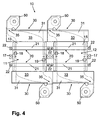
- Fuel cell system 10 is another embodiment of a Fuel cell system 10 according to the invention shown. Again that is Fuel cell system 10 of two fuel cell stacks 11, 12, in which between respective end plates 13, 14 and 15, 16 stacks of Fuel cells or fuel cell plates are located.
- the Fuel cell stacks 11, 12 have a longitudinal extent L on.
- openings 18 for the supply of oxidant or openings 19 shown for the fuel discharge are openings 18 for the supply of oxidant or openings 19 shown for the fuel discharge.
- Appropriate are openings for the Oxidationsffenabbow or the fuel supply also provided in the end plates 14, 16, but not explicitly in the figures shown.
- the Fuel cell stacks 11, 12 corresponding current collection plates 17.
- bracing devices 20 each consist of spring elements 21, the over corresponding VerspanngestShe 22 are interconnected. In this way let the fuel cell stacks 11, 12 firmly join together. Furthermore are the individual plates of the fuel cell stacks 11, 12 usually still glued together.
- the fuel cell stacks 11, 12 in a sufficient and appropriate manner to be able to ventilate, so that in the fuel cell stacks 11, 12 a homogeneous Moisture distribution is feasible and thus the fuel cell stacks 11, 12 in can be suitably cooled, are per fuel cell stack 11, 12th two devices 30 for flowing the fuel cell stacks 11, 12 intended.
- the devices 30 are in the longitudinal extent L of Fuel cell stacks 11, 12 on opposite sides of the Fuel cell stacks 11, 12 are arranged.
- Each of the devices 30 has in turn via a housing 31, in each of which a distributor space 33 is provided. Similar to the example shown in Figure 1, in turn, a medium volume flow evenly distributed in the distribution space 33 so that this over a defined area of the fuel cell stacks 11, 12 can enter this.
- the conveyors are 50 formed in the form of cross-flow conveyors, for example in shape of cross-flow fans or cross-flow blowers. These cross flow conveyors 50 extend along the entry regions 35 of FIG Distribution spaces 33. Crossflow conveyors are particularly suitable for to provide a large-scale media feed.
- the conveyors 50 of the devices 30 or the use each of two devices 30 on opposite sides of the Fuel cell stacks 11, 12 makes it possible that the flow direction of the Medium through the fuel cell stacks 11, 12 through during operation can be reversed. This is a particularly homogeneous flow the fuel cell stacks 11, 12 guaranteed.
- a Device 30 is provided for flowing.
- the two devices with respect to the center M of Fuel cell stacks 11 arranged approximately point-symmetrically.
- the devices 30 according to FIGS. 6 and 7 each have a distributor space 33, which through an inlet opening 41, a transition opening 42 (for the Transfer of the medium from the distribution chamber 33 into the fuel cell stack 11), a first wall element 43 and a second wall element 44 is limited.
- the Inlet opening 41 has a height of 22 mm.
- the first wall element 43 and the second wall element 44 each have a curved course and each extend from the inlet opening 41 to the transition opening 42.
- the maximum height of the distributor space 33 in the region of the inlet opening 41 is 50 mm, the maximum length of the distributor space is 140 mm.
- the second wall element 44 has in both Figures 6 and 7 each one curved course formed by a single radius of curvature K3 becomes.
- the first wall element 43 has a curved course in FIG is formed by two radii of curvature K1 and K2.
- the first wall element 43 in contrast, has a curved course, the only by a single radius of curvature K1 is formed.
- the first wall element 43 is such formed in that in the transition region 45 between the first wall element 43 and the transition opening 42, the angle W1 between the tangent T1 of the first Wall element 43 and the transition opening 60 to 90 degrees, ideally about 80 degrees.
- the radius of curvature K2 is preferably in this range 15-40% of the length of the transition opening 42 (that is, of the extent thereof between first wall element 43 and second wall element 44), ideally about 25 - 35%.
- the subsequent to the radius of curvature K2 further The radius of curvature K1 is preferably 200-500% of the length of the Transition opening 42, ideally about 300%.
- In the transition area 46 of the Inlet opening 41 to the first wall element 43 is the angle W2 between the Tangent T2 of the first wall element 43 and the horizontal H1 preferably 0 to 10 degrees, ideally about 1 to 4 degrees.
- the second wall element 44 according to FIG. 6 advantageously has a length which is 80 to 200% of the height of the inlet opening 41 corresponds, ideally 130 to 150%.
- the Length of the second wall element 44 corresponds to the distance from Transition region 48 between the inlet opening 41 and the second wall element 44 bis towards the transition region 47 between the second wall element 44 and the Transition opening 42.
- the Angle W4 between the tangent T4 of the second wall member 44 and the Vertical H2 preferably 10 to 30 degrees, ideally about 20 degrees.
- the angle W3 is between the tangent T3 of the second wall element 44 and the vertical H2 preferably 5 to 25 degrees, ideally about 10 to 20 Degree.
- the second wall element 44 preferably has a curved course with a radius of curvature K3, which is advantageously 40-120% of the length of the Transition opening 42 is, ideally about 70%.
- Distribution chamber 33 can be in the distribution chamber 33 entering medium distribute particularly well and in a defined manner into the fuel cell section 11 initiate.
- the devices 30 according to Figure 7 via first wall elements 43, one formed by only one radius of curvature K1 have a curved course.
- the geometric configuration of the device 30 results as follows.
- the first wall element 43 is designed such that in the transition region 45 between the first wall element 43 and the transition opening 42 of the angle W1 between the tangent T1 of the first wall element 43 and the Transition opening 30 to 60 degrees, ideally about 40 degrees.
- the Curvature radius K1 of the first wall element 43 is preferably 100 - 300% of the length of the transition opening 42, ideally about 140 - 160%.
- the angle W2 is between the tangent T2 of the first wall element 43 and the horizontal H1 preferably 0 to 10 degrees, ideally about 1 to 4 Degree.
- the second wall element 44 advantageously has a length which is 80 to 200% of the height of the inlet opening 41 corresponds, ideally 130 to 150%.
- the angle W4 between the Tangent T4 of the second wall element 44 and the vertical H2 preferably 30 to 60 degrees, ideally about 40 to 50 degrees.
- the angle W3 is between the tangent T3 of the second wall element 44 and the vertical H2 preferably 10 to 40 degrees, ideally about 20 to 30 Degree.
- the second wall element 44 preferably has a curved course with a radius of curvature K3, which is advantageously 40-120% of the length of the Transition opening 42 is, ideally about 70%.
- FIGS. 8a to 8c show a further embodiment of a device according to the invention Device 30 for flow of at least one fuel cell shown.
- the Device 30 has one as in the previously described embodiments Distribution space 33, in which there are a number of partition plates 60, the have already been described above.
- the distribution space 30 is defined by an inlet opening 41, a transition opening 42, a first wall element 43 and a second wall element 44 bounded.
- the first Wall element 43 and the second wall element 44 have at least one partially curved course.
- the partition plates 60 are formed in a curved configuration in the example, However, they can also be designed in a straight shape.
- the partition plates 60 can in their curved shape, for example, a radius of about 5 to 25% of the length have the transition opening 42.
- the second wall element 44 is seen - seen from the direction of the inlet opening 41 from a straight (linear) segment 44b and a subsequent, curved segment 44a.
- the total length of the second wall element 44 is preferably 80 to 200% of the height of the inlet opening 41, ideally 120 to 150%.
- the radius of curvature of the curved segment 44a is, for example 0 to 30% of the length of the transition opening 42, ideally 3 to 10%.
- the Inlet opening 41 may have a height between 20 to 25 mm, ideally a height between 22 and 24 mm.
- the transition opening 42 may in the example a Length of 300 mm.
- the first wall element 43 also has a straight (linear) segment 43b and an adjoining curved segment 43a.
- the radius of curvature of the curved segment 43a may be, for example, 5 to 30% of the length of the Transition opening 42, preferably 11 to 14% amount.
- the straight segment 43b of the wall element 43 may have an angle W2 to the plane of the transition opening 42 from 0 to 10 degrees, preferably 2 to 5 degrees.
- the length of the straight Wall segment 43b can be 80 to 120% of the length of the Transition opening 42 amount.
- the angle W1 between the transition opening 42 and the tangent T1 of the first Wall element 43 advantageously 60 to 90 degrees, preferably 70 to about 80 degrees be.
- the angle W3 between the tangent T3 of the second Wall element 44 and the vertical H2 advantageously 0 to 15 degrees, preferably 0 to 5 degrees.
- the angle W4 between the tangent T4 and the Vertical H2 preferably 70 to 90 degrees, ideally 80 to 90 degrees be.
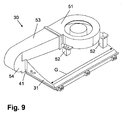
- FIGS. 9 to 14 show a further exemplary embodiment of a Device 30 for flow of at least one fuel cell shown.
- the Beströmvoriques has a limited by a housing 31 distribution space 33 on.
- a suitable fastening means 52 On the housing 31 is a suitable fastening means 52 a Conveyor in the form of a radial fan 51 attached.
- the radial fan 51 generates the air introduced into the distribution space 33 and over directed to the fuel cell (s) in a homogeneous manner should.
- the air generated by the radial fan 51 is first via a Inlet channel 53 and a deflection channel 54 of the inlet opening 41 of a Entry region 35 of the distribution chamber 33 is supplied.
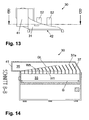
- the inlet region 35 merges into the actual distributor chamber 33. So that Medium already in the inlet region 35 over the entire length G of the distribution space 33 directed with a defined flow characteristic in the given Area of the fuel cell (s) may occur in the inlet region 35th Distributor elements 37 provided ( Figure 14).
- the distributor elements 37 have curved guide surfaces, in the present example, the distributor elements 38th consist of two straight sub-elements and the sub-elements angular stand on each other.
- the increase in the height of the distributor elements 37 is selected so that the Angle W5 between an imaginary line GL along the in the entrance area 35th protruding ends 37a of the distributor elements 37 and the horizontal H1 0 bis 30 degrees, preferably 3 to 15 degrees, and most preferably 8 degrees. This ensures that the medium flowing into the inlet region 35 over the entire length G of the Beströmvoriques 30 directed into the distributor space 33 occurs.
- the inlet area 35 enters into the inlet area 35 Medium first through the distribution elements 37 into uniform partial flows divided (which by the different height of the distribution elements 37 guaranteed) and directed into the distribution chamber 33 introduced (via its entire length).
- the distribution chamber 33 has particular trained wall elements.
- the distributor space 33 is through the inlet opening 41, the adjoining inlet region 35, a Transition opening 42 for the passage of the medium in the fuel cell (s), a limited first wall element 43 and a second wall element 444. there the wall elements 43, 44 extend from the inlet region 35 towards Transition opening 42.
- the first wall element 43 is designed such that in the transition region 45 between the first wall element 43 and the transition opening 42 of the angle W1 between the tangent T1 of the first wall element 43 and the Transition opening 60 to 90 degrees, ideally about 80 degrees.
- in the Transition region 46 from the inlet region 35 to the first wall element 43 is the angle W2 between the tangent T2 of the first wall element 43 and the Horizontal H1 preferably 10 to 40 degrees, ideally about 15 to 30 degrees.
- a first Wall element 43 which from the transition opening 42 for the passage of the Medium in the fuel cell (s) seen from an outwardly curved course has, shown in Figures 9 to 14 first wall element 43 of the Transition opening 42 seen from an inward into the distribution chamber 33 inside arched contour on.
Landscapes
- Engineering & Computer Science (AREA)
- Chemical & Material Sciences (AREA)
- Life Sciences & Earth Sciences (AREA)
- Manufacturing & Machinery (AREA)
- Sustainable Development (AREA)
- Sustainable Energy (AREA)
- Chemical Kinetics & Catalysis (AREA)
- Electrochemistry (AREA)
- General Chemical & Material Sciences (AREA)
- Combustion & Propulsion (AREA)
- Fuel Cell (AREA)
Abstract
Description
- Figur 1
- in schematischer Darstellung eine Draufsicht auf ein Brennstoffzellensystem mit einer erfindungsgemäßen Vorrichtung zum Beströmen wenigstens einer Brennstoffzelle gemäß einem ersten Ausführungsbeispiel der Erfindung;
- Figur 2
- in schematischer Darstellung einen Querschnitt durch einen Verteilerraum einer erfindungsgemäßen Vorrichtung zum Beströmen wenigstens einer Brennstoffzelle;
- Figur 3
- in schematischer Ansicht eine Trennplatte zum Einsatz in einem Verteilerraum einer erfindungsgemäß Vorrichtung zum Beströmen wenigstens einer Brennstoffzelle;
- Figur 4
- in schematischer Querschnittsansicht eine weitere Ausführungsform eines erfindungsgemäßen Brennstoffzellensystem mit erfindungsgemäßen Vorrichtungen zum Beströmen wenigstens einer Brennstoffzelle;
- Figur 5
- eine perspektivische Darstellung des in Figur 4 dargestellten Brennstoffzellensystems;
- Figur 6
- eine schematische Darstellung einer anderen Ausführungsform des erfindungsgemäßen Brennstoffzellensystems;
- Figur 7
- eine schematische Darstellung einer weiteren Ausführungsform des erfindungsgemäßen Brennstoffzellensystems;
- Figuren 8a)-c)
- Darstellungen noch einer anderen Ausführungsform einer erfindungsgemäßen Vorrichtung zum Beströmen einer Brennstoffzelle;
- Figur 9
- eine perspektivische Darstellung einer weiteren Ausführungsform einer erfindungsgemäßen Vorrichtung zum Beströmen wenigstens einer Brennstoffzelle;
- Figur 10
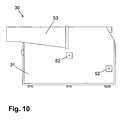
- eine Draufsicht auf die in Figur 9 dargestellte Vorrichtung zum Beströmen wenigstens einer Brennstoffzelle;
- Figur 11
- eine Seitenansicht der in den Figuren 9 und 10 dargestellten Vorrichtung zum Beströmen wenigstens einer Brennstoffzelle;
- Figur 12
- eine Schnittdarstellung durch den Verteilerraum der Vorrichtung zum Beströmen wenigstens einer Brennstoffzelle entlang der Schnittlinie A-A in Figur 11;
- Figur 13
- eine Frontansicht der in den Figuren 9 und 10 dargestellten Vorrichtung zum Beströmen wenigstens einer Brennstoffzelle; und
- Figur 14
- eine Schnittdarstellung durch die Vorrichtung zum Beströmen wenigstens einer Brennstoffzelle entlang der Schnittlinie B-B in Figur 13.
- 10
- Brennstoffzellensystem
- 11
- Brennstoffzellenstack
- 12
- Brennstoffzellenstack
- 13
- Endplatte
- 14
- Endplatte
- 15
- Endplatte
- 16
- Endplatte
- 17
- Stromabnahmeplatte
- 18
- Oxidationsmittelzufuhr
- 19
- Brennstoffabfuhr
- 20
- Verspanneinrichtung
- 21
- Federelement
- 22
- Verspanngestänge
- 30
- Vorrichtung zum Beströmen wenigstens einer Brennstoffzelle
- 31
- Gehäuse
- 32
- Medienzufuhr
- 33
- Verteilerraum
- 34
- Verteilerraum
- 35
- Eintrittsbereich in den Verteilerraum
- 36
- Eintrittsbereich in den Verteilerraum
- 37
- Verteilerelement
- 37a
- Ende des Verteilerelements
- 38
- Leitfläche
- 39
- in Bezug auf den Eintrittsbereich gegenüberliegendes Ende des Verteilerraums
- 40
- Aufnahmebereich
- 41
- Eintrittsöffnung
- 42
- Übergangsöffnung
- 43
- erstes Wandelement
- 43a
- gekrümmtes Wandsegment
- 43b
- gerades Wandsegment
- 44
- zweites Wandelement
- 44a
- gekrümmtes Wandsegment
- 44b
- gerades Wandsegment
- 45
- Übergangsbereich erstes Wandelement in Übergangsöffnung
- 46
- Übergangsbereich Eintrittsöffnung in erstes Wandelement
- 47
- Übergangsbereich zweites Wandelement in Übergangsöffnung
- 48
- Übergangsbereich Eintrittsöffnung in zweites Wandelement
- 50
- Fördereinrichtung
- 51
- Radiallüfter
- 52
- Befestigungseinrichtung
- 53
- Eintrittskanal
- 54
- Umlenkkanal
- 60
- Trennplatte
- 61
- Strömungskanal
- 65
- Begrenzungswand des Verteilerraums
- G
- Gesamte Länge des Verteilerraums
- GL
- gedachte Linie
- H1
- Waagerechte
- H2
- Senkrechte
- K1
- Krümmungsradius
- K2
- Krümmungsradius
- K3
- Krümmungsradius
- L
- Längsausdehnung des Brennstoffzellenstacks
- M
- Mittelpunkt der Brennstoffzelle(n)
- S
- Strömungsrichtung des Medium-Volumenstroms
- T1
- Tangente
- T2
- Tangente
- T3
- Tangente
- T4
- Tangente
- W1
- Winkel
- W2
- Winkel
- W3
- Winkel
- W4
- Winkel
- W5
- Winkel
Claims (23)
- Vorrichtung zum Beströmen wenigstens einer Brennstoffzelle mit einem Medium, mit wenigstens einer Medienzufuhr (32) zum Zuführen des Mediums zu der wenigstens einen Brennstoffzelle, und mit wenigstens einer in der Medienzufuhr (32) angeordneten Fördereinrichtung (50) zum Erzeugen eines definierten Medium-Volumenstroms mit einer definierten Strömungsrichtung (S), wobei die Medienzufuhr (32) in einen Verteilerraum (33, 34) mündet, in dem sich das Medium vor Eintritt in die Brennstoffzelle(n) verteilt/verteilen kann und wobei der Verteilerraum (33, 34) unmittelbar mit der wenigstens einen Brennstoffzelle in Kontakt bringbar ist, sodass der Eintritt des Mediums in die Brennstoffzelle(n) über einen vorgegebenen Bereich der Brennstoffzelle(n) erfolgen kann, dadurch gekennzeichnet, dass die Vorrichtung derart ausgebildet ist, dass das Medium über die gesamte Länge (G) des Verteilerraums (33, 34) mit einer definierten Strömungscharakteristik gerichtet in dem vorgegebenen Bereich in die Brennstoffzelle(n) eintritt/eintreten kann und dass in einem Eintrittsbereich (35, 36) des Verteilerraums, Mittel zur definierten Verteilung des Medium-Volumenstroms in den Verteilerraum (33, 34) vorgesehen sind.
- Vorrichtung nach Anspruch 1, dadurch gekennzeichnet, dass die Mittel zur definierten Verteilung des Medium-Volumenstroms als Bestandteil der wenigstens einen Fördereinrichtung (50) ausgebildet sind.
- Vorrichtung nach Anspruch 1 oder 2, dadurch gekennzeichnet, dass die Mittel zur definierten Verteilung des Medium-Volumenstroms als Bestandteil des Verteilerraums (33, 34) ausgebildet sind.
- Vorrichtung nach einem der Ansprüche 1 bis 3, dadurch gekennzeichnet, dass die wenigstens eine Fördereinrichtung (50) als Querstrom-Fördereinrichtung ausgebildet ist, die sich entlang des Eintrittsbereichs (35, 36) des Verteilerraums (33, 34) erstreckt und/oder dass die Fördereinrichtung (50) als Radiallüfter ausgebildet ist.
- Vorrichtung nach einem der Ansprüche 1 bis 4, dadurch gekennzeichnet, dass im Eintrittsbereich (35, 36) des Verteilerraums (33, 34) zur definierten Verteilung des Medium-Volumenstroms ein oder mehrere Verteilerelement(e) (37) vorgesehen ist/sind.
- Vorrichtung nach Anspruch 5, dadurch gekennzeichnet, dass wenigstens ein Verteilerelement (37) zur Richtungsweisung eines Teilstroms des Medium-Volumenstroms wenigstens eine zumindest teilweise gekrümmte Leitfläche (38) aufweist.
- Vorrichtung nach Anspruch 5 oder 6, dadurch gekennzeichnet, dass mehrere Verteilerelemente (37) vorgesehen sind, dass die in den Eintrittsbereich (35) des Verteilerraums (33) hineinragenden Enden (37a) der Verteilerelemente (37) von der Eintrittsöffnung (41) in den Eintrittsbereich (35) hin zu einer gegenüberliegenden Begrenzungswand (65) des Eintrittsbereichs (35) eine zunehmende Höhe aufweisen.
- Vorrichtung nach Anspruch 7, dadurch gekennzeichnet, dass der Winkel (W5) zwischen einer gedachten Linie (GL) entlang der in den Eintrittsbereich (35) hineinragenden Enden (37a) der Verteilerelemente (37) und der Waagerechten (H1) 0 bis 30 Grad, vorzugsweise 3 bis 15 Grad, insbesondere 8 Grad, beträgt.
- Vorrichtung nach einem der Ansprüche 1 bis 8, dadurch gekennzeichnet, dass der Verteilerraum (33, 34) an sich in einer Weise ausgebildet ist, dass das Medium mit einer definierten Strömungscharakteristik in dem vorgegebenen Bereich in die Brennstoffzelle(n) eintreten kann und dass der Verteilerraum (33, 34) von seinem Eintrittsbereich (35, 36) aus gesehen hin zu dessen gegenüberliegenden Ende (39) eine sich verjüngende, insbesondere eine zumindest teilweise kurvenförmig verlaufende, Kontur aufweist.
- Vorrichtung nach einem der Ansprüche 1 bis 9, dadurch gekennzeichnet, dass der Verteilerraum (33, 34) durch eine Eintrittsöffnung (41), eine Übergangsöffnung (42) für den Übertritt des Mediums in die Brennstoffzelle(n), ein erstes Wandelement (43) sowie ein zweites Wandelement (44) begrenzt ist, wobei sich die Wandelemente (43, 44) von der Eintrittsöffnung (41) zur Übergangsöffnung (42) erstrecken.
- Vorrichtung nach einem der Ansprüche 1 bis 9, dadurch gekennzeichnet, dass der Verteilerraum (33, 34) durch eine Eintrittsöffnung (41), einen sich daran anschließenden Eintrittsbereich (35), eine Übergangsöffnung (42) für den Übertritt des Mediums in die Brennstoffzelle(n), ein erstes Wandelement (43) sowie ein zweites Wandelement (44) begrenzt ist, wobei sich die Wandelemente (43, 44) von dem Eintrittsbereich (35) zur Übergangsöffnung (42) erstrecken.
- Vorrichtung nach Anspruch 10 oder 11, dadurch gekennzeichnet, dass das erste Wandelement (43) und/oder das zweite Wandelement (44) zumindest bereichsweise einen gekrümmten Verlauf aufweisen und dass der gekrümmte Verlauf des ersten und/oder zweiten Wandelements (43, 44) durch wenigstens einen Krümmungsradius (K1, K2, K3) gebildet wird.
- Vorrichtung nach einem der Ansprüche 10 bis 12, dadurch gekennzeichnet, dass im Übergangsbereich (45) vom ersten Wandelement (43) zur Übergangsöffnung (42) der Winkel (W1) zwischen der Übergangsöffnung (42) und der Tangente (T1) des ersten Wandelements (43) 20 bis 90 Grad beträgt.
- Vorrichtung nach einem der Ansprüche 10 bis 13, dadurch gekennzeichnet, dass im Übergangsbereich (46) von der Eintrittsöffnung (41) zum ersten Wandelement (43) und/oder vom Eintrittsbereich (35) zum ersten Wandelement (43) der Winkel (W2) zwischen der Tangente (T2) des ersten Wandelements (43) und der Waagerechten (H1) 0 bis 40 Grad beträgt.
- Vorrichtung nach einem der Ansprüche 10 bis 14, dadurch gekennzeichnet, dass im Übergangsbereich (47) vom zweiten Wandelement (44) zur Übergangsöffnung (42) der Winkel (W3) zwischen der Tangente (T3) des zweiten Wandelements (44) und der Senkrechten (H2) 0 bis 90 Grad beträgt.
- Vorrichtung nach einem der Ansprüche 10 bis 15, dadurch gekennzeichnet, dass im Übergangsbereich (48) von der Eintrittsöffnung (41) zum zweiten Wandelement (44) und/oder vom Eintrittsbereich (35) zum zweiten Wandelement (44) der Winkel (W4) zwischen der Tangente (T4) des zweiten Wandelements (44) und der Senkrechten (H2) 5 bis 90 Grad beträgt.
- Vorrichtung nach einem der Ansprüche 1 bis 16, dadurch gekennzeichnet, dass in dem Verteilerraum (33, 34) wenigstens eine Trennplatte (60) vorgesehen ist, die innerhalb des Verteilerraums (33, 34) zumindest bereichsweise zwei oder mehr Strömungskanäle (61) ausbildet.
- Vorrichtung nach einem der Ansprüche 1 bis 17, dadurch gekennzeichnet, dass wenigstens eine Fördereinrichtung (50) in ihrer Förderrichtung und/oder in ihrer Fördermenge variabel ausgebildet ist.
- Vorrichtung nach einem der Ansprüche 1 bis 18, dadurch gekennzeichnet, dass wenigstens eine Fördereinrichtung (50) mit einer Steuereinrichtung verbunden ist.
- Brennstoffzellensystem, aufweisend wenigstens eine Brennstoffzelle mit wenigstens einer Zufuhr für einen Mediumzustrom und mit wenigstens einer Abfuhr für einen Mediumabstrom, dadurch gekennzeichnet, dass in der Zufuhr und/oder der Abfuhr wenigstens eine Vorrichtung (30) gemäß einem der Ansprüche 1 bis 19 vorgesehen ist.
- Brennstoffzellensystem nach Anspruch 20, dadurch gekennzeichnet, dass sowohl in der Zufuhr als auch in der Abfuhr eine Vorrichtung (30) nach einem der Ansprüche 1 bis 19 vorgesehen ist und dass je nach Aktivierung und Förderrichtung der Fördereinrichtungen (50) eine der Vorrichtungen zum Beströmen der Brennstoffzelle(n) zum Zuführen des Medium-Volumenstroms in die Brennstoffzelle(n) und die andere Vorrichtung zum Abführen des Medium-Volumenstroms aus der/den Brennstoffzelle(n) ausgebildet ist.
- Brennstoffzellensystem nach Anspruch 21, dadurch gekennzeichnet, dass die beiden Vorrichtungen (30) bezüglich des Mittelpunkts (M) der Brennstoffzelle(n) punktsymmetrisch angeordnet sind.
- Brennstoffzellensystem nach einem der Ansprüche 20 bis 22, dadurch gekennzeichnet, dass dieses wenigstens einen Brennstoffzellenstack (11, 12) aus zwei oder mehr hintereinander angeordneten Brennstoffzellen aufweist und dass der Verteilerraum (33, 34) der wenigstens einen Vorrichtung (30) zum Beströmen der Brennstoffzellen unmittelbar mit einem definierten Bereich des Brennstoffzellenstacks (11, 12), insbesondere in dessen Längsausdehnung (L), in Kontakt steht.
Applications Claiming Priority (2)
| Application Number | Priority Date | Filing Date | Title |
|---|---|---|---|
| DE10342470A DE10342470A1 (de) | 2003-09-15 | 2003-09-15 | Vorrichtung zum Beströmen wenigstens einer Brennstoffzelle mit einem Medium sowie Brennstoffzellensystem |
| DE10342470 | 2003-09-15 |
Publications (2)
| Publication Number | Publication Date |
|---|---|
| EP1515383A2 true EP1515383A2 (de) | 2005-03-16 |
| EP1515383A3 EP1515383A3 (de) | 2007-11-14 |
Family
ID=34129807
Family Applications (1)
| Application Number | Title | Priority Date | Filing Date |
|---|---|---|---|
| EP04021360A Withdrawn EP1515383A3 (de) | 2003-09-15 | 2004-09-08 | Vorrichtung zum Beströmen wenigstens einer Brennstoffzelle mit einem Medium sowie Brennstoffzellensystem |
Country Status (3)
| Country | Link |
|---|---|
| US (1) | US20050142421A1 (de) |
| EP (1) | EP1515383A3 (de) |
| DE (1) | DE10342470A1 (de) |
Cited By (4)
| Publication number | Priority date | Publication date | Assignee | Title |
|---|---|---|---|---|
| EP2051323A1 (de) | 2007-10-17 | 2009-04-22 | L'Air Liquide Société Anonyme pour l'Etude et l'Exploitation des Procédés Georges Claude | Brennstoffzelle, die eine Abkühlvorrichtung mit Hilfe eines Kühlmittelgases umfasst |
| WO2010041013A1 (en) * | 2008-10-07 | 2010-04-15 | Intelligent Energy Limited | Fuel cell assembly |
| WO2024020614A1 (de) * | 2022-07-28 | 2024-02-01 | Avl List Gmbh | Brennstoffzellensystem mit einem brennstoffzellenstapel und einer strömungsanordnung zum zuführen eines medienstroms zum brennstoffzellenstapel |
| DE102022211229A1 (de) | 2022-10-24 | 2024-04-25 | Robert Bosch Gesellschaft mit beschränkter Haftung | Zellstapel zum elektrochemischen Wandeln von Energie |
Families Citing this family (9)
| Publication number | Priority date | Publication date | Assignee | Title |
|---|---|---|---|---|
| US20070077474A1 (en) * | 2005-10-04 | 2007-04-05 | Goebel Steven G | Fuel cell system water mass balancing scheme |
| KR101255236B1 (ko) * | 2006-01-27 | 2013-04-16 | 삼성에스디아이 주식회사 | 직접액체 연료전지 시스템 |
| JP2008251338A (ja) * | 2007-03-30 | 2008-10-16 | Equos Research Co Ltd | 燃料電池システム |
| US20110136042A1 (en) * | 2009-12-07 | 2011-06-09 | Chi-Chang Chen | Fluid flow plate assemblies |
| KR101209684B1 (ko) | 2010-11-17 | 2012-12-10 | 기아자동차주식회사 | 분배 가이드를 갖는 스택 매니폴드 인서트 및 이를 포함하는 연료전지 스택 |
| DE102012221676A1 (de) * | 2012-11-27 | 2014-05-28 | Bayerische Motoren Werke Aktiengesellschaft | Brennstoffzelle mit einem Anoden-Kathoden-Stapel |
| EP3348947B1 (de) * | 2017-01-13 | 2020-11-04 | HS Marston Aerospace Limited | Wärmetauscher |
| US10727520B2 (en) | 2017-07-18 | 2020-07-28 | Cummins Enterprise Llc | Fuel cell stack assembly |
| DE102023129011A1 (de) * | 2023-10-23 | 2025-04-24 | Ekpo Fuel Cell Technologies Gmbh | Elektrochemische Vorrichtung |
Family Cites Families (11)
| Publication number | Priority date | Publication date | Assignee | Title |
|---|---|---|---|---|
| JPS58178964A (ja) * | 1982-04-13 | 1983-10-20 | Sanyo Electric Co Ltd | 空冷式燃料電池 |
| US4706737A (en) * | 1986-11-20 | 1987-11-17 | International Fuel Cells Corporation | Fuel cell coolant inlet manifold and system |
| JP2701522B2 (ja) * | 1990-06-20 | 1998-01-21 | 富士電機株式会社 | 燃料電池発電装置 |
| DE19649691C2 (de) * | 1996-11-29 | 1998-10-15 | Siemens Ag | Flüssigkeitsgekühlte Brennstoffzellenbatterie sowie Verfahren zu deren Kühlung |
| JPH11185785A (ja) * | 1997-12-25 | 1999-07-09 | Sanyo Electric Co Ltd | 固体高分子型燃料電池システム |
| US6632556B2 (en) * | 2000-12-19 | 2003-10-14 | Utc Fuel Cells, Llc | Manifold assembly for a fuel cell power plant |
| JP4424863B2 (ja) * | 2001-02-23 | 2010-03-03 | 三洋電機株式会社 | 燃料電池 |
| US6696190B2 (en) * | 2001-06-29 | 2004-02-24 | Plug Power Inc. | Fuel cell system and method |
| JP2003036878A (ja) * | 2001-07-19 | 2003-02-07 | Equos Research Co Ltd | 燃料電池の空気供給装置 |
| US6679280B1 (en) * | 2001-10-19 | 2004-01-20 | Metallic Power, Inc. | Manifold for fuel cell system |
| US20070077459A1 (en) * | 2002-05-14 | 2007-04-05 | Walton James F Ii | Compressor-expander with high to idle air flow to fuel cell |
-
2003
- 2003-09-15 DE DE10342470A patent/DE10342470A1/de not_active Withdrawn
-
2004
- 2004-09-08 EP EP04021360A patent/EP1515383A3/de not_active Withdrawn
- 2004-09-13 US US10/939,957 patent/US20050142421A1/en not_active Abandoned
Cited By (6)
| Publication number | Priority date | Publication date | Assignee | Title |
|---|---|---|---|---|
| EP2051323A1 (de) | 2007-10-17 | 2009-04-22 | L'Air Liquide Société Anonyme pour l'Etude et l'Exploitation des Procédés Georges Claude | Brennstoffzelle, die eine Abkühlvorrichtung mit Hilfe eines Kühlmittelgases umfasst |
| FR2922686A1 (fr) * | 2007-10-17 | 2009-04-24 | Air Liquide | Pile a combustible comprenant un dispositif de refroidissement par gaz caloporteur |
| WO2010041013A1 (en) * | 2008-10-07 | 2010-04-15 | Intelligent Energy Limited | Fuel cell assembly |
| TWI469436B (zh) * | 2008-10-07 | 2015-01-11 | Intelligent Energy Ltd | 燃料電池組合 |
| WO2024020614A1 (de) * | 2022-07-28 | 2024-02-01 | Avl List Gmbh | Brennstoffzellensystem mit einem brennstoffzellenstapel und einer strömungsanordnung zum zuführen eines medienstroms zum brennstoffzellenstapel |
| DE102022211229A1 (de) | 2022-10-24 | 2024-04-25 | Robert Bosch Gesellschaft mit beschränkter Haftung | Zellstapel zum elektrochemischen Wandeln von Energie |
Also Published As
| Publication number | Publication date |
|---|---|
| US20050142421A1 (en) | 2005-06-30 |
| DE10342470A1 (de) | 2005-04-07 |
| EP1515383A3 (de) | 2007-11-14 |
Similar Documents
| Publication | Publication Date | Title |
|---|---|---|
| DE10393165B4 (de) | Brennstoffzellenstapel und Betriebsverfahren | |
| DE69929756T2 (de) | Brennstoffzellenstapel | |
| EP2356714B1 (de) | Brennstoffzelle ohne bipolarplatten | |
| EP1515383A2 (de) | Vorrichtung zum Beströmen wenigstens einer Brennstoffzelle mit einem Medium sowie Brennstoffzellensystem | |
| DE102008006735A1 (de) | Leistungsstarke, kompakte und geringen Druckabfall aufweisende, spiralartig gewickelte Brennstoffzellenbefeuchter-Gestaltung | |
| WO2019229138A1 (de) | Separatorplatte für ein elektrochemisches system | |
| DE112005001086B4 (de) | Kühlmittelströmungsfeldgeometrie mit verzweigten Fluidkanälen zur verbesserten Fluidströmung durch eine Brennstoffzelle, Separatorplatte und Brennstoffzelle | |
| DE102019206577A1 (de) | Flussfeldplatte | |
| DE10244707A1 (de) | Vorrichtung zum Austausch von Feuchtigkeit zwischen einem feuchten und einem trockenen Gasstrom | |
| WO2019141601A1 (de) | Bipolarplatte, brennstoffzelle und ein kraftfahrzeug | |
| WO2021121464A1 (de) | Feuchtetauscher, insbesondere befeuchter für eine brennstoffzelle, und brennstoffzellensystem | |
| WO2009095201A1 (de) | Befeuchter | |
| DE10297193T5 (de) | Fluidströmungssteuerung für kühlen, effizienten Brennstoffzellenbetrieb | |
| DE19743067C2 (de) | Strömungsmodul mit Strömungskammern für drei oder vier Fluide | |
| DE102004058117B4 (de) | Dickenoptimierte Bipolarplatte für Brennstoffzellenstapel sowie Bipolarplattenanordnung in einem Brennstoffzellenstapel | |
| WO2016206840A1 (de) | Strömungsfeld einer brennstoffzelle | |
| DE102004022021A1 (de) | Feuchtigkeitsaustauschmodul mit einem Bündel von für Feuchtigkeit durchlässigen Hohlfasermembranen | |
| DE102009009177A1 (de) | Wiederholeinheit für einen Brennstoffzellenstapel | |
| EP1522115A1 (de) | Brennstoffzellenstapel mit gegenstromkühlung und einer vielzahl von kühlmittelsammelkanälen parallel zur stapelachse | |
| DE102018205995A1 (de) | Vorrichtung zur Konditionierung des Kathodengases und Brennstoffzellensystem mit einer solchen Vorrichtung | |
| DE102005037093B4 (de) | Brennstoffzelle mit Fluidführungskanälen mit sich gegenläufig ändernden Strömungsquerschnitten | |
| DE102006046725B4 (de) | Anordnung zur elektrochemischen Umwandlung sowie Verfahren zum Betrieb dieser | |
| DE102017221983A1 (de) | Befeuchter mit variabler Faserdichte für ein Brennstoffzellensystem, Brennstoffzellensystem sowie Fahrzeug mit einem solchen | |
| WO2002097908A2 (de) | Interkonnektor für eine brennstoffzelle | |
| DE102004022539B4 (de) | Feuchtigkeitsaustauschmodul mit einem Bündel von für Feuchtigkeit durchlässigen Hohlfasermembranen |
Legal Events
| Date | Code | Title | Description |
|---|---|---|---|
| PUAI | Public reference made under article 153(3) epc to a published international application that has entered the european phase |
Free format text: ORIGINAL CODE: 0009012 |
|
| AK | Designated contracting states |
Kind code of ref document: A2 Designated state(s): AT BE BG CH CY CZ DE DK EE ES FI FR GB GR HU IE IT LI LU MC NL PL PT RO SE SI SK TR |
|
| AX | Request for extension of the european patent |
Extension state: AL HR LT LV MK |
|
| EL | Fr: translation of claims filed | ||
| GBC | Gb: translation of claims filed (gb section 78(7)/1977) | ||
| PUAL | Search report despatched |
Free format text: ORIGINAL CODE: 0009013 |
|
| AK | Designated contracting states |
Kind code of ref document: A3 Designated state(s): AT BE BG CH CY CZ DE DK EE ES FI FR GB GR HU IE IT LI LU MC NL PL PT RO SE SI SK TR |
|
| AX | Request for extension of the european patent |
Extension state: AL HR LT LV MK |
|
| 17P | Request for examination filed |
Effective date: 20080514 |
|
| AKX | Designation fees paid |
Designated state(s): AT BE BG CH CY CZ DE DK EE ES FI FR GB GR HU IE IT LI LU MC NL PL PT RO SE SI SK TR |
|
| 17Q | First examination report despatched |
Effective date: 20090121 |
|
| STAA | Information on the status of an ep patent application or granted ep patent |
Free format text: STATUS: THE APPLICATION IS DEEMED TO BE WITHDRAWN |
|
| 18D | Application deemed to be withdrawn |
Effective date: 20091001 |