EP1514948A1 - Steel belt comprising martensitic steel and method for manufacturing hoop for continuously variable transmission using said steel belt - Google Patents
Steel belt comprising martensitic steel and method for manufacturing hoop for continuously variable transmission using said steel belt Download PDFInfo
- Publication number
- EP1514948A1 EP1514948A1 EP03730824A EP03730824A EP1514948A1 EP 1514948 A1 EP1514948 A1 EP 1514948A1 EP 03730824 A EP03730824 A EP 03730824A EP 03730824 A EP03730824 A EP 03730824A EP 1514948 A1 EP1514948 A1 EP 1514948A1
- Authority
- EP
- European Patent Office
- Prior art keywords
- hoop
- steel strip
- steel
- less
- continuously variable
- Prior art date
- Legal status (The legal status is an assumption and is not a legal conclusion. Google has not performed a legal analysis and makes no representation as to the accuracy of the status listed.)
- Withdrawn
Links
Images



Classifications
-
- C—CHEMISTRY; METALLURGY
- C22—METALLURGY; FERROUS OR NON-FERROUS ALLOYS; TREATMENT OF ALLOYS OR NON-FERROUS METALS
- C22C—ALLOYS
- C22C38/00—Ferrous alloys, e.g. steel alloys
- C22C38/001—Ferrous alloys, e.g. steel alloys containing N
-
- C—CHEMISTRY; METALLURGY
- C22—METALLURGY; FERROUS OR NON-FERROUS ALLOYS; TREATMENT OF ALLOYS OR NON-FERROUS METALS
- C22C—ALLOYS
- C22C38/00—Ferrous alloys, e.g. steel alloys
- C22C38/02—Ferrous alloys, e.g. steel alloys containing silicon
-
- C—CHEMISTRY; METALLURGY
- C22—METALLURGY; FERROUS OR NON-FERROUS ALLOYS; TREATMENT OF ALLOYS OR NON-FERROUS METALS
- C22C—ALLOYS
- C22C38/00—Ferrous alloys, e.g. steel alloys
- C22C38/18—Ferrous alloys, e.g. steel alloys containing chromium
- C22C38/40—Ferrous alloys, e.g. steel alloys containing chromium with nickel
- C22C38/44—Ferrous alloys, e.g. steel alloys containing chromium with nickel with molybdenum or tungsten
-
- C—CHEMISTRY; METALLURGY
- C22—METALLURGY; FERROUS OR NON-FERROUS ALLOYS; TREATMENT OF ALLOYS OR NON-FERROUS METALS
- C22C—ALLOYS
- C22C38/00—Ferrous alloys, e.g. steel alloys
- C22C38/18—Ferrous alloys, e.g. steel alloys containing chromium
- C22C38/40—Ferrous alloys, e.g. steel alloys containing chromium with nickel
- C22C38/48—Ferrous alloys, e.g. steel alloys containing chromium with nickel with niobium or tantalum
-
- C—CHEMISTRY; METALLURGY
- C22—METALLURGY; FERROUS OR NON-FERROUS ALLOYS; TREATMENT OF ALLOYS OR NON-FERROUS METALS
- C22C—ALLOYS
- C22C38/00—Ferrous alloys, e.g. steel alloys
- C22C38/18—Ferrous alloys, e.g. steel alloys containing chromium
- C22C38/40—Ferrous alloys, e.g. steel alloys containing chromium with nickel
- C22C38/58—Ferrous alloys, e.g. steel alloys containing chromium with nickel with more than 1.5% by weight of manganese
-
- F—MECHANICAL ENGINEERING; LIGHTING; HEATING; WEAPONS; BLASTING
- F16—ENGINEERING ELEMENTS AND UNITS; GENERAL MEASURES FOR PRODUCING AND MAINTAINING EFFECTIVE FUNCTIONING OF MACHINES OR INSTALLATIONS; THERMAL INSULATION IN GENERAL
- F16G—BELTS, CABLES, OR ROPES, PREDOMINANTLY USED FOR DRIVING PURPOSES; CHAINS; FITTINGS PREDOMINANTLY USED THEREFOR
- F16G5/00—V-belts, i.e. belts of tapered cross-section
- F16G5/16—V-belts, i.e. belts of tapered cross-section consisting of several parts
Definitions
- the present invention relates to a steel strip made of martensitic steel and to a production technique for a hoop for a continuously variable transmission of an automobile, which is obtained by using this steel strip, and specifically relates to a technology which produces the hoop for a continuously variable transmission with precise size and shape in a simple manner.
- a hoop for a continuously variable transmission of an automobile must have high-strength in use, and therefore the hoop is produced by using a high-strength material.
- a steel strip which is a flat material
- the member is then cut in a predetermined width.
- the member is subjected to ring rolling at a reduction of not less than 30% so as to remove irregularities of the welded portion and to provide a predetermined thickness.
- Japanese Patent Unexamined (KOKAI) Publication No. 59-80772 proposes to use a maraging steel.
- Japanese Patent Unexamined (KOKAI) Publication No. 2000-63998 proposes to use a high-strength metastable austenite stainless steel.
- Japanese Patent Unexamined (KOKAI) Publication No. 2001-172746 proposes to use a high-strength strain induced martensitic steel.
- a high-strength hoop is obtained by rolling, performing a solution treatment for obtaining a uniform rolled structure, and aging.
- the solution treatment is performed at about 800°C to 900°C.
- contraction and expansion with transformation in heating and cooling are repeated since the martensite reverse transformation point of the maraging steel is 600°C to 800°C. Therefore, shape changes such as bending and swells in the width-direction may occur after the solution treatment even if the hoop is rolled in a precise size and shape.
- an object of the present invention is to provide a steel strip made of martensitic steel and a production technique for a hoop for a continuously variable transmission of an automobile obtained by using this steel strip, in which manufacturing is simply performed while yielding precise size and shape of the hoop.
- a Schaeffler diagram is generally used.
- an austenite crystallizes at an initial stage, and ä ferrite may be formed according to composition designs.
- a ferrite former for example, Mo
- an austenite former for example, Ni
- segregation is undesirably produced in the composition.
- the segregation concerning the composition must be suppressed as much as possible so as to obtain a uniform structure.
- Ni is a stabilizing element for austenite
- a condition for forming martensite is that Ni equivalent is not more than 24 in the Schaeffler diagram. Therefore, the upper limit of the Ni content is 24wt%.
- Cr is a strengthening element and a ferrite forming element. A condition for forming martensite is that the Cr equivalent is not more than 16 in the Schaeffler diagram. Therefore, the upper limit of Cr content is 16wt%.
- the above-mentioned effects concerned with Ni and Cr respectively decrease and ferrite is formed, when the contents of both elements are not more than 2wt%. Therefore, lower limits of contents for both elements are 2wt%.
- These composition ranges are necessary conditions. In order to set a composition range for forming a mainly martensitic structure with high workability, additional limits are required.
- Si is an inevitable element for steel making processes. However, Si inhibits rolling characteristic and promotes formation of oxides in welding. Therefore, Si content is not more than 1wt%.
- Mo is a stabilizing element for ferrite, and can be added so as to adjust austenite amount or martensite amount. However, ferrite is formed by excessive addition of Mo. Therefore, Mo content is not more than 2.5wt%.
- the segregation in composition is formed when a welded portion separates into two phases of the ä ferrite portion and the austenite portion in welding.
- the Ni-Bal value defined by the following equations shown by weight percentage of each composition.
- the Ni-Bal value shows appearance characteristics of the austenite structure in solidification.
- Ni-Bal Ni+0.5Mn+30(C+N)-1.1(Cr+1.5Si) +8.2
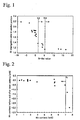
- Fig. 1 shows a relationship between the Ni segregation ratio of the weld portion (data in Table 2 described hereinafter) and the Ni-Bal value (data in Table 2 similarly described hereinafter).
- Amax is the maximum count of Ni characteristic X-ray by EPMA line analysis
- Amin is the minimum count of Ni characteristic X-ray by the EPMA line analysis.
- the Ni segregation ratio is rapidly increased when the Ni-Bal value is less than 1.2. This is because the solidification structure separates into two phases of austenite and ferrite, thereby causing the Ni segregation.
- the Ni-Bal value is not less than 5 when the Ni-Bal value is not less than 5, the segregation ratio is very near to 1. Therefore, the Ni-Bal value was set to be not less than 1.2 by the present inventor. It is more preferable that the Ni-Bal value be set to be not less than 5.
- a steel strip of the present invention contains Mn so as to adjust the austenite amount or martensite amount.
- Mn may evaporate in welding the steel strip when the Mn content is large, since the vapor pressure of Mn is high.
- Fig. 2 shows a relationship between change in Mn amount before and after laser welding (wt%) (data in Table 2 described hereinafter) and Mn content (wt%) (data in Table 1 described hereinafter).
- the above change in Mn amount was measured by EPMA.
- the Mn amount rapidly decreases when the Mn content is more than 7wt%.
- characteristics including welded portion must be considered. Therefore, the inventors set the Mn content to be not more than 7wt% in order to obtain a stabilized composition system even after the welding.
- a hoop for a continuously variable transmission of an automobile is produced by using a steel strip of the present invention
- work hardening occurs in rolling.
- the work hardening is caused by formation of strain induced martensite and work hardening of austenite.
- Fig. 3 shows a relationship between work hardening amount ( ⁇ Hv) in 30% rolling (data in Table 2 described hereinafter) and martensite rate (%) after annealing steel strip (data in Table 2 similarly described hereinafter).
- the martensite rate is defined by peak intensity ratio of X-ray diffraction.
- the work hardening amount decreases as the martensite rate increases.
- the work hardening amount can be stably decreased if the martensite rate is not less than 30%. This fact means that the workability improves as the martensite rate increases.
- the martensite rate (%) after annealing depends on the Ms value which is defined by the following equation shown by weight percentage of each composition.
- Ms 502-810C-1230N-13Mn-30Ni-12Cr-54Cu-46Mo
- the Ms value is an empirical formula which shows a temperature (°C) in which 50% martensitic transformation by volume ratio is realized.
- Fig. 4 shows a relationship between martensite rate (%) after annealing the steel strip (data in Table 2 described hereinafter) and Ms value (°C) (data in Table 2 similarly described hereinafter).
- the martensite rate can be not less than 60% when the Ms value is not less than -28°C, and the martensite rate can be reliably not less than 80% when the Ms value is not less than -7°C.
- the present inventors set the Ms value not less than -28°C so as to stably decrease the work hardening amount. It is more preferable that the Ms value be not less than -7°C.
- Fig. 5 shows a relationship between hardness (Hv) of a steel strip in which the martensite rate is not less than 30% in a condition of annealing (data in Table 2 described hereinafter) and C+N content (wt%) (data in Table 2 similarly described hereinafter).
- Hv hardness
- wt% C+N content
- the present invention it is provided with a steel strip made of the martensitic steel in which the hoop for continuously variable transmission can be easily produced and the precise size and shape of the hoop can be obtained based on the above-mentioned reason for limitation, without performing a heat treatment described in Japanese Patent Unexamined (KOKAI) Publication No. 11-173385 and the cold plastic deformation described in Japanese Patent Unexamined (KOKAI) Publication No. 13-105050. Preferred embodiments and production method of the present invention are explained hereinafter.
- the Cr content is preferably 2 to 10 wt%.
- Nitriding is generally performed when wear resistance is improved by increasing surface hardness of a rolled hoop or when fatigue strength is improved. Specifically, concerning the hoop for a continuously variable transmission of an automobile, a nitride layer called a "white layer" on the surface is observed by an optical microscope. The surface is embrittled when the surface hardness is not less than 1000 in Hv. The hardened layer depth by the nitriding also decreases, and therefore, the fatigue strength decreases. In the Ni-Cr system steel, the surface hardness is extremely high and the white layer is easily formed. In order to avoid such failure, it is effective to decrease Cr which easily forms the nitride as much as possible. Fig.
- the Cr content is set to be 2 to 10 wt% by the present inventors, based on the above-mentioned knowledge.
- Md30 value defined by following equations shown by weight percentage of each composition is set to be not less than 100.
- Md30 497-462(C+N)-9.2Si-8.1Mn -13.7Cr-20(Ni+Cu)-18.5Mo Md30 ⁇ 100
- ring rolling which enables precise working can be performed by using a material with good workability.
- strengthening by using aging is generally performed in order to additionally improve strength.
- an example in which Ti and AI are added for example, Japanese Patent Unexamined (KOKAI) Publication No. 59-170244
- N for example, Japanese Patent Unexamined (KOKAI) Publication No. 56-139663
- Cu for example, Japanese Patent Unexamined (KOKAI) Publication No. 56-139663
- Si for example, Japanese Patent Unexamined (KOKAI) Publication No.
- Ni and Mn are arranged (for example, "Concerning age hardening characteristics of Fe-Ni-Mn martensitic alloy", Minoru Tanaka etc., a magazine published by The Japan Institute of Metals, Vol.31 (1967), No.9, P.1075 ⁇ 1081 ) may be mentioned.
- Ti, Al, and Si are effective as aging elements.
- these elements easily form non-metallic inclusions such as oxides and nitrides, and they are not preferable for producing products in which fatigue strength is required, as in the presrent invention. Therefore, addition of N and Cu as aging elements or adjustment of Ni and Mn is preferable.
- Aging must be performed at a temperature of not more than the transformation temperature in order to age without decreasing the size precision.
- the aging In steel mainly made of martensite as in the present invention, the aging must be performed at not more than 600°C since the martensite inverse transformation temperature is 600 to 800°C. It is important to control a structure after the rolling in order to obtain excellent aging characteristics in such a temperature range. Because packing rate of martensite is lower than that of austenite since the crystal structure of the martensite is bct and the crystal structure of the austenite is fcc, and therefore, when the martensite amount is large, the diffusion amount of the aging elements is large, to improve the aging characteristics.
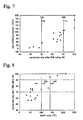
- Fig. 7 shows a relationship between age hardening amount ( ⁇ Hv) which is the hardness difference before and after aging at 450°C (data in Table 2 described hereinafter) and martensite rate (%) after 50% rolling (data in Table 2 similarly described hereinafter).
- ⁇ Hv age hardening amount
- martensite rate % after 50% rolling
- Md30 497-462(C+N)-9.2Si-8.1Mn -13.7Cr-20(Ni +Cu)-18.5Mo
- the Md30 value is an empirical formula which shows a temperature (°C) in which 60% martensitic transformation at volume ratio is realized when 30% tensile deformation is given.
- Fig. 8 shows a relationship between martensite rate (%) after 30% rolling (data in Table 2 described hereinafter) and Md 30 value (°C) (data in Table 2 similarly described hereinafter).
- the rolling rate is 30%
- the above mentioned martensite rate can be not less than 70% if the Md30 value is not less than 100°C
- the martensite rate can be reliably not less than 90% if the Md30 value is not less than 140°C. Therefore, the Md30 value is suitably not less than 100°C, and it is more suitably not less than 140°C.
- the steel strip of the present invention was explained above, and production methods for a hoop for a continuously variable transmission of an automobile of the present invention, obtained by using these steel strips, will be explained in detail hereinafter.
- the present invention provides a production method for a hoop for a continuously variable transmission of an automobile in which cold rolling of not less than 30% is performed on a steel strip made of martensitic steel in which C+N is not more than 0.12wt%, Si is not more than 1wt%, Mn is not more than 7wt %, Ni is 2 to 24wt %, Cr is 2 to 16wt%, Mo is not more than 2.5wt%, and Ni-Bal ⁇ 1.2, Ms ⁇ -28.
- the hoop of precise size and shape can be produced by producing the hoop by performing general cold rolling on a steel strip produced under the above mentioned various reasons for limitations, and this manufacturing can be simply performed without separately performing a heat treatment and a plastic deformation in the cold as in a conventional technology.
- the present invention also provides another production method for a hoop for a continuously variable transmission of an automobile in which cold rolling of not less than 30% is performed on a steel strip in which C+N is not more than 0.12wt%, Si is not more than 1wt%, Mn is not more than 7wt%, Ni is 2 to 24wt %, Cr is 2 to 16wt%, Mo is not more than 2.5wt%, and Ni-Bal ⁇ 1.2, Ms ⁇ -28, Md30 ⁇ 100, and afterwards, the steel strip is aged at a temperature of not more than a martensite inverse transformation temperature.
- a hoop with excellent strength based on the aging can be produced without decreasing dimensional accuracy, specifically by setting the Md30 value of the steel strip to be not less than 100°C and by aging at a temperature of not more than an martensite inverse transformation temperature.
- the present invention also provides another production method for a hoop for a continuously variable transmission of an automobile in which cold rolling of not less than 30% is performed on a steel strip in which C+N is not more than 0.12wt%, Si is not more than 1wt%, Mn is not more than 7wt%, Ni is 2 to 24wt%, Cr is 2 to 10wt%, Mo is not more than 2.5wt%, and Ni-Bal ⁇ 1.2, Ms ⁇ -28, and afterwards, the steel strip is nitrified.
- the surface hardness of the hoop can decrease specifically by setting the Cr content in the steel strip to be 2 to 10wt% and by nitriding.
- This production method is extremely effective for members, which requires curvature fatigue characteristics, such as a hoop for a continuously variable transmission of an automobile.
- the present invention also provides another production method for a hoop for a continuously variable transmission of an automobile in which cold rolling of not less than 30% is performed on a steel strip in which C+N is not more than 0.12wt%, Si is not more than 1wt%, Mn is not more than 7wt%, Ni is 2 to 24wt%, Cr is 2 to 16wt%, Mo is not more than 2.5wt%, and Ni-Bal ⁇ 1.2, Ms ⁇ -28, Md30 ⁇ 100, and afterwards, the steel strip is aged at a temperature of not more than the martensite inverse transformation temperature and is nitrified.
- a hoop with excellent strength based on the aging can be produced without decreasing the dimensional accuracy, by setting Md30 value of the steel strip to be not less than 100°C and by aging at the temperature of not more than the martensite inverse transformation temperature.
- a hoop with excellent wear resistance and fatigue strength can be produced by nitriding.
- Table 1 respectively shows practical examples 1 to 4 according to the present invention and comparative examples 1 to 15 according to the conventional technology, concerned with composition of steel strip as a material of a hoop for a continuously variable transmission of an automobile.
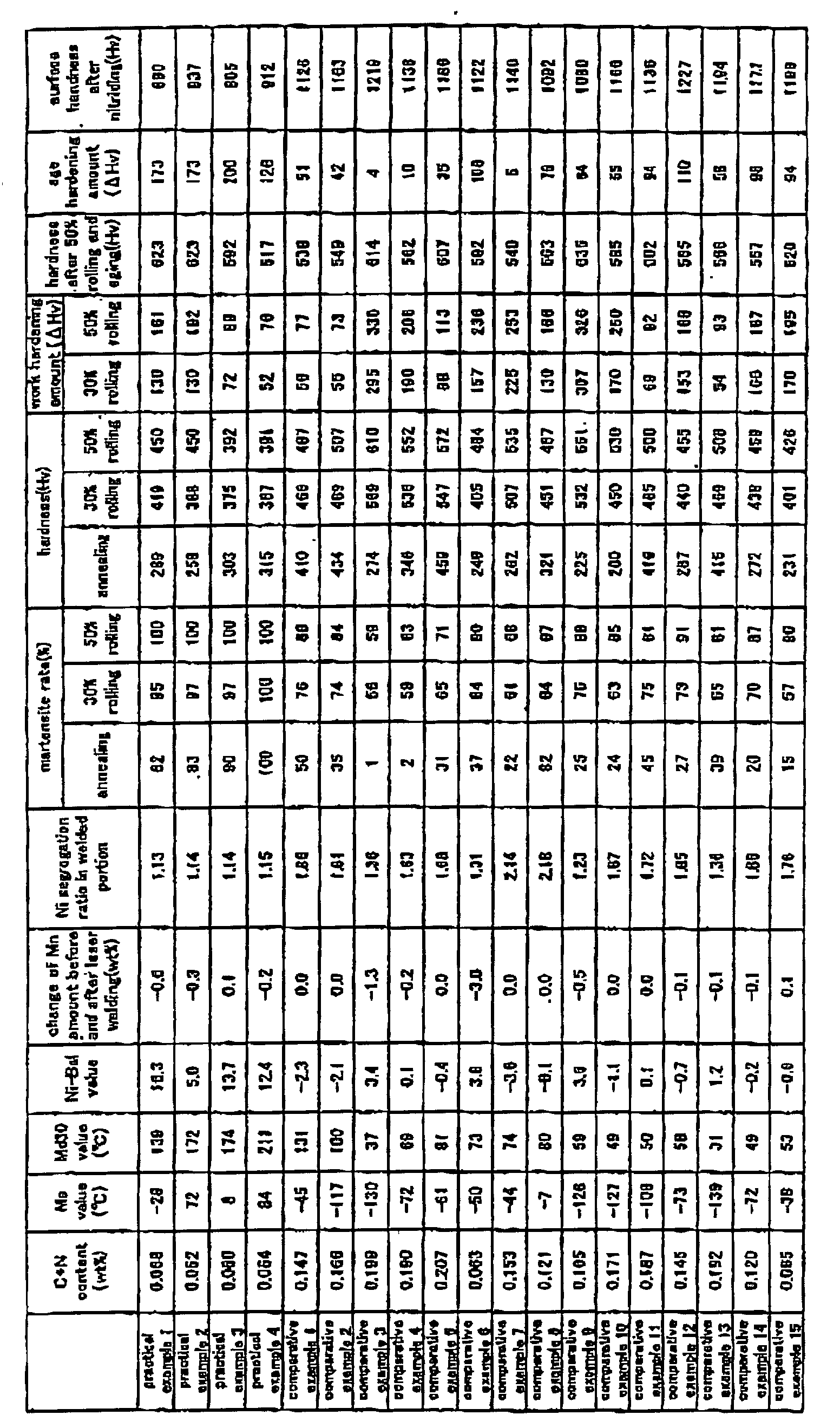
- Table 2 shows results concerned with hardness (Hv) after 50% rolling and aging each steel strip, hardening amount ( ⁇ Hv) after aging, and surface hardness (Hv) after nitriding each steel strip.
- the other data shown together in Table 2 are data with regard to parameters of vertical line or horizontal axis in graphs of the steel strips shown in Fig. 1 to Fig. 8.
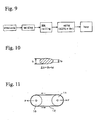
- Fig. 10 is a sectional view of a product hoop after the aging, and ⁇ t in Fig. 10 shows dimensional accuracy of the hoop.
- ⁇ t was 3 to 12 ⁇ m in comparative example 16 while ⁇ t was not more than 2 ⁇ m in practical example 5.
- the circumferential length accuracy of the hoops was also measured although it is not shown. According to the result of the measurement, the accuracy in practical example 5 was about ⁇ 10 ⁇ m which is excellent while the accuracy in comparative example 16 was about ⁇ 50 ⁇ m.
- comparative example 16 in which the work hardening amount is large is not preferable for a hoop for a continuously variable transmission of an automobile since sufficient dimensional accuracy for use by laminating cannot be obtained.
- dimensional accuracy is extremely superior by small work hardening amount. Therefore, practical example 5 is preferable for a hoop for a continuously variable transmission of an automobile since sufficient dimensional accuracy for use by laminating can be obtained.
- Fatigue strength of a hoop is an important characteristic in actually using the hoop for a continuously variable transmission of an automobile.
- a side view in Fig. 11 fatigue lives of hoop 12 of various tensile strength F were compared by a fatigue strength test device comprised of 2 rollers 10 and 11. Repeatedly bended time to rupture was fatigue life. The fatigue life was defined by multiplying rotated times of hoop 12 by 2. The test was continued until whether the hoop was broken or fatigue life reached 10 8 times. This test was performed by using rollers of 55 mm diameter and by setting the rotational rate to be 6000 rpm.
- Fig. 12 shows the result.
- the plot shown in Fig. 12 concerns practical example 5 and comparative example 16. As shown in Fig. 12, practical example 5 has fatigue lives which are equivalent to those of comparative example 16, and practical example 5 has sufficient fatigue characteristics in use for a continuously variable transmission of an automobile.
Landscapes
- Chemical & Material Sciences (AREA)
- Engineering & Computer Science (AREA)
- Mechanical Engineering (AREA)
- Materials Engineering (AREA)
- Metallurgy (AREA)
- Organic Chemistry (AREA)
- General Engineering & Computer Science (AREA)
- Heat Treatment Of Sheet Steel (AREA)
Abstract
Description
Cr: 2 to 10 wt%
| (wt%: balance of substantially Fe) | |||||||||
| C | Si | Mn | Cr | Ni | Mo | Cu | N | Nb | |
| practical example 1 | 0.045 | 0.45 | 5.48 | 4.98 | 9.57 | 1.02 | 0.00 | 0.023 | 0.11 |
| practical example 2 | 0.032 | 0.45 | 5.43 | 10.34 | 4.59 | 1.03 | 0.00 | 0.020 | 0.00 |
| practical example 3 | 0.038 | 0.46 | 5.39 | 4.91 | 7.17 | 2.01 | 0.00 | 0.022 | 0.10 |
| practical example 4 | 0.042 | 0.45 | 5.47 | 5.15 | 5.84 | 1.00 | 0.00 | 0.022 | 0.00 |
| comparative example 1 | 0.058 | 1.12 | 0.35 | 15.26 | 3.59 | 0.22 | 1.58 | 0.089 | 0.06 |
| comparative example 2 | 0.054 | 1.57 | 0.98 | 15.61 | 4.03 | 0.21 | 1.98 | 0.112 | 0.06 |
| comparative example 3 | 0.069 | 0.89 | 7.23 | 15.58 | 4.22 | 0.19 | 0.00 | 0.130 | 0.06 |
| comparative example 4 | 0.054 | 1.27 | 2.89 | 15.84 | 4.23 | 0.19 | 0.00 | 0.136 | 0.06 |
| comparative example 5 | 0.054 | 1.85 | 1.55 | 15.07 | 4.01 | 0.21 | 0.00 | 0.153 | 0.06 |
| comparative example 6 | 0.042 | 0.45 | 7.56 | 13.91 | 6.01 | 1.02 | 0.00 | 0.021 | 0.09 |
| comparative example 7 | 0.054 | 2.54 | 1.91 | 15.62 | 4.01 | 1.05 | 0.00 | 0.099 | 0.07 |
| comparative example 8 | 0.046 | 4.52 | 0.33 | 15.17 | 4.02 | 1.57 | 0.00 | 0.075 | 0.06 |
| comparative example 9 | 0.075 | 0.57 | 6.91 | 14.11 | 3.44 | 2.10 | 0.00 | 0.090 | 0.09 |
| comparative example 10 | 0.081 | 0.25 | 0.65 | 16.88 | 4.21 | 2.51 | 0.00 | 0.090 | 0.00 |
| comparative example 11 | 0.020 | 0.51 | 1.53 | 17.30 | 5.35 | 0.00 | 0.00 | 0.167 | 0.06 |
| comparative example 12 | 0.019 | 0.52 | 1.52 | 17.29 | 5.91 | 0.00 | 0.00 | 0.126 | 0.06 |
| comparative example 13 | 0.021 | 0.51 | 1.55 | 17.21 | 6.23 | 0.00 | 0.00 | 0.171 | 0.07 |
| comparative example 14 | 0.022 | 0.52 | 1.52 | 17.19 | 6.98 | 0.00 | 0.00 | 0.098 | 0.06 |
| comparative example 15 | 0.021 | 0.51 | 1.53 | 17.09 | 8.12 | 0.00 | 0.00 | 0.044 | 0.07 |
| (Hv) | ||
| before aging | after aging | |
| practical example 5 | 448∼465 | 615∼624 |
| comparative example 16 | 609∼618 | 620∼631 |
Claims (7)
- A steel strip made of martensitic steel, comprising: not more than 0.12wt % of C+N, not more than 1wt% of Si, not more than 7wt% of Mn, 2 to 24wt % of Ni, 2 to 16wt% of Cr, not more than 2.5wt% of Mo,
wherein Ni-Bal value and Ms value defined by following equations shown by weight percentage of each composition are respectively Ni-Bal ≧1.2, Ms≧-28. - A steel strip made of martensitic steel according to claim 1, wherein Cr is 2 to 10 wt %.
- A steel strip made of martensitic steel according to claim 1 or 2, wherein Md30 value defined by the following equation shown by weight percentage of each composition is not less than 100.
- A production technique for a hoop for a continuously variable transmission of an automobile, wherein cold rolling of not less than 30%. is performed on a steel strip recited in claim 1.
- A production technique of a hoop for a continuously variable transmission of an automobile, wherein cold rolling of not less than 30% is performed on a steel strip recited in claim 1 in which the Md30 value recited in claim 3 is not less than 100, and afterwards, the steel strip is aged at a temperature of not more than a martensite inverse transformation temperature.
- A production technique for a hoop for a continuously variable transmission of an automobile, wherein cold rolling of not less than 30% is performed on a steel strip recited in claim 2, and afterwards, the steel strip is nitrided.
- A production technique for a hoop for a continuously variable transmission of an automobile, wherein cold rolling of not less than 30% is performed on a steel strip recited in claim 1 in which the Md30 value recited in claim 3 is not less than 100, and afterwards, the steel strip is aged at a temperature of not more than martensite inverse transformation temperature, and is nitrided.
Applications Claiming Priority (3)
| Application Number | Priority Date | Filing Date | Title |
|---|---|---|---|
| JP2002179413 | 2002-06-20 | ||
| JP2002179413A JP4173976B2 (en) | 2002-06-20 | 2002-06-20 | Manufacturing method of hoop for automatic transmission of automobile |
| PCT/JP2003/007113 WO2004001081A1 (en) | 2002-06-20 | 2003-06-05 | Steel belt comprising martensitic steel and method for manufacturing hoop for continuously variable transmission using said steel belt |
Publications (2)
| Publication Number | Publication Date |
|---|---|
| EP1514948A1 true EP1514948A1 (en) | 2005-03-16 |
| EP1514948A4 EP1514948A4 (en) | 2006-01-04 |
Family
ID=29996563
Family Applications (1)
| Application Number | Title | Priority Date | Filing Date |
|---|---|---|---|
| EP03730824A Withdrawn EP1514948A4 (en) | 2002-06-20 | 2003-06-05 | Steel belt comprising martensitic steel and method for manufacturing hoop for continuously variable transmission using said steel belt |
Country Status (6)
| Country | Link |
|---|---|
| US (1) | US7459034B2 (en) |
| EP (1) | EP1514948A4 (en) |
| JP (1) | JP4173976B2 (en) |
| CN (1) | CN1263881C (en) |
| TW (1) | TWI230202B (en) |
| WO (1) | WO2004001081A1 (en) |
Cited By (1)
| Publication number | Priority date | Publication date | Assignee | Title |
|---|---|---|---|---|
| WO2022218469A1 (en) * | 2021-04-12 | 2022-10-20 | Schaeffler Technologies AG & Co. KG | Method for producing a harmonic drive component, drive component, and harmonic drive |
Families Citing this family (4)
| Publication number | Priority date | Publication date | Assignee | Title |
|---|---|---|---|---|
| US10031531B2 (en) | 2011-02-25 | 2018-07-24 | Mks Instruments, Inc. | System for and method of multiple channel fast pulse gas delivery |
| NL1040574C2 (en) * | 2013-12-24 | 2015-06-26 | Bosch Gmbh Robert | Method for forming a carrier ring suitable for use in a drive belt for a continuously variable transmission. |
| NL1041998B1 (en) * | 2016-07-27 | 2018-02-01 | Bosch Gmbh Robert | Flexible steel ring made from maraging steel and provided with a nitrided surface layer |
| KR102169457B1 (en) * | 2018-12-18 | 2020-10-23 | 주식회사 포스코 | High-strength stainless steel |
Family Cites Families (16)
| Publication number | Priority date | Publication date | Assignee | Title |
|---|---|---|---|---|
| JPS5713151A (en) * | 1980-06-23 | 1982-01-23 | Kawasaki Steel Corp | Superhigh-tensile steel with superior toughness at low temperature |
| JPS5980772A (en) | 1982-10-28 | 1984-05-10 | Toyota Motor Corp | Heat treatment of maraging steel hoop |
| JPH0536827Y2 (en) | 1987-07-13 | 1993-09-17 | ||
| JP2527564B2 (en) * | 1987-07-21 | 1996-08-28 | 日新製鋼株式会社 | Precipitation hardening type stainless steel with excellent welding strength and toughness |
| JPS6425952U (en) | 1987-08-07 | 1989-02-14 | ||
| EP0391949A1 (en) * | 1987-12-23 | 1990-10-17 | Uddeholm Tooling Aktiebolag | Precipitation hardening tool steel for forming tools and forming tool made from the steel |
| JP2995524B2 (en) * | 1993-04-28 | 1999-12-27 | 新日本製鐵株式会社 | High strength martensitic stainless steel and its manufacturing method |
| JP3186678B2 (en) | 1997-12-10 | 2001-07-11 | 日産自動車株式会社 | Manufacturing method of metal belt for belt type continuously variable transmission |
| JPH11229093A (en) * | 1998-02-09 | 1999-08-24 | Daido Steel Co Ltd | High corrosion resistance and high strength stainless steel |
| JP4207137B2 (en) * | 1998-02-16 | 2009-01-14 | 日立金属株式会社 | High hardness and high corrosion resistance stainless steel |
| JP3421265B2 (en) | 1998-06-12 | 2003-06-30 | 日新製鋼株式会社 | Metastable austenitic stainless steel sheet for continuously variable transmission belt and method of manufacturing the same |
| KR100374980B1 (en) * | 1999-02-12 | 2003-03-06 | 히다찌긴조꾸가부시끼가이사 | High strength steel for dies with excellent machinability |
| DE60026746T2 (en) * | 1999-10-04 | 2006-11-16 | Hitachi Metals, Ltd. | belts |
| JP3638482B2 (en) | 1999-10-08 | 2005-04-13 | 本田技研工業株式会社 | Metal ring circumference correction method |
| JP2001131713A (en) * | 1999-11-05 | 2001-05-15 | Nisshin Steel Co Ltd | Ultra-high-strength metastable austenitic stainless steel containing Ti and manufacturing method |
| JP2002053936A (en) * | 2000-08-02 | 2002-02-19 | Nisshin Steel Co Ltd | Austenitic stainless steel plate for continuously variable transmission belt metallic ring and its production method |
-
2002
- 2002-06-20 JP JP2002179413A patent/JP4173976B2/en not_active Expired - Fee Related
-
2003
- 2003-06-05 EP EP03730824A patent/EP1514948A4/en not_active Withdrawn
- 2003-06-05 US US10/488,108 patent/US7459034B2/en not_active Expired - Fee Related
- 2003-06-05 WO PCT/JP2003/007113 patent/WO2004001081A1/en not_active Ceased
- 2003-06-05 CN CNB038011107A patent/CN1263881C/en not_active Expired - Fee Related
- 2003-06-20 TW TW092116736A patent/TWI230202B/en not_active IP Right Cessation
Cited By (3)
| Publication number | Priority date | Publication date | Assignee | Title |
|---|---|---|---|---|
| WO2022218469A1 (en) * | 2021-04-12 | 2022-10-20 | Schaeffler Technologies AG & Co. KG | Method for producing a harmonic drive component, drive component, and harmonic drive |
| CN117120637A (en) * | 2021-04-12 | 2023-11-24 | 舍弗勒技术股份两合公司 | Method for manufacturing harmonic transmission components, harmonic transmission components and harmonic transmission devices |
| JP2024514142A (en) * | 2021-04-12 | 2024-03-28 | シェフラー テクノロジーズ アー・ゲー ウント コー. カー・ゲー | Method for manufacturing a reduction gearbox component, reduction gearbox component and reduction gearbox |
Also Published As
| Publication number | Publication date |
|---|---|
| JP4173976B2 (en) | 2008-10-29 |
| TWI230202B (en) | 2005-04-01 |
| US20040244873A1 (en) | 2004-12-09 |
| JP2004018989A (en) | 2004-01-22 |
| US7459034B2 (en) | 2008-12-02 |
| EP1514948A4 (en) | 2006-01-04 |
| TW200401039A (en) | 2004-01-16 |
| CN1263881C (en) | 2006-07-12 |
| CN1556870A (en) | 2004-12-22 |
| WO2004001081A1 (en) | 2003-12-31 |
Similar Documents
| Publication | Publication Date | Title |
|---|---|---|
| EP2412836B1 (en) | Maraging steel strip | |
| EP1394280A1 (en) | Metal gasket and its law material and methods for production of them | |
| US20180312956A1 (en) | Method of producing carburizing forging steel material | |
| US8273191B2 (en) | High-strength stainless steel material and production process of the same | |
| EP3081661B1 (en) | Ring member for cvt and method for producing same | |
| EP1514948A1 (en) | Steel belt comprising martensitic steel and method for manufacturing hoop for continuously variable transmission using said steel belt | |
| JP5425675B2 (en) | Continuously variable transmission belt and steel for continuously variable transmission belt | |
| JP2005097682A (en) | Steel, steel sheet and stock belt for continuously variable transmission belt, continuously variable transmission belt, and production method therefor | |
| KR20230113593A (en) | Steel plate for gas nitrocarburization | |
| JP2002155339A (en) | Medium and high carbon steel having excellent deep drawability | |
| EP3560621A1 (en) | Endless metal ring and method of producing the same | |
| JP2018172749A (en) | Steel for cvt ring, and cvt ring material for nitriding, and method for manufacturing the same, and cvt ring member and method for manufacturing the same | |
| JP5882357B2 (en) | Heat treatment process for manufacturing drive belt metal ring components | |
| JP2014508214A (en) | Heat treatment process for manufacturing process of drive belt metal ring components | |
| JP2018172751A (en) | Cvt ring material for nitriding, and cvt ring member, and method for manufacturing the same | |
| EP1816225A1 (en) | Steel pipe having excellent electromagnetic properties and process for producing the same | |
| WO2019198781A1 (en) | Press molded steel article | |
| JP2004315947A (en) | Method for manufacturing maraging steel strip for continuously variable transmission | |
| JP2019167578A (en) | Maraging steel for metal belt | |
| JP2018172754A (en) | Cvt ring material for nitriding, cvt ring member, and method for manufacturing the same | |
| EP3546601A1 (en) | Method of producing endless metal ring | |
| JP2019119898A (en) | Cvt ring raw material, cvt ring member, and manufacturing method therefor | |
| JP2006265663A (en) | Steel for continuously variable transmission, stock material steel sheet, and belt for continuously variable transmission | |
| JP2018172752A (en) | Cvt ring material for nitriding, and cvt ring member, and method for manufacturing the same | |
| CN110468325A (en) | Endless metal belt and method of making the same |
Legal Events
| Date | Code | Title | Description |
|---|---|---|---|
| PUAI | Public reference made under article 153(3) epc to a published international application that has entered the european phase |
Free format text: ORIGINAL CODE: 0009012 |
|
| 17P | Request for examination filed |
Effective date: 20040316 |
|
| AK | Designated contracting states |
Kind code of ref document: A1 Designated state(s): DE GB NL RO |
|
| AX | Request for extension of the european patent |
Extension state: AL LT LV MK |
|
| DAX | Request for extension of the european patent (deleted) | ||
| RBV | Designated contracting states (corrected) |
Designated state(s): DE GB NL |
|
| A4 | Supplementary search report drawn up and despatched |
Effective date: 20051118 |
|
| RIC1 | Information provided on ipc code assigned before grant |
Ipc: C22C 38/00 19740701AFI20040115BHEP Ipc: F16G 1/20 19680901ALI20051114BHEP Ipc: C21D 9/46 19680901ALI20051114BHEP |
|
| 17Q | First examination report despatched |
Effective date: 20080225 |
|
| STAA | Information on the status of an ep patent application or granted ep patent |
Free format text: STATUS: THE APPLICATION IS DEEMED TO BE WITHDRAWN |
|
| 18D | Application deemed to be withdrawn |
Effective date: 20180103 |
|
| RIC1 | Information provided on ipc code assigned before grant |
Ipc: F16G 1/20 20060101ALI20051114BHEP Ipc: C22C 38/00 20060101AFI20040115BHEP Ipc: C21D 9/46 20060101ALI20051114BHEP |