EP1513841B1 - 1,6,9,14-tetrasubstituted terrylene tetracarboxylic acid diimides - Google Patents
1,6,9,14-tetrasubstituted terrylene tetracarboxylic acid diimides Download PDFInfo
- Publication number
- EP1513841B1 EP1513841B1 EP03735536A EP03735536A EP1513841B1 EP 1513841 B1 EP1513841 B1 EP 1513841B1 EP 03735536 A EP03735536 A EP 03735536A EP 03735536 A EP03735536 A EP 03735536A EP 1513841 B1 EP1513841 B1 EP 1513841B1
- Authority
- EP
- European Patent Office
- Prior art keywords
- alkyl
- alkoxy
- cyano
- substituted
- aryl
- Prior art date
- Legal status (The legal status is an assumption and is not a legal conclusion. Google has not performed a legal analysis and makes no representation as to the accuracy of the status listed.)
- Expired - Lifetime
Links
- 0 *c1cc(C(N(*)C(c2cc(*)c3-4)=O)=O)c2c3c1-c1ccc(-c(c2c35)c(*)cc3C(N3*)=O)c6c1c-4ccc6-c2c(*)cc5*3=O Chemical compound *c1cc(C(N(*)C(c2cc(*)c3-4)=O)=O)c2c3c1-c1ccc(-c(c2c35)c(*)cc3C(N3*)=O)c6c1c-4ccc6-c2c(*)cc5*3=O 0.000 description 5
Classifications
-
- C—CHEMISTRY; METALLURGY
- C07—ORGANIC CHEMISTRY
- C07D—HETEROCYCLIC COMPOUNDS
- C07D471/00—Heterocyclic compounds containing nitrogen atoms as the only ring hetero atoms in the condensed system, at least one ring being a six-membered ring with one nitrogen atom, not provided for by groups C07D451/00 - C07D463/00
- C07D471/02—Heterocyclic compounds containing nitrogen atoms as the only ring hetero atoms in the condensed system, at least one ring being a six-membered ring with one nitrogen atom, not provided for by groups C07D451/00 - C07D463/00 in which the condensed system contains two hetero rings
- C07D471/06—Peri-condensed systems
-
- C—CHEMISTRY; METALLURGY
- C09—DYES; PAINTS; POLISHES; NATURAL RESINS; ADHESIVES; COMPOSITIONS NOT OTHERWISE PROVIDED FOR; APPLICATIONS OF MATERIALS NOT OTHERWISE PROVIDED FOR
- C09B—ORGANIC DYES OR CLOSELY-RELATED COMPOUNDS FOR PRODUCING DYES, e.g. PIGMENTS; MORDANTS; LAKES
- C09B5/00—Dyes with an anthracene nucleus condensed with one or more heterocyclic rings with or without carbocyclic rings
- C09B5/62—Cyclic imides or amidines of peri-dicarboxylic acids of the anthracene, benzanthrene, or perylene series
Definitions
- terrylimides 11,12-tetracarboxylic diimides
- the invention was therefore based on the object, higher substituted Terrylimide with advantageous application properties, which are particularly not only good in the respective application medium einarbeitbar and adaptable to this medium, but also longer wavelength than the previously known representatives of this class of substances, i. in the long-wave red and near-infrared region of the electromagnetic spectrum, absorbing and emitting.
- Preferred terrylimides can be found in the subclaim.
- a process for the preparation of 1,6,9,14-tetrasubstituted Terrylimiden the general formula Ic in which X 3 is a radical of the formula -LR 3 which is characterized in that a 1,6,9,14-tetrabromoterrylimide of the general formula Ia ' in the presence of an aprotic solvent, a palladium complex as a catalyst, a copper salt as a cocatalyst and a base with a 1-alkyne of the general formula V HC ⁇ CR 3 V and, if desired, additionally reducing the unsaturated bonds contained in the radicals X 3 of the resulting 1,6,9,14-tetrasubstituted terrylimide.
- Terrylimide I for coloring high molecular weight organic and inorganic materials, as a dispersing aid, pigment additives for organic pigments and intermediates for the preparation of fluorescent colorants and pigment additives, for producing colored or in the near-infrared region of the electromagnetic spectrum absorbing and / or emitting aqueous Polymerisatdispersionen, as photoconductors in electrophotography, as emitters in electro- and chemiluminescence applications, as active components in fluorescence conversion, in bioluminescence arrays and photovoltaic and found as laser dyes.
- alkyl groups occurring in the formulas I to V can be straight-chain or branched. When the alkyl groups are substituted, they usually carry 1 or 2 substituents.
- Aromatic radicals which are substituted may generally have up to 3, preferably 1 or 2, of said substituents.
- Preferred radicals -LR 3 are substituted by C 1 -C 18 -alkyl, especially C 4 -C 8 -alkyl, which in particular terminal ( ⁇ -position) by cyano, hydroxy, carboxy, methyl or ethylcarboxy may be substituted To name ethenyl and ethynyl.
- the terrylimides II or IV in step a) are first converted by reaction with elemental bromine into the 1,6,9,14-tetrabrominated terrylimides of the formula Ia 'or the 9,14-dibrominated terrylimides of the formula Ib'.
- the Terrylimide Ia or Ib substituted on the Terrylenkern by optionally further functionalized (Het) aryloxy or (Het) Arylthioreste can in a further step b) by reacting the brominated Terrylimide Ia 'or Ib' with an aromatic or heteroaromatic alcohol or thioalcohol III be prepared under bromine exchange.
- Step a) of the preparation process according to the invention the reaction of the terrylimides II or IV with elemental bromine, is carried out in the presence of a halohydrocarbon as solvent.
- Both aliphatic and aromatic halogenated hydrocarbons are suitable as solvents, preference being given to the chlorinated hydrocarbons.
- Specific examples include methylene chloride, chloroform, 1,1,2,2-tetrachloroethane, chlorobenzene, dichlorobenzene (all isomers) and trichlorobenzene (all isomers), with chloroform, 1,1,2,2-tetrachloroethane and chlorobenzene being preferred ,
- the molar ratio of bromine to terrylimide depends on the starting material used. In general, 1 to 2 mol, preferably 1.1 to 1.5 mol, of bromine are used per mole of II or IV per bromine atom to be introduced.
- halogenation catalyst In general, the presence of a halogenation catalyst is not required. However, if it is desired to accelerate the bromination reaction (by about a factor of 1.5 to 3), it is advisable to add elemental iodine, preferably in an amount of from 1 to 5 mol%, based on the terrylimide II or IV.
- the reaction temperature depends on the stability of the substituents on the imide nitrogen relative to the halogenation conditions and is generally 40 to 100 ° C., preferably 60 to 100 ° C. for inert alkyl or cycloalkyl substituents and aryl or hetaryl substituents which are only partially stable with respect to the halogenation conditions preferably 50 to 70 ° C.
- the bromination is usually complete in 2 to 24 hours.
- the purity of the 1, 6, 9, 14-tetrabrominated terrylimides of the formula Ia 'or of the 9,14-dibrominated terrylimides of the formula Ib' thus prepared is sufficient for further processing.
- purification may be carried out by column filtration on silica gel with methylene chloride as the eluent or by extraction with a solvent such as methanol.
- Terrylimides Ia and Ib which are substituted on the Terrylenkern by optionally further functionalized (Het) aryloxy or (Het) Arylthioreste, according to step b) of the inventive method by reacting the brominated Terrylimide Ia 'or Ib' with an aromatic or heteroaromatic Alcohol or thioalcohol III can be prepared in the presence of an inert nitrogen-based solvent and a base.
- Suitable inert nitrogen-based solvents for this purpose are, in particular, polar solvents, especially nitrogen heterocycles, such as pyridine, pyrimidine, quinoline, isoquinoline, quinaldine and N-methylpyrrolidone, and carboxamides, such as N, N-dimethylformamide and N, N-dimethylacetamide, where N-methylpyrrolidone is preferred.
- polar solvents especially nitrogen heterocycles, such as pyridine, pyrimidine, quinoline, isoquinoline, quinaldine and N-methylpyrrolidone
- carboxamides such as N, N-dimethylformamide and N, N-dimethylacetamide, where N-methylpyrrolidone is preferred.
- the amount of solvent is usually 5 to 100 g, preferably 10 to 40 g, per g of the terrylimide Ia 'or Ib'.
- bases inorganic bases, e.g. Alkali metal hydroxides, such as potassium and sodium hydroxide, and alkali metal carbonates, such as potassium and sodium carbonate, and organic bases, e.g. Alkali metal alcoholates in particular tertiary alcohols, such as lithium, sodium and potassium tert-butoxide, which are used in anhydrous form.
- inorganic bases e.g. Alkali metal hydroxides, such as potassium and sodium hydroxide
- alkali metal carbonates such as potassium and sodium carbonate
- organic bases e.g. Alkali metal alcoholates in particular tertiary alcohols, such as lithium, sodium and potassium tert-butoxide, which are used in anhydrous form.
- the molar ratio of brominated terrylimide Ia 'or Ib' to alcohol or thioalcohol III also depends on the number of bromine atoms to be substituted. In general, from 1 to 2, preferably from 1 to 1.5, mole III are used per mole of bromine to be exchanged.
- the reaction temperature is usually in the range of 50 to 200 ° C, preferably 60 to 140 ° C.
- the reaction time is about 2 to 48 hours, depending on the reactivity of the brominated terrylimide Ia 'or Ib'.
- step b) it is expedient to proceed in step b) by initially introducing the solvent, adding brominated terrylimide Ia 'or Ib', alcohol or thioalcohol III and base, and The resulting solution or suspension is heated with stirring under inert gas for 2 to 48 hours to the desired reaction temperature.
- Isolation of the reaction product after cooling to room temperature, may be accomplished by direct filtration of the already precipitated reaction product or by filtration after dilution with three to four times the volume of water, a dilute inorganic acid, e.g. 5 to 10% by weight hydrochloric acid, or an aliphatic alcohol, e.g. Methanol, wash first with a little solvent and then with water until neutral and dried in vacuo.
- a dilute inorganic acid e.g. 5 to 10% by weight hydrochloric acid
- an aliphatic alcohol e.g. Methanol
- the preparation of the terrylimides Ic according to the invention which carry the same optionally substituted alkyl, alkenyl or alkynyl radicals X 3 in the 1,6,9,14-position 4, can advantageously be carried out by the process according to the invention, starting from the 1,6,9 likewise inventive , 14-Tetrabromterrylimiden of formula Ia ', take place.
- the reaction with the alkyne V is carried out in the presence of an aprotic solvent, a palladium complex as catalyst, a copper salt as cocatalyst and a base.
- Suitable solvents are linear and cyclic aliphatic ethers having up to 10 carbon atoms, such as diethyl ether, di-propyl ether, di-n-butyl ether, 1,2-dimethoxyethane, 1,2-diethoxyethane, dioxane and especially tetrahydrofuran.
- the added base also serves as cosolvent. Suitable for this purpose are especially with the ethers miscible, organic nitrogen bases having a melting point below room temperature and a boiling point above the reaction temperature.
- Preferred bases are aliphatic amines having up to 15 C atoms, in particular tertiary amines, such as triethylamine, tri-n-propylamine and tri-n-butylamine, and cycloaliphatic amines, in particular piperidine.
- the catalyst used palladium complexes which are used in conjunction with copper (I) salts as cocatalyst.
- Suitable palladium complexes are tetrakis (tris-o-tolylphosphine) palladium (0), [1,2-bis (diphenylphosphino) ethane] palladium (II) chloride, [1,1'-bis (diphenylphosphino) ferrocene] palladium (II) chloride, bis (triethylphosphine) palladium (II) chloride, bis (tricyclohexylphosphine) palladium (II) chloride, bis (triphenylphosphine) palladium (II) acetate, (2,2'-bipyridyl) palladium (II) chloride and especially Tetrakis (triphenylphosphine) palladium (0), bis (triphenylphosphine) palladium (II) chloride, bis (acetonitrile) palladium (II) chloride and bis (benzonitrile)
- copper (I) salts examples include copper (I) iodide and copper (I) bromide.
- the molar ratio of tetrabromoterrylimide Ia 'to alkyne V is generally from 1: 4 to 1: 8, in particular from 1: 4 to 1: 6.
- the reaction temperature is usually 20 to 140 ° C, especially 40 to 90 ° C.
- the reaction can be carried out at atmospheric pressure or at an overpressure of, as a rule, up to 50 bar.
- the operation under pressure is required when using volatile alkynes such as acetylene.
- the reaction generally takes about 1 to 15 hours, in particular 2 to 10 hours.
- terrylimides Ic can be prepared which contain 1,2-ethynylene or 1,2-ethenylene radicals as bridge member L in the substituents X 3 .
- Terrylimides Ic containing ethylene radicals L can be obtained by stirring the reaction mixture in a hydrogen atmosphere. However, it is also possible subsequently to carry out a reduction of the unsaturated bond, for example with hydrogen, under palladium / activated carbon catalysis, it being possible to proceed as usual for such reductions (cf. Larock, Comprehensive Organic Transformations, VCH Publishers New York, 1989, pp. 6-17 ; March, Advanced Organic Chemistry, John Wiley and Sons New York, 4th Edition 1992, pp. 775-777 ; J. Org. Chem. 45, pp. 4926-4931 (1980) ).
- the preparation of the Terrylimide Id according to the invention which are substituted in the 1,6-position by 2 identical optionally further functionalized (Het) aryloxy or (Het) arylthio and in the 9,14-position 2 the same optionally substituted alkyl, alkenyl or alkynyl radicals X carry 3 , can advantageously be carried out according to the method of the invention, starting from the 9,14-dibrominated Terrylimid Ib ', analogously to the preparation of the Terrylimide Ic halving the amounts of palladium complex, copper (I) salt and alkyne V.
- reaction mixture is directly, ie without prior cooling, with vigorous stirring in about three times the volume of a mixture of about equal parts by weight of concentrated hydrochloric acid and ice, filtered from the crude product, washed with half-concentrated hydrochloric acid until colorless and then with water until neutral and dried in vacuo.
- the Terrylimide I obtained according to the invention already have such a high value content (> 95%) that can be dispensed with further purification.
- Analytically pure products can be prepared by recrystallization from aromatic solvents such as toluene and xylene, or halogenated hydrocarbons such as methylene chloride and chloroform, or by filtration of a solution of the products in these solvents over silica gel followed by concentration.
- the terrylimides I according to the invention are outstandingly suitable for homogeneous coloring of high molecular weight organic and inorganic materials, in particular e.g. of plastics, in particular thermoplastics, lacquers and printing inks, and oxidic layer systems.
- pigment additives for organic pigments and intermediates for the preparation of fluorescent colorants and pigment additives for producing colored or in the near-infrared region of the electromagnetic spectrum absorbing and / or emitting aqueous polymer dispersions and as a photoconductor in electrophotography, as an emitter in electrochemical and chemiluminescence applications, as active components in fluorescence conversion, in bioluminescence arrays and in photovoltaics, and as laser dyes.
- the Terrylimide I according to the invention usually absorb at 670 to 700 nm and generally emit at 710 to 780 nm, so their absorption and emission are much longer wavelength than that of the known Terrylimide.
- reaction product was either directly (Examples 22, 30, 32) or after dilution with 3 times the volume of a 5 wt .-% hydrochloric acid (Examples 24, 26, 28, 29, 35, 36, 43, 45 , 48, 49) or methanol (Examples 21, 23, 25, 27, 31, 33, 34, 37-42, 44, 46, 47, 50) filtered off, first with little solvent (Examples 22, 30, 32) or the same mixture of solvent and diluent (Examples 21, 23-29, 31, 33-50) and then washed with water until neutral and dried in vacuo at 120 ° C.
- a 5 wt .-% hydrochloric acid Examples 24, 26, 28, 29, 35, 36, 43, 45 , 48, 49
- methanol Examples 21, 23, 25, 27, 31, 33, 34, 37-42, 44, 46, 47, 50
Landscapes
- Chemical & Material Sciences (AREA)
- Organic Chemistry (AREA)
- Nitrogen Condensed Heterocyclic Rings (AREA)
- Plural Heterocyclic Compounds (AREA)
- Organic Low-Molecular-Weight Compounds And Preparation Thereof (AREA)
- Organic Insulating Materials (AREA)
- Chemical And Physical Treatments For Wood And The Like (AREA)
- Pharmaceuticals Containing Other Organic And Inorganic Compounds (AREA)
- Stringed Musical Instruments (AREA)
Abstract
Description
Die vorliegende Erfindung betrifft neue 1,6,9,14-tetrasubstituierte Terrylentetracarbonsäurediimide der allgemeinen Formel I

- X, Y
- unabhängig voneinander
Brom; Cyano;
Aryloxy, Arylthio, Hetaryloxy oder Hetarylthio, das jeweils ein- oder mehrfach durch C1-C12-Alkyl, C1-C12-Alkoxy, -COOR1, -SO3R1, Halogen, Hydroxy, Carboxy, Cyano, -CONHR2 und/oder -NHCOR2 substituiert sein kann;
einen Rest der Formel -L-R3;
einen Rest der Formel -NR2 2; - R, R'
- unabhängig voneinander
Wasserstoff;
C1-C30-Alkyl, dessen Kohlenstoffkette durch eine oder mehrere Gruppierungen -O-, -S-, -NR1-, -CO- und/oder -SO2- unterbrochen sein kann und das durch Cyano, C1-C6-Alkoxy, Aryl, das durch C1-C18-Alkyl oder C1-C6-Alkoxy substituiert sein kann, und/oder einen über ein Stickstoffatom gebundenen 5- bis 7-gliedrigen heterocyclischen Rest, der weitere Heteroatome enthalten und aromatisch sein kann, ein- oder mehrfach substituiert sein kann;
C5-C8-Cycloalkyl, dessen Kohlenstoffgerüst durch eine oder mehrere Gruppierungen -O-, -S- und/oder -NR1- unterbrochen und/oder das durch C1-C6-Alkyl ein- oder mehrfach substituiert sein kann;
Aryl oder Hetaryl, das durch C1-C18-Alkyl, C1-C6-Alkoxy, Cyano, -CONHR2, -NHCOR2 und/oder Aryl- oder Hetarylazo, das jeweils durch C1-C10-Alkyl, C1-C6-Alkoxy oder Cyano substituiert sein kann, ein- oder mehrfach substituiert sein kann; - L
- 1,2-Ethylen, 1,2-Ethenylen oder 1,2-Ethinylen;
- R1
- Wasserstoff oder C1-C6-Alkyl;
- R2
- Wasserstoff; C1-C18-Alkyl; Aryl oder Hetaryl, das jeweils durch C1-C6-Alkyl, C1-C6-Alkoxy, Halogen, Hydroxy, Carboxy oder Cyano substituiert sein kann;
- R3
- C1-C18-Alkyl, dessen Kohlenstoffkette durch eine oder mehrere Gruppierungen -O-, -S-, -NR1-, -CO- und/oder -SO2-unterbrochen sein kann und das durch -COOR1, -SO3R1, Hydroxy, Cyano, C1-C6-Alkoxy, Aryl, das durch C1-C18-Alkyl oder C1-C6-Alkoxy substituiert sein kann, und/oder einen über ein Stickstoffatom gebundenen 5- bis 7-gliedrigen heterocyclischen Rest, der weitere Heteroatome enthalten und aromatisch sein kann, ein- oder mehrfach substituiert sein kann,
mit der Maßgabe, dass N,N'-Bis(2,6-diisopropylphenyl)-1,6,9,14-tetrabxomterrylen-3,4:11,12-tetracarbonsäurediimid, N,N'-Bis(2,6-diisopropylphenyl)-1,6,9,14-tetra(p-tert.-octylphenoxy)terrylen-3,4:11,12-tetracarbonsäurediimid, N-Cyclohexyl-N'-(2,6-diisopropylphenyl)-1,6,9,14-tetrabromterrylen-3,4:11,12-tetracarbonsäurediimid, N-Cyclohexyl-N'-(2,6-diisopropylphenyl)-1,6,9,14-tetra(p-tert.-octylphenoxy)terrylen-3,4:11,12-tetracarbonsäurediimid ausgeschlossen sind,
- X, Y
- independently of each other
Bromine; cyano;
Aryloxy, arylthio, hetaryloxy or hetarylthio, each of which is mono- or polysubstituted by C 1 -C 12 -alkyl, C 1 -C 12 -alkoxy, -COOR 1 , -SO 3 R 1 , halogen, hydroxyl, carboxyl, cyano, - CONHR 2 and / or -NHCOR 2 may be substituted;
a radical of the formula -LR 3 ;
a radical of the formula -NR 2 2 ; - R, R '
- independently of each other
Hydrogen;
C 1 -C 30 -alkyl whose carbon chain can be interrupted by one or more groups -O-, -S-, -NR 1 -, -CO- and / or -SO 2 - and which is substituted by cyano, C 1 -C 6 -alkoxy, aryl which may be substituted by C 1 -C 18 alkyl or C 1 -C 6 alkoxy, and / or a 5- to 7-membered heterocyclic radical bonded via a nitrogen atom and containing further heteroatoms and aromatic may be mono- or polysubstituted;
C 5 -C 8 -cycloalkyl, whose carbon skeleton may be interrupted by one or more groups -O-, -S- and / or -NR 1 - and / or which may be monosubstituted or polysubstituted by C 1 -C 6 -alkyl;
Aryl or hetaryl, which is represented by C 1 -C 18 -alkyl, C 1 -C 6 -alkoxy, cyano, -CONHR 2 , -NHCOR 2 and / or aryl- or hetarylazo, each represented by C 1 -C 10 -alkyl, C 1 -C 6 alkoxy or cyano may be substituted, mono- or polysubstituted; - L
- 1,2-ethylene, 1,2-ethenylene or 1,2-ethynylene;
- R 1
- Hydrogen or C 1 -C 6 -alkyl;
- R 2
- Hydrogen; C 1 -C 18 alkyl; Aryl or hetaryl, each of which may be substituted by C 1 -C 6 alkyl, C 1 -C 6 alkoxy, halogen, hydroxy, carboxy or cyano;
- R 3
- C 1 -C 18 -alkyl whose carbon chain can be interrupted by one or more groups -O-, -S-, -NR 1 -, -CO- and / or -SO 2 - interrupted by -COOR 1 , -SO 3 R 1 , hydroxy, cyano, C 1 -C 6 alkoxy, aryl which may be substituted by C 1 -C 18 alkyl or C 1 -C 6 alkoxy, and / or a 5-linked via a nitrogen atom 7-membered heterocyclic radical containing further heteroatoms and which may be aromatic, mono- or polysubstituted,
with the proviso that N, N'-bis (2,6-diisopropylphenyl) -1,6,9,14-tetrabxomterrylene-3,4: 11,12-tetracarboxylic diimide, N, N'-bis (2,6-) diisopropylphenyl) -1,6,9,14-tetra (p-tert-octylphenoxy) terrylene-3,4: 11,12-tetracarboxylic diimide, N-cyclohexyl-N '- (2,6-diisopropylphenyl) -1,6 , 9,14-Tetrabromoterrylene-3,4: 11,12-tetracarboxylic acid diimide, N-cyclohexyl-N '- (2,6-diisopropylphenyl) -1,6,9,14-tetra (p-tert-octylphenoxy) -trylene -3,4: 11,12-tetracarboxylic diimide are excluded,
Wie aus
Im einzelnen wird in
Während die am Terrylenkern unsubstituierten Vertreter dieser Substanzklasse über die beschriebene Synthesesequenz in befriedigenden Ausbeuten zugänglich sind, ist eine Darstellung der 1,6-disubstituierten Derivate synthetisch äußerst aufwendig und liefert die gewünschten Produkte nur in unbefriedigenden Ausbeuten. Eine Darstellung höher substituierter Derivate mit längerwelliger Absorption und Emission ist über die bekannte Route prinzipiell nicht möglich.While the unsubstituted on Terrylenkern representative of this class of substances are accessible via the synthesis sequence described in satisfactory yields, a representation of the 1,6-disubstituted derivatives is synthetically extremely expensive and provides the desired products only in unsatisfactory yields. A representation of higher substituted derivatives with longer wavelength absorption and emission is not possible in principle via the known route.
In der nicht vorveröffentlichten
Der Erfindung lag daher die Aufgabe zugrunde, höher substituierte Terrylimide mit vorteilhaften Anwendungseigenschaften, die insbesondere nicht nur gut in das jeweilige Anwendungsmedium einarbeitbar und an dieses Medium anpaßbar sind, sondern auch langwelliger als die bisher bekannten Vertreter dieser Substanzklasse, d.h. im langwellig roten und nahinfraroten Bereich des elektromagnetischen Spektrums, absorbieren und emittieren, bereitzustellen.The invention was therefore based on the object, higher substituted Terrylimide with advantageous application properties, which are particularly not only good in the respective application medium einarbeitbar and adaptable to this medium, but also longer wavelength than the previously known representatives of this class of substances, i. in the long-wave red and near-infrared region of the electromagnetic spectrum, absorbing and emitting.
Demgemäß wurden die eingangs definierten Terrylimide der Formel I gefunden.Accordingly, the terrylimides of formula I defined above were found.
Bevorzugte Terrylimide sind dem Unteranspruch zu entnehmen.Preferred terrylimides can be found in the subclaim.
Weiterhin wurde ein Verfahren zur Herstellung von 1,6,9,14-tetrasubstituierten Terrylimiden der allgemeinen Formel Ia

- a) ein Terrylimid der allgemeinen Formel II
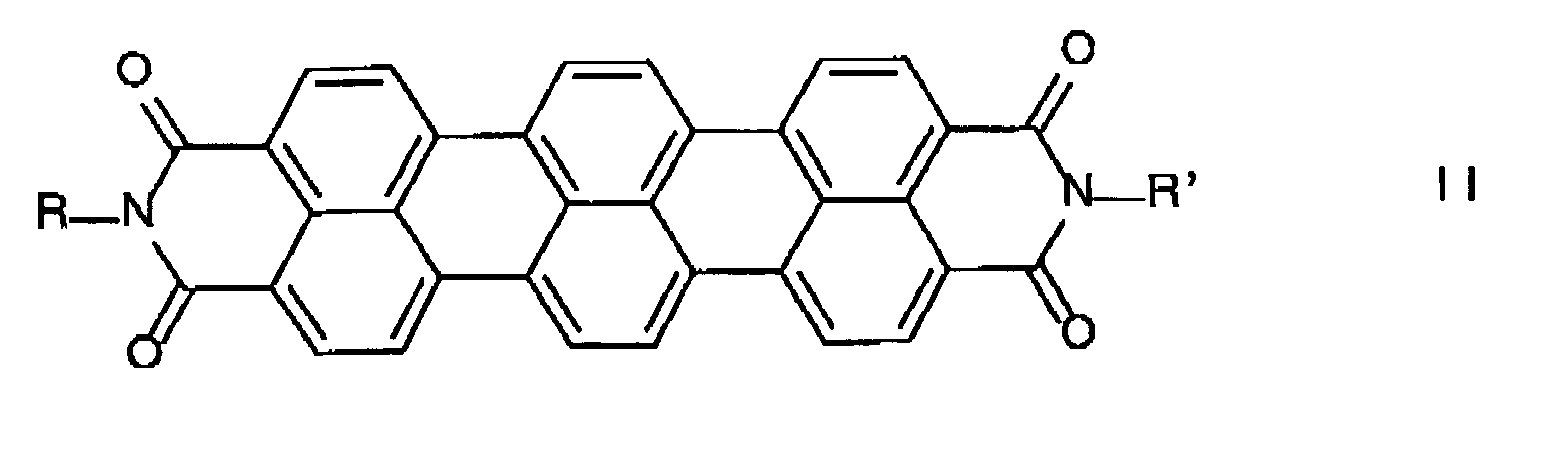

- b) das in Schritt a) erhaltene Tetrabromterrylimid Ia' in Gegenwart eines inerten stickstoffbasischen Lösungsmittels und einer Base mit einem Alkohol oder Thioalkohol der allgemeinen Formel III mit X1 ≠ Brom

- a) a terrylimide of the general formula II
- b) the tetrabromoterrylimide Ia 'obtained in step a) in the presence of an inert nitrogen-based solvent and a base with an alcohol or thioalcohol of the general formula III with X 1 ≠ bromine
Außerdem wurde ein Verfahren zur Herstellung von 1,6,9,14-tetrasubstituierten Terrylimiden der allgemeinen Formel Ib

- X2
- Aryloxy, Arylthio, Hetaryloxy oder Hetarylthio, das jeweils ein- oder mehrfach durch C1-C12-Alkyl, C1-C12-Alkoxy, -COOR1, -SO3R1, Cyano, -CONHR4 und/oder -NHCOR4 substituiert sein kann,
- Y2
- Brom; Aryloxy, Arylthio, Hetaryloxy oder Hetarylthio, das jeweils ein- oder mehrfach durch C1-C12-Alkyl, C1-C12-Alkoxy, -COOR1, -SO3Rl, Halogen, Hydroxy, Carboxy, Cyano, -CONHR2 und/oder -NHCOR2 substituiert sein kann, und
- R4
- C1-C18-Alkyl; Aryl oder Hetaryl, das jeweils durch C1-C6-Alkyl, C1-C6-Alkoxy, Hydroxy oder Cyano substituiert sein kann, bedeuten,
- a) ein 1,6-disubstiutiertes Terrylimid der allgemeinen Formel IV


- b) das in Schritt a) erhaltene 9,14-dibromierte Terrylimid Ib' in Gegenwart eines inerten stickstoffbasischen Lösungsmittels und einer Base mit einem Alkohol oder Thioalkohol der allgemeinen Formel III mit X1 ≠ Brom

- X 2
- Aryloxy, arylthio, hetaryloxy or hetarylthio which are each mono- or polysubstituted by C 1 -C 12 -alkyl, C 1 -C 12 -alkoxy, -COOR 1 , -SO 3 R 1 , cyano, -CONHR 4 and / or NHCOR 4 can be substituted,
- Y 2
- Bromine; Aryloxy, arylthio, hetaryloxy or hetarylthio, each of which is mono- or polysubstituted by C 1 -C 12 -alkyl, C 1 -C 12 -alkoxy, -COOR 1 , -SO 3 R 1 , halogen, hydroxyl, carboxyl, cyano, - CONHR 2 and / or -NHCOR 2 may be substituted, and
- R 4
- C 1 -C 18 alkyl; Aryl or hetaryl, which may each be substituted by C 1 -C 6 -alkyl, C 1 -C 6 -alkoxy, hydroxy or cyano, mean
- a) a 1,6-disubstituted terrylimide of the general formula IV
- b) the obtained in step a) 9,14-dibrominated Terrylimid Ib 'in the presence of an inert nitrogen-based solvent and a base with an alcohol or thioalcohol of the general formula III with X 1 ≠ bromine
Weiterhin wurde ein Verfahren zur Herstellung von 1,6,9,14-tetrasubstituierten Terrylimiden der allgemeinen Formel Ic
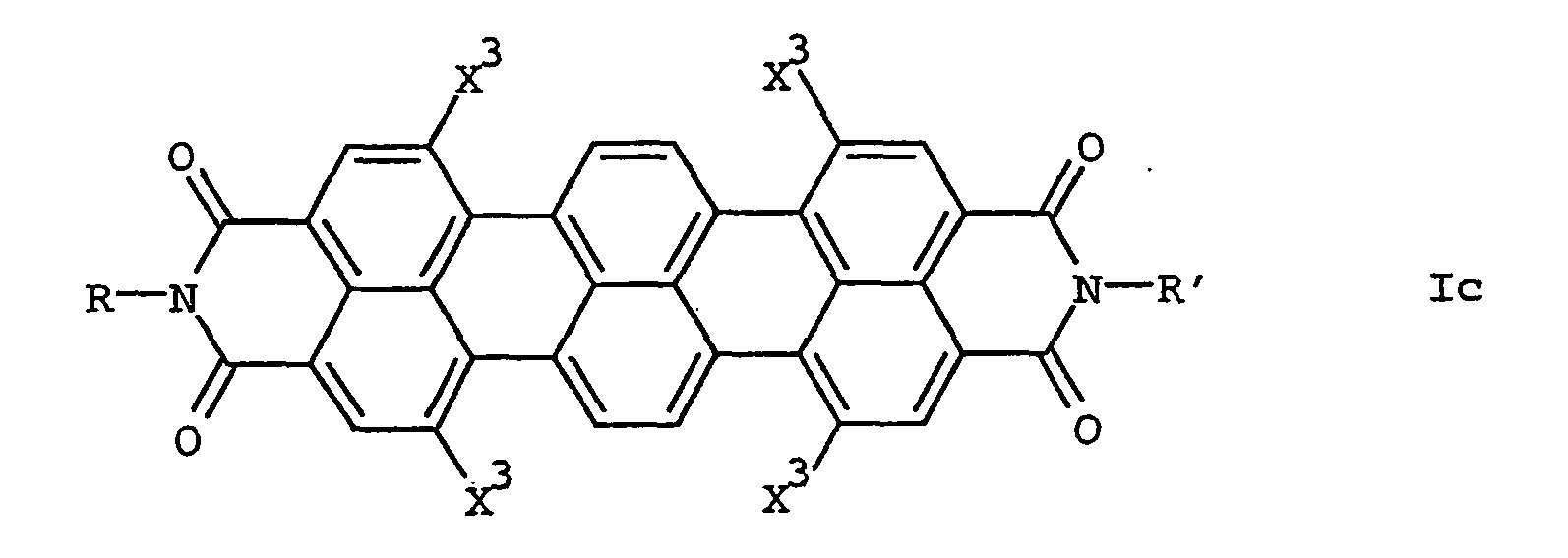

H-C≡C-R3 V
umsetzt und gewünschtenfalls die in den Resten X3 des erhaltenen 1,6,9,14-tetrasubstituierten Terrylimids enthaltenen ungesättigten Bindungen zusätzlich reduziert.Furthermore, a process for the preparation of 1,6,9,14-tetrasubstituted Terrylimiden the general formula Ic
HC≡CR 3 V
and, if desired, additionally reducing the unsaturated bonds contained in the radicals X 3 of the resulting 1,6,9,14-tetrasubstituted terrylimide.
Schließlich wurde ein Verfahren zur Herstellung von 1,6,9,14-tetrasubstituierten Terrylimiden der allgemeinen Formel Id

- X2
- Aryloxy, Arylthio, Hetaryloxy oder Hetarylthio, das jeweils ein- oder mehrfach durch C1-C12-Alkyl C1-C12-Alkoxy, -COOR1, -SO3R1, Cyano, -CONHR4 und/oder -NHCOR4 substituiert sein kann,
- X3
- einen Rest der Formel -L-R3 und
- R4
- C1-C18-Alkyl; Aryl oder Hetaryl, das jeweils durch C1-C6-Alkyl, C1-C6-Alkoxy, Hydroxy oder Cyano substituiert sein kann, bedeuten,
H-C≡C-R3 V
umsetzt und gewünschtenfalls die in den Resten X3 des erhaltenen 1,6,9,14-tetrasubstituierten Terrylimids enthaltenen ungesättigten Bindungen zusätzlich reduziert.Finally, a process for the preparation of 1,6,9,14-tetrasubstituted Terrylimiden of the general formula Id
- X 2
- Aryloxy, arylthio, hetaryloxy or hetarylthio, each one or more times by C 1 -C 12 alkyl C 1 -C 12 alkoxy, -COOR 1 , -SO 3 R 1 , cyano, -CONHR 4 and / or -NHCOR 4 can be substituted,
- X 3
- a radical of the formula -LR 3 and
- R 4
- C 1 -C 18 alkyl; Aryl or hetaryl, which may each be substituted by C 1 -C 6 -alkyl, C 1 -C 6 -alkoxy, hydroxy or cyano, mean
HC≡CR 3 V
and, if desired, additionally reducing the unsaturated bonds contained in the radicals X 3 of the resulting 1,6,9,14-tetrasubstituted terrylimide.
Nicht zuletzt wurde die Verwendung der Terrylimide I zur Einfärbung von hochmolekularen organischen und anorganischen Materialien, als Dispergierhilfsmittel, Pigmentadditive für organische Pigmente und Zwischenprodukte für die Herstellung von Fluoreszenzfarbmitteln und Pigmentadditiven, zur Herstellung farbiger oder im nahinfraroten Bereich des elektromagnetischen Spektrums absorbierender und/oder emittierender wäßriger Polymerisatdispersionen, als Photoleiter in der Elektrophotographie, als Emitter in Elektro- und Chemilumineszenzanwendungen, als Aktivkomponenten in der Fluoreszenzkonversion, in Biolumineszenzarrays sowie der Photovoltaik und als Laserfarbstoffe gefunden.Last but not least, the use of Terrylimide I for coloring high molecular weight organic and inorganic materials, as a dispersing aid, pigment additives for organic pigments and intermediates for the preparation of fluorescent colorants and pigment additives, for producing colored or in the near-infrared region of the electromagnetic spectrum absorbing and / or emitting aqueous Polymerisatdispersionen, as photoconductors in electrophotography, as emitters in electro- and chemiluminescence applications, as active components in fluorescence conversion, in bioluminescence arrays and photovoltaic and found as laser dyes.
Alle in den Formeln I bis V auftretenden Alkylgruppen können geradkettig oder verzweigt sein. Wenn die Alkylgruppen substituiert sind, tragen sie in der Regel 1 oder 2 Substituenten.All alkyl groups occurring in the formulas I to V can be straight-chain or branched. When the alkyl groups are substituted, they usually carry 1 or 2 substituents.
Aromatische Reste, die substituiert sind, können im allgemeinen bis zu 3, bevorzugt 1 oder 2, der genannten Substituenten aufweisen.Aromatic radicals which are substituted may generally have up to 3, preferably 1 or 2, of said substituents.
Als bevorzugte Reste -L-R3 sind durch C1-C18-Alkyl, vor allem C4-C8-Alkyl, das insbesondere endständig (ω-Position) durch Cyano, Hydroxy, Carboxy, Methyl- oder Ethylcarboxy substituiert sein kann, substitutiertes Ethenyl und Ethinyl zu nennen.Preferred radicals -LR 3 are substituted by C 1 -C 18 -alkyl, especially C 4 -C 8 -alkyl, which in particular terminal (ω-position) by cyano, hydroxy, carboxy, methyl or ethylcarboxy may be substituted To name ethenyl and ethynyl.
Als Beispiele für geeignete Reste R, R', R1, R2, R3, R4, X, X1, X2, X3, Y und Y2 (bzw. für deren Substituenten) sowie -L-R3 seien im einzelnen genannt:
- Methyl, Ethyl, Propyl, Isopropyl, Butyl, Isobutyl, tert.-Butyl, Pentyl, Isopentyl, Neopentyl, tert.-Pentyl, Hexyl, 2-Methylpentyl, Heptyl, 1-Ethylpentyl, Octyl, 2-Ethylhexyl, Isooctyl, Nonyl, Isononyl, Decyl, Isodecyl, Undecyl, Dodecyl, Tridecyl, Isotridecyl, Tetradecyl, Pentadecyl, Hexadecyl, Heptadecyl, Octadecyl, Nonadecyl und Eicosyl (die obigen Bezeichnungen Isooctyl, Isononyl, Isodecyl und Isotridecyl sind Trivialbezeichnungen und
stammen von den nach der Oxosynthese erhaltenen Alkoholen); - Methoxymethyl, 2-Methoxyethyl, 2-Ethoxyethyl, 2-Propoxyethyl, 2-Isopropoxyethyl, 2-Butoxyethyl, 2- und 3-Methoxypropyl, 2- und 3-Ethoxypropyl, 2- und 3-Propoxypropyl, 2- und 3-Butoxypropyl, 2-und 4-Methoxybutyl, 2- und 4-Ethoxybutyl, 2- und 4-Propoxybutyl, 3,6-Dioxaheptyl, 3,6-Dioxaoctyl, 4,8-Dioxanonyl, 3,7-Dioxaoctyl, 3,7-Dioxanonyl, 4,7-Dioxaoctyl, 4,7-Dioxanonyl, 2- und 4-Butoxybutyl, 4,8-Dioxadecyl, 3,6,9-Trioxadecyl, 3,6,9-Trioxaundecyl, 3,6,9-Trioxadodecyl, 3,6,9,12-Tetraoxatridecyl und 3,6,9,12-Tetraoxatetradecyl;
- Methylthiomethyl, 2-Methylthioethyl, 2-Ethylthioethyl, 2-Propylthioethyl, 2-Isopropylthioethyl, 2-Butylthioethyl, 2- und 3-Methylthiopropyl, 2- und 3-Ethylthiopropyl, 2- und 3-Propylthiopropyl, 2- und 3-Butylthiopropyl, 2- und 4-Methylthiobutyl, 2- und 4-Ethylthiobutyl, 2- und 4-Propylthiobutyl, 3,6-Dithiaheptyl, 3,6-Dithiaoctyl, 4,8-Dithianonyl, 3,7-Dithiaoctyl, 3,7-Dithianonyl, 2- und 4-Butylthiobutyl, 4,8-Dithiadecyl, 3,6,9-Trithiadecyl, 3,6,9-Trithiaundecyl, 3,6,9-Trithiadodecyl, 3,6,9,12-Tetrathiatridecyl und 3,6,9,12-Tetrathiatetradecyl;
- 2-Monomethyl- und 2-Monoethylaminoethyl, 2-Dimethylaminoethyl, 2-und 3- Dimethylaminopropyl, 3-Monoisopropylaminopropyl, 2- und 4-Monopropylaminobutyl, 2- und 4-Dimethylaminobutyl, 6-Methyl-3,6-diazaheptyl, 3,6-Dimethyl-3,6-diazaheptyl, 3,6-Diazaoctyl, 3,6-Dimethyl-3,6-diazaoctyl, 9-Methyl-3,6,9-triazadecyl, 3,6,9-Trimethyl-3,6,9-triazadecyl, 3,6,9-Triazaundecyl, 3,6,9-Trimethyl-3,6,9-triazaundecyl, 12-Methyl-3,6,9,12-tetraazatridecyl und 3,6,9,12-Tetramethyl-3,6,9,12-tetraazatridecyl;
- Propan-2-on-1-yl, Butan-3-on-1-yl, Butan-3-on-2-yl und 2-Ethylpentan-3-on-1-yl;
- 2-Methylsulfonylethyl, 2-Ethylsulfonylethyl, 2-Propylsulfonylethyl, 2-Isopropylsulfonylethyl, 2-Butylsulfonylethyl, 2- und 3-Methylsulfonylpropyl, 2- und 3-Ethylsulfonylpropyl, 2- und 3-Propylsulfonylpropyl, 2- und 3-Butylsulfonylpropyl, 2- und 4-Methylsulfonylbutyl, 2- und 4-Ethylsulfonylbutyl, 2- und 4-Propylsulfonylbutyl und 4-Butylsulfonylbutyl;
- Carboxymethyl, 2-Carboxyethyl, 3-Carboxypropyl, 4-Carboxybutyl, 5-Carboxypentyl, 6-Carboxyhexyl, 8-Carboxyoctyl, 10-Carboxydecyl, 12-Carboxydodecyl und 14-Carboxytetradecyl;
- Sulfomethyl, 2-Sulfoethyl, 3-Sulfopropyl, 4-Sulfobutyl, 5-Sulfopentyl, 6-Sulfohexyl, 8-Sulfooctyl, 10-Sulfodecyl, 12-Sulfododecyl und 14-Sulfotetradecyl;
- 2-Hydroxyethyl, 3-Hydroxypropyl, 1-Hydroxyprop-2-yl, 2- und 4-Hydroxybutyl, 1-Hydroxybut-2-yl und 8-Hydroxy-4-oxaoctyl;
- Cyanomethyl, 2-Cyanoethyl, 3-Cyanopropyl, 2-Methyl-3-ethyl-3-cyanopropyl, 7-Cyano-7-ethylheptyl und 4,7-Dimethyl-7-cyanoheptyl;
- Methoxy, Ethoxy, Propoxy, Isopropoxy, Butoxy, Isobutoxy, sec.-Butoxy, tert.-Butoxy, Pentoxy, Isopentoxy, Neopentoxy, tert.-Pentoxy und Hexoxy;
- Carbamoyl, Methylaminocarbonyl, Ethylaminocarbonyl, Propylaminocarbonyl, Butylaminocarbonyl, Pentylaminocarbonyl, Hexylaminocarbonyl, Heptylaminocarbonyl, Octylaminocarbonyl, Nonylaminocarbonyl, Decylaminocarbonyl und Phenylaminocarbonyl;
- Formylamino, Acetylamino, Propionylamino und Benzoylamino;
- Chlor, Brom und Iod;
- Phenylazo, 2-Napthylazo, 2-Pyridylazo und 2-Pyrimidylazo;
- Phenyl, 1- und 2-Naphthyl, 2- und 3-Pyrryl, 2-, 3- und 4-Pyridyl, 2-, 4- und 5-Pyrimidyl, 3-, 4- und 5-Pyrazolyl, 2-, 4- und 5-Imidazolyl, 2-, 4- und 5-Thiazolyl, 3-(1,2,4-Triazyl), 2-(1,3,5-Triazyl), 6-Chinaldyl, 3-, 5-, 6- und 8-Chinolinyl, 2-Benzoxazolyl, 2-Benzothiazolyl, 5-Benzothiadiazolyl, 2- und 5-Benzimidazolyl und 1- und 5- Isochinolyl;
- 2-, 3- und 4-Methylphenyl, 2,3-, 2,4-, 2,5-, 3,5- und 2,6-Dimethylphenyl, 2,4,6-Trimethylphenyl, 2-, 3- und 4-Ethylphenyl, 2,3-, 2,4-, 2,5-, 3,5- und 2,6-Diethylphenyl, 2,4,6-Triethylphenyl, 2-, 3- und 4-Propylphenyl, 2,3-, 2,4-, 2,5-, 3,5-und 2,6-Dipropylphenyl, 2,4,6-Tripropylphenyl, 2-, 3- und 4-Isopropylphenyl, 2,3-, 2,4-, 2,5-, 3,5- und 2,6-Diisopropylphenyl, 2,4,6-Triisopropylphenyl, 2-, 3- und 4-Butylphenyl, 2,3-, 2,4-, 2,5-, 3,5- und 2,6-Dibutylphenyl, 2,4,6-Tributylphenyl, 2-, 3-und 4-Isobutylphenyl, 2,3-, 2,4-, 2,5-, 3,5- und 2,6-Diisobutylphenyl, 2,4,6-Triisobutylphenyl, 2-, 3- und 4-sec.-Butylphenyl, 2,3-, 2,4-, 2,5-, 3,5- und 2,6-Di-sec.-butylphenyl und 2,4,6-Tri-sec.-butylphenyl, 2-, 3- und 4-tert.-Butylphenyl, 2,3-, 2,4-, 2,5-, 3,5- und 2,6-Di-tert.-butylphenyl, 2,4,6-Tri-tert.-butylphenyl; 2-, 3- und 4-Methoxyphenyl, 2,3-, 2,4-, 2,5-, 3,5- und 2,6-Dimethoxyphenyl, 2,4,6-Trimethoxyphenyl, 2-, 3- und 4-Ethoxyphenyl, 2,3-, 2,4-, 2,5-, 3,5- und 2,6-Diethoxyphenyl, 2,4,6-Triethoxyphenyl, 2-, 3- und 4-Propoxyphenyl, 2,3-, 2,4-, 2,5-, 3,5-und 2,6-Dipropoxyphenyl, 2-, 3- und 4-Isopropoxyphenyl, 2,3-, 2,4-, 2,5-, 3,5- und 2,6-Diisopropoxyphenyl und 2-, 3- und 4-Butoxyphenyl; 2-, 3- und 4-Chlorphenyl, und 2,3-, 2,4-, 2,5-, 3,5- und 2,6-Dichlorphenyl; 2-, 3- und 4-Hydroxyphenyl und 2,3-, 2,4-, 2,5-, 3,5- und 2,6-Dihydroxyphenyl; 2-, 3- und 4-Cyanophenyl; 3- und 4-Carboxyphenyl; 3- und 4-Carboxamidophenyl, 3-und 4-N-Methylcarboxamidophenyl und 3- und 4-N-Ethylcarboxamidophenyl; 3- und 4-Acetylaminophenyl, 3- und 4-Propionylaminophenyl und 3- und 4-Butyrylaminophenyl; 3- und 4-N-Phenylaminophenyl, 3-und 4-N-(o-Tolyl)aminophenyl, 3- und 4-N-(m-Tolyl)aminophenyl und 3- und 4-N-(p-Tolyl)aminophenyl; 3- und 4-(2-Pyridyl)aminophenyl, 3- und 4-(3-Pyridyl)aminophenyl, 3- und 4-(4-Pyridyl)aminophenyl, 3- und 4-(2-Pyrimidyl)aminophenyl und 4-(4-Pyrimidyl)aminophenyl;
- 4-Phenylazophenyl, 4-(1-Naphthylazo)phenyl, 4-(2-Naphthylazo)phenyl, 4-(4-Naphthylazo)plienyl, 4-(2-Pyridylazo)phenyl, 4-(3-Pyridylazo)phenyl, 4-(4-Pyridylazo)phenyl, 4-(2-Pyrimidylazo)phenyl, 4-(4-Pyrimidylazo)phenyl und 4-(5-Pyrimidylazo)-phenyl;
- Cyclopentyl, 2- und 3-Methylcyclopentyl, 2- und 3-Ethylcyclopentyl, Cyclohexyl, 2-, 3- und 4-Methylcyclohexyl, 2-, 3- und . 4-Ethylcyclohexyl, 3- und 4-Propylcyclohexyl, 3- und 4-Isopropylcyclohexyl, 3- und 4-Butylcyclohexyl, 3- und 4-sec.-Butylcyclohexyl, 3- und 4-tert.-Butylcyclohexyl, Cycloheptyl, 2-, 3- und 4-Methylcycloheptyl, 2-, 3- und 4-Ethylcycloheptyl, 3- und 4-Propylcycloheptyl, 3- und 4-Isopropylcycloheptyl, 3- und 4-Butylcycloheptyl, 3- und 4-sec.-Butylcycloheptyl, 3- und 4-tert.-Butylcycloheptyl, Cyclooctyl, 2-, 3-, 4- und 5-Methylcyclooctyl, 2-, 3-, 4- und 5-Ethylcyclooctyl, 3-, 4- und 5-Propylcyclooctyl, 2-Dioxanyl, 4-Morpholinyl, 2- und 3-Tetrahydrofuryl, 1-, 2- und 3-Pyrrolidinyl und 1-, 2-, 3- und 4-Piperidyl;
- Phenoxy, Phenylthio, 1- und 2-Naphthyloxy, 1- und 2-Naphthylthio, 2-, 3- und 4-Pyridyloxy, 2-, 3- und 4-Pyridylthio, 2-, 4- und 5-Pyrimidyloxy und 2-, 4- und 5-Pyrimidylthio;
- Dimethylamino, Diethylamino, Dipropylamino, Diisopropylamino, Dibutylamino, Diisobutylamino, Di-tert.-butylamino, Dipentylamino, Dihexylamino, Diphenylamino, Di-o-tolylamino, Di-m-tolylamino, Di-p-tolylamino und Di(4 -cyanophenyl)amino;
- 1-Propinyl, 1-Butinyl, 1-Pentinyl, 3-Methyl-1-butinyl, 1-Hexinyl, 3- und 4-Methyl-1-pentinyl, 3,3-Dimethyl-1-butinyl, 1-Heptinyl, 3-, 4- und 5-Methyl-1-hexinyl, 3,3-, 3,4- und 4,4-Dimethyl-1-pentinyl, 3-Ethyl-1-pentinyl, 1-Octinyl, 3-, 4-, 5- und 6-Methyl-1-heptinyl, 3,3-, 3,4-, 3,5-, 4,4- und 4,5-Dimethyl-1-hexinyl, 3-, 4- und 5-Ethyl-1-hexinyl, 3-Ethyl-3-methyl-1-pentinyl, 3-Ethyl-4-methyl-1-pentinyl, 3,3,4- und 3,4,4-Trimethyl-1-pentinyl, 1-Noninyl, 1-Decinyl, 1-Undecinyl und 1-Dodecinyl;
- 4-Cyano-1-butinyl, 5-Cyano-1-pentinyl, 6-Cyano-1-hexinyl, 7-Cyano-1-heptinyl und 8-Cyano-1-octinyl;
- 4-Hydroxy-1-butinyl, 5-Hydroxy-1-pentinyl, 6-Hydroxy-1-hexinyl, 7-Hydroxy-1-heptinyl, 8-Hydroxy-1-octinyl, 9-Hydroxy-1-noninyl, 10-Hydroxy-1-decinyl, 11-Hydroxy-1-undecinyl und 12-Hydroxy-1-dodecinyl;
- 4-Carboxy-1-butinyl, 5-Carboxy-1-pentinyl, 6-Carboxy-1-hexinyl, 7-Carboxy-1-heptinyl, 8-Carboxy-1-octinyl, 4-Methylcarboxy-1-butinyl, 5-Methylcarboxy-1-pentinyl, 6-Methylcarboxy-1-hexinyl, 7-Methylcarboxy-1-heptinyl, 8-Methylcarboxy-1-octinyl, 4-Ethylcarboxy-1-butinyl, 5-Ethylcarboxy-1-pentinyl, 6-Ethylcarboxy-1-hexinyl, 7-Ethylcarboxy-1-heptinyl und 8-Ethylcarboxy-1-octinyl;
- 1-Propenyl, 1-Butenyl, 1-Pentenyl, 3-Methyl-1-butenyl, 1-Hexenyl, 3- und 4-Methyl-1-pentenyl, 3,3-Dimethyl-1-butenyl, 1-Heptenyl, 3-, 4- und 5-Methyl-1-hexenyl, 3,3-, 3,4- und 4,4-Dimethyl-1-pentenyl, 3-Ethyl-1-pentenyl, 1-Octenyl, 3-, 4-, 5- und 6-Methyl-1-heptenyl, 3,3-, 3,4-, 3,5-, 4,4 und 4,5-Dimethyl-1-hexenyl, 3-, 4- und 5-Ethyl-1-hexenyl, 3-Ethyl-3-methyl-1-pentenyl, 3-Ethyl-4-methyl-1-pentenyl, 3,3,4- und 3,4,4-Trimethyl-1-pentenyl, 1-Nonenyl, 1-Decenyl, 1-Undecenyl und 1-Dodecenyl;
- 4-Cyano-1-butenyl, 5-Cyano-1-pentenyl, 6-Cyano-1-hexenyl, 7-Cyano-1-heptenyl und 8-Cyano-1-octenyl;
- 4-Hydroxy-1-butenyl, 5-Hydroxy-1-pentenyl, 6-Hydroxy-1-hexenyl, 7-Hydroxy-1-heptenyl, 8-Hydroxy-1-octenyl, 9-Hydroxy-1-nonenyl, 10-Hydroxy-1-decenyl, 11-Hydroxy-1-undecenyl und 12-Hydroxy-1-dodecenyl;
- 4-Carboxy-1-butenyl, 5-Carboxy-1-pentenyl, 6-Carboxy-1-hexenyl, 7-Carboxy-1-heptenyl, 8-Carboxy-1-octenyl, 4-Methylcarboxy-1-butenyl, 5-Methylcarboxy-1-pentenyl, 6-Methylcarboxy-1-hexenyl, 7-Methylcarboxy-1-heptenyl, 8-Methylcarboxy-1-octenyl, 4-Ethylcarboxy-1-butenyl, 5-Ethylcarboxy-1-pentenyl, 6-Ethylcarboxy-1-hexenyl, 7-Ethylcarboxy-1-heptenyl und 8-Ethylcarboxy-1-octenyl.
- Methyl, ethyl, propyl, isopropyl, butyl, isobutyl, tert-butyl, pentyl, isopentyl, neopentyl, tert-pentyl, hexyl, 2-methylpentyl, heptyl, 1-ethylpentyl, octyl, 2-ethylhexyl, isooctyl, nonyl, Isononyl, decyl, isodecyl, undecyl, dodecyl, tridecyl, isotridecyl, tetradecyl, pentadecyl, hexadecyl, heptadecyl, octadecyl, Nonadecyl and eicosyl (the above designations isooctyl, isononyl, isodecyl and isotridecyl are trivial and
are derived from the alcohols obtained by the oxo process); - Methoxymethyl, 2-methoxyethyl, 2-ethoxyethyl, 2-propoxyethyl, 2-isopropoxyethyl, 2-butoxyethyl, 2- and 3-methoxypropyl, 2- and 3-ethoxypropyl, 2- and 3-propoxypropyl, 2- and 3-butoxypropyl, 2- and 4-methoxybutyl, 2- and 4-ethoxybutyl, 2- and 4-propoxybutyl, 3,6-dioxaheptyl, 3,6-dioxaoctyl, 4,8-dioxanonyl, 3,7-dioxaoctyl, 3,7-dioxanonyl , 4,7-dioxanonyl, 4,7-dioxanonyl, 2- and 4-butoxybutyl, 4,8-dioxadecyl, 3,6,9-trioxadecyl, 3,6,9-trioxaundecyl, 3,6,9-trioxadodecyl, 3,6,9,12-tetraoxatridecyl and 3,6,9,12-tetraoxatetradecyl;
- Methylthiomethyl, 2-methylthioethyl, 2-ethylthioethyl, 2-propylthioethyl, 2-isopropylthioethyl, 2-butylthioethyl, 2- and 3-methylthiopropyl, 2- and 3-ethylthiopropyl, 2- and 3-propylthiopropyl, 2- and 3-butylthiopropyl, 2- and 4-methylthiobutyl, 2- and 4-ethylthiobutyl, 2- and 4-propylthiobutyl, 3,6-dithiaheptyl, 3,6-dithiaoctyl, 4,8-dithianonyl, 3,7-dithiaoctyl, 3,7-dithianonyl , 2- and 4-butylthiobutyl, 4,8-dithiadecyl, 3,6,9-trithiadecyl, 3,6,9-trithiaundecyl, 3,6,9-trithiadodecyl, 3,6,9,12-tetrathiatridecyl and 3, 6,9,12-Tetrathiatetradecyl;
- 2-monomethyl- and 2-monoethylaminoethyl, 2-dimethylaminoethyl, 2- and 3-dimethylaminopropyl, 3-monoisopropylaminopropyl, 2- and 4-monopropylaminobutyl, 2- and 4-dimethylaminobutyl, 6-methyl-3,6-diazaheptyl, 3, 6-dimethyl-3,6-diazaheptyl, 3,6-diazaoctyl, 3,6-dimethyl-3,6-diazaoctyl, 9-methyl-3,6,9-triazadecyl, 3,6,9-trimethyl-3, 6,9-triazadecyl, 3,6,9-triazaundecyl, 3,6,9-trimethyl-3,6,9-triazaundecyl, 12-methyl-3,6,9,12-tetraazatridecyl and 3,6,9, 12-tetramethyl-3,6,9,12-tetraazatridecyl;
- Propan-2-one-1-yl, butan-3-one-1-yl, butan-3-one-2-yl and 2-ethyl-pentan-3-one-1-yl;
- 2-methylsulfonylethyl, 2-ethylsulfonylethyl, 2-propylsulfonylethyl, 2-isopropylsulfonylethyl, 2-butylsulfonylethyl, 2- and 3-methylsulfonylpropyl, 2- and 3-ethylsulfonylpropyl, 2- and 3-propylsulfonylpropyl, 2- and 3-butylsulfonylpropyl, 2- and 4-methylsulfonylbutyl, 2- and 4-ethylsulfonylbutyl, 2- and 4-propylsulfonylbutyl and 4-butylsulfonylbutyl;
- Carboxymethyl, 2-carboxyethyl, 3-carboxypropyl, 4-carboxybutyl, 5-carboxypentyl, 6-carboxyhexyl, 8-carboxyctyl, 10-carboxydecyl, 12-carboxydodecyl and 14-carboxytetradecyl;
- Sulfomethyl, 2-sulfoethyl, 3-sulfopropyl, 4-sulfobutyl, 5-sulfopentyl, 6-sulfohexyl, 8-sulfooctyl, 10-sulfodecyl, 12-sulfododecyl and 14-sulfotetradecyl;
- 2-hydroxyethyl, 3-hydroxypropyl, 1-hydroxyprop-2-yl, 2- and 4-hydroxybutyl, 1-hydroxybut-2-yl and 8-hydroxy-4-oxo-octyl;
- Cyanomethyl, 2-cyanoethyl, 3-cyanopropyl, 2-methyl-3-ethyl-3-cyanopropyl, 7-cyano-7-ethylheptyl and 4,7-dimethyl-7-cyanoheptyl;
- Methoxy, ethoxy, propoxy, isopropoxy, butoxy, isobutoxy, sec-butoxy, tert-butoxy, pentoxy, isopentoxy, neopentoxy, tert-pentoxy and hexoxy;
- Carbamoyl, methylaminocarbonyl, ethylaminocarbonyl, propylaminocarbonyl, butylaminocarbonyl, pentylaminocarbonyl, hexylaminocarbonyl, heptylaminocarbonyl, octylaminocarbonyl, nonylaminocarbonyl, decylaminocarbonyl and phenylaminocarbonyl;
- Formylamino, acetylamino, propionylamino and benzoylamino;
- Chlorine, bromine and iodine;
- Phenylazo, 2-naphthylazo, 2-pyridylazo and 2-pyrimidylazo;
- Phenyl, 1- and 2-naphthyl, 2- and 3-pyrryl, 2-, 3- and 4-pyridyl, 2-, 4- and 5-pyrimidyl, 3-, 4- and 5-pyrazolyl, 2-, 4 and 5-imidazolyl, 2-, 4- and 5-thiazolyl, 3- (1,2,4-triazyl), 2- (1,3,5-triazyl), 6-quinaldyl, 3, 5, 6- and 8-quinolinyl, 2-benzoxazolyl, 2-benzothiazolyl, 5-benzothiadiazolyl, 2- and 5-benzimidazolyl and 1- and 5-isoquinolyl;
- 2-, 3- and 4-methylphenyl, 2,3-, 2,4-, 2,5-, 3,5- and 2,6-dimethylphenyl, 2,4,6-trimethylphenyl, 2-, 3- and 4-ethylphenyl, 2,3-, 2,4-, 2,5-, 3,5- and 2,6-diethylphenyl, 2,4,6-triethylphenyl, 2-, 3- and 4-propylphenyl, 2, 3-, 2,4-, 2,5-, 3,5- and 2,6-dipropylphenyl, 2,4,6-tripropylphenyl, 2-, 3- and 4-isopropylphenyl, 2,3-, 2,4 , 2,5-, 3,5- and 2,6-diisopropylphenyl, 2,4,6-triisopropylphenyl, 2-, 3- and 4-butylphenyl, 2,3-, 2,4-, 2,5- , 3,5- and 2,6-dibutylphenyl, 2,4,6-tributylphenyl, 2-, 3- and 4-isobutylphenyl, 2,3-, 2,4-, 2,5-, 3,5- and 2,6-diisobutylphenyl, 2,4,6-triisobutylphenyl, 2-, 3- and 4-sec-butylphenyl, 2,3-, 2,4-, 2,5-, 3,5- and 2,6 Di-sec-butylphenyl and 2,4,6-tri-sec-butylphenyl, 2-, 3- and 4-tert-butylphenyl, 2,3-, 2,4-, 2,5-, 3 , 5- and 2,6-di-tert-butylphenyl, 2,4,6-tri-tert-butylphenyl; 2-, 3- and 4-methoxyphenyl, 2,3-, 2,4-, 2,5-, 3,5- and 2,6-dimethoxyphenyl, 2,4,6-trimethoxyphenyl, 2-, 3- and 4-ethoxyphenyl, 2,3-, 2,4-, 2,5-, 3,5- and 2,6-diethoxyphenyl, 2,4,6-triethoxyphenyl, 2-, 3- and 4-propoxyphenyl, 2,3-, 2,4-, 2,5-, 3,5- and 2,6-dipropoxyphenyl, 2-, 3- and 4-isopropoxyphenyl, 2,3-, 2,4-, 2,5-, 3,5- and 2,6-diisopropoxyphenyl and 2-, 3- and 4-butoxyphenyl; 2-, 3- and 4-chlorophenyl, and 2,3-, 2,4-, 2,5-, 3,5- and 2,6-dichlorophenyl; 2-, 3- and 4-hydroxyphenyl and 2,3-, 2,4-, 2,5-, 3,5- and 2,6-dihydroxyphenyl; 2-, 3- and 4-cyanophenyl; 3- and 4-carboxyphenyl; 3- and 4-carboxamidophenyl, 3- and 4-N-methylcarboxamidophenyl and 3- and 4-N-ethylcarboxamidophenyl; 3- and 4-acetylaminophenyl, 3- and 4-propionylaminophenyl and 3- and 4-butyrylaminophenyl; 3- and 4-N-phenylaminophenyl, 3- and 4-N- (o -tolyl) aminophenyl, 3- and 4-N- (m-tolyl) aminophenyl and 3- and 4-N- (p-tolyl) aminophenyl ; 3- and 4- (2-pyridyl) aminophenyl, 3- and 4- (3-pyridyl) aminophenyl, 3- and 4- (4-pyridyl) aminophenyl, 3- and 4- (2-pyrimidyl) aminophenyl and 4- (4-pyrimidyl) aminophenyl;
- 4-phenylazophenyl, 4- (1-naphthylazo) phenyl, 4- (2-naphthylazo) phenyl, 4- (4-naphthylazo) plienyl, 4- (2-pyridylazo) phenyl, 4- (3-pyridylazo) phenyl, 4 - (4-pyridylazo) phenyl, 4- (2-pyrimidylazo) phenyl, 4- (4-pyrimidylazo) phenyl and 4- (5-pyrimidylazo) -phenyl;
- Cyclopentyl, 2- and 3-methylcyclopentyl, 2- and 3-ethylcyclopentyl, cyclohexyl, 2-, 3- and 4-methylcyclohexyl, 2-, 3- and. 4-ethylcyclohexyl, 3- and 4-propylcyclohexyl, 3- and 4-isopropylcyclohexyl, 3- and 4-butylcyclohexyl, 3- and 4-sec-butylcyclohexyl, 3- and 4-tert-butylcyclohexyl, cycloheptyl, 2-, 3- and 4-methylcycloheptyl, 2-, 3- and 4-ethylcycloheptyl, 3- and 4-propylcycloheptyl, 3- and 4-isopropylcycloheptyl, 3- and 4-butylcycloheptyl, 3- and 4-sec-butylcycloheptyl, 3- and 4-tert-butylcycloheptyl, cyclooctyl, 2-, 3-, 4- and 5-methylcyclooctyl, 2-, 3-, 4- and 5-ethylcyclooctyl, 3-, 4- and 5-propylcyclooctyl, 2-dioxanyl, 4-morpholinyl, 2- and 3-tetrahydrofuryl, 1-, 2- and 3-pyrrolidinyl and 1-, 2-, 3- and 4-piperidyl;
- Phenoxy, phenylthio, 1- and 2-naphthyloxy, 1- and 2-naphthylthio, 2-, 3- and 4-pyridyloxy, 2-, 3- and 4-pyridylthio, 2-, 4- and 5-pyrimidyloxy and 2- , 4- and 5-pyrimidylthio;
- Dimethylamino, diethylamino, dipropylamino, diisopropylamino, dibutylamino, diisobutylamino, di-tert-butylamino, dipentylamino, dihexylamino, diphenylamino, di-o-tolylamino, di-m-tolylamino, di-p-tolylamino and di (4-cyanophenyl) amino ;
- 1-propynyl, 1-butynyl, 1-pentynyl, 3-methyl-1-butynyl, 1-hexynyl, 3- and 4-methyl-1-pentynyl, 3,3-dimethyl-1-butynyl, 1-heptynyl, 3 , 4- and 5-methyl-1-hexynyl, 3,3-, 3,4- and 4,4-dimethyl-1-pentynyl, 3-ethyl-1-pentynyl, 1-octynyl, 3-, 4- , 5- and 6-methyl-1-heptinyl, 3,3-, 3,4-, 3,5-, 4,4- and 4,5-dimethyl-1-hexynyl, 3, 4 and 5 Ethyl 1-hexynyl, 3-ethyl-3-methyl-1-pentynyl, 3-ethyl-4-methyl-1-pentynyl, 3,3,4- and 3,4,4-trimethyl-1-pentynyl, 1 Noninyl, 1-decynyl, 1-undecynyl and 1-dodecynyl;
- 4-cyano-1-butynyl, 5-cyano-1-pentynyl, 6-cyano-1-hexynyl, 7-cyano-1-heptynyl and 8-cyano-1-octynyl;
- 4-hydroxy-1-butynyl, 5-hydroxy-1-pentynyl, 6-hydroxy-1-hexynyl, 7-hydroxy-1-heptynyl, 8-hydroxy-1-octynyl, 9-hydroxy-1-nonynyl, 10 Hydroxy-1-decynyl, 11-hydroxy-1-undecynyl and 12-hydroxy-1-dodecynyl;
- 4-carboxy-1-butynyl, 5-carboxy-1-pentynyl, 6-carboxy-1-hexynyl, 7-carboxy-1-heptynyl, 8-carboxy-1-octynyl, 4-methylcarboxy-1-butynyl, 5- Methylcarboxy-1-pentynyl, 6-methylcarboxy-1-hexynyl, 7-methylcarboxy-1-heptynyl, 8-methylcarboxy-1-octynyl, 4-ethylcarboxy-1-butynyl, 5-ethylcarboxy-1-pentynyl, 6-ethylcarboxy 1-hexynyl, 7-ethylcarboxy-1-heptynyl and 8-ethylcarboxy-1-octynyl;
- 1-propenyl, 1-butenyl, 1-pentenyl, 3-methyl-1-butenyl, 1-hexenyl, 3- and 4-methyl-1-pentenyl, 3,3-dimethyl-1-butenyl, 1-heptenyl, 3 , 4- and 5-methyl-1-hexenyl, 3,3-, 3,4- and 4,4-dimethyl-1-pentenyl, 3-ethyl-1-pentenyl, 1-octenyl, 3-, 4- , 5- and 6-methyl-1-heptenyl, 3,3-, 3,4-, 3,5-, 4,4- and 4,5-dimethyl-1-hexenyl, 3-, 4- and 5-ethyl 1-hexenyl, 3-ethyl-3-methyl-1-pentenyl, 3-ethyl-4-methyl-1-pentenyl, 3,3,4- and 3,4,4-trimethyl-1-pentenyl, 1 Nonenyl, 1-decenyl, 1-undecenyl and 1-dodecenyl;
- 4-cyano-1-butenyl, 5-cyano-1-pentenyl, 6-cyano-1-hexenyl, 7-cyano-1-heptenyl and 8-cyano-1-octenyl;
- 4-hydroxy-1-butenyl, 5-hydroxy-1-pentenyl, 6-hydroxy-1-hexenyl, 7-hydroxy-1-heptenyl, 8-hydroxy-1-octenyl, 9-hydroxy-1-nonenyl, 10 Hydroxy-1-decenyl, 11-hydroxy-1-undecenyl and 12-hydroxy-1-dodecenyl;
- 4-carboxy-1-butenyl, 5-carboxy-1-pentenyl, 6-carboxy-1-hexenyl, 7-carboxy-1-heptenyl, 8-carboxy-1-octenyl, 4-methylcarboxy-1-butenyl, 5- Methylcarboxy-1-pentenyl, 6-methylcarboxy-1-hexenyl, 7-methylcarboxy-1-heptenyl, 8-methylcarboxy-1-octenyl, 4-ethylcarboxy-1-butenyl, 5-ethylcarboxy-1-pentenyl, 6-ethylcarboxy-1-hexenyl, 7-ethylcarboxy-1-heptenyl and 8-ethylcarboxy-1-octenyl.
Die Herstellung der erfindungsgemäßen Terrylimide Ia, Ia', Ib und Ib', die in 1,6,9,14-Stellung bromiert sind oder 4 gleiche (Het)Aryloxy- oder (Het)Arylthioreste tragen bzw. in 1,6-Stellung und in 9,14-Stellung jeweils 2 gleiche (Het)Aryloxy- oder (Het)Arylthioreste oder in 1,6-Stellung 2 gleiche (Het)Aryloxy-oder (Het)Arylthioreste tragen und in 9,14-Stellung bromiert sind, kann vorteilhaft nach den beiden erfindungsgemäßen Verfahren, ausgehend von den literaturbekannten nichtkernsubstituierten Terrylimiden II bzw. 1,6-disubstituierten Terrylimiden IV, erfolgen.The preparation of Terrylimide Ia, Ia ', Ib and Ib' according to the invention, which are brominated in the 1,6,9,14-position or carry 4 identical (Het) aryloxy or (Het) Arylthioreste or in 1,6-position and in the 9,14-position in each case 2 identical (het) aryloxy or (het) arylthio radicals or in the 1,6-position 2 identical (het) aryloxy or (het) arylthio radicals and are brominated in the 9,14-position, can advantageously according to the two methods of the invention, starting from the literature non-nucleated Terrylimiden II or 1,6-disubstituted Terrylimiden IV, take place.
Dabei werden die Terrylimide II bzw. IV in Schritt a) zunächst durch Umsetzung mit elementarem Brom in die 1,6,9,14-tetrabromierten Terrylimide der Formel Ia' bzw. die 9,14-dibromierten Terrylimide der Formel Ib' überführt.In this case, the terrylimides II or IV in step a) are first converted by reaction with elemental bromine into the 1,6,9,14-tetrabrominated terrylimides of the formula Ia 'or the 9,14-dibrominated terrylimides of the formula Ib'.
Die am Terrylenkern durch gegebenenfalls weiter funktionalisierte (Het)Aryloxy- oder (Het)Arylthioreste substituierten Terrylimide Ia bzw. Ib können in einem weiteren Schritt b) durch Umsetzung der bromierten Terrylimide Ia' bzw. Ib' mit einem aromatischen oder heteroaromatischen Alkohol oder Thioalkohol III unter Bromaustausch hergestellt werden.The Terrylimide Ia or Ib substituted on the Terrylenkern by optionally further functionalized (Het) aryloxy or (Het) Arylthioreste can in a further step b) by reacting the brominated Terrylimide Ia 'or Ib' with an aromatic or heteroaromatic alcohol or thioalcohol III be prepared under bromine exchange.
Schritt a) der erfindungsgemäßen Herstellungsverfahren, die Umsetzung der Terrylimide II bzw. IV mit elementarem Brom, wird in Gegenwart eines Halogenkohlenwasserstoffs als Lösungsmittel vorgenommen.Step a) of the preparation process according to the invention, the reaction of the terrylimides II or IV with elemental bromine, is carried out in the presence of a halohydrocarbon as solvent.
Dabei sind sowohl aliphatische als auch aromatische halogenierte Kohlenwasserstoffe als Lösungsmittel geeignet, bevorzugt sind die chlorierten Kohlenwasserstoffe. Als Beispiele seien im einzelnen Methylenchlorid, Chloroform, 1,1,2,2-Tetrachlorethan, Chlorbenzol, Dichlorbenzol (alle Isomere) und Trichlorbenzol (alle Isomere) genannt, wobei Chloroform, 1,1,2,2-Tetrachlorethan und Chlorbenzol bevorzugt sind.Both aliphatic and aromatic halogenated hydrocarbons are suitable as solvents, preference being given to the chlorinated hydrocarbons. Specific examples include methylene chloride, chloroform, 1,1,2,2-tetrachloroethane, chlorobenzene, dichlorobenzene (all isomers) and trichlorobenzene (all isomers), with chloroform, 1,1,2,2-tetrachloroethane and chlorobenzene being preferred ,
Üblicherweise kommen 15 bis 150 g, vorzugsweise 70 bis 100 g, Lösungsmittel je g zu bromierendem Terrylimid II bzw. IV zum Einsatz.Usually 15 to 150 g, preferably 70 to 100 g, solvent per g of brominated Terrylimid II or IV are used.
Das Molverhältnis Brom zu Terrylimid hängt von dem eingesetzten Ausgangsmaterial ab. Im allgemeinen werden je einzuführendem Bromatom 1 bis 2 mol, vorzugsweise 1,1 bis 1,5 mol, Brom je mol II bzw. IV eingesetzt.The molar ratio of bromine to terrylimide depends on the starting material used. In general, 1 to 2 mol, preferably 1.1 to 1.5 mol, of bromine are used per mole of II or IV per bromine atom to be introduced.
In der Regel ist die Anwesenheit eines Halogenierungskatalysators nicht erforderlich. Will man jedoch die Bromierungsreaktion beschleunigen (etwa um den Faktor 1,5 bis 3), so empfiehlt es sich, elementares Iod, bevorzugt in einer Menge von 1 bis 5 mol-%, bezogen auf das Terrylimid II bzw. IV, zuzusetzen.In general, the presence of a halogenation catalyst is not required. However, if it is desired to accelerate the bromination reaction (by about a factor of 1.5 to 3), it is advisable to add elemental iodine, preferably in an amount of from 1 to 5 mol%, based on the terrylimide II or IV.
Die Reaktionstemperatur hängt von der Stabilität der Substituenten am Imidstickstoff gegenüber den Halogenierungsbedingungen ab und beträgt im allgemeinen 40 bis 100°C, bei inerten Alkyl- bzw. Cycloalkylsubstituenten vorzugsweise 60 bis 100°C und bei gegenüber den Halogenierungsbedingungen nur eingeschränkt stabilen Aryl- bzw. Hetarylsubstituenten vorzugsweise 50 bis 70°C.The reaction temperature depends on the stability of the substituents on the imide nitrogen relative to the halogenation conditions and is generally 40 to 100 ° C., preferably 60 to 100 ° C. for inert alkyl or cycloalkyl substituents and aryl or hetaryl substituents which are only partially stable with respect to the halogenation conditions preferably 50 to 70 ° C.
In Abhängigkeit von der Reaktivität des zu bromierenden Terrylimids II bzw. IV und der An- oder Abwesenheit von Iod ist die Bromierung üblicherweise in 2 bis 24 h beendet.Depending on the reactivity of the terrylimide II or IV to be brominated and the presence or absence of iodine, the bromination is usually complete in 2 to 24 hours.
Verfahrenstechnisch geht man in Schritt a) zweckmäßigerweise wie folgt vor:In terms of process technology, it is expedient to proceed as follows in step a):
Man legt Lösungsmittel und Terrylimid II bzw. IV vor, setzt gegebenenfalls den Katalysator und anschließend in 5 bis 10 min die gewünschte Brommenge zu, erwärmt die Mischung unter Rühren auf die gewünschte Reaktionstemperatur und rührt unter Lichtausschluß 2 bis 24 h bei Reaktionstemperatur nach. Nach Entfernen von überschüssigem Brom mit einem kräftigen Stickstoffstrom wird das Lösungsmittel im Vakuum abgezogen. Der Rückstand wird in dem etwa 20-fachen Volumen eines aliphatischen Alkohols, wie Methanol, aufgeschlämmt und über Nacht gerührt. Das ausgefallene Produkt wird dann abfiltriert, vorzugsweise mit dem gleichen Alkohol und anschließend mit Wasser gewaschen und unter Vakuum bei etwa 120°C getrocknet.It sets solvent and Terrylimid II or IV before, if necessary, the catalyst and then in 5 to 10 minutes, the desired amount of bromine, the mixture is heated with stirring to the desired reaction temperature and stirred under exclusion of light for 2 to 24 h at reaction temperature. After removing excess bromine with a vigorous stream of nitrogen, the solvent is removed in vacuo. The residue is slurried in about 20 times the volume of an aliphatic alcohol such as methanol and stirred overnight. The precipitated product is then filtered off, preferably washed with the same alcohol and then with water and dried under vacuum at about 120 ° C.
Im allgemeinen reicht die Reinheit der so hergestellten 1, 6, 9, 14-tetrabromierten Terrylimide der Formel Ia' bzw. der 9,14-dibromierten Terrylimide der Formel Ib' für die Weiterverarbeitung aus. Gewünschtenfalls kann eine Aufreinigung durch Säulenfiltration an Kieselgel mit Methylenchlorid als Eluens oder durch Extraktion mit einem Lösungsmittel wie Methanol durchgeführt werden.In general, the purity of the 1, 6, 9, 14-tetrabrominated terrylimides of the formula Ia 'or of the 9,14-dibrominated terrylimides of the formula Ib' thus prepared is sufficient for further processing. If desired, purification may be carried out by column filtration on silica gel with methylene chloride as the eluent or by extraction with a solvent such as methanol.
Terrylimide Ia bzw. Ib, die am Terrylenkern durch gegebenenfalls weiter funktionalisierte (Het)Aryloxy- oder (Het)Arylthioreste substituiert sind, können gemäß Schritt b) der erfindungsgemäßen Verfahren durch Umsetzung der bromierten Terrylimide Ia' bzw. Ib' mit einem aromatischen oder heteroaromatischen Alkohol oder Thioalkohol III in Gegenwart eines inerten stickstoffbasischen Lösungsmittels und einer Base hergestellt werden.Terrylimides Ia and Ib, which are substituted on the Terrylenkern by optionally further functionalized (Het) aryloxy or (Het) Arylthioreste, according to step b) of the inventive method by reacting the brominated Terrylimide Ia 'or Ib' with an aromatic or heteroaromatic Alcohol or thioalcohol III can be prepared in the presence of an inert nitrogen-based solvent and a base.
Als inertes stickstoffbasisches Lösungsmittel eignen sich hierfür insbesondere polare Lösungsmittel, vor allem Stickstoffheterocyclen, wie Pyridin, Pyrimidin, Chinolin, Isochinolin, Chinaldin und N-Methylpyrrolidon, sowie Carbonsäureamide, wie N,N-Dimethylformamid und N,N-Dimethylacetamid, wobei N-Methylpyrrolidon bevorzugt ist.Suitable inert nitrogen-based solvents for this purpose are, in particular, polar solvents, especially nitrogen heterocycles, such as pyridine, pyrimidine, quinoline, isoquinoline, quinaldine and N-methylpyrrolidone, and carboxamides, such as N, N-dimethylformamide and N, N-dimethylacetamide, where N-methylpyrrolidone is preferred.
Die Lösungsmittelmenge beträgt abhängig von der Löslichkeit des bromierten Terrylimids Ia' bzw. Ib' üblicherweise 5 bis 100 g, vorzugsweise 10 bis 40 g, je g des Terrylimids Ia' bzw. Ib'.Depending on the solubility of the brominated terrylimide Ia 'or Ib', the amount of solvent is usually 5 to 100 g, preferably 10 to 40 g, per g of the terrylimide Ia 'or Ib'.
Als Base sind insbesondere nicht oder nur schwach nukleophile Verbindungen geeignet. Beispiele für solche Basen sind anorganische Basen, z.B. Alkalimetallhydroxide, wie Kalium- und Natriumhydroxid, und Alkalimetallcarbonate, wie Kalium- und Natriumcarbonat, sowie organische Basen, z.B. Alkalimetallalkoholate insbesondere tertiärer Alkohole, wie Lithium-, Natrium- und Kalium-tert.-butanolat, die in wasserfreier Form zum Einsatz kommen.As the base, in particular, only weakly nucleophilic compounds are not suitable. Examples of such bases are inorganic bases, e.g. Alkali metal hydroxides, such as potassium and sodium hydroxide, and alkali metal carbonates, such as potassium and sodium carbonate, and organic bases, e.g. Alkali metal alcoholates in particular tertiary alcohols, such as lithium, sodium and potassium tert-butoxide, which are used in anhydrous form.
In der Regel werden 0,8 bis 1,5, bevorzugt 1 bis 1,3, Moläquivalente Base je mol zu substituierendes Bromatom eingesetzt.As a rule, from 0.8 to 1.5, preferably from 1 to 1.3, molar equivalents of base are used per mole of bromine atom to be substituted.
Das Molverhältnis bromiertes Terrylimid Ia' bzw. Ib' zu Alkohol bzw. Thioalkohol III hängt ebenfalls von der Anzahl der zu substituierenden Bromatome ab. Im allgemeinen verwendet man 1 bis 2, vorzugsweise 1 bis 1,5, mol III je mol auszutauschendes Bromatom.The molar ratio of brominated terrylimide Ia 'or Ib' to alcohol or thioalcohol III also depends on the number of bromine atoms to be substituted. In general, from 1 to 2, preferably from 1 to 1.5, mole III are used per mole of bromine to be exchanged.
Die Reaktionstemperatur liegt üblicherweise im Bereich von 50 bis 200°C, bevorzugt bei 60 bis 140°C.The reaction temperature is usually in the range of 50 to 200 ° C, preferably 60 to 140 ° C.
Es empfiehlt sich, die Umsetzung unter Schutzgas durchzuführen.It is recommended to carry out the reaction under protective gas.
Die Reaktionszeit beträgt in Abhängigkeit von der Reaktivität des bromierten Terrylimids Ia' bzw. Ib' etwa 2 bis 48 h.The reaction time is about 2 to 48 hours, depending on the reactivity of the brominated terrylimide Ia 'or Ib'.
Verfahrenstechnisch geht man in Schritt b) zweckmäßigerweise so vor, daß man das Lösungsmittel vorlegt, bromiertes Terrylimid Ia' bzw. Ib', Alkohol oder Thioalkohol III und Base zugibt und die erhaltene Lösung bzw. Suspension unter Rühren unter Schutzgas 2 bis 48 h auf die gewünschte Reaktionstemperatur erhitzt.In terms of process technology, it is expedient to proceed in step b) by initially introducing the solvent, adding brominated terrylimide Ia 'or Ib', alcohol or thioalcohol III and base, and The resulting solution or suspension is heated with stirring under inert gas for 2 to 48 hours to the desired reaction temperature.
Die Isolierung des Reaktionsprodukts kann nach Abkühlen auf Raumtemperatur durch direktes Abfiltrieren des bereits ausgefallenen Reaktionsprodukts oder durch Abfiltrieren nach Verdünnen mit dem drei- bis vierfachen Volumen an Wasser, einer verdünnten anorganischen Säure, z.B. 5 bis 10 gew.-%iger Salzsäure, oder eines aliphatischen Alkohols, z.B. Methanol, Waschen zunächst mit wenig Lösungsmittel und anschließend mit Wasser bis zum neutralen Ablauf und Trocknen im Vakuum erfolgen.Isolation of the reaction product, after cooling to room temperature, may be accomplished by direct filtration of the already precipitated reaction product or by filtration after dilution with three to four times the volume of water, a dilute inorganic acid, e.g. 5 to 10% by weight hydrochloric acid, or an aliphatic alcohol, e.g. Methanol, wash first with a little solvent and then with water until neutral and dried in vacuo.
Die Herstellung der erfindungsgemäßen Terrylimide Ic, die in 1,6,9,14-Stellung 4 gleiche gewünschtenfalls substituierte Alkyl-, Alkenyl- oder Alkinylreste X3 tragen, kann vorteilhaft nach dem erfindungsgemäßen Verfahren, ausgehend von den ebenfalls erfindungsgemäßen 1,6,9,14-Tetrabromterrylimiden der Formel Ia', erfolgen.The preparation of the terrylimides Ic according to the invention, which carry the same optionally substituted alkyl, alkenyl or alkynyl radicals X 3 in the 1,6,9,14-position 4, can advantageously be carried out by the process according to the invention, starting from the 1,6,9 likewise inventive , 14-Tetrabromterrylimiden of formula Ia ', take place.
Dabei werden die Tetrabromterrylimide Ia' mit einem Alkin V umgesetzt. Die im Substituent X3 enthaltene ungesättigte Bindung kann gewünschtenfalls zusätzlich reduziert werden.The tetrabromoterrylimides Ia 'are reacted with an alkyne V. If desired, the unsaturated bond contained in the substituent X 3 can be additionally reduced.
Die Umsetzung mit dem Alkin V wird in Gegenwart eines aprotischen Lösungsmittels, eines Palladiumkomplexes als Katalysator, eines Kupfersalzes als Cokatalysator und einer Base vorgenommen.The reaction with the alkyne V is carried out in the presence of an aprotic solvent, a palladium complex as catalyst, a copper salt as cocatalyst and a base.
Als Lösungsmittel eignen sich dabei lineare und cyclische aliphatische Ether mit bis zu 10 C-Atomen, wie Diethylether, Din-propylether, Di-n-butylether, 1,2-Dimethoxyethan, 1,2-Diethoxyethan, Dioxan und insbesondere Tetrahydrofuran.Suitable solvents are linear and cyclic aliphatic ethers having up to 10 carbon atoms, such as diethyl ether, di-propyl ether, di-n-butyl ether, 1,2-dimethoxyethane, 1,2-diethoxyethane, dioxane and especially tetrahydrofuran.
Üblicherweise kommen 30 bis 150 g, vorzugsweise 50 bis 80 g, Lösungsmittel je g Tetrabromterrylimid Ia' zum Einsatz.Usually, 30 to 150 g, preferably 50 to 80 g, of solvent per g of tetrabromoterrylimide Ia 'are used.
Die zugesetzte Base dient gleichzeitig als Cosolvens. Geeignet sind hierfür vor allem mit den Ethern mischbare, organische Stickstoffbasen mit einem Schmelzpunkt unterhalb Raumtemperatur und einem Siedepunkt oberhalb der Reaktionstemperatur.The added base also serves as cosolvent. Suitable for this purpose are especially with the ethers miscible, organic nitrogen bases having a melting point below room temperature and a boiling point above the reaction temperature.
Bevorzugte Basen sind aliphatische Amine mit bis zu 15 C-Atomen, insbesondere tertiäre Amine, wie Triethylamin, Tri-n-propylamin und Tri-n-butylamin, und cycloaliphatische Amine, wie insbesondere Piperidin.Preferred bases are aliphatic amines having up to 15 C atoms, in particular tertiary amines, such as triethylamine, tri-n-propylamine and tri-n-butylamine, and cycloaliphatic amines, in particular piperidine.
Üblicherweise werden 0,2 bis 1,5 g, bevorzugt 0,7 bis 1,2 g, Base je g Lösungsmittel zugesetzt.Usually, 0.2 to 1.5 g, preferably 0.7 to 1.2 g, base per g of solvent is added.
Als Katalysator finden Palladiumkomplexe Verwendung, die in Verbindung mit Kupfer(I)salzen als Cokatalysator eingesetzt werden.The catalyst used palladium complexes, which are used in conjunction with copper (I) salts as cocatalyst.
Beispiele für geeignete Palladiumkomplexe sind Tetrakis(tris-o-tolylphosphin)palladium(0), [1,2-Bis(diphenylphosphino)ethan]-palladium(II)chlorid,[1,1'-Bis(diphenylphosphino)ferrocen]-palladium(II)chlorid, Bis(triethylphosphin)palladium(II)chlorid, Bis(tricyclohexylphosphin)palladium(II)chlorid, Bis(triphenylphosphin)palladium(II)acetat, (2,2'-Bipyridyl)palladium(II)chlorid und insbesondere Tetrakis(triphenylphosphin)palladium(0), Bis(triphenylphosphin)palladium(II)chlorid,Bis(acetonitril) palladium(II)chlorid und Bis(benzonitril)palladium(II)chlorid.Examples of suitable palladium complexes are tetrakis (tris-o-tolylphosphine) palladium (0), [1,2-bis (diphenylphosphino) ethane] palladium (II) chloride, [1,1'-bis (diphenylphosphino) ferrocene] palladium (II) chloride, bis (triethylphosphine) palladium (II) chloride, bis (tricyclohexylphosphine) palladium (II) chloride, bis (triphenylphosphine) palladium (II) acetate, (2,2'-bipyridyl) palladium (II) chloride and especially Tetrakis (triphenylphosphine) palladium (0), bis (triphenylphosphine) palladium (II) chloride, bis (acetonitrile) palladium (II) chloride and bis (benzonitrile) palladium (II) chloride.
Beispiele für besonders geeignete Kupfer(I)salze sind Kupfer (I) iodid und Kupf er (I) bromid.Examples of particularly suitable copper (I) salts are copper (I) iodide and copper (I) bromide.
In der Regel werden 4 bis 30 mol-%, vorzugsweise 10 bis 20 mol-%, Palladiumkomplex und im allgemeinen 4 bis 40 mol-%, bevorzugt 15 bis 25 mol-%, Kupfer(I)salz, jeweils bezogen auf das Tetrabromterrylimid Ia', eingesetzt.In general, 4 to 30 mol%, preferably 10 to 20 mol%, palladium complex and generally 4 to 40 mol%, preferably 15 to 25 mol%, of copper (I) salt, in each case based on the tetrabromoterrylimide Ia 'used.
Das Molverhältnis Tetrabromterrylimid Ia' zu Alkin V liegt in der Regel bei 1 : 4 bis 1 : 8, insbesondere bei 1 : 4 bis 1 : 6.The molar ratio of tetrabromoterrylimide Ia 'to alkyne V is generally from 1: 4 to 1: 8, in particular from 1: 4 to 1: 6.
Die Reaktionstemperatur beträgt üblicherweise 20 bis 140°C, vor allem 40 bis 90°C.The reaction temperature is usually 20 to 140 ° C, especially 40 to 90 ° C.
Je nach dem eingesetzten Alkin V kann die Umsetzung bei Normaldruck oder bei einem Überdruck von in der Regel bis zu 50 bar durchgeführt werden. Die Arbeitsweise unter Druck ist erforderlich beim Einsatz flüchtiger Alkine wie Acetylen.Depending on the alkyne V used, the reaction can be carried out at atmospheric pressure or at an overpressure of, as a rule, up to 50 bar. The operation under pressure is required when using volatile alkynes such as acetylene.
Die Umsetzung dauert im allgemeinen etwa 1 bis 15 h, insbesondere 2 bis 10 h.The reaction generally takes about 1 to 15 hours, in particular 2 to 10 hours.
In Abhängigkeit von den gewählten Reaktionsbedingungen können Terrylimide Ic hergestellt werden, die als Brückenglied L in den Substituenten X3 1,2-Ethinylen- oder 1,2-Ethenylenreste enthalten.Depending on the chosen reaction conditions, terrylimides Ic can be prepared which contain 1,2-ethynylene or 1,2-ethenylene radicals as bridge member L in the substituents X 3 .
Zur Herstellung ungesättigte Bindungen enthaltende Substituenten X3 aufweisender Terrylimide Ic empfiehlt es sich, unter Schutzgas (z.B. Argon oder Stickstoff) zu arbeiten. Beträgt die Reaktionszeit über 4 h und/oder liegt die Reaktionstemperatur über 100°C, so wird die acetylenische Bindung direkt zu ethylenischen Bindung reduziert.For the preparation of unsaturated bonds containing substituents X 3 Terrier imide Ic it is recommended to work under inert gas (eg argon or nitrogen). If the reaction time is over 4 h and / or if the reaction temperature is above 100 ° C., Thus, the acetylenic bond is reduced directly to ethylenic bond.
Ethylenreste L enthaltende Terrylimide Ic können durch Nachrühren des Reaktionsgemischs in einer Wasserstoffatmosphäre erhalten werden. Man kann jedoch auch anschließend eine Reduktion der ungesättigten Bindung z.B. mit Wasserstoff unter Palladium/Aktivkohle-Katalyse vornehmen, wobei wie für derartige Reduktionen üblich vorgegangen werden kann (vgl.
Die Herstellung der erfindungsgemäßen Terrylimide Id, die in 1,6-Stellung durch 2 gleiche gegebenenfalls weiter funktionalisierte (Het)Aryloxy- oder (Het)Arylthioreste substituiert sind und in 9,14-Stellung 2 gleiche gewünschtenfalls substituierte Alkyl-, Alkenyl- oder Alkinylreste X3 tragen, kann vorteilhaft nach dem ebenfalls erfindungsgemäßen Verfahren, ausgehend vom 9,14-dibromierten Terrylimid Ib', analog zu der Herstellung der Terrylimide Ic unter Halbierung der Einsatzmengen an Palladiumkomplex, Kupfer(I)salz und Alkin V erfolgen.The preparation of the Terrylimide Id according to the invention, which are substituted in the 1,6-position by 2 identical optionally further functionalized (Het) aryloxy or (Het) arylthio and in the 9,14-position 2 the same optionally substituted alkyl, alkenyl or alkynyl radicals X carry 3 , can advantageously be carried out according to the method of the invention, starting from the 9,14-dibrominated Terrylimid Ib ', analogously to the preparation of the Terrylimide Ic halving the amounts of palladium complex, copper (I) salt and alkyne V.
Verfahrenstechnisch geht man bei den Verfahren zur Herstellung der Terrylimide Ic bzw. Id zweckmäßigerweise wie folgt vor:In terms of process technology, the processes for preparing the terrylimides Ic and Id are expediently carried out as follows:
Man legt eine gerührte Lösung bzw. Suspension des Tetrabromterrylimids Ia bzw. des Dibromterrylimids Ib' in einer Mischung aus Lösungsmittel und Base (beide möglichst wasserfrei) vor, sättigt die Suspension mit Stickstoff durch mehrfaches Entgasen und Belüften mit trockenem Stickstoff, trägt im Stickstoff-Gegenstrom das Kupfer(I)salz, den Palladiumkomplex und das Alkin V ein (flüchtige Alkine wie Acetylen werden abgewogen in die geschlossene Apparatur eingegast) und erhitzt die Reaktionsmischung für die gewünschte Zeit auf die gewünschte Reaktionstemperatur. Gewünschtenfalls wird nun mit Wasserstoff begast und weitere 4 bis 8 h bei der Reaktionstemperatur gerührt. Anschließend (gegebenenfalls nach vorherigem Entspannen) trägt man die Reaktionsmischung direkt, d.h. ohne vorheriges Abkühlen, unter starkem Rühren in das ca. dreifache Volumen einer Mischung aus etwa gleichen Gewichtsteilen konzentrierter Salzsäure und Eis ein, filtriert das Rohprodukt ab, wäscht mit halbkonzentrierter Salzsäure bis zum farblosen Ablauf und anschließend mit Wasser bis zum neutralen Ablauf und trocknet im Vakuum.Place a stirred solution or suspension of Tetrabromterrylimids Ia or Dibromterrylimids Ib 'in a mixture of solvent and base (both anhydrous as possible), saturates the suspension with nitrogen by repeated degassing and venting with dry nitrogen, carries in nitrogen countercurrent the copper (I) salt, the palladium complex and the alkyne V (volatile alkynes such as acetylene are weighed weighed into the closed apparatus) and heated the reaction mixture for the desired time to the desired reaction temperature. If desired, hydrogen is then sparged and stirred at the reaction temperature for a further 4 to 8 hours. Then (if appropriate after prior expansion), the reaction mixture is directly, ie without prior cooling, with vigorous stirring in about three times the volume of a mixture of about equal parts by weight of concentrated hydrochloric acid and ice, filtered from the crude product, washed with half-concentrated hydrochloric acid until colorless and then with water until neutral and dried in vacuo.
Die Herstellung der erfindungsgemäßen Terrylimide der allgemeinen Formel I mit X und/oder Y = Cyano, -NR2 2 kann über literaturbekannte und z.B. in der
In der Regel haben die erfindungsgemäß erhaltenen Terrylimide I bereits einen so hohen Wertgehalt (> 95%) , daß auf eine weitere Reinigung verzichtet werden kann. Analysenreine Produkte können durch Umkristallisation aus aromatischen Lösungsmitteln, wie Toluol und Xylol, oder halogenierten Kohlenwasserstoffen, wie Methylenchlorid und Chloroform, oder durch Filtration einer Lösung der Produkte in diesen Lösungsmitteln über Kieselgel und anschließendes Einengen hergestellt werden.In general, the Terrylimide I obtained according to the invention already have such a high value content (> 95%) that can be dispensed with further purification. Analytically pure products can be prepared by recrystallization from aromatic solvents such as toluene and xylene, or halogenated hydrocarbons such as methylene chloride and chloroform, or by filtration of a solution of the products in these solvents over silica gel followed by concentration.
Die erfindungsgemäßen Terrylimide I eignen sich hervorragend zur homogenen Einfärbung von hochmolekularen organischen und anorganischen Materialien, insbesondere z.B. von Kunststoffen, vor allem von thermoplastischen Kunststoffen, Lacken und Druckfarben sowie oxidischen Schichtsystemen.The terrylimides I according to the invention are outstandingly suitable for homogeneous coloring of high molecular weight organic and inorganic materials, in particular e.g. of plastics, in particular thermoplastics, lacquers and printing inks, and oxidic layer systems.
Außerdem eignen sie sich als Dispergierhilfsmittel, Pigmentadditive für organische Pigmente und Zwischenprodukte für die Herstellung von Fluoreszenzfarbmitteln und Pigmentadditiven, zur Herstellung farbiger oder im nahinfraroten Bereich des elektromagnetischen Spektrums absorbierender und/oder emittierender wäßriger Polymerisatdispersionen und als Photoleiter in der Elektrophotographie, als Emitter in Elektro- und Chemilumineszenzanwendungen, als Aktivkomponenten in der Fluoreszenzkonversion, in Biolumineszenzarrays sowie der Photovoltaik und als Laserfarbstoffe.In addition, they are useful as dispersing agents, pigment additives for organic pigments and intermediates for the preparation of fluorescent colorants and pigment additives, for producing colored or in the near-infrared region of the electromagnetic spectrum absorbing and / or emitting aqueous polymer dispersions and as a photoconductor in electrophotography, as an emitter in electrochemical and chemiluminescence applications, as active components in fluorescence conversion, in bioluminescence arrays and in photovoltaics, and as laser dyes.
Die erfindungsgemäßen Terrylimide I absorbieren üblicherweise bei 670 bis 700 nm und emittieren im allgemeinen bei 710 bis 780 nm, ihre Absorption und Emmission sind also deutlich langwelliger als die der bekannten Terrylimide.The Terrylimide I according to the invention usually absorb at 670 to 700 nm and generally emit at 710 to 780 nm, so their absorption and emission are much longer wavelength than that of the known Terrylimide.
Eine Mischung aus x g (25 mmol) Terrylimid II, y g Iod als Katalysator, 20 g (125 mmol) Brom und v ml des Lösungsmittels L wurde unter Rühren und Lichtausschluß t h auf T°C erhitzt.A mixture of x g (25 mmol) Terrylimid II, y g iodine as catalyst, 20 g (125 mmol) of bromine and v ml of the solvent L was heated to T ° C with stirring and light exclusion for t h.
Nach Abkühlen der Reaktionslösung auf Raumtemperatur und Ausblasen von überschüssigem Brom mit Stickstoff wurde das Lösungsmittel im Vakuum abgezogen. Das Rohprodukt wurde in 500 ml Methanol aufgeschlämmt, 12 h bei Raumtemperatur gerührt, abfiltriert, mit Methanol bis zum fast farblosen Ablauf und anschließend mit Wasser gewaschen, getrocknet und über Kieselgel mit Dichlormethan als Eluens chromatographiert.After cooling the reaction solution to room temperature and blowing out excess bromine with nitrogen, the solvent was removed in vacuo. The crude product was slurried in 500 ml of methanol, stirred for 12 h at room temperature, filtered off, washed with methanol until almost colorless and then with water, dried and chromatographed on silica gel with dichloromethane as eluent.
Weitere Einzelheiten zu diesen Versuchen sowie deren Ergebnisse sind in Tabelle 1 zusammengestellt.
Elementaranalyse (Gew.-% ber. /gef .) :
C: 60,55/60,7; H: 3,7/3,7; N: 2,45/2,45; O: 5,55/5,6;
Br: 27,75/27,55;
Masse (FD, 8kV): m/z = 1145,3 [M+, 100%];
IR (KBr): ν = 1703 (s, C=O), 1660 (s, C=O) cm-1;
UV/VIS (CHCl3): λmax (ε) = 559 (15850), 605 (46770),
656 (93330) nm.
Analytische Daten zu Beispiel 8:
Elementaranalyse (Gew.-% ber./gef.):
C: 58,25/58,35; H: 3,4/3,4; N: 2,6/2,6; O: 5,95/6,0;
Br: 29,8/29,65;
Masse (FD, 8kV): m/z = 1073,0 [M+, 100%];
IR (KBr): ν = 1705 (s, C=O) 1662 (s, C=O) cm-1;
UV/VIS (CHCl3) : λmax (ε) = 556 (16790), 600 (48290),
652 (90070) nm.Further details of these experiments and their results are summarized in Table 1.
Elemental analysis (wt% calculated / gef.):
C: 60.55 / 60.7; H: 3.7 / 3.7; N: 2.45 / 2.45; O: 5.55 / 5.6;
Br: 27.75 / 27.55;
Mass (FD, 8kV): m / z = 1145.3 [M + , 100%];
IR (KBr): ν = 1703 (s, C = O), 1660 (s, C = O) cm -1 ;
UV / VIS (CHCl 3 ): λ max (ε) = 559 (15850), 605 (46770),
656 (93330) nm.
Analytical Data for Example 8:
Elemental analysis (% by weight, calculated):
C: 58.25 / 58.35; H: 3.4 / 3.4; N: 2.6 / 2.6; O: 5.95 / 6.0;
Br: 29.8 / 29.65;
Mass (FD, 8kV): m / z = 1073.0 [M + , 100%];
IR (KBr): ν = 1705 (s, C = O) 1662 (s, C = O) cm -1 ;
UV / VIS (CHCl 3): λ max (ε) = 556 (16790), 600 (48290),
652 (90070) nm.
Eine Mischung aus x g (25 mmol) Terrylimid IV, y g Iod als Katalysator, 10 g (62,5 mmol) Brom und v ml des Lösungsmittels L wurde unter Rühren und Lichtausschluß t h auf T°C erhitzt. Nach Abkühlen der Reaktionslösung auf Raumtemperatur und Ausblasen von überschüssigem Brom mit Stickstoff wurde das Lösungsmittel im Vakuum abgezogen. Das Rohprodukt wurde in 500 ml Methanol aufgeschlämmt, 12 h bei Raumtemperatur gerührt, abfiltriert, mit Methanol bis zum fast farblosen Ablauf und anschließend mit Wasser gewaschen, getrocknet und über Kieselgel mit Dichlormethan als Eluens chromatographiert.A mixture of x g (25 mmol) terrylimide IV, y g iodine as catalyst, 10 g (62.5 mmol) bromine and v ml of the solvent L was heated to T ° C. with stirring and exclusion of light for t h. After cooling the reaction solution to room temperature and blowing out excess bromine with nitrogen, the solvent was removed in vacuo. The crude product was slurried in 500 ml of methanol, stirred for 12 h at room temperature, filtered off, washed with methanol until almost colorless and then with water, dried and chromatographed on silica gel with dichloromethane as eluent.
Weitere Einzelheiten zu diesen Versuchen sowie deren Ergebnisse sind in Tabelle 2 zusammengestellt.
Elementaranalyse (Gew.-% ber./gef.):
C: 71,45/71,6; H: 4,45/4,5; N: 2,4/2,4; O: 8,15/8,2;
Br: 13,55/13,3;
Masse (FD, 8kV): m/z = 1175,7 [M+, 100%];
IR (KBr): ν = 1705 (s, C=O), 1662 (s, C=O) cm-1;
UV/VIS (CHCl3) : λmax (ε) = 553 (9750), 616 (51330),
661 (111530) nm.
Analytische Daten zu Beispiel 15:
Elementaranalyse (Gew.-% ber./gef.):
C: 72,65/72,7; H: 5;3/5,3; N: 2,2/2,2; O: 7,45/7,5;
Br: 12,4/12,3;
Masse (FD, 8kV): m/z = 1287,8 [M+, 100%];
IR (KBr): ν = 1704 (s, C=O), 1662 (s, C=O) cm-1;
UV/VIS (CHCl3) : λmax (ε) = 551 (10080), 615 (55000),
659 (106780) nm.
Analytische Daten zu Beispiel 19:
Elementaranalyse (Gew.-% ber./gef.):
C: 69,95/70,0; H: 4,2/4,2; N: 2,55/2,6; O: 8,75/8,8;
Br: 14,55/14,4;
Masse (FD, 8kV): m/z = 1198,0 [M+, 100%];
IR (KBr): ν = 1705 (s, C=O) , 1660 (s, C=O) cm-1;
UV/VIS (CHCl3) : λmax (ε) = 552 (11040), 616 (53790),
660 (113460) nm.
Analytische Daten zu Beispiel 20:
Elementaranalyse (Gew.-% ber./gef.):
C: 71,4/71,6; H: 5,15/5,2; N: 2,3/2,3; O: 7,95/8,0;
Br: 13,2/12,9;
Masse (FD, 8kV): m/z = 1209,9 [M+, 100%];
IR (KBr): ν = 1705 (s, C=O) , 1662 (s, C=O) cm-1;
UV/VIS (CHCl3) : λmax (ε) = 550 (10730), 614 (58490) ,
657 (111110) nm.Further details of these experiments and their results are summarized in Table 2.
Elemental analysis (% by weight, calculated):
C: 71.45 / 71.6; H: 4.45 / 4.5; N: 2.4 / 2.4; O: 8,15 / 8,2;
Br: 13.55 / 13.3;
Mass (FD, 8kV): m / z = 1175.7 [M + , 100%];
IR (KBr): ν = 1705 (s, C = O), 1662 (s, C = O) cm -1 ;
UV / VIS (CHCl 3): λ max (ε) = 553 (9750), 616 (51330),
661 (111530) nm.
Analytical Data for Example 15:
Elemental analysis (% by weight, calculated):
C: 72.65 / 72.7; H: 5; 3 / 5.3; N: 2.2 / 2.2; O: 7.45 / 7.5;
Br: 12.4 / 12.3;
Mass (FD, 8kV): m / z = 1287.8 [M + , 100%];
IR (KBr): ν = 1704 (s, C = O), 1662 (s, C = O) cm -1 ;
UV / VIS (CHCl 3): λ max (ε) = 551 (10080), 615 (55000),
659 (106780) nm.
Analytical Data for Example 19:
Elemental analysis (% by weight, calculated):
C: 69.95 / 70.0; H: 4.2 / 4.2; N: 2.55 / 2.6; O: 8.75 / 8.8;
Br: 14.55 / 14.4;
Mass (FD, 8kV): m / z = 1198.0 [M + , 100%];
IR (KBr): ν = 1705 (s, C = O), 1660 (s, C = O) cm -1 ;
UV / VIS (CHCl 3): λ max (ε) = 552 (11040), 616 (53790),
660 (113460) nm.
Analytical Data for Example 20:
Elemental analysis (% by weight, calculated):
C: 71.4 / 71.6; H: 5.15 / 5.2; N: 2.3 / 2.3; O: 7.95 / 8.0;
Br: 13.2 / 12.9;
Mass (FD, 8kV): m / z = 1209.9 [M + , 100%];
IR (KBr): ν = 1705 (s, C = O), 1662 (s, C = O) cm -1 ;
UV / VIS (CHCl 3): λ max (ε) = 550 (10730), 614 (58490),
657 (111110) nm.
Eine Mischung aus x g (10 mmol) der tetra- bzw. dibromierten Terrylimide Ia' bzw. Ib' aus Beispiel B, y g (y1 mmol) Alkohol oder Thioalkohol III, z g (z1 mmol) wasserfreies Kaliumcarbonat und v ml N-Methylpyrrolidon wurde unter Rühren unter Schutzgasatmosphäre t h auf T °C erhitzt. Nach Abkühlen auf Raumtemperatur wurde das Reaktionsprodukt entweder direkt (Beispiele 22, 30, 32) oder nach Verdünnen mit dem 3-fachen Volumen an einer 5 gew.-%igen Salzsäure (Beispiele 24, 26, 28, 29, 35, 36, 43, 45, 48, 49) oder Methanol (Beispiele 21, 23, 25, 27, 31, 33, 34, 37-42, 44, 46, 47, 50) abfiltriert, zunächst mit wenig Lösungsmittel (Beispiele 22, 30, 32) oder demselben Gemisch aus Lösungs- und Verdünnungsmittel (Beispiele 21, 23-29, 31, 33-50) und anschließend mit Wasser bis zum neutralen Ablauf gewaschen und im Vakuum bei 120°C getrocknet.A mixture of xg (10 mmol) of the tetra- or dibrominated Terrylimide Ia 'or Ib' from Example B, yg (y 1 mmol) alcohol or thioalcohol III, zg (z 1 mmol) anhydrous potassium carbonate and v ml of N-methylpyrrolidone was heated to T ° C with stirring under a protective gas atmosphere th. After cooling At room temperature, the reaction product was either directly (Examples 22, 30, 32) or after dilution with 3 times the volume of a 5 wt .-% hydrochloric acid (Examples 24, 26, 28, 29, 35, 36, 43, 45 , 48, 49) or methanol (Examples 21, 23, 25, 27, 31, 33, 34, 37-42, 44, 46, 47, 50) filtered off, first with little solvent (Examples 22, 30, 32) or the same mixture of solvent and diluent (Examples 21, 23-29, 31, 33-50) and then washed with water until neutral and dried in vacuo at 120 ° C.
Weitere Einzelheiten zu diesen Versuchen sowie deren Ergebnisse sind in Tabelle 3 zusammengestellt.
Elementaranalyse (Gew.-% ber./gef.):
C: 81,85/81,8; H: 5,2/5,2; N: 2,3/2,35; O: 10,65/10,65;
Masse (FD, 8kV): m/z = 1202,7 [M+, 100%];
IR (KBr): ν = 1709 (s, C=O), 1668 (s, C=O) cm-1;
UV/VIS (CHCl3) : λmax (ε) = 630 (61010), 678 (143210) nm.
Analytische Daten zu Beispiel 28:
Elementaranalyse (Gew.-% ber./gef.): .
C: 57,7/57,6; H: 3,4/3,4; N: 1,65/1,65; O: 7,5/7,55;
I: 29,75/29,8;
Masse (FD, 8kV): m/z = 1706,5 [M+, 100%];
IR (KBr): ν = 1708 (s, C=O), 1669 (s, C=O) cm-1;
UV/VIS (CHCl3): λmax (ε) = 626 (50330), 675 (124000) nm.
Analytische Daten zu Beispiel 29:
Elementaranalyse (Gew.-% ber./gef.):
C: 82,85/82,8; H: 7,7/7,7; N: 1,7/1,7; O: 7,75/7,8;
Masse (FD, 8kV): m/z = 1651,2 [M+, 100%];
IR (KBr): ν = 1708 (s, C=O), 1668 (s, C=O) cm-1;
UV/VIS (CHCl3) : λmax (ε) = 625 (52930), 677 (128770) nm.
Analytische Daten zu Beispiel 30:
Elementaranalyse (Gew.-% ber./gef.):
C: 77, 7/77,5; H: 4,95/5,0; N: 2,2/2,2; O: 5,05/5,1; S: 10,1/10,2;
Masse (FD, 8kV): m/z = 1266,9 [M+, 100%];
IR (KBr): ν = 1706 (s, C=O), 1667 (s, C=O) cm-1;
UV/VIS (CHCl3) : λmax (ε) = 638 (67860), 694 (157030) nm.
Analytische Daten zu Beispiel 35:
Elementaranalyse (Gew.-% ber./gef.):
C: 56,05/55,9; H: 3,2/3,2; N: 1,7/1,7; O: 7,85/7,9; I: 31,2/31,3;
Masse (FD, 8kV): m/z = 1628,4 [M+, 100%];
IR (KBr): ν = 1709 (s, C=O), 1667 (s, C=O) cm-1;
UV/VIS (CHCl3) : λmax (ε) = 624 (53220), 667 (129770) nm.
Analytische Daten zu Beispiel 36:
Elementaranalyse (Gew.-% ber./gef.):
C: 82,4/82,3; H: 7,7/7,7; N: 1,8/1,8; O: 8,1/8,2;
Masse (FD, 8kV): m/z = 1573,5 [M+, 1.00%];
IR (KBr): ν = 1709 (s, C=O), 1667 (s, C=O) cm-1;
UV/VIS (CHCl3): λmax (ε) = 624 (54010), 673 (129770) nm.
Analytische Daten zu Beispiel 37:
Elementaranalyse (Gew.-% ber./gef.):
C: 76,75/76,6; H: 4,75/4,75; N: 2,35/2,35; O: 5,4/5,45;
S: 10,75/10,85;
Masse (FD, 8kV): m/z = 1188,9 [M+, 100%];
IR (KBr): ν = 1707 (s, C=O) , 1668 (s, C=O) cm-1;
UV/VIS (CHCl3) : λmax (ε) = 635 (68880), 691 (160210) nm.
Analytische Daten zu Beispiel 49:
Elementaranalyse (Gew.-% ber./gef.):
C: 66,3/66,2; H: 3,95/3,95; N: 2,05/2,1; O: 9,3/9,35;
I: 18,4/18,4;
Masse (FD, 8kV): m/z = 1376,3 [M+, 100%];
IR (KBr): ν = 1709 (s, C=O) , 1667 (s, C=O) cm-1;
UV/VIS (CHCl3): λmax (ε) = 624 (56040), 672 (134830) nm.
Analytische Daten zu Beispiel 50:
Elementaranalyse (Gew.-% ber./gef.) :
C: 79,5/79,3; H: 5,7/5,7; N: 2,2/2,2; O: 7,55 /7,7; S: 5,05/5,1;
Masse (FD, 8kV): m/z = 1269,0 [M+, 100%];
IR (KBr): ν = 1708 (s, C=O), 1669 (s, C=O) cm-1;
UV/VIS (CHCl3) : λmax (ε) = 630 (61650), 686 (143410) nm.Further details of these experiments and their results are summarized in Table 3.
Elemental analysis (% by weight, calculated):
C: 81.85 / 81.8; H: 5.2 / 5.2; N: 2.3 / 2.35; O: 10.65 / 10.65;
Mass (FD, 8kV): m / z = 1202.7 [M + , 100%];
IR (KBr): ν = 1709 (s, C = O), 1668 (s, C = O) cm -1 ;
UV / VIS (CHCl 3): λ max (ε) = 630 (61010), 678 (143210) nm.
Analytical Data for Example 28:
Elemental analysis (wt% calculated / gef.):.
C: 57.7 / 57.6; H: 3.4 / 3.4; N: 1.65 / 1.65; O: 7.5 / 7.55;
I: 29.75 / 29.8;
Mass (FD, 8kV): m / z = 1706.5 [M + , 100%];
IR (KBr): ν = 1708 (s, C = O), 1669 (s, C = O) cm -1 ;
UV / VIS (CHCl 3): λ max (ε) = 626 (50330), 675 (124000) nm.
Analytical data for example 29:
Elemental analysis (% by weight, calculated):
C: 82.85 / 82.8; H: 7.7 / 7.7; N: 1.7 / 1.7; O: 7.75 / 7.8;
Mass (FD, 8kV): m / z = 1651.2 [M + , 100%];
IR (KBr): ν = 1708 (s, C = O), 1668 (s, C = O) cm -1 ;
UV / VIS (CHCl 3): λ max (ε) = 625 (52930), 677 (128770) nm.
Analytical data for example 30:
Elemental analysis (% by weight, calculated):
C: 77, 7 / 77.5; H: 4.95 / 5.0; N: 2.2 / 2.2; O: 5.05 / 5.1; S: 10.1 / 10.2;
Mass (FD, 8kV): m / z = 1266.9 [M + , 100%];
IR (KBr): ν = 1706 (s, C = O), 1667 (s, C = O) cm -1 ;
UV / VIS (CHCl 3): λ max (ε) = 638 (67860), 694 (157030) nm.
Analytical data for example 35:
Elemental analysis (% by weight, calculated):
C: 56.05 / 55.9; H: 3.2 / 3.2; N: 1.7 / 1.7; O: 7.85 / 7.9; I: 31.2 / 31.3;
Mass (FD, 8kV): m / z = 1628.4 [M + , 100%];
IR (KBr): ν = 1709 (s, C = O), 1667 (s, C = O) cm -1 ;
UV / VIS (CHCl 3): λ max (ε) = 624 (53220), 667 (129770) nm.
Analytical Data for Example 36:
Elemental analysis (% by weight, calculated):
C: 82.4 / 82.3; H: 7.7 / 7.7; N: 1.8 / 1.8; O: 8,1 / 8,2;
Mass (FD, 8kV): m / z = 1573.5 [M + , 1.00%];
IR (KBr): ν = 1709 (s, C = O), 1667 (s, C = O) cm -1 ;
UV / VIS (CHCl 3 ): λ max (ε) = 624 (54010), 673 (129770) nm.
Analytical data for example 37:
Elemental analysis (% by weight, calculated):
C: 76.75 / 76.6; H: 4.75 / 4.75; N: 2.35 / 2.35; O: 5.4 / 5.45;
S: 10.75 / 10.85;
Mass (FD, 8kV): m / z = 1188.9 [M + , 100%];
IR (KBr): ν = 1707 (s, C = O), 1668 (s, C = O) cm -1 ;
UV / VIS (CHCl 3): λ max (ε) = 635 (68880), 691 (160210) nm.
Analytical Data for Example 49:
Elemental analysis (% by weight, calculated):
C: 66.3 / 66.2; H: 3.95 / 3.95; N: 2.05 / 2.1; O: 9,3 / 9,35;
I: 18.4 / 18.4;
Mass (FD, 8kV): m / z = 1376.3 [M + , 100%];
IR (KBr): ν = 1709 (s, C = O), 1667 (s, C = O) cm -1 ;
UV / VIS (CHCl 3): λ max (ε) = 624 (56040), 672 (134830) nm.
Analytical Data for Example 50:
Elemental analysis (% by weight, calculated):
C: 79.5 / 79.3; H: 5.7 / 5.7; N: 2.2 / 2.2; O: 7.55 / 7.7; S: 5.05 / 5.1;
Mass (FD, 8kV): m / z = 1269.0 [M + , 100%];
IR (KBr): ν = 1708 (s, C = O), 1669 (s, C = O) cm -1 ;
UV / VIS (CHCl 3): λ max (ε) = 630 (61650), 686 (143,410) nm.
Claims (10)
- A 1,6,9,14-tetrasubstituted terrylenetetracarboxylic diimide of the general formula I
 X and Y are each independently
bromine; cyano;
aryloxy, arylthio, hetaryloxy or hetarylthio, each of which may be mono- or polysubstituted by C1-C12-alkyl, C1-C12-alkoxy, -COOR1, -SO3R1, halogen, hydroxyl, carboxyl, cyano, -CONHR2 and/or -NHCOR2;
a radical of the formula -L-R3;
a radical of the formula -NR2 2;R and R' are each independently
hydrogen;
C1-C30-alkyl whose carbon chain may be interrupted by one or more -O-, -S-, -NR1-, -CO- and/or -SO2- groups, and which may be mono- or polysubstituted by cyano, C1-C6-alkoxy, aryl which may be substituted by C1-C18-alkyl or C1-C6-alkoxy, and/or a 5- to 7-membered heterocyclic radical which is bonded via a nitrogen atom and may comprise further heteroatoms and be aromatic;
C5-C8-cycloalkyl whose carbon skeleton may be interrupted by one or more -O-, -S- and/or -NR1- groups, and/or which may be mono- or polysubstituted by C1-C6-alkyl;
aryl or hetaryl, each of which may be mono- or polysubstituted by C1-C18-alkyl, C1-C6-alkoxy, cyano, -CONHR2, -NHCOR2 and/or aryl or hetarylazo, each of which may be substituted by C1-C10-alkyl, C1-C6-alkoxy or cyano;L is 1,2-ethylene, 1,2-ethenylene or 1,2-ethynylene;R1 is hydrogen or C1-C6-alkyl;R2 is hydrogen; C1-C18-alkyl; aryl or hetaryl, each of which may be substituted by C1-C6-alkyl, C1-C6-alkoxy, halogen, hydroxyl, carboxyl or cyano;R3 is C1-C18-alkyl whose carbon chain may be interrupted by one or more -O-, -S-, -NR1-, -CO- and/or -SO2- groups, and may be mono- or polysubstituted by -COOR1, -SO3R1, hydroxyl, cyano, C1-C6-alkoxy, aryl which may be substituted by C1-C18-alkyl or C1-C6-alkoxy, and/or a 5- to 7-membered heterocyclic radical which is bonded via a nitrogen atom and may comprise further heteroatoms and be aromatic,
with the proviso that N,N'-bis(2,6-diisopropylphenyl)-1,6,9,14-tetrabromoterrylene-3,4:11,12-tetracarboxylic diimide, N,N'-bis(2,6-diisopropylphenyl)-1,6,9,14-tetra(p-tert-octylphenoxy)terrylene-3,4:11,12-tetracarboxylic diimide, N-cyclohexyl-N'-(2,6-diisopropylphenyl)-1,6,9,14-tetrabromoterrylene-3,4:11,12- tetracarboxylic diimide, N-cyclohexyl-N'-(2,6-diisopropylphenyl)-1,6,9,14-tetra(p-tert-octylphenoxy)terrylene-3,4:11,12-tetracarboxylic diimide are excluded. - A 1,6,9,14-tetrasubstituted terrylenetetracarboxylic diimide of the formula I as claimed in claim 1, in which the variables are defined as follows:X and Y are each independently
bromine; cyano;
phenoxy, phenylthio, pyridyloxy or pyridylthio, each of which may be mono- or polysubstituted by C1-C12-alkyl, C1-C12-alkoxy, -COOR1, halogen, hydroxyl, carboxyl, cyano, -CONHR2 and/or-NHCOR2 ;
a radical of the formula -L-R3;R and R' are each independently
hydrogen;
C1-C30-alkyl whose carbon chain may be interrupted by one or more -O- and/or -CO- groups, and which may be mono- or polysubstituted by cyano, C1-C6-alkoxy and/or aryl which may be substituted by C1-C18-alkyl or C1-C6-alkoxy;
C5-C8-cycloalkyl, each of which may be mono- or polysubstituted by C1-C6-alkyl;
phenyl, naphthyl or pyridyl which may be mono- or polysubstituted by C1-C18-alkyl, C1-C6-alkoxy, cyano, -CONHR2 and/or -NHCOR2;L is 1,2-ethenylene or 1,2-ethynylene;R1 is hydrogen or C1-C6-alkyl ;R2 is hydrogen; C1-C18-alkyl; phenyl which may be substituted by C1-C6-alkyl, C1-C6-alkoxy, halogen, hydroxyl, carboxyl or cyano;R3 is C1-C18-alkyl whose carbon chain may be interrupted by one or more -O- and/or -CO- groups, and which may be mono- or polysubstituted by -COOR1, hydroxyl, cyano, C1-C6-alkoxy and/or aryl which may be substituted by C1-C18-alkyl or C1-C6-alkoxy,
with the proviso that N,N'-bis(2,6-diisopropylphenyl)-1,6,9,14-tetrabromoterrylene-3,4:11,12-tetracarboxylic diimide, N,N'-bis(2,6-diisopropylphenyl)-1,6,9,14-tetra(p-tert-octylphenoxy)terrylene-3,4:11,12-tetracarboxylic diimide, N-cyclohexyl-N'-(2,6-diisopropylphenyl)-1,6,9,14-tetrabromoterrylene-3,4:11,12-tetracarboxylic diimide, N-cyclohexyl-N'-(2,6-diisopropylphenyl)-1,6,9,14-tetra(p-tert-octylphenoxy)terrylene-3,4:11,12-tetracarboxylic diimide are excluded. - A process for preparing 1,6,9,14-tetrasubstituted terrylenetetracarboxylic diimides of the general formula Ia
 X1 is bromine; aryloxy, arylthio, hetaryloxy or hetarylthio, each of which may be mono- or polysubstituted by C1-C12-alkyl, C1-C12-alkoxy,-COOR1, -SO3R1, halogen, hydroxyl, carboxyl, cyano, -CONHR2 and/or -NHCOR2;
R and R' are each independently
hydrogen;
C1-C30-alkyl whose carbon chain may be interrupted by one or more -O-, -S-, -NR1-, -CO-and/or -SO2- groups, and which may be mono- or polysubstituted by cyano, C1-C6-alkoxy, aryl which may be substituted by C1-C18-alkyl or C1-C6-alkoxy, and/or a 5- to 7-membered heterocyclic radical which is bonded via a nitrogen atom and may comprise further heteroatoms and be aromatic;
C5-C8-CYCloalkyl whose carbon skeleton may be interrupted by one or more -O-, -S- and/or -NR1- groups, and/or which may be mono- or polysubstituted by C1-C6-alkyl;
aryl or hetaryl, each of which may be mono- or polysubstituted by C1-C18-alkyl, C1-C6-alkoxy, cyano, -CONHR2, -NHCOR2 and/or aryl or hetarylazo, each of which may be substituted by C1-C10-alkyl, C1-C6-alkoxy or cyano;R1 is hydrogen or C1-C6-alkyl;R2 is hydrogen; C1-C18-alkyl; aryl or hetaryl, each of which may be substituted by C1-C6-alkyl, C1-C6-alkoxy, halogen, hydroxyl, carboxyl or cyano,with the proviso that N,N'-bis(2,6-diisopropylphenyl)-1,6,9,14-tetrabromoterrylene-3,4:11,12-tetracarboxylic diimide, N,N'-bis(2,6-diisopropylphenyl)-1,6,9,14-tetra(p-tert-octylphenoxy)terrylene-3,4:11,12-tetracarboxylic diimide, N-cyclohexyl-N'-(2,6-diisopropylphenyl)-1,6,9,14-tetrabromoterrylene-3,4:11,12-tetracarboxylic diimide, N-cyclohexyl-N'-(2,6-diisopropylphenyl)-1,6,9,14-tetra(p-tert-octylphenoxy)terrylene-3,4:11,12- tetracarboxylic diimide are excluded,
which comprisesa) reacting a terrylenetetracarboxylic diimide of the general formula II
 b) converting the tetrabromoterrylenetetracarboxylic diimide Ia' obtained in step a) in the presence of an inert nitrogen-basic solvent and a base with an alcohol or thioalcohol of the general formula III where X1 ≠ Br
- A process for preparing 1,6,9,14-tetrasubstituted terrylenetetracarboxylic dimides of the general formula Ib
 x2 is aryloxy, arylthio, hetaryloxy or hetarylthio, each of which may be mono- or polysubstituted by C1-C12-alkyl, C1-C12-alkoxy,-COOR1, -SO3R1, cyano, -CONHR4 and/or -NHCOR4;X1 is bromine; aryloxy, arylthio, hetaryloxy or hetarylthio, each of which may be mono- or polysubstituted by C1-C12-alkyl, C1-C12-alkoxy,-COOR1, -S03R1, halogen, hydroxyl, carboxyl, cyano, -CONHR2 and/or -NHCOR2;R and R' are each independently
hydrogen;
C1-C30-alkyl whose carbon chain may be interrupted by one or more -0-, -S-, -NR1-, -CO- and/or -SO2- groups, and which may be mono- or polysubstituted by cyano, C1-C6-alkoxy, aryl which may be substituted by C1-C18-alkyl or C1-C6-alkoxy, and/or a 5- to 7-membered heterocyclic radical which is bonded via a nitrogen atom and may comprise further heteroatoms and be aromatic; C5-C8-cycloalkyl whose carbon skeleton may be interrupted by one or more -O-, -S- and/or -NR1- groups, and/or which may be mono- or polysubstituted by C1-C6-alkyl;
aryl or hetaryl, each of which may be mono- or polysubstituted by C1-C18-alkyl, C1-C6-alkoxy, cyano, -CONHR2, -NHCOR2 and/or aryl or hetarylazo, each of which may be substituted by C1-C10-alkyl, C1-C6-alkoxy or cyano;R1 is hydrogen or C1-C6-alkyl;R2 is hydrogen; C1-C18-alkyl; aryl or hetaryl, each of which may be substituted by C1-C6-alkyl, C1-C6-alkoxy, halogen, hydroxyl, carboxyl or cyano,R4 is C1-C18-alkyl; aryl or hetaryl, each of which may be substituted by C1-C6-alkyl, C1-C6-alkoxy, hydroxyl or cyano,which comprisesa) reacting a 1,6-disubstituted terrylenetetracarboxylic diimide of the general formula IV
 b) converting the 9,14-dibrominated terrylenetetracarboxylic diimide Ib' obtained in step a) in the presence of an inert nitrogen-basic solvent and a base with an alcohol or thioalcohol of the general formula III where X1 # bromine
- A process for preparing 1,6,9,14-tetrasubstituted terrylenetetracarboxylic diimides of the general formula Ic
 X3 is a radical of the formula -L-R3;
R and R' are each independently
hydrogen;
C1-C30-alkyl whose carbon chain may be interrupted by one or more -O-, -S-, -NR1-, -CO- and/or -SO2- groups, and which may be mono- or polysubstituted by cyano, C1-C6-alkoxy, aryl which may be substituted by C1-C18-alkyl or C1-C6-alkoxy, and/or a 5- to 7-membered heterocyclic radical which is bonded via a nitrogen atom and may comprise further heteroatoms and be aromatic;
C5-C8-cycloalkyl whose carbon skeleton may be interrupted by one or more -O-, -S- and/or -NR1- groups, and/or which may be mono- or polysubstituted by C1-C6-alkyl;
aryl or hetaryl, each of which may be mono- or polysubstituted by C1-C18-alkyl, C1-C6-alkoxy, cyano, -CONHR2, -NHCOR2 and/or aryl or hetarylazo, each of which may be substituted by C1-C10-alkyl, C1-C6-alkoxy or cyano;L is 1,2-ethylene, 1,2-ethenylene or 1,2-ethynylene;R1 is hydrogen or C1-C6-alkyl ;R2 is hydrogen; C1-C18-alkyl; aryl or hetaryl, each of which may be substituted by C1-C6-alkyl, C1-C6-alkoxy, halogen, hydroxyl, carboxyl or cyano;R3 is C1-C18-alkyl whose carbon chain may be interrupted by one or more -O-, -S-, -NR1-, -CO- and/or -SO2- groups, and may be mono- or polysubstituted by -COOR1, -SO3R1, hydroxyl, cyano, C1-C6-alkoxy, aryl which may be substituted by C1-C18-alkyl or C1-C6-alkoxy, and/or a 5- to 7-membered heterocyclic radical which is bonded via a nitrogen atom and may comprise further heteroatoms and be aromatic,which comprises reacting a 1,6,9,14-tetrabromoterrylenetetracarboxylic diimide of the general formula Ia'
H-C≡C-R3 V
and, if desired, additionally reducing the unsaturated bonds present in the X3 radicals of the 1,6,9,14-tetrasubstituted terrylenetetracarboxylic diimide obtained. - A process for preparing 1,6,9,14-tetrasubstituted terrylenetetracarboxylic diimides of the general formula Id
 X2 is aryloxy, arylthio, hetaryloxy or hetarylthio, each of which may be mono- or polysubstituted by C1-C12-alkyl, C1-C12-alkoxy,-COOR1, -SO3R1, cyano, -CONHR4 and/or -NHCOR4 ;X3 is a radical of the formula -L-R3;R and R' are identical or different and are each independently
hydrogen;
C1-C30-alkyl whose carbon chain may be interrupted by one or more -O-, -S-, -NR1-, -CO- and/or -SO2- groups, and which may be mono- or polysubstituted by cyano, C1-C6-alkoxy, aryl which may be substituted by C1-C18-alkyl or C1-C6-alkoxy, and/or a 5- to 7-membered heterocyclic radical which is bonded via a nitrogen atom and may comprise further heteroatoms and be aromatic;
C5-C8-cycloalkyl whose carbon skeleton may be interrupted by one or more -O-, -S- and/or -NR1- groups, and/or which may be mono- or polysubstituted by C1-C6-alkyl;
aryl or hetaryl, each of which may be mono- or polysubstituted by C1-C18-alkyl, C1-C6-alkoxy, cyano, -CONHR2, -NHCOR2 and/or aryl or hetarylazo, each of which may be substituted by C1-C10-alkyl, C1-C6-alkoxy or cyano;L is 1,2-ethylene, 1,2-ethenylene or 1,2-ethynylene;R1 is hydrogen or C1-C6-alkyl ;R2 is hydrogen; C1-C18-alkyl; aryl or hetaryl, each of which may be substituted by C1-C6-alkyl, C1-C6-alkoxy, halogen, hydroxyl, carboxyl or cyano;R3 is C1-C18-alkyl whose carbon chain may be interrupted by one or more -O-, -S-, -NR1-, -CO- and/or -SO2- groups, and may be mono- or polysubstituted by -COOR1, -SO3R1, hydroxyl, cyano, C1-C6-alkoxy, aryl which may be substituted by C1-C18-alkyl or C1-C6-alkoxy, and/or a 5- to 7-membered heterocyclic radical which is bonded via a nitrogen atom and may comprise further heteroatoms and be aromatic;R4 is C1-C18-alkyl; aryl or hetaryl, each of which may be substituted by C1-C6-alkyl, C1-C6-alkoxy, halogen, hydroxyl, carboxyl or cyano,which comprises reacting a 9,14-dibrominated terrylenetetracarboxylic diimide of the general formula Ib'
H-C≡C-R3 V
and, if desired, additionally reducing the unsaturated bonds present in the X3 radicals of the 1,6,9,14-tetrasubstituted terrylenetetracarboxylic diimide obtained. - The use of 1,6,9,14-tetrasubstituted terrylenetetracarboxylic diimides of the formula I as claimed in claim 1 or 2 for coloring high molecular weight organic and inorganic materials.
- The use of 1,6,9,14-tetrasubstituted terrylenetetracarboxylic diimides of the formula I as claimed in claim 1 or 2 as dispersing aids, pigment additives for organic pigments and intermediates for preparing fluorescent colorants and pigment additives.
- The use of 1,6,9,14-tetrasubstituted terrylenetetracarboxylic diimides of the formula I as claimed in claim 1 or 2 for preparing aqueous polymer dispersions which are colored or absorb and/or emit in the near infrared region of the electromagnetic spectrum.
- The use of 1,6,9,14-tetrasubstituted terrylenetetracarboxylic diimides of the formula I as claimed in claim 1 or 2 as emitters in electroluminescence and chemiluminescence applications, as active components in fluorescence conversion, in bioluminescence arrays and in photovoltaics, and as laser dyes.
Applications Claiming Priority (3)
| Application Number | Priority Date | Filing Date | Title |
|---|---|---|---|
| DE10225595 | 2002-06-07 | ||
| DE10225595A DE10225595A1 (en) | 2002-06-07 | 2002-06-07 | New 1,6,9,14-tetra-substituted terrylenetetracarbodiimides, preparation and use as colorant, dispersant, pigment additive, intermediate, emitter and laser dye and in fluorescence conversion, bioluminescence array and photovoltaics |
| PCT/EP2003/005817 WO2003104232A1 (en) | 2002-06-07 | 2003-06-04 | 1,6,9,14-tetrasubstituted terrylene tetracarboxylic acid diimides |
Publications (2)
| Publication Number | Publication Date |
|---|---|
| EP1513841A1 EP1513841A1 (en) | 2005-03-16 |
| EP1513841B1 true EP1513841B1 (en) | 2008-05-14 |
Family
ID=29557708
Family Applications (1)
| Application Number | Title | Priority Date | Filing Date |
|---|---|---|---|
| EP03735536A Expired - Lifetime EP1513841B1 (en) | 2002-06-07 | 2003-06-04 | 1,6,9,14-tetrasubstituted terrylene tetracarboxylic acid diimides |
Country Status (9)
| Country | Link |
|---|---|
| US (1) | US7521556B2 (en) |
| EP (1) | EP1513841B1 (en) |
| JP (1) | JP4532265B2 (en) |
| KR (1) | KR101015478B1 (en) |
| CN (1) | CN1318419C (en) |
| AT (1) | ATE395347T1 (en) |
| AU (1) | AU2003238211A1 (en) |
| DE (2) | DE10225595A1 (en) |
| WO (1) | WO2003104232A1 (en) |
Families Citing this family (31)
| Publication number | Priority date | Publication date | Assignee | Title |
|---|---|---|---|---|
| JP2004533422A (en) * | 2001-03-23 | 2004-11-04 | ビーエーエスエフ アクチェンゲゼルシャフト | Tertiary alkylphenoxy substituted polycyclic compounds |
| CA2554302C (en) | 2004-01-26 | 2013-03-26 | Northwestern University | Perylene n-type semiconductors and related devices |
| DE102004018547A1 (en) * | 2004-04-14 | 2005-02-03 | Basf Ag | Welding plastics with invisible laser radiation, e.g. in packaging, uses visibly transparent, colorless, thermostable nonionic polycyclic organic compound, doped tin oxide or lanthanide or alkaline earth hexaboride as radiation absorber |
| DE102004048729A1 (en) * | 2004-10-05 | 2006-04-06 | Basf Ag | Process for the preparation of halogenated rylenecarboximides |
| DE102004057585A1 (en) * | 2004-11-29 | 2006-06-01 | Basf Ag | New rylene tetracarbonic acid diimide compounds useful e.g. for coloring high-molecular organic and inorganic materials; as dispersants; preparing aqueous polymer dispersions, markings and letters that absorb light from infra-red light |
| DE102005021362A1 (en) * | 2005-05-04 | 2006-11-09 | Basf Ag | Terrylene and Quaterrylene Derivatives |
| DE102005032583A1 (en) * | 2005-07-11 | 2007-01-25 | Basf Ag | Substituted Rylene Derivatives |
| DE102005037115A1 (en) * | 2005-08-03 | 2007-02-08 | Basf Ag | polychromophores |
| DE102005043572A1 (en) * | 2005-09-12 | 2007-03-15 | Basf Ag | Fluorescence conversion solar cells based on terrylene fluorescent dyes |
| JP2009528277A (en) * | 2006-02-17 | 2009-08-06 | ビーエーエスエフ ソシエタス・ヨーロピア | Fluorinated rylenetetracarboxylic acid derivatives and their use |
| EP1843407A1 (en) | 2006-04-07 | 2007-10-10 | Basf Aktiengesellschaft | Liquid crystalline rylenetetracarboxylic acid derivatives and their use |
| JP5470606B2 (en) * | 2006-05-04 | 2014-04-16 | ビーエーエスエフ ソシエタス・ヨーロピア | Manufacturing method of organic field effect transistor |
| US20070259475A1 (en) * | 2006-05-04 | 2007-11-08 | Basf Aktiengesellschaft | Method for producing organic field-effect transistors |
| US7569693B2 (en) * | 2006-06-12 | 2009-08-04 | Northwestern University | Naphthalene-based semiconductor materials and methods of preparing and use thereof |
| US7947837B2 (en) * | 2006-10-25 | 2011-05-24 | Polyera Corporation | Organic semiconductor materials and methods of preparing and use thereof |
| WO2008063609A2 (en) * | 2006-11-17 | 2008-05-29 | Polyera Corporation | Diimide-based semiconductor materials and methods of preparing and using the same |
| KR20090117730A (en) * | 2007-01-08 | 2009-11-12 | 폴리에라 코퍼레이션 | Arene-bis (dicarboximide) -based semiconductor materials, and methods of making related intermediates for making them |
| WO2008091670A2 (en) * | 2007-01-24 | 2008-07-31 | Polyera Corporation | Organic semiconductor materials and precursors thereof |
| WO2008113753A1 (en) * | 2007-03-16 | 2008-09-25 | Basf Se | Method for the production of rylene tetracarboxylic acid diimides the imide nitrogens of which carry hydrogen atoms and the use thereof |
| DE102007015261A1 (en) | 2007-03-27 | 2008-10-02 | Aacure Aadhesives Gmbh | Reactive mass for substrate application, preferably for the generation of a glop-top, comprises a thermally initiable matrix forming material and an energy absorbing initiator, where the initiator is soluble in the reactive mass |
| WO2009000831A1 (en) * | 2007-06-25 | 2008-12-31 | Basf Se | Bromine-substituted rylene tetracarboxylic acid derivatives, and the use thereof |
| TWI439461B (en) * | 2008-02-05 | 2014-06-01 | Basf Se | Bismuth semiconductor and preparation method and use thereof |
| US8586745B2 (en) * | 2008-05-19 | 2013-11-19 | Basf Se | Switchable special effect substances |
| DE102011007196A1 (en) | 2011-04-12 | 2012-10-18 | Evonik Degussa Gmbh | Producing a composite part contains joint partner including molded part made of a polyamide molding composition and a molded part made of a methacrylate copolymer molding composition comprising e.g. 2-methyl-propionic acid methyl ester |
| AR086509A1 (en) * | 2011-05-25 | 2013-12-18 | Sicpa Holding Sa | DYES OF QUATERRYLENE AND / OR LAND UNITED TO POLYMERS AND COMPOSITIONS CONTAINING THEM |
| CN104674348B (en) * | 2013-12-02 | 2017-05-10 | 济南大学 | Method for preparing zinc sulfide/amphiphilic perylene bisimide hybrid semiconductor material with different crystal phases |
| WO2020193309A1 (en) | 2019-03-22 | 2020-10-01 | Basf Se | Plant cultivation method |
| EP3858946A1 (en) | 2020-01-29 | 2021-08-04 | Basf Se | New rylene dicarboximides |
| CN118369312A (en) * | 2021-12-09 | 2024-07-19 | 巴斯夫欧洲公司 | Triphenylene diimide and quaterylene diimide colorants |
| DE102021132512A1 (en) | 2021-12-09 | 2023-06-15 | OSRAM Opto Semiconductors Gesellschaft mit beschränkter Haftung | OPTOELECTRONIC DEVICE AND METHOD FOR MANUFACTURING OPTOELECTRONIC DEVICE |
| CN115598826B (en) * | 2022-09-16 | 2026-02-13 | 深圳市国华光电研究院 | Application of an ink in electrowetting display devices |
Family Cites Families (3)
| Publication number | Priority date | Publication date | Assignee | Title |
|---|---|---|---|---|
| DE10039232A1 (en) * | 2000-08-11 | 2002-02-21 | Basf Ag | Liquid crystalline perylene-3,4: 9,10-tetracarboxylic acid diimides |
| DE10039643A1 (en) * | 2000-08-14 | 2002-02-28 | Max Planck Gesellschaft | Functionalized perylene tetracarboxylic acid diimides |
| JP2004533422A (en) | 2001-03-23 | 2004-11-04 | ビーエーエスエフ アクチェンゲゼルシャフト | Tertiary alkylphenoxy substituted polycyclic compounds |
-
2002
- 2002-06-07 DE DE10225595A patent/DE10225595A1/en not_active Withdrawn
-
2003
- 2003-06-04 WO PCT/EP2003/005817 patent/WO2003104232A1/en not_active Ceased
- 2003-06-04 JP JP2004511302A patent/JP4532265B2/en not_active Expired - Fee Related
- 2003-06-04 AT AT03735536T patent/ATE395347T1/en not_active IP Right Cessation
- 2003-06-04 EP EP03735536A patent/EP1513841B1/en not_active Expired - Lifetime
- 2003-06-04 AU AU2003238211A patent/AU2003238211A1/en not_active Abandoned
- 2003-06-04 US US10/514,568 patent/US7521556B2/en not_active Expired - Fee Related
- 2003-06-04 KR KR1020047019830A patent/KR101015478B1/en not_active Expired - Fee Related
- 2003-06-04 DE DE50309848T patent/DE50309848D1/en not_active Expired - Lifetime
- 2003-06-04 CN CNB038131811A patent/CN1318419C/en not_active Expired - Fee Related
Also Published As
| Publication number | Publication date |
|---|---|
| KR20050013567A (en) | 2005-02-04 |
| JP2005531610A (en) | 2005-10-20 |
| EP1513841A1 (en) | 2005-03-16 |
| JP4532265B2 (en) | 2010-08-25 |
| CN1318419C (en) | 2007-05-30 |
| AU2003238211A1 (en) | 2003-12-22 |
| DE10225595A1 (en) | 2003-12-18 |
| WO2003104232A1 (en) | 2003-12-18 |
| ATE395347T1 (en) | 2008-05-15 |
| KR101015478B1 (en) | 2011-02-22 |
| US7521556B2 (en) | 2009-04-21 |
| DE50309848D1 (en) | 2008-06-26 |
| AU2003238211A8 (en) | 2003-12-22 |
| US20050222416A1 (en) | 2005-10-06 |
| CN1659167A (en) | 2005-08-24 |
Similar Documents
| Publication | Publication Date | Title |
|---|---|---|
| EP1513841B1 (en) | 1,6,9,14-tetrasubstituted terrylene tetracarboxylic acid diimides | |
| EP1879847B1 (en) | Terrylene and quaterrylene derivatives | |
| EP1904497B1 (en) | Substituted rylene derivatives | |
| EP1532210B1 (en) | Rylene dyes | |
| EP0804507B1 (en) | Substituted quaterrylene tetracarboxylic acid diimides | |
| EP0869959B1 (en) | 1,7-disubstituted perylene-3,4,9,10-tetracarboxylic acids and dianhydrides and diimides of said acids | |
| EP1542975B1 (en) | 9-cyano-substituted perylene-3,4-dicarboxylic acid monoimides | |
| US5808073A (en) | Preparation and purification of perylene-3,4-dicarbimides | |
| EP1373214B1 (en) | Rylene derivatives and their use as dyes | |
| EP1874773B1 (en) | Hexarylene and pentarylene tetracarboxylic acid diimides | |
| DE102004054303A1 (en) | Process for the preparation of perylene-3,4-dicarboxylic acid imides | |
| WO2008052927A1 (en) | Heptarylene and octarylene tetracarboxylic acid diimides, and production thereof | |
| EP1711469B1 (en) | Method for the production of terylene-3,4:11,12-tetracarboxydiimides by direct synthesis | |
| EP1789415B1 (en) | Method for producing quaterrylene-3,4:13,14-tetracarboxy diimides by direct synthesis | |
| WO2005070894A1 (en) | Method for producing terrylen-3,4:11,12-tetracarbon acid di-imids |
Legal Events
| Date | Code | Title | Description |
|---|---|---|---|
| PUAI | Public reference made under article 153(3) epc to a published international application that has entered the european phase |
Free format text: ORIGINAL CODE: 0009012 |
|
| 17P | Request for examination filed |
Effective date: 20050107 |
|
| AK | Designated contracting states |
Kind code of ref document: A1 Designated state(s): AT BE BG CH CY CZ DE DK EE ES FI FR GB GR HU IE IT LI LU MC NL PT RO SE SI SK TR |
|
| AX | Request for extension of the european patent |
Extension state: AL LT LV MK |
|
| DAX | Request for extension of the european patent (deleted) | ||
| 17Q | First examination report despatched |
Effective date: 20060717 |
|
| GRAP | Despatch of communication of intention to grant a patent |
Free format text: ORIGINAL CODE: EPIDOSNIGR1 |
|
| RIC1 | Information provided on ipc code assigned before grant |
Ipc: C09B 5/62 20060101ALI20071110BHEP Ipc: C07D 471/06 20060101AFI20071110BHEP |
|
| RAP1 | Party data changed (applicant data changed or rights of an application transferred) |
Owner name: BASF SE Owner name: MAX-PLANCK-GESELLSCHAFT ZUR FOERDERUNG DER WISSENS |
|
| GRAS | Grant fee paid |
Free format text: ORIGINAL CODE: EPIDOSNIGR3 |
|
| GRAA | (expected) grant |
Free format text: ORIGINAL CODE: 0009210 |
|
| AK | Designated contracting states |
Kind code of ref document: B1 Designated state(s): AT BE BG CH CY CZ DE DK EE ES FI FR GB GR HU IE IT LI LU MC NL PT RO SE SI SK TR |
|
| RAP3 | Party data changed (applicant data changed or rights of an application transferred) |
Owner name: BASF SE Owner name: MAX-PLANCK-GESELLSCHAFT ZUR FOERDERUNG DER WISSENS |
|
| REG | Reference to a national code |
Ref country code: GB Ref legal event code: FG4D Free format text: NOT ENGLISH |
|
| REG | Reference to a national code |
Ref country code: CH Ref legal event code: EP |
|
| REG | Reference to a national code |
Ref country code: IE Ref legal event code: FG4D Free format text: LANGUAGE OF EP DOCUMENT: GERMAN |
|
| REF | Corresponds to: |
Ref document number: 50309848 Country of ref document: DE Date of ref document: 20080626 Kind code of ref document: P |
|
| PG25 | Lapsed in a contracting state [announced via postgrant information from national office to epo] |
Ref country code: SI Free format text: LAPSE BECAUSE OF FAILURE TO SUBMIT A TRANSLATION OF THE DESCRIPTION OR TO PAY THE FEE WITHIN THE PRESCRIBED TIME-LIMIT Effective date: 20080514 |
|
| PG25 | Lapsed in a contracting state [announced via postgrant information from national office to epo] |
Ref country code: FI Free format text: LAPSE BECAUSE OF FAILURE TO SUBMIT A TRANSLATION OF THE DESCRIPTION OR TO PAY THE FEE WITHIN THE PRESCRIBED TIME-LIMIT Effective date: 20080514 Ref country code: ES Free format text: LAPSE BECAUSE OF FAILURE TO SUBMIT A TRANSLATION OF THE DESCRIPTION OR TO PAY THE FEE WITHIN THE PRESCRIBED TIME-LIMIT Effective date: 20080825 |
|
| NLV1 | Nl: lapsed or annulled due to failure to fulfill the requirements of art. 29p and 29m of the patents act | ||
| PG25 | Lapsed in a contracting state [announced via postgrant information from national office to epo] |
Ref country code: NL Free format text: LAPSE BECAUSE OF FAILURE TO SUBMIT A TRANSLATION OF THE DESCRIPTION OR TO PAY THE FEE WITHIN THE PRESCRIBED TIME-LIMIT Effective date: 20080514 |
|
| BERE | Be: lapsed |
Owner name: MAX-PLANCK-GESELLSCHAFT ZUR FORDERUNG DER WISSENS Effective date: 20080630 Owner name: BASF SE Effective date: 20080630 |
|
| REG | Reference to a national code |
Ref country code: IE Ref legal event code: FD4D |
|
| PG25 | Lapsed in a contracting state [announced via postgrant information from national office to epo] |
Ref country code: SE Free format text: LAPSE BECAUSE OF FAILURE TO SUBMIT A TRANSLATION OF THE DESCRIPTION OR TO PAY THE FEE WITHIN THE PRESCRIBED TIME-LIMIT Effective date: 20080814 Ref country code: PT Free format text: LAPSE BECAUSE OF FAILURE TO SUBMIT A TRANSLATION OF THE DESCRIPTION OR TO PAY THE FEE WITHIN THE PRESCRIBED TIME-LIMIT Effective date: 20081014 Ref country code: IE Free format text: LAPSE BECAUSE OF FAILURE TO SUBMIT A TRANSLATION OF THE DESCRIPTION OR TO PAY THE FEE WITHIN THE PRESCRIBED TIME-LIMIT Effective date: 20080514 Ref country code: CZ Free format text: LAPSE BECAUSE OF FAILURE TO SUBMIT A TRANSLATION OF THE DESCRIPTION OR TO PAY THE FEE WITHIN THE PRESCRIBED TIME-LIMIT Effective date: 20080514 Ref country code: MC Free format text: LAPSE BECAUSE OF NON-PAYMENT OF DUE FEES Effective date: 20080630 Ref country code: DK Free format text: LAPSE BECAUSE OF FAILURE TO SUBMIT A TRANSLATION OF THE DESCRIPTION OR TO PAY THE FEE WITHIN THE PRESCRIBED TIME-LIMIT Effective date: 20080514 |
|
| REG | Reference to a national code |
Ref country code: CH Ref legal event code: PL |
|
| PG25 | Lapsed in a contracting state [announced via postgrant information from national office to epo] |
Ref country code: SK Free format text: LAPSE BECAUSE OF FAILURE TO SUBMIT A TRANSLATION OF THE DESCRIPTION OR TO PAY THE FEE WITHIN THE PRESCRIBED TIME-LIMIT Effective date: 20080514 Ref country code: RO Free format text: LAPSE BECAUSE OF FAILURE TO SUBMIT A TRANSLATION OF THE DESCRIPTION OR TO PAY THE FEE WITHIN THE PRESCRIBED TIME-LIMIT Effective date: 20080514 |
|
| PLBE | No opposition filed within time limit |
Free format text: ORIGINAL CODE: 0009261 |
|
| STAA | Information on the status of an ep patent application or granted ep patent |
Free format text: STATUS: NO OPPOSITION FILED WITHIN TIME LIMIT |
|
| PG25 | Lapsed in a contracting state [announced via postgrant information from national office to epo] |
Ref country code: BE Free format text: LAPSE BECAUSE OF NON-PAYMENT OF DUE FEES Effective date: 20080630 |
|
| 26N | No opposition filed |
Effective date: 20090217 |
|
| PG25 | Lapsed in a contracting state [announced via postgrant information from national office to epo] |
Ref country code: BG Free format text: LAPSE BECAUSE OF FAILURE TO SUBMIT A TRANSLATION OF THE DESCRIPTION OR TO PAY THE FEE WITHIN THE PRESCRIBED TIME-LIMIT Effective date: 20080814 Ref country code: EE Free format text: LAPSE BECAUSE OF FAILURE TO SUBMIT A TRANSLATION OF THE DESCRIPTION OR TO PAY THE FEE WITHIN THE PRESCRIBED TIME-LIMIT Effective date: 20080514 |
|
| PG25 | Lapsed in a contracting state [announced via postgrant information from national office to epo] |
Ref country code: LI Free format text: LAPSE BECAUSE OF NON-PAYMENT OF DUE FEES Effective date: 20080630 Ref country code: CH Free format text: LAPSE BECAUSE OF NON-PAYMENT OF DUE FEES Effective date: 20080630 |
|
| PG25 | Lapsed in a contracting state [announced via postgrant information from national office to epo] |
Ref country code: AT Free format text: LAPSE BECAUSE OF NON-PAYMENT OF DUE FEES Effective date: 20080604 |
|
| PG25 | Lapsed in a contracting state [announced via postgrant information from national office to epo] |
Ref country code: CY Free format text: LAPSE BECAUSE OF FAILURE TO SUBMIT A TRANSLATION OF THE DESCRIPTION OR TO PAY THE FEE WITHIN THE PRESCRIBED TIME-LIMIT Effective date: 20080514 Ref country code: HU Free format text: LAPSE BECAUSE OF FAILURE TO SUBMIT A TRANSLATION OF THE DESCRIPTION OR TO PAY THE FEE WITHIN THE PRESCRIBED TIME-LIMIT Effective date: 20081115 Ref country code: LU Free format text: LAPSE BECAUSE OF NON-PAYMENT OF DUE FEES Effective date: 20080604 |
|
| PG25 | Lapsed in a contracting state [announced via postgrant information from national office to epo] |
Ref country code: TR Free format text: LAPSE BECAUSE OF FAILURE TO SUBMIT A TRANSLATION OF THE DESCRIPTION OR TO PAY THE FEE WITHIN THE PRESCRIBED TIME-LIMIT Effective date: 20080514 |
|
| PG25 | Lapsed in a contracting state [announced via postgrant information from national office to epo] |
Ref country code: GR Free format text: LAPSE BECAUSE OF FAILURE TO SUBMIT A TRANSLATION OF THE DESCRIPTION OR TO PAY THE FEE WITHIN THE PRESCRIBED TIME-LIMIT Effective date: 20080815 |
|
| REG | Reference to a national code |
Ref country code: FR Ref legal event code: PLFP Year of fee payment: 13 |
|
| REG | Reference to a national code |
Ref country code: FR Ref legal event code: PLFP Year of fee payment: 14 |
|
| PGFP | Annual fee paid to national office [announced via postgrant information from national office to epo] |
Ref country code: GB Payment date: 20160630 Year of fee payment: 14 |
|
| PGFP | Annual fee paid to national office [announced via postgrant information from national office to epo] |
Ref country code: FR Payment date: 20160630 Year of fee payment: 14 |
|
| PGFP | Annual fee paid to national office [announced via postgrant information from national office to epo] |
Ref country code: IT Payment date: 20160624 Year of fee payment: 14 Ref country code: DE Payment date: 20160831 Year of fee payment: 14 |
|
| REG | Reference to a national code |
Ref country code: DE Ref legal event code: R119 Ref document number: 50309848 Country of ref document: DE |
|
| GBPC | Gb: european patent ceased through non-payment of renewal fee |
Effective date: 20170604 |
|
| REG | Reference to a national code |
Ref country code: FR Ref legal event code: ST Effective date: 20180228 |
|
| PG25 | Lapsed in a contracting state [announced via postgrant information from national office to epo] |
Ref country code: DE Free format text: LAPSE BECAUSE OF NON-PAYMENT OF DUE FEES Effective date: 20180103 Ref country code: GB Free format text: LAPSE BECAUSE OF NON-PAYMENT OF DUE FEES Effective date: 20170604 |
|
| PG25 | Lapsed in a contracting state [announced via postgrant information from national office to epo] |
Ref country code: FR Free format text: LAPSE BECAUSE OF NON-PAYMENT OF DUE FEES Effective date: 20170630 Ref country code: IT Free format text: LAPSE BECAUSE OF NON-PAYMENT OF DUE FEES Effective date: 20170604 |