EP1513342A2 - System and method for storing audio/video data - Google Patents
System and method for storing audio/video data Download PDFInfo
- Publication number
- EP1513342A2 EP1513342A2 EP04252158A EP04252158A EP1513342A2 EP 1513342 A2 EP1513342 A2 EP 1513342A2 EP 04252158 A EP04252158 A EP 04252158A EP 04252158 A EP04252158 A EP 04252158A EP 1513342 A2 EP1513342 A2 EP 1513342A2
- Authority
- EP
- European Patent Office
- Prior art keywords
- audio
- video data
- spatial
- temporal resolution
- frames
- Prior art date
- Legal status (The legal status is an assumption and is not a legal conclusion. Google has not performed a legal analysis and makes no representation as to the accuracy of the status listed.)
- Withdrawn
Links
Images
Classifications
-
- H—ELECTRICITY
- H04—ELECTRIC COMMUNICATION TECHNIQUE
- H04N—PICTORIAL COMMUNICATION, e.g. TELEVISION
- H04N5/00—Details of television systems
- H04N5/76—Television signal recording
-
- H—ELECTRICITY
- H04—ELECTRIC COMMUNICATION TECHNIQUE
- H04N—PICTORIAL COMMUNICATION, e.g. TELEVISION
- H04N5/00—Details of television systems
- H04N5/76—Television signal recording
- H04N5/78—Television signal recording using magnetic recording
- H04N5/781—Television signal recording using magnetic recording on disks or drums
-
- H—ELECTRICITY
- H04—ELECTRIC COMMUNICATION TECHNIQUE
- H04N—PICTORIAL COMMUNICATION, e.g. TELEVISION
- H04N9/00—Details of colour television systems
- H04N9/79—Processing of colour television signals in connection with recording
- H04N9/80—Transformation of the television signal for recording, e.g. modulation, frequency changing; Inverse transformation for playback
- H04N9/804—Transformation of the television signal for recording, e.g. modulation, frequency changing; Inverse transformation for playback involving pulse code modulation of the colour picture signal components
- H04N9/8042—Transformation of the television signal for recording, e.g. modulation, frequency changing; Inverse transformation for playback involving pulse code modulation of the colour picture signal components involving data reduction
Definitions
- This invention relates to a system and method for storing audio/video data.
- the storage pool may range from a single hard disk drive thorough to centralized mass storage designs using RAID arrays and ultra scalable tape libraries, from IT manufacturers such as IBM.
- a typical and commonly used case would be motion detection.
- video sequences are only retained if they are believed to contain certain motion characteristics which can often be defined in terms of specific areas within the video or minimum levels of activity.
- a busy shopping street with moving cameras such an approach is ineffective but, with a fixed internal camera in say a corridor, the results can be dramatic.
- Other approaches include reducing the video capture rate from full frame rate to time lapsed, where only one in n pictures are stored as single isolated frames.
- Motion detection cannot provide useful (and reliable) data reduction in all circumstances; while on the other hand, time-lapsing may incur undesirable quality loss.
- a method of storing audio/video data comprises:
- references to audio/video data in relation to the invention should also to be interpreted to include references to associated data or metadata, such as the occurrence of an alarm in a surveillance video, or the details of information automatically identified in an image or audio track, such as a car number plate or voice.
- the first/second spatial resolution may be a number of bits/pixels per frame of video data.
- the first/second temporal resolution may be a frame rate of video data or a bit rate.
- the method preferably includes removing first selected audio/video data from said audio/video data stored at said first spatial and/or temporal resolution to achieve said second spatial and/or temporal resolution.
- Said first selected audio/video data may be frames of video data, preferably of a first specified type of frame.
- the method may include a step of storing said audio/video data at a third, still lower, spatial and/or temporal resolution for at least a third, still later, time period.
- Said latter step preferably follows removing second selected audio/video data from said audio/video data stored at said second spatial and/or temporal resolution to achieve said third spatial and/or temporal resolution.
- Said selected audio/video data may be frames of audio/video data of a second specified type of frame.
- Third or subsequent selected audio/video data may be removed from said audio/video data of said second or subsequent spatial and/or temporal resolution.
- the audio/video data may be stored in an MPEG (any of the MPEG formats) or MJPEG format.
- said first selected audio/video data are preferably B-frames
- said second selected audio/video data are preferably P-frames
- said third selected audio data are preferably some of the I-frames of the audio/video data.
- the first time period may be approximately 0.5 to 2 days in length, which may be about one day.
- the second time period may be approximately 5 to 10 days in length.
- the third time period may be in excess of one month.
- the first selected audio/video data may constitute approximately 40% to 60% of the total data, or may constitute approximately 55% to 65%.
- the second selected audio/video data may constitute approximately 25% to 45% of the total data, or approximately 30% to 35% of the total data.
- the third selected audio/video data may constitute approximately half of the audio/video data retained for the second period.
- Data may be retained in a given resolution for a period related to its expected value or utility.
- a system for storing audio/video data comprises:
- control means is operable to remove first selected audio/video data from said audio/video data stored at said first spatial and/or temporal resolution to achieve said second spatial and/or temporal resolution.
- control means is preferably operable to remove second or subsequent selected audio/video data to achieve a third or subsequent spatial and/or temporal data resolution.
- a computer is provided wherein said computer is programmed to perform the method of the first aspect.
- a computer program product is operable to perform the method of the first aspect.
- a method of capturing audio/video data comprises selectively capturing audio/video data for storage at a given spatial and/or temporal resolution based on an expectation of the value and/or utility, of said audio/video data.
- the temporal and/or spatial resolution of capture of the audio/video data may be improved for audio/video of expected higher value and/or utility.
- Data may be captured in real time, rather than in time.
- a system for capturing audio/video data comprises audio/video data capture means, storage means and control means, wherein the system is operable to perform the method of the fifth aspect.
- a system and method for managing a volume of video/audio data stored is disclosed herein whereby the amount of data captured is varied according to an estimated required quality and/or frame rate of the data. Alternatively, the quality and/or frame rate of captured data may be degraded over time to reduce storage requirements.
- the solution proposed by the applicant falls into two principal categories referred to above.
- the first is termed agile encoding, and the latter, agile post decimation.
- the applicant recognises that the problem is one of optimising the use of the available data storage pool (the data storage capacity) and this is achieved by an awareness that the value of audio and video (audio and video being specific to our applications and not the generic situation) data may vary over time.
- an incident such as a pub brawl or an attack will be discovered by the police within a relatively short period of time and video/audio footage of the incident will have high relative value.
- the value of the audio and video footage becomes lower, although not necessarily zero.
- older footage may reveal precursors to carefully laid attacks such as reconnaissance missions.
- footage is of the highest quality where incidents have taken place, but quality is less important where there are no incidents.
- Use of fixed schemes like time-lapsing reduces the storage pool required, but compromises the overall value of footage.
- Higher quality schemes like MPEG-II when used with a suitably high bit rate), however, give high value footage which is not required most of the time and uses excessive amounts of storage.
- Agile encoding is one part of a possible solution to this problem where the mode in which encoders operate is variable. For example, in and around a football stadium, time-lapse recording (by a reduced frame rate) might be more than adequate for six days of the week but on match days, the mode can be changed to full frame rate MPEG.
- MPEG is particularly amenable to post-decimation on account of its structure which is described here in a little more detail.
- MPEG is a digital form of both video and audio footage which is highly compressed. This means that video stored as MPEG already requires far less storage that would raw (uncompressed) video. For example, a typical movie will fit (in MPEG form) on a DVD in about 4Gbytes of data. However, the raw (uncompressed) movie would require about 150 Gbytes or 37 DVDs.
- An MPEG video stream typically contains three types of picture, or frame, which are formed into larger structures called GOPs (group of pictures).
- GOPs group of pictures
- the structure or mixture of these pictures can be specified during the encoding process in order to give the MPEG particular characteristics.
- Each picture within the MPEG stream decodes to produce a complete video image.
- the picture types are
- I-frames are self-contained, P-frames require P-and I- frames for reconstruction to be possible and B-frames also require P- and I-frames for reconstruction.
- a typical GOP might have the following series of frames:
- the GOP in the square brackets is 24 frames comprising 1 I-frame, 7 P-frames and 16 B-frames.
- the size of the GOP determines the maximum time before decoding can take place and, the maximum persistence of errors in the decoded stream. Imagine that you turn on your digital television. It will not be possible to view any pictures until the first I-frame arrives. Further, if the signal is interrupted, uncorrected errors will manifest themselves on the TV screen until the arrival of the next I-frame since, once an error is introduced, P-and B- frames will perpetuate it, using previous (and future) images as the basis for reconstruction. Considerations like these determine the GOP structure. Closely spaced I-frames would be nice, but they're bigger than P- or B-frames.
- the I-frame will occupy about 16% of the GOP, P-frames 33% and B-frames 51%, depending on image content, giving a relative size ratio of about 16:5:3.
- P-frames 33% and B-frames 51% depending on image content, giving a relative size ratio of about 16:5:3.
- 1 camera recording MPEG for one week would need about 336Gbytes of storage.
- Using a primary storage period of 1 day, for I, P and B frames, and a secondary storage period, for I and P frames, of one day would extend the recording duration to about 36 days.
- the storage pool requirement could be reduced to about 79Gbytes, less than one quarter of the original.
- Decimation is achieved by parsing the MPEG stream for flags which are special sequences of data bytes.
- flags are four sequential bytes with the form 00 00 01 XX, where XX is the flag identification.
- the start of each frame within an MPEG sequence is identified by the flag 00 00 01 00.
- the start of each GOP is identified by the flag 00 00 01 0xB8. If necessary, more of the stream can be parsed in order to identify the type of each frame. However, if the construction of the stream is known a priori, this is not necessary since frame type is implicit in its position within the GOP.
- Further post decimation may be achieved by isolating and discarding individual I-frames, again, parsing flags in order to identify where frames begin and end. Throwing away every other I-frame would reduce the sequence to one picture every 1.92 seconds, for example.
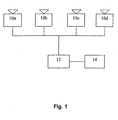
- FIG. 1 shows schematically the type of system described herein, wherein a plurality of image capture devices 10a-d transmit images to a storage means 12.
- a control means 14 selectively degrades the capture images stored in the storage means 12, according to a scheme as set out above.
- the capture of images, i.e. the agile encoding referred to above is also achieved by the control means 14.
- the applicant has identified that the value of certain data types changes with age and, further, that it is possible to match this value to data resolution in order to optimise the cost/size/recording duration of the storage medium without compromising the integrity of high-value data.
- the applicant devised a novel and simple process whereby standard MPEG video streams can be decimated from full frame rate into a time-lapsed format.
- MPEG structure used, there may be several stages in this process, allowing gradual data decay.
- MPEG flags it is possible first to remove B-frames, then P-frames and finally to sub-sample I-frames ad-infinitum.
- While post-decimation of MPEG is specific to AV media, the underlying concept of data decay is generic and may be applied to all manner of data types. For example, in a typical industrial process, high value data may be acquired and, if there are no process anomalies which require detailed scrutiny, the data may be filtered/subsampled for longer term archiving.
Landscapes
- Engineering & Computer Science (AREA)
- Multimedia (AREA)
- Signal Processing (AREA)
- Television Signal Processing For Recording (AREA)
Abstract
Description
- I-frame: this is an intra-coded image which is completely self-contained and does not refer back or forward to any other frames in a series. In other words, if an I-frame is isolated from the MPEG stream it can be decoded to create a picture. An I-frame is roughly equivalent to a JPEG still picture.
- P-frame: this is a predicted image. In order to construct a picture from a P-frame, it is necessary to know the previous P- or I-frame. The reason for this is that a P-frame uses blocks from the previous P- or I-frame to construct the picture. If the previous P- or I-frame is not known, then reconstruction cannot take place.
- B-frame: this is a bi-directional encoded image. To decode a B-frame into a picture requires both the previous P- or I-frame and a future P- or I-frame (future pictures are known by changing the order in which pictures are transmitted).


Claims (15)
- A method of storing audio/video data comprises:capturing a plurality of audio/video data;storing said audio/video data at a first spatial and/or temporal resolution for a first time period; andstoring said audio/video data at a second, lower, spatial and/or temporal resolution for at least a second, later, time period.
- A method as claimed in claim 1, in which the first/second spatial resolution is a number of bits/pixels per frame of video data.
- A method as claimed in either claim 1 or claim 2, in which the first/second temporal resolution is a frame rate of video data or a bit rate.
- A method as claimed in claim 1 or claim 2, which includes removing first selected audio/video data from said audio/video data stored at said first spatial resolution and/or temporal resolution to achieve said second spatial and/or temporal resolution.
- A method as claimed in claim 1 or claim 2, which includes a step of storing said audio/video at a third, still lower, spatial and/or temporal resolution for at least a third, still later, time period.
- A method as claimed in claim 5, in which the step of storing said audio/video data at the third spatial and/or temporal resolution follows removing second selected audio/video data from said audio video data stored at said second spatial and/or temporal resolution to achieve said third spatial and/or temporal resolution.
- A method as claimed in claim 4, in which said selected audio/video data are frames of audio/video data of a second specified type of frame.
- A method as claimed in any preceding claim, in which the audio/video data is stored in an MPEG or MJPEG format.
- A method as claimed in claim 8, in which said first selected audio/video data are preferably B-frames.
- A method as claimed in either claim 8 or claim 9, in which said second selected audio/video data are P-frames.
- A method as claimed in claim 8 or claim 9, in which said third selected audio data is a plurality of 1-frames of the audio/video data.
- A system for storing audio/video data comprises:wherein the system is operable to capture audio/video data and store said audio/video data at a first spatial and/or temporal resolution for a first time period and is operable to store said audio/video data at a second, lower, spatial and/or temporal resolution for at least a second, later, time period.at least one audio/video data capture means;audio/video data storage means; andcontrol means;
- A computer programmed to perform the method of any one of claims 1 to 11.
- A computer programmed to perform the method of any one of claims 1 to 11.
- A system for capturing audio/video data comprises audio/video data capture means, storage means and control means, wherein the system is operable to perform the method of any one of claims 1 to 11.
Applications Claiming Priority (2)
| Application Number | Priority Date | Filing Date | Title |
|---|---|---|---|
| GB0309663 | 2003-04-29 | ||
| GB0309663 | 2003-04-29 |
Publications (2)
| Publication Number | Publication Date |
|---|---|
| EP1513342A2 true EP1513342A2 (en) | 2005-03-09 |
| EP1513342A3 EP1513342A3 (en) | 2005-03-16 |
Family
ID=33515565
Family Applications (1)
| Application Number | Title | Priority Date | Filing Date |
|---|---|---|---|
| EP04252158A Withdrawn EP1513342A3 (en) | 2003-04-29 | 2004-04-13 | System and method for storing audio/video data |
Country Status (2)
| Country | Link |
|---|---|
| US (1) | US20040258149A1 (en) |
| EP (1) | EP1513342A3 (en) |
Families Citing this family (11)
| Publication number | Priority date | Publication date | Assignee | Title |
|---|---|---|---|---|
| WO2006044476A2 (en) * | 2004-10-12 | 2006-04-27 | Robert Vernon Vanman | Method of and system for mobile surveillance and event recording |
| US8086088B2 (en) * | 2005-03-03 | 2011-12-27 | Sam Myung Co., Ltd. | Digital video recording method in an audio detection mode |
| JP2006268391A (en) * | 2005-03-24 | 2006-10-05 | Sony Corp | INFORMATION PROVIDING METHOD, INFORMATION PROVIDING DEVICE, INFORMATION PROVIDING METHOD PROGRAM, AND RECORDING MEDIUM CONTAINING INFORMATION PROVIDING METHOD PROGRAM |
| US8982944B2 (en) * | 2005-10-12 | 2015-03-17 | Enforcement Video, Llc | Method and system for categorized event recording of images in multiple resolution levels |
| US20090046157A1 (en) * | 2007-08-13 | 2009-02-19 | Andrew Cilia | Combined wide-angle/zoom camera for license plate identification |
| US8599368B1 (en) | 2008-01-29 | 2013-12-03 | Enforcement Video, Llc | Laser-based speed determination device for use in a moving vehicle |
| CA2714362A1 (en) | 2008-01-29 | 2009-08-06 | Enforcement Video, Llc | Omnidirectional camera for use in police car event recording |
| US9860536B2 (en) * | 2008-02-15 | 2018-01-02 | Enforcement Video, Llc | System and method for high-resolution storage of images |
| DE102009046362A1 (en) * | 2009-11-03 | 2011-05-05 | Tesa Se | Pressure-sensitive adhesive made of a crosslinkable polyolefin and an adhesive resin |
| US8736680B1 (en) | 2010-05-18 | 2014-05-27 | Enforcement Video, Llc | Method and system for split-screen video display |
| US10341605B1 (en) | 2016-04-07 | 2019-07-02 | WatchGuard, Inc. | Systems and methods for multiple-resolution storage of media streams |
Family Cites Families (25)
| Publication number | Priority date | Publication date | Assignee | Title |
|---|---|---|---|---|
| US5379297A (en) * | 1992-04-09 | 1995-01-03 | Network Equipment Technologies, Inc. | Concurrent multi-channel segmentation and reassembly processors for asynchronous transfer mode |
| US5359593A (en) * | 1993-08-26 | 1994-10-25 | International Business Machines Corporation | Dynamic bandwidth estimation and adaptation for packet communications networks |
| US5497375A (en) * | 1994-01-05 | 1996-03-05 | Motorola, Inc. | Device and method for ATM end system cell flow regulation |
| US5432824A (en) * | 1994-07-06 | 1995-07-11 | Mitsubishi Electric Research Laboratories, Inc. | Credit/rate-based system for controlling traffic in a digital communication network |
| US5528591A (en) * | 1995-01-31 | 1996-06-18 | Mitsubishi Electric Research Laboratories, Inc. | End-to-end credit-based flow control system in a digital communication network |
| US5724475A (en) * | 1995-05-18 | 1998-03-03 | Kirsten; Jeff P. | Compressed digital video reload and playback system |
| US5675576A (en) * | 1995-06-05 | 1997-10-07 | Lucent Technologies Inc. | Concestion control system and method for packet switched networks providing max-min fairness |
| US5805577A (en) * | 1995-07-20 | 1998-09-08 | Jain; Raj | Erica: explicit rate indication for congestion avoidance in ATM networks |
| US5812526A (en) * | 1995-12-21 | 1998-09-22 | Industrial Technology Research Institute | Traffic control mechanism in ATM communications network |
| US5745477A (en) * | 1996-01-25 | 1998-04-28 | Mitsubishi Electric Information Technology Center America, Inc. | Traffic shaping and ABR flow control |
| US5737313A (en) * | 1996-03-15 | 1998-04-07 | Nec Usa, Inc. | Design of a closed loop feed back control for ABR service |
| US5898669A (en) * | 1996-03-22 | 1999-04-27 | Shimony; Ilan | ATM traffic management device |
| US5777984A (en) * | 1996-04-01 | 1998-07-07 | Motorola Inc. | Method and apparatus for controlling cell transmission rate in a cell based network in the presence of congestion |
| US5812527A (en) * | 1996-04-01 | 1998-09-22 | Motorola Inc. | Simplified calculation of cell transmission rates in a cell based netwook |
| US5754530A (en) * | 1996-04-18 | 1998-05-19 | Northern Telecom Limited | Flow control of ABR traffic in ATM networks |
| US5864539A (en) * | 1996-05-06 | 1999-01-26 | Bay Networks, Inc. | Method and apparatus for a rate-based congestion control in a shared memory switch |
| US5926459A (en) * | 1996-06-27 | 1999-07-20 | Xerox Corporation | Rate shaping in per-flow queued routing mechanisms for available bit rate service |
| JP3607017B2 (en) * | 1996-10-31 | 2005-01-05 | 富士通株式会社 | Feedback control device and cell scheduling device in cell switch |
| US5901138A (en) * | 1996-11-08 | 1999-05-04 | International Business Machines Corporation | Process for improving the efficiency of high performance routing |
| US5805599A (en) * | 1996-12-04 | 1998-09-08 | At&T Corp. | Adaptive channel allocation system for communication network |
| US5940369A (en) * | 1997-03-26 | 1999-08-17 | Lucent Technologies Inc. | Asynchronous transfer mode and media access protocol interoperability apparatus and method |
| US5987031A (en) * | 1997-05-22 | 1999-11-16 | Integrated Device Technology, Inc. | Method for fair dynamic scheduling of available bandwidth rate (ABR) service under asynchronous transfer mode (ATM) |
| US5991268A (en) * | 1997-07-07 | 1999-11-23 | Nortel Networks Corporation | Flow control mechanism of ABR traffic in ATM networks |
| AU6230899A (en) * | 1998-10-27 | 2000-05-15 | Hitachi Maxell, Ltd. | Information recording method and system, image compression/decompression system,system control method, and monitoring system including part or all of them |
| US7573421B2 (en) * | 2001-09-24 | 2009-08-11 | Nice Systems, Ltd. | System and method for the automatic control of video frame rate |
-
2004
- 2004-04-13 EP EP04252158A patent/EP1513342A3/en not_active Withdrawn
- 2004-04-22 US US10/829,371 patent/US20040258149A1/en not_active Abandoned
Also Published As
| Publication number | Publication date |
|---|---|
| EP1513342A3 (en) | 2005-03-16 |
| US20040258149A1 (en) | 2004-12-23 |
Similar Documents
| Publication | Publication Date | Title |
|---|---|---|
| US6453115B1 (en) | Digital video recording system which generates an index data structure for displaying a video stream in trickplay mode | |
| KR100906957B1 (en) | Adaptive video processing using sub-frame metadata | |
| KR100912599B1 (en) | Processing of removable media that stores full frame video ? sub?frame metadata | |
| US6058141A (en) | Varied frame rate video | |
| KR100904649B1 (en) | Adaptive video processing circuitry and player using sub-frame metadata | |
| KR101012618B1 (en) | Processing of Images in the Imaging System | |
| US7903743B2 (en) | Memory sharing in video transcoding and displaying | |
| AU2008319291B2 (en) | Apparatus and method of storing video data | |
| EP2538676A2 (en) | Method and system for digital coding 3D stereoscopic video images | |
| EP1513342A2 (en) | System and method for storing audio/video data | |
| EP1553779A1 (en) | Data reduction of video streams by selection of frames and partial deletion of transform coefficients | |
| AU2003264988B2 (en) | Recording medium having a data structure for managing reproduction of graphic data and recording and reproducing methods and apparatuses | |
| EP2651132B1 (en) | Data management apparatus and data management method | |
| CA2716084C (en) | Apparatus for and a method of providing content data | |
| US8965183B1 (en) | Systems and methods for creating and storing reduced quality video data | |
| US7889934B2 (en) | Image processing apparatus and processing method thereof | |
| US20050105811A1 (en) | Processing images | |
| JP3816373B2 (en) | Video recording / reproducing apparatus and method thereof | |
| TWI454150B (en) | Processing method for image file | |
| Bancroft | A Multi-Frame Rate, Compression-Free, Video Recorder for Universal DTV Mastering in High Resolution | |
| GB2402829A (en) | Surveillance image recording system | |
| JP2011188193A (en) | Recording/reproduction device, and recording/reproduction method | |
| Larbier | AVC-I: Yet Another Intra Codec for Broadcast Contribution? | |
| Husak | Digital cinema video compression | |
| Marcellin | Digital Cinema |
Legal Events
| Date | Code | Title | Description |
|---|---|---|---|
| PUAI | Public reference made under article 153(3) epc to a published international application that has entered the european phase |
Free format text: ORIGINAL CODE: 0009012 |
|
| PUAL | Search report despatched |
Free format text: ORIGINAL CODE: 0009013 |
|
| AK | Designated contracting states |
Kind code of ref document: A2 Designated state(s): AT BE BG CH CY CZ DE DK EE ES FI FR GB GR HU IE IT LI LU MC NL PL PT RO SE SI SK TR |
|
| AX | Request for extension of the european patent |
Extension state: AL HR LT LV MK |
|
| AK | Designated contracting states |
Kind code of ref document: A3 Designated state(s): AT BE BG CH CY CZ DE DK EE ES FI FR GB GR HU IE IT LI LU MC NL PL PT RO SE SI SK TR |
|
| AX | Request for extension of the european patent |
Extension state: AL HR LT LV MK |
|
| RIC1 | Information provided on ipc code assigned before grant |
Ipc: 7H 04N 5/76 A |
|
| 17P | Request for examination filed |
Effective date: 20050915 |
|
| AKX | Designation fees paid |
Designated state(s): AT BE BG CH CY CZ DE DK EE ES FI FR GB GR HU IE IT LI LU MC NL PL PT RO SE SI SK TR |
|
| RAP1 | Party data changed (applicant data changed or rights of an application transferred) |
Owner name: SYNECTICS SYSTEMS GROUP LIMITED |
|
| STAA | Information on the status of an ep patent application or granted ep patent |
Free format text: STATUS: THE APPLICATION IS DEEMED TO BE WITHDRAWN |
|
| 18D | Application deemed to be withdrawn |
Effective date: 20101102 |