EP1512944A2 - System und Verfahren zur Verringerung von Interferenzstörungen zwischen Datenübertragungssignalen - Google Patents
System und Verfahren zur Verringerung von Interferenzstörungen zwischen Datenübertragungssignalen Download PDFInfo
- Publication number
- EP1512944A2 EP1512944A2 EP04021004A EP04021004A EP1512944A2 EP 1512944 A2 EP1512944 A2 EP 1512944A2 EP 04021004 A EP04021004 A EP 04021004A EP 04021004 A EP04021004 A EP 04021004A EP 1512944 A2 EP1512944 A2 EP 1512944A2
- Authority
- EP
- European Patent Office
- Prior art keywords
- frame
- endpoint
- reader
- wake
- assigned
- Prior art date
- Legal status (The legal status is an assumption and is not a legal conclusion. Google has not performed a legal analysis and makes no representation as to the accuracy of the status listed.)
- Granted
Links
Images





Classifications
-
- H—ELECTRICITY
- H04—ELECTRIC COMMUNICATION TECHNIQUE
- H04W—WIRELESS COMMUNICATION NETWORKS
- H04W16/00—Network planning, e.g. coverage or traffic planning tools; Network deployment, e.g. resource partitioning or cells structures
- H04W16/14—Spectrum sharing arrangements between different networks
-
- H—ELECTRICITY
- H04—ELECTRIC COMMUNICATION TECHNIQUE
- H04Q—SELECTING
- H04Q9/00—Arrangements in telecontrol or telemetry systems for selectively calling a substation from a main station, in which substation desired apparatus is selected for applying a control signal thereto or for obtaining measured values therefrom
-
- H—ELECTRICITY
- H04—ELECTRIC COMMUNICATION TECHNIQUE
- H04Q—SELECTING
- H04Q2209/00—Arrangements in telecontrol or telemetry systems
- H04Q2209/60—Arrangements in telecontrol or telemetry systems for transmitting utility meters data, i.e. transmission of data from the reader of the utility meter
-
- H—ELECTRICITY
- H04—ELECTRIC COMMUNICATION TECHNIQUE
- H04W—WIRELESS COMMUNICATION NETWORKS
- H04W52/00—Power management, e.g. Transmission Power Control [TPC] or power classes
- H04W52/02—Power saving arrangements
- H04W52/0209—Power saving arrangements in terminal devices
- H04W52/0212—Power saving arrangements in terminal devices managed by the network, e.g. network or access point is leader and terminal is follower
- H04W52/0219—Power saving arrangements in terminal devices managed by the network, e.g. network or access point is leader and terminal is follower where the power saving management affects multiple terminals
-
- Y—GENERAL TAGGING OF NEW TECHNOLOGICAL DEVELOPMENTS; GENERAL TAGGING OF CROSS-SECTIONAL TECHNOLOGIES SPANNING OVER SEVERAL SECTIONS OF THE IPC; TECHNICAL SUBJECTS COVERED BY FORMER USPC CROSS-REFERENCE ART COLLECTIONS [XRACs] AND DIGESTS
- Y02—TECHNOLOGIES OR APPLICATIONS FOR MITIGATION OR ADAPTATION AGAINST CLIMATE CHANGE
- Y02D—CLIMATE CHANGE MITIGATION TECHNOLOGIES IN INFORMATION AND COMMUNICATION TECHNOLOGIES [ICT], I.E. INFORMATION AND COMMUNICATION TECHNOLOGIES AIMING AT THE REDUCTION OF THEIR OWN ENERGY USE
- Y02D30/00—Reducing energy consumption in communication networks
- Y02D30/70—Reducing energy consumption in communication networks in wireless communication networks
Definitions
- the present invention relates to a method and system for collecting data from remote utility meters and, more particularly, to method and a system for improving coverage of an automated meter reading system without substantially increasing the cost of the overall system.
- One approach is to assign different frequencies to the different devices or to the different cells in the AMR system.
- this is only a short-term solution as the number of available frequency bands is inadequate to handle the increasing number of endpoint units that will be placed in a defined geographic location.
- Increasing the number of endpoints in the AMR system requires more efficient utilization of the limited available frequency spectrum in order to provide more total channels while maintaining communications quality. This is even more of a challenge where the endpoints are not uniformly distributed among cells in the system. More channels may be needed for particular cells to handle potentially higher local endpoint densities at any given time. For example, a cell in an urban area will include more endpoints requiring reading then a cell in a rural area.
- a method and system are provided for reducing signal interference in the transmission of metered data from a plurality of meter endpoint transmitters to a plurality of corresponding readers in an automatic meter reading (AMR) system.
- the AMR system includes a first set of the endpoint transmitters being assigned to a first reader, a second set of the endpoint transmitters being assigned to a second reader, and a third set of the endpoint transmitters (endpoints) being assigned to a third reader.
- the first, second and third set of endpoints are disposed within each of a first, second and third cells that are adjacent to each other.
- the second reader transmits on the at least one control frequency channel from a second wake up signal sequence comprised of a second wake-up countdown timer frame, a second sync and control frame corresponding to the second Frame ID number, and a second dead time slot frame, the second wake up signal sequence adapted to include a second response delay for the second endpoint set.
- the third reader transmits on the at least one control frequency channel a third wake up signal sequence comprised of a third wake-up countdown timer frame, a third sync and control frame corresponding to the third Frame ID number, and a third dead time slot frame, the third wake up signal sequence adapted to include a third response delay for the third endpoint set.
- the readers then receive metered data simultaneously from the corresponding endpoint sets via the first, second and third response frequency channels.
- the order of transmitting the first, second and third wake-up signal sequences and the magnitude of the response delay for the respective endpoints is a function of the Frame ID number that is assigned to each cell.
- the first, second and third wake-up signal sequences are transmitted from the respective readers in a time staggered scheme as a function of the Frame ID number and the first, second and third endpoint sets respond simultaneously to each of the readers via their assigned response frequency, the Frame ID numbers and the response frequencies being a function of a multi-cell pattern selected for organizing all of the endpoint sets.
- Narrowband receivers 26A and 26B are each equipped to transmit the utility data to the meter-reading analysis device 28.
- the transmission from receivers 26A and 26B is preferably performed via a standard telephone connection (PSTN) 30 or, alternatively, via a cellular connection.
- PSTN standard telephone connection
- Receivers 26A and 26B are preferably mounted at a central point in multi-dwelling complex wherein ease of interconnection to power and telephone lines are available.
- each of the receivers 26A and 26B can monitor and retain data on up to 10000 endpoint modules 22.
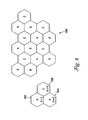
- cell pattern 400 is comprised of a cell 402, a cell 404 and a cell 406.
- Cell 402 includes a receiver R1 configured to receive inbound data from the endpoints on channel 1.
- Cell 404 includes a receiver R2 configured to receive inbound data from the endpoints on channel 2.
- Cell 406 includes a receiver R4 configured to receive inbound data from the endpoints on channel 4.
- the readers then receive metered data simultaneously from the corresponding endpoint sets via the first, second and third response frequency channels.
- the order of transmitting the first, second and third wake-up signal sequences and the magnitude of the response delay for the respective endpoints is a function of the Frame ID number that is assigned each cell.
- the reader with the highest Frame ID number is the first to transmit the first wake-up signal sequence and the reader with the lowest Frame ID number is the last to transmit a wake-up signal sequence, the readers transmitting in a descending order as a function of the value of the Frame ID number.
- the response delay for each of the endpoint sets is determined by multiplying the Frame ID number by the Nominal Frame Time such that reader with the highest Frame ID number has the longest hold off time for response by the corresponding endpoint set.
- the timings in this wake-up sequence are for receivers having a clock accuracy of +/- 0.5 seconds, if the value obtainable is only +/-1 second then the dead time must be increased to 5 seconds and the nominal frame time increased to 22.5 seconds. All other timings remain the same. If GPS is available in the reader, the dead time can be reduced and the frame timing can be shortened. The minimum dead time preferred in any of these wake-up sequences is about 0.5 seconds.
- an RF ASIC is configured so as to reduce the communications architecture to 3 contiguous channels with the remaining two or more channels to be scattered throughout the frequency band to ease spectrum allocation needs.
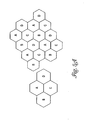
- FIGS. 5A and 5B illustrate a four-cell and a five-cell frequency reuse pattern, respectively, for an AMR system configured according to the invention.
- each of the cells has a receiver (R) fixed on a particular channel of the 5-channel block for control signals as well as its own Frame ID number.
- R receiver
- the maximum preferable cellular frequency reuse value or pattern is 5. This results in a hold off time of 100 seconds in the first cell transmitted which is short enough for the endpoint to maintain accurate timing with regard to slot timings.
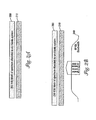
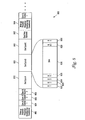
- FIG. 6 illustrates a wake-up sequence 600 for a multiple cell frequency reuse pattern of a mobile meter reading system according to the present invention.
- wake up sequence comprises a wake-up preamble 602, followed by a command and control frame 604, which is followed by a Quiet Time frame 606.
- Command and control frame 604 contains a group call read that solicits a consumptive type reading from all of the endpoints that can hear the mobile and that have the correct system Frame ID.
- Each endpoint is configured to respond to the group call in a random slot and on a random channel.
- the random channel will be chosen from the list of available channels in the command and control frame.
- the random slot will also be one of the 50ms slots in an S-ALOHA portion 608 of the frame.
- Slotted ALOHA is a random access scheme similar to ALOHA except that the transmissions are required to begin and end within the predefined timeslot. The timeslots are marked from the end of the command and control frame just like in a fixed network. Following the slotted ALOHA frame 608 is a scheduled receive time frame 610 that precedes another quiet time frame 612 before the wake up cycle repeats itself.
- the van mobile collector
- the van will travel about 440 feet in 10 seconds.
- the van will also have a communication radius of approximately 500 feet given a 1430 MHz system operating at a data rate of 22.6 Kchips/second with the expected power levels and receiver sensitivities (+14 dBm endpoint TX power, -110 dBm RX sensitivity in the van, 20 dB margin, endpoint at 5 feet).
- the margin is included because the mobile data packet (MDP) is much longer than the current SCM (standard consumptive message) type messages and is not repeated unless an error occurs.
- the BER bit error rate
- the mobile reader in this mode can process 42 new meters per second, but data collection accuracy is the best in the range of 10 to 12 meter units per second (this allows a full set of re-tries in a dense system). This assumes the 22.727KBPS data rate and the full 250 byte MDP, for smaller packets and with the higher data rate option system operation is even better.
- this approach utilizes a scanning approach wherein the endpoint listens on each frequency in its assigned channel (or operating frequencies) list looking for a proper pseudo-random number (PN) wakeup. When this is found the endpoint will note this and continue scanning. The endpoint will respond on the channel with the best RSSI (Return Signal Strength Indication) or the fewest errors. Unless the endpoint has not heard a wake-up within a predefined number of days, the endpoint may reduce the size of the assigned channel list that is supposed to be scanned during normal operation by only checking the three most active channels.
- PN pseudo-random number
- a method to eliminate non-adjacent physical cell interference due to a less than optimal physical topology is described.
- the method outlined herein facilitates configuration of a two-way AMR communications network such that no two physical cells that are assigned the same receive frequency, or Cell ID, will interfere with each other's endpoint population.
- the proposed method addresses the situation of two readers using the same default receive frequency where they may have the same Frame ID.
- all cells with the same Frame ID are required to transmit a WUP (wake-up) signal on the networks control frequency at the same instant in time.
- WUP wake-up
- All cells transmit their WUPs during a specific offset from the beginning of a read cycle based upon their Frame ID. This is done to keep adjacent cells from interfering with each other.
- two cells are identified as cell A and cell A' with the same Frame ID and with an endpoint that can receive the WUP of both cell A and cell A' with approximately the same signal strength.
- the endpoint in each cell may have difficulty in decoding the WUP signal of either the reader in cell A or cell A' if both cells transmit simultaneously. In this example, the endpoint may end up not responding to either reader.
- a method of facilitating cell virtualization is presented herein that is rather simple in its implementation, is cost effective in its deployment and helps to reduce the incidence of signal interference in the transmission of metered data from multiple meter endpoints and cells in an automatic meter reading system.
- the method of reducing signal interference in the transmission of metered data from a plurality of meter endpoint transmitters to a plurality of corresponding readers in an automatic meter reading (AMR) system includes assigning a first Frame ID number and first response frequency channel to the first reader, a second Frame ID number and a second response frequency channel to the second reader, and a third Frame ID number and third response frequency channel to the third reader.
- AMR automatic meter reading
- a wake up signal sequence comprised of a wake-up countdown timer frame, a sync and control frame corresponding to a Frame ID number, and a dead time slot frame for each reader is transmitted on at least one control frequency channel from each of the respective readers, with each of the wake up signal sequences adapted to include a response delay for the each of the endpoint sets.
- the method further includes receiving metered data simultaneously at the readers from the corresponding endpoint sets via the first, second and third response frequency channels and thereafter assigning a new Frame ID number to the reader in a fourth cell upon detecting an interference of the received meter data between the fourth cell and one of the first, second and third cells, wherein the new Frame ID number corresponds to a fourth response frequency having a predefined response delay.
- the order of transmitting the first, second and third wake-up signal sequences and the magnitude of the response delay for the respective endpoints is a function of the Frame ID number that is assigned to the reader of each cell.
- the number of Frame IDs is not restricted to a corresponding number of response frequencies. If two cells with the same Frame ID are found to interfere with each others endpoint population, one of the cells is assigned a new Frame ID which is not currently being used on the network. Since a reader's WUP transmit offset is based on its Frame ID, an offending reader will now be transmitting in its own time slot thus eliminating the interference.
- the challenge with this scenario is that since the endpoint uses the Frame ID to schedule its inbound response time offset some endpoints may have to wait more time before they can respond if they are in Frame ID 6, for example. With this approach a check of the system is necessary to ensure that the AMR system can accept the latency as described above. Another alternative is to have the endpoint modify the Frame ID to a mod 3 or a mod 5 based on the maximum number of cells in the system to respond sooner.
- the step of assigning a new Frame ID number includes assigning to the new Frame ID number a previously assigned response frequency that further includes a higher offset value than that of the previously assigned response frequency corresponding to a previously assigned Frame ID number, thereby avoiding signal collision.
- the step of assigning a new Frame ID number includes assigning a fourth response frequency that corresponds to an unused response frequency available in the AMR system.
- the endpoints will recognize any Frame ID greater than a number X and less than or equal to 2X to be in the second grouping, or third grouping if the Frame ID is over 2X but less than 3X and so on.
Landscapes
- Engineering & Computer Science (AREA)
- Computer Networks & Wireless Communication (AREA)
- Signal Processing (AREA)
- Mobile Radio Communication Systems (AREA)
- Selective Calling Equipment (AREA)
Applications Claiming Priority (4)
| Application Number | Priority Date | Filing Date | Title |
|---|---|---|---|
| US929862 | 1992-08-17 | ||
| US50050403P | 2003-09-05 | 2003-09-05 | |
| US500504P | 2003-09-05 | ||
| US10/929,862 US7376118B2 (en) | 2003-09-05 | 2004-08-30 | System and method for optimizing contiguous channel operation with cellular reuse |
Publications (3)
| Publication Number | Publication Date |
|---|---|
| EP1512944A2 true EP1512944A2 (de) | 2005-03-09 |
| EP1512944A3 EP1512944A3 (de) | 2005-05-25 |
| EP1512944B1 EP1512944B1 (de) | 2006-11-02 |
Family
ID=34139058
Family Applications (1)
| Application Number | Title | Priority Date | Filing Date |
|---|---|---|---|
| EP04021004A Expired - Lifetime EP1512944B1 (de) | 2003-09-05 | 2004-09-03 | System und Verfahren zur Verringerung von Interferenzstörungen zwischen Datenübertragungssignalen |
Country Status (7)
| Country | Link |
|---|---|
| US (1) | US7376118B2 (de) |
| EP (1) | EP1512944B1 (de) |
| JP (1) | JP2005143082A (de) |
| AU (1) | AU2004208713A1 (de) |
| CA (1) | CA2480623A1 (de) |
| DE (1) | DE602004003002D1 (de) |
| SG (1) | SG109621A1 (de) |
Cited By (2)
| Publication number | Priority date | Publication date | Assignee | Title |
|---|---|---|---|---|
| EP2228627A1 (de) * | 2009-03-13 | 2010-09-15 | Actaris SAS | Hilfssystem zur Installation eines Fernsehfestnetzes, das von Zählern erfasst wird |
| US7956752B2 (en) | 2005-01-14 | 2011-06-07 | Matthew Henderson | Transponder bolt seal and a housing for a transponder |
Families Citing this family (23)
| Publication number | Priority date | Publication date | Assignee | Title |
|---|---|---|---|---|
| US7346030B2 (en) * | 2003-09-26 | 2008-03-18 | Itron, Inc. | Processing gain for wireless communication, such as in automatic data collection systems for public utility data collection |
| EP1806942A1 (de) * | 2006-01-05 | 2007-07-11 | Alcatel Lucent | Verfahren von halb-dynamischer zentralisierter Interferenzskoordination für zellulare Systeme |
| GB0609426D0 (en) * | 2006-05-12 | 2006-06-21 | Univ Edinburgh | A low power media access control protocol |
| US7986718B2 (en) * | 2006-09-15 | 2011-07-26 | Itron, Inc. | Discovery phase in a frequency hopping network |
| US8787210B2 (en) | 2006-09-15 | 2014-07-22 | Itron, Inc. | Firmware download with adaptive lost packet recovery |
| WO2008086231A2 (en) * | 2007-01-04 | 2008-07-17 | Itron, Inc. | Utility data collection and reconfigurations in a utility metering system |
| US8379625B2 (en) * | 2007-12-18 | 2013-02-19 | Airvana Llc | Obtaining time information in a cellular network |
| US8368554B2 (en) * | 2007-12-18 | 2013-02-05 | Elster Electricity Llc | System and method for collecting information from utility meters |
| US8520659B2 (en) * | 2007-12-18 | 2013-08-27 | Airvana Llc | Absolute time recovery |
| US20100026517A1 (en) * | 2008-01-04 | 2010-02-04 | Itron, Inc. | Utility data collection and reconfigurations in a utility metering system |
| US8687588B2 (en) * | 2008-07-02 | 2014-04-01 | Qualcomm Incorporated | Low power modes for femto cells |
| KR101151134B1 (ko) * | 2008-12-03 | 2012-06-01 | 한국전자통신연구원 | 넓은 셀 영역을 가지는 무선통신 시스템을 위한 계층적 임의 접속 방법 |
| US8248267B2 (en) * | 2009-01-29 | 2012-08-21 | Itron, Inc. | Systems and methods for improving reception of data in wireless communication environments |
| US8781462B2 (en) * | 2009-09-28 | 2014-07-15 | Itron, Inc. | Methodology and apparatus for validating network coverage |
| KR101179126B1 (ko) * | 2010-03-31 | 2012-09-07 | 전자부품연구원 | 자기장 통신 방법 및 이에 의해 동작하는 노드 |
| US8811247B2 (en) * | 2010-06-25 | 2014-08-19 | Cisco Technology, Inc. | Automating radio enablement to facilitate power saving |
| CN102421172B (zh) * | 2010-09-28 | 2015-04-08 | 上海贝尔股份有限公司 | 基站及节约基站能耗的方法 |
| US8619640B2 (en) * | 2010-12-16 | 2013-12-31 | Intel Corporation | Dynamic bandwidth control in interference situations |
| US8842712B2 (en) | 2011-03-24 | 2014-09-23 | Gregory C. Hancock | Methods and apparatuses for reception of frequency-hopping spread spectrum radio transmissions |
| PT2850902T (pt) * | 2012-05-16 | 2017-03-02 | ERICSSON TELEFON AB L M (publ) | Método e configuração numa rede de comunicações |
| KR102315701B1 (ko) * | 2014-08-26 | 2021-10-21 | 삼성전자 주식회사 | 사물 인터넷 기기간 간섭 제어 방법 및 장치 |
| US10833799B2 (en) | 2018-05-31 | 2020-11-10 | Itron Global Sarl | Message correction and dynamic correction adjustment for communication systems |
| US10966002B2 (en) * | 2018-08-24 | 2021-03-30 | Sensus Spectrum, Llc | System, method, and computer program product for wake up of a water meter |
Family Cites Families (14)
| Publication number | Priority date | Publication date | Assignee | Title |
|---|---|---|---|---|
| US5073971A (en) | 1989-09-05 | 1991-12-17 | Motorola, Inc. | Cellular radiotelephone communications system |
| US5553094A (en) * | 1990-02-15 | 1996-09-03 | Iris Systems, Inc. | Radio communication network for remote data generating stations |
| US5684472A (en) | 1996-05-08 | 1997-11-04 | Motorola, Inc. | Method and apparatus for remotely accessing meter status information in a meter reading system |
| US6512463B1 (en) | 1999-03-30 | 2003-01-28 | American Meter Co. | Bi-directional protocol |
| US6998962B2 (en) * | 2000-04-14 | 2006-02-14 | Current Technologies, Llc | Power line communication apparatus and method of using the same |
| PT1382172E (pt) * | 2001-03-30 | 2009-01-21 | M & Fc Holding Llc | Sistema, método e aparelho melhorados para comunicação de pacotes de dados sem fios aplicáveis tanto a redes remotas como a redes locais |
| AR033319A1 (es) | 2001-05-04 | 2003-12-10 | Invensys Metering Systems Nort | Disposicion y metodo para comunicacion y control de lectura automatizada de medidores |
| US6674997B2 (en) * | 2001-08-28 | 2004-01-06 | General Electric Company | AM band transmission using multi-tone modulation |
| US7009530B2 (en) * | 2001-09-13 | 2006-03-07 | M&Fc Holding, Llc | Modular wireless fixed network for wide-area metering data collection and meter module apparatus |
| US6819098B2 (en) * | 2002-10-01 | 2004-11-16 | Poweronedata, Inc. | Utility power meter database |
| US6980091B2 (en) * | 2002-12-10 | 2005-12-27 | Current Technologies, Llc | Power line communication system and method of operating the same |
| US7064654B2 (en) * | 2002-12-10 | 2006-06-20 | Current Technologies, Llc | Power line communication system and method of operating the same |
| US7075414B2 (en) * | 2003-05-13 | 2006-07-11 | Current Technologies, Llc | Device and method for communicating data signals through multiple power line conductors |
| US7154938B2 (en) * | 2002-12-31 | 2006-12-26 | Itron, Inc. | RF communications system utilizing digital modulation to transmit and receive data |
-
2004
- 2004-08-30 US US10/929,862 patent/US7376118B2/en not_active Expired - Fee Related
- 2004-09-03 EP EP04021004A patent/EP1512944B1/de not_active Expired - Lifetime
- 2004-09-03 JP JP2004256446A patent/JP2005143082A/ja active Pending
- 2004-09-03 CA CA002480623A patent/CA2480623A1/en not_active Abandoned
- 2004-09-03 DE DE602004003002T patent/DE602004003002D1/de not_active Expired - Lifetime
- 2004-09-04 SG SG200407940A patent/SG109621A1/en unknown
- 2004-09-06 AU AU2004208713A patent/AU2004208713A1/en not_active Abandoned
Cited By (3)
| Publication number | Priority date | Publication date | Assignee | Title |
|---|---|---|---|---|
| US7956752B2 (en) | 2005-01-14 | 2011-06-07 | Matthew Henderson | Transponder bolt seal and a housing for a transponder |
| EP2228627A1 (de) * | 2009-03-13 | 2010-09-15 | Actaris SAS | Hilfssystem zur Installation eines Fernsehfestnetzes, das von Zählern erfasst wird |
| WO2010102970A3 (fr) * | 2009-03-13 | 2011-03-24 | Itron France | Systeme d'aide au deploiement d'un reseau fixe de tele releve de compteurs |
Also Published As
| Publication number | Publication date |
|---|---|
| EP1512944A3 (de) | 2005-05-25 |
| JP2005143082A (ja) | 2005-06-02 |
| CA2480623A1 (en) | 2005-03-05 |
| US7376118B2 (en) | 2008-05-20 |
| AU2004208713A1 (en) | 2005-03-24 |
| SG109621A1 (en) | 2005-03-30 |
| US20050053047A1 (en) | 2005-03-10 |
| EP1512944B1 (de) | 2006-11-02 |
| DE602004003002D1 (de) | 2006-12-14 |
Similar Documents
| Publication | Publication Date | Title |
|---|---|---|
| US7376118B2 (en) | System and method for optimizing contiguous channel operation with cellular reuse | |
| US20110038288A1 (en) | Mobile automatic meter reading system and method | |
| US7479895B2 (en) | Data communication protocol in an automatic meter reading system | |
| US7948396B2 (en) | RF meter reading system | |
| US8791834B2 (en) | Fixed network for an automatic utility meter reading system | |
| US8923130B2 (en) | Communication controller controlling frame rate to provide frame response time | |
| US20140153553A1 (en) | Combined frame of two communication protocols on same carrier for machine-to-machine and for broadband communication | |
| US20050259580A1 (en) | Fixed network utility data collection system and method | |
| CA2801452A1 (en) | Scalable packets in a frequency hopping spread spectrum (fhss) system | |
| US20050238044A1 (en) | System and method for utility data collection | |
| AU2006210804B2 (en) | Data communication protocol in an automatic meter reading system | |
| US9749772B2 (en) | Very long frame in a machine to machine communication network | |
| US7372372B2 (en) | Sequence inversion keyed countdown timer utilized within a utility meter system | |
| US20050086182A1 (en) | Optimized bubble up receiver AMR system | |
| EP1515579A2 (de) | Selbsttätiges Meterablesesystem unter Verwendung von rückwärtszählender Zeitgebervorrichtung | |
| AU2011211465A1 (en) | Data communication protocol in an automatic meter reading system |
Legal Events
| Date | Code | Title | Description |
|---|---|---|---|
| PUAI | Public reference made under article 153(3) epc to a published international application that has entered the european phase |
Free format text: ORIGINAL CODE: 0009012 |
|
| AK | Designated contracting states |
Kind code of ref document: A2 Designated state(s): AT BE BG CH CY CZ DE DK EE ES FI FR GB GR HU IE IT LI LU MC NL PL PT RO SE SI SK TR |
|
| AX | Request for extension of the european patent |
Extension state: AL HR LT LV MK |
|
| PUAL | Search report despatched |
Free format text: ORIGINAL CODE: 0009013 |
|
| AK | Designated contracting states |
Kind code of ref document: A3 Designated state(s): AT BE BG CH CY CZ DE DK EE ES FI FR GB GR HU IE IT LI LU MC NL PL PT RO SE SI SK TR |
|
| AX | Request for extension of the european patent |
Extension state: AL HR LT LV MK |
|
| 17P | Request for examination filed |
Effective date: 20050822 |
|
| AKX | Designation fees paid |
Designated state(s): DE FR GB SI |
|
| GRAP | Despatch of communication of intention to grant a patent |
Free format text: ORIGINAL CODE: EPIDOSNIGR1 |
|
| GRAS | Grant fee paid |
Free format text: ORIGINAL CODE: EPIDOSNIGR3 |
|
| GRAA | (expected) grant |
Free format text: ORIGINAL CODE: 0009210 |
|
| AK | Designated contracting states |
Kind code of ref document: B1 Designated state(s): DE FR GB SI |
|
| PG25 | Lapsed in a contracting state [announced via postgrant information from national office to epo] |
Ref country code: SI Free format text: LAPSE BECAUSE OF FAILURE TO SUBMIT A TRANSLATION OF THE DESCRIPTION OR TO PAY THE FEE WITHIN THE PRESCRIBED TIME-LIMIT Effective date: 20061102 |
|
| REG | Reference to a national code |
Ref country code: GB Ref legal event code: FG4D |
|
| REF | Corresponds to: |
Ref document number: 602004003002 Country of ref document: DE Date of ref document: 20061214 Kind code of ref document: P |
|
| PG25 | Lapsed in a contracting state [announced via postgrant information from national office to epo] |
Ref country code: DE Free format text: LAPSE BECAUSE OF FAILURE TO SUBMIT A TRANSLATION OF THE DESCRIPTION OR TO PAY THE FEE WITHIN THE PRESCRIBED TIME-LIMIT Effective date: 20070203 |
|
| ET | Fr: translation filed | ||
| PLBE | No opposition filed within time limit |
Free format text: ORIGINAL CODE: 0009261 |
|
| STAA | Information on the status of an ep patent application or granted ep patent |
Free format text: STATUS: NO OPPOSITION FILED WITHIN TIME LIMIT |
|
| 26N | No opposition filed |
Effective date: 20070803 |
|
| PGFP | Annual fee paid to national office [announced via postgrant information from national office to epo] |
Ref country code: FR Payment date: 20080917 Year of fee payment: 5 |
|
| PGFP | Annual fee paid to national office [announced via postgrant information from national office to epo] |
Ref country code: GB Payment date: 20080929 Year of fee payment: 5 |
|
| GBPC | Gb: european patent ceased through non-payment of renewal fee |
Effective date: 20090903 |
|
| REG | Reference to a national code |
Ref country code: FR Ref legal event code: ST Effective date: 20100531 |
|
| PG25 | Lapsed in a contracting state [announced via postgrant information from national office to epo] |
Ref country code: FR Free format text: LAPSE BECAUSE OF NON-PAYMENT OF DUE FEES Effective date: 20090930 |
|
| PG25 | Lapsed in a contracting state [announced via postgrant information from national office to epo] |
Ref country code: GB Free format text: LAPSE BECAUSE OF NON-PAYMENT OF DUE FEES Effective date: 20090903 |