EP1512709A2 - Copolymers of biodegradable aliphatic polyesters - Google Patents
Copolymers of biodegradable aliphatic polyesters Download PDFInfo
- Publication number
- EP1512709A2 EP1512709A2 EP04077835A EP04077835A EP1512709A2 EP 1512709 A2 EP1512709 A2 EP 1512709A2 EP 04077835 A EP04077835 A EP 04077835A EP 04077835 A EP04077835 A EP 04077835A EP 1512709 A2 EP1512709 A2 EP 1512709A2
- Authority
- EP
- European Patent Office
- Prior art keywords
- acid
- copolymers according
- food
- films
- copolymers
- Prior art date
- Legal status (The legal status is an assumption and is not a legal conclusion. Google has not performed a legal analysis and makes no representation as to the accuracy of the status listed.)
- Granted
Links
- 229920001577 copolymer Polymers 0.000 title claims abstract description 18
- 229920003232 aliphatic polyester Polymers 0.000 title claims abstract description 14
- -1 aliphatic dicarboxylic acids Chemical class 0.000 claims abstract description 20
- 239000002253 acid Substances 0.000 claims abstract description 10
- 150000007513 acids Chemical class 0.000 claims abstract description 5
- 150000005690 diesters Chemical class 0.000 claims abstract description 5
- WBHHMMIMDMUBKC-XLNAKTSKSA-N ricinelaidic acid Chemical compound CCCCCC[C@@H](O)C\C=C\CCCCCCCC(O)=O WBHHMMIMDMUBKC-XLNAKTSKSA-N 0.000 claims abstract 3
- 229960003656 ricinoleic acid Drugs 0.000 claims abstract 3
- FEUQNCSVHBHROZ-UHFFFAOYSA-N ricinoleic acid Natural products CCCCCCC(O[Si](C)(C)C)CC=CCCCCCCCC(=O)OC FEUQNCSVHBHROZ-UHFFFAOYSA-N 0.000 claims abstract 3
- CXMXRPHRNRROMY-UHFFFAOYSA-N sebacic acid Chemical compound OC(=O)CCCCCCCCC(O)=O CXMXRPHRNRROMY-UHFFFAOYSA-N 0.000 claims description 22
- 238000006243 chemical reaction Methods 0.000 claims description 17
- 235000013305 food Nutrition 0.000 claims description 10
- 239000010410 layer Substances 0.000 claims description 10
- 239000010408 film Substances 0.000 claims description 7
- PEDCQBHIVMGVHV-UHFFFAOYSA-N Glycerine Chemical compound OCC(O)CO PEDCQBHIVMGVHV-UHFFFAOYSA-N 0.000 claims description 6
- 229920002472 Starch Polymers 0.000 claims description 6
- KRKNYBCHXYNGOX-UHFFFAOYSA-N citric acid Chemical compound OC(=O)CC(O)(C(O)=O)CC(O)=O KRKNYBCHXYNGOX-UHFFFAOYSA-N 0.000 claims description 6
- 235000013410 fast food Nutrition 0.000 claims description 6
- 239000000463 material Substances 0.000 claims description 6
- 239000008107 starch Substances 0.000 claims description 6
- 235000019698 starch Nutrition 0.000 claims description 6
- OFOBLEOULBTSOW-UHFFFAOYSA-N Malonic acid Chemical compound OC(=O)CC(O)=O OFOBLEOULBTSOW-UHFFFAOYSA-N 0.000 claims description 4
- KDYFGRWQOYBRFD-UHFFFAOYSA-N Succinic acid Natural products OC(=O)CCC(O)=O KDYFGRWQOYBRFD-UHFFFAOYSA-N 0.000 claims description 4
- 235000013361 beverage Nutrition 0.000 claims description 4
- 239000002131 composite material Substances 0.000 claims description 4
- 230000007423 decrease Effects 0.000 claims description 4
- 239000000945 filler Substances 0.000 claims description 4
- 238000004806 packaging method and process Methods 0.000 claims description 4
- 239000004033 plastic Substances 0.000 claims description 4
- 229920003023 plastic Polymers 0.000 claims description 4
- WERYXYBDKMZEQL-UHFFFAOYSA-N butane-1,4-diol Chemical compound OCCCCO WERYXYBDKMZEQL-UHFFFAOYSA-N 0.000 claims description 3
- 239000003814 drug Substances 0.000 claims description 3
- 238000007765 extrusion coating Methods 0.000 claims description 3
- 150000002334 glycols Chemical class 0.000 claims description 3
- SLCVBVWXLSEKPL-UHFFFAOYSA-N neopentyl glycol Chemical compound OCC(C)(C)CO SLCVBVWXLSEKPL-UHFFFAOYSA-N 0.000 claims description 3
- BDJRBEYXGGNYIS-UHFFFAOYSA-N nonanedioic acid Chemical compound OC(=O)CCCCCCCC(O)=O BDJRBEYXGGNYIS-UHFFFAOYSA-N 0.000 claims description 3
- ALVZNPYWJMLXKV-UHFFFAOYSA-N 1,9-Nonanediol Chemical compound OCCCCCCCCCO ALVZNPYWJMLXKV-UHFFFAOYSA-N 0.000 claims description 2
- 244000025254 Cannabis sativa Species 0.000 claims description 2
- FBPFZTCFMRRESA-FSIIMWSLSA-N D-Glucitol Natural products OC[C@H](O)[C@H](O)[C@@H](O)[C@H](O)CO FBPFZTCFMRRESA-FSIIMWSLSA-N 0.000 claims description 2
- LYCAIKOWRPUZTN-UHFFFAOYSA-N Ethylene glycol Chemical compound OCCO LYCAIKOWRPUZTN-UHFFFAOYSA-N 0.000 claims description 2
- ZJCCRDAZUWHFQH-UHFFFAOYSA-N Trimethylolpropane Chemical compound CCC(CO)(CO)CO ZJCCRDAZUWHFQH-UHFFFAOYSA-N 0.000 claims description 2
- YIMQCDZDWXUDCA-UHFFFAOYSA-N [4-(hydroxymethyl)cyclohexyl]methanol Chemical compound OCC1CCC(CO)CC1 YIMQCDZDWXUDCA-UHFFFAOYSA-N 0.000 claims description 2
- 238000005054 agglomeration Methods 0.000 claims description 2
- 230000002776 aggregation Effects 0.000 claims description 2
- 229910052782 aluminium Inorganic materials 0.000 claims description 2
- XAGFODPZIPBFFR-UHFFFAOYSA-N aluminium Chemical compound [Al] XAGFODPZIPBFFR-UHFFFAOYSA-N 0.000 claims description 2
- KDYFGRWQOYBRFD-NUQCWPJISA-N butanedioic acid Chemical compound O[14C](=O)CC[14C](O)=O KDYFGRWQOYBRFD-NUQCWPJISA-N 0.000 claims description 2
- 235000013351 cheese Nutrition 0.000 claims description 2
- 238000000576 coating method Methods 0.000 claims description 2
- 239000002537 cosmetic Substances 0.000 claims description 2
- 238000005520 cutting process Methods 0.000 claims description 2
- VKONPUDBRVKQLM-UHFFFAOYSA-N cyclohexane-1,4-diol Chemical compound OC1CCC(O)CC1 VKONPUDBRVKQLM-UHFFFAOYSA-N 0.000 claims description 2
- FOTKYAAJKYLFFN-UHFFFAOYSA-N decane-1,10-diol Chemical compound OCCCCCCCCCCO FOTKYAAJKYLFFN-UHFFFAOYSA-N 0.000 claims description 2
- 125000001142 dicarboxylic acid group Chemical group 0.000 claims description 2
- 150000001991 dicarboxylic acids Chemical class 0.000 claims description 2
- GHLKSLMMWAKNBM-UHFFFAOYSA-N dodecane-1,12-diol Chemical compound OCCCCCCCCCCCCO GHLKSLMMWAKNBM-UHFFFAOYSA-N 0.000 claims description 2
- 229940079593 drug Drugs 0.000 claims description 2
- 238000001125 extrusion Methods 0.000 claims description 2
- 239000004744 fabric Substances 0.000 claims description 2
- 235000012055 fruits and vegetables Nutrition 0.000 claims description 2
- SXCBDZAEHILGLM-UHFFFAOYSA-N heptane-1,7-diol Chemical compound OCCCCCCCO SXCBDZAEHILGLM-UHFFFAOYSA-N 0.000 claims description 2
- XXMIOPMDWAUFGU-UHFFFAOYSA-N hexane-1,6-diol Chemical compound OCCCCCCO XXMIOPMDWAUFGU-UHFFFAOYSA-N 0.000 claims description 2
- 238000002347 injection Methods 0.000 claims description 2
- 239000007924 injection Substances 0.000 claims description 2
- 229910052500 inorganic mineral Inorganic materials 0.000 claims description 2
- 230000002262 irrigation Effects 0.000 claims description 2
- 238000003973 irrigation Methods 0.000 claims description 2
- 235000013372 meat Nutrition 0.000 claims description 2
- 239000011104 metalized film Substances 0.000 claims description 2
- 235000013336 milk Nutrition 0.000 claims description 2
- 239000008267 milk Substances 0.000 claims description 2
- 210000004080 milk Anatomy 0.000 claims description 2
- 239000011707 mineral Substances 0.000 claims description 2
- 239000004745 nonwoven fabric Substances 0.000 claims description 2
- OEIJHBUUFURJLI-UHFFFAOYSA-N octane-1,8-diol Chemical compound OCCCCCCCCO OEIJHBUUFURJLI-UHFFFAOYSA-N 0.000 claims description 2
- 239000002245 particle Substances 0.000 claims description 2
- 239000002861 polymer material Substances 0.000 claims description 2
- 229920006300 shrink film Polymers 0.000 claims description 2
- 239000002356 single layer Substances 0.000 claims description 2
- 239000000600 sorbitol Substances 0.000 claims description 2
- 229920006302 stretch film Polymers 0.000 claims description 2
- 239000000126 substance Substances 0.000 claims description 2
- 235000013311 vegetables Nutrition 0.000 claims description 2
- 235000013618 yogurt Nutrition 0.000 claims description 2
- MUBZPKHOEPUJKR-UHFFFAOYSA-N Oxalic acid Chemical compound OC(=O)C(O)=O MUBZPKHOEPUJKR-UHFFFAOYSA-N 0.000 claims 3
- WNLRTRBMVRJNCN-UHFFFAOYSA-N adipic acid Chemical compound OC(=O)CCCCC(O)=O WNLRTRBMVRJNCN-UHFFFAOYSA-N 0.000 claims 2
- WLJVNTCWHIRURA-UHFFFAOYSA-N pimelic acid Chemical compound OC(=O)CCCCCC(O)=O WLJVNTCWHIRURA-UHFFFAOYSA-N 0.000 claims 2
- TYFQFVWCELRYAO-UHFFFAOYSA-N suberic acid Chemical compound OC(=O)CCCCCCC(O)=O TYFQFVWCELRYAO-UHFFFAOYSA-N 0.000 claims 2
- LWBHHRRTOZQPDM-UHFFFAOYSA-N undecanedioic acid Chemical compound OC(=O)CCCCCCCCCC(O)=O LWBHHRRTOZQPDM-UHFFFAOYSA-N 0.000 claims 2
- RTBFRGCFXZNCOE-UHFFFAOYSA-N 1-methylsulfonylpiperidin-4-one Chemical compound CS(=O)(=O)N1CCC(=O)CC1 RTBFRGCFXZNCOE-UHFFFAOYSA-N 0.000 claims 1
- DPUOLQHDNGRHBS-UHFFFAOYSA-N Brassidinsaeure Natural products CCCCCCCCC=CCCCCCCCCCCCC(O)=O DPUOLQHDNGRHBS-UHFFFAOYSA-N 0.000 claims 1
- 239000001361 adipic acid Substances 0.000 claims 1
- 235000011037 adipic acid Nutrition 0.000 claims 1
- JFCQEDHGNNZCLN-UHFFFAOYSA-N anhydrous glutaric acid Natural products OC(=O)CCCC(O)=O JFCQEDHGNNZCLN-UHFFFAOYSA-N 0.000 claims 1
- 235000006408 oxalic acid Nutrition 0.000 claims 1
- DXNCZXXFRKPEPY-UHFFFAOYSA-N tridecanedioic acid Chemical compound OC(=O)CCCCCCCCCCCC(O)=O DXNCZXXFRKPEPY-UHFFFAOYSA-N 0.000 claims 1
- 238000000034 method Methods 0.000 description 22
- 229920000642 polymer Polymers 0.000 description 22
- IJGRMHOSHXDMSA-UHFFFAOYSA-N Atomic nitrogen Chemical compound N#N IJGRMHOSHXDMSA-UHFFFAOYSA-N 0.000 description 20
- 229920000728 polyester Polymers 0.000 description 16
- 239000003054 catalyst Substances 0.000 description 12
- 229910052757 nitrogen Inorganic materials 0.000 description 10
- XLYOFNOQVPJJNP-UHFFFAOYSA-N water Substances O XLYOFNOQVPJJNP-UHFFFAOYSA-N 0.000 description 10
- 238000004821 distillation Methods 0.000 description 8
- 238000006116 polymerization reaction Methods 0.000 description 7
- 238000003756 stirring Methods 0.000 description 7
- 239000003377 acid catalyst Substances 0.000 description 6
- 238000005809 transesterification reaction Methods 0.000 description 6
- 230000032050 esterification Effects 0.000 description 5
- 238000005886 esterification reaction Methods 0.000 description 5
- 239000000047 product Substances 0.000 description 5
- 230000015572 biosynthetic process Effects 0.000 description 4
- 238000004519 manufacturing process Methods 0.000 description 4
- 239000000155 melt Substances 0.000 description 4
- 238000003786 synthesis reaction Methods 0.000 description 4
- 241000282326 Felis catus Species 0.000 description 3
- 125000001931 aliphatic group Chemical group 0.000 description 3
- 238000001816 cooling Methods 0.000 description 3
- JGFBRKRYDCGYKD-UHFFFAOYSA-N dibutyl(oxo)tin Chemical compound CCCC[Sn](=O)CCCC JGFBRKRYDCGYKD-UHFFFAOYSA-N 0.000 description 3
- 238000001035 drying Methods 0.000 description 3
- 150000002148 esters Chemical class 0.000 description 3
- 238000010438 heat treatment Methods 0.000 description 3
- ACCCMOQWYVYDOT-UHFFFAOYSA-N hexane-1,1-diol Chemical compound CCCCCC(O)O ACCCMOQWYVYDOT-UHFFFAOYSA-N 0.000 description 3
- 229920006395 saturated elastomer Polymers 0.000 description 3
- 239000002904 solvent Substances 0.000 description 3
- 239000004970 Chain extender Substances 0.000 description 2
- HEDRZPFGACZZDS-UHFFFAOYSA-N Chloroform Chemical compound ClC(Cl)Cl HEDRZPFGACZZDS-UHFFFAOYSA-N 0.000 description 2
- 235000011092 calcium acetate Nutrition 0.000 description 2
- 230000003197 catalytic effect Effects 0.000 description 2
- 125000005442 diisocyanate group Chemical group 0.000 description 2
- 150000002009 diols Chemical class 0.000 description 2
- USIUVYZYUHIAEV-UHFFFAOYSA-N diphenyl ether Chemical compound C=1C=CC=CC=1OC1=CC=CC=C1 USIUVYZYUHIAEV-UHFFFAOYSA-N 0.000 description 2
- 238000002360 preparation method Methods 0.000 description 2
- VACHUYIREGFMSP-UHFFFAOYSA-N 9,10-dihydroxyoctadecanoic acid Chemical class CCCCCCCCC(O)C(O)CCCCCCCC(O)=O VACHUYIREGFMSP-UHFFFAOYSA-N 0.000 description 1
- RZVAJINKPMORJF-UHFFFAOYSA-N Acetaminophen Chemical compound CC(=O)NC1=CC=C(O)C=C1 RZVAJINKPMORJF-UHFFFAOYSA-N 0.000 description 1
- OYPRJOBELJOOCE-UHFFFAOYSA-N Calcium Chemical compound [Ca] OYPRJOBELJOOCE-UHFFFAOYSA-N 0.000 description 1
- LFQSCWFLJHTTHZ-UHFFFAOYSA-N Ethanol Chemical compound CCO LFQSCWFLJHTTHZ-UHFFFAOYSA-N 0.000 description 1
- 240000002129 Malva sylvestris Species 0.000 description 1
- 235000006770 Malva sylvestris Nutrition 0.000 description 1
- 229910000831 Steel Inorganic materials 0.000 description 1
- ATJFFYVFTNAWJD-UHFFFAOYSA-N Tin Chemical class [Sn] ATJFFYVFTNAWJD-UHFFFAOYSA-N 0.000 description 1
- RTAQQCXQSZGOHL-UHFFFAOYSA-N Titanium Chemical compound [Ti] RTAQQCXQSZGOHL-UHFFFAOYSA-N 0.000 description 1
- 125000005595 acetylacetonate group Chemical group 0.000 description 1
- 239000004411 aluminium Substances 0.000 description 1
- 125000003118 aryl group Chemical group 0.000 description 1
- 229920000229 biodegradable polyester Polymers 0.000 description 1
- 239000004622 biodegradable polyester Substances 0.000 description 1
- 239000004621 biodegradable polymer Substances 0.000 description 1
- 229920002988 biodegradable polymer Polymers 0.000 description 1
- 238000006065 biodegradation reaction Methods 0.000 description 1
- 238000009835 boiling Methods 0.000 description 1
- YHWCPXVTRSHPNY-UHFFFAOYSA-N butan-1-olate;titanium(4+) Chemical compound [Ti+4].CCCC[O-].CCCC[O-].CCCC[O-].CCCC[O-] YHWCPXVTRSHPNY-UHFFFAOYSA-N 0.000 description 1
- 125000000484 butyl group Chemical group [H]C([*])([H])C([H])([H])C([H])([H])C([H])([H])[H] 0.000 description 1
- WIHMDCQAEONXND-UHFFFAOYSA-M butyl-hydroxy-oxotin Chemical compound CCCC[Sn](O)=O WIHMDCQAEONXND-UHFFFAOYSA-M 0.000 description 1
- 239000006227 byproduct Substances 0.000 description 1
- 229910052791 calcium Inorganic materials 0.000 description 1
- 239000011575 calcium Substances 0.000 description 1
- VSGNNIFQASZAOI-UHFFFAOYSA-L calcium acetate Chemical compound [Ca+2].CC([O-])=O.CC([O-])=O VSGNNIFQASZAOI-UHFFFAOYSA-L 0.000 description 1
- 239000001639 calcium acetate Substances 0.000 description 1
- 229960005147 calcium acetate Drugs 0.000 description 1
- 230000015556 catabolic process Effects 0.000 description 1
- 230000000052 comparative effect Effects 0.000 description 1
- 238000009264 composting Methods 0.000 description 1
- 150000001875 compounds Chemical class 0.000 description 1
- 238000004132 cross linking Methods 0.000 description 1
- 238000006731 degradation reaction Methods 0.000 description 1
- 239000000539 dimer Chemical class 0.000 description 1
- 238000009826 distribution Methods 0.000 description 1
- 230000000694 effects Effects 0.000 description 1
- 239000011521 glass Substances 0.000 description 1
- 150000001261 hydroxy acids Chemical class 0.000 description 1
- 238000001746 injection moulding Methods 0.000 description 1
- 238000002955 isolation Methods 0.000 description 1
- 125000001449 isopropyl group Chemical group [H]C([H])([H])C([H])(*)C([H])([H])[H] 0.000 description 1
- 238000005259 measurement Methods 0.000 description 1
- 235000010755 mineral Nutrition 0.000 description 1
- 239000000203 mixture Substances 0.000 description 1
- 125000004123 n-propyl group Chemical group [H]C([H])([H])C([H])([H])C([H])([H])* 0.000 description 1
- 239000010815 organic waste Substances 0.000 description 1
- 231100000614 poison Toxicity 0.000 description 1
- 238000006068 polycondensation reaction Methods 0.000 description 1
- 238000010094 polymer processing Methods 0.000 description 1
- 230000001376 precipitating effect Effects 0.000 description 1
- HKJYVRJHDIPMQB-UHFFFAOYSA-N propan-1-olate;titanium(4+) Chemical compound CCCO[Ti](OCCC)(OCCC)OCCC HKJYVRJHDIPMQB-UHFFFAOYSA-N 0.000 description 1
- 239000005297 pyrex Substances 0.000 description 1
- 239000002516 radical scavenger Substances 0.000 description 1
- 229940116351 sebacate Drugs 0.000 description 1
- CXMXRPHRNRROMY-UHFFFAOYSA-L sebacate(2-) Chemical compound [O-]C(=O)CCCCCCCCC([O-])=O CXMXRPHRNRROMY-UHFFFAOYSA-L 0.000 description 1
- 239000000243 solution Substances 0.000 description 1
- 239000010959 steel Substances 0.000 description 1
- 150000003890 succinate salts Chemical class 0.000 description 1
- 239000001384 succinic acid Substances 0.000 description 1
- 230000002194 synthesizing effect Effects 0.000 description 1
- 239000010936 titanium Substances 0.000 description 1
- 229910052719 titanium Inorganic materials 0.000 description 1
- 239000003440 toxic substance Substances 0.000 description 1
- 229910052723 transition metal Inorganic materials 0.000 description 1
- 150000003624 transition metals Chemical class 0.000 description 1
- DJWUNCQRNNEAKC-UHFFFAOYSA-L zinc acetate Chemical class [Zn+2].CC([O-])=O.CC([O-])=O DJWUNCQRNNEAKC-UHFFFAOYSA-L 0.000 description 1
- 235000013904 zinc acetate Nutrition 0.000 description 1
Images
Classifications
-
- C—CHEMISTRY; METALLURGY
- C08—ORGANIC MACROMOLECULAR COMPOUNDS; THEIR PREPARATION OR CHEMICAL WORKING-UP; COMPOSITIONS BASED THEREON
- C08G—MACROMOLECULAR COMPOUNDS OBTAINED OTHERWISE THAN BY REACTIONS ONLY INVOLVING UNSATURATED CARBON-TO-CARBON BONDS
- C08G63/00—Macromolecular compounds obtained by reactions forming a carboxylic ester link in the main chain of the macromolecule
- C08G63/02—Polyesters derived from hydroxycarboxylic acids or from polycarboxylic acids and polyhydroxy compounds
- C08G63/12—Polyesters derived from hydroxycarboxylic acids or from polycarboxylic acids and polyhydroxy compounds derived from polycarboxylic acids and polyhydroxy compounds
- C08G63/16—Dicarboxylic acids and dihydroxy compounds
- C08G63/20—Polyesters having been prepared in the presence of compounds having one reactive group or more than two reactive groups
-
- C—CHEMISTRY; METALLURGY
- C08—ORGANIC MACROMOLECULAR COMPOUNDS; THEIR PREPARATION OR CHEMICAL WORKING-UP; COMPOSITIONS BASED THEREON
- C08G—MACROMOLECULAR COMPOUNDS OBTAINED OTHERWISE THAN BY REACTIONS ONLY INVOLVING UNSATURATED CARBON-TO-CARBON BONDS
- C08G63/00—Macromolecular compounds obtained by reactions forming a carboxylic ester link in the main chain of the macromolecule
- C08G63/78—Preparation processes
- C08G63/82—Preparation processes characterised by the catalyst used
- C08G63/85—Germanium, tin, lead, arsenic, antimony, bismuth, titanium, zirconium, hafnium, vanadium, niobium, tantalum, or compounds thereof
-
- C—CHEMISTRY; METALLURGY
- C08—ORGANIC MACROMOLECULAR COMPOUNDS; THEIR PREPARATION OR CHEMICAL WORKING-UP; COMPOSITIONS BASED THEREON
- C08G—MACROMOLECULAR COMPOUNDS OBTAINED OTHERWISE THAN BY REACTIONS ONLY INVOLVING UNSATURATED CARBON-TO-CARBON BONDS
- C08G63/00—Macromolecular compounds obtained by reactions forming a carboxylic ester link in the main chain of the macromolecule
- C08G63/02—Polyesters derived from hydroxycarboxylic acids or from polycarboxylic acids and polyhydroxy compounds
- C08G63/12—Polyesters derived from hydroxycarboxylic acids or from polycarboxylic acids and polyhydroxy compounds derived from polycarboxylic acids and polyhydroxy compounds
- C08G63/16—Dicarboxylic acids and dihydroxy compounds
-
- C—CHEMISTRY; METALLURGY
- C08—ORGANIC MACROMOLECULAR COMPOUNDS; THEIR PREPARATION OR CHEMICAL WORKING-UP; COMPOSITIONS BASED THEREON
- C08G—MACROMOLECULAR COMPOUNDS OBTAINED OTHERWISE THAN BY REACTIONS ONLY INVOLVING UNSATURATED CARBON-TO-CARBON BONDS
- C08G63/00—Macromolecular compounds obtained by reactions forming a carboxylic ester link in the main chain of the macromolecule
- C08G63/02—Polyesters derived from hydroxycarboxylic acids or from polycarboxylic acids and polyhydroxy compounds
- C08G63/60—Polyesters derived from hydroxycarboxylic acids or from polycarboxylic acids and polyhydroxy compounds derived from the reaction of a mixture of hydroxy carboxylic acids, polycarboxylic acids and polyhydroxy compounds
-
- C—CHEMISTRY; METALLURGY
- C08—ORGANIC MACROMOLECULAR COMPOUNDS; THEIR PREPARATION OR CHEMICAL WORKING-UP; COMPOSITIONS BASED THEREON
- C08G—MACROMOLECULAR COMPOUNDS OBTAINED OTHERWISE THAN BY REACTIONS ONLY INVOLVING UNSATURATED CARBON-TO-CARBON BONDS
- C08G63/00—Macromolecular compounds obtained by reactions forming a carboxylic ester link in the main chain of the macromolecule
- C08G63/78—Preparation processes
Definitions
- the present invention relates to novel copolymers of biodegradable aliphatic polyesters which can be produced by polycondensation between aliphatic diols and aliphatic diacids or esters thereof.
- aliphatic polyesters represent a class of biodegradable polymers.
- the feasibility of using them to produce products is linked to the achievement of high molecular weights which enable the products to have suitable qualities such as, for example, adequate mechanical strength, which render them fit for use.
- chain extenders makes the polymerization process more complex since it requires two distinct steps: the actual polymerization step, and the upgrading step to produce high molecular weights. In these cases, the polymerization process is also dangerous to health and capable of unfavourably modifying the biodegradability of the materials and giving rise to potentially toxic substances during the biodegradation processes.
- the method claimed suffers from some important limitations such as the need to start with esters of the saturated acids, and the fact that at least 30% of the esters are succinates and that at least 70% of the glycols comprise 1,4-butandiol.
- the dicarboxylic acid used is in fact succinic acid or a mixture thereof with another aliphatic diacid.
- the method also provides for a particularly complex catalytic system comprising a catalyst for the first stage of the polymerization and a catalyst for the second stage.
- a particularly complex catalytic system comprising a catalyst for the first stage of the polymerization and a catalyst for the second stage.
- the use of tetrabutyl titanate, alone or also mixed with calcium or zinc acetates, tetrapropyl titanate, or dibutyl tin oxide is provided for.
- dibutyl tin oxide is used, alone or mixed with butyl, iso -propyl, or n -propyl titanates or calcium acetate.
- butylstannoic acid is not described as having a greater activity for the production of biodegradable aliphatic polyesters than the other tin derivatives.
- the subject of the present invention is a method of synthesizing biodegradable aliphatic polyesters from one or more aliphatic dicarboxylic acids (or from diesters of the said aliphatic dicarboxylic acids) and one or more linear or branched aliphatic glycols, comprising an esterification or transesterification step and a deglycolation under vacuum step, characterized in that the catalyst is monobutylstannoic acid and that the catalyst is the sole catalyst both for the esterification or transesterification step, and for the deglycolation under vacuum step.
- biodegradable saturated polyesters suitably adjusting their molecular weights according to the practical applications concerned (films, injection-moulding products, extrusion coatings, fibres, etc.), by virtue of the use of a catalyst which is effective both in the esterification or transesterification step and in the deglycolation step.
- the method according to the invention thus provides for a suitable range of molecular weights and overcomes the disadvantages described in the prior art.
- Biodegradable polyesters made according to the method of the invention display a good thermal stability (which allows them a good processability) and a good biodegradability.
- dicarboxylic acids used in the method of producing saturated aliphatic polyesters according to the invention are oxalic, malonic, succinic, glutaric, adipic, pimelic, suberic, azelaic, sebacic, undecandioic, dodecandioic, brassilic acids and dimer acids.
- diols examples include 1,2-ethandiol, 1,4-butandiol, 1,6-hexandiol, 1,7-heptandiol, 1,8-octandiol, 1,9-nonandiol, 1,10-decandiol, 1,12-dodecandiol, 1,4-cyclohexandimethanol, 1,4-cyclohexandiol, neopentyl glycol, polyoxyalkylenes and anhydrous and di-anhydrous sorbitol.
- the diol is loaded into the reaction system, preferably in quantities of from 1 to 1.5 moles per mole of diacid or diester.
- the method according to the invention has been found particularly effective in the synthesis of poly(alkylene sebacates).
- the monobutylstannoic acid catalyst may be added at any moment during the process before the beginning of the deglycolation step and, preferably, at the beginning of the polymerization process.
- the catalyst is preferably added in quantities of between 0.5-10 -4 and 5-10 -3 moles of catalyst/mole of dicarboxylic acid.
- the method according to the invention can advantageously also be used for the synthesis of copolymers of the above-mentioned polyesters, in particular, containing up to 10% in moles of aliphatic hydroxy-acids.
- hydroxy-acids examples include glycolic, hydroxybutyric, hydroxycaproic, hydroxyvaleric, 7-hydroxyheptanoic, 8-hydroxyoctanoic, 9-hydroxynonanoic, lactic, ricinoleic, and 9,10-dihydroxystearic acids.
- the method according to the invention is also suitable for the synthesis of branched aliphatic polyesters which are produced by introducing trifunctional or polyfunctional comonomers into the reaction system in quantities of between 0.1 and 5% in moles, relative to the dicarboxylic acid.
- Examples of these comonomers are glycerol, pentaerithritol, trimethylolpropane and citric acid.
- the polyesters produced by the method according to the invention have intrinsic viscosities (measured with an Ubbelhode viscometer for solutions in CHCl 3 with a concentration of 0.2 g/dl at 25°C) of between 0.8 and 1.5 dl/g and preferably between 0.9 and 1.3 dl/g and MFRs, measured according to the ASTM D1238 (150°C/2.16 Kg) standard, of between 0.1 g/10 min and 70 g/10 min, and preferably between 2 g/10 min and 30 g/10 min. These values render the polyesters produced by the method according to the invention particularly suitable for many practical applications.
- a 25 l steel reactor with a mechanical stirrer, an inlet for the stream of nitrogen, a condenser, and a connection to a vacuum pump was loaded with 5050 g of sebacic acid, 2362.5 g of butandiol, and 4 g (1.9-10 -2 moles, corresponding to 7.6 x 10 -4 moles cat./moles sebacic acid) of monobutylstannoic acid catalyst.
- the temperature was gradually increased to 190°C with vigorous stirring and under a stream of nitrogen.
- the reaction was continued until distillation of the water had been completed (900 ml), over a period of 210 min.
- the vacuum system was then switched on, producing a vacuum of 0.5 torrs, and the temperature was brought to 230°C over a period of 30 min.
- the reaction was continued for 210 min at the temperature given above and at the pressure of 0.5 torrs.
- the resulting polyester has then been discharged from the reactor by means of a die forming strands which have been cooled in a water bath at 15°C for, at least, 5 seconds.
- the polyester has then been granulated and dried to a water content less than 0.2% by weight. With the process has been produced 6 kg of polybutylene sebacate with an inherent viscosity of 0.9 dl/g and a MFR of 40 g/10 min.
- Example 1 The method described in Example 1 was repeated to produce the polybutylene sebacate polyester in the same experimental conditions but with the use of dibutyl tin oxide in a quantity of 4.5 g (1.9-10 -2 mol) as the sole catalyst.
- the polymer produced had an inherent viscosity of 0.58 dl/g, that is, a much lower viscosity value which rendered it unsuitable for any significant practical application.
- the polymer produced had an inherent viscosity of 1.32 dl/g and a MFR of 4 g/10 min.
- the temperature was gradually increased to 205°C with vigorous stirring and under a stream of nitrogen.
- the reaction was continued until distillation of the water had been completed (900 ml), over a period of 180 min.
- the vacuum system was then switched on, producing a vacuum of 0.5 torrs, and the temperature was brought to 240°C over a period of 40 min.
- the reaction was continued for 300 min and the resulting polymer has been then subjected to the discharge, cooling and drying procedure described in Example 1.
- the polymer produced had an inherent viscosity of 1.3 dl/g and a MFR of 3 g/10 min.
- the temperature was gradually increased to 190°C with vigorous stirring and under a stream of nitrogen.
- the reaction was continued until distillation of the water had been completed (1150 ml), over a period of 300 min.
- the vacuum system was then switched on, producing a vacuum of 0.5 torrs, and the temperature was brought to 240°C over a period of 30 min.
- the reaction was continued for 420 min and the resulting polymer has been then subjected to the discharge, cooling and drying procedure described in Example 1.
- the polymer produced had an inherent viscosity of 1.24 dl/g and a MFR of 5 g/10 min.
- a 1.5 l, cylindrical, Pyrex glass reactor with a mechanical stirrer, an inlet for the stream of nitrogen, a condenser, and a connection to a vacuum pump was loaded with 118 g of succinic acid, 121 g of hexandiol and 0.26 g of monobutylstannoic acid catalyst.
- the temperature was gradually increased to 210°C with vigorous stirring and under a stream of nitrogen.
- the reaction was continued until distillation of the water had been completed (36 ml), over a period of 150 min.
- the vacuum system was then switched on, producing a vacuum of 0.5 torrs, and the temperature was brought to 230°C over a period of 30 min.
- the reaction was continued for 300 min at the temperature given above and at the pressure of 0.5 torrs, producing 200 g of polyhexamethylene succinate with an inherent viscosity of 0.8 dl/g and a MFR of 60 g/10 min.
- the temperature was gradually increased to 180°C with vigorous stirring and under a stream of nitrogen.
- the reaction was continued until distillation of the water had been completed (36 ml), over a period of 240 min.
- the vacuum system was then switched on, producing a vacuum of 0.5 torrs, and the temperature was brought to 240°C.
- the reaction was continued for 300 min at the temperature given above and at the pressure of 0.5 torrs.
- the polymer produced had an inherent viscosity of 1.06 dl/g and a MFR of 12 g/10 min.
- the temperature was gradually increased to 190°C with vigorous stirring and under a stream of nitrogen.
- the reaction was continued until distillation of the water had been completed (18 ml), over a period of 210 min.
- the vacuum system was then switched on, producing a vacuum of 0.5 torrs, and the temperature was brought to 240°C.
- the reaction was continued for 240 min at the temperature given above and at the pressure of 0.5 torrs.
- the polymer produced had an inherent viscosity of 1.2 dl/g and a MFR of 5 g/10 min.
- the tests have been performed on a capillary rheometer GOTTFERT RHEO-TESTER 1000 which detect the viscosity of the melt.
- the temperature of the chamber was 160°C.
- the polymer has been fed to the barrel and preheated for a time of 650 s (pre heating time) and then has been pushed in the capillary so to have a shear rate of 100 s -1 .
- Viscosity values of the melt have been detected from the end of the preheating time over a period of 900 s (that is to say a time higher than the usual residence time of the polymer in a processing device).
- the polymers have shown a biodegradability higher than 60% in 180 days with the polybutylene sebacate showing a biodegradability higher than 90% in the same period of time.
- Polyesters produced according to the process of the invention are suitable for a lot of applications wherein a good processability and/or a good biodegradability of the polymer are requested such as :
Landscapes
- Chemical & Material Sciences (AREA)
- Health & Medical Sciences (AREA)
- Chemical Kinetics & Catalysis (AREA)
- Medicinal Chemistry (AREA)
- Polymers & Plastics (AREA)
- Organic Chemistry (AREA)
- Polyesters Or Polycarbonates (AREA)
- Biological Depolymerization Polymers (AREA)
- Wrappers (AREA)
- Manufacture Of Macromolecular Shaped Articles (AREA)
- Manufacture Of Porous Articles, And Recovery And Treatment Of Waste Products (AREA)
- Compositions Of Macromolecular Compounds (AREA)
- Artificial Filaments (AREA)
Abstract
Description
- The present invention relates to novel copolymers of biodegradable aliphatic polyesters which can be produced by polycondensation between aliphatic diols and aliphatic diacids or esters thereof.
- It is known that aliphatic polyesters represent a class of biodegradable polymers. The feasibility of using them to produce products, however, is linked to the achievement of high molecular weights which enable the products to have suitable qualities such as, for example, adequate mechanical strength, which render them fit for use.
- In the literature, various methods of achieving this objective have been tried.
- In U.S. patent No. 5,306,787 and in European patent application EP-0 565 235, the use of diisocyanates as chain extenders on the fused polymer is described. In patent application EP 0 747 416 the use of triisocyanates alongside diisocyanates is also reported.
- The use of these chain extenders makes the polymerization process more complex since it requires two distinct steps: the actual polymerization step, and the upgrading step to produce high molecular weights. In these cases, the polymerization process is also dangerous to health and capable of unfavourably modifying the biodegradability of the materials and giving rise to potentially toxic substances during the biodegradation processes.
- According to U.S. patent No. 5,741,882, the production of saturated polyesters of high molecular weight from diesters and glycols is linked basically with the particular way in which the catalytic system is added, and with the presence of a scavenger of free radicals. The catalyst, which is constituted by alcoholates or acetyl acetonates of various transition metals, preferably of titanium since they are indicated as being most active, is added at at least two moments in the course of the polymerization step, preferably at the beginning and during the deglycolation.
- In addition to the complex and ill-defined way of adding the catalyst, the method claimed suffers from some important limitations such as the need to start with esters of the saturated acids, and the fact that at least 30% of the esters are succinates and that at least 70% of the glycols comprise 1,4-butandiol.
- Limitations in structure are also present in the method described in the patent WO94/14870. The dicarboxylic acid used is in fact succinic acid or a mixture thereof with another aliphatic diacid. The method also provides for a particularly complex catalytic system comprising a catalyst for the first stage of the polymerization and a catalyst for the second stage. In fact, during the esterification or transesterification step, the use of tetrabutyl titanate, alone or also mixed with calcium or zinc acetates, tetrapropyl titanate, or dibutyl tin oxide, is provided for. During the deglycolation stage, dibutyl tin oxide is used, alone or mixed with butyl, iso-propyl, or n-propyl titanates or calcium acetate.
- Moreover, the polymerization in solvent described in patent application EP-0 618 249 appears not to be easy to implement in practice owing to the need to use and to dehydrate large quantities of high-boiling solvents such as diphenyl ether. There is a further difficulty when the solubility of the polymer is such as to require large quantities of precipitating solvent for the isolation.
- With regard to the use of catalysts in the polyester preparation process, various classes of inorganic or organometallic tin compounds, used mainly for the production of aromatic polyesters in the polyesterification or transesterification step, have been described (US-4,970,288, US-5,166,310). In no case, however, is the use of these compounds described for the preparation of biodegradable aliphatic polyesters.
- Moreover, amongst organometallic tin compounds, butylstannoic acid is not described as having a greater activity for the production of biodegradable aliphatic polyesters than the other tin derivatives.
- The subject of the present invention is a method of synthesizing biodegradable aliphatic polyesters from one or more aliphatic dicarboxylic acids (or from diesters of the said aliphatic dicarboxylic acids) and one or more linear or branched aliphatic glycols, comprising an esterification or transesterification step and a deglycolation under vacuum step, characterized in that the catalyst is monobutylstannoic acid and that the catalyst is the sole catalyst both for the esterification or transesterification step, and for the deglycolation under vacuum step.
- In particular, according to the novel method, it is possible to prepare biodegradable saturated polyesters, suitably adjusting their molecular weights according to the practical applications concerned (films, injection-moulding products, extrusion coatings, fibres, etc.), by virtue of the use of a catalyst which is effective both in the esterification or transesterification step and in the deglycolation step.
- The method according to the invention thus provides for a suitable range of molecular weights and overcomes the disadvantages described in the prior art.
- Biodegradable polyesters made according to the method of the invention display a good thermal stability (which allows them a good processability) and a good biodegradability.
- Examples of dicarboxylic acids used in the method of producing saturated aliphatic polyesters according to the invention are oxalic, malonic, succinic, glutaric, adipic, pimelic, suberic, azelaic, sebacic, undecandioic, dodecandioic, brassilic acids and dimer acids.
- Examples of diols are 1,2-ethandiol, 1,4-butandiol, 1,6-hexandiol, 1,7-heptandiol, 1,8-octandiol, 1,9-nonandiol, 1,10-decandiol, 1,12-dodecandiol, 1,4-cyclohexandimethanol, 1,4-cyclohexandiol, neopentyl glycol, polyoxyalkylenes and anhydrous and di-anhydrous sorbitol.
- The diol is loaded into the reaction system, preferably in quantities of from 1 to 1.5 moles per mole of diacid or diester.
- The method according to the invention has been found particularly effective in the synthesis of poly(alkylene sebacates).
- The synthesis of the polyester in the method according to the invention is carried out in two steps, that is:
- 1) the esterification or transesterification step which is preferably carried out at temperatures of between 180°C and 230°C and in a stream of nitrogen until distillation of the by-products (water and monovalent alcohol) is complete;
- 2) the deglycolation step which is preferably carried out in a dynamic vacuum at a pressure of <1 mmHg and at temperatures of between 220°C and 250°C, for a period of between 3 and 10 h.
-
- The monobutylstannoic acid catalyst may be added at any moment during the process before the beginning of the deglycolation step and, preferably, at the beginning of the polymerization process.
- The catalyst is preferably added in quantities of between 0.5-10-4 and 5-10-3 moles of catalyst/mole of dicarboxylic acid.
- The method according to the invention can advantageously also be used for the synthesis of copolymers of the above-mentioned polyesters, in particular, containing up to 10% in moles of aliphatic hydroxy-acids.
- Examples of these hydroxy-acids are glycolic, hydroxybutyric, hydroxycaproic, hydroxyvaleric, 7-hydroxyheptanoic, 8-hydroxyoctanoic, 9-hydroxynonanoic, lactic, ricinoleic, and 9,10-dihydroxystearic acids.
- The method according to the invention is also suitable for the synthesis of branched aliphatic polyesters which are produced by introducing trifunctional or polyfunctional comonomers into the reaction system in quantities of between 0.1 and 5% in moles, relative to the dicarboxylic acid.
- Examples of these comonomers are glycerol, pentaerithritol, trimethylolpropane and citric acid.
- The polyesters produced by the method according to the invention have intrinsic viscosities (measured with an Ubbelhode viscometer for solutions in CHCl3 with a concentration of 0.2 g/dl at 25°C) of between 0.8 and 1.5 dl/g and preferably between 0.9 and 1.3 dl/g and MFRs, measured according to the ASTM D1238 (150°C/2.16 Kg) standard, of between 0.1 g/10 min and 70 g/10 min, and preferably between 2 g/10 min and 30 g/10 min. These values render the polyesters produced by the method according to the invention particularly suitable for many practical applications.
- Some examples of the method according to the invention are now given, purely by way of non-exhaustive indication.
- A 25 l steel reactor with a mechanical stirrer, an inlet for the stream of nitrogen, a condenser, and a connection to a vacuum pump was loaded with 5050 g of sebacic acid, 2362.5 g of butandiol, and 4 g (1.9-10-2 moles, corresponding to 7.6 x 10⁻⁴ moles cat./moles sebacic acid) of monobutylstannoic acid catalyst.
- The temperature was gradually increased to 190°C with vigorous stirring and under a stream of nitrogen. The reaction was continued until distillation of the water had been completed (900 ml), over a period of 210 min.
- The vacuum system was then switched on, producing a vacuum of 0.5 torrs, and the temperature was brought to 230°C over a period of 30 min.
- The reaction was continued for 210 min at the temperature given above and at the pressure of 0.5 torrs. The resulting polyester has then been discharged from the reactor by means of a die forming strands which have been cooled in a water bath at 15°C for, at least, 5 seconds. The polyester has then been granulated and dried to a water content less than 0.2% by weight. With the process has been produced 6 kg of polybutylene sebacate with an inherent viscosity of 0.9 dl/g and a MFR of 40 g/10 min.
- The method described in Example 1 was repeated to produce the polybutylene sebacate polyester in the same experimental conditions but with the use of dibutyl tin oxide in a quantity of 4.5 g (1.9-10-2 mol) as the sole catalyst.
- The polymer produced had an inherent viscosity of 0.58 dl/g, that is, a much lower viscosity value which rendered it unsuitable for any significant practical application.
- 6877 g of sebacic acid and 3217 g of butandiol were loaded into the reactor of Example 1. The temperature was gradually increased to 200°C with vigorous stirring and under a stream of nitrogen. The reaction was continued until distillation of the water had been completed (1226 ml), over a period of 180 min.
- 4.0 g of monobutylstannoic acid catalyst (corresponding to 5.6 x 10⁻⁴ moles cat/moles sebacic acid) was then added to the reactor and the vacuum system was switched on, producing a vacuum of 0.5 torrs, and the temperature was brought to 240°C, over a period of 50 min. The reaction was continued for 300 min and the resulting polymer has been then subjected to the discharge, cooling and drying procedure described in Example 1.
- The polymer produced had an inherent viscosity of 1.32 dl/g and a MFR of 4 g/10 min.
- 5056 g of sebacic acid, 3028 g of hexandiol, and 4 g of monobutylstannoic acid catalyst were loaded into the reactor of Example 1.
- The temperature was gradually increased to 205°C with vigorous stirring and under a stream of nitrogen. The reaction was continued until distillation of the water had been completed (900 ml), over a period of 180 min.
- The vacuum system was then switched on, producing a vacuum of 0.5 torrs, and the temperature was brought to 240°C over a period of 40 min. The reaction was continued for 300 min and the resulting polymer has been then subjected to the discharge, cooling and drying procedure described in Example 1.
- The polymer produced had an inherent viscosity of 1.3 dl/g and a MFR of 3 g/10 min.
- 6464 g of sebacic acid, 2182 g of 1-2-ethandiol and 6 g of monobutylstannoic acid catalyst were loaded into the reactor of Example 1.
- The temperature was gradually increased to 190°C with vigorous stirring and under a stream of nitrogen. The reaction was continued until distillation of the water had been completed (1150 ml), over a period of 300 min.
- The vacuum system was then switched on, producing a vacuum of 0.5 torrs, and the temperature was brought to 240°C over a period of 30 min. The reaction was continued for 420 min and the resulting polymer has been then subjected to the discharge, cooling and drying procedure described in Example 1.
- The polymer produced had an inherent viscosity of 1.24 dl/g and a MFR of 5 g/10 min.
- A 1.5 l, cylindrical, Pyrex glass reactor with a mechanical stirrer, an inlet for the stream of nitrogen, a condenser, and a connection to a vacuum pump was loaded with 118 g of succinic acid, 121 g of hexandiol and 0.26 g of monobutylstannoic acid catalyst.
- The temperature was gradually increased to 210°C with vigorous stirring and under a stream of nitrogen. The reaction was continued until distillation of the water had been completed (36 ml), over a period of 150 min.
- The vacuum system was then switched on, producing a vacuum of 0.5 torrs, and the temperature was brought to 230°C over a period of 30 min. The reaction was continued for 300 min at the temperature given above and at the pressure of 0.5 torrs, producing 200 g of polyhexamethylene succinate with an inherent viscosity of 0.8 dl/g and a MFR of 60 g/10 min.
- 202 g of sebacic acid, 109 g of hexandiol, 10.4 g of neopentyl glycol, and 0.26 g of monobutylstannoic acid were loaded into the reactor described in Example 5.
- The temperature was gradually increased to 180°C with vigorous stirring and under a stream of nitrogen. The reaction was continued until distillation of the water had been completed (36 ml), over a period of 240 min.
- The vacuum system was then switched on, producing a vacuum of 0.5 torrs, and the temperature was brought to 240°C. The reaction was continued for 300 min at the temperature given above and at the pressure of 0.5 torrs. The polymer produced had an inherent viscosity of 1.06 dl/g and a MFR of 12 g/10 min.
- 101 g of sebacic acid, 89.2 g of decandiol, and 0.13 g of monobutylstannoic acid were loaded into the reactor described in Example 5.
- The temperature was gradually increased to 190°C with vigorous stirring and under a stream of nitrogen. The reaction was continued until distillation of the water had been completed (18 ml), over a period of 210 min.
- The vacuum system was then switched on, producing a vacuum of 0.5 torrs, and the temperature was brought to 240°C. The reaction was continued for 240 min at the temperature given above and at the pressure of 0.5 torrs. The polymer produced had an inherent viscosity of 1.2 dl/g and a MFR of 5 g/10 min.
- Tests on the thermal stability have been carried out on the polyester in order to evaluate its stability with respect to temperature and time.
- In order to obtain data on the thermal stability of a polymeric material it is possible to measure, by a rheometer, the viscosity of the melt at constant temperature and shear rate since the viscosity of the melt is related to the molecular weight distribution of the polymer.
- When the viscosity increases this means a regradation or cross-linking phenomena, whereas when the viscosity decreases it means that a degradation occurs.
- With regard to the measurement of the thermal stability it has to be noted that:
- the temperature has been selected in relation to the standard conditions for the polymer processing since the polymer has to result stable during the manufacturing of the final products;
- residence time of the polymer in the barrel of the rheometer has been selected with regard to the maximum residence time (at the selected temperature) of the polymer in a processing device (such as an extruder and so on) ;
- the shear rate has been selected with reference to a value corresponding to the "linear behaviour zone" of the polymer that is to say the zone of the curve stress/shear rate where a doubling of the shear corresponds to a doubling of the stress.
- Tests have been performed on 3 samples:
- sample A: polyester made according to example 2;
- sample B: polyester made according to example 2 but with a 11.3 x 10⁻⁴ ratio of moles cat/moles sebacic acid and a MFR of 12 g/10 min;
- sample C: polyester made according to example 2 but with a 11.3 x 10⁻⁴ ratio of moles cat/moles sebacic acid and a MFR of 4 g/10 min.
- The tests have been performed on a capillary rheometer GOTTFERT RHEO-
TESTER 1000 which detect the viscosity of the melt. The temperature of the chamber was 160°C. - The polymer has been fed to the barrel and preheated for a time of 650 s (pre heating time) and then has been pushed in the capillary so to have a shear rate of 100 s-1.
- Viscosity values of the melt have been detected from the end of the preheating time over a period of 900 s (that is to say a time higher than the usual residence time of the polymer in a processing device).
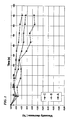
- The viscosity decrease has been expressed as:
ηo = viscosity at the end of the pre-heating time
ηi = viscosity after i sec from the end of the pre-heating time
where 0 < i < 900 s - The data are reported in Fig. 1. They show that after 900 sec the viscosity decrease is less than 10%.
- Texts have been performed also with reference to the biodegradability of the polymers made with the process according to the invention.
- Polymers produced according to example 2 (polybutylene sebacate), example 3 (polyexamethylene sebacate) and example 7 (polydecamethylene sebacate) have been subjected to the Control Composting Test according to the ISO DIS 14855.
- The polymers have shown a biodegradability higher than 60% in 180 days with the polybutylene sebacate showing a biodegradability higher than 90% in the same period of time.
- Polyesters produced according to the process of the invention are suitable for a lot of applications wherein a good processability and/or a good biodegradability of the polymer are requested such as :
- coatings produced by extrusion-coating,
- multi-layer laminates with layers of paper, plastics material or paper/plastics material, aluminium and metallized films,
- films as such and multi-layer films with other polymer materials,
- sacks and bags for organic waste and for grass cuttings with periods of use longer than 1 week,
- single-layer and multi-layer food packaging comprising containers for milk, yoghurt, cheeses, meat and beverages, in which the layer in contact with the food or beverage is formed by the aliphatic polyester,
- composites with gelatinized or destructured starch, and/or complexed starch or natural starch as a filler,
- mono-directional and bi-directional films, shrink films, stretch films,
- semi-expanded and expanded products produced by physical and/or chemical means, by extrusion, injection, or agglomeration of pre-expanded particles,
- expanded sheet and expanded containers for foods, for drugs, and for fast food,
- fibres, fabrics and non-woven fabrics in the hygiene, sanitary and clothing fields,
- composites with mineral and vegetable fillers,
- thermoformed sheets for the food or fast-food packaging fields,
- bottles for the food, cosmetics and pharmaceutical fields,
- fishing nets,
- containers for fruit and vegetables,
- extruded sections usable in the fast-food field and irrigation pipes in the agricultural field.
Claims (14)
- Copolymers of biodegradable aliphatic polyesters from one or more aliphatic dicarboxylic acids or diesters of the said acids and one or more linear or branched aliphatic glycols, characterized by containing ricinoleic acid.
- Copolymers according to claim 1, characterized by containing up to 10% in moles of ricinoleic acid.
- Copolymers according to claim 1 or 2, characterized in that said dicarboxylic acids are selected from the group consisting of oxalic acid, malonic acid, succinic acid, glutaric acid, adipic acid, pimelic acid, suberic acid, azelaic acid, sebacic acid, undecandioic acid, dodecandioc acid, brassylic acid, dimmer acid.
- Copolymers according to claim 1 or 2, characterized in that said glycols are selected from the group consisting of 1,2-ethandiol, 1,4-butandiol, 1,6-hexandiol, 1,7-heptandiol, 1,8-octandiol, 1,9-nonandiol, 1,10-decandiol, 1,12-dodecandiol, 1,4-cyclohexandimethanol, 1,4-cyclohexandiol, neopentyl glycol, polyoxyalkylenes, anhydrous and di-anhydrous sorbitol.
- Copolymers according to claim 1 or 2, characterized in that said aliphatic polyesters are branched aliphatic polyesters which are produced by introducing trifunctional or polyfunctional comonomers into the reaction system in quantities of between 0.1 and 5% in moles, relative to the dicarboxylic acid.
- Copolymers according to claim 5, characterized in that said trifunctional or polyfunctional comonomers are selected from glycerol, pentaerithritol, trimethylolpropane and citric acid.
- Copolymers according to any of the preceding claims, with intrinsic viscosity of between 0.8 and 1.5 dl/g.
- Copolymers according to claim 7, with intrinsic viscosity of between 0.9 and 1.3 dl/g.
- Copolymers according to any of the preceding claims, with MFR of between 0.1 and 70 g/10 min.
- Copolymers according to claim 9, with MFR of between 2 and 30 g/10 min.
- Copolymers according to claim 7-9, wherein the thermal stability measured as viscosity decrease is less than 10%.
- Copolymers according to claim 7-9, wherein the biodegradability is higher than 60% in 180 days.
- Copolymers according to claim 12, wherein the biodegradability is higher than 90% in 180 days.
- Use of copolymers according to any of the preceding claims for:Coatings produced by extrusion coating;Multi-layers laminates with layers of paper, plastic material or paper/plastic material, aluminum and metallized films;Films as such and multi-layers films with other polymer materials;Sacks for organic refuse and for grass cuttings with period of use longer than one week;Single-layer and multi-layer food packaging comprising container for milk, yoghurt, cheese, meat and beverages, in which the layer in contact with said food or beverage is formed by an aliphatic polyester;Composites with gelatinized or destructured starch, and/or complexed starch or natural starch as a filler;Mono-directional and bi-directional films, shrink films, stretch films;Semi-expanded and expanded products produced by physical and/or chemical means, by extrusion, injection or agglomeration of pre-expanded particles;Expanded sheets and expanded containers for food, for drugs and for fast food;Fibres, fabrics and non-woven fabrics in the hygiene, sanitary and clothing fields;Composites with mineral and vegetable fillers;Thermoformed sheets for food or fast-food packaging;Bottles for the food, cosmetic and pharmaceuticals fields;Fishing nets;Containers for fruit and vegetables;Extruded sections usable in the fast-food field and irrigation pipes in the agricultural fields.
Applications Claiming Priority (3)
| Application Number | Priority Date | Filing Date | Title |
|---|---|---|---|
| ITTO990198 | 1999-03-15 | ||
| IT1999TO000198A IT1307022B1 (en) | 1999-03-15 | 1999-03-15 | SIMPLIFIED PROCESS FOR OBTAINING BIODEGRADABLE ALIPATIC POLYESTERS. |
| EP00910841A EP1165650A1 (en) | 1999-03-15 | 2000-03-15 | A simplified method of producing biodegradable aliphatic polyesters |
Related Parent Applications (1)
| Application Number | Title | Priority Date | Filing Date |
|---|---|---|---|
| EP00910841A Division EP1165650A1 (en) | 1999-03-15 | 2000-03-15 | A simplified method of producing biodegradable aliphatic polyesters |
Publications (3)
| Publication Number | Publication Date |
|---|---|
| EP1512709A2 true EP1512709A2 (en) | 2005-03-09 |
| EP1512709A3 EP1512709A3 (en) | 2005-03-23 |
| EP1512709B1 EP1512709B1 (en) | 2007-10-10 |
Family
ID=11417618
Family Applications (2)
| Application Number | Title | Priority Date | Filing Date |
|---|---|---|---|
| EP00910841A Ceased EP1165650A1 (en) | 1999-03-15 | 2000-03-15 | A simplified method of producing biodegradable aliphatic polyesters |
| EP04077835A Expired - Lifetime EP1512709B1 (en) | 1999-03-15 | 2000-03-15 | Copolymers of biodegradable aliphatic polyesters |
Family Applications Before (1)
| Application Number | Title | Priority Date | Filing Date |
|---|---|---|---|
| EP00910841A Ceased EP1165650A1 (en) | 1999-03-15 | 2000-03-15 | A simplified method of producing biodegradable aliphatic polyesters |
Country Status (11)
| Country | Link |
|---|---|
| US (1) | US6562939B1 (en) |
| EP (2) | EP1165650A1 (en) |
| JP (1) | JP2002539309A (en) |
| AT (1) | ATE375374T1 (en) |
| AU (1) | AU756070B2 (en) |
| CA (1) | CA2365485C (en) |
| DE (1) | DE60036737T2 (en) |
| ES (1) | ES2294428T3 (en) |
| IT (1) | IT1307022B1 (en) |
| NO (1) | NO329458B1 (en) |
| WO (1) | WO2000055236A1 (en) |
Cited By (1)
| Publication number | Priority date | Publication date | Assignee | Title |
|---|---|---|---|---|
| WO2008099398A2 (en) | 2007-02-14 | 2008-08-21 | Netafim Ltd. | Biodegradable irrigation pipe |
Families Citing this family (29)
| Publication number | Priority date | Publication date | Assignee | Title |
|---|---|---|---|---|
| ITTO20010058A1 (en) | 2001-01-25 | 2002-07-25 | Novamont Spa | BIODEGRADABLE POLYESTER TERNARY MIXTURES AND PRODUCTS OBTAINED FROM THESE. |
| ITMI20020867A1 (en) * | 2002-04-22 | 2003-10-22 | Novamont Spa | BIODEGRADABLE SATURATED / UNSATURED THERMOPLASTIC COPOLYESTERS |
| ITMI20020864A1 (en) | 2002-04-22 | 2003-10-22 | Novamont Spa | AMORPHO-CRYSTALLINE BLOCK COPOLYMERS |
| ITMI20020866A1 (en) * | 2002-04-22 | 2003-10-22 | Novamont Spa | BIODEGRADABLE SATURATED / UNSATURED THERMOPLASTIC COPOLYESTERS |
| ITMI20020865A1 (en) * | 2002-04-22 | 2003-10-22 | Novamont Spa | BIODEGRADABLE POLYESTERS OBTAINED BY REACTIVE EXTRUSION |
| US20060286138A1 (en) * | 2003-04-10 | 2006-12-21 | Malshe Vinod C | Novel biodegradable aliphatic polyesters and pharmaceutical compositions and applications thereof |
| JP4635475B2 (en) * | 2003-05-21 | 2011-02-23 | 三菱化学株式会社 | Aliphatic polyester and method for producing the same |
| US20070082982A1 (en) * | 2005-10-11 | 2007-04-12 | The Procter & Gamble Company | Water stable compositions and articles comprising starch and methods of making the same |
| US9091004B2 (en) * | 2006-07-14 | 2015-07-28 | Kimberly-Clark Worldwide, Inc. | Biodegradable polylactic acid for use in nonwoven webs |
| EP2044251B1 (en) * | 2006-07-14 | 2019-10-02 | NatureWorks LLC | Biodegradable aliphatic polyester for use in nonwoven webs |
| MX2009000526A (en) * | 2006-07-14 | 2009-01-27 | Kimberly Clark Co | Biodegradable aliphatic-aromatic copolyester for use in nonwoven webs. |
| US8729176B2 (en) | 2006-09-06 | 2014-05-20 | Keio University | Polyricinoleate composition and process for producing the same |
| EP2064261A1 (en) * | 2006-12-15 | 2009-06-03 | Kimberly-Clark Worldwide, Inc. | Biodegradable polylactic acids for use in forming fibers |
| WO2008073099A1 (en) * | 2006-12-15 | 2008-06-19 | Kimberly-Clark Worldwide, Inc. | Biodegradable polyesters for use in forming fibers |
| WO2009024836A1 (en) * | 2007-08-22 | 2009-02-26 | Kimberly-Clark Worldwide, Inc. | Multicomponent biodegradable filaments and nonwoven webs formed therefrom |
| US20100323575A1 (en) * | 2007-12-13 | 2010-12-23 | Aimin He | Biodegradable fibers formed from a thermoplastic composition containing polylactic acid and a polyether copolymer |
| KR101526636B1 (en) * | 2008-05-30 | 2015-06-05 | 킴벌리-클라크 월드와이드, 인크. | Polylactic acid fibers |
| US8461262B2 (en) | 2010-12-07 | 2013-06-11 | Kimberly-Clark Worldwide, Inc. | Polylactic acid fibers |
| IT1403272B1 (en) * | 2010-12-20 | 2013-10-17 | Novamont Spa | COMPLEX OLIGOMERIC STRUCTURES |
| ITMI20121067A1 (en) * | 2012-06-19 | 2013-12-20 | Novamont Spa | VEGETABLE DERIVATIVES AS EXTENDED OILS AND BIOFILLERS IN ELASTOMERIC COMPOSITIONS. |
| KR20140031011A (en) * | 2012-09-04 | 2014-03-12 | 삼성정밀화학 주식회사 | Continuous production method of biodegradable aliphatic polyester |
| KR101992391B1 (en) * | 2012-09-04 | 2019-09-30 | (주)새한폴리머 | Method for continuous production of biodegradable aliphatic/aromatic polyester copolymer |
| CN103243413B (en) * | 2013-04-24 | 2014-11-05 | 浙江理工大学 | Preparation method of completely biodegradable aliphatic copolyester staple fiber |
| JP6538087B2 (en) * | 2014-05-30 | 2019-07-03 | ザ・セカント・グループ・エルエルシー | Waterborne manufacture of polymeric materials |
| JP6619011B2 (en) * | 2015-08-31 | 2019-12-11 | 三井化学株式会社 | Copolymer and lubricating oil composition |
| EP3600465A1 (en) | 2017-03-31 | 2020-02-05 | The Secant Group, LLC | Cured biodegradable microparticles and scaffolds and methods of making and using the same |
| US10822450B2 (en) | 2017-07-11 | 2020-11-03 | The Secant Group Llc | Poly(glycerol sebacate)-interleukin inhibitor copolymers and methods of making and use |
| KR102621249B1 (en) * | 2020-08-19 | 2024-01-08 | 효성티앤씨 주식회사 | Polyester yarn for apparel use and method for preparing the same |
| CN118996663B (en) * | 2024-09-26 | 2025-07-11 | 江苏轩达高分子材料有限公司 | A bio-based polyester memory fiber and preparation method thereof |
Family Cites Families (13)
| Publication number | Priority date | Publication date | Assignee | Title |
|---|---|---|---|---|
| JPS55142024A (en) * | 1979-04-23 | 1980-11-06 | Toray Ind Inc | Production of polyester |
| JPS6119628A (en) * | 1984-07-05 | 1986-01-28 | Mitsubishi Kasei Vinyl Co | Polyester manufacturing method |
| US4554343A (en) | 1984-11-23 | 1985-11-19 | Eastman Kodak Company | Process for the production of high molecular weight polyester |
| US4970288A (en) | 1989-09-22 | 1990-11-13 | Atochem North America, Inc. | Non-toxic polyester compositions made with organotin esterification catalysts |
| US5306787A (en) | 1990-11-26 | 1994-04-26 | Showa Highpolymer Co., Ltd. | Method for producing saturated polyester |
| US5166310A (en) | 1991-08-27 | 1992-11-24 | The Dow Chemical Company | Preparation of polyesters with tin catalyst |
| JP3179177B2 (en) | 1992-04-10 | 2001-06-25 | 昭和高分子株式会社 | Aliphatic polyesters containing urethane bonds |
| KR0120326B1 (en) | 1992-12-24 | 1997-10-22 | 김준웅 | Thermoplastic biodegrable, and aliphatic polyester and method of making the same |
| US5401796A (en) | 1993-04-02 | 1995-03-28 | Mitsui Toatsu Chemicals, Inc. | Aliphatic polyester and preparation process thereof |
| EP0703260A1 (en) | 1994-09-21 | 1996-03-27 | Tonen Corporation | Aliphatic polyester and a process for the preparation thereof |
| AU694832B2 (en) * | 1994-12-21 | 1998-07-30 | Showa Denko Kabushiki Kaisha | Aliphatic polyester resin and process for producing the same |
| JPH0959359A (en) * | 1995-06-13 | 1997-03-04 | Toray Ind Inc | Polyester polymer and method for producing the same |
| JP3888693B2 (en) | 1995-10-13 | 2007-03-07 | ユニ・チャーム株式会社 | Wet wipes |
-
1999
- 1999-03-15 IT IT1999TO000198A patent/IT1307022B1/en active
-
2000
- 2000-03-15 EP EP00910841A patent/EP1165650A1/en not_active Ceased
- 2000-03-15 US US09/936,598 patent/US6562939B1/en not_active Expired - Fee Related
- 2000-03-15 EP EP04077835A patent/EP1512709B1/en not_active Expired - Lifetime
- 2000-03-15 WO PCT/EP2000/002305 patent/WO2000055236A1/en not_active Ceased
- 2000-03-15 DE DE60036737T patent/DE60036737T2/en not_active Expired - Lifetime
- 2000-03-15 ES ES04077835T patent/ES2294428T3/en not_active Expired - Lifetime
- 2000-03-15 AU AU32899/00A patent/AU756070B2/en not_active Ceased
- 2000-03-15 AT AT04077835T patent/ATE375374T1/en not_active IP Right Cessation
- 2000-03-15 CA CA002365485A patent/CA2365485C/en not_active Expired - Fee Related
- 2000-03-15 JP JP2000605661A patent/JP2002539309A/en active Pending
-
2001
- 2001-09-14 NO NO20014456A patent/NO329458B1/en not_active IP Right Cessation
Non-Patent Citations (1)
| Title |
|---|
| DATABASE CAPLUS [Online] CHEMICAL ABSTRACTS SERVICE, COLUMBUS, OHIO, US; 5 February 1998 (1998-02-05), SHUAI, XINTAO: "Synthesis and characterization of degradable copolymers of fatty acids and ricinoleic acid" XP002313602 retrieved from STN Database accession no. 1998:67284 * |
Cited By (3)
| Publication number | Priority date | Publication date | Assignee | Title |
|---|---|---|---|---|
| WO2008099398A2 (en) | 2007-02-14 | 2008-08-21 | Netafim Ltd. | Biodegradable irrigation pipe |
| WO2008099398A3 (en) * | 2007-02-14 | 2009-01-08 | Netafim Ltd | Biodegradable irrigation pipe |
| US7862873B2 (en) | 2007-02-14 | 2011-01-04 | Netafim, Ltd. | Biodegradable irrigation pipe |
Also Published As
| Publication number | Publication date |
|---|---|
| ES2294428T3 (en) | 2008-04-01 |
| DE60036737T2 (en) | 2008-07-17 |
| US6562939B1 (en) | 2003-05-13 |
| IT1307022B1 (en) | 2001-10-23 |
| DE60036737D1 (en) | 2007-11-22 |
| CA2365485C (en) | 2010-02-02 |
| WO2000055236A1 (en) | 2000-09-21 |
| EP1165650A1 (en) | 2002-01-02 |
| JP2002539309A (en) | 2002-11-19 |
| NO20014456L (en) | 2001-09-14 |
| NO329458B1 (en) | 2010-10-25 |
| CA2365485A1 (en) | 2000-09-21 |
| ATE375374T1 (en) | 2007-10-15 |
| NO20014456D0 (en) | 2001-09-14 |
| EP1512709B1 (en) | 2007-10-10 |
| EP1512709A3 (en) | 2005-03-23 |
| AU756070B2 (en) | 2003-01-02 |
| ITTO990198A1 (en) | 2000-09-15 |
| AU3289900A (en) | 2000-10-04 |
Similar Documents
| Publication | Publication Date | Title |
|---|---|---|
| US6562939B1 (en) | Simplified method of producing biodegradable aliphatic polyesters | |
| US7196157B2 (en) | Biodegradable saturated/unsaturated thermoplastic polyesters | |
| US7288618B2 (en) | Biodegradable thermoplastic polyesters | |
| US9012573B2 (en) | Biodegradable polyester and wrapping films for packaging produced therewith | |
| EP0832145B1 (en) | Thermoplastic biodegradable polyester, a process for the preparation thereof and articles manufactured therefrom | |
| US7169860B2 (en) | Amorphous-crystalline block copolymers | |
| JP2001514279A (en) | Biodegradable lactone copolymer | |
| US6214967B1 (en) | Process for the polymerization of lactide | |
| KR20130008592A (en) | Method for producing foil | |
| NO327722B1 (en) | Use of polyester resins for making articles with good water vapor barrier | |
| US7253250B2 (en) | Simplified method of producing biodegradable aliphatic polyesters | |
| EP2836535B1 (en) | Polyesters comprising 2-methylglutaric acid, process for production of the said polyesters and products obtained therewith | |
| CN118613527A (en) | Aliphatic-aromatic polyesters with controlled content of mixed residual cyclic oligomers | |
| JP3301505B2 (en) | Polylactic acid copolymer | |
| JP3144416B2 (en) | Aliphatic polyester and / or copolymer thereof | |
| CN120418323A (en) | Polyesters with long chain dicarboxylic acids |
Legal Events
| Date | Code | Title | Description |
|---|---|---|---|
| PUAI | Public reference made under article 153(3) epc to a published international application that has entered the european phase |
Free format text: ORIGINAL CODE: 0009012 |
|
| PUAL | Search report despatched |
Free format text: ORIGINAL CODE: 0009013 |
|
| AC | Divisional application: reference to earlier application |
Ref document number: 1165650 Country of ref document: EP Kind code of ref document: P |
|
| AK | Designated contracting states |
Kind code of ref document: A2 Designated state(s): AT BE CH CY DE DK ES FI FR GB GR IE IT LI LU MC NL PT SE |
|
| AK | Designated contracting states |
Kind code of ref document: A3 Designated state(s): AT BE CH CY DE DK ES FI FR GB GR IE IT LI LU MC NL PT SE |
|
| 17P | Request for examination filed |
Effective date: 20050427 |
|
| 17Q | First examination report despatched |
Effective date: 20050617 |
|
| RAP3 | Party data changed (applicant data changed or rights of an application transferred) |
Owner name: MINISTERO DELL' UNIVERSITA' E DELLA RICERCASCIENTI |
|
| AKX | Designation fees paid |
Designated state(s): AT BE CH CY DE DK ES FI FR GB GR IE IT LI LU MC NL PT SE |
|
| 17Q | First examination report despatched |
Effective date: 20050617 |
|
| GRAP | Despatch of communication of intention to grant a patent |
Free format text: ORIGINAL CODE: EPIDOSNIGR1 |
|
| GRAS | Grant fee paid |
Free format text: ORIGINAL CODE: EPIDOSNIGR3 |
|
| GRAA | (expected) grant |
Free format text: ORIGINAL CODE: 0009210 |
|
| AC | Divisional application: reference to earlier application |
Ref document number: 1165650 Country of ref document: EP Kind code of ref document: P |
|
| AK | Designated contracting states |
Kind code of ref document: B1 Designated state(s): AT BE CH CY DE DK ES FI FR GB GR IE IT LI LU MC NL PT SE |
|
| REG | Reference to a national code |
Ref country code: GB Ref legal event code: FG4D |
|
| REG | Reference to a national code |
Ref country code: CH Ref legal event code: EP |
|
| REG | Reference to a national code |
Ref country code: IE Ref legal event code: FG4D |
|
| REF | Corresponds to: |
Ref document number: 60036737 Country of ref document: DE Date of ref document: 20071122 Kind code of ref document: P |
|
| NLV1 | Nl: lapsed or annulled due to failure to fulfill the requirements of art. 29p and 29m of the patents act | ||
| REG | Reference to a national code |
Ref country code: ES Ref legal event code: FG2A Ref document number: 2294428 Country of ref document: ES Kind code of ref document: T3 |
|
| PG25 | Lapsed in a contracting state [announced via postgrant information from national office to epo] |
Ref country code: SE Free format text: LAPSE BECAUSE OF FAILURE TO SUBMIT A TRANSLATION OF THE DESCRIPTION OR TO PAY THE FEE WITHIN THE PRESCRIBED TIME-LIMIT Effective date: 20080110 Ref country code: NL Free format text: LAPSE BECAUSE OF FAILURE TO SUBMIT A TRANSLATION OF THE DESCRIPTION OR TO PAY THE FEE WITHIN THE PRESCRIBED TIME-LIMIT Effective date: 20071010 Ref country code: LI Free format text: LAPSE BECAUSE OF FAILURE TO SUBMIT A TRANSLATION OF THE DESCRIPTION OR TO PAY THE FEE WITHIN THE PRESCRIBED TIME-LIMIT Effective date: 20071010 Ref country code: CH Free format text: LAPSE BECAUSE OF FAILURE TO SUBMIT A TRANSLATION OF THE DESCRIPTION OR TO PAY THE FEE WITHIN THE PRESCRIBED TIME-LIMIT Effective date: 20071010 |
|
| REG | Reference to a national code |
Ref country code: CH Ref legal event code: PL |
|
| PG25 | Lapsed in a contracting state [announced via postgrant information from national office to epo] |
Ref country code: PT Free format text: LAPSE BECAUSE OF FAILURE TO SUBMIT A TRANSLATION OF THE DESCRIPTION OR TO PAY THE FEE WITHIN THE PRESCRIBED TIME-LIMIT Effective date: 20080310 |
|
| PG25 | Lapsed in a contracting state [announced via postgrant information from national office to epo] |
Ref country code: AT Free format text: LAPSE BECAUSE OF FAILURE TO SUBMIT A TRANSLATION OF THE DESCRIPTION OR TO PAY THE FEE WITHIN THE PRESCRIBED TIME-LIMIT Effective date: 20071010 |
|
| ET | Fr: translation filed | ||
| PG25 | Lapsed in a contracting state [announced via postgrant information from national office to epo] |
Ref country code: DK Free format text: LAPSE BECAUSE OF FAILURE TO SUBMIT A TRANSLATION OF THE DESCRIPTION OR TO PAY THE FEE WITHIN THE PRESCRIBED TIME-LIMIT Effective date: 20071010 |
|
| PLBE | No opposition filed within time limit |
Free format text: ORIGINAL CODE: 0009261 |
|
| STAA | Information on the status of an ep patent application or granted ep patent |
Free format text: STATUS: NO OPPOSITION FILED WITHIN TIME LIMIT |
|
| PG25 | Lapsed in a contracting state [announced via postgrant information from national office to epo] |
Ref country code: BE Free format text: LAPSE BECAUSE OF FAILURE TO SUBMIT A TRANSLATION OF THE DESCRIPTION OR TO PAY THE FEE WITHIN THE PRESCRIBED TIME-LIMIT Effective date: 20071010 |
|
| 26N | No opposition filed |
Effective date: 20080711 |
|
| PG25 | Lapsed in a contracting state [announced via postgrant information from national office to epo] |
Ref country code: MC Free format text: LAPSE BECAUSE OF NON-PAYMENT OF DUE FEES Effective date: 20080331 |
|
| PG25 | Lapsed in a contracting state [announced via postgrant information from national office to epo] |
Ref country code: IE Free format text: LAPSE BECAUSE OF NON-PAYMENT OF DUE FEES Effective date: 20080317 Ref country code: GR Free format text: LAPSE BECAUSE OF FAILURE TO SUBMIT A TRANSLATION OF THE DESCRIPTION OR TO PAY THE FEE WITHIN THE PRESCRIBED TIME-LIMIT Effective date: 20080111 |
|
| PG25 | Lapsed in a contracting state [announced via postgrant information from national office to epo] |
Ref country code: FI Free format text: LAPSE BECAUSE OF FAILURE TO SUBMIT A TRANSLATION OF THE DESCRIPTION OR TO PAY THE FEE WITHIN THE PRESCRIBED TIME-LIMIT Effective date: 20071010 |
|
| PG25 | Lapsed in a contracting state [announced via postgrant information from national office to epo] |
Ref country code: CY Free format text: LAPSE BECAUSE OF FAILURE TO SUBMIT A TRANSLATION OF THE DESCRIPTION OR TO PAY THE FEE WITHIN THE PRESCRIBED TIME-LIMIT Effective date: 20071010 |
|
| PG25 | Lapsed in a contracting state [announced via postgrant information from national office to epo] |
Ref country code: LU Free format text: LAPSE BECAUSE OF NON-PAYMENT OF DUE FEES Effective date: 20080315 |
|
| PGRI | Patent reinstated in contracting state [announced from national office to epo] |
Ref country code: IT Effective date: 20110501 |
|
| REG | Reference to a national code |
Ref country code: FR Ref legal event code: PLFP Year of fee payment: 17 |
|
| PGFP | Annual fee paid to national office [announced via postgrant information from national office to epo] |
Ref country code: ES Payment date: 20160328 Year of fee payment: 17 Ref country code: IT Payment date: 20160302 Year of fee payment: 17 |
|
| PGFP | Annual fee paid to national office [announced via postgrant information from national office to epo] |
Ref country code: FR Payment date: 20160328 Year of fee payment: 17 Ref country code: GB Payment date: 20160329 Year of fee payment: 17 |
|
| PGFP | Annual fee paid to national office [announced via postgrant information from national office to epo] |
Ref country code: DE Payment date: 20160331 Year of fee payment: 17 |
|
| REG | Reference to a national code |
Ref country code: DE Ref legal event code: R119 Ref document number: 60036737 Country of ref document: DE |
|
| GBPC | Gb: european patent ceased through non-payment of renewal fee |
Effective date: 20170315 |
|
| REG | Reference to a national code |
Ref country code: FR Ref legal event code: ST Effective date: 20171130 |
|
| PG25 | Lapsed in a contracting state [announced via postgrant information from national office to epo] |
Ref country code: DE Free format text: LAPSE BECAUSE OF NON-PAYMENT OF DUE FEES Effective date: 20171003 Ref country code: FR Free format text: LAPSE BECAUSE OF NON-PAYMENT OF DUE FEES Effective date: 20170331 |
|
| PG25 | Lapsed in a contracting state [announced via postgrant information from national office to epo] |
Ref country code: IT Free format text: LAPSE BECAUSE OF NON-PAYMENT OF DUE FEES Effective date: 20170315 Ref country code: GB Free format text: LAPSE BECAUSE OF NON-PAYMENT OF DUE FEES Effective date: 20170315 |
|
| REG | Reference to a national code |
Ref country code: ES Ref legal event code: FD2A Effective date: 20180629 |
|
| PG25 | Lapsed in a contracting state [announced via postgrant information from national office to epo] |
Ref country code: ES Free format text: LAPSE BECAUSE OF NON-PAYMENT OF DUE FEES Effective date: 20170316 |