EP1512566A1 - Vehicle slide-door supporting structure - Google Patents
Vehicle slide-door supporting structure Download PDFInfo
- Publication number
- EP1512566A1 EP1512566A1 EP04020773A EP04020773A EP1512566A1 EP 1512566 A1 EP1512566 A1 EP 1512566A1 EP 04020773 A EP04020773 A EP 04020773A EP 04020773 A EP04020773 A EP 04020773A EP 1512566 A1 EP1512566 A1 EP 1512566A1
- Authority
- EP
- European Patent Office
- Prior art keywords
- vehicle
- door
- slide
- tail lamp
- vehicle body
- Prior art date
- Legal status (The legal status is an assumption and is not a legal conclusion. Google has not performed a legal analysis and makes no representation as to the accuracy of the status listed.)
- Granted
Links
- 239000005357 flat glass Substances 0.000 claims description 11
- 238000012986 modification Methods 0.000 description 2
- 230000004048 modification Effects 0.000 description 2
- 238000003466 welding Methods 0.000 description 2
- 238000004519 manufacturing process Methods 0.000 description 1
- 230000002093 peripheral effect Effects 0.000 description 1
Images




Classifications
-
- B—PERFORMING OPERATIONS; TRANSPORTING
- B60—VEHICLES IN GENERAL
- B60J—WINDOWS, WINDSCREENS, NON-FIXED ROOFS, DOORS, OR SIMILAR DEVICES FOR VEHICLES; REMOVABLE EXTERNAL PROTECTIVE COVERINGS SPECIALLY ADAPTED FOR VEHICLES
- B60J5/00—Doors
- B60J5/04—Doors arranged at the vehicle sides
- B60J5/06—Doors arranged at the vehicle sides slidable; foldable
Definitions
- This invention relates to a vehicle slide-door supporting structure.
- Some vehicles have a slide door which is slid in their front and rear directions, as a side door that opens and closes an opening through which passengers get into and out of a vehicle.
- the opening is formed in the side part of a vehicle body.
- Such a slide door is used, especially for the rearmost side door in the vehicle.
- the slide door has generally been used for a so-called one-box car or one-and-half box car, and the like.
- a slide door like this needs to be smoothly slid along a predetermined track.
- a guide rail is provided which extends in the front and rear directions in the side part of the vehicle body.
- a door support member provided in the slide door is fitted so that it can be slid.
- the opening through which passengers get into and out of the vehicle is usually opened by sliding rearward the slide door which keeps the opening closed.
- Japanese Patent Laid-Open No. 2003-82927 specification discloses a slide door which is provided as an additional component with a driving mechanism. This helps drive the slide door easily, in other words, open and close it without difficulty.
- a driving mechanism usually drives the above described door support member, or a wire connected to the slide door, in the front and rear directions by means of a motor.
- the wire is guided midway by a guide pulley or the like.
- the guide pulley is provided, for example, in at least two front and rear positions, such as at or near the front-end part and the rear-end part of the guide rail.
- the guide rail is provided, and in addition, the door support member connected on the side of the vehicle body is fitted into the guide rail from the outside of the vehicle body. This needs a narrow opening portion which extends in the front and rear directions along the guide rail in the side part of the vehicle body. This opening portion which extends in the front and rear directions may enormously affect the design of the side part of the vehicle body.
- a tail lamp is disposed at each end part thereof in the vehicle-width directions (i.e., in the right-and-left directions). If the rear-end part of the guide rail is located far apart from the tail lamp in the up-and-down directions, or in another such case, they cannot be well arranged from the viewpoint of design. Hence, the side part of the vehicle body, as a whole, may become uneven in respect of design. This disadvantage could not be bypassed in the case of a private car, especially, a luxury private car, even apart from an automobile for business use whose design is not necessarily important.
- the vehicle slide-door supporting structure comprising: a slide door which is a side door that opens and closes an opening through which a person gets into and out of a vehicle, the opening being formed in a side part of a vehicle body, the side door being slid in the front and rear directions so that the opening is opened and closed, and the opening being opened when the side door is slid rearward; and a driving mechanism which is connected to the slide door and drives the slide door, wherein one part of the driving mechanism is attached to a tail lamp which is disposed at the rear part of the vehicle body.
- the one part of the driving mechanism is attached to the tail lamp and thus is located rearward sufficiently. This allows the slide door to slide rearward sufficiently, in other words, widens, in the front and rear directions, the opening which is opened and closed by the slide door. Thereby, a person easily gets into and out of the vehicle.
- a concave portion which is opened frontward is formed in the front part of the tail lamp; and the one part of the driving mechanism is located inside of the concave portion.
- the one part of the driving mechanism is located rearward sufficiently by using the concave portion formed in the front part of the tail lamp. This allows the slide door to slide rearward farther.
- the one part of the driving mechanism is attached to an attachment portion of the tail lamp to the vehicle body.
- the attachment portion to the vehicle body is one of the strong parts in the tail lamp, and it is effectively used. This makes it possible to attach the one part of the driving mechanism tightly to the tail lamp.
- the one part of the driving mechanism and the tail lamp are assembled beforehand into a unit body, and the unit body is attached to the vehicle body so that the part of the driving mechanism and the tail lamp are attached to the vehicle body.
- the tail lamp and the one part of the driving mechanism can be united in advance, i.e., as a module.
- an attachment portion of the tail lamp to the vehicle body, together with the one part of the driving mechanism, is fixed on the vehicle body, by means of a fixing part.
- the attachment of the tail lamp to the vehicle body and the attachment of the one part of the driving mechanism to the vehicle body can be conducted using common fixing parts.
- the driving mechanism includes a wire which is connected to the slide door, a drive portion which drives the slide door via the wire, and a guide portion which guides the wire; and the one part of the driving mechanism which is attached to the tail lamp is the guide portion.
- the driving mechanism can be made general.
- the guide portion is a guide pulley around which the wire is placed. In this case, the guide portion becomes more distinct.
- a boundary position between the vehicle-body rear plane and the vehicle-body side plane is covered with the tail lamp, from the outside of the vehicle body; and the one part of the driving mechanism is disposed to protrude at the boundary position between the vehicle-body rear plane and the vehicle-body side plane and toward the outside of the vehicle body.
- a guide rail is disposed which extends in the front and rear directions and guides the slide door in the front and rear directions; and the rear end of the guide rail extends rearward long up to a position adjacent to the tail lamp. In this case, by means of the guide rail, the slide door can be guided rearward sufficiently.
- the guide rail is positioned substantially at the same height as the horizontally-seen line of the tail lamp.
- the guide rail appears on the outside of the vehicle body and forms a kind of parting line. That guide rail is positioned substantially at the same height as the horizontally-seen line of the tail lamp. Therefore, the part from the guide rail over to the tail lamp becomes continuous in respect of design, thus giving a better external appearance.
- a cover member is disposed which forms an exterior surface of the vehicle body and covers the guide rail from the outside of the vehicle body; the lower edge of the cover member extends in the front and rear directions along the guide rail and is substantially at the same height as the horizontally-seen line of the tail lamp; and the exterior surface of the cover member continues to the exterior surface of the tail lamp with little space and substantially on the same surface.
- the cover member which covers the guide rail helps improve the external appearance over the long range in the front and rear directions from behind the slide door which is kept closed over to the tail lamp.
- the vehicle slide-door supporting structure comprising: a slide door which is a side door that opens and closes an opening through which a person gets into and out of a vehicle, the opening being formed in a side part of a vehicle body, the side door being slid in the front and rear directions so that the opening is opened and closed, and the opening being opened when the side door is slid rearward; and a driving mechanism which is connected to the slide door and drives the slide door, wherein one part of the driving mechanism is wrapped from frontward in a tail lamp which is disposed at the rear part of the vehicle body.
- the one part of the driving mechanism is located rearward sufficiently so that it can be wrapped from frontward in the tail lamp.
- the one part of the driving mechanism at least a rear-end part thereof overlaps with the tail lamp in the vehicle-width directions, if seen from the side of the vehicle body.
- the whole one part of the driving mechanism is located behind the front end of the tail lamp. In both cases, the positional relation between the one part of the driving mechanism and the tail lamp becomes more definite in the front and rear directions.
- the driving mechanism includes a wire which is connected to the slide door, a drive portion which drives the slide door via the wire, and a guide portion which guides the wire; and the one part of the driving mechanism is the guide portion.
- the driving mechanism can be made general.
- the member which is wrapped from frontward in the tail lamp becomes distinct.
- the guide portion is a guide pulley around which the wire is placed. In this case, the guide portion becomes more distinct.
- a guide rail is disposed which extends in the front and rear directions and guides the slide door in the front and rear directions; and the rear end of the guide rail extends rearward long up to a position adjacent to the tail lamp. In this case, by means of the guide rail, the slide door can be guided rearward sufficiently.
- the guide rail is positioned substantially at the same height as the horizontally-seen line of the tail lamp.
- the guide rail appears on the outside of the vehicle body and forms a kind of parting line. That guide rail is positioned substantially at the same height as the horizontally-seen line of the tail lamp. Therefore, the part from the guide rail over to the tail lamp becomes continuous in respect of design, thus giving a better external appearance.
- a cover member is disposed which forms an exterior surface of the vehicle body and covers the guide rail from the outside of the vehicle body; the lower edge of the cover member extends in the front and rear directions along the guide rail and is substantially at the same height as the horizontally-seen line of the tail lamp; and the exterior surface of the cover member continues to the exterior surface of the tail lamp with little space and substantially on the same surface.
- the cover member which covers the guide rail helps improve the external appearance over the long range in the front and rear directions from behind the slide door which is kept closed over to the tail lamp.
- the guide pulley is disposed to protrude toward the outside of the vehicle body from a vehicle-body panel member to which the guide rail is attached. In this case, there is no need to bend the wire by force at the part of the guide pulley. This allows the slide door to be driven more smoothly.
- the guide pulley is located rearward sufficiently so that it can be wrapped from frontward in the tail lamp.
- the guide pulley is disposed in a boundary position between the vehicle-body rear plane and the vehicle-body side plane in the rear part of the vehicle body. In this case, different from the case where the guide pulley is located only at the vehicle-body side plane or only at the vehicle-body rear plane, there is no need to bend the wire by force near the guide pulley. This allows the slide door to be driven more smoothly.
- a concave portion which is opened frontward is formed in the front part of the tail lamp; and the guide pulley is located inside of the concave portion.
- the guide pulley is located rearward further sufficiently, so that the slide door can be slid rearward further.
- a guide rail is disposed which extends in the front and rear directions and guides the slide door; in the slide door, a door support member is disposed which fits into the guide rail so that it is slid; the guide rail extends rearward long so that the rear end thereof comes close to the tail lamp which is disposed at the rear part of the vehicle body; and a cover member is disposed which forms an exterior surface of the vehicle body, covers at least the rear-end part of the guide rail from the outside of the vehicle body and continues to the front edge of the tail lamp.
- the guide rail extends rearward long up to the vicinity of the tail lamp, so that the slide door can be moved rearward longer.
- the lower edge of the cover member extends straight in the front and rear directions along the guide rail; the lower edge of the cover member continues to a panel member with a little space in the up-and-down directions and substantially on the same surface, the panel member being located below the cover member and forming an exterior surface of the vehicle body; the door support member is disposed to pass through the space and slide along the lower edge of the cover member; and the front edge of the cover member continues adjacently and smoothly to the rear edge of the slide door which is kept closed.
- the cover member which covers the guide rail can form an exterior surface of the vehicle body, over a long distance in the front and rear directions from behind the slide door which is kept closed over to the tail lamp.
- the panel member has a level difference which dents toward the inside of the vehicle body and extends in the front and rear directions, and above the level difference, the guide rail and the cover member are disposed; in the panel member, rear quarter-window glass is attached to an upper panel portion which is located upward from the level difference; and the cover member connects smoothly the upper edge of a lower panel portion which is located downward from the level difference in the panel member and the lower edge of the rear quarter-window glass.
- the guide rail and the cover member can be disposed, using the level difference formed in the panel member which forms an exterior surface of the vehicle body.
- the panel member is not divided and continues in the up-and-down directions in the position of the guide rail. This strengthens the vehicle body, or makes its production easier.
- the vehicle slide-door supporting structure comprising: a slide door which is a side door that opens and closes an opening through which a person gets into and out of a vehicle, the opening being formed in a side part of a vehicle body, the side door being slid in the front and rear directions so that the opening is opened and closed, and the opening being opened when the side door is slid rearward; in the side part of the vehicle body, a guide rail is disposed which extends in the front and rear directions and guides the slide door; in the slide door, a door support member is disposed which fits into the guide rail so that it is slid; the guide rail extends rearward long so that the rear end thereof comes close to the tail lamp which is disposed at the rear part of the vehicle body; and the horizontally-seen line of the tail lamp is set to be substantially at the same height as the guide rail.
- the guide rail extends rearward long up to the vicinity of the tail lamp, so that the slide door can be moved rearward longer. This widens, in the front and rear directions, the opening which is opened and closed by the slide door. Thereby, a person easily gets into and out of the vehicle. Besides, if the vehicle body is seen from its side, the guide rail appears on the outside of the vehicle body and forms a kind of parting line. That guide rail is positioned substantially at the same height as the horizontally-seen line of the tail lamp. Therefore, the part from the guide rail over to the tail lamp becomes continuous in respect of design, thus giving a better external appearance.
- the door support member is slid up to the vicinity of the tail lamp as the slide door moves rearward. In this case, the door support member can be moved rearward sufficiently, thereby widening, in the front and rear directions, the opening through which a person gets into and out of the vehicle.
- the rear-end part of the guide rail extends rearward from the front end of the tail lamp, if seen from the side of the vehicle body. In this case, the slide door itself can be moved rearward further sufficiently.
- the door support member is slid rearward so that the rear-end part thereof is positioned behind the front end of the tail lamp. In this case, the door support member, or the slide door can be moved rearward further.
- a cover member is disposed which covers the guide rail from the outside of the vehicle body and whose lower edge extends in the front and rear directions; the cover member forms an exterior surface of the vehicle body and continues to a panel member with a little space in the up-and-down directions and substantially on the same surface, the panel member being located below the cover member and forming an exterior surface of the vehicle body; and the door support member is disposed to pass through the space and slide along the lower edge of the cover member.
- the guide rail is covered with the cover member, thus improving its external appearance.
- the cover member continues to the panel member which is located below it, substantially on the same surface. This improves the external appearance of the part from the panel member over to the cover member.
- the lower edge of the cover member extends straight in the front and rear directions substantially at the same height as the lower horizontally-seen line of the tail lamp; and the exterior surface of the cover member continues to the exterior surface of the tail lamp with little space and substantially on the same surface.
- the part from the cover member over to the tail lamp is also a continuous surface, thereby improving its external appearance further.
- a front side door 1 which is used for a driver's seat or an assistant seat in a vehicle S swings on its front-end part so that it can be opened and closed. It opens and closes a front opening 2 through which a person gets into and out of the vehicle S.
- the front opening 2 leads from a vehicle cabin to the outside of the vehicle S.
- a slide door 3 is provided as a rear side door which is located behind the front side door 1. This slide door 3 is used to open and close a rear opening 4 for a backseat (also see Fig. 4) through which a person gets into and out of the vehicle S. It slides in the front and rear directions.
- a slide door 3 When located at the front slide end, it covers the rear opening 4 which leads from the vehicle cabin to the outside of the vehicle S. That is called a closed position. When moved rearward, it comes to an opened position where it opens the rear opening 4. As shown in Fig. 5, such a slide door 3 has a section which is closed with an inner panel 3a and an outer panel 3b. In its upper part, a pane of window glass 3c is fitted (see Fig. 1 to Fig. 4).
- a back opening 5 is formed in its rear surface (also see Fig. 4).
- This back opening 5 is opened and closed by a back door 6.
- the back door 6 swings on its upper-end part so that it can be opened and closed. However, it may also be opened and closed suitably, for example, it may swing laterally on its end part in the vehicle-width directions.
- a tail lamp 10 is provided at each end part in the vehicle-width directions (i.e., in the right-and-left directions) of its rear-end part.
- This tail lamp 10 is attached to a rear pillar which is located on each of the right and left of the back door 6. It is fixed in a certain position of the vehicle body, whether the back door 6 is opened or closed.
- the tail lamp 10 includes a rear-surface portion 10a which faces behind the vehicle S, and a side-surface portion 10b which faces on the outside in the vehicle-width directions.
- a side light or lamp
- a brake lamp and a turn indicator light
- reference numeral 7 denotes a rear bumper.
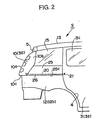
- Fig. 2 to Fig. 4 the rear bumper 7 and the back door 6 are removed.
- reference numeral 12 designates a rear quarter panel which configures the vehicle-body side part behind the rear opening 4
- 13 denotes a roof (or roof panel).
- the rear quarter panel 12 has a section which is closed with an inner panel 12a and an outer panel 12b.
- a rear quarter-window glass 15 is provided in the upper part of the rear quarter panel 12.
- the rear-end part of the rear quarter panel 12 configures the rear pillar to which the tail lamp 10 is attached.
- a guide rail 20 is attached behind the rear opening 4.
- This guide rail 20 is used to guide the slide door 3 in the front and rear directions. Its front end is located at the rear-edge part of the rear opening 4, and its rear end extends rearward slightly from the front end of the tail lamp 10, if seen from the side of the vehicle body.
- the guide rail 20 which extends in the front and rear directions is designed so that its lower edge is located substantially at the same height as a lower horizontally-seen line 10c of the tail lamp 10. In other words, the tail lamp 10 extends upward from the level of the guide rail 20.
- the above described side light, brake lamp and turn indicator light are placed apart from each other in the up-and-down directions.
- Such a guide rail 20 is located at substantially the middle part of the slide door 3 in the up-and-down directions. In other words, the guide rail 20 is in a position slightly lower from a belt-line which is located right below the window glass 3c of the slide door 3.
- This guide rail 20 is fixed on the vehicle body by welding, bolt fixing, or the like.
- the guide rail 20 has an opening portion 20a which is opened outward in the vehicle-width directions. This opening portion 20a extends over the full length of the guide rail 20.
- a door support member 21 is fitted so as to slide.
- This door support member 21 is attached to the rear inner-end part of the slide door 3. It includes a pair of bracket members 21 a, 21 b, and the one bracket member 21 a is fixed on the slide door 3 by welding, bolt fixing, or the like.
- the base-end part of the other bracket member 21 b is connected by means of a pin 21 c, so that the bracket member 21 b can turn on its axial line in the up-and-down directions.
- a pair of guide rollers 21d, 21 e are held so as to rotate.
- the one guide roller 21d can rotate on its axial line which extends in substantially the horizontal directions. Thereby, it is designed to move on the bottom-wall part of the guide rail 20.
- the guide roller 21 d is supposed mainly to keep the slide door 3 from being displaced downward.
- the other guide roller 21 e can rotate on its axial line which extends in the up-and-down directions. It is located between a pair of side-wall parts of the guide rail 20.
- Those side-wall parts are disposed at a certain distance from each other in the vehicle-width directions, so that they prevents the guide roller 21 e from being shifted beyond that distance in the vehicle-width directions.
- the guide roller 21 e is supposed to keep the slide door 3 from being displaced in the vehicle-width directions.
- two pairs are provided in front and behind at a short interval in the front and rear directions.
- a panel member which is located behind the rear opening 4 through which a person gets into and out of the vehicle and forms an exterior surface of the vehicle body, is configured by the above described outer panel 12b of the rear quarter panel 12. As shown in Fig. 5, to this outer panel 12b, a panel member 14 is connected which configures a rear wheel housing.
- the outer panel 12b dents inward in the vehicle-width directions, and continuously, extends upward.
- a level difference 23 is formed by denting inward in the vehicle-width directions, and the guide rail 20 is disposed above the part of the level difference 23.
- the guide rail 20 is designed so as not to protrude outward in the vehicle-width directions from the extended line which is formed by extending upward the exterior surface of the outer panel 12b located below the guide rail 20.
- the guide rail 20 is covered with a cover member 25 from the outside in the vehicle-width directions.
- This cover member 25 has, as shown in Fig. 5 and Fig. 6, a section which is closed with an inner panel 25a and an outer panel 25b.
- the outer panel 25b continues smoothly to the outer panel 12b located below it, so that they are substantially on the same surface.
- the above described rear quarter-window glass 15 is attached to an upper panel part above the level difference 23 in the outer panel 12b of the panel member 12.
- the upper edge of the cover member 25 continues smoothly to the lower edge of the rear quarter-window glass 15.
- the cover member 25 is designed to smoothly connect the rear quarter-window glass 15 and the outer panel 12b below the level difference 23.
- its front edge continues closely and smoothly to the rear edge in the exterior surface of the slide door 3 which is kept closed.
- a lower edge 25c of the cover member 25 extends straight in the front and rear directions along the guide rail 20. Between it and the outer panel 12b which is a rear fender, a little space 26 is formed in the up-and-down directions (see Fig. 5). This space 26 extends straight in the front and rear directions along the guide rail 20.
- the bracket member 21 b of the above described door support member 21 is disposed to pass through the space 26. In such a space 26, its rear end is positioned substantially at the same height as a lower horizontally-seen line 10c of the tail lamp 10 (see Fig. 1 and Fig. 2), and continues smoothly to the line 10c.
- the cover member 25 its rear edge is located immediately near the tail lamp 10.
- the exterior surface of the cover member 25 continues smoothly to the exterior surface of the tail lamp 10, substantially on the same surface (see Fig. 6). Hence, in the front and rear directions, the exterior surface of the cover member 25 configures the exterior surface of the vehicle body from the slide door 3 which is kept closed over to the tail lamp 10. In addition, in the up-and-down directions, it configures the exterior surface of the vehicle body from the rear quarter-window glass 15 over to the level difference 23. In other words, the exterior surface of the cover member 25 is designed to continue smoothly to each of its peripheral members in the up-and-down and front-and-rear directions. This improves the external appearance of the vehicle-body side part.
- the front-end part of the guide rail 20 is bent forward and inward in the vehicle-width directions.
- the door support member 21 is located at the front-end part of the guide rail 20 (i.e., in the position shown by a solid line in Fig. 6).
- Fig. 6 shows, by two-dot chain lines, a state where the slide door 3 is moved up to the vicinity of its rear end.
- the guide rail 20 extends rearward further from the front end of the tail lamp 10, and thus, the slide door 3 can be moved rearward further from the position shown by the two-dot chain lines in Fig. 6.
- the rear-end part of the door support member 21 is located behind the front end of the tail lamp 10, if seen from the side of the vehicle body.
- the slide door 3 is opened and closed by a driving mechanism 40.
- the driving mechanism 40 includes: a drive portion 41 which houses a motor for driving or the like; a wire 42 which has no end and a ring shape (i.e., it is endless), the wire 42 being connected to the door support member 21; and a pair of front and rear guide portions 43, 44 which guides the wire 42. Inside of each guide portion 43, 44, there is provided a guide pulley.
- the wire 42 is disposed to pass through the guide rail 20, and is also placed to pass through the drive portion 41 and (the guide pulleys of) the guide portions 43, 44. If the motor inside of the drive portion 41 is rotated, for example, in its regular direction, then the slide door 3 is driven forward.
- the slide door 3 is driven rearward.
- the motor is controlled so as to stop in the front-end position and the rear-end position of the slide door 3. This keeps the slide door 3 from moving forward and rearward beyond predetermined positions.
- a stopper may also be provided which the door support member 21 comes into contact with. This also prevents the slide door 3 from moving back and forth further from the predetermined positions.
- the slide door 3 may also come into contact with the front edge of the rear opening 4 through which a person gets into and out of the vehicle. Thereby, the slide door 3 can be prevented from moving forward beyond the predetermined position.
- a command to drive the drive portion 41 is given using a manual switch or a remote-control switch provided in the vehicle cabin. In other words, such a switch issues a command to open or close the slide door 3.
- the front guide portion 43 is located near the front end of the guide rail 20. It is fixed on the inner panel 12a of the rear quarter panel 12, by means of a fixing part 45 such as a bolt.
- the rear guide portion 44 is located right near the tail lamp 10, so that it is wrapped from frontward in the tail lamp 10. It is fixed on the outer panel 12b of the rear quarter panel 12, by means of a fixing part 46 such as a bolt.
- This rear guide portion 44 is located a little behind the guide rail 20 and rearward from the front end of the tail lamp 10. In other words, if seen from the side of the vehicle body, the guide portion 44 overlaps with the tail lamp 10 in the vehicle-width directions.
- the rear guide portion 44 has a structure in which a casing 44a houses a guide pulley 44b (and the front guide portion 43 also has the same structure).
- This guide portion 44 (or The casing 44a thereof) is fixed on the tail lamp 10 (as described later).
- the tail lamp 10 has, as shown in Fig. 6 and Fig. 7, a hollow shape which is formed by an inner casing 35 and a lens panel 36 which configures the exterior surface of the tail lamp 10.
- the whole hollow part of the tail lamp 10 is narrow in the front and rear directions (see Fig. 6).
- the hollow part of the tail lamp 10 is, in the front and rear directions, broad enough to dispose a lamp 37 (see Fig. 7).
- the tail lamp 10 has a rearward-convex shape at least near the position of the guide portion 44. In other words, it is concave there in the front direction. In this concave part, the guide portion 44 is disposed, and the rear-end part of the guide rail 20 is also located.
- an attachment portion 35a is formed which protrudes forward like a tongue.
- the guide portion 44 is fixed by means of a fixing part 50 such as a bolt.
- the casing 44a of the guide portion 44 is fixed not only to the outer panel 12b by means of the above described fixing part 46, but also to the tail lamp 10 by means of the fixing part 50.
- Fig. 8 shows in detail the part of the guide rail 20 which extends behind the front end of the tail lamp 10.
- the rear-end part of the guide rail 20 does not have a pair of right and left side-wall parts which keeps the guide roller 21 e located behind from being displaced in the vehicle-width directions.
- the lower-edge part of the tail lamp 10 is located outward in the vehicle-width directions from the guide roller 21 e.
- the part where the pair of upper and lower guide rollers 21 d, 21 e are located has the same section as in the case of those located in front in Fig. 5.
- reference numeral 8 denotes a side sill.
- a guide rail 31 is formed in its exterior surface in the vehicle-width directions.
- the guide rail 31 is used to guide the slide door 3 in the front and rear directions.
- the tip-end part of a door support member 32 is fitted, which is attached to the front inner-end part of the slide door 3.
- the guide rail 31 and the door support member 32 which are located in front have only the function of smoothly sliding and guiding the slide door 3 along a predetermined track.
- the above described driving mechanism 40 is not provided.
- the front guide rail 31 and door support member 32 are provided so that the slide door 3 can be slid more smoothly in the front and rear directions, and thus, they are not necessarily required.
- Fig. 9 shows the vehicle slide-door supporting structure according to a second embodiment of the present invention. It corresponds to the part of the guide portion 44 shown in Fig. 6.
- the rear guide portion 44 is fixed to the outer panel 12b by means of the fixing part 46 such as a bolt.
- a fixing part 47 such as a bolt which fix the tail lamp 10 on the outer panel 12b
- the guide portion 44 is fixed to the outer panel 12b.
- an attachment portion 35b where the tail lamp 10 is attached to the vehicle body, and the guide portion 44 are fixed together to the outer panel 12b by means of the fixing part 47.
- the attachment portion 35b of the tail lamp 10 to the vehicle body is strong (or rigid) enough.
- the attachment portion 35b may also be extended farther so that the outer panel 12b and the attachment portion 35b can be fixed together also by means of the bolt 46 (i.e., the former and the latter two members are each fixed together by means of several fixing parts).
- Fig. 10 shows the vehicle slide-door supporting structure according to a third embodiment of the present invention.
- an attachment portion 35c of the inner casing 35 in the tail lamp 10 is fixed to the outer panel 12b by means of a fixing part 48 such as a bolt.
- the guide portion 44 is fixed to the attachment portion 35c of the inner casing 35, by means of fixing parts 49 such as bolts.
- the tail lamp 10 and the guide portion 44 are fixed as a module (or a unit).
- the guide portion 44 is mechanically fixed in a predetermined position of the vehicle body.
- the attachment portion 35c of the inner casing 35 to the vehicle body is formed by extending the attachment portion 35b of Fig. 9 longer along the outer panel 12b.
- This attachment portion 35c is also used as an attachment portion where the guide portion 44 is attached to the tail lamp 10.
- the guide portion 44 includes, as described earlier: the casing 44a which is attached directly, or indirectly via the tail lamp 10, to the vehicle body; and the guide pulley 44b which is disposed inside of this casing 44a and around which the wire 42 is placed (or wound). At least the guide pulley 44b itself is located in the vehicle-body outside direction from the outer panel 12b to which the guide rail 20 is attached.
- the axial line on which the guide pulley 44b rotates is set to extend substantially in the up-and-down directions.
- the drive portion 41 may also be set to extend substantially in the horizontal directions. Or, it can also be set to incline from each of the up-and-down directions and in the horizontal directions, or the like.
- the guide portion 44 or the guide pulley 44b is located in the boundary position between the vehicle-body rear plane and the vehicle-body side plane in the outer panel 12b. Besides, it is located in the vehicle-body outside direction from this boundary position. Therefore, the wire 42 which is pulled out of the rear end of the guide rail 20 passes through the guide pulley 44b and is guided in the vehicle-body inside direction. Thereafter, when drawn and turned forward, the wire 42 does not need to be forcibly bent.
- the tail lamp 10 its part which faces at least the guide portion 44 is a concave portion 51 which opens forward.
- the whole front surface of the tail lamp 10 is bent over almost its full length in the vehicle-width directions, so that it becomes convex rearward (or concave forward). In this way, the concave portion 51 is formed.
- the concave portion 51 which opens forward. In each case, the guide portion 44 is disposed in the concave portion 51 so that it protrudes into the concave portion 51.
- the embodiments have been described, but a part of the tail lamp 10 may also be attached to the back door 6.
- the tail lamp 10 can also be placed in a far lower position than according to the embodiments, so that its upper edge (i.e., upper horizontally-seen line) is positioned substantially at the same height as the guide rail 20.
- the rear end of the guide rail 20 may also be located just near the front end of the tail lamp 10, not behind the front end of the tail lamp 10.
- the drive portion 41 of the driving mechanism 40 may also be attached to the tail lamp 10, in the same way as the guide portion 44.
- both the drive portion 41 and the guide portion 44 may also be attached to the tail lamp 10.
- this drive portion 41 may also be wrapped from frontward in the tail lamp 10.
- the objects of the present invention are not limited to the described ones. They also tacitly include providing the ones which are described as practically preferable or advantageous.
Landscapes
- Engineering & Computer Science (AREA)
- Mechanical Engineering (AREA)
- Support Devices For Sliding Doors (AREA)
- Power-Operated Mechanisms For Wings (AREA)
- Lighting Device Outwards From Vehicle And Optical Signal (AREA)
Abstract
Description
- This invention relates to a vehicle slide-door supporting structure.
- Some vehicles have a slide door which is slid in their front and rear directions, as a side door that opens and closes an opening through which passengers get into and out of a vehicle. Herein, the opening is formed in the side part of a vehicle body. Such a slide door is used, especially for the rearmost side door in the vehicle. The slide door has generally been used for a so-called one-box car or one-and-half box car, and the like. A slide door like this needs to be smoothly slid along a predetermined track. To do that, a guide rail is provided which extends in the front and rear directions in the side part of the vehicle body. Into the guide rail, a door support member provided in the slide door is fitted so that it can be slid. In this case, the opening through which passengers get into and out of the vehicle is usually opened by sliding rearward the slide door which keeps the opening closed.
- Japanese Patent Laid-Open No. 2003-82927 specification discloses a slide door which is provided as an additional component with a driving mechanism. This helps drive the slide door easily, in other words, open and close it without difficulty. Such a driving mechanism usually drives the above described door support member, or a wire connected to the slide door, in the front and rear directions by means of a motor. The wire is guided midway by a guide pulley or the like. In many cases, the guide pulley is provided, for example, in at least two front and rear positions, such as at or near the front-end part and the rear-end part of the guide rail.
- In recent years, demand has risen for making larger in the front and rear directions the area of an opening through which passengers get into and out of a vehicle when a slide door is opened. Aiming at meeting the demand, the idea has been presented of sliding the slide door rearward farther than any conventional one. However, if the slide door is slid rearward largely, only a small space remains in the rear part of the vehicle body. This makes it difficult to dispose the one part of the driving mechanism in the slide door, such as the guide pulley, in the space. In other words, the driving mechanism which drives the slide door becomes hard to dispose rearward sufficiently. As a result, if the driving mechanism is installed, that blocks an adequate rearward slide of the slide door. Herein, if the slide door is manually opened and closed, there is no need for any driving mechanism. In that case, the slide door can be slid rearward as far as required.
- In addition, if the guide rail is simply extended rearward, there is a disadvantage in that the rear-end part of the guide rail may greatly affect the design of the side part of the vehicle body, thus spoiling its external appearance. In other words, the guide rail is provided, and in addition, the door support member connected on the side of the vehicle body is fitted into the guide rail from the outside of the vehicle body. This needs a narrow opening portion which extends in the front and rear directions along the guide rail in the side part of the vehicle body. This opening portion which extends in the front and rear directions may enormously affect the design of the side part of the vehicle body.
- In the rear part of the vehicle body, a tail lamp is disposed at each end part thereof in the vehicle-width directions (i.e., in the right-and-left directions). If the rear-end part of the guide rail is located far apart from the tail lamp in the up-and-down directions, or in another such case, they cannot be well arranged from the viewpoint of design. Hence, the side part of the vehicle body, as a whole, may become uneven in respect of design. This disadvantage could not be bypassed in the case of a private car, especially, a luxury private car, even apart from an automobile for business use whose design is not necessarily important.
- In view of the above described disadvantages, it is an object of the present invention to provide a vehicle slide-door supporting structure which is capable of sliding a slide door rearward over a longer distance, and installing a driving mechanism of the slide door.
- In addition, it is another object of the present invention to provide a vehicle slide-door supporting structure which is capable of sliding the slide door rearward over a longer distance, and in respect of design, giving a good external appearance to the rear-end part of the vehicle-body side part.
- In order to attain the above described objects, the following resolution art is adopted. The vehicle slide-door supporting structure according to an aspect of the present invention, comprising: a slide door which is a side door that opens and closes an opening through which a person gets into and out of a vehicle, the opening being formed in a side part of a vehicle body, the side door being slid in the front and rear directions so that the opening is opened and closed, and the opening being opened when the side door is slid rearward; and a driving mechanism which is connected to the slide door and drives the slide door, wherein one part of the driving mechanism is attached to a tail lamp which is disposed at the rear part of the vehicle body. According to this resolution art, the one part of the driving mechanism is attached to the tail lamp and thus is located rearward sufficiently. This allows the slide door to slide rearward sufficiently, in other words, widens, in the front and rear directions, the opening which is opened and closed by the slide door. Thereby, a person easily gets into and out of the vehicle.
- Preferred aspects based on the above described resolution art are described below. A concave portion which is opened frontward is formed in the front part of the tail lamp; and the one part of the driving mechanism is located inside of the concave portion. In this case, the one part of the driving mechanism is located rearward sufficiently by using the concave portion formed in the front part of the tail lamp. This allows the slide door to slide rearward farther.
- Furthermore, the one part of the driving mechanism is attached to an attachment portion of the tail lamp to the vehicle body. In this case, the attachment portion to the vehicle body is one of the strong parts in the tail lamp, and it is effectively used. This makes it possible to attach the one part of the driving mechanism tightly to the tail lamp.
- Moreover, the one part of the driving mechanism and the tail lamp are assembled beforehand into a unit body, and the unit body is attached to the vehicle body so that the part of the driving mechanism and the tail lamp are attached to the vehicle body. In this case, the tail lamp and the one part of the driving mechanism can be united in advance, i.e., as a module.
- In addition, an attachment portion of the tail lamp to the vehicle body, together with the one part of the driving mechanism, is fixed on the vehicle body, by means of a fixing part. In this case, the attachment of the tail lamp to the vehicle body and the attachment of the one part of the driving mechanism to the vehicle body can be conducted using common fixing parts.
- Furthermore, the driving mechanism includes a wire which is connected to the slide door, a drive portion which drives the slide door via the wire, and a guide portion which guides the wire; and the one part of the driving mechanism which is attached to the tail lamp is the guide portion. In this case, the driving mechanism can be made general.
- Moreover, the guide portion is a guide pulley around which the wire is placed. In this case, the guide portion becomes more distinct.
- In addition, in the rear part of the vehicle body, a boundary position between the vehicle-body rear plane and the vehicle-body side plane is covered with the tail lamp, from the outside of the vehicle body; and the one part of the driving mechanism is disposed to protrude at the boundary position between the vehicle-body rear plane and the vehicle-body side plane and toward the outside of the vehicle body. In this case, different from the case where the guide portion is located only at the vehicle-body side plane or only at the vehicle-body rear plane, there is no need to bend the wire by force near the guide portion. This allows the slide door to be driven more smoothly.
- Furthermore, in the side part of the vehicle body, a guide rail is disposed which extends in the front and rear directions and guides the slide door in the front and rear directions; and the rear end of the guide rail extends rearward long up to a position adjacent to the tail lamp. In this case, by means of the guide rail, the slide door can be guided rearward sufficiently.
- Moreover, at least the rear end of the guide rail is positioned substantially at the same height as the horizontally-seen line of the tail lamp. In this case, if seen from the side of the vehicle body, the guide rail appears on the outside of the vehicle body and forms a kind of parting line. That guide rail is positioned substantially at the same height as the horizontally-seen line of the tail lamp. Therefore, the part from the guide rail over to the tail lamp becomes continuous in respect of design, thus giving a better external appearance.
- In addition, a cover member is disposed which forms an exterior surface of the vehicle body and covers the guide rail from the outside of the vehicle body; the lower edge of the cover member extends in the front and rear directions along the guide rail and is substantially at the same height as the horizontally-seen line of the tail lamp; and the exterior surface of the cover member continues to the exterior surface of the tail lamp with little space and substantially on the same surface. In this case, the cover member which covers the guide rail helps improve the external appearance over the long range in the front and rear directions from behind the slide door which is kept closed over to the tail lamp.
- Furthermore, the following resolution art is adopted. The vehicle slide-door supporting structure according to another aspect of the present invention, comprising: a slide door which is a side door that opens and closes an opening through which a person gets into and out of a vehicle, the opening being formed in a side part of a vehicle body, the side door being slid in the front and rear directions so that the opening is opened and closed, and the opening being opened when the side door is slid rearward; and a driving mechanism which is connected to the slide door and drives the slide door, wherein one part of the driving mechanism is wrapped from frontward in a tail lamp which is disposed at the rear part of the vehicle body. According to this resolution art, the one part of the driving mechanism is located rearward sufficiently so that it can be wrapped from frontward in the tail lamp. This allows the slide door to slide rearward sufficiently, in other words, widens, in the front and rear directions, the opening which is opened and closed by the slide door. Thereby, a person easily gets into and out of the vehicle.
- Preferred aspects based on the above described resolution art are described below. In the one part of the driving mechanism, at least a rear-end part thereof overlaps with the tail lamp in the vehicle-width directions, if seen from the side of the vehicle body. Besides, the whole one part of the driving mechanism is located behind the front end of the tail lamp. In both cases, the positional relation between the one part of the driving mechanism and the tail lamp becomes more definite in the front and rear directions.
- Moreover, the driving mechanism includes a wire which is connected to the slide door, a drive portion which drives the slide door via the wire, and a guide portion which guides the wire; and the one part of the driving mechanism is the guide portion. In this case, the driving mechanism can be made general. Besides, the member which is wrapped from frontward in the tail lamp becomes distinct.
- Moreover, the guide portion is a guide pulley around which the wire is placed. In this case, the guide portion becomes more distinct.
- Furthermore, in the side part of the vehicle body, a guide rail is disposed which extends in the front and rear directions and guides the slide door in the front and rear directions; and the rear end of the guide rail extends rearward long up to a position adjacent to the tail lamp. In this case, by means of the guide rail, the slide door can be guided rearward sufficiently.
- Moreover, at least the rear end of the guide rail is positioned substantially at the same height as the horizontally-seen line of the tail lamp. In this case, if seen from the side of the vehicle body, the guide rail appears on the outside of the vehicle body and forms a kind of parting line. That guide rail is positioned substantially at the same height as the horizontally-seen line of the tail lamp. Therefore, the part from the guide rail over to the tail lamp becomes continuous in respect of design, thus giving a better external appearance.
- In addition, a cover member is disposed which forms an exterior surface of the vehicle body and covers the guide rail from the outside of the vehicle body; the lower edge of the cover member extends in the front and rear directions along the guide rail and is substantially at the same height as the horizontally-seen line of the tail lamp; and the exterior surface of the cover member continues to the exterior surface of the tail lamp with little space and substantially on the same surface. In this case, the cover member which covers the guide rail helps improve the external appearance over the long range in the front and rear directions from behind the slide door which is kept closed over to the tail lamp.
- Furthermore, the guide pulley is disposed to protrude toward the outside of the vehicle body from a vehicle-body panel member to which the guide rail is attached. In this case, there is no need to bend the wire by force at the part of the guide pulley. This allows the slide door to be driven more smoothly. Besides, the guide pulley is located rearward sufficiently so that it can be wrapped from frontward in the tail lamp.
- Moreover, the guide pulley is disposed in a boundary position between the vehicle-body rear plane and the vehicle-body side plane in the rear part of the vehicle body. In this case, different from the case where the guide pulley is located only at the vehicle-body side plane or only at the vehicle-body rear plane, there is no need to bend the wire by force near the guide pulley. This allows the slide door to be driven more smoothly.
- In addition, a concave portion which is opened frontward is formed in the front part of the tail lamp; and the guide pulley is located inside of the concave portion. In this case, the guide pulley is located rearward further sufficiently, so that the slide door can be slid rearward further.
- Furthermore, in the side part of the vehicle body, a guide rail is disposed which extends in the front and rear directions and guides the slide door; in the slide door, a door support member is disposed which fits into the guide rail so that it is slid; the guide rail extends rearward long so that the rear end thereof comes close to the tail lamp which is disposed at the rear part of the vehicle body; and a cover member is disposed which forms an exterior surface of the vehicle body, covers at least the rear-end part of the guide rail from the outside of the vehicle body and continues to the front edge of the tail lamp. In this case, the guide rail extends rearward long up to the vicinity of the tail lamp, so that the slide door can be moved rearward longer. This widens, in the front and rear directions, the opening which is opened and closed by the slide door. Thereby, a person easily gets into and out of the vehicle. Besides, at least the rear-end part of the guide rail which continues to the tail lamp is covered with the cover member which forms an exterior surface of the vehicle body. This improves, to a sufficient level, the external appearance of the vehicle-body side part from the guide rail over to the tail lamp.
- In addition, the lower edge of the cover member extends straight in the front and rear directions along the guide rail; the lower edge of the cover member continues to a panel member with a little space in the up-and-down directions and substantially on the same surface, the panel member being located below the cover member and forming an exterior surface of the vehicle body; the door support member is disposed to pass through the space and slide along the lower edge of the cover member; and the front edge of the cover member continues adjacently and smoothly to the rear edge of the slide door which is kept closed. In this case, the cover member which covers the guide rail can form an exterior surface of the vehicle body, over a long distance in the front and rear directions from behind the slide door which is kept closed over to the tail lamp.
- Moreover, the panel member has a level difference which dents toward the inside of the vehicle body and extends in the front and rear directions, and above the level difference, the guide rail and the cover member are disposed; in the panel member, rear quarter-window glass is attached to an upper panel portion which is located upward from the level difference; and the cover member connects smoothly the upper edge of a lower panel portion which is located downward from the level difference in the panel member and the lower edge of the rear quarter-window glass. In this case, the guide rail and the cover member can be disposed, using the level difference formed in the panel member which forms an exterior surface of the vehicle body. Besides, the panel member is not divided and continues in the up-and-down directions in the position of the guide rail. This strengthens the vehicle body, or makes its production easier.
- Furthermore, the following resolution art is adopted. The vehicle slide-door supporting structure according to still another aspect of the present invention, comprising: a slide door which is a side door that opens and closes an opening through which a person gets into and out of a vehicle, the opening being formed in a side part of a vehicle body, the side door being slid in the front and rear directions so that the opening is opened and closed, and the opening being opened when the side door is slid rearward; in the side part of the vehicle body, a guide rail is disposed which extends in the front and rear directions and guides the slide door; in the slide door, a door support member is disposed which fits into the guide rail so that it is slid; the guide rail extends rearward long so that the rear end thereof comes close to the tail lamp which is disposed at the rear part of the vehicle body; and the horizontally-seen line of the tail lamp is set to be substantially at the same height as the guide rail. According to this resolution art, the guide rail extends rearward long up to the vicinity of the tail lamp, so that the slide door can be moved rearward longer. This widens, in the front and rear directions, the opening which is opened and closed by the slide door. Thereby, a person easily gets into and out of the vehicle. Besides, if the vehicle body is seen from its side, the guide rail appears on the outside of the vehicle body and forms a kind of parting line. That guide rail is positioned substantially at the same height as the horizontally-seen line of the tail lamp. Therefore, the part from the guide rail over to the tail lamp becomes continuous in respect of design, thus giving a better external appearance.
- Preferred aspects based on the above described resolution art are described below. The door support member is slid up to the vicinity of the tail lamp as the slide door moves rearward. In this case, the door support member can be moved rearward sufficiently, thereby widening, in the front and rear directions, the opening through which a person gets into and out of the vehicle.
- Moreover, the rear-end part of the guide rail extends rearward from the front end of the tail lamp, if seen from the side of the vehicle body. In this case, the slide door itself can be moved rearward further sufficiently.
- In addition, the door support member is slid rearward so that the rear-end part thereof is positioned behind the front end of the tail lamp. In this case, the door support member, or the slide door can be moved rearward further.
- Furthermore, a cover member is disposed which covers the guide rail from the outside of the vehicle body and whose lower edge extends in the front and rear directions; the cover member forms an exterior surface of the vehicle body and continues to a panel member with a little space in the up-and-down directions and substantially on the same surface, the panel member being located below the cover member and forming an exterior surface of the vehicle body; and the door support member is disposed to pass through the space and slide along the lower edge of the cover member. In this case, the guide rail is covered with the cover member, thus improving its external appearance. Besides, the cover member continues to the panel member which is located below it, substantially on the same surface. This improves the external appearance of the part from the panel member over to the cover member.
- Moreover, the lower edge of the cover member extends straight in the front and rear directions substantially at the same height as the lower horizontally-seen line of the tail lamp; and the exterior surface of the cover member continues to the exterior surface of the tail lamp with little space and substantially on the same surface. In this case, the part from the cover member over to the tail lamp is also a continuous surface, thereby improving its external appearance further.
- These and other objects, features and advantages of the present invention will become more apparent upon reading of the following detailed description along with the accompanied drawings.
-
- Fig. 1 is a side view of a vehicle body according to an embodiment of the present invention.
- Fig. 2 is a side view of the rear part of the vehicle body in Fig. 1, showing a state where a rear bumper and a back door are removed.
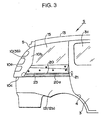
- Fig. 3 is a side view of the vehicle-body rear part in Fig. 2, showing a state where a cover member is removed.
- Fig. 4 is a perspective view of the vehicle-body rear part in Fig. 2, showing a state where a slide door is slid rearward.
- Fig. 5 is a longitudinal sectional view of the vehicle-body rear part in which the slide door is kept opened in Fig. 4, showing the relation between each of a guide rail, a door support member and the cover member.
- Fig. 6 is a horizontal sectional view of the vehicle-body rear part at the height of the guide rail, showing an example of a driving mechanism.
- Fig. 7 is a horizontal sectional view of a tail lamp at a position higher than the guide rail.
- Fig. 8 is a longitudinal sectional view of the vehicle-body rear part which corresponds to Fig. 5, showing the rear-end part of the guide rail.
- Fig. 9 is a sectional view of the main part which corresponds to Fig. 6 according to a second embodiment of the present invention.
- Fig. 10 is a sectional view of the main part which corresponds to Fig. 6 according to a third embodiment of the present invention.
-
- In Fig. 1, a front side door 1 which is used for a driver's seat or an assistant seat in a vehicle S swings on its front-end part so that it can be opened and closed. It opens and closes a front opening 2 through which a person gets into and out of the vehicle S. Herein, the front opening 2 leads from a vehicle cabin to the outside of the vehicle S. In the side part of a vehicle body, a
slide door 3 is provided as a rear side door which is located behind the front side door 1. Thisslide door 3 is used to open and close arear opening 4 for a backseat (also see Fig. 4) through which a person gets into and out of the vehicle S. It slides in the front and rear directions. When located at the front slide end, it covers therear opening 4 which leads from the vehicle cabin to the outside of the vehicle S. That is called a closed position. When moved rearward, it comes to an opened position where it opens therear opening 4. As shown in Fig. 5, such aslide door 3 has a section which is closed with aninner panel 3a and anouter panel 3b. In its upper part, a pane ofwindow glass 3c is fitted (see Fig. 1 to Fig. 4). - In the vehicle S, a
back opening 5 is formed in its rear surface (also see Fig. 4). Thisback opening 5 is opened and closed by a back door 6. The back door 6 swings on its upper-end part so that it can be opened and closed. However, it may also be opened and closed suitably, for example, it may swing laterally on its end part in the vehicle-width directions. - As shown in Fig. 1 to Fig. 4, in the vehicle S, a
tail lamp 10 is provided at each end part in the vehicle-width directions (i.e., in the right-and-left directions) of its rear-end part. Thistail lamp 10 is attached to a rear pillar which is located on each of the right and left of the back door 6. It is fixed in a certain position of the vehicle body, whether the back door 6 is opened or closed. Thetail lamp 10 includes a rear-surface portion 10a which faces behind the vehicle S, and a side-surface portion 10b which faces on the outside in the vehicle-width directions. In such atail lamp 10, for example, at least one of a side light (or lamp), a brake lamp and a turn indicator light is placed. According to this embodiment, all of them are integrated. Herein, in Fig. 1, reference numeral 7 denotes a rear bumper. In Fig. 2 to Fig. 4, the rear bumper 7 and the back door 6 are removed. In Fig. 1 to Fig. 4,reference numeral 12 designates a rear quarter panel which configures the vehicle-body side part behind therear opening rear quarter panel 12 has a section which is closed with aninner panel 12a and anouter panel 12b. A rear quarter-window glass 15 is provided in the upper part of therear quarter panel 12. The rear-end part of therear quarter panel 12 configures the rear pillar to which thetail lamp 10 is attached. - To the vehicle-body side part, a
guide rail 20 is attached behind therear opening 4. Thisguide rail 20 is used to guide theslide door 3 in the front and rear directions. Its front end is located at the rear-edge part of therear opening 4, and its rear end extends rearward slightly from the front end of thetail lamp 10, if seen from the side of the vehicle body. Theguide rail 20 which extends in the front and rear directions is designed so that its lower edge is located substantially at the same height as a lower horizontally-seenline 10c of thetail lamp 10. In other words, thetail lamp 10 extends upward from the level of theguide rail 20. The above described side light, brake lamp and turn indicator light are placed apart from each other in the up-and-down directions. Such aguide rail 20 is located at substantially the middle part of theslide door 3 in the up-and-down directions. In other words, theguide rail 20 is in a position slightly lower from a belt-line which is located right below thewindow glass 3c of theslide door 3. Thisguide rail 20 is fixed on the vehicle body by welding, bolt fixing, or the like. - As shown in Fig. 3 and Fig. 5, the
guide rail 20 has an opening portion 20a which is opened outward in the vehicle-width directions. This opening portion 20a extends over the full length of theguide rail 20. Into such aguide rail 20, as shown in Fig. 5 and Fig. 6, adoor support member 21 is fitted so as to slide. Thisdoor support member 21 is attached to the rear inner-end part of theslide door 3. It includes a pair ofbracket members 21 a, 21 b, and the onebracket member 21 a is fixed on theslide door 3 by welding, bolt fixing, or the like. To the tip-end part of thebracket member 21 a, the base-end part of the other bracket member 21 b is connected by means of apin 21 c, so that the bracket member 21 b can turn on its axial line in the up-and-down directions. - On the tip-end part of the other bracket member 21 b, a pair of
guide rollers guide roller 21d can rotate on its axial line which extends in substantially the horizontal directions. Thereby, it is designed to move on the bottom-wall part of theguide rail 20. In other words, theguide roller 21 d is supposed mainly to keep theslide door 3 from being displaced downward. Theother guide roller 21 e can rotate on its axial line which extends in the up-and-down directions. It is located between a pair of side-wall parts of theguide rail 20. Those side-wall parts are disposed at a certain distance from each other in the vehicle-width directions, so that they prevents theguide roller 21 e from being shifted beyond that distance in the vehicle-width directions. In other words, theguide roller 21 e is supposed to keep theslide door 3 from being displaced in the vehicle-width directions. Herein, assuch guide rollers - A panel member, which is located behind the
rear opening 4 through which a person gets into and out of the vehicle and forms an exterior surface of the vehicle body, is configured by the above describedouter panel 12b of therear quarter panel 12. As shown in Fig. 5, to thisouter panel 12b, apanel member 14 is connected which configures a rear wheel housing. At the level of theguide rail 20, theouter panel 12b dents inward in the vehicle-width directions, and continuously, extends upward. Hence, alevel difference 23 is formed by denting inward in the vehicle-width directions, and theguide rail 20 is disposed above the part of thelevel difference 23. In other words, theguide rail 20 is designed so as not to protrude outward in the vehicle-width directions from the extended line which is formed by extending upward the exterior surface of theouter panel 12b located below theguide rail 20. - The
guide rail 20 is covered with acover member 25 from the outside in the vehicle-width directions. Thiscover member 25 has, as shown in Fig. 5 and Fig. 6, a section which is closed with aninner panel 25a and anouter panel 25b. When theguide rail 20 is covered with thecover member 25, theouter panel 25b continues smoothly to theouter panel 12b located below it, so that they are substantially on the same surface. The above described rear quarter-window glass 15 is attached to an upper panel part above thelevel difference 23 in theouter panel 12b of thepanel member 12. The upper edge of thecover member 25 continues smoothly to the lower edge of the rear quarter-window glass 15. In other words, thecover member 25 is designed to smoothly connect the rear quarter-window glass 15 and theouter panel 12b below thelevel difference 23. In addition, in the exterior surface of thecover member 25, its front edge continues closely and smoothly to the rear edge in the exterior surface of theslide door 3 which is kept closed. - A
lower edge 25c of thecover member 25 extends straight in the front and rear directions along theguide rail 20. Between it and theouter panel 12b which is a rear fender, alittle space 26 is formed in the up-and-down directions (see Fig. 5). Thisspace 26 extends straight in the front and rear directions along theguide rail 20. The bracket member 21 b of the above describeddoor support member 21 is disposed to pass through thespace 26. In such aspace 26, its rear end is positioned substantially at the same height as a lower horizontally-seenline 10c of the tail lamp 10 (see Fig. 1 and Fig. 2), and continues smoothly to theline 10c. In thecover member 25, its rear edge is located immediately near thetail lamp 10. The exterior surface of thecover member 25 continues smoothly to the exterior surface of thetail lamp 10, substantially on the same surface (see Fig. 6). Hence, in the front and rear directions, the exterior surface of thecover member 25 configures the exterior surface of the vehicle body from theslide door 3 which is kept closed over to thetail lamp 10. In addition, in the up-and-down directions, it configures the exterior surface of the vehicle body from the rear quarter-window glass 15 over to thelevel difference 23. In other words, the exterior surface of thecover member 25 is designed to continue smoothly to each of its peripheral members in the up-and-down and front-and-rear directions. This improves the external appearance of the vehicle-body side part. - As shown in Fig. 6, the front-end part of the
guide rail 20 is bent forward and inward in the vehicle-width directions. When theslide door 3 is in the position where it closes therear opening 4 through which a person gets into and out of the vehicle, thedoor support member 21 is located at the front-end part of the guide rail 20 (i.e., in the position shown by a solid line in Fig. 6). When theslide door 3 is slid rearward from this state, it once goes outward in the vehicle-width directions, and then, moves rearward. Fig. 6 shows, by two-dot chain lines, a state where theslide door 3 is moved up to the vicinity of its rear end. Theguide rail 20 extends rearward further from the front end of thetail lamp 10, and thus, theslide door 3 can be moved rearward further from the position shown by the two-dot chain lines in Fig. 6. At its rearmost end, the rear-end part of thedoor support member 21 is located behind the front end of thetail lamp 10, if seen from the side of the vehicle body. - The
slide door 3 is opened and closed by adriving mechanism 40. Thedriving mechanism 40 includes: adrive portion 41 which houses a motor for driving or the like; awire 42 which has no end and a ring shape (i.e., it is endless), thewire 42 being connected to thedoor support member 21; and a pair of front andrear guide portions wire 42. Inside of eachguide portion wire 42 is disposed to pass through theguide rail 20, and is also placed to pass through thedrive portion 41 and (the guide pulleys of) theguide portions drive portion 41 is rotated, for example, in its regular direction, then theslide door 3 is driven forward. On the other hand, if the motor is rotated, for example, in its reverse direction, then theslide door 3 is driven rearward. Herein, the motor is controlled so as to stop in the front-end position and the rear-end position of theslide door 3. This keeps theslide door 3 from moving forward and rearward beyond predetermined positions. However, at each of the front and rear ends of theguide rail 20, for example, a stopper may also be provided which thedoor support member 21 comes into contact with. This also prevents theslide door 3 from moving back and forth further from the predetermined positions. Of course, theslide door 3 may also come into contact with the front edge of therear opening 4 through which a person gets into and out of the vehicle. Thereby, theslide door 3 can be prevented from moving forward beyond the predetermined position. Herein, a command to drive thedrive portion 41 is given using a manual switch or a remote-control switch provided in the vehicle cabin. In other words, such a switch issues a command to open or close theslide door 3. - With respect to the above described pair of front and
rear guide portions front guide portion 43 is located near the front end of theguide rail 20. It is fixed on theinner panel 12a of therear quarter panel 12, by means of a fixingpart 45 such as a bolt. On the other hand, therear guide portion 44 is located right near thetail lamp 10, so that it is wrapped from frontward in thetail lamp 10. It is fixed on theouter panel 12b of therear quarter panel 12, by means of a fixingpart 46 such as a bolt. Thisrear guide portion 44 is located a little behind theguide rail 20 and rearward from the front end of thetail lamp 10. In other words, if seen from the side of the vehicle body, theguide portion 44 overlaps with thetail lamp 10 in the vehicle-width directions. Herein, therear guide portion 44 has a structure in which acasing 44a houses aguide pulley 44b (and thefront guide portion 43 also has the same structure). This guide portion 44 (or Thecasing 44a thereof) is fixed on the tail lamp 10 (as described later). - Herein, the
tail lamp 10 has, as shown in Fig. 6 and Fig. 7, a hollow shape which is formed by aninner casing 35 and alens panel 36 which configures the exterior surface of thetail lamp 10. In the position where theguide portion 44 is located, the whole hollow part of thetail lamp 10 is narrow in the front and rear directions (see Fig. 6). On the other hand, in a position above theguide portion 44, the hollow part of thetail lamp 10 is, in the front and rear directions, broad enough to dispose a lamp 37 (see Fig. 7). As is apparent in Fig. 6, thetail lamp 10 has a rearward-convex shape at least near the position of theguide portion 44. In other words, it is concave there in the front direction. In this concave part, theguide portion 44 is disposed, and the rear-end part of theguide rail 20 is also located. - In the
inner casing 35 of thetail lamp 10, anattachment portion 35a is formed which protrudes forward like a tongue. To thisattachment portion 35a, theguide portion 44 is fixed by means of a fixingpart 50 such as a bolt. In other words, thecasing 44a of theguide portion 44 is fixed not only to theouter panel 12b by means of the above described fixingpart 46, but also to thetail lamp 10 by means of the fixingpart 50. When theguide portion 44 is attached to the vehicle body, in advance, by means of the fixingpart 50, theguide portion 44 is attached to thetail lamp 10. Then, at the time when thetail lamp 10 is attached to the vehicle body, by means of the fixingpart 46, theguide portion 44 can be attached to the vehicle body. This allows theguide portion 44 to be easily integrated into the vehicle body, and also heightens their attachment strength after integrated. - Fig. 8 shows in detail the part of the
guide rail 20 which extends behind the front end of thetail lamp 10. As is apparent in Fig. 8, the rear-end part of theguide rail 20 does not have a pair of right and left side-wall parts which keeps theguide roller 21 e located behind from being displaced in the vehicle-width directions. The lower-edge part of thetail lamp 10 is located outward in the vehicle-width directions from theguide roller 21 e. Herein, in theguide rail 20, the part where the pair of upper andlower guide rollers - In Fig. 1,
reference numeral 8 denotes a side sill. In thisside sill 8, at its part located behind therear opening 4 through which a person gets into and out of the vehicle, aguide rail 31 is formed in its exterior surface in the vehicle-width directions. Theguide rail 31 is used to guide theslide door 3 in the front and rear directions. Into theguide rail 31, the tip-end part of adoor support member 32 is fitted, which is attached to the front inner-end part of theslide door 3. Herein, theguide rail 31 and thedoor support member 32 which are located in front have only the function of smoothly sliding and guiding theslide door 3 along a predetermined track. In short, the above described drivingmechanism 40 is not provided. Herein, thefront guide rail 31 anddoor support member 32 are provided so that theslide door 3 can be slid more smoothly in the front and rear directions, and thus, they are not necessarily required. - Fig. 9 shows the vehicle slide-door supporting structure according to a second embodiment of the present invention. It corresponds to the part of the
guide portion 44 shown in Fig. 6. According to this embodiment, therear guide portion 44 is fixed to theouter panel 12b by means of the fixingpart 46 such as a bolt. In addition, by means of a fixingpart 47 such as a bolt which fix thetail lamp 10 on theouter panel 12b, theguide portion 44 is fixed to theouter panel 12b. In other words, anattachment portion 35b where thetail lamp 10 is attached to the vehicle body, and theguide portion 44, are fixed together to theouter panel 12b by means of the fixingpart 47. Herein, theattachment portion 35b of thetail lamp 10 to the vehicle body is strong (or rigid) enough. In addition, theattachment portion 35b may also be extended farther so that theouter panel 12b and theattachment portion 35b can be fixed together also by means of the bolt 46 (i.e., the former and the latter two members are each fixed together by means of several fixing parts). - Fig. 10 shows the vehicle slide-door supporting structure according to a third embodiment of the present invention. According to this embodiment which corresponds to Fig. 9, an
attachment portion 35c of theinner casing 35 in thetail lamp 10 is fixed to theouter panel 12b by means of a fixingpart 48 such as a bolt. Theguide portion 44 is fixed to theattachment portion 35c of theinner casing 35, by means of fixingparts 49 such as bolts. Hence, according to this embodiment, by means of the fixingparts 49, thetail lamp 10 and theguide portion 44 are fixed as a module (or a unit). In this case, if thetail lamp 10 is fixed in a predetermined position of theouter panel 12b or the vehicle body, then theguide portion 44 is mechanically fixed in a predetermined position of the vehicle body. Herein, theattachment portion 35c of theinner casing 35 to the vehicle body according to this embodiment is formed by extending theattachment portion 35b of Fig. 9 longer along theouter panel 12b. Thisattachment portion 35c is also used as an attachment portion where theguide portion 44 is attached to thetail lamp 10. - Hereinafter, the
guide portion 44 disposed behind will be described in further detail. First, according to each embodiment of Fig. 6, Fig. 9 and Fig. 10, theguide portion 44 includes, as described earlier: thecasing 44a which is attached directly, or indirectly via thetail lamp 10, to the vehicle body; and theguide pulley 44b which is disposed inside of thiscasing 44a and around which thewire 42 is placed (or wound). At least theguide pulley 44b itself is located in the vehicle-body outside direction from theouter panel 12b to which theguide rail 20 is attached. Herein, the axial line on which theguide pulley 44b rotates is set to extend substantially in the up-and-down directions. However, from the point of view of its positional relation with thedrive portion 41 or the like, it may also be set to extend substantially in the horizontal directions. Or, it can also be set to incline from each of the up-and-down directions and in the horizontal directions, or the like. - The
guide portion 44 or theguide pulley 44b is located in the boundary position between the vehicle-body rear plane and the vehicle-body side plane in theouter panel 12b. Besides, it is located in the vehicle-body outside direction from this boundary position. Therefore, thewire 42 which is pulled out of the rear end of theguide rail 20 passes through theguide pulley 44b and is guided in the vehicle-body inside direction. Thereafter, when drawn and turned forward, thewire 42 does not need to be forcibly bent. - In the
tail lamp 10, its part which faces at least theguide portion 44 is aconcave portion 51 which opens forward. In other words, in the example of Fig. 6, the whole front surface of thetail lamp 10 is bent over almost its full length in the vehicle-width directions, so that it becomes convex rearward (or concave forward). In this way, theconcave portion 51 is formed. On the other hand, in the examples of Fig. 9 and Fig. 10, only the part which faces theguide portion 44 is theconcave portion 51 which opens forward. In each case, theguide portion 44 is disposed in theconcave portion 51 so that it protrudes into theconcave portion 51. - Hereinbefore, the embodiments have been described, but a part of the
tail lamp 10 may also be attached to the back door 6. In addition, thetail lamp 10 can also be placed in a far lower position than according to the embodiments, so that its upper edge (i.e., upper horizontally-seen line) is positioned substantially at the same height as theguide rail 20. Furthermore, the rear end of theguide rail 20 may also be located just near the front end of thetail lamp 10, not behind the front end of thetail lamp 10. Moreover, thedrive portion 41 of thedriving mechanism 40 may also be attached to thetail lamp 10, in the same way as theguide portion 44. Besides, both thedrive portion 41 and theguide portion 44 may also be attached to thetail lamp 10. In addition, thisdrive portion 41 may also be wrapped from frontward in thetail lamp 10. Herein, the objects of the present invention are not limited to the described ones. They also tacitly include providing the ones which are described as practically preferable or advantageous. - Although the present invention has been fully described by way of example with reference to the accompanied drawings, it is to be understood that various changes and modifications will be apparent to those skilled in the art. Therefore, unless otherwise such changes and modifications depart from the scope of the present invention hereinafter defined, they should be construed as being included therein.
Claims (25)
- A vehicle slide-door supporting structure, comprising:wherein one part of the driving mechanism (40) is wrapped from frontward in a tail lamp (10) which is disposed at the rear part of the vehicle body.a slide door (3) which is a side door that opens and closes an opening (4) through which a person gets into and out of a vehicle, the opening being formed in a side part of a vehicle body, the side door being slid in the front and rear directions so that the opening is opened and closed, and the opening being opened when the side door is slid rearward; anda driving mechanism (40) which is connected to the slide door and drives the slide door,
- The vehicle slide-door supporting structure according to claim 1, wherein in the one part of the driving mechanism (40), at least a rear-end part thereof overlaps with the tail lamp (10) in the vehicle-width directions, if seen from the side of the vehicle body.
- The vehicle slide-door supporting structure according to one of the preceding claims, wherein the whole one part of the driving mechanism (40) is located behind the front end of the tail lamp (10).
- The vehicle slide-door supporting structure according to one of the preceding claims, wherein:the driving mechanism (40) includes a wire (42) which is connected to the slide door (3), a drive portion (41) which drives the slide door via the wire (42), and a guide portion (43, 44) which guides the wire (42); andthe one part of the driving mechanism (40) includes the guide portion (43, 44).
- The vehicle slide-door supporting structure according to claim 4, wherein the guide portion (43, 44) includes a guide pulley (44b) around which the wire (42) is placed.
- The vehicle slide-door supporting structure according to one of the preceding claims, further comprising:a guide rail (20), disposed in the side part of the vehicle body, which extends in the front and rear directions and guides the slide door (3) in the front and rear directions; and wherein the rear end of the guide rail extends rearward long up to a position adjacent to the tail lamp (10).
- The vehicle slide-door supporting structure according to claim 6, wherein at least the rear end of the guide rail (20) is positioned substantially at the same height as the horizontally-seen line of the tail lamp (10).
- The vehicle slide-door supporting structure according to claim 6 or 7,
wherein:a cover member (25) is disposed which forms an exterior surface of the vehicle body and covers the guide rail (20) from the outside of the vehicle body;the lower edge of the cover member (25) extends in the front and rear directions along the guide rail (20) and is substantially at the same height as the horizontally-seen line of the tail lamp (10); andthe exterior surface of the cover member (25) continues to the exterior surface of the tail lamp (10) with little space and substantially on the same surface. - The vehicle slide-door supporting structure according to claim 5, 6, 7 or 8, wherein the guide pulley (44b) is disposed to protrude toward the outside of the vehicle body from a vehicle-body panel member to which the guide rail (20) is attached.
- The vehicle slide-door supporting structure according to claim 5, 6, 7, 8 or 9, wherein the guide pulley (44b) is disposed in a boundary position between the vehicle-body rear plane and the vehicle-body side plane in the rear part of the vehicle body.
- The vehicle slide-door supporting structure according to one of the preceding claims in combination with claim 5, wherein:a concave portion (51) which is opened frontward is formed in the front part of the tail lamp (10); andthe guide pulley (44b) is located inside of the concave portion (51).
- The vehicle slide-door supporting structure according to one of the preceding claims, wherein said one part of the driving mechanism (40) is attached to a tail lamp (10) which is disposed at the rear part of the vehicle body.
- The vehicle slide-door supporting structure according to claim 12,
wherein:a concave portion (51) which is opened frontward is formed in the front part of the tail lamp (10); andthe one part of the driving mechanism (40) is located inside of the concave portion (51). - The vehicle slide-door supporting structure according to claim 12 or 13,
wherein the one part of the driving mechanism (40) is attached to an attachment portion of the tail lamp (10) to the vehicle body. - The vehicle slide-door supporting structure according to claim 12, 13 or 14, wherein the one part of the driving mechanism (40) and the tail lamp (10) are assembled beforehand into a unit body, and the unit body is attached to the vehicle body so that the part of the driving mechanism (40) and the tail lamp (10) are attached to the vehicle body.
- The vehicle slide-door supporting structure according to claim 12, 13, 14 or 15, wherein an attachment portion (35a, 35b, 35c) of the tail lamp (10) to the vehicle body, together with the one part of the driving mechanism (40), is fixed on the vehicle body, by means of a fixing part (47, 48, 50).
- The vehicle slide-door supporting structure according to one of the preceding claims, further comprising:a guide rail (20), disposed in the side part of the vehicle body, which extends in the front and rear directions and guides the slide door (3);a door support member (21), disposed in the slide door 3, which fits into the guide rail (20) so that it is slid;the guide rail (20) extends rearward long so that the rear end thereof comes close to the tail lamp (10) which is disposed at the rear part of the vehicle body; andthe horizontally-seen line of the tail lamp (10) is set to be substantially at the same height as the guide rail (20).
- The vehicle slide-door supporting structure according to claim 17, wherein the door support member (21) is slid up to the vicinity of the tail lamp (10) as the slide door (3) moves rearward.
- The vehicle slide-door supporting structure according to claim 17 or 18, wherein the rear-end part of the guide rail (20) extends rearward from the front end of the tail lamp (10), if seen from the side of the vehicle body.
- The vehicle slide-door supporting structure according to claim 17, 18 or 19, wherein the door support member (21) is slid rearward so that the rear-end part thereof is positioned behind the front end of the tail lamp (10).
- The vehicle slide-door supporting structure according to claim 17, 18, 19 or 20, wherein:a cover member (25) is disposed which covers the guide rail (20) from the outside of the vehicle body and whose lower edge extends in the front and rear directions;the cover member (25) forms an exterior surface of the vehicle body and continues to a panel member (12) with a little space in the up-and-down directions and substantially on the same surface, the panel member (12) being located below the cover member (25) and forming an exterior surface of the vehicle body; andthe door support member (21) is disposed to pass through the space and slide along the lower edge of the cover member (25).
- The vehicle slide-door supporting structure according to claim 21,
wherein:the lower edge of the cover member (25) extends straight in the front and rear directions substantially at the same height as the lower horizontally-seen line of the tail lamp (10); andthe exterior surface of the cover member (25) continues to the exterior surface of the tail lamp (10) with little space and substantially on the same surface. - The vehicle slide-door supporting structure according to one of the preceding claims, further comprising:a guide rail (20), disposed in the side part of the vehicle body, which extends in the front and rear directions and guides the slide door (3);a door support member (21), disposed in the slide door 3, which fits into the guide rail (20) so that it is slid;the guide rail (20) extends rearward long so that the rear end thereof comes close to the tail lamp (10) which is disposed at the rear part of the vehicle body; anda cover member (25) which forms an exterior surface of the vehicle body, covers at least the rear-end part of the guide rail (20) from the outside of the vehicle body and continues to the front edge of the tail lam (10).
- The vehicle slide-door supporting structure according to claim 23,
wherein:the lower edge of the cover member (25) extends straight in the front and rear directions along the guide rail (20);the lower edge of the cover member (25) continues to a panel member (12) with a little space in the up-and-down directions and substantially on the same surface, the panel member (12) being located below the cover member (25) and forming an exterior surface of the vehicle body;the door support member (21) is disposed to pass through the space and slide along the lower edge of the cover member (25); andthe front edge of the cover member (25) continues adjacently and smoothly to the rear edge of the slide door (3) which is kept closed. - The vehicle slide-door supporting structure according to claim 24,
wherein:the panel member (12) has a level difference (23) which dents toward the inside of the vehicle body and extends in the front and rear directions, and above the level difference (23), the guide rail (20) and the cover member (25) are disposed;in the panel member (12), rear quarter-window glass (15) is attached to an upper panel portion which is located upward from the level difference (23); andthe cover member (25) connects smoothly the upper edge of a lower panel portion which is located downward from the level difference in the panel member and the lower edge of the rear quarter-window glass (15).
Applications Claiming Priority (8)
| Application Number | Priority Date | Filing Date | Title |
|---|---|---|---|
| JP2003311382 | 2003-09-03 | ||
| JP2003311385A JP4305101B2 (en) | 2003-09-03 | 2003-09-03 | Vehicle sliding door support structure |
| JP2003311383A JP4269852B2 (en) | 2003-09-03 | 2003-09-03 | Vehicle sliding door support structure |
| JP2003311384A JP4305100B2 (en) | 2003-09-03 | 2003-09-03 | Vehicle sliding door support structure |
| JP2003311384 | 2003-09-03 | ||
| JP2003311383 | 2003-09-03 | ||
| JP2003311382A JP4265349B2 (en) | 2003-09-03 | 2003-09-03 | Vehicle sliding door support structure |
| JP2003311385 | 2003-09-03 |
Publications (2)
| Publication Number | Publication Date |
|---|---|
| EP1512566A1 true EP1512566A1 (en) | 2005-03-09 |
| EP1512566B1 EP1512566B1 (en) | 2006-07-05 |
Family
ID=34139748
Family Applications (1)
| Application Number | Title | Priority Date | Filing Date |
|---|---|---|---|
| EP04020773A Expired - Lifetime EP1512566B1 (en) | 2003-09-03 | 2004-09-01 | Vehicle slide-door supporting structure |
Country Status (4)
| Country | Link |
|---|---|
| US (1) | US7159929B2 (en) |
| EP (1) | EP1512566B1 (en) |
| CN (1) | CN100519244C (en) |
| DE (1) | DE602004001423T2 (en) |
Cited By (1)
| Publication number | Priority date | Publication date | Assignee | Title |
|---|---|---|---|---|
| US20230118226A1 (en) * | 2021-10-19 | 2023-04-20 | Hyundai Motor Company | Structure of flap part for covering rail part when opening sliding door of vehicle |
Families Citing this family (17)
| Publication number | Priority date | Publication date | Assignee | Title |
|---|---|---|---|---|
| JP4098273B2 (en) * | 2004-05-11 | 2008-06-11 | 本田技研工業株式会社 | Body structure of vehicle with sliding door |
| JP4442496B2 (en) * | 2005-04-13 | 2010-03-31 | トヨタ自動車株式会社 | Sliding door structure |
| DE102007017169A1 (en) * | 2007-04-12 | 2008-10-16 | GM Global Technology Operations, Inc., Detroit | Rail system of a storage and guide device for a motor vehicle sliding door |
| DE102008008128A1 (en) * | 2008-02-08 | 2009-08-13 | GM Global Technology Operations, Inc., Detroit | Cover of guide parts of a motor vehicle sliding door |
| US7963587B2 (en) * | 2009-05-12 | 2011-06-21 | Honda Motor Company, Ltd. | Attachments to sliding doors and vehicles including same |
| US20100289299A1 (en) * | 2009-05-13 | 2010-11-18 | Kenichi Kitayama | Sliding door mechanisms and vehicles including same |
| DE102010027751B4 (en) * | 2010-04-14 | 2019-03-21 | Ford Global Technologies, Llc | motor vehicle |
| JP5712917B2 (en) * | 2011-12-22 | 2015-05-07 | トヨタ自動車株式会社 | Vehicle rear lamp and vehicle body side structure |
| CN104136249A (en) * | 2012-03-01 | 2014-11-05 | 丰田自动车株式会社 | Vehicle side structure |
| JP5796238B2 (en) * | 2014-02-07 | 2015-10-21 | 三井金属アクト株式会社 | Opening and closing device for vehicle door |
| FR3046574B1 (en) * | 2016-01-07 | 2018-01-26 | Psa Automobiles Sa. | COVER FOR SLIDING DOOR GUIDE ARMS OF MOTOR VEHICLE |
| EP3199734B1 (en) | 2016-01-27 | 2018-10-10 | Ford Global Technologies, LLC | Centre track design for a sliding door |
| CN107433489A (en) * | 2016-05-25 | 2017-12-05 | 成都与俱科技有限公司 | Mobile door for lathe |
| CN106740890A (en) * | 2016-09-13 | 2017-05-31 | 封璘波 | The car of tree-shaped artificial intelligence Air Traffic System |
| US11585137B2 (en) | 2019-07-02 | 2023-02-21 | The Braun Corporation | Modified door operation for a motorized vehicle |
| CN114622791B (en) * | 2022-03-30 | 2024-03-12 | 浙江吉利控股集团有限公司 | Sliding door devices and automobiles |
| JP7782369B2 (en) * | 2022-05-31 | 2025-12-09 | スズキ株式会社 | Body structure |
Citations (3)
| Publication number | Priority date | Publication date | Assignee | Title |
|---|---|---|---|---|
| JPS6092925A (en) * | 1983-10-27 | 1985-05-24 | Oi Seisakusho Co Ltd | Operating apparatus for automatic opening and closing apparatus for slide door for car |
| US4887390A (en) * | 1987-12-18 | 1989-12-19 | Masco Industries, Inc. | Powered sliding door opener/closer for vehicles |
| US20030071484A1 (en) * | 2001-10-12 | 2003-04-17 | Honda Giken Kogyo Kabushiki Kaisha | Attachment structure of slide rail cover to vehicle body |
Family Cites Families (8)
| Publication number | Priority date | Publication date | Assignee | Title |
|---|---|---|---|---|
| US4991905A (en) * | 1988-08-29 | 1991-02-12 | Suzuki Motor Company Limited | Vehicle construction of automobile provided with slide door |
| FR2684049B1 (en) * | 1991-11-27 | 1994-03-04 | Peugeot Automobiles | DEVICE FOR GUIDING A SLIDING OPENING DEVICE SUCH AS A SLIDING DOOR, PARTICULARLY FOR A MOTOR VEHICLE. |
| IT1290825B1 (en) * | 1996-04-02 | 1998-12-11 | Kiekert Ag | VEHICLE WITH ELECTRONIC CONTROL DEVICE FOR OPERATING THE VEHICLE DOOR WITH LOCKING THE VEHICLE DOOR |
| JP3452009B2 (en) * | 1999-12-22 | 2003-09-29 | トヨタ車体株式会社 | Center rail mounting structure of sliding door |
| JP4747471B2 (en) | 2001-09-10 | 2011-08-17 | アイシン精機株式会社 | Sliding door device for vehicle |
| JP2004284539A (en) * | 2003-03-25 | 2004-10-14 | Mazda Motor Corp | Car side structure |
| JP4098273B2 (en) * | 2004-05-11 | 2008-06-11 | 本田技研工業株式会社 | Body structure of vehicle with sliding door |
| JP3889419B2 (en) * | 2004-08-30 | 2007-03-07 | 本田技研工業株式会社 | Sliding door device for vehicle |
-
2004
- 2004-08-30 CN CNB2004100769960A patent/CN100519244C/en not_active Expired - Lifetime
- 2004-09-01 US US10/930,906 patent/US7159929B2/en not_active Expired - Lifetime
- 2004-09-01 EP EP04020773A patent/EP1512566B1/en not_active Expired - Lifetime
- 2004-09-01 DE DE602004001423T patent/DE602004001423T2/en not_active Expired - Lifetime
Patent Citations (3)
| Publication number | Priority date | Publication date | Assignee | Title |
|---|---|---|---|---|
| JPS6092925A (en) * | 1983-10-27 | 1985-05-24 | Oi Seisakusho Co Ltd | Operating apparatus for automatic opening and closing apparatus for slide door for car |
| US4887390A (en) * | 1987-12-18 | 1989-12-19 | Masco Industries, Inc. | Powered sliding door opener/closer for vehicles |
| US20030071484A1 (en) * | 2001-10-12 | 2003-04-17 | Honda Giken Kogyo Kabushiki Kaisha | Attachment structure of slide rail cover to vehicle body |
Non-Patent Citations (1)
| Title |
|---|
| PATENT ABSTRACTS OF JAPAN vol. 0092, no. 38 (M - 416) 25 September 1985 (1985-09-25) * |
Cited By (2)
| Publication number | Priority date | Publication date | Assignee | Title |
|---|---|---|---|---|
| US20230118226A1 (en) * | 2021-10-19 | 2023-04-20 | Hyundai Motor Company | Structure of flap part for covering rail part when opening sliding door of vehicle |
| US12257887B2 (en) * | 2021-10-19 | 2025-03-25 | Hyundai Motor Company | Structure of flap part for covering rail part when opening sliding door of vehicle |
Also Published As
| Publication number | Publication date |
|---|---|
| US7159929B2 (en) | 2007-01-09 |
| CN1590690A (en) | 2005-03-09 |
| DE602004001423T2 (en) | 2007-02-08 |
| US20050044795A1 (en) | 2005-03-03 |
| CN100519244C (en) | 2009-07-29 |
| DE602004001423D1 (en) | 2006-08-17 |
| EP1512566B1 (en) | 2006-07-05 |
Similar Documents
| Publication | Publication Date | Title |
|---|---|---|
| EP1512566B1 (en) | Vehicle slide-door supporting structure | |
| US7559597B2 (en) | Vehicle roof automatic opening/closing device | |
| US6880884B2 (en) | Vehicle sunroof structure | |
| US20070145731A1 (en) | Blind member for vehicle, and gap-closing structure including blind member | |
| JPH0315576B2 (en) | ||
| JP2009298259A (en) | Vehicle body side part structure | |
| JP5146127B2 (en) | Body side structure | |
| JP4269852B2 (en) | Vehicle sliding door support structure | |
| JP3666711B2 (en) | Automotive window regulator | |
| US8042302B2 (en) | Window pane for a motor vehicle | |
| US12084901B2 (en) | Sliding door device for vehicle | |
| JP4265349B2 (en) | Vehicle sliding door support structure | |
| JP4305101B2 (en) | Vehicle sliding door support structure | |
| JP2007269086A (en) | Vehicle entry / exit step structure | |
| JP4305100B2 (en) | Vehicle sliding door support structure | |
| CN103171485B (en) | Vehicle taillight and structure for vehicle body side section | |
| JP5115700B2 (en) | Vehicle sliding door drive device | |
| JP6479610B2 (en) | vehicle | |
| US20260001592A1 (en) | Vehicle fender assembly | |
| CN223317721U (en) | Sliding door drive mechanism | |
| JP2005289304A (en) | Side protector mounting structure | |
| KR0185899B1 (en) | Inside handle of car door having anti-theft structure | |
| JP4121992B2 (en) | Door glass slide mounting structure | |
| JPH0732199Y2 (en) | Side door glass guide structure | |
| JPH059012U (en) | Car antenna |
Legal Events
| Date | Code | Title | Description |
|---|---|---|---|
| PUAI | Public reference made under article 153(3) epc to a published international application that has entered the european phase |
Free format text: ORIGINAL CODE: 0009012 |
|
| AK | Designated contracting states |
Kind code of ref document: A1 Designated state(s): AT BE BG CH CY CZ DE DK EE ES FI FR GB GR HU IE IT LI LU MC NL PL PT RO SE SI SK TR |
|
| AX | Request for extension of the european patent |
Extension state: AL HR LT LV MK |
|
| 17P | Request for examination filed |
Effective date: 20050707 |
|
| GRAP | Despatch of communication of intention to grant a patent |
Free format text: ORIGINAL CODE: EPIDOSNIGR1 |
|
| AKX | Designation fees paid |
Designated state(s): DE |
|
| GRAS | Grant fee paid |
Free format text: ORIGINAL CODE: EPIDOSNIGR3 |
|
| GRAA | (expected) grant |
Free format text: ORIGINAL CODE: 0009210 |
|
| AK | Designated contracting states |
Kind code of ref document: B1 Designated state(s): DE |
|
| REF | Corresponds to: |
Ref document number: 602004001423 Country of ref document: DE Date of ref document: 20060817 Kind code of ref document: P |
|
| PLBE | No opposition filed within time limit |
Free format text: ORIGINAL CODE: 0009261 |
|
| STAA | Information on the status of an ep patent application or granted ep patent |
Free format text: STATUS: NO OPPOSITION FILED WITHIN TIME LIMIT |
|
| 26N | No opposition filed |
Effective date: 20070410 |
|
| PGFP | Annual fee paid to national office [announced via postgrant information from national office to epo] |
Ref country code: DE Payment date: 20230802 Year of fee payment: 20 |
|
| REG | Reference to a national code |
Ref country code: DE Ref legal event code: R071 Ref document number: 602004001423 Country of ref document: DE |