EP1512071B1 - Verfahren zum prüfen von codes für mikroschaltungen mit eingeschränkten ressourcen - Google Patents
Verfahren zum prüfen von codes für mikroschaltungen mit eingeschränkten ressourcen Download PDFInfo
- Publication number
- EP1512071B1 EP1512071B1 EP03735717A EP03735717A EP1512071B1 EP 1512071 B1 EP1512071 B1 EP 1512071B1 EP 03735717 A EP03735717 A EP 03735717A EP 03735717 A EP03735717 A EP 03735717A EP 1512071 B1 EP1512071 B1 EP 1512071B1
- Authority
- EP
- European Patent Office
- Prior art keywords
- reallocation
- code
- type
- intermediate code
- verification
- Prior art date
- Legal status (The legal status is an assumption and is not a legal conclusion. Google has not performed a legal analysis and makes no representation as to the accuracy of the status listed.)
- Expired - Lifetime
Links
Images



Classifications
-
- G—PHYSICS
- G06—COMPUTING OR CALCULATING; COUNTING
- G06F—ELECTRIC DIGITAL DATA PROCESSING
- G06F8/00—Arrangements for software engineering
- G06F8/40—Transformation of program code
- G06F8/41—Compilation
- G06F8/44—Encoding
- G06F8/441—Register allocation; Assignment of physical memory space to logical memory space
-
- G—PHYSICS
- G06—COMPUTING OR CALCULATING; COUNTING
- G06F—ELECTRIC DIGITAL DATA PROCESSING
- G06F9/00—Arrangements for program control, e.g. control units
- G06F9/06—Arrangements for program control, e.g. control units using stored programs, i.e. using an internal store of processing equipment to receive or retain programs
- G06F9/44—Arrangements for executing specific programs
- G06F9/445—Program loading or initiating
- G06F9/44589—Program code verification, e.g. Java bytecode verification, proof-carrying code
Definitions
- the present invention relates to a method for checking codes used with microcircuits with limited resources, as used in smart cards, in particular to verify the integrity and ensure the safety of the code.
- Smart cards Electronic microcircuit cards, called smart cards, are used as a mobile computing support for a wide variety of applications and most of them require a high level of security, including banking, secure payments, buildings or secure areas and telecommunications.
- a platform such as Java has two advantages, the standardization of the intermediate code, called "bytecode”, and its independence from the machine. Any Java program can therefore be compiled into a series of bytecode instructions universally understood by any machine based on such a platform.
- An intermediate code verification program of Java type is described in the patent US 5,740,441 .
- the verification method described in this patent is suitable for computer systems such as PCs whose computing power of their processor and RAM memory capacity (Random Access Memory) are significantly higher than those of a smart card.
- the power of a processor and the capacity of RAM or persistent ROM (Read Only Memory) are a function of the embedded silicon surface.
- Smart cards have to respect mechanical stresses, in particular torsion and bending, and secondly to guarantee a reasonable lifetime, their silicon surface does not generally exceed 25 mm 2 .
- the memory of a smart card typically has a capacity of about 8 kilobytes, therefore much less than the RAM capacity of the lowest performing PC computer currently on the market.
- One of these approaches consists in adding to the code the result of a pre-calculation algorithm which will then be taken up by the bytecode verifier.
- This may be for example the PCC (Proof Carrying Code) method or a variant of the latter which allows the auditor to use simpler algorithms.
- a program such as any Java applet, does not understand the additional PCC code, so it can not be checked by the microcircuit. The sphere use of microcircuits using these methods is therefore limited.
- Another approach is to modify the intermediate code of the program to check outside the device so that the verification process is easier without causing a decrease in reliability, as described in the international patent application.
- WO 0114958 A2 a method for verifying a Java-type program in which the intermediate code is modified by a so-called "normalization" method in an external data processing system before transferring this modified code into a code is described.
- embedded system During this normalization, the real register of the types is reallocated to a virtual register, each box of this register only defining one type, that is to say that the virtual register is monomorphic. This modification therefore greatly reduces the memory consumption required to store the different types of a polymorphic register during the verification process.
- the conventional methods of verification of the intermediate code (bytecode) Java intended to be used in microcircuits to Limited resources may also have the disadvantages of increasing the amount of information to be transmitted to the microcircuit, requiring the implementation and execution of relatively complex software in the external computer system in communication with the smart card, or limit the use of certain optimization techniques for calculating the program.
- one of the objectives of the invention is to provide an intermediate code verification method intended to be executed in a microcircuit object with limited resources, reliable and economical in terms of occupancy of resources of memory of the microcircuit, in particular the volatile memory or other memories accessible in writing and reading the microcircuit.
- an intermediate code verification method executable by a resource-limited microcircuit connected to an external data processing system includes a step of modifying the intermediate code comprising reallocation of real type registers to virtual registers of monomorphic types, and construction of a reallocated code whose instructions refer to the virtual registers, and a step of checking the code reallocated in the microcircuit with limited resources, characterized in that, in the event of success of the verification of the reallocated code in the microcircuit, the original intermediate code is installed in the microcircuit with limited resources for execution.
- the modification of the original intermediate code can be performed in an external data processing system before it is loaded into the resource-limited microcircuit, the modification comprising the generation of a reallocation component including an array of reallocation defining the reallocation of data of the type of a real register to data of the type of a monomorphic virtual register.
- the verification method comprises verifying the reallocation component and, if successful, verifying the reallocated code, the reallocated code being constructed either during the verification process of the reallocation component or after verification. the reallocation component. If the verification of the reallocated code completes successfully, the original bytecode is installed for execution, the original bytecode being either stored in a persistent memory accessible for reading and writing the microcircuit, is loaded from the external system.
- the steps of calculating the reallocation and the construction of the reallocated code can be performed in the microcircuit with limited resources, the original intermediate code being loaded into the microcircuit before the execution of the verification method and stored in a memory of the microcircuit, for example in a persistent memory accessible for reading and writing, type EEPROM (Electrical Erasable Programmable Read Only Memory).
- EEPROM Electrical Erasable Programmable Read Only Memory
- the generation of a reassigned code for verification makes it possible to generate a register of the monomorphic type reducing the consumption of the volatile memory of the microcircuit during the verification of the intermediate code.
- the installation of the original intermediate code for execution, after the verification process avoids possible problems related to the execution of a modified intermediate code and also allows the use of optimized calculation techniques.
- FIG. 1 the steps of a method for verifying an intermediate code, such as a Java or Javacard bytecode, according to a first embodiment of the invention, are shown.
- a microcircuit with limited resources in particular for an embedded system such as a smart card, is connected to an external data processing system (hereinafter "external system") for loading and executing a program such as a Java applet, or Javacard, in the microcircuit.
- the external system compiles and converts the Java program into a .cap file, that is, the intermediate code (bytecode) executable by the microcircuit.
- a reallocation component comprising a reallocation table T, as shown in FIGS. 2 and 3, is added to the original intermediate code.
- This reallocation component is generated by the external system by a method of reallocation. the known reallocation calculation, such as the "graph coloring" method.
- the graph color reallocation calculation is well known as such and is used for example in the verification process described in the international application WO 0114958 A2 .
- the original intermediate code is modified by a so-called "normalization" method.
- the instructions of the intermediate code and the register are modified, so that the register is monomorphic. that is, each register only receives data representing a single type and, on the other hand, at each branch instruction, the stack is empty.
- This transformation makes it possible to make the verification process linear and to avoid the high consumption in volatile memory (RAM) that the storage of registers that can accept data representing different types, that is to say the polymorphic registers, requires.
- the Java bytecode thus modified is used for the execution of the program after verification.
- the execution of the modified code can have consequences on the reliability of the execution, on the other hand it limits the possibilities to use the known optimization techniques of the Java bytecode, used for example to reduce the time execution time or communication time with the external system.
- the original intermediate code (bytecode) as well as the reallocation component is loaded into the microcircuit with limited resources.
- the original intermediate code is stored in memory of the microcircuit, for example in a persistent memory accessible in EEPROM reading and reading and the reallocation component is loaded into a volatile memory (RAM) of the microcircuit.
- the reallocation component is checked (step 110) and, if successful, the reassigned code is constructed (step 112) and finally a step of checking the reallocated code (step 114) before installing the original intermediate code stored in the persistent memory (step 116) for execution.
- the intermediate code is rejected and not installed for execution. It should be noted that the construction of the reallocated code can be performed during the verification process of the reallocation component, that is to say that the steps 110 and 112 can be confused.
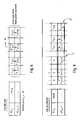
- Fig. 2 shows, in a simplified manner, a series of PC instructions of the intermediate code and a reallocation component T of the real type data register.
- the instructions of the intermediate code can be classified among the following five classes of instructions according to their effect on the reallocation of the corresponding type data register.
- the reallocation component T comprises a sub-array D containing the reallocation for each instruction that defines the type of a variable x in the register r x , i.e.
- Table F is a table resulting from the reallocation of the real registers of type r x to virtual registers v y .
- Each register r x of the same type is reallocated to a single virtual register v y corresponding to this type.
- the actual registers whose type can change, that is to say the polymorphic registers, are reallocated to different virtual registers corresponding to the different types of these registers. Since each virtual register defines only one type, the virtual registers are monomorphic, ie the variables for which there exists a type remain valid throughout the verification process of the intermediate code.
- the verification algorithm is much simpler in the case of monomorphic variables, since it is simply necessary to find for each variable the type of the variable that will be valid throughout the verification procedure. It is actually a fixed point calculation where the type of variables is specialized until it remains unchanged. Such an algorithm fails if it presents polymorphic variables as monomorphic variables.
- the method of verifying the reallocation component uses a current table F '(see Fig. 3) containing the type of each variable for the current instruction (PC), so that the types contained in this current table F' correspond to the evolution of the current reallocation during the verification of the reallocation component T.
- the data of the current reallocation table is initialized (step 402 of Fig. 4) with the "null" type , as shown in FIG. FIG. 3, which is the smallest element of the lattice of types, instead of the type "top” which unites all types, that is to say the largest element of the lattice of types.
- the first instruction (step 404 of Fig. 4) is then read and, depending on the instruction class of the intermediate code, a check is carried out followed by an update of the current reallocation table F 'or simply a updating the current reallocation table.
- the verification algorithm simply updates the reallocation table (steps 412 and 414, respectively, of Fig. 4), as shown in Figs. Figures 8 respectively 9.
- the update simply consists of a transfer of the type data (f ' ⁇ , i ) in the current reallocation table, that is to say that type data is kept unchanged for the next PC +1 instruction.
- the update consists in assigning the data of type (f ' ⁇ + 1, i ) of the reallocation sub-array F of the following instruction PC +1 in the current reallocation table F', as shown in FIG. 9.
- the verification algorithm simply checks whether the value of the corresponding register (the column x ) of the current reallocation table F 'is not equal to the value "zero", which is the smallest value of the lattice of types.
- the updating for this instruction is simply the retention of the type data ( f ', i ) of the current reallocation table F' as shown in FIG. 6.
- the check consists in comparing the type data ( f ' i ) in the table in the current reallocation table F' corresponding to the current instruction PC ⁇ with the type data ( f i ) of the reallocation table F to the target instructions PC ⁇ and PC ⁇ and, in case of inequality, the verification procedure ends with a failure.
- the current reallocation table F ' is then updated by assigning the type data of the reallocation table F to the following instruction PC ⁇ + 1 to the current reallocation table F'.
- the next step (416) is to check if there are still instructions to read and, if so, to increment the pointer of the current instruction (step 418) and to repeat the read loop of the instruction (step 414) and checking and updating the current reallocation until there are no further instructions to read.
- the verification program then proceeds to the step of building the reallocated code (step 112) and checking the reallocated code (step 114). Verification of reallocated code follows known verification procedures. It should be noted, however, that the reallocated code can be constructed during the verification of the reallocation component (step 110) by changing the variable on which the instruction operates to its reallocated value. For example, if a definition statement "def r 1 " (see Fig. 3) acts on the register r 1 which is reallocated to the virtual register v 1 , then the reallocated code instruction becomes "def v 1 ", so that it acts on the virtual register of type data instead of the real register of data of the original type.
- the program starts again at the beginning until the type of each variable remains unchanged.
- the verification algorithm fails when presented with a code with non-monomorphic variables, because it verifies on the definition instructions " def " that the type data in the D sub-array specialize the type already present in the reallocation table current F '.
- a code that passes the monomorphic check and initializes the type data of its variables must be correctly typed, since each virtual register ( v i ) can only contain one type.
- the type interpreter verifies that all possible uses of a variable are consistent with its type and this is therefore ensured by the fact that operations of the PC instructions on the reallocation table F pass a monomorphic verification.
- a reallocation is valid if in the original intermediate code, any usage statement "use x " uses the same reallocation as all the "def x" definition instructions that could define it. That is, in the code generated for the check, if a "use x" statement has changed to "use y", then the "def x” statement has changed to "def y ".
- the variables types for each branch target are stored in volatile memory (RAM) as well as a current table and a working list. Arrays are initialized with the type "top", the largest element of the lattice of types.
- the current table is also initialized with the type "top" for each non-parameterized variable and with the types of the signature for the parameterized variables.
- the verification algorithm starts with the instruction associated with the entry point of the method in the worklist. Remove the first statement from the worklist.
- the new current table is calculated after the execution of this instruction from the type interpreter and is unified to all the tables that correspond to the instructions that may succeed.
- We add to the work table the instructions whose tables have changed.
- the intermediate code is verified successfully if it results in an empty worklist. The verification method rejects an algorithm if type unification is not possible or if the type interpreter encounters an instruction that is incompatible with the type data in the register table.
- "use x” The verification process may fail if the type interpreter decides that the type of variable x is not compatible with its use. The validity of the reallocation assures us that the reallocation of the variable x has not changed between this "use” statement and the corresponding " def " statements. Since the verification of reallocated code has been successful so far, the type of variable x is compatible with its use. So, the verification process passes successfully on the instruction.
- "brch xy” The verification process may fail in the unification of the current table with that corresponding to the register x or with that corresponding to the register y .
- the validity of the reallocation assures us that the current reallocation at the time of the branch instruction "brch" is the same as that at x and y .
- the verification of the reallocated code succeeds for this instruction, the verification also succeeds for the intermediate code not reallocated.
- the calculation of the reallocation and reallocated code (step 1010) is performed entirely in the microcircuit with limited resources, followed by a step 1012 for verifying the code reallocated in the microcircuit and, if successful, the installation of the original intermediate code for execution (step 1016).
- the calculation of the reallocation and the reallocated code in the microcircuit can be carried out according to the known methods, however without it being necessary to carry out an optimization of the reallocated code because it is not used for execution, but only for the verification of the integrity and the safety of the intermediate code.
- the intermediate code can either be stored in persistent memory accessible for writing and reading, for example of the EEPROM type, during the first loading from the external system, or to be reinstalled after verification, by applying a hash function to the first loading, by storing the resultant in a memory of the microcircuit and comparing it with the calculated hash value from the intermediate code loaded after verification.
Landscapes
- Engineering & Computer Science (AREA)
- Software Systems (AREA)
- Theoretical Computer Science (AREA)
- General Engineering & Computer Science (AREA)
- Physics & Mathematics (AREA)
- General Physics & Mathematics (AREA)
- Devices For Executing Special Programs (AREA)
- Debugging And Monitoring (AREA)
- Design And Manufacture Of Integrated Circuits (AREA)
- Microscoopes, Condenser (AREA)
- Test And Diagnosis Of Digital Computers (AREA)
- Slot Machines And Peripheral Devices (AREA)
- Structure Of Printed Boards (AREA)
Claims (9)
- Prüfverfahren eines Zwischencodes, ausführbar von einer Mikroschaltung mit begrenzten Ressourcen, die an einem externen Datenverarbeitungssystem angeschlossen ist, umfassend einen Änderungsschritt des Zwischencodes bestehend aus der Neuzuweisung von reellen Registern des Typs (r) zu virtuellen Registern (v) des Typs monomorph und der Konstruktion eines neu zugewiesenen Codes, dessen Anweisungen (PC) sich auf die virtuellen Register (v) beziehen, und einen Prüfschritt des neu zugewiesenen Codes in der Mikroschaltung mit begrenzten Ressourcen, dadurch gekennzeichnet, dass man bei erfolgreicher Prüfung des neu zugewiesenen Codes in der Mikroschaltung einen Original-Zwischencode in die Mikroschaltung mit begrenzten Ressourcen für die Ausführung einfügt.
- Verfahren gemäß Anspruch 1, dadurch gekennzeichnet, dass der Konstruktionsschritt des neu zugewiesenen Codes innerhalb der Mikroschaltung mit begrenzten Ressourcen erfolgt.
- Verfahren gemäß einem der vorangehenden Ansprüche, dadurch gekennzeichnet, dass der Original-Zwischencode vor der Ausführung des Prüfverfahrens in die Mikroschaltung mit begrenzten Ressourcen geladen und in einem Speicher der Mikroschaltung abgelegt wird.
- Verfahren gemäß einem der vorangehenden Ansprüche, dadurch gekennzeichnet, dass man bei dem Änderungssehritt des Zwischencodes eine Neuzuweisungskomponente (T) erstellt, die eine Neuzuweisungstabelle enthält, die die Neuzuweisung der Daten des Typs eines reellen Registers zu Daten des Typs eines monomorphen virtuellen Registers definiert.
- Verfahren gemäß dem vorangehenden Anspruch, dadurch gekennzeichnet, dass die Neuzuweisungskomponente (T) eine Neuzuweisungs-Untertabelle (D) umfasst, die die Neuzuweisung für jede Definitionsanweisung ("def") des Zwischencodes enthält der den Typ einer Variablen in einem der reellen Register definiert, und eine Neuzuweisungstabelle (F), die die Neuzuweisung der reellen Register des Typs zu den monomorphen virtuellen Registern enthält.
- Verfahren gemäß dem vorangehenden Anspruch, dadurch gekennzeichnet, dass das genannte Verfahren einen zusätzlichen Prüfschritt der Neuzuweisungskomponente (T) umfasst, und dass man im Verlauf dieses zusätzlichen Schritts prüft, ob die Neuzuweisungs-Untertabelle (D) für die Definitionsanweisungen ("def") einen Neuzuweisungswert enthält, und wenn sie keinen Neuzuweisungswert enthält, der Zwischencode abgelehnt wird.
- Verfahren gemäß Anspruch 6, dadurch gekennzeichnet, dass die Prüfung der Neuzuweisungskomponente (T) eine laufende Neuzuweisungstabelle (F') verwendet, die den Typ jeder Variablen für die laufende Anweisung (PC) enthält, wobei die Prüfung der Neuzuweisungskomponente (T), im Fall einer Anweisung des eine Variable verwendenden Zwischencodes, in der Prüfung besteht, ob die in der laufenden Neuzuweisungstabelle (F') verwendete Variable nicht gleich "null" ist, und wenn sie gleich "null" ist, der Zwischencode abgelehnt wird.
- Verfahren gemäß Anspruch 6, dadurch gekennzeichnet, dass die Prüfung der Neuzuweisungskomponente (T) eine laufende Neuzuweisungstabelle (F') verwendet, die den Typ jeder Variablen für die laufende Anweisung (PC) enthält, wobei die genannte Prüfung der Neuzuweisungskomponente (T), im Fall einer Anschlussanweisung (PCα) an Zielanweisungen (PCβ, PCγ), in der Prüfung besteht, ob die Daten des Typs (f'α,1) in der laufenden Neuzuweisungstabelle (F'), die der laufenden Anweisung (PCα) entsprechen, mit den Daten des Typs (fβ, 1; fγ, 1) der Neuzuweisungstabelle (F), die den Zielanweisungen (PCβ, PCγ) entsprechen, übereinstimmen, und dass bei Unterschieden der Zwischencode abgelehnt wird.
- Verfahren gemäß einem der Ansprüche 1 bis 3, dadurch gekennzeichnet, dass der Änderungsschritt des Zwischencodes innerhalb der Mikroschaltung mit begrenzten Ressourcen erfolgt.
Applications Claiming Priority (3)
| Application Number | Priority Date | Filing Date | Title |
|---|---|---|---|
| FR0206445A FR2840084A1 (fr) | 2002-05-27 | 2002-05-27 | Procede de verification de codes pour microcircuits a ressources limitees |
| FR0206445 | 2002-05-27 | ||
| PCT/EP2003/050193 WO2003100607A2 (fr) | 2002-05-27 | 2003-05-23 | Procédé de vérification de codes pour microcircuits à ressources limitées |
Publications (2)
| Publication Number | Publication Date |
|---|---|
| EP1512071A2 EP1512071A2 (de) | 2005-03-09 |
| EP1512071B1 true EP1512071B1 (de) | 2007-11-07 |
Family
ID=29415115
Family Applications (1)
| Application Number | Title | Priority Date | Filing Date |
|---|---|---|---|
| EP03735717A Expired - Lifetime EP1512071B1 (de) | 2002-05-27 | 2003-05-23 | Verfahren zum prüfen von codes für mikroschaltungen mit eingeschränkten ressourcen |
Country Status (8)
| Country | Link |
|---|---|
| US (1) | US20050252977A1 (de) |
| EP (1) | EP1512071B1 (de) |
| CN (1) | CN1672130A (de) |
| AT (1) | ATE377791T1 (de) |
| AU (1) | AU2003238085A1 (de) |
| DE (1) | DE60317324D1 (de) |
| FR (1) | FR2840084A1 (de) |
| WO (1) | WO2003100607A2 (de) |
Families Citing this family (6)
| Publication number | Priority date | Publication date | Assignee | Title |
|---|---|---|---|---|
| FR2884994A1 (fr) | 2005-04-22 | 2006-10-27 | Gemplus Sa | Procede de verification de pseudo-code charge dans un systeme embarque, notamment une carte a puce |
| US8200983B1 (en) * | 2006-09-09 | 2012-06-12 | 9Rays.Net, Inc. | System and method for tamper-proofing executable binary assemblies |
| JP2013138409A (ja) * | 2011-11-30 | 2013-07-11 | Canon Inc | 情報処理装置およびその方法 |
| EP2782006B1 (de) * | 2013-03-19 | 2018-06-13 | Nxp B.V. | Prozess und System zur Überprüfung eines Computerprogramms auf einer Chipkarte |
| US10261764B2 (en) * | 2014-05-13 | 2019-04-16 | Oracle International Corporation | Handling value types |
| US11416273B2 (en) * | 2020-01-16 | 2022-08-16 | Red Hat, Inc. | Adaptive and secure bitecode injection based on comparison with previously stored bytecode |
Family Cites Families (10)
| Publication number | Priority date | Publication date | Assignee | Title |
|---|---|---|---|---|
| US5748964A (en) * | 1994-12-20 | 1998-05-05 | Sun Microsystems, Inc. | Bytecode program interpreter apparatus and method with pre-verification of data type restrictions |
| BR9713267A (pt) * | 1996-10-25 | 2004-06-15 | Schlumberger Systems & Service | Cartão de circuito integrado para uso com um terminal, processo para uso com o mesmo, microcontrolador e processo para sua programação |
| US6092147A (en) * | 1997-04-15 | 2000-07-18 | Sun Microsystems, Inc. | Virtual machine with securely distributed bytecode verification |
| FR2795835B1 (fr) * | 1999-07-01 | 2001-10-05 | Bull Cp8 | Procede de verification de transformateurs de codes pour un systeme embarque, notamment sur une carte a puce |
| FR2797963B1 (fr) * | 1999-08-23 | 2002-11-29 | Trusted Logic | Protocole de gestion, procede de verification et de transformation d'un fragment de programme telecharge et systemes correspondants |
| US6560774B1 (en) * | 1999-09-01 | 2003-05-06 | Microsoft Corporation | Verifier to check intermediate language |
| US6763463B1 (en) * | 1999-11-05 | 2004-07-13 | Microsoft Corporation | Integrated circuit card with data modifying capabilities and related methods |
| US6981245B1 (en) * | 2000-09-14 | 2005-12-27 | Sun Microsystems, Inc. | Populating binary compatible resource-constrained devices with content verified using API definitions |
| US7506175B2 (en) * | 2000-11-06 | 2009-03-17 | International Business Machines Corporation | File language verification |
| EP1207454A1 (de) * | 2000-11-15 | 2002-05-22 | International Business Machines Corporation | Java Laufzeitsystem mit modifizierten Verknüpfungsnamen |
-
2002
- 2002-05-27 FR FR0206445A patent/FR2840084A1/fr active Pending
-
2003
- 2003-05-23 DE DE60317324T patent/DE60317324D1/de not_active Expired - Lifetime
- 2003-05-23 AT AT03735717T patent/ATE377791T1/de not_active IP Right Cessation
- 2003-05-23 US US10/515,375 patent/US20050252977A1/en not_active Abandoned
- 2003-05-23 AU AU2003238085A patent/AU2003238085A1/en not_active Abandoned
- 2003-05-23 CN CN03817969.5A patent/CN1672130A/zh active Pending
- 2003-05-23 EP EP03735717A patent/EP1512071B1/de not_active Expired - Lifetime
- 2003-05-23 WO PCT/EP2003/050193 patent/WO2003100607A2/fr not_active Ceased
Also Published As
| Publication number | Publication date |
|---|---|
| FR2840084A1 (fr) | 2003-11-28 |
| WO2003100607A2 (fr) | 2003-12-04 |
| ATE377791T1 (de) | 2007-11-15 |
| US20050252977A1 (en) | 2005-11-17 |
| WO2003100607A3 (fr) | 2004-02-19 |
| EP1512071A2 (de) | 2005-03-09 |
| DE60317324D1 (de) | 2007-12-20 |
| AU2003238085A1 (en) | 2003-12-12 |
| CN1672130A (zh) | 2005-09-21 |
Similar Documents
| Publication | Publication Date | Title |
|---|---|---|
| US7191288B2 (en) | Method and apparatus for providing an application on a smart card | |
| KR102351085B1 (ko) | 처리될 트랜잭션에 관련된 위험 식별 방법, 장치 및 전자 디바이스 | |
| EP1212678B1 (de) | Verwaltungsprotokoll, verifikationsverfahren und transformierung eines ferngeladenen programmfragments und korrespondierende systeme | |
| EP2453356A1 (de) | Verfahren, Computerprogramm und Vorrichtung zur Sicherung des Programmierungs-Verbindungscodes für seine Ausführung durch eine virtuelle Maschine | |
| EP1512071B1 (de) | Verfahren zum prüfen von codes für mikroschaltungen mit eingeschränkten ressourcen | |
| EP2565810A1 (de) | Mikroprozessor, der gegen Speicherabzug geschützt ist | |
| FR2833374A1 (fr) | Procede et dispositif de controle d'acces dans un systeme embarque | |
| WO2002084610A1 (fr) | Procede et systeme de gestion de donnes destinees a etre stockees dans une carte a puce programmable | |
| EP1344137A1 (de) | Verfahren und gerät zur gesicherten datenverarbeitung | |
| FR2795835A1 (fr) | Procede de verification de transformateurs de codes pour un systeme embarque, notamment sur une carte a puce | |
| EP1960934B1 (de) | Verfahren zur sicherung der ausführung eines vermittelnden sprachsoftwarecodes bei einer tragbaren anwendung | |
| JP5225071B2 (ja) | 埋め込みシステム、特にスマートカードにロードされる疑似コードの検証方法 | |
| WO2003027851A1 (fr) | Procede et dispositif de verifieur de code optimise | |
| FR2867929A1 (fr) | Procede d'authentification dynamique de programmes par un objet portable electronique | |
| FR3072477B1 (fr) | Securisation d’instructions de branchement conditionnel compose dans un programme informatique en code intermediaire | |
| EP1155389B1 (de) | Vorrichtung für gesicherten zugang zu chipkartenanwendungen | |
| CN116091056A (zh) | 基于u盾的交易方法、装置、计算机存储介质及电子设备 | |
| EP1337915A1 (de) | Formelle prüfung einer gesicherten virtuellen maschine | |
| EP2252978B1 (de) | Chipkarte mit veränderbarem betriebsprogramm und entsprechendes änderungsverfahren | |
| EP3514749B1 (de) | Verfahren zur kontrolle von abhangigkeitsregelen für geänderte objekte in einem mikroschaltkreis und entsprechendes gerät | |
| FR2854261A1 (fr) | Procede d'execution d'une application logicielle par l'intermediaire d'un programme d'amorce logicielle et architecture informatique pour la mise en oeuvre du procede | |
| WO2008125479A1 (fr) | Procédé d'exécution sécurisée d'une application | |
| FR2829847A1 (fr) | Procede de controle d'acces a des ressources partagees dans un systeme embarque et systeme embarque pour la mise en oeuvre d'un tel procede | |
| FR2936327A1 (fr) | Procede de telechargement d'un programme .net et dispositif pour celui-ci | |
| EP3203405B1 (de) | Verfahren zur ausführung von objektorientierten anwendungsanweisungen durch einen dolmetscher |
Legal Events
| Date | Code | Title | Description |
|---|---|---|---|
| PUAI | Public reference made under article 153(3) epc to a published international application that has entered the european phase |
Free format text: ORIGINAL CODE: 0009012 |
|
| 17P | Request for examination filed |
Effective date: 20041227 |
|
| AK | Designated contracting states |
Kind code of ref document: A2 Designated state(s): AT BE BG CH CY CZ DE DK EE ES FI FR GB GR HU IE IT LI LU MC NL PT RO SE SI SK TR |
|
| AX | Request for extension of the european patent |
Extension state: AL LT LV MK |
|
| DAX | Request for extension of the european patent (deleted) | ||
| 17Q | First examination report despatched |
Effective date: 20060720 |
|
| GRAP | Despatch of communication of intention to grant a patent |
Free format text: ORIGINAL CODE: EPIDOSNIGR1 |
|
| GRAS | Grant fee paid |
Free format text: ORIGINAL CODE: EPIDOSNIGR3 |
|
| GRAA | (expected) grant |
Free format text: ORIGINAL CODE: 0009210 |
|
| AK | Designated contracting states |
Kind code of ref document: B1 Designated state(s): AT BE BG CH CY CZ DE DK EE ES FI FR GB GR HU IE IT LI LU MC NL PT RO SE SI SK TR |
|
| REG | Reference to a national code |
Ref country code: GB Ref legal event code: FG4D Free format text: NOT ENGLISH |
|
| REG | Reference to a national code |
Ref country code: IE Ref legal event code: FG4D Free format text: LANGUAGE OF EP DOCUMENT: FRENCH |
|
| REG | Reference to a national code |
Ref country code: CH Ref legal event code: EP |
|
| REF | Corresponds to: |
Ref document number: 60317324 Country of ref document: DE Date of ref document: 20071220 Kind code of ref document: P |
|
| GBT | Gb: translation of ep patent filed (gb section 77(6)(a)/1977) |
Effective date: 20080204 |
|
| PG25 | Lapsed in a contracting state [announced via postgrant information from national office to epo] |
Ref country code: ES Free format text: LAPSE BECAUSE OF FAILURE TO SUBMIT A TRANSLATION OF THE DESCRIPTION OR TO PAY THE FEE WITHIN THE PRESCRIBED TIME-LIMIT Effective date: 20080218 Ref country code: NL Free format text: LAPSE BECAUSE OF FAILURE TO SUBMIT A TRANSLATION OF THE DESCRIPTION OR TO PAY THE FEE WITHIN THE PRESCRIBED TIME-LIMIT Effective date: 20071107 Ref country code: SE Free format text: LAPSE BECAUSE OF FAILURE TO SUBMIT A TRANSLATION OF THE DESCRIPTION OR TO PAY THE FEE WITHIN THE PRESCRIBED TIME-LIMIT Effective date: 20080207 |
|
| NLV1 | Nl: lapsed or annulled due to failure to fulfill the requirements of art. 29p and 29m of the patents act | ||
| PG25 | Lapsed in a contracting state [announced via postgrant information from national office to epo] |
Ref country code: BG Free format text: LAPSE BECAUSE OF FAILURE TO SUBMIT A TRANSLATION OF THE DESCRIPTION OR TO PAY THE FEE WITHIN THE PRESCRIBED TIME-LIMIT Effective date: 20080207 Ref country code: SI Free format text: LAPSE BECAUSE OF FAILURE TO SUBMIT A TRANSLATION OF THE DESCRIPTION OR TO PAY THE FEE WITHIN THE PRESCRIBED TIME-LIMIT Effective date: 20071107 |
|
| PG25 | Lapsed in a contracting state [announced via postgrant information from national office to epo] |
Ref country code: AT Free format text: LAPSE BECAUSE OF FAILURE TO SUBMIT A TRANSLATION OF THE DESCRIPTION OR TO PAY THE FEE WITHIN THE PRESCRIBED TIME-LIMIT Effective date: 20071107 |
|
| PG25 | Lapsed in a contracting state [announced via postgrant information from national office to epo] |
Ref country code: CZ Free format text: LAPSE BECAUSE OF FAILURE TO SUBMIT A TRANSLATION OF THE DESCRIPTION OR TO PAY THE FEE WITHIN THE PRESCRIBED TIME-LIMIT Effective date: 20071107 Ref country code: DK Free format text: LAPSE BECAUSE OF FAILURE TO SUBMIT A TRANSLATION OF THE DESCRIPTION OR TO PAY THE FEE WITHIN THE PRESCRIBED TIME-LIMIT Effective date: 20071107 |
|
| PG25 | Lapsed in a contracting state [announced via postgrant information from national office to epo] |
Ref country code: RO Free format text: LAPSE BECAUSE OF FAILURE TO SUBMIT A TRANSLATION OF THE DESCRIPTION OR TO PAY THE FEE WITHIN THE PRESCRIBED TIME-LIMIT Effective date: 20071107 Ref country code: SK Free format text: LAPSE BECAUSE OF FAILURE TO SUBMIT A TRANSLATION OF THE DESCRIPTION OR TO PAY THE FEE WITHIN THE PRESCRIBED TIME-LIMIT Effective date: 20071107 |
|
| PLBE | No opposition filed within time limit |
Free format text: ORIGINAL CODE: 0009261 |
|
| STAA | Information on the status of an ep patent application or granted ep patent |
Free format text: STATUS: NO OPPOSITION FILED WITHIN TIME LIMIT |
|
| PG25 | Lapsed in a contracting state [announced via postgrant information from national office to epo] |
Ref country code: PT Free format text: LAPSE BECAUSE OF FAILURE TO SUBMIT A TRANSLATION OF THE DESCRIPTION OR TO PAY THE FEE WITHIN THE PRESCRIBED TIME-LIMIT Effective date: 20080407 |
|
| REG | Reference to a national code |
Ref country code: IE Ref legal event code: FD4D |
|
| 26N | No opposition filed |
Effective date: 20080808 |
|
| PG25 | Lapsed in a contracting state [announced via postgrant information from national office to epo] |
Ref country code: IE Free format text: LAPSE BECAUSE OF FAILURE TO SUBMIT A TRANSLATION OF THE DESCRIPTION OR TO PAY THE FEE WITHIN THE PRESCRIBED TIME-LIMIT Effective date: 20071107 Ref country code: DE Free format text: LAPSE BECAUSE OF FAILURE TO SUBMIT A TRANSLATION OF THE DESCRIPTION OR TO PAY THE FEE WITHIN THE PRESCRIBED TIME-LIMIT Effective date: 20080208 |
|
| PGFP | Annual fee paid to national office [announced via postgrant information from national office to epo] |
Ref country code: FR Payment date: 20080530 Year of fee payment: 6 |
|
| BERE | Be: lapsed |
Owner name: GEMPLUS Effective date: 20080531 |
|
| PG25 | Lapsed in a contracting state [announced via postgrant information from national office to epo] |
Ref country code: MC Free format text: LAPSE BECAUSE OF NON-PAYMENT OF DUE FEES Effective date: 20080531 |
|
| PGFP | Annual fee paid to national office [announced via postgrant information from national office to epo] |
Ref country code: GB Payment date: 20080424 Year of fee payment: 6 |
|
| REG | Reference to a national code |
Ref country code: CH Ref legal event code: PL |
|
| PG25 | Lapsed in a contracting state [announced via postgrant information from national office to epo] |
Ref country code: GR Free format text: LAPSE BECAUSE OF FAILURE TO SUBMIT A TRANSLATION OF THE DESCRIPTION OR TO PAY THE FEE WITHIN THE PRESCRIBED TIME-LIMIT Effective date: 20080208 Ref country code: CH Free format text: LAPSE BECAUSE OF NON-PAYMENT OF DUE FEES Effective date: 20080531 Ref country code: LI Free format text: LAPSE BECAUSE OF NON-PAYMENT OF DUE FEES Effective date: 20080531 |
|
| PG25 | Lapsed in a contracting state [announced via postgrant information from national office to epo] |
Ref country code: FI Free format text: LAPSE BECAUSE OF FAILURE TO SUBMIT A TRANSLATION OF THE DESCRIPTION OR TO PAY THE FEE WITHIN THE PRESCRIBED TIME-LIMIT Effective date: 20071107 |
|
| PG25 | Lapsed in a contracting state [announced via postgrant information from national office to epo] |
Ref country code: BE Free format text: LAPSE BECAUSE OF NON-PAYMENT OF DUE FEES Effective date: 20080531 |
|
| PG25 | Lapsed in a contracting state [announced via postgrant information from national office to epo] |
Ref country code: EE Free format text: LAPSE BECAUSE OF FAILURE TO SUBMIT A TRANSLATION OF THE DESCRIPTION OR TO PAY THE FEE WITHIN THE PRESCRIBED TIME-LIMIT Effective date: 20071107 |
|
| PG25 | Lapsed in a contracting state [announced via postgrant information from national office to epo] |
Ref country code: CY Free format text: LAPSE BECAUSE OF FAILURE TO SUBMIT A TRANSLATION OF THE DESCRIPTION OR TO PAY THE FEE WITHIN THE PRESCRIBED TIME-LIMIT Effective date: 20071107 |
|
| GBPC | Gb: european patent ceased through non-payment of renewal fee |
Effective date: 20090523 |
|
| REG | Reference to a national code |
Ref country code: FR Ref legal event code: ST Effective date: 20100129 |
|
| PG25 | Lapsed in a contracting state [announced via postgrant information from national office to epo] |
Ref country code: FR Free format text: LAPSE BECAUSE OF NON-PAYMENT OF DUE FEES Effective date: 20090602 |
|
| PG25 | Lapsed in a contracting state [announced via postgrant information from national office to epo] |
Ref country code: GB Free format text: LAPSE BECAUSE OF NON-PAYMENT OF DUE FEES Effective date: 20090523 |
|
| PG25 | Lapsed in a contracting state [announced via postgrant information from national office to epo] |
Ref country code: HU Free format text: LAPSE BECAUSE OF FAILURE TO SUBMIT A TRANSLATION OF THE DESCRIPTION OR TO PAY THE FEE WITHIN THE PRESCRIBED TIME-LIMIT Effective date: 20080508 Ref country code: LU Free format text: LAPSE BECAUSE OF NON-PAYMENT OF DUE FEES Effective date: 20080523 |
|
| PG25 | Lapsed in a contracting state [announced via postgrant information from national office to epo] |
Ref country code: TR Free format text: LAPSE BECAUSE OF FAILURE TO SUBMIT A TRANSLATION OF THE DESCRIPTION OR TO PAY THE FEE WITHIN THE PRESCRIBED TIME-LIMIT Effective date: 20071107 |
|
| PG25 | Lapsed in a contracting state [announced via postgrant information from national office to epo] |
Ref country code: IT Free format text: LAPSE BECAUSE OF NON-PAYMENT OF DUE FEES Effective date: 20080531 |