EP1510908A2 - Thread scheduling mechanisms for processor resource power management - Google Patents
Thread scheduling mechanisms for processor resource power management Download PDFInfo
- Publication number
- EP1510908A2 EP1510908A2 EP04104016A EP04104016A EP1510908A2 EP 1510908 A2 EP1510908 A2 EP 1510908A2 EP 04104016 A EP04104016 A EP 04104016A EP 04104016 A EP04104016 A EP 04104016A EP 1510908 A2 EP1510908 A2 EP 1510908A2
- Authority
- EP
- European Patent Office
- Prior art keywords
- resource
- power
- circuit
- needed
- state information
- Prior art date
- Legal status (The legal status is an assumption and is not a legal conclusion. Google has not performed a legal analysis and makes no representation as to the accuracy of the status listed.)
- Granted
Links
Images


Classifications
-
- G—PHYSICS
- G06—COMPUTING OR CALCULATING; COUNTING
- G06F—ELECTRIC DIGITAL DATA PROCESSING
- G06F9/00—Arrangements for program control, e.g. control units
- G06F9/06—Arrangements for program control, e.g. control units using stored programs, i.e. using an internal store of processing equipment to receive or retain programs
- G06F9/46—Multiprogramming arrangements
- G06F9/50—Allocation of resources, e.g. of the central processing unit [CPU]
- G06F9/5083—Techniques for rebalancing the load in a distributed system
-
- G—PHYSICS
- G06—COMPUTING OR CALCULATING; COUNTING
- G06F—ELECTRIC DIGITAL DATA PROCESSING
- G06F1/00—Details not covered by groups G06F3/00 - G06F13/00 and G06F21/00
- G06F1/26—Power supply means, e.g. regulation thereof
- G06F1/32—Means for saving power
- G06F1/3203—Power management, i.e. event-based initiation of a power-saving mode
-
- G—PHYSICS
- G06—COMPUTING OR CALCULATING; COUNTING
- G06F—ELECTRIC DIGITAL DATA PROCESSING
- G06F1/00—Details not covered by groups G06F3/00 - G06F13/00 and G06F21/00
- G06F1/26—Power supply means, e.g. regulation thereof
- G06F1/32—Means for saving power
- G06F1/3203—Power management, i.e. event-based initiation of a power-saving mode
- G06F1/3234—Power saving characterised by the action undertaken
- G06F1/3287—Power saving characterised by the action undertaken by switching off individual functional units in the computer system
-
- G—PHYSICS
- G06—COMPUTING OR CALCULATING; COUNTING
- G06F—ELECTRIC DIGITAL DATA PROCESSING
- G06F1/00—Details not covered by groups G06F3/00 - G06F13/00 and G06F21/00
- G06F1/26—Power supply means, e.g. regulation thereof
- G06F1/32—Means for saving power
- G06F1/3203—Power management, i.e. event-based initiation of a power-saving mode
- G06F1/3234—Power saving characterised by the action undertaken
- G06F1/329—Power saving characterised by the action undertaken by task scheduling
-
- G—PHYSICS
- G06—COMPUTING OR CALCULATING; COUNTING
- G06F—ELECTRIC DIGITAL DATA PROCESSING
- G06F9/00—Arrangements for program control, e.g. control units
- G06F9/06—Arrangements for program control, e.g. control units using stored programs, i.e. using an internal store of processing equipment to receive or retain programs
- G06F9/46—Multiprogramming arrangements
- G06F9/50—Allocation of resources, e.g. of the central processing unit [CPU]
- G06F9/5094—Allocation of resources, e.g. of the central processing unit [CPU] where the allocation takes into account power or heat criteria
-
- G—PHYSICS
- G06—COMPUTING OR CALCULATING; COUNTING
- G06F—ELECTRIC DIGITAL DATA PROCESSING
- G06F2209/00—Indexing scheme relating to G06F9/00
- G06F2209/50—Indexing scheme relating to G06F9/50
- G06F2209/5019—Workload prediction
-
- Y—GENERAL TAGGING OF NEW TECHNOLOGICAL DEVELOPMENTS; GENERAL TAGGING OF CROSS-SECTIONAL TECHNOLOGIES SPANNING OVER SEVERAL SECTIONS OF THE IPC; TECHNICAL SUBJECTS COVERED BY FORMER USPC CROSS-REFERENCE ART COLLECTIONS [XRACs] AND DIGESTS
- Y02—TECHNOLOGIES OR APPLICATIONS FOR MITIGATION OR ADAPTATION AGAINST CLIMATE CHANGE
- Y02D—CLIMATE CHANGE MITIGATION TECHNOLOGIES IN INFORMATION AND COMMUNICATION TECHNOLOGIES [ICT], I.E. INFORMATION AND COMMUNICATION TECHNOLOGIES AIMING AT THE REDUCTION OF THEIR OWN ENERGY USE
- Y02D10/00—Energy efficient computing, e.g. low power processors, power management or thermal management
Definitions
- Power efficiency is a significant requirement across a broad range of systems, ranging from small portable devices to rack-mounted server systems. Even in systems for which high performance is desired, power efficiency still may be a concern. Power efficiency is effected both by hardware design and component choice as well as software-based run-time power management techniques.
- CMOS complementary metal oxide semiconductor
- Active power consumption occurs when the circuit is actively switching from one logic state to another. Active power consumption is caused both by “switching" current and “through” current (current that flows when both P and N-channel transistors are both on momentarily). Static power consumption results from reverse bias leakage and occurs even when the circuit is not actively switching.
- the total power consumption of a CMOS circuit is the sum of both active and static power consumption.
- CMOS process technology With conventional CMOS process technology, power savings may occur by simply gating off the clocks. In such circuits in this state, active power consumption falls to zero and the resulting leakage becomes relatively minimal.
- the size of the transistors advantageously has been reduced, but with an undesirable increase in leakage current. As a result, some CMOS circuits experience undesirably high current draw even with all clocks gated off.
- the embodiments described herein are directed to an operating system that runs on a processor and that dynamically manages the power state of individual circuits or resources within the processor. If a particular circuit within the processor is not needed, power to that circuit is disabled. If a circuit is to be shut down, any configuration information or other type of data associated with that circuit is saved before powering off the circuit. Power can be re-enabled to the circuit on a responsive or predictive basis and the configuration information and/or data (collectively referred to as "state" information) can be reloaded into the circuit.
- a method comprises receiving a request for a resource within a semiconductor device, enabling power to the resource in response to receiving said request if power is not already enabled to the resource, determining whether state information should be restored to the resource, and restoring the state information to the resource after enabling power if the state information should be restored.
- a method comprises, before a need for a resource arises, determining that the resource will be needed, enabling power to the resource if power is not already enabled to the resource, determining whether state information should be restored to the resource, and restoring the state information to the resource after enabling power if the state information should be restored.
- a system comprises a processor, a plurality of resources contained in the processor, and a power manager that runs on the processor and that receives a request for use of a resource, enables power to the resource in response to receiving said request if power is not already enabled to the resource, determines whether state information should be restored to the resource, and restores the state information to the resource after enabling power if the state information should be restored.
- a system comprises a processor, a plurality of resources contained in the processor, and a power manager that runs on the processor and that, before a need for a resource arises, determines that the resource will be needed and the power manager also enables power to the resource if power is not already enabled to the resource, determines whether state information should be restored to the resource, and restores the state information to the resource after enabling power if the state information should be restored.
- Various embodiments of the invention also may be implemented as a storage medium that contains software and, when executed by a processor, the software dynamically manages power within the processor, the processor comprising a plurality of circuits.
- the software comprises instructions that determine when a circuit within the processor is needed for use, instructions that determine whether the circuit already has power enabled to the circuit, and instructions that cause power to be enabled to the circuit if power is not already enabled to the circuit.
- FIG. 1 shows a logical architecture of an embodiment of a system 100 comprising a real-time operating system ("RTOS") 102, a processor 110 (or other type of semiconductor device), various drivers 112 and application threads 114.
- RTOS real-time operating system
- processor 110 or other type of semiconductor device
- power manager 104 preferably is included as part of the RTOS 102 and, as such, comprises software.
- a separate control thread 116 is used for the operation of the power manager 104.
- the RTOS 102 also may include or have access to one or more inactivity timers 106.
- the processor 110 includes, or has access to, a plurality of resources.
- the processor 110 preferably comprises a core 120 coupled to a plurality of resources 122.
- the resources 122 may comprise circuits contained with the processor 110.
- the resources may include memory, input/output ports, analog-to-digital ("ADC") channels, and other resources that dynamically (i.e., during run-time) may be turned on and off on an individual basis.
- ADC analog-to-digital
- turning a resource "off” involves completely disabling power to the resource, not simply gating off clocks to the resource. By turning off a resource in this way, leakage current in the resource becomes zero.
- individual resources within the processor 110 may be selectively and dynamically powered on and off. In this way, a processor resource that is not needed can be selectively powered off while other resources are selectively powered on.
- the power manager 104 implements some or all of the functionality described below to power on and off individual resources within the processor 110.
- the operation of power manager 104 is transparent to applications running on the processor.
- a resource (or multiple resources) may be powered off based on one or more criteria.
- the inactivity timers 106 may be configured to monitor one or more resources individually for conditions of inactivity. Thus, if a particular resource has been inactive for more than the period of time programmed into the associated inactivity timer, the power manager 104 causes the resource to power down.
- a user can program a portion of memory (not specifically shown) with information as to which of the processor resources will be used and which will not be used. Using this information, during initialization the power manager 104 preferably prevents power from being enabled to those resources that will not be used, as well as turns off resources that are powered on by default that the application will not use.
- threads in which applications run may carry information regarding the power resource requirements.
- a thread may include power resource assignments, restoration boundaries, and power ready state information. More specifically, a thread may include the following information:
- This information can be configured statically for the thread at design time, or dynamically registered with the power manager if the thread is dynamically created at runtime.
- Some resources may have state information ("state") that should be saved, if desired, when the resource is powered off by the power manager 104.
- State information comprises any type of configuration information or data.
- state information pertaining to a memory device may comprise the current data contents of the memory.
- Other types of resources may be configurable and thus various items of configurations (e.g., speed, number of channels, etc.) may comprise the resource's state information.
- the power manager 104 preferably is capable of powering on a resource in accordance with any of multiple modes including, without limitation, a responsive mode and a predictive mode.
- the responsive mode the power manager 104 powers a resource back on in response to a request for that resource.
- the predictive mode the power manager begins the process of enabling power to a resource before an application requests access for the resource.
- the predictive mode may also permit state information previously saved to be restored to the resource before the use of the resource is requested or needed.
- Figure 2 depicts the operation of the power manager 104 in the responsive mode.
- Figure 3 depicts the operation of the power manager in the predictive mode.
- the power manager preferably implements the logic depicted in the flow charts of Figures 2 and 3.
- flow chart 200 begins with an application interrupt at block 202.
- the application interrupt is asserted to request an application-specific action that may require the power manager 104 to power on a particular resource.
- a software interrupt (“SWI") is posted to run.
- the processor 110 begin to run "SWI POST" code (which may be included in RTOS 102) at block 206.
- the SWI POST code determines whether the resource is power managed (decision block 208).
- Non-power managed resources are generally powered on during run-time and not subject to the selective processor resource power management scheme described herein. Other resources are power managed and thus can be selectively powered on and off as described herein.
- the power manager 104 may suspend a save/restore state job if a save/restore job with a higher priority comes along.
- the SWI POST code queues a direct memory access ("DMA") in block 218 to copy the resource's state back to the resource.
- DMA direct memory access
- the DMA operations may be prioritized (priority queued) so that thread priority inversion does not occur so that the power manager does not adversely affect scheduling priorities. If a restore job becomes queued that has a higher priority than the restore job in progress, the in -progress job will be suspended in favor of the higher priority job.
- the DMA process of course takes a finite amount of time to completely copy back all of the resource's state information.
- the SWI POST code sets the status of a flag to "not ready” to indicate that the DMA state restoration process has not completed and thus the resource is not ready yet for use.
- the SWI POST code then returns at 224.
- a DMA completion interrupt is asserted at 226 to reenter execution of the SWI POST code.
- the flag is set to the "ready" state to indicate that the resource's state has been restored. Control then passes back to block 206.
- the SWI POST code determines at decision block 210 that the thread is ready and control passes to blocks 230 and 232.
- Process 300 preferably comprises three entry points 302, 320, and 330 into the code that implements the process. Entry point 302 is activated when the power manager 104 predictively determines that a presently powered down resource may need to be used in the near future.
- the method of how to predict future resource use varies from resource to resource and upon the overall system architecture and use.
- the power manager 104 may be implemented to determine that a particular resource will be used after a certain period of time elapses following a predetermined event.
- the power manager 104 determines whether the resource is already powered on. If the resource is not already powered on, the power manager causes the resource to be powered on at 306. After powering on the resource or after determining that the resource was already powered on, the power manager determines at 308 whether the resource needs to have its state restored. If no state is to be restored, control returns at 314. If the resource needs to have its state restored, control passes to 310 in which a DMA job is queued to begin retrieving the relevant state information for the resource. At 312, the power manager 104 sets the status flag to "not ready" to indicate that the resource is not yet ready for use. Execution then returns at 314.
- the power manager is reentered at 320 when a DMA completion interrupt is asserted at 322.
- the status flag is set to the "ready" state at 324 to indicate that the resource's state has been fully restored and the execution returns again at 326.
- the third entry point 330 occurs when the application that is to use the resource asserts an application interrupt for the relevant resource (332).
- a SWI is posted at 334 and the SWI POST code is run at 336.
- the power manager determines whether the resource is power managed as described previously. If the resource is not power managed, control passes to 342 and 344 in which the thread that will use the resource is placed on to the ready list and the O/S runs the thread. If the resource is power managed, control passes to decision block 340 in which it is determined whether the thread is ready. If the thread is ready, control passes to blocks 342 and 344. Otherwise, control loops back on decision block 340 until the thread is ready to be run.
- the implementations described herein permit the power manager 104 to hook into pre-existing scheduling functions, and preferably at a single point (where scheduling actions ultimately occur), versus multiple points in the OS code base where thread scheduling is initiated. This means that the kernel itself is not potentially destablized by multiple modifications and maintenance points.
Landscapes
- Engineering & Computer Science (AREA)
- Theoretical Computer Science (AREA)
- General Engineering & Computer Science (AREA)
- Physics & Mathematics (AREA)
- General Physics & Mathematics (AREA)
- Software Systems (AREA)
- Computer Hardware Design (AREA)
- Computing Systems (AREA)
- Power Sources (AREA)
Abstract
Description
- Power efficiency is a significant requirement across a broad range of systems, ranging from small portable devices to rack-mounted server systems. Even in systems for which high performance is desired, power efficiency still may be a concern. Power efficiency is effected both by hardware design and component choice as well as software-based run-time power management techniques.
- A complementary metal oxide semiconductor ("CMOS") circuit experiences both "active" and "static" power consumption. Active power consumption occurs when the circuit is actively switching from one logic state to another. Active power consumption is caused both by "switching" current and "through" current (current that flows when both P and N-channel transistors are both on momentarily). Static power consumption results from reverse bias leakage and occurs even when the circuit is not actively switching. The total power consumption of a CMOS circuit is the sum of both active and static power consumption.
- With conventional CMOS process technology, power savings may occur by simply gating off the clocks. In such circuits in this state, active power consumption falls to zero and the resulting leakage becomes relatively minimal. However, in more recently developed CMOS technology, the size of the transistors advantageously has been reduced, but with an undesirable increase in leakage current. As a result, some CMOS circuits experience undesirably high current draw even with all clocks gated off.
- Various hardware and software techniques have been employed to help manage the power state of a circuit or a complete system. While some of these techniques may be satisfactory, there still remains a need for improvement in the power management of individual semiconductor devices (e.g., processors), particularly for semiconductor devices having relatively high leakage currents when active power consumption is reduced.
- In general, the embodiments described herein are directed to an operating system that runs on a processor and that dynamically manages the power state of individual circuits or resources within the processor. If a particular circuit within the processor is not needed, power to that circuit is disabled. If a circuit is to be shut down, any configuration information or other type of data associated with that circuit is saved before powering off the circuit. Power can be re-enabled to the circuit on a responsive or predictive basis and the configuration information and/or data (collectively referred to as "state" information) can be reloaded into the circuit.
- In some embodiments a method comprises receiving a request for a resource within a semiconductor device, enabling power to the resource in response to receiving said request if power is not already enabled to the resource, determining whether state information should be restored to the resource, and restoring the state information to the resource after enabling power if the state information should be restored.
- In other embodiments, a method comprises, before a need for a resource arises, determining that the resource will be needed, enabling power to the resource if power is not already enabled to the resource, determining whether state information should be restored to the resource, and restoring the state information to the resource after enabling power if the state information should be restored.
- In still other embodiments, a system comprises a processor, a plurality of resources contained in the processor, and a power manager that runs on the processor and that receives a request for use of a resource, enables power to the resource in response to receiving said request if power is not already enabled to the resource, determines whether state information should be restored to the resource, and restores the state information to the resource after enabling power if the state information should be restored.
- In accordance with other embodiments, a system comprises a processor, a plurality of resources contained in the processor, and a power manager that runs on the processor and that, before a need for a resource arises, determines that the resource will be needed and the power manager also enables power to the resource if power is not already enabled to the resource, determines whether state information should be restored to the resource, and restores the state information to the resource after enabling power if the state information should be restored.
- Various embodiments of the invention also may be implemented as a storage medium that contains software and, when executed by a processor, the software dynamically manages power within the processor, the processor comprising a plurality of circuits. The software comprises instructions that determine when a circuit within the processor is needed for use, instructions that determine whether the circuit already has power enabled to the circuit, and instructions that cause power to be enabled to the circuit if power is not already enabled to the circuit.
- Certain terms are used throughout the following description and claims to refer to particular system components. As one skilled in the art will appreciate, various companies may refer to a component by different names. This document does not intend to distinguish between components that differ in name but not function. In the following discussion and in the claims, the terms "including" and "comprising" are used in an open-ended fashion, and thus should be interpreted to mean "including, but not limited to...". Also, the term "couple" or "couples" is intended to mean either an indirect or direct connection. Thus, if a first device couples to a second device, that connection may be through a direct connection, or through an indirect connection via other devices and connections.
- For a more detailed description of the preferred embodiments of the present invention, reference will now be made to the accompanying drawings, wherein:
- Figure 1 shows a logical architecture of an embodiment of a system that implements the power management techniques described herein;
- Figure 2 shows a flow chart depicting the operation of software that implements a responsive power management mode; and
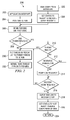
- Figure 3 shows a flow chart depicting the operation of software that implements a predictive power management mode.
-
- The following discussion is directed to various embodiments of the invention. Although one or more of these embodiments may be preferred, the embodiments disclosed should not be interpreted, or otherwise used, as limiting the scope of the disclosure, including the claims, unless otherwise specified. In addition, one skilled in the art will understand that the following description has broad application, and the discussion of any embodiment is meant only to be exemplary of that embodiment, and not intended to intimate that the scope of the disclosure, including the claims, is limited to that embodiment.
- Figure 1 shows a logical architecture of an embodiment of a
system 100 comprising a real-time operating system ("RTOS") 102, a processor 110 (or other type of semiconductor device),various drivers 112 andapplication threads 114. Further,power manager 104 preferably is included as part of the RTOS 102 and, as such, comprises software. Aseparate control thread 116 is used for the operation of thepower manager 104. The RTOS 102 also may include or have access to one ormore inactivity timers 106. - The
processor 110 includes, or has access to, a plurality of resources. In Figure 1, theprocessor 110 preferably comprises acore 120 coupled to a plurality ofresources 122. Theresources 122 may comprise circuits contained with theprocessor 110. For example, the resources may include memory, input/output ports, analog-to-digital ("ADC") channels, and other resources that dynamically (i.e., during run-time) may be turned on and off on an individual basis. In the preferred embodiment, turning a resource "off" involves completely disabling power to the resource, not simply gating off clocks to the resource. By turning off a resource in this way, leakage current in the resource becomes zero. Thus, in the preferred embodiment, individual resources within theprocessor 110 may be selectively and dynamically powered on and off. In this way, a processor resource that is not needed can be selectively powered off while other resources are selectively powered on. - The
power manager 104 implements some or all of the functionality described below to power on and off individual resources within theprocessor 110. In general, the operation ofpower manager 104 is transparent to applications running on the processor. A resource (or multiple resources) may be powered off based on one or more criteria. For instance, theinactivity timers 106 may be configured to monitor one or more resources individually for conditions of inactivity. Thus, if a particular resource has been inactive for more than the period of time programmed into the associated inactivity timer, thepower manager 104 causes the resource to power down. Further, a user can program a portion of memory (not specifically shown) with information as to which of the processor resources will be used and which will not be used. Using this information, during initialization thepower manager 104 preferably prevents power from being enabled to those resources that will not be used, as well as turns off resources that are powered on by default that the application will not use. - In at least some embodiments, threads in which applications run may carry information regarding the power resource requirements. In these embodiments, a thread may include power resource assignments, restoration boundaries, and power ready state information. More specifically, a thread may include the following information:
- a. Power resource assignments, meaning the power 'domains' it is dependent upon (a 'domain' being a memory bank or group of peripherals that are jointly powered ON or OFF), or, when power to individual banks/peripherals is individually-gateable, the specific banks/peripherals that the thread requires;
- b. Restoration boundaries for memory state that needs to be restored (e.g., a thread may only require 100 bytes out of a 64Kbyte memory bank; the 'boundaries' define this 100 byte region); and
- c. Power ready state information that may be a flag to indicate whether all of the threads dependent resources are currently powered, and the necessary thread state has been restored.
-
- This information can be configured statically for the thread at design time, or dynamically registered with the power manager if the thread is dynamically created at runtime.
- Some resources may have state information ("state") that should be saved, if desired, when the resource is powered off by the
power manager 104. State information comprises any type of configuration information or data. For example, state information pertaining to a memory device may comprise the current data contents of the memory. Other types of resources may be configurable and thus various items of configurations (e.g., speed, number of channels, etc.) may comprise the resource's state information. Once thepower manager 104 determines that it is appropriate to power off a resource, the resource's state information is saved to a storage medium (not specifically shown) that is not powered off when the resource is powered. Once the resource's state is saved, the resource can be powered off. - Once a processor resource is powered off, a mechanism to power back on the resource is needed. The
power manager 104 preferably is capable of powering on a resource in accordance with any of multiple modes including, without limitation, a responsive mode and a predictive mode. In the responsive mode, thepower manager 104 powers a resource back on in response to a request for that resource. In the predictive mode, the power manager begins the process of enabling power to a resource before an application requests access for the resource. The predictive mode may also permit state information previously saved to be restored to the resource before the use of the resource is requested or needed. Figure 2 depicts the operation of thepower manager 104 in the responsive mode. Figure 3 depicts the operation of the power manager in the predictive mode. The power manager preferably implements the logic depicted in the flow charts of Figures 2 and 3. - Referring now to Figure 2,
flow chart 200 begins with an application interrupt atblock 202. The application interrupt is asserted to request an application-specific action that may require thepower manager 104 to power on a particular resource. Inblock 204, a software interrupt ("SWI") is posted to run. In response, theprocessor 110 begin to run "SWI POST" code (which may be included in RTOS 102) atblock 206. The SWI POST code determines whether the resource is power managed (decision block 208). Non-power managed resources are generally powered on during run-time and not subject to the selective processor resource power management scheme described herein. Other resources are power managed and thus can be selectively powered on and off as described herein. - If the processor resource is not power managed (which indicates to the SWI POST code that the resource is already powered on), then control passes to block 230 in which the thread that will use the resource is placed into a "ready" list accessible to the
RTOS 102. Once in the ready list, the thread is run at an appropriate time as controlled by the RTOS. In accordance with some embodiments, threads may be assigned priorities and some threads may have higher priorities than other threads. Thus, inblock 232 theRTOS 102 runs the thread placed into the ready list at 230 preferably when its priority is the highest priority of all other threads in the ready list. Thepower manager 104 may suspend a save/restore state job if a save/restore job with a higher priority comes along. - If, however, the resource is power managed as determined by
decision 208, control passes todecision 210 in which the SWI POST code determines whether the thread that is to use the resource is ready to be run. If the thread is ready to be run, control passes toblocks decision 212 in which the SWI POST code determines whether the resource is powered on. If the resource is not powered on, then at 214 power is enabled to the resource. Once the resource is powered on, or if the resource was already powered on as determined atdecision 212, control passes todecision 216 in which the SWI POST code determines whether the resource needs to have its state restored. If the resource does not require the restoration of its state, control proceeds toblocks block 218 to copy the resource's state back to the resource. The DMA operations may be prioritized (priority queued) so that thread priority inversion does not occur so that the power manager does not adversely affect scheduling priorities. If a restore job becomes queued that has a higher priority than the restore job in progress, the in -progress job will be suspended in favor of the higher priority job. The DMA process of course takes a finite amount of time to completely copy back all of the resource's state information. Inblock 220, while the DMA process is running, the SWI POST code sets the status of a flag to "not ready" to indicate that the DMA state restoration process has not completed and thus the resource is not ready yet for use. The SWI POST code then returns at 224. - When the DMA process completes, a DMA completion interrupt is asserted at 226 to reenter execution of the SWI POST code. In
block 228 the flag is set to the "ready" state to indicate that the resource's state has been restored. Control then passes back to block 206. Eventually, the SWI POST code determines atdecision block 210 that the thread is ready and control passes toblocks - In Figure 3, an
exemplary process 300 is shown in which thepower manager 104 implements the predictive mode of enabling power to a processor resource.Process 300 preferably comprises threeentry points Entry point 302 is activated when thepower manager 104 predictively determines that a presently powered down resource may need to be used in the near future. The method of how to predict future resource use varies from resource to resource and upon the overall system architecture and use. For example, thepower manager 104 may be implemented to determine that a particular resource will be used after a certain period of time elapses following a predetermined event. - At 304, the
power manager 104 determines whether the resource is already powered on. If the resource is not already powered on, the power manager causes the resource to be powered on at 306. After powering on the resource or after determining that the resource was already powered on, the power manager determines at 308 whether the resource needs to have its state restored. If no state is to be restored, control returns at 314. If the resource needs to have its state restored, control passes to 310 in which a DMA job is queued to begin retrieving the relevant state information for the resource. At 312, thepower manager 104 sets the status flag to "not ready" to indicate that the resource is not yet ready for use. Execution then returns at 314. - Once the DMA job to retrieve the resource's state completes, the power manager is reentered at 320 when a DMA completion interrupt is asserted at 322. The status flag is set to the "ready" state at 324 to indicate that the resource's state has been fully restored and the execution returns again at 326.
- The
third entry point 330 occurs when the application that is to use the resource asserts an application interrupt for the relevant resource (332). A SWI is posted at 334 and the SWI POST code is run at 336. At 338, the power manager determines whether the resource is power managed as described previously. If the resource is not power managed, control passes to 342 and 344 in which the thread that will use the resource is placed on to the ready list and the O/S runs the thread. If the resource is power managed, control passes to decision block 340 in which it is determined whether the thread is ready. If the thread is ready, control passes toblocks decision block 340 until the thread is ready to be run. - The implementations described herein permit the
power manager 104 to hook into pre-existing scheduling functions, and preferably at a single point (where scheduling actions ultimately occur), versus multiple points in the OS code base where thread scheduling is initiated. This means that the kernel itself is not potentially destablized by multiple modifications and maintenance points. - While the preferred embodiments of the present invention have been shown and described, modifications thereof can be made by one skilled in the art without departing from the spirit and teachings of the invention. The embodiments described herein are exemplary only, and are not intended to be limiting. Many variations and modifications of the invention disclosed herein are possible and are within the scope of the invention. For example, any suitable thread type besides SWIs, such as RTOS blockable tasks, can be used in place of the SWIs described above. Accordingly, the scope of protection is not limited by the description set out above. Each and every claim is incorporated into the specification as an embodiment of the present invention.
Claims (18)
- A method, comprising:determining when a resource within a semiconductor device will be needed for use;enabling power to said resource in response to determining that the device will be needed for use, if power is not already enabled to the resource;determining whether state information should be restored to the resource; andrestoring the state information to the resource after enabling power if the state information should be restored.
- The method of claim 1, further comprising determining whether power is already enabled to the resource.
- The method of either claim 1 or claim 2, wherein restoring the state information comprises initiating a direct memory access process to copy the state information to the resource.
- The method of claim 3, further comprising assigning priorities to the direct memory access process.
- The method of any of claims 1 - 4, wherein determining when a resource will be needed for use, comprises predicting that the resource will be needed before the need for the resource arises.
- The method of claim 5, wherein predicting that the resource will be needed comprises reading information from a configurable table that indicates when the resource may be needed based upon other activity of the semiconductor device.
- A system, comprising:a processor;a plurality of resources contained in the processor;a power manager that runs on the processor and that determines when a resource will be needed, enables power to said resource in response to receiving said request if power is not already enabled to the resource, determines whether state information should be restored to the resource, and restores the state information to the resource after enabling power if the state information should be restored.
- The system of claim 7, wherein the power manager determines whether power is already enabled to the resource.
- The system of either claim 7 or claim 8, wherein the power manager restores the state information by initiating a direct memory access process to copy the state information to the resource.
- The system of claim 9, wherein direct memory access processes have assigned priorities and the power manager restores state information associated with a highest priority direct memory access process.
- The system of any of claims 7 - 10, wherein determining when a resource will be needed for use comprises predicting that the resource will be needed before the need for the resource arises.
- The system of claim 11, wherein predicting that the resource will be needed comprises reading information from a configurable table that indicates when the resource may be needed based upon other activity of the semiconductor device.
- A storage medium that contains software and, when executed by a processor, said software dynamically manages power within the processor, the processor comprising a plurality of circuits, said software comprising:instructions that determine when a circuit within the processor is needed for use; instructions that determine whether the circuit already has power enabled to the circuit; and instructions that cause power to be enabled to the circuit if power is not already enabled to the circuit.
- The storage medium of claim 13, wherein the instructions that determine when a circuit is needed for use comprise instructions that predict when the circuit will be needed for use before a request for the circuit is received.
- The storage medium of claim 14, wherein the instructions that predict comprise instructions that read information from a configurable table that indicate when the circuit may be needed based upon other processor activity.
- The storage medium of any of claims 13 - 15, wherein the software further comprises instructions that, after enabling power to the circuit, cause state information to be loaded into the circuit.
- The storage medium of any of claims 13 - 16, wherein the software comprises instructions that save the state information associated with a circuit and selectively disables power to the circuit when the circuit is not needed.
- The storage medium of any of claims 13 - 17, wherein the software comprises instructions that save state information associated with a circuit and selectively disables power to the circuit when the circuit is not needed.
Applications Claiming Priority (2)
| Application Number | Priority Date | Filing Date | Title |
|---|---|---|---|
| US652384 | 2003-08-29 | ||
| US10/652,384 US7111182B2 (en) | 2003-08-29 | 2003-08-29 | Thread scheduling mechanisms for processor resource power management |
Publications (3)
| Publication Number | Publication Date |
|---|---|
| EP1510908A2 true EP1510908A2 (en) | 2005-03-02 |
| EP1510908A3 EP1510908A3 (en) | 2010-07-21 |
| EP1510908B1 EP1510908B1 (en) | 2019-05-22 |
Family
ID=34104747
Family Applications (1)
| Application Number | Title | Priority Date | Filing Date |
|---|---|---|---|
| EP04104016.3A Expired - Lifetime EP1510908B1 (en) | 2003-08-29 | 2004-08-20 | Processor resource power management |
Country Status (3)
| Country | Link |
|---|---|
| US (1) | US7111182B2 (en) |
| EP (1) | EP1510908B1 (en) |
| JP (1) | JP2005078640A (en) |
Cited By (4)
| Publication number | Priority date | Publication date | Assignee | Title |
|---|---|---|---|---|
| EP1696305A1 (en) * | 2005-02-25 | 2006-08-30 | Sony Corporation | Information processing device and information processing method |
| EP1946200A4 (en) * | 2005-08-19 | 2008-11-26 | Ibm | Systems and methods for mutually exclusive activation of microprocessor resources to control maximum power |
| WO2009034312A3 (en) * | 2007-09-12 | 2009-09-24 | Symbian Software Limited | Power management method and apparatus |
| WO2014042850A1 (en) * | 2012-09-11 | 2014-03-20 | Apple Inc. | Preemptive hardware activation |
Families Citing this family (15)
| Publication number | Priority date | Publication date | Assignee | Title |
|---|---|---|---|---|
| US7484016B2 (en) * | 2004-06-30 | 2009-01-27 | Intel Corporation | Apparatus and method for high performance volatile disk drive memory access using an integrated DMA engine |
| US8745627B2 (en) * | 2005-06-27 | 2014-06-03 | Qualcomm Incorporated | System and method of controlling power in a multi-threaded processor |
| JP2007257169A (en) * | 2006-03-22 | 2007-10-04 | Fujitsu Ltd | Access control method and information processing apparatus |
| JP2007287101A (en) * | 2006-04-20 | 2007-11-01 | Hitachi Ltd | System pause control method and control system |
| JP4370336B2 (en) * | 2007-03-09 | 2009-11-25 | 株式会社日立製作所 | Low power consumption job management method and computer system |
| TWI361345B (en) * | 2007-04-13 | 2012-04-01 | Ind Tech Res Inst | Multi-thread power-gating design |
| TWI462011B (en) * | 2007-12-28 | 2014-11-21 | Accton Technology Corp | A thread group management method for a process |
| US8112648B2 (en) * | 2008-03-11 | 2012-02-07 | Globalfoundries Inc. | Enhanced control of CPU parking and thread rescheduling for maximizing the benefits of low-power state |
| US8010822B2 (en) * | 2008-03-28 | 2011-08-30 | Microsoft Corporation | Power-aware thread scheduling and dynamic use of processors |
| US9027027B2 (en) * | 2008-06-09 | 2015-05-05 | Microsoft Technology Licensing, Llc | Thread management based on device power state |
| US8140876B2 (en) * | 2009-01-16 | 2012-03-20 | International Business Machines Corporation | Reducing power consumption of components based on criticality of running tasks independent of scheduling priority in multitask computer |
| JP4886889B1 (en) * | 2010-09-09 | 2012-02-29 | 株式会社東芝 | Information processing apparatus and device control method |
| US9507405B2 (en) | 2014-06-18 | 2016-11-29 | Oracle International Corporation | System and method for managing power in a chip multiprocessor using a proportional feedback mechanism |
| US9652027B2 (en) | 2015-04-01 | 2017-05-16 | Microsoft Technology Licensing, Llc | Thread scheduling based on performance state and idle state of processing units |
| CN114661139B (en) * | 2020-12-23 | 2024-02-13 | 龙芯中科技术股份有限公司 | Method, apparatus, device and computer readable storage medium for reducing power consumption |
Citations (1)
| Publication number | Priority date | Publication date | Assignee | Title |
|---|---|---|---|---|
| US20030061383A1 (en) | 2001-09-25 | 2003-03-27 | Zilka Anthony M. | Predicting processor inactivity for a controlled transition of power states |
Family Cites Families (15)
| Publication number | Priority date | Publication date | Assignee | Title |
|---|---|---|---|---|
| DE3526364A1 (en) * | 1985-07-19 | 1987-01-22 | Siemens Ag | CIRCUIT FOR THE NETWORK-FREE POWER SUPPLY OF A DISTRIBUTION DEVICE FOR DATA STATIONS CONNECTED TO A BUS NETWORK |
| JPS62169218A (en) * | 1986-01-17 | 1987-07-25 | インタ−ナショナル ビジネス マシ−ンズ コ−ポレ−ション | Application suspension restarter for information processing system |
| US4926458A (en) * | 1988-05-26 | 1990-05-15 | Mars Incorporated | Low power control apparatus for a coin operated telephone |
| US5357519A (en) * | 1991-10-03 | 1994-10-18 | Apple Computer, Inc. | Diagnostic system |
| JP3045948B2 (en) * | 1995-07-05 | 2000-05-29 | インターナショナル・ビジネス・マシーンズ・コーポレイション | Information processing apparatus and control method thereof |
| US6336161B1 (en) * | 1995-12-15 | 2002-01-01 | Texas Instruments Incorporated | Computer configuration system and method with state and restoration from non-volatile semiconductor memory |
| JPH11312356A (en) * | 1998-04-28 | 1999-11-09 | Fujitsu Ltd | Power supply method for signal processing device, signal processing device, control device, and disk device |
| US6209088B1 (en) * | 1998-09-21 | 2001-03-27 | Microsoft Corporation | Computer hibernation implemented by a computer operating system |
| DE10141626B4 (en) * | 2000-09-06 | 2007-08-09 | International Business Machines Corp. | Dynamic equalization of performance and power consumption |
| KR100396897B1 (en) * | 2001-08-14 | 2003-09-02 | 삼성전자주식회사 | Voltage generating circuit for periphery, Semiconductor memory device having the circuit and method thereof |
| US20030084353A1 (en) * | 2001-10-31 | 2003-05-01 | Norman Chang | System and method for predictive power ramping |
| KR100446510B1 (en) * | 2002-02-04 | 2004-09-04 | 삼성전자주식회사 | Method for managing power in handheld terminal |
| US6928531B2 (en) * | 2002-08-29 | 2005-08-09 | Micron Technology, Inc. | Linear and non-linear object management |
| US7035972B2 (en) * | 2002-09-03 | 2006-04-25 | Copan Systems, Inc. | Method and apparatus for power-efficient high-capacity scalable storage system |
| GB2395302B (en) * | 2002-11-13 | 2005-12-28 | Advanced Risc Mach Ltd | Hardware driven state save/restore in a data processing system |
-
2003
- 2003-08-29 US US10/652,384 patent/US7111182B2/en not_active Expired - Lifetime
-
2004
- 2004-08-20 EP EP04104016.3A patent/EP1510908B1/en not_active Expired - Lifetime
- 2004-08-27 JP JP2004248530A patent/JP2005078640A/en active Pending
Patent Citations (1)
| Publication number | Priority date | Publication date | Assignee | Title |
|---|---|---|---|---|
| US20030061383A1 (en) | 2001-09-25 | 2003-03-27 | Zilka Anthony M. | Predicting processor inactivity for a controlled transition of power states |
Cited By (4)
| Publication number | Priority date | Publication date | Assignee | Title |
|---|---|---|---|---|
| EP1696305A1 (en) * | 2005-02-25 | 2006-08-30 | Sony Corporation | Information processing device and information processing method |
| EP1946200A4 (en) * | 2005-08-19 | 2008-11-26 | Ibm | Systems and methods for mutually exclusive activation of microprocessor resources to control maximum power |
| WO2009034312A3 (en) * | 2007-09-12 | 2009-09-24 | Symbian Software Limited | Power management method and apparatus |
| WO2014042850A1 (en) * | 2012-09-11 | 2014-03-20 | Apple Inc. | Preemptive hardware activation |
Also Published As
| Publication number | Publication date |
|---|---|
| US7111182B2 (en) | 2006-09-19 |
| US20050050369A1 (en) | 2005-03-03 |
| JP2005078640A (en) | 2005-03-24 |
| EP1510908A3 (en) | 2010-07-21 |
| EP1510908B1 (en) | 2019-05-22 |
Similar Documents
| Publication | Publication Date | Title |
|---|---|---|
| US7111182B2 (en) | Thread scheduling mechanisms for processor resource power management | |
| US6266776B1 (en) | ACPI sleep control | |
| KR100745477B1 (en) | Dynamic Switching of Multithreaded Processor between Single Threaded and Simultaneous Multithreded Modes | |
| EP0669016B1 (en) | Method of autonomously reducing power consumption in a computer system | |
| EP0683451B1 (en) | Power supply control method in multi-task environment | |
| US6243831B1 (en) | Computer system with power loss protection mechanism | |
| US5390329A (en) | Responding to service requests using minimal system-side context in a multiprocessor environment | |
| JP4704041B2 (en) | Apparatus and method for controlling multithreaded processor performance | |
| KR100934533B1 (en) | Computer-readable recording medium recording arithmetic processing system, task control method on computer system, and computer program | |
| US7810096B2 (en) | Computer executing multiple operating systems | |
| US8423799B2 (en) | Managing accelerators of a computing environment | |
| JPH0969017A (en) | Method and apparatus for management of electric power of computer system | |
| US7334138B2 (en) | Windows-driven power management for peripheral devices in a computer system | |
| JPH0850523A (en) | Power consumption management method and apparatus in computer system | |
| WO2013126415A2 (en) | Method and system for scheduling requests in a portable computing device | |
| JP2002099436A (en) | Computer system and its resume processing method | |
| CN112306652A (en) | Wake-up and scheduling with context-aware functionality | |
| US8255721B2 (en) | Seamless frequency sequestering | |
| JPWO2008023427A1 (en) | Task processing device | |
| US7797473B2 (en) | System for executing system management interrupts and methods thereof | |
| KR100978147B1 (en) | Apparatus, Method and System for Centralized Interrupt Controllers | |
| JP3600373B2 (en) | Computer operation control method | |
| WO2024024102A1 (en) | Computer system, task scheduler device, pending process awakening method, and program | |
| WO1992003783A1 (en) | Method of implementing kernel functions | |
| Hansen | Formats available |
Legal Events
| Date | Code | Title | Description |
|---|---|---|---|
| PUAI | Public reference made under article 153(3) epc to a published international application that has entered the european phase |
Free format text: ORIGINAL CODE: 0009012 |
|
| AK | Designated contracting states |
Kind code of ref document: A2 Designated state(s): AT BE BG CH CY CZ DE DK EE ES FI FR GB GR HU IE IT LI LU MC NL PL PT RO SE SI SK TR |
|
| AX | Request for extension of the european patent |
Extension state: AL HR LT LV MK |
|
| PUAL | Search report despatched |
Free format text: ORIGINAL CODE: 0009013 |
|
| AK | Designated contracting states |
Kind code of ref document: A3 Designated state(s): AT BE BG CH CY CZ DE DK EE ES FI FR GB GR HU IE IT LI LU MC NL PL PT RO SE SI SK TR |
|
| AX | Request for extension of the european patent |
Extension state: AL HR LT LV MK |
|
| 17P | Request for examination filed |
Effective date: 20110121 |
|
| AKX | Designation fees paid |
Designated state(s): DE FR GB |
|
| 17Q | First examination report despatched |
Effective date: 20110609 |
|
| RIC1 | Information provided on ipc code assigned before grant |
Ipc: G06F 9/50 20060101ALI20181127BHEP Ipc: G06F 1/32 20060101AFI20181127BHEP |
|
| GRAP | Despatch of communication of intention to grant a patent |
Free format text: ORIGINAL CODE: EPIDOSNIGR1 |
|
| INTG | Intention to grant announced |
Effective date: 20190104 |
|
| GRAS | Grant fee paid |
Free format text: ORIGINAL CODE: EPIDOSNIGR3 |
|
| GRAA | (expected) grant |
Free format text: ORIGINAL CODE: 0009210 |
|
| AK | Designated contracting states |
Kind code of ref document: B1 Designated state(s): DE FR GB |
|
| REG | Reference to a national code |
Ref country code: GB Ref legal event code: FG4D |
|
| REG | Reference to a national code |
Ref country code: DE Ref legal event code: R096 Ref document number: 602004053985 Country of ref document: DE |
|
| REG | Reference to a national code |
Ref country code: DE Ref legal event code: R097 Ref document number: 602004053985 Country of ref document: DE |
|
| PLBE | No opposition filed within time limit |
Free format text: ORIGINAL CODE: 0009261 |
|
| STAA | Information on the status of an ep patent application or granted ep patent |
Free format text: STATUS: NO OPPOSITION FILED WITHIN TIME LIMIT |
|
| 26N | No opposition filed |
Effective date: 20200225 |
|
| P01 | Opt-out of the competence of the unified patent court (upc) registered |
Effective date: 20230523 |
|
| PGFP | Annual fee paid to national office [announced via postgrant information from national office to epo] |
Ref country code: GB Payment date: 20230720 Year of fee payment: 20 |
|
| PGFP | Annual fee paid to national office [announced via postgrant information from national office to epo] |
Ref country code: FR Payment date: 20230720 Year of fee payment: 20 Ref country code: DE Payment date: 20230720 Year of fee payment: 20 |
|
| REG | Reference to a national code |
Ref country code: DE Ref legal event code: R071 Ref document number: 602004053985 Country of ref document: DE |
|
| REG | Reference to a national code |
Ref country code: GB Ref legal event code: PE20 Expiry date: 20240819 |
|
| PG25 | Lapsed in a contracting state [announced via postgrant information from national office to epo] |
Ref country code: GB Free format text: LAPSE BECAUSE OF EXPIRATION OF PROTECTION Effective date: 20240819 |
|
| PG25 | Lapsed in a contracting state [announced via postgrant information from national office to epo] |
Ref country code: GB Free format text: LAPSE BECAUSE OF EXPIRATION OF PROTECTION Effective date: 20240819 |