EP1510538A1 - Method for reusing crushed synthetic resin product - Google Patents
Method for reusing crushed synthetic resin product Download PDFInfo
- Publication number
- EP1510538A1 EP1510538A1 EP03749813A EP03749813A EP1510538A1 EP 1510538 A1 EP1510538 A1 EP 1510538A1 EP 03749813 A EP03749813 A EP 03749813A EP 03749813 A EP03749813 A EP 03749813A EP 1510538 A1 EP1510538 A1 EP 1510538A1
- Authority
- EP
- European Patent Office
- Prior art keywords
- product
- reclaimed
- pulverized
- resin
- colored
- Prior art date
- Legal status (The legal status is an assumption and is not a legal conclusion. Google has not performed a legal analysis and makes no representation as to the accuracy of the status listed.)
- Granted
Links
Classifications
-
- C—CHEMISTRY; METALLURGY
- C08—ORGANIC MACROMOLECULAR COMPOUNDS; THEIR PREPARATION OR CHEMICAL WORKING-UP; COMPOSITIONS BASED THEREON
- C08J—WORKING-UP; GENERAL PROCESSES OF COMPOUNDING; AFTER-TREATMENT NOT COVERED BY SUBCLASSES C08B, C08C, C08F, C08G or C08H
- C08J3/00—Processes of treating or compounding macromolecular substances
- C08J3/20—Compounding polymers with additives, e.g. colouring
- C08J3/201—Pre-melted polymers
-
- C—CHEMISTRY; METALLURGY
- C08—ORGANIC MACROMOLECULAR COMPOUNDS; THEIR PREPARATION OR CHEMICAL WORKING-UP; COMPOSITIONS BASED THEREON
- C08J—WORKING-UP; GENERAL PROCESSES OF COMPOUNDING; AFTER-TREATMENT NOT COVERED BY SUBCLASSES C08B, C08C, C08F, C08G or C08H
- C08J3/00—Processes of treating or compounding macromolecular substances
- C08J3/20—Compounding polymers with additives, e.g. colouring
-
- B—PERFORMING OPERATIONS; TRANSPORTING
- B29—WORKING OF PLASTICS; WORKING OF SUBSTANCES IN A PLASTIC STATE IN GENERAL
- B29B—PREPARATION OR PRETREATMENT OF THE MATERIAL TO BE SHAPED; MAKING GRANULES OR PREFORMS; RECOVERY OF PLASTICS OR OTHER CONSTITUENTS OF WASTE MATERIAL CONTAINING PLASTICS
- B29B7/00—Mixing; Kneading
-
- C—CHEMISTRY; METALLURGY
- C08—ORGANIC MACROMOLECULAR COMPOUNDS; THEIR PREPARATION OR CHEMICAL WORKING-UP; COMPOSITIONS BASED THEREON
- C08J—WORKING-UP; GENERAL PROCESSES OF COMPOUNDING; AFTER-TREATMENT NOT COVERED BY SUBCLASSES C08B, C08C, C08F, C08G or C08H
- C08J11/00—Recovery or working-up of waste materials
- C08J11/04—Recovery or working-up of waste materials of polymers
- C08J11/06—Recovery or working-up of waste materials of polymers without chemical reactions
-
- C—CHEMISTRY; METALLURGY
- C08—ORGANIC MACROMOLECULAR COMPOUNDS; THEIR PREPARATION OR CHEMICAL WORKING-UP; COMPOSITIONS BASED THEREON
- C08J—WORKING-UP; GENERAL PROCESSES OF COMPOUNDING; AFTER-TREATMENT NOT COVERED BY SUBCLASSES C08B, C08C, C08F, C08G or C08H
- C08J3/00—Processes of treating or compounding macromolecular substances
- C08J3/12—Powdering or granulating
-
- Y—GENERAL TAGGING OF NEW TECHNOLOGICAL DEVELOPMENTS; GENERAL TAGGING OF CROSS-SECTIONAL TECHNOLOGIES SPANNING OVER SEVERAL SECTIONS OF THE IPC; TECHNICAL SUBJECTS COVERED BY FORMER USPC CROSS-REFERENCE ART COLLECTIONS [XRACs] AND DIGESTS
- Y02—TECHNOLOGIES OR APPLICATIONS FOR MITIGATION OR ADAPTATION AGAINST CLIMATE CHANGE
- Y02W—CLIMATE CHANGE MITIGATION TECHNOLOGIES RELATED TO WASTEWATER TREATMENT OR WASTE MANAGEMENT
- Y02W30/00—Technologies for solid waste management
- Y02W30/50—Reuse, recycling or recovery technologies
- Y02W30/62—Plastics recycling; Rubber recycling
Definitions
- the present invention relates to a method for reclaiming a synthetic resin product that is colored with a black or colored pigment.
- the invention relates to a technology for converting a pulverized synthetic resin product that is colored with a black or colored pigment, which is obtainable, for instance, from parts of automobile or parts of household electric appliances.
- the synthetic resin products mentioned above are generally named waste plastic materials. Most of the waste plastic materials are colored with a black pigment to show a black or gray surface, or with colored pigments such as a red pigment, a blue pigment and a yellow pigment to show a colored surface. In most cases, the colored products have various colorings or patterned or partial coloring. In some cases, coloring of the colored synthetic resin products used for a certain period is faded and varies from the original coloring. Accordingly, when the pulverized synthetic resin product is melted and converted into reclaimed resin particles, the resulting resin particles necessarily show black or gray surfaces. Therefore, thus produced resin material having black or gray surface can be re-used only for manufacturing black or gray resin articles.
- a pulverized thermoplastic resin product which is selected from the group consisting of a pulverized thermoplastic product containing a black pigment, a mixture of a pulverized thermoplastic product containing a black pigment and a pulverized thermoplastic product containing a colored pigment, and a pulverized thermoplastic product containing two or more different colored pigments can be converted into reclaimed'resin particles having the desired coloring by the steps of mixing the pulverized product with a light-shielding white pigment and a colored pigment having a hue for adjusting the coloring of the reclaimed resin, melting the mixture, and converting the molten mixture into solid particles.
- the invention has been complete based on the above-mentioned discovery.
- the present invention resides in a method for producing reclaimed resin particles which comprises the steps of preparing a molten product which comprises a mixture of a white pigment, a colored pigment, and a pulverized thermoplastic resin product to be reclaimed which is selected from the group consisting of a pulverized thermoplastic product containing a black pigment, a mixture of a pulverized thermoplastic product containing a black pigment and a pulverized thermoplastic product containing a colored pigment, and a pulverized thermoplastic product containing two or more different colored pigments, and converting the molten product into solid particles.
- the step of preparing a molten product involved in the present invention is preferably performed by mixing the pulverized resin product to be reclaimed with a white pigment and a colored pigment and then melting the mixture by heating.
- the step can be carried out by preliminarily heating and melting the synthetic resin product to be reclaimed and then adding the white pigment and the colored pigment to the molten product during the heating procedure or a cooled product after once terminating the procedure of heating the molten product. Subsequently, the resulting mixture is heated and melted.
- the molten product can be converted into solid particles by producing particles of the molten product and cooling them, or by cooling the molten product as such and then pulverizing the cooled product.
- the method of the invention for reclaiming pulverized synthetic resin product is characterized in that a combination of a light-shielding white pigment and a colored pigment, and optionally a thermoplastic resin, an elastomer, and a filler, are added to the pulverized synthetic resin product.
- 0-99 wt.% of a thermoplastic resin, 0-40 wt.% of an elastomer, and 0-50 wt.% of a filter is added to 1-100 wt.% of the pulverized product (total amount of the pulverized product, polyolefin, elastomer, and/or filler reach 100 wt.%).
- To 100 weight parts of the pulverized product are added 0.01-20 weight parts, preferably 0.05-15 weight parts, more preferably 0.15-12 weight parts, more preferably 0.2-12 weight parts, most preferably 0.25-10 weight parts, of each of a white pigment and a colored pigment.
- the addition of a component selected from a thermoplastic resin, an elastomer, and a filler is preferred, because physical properties such as mechanical performance of a resin article manufactured in the reclaiming method of the invention is improved.
- Examples of the pulverized synthetic resin products to be reclaimed in the invention include pulverized resin material wastes produced in resin molding and resin processing, used instrument panels, interior and exterior parts such as bumpers and plastic material parts of used automobiles, used household electric appliances, industrial material parts, and building materials.
- the method of the invention is preferably employed for reclaiming pulverized resinous parts of used automobiles such as instrument panels, bumpers and plastic material parts, household electric parts, industrial materials, and materials employed for building houses. It is preferred that from the pulverized synthetic resin products to be reclaimed, cured resin films (coated films) are previously removed.
- the pulverized synthetic resin product to be reclaimed in the invention can be a pulverized resin product waste which is obtained from a mixture of a thermoplastic resin product from which a cured resin skin film (resinous film prepared by curing a resin coat of a curable resin such as acryl resin, urethane resin, unsaturated polyester resin, alkyd-melamine resin, or acryl-melamine resin by the use of heat, light (including ultra-violet rays)) has been removed by physical or chemical processing, water, a solvent, a curing catalyst, and the like.
- a cured resin skin film resinous film prepared by curing a resin coat of a curable resin such as acryl resin, urethane resin, unsaturated polyester resin, alkyd-melamine resin, or acryl-melamine resin by the use of heat, light (including ultra-violet rays)
- thermoplastic resin materials employable in the method of reclaiming the pulverized resin product are olefinic resins, polycarbonate resins, polyurethane resins, styrene resins, ABS resins (acrylonitrile-butadiene-styrene resins), polyester resins such as polybutylene terephthalate and polyethylene terephthalate, polyphenyl ether resins such as modified polyphenylene ether and polyphenylene sulfide, polyacryl resins such as poly(methyl methacrylate), polyamides such as 6-nylon, 66-nylon, 12-nylon, and 6,12-nylon, and polysulfones.
- the pulverized synthetic resin product can be a pulverized product comprising a thermoplastic resin and an elastomer.
- the pulverized synthetic resin product can be in the form of pellets.
- the recovered bumper comprises a crystalline propylene resin, an elastomer, and a pigment.
- the recovered bumper comprises 40-90 wt.% of a crystalline propylene resin, 10-60 wt.% of an elastomer, and 0-20 wt.% of other resin materials.
- the recovered bumper can contain pigments such as carbon black and titanium dioxide. A recovered bumper containing both of carbon black and titanium dioxide is favorably reclaimed according to the invention.
- the recovered bumper preferably comprises 100 weight parts of plastic components (resinous component + elastomer component), and not more than 2 weight parts, preferably not more than 1.5 weight parts, more preferably not more than 1 weight part, most preferably not more than 0.6 weight part, of carbon black.
- the recovered bumper preferably contains not more than 1.5 weight parts (based on 100 weight parts of the plastic components), more preferably not more than 1 weight part, more preferably not more than 0.5 weight part, most preferably not more than 0.3 weight part, of a pigment other than carbon black.
- the recovered bumper may contain not more than 50 weight parts (based on 100 weight parts of the plastic components), preferably not more than 40 weight parts, more preferably not more than 30 weight parts, most preferably not more than 20 weight parts, of a filler such as talc.
- the recovered bumper preferably comprises a thermoplastic resin showing a melt flow rate (MFR, measured according to ASTM D1238, at a temperature of 230°C and a weight o 2.16 kg) of 1-100 g/10 min., more preferably 3-70 g/10 min., most preferably 5-50 g/10 min.
- MFR melt flow rate
- the pulverized synthetic resin product generally comprises particles having a diameter of not larger than 30 mm, preferably 1-30 mm, more preferably 1-25 mm, more preferably 1-20 mm, most preferably 1-12 mm.
- the pulverized synthetic resin product can be melted and molded in a heated extruder to give pellets. These pellets can be utilized in the invention in place of the pulverized product.
- the pulverized synthetic resin product containing a black pigment which can be reclaimed in the invention preferably is a black or gray pulverized product showing L* of not higher than 28.00, a* of -1.00 to 0.40, and b* of -1.50 to 0.50.
- the pulverized product shows L* of 20.00 to 37.00, a* of -1.00 to 0.40, and b* of -1.50 to 0.60. More preferably, the pulverized product shows L* of 23.00 to 36.00, a* of -0.70 to 0.10, and b* of -1.20 to 0.20.
- the pulverized product shows L* of 23.00 to 33.00, a* of -0.70 to 0.10, and b* of -1.20 to 0.20.
- the pulverized product shows L* of 23.00 to 28.00, a* of -0.70 to 0.10, and b* of -1.20 to 0.20.
- Examples of the white pigments employable for incorporation into the pulverized synthetic resin product include titanium dioxide, white lead, and zinc oxide. Most preferred is titanium dioxide.
- titanium dioxide pigments can be employed with no specific limitations.
- titanium dioxide prepared by the chlorine method or sulfuric acid method can be employed.
- the forms of the particles Titanium dioxide of tetragonal type, rutile type, or anatase type can be employed.
- mean size of the particles It is preferred that the mean particle size is within 0.01-0.5 ⁇ m, more preferably 0.05-0.5 ⁇ m, more preferably 0.1-0.4 ⁇ m, and particularly preferably 0.2-0.3 ⁇ m, because these particles are satisfactory in dispersability and handling.
- DOP absorption of the titanium dioxide there is no limitation with respect to DOP absorption of the titanium dioxide. It is preferred that the DOP absorption is within 5-40 cc/100 g, more preferably 8-30 cc/100 g, more preferably 10-20 cc/100 g, and most preferably 12-18 cc/100 g.
- any of known colored pigments can be employed in the invention.
- examples include inorganic pigments such as oxides, hydroxides, sulfides, chromates, carbonates, sulfates and silicates of metal; and organic pigments such as azo compounds, diphentylmethane compounds, triphenylmethane compounds, phthalocyanine compounds, nitro compounds, nitroso compounds, anthraquinone compounds, quinacridone red compounds, benzidine compounds, and fused polycyclic compounds.
- organic pigments such as azo compounds, diphentylmethane compounds, triphenylmethane compounds, phthalocyanine compounds, nitro compounds, nitroso compounds, anthraquinone compounds, quinacridone red compounds, benzidine compounds, and fused polycyclic compounds.
- colored fibers and metal particles There is no specific limitation with respect to hue of the colored pigment. Any of yellow pigments, blue pigments, red pigments, and green pigments can be employed. The pigment
- Examples of the colored pigments employable in the invention include inorganic pigments such as iron oxide red, cadmium red, cadmium yellow, ultramarine blue, cobalt blue, titanium yellow, red lead, yellow lead, prussian blue, zinc sulfide, chromium yellow, barium yellow, cobalt blue, and cobalt green; organic pigments such as quinacridone red, polyazo yellow, anthraquinone red, anthraquinone yellow, polyazo red, azo lake yellow, perylene, phthalocyanine blue, phthalocyanine green, isoindolinone yellow, watchung red, permanent red, para red, toluidine maroon, benzidine yellow, fast sky blue, and brilliant carmine 6B; colored fibers, and glossy metal particles.
- the pigments can be employed in combination of two or more.
- mean size of the titanium yellow there is no specific limitation with respect to mean size of the titanium yellow. It is preferred that the mean size is within 0.1-1.5 ⁇ m, more preferably 0.5-1.3 ⁇ m, more preferably 0.7-1.1 ⁇ m, and most preferably 0.8-1 ⁇ m, because they are satisfactory in dispersability and handling.
- DOP absorption of the titanium yellow It is preferred that the DOP absorption is within 15-40 cc/100 g, more preferably 20-35 cc/100 g, and most preferably 20-30 cc/100 g.
- pH of the titanium yellow Preferred is pH 6-10, and pH 7-9 is most preferred.
- mean size of the ultramarine blue there is no specific limitation with respect to mean size of the ultramarine blue. It is preferred that the mean size is within 0.1-5 ⁇ m, more preferably 0.5-4 ⁇ m, more preferably 0.8-3.5 ⁇ m, and most preferably 1-3 ⁇ m, because they are satisfactory in dispersability and handling.
- DOP absorption of the ultramarine blue It is preferred that the DOP absorption is within 20-50 cc/100 g, more preferably 25-40 cc/100 g, and most preferably 30-35 cc/100 g.
- pH of the ultramarine blue Preferred is pH 5-11. pH 5.5-11 is more preferred, and pH 7-11 is most preferred.
- phthalocyanine blue any of known phthalocyanine blue pigments can be employed. For instance, those produced by the Waller process or the phthalonitrile process can be employed. There is no specific limitation with respect to form of the phthalocyanine blue. Phthalocyanine blue pigments of ⁇ -type and ⁇ -type can be employed. There is no specific limitation with respect to mean size of the phthalocyanine blue. It is preferred that the mean size is within 0.01-2 ⁇ m, more preferably 0.05-1.5 ⁇ m, more preferably 0.1-0.4 ⁇ m, and most preferably 0.1-1 ⁇ m.
- phthalocyanine green any of known phthalocyanine green pigments can be employed. For instance, those produced by the Waller process or the phthalonitrile process can be employed. There is no specific limitation with respect to form of the phthalocyanine green. Phthalocyanine green pigments of ⁇ -type and ⁇ -type can be employed. There is no specific limitation with respect to mean size of the phthalocyanine green. It is preferred that the mean size is within 0.01-2 ⁇ m, more preferably 0.05-1.5 ⁇ m, more preferably 0.1-0.4 ⁇ m, and most preferably 0.1-1 ⁇ m. There is no specific limitation with respect to pH of the phthalocyanine green. Preferred is pH 4-9, and pH 4-8 is more preferred.
- iron oxide red any of known iron oxide red pigments can be employed. There is no specific limitation with respect to form of the iron oxide red. Iron oxide red pigments of isometric system can be employed. There is no specific limitation with respect to mean size of the iron oxide red. It is preferred that the mean size is within 0.01-1 ⁇ m, more preferably 0.05-0.5 ⁇ m, more preferably 0.08-0.4 ⁇ m, most preferably 0.1-0.3 ⁇ m. There is no specific limitation with respect to DOP absorption of the iron oxide red. It is preferred that the DOP absorption is within 10-50 cc/100 g, more preferably 12-40 cc/100 g, and most preferably 15-30 cc/100 g. There is no specific limitation with respect to pH of the iron oxide red. Preferred is pH 4-8, and pH 5-7 is more preferred.
- quinacridone red any of known quinacridone red pigments can be employed. There is no specific limitation with respect to form of the quinacridone red. Quinacridone red pigments of ⁇ -type, ⁇ -type and ⁇ -types can be employed. There is no specific limitation with respect to mean size of the quinacridone red. It is preferred that the mean size is within 0.01-2 ⁇ m, more preferably 0.05-1.5 ⁇ m, and most preferably 0.1-1 ⁇ m.
- anthraquinone red any of known anthraquinone red pigments can be employed.
- form of the anthraquinone red There is no specific limitation with respect to mean size of the anthraquinone red. It is preferred that the mean size is within 0.01-2 ⁇ m, more preferably 0.05-1.5 ⁇ m, and most preferably 0.1-1 ⁇ m.
- pH of the anthraquinone red Preferred is pH 4-9.
- the white pigment and colored pigment can be added directly, or in the form of a master batch.
- Technology of master batch utilizing a pigment and a resin component is already known.
- a black pigment such as carbon black or iron black can be optionally added to the pulverized resin product.
- the black pigment can impart a high light-insulating property to the reclaimed resin articles.
- the black pigments can be employed in combination of two or more.
- any of known carbon black pigments can be employed without no specific limitations.
- carbon black, acetylene black, lamp black, channel black, or ketchen black produced by the furnace process or channel process can be employed.
- the carbon black can be subjected to oxidation processing.
- Preferred is a furnace black produced by the furnace process, because it has good uniform appearance, good dispersability, and blackness and increased gloss of the resulting molded article.
- mean size of the carbon black There is no specific limitation with respect to mean size of the carbon black.
- the mean size is within 0.001-0.3 ⁇ m, more preferably 0.005-0.2 ⁇ m, more preferably 0.01-0.1 ⁇ m, and most preferably 0.01-0.03 ⁇ m, because a carbon black of such mean size is excellent in dispersability and handling, and moreover provides high blackness and high glossiness.
- the iron black can be a black iron oxide produced by the firing method.
- the iron black having a polyhedral form such as an octahedral form or a globular form can be used. Preferred is an octahedral iron black.
- mean size of the iron black It is preferred that the mean size is within 0.05-0.4 ⁇ m, more preferably 0.15-0.35 ⁇ m, and most preferably 0.2-0.35 ⁇ m.
- DOP absorption of the iron black is no specific limitation with respect to DOP absorption of the iron black.
- the DOP absorption is within 10-80 cc/100 g, more preferably 15-50 cc/100 g, more preferably 20-40 cc/100 g, and most preferably 25-30 cc/100.g.
- pH of the iron black Preferred is pH 9-11, and pH 9-10 is more preferred.
- a filler can be optionally added to the pulverized resin product, and the addition of a filler is preferred for improving physical properties of the resulting reclaimed resin articles.
- the fillers can be employed in combination of two or more.
- the filler can be organic fillers or inorganic fillers other than the pigments.
- the inorganic fillers include talc, clay, mica, silica, diatomaceous earth, magnesium aluminate, montmorillonite, bentonite, dolomite, dosonite, silicates, carbon fibers, glasses (including glass fibers), barium ferrite, beryllium oxide, aluminum hydroxide, magnesium hydroxide, basic magnesium carbonate, calcium carbonate, magnesium carbonate, magnesium sulfate, calcium sulfate, barium sulfate, ammonium sulfate, calcium sulfite, calcium silicate, molybdenum sulfite, zinc borate, barium methaborate, calcium borate, sodium borate, metals such as zinc, copper, iron, lead, aluminum, nickel, chromium, titanium, manganese, tin, platinum, tungsten, gold, magnesium, cobalt, and strontium, oxides of these metals,
- the fibers and whiskers preferably have L/D of not lower than 10, more preferably not lower than 15.
- the fibers preferably has a length of 0.1 to 5 mm, more preferably 1 to 5 mm.
- the width of the fiber preferably is not more than 30 ⁇ m, more preferably 1-30 ⁇ m, most preferably 1-15 ⁇ m.
- the carbon fiber preferably has a length of 0.1 to 5 mm, more preferably 1 to 5 mm, and a width of not more than 30 ⁇ m, more preferably 1-30 ⁇ m, and most preferably 1-15 ⁇ m.
- an inorganic filler is preferred, and talc is most preferred.
- additives and dispersants such as lubricants, anti-static agents, surfactants, nucleating agents, ultra-violet ray absorbers, oxidation inhibitors, and flame retardants can be employed.
- dispersants examples include higher fatty acids, higher fatty acidamide, metal soaps, glycerol esters, hydrotalcite, polyethylene wax, and polypropylene wax.
- additives examples include oxidation inhibitors of phenol type, phosphorus type, and sulfur type, benzophenone, benzotriazole, ultraviolet ray absorbers such as HALS, and flame retardants of phosphorus type and halogen types.
- thermoplastic resin and/or an elastomer can be employed in the method of the invention for reclaiming the pulverized synthetic resin product.
- the thermoplastic resin and elastomer to be employed preferably is the same as or an equivalent to those contained in the resin product.
- thermoplastic resin materials employable in the method of reclaiming the pulverized resin product are olefinic resins (e.g., high density polyethylene, low density polyethylene, crystalline polypropylene), polycarbonate resins, polyurethane resins, styrene resins, ABS resins (acrylonitrile-butadiene-styrene resins), polyester resins such as polybutylene terephthalate and polyethylene terephthalate, polyphenyl ether resins such as modified polyphenylene ether and polyphenylene sulfide, polyacryl resins such as poly(methyl methacrylate), polyamides such as 6-nylon, 66-nylon, 12-nylon, and 6,12-nylon, and polysulfones.
- olefinic resins e.g., high density polyethylene, low density polyethylene, crystalline polypropylene
- polycarbonate resins e.g., polycarbonate resins, polyurethane resins, st
- the pulverized synthetic resin product is mixed with appropriate amounts of a white pigment and a colored pigment, and optionally, with a thermoplastic resin and an elastomer, and subsequently the resulting mixture is melted and kneaded.
- the amounts of these pigments can be determined in consideration of the degree of coloring (such as black or gray) of the pulverized resin product.
- the kneaded material is processed to obtain specimen directly or via reclaimed resin particles.
- the obtained specimen is subjected to visual observation or observation using a testing apparatus for examining color hue or appearance. If desired, certain physical properties are measured to examine whether the amounts of the employed additives are appropriate or not. Based on the examination, the preparation of specimen of reclaimed resin product is repeated with varying the natures and amounts of the additives to obtain a reclaimed resin product having the desired coloring.
- Mixers and/or kneaders such as known single worm extruders (or kneaders), dual worm extruders (or kneader), tandem kneading apparatuses comprising a dual worm extruder and a single worm extruder (or kneader) combined in series, calenders, banbury mixers, kneading rolls, brabender plastgraphs, or kneaders can be employed.
- the colored reclaimed resin particles can be processed by known molding procedures such as extrusion molding, sheet formation molding, injection molding, injection-compression molding, gas injection molding, blow molding, or vacuum molding, to give reclaimed articles such as interior or exterior parts of automobiles such as bumpers, plastic material parts, door trims, instrument panel, trims, console boxes, parts of engine room of automobiles such as batteries and fan shrouds, interior or exterior parts of household electric appliances, interior or exterior parts of house, or articles employable as buffer materials or packing materials.
- the method of the invention for reclaiming plastic materials can give molded articles having a glossy surface, embossed articles, articles having color patterns, and articles having a smoothly embossed pattern.
- the pellets were placed on a hot plate and molded (clamp pressure: 40 t, spacer: 100 mm x 100 mm x 1 mm, heating temperature: 230°C, pressure: 100 kg/cm 2 , cooling temperature: 20°C, cooling period: 2 min.), to give specimen.
- waste plastic products comprising as a main component a thermoplastic resin such as polypropylene resin can be effectively reclaimed.
- the method of the invention for reclaiming waste plastic material enable to prepare colored resin products (other than black resin products) by utilizing a combination of a light-shielding white pigment and an optionally selected colored pigment. If desired, the reclaimed resin product can have a color other than the color of the starting waste plastic material. Accordingly, the method is particularly advantageous for recycling waste plastic material.
Landscapes
- Chemical & Material Sciences (AREA)
- Health & Medical Sciences (AREA)
- Chemical Kinetics & Catalysis (AREA)
- Medicinal Chemistry (AREA)
- Polymers & Plastics (AREA)
- Organic Chemistry (AREA)
- Sustainable Development (AREA)
- Life Sciences & Earth Sciences (AREA)
- Mechanical Engineering (AREA)
- Engineering & Computer Science (AREA)
- Compositions Of Macromolecular Compounds (AREA)
- Separation, Recovery Or Treatment Of Waste Materials Containing Plastics (AREA)
- Processes Of Treating Macromolecular Substances (AREA)
- Processing And Handling Of Plastics And Other Materials For Molding In General (AREA)
Abstract
Description
The recovered bumper can contain pigments such as carbon black and titanium dioxide. A recovered bumper containing both of carbon black and titanium dioxide is favorably reclaimed according to the invention. The recovered bumper preferably comprises 100 weight parts of plastic components (resinous component + elastomer component), and not more than 2 weight parts, preferably not more than 1.5 weight parts, more preferably not more than 1 weight part, most preferably not more than 0.6 weight part, of carbon black. The recovered bumper preferably contains not more than 1.5 weight parts (based on 100 weight parts of the plastic components), more preferably not more than 1 weight part, more preferably not more than 0.5 weight part, most preferably not more than 0.3 weight part, of a pigment other than carbon black. In addition, the recovered bumper may contain not more than 50 weight parts (based on 100 weight parts of the plastic components), preferably not more than 40 weight parts, more preferably not more than 30 weight parts, most preferably not more than 20 weight parts, of a filler such as talc. The recovered bumper preferably comprises a thermoplastic resin showing a melt flow rate (MFR, measured according to ASTM D1238, at a temperature of 230°C and a weight o 2.16 kg) of 1-100 g/10 min., more preferably 3-70 g/10 min., most preferably 5-50 g/10 min.
There is no specific limitation with respect to pH of the iron oxide red. Preferred is pH 4-8, and pH 5-7 is more preferred.
The fibers preferably has a length of 0.1 to 5 mm, more preferably 1 to 5 mm. The width of the fiber preferably is not more than 30 µm, more preferably 1-30 µm, most preferably 1-15 µm. Particularly, the carbon fiber preferably has a length of 0.1 to 5 mm, more preferably 1 to 5 mm, and a width of not more than 30 µm, more preferably 1-30 µm, and most preferably 1-15 µm.


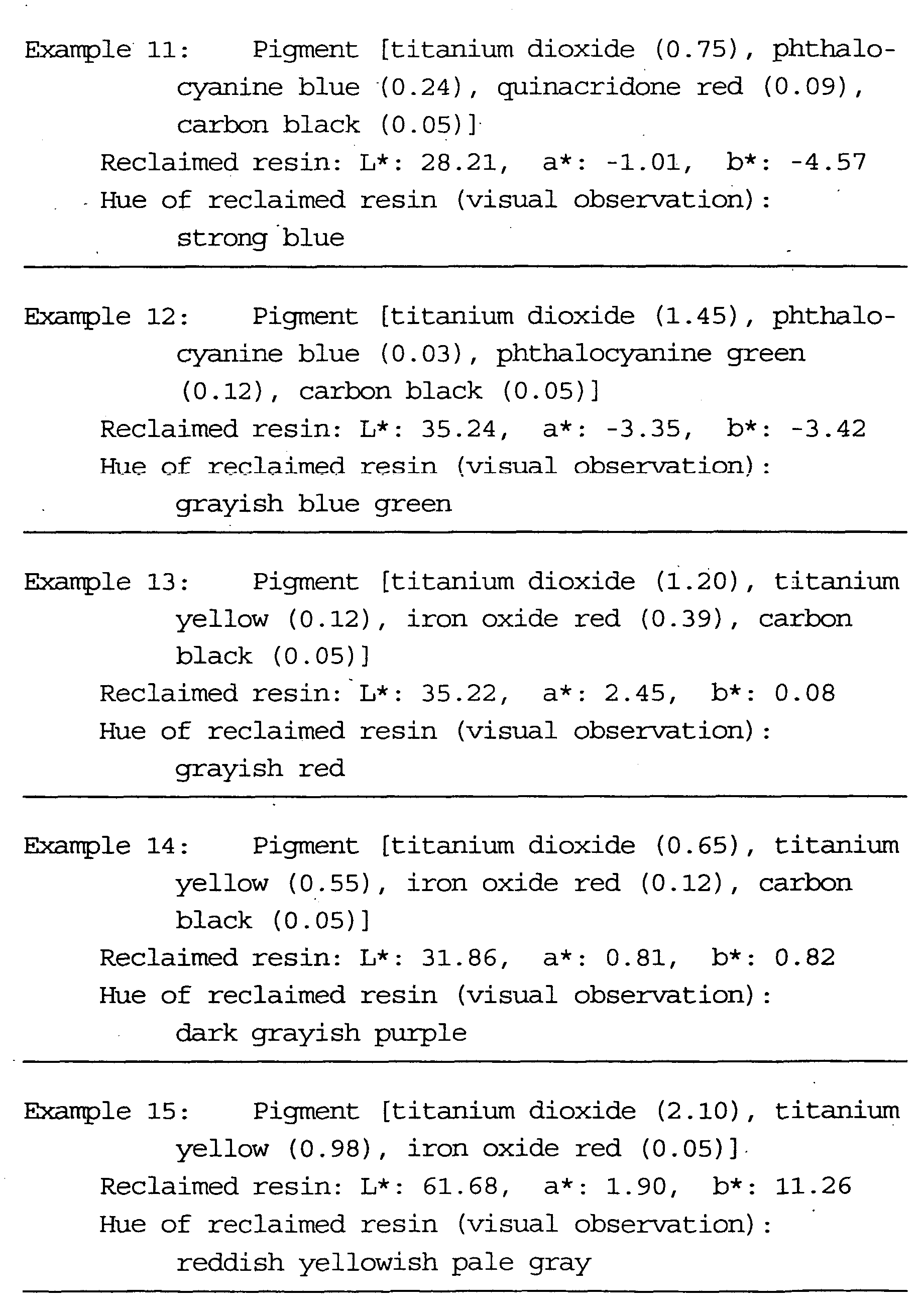


Claims (11)
- A method for producing colored reclaimed resin particles which comprises the steps of:preparing a molten product which comprises a mixture of a white pigment, a colored pigment, and a pulverized thermoplastic resin product to be reclaimed which is selected from the group consisting of a pulverized thermoplastic product containing a black pigment, a mixture of a pulverized thermoplastic product containing a black pigment and a pulverized thermoplastic product containing a colored pigment, and a pulverized thermoplastic product containing two or more different colored pigments; andconverting the molten product into solid particles.
- The method for producing colored reclaimed resin particles as defined in claim 1, wherein the step of preparing a molten product comprises a step of mixing the product to be reclaimed with the white pigment and the colored pigment, and a subsequent step of heating and melting the resulting mixture.
- The method for producing colored reclaimed resin particles as defined in claim 1, wherein the step of preparing a molten product comprises incorporation of a black pigment.
- The method for producing colored reclaimed resin particles defined in claim 1, wherein an inorganic filler is incorporated into the mixture produced in the step of preparing a molten product.
- The method for producing colored reclaimed resin particles defined in claim 1, wherein a thermoplastic resin is incorporated into the mixture produced in the step of preparing a molten product.
- The method for producing colored reclaimed resin particles defined in claim 1, wherein a thermoplastic resin and an elastomer are incorporated into the mixture produced in the step of preparing a molten product.
- The method for producing colored reclaimed resin particles defined in claim 1, wherein the pulverized thermoplastic resin product to be reclaimed is a pulverized bumper or interior trim taken from automobile which has no skin film thereon.
- The method for producing colored reclaimed resin particles defined in claim 1, wherein the pulverized thermoplastic resin product to be reclaimed comprises a thermoplastic resin selected from the group consisting of polyolefin, polyester, polystyrene, ABS resin, and polyamide.
- The method for producing colored reclaimed resin particles defined in claim 1, wherein the pulverized thermoplastic resin product to be reclaimed contains an elastomer.
- Colored reclaimed resin particles produced by the method of claim 1.
- A method for manufacturing a resin article prepared by melting the colored reclaimed resin particles of claim 10 under heating and molding the molten particles.
Applications Claiming Priority (5)
| Application Number | Priority Date | Filing Date | Title |
|---|---|---|---|
| JP2002134288 | 2002-05-09 | ||
| JP2002134288 | 2002-05-09 | ||
| JP2002188255 | 2002-06-27 | ||
| JP2002188255 | 2002-06-27 | ||
| PCT/JP2003/004651 WO2003095531A1 (en) | 2002-05-09 | 2003-04-11 | Method for reusing crushed synthetic resin product |
Publications (3)
| Publication Number | Publication Date |
|---|---|
| EP1510538A1 true EP1510538A1 (en) | 2005-03-02 |
| EP1510538A4 EP1510538A4 (en) | 2005-08-31 |
| EP1510538B1 EP1510538B1 (en) | 2010-09-15 |
Family
ID=29422379
Family Applications (1)
| Application Number | Title | Priority Date | Filing Date |
|---|---|---|---|
| EP03749813A Expired - Lifetime EP1510538B1 (en) | 2002-05-09 | 2003-04-11 | Method for reusing crushed synthetic resin product |
Country Status (9)
| Country | Link |
|---|---|
| US (2) | US20040130052A1 (en) |
| EP (1) | EP1510538B1 (en) |
| JP (2) | JP4042120B2 (en) |
| KR (1) | KR100973961B1 (en) |
| CN (1) | CN1294184C (en) |
| AT (1) | ATE481443T1 (en) |
| AU (1) | AU2003236214A1 (en) |
| DE (1) | DE60334210D1 (en) |
| WO (1) | WO2003095531A1 (en) |
Cited By (1)
| Publication number | Priority date | Publication date | Assignee | Title |
|---|---|---|---|---|
| EP1674532A4 (en) * | 2003-10-17 | 2011-07-06 | Ube Industries | RECYCLED RESIN COMPOSITION PRODUCED FROM MOLDED PLASTIC WASTE MATERIAL CONTAINING SOLID FOREIGN BODIES |
Families Citing this family (10)
| Publication number | Priority date | Publication date | Assignee | Title |
|---|---|---|---|---|
| JP4870380B2 (en) * | 2005-04-15 | 2012-02-08 | 宇部興産株式会社 | Granular white resin composition |
| JP2007119693A (en) * | 2005-10-31 | 2007-05-17 | Bussan Nanotech Research Institute Inc | Colored polymer composition |
| JP2007138039A (en) * | 2005-11-18 | 2007-06-07 | Bussan Nanotech Research Institute Inc | Recycled composite materials |
| JP5428345B2 (en) * | 2009-01-14 | 2014-02-26 | 東ソー株式会社 | Method for producing chromatic color regenerated fibrous filler reinforced thermoplastic resin granules |
| JP5928990B2 (en) * | 2011-03-31 | 2016-06-01 | 宇部興産株式会社 | Highly scratch-resistant polyolefin resin composition molded body |
| JP6102469B2 (en) * | 2013-01-17 | 2017-03-29 | 東洋インキScホールディングス株式会社 | Dispersion composition, coating composition, coating film, and colored product |
| JP7296117B2 (en) * | 2018-10-12 | 2023-06-22 | グリーンプラ株式会社 | Recycled resin composition |
| CN111070547A (en) * | 2019-11-25 | 2020-04-28 | 泸州拓力源塑胶制品有限公司 | High-efficiency energy-saving plastic part injection molding process |
| KR102090431B1 (en) * | 2019-11-29 | 2020-03-17 | 이정호 | Recycling method for scrap of poly lactic acid resin |
| CN111117033B (en) * | 2019-12-25 | 2022-08-16 | 安徽天路新材料股份有限公司 | Method for preparing environment-friendly paint bucket by using reclaimed materials |
Family Cites Families (23)
| Publication number | Priority date | Publication date | Assignee | Title |
|---|---|---|---|---|
| US2000A (en) * | 1841-03-12 | Improvement in the manufacture of starch | ||
| DE1669569B2 (en) * | 1967-09-07 | 1973-01-25 | Zimmer AG, Planung und Bau von Industrieanlagen, 6000 Frankfurt | PROCESS FOR THE PRODUCTION OF PIGMENTED HIGH POLYMER MOLDING COMPOUNDS |
| CA1290528C (en) * | 1985-07-09 | 1991-10-15 | Martin Walsh | Method and apparatus for producing thermoplastic and products produced therefrom |
| JPH01168737A (en) * | 1987-12-24 | 1989-07-04 | Kazuo Akiyama | Coloration of synthetic resin article containing reclaimed rubber |
| DE3936194A1 (en) * | 1989-10-31 | 1991-05-02 | Basf Ag | RECYCLABLE BUMPER SYSTEM |
| US5157082A (en) * | 1990-11-13 | 1992-10-20 | Synesis Corporation | Thermoplastic compositions containing ground vulcanized rubber and polyolefin resin |
| JPH09124798A (en) * | 1995-10-30 | 1997-05-13 | Kouchi Vinyl Kk | Colored chip |
| JPH09207134A (en) * | 1995-11-28 | 1997-08-12 | Toto Ltd | Molding material of thermoplastic resin raw material and manufacture thereof |
| WO1997038838A1 (en) * | 1996-04-14 | 1997-10-23 | Suzuka Fuji Xerox Co., Ltd. | Coated molded article, method of recycling the same and apparatus therefor |
| JP3832785B2 (en) * | 1997-10-27 | 2006-10-11 | 三菱化学ポリエステルフィルム株式会社 | Colored pigment-containing polyester film |
| US6143405A (en) * | 1998-06-30 | 2000-11-07 | 3M Innovative Properties Company | Light colored, electrically conductive coated particles and composites made therefrom |
| JP4262831B2 (en) * | 1999-05-19 | 2009-05-13 | 帝人化成株式会社 | Coloring master resin composition |
| JP2001254024A (en) * | 2000-03-09 | 2001-09-18 | Techno Polymer Co Ltd | Method for producing recycled plastic material |
| JP2001294671A (en) * | 2000-04-17 | 2001-10-23 | Idemitsu Petrochem Co Ltd | Color pigment masterbatch and blow molding method using the same |
| JP2001341173A (en) | 2000-06-05 | 2001-12-11 | Japan Polychem Corp | Method for manufacturing exterior parts for car |
| JP2002047427A (en) * | 2000-08-03 | 2002-02-12 | Konica Corp | Resin molded product and method for manufacturing resin molded product |
| JP2002072419A (en) * | 2000-08-23 | 2002-03-12 | Fuji Photo Film Co Ltd | Method for recycling injection-molded article for photographic sensitive material and recycled parts fur photographic sensitive material |
| JP2002187990A (en) * | 2000-12-20 | 2002-07-05 | Kanegafuchi Chem Ind Co Ltd | Resin composition recycled vinyl chloride wallpaper and wood composite molding using the same |
| CN1174848C (en) * | 2001-04-26 | 2004-11-10 | 北京嘉寓新型建材股份有限公司 | Technology for preparing colour plastic-wood section and pallet |
| JP3687568B2 (en) * | 2001-05-17 | 2005-08-24 | 三菱ふそうトラック・バス株式会社 | Resin molded product with anti-slip bead and molding method thereof |
| JP4894096B2 (en) * | 2001-06-18 | 2012-03-07 | ダイキン工業株式会社 | Fluoropolymer powder manufacturing method |
| US7884140B2 (en) * | 2002-04-12 | 2011-02-08 | Mba Polymers, Inc. | Compositions of materials containing recycled plastics |
| DE60305480T2 (en) | 2002-04-19 | 2006-11-16 | Ube Industries, Ltd., Ube | METHOD OF REUSE OF CRUSHED ART RESIN PRODUCT WITH RESIN HARDENED RESIN |
-
2003
- 2003-04-11 EP EP03749813A patent/EP1510538B1/en not_active Expired - Lifetime
- 2003-04-11 DE DE60334210T patent/DE60334210D1/en not_active Expired - Lifetime
- 2003-04-11 AU AU2003236214A patent/AU2003236214A1/en not_active Abandoned
- 2003-04-11 WO PCT/JP2003/004651 patent/WO2003095531A1/en not_active Ceased
- 2003-04-11 AT AT03749813T patent/ATE481443T1/en not_active IP Right Cessation
- 2003-04-11 JP JP2004503539A patent/JP4042120B2/en not_active Expired - Fee Related
- 2003-04-11 CN CNB03810458XA patent/CN1294184C/en not_active Expired - Fee Related
- 2003-04-11 US US10/475,983 patent/US20040130052A1/en not_active Abandoned
- 2003-04-11 KR KR1020047018059A patent/KR100973961B1/en not_active Expired - Fee Related
-
2008
- 2008-02-04 US US12/025,354 patent/US7893120B2/en not_active Expired - Fee Related
-
2011
- 2011-03-15 JP JP2011057015A patent/JP5294093B2/en not_active Expired - Fee Related
Cited By (1)
| Publication number | Priority date | Publication date | Assignee | Title |
|---|---|---|---|---|
| EP1674532A4 (en) * | 2003-10-17 | 2011-07-06 | Ube Industries | RECYCLED RESIN COMPOSITION PRODUCED FROM MOLDED PLASTIC WASTE MATERIAL CONTAINING SOLID FOREIGN BODIES |
Also Published As
| Publication number | Publication date |
|---|---|
| JP5294093B2 (en) | 2013-09-18 |
| JP4042120B2 (en) | 2008-02-06 |
| KR20040106510A (en) | 2004-12-17 |
| US7893120B2 (en) | 2011-02-22 |
| EP1510538A4 (en) | 2005-08-31 |
| US20080132590A1 (en) | 2008-06-05 |
| US20040130052A1 (en) | 2004-07-08 |
| AU2003236214A1 (en) | 2003-11-11 |
| DE60334210D1 (en) | 2010-10-28 |
| KR100973961B1 (en) | 2010-08-05 |
| ATE481443T1 (en) | 2010-10-15 |
| JP2011153310A (en) | 2011-08-11 |
| CN1653111A (en) | 2005-08-10 |
| JPWO2003095531A1 (en) | 2005-09-15 |
| EP1510538B1 (en) | 2010-09-15 |
| CN1294184C (en) | 2007-01-10 |
| WO2003095531A1 (en) | 2003-11-20 |
Similar Documents
| Publication | Publication Date | Title |
|---|---|---|
| US7893120B2 (en) | Method for reclaiming pulverized synthetic resin product | |
| EP1674532B1 (en) | Recycled resin composition produced from ground product of waste plastic material containing solid foreigner | |
| JP5478967B2 (en) | Recycling method for pulverized synthetic resin products containing cured resin | |
| JP4572560B2 (en) | Recycled resin obtained from thermoplastic waste plastic and method for producing the same | |
| JP4895207B2 (en) | Reuse method of pulverized synthetic resin products | |
| JP4877569B2 (en) | Granular chromatic resin composition | |
| JP4492636B2 (en) | Recycling method for pulverized synthetic resin products containing cured resin | |
| JP2005139422A (en) | Recycled resin obtained from pulverized thermoplastic waste plastic mixed with cured resin and method for producing the same | |
| US7638571B2 (en) | Particulate chromatic resin composition | |
| ES2350097T3 (en) | PROCEDURE FOR REUSING A CRUSHED SYNTHETIC RESIN PRODUCT. |
Legal Events
| Date | Code | Title | Description |
|---|---|---|---|
| PUAI | Public reference made under article 153(3) epc to a published international application that has entered the european phase |
Free format text: ORIGINAL CODE: 0009012 |
|
| 17P | Request for examination filed |
Effective date: 20041102 |
|
| AK | Designated contracting states |
Kind code of ref document: A1 Designated state(s): AT BE BG CH CY CZ DE DK EE ES FI FR GB GR HU IE IT LI LU MC NL PT RO SE SI SK TR |
|
| AX | Request for extension of the european patent |
Extension state: AL LT LV MK |
|
| A4 | Supplementary search report drawn up and despatched |
Effective date: 20050718 |
|
| 17Q | First examination report despatched |
Effective date: 20090224 |
|
| GRAP | Despatch of communication of intention to grant a patent |
Free format text: ORIGINAL CODE: EPIDOSNIGR1 |
|
| GRAS | Grant fee paid |
Free format text: ORIGINAL CODE: EPIDOSNIGR3 |
|
| GRAA | (expected) grant |
Free format text: ORIGINAL CODE: 0009210 |
|
| AK | Designated contracting states |
Kind code of ref document: B1 Designated state(s): AT BE BG CH CY CZ DE DK EE ES FI FR GB GR HU IE IT LI LU MC NL PT RO SE SI SK TR |
|
| AX | Request for extension of the european patent |
Extension state: AL LT LV MK |
|
| REG | Reference to a national code |
Ref country code: GB Ref legal event code: FG4D Ref country code: CH Ref legal event code: EP |
|
| REG | Reference to a national code |
Ref country code: IE Ref legal event code: FG4D |
|
| REF | Corresponds to: |
Ref document number: 60334210 Country of ref document: DE Date of ref document: 20101028 Kind code of ref document: P |
|
| REG | Reference to a national code |
Ref country code: NL Ref legal event code: VDEP Effective date: 20100915 |
|
| REG | Reference to a national code |
Ref country code: ES Ref legal event code: FG2A Effective date: 20110105 |
|
| PG25 | Lapsed in a contracting state [announced via postgrant information from national office to epo] |
Ref country code: AT Free format text: LAPSE BECAUSE OF FAILURE TO SUBMIT A TRANSLATION OF THE DESCRIPTION OR TO PAY THE FEE WITHIN THE PRESCRIBED TIME-LIMIT Effective date: 20100915 Ref country code: FI Free format text: LAPSE BECAUSE OF FAILURE TO SUBMIT A TRANSLATION OF THE DESCRIPTION OR TO PAY THE FEE WITHIN THE PRESCRIBED TIME-LIMIT Effective date: 20100915 |
|
| LTIE | Lt: invalidation of european patent or patent extension |
Effective date: 20100915 |
|
| PG25 | Lapsed in a contracting state [announced via postgrant information from national office to epo] |
Ref country code: SI Free format text: LAPSE BECAUSE OF FAILURE TO SUBMIT A TRANSLATION OF THE DESCRIPTION OR TO PAY THE FEE WITHIN THE PRESCRIBED TIME-LIMIT Effective date: 20100915 Ref country code: CY Free format text: LAPSE BECAUSE OF FAILURE TO SUBMIT A TRANSLATION OF THE DESCRIPTION OR TO PAY THE FEE WITHIN THE PRESCRIBED TIME-LIMIT Effective date: 20100915 |
|
| PG25 | Lapsed in a contracting state [announced via postgrant information from national office to epo] |
Ref country code: GR Free format text: LAPSE BECAUSE OF FAILURE TO SUBMIT A TRANSLATION OF THE DESCRIPTION OR TO PAY THE FEE WITHIN THE PRESCRIBED TIME-LIMIT Effective date: 20101216 Ref country code: SE Free format text: LAPSE BECAUSE OF FAILURE TO SUBMIT A TRANSLATION OF THE DESCRIPTION OR TO PAY THE FEE WITHIN THE PRESCRIBED TIME-LIMIT Effective date: 20100915 |
|
| PG25 | Lapsed in a contracting state [announced via postgrant information from national office to epo] |
Ref country code: NL Free format text: LAPSE BECAUSE OF FAILURE TO SUBMIT A TRANSLATION OF THE DESCRIPTION OR TO PAY THE FEE WITHIN THE PRESCRIBED TIME-LIMIT Effective date: 20100915 Ref country code: CZ Free format text: LAPSE BECAUSE OF FAILURE TO SUBMIT A TRANSLATION OF THE DESCRIPTION OR TO PAY THE FEE WITHIN THE PRESCRIBED TIME-LIMIT Effective date: 20100915 Ref country code: SK Free format text: LAPSE BECAUSE OF FAILURE TO SUBMIT A TRANSLATION OF THE DESCRIPTION OR TO PAY THE FEE WITHIN THE PRESCRIBED TIME-LIMIT Effective date: 20100915 Ref country code: EE Free format text: LAPSE BECAUSE OF FAILURE TO SUBMIT A TRANSLATION OF THE DESCRIPTION OR TO PAY THE FEE WITHIN THE PRESCRIBED TIME-LIMIT Effective date: 20100915 Ref country code: PT Free format text: LAPSE BECAUSE OF FAILURE TO SUBMIT A TRANSLATION OF THE DESCRIPTION OR TO PAY THE FEE WITHIN THE PRESCRIBED TIME-LIMIT Effective date: 20110117 Ref country code: RO Free format text: LAPSE BECAUSE OF FAILURE TO SUBMIT A TRANSLATION OF THE DESCRIPTION OR TO PAY THE FEE WITHIN THE PRESCRIBED TIME-LIMIT Effective date: 20100915 |
|
| PG25 | Lapsed in a contracting state [announced via postgrant information from national office to epo] |
Ref country code: BE Free format text: LAPSE BECAUSE OF FAILURE TO SUBMIT A TRANSLATION OF THE DESCRIPTION OR TO PAY THE FEE WITHIN THE PRESCRIBED TIME-LIMIT Effective date: 20100915 |
|
| PLBE | No opposition filed within time limit |
Free format text: ORIGINAL CODE: 0009261 |
|
| STAA | Information on the status of an ep patent application or granted ep patent |
Free format text: STATUS: NO OPPOSITION FILED WITHIN TIME LIMIT |
|
| 26N | No opposition filed |
Effective date: 20110616 |
|
| PG25 | Lapsed in a contracting state [announced via postgrant information from national office to epo] |
Ref country code: DK Free format text: LAPSE BECAUSE OF FAILURE TO SUBMIT A TRANSLATION OF THE DESCRIPTION OR TO PAY THE FEE WITHIN THE PRESCRIBED TIME-LIMIT Effective date: 20100915 |
|
| REG | Reference to a national code |
Ref country code: DE Ref legal event code: R097 Ref document number: 60334210 Country of ref document: DE Effective date: 20110616 |
|
| PG25 | Lapsed in a contracting state [announced via postgrant information from national office to epo] |
Ref country code: MC Free format text: LAPSE BECAUSE OF NON-PAYMENT OF DUE FEES Effective date: 20110430 |
|
| REG | Reference to a national code |
Ref country code: CH Ref legal event code: PL |
|
| PG25 | Lapsed in a contracting state [announced via postgrant information from national office to epo] |
Ref country code: LI Free format text: LAPSE BECAUSE OF NON-PAYMENT OF DUE FEES Effective date: 20110430 Ref country code: CH Free format text: LAPSE BECAUSE OF NON-PAYMENT OF DUE FEES Effective date: 20110430 |
|
| REG | Reference to a national code |
Ref country code: IE Ref legal event code: MM4A |
|
| PG25 | Lapsed in a contracting state [announced via postgrant information from national office to epo] |
Ref country code: IE Free format text: LAPSE BECAUSE OF NON-PAYMENT OF DUE FEES Effective date: 20110411 |
|
| PG25 | Lapsed in a contracting state [announced via postgrant information from national office to epo] |
Ref country code: LU Free format text: LAPSE BECAUSE OF NON-PAYMENT OF DUE FEES Effective date: 20110411 |
|
| PG25 | Lapsed in a contracting state [announced via postgrant information from national office to epo] |
Ref country code: TR Free format text: LAPSE BECAUSE OF FAILURE TO SUBMIT A TRANSLATION OF THE DESCRIPTION OR TO PAY THE FEE WITHIN THE PRESCRIBED TIME-LIMIT Effective date: 20100915 Ref country code: BG Free format text: LAPSE BECAUSE OF FAILURE TO SUBMIT A TRANSLATION OF THE DESCRIPTION OR TO PAY THE FEE WITHIN THE PRESCRIBED TIME-LIMIT Effective date: 20101215 |
|
| PG25 | Lapsed in a contracting state [announced via postgrant information from national office to epo] |
Ref country code: HU Free format text: LAPSE BECAUSE OF FAILURE TO SUBMIT A TRANSLATION OF THE DESCRIPTION OR TO PAY THE FEE WITHIN THE PRESCRIBED TIME-LIMIT Effective date: 20100915 |
|
| REG | Reference to a national code |
Ref country code: FR Ref legal event code: PLFP Year of fee payment: 14 |
|
| REG | Reference to a national code |
Ref country code: FR Ref legal event code: PLFP Year of fee payment: 15 |
|
| REG | Reference to a national code |
Ref country code: FR Ref legal event code: PLFP Year of fee payment: 16 |
|
| PGFP | Annual fee paid to national office [announced via postgrant information from national office to epo] |
Ref country code: GB Payment date: 20180329 Year of fee payment: 16 |
|
| PGFP | Annual fee paid to national office [announced via postgrant information from national office to epo] |
Ref country code: FR Payment date: 20180315 Year of fee payment: 16 |
|
| PGFP | Annual fee paid to national office [announced via postgrant information from national office to epo] |
Ref country code: DE Payment date: 20180327 Year of fee payment: 16 Ref country code: ES Payment date: 20180507 Year of fee payment: 16 |
|
| PGFP | Annual fee paid to national office [announced via postgrant information from national office to epo] |
Ref country code: IT Payment date: 20180420 Year of fee payment: 16 |
|
| REG | Reference to a national code |
Ref country code: DE Ref legal event code: R119 Ref document number: 60334210 Country of ref document: DE |
|
| GBPC | Gb: european patent ceased through non-payment of renewal fee |
Effective date: 20190411 |
|
| PG25 | Lapsed in a contracting state [announced via postgrant information from national office to epo] |
Ref country code: GB Free format text: LAPSE BECAUSE OF NON-PAYMENT OF DUE FEES Effective date: 20190411 Ref country code: DE Free format text: LAPSE BECAUSE OF NON-PAYMENT OF DUE FEES Effective date: 20191101 |
|
| PG25 | Lapsed in a contracting state [announced via postgrant information from national office to epo] |
Ref country code: IT Free format text: LAPSE BECAUSE OF NON-PAYMENT OF DUE FEES Effective date: 20190411 |
|
| PG25 | Lapsed in a contracting state [announced via postgrant information from national office to epo] |
Ref country code: FR Free format text: LAPSE BECAUSE OF NON-PAYMENT OF DUE FEES Effective date: 20190430 |
|
| REG | Reference to a national code |
Ref country code: ES Ref legal event code: FD2A Effective date: 20200831 |
|
| PG25 | Lapsed in a contracting state [announced via postgrant information from national office to epo] |
Ref country code: ES Free format text: LAPSE BECAUSE OF NON-PAYMENT OF DUE FEES Effective date: 20190412 |