EP1510252A1 - Surfactant and dispersion aid each comprising graft fluoropolymer - Google Patents
Surfactant and dispersion aid each comprising graft fluoropolymer Download PDFInfo
- Publication number
- EP1510252A1 EP1510252A1 EP03721046A EP03721046A EP1510252A1 EP 1510252 A1 EP1510252 A1 EP 1510252A1 EP 03721046 A EP03721046 A EP 03721046A EP 03721046 A EP03721046 A EP 03721046A EP 1510252 A1 EP1510252 A1 EP 1510252A1
- Authority
- EP
- European Patent Office
- Prior art keywords
- polymer
- group
- surfactant
- fluoropolymer
- fluorine
- Prior art date
- Legal status (The legal status is an assumption and is not a legal conclusion. Google has not performed a legal analysis and makes no representation as to the accuracy of the status listed.)
- Withdrawn
Links
- HPXRVTGHNJAIIH-UHFFFAOYSA-N OC1CCCCC1 Chemical compound OC1CCCCC1 HPXRVTGHNJAIIH-UHFFFAOYSA-N 0.000 description 1
Images


Classifications
-
- C—CHEMISTRY; METALLURGY
- C08—ORGANIC MACROMOLECULAR COMPOUNDS; THEIR PREPARATION OR CHEMICAL WORKING-UP; COMPOSITIONS BASED THEREON
- C08G—MACROMOLECULAR COMPOUNDS OBTAINED OTHERWISE THAN BY REACTIONS ONLY INVOLVING UNSATURATED CARBON-TO-CARBON BONDS
- C08G18/00—Polymeric products of isocyanates or isothiocyanates
- C08G18/06—Polymeric products of isocyanates or isothiocyanates with compounds having active hydrogen
- C08G18/70—Polymeric products of isocyanates or isothiocyanates with compounds having active hydrogen characterised by the isocyanates or isothiocyanates used
- C08G18/81—Unsaturated isocyanates or isothiocyanates
- C08G18/8108—Unsaturated isocyanates or isothiocyanates having only one isocyanate or isothiocyanate group
- C08G18/8116—Unsaturated isocyanates or isothiocyanates having only one isocyanate or isothiocyanate group esters of acrylic or alkylacrylic acid having only one isocyanate or isothiocyanate group
-
- C—CHEMISTRY; METALLURGY
- C08—ORGANIC MACROMOLECULAR COMPOUNDS; THEIR PREPARATION OR CHEMICAL WORKING-UP; COMPOSITIONS BASED THEREON
- C08F—MACROMOLECULAR COMPOUNDS OBTAINED BY REACTIONS ONLY INVOLVING CARBON-TO-CARBON UNSATURATED BONDS
- C08F259/00—Macromolecular compounds obtained by polymerising monomers on to polymers of halogen containing monomers as defined in group C08F14/00
- C08F259/08—Macromolecular compounds obtained by polymerising monomers on to polymers of halogen containing monomers as defined in group C08F14/00 on to polymers containing fluorine
-
- C—CHEMISTRY; METALLURGY
- C08—ORGANIC MACROMOLECULAR COMPOUNDS; THEIR PREPARATION OR CHEMICAL WORKING-UP; COMPOSITIONS BASED THEREON
- C08F—MACROMOLECULAR COMPOUNDS OBTAINED BY REACTIONS ONLY INVOLVING CARBON-TO-CARBON UNSATURATED BONDS
- C08F290/00—Macromolecular compounds obtained by polymerising monomers on to polymers modified by introduction of aliphatic unsaturated end or side groups
- C08F290/02—Macromolecular compounds obtained by polymerising monomers on to polymers modified by introduction of aliphatic unsaturated end or side groups on to polymers modified by introduction of unsaturated end groups
- C08F290/04—Polymers provided for in subclasses C08C or C08F
-
- C—CHEMISTRY; METALLURGY
- C08—ORGANIC MACROMOLECULAR COMPOUNDS; THEIR PREPARATION OR CHEMICAL WORKING-UP; COMPOSITIONS BASED THEREON
- C08F—MACROMOLECULAR COMPOUNDS OBTAINED BY REACTIONS ONLY INVOLVING CARBON-TO-CARBON UNSATURATED BONDS
- C08F8/00—Chemical modification by after-treatment
- C08F8/18—Introducing halogen atoms or halogen-containing groups
- C08F8/20—Halogenation
-
- C—CHEMISTRY; METALLURGY
- C08—ORGANIC MACROMOLECULAR COMPOUNDS; THEIR PREPARATION OR CHEMICAL WORKING-UP; COMPOSITIONS BASED THEREON
- C08G—MACROMOLECULAR COMPOUNDS OBTAINED OTHERWISE THAN BY REACTIONS ONLY INVOLVING UNSATURATED CARBON-TO-CARBON BONDS
- C08G18/00—Polymeric products of isocyanates or isothiocyanates
- C08G18/06—Polymeric products of isocyanates or isothiocyanates with compounds having active hydrogen
- C08G18/28—Polymeric products of isocyanates or isothiocyanates with compounds having active hydrogen characterised by the compounds used containing active hydrogen
- C08G18/30—Low-molecular-weight compounds
- C08G18/38—Low-molecular-weight compounds having heteroatoms other than oxygen
- C08G18/3855—Low-molecular-weight compounds having heteroatoms other than oxygen having sulfur
- C08G18/3876—Low-molecular-weight compounds having heteroatoms other than oxygen having sulfur containing mercapto groups
-
- C—CHEMISTRY; METALLURGY
- C08—ORGANIC MACROMOLECULAR COMPOUNDS; THEIR PREPARATION OR CHEMICAL WORKING-UP; COMPOSITIONS BASED THEREON
- C08L—COMPOSITIONS OF MACROMOLECULAR COMPOUNDS
- C08L51/00—Compositions of graft polymers in which the grafted component is obtained by reactions only involving carbon-to-carbon unsaturated bonds; Compositions of derivatives of such polymers
- C08L51/003—Compositions of graft polymers in which the grafted component is obtained by reactions only involving carbon-to-carbon unsaturated bonds; Compositions of derivatives of such polymers grafted on to macromolecular compounds obtained by reactions only involving unsaturated carbon-to-carbon bonds
-
- C—CHEMISTRY; METALLURGY
- C09—DYES; PAINTS; POLISHES; NATURAL RESINS; ADHESIVES; COMPOSITIONS NOT OTHERWISE PROVIDED FOR; APPLICATIONS OF MATERIALS NOT OTHERWISE PROVIDED FOR
- C09D—COATING COMPOSITIONS, e.g. PAINTS, VARNISHES OR LACQUERS; FILLING PASTES; CHEMICAL PAINT OR INK REMOVERS; INKS; CORRECTING FLUIDS; WOODSTAINS; PASTES OR SOLIDS FOR COLOURING OR PRINTING; USE OF MATERIALS THEREFOR
- C09D151/00—Coating compositions based on graft polymers in which the grafted component is obtained by reactions only involving carbon-to-carbon unsaturated bonds; Coating compositions based on derivatives of such polymers
- C09D151/003—Coating compositions based on graft polymers in which the grafted component is obtained by reactions only involving carbon-to-carbon unsaturated bonds; Coating compositions based on derivatives of such polymers grafted on to macromolecular compounds obtained by reactions only involving unsaturated carbon-to-carbon bonds
-
- C—CHEMISTRY; METALLURGY
- C09—DYES; PAINTS; POLISHES; NATURAL RESINS; ADHESIVES; COMPOSITIONS NOT OTHERWISE PROVIDED FOR; APPLICATIONS OF MATERIALS NOT OTHERWISE PROVIDED FOR
- C09K—MATERIALS FOR MISCELLANEOUS APPLICATIONS, NOT PROVIDED FOR ELSEWHERE
- C09K23/00—Use of substances as emulsifying, wetting, dispersing, or foam-producing agents
- C09K23/007—Organic compounds containing halogen
-
- C—CHEMISTRY; METALLURGY
- C09—DYES; PAINTS; POLISHES; NATURAL RESINS; ADHESIVES; COMPOSITIONS NOT OTHERWISE PROVIDED FOR; APPLICATIONS OF MATERIALS NOT OTHERWISE PROVIDED FOR
- C09K—MATERIALS FOR MISCELLANEOUS APPLICATIONS, NOT PROVIDED FOR ELSEWHERE
- C09K23/00—Use of substances as emulsifying, wetting, dispersing, or foam-producing agents
- C09K23/16—Amines or polyamines
Definitions
- the present invention relates to surfactants and dispersion aids both comprising graft fluoropolymers.
- the surfactants of the present invention are used in a variety of fields because they have high surface tension-lowering actions to improve the wetting, penetrating and leveling properties of solutions to the surfaces of solid materials.
- the surfactants of the present invention are used as modifiers for liquids such as paints, ink and emulsions for photographs, or surface treatment agents or internal additives, so as to modify the surfaces of solid materials such as textiles, films and powder to thereby impart stain-proofing properties, water- and oil-repellant properties and lubricity to such solid materials.
- the surfactants of the present invention are used as agents for remedying defects of paint layers, agents for protecting coating layers, agents for lowering the surface tension of ink, surface treatment agents for pigments, dispersants for pigments, etc. in the pigment, paint and ink industries. Further, the surfactants of the present invention are used as penetrants for use in processing textiles, textile oils, water- and oil-repellant processing agents for textiles, stain-proofing agents for textiles, and oil-repellant treatment agents for paper in the paper and textile industries.
- the surfactants of the present invention are used as defoaming aids, internal additives for plastics and rubber, wet type film-forming aids for urethanes, and mold release agents for urethanes in the rubber and plastic industries.
- the surfactants of the present invention can be used in other various industrial fields, as detergents, removers for floor waxes, leveling agents for waxes, spot-preventing agents for plating, agents for defoaming aqueous foams, emulsions for photographs, internal additives for vinyl films as fog-preventing materials for agricultural green houses, flux-preventing agents for solder, water- and oil-repellant processing agents for leathers, stain-proof processing agents for leathers, unevenness-preventing agents for films formed by spin-coating, additives for adhesives, etc.
- the dispersion aids of the present invention are used to coat the surfaces of various kinds of substrates, or used as internal addition type modifiers for resins.
- the agents of the present invention are useful as internal additives or coatings required to have surface properties which protect the surfaces of materials from the adhesion of stains and water or the like, or required to have lubricity.
- the present invention also relates to fluoropolymer dispersion compositions comprising fluoropolymers, liquid media and the above surfactants or the above dispersion aids.
- Fluoropolymers are used in dry lubricants, release agents, industrial thickeners, and non-tacky and abrasion resistant films of cocking utensils such as frying pans, and irons, because of their features such as low surface energies, and physical and chemical stabilities (e.g., abrasion resistance, corrosion resistance, non-tackiness, etc.).
- Fluoropolymer dispersion compositions are used to coat various substrates with fluoropolymer films. Further, the fluoropolymer dispersion compositions are used as internal additives for stain-proof and water repellant FRP. When construction materials of kitchens and bathrooms are made of FRP, such materials are made by simultaneously adding glass fibers and fluoropolymers to liquid polyesters, and further adding crosslinking agents to the mixtures, thereby curing and molding the mixtures.
- the dispersion compositions cannot be easily obtained, since the affinity of the fluoropolymers to the media is poor because of their low surface energies, one of the features of the fluoropolymers.
- the fluoropolymer is powder of a tetrafluoroethylene resin having a low molecular weight of up to 10,000, or a copolymer which is prepared from tetrafluoroethylene and copolymerizable monomers for modification (such as hexafluoropropylene, perfluoro(propyl vinyl ether)chlorotrifluoroethylene, etc.)
- an article coated with a film formed from such powder or such a copolymer is insufficient in low surface energy (non-tackiness) and chemical stability, as compared with an article coated with a film formed from a tetrafluoroethylene resin having a molecular weight of 100,000 or more.
- JP-A-08-108139 describes the coating of an article with an aqueous dispersion of a tetrafluoroethylene/hexafluoropropylene copolymer.
- halogen-containing solvents, fluorine-containing solvents and aromatic solvents have been mainly used as solvents for dispersions, and have given heavy loads on the environments.
- the fluorine-containing solvents have low boiling points and soon evaporate during coating operations, and thus make it hard to obtain homogeneous films, resulting in low cost*-effectiveness.
- fluoroalkyl group-containing surfactants are effective to greatly decrease the surface tensions of solutions, in spite of low concentrations, as compared with hydrocarbon-based surfactants. Therefore, the fluoroalkyl group-containing surfactants exhibit various actions for emulsification, dispersion and dissolution.
- a perfluoroalkyl group-containing surfactant is used to obtain a coating layer with an uniform thickness, by dissolving or dispersing this surfactant together with a photosensitive composition in a solvent, uniformly coating the resultant solution or dispersion to a substrate, and drying the resulting coating layer.
- perfluoroalkyl group-containing surfactants are particularly useful for obtaining homogeneous dispersions and leveling coating layers.
- the surfactants comprising short-chain perfluoroalkyl groups are poor in surface tension-lowering action, even though the content of fluorine is equal to that of a surfactant comprising long-chain perfluoroalkyl groups. If the content of fluorine is increased, the surface tension-lowering action of the surfactant is improved, but the solubility, particularly water solubility, of the surfactant becomes poor.
- an object of the present invention is to provide a compound which has high solubility in a liquid medium in spite of containing fluoroalkyl groups at a high concentration, and which has excellent action to decrease the surface tension of a solution.
- Another object of the invention is to provide a surfactant which has high solubility in a liquid medium in spite of containing short-chain perfluoroalkyl groups poor in surface tension-lowering action, and which has an excellent action to lower the surface tension of a solution.
- the present invention is intended to improve the conventional fluoroalkyl group-containing surfactants poor in solubility or surface tension-lowering action to thereby provide surfactants and dispersion aids both of which have high solubility and can lower the surface tensions of solutions, and to further provide surfactants which preferably comprise short-chain perfluoroalkyl groups and which have high solubility and can lower the surface tensions of solutions.
- a surfactant and a dispersion aid each of which comprises a graft polymer having a branch polymer and a trunk polymer, at least one of which contains repeating units having fluoroalkyl groups, have high solubility in liquid media in spite of containing fluoroalkyl groups at high concentrations, and that such surfactant and dispersion aid exhibit comparable or superior actions of lowering the surface tensions of solutions in spite of containing smaller amounts of fluorine atoms than random polymers.
- the present invention provides surfactants and fluoropolymer-dispersing aids each comprising graft polymers, fluoropolymer-dispersed compositions, and articles whose surfaces are coated with layers formed from such fluoropolymer dispersion compositions.
- a graft polymer comprising a branch polymer and a trunk polymer, at least one of which has a fluoroalkyl group, has high solubility in a liquid medium even though containing fluoroalkyl groups at a high concentration. Even a graft polymer having repeating units of short-chain perfluoroalkyl groups each having not larger than 7 carbon atoms has high solubility in a liquid medium and can be used as a surfactant which exhibits a comparable or superior surface tension-lowering action, in spite of having a smaller content of fluorine atoms than a random polymer.
- graft polymers of the present invention makes it possible to sufficiently disperse solid materials such as the powder of tetrafluoroethylene resins, poor in affinity to media, in liquid media, because the polymer moiety, containing fluoroalkyl groups, of such a graft polymer has affinity with a fluoropolymer, and because the other polymer moiety thereof has affinity with a liquid medium.
- the graft polymer of the present invention is a graft polymer in which at least one of the branch polymer and the trunk polymer contains repeating units of fluoroalkyl groups.
- the branch polymer containing fluoroalkyl groups may be grafted to the trunk polymer.
- the fluoroalkyl group is a perfluoroalkyl group.
- the fluoroalkyl group (particularly a perfluoroalkyl group) has 1 to 21 carbon atoms, for example, 1 to 7 carbon atoms, particularly 1 to 4 carbon atoms.
- Particularly preferable fluoroalkyl group (or Rf group) is C 4 F 9 .
- a graft polymer having fluoroalkyl groups represented by the formula: C 4 F 9 can maintain sufficient dispersibility to a liquid medium (e.g., water, organic solvents, etc.) in spite of having a high content of fluorine atoms, and further has high surface activity because of the neighbor aggregation effect of the fluoroalkyl groups.
- a graft polymer in which the branch polymer is grafted to the isocyanate group moiety of the trunk polymer may be used.
- the trunk polymer comprises a repeating unit derived from an isocyanate group-containing vinyl monomer, and if necessary, a repeating unit derived from other copolymerizable monomer.
- the isocyanate groups in the repeating unit derived from the isocyanate group-containing vinyl monomer reacts with the active hydrogen atoms of the branch polymer to thereby bond the trunk polymer to the branch polymer.
- the isocyanate group-containing vinyl monomer referred to throughout the description means a polymerizable compound having a carbon-carbon double bond and an isocyanate group.
- the numbers of the carbon-carbon double bonds and the isocyanate groups are one, respectively.
- the molecule of the isocyanate group-containing vinyl monomer has a carbon-carbon double bond at one of the ends, and an isocyanate group at the other end.
- isocyanate group-containing vinyl monomer examples include
- R 13 is a
- Examples of the compound having two isocyanate groups (iii-1) include 2,4-tolylene diisocyanate, 2,6-tolylene diisocyanate, diphenylmethane diisocyanate, naphthalene diisocyanate, hexamethylene diisocyanate, xylene diisocyanate, and isophorone diisocyanate.
- the reaction between the compound having two isocyanate groups (iii-1) and the monomer having an active hydrogen (iii-2) may be conducted in a solvent (especially, an aprotic solvent, for example, an ester solvent) and optionally in the presence of a catalyst such as dibutyltin dilaurate.
- a solvent especially, an aprotic solvent, for example, an ester solvent
- a catalyst such as dibutyltin dilaurate.
- the amount of the monomer having an active hydrogen (iii-2) in the reaction may be from 1.0 to 2.0 equivalents, preferably from 1.0 to 1.7 equivalents, based on the compound having two isocyanate groups (iii-1).
- the amount of the isocyanate group-containing vinyl monomer may have the lower limit of 1% by weight, for example 2% by weight, particularly 6% by weight, and the upper limit of 30% by weight, for example 20% by weight, particularly 10% by weight, based on the weight of the trunk polymer.
- the other copolymerizable monomer constituting the trunk polymer may be any one, in so far as it is an addition-polymerizable monomer (namely, a compound having a carbon-carbon double bond), and it is selected in accordance with a solvent for dispersing a fluoropolymer therein.
- the other copolymerizable monomer may be either a fluorine-free monomer or a fluorine-containing monomer.
- the amount of the fluorine-free monomer may have the lower limit of 50% by weight, for example 60% by weight, particularly 70% by weight, and the upper limit of 99% by weight, for example 98% by weight, particularly 90% by weight, based on the weight of the trunk polymer.
- the amount of the fluorine-containing monomer may have the lower limit of 0% by weight, for example 1% by weight, and the upper limit of 50% by weight, for example 30% by weight, based on the weight of the trunk polymer.
- the fluorine-free monomer examples include (meth)acrylate esters.
- the (meth)acrylate ester may be an ester of (meth)acrylic acid and an aliphatic alcohol such as a monohydric alcohol or a polyhydric alcohol (for example, a dihydric alcohol).
- (meth)acrylates such as 2-ethylhexyl (meth)acrylate, cyclohexyl (meth)acrylate, lauryl (meth)acrylate, stearyl (meth)acrylate, hydroxyalkyl (meth)acrylate, tetrahydrofurfuryl (meth)acrylate, polyoxyalkylene (meth)acrylate, alkoxypolyoxyalkylene (meth)acrylate, 3-chloro-2-hydroxypropyl (meth)acrylate, glycidyl (meth)acrylate, N,N-dimethylaminoethyl (meth)acrylate, N,N-diethylaminoethyl (meth)acrylate, benzyl (meth)acrylate, glycidyl methacrylate, hydroxypropyl monomethacrylate, 2-hydroxy-3-phenoxypropyl acrylate, 2-hydroxye
- fluorine-free monomer examples include ethylene, butadiene, vinyl acetate, chloroprene, vinyl halide such as vinyl chloride, vinylidene halide, acrylonitrile, vinyl alkyl ketone, maleic anhydride, N-vinylcarbazole, vinyl pyrrolidone, and (meth)acrylic acid.
- vinyl halide such as vinyl chloride, vinylidene halide, acrylonitrile, vinyl alkyl ketone, maleic anhydride, N-vinylcarbazole, vinyl pyrrolidone, and (meth)acrylic acid.
- the fluorine-free monomer may be a silicon-containing monomer (for example, (meth)acryloyl group-containing alkylsilane, (meth)acryloyl group-containing alkoxysilane, and (meth)acryloyl group-containing polysiloxane).
- silicon-containing monomer for example, (meth)acryloyl group-containing alkylsilane, (meth)acryloyl group-containing alkoxysilane, and (meth)acryloyl group-containing polysiloxane.
- silicon-containing monomer examples include (meth)acryloxytrialkylsilane, (meth)acryloxytrialkoxysilane, (meth)acryloxypolysiloxane, (meth)acryloxypropyltrialkylsilane, (meth) acryloxypropyltrialkoxysilane, (meth)acryloxypropylpolysiloxane, allyltrialkylsilane, allyltrialkoxysilane, allylpolysiloxane, vinyltrialkylsilane, vinyltrialkoxysilane, and vinylpolysiloxane.
- the (meth)acryloxypropylpolysiloxane may be a compound of the formula: wherein each of R 20 , R 21 , R 22 and R 23 is H or CH 3 , and n is from 1 to 100.
- the (meth)acryloxypropylpolysiloxane is (meth)acryloxypropylpolydimethylsiloxane.
- At least two types of the above fluorine-free monomers may be used in combination.
- Examples of the fluorine-containing monomer constituting the trunk polymer may be the same ones as the fluorine-containing monomers constituting the below-mentioned branch polymers (for example, fluoroalkyl group-containing (meth) acrylate, fluorinated olefin).
- the fluorine-containing monomer may be, for example, a fluorine-containing methacrylate or acrylate.
- the trunk polymer may be a block polymer or a random polymer.
- the branch polymer can be formed by using a chain transfer agent, a fluoroalkyl group-containing vinyl monomer and, if necessary, another fluorine-containing monomer and a fluorine-free monomer.
- the chain transfer agent may be a chain transfer agent having active hydrogen groups at both ends, and examples thereof include an alkylene thiol chain transfer agent having active hydrogen groups and an aryl chain transfer agent having active hydrogen groups.
- the active hydrogen group include OH, NH 2 , SO 3 H, NHOH, COOH and SH.
- the number of carbon atoms in the alkylene group of the alkylene thiol may be from 1 to 20.
- alkylene thiol chain transfer agent examples include the followings: HS(CH 2 ) n OH [n is from 1 to 20, particularly 2, 4, 6 or 11], HSCH 2 COOH, HSCH 2 CH(CH 3 )COOH, HSCH 2 CH 2 SO 3 Na, HSCH 2 CH 2 SO 3 H, and
- aryl chain transfer agent examples include the followings:
- the amount of the isocyanate group of the trunk polymer is preferably from 1.0 to 2.5 equivalents, for example, from 1.0 to 2.0 equivalents, based on 1.0 equivalent of the chain transfer agent.
- the amount of the chain transfer agent may be from 0.05 to 0.7 mol, preferably from 0.1 to 0.6 mol, based on 1 mol of the branch monomer.
- the chain transfer agent is bonded to one end of the branch polymer which is obtained by polymerizing the branch monomer.
- the chain transfer agent can control the length of the chain of the branch polymer.
- the fluoroalkyl group-containing vinyl monomer may be (meth)acrylate having a fluoroalkyl group.
- fluoroalkyl group-containing (meth)acrylates may be used in combination.
- other fluorine-containing monomer may be used.
- the amount of the other fluorine-containing monomer in the branch polymer is at most 20% by weight, for example, at most 10% by weight, particularly at most 5% by weight, based on the weight of the monomer components in the branch polymer.
- a fluorine-free monomer may be used in the branch polymer.
- the fluorine-free monomer used in the branch polymer include the same fluorine-free monomers as those used in the trunk polymer.
- the fluorine-free monomer in the branch polymer may be a (meth)acrylate ester, for example, an ester between an aliphatic monohydric alcohol and (meth) acrylic acid.
- the amount of the fluorine-free monomer in the branch polymer may be at most 80% by weight, e.g. at most 50% by weight, particularly at most 30% by weight, based on the monomer components of the branch polymer.
- the branch polymer may be a block polymer or a random polymer.
- the polymerization degree of the branch polymer is from 3 to 25 molecules, and preferably from 4 to 20 molecules of the monomer, based on one molecule of the chain transfer agent.
- the graft polymer comprises the trunk polymer and the branch polymer.
- the weight ratio of the trunk polymer to the branch polymer may be from 5:95 to 95:5, preferably from 10:90 to 90:10, particularly from 30:70 to 70:30.
- the number-average molecular weight (measured by GPC, converted to polystyrene, in THF) of the graft polymer may be from 1,000 to 200,000, preferably from 5,000 to 100,000.
- the graft polymer of the present invention may be prepared by any of known methods, and some of the methods are herein described.
- the graft polymerization method (1) of a macromonomer is carried out as follows: a perfluoroalkyl group-containing vinyl monomer and a fluorine-free vinyl monomer are radical-polymerized in the presence of a mercaptan-based chain transfer agent having an active hydrogen group such as a hydroxyl group, carboxyl group, amino group, sulfonic acid group or the like, to obtain a polymer having an active hydrogen group at one end; the resulting polymer is reacted with a vinyl monomer which has a group reactive with an active hydrogen, such as a NCO group, glycidyl group, acid chloride group or the like, and a group having a polymerizable double bond, to obtain a macromonomer; and this macromonomer is copolymerized with a perfluoroalkyl group-containing vinyl monomer and a fluorine-free vinyl monomer which consititute a trunk polymer, to obtain a graft polymer.
- the method (2) of reacting a trunk polymer having a group (e.g., a NCO group, glycidyl group, and acid chloride group or the like) reactive with an active hydrogen atom, with a branch polymer polymerized by using a chain transfer agent having an active hydrogen group is carried out as follows: firstly, a vinyl monomer having a group reactive with an active hydrogen and a polymerizable double bond is radical-polymerized with a perfluoroalkyl group-containing vinyl monomer, and if needed, a fluorine-free vinyl monomer, to obtain a trunk polymer having a group reactive with an active hydrogen; the resultant trunk polymer is radical-polymerized with a perfluoroalkyl group-containing vinyl monomer, and if needed, a fluorine-free vinyl monomer, in the presence of a mercaptan-based chain transfer agent having an active hydrogen group such as a hydroxyl group, carboxyl group, amino group and sulfonic group, to
- a graft polymer may be prepared by either of the following methods:
- the method (A) comprises the steps of:
- the method (B) comprises the steps of:
- the polymerization step (A-1) of the branch polymer and the polymerization steps (A-3) and (B-1) of the trunk polymers may be conducted in solvents at temperatures of 70 to 80°C in the presence of polymerization initiators.
- the polymerization time is generally from 2 to 12 hours.
- the polymerization initiator for example, azobisisobutyronitrile, benzoyl peroxide, di-tert-butyl peroxide, lauryl peroxide, cumene hydroperoxide, tert-butyl peroxide pivalate, diisopropylperoxy dicarbonate and the like are used.
- the amount of the polymerization initiator is preferably from 1 to 10 parts by weight based on 100 parts by weight of the monomer.
- the polymerization solvent may be a polar solvent, a hydrocarbon solvent, or a mixture of these solvents.
- a protic solvent having an active hydrogen group such as alcohol solvent, can not be used.
- the polar solvent is a solvent having a polar group in the molecule.
- the polar group include a hydroxyl group, a carboxyl group, an ester group, an acyl group, and an ether oxygen group.
- the polar solvent include an alcohol solvent, a glycol solvent, an ester solvent, and a ketone solvent.
- the hydrocarbon solvent may be a solvent consisting of carbon and hydrogen.
- the hydrocarbon solvent may be an aliphatic hydrocarbon.
- examples of the hydrocarbon solvent include n-heptane, n-hexane, n-octane, cyclohexane, methylcyclohexane, cyclopentane, methylcyclopentane, methylpentane, 2-ethylpentane, isoparaffin hydrocarbon, liquid paraffin, decane, undecane, dodecane, mineral spirit, and mineral turpentine. In some cases, an aromatic hydrocarbon solvent may be used.
- Examples of the alcohol solvent include butyl alcohol and isopropyl alcohol.
- Examples of the glycol solvent include propylene glycol monomethyl ether, propylene glycol monoethyl ether, dipropylene glycolmonomethyl ether, dipropylene glycol monoethyl ether, and acetates thereof.
- Examples of the ester solvent include monobasic acid esters such as methyl acetate, ethyl acetate and butyl acetate; and dibasic acid esters such as diethyl succinate, diethyl adipate, dibutyl phthalate and dioctyl phthalate.
- Examples of the ketone solvent include methyl isobutyl ketone (MIBK), methyl ethyl ketone, and acetone.
- a mixture of the hydrocarbon solvent and the polar solvent also may be used.
- the weight ratio of the hydrocarbon solvent to the polar solvent may be from 100:0 to 0:100, for example, 5:95 to 95:5.
- reaction steps (A-2) and (B-2) of reacting the active hydrogen groups of the chain transfer agents constituting the branch polymers with the groups reactive with active hydrogens, contained in the monomers constituting the trunk polymers may be conducted in solvents at temperatures of 30°C to 130°C.
- the reaction time is generally from 2 hours to 24 hours.
- the reaction temperature is 50°C or higher, it is needed to add a polymerization inhibitor.
- a polymerization inhibitor is not needed.
- the solvent may be a polymerization solvent as described above, a protic solvent having an active hydrogen group such as alcohol solvent can not be used.
- the graft polymer of the present invention acts as a dispersant which is used to disperse a fluoropolymer in a liquid medium.
- a fluoropolymer is a homopolymer or a copolymer of a fluorine-containing monomer.
- the fluoropolymer may be a copolymer of a fluorine-containing monomer and a fluorine-free monomer. Also, the fluoropolymer may be polytetrafluoroethylene or a copolymer of tetrafluoroethylene and a copolymerizable modifying monomer [such as hexafluoropropylene, perfluoro(propylvinyether) and chlorotrifluoroethylene].
- the molecular weight of the fluoropolymer may be 10,000 to 3,000,000.
- the content of fluorine atoms in the fluoropolymer may be 10% by weight or more, for example, 40% by weight or more, particularly 40 to 90% by weight, based on the weight of the fluoropolymer.
- the fluoropolymer to be dispersed may be in the form of powder which has an average particle size of, for example, 0.01 to 100 ⁇ m.
- liquid medium examples include organic solvents, water, mixtures of the organic solvents and water, liquid resins, and mixtures of the liquid resins and the organic solvents.
- the organic solvents may be fluorine-containing solvents or fluorine-free solvents.
- fluorine-containing solvents include CFC-113, HCFC-141b, HCFC-225, perfluorohexane and perfluorobenzene.
- the fluorine-containing solvents may be perfluorocompounds. Typical perfluorocompounds are cyclic and non-cyclic perfluoroalkane, perfluoroamine, perfluoroether, perfluorocycloamine, and all kinds of mixtures thereof.
- perfluorocompounds examples include perfluoropentane, perfluorohexane, perfluoroheptane, perfluorooctance, perfluoromethylcyclohexane, perfluorotributylamine, perfluorotriamylamine, perfluoro-N-methylmorpholine, perfluoro-N-ethylmorpholine, perfluoroisopropylmorpholine, perfluoro-N-methylpyrrolidine, perfluoro-1,2-bis(trifluoromethyl)hexafluorocyclobutane, perfluoro-2-butyltetrahydrofuran, perfluorotriethylamine, perfluorodibutyl ether, and mixtures of the above perfluorocompounds and other perfluorocompounds.
- fluorine-free solvents examples include ethers (e.g., cellosolve-based solvents), alcohols, esters, amides (e.g., N-alkylpyrrolidone), heterocyclic hydrocarbons (e.g., morpholine), aromatic solvents (e.g., toluene, benzene, and xylene), hydrocarbon-based solvents (e.g., hexane, decane, and kerosine) and chlorine-containing solvents.
- ethers e.g., cellosolve-based solvents
- alcohols esters
- amides e.g., N-alkylpyrrolidone
- heterocyclic hydrocarbons e.g., morpholine
- aromatic solvents e.g., toluene, benzene, and xylene
- hydrocarbon-based solvents e.g., hexane, decane, and kerosine
- the liquid medium may be a liquid resin.
- the liquid resin may be a thermosetting resin which can be cured by heating a monomer or a prepolymer, or by adding a crosslinking agent.
- examples of the liquid resin are phenol resins, urea resins, melamine resins, furan resins, epoxy resins, unsaturated polyester resins, silicone resins and polyurethane resins.
- the present invention further provides a fluoropolymer dispersion composition which comprises a fluoropolymer, a liquid medium and a dispersion aid (i.e., a fluorine-containing graft polymer).
- a fluoropolymer dispersion composition of the present invention may further contain additives such as a binder polymer (other than the fluoropolymers), carbon powder, and colloidal silica, as required.
- the amount of the dispersion aid is 0.1 to 1,000 parts by weight, for example, 0.1 to 500 parts by weight, and the amount of the additives is 0 to 1,000 parts by weight, per 100 parts by weight of the fluoropolymer.
- the amount of the liquid medium is 10 to 99% by weight, for example, 20 to 95% by weight, based on the weight of the fluoropolymer dispersion composition.
- a variety of substrate can be treated with the fluoropolymer dispersion composition (i.e., a liquid dispersion of a fluoropolymer) of the present invention.
- the substrate to be treated include textiles, glass, paper, woods, leather, hides, asbestos, bricks, cements, metals and oxides, ceramics, plastics, coated surfaces and plasters.
- the textiles include animal- and vegetable-origin natural fibers such as cotton, hemp, wool, and silk; synthetic fibers such as polyamide, polyester, polyvinyl alcohol, polyacrylonitrile, polyvinyl chloride, and polypropylene; semisynthetic fibers such as rayon and acetate; and mixtures of these fibers.
- the fluoropolymer dispersion composition of the present invention can be applied to substrates by a known method such as immersion, coating or the like, and dried. Otherwise, the fluoropolymer dispersion composition of the present invention is internally added to a curable liquid resin, and the mixture is cured and molded so that the fluoropolymer is migrated to the surface of the molded article. For example, a coating layer of the fluoropolymer dispersion composition is formed on the surface of the substrate (for example, a metal).
- a solution having a given concentration (0.5 wt.%) was prepared, and the surface tension of the solution was measured with a surface tension meter (BUBBLE PRESSURE TENSIOMETER-BP2 manufactured by KRUESS) by the maximum bubble pressure method, at a temperature of 25 to 30°C.
- the gas used was a dry air.
- Solutions having given concentrations (0.001 wt.%, 0.01 wt.%, 0.1 wt.% and 1 wt.%) were prepared and left to stand alone for one day, and the surface tensions of the solutions were measured with a surface tension meter (SURFACE TENSIOMETER CBVP-A3 manufactured by KYOWA INTERFACE SCIENCE CO., LTD.) by a Wilhelmy's method, at a temperature of 22 to 28°C.
- SURFACE TENSIOMETER CBVP-A3 manufactured by KYOWA INTERFACE SCIENCE CO., LTD.
- a solution having a given concentration was prepared and stirred. Then, the dissolution state of the solution was visually observed and evaluated based on the following criteria.
- a product synthesized in Examples (0.5 g) and butyl cellosolve (2-butoxyethanol) (4.5 g) were thoroughly mixed in a 20 mL sample tube, and tetrafluoroethylene resin powder (LUBRON L-2 manufactured by DAIKIN INDUSTRIES, LTD., having a molecular weight of 500,000, a primary particle size of 0.2 ⁇ m and a secondary particle size of 5 ⁇ m) (5 g) was added and dispersed in the mixture.
- the resultant liquid dispersion in the sample tube was shaken by the hand to obtain a milky liquid dispersion having a low viscosity.
- the liquid dispersion was left to stand alone for one day, and the resin powder was found to precipitate.
- the dispersibility of the resin powder was evaluated as good, when it was visually observed that the resin powder could be dispersed when the liquid dispersion was again shaken.
- Tetrafluoroethylene resin powder (LUBRON L-2 manufactured by DAIKIN INDUSTRIES, LTD., having a molecular weight of 500,000, a primary particle size of 0.2 ⁇ m and a secondary particle size of 5 ⁇ m) was added to a hydrocarbon solvent, and the mixture was mixed with a dispersion aid (a polymer) and stirred with a glass bar, to obtain a milky liquid dispersion having a low viscosity. The liquid dispersion was left to stand alone for one day, and the resin powder was found to precipitate. The dispersibility of the resin powder was evaluated as good, when it was visually observed that the resin powder could be dispersed when the liquid dispersion was again shaken.
- the dispersion aid the polymer prepared using the components shown in Table 13, in Example 3 was used.
- the gas chromatography analysis revealed that 100% of the monomers were consumed.
- the NMR analysis revealed that the composition ratio (molar ratio) of the respective components in the polymer, namely, the ratio of mercaptoethanol:FA:StMA was 1.0:4.8:0.8.
- a graft polymer was prepared in the same manner as in Example 1, except that 38 g of a solution (50% by weight) of the isocyanate group-containing vinyl monomer (a) prepared in Synthesis Example 1 was used in place of 9 g of 2-isocyanatoethyl methacrylate.
- Example 1 The same procedure as in Example 1 was repeated, except that the monomers shown in Table 1 were used.
- the GPC analysis revealed that the number average molecular weight of the resultant polymer was 25,000.
- the dynamic surface tension, static surface tension, solvent solubility and fluorine content of the resultant polymer were determined. The results are shown in Figs. 1 to 3 and Tables 5 to 9.
- Example 1 In each of Examples, the procedure of Example 1 was repeated, except that the FA' macromonomer solution prepared in Example 4 was used, and that the monomers shown in Table 2 were used.
- each graft polymer In the preparation of each graft polymer, the consumption of the monomers was 95 to 100%.
- the number average molecular weight of the polymer obtained by distilling off the solvent was determined by GPC, and the fluorine content thereof was determined by an elemental analysis.
- the dynamic surface tension, static surface tension and solvent solubility of the resultant polymer were determined. The results are shown in Figs. 1 to 3 and Tables 2 and 5 to 9.
- the resultant polymers were not graft polymers.
- the number average molecular weights of the polymers were determined by GPC.
- the dynamic and static surface tensions, solvent solubility and dispersibility and fluorine contents of the polymers were determined.
- the results are shown in Figs. 1 to 3 and Tables 5 to 9.
- Compositions of Monomers (parts by weight) Branch polymer Trunk polymer Macromonomer Mercaptoethanol FA StMA 2-Isocyanatoethyl methacrylate Isocyanate-containing vinyl monomer 2-EHMA MAN Ex. 1 3 95 5 9 - 100 10 Ex. 2 3 95 5 - 38 100 10 Ex.
- Macromonomer The weight parts of the solid content in the macromonomer solution prepared by using FA' or FA" in each of Examples 4 to 11.
- GLM Glycerol methacrylate, BLEMER GLM manufactured by NOF Corp.
- CHPM 3-Chloro-2-hydroxypropyl methacrylate, TOPOLENE M manufactured by SHIN-NAKAMURA CHEMICAL CO., LTD. Solubility in Solvent Water DMF Butyl cellosolve Ethyl acetate Toluene MEK IPA Acetone n-Heptane Ex. 1 IS SS VS VS VS IS SS S Ex. 2 IS SS VS VS VS IS SS S Ex. 3 IS SS VS VS VS IS SS S Ex. 4 VS VS VS VS VS VS IS Ex.
- the graft polymers of the present invention can be used as surfactants which exhibit comparable or superior surface tension-lowering actions to random polymers, in spite of containing smaller amounts of fluorine than the random polymers, and can concurrently exhibit actions of fluorine components and hydrocarbon components.
- the graft polymers of the present invention exhibit superior surface activating actions, and act to disperse, in solvents having small environmental loads, powder of fluoropolymers which have high molecular weights, high fluorine content, and poor affinity with such solvents, to thereby provide liquid dispersions of such fluoropolymers in the solvents having small environmental loads.
- the graft polymers of the present invention can exhibit excellent properties, in spite of having repeating units comprising short-chain perfluoroalkyl groups each having at most 7 carbon atoms.
Landscapes
- Chemical & Material Sciences (AREA)
- Organic Chemistry (AREA)
- Chemical Kinetics & Catalysis (AREA)
- Health & Medical Sciences (AREA)
- Medicinal Chemistry (AREA)
- Polymers & Plastics (AREA)
- Engineering & Computer Science (AREA)
- Materials Engineering (AREA)
- General Chemical & Material Sciences (AREA)
- Life Sciences & Earth Sciences (AREA)
- Wood Science & Technology (AREA)
- Compositions Of Macromolecular Compounds (AREA)
- Paints Or Removers (AREA)
- Macromonomer-Based Addition Polymer (AREA)
- Emulsifying, Dispersing, Foam-Producing Or Wetting Agents (AREA)
- Detergent Compositions (AREA)
Abstract
A surfactant comprising a graft polymer having a
branch polymer and a trunk polymer, at least one of which
contains a fluoroalkyl group, has high solubility in a
liquid medium and shows a superior surface tension-lowering
action, in spite of containing fluoroalkyl groups at a high
concentration. The surfactant also has high solubility in a
liquid medium, in spite of containing a short-chain
perfluoroalkyl group which is poor in surface tension-lowering
action, and further shows a superior action to
decrease the surface tension of a solution. The use of this
surfactant can provide a liquid dispersion well dispersed
in a liquid medium having a small environmental load.
Description
The present invention relates to surfactants and
dispersion aids both comprising graft fluoropolymers. The
surfactants of the present invention are used in a variety
of fields because they have high surface tension-lowering
actions to improve the wetting, penetrating and leveling
properties of solutions to the surfaces of solid materials.
For example, the surfactants of the present invention are
used as modifiers for liquids such as paints, ink and
emulsions for photographs, or surface treatment agents or
internal additives, so as to modify the surfaces of solid
materials such as textiles, films and powder to thereby
impart stain-proofing properties, water- and oil-repellant
properties and lubricity to such solid materials. In
addition, the surfactants of the present invention are used
as agents for remedying defects of paint layers, agents for
protecting coating layers, agents for lowering the surface
tension of ink, surface treatment agents for pigments,
dispersants for pigments, etc. in the pigment, paint and
ink industries. Further, the surfactants of the present
invention are used as penetrants for use in processing
textiles, textile oils, water- and oil-repellant processing
agents for textiles, stain-proofing agents for textiles,
and oil-repellant treatment agents for paper in the paper
and textile industries. Furthermore, the surfactants of the
present invention are used as defoaming aids, internal
additives for plastics and rubber, wet type film-forming
aids for urethanes, and mold release agents for urethanes
in the rubber and plastic industries. Furthermore, the
surfactants of the present invention can be used in other
various industrial fields, as detergents, removers for
floor waxes, leveling agents for waxes, spot-preventing
agents for plating, agents for defoaming aqueous foams,
emulsions for photographs, internal additives for vinyl
films as fog-preventing materials for agricultural green
houses, flux-preventing agents for solder, water- and oil-repellant
processing agents for leathers, stain-proof
processing agents for leathers, unevenness-preventing
agents for films formed by spin-coating, additives for
adhesives, etc.
On the other hand, the dispersion aids of the present
invention are used to coat the surfaces of various kinds of
substrates, or used as internal addition type modifiers for
resins. Particularly, the agents of the present invention
are useful as internal additives or coatings required to
have surface properties which protect the surfaces of
materials from the adhesion of stains and water or the like,
or required to have lubricity.
The present invention also relates to fluoropolymer
dispersion compositions comprising fluoropolymers, liquid
media and the above surfactants or the above dispersion
aids.
Fluoropolymers are used in dry lubricants, release
agents, industrial thickeners, and non-tacky and abrasion
resistant films of cocking utensils such as frying pans,
and irons, because of their features such as low surface
energies, and physical and chemical stabilities (e.g.,
abrasion resistance, corrosion resistance, non-tackiness,
etc.).
Fluoropolymer dispersion compositions are used to
coat various substrates with fluoropolymer films. Further,
the fluoropolymer dispersion compositions are used as
internal additives for stain-proof and water repellant FRP.
When construction materials of kitchens and bathrooms are
made of FRP, such materials are made by simultaneously
adding glass fibers and fluoropolymers to liquid polyesters,
and further adding crosslinking agents to the mixtures,
thereby curing and molding the mixtures.
However, the dispersion compositions cannot be easily
obtained, since the affinity of the fluoropolymers to the
media is poor because of their low surface energies, one of
the features of the fluoropolymers. When the fluoropolymer
is powder of a tetrafluoroethylene resin having a low
molecular weight of up to 10,000, or a copolymer which is
prepared from tetrafluoroethylene and copolymerizable
monomers for modification (such as hexafluoropropylene,
perfluoro(propyl vinyl ether)chlorotrifluoroethylene, etc.),
an article coated with a film formed from such powder or
such a copolymer is insufficient in low surface energy
(non-tackiness) and chemical stability, as compared with an
article coated with a film formed from a
tetrafluoroethylene resin having a molecular weight of
100,000 or more. This is because the film of the former
article has a low molecular weight and has portions other
than the fully fluorinated tetrafluoroethylene. For example,
JP-A-08-108139 describes the coating of an article with an
aqueous dispersion of a tetrafluoroethylene/hexafluoropropylene
copolymer.
Hitherto, halogen-containing solvents, fluorine-containing
solvents and aromatic solvents have been mainly
used as solvents for dispersions, and have given heavy
loads on the environments. Particularly, the fluorine-containing
solvents have low boiling points and soon
evaporate during coating operations, and thus make it hard
to obtain homogeneous films, resulting in low cost*-effectiveness.
It is difficult to obtain a liquid
dispersion by using a general-purpose organic solvent which
makes it possible to coat a tetrafluoroethylene resin
having a molecular weight of 100,000 or more, and which has
less environmental load and has a boiling point suitable
for coating and costs lower, because the
tetrafluoroethylene resin is poor in affinity to such a
solvent. It has hitherto been difficult to internally add
and homogeneously disperse a tetrafluoroethylene resin
having a molecular weight of 100,000 or more in a resin
medium, since the tetrafluoroethylene resin agglomerates
for the same reason.
In general, the use of fluoroalkyl group-containing
surfactants is effective to greatly decrease the surface
tensions of solutions, in spite of low concentrations, as
compared with hydrocarbon-based surfactants. Therefore, the
fluoroalkyl group-containing surfactants exhibit various
actions for emulsification, dispersion and dissolution. For
example, as disclosed in JP-A-62-226143 and JP-A-62-170950,
a perfluoroalkyl group-containing surfactant is used to
obtain a coating layer with an uniform thickness, by
dissolving or dispersing this surfactant together with a
photosensitive composition in a solvent, uniformly coating
the resultant solution or dispersion to a substrate, and
drying the resulting coating layer. Thus, perfluoroalkyl
group-containing surfactants are particularly useful for
obtaining homogeneous dispersions and leveling coating
layers.
Similar applications are found in JP-A-11-504360.
This publication proposes surfactants for use in dispersing
fluoropolymers in liquid solvents to obtain liquid
fluoropolymer dispersions. While the solvents used are
ozone-non-destructive, the amounts of tetrafluoroethylene
resins dispersed in expensive fluorinated solvents are
merely 2 wt.% or so, because the dispersibility of the
fluoropolymers is poor.
On the other hand, the in vivo accumulation of
compounds having perfluorooctylsulfonic acid groups have
recently brought about social problems, and the
environmental pollution due to perfluoroalkyl groups each
having 8 or more carbon atoms has drawn keen public
attentions. Any of the above surfactants of the prior art
contains perfluorooctyl-sulfonic acids and has a danger of
polluting the environment. It is said that short-chain
perfluoroalkyl, particularly having 4 or less carbon atoms,
is low in possibility of in vivo accumulation, and
therefore, surfactants comprising short-chain
perfluoroalkyl groups are desired so as to decrease the
environmental loads. However, the surfactants comprising
short-chain perfluoroalkyl groups are poor in surface
tension-lowering action, even though the content of
fluorine is equal to that of a surfactant comprising long-chain
perfluoroalkyl groups. If the content of fluorine is
increased, the surface tension-lowering action of the
surfactant is improved, but the solubility, particularly
water solubility, of the surfactant becomes poor.
Under the foregoing circumstances, an object of the
present invention is to provide a compound which has high
solubility in a liquid medium in spite of containing
fluoroalkyl groups at a high concentration, and which has
excellent action to decrease the surface tension of a
solution. Another object of the invention is to provide a
surfactant which has high solubility in a liquid medium in
spite of containing short-chain perfluoroalkyl groups poor
in surface tension-lowering action, and which has an
excellent action to lower the surface tension of a solution.
By using such a surfactant, a liquid dispersion which is
well dispersed in a liquid medium having a small
environmental load can be obtained.
The present invention is intended to improve the
conventional fluoroalkyl group-containing surfactants poor
in solubility or surface tension-lowering action to thereby
provide surfactants and dispersion aids both of which have
high solubility and can lower the surface tensions of
solutions, and to further provide surfactants which
preferably comprise short-chain perfluoroalkyl groups and
which have high solubility and can lower the surface
tensions of solutions.
The present inventors have discovered that a
surfactant and a dispersion aid, each of which comprises a
graft polymer having a branch polymer and a trunk polymer,
at least one of which contains repeating units having
fluoroalkyl groups, have high solubility in liquid media in
spite of containing fluoroalkyl groups at high
concentrations, and that such surfactant and dispersion aid
exhibit comparable or superior actions of lowering the
surface tensions of solutions in spite of containing
smaller amounts of fluorine atoms than random polymers.
They also have discovered that the addition of the above
surfactant or the above dispersion aid makes it possible to
sufficiently disperse a fluoropolymer poor in affinity to a
liquid medium (e.g., powder of a tetrafluoroethylene resin)
in a liquid medium. They further have discovered that even
a graft polymer having repeating units of short-chain
perfluoroalkyl groups each having not larger than 7 carbon
atoms can have an improved solubility in a liquid medium.
That is, the present invention provides surfactants
and fluoropolymer-dispersing aids each comprising graft
polymers, fluoropolymer-dispersed compositions, and
articles whose surfaces are coated with layers formed from
such fluoropolymer dispersion compositions.
A graft polymer comprising a branch polymer and a
trunk polymer, at least one of which has a fluoroalkyl
group, has high solubility in a liquid medium even though
containing fluoroalkyl groups at a high concentration. Even
a graft polymer having repeating units of short-chain
perfluoroalkyl groups each having not larger than 7 carbon
atoms has high solubility in a liquid medium and can be
used as a surfactant which exhibits a comparable or
superior surface tension-lowering action, in spite of
having a smaller content of fluorine atoms than a random
polymer. The addition of the graft polymers of the present
invention makes it possible to sufficiently disperse solid
materials such as the powder of tetrafluoroethylene resins,
poor in affinity to media, in liquid media, because the
polymer moiety, containing fluoroalkyl groups, of such a
graft polymer has affinity with a fluoropolymer, and
because the other polymer moiety thereof has affinity with
a liquid medium.
Generally, the graft polymer of the present invention
is a graft polymer in which at least one of the branch
polymer and the trunk polymer contains repeating units of
fluoroalkyl groups. The branch polymer containing
fluoroalkyl groups may be grafted to the trunk polymer.
Preferably, the fluoroalkyl group is a perfluoroalkyl
group. The fluoroalkyl group (particularly a perfluoroalkyl
group) has 1 to 21 carbon atoms, for example, 1 to 7 carbon
atoms, particularly 1 to 4 carbon atoms. Particularly
preferable fluoroalkyl group (or Rf group) is C4F9. A graft
polymer having fluoroalkyl groups represented by the
formula: C4F9 can maintain sufficient dispersibility to a
liquid medium (e.g., water, organic solvents, etc.) in
spite of having a high content of fluorine atoms, and
further has high surface activity because of the neighbor
aggregation effect of the fluoroalkyl groups.
In the present invention, a graft polymer in which
the branch polymer is grafted to the isocyanate group
moiety of the trunk polymer may be used.
In one of embodiments, the trunk polymer comprises a
repeating unit derived from an isocyanate group-containing
vinyl monomer, and if necessary, a repeating unit derived
from other copolymerizable monomer. The isocyanate groups
in the repeating unit derived from the isocyanate group-containing
vinyl monomer reacts with the active hydrogen
atoms of the branch polymer to thereby bond the trunk
polymer to the branch polymer.
The isocyanate group-containing vinyl monomer
referred to throughout the description means a
polymerizable compound having a carbon-carbon double bond
and an isocyanate group. In a typical isocyanate group-containing
vinyl monomer, the numbers of the carbon-carbon
double bonds and the isocyanate groups are one,
respectively. In general, the molecule of the isocyanate
group-containing vinyl monomer has a carbon-carbon double
bond at one of the ends, and an isocyanate group at the
other end.
Examples of the isocyanate group-containing vinyl
monomer include
Examples of the isocyanate group-containing
(meth)acrylate ester (i) include the compounds of the
formula:
H2C=C(R12)COO(CH2CH2O)n(CH2)m-NCO
wherein R12 is H or CH3, n is from 0 to 20, and m is from 1
to 20 (for example, 2-isocyanatoethyl (meth)acrylate).
Examples of the vinyl isocyanate (ii) include
the compounds of the formula:
H2C=C(R13)-NCO
wherein R13 is a linear, branched or cyclic hydrocarbon
group (for example, an alkyl group or a cyclohexyl group)
having 1 to 20 (for example, 1 to 10) carbon atoms,
the compounds of the formula:
H2C=C(R14)-(CH2)n-NCO
wherein R14 is H or a linear, branched or cyclic
hydrocarbon group (for example, an alkyl group or a
cyclohexyl group) having 1 to 20 (for example, 1 to 10)
carbon atoms, and n is from 2 to 20, and
the compounds of the formula:
H2C=C(R15)-Ph-C(R16)2-NCO
wherein R15 is H or CH3, R16 is H or CH3, and Ph is a
phenylene group.
Examples of the compound having two isocyanate groups
(iii-1) include 2,4-tolylene diisocyanate, 2,6-tolylene
diisocyanate, diphenylmethane diisocyanate, naphthalene
diisocyanate, hexamethylene diisocyanate, xylene
diisocyanate, and isophorone diisocyanate.
Examples of the compound having a carbon-carbon
double bond and an active hydrogen (iii-2) (hereinafter
referred to as "a monomer having an active hydrogen")
include hydroxyethyl (meth)acrylate, the compounds of the
formula:
HO(CH2CH2O)nCOC(R17)C=CH2
wherein R17 is H or CH3 and n is from 2 to 20, and
aminoethyl (meth)acrylate.
The reaction between the compound having two
isocyanate groups (iii-1) and the monomer having an active
hydrogen (iii-2) may be conducted in a solvent (especially,
an aprotic solvent, for example, an ester solvent) and
optionally in the presence of a catalyst such as dibutyltin
dilaurate. The amount of the monomer having an active
hydrogen (iii-2) in the reaction may be from 1.0 to 2.0
equivalents, preferably from 1.0 to 1.7 equivalents, based
on the compound having two isocyanate groups (iii-1).
The amount of the isocyanate group-containing vinyl
monomer may have the lower limit of 1% by weight, for
example 2% by weight, particularly 6% by weight, and the
upper limit of 30% by weight, for example 20% by weight,
particularly 10% by weight, based on the weight of the
trunk polymer.
The other copolymerizable monomer constituting the
trunk polymer may be any one, in so far as it is an
addition-polymerizable monomer (namely, a compound having a
carbon-carbon double bond), and it is selected in
accordance with a solvent for dispersing a fluoropolymer
therein. The other copolymerizable monomer may be either a
fluorine-free monomer or a fluorine-containing monomer. The
amount of the fluorine-free monomer may have the lower
limit of 50% by weight, for example 60% by weight,
particularly 70% by weight, and the upper limit of 99% by
weight, for example 98% by weight, particularly 90% by
weight, based on the weight of the trunk polymer. The
amount of the fluorine-containing monomer may have the
lower limit of 0% by weight, for example 1% by weight, and
the upper limit of 50% by weight, for example 30% by weight,
based on the weight of the trunk polymer.
Examples of the fluorine-free monomer include
(meth)acrylate esters. The (meth)acrylate ester may be an
ester of (meth)acrylic acid and an aliphatic alcohol such
as a monohydric alcohol or a polyhydric alcohol (for
example, a dihydric alcohol).
The following compounds are included in the examples
of the fluorine-free monomer: (meth)acrylates such as 2-ethylhexyl
(meth)acrylate, cyclohexyl (meth)acrylate,
lauryl (meth)acrylate, stearyl (meth)acrylate, hydroxyalkyl
(meth)acrylate, tetrahydrofurfuryl (meth)acrylate,
polyoxyalkylene (meth)acrylate, alkoxypolyoxyalkylene
(meth)acrylate, 3-chloro-2-hydroxypropyl (meth)acrylate,
glycidyl (meth)acrylate, N,N-dimethylaminoethyl
(meth)acrylate, N,N-diethylaminoethyl (meth)acrylate,
benzyl (meth)acrylate, glycidyl methacrylate, hydroxypropyl
monomethacrylate, 2-hydroxy-3-phenoxypropyl acrylate, 2-hydroxyethyl
acrylate, glycerol monomethacrylate, β-acryloyloxyethyl
hydrogen succinate, β-methacryloyloxyethyl
hydrogen phthalate, 2-acryloyloxyethylhexahydrophthalic
acid, 2-acryloyloxyethylphthalic acid, 2-acryloyloxyethyl-2-hydroxyethylphthalic
acid, methacrylic acid
hydroxypropyltrimethyl ammonium chloride, 2-acryloyloxyethyl
acid phosphate, glucosyl ethyl
methacrylate, methacrylamide, 2-hydroxy-3-acryloyloxypropyl
methacrylate, 2-methacryloylethyl acid phosphate, and
hydroxypivalic acid neopentyl glycol diacrylate; styrenes
such as styrene and p-isopropylstyrene; (meth)acrylamides
such as (meth)acrylamide, N,N-dimethylacrylamide,
acryloylmorpholine, diacetone(meth)acrylamide, N-methylol(meth)acrylamide,
N-butoxymethylacrylamide, and 2-acrylamide-2-methylpropanesulfonic
acid; and vinyl ethers
such as vinyl alkyl ether.
Further examples of the fluorine-free monomer include
ethylene, butadiene, vinyl acetate, chloroprene, vinyl
halide such as vinyl chloride, vinylidene halide,
acrylonitrile, vinyl alkyl ketone, maleic anhydride, N-vinylcarbazole,
vinyl pyrrolidone, and (meth)acrylic acid.
The fluorine-free monomer may be a silicon-containing
monomer (for example, (meth)acryloyl group-containing
alkylsilane, (meth)acryloyl group-containing alkoxysilane,
and (meth)acryloyl group-containing polysiloxane).
Examples of the silicon-containing monomer include
(meth)acryloxytrialkylsilane, (meth)acryloxytrialkoxysilane,
(meth)acryloxypolysiloxane,
(meth)acryloxypropyltrialkylsilane, (meth) acryloxypropyltrialkoxysilane,
(meth)acryloxypropylpolysiloxane,
allyltrialkylsilane, allyltrialkoxysilane, allylpolysiloxane,
vinyltrialkylsilane, vinyltrialkoxysilane, and
vinylpolysiloxane.
The (meth)acryloxypropylpolysiloxane may be a
compound of the formula:
 wherein each of R20, R21, R22 and R23 is H or CH3, and n is
from 1 to 100.
wherein each of R20, R21, R22 and R23 is H or CH3, and n is
from 1 to 100.
For example, the (meth)acryloxypropylpolysiloxane is (meth)acryloxypropylpolydimethylsiloxane.
For example, the (meth)acryloxypropylpolysiloxane is (meth)acryloxypropylpolydimethylsiloxane.
At least two types of the above fluorine-free
monomers may be used in combination.
Examples of the fluorine-containing monomer
constituting the trunk polymer may be the same ones as the
fluorine-containing monomers constituting the below-mentioned
branch polymers (for example, fluoroalkyl group-containing
(meth) acrylate, fluorinated olefin). The
fluorine-containing monomer may be, for example, a
fluorine-containing methacrylate or acrylate.
The trunk polymer may be a block polymer or a random
polymer.
The branch polymer can be formed by using a chain
transfer agent, a fluoroalkyl group-containing vinyl
monomer and, if necessary, another fluorine-containing
monomer and a fluorine-free monomer.
The chain transfer agent may be a chain transfer
agent having active hydrogen groups at both ends, and
examples thereof include an alkylene thiol chain transfer
agent having active hydrogen groups and an aryl chain
transfer agent having active hydrogen groups. Examples of
the active hydrogen group include OH, NH2, SO3H, NHOH, COOH
and SH. The number of carbon atoms in the alkylene group of
the alkylene thiol may be from 1 to 20.
Examples of the alkylene thiol chain transfer agent
include the followings:
HS(CH2)nOH [n is from 1 to 20, particularly 2, 4, 6 or 11],HSCH2COOH,
HSCH2CH(CH3)COOH,
HSCH2CH2SO3Na,
HSCH2CH2SO3H,
and

HS(CH2)nOH [n is from 1 to 20, particularly 2, 4, 6 or 11],
Examples of the aryl chain transfer agent include the
followings:

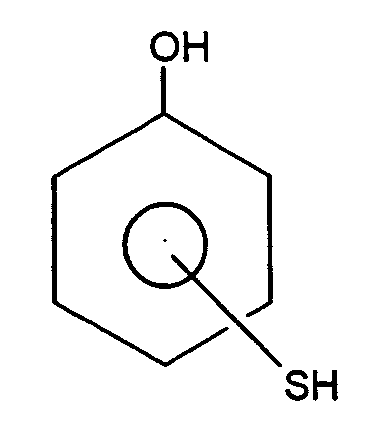


The active hydrogen group of the chain transfer agent
reacts with the isocyanate group of the trunk polymer to
form a -NH-C(=O)- linkage (an amide linkage). When the
active hydrogen group is an OH group, a urethane linkage (-NH-C(=O)-O-)
is formed. When the active hydrogen group is
an NH2 group, a urea linkage (-NH-C(=O)-NH-) is formed. The
amount of the isocyanate group of the trunk polymer is
preferably from 1.0 to 2.5 equivalents, for example, from
1.0 to 2.0 equivalents, based on 1.0 equivalent of the
chain transfer agent.
The amount of the chain transfer agent may be from
0.05 to 0.7 mol, preferably from 0.1 to 0.6 mol, based on 1
mol of the branch monomer. The chain transfer agent is
bonded to one end of the branch polymer which is obtained
by polymerizing the branch monomer. The chain transfer
agent can control the length of the chain of the branch
polymer.
The fluoroalkyl group-containing vinyl monomer may be
(meth)acrylate having a fluoroalkyl group.
The fluoroalkyl group-containing (meth)acrylate may
be the compounds represented by the following general
formula:
Rf-A2-OC (=O) CR18=CH2
wherein Rf is a linear or branched fluoroalkyl group having
1 to 21 carbon atoms, R18 is hydrogen or a methyl group,
and A2 is a divalent organic group.
Examples of the fluoroalkyl group-containing
(meth)acrylate include the followings:

Rf-(CH2)nOCOCR3=CH2

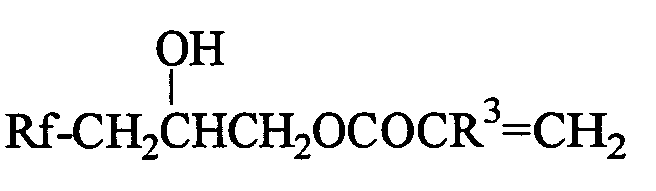
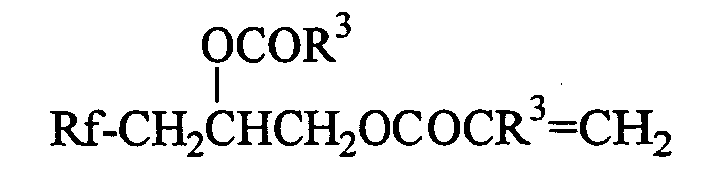
Rf-O-Ar-CH2OCOCR3=CH2
wherein Rf is a fluoroalkyl group having 1 to 21 carbon
atoms, R1 is hydrogen or an alkyl group having 1 to 10
carbon atoms, R2 is an alkylene group having 1 to 10 carbon
atoms, R3 is hydrogen or a methyl group, Ar is an arylene
group which optionally has a substituent group, and n is an
integer of 1 to 10.
Specific examples of the fluoroalkyl group-containing
(meth)acrylate include the followings:
CF3(CF2)p(CH2)qOCOCH=CH2,
CF3(CF2)pCH=CH(CH2)qOCOCH=CH2,
(CF3)2CF(CF2)p(CH2)qOCOCH=CH2,
H(CF2)p(CH2)qOCOCH=CH2,
CF3CHFCF2(CH2)qOCOCH=CH2,
CF3(CF2)p(CH2)qOCOC(CH3)=CH2,
CF3(CF2)pCH=CH(CH2)qOCOC(CH3)=CH2,
(CF3)2CF(CF2)p(CH2)qOCOC(CH3)=CH2,
H(CF2)p(CH2)qOCOC(CH3)=CH2,
CF3CHFCF2(CH2)pOCOC(CH3)=CH2,
CF3(CF2)pSO2N(CsH2s+1) (CH2)qOCOCH=CH2,
CF3(CF2)pSO2N(CsH2s+1)(CH2)qOCOC(CH3)=CH2,
CF3C6F10(CF2)pSO2N(CH3)(CH2)qOCOCH=CH2,
CF3C6F10(CF2)pSO2N(CH3)(CH2)qOCOC(CH3)=CH2,
(CF3)2CF(CF2)pCH2CH(OCOCH3)CH2OCOCH=CH2,
(CF3)2CF(CF2)pCH2CH(OCOCH3)CH2OCOC(CH3)=CH2,
(CF3)2CF(CF2)pCH2CH(OH)CH2OCOCH=CH2,
(CF3)2CF(CF2)pCH2CH(OH)CH2OCOC(CH3)=CH2,
[p = 0 to 20, q = 1 to 10, s = 1 or 2]



As a matter of course, at least two types of the
fluoroalkyl group-containing (meth)acrylates may be used in
combination.
In the branch polymer, other fluorine-containing
monomer may be used. Examples of the other fluorine-containing
monomer include fluorinated olefins (each having,
for example, 1 to 20 carbon atoms) such as CF3(CF2)7CH=CH2,
 for example,
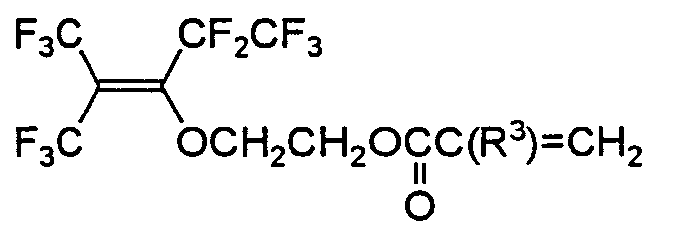

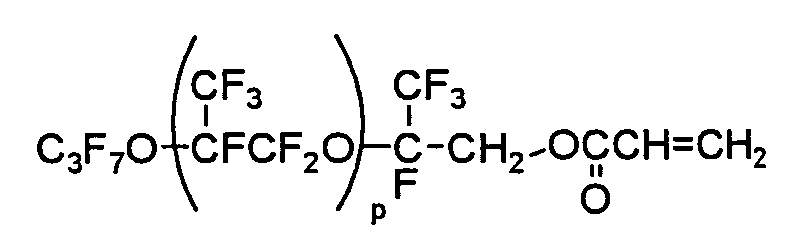 The amount of the other fluorine-containing monomer in the
branch polymer is at most 20% by weight, for example, at
most 10% by weight, particularly at most 5% by weight,
based on the weight of the monomer components in the branch
polymer.
The amount of the other fluorine-containing monomer in the
branch polymer is at most 20% by weight, for example, at
most 10% by weight, particularly at most 5% by weight,
based on the weight of the monomer components in the branch
polymer.
In the branch polymer, a fluorine-free monomer may be
used. Examples of the fluorine-free monomer used in the
branch polymer include the same fluorine-free monomers as
those used in the trunk polymer. The fluorine-free monomer
in the branch polymer may be a (meth)acrylate ester, for
example, an ester between an aliphatic monohydric alcohol
and (meth) acrylic acid.
The amount of the fluorine-free monomer in the branch
polymer may be at most 80% by weight, e.g. at most 50% by
weight, particularly at most 30% by weight, based on the
monomer components of the branch polymer.
The branch polymer may be a block polymer or a random
polymer. The polymerization degree of the branch polymer is
from 3 to 25 molecules, and preferably from 4 to 20
molecules of the monomer, based on one molecule of the
chain transfer agent.
The graft polymer comprises the trunk polymer and the
branch polymer. The weight ratio of the trunk polymer to
the branch polymer may be from 5:95 to 95:5, preferably
from 10:90 to 90:10, particularly from 30:70 to 70:30.
The number-average molecular weight (measured by GPC,
converted to polystyrene, in THF) of the graft polymer may
be from 1,000 to 200,000, preferably from 5,000 to 100,000.
The graft polymer of the present invention may be
prepared by any of known methods, and some of the methods
are herein described.
Typically, the graft polymerization method (1) of a
macromonomer is carried out as follows: a perfluoroalkyl
group-containing vinyl monomer and a fluorine-free vinyl
monomer are radical-polymerized in the presence of a
mercaptan-based chain transfer agent having an active
hydrogen group such as a hydroxyl group, carboxyl group,
amino group, sulfonic acid group or the like, to obtain a
polymer having an active hydrogen group at one end; the
resulting polymer is reacted with a vinyl monomer which has
a group reactive with an active hydrogen, such as a NCO
group, glycidyl group, acid chloride group or the like, and
a group having a polymerizable double bond, to obtain a
macromonomer; and this macromonomer is copolymerized with a
perfluoroalkyl group-containing vinyl monomer and a
fluorine-free vinyl monomer which consititute a trunk
polymer, to obtain a graft polymer.
The method (2) of reacting a trunk polymer having a
group (e.g., a NCO group, glycidyl group, and acid chloride
group or the like) reactive with an active hydrogen atom,
with a branch polymer polymerized by using a chain transfer
agent having an active hydrogen group is carried out as
follows: firstly, a vinyl monomer having a group reactive
with an active hydrogen and a polymerizable double bond is
radical-polymerized with a perfluoroalkyl group-containing
vinyl monomer, and if needed, a fluorine-free vinyl monomer,
to obtain a trunk polymer having a group reactive with an
active hydrogen; the resultant trunk polymer is radical-polymerized
with a perfluoroalkyl group-containing vinyl
monomer, and if needed, a fluorine-free vinyl monomer, in
the presence of a mercaptan-based chain transfer agent
having an active hydrogen group such as a hydroxyl group,
carboxyl group, amino group and sulfonic group, to obtain a
branch polymer having an active hydrogen at one end; and
the active hydrogen atom of the branch polymer is reacted
with the group, reactive with an active hydrogen atom, of
the trunk polymer, to thereby obtain a graft polymer.
For example, a graft polymer may be prepared by
either of the following methods:
The method (A) comprises the steps of:
The method (B) comprises the steps of:
The polymerization step (A-1) of the branch polymer
and the polymerization steps (A-3) and (B-1) of the trunk
polymers may be conducted in solvents at temperatures of 70
to 80°C in the presence of polymerization initiators. The
polymerization time is generally from 2 to 12 hours.
As the polymerization initiator, for example,
azobisisobutyronitrile, benzoyl peroxide, di-tert-butyl
peroxide, lauryl peroxide, cumene hydroperoxide, tert-butyl
peroxide pivalate, diisopropylperoxy dicarbonate and the
like are used. The amount of the polymerization initiator
is preferably from 1 to 10 parts by weight based on 100
parts by weight of the monomer.
The polymerization solvent may be a polar solvent, a
hydrocarbon solvent, or a mixture of these solvents. When a
group reactive with an active hydrogen exists in the
reaction system (namely, in the steps (A-2), (B-1) and (B-2)),
a protic solvent having an active hydrogen group, such
as alcohol solvent, can not be used.
The polar solvent is a solvent having a polar group
in the molecule. Examples of the polar group include a
hydroxyl group, a carboxyl group, an ester group, an acyl
group, and an ether oxygen group. Examples of the polar
solvent include an alcohol solvent, a glycol solvent, an
ester solvent, and a ketone solvent.
The hydrocarbon solvent may be a solvent consisting
of carbon and hydrogen. The hydrocarbon solvent may be an
aliphatic hydrocarbon. Examples of the hydrocarbon solvent
include n-heptane, n-hexane, n-octane, cyclohexane,
methylcyclohexane, cyclopentane, methylcyclopentane,
methylpentane, 2-ethylpentane, isoparaffin hydrocarbon,
liquid paraffin, decane, undecane, dodecane, mineral spirit,
and mineral turpentine. In some cases, an aromatic
hydrocarbon solvent may be used.
Examples of the alcohol solvent include butyl alcohol
and isopropyl alcohol. Examples of the glycol solvent
include propylene glycol monomethyl ether, propylene glycol
monoethyl ether, dipropylene glycolmonomethyl ether,
dipropylene glycol monoethyl ether, and acetates thereof.
Examples of the ester solvent include monobasic acid esters
such as methyl acetate, ethyl acetate and butyl acetate;
and dibasic acid esters such as diethyl succinate, diethyl
adipate, dibutyl phthalate and dioctyl phthalate. Examples
of the ketone solvent include methyl isobutyl ketone (MIBK),
methyl ethyl ketone, and acetone.
A mixture of the hydrocarbon solvent and the polar
solvent also may be used. The weight ratio of the
hydrocarbon solvent to the polar solvent may be from 100:0
to 0:100, for example, 5:95 to 95:5.
The reaction steps (A-2) and (B-2) of reacting the
active hydrogen groups of the chain transfer agents
constituting the branch polymers with the groups reactive
with active hydrogens, contained in the monomers
constituting the trunk polymers, may be conducted in
solvents at temperatures of 30°C to 130°C. The reaction
time is generally from 2 hours to 24 hours. When the
reaction temperature is 50°C or higher, it is needed to add
a polymerization inhibitor. When the reaction temperature
is 50°C or lower, a polymerization inhibitor is not needed.
Although the solvent may be a polymerization solvent
as described above, a protic solvent having an active
hydrogen group such as alcohol solvent can not be used.
The graft polymer of the present invention acts as a
dispersant which is used to disperse a fluoropolymer in a
liquid medium.
A fluoropolymer is a homopolymer or a copolymer of a
fluorine-containing monomer. Examples of the fluorine-containing
monomer include tetrafluoroethylene,
hexafluoropropylene, perfluoroalkylvinyl ether [i.e., the
compounds of the formula: CF2=CF-O-R (in which R represents
a straight or branched perfluoroalkyl group having 1 to 20
carbon atoms), such as perfluoro(butylvinylether),
perfluoro(propylvinylether) and perfluoro(ethylvinylether)],
chlorotrifluoroethylene, vinylidene fluoride,
hexafluoropropylene oxide, perfluoroalkylethyl
(meth)acrylate, methyl α-fluoroacrylate, and 2-bromo-1,1,2,2-tetrafluoroethyltrifluorovinyl
ether.
The fluoropolymer may be a copolymer of a fluorine-containing
monomer and a fluorine-free monomer. Also, the
fluoropolymer may be polytetrafluoroethylene or a copolymer
of tetrafluoroethylene and a copolymerizable modifying
monomer [such as hexafluoropropylene,
perfluoro(propylvinyether) and chlorotrifluoroethylene].
The molecular weight of the fluoropolymer may be
10,000 to 3,000,000.
The content of fluorine atoms in the fluoropolymer
may be 10% by weight or more, for example, 40% by weight or
more, particularly 40 to 90% by weight, based on the weight
of the fluoropolymer.
The fluoropolymer to be dispersed may be in the form
of powder which has an average particle size of, for
example, 0.01 to 100 µm.
Examples of the liquid medium include organic
solvents, water, mixtures of the organic solvents and water,
liquid resins, and mixtures of the liquid resins and the
organic solvents.
The organic solvents may be fluorine-containing
solvents or fluorine-free solvents. Examples of the
fluorine-containing solvents include CFC-113, HCFC-141b,
HCFC-225, perfluorohexane and perfluorobenzene. The
fluorine-containing solvents may be perfluorocompounds.
Typical perfluorocompounds are cyclic and non-cyclic
perfluoroalkane, perfluoroamine, perfluoroether,
perfluorocycloamine, and all kinds of mixtures thereof.
Examples of the perfluorocompounds include perfluoropentane,
perfluorohexane, perfluoroheptane, perfluorooctance,
perfluoromethylcyclohexane, perfluorotributylamine,
perfluorotriamylamine, perfluoro-N-methylmorpholine,
perfluoro-N-ethylmorpholine, perfluoroisopropylmorpholine,
perfluoro-N-methylpyrrolidine, perfluoro-1,2-bis(trifluoromethyl)hexafluorocyclobutane,
perfluoro-2-butyltetrahydrofuran,
perfluorotriethylamine,
perfluorodibutyl ether, and mixtures of the above
perfluorocompounds and other perfluorocompounds. Examples
of the fluorine-free solvents include ethers (e.g.,
cellosolve-based solvents), alcohols, esters, amides (e.g.,
N-alkylpyrrolidone), heterocyclic hydrocarbons (e.g.,
morpholine), aromatic solvents (e.g., toluene, benzene, and
xylene), hydrocarbon-based solvents (e.g., hexane, decane,
and kerosine) and chlorine-containing solvents.
The liquid medium may be a liquid resin. The liquid
resin may be a thermosetting resin which can be cured by
heating a monomer or a prepolymer, or by adding a
crosslinking agent. Examples of the liquid resin are phenol
resins, urea resins, melamine resins, furan resins, epoxy
resins, unsaturated polyester resins, silicone resins and
polyurethane resins.
The present invention further provides a
fluoropolymer dispersion composition which comprises a
fluoropolymer, a liquid medium and a dispersion aid (i.e.,
a fluorine-containing graft polymer). The fluoropolymer
dispersion composition of the present invention may further
contain additives such as a binder polymer (other than the
fluoropolymers), carbon powder, and colloidal silica, as
required.
In the fluoropolymer dispersion composition, the
amount of the dispersion aid is 0.1 to 1,000 parts by
weight, for example, 0.1 to 500 parts by weight, and the
amount of the additives is 0 to 1,000 parts by weight, per
100 parts by weight of the fluoropolymer. The amount of the
liquid medium is 10 to 99% by weight, for example, 20 to
95% by weight, based on the weight of the fluoropolymer
dispersion composition.
A variety of substrate can be treated with the
fluoropolymer dispersion composition (i.e., a liquid
dispersion of a fluoropolymer) of the present invention.
Examples of the substrate to be treated include textiles,
glass, paper, woods, leather, hides, asbestos, bricks,
cements, metals and oxides, ceramics, plastics, coated
surfaces and plasters. Examples of the textiles include
animal- and vegetable-origin natural fibers such as cotton,
hemp, wool, and silk; synthetic fibers such as polyamide,
polyester, polyvinyl alcohol, polyacrylonitrile, polyvinyl
chloride, and polypropylene; semisynthetic fibers such as
rayon and acetate; and mixtures of these fibers.
The fluoropolymer dispersion composition of the
present invention can be applied to substrates by a known
method such as immersion, coating or the like, and dried.
Otherwise, the fluoropolymer dispersion composition of the
present invention is internally added to a curable liquid
resin, and the mixture is cured and molded so that the
fluoropolymer is migrated to the surface of the molded
article. For example, a coating layer of the fluoropolymer
dispersion composition is formed on the surface of the
substrate (for example, a metal).
The present invention will be illustrated in more
detail by way of the following embodiments, which, however,
should not be construed as limiting the scope of the
present invention in any way.
The properties were measured as follows.
A solution having a given concentration (0.5 wt.%)
was prepared, and the surface tension of the solution was
measured with a surface tension meter (BUBBLE PRESSURE
TENSIOMETER-BP2 manufactured by KRUESS) by the maximum
bubble pressure method, at a temperature of 25 to 30°C. The
gas used was a dry air.
Solutions having given concentrations (0.001 wt.%,
0.01 wt.%, 0.1 wt.% and 1 wt.%) were prepared and left to
stand alone for one day, and the surface tensions of the
solutions were measured with a surface tension meter
(SURFACE TENSIOMETER CBVP-A3 manufactured by KYOWA
INTERFACE SCIENCE CO., LTD.) by a Wilhelmy's method, at a
temperature of 22 to 28°C.
A solution having a given concentration was prepared
and stirred. Then, the dissolution state of the solution
was visually observed and evaluated based on the following
criteria.
- VS:
- 5% or more dissolved
- S:
- 1 to 5% dissolved
- SS:
- 1% or less dissolved
- IS:
- insoluble
A product synthesized in Examples (0.5 g) and butyl
cellosolve (2-butoxyethanol) (4.5 g) were thoroughly mixed
in a 20 mL sample tube, and tetrafluoroethylene resin
powder (LUBRON L-2 manufactured by DAIKIN INDUSTRIES, LTD.,
having a molecular weight of 500,000, a primary particle
size of 0.2 µm and a secondary particle size of 5 µm) (5 g)
was added and dispersed in the mixture. The resultant
liquid dispersion in the sample tube was shaken by the hand
to obtain a milky liquid dispersion having a low viscosity.
The liquid dispersion was left to stand alone for one day,
and the resin powder was found to precipitate. The
dispersibility of the resin powder was evaluated as good,
when it was visually observed that the resin powder could
be dispersed when the liquid dispersion was again shaken.
Tetrafluoroethylene resin powder (LUBRON L-2
manufactured by DAIKIN INDUSTRIES, LTD., having a molecular
weight of 500,000, a primary particle size of 0.2 µm and a
secondary particle size of 5 µm) was added to a hydrocarbon
solvent, and the mixture was mixed with a dispersion aid (a
polymer) and stirred with a glass bar, to obtain a milky
liquid dispersion having a low viscosity. The liquid
dispersion was left to stand alone for one day, and the
resin powder was found to precipitate. The dispersibility
of the resin powder was evaluated as good, when it was
visually observed that the resin powder could be dispersed
when the liquid dispersion was again shaken. As the
dispersion aid, the polymer prepared using the components
shown in Table 13, in Example 3 was used.
In a 500 mL three-necked flask equipped with a
dropping funnel, the following components were charged:
While shaking the mixture at a temperature of 50 to 55°C,
the followings were added dropwise through the dropping
funnel over 15 minutes:
and the mixture was reacted for 8 hours to give an
isocyanate group-containing vinyl monomer (a) shown below:

| 2,4-tolylene diisocyanate | 100 g |
| ethyl acetate | 100 g |
| dibutyltin dilaurate | 0.1 g |
| hydroxyethyl methacrylate | 90 g |
| ethyl acetate | 90 g |
In a 1,000 mL glass polymerization sample tube, the
following components were charged and reacted in a nitrogen
atmosphere at 75°C for 8 hours while shaking, to give a
branch polymer.
| Mercaptoethanol | 3 g |
| CF3CF2(C2F4)nC2H4OCOCH=CH2 (FA) [n = 3.5 on average] | 95 g |
| Stearyl methacrylate (StMA) | 5 g |
| Azoisobutyronitrile | 0.17 g |
| Ethyl acetate | 120 g |
After the completion of the reaction, the gas
chromatography analysis revealed that 100% of the monomers
were consumed. The NMR analysis revealed that the
composition ratio (molar ratio) of the respective
components in the polymer, namely, the ratio of
mercaptoethanol:FA:StMA was 1.0:4.8:0.8.
After lowering the temperature to 55 to 60°C, 9 g of
2-isocyanatoethyl methacrylate and 0.1 g of dibutyltin
dilaurate were charged in an air atmosphere and the
reaction was conducted at 55 to 60°C for 8 hours while
shaking to give a macromonomer. After the completion of the
reaction, the absorption peak of the NCO group in the IR
spectrum nearly disappeared.
To the macromonomer, the following components were
added and the reaction was conducted in a nitrogen
atmosphere at 75°C for 8 hours while shaking to give a
graft polymer.
| 2-Ethylhexyl methacrylate (2EHMA) | 100 g |
| Maleic anhydride (MAN) | 10 g |
| Ethyl acetate | 515 g |
| Tert-butylperoxy pivalate (PERBUTYL PV, manufactured by NOF Corp.) | 9 g |
After the completion of the reaction, the gas
chromatography analysis revealed that 100% of the monomers
were consumed. The GPC analysis revealed that the number
average molecular weight of the polymer obtained after
distilling off the solvent was 8,000.
The solvent solubility and static surface tension of
the resultant polymer were determined. The dispersibility
of the tetrafluoroethylene resin powder in butyl cellosolve
was evaluated. The results are shown in Tables 5 and 7 to
12.
A graft polymer was prepared in the same manner as in
Example 1, except that 38 g of a solution (50% by weight)
of the isocyanate group-containing vinyl monomer (a)
prepared in Synthesis Example 1 was used in place of 9 g of
2-isocyanatoethyl methacrylate.
In the preparation of each of the branch polymer and
the graft polymer, 100% of the monomers were consumed.
After the completion of the reaction for forming a
macromonomer, the NCO absorption peak in the IR spectrum
nearly disappeared. The GPC analysis revealed that the
number average molecular weight of the polymer obtained
after distilling off the solvent was 8,500.
The solvent solubility and static surface tension of
the resultant polymer were determined. The dispersibility
of the tetrafluoroethylene resin powder in the solvent was
evaluated. The results are shown in Tables 5 and 7 to 12.
The same procedure as in Example 1 was repeated,
except that the monomers shown in Table 1 were used.
In the preparation of each of the branch polymer and
the graft polymer, 100% of the monomers were consumed.
After the completion of the reaction for forming a
macromonomer, the NCO absorption peak in the IR spectrum
nearly disappeared. The GPC analysis revealed that the
number average molecular weight of the resultant polymer
was 9,300.
The solvent solubility and surface tension of the
resultant polymer were determined. The dispersibility of
the tetrafluoroethylene resin powder in the solvent was
evaluated. The results are shown in Tables 5 and 7 to 13.
The followings were charged in a 1000 mL glass
polymerization sample tube, and were reacted at 75°C in a
nitrogen atmosphere for 8 hours while shaking, to obtain a
branch polymer.
After the completion of reaction, it was found by the gas
chromatograph that 100% of the monomers were consumed. The
composition ratio (molar ratio) of the components of the
polymer determined by NMR was as follows: mercaptoethanol :
FA' = 1.0 : 4.2.
| Mercaptoethanol | 5.5 g |
| CF3CF2CF2CF2CH2CH2OCOCH=CH2 (FA') | 90 g |
| Azoisobutyronitrile | 0.28 g |
| Ethyl acetate | 143.1 g |
Next, the temperature was decreased to 55-60°C, a
solution of 2-isocyanatoethyl methacrylate (13.2 g) in
ethyl acetate (19.8 g) and dibutyltin dilaurate (0.13 g)
were charged, and the reaction was conducted at a
temperature of 55 to 60°C in an air atmosphere for 6 hour
while shaking, to give a FA' macromonomer solution. After
the completion of reaction, the NCO absorption peak in the
IR spectrum nearly disappeared.
Next, the following components were added to a
predetermined amount of the resultant FA' macromonomer
solution, and the mixture was reacted at 75°C in a nitrogen
atmosphere for 8 hours while shaking, to give a graft
polymer.
After the completion of reaction, it was found by the gas
chromatograph that 95% of the monomers were consumed. The
GPC analysis revealed that the number average molecular
weight of the resultant polymer was 25,000. The dynamic
surface tension, static surface tension, solvent solubility
and fluorine content of the resultant polymer were
determined. The results are shown in Figs. 1 to 3 and
Tables 5 to 9.
| FA' macromonomer solution | 15.0 g |
| Polypropyleneglycol methacrylate (HO-(C3H6O)n-COC(CH3)=CH2 (n = about 13, BLEMER PP-800 manufactured by NOF Corp.) | 1.3 g |
| Methoxypolyethyleneglycol methacrylate (CH3O-(C2H4O)n-COC(CH3)=CH2 (n = about 9, BLEMER PME-400 manufactured by NOF Corp.) | 3.4 g |
| n-Butyl methacrylate (BLEMER BMA manufactured by NOF Corp.) | 0.4 g |
| Azoisobutyronitrile | 0.1 g |
| Ethyl acetate | 24.4 g |
In each of Examples, the procedure of Example 1 was
repeated, except that the FA' macromonomer solution
prepared in Example 4 was used, and that the monomers shown
in Table 2 were used.
In the preparation of each graft polymer, the
consumption of the monomers was 95 to 100%. The number
average molecular weight of the polymer obtained by
distilling off the solvent was determined by GPC, and the
fluorine content thereof was determined by an elemental
analysis. The dynamic surface tension, static surface
tension and solvent solubility of the resultant polymer
were determined. The results are shown in Figs. 1 to 3 and
Tables 2 and 5 to 9.
The procedure of Example 4 was repeated, except for
the following: CH3CF2CH2OCOCH=CH2 (FA") was used in place of
CF3CF2CF2CF2CH2CH2OCOCH=CH2 (FA') (90) g; the following
components were used to prepare a FA" branch polymer
solution (mercaptoethanol : FA" = 1.0 : 4.3 (mol : mol)) in
the same manner as in Example 4:
and
a FA" macromonomer solution prepared from the following components:
and the monomers shown in Table 2 were used.
| Mercaptoethanol | 3.8 g |
| CF3CF2CH2OCOCH=CH2 (FA") | 40 g |
| Azoisobutylonitrile | 0.19 g |
| Ethyl acetate | 65.7 g; |
a FA" macromonomer solution prepared from the following components:
| 2-Isocyanatoethyl methacrylate | 9.1 g |
| Ethyl acetate | 13.7 g |
| Dibutyltin dilaurate | 0.09 g |
In the preparation of each of the branch polymers and
each of the graft polymers, the consumption of the monomers
was 95 to 100%. After the completion of the reaction for
forming the macromonomer, the NCO absorption peak in the IR
spectrum substantially disappeared. The number average
molecular weight of the polymer obtained by distilling off
the solvent was determined by GPC, and the fluorine content
thereof was determined by an elemental analysis. The
dynamic surface tension, static surface tension and solvent
solubility of the resultant polymer were determined. The
results are shown in Figs. 1 to 3 and Tables 2 and 5 to 9.
One point zero (1.0) equivalent of 2-isocyanatoethyl
methacrylate and 0.7 equivalents of mercaptoethanol were
reacted in ethyl acetate at 50°C in the presence of 0.1 g
of dibutyltin dilaurate for 12 hours.
To 5.5 g of the resultant reaction product (a
reaction product between an isocyanate group-containing
vinyl monomer and mercaptoethanol), the following
components were added and the mixture was reacted in a
nitrogen atmosphere at 75°C for 8 hours while shaking to
give a polymer.
| CF3CF2(C2F4)nC2H4OCOCH=CH2 (FA) [n = 3.5 on average] | 42.7 g |
| Stearyl methacrylate (StMA) | 2.3 g |
| 2-Ethylhexyl methacrylate (2EHMA) | 45.0 g |
| Maleic anhydride (MAN) | 4.5 g |
| Ethyl acetate | 515 g |
| Tert-butylperoxy pivalate (PERBUTYL PV, manufactured by NOF Corp.) | 9 g |
Substantially 100% of the monomers were polymerized.
The resultant polymer was not a graft polymer. The GPC
analysis revealed that the number average molecular weight
of the resultant polymer was 15,000.
The solvent solubility and dispersibility of the
resultant polymer were determined. The results are shown in
Tables 5 and 12.
The same procedure as in Comparative Example 1 was
repeated, except that the monomers shown in Table 3 were
used.
Substantially 100% of the monomers were polymerized.
The resultant polymer was not a graft polymer. The GPC
analysis revealed that the number average molecular weight
of the resultant polymer was 14,000.
The solvent solubility and dispersibility of the
resultant polymer were determined. The results are shown in
Tables 5 and 12.
The same procedure as in Comparative Example 1 was
repeated, except that the monomers shown in Table 4 were
used.
The resultant polymers were not graft polymers. The
number average molecular weights of the polymers were
determined by GPC. The dynamic and static surface tensions,
solvent solubility and dispersibility and fluorine contents
of the polymers were determined. The results are shown in
Figs. 1 to 3 and Tables 5 to 9.
| Compositions of Monomers (parts by weight) | |||||||
| Branch polymer | Trunk polymer | ||||||
| Macromonomer | |||||||
| Mercaptoethanol | FA | StMA | 2-Isocyanatoethyl methacrylate | Isocyanate-containing vinyl monomer | 2-EHMA | MAN | |
| Ex. 1 | 3 | 95 | 5 | 9 | - | 100 | 10 |
| Ex. 2 | 3 | 95 | 5 | - | 38 | 100 | 10 |
| Ex. 3 | 3 | 95 | 5 | 12 | - | 110 | 4 |
| Notes) | |||||||
| FA: CF3CF2(C2F4)nC2H4OCOCH=CH2 n = 3.5 on average | |||||||
| StMA: Stearyl methacrylate | |||||||
| 2-EHMA: 2-Ethylhexyl methacrylate | |||||||
| MAN: Maleic anhydride | |||||||
| Isocyanate group-containing vinyl monomer: A 50 wt.% solution of the isocyanate group-containing monomer of Synthesis Example 1 |
| Composition of Monomers (parts by weight) | ||||||
| Macromonomer | PPGMA | MEGMA | BMA | Number average molecular weight | Fluorine-containing acrylate species | |
| Ex. 4 | 54.1 | 12.0 | 30.6 | 3.3 | 25,000 | FA' |
| Ex. 5 | 45.1 | 14.5 | 37.1 | 3.3 | 17,000 | FA' |
| Ex. 6 | 31.6 | 18.4 | 46.7 | 3.3 | 17,500 | FA' |
| Ex. 7 | 54.1 | 0 | 42.6 | 3.3 | 23,000 | FA' |
| Ex. 8 | 45.1 | 0 | 51.6 | 3.3 | 17,800 | FA' |
| Ex. 9 | 31.5 | 0 | 65.2 | 3.3 | 13,100 | FA' |
| Ex. 10 | 68.7 | 7.9 | 20.1 | 3.3 | 23,900 | FA" |
| Ex. 11 | 40.0 | 16.0 | 40.7 | 3.3 | 17,800 | FA" |
| Notes) | ||||||
| Macromonomer: The weight parts of the solid content in the macromonomer solution prepared by using FA' or FA" in each of Examples 4 to 11. | ||||||
| FA': CF3CF2CF2CF2CH2CH2OCOCH=CH2, manufactured by Daikin Fine Chemical Laboratory | ||||||
| FA": CF3CF2CH2OCOCH=CH2, manufactured by Daikin Fine Chemical Laboratory | ||||||
| PPGMA: HO-(C3H6O)n-COCH=CH2 (n = about 13), BLEMER PP-800, manufactured by NOF Corp. | ||||||
| MEGMA: CH3O-(C2H4O)n-COCH=CH2 (n = about 13), BLEMER PME-400, manufactured by NOF Corp. | ||||||
| BMA: n-Butyl methacrylate, BLEMER BMA, manufactured by NOF Corp. |
| Amounts of Monomers (g) | |||||
| FA | StMA | 2-EHMA | MAN | 2-Isocyanatoethyl methacrylate | |
| C. Ex. 1 | 42.7 | 2.3 | 45.0 | 4.5 | 5.5 |
| C. Ex. 2 | 41.2 | 2.2 | 48.1 | 1.9 | 6.6 |
| Notes) | |||||
| FA: CF3CF2(C2F4)nC2H4OCOCH=CH2, n = average 3.5 | |||||
| StMA: Stearyl methacrylate | |||||
| 2-EHMA: 2-Ethylhexyl methacrylate | |||||
| MAN: Maleic anhydride |
| Compositions of Monomers (parts by weight) | ||||||||
| FA | FA' | PPGMA | MEGMA | GLM | CHPM | Mercaptoethanol | Number average molecular weight | |
| C. Ex. 3 | 0 | 27.1 | 16.4 | 39.2 | 4.1 | 12.3 | 1.0 | 6700 |
| C. Ex. 4 | 0 | 44.9 | 12.4 | 29.6 | 3.1 | 9.3 | 0.8 | 6700 |
| C. Ex. 5 | 0 | 63.0 | 8.4 | 20.1 | 2.1 | 6.3 | 0 | 13000 |
| C. Ex. 6 | 39.3 | 0 | 17.2 | 29.7 | 5.7 | 8.1 | 0 | 17800 |
| Notes) | ||||||||
| FA: CF3CF2(CF2CF2)nCH2CH2OCOCH=CH2, n = average 3.5 | ||||||||
| FA' : CF3CF2CF2CF2CH2CH2OCOCH=CH2, manufactured by Daikin Fine Chemical Laboratory | ||||||||
PPGMA: HO-(C3H6O)n-COCH=CH2 (n  | ||||||||
MEGMA: CH3O-(C2H4O)n-COCH=CH2 (n  | ||||||||
| GLM: Glycerol methacrylate, BLEMER GLM manufactured by NOF Corp. | ||||||||
| CHPM: 3-Chloro-2-hydroxypropyl methacrylate, TOPOLENE M manufactured by SHIN-NAKAMURA CHEMICAL CO., LTD. |
| Solubility in Solvent | |||||||||
| Water | DMF | Butyl cellosolve | Ethyl acetate | Toluene | MEK | IPA | Acetone | n-Heptane | |
| Ex. 1 | IS | SS | VS | VS | VS | VS | IS | SS | S |
| Ex. 2 | IS | SS | VS | VS | VS | VS | IS | SS | S |
| Ex. 3 | IS | SS | VS | VS | VS | VS | IS | SS | S |
| Ex. 4 | VS | VS | VS | VS | VS | VS | VS | VS | IS |
| Ex. 5 | VS | VS | VS | VS | VS | VS | VS | VS | IS |
| Ex. 6 | VS | VS | VS | VS | VS | VS | VS | VS | IS |
| Ex. 7 | VS | VS | VS | VS | S | VS | SS | VS | IS |
| Ex. 8 | VS | VS | VS | VS | VS | VS | SS | VS | IS |
| Ex. 9 | VS | VS | VS | VS | VS | VS | VS | VS | IS |
| Ex. 10 | IS | VS | VS | VS | VS | VS | S | VS | IS |
| Ex. 11 | VS | VS | VS | VS | VS | VS | SS | VS | IS |
| C. Ex. 1 | IS | IS | IS | IS | IS | IS | IS | IS | IS |
| C. Ex. 2 | IS | IS | IS | IS | IS | IS | IS | IS | IS |
| C. Ex. 3 | VS | VS | VS | VS | VS | VS | VS | VS | IS |
| C. Ex. 4 | VS | VS | VS | VS | VS | VS | VS | VS | IS |
| C. Ex. 5 | SS | VS | VS | VS | VS | VS | VS | VS | IS |
| C. Ex. 6 | SS | VS | VS | VS | VS | VS | VS | VS | IS |
| DMF: Dimethyl formamide | |||||||||
| MEK: Methyl ethyl ketone | |||||||||
| IPA: Isopropanol |
| Fluorine Content of Polymer Containing Various Perfluoroalkyl acrylates | ||
| Fluorine-containing acrylate species | Fluorine content (value found by elemental analysis) | |
| Ex. 4 (graft polymer) | FA' | 22.9 |
| Ex. 5 (graft polymer) | FA' | 19.3 |
| Ex. 6 (graft polymer) | FA' | 13.7 |
| Ex. 7 (graft polymer) | FA' | 23.0 |
| Ex. 8 (graft polymer) | FA' | 19.3 |
| Ex. 9 (graft polymer) | FA' | 13.5 |
| Ex. 10 (graft polymer) | FA" | 22.9 |
| Ex. 11 (graft polymer) | FA" | 13.7 |
| C. Ex. 3 (random polymer) | FA' | 14.0 |
| C. Ex. 4 (random polymer) | FA' | 23.8 |
| C. Ex. 5 (random polymer) | FA' | 34.1 |
| C. Ex. 6 (random polymer) | FA | 24.2 |
| Notes) | ||
| FA: CF3CF2(CF2CF2)nCH2CH2OCOCH=CH2, n = 3.5 on average | ||
| FA' : CF3CF2CF2CF2CH2CH2OCOCH=CH2, manufactured by Daikin Fine Chemical Laboratory | ||
| FA": CF3CF2CH2OCOCH=CH2, manufactured by Daikin Fine Chemical Laboratory |
| Static Surface Tension in DMF The static surface tension without surfactant: 36.8 mN/m Temperature: 25°C | ||||||||
| Concentration (log) | Static surface tension in DMF | |||||||
| Ex. 1 | Ex. 2 | Ex. 3 | Ex. 4 | Ex. 5 | Ex. 6 | Ex. 7 | Ex. 8 | |
| 0 | 21.1 | 22.1 | 21.5 | 19.8 | 20.4 | 20.7 | 19.8 | 20.1 |
| -1 | 21.0 | 21.0 | 22.0 | 20.3 | 21.2 | 22.1 | 20.3 | 20.9 |
| -2 | 23.9 | 24.9 | 24.2 | 20.7 | 22.9 | 25.2 | 21.6 | 22.4 |
| -3 | 31.8 | 32.0 | 31.5 | 25.6 | 27.8 | 30.9 | 26.9 | 28.1 |
| Concentration (log) | Static surface tension in DMF | |||||||
| Ex. 9 | Ex. 10 | Ex. 11 | C. Ex. 3 | C. Ex. 4 | C. Ex. 5 | C. Ex. 6 | ||
| 0 | 20.2 | 25.7 | 26.1 | 31.1 | 26.3 | 20.9 | 17.2 | |
| -1 | 21.4 | 26.6 | 28.4 | 32.5 | 28.6 | 22.5 | 17.2 | |
| -2 | 24.5 | 28.1 | 30.3 | 34.5 | 31.0 | 25.4 | 25.5 | |
| -3 | 30.9 | 30.5 | 32.5 | 35.4 | 33.3 | 29.6 | 30.9 |
| Static Surface Tension in Butyl cellosolve The static surface tension without surfactant: 27.6 mN/m Temperature: 25°C | ||||||||
| Concentration (log) | Static surface tension in butyl cellosolve | |||||||
| Ex. 1 | Ex. 2 | Ex. 3 | Ex. 4 | Ex. 5 | Ex. 6 | Ex. 7 | Ex. 8 | |
| 0 | 19.5 | 19.6 | 20.1 | 19.5 | 18.4 | 19.9 | 18.6 | 19.2 |
| -1 | 20.7 | 20.6 | 22.0 | 20.0 | 19.0 | 21.3 | 19.2 | 21.3 |
| -2 | 22.1 | 22.4 | 23.5 | 21.2 | 20.1 | 23.2 | 20.3 | 23.2 |
| -3 | 25.0 | 26.2 | 26.3 | 23.8 | 22.5 | 25.3 | 22.2 | 25.3 |
| Concentration (log) | Static surface tension in butyl cellosolve | |||||||
| Ex. 9 | Ex. 10 | Ex. 11 | C. Ex. 3 | C. Ex. 4 | C. Ex. 5 | C. Ex. 6 | ||
| 0 | 19.5 | 22.2 | 23.1 | 26.8 | 25.1 | 21.1 | 18.1 | |
| -1 | 20.3 | 22.7 | 24.3 | 27.2 | 26.0 | 22.3 | 20.5 | |
| -2 | 22.5 | 24.1 | 25.6 | 27.3 | 26.8 | 24.1 | 23.7 | |
| -3 | 25.1 | 26.8 | 26.5 | 27.3 | 27.2 | 26.0 | 26.5 |
| Static Surface Tension in Ethyl Acetate The static surface tension without surfactant: 22.5 mN/m Temperature: 25°C | ||||||||
| Cocentration (log) | Static surface tension in ethyl acetate | |||||||
| Ex. 1 | Ex. 2 | Ex. 3 | Ex. 4 | Ex. 5 | Ex. 6 | Ex. 7 | Ex. 8 | |
| 0 | 15.4 | 15.6 | 15.6 | 19.5 | 19.8 | 19.1 | 19.5 | 19.7 |
| -1 | 16.8 | 16.4 | 16.7 | 19.9 | 20.2 | 19.6 | 19.9 | 20.3 |
| -2 | 19.0 | 19.0 | 19.2 | 20.4 | 21.4 | 21.1 | 20.5 | 21.0 |
| -3 | 21.3 | 20.6 | 22.0 | 21.2 | 21.9 | 22.0 | 20.9 | 21.8 |
| Concentration (log) | Static surface tension in ethyl acetate | |||||||
| Ex. 9 | Ex. 10 | Ex. 11 | C. Ex. 3 | C. Ex. 4 | C. Ex. 5 | C. Ex. 6 | ||
| 0 | 19.1 | 21.8 | 21.9 | 23.0 | 22.2 | 21.7 | 18.1 | |
| -1 | 19.6 | 21.8 | 22.0 | 23.0 | 22.7 | 22.0 | 20.5 | |
| -2 | 21.1 | 21.8 | 22.0 | 23.0 | 22.8 | 22.2 | 23.7 | |
| -3 | 22.0 | 21.9 | 22.0 | 23.0 | 22.8 | 22.3 | 26.5 |
| Static Surface Tension in Toluene The static surface tension without surfactant: 28.7 mN/m | |||
| Concentration (log) | Static surface tension of compound of Ex. 1 | Static surface tension of compound of Ex. 2 | Static surface tension of compound of Ex. 3 |
| 0 | 16.6 | 16.4 | 15.7 |
| -1 | 18.9 | 19.0 | 16.4 |
| -2 | 23.1 | 23.0 | 20.1 |
| -3 | 25.3 | 25.5 | 23.3 |
| Static Surface Tension in n-Heptane The static surface tension without surfactant: 20.0 mN/m | |||
| Concentration (log) | Static surface tension of compound of Ex. 1 2 | Static surface tension of compound of Ex. | Static surface tension of compound of Ex. 3 |
| 0 | 15.8 | 15.9 | 15.6 |
| -1 | 16.2 | 16.3 | 16.0 |
| -2 | 18.4 | 18.5 | 17.5 |
| -3 | 19.4 | 19.5 | 19.1 |
| Dispersibility of Tetrafluoroethylene (PTFE) Resin Powder in Butyl cellosolve | |
| Dispersibility of PTFE powder in butyl cellosolve | |
| Compound of Ex. 1 | Good |
| Compound of Ex. 2 | Good |
| Compound of Ex. 3 | Good |
| Compound of C. Ex. 1 | No good (agglomerated and precipitated) |
| Compound of C. Ex. 2 | No good (agglomerated and precipitated) |
| Dispersibility of Tetrafluoroethylene (PTFE) Resin Powder in Hydrocarbon Solvent | ||||||
| Compound of Ex. 3 | PTFE | Butyl acetate | Hexane | Heptane | Turpentine | Dispersibility |
| 4.0 g | 4.0 g | 6.0 g | 2.0 g | - | - | Good |
| 4.0 g | 4.0 g | 4.0 g | 4.0 g | - | - | Good |
| 4.0 g | 4.0 g | 2.0 g | 6.0 g | - | - | Good |
| 4.0 g | 4.0 g | 7.2 g | - | 0.8 g | - | Good |
| 4.0 g | 4.0 g | 6.0 g | - | 2.0 g | - | Good |
| 4.0 g | 4.0 g | 4.0 g | - | 4.0 g | - | Good |
| 4.0 g | 4.0 g | 2.0 g | - | 6.0 g | - | Good |
| 4.0 g | 4.0 g | 10.0 g | - | 10.0 g | - | Good |
| 4.0 g | 4.0 g | 20.0 g | - | 20.0 g | - | Good |
| 4.0 g | 4.0 g | 7.2 g | - | - | 0.8 g | Good |
| 4.0 g | 4.0 g | 6.0 g | - | - | 2.0 g | Good |
| 4.0 g | 4.0 g | 4.0 g | - | - | 4.0 g | Good |
| 4.0 g | 4.0 g | 2.0 g | - | - | 6.0 g | Good |
| 4.0 g | 4.0 g | 18.0 g | - | - | 2.0 g | Good |
| 4.0 g | 4.0 g | 16.0 g | - | - | 4.0 g | Good |
| 4.0 g | 4.0 g | 14.0 g | - | - | 6.0 g | Good |
The graft polymers of the present invention can be
used as surfactants which exhibit comparable or superior
surface tension-lowering actions to random polymers, in
spite of containing smaller amounts of fluorine than the
random polymers, and can concurrently exhibit actions of
fluorine components and hydrocarbon components. For example,
the graft polymers of the present invention exhibit
superior surface activating actions, and act to disperse,
in solvents having small environmental loads, powder of
fluoropolymers which have high molecular weights, high
fluorine content, and poor affinity with such solvents, to
thereby provide liquid dispersions of such fluoropolymers
in the solvents having small environmental loads. Further,
the graft polymers of the present invention can exhibit
excellent properties, in spite of having repeating units
comprising short-chain perfluoroalkyl groups each having at
most 7 carbon atoms.
Claims (12)
- A surfactant comprising a graft polymer having a branch polymer and a trunk polymer, at least one of which contains a fluoroalkyl group.
- The surfactant according to claim 1, wherein at least one of the branch polymer and the trunk polymer has a repeating unit containing the fluoroalkyl group.
- The surfactant according to claim 1 or 2, wherein the fluoroalkyl group has 1 to 7 carbon atoms.
- The surfactant according to claim 3, wherein the fluoroalkyl group is C4F9.
- The surfactant according to claim 1, wherein the branch polymer containing a fluoroalkyl group is bonded to the trunk polymer.
- The surfactant according to claim 1, wherein the branch polymer containing a fluoroalkyl group is bonded to the trunk polymer through a linkage having a -C(=O)NH- group.
- The surfactant according to claim 1, wherein the linkage having a -C(=O)NH- group is formed by the reaction between an active hydrogen group contained in a chain transfer agent constituting the branch polymer and an isocyanate group contained in a monomer constituting the trunk polymer.
- A dispersion aid comprising the surfactant according to anyone of claims 1 to 7.
- The dispersion aid according to claim 8, for use in dispersing a fluoropolymer.
- The dispersion aid according to claim 8, wherein the fluoropolymer is a tetrafluoroethylene resin powder.
- A fluoropolymer dispersion composition comprising the dispersion aid according to claim 8, a fluoropolymer and a liquid medium.
- An article having a surface coating film formed from the fluoropolymer dispersion composition according to claim 11.
Applications Claiming Priority (5)
| Application Number | Priority Date | Filing Date | Title |
|---|---|---|---|
| JP2002136087 | 2002-05-10 | ||
| JP2002136087 | 2002-05-10 | ||
| JP2002190834 | 2002-06-28 | ||
| JP2002190834 | 2002-06-28 | ||
| PCT/JP2003/005688 WO2003095083A1 (en) | 2002-05-10 | 2003-05-07 | Surfactant and dispersion aid each comprising graft fluoropolymer |
Publications (2)
| Publication Number | Publication Date |
|---|---|
| EP1510252A1 true EP1510252A1 (en) | 2005-03-02 |
| EP1510252A4 EP1510252A4 (en) | 2008-08-06 |
Family
ID=29422400
Family Applications (1)
| Application Number | Title | Priority Date | Filing Date |
|---|---|---|---|
| EP03721046A Withdrawn EP1510252A4 (en) | 2002-05-10 | 2003-05-07 | SURFACTANT AND DISPERSION AGENT COMPRISING EACH RETICULATED FLUOROPOLYMER |
Country Status (5)
| Country | Link |
|---|---|
| US (1) | US20050202997A1 (en) |
| EP (1) | EP1510252A4 (en) |
| JP (1) | JPWO2003095083A1 (en) |
| AU (1) | AU2003235863A1 (en) |
| WO (1) | WO2003095083A1 (en) |
Cited By (2)
| Publication number | Priority date | Publication date | Assignee | Title |
|---|---|---|---|---|
| WO2014046954A1 (en) * | 2012-09-24 | 2014-03-27 | Honeywell International Inc. | Chlorofluoropolymer coated substrates and methods for producing the same |
| CN112691607A (en) * | 2020-12-26 | 2021-04-23 | 张家港邦力材料科技有限公司 | Gemini type fluorine-containing surfactant and preparation method and application thereof |
Families Citing this family (10)
| Publication number | Priority date | Publication date | Assignee | Title |
|---|---|---|---|---|
| JP2007191507A (en) * | 2006-01-17 | 2007-08-02 | Kyoeisha Chem Co Ltd | Coating agent composition |
| JP5167649B2 (en) * | 2007-02-06 | 2013-03-21 | ダイキン工業株式会社 | Soil release agent comprising a fluoropolymer |
| CN101144053B (en) * | 2007-10-30 | 2010-11-10 | 沈阳新奇日化有限责任公司 | A dispersant for reducing viscosity and stabilizing effect on spray powder slurry of washing powder |
| US8592040B2 (en) | 2008-09-05 | 2013-11-26 | Basf Se | Polymer emulsion coating or binding formulations and methods of making and using same |
| US20120016070A1 (en) | 2009-03-25 | 2012-01-19 | Daikin Industries Ltd. | Surfactant comprising fluorine-containing polymer |
| US9017520B2 (en) | 2010-03-23 | 2015-04-28 | Basf Se | Paper coating or binding formulations and methods of making and using same |
| US9102848B2 (en) | 2011-02-28 | 2015-08-11 | Basf Se | Environmentally friendly, polymer dispersion-based coating formulations and methods of preparing and using same |
| JP6478310B2 (en) * | 2013-02-15 | 2019-03-06 | 国立大学法人神戸大学 | Reactive surfactant composition |
| KR102693761B1 (en) * | 2019-10-03 | 2024-08-13 | 유니마테크 가부시키가이샤 | Non-adhesive composition |
| CN117069887A (en) * | 2023-07-28 | 2023-11-17 | 万华化学集团股份有限公司 | A dispersant for lithium-ion batteries with high fluorine content and its preparation method and application |
Family Cites Families (9)
| Publication number | Priority date | Publication date | Assignee | Title |
|---|---|---|---|---|
| JPS6024828B2 (en) * | 1979-08-24 | 1985-06-14 | 積水化学工業株式会社 | paint remover |
| JPS58164656A (en) * | 1982-03-24 | 1983-09-29 | Toagosei Chem Ind Co Ltd | Improved coating composition |
| EP0743349B1 (en) * | 1993-12-29 | 2003-03-05 | Daikin Industries, Ltd. | Fluorinated oil/water emulsion and surface treatment composition |
| AU707886B2 (en) * | 1995-07-27 | 1999-07-22 | Asahi Glass Company Limited | Water and oil repellent composition, treating method therewith and copolymer |
| JP2000290329A (en) * | 1999-04-12 | 2000-10-17 | Daikin Ind Ltd | Graft polymer, method for producing the same, and water / oil repellent composition using the same |
| DE60018469T2 (en) * | 1999-09-14 | 2006-02-16 | Daikin Industries, Ltd. | POLYMER, METHOD FOR THE PRODUCTION THEREOF, AND SOLUBLE WATER- AND OIL-REPELLING COMPOSITIONS CONTAINING THIS POLYMER |
| JP2001158811A (en) * | 1999-12-02 | 2001-06-12 | Daikin Ind Ltd | Graft copolymer and solution-type water / oil repellent composition using the same |
| EP1108761A3 (en) * | 1999-12-13 | 2001-07-18 | Canon Kabushiki Kaisha | Polymer film, and polymeric compound for the production thereof |
| JP2002105387A (en) * | 2000-09-27 | 2002-04-10 | Toray Ind Inc | Resin composition for paint |
-
2003
- 2003-05-07 JP JP2004508536A patent/JPWO2003095083A1/en active Pending
- 2003-05-07 WO PCT/JP2003/005688 patent/WO2003095083A1/en not_active Ceased
- 2003-05-07 AU AU2003235863A patent/AU2003235863A1/en not_active Abandoned
- 2003-05-07 US US10/513,770 patent/US20050202997A1/en not_active Abandoned
- 2003-05-07 EP EP03721046A patent/EP1510252A4/en not_active Withdrawn
Cited By (2)
| Publication number | Priority date | Publication date | Assignee | Title |
|---|---|---|---|---|
| WO2014046954A1 (en) * | 2012-09-24 | 2014-03-27 | Honeywell International Inc. | Chlorofluoropolymer coated substrates and methods for producing the same |
| CN112691607A (en) * | 2020-12-26 | 2021-04-23 | 张家港邦力材料科技有限公司 | Gemini type fluorine-containing surfactant and preparation method and application thereof |
Also Published As
| Publication number | Publication date |
|---|---|
| WO2003095083A1 (en) | 2003-11-20 |
| AU2003235863A1 (en) | 2003-11-11 |
| EP1510252A4 (en) | 2008-08-06 |
| JPWO2003095083A1 (en) | 2005-09-08 |
| US20050202997A1 (en) | 2005-09-15 |
Similar Documents
| Publication | Publication Date | Title |
|---|---|---|
| CN100379777C (en) | Fluorinated polymers of fluorinated short-chain acrylates or methacrylates and oil- and water-repellent compositions based thereon | |
| JP4006761B2 (en) | Fluorine-in-water emulsion in water and surface treatment composition | |
| US8609795B2 (en) | Water and oil repellent composition | |
| JP3275402B2 (en) | Aqueous dispersion composition and method for producing the same, and water / oil repellent and release agent | |
| US5143991A (en) | Copolymer desoiling agent | |
| US20050202997A1 (en) | Surfactant and dispersion aid each comprising graft fluoropolymer | |
| JPWO1995018194A1 (en) | Fluorinated oil-in-water emulsion and surface treatment composition | |
| JPWO1994011456A1 (en) | Non-aqueous emulsion type surface treatment composition | |
| WO1994018377A1 (en) | Textile product treatment | |
| US5069941A (en) | Water- and oil-repellent antifouling finishing agent | |
| JPH0559942B2 (en) | ||
| JP2002105152A (en) | Fluorine-containing block copolymer for fluorine paint | |
| WO2020075766A1 (en) | Fluorine-containing polymer and surface treatment agent | |
| US6693144B1 (en) | Graft copolymer and solvent-based water-and oil-repellant composition comprising the same | |
| JP2000160148A (en) | Solution type water / oil repellent composition and method for producing the same | |
| JP2012017438A (en) | Fluorine-based copolymer, method for producing the same and coating agent | |
| JP6943391B2 (en) | Coating composition | |
| JP2004114620A (en) | Release coating agent and release film | |
| JP3148327B2 (en) | Perfluoroalkyl group-containing copolymer non-aqueous dispersion and water / oil repellent | |
| CA2394673C (en) | Graft polymer, process for preparing the same, and solvent-based water- and oil-repellent composition | |
| WO2025070541A1 (en) | Coating composition | |
| JPWO2001019884A1 (en) | Graft polymer, its production method, and solution-type water- and oil-repellent composition using the same | |
| JPH03275859A (en) | Contamination-preventing method for vinyl chloride wallpaper | |
| JPH0337252A (en) | Water-based coating composition | |
| JPH04222805A (en) | Surfactant, antifouling treatment agent and polishing agent |
Legal Events
| Date | Code | Title | Description |
|---|---|---|---|
| PUAI | Public reference made under article 153(3) epc to a published international application that has entered the european phase |
Free format text: ORIGINAL CODE: 0009012 |
|
| 17P | Request for examination filed |
Effective date: 20041208 |
|
| AK | Designated contracting states |
Kind code of ref document: A1 Designated state(s): AT BE BG CH CY CZ DE DK EE ES FI FR GB GR HU IE IT LI LU MC NL PT RO SE SI SK TR |
|
| AX | Request for extension of the european patent |
Extension state: AL LT LV MK |
|
| DAX | Request for extension of the european patent (deleted) | ||
| A4 | Supplementary search report drawn up and despatched |
Effective date: 20080707 |
|
| 17Q | First examination report despatched |
Effective date: 20100415 |
|
| STAA | Information on the status of an ep patent application or granted ep patent |
Free format text: STATUS: THE APPLICATION IS DEEMED TO BE WITHDRAWN |
|
| 18D | Application deemed to be withdrawn |
Effective date: 20100826 |