EP1508838A2 - Positive photoresist composition and pattern making method using the same - Google Patents

Positive photoresist composition and pattern making method using the same Download PDF

Info

Publication number
EP1508838A2
EP1508838A2 EP04019818A EP04019818A EP1508838A2 EP 1508838 A2 EP1508838 A2 EP 1508838A2 EP 04019818 A EP04019818 A EP 04019818A EP 04019818 A EP04019818 A EP 04019818A EP 1508838 A2 EP1508838 A2 EP 1508838A2
Authority
EP
European Patent Office
Prior art keywords
group
atom
groups
acid
carbon atoms
Prior art date
Legal status (The legal status is an assumption and is not a legal conclusion. Google has not performed a legal analysis and makes no representation as to the accuracy of the status listed.)
Withdrawn
Application number
EP04019818A
Other languages
German (de)
French (fr)
Other versions
EP1508838A3 (en
Inventor
Shinichi Fuji Photo Film Co. Ltd. Kanna
Kazuyoshi Fuji Photo Film Co. Ltd. Mizutani
Tomoya Fuji Photo Film Co. Ltd. Sasaki
Current Assignee (The listed assignees may be inaccurate. Google has not performed a legal analysis and makes no representation or warranty as to the accuracy of the list.)
Fujifilm Corp
Original Assignee
Fuji Photo Film Co Ltd
Priority date (The priority date is an assumption and is not a legal conclusion. Google has not performed a legal analysis and makes no representation as to the accuracy of the date listed.)
Filing date
Publication date
Application filed by Fuji Photo Film Co Ltd filed Critical Fuji Photo Film Co Ltd
Publication of EP1508838A2 publication Critical patent/EP1508838A2/en
Publication of EP1508838A3 publication Critical patent/EP1508838A3/en
Withdrawn legal-status Critical Current

Links

Images

Classifications

    • GPHYSICS
    • G03PHOTOGRAPHY; CINEMATOGRAPHY; ANALOGOUS TECHNIQUES USING WAVES OTHER THAN OPTICAL WAVES; ELECTROGRAPHY; HOLOGRAPHY
    • G03FPHOTOMECHANICAL PRODUCTION OF TEXTURED OR PATTERNED SURFACES, e.g. FOR PRINTING, FOR PROCESSING OF SEMICONDUCTOR DEVICES; MATERIALS THEREFOR; ORIGINALS THEREFOR; APPARATUS SPECIALLY ADAPTED THEREFOR
    • G03F7/00Photomechanical, e.g. photolithographic, production of textured or patterned surfaces, e.g. printing surfaces; Materials therefor, e.g. comprising photoresists; Apparatus specially adapted therefor
    • G03F7/004Photosensitive materials
    • G03F7/0046Photosensitive materials with perfluoro compounds, e.g. for dry lithography
    • GPHYSICS
    • G03PHOTOGRAPHY; CINEMATOGRAPHY; ANALOGOUS TECHNIQUES USING WAVES OTHER THAN OPTICAL WAVES; ELECTROGRAPHY; HOLOGRAPHY
    • G03FPHOTOMECHANICAL PRODUCTION OF TEXTURED OR PATTERNED SURFACES, e.g. FOR PRINTING, FOR PROCESSING OF SEMICONDUCTOR DEVICES; MATERIALS THEREFOR; ORIGINALS THEREFOR; APPARATUS SPECIALLY ADAPTED THEREFOR
    • G03F7/00Photomechanical, e.g. photolithographic, production of textured or patterned surfaces, e.g. printing surfaces; Materials therefor, e.g. comprising photoresists; Apparatus specially adapted therefor
    • G03F7/004Photosensitive materials
    • G03F7/0045Photosensitive materials with organic non-macromolecular light-sensitive compounds not otherwise provided for, e.g. dissolution inhibitors
    • GPHYSICS
    • G03PHOTOGRAPHY; CINEMATOGRAPHY; ANALOGOUS TECHNIQUES USING WAVES OTHER THAN OPTICAL WAVES; ELECTROGRAPHY; HOLOGRAPHY
    • G03FPHOTOMECHANICAL PRODUCTION OF TEXTURED OR PATTERNED SURFACES, e.g. FOR PRINTING, FOR PROCESSING OF SEMICONDUCTOR DEVICES; MATERIALS THEREFOR; ORIGINALS THEREFOR; APPARATUS SPECIALLY ADAPTED THEREFOR
    • G03F7/00Photomechanical, e.g. photolithographic, production of textured or patterned surfaces, e.g. printing surfaces; Materials therefor, e.g. comprising photoresists; Apparatus specially adapted therefor
    • G03F7/004Photosensitive materials
    • G03F7/039Macromolecular compounds which are photodegradable, e.g. positive electron resists
    • G03F7/0392Macromolecular compounds which are photodegradable, e.g. positive electron resists the macromolecular compound being present in a chemically amplified positive photoresist composition
    • YGENERAL TAGGING OF NEW TECHNOLOGICAL DEVELOPMENTS; GENERAL TAGGING OF CROSS-SECTIONAL TECHNOLOGIES SPANNING OVER SEVERAL SECTIONS OF THE IPC; TECHNICAL SUBJECTS COVERED BY FORMER USPC CROSS-REFERENCE ART COLLECTIONS [XRACs] AND DIGESTS
    • Y10TECHNICAL SUBJECTS COVERED BY FORMER USPC
    • Y10STECHNICAL SUBJECTS COVERED BY FORMER USPC CROSS-REFERENCE ART COLLECTIONS [XRACs] AND DIGESTS
    • Y10S430/00Radiation imagery chemistry: process, composition, or product thereof
    • Y10S430/1053Imaging affecting physical property or radiation sensitive material, or producing nonplanar or printing surface - process, composition, or product: radiation sensitive composition or product or process of making binder containing
    • Y10S430/1055Radiation sensitive composition or product or process of making
    • Y10S430/106Binder containing
    • Y10S430/108Polyolefin or halogen containing

Definitions

  • This invention relates to a photosensitive resin composition which is appropriately usable in microlithography for producing very-large-scale integrated circuits and high-capacity microchips as well as other photofabrication processes. More specifically, it relates to a photoresist composition whereby highly fine pattern making can be made with the use of vacuum ultraviolet ray of 160 nm or less and a pattern making method using the same.
  • chemical amplification resists comprising a resin which has poly (hydroxystyrene) showing small absorption in the 248 nm range as the fundamental skeleton and protected with an acid-decomposable group as the main component together with a compound capable of generating an acid upon far ultraviolet light irradiation (a photo-acid generator) have been developed.
  • an object of the present invention is to provide a photosensitive resin composition appropriately usable in the case of using an exposure light source of 160 nm or less, in particular, the F 2 excimer laser beam (157 nm). More specifically speaking, the present invention aims at providing a resist composition which has a sufficient transmittance in the case of using a light source of 157 nm, shows regulated bottom spread and has a favorable profile and a pattern making method using the same.
  • the present inventors have attracted their attention to the characteristics as described above and conducted intensive studies. As a result, they have found out that the object of the present invention can be achieved by using a specific composition as will be described below, thereby completing the invention.
  • the present invention has the following constitution.
  • a resist composition which has a sufficient transmittance in the case of using a light source of 157 nm, shows regulated bottom spread and has a favorable profile and a pattern making method using the same.
  • a group not specified as substituted or unsubstituted involves a group having no substituent as well as one having substituent(s).
  • an alkyl group involves not only an alkyl group having n substituent (an unsubstituted alkyl group) but also an alkyl group having substituent(s) (a substituted alkyl group).
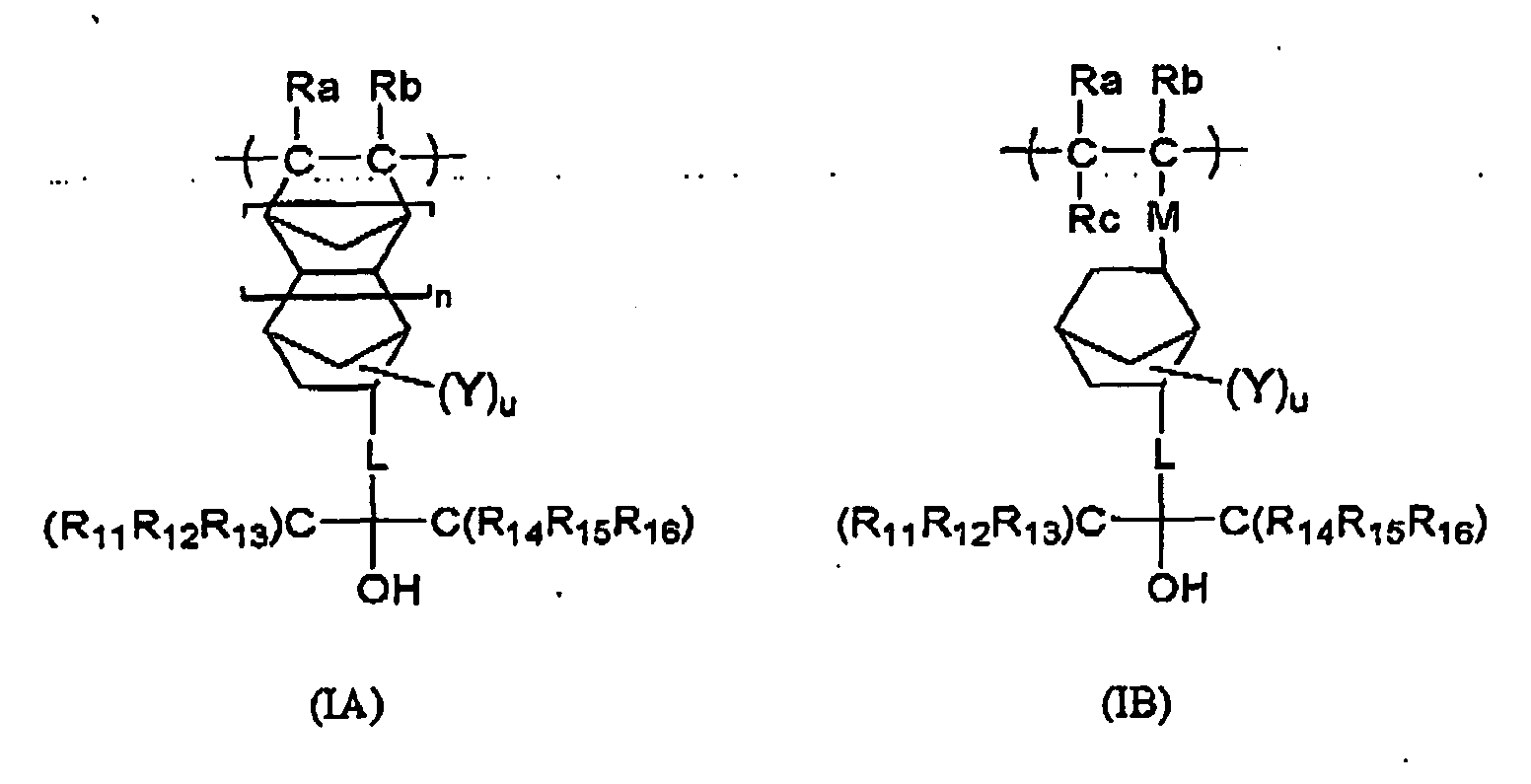
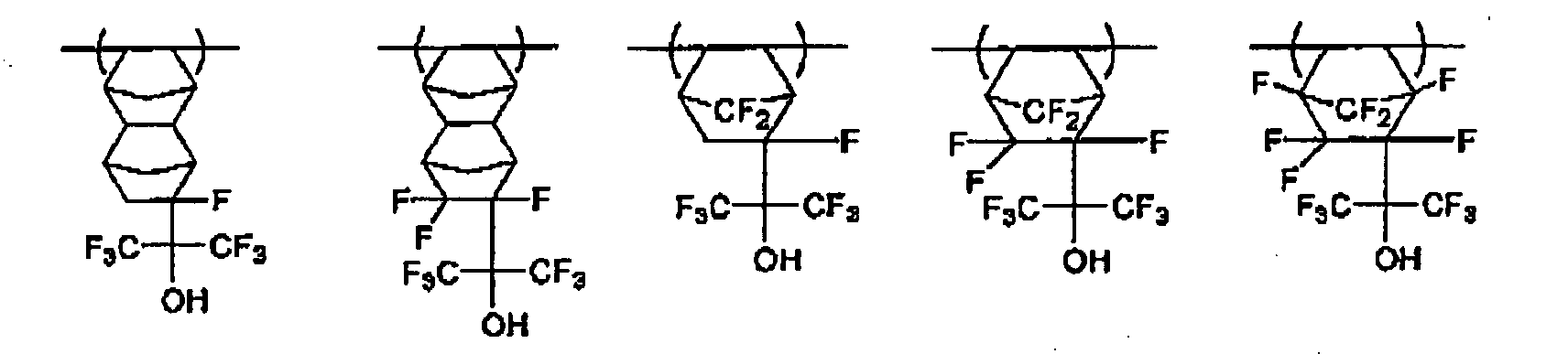
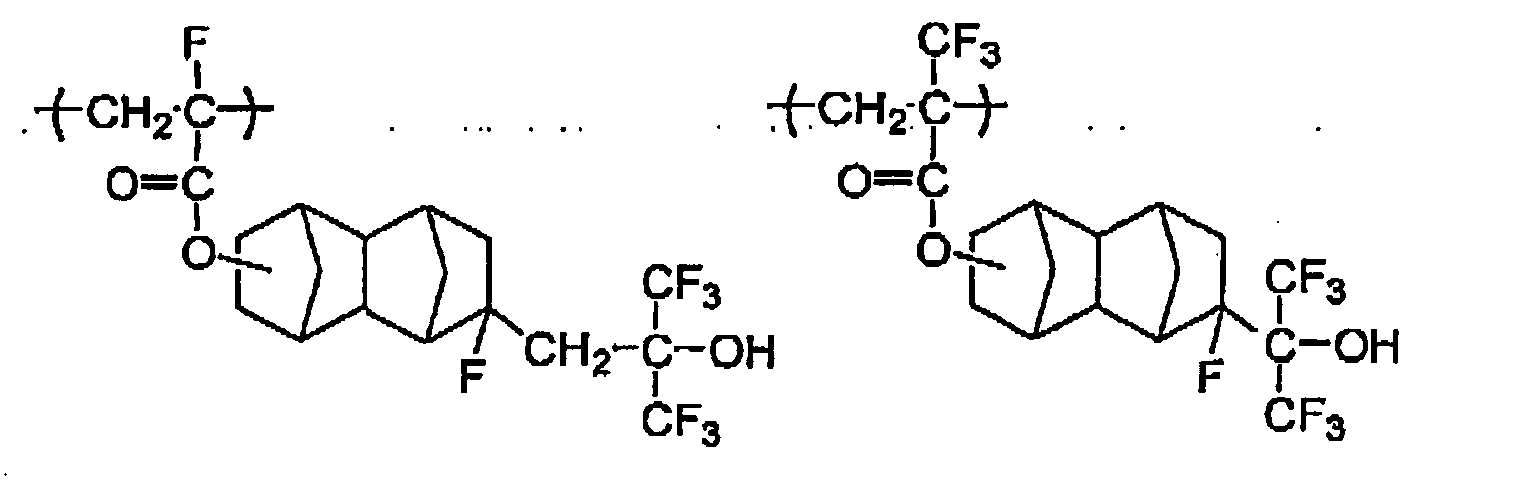
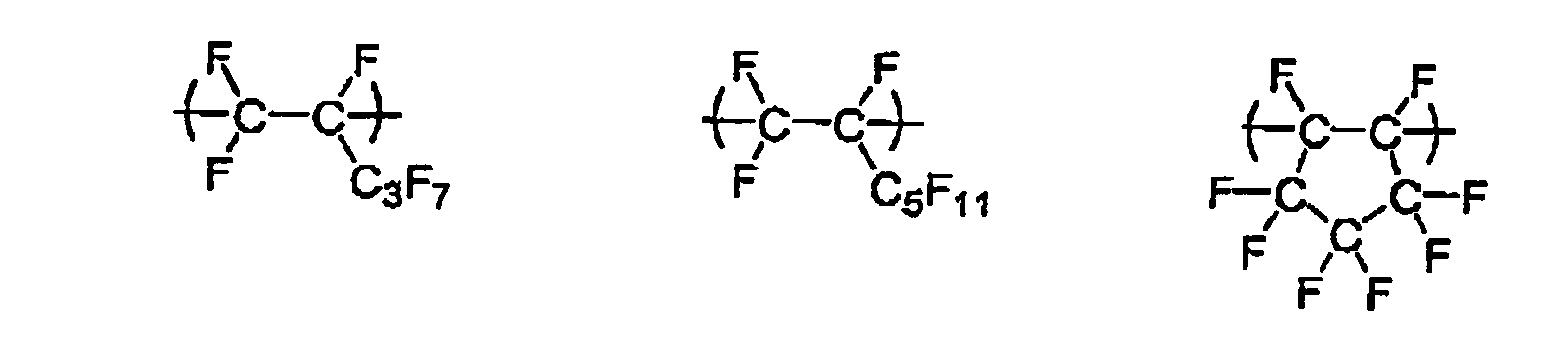
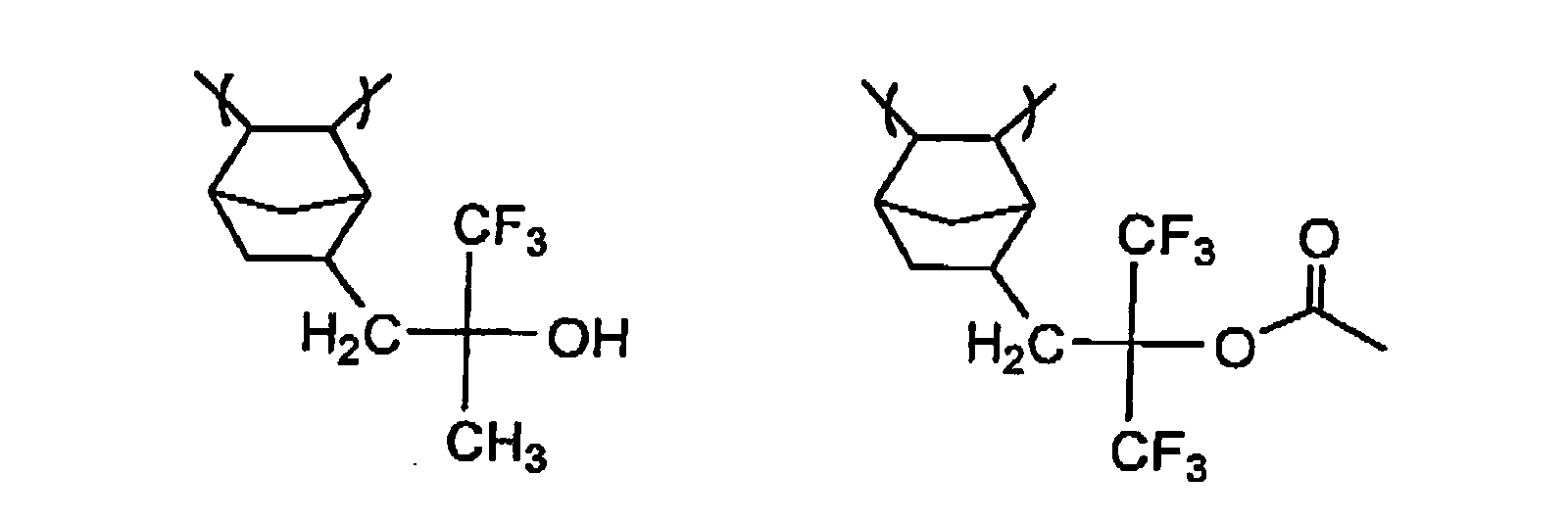
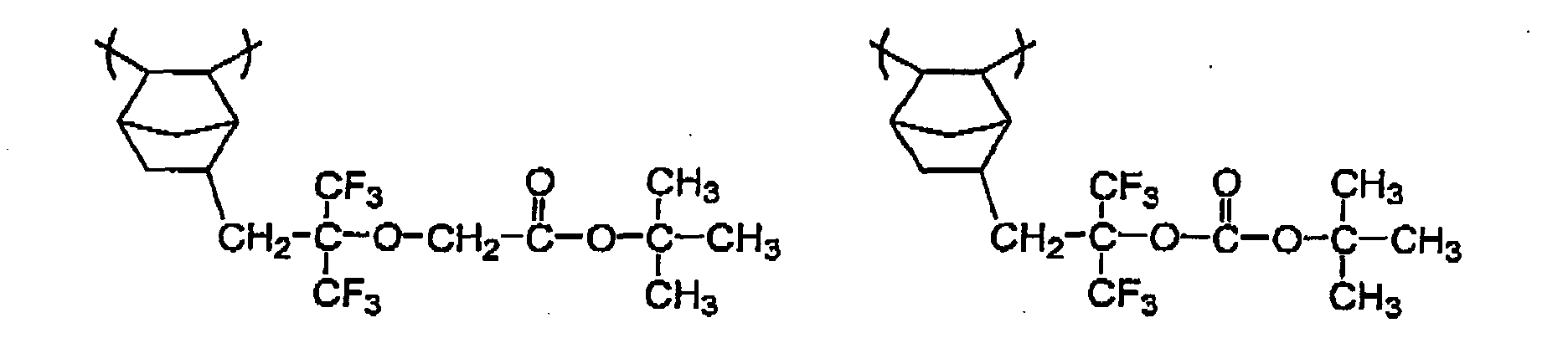
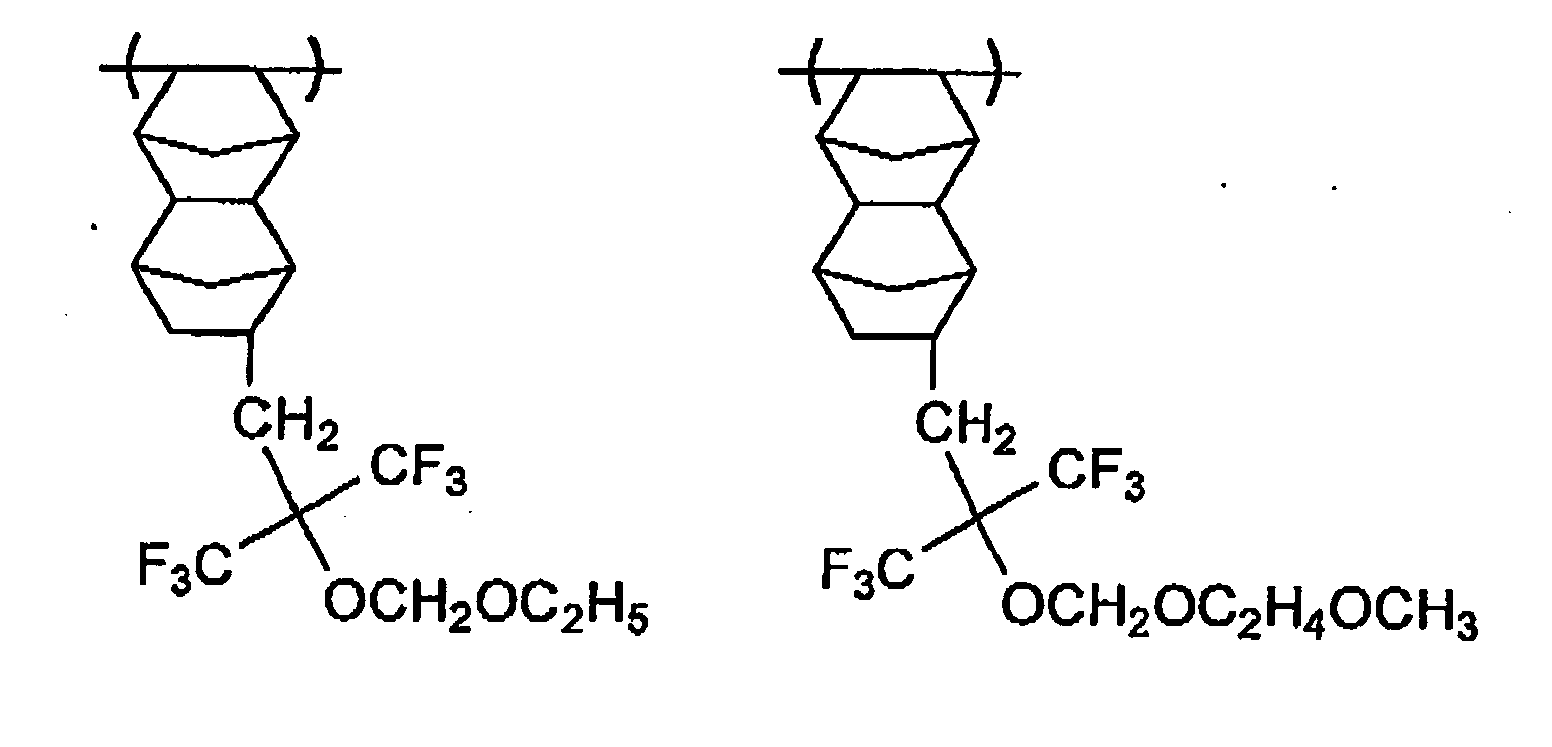
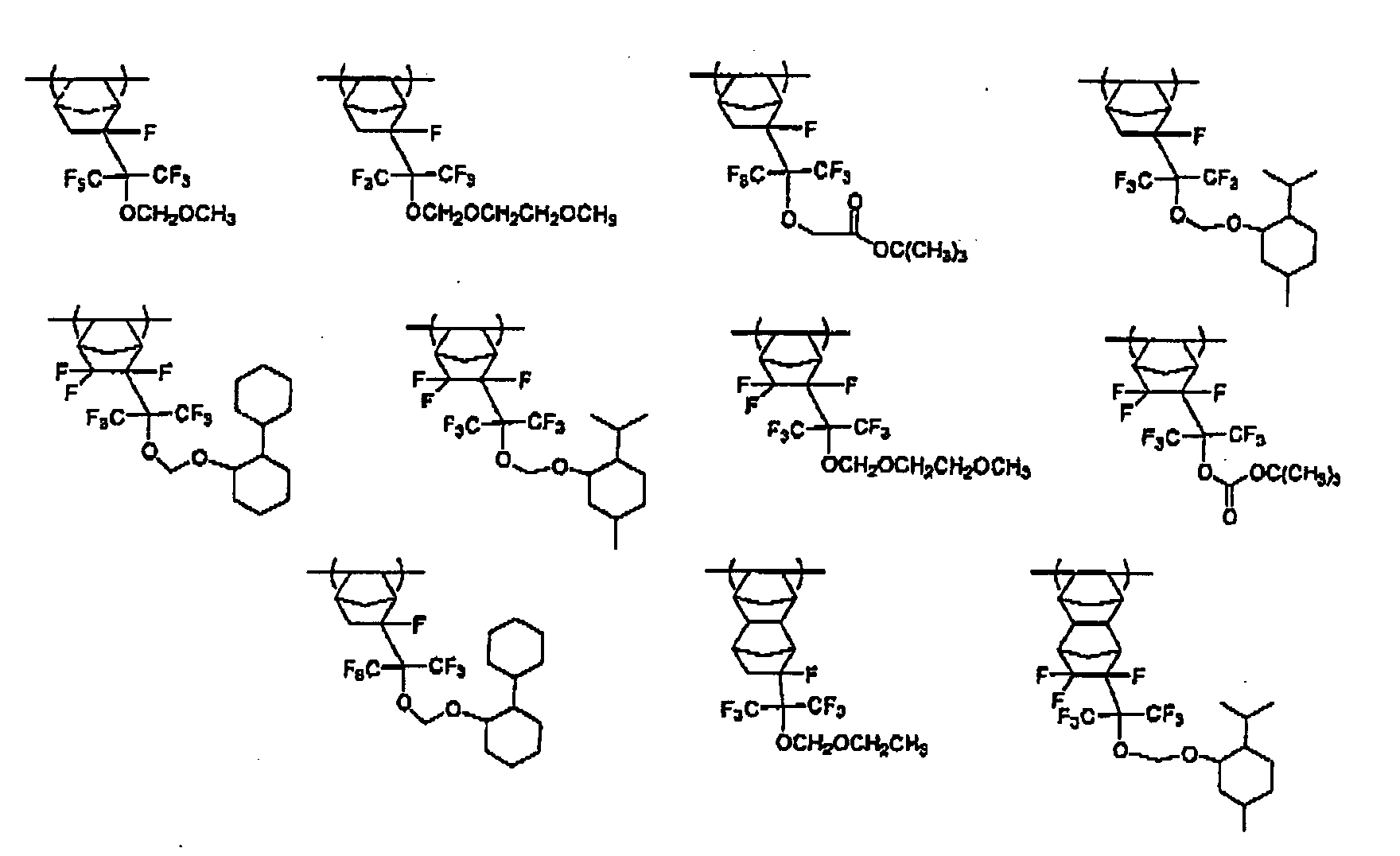
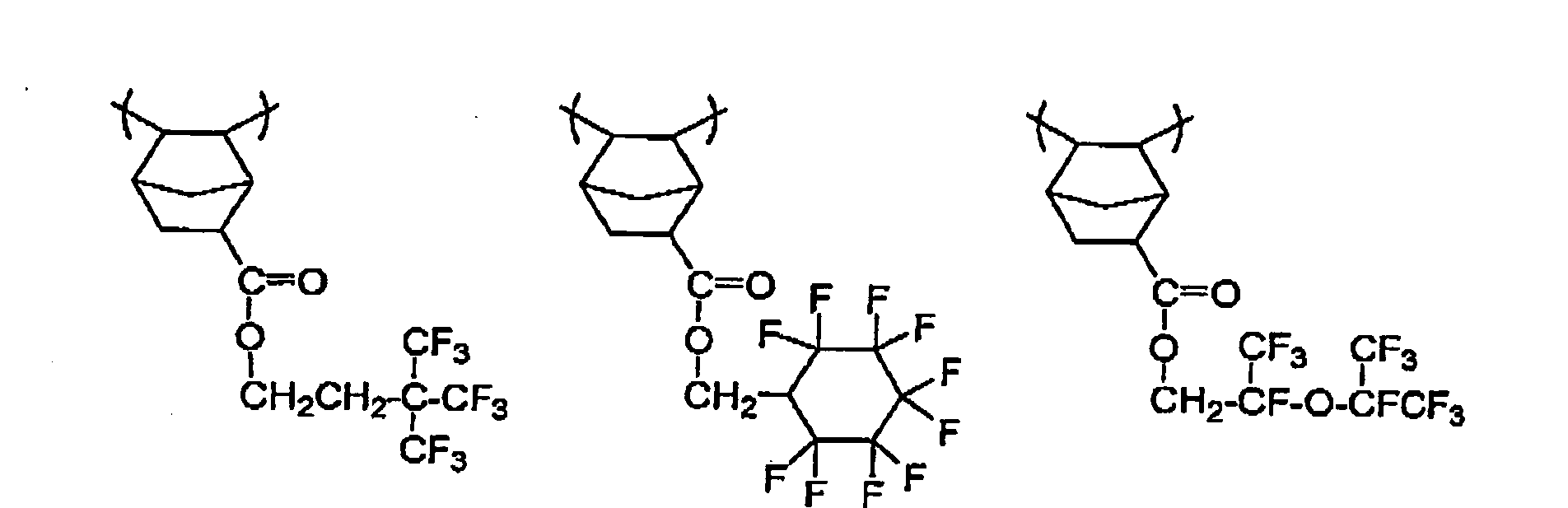
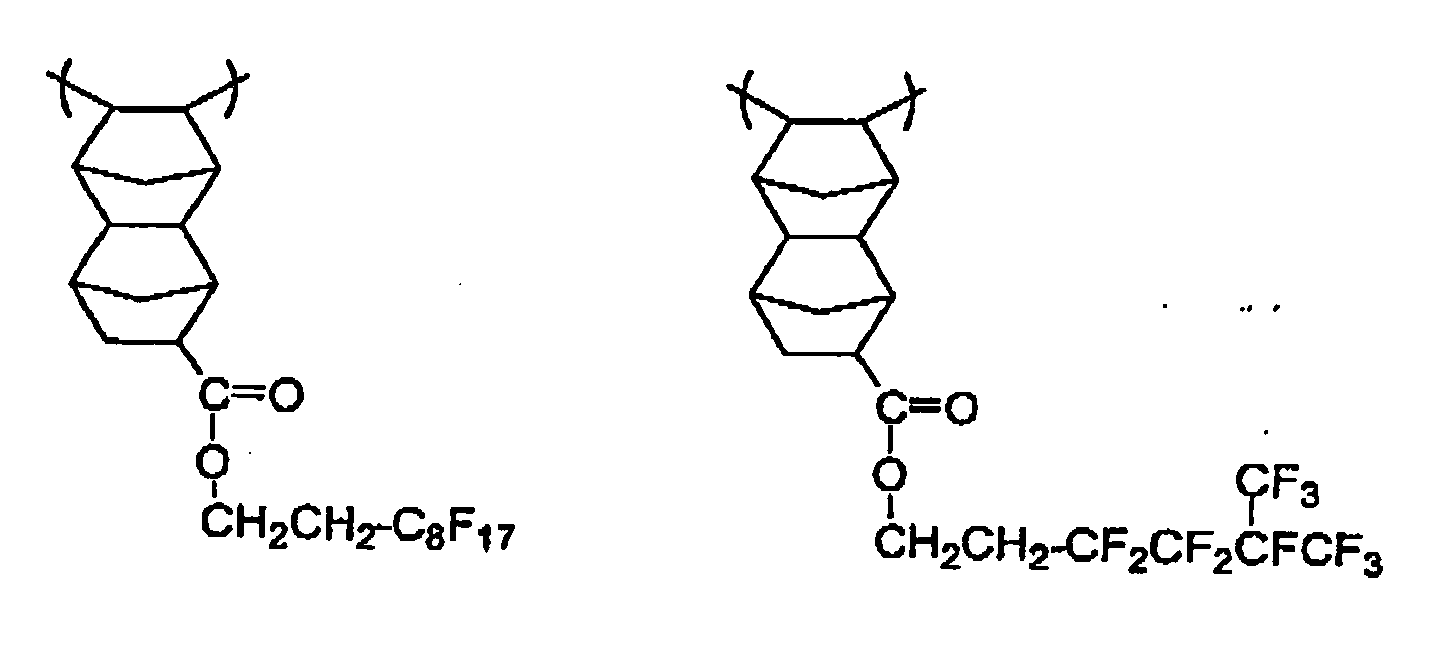
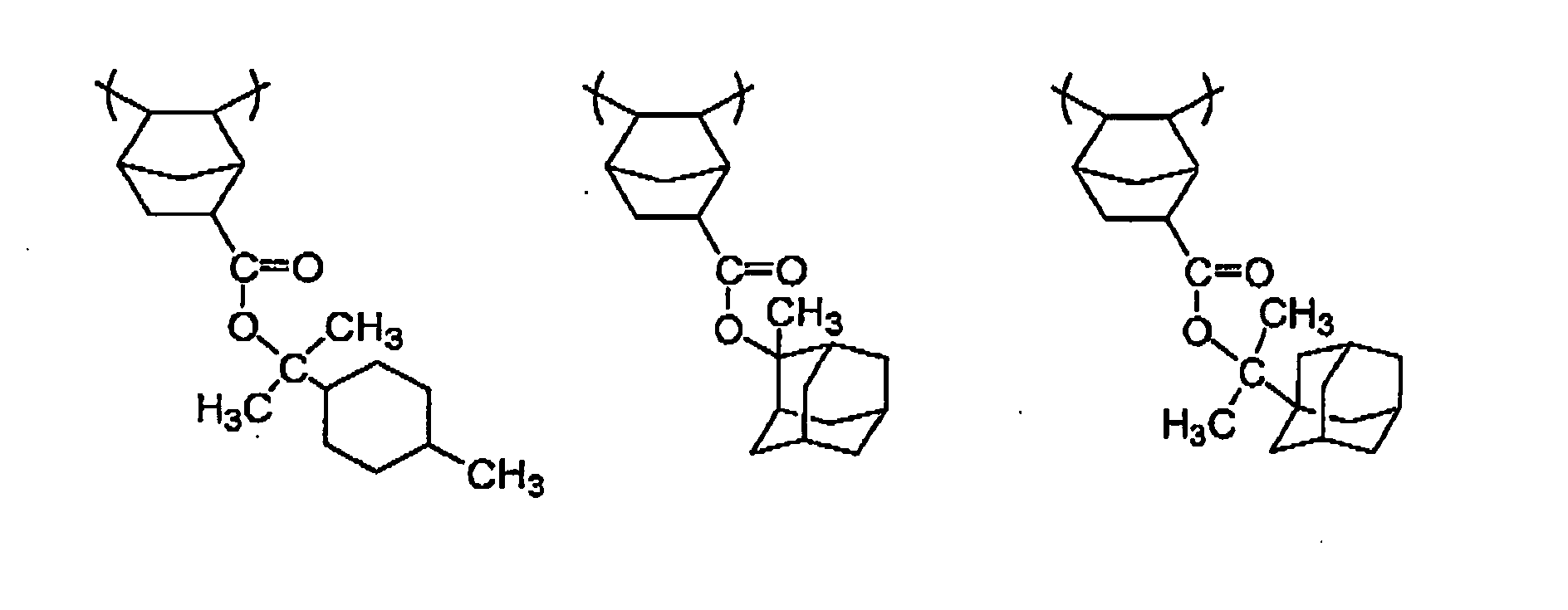
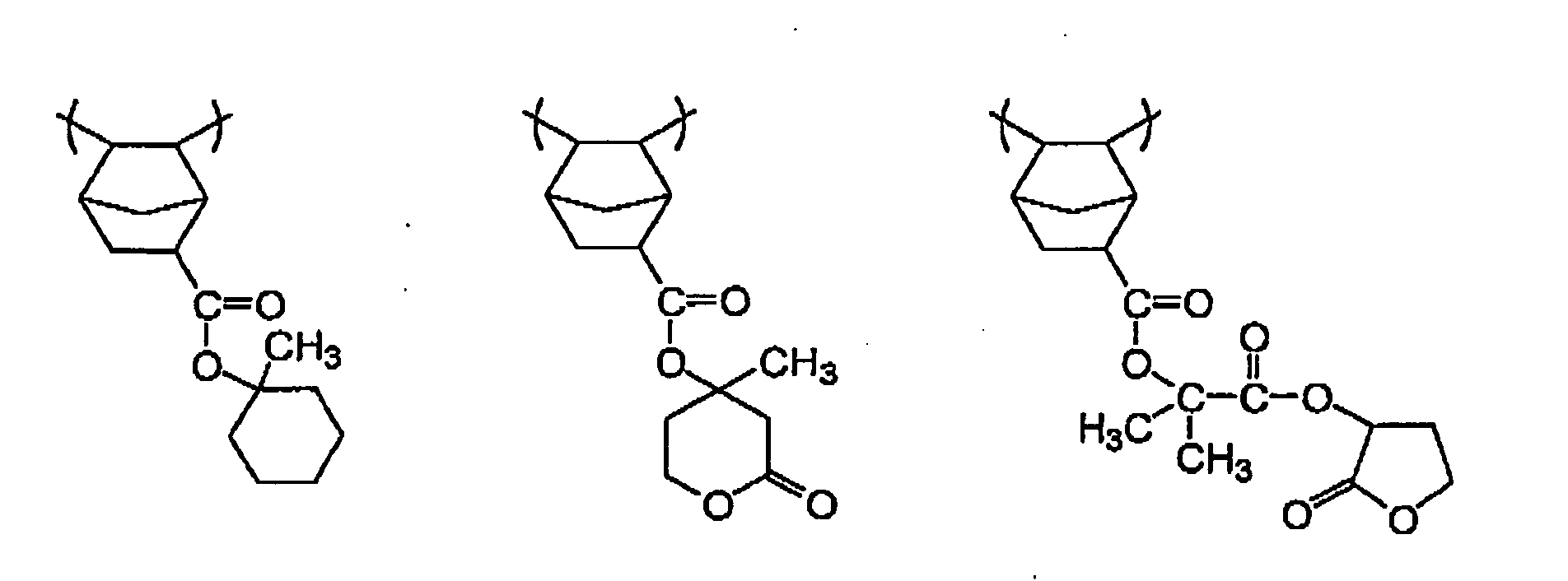
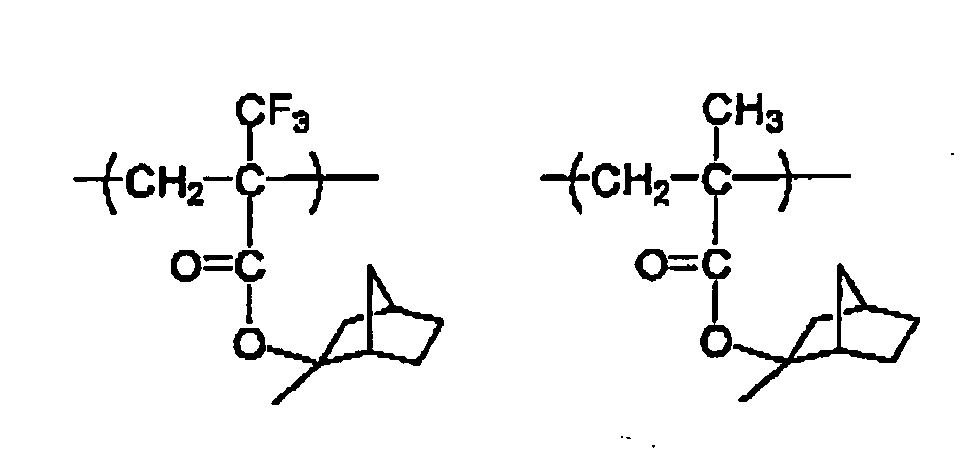
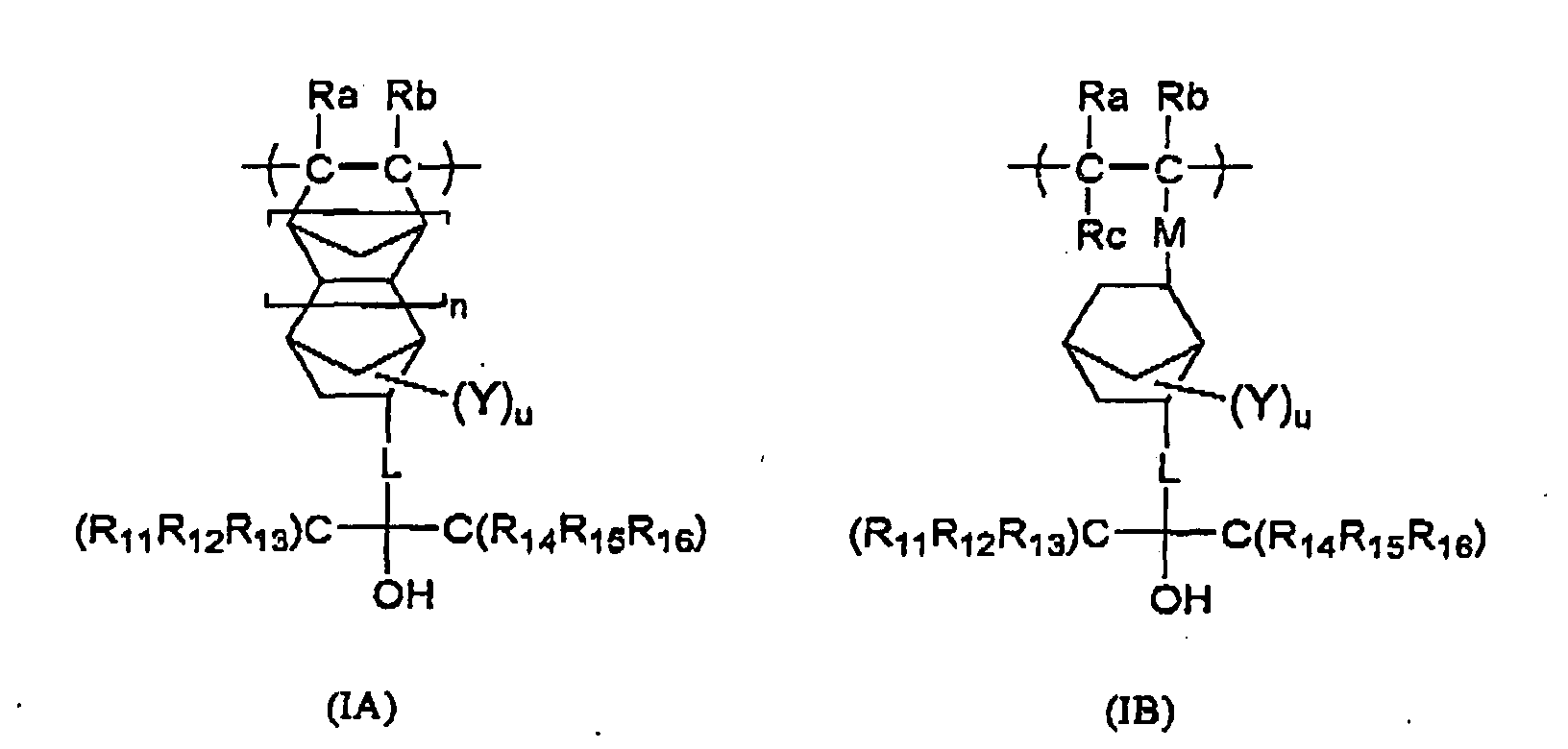
  • the resin (A) contained in the composition according to the invention is a resin which contains at least one of a repeating unit represented by the above formula (IA) and a repeating unit represented by the above formula (IB), is decomposed by the action of an acid and shows an increase in the solubility in an alkali developer (an aid-decomposable resin):
  • Ra, Rb and Rc independently represent each a hydrogen atom, a methyl group, a fluorine atom or a fluoroalkyl group.
  • n 0 or 1.
  • Y represents a fluorine atom or a fluoroalkyl group.
  • u is an integer of from 1 to 5.
  • L and M independently represent each a methylene group, an oxygen atom or an ester group.
  • R 11 to R 16 independently represent each a hydrogen atom, a fluorine atom or a fluoroalkyl group, provided that at least one of R 11 to R 16 represents a fluorine atom or a fluoroalkyl group.
  • -C(R 11 R 12 R 13 ) represents a group in which each of the groups represented by R 11 to R 13 attaches to a carbon atom via a single bond.
  • a fluoroalkyl group represented by Ra, Rb, Rc or Y is an alkyl group in which at least one hydrogen atom is substituted by a fluorine atom and the substitution by the fluorine atom occurs at an arbitrary position of a linear or branched alkyl group.
  • the fluoroalkyl group may have -O- in the middle thereof. It is preferable that the fluoroalkyl group has from 1 to 8 carbon atoms, still preferably form 1 to 5 carbon atoms.
  • Examples thereof include monofluoromethyl, difluoromethyl, trifluoromethyl, 2,2,2-trifluoroethyl, pentafluoroethyl, 2,2,3,3,3-pentafluoropropyl, heptafluoropropyl, 2,2,3,3,4,4,4-heptafluorobutyl, nonafluorobutyl, perfluorohexyl and 1H-1H-perfluorobutyl groups.
  • substituent of the fluoroalkyl group include hydroxyl group, alkoxy groups, halogen atoms and cyano group.
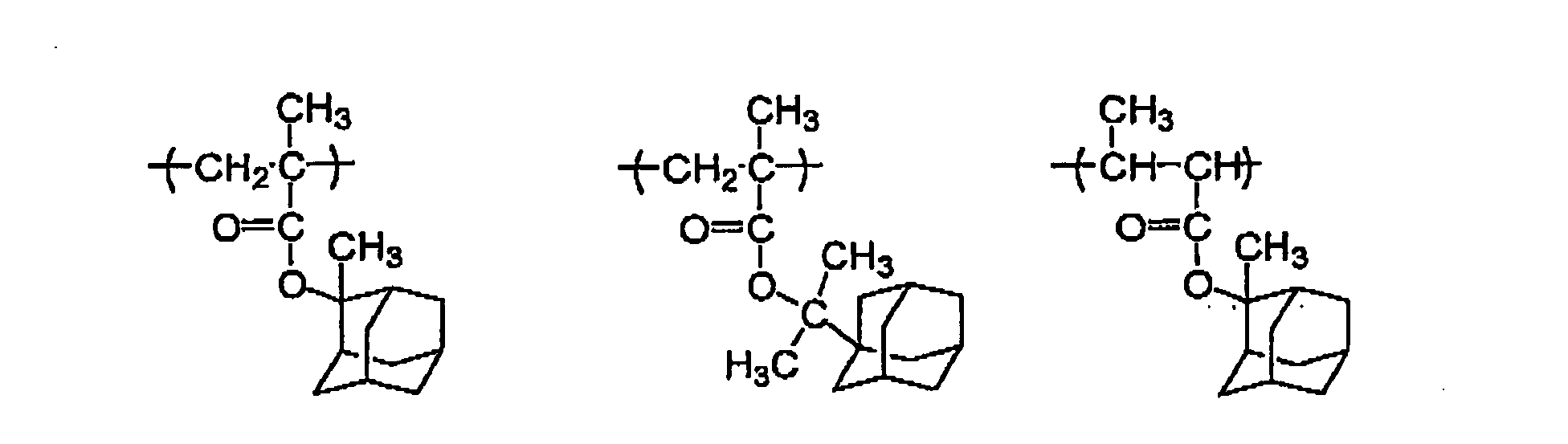
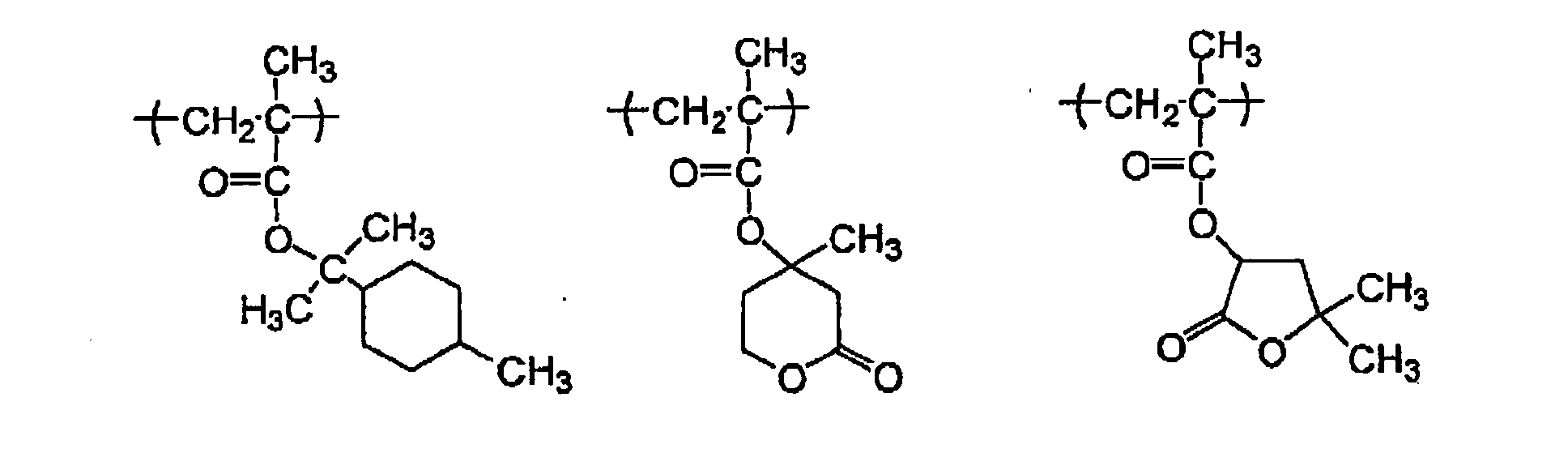
  • the resin (A) is a resin which is decomposed by the action of an acid and shows an increase in the solubility in an alkali developer. It contains a repeating unit having a group which generates an alkali-soluble group such as hydroxyl or carboxyl group (an acid-decomposable group).
  • the acid-decomposable group may be contained in any repeating unit including the repeating units as will be described hereinafter.
  • Examples of the acid-decomposable group include -C(R 36 ) (R 37 ) (R 38 ), -C(R 36 ) (R 37 ) (OR 39 ), -COO-C(R 36 ) (R 37 ) (R 38 ), -C(R 01 ) (R 02 ) (OR 38 ), -C(R 01 ) (R 02 )COO-C(R 36 ) (R 37 ) (R 38 ), though the invention is not restricted thereto.
  • -C(R 36 ) (R 37 ) (R 38 ) means a group in which each of the groups represented by R 36 to R 38 attaches to a carbon atom via a single bond.
  • R 36 to R 39 independently represent each an alkyl group, a cycloalkyl group, an alkenyl group, an aralkyl group or an aryl group. R 36 and R 39 may be bonded to each other to form a ring.
  • R 01 and R 02 independently represent each a hydrogen atom, an alkyl group, a cycloalkyl group, an alkenyl group, an aralkyl group or an aryl group.
  • An alkyl group represented by R 36 to R 39 , R 01 or R 02 may have a substituent and an alkyl group having from 1 to 8 carbon atoms is preferable. Examples thereof include methyl, ethyl, propyl, n-butyl, sec-butyl, hexyl, 2-ethylhexyl and octyl groups.
  • a cycloalkyl group represented by R 36 to R 39 , R 01 or R 02 may have a substituent. It may be either a monocyclic or polycyclic group. As a monocyclic group, a cycloalkyl group having from 3 to 8 carbon atoms is preferable. Examples thereof include cyclopropyl, cyclopentyl, cyclohexyl, cyclobutyl and cyclooctyl groups. As a polycyclic group, a cycloalkyl group having from 6 to 20 carbon atoms is preferable.
  • Examples thereof include adamantyl, norbornyl, isobornyl, camphanyl, dicyclopentyl, ⁇ -pinenyl, tricyclodecanyl, tetracyclododecyl and androstanyl groups.
  • a part of the carbon atoms in the cycloalkyl group may be substituted by a hetero atom such as an oxygen atom.
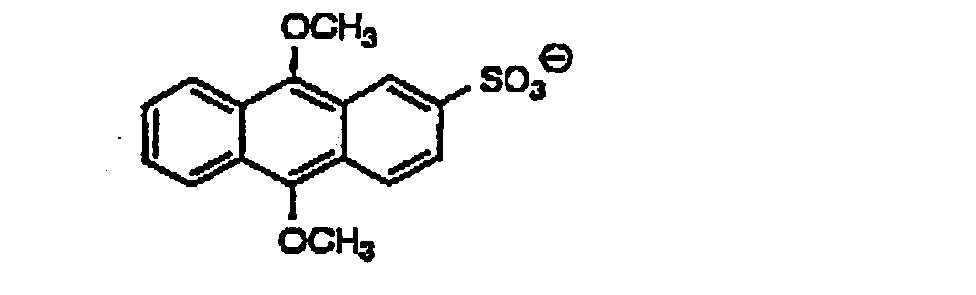
  • An aryl group represented by R 36 to R 39 , R 01 or R 02 may have a substituent and an aryl group having from 6 to 10 carbon atoms is preferable. Examples thereof include phenyl, tolyl, dimethylphenyl, 2,4,6-trimethylphenyl, naphthyl, anthryl and 9,10-dimethoxyanthryl groups.
  • An aralkyl group represented by R 36 to R 39 , R 01 or R 02 may have a substituent and an aralkyl group having from 7 to 12 carbon atoms is preferable. Examples thereof include benzyl, phenethyl and naphthylmethyl groups.
  • An alkenyl group represented by R 36 to R 39 , R 01 or R 02 may have a substituent and an alkenyl group having from 2 to 8 carbon atoms is preferable. Examples thereof include vinyl, allyl, butenyl and cyclohexenyl groups.
  • Examples of the substituent which may be carried by R 36 to R 39 , R 01 and R 02 include alkyl, cycloalkyl, aryl, amino, amido, ureido, urethane, hydroxy and carboxy groups, halogen atoms, alkoxy, thioether, acyl, acyloxy, alkoxycarbonyl, cyano and nitro groups.
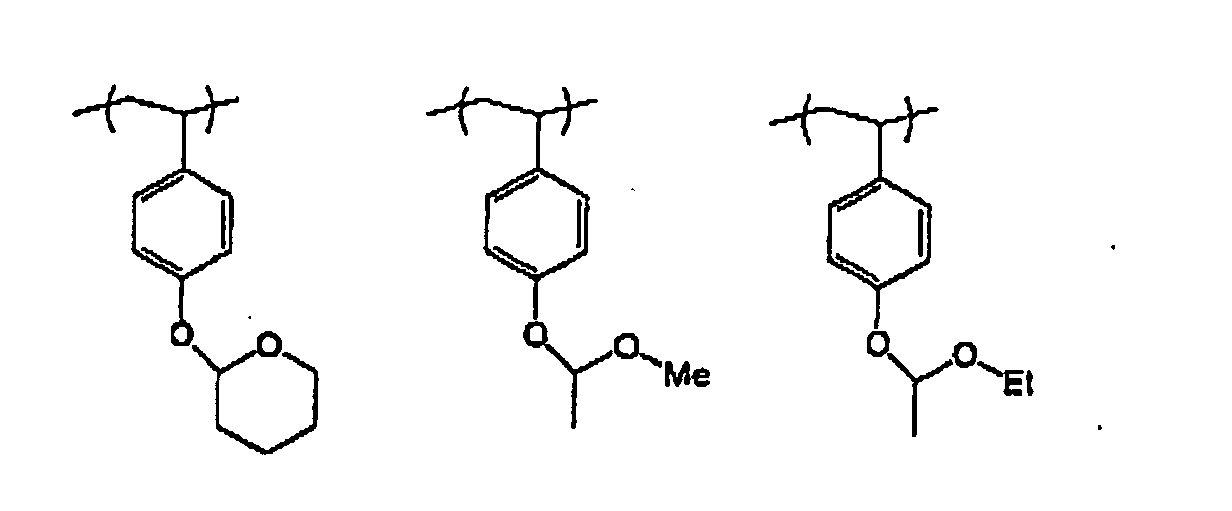
  • Preferable examples of the acid-decomposable group include acetal groups such as 1-alkoxy-1-ethoxy, 1-alkoxy-1-methoxy and tetrahydropyranyl groups, t-alkyloxycarbonyl, ethoxymethyl, methoxyethoxymethyl and t-alkylcarbonylmethyl groups.
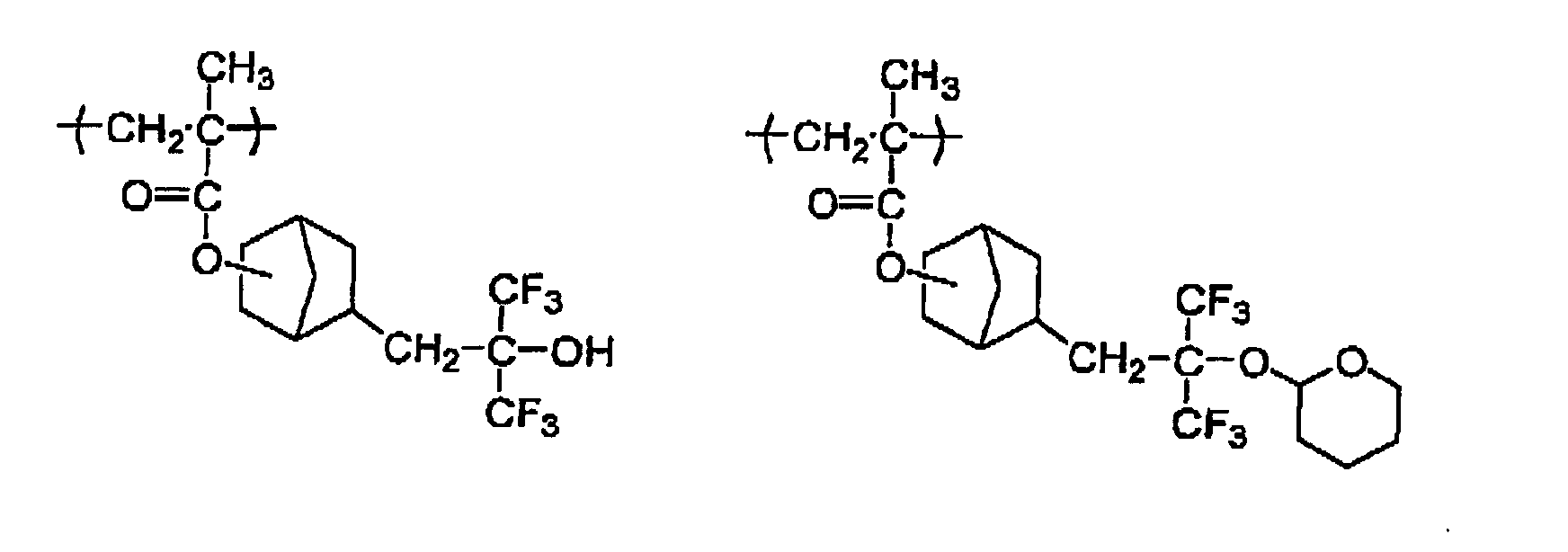
  • the resin (A) further contains at least one of a repeating unit represented by the following formula (IIA) and a repeating unit represented by the following formula (IIB).
  • Ra, Rb and Rc independently represent each a hydrogen atom, a methyl group, a fluorine atom or fluoroalkyl group.
  • AR represents an alicyclic hydrocarbon structure.
  • p is an integer of from 1 to 5.
  • Rg and Rh independently represent each a hydrogen atom, a hydroxyl group or a hydroxyalkyl group, provided that one of them represents a hydroxyl group or a hydroxyalkyl group.
  • a fluoroalkyl group represented by Ra, Rb or Rc is the same as the fluoroalkyl group as in the formula (IA).
  • the alicyclic hydrocarbon structure represented by AR may be either a monocyclic or polycyclic structure. Specific examples thereof include alicyclic hydrocarbon structures having 5 or more carbon atoms such as monocyclo, bicyclo, tricycle and tetracyclo structures. It is preferable that AR has from 6 to 30 carbon atoms, still preferable from 7 to 25 carbon atoms.
  • alicyclic hydrocarbon structure represented by AR examples include adamantane, noradamantane, decalin, tricyclodecane, tetracyclododecane, norbornane, cycloheaxne, cycloheptane, cyclooctane, cyclodecane and cyclododecane. Still preferable examples thereof include adamantane, norbornane and cyclohexane.
  • the alicyclic hydrocarbon structure represented by AR may further have a substituent such as alkyl or alkoxy group.
  • a hydroxyalkyl group represented by Rg or Rh has 1 to 10 carbon atoms, still preferably 1 to 5 carbon atoms.
  • a hydroxymethyl group is particularly preferable therefor.
  • the repeating unit represented by the above formula (IA) and the repeating unit represented by the above formula (IB) are used in a content of generally from 5 to 80% by mol, preferably from 7 to 75% by mol and still preferably from 10 to 70% by mol, based on the total repeating units.
  • the repeating unit represented by the above formula (IIA) and the repeating unit represented by the above formula (IIB) are used in a content of generally from 1 to 40% by mol, preferably from 3 to 35% by mol and still preferably from 5 to 30% by mol, based on the total repeating units.
  • the repeating unit having the acid-decomposable group is used in a content of generally from 5 to 80% by mol, preferably from 7 to 75% by mol and still preferably from 10 to 70% by mol, based on the total repeating units.
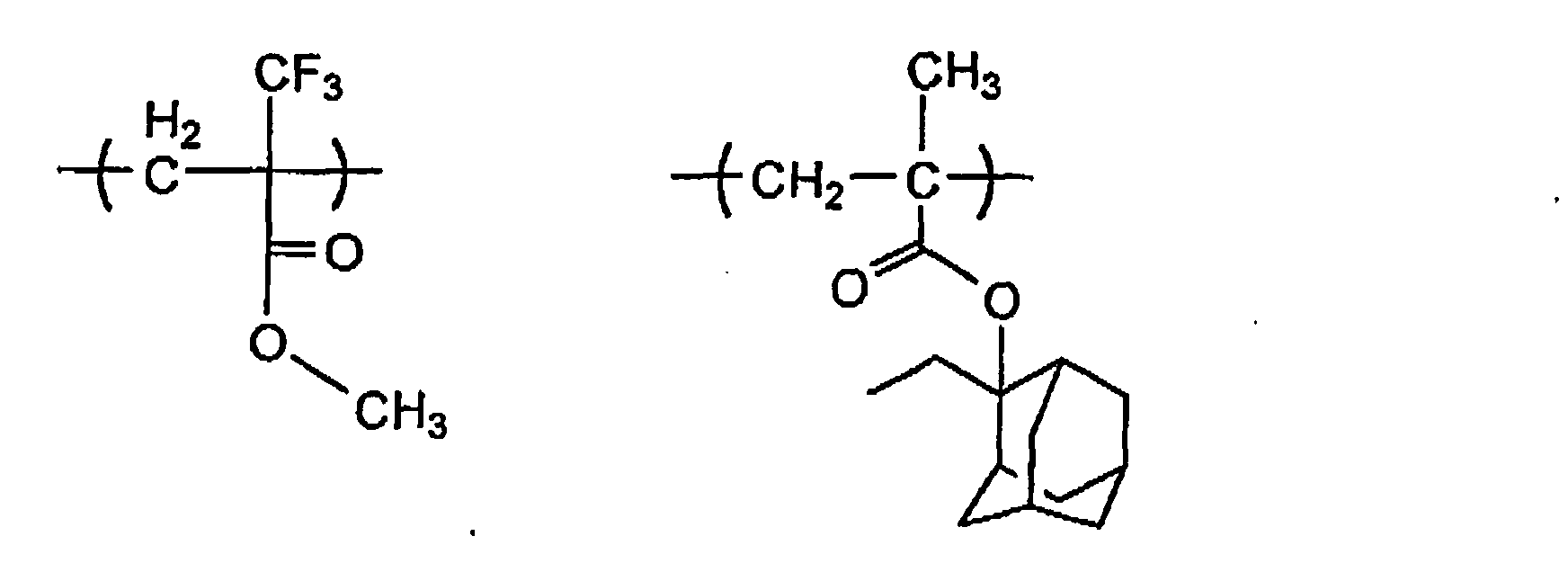
  • the resin (A) may have an additional repeating unit and preferable examples thereof are as follows.
  • R 1 , R 5 , R 17a and R 17 may be the same or different and each represents a hydrogen atom, a halogen atom, a cyano group or an alkyl group.
  • R 2 , R 3 , R 6 and R 7 may be the same or different and each represents a hydrogen atom, a halogen atom, a cyano group, a hydroxyl group, an alkyl groups a cycloalkyl group, an aryl group or an aralkyl group.
  • R 50 to R 55 may be the same or different and each represents a hydrogen atom, a fluorine atom or an alkyl group, provided that at least one of R 50 to R 55 represents a fluorine atom or an alkyl group having a substitution of at least one hydrogen atom by a fluorine atom (a fluoroalkyl group).
  • R 4 represents a group of the following formula (IV) or (V).
  • R 18 represents -C(R 18d ) (R 18c ) (R 18f ) or -C(R 18d ) (R 18e ) (OR 18g ).
  • R 18d to R 18g may be the same or different and each represents a hydrogen atom, an alkyl group, a cycloalkyl group, an alkenyl group, an aralkyl group or an aryl group.
  • Two groups among R 18d , R 18e and R 18f or two groups among R 18d , R 18e and R 18g may be bonded together to form a ring.
  • R 11 , R 12 arid R 13 may be the same or different and each represents an alkyl group, a cycloalkyl group, an alkenyl group, an aralkyl group or an aryl group.
  • R 14 and R 15 may be the same or different and each represents a hydrogen atom or an alkyl group.
  • R 16 represents an alkyl group, a cycloalkyl group, an aralkyl group or an aryl group. Two groups among R 14 to R 16 may be bonded together to form a ring.
  • R 18 is a group represented by any of the following formulae (VI-A) to (VI-C).
  • R 18a and R 18b may be the same or different and each represents an alkyl group.
  • R 18c represents a cycloalkyl group.
  • R 18h represents analkyl group, an alkenyl group, an alkynyl group, an aralkyl group or an aryl group.
  • Z represents an atomic group which forms a monocyclic or polycyclic alicyclic group together with the carbon atom in the formula (VI-B).
  • R 18' represents an alkyl group, an alkenyl group, an alkynyl group, an aralkyl group or an aryl group.
  • R 1 in the above formula (I), R 5 in the formula (II) and R 17 in the formula (VI) are each a trifluoromethyl group.
  • Ra represents a hydrogen atom, a halogen atom, a cyano group or an alkyl group.
  • R 9 and R 10 may be the same or different and each represents a hydrogen atom, a halogen atom, a cyano group, an alkyl group, a cycloalkyl group, an alkoxy group, an acyl group, an acyloxy group, an alkenyl group, an aryl group or an aralkyl group.
  • R 19 and R 20 may be the same or different and each represents a hydrogen atom, a halogen atom, a cyano group or an alkyl group.
  • R 21 represents a hydrogen atom, a halogen atom, an alkyl group or -D-CN.
  • D represents a single bond or a divalent linking group.
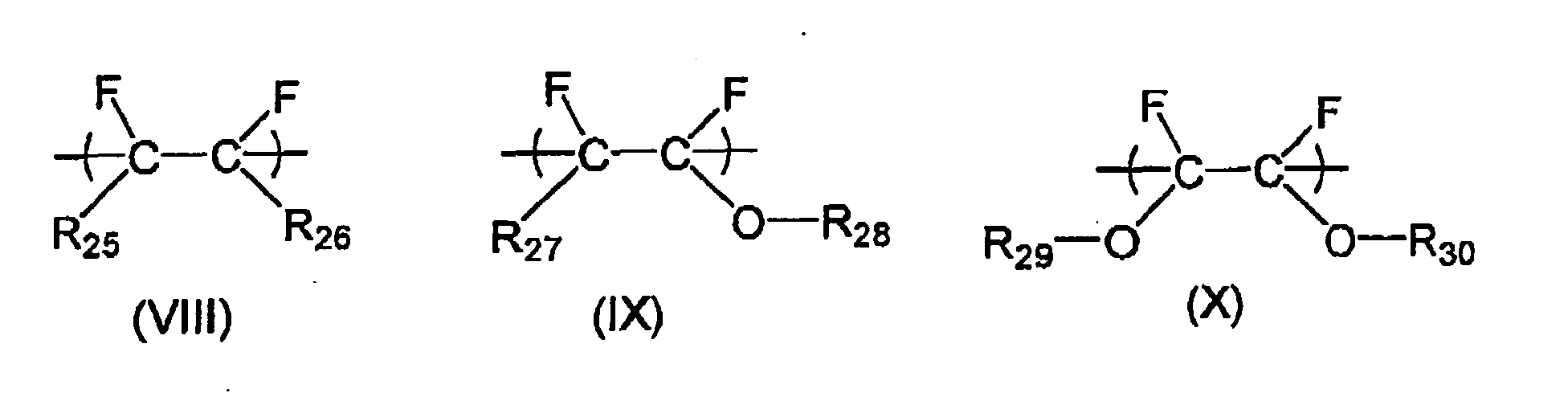
  • R 25 , R 26 and R 27 may be the same or different and each represents a hydrogen atom, a fluorine atom, an alkyl group, a cycloalkyl group or an aryl group.
  • R 28 , R 29 and R 30 may be the same or different and each represents an alkyl group, a cycloalkyl group or an aryl group.
  • R 25 and R 26 , R 27 and R 28 , or R 29 and R 30 may be bonded to each other to form a ring.
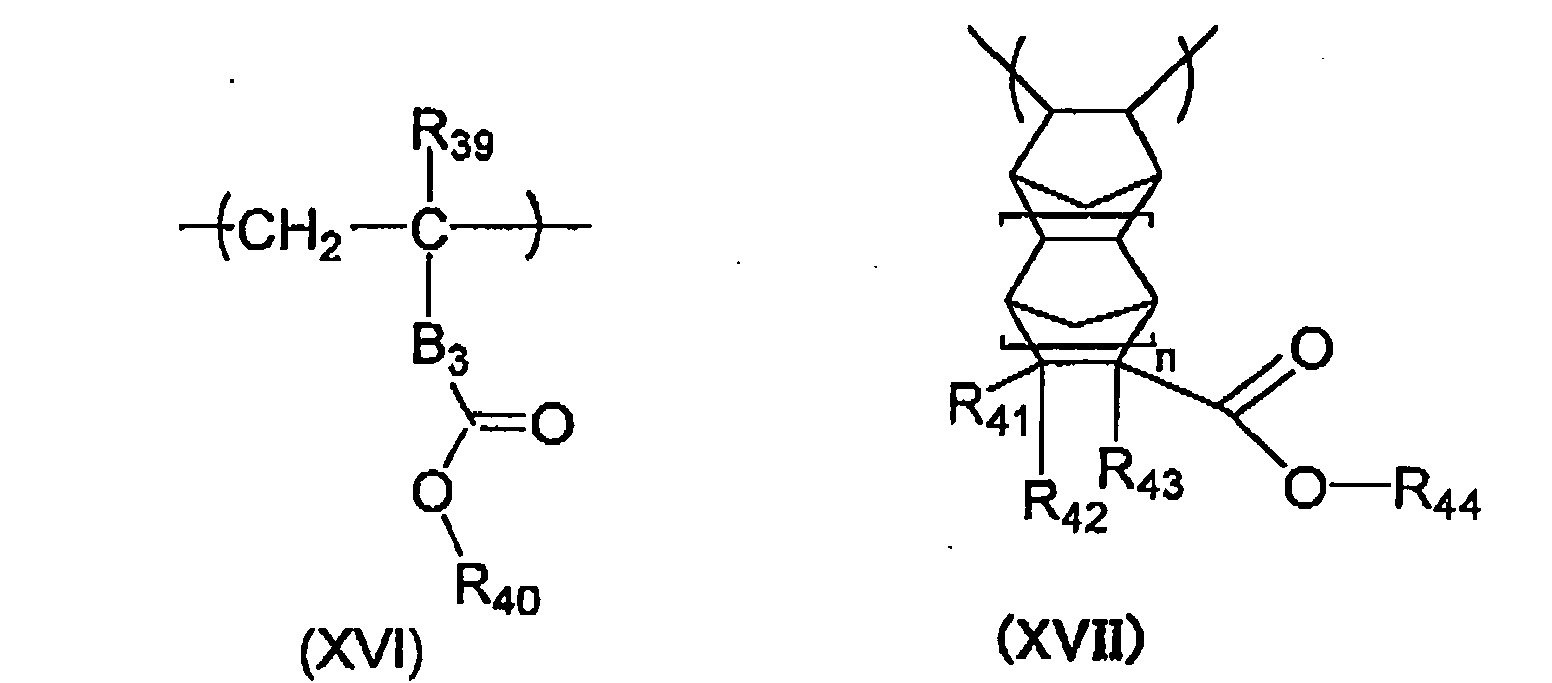
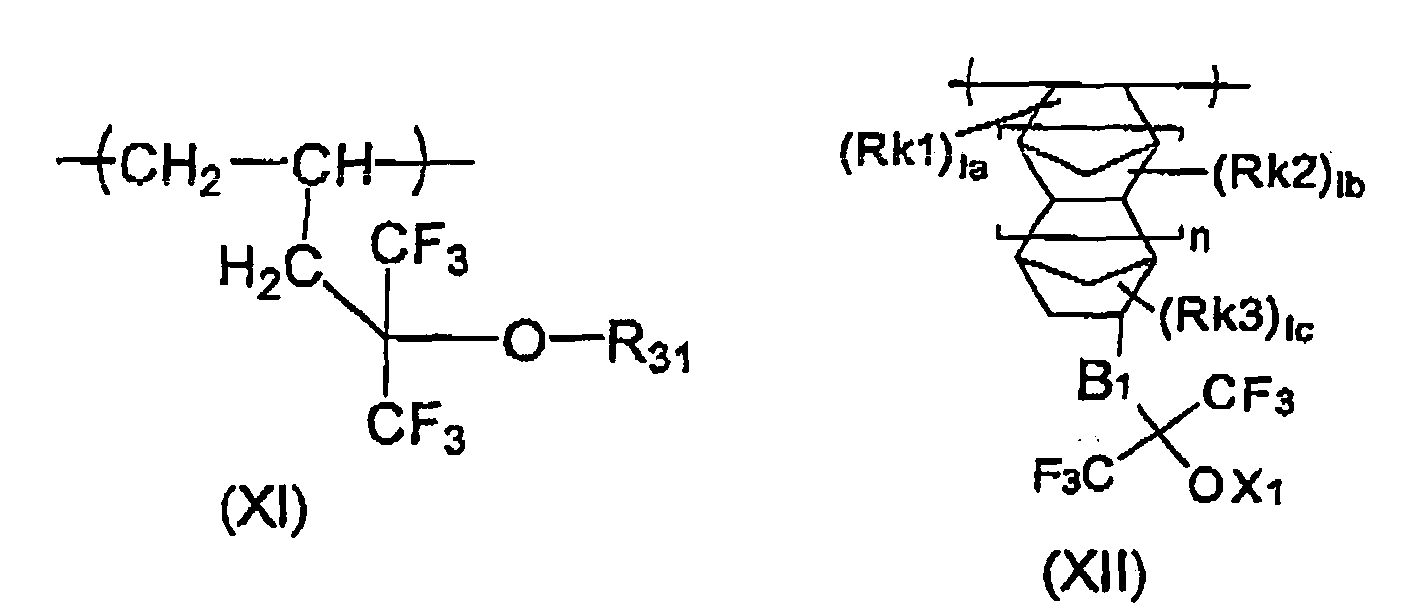
  • R 31 , R 37 , R 40 and R 44 may be the same or different and each represents a hydrogen atom, an alkyl group, a cycloalkyl group, an acyl group or an alkoxycarbonyl group.
  • R 41 , R 42 and R 43 may be the same or different and each represents a hydrogen atom, a halogen atom, an alkyl group or an alkoxy group.
  • R 36 and R 39 may be the same or different and each represents a hydrogen atom, a halogen atom, a cyano group or an alkyl group.
  • R 38 represents an alkyl group, a cycloalkyl group, an aralkyl group or an aryl group.
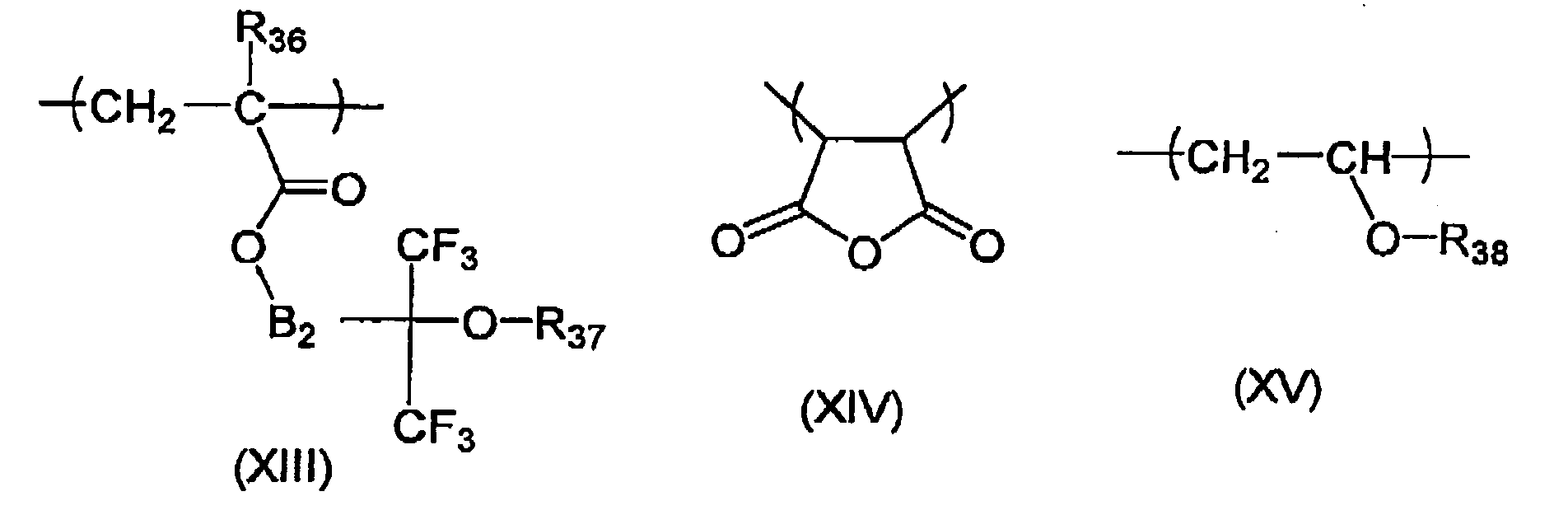
  • B 1 and B 2 represent each a single bond or a divalent linking group.
  • B 3 represents a divalent linking group, n is 0 or 1.
  • Rk1, Rk2 and Rk3 independently represent each a halogen atom, an alkyl group or an alkoxy group.
  • X 1 represents a hydrogen atom or a monovalent organic group.
  • 1a is 0 or 1
  • 1 b is an integer of 0 to 2
  • 1c is an integer of 0 to 5.
  • An alkyl group means a linear or branched alkyl group having, for example, from 1 to 8 carbon atoms. Preferable examples thereof include methyl, ethyl, propyl, n-butyl, sec-butyl, hexyl, 2-ethylhexyl and octyl groups.
  • a cycloalkyl group may be either a monocyclic or polycyclic group.
  • a monocyclic group a cycloalkyl group having from 3 to 8 carbon atoms is preferable. Examples thereof include cyclopropyl, cyclopentyl, cyclohexyl, cycloheptyl and cyclooctyl groups.
  • a polycylic group a cycloalkyl group having from 6 to 20 carbon atoms is preferable.
  • Examples thereof include adamantyl, norbornyl, isobornyl, camphanyl, dicyclopentyl, ⁇ -pinenyl, tricyclodecanyl, tetracylcododecyl and androstanyl groups.
  • a cycloalkyl group having substitution of a part of carbon atoms constituting a ring by a hetero atom such as an oxygen atom, a sulfur atom or a nitrogen atom is also involves.
  • An aryl group means an aryl group having, for example, from 6 to 15 carbon atoms. Preferable examples thereof include phenyl, tolyl, dimethylphenyl, 2,4,6-trimethylphenyl, naphthyl, anthryl and 9,10-dimethoxyanthryl groups.
  • An aralkyl group means an aralkyl group having, for example, from 7 to 12 carbon atoms. Preferable examples thereof include benzyl, phenethyl and naphthylmethyl groups.
  • alkenyl group means an alkenyl group having from, for example, 2 to 8 carbon atoms. Preferable examples thereof include vinyl, allyl, butenyl and cyclohexenyl groups.
  • An alkoxy group means an alkoxy group having, for example, from 1 to 8 carbon atoms. Preferable examples thereof include methoxy, ethoxy, n-propoxy, iso-propoxy, butoxy, pentoxy, allyloxy and octoxy groups.
  • An acyl group means an acyl group having, for example, from 1 to 10 carbon atoms. Preferable examples thereof include formyl, acetyl, propanoyl, butanoyl, pivaloyl, octanoyl and benzoyl groups.
  • acyloxy groups having from 2 to 12 carbon atoms such as acetoxy, propionyloxy and benzoyloxy groups are preferable.
  • alkynyl groups having from 2 to 5 carbon atoms such as ethynyl, propynyl and butynyl groups are preferable.
  • alkoxycarbonyl group examples include tertiary alkoxycarbonyl groups such as t-butoxycarbonyl, t-amyloxycarbonyl, 1-methyl-1-cyclohexylcarbonyl groups.
  • halogen atom examples include fluorine, chlorine, bromine and iodine atoms.
  • a divalent linking group means an optionally substituted divalent alkylene, cycloalkylene, alkenylene or arylene group, or -O-CO-R 22a -, -CO-O-R 22b -, -CO-N(R 22d )-R 22c -.
  • R 22a , R 22b and R 22c may be the same or different and each represents a single bond or a divalent alkylene, cycloalkylene, alkenylene or arylene group optionally having an ether group, an ester group, an amido group, an urethane group or an ureido group.
  • R 22d represents a hydrogen atom or an optionally substituted alkyl, cycloalkyl, aralkyl or aryl group.
  • An alkylene group means a linear or branched alkylene group. Examples thereof include alkylene groups having from 1 to 8 carbon atoms such as methylene, ethylene, propylene, butylene, hexylene and octylene groups.
  • Examples of a cycloalkylene group include cycloalkylene groups having from 5 to 8 carbon atoms such as cyclopentylene and cyclohexylene groups.
  • an alkenylene group include optionally substituted alkenylene groups having from 2 to 6 carbon atoms such as ethenylene, propenylene and butenylene groups.
  • an arylene group include optionally substituted arylene groups having from 6 t 15 carbon atoms such as phenylene, tolylene and naphthylene groups.
  • Examples of a ring formed by two of R 18d to R 18f , two of R 18d , R 18e and R 18g , two of R 14 to R 16 , R 25 and R 26 , R 27 and R 28 or R 29 to R 30 bonded together include 3- to 8-membered rings such as cyclopropane, cyclopentane, cyclohexane, tetramethylene oxide, pentamethylene oxide, hexamethylene oxide, furan, pyrane, dioxonol and 1,3-dioxolane rings.
  • Z represents an atomic group which forms a monocyclic or polycyclic alicyclic group together with the carbon atom in the formula (VI-B).
  • the monocyclic alicyclic group include monooyclioalicyclicgroups having from 3 to 8 carbon atoms such as cyclopropyl, cyclopentyl, cyclohexyl, cycloheptyl and cyclooctyl groups.
  • polycyclic alicyclic groups examples include polycyclic alicyclic groups having from 6 to 20 carbon atoms such as adamantyl, norbornyl, isobornyl, camphanyl, dicyclopentyl, ⁇ -pinenyl, tricyclodecanyl, tetracylcododecyl and androstanyl groups.
  • alkyl, cycloalkyl, alkoxy, acyl, acyloxy, alkynyl, alkenyl, aryl, aralkyl, alkoxycarbonyl, alkylene, cycloalkylene, alkenylene and arylene groups may have substituent(s).
  • substituents which may be carried by these groups include active hydrogen-containing groups such as amino, amido, ureido, urethane, hydroxyl and carboxyl groups, halogen atoms (fluorine, chlorine, bromine and iodine atoms), alkoxy groups (methoxy, ethoxy, propoxy, butoxy and so on), thioether groups, acyl groups (acetyl, propanoyl, benzoyl and so on), acyloxy groups (acetoxy, propanoyloxy, benzoyloxy and so on), alkoxycarbonyl groups (methoxycarbonyl, ethoxycarbonyl, propoxycarbonyl and so on), alkyl groups (methyl, ethyl, propyl, butyl), cycloalkyl groups (cyclohexyl), aryl groups (phenyl), cyano group and nitro group.
  • active hydrogen-containing groups such as amino, amido, ureido,
  • the alkyl groups represented by Rk1, Rk2 and Rk3 in the formula (XII) are alkyl groups having from 1 to 5 carbon atoms such as methyl, ethyl, propyl, n-butyl, see-butyl and t-butyl groups.
  • the alkyl groups Rk1, Rk2 and Rk3 may have substituent(s).
  • a substituted alkyl group a perfluoroalkyl group wherein all of the hydrogen atoms in an alkyl group as described above are substituted by fluorine atoms.
  • the alkoxy groups Rk1, Rk2 and Rk3 are alkoxy groups having from 1 to 5 carbon atoms such as methoxy, ethoxy, propoxy and n-butoxy groups.
  • RK1, RK2 and RK3 represent each a halogen atom or a perfluoroalkyl group and a halogen atom is still preferable.
  • a halogen atom a fluorine atom is preferred.
  • R 22a , R 22b , R 22c and R 22e represent each a single bond, or an alkylene group, a cycloalkylene group, an alkenylene group or an arylene group optionally having an ether group, an ester group, an amido group, a urethane group or an ureido group.
  • R 22d represents a hydrogen atom, an alkyl group (preferably having from 1 to 5 carbon atoms), a cycloalkyl group (preferably having from 3 to 10 carbon atoms), an aralkyl group (preferably having from 7 to 10 carbon atoms) or an aryl group (preferably having from 6 to 10 carbon atoms).
  • alkylene group examples include linear and branched alkylene groups having from 1 to 8 carbon atoms such as methylene, ethylene, propylene, butylene, hexylene and octyelne groups.
  • cycloalkylene group examples include cycloalkylene groups having from 5 to 12 carbon atoms, e.g., monocyclic residues such as cyclopentylene and cyclohexylene groups and polycyclic residues such as norbornane and adamantane skeletons.
  • alkenylene group examples include alkenylene groups having from 2 to 6 carbon atoms such as ethenylene, propenylene and butenylene groups.
  • arylene group examples include arylene groups having from 6 to 15 carbon atoms such as phenylene, tolylene and naphthylene groups.
  • substituents which may be carried by the divalent linking group B 1 include halogen atoms such as a fluorine atom and a chlorine atom and a cyano group and a fluorine atom is preferred.
  • B 1 represents a single bond, a methylene group or an -O- group.
  • the monovalent organic group represented by X 1 may be either a group which is decomposed by the action of an acid (hereinafter also referred to as “acid-decomposalble group”) or a group which is not decomposed by the action of an acid (hereinafter also referred to as “acid-decomposable group”).
  • acid-decomposable group As examples of the group which is decomposed by the action of an acid (hereinafter also referred to as "acid-decomposable group"), the same groups as described as examples of the above acid-decomposable group may be cited.
  • Preferable examples of the acid-decomposable group include acetal groups such as 1-alkoxy-1-ethoxy, 1-alkoxy-1-methoxy and tetrahydropyranyl groups, t-alkyloxycarbonyl, ethoxymethyl, methoxyethoxymethyl and t-alkylcarbonylmethyl groups.
  • 1a is 0 or 1
  • 1b is an integer of from 0 to 2
  • 1c is an integer of from 0 to 5. It is preferable that 1a is 0, 1b is 0 and 1c is from 0 to 3.
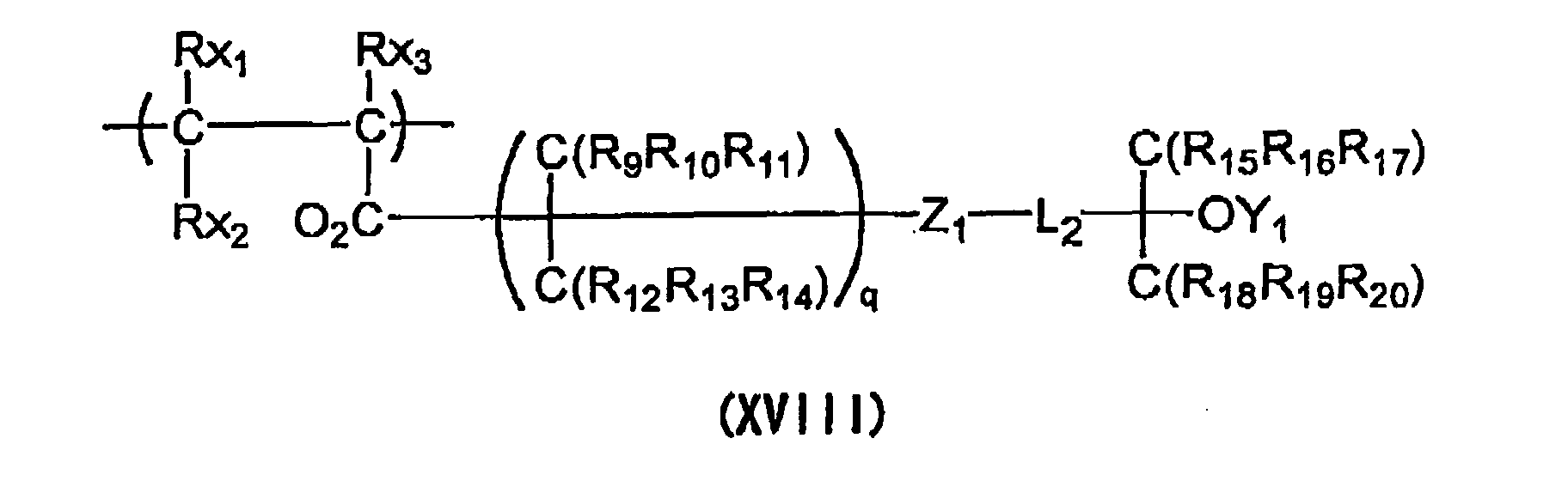
  • the resin according to the invention may further contain a repeating unit represented by the following formula (XVIII).
  • R X1 to R x3 independently represent each a hydrogen atom, a fluorine atom, a chlorine atom, a cyano group or a fluoroalkyl group.
  • R 9 to R 20 independently represent each a hydrogen atom, a fluorine atom or an alkyl group, provided that at least one of R 9 to R 14 is a fluorine atom while at least one of R 15 to R 20 is a fluorine atom.
  • Z 1 represents a phenylene group, a cyclohexylene group, an adamantane residue or a norbornane residue.
  • L 2 represents a single bond or a divalent linking group.
  • Y 1 represents a hydrogen atom or an organic group.
  • q 0 or 1.
  • a fluoroalkyl group represented by R X1 to R x3 in the formula (XVIII) include alkyl groups having from 1 to 5 carbon atoms in which at least one hydrogen atom is substituted by a fluorine atom, e.g., trifluoromethyl, difluoromethyl, fluoromethyl, perfluoroethyl and perfluoropropyl groups.
  • an alkyl group represented by R 9 to R 20 include alkyl groups having from 1 to 5 carbon atoms such as methyl, ethyl, propyl, n-butyl and sec-butyl groups.
  • the alkyl group of R 9 to R 20 may have substituent(s).
  • substituents which may be carried by the alkyl group R 9 to R 20 , a fluorine atom can be cited.
  • Z 1 may have substituent(s).
  • substituents which can be carried by Z 1 include halogen atoms, hydroxyl, alkoxy (preferably having from 1 to 5 carbon atoms) and cyano groups.
  • substituents which can be carried by Z 1 a fluorine atom and a hydroxyl group are preferable and a fluorine atom is still preferable.
  • z 1 as a fluorine atom(s) as substituent(s) it preferably has from 1 to 5, still preferably from 1 to 3, fluorine atoms.
  • divalent linking group L 2 As examples of the divalent linking group L 2 , the same groups as described as examples of the divalent linking group B 1 in the formula (XII) may be cited.
  • an acid-decomposable group which leaves from an oxygen atom by the action of an acid and an acid-undecomposable group which does not leave from an oxygen group by the action of an acid can be cited.
  • R 36 to R 39 independently represent each an alkyl group, a cycloalkyl group, an aryl group, an aralkyl group or an alkenyl group.
  • R 36 and R 37 or R 36 and R 39 may be bonded to each other to form a ring.
  • R 01 and R 02 independently represent each a hydrogen atom, an alkyl group, a cycloalkyl group, an aryl group, an aralkyl group or an alkenyl group.
  • an alkyl group represented by R 36 to R 39 , R 01 or R 02 include alkyl groups having from 1 to 8 carbon atoms such as methyl, ethyl, propyl, n-butyl, sec-butyl, hexyl and octyl groups.
  • a cycloalkyl group represented by R 36 to R 39 , R 01 or R 02 may be either a monocyclic or polycyclic group.
  • a monocyclic group a cycloalkyl group having from 3 to 8 carbon atoms is preferable. Examples thereof include cyclopropyl, cyclobutyl, cyclopentyl, cyclohexyl and cyclooctyl groups.
  • a polycylic group a cycloalkyl group having from 6 to 20 carbon atoms is preferable.
  • Examples thereof include adamantyl, norbornyl, isobornyl, camphanyl, dicyclopentyl, ⁇ -pinenyl, tricyclodecanyl, tetracylcododecyl and androstanyl groups.
  • a part of the carbon atoms in the cycloalkyl group may be substituted by a hetero atom such as an oxygen atom.
  • an aryl group represented by R 36 to R 39 , R 01 or R 02 include aryl groups having from 6 to 10 carbon atoms such as phenyl, naphthyl and anthryl groups.
  • an aralkyl group represented by R 36 to R 39 , R 01 or R 02 include aralkyl groups having from 7 to 12 carbon atoms such as benzyl, phenethyl and naphthylmethyl groups.
  • an alkenyl group represented by R 36 to R 39 , R 01 or R 02 include alkenyl groups having from 2 to 8 carbon atoms such as vinyl, allyl, butenyl and cyclohexenyl groups.
  • Examples of the substituent which may be carried by R 36 to R 39 , R 01 and R 02 include alkyl, cycloalkyl, aryl, amino, amido, ureido, urethane, hydroxyl and carboxyl groups, halogen atoms, alkoxy, thioether, acyl, acyloxy, alkoxycarbonyl, cyano and nitro groups.
  • Examples of the acid-undecomposable group Y 1 include alkyl, cycloalkyl, aryl, aralkyl and alkenyl groups which would not leave from an oxygen atom even by the action of an acid.
  • an alkyl group of the acid-undecomposable group represented by Y 1 an alkyl group having from 1 to 8 carbon atoms is preferable and examples thereof include methyl, ethyl, propyl, n-butyl, sec-butyl, hexyl and octyl groups.
  • a cycloalkyl group of the acid-undecomposable group represented by Y 1 may be either a monocyclic group or a polycyclic group.
  • a monocyclic group a cycloalkyl group having from 3 to 8 carbon atoms is preferable. Examples thereof include cyclopropyl, cyclobutyl, cyclopentyl, cyclohexyl and cyclooctyl groups.
  • a polycylic group a cycloalkyl group having from 6 to 20 carbon atoms is preferable.
  • Examples thereof include adamantyl, norbornyl, isobornyl, camphanyl, dicyclopentyl, ⁇ -pinenyl, tricyclodecanyl, tetracylcododecyl and androstanyl groups.
  • a part of the carbon atoms in the cycloalkyl group may be substituted by a hetero atom such as an oxygen atom.
  • an aryl group of the acid-undecomposable group represented by Y 1 is an aryl group having from 6 to 10 carbon atoms. Examples thereof include phenyl, naphthyl and anthryl groups.
  • an aralkyl group of the acid-undecomposable group represented by Y 1 is an aralkyl group having from 7 to 12 carbon atoms. Examples thereof include benzyl, phenethyl and naphthylmethyl groups.
  • an alkenyl group of the acid-undecomposable group represented by Y 1 is an alkenyl group having from 2 to 8 carbon atoms is preferable.
  • alkenyl group having from 2 to 8 carbon atoms examples thereof include vinyl, allyl, butenyl and cyclohexenyl groups.
  • Examples of the substituent which may be carried by the acid-undecomposable group represented by Y 1 include alkyl, cycloalkyl, aryl, amino, amino, ureido, urethane, hydroxyl and carboxyl groups, halogen atoms, alkoxy, thioether, acyl, acyloxy, alkoxycarbonyl, cyano and nitro groups.
  • R 38 to R 40 independently represent each a hydrogen atom, a halogen atom, a hydroxyl group, a cyano group, an alkyl group, an aryl group, an alkoxy group or an aralkyl group.
  • L 3 represents a single bond or a divalent linking group.
  • Y 5 represents a hydrogen atom or an organic group.
  • m 0 or 1.
  • Examples of a halogen atom represented by R 38 to R 40 in the formula (XIX) include fluorine, chlorine, bromine and iodine atoms.
  • an alkyl group represented by R 38 to R 40 is an alkyl group having from 1 to 5 carbon atoms such as methyl, ethyl, propyl, n-butyl, sec-butyl and t-butyl groups.
  • an aryl group represented by R 38 to R 40 is an aryl group having from 6 to 10 carbon atoms such as phenyl, naphthyl and anthryl groups.
  • an alkoxy group represented by R 38 to R 40 is an alkoxy group having from 1 to 5 carbon atoms such as methoxy, ethoxy, propoxy and n-butoxy groups.
  • an aralkyl group represented by R 38 to R 40 is an aralkyl group having from 7 to 12 carbon atoms such as benzyl, phenethyl and naphthylmethyl groups.
  • Examples of the substituent which may be carried by the alkyl, aryl groups, etc. of R 38 to R 40 include alkyl, cycloalkyl, aryl, amino, amido, ureido, urethane, hydroxy and carboxy groups, halogen atoms, alkoxy, thioether, acyl, acyloxy, alkoxycarbonyl, cyano and nitro groups.
  • R 38 to R 40 represent each a hydrogen atom or a halogen atom, still preferably a fluorine atom. It is particularly preferable that R 38 is a fluorine atom.
  • Examples of a divalent linking group represented by L 3 are the same as those cited with respect to the divalent linking group B 1 in the formula (XVIII).
  • Examples of an organic group represented by Y 5 are the same as those cited with respect to the organic group Y 1 in the formula (XVIII).
  • the resin (A) may have other polymerizable monomer having been polymerized.
  • use may be made of addition-polymerizable unsaturated compounds which can be copolymerized.
  • the repeating unit represented by the formula (I) is used in an amount ranging generally from 5 to 80% by mol, preferably from 7 to 75% by mol and still preferably from 10 to 70% by mol.
  • the repeating unit represented by the formula (II) is used in an amount ranging generally from 5 to 80% by mol, preferably from 7 to 70% by mol and still preferably from 10 to 65% by mol.
  • the repeating unit represented by the formula (VI) is used in an amount ranging generally from 1 to 70% by mol, preferably from 1 to 65% by mol and still preferably from 50 to 60% by mol.
  • the repeating unit represented by the formula (III) is used in an amount ranging generally from 1 to 40% by mol, preferably from 3 to 35% by mol and still preferably from 5 to 30% by mol.
  • the repeating unit represented by the formula (VII) is used in an amount ranging generally from 1 to 40% by mol, preferably from 3 to 35% by mol and still preferably from 5 to 30% by mol.
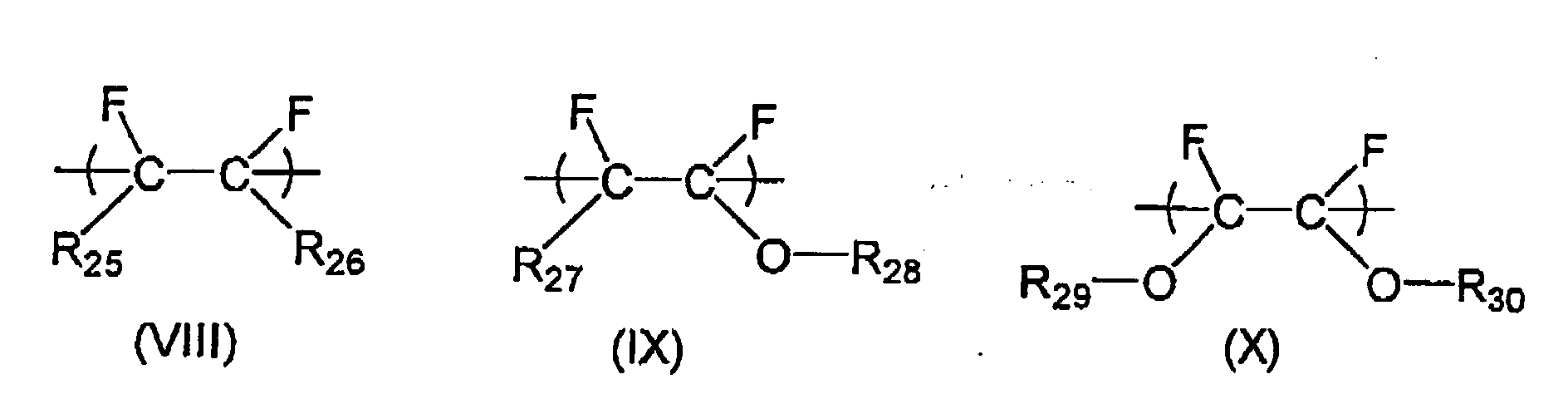
  • the repeating units represented by the formulae (VIII) to (X) are each used in an amount ranging generally from 1 to 40% by mol, preferably from 3 to 35% by mol and still preferably from 5 to 30% by mol.
  • the repeating units represented by the formulae (XI) to (XIII) are each used in an amount ranging generally from 1 to 40% by mol, preferably from 3 to 35% by mol and still preferably from 5 to 30% by mol.
  • the repeating unit represented by the formula (XIV) is used in an amount ranging generally from 1 to 40% by mol, preferably from 3 to 35% by mol and still preferably from 5 to 30% by mol.
  • the repeating unit represented by the formula (XV) is used in an amount ranging generally from 1 to 40% by mol, preferably from 3 to 35% by mol and still preferably from 5 to 30% by mol.
  • the repeating unit represented by the formula (XVI) is used in an amount ranging generally from 1 to 40% bymol, preferably from 3 to 35% bymol and still preferably from 5 to 30% by mol.
  • the repeating unit represented by the formula (XVII) is used in an amount ranging generally from 1 to 40% bymol, preferably from 3 to 35% bymol and still preferably from 5 to 30% by mol.
  • the repeating unit represented by the formula (XVIII) is used in an amount ranging generally from 1 to 40% by mol, preferably from 3 to 35% by mol and still preferably from 5 to 30% by mol.
  • the repeating unit represented by the formula (XIX) is used in an amount ranging generally from 1 to 40% by mol, preferably from 3 to 35% bymol and still preferably from 5 to 30% by mol.
  • the resin (A) according to the invention may contain another polymerizable monomer copolymerized therein to improve the performance of the photosensitive resin according to the invention.
  • copolymerizable monomer usable therein examples include the following ones.
  • a compound having an addition-polymerizable unsaturated bond selected form among acrylic acid esters, acrylamides, methacrylic acid esters, methacrylamides, allyl compounds, vinyl ethers, vinyl esters, styrenes, crotonic acid esters and so on other than those cited above.
  • repeating structural unit represented by the formula (XV) the repeating structural units formed by, for example, the above-described vinyl ethers may be cited.
  • the weight-average molecular weight of the resin (A) according to the invention having the above-described repeating structural unit ranges from 1,000 to 200,000, still preferably from 3,000 to 20,000.
  • the molecular weight distribution (Mw/Mn) thereof is from 1 to 10, preferably from 1 to 3 and still preferably from 1 to 2.
  • a smaller molecular weight distribution indicates the better resolution, resist shape, smoothness in resist pattern side wall and roughness.
  • the resin (A) according to the invention is employed in an amount of generally from 50 to 99.5% by weight, preferably from 60 to 98% by weight and still preferably from 65 to 95% by weight based on the total solid components in the composition.
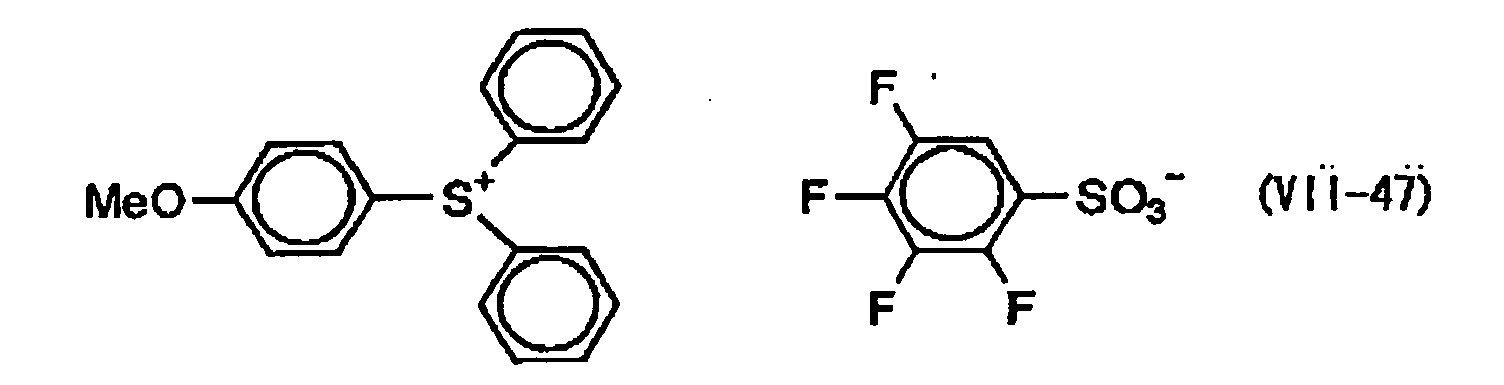
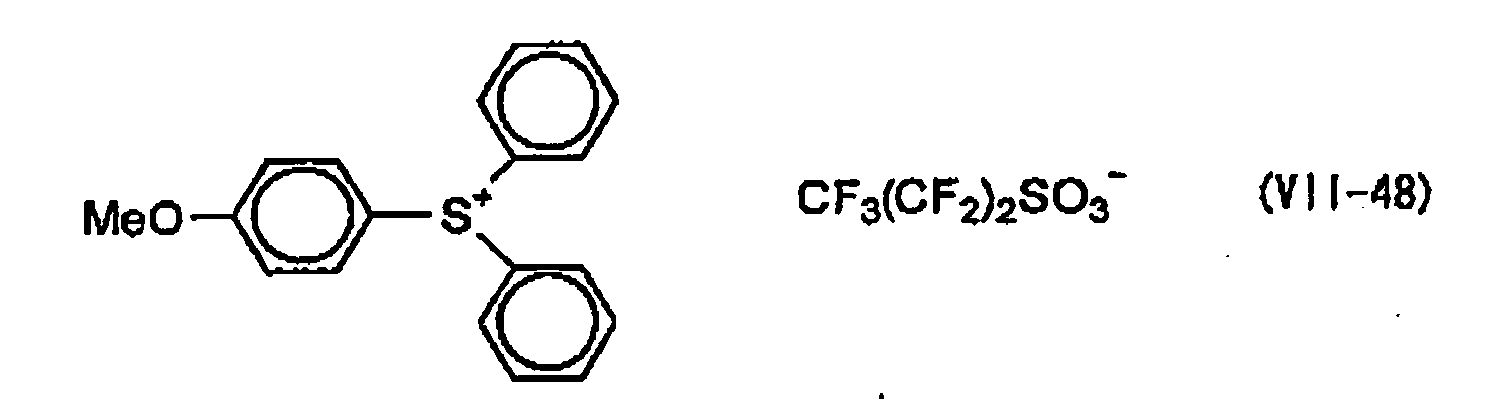
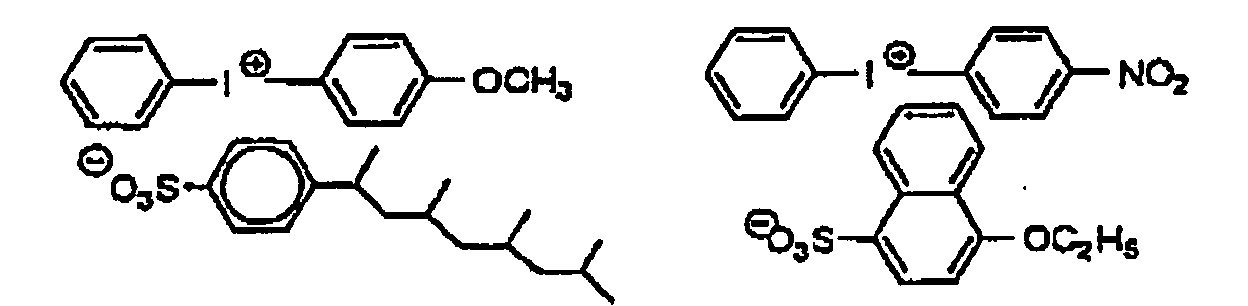
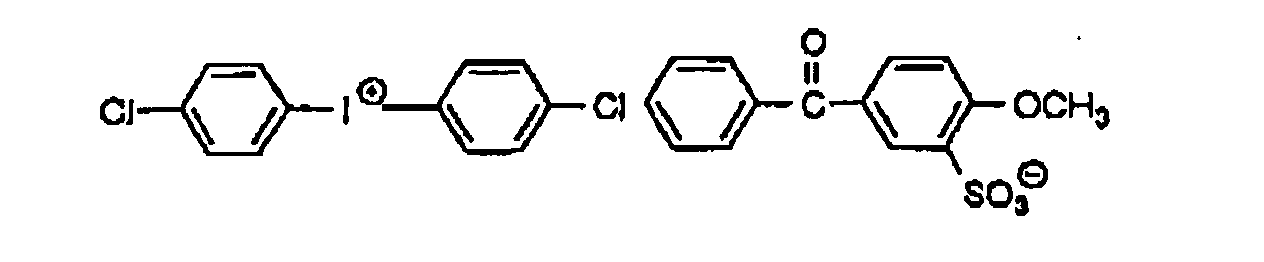
  • the resist composition according to the invention is characterized by containing a compound capable of generating an acid having a relatively high acid strength and another compound capable of generating an acid having a low acid strength upon irradiation with one of actinic ray and radiation, in particular, an F 2 excimer laser beam.
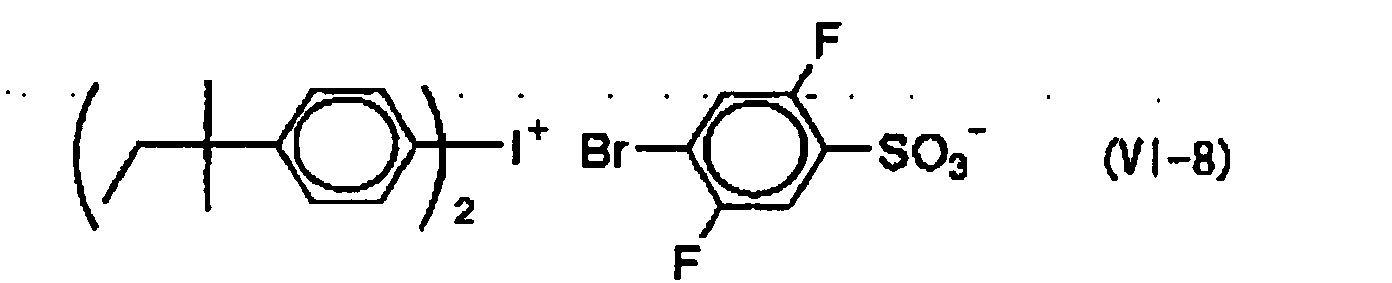
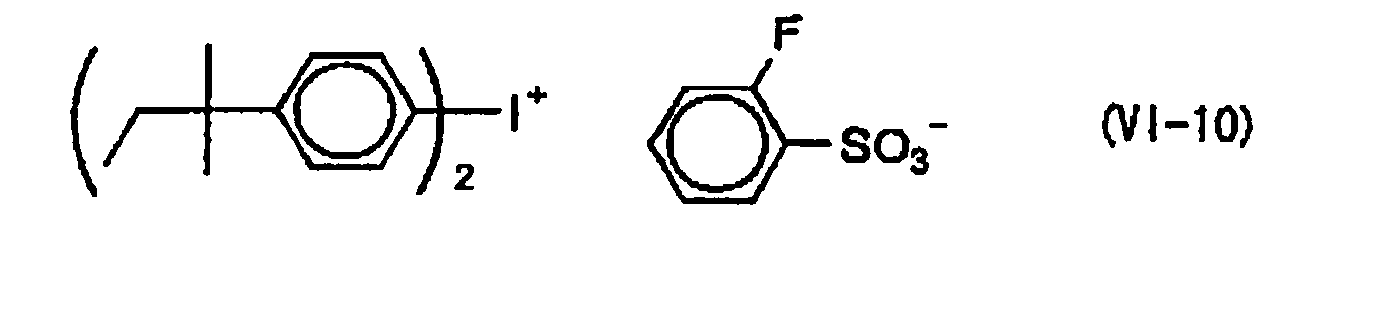
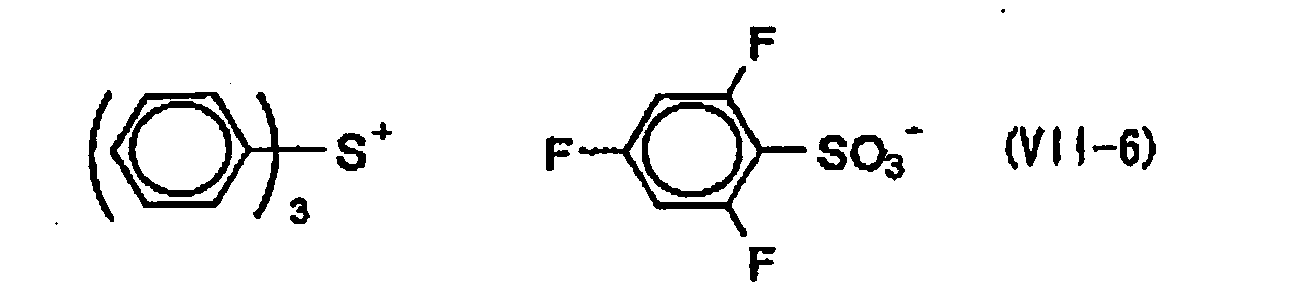
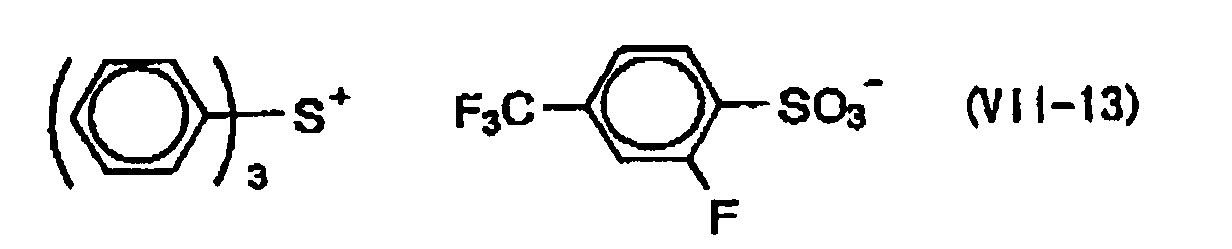
  • the resist composition according to the invention contains, as compounds capable of generating an acid upon irradiation wi th one of an actini c ray and a radiation, at least two compounds selected from among;
  • the deprotection reaction of the acid-decomposable group in the resin around the interface between actinic ray or radiation-irradiated part/unirradiated part can be controlled.
  • the contrast in image formation can be elevated and, in its turn, a relief image having improved rectangular properties and line edge roughness can be obtained.
  • the components (B1) to (B4) can be selected from among generally employed compounds capable of decomposing and generating an acid upon irradiation with one of an actinic ray and a radiation (photo-acid generators).
  • a compound or mixtures thereof selected from among compounds generating an acid upon irradiation with publicly known rays (ultraviolet rays of 400 to 200 nm, far ultraviolet rays, particularly preferably g, h and i rays, KrF excimer laser beam, ArF excimer laser beam, F 2 excimer laser beam, electron beams, X-ray, molecular beams or ion beams) which are employed in photo-initiators for cationic photopolymerization, photo-initiators for radical photopolymerization, photodecolouring agents for dyes, photodiscolouring agents and microresists.
  • publicly known rays ultraviolet rays of 400 to 200 nm, far ultraviolet rays, particularly preferably g, h and i rays, KrF excimer laser beam, ArF excimer laser beam, F 2 excimer laser beam, electron beams, X-ray, molecular beams or ion beams
  • Examples of such compounds include onium salts such as diazonium salts described in S.I. Schlesinger, Photogr. Sci. Eng., 18, 387 (1974), T.S. Bal et al., Polymer, 21, 423 (1980), etc., ammonium salts described in USP 4,069,055, USP 4,069,056, USP Re 27, 992, JP-A-3-140140, etc., phosphoniumsalts described in D.C. Necker et al., Macromolecules, 17, 2468 (1984), C.S. Wen et al., Teh, Proc. Conf. Rad.
  • onium salts such as diazonium salts described in S.I. Schlesinger, Photogr. Sci. Eng., 18, 387 (1974), T.S. Bal et al., Polymer, 21, 423 (1980), etc.
  • ammonium salts described in USP 4,069,055, USP 4,069,056, USP Re 27, 992, JP
  • the acid generated from the components (B1) to (B-4) upon irradiation with one of an actinic ray and a radiation is preferably an organic acid.
  • the components (B1) to (B4) are preferably onium salts.
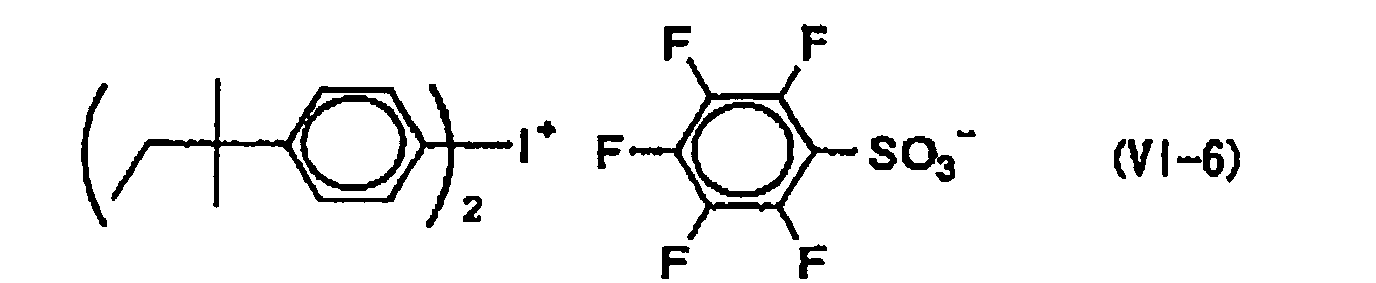
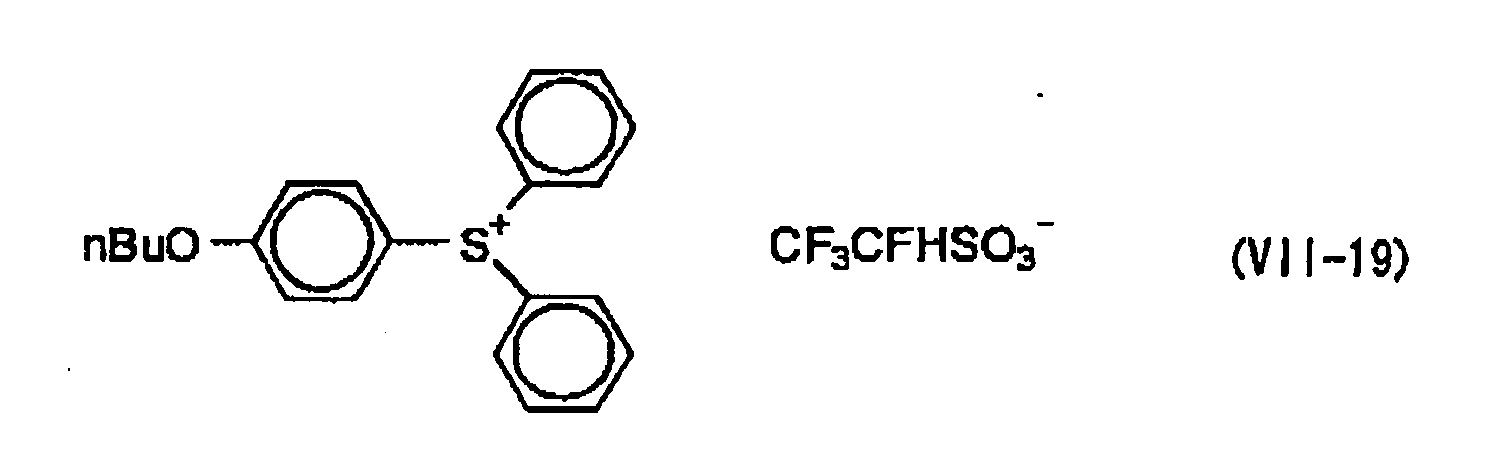
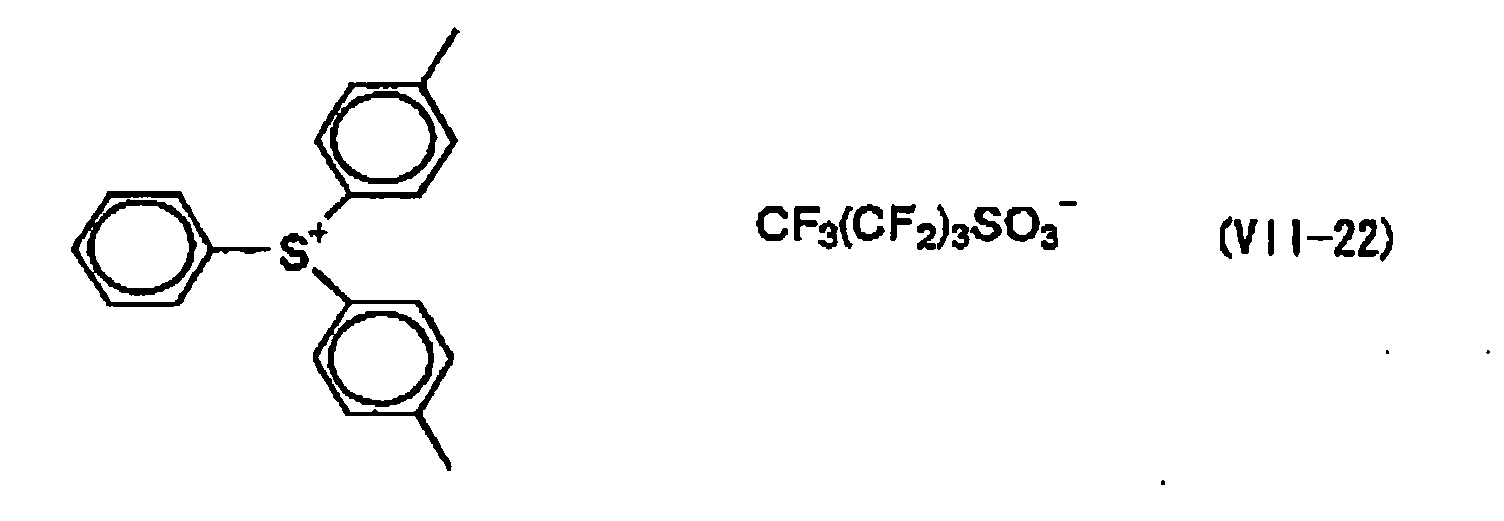
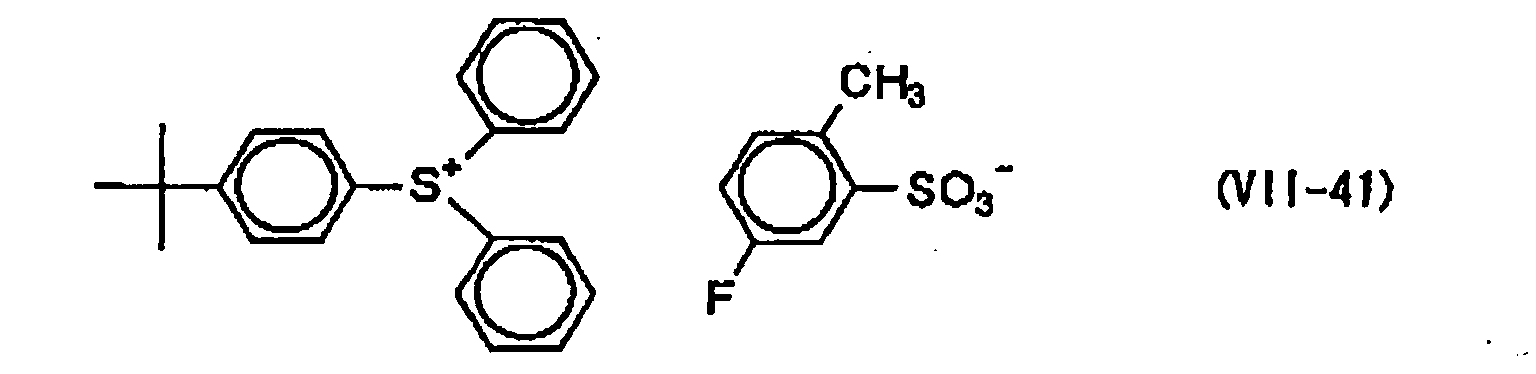
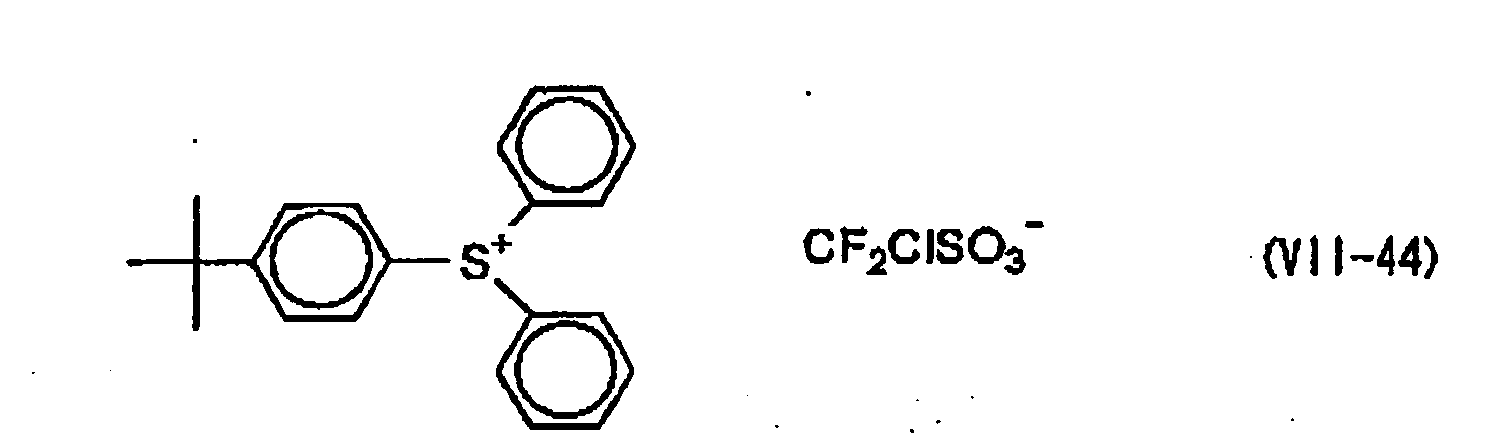
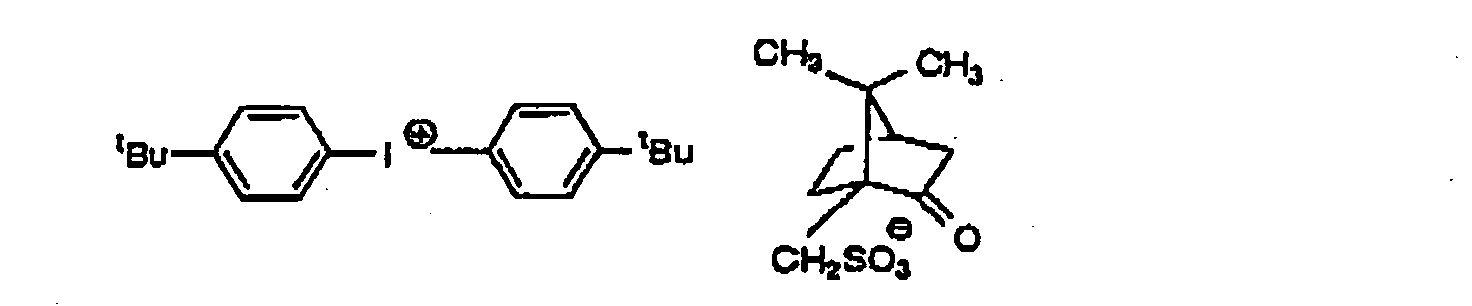
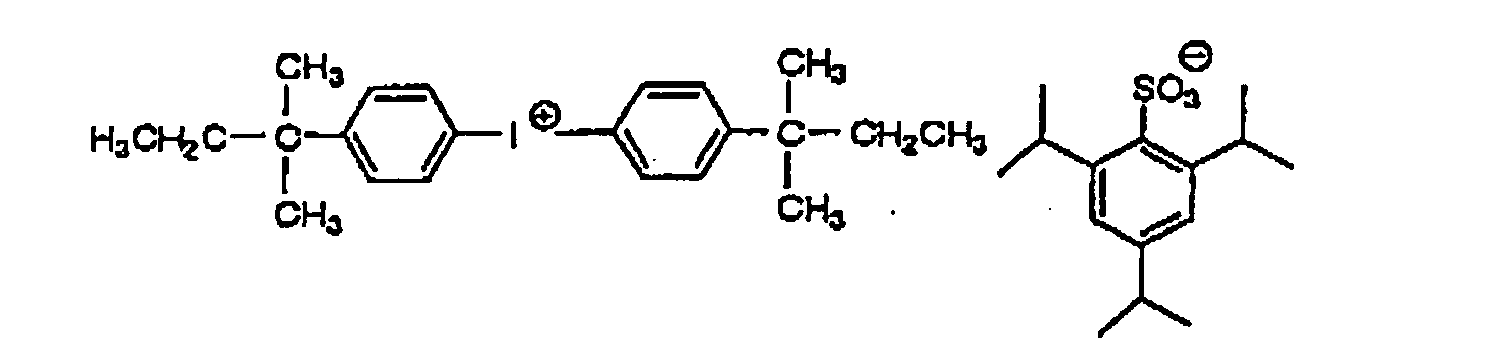
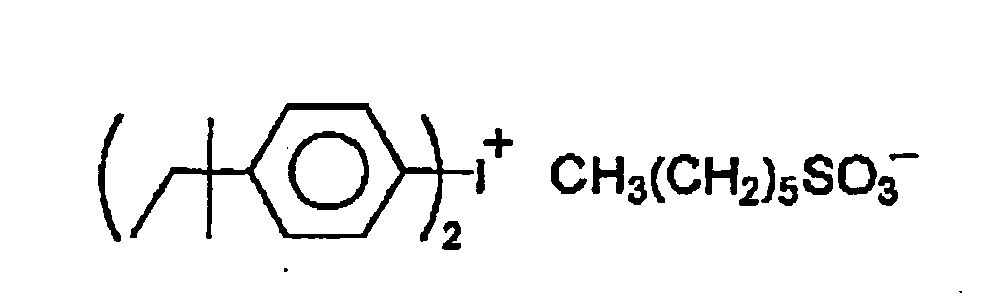
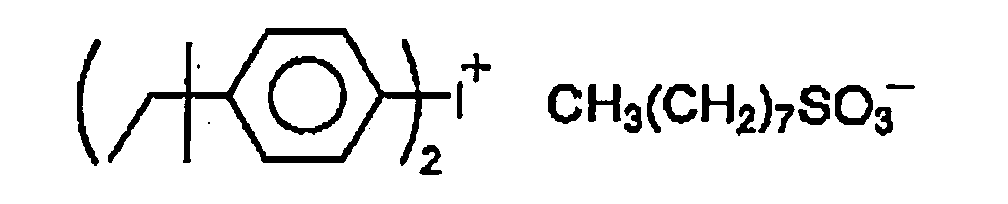
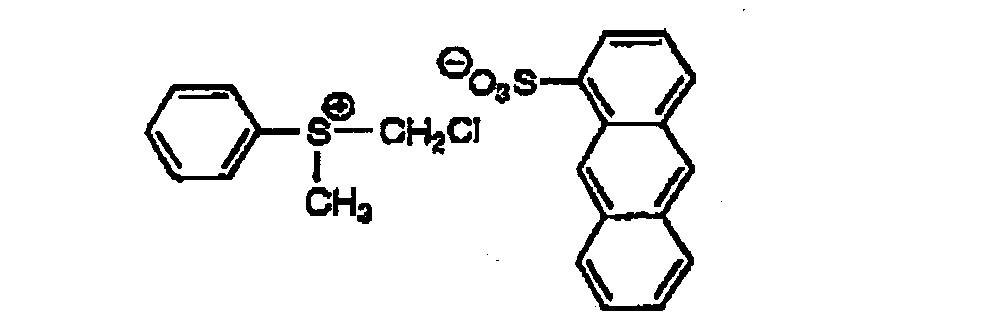
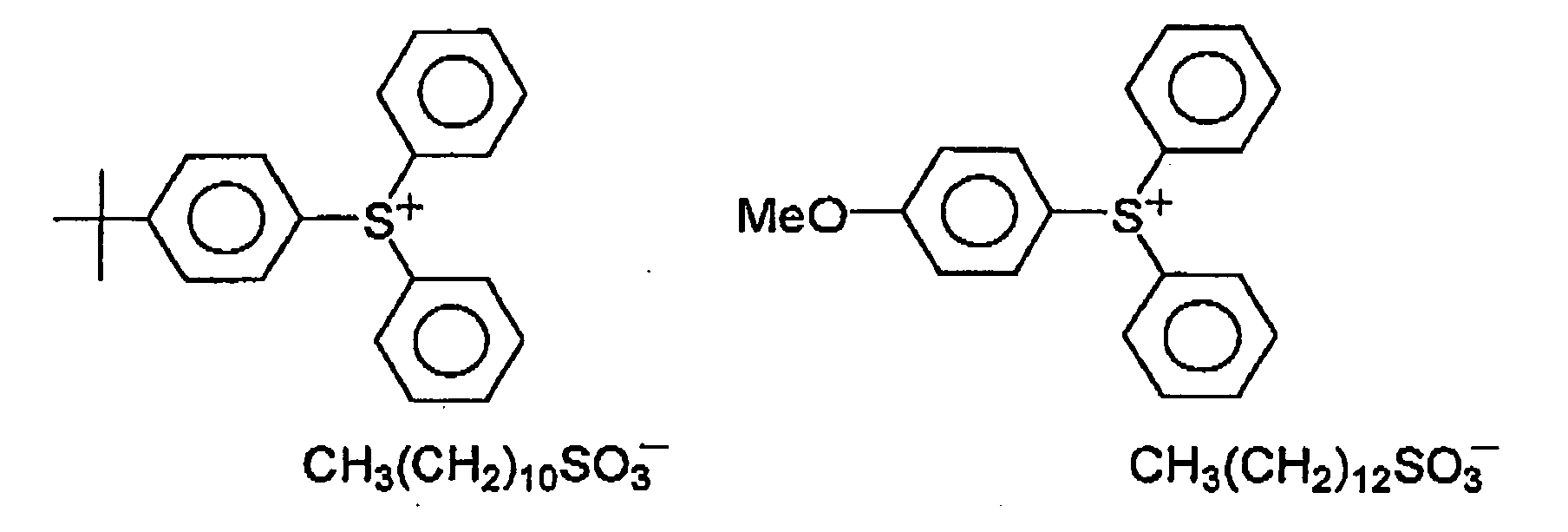
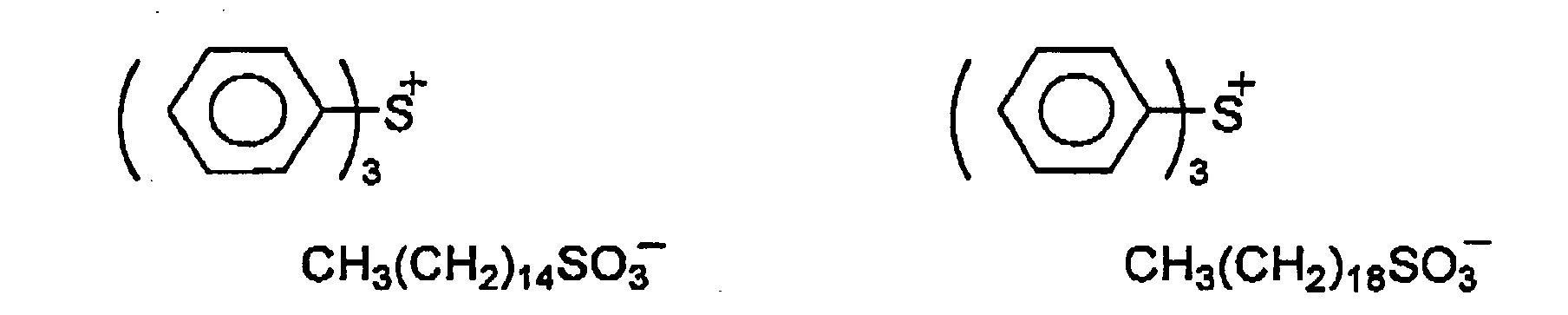
  • iodonium salts represented by the following formula (PAG1) and sulfonium salts represented by the formula (PAG2) may be cited.
  • Ar 1 and Ar 2 independently represent each an aryl group.
  • R 100 , R 101 and R 102 independently represent each an alkyl group, a cycloalkyl group or an aryl group.
  • Z - represents a sulfonate anion having at least one fluorine atom.
  • Two members of R 100 , R 101 and R 102 and Ar 1 and Ar 2 may be bonded each via a single bond or a substituent.
  • an aryl group having from 6 to 14 carbon atoms is preferable.
  • an alkyl group or a cycloalkyl group thereof an alkyl group or a cycloalkyl group having from 1 to 8 carbon atoms is preferable.
  • substituent of the aryl group include alkoxy groups having from 1 to 8 carbon atoms, alkyl groups having from 1 to 8 carbon atoms, alkoxycarbonyl groups having from 2 to 9 carbon atoms, alkylcarbonylamino groups having from 2 to 9 carbon atoms, a nitro group, a carboxyl group, a hydroxy group, halogen atoms and a phenylthio group.
  • substituent of the alkyl group and the cycloalkyl group include alkoxy groups having from 1 to 8 carbon atoms, aryl groups having from 5 to 14 carbon atoms, arylcarbonyl groups having from 6 to 15 carbon atoms, a carboxyl group and halogen atoms.
  • the sulfonate anion Z - include aliphatic hydrocarbons having from 1 to 20 carbon atoms and aromatic hydrocarbons having from 5 to 20 carbon atoms each having at least one fluorine atom. Such a group may have a substituent.
  • substituents include optionally fluorine-substituted alkoxy groups having from 1 to 10 carbon atoms, optionally fluorine-substituted alkoxycarbonyl groups having from 2 to 11 carbon atoms, a phenylamino group, a phenylcarbonyl group, halogen atoms and a hydroxyl group.
  • alkyl groups and cycloalkyl groups having from 1 to 15 carbon atoms may be cited as further examples of the substituent.
  • an anion having a fluorine atom on the ⁇ -carbon atom of the sulfonate has a particularly high acid strength.
  • a perfuloro aliphatic sulfonate has a further high acid strength.
  • iodinium salts and sulfonium salts of the above formulae (PAG1) and (PAG2) wherein Z - is fluorine-free sulfonate anion may be cited.
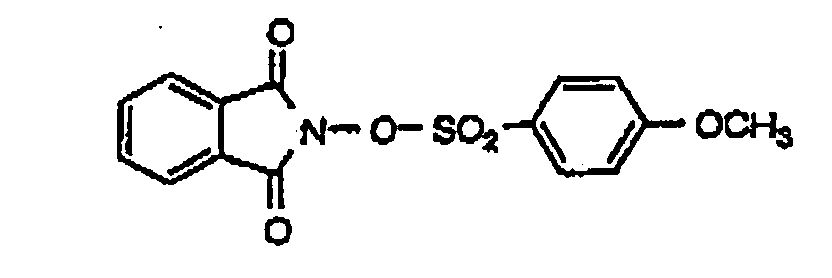
  • PAG3 disulfone derivatives represented by the following formula (PAG3) or iminosulfonate derivatives represented by the following formula (PAG4) may be cited.
  • Ar 3 and Ar 4 independently represent each an aryl group.
  • R 103 represents an alkyl group, a cycloalkyl group or an aryl group.
  • A represents an alkylene group, an alkenylene group or an arylene group.
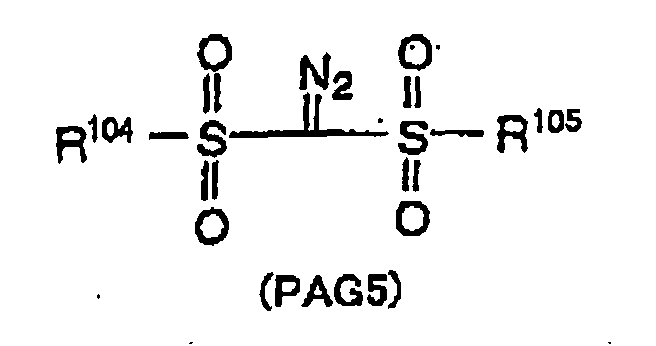
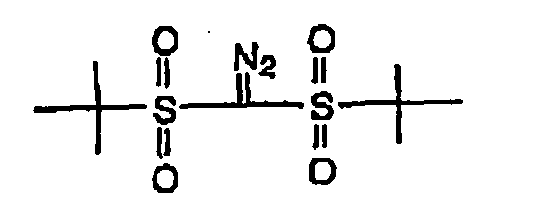
  • diazodisulfone derivatives represented by the following formula (PAG5) may be cited.
  • R 104 and R 105 represent each an alkyl group, a cycloalkyl group or an aryl group.
  • the compounds of the above-described components (B-1) and (B-2) can be synthesized by reacting an aromatic compound with a periodic acid salt and subjecting the thus obtained iodinium salt to salt-exchange into the corresponding sulfonic acid.
  • Synthesis can be also made by reacting an aryl Grignard reagent such as an aryl magnesium bromide with a substituted or unsubstituted phenyl sulfoxide and then subjecting the thus obtained triarylsulfonium halide to salt-exchange with the corresponding sulfonic acid.
  • an aryl Grignard reagent such as an aryl magnesium bromide
  • a substituted or unsubstituted phenyl sulfoxide then subjecting the thus obtained triarylsulfonium halide to salt-exchange with the corresponding sulfonic acid.
  • synthesis can be made by fusing a substituted or unsubstituted phenyl sulfoxide with a corresponding aromatic compound with the use of an acid catalyst such as methanesulfonic acid/diphosphorus pentaoxide or aluminum chloride followed by salt-exchange, or by fusing a diaryl iodonium salt with a diaryl sulfide by using a catalyst such as copper acetate followed by salt-exchange.
  • an acid catalyst such as methanesulfonic acid/diphosphorus pentaoxide or aluminum chloride followed by salt-exchange
  • a diaryl iodonium salt with a diaryl sulfide by using a catalyst such as copper acetate followed by salt-exchange.
  • the salt-exchange can be carried out by a method of once forming a halide salt and then converting it into a sulfonic acid salt with the use of a silver reagent such as silver oxide, or by using an ion exchange resin.
  • a silver reagent such as silver oxide
  • an ion exchange resin As the sulfonic acid or sulfonic acid salt to be used in the salt-exchange, use may be made of either marketed products or products prepared by, for example, hydrolyzing marketed sulfonic halides.
  • fluorine-substituted aliphatic carboxylic acid examples include fluorine-substituted aliphatic carboxylic acids such as acetic acid, propionic acid, n-butyric acid, isobutyric acid, valerianic acid, trimethylacetic acid, caproic acid, heptanoic acid, caprylic acid, pelargonic acid, capric acid, lauric acid, myristic acid, palmitic acid, stearic acid, undecanoic acid, dodecanoic acid and tridecanoic acid. These compounds may have a hydroxyl group, an alkoxy group or a halogen atom as a substituent. Moreover, compounds having a linking group such as an oxygen atom, a sulfur atom, a carbonyl group, a carboxyl group or a sulfonyl group in the aliphatic chain are preferred.
  • fluorine-substituted aliphatic carboxylic acid is compounds represented by the following formula. L- ((CH 2 ) p (CF 2 ) q (CH 2 ) r -COOH
  • L represents a hydrogen atom or a fluorine atom.
  • p and r independently represent each an integer of from 0 to 15, while q represents an integer of from 1 to 15.
  • the hydrogen atom or fluorine atom in the alkyl chain in this formula may be substituted by an optionally fluorine-substituted alkyl group (preferably having from 1 to 5 carbon atoms), an optionally fluorine-substituted alkoxy group (preferably having from 1 to 5 carbon atoms) or a hydroxyl group.
  • the fluorine-substituted aliphatic carboxylic group as described above is preferably a fluorine-substituted saturated carboxylic acid having from 2 to 20 carbon atoms, still preferably from 4 to 20 carbon atoms.
  • a fluorine-substituted linear or branched saturated aliphatic carboxylic acid having from 4 to 18 carbon atoms is preferable.
  • fluorine-substituted aromatic carboxylic acid as described above include fluorine-substituted aromatic carboxylic acids having from 7 to 20 carbon atoms, still preferably from 7 to 15 carbon atoms and still preferably from 7 to 11 carbon atoms.
  • fluorine-substituted aromatic carboxylic acids such as benzoic acid, substituted benzoic acids, naphthoic acid, substituted naphthoic acids, anthracene-carboxylic acid and substituted anthracene-carboxylic acids (examples of substituents including alkyl, alkoxy and hydroxyl groups, halogen atoms, aryl, acyl, acyloxy, nitro, alkylthio and arylthio groups).
  • one or more hydrogen atoms in the skeleton other than the carboxyl group is substituted by fluorine atoms.
  • An aliphatic or aromatic carboxylic acid in which all of the hydrogen atoms in the skeleton other than the carboxylic group are substituted by fluorine atoms i.e., a perfluoro saturated aliphatic carboxylic acid or a perfluoro aromatic carboxylic acid
  • fluorine atoms i.e., a perfluoro saturated aliphatic carboxylic acid or a perfluoro aromatic carboxylic acid
  • an anion having a fluorine atom on the ⁇ -carbon atom of the carboxylate has a high acid strength.
  • a perfluoro aliphatic sulfonic acid has a further high acid strength.
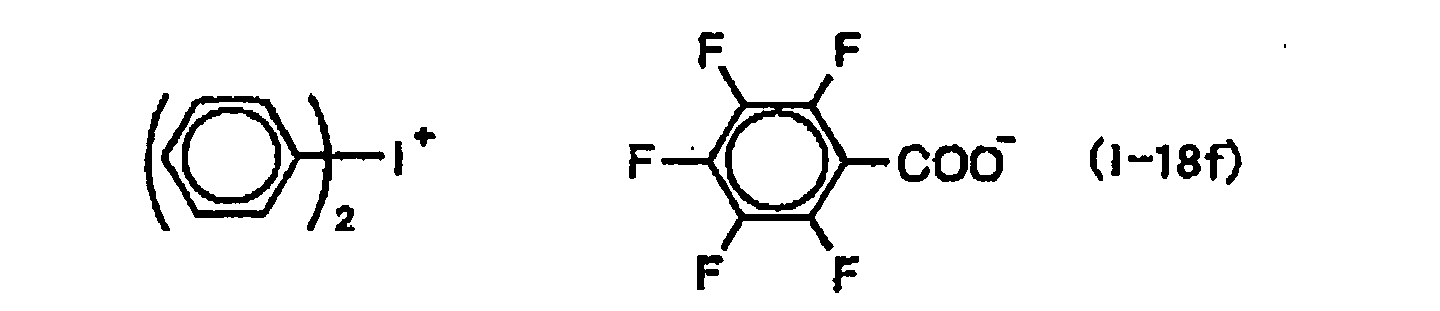
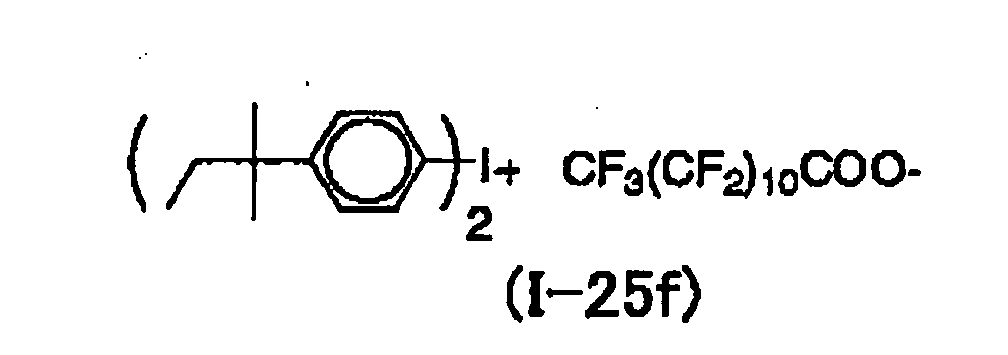
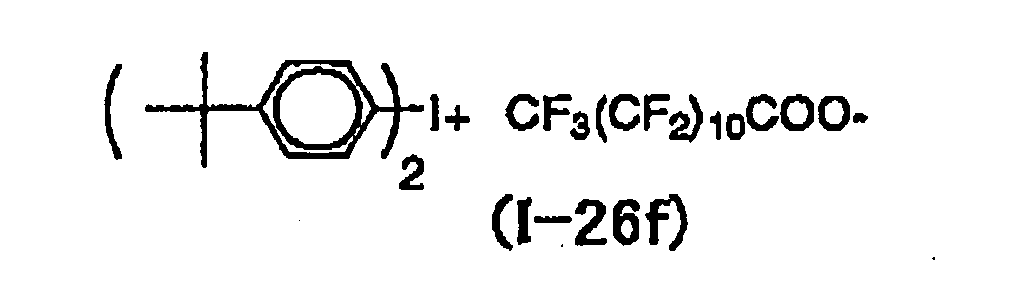
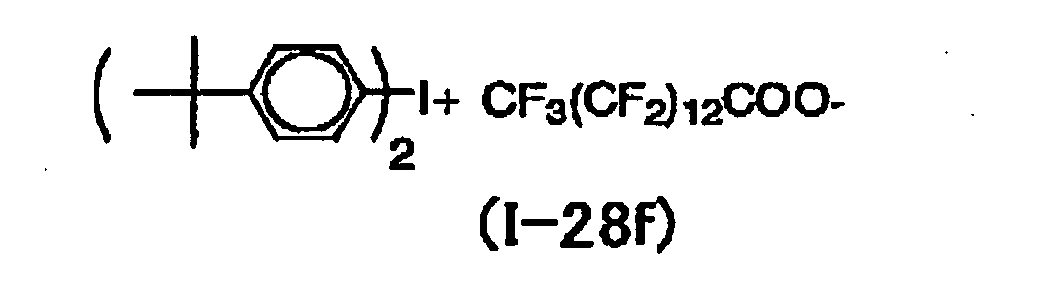
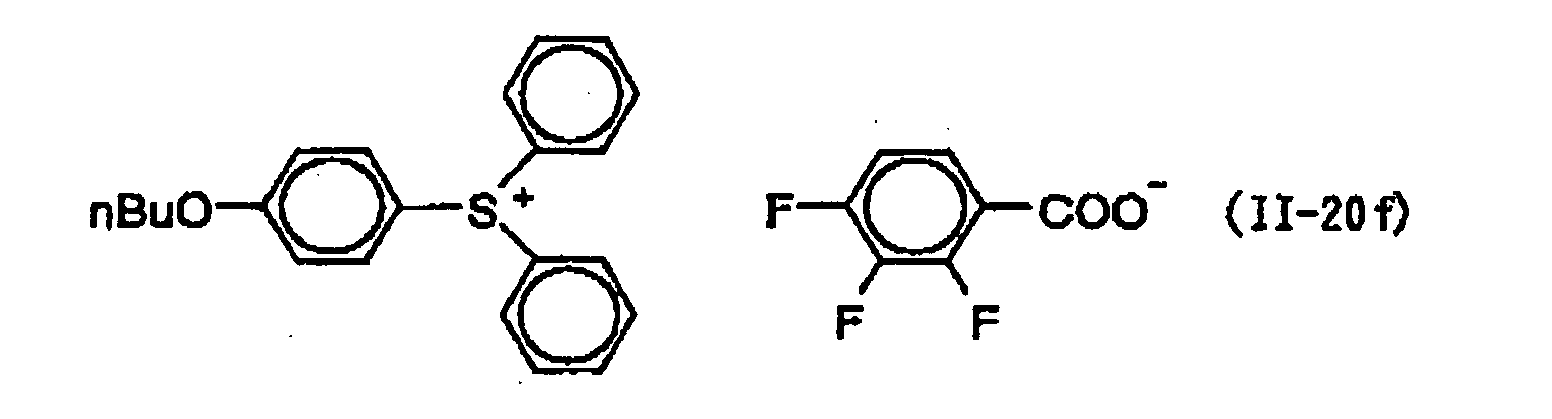
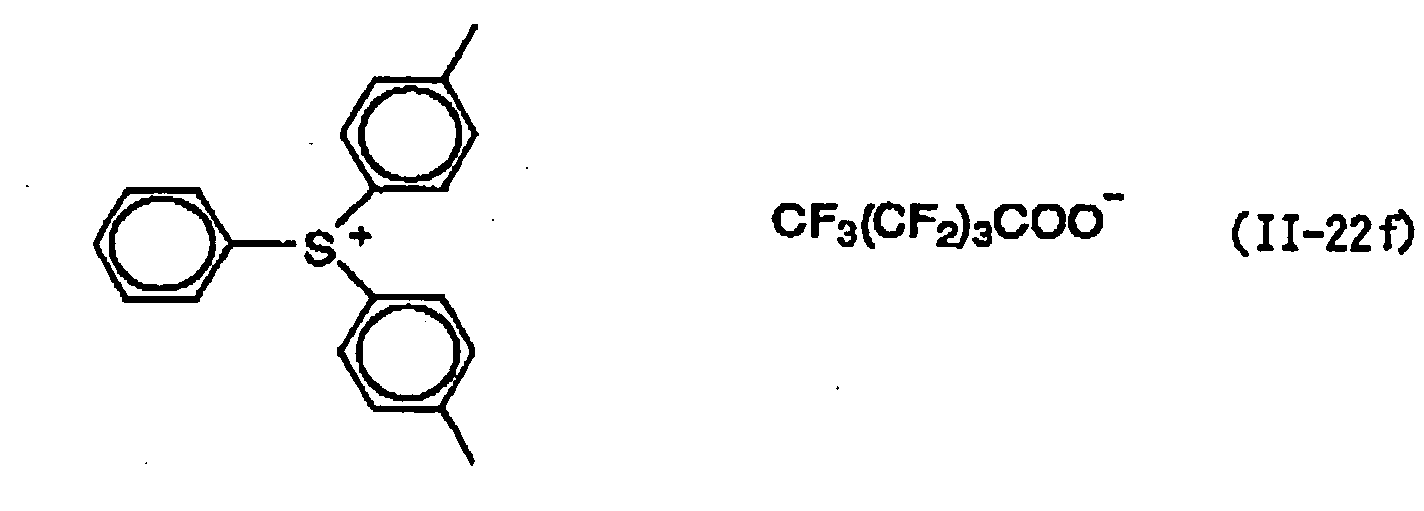
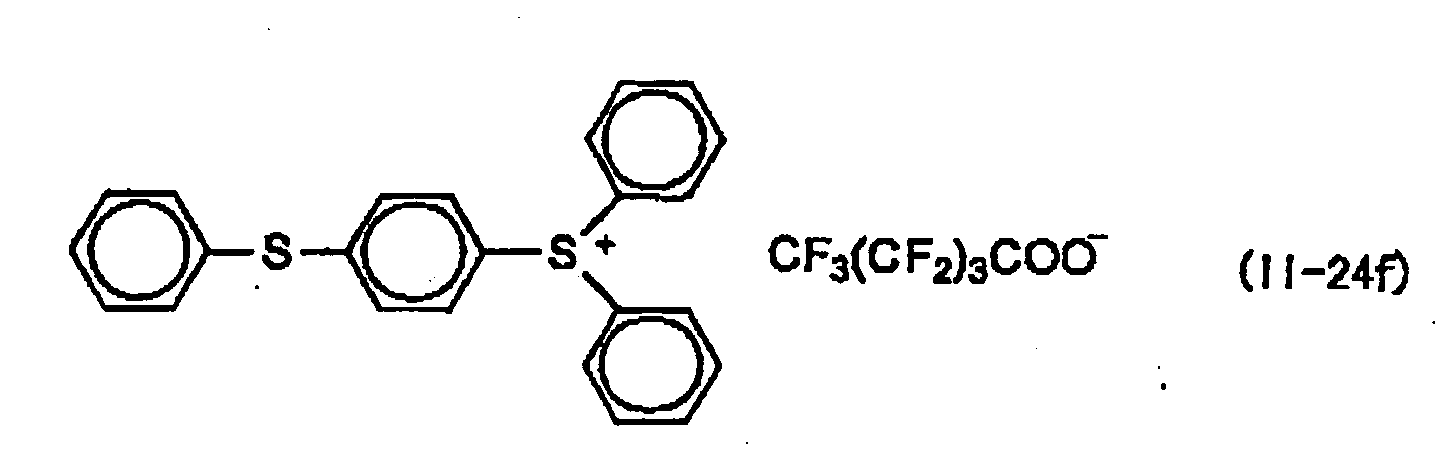
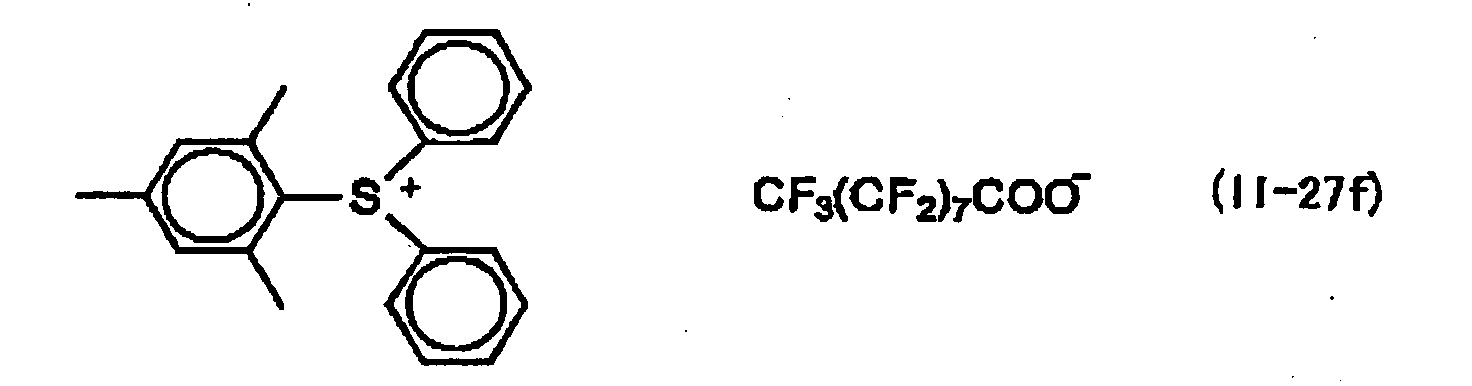
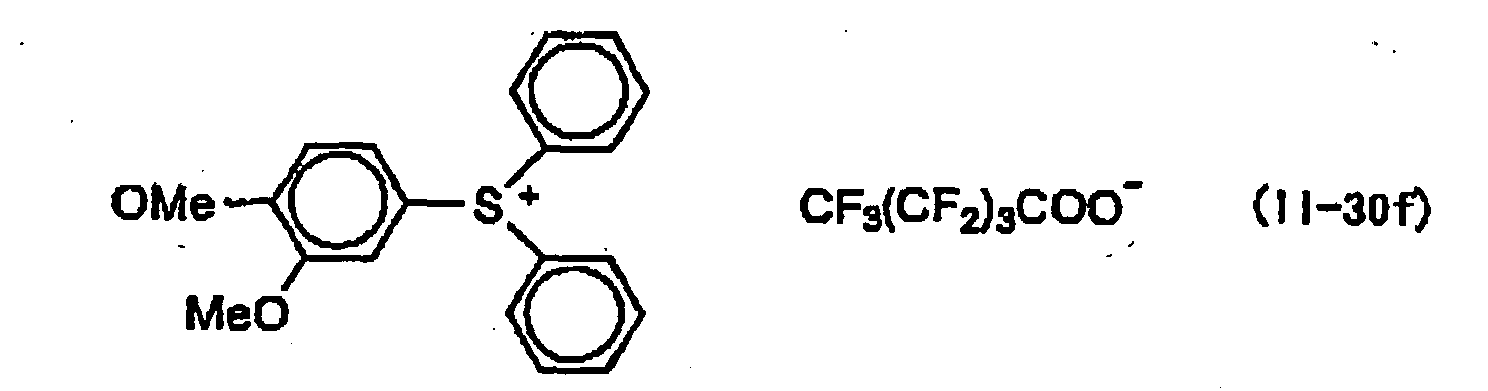
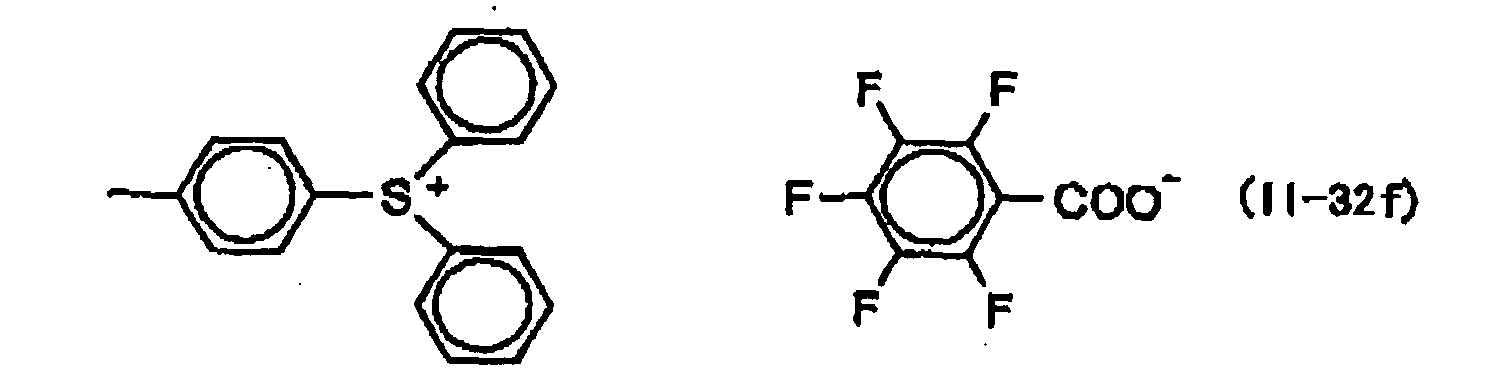
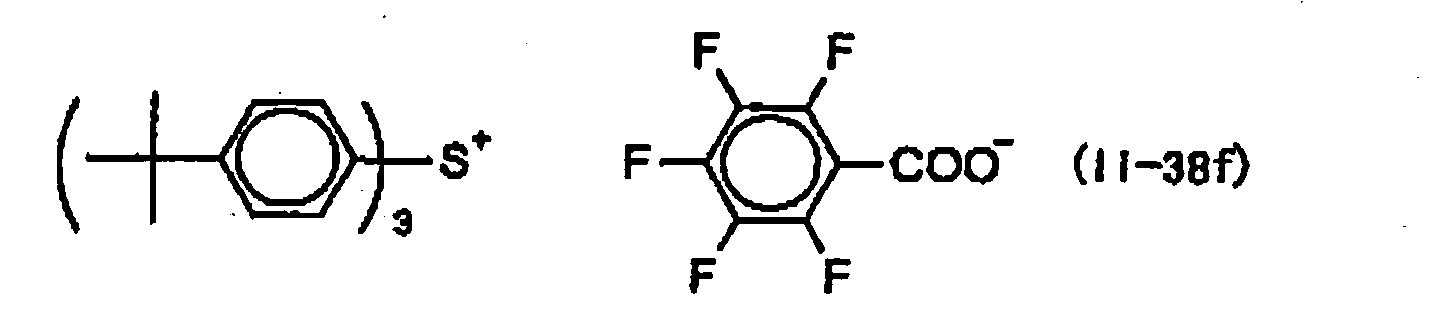
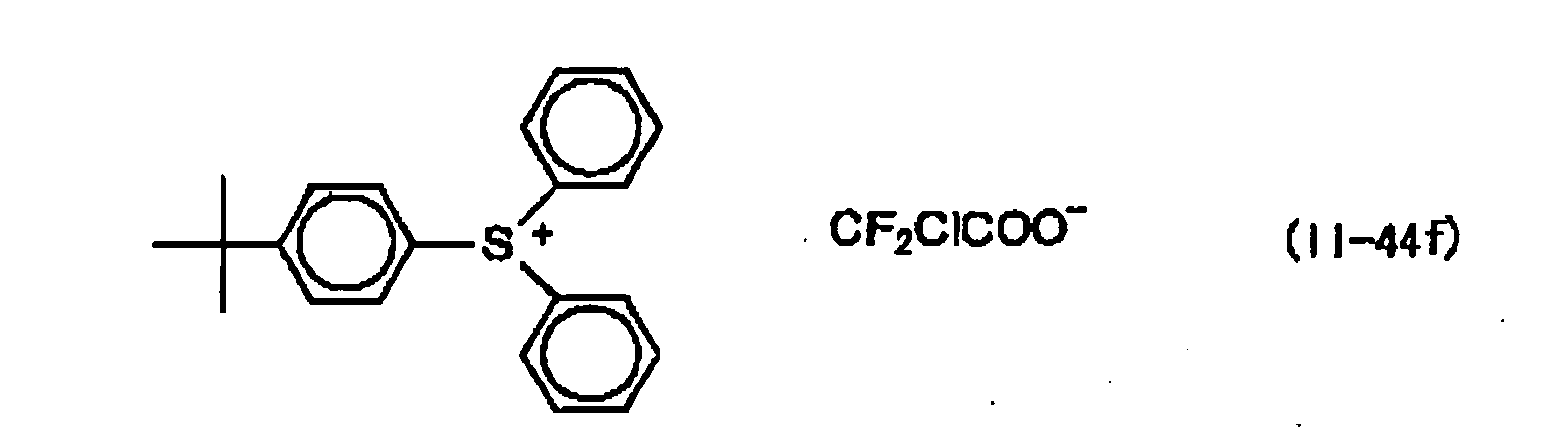
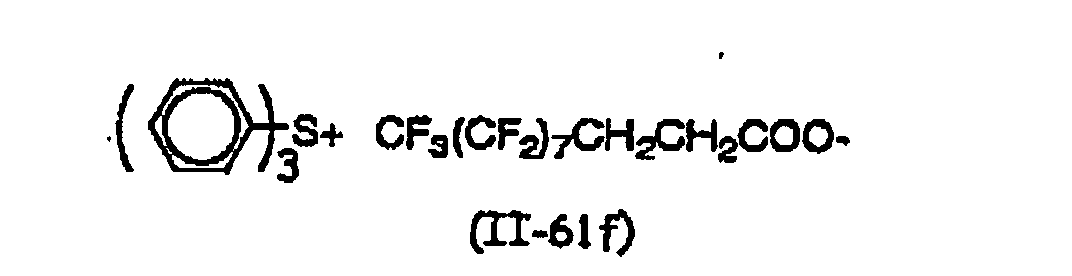
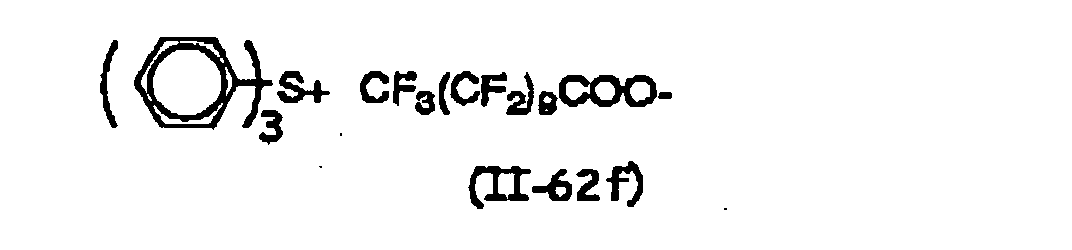
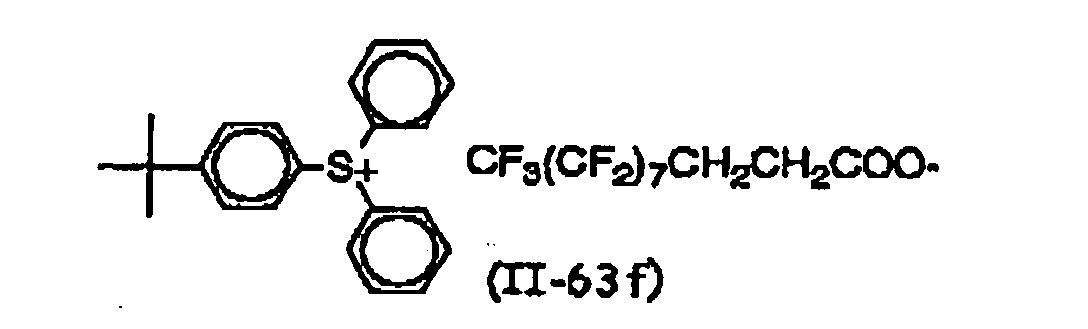
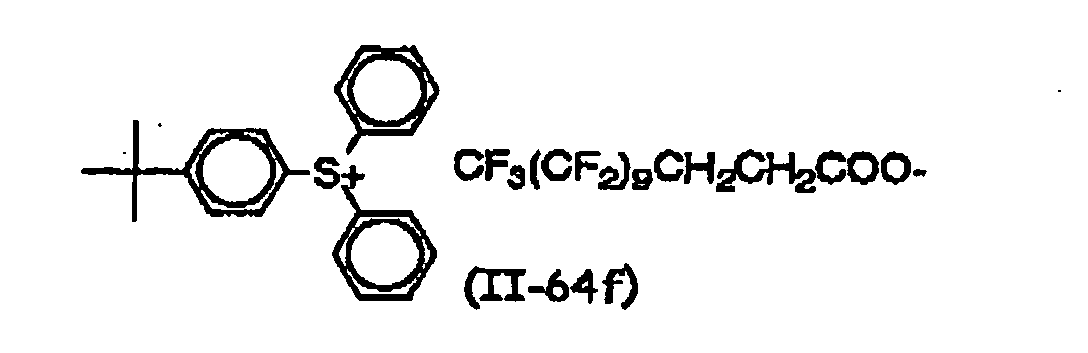
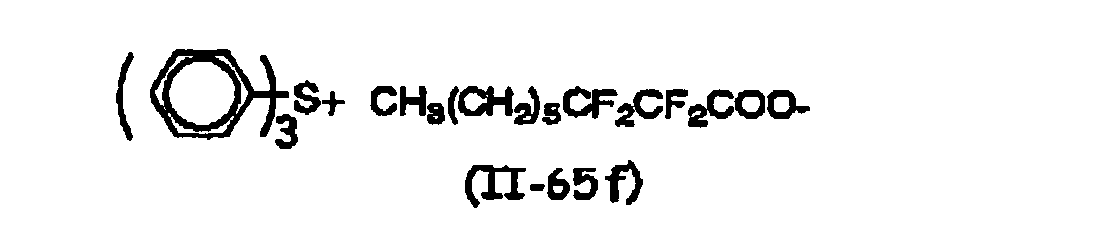
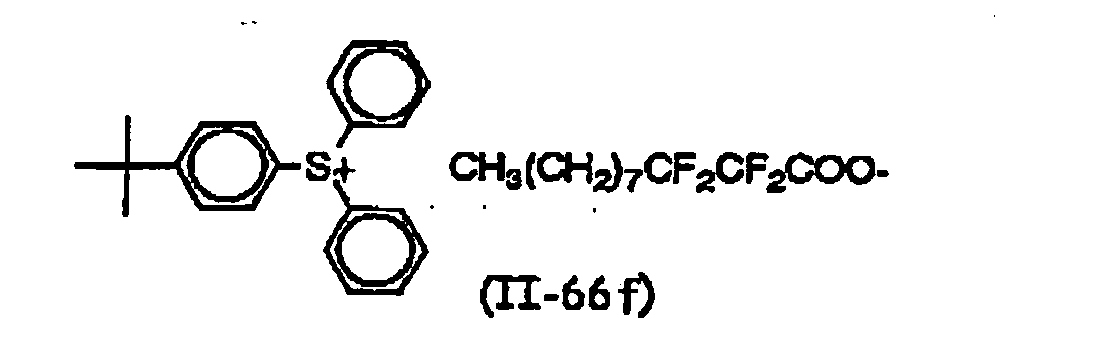
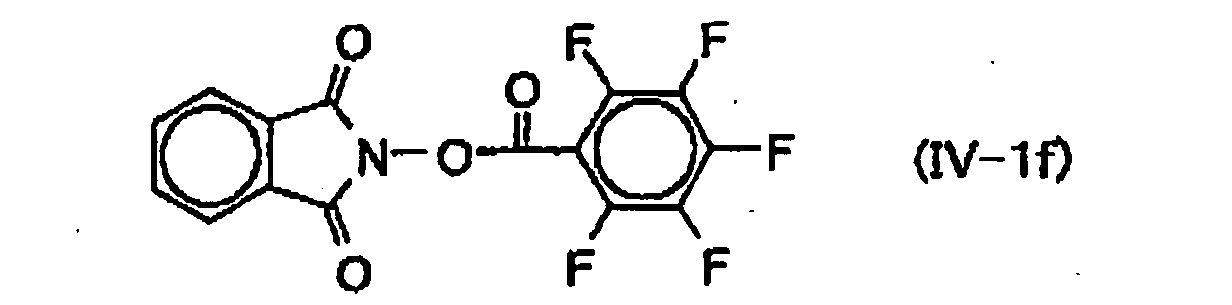
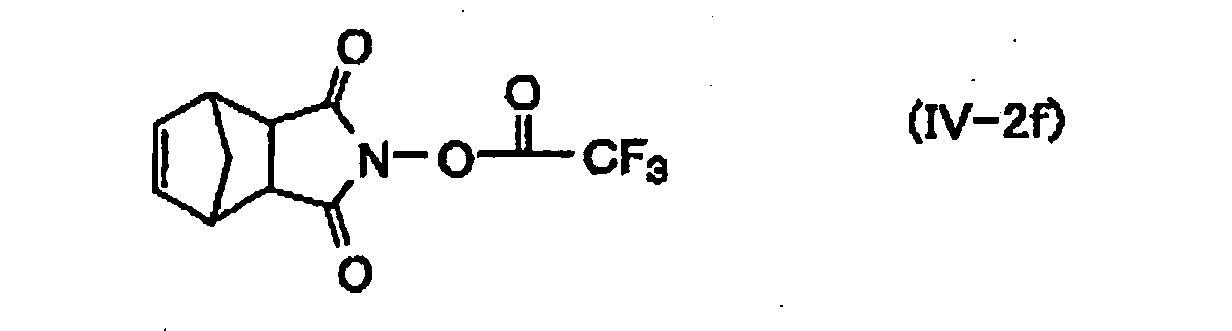
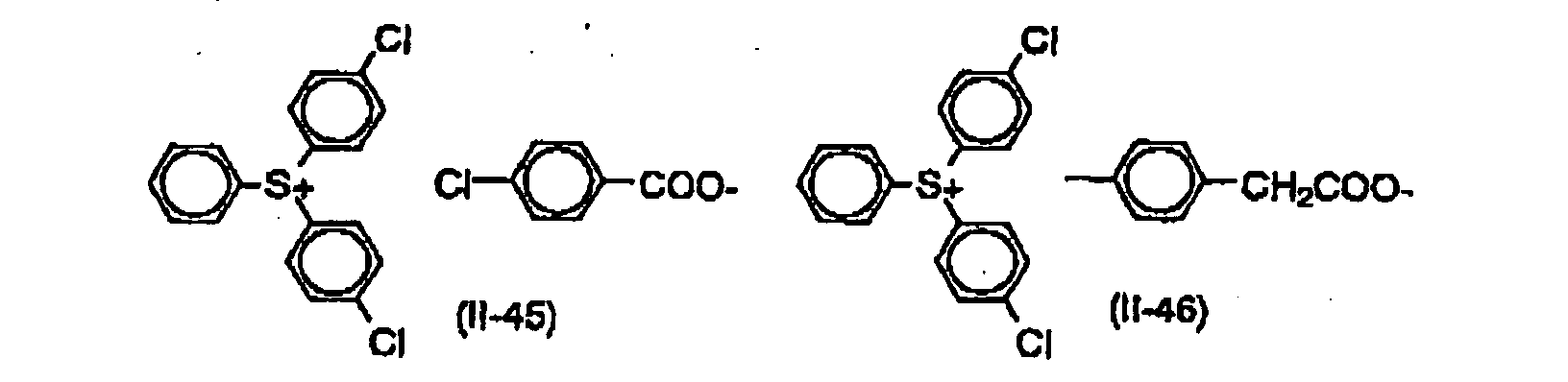
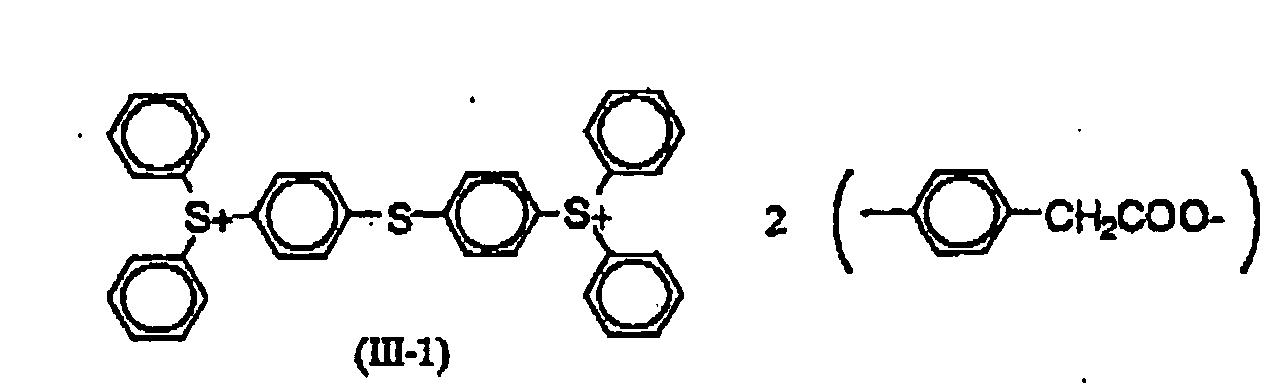
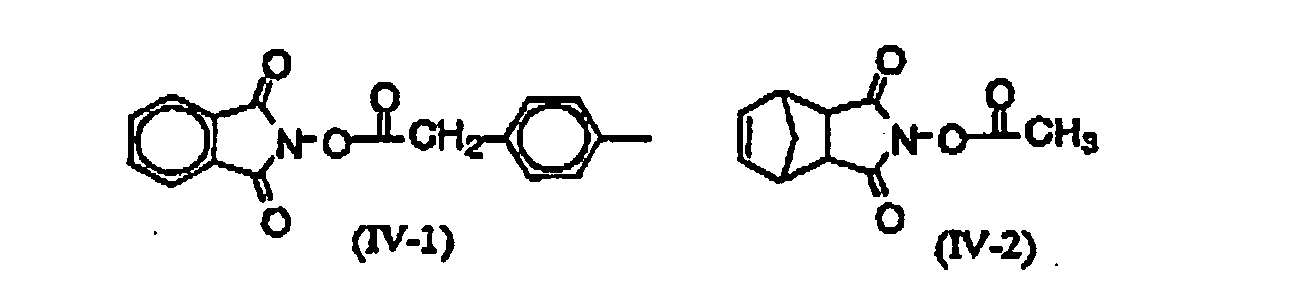
  • onium salt compounds having such a fluorine-substituted aliphatic or aromatic carboxylate anion as described above as a counter anion (sulfonium salts, iodonium salts, etc.), imidocarboxylate compounds having a carboxylic acid ester group and nitrobenzyl ester compounds.
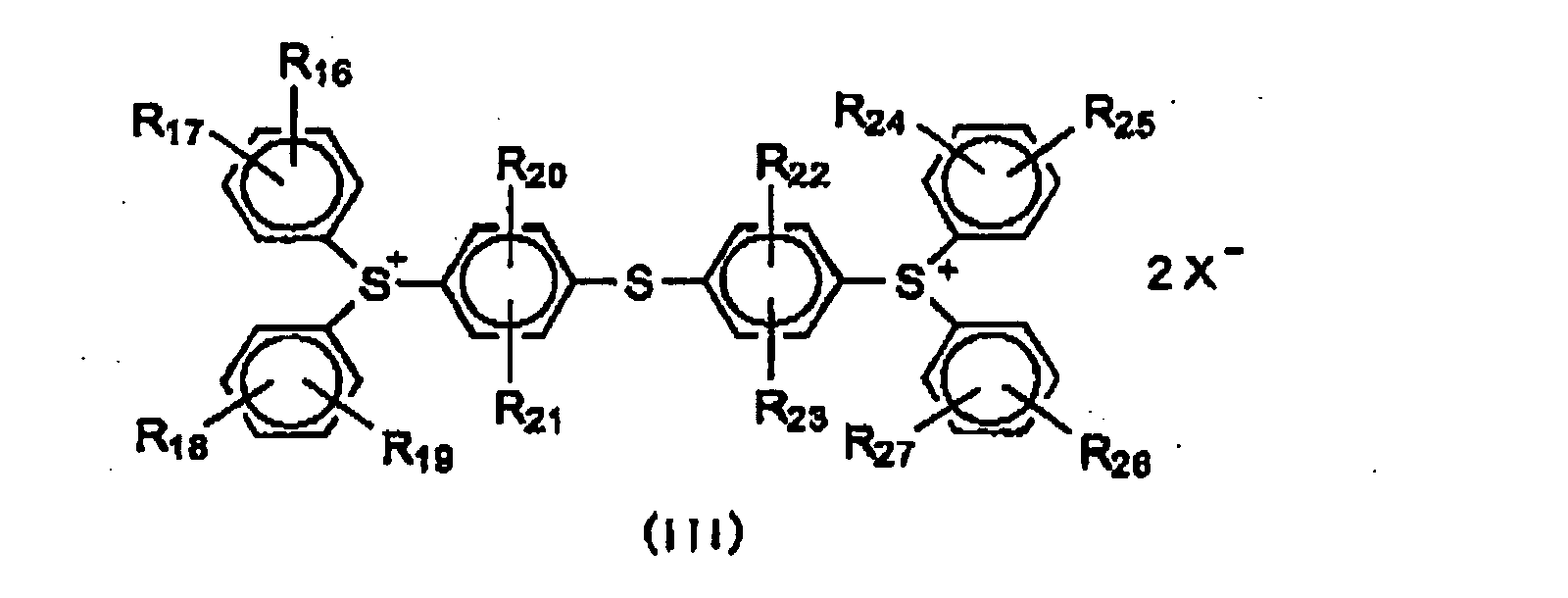
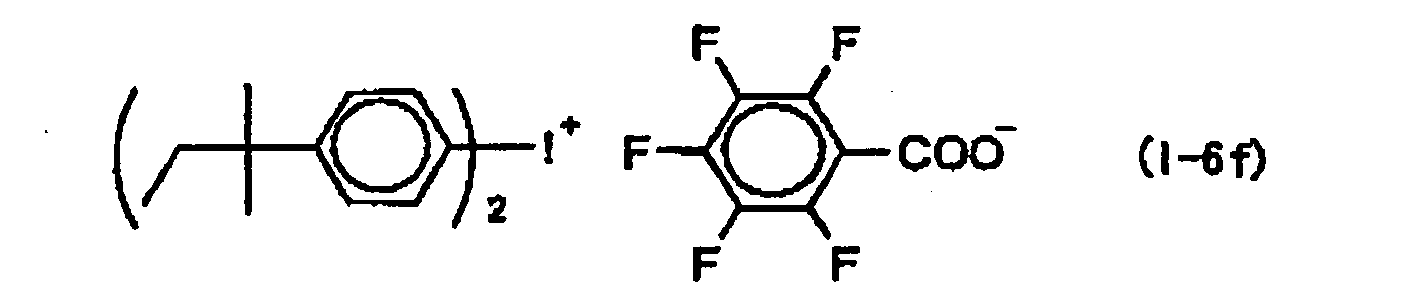
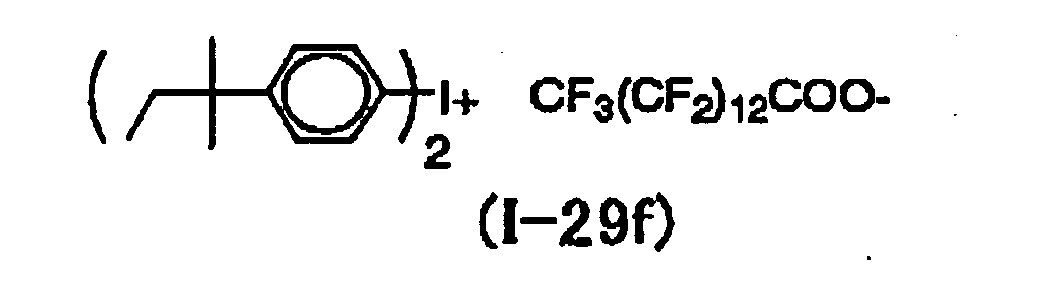
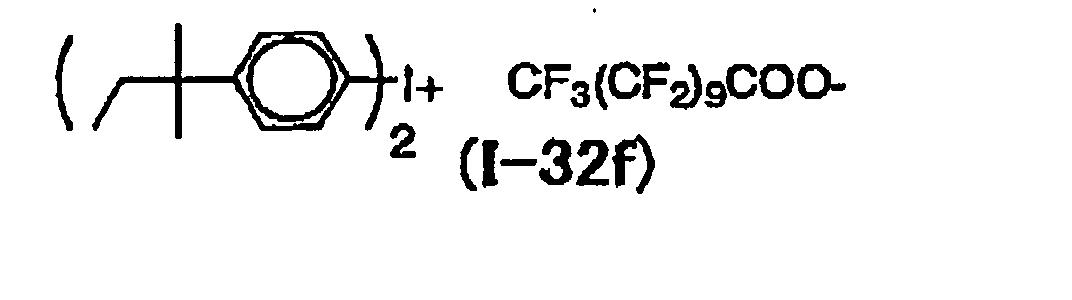
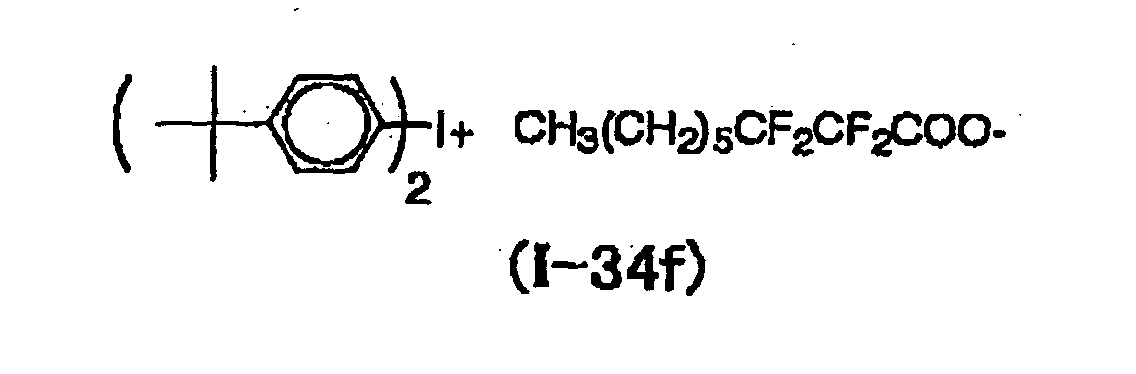
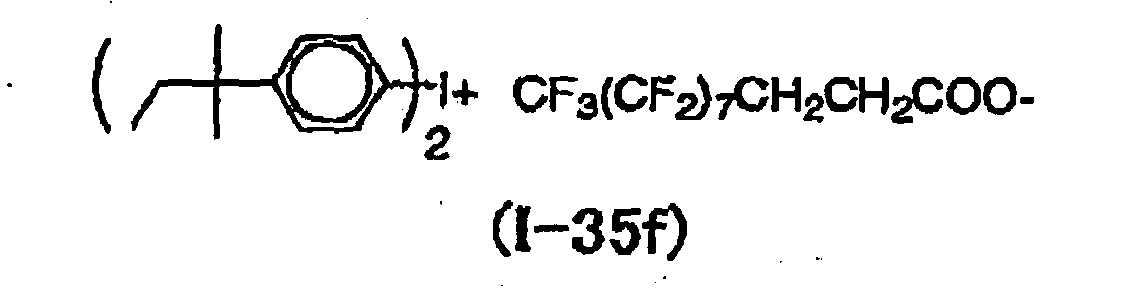
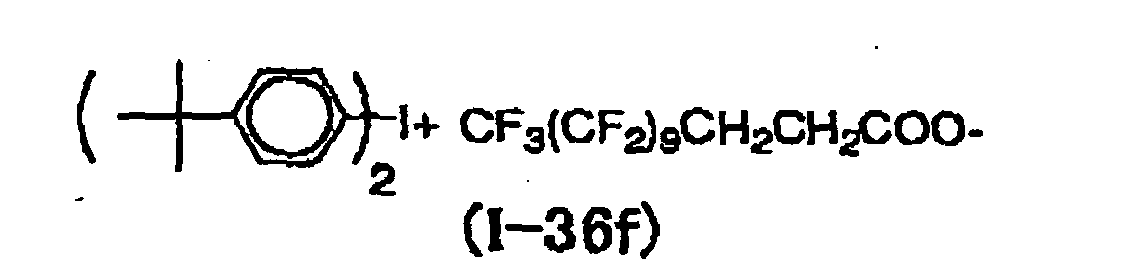
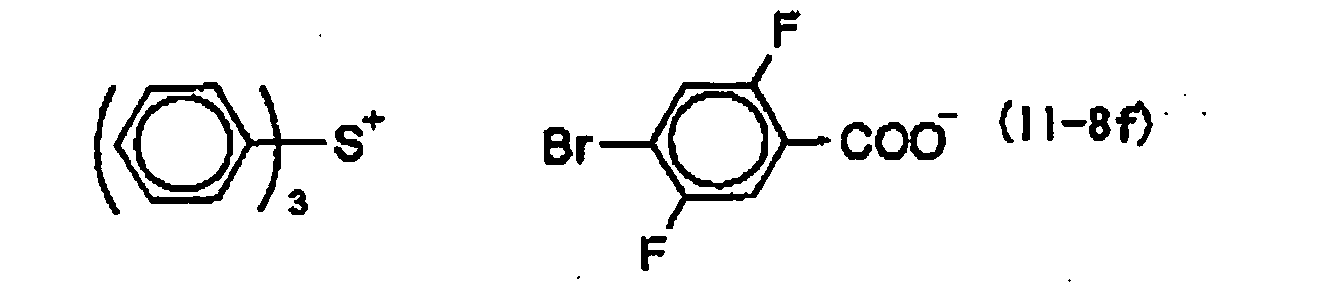
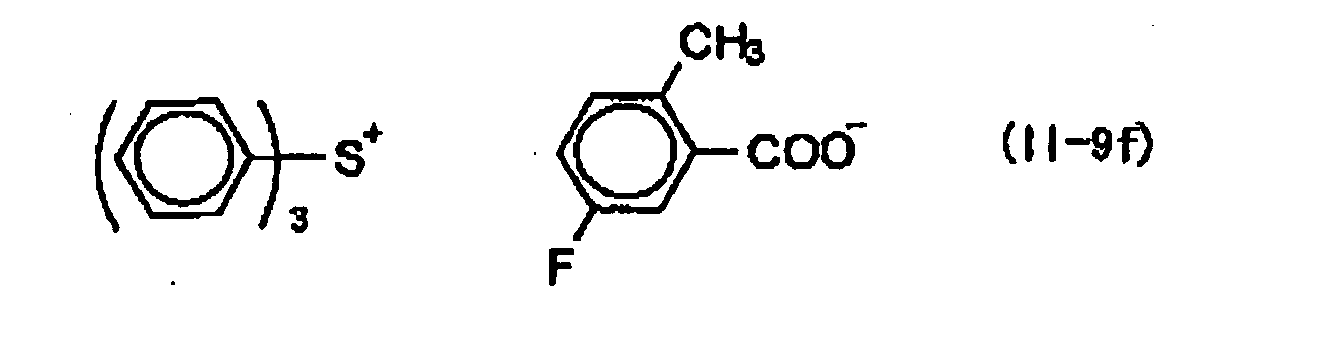
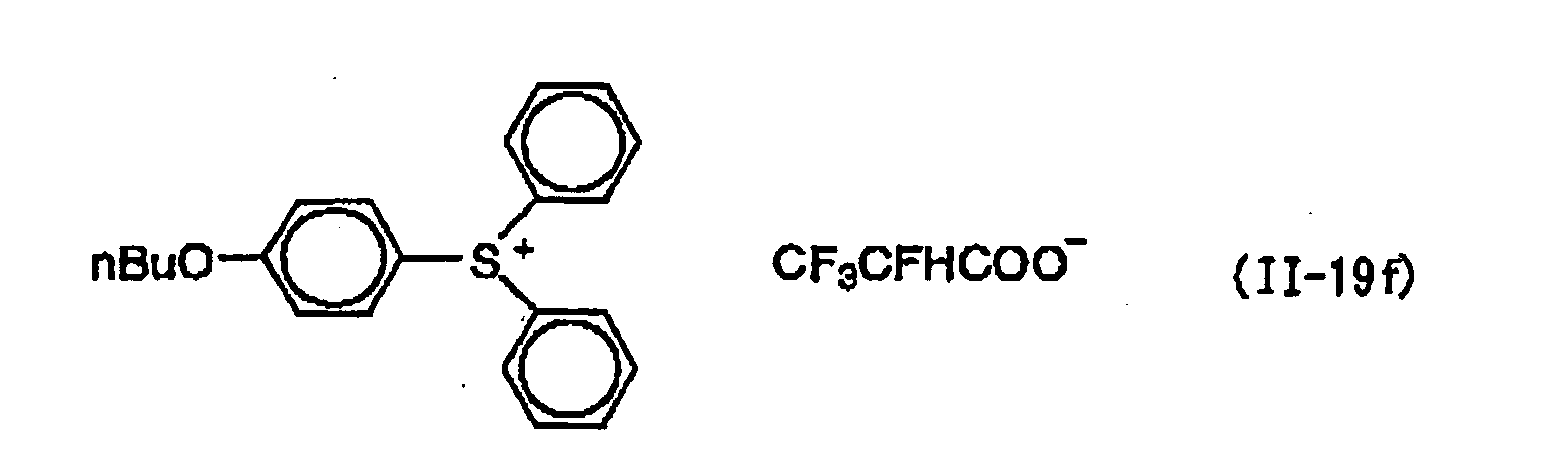
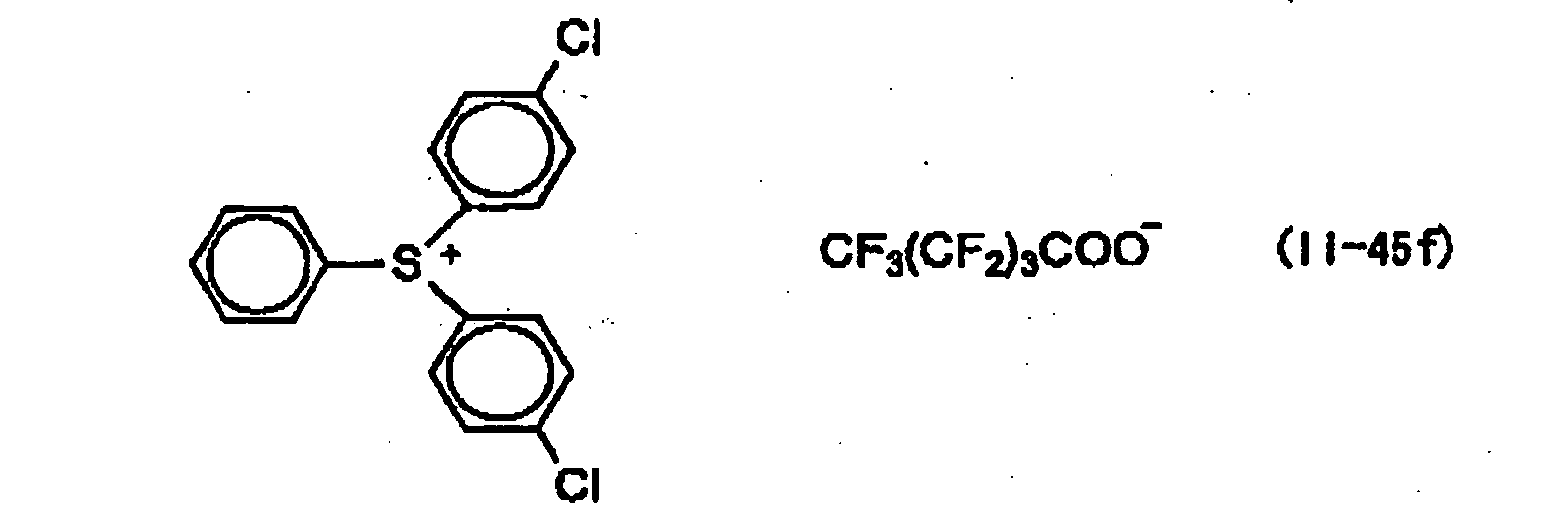
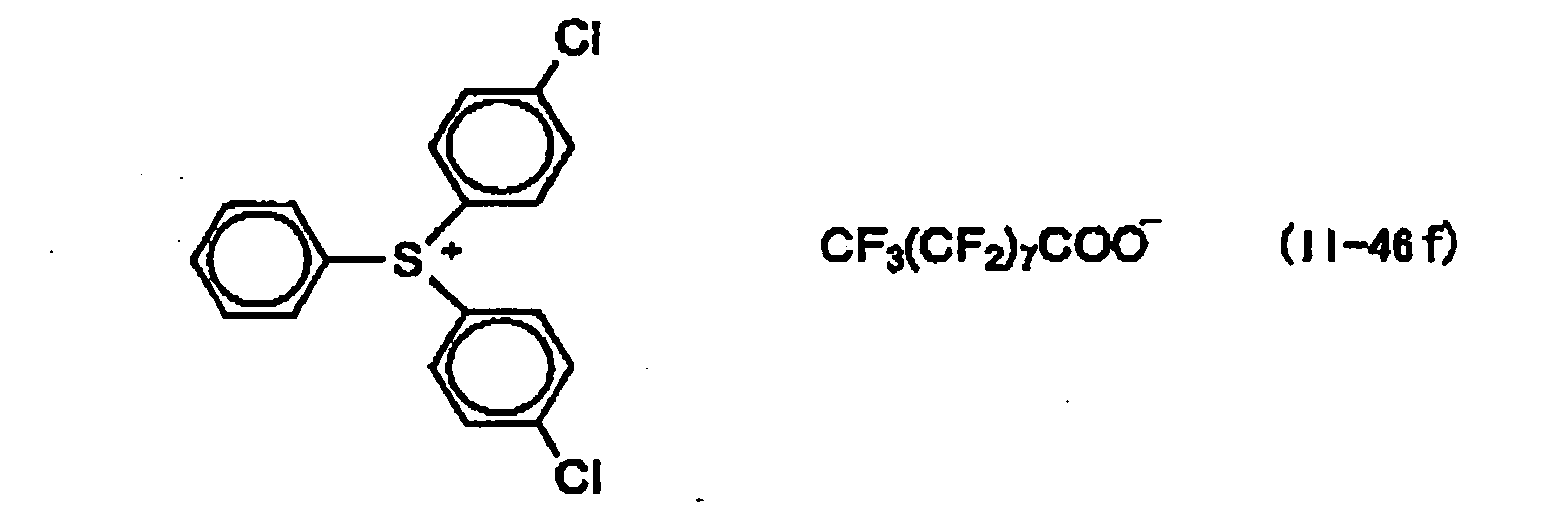
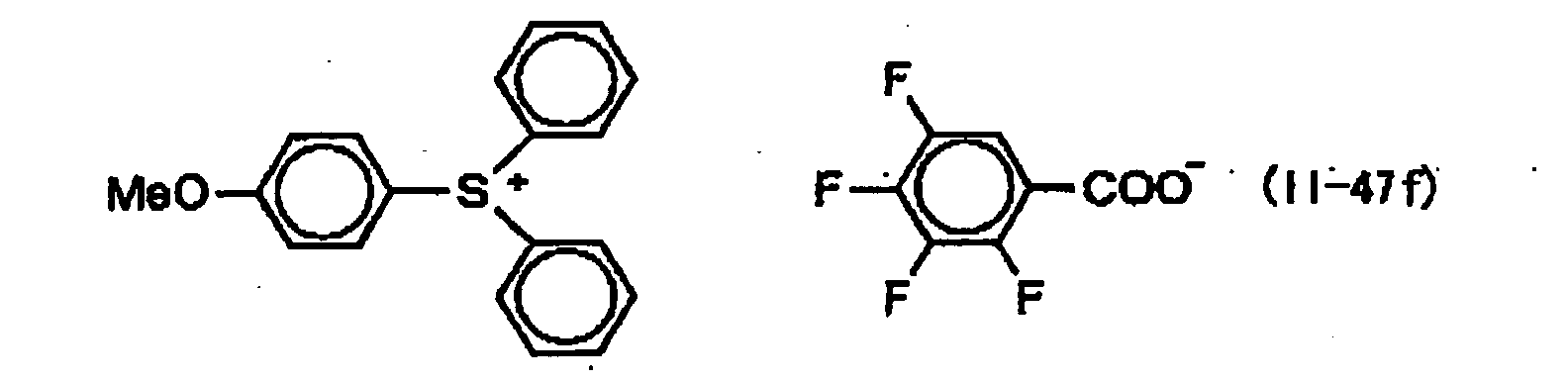
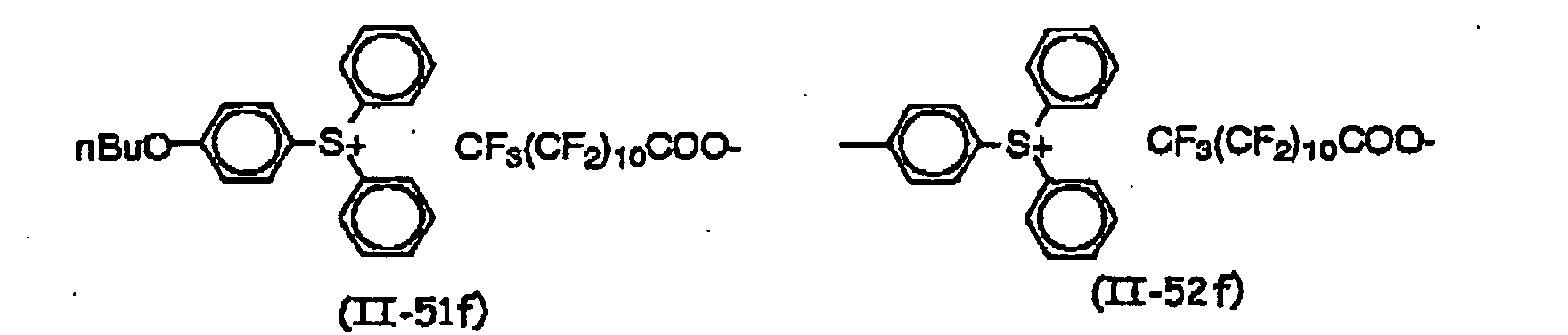
  • Still preferable examples include compounds represented by the above-described formulae (I) to (III).
  • sensitivity, resolution and exposure margin can be further improved.
  • a saturated aliphatic or aromatic carboxylic acid substituted by at least one fluorine atom corresponding to X - in the formulae (I) to (III) is generated, thereby serving as a photo-acid generator.
  • R 1 to R 37 independently represent each a hydrogen atom, an alkyl group, a cycloalkyl group, a linear, branched or cyclic alkoxy group, a hydroxy group, a halogen atom or an -S-R 38 group, wherein R 38 represents a linear, branched or cyclic alkyl group or an aryl group.
  • X - represents an aliphatic or aromatic carboxylate anion substituted by at least one fluorine atom.
  • X - is a perfluoro aliphatic carboxylate anion or a perfluoro aromatic carboxylate anion, still preferably a fluorine-substituted alkylcarboxylate anion having 4 or more carbon atoms.
  • Examples of an alkyl group of R 1 to R 37 in the formulae (I) to (III) include optionally substituted alkyl groups having from 1 to 4 carbon atoms such as methyl, ethyl, propyl, n-butyl, sec-butyl and t-butyl groups.
  • Examples of a cycloalkyl group include optionally substituted cycloalkyl groups having from 3 to 8 carbon atoms such as cyclopropyl, cyclopentyl and cyclohexyl groups.
  • Examples of an alkoxy group of R 1 to R 37 include alkoxy groups having from 1 to 4 carbon atoms such as methoxy, ethoxy, hydroxyethoxy, propoxy, n-butoxy, isobutoxy, sec-butoxy and t-butoxy groups.
  • Examples of a halogen atom of R 1 to R 37 include fluorine, chlorine, bromine and iodine atoms.
  • aryl group of R 38 examples include aryl groups having from 6 to 14 carbon atoms such as phenyl, tolyl, methoxyphenyl and naphthyl groups. Such an aryl group may have a substituent.
  • substituents thereof include alkoxy groups having from 1 to 4 carbon atoms, halogen atoms (fluorine, chlorine and iodine atoms), aryl groups having from 6 to 10 carbon atoms, alkenyl groups having from 2 to 6 carbon atoms, a cyano group, a hydroxy group, a carboxy group, an alkoxycarbonyl group and a nitro group.
  • the iodonium compounds or sulfonium compounds represented by the formulae (I) to (III) to be used in the invention have at least afluorine-substituted saturated aliphatic or aromatic carboxylate anion as the counter ion X - .
  • Such an anion is an anion (-COO - ) remaining after a hydrogen atom leaves from the carboxylate (-COOH).
  • the compounds represented by the formula (I) as described above can be synthesized by reacting an aromatic compound with a periodic acid salt and subjecting the thus obtained iodinium salt to salt-exchange into the corresponding sulfonic acid.
  • the compounds represented by the formulae (II) and (III) can be synthesized by reacting an aryl Grignard reagent such as an aryl magnesium bromide with a substituted or unsubstituted phenyl sulfoxide and then subjecting the thus obtained triarylsulfonium halide to salt-exchange with the corresponding sulfonic acid.
  • an aryl Grignard reagent such as an aryl magnesium bromide
  • a substituted or unsubstituted phenyl sulfoxide and then subjecting the thus obtained triarylsulfonium halide to salt-exchange with the corresponding sulfonic acid.
  • synthesis can be made by fusing a substituted or unsubstituted phenyl sulfoxide with a corresponding aromatic compound with the use of an acid catalyst such as methanesulfonic acid/diphosphorus pentaoxide or aluminum chloride followed by salt-exchange, or by fusing a diaryl iodonium salt with a diaryl sulfide by using a catalyst such as copper acetate followed by salt-exchange.
  • an acid catalyst such as methanesulfonic acid/diphosphorus pentaoxide or aluminum chloride followed by salt-exchange
  • a diaryl iodonium salt with a diaryl sulfide by using a catalyst such as copper acetate followed by salt-exchange.
  • the salt-exchange can be carried out by a method of once forming a halide salt and then converting it into a sulfonic acid salt with the use of a silver reagent such as silver oxide, or by using an ion exchange resin.
  • a silver reagent such as silver oxide
  • an ion exchange resin As the sulfonic acid or sulfonic acid salt to be used in the salt-exchange, use may be made of either marketed products or products prepared by, for example, hydrolyzing marketed sulfonic halides.
  • fluorine-substituted carboxylate serving as an anion
  • Methods of producing these fluoro aliphatic compounds are described in, for example, Fusso Kagobutu no Gosei to Kino, (supervised by Nobuo Ishikawa, CMC, 1987), p. 117 to 118 and Chemistry of Organic Fluorine Compounds II (Monograph 187 Ed by Milos Hudlicky and Attila E. Pavlath, American Chemical Society 1995) p. 747 to 752.
  • telomerization method an alkyl halide (for example, an iodide) having a large chain transfer constant is employed as a telogen and a fluorine-containing vinyl compound (for example, tetrafluoroethylene) is radical-polymerized to thereby synthesize a telomer (as in an example shown in Scheme-1).
  • a fluorine-containing vinyl compound for example, tetrafluoroethylene
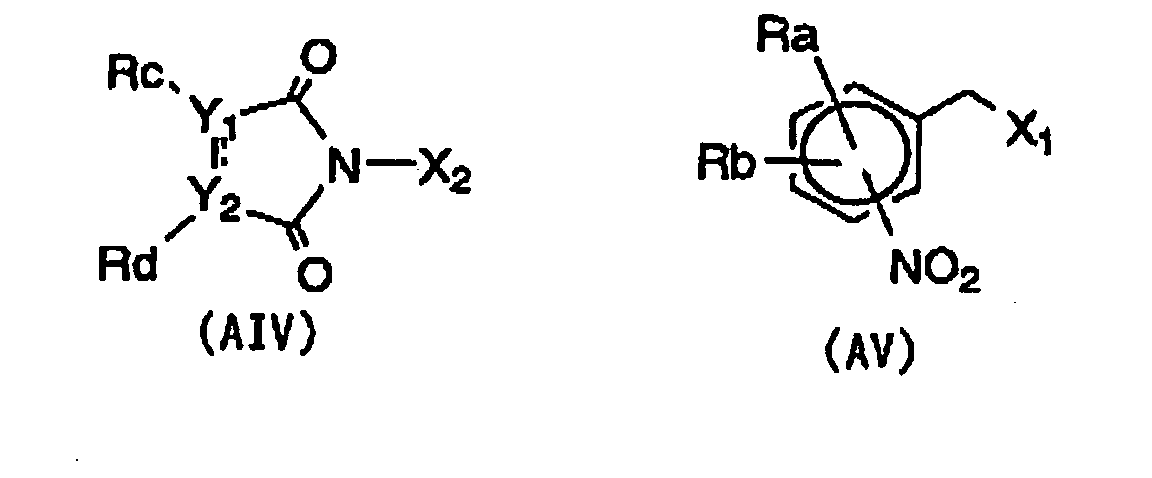
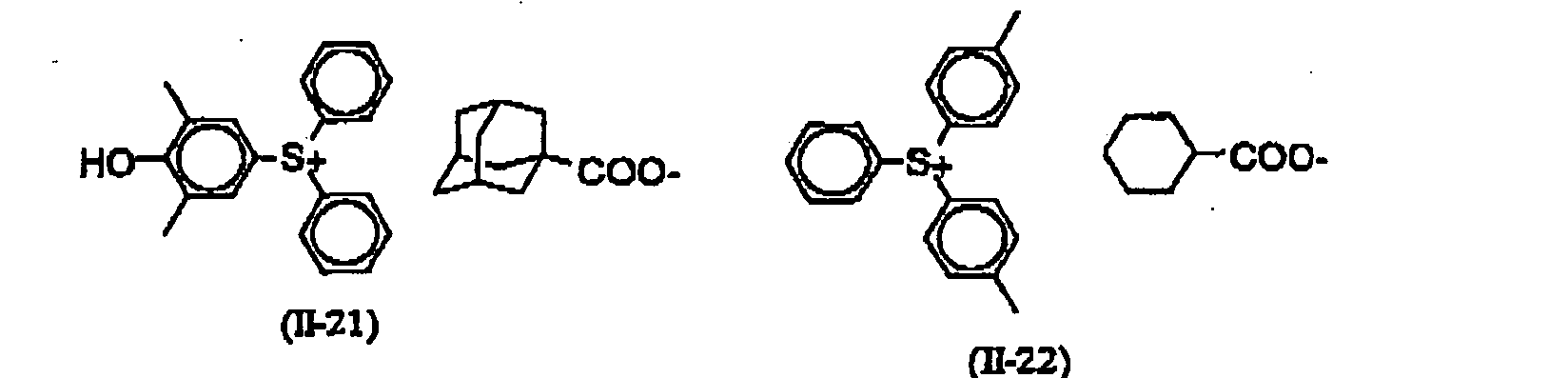
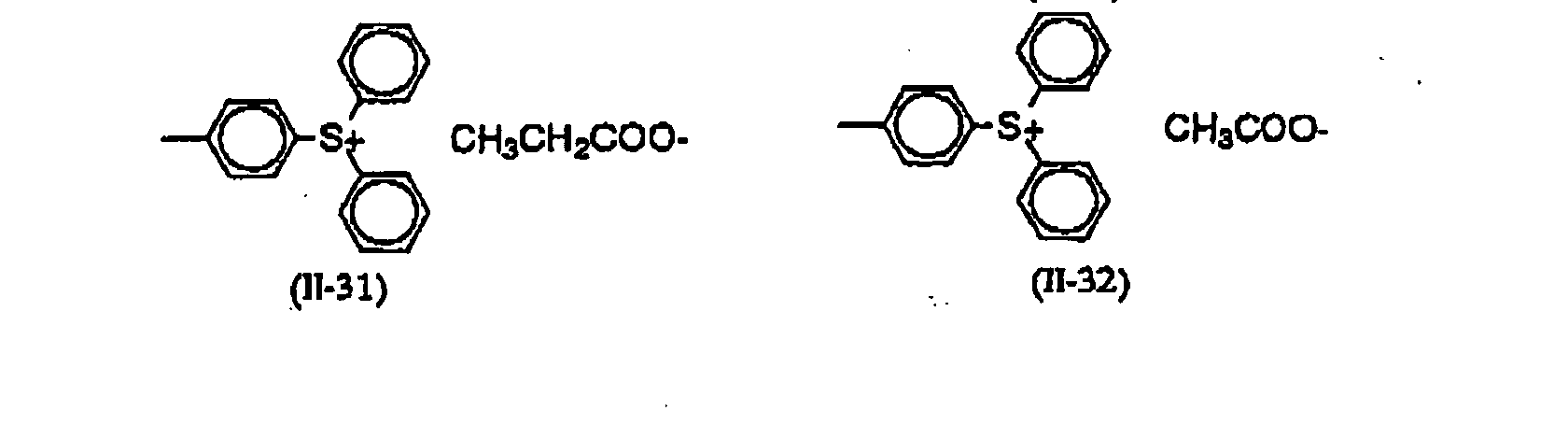
  • Examples of the compound (B4) generating a fluorine-free carboxylic acid upon irradiation with one of an actinic ray and a radiation include compounds represented by the following formulae (AI) to (AV).
  • R 301 to R 337 independently represent each a hydrogen atom, a linear, branched or cyclic alkyl group, a linear, branched or cyclic alkoxy group, a hydroxy group, a halogen atom or an -S-R 0 group wherein R 0 represents a linear, branched or cyclic alkyl group or an aryl group.
  • Ra and Rb independently represent each a hydrogen atom, a nitro group, a halogen atom, an optionally substituted alkyl group, a cycloalkyl group or an alkoxy group.
  • Rc and Rd independently represent each a halogen atom, an optionally substituted alkyl group or an aryl group. Alternatively, Rc and Rd may be bonded together to form an aromatic ring or a monooyclic or polycyclic hydrocarbon ring optionally having an oxygen atom or a nitrogen atom in the ring.
  • Y 1 and Y 2 represent each a carbon atom and the Y 1 -Y 2 bond may be either a single bond or a double bond.
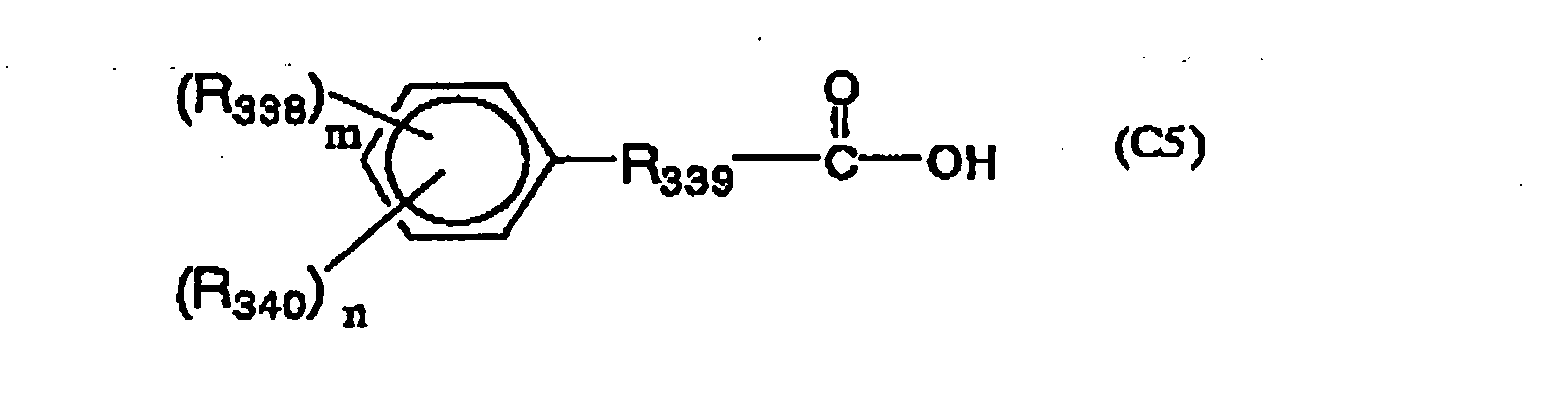
  • X - represents an anion of a carboxylic acid compound represented by the following formulae.
  • X 1 and X 2 independently represent each an ester group of the carboxyl group moiety of a carboxylic acid group represented by the following formulae.
  • R 338 represents a linear, branched or cyclic alkyl group having from 1 to 30 carbon atoms optionally having an oxygen atom or a nitrogen atom in its alkyl chain, a linear, branched or cyclic alkenyl group having from 1 to 20 carbon atoms, a linear, branched or cyclic alkynyl group having from 1 to 20 carbon atoms, a linear, branched or cyclic alkoxyl group having from 1 to 20 carbon atoms, the above-described alkyl group in which at least a part of the hydrogen atoms are substituted by a halogen atom and/or a hydroxyl group, or a substituted or unsubstituted aryl group having from 6
  • R 339 represents a single bond, a linear, branched or cyclic alkylene group having from 1 to 20 carbon atoms (optionally containing an oxygen atom or a nitrogen atom in its alkylene chain), a linear, branched or cyclic alkenylene group having from 1 to 20 carbon atoms, the above-described alkylene group in which at least a part of the hydrogen atoms are substituted by a halogen atom and/or a hydroxyl group, the above-described alkenylene group in which at least a part of the hydrogen atoms is substituted by a halogen atom and/or a hydroxyl group, or an alkoxyalkylene group having from 2 to 20 carbon atoms.
  • R 338 's and R 339 's may be either the same or different from each other.
  • R 340 represents a hydroxyl group or a halogen atom and R 340 's may be either the same or different from each other.
  • m, n, p and q independently represent each an integer of from 0 to 3, provided that m+n is not more than 5 an dp+q is not more than 5.
  • Examples of an alkyl group of R 301 to R 337 , Ra, Rb, Rc, Rd and Ro in the above formulae (AI) to (AV) include optionally substituted alkyl groups having from 1 to 4 carbon atoms such as methyl, ethyl, propyl, n-butyl, sec-butyl and t-butyl groups.
  • Examples of a cycloalkyl group include optionally substituted cycloalkyl groups having from 3 to 8 carbon atoms such as cyclopropyl, cyclopentyl and cyclohexyl groups.
  • Examples of an alkoxy group of R 301 to R 337 , Ra, Rb, Rc, Rd and Ro include alkoxy groups having from 1 to 4 carbon atoms such as methoxy, ethoxy, hydroxyethoxy, propoxy, n-butoxy, isobutoxy, sec-butoxy and t-butoxy groups.
  • Examples of a halogen atom of R 301 to R 337 , Ra, Rb, Rc, Rd and Ro include fluorine, chlorine, bromine and iodine atoms.
  • Examples of an aryl group of Ro, Rc and Rd include aryl optionally substituted aryl groups having from 6 to 14 carbon atoms such as phenyl, tolyl, methoxyphenyl and naphthyl groups.
  • substituents thereof include alkoxy groups having from 1 to 4 carbon atoms, halogen atoms (fluorine, chlorine and iodine atoms), aryl groups having from 6 to 10 carbon atoms, alkenyl groups having from 2 to 6 carbon atoms, a cyano group, a hydroxy group, a carboxy group, alkoxycarbonyl groups and a nitro group.
  • Examples of an aromatic, monocyclic or polycyclic hydrocarbon (optionally containing an oxygen atom or a nitrogen atom in its ring) formed by the binding of Rc to Rd include a benzene structure, a naphthalene structure, a cyclohexane structure, a norbornene structure and an oxabicyclo structure.
  • the iodonium compounds or sulfonium compounds represented by the formulae (AI) to (AV) to be used in the invention have at least a substituent which is an ester group (-COO-) derived from the carboxyl group (-COOH) in at least one of the carboxylic acid compounds of the above formulae (C1) to (C10).
  • Examples of an alkyl group or a cycloalkyl group having from 1 to 30 carbon atoms (optionally containing an oxygen atom or a nitrogen atom in the alkyl or cycloalkyl chain) in R 338 include methyl, ethyl, propyl, butyl, pentyl, hexyl, cyclohexyl, dodecyl, 1-ethoxyethyl and adamantyl.
  • Examples of a linear, branched or cyclic alkenyl group having from 1 to 20 carbon atoms include ethenyl, propenyl, isopropenyl and cyclohexene.
  • Examples of a linear, branched or cyclic alkynyl group having from 1 to 20 carbon atoms include acetylene and propenylene.
  • Examples of a linear, branched or cyclic alkoxy group having from 1 to 20 carbon atoms include methoxy, ethoxy, propyloxy, butoxy, cyclohexyloxy, isobutoxy and dodecyloxy.
  • substituted or unsubstituted aryl group having from 6 to 20 carbon atoms examples includephenyl, naphthyl and anthranyl.
  • substituent of the aryl group examples include alkyl groups, a nitro group, a hydroxyl groups alkoxy groups, acyl groups, alkoxycarbonyl groups and halogen atoms.
  • Examples of a linear, branched or cyclic alkylene group having from 1 to 20 carbon atoms (optionally containing an oxygen atom or a nitrogen atom in the alkylene chain) in R 339 includemethylene, ethylene, propylene, butylene, isobutylene, ethoxyethyleneand cyclohexylene.
  • Examples of a linear, branched or cyclic alkenylene group having from 1 to 20 carbon atoms include vinylene and allylene.
  • the above photo-acid generators i.e., the compounds represented by the formulae (AI), (AII) and (AIII) can be synthesized by using a method described in USP 3,734,928, methods described in Macromolecules, vol. 10, 1307 (1977), Journal of Organic Chemistry, vol. 55, 4222 (1990) and J. Radiat. Curing, vol. 5(1), 2 (1978), etc. followed by the exchange of a counter anion.
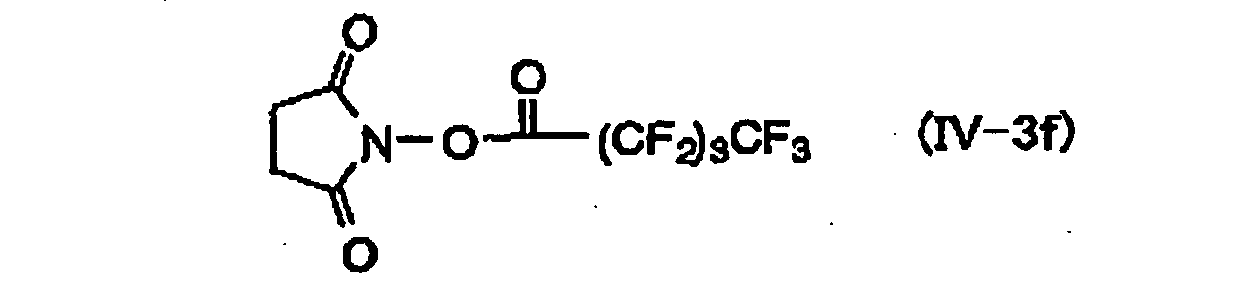
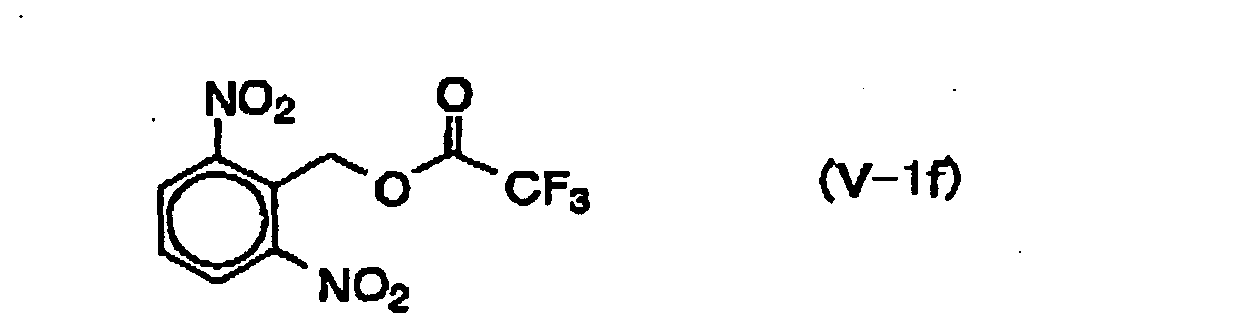
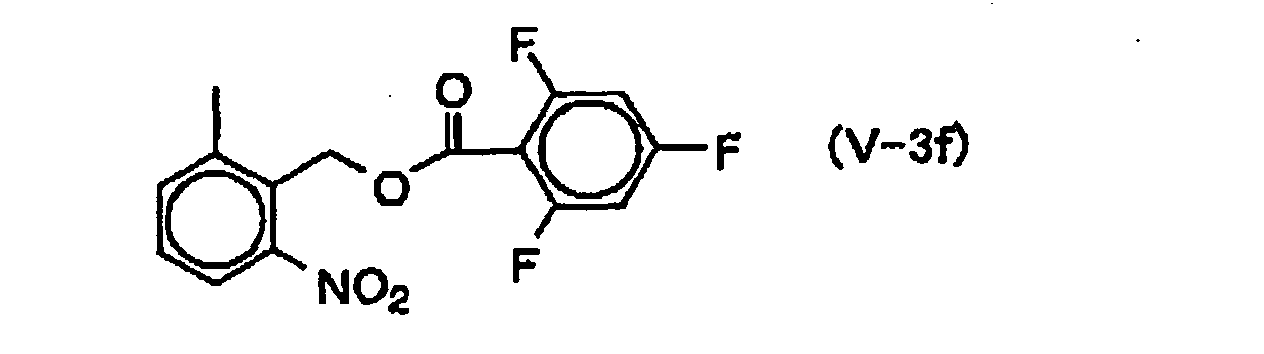
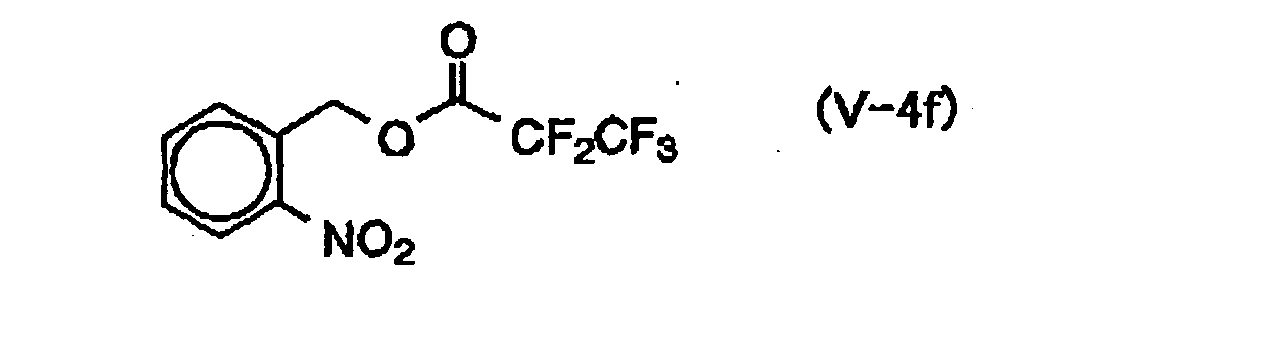
  • the compounds represented by the formulae (AIV) and (AV) can be obtained by reacting an N-hydroxyimide compound with a carboxylic acid chloride under basic conditions or reacting nitrobenzyl alcohol with a carboxylic acid chloride under basic conditions.
  • the ratio by weight of the acid generator (B-1) generating an acid having a relatively high acid strength to the acid generator (B-2) generating an acid having a relatively low acid strength ranges generally from 1/1 to 50/1, preferably from 1/1 to 10/1, still preferably from 2/1 to 5/1.
  • These two acid generators are employed in a total content of usually from 0.5 to 20% by weight, preferably from 0.75 to 15% by weight and still preferably from 1 to 10% by weight, based on the total solid components.
  • the above components are dissolved in a solvent in which they are soluble and the solution is coated to a support.
  • the solvent usable include 1-methoxy-2-propanol acetate, 1-methoxy-2-propanol, ethylene dichloride, cyclohexanone, cyclopentanone, 2-heptanone, ⁇ -butyrolactone, methyl ethyl ketone, ethylene glycol monomethyl ether, ethylene glycol monoethyl ether, 2-methoxyethyl acetate, ethylene glycol monoethyl ether acetate, propylene glycol monomethyl ether, propylene glycol monoethyl ether, propylene glycol monomethyl ether acetate, toluene, ethyl acetate, methyl lactate, ethyl lactate, methyl methxypropionate, ethyl ethoxypropionate, methyl
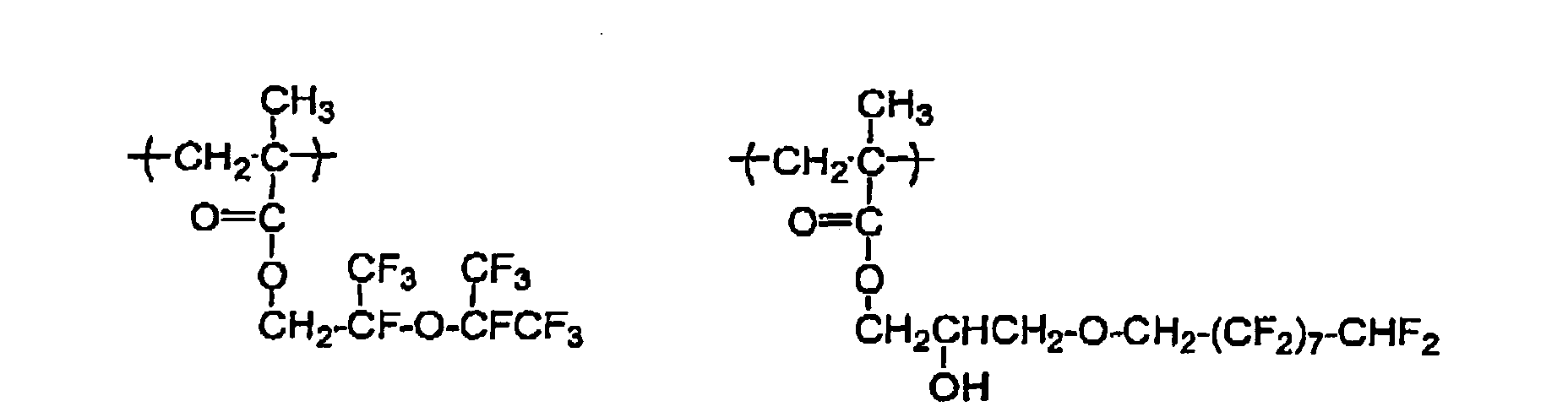
  • the photoresist composition according to the invention further contains one or more of surfactants containing at least one of a group consisting of a fluorine atom and a silicon atom (a fluorine-containing surfactant, a silicon-containing surfactant and a surfactant containing both of fluorine and silicon atoms).
  • a fluorine-containing surfactant, a silicon-containing surfactant and a surfactant containing both of fluorine and silicon atoms additive of such surfactants containing at least one of a group consisting of a fluorine atom and a silicon atom contributes to the prevention of development defect and improvement in coating properties.
  • Examples of marketed surfactants usable herein include surfactants containing at least one of a group consisting of a fluorine atom and a silicon atom such as Eftop EF301 and EF 303 (manufactured by Shin-Akita Kasei K.K.), Florad FC430 and 431 (manufactured by Sumitomo 3M, Inc.), Megafac F171, F173, F176, F189 and R08 (manufactured by Dainippon Ink & Chemicals, Inc.), Surflon S-382, DC101, 102, 103, 104, 105 and 106 (manufactured by Asahi Glass Co., Ltd.), Troysol S-366 (manufactured by Troy Chemical Industries, Inc.). It is also possible to use silicon-containing surfactants such as Polysiloxane polymer KP341 (manufactured by Shin-Etsu Chemical Industry Col., Ltd.).
  • surfactants comprising a polymer having a fluoro aliphatic group derived from a fluoro aliphatic compound which is produced by the telomerization method (also called the telomer method) or the oligomerization method (also called the oligomer method).
  • telomerization method also called the telomer method
  • oligomerization method also called the oligomer method
  • polymer having a fluoroaliphatic group acopolymer of a monomer having a fluoro aliphatic group with a (poly(oxyalkylene)) acrylate and/or a (poly(oxyalkylene)) methacrylate is preferable. Either a copolymer with irregular distribution or a block copolymer may be used.
  • the poly(oxyalkylene) group include poly(oxyethylene), poly(oxypropylene) and poly (oxybutylene) groups. Use may be also made of units having alkylenes with different chain lengths in a single chain such as a poly (oxyethylene-oxypropylene block unit) and poly (oxyethylene-oxypropylene block unit).
  • a copolymer or a dimer of a monomer having a fluoro aliphatic group with a (poly(oxyalkylene)) acrylate (or methacrylate) but also a trimer or a higher copolymer having two or more different monomers having a fluoro aliphatic group or two or more different (poly(oxyalkylene)) acrylates (or methacrylates) copolymerized at the same time.
  • Examples of marketed surfactants include Megafac F178, F-470, F-473, F-475, F-476 and F-472 (manufactured by Dainippon Ink & chemicals. Inc.). Further examples thereof include a copolymer of a C 6 F 13 -containing acrylate (or methacrylate) with a (poly(oxyalkylene))acrylate (or methacrylate), a copolymer of a C 6 F 13 -containing acrylate (or methacrylate) with (poly(oxyethylene))acrylate (or methacrylate) and (poly(oxypropylene))acrylate (or methacrylate), a copolymer of a C 8 F 17 -containing acrylate (or methacrylate) with a (poly(oxyalkylene))acrylate (or methacrylate), and a copolymer of a C 8 F 17 -containing acrylate (or methacrylate) with (poly(oxyethylene))
  • the surfactant containing at least one of a group consisting of a fluorine atom and a silicon atom is used in an amount of prferably from 0.0001 to 2% by weight, still preferably form 0.001 to 1% by weight based on the whole positive photoresist composition (exlcuding the solvent).
  • an acid diffusion inhibitor is added to the composition according to the invention to prevent changes in the performance (T-top formation in pattern, change in sensitivity, change in pattern line width, etc.) with the passage of time after the irradiation with one of an actinic ray and radiation until the heat treatment, changes in performance with the passage of time after the coating and, furthermore, the excessive diffusion of an acid (worsening in resolution) during the heat treatment after the irradiation with one of an actinic ray and radiation.
  • the acid diffusion inhibitor use can be made of an organic basic compound.
  • an organicbasic compound containing nitrogen e.g., a conjugated acid compound with a pKa value of 4 or more.
  • R 200 , R 201 and R 202 may be the same or different and each represents a hydrogen atom, an alkyl group having from 1 to 20 carbon atoms, a cycloalkyl group having from 3 to 20 carbon atoms or an aryl group having from 6 to 20 carbon atoms, or R 201 and R 202 may be bonded to form a ring together.
  • the alkyl and cycloalkyl groups may be substituted. Examples of the substituted alkyl group include aminoalkyl groups having from 1 to 20 carbon atoms and hydroxyalkyl groups having from 1 to 20 carbon atoms. Examples of the substituted cycloalkyl groups include aminocycloalkyl groups having from 3 to 20 carbon atoms and hydroxycycloalkyl groups having from 3 to 20 carbon atoms.
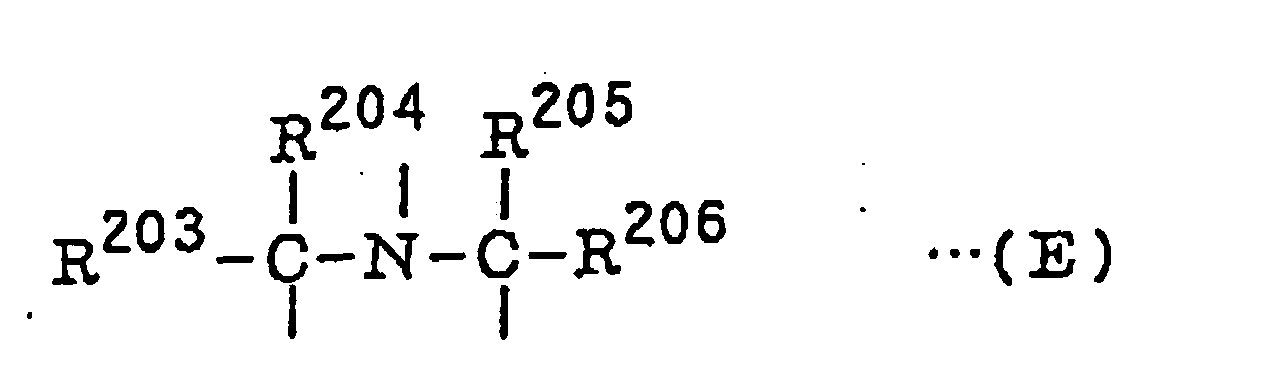
  • R 203 , R 204 , R 205 and R 206 may be the same or different and each represents an alkyl group or a cycloalkyl group having from 1 to 30 carbon atoms.
  • a still preferable compound is a nitrogen-containing basic compound having two or more nitrogen atoms differing in chemical environment per molecule.
  • a particularly preferable compound is a compound having both of a substituted or unsubstituted amino group and a nitrogen-containing cyclic structure or a compound having an alkylamino group.
  • Particularly preferable examples thereof include substituted or unsubstituted guanidine, substituted or unsubstituted aminopyridine, substituted or unsubstituted aminoalkylpyridine, substituted or unsubstituted aminopyrrolidine, substituted or unsubstituted indazole, imidazole, substituted or unsubstituted pyrazole, substituted or unsubstituted pyradine, substituted or unsubstituted pyrimidine, substituted or unsubstituted purine, substituted or unsubstituted imidazoline, substituted or unsubstituted pyrazoline, substituted or unsubstituted piperazine, substituted or unsubstituted aminomorpholine and substituted or unsubstituted aminoalkylmorpholine.
  • preferable substituents include amino, aminoalkyl, alkylamino, aminoaryl, arylamino, alkyl, alkoxy, acyl, acyloxy, aryl, aryloxy, nitro, hydroxyl and cyano groups.
  • Particularly preferable compounds include guanidine, 1,1-dimethylguanidine, 1,1,3,3-tetramethylguanidine, imidazole, 2-methylimidazole, 4-methylimidazole, N-methylimidazole, 2-phenylimidazole, 4,5-diphenylimidazole, 2,4,5-triphenylimidazole, 2-aminopyridine, 3-aminopyridine, 4-aminopyridine, 2-dimethylaminopyridine, 4-dimethylaminopyridine, 2-diethylaminopyridine, 2-(aminomethyl)pyridine, 2-amino-3-methylpyridine, 2-amino-4-methylpyridine, 2-amino-5-methylpyridine, 2-amino-6-methylpyridine, 3-aminoethylpyridine, 4-aminoethylpyridine, 3-aminopyrrolidine, piperazine, N-(2-aimoethyl)piperazine, N-(2-aminoeth
  • the acid generator and the organic basic compound are employed in the composition at a ratio by mol of (acid generator)/(organic basic compound) from 2.5 to 300. From the viewpoints of sensitivity and resolution, it is preferred that the molar ratio is 2.5 or higher. From the viewpoints of the change in the resist pattern with the passage of time from the exposure to the heating and resolution, the molar ratio is 300 or lower.
  • the molar ratio of (acid generator)/(organic basic compound) preferably ranges from 5.0 to 200, still preferably from 7.0 to 150.
  • a pattern is formed on a resist film by coating the composition according to the invention to a substrate (for example, a transparent substrate such as a silicone/silicone dioxide-coated glass substrate or an ITO substrate), thus forming a resist film, irradiating it with the use of an actinic ray or radiation drawing device, heating, developing, rinsing and drying to give a favorable resist pattern.
  • a substrate for example, a transparent substrate such as a silicone/silicone dioxide-coated glass substrate or an ITO substrate
  • aqueous solutions of alkalis for example, inorganic alkalis such as sodium hydroxide, potassium hydroxide, sodium carbonate, sodium silicate, sodium metasilicate and aqueous ammonia, primary amines such as etnylamine and n-propylamine, secondary amines such as diethylamine and di-n-butylamine, tertiary amines such as triethylamine and methyldiethylamine, alcohol amines such as dimethylethanolamine and triethanolamine, quaternary amine salts such as tetramethylammonium hydroxide, tetraethylammonium hydroxide and choline, and cyclic amines such as pyrrole and piperidine.
  • alcohols such as isopropyl alcohol and surfactants such as a nonionic surfactant may be added to the aqueous solutions of alkalis as
  • quaternary ammonium salts are preferable and tetramethylammonium hydroxide and choline are still preferable.
  • the alkali concentration in the alkali developing solution ranges usually form 0.1 to 20% by weight while its pH value usually ranges from 10 to 15.
  • the obtained polymer was analyzed by GPC (in a THF solvent, calculated in terms of polystyrene).
  • the weight-average molecular weight of the polymer was 9,200
  • the degree of dispersion was 1.52
  • the ratio of compounds having a molecular weight of 1000 or less was not more than 5% by weight.
  • Resins according to the invention listed in Table 1 were synthesized by the same procedure.
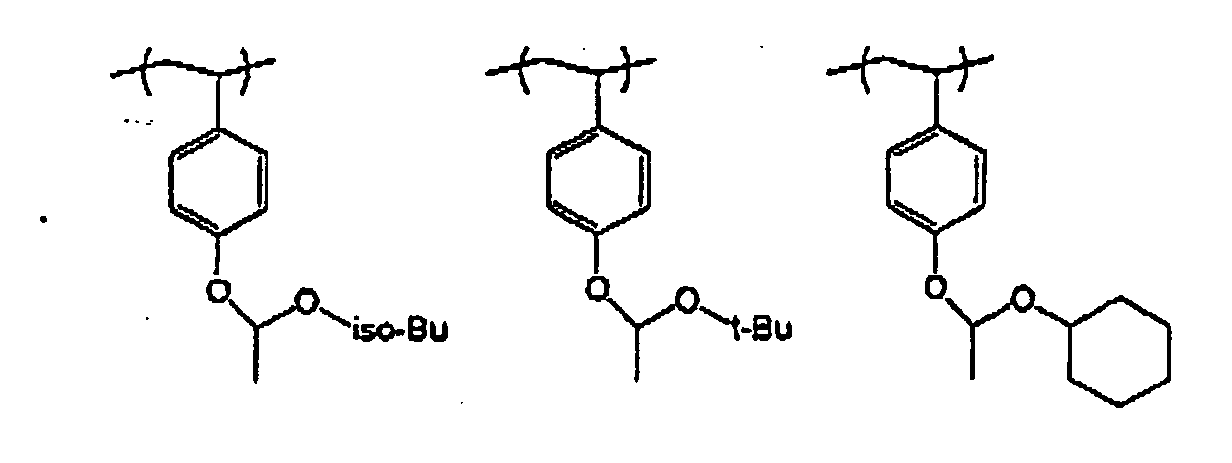
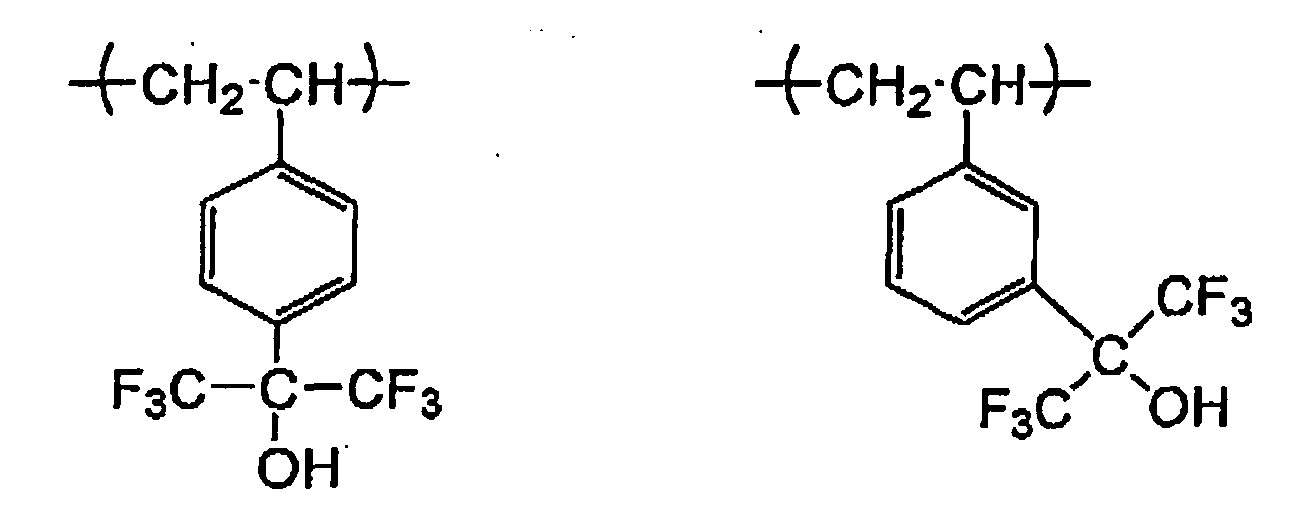
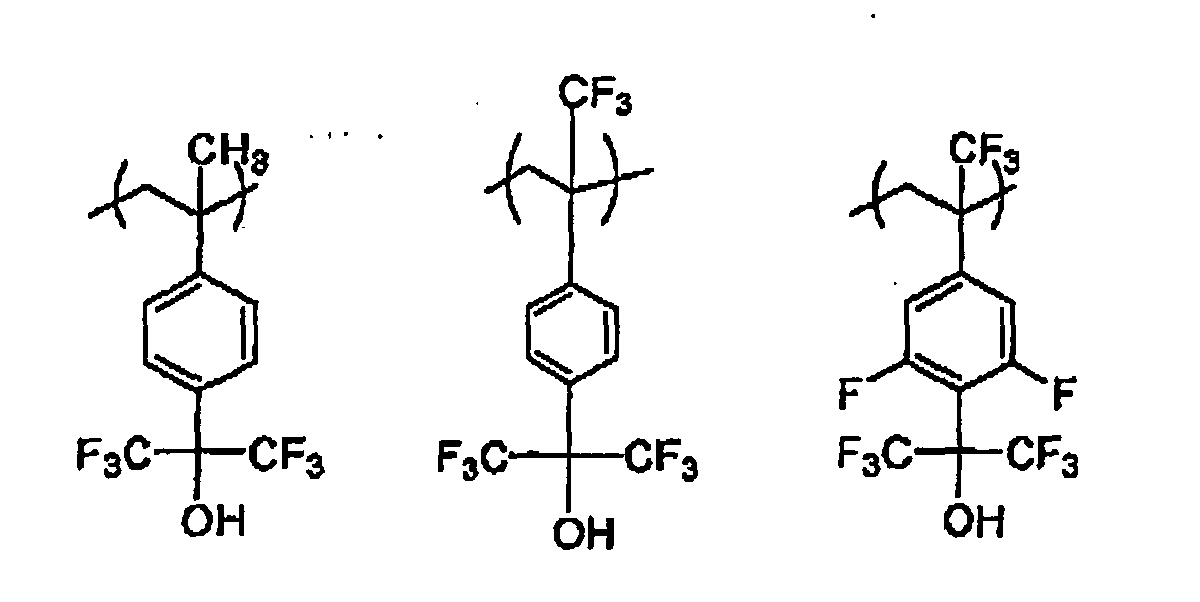
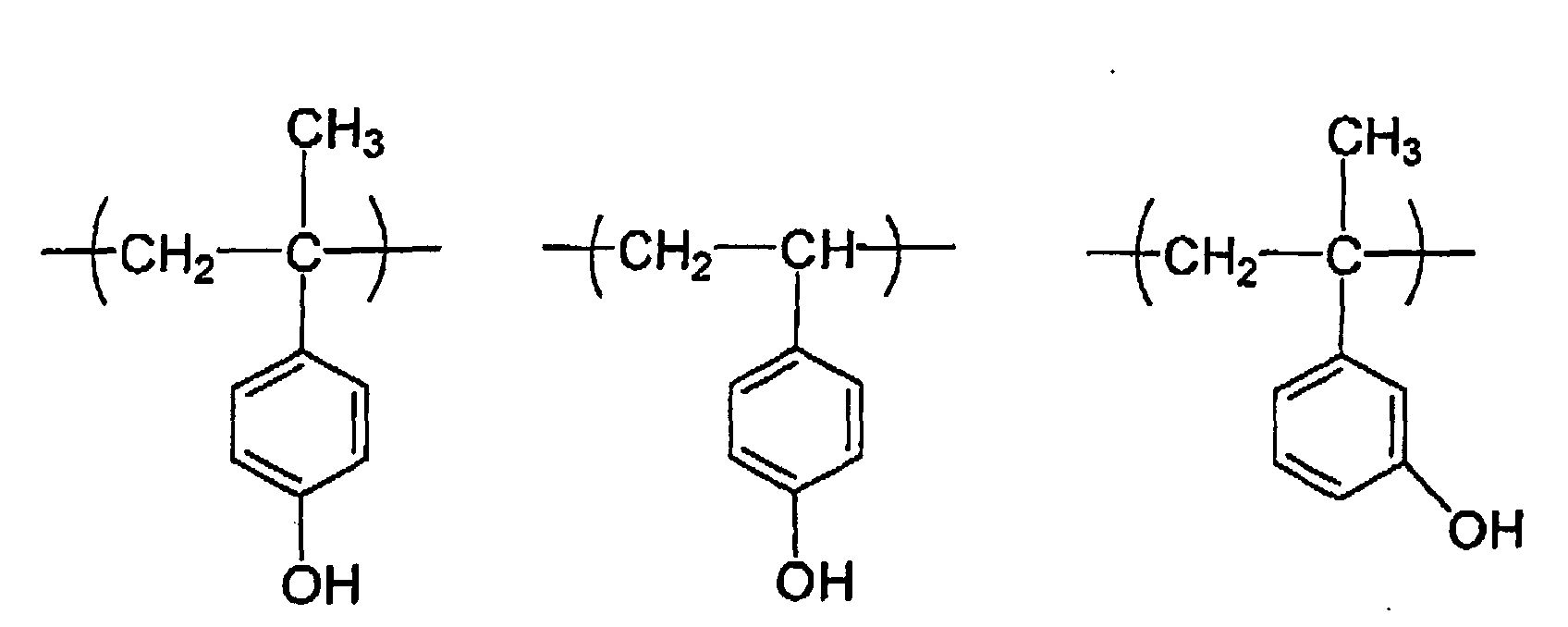
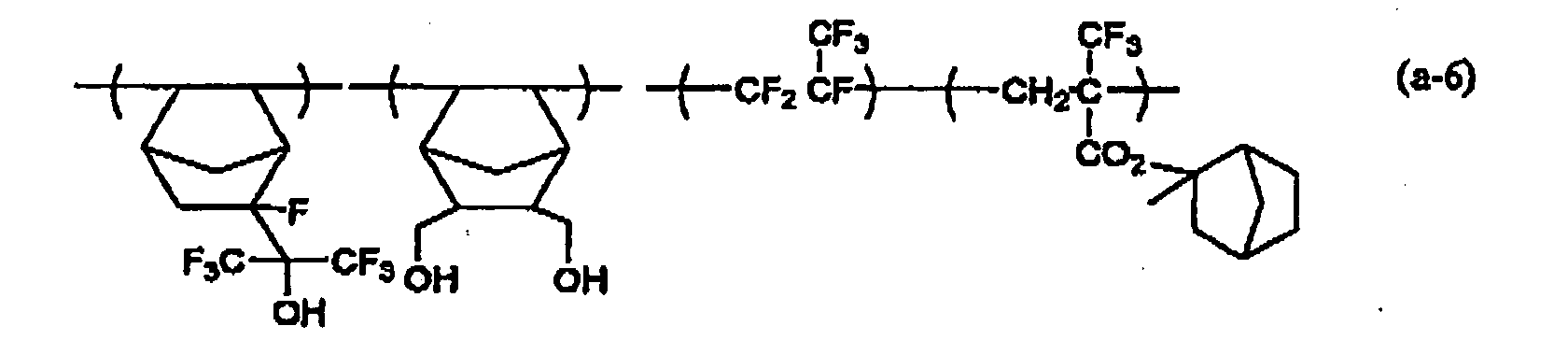
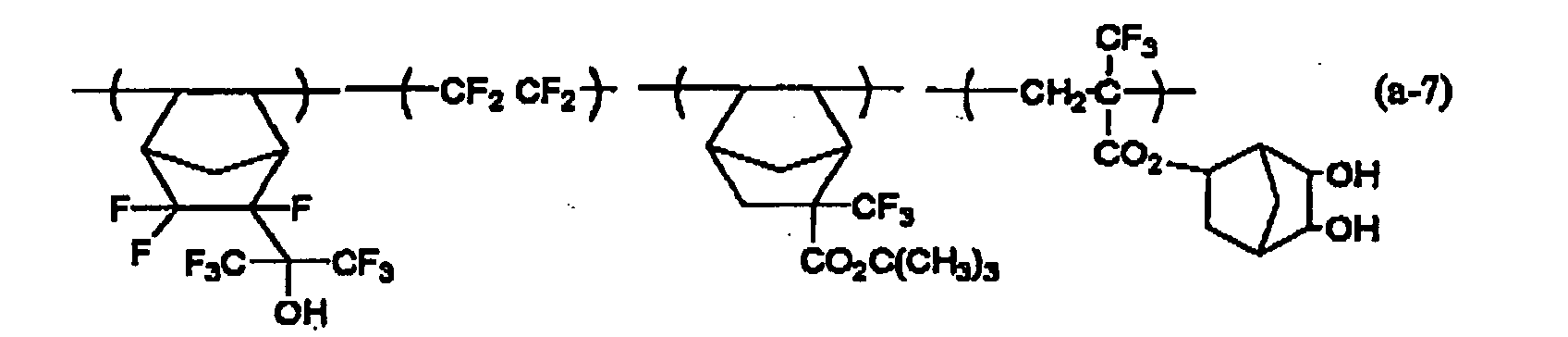
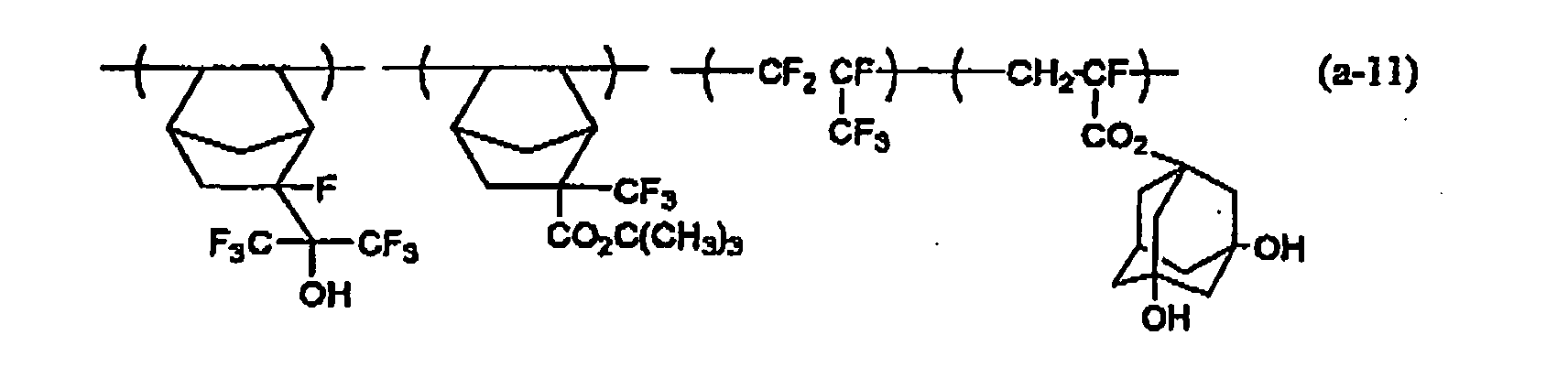
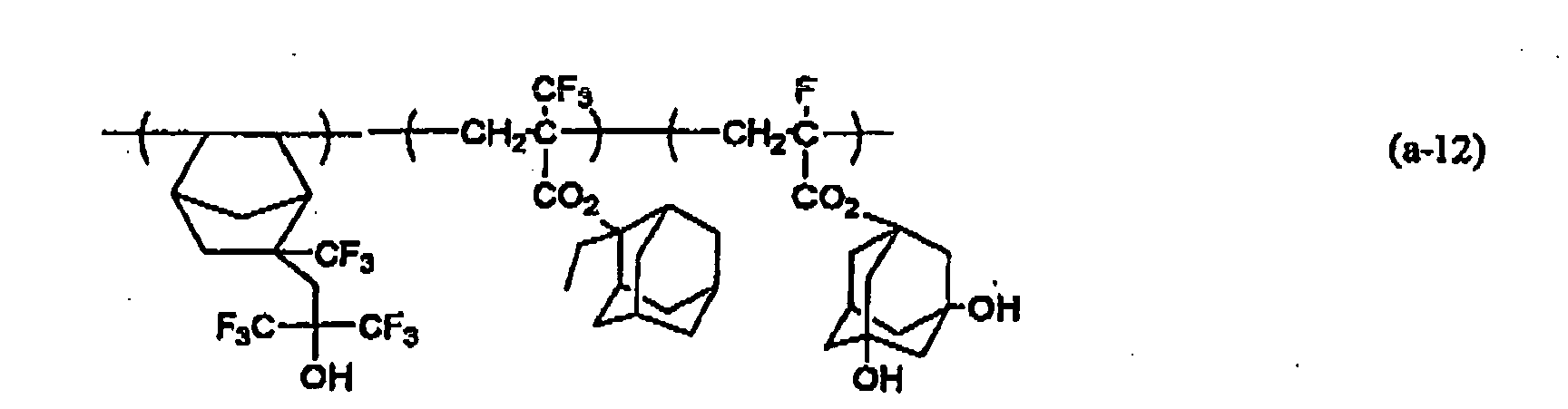
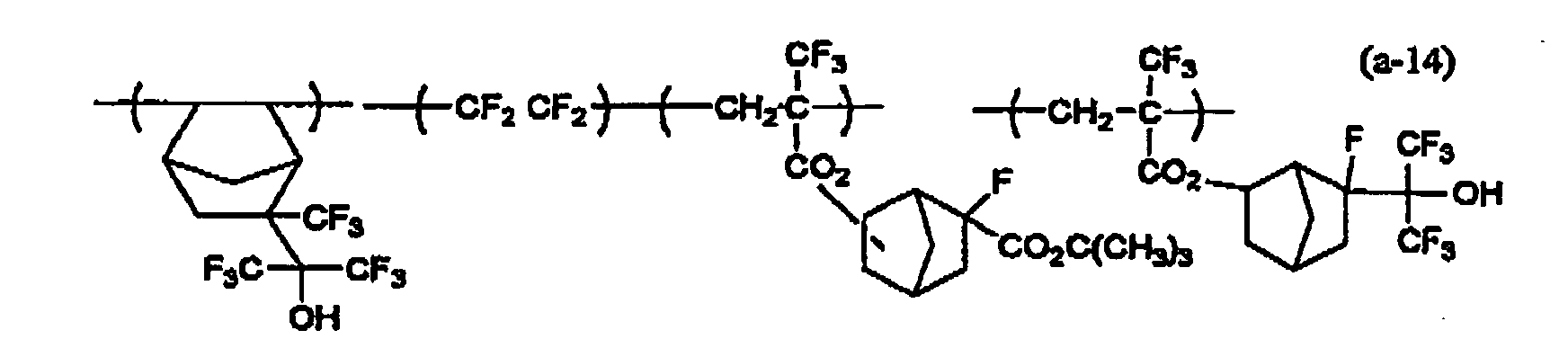
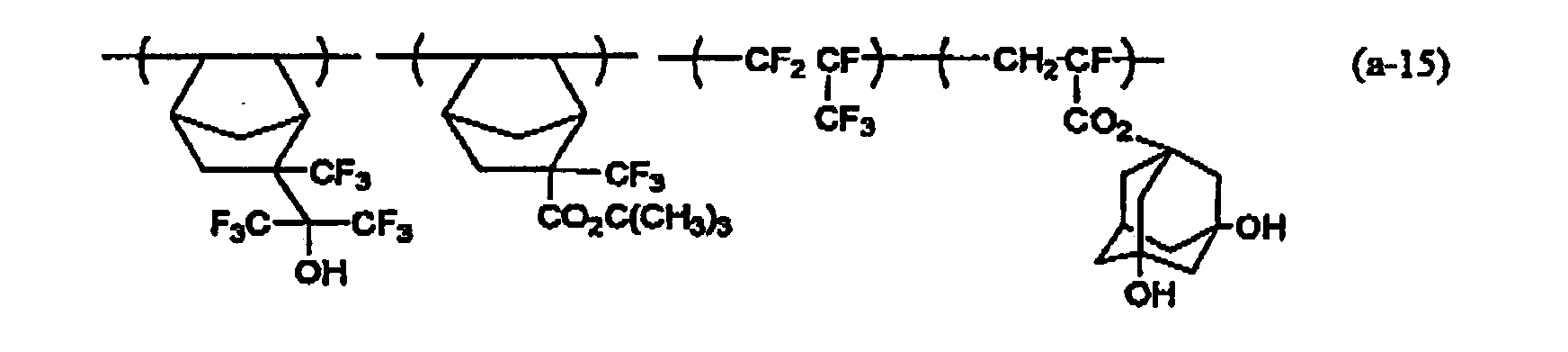
  • Resin Composition ratio (by mol) (from the left side in structural formula) Weight-average molecular weight Degree of dispersion a-1 50/25/25 8600 1.53 a-2 45/30/25 8500 1.51 a-3 50/30/20 7600 1.52 a-4 30/25/25 8200 1.51 a-5 40/30/30 9200 1.52 a-6 20/20/50/10 7900 1.51 a-7 20/50/20/10 8800 1.48 a-8 20/50/20/10 8600 1.49 a-9 20/10/50/10 7900 1.55 a-10 40/30/30 8100 1.56 a-11 20/10/50/20 8300 1.61 a-12 40/30/30 7700 1.55 a-13 10/20/50/20 7900 1.48 a-14 20/50/20/10 8000 1.59 a-15 20/20/50/10 8800 1.57
  • the positive photoresist solution as prepared above was uniformly coated on a silicone wafer having been coated with an anti-reflecting coating (DUV42-6, manufactured by Brewer Science Inc.) by using a spin coater and dried by heating to 120°C for 60 seconds to give a positive photoresist film of 0.15 ⁇ m in film thickness.
  • the positive photoresist solution as prepared above was uniformly coated on an SiON substrate by using a spin coater and dried by heating to 120°C for 60 seconds to give a positive photoresist film.
  • the resist performance of the thus obtained pattern on the silicone wafer was evaluated by the following method.
  • a line-and-space pattern of 150 nm in dimensional size was observed under an SEM (Model S-8840 manufactured by Hitachi) and the degree of the bottom spread shape shown in Fig. 1 was evaluated in accordance with the following formula. A smaller value indicates the less bottom spread.
  • Table 2 summarizes the results of the performance evaluations.

Landscapes

  • Physics & Mathematics (AREA)
  • Spectroscopy & Molecular Physics (AREA)
  • General Physics & Mathematics (AREA)
  • Materials For Photolithography (AREA)
  • Addition Polymer Or Copolymer, Post-Treatments, Or Chemical Modifications (AREA)
  • Exposure And Positioning Against Photoresist Photosensitive Materials (AREA)

Abstract

Apositive photoresist composition containing: (A) a resin which contains at least one of a repeating unit represented by the formula (IA) defiend herein and a repeating unit represented by the formula (IB) defined herein, and is decomposed by an action of an acid and shows an increase in a solubility in an alkali developer; and (B) as compounds capable of generating an acid upon irradiation with one of an actinic ray and a radiation, at least two compounds selected from the compounds (B1), (B2), (B3) and (B4) as defiend herein.

Description

FIELD OF THE INVENTION
This invention relates to a photosensitive resin composition which is appropriately usable in microlithography for producing very-large-scale integrated circuits and high-capacity microchips as well as other photofabrication processes. More specifically, it relates to a photoresist composition whereby highly fine pattern making can be made with the use of vacuum ultraviolet ray of 160 nm or less and a pattern making method using the same.
BACKGROUND OF THE INVENTION
Integration degrees of integrated circuits have been more and more increasing. As a result, ultrafine pattern processing wi th subquater-micron line width becomes necessary in producing semiconductor substrates such as very-large-scale integrated circuits. As one of techniques for fine pattern making, it is known to shorten the wavelength of an exposure light source to be used in resist pattern making.
In producing semiconductor devices up to 64 Mbit, for example, it has been a practice to employ the i-beam (365 nm) of a high pressure mercury lamp as the light source. As positive resists suitable for this light source, a large number of compositions containing a novolac resin and a naphtoquinone diadize compound as a photosensitive substance which have accomplished satisfactory results in processing at a line width of about 0.3 µm have been developed. In the production of semiconductor devices of 256 Mbit or more in the degree of integration, use has been made of a KrF excimer laser beam (248 nm) as an exposure light source.
To produce semiconductor devices of 1 Gbit or more in the degree of integration, furthermore, attempts have been recently made to use an ArF excimer laser beam (193 nm) and an F2 excimer laser beam (156 nm) for forming patterns of 0.1 µm or less.
The tendency to shorten the light source wavelength as described above brings about large changes in components constituting resist materials and structures of compounds used therein.
As resist compositions for the exposure with the KrF excimer laser beam, so-called chemical amplification resists comprising a resin which has poly (hydroxystyrene) showing small absorption in the 248 nm range as the fundamental skeleton and protected with an acid-decomposable group as the main component together with a compound capable of generating an acid upon far ultraviolet light irradiation (a photo-acid generator) have been developed.
As resist compositions for the exposure with the ArF excimer laser beam (193 nm), chemical amplification resists with the use of an acid-decomposable resin in which an alicyclic structure showing no absorption in the 193 nm range is introduced into the main or side chain of a polymer have been developed.
In the case of using the F2 excimer laser (157 nm), it is clarified that even such an alicyclic resin as described above is insufficient for obtaining a desired pattern of 0.1 µm or less because of showing large absorption in the 157 nm range. It is also found out that resins having a fluorine atom introduced therein (perfluoro structure) have sufficient transparency at 157 nm. Thus, various resist compositions containing fluororesins are discussed in, for example, JP-A-2003-57826, JP-A-2002-333715 and JP-A-2002-341543.
However, these fluororesin-containing resist compositions for F2 excimer laser exposure suffer from the problem of bottom spread.
SUMMARY OF THE INVENTION
Therefore, an object of the present invention is to provide a photosensitive resin composition appropriately usable in the case of using an exposure light source of 160 nm or less, in particular, the F2 excimer laser beam (157 nm). More specifically speaking, the present invention aims at providing a resist composition which has a sufficient transmittance in the case of using a light source of 157 nm, shows regulated bottom spread and has a favorable profile and a pattern making method using the same.
The present inventors have attracted their attention to the characteristics as described above and conducted intensive studies. As a result, they have found out that the object of the present invention can be achieved by using a specific composition as will be described below, thereby completing the invention.
Accordingly, the present invention has the following constitution.
  • (1) A positive photoresist composition containing:
  • (A) a resin which contains at least one of a repeating unit represented by the formula (IA) and a repeating unit represented by the formula (IB), is decomposed by the action of an acid and shows an increase in the solubility in an alkali developer; and
  • (B) as compounds capable of generating an acid upon irradiation with one of an actinic ray and a radiation, at least two compounds selected from among;
  • (B1) a compound capable of generating an aliphatic or aromatic sulfonic acid substituted by at least one fluorine atom upon irradiation with one of an actinic ray and a radiation;
  • (B2) a compound capable of generating an aliphatic or aromatic sulfonic acid containing no fluorine atom upon irradiation with one of an actinic ray and a radiation;
  • (B3) a compound capable of generating an aliphatic or aromatic carboxylic acid substituted by at least one fluorine atom upon irradiation with one of an actinic ray and a radiation; and
  • (B4) a compound capable of generating an aliphatic or aromatic carboxylic acid containing no fluorine atom upon irradiation with one of an actinic ray and a radiation;
    Figure 00050001
  •    wherein Ra, Rb and Rc independently represent each a hydrogen atom, a methyl group, a fluorine atom or a fluoroalkyl group;
       n is 0 or 1;
       Y represents a fluorine atom or a fluoroalkyl group;
       u is an integer of from 1 to 5;
       L and M independently represent each a methylene group, an oxygen atom or an ester group; and
       R11 to R16 independently represent each a hydrogen atom, a fluorine atom or a fluoroalkyl group, provided that at least one of R11 to R16 represents a fluorine atom or a fluoroalkyl group.
  • (2) The photoresist composition according to the above (1) characterized in that the resin (A) contains at least one of a repeating unit represented by the following formula (IIA) and a repeating unit represented by the following formula (IIB) :
    Figure 00060001
       wherein Ra, Rb and Rc independently represent each a hydrogen atom, a methyl group, a fluorine atom or fluoroalkyl group;
       AR represents an alicyclic hydrocarbon structure;
       P is an integer of from 1 to 5; and
       Rg and Rh independently represent each a hydrogen atom, a hydroxyl group or a hydroxyalkyl group, provided that one of them represents a hydroxyl group or a hydroxyalkyl group.
  • (3) A photoresist composition according to the above (1) or (2) characterized in that the resin A further contains at least one of repeating units represented by the following formulae (VIII) to (XVII):
    Figure 00070001
    Figure 00070002
    Figure 00070003
    Figure 00070004
    wherein R25, R26 and R27 may be the same or different and each represents a hydrogen atom, a fluorine atom, an alkyl group, a cycloalkyl group or an aryl group; R28, R29 and R30 may be the same or different and each represents an alkyl group, a cycloalkyl group or an aryl group; or R25 and R26, R27 and R28, or R29 and R30 may be bonded to each other to form a ring; R31, R37, R40 and R44 may be the same or different and each represents a hydrogen atom, an alkyl group, a cycloalkyl group, an acyl group or an alkoxycarbonyl group; R41, R42 and R43 may be the same or different and each represents a hydrogen atom, a halogen atom, an alkyl group or an alkoxy group; R36 and R39 may be the same or different and each represents a hydrogen atom, a halogen atom, a cyano group or an alkyl group; R38 represents an alkyl group, a cycloalkyl group, an aralkyl group or an aryl group; B1 and B2 represent each a single bond or a divalent linking group; B3 represents a divalent linking group; n is 0 or 1;
       Rk1, Rk2 and Rk3 independently represent each a halogen atom, an alkyl group or an alkoxy group;
       X1 represents a hydrogen atom or a monovalent organic group;
       1a is 0 or 1; 1 b is an integer of 0 to 2; and 1c is an integer of 0 to 5.
  • (4) A photoresist composition according to any of the above (1) to (3) characterized by further containing (D) a surfactant containing at least one of a group consisting of a fluorine atom and a silicone atom.
  • (5) A photoresist composition according to any of the above (1) to (4) characterized by further containing (E) a basic compound having a nitrogen atom as an acid diffusion inhibitor.
  • (6) A photoresist composition according to any of the above (1) to (5) characterized by being intended to use in F2 laser irradiation.
  • (7) A pattern making characterized by comprising forming a resist film by using a photoresist composition according to any of the above (1) to (6), exposing the resist film and then developing.
  • According to the present invention, it is possible to provide a resist composition which has a sufficient transmittance in the case of using a light source of 157 nm, shows regulated bottom spread and has a favorable profile and a pattern making method using the same.
    BRIEF DESCRIPTION OF THE DRAWINGS
  • [Fig. 1] Fig. 1 is a diagram showing the bottom spread shape to be used in evaluating the bottom spread in EXAMPLES.
  • DETAILED DESCRIPTION OF THE INVENTION
    Now, compounds to be used in the present invention will be described in detail.
    In the description of groups (atomic groups) herein, a group not specified as substituted or unsubstituted involves a group having no substituent as well as one having substituent(s). For example, the term "an alkyl group" involves not only an alkyl group having n substituent (an unsubstituted alkyl group) but also an alkyl group having substituent(s) (a substituted alkyl group).
    [1] Resin (A)
    The resin (A) contained in the composition according to the invention is a resin which contains at least one of a repeating unit represented by the above formula (IA) and a repeating unit represented by the above formula (IB), is decomposed by the action of an acid and shows an increase in the solubility in an alkali developer (an aid-decomposable resin):
    Figure 00100001
    Ra, Rb and Rc independently represent each a hydrogen atom, a methyl group, a fluorine atom or a fluoroalkyl group.
    n is 0 or 1.
    Y represents a fluorine atom or a fluoroalkyl group.
    u is an integer of from 1 to 5.
    L and M independently represent each a methylene group, an oxygen atom or an ester group.
    R11 to R16 independently represent each a hydrogen atom, a fluorine atom or a fluoroalkyl group, provided that at least one of R11 to R16 represents a fluorine atom or a fluoroalkyl group.
    -C(R11R12R13) represents a group in which each of the groups represented by R11 to R13 attaches to a carbon atom via a single bond.
    A fluoroalkyl group represented by Ra, Rb, Rc or Y is an alkyl group in which at least one hydrogen atom is substituted by a fluorine atom and the substitution by the fluorine atom occurs at an arbitrary position of a linear or branched alkyl group. The fluoroalkyl group may have -O- in the middle thereof. It is preferable that the fluoroalkyl group has from 1 to 8 carbon atoms, still preferably form 1 to 5 carbon atoms. Examples thereof include monofluoromethyl, difluoromethyl, trifluoromethyl, 2,2,2-trifluoroethyl, pentafluoroethyl, 2,2,3,3,3-pentafluoropropyl, heptafluoropropyl, 2,2,3,3,4,4,4-heptafluorobutyl, nonafluorobutyl, perfluorohexyl and 1H-1H-perfluorobutyl groups. Examples of the substituent of the fluoroalkyl group include hydroxyl group, alkoxy groups, halogen atoms and cyano group.
    Next, specific examples of the repeating unit represented by the formula (IA) will be presented, though the invention is not restricted thereto.
    Figure 00120001
    Figure 00120002
    Next, specific examples of the repeating unit represented by the formula (IB) will be presented, though the invention is not restricted thereto.
    Figure 00120003
    Figure 00120004
    The resin (A) is a resin which is decomposed by the action of an acid and shows an increase in the solubility in an alkali developer. It contains a repeating unit having a group which generates an alkali-soluble group such as hydroxyl or carboxyl group (an acid-decomposable group). The acid-decomposable group may be contained in any repeating unit including the repeating units as will be described hereinafter.
    Examples of the acid-decomposable group include -C(R36) (R37) (R38), -C(R36) (R37) (OR39), -COO-C(R36) (R37) (R38), -C(R01) (R02) (OR38), -C(R01) (R02)COO-C(R36) (R37) (R38), though the invention is not restricted thereto. -C(R36) (R37) (R38) means a group in which each of the groups represented by R36 to R38 attaches to a carbon atom via a single bond.
    R36 to R39 independently represent each an alkyl group, a cycloalkyl group, an alkenyl group, an aralkyl group or an aryl group. R36 and R39 may be bonded to each other to form a ring.
    R01 and R02 independently represent each a hydrogen atom, an alkyl group, a cycloalkyl group, an alkenyl group, an aralkyl group or an aryl group.
    An alkyl group represented by R36 to R39, R01 or R02 may have a substituent and an alkyl group having from 1 to 8 carbon atoms is preferable. Examples thereof include methyl, ethyl, propyl, n-butyl, sec-butyl, hexyl, 2-ethylhexyl and octyl groups.
    A cycloalkyl group represented by R36 to R39, R01 or R02 may have a substituent. It may be either a monocyclic or polycyclic group. As a monocyclic group, a cycloalkyl group having from 3 to 8 carbon atoms is preferable. Examples thereof include cyclopropyl, cyclopentyl, cyclohexyl, cyclobutyl and cyclooctyl groups. As a polycyclic group, a cycloalkyl group having from 6 to 20 carbon atoms is preferable. Examples thereof include adamantyl, norbornyl, isobornyl, camphanyl, dicyclopentyl, α-pinenyl, tricyclodecanyl, tetracyclododecyl and androstanyl groups. A part of the carbon atoms in the cycloalkyl group may be substituted by a hetero atom such as an oxygen atom.
    An aryl group represented by R36 to R39, R01 or R02 may have a substituent and an aryl group having from 6 to 10 carbon atoms is preferable. Examples thereof include phenyl, tolyl, dimethylphenyl, 2,4,6-trimethylphenyl, naphthyl, anthryl and 9,10-dimethoxyanthryl groups.
    An aralkyl group represented by R36 to R39, R01 or R02 may have a substituent and an aralkyl group having from 7 to 12 carbon atoms is preferable. Examples thereof include benzyl, phenethyl and naphthylmethyl groups.
    An alkenyl group represented by R36 to R39, R01 or R02 may have a substituent and an alkenyl group having from 2 to 8 carbon atoms is preferable. Examples thereof include vinyl, allyl, butenyl and cyclohexenyl groups.
    Examples of the substituent which may be carried by R36 to R39, R01 and R02 include alkyl, cycloalkyl, aryl, amino, amido, ureido, urethane, hydroxy and carboxy groups, halogen atoms, alkoxy, thioether, acyl, acyloxy, alkoxycarbonyl, cyano and nitro groups.
    Preferable examples of the acid-decomposable group include acetal groups such as 1-alkoxy-1-ethoxy, 1-alkoxy-1-methoxy and tetrahydropyranyl groups, t-alkyloxycarbonyl, ethoxymethyl, methoxyethoxymethyl and t-alkylcarbonylmethyl groups.
    It is preferable that the resin (A) further contains at least one of a repeating unit represented by the following formula (IIA) and a repeating unit represented by the following formula (IIB).
    Figure 00150001
    Ra, Rb and Rc independently represent each a hydrogen atom, a methyl group, a fluorine atom or fluoroalkyl group.
    AR represents an alicyclic hydrocarbon structure.
    p is an integer of from 1 to 5.
    Rg and Rh independently represent each a hydrogen atom, a hydroxyl group or a hydroxyalkyl group, provided that one of them represents a hydroxyl group or a hydroxyalkyl group.
    A fluoroalkyl group represented by Ra, Rb or Rc is the same as the fluoroalkyl group as in the formula (IA).
    The alicyclic hydrocarbon structure represented by AR may be either a monocyclic or polycyclic structure. Specific examples thereof include alicyclic hydrocarbon structures having 5 or more carbon atoms such as monocyclo, bicyclo, tricycle and tetracyclo structures. It is preferable that AR has from 6 to 30 carbon atoms, still preferable from 7 to 25 carbon atoms.
    Preferable examples of the alicyclic hydrocarbon structure represented by AR include adamantane, noradamantane, decalin, tricyclodecane, tetracyclododecane, norbornane, cycloheaxne, cycloheptane, cyclooctane, cyclodecane and cyclododecane. Still preferable examples thereof include adamantane, norbornane and cyclohexane.
    The alicyclic hydrocarbon structure represented by AR may further have a substituent such as alkyl or alkoxy group.
    It is preferable that a hydroxyalkyl group represented by Rg or Rh has 1 to 10 carbon atoms, still preferably 1 to 5 carbon atoms. A hydroxymethyl group is particularly preferable therefor.
    Next, specific examples of the repeating unit represented by the formula (IIA) will be presented, though the invention is not restricted thereto.
    Figure 00170001
    Figure 00170002
    Next, specific examples of the repeating unit represented by the formula (IIB) will be presented, though the invention is not restricted thereto.
    Figure 00170003
    In the resin (A), the repeating unit represented by the above formula (IA) and the repeating unit represented by the above formula (IB) are used in a content of generally from 5 to 80% by mol, preferably from 7 to 75% by mol and still preferably from 10 to 70% by mol, based on the total repeating units.
    In the resin (A), the repeating unit represented by the above formula (IIA) and the repeating unit represented by the above formula (IIB) are used in a content of generally from 1 to 40% by mol, preferably from 3 to 35% by mol and still preferably from 5 to 30% by mol, based on the total repeating units.
    In the resin (A), the repeating unit having the acid-decomposable group is used in a content of generally from 5 to 80% by mol, preferably from 7 to 75% by mol and still preferably from 10 to 70% by mol, based on the total repeating units.
    The resin (A) may have an additional repeating unit and preferable examples thereof are as follows.
    (1) Repeating units represented by the following formulae (I), (II) and (VI).
    Figure 00180001
    In the formulae (I), (II) and (VI), R1, R5, R17a and R17 may be the same or different and each represents a hydrogen atom, a halogen atom, a cyano group or an alkyl group. R2, R3, R6 and R7 may be the same or different and each represents a hydrogen atom, a halogen atom, a cyano group, a hydroxyl group, an alkyl groups a cycloalkyl group, an aryl group or an aralkyl group. R50 to R55 may be the same or different and each represents a hydrogen atom, a fluorine atom or an alkyl group, provided that at least one of R50 to R55 represents a fluorine atom or an alkyl group having a substitution of at least one hydrogen atom by a fluorine atom (a fluoroalkyl group). R4 represents a group of the following formula (IV) or (V). R18 represents -C(R18d) (R18c) (R18f) or -C(R18d) (R18e) (OR18g). R18d to R18g may be the same or different and each represents a hydrogen atom, an alkyl group, a cycloalkyl group, an alkenyl group, an aralkyl group or an aryl group. Two groups among R18d, R18e and R18f or two groups among R18d, R18e and R18g may be bonded together to form a ring.
    Figure 00190001
    In the formula (IV), R11, R12 arid R13 may be the same or different and each represents an alkyl group, a cycloalkyl group, an alkenyl group, an aralkyl group or an aryl group.
    In the formula (V), R14 and R15 may be the same or different and each represents a hydrogen atom or an alkyl group. R16 represents an alkyl group, a cycloalkyl group, an aralkyl group or an aryl group. Two groups among R14 to R16 may be bonded together to form a ring.
    In the above formula (VI), it is preferable that R18 is a group represented by any of the following formulae (VI-A) to (VI-C).
    Figure 00200001
    In the formula (VI-A), R18a and R18b may be the same or different and each represents an alkyl group. R18c represents a cycloalkyl group.
    In the formula (VI -B), R18h, represents analkyl group, an alkenyl group, an alkynyl group, an aralkyl group or an aryl group. Z represents an atomic group which forms a monocyclic or polycyclic alicyclic group together with the carbon atom in the formula (VI-B).
    In the formula (VI-C), R18' represents an alkyl group, an alkenyl group, an alkynyl group, an aralkyl group or an aryl group.
    It is preferable that R1 in the above formula (I), R5 in the formula (II) and R17 in the formula (VI) are each a trifluoromethyl group.
    (2) Repeating units represented by the following formulae (III) and (VII).
    Figure 00210001
    In the formula (III), Ra represents a hydrogen atom, a halogen atom, a cyano group or an alkyl group. R9 and R10 may be the same or different and each represents a hydrogen atom, a halogen atom, a cyano group, an alkyl group, a cycloalkyl group, an alkoxy group, an acyl group, an acyloxy group, an alkenyl group, an aryl group or an aralkyl group.
    In the formula (VII), R19 and R20 may be the same or different and each represents a hydrogen atom, a halogen atom, a cyano group or an alkyl group.
    R21 represents a hydrogen atom, a halogen atom, an alkyl group or -D-CN. D represents a single bond or a divalent linking group.
    (3) Repeating units represented by the following formulae (VIII) to (XVII).
    Figure 00220001
    Figure 00220002
    Figure 00220003
    Figure 00220004
    In the formulae (VIII) to (XVII), R25, R26 and R27 may be the same or different and each represents a hydrogen atom, a fluorine atom, an alkyl group, a cycloalkyl group or an aryl group. R28, R29 and R30 may be the same or different and each represents an alkyl group, a cycloalkyl group or an aryl group. Alternatively, R25 and R26, R27 and R28, or R29 and R30 may be bonded to each other to form a ring. R31, R37, R40 and R44 may be the same or different and each represents a hydrogen atom, an alkyl group, a cycloalkyl group, an acyl group or an alkoxycarbonyl group. R41, R42 and R43 may be the same or different and each represents a hydrogen atom, a halogen atom, an alkyl group or an alkoxy group. R36 and R39 may be the same or different and each represents a hydrogen atom, a halogen atom, a cyano group or an alkyl group. R38 represents an alkyl group, a cycloalkyl group, an aralkyl group or an aryl group. B1 and B2 represent each a single bond or a divalent linking group. B3 represents a divalent linking group, n is 0 or 1.
    Rk1, Rk2 and Rk3 independently represent each a halogen atom, an alkyl group or an alkoxy group.
    X1 represents a hydrogen atom or a monovalent organic group.
    1a is 0 or 1, 1 b is an integer of 0 to 2, and 1c is an integer of 0 to 5.
    Now, individual groups as described above will be illustrated in detail.
    An alkyl group means a linear or branched alkyl group having, for example, from 1 to 8 carbon atoms. Preferable examples thereof include methyl, ethyl, propyl, n-butyl, sec-butyl, hexyl, 2-ethylhexyl and octyl groups.
    A cycloalkyl group may be either a monocyclic or polycyclic group. As a monocyclic group, a cycloalkyl group having from 3 to 8 carbon atoms is preferable. Examples thereof include cyclopropyl, cyclopentyl, cyclohexyl, cycloheptyl and cyclooctyl groups. As a polycylic group, a cycloalkyl group having from 6 to 20 carbon atoms is preferable. Examples thereof include adamantyl, norbornyl, isobornyl, camphanyl, dicyclopentyl, α-pinenyl, tricyclodecanyl, tetracylcododecyl and androstanyl groups. A cycloalkyl group having substitution of a part of carbon atoms constituting a ring by a hetero atom such as an oxygen atom, a sulfur atom or a nitrogen atom is also involves.
    An aryl group means an aryl group having, for example, from 6 to 15 carbon atoms. Preferable examples thereof include phenyl, tolyl, dimethylphenyl, 2,4,6-trimethylphenyl, naphthyl, anthryl and 9,10-dimethoxyanthryl groups.
    An aralkyl group means an aralkyl group having, for example, from 7 to 12 carbon atoms. Preferable examples thereof include benzyl, phenethyl and naphthylmethyl groups.
    An alkenyl group means an alkenyl group having from, for example, 2 to 8 carbon atoms. Preferable examples thereof include vinyl, allyl, butenyl and cyclohexenyl groups.
    An alkoxy group means an alkoxy group having, for example, from 1 to 8 carbon atoms. Preferable examples thereof include methoxy, ethoxy, n-propoxy, iso-propoxy, butoxy, pentoxy, allyloxy and octoxy groups.
    An acyl group means an acyl group having, for example, from 1 to 10 carbon atoms. Preferable examples thereof include formyl, acetyl, propanoyl, butanoyl, pivaloyl, octanoyl and benzoyl groups.
    As an acyloxy group, acyloxy groups having from 2 to 12 carbon atoms such as acetoxy, propionyloxy and benzoyloxy groups are preferable.
    As an alkynyl group, alkynyl groups having from 2 to 5 carbon atoms such as ethynyl, propynyl and butynyl groups are preferable.
    Examples of an alkoxycarbonyl group include tertiary alkoxycarbonyl groups such as t-butoxycarbonyl, t-amyloxycarbonyl, 1-methyl-1-cyclohexylcarbonyl groups.
    Examples of a halogen atom include fluorine, chlorine, bromine and iodine atoms.
    A divalent linking group means an optionally substituted divalent alkylene, cycloalkylene, alkenylene or arylene group, or -O-CO-R22a-, -CO-O-R22b-, -CO-N(R22d)-R22c-. R22a, R22b and R22c may be the same or different and each represents a single bond or a divalent alkylene, cycloalkylene, alkenylene or arylene group optionally having an ether group, an ester group, an amido group, an urethane group or an ureido group. R22d represents a hydrogen atom or an optionally substituted alkyl, cycloalkyl, aralkyl or aryl group.
    An alkylene group means a linear or branched alkylene group. Examples thereof include alkylene groups having from 1 to 8 carbon atoms such as methylene, ethylene, propylene, butylene, hexylene and octylene groups.
    Examples of a cycloalkylene group include cycloalkylene groups having from 5 to 8 carbon atoms such as cyclopentylene and cyclohexylene groups.
    Preferable examples of an alkenylene group include optionally substituted alkenylene groups having from 2 to 6 carbon atoms such as ethenylene, propenylene and butenylene groups.
    Preferable examples of an arylene group include optionally substituted arylene groups having from 6 t 15 carbon atoms such as phenylene, tolylene and naphthylene groups.
    Examples of a ring formed by two of R18d to R18f, two of R18d, R18e and R18g, two of R14 to R16, R25 and R26, R27 and R28 or R29 to R30 bonded together include 3- to 8-membered rings such as cyclopropane, cyclopentane, cyclohexane, tetramethylene oxide, pentamethylene oxide, hexamethylene oxide, furan, pyrane, dioxonol and 1,3-dioxolane rings.
    Z represents an atomic group which forms a monocyclic or polycyclic alicyclic group together with the carbon atom in the formula (VI-B). Preferable examples of the monocyclic alicyclic group include monooyclioalicyclicgroups having from 3 to 8 carbon atoms such as cyclopropyl, cyclopentyl, cyclohexyl, cycloheptyl and cyclooctyl groups. Examples of the polycyclic alicyclic groups include polycyclic alicyclic groups having from 6 to 20 carbon atoms such as adamantyl, norbornyl, isobornyl, camphanyl, dicyclopentyl, α-pinenyl, tricyclodecanyl, tetracylcododecyl and androstanyl groups.
    The above-described alkyl, cycloalkyl, alkoxy, acyl, acyloxy, alkynyl, alkenyl, aryl, aralkyl, alkoxycarbonyl, alkylene, cycloalkylene, alkenylene and arylene groups may have substituent(s).
    Examples of the substituents which may be carried by these groups include active hydrogen-containing groups such as amino, amido, ureido, urethane, hydroxyl and carboxyl groups, halogen atoms (fluorine, chlorine, bromine and iodine atoms), alkoxy groups (methoxy, ethoxy, propoxy, butoxy and so on), thioether groups, acyl groups (acetyl, propanoyl, benzoyl and so on), acyloxy groups (acetoxy, propanoyloxy, benzoyloxy and so on), alkoxycarbonyl groups (methoxycarbonyl, ethoxycarbonyl, propoxycarbonyl and so on), alkyl groups (methyl, ethyl, propyl, butyl), cycloalkyl groups (cyclohexyl), aryl groups (phenyl), cyano group and nitro group.
    It is preferable that the alkyl groups represented by Rk1, Rk2 and Rk3 in the formula (XII) are alkyl groups having from 1 to 5 carbon atoms such as methyl, ethyl, propyl, n-butyl, see-butyl and t-butyl groups. The alkyl groups Rk1, Rk2 and Rk3 may have substituent(s). As a substituted alkyl group, a perfluoroalkyl group wherein all of the hydrogen atoms in an alkyl group as described above are substituted by fluorine atoms. It is preferable that the alkoxy groups Rk1, Rk2 and Rk3 are alkoxy groups having from 1 to 5 carbon atoms such as methoxy, ethoxy, propoxy and n-butoxy groups.
    It is preferable that RK1, RK2 and RK3 represent each a halogen atom or a perfluoroalkyl group and a halogen atom is still preferable. As the halogen atom, a fluorine atom is preferred.
    Examples of the divalent linking group represented by B1 include an alkylene group, a cycloalkylene group, an alkenylene group, an arylene group, -O-, -O-R22a-, -O-C(=O)-R22b-, -C(=O)-O-R22c- and -C(=O)-N(R22d)-R22c-. R22a, R22b, R22c and R22e represent each a single bond, or an alkylene group, a cycloalkylene group, an alkenylene group or an arylene group optionally having an ether group, an ester group, an amido group, a urethane group or an ureido group. R22d represents a hydrogen atom, an alkyl group (preferably having from 1 to 5 carbon atoms), a cycloalkyl group (preferably having from 3 to 10 carbon atoms), an aralkyl group (preferably having from 7 to 10 carbon atoms) or an aryl group (preferably having from 6 to 10 carbon atoms).
    Preferable examples of the alkylene group include linear and branched alkylene groups having from 1 to 8 carbon atoms such as methylene, ethylene, propylene, butylene, hexylene and octyelne groups.
    Preferable examples of the cycloalkylene group include cycloalkylene groups having from 5 to 12 carbon atoms, e.g., monocyclic residues such as cyclopentylene and cyclohexylene groups and polycyclic residues such as norbornane and adamantane skeletons.
    Preferable examples of the alkenylene group include alkenylene groups having from 2 to 6 carbon atoms such as ethenylene, propenylene and butenylene groups.
    Preferable examples of the arylene group include arylene groups having from 6 to 15 carbon atoms such as phenylene, tolylene and naphthylene groups.
    Examples of the substituents which may be carried by the divalent linking group B1 include halogen atoms such as a fluorine atom and a chlorine atom and a cyano group and a fluorine atom is preferred.
    It is preferable that B1 represents a single bond, a methylene group or an -O- group.
    The monovalent organic group represented by X1 may be either a group which is decomposed by the action of an acid (hereinafter also referred to as "acid-decomposalble group") or a group which is not decomposed by the action of an acid (hereinafter also referred to as "acid-decomposable group").
    As examples of the group which is decomposed by the action of an acid (hereinafter also referred to as "acid-decomposable group"), the same groups as described as examples of the above acid-decomposable group may be cited.
    Preferable examples of the acid-decomposable group include acetal groups such as 1-alkoxy-1-ethoxy, 1-alkoxy-1-methoxy and tetrahydropyranyl groups, t-alkyloxycarbonyl, ethoxymethyl, methoxyethoxymethyl and t-alkylcarbonylmethyl groups.
    As examples of the acid-undecomposable group, the same groups as the acid-undecomposable group Y1 in the formula (XVIII) as will be described hereinafter.
    1a is 0 or 1, 1b is an integer of from 0 to 2, and 1c is an integer of from 0 to 5. It is preferable that 1a is 0, 1b is 0 and 1c is from 0 to 3.
    The resin according to the invention may further contain a repeating unit represented by the following formula (XVIII).
    Figure 00300001
    In the formula (XVIII), RX1 to Rx3 independently represent each a hydrogen atom, a fluorine atom, a chlorine atom, a cyano group or a fluoroalkyl group.
    R9 to R20 independently represent each a hydrogen atom, a fluorine atom or an alkyl group, provided that at least one of R9 to R14 is a fluorine atom while at least one of R15 to R20 is a fluorine atom.
    Z1 represents a phenylene group, a cyclohexylene group, an adamantane residue or a norbornane residue.
    L2 represents a single bond or a divalent linking group.
    Y1 represents a hydrogen atom or an organic group.
    q is 0 or 1.
    Preferable examples of a fluoroalkyl group represented by RX1 to Rx3 in the formula (XVIII) include alkyl groups having from 1 to 5 carbon atoms in which at least one hydrogen atom is substituted by a fluorine atom, e.g., trifluoromethyl, difluoromethyl, fluoromethyl, perfluoroethyl and perfluoropropyl groups.
    Preferable examples of an alkyl group represented by R9 to R20 include alkyl groups having from 1 to 5 carbon atoms such as methyl, ethyl, propyl, n-butyl and sec-butyl groups. The alkyl group of R9 to R20 may have substituent(s). As an example of the substituents which may be carried by the alkyl group R9 to R20, a fluorine atom can be cited.
    Z1 may have substituent(s). Examples of the substituents which can be carried by Z1 include halogen atoms, hydroxyl, alkoxy (preferably having from 1 to 5 carbon atoms) and cyano groups. As the substituents which can be carried by Z1, a fluorine atom and a hydroxyl group are preferable and a fluorine atom is still preferable. In the case where z1 as a fluorine atom(s) as substituent(s), it preferably has from 1 to 5, still preferably from 1 to 3, fluorine atoms.
    As examples of the divalent linking group L2, the same groups as described as examples of the divalent linking group B1 in the formula (XII) may be cited.
    As examples of the organic group represented by Y1, an acid-decomposable group which leaves from an oxygen atom by the action of an acid and an acid-undecomposable group which does not leave from an oxygen group by the action of an acid can be cited.
    Examples of the acid-decomposable group represented by Y1 include -C(R36) (R37) (R38), -C(R36) (R37) (OR39), -C(=)-O-C (R36) (R37) (R38), -C(R01) (R02) (OR39) and -C(R01) (R02)-C(=O)-O-C(R36) (R37) (R38).
    R36 to R39 independently represent each an alkyl group, a cycloalkyl group, an aryl group, an aralkyl group or an alkenyl group. R36 and R37 or R36 and R39 may be bonded to each other to form a ring.
    R01 and R02 independently represent each a hydrogen atom, an alkyl group, a cycloalkyl group, an aryl group, an aralkyl group or an alkenyl group.
    Preferable examples of an alkyl group represented by R36 to R39, R01 or R02 include alkyl groups having from 1 to 8 carbon atoms such as methyl, ethyl, propyl, n-butyl, sec-butyl, hexyl and octyl groups.
    A cycloalkyl group represented by R36 to R39, R01 or R02 may be either a monocyclic or polycyclic group. As a monocyclic group, a cycloalkyl group having from 3 to 8 carbon atoms is preferable. Examples thereof include cyclopropyl, cyclobutyl, cyclopentyl, cyclohexyl and cyclooctyl groups. As a polycylic group, a cycloalkyl group having from 6 to 20 carbon atoms is preferable. Examples thereof include adamantyl, norbornyl, isobornyl, camphanyl, dicyclopentyl, α-pinenyl, tricyclodecanyl, tetracylcododecyl and androstanyl groups. A part of the carbon atoms in the cycloalkyl group may be substituted by a hetero atom such as an oxygen atom.
    Preferable examples of an aryl group represented by R36 to R39, R01 or R02 include aryl groups having from 6 to 10 carbon atoms such as phenyl, naphthyl and anthryl groups.
    Preferable examples of an aralkyl group represented by R36 to R39, R01 or R02 include aralkyl groups having from 7 to 12 carbon atoms such as benzyl, phenethyl and naphthylmethyl groups.
    Preferable examples of an alkenyl group represented by R36 to R39, R01 or R02 include alkenyl groups having from 2 to 8 carbon atoms such as vinyl, allyl, butenyl and cyclohexenyl groups.
    Examples of the substituent which may be carried by R36 to R39, R01 and R02 include alkyl, cycloalkyl, aryl, amino, amido, ureido, urethane, hydroxyl and carboxyl groups, halogen atoms, alkoxy, thioether, acyl, acyloxy, alkoxycarbonyl, cyano and nitro groups.
    Examples of the acid-undecomposable group Y1 include alkyl, cycloalkyl, aryl, aralkyl and alkenyl groups which would not leave from an oxygen atom even by the action of an acid.
    As an alkyl group of the acid-undecomposable group represented by Y1, an alkyl group having from 1 to 8 carbon atoms is preferable and examples thereof include methyl, ethyl, propyl, n-butyl, sec-butyl, hexyl and octyl groups.
    A cycloalkyl group of the acid-undecomposable group represented by Y1 may be either a monocyclic group or a polycyclic group. As a monocyclic group, a cycloalkyl group having from 3 to 8 carbon atoms is preferable. Examples thereof include cyclopropyl, cyclobutyl, cyclopentyl, cyclohexyl and cyclooctyl groups. As a polycylic group, a cycloalkyl group having from 6 to 20 carbon atoms is preferable. Examples thereof include adamantyl, norbornyl, isobornyl, camphanyl, dicyclopentyl, α-pinenyl, tricyclodecanyl, tetracylcododecyl and androstanyl groups. A part of the carbon atoms in the cycloalkyl group may be substituted by a hetero atom such as an oxygen atom.
    It is preferable that an aryl group of the acid-undecomposable group represented by Y1 is an aryl group having from 6 to 10 carbon atoms. Examples thereof include phenyl, naphthyl and anthryl groups.
    It is preferable that an aralkyl group of the acid-undecomposable group represented by Y1 is an aralkyl group having from 7 to 12 carbon atoms. Examples thereof include benzyl, phenethyl and naphthylmethyl groups.
    it is preferable that an alkenyl group of the acid-undecomposable group represented by Y1 is an alkenyl group having from 2 to 8 carbon atoms is preferable. Examples thereof include vinyl, allyl, butenyl and cyclohexenyl groups.
    Examples of the substituent which may be carried by the acid-undecomposable group represented by Y1 include alkyl, cycloalkyl, aryl, amino, amino, ureido, urethane, hydroxyl and carboxyl groups, halogen atoms, alkoxy, thioether, acyl, acyloxy, alkoxycarbonyl, cyano and nitro groups.
    A repeating unit represented by the formula (XIX).
    Figure 00350001
    In the formula (XIX), R38 to R40 independently represent each a hydrogen atom, a halogen atom, a hydroxyl group, a cyano group, an alkyl group, an aryl group, an alkoxy group or an aralkyl group.
    L3 represents a single bond or a divalent linking group.
    Y5 represents a hydrogen atom or an organic group.
    m is 0 or 1.
    Examples of a halogen atom represented by R38 to R40 in the formula (XIX) include fluorine, chlorine, bromine and iodine atoms.
    It is preferable that an alkyl group represented by R38 to R40 is an alkyl group having from 1 to 5 carbon atoms such as methyl, ethyl, propyl, n-butyl, sec-butyl and t-butyl groups.
    It is preferable that an aryl group represented by R38 to R40 is an aryl group having from 6 to 10 carbon atoms such as phenyl, naphthyl and anthryl groups.
    It is preferable that an alkoxy group represented by R38 to R40 is an alkoxy group having from 1 to 5 carbon atoms such as methoxy, ethoxy, propoxy and n-butoxy groups.
    It is preferable that an aralkyl group represented by R38 to R40 is an aralkyl group having from 7 to 12 carbon atoms such as benzyl, phenethyl and naphthylmethyl groups.
    Examples of the substituent which may be carried by the alkyl, aryl groups, etc. of R38 to R40 include alkyl, cycloalkyl, aryl, amino, amido, ureido, urethane, hydroxy and carboxy groups, halogen atoms, alkoxy, thioether, acyl, acyloxy, alkoxycarbonyl, cyano and nitro groups.
    It is preferable that R38 to R40 represent each a hydrogen atom or a halogen atom, still preferably a fluorine atom. It is particularly preferable that R38 is a fluorine atom.
    Examples of a divalent linking group represented by L3 are the same as those cited with respect to the divalent linking group B1 in the formula (XVIII).
    Examples of an organic group represented by Y5 are the same as those cited with respect to the organic group Y1 in the formula (XVIII).
    In addition to the above-described repeating units, the resin (A) may have other polymerizable monomer having been polymerized.
    Examples of the copolymerizable monomer usable herein include acrylic acid esters, acrylamides, methacrylic acid esters, methacrylamides, allyl compounds, vinyl ethers, vinyl esters, styrenes, crotonic acid esters, dialkyl esters of maleic acid or fumaric acid, maleic anhydride, maleimides, acrylonitrile, methacrylonitrile, maleylonitrile and C(R1a) (R2a=C(R3a) (R4a) (wherein R1a to R4a may be the same or different and each represents a hydrogen atom, a halogen atom, an optionally halogenated alkyl group (preferably having from 1 to 10 carbon atoms), etc.). It is particularly preferable to use the following acrylic acid esters, acrylonitrile, methacrylonitrile, maleic anhydride, maleimide, N-hydroxymaleimide, N-(t-butoxycarbonyloxy)-maleimide or C(R1a) (R2a=C(R3a) (R4a). In general, use may be made of addition-polymerizable unsaturated compounds which can be copolymerized.
    Figure 00380001
    In the resin (A), the repeating unit represented by the formula (I) is used in an amount ranging generally from 5 to 80% by mol, preferably from 7 to 75% by mol and still preferably from 10 to 70% by mol.
    In the resin (A), the repeating unit represented by the formula (II) is used in an amount ranging generally from 5 to 80% by mol, preferably from 7 to 70% by mol and still preferably from 10 to 65% by mol.
    In the resin (A), the repeating unit represented by the formula (VI) is used in an amount ranging generally from 1 to 70% by mol, preferably from 1 to 65% by mol and still preferably from 50 to 60% by mol.
    In the resin (A), the repeating unit represented by the formula (III) is used in an amount ranging generally from 1 to 40% by mol, preferably from 3 to 35% by mol and still preferably from 5 to 30% by mol.
    In the resin (A), the repeating unit represented by the formula (VII) is used in an amount ranging generally from 1 to 40% by mol, preferably from 3 to 35% by mol and still preferably from 5 to 30% by mol.
    In the resin (A), the repeating units represented by the formulae (VIII) to (X) are each used in an amount ranging generally from 1 to 40% by mol, preferably from 3 to 35% by mol and still preferably from 5 to 30% by mol.
    In the resin (A), the repeating units represented by the formulae (XI) to (XIII) are each used in an amount ranging generally from 1 to 40% by mol, preferably from 3 to 35% by mol and still preferably from 5 to 30% by mol.
    In the resin (A), the repeating unit represented by the formula (XIV) is used in an amount ranging generally from 1 to 40% by mol, preferably from 3 to 35% by mol and still preferably from 5 to 30% by mol.
    In the resin (A), the repeating unit represented by the formula (XV) is used in an amount ranging generally from 1 to 40% by mol, preferably from 3 to 35% by mol and still preferably from 5 to 30% by mol.
    In the resin (A), the repeating unit represented by the formula (XVI) is used in an amount ranging generally from 1 to 40% bymol, preferably from 3 to 35% bymol and still preferably from 5 to 30% by mol.
    In the resin (A), the repeating unit represented by the formula (XVII) is used in an amount ranging generally from 1 to 40% bymol, preferably from 3 to 35% bymol and still preferably from 5 to 30% by mol.
    In the resin (A), the repeating unit represented by the formula (XVIII) is used in an amount ranging generally from 1 to 40% by mol, preferably from 3 to 35% by mol and still preferably from 5 to 30% by mol.
    In the resin (A), the repeating unit represented by the formula (XIX) is used in an amount ranging generally from 1 to 40% by mol, preferably from 3 to 35% bymol and still preferably from 5 to 30% by mol.
    In addition to the above-described repeating structural units, the resin (A) according to the invention may contain another polymerizable monomer copolymerized therein to improve the performance of the photosensitive resin according to the invention.
    Examples of the copolymerizable monomer usable therein include the following ones. For example, use can be made of a compound having an addition-polymerizable unsaturated bond selected form among acrylic acid esters, acrylamides, methacrylic acid esters, methacrylamides, allyl compounds, vinyl ethers, vinyl esters, styrenes, crotonic acid esters and so on other than those cited above.
    Next, specific examples of the repeating structural unit represented by the formula (I) will be presented, though the invention is not restricted thereto.
    Figure 00410001
    Figure 00410002
    Figure 00410003
    Figure 00420001
    Figure 00420002
    Figure 00420003
    Figure 00420004
    Figure 00420005
    Figure 00430001
    Figure 00430002
    Figure 00430003
    Figure 00430004
    Next, specific examples of the repeating structural unit represented by the formula (II) will be presented, though the invention is not restricted thereto.
    Figure 00440001
    Figure 00440002
    Figure 00440003
    Next, specific examples of the repeating structural unit represented by the formula (III) will be presented, though the invention is not restricted thereto.
    Figure 00460001
    Next, specific examples of the repeating structural unit represented by the formula (VII) will be presented, though the invention is not restricted thereto.
    Figure 00460002
    Figure 00460003
    Figure 00460004
    Next, specific examples of the repeating structural units represented by the formulae (VIII) to (XIII) will be presented, though the invention is not restricted thereto.
    Figure 00470001
    Figure 00470002
    Figure 00470003
    Figure 00470004
    Figure 00470005
    Figure 00470006
    Figure 00480001
    Figure 00480002
    Figure 00490001
    Figure 00490002
    Figure 00490003
    Figure 00490004
    Figure 00500001
    Figure 00500002
    Figure 00500003
    Figure 00510001
    Figure 00520001
    Figure 00520002
    Figure 00520003
    Figure 00520004
    Figure 00530001
    Figure 00530002
    Next, specific examples of the repeating structural units represented by the formulae (VI) and (XVII) will be presented, though the invention is not restricted thereto.
    Figure 00540001
    Figure 00540002
    Figure 00540003
    Figure 00540004
    Figure 00550001
    Figure 00550002
    Figure 00550003
    Figure 00560001
    Figure 00560002
    Figure 00560003
    Figure 00560004
    Figure 00570001
    Figure 00570002
    Figure 00570003
    Figure 00580001
    Figure 00580002
    Figure 00580003
    Figure 00590001
    Figure 00590002
    Next, specific examples of the repeating structural unit represented by the formula (XVIII) will be presented, though the invention is not restricted thereto.
    Figure 00600001
    Figure 00600002
    Next, specific examples of the repeating structural unit represented by the formula (XVIII) will be presented, though the invention is not restricted thereto.
    Figure 00600003
    Figure 00600004
    As specific examples of the repeating structural unit represented by the formula (XV), the repeating structural units formed by, for example, the above-described vinyl ethers may be cited.
    Either one of the repeating structural units cited above as specific examples or a mixture of two or more thereof may be used.
    It is preferable that the weight-average molecular weight of the resin (A) according to the invention having the above-described repeating structural unit ranges from 1,000 to 200,000, still preferably from 3,000 to 20,000. The molecular weight distribution (Mw/Mn) thereof is from 1 to 10, preferably from 1 to 3 and still preferably from 1 to 2. A smaller molecular weight distribution indicates the better resolution, resist shape, smoothness in resist pattern side wall and roughness. The resin (A) according to the invention is employed in an amount of generally from 50 to 99.5% by weight, preferably from 60 to 98% by weight and still preferably from 65 to 95% by weight based on the total solid components in the composition.
    [2] Compound capable of generating acid upon irradiation with one of actinic ray and radiation (Component (B))
    The resist composition according to the invention is characterized by containing a compound capable of generating an acid having a relatively high acid strength and another compound capable of generating an acid having a low acid strength upon irradiation with one of actinic ray and radiation, in particular, an F2 excimer laser beam.
    More specifically speaking, the resist composition according to the invention contains, as compounds capable of generating an acid upon irradiation wi th one of an actini c ray and a radiation, at least two compounds selected from among;
  • (B1) a compound capable of generating an aliphatic or aromatic sulfonic acid substituted by at least one fluorine atom upon irradiation with one of an actinic ray and a radiation;
  • (B2) a compound capable of generating an aliphatic or aromatic sulfonic acid containing no fluorine atom upon irradiation with one of an actinic ray and a radiation;
  • (B3) a compound capable of generating an aliphatic or aromatic carboxylic acid substituted by at least one fluorine atom upon irradiation with one of an actinic ray and a radiation; and
  • (B4) a compound capable of generating an aliphatic or aromatic carboxylic acid containing no fluorine atom upon irradiation with one of an actinic ray and a radiation.
  • Because of the generation of two acids having different acid strengths upon irradiation with one of an actinic ray and a radiation, the deprotection reaction of the acid-decomposable group in the resin around the interface between actinic ray or radiation-irradiated part/unirradiated part (low-energy irradiation area) can be controlled. As a result, the contrast in image formation can be elevated and, in its turn, a relief image having improved rectangular properties and line edge roughness can be obtained.
    The components (B1) to (B4) can be selected from among generally employed compounds capable of decomposing and generating an acid upon irradiation with one of an actinic ray and a radiation (photo-acid generators).
    That is to say, use can be made of a compound or mixtures thereof selected from among compounds generating an acid upon irradiation with publicly known rays (ultraviolet rays of 400 to 200 nm, far ultraviolet rays, particularly preferably g, h and i rays, KrF excimer laser beam, ArF excimer laser beam, F2 excimer laser beam, electron beams, X-ray, molecular beams or ion beams) which are employed in photo-initiators for cationic photopolymerization, photo-initiators for radical photopolymerization, photodecolouring agents for dyes, photodiscolouring agents and microresists.
    Examples of such compounds include onium salts such as diazonium salts described in S.I. Schlesinger, Photogr. Sci. Eng., 18, 387 (1974), T.S. Bal et al., Polymer, 21, 423 (1980), etc., ammonium salts described in USP 4,069,055, USP 4,069,056, USP Re 27, 992, JP-A-3-140140, etc., phosphoniumsalts described in D.C. Necker et al., Macromolecules, 17, 2468 (1984), C.S. Wen et al., Teh, Proc. Conf. Rad. Curing ASIA, p.478, Tokyo Oct (1988), USP4,069,055, USP4,069,056, etc., iodonium salts described in J.V. Crivello et al., Macromolecules, 10(6), 1301 (1977), Chem. & Eng. News, Nov. 28, p.31 (1988), EP 104,143, EP 339,049, EP 410,201, JP-A-2-150848, JP-A-2-196514, etc., sulfonium salts described in J.V. Crivello et al., Polymer J. 17, 73 (1985), J.V. Crivello et al., J. Org. Chem., 43, 3055 (1978), W.R. Watt et al., J. Polymer Sci., Polymer Chem. Ed., 22, 1789 (1984), J.V. Crivello et al., Polymer Bull., 14, 279 (1985), J.V. Crivello et al., Macromolecules, 14(5), 1141 (1981), J.V. Crivello et al., J. Polymer Sci., Polymer Chem. Ed., 17, 2877 (1979), EP 370,693, EP 161,811, EP410,201, EP 339,049, EP 233, 567, EP 297,443, EP 297,442, USP 4,933,377, USP 3,902,114, USP 4,760,013, USP 4,734,444, USP 2,833,827 German Patent 2,904,626, German Patent 3,604,580, German Patent 3,604,581, etc., selenonium salts described in J.V. Crivello et al., Macromoleclues, 10(6), 1307 (1977), J.V. Crivello et al., J. Polymer Sci., Polymer Chem. Ed., 17, 1047 (1979), etc., and arsonium salts described in C.S. Wen et al., Teh, Proc. Conf. Rad. Curing ASIA, p. 478 Tokyo, Oct. (1988), etc., organic halogen compounds described in USP 3,905,815, JP-B-46-4605, JP-A-48-36281, JP-A-55-32070, JP-A-60-239736, JP-A-61-169835, JP-A-61-169837, JP-A-62-58241, JP-A-62-212401, JP-A-63-70243, JP-A-53-298339, etc., organic metal/organic halides described in K. Meier et al., J. Rad. Curing, 13(4), 26 (1986), T. P. Gill et al., Inorg. Chem., 19 3007 (1980), D. Astruc, Acc. Chem. Res., 19(12), 377 (1896), JP-A-2-1614445, etc., photo-acid generators having O-nitrobenzyl type protecting group described in S. Hayase et al., J. Polymer Sci., 25, 753 (1987), E. Reichmanis at al., J. Polymer Sci., Polymer Chem. Ed., 23, 1 (1985), Q.Q. Zhuetal, J. Photochem., 36, 85, 39, 317 (1987), B. Amit et al., Tetrahedron Lett., (24) 2205 (1973), D.H.R. Barton et al., J. Chem. Soc., 3571 (1965), P. M. Collins et al., J. Chem. Soc., Perkin I, 1695 (1975), M. Rudinstein et al. Tetrahedron Lett., (17), 1445 (1975), J.W. Walker et al., J. Am. Chem. Soc., 110, 7170 (1988), S.C. Busman et al., J. Imaging Technol., 11(4), 191 (1985), H,M, Houlihan et al., Macromolecules, 21, 2001 (1988), P.M. Collins et al., J. Chem. Soc., Chem. Commun., 532 (1972), S. Hayase et al., Macromolecules, 18, 1799 (1985), E. Reichmanis et al., J. Electrochem. Soc., Solid State Sci. Technol., 130(6), F.M. Houlihan et al., Macromolecules, 21, 2001 (1988), EP 0290,750, EP046,083, EP156,535, EP271,851, EPO,388,343, USP3,901,710, JP-A-60-198538, JP-A-53-133022, etc., photo-decomposable compounds photo-decomposable generating sulfonic acid typified by iminosulfonate, etc. described in M. TUNOOKA. et al., Polymer Preprints Japan, 35(8), G. Berner et al., J. Rad. Curing, 13(4), w.J. Mijs et al., Coating Technol., 55 (697), 45 (1983), Akzo, H. Adachi et al., Polymer Preprints, Japan, 37(3), EP 0199,672, EP 84515, EP 044,115, EP 618,564, EP 0101,122, USP 4,371,605, USP 4,431,774, JP-A-64-18143, JP-A-2-245756, JP-A-3-140109, etc., and disulfone compounds described in JP-A-61-166544, etc.
    The acid generated from the components (B1) to (B-4) upon irradiation with one of an actinic ray and a radiation is preferably an organic acid. The components (B1) to (B4) are preferably onium salts.
    Next, the components (B1) to (B4) will be described in greater detail.
    As examples of the compound (B1) capable of generating a fluorine-containing sulfonic acid upon irradiation with one of an actinic ray and a radiation, iodonium salts represented by the following formula (PAG1) and sulfonium salts represented by the formula (PAG2) may be cited.
    Figure 00660001
    Ar1 and Ar2 independently represent each an aryl group. R100, R101 and R102 independently represent each an alkyl group, a cycloalkyl group or an aryl group.
    Z- represents a sulfonate anion having at least one fluorine atom.
    Two members of R100, R101 and R102 and Ar1 and Ar2 may be bonded each via a single bond or a substituent.
    As an aryl group of R100, R101 and R102 and Ar1 and Ar2, an aryl group having from 6 to 14 carbon atoms is preferable. As an alkyl group or a cycloalkyl group thereof, an alkyl group or a cycloalkyl group having from 1 to 8 carbon atoms is preferable.
    Preferable examples of the substituent of the aryl group include alkoxy groups having from 1 to 8 carbon atoms, alkyl groups having from 1 to 8 carbon atoms, alkoxycarbonyl groups having from 2 to 9 carbon atoms, alkylcarbonylamino groups having from 2 to 9 carbon atoms, a nitro group, a carboxyl group, a hydroxy group, halogen atoms and a phenylthio group. Preferable examples of the substituent of the alkyl group and the cycloalkyl group include alkoxy groups having from 1 to 8 carbon atoms, aryl groups having from 5 to 14 carbon atoms, arylcarbonyl groups having from 6 to 15 carbon atoms, a carboxyl group and halogen atoms.
    Preferable examples of the sulfonate anion Z- include aliphatic hydrocarbons having from 1 to 20 carbon atoms and aromatic hydrocarbons having from 5 to 20 carbon atoms each having at least one fluorine atom. Such a group may have a substituent. Examples of the substituent include optionally fluorine-substituted alkoxy groups having from 1 to 10 carbon atoms, optionally fluorine-substituted alkoxycarbonyl groups having from 2 to 11 carbon atoms, a phenylamino group, a phenylcarbonyl group, halogen atoms and a hydroxyl group. In the case of an aromatic hydrocarbon, alkyl groups and cycloalkyl groups having from 1 to 15 carbon atoms may be cited as further examples of the substituent.
    Concerning an aliphatic sulfonate anion, an anion having a fluorine atom on the α-carbon atom of the sulfonate has a particularly high acid strength. A perfuloro aliphatic sulfonate has a further high acid strength.
    Next, specific examples thereof will be presented, though the invention is not restricted thereto.
    Figure 00680001
    Figure 00680002
    Figure 00680003
    Figure 00680004
    Figure 00680005
    Figure 00680006
    Figure 00680007
    Figure 00680008
    Figure 00680009
    Figure 00680010
    Figure 00690001
    Figure 00690002
    Figure 00690003
    Figure 00690004
    Figure 00690005
    Figure 00690006
    Figure 00690007
    Figure 00690008
    Figure 00690009
    Figure 00700001
    Figure 00700002
    Figure 00700003
    Figure 00700004
    Figure 00700005
    Figure 00700006
    Figure 00700007
    Figure 00700008
    Figure 00700009
    Figure 00700010
    Figure 00700011
    Figure 00700012
    Figure 00710001
    Figure 00710002
    Figure 00710003
    Figure 00710004
    Figure 00710005
    Figure 00710006
    Figure 00710007
    Figure 00710008
    Figure 00710009
    Figure 00720001
    Figure 00720002
    Figure 00720003
    Figure 00720004
    Figure 00720005
    Figure 00720006
    Figure 00720007
    Figure 00720008
    Figure 00720009
    Figure 00730001
    Figure 00730002
    Figure 00730003
    Figure 00730004
    Figure 00730005
    Figure 00740001
    Figure 00740002
    Figure 00740003
    Figure 00740004
    Figure 00740005
    Figure 00750001
    Figure 00750002
    Figure 00750003
    Figure 00750004
    Figure 00750005
    Figure 00750006
    Figure 00750007
    Figure 00760001
    Figure 00760002
    Figure 00760003
    Figure 00760004
    Figure 00760005
    Figure 00760006
    Figure 00760007
    Figure 00760008
    Figure 00770001
    Figure 00770002
    Figure 00770003
    Figure 00770004
    Figure 00770005
    Figure 00780001
    Figure 00780002
    Figure 00780003
    Figure 00780004
    Figure 00780005
    Figure 00780006
    Figure 00780007
    Figure 00780008
    As examples of the compound (B2) capable of generating a fluorine-free sulfonic acid upon irradiation with one of an actinic ray and a radiation, iodinium salts and sulfonium salts of the above formulae (PAG1) and (PAG2) wherein Z- is fluorine-free sulfonate anion may be cited.
    As specific examples thereof, the following compounds will be presented, though the invention is not restricted thereto.
    Figure 00790001
    Figure 00790002
    Figure 00790003
    Figure 00790004
    Figure 00790005
    Figure 00800001
    Figure 00800002
    Figure 00800003
    Figure 00800004
    Figure 00800005
    Figure 00800006
    Figure 00800007
    Figure 00810001
    Figure 00810002
    Figure 00810003
    Figure 00810004
    Figure 00810005
    Figure 00810006
    Figure 00810007
    Figure 00810008
    Figure 00820001
    Figure 00820002
    Figure 00820003
    Figure 00820004
    Figure 00820005
    Figure 00830001
    Figure 00830002
    Figure 00830003
    Figure 00830004
    Figure 00830005
    Figure 00840001
    Figure 00840002
    Figure 00840003
    Figure 00840004
    Moreover, disulfone derivatives represented by the following formula (PAG3) or iminosulfonate derivatives represented by the following formula (PAG4) may be cited.
    Figure 00850001
    Ar3 and Ar4 independently represent each an aryl group. R103 represents an alkyl group, a cycloalkyl group or an aryl group. A represents an alkylene group, an alkenylene group or an arylene group.
    As specific examples thereof, the following compounds will be presented, though the invention is not restricted thereto.
    Figure 00860001
    Figure 00860002
    Figure 00860003
    Figure 00860004
    Figure 00860005
    Figure 00860006
    Figure 00860007
    Figure 00870001
    Figure 00870002
    Figure 00870003
    Figure 00870004
    Figure 00870005
    Figure 00870006
    Figure 00870007
    Figure 00870008
    Moreover, diazodisulfone derivatives represented by the following formula (PAG5) may be cited.
    Figure 00880001
    In this formula, R104 and R105 represent each an alkyl group, a cycloalkyl group or an aryl group.
    As specific examples thereof, the following compounds will be presented, though the invention is not restricted thereto.
    Figure 00880002
    Figure 00880003
    Figure 00880004
    The compounds of the above-described components (B-1) and (B-2) can be synthesized by reacting an aromatic compound with a periodic acid salt and subjecting the thus obtained iodinium salt to salt-exchange into the corresponding sulfonic acid.
    Synthesis can be also made by reacting an aryl Grignard reagent such as an aryl magnesium bromide with a substituted or unsubstituted phenyl sulfoxide and then subjecting the thus obtained triarylsulfonium halide to salt-exchange with the corresponding sulfonic acid. Alternatively, synthesis can be made by fusing a substituted or unsubstituted phenyl sulfoxide with a corresponding aromatic compound with the use of an acid catalyst such as methanesulfonic acid/diphosphorus pentaoxide or aluminum chloride followed by salt-exchange, or by fusing a diaryl iodonium salt with a diaryl sulfide by using a catalyst such as copper acetate followed by salt-exchange.
    The salt-exchange can be carried out by a method of once forming a halide salt and then converting it into a sulfonic acid salt with the use of a silver reagent such as silver oxide, or by using an ion exchange resin. As the sulfonic acid or sulfonic acid salt to be used in the salt-exchange, use may be made of either marketed products or products prepared by, for example, hydrolyzing marketed sulfonic halides.
    Next, the compound (B-3) generating a fluorine-containing carboxylic acid upon irradiation with one of an actinic ray and a radiation will be illustrated.
    Examples of the fluorine-substituted aliphatic carboxylic acid include fluorine-substituted aliphatic carboxylic acids such as acetic acid, propionic acid, n-butyric acid, isobutyric acid, valerianic acid, trimethylacetic acid, caproic acid, heptanoic acid, caprylic acid, pelargonic acid, capric acid, lauric acid, myristic acid, palmitic acid, stearic acid, undecanoic acid, dodecanoic acid and tridecanoic acid. These compounds may have a hydroxyl group, an alkoxy group or a halogen atom as a substituent. Moreover, compounds having a linking group such as an oxygen atom, a sulfur atom, a carbonyl group, a carboxyl group or a sulfonyl group in the aliphatic chain are preferred.
    Preferable examples of the fluorine-substituted aliphatic carboxylic acid are compounds represented by the following formula. L- ((CH2)p(CF2)q(CH2)r-COOH
    In this formula, L represents a hydrogen atom or a fluorine atom. p and r independently represent each an integer of from 0 to 15, while q represents an integer of from 1 to 15. The hydrogen atom or fluorine atom in the alkyl chain in this formula may be substituted by an optionally fluorine-substituted alkyl group (preferably having from 1 to 5 carbon atoms), an optionally fluorine-substituted alkoxy group (preferably having from 1 to 5 carbon atoms) or a hydroxyl group.
    The fluorine-substituted aliphatic carboxylic group as described above is preferably a fluorine-substituted saturated carboxylic acid having from 2 to 20 carbon atoms, still preferably from 4 to 20 carbon atoms. By controlling the carbon atom number to 4 or more, the diff usability of the decomposability of the carboxylic acid thus generated is lowered and thus changes in line width with the passage of time from exposure to post-heating can be lessened. In particular, a fluorine-substituted linear or branched saturated aliphatic carboxylic acid having from 4 to 18 carbon atoms is preferable.
    Preferable examples of the fluorine-substituted aromatic carboxylic acid as described above include fluorine-substituted aromatic carboxylic acids having from 7 to 20 carbon atoms, still preferably from 7 to 15 carbon atoms and still preferably from 7 to 11 carbon atoms. Specific examples thereof include fluorine-substituted aromatic carboxylic acids such as benzoic acid, substituted benzoic acids, naphthoic acid, substituted naphthoic acids, anthracene-carboxylic acid and substituted anthracene-carboxylic acids (examples of substituents including alkyl, alkoxy and hydroxyl groups, halogen atoms, aryl, acyl, acyloxy, nitro, alkylthio and arylthio groups).
    In such a fluorine-substituted aliphatic or aromatic carboxylic acid, one or more hydrogen atoms in the skeleton other than the carboxyl group is substituted by fluorine atoms. An aliphatic or aromatic carboxylic acid in which all of the hydrogen atoms in the skeleton other than the carboxylic group are substituted by fluorine atoms (i.e., a perfluoro saturated aliphatic carboxylic acid or a perfluoro aromatic carboxylic acid) is particularly preferred. Thus, the sensitivity can be further improved.
    Among aliphatic carboxylate anions, an anion having a fluorine atom on the α-carbon atom of the carboxylate has a high acid strength. A perfluoro aliphatic sulfonic acid has a further high acid strength.
    Preferable examples thereof include onium salt compounds having such a fluorine-substituted aliphatic or aromatic carboxylate anion as described above as a counter anion (sulfonium salts, iodonium salts, etc.), imidocarboxylate compounds having a carboxylic acid ester group and nitrobenzyl ester compounds.
    Still preferable examples include compounds represented by the above-described formulae (I) to (III). Thus, sensitivity, resolution and exposure margin can be further improved. By irradiating such a compound with one of an actinic ray and a radiation, a saturated aliphatic or aromatic carboxylic acid substituted by at least one fluorine atom corresponding to X- in the formulae (I) to (III) is generated, thereby serving as a photo-acid generator.
    Figure 00930001
    Figure 00930002
    In the above formulae, R1 to R37 independently represent each a hydrogen atom, an alkyl group, a cycloalkyl group, a linear, branched or cyclic alkoxy group, a hydroxy group, a halogen atom or an -S-R38 group, wherein R38 represents a linear, branched or cyclic alkyl group or an aryl group. X- represents an aliphatic or aromatic carboxylate anion substituted by at least one fluorine atom.
    It is preferable that X- is a perfluoro aliphatic carboxylate anion or a perfluoro aromatic carboxylate anion, still preferably a fluorine-substituted alkylcarboxylate anion having 4 or more carbon atoms.
    Examples of an alkyl group of R1 to R37 in the formulae (I) to (III) include optionally substituted alkyl groups having from 1 to 4 carbon atoms such as methyl, ethyl, propyl, n-butyl, sec-butyl and t-butyl groups. Examples of a cycloalkyl group include optionally substituted cycloalkyl groups having from 3 to 8 carbon atoms such as cyclopropyl, cyclopentyl and cyclohexyl groups.
    Examples of an alkoxy group of R1 to R37 include alkoxy groups having from 1 to 4 carbon atoms such as methoxy, ethoxy, hydroxyethoxy, propoxy, n-butoxy, isobutoxy, sec-butoxy and t-butoxy groups.
    Examples of a halogen atom of R1 to R37 include fluorine, chlorine, bromine and iodine atoms.
    Examples of the aryl group of R38 include aryl groups having from 6 to 14 carbon atoms such as phenyl, tolyl, methoxyphenyl and naphthyl groups. Such an aryl group may have a substituent.
    Preferable examples of substituents thereof include alkoxy groups having from 1 to 4 carbon atoms, halogen atoms (fluorine, chlorine and iodine atoms), aryl groups having from 6 to 10 carbon atoms, alkenyl groups having from 2 to 6 carbon atoms, a cyano group, a hydroxy group, a carboxy group, an alkoxycarbonyl group and a nitro group.
    The iodonium compounds or sulfonium compounds represented by the formulae (I) to (III) to be used in the invention have at least afluorine-substituted saturated aliphatic or aromatic carboxylate anion as the counter ion X-. Such an anion is an anion (-COO-) remaining after a hydrogen atom leaves from the carboxylate (-COOH).
    Next, specific examples thereof will be presented, though the invention is not restricted thereto.
    Specific examples (I-1f) to (I-36f) of photo-acid generator represented by the formula (I):
    Figure 00960001
    Figure 00960002
    Figure 00960003
    Figure 00960004
    Figure 00960005
    Figure 00960006
    Figure 00960007
    Figure 00960008
    Figure 00960009
    Figure 00970001
    Figure 00970002
    Figure 00970003
    Figure 00970004
    Figure 00970005
    Figure 00970006
    Figure 00970007
    Figure 00970008
    Figure 00970009
    Figure 00980001
    Figure 00980002
    Figure 00980003
    Figure 00980004
    Figure 00980005
    Figure 00980006
    Figure 00990001
    Figure 00990002
    Figure 00990003
    Figure 00990004
    Figure 00990005
    Figure 00990006
    Figure 00990007
    Figure 00990008
    Figure 01000001
    Figure 01000002
    Figure 01000003
    Figure 01000004
    Specific examples (II-If) to (II-67f) of photo-acid generator represented by the formula (II) :
    Figure 01010001
    Figure 01010002
    Figure 01010003
    Figure 01010004
    Figure 01010005
    Figure 01010006
    Figure 01010007
    Figure 01010008
    Figure 01010009
    Figure 01020001
    Figure 01020002
    Figure 01020003
    Figure 01020004
    Figure 01020005
    Figure 01020006
    Figure 01020007
    Figure 01020008
    Figure 01020009
    Figure 01030001
    Figure 01030002
    Figure 01030003
    Figure 01030004
    Figure 01030005
    Figure 01040001
    Figure 01040002
    Figure 01040003
    Figure 01040004
    Figure 01040005
    Figure 01050001
    Figure 01050002
    Figure 01050003
    Figure 01050004
    Figure 01050005
    Figure 01050006
    Figure 01050007
    Figure 01060001
    Figure 01060002
    Figure 01060003
    Figure 01060004
    Figure 01060005
    Figure 01060006
    Figure 01060007
    Figure 01060008
    Figure 01070001
    Figure 01070002
    Figure 01070003
    Figure 01070004
    Figure 01070005
    Figure 01080001
    Figure 01080002
    Figure 01080003
    Figure 01080004
    Figure 01080005
    Figure 01080006
    Figure 01090001
    Figure 01090002
    Figure 01090003
    Figure 01090004
    Figure 01090005
    Figure 01090006
    Figure 01090007
    Specific examples (III-1f) to (III-4f) of photo-acid generator represented by the formula (III) :
    Figure 01100001
    Figure 01100002
    Figure 01100003
    Figure 01100004
    Specific examples (IV-1f) to (V-4f) of other photo-acid generators:
    Figure 01110001
    Figure 01110002
    Figure 01110003
    Figure 01110004
    Figure 01110005
    Figure 01110006
    Figure 01110007
    The compounds represented by the formula (I) as described above can be synthesized by reacting an aromatic compound with a periodic acid salt and subjecting the thus obtained iodinium salt to salt-exchange into the corresponding sulfonic acid.
    The compounds represented by the formulae (II) and (III) can be synthesized by reacting an aryl Grignard reagent such as an aryl magnesium bromide with a substituted or unsubstituted phenyl sulfoxide and then subjecting the thus obtained triarylsulfonium halide to salt-exchange with the corresponding sulfonic acid. Alternatively, synthesis can be made by fusing a substituted or unsubstituted phenyl sulfoxide with a corresponding aromatic compound with the use of an acid catalyst such as methanesulfonic acid/diphosphorus pentaoxide or aluminum chloride followed by salt-exchange, or by fusing a diaryl iodonium salt with a diaryl sulfide by using a catalyst such as copper acetate followed by salt-exchange.
    The salt-exchange can be carried out by a method of once forming a halide salt and then converting it into a sulfonic acid salt with the use of a silver reagent such as silver oxide, or by using an ion exchange resin. As the sulfonic acid or sulfonic acid salt to be used in the salt-exchange, use may be made of either marketed products or products prepared by, for example, hydrolyzing marketed sulfonic halides.
    As the fluorine-substituted carboxylate serving as an anion, it is also preferable to employ a compound derived from a fluoro aliphatic compound which is produced by the telomerization method (also called the telomer method) or the oligomerization method (also called the oligomer method). Methods of producing these fluoro aliphatic compounds are described in, for example, Fusso Kagobutu no Gosei to Kino, (supervised by Nobuo Ishikawa, CMC, 1987), p. 117 to 118 and Chemistry of Organic Fluorine Compounds II (Monograph 187 Ed by Milos Hudlicky and Attila E. Pavlath, American Chemical Society 1995) p. 747 to 752. In the telomerization method, an alkyl halide (for example, an iodide) having a large chain transfer constant is employed as a telogen and a fluorine-containing vinyl compound (for example, tetrafluoroethylene) is radical-polymerized to thereby synthesize a telomer (as in an example shown in Scheme-1). By the synthesis using this telomer method, a mixture of a plural number of compounds having different chain lengths is obtained. The mixture may be used as such. Alternatively, it may be purified before using.
    Examples of the compound (B4) generating a fluorine-free carboxylic acid upon irradiation with one of an actinic ray and a radiation include compounds represented by the following formulae (AI) to (AV).
    Figure 01140001
    Figure 01140002
    Figure 01140003
    Figure 01140004
    In the above formulae, R301 to R337 independently represent each a hydrogen atom, a linear, branched or cyclic alkyl group, a linear, branched or cyclic alkoxy group, a hydroxy group, a halogen atom or an -S-R0 group wherein R0 represents a linear, branched or cyclic alkyl group or an aryl group.
    Ra and Rb independently represent each a hydrogen atom, a nitro group, a halogen atom, an optionally substituted alkyl group, a cycloalkyl group or an alkoxy group. Rc and Rd independently represent each a halogen atom, an optionally substituted alkyl group or an aryl group. Alternatively, Rc and Rd may be bonded together to form an aromatic ring or a monooyclic or polycyclic hydrocarbon ring optionally having an oxygen atom or a nitrogen atom in the ring. Y1 and Y2 represent each a carbon atom and the Y1-Y2 bond may be either a single bond or a double bond. X- represents an anion of a carboxylic acid compound represented by the following formulae. X1 and X2 independently represent each an ester group of the carboxyl group moiety of a carboxylic acid group represented by the following formulae.
    Figure 01160001
    Figure 01160002
    Figure 01160003
    Figure 01160004
    Figure 01160005
    Figure 01160006
    Figure 01170001
    Figure 01170002
    Figure 01170003
    Figure 01170004
    In the above formulae, R338 represents a linear, branched or cyclic alkyl group having from 1 to 30 carbon atoms optionally having an oxygen atom or a nitrogen atom in its alkyl chain, a linear, branched or cyclic alkenyl group having from 1 to 20 carbon atoms, a linear, branched or cyclic alkynyl group having from 1 to 20 carbon atoms, a linear, branched or cyclic alkoxyl group having from 1 to 20 carbon atoms, the above-described alkyl group in which at least a part of the hydrogen atoms are substituted by a halogen atom and/or a hydroxyl group, or a substituted or unsubstituted aryl group having from 6 to 20 carbon atoms. Examples of the substituent of the aryl group include alkyl, nitro, hydroxyl, alkoxy, acyl and alkoxycabronyl groups and halogen atoms.
    R339 represents a single bond, a linear, branched or cyclic alkylene group having from 1 to 20 carbon atoms (optionally containing an oxygen atom or a nitrogen atom in its alkylene chain), a linear, branched or cyclic alkenylene group having from 1 to 20 carbon atoms, the above-described alkylene group in which at least a part of the hydrogen atoms are substituted by a halogen atom and/or a hydroxyl group, the above-described alkenylene group in which at least a part of the hydrogen atoms is substituted by a halogen atom and/or a hydroxyl group, or an alkoxyalkylene group having from 2 to 20 carbon atoms. R338's and R339's may be either the same or different from each other.
    R340 represents a hydroxyl group or a halogen atom and R340's may be either the same or different from each other. m, n, p and q independently represent each an integer of from 0 to 3, provided that m+n is not more than 5 an dp+q is not more than 5.
    Examples of an alkyl group of R301 to R337, Ra, Rb, Rc, Rd and Ro in the above formulae (AI) to (AV) include optionally substituted alkyl groups having from 1 to 4 carbon atoms such as methyl, ethyl, propyl, n-butyl, sec-butyl and t-butyl groups. Examples of a cycloalkyl group include optionally substituted cycloalkyl groups having from 3 to 8 carbon atoms such as cyclopropyl, cyclopentyl and cyclohexyl groups.
    Examples of an alkoxy group of R301 to R337, Ra, Rb, Rc, Rd and Ro include alkoxy groups having from 1 to 4 carbon atoms such as methoxy, ethoxy, hydroxyethoxy, propoxy, n-butoxy, isobutoxy, sec-butoxy and t-butoxy groups.
    Examples of a halogen atom of R301 to R337, Ra, Rb, Rc, Rd and Ro include fluorine, chlorine, bromine and iodine atoms.
    Examples of an aryl group of Ro, Rc and Rd include aryl optionally substituted aryl groups having from 6 to 14 carbon atoms such as phenyl, tolyl, methoxyphenyl and naphthyl groups.
    Preferable examples of the substituents thereof include alkoxy groups having from 1 to 4 carbon atoms, halogen atoms (fluorine, chlorine and iodine atoms), aryl groups having from 6 to 10 carbon atoms, alkenyl groups having from 2 to 6 carbon atoms, a cyano group, a hydroxy group, a carboxy group, alkoxycarbonyl groups and a nitro group.
    Examples of an aromatic, monocyclic or polycyclic hydrocarbon (optionally containing an oxygen atom or a nitrogen atom in its ring) formed by the binding of Rc to Rd include a benzene structure, a naphthalene structure, a cyclohexane structure, a norbornene structure and an oxabicyclo structure.
    The iodonium compounds or sulfonium compounds represented by the formulae (AI) to (AV) to be used in the invention have at least a substituent which is an ester group (-COO-) derived from the carboxyl group (-COOH) in at least one of the carboxylic acid compounds of the above formulae (C1) to (C10).
    Examples of an alkyl group or a cycloalkyl group having from 1 to 30 carbon atoms (optionally containing an oxygen atom or a nitrogen atom in the alkyl or cycloalkyl chain) in R338 include methyl, ethyl, propyl, butyl, pentyl, hexyl, cyclohexyl, dodecyl, 1-ethoxyethyl and adamantyl.
    Examples of a linear, branched or cyclic alkenyl group having from 1 to 20 carbon atoms include ethenyl, propenyl, isopropenyl and cyclohexene.
    Examples of a linear, branched or cyclic alkynyl group having from 1 to 20 carbon atoms include acetylene and propenylene.
    Examples of a linear, branched or cyclic alkoxy group having from 1 to 20 carbon atoms include methoxy, ethoxy, propyloxy, butoxy, cyclohexyloxy, isobutoxy and dodecyloxy.
    Examples of substituted or unsubstituted aryl group having from 6 to 20 carbon atoms includephenyl, naphthyl and anthranyl.
    Examples of the substituent of the aryl group include alkyl groups, a nitro group, a hydroxyl groups alkoxy groups, acyl groups, alkoxycarbonyl groups and halogen atoms.
    Examples of a linear, branched or cyclic alkylene group having from 1 to 20 carbon atoms (optionally containing an oxygen atom or a nitrogen atom in the alkylene chain) in R339 includemethylene, ethylene, propylene, butylene, isobutylene, ethoxyethyleneand cyclohexylene.
    Examples of a linear, branched or cyclic alkenylene group having from 1 to 20 carbon atoms include vinylene and allylene.
    Next, specific examples thereof will be presented, though the invention is not restricted thereto.
    Figure 01220001
    Figure 01220002
    Figure 01220003
    Figure 01220004
    Figure 01220005
    Figure 01220006
    Figure 01220007
    Figure 01230001
    Figure 01230002
    Figure 01230003
    Figure 01230004
    Figure 01230005
    Figure 01230006
    Figure 01230007
    Figure 01230008
    Figure 01230009
    Figure 01240001
    Figure 01240002
    Figure 01240003
    Figure 01240004
    Figure 01240005
    Figure 01240006
    Figure 01240007
    Figure 01250001
    Figure 01250002
    Figure 01250003
    Figure 01250004
    Figure 01250005
    Figure 01250006
    Figure 01250007
    Figure 01250008
    Figure 01260001
    Figure 01260002
    Figure 01260003
    Figure 01260004
    Figure 01260005
    The above photo-acid generators, i.e., the compounds represented by the formulae (AI), (AII) and (AIII) can be synthesized by using a method described in USP 3,734,928, methods described in Macromolecules, vol. 10, 1307 (1977), Journal of Organic Chemistry, vol. 55, 4222 (1990) and J. Radiat. Curing, vol. 5(1), 2 (1978), etc. followed by the exchange of a counter anion. The compounds represented by the formulae (AIV) and (AV) can be obtained by reacting an N-hydroxyimide compound with a carboxylic acid chloride under basic conditions or reacting nitrobenzyl alcohol with a carboxylic acid chloride under basic conditions.
    The ratio by weight of the acid generator (B-1) generating an acid having a relatively high acid strength to the acid generator (B-2) generating an acid having a relatively low acid strength ranges generally from 1/1 to 50/1, preferably from 1/1 to 10/1, still preferably from 2/1 to 5/1.
    These two acid generators are employed in a total content of usually from 0.5 to 20% by weight, preferably from 0.75 to 15% by weight and still preferably from 1 to 10% by weight, based on the total solid components.
    [3] Solvent (Component C)
    In using the composition according to the invention, the above components are dissolved in a solvent in which they are soluble and the solution is coated to a support. Preferable examples of the solvent usable include 1-methoxy-2-propanol acetate, 1-methoxy-2-propanol, ethylene dichloride, cyclohexanone, cyclopentanone, 2-heptanone, γ-butyrolactone, methyl ethyl ketone, ethylene glycol monomethyl ether, ethylene glycol monoethyl ether, 2-methoxyethyl acetate, ethylene glycol monoethyl ether acetate, propylene glycol monomethyl ether, propylene glycol monoethyl ether, propylene glycol monomethyl ether acetate, toluene, ethyl acetate, methyl lactate, ethyl lactate, methyl methxypropionate, ethyl ethoxypropionate, methyl pyruvate, ethyl pyruvate, propyl pyruvate, N,N-dimethylformamide, dimethyl sulfoxide, N-methylpyrrolidone and tetrahydrofuran. Among all, 1-methoxy-2-propanol acetate and 1-methoxy-2-propanol are particularly preferable. Either one of these solvent or a mixture thereof may be used.
    [4] Surfactant (D)
    It is preferable that the photoresist composition according to the invention further contains one or more of surfactants containing at least one of a group consisting of a fluorine atom and a silicon atom (a fluorine-containing surfactant, a silicon-containing surfactant and a surfactant containing both of fluorine and silicon atoms). Addition of such surfactants containing at least one of a group consisting of a fluorine atom and a silicon atom contributes to the prevention of development defect and improvement in coating properties.
    Examples of these surfactants containing at least one of a group consisting of a fluorine atom and a silicon atom include surfactants described in JP-A-62-36663, JP-A-61-226746, JP-A-61-226745, JP-A-62-170950, JP-A=63-34540, JP-A-7-230165, JP-A-8-62834, JP-A-9-54432, JP-A-9-5988, JP-A-2002-277862, USP 5405720, USP 5360692, USP 5529881, USP 5296330, USP 5436098, USP 5576143, USP 5294511 and USP 5824451. It is also possible to employ the following marketed surfactants as such.
    Examples of marketed surfactants usable herein include surfactants containing at least one of a group consisting of a fluorine atom and a silicon atom such as Eftop EF301 and EF 303 (manufactured by Shin-Akita Kasei K.K.), Florad FC430 and 431 (manufactured by Sumitomo 3M, Inc.), Megafac F171, F173, F176, F189 and R08 (manufactured by Dainippon Ink & Chemicals, Inc.), Surflon S-382, DC101, 102, 103, 104, 105 and 106 (manufactured by Asahi Glass Co., Ltd.), Troysol S-366 (manufactured by Troy Chemical Industries, Inc.). It is also possible to use silicon-containing surfactants such as Polysiloxane polymer KP341 (manufactured by Shin-Etsu Chemical Industry Col., Ltd.).
    In addition to the publicly known surfactants as described above, use can be also made of surfactants comprising a polymer having a fluoro aliphatic group derived from a fluoro aliphatic compound which is produced by the telomerization method (also called the telomer method) or the oligomerization method (also called the oligomer method). Such a fluoro aliphatic compound can be synthesized by a method described in JP-A-2002-90991.
    As the polymer having a fluoroaliphatic group, acopolymer of a monomer having a fluoro aliphatic group with a (poly(oxyalkylene)) acrylate and/or a (poly(oxyalkylene)) methacrylate is preferable. Either a copolymer with irregular distribution or a block copolymer may be used. Examples of the poly(oxyalkylene) group include poly(oxyethylene), poly(oxypropylene) and poly (oxybutylene) groups. Use may be also made of units having alkylenes with different chain lengths in a single chain such as a poly (oxyethylene-oxypropylene block unit) and poly (oxyethylene-oxypropylene block unit). Moreover, use may be made of not only a copolymer or a dimer of a monomer having a fluoro aliphatic group with a (poly(oxyalkylene)) acrylate (or methacrylate) but also a trimer or a higher copolymer having two or more different monomers having a fluoro aliphatic group or two or more different (poly(oxyalkylene)) acrylates (or methacrylates) copolymerized at the same time.
    Examples of marketed surfactants include Megafac F178, F-470, F-473, F-475, F-476 and F-472 (manufactured by Dainippon Ink & chemicals. Inc.). Further examples thereof include a copolymer of a C6F13-containing acrylate (or methacrylate) with a (poly(oxyalkylene))acrylate (or methacrylate), a copolymer of a C6F13-containing acrylate (or methacrylate) with (poly(oxyethylene))acrylate (or methacrylate) and (poly(oxypropylene))acrylate (or methacrylate), a copolymer of a C8F17-containing acrylate (or methacrylate) with a (poly(oxyalkylene))acrylate (or methacrylate), and a copolymer of a C8F17-containing acrylate (or methacrylate) with (poly(oxyethylene))acrylate (or methacrylate) and (poly(oxypropylene))acrylate (or methacrylate).
    The surfactant containing at least one of a group consisting of a fluorine atom and a silicon atom is used in an amount of prferably from 0.0001 to 2% by weight, still preferably form 0.001 to 1% by weight based on the whole positive photoresist composition (exlcuding the solvent).
    [5] Acid diffusion inhibitor (E)
    It is preferable that an acid diffusion inhibitor is added to the composition according to the invention to prevent changes in the performance (T-top formation in pattern, change in sensitivity, change in pattern line width, etc.) with the passage of time after the irradiation with one of an actinic ray and radiation until the heat treatment, changes in performance with the passage of time after the coating and, furthermore, the excessive diffusion of an acid (worsening in resolution) during the heat treatment after the irradiation with one of an actinic ray and radiation. As the acid diffusion inhibitor, use can be made of an organic basic compound. For example, it is preferable to use an organicbasic compound containing nitrogen, e.g., a conjugated acid compound with a pKa value of 4 or more.
    Specific examples thereof include the following structures (A) to (E).
    Figure 01320001
    Figure 01320002
    Figure 01320003
    Figure 01320004
    Figure 01320005
    In the above formulae, R200, R201 and R202 may be the same or different and each represents a hydrogen atom, an alkyl group having from 1 to 20 carbon atoms, a cycloalkyl group having from 3 to 20 carbon atoms or an aryl group having from 6 to 20 carbon atoms, or R201 and R202 may be bonded to form a ring together. The alkyl and cycloalkyl groups may be substituted. Examples of the substituted alkyl group include aminoalkyl groups having from 1 to 20 carbon atoms and hydroxyalkyl groups having from 1 to 20 carbon atoms. Examples of the substituted cycloalkyl groups include aminocycloalkyl groups having from 3 to 20 carbon atoms and hydroxycycloalkyl groups having from 3 to 20 carbon atoms.
    R203, R204, R205 and R206 may be the same or different and each represents an alkyl group or a cycloalkyl group having from 1 to 30 carbon atoms.
    A still preferable compound is a nitrogen-containing basic compound having two or more nitrogen atoms differing in chemical environment per molecule. A particularly preferable compound is a compound having both of a substituted or unsubstituted amino group and a nitrogen-containing cyclic structure or a compound having an alkylamino group.
    Particularly preferable examples thereof include substituted or unsubstituted guanidine, substituted or unsubstituted aminopyridine, substituted or unsubstituted aminoalkylpyridine, substituted or unsubstituted aminopyrrolidine, substituted or unsubstituted indazole, imidazole, substituted or unsubstituted pyrazole, substituted or unsubstituted pyradine, substituted or unsubstituted pyrimidine, substituted or unsubstituted purine, substituted or unsubstituted imidazoline, substituted or unsubstituted pyrazoline, substituted or unsubstituted piperazine, substituted or unsubstituted aminomorpholine and substituted or unsubstituted aminoalkylmorpholine. Examples of preferable substituents include amino, aminoalkyl, alkylamino, aminoaryl, arylamino, alkyl, alkoxy, acyl, acyloxy, aryl, aryloxy, nitro, hydroxyl and cyano groups.
    Particularly preferable compounds include guanidine, 1,1-dimethylguanidine, 1,1,3,3-tetramethylguanidine, imidazole, 2-methylimidazole, 4-methylimidazole, N-methylimidazole, 2-phenylimidazole, 4,5-diphenylimidazole, 2,4,5-triphenylimidazole, 2-aminopyridine, 3-aminopyridine, 4-aminopyridine, 2-dimethylaminopyridine, 4-dimethylaminopyridine, 2-diethylaminopyridine, 2-(aminomethyl)pyridine, 2-amino-3-methylpyridine, 2-amino-4-methylpyridine, 2-amino-5-methylpyridine, 2-amino-6-methylpyridine, 3-aminoethylpyridine, 4-aminoethylpyridine, 3-aminopyrrolidine, piperazine, N-(2-aimoethyl)piperazine, N-(2-aminoethyl)piperidine, 4-amino-2,2,6,6-tetramethylpiperidine, 4-piperidinopiperidine, 2-iminopiperidine, 1-(2-aminoethyl)pyrrolidine, pyrazole, 3-amino-5-methylpyrazole, 5-amino-3-methyl-1-p-tolylpyrazole, pyrazine, 2-(aminomethyl)-5-methylpyrazine, pyrimidine, 2,4-diaminopyrimidine, 4,6-dihydroxypyrimidine, 2-pyrazoline, 3-pyrazoline, N-aminomorpholine, N-(-aminoethyl)morpholine and so on, though the invention is not restricted thereto.
    Either one of these nitrogen-containing basic compounds or a mixture of two or more of them may be used.
    It is preferable that the acid generator and the organic basic compound are employed in the composition at a ratio by mol of (acid generator)/(organic basic compound) from 2.5 to 300. From the viewpoints of sensitivity and resolution, it is preferred that the molar ratio is 2.5 or higher. From the viewpoints of the change in the resist pattern with the passage of time from the exposure to the heating and resolution, the molar ratio is 300 or lower. The molar ratio of (acid generator)/(organic basic compound) preferably ranges from 5.0 to 200, still preferably from 7.0 to 150.
    In producing a fine integrated circuit element, etc., a pattern is formed on a resist film by coating the composition according to the invention to a substrate (for example, a transparent substrate such as a silicone/silicone dioxide-coated glass substrate or an ITO substrate), thus forming a resist film, irradiating it with the use of an actinic ray or radiation drawing device, heating, developing, rinsing and drying to give a favorable resist pattern.
    As the developing solution for the resist composition according to the invention, use can be made of aqueous solutions of alkalis, for example, inorganic alkalis such as sodium hydroxide, potassium hydroxide, sodium carbonate, sodium silicate, sodium metasilicate and aqueous ammonia, primary amines such as etnylamine and n-propylamine, secondary amines such as diethylamine and di-n-butylamine, tertiary amines such as triethylamine and methyldiethylamine, alcohol amines such as dimethylethanolamine and triethanolamine, quaternary amine salts such as tetramethylammonium hydroxide, tetraethylammonium hydroxide and choline, and cyclic amines such as pyrrole and piperidine. Furthermore, alcohols such as isopropyl alcohol and surfactants such as a nonionic surfactant may be added to the aqueous solutions of alkalis as cited above.
    Among these developing solutions, quaternary ammonium salts are preferable and tetramethylammonium hydroxide and choline are still preferable.
    The alkali concentration in the alkali developing solution ranges usually form 0.1 to 20% by weight while its pH value usually ranges from 10 to 15.
    EXAMPLES
    Now, the invention will be illustrated in greater detail by reference to the following EXAMPLES, though the contents of the invention are not restricted thereto.
    SYNTHESIS EXAMPLE (Synthesis of resin (a-5))
    Into a 100 ml 3-necked flask provided with a condenser and a nitrogen-inlet tube, 1,1,1,3,3,3-hexafluoro-2-(2-fluoro-bicyclo[2.2.1]hept-5-en-2-yl)-propan-2-ol, 2-trifluoromethyl-acrylic acid 2-ethyl-adamantan-2-yl ester and 2-trifluoromethyl-acrylic acid 3,5-dihydroxy-adamantan-1-yl ester were fed at a molar ratio of 40/30/30. Next, tetrahydrofuran was added to prepare 30 g of a liquid reaction mixture having a monomer concentration of 30% by weight. Then it was heated to 65°C while stirring under a nitrogen gas stream. An azo polymerization initiator V-65 (manufactured by Wako Pure Chemical Industries, Ltd.) was added in an amount of 5.0% by mol based on the total amount by mol of the above three monomers and the mixture was reacted for 8 hours while stirring under a nitrogen gas stream. To the liquid reaction mixture thus obtained, 200 ml of hexane was added and the polymer thus formed was purified by precipitating from the solution to thereby separate the unreacted monomers.
    The obtained polymer was analyzed by GPC (in a THF solvent, calculated in terms of polystyrene). Thus, the weight-average molecular weight of the polymer was 9,200, the degree of dispersion was 1.52 and the ratio of compounds having a molecular weight of 1000 or less was not more than 5% by weight.
    Resins according to the invention listed in Table 1 were synthesized by the same procedure.
    [Table 1]
    Resin Composition ratio (by mol)
    (from the left side in structural formula)
    Weight-average molecular weight Degree of dispersion
    a-1 50/25/25 8600 1.53
    a-2 45/30/25 8500 1.51
    a-3 50/30/20 7600 1.52
    a-4 30/25/25 8200 1.51
    a-5 40/30/30 9200 1.52
    a-6 20/20/50/10 7900 1.51
    a-7 20/50/20/10 8800 1.48
    a-8 20/50/20/10 8600 1.49
    a-9 20/10/50/10 7900 1.55
    a-10 40/30/30 8100 1.56
    a-11 20/10/50/20 8300 1.61
    a-12 40/30/30 7700 1.55
    a-13 10/20/50/20 7900 1.48
    a-14 20/50/20/10 8000 1.59
    a-15 20/20/50/10 8800 1.57
    Figure 01390001
    Figure 01390002
    Figure 01390003
    Figure 01390004
    Figure 01400001
    Figure 01400002
    Figure 01400003
    Figure 01400004
    Figure 01400005
    Figure 01400006
    Figure 01410001
    Figure 01410002
    Figure 01410003
    Figure 01410004
    Figure 01410005
    Figure 01410006
    <Synthesis of triphenylsulfonium nonafluorobutane sulfonate (VII-4)>
    20 g of triphenylsulfonium iodide was dissolved in 500 ml of methanol. After adding 12.5 g of silver oxide, the mixture was stirred at room temperature for 4 hours. Then the liquid reaction mixture was filtered to remove the silver compound. TO the resultant solution, 14.9 g of nonafluorobutanesulfonic acid was added and the solution was concentrated. 300 ml of diisopropyl ether was added to the oily product thus obtained. After thoroughly stirring, the diisopropyl ether was removed by decantation twice. The obtained oily product was dried under reduced pressure to give 18 g of the target product.
    <Synthesis of triphenylsulfonium nonafluoropentanoate (II-4f)>
    20 g of triphenylsulfonium iodide was dissolved in 500 ml of methanol. After adding 12.5 g of silver oxide, the mixture was stirred at room temperature for 4 hours. Then the liquid reaction mixture was filtered to remove the silver compound. TO the resultant solution, 14.9 g of nonafluoropentanoic acid was added and the solution was concentrated. 300 ml of diisopropyl ether was added to the oily product thus obtained. After thoroughly stirring, the diisopropyl ether was removed by decantation twice. The obtained oily product was dried under reduced pressure to give 18 g of the target product.
    [EXAMPLES 1 to 15 and COMPARATIVE EXAMPLES 1 to 3]
    1.2 g of the resin component A, 0.024 g of the acid generator component B-1, 0.006 g of the acid generator component B-2, 100 ppm (based on the polymer solution) of the surfactant component D, and 0.0021 g of the basic compound component E were dissolved in 19. 6 g of the solvent component C, each as shown in the following Table 2. The obtained polymer solution was filtered through a 0.1 µm Teflon® filter to prepare a positive photoresist solution.
    Symbols given in Table 2 have the following meanings.
    N-1:
    hexamethylenetetramine
    N-2:
    1,5-diazabicyclo[4.3.0]-5-nonene
    W-1:
    Megafac F176 (manufactured by Dainippon Ink & Chemicals, Inc.)
    W-2:
    Megafac R08 (manufactured by Dainippon Ink & Chemicals, Inc.) (fluorine and silicon type)
    S1:
    ethyl lactate
    S2:
    propylene glycol monomethyl ether acetate
    S3:
    propylene glycol monomethyl ether
    The amount of each component given in Table 2 is expressed by weight.
    Evaluation was made as follows.
    [Bottom spread shape evaluation 1]
    The positive photoresist solution as prepared above was uniformly coated on a silicone wafer having been coated with an anti-reflecting coating (DUV42-6, manufactured by Brewer Science Inc.) by using a spin coater and dried by heating to 120°C for 60 seconds to give a positive photoresist film of 0.15 µm in film thickness. This resist film was subjected to pattern exposure with the use of an F2 excimer laser microstepper (NA=0.60) via a line-and-space mask (line width: 150 nm, line/space=1/1). Immediately after the exposure, it was heated on a hot plate at 110°C for 90 seconds. Further, development was performed with a 2.38% by weight aqueous solution of tetramethylammonium hydroxide at 23°C for 30 seconds and rinsed with purified water for 30 seconds followed by drying. The resist performance of the thus obtained pattern on the silicone wafer was evaluated by the following method. A line-and-space pattern of 150 nm in dimensional size was observed under an SEM (Model S-8840 manufactured by Hitachi) and the degree of the bottom spread shape shown in Fig. 1 was evaluated in accordance with the following formula. A smaller value indicates the less bottom spread. Formula: (B-A) /2Bx100 (%)
    [Bottom spread shape evaluation 2]
    The positive photoresist solution as prepared above was uniformly coated on an SiON substrate by using a spin coater and dried by heating to 120°C for 60 seconds to give a positive photoresist film. This resist film was subjected to pattern exposure with the use of an F2 excimer laser microstepper (NA=0.60) via a line-and-space mask (line width: 150 nm, line/space=1/1). Immediately after the exposure, it was heated on a hot plate at 110°C for 90 seconds. Further, development was performed with a 2.38% by weight aqueous solution of tetramethylammonium hydroxide at 23°C for 30 seconds and rinsed with purified water for 30 seconds followed by drying. The resist performance of the thus obtained pattern on the silicone wafer was evaluated by the following method. A line-and-space pattern of 150 nm in dimensional size was observed under an SEM (Model S-8840 manufactured by Hitachi) and the degree of the bottom spread shape shown in Fig. 1 was evaluated in accordance with the following formula. A smaller value indicates the less bottom spread. Formula:   (B-A) /2Bx100 (%)
    Table 2 summarizes the results of the performance evaluations.
    Figure 01460001
    The results given in Table 2 indicate that the compositions according to the invention showed favorable profiles with regulated bottom spread.
    This application is based on Japanese Patent application JP 2003-298897, filed August 22, 2003, the entire content of which is hereby incorporated by reference, the same as if set forth at length.

    Claims (7)

    1. A positive photoresist composition containing:
      (A) a resin which contains at least one of a repeating unit represented by the formula (IA) and a repeating unit represented by the formula (IB), and is decomposed by an action of an acid and shows an increase in a solubility in an alkali developer; and
      (B) as compounds capable of generating an acid upon irradiation with one of an actinic ray and a radiation, at least two compounds selected from the group consisting of:
      (B1) a compound capable of generating an aliphatic or aromatic sulfonic acid substituted by at least one fluorine atom upon irradiation with one of an actinic ray and a radiation;
      (B2) a compound capable of generating an aliphatic or aromatic sulfonic acid containing no fluorine atom upon irradiation with one of an actinic ray and a radiation;
      (B3) a compound capable of generating an aliphatic or aromatic carboxylic acid substituted by at least one fluorine atom upon irradiation with one of an actinic ray and a radiation; and
      (B4) a compound capable of generating an aliphatic or aromatic carboxylic acid containing no fluorine atom upon irradiation with one of an actinic ray and a radiation;
      Figure 01490001
         wherein Ra, Rb and Rc each independently represents a hydrogen atom, a methyl group, a fluorine atom or a fluoroalkyl group;
         n is 0 or 1;
         Y represents a fluorine atom or a fluoroalkyl group;
         u is an integer of from 1 to 5;
         L and M each independently represents a methylene group, an oxygen atom or an ester group; and
         R11 to R16 each independently represents a hydrogen atom, a fluorine atom or a fluoroalkyl group, provided that at least one of R11 to R16 represents a fluorine atom or a fluoroalkyl group.
    2. The photoresist composition according to claim 1, wherein the resin (A) contains at least one of a repeating unit represented by the following formula (IIA) and a repeating unit represented by the following formula (IIB):
      Figure 01500001
         wherein Ra, Rb and Rc each independently represents a hydrogen atom, a methyl group, a fluorine atom or a fluoroalkyl group;
         AR represents an alicyclic hydrocarbon structure;
         p is an integer of from 1 to 5; and
         Rg and Rh each independently represents a hydrogen atom, a hydroxyl group or a hydroxyalkyl group, provided that at least one of Rg and Rh represents a hydroxyl group or a hydroxyalkyl group.
    3. The photoresist composition according to claim 1, wherein the resin (A) further contains at least one of repeating units represented by the following formulae (VIII) to (XVII):
      Figure 01500002
      Figure 01510001
      Figure 01510002
      Figure 01510003
      wherein R25, R26 and R27 may be same or different and each represents a hydrogen atom, a fluorine atom, an alkyl group, a cycloalkyl group or an aryl group; R28, R29 and R30 may be same or different and each represents an alkyl group, a cycloalkyl group or an aryl group; or R25 and R26, R27 and R29, or R29 and R30 may be bonded to each other to form a ring; R31, R37, R40 and R44 may be same or different and each represents a hydrogen atom, an alkyl group, a cycloalkyl group, an acyl group or an alkoxycarbonyl group; R41, R42 and R43 may be same or different and each represents a hydrogen atom, a halogen atom, an alkyl group or an alkoxy group; R36 and R39 may be same or different and each represents a hydrogen atom, a halogen atom, a cyano group or an alkyl group; R38 represents an alkyl group, a cycloalkyl group, an aralkyl group or an aryl group; B1 and B2 represent each a single bond or a divalent linking group; B3 represents a divalent linking group; n is 0 or 1;
         Rk1, Rk2 and Rk3 each independently represents a halogen atom, an alkyl group or an alkoxy group;
         X1 represents a hydrogen atom or a monovalent organic group;
         1a is 0 or 1; 1b is an integer of 0 to 2; and 1c is an integer of 0 to 5.
    4. The photoresist composition according to claim 1, further containing (D) a surfactant containing at least one of a fluorine atom and a silicone atom.
    5. The photoresist composition according to claim 1, further containing (E) a basic compound having a nitrogen atom.
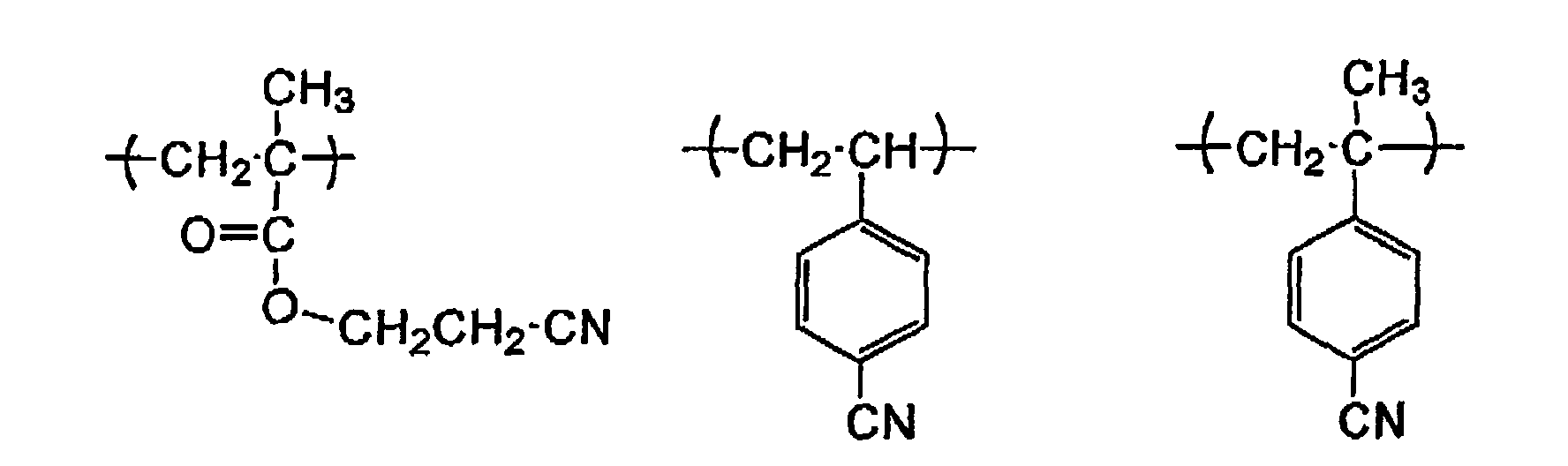
    6. The photoresist composition according to claim 1, for using in F2 laser irradiation.

    7. A pattern making method comprising forming a resist film by using the photoresist composition according to claim 1, exposing the resist film and developing.
    EP04019818A 2003-08-22 2004-08-20 Positive photoresist composition and pattern making method using the same Withdrawn EP1508838A3 (en)

    Applications Claiming Priority (2)

    Application Number Priority Date Filing Date Title
    JP2003298897A JP2005070316A (en) 2003-08-22 2003-08-22 Positive resist composition and pattern making method using same
    JP2003298897 2003-08-22

    Publications (2)

    Publication Number Publication Date
    EP1508838A2 true EP1508838A2 (en) 2005-02-23
    EP1508838A3 EP1508838A3 (en) 2006-06-07

    Family

    ID=34056269

    Family Applications (1)

    Application Number Title Priority Date Filing Date
    EP04019818A Withdrawn EP1508838A3 (en) 2003-08-22 2004-08-20 Positive photoresist composition and pattern making method using the same

    Country Status (3)

    Country Link
    US (1) US7202015B2 (en)
    EP (1) EP1508838A3 (en)
    JP (1) JP2005070316A (en)

    Cited By (1)

    * Cited by examiner, † Cited by third party
    Publication number Priority date Publication date Assignee Title
    WO2006090559A1 (en) * 2005-02-25 2006-08-31 Daikin Industries, Ltd. Resist composition

    Families Citing this family (13)

    * Cited by examiner, † Cited by third party
    Publication number Priority date Publication date Assignee Title
    JP2005336452A (en) * 2004-04-27 2005-12-08 Tokyo Ohka Kogyo Co Ltd Resin for resist composition, negative type resist composition and method for forming resist pattern
    KR100827903B1 (en) * 2004-05-20 2008-05-07 미츠비시 레이온 가부시키가이샤 Methacrylate, polymer and resist composition
    JP4617207B2 (en) * 2005-06-03 2011-01-19 丸善石油化学株式会社 Copolymer, composition and thiol compound for semiconductor lithography
    WO2007066481A1 (en) * 2005-12-05 2007-06-14 Daikin Industries, Ltd. FLUORINE-CONTAINING NORBORNENE DERIVATIVE CONTAINING α,β-UNSATURATED ESTER GROUP OR CURABLE FLUORINE-CONTAINING POLYMER COMPOSITION CONTAINING FLUORINE-CONTAINING NORBORNANE DERIVATIVE
    US8039194B2 (en) * 2008-01-08 2011-10-18 Internatinal Business Machines Corporation Photoacid generators for extreme ultraviolet lithography
    JP5586294B2 (en) * 2009-03-31 2014-09-10 富士フイルム株式会社 Actinic ray-sensitive or radiation-sensitive resin composition, and pattern formation method using the composition
    JP2012031144A (en) * 2010-06-29 2012-02-16 Sumitomo Chemical Co Ltd Compound, resin and resist composition
    JP6326825B2 (en) * 2013-02-18 2018-05-23 住友化学株式会社 Salt, resist composition and method for producing resist pattern
    JP2013241595A (en) * 2013-05-27 2013-12-05 Shin-Etsu Chemical Co Ltd Fluorine-containing monomer, polymer compound, resist material, and method of forming pattern
    JP6059675B2 (en) * 2014-03-24 2017-01-11 信越化学工業株式会社 Chemically amplified negative resist composition and resist pattern forming method
    JP7560947B2 (en) * 2019-03-14 2024-10-03 住友化学株式会社 Resist composition and method for producing resist pattern
    KR102826221B1 (en) * 2020-07-27 2025-06-27 후지필름 가부시키가이샤 Active light-sensitive or radiation-sensitive resin composition, resist film, pattern forming method, method for manufacturing electronic device
    JP7677200B2 (en) * 2021-04-14 2025-05-15 信越化学工業株式会社 Resist material and pattern forming method

    Family Cites Families (12)

    * Cited by examiner, † Cited by third party
    Publication number Priority date Publication date Assignee Title
    WO1997033198A1 (en) * 1996-03-07 1997-09-12 The B.F. Goodrich Company Photoresist compositions comprising polycyclic polymers with acid labile pendant groups
    JP3991462B2 (en) 1997-08-18 2007-10-17 Jsr株式会社 Radiation sensitive resin composition
    JP3955384B2 (en) * 1998-04-08 2007-08-08 Azエレクトロニックマテリアルズ株式会社 Chemically amplified resist composition
    EP1240554A2 (en) 1999-11-17 2002-09-18 E.I. Du Pont De Nemours And Company Nitrile/fluoroalcohol polymer-containing photoresists and associated processes for microlithography
    JP4190167B2 (en) 2000-09-26 2008-12-03 富士フイルム株式会社 Positive resist composition
    JP2002341543A (en) 2001-05-21 2002-11-27 Fuji Photo Film Co Ltd Positive resist composition
    EP1415974B1 (en) 2001-07-12 2017-03-01 Daikin Industries, Ltd. Process for production of fluorine-containing norbornene derivatives
    JP2003057826A (en) 2001-08-21 2003-02-28 Fuji Photo Film Co Ltd Photosensitive resin composition
    EP1319981B1 (en) * 2001-12-13 2012-10-24 FUJIFILM Corporation Positive resist composition
    EP1501877A1 (en) * 2002-05-07 2005-02-02 Honeywell International Inc. Fluorinated polymers
    TWI284779B (en) * 2002-06-07 2007-08-01 Fujifilm Corp Photosensitive resin composition
    JP2005049695A (en) 2003-07-30 2005-02-24 Fuji Photo Film Co Ltd Positive resist composition

    Cited By (1)

    * Cited by examiner, † Cited by third party
    Publication number Priority date Publication date Assignee Title
    WO2006090559A1 (en) * 2005-02-25 2006-08-31 Daikin Industries, Ltd. Resist composition

    Also Published As

    Publication number Publication date
    US20050042543A1 (en) 2005-02-24
    JP2005070316A (en) 2005-03-17
    US7202015B2 (en) 2007-04-10
    EP1508838A3 (en) 2006-06-07

    Similar Documents

    Publication Publication Date Title
    EP1367440B1 (en) Positive-working resist composition
    EP1508838A2 (en) Positive photoresist composition and pattern making method using the same
    US6830871B2 (en) Chemical amplification type resist composition
    JP4056345B2 (en) Positive resist composition
    JP4092153B2 (en) Positive resist composition
    EP1505440A2 (en) Positive resist composition and method of forming resist pattern using the same
    US6811947B2 (en) Positive resist composition
    JP2004029542A (en) Positive resist composition
    JP2004109834A (en) Positive resist composition
    JP2004271843A (en) Positive resist composition
    JP2004101934A (en) Positive resist composition
    JP2004318045A (en) Positive resist composition and method for forming pattern using the same
    US7147987B2 (en) Positive resist composition and pattern formation method using the same
    JP2004271630A (en) Positive type resist composition
    JP2004302200A (en) Positive resist composition
    JP4178007B2 (en) Positive resist composition
    JP2004102264A (en) Chemical amplification type resist composition and pattern forming method using same
    JP2004069921A (en) Positive resist composition
    JP4048529B2 (en) Positive resist composition
    JP2004093768A (en) Positive resist composition
    JP2005099156A (en) Positive photoresist composition and pattern forming method using same
    JP2004318046A (en) Positive resist composition and method for forming pattern using the same
    JP2005099157A (en) Positive photoresist composition and pattern forming method using same
    JP2005062722A (en) Positive resist composition and method for forming pattern by using same
    JP2004226728A (en) Positive resist composition

    Legal Events

    Date Code Title Description
    PUAI Public reference made under article 153(3) epc to a published international application that has entered the european phase

    Free format text: ORIGINAL CODE: 0009012

    AK Designated contracting states

    Kind code of ref document: A2

    Designated state(s): AT BE BG CH CY CZ DE DK EE ES FI FR GB GR HU IE IT LI LU MC NL PL PT RO SE SI SK TR

    AX Request for extension of the european patent

    Extension state: AL HR LT LV MK

    RIN1 Information on inventor provided before grant (corrected)

    Inventor name: SASAKI, TOMOYAC/O FUJI PHOTO FILM CO., LTD.

    Inventor name: MIZUTANI, KAZUYOSHIC/O FUJI PHOTO FILM CO., LTD.

    Inventor name: KANNA, SHINICHIC/O FUJI PHOTO FILM CO., LTD.

    PUAL Search report despatched

    Free format text: ORIGINAL CODE: 0009013

    AK Designated contracting states

    Kind code of ref document: A3

    Designated state(s): AT BE BG CH CY CZ DE DK EE ES FI FR GB GR HU IE IT LI LU MC NL PL PT RO SE SI SK TR

    AX Request for extension of the european patent

    Extension state: AL HR LT LV MK
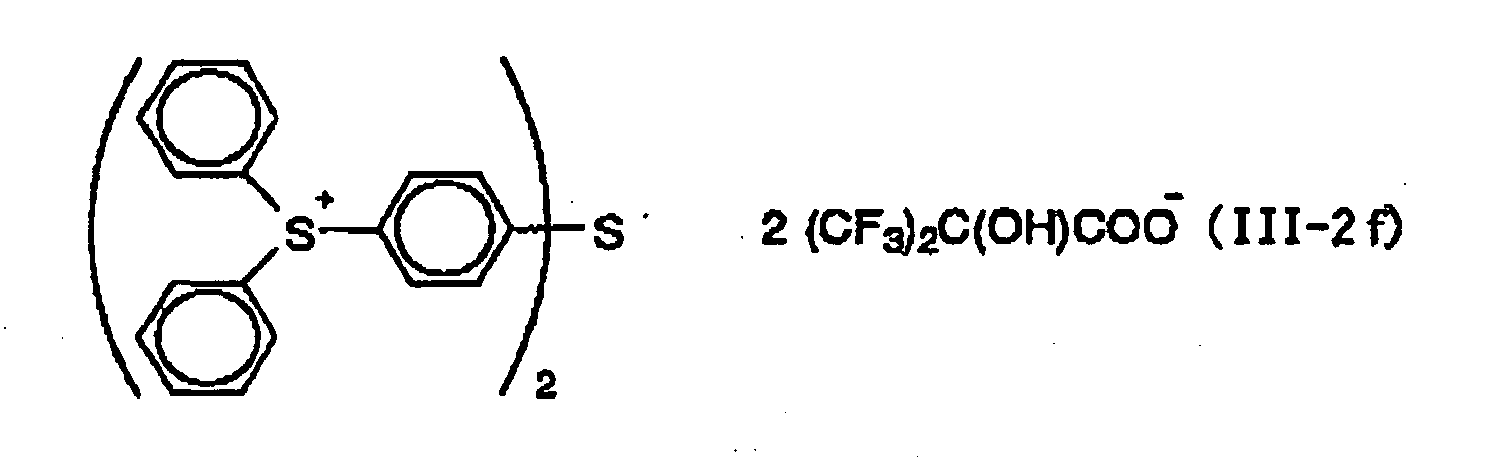
    17P Request for examination filed

    Effective date: 20060928

    AKX Designation fees paid

    Designated state(s): AT BE BG CH CY CZ DE DK EE ES FI FR GB GR HU IE IT LI LU MC NL PL PT RO SE SI SK TR

    RAP1 Party data changed (applicant data changed or rights of an application transferred)

    Owner name: FUJIFILM CORPORATION

    STAA Information on the status of an ep patent application or granted ep patent

    Free format text: STATUS: THE APPLICATION IS DEEMED TO BE WITHDRAWN

    18D Application deemed to be withdrawn

    Effective date: 20140301