EP1506932A1 - Booklet maker - Google Patents
Booklet maker Download PDFInfo
- Publication number
- EP1506932A1 EP1506932A1 EP04254633A EP04254633A EP1506932A1 EP 1506932 A1 EP1506932 A1 EP 1506932A1 EP 04254633 A EP04254633 A EP 04254633A EP 04254633 A EP04254633 A EP 04254633A EP 1506932 A1 EP1506932 A1 EP 1506932A1
- Authority
- EP
- European Patent Office
- Prior art keywords
- crease
- sheets
- booklet
- roll
- nip
- Prior art date
- Legal status (The legal status is an assumption and is not a legal conclusion. Google has not performed a legal analysis and makes no representation as to the accuracy of the status listed.)
- Granted
Links
- 230000000694 effects Effects 0.000 description 4
- 238000002955 isolation Methods 0.000 description 2
- 230000000295 complement effect Effects 0.000 description 1
- 238000013329 compounding Methods 0.000 description 1
- 238000000034 method Methods 0.000 description 1
- 238000004080 punching Methods 0.000 description 1
Images


Classifications
-
- B—PERFORMING OPERATIONS; TRANSPORTING
- B65—CONVEYING; PACKING; STORING; HANDLING THIN OR FILAMENTARY MATERIAL
- B65H—HANDLING THIN OR FILAMENTARY MATERIAL, e.g. SHEETS, WEBS, CABLES
- B65H45/00—Folding thin material
- B65H45/12—Folding articles or webs with application of pressure to define or form crease lines
- B65H45/18—Oscillating or reciprocating blade folders
-
- B—PERFORMING OPERATIONS; TRANSPORTING
- B65—CONVEYING; PACKING; STORING; HANDLING THIN OR FILAMENTARY MATERIAL
- B65H—HANDLING THIN OR FILAMENTARY MATERIAL, e.g. SHEETS, WEBS, CABLES
- B65H2403/00—Power transmission; Driving means
- B65H2403/40—Toothed gearings
-
- B—PERFORMING OPERATIONS; TRANSPORTING
- B65—CONVEYING; PACKING; STORING; HANDLING THIN OR FILAMENTARY MATERIAL
- B65H—HANDLING THIN OR FILAMENTARY MATERIAL, e.g. SHEETS, WEBS, CABLES
- B65H2403/00—Power transmission; Driving means
- B65H2403/70—Clutches; Couplings
- B65H2403/72—Clutches, brakes, e.g. one-way clutch +F204
Definitions
- the present disclosure relates to automated booklet makers, in which sheets forming a booklet are folded by passing through a pair of crease rolls.
- Booklet makers are well-known devices for forming folded booklets which are stapled along the crease thereof. It is becoming common to include booklet makers in conjunction with office-range copiers and printers (as used herein, a "copier” will be considered a type of "printer”).
- a booklet maker includes a slot for accumulating signature sheets, as would be produced by a printer. The accumulated sheets, forming the pages of a booklet, are positioned within the stack so that a stapler mechanism and complementary anvil can staple the stack precisely along the intended crease line.
- the creased and stapled sheet sets are then pushed, by a blade, completely through crease rolls, to form the final main fold in the finished booklet.
- the finished booklets are then accumulated in a tray downstream of the crease rolls.
- a practical problem with booklet makers having crease rolls relates to the fact that, when a set of sheets to be folded into a booklet enters the nip formed by the crease rolls, there is a sudden change in frictional coefficient between the crease rolls, especially between the outermost sheet in the folded set (such as forming the cover of the booklet) and the neighboring sheet in the set.
- the change in torque between the crease rolls can result in damage to the outer sheet of the set.
- U.S-A-2,183,714 shows a slip clutch in the context of a machine for folding sheets and U.S-A-5,316,280 shows an example of a current practical booklet maker design.
- an apparatus for folding sheets comprising a first crease roll, disposed on a first axle and a second crease roll, disposed on a second axle.
- the first crease roll and second crease roll are arranged to form a nip therebetween.
- a first drive member is disposed on the first axle, and a second drive member is disposed on the second axle, engaging the first drive member.
- a slip element is operatively disposed between the second drive member and the second axle.
- a method of operating an apparatus for folding sheets including a first roll and a second roll arranged to form a nip therebetween.
- a torque is transmitted from the first roll to the second roll.
- At least one sheet is urged through the nip, thereby folding the sheet.
- the transmitted torque is limited as a result of an effective change in frictional coefficient between the first roll and the second roll.
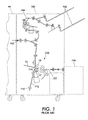
- Figure 1 is a simplified elevational view of a "finisher module,” generally indicated as 100, including a booklet maker, as would be used with an office-range digital printer.
- Printed signature sheets from the printer 99 are accepted in an entry port 102.
- there may be numerous paths such as 104 and numerous output trays 106 for print sheets, corresponding to different desired actions, such as stapling, hole-punching and C- or Z-folding.
- Booklet maker 110 defines a "slot" which is here indicated as 112.
- Slot 112 accumulates signature sheets (sheets each having four page images thereon, for eventual folding into pages of the booklet) from the printer 99. Each sheet is held within slot 112 at a level where a stapler 114 can staple the sheets along a midline of the signatures, the midline corresponding to the eventual crease of the finished booklet.
- a stapler 114 can staple the sheets along a midline of the signatures, the midline corresponding to the eventual crease of the finished booklet.
- an elevator 116 which forms the "floor" of the slot 112 on which the edges of the accumulating sheets rest before they are stapled.
- the elevator 116 is placed at different locations along slot 112 depending on the size of the incoming sheets.
- elevator 116 is moved from its second position to a third position, where the midpoint of the sheets are adjacent a blade 14 and a nip formed by crease rolls 10 and 12.
- the action of blade 14 and crease rolls 10 and 12 performs the final folding, and sharp creasing, of the sheets into the finished booklet.
- Blade 14 contacts the sheet set along the stapled midpoint thereof, and bends the sheet set toward the nip of crease rolls 10 and 12, which draw all the sheets in and form a sharp crease.
- the creased and stapled sheet sets are then drawn, by the rotation of crease rolls 10 and 12, completely through the nip, to form the final main fold in the finished booklet.
- the finished booklets are then conducted along path 122 and collected in a tray 124.
- crease rolls 10 and 12 are shown in isolation in Figure 2.
- crease rolls 10 and 12 generally contact each other along longitudes thereof, shown as nip 16.
- nip 16 When a set of sheets is caused to be creased as described above, the folded set of sheets is drawn through nip 16 by frictional engagement with the crease rolls 10 and 12.
- Each crease roll 10 and 12 shares an axle with a drive gear, shown as 20 and 22 respectively.
- the crease rolls are driven by an external motor, not shown, which drives one of the gears 20 or 22, with the other gear in effect following the driven gear. So, when there are no sheets in nip 16, the two contacting crease rolls 10 and 12 ride on each other, while simultaneously the two gears (or, more broadly, "drive members," which could be for example toothless wheels, or include a pulley arrangement, etc.) act with one gear driving the other.
- the effective circumferences of the gears 20 and 22 must correspond closely to the circumferences of the crease roll 10 and 12: otherwise, there will be a velocity mismatch between the crease rolls and the drive members, causing a shear load along nip 16, resulting in slipping between the crease rolls along nip 16.
- a slip element in the form of a slip clutch 24 in this embodiment, operatively disposed between one of the gears such as 22 and its corresponding crease roll 12.
- the function of such a slip element is to allow a certain required torque to be transmitted from the driven member to the following member, but to limit this transmitted torque so that sudden changes in the frictional coefficient (such as when a set of sheets are acquired by the crease rolls) have a site to slip at instead of between the outermost sheet in the folded set (such as the cover of the booklet) and the neighboring sheet in the set.
- This new slip site prevents the crumpling, tearing, or other damage to the sheet set as mentioned above.
- Figure 3 is a cutaway view
- Figure 4 is an exploded, sectional view, of a slip clutch 24 that can be used with the mechanism of Figure 2, operatively disposed between the gear 22 and the crease roll 12.
- the slip clutch includes a set of what are known as "Belleville washers,” which are concave-convex springable washers arranged in an alternating fashion.
- every other washer 30 is keyed to engage a flat surface 28 in the center axle 26 of roller 12, and alternating washers 32 are keyed to slots 34 on the inner surface of gear 22.
- each washer 30, 32 is substantially disk-shaped, and not semi-circular, as shown.
- the overall effect of the Belleville washers used in this way is that a certain degree of slip is permitted between gear 22 and axle 26, which is rigidly attached to crease roll 22.
- slip clutch Although a mechanical slip clutch is here illustrated, other types of slip clutch or slip element may be used, such as a wrap-spring clutch or a magnetic clutch.
Landscapes
- Folding Of Thin Sheet-Like Materials, Special Discharging Devices, And Others (AREA)
Abstract
Description
- The present disclosure relates to automated booklet makers, in which sheets forming a booklet are folded by passing through a pair of crease rolls.
- Booklet makers are well-known devices for forming folded booklets which are stapled along the crease thereof. It is becoming common to include booklet makers in conjunction with office-range copiers and printers (as used herein, a "copier" will be considered a type of "printer"). In basic form, a booklet maker includes a slot for accumulating signature sheets, as would be produced by a printer. The accumulated sheets, forming the pages of a booklet, are positioned within the stack so that a stapler mechanism and complementary anvil can staple the stack precisely along the intended crease line. In one embodiment, the creased and stapled sheet sets are then pushed, by a blade, completely through crease rolls, to form the final main fold in the finished booklet. The finished booklets are then accumulated in a tray downstream of the crease rolls.
- A practical problem with booklet makers having crease rolls relates to the fact that, when a set of sheets to be folded into a booklet enters the nip formed by the crease rolls, there is a sudden change in frictional coefficient between the crease rolls, especially between the outermost sheet in the folded set (such as forming the cover of the booklet) and the neighboring sheet in the set. The change in torque between the crease rolls can result in damage to the outer sheet of the set.
- U.S-A-2,183,714 shows a slip clutch in the context of a machine for folding sheets and U.S-A-5,316,280 shows an example of a current practical booklet maker design.
- According to one aspect of this invention, there is provided an apparatus for folding sheets, comprising a first crease roll, disposed on a first axle and a second crease roll, disposed on a second axle. The first crease roll and second crease roll are arranged to form a nip therebetween. A first drive member is disposed on the first axle, and a second drive member is disposed on the second axle, engaging the first drive member. A slip element is operatively disposed between the second drive member and the second axle.
- According to another aspect, there is provided a method of operating an apparatus for folding sheets, the apparatus including a first roll and a second roll arranged to form a nip therebetween. A torque is transmitted from the first roll to the second roll. At least one sheet is urged through the nip, thereby folding the sheet. The transmitted torque is limited as a result of an effective change in frictional coefficient between the first roll and the second roll.
- A particular embodiment in accordance with this invention will now be described with reference to the accompanying drawings; in which:-
- Figure 1 is a simplified elevational view of a finisher module used with a mid-range copier or printer;
- Figure 2 shows crease rolls, used in the finisher of Figure 1, with an associated mechanism, in isolation; and,
- Figure 3 is a cutaway view, and Figure 4 is an exploded, partially sectional view, of a slip clutch that can be used with the mechanism of Figure 2.
-
- Figure 1 is a simplified elevational view of a "finisher module," generally indicated as 100, including a booklet maker, as would be used with an office-range digital printer. Printed signature sheets from the
printer 99 are accepted in anentry port 102. Depending on the specific design offinisher module 100, there may be numerous paths such as 104 andnumerous output trays 106 for print sheets, corresponding to different desired actions, such as stapling, hole-punching and C- or Z-folding. It is to be understood that the various rollers and other devices which contact and handle sheets withinfinisher module 100 are driven by various motors, solenoids and other electromechanical devices (not shown), under a control system, such as including a microprocessor (not shown), within thefinisher module 100,printer 99, or elsewhere, in a manner generally familiar in the art. For present purposes what is of interest is the booklet maker generally indicated as 110. -
Booklet maker 110 defines a "slot" which is here indicated as 112.Slot 112 accumulates signature sheets (sheets each having four page images thereon, for eventual folding into pages of the booklet) from theprinter 99. Each sheet is held withinslot 112 at a level where astapler 114 can staple the sheets along a midline of the signatures, the midline corresponding to the eventual crease of the finished booklet. In order to hold sheets of a given size at the desired level relative to thestapler 114, there is provided at the bottom ofslot 112 anelevator 116, which forms the "floor" of theslot 112 on which the edges of the accumulating sheets rest before they are stapled. Theelevator 116 is placed at different locations alongslot 112 depending on the size of the incoming sheets. - As printed signature sheets are output from
printer 99, they accumulate inslot 112. When all of the necessary sheets to form a desired booklet are accumulated inslot 112,elevator 116 is moved from its first position to a second position where the midpoint of the sheets are adjacent thestapler 114.Stapler 114 is activated to place one or more staples along the midpoint of the sheets, where the booklet will eventually be folded. - After the stapling,
elevator 116 is moved from its second position to a third position, where the midpoint of the sheets are adjacent ablade 14 and a nip formed bycrease rolls blade 14 andcrease rolls Blade 14 contacts the sheet set along the stapled midpoint thereof, and bends the sheet set toward the nip ofcrease rolls crease rolls path 122 and collected in atray 124. - Of particular interest to the present disclosure is a mechanism associated with the
crease rolls crease rolls nip 16. When a set of sheets is caused to be creased as described above, the folded set of sheets is drawn throughnip 16 by frictional engagement with thecrease rolls - Each
crease roll gears nip 16, the two contactingcrease rolls gears crease roll 10 and 12: otherwise, there will be a velocity mismatch between the crease rolls and the drive members, causing a shear load alongnip 16, resulting in slipping between the crease rolls alongnip 16. - As mentioned above, when a set of sheets, such as forming a booklet, is pushed through
nip 16, there will be in effect a major change in frictional coefficient between thecrease rolls crease roll nip 16, the effective coefficient of friction betweengears - To address this problem, there is provided a slip element, in the form of a
slip clutch 24 in this embodiment, operatively disposed between one of the gears such as 22 and itscorresponding crease roll 12. The function of such a slip element is to allow a certain required torque to be transmitted from the driven member to the following member, but to limit this transmitted torque so that sudden changes in the frictional coefficient (such as when a set of sheets are acquired by the crease rolls) have a site to slip at instead of between the outermost sheet in the folded set (such as the cover of the booklet) and the neighboring sheet in the set. This new slip site prevents the crumpling, tearing, or other damage to the sheet set as mentioned above. - Figure 3 is a cutaway view, and Figure 4 is an exploded, sectional view, of a
slip clutch 24 that can be used with the mechanism of Figure 2, operatively disposed between thegear 22 and thecrease roll 12. In this embodiment, the slip clutch includes a set of what are known as "Belleville washers," which are concave-convex springable washers arranged in an alternating fashion. As can be seen by comparing the views of Figure 3 and 4, everyother washer 30 is keyed to engage aflat surface 28 in thecenter axle 26 ofroller 12, and alternatingwashers 32 are keyed toslots 34 on the inner surface ofgear 22. (It will be understood that Figure 4 is a sectional view; in a practical embodiment, eachwasher gear 22 andaxle 26, which is rigidly attached tocrease roll 22. - Although a mechanical slip clutch is here illustrated, other types of slip clutch or slip element may be used, such as a wrap-spring clutch or a magnetic clutch.
Claims (6)
- An apparatus (110) for folding sheets, comprising:a first crease roll (10), disposed on a first axle;a second crease roll (12), disposed on a second axle (26);the first crease roll and second crease roll (10, 12) being arranged to form a nip (16) therebetween;a first drive member (20) disposed on the first axle;a second drive member (22) disposed on the second axle (26), engaging the first drive member (22); and,a slip element (24) operatively disposed between the second drive member (12) and the second axle (26).
- An apparatus according to claim 1, further comprising a movable blade (14) for pushing at least one sheet through the nip (16), thereby folding the sheet.
- An apparatus according to claim 1 and 2, wherein the first drive member is a first gear (22) and the second drive member is a second gear (24) engaging the first gear (22) .
- An apparatus according to any one of the preceding claims, wherein the slip element is a slip clutch (28).
- An apparatus according to claim 4, wherein the slip clutch includes a Belleville washer.
- An apparatus according to claim 4 or 5, wherein the slip clutch includes a stack of Belleville washers (30, 32) alternate ones of which are keyed to the axle (26) and the roll (12).
Applications Claiming Priority (2)
| Application Number | Priority Date | Filing Date | Title |
|---|---|---|---|
| US642410 | 2003-08-15 | ||
| US10/642,410 US6981938B2 (en) | 2003-08-15 | 2003-08-15 | Booklet maker with crease rolls having a slip clutch |
Publications (2)
| Publication Number | Publication Date |
|---|---|
| EP1506932A1 true EP1506932A1 (en) | 2005-02-16 |
| EP1506932B1 EP1506932B1 (en) | 2006-09-27 |
Family
ID=33565294
Family Applications (1)
| Application Number | Title | Priority Date | Filing Date |
|---|---|---|---|
| EP04254633A Expired - Lifetime EP1506932B1 (en) | 2003-08-15 | 2004-08-02 | Booklet maker |
Country Status (4)
| Country | Link |
|---|---|
| US (1) | US6981938B2 (en) |
| EP (1) | EP1506932B1 (en) |
| JP (1) | JP4638186B2 (en) |
| DE (1) | DE602004002532T2 (en) |
Cited By (1)
| Publication number | Priority date | Publication date | Assignee | Title |
|---|---|---|---|---|
| CN102849522A (en) * | 2012-09-14 | 2013-01-02 | 胡和萍 | Driving ratchet device for folding machine |
Families Citing this family (7)
| Publication number | Priority date | Publication date | Assignee | Title |
|---|---|---|---|---|
| JP5097425B2 (en) * | 2007-03-29 | 2012-12-12 | ニスカ株式会社 | Sheet folding apparatus, post-processing apparatus including the same, and image forming system |
| JP4956257B2 (en) * | 2007-03-29 | 2012-06-20 | ニスカ株式会社 | Sheet folding apparatus, post-processing apparatus, and image forming system |
| US7537558B2 (en) * | 2007-06-26 | 2009-05-26 | Xerox Corporation | Bookletmaker nip-idler assist creasing device |
| US8146903B2 (en) * | 2008-10-24 | 2012-04-03 | Xerox Corporation | Booklet maker with spaced crease rollers |
| US8059284B2 (en) * | 2008-10-30 | 2011-11-15 | Xerox Corporation | Automated booklet maker |
| US20100107844A1 (en) * | 2008-11-05 | 2010-05-06 | Xerox Corporation | Automated Hole Punch |
| US10850938B2 (en) | 2017-10-09 | 2020-12-01 | Gpcp Ip Holdings Llc | Mechanical sheet product dispenser |
Citations (5)
| Publication number | Priority date | Publication date | Assignee | Title |
|---|---|---|---|---|
| US3671033A (en) * | 1970-11-23 | 1972-06-20 | Coast Machinery Inc | Machine and method for folding plastic bags and the like |
| US5738620A (en) * | 1995-11-18 | 1998-04-14 | Eastman Kodak Company | Device for folding sheets |
| US6276677B1 (en) * | 1997-12-27 | 2001-08-21 | Canon Kabushiki Kaisha | Sheet bundle folding apparatus with movable push-in member |
| DE10122113A1 (en) * | 2000-05-15 | 2001-11-22 | Heidelberger Druckmasch Ag | Folding machine for paper has folding rollers and cutter shafts mounted between side walls which have corresponding recesses of same size, allowing post-processing devices, e.g. take-up roller, to be fitted |
| JP2004106976A (en) * | 2002-09-17 | 2004-04-08 | Konica Minolta Holdings Inc | Bookbinding device |
Family Cites Families (21)
| Publication number | Priority date | Publication date | Assignee | Title |
|---|---|---|---|---|
| US2183714A (en) * | 1937-05-13 | 1939-12-19 | Telefunken Gmbh | Interference eliminator |
| US2813714A (en) | 1954-01-06 | 1957-11-19 | Pitney Bowes Inc | Sheet feeding and folding device |
| US3627304A (en) * | 1969-07-22 | 1971-12-14 | Eastman Kodak Co | Apparatus for handling continuous strips of material |
| NL7204879A (en) * | 1971-04-22 | 1972-10-24 | ||
| US4023789A (en) * | 1974-02-07 | 1977-05-17 | Scott Paper Company | Method and apparatus for registering, feeding and separating original and copy sheets in a duplicator |
| US3975009A (en) * | 1974-12-23 | 1976-08-17 | Brown Frank H | Machine for folding flexible sheets |
| JP2532507B2 (en) * | 1987-09-10 | 1996-09-11 | 株式会社小森コーポレーション | Chopper folding device |
| NL8902476A (en) * | 1989-10-05 | 1991-05-01 | Hadewe Bv | METHOD AND DEVICE FOR FOLDING SHEETS. |
| JP2756348B2 (en) * | 1990-05-30 | 1998-05-25 | キヤノン株式会社 | Sheet transport device |
| GB9101377D0 (en) | 1991-01-22 | 1991-03-06 | Watkiss Automation Ltd | Stitcher/folder apparatus |
| US5893204A (en) * | 1996-11-12 | 1999-04-13 | Dresser Industries, Inc. | Production process for casting steel-bodied bits |
| JPH08152753A (en) * | 1994-11-30 | 1996-06-11 | Mita Ind Co Ltd | Sheet carrying device for image forming device |
| US5564684A (en) * | 1995-02-27 | 1996-10-15 | Pitney Bowes Inc. | Anti-shingling buckle chute folder system |
| JPH09110234A (en) * | 1995-10-12 | 1997-04-28 | Ricoh Co Ltd | Transfer device |
| US5766122A (en) * | 1995-10-26 | 1998-06-16 | Hamilton; Wade D. | Paper folding apparatus |
| DE19709643C1 (en) * | 1997-03-08 | 1998-07-16 | Boewe Systec Ag | Folding system for paper sheets |
| DE19828300A1 (en) * | 1998-06-25 | 1999-12-30 | Bielomatik Leuze & Co | Transport device for sheet layers, in particular folding device, and method for transporting sheet layers, in particular for producing the fold |
| JP3744234B2 (en) * | 1998-11-10 | 2006-02-08 | コニカミノルタホールディングス株式会社 | Sheet post-processing apparatus and image forming apparatus |
| US6174273B1 (en) * | 1998-12-18 | 2001-01-16 | Ranpak Corp. | Cushioning conversion machine with tension control |
| JP2001019270A (en) * | 1999-07-02 | 2001-01-23 | Canon Aptex Inc | Sheet folding treatment device and picture image formation device furnished with this device |
| CA2351264C (en) * | 2000-06-28 | 2009-11-03 | Grant Muir | Machine for repeatedly folding a sheet of foil to create a layered edge |
-
2003
- 2003-08-15 US US10/642,410 patent/US6981938B2/en not_active Expired - Lifetime
-
2004
- 2004-08-02 EP EP04254633A patent/EP1506932B1/en not_active Expired - Lifetime
- 2004-08-02 DE DE602004002532T patent/DE602004002532T2/en not_active Expired - Lifetime
- 2004-08-10 JP JP2004233243A patent/JP4638186B2/en not_active Expired - Fee Related
Patent Citations (5)
| Publication number | Priority date | Publication date | Assignee | Title |
|---|---|---|---|---|
| US3671033A (en) * | 1970-11-23 | 1972-06-20 | Coast Machinery Inc | Machine and method for folding plastic bags and the like |
| US5738620A (en) * | 1995-11-18 | 1998-04-14 | Eastman Kodak Company | Device for folding sheets |
| US6276677B1 (en) * | 1997-12-27 | 2001-08-21 | Canon Kabushiki Kaisha | Sheet bundle folding apparatus with movable push-in member |
| DE10122113A1 (en) * | 2000-05-15 | 2001-11-22 | Heidelberger Druckmasch Ag | Folding machine for paper has folding rollers and cutter shafts mounted between side walls which have corresponding recesses of same size, allowing post-processing devices, e.g. take-up roller, to be fitted |
| JP2004106976A (en) * | 2002-09-17 | 2004-04-08 | Konica Minolta Holdings Inc | Bookbinding device |
Non-Patent Citations (1)
| Title |
|---|
| PATENT ABSTRACTS OF JAPAN vol. 2003, no. 12 5 December 2003 (2003-12-05) * |
Cited By (1)
| Publication number | Priority date | Publication date | Assignee | Title |
|---|---|---|---|---|
| CN102849522A (en) * | 2012-09-14 | 2013-01-02 | 胡和萍 | Driving ratchet device for folding machine |
Also Published As
| Publication number | Publication date |
|---|---|
| DE602004002532T2 (en) | 2007-04-05 |
| US6981938B2 (en) | 2006-01-03 |
| JP2005060113A (en) | 2005-03-10 |
| DE602004002532D1 (en) | 2006-11-09 |
| JP4638186B2 (en) | 2011-02-23 |
| EP1506932B1 (en) | 2006-09-27 |
| US20050037908A1 (en) | 2005-02-17 |
Similar Documents
| Publication | Publication Date | Title |
|---|---|---|
| EP1506879B1 (en) | Booklet maker | |
| US20040188911A1 (en) | Booklet maker with contact member | |
| US8876107B2 (en) | Sheet stacking device, image forming system, and sheet stacking method | |
| JP5511446B2 (en) | Sheet processing apparatus and image forming apparatus | |
| EP1970337B1 (en) | Vertical Sheet Compiling Apparatus and Methods of Vertically Compiling Sheets | |
| JP5686177B1 (en) | Sheet folding device, post-processing device, and image forming system | |
| JP5741681B1 (en) | Conveying roll pair, folding device, post-processing device, and image forming system | |
| CN101456498A (en) | Sheet creaser, sheet conveyer, sheet finisher, and image forming apparatus | |
| EP1506932B1 (en) | Booklet maker | |
| JP2009029523A (en) | Folding device, device provided with the same, and folding method | |
| JP2011001172A (en) | Paper post-processing device | |
| US8146903B2 (en) | Booklet maker with spaced crease rollers | |
| EP2295253B1 (en) | Print-medium post-treatment apparatus | |
| EP2096068A2 (en) | Sheet processing apparatus and image forming apparatus | |
| US7537558B2 (en) | Bookletmaker nip-idler assist creasing device | |
| JP4136665B2 (en) | Cutting system for booklet manufacturers with sheet-type cutting | |
| JP5790300B2 (en) | Sheet binding apparatus, post-processing apparatus, and image forming apparatus | |
| US8059284B2 (en) | Automated booklet maker | |
| JP5686178B1 (en) | Sheet folding device, post-processing device, and image forming system | |
| JP2001316033A (en) | Staple unit and device having it | |
| EP1557388A1 (en) | Automated sheet folder or booklet maker which applies sticker closures | |
| JP2005193991A (en) | Paper processing apparatus and image forming system | |
| JP4147024B2 (en) | Paper post-processing device | |
| JP6405839B2 (en) | Sheet folding device, post-processing device, and image forming system | |
| JP6060676B2 (en) | Paper processing apparatus and image forming system |
Legal Events
| Date | Code | Title | Description |
|---|---|---|---|
| PUAI | Public reference made under article 153(3) epc to a published international application that has entered the european phase |
Free format text: ORIGINAL CODE: 0009012 |
|
| AK | Designated contracting states |
Kind code of ref document: A1 Designated state(s): AT BE BG CH CY CZ DE DK EE ES FI FR GB GR HU IE IT LI LU MC NL PL PT RO SE SI SK TR |
|
| AX | Request for extension of the european patent |
Extension state: AL HR LT LV MK |
|
| 17P | Request for examination filed |
Effective date: 20050816 |
|
| AKX | Designation fees paid |
Designated state(s): DE FR GB |
|
| GRAP | Despatch of communication of intention to grant a patent |
Free format text: ORIGINAL CODE: EPIDOSNIGR1 |
|
| GRAS | Grant fee paid |
Free format text: ORIGINAL CODE: EPIDOSNIGR3 |
|
| GRAA | (expected) grant |
Free format text: ORIGINAL CODE: 0009210 |
|
| AK | Designated contracting states |
Kind code of ref document: B1 Designated state(s): DE FR GB |
|
| REG | Reference to a national code |
Ref country code: GB Ref legal event code: FG4D |
|
| REF | Corresponds to: |
Ref document number: 602004002532 Country of ref document: DE Date of ref document: 20061109 Kind code of ref document: P |
|
| ET | Fr: translation filed | ||
| PLBE | No opposition filed within time limit |
Free format text: ORIGINAL CODE: 0009261 |
|
| STAA | Information on the status of an ep patent application or granted ep patent |
Free format text: STATUS: NO OPPOSITION FILED WITHIN TIME LIMIT |
|
| 26N | No opposition filed |
Effective date: 20070628 |
|
| REG | Reference to a national code |
Ref country code: FR Ref legal event code: PLFP Year of fee payment: 13 |
|
| PGFP | Annual fee paid to national office [announced via postgrant information from national office to epo] |
Ref country code: DE Payment date: 20160721 Year of fee payment: 13 Ref country code: GB Payment date: 20160726 Year of fee payment: 13 |
|
| PGFP | Annual fee paid to national office [announced via postgrant information from national office to epo] |
Ref country code: FR Payment date: 20160720 Year of fee payment: 13 |
|
| REG | Reference to a national code |
Ref country code: DE Ref legal event code: R119 Ref document number: 602004002532 Country of ref document: DE |
|
| GBPC | Gb: european patent ceased through non-payment of renewal fee |
Effective date: 20170802 |
|
| REG | Reference to a national code |
Ref country code: FR Ref legal event code: ST Effective date: 20180430 |
|
| PG25 | Lapsed in a contracting state [announced via postgrant information from national office to epo] |
Ref country code: DE Free format text: LAPSE BECAUSE OF NON-PAYMENT OF DUE FEES Effective date: 20180301 Ref country code: GB Free format text: LAPSE BECAUSE OF NON-PAYMENT OF DUE FEES Effective date: 20170802 |
|
| PG25 | Lapsed in a contracting state [announced via postgrant information from national office to epo] |
Ref country code: FR Free format text: LAPSE BECAUSE OF NON-PAYMENT OF DUE FEES Effective date: 20170831 |