EP1506750B1 - Oberschenkelteil einer Hüftgelenkendoprothese - Google Patents
Oberschenkelteil einer Hüftgelenkendoprothese Download PDFInfo
- Publication number
- EP1506750B1 EP1506750B1 EP04014381A EP04014381A EP1506750B1 EP 1506750 B1 EP1506750 B1 EP 1506750B1 EP 04014381 A EP04014381 A EP 04014381A EP 04014381 A EP04014381 A EP 04014381A EP 1506750 B1 EP1506750 B1 EP 1506750B1
- Authority
- EP
- European Patent Office
- Prior art keywords
- shoulders
- proximal
- blade
- lateral
- medial
- Prior art date
- Legal status (The legal status is an assumption and is not a legal conclusion. Google has not performed a legal analysis and makes no representation as to the accuracy of the status listed.)
- Expired - Lifetime
Links
- 210000004394 hip joint Anatomy 0.000 title claims description 8
- 230000001174 ascending effect Effects 0.000 claims description 3
- 210000000988 bone and bone Anatomy 0.000 abstract description 15
- 230000003247 decreasing effect Effects 0.000 abstract description 3
- 230000000295 complement effect Effects 0.000 abstract 1
- 210000000689 upper leg Anatomy 0.000 description 15
- 230000006978 adaptation Effects 0.000 description 5
- 230000000630 rising effect Effects 0.000 description 5
- 230000015572 biosynthetic process Effects 0.000 description 2
- 239000002639 bone cement Substances 0.000 description 2
- 238000002513 implantation Methods 0.000 description 2
- 230000007774 longterm Effects 0.000 description 2
- 230000000750 progressive effect Effects 0.000 description 2
- 238000004873 anchoring Methods 0.000 description 1
- 210000001624 hip Anatomy 0.000 description 1
- 230000002093 peripheral effect Effects 0.000 description 1
- 238000006116 polymerization reaction Methods 0.000 description 1
- 238000007493 shaping process Methods 0.000 description 1
- 230000007704 transition Effects 0.000 description 1
Images

Classifications
-
- A—HUMAN NECESSITIES
- A61—MEDICAL OR VETERINARY SCIENCE; HYGIENE
- A61F—FILTERS IMPLANTABLE INTO BLOOD VESSELS; PROSTHESES; DEVICES PROVIDING PATENCY TO, OR PREVENTING COLLAPSING OF, TUBULAR STRUCTURES OF THE BODY, e.g. STENTS; ORTHOPAEDIC, NURSING OR CONTRACEPTIVE DEVICES; FOMENTATION; TREATMENT OR PROTECTION OF EYES OR EARS; BANDAGES, DRESSINGS OR ABSORBENT PADS; FIRST-AID KITS
- A61F2/00—Filters implantable into blood vessels; Prostheses, i.e. artificial substitutes or replacements for parts of the body; Appliances for connecting them with the body; Devices providing patency to, or preventing collapsing of, tubular structures of the body, e.g. stents
- A61F2/02—Prostheses implantable into the body
- A61F2/30—Joints
- A61F2/32—Joints for the hip
- A61F2/36—Femoral heads ; Femoral endoprostheses
- A61F2/3662—Femoral shafts
- A61F2/367—Proximal or metaphyseal parts of shafts
-
- A—HUMAN NECESSITIES
- A61—MEDICAL OR VETERINARY SCIENCE; HYGIENE
- A61F—FILTERS IMPLANTABLE INTO BLOOD VESSELS; PROSTHESES; DEVICES PROVIDING PATENCY TO, OR PREVENTING COLLAPSING OF, TUBULAR STRUCTURES OF THE BODY, e.g. STENTS; ORTHOPAEDIC, NURSING OR CONTRACEPTIVE DEVICES; FOMENTATION; TREATMENT OR PROTECTION OF EYES OR EARS; BANDAGES, DRESSINGS OR ABSORBENT PADS; FIRST-AID KITS
- A61F2/00—Filters implantable into blood vessels; Prostheses, i.e. artificial substitutes or replacements for parts of the body; Appliances for connecting them with the body; Devices providing patency to, or preventing collapsing of, tubular structures of the body, e.g. stents
- A61F2/02—Prostheses implantable into the body
- A61F2/30—Joints
- A61F2/32—Joints for the hip
- A61F2/36—Femoral heads ; Femoral endoprostheses
-
- A—HUMAN NECESSITIES
- A61—MEDICAL OR VETERINARY SCIENCE; HYGIENE
- A61F—FILTERS IMPLANTABLE INTO BLOOD VESSELS; PROSTHESES; DEVICES PROVIDING PATENCY TO, OR PREVENTING COLLAPSING OF, TUBULAR STRUCTURES OF THE BODY, e.g. STENTS; ORTHOPAEDIC, NURSING OR CONTRACEPTIVE DEVICES; FOMENTATION; TREATMENT OR PROTECTION OF EYES OR EARS; BANDAGES, DRESSINGS OR ABSORBENT PADS; FIRST-AID KITS
- A61F2/00—Filters implantable into blood vessels; Prostheses, i.e. artificial substitutes or replacements for parts of the body; Appliances for connecting them with the body; Devices providing patency to, or preventing collapsing of, tubular structures of the body, e.g. stents
- A61F2/02—Prostheses implantable into the body
- A61F2/30—Joints
- A61F2002/30001—Additional features of subject-matter classified in A61F2/28, A61F2/30 and subgroups thereof
- A61F2002/30316—The prosthesis having different structural features at different locations within the same prosthesis; Connections between prosthetic parts; Special structural features of bone or joint prostheses not otherwise provided for
- A61F2002/30317—The prosthesis having different structural features at different locations within the same prosthesis
- A61F2002/30322—The prosthesis having different structural features at different locations within the same prosthesis differing in surface structures
-
- A—HUMAN NECESSITIES
- A61—MEDICAL OR VETERINARY SCIENCE; HYGIENE
- A61F—FILTERS IMPLANTABLE INTO BLOOD VESSELS; PROSTHESES; DEVICES PROVIDING PATENCY TO, OR PREVENTING COLLAPSING OF, TUBULAR STRUCTURES OF THE BODY, e.g. STENTS; ORTHOPAEDIC, NURSING OR CONTRACEPTIVE DEVICES; FOMENTATION; TREATMENT OR PROTECTION OF EYES OR EARS; BANDAGES, DRESSINGS OR ABSORBENT PADS; FIRST-AID KITS
- A61F2/00—Filters implantable into blood vessels; Prostheses, i.e. artificial substitutes or replacements for parts of the body; Appliances for connecting them with the body; Devices providing patency to, or preventing collapsing of, tubular structures of the body, e.g. stents
- A61F2/02—Prostheses implantable into the body
- A61F2/30—Joints
- A61F2002/30001—Additional features of subject-matter classified in A61F2/28, A61F2/30 and subgroups thereof
- A61F2002/30316—The prosthesis having different structural features at different locations within the same prosthesis; Connections between prosthetic parts; Special structural features of bone or joint prostheses not otherwise provided for
- A61F2002/30329—Connections or couplings between prosthetic parts, e.g. between modular parts; Connecting elements
- A61F2002/30331—Connections or couplings between prosthetic parts, e.g. between modular parts; Connecting elements made by longitudinally pushing a protrusion into a complementarily-shaped recess, e.g. held by friction fit
- A61F2002/30332—Conically- or frustoconically-shaped protrusion and recess
-
- A—HUMAN NECESSITIES
- A61—MEDICAL OR VETERINARY SCIENCE; HYGIENE
- A61F—FILTERS IMPLANTABLE INTO BLOOD VESSELS; PROSTHESES; DEVICES PROVIDING PATENCY TO, OR PREVENTING COLLAPSING OF, TUBULAR STRUCTURES OF THE BODY, e.g. STENTS; ORTHOPAEDIC, NURSING OR CONTRACEPTIVE DEVICES; FOMENTATION; TREATMENT OR PROTECTION OF EYES OR EARS; BANDAGES, DRESSINGS OR ABSORBENT PADS; FIRST-AID KITS
- A61F2/00—Filters implantable into blood vessels; Prostheses, i.e. artificial substitutes or replacements for parts of the body; Appliances for connecting them with the body; Devices providing patency to, or preventing collapsing of, tubular structures of the body, e.g. stents
- A61F2/02—Prostheses implantable into the body
- A61F2/30—Joints
- A61F2/32—Joints for the hip
- A61F2/36—Femoral heads ; Femoral endoprostheses
- A61F2/3609—Femoral heads or necks; Connections of endoprosthetic heads or necks to endoprosthetic femoral shafts
- A61F2002/3625—Necks
-
- A—HUMAN NECESSITIES
- A61—MEDICAL OR VETERINARY SCIENCE; HYGIENE
- A61F—FILTERS IMPLANTABLE INTO BLOOD VESSELS; PROSTHESES; DEVICES PROVIDING PATENCY TO, OR PREVENTING COLLAPSING OF, TUBULAR STRUCTURES OF THE BODY, e.g. STENTS; ORTHOPAEDIC, NURSING OR CONTRACEPTIVE DEVICES; FOMENTATION; TREATMENT OR PROTECTION OF EYES OR EARS; BANDAGES, DRESSINGS OR ABSORBENT PADS; FIRST-AID KITS
- A61F2/00—Filters implantable into blood vessels; Prostheses, i.e. artificial substitutes or replacements for parts of the body; Appliances for connecting them with the body; Devices providing patency to, or preventing collapsing of, tubular structures of the body, e.g. stents
- A61F2/02—Prostheses implantable into the body
- A61F2/30—Joints
- A61F2/32—Joints for the hip
- A61F2/36—Femoral heads ; Femoral endoprostheses
- A61F2/3609—Femoral heads or necks; Connections of endoprosthetic heads or necks to endoprosthetic femoral shafts
- A61F2002/365—Connections of heads to necks
-
- A—HUMAN NECESSITIES
- A61—MEDICAL OR VETERINARY SCIENCE; HYGIENE
- A61F—FILTERS IMPLANTABLE INTO BLOOD VESSELS; PROSTHESES; DEVICES PROVIDING PATENCY TO, OR PREVENTING COLLAPSING OF, TUBULAR STRUCTURES OF THE BODY, e.g. STENTS; ORTHOPAEDIC, NURSING OR CONTRACEPTIVE DEVICES; FOMENTATION; TREATMENT OR PROTECTION OF EYES OR EARS; BANDAGES, DRESSINGS OR ABSORBENT PADS; FIRST-AID KITS
- A61F2/00—Filters implantable into blood vessels; Prostheses, i.e. artificial substitutes or replacements for parts of the body; Appliances for connecting them with the body; Devices providing patency to, or preventing collapsing of, tubular structures of the body, e.g. stents
- A61F2/02—Prostheses implantable into the body
- A61F2/30—Joints
- A61F2/32—Joints for the hip
- A61F2/36—Femoral heads ; Femoral endoprostheses
- A61F2/3662—Femoral shafts
- A61F2002/3678—Geometrical features
- A61F2002/369—Stepped shaft, i.e. having discrete diameter changes
-
- A—HUMAN NECESSITIES
- A61—MEDICAL OR VETERINARY SCIENCE; HYGIENE
- A61F—FILTERS IMPLANTABLE INTO BLOOD VESSELS; PROSTHESES; DEVICES PROVIDING PATENCY TO, OR PREVENTING COLLAPSING OF, TUBULAR STRUCTURES OF THE BODY, e.g. STENTS; ORTHOPAEDIC, NURSING OR CONTRACEPTIVE DEVICES; FOMENTATION; TREATMENT OR PROTECTION OF EYES OR EARS; BANDAGES, DRESSINGS OR ABSORBENT PADS; FIRST-AID KITS
- A61F2220/00—Fixations or connections for prostheses classified in groups A61F2/00 - A61F2/26 or A61F2/82 or A61F9/00 or A61F11/00 or subgroups thereof
- A61F2220/0025—Connections or couplings between prosthetic parts, e.g. between modular parts; Connecting elements
- A61F2220/0033—Connections or couplings between prosthetic parts, e.g. between modular parts; Connecting elements made by longitudinally pushing a protrusion into a complementary-shaped recess, e.g. held by friction fit
-
- A—HUMAN NECESSITIES
- A61—MEDICAL OR VETERINARY SCIENCE; HYGIENE
- A61F—FILTERS IMPLANTABLE INTO BLOOD VESSELS; PROSTHESES; DEVICES PROVIDING PATENCY TO, OR PREVENTING COLLAPSING OF, TUBULAR STRUCTURES OF THE BODY, e.g. STENTS; ORTHOPAEDIC, NURSING OR CONTRACEPTIVE DEVICES; FOMENTATION; TREATMENT OR PROTECTION OF EYES OR EARS; BANDAGES, DRESSINGS OR ABSORBENT PADS; FIRST-AID KITS
- A61F2250/00—Special features of prostheses classified in groups A61F2/00 - A61F2/26 or A61F2/82 or A61F9/00 or A61F11/00 or subgroups thereof
- A61F2250/0014—Special features of prostheses classified in groups A61F2/00 - A61F2/26 or A61F2/82 or A61F9/00 or A61F11/00 or subgroups thereof having different values of a given property or geometrical feature, e.g. mechanical property or material property, at different locations within the same prosthesis
- A61F2250/0026—Special features of prostheses classified in groups A61F2/00 - A61F2/26 or A61F2/82 or A61F9/00 or A61F11/00 or subgroups thereof having different values of a given property or geometrical feature, e.g. mechanical property or material property, at different locations within the same prosthesis differing in surface structures
Definitions
- the invention relates to a femoral part of a hip joint endoprosthesis, with a leaf-like shaft whose cross-section continuously increases from the distal end to the proximal end, stepped heels are formed in the proximal shaft portion, and wherein the step-shaped shoulders extending approximately in the shaft longitudinal direction on at least one of the two leaf sides are formed, and from lateral to medial define an initially rising and then falling down "stairs".
- a thigh part of a hip joint endoprosthesis in which a stepwise increase in the cross section between the medial and the lateral narrow side is provided.
- This grading is realized by means of ventral and dorsal projections, which extend from the proximal end to the distal end of the thigh part.
- This design is intended to increase the contact area between the shaft and the bone cement in order to improve the stability of the prosthesis anchorage. It should thereby avoid dislocations, which are based on polymerization-related reduction in volume of the bone cement.
- an endoprosthesis shaft with a plurality of gradations, which each extend to the entire peripheral region.
- the introduction of the vertical load into the femur is restricted to relatively small areas and primarily to the distal end of the femoral part, while large areas of the proximal shaft end have little function in force introduction.
- the stepped heels are relatively complicated, namely approximately trapezoidal designed with the result that the bone cavity must be pretreated correspondingly complex to ensure a snug fit of the shaft within the bone cavity.
- the increase of the shaft cross section to the proximal shaft end takes place in anterior / dorsal direction in several stages whose medial / lateral width increases from the distal step edge to the proximal shaft end.
- the disadvantage of such an embodiment is the unfavorable shape of the femoral part of the hip joint endoprosthesis in terms of bone anatomy.
- the present invention has for its object to provide a thigh part of the type mentioned, to which the bone cavity of the femur is easily adaptable and which ensures both a high primary stability and long-term stability and also allows large-scale introduction of vertical loads in the bone.
- step-shaped shoulders are formed extending approximately in the longitudinal direction of the shaft on at least one of the two leaf sides and define from lateral to medial an initially rising and then falling again "stairs".
- This constructive shaping requires an adaptation of the bone cavity only in the femoral longitudinal direction.
- no transverse or oblique steps within the bone cavity must be formed by means of a correspondingly complicated rasp. Accordingly, it is also much easier, even for a somewhat inexperienced surgeon achieve a positive fit of the prosthesis within the bone cavity, so that a high primary stability and long-term stability are guaranteed.
- stepped heels on the ventral leaf side of the shaft while the dorsal leaf side forms a flat surface, as this is particularly anatomical.
- the step-like shoulders preferably rise from the leaf plane from distal to proximal, in particular continuously. This makes it possible to achieve a large-scale introduction of vertical forces in the bone. Depending on the slope of the stepped heels, a more or less pronounced "proximal press fit" is achieved.
- the prosthesis according to the invention is particularly well suited for cementless implantation.
- the adaptation of the cavity is done in the same simple manner as for a shaft whose surfaces are smooth-flat.
- step-like heels increase stepwise from distal to proximal. Then the adaptation of the bone cavity is somewhat more complicated. However, this effort must be taken into account if the external conditions require it. However, the simpler embodiment is that with step-like heels that increase continuously from distal to proximal.
- the embodiment with stepped shoulders is emphasized, the width of which is constant from distal to proximal.
- This embodiment allows a “readjustment” of the stem upon change of the "pressfit” due to a change in bone structure, especially in elderly patients.
- This "Nachtures” an advantageous secondary stability is achieved and a loosening of the shaft, especially in the distal region of the same, even after a long time of implantation avoided.
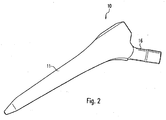
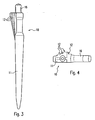
- a femoral part 10 of a hip joint endoprosthesis which has a leaf-like shaft, the cross section of which increases continuously from the distal end to the proximal end (see Fig. 1 and 2 such as Fig. 3 ).
- proximal shaft area are on the ventral side ( Fig. 1 ) stepped steps 12, and in each case approximately in the shaft longitudinal direction, ie extending parallel to the shaft longitudinal center axis 13.
- These step-shaped shoulders 12 define from lateral to medial an initially rising and then falling down "stairs".
- the from lateral to medial Rising stair section is denoted by the reference numeral 14, and the sloping from lateral to medial stair section is designated by the reference numeral 15.
- stepped shoulders 12 each rise from the leaf level from distal to proximal, each linear. It is also conceivable a slightly progressive increase according to the contour of a parabolic or hyper-load or elliptical section.
- Fig. 1 shows that the staircase defined by the step-like shoulders 12 from lateral to the shaft longitudinal center axis 13, in accordance with Fig. 1 even slightly beyond that, increases, then drops off medially again.
- Corresponding Fig. 2 is the dorsal or posterior side of the shaft 11 formed as a flat surface.
- the laterally-medially ascending stairway section 14 has more, namely, three steps than the descending stair section 15, which in the illustrated embodiment comprises only two steps.
- the highest or step-shaped step 12 which is the highest in relation to the leaf level, has the comparatively largest width. Moreover, the width of the stepped shoulders 12 is constant from distal to proximal. The step-shaped shoulders 12 are thus formed strip-shaped from distal to proximal.
- the step height of the stepped steps 12 is preferably equal in each case. However, it may be advantageous to progressively increase the step height from lateral to medial in the region of the ascending stair section 14 and decreasing in the region of the descending stair section 15 in a decreasing manner. Ultimately, this depends on the anatomical conditions of the patient. Moreover, the step-shaped shoulders 12 are formed rising both on the lateral and medial side of each of the leaf level. That is, the lowest one Stage extends in the plane of the page, from which, starting from the stepped heels in the direction of the shaft longitudinal center axis 13 rise.
- the step-shaped shoulders extend approximately parallel to the page level.
- the flat sides of the shoulders 12 are each formed slightly increasing towards the shaft longitudinal center axis 13, either linear or progressive. It is also conceivable to reduce stress peaks to form rounded transitions in the step area.
- a plug-in cone 16 is formed, which is aligned with respect to the shaft longitudinal center axis 13 to the so-called. CCD angle inclined.
- the plug-in cone 16 serves to attach a prosthesis head (not shown) with a corresponding conical recess and thus to be able to fix it firmly and firmly on the femoral part.
- a prosthesis neck with a subsequent prosthesis head in one piece at the proximal end of the shaft.
Landscapes
- Health & Medical Sciences (AREA)
- Orthopedic Medicine & Surgery (AREA)
- Cardiology (AREA)
- Oral & Maxillofacial Surgery (AREA)
- Transplantation (AREA)
- Engineering & Computer Science (AREA)
- Biomedical Technology (AREA)
- Heart & Thoracic Surgery (AREA)
- Vascular Medicine (AREA)
- Life Sciences & Earth Sciences (AREA)
- Animal Behavior & Ethology (AREA)
- General Health & Medical Sciences (AREA)
- Public Health (AREA)
- Veterinary Medicine (AREA)
- Prostheses (AREA)
Description
- Die Erfindung betrifft ein Oberschenkelteil einer Hüftgelenkendoprothese, mit einem blattartigen Schaft, dessen Querschnitt vom distalen Ende zum proximalen Ende hin ständig zunimmt, wobei im proximalen Schaftbereich stufenförmige Absätze ausgebildet sind, und wobei die stufenförmigen Absätze sich etwa in Schaftlängsrichtung erstreckend an wenigstens einer der beiden Blattseiten ausgebildet sind, und von lateral nach medial eine zunächst ansteigende und dann wieder abfallende "Treppe" definieren.
- Aus der
EP 0 112 435 A1 ist ein Oberschenkelteil einer Hüftgelenkendoprothese bekannt, bei dem eine stufenweise Zunahme des Querschnitts zwischen der medialen und der lateralen Schmalseite vorgesehen ist. Diese Stufung ist mittels ventraler und dorsaler Anformungen realisiert, die vom proximalen Ende bis zum distalen Ende des Oberschenkelteils reichen. Durch diese Ausbildung ist beabsichtigt, eine Vergrößerung der Kontaktfläche zwischen Schaft und Knochenzement zu erreichen, um die Stabilität der Prothesenverankerung zu verbessern. Es sollen dadurch Luxationen vermieden, die auf polymerisationsbedingter Volumenverkleinerung des Knochenzements beruhen. Jedoch ist mittels dieses bekannten, stützkragenfreien Oberschenkelteils keine allen Anforderungen genügende Einleitung der vertikalen Last von der Hüfte in den Femur möglich, da die am distalen Schaftende vorgesehenen auslaufenden Erhebungen der ventralen/dorsalen Anformungen nicht als mit entsprechend konformen Ausnehmungen im Femur korrespondierende Stufen ausgebildet sind. - Aus der
DE 33 10 486 A1 ist ein Endoprothesenschaft mit einer Vielzahl von Stufungen bekannt, welche sich jeweils auf den gesamten Umfangsbereich erstrecken. Bei dieser Ausführungsform ist die Einleitung der vertikalen Last in den Femur auf relativ kleine Flächen und vornehmlich auf das distale Ende des Oberschenkelteils beschränkt, während große Flächen des proximalen Schaftendes nur eine geringe Funktion bei der Krafteinleitung übernehmen. - Weiter sei noch auf die
DE 195 47 638 C2 verwiesen, die ein Oberschenkelteil einer Hüftgelenkendoprothese mit einem Schaft beschreibt, dessen Querschnitt vom distalen Schaftende zum proximalen Schaftende hin ständig zunimmt und im proximalen Schaftbereich in medial/lateraler Richtung oval gestreckt ist. Im proximalen Schaftbereich erfolgt zum proximalen Schaftende hin die Zunahme des Querschnitts in ventral/dorsaler Richtung in mehreren Stufen, deren medial/laterale Breite von der distalen Stufenkante zum proximalen Schaftende hin zunimmt. Damit soll die formschlüssige Einleitung der vertikalen Last in den Femurknochen mit ausreichend großen Stützflächen realisiert werden. - Die stufenförmigen Absätze sind jedoch relativ kompliziert, nämlich etwa trapezförmig gestaltet mit der Folge, dass der Knochenhohlraum entsprechend aufwendig vorbehandelt werden muß, um einen Passsitz des Schaftes innerhalb des Knochenhohlraumes sicherzustellen.
- Schließlich zeigt die
DE 195 47 683 A1 einen Oberschenkelteil einer Hüftgelenkendoprothese gemäß dem Oberbegriff von Anspruch 1, der einen Schaft aufweist, dessen Querschnitt vom distalen Schaftende zum proximalen Schaftende hin ständig zunimmt und im proximalen Schaftbereich in medial/lateraler Richtung oval gestreckt ist. Zur verbesserten Verankerung des Oberschenkelteils in einem natürlichen Femurknochen erfolgt die Zunahme des Schaftquerschnitts zum proximalen Schaftende hin in ventral/dorsaler Richtung in mehreren Stufen, deren medial/laterale Breite von der distalen Stufenkante zum proximalen Schaftende hin zunimmt. Nachteil einer solchen Ausführungsform ist jedoch die hinsichtlich der Knochenanatomie unvorteilhafte Form des Oberschenkelteils der Hüftgelenkendoprothese. - Der vorliegenden Erfindung liegt die Aufgabe zugrunde, ein Oberschenkelteil der eingangs genannten Art zu schaffen, an das der Knochenhohlraum des Femurs einfach anpassbar ist und das sowohl eine hohe Primärstabilität als auch Langzeitstabilität sicherstellt und außerdem eine großflächige Einleitung vertikaler Lasten in den Knochen ermöglicht.
- Diese Aufgabe wird erfindungsgemäß durch die kennzeichnenden Merkmale des Anspruches 1 gelöst.
- Ein wesentlicher Punkt der vorliegenden Erfindung besteht also darin, dass die stufenförmigen Absätze sich etwa in Schaftlängsrichtung erstreckend an wenigstens einer der beiden Blattseiten ausgebildet sind und von lateral nach medial eine zunächst ansteigende und dann wieder abfallende "Treppe" definieren. Diese konstruktive Formgebung bedarf eine Anpassung des Knochenhohlraums nur in Femurlängsrichtung. Es müssen also keine Quer- oder Schrägstufen innerhalb des Knochenhohlraums mittels einer entsprechend komplizierten Raspel ausgebildet werden. Dementsprechend lässt sich auch wesentlich leichter, und zwar auch für einen etwas ungeübteren Operateur ein formschlüssiger Halt der Prothese innerhalb des Knochenhohlraums erreichen, so dass eine hohe Primärstabilität sowie auch Langzeitstabilität gewährleistet sind. Besonders hervorzuheben ist dabei noch die Ausbildung von stufenförmigen Absätzen an der ventralen Blattseite des Schaftes, während die dorsale Blattseite eine ebene Fläche bildet, da dies besonders anatomiegerecht ist.
- Vorzugsweise steigen die stufenförmigen Absätze jeweils aus der Blattebene heraus von distal nach proximal an, und zwar insbesondere kontinuierlich. Damit lässt sich eine großflächige Einleitung vertikaler Kräfte in den Knochen erzielen. Abhängig von der Steigung der stufenförmigen Absätze wird ein mehr oder weniger ausgeprägter "proximaler Pressfit" erreicht. Die erfindungsgemäße Prothese eignet sich besonders gut für ein zementloses Implantieren. Wie bereits erwähnt, ist die Ausbildung bzw. Anpassung des Knochenhohlraums an die stufenförmigen Absätze des erfindungsgemäßen Oberschenkelteils mit einer entsprechend ausgebildeten Raspel in einfacher Weise möglich. Die Arbeitsbewegung der Raspel erfolgt lediglich in axialer Richtung, ohne dass auf die Positionierung horizontaler oder schräger Stufen geachtet werden muß. Die Anpassung des Hohlraumes geschieht in gleicher einfacher Weise wie für einen Schaft, dessen Oberflächen glatt-eben ausgebildet sind.
- Bei Bedarf ist es jedoch auch denkbar, dass die stufenförmigen Absätze von distal nach proximal stufenförmig ansteigen. Dann ist die Anpassung des Knochenhohlraums etwas aufwendiger. Dieser Aufwand muß jedoch dann in Kauf genommen werden, wenn die äußeren Gegebenheiten dies erfordern. Die einfachere Ausführungsform stellt jedoch diejenige mit kontinuierlich von distal nach proximal ansteigenden stufenförmigen Absätze dar.
- Weitere konstruktive Details und vorteilhafte Ausführungen sind in den Unteransprüchen beschrieben.
- Bezüglich der Anpassung des Knochenhohlraumes ist dabei die Ausführungsform mit stufenförmigen Absätzen hervorzuheben, deren Breite von distal nach proximal jeweils konstant ist.
- Diese Ausführungsform erlaubt ein "Nachsetzen" des Schaftes bei Änderung des "pressfit's" aufgrund einer Änderung der Knochenstruktur, insbesondere bei älteren Patienten. Durch dieses "Nachsetzen" wird eine vorteilhafte Sekundärstabilität erreicht und einer Lockerung des Schaftes, insbesondere im distalen Bereich desselben, auch nach längerer Zeit der Implantation vermieden.
- Nachstehend wird eine bevorzugte Ausführungsform eines erfindungsgemäß ausgebildeten Oberschenkelteils anhand der beigefügten Zeichnung näher erläutert. Diese zeigt in:
- Fig. 1
- Die Ansicht eines erfindungsgemäß ausgebildeten Oberschenkelteils in Ansicht von ventral bzw. anterior;
- Fig. 2
- das Oberschenkelteil gemäß
Fig. 1 in Ansicht von dorsal bzw. posterior; - Fig. 3
- den Schaft gemäß den
Fig. 1 und2 in Ansicht von lateral; und - Fig. 4
- den Schaft gemäß den vorstehenden Figuren in Ansicht von proximal nach distal.
- In den
Fig. 1-4 ist ein Ausführungsbeispiel eines erfindungsgemäßen Oberschenkelteils 10 einer Hüftgelenkendoprothese dargestellt, welches einen blattartigen Schaft aufweist, dessen Querschnitt vom distalen Ende zum proximalen Ende hin ständig zunimmt (sieheFig. 1 und2 sowieFig. 3 ). Im proximalen Schaftbereich sind an der ventralen Seite (Fig. 1 ) stufenförmige Absätze 12 ausgebildet, und zwar sich jeweils etwa in Schaftlängsrichtung, d.h. parallel zur Schaftlängsmittenachse 13 erstreckend. Diese stufenförmigen Absätze 12 definieren von lateral nach medial eine zunächst ansteigende und dann wieder abfallende "Treppe". Der von lateral nach medial ansteigende Treppenabschnitt ist mit der Bezugsziffer 14, und der von lateral nach medial abfallende Treppenabschnitt ist mit der Bezugsziffer 15 gekennzeichnet. - Des weiteren lassen die anliegenden Figuren, insbesondere auch
Fig. 3 erkennen, dass die stufenförmigen Absätze 12 jeweils aus der Blattebene heraus von distal nach proximal ansteigen, und zwar jeweils linear. Denkbar ist auch ein leicht progressiver Anstieg entsprechend der Kontur eines Parabel- oder Hyperbelastes oder auch Ellipsen-Abschnitts. - Die
Fig. 1 läßt erkennen, dass die durch die stufenförmigen Absätze 12 definierte Treppe von lateral bis zur Schaftlängsmittenachse 13, und zwar gemäßFig. 1 sogar geringfügig darüber hinaus, ansteigt, um dann nach medial wieder abzufallen. - Entsprechend
Fig. 2 ist die dorsale bzw. posteriore Seite des Schaftes 11 als ebene Fläche ausgebildet. - Bei der dargestellten Ausführungsform weist der von lateral nach medial ansteigende Treppenabschnitt 14 mehr, nämlich drei Stufen aus als der abfallende Treppenabschnitt 15, der bei der dargestellten Ausführungsform nur zwei Stufen umfaßt.
- Entsprechend
Fig. 1 weist des weiteren der höchste bzw. gegenüber der Blattebene erhabenste stufenförmige Absatz 12 die vergleichsweise größte Breite auf. Im übrigen ist die Breite der stufenförmigen Absätze 12 von distal nach proximal jeweils konstant. Die stufenförmigen Absätze 12 sind also von distal nach proximal streifenförmig ausgebildet. - Die Stufenhöhe der stufenförmigen Absätze 12 ist vorzugsweise jeweils gleich bemessen. Es kann jedoch vorteilhaft sein, die Stufenhöhe von lateral nach medial im Bereich des ansteigenden Treppenabschnitts 14 progressiv zunehmend und im Bereich des abfallenden Treppenabschnitts 15 degressiv abnehmend zu bemessen. Letztlich hängt dies von den anatomischen Gegebenheiten des Patienten ab. Im übrigen sind die stufenförmigen Absätze 12 sowohl an der lateralen als auch medialen Seite jeweils aus der Blattebene heraus ansteigend ausgebildet. Das heißt, die jeweils unterste Stufe erstreckt sich in der Blattebene, von der dann ausgehend die stufenförmigen Absätze in Richtung zur Schaftlängsmittenachse 13 hin ansteigen.
- Entsprechend den
Figuren 3 und 4 erstrecken sich die stufenförmigen Absätze etwa parallel zur Blattebene. Es ist jedoch auch denkbar, dass die Flachseiten der Absätze 12 zur Schaftlängsmittenachse 13 hin jeweils geringfügig ansteigend ausgebildet sind, und zwar entweder linear oder progressiv. Auch ist es zum Abbau von Spannungsspitzen denkbar, die Übergänge im Stufenbereich abgerundet auszubilden. - Zu dem in den
Figuren 1-4 dargestellten Schaft sei noch erwähnt, dass am proximalen Schaftende ein Steckkonus 16 angeformt ist, der gegenüber der Schaftlängsmittenachse 13 um den sog. CCD-Winkel geneigt ausgerichtet ist. Der Steckkonus 16 dient dazu, einen Prothesenkopf (nicht dargestellt) mit entsprechender Konusausnehmung aufstecken und somit klemmend und fest am Oberschenkelteil befestigen zu können. Alternativ ist es auch möglich, am proximalen Ende des Schaftes einen Prothesenhals mit anschließendem Prothesenkopf einstückig anzuformen. - Sämtliche in den Anmeldungsunterlagen offenbarten Merkmale werden als erfindungswesentlich beansprucht, soweit sie einzeln oder in Kombination gegenüber dem Stand der Technik neu sind.
-
- 10
- Oberschenkelteil
- 11
- Schaft
- 12
- stufenförmige Absätze
- 13
- Schaftlängsmittenachse
- 14
- lateralseitiger Treppenabschnitt
- 15
- medialseitiger Treppenabschnitt
- 16
- Steckkonus
Claims (9)
- Oberschenkelteil (10) einer Hüftgelenkendoprothese, mit einem blattartigen Schaft (11), dessen Querschnitt vom distalen zum proximalen Ende hin ständig zunimmt, wobei im proximalen Schaftbereich stufenförmige Absätze (12) ausgebildet sind, und wobei
die stufenförmigen Absätze (12) sich etwa in Schaftlängsrichtung erstreckend an wenigstens einer der beiden Blattseiten ausgebildet sind, und von lateral nach medial eine zunächst ansteigende (14) und dann wieder abfallende "Treppe" (15) definieren,
dadurch gekennzeichnet, dass
die stufenförmigen Absätze (12) nur an der ventralen Blattseite des Schaftes (11) ausgebildet sind, während die dorsale Blattseite eine ebene Fläche bildet. - Oberschenkelteil nach Anspruch 1,
dadurch gekennzeichnet, dass
die stufenförmigen Absätze (12) jeweils aus der Blattebene heraus von distal nach proximal ansteigen. - Oberschenkelteil nach Anspruch 2,
dadurch gekennzeichnet, dass
die stufenförmigen Absätze (12) von distal nach proximal entweder stufenförmig oder kontinuierlich, und dabei jeweils entweder linear oder progressiv ansteigen. - Oberschenkelteil nach einem der Ansprüche 1 bis 3,
dadurch gekennzeichnet, dass
die durch die stufenförmigen Absätze (12) definierte "Treppe" von lateral bis zur Schaftlängsmittenachse (13) oder geringfügig darüber hinaus ansteigt, um dann nach medial wieder abzufallen. - Oberschenkelteil nach einem der Ansprüche 1 bis 4,
dadurch gekennzeichnet, dass
der von lateral nach medial ansteigende Treppenabschnitt (14) mehr, insbesondere drei Stufen aufweist, als der von lateral nach medial abfallende Treppenabschnitt (15). - Oberschenkelteil nach einem der Ansprüche 1 bis 5,
dadurch gekennzeichnet, dass
der höchste bzw. gegenüber der Blattebene erhabenste stufenförmige Absatz (12) die vergleichsweise größte Breite aufweist. - Oberschenkelteil nach einem der Ansprüche 1 bis 6,
dadurch gekennzeichnet, dass
die Stufenhöhe der stufenförmigen Absätze (12) jeweils gleich, oder alternativ von lateral nach medial im Bereich des ansteigenden Treppenabschnitts (14) progressiv zunehmend und im Bereich des abfallenden Treppenabschnitts (15) degressiv abnehmend bemessen ist. - Oberschenkelteil nach einem der Ansprüche 1 bis 7,
dadurch gekennzeichnet, dass
die stufenförmigen Absätze (12) lateral und medial jeweils aus der Blattebene heraus in Richtung zur Schaftlängsmittenachse (13) hin ansteigend ausgebildet sind. - Oberschenkelteil nach einem der Ansprüche 1 bis 8,
dadurch gekennzeichnet, dass
die Breite der stufenförmigen Absätze (12) von distal nach proximal jeweils konstant ist.
Applications Claiming Priority (2)
| Application Number | Priority Date | Filing Date | Title |
|---|---|---|---|
| DE10329673A DE10329673A1 (de) | 2003-07-01 | 2003-07-01 | Oberschenkelteil einer Hüftgelenkendoprothese |
| DE10329673 | 2003-07-01 |
Publications (3)
| Publication Number | Publication Date |
|---|---|
| EP1506750A2 EP1506750A2 (de) | 2005-02-16 |
| EP1506750A3 EP1506750A3 (de) | 2005-08-03 |
| EP1506750B1 true EP1506750B1 (de) | 2009-04-22 |
Family
ID=33546791
Family Applications (1)
| Application Number | Title | Priority Date | Filing Date |
|---|---|---|---|
| EP04014381A Expired - Lifetime EP1506750B1 (de) | 2003-07-01 | 2004-06-18 | Oberschenkelteil einer Hüftgelenkendoprothese |
Country Status (3)
| Country | Link |
|---|---|
| EP (1) | EP1506750B1 (de) |
| AT (1) | ATE429195T1 (de) |
| DE (2) | DE10329673A1 (de) |
Family Cites Families (5)
| Publication number | Priority date | Publication date | Assignee | Title |
|---|---|---|---|---|
| DE3213434C1 (de) | 1982-04-10 | 1983-10-27 | Günther Dr.med. 7400 Tübingen Aldinger | Verfahren zur Herstellung individuell gestalteter Endoprothesen oder Implantate |
| CH656797A5 (de) * | 1982-12-20 | 1986-07-31 | Sulzer Ag | Femurkopfprothese. |
| CH676664A5 (de) * | 1989-01-10 | 1991-02-28 | Sulzer Ag | |
| DE4428099C5 (de) * | 1994-08-09 | 2004-12-30 | Moos, Norbert, Dr. | Mit Knochenzement befestigbare Hüftkopf-Schaft-Endoprothese |
| DE19547638C2 (de) * | 1995-12-20 | 1998-05-14 | Zimmer Ltd | Oberschenkelteil einer Hüftgelenkendoprothese |
-
2003
- 2003-07-01 DE DE10329673A patent/DE10329673A1/de not_active Withdrawn
-
2004
- 2004-06-18 EP EP04014381A patent/EP1506750B1/de not_active Expired - Lifetime
- 2004-06-18 AT AT04014381T patent/ATE429195T1/de active
- 2004-06-18 DE DE502004009383T patent/DE502004009383D1/de not_active Expired - Lifetime
Also Published As
| Publication number | Publication date |
|---|---|
| DE502004009383D1 (de) | 2009-06-04 |
| EP1506750A2 (de) | 2005-02-16 |
| ATE429195T1 (de) | 2009-05-15 |
| EP1506750A3 (de) | 2005-08-03 |
| DE10329673A1 (de) | 2005-01-27 |
Similar Documents
| Publication | Publication Date | Title |
|---|---|---|
| EP0135755B1 (de) | Schaft für eine Hüftgelenkprothese | |
| EP0131178B1 (de) | Hüftgelenk-Endoprothese mit einem im Oberschenkelknochen zu verankernden Schaft | |
| EP0159462B1 (de) | Femurale Totalendoprothese für ein Hüftgelenk | |
| AT390183B (de) | Knochenimplantat fuer endoprothesen | |
| DE60012352T2 (de) | Implantat | |
| EP0085147B1 (de) | Gerader, blattartiger Schaft für eine Gelenkendoprothese | |
| CH666178A5 (de) | Femurkopfprothese. | |
| DE3216539A1 (de) | Knochenenimplantat, insbesondere femorale hueftgelenkprothese | |
| EP1062923A2 (de) | Hüftgelenk-Endoprothesensystem | |
| DE9216092U1 (de) | Scheibenförmiges Implantat zum Versteifen benachbarter Wirbelknochen | |
| EP0942691A1 (de) | Femurkomponente einer huftgelenk-endoprothese | |
| CH675827A5 (de) | ||
| EP0163042A1 (de) | Femorale Hüftgelenkendoprothese | |
| EP0027160A2 (de) | Hüftgelenkprothese | |
| DE69630102T2 (de) | Femurteil einer Hüftgelenkendoprothese | |
| DE3426947A1 (de) | Selbsthaftendes, zementlos implantierbares hueftschaft-implantat | |
| EP1438933B1 (de) | Hüftprothese mit einem in den Markkanal des Oberschenkelknochens zu verankernden Schaft | |
| EP0669116A1 (de) | Oberschenkelteil für eine Hüftgelenk-Endoprothese | |
| CH656797A5 (de) | Femurkopfprothese. | |
| DE3737372A1 (de) | Implantierbare hueftgelenksprothese | |
| DE8324860U1 (de) | Hüftgelenk-Prothesenpfanne | |
| EP0238860A2 (de) | Femurale Totalendoprothese für ein Hüftgelenk | |
| DE3819948C2 (de) | ||
| EP1506750A2 (de) | Oberschenkelteil einer Hüftgelenkendoprothese | |
| DE8337293U1 (de) | Prothetisches Zwischenstück für einen Knochen |
Legal Events
| Date | Code | Title | Description |
|---|---|---|---|
| PUAI | Public reference made under article 153(3) epc to a published international application that has entered the european phase |
Free format text: ORIGINAL CODE: 0009012 |
|
| AK | Designated contracting states |
Kind code of ref document: A2 Designated state(s): AT BE BG CH CY CZ DE DK EE ES FI FR GB GR HU IE IT LI LU MC NL PL PT RO SE SI SK TR |
|
| AX | Request for extension of the european patent |
Extension state: AL HR LT LV MK |
|
| PUAL | Search report despatched |
Free format text: ORIGINAL CODE: 0009013 |
|
| AK | Designated contracting states |
Kind code of ref document: A3 Designated state(s): AT BE BG CH CY CZ DE DK EE ES FI FR GB GR HU IE IT LI LU MC NL PL PT RO SE SI SK TR |
|
| AX | Request for extension of the european patent |
Extension state: AL HR LT LV MK |
|
| 17P | Request for examination filed |
Effective date: 20060116 |
|
| AKX | Designation fees paid |
Designated state(s): AT BE BG CH CY CZ DE DK EE ES FI FR GB GR HU IE IT LI LU MC NL PL PT RO SE SI SK TR |
|
| RAP1 | Party data changed (applicant data changed or rights of an application transferred) |
Owner name: PLUS ORTHOPEDICS AG |
|
| 17Q | First examination report despatched |
Effective date: 20061128 |
|
| GRAP | Despatch of communication of intention to grant a patent |
Free format text: ORIGINAL CODE: EPIDOSNIGR1 |
|
| RAP1 | Party data changed (applicant data changed or rights of an application transferred) |
Owner name: SMITH & NEPHEW ORTHOPAEDICS AG |
|
| GRAS | Grant fee paid |
Free format text: ORIGINAL CODE: EPIDOSNIGR3 |
|
| GRAA | (expected) grant |
Free format text: ORIGINAL CODE: 0009210 |
|
| AK | Designated contracting states |
Kind code of ref document: B1 Designated state(s): AT BE BG CH CY CZ DE DK EE ES FI FR GB GR HU IE IT LI LU MC NL PL PT RO SE SI SK TR |
|
| REG | Reference to a national code |
Ref country code: GB Ref legal event code: FG4D Free format text: NOT ENGLISH |
|
| REG | Reference to a national code |
Ref country code: CH Ref legal event code: NV Representative=s name: TROESCH SCHEIDEGGER WERNER AG Ref country code: CH Ref legal event code: EP |
|
| REG | Reference to a national code |
Ref country code: IE Ref legal event code: FG4D |
|
| REF | Corresponds to: |
Ref document number: 502004009383 Country of ref document: DE Date of ref document: 20090604 Kind code of ref document: P |
|
| NLV1 | Nl: lapsed or annulled due to failure to fulfill the requirements of art. 29p and 29m of the patents act | ||
| PG25 | Lapsed in a contracting state [announced via postgrant information from national office to epo] |
Ref country code: ES Free format text: LAPSE BECAUSE OF FAILURE TO SUBMIT A TRANSLATION OF THE DESCRIPTION OR TO PAY THE FEE WITHIN THE PRESCRIBED TIME-LIMIT Effective date: 20090802 Ref country code: PT Free format text: LAPSE BECAUSE OF FAILURE TO SUBMIT A TRANSLATION OF THE DESCRIPTION OR TO PAY THE FEE WITHIN THE PRESCRIBED TIME-LIMIT Effective date: 20090822 Ref country code: FI Free format text: LAPSE BECAUSE OF FAILURE TO SUBMIT A TRANSLATION OF THE DESCRIPTION OR TO PAY THE FEE WITHIN THE PRESCRIBED TIME-LIMIT Effective date: 20090422 |
|
| PG25 | Lapsed in a contracting state [announced via postgrant information from national office to epo] |
Ref country code: PL Free format text: LAPSE BECAUSE OF FAILURE TO SUBMIT A TRANSLATION OF THE DESCRIPTION OR TO PAY THE FEE WITHIN THE PRESCRIBED TIME-LIMIT Effective date: 20090422 Ref country code: SE Free format text: LAPSE BECAUSE OF FAILURE TO SUBMIT A TRANSLATION OF THE DESCRIPTION OR TO PAY THE FEE WITHIN THE PRESCRIBED TIME-LIMIT Effective date: 20090722 Ref country code: SI Free format text: LAPSE BECAUSE OF FAILURE TO SUBMIT A TRANSLATION OF THE DESCRIPTION OR TO PAY THE FEE WITHIN THE PRESCRIBED TIME-LIMIT Effective date: 20090422 Ref country code: NL Free format text: LAPSE BECAUSE OF FAILURE TO SUBMIT A TRANSLATION OF THE DESCRIPTION OR TO PAY THE FEE WITHIN THE PRESCRIBED TIME-LIMIT Effective date: 20090422 |
|
| REG | Reference to a national code |
Ref country code: IE Ref legal event code: FD4D |
|
| BERE | Be: lapsed |
Owner name: SMITH & NEPHEW ORTHOPAEDICS A.G. Effective date: 20090630 |
|
| PG25 | Lapsed in a contracting state [announced via postgrant information from national office to epo] |
Ref country code: MC Free format text: LAPSE BECAUSE OF NON-PAYMENT OF DUE FEES Effective date: 20090630 Ref country code: RO Free format text: LAPSE BECAUSE OF FAILURE TO SUBMIT A TRANSLATION OF THE DESCRIPTION OR TO PAY THE FEE WITHIN THE PRESCRIBED TIME-LIMIT Effective date: 20090422 Ref country code: CZ Free format text: LAPSE BECAUSE OF FAILURE TO SUBMIT A TRANSLATION OF THE DESCRIPTION OR TO PAY THE FEE WITHIN THE PRESCRIBED TIME-LIMIT Effective date: 20090422 Ref country code: DK Free format text: LAPSE BECAUSE OF FAILURE TO SUBMIT A TRANSLATION OF THE DESCRIPTION OR TO PAY THE FEE WITHIN THE PRESCRIBED TIME-LIMIT Effective date: 20090422 Ref country code: EE Free format text: LAPSE BECAUSE OF FAILURE TO SUBMIT A TRANSLATION OF THE DESCRIPTION OR TO PAY THE FEE WITHIN THE PRESCRIBED TIME-LIMIT Effective date: 20090422 Ref country code: IE Free format text: LAPSE BECAUSE OF FAILURE TO SUBMIT A TRANSLATION OF THE DESCRIPTION OR TO PAY THE FEE WITHIN THE PRESCRIBED TIME-LIMIT Effective date: 20090422 |
|
| PG25 | Lapsed in a contracting state [announced via postgrant information from national office to epo] |
Ref country code: SK Free format text: LAPSE BECAUSE OF FAILURE TO SUBMIT A TRANSLATION OF THE DESCRIPTION OR TO PAY THE FEE WITHIN THE PRESCRIBED TIME-LIMIT Effective date: 20090422 |
|
| PLBE | No opposition filed within time limit |
Free format text: ORIGINAL CODE: 0009261 |
|
| STAA | Information on the status of an ep patent application or granted ep patent |
Free format text: STATUS: NO OPPOSITION FILED WITHIN TIME LIMIT |
|
| GBPC | Gb: european patent ceased through non-payment of renewal fee |
Effective date: 20090722 |
|
| REG | Reference to a national code |
Ref country code: FR Ref legal event code: ST Effective date: 20100226 |
|
| 26N | No opposition filed |
Effective date: 20100125 |
|
| PG25 | Lapsed in a contracting state [announced via postgrant information from national office to epo] |
Ref country code: BG Free format text: LAPSE BECAUSE OF FAILURE TO SUBMIT A TRANSLATION OF THE DESCRIPTION OR TO PAY THE FEE WITHIN THE PRESCRIBED TIME-LIMIT Effective date: 20090722 |
|
| PG25 | Lapsed in a contracting state [announced via postgrant information from national office to epo] |
Ref country code: FR Free format text: LAPSE BECAUSE OF NON-PAYMENT OF DUE FEES Effective date: 20090630 |
|
| PG25 | Lapsed in a contracting state [announced via postgrant information from national office to epo] |
Ref country code: GB Free format text: LAPSE BECAUSE OF NON-PAYMENT OF DUE FEES Effective date: 20090722 |
|
| PG25 | Lapsed in a contracting state [announced via postgrant information from national office to epo] |
Ref country code: BE Free format text: LAPSE BECAUSE OF NON-PAYMENT OF DUE FEES Effective date: 20090630 |
|
| PG25 | Lapsed in a contracting state [announced via postgrant information from national office to epo] |
Ref country code: GR Free format text: LAPSE BECAUSE OF FAILURE TO SUBMIT A TRANSLATION OF THE DESCRIPTION OR TO PAY THE FEE WITHIN THE PRESCRIBED TIME-LIMIT Effective date: 20090723 |
|
| PG25 | Lapsed in a contracting state [announced via postgrant information from national office to epo] |
Ref country code: IT Free format text: LAPSE BECAUSE OF FAILURE TO SUBMIT A TRANSLATION OF THE DESCRIPTION OR TO PAY THE FEE WITHIN THE PRESCRIBED TIME-LIMIT Effective date: 20090422 |
|
| PG25 | Lapsed in a contracting state [announced via postgrant information from national office to epo] |
Ref country code: LU Free format text: LAPSE BECAUSE OF NON-PAYMENT OF DUE FEES Effective date: 20090618 |
|
| PG25 | Lapsed in a contracting state [announced via postgrant information from national office to epo] |
Ref country code: HU Free format text: LAPSE BECAUSE OF FAILURE TO SUBMIT A TRANSLATION OF THE DESCRIPTION OR TO PAY THE FEE WITHIN THE PRESCRIBED TIME-LIMIT Effective date: 20091023 |
|
| PG25 | Lapsed in a contracting state [announced via postgrant information from national office to epo] |
Ref country code: TR Free format text: LAPSE BECAUSE OF FAILURE TO SUBMIT A TRANSLATION OF THE DESCRIPTION OR TO PAY THE FEE WITHIN THE PRESCRIBED TIME-LIMIT Effective date: 20090422 |
|
| PG25 | Lapsed in a contracting state [announced via postgrant information from national office to epo] |
Ref country code: CY Free format text: LAPSE BECAUSE OF FAILURE TO SUBMIT A TRANSLATION OF THE DESCRIPTION OR TO PAY THE FEE WITHIN THE PRESCRIBED TIME-LIMIT Effective date: 20090422 |
|
| PGFP | Annual fee paid to national office [announced via postgrant information from national office to epo] |
Ref country code: CH Payment date: 20120612 Year of fee payment: 9 Ref country code: DE Payment date: 20120613 Year of fee payment: 9 |
|
| PGFP | Annual fee paid to national office [announced via postgrant information from national office to epo] |
Ref country code: AT Payment date: 20120529 Year of fee payment: 9 |
|
| REG | Reference to a national code |
Ref country code: CH Ref legal event code: PL |
|
| REG | Reference to a national code |
Ref country code: AT Ref legal event code: MM01 Ref document number: 429195 Country of ref document: AT Kind code of ref document: T Effective date: 20130618 |
|
| REG | Reference to a national code |
Ref country code: DE Ref legal event code: R119 Ref document number: 502004009383 Country of ref document: DE Effective date: 20140101 |
|
| PG25 | Lapsed in a contracting state [announced via postgrant information from national office to epo] |
Ref country code: CH Free format text: LAPSE BECAUSE OF NON-PAYMENT OF DUE FEES Effective date: 20130630 Ref country code: DE Free format text: LAPSE BECAUSE OF NON-PAYMENT OF DUE FEES Effective date: 20140101 Ref country code: LI Free format text: LAPSE BECAUSE OF NON-PAYMENT OF DUE FEES Effective date: 20130630 |
|
| PG25 | Lapsed in a contracting state [announced via postgrant information from national office to epo] |
Ref country code: AT Free format text: LAPSE BECAUSE OF NON-PAYMENT OF DUE FEES Effective date: 20130618 |