FIELD OF THE INVENTION
-
The present invention relates to a positive resist
composition suitably used in microlithography processes,
for example, in the production of VLSI or high capacity
microchips, or in other photofabrication processes. More
specifically, the invention relates to a positive resist
composition capable of forming a highly precise pattern
using a vacuum ultraviolet ray of not longer than 160 nm as
a light source for exposure.
BACKGROUND OF THE INVENTION
-
The degree of integration of integrated circuits has
recently become much higher, and the processing of ultrafine
patterns having a line width of a quarter micron or
below is required in the production of semiconductor
substrate, for example, VSLI. In order to form fine
patterns, means of reducing a wavelength of exposure light
source for use in the production of resist patterns is
known.
-
For instance, in the production of semiconductor
device having the degree of integration up to 64 Mbits, an
i-line (365 nm) of high pressure mercury lamp has been
employed as the light source. As a positive resist
corresponding to the light source, a large number of
compositions containing a novolak resin and a
naphthoquinone diazide compound as a photosensitive
substance have been developed. These compositions have
achieved full success in the processing of linewidth up to
about 0.3 µm. Also, in the production of semiconductor
device having the degree of integration of 256 Mbits or
more, a KrF excimer laser beam (248 nm) is employed as the
light source in place of the i-line.
-
In recent years, for the purpose of the production of
semiconductor device having the degree of integration of 1
Gbit or more, as a light source having shorter wavelength,
the use of an ArF excimer laser beam (193 nm) and further,
the use of an F2 excimer laser beam (157 nm) in order to
form a pattern of not more than 0.1 µm have been
investigated.
-
In response to such a trend of using light source
having a shorter wavelength, constituent components of the
resist materials and structure of compounds used for the
constituent components have been greatly changed.
-
As the resist composition for exposure using a KrF
excimer laser beam, a composition in which a resin
including a basic skeleton of poly (hydroxystyrene) that
has a small absorption in the region of around 248 nm and
being protected by an acid-decomposable group is used as
the main component and a compound that generates an acid
upon irradiation of a far ultraviolet ray (a photo-acid
generator) is used in combination, that is, a so-called
chemical amplification resist has been developed.
-
Further, as the resist composition for exposure using
a ArF excimer laser beam (193 nm), a chemical amplification
resist using a resin having an alicyclic structure, which
do not have an absorption at 193 nm, introduced into the
main chain or side chain has been developed.
-
It has been found in case of using an F2 excimer
laser beam (157 nm), however, that since the above-described
alicyclic group-containing resin still has a
large absorption in the region of around 157 nm, it is
insufficient for obtaining the desired pattern of not more
than 0.1 µm. In the circumstances, it has been known that
a resin having a fluorine atom introduced therein has
sufficient transparency at 157 nm. Structures of fluorine
resins are proposed, for example, in Patent Document 1 (JP-A-2003-89708
(the term "JP-A" as used herein means an
"unexamined published Japanese patent application")),
Patent Document 2 (JP-A-2003-82030) and Non-Patent Document
1 (Journal of Photopolymer Science and Technology), Vol.
16.4, pages 607 to 614 (2003)), and resist compositions
including a fluorine resin are investigated.
-
However, resist compositions including the fluorine
resin have problems in surface roughness, development
defect, development residue (scum), resolution or the like,
and solution of these problems has been desired.
- Patent Document 1: JP-A-2003-89708
- Patent Document 2: JP-A-2003-82030
- Non-Patent Document 1: Journal of Photopolymer
Science and Technology), Vol. 16.4, pages 607 to 614 (2003)
-
SUMMARY OF THE INVENTION
-
Therefore, an object of the present invention is to
provide a positive resist composition suitable for using an
exposure light source having a wavelength of not more than
160 nm, particularly an F2 excimer laser beam (157 nm).
-
Another object of the invention is to provide a
positive resist composition, which has sufficient
transmission at the time using a light source having a
wavelength of 157 nm and is improved in surface roughness,
development defect, development residue (scum) and
resolution.
-
As a result of the intensive investigations on the
above-described performances of positive resist composition,
it has been found that the objects of the invention are
accomplished the specific composition described below to
complete the invention.
-
Specifically, the present invention has the following
constitution.
(1) A positive resist composition comprising (A) a
compound that generates an acid upon irradiation of an
actinic ray or radiation and (B) a resin having a property
of increasing solubility in an alkali developing solution
by the action of an acid and including a repeating unit
containing a partial structure represented by formula (X)
shown below and a repeating unit represented by formula (Y)
shown below:
-
In formula (X), R
1 to R
6 each independently represent
a hydrogen atom, a fluorine atom or a fluoroalkyl group,
provided that at least one of R
1 to R
6 is not a hydrogen
atom. Instead, the carbon atom C* may be connected to a
main chain of the resin directly or through a connecting
group at any position of R
1 to R
3. X
1 and X
2 each
independently represent a hydrogen atom or an alkyl group.
Z represents a monovalent organic group having at least one
cyclic hydrocarbon structure.
-
In formula (Y), R
a', R
b', R
c' and R
d' each
independently represent a hydrogen atom, a fluorine atom or
a fluoroalkyl group, provided that at least one of R
a' to
R
d' is not a hydrogen atom.
(2) The positive resist composition as described in (1),
wherein the resin of component (B) further includes a
repeating unit containing an alicyclic structure having a
hydroxy group or a hydroxyalkyl group.
(3) The positive resist composition as described in (1)
or (2), wherein the organic group represented by Z in
formula (X) includes an alicyclic hydrocarbon structure
having at least one bridged structure.
(4) The positive resist composition as described in any
one of (1) to (3), wherein the organic group represented by
Z in formula (X) includes at least one of a fluorine atom
and an alkyl group substituted with a fluorine atom.
(5) The positive resist composition as described in any
one of (1) to (4), wherein the repeating unit containing a
partial structure represented by formula (X) is at least
one repeating unit selected from repeating units
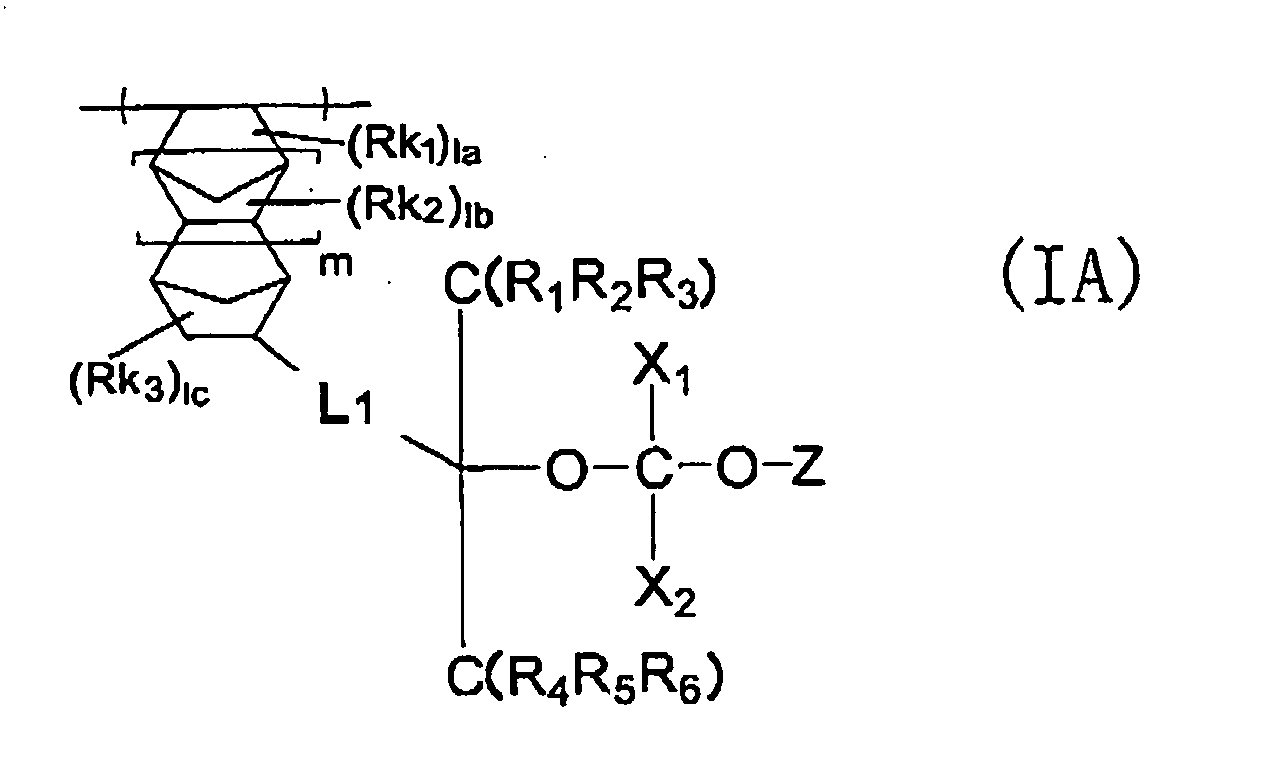
represented by the following formulae (IA) to (IC):
-
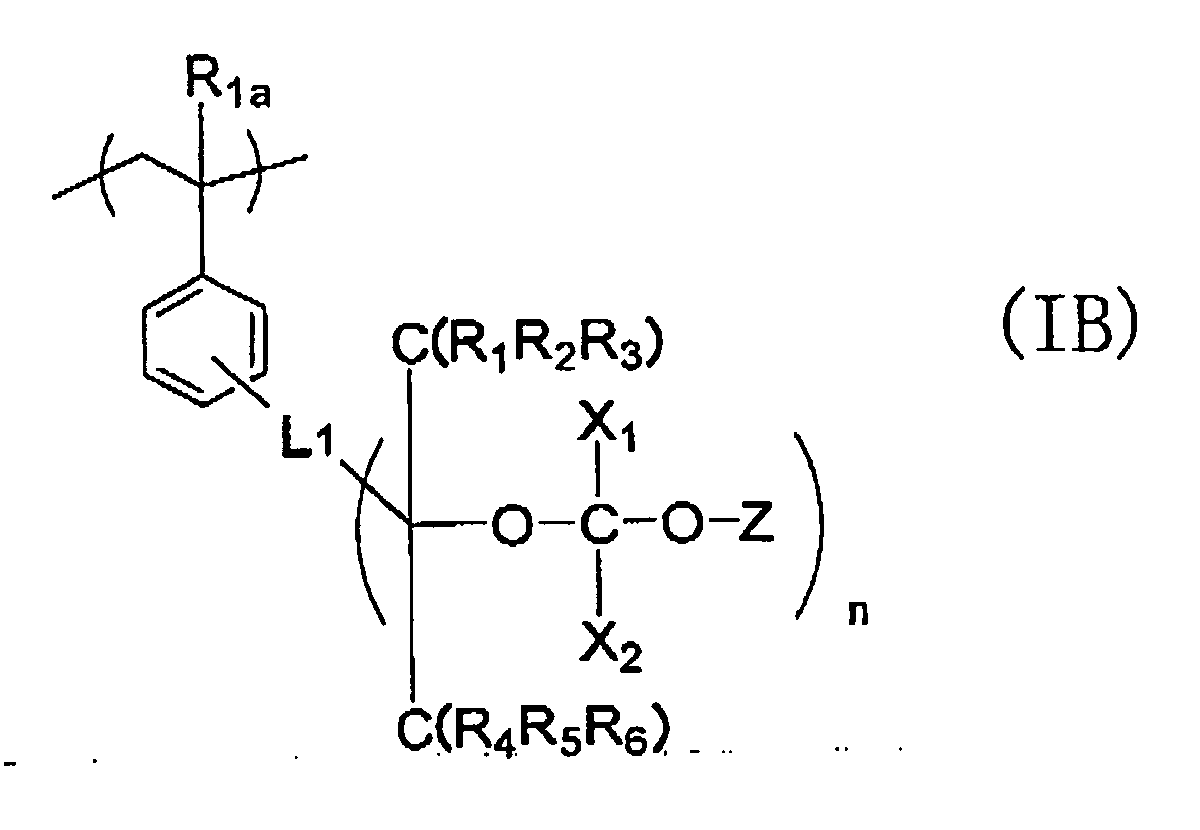
In formulae (IA) to (IC), R1 to R6 each independently
represent a hydrogen atom, a fluorine atom or a fluoroalkyl
group, provided that at least one of R1 to R6 is not a
hydrogen atom. Instead, the carbon atom to which R3 is
connected may be connected to a main chain of the resin
directly or through a connecting group. X1 and X2 each
independently represent a hydrogen atom or an alkyl group.
Z represents a monovalent organic group having at least one
cyclic hydrocarbon structure. Rk1, Rk2 and Rk3 each
represent a halogen atom or an alkyl group. L1 represents
a single bond or a divalent connecting group. R1a
represents a hydrogen atom, a fluorine atom, a chlorine
atom, a bromine atom, a cyano group or a trifluoromethyl
group. Rm represents a hydrogen atom, a fluorine atom, a
methyl group or a trifluoromethyl group. Q represents a
hydrogen atom or a hydroxy group. m represents 0 or 1. la
represents 0 or 1. lb represents an integer of from 0 to 2.
lc represents an integer of from 0 to 5. n represents an
integer of from 1 to 5. 1 represents 0 or 1.
(6) A pattern formation method comprising forming a
resist film using the positive resist composition as
described in any one of (1) to (5), exposing the resist
film, and developing the exposed resist film.
-
The present invention also includes the following
preferred embodiments.
(7) The positive resist composition as described in any
one of (2) to (5), wherein the repeating unit containing an
alicyclic structure having a hydroxy group or a
hydroxyalkyl group is a repeating unit represented by the
following formulae (II) or (III):
-
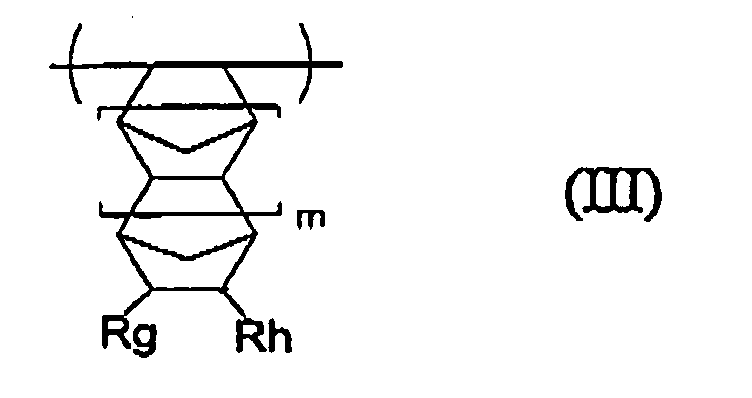
In formulae (II) and (III), R
a and R
b each
independently represent a hydrogen atom, a fluorine atom, a
methyl group or a fluoroalkyl group. Rf represents a
hydrogen atom, a fluorine atom, a methyl group or a
trifluoromethyl group. L2 represents -C(=O)-O- group or
-O- group. AR represents alicyclic hydrocarbon structure.
Rg and Rh each independently represent a hydrogen atom, a
hydroxy group or a hydroxyalkyl group, provided that at
least one of Rg and Rh is not a hydrogen atom. m
represents 0 or 1. nc represents an integer of from 1 to 5.
(8) The positive resist composition as described in any
one of (1) to (5) and (7), wherein the resin of component
(B) further includes at least one repeating unit selected
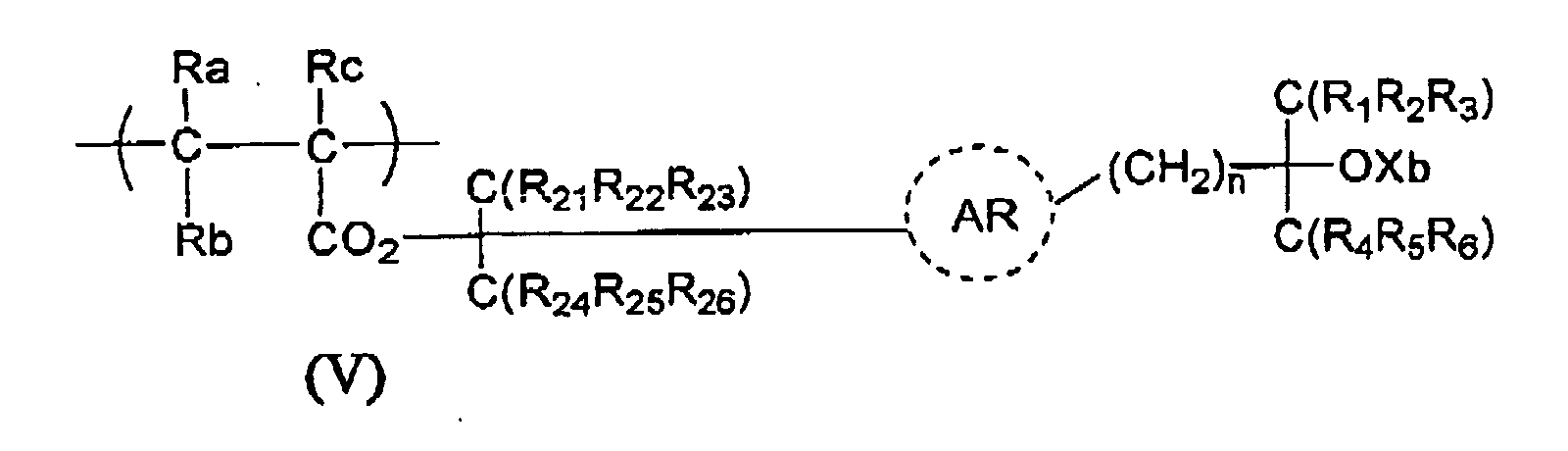
from repeating units represented by the following formulae
(IV) to (VII):
-
In formulae (IV) to (VII), Ra, Rb and Rc each
independently represent a hydrogen atom, a fluorine atom, a
methyl group or a fluoroalkyl group. R21 to R26 each
independently represent a hydrogen atom, a fluorine atom or
a fluoroalkyl group, provided that at least one of R21 to
R26 is not a hydrogen atom. AR represents alicyclic
hydrocarbon structure. Q represents a hydrogen atom or a
hydroxy group. Xa represents a hydrogen atom or a group
capable of being decomposed by the action of an acid. R1
to R6 each independently represent a hydrogen atom, a
fluorine atom or a fluoroalkyl group, provided that at
least one of R1 to R6 is not a hydrogen atom. Xb represents
a hydrogen atom or a group capable of being decomposed by
the action of an acid. Rn represents a fluorine atom or a
trifluoromethyl group. Xc represents a hydrogen atom or a
group capable of being decomposed by the action of an acid.
Rd represents a hydrogen atom or a group capable of being
decomposed by the action of an acid. nb represents 0 or 1.
n represents 0 or 1. m represents 0 or 1.
DETAILED DESCRIPTION OF THE INVENTION
-
According to the present invention, a positive resist
composition, which is improved in surface roughness,
development defect, scum and resolution, can be provided.
-
The present invention will be described in detail
below.
-
With respect to the description of a group (atomic
group) in the specification, the term "group", which is not
particularly referred to whether it is substituted or not,
means and includes both unsubstituted and substituted
groups. For instance, the description of an "alkyl group"
includes not only an alkyl group having no substituent
(unsubstituted alkyl group) but also an alkyl group having
a substituent (substituted alkyl group).
[1] (B) Resin having a property of increasing solubility
in an alkali developing solution by the action of an acid
and including a repeating unit containing a partial
structure represented by formula (X) and a repeating unit
represented by formula (Y)
-
The positive resist composition of the invention
include a resin having a property of increasing solubility
in an alkali developing solution by the action of an acid
and including a repeating unit containing a partial
structure represented by formula (X) shown below and a
repeating unit represented by formula (Y) shown below
(hereinafter also referred to as "resin of Component (B)"
or "resin (B)").
-
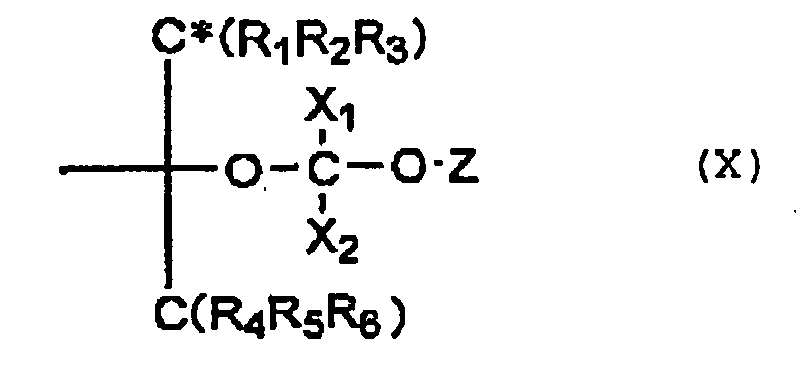
In formula (X), R
1 to R
6 each independently
represents a hydrogen atom, a fluorine atom or a
fluoroalkyl group, provided that at least one of R
1 to R
6
is not a hydrogen atom. Instead, the carbon atom C* may be
connected to a main chain of the resin directly or through
a connecting group at any position of R
1 to R
3. X
1 and X
2
each independently represents a hydrogen atom or an alkyl
group. Z represents a monovalent organic group having at
least one cyclic hydrocarbon structure.
-
In formula (Y) , Ra', Rb', Rc' and Rd' each
independently represents a hydrogen atom, a fluorine atom
or a fluoroalkyl group, provided that at least one of Ra'
to Rd' is not a hydrogen atom.
-
The fluoroalkyl group represented by any one of R1 to
R6 in formula (X) means an alkyl group in which at least
one of the hydrogen atoms is fluorinated. The fluoroalkyl
group has preferably from 1 to 6 carbon atoms, and more
preferably from 1 to 3 carbon atoms. Specific examples of
the fluoroalkyl group include trifluoromethyl,
difluoromethyl, fluoromethyl, pentafluoroethyl, 2,2,2-trifluoroethyl,
2-fluoroethyl, 3,3,3-trifluoropropyl and 3-fluoropropyl
groups. A trifluoromethyl group is
particularly preferred.
-
The fluoroalkyl group represented by any one of R1 to
R6 may have a substituent. Examples of the substituent
include a chlorine atom, a bromine atom and an iodine atom.
-
R1 to R6 each preferably represents a fluorine atom.
-
The -C*(R1R2R3) means a group wherein each group
represented by R1, R2 or R3 is connected to the carbon atom
C* with a single bong. Hereinafter the same shall apply.
-
The alkyl group represented by any one of X1 and X2
is preferably an alkyl group having from 1 to 6 carbon
atoms, and more preferably an alkyl group having from 1 to
3 carbon atoms. Specific examples of the alkyl group
include methyl, ethyl, propyl, isopropyl, n-butyl, isobutyl,
sec-butyl and pentyl groups.
-
X1 and X2 each preferably represents a hydrogen atom.
-
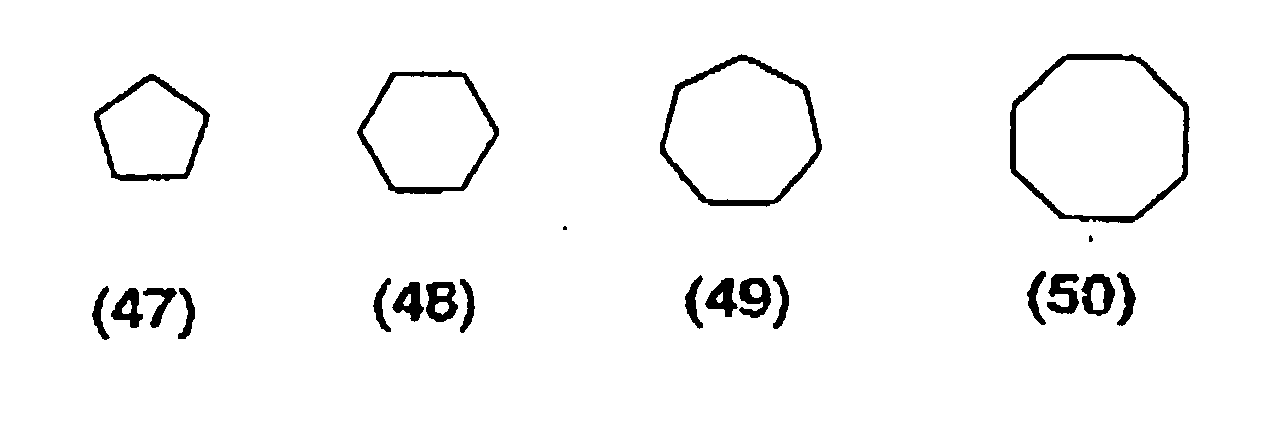
The cyclic hydrocarbon structure included in Z
includes, for example, cyclopropyl ring, cyclobutyl ring,
cyclopentyl ring and cyclohexyl ring. The cyclic
hydrocarbon structure included in Z is preferably an
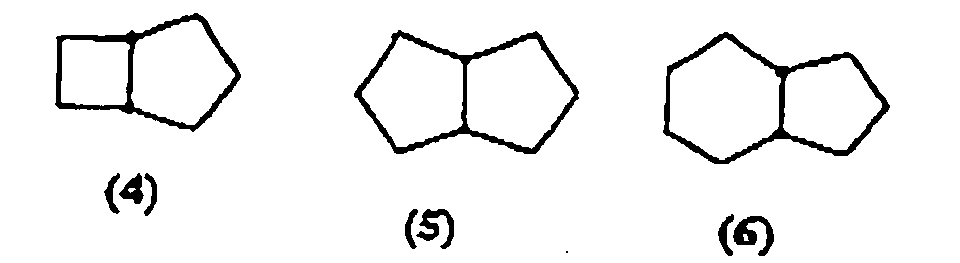
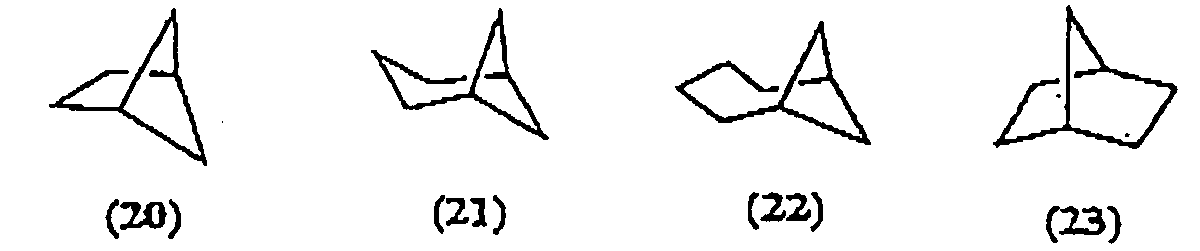
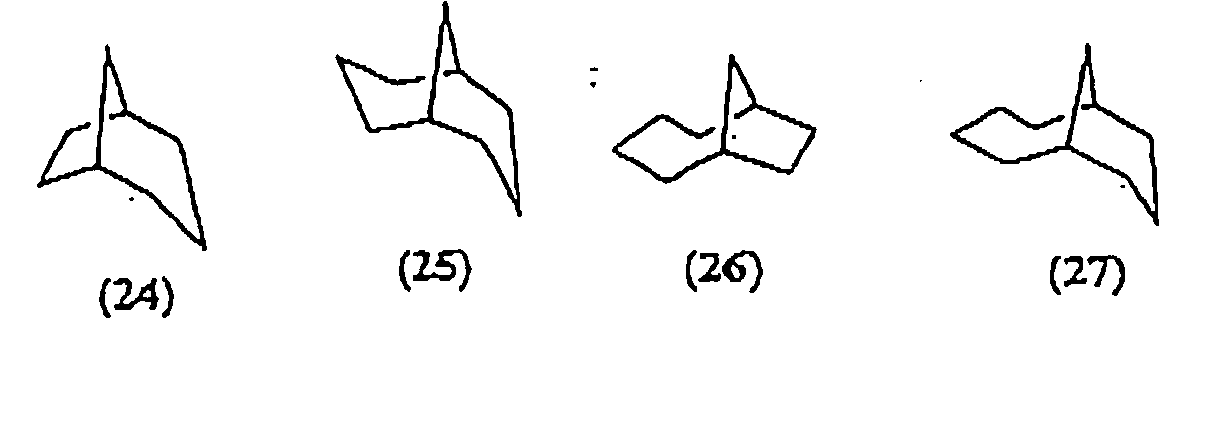
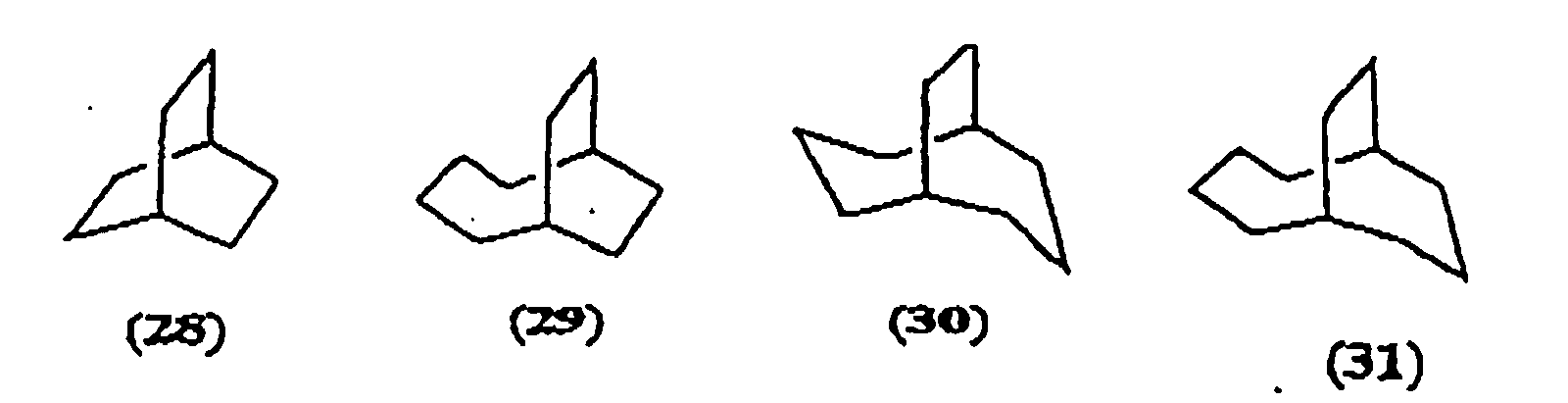
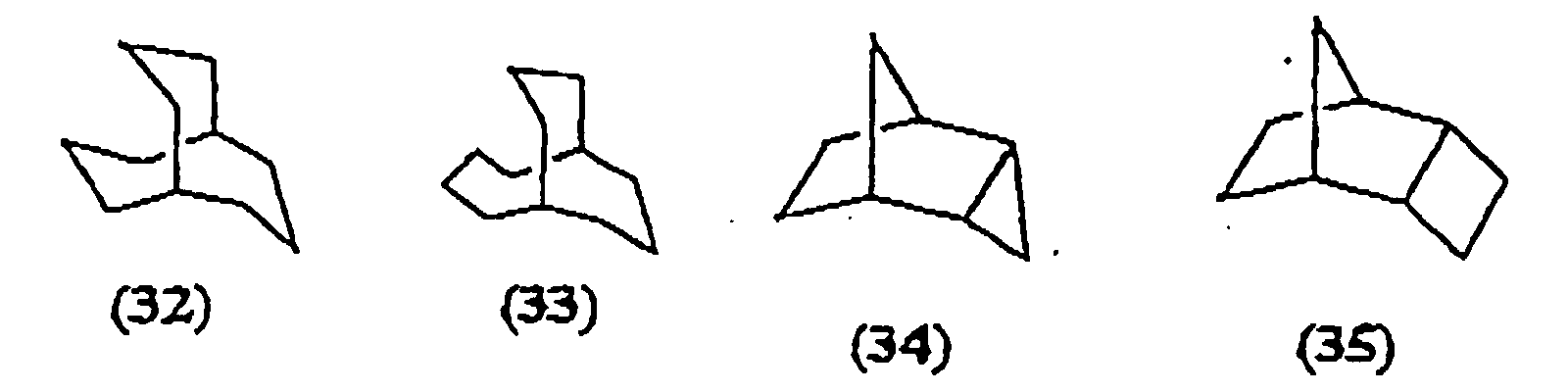
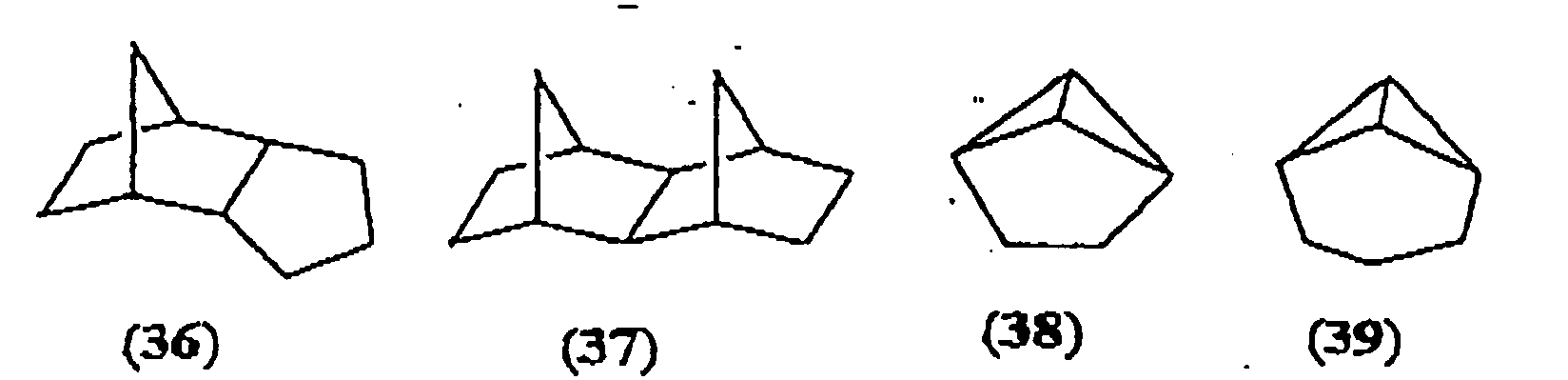
alicyclic hydrocarbon structure having at least one bridged
structure. Specific examples thereof include the following
ring structures:
-
Preferred examples of the alicyclic hydrocarbon
structure having at least one bridged structure include an
alicyclic hydrocarbon group, for example, an adamantyl
group, a noradamantyl group, a tricyclodecanyl group, a
tetracyclododecanyl group, a norbonyl group or a cedrol
group. Of these, an adamantyl group, a decalin residue, a
norbonyl group and a cedrol group are more preferable.
-
Examples of the substituent for the alicyclic
hydrocarbon group include an alkyl group, a substituted
alkyl group, a cycloalkyl group, a halogen atom, a hydroxy
group, an alkoxy group, a carboxy group and an
alkoxycarbonyl group.
-
The alkyl group is preferably a lower alkyl group,
for example, a methyl group, an ethyl group, a propyl group,
an isopropyl group or a butyl group, and more preferably a
methyl group, an ethyl group, a propyl group and an
isopropyl group. Examples of the substituent for the
substituted alkyl group include a hydroxy group, a halogen
atom and an alkoxy group.
-
Examples of the alkoxy group (including the alkoxy
group in the alkoxycarbonyl group) includes those having
from 1 to 4 carbon atoms, for example, a methoxy group, an
ethoxy group, a propoxy group or a butoxy group.
-
Examples of the cycloalkyl group include a
cyclopropyl group, a cyclopentyl group and a cyclohexyl
group.
-
The alkenyl group includes an alkenyl group having
from 2 to 6 carbon atoms, specifically, for example, a
vinyl group, a propenyl group, an allyl group, a butenyl
group, a pentenyl group and a hexenyl group.
-
Examples of the acyl group include an acetyl group, a
ethylcarbonyl group and a propyl carbonyl group. Examples
of the halogen atom include a chlorine atom, a bromine atom,
an iodine atom and a fluorine atom.
-
The monovalent organic group having at least one
cyclic hydrocarbon structure represented by Z may be an
alicyclic hydrocarbon group per se or a group connecting an
alicyclic hydrocarbon group with a straight chain or
branched alkylene group, an oxy group or the like.
Examples of the alkylene group include a methylene group,
ethylene group a propylene group, a butylene group and a
hexylene group. The straight chain or branched alkylene
group may have a substituent, for example, a fluorine atom
or an alky group substituted with a fluorine atom.
-
The monovalent organic group having at least one
cyclic hydrocarbon structure represented by Z has at least
one substituent selected from a fluorine atom and an alkyl
group substituted with a fluorine atom is preferred because
absorption at 157 nm can be reduced. The fluorine atom and
an alkyl group substituted with a fluorine atom may be
connected directly or through a connecting group to the
alicyclic hydrocarbon group and/or alkylene group. The
alkyl group substituted with a fluorine atom has the same
meaning as defined for the fluoroalkyl group represented by
any one of R1 to R6.
-
The -C(X1X2)-O-Z group in the partial structure
represented by formula (X) is a group (acid-decomposable
group) capable of being decomposed by the action of an acid.
The -C(X1X2)-O-Z group is decomposed by the action of an
acid to generate a hydrophilic hydroxy group, whereby the
resin (B) increases solubility in an alkaline developing
solution by the action of an acid.
-
A repeating unit containing a partial structure
represented by formula (X) includes repeating units
represented by the following formulae (IA) to (IC):
-
In formulae (IA) to (IC), R1 to R6 each independently
represents a hydrogen atom, a fluorine atom or a
fluoroalkyl group, provided that at least one of R1 to R6
is not a hydrogen atom. Instead, the carbon atom to which
R3 is connected may be connected to a main chain of the
resin directly or through a connecting group. X1 and X2
each independently represent a hydrogen atom or an alkyl
group. Z represents a monovalent organic group having at
least one cyclic hydrocarbon structure. Rk1, Rk2 and Rk3
each represent a halogen atom or an alkyl group. L1
represents a single bond or a divalent connecting group.
R1a represents a hydrogen atom, a fluorine atom, a chlorine
atom, a bromine atom, a cyano group or a trifluoromethyl
group. Rm represents a hydrogen atom, a fluorine atom, a
methyl group or a trifluoromethyl group. Q represents a
hydrogen atom or a hydroxy group. m represents 0 or 1. la
represents 0 or 1. lb represents an integer of from 0 to 2.
lc represents an integer of from 0 to 5. n represents an
integer of from 1 to 5. 1 represents 0 or 1.
-
R1 to R6 in formulae (IA) to (IC) have the same
meanings as R1 to R6 in formula (X). X1 and X2 have the same
meanings as X1 and X2 in formula (X). Z has the same
meaning as Z in formula (X).
-
The halogen atom represented by any one of Rk1 to Rk3
includes a fluorine atom, a chlorine atom, a bromine atom
and an iodine atom.
-
The alkyl group represented by any one of Rk1 to Rk3
preferably includes an alkyl group having from 1 to 5
carbon atoms, for example, methyl, ethyl, propyl, isopropyl,
n-butyl, isobutyl and sec-butyl groups. The alkyl group
represented by any one of Rk1 to Rk3 may have a substituent,
for example, a fluorine atom.
-
la is preferably 0. lb is preferably 0. lc is
preferably an integer of from 0 to 3.
-
When the sum total of la, lb and lc is 1 or more, Rk1
to Rk3 each preferably represent a fluorine atom or an
alkyl group (preferably having from 1 to 8 carbon atoms,
more preferably having from 1 to 2 carbon atoms)
substituted with a fluorine atom, and more preferably each
represent a fluorine atom or a trifluoromethyl group.
-
The divalent connecting group represented by L1
includes, for example, an alkylene group, a cycloalkylene
group, an alkenylene group, an arylene group, -O-R22a-, -O-CO-R22b-,
-CO-O-R22c- and -CO-N(R22d)-R22e-. R22a, R22b, R22c and
R22e each represent a single bond or a divalent alkylene
group, cycloalkylene group, alkenylene group or arylene
group, which may contain an ether group, an ester group, an
amido group a urethane group or a ureido group. R22de
represents a hydrogen atom, an alkyl group, a cycloalkyl
group, an aralkyl group or an aryl group.
-
The alkylene group includes a straight chain and
branched alkylene group and an alkylene group having from 1
to 8 carbon atoms, for example, methylene, ethylene,
propylene, butylene, hexylene or octylene group.
-
The cycloalkylene group preferably includes a
cycloalkyl group having from 5 to 12 carbon atoms, and may
be a monocyclic residue, for example, cyclopentylene or
cyclohexylene group, or a polycyclic residue, for example,
norbornane or adamantane skeleton.
-
The alkenylene group preferably includes an alkylene
group having from 2 to 6 carbon atoms, for example,
ethenylene, propenylene or butenylen group.
-
The arylene group preferably includes an arylene
group having from 6 to 15 carbon atoms, for example,
phenylene, tolylene or naphthylene group.
-
The substituent which the divalent connecting group
represented by L1 may have includes, for example, a halogen
atom, e.g., fluorine or chlorine atom, and a cyano group,
and preferably a fluorine atom.
-
L1 preferably represents a single bong, a methylene
group or an -O- group.
-
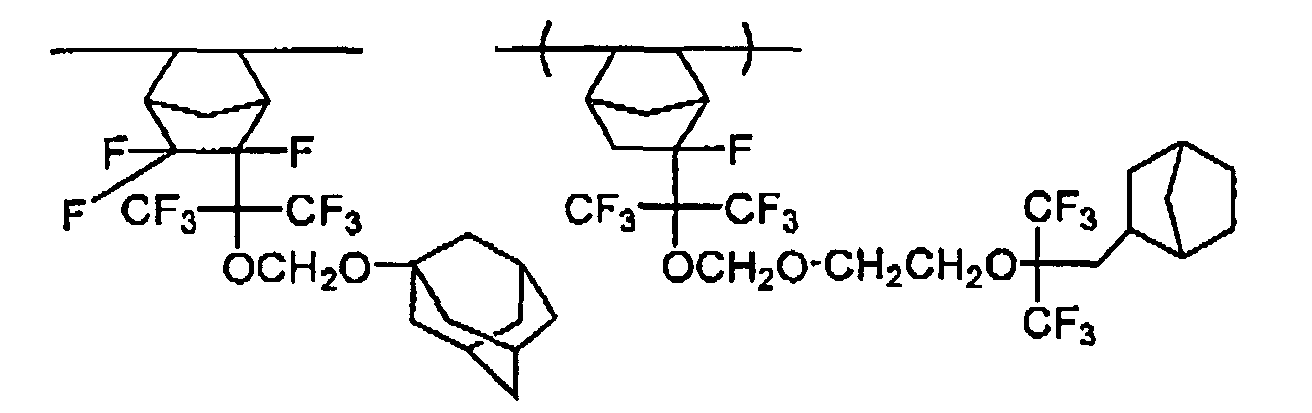
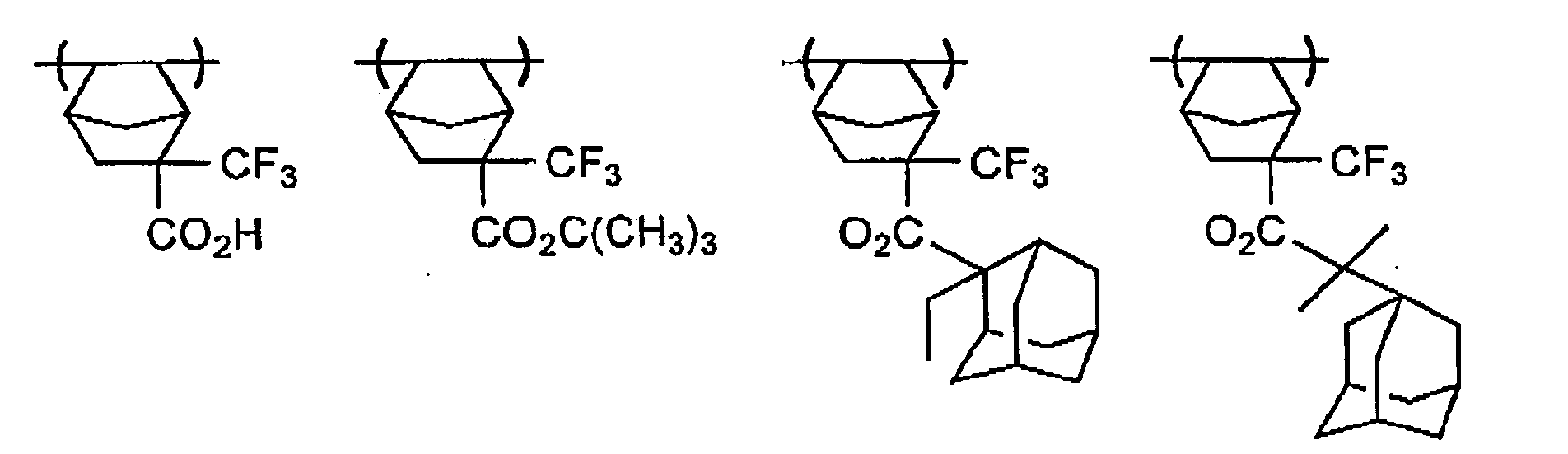
Specific examples of the repeating unit containing a
partial structure represented by formula (X) and specific
examples of the repeating unit represented by any one of
formulae (IA) to (IC) are set forth below, but the
invention should not be construed as being limited thereto.
-
The fluoroalkyl group represented by any one of Ra',
Rb', Rc' and Rd' in formula (Y) has the same meaning as the
fluoroalkyl group represented by any one of R1 to R6 in
formula (X).
-
Ra', Rb', Rc' and Rd' preferably represents a fluorine
atom or a fluoroalkyl group, and more preferably a fluorine
atom or a trifluoromethyl group.
-
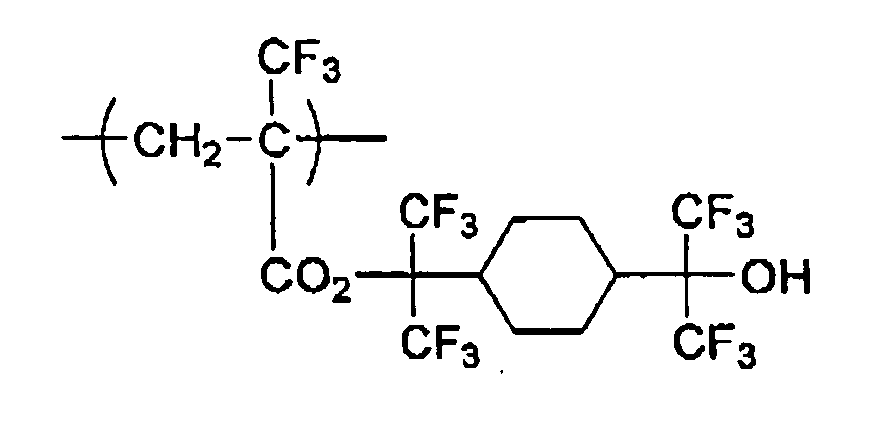
Specific examples of the repeating unit represented
by formula (Y) are set forth below, but the invention
should not be construed as being limited thereto.
-
It is preferred that the resin (B) further includes a
repeating unit containing an alicyclic structure having a
hydroxy group or a hydroxyalkyl group.
-
The repeating unit containing an alicyclic structure
having a hydroxy group or a hydroxyalkyl group is
preferably a repeating unit represented by the following
formulae (II) or (III):
-
In formulae (II) and (III), Ra and Rb each
independently represents a hydrogen atom, a fluorine atom,
a methyl group or a fluoroalkyl group. Rf represents a
hydrogen atom, a fluorine atom, a methyl group or a
trifluoromethyl group. L2 represents -C(=O)-O- group or
-O- group. AR represents alicyclic hydrocarbon structure.
Rg and Rh each independently represents a hydrogen atom, a
hydroxy group or a hydroxyalkyl group, provided that at
least one of Rg and Rh is not a hydrogen atom. m
represents 0 or 1. nc represents an integer of from 1 to 5.
-
The fluoroalkyl group represented by any one of Ra
and Rb in formula (II) has the same meaning as the
fluoroalkyl group represented by any one of R1 to R6 in
formula (X).
-
The alicyclic hydrocarbon structure represented by AR
may be monocyclic or polycyclic. Specifically, the
alicyclic hydrocarbon structure includes alicyclic
hydrocarbon structures having not less than 5 carbon atoms,
for example, a monocyclo, bicyclo, tricyclo or tetracyclo
structure. The number of carbon atoms included therein is
preferably from 6 to 30, and particularly preferably from 7
to 25.
-
Preferred examples of the alicyclic hydrocarbon
structure represented by AR include adamantane,
noradamantane, decalin, tricyclodecane, tetracyclododecane,
norbornane, cyclohexane, cycloheptane, cyclooctane,
cyclodecane and cyclododecane structures. Of these
structures, adamantane, norbornane and cyclohexane
structures are more preferred.
-
The alicyclic hydrocarbon structure represented by AR
may further have a substituent, for example, an alkyl group,
an alkoxy group or a halogen atom (for example, fluorine or
chlorine atom).
-
The hydroxyalkyl group represented by any one of Rg
and Rh preferably includes a hydroxyalkyl group having from
1 to 3 carbon atoms, for example, hydroxymethyl or
hydroxyethyl group.
-
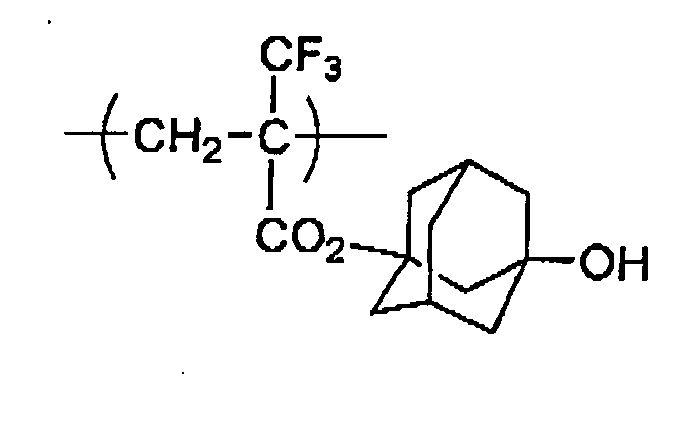
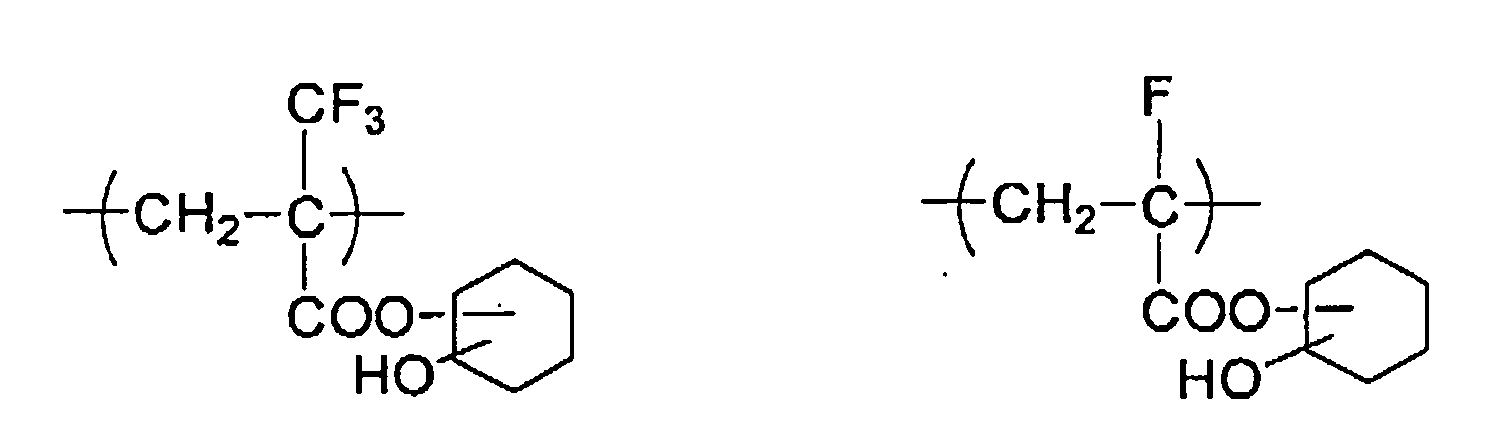
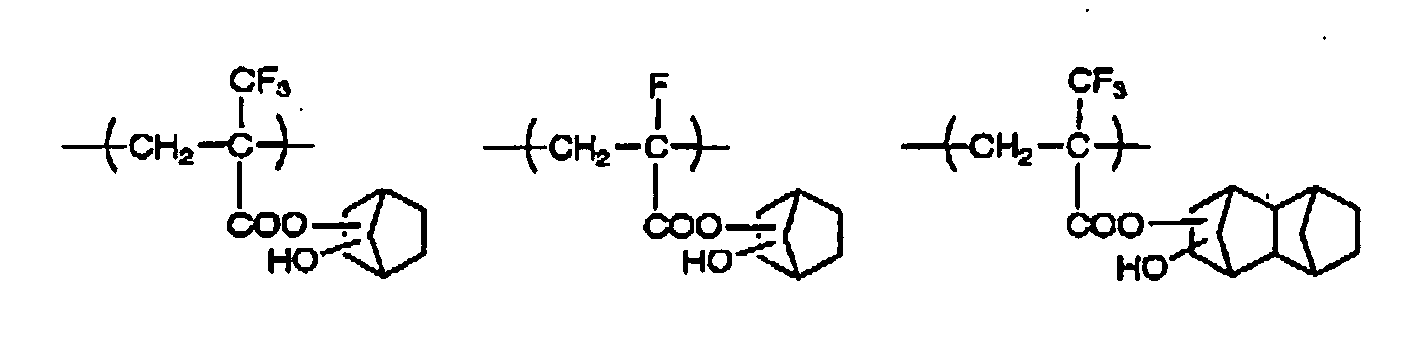
Specific examples of the repeating unit represented
by formula (II) are set forth below, but the invention
should not be construed as being limited thereto.
-
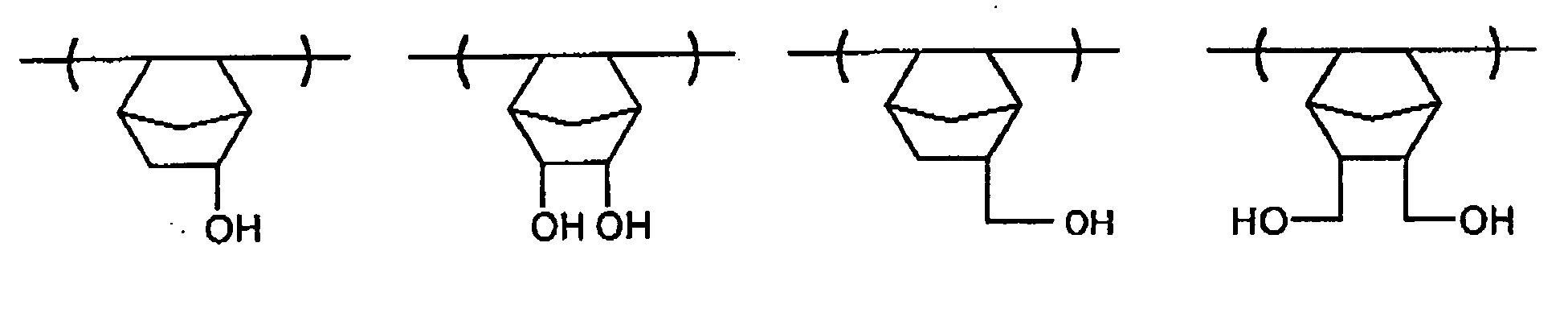
Specific examples of the repeating unit represented
by formula (III) are set forth below, but the invention
should not be construed as being limited thereto.
-
It is preferred that the resin (B) further includes
at least one repeating unit selected from repeating units
represented by the following formulae (IV) to (VII):
-
In formulae (IV) to (VII), Ra, Rb and Rc each
independently represents a hydrogen atom, a fluorine atom,
a methyl group or a fluoroalkyl group. R21 to R26 each
independently represents a hydrogen atom, a fluorine atom
or a fluoroalkyl group, provided that at least one of R21
to R26 is not a hydrogen atom. AR represents alicyclic
hydrocarbon structure. Q represents a hydrogen atom or a
hydroxy group. Xa represents a hydrogen atom or a group
capable of being decomposed by the action of an acid. R1
to R6 each independently represents a hydrogen atom, a
fluorine atom or a fluoroalkyl group, provided that at
least one of R1 to R6 is not a hydrogen atom. Xb represents
a hydrogen atom or a group capable of being decomposed by
the action of an acid. Rn represents a fluorine atom or a
trifluoromethyl group. Xc represents a hydrogen atom or a
group capable of being decomposed by the action of an acid.
Rd represents a hydrogen atom or a group capable of being
decomposed by the action of an acid. nb represents 0 or 1.
n represents 0 or 1. m represents 0 or 1.
-
The fluoroalkyl group represented by any one of Ra,
Rb and Rc has the same meaning as the fluoroalkyl group
represented by any one of R1 to R6 in formula (X).
-
R21 to R26 have the same meanings as R1 to R6 in
formula (X). R21 to R26 each preferably represents a
fluorine atom.
-
R1 to R6 have the same meanings as R1 to R6 in formula
(X).
-
The alicyclic hydrocarbon structure represented by AR
has the same meaning as the alicyclic hydrocarbon structure
represented by Ar in formula (II).
-
The group (hereinafter also referred to as an acid-decomposable
group) capable of being decomposed by the
action of an acid represented by any one of Xa, Xb, Xc and
Rd includes, for example, -C(R36)(R37)(R38), -C(R36)(R37)(OR39),
-COO-C(R36)(R37)(R38), -C(R01)(R02)(OR39) and -C(R01)(R02)COO-C(R36)(R37)(R38).
-
R36 to R39 each independently represent an alkyl group,
a cycloalkyl group, an alkenyl group, an aralkyl group or
an aryl group. R36 and R37 or R36 and R39 may be combined
with each other to from a ring. R01 and R02 each
independently represent a hydrogen atom, an alkyl group, a
cycloalkyl group, an alkenyl group, an aralkyl group or an
aryl group.
-
The -C(R36)(R37)(R38) means a group wherein each group
represented by R36, R37 or R38 is connected to the carbon
atom with a single bong. Hereinafter the same shall apply.
-
The alkyl group represented by any one of R36 to R39,
R01 and R02 preferably includes an alkyl group having from 1
to 8 carbon atoms, for example, methyl, ethyl, propyl, n-butyl,
sec-butyl, hexyl, 2-ethylhexyl or octyl group.
-
The cycloalkyl group represented by any one of R36 to
R39, R01 and R02 may be monocyclic or polycyclic. The
monocyclic cycloalkyl group preferably includes a
cycloalkyl group having from 3 to 8 carbon atoms, for
example, cyclopropyl, cyclopentyl, cyclohexyl, cycloheptyl
or cyclooctyl group. The polycyclic cycloalkyl group
preferably includes a cycloalkyl group having from 6 to 20
carbon atoms, for example, adamantyl, norbornyl, isobornyl,
camphanyl, dicyclopentyl, α-pinenyl, tricyclodecanyl,
tetracyclododecyl or androstanyl group. The carbon atoms
in the monocyclic or polycyclic cycloalkyl group may be
partially replaced with hetero atoms, for example, an
oxygen atom.
-
The aryl group represented by any one of R36 to R39,
R01 and R02 preferably includes an aryl group having from 6
to 10 carbon atoms, for example, phenyl, tolyl,
dimethylphenyl, 2,4,6-trimethylphenyl, naphthyl, anthryl or
9,10-dimethoxyanthryl group.
-
The aralkyl group represented by any one of R36 to R39,
R01 and R02 preferably includes an aralkyl group having from
7 to 12 carbon atoms, for example, benzyl, phenethyl or
naphthylmethyl group.
-
The alkenyl group represented by any one of R36 to R39,
R01 and R02 preferably includes an alkenyl group having from
2 to 8 carbon atoms, for example, vinyl, allyl, butenyl or
cyclohexenyl group.
-
The substituent which the groups represented by R36
to R39, R01 and R02 may have includes, for example, an alkyl
group, a cycloalkyl group, an aryl group, an amino group,
an amido group, a ureido group, a urethane group, a hydroxy
group, a carboxy group, a halogen atom, an alkoxy group, a
thioether group, an acyl group, an acyloxy group, an
alkoxycarbonyl group, a cyano group and a nitro group.
-
Specific preferred examples of the acid-decomposable
group include, for example, a tertiary alkyl group, e.g.,
tert-butyl, tert-amyl, 1-alkyl-1-cyclohexyl, 2-alkyl-2-adamantyl,
2-adamantyl-2-propyl or 2-(4-methylcyclohexyl)-2-propyl
group, an acetal group, e.g., 1-alkoxy-1-ethoxy,
1-alkoxy-1-methoxy or tetrahydropyranyl group, a tert-alkyloxycarbonyl
group, an ethoxymethyl group, a
methoxyethoxymethyl group and a tert-alkylcarbonylmethyl
group.
-
Specific examples of the repeating unit represented
by formula (IV) are set forth below, but the invention
should not be construed as being limited thereto.
-
Specific examples of the repeating unit represented
by formula (V) are set forth below, but the invention
should not be construed as being limited thereto.
-
Specific examples of the repeating unit represented
by formula (VI) are set forth below, but the invention
should not be construed as being limited thereto.
-
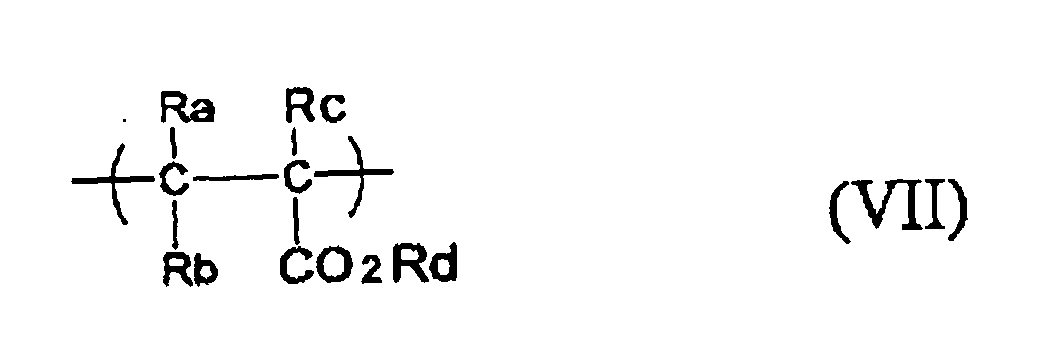
Specific examples of the repeating unit represented
by formula (VII) are set forth below, but the invention
should not be construed as being limited thereto.
-
It is preferred that the resin (B) further includes a
repeating unit formed by replacing the -C(X1X2)-O-Z group
in the repeating unit represented by any one of formulae
(IA) to (IC) with a hydrogen atom. Specific examples of
the respective repeating units include repeating units
formed by replacing the -C(X1X2)-O-Z group with a hydrogen
atom in the specific examples of the repeating unit
represented by formulae (IA) to (IC).
-
The resin of Component (B) may further contain a
repeating unit formed from other polymerizable monomer in
addition to the repeating units described above.
-
Examples of the copolymerizable monomer include an
acrylate, an acrylamide, a methacrylate, a methacrylamide,
an allyl compound, a vinyl ester, a styrene, a crotonate, a
dialkyl maleate, a dialkyl fumarate, maleic anhydride, a
maleimide, acrylonitrile, methacrylonitrile, maleonitrile
and C(R1a)(R2a) = C(R3a)(R4a) (wherein R1a to R4a, which may be
the same or different, each represent a hydrogen atom, a
halogen atom or an alkyl group (preferably having from 1 to
10 carbon atoms), which may be substituted with a halogen
atom). Acrylonitrile, methacrylonitrile, maleic anhydride,
a maleimide, N-hydroxymaleimide, N-(tert-butoxycarbonyloxy)maleimide
and C(R1a)(R2a) = C(R3a)(R4a) are
particularly preferred. In addition, any addition
polymerizable unsaturated compound copolymerizable with
monomers corresponding to the repeating units described
above may be ordinarily employed.
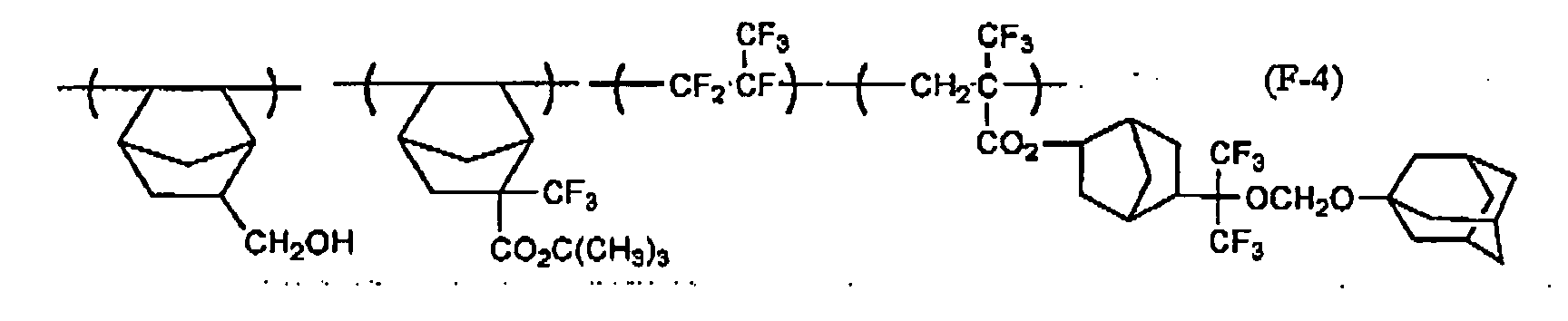
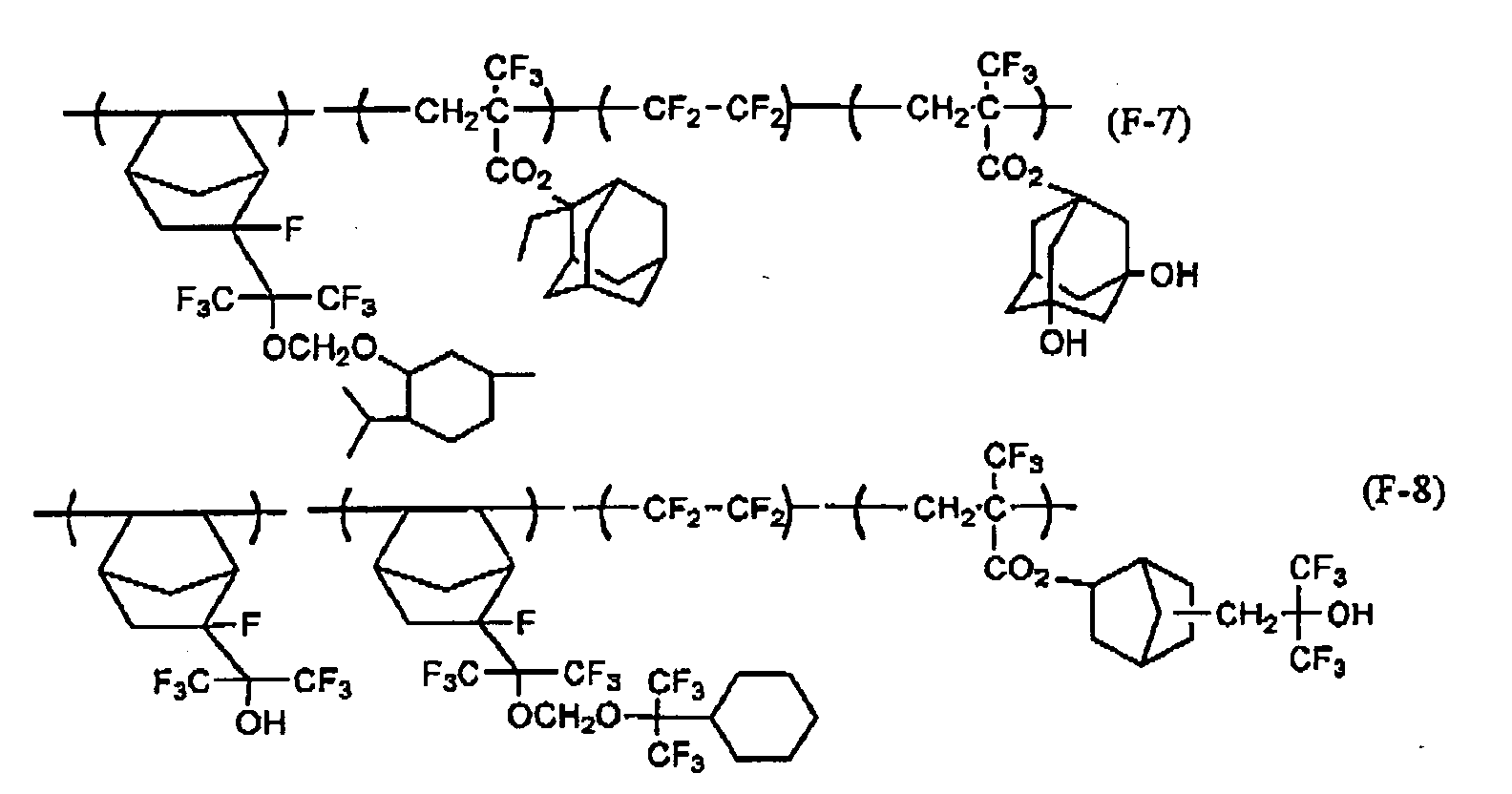
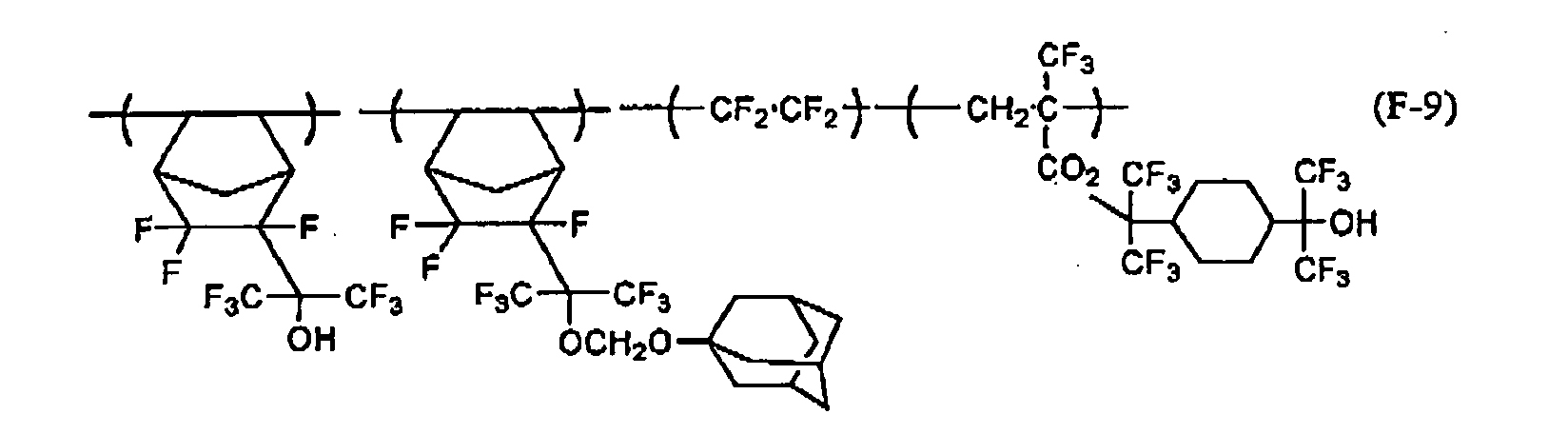
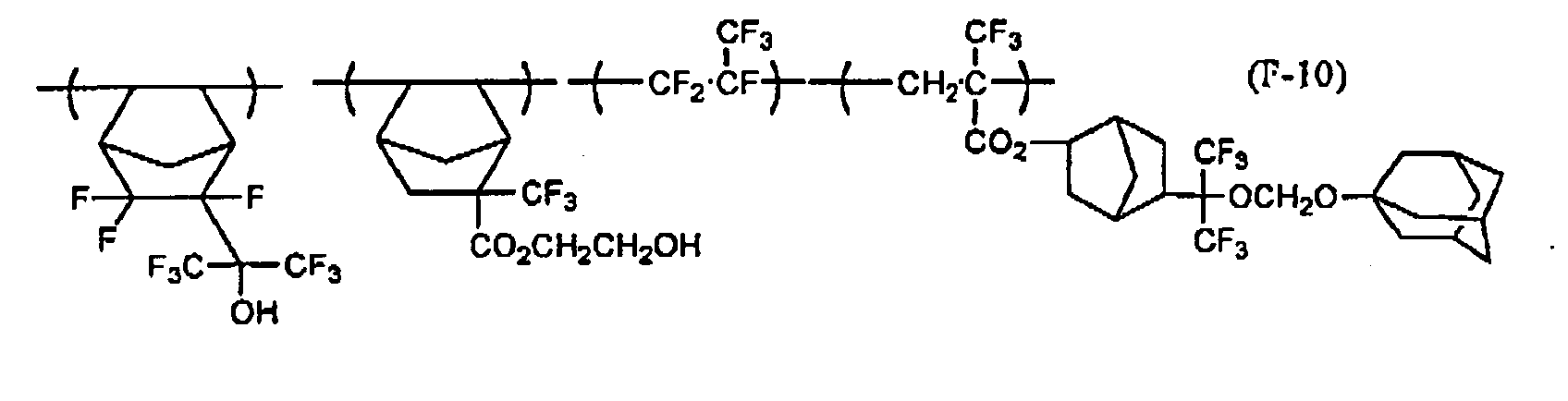
-
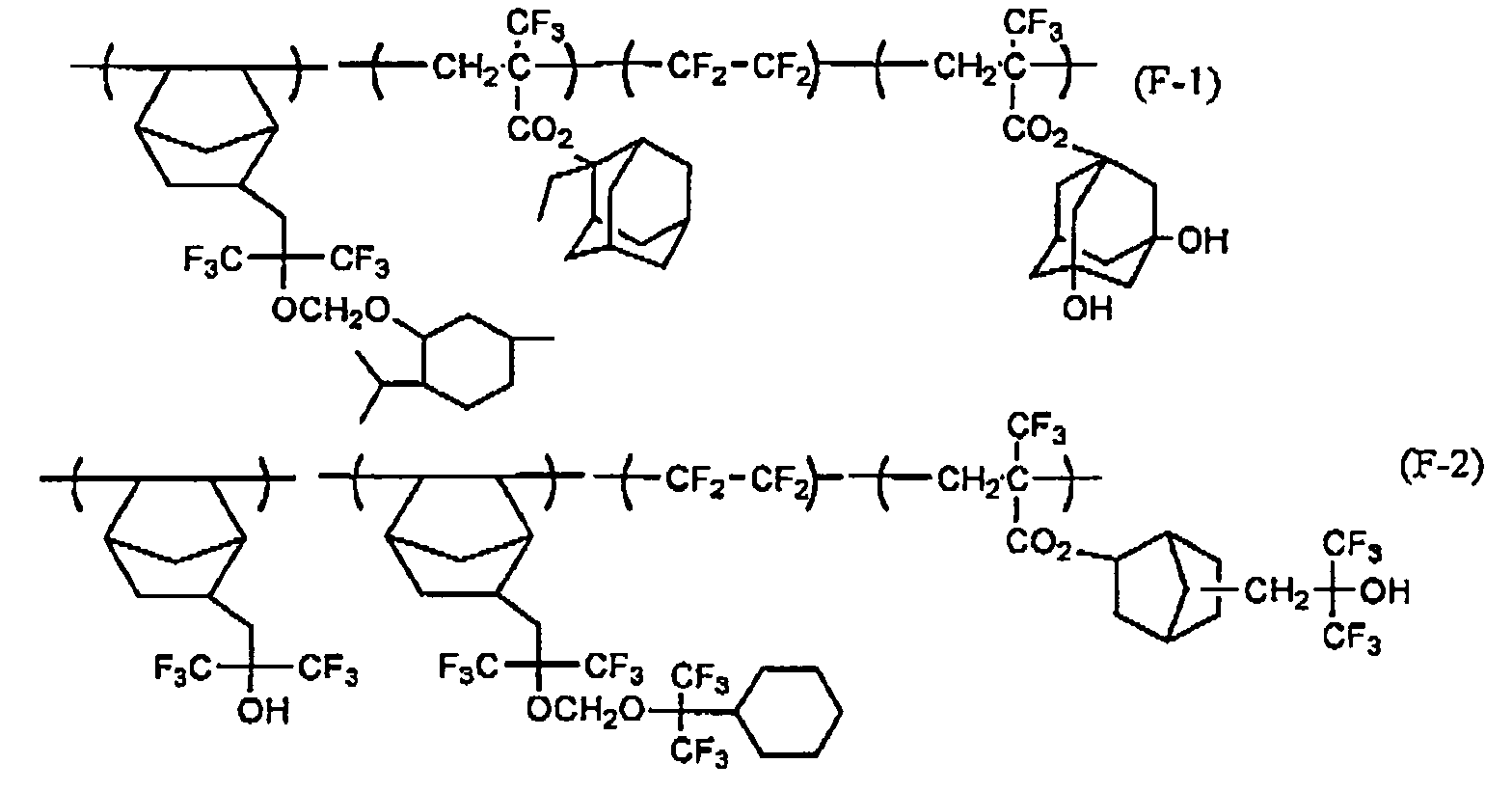
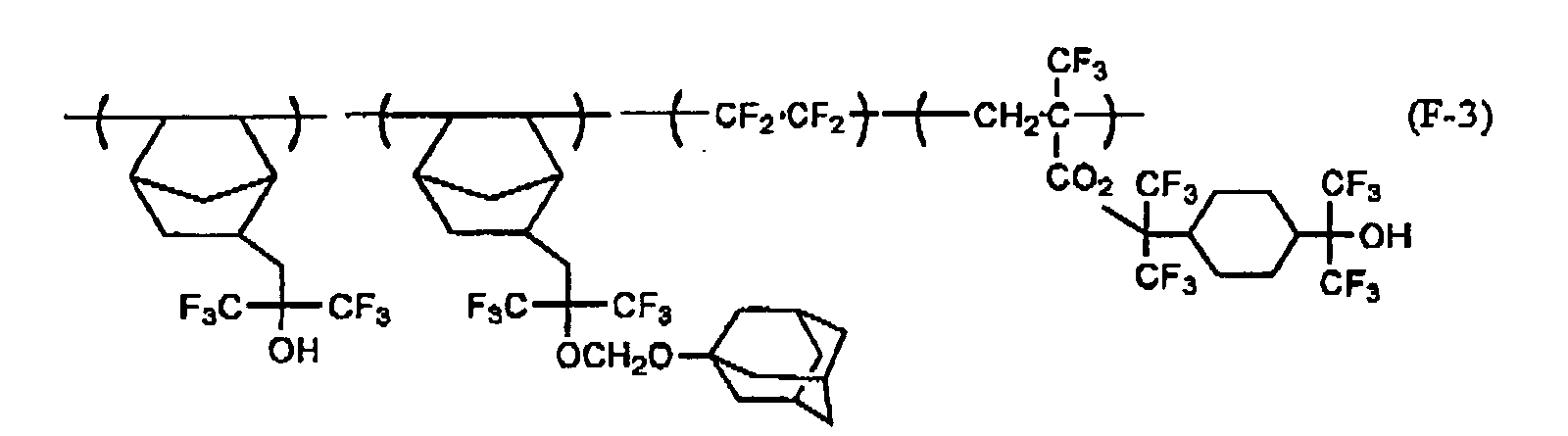
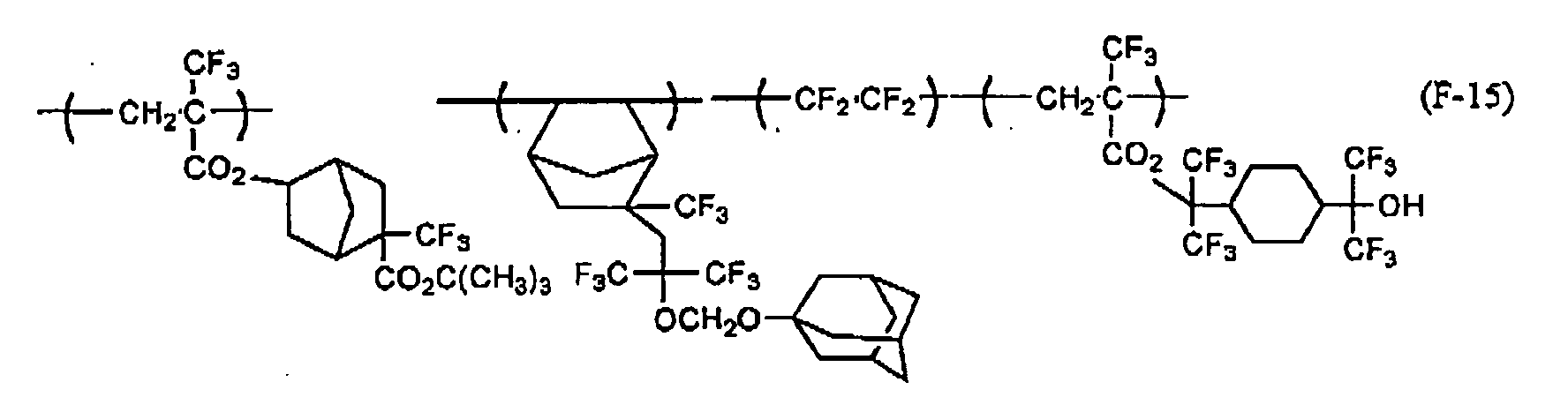
Specific preferred examples of the resin of Component
(B) are set forth below, but the invention should not be
construed as being limited thereto.
-
In the resin of Component (B), the content of the
repeating unit containing a partial structure represented
by formula (X) is preferably from 10 to 60% by mole, and
more preferably from 20 to 40% by mole.
-
In the resin of Component (B), the content of the
repeating unit represented by formula (Y) is preferably
from 10 to 70% by mole, and more preferably from 20 to 50%
by mole.
-
In the resin of Component (B), the content of the
repeating unit containing an alicyclic structure having a
hydroxy group or a hydroxyalkyl group is preferably from 5
to 40% by mole, and more preferably from 10 to 30% by mole.
-
In the resin of Component (B), the content of the
repeating units represented by formulae (IV) to (VII) is
preferably from 5 to 40% by mole, and more preferably from
10 to 30% by mole.
-
In the resin of Component (B), the content of the
repeating unit containing an acid-decomposable group is
preferably from 10 to 60% by mole, and more preferably from
20 to 50% by mole.
-
The molecular weight of the resin of Component (B) is
preferably from 2,000 to 50,000, more preferably from 3,000
to 30,000, and particularly preferably from 5,000 to 15,000,
in terms of a weight average molecular weight.
-
The dispersion degree of molecular weight (Mw/Mn) is
preferably from 1.0 to 3.0, more preferably from 1.1 to 2.0,
and particularly preferably from 1.1 to 1.5. In order to
reduce the dispersion degree of molecular weight, there are
a method in which a polymer obtained by a conventional
radical polymerization is dissolved in a good solvent and
then a poor solvent is added thereto to remove low
molecular weight components and a method using a living
polymerization method, for example, a living radical
polymerization method, and any of these methods can be
preferably employed.
-
As the living radical polymerization method, any of
method using nitroxide by M.K. Georges et al. and method
using metal complex by Mitsuo Sawamoto et al. or Krzysztof
Matyjaszewski, all described in Controlled Radical
Polymerization (ACS Symposium Series, No 685) can be used.
-
From the standpoint of improvement in the roughness
of pattern, it is preferred to apply a dropping
polymerization method (radical polymerization method in
which during radical polymerization of monomer in the
presence of a radical polymerization initiator, a monomer
is further added continuously or intermittently) to the
above-described conventional radical polymerization method.
-
In the dropping polymerization method, species and
composition of monomer put in first in a reaction vessel
and species and composition of monomer added later in
progress of the radical polymerization may be the same or
different.
-
Also, with respect to the polymerization initiator,
it is preferred to utilize a method of further adding it
together with the monomer added later because an amount of
the remaining unreacted monomer is reduced.
-
The resin of Component (B) is used in an amount
ordinarily from 50 to 99.5% by weight, preferably from 80
to 99% by weight, and more preferably from 90 to 98% by
weight, based on the total solid content of the resist
composition.
[2] (A) Compound that generates an acid upon irradiation
of an actinic ray or radiation
-
The positive resist composition of the invention
includes a compound that generates an acid upon irradiation
of an actinic ray or radiation, particularly an F2 excimer
laser beam.
-
The compound that generates an acid upon irradiation
of an actinic ray or radiation can be selected from
compounds ordinarily used as compounds (acid-generators)
that are decomposed by irradiation of an actinic ray or
radiation to generate an acid.
-
Specifically, the compound can be appropriately
selected from photoinitiators for photo-cationic
polymerization, photoinitiators for photo-radical
polymerization, photo-achromatic agents for dyes, photo-discoloring
agents, compounds capable of generating an acid
with known light used for microresists (for example, an
ultraviolet ray having a wavelength of from 400 to 200 nm
or a far ultraviolet ray, particularly preferably g-line,
h-line, i-line or a KrF excimer laser beam), an ArF excimer
laser beam, an F2 excimer laser beam, an electron beam, an
X ray, a molecular beam or an ion beam, and mixtures
thereof.
-
Specific examples of such compounds include diazonium
salts as described, e.g., in S.I. Schlesinger, Photogr. Sci.
Eng., 18, 387 (1974) and T.S. Bal et al., Polymer, 21, 423
(1980); onium salts, for example, ammonium salts as
described, e.g., in U.S. Patents 4,069,055, 4,069,056 and
Re 27,992 and JP-A-3-140140, phosphonium salts as described,
e.g., in D.C. Necker et al., Macromolecules, 17, 2468
(1984), C.S. Wen et al., Teh. Proc. Conf. Rad. Curing ASIA,
p. 478, Tokyo (Oct. 1988) and U.S. Patents 4,069,055 and
4,069,056, iodonium salts as described, e.g., in J.V.
Crivello et al., Macromolecules, 10(6), 1307(1977), Chem. &
Eng. News, Nov. 28, p. 31 (1988), European Patents 104,143,
339,049 and 410,201, JP-A-2-150848 and JP-A-2-296514,
sulfonium salts as described, e.g., in J.V. Crivello et al.,
Polymer J., 17, 73 (1985), J.V. Crivello et al., J. Org.
Chem., 43, 3055 (1978), W.R. Watt et al., J. Polymer Sci.,
Polymer Chem. Ed., 22, 1789 (1984), J.V. Crivello et al.,
Polymer Bull., 14, 279 (1985), J.V. Crivello et al.,
Macromolecules, 14(5), 1141 (1981), J.V. Crivello et al., J.
Polymer Sci., Polymer Chem. Ed., 17, 2877 (1979), European
Patents 370,693, 161,811, 410,201, 339,049, 233,567,
297,443 and 297,442, U.S. Patents 3,902,114, 4,933,377,
4,760,013, 4,734,444 and 2,883,827, German Patents
2,904,626, 3,604,580 and 3,604,581, selenonium salts as
described, e.g., in J.V. Crivello et al., Macromolecules,
10(6), 1307 (1977) and J.V. Crivello et al., J. Polymer
Sci., Polymer Chem. Ed., 17, 1047 (1979), and arsonium
salts as described, e.g., in C.S. Wen et al., Teh. Proc.
Conf. Rad. Curing ASIA, p. 478, Tokyo (Oct., 1988); organic
halogen compounds as described, e.g., in U.S. Patent
3,905,815, JP-B-46-4605, JP-A-48-36281, JP-A-55-32070, JP-A-60-239736,
JP-A-61-169835, JP-A-61-169837, JP-A-62-58241,
JP-A-62-212401, JP-A-63-70243 and JP-A-63-298339; organic
metal/organic halogen compounds as described, e.g., in K.
Meier et al., J. Rad. Curing, 13(4), 26(1986), T.P. Gill et
al., Inorg. Chem., 19, 3007 (1980), D. Astruc, Acc. Chem.
Res., 19(12), 377 (1986) and JP-A-2-161445; photo-acid
generators having an o-nitrobenzyl type protective group as
described, e.g., in S. Hayase et al., J. Polymer Sci., 25,
753 (1987), E. Reichmanis et al., J. Polymer Sci., Polymer
Chem. Ed., 23, 1 (1985), Q.Q. Zhu et al., J. Photochem., 36,
85, 39, 317 (1987), B. Amit et al., Tetrahedron Lett., (24)
2205 (1973), D.H.R. Barton et al., J. Chem. Soc., 3571
(1965), P.M. Collins et al., J. Chem. Soc., Perkin I, 1695
(1975), M. Rudinstein et al., Tetrahedron Lett., (17), 1445
(1975), J.W. Walker et al., J. Am. Chem. Soc., 110, 7170
(1988), S.C. Busman et al., J. Imaging Technol., 11(4), 191
(1985), H.M. Houlihan et al., Macromolecules, 21, 2001
(1988), P.M. Collins et al., J. Chem. Soc., Chem. Commun.,
532 (1972), S. Hayase et al., Macromolecules, 18, 1799
(1985), E. Reichmanis et al., J.Electrochem. Soc., Solid
State Sci. Technol., 130(6), F.M. Houlihan et al.,
Macromolecules, 21, 2001 (1988), European Patents 290,750,
046,083, 156,535, 271,851 and 388,343, U.S. Patents
3,901,710 and 4,181,531, JP-A-60-198538 and JP-A-53-133022;
compounds generating a sulfonic acid upon photolysis, as
typified by iminosulfonates, as described, e.g., in M.
Tunooka et al., Polymer Preprints Japan, 35(8), G. Berner
et al., J. Rad. Curing, 13(4), W.J. Mijs et al., Coating
Technol., 55(697), 45(1983), Akzo, H. Adachi et al.,
Polymer Preprints Japan, 37(3), European Patents 199,672,
084,515, 044,115, 618,564 and 101,122, U.S. Patents
4,371,605 and 4,431,774, JP-A-64-18143, JP-A-2-245756 and
JP-A-3-140109; and disulfone compounds as described, e.g.,
in JP-A-61-166544.
-
Of the compounds that generate an acid upon
irradiation of an actinic ray or radiation, a compound (Al)
that generates an organic sulfonic acid upon irradiation of
an actinic ray or radiation is preferably used in the
invention.
-
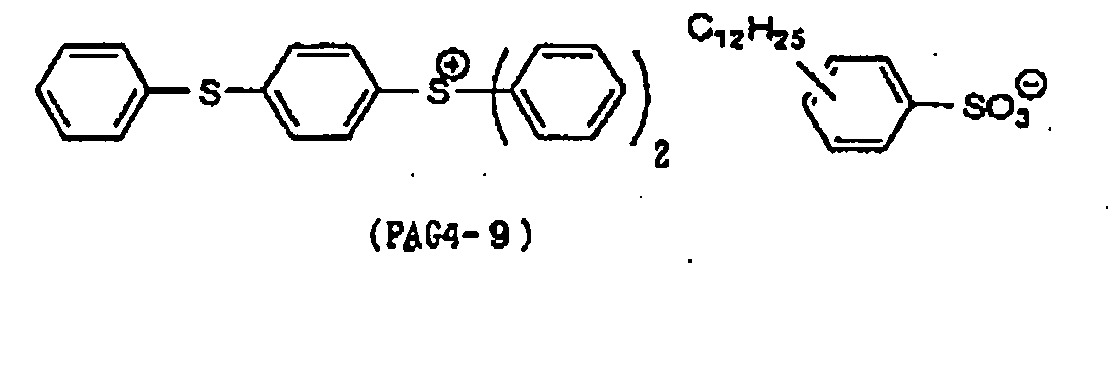
The compound (A1) that generates an organic sulfonic
acid upon irradiation of an actinic ray or radiation
includes a compound (A1a) that generates a sulfonic acid
containing a fluorine atom upon irradiation of an actinic
ray or radiation and a compound (A1b) that generates a
sulfonic acid free from a fluorine atom upon irradiation of
an actinic ray or radiation.
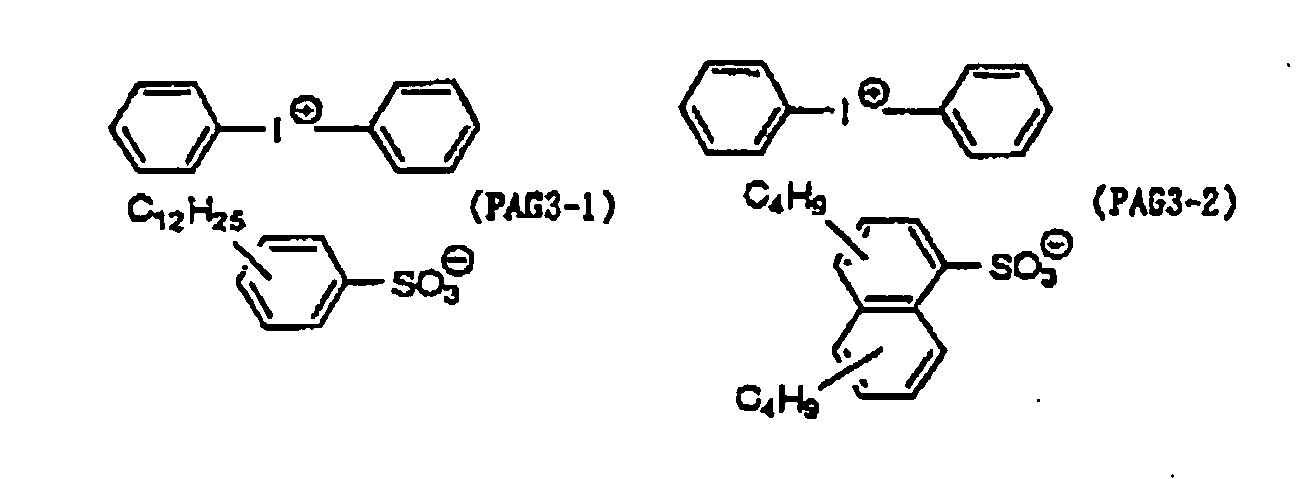
(A1a) Compound that generates a sulfonic acid containing a
fluorine atom upon irradiation of an actinic ray or
radiation
-
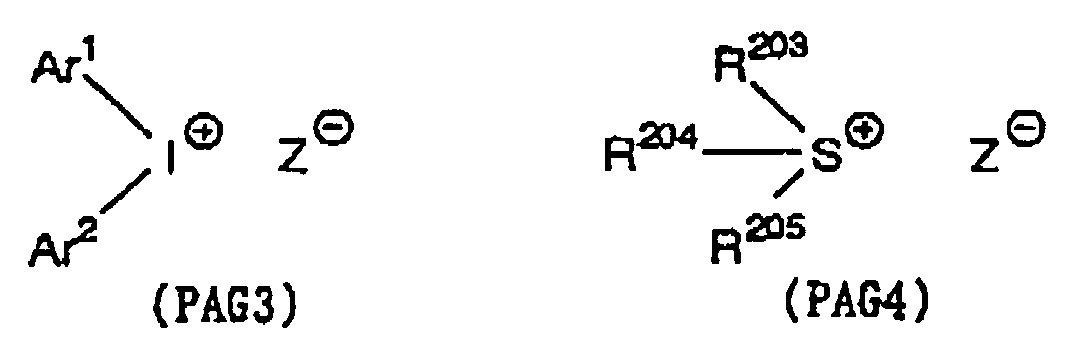
The compound that generates a sulfonic acid
containing a fluorine atom upon irradiation of an actinic
ray or radiation includes, for example, an iodonium salt
represented by formula (PAG3) shown below and a sulfonium
salt represented by formula (PAG4) shown below.
-
In the above formulae, Ar1 and Ar2 each independently
represent an aryl group. R203, R204 and R205 each
independently represent an alkyl group or an aryl group.
-
Z- represents an anion of sulfonic acid having at
least one fluorine atom.
-
Alternatively; two of R203, R204 and R205, or Ar1 and
Ar2 may be combined with each other through a single bond
or a substituent.
-
The aryl group represented by Ar1, Ar2, R203, R204 or
R205 is preferably an aryl group having from 6 to 14 carbon
atoms. The alkyl group represented by Ar1, Ar2, R203, R204 or
R205 is preferably an alkyl group having from 1 to 8 carbon
atoms.
-
Preferred examples of the substituent for the aryl
group include an alkoxy group having from 1 to 8 carbon
atoms, an alkyl group having from 1 to 8 carbon atoms, an
alkoxycarbonyl group having from 2 to 9 carbon atoms, an
alkylcarbonylamino group having from 2 to 9 carbon atoms, a
nitro group, a carboxy group, a hydroxy group, a halogen
atom and a phenylthio group. Preferred examples of the
substituent for the alkyl group include an alkoxy group
having from 1 to 8 carbon atoms, an aryl group having from
6 to 14 carbon atoms, an arylcarbonyl group having from 7
to 15 carbon atoms, a carboxy group and a halogen atom.
-
The anion of sulfonic acid represented by Z- includes
preferably an anion of sulfonic acid containing an
aliphatic hydrocarbon group having from 1 to 20 carbon
atoms or an aromatic hydrocarbon group having from 6 to 20
carbon atoms and at least one fluorine atom. The
hydrocarbon group may have a substituent. Examples of the
substituent include an alkoxy group having from 1 to 10
carbon atoms, which may be substituted with a fluorine atom,
an alkoxycarbonyl group having from 2 to 11 carbon atoms,
which may be substituted with a fluorine atom, a
phenylamino group, a phenylcarbonyl group, a halogen atom
and a hydroxy group. The substituent for the aromatic
hydrocarbon group further includes an alkyl group having
from 1 to 15 carbon atoms.
-
Of the aliphatic sulfonic acid anions, an anion
having a fluorine atom on the α-carbon atom of sulfonic
acid has a high acid strength. The perfluoro aliphatic
sulfonic acid anion has a higher acid strength.
-
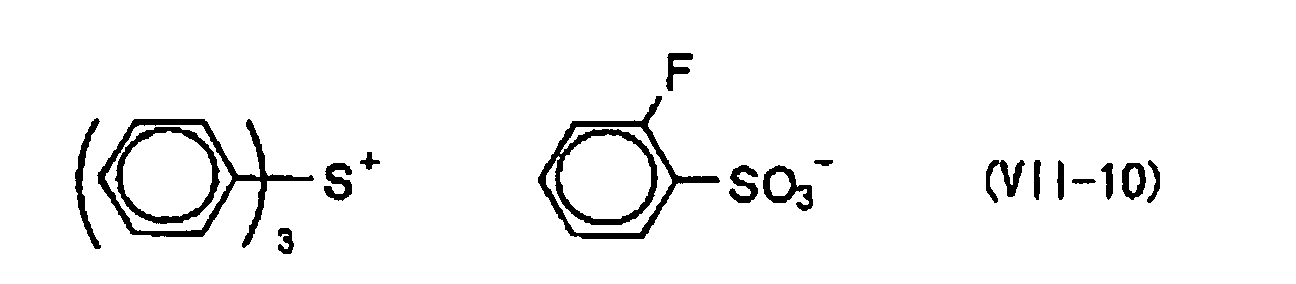
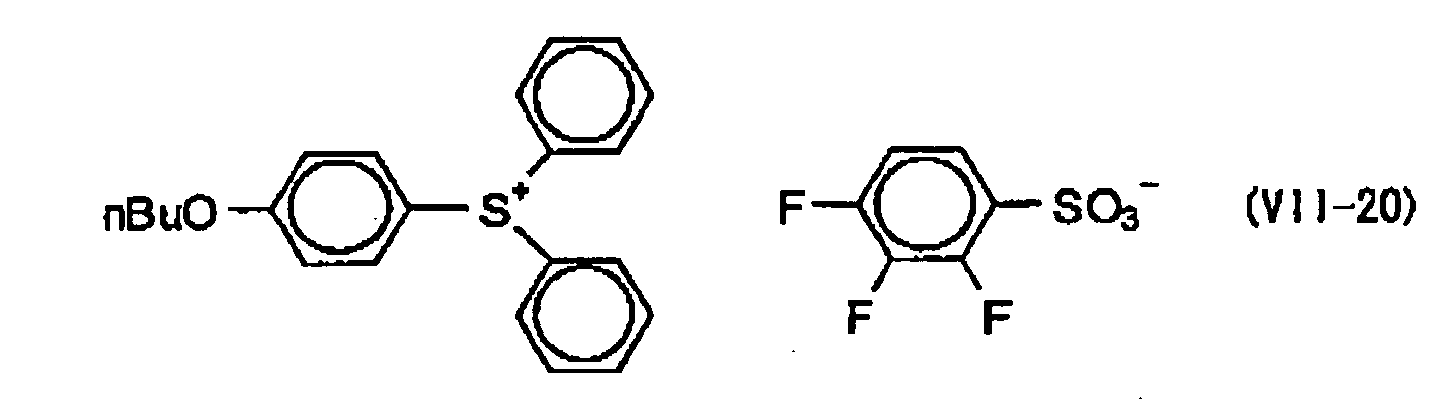
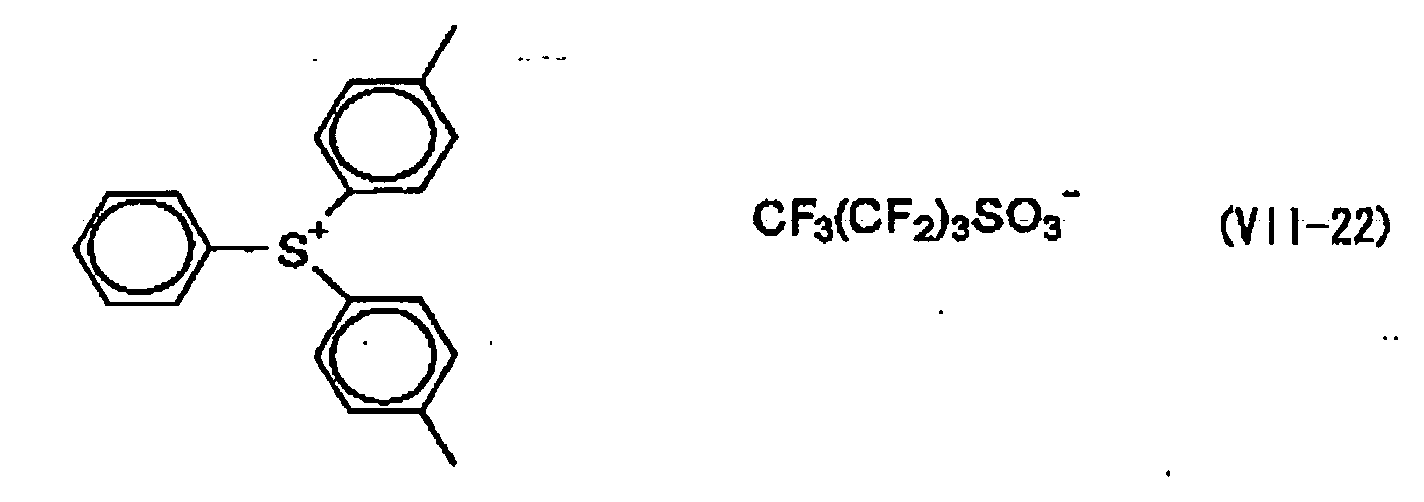
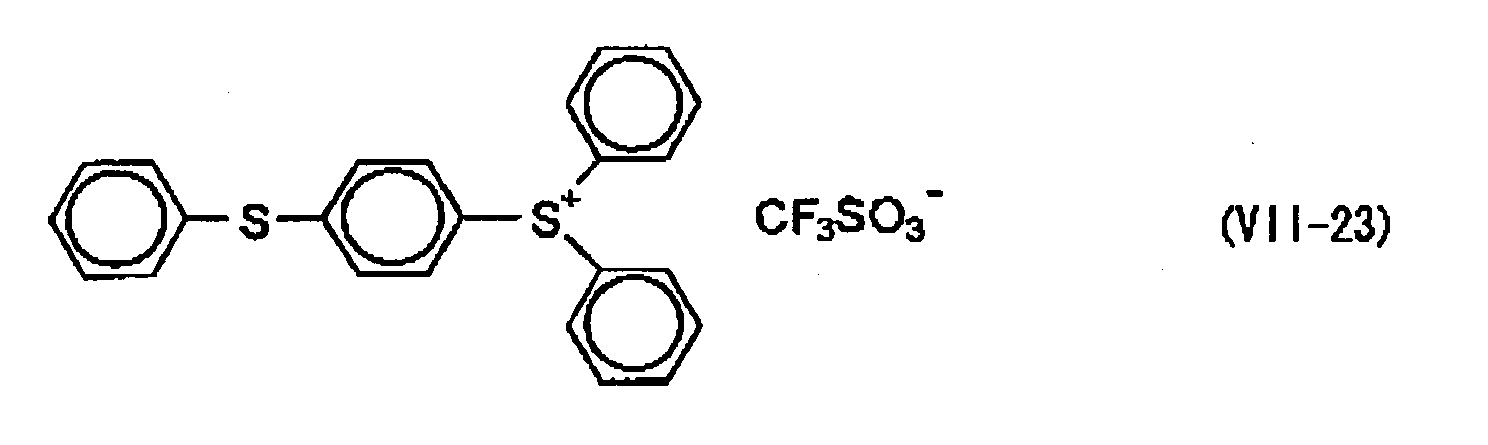
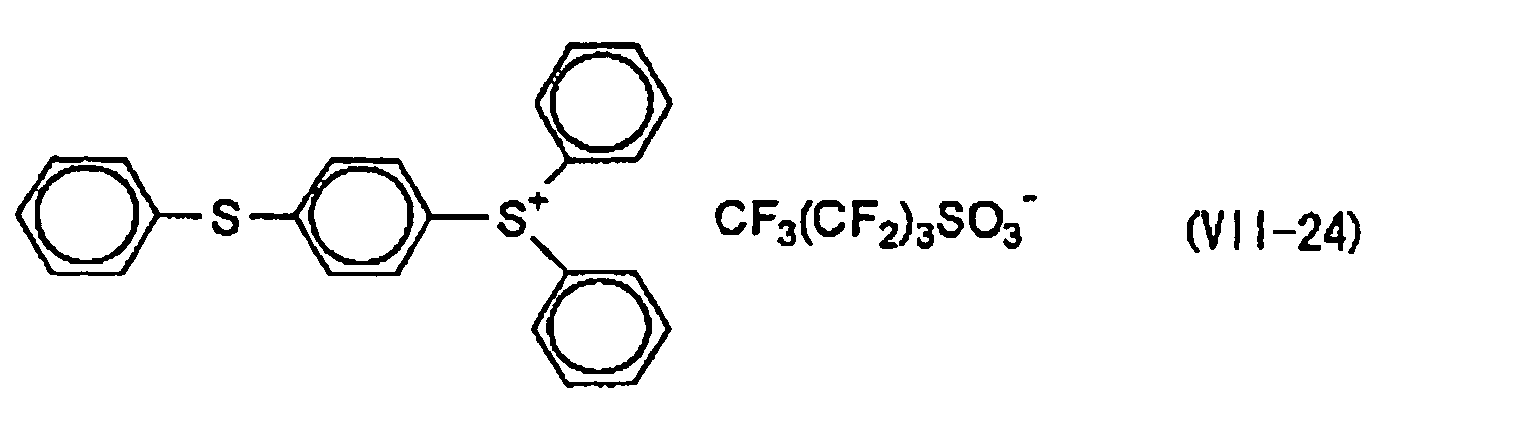
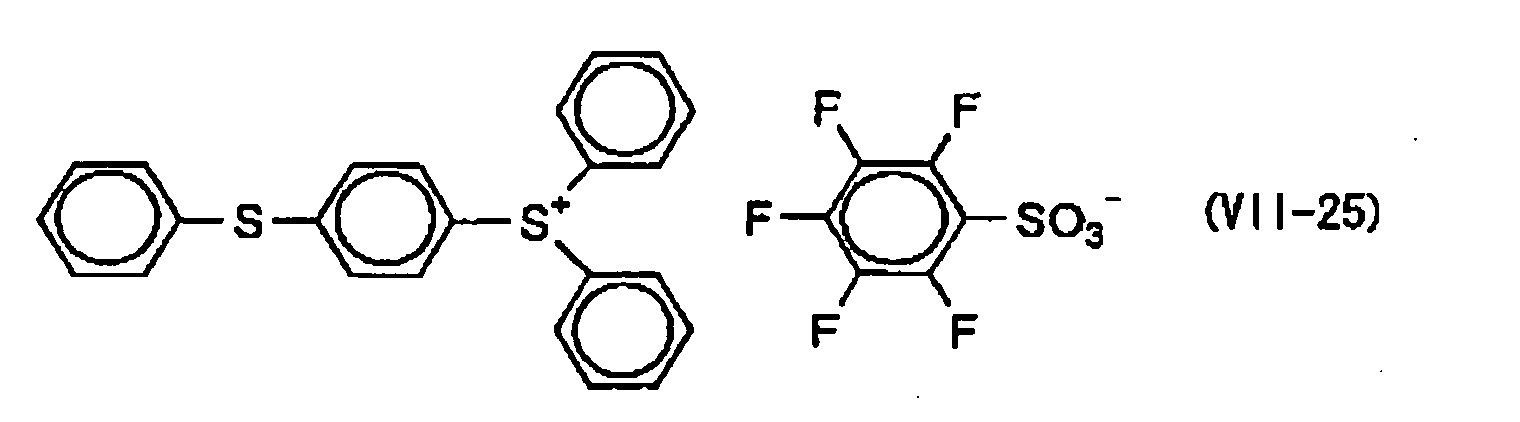
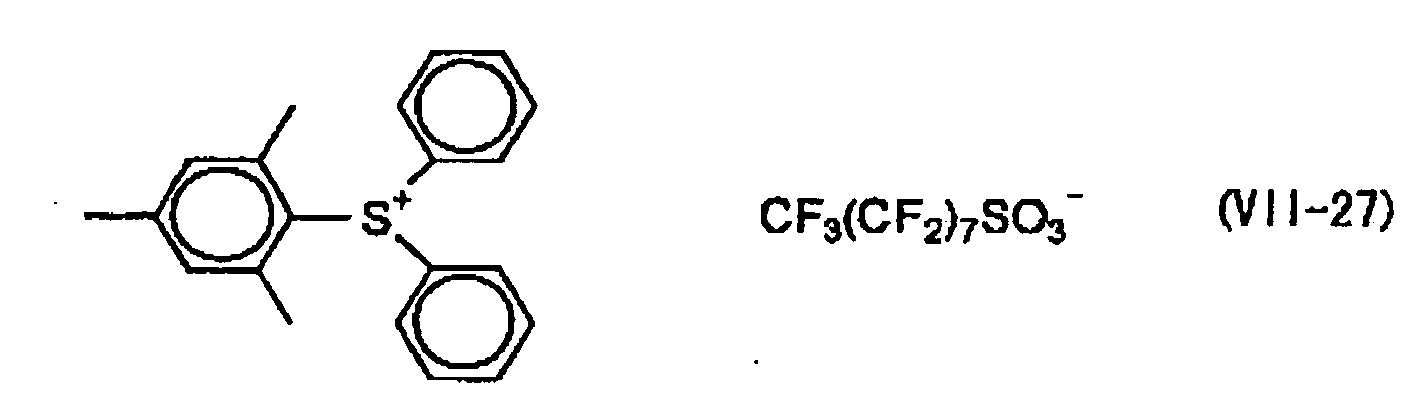
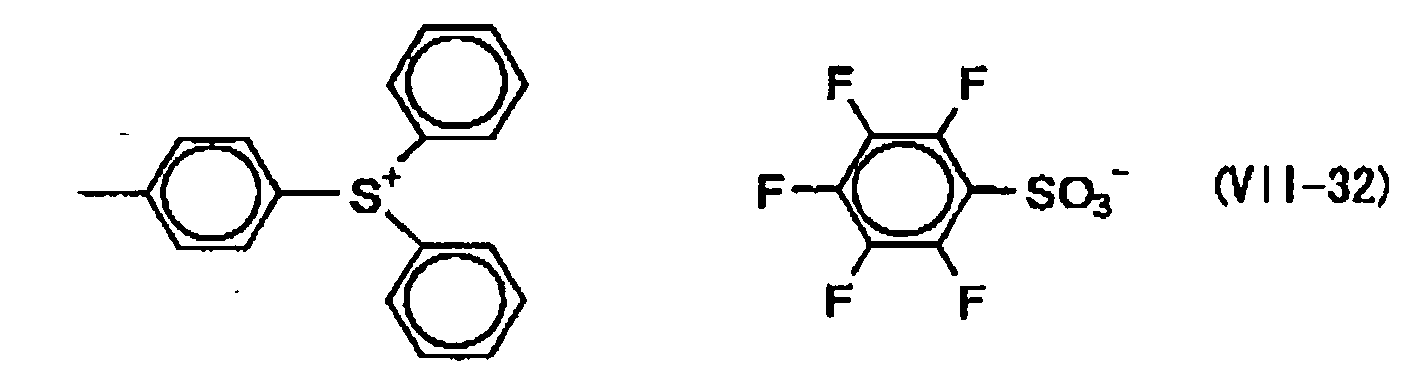
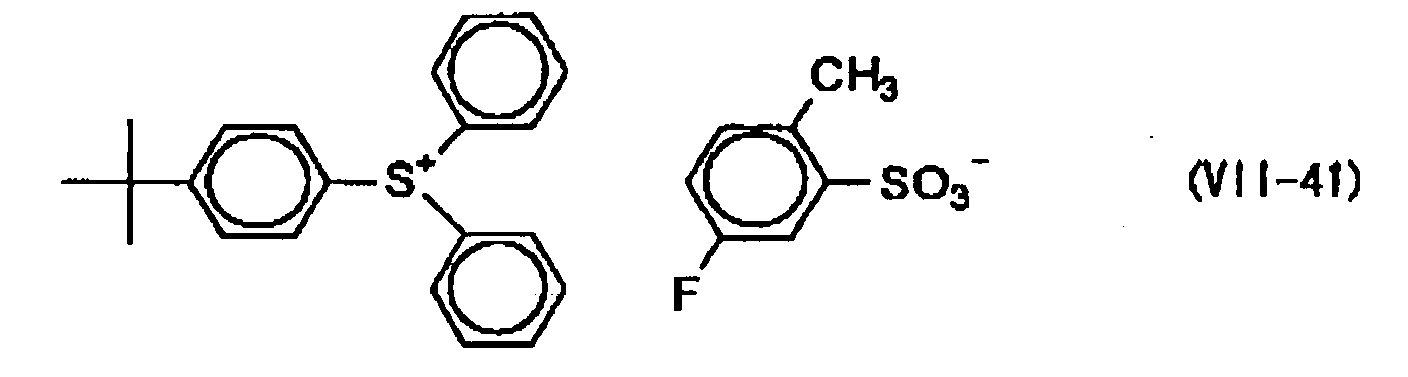
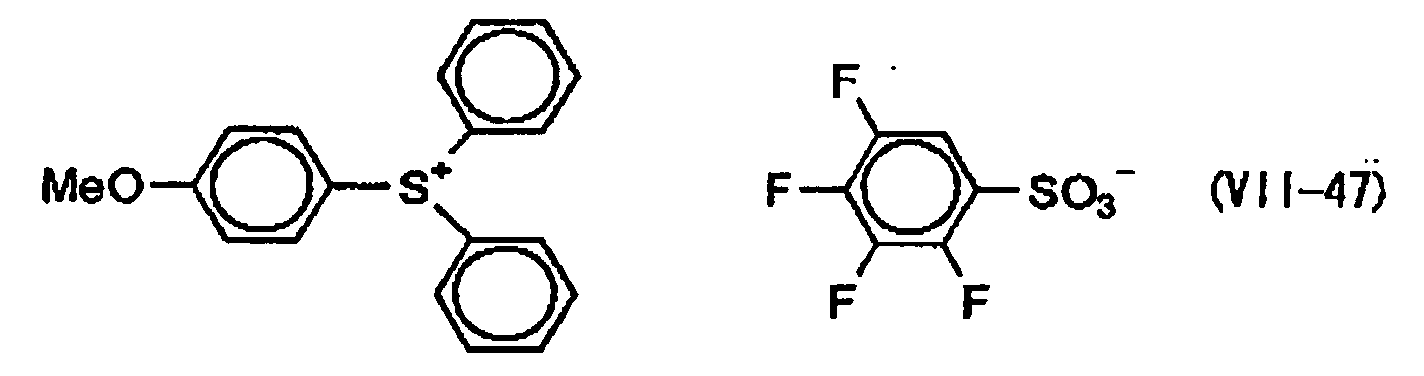
Specific examples of such compounds are set forth
below, but the invention should not be construed as being
limited thereto.
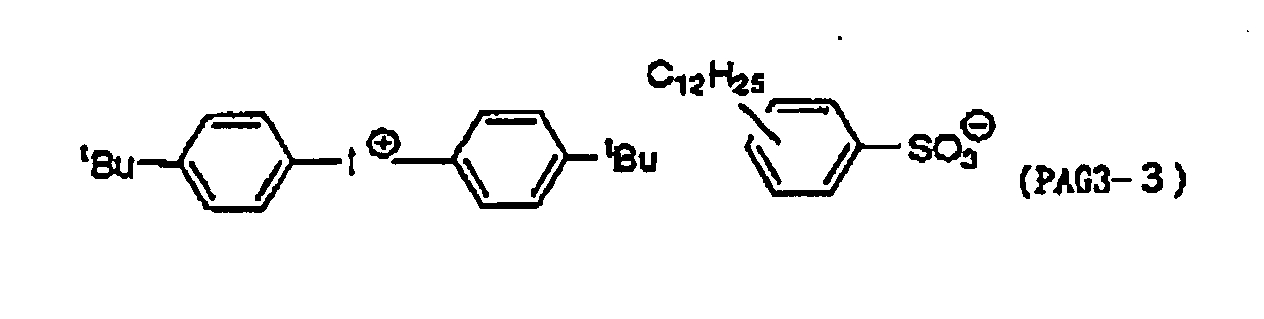
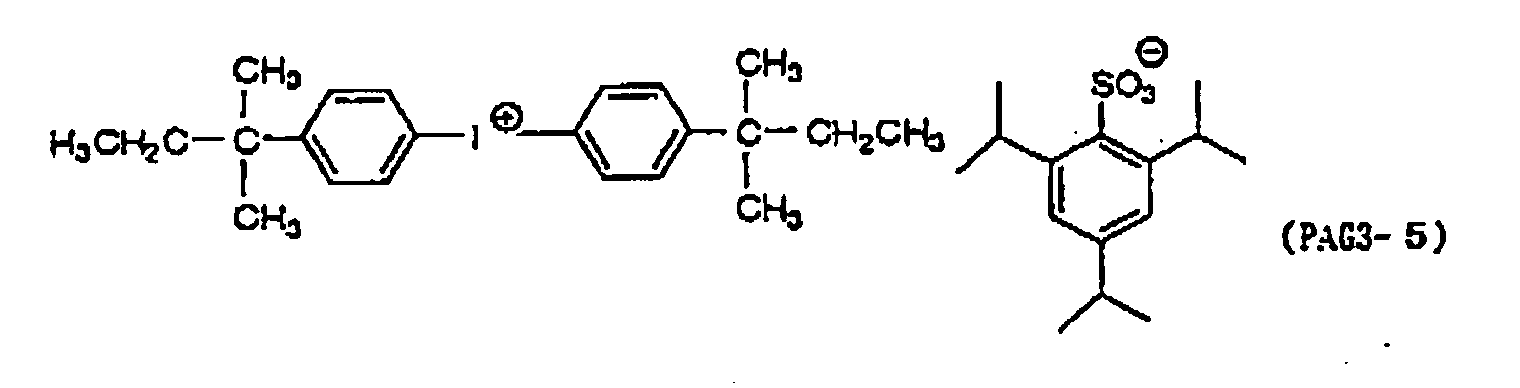
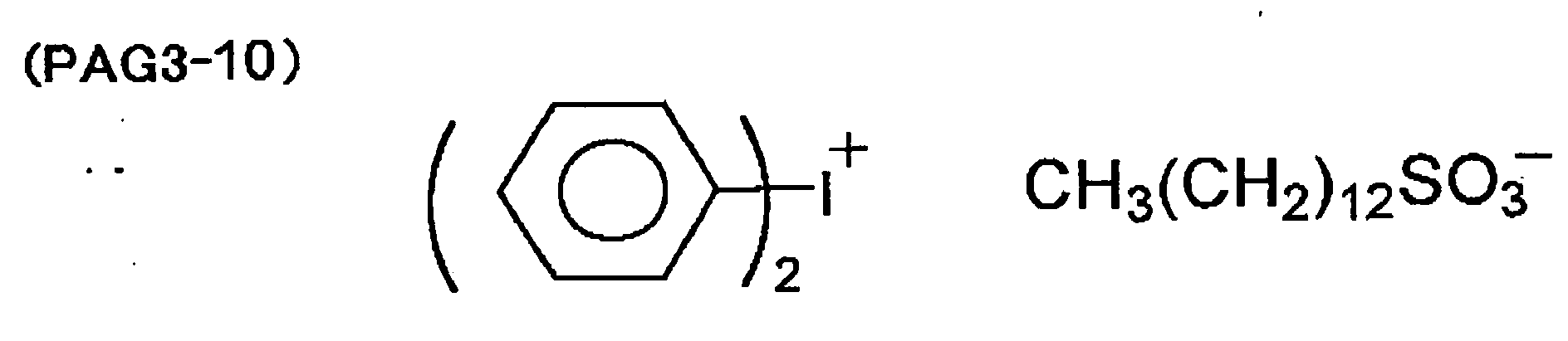
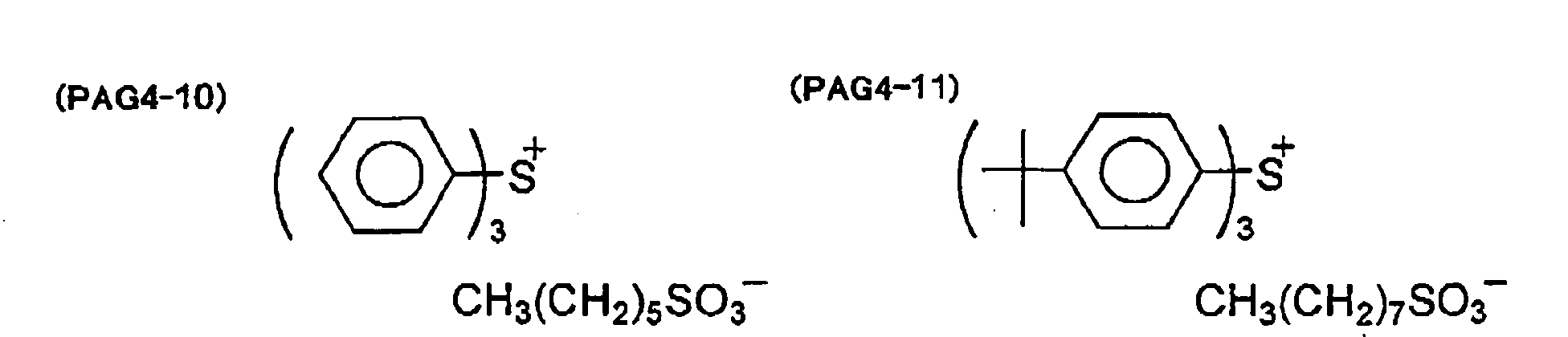
(A1b) Compound that generates a sulfonic acid free from a
fluorine atom upon irradiation of an actinic ray or
radiation
-
The compound that generates a sulfonic acid free from
a fluorine atom upon irradiation of an actinic ray includes,
for example, an iodonium salt represented by formula (PAG3)
shown above and a sulfonium salt represented by formula
(PAG4) shown above, wherein Z- represents an anion of
sulfonic acid having no fluorine atom.
-
Specific examples of such compounds are set forth
below, but the invention should not be construed as being
limited thereto.
-
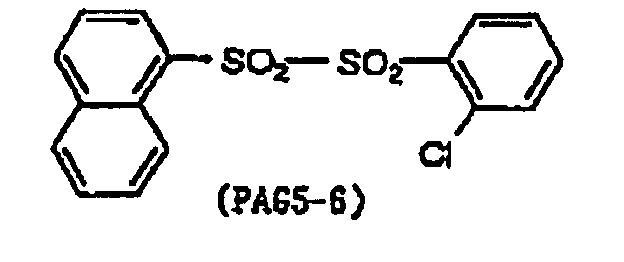
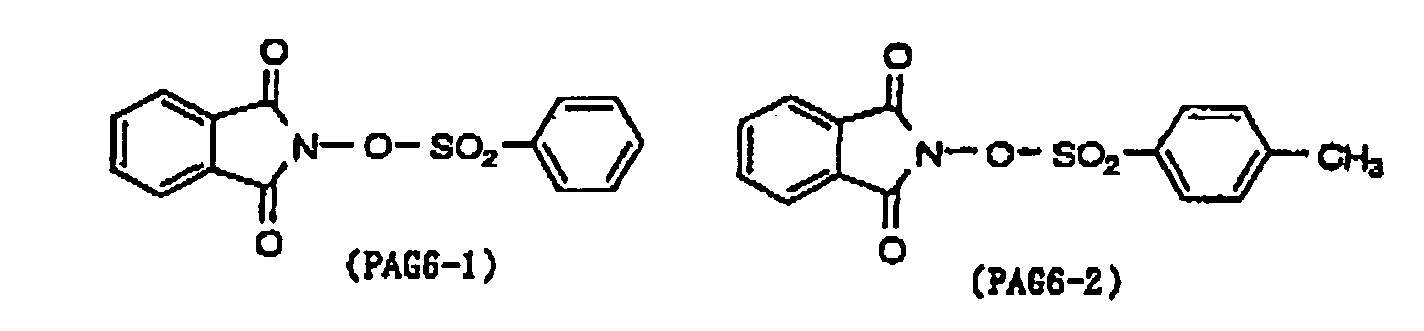
Further, a disulfone derivative represented by
formula (PAG5) shown below and an iminosulfonate derivative
represented by formula (PAG6) shown below are exemplified.
-
In formulae (PAG5) and (PAG6), Ar3 and Ar4 each
independently represent an aryl group. R206 represents an
alkyl group or an aryl group. A represents an alkylene
group, an alkenylene group or an arylene group.
-
Specific examples of such compounds are set forth
below, but the invention should not be construed as being
limited thereto.
-
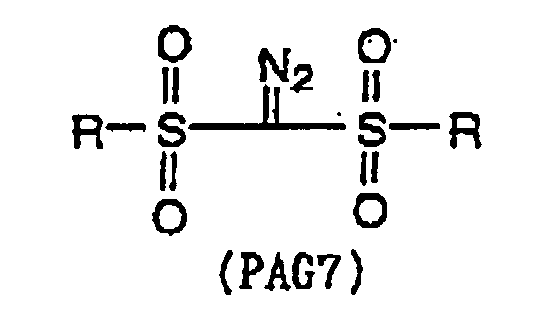
Moreover, a diazodisulfone derivative represented by
formula (PAG7) shown below is also exemplified.
-
In formula (PAG7), R represents an alkyl group, a
cycloalkyl group or an aryl group.
-
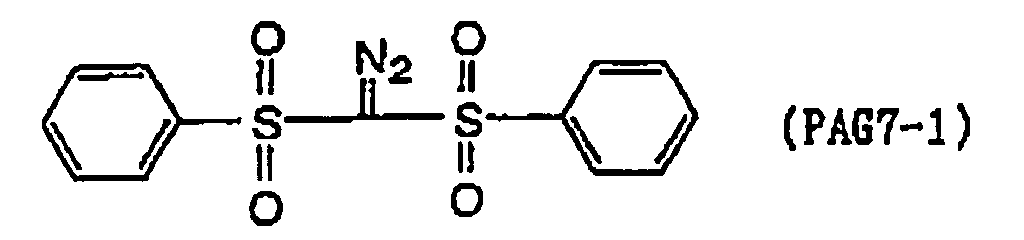
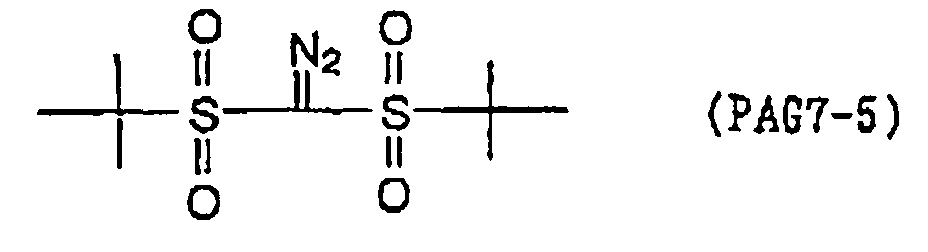
Specific examples of such compounds are set forth
below, but the invention should not be construed as being
limited thereto.
-
The compound of any one of formulae (A1a) and (A1b)
can be synthesized by reacting an aromatic compound with a
periodate and subjecting the resulting iodonium salt to
salt exchange with a corresponding sulfonic acid.
-
The compound can also be synthesized, for example, by
a method comprising reacting an aryl Grignard reagent, e.g.,
an aryl magnesium bromide with a substituted or
unsubstituted phenylsulfoxide and then subjecting the
resulting triaryl sulfonium halide to salt exchange with a
corresponding sulfonic acid, a method comprising condensing
a substituted or unsubstituted phenyl sulfoxide with a
corresponding aromatic compound in the presence of an acid
catalyst, e.g., methanesulfonic acid/diphosphorus
pentaoxide or aluminum chloride and then subjecting the
resulting condensate to salt exchange, or a method
comprising condensing a diaryl iodonium salt with a diaryl
sulfide in the presence of a catalyst, e.g., copper acetate
and then subjecting the resulting condensate to salt
exchange.
-
The salt exchange can be conducted by introducing
once into a halide, followed by converting to a sulfonate
using a silver reagent, e.g., silver oxide, or by using an
ion exchange resin. For the salt exchange, a sulfonic acid
or sulfate commercially available or a sulfonic acid or
sulfate obtained by hydrolysis of a commercially available
sulfonic acid halide can be employed.
-
The amount of the compound of Component (A) added is
ordinarily from 0.5 to 20% by weight, preferably from 0.75
to 15% by weight, and more preferably from 1 to 10% by
weight, based on the total solid content of the positive
resist composition.
[3] Organic basic compound
-
It is preferred that the positive resist composition
of the invention contains an organic basic compound for the
purpose of preventing fluctuations in performances (for
example, formation of T-top shaped pattern, fluctuation in
sensitivity or fluctuation in linewidth of pattern) with
the lapse of time between the irradiation of an actinic ray
or radiation and a heat treatment, fluctuations in
performances with the lapse of time after coating, or
excessive diffusion of the acid at the heat treatment after
the irradiation of an actinic ray or radiation, which
results in deterioration of the resolution. AS the organic
basic compound, for example, an organic basic compound
containing a basic nitrogen atom is exemplified, and a
compound exhibiting pKa of a conjugated acid of not less
than 4 is preferably used.
-
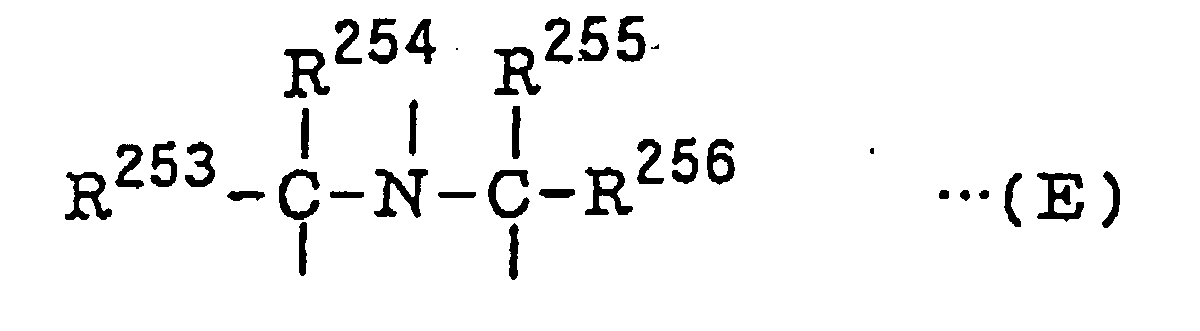
Specifically, compounds having a structure
represented by any one of formulae (A) to (E) shown below
are used.
-
In the above formulae, R250, R251 and R252, which may be
the same or different, each represent a hydrogen atom, an
alkyl group having from 1 to 20 carbon atoms, a cycloalkyl
group having from 3 to 20 carbon atoms or an aryl group
having from 6 to 20 carbon atoms, or R251 and R252 may be
connected with each other to form a ring.
-
The alkyl group, cycloalkyl group and aryl group
represented by any one of R250, R251 and R252 may have a
substituent. The alkyl group or cycloalkyl group, which
may have a substituent, include, for example, an aminoalkyl
group having from 1 to 20 carbon atoms, an aminocycloalkyl
group having from 3 to 20 carbon atoms, a hydroxyalkyl
group having from 1 to 20 carbon atoms and a
hydroxycycloalkyl group having from 3 to 20 carbon atoms.
-
R253, R254, R255 and R256, which may be the same or
different, each represent an alkyl group having from 1 to
20 carbon atoms or a cycloalkyl group having from 3 to 20
carbon atoms.
-
More preferred compounds are nitrogen-containing
basic compounds having two or more nitrogen atoms having
different chemical circumstances per molecule, and
particularly preferred compounds are compounds having both
a substituted or unsubstituted amino group and a cyclic
structure containing a nitrogen atom and compounds having
an alkylamino group.
-
Preferred examples of the organic basic compound
include substituted or unsubstituted guanidines,
substituted or unsubstituted aminopyridines, substituted or
unsubstituted aminoalkylpyridines, substituted or
unsubstituted aminopyrrolidines, substituted or
unsubstituted indazoles, substituted or unsubstituted
imidazoles, substituted or unsubstituted pyrazoles,
substituted or unsubstituted pyrazines, substituted or
unsubstituted pyrimidines, substituted or unsubstituted
purines, substituted or unsubstituted imidazolines,
substituted or unsubstituted pyrazolines, substituted or
unsubstituted piperazines, substituted or unsubstituted
aminomorpholines and substituted or unsubstituted
aminoalkylmorpholines. Preferred examples of the
substituent include an amino group, an aminoalkyl group, an
alkylamino group, an aminoaryl group, an arylamino group,
an alkyl group, an alkoxy group, an acyl group, an acyloxy
group, an aryl group, an aryloxy group, a nitro group, a
hydroxy group and a cyano group.
-
Particularly preferred examples of the organic basic
compound include guanidine, 1,1-dimethylguanidine, 1,1,3,3-tetramethylguanidine,
imidazole, 2-methylimidazole, 4-methylimidazole,
N-methylimidazole, 2-phenylimidazole, 4,5-diphenylimidazole,
2,4,5-triphenylimidazole, 2-aminopyridine,
3-aminopyridine, 4-aminopyridine, 2-dimethylaminopyridine,
4-dimethylaminopyridine, 2-diethylaminopyridine,
2-(aminomethyl)pyridine, 2-amino-3-methylpyridine,
2-amino-4-methylpyridine, 2-amino-5-methylpyridine,
2-amino-6-methylpyridine, 3-aminoethylpyridine,
4-aminoethylpyridine, 3-aminopyrrolidine,
piperazine, N-(2-aminoethyl)piperazine,
N-(2-aminoethyl)piperidine, 4-amino-2,2,6,6-tetramethylpiperidine,
4-piperidinopiperidine, 2-iminopiperidine,
1-(2-aminoethyl)pyrrolidine, pyrazole, 3-amino-5-methylpyrazole,
5-amino-3-methyl-1-p-tolylpyrazole,
pyrazine, 2-(aminomethyl)-5-methylpyrazine, pyrimidine,
2,4-diaminopyrimidine, 4,6-dihydroxypyrimidine, 2-pyrazoline,
3-pyrazoline, N-aminomorpholine and N-(2-aminoethyl)morpholine.
However, the organic basic compound
for use in the invention should not be construed as being
limited to these compounds.
-
The organic basic compounds may be used individually
or as a mixture of two or more thereof.
-
A ratio of the acid generator to the organic basic
compound (acid generator)/(organic basic compound) used in
the positive resist composition is preferably from 2.5 to
300 in a molar ratio. The molar ratio of (acid
generator)/(organic basic compound) is preferably from 5.0
to 200, and more preferably from 7.0 to 150.
[4] Surfactant
-
It is preferred that the positive resist composition
of the invention contains a surfactant, particularly, a
fluorine-based and/or silicon-based surfactant.
Specifically, the positive resist composition of the
invention preferably contains one or more of a fluorine
atom-containing surfactant, a silicon atom-containing
surfactant and a surfactant containing both a fluorine atom
and a silicon atom. The addition of such a fluorine-based
and/or silicon-based surfactant is effective for the
suppression of development defect and the improvement in
coating property.
-
Examples of the fluorine-based and/or silicon-based
surfactant include those as described in JP-A-62-36663, JP-A-61-226746,
JP-A-61-226745, JP-A-62-170950, JP-A-63-34540,
JP-A-7-230165, JP-A-8-62834, JP-A-9-54432, JP-A-9-5988, JP-A-2002-277862
and U.S. Patents 5,405,720, 5,360,692,
5,529,881, 5,296,330, 5,436,098, 5,576,143, 5,296,143,
5,294,511 and 5,824,451. Commercially available
surfactants described below may also be used as they are.
-
Examples of the commercially available fluorine-based
and/or silicon-based surfactant, which can be used, include
fluorine-based surfactants or silicon-based surfactants,
e.g., Eftop EF301 and EF303 (manufactured by Shin-Akita
Kasei Co., Ltd.), Florad FC430 and 431 (manufactured by
Sumitomo 3M Ltd.), Megafac F171, F173, F176, F189 and R08
(manufactured by Dainippon Ink and Chemicals, Inc.),
Surflon S-382, SC101, 102, 103, 104, 105 and 106
(manufactured by Asahi Glass Co., Ltd.) and Troysol S-366
(manufactured by Troy Chemical Corp.). A polysiloxane
polymer KP-341 (manufactured by Shin-Etsu Chemical Co.,
Ltd.) is also used as the silicon-based surfactant.
-
Besides the above described known surfactants, a
surfactant comprising a polymer including a fluoroaliphatic
group derived from a fluoroaliphatic compound produced by a
telomerization method (also referred to as a telomer
method) or an oligomerization method (also referred to as
an oligomer method) can be used as the fluorine-based
and/or silicon-based surfactant. The fluoroaliphatic
compound can be synthesized according to methods described
in JP-A-2002-90991.
-
As the polymer including a fluoroaliphatic group, a
copolymer of a monomer having a fluoroaliphatic group with
(poly(oxyalkylene)) acrylate and/or (poly(oxyalkylene))
methacrylate is preferred. The copolymer may be a random
copolymer or a block copolymer. The poly(oxyalkylene)
group includes, for example, a poly(oxyethylene) group, a
poly(oxypropylene) group and a poly (oxybutylene) group.
Also, a unit containing alkylenes having different chain
lengths in the chain thereof, for example,
poly(oxyethylene-oxypropylene-oxyethylene block connecting
group) or poly(oxyethylene-oxypropylene block connecting
group) may be used. Further, the copolymer of a monomer
having a fluoroaliphatic group with a (poly(oxyalkylene))
acrylate (or methacrylate) may be not only a binary
copolymer but also a ternary or more component-containing
copolymer obtained by copolymerizing simultaneously two or
more different monomers having a fluoroaliphatic group with
two or more different (poly(oxyalkylene)) acrylates (or
methacrylates).
-
Examples of the commercially available polymer
fluorine-based and/or silicon-based surfactants include
Megafac F178, F-470, F-473, F-475, F-476 and F-472
(manufactured by Dainippon Ink and Chemicals, Inc.). Also,
copolymers of acrylate (or methacrylate) having a C6F13
group and (poly(oxyalkylene)) acrylate (or methacrylate),
copolymers of acrylate (or methacrylate) having a C6F13
group, (poly(oxyethylene)) acrylate (or methacrylate) and
(poly(oxypropylene)) acrylate (or methacrylate), copolymers
of acrylate (or methacrylate) having a C8F17 group and
(poly(oxyalkylene)) acrylate (or methacrylate), copolymers
of acrylate (or methacrylate) having a C8F17 group,
(poly(oxyethylene)) acrylate (or methacrylate) and
(poly(oxypropylene)) acrylate (or methacrylate) are
exemplified.
-
The amount of the fluorine-based and/or silicon-based
surfactant used is preferably from 0.0001 to 2% by weight,
more preferably from 0.001 to 1% by weight, and
particularly preferably from 0.01 to 1% by weight, based on
the total amount of the positive resist composition
(excluding a solvent).
[5] Solvent
-
The positive resist composition of the invention is
used by dissolving the above-described components in a
solvent that can dissolve the components, and coating the
resulting solution on a substrate. Preferred examples of
the solvent used include ethylene dichloride, cyclohexanone,
cyclopentanone, 2-heptanone, γ-butyrolactone, methyl ethyl
ketone, ethylene glycol monomethyl ether, ethylene glycol
monoethyl ether, 2-methoxyethyl acetate, ethylene glycol
monoethyl ether acetate, propylene glycol monomethyl ether,
propylene glycol monoethyl ether, propylene glycol
monomethyl ether acetate, toluene, ethyl acetate, methyl
lactate, ethyl lactate, methyl methoxypropionate, ethyl
ethoxypropionate, methyl pyruvate, ethyl pyruvate, propyl
pyruvate, N,N-dimethylformamide, dimethylsulfoxide, N-methylpyrrolidone
and tetrahydrofuran. The solvents may be
used individually or as a mixture of two or more thereof.
-
In the invention, it is preferred to use a mixed
solvent in which a propylene glycol monoalkyl ether acetate,
for example, propylene glycol monomethyl ether acetate is
mixed with a propylene glycol monoalkyl ether, for example,
propylene glycol monomethyl ether or propylene glycol
monoethyl ether or an alkyl lactate, for example, ethyl
lactate.
-
A solid content concentration when the above-described
components are dissolved in a solvent is
preferably from 3 to 15% by weight, and more preferably
from 5 to 10% by weight
-
The steps of pattern formation on a resist film, for
example, in the production of precise integrated circuit
devices, comprises applying the positive resist composition
of the invention to a substrate (for example,
silicon/silicon dioxide coating, a transparent substrate,
e.g., glass substrate or ITO substrate), irradiating the
resist film using an actinic ray or radiation drawing
apparatus, followed by heating, developing, rinsing and
drying. Thus, good resist patterns are obtained.
-
The developing solution, which can be used for the
positive resist composition of the invention, is an aqueous
solution of alkali, for example, an inorganic alkali, e.g.,
sodium hydroxide, potassium hydroxide, sodium carbonate,
sodium silicate, sodium metasilicate or aqueous ammonia; a
primary amine, e.g., ethylamine or n-propylamine; a
secondary amine, e.g., diethylamine or di-n-butylamine; a
tertiary amine, e.g., triethylamine or methyldiethylamine;
an alcohol amine, e.g., dimethylethanolamine or
triethanolamine; a quaternary ammonium salt, e.g.,
tetramethylammonium hydroxide, tetraethylammonium hydroxide
or choline; and a cyclic amine, e.g., pyrrole or piperidine.
A developing solution prepared by adding an appropriate
amount of an alcohol, for example, isopropyl alcohol or a
surfactant, for example, a nonionic surfactant, to the
above-described aqueous solution of alkali is also used.
-
Of the developing solutions, those containing a
quaternary ammonium salt are preferred and, those
containing tetramethylammonium hydroxide or choline are
more preferred.
-
The alkali concentration of the alkali developing
solution is ordinarily from 0.1 to 20% by weight,
preferably from 0.2 to 15% by weight, and more preferably
from 0.5 to 10% by weight.
-
The pH of the alkali developing solution is
ordinarily from 10.0 to 15.0, preferably from 10.5 to 14.5,
and more preferably from 11.0 to 14.0.
-
The present invention will be described in more
detail with reference to the following examples, but the
invention should not be construed as being limited thereto.
Synthesis Example 1: Synthesis of monomer having acid-decomposable
group
-
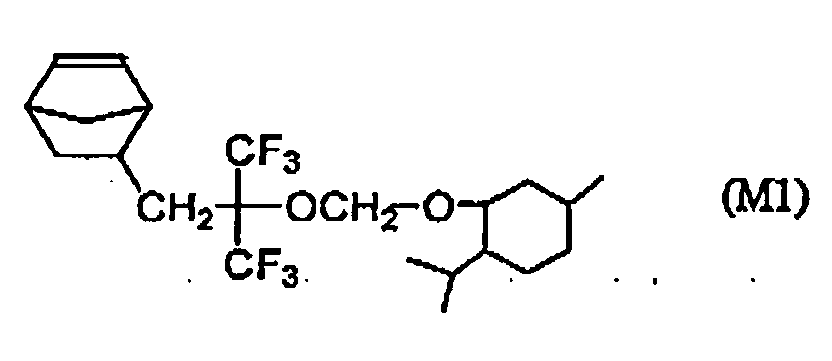
In tetrahydrofuran was dissolved 27.5 g of 3-(5-bicyclo[2.2.1]hepten-2-yl)-1,1,1-trifluoro-2-(trifluoromethyl)-2-propan-2-ol
and the resulting solution
was cooled to 0°C under nitrogen atmosphere. To the
solution was added 4.6 g of sodium hydride (60%) over a
period of 30 minutes and then was dropwise added 20.4 g of
chloromethyl methyl ether, followed by stirring for 30
minutes as it was. The temperature of the reaction
solution was raised to room temperature, and then 300 ml of
ethyl acetate was added thereto. The reaction solution was
washed three times with each 500 ml of distilled water.
The ethyl acetate layer separated was treated in an
evaporator to distill off the ethyl acetate to obtain 28.9
g of Monomer (M1) shown below.
Synthesis Example 2: Synthesis of Resin (F-1)
-
In 100 ml of tetrahydrofuran were dissolved 13.3 g of
acid-decomposable Monomer (M1) described above, 6.0 g of α-trifluoromethylacrylic
acid 2-ethyladamantyl ester and 9.2
g of α-trifluoromethylacrylic acid dihydroxyadamantyl ester
and the solution was introduced into an autoclave under
nitrogen atmosphere. 1.24 g of an azo series
polymerization initiator (V-65, manufactured by Wako Pure
Chemical Industries, Ltd.) was added and then 2.0 g of
tetrafluoroethylene was charged, followed by reacting at
70°C for 10 hours with stirring.
-
To the reaction solution was added 500 ml of hexane
to precipitate a polymer and the supernatant liquid was
removed by decantation. The remaining viscous polymer was
dissolved in 50 ml of acetone and one liter of hexane was
again added thereto to conduct separation treatment of the
polymer, thereby removing the unreacted monomers and
oligomer components. The polymer obtained was subjected to
measurement of molecular weight by gel permeation
chromatography (GPC) and it was found that the weight
average molecular weight and degree of dispersion were
10,200 and 1.9, respectively.
-
The polymer was again dissolved in 50 ml of acetone
and one liter of hexane was again added thereto to conduct
separation treatment of Polymer (F-1), thereby removing the
unreacted monomers and oligomer components. Polymer (F-1)
obtained was subjected to measurement of molecular weight
by gel permeation chromatography (GPC) and it was found
that the weight average molecular weight and degree of
dispersion were 8,000 and 1.4, respectively.
-
In the same manner as described above, the resins
shown in Table 1 below were obtained.
| Resin | Monomer Composition (molar ratio) | Weight Average Molecular Weight | Degree of Dispersion |
| (F-1) | 30/20/20/30 | 8,000 | 1.4 |
| (F-2) | 15/25/40/20 | 8,000 | 1.45 |
| (F-3) | 25/25/30/20 | 7,000 | 1.5 |
| (F-4) | 20/30/20/30 | 6,000 | 1.45 |
| (F-6) | 10/30/30/30 | 9,000 | 1.5 |
| (F-8) | 30/20/20/30 | 10,000 | 1.4 |
| (F-10) | 20/30/20/30 | 10,000 | 1.5 |
| (F-12) | 25/25/30/20 | 7,000 | 1.45. |
Synthesis of Resin (CP) for comparative example
-
Resin (CP) for comparative example having the
structure shown below was synthesized in the same manner as
in Synthesis Example 2 except for using as the monomers,
6.9 g of 3-(5-bicyclo[2.2.1]hepten-2-yl)-1,1,1-trifluoro-2-(trifluoromethyl)-2-propan-2-ol,
8.0 g of monomer in which
the hydroxy group of 3-(5-bicyclo[2.2.1]hepten-2-yl)-1,1,1-trifluoro-2-(trifluoromethyl)-2-propan-2-ol
was protected
with a methoxymethyl group and 5.1 g of tetrafluoroehtylene.
The weight average molecular weight and degree of
dispersion of Resin (CP) were 8,000 and 1.4, respectively.
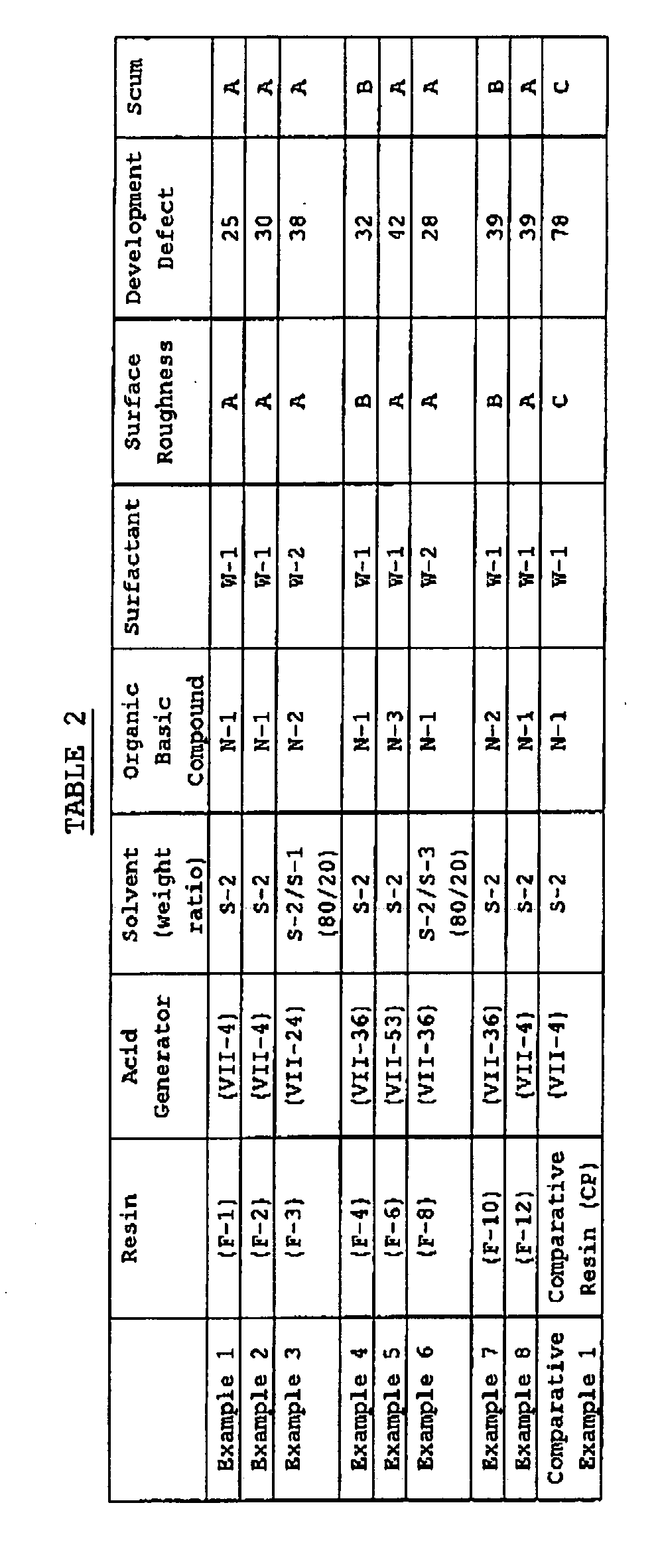
Examples 1 to 8 and Comparative Example 1
-
A resin solution prepared by dissolving 1.2 g of
resin, 0.030 g of acid generator, 100 ppm of surfactant to
the polymer solution and 0.0012 g of organic basic compound
in 19.6 g of solvent as shown in Table 2 below was filtered
through a polytetrafluoroethylene filter having a pore size
of 0.1 µm to prepare a positive resist solution.
-
The abbreviations shown in Table 2 indicate the
following compounds.
- N-1: Hexamethylenetetramine
- N-2: 1,5-Diazabicyclo[4.3.0]-5-nonene
- N-3: 1,8-Diazabicyclo[5.4.0]-7-undecene
- W-1: Megafac F176 (manufactured by Dainippon Ink and
Chemicals, Inc.) (fluorine-based)
- W-2: Megafac R08 (manufactured by Dainippon Ink and
Chemicals, Inc.) (fluorine- and silicon-based)
- S-1: Methyl lactate
- S-2: Propylene glycol monomethyl ether acetate
- S-3: Propylene glycol monomethyl ether
-
-
On a silicon wafer having coated thereon an anti-reflective
coating (DUV42-6, manufactured by Brewer Science,
Inc.), the positive resist solution described above was
uniformly coated by a spin coater and dried by heating at
120°C for 60 seconds to form a positive resist film having
a thickness of 0.12 µm. The resist film was subjected to
pattern exposure using an ArF microstepper and immediately
after the exposure, it was heated at 110°C for 90 seconds
on a hot plate. Then, the resist film was developed with a
2.38% by weight aqueous solution of tetramethylammonium
hydroxide at 23°C for 30 seconds, rinsed with pure water
for 30 seconds and dried. With the pattern on the silicon
wafer thus-obtained, surface roughness, development defect
and development residue (scum) were evaluated in the manner
shown below.
[Surface Roughness]
-
In a line and space pattern of 0.11 µm, a degree of
roughness on the line surface portion was visually
evaluated according to observation by SEM. A case wherein
roughness (convexoconcave) was hardly observed on the line
surface was rated as A, a case wherein roughness was
somewhat observed on the line surface was rated as B, and a
case wherein roughness was apparently observed on the line
surface was rated as C.
[Evaluation Test of Development Defect]
-
With the resist pattern obtained as above, a number
of development defect was measured by an apparatus (KLA-2112,
manufactured by KLA Tencor Corp.). The primary datum
value was designated as the result of measurement.
[Occurrence of Scum]
-
A degree of development residue (scum) on the resist
pattern having a linewidth of 0.15 µm was evaluated. A
case wherein the residue was not observed was ranked as A,
a case wherein the residue was considerably observed was
ranked as C, and intermediate between A and C was rated as
B.
-
The results of performance evaluation are shown in
Table 2.
-
Form the results shown in Table 2, it is apparent
that the positive resist composition of the invention is
excellent in the surface roughness, development defect and
scum.
[Resolution]
-
On a silicon wafer having coated thereon an anti-reflective
coating (DUV42-6, manufactured by Brewer Science,
Inc.), each of the positive resist solutions of Examples 1,
3 and 6 and Comparative Example 1 was uniformly coated by a
spin coater and dried by heating at 120°C for 60 seconds to
form a positive resist film having a thickness of 0.12 µm.
The resist film was subjected to pattern exposure using an
F2 microstepper and immediately after the exposure, it was
heated at 110°C for 90 seconds on a hot plate. Then, the
resist film was developed with a 2.38% by weight aqueous
solution of tetramethylammonium hydroxide at 23°C for 30
seconds, rinsed with pure water for 30 seconds and dried.
With the pattern on the silicon wafer thus-obtained,
resolution performance was evaluated using a limiting
resolution capable of being reproduced in the minimum
exposure amount necessary for reproducing line and space of
100 nm.
-
The results of evaluation are shown in Table 3.
| | Resolution (nm) |
| Example 1 | 70 |
| Example 3 | 80 |
| Example 6 | 75 |
| Comparative Example 1 | 100 |
-
Form the results shown in Table 3, it can be seen
that the positive resist composition of the invention
exhibit high resolution.
-
The entire disclosure of each and every foreign
patent application from which the benefit of foreign
priority has been claimed in the present application is
incorporated herein by reference, as if fully set forth
herein.
-
While the invention has been described in detail and
with reference to specific embodiments thereof, it will be
apparent to one skilled in the art that various changes and
modifications can be made therein without departing from
the spirit and scope thereof.
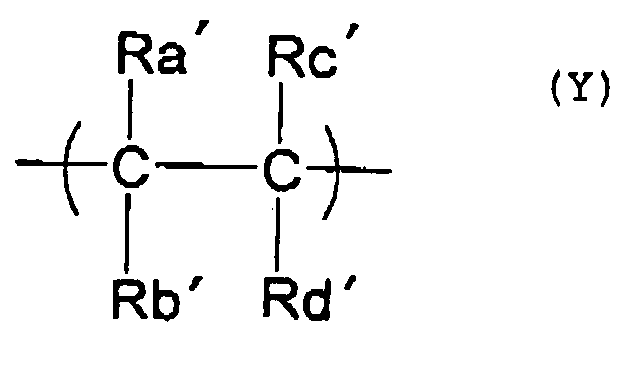




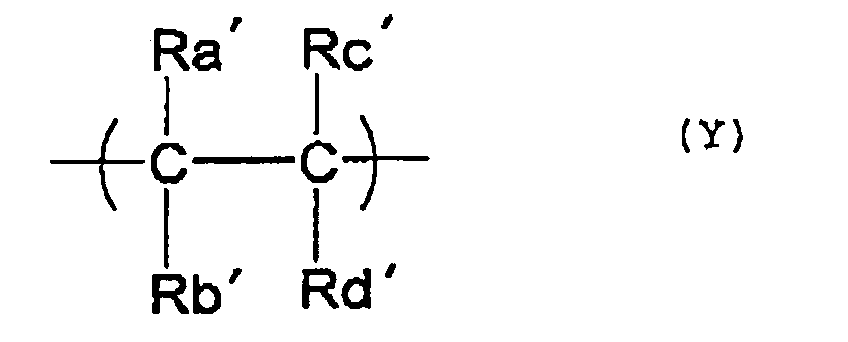



















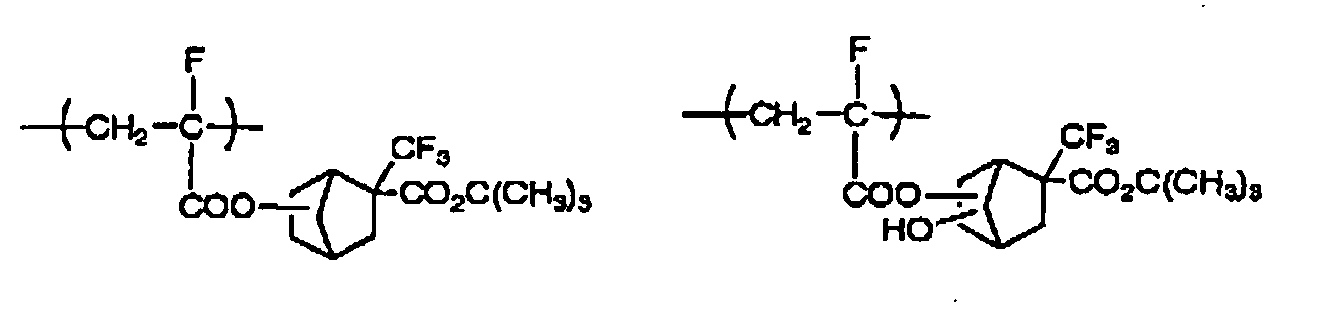

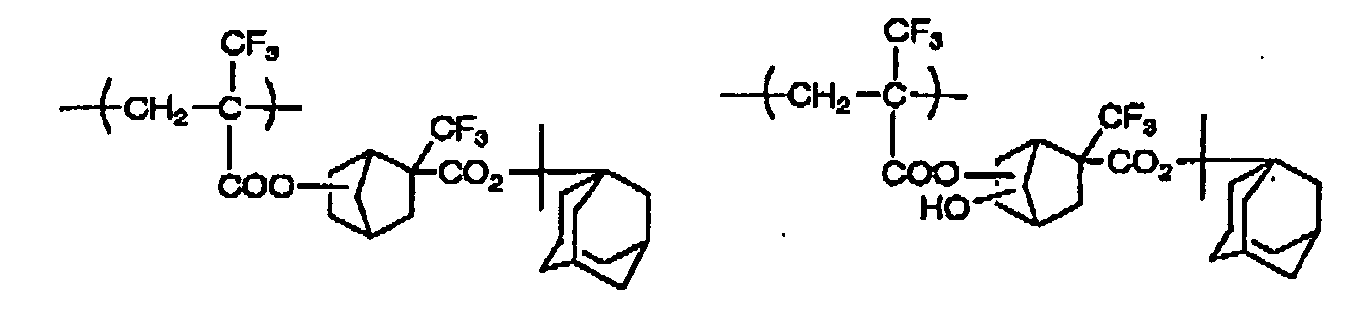


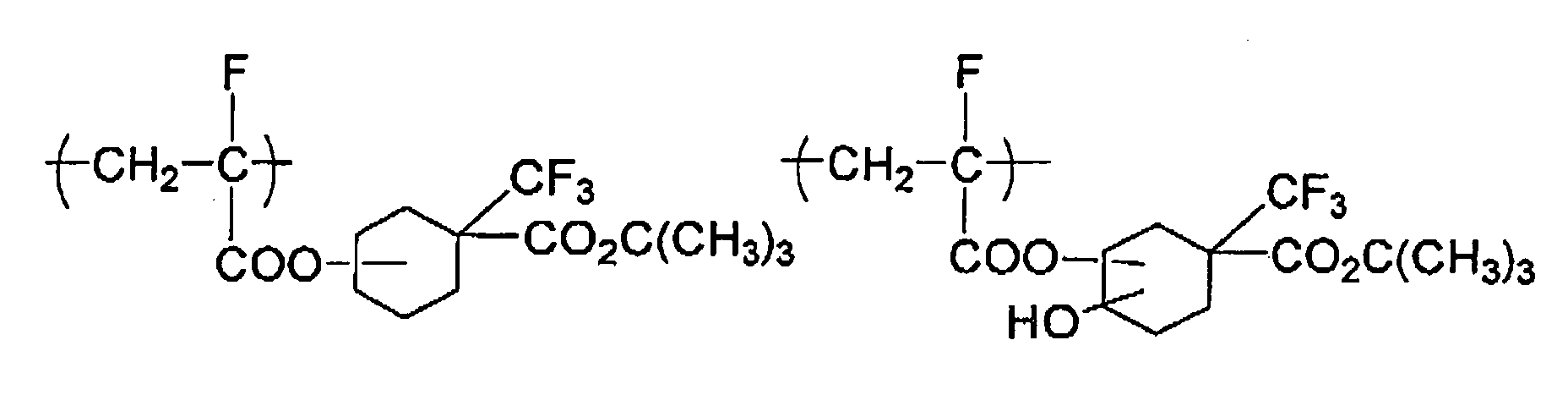
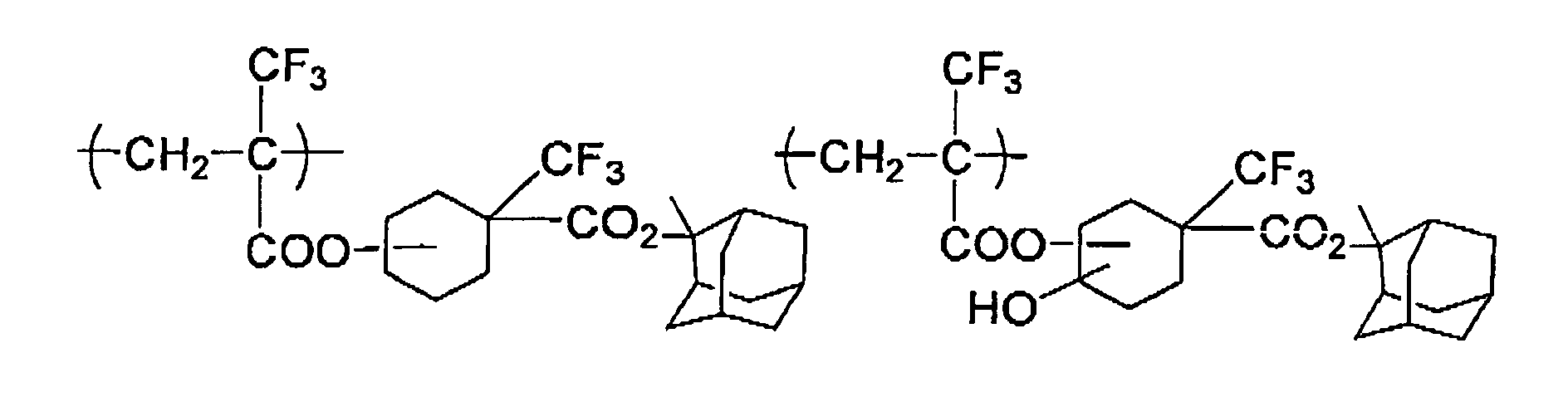




































































 wherein Ra', Rb', Rc' and Rd' each independently represent a hydrogen atom, a fluorine atom or a fluoroalkyl group, provided that at least one of Ra' to Rd' is not a hydrogen atom.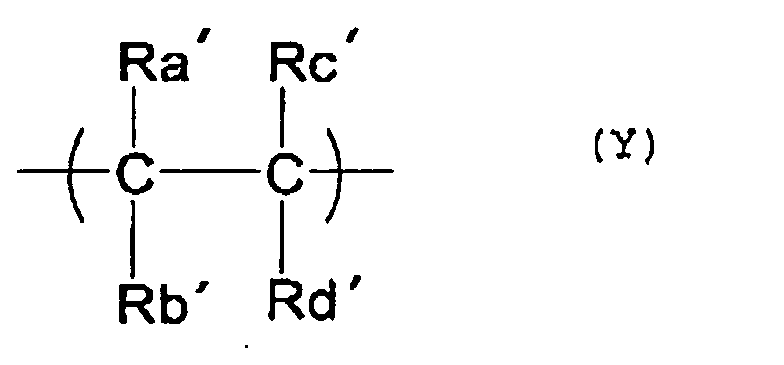

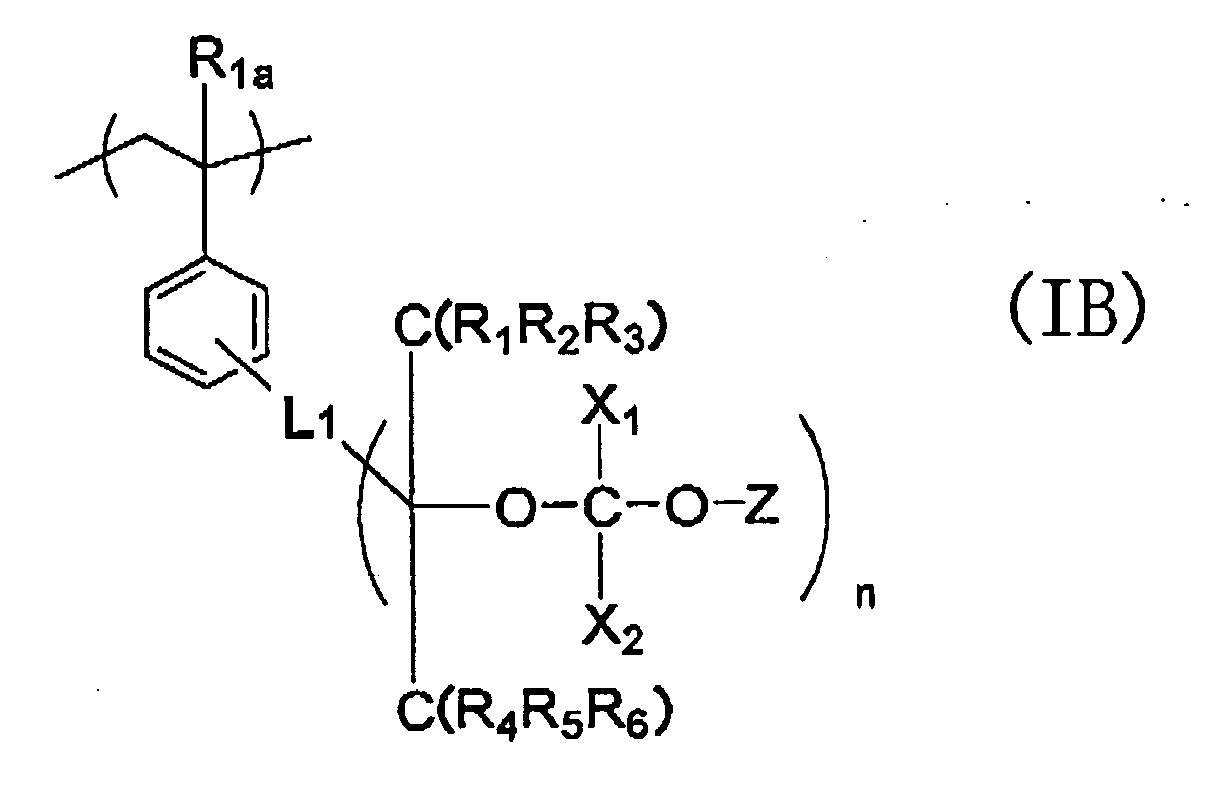 wherein R1 to R6 each independently represent a hydrogen atom, a fluorine atom or a fluoroalkyl group, provided that at least one of R1 to R6 is not a hydrogen atom, or the carbon atom to which R3 is connected may be connected to a main chain of the resin directly or through a connecting group, X1 and X2 each independently represent a hydrogen atom or an alkyl group, Z represents a monovalent organic group having at least one cyclic hydrocarbon structure, Rk1, Rk2 and Rk3 each represent a halogen atom or an alkyl group, L1 represents a single bond or a divalent connecting group, R1a represents a hydrogen atom, a fluorine atom, a chlorine atom, a bromine atom, a cyano group or a trifluoromethyl group, Rm represents a hydrogen atom, a fluorine atom, a methyl group or a trifluoromethyl group, Q represents a hydrogen atom or a hydroxy group, m represents 0 or 1, la represents 0 or 1, 1b represents an integer of from 0 to 2, lc represents an integer of from 0 to 5, n represents an integer of from 1 to 5, and 1 represents 0 or 1.
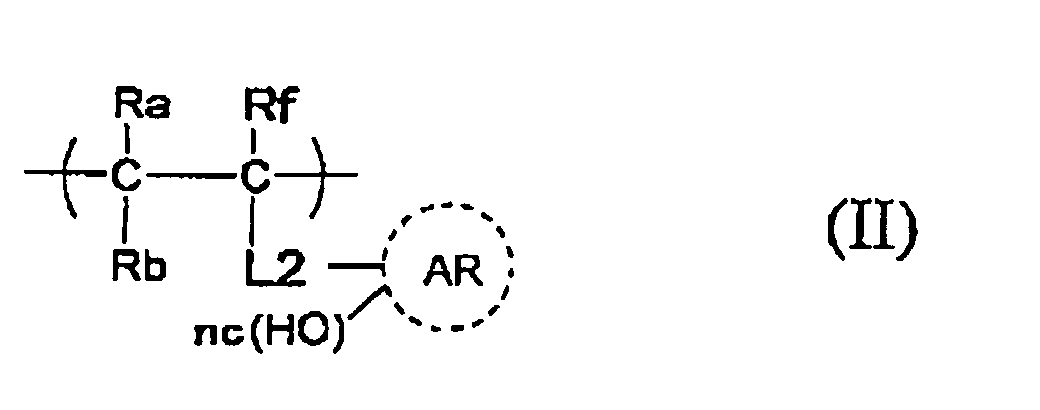 wherein Ra and Rb each independently represent a hydrogen atom, a fluorine atom, a methyl group or a fluoroalkyl group, Rf represents a hydrogen atom, a fluorine atom, a methyl group or a trifluoromethyl group, L2 represents -C(=O)-O- group or -O- group, AR represents alicyclic hydrocarbon structure, Rg and Rh each independently represent a hydrogen atom, a hydroxy group or a hydroxyalkyl group, provided that at least one of Rg and Rh is not a hydrogen atom, m represents 0 or 1, and nc represents an integer of from 1 to 5.


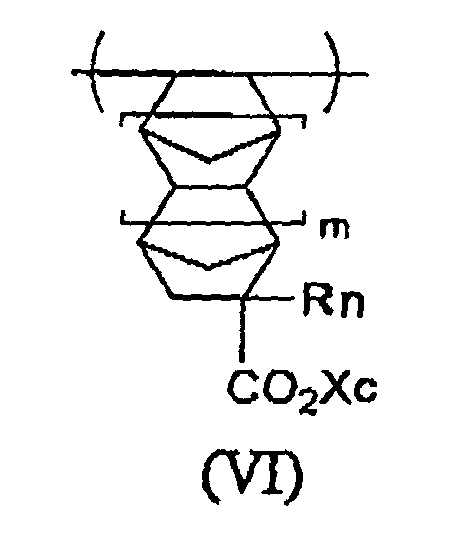 wherein Ra, Rb and Rc each independently represent a hydrogen atom, a fluorine atom, a methyl group or a fluoroalkyl group, R21 to R26 each independently represent a hydrogen atom, a fluorine atom or a fluoroalkyl group, provided that at least one of R21 to R26 is not a hydrogen atom, AR represents alicyclic hydrocarbon structure, Q represents a hydrogen atom or a hydroxy group, Xa represents a hydrogen atom or a group capable of being decomposed by the action of an acid, R1 to R6 each independently represent a hydrogen atom, a fluorine atom or a fluoroalkyl group, provided that at least one of R1 to R6 is not a hydrogen atom, Xb represents a hydrogen atom or a group capable of being decomposed by the action of an acid, Rn represents a fluorine atom or a trifluoromethyl group, Xc represents a hydrogen atom or a group capable of being decomposed by the action of an acid, Rd represents a hydrogen atom or a group capable of being decomposed by the action of an acid, nb represents 0 or 1, n represents 0 or 1, and m represents 0 or 1.