EP1505094A1 - Thiourethane-based optical material - Google Patents
Thiourethane-based optical material Download PDFInfo
- Publication number
- EP1505094A1 EP1505094A1 EP03723124A EP03723124A EP1505094A1 EP 1505094 A1 EP1505094 A1 EP 1505094A1 EP 03723124 A EP03723124 A EP 03723124A EP 03723124 A EP03723124 A EP 03723124A EP 1505094 A1 EP1505094 A1 EP 1505094A1
- Authority
- EP
- European Patent Office
- Prior art keywords
- bis
- mercaptomethylthio
- residue
- polymerizable composition
- polythiol compound
- Prior art date
- Legal status (The legal status is an assumption and is not a legal conclusion. Google has not performed a legal analysis and makes no representation as to the accuracy of the status listed.)
- Granted
Links
- 0 CNC(N*)(N*)N*=C Chemical compound CNC(N*)(N*)N*=C 0.000 description 1
Classifications
-
- C—CHEMISTRY; METALLURGY
- C08—ORGANIC MACROMOLECULAR COMPOUNDS; THEIR PREPARATION OR CHEMICAL WORKING-UP; COMPOSITIONS BASED THEREON
- C08G—MACROMOLECULAR COMPOUNDS OBTAINED OTHERWISE THAN BY REACTIONS ONLY INVOLVING UNSATURATED CARBON-TO-CARBON BONDS
- C08G18/00—Polymeric products of isocyanates or isothiocyanates
- C08G18/06—Polymeric products of isocyanates or isothiocyanates with compounds having active hydrogen
- C08G18/70—Polymeric products of isocyanates or isothiocyanates with compounds having active hydrogen characterised by the isocyanates or isothiocyanates used
- C08G18/72—Polyisocyanates or polyisothiocyanates
- C08G18/74—Polyisocyanates or polyisothiocyanates cyclic
- C08G18/76—Polyisocyanates or polyisothiocyanates cyclic aromatic
- C08G18/7614—Polyisocyanates or polyisothiocyanates cyclic aromatic containing only one aromatic ring
- C08G18/7628—Polyisocyanates or polyisothiocyanates cyclic aromatic containing only one aromatic ring containing at least one isocyanate or isothiocyanate group linked to the aromatic ring by means of an aliphatic group
- C08G18/7642—Polyisocyanates or polyisothiocyanates cyclic aromatic containing only one aromatic ring containing at least one isocyanate or isothiocyanate group linked to the aromatic ring by means of an aliphatic group containing at least two isocyanate or isothiocyanate groups linked to the aromatic ring by means of an aliphatic group having a primary carbon atom next to the isocyanate or isothiocyanate groups, e.g. xylylene diisocyanate or homologues substituted on the aromatic ring
-
- C—CHEMISTRY; METALLURGY
- C08—ORGANIC MACROMOLECULAR COMPOUNDS; THEIR PREPARATION OR CHEMICAL WORKING-UP; COMPOSITIONS BASED THEREON
- C08G—MACROMOLECULAR COMPOUNDS OBTAINED OTHERWISE THAN BY REACTIONS ONLY INVOLVING UNSATURATED CARBON-TO-CARBON BONDS
- C08G61/00—Macromolecular compounds obtained by reactions forming a carbon-to-carbon link in the main chain of the macromolecule
-
- C—CHEMISTRY; METALLURGY
- C08—ORGANIC MACROMOLECULAR COMPOUNDS; THEIR PREPARATION OR CHEMICAL WORKING-UP; COMPOSITIONS BASED THEREON
- C08G—MACROMOLECULAR COMPOUNDS OBTAINED OTHERWISE THAN BY REACTIONS ONLY INVOLVING UNSATURATED CARBON-TO-CARBON BONDS
- C08G18/00—Polymeric products of isocyanates or isothiocyanates
- C08G18/06—Polymeric products of isocyanates or isothiocyanates with compounds having active hydrogen
- C08G18/28—Polymeric products of isocyanates or isothiocyanates with compounds having active hydrogen characterised by the compounds used containing active hydrogen
- C08G18/30—Low-molecular-weight compounds
- C08G18/38—Low-molecular-weight compounds having heteroatoms other than oxygen
-
- C—CHEMISTRY; METALLURGY
- C08—ORGANIC MACROMOLECULAR COMPOUNDS; THEIR PREPARATION OR CHEMICAL WORKING-UP; COMPOSITIONS BASED THEREON
- C08G—MACROMOLECULAR COMPOUNDS OBTAINED OTHERWISE THAN BY REACTIONS ONLY INVOLVING UNSATURATED CARBON-TO-CARBON BONDS
- C08G18/00—Polymeric products of isocyanates or isothiocyanates
- C08G18/06—Polymeric products of isocyanates or isothiocyanates with compounds having active hydrogen
- C08G18/28—Polymeric products of isocyanates or isothiocyanates with compounds having active hydrogen characterised by the compounds used containing active hydrogen
- C08G18/30—Low-molecular-weight compounds
- C08G18/38—Low-molecular-weight compounds having heteroatoms other than oxygen
- C08G18/3855—Low-molecular-weight compounds having heteroatoms other than oxygen having sulfur
- C08G18/3876—Low-molecular-weight compounds having heteroatoms other than oxygen having sulfur containing mercapto groups
-
- G—PHYSICS
- G02—OPTICS
- G02B—OPTICAL ELEMENTS, SYSTEMS OR APPARATUS
- G02B1/00—Optical elements characterised by the material of which they are made; Optical coatings for optical elements
- G02B1/04—Optical elements characterised by the material of which they are made; Optical coatings for optical elements made of organic materials, e.g. plastics
Definitions
- the present invention relates to a resin for use in optical materials of plastic lenses, prisms, optical fibers, information recording boards, filters, light-emitting diodes, or the like, to a polymerizable composition, i.e., the ingredient, of the resin, and to a mercapto compound contained in the polymerizable composition.
- the present invention is suitable for application in spectacle lenses having a high refractive index.
- Plastic lenses which are lightweight and unbreakable compared to inorganic lenses and can be dyed, are increasingly used in optical elements such as spectacle lenses and camera lenses.
- Resins for making plastic lenses are required to exhibit high performance, such as high refractive index, high Abbe number, low specific gravity, high heat resistance, and the like.
- Various resin materials for making lenses have been developed and used to date.
- a representative example thereof is a plastic lens made from a polythiourethane resin (Japanese Unexamined Patent Application Publication Nos. 60-199016, 62-267316, and 63-46213).
- a polythiourethane resin that exhibits higher refractive index due to an increased sulfur content of thiol used in the polythiourethane has also been developed (Japanese Unexamined Patent Application Publication Nos. 2-270859 and 7-252207).
- a high refractive index can be achieved while exhibiting a relatively high Abbe number; however, in order to obtain a polyurethane resin having a yet higher refractive index, a novel thiol having a high sulfur content or a novel polyisocyanate having a high sulfur content must be developed. Despite the need, the development of novel compounds is not easy. Moreover, in order for it to be used in optical elements such as resins for making plastic lenses, physical properties, such as transparency, hue, heat resistance, and shock resistance, other than the refractive index must also be high. Development of a high-refractive-index urethane resin that satisfies all of these requirements is highly difficult.
- the polymerizable composition has been prepared such that the molar ratio of a mercapto group to an iso(thio)cyanato group is 1.
- No examples that investigated the molar ratio and the physical properties of the resin have existed. The reason for this is because when the molar ratio is made greater than 1 using a conventional polythiol compound, i.e., when the mercapto group is excessive relative to the iso(thio)cyanato group, the heat resistance of the resin prepared by polymerization becomes dramatically poor, and the resin may not be applied to optical elements such as plastic lenses.
- an object of the present invention is to provide a method for easily obtaining a high-refractive-index resin.
- the present inventors have conducted extensive investigations to overcome the above-described problems. As a result, the present inventors have found that these problems can be overcome by using a polythiol compound characterized in having a dithioacetal, a dithioketal, an orthotrithioformic ester, or an orthotetrathiocarbonic ester skeleton in a molecule.
- the inventors have found that, in a polymerizable composition containing polyiso(thio)cyanate and a polythiol compound having a dithioacetal, dithioketal, orthotrithioformic ester, or orthotetrathiocarbonic ester skeleton in a molecule, a decrease in heat resistance of the resin can be minimized and a resin with higher refractive index can be obtained by curing the polymerizable composition whose molar ratio of mercapto to iso(thio)cyanato is greater than 1.0, i.e., the polymerizable composition containing an excessive amount of the mercapto group relative to the iso(thio)cyanato group.
- the inventors have made the present invention based on these findings.
- the excess rate of the polythiol compound is determined ad libitum.
- polythiol and polyiso(thio)cyanato are prepared so that the molar ratio of the mercapto group to the iso(thio)cyanato group is greater than 1.0 but not more than 3.0.
- the polymerizable composition of the invention is characterized in that the mercapto group is excessive relative to the iso(thio)cyanato group in the composition.
- the molar ratio (SH/NCO) of the mercapto group to the isocyanato group is adjusted to be greater than 1.0.
- the upper limit of the molar ratio depends on the heat resistance of the resin cured at a molar ratio of 1.0; however, the cured product exhibits satisfactory heat resistance when the molar ratio is not more than 3.0.
- the molar ratio of the mercapto group to the isocyanato group is 1.0 ⁇ (SH/NCO) ⁇ 3.0, preferably, 1.01 ⁇ (SH/NCO) ⁇ 3.0, more preferably 1.01 ⁇ (SH/NCO) ⁇ 2.0, and most preferably 1.05 ⁇ (SH/NCO) ⁇ 1.3.
- the polythiol compound of the present invention has a dithioacetal, dithioketal, orthotrithioformic ester, or orthotetrathiocarbonic ester polythiol skeleton. No particular limit is imposed as long as the polythiol has any of these skeletons.
- the polythiol having the dithioacetal or dithioketal skeleton can be represented by General Formula (1):
- R 1 is an aliphatic residue, a heterocyclic residue, or an aromatic residue with a valence of n
- R 2 is a hydrogen atom, an aliphatic residue, a heterocyclic residue, or an aromatic residue with a valence of 1
- R 3 and R 4 are each independently an aliphatic residue, a heterocyclic residue, or an aromatic residue with a valence of 1, and R 3 and R 4 may bond to each other to form a ring or each may bond to R 3 or R 4 in another set of parentheses to form a ring when n is 2 or more.
- At least one of R 1 , R 2 , R 3 , and R 4 must have at least one mercapto group, and m1 + (m2 + m3 + m4) ⁇ n ⁇ 2, wherein m1, m2, m3, and m4 represent the numbers of mercapto group contained in R 1 , R 2 , R 3 , and R 4 , respectively, and n is an integer of 1 or more.
- R 1 may be any as long as R 1 is an organic residue having a valence of n derived from aliphatic, heterocyclic, or aromatic.
- the number of carbon atoms is in the range of 1 to 15.
- Examples thereof include organic residues having a valence of n derived from straight-chain aliphatic groups such as methane, ethane, propane, butane, pentane, hexane, ethylene, propylene, 1-butene, 2-butene, butadiene, and the like; organic residues having a valence of n derived from cyclic fatty series such as cyclopentane, cyclopentene, cyclopentadiene, cyclohexane, 1,2-dimethylcyclohexane, 1,3-dimethylcyclohexane, 1,4-dimethylcyclohexane, cyclohexene, 1,3-cyclohexadiene, 1,4-cyclohexadiene, norbornane, 2,3-dimethylnorbornane, 2,5-dimethylnorbornane, 2,6-dimethylnorbornane, bis(4-methylcyclohexyl)me
- Examples of the conventional thiol compounds include monofunctional thiols such as methanethiol, ethanethiol, 2-mercaptoethyl-1,3-dithiane, thiophenol, and benzylthiol; aliphatic polythiol compounds such as methanedithiol, 1,2-ethanedithiol, 1,1-propanedithiol, 1,2-propanedithiol, 1,3-propanedithiol, 2,2-propanedithiol, 1,6-hexanedithiol, 1,2,3-propanetrithiol, 1,1-cyclohexanedithiol, 1,2-cyclohexanedithiol, 2,2-dimethylpropane-1,3-dithiol, 3,4-dimethoxybutane-1,2-dithiol, 2-methylcyclohexane-2,3-dithiol, 1,1-bis(mercaptomethyl)cyclo
- Examples of the monovalent aliphatic residue, heterocyclic residue, and aromatic residue in R 2 , R 3 , and R 4 include monovalent organic residues derived from examples of straight-chain aliphatic series, cyclic aliphatic series, heterocycles, and aromatic series described in R 1 ; and organic residues obtained by removing mercapto groups from the above-described thiol compounds.
- examples of the ring that contains a dithioacetal structure include four- to eight-membered rings, such as 1,3-dithiacyclobutane, 1,3-dithiacyclopentane, 1,3-dithiacyclohexane, 1,3-dithiacycloheptane, and the like.
- n is 2 or more
- (R 3 )s in different sets of parentheses bond to form a ring.
- 4,6-bis(mercaptomethylthio)-1,3-dithiacyclohexane is included in the example.
- n may be any integer as long as n is not less than 1. Since purification, handling, or the like becomes difficult as n increases, n is preferably an integer between 1 and 4.
- Specific examples of the compound represented by Formula (1) include 1,1,3,3-tetrakis(mercaptomethylthio)propane, 1,1,2,2-tetrakis(mercaptomethylthio)ethane, 4,6-bis(mercaptomethylthio)-1,3-dithiacyclohexane, 1,1,5,5-tetrakis(mercaptomethylthio)-3-thiapentane, 1,1,6,6-tetrakis(mercaptomethylthio)-3,4-dithiahexane, 2,2-bis(mercaptomethylthio)ethanethiol, 2-(4,5-dimercapto-2-thiapentyl)-1,3-dithiacyclopentane, 2,2-bis(mercaptomethyl)-1,3-dithiacyclopentane, 2,5-bis(4,4-bis(mercaptomethylthio)-2-thiabutyl)-1,4-dithiane, 2,2-bis(mercaptomethylthi
- the polythiol compound having the orthotrithioformic ester skeleton is not particularly limited.
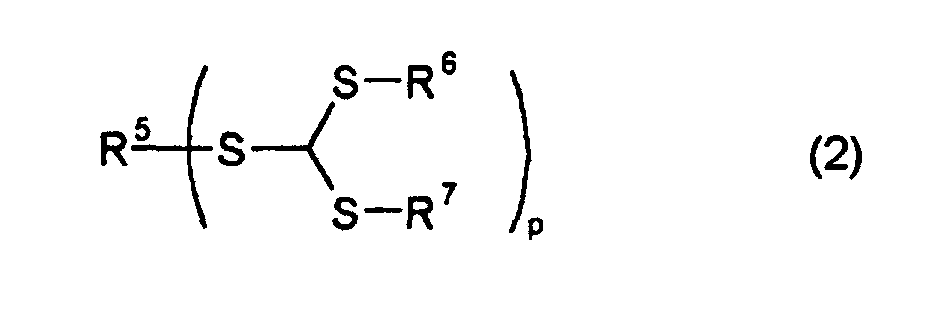
- An example is a compound represented by General Formula (2)
- R 5 is an aliphatic residue, a heterocyclic residue, or an aromatic residue with a valence of p
- R 6 and R 7 are each independently an aliphatic residue, a heterocyclic residue, or an aromatic residue with a valence of 1, and R 6 and R 7 may bond to each other to form a ring.
- At least one of R 5 , R 6 and R 7 must have at least one mercapto group, and m5 + (m6 + m7) ⁇ p ⁇ 2, wherein m5, m6, and m7 represent the numbers of mercapto group contained in R 5 , R 6 , and R 7 , respectively, and p is an integer of 1 or more.
- R 5 is not particularly limited as long as R 5 is any organic residue having a valence of p derived from aliphatic series, heterocycles, or aromatic series.
- R 5 is an organic residue having a valence of p derived from any of examples of straight-chain aliphatic series, cyclic aliphatic series, heterocycles, and aromatic series described in R 1 of Formula (1) or an organic residue having a valence of p obtained by removing the mercapto group from the above-described conventional thiol compound.
- R 6 and R 7 are not particularly limited as long as they are each a monovalent organic residue derived from any of the above-described examples of aliphatic series, heterocycles, and aromatic series.
- R 6 and R 7 are each an organic residue obtained by removing the mercapto group from the known thiol compound and may form a ring.
- p may be any integer not less than 1.
- n is preferably an integer in the range of 1 to 4.
- polythiol compound having the orthotrithioformic ester skeleton represented by Formula (2) include tris(mercaptomethylthio)methane, tris(mercaptoethylthio)methane, 1,1,5,5-tetrakis(mercaptomethylthio)-2,4-dithiapentane, bis(4,4-bis(mercaptomethylthio)-1,3-dithiabutyl)(mercaptomethylthio)methane, tris(4,4-bis(mercaptomethylthio)-1,3-dithiabutyl)methane, 2,4,6-tris(mercaptomethylthio)-1,3,5-trithiacyclohexane, 2,4-bis(mercaptomethylthio)-1,3,5-trithiacyclohexane, 1,1,3,3-tetrakis(mercaptomethylthio)-2-thiapropane, bis(mercaptomethyl)methylthio-1,3,5-
- the polythiol compound having the tetrathioorthocarbonic ester skeleton is not particularly limited.
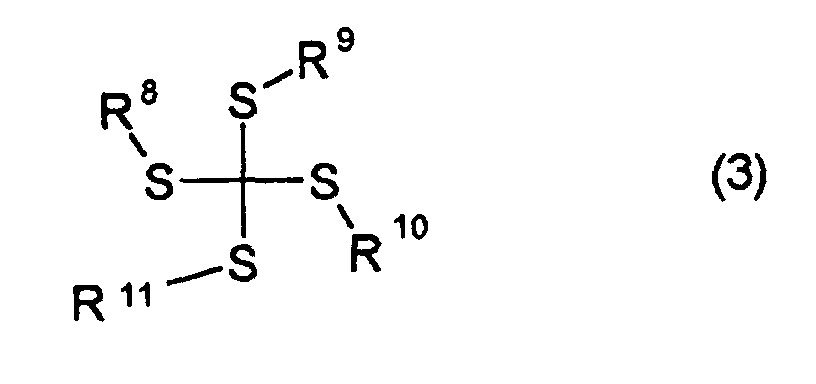
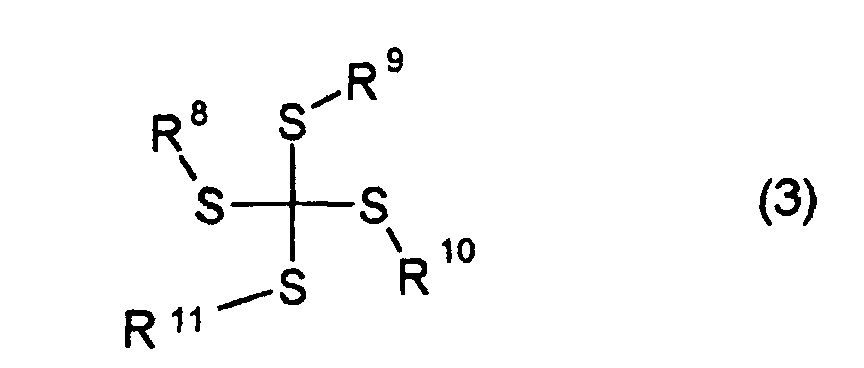
- An example is a compound represented by General Formula (3)
- R 8 , R 9 , R 10 , and R 11 are each independently an aliphatic residue, a heterocyclic residue, or an aromatic residue and may each bond with one of other residues to form a ring. At least one of R 8 , R 9 , R 10 , and R 11 must contain at least one mercapto group, and m8 + m9 + m10 + m11 ⁇ 2, wherein m8, m9, m10, and m11 represent the numbers of mercapto group in R 8 , R 9 , R 10 , and R 11 , respectively.
- R 8 , R 9 , R 10 , and R 11 are not particularly limited as long as they are aliphatic residues, heterocyclic residues, or aromatic residues.
- each of R 8 , R 9 , R 10 , and R 11 is preferably an organic residue obtained by removing a mercapto group from a known thiol compound and may form a ring as with R 3 and R 4 .
- polythiol compound having the tetrathioorthocarbonic ester skeleton represented by Formula (3) include 3,3'-di(mercaptomethylthio)-1,5-dimercapto-2,4-dithiapentane, 2,2'-di(mercaptomethylthio)-1,3-dithiacyclopentane, 2,7-di(mercaptomethyl)-1,4,5,9-tetrathiaspiro[4,4]nonane, and 3,9-dimercapto-1,5,7,11-tetrathiaspiro[5,5]undecane. These examples are no limiting.
- the polythiol compound may be a polymer having no particular repeated structure as long as the polymer has the tetrathiocarbonic ester skeleton and at least two mercapto groups.
- the polythiol compound of the present invention is characterized by having a dithioacetal, dithioketal, orthotrithioformic ester, or orthotetrathiocarbonic ester skeleton in the molecule.
- the polythiol compound additionally contains a mercaptomethylthio group to achieve yet higher refractive index and maintain heat resistance.
- the polymerizable composition of the present invention is characterized by containing the above-described polythiol compound.
- the polythiol compounds described above may be used alone or in combination.
- Examples of other thiol compounds include aliphatic polythiol compounds such as methanedithiol, ethanedithiol, 1,1-propanedithiol, 1,2-propanedithiol, 1,3-propanedithiol, 1,6-hexanedithiol, 1,2,3-propanetrithiol, 1,1-cyclohexanedithiol, 1,2-cyclohexanedithiol, 2,2-dimethylpropane-1,3-dithiol, 3,4-dimethoxybutane-1,2-dithiol, 2-methylcyclohexane-2,3-dithiol, 1,1-bis(mercaptomethyl)cyclohexane, bis(2-mercaptoethyl) thiomalate, 2,3-dimercapto-1-propanol(2-mercaptoacetate), 2,3-dimercapto-1-propanol(3-mercaptopropionate
- Compounds having at least two iso(thio)cyanato groups used in the present invention are not particularly limited. Specific examples thereof include aliphatic polyisocyanate compounds such as hexamethylene diisocyanate, 2,2-dimethylpentane diisocyanate, 2,2,4-trimethylhexane diisocyanate, butene diisocyanate, 2,3-butadiene-1,4-diisocyanate, 2,4,4-trimethylhexamethylene diisocyanate, 1,6,11-undecane triisocyanate, 1,3,6-hexamethylene triisocyanate, 1,8-diisocyanato-4-isocyanatomethyloctane, bis(isocyanatoethyl) carbonate, bis(isocyanatoethyl)ether, lysine diisocyanate methyl ester, lysine triisocyanate, xylylene diisocyanate, bis(isocyanatoethy
- These compounds may be substituted with halogen, e.g., chlorine or bromine, alkyl, alkoxy, or nitro. Moreover, these compounds may be modified with polyalcohol (polymer type), carbodiimide, urea, or biuret. Dimer or trimer reaction products of these compounds may also be used.
- the polymerizable composition of the present invention may contain a resin modifier to modify the monomer system or the resin, i.e., to adjust the optical properties, such as refractive index of the resin, various physical properties, such as impact resistance and specific gravity, the viscosity of the polymerizable composition, handling ease, and the like.
- a resin modifier to modify the monomer system or the resin, i.e., to adjust the optical properties, such as refractive index of the resin, various physical properties, such as impact resistance and specific gravity, the viscosity of the polymerizable composition, handling ease, and the like.
- various substances such as a chain extender, a cross-linker, a photostabilizer, a UV absorber, an antioxidant, an antiyellowing agent, a bluing agent, an oil-soluble dye, and a filler, may be added as required.
- an adequate conventional reaction catalyst may be added.
- the catalyst include urethane reaction catalysts such as tin compounds, e.g., dibutyltin dilaurate, dibutyltin dichloride, dimethyltin dichloride, and the like, and amine compounds such as tertiary amine. These catalysts may be used alone or in combination.
- the resin of the present invention is produced by mold injection polymerization.
- additives such as a catalyst, a UV absorber, and an internal mold release agent are blended into a target monomer in advance to prepare a mixture.
- the mixture may be prepared by any of the following methods: (1) adding the thiol component to a premix solution of additives in the isocyanate component; (2) adding the isocyanate component to a premix solution of additives in the thiol component; (3) dissolving the additives in a mixture of the isocyanate component and the thiol component; and (4) adding a mixture of the isocyanate component and the thiol component to a high-concentration master solution of the additives in the isocyanate component or the thiol component.
- the resulting mixture was degassed by an adequate method, if necessary. Subsequently, the mixture is injected into a mold constituted from two glass plates and tapes or gaskets to carry out polymerization.
- the injection method is not particularly limited.
- the viscosity of the monomer mixture is 20 to 1,000mPa ⁇ s.
- the polymerization conditions significantly vary according to the type and/or amount of the monomer and/or catalyst employed, the shape of the mold, and the like; hence, the polymerization conditions are not particularly limited.
- Thermal polymerization is performed at a temperature of -20 to 200°C for 1 to 100 hours.
- the resin of the invention produced as above is colorless and transparent, exhibits superior mechanical properties, and is suitable for use in optical elements, such as plastic lenses, prisms, optical fibers, information recording boards, filters, light-emitting diodes, and the like.
- the lenses may be subjected to physical and/or chemical treatment, if necessary.
- physical and/or chemical treatment examples include surface polishing, antistatic treatment, hard coat treatment, non-reflecting coating treatment, and dyeing treatment.
- dyeing treatment a hot water bath containing dispersed dye is normally used; alternatively, a dyebath containing carrier, such as benzyl alcohol, that improves dyeing rate and dyeing density may be used.
- the physical properties of the resin prepared by the polymerization were evaluated by the following methods.
- Tg was measured by TMA penetration method (load: 50 g, probe diameter: 0.5 mm; temperature elevation rate 10°C/min).
- Impact resistance Falling weight test was performed according to United States FDA standards. In this test, a 16-g steel ball was dropped from a height of 127 cm onto a lens having a thickness of 1.0 mm at the center. Lenses that remained unaffected were rated "A", those that allowed the steel ball to penetrate were rated "C”, and those suffered star-shaped cracks were rated "B".
- polythiol compound A After performing solvent extraction of the organic layer to remove toluene and low-boiling-point components, the resulting mixture was filtered with a 3- ⁇ m Teflon filter to obtain 122.5 g of a polythiol compound mixture (hereinafter, simply "polythiol compound A").
- TMMTM tris(mercaptomethylthio)methane
- TMMTDTP 1,1,5,5-tetrakis(mercaptomethylthio)-2,4-dithiapentane
- the molecular weight of the remaining one component was calculated from the GPC analysis results based on these two components.
- the number-average molecular weight of the remaining one component was 585, and the weight-average molecular weight was 589.
- SHV polythiol compound A per unit mass
- the monomer mixture was degassed for one hour at 0.6 kPa.
- a moiety of the mixture was then injected into a lens mold, gradually heated from 40°C to 120°C, and cured over 21 hours. After cooling, the produced lens was released from the glass mold.
- the lens was colorless and transparent. Using a slide projector, light was transmitted through the lens in a darkroom, and no muddiness was observed in the lens.
- the refractive index (ne) was 1.704
- the Abbe number (ve) was 30.
- the Tg point was 94.3°C, which was satisfactory.
- the impact resistance was "A".
- polythiol compound B 1,1,3,3-tetrakis(mercaptomethylthio)propane
- the SHV of the polythiol compound B (containing the above-described two by-product components) was calculated from the chromatogram area ratio based on LC.
- the SHV was 10.5 meq/g.
- the monomer mixture was degassed for one hour at 0.6 kPa.
- a moiety of the mixture was then injected into a lens mold, gradually heated from 40°C to 130°C, and cured over 20 hours. After cooling, the produced lens was released from the glass mold.
- the lens was colorless and transparent. Using a slide projector, light was transmitted through the lens in a darkroom, and no muddiness was observed in the lens.
- the refractive index (ne) was 1.693
- the Abbe number (ve) was 30.
- the Tg point was 99.5°C, which was satisfactory.
- the impact resistance was "A".
- the toluene layer was washed with an adequate amount of water several times. After performing solvent extraction to remove toluene and low-boiling-point components, the mixture was filtered with 1- ⁇ m Teflon filter to obtain 340.0 g of polythiol compound B. As in SYNTHETIC EXAMPLE 2, two components other than the polythiol compound B were detected in the LC analysis. These two components were the same as in SYNTHETIC EXAMPLE 2.
- the SHV of the polythiol compound B (containing the above-described two by-product components) was 9.8 meq/g.
- the monomer mixture was degassed for one hour at 0.6 kPa and was filtered with 1- ⁇ m Teflon filter. A moiety of the mixture was then injected into a lens mold, gradually heated from 40°C to 130°C, and cured over 20 hours. After cooling, the produced lens was released from the glass mold. The lens was colorless and transparent. Using a slide projector, light was transmitted through the lens in a darkroom, and no muddiness was observed in the lens. As for the optical properties, the refractive index (ne) was 1.695, and the Abbe number (ve) was 30. As for the heat resistance, the Tg point was 100.1°C, which was satisfactory. The impact resistance was "A".
- the SHV of the polythiol compound B produced was 9.5 meq/g.
- the molar ratio of the mercapto group to the isocyanato group in the monomer mixture was SH/NCO 1.13.
- the obtained lens was colorless and transparent. Using a slide projector, light was transmitted through the lens in a darkroom, and no muddiness was observed in the lens.
- the refractive index (ne) was 1.696
- the Abbe number (ve) was 30.
- the Tg point 100.0°C, which was satisfactory.
- the SHV of the polythiol compound B produced was 9.3 meq/g.
- the molar ratio of the mercapto group to the isocyanato group in the monomer mixture was SH/NCO 1.09.
- the obtained lens was colorless and transparent. Using a slide projector, light was transmitted through the lens in a darkroom, and no muddiness was observed in the lens.
- the refractive index (ne) was 1.696
- the Abbe number (ve) was 30.
- the Tg point 103.1°C, which was satisfactory.
- the polymerization was performed as in EXAMPLE 1 to produce a lens.
- the refractive index (ne) was 1.700
- the Abbe number (ve) was 30.
- the Tg point was 96.0°C.
- the impact resistance was "A”.
- the polymerization was performed as in EXAMPLE 2 to produce a lens.
- the refractive index (ne) was 1.688
- the Abbe number (ve) was 30.
- the Tg point was 106.0°C.
- the impact resistance was "A”.
- the polymerization was performed as in EXAMPLE 2 to produce a lens.
- the refractive index (ne) was 1.690, and the Abbe number (ve) was 30.
- the Tg point was 106.3°C.
- the impact resistance was "A”.
- the polymerization was performed as in EXAMPLE 3 to produce a lens.
- the refractive index (ne) was 1.690, and the Abbe number (ve) was 30.
- the Tg point was 106.3°C.
- the impact resistance was "A”.
- the polymerization was performed as in EXAMPLE 4 to produce a lens.
- the refractive index (ne) was 1.690, and the Abbe number (ve) was 30.
- the Tg point was 109.2°C.
- the impact resistance was "A”.
- xylylene diisocyanate In 52.0 g of xylylene diisocyanate were dissolved 10 mg of dibutyltin dichloride, i.e., the catalyst, 100 mg of Zelec UN (trade name, acidic alkyl phosphoric ester manufactured by Stepan Company), i.e., the internal mold release agent, and 50 mg of Viosorb 583 (trade name, manufactured by Kyodo Chemical Co., Ltd.), i.e., the UV absorber, to prepare a solution.
- Zelec UN trade name, acidic alkyl phosphoric ester manufactured by Stepan Company
- Viosorb 583 trade name, manufactured by Kyodo Chemical Co., Ltd.
- polythiol compound C 4-mercaptomethyl-1,8-dimercapto-3,6-dithiaoctane
- polythiol compound C 4-mercaptomethyl-1,8-dimercapto-3,6-dithiaoctane
- the resulting mixture was thoroughly mixed to prepare a monomer mixture.
- the monomer mixture was degassed for one hour at 0.6 kPa. A moiety of the mixture was then injected into a lens mold, gradually heated from 40°C to 120°C, and cured over 20 hours. After cooling, the produced lens was released from the glass mold. The lens was colorless and transparent.
- the lens was transmitted through the lens in a darkroom, and no muddiness was observed in the lens.
- the refractive index (ne) was 1.660
- the Abbe number (ve) was 32.
- the Tg point was 85.0°C.
- the impact resistance was "A”.
- the polymerization was performed as in COMPARATIVE EXAMPLE 5 to produce a lens.
- the lens was colorless and transparent. Using a slide projector, light was transmitted through the lens in a darkroom, and no muddiness was observed in the lens.
- the refractive index (ne) was 1.663
- the Abbe number (ve) was 32.
- the Tg point was 62.1°C.
- the impact resistance was "A".
- xylylene diisocyanate In 50.7 g of xylylene diisocyanate were dissolved 10 mg of dibutyltin dichloride, i.e., the catalyst, 100 mg of Zelec UN (trade name, acidic alkyl phosphoric ester manufactured by Stepan Company), i.e., the internal mold release agent, and 50 mg of Viosorb 583 (trade name, manufactured by Kyodo Chemical Co., Ltd.), i.e., the UV absorber, to prepare a solution.
- Zelec UN trade name, acidic alkyl phosphoric ester manufactured by Stepan Company
- Viosorb 583 trade name, manufactured by Kyodo Chemical Co., Ltd.
- polythiol compound D 4,8-dimercaptomethyl-1,11-dimercapto-3,6,9-trithiaundecane
- the lens was transmitted through the lens in a darkroom, and no muddiness was observed in the lens.
- the refractive index (ne) was 1.667
- the Abbe number (ve) was 31.
- the Tg point was 100.2°C.
- the impact resistance was "A”.
- the polymerization was performed as in COMPARATIVE EXAMPLE 7 to produce a lens.
- the lens was colorless and transparent. Using a slide projector, light was transmitted through the lens in a darkroom, and no muddiness was observed in the lens.
- the refractive index (ne) was 1.670
- the Abbe number (ve) was 32.
- the Tg point was 82.1°C.
- the impact resistance was "A".
- ⁇ ne and ⁇ Tg denote, respectively, the differences in refractive index (ne) and heat resistance (Tg) between when the molar ratio of the mercapto group to the isocyanato group (SH/NCO) is greater than 1.01 and when the molar ratio of the mercapto group to the isocyanato group (SH/NCO) is not more than 1.0.
- the larger ⁇ ne/ ⁇ Tg the better the heat resistance and the higher the refractive index.
- the resin made from the polymerizable composition containing the polythiol of the present invention exhibited ⁇ ne/ ⁇ Tg larger than those of COMPARATIVE EXAMPLES that use conventional polythiols.
- the heat resistant temperature of the resin of COMPARATIVE EXAMPLE 5 i.e., a typical widespread thiourethane optical resin, was 85.0°C; accordingly, the resin can be put to practical application if the resin has higher heat resistant temperature than this temperature. Therefore, the resin of each EXAMPLE has sufficient heat resistance.
- the heat resistance of the resins of COMPARATIVE EXAMPLES 6 and 8 is insufficient. Note that, as shown in COMPARATIVE EXAMPLES 2 and 4, the resin becomes rubbery and exhibits poor heat resistance when the ratio of the mercapto group to the isocyanato group exceeds 3.0.
- the refractive index of the resin can be easily increased while maintaining the heat and impact resistance.
Landscapes
- Chemical & Material Sciences (AREA)
- Health & Medical Sciences (AREA)
- Chemical Kinetics & Catalysis (AREA)
- Medicinal Chemistry (AREA)
- Polymers & Plastics (AREA)
- Organic Chemistry (AREA)
- Physics & Mathematics (AREA)
- General Physics & Mathematics (AREA)
- Optics & Photonics (AREA)
- Polymers With Sulfur, Phosphorus Or Metals In The Main Chain (AREA)
- Polyurethanes Or Polyureas (AREA)
Abstract
Description



R1 may be any as long as R1 is an organic residue having a valence of n derived from aliphatic, heterocyclic, or aromatic. Preferably, the number of carbon atoms is in the range of 1 to 15. Examples thereof include organic residues having a valence of n derived from straight-chain aliphatic groups such as methane, ethane, propane, butane, pentane, hexane, ethylene, propylene, 1-butene, 2-butene, butadiene, and the like; organic residues having a valence of n derived from cyclic fatty series such as cyclopentane, cyclopentene, cyclopentadiene, cyclohexane, 1,2-dimethylcyclohexane, 1,3-dimethylcyclohexane, 1,4-dimethylcyclohexane, cyclohexene, 1,3-cyclohexadiene, 1,4-cyclohexadiene, norbornane, 2,3-dimethylnorbornane, 2,5-dimethylnorbornane, 2,6-dimethylnorbornane, bis(4-methylcyclohexyl)methane, and the like;
organic residues having a valence of n derived from heterocycles such as thiolane, 2,5-dimethylthiolane, 3,4-dimethylthiolane, 2,3-dimethylthiolane, 2,4-dimethylthiolane, 2,5-diethylthiolane, 3,4-diethylthiolane, 2,3-diethylthiolane, 1,3-dithiolene, 2,4-dimethyl-1,3-dithiolene, 4,5-dimethyl-1,3-dithiolene, 2,4-diethyl-1,3-dithiolene, 4,5-diethyl-1,3-dithiolene, 1,3-dithiolane, 2,4-dimethyl-1,3-dithiolane, 4,5-dimethyl-1,3-dithiolane, 2,4-diethyl-1,3-dithiolane, 4,5-diethyl-1,3-dithiolane, thiophene, 2,5-dimethylthiophene, 1,4-dithiane, 2,5-dimethyl-1,4-dithiane, 2,6-dimethyl-1,4-dithiane, 2,3-dimethyl-1,4-dithiane, 2,5-diethyl-1,4-dithiane, 2,6-diethyl-1,4-dithiane, 2,3-diethyl-1,4-dithiane, 1,3,5-trithiane, 2,4-dimethyl-1,3,5-trithiane, 2,4-diethyl-1,3,5-trithiane, thiazole, 1,3,4-thiadiazole, 1,3-dithietane, 2,4-dimethyl-1,3-dithietane, 2,4-diethyl-1,3-dithietane, and the like;
organic residues having a valence of n derived from aromatic series such as benzene, o-xylene, m-xylene, p-xylene, naphthalene, biphenyl, anthracene, perylene, styrene, ethylbenzene, and the like; and organic groups having a valence of n formed by removing mercapto groups from conventional thiol compounds.
aromatic polythiols such as 1,2-dimercaptobenzene, 1,3-dimercaptobenzene, 1,4-dimercaptobenzene, 1,2-bis(mercaptomethyl)benzene, 1,3-bis(mercaptomethyl)benzene, 1,4-bis(mercaptomethyl)benzene, 1,2-bis(mercaptoethyl)benzene, 1,3-bis(mercaptoethyl)benzene, 1,4-bis(mercaptoethyl)benzene, 1,2,3-trimercaptobenzene, 1,2,4-trimercaptobenzene, 1,3,5-trimercaptobenzene, 1,2,3-tris(mercaptomethyl)benzene, 1,2,4-tris(mercaptomethyl)benzene, 1,3,5-tris(mercaptomethyl)benzene, 1,2,3-tris (mercaptoethyl) benzene, 1,2,4-tris(mercaptoethyl)benzene, 1,3,5-tris(mercaptoethyl)benzene, 2,5-toluenedithiol, 3,4-toluenedithiol, 1,3-di(p-methoxyphenyl)propane-2,2-dithiol, 1,3-diphenylpropane-2,2-dithiol, phenylmethane-1,1-dithiol, and 2,4-di(p-mercaptophenyl)pentane;
aromatic polythiol compounds containing sulfur atoms other than in the mercapto groups such as 1,2-bis(mercaptoethylthio)benzene, 1,3-bis(mercaptoethylthio)benzene, 1,4-bis(mercaptoethylthio)benzene, 1,2,3-tris(mercaptomethylthio)benzene, 1,2,4-tris(mercaptomethylthio)benzene, 1,3,5-tris(mercaptomethylthio)benzene, 1,2,3-tris(mercaptoethylthio)benzene, 1,2,4-tris(mercaptoethylthio)benzene, and 1,3,5-tris(mercaptoethylthio)benzene, and ring-alkylated derivatives of these;
bis(mercaptomethyl) sulfide, bis(mercaptomethyl) disulfide, bis(mercaptoethyl) sulfide, bis(mercaptoethyl) disulfide, bis(mercaptopropyl) sulfide, bis(mercaptomethylthio)methane, bis(2-mercaptoethylthio) methane, bis(3-mercaptopropylthio)methane, 1,2-bis(mercaptomethylthio)ethane, 1,2-bis(2-mercaptoethylthio)ethane, 1,2-bis(3-mercaptopropyl)ethane, 1,3-bis(mercaptomethylthio)propane, 1,3-bis(2-mercaptoethylthio)propane, 1,3-bis(3-mercaptopropylthio)propane, 1,2,3-tris(mercaptomethylthio)propane, 1,2,3-tris(2-mercaptoethylthio)propane, 1,2,3-tris(3-mercaptopropylthio)propane, 1,2-bis[(2-mercaptoethyl)thio]-3-mercaptopropane, 4,8-dimercaptomethyl-1,11-mercapto-3,6,9-trithiaundecane, 4,7-dimercaptomethyl-1,11-mercapto-3,6,9-trithiaundecane, 5,7-dimercaptomethyl-1,11-mercapto-3,6,9-trithiaundecane, tetrakis(mercaptomethylthiomethyl)methane, tetrakis(2-mercaptoethylthiomethyl)methane, tetrakis(3-mercaptopropylthiomethyl)methane, bis(2,3-dimercaptopropyl) sulfide, bis(1,3-dimercaptopropyl) sulfide, 2,5-dimercapto-1,4-dithiane, 2,5-dimercaptomethyl-1,4-dithiane, 2,5-dimercaptomethyl-2,5-dimethyl-1,4-dithiane, bis(mercaptomethyl) disulfide, bis(mercaptoethyl) disulfide, and bis(mercaptopropyl) disulfide, and esters of thioglycolates and mercaptopropionates of these;
aliphatic polythiol compounds containing sulfur atoms other than in the mercapto groups, such as hydroxymethyl sulfide bis (2-mercaptoacetate), hydroxymethyl sulfide bis(3-mercaptopropionate), hydroxyethyl sulfide bis(2-mercaptoacetate), hydroxyethyl sulfide bis(3-mercaptopropionate), hydroxypropyl sulfide bis(2-mercaptoacetate), hydroxypropyl sulfide bis(3-mercaptopropionate), hydroxymethyl disulfide bis(2-mercaptoacetate), hydroxymethyl disulfide bis(3-mercaptopropionate), hydroxyethyl disulfide bis(2-mercaptoacetate), hydroxyethyl disulfide bis(3-mercaptopropionate), hydroxypropyl disulfide bis(2-mercaptoacetate), hydroxypropyl disulfide bis(3-mercaptopropionate), 2-mercaptoethylether bis(2-mercaptoacetate), 2-mercaptoethylether bis(3-mercaptopropionate), 1,4-dithiane-2,5-diol bis(2-mercaptoacetate), 1,4-dithiane-2,5-diol bis(3-mercaptopropionate), bis(2-mercaptoethyl) thiodiglycolate, bis(2-mercaptoethyl) thiodipropionate, bis(2-mercaptoethyl) 4,4-thiodibutylate, bis(2-mercaptoethyl) dithiodiglycolate, bis(2-mercaptoethyl) dithiodipropionate, bis(2-mercaptoethyl) 4,4-dithiodibutylate, bis(2,3-dimercaptopropyl) thiodiglycolate, bis(2,3-dimercaptopropyl) thiodipropionate, bis(2,3-dimercaptopropyl) dithioglycolate, and bis(2,3-dimercaptopropyl) dithiodipropionate;
heterocyclic compounds containing sulfur atoms other than in the mercapto groups, such as 3,4-thiophenedithiol and 2,5-dimercapto-1,3,4-thiadiazole; and compounds containing hydroxyl groups in addition to the mercapto groups, such as 2-mercaptoethanol, 3-mercapto-1,2-propanediol, glycerin di(mercaptoacetate), 1-hydroxy-4-mercaptocyclohexane, 2,4-dimercaptophenol, 2-mercaptohydroquinone, 4-mercaptophenol, 3,4-dimercapto-2-propanol, 1,3-dimercapto-2-propanol, 2,3-dimercapto-1-propanol, 1,2-dimercapto-1,3-butanediol, pentaerythritol tris(3-mercaptopropionate), pentaerythritol mono(3-mercaptopropionate), pentaerythritol bis(3-mercaptopropionate), pentaerythritol tris(thioglycolate), dipentaerythritol pentakis(3-mercaptopropionate), hydroxymethyl-tris(mercaptoethylthiomethyl)methane, and 1-hydroxyethylthio-3-mercaptoethylthiobenzene.


aromatic polythiols such as 1,2-dimercaptobenzene, 1,3-dimercaptobenzene, 1,4-dimercaptobenzene, 1,2-bis(mercaptomethyl)benzene, 1,3-bis(mercaptomethyl)benzene, 1,4-bis(mercaptomethyl)benzene, 1,2-bis(mercaptoethyl)benzene, 1,3-bis(mercaptoethyl)benzene, 1,4-bis(mercaptoethyl)benzene, 1,2,3-trimercaptobenzene, 1,2,4-trimercaptobenzene, 1,3,5-trimercaptobenzene, 1,2,3-tris(mercaptomethyl)benzene, 1,2,4-tris(mercaptomethyl)benzene, 1,3,5-tris(mercaptomethyl)benzene, 1,2,3-tris(mercaptoethyl)benzene, 1,2,4-tris(mercaptoethyl)benzene, 1,3,5-tris(mercaptoethyl)benzene, 2,5-toluenedithiol, 3,4-toluenedithiol, 1,3-di(p-methoxyphenyl)propane-2,2-dithiol, 1,3-diphenylpropane-2,2-dithiol, phenylmethane-1,1-dithiol, and 2,4-di(p-mercaptophenyl)pentane;
aromatic polythiol compounds containing a sulfur atom other than in the mercapto group, such as 1,2-bis(mercaptoethylthio)benzene, 1,3-bis(mercaptoethylthio)benzene, 1,4-bis(mercaptoethylthio)benzene, 1,2,3-tris(mercaptomethylthio)benzene, 1,2,4-tris(mercaptomethylthio)benzene, 1,3,5-tris(mercaptomethylthio)benzene, 1,2,3-tris(mercaptoethylthio)benzene, 1,2,4-tris(mercaptoethylthio)benzene, and 1,3,5-tris(mercaptoethylthio)benzene, and ring-alkylated derivatives of these;
aliphatic polythiol compounds containing a sulfur atom other than in the mercapto group such as bis(mercaptomethyl) sulfide, bis(mercaptoethyl) sulfide, bis(mercaptopropyl) sulfide, bis(2-mercaptoethylthio) methane, bis(3-mercaptopropylthio)methane, 1,2-bis(2-mercaptoethylthio)ethane, 1,2-bis(3-mercaptopropyl)ethane, 1,3-bis(2-mercaptoethylthio)propane, 1,3-bis(3-mercaptopropylthio)propane, 1,2,3-tris(2-mercaptoethylthio)propane, 1,2,3-tris(3-mercaptopropylthio)propane, 1,2-bis[(2-mercaptoethyl)thio]-3-mercaptopropane, 4,8-dimercaptomethyl-1,11-mercapto-3,6,9-trithiaundecane, 4,7-dimercaptomethyl-1,11-mercapto-3,6,9-trithiaundecane, 5,7-dimercaptomethyl-1,11-mercapto-3,6,9-trithiaundecane, tetrakis(2-mercaptoethylthiomethyl)methane, tetrakis(3-mercaptopropylthiomethyl)methane, bis(2,3-dimercaptopropyl) sulfide, bis(1,3-dimercaptopropyl) sulfide, 2,5-dimercapto-1,4-dithiane, 2,5-dimercaptomethyl-1,4-dithiane, 2,5-dimercaptomethyl-2,5-dimethyl-1,4-dithiane, bis(mercaptoethyl) disulfide, bis(mercaptopropyl) disulfide, and esters of thioglycolates and mercaptopropionates of these;
hydroxymethyl sulfide bis(2-mercaptoacetate), hydroxymethyl sulfide bis(3-mercaptopropionate), hydroxyethyl sulfide bis(2-mercaptoacetate), hydroxyethyl sulfide bis(3-mercaptopropionate), hydroxypropyl sulfide bis(2-mercaptoacetate), hydroxypropyl sulfide bis(3-mercaptopropionate), hydroxymethyl disulfide bis(2-mercaptoacetate), hydroxymethyl disulfide bis(3-mercaptopropionate), hydroxyethyl disulfide bis(2-mercaptoacetate), hydroxyethyl disulfide bis(3-mercaptopropionate), hydroxypropyl disulfide bis(2-mercaptoacetate), hydroxypropyl disulfide bis(3-mercaptopropionate), 2-mercaptoethylether bis(2-mercaptoacetate), 2-mercaptoethylether bis(3-mercaptopropionate), 1,4-dithiane-2,5-diol bis(2-mercaptoacetate), 1,4-dithiane-2,5-diol bis(3-mercaptopropionate), bis(2-mercaptoethyl) thiodiglycolate, bis(2-mercaptoethyl) thiodipropionate, bis(2-mercaptoethyl) 4,4-thiodibutylate, bis(2-mercaptoethyl) dithiodiglycolate, bis(2-mercaptoethyl) dithiodipropionate, bis(2-mercaptoethyl) 4,4-dithiodibutylate, bis(2,3-dimercaptopropyl) thiodiglycolate, bis(2,3-dimercaptopropyl) thiodipropionate, bis(2,3-dimercaptopropyl) dithioglycolate, and bis(2,3-dimercaptopropyl) dithiodipropionate;
heterocyclic compounds containing sulfur atoms other than in the mercapto groups such as 3,4-thiophenedithiol, and 2,5-dimercapto-1,3,4-thiadiazole; and compounds containing hydroxyl groups and mercapto groups, such as 2-mercaptoethanol, 3-mercapto-1,2-propanediol, glycerin di(mercaptoacetate), 1-hydroxy-4-mercaptocyclohexane, 2,4-dimercaptophenol, 2-mercaptohydroquinone, 4-mercaptophenol, 3,4-dimercapto-2-propanol, 1,3-dimercapto-2-propanol, 2,3-dimercapto-1-propanol, 1,2-dimercapto-1,3-butanediol, pentaerythritol tris(3-mercaptopropionate), pentaerythritol mono(3-mercaptopropionate), pentaerythritol bis(3-mercaptopropionate), pentaerythritol tris(thioglycolate), dipentaerythritol pentakis(3-mercaptopropionate), hydroxymethyl-tris(mercaptoethylthiomethyl)methane, and 1-hydroxyethylthio-3-mercaptoethylthiobenzene. These thiol compounds may be substituted with halogen such as chlorine or bromine.
alicyclic polyisocyanate compounds such as isophorone diisocyanate, bis(isocyanatomethyl)cyclohexane, cyclohexane diisocyanate, methylcyclohexane diisocyanate, 4,4'-methylene bis(cyclohexylisocyanate), 4,4'-methylene bis(2-methylcyclohexylisocyanate), 2,5-bis(isocyanatomethyl)bicyclo-[2,2,1]-heptane, 2,6-bis(isocyanatomethyl)bicyclo-[2,2,1]-heptane, 3,8-bis(isocyanatomethyl)tricyclodecane, 3,9-bis(isocyanatomethyl)tricyclodecane, 4,8-bis(isocyanatomethyl)tricyclodecane, and 4,9-bis(isocyanatomethyl)tricyclodecane;
aromatic polyisocyanate compounds such as 1,2-diisocyanatobenzene, 1,3-diisocyanatobenzene, 1,4-diisocyanatobenzene, 2,4-diisocyanatotoluene, ethylphenylene diisocyanate, isopropylphenylene diisocyanate, dimethylphenylene diisocyanate, diethylphenylene diisocyanate, diisopropylphenylene diisocyanate, trimethylbenzene triisocyanate, benzene triisocyanate, biphenyl diisocyanate, toluidine diisocyanate, 4,4'-methylene bis(phenylisocyanate), 4,4'-methylene bis(2-methylphenyl isocyanate), bibenzyl-4,4'-diisocyanate, and bis(isocyanatophenyl)ethylene;
sulfur-containing aliphatic isocyanate compounds such as bis(isocyanatomethyl) sulfide, bis(isocyanatoethyl) sulfide, bis(isocyanatopropyl) sulfide, bis(isocyanatohexyl) sulfide, bis(isocyanatomethyl) sulfone, bis(isocyanatomethyl) disulfide, bis(isocyanatoethyl) disulfide, bis(isocyanatopropyl) disulfide, bis(isocyanatomethylthio)methane, bis(isocyanatoethylthio)methane, bis(isocyanatoethylthio)ethane, bis(isocyanatomethylthio)ethane, 1,5-diisocyanato-2-isocyanatomethyl-3-thiapentane, 1,2,3-tris(isocyanatomethylthio) propane, 1,2,3-tris(isocyanatoethylthio)propane, 3,5-dithia-1,2,6,7-heptane tetraisocyanate, 2,6-diisocyanatomethyl-3,5-dithia-1,7-heptane diisocyanate, 2,5-diisocyanate methyl thiophene, and 4-isocyanatoethylthio-2,6-dithia-1,8-octane diisocyanate;
aromatic sulfide-series isocyanate compounds such as 2-isocyanatophenyl-4-isocyanatophenyl sulfide, bis(4-isocyanatophenyl) sulfide, and bis(4-isocyanatomethylphenyl) sulfide;
aromatic disulfide-series isocyanate compounds such as bis(4-isocyanatophenyl) disulfide, bis(2-methyl-5-isocyanatophenyl) disulfide, bis(3-methyl-5-isocyanatophenyl) disulfide, bis(3-methyl-6-isocyanatophenyl) disulfide, bis(4-methyl-5-isocyanatophenyl) disulfide, bis(3-methoxy-4-isocyanatophenyl) disulfide, and bis(4-methoxy-3-isocyanatophenyl)disulfide;
sulfur-containing alicyclic compounds such as 2,5-diisocyanato tetrahydrothiophene, 2,5-diisocyanato methyl tetrahydrothiophene, 3,4-diisocyanatomethyl tetrahydrothiophene, 2,5-diisocyanato-1,4-dithiane, 2,5-diisocyanato methyl-1,4-dithiane, 4,5-diisocyanato-1,3-dithiolane, 4,5-bis(isocyanatomethyl)-1,3-dithiolane, and 4,5-diisocyanatomethyl-2-methyl-1,3-dithiolane;
aliphatic isothiocyanate compounds such as 1,2-diisothiocyanatoethane and 1,6-diisothiocyanatohexane; alicyclic isothiocyanate compounds such as cyclohexane diisocyanate; aromatic isotyiocyanate compounds such as 1,2-diisothiocyanatobenzene, 1,3-diisothiocyanatobenzene, 1,4-diisothiocyanatobenzene, 2,4-diisothiocyanatotoluene, 2,5-diisothiocyanato-m-xylene, 4,4'-diisothiocyanatobiphenyl, 4,4'-methylene bis(phenylisothiocyanate), 4,4'-methylene bis(2-methylphenyl isothiocyanate), 4,4'-methylene bis(3-methylphenyl isothiocyanate), 4,4'-isopropylidenebis(phenylisothiocyanate), 4,4'-diisothiocyanatobenzophenone, 4,4'-diisothiocyanato-3,3'-dimethylbenzophenone, and bis(4-isothiocyanatophenyl) ether;
carbonyl isothiocyanate compounds such as 1,3-benzenedicarbonyldiisothiocyanate, 1,4-benzenedicarbonyldiisothiocyanate, and (2,2-pyridine)-4,4-dicarbonyl diisothiocyanate; sulfur-containing aliphatic isothiocyanate compounds such as thiobis(3-isothiocyanatopropane), thiobis(2-isothiocyanatoethane), and dithiobis(2-isothiocyanatoethane);
sulfur-containing aromatic isothiocyanate compounds such as 1-isothiocyanato-4-[(2-isothiocyanato)sulfonyl]benzene, thiobis(4-isothiocyanatobenzene), sulfonylbis(4-isothiocyanatobenzene), and dithiobis(4-isothiocyanatobenzene); sulfur-containing alicyclic compounds such as 2,5-diisothiocyanatothiophene and 2,5-diisothiocyanato-1,4-dithiane; and
compounds containing isocyanato groups and isothiocyanato groups, such as 1-isocyanato-6-isothiocyanatohexane, 1-isocyanato-4-isothiocyanatocyclohexane, 1-isocyanato-4-isothiocyanatobenzene, 4-methyl-3-isocyanato-1-isocyanatobenzene, 2-isocyanato-4,6-diisothiocyanato-1,3,5-triazine, 4-isocyanatophenyl-4-isothiocyanatophenyl sulfide, and 2-isocyanatoethyl-2-isothiocyanatoethyl disulfide.
1H-NMR δ(CDCl3): 2.23 (t, 3H), 3.85 (d, 6H), 5.57 (s, 1H)
13C-NMR δ(CDCl3): 28.1, 52.7
FT-IR: 2540 cm-1
1H-NMR δ(CDCl3): 2.22 (t, 4H), 3.86 (d, 8H), 4.08 (s, 2H), 5.57 (s, 2H)
13C-NMR δ(CDCl3): 28.1, 35.65, 52.7
FT-IR: 2540 cm-1
1H-NMR δ(CDCl3): 2.18 (t, 4H), 2.49 (t, 2H), 3.78-3.90 (m, 8H), 4.64 (t, 2H)
13C-NMR δ(CDCl3): 26.7, 41.3, 48.7
FT-IR: 2538 cm-1
MS: m/z = 356(M+)
1H-NMR δ(CDCl3): 2.02 (t, 2H), 2.56 (t, 2H), 3.77-3.91 (m, 4H), 3.97 (s, 2H), 4.66 (t, 2H)
13C-NMR δ(CDCl3): 27.1, 28.8, 38.1, 44.6
FT-IR: 2538 cm-1
MS: m/z = 276(M+)
1H-NMR δ(CDCl3): 2.03 (t, 2H), 2.13-2.21 (m, 1H), 2.75-2.80 (m, 1H), 3.79-3.84 (m, 1H), 3.90-3.96 (m, 3H), 4.32-4.35 (m, 2H)
13C-NMR-δ(CDCl3): 27.2, 32.3, 38.9, 46.2
FT-IR: 2538 cm-1
MS: m/z = 276(M+)
| Thiol | SH/NCO Molar ratio | Refractive index (ne) | Heat resistance °C | Impact resistance | Δ ne/Tg (× 10-3) | |
| Polythiol compound A | Ex. 1 | 1.12 | 1.704 | 94.3 | A | 2.11 |
| C.Ex. 1 | 1.00 | 1.700 | 96.2 | A | ||
| Polythiol compound B | Ex. 2 | 1.18 | 1.693 | 99.5 | A | 0.77 |
| C.Ex. 3 | 0.99 | 1.688 | 106.0 | A | ||
| Polythiol compound B | Ex.3 | 1.16 | 1.695 | 100.1 | A | 0.85 |
| C.Ex. 5 | 1.00 | 1.690 | 106.0 | A | ||
| Polythiol compound B | Ex. 4 | 1.13 | 1.696 | 100.0 | A | 0.95 |
| C.Ex. 6 | 1.00 | 1.690 | 106.3 | A | ||
| Polythiol compound B | Ex. 5 | 1.09 | 1.696 | 103.1 | A | 0.98 |
| C.Ex. 7 | 1.00 | 1.690 | 109.2 | A | ||
| Polythiol compound C | C.Ex.9 | 1.15 | 1.663 | 62.1 | A | 0.13 |
| C.Ex. 8 | 1.00 | 1.660 | 85.0 | A | ||
| Polythiol compound D | C.Ex.11 | 1.20 | 1.670 | 82.1 | A | 0.17 |
| C.Ex.10 | 1.00 | 1.667 | 100.1 | A | ||
| *Ex. = EXAMPLE, C.Ex. = COMPARATIVE EXAMPLE |
Claims (15)
- A polymerizable composition for making a high-refractive-index resin, the composition containing a polythiol compound having a dithioacetal, dithioketal, orthotrithioformic ester, or orthotetrathiocarbonic ester skeleton, and at least two mercapto groups; and a compound having at least two iso(thio)cyanato groups, wherein the molar ratio of the mercapto group to the iso(thio)cyanato group is greater than 1.0 but not more than 3.0.
- The polymerizable composition according to claim 1, wherein the polythiol compound has a mercaptomethylthio group.
- The polymerizable composition according to claim 1 or 2, wherein the polythiol compound having the dithioketal or dithioacetal skeleton is represented by General Formula (1)(wherein R1 is an aliphatic residue, a heterocyclic residue, or an aromatic residue with a valence of n; R2 is a hydrogen atom or an aliphatic residue, a heterocyclic residue, or an aromatic residue with a valence of 1; and R3 and R4 are each independently an aliphatic residue, a heterocyclic residue, or an aromatic residue with a valence of 1, and R3 and R4 may bond to each other to form a ring or each may bond to R3 or R4 in another set of parentheses to form a ring when n is 2 or more; wherein at least one of R1, R2, R3, and R4 must have at least one mercapto group, and m1 + (m2 + m3 + m4) × n ≥ 2, wherein m1, m2, m3, and m4 represent the numbers of mercapto group contained in R1, R2, R3, and R4, respectively, and n is an integer of 1 or more.)

- The polymerizable composition according to claim 3, wherein R2 in General Formula (1) is a hydrogen atom.
- The polymerizable composition according to claim 4, wherein the polythiol compound having the dithioacetal skeleton is at least one selected from the group consisting of 1,1,3,3-tetrakis(mercaptomethylthio)propane, 1,1,2,2-tetrakis(mercaptomethylthio)ethane, 4,6-bis(mercaptomethylthio)-1,3-dithiane, and 2-(2,2-bis(mercaptomethylthio)ethyl)-1,3-dithietane.
- The polymerizable composition according to claim 1 or 2, wherein the polythiol compound having the orthotrithioformic ester skeleton is represented by General Formula (2)(wherein R5 is an aliphatic residue, a heterocyclic residue, or an aromatic residue with a valence of p; R6 and R7 are each independently an aliphatic residue, a heterocyclic residue, or an aromatic residue with a valence of 1, and R6 and R7 may bond to each other to form a ring; wherein, at least one of R5, R6 and R7 must have at least one mercapto group, m5 + (m6 + m7) × p ≥ 2, wherein m5, m6, and m7 represent the numbers of mercapto group contained in R5, R6, and R7, respectively, and p is an integer of 1 or more.)
- The polymerizable composition according to claim 6, wherein R6 and R7 are each a mercaptomethyl group.
- The polymerizable composition according to claim 7, wherein the polythiol compound represented by General Formula (2) is at least one selected from the group consisting of tris(mercaptomethylthio)methane, 1,1,5,5-tetrakis(mercaptomethylthio)-2,4-dithiapentane, and bis(4,4-bis(mercaptomethylthio)-1,3-dithiabutyl)(mercaptomethylthio)methane.
- The polymerizable composition according to claim 1 or 2, wherein the polythiol compound having the orthotetrathiocarbonic ester skeleton is represented by General Formula (3)(wherein R8, R9, R10, and R11 are each independently an aliphatic residue, a heterocyclic residue, or an aromatic residue and may each bond with one of other residues to form a ring; wherein at least one of R8, R9, R10, and R11 must contain at least one mercapto group, and m8 + m9 + m10 + m11 ≥ 2, wherein m8, m9, m10, and m11 represent the numbers of mercapto group in R8, R9, R10, and R11, respectively.)
- A method for making a resin by curing the polymerizable composition according to any one of claims 1 to 9.
- A resin prepared by curing the polymerizable composition according to any one of claims 1 to 9.
- An optical element comprising the resin according to claim 11.
- A lens comprising the optical element according to claim 12.
- 4,6-bis(mercaptomethylthio)-1,3-dithiane.
- 2-(2,2-bis(mercaptomethylthio)ethyl)-1,3-dithietane.
Applications Claiming Priority (3)
| Application Number | Priority Date | Filing Date | Title |
|---|---|---|---|
| JP2002117531 | 2002-04-19 | ||
| JP2002117531 | 2002-04-19 | ||
| PCT/JP2003/004816 WO2003089488A1 (en) | 2002-04-19 | 2003-04-16 | Thiourethane-based optical material |
Publications (3)
| Publication Number | Publication Date |
|---|---|
| EP1505094A1 true EP1505094A1 (en) | 2005-02-09 |
| EP1505094A4 EP1505094A4 (en) | 2007-03-21 |
| EP1505094B1 EP1505094B1 (en) | 2014-01-22 |
Family
ID=29243500
Family Applications (1)
| Application Number | Title | Priority Date | Filing Date |
|---|---|---|---|
| EP03723124.8A Expired - Lifetime EP1505094B1 (en) | 2002-04-19 | 2003-04-16 | Thiourethane-based optical material |
Country Status (7)
| Country | Link |
|---|---|
| US (2) | US7244808B2 (en) |
| EP (1) | EP1505094B1 (en) |
| KR (1) | KR100616795B1 (en) |
| CN (1) | CN100343299C (en) |
| AU (1) | AU2003235176B2 (en) |
| TW (1) | TW593436B (en) |
| WO (1) | WO2003089488A1 (en) |
Families Citing this family (9)
| Publication number | Priority date | Publication date | Assignee | Title |
|---|---|---|---|---|
| EP2500372A4 (en) | 2009-11-13 | 2014-01-08 | Mitsui Chemicals Inc | FILM AND APPLICATION THEREOF |
| WO2014080750A1 (en) * | 2012-11-21 | 2014-05-30 | 三井化学株式会社 | Polyurethane resin production method |
| JP6791546B2 (en) * | 2013-09-30 | 2020-11-25 | ホヤ レンズ タイランド リミテッドHOYA Lens Thailand Ltd | Transparent plastic substrate and plastic lens |
| US10160141B2 (en) | 2014-11-25 | 2018-12-25 | Novartis Ag | Molds for making contact lenses |
| JP7296754B2 (en) * | 2019-03-28 | 2023-06-23 | ホヤ レンズ タイランド リミテッド | Polymerizable composition for optical member, optical member, and spectacle lens |
| JP7296755B2 (en) * | 2019-03-28 | 2023-06-23 | ホヤ レンズ タイランド リミテッド | Resin composition for optical member, optical member, and spectacle lens |
| EP4289879A4 (en) * | 2021-02-03 | 2024-12-11 | Mitsui Chemicals, Inc. | Optical material production method, polymerizable composition for optical material, and optical material |
| CN119371662B (en) * | 2024-11-18 | 2025-11-25 | 大连理工大学 | A polytetrathiocarbonate with tunable optical properties and its preparation method |
| CN121108414B (en) * | 2025-11-12 | 2026-05-12 | 江苏视科新材料股份有限公司 | Raw material composition for preparing medium-high refractive index polyurethane optical material |
Family Cites Families (21)
| Publication number | Priority date | Publication date | Assignee | Title |
|---|---|---|---|---|
| JPS60199016A (en) * | 1984-03-23 | 1985-10-08 | Mitsui Toatsu Chem Inc | Thiocarbomic acid s-alkyl ester resin for lens |
| JPS6346213A (en) | 1986-03-01 | 1988-02-27 | Mitsui Toatsu Chem Inc | Resin for high-refractive index plastic lens |
| AU573471B2 (en) * | 1986-03-01 | 1988-06-09 | Mitsui Chemicals, Inc. | Polythiocarbamate lense material |
| JPS62267316A (en) | 1986-05-16 | 1987-11-20 | Mitsui Toatsu Chem Inc | Resin for plastic lens having high refractive index |
| JP2621991B2 (en) | 1988-12-22 | 1997-06-18 | 三井東圧化学株式会社 | Mercapto compound and method for producing the same |
| US5087758A (en) * | 1988-12-22 | 1992-02-11 | Mitsui Toatsu Chemicals, Inc. | Mercapto compound, a high refractive index resin and lens and a process for preparing them |
| FR2670486B1 (en) * | 1990-12-14 | 1993-05-28 | Rhone Poulenc Chimie | NOVEL SULFUR COMPOUNDS AND NEW POLYMERS OBTAINED FROM SUCH SULFUR COMPOUNDS. |
| US5446173A (en) | 1992-03-24 | 1995-08-29 | Daiso Co., Ltd. | Cyclic sulfide compound, polymerizable compositions for optical products and optical products formed thereof |
| JP3221141B2 (en) * | 1992-03-24 | 2001-10-22 | ダイソー株式会社 | Cyclic sulfide compound, optical resin and optical product obtained using the same |
| US5608115A (en) | 1994-01-26 | 1997-03-04 | Mitsui Toatsu Chemicals, Inc. | Polythiol useful for preparing sulfur-containing urethane-based resin and process for producing the same |
| JP3628054B2 (en) | 1994-12-08 | 2005-03-09 | 三井化学株式会社 | Polythiol derivative and lens using the same |
| JP3256415B2 (en) | 1995-06-30 | 2002-02-12 | 三井化学株式会社 | Photopolymerized sulfur-containing urethane plastic lens |
| JP3706036B2 (en) | 2000-03-15 | 2005-10-12 | Hoya株式会社 | Plastic lens for eyeglasses |
| CA2337955C (en) * | 2000-03-15 | 2006-07-25 | Hoya Corporation | Plastic lenses for spectacles |
| JP4598916B2 (en) * | 2000-03-27 | 2010-12-15 | 三井化学株式会社 | Method for producing polythiol and polythiol obtained thereby |
| DE60110967T2 (en) * | 2000-03-27 | 2005-10-27 | Mitsui Chemicals, Inc. | Polythiol, polymerizable composition, resin and lens and process for the preparation of the thiol compound |
| JP3995427B2 (en) * | 2000-03-27 | 2007-10-24 | 三井化学株式会社 | Polymerizable composition containing novel polythiol, resin obtained by polymerizing the same, and lens |
| JP4947845B2 (en) * | 2000-03-27 | 2012-06-06 | 三井化学株式会社 | Method for producing thiol compound |
| JP2001288162A (en) * | 2000-04-03 | 2001-10-16 | Nof Corp | Trithiol and method for producing the same |
| JP2002014201A (en) * | 2000-06-27 | 2002-01-18 | Nof Corp | Synthetic resin lens |
| JP4132775B2 (en) * | 2001-10-22 | 2008-08-13 | 三井化学株式会社 | New polythiol |
-
2003
- 2003-04-16 WO PCT/JP2003/004816 patent/WO2003089488A1/en not_active Ceased
- 2003-04-16 KR KR1020047006669A patent/KR100616795B1/en not_active Expired - Lifetime
- 2003-04-16 CN CNB03801436XA patent/CN100343299C/en not_active Expired - Lifetime
- 2003-04-16 AU AU2003235176A patent/AU2003235176B2/en not_active Ceased
- 2003-04-16 EP EP03723124.8A patent/EP1505094B1/en not_active Expired - Lifetime
- 2003-04-18 TW TW092109190A patent/TW593436B/en not_active IP Right Cessation
- 2003-12-12 US US10/509,765 patent/US7244808B2/en not_active Expired - Lifetime
-
2007
- 2007-02-20 US US11/707,919 patent/US7396900B2/en not_active Expired - Lifetime
Also Published As
| Publication number | Publication date |
|---|---|
| TW593436B (en) | 2004-06-21 |
| CN100343299C (en) | 2007-10-17 |
| US7396900B2 (en) | 2008-07-08 |
| AU2003235176A1 (en) | 2003-11-03 |
| CN1578798A (en) | 2005-02-09 |
| WO2003089488A1 (en) | 2003-10-30 |
| EP1505094B1 (en) | 2014-01-22 |
| US20070149822A1 (en) | 2007-06-28 |
| KR20040053258A (en) | 2004-06-23 |
| EP1505094A4 (en) | 2007-03-21 |
| TW200304920A (en) | 2003-10-16 |
| US20050131203A1 (en) | 2005-06-16 |
| US7244808B2 (en) | 2007-07-17 |
| AU2003235176B2 (en) | 2007-11-01 |
| KR100616795B1 (en) | 2006-08-28 |
Similar Documents
| Publication | Publication Date | Title |
|---|---|---|
| JP5026432B2 (en) | Manufacturing method of resin for optical material | |
| CN102633980B (en) | Composition for optical material and optical material using same | |
| US7396900B2 (en) | Thiourethane-based optical material | |
| JP2000256435A (en) | Novel optical resin | |
| JP3995427B2 (en) | Polymerizable composition containing novel polythiol, resin obtained by polymerizing the same, and lens | |
| JP5842827B2 (en) | Composition for optical materials | |
| JP2004002820A (en) | Thiourethane optical material | |
| JP4684427B2 (en) | New polythiol | |
| JP4822495B2 (en) | Method for producing polythiol | |
| JP4326455B2 (en) | Polythiol for high heat resistance resin | |
| JP3974404B2 (en) | POLYTHYL, PROCESS FOR PRODUCING THE SAME, POLYMERIZABLE COMPOSITION CONTAINING THE SAME, RESIN AND LENS | |
| JP4469918B2 (en) | High refractive index resin composition | |
| JP2003128668A (en) | New polythiol | |
| JP4377208B2 (en) | High refractive index transparent resin composition | |
| JP2005325183A (en) | Thiourethane-based optical material having high refractive index | |
| JP4421911B2 (en) | High refractive index resin composition | |
| HK1170753B (en) | Method for producing resin for optical material | |
| JP2001278881A (en) | Method for producing polythiol and polythiol obtained thereby |
Legal Events
| Date | Code | Title | Description |
|---|---|---|---|
| PUAI | Public reference made under article 153(3) epc to a published international application that has entered the european phase |
Free format text: ORIGINAL CODE: 0009012 |
|
| 17P | Request for examination filed |
Effective date: 20041108 |
|
| AK | Designated contracting states |
Kind code of ref document: A1 Designated state(s): AT BE BG CH CY CZ DE DK EE ES FI FR GB GR HU IE IT LI LU MC NL PT RO SE SI SK TR |
|
| AX | Request for extension of the european patent |
Extension state: AL LT LV MK |
|
| A4 | Supplementary search report drawn up and despatched |
Effective date: 20070215 |
|
| 17Q | First examination report despatched |
Effective date: 20070618 |
|
| GRAP | Despatch of communication of intention to grant a patent |
Free format text: ORIGINAL CODE: EPIDOSNIGR1 |
|
| INTG | Intention to grant announced |
Effective date: 20130815 |
|
| RIN1 | Information on inventor provided before grant (corrected) |
Inventor name: TANAKA, MAMORU C/O ACOMON S.R.L Inventor name: KUMA, SHIGETOSHI C/O MITSUI CHEMICALS, INC. Inventor name: KOBAYASHI, SEIICHI C/O MITSUI CHEMICALS, INC. Inventor name: FUNAYA, MUNEHITO C/O MITSUI CHEMICALS, INC. |
|
| GRAS | Grant fee paid |
Free format text: ORIGINAL CODE: EPIDOSNIGR3 |
|
| GRAA | (expected) grant |
Free format text: ORIGINAL CODE: 0009210 |
|
| AK | Designated contracting states |
Kind code of ref document: B1 Designated state(s): DE FR GB |
|
| REG | Reference to a national code |
Ref country code: GB Ref legal event code: FG4D |
|
| REG | Reference to a national code |
Ref country code: DE Ref legal event code: R096 Ref document number: 60345651 Country of ref document: DE Effective date: 20140306 |
|
| REG | Reference to a national code |
Ref country code: DE Ref legal event code: R097 Ref document number: 60345651 Country of ref document: DE |
|
| PLBE | No opposition filed within time limit |
Free format text: ORIGINAL CODE: 0009261 |
|
| STAA | Information on the status of an ep patent application or granted ep patent |
Free format text: STATUS: NO OPPOSITION FILED WITHIN TIME LIMIT |
|
| 26N | No opposition filed |
Effective date: 20141023 |
|
| REG | Reference to a national code |
Ref country code: DE Ref legal event code: R097 Ref document number: 60345651 Country of ref document: DE Effective date: 20141023 |
|
| REG | Reference to a national code |
Ref country code: FR Ref legal event code: PLFP Year of fee payment: 14 |
|
| REG | Reference to a national code |
Ref country code: FR Ref legal event code: PLFP Year of fee payment: 15 |
|
| REG | Reference to a national code |
Ref country code: FR Ref legal event code: PLFP Year of fee payment: 16 |
|
| PGFP | Annual fee paid to national office [announced via postgrant information from national office to epo] |
Ref country code: GB Payment date: 20220420 Year of fee payment: 20 Ref country code: FR Payment date: 20220420 Year of fee payment: 20 Ref country code: DE Payment date: 20220420 Year of fee payment: 20 |
|
| REG | Reference to a national code |
Ref country code: DE Ref legal event code: R071 Ref document number: 60345651 Country of ref document: DE |
|
| REG | Reference to a national code |
Ref country code: GB Ref legal event code: PE20 Expiry date: 20230415 |
|
| PG25 | Lapsed in a contracting state [announced via postgrant information from national office to epo] |
Ref country code: GB Free format text: LAPSE BECAUSE OF EXPIRATION OF PROTECTION Effective date: 20230415 |