EP1504966A1 - Bumper assembly for a vehicle - Google Patents
Bumper assembly for a vehicle Download PDFInfo
- Publication number
- EP1504966A1 EP1504966A1 EP04077215A EP04077215A EP1504966A1 EP 1504966 A1 EP1504966 A1 EP 1504966A1 EP 04077215 A EP04077215 A EP 04077215A EP 04077215 A EP04077215 A EP 04077215A EP 1504966 A1 EP1504966 A1 EP 1504966A1
- Authority
- EP
- European Patent Office
- Prior art keywords
- cross member
- bumper assembly
- vehicle
- crash boxes
- connecting devices
- Prior art date
- Legal status (The legal status is an assumption and is not a legal conclusion. Google has not performed a legal analysis and makes no representation as to the accuracy of the status listed.)
- Granted
Links
Images


Classifications
-
- B—PERFORMING OPERATIONS; TRANSPORTING
- B60—VEHICLES IN GENERAL
- B60R—VEHICLES, VEHICLE FITTINGS, OR VEHICLE PARTS, NOT OTHERWISE PROVIDED FOR
- B60R19/00—Wheel guards; Radiator guards, e.g. grilles; Obstruction removers; Fittings damping bouncing force in collisions
- B60R19/02—Bumpers, i.e. impact receiving or absorbing members for protecting vehicles or fending off blows from other vehicles or objects
- B60R19/24—Arrangements for mounting bumpers on vehicles
- B60R19/26—Arrangements for mounting bumpers on vehicles comprising yieldable mounting means
- B60R19/34—Arrangements for mounting bumpers on vehicles comprising yieldable mounting means destroyed upon impact, e.g. one-shot type
-
- B—PERFORMING OPERATIONS; TRANSPORTING
- B60—VEHICLES IN GENERAL
- B60R—VEHICLES, VEHICLE FITTINGS, OR VEHICLE PARTS, NOT OTHERWISE PROVIDED FOR
- B60R19/00—Wheel guards; Radiator guards, e.g. grilles; Obstruction removers; Fittings damping bouncing force in collisions
- B60R19/02—Bumpers, i.e. impact receiving or absorbing members for protecting vehicles or fending off blows from other vehicles or objects
- B60R19/18—Bumpers, i.e. impact receiving or absorbing members for protecting vehicles or fending off blows from other vehicles or objects characterised by the cross-section; Means within the bumper to absorb impact
- B60R2019/1806—Structural beams therefor, e.g. shock-absorbing
- B60R2019/1833—Structural beams therefor, e.g. shock-absorbing made of plastic material
Definitions
- the present invention relates to the cushioning of energy generated by bumpers in vehicles and in particular relates to an improved bumper assembly for vehicles as well as a vehicle comprising this bumper assembly and a method for protecting a vehicle from damage caused by impacts.
- Car manufacturers in order to avoid the risk of a reduced market share due to the high operating costs of their vehicles, which are in turn penalized by high insurance premiums, are seeking efficient solutions which will enable them to minimize the damage to their vehicles following impacts at low speeds, typically less than about 15-16 km/h.
- a bumper assembly with a sacrificial element of the known type comprises a pair of crash boxes, a cross member, a cushioning element (for example made of foam or the like) and a bumper shield.
- the two crash boxes are fixed to the ends of two respective longitudinal members of the vehicle chassis by means of two respective plates.
- the cross member is joined to the opposite side of the crash boxes and extends continuously from one crash box to the other.
- the cushioning element made of foam or the like, when envisaged, is constrained to the outside of the cross member.
- the bumper assembly is moreover completed by a bumper shield having primarily aesthetic and aerodynamic functions.
- the cushioning element for example made of expanded polypropylene or the like, is characterized by a marked capacity to return resiliently into the initial non-deformed position at the end of an impact acting on it at very low speeds (speeds less than 4-5 km/h) and occurring for example during parking manoeuvres.
- both the crash boxes and the cross member are made of metallic materials, typically sheet steel or aluminium.
- a cross member allows the impact pressure to be spread in a more uniform and equally distributed manner.
- the force acting on the crash boxes relative to the surface area of the crash boxes (with no cross member) is equal to about 20 N/mm 2 , but decreases to about 3-5 N/mm 2 when the cross member is present, owing to the improved impact surface area.
- Such a pressure is compatible with the rigidity (1-6 N/mm 2 ) of a deformable NCAP barrier ("impactor") used for simulation of a real impact. Therefore, the need to provide a cross member between two crash boxes is determined firstly by the fact that, in the case of real impacts involving two cars, the cross member of the striking vehicle simulates the rigid impact of a so-called "insurance test".
- the cross member ensures an improved distribution of the impact, even if offset.
- the barrier (or impactor) used to carry out the insurance impact tests covers 40% of the vehicle. For this reason, on account of the geometry of the bumpers, an offset impact does not occur against the boxes, but the first contact during impact occurs at about 2-3 cm from the latter.
- the cross member allows the force to be distributed over the two lateral crash boxes for improved protection of the vehicle.
- the cross member is fixed to the distal end of the crash boxes by means of a conventional mechanical fixing system, for example by means of welding, screws and bolts or the like.
- a conventional mechanical fixing system for example by means of welding, screws and bolts or the like.
- Bumper assemblies comprising only plastic crash boxes (which perform essentially the same functions as metal crash boxes) are also known. These bumper assemblies do not have a continuous cross member, but nevertheless are able to pass the insurance impact tests carried out in laboratories. These bumper assemblies work reasonably well for impacts against fixed obstacles and may be made precisely of plastic materials, in a low-cost manner and with fairly low weights, for example by means of a plastic honeycomb structure.
- the metal cross member was constrained to each of the plastic crash boxes by means of a through-screw system, but this had the negative result of a different deformational behaviour of the crash boxes.
- the through-screws in the event of impact, tend to cut the crash boxes through.
- the metal cross member was constrained to each of the plastic crash boxes by means of elongated projections which engage with corresponding through-holes in the cross member.
- the ends of the elongated projections which protrude from the holes of the cross members are then hot-riveted in order to achieve fixing between the crash box and cross member.
- this second known embodiment does not provide guarantees as to the reliability and duration over time of the crash box / cross member constraining system because of the weight of the cross member itself, the mechanical stresses and the fixing areas which are relatively small.
- a bumper assembly for a vehicle is known.
- the bumper assembly according to FR 2 763 546 comprises a bumper shield 2, a cross member 3 and two local bumpers 4 to be fixed to a vehicle chassis 5.
- Each of the local bumpers 4 comprises an absorber element 6 and two "U" shaped plates 7.
- the plates 7 and element 6 form an elastic assembly arranged between the vehicle chassis and the cross member.
- the length of the "U" shaped plates is equal to the one of the absorber element.
- the cross member 3 is not fixed to the vehicle chassis in a rigid manner.
- such cross member is fixed to the chassis by metal plates, screws and bolts.
- a shock absorbing honeycomb bumper is known.
- the bumper according to US 3 744 835 is constructed from plastic, metallic or paper honeycomb material and covered by a rubber, metal or plastic shell.
- the bumper is shock absorbent to reduce damage to the fenders and body of the automotive during slow speed crashes.
- the bumper is attached to the vehicle by a pair of T-bolts which are fastened by nuts on fender.
- the bumper is not attached directly to the vehicle chassis and it does not provides for a rigid connection between a cross member and the vehicle chassis.
- the Applicant simply replaced the sheet metal cross member with a cross member made of plastic material, while maintaining a similar system for fixing together the plastic crash box and cross member so as to form essentially a beam (cross member) system resting on two points (plastic crash boxes). According to a first attempt, the plates were simply used to constrain the crash boxes to the longitudinal members.
- the Applicant used for the cross member a plastic material reinforced with short or long glass fibres.
- the Applicant established, however, that this increase in the Young's modulus and yield point values is accompanied in an undesirable manner by an increased fragility. For this reason, an impact force close to the maximum admissible value results in breakage of the cross member and therefore the situation where the two crash boxes are no longer connected to each other (reproducing a situation similar to the solution without cross member).
- the Applicant obtained the same unsatisfactory results also when the cross member (made of non-reinforced or reinforced plastic material) is constrained to the bumper shield.
- the idea forming the basis of the present invention is that of constraining a plastic cross member, by means of a substantially rigid interfitting joint, to the chassis (typically to the two longitudinal members) of the vehicle, inserting the crash boxes inside it.
- the present invention relates to a bumper assembly for a vehicle comprising a chassis.
- the bumper assembly comprises: at least two crash boxes; a cross member made of a first plastic material which, during use, extends over a distance at least corresponding to that between the crash boxes; and at least two substantially indeformable connecting devices connected to the cross member for rigidly fixing said cross member to the chassis of the vehicle, wherein the substantially indeformable connecting devices are connected to the cross member at positions corresponding to the crash boxes.
- the substantially indeformable connecting devices are made of a second plastic material.
- the first plastic material is the same plastic material as the second plastic material.
- the substantially indeformable connecting devices are directly connected to the cross member by a welding process, more preferably by an hot blade welding process.
- both the first and second plastic materials comprise XENOY®.
- the at least two substantially indeformable connecting devices are substantially solid.
- the at least two substantially indeformable connecting devices have a honeycomb cross-section.
- the cross member comprises at least one first connecting surface and each of said substantially indeformable connecting devices comprises at least one corresponding second surface for surface connecting said cross member to said substantially indeformable connecting devices along said surfaces.
- the cross member has a cross-section which is substantially at least partially open in the form of an " ⁇ " or "H".
- each of said substantially indeformable connecting devices comprises a fixing device for fixing said substantially indeformable connecting device to a respective crash box.
- each of the crash boxes is integral with a respective substantially indeformable connecting device.
- the crash boxes are integral with said cross member.
- the bumper according to the present invention could further comprise one or more of: a reinforcing element, an impact cushioning element, a bumper shield.
- the present invention provides a method for protecting a vehicle from damage caused by impacts, said vehicle comprising a chassis, the method comprising the steps of: providing at least two crash boxes; providing a cross member made of a first plastic material which extends over a distance at least corresponding to that between the crash boxes; and directly connecting to said cross member at least two substantially indeformable connecting devices for rigidly fixing said cross member to said chassis of the vehicle, wherein said at least two substantially indeformable connecting devices are connected to the cross member at positions corresponding to the crash boxes.
- the present invention provides a vehicle with a chassis and comprising a bumper assembly which comprises: at least two crash boxes; a cross member made of a first plastic material which, during use, extends over a distance at least corresponding to that between the crash boxes; and at least two substantially indeformable connecting devices connected to the cross member for rigidly fixing said cross member to the chassis of the vehicle, wherein the substantially indeformable connecting devices are connected to the cross member at positions corresponding to the crash boxes.
- the bumper assembly 1 comprises at least two crash boxes 10, at least two respective substantially indeformable connecting devices 20 for rigidly fixing said cross member to said chassis of the vehicle and a cross member 30.
- the substantially indeformable connecting devices 20 are in the form of connecting plates 20.
- the bumper assembly 1 also comprises a bumper shield 40 which is suitably shaped.
- the bumper assembly 1 according to the invention also comprises an impact cushioning element 41 applied distally to the cross member 30.
- the bumper assembly 1 also comprises a reinforcing element 42 applied proximally or distally to the cross member 30.
- the cross member 30 and, at least partially, the connecting plates 20, are made of a plastic material or the like.
- plastic material is intended to mean primarily a material different from metal and in particular a substantially thermoplastic material with elongation at break values ⁇ 50% (for tensile tests on test pieces at 5 mm/min.) such as polycarbonate, polyester, polybutylene terephthalate, polypropylene, polyamide and derivatives thereof, EPDM reinforced polypropylene or the like and any combination thereof.
- a material particularly suitable for manufacture of the present invention is XENOY® PC/PBT marketed by GE Plastics.
- the resin XENOY® is already used in the motor car sector and ensures optimum resistance to motor fuels as well as a high level of resistance to impacts also at low temperatures and strength over time.
- the term "substantially indeformable" used in connection with “connecting devices” is intended to mean connecting devices which do not result in a visible deformation when they are subject to pressures of the order of at least 20 N/mm 2 .
- the present invention envisages optionally reinforcing the plastic materials with long or short glass fibres.
- each of the crash boxes 10 essentially comprises a plurality of elongated elements 11 with a hexagonal cross-section, joined together so as to form a body of the parallelepiped type, the cross-section of which substantially corresponds to the combination of the plurality of hexagonal cross-sections.
- the cross-section of the invention shown in Figures 3 and 4, there are twenty three elongated elements 11 with a hexagonal cross-section, arranged in a "5-4-5-4-5" configuration, but it will be understood that other configurations (for example "3-2-3-2" are nevertheless considered suitable, depending on the applications).
- the number of cells is variable depending on the collapse force.
- the Applicant has ascertained that, in order to obtain a greater strength, it is preferable to increase the number of cells instead of increasing their wall thickness.
- the diameter of the circumference circumscribed around the hexagonal elements 11 is ⁇ about 10 mm, more preferably ⁇ about 15 mm and the thickness of each cell is ⁇ about 0.5 mm, more preferably ⁇ about 1.0 mm.
- each of the crash boxes 10 is obtained by means of injection moulding of a plastic material with internal rake values ⁇ 0.5°.
- one side 12 of the crash box 10 is substantially flat, while the opposite side 13 is formed in a tapered manner so as to have an initial collapse surface designed to reduce the initial collapse peak.
- the flat side 12 is also defined as a proximal side because, when the crash box is mounted on the chassis 50 (longitudinal member 51 of the vehicle and/or dorsal member 52), it is closest thereto; similarly, the tapered side 13 is referred to as the distal side.
- the proximal side 12 of the crash box is substantially closed, but has a plurality of holes 14, 15 with a preferably circular cross-section which may be divided up into holes 14 for locating/centring pins and holes 15 for pressure fixing pins, which will be described below with reference to the connecting plates 20.
- the holes 14, 15 have the function of ensuring that the wall thicknesses are properly maintained during moulding of the part.
- a fastening system preferably a system of projecting teeth, for example four projecting teeth arranged on opposite sides of the hexagonal elements (not shown).
- the crash box 10 and the respective connecting plate 20 are formed as one piece or are joined together by means of hot blade welding or a similar joining process.
- crash box 10 may also be made of a metallic material, not necessarily a plastic material and may have a form which is different from that described and shown.
- the crash boxes 10 and the cross member 30 are formed as one piece or are joined together by means of hot blade welding or a similar joining process.
- the cross member 30 which is made of a plastic material, as mentioned above, is formed longitudinally in any manner depending on the requirements and the space available in the vehicle on which it will be installed. As regards its cross-section, it may be equally well box-shaped or open, for example substantially in the form of an " ⁇ " (omega), as clearly shown in Fig. 4, or in the form of an "H".
- the cross member 30 has preferably a thickness of between about 2 and 8 mm, preferably between about 3 and 6 mm and even more preferably about 4 mm.
- internal baffles which are suitably spaced from each other may be envisaged.
- the cross member 30 has an omega-shaped cross-section so that the flat flanges 31 which extend in opposite directions form a first connecting surface which can be joined to a second corresponding connecting surface 23 provided directly on the chassis 50 (or better, on the longitudinal member and/or on the dorsal member) or, preferably, on the substantially indeformable connecting devices (connecting plates) 20 which will be described hereinbelow.
- the connecting plates 20 comprise a body 24 which is solid or has a honeycomb cross-section (as shown in Fig. 4) and is substantially rigid with a first proximal side 25 facing directly the end of the longitudinal member 51 of the vehicle chassis and a distal side 26 co-operating with the proximal side 12 of the crash box 10.
- the two sides 25, 26 may not be parallel.
- the connecting plates 20 are constrained integrally to the ends of the longitudinal members 51 and/or to the dorsal members 52 by means of any mechanical constraining device, for example by means of screws and bolts.
- the connecting plates Preferably, have a thickness of between about 10 mm and 100 mm, more preferably between 15 mm and 50 mm.
- each connecting plate 20 comprises at least one second connecting surface 23 co-operating with the first connecting surface 31 on the cross member 30.
- the area of each of the second surfaces is preferably between about 1000 mm 2 and 5000 mm 2 , more preferably between about 1100 mm 2 and 2500 mm 2 .
- the cross member 30 and connecting plates 20 are made of the same material or a compatible material which allows them to be joined together in a simple, low-cost and reliable manner.
- the cross member and fixing plate are made of a plastic material, in particular XENOY®.
- the cross member and the fixing plates 20 are joined together by means of welding, more preferably by means of hot blade welding.
- the connecting plates 20 are substantially rigid and indeformable, the cross member 30 is constrained directly to the chassis 50 of the vehicle, for example by means of the longitudinal members 51 and/or the dorsal members 52 and provides a better impact resistance than the existing solutions.
- the cross member 30 has a cross-section which is substantially in the form of an " ⁇ " (omega) and the crash boxes 10 are housed inside the cross member 30, i.e. inside its hollow part (Fig. 4).
- the crash boxes may be made of metal or plastic, this latter solution being preferred.
- the crash boxes 10 could be constrained to the cross member 30 by means of interfitting engagement, pressure or in any other manner. Optionally they could also be simply centred.
- the crash boxes 10 are integral with the cross member 30 and are obtained by moulding the latter or joined by means of hot blade welding.
- a reinforcing element 42 may be conveniently envisaged, being connected to the cross member 30, preferably in a proximal manner.
- the reinforcing element 42 is preferably made of plastic or metal (for example steel) and may be connected to the cross member 30 by means of a mechanical connecting system of the screw and bolt type, welding or bonding.
- the bumper assembly 1 comprises an impact cushioning element 41 which is applied distally to the cross member, this element comprising a material such as foam, for example expanded polypropylene, expanded polyurethane, expanded polystyrene and derivatives thereof.
- the cushioning element comprises a honeycomb thermoplastic absorber.
- each connecting plate 20 comprises a hook, for example a hook for towing the vehicle.
- these metal hooks connected to metal plates provided with holes opposite the fixing holes 27 of the plate 20 may be embedded in plastic material during production of the said plates by means of injection moulding.
- At least two substantially indeformable connecting devices 20 for rigidly fixing the cross member 30 to the chassis (50, 51, 52) of the vehicle are provided.
- the at least two substantially indeformable connecting devices 20 are directly between the chassis and the cross member 30.
- the cross member 30 is in contact with the connecting devices 20 through surfaces 23 and 31 (see Figure 4); in turn, the substantially indeformable connecting devices 20 are in contact with the vehicle chassis 50, 51, 52.
- the cross member 30 and crash boxes 10 absorb the impact energy for which they are designed. Only after that cross member and crash boxes have become deformed, the connecting devices 20 will start to become deformed.
- the relative position of the contact surface (23, 31) between the connecting devices 20 and the cross member is unchanged with respect to at least one of the contact surfaces between the connecting devices 20 and the vehicle chassis (50, 51, 52).
Landscapes
- Engineering & Computer Science (AREA)
- Mechanical Engineering (AREA)
- Vibration Dampers (AREA)
- Vehicle Interior And Exterior Ornaments, Soundproofing, And Insulation (AREA)
- Body Structure For Vehicles (AREA)
- Preparation Of Compounds By Using Micro-Organisms (AREA)
Abstract
Description
- The present invention relates to the cushioning of energy generated by bumpers in vehicles and in particular relates to an improved bumper assembly for vehicles as well as a vehicle comprising this bumper assembly and a method for protecting a vehicle from damage caused by impacts.
- It is known in the motor car industry to provide bumpers at the front and at the rear of a vehicle in order to cushion the energy resulting from an impact and limit as far as possible any damage to parts of the vehicle and injury to passengers and pedestrians who may be involved in the impact.
- At present, in particular, the attention of vehicle manufacturers is directed towards reducing the damage which a vehicle suffers following impacts at relatively low speeds, typically less than about 15-16 km/h. Insurance companies in certain countries, for example Germany and Great Britain, in an attempt to provide increasingly fairer policy premiums, have introduced new evaluation parameters. The current tendency is in fact that of offering a policy premium which is proportional to the so-called "insurance class" of the vehicle and not just the power and the value of the said vehicle. In turn, the insurance class is calculated on the basis of the cost of repair of a vehicle model following impact of both the front and the rear of the vehicle against a rigid carriage at 15-16 km/h.
- Car manufacturers, in order to avoid the risk of a reduced market share due to the high operating costs of their vehicles, which are in turn penalized by high insurance premiums, are seeking efficient solutions which will enable them to minimize the damage to their vehicles following impacts at low speeds, typically less than about 15-16 km/h.
- At present, car manufacturers provide a so-called "sacrificial element" (otherwise known as "crash box") which, in the event of impact, cushions most of the impact energy, being deformed but preventing deformation of the vehicle chassis. In fact, any deformation of the chassis would result in decidedly high repair costs and unacceptably high insurance costs as a result.
- Typically, a bumper assembly with a sacrificial element of the known type comprises a pair of crash boxes, a cross member, a cushioning element (for example made of foam or the like) and a bumper shield. In the bumper assembly of the abovementioned known type, the two crash boxes are fixed to the ends of two respective longitudinal members of the vehicle chassis by means of two respective plates. The cross member is joined to the opposite side of the crash boxes and extends continuously from one crash box to the other. The cushioning element made of foam or the like, when envisaged, is constrained to the outside of the cross member. The bumper assembly is moreover completed by a bumper shield having primarily aesthetic and aerodynamic functions. The cushioning element, for example made of expanded polypropylene or the like, is characterized by a marked capacity to return resiliently into the initial non-deformed position at the end of an impact acting on it at very low speeds (speeds less than 4-5 km/h) and occurring for example during parking manoeuvres.
- Conventionally, both the crash boxes and the cross member are made of metallic materials, typically sheet steel or aluminium. Generally, the presence of a cross member allows the impact pressure to be spread in a more uniform and equally distributed manner. In terms of order of magnitude, the force acting on the crash boxes relative to the surface area of the crash boxes (with no cross member) is equal to about 20 N/mm2, but decreases to about 3-5 N/mm2 when the cross member is present, owing to the improved impact surface area. Such a pressure is compatible with the rigidity (1-6 N/mm2) of a deformable NCAP barrier ("impactor") used for simulation of a real impact. Therefore, the need to provide a cross member between two crash boxes is determined firstly by the fact that, in the case of real impacts involving two cars, the cross member of the striking vehicle simulates the rigid impact of a so-called "insurance test".
- Moreover, the cross member ensures an improved distribution of the impact, even if offset. In fact, usually the barrier (or impactor) used to carry out the insurance impact tests covers 40% of the vehicle. For this reason, on account of the geometry of the bumpers, an offset impact does not occur against the boxes, but the first contact during impact occurs at about 2-3 cm from the latter.
- Finally, in the case of an impact with a pole in a substantially central zone, the cross member allows the force to be distributed over the two lateral crash boxes for improved protection of the vehicle.
- In the known solution described above, the cross member is fixed to the distal end of the crash boxes by means of a conventional mechanical fixing system, for example by means of welding, screws and bolts or the like. For the purpose of the present patent application, the adjectives "distal" (or "external") and "proximal" (or "internal") must be understood with reference to a vehicle (not shown in its entirety). In other words, the "distal" side is the side furthest from the vehicle, while the "proximal" side is the side closest to the said vehicle.
- The known solutions described above (metal crash boxes, plates for fixing the crash boxes to the longitudinal members and metal cross members fixed to the distal ends of the crash boxes) are satisfactory from the point of view of the impact resistance, but are considered to be somewhat awkward to assemble, heavy, costly and not easily adaptable to new vehicle models.
- Bumper assemblies comprising only plastic crash boxes (which perform essentially the same functions as metal crash boxes) are also known. These bumper assemblies do not have a continuous cross member, but nevertheless are able to pass the insurance impact tests carried out in laboratories. These bumper assemblies work reasonably well for impacts against fixed obstacles and may be made precisely of plastic materials, in a low-cost manner and with fairly low weights, for example by means of a plastic honeycomb structure.
- However, a drawback of these bumper assemblies without cross member is the inability to withstand adequately concentrated central impacts, of the type known as "pole impact".
- Finally, in an attempt to solve the drawbacks of bumper assemblies without a cross member, compromise solutions of associating a sheet metal cross member with the known plastic crash boxes have been proposed. In the case of these bumper assemblies also, the sheet metal cross member is constrained to the distal end of the plastic crash box. These bumper assemblies offer a greater resistance to the concentrated central impacts than the solutions without cross member. The drawback in this case consists in the difficulty of constraining in an effective, lasting and reliable manner a fairly heavy metal body (cross member) to a plastic body (crash box, in turn fixed to the longitudinal member).
- For example, according to a first known embodiment, the metal cross member was constrained to each of the plastic crash boxes by means of a through-screw system, but this had the negative result of a different deformational behaviour of the crash boxes. Basically, the through-screws, in the event of impact, tend to cut the crash boxes through.
- According to a second known embodiment, the metal cross member was constrained to each of the plastic crash boxes by means of elongated projections which engage with corresponding through-holes in the cross member. The ends of the elongated projections which protrude from the holes of the cross members are then hot-riveted in order to achieve fixing between the crash box and cross member. However, this second known embodiment does not provide guarantees as to the reliability and duration over time of the crash box / cross member constraining system because of the weight of the cross member itself, the mechanical stresses and the fixing areas which are relatively small.
- From FR 2 763 546 a bumper assembly for a vehicle is known. The bumper assembly according to FR 2 763 546 comprises a bumper shield 2, a cross member 3 and two local bumpers 4 to be fixed to a vehicle chassis 5. Each of the local bumpers 4 comprises an absorber element 6 and two "U" shaped plates 7. The plates 7 and element 6 form an elastic assembly arranged between the vehicle chassis and the cross member. The length of the "U" shaped plates is equal to the one of the absorber element. Thus, the cross member 3 is not fixed to the vehicle chassis in a rigid manner. Furthermore, such cross member is fixed to the chassis by metal plates, screws and bolts.
- From US 3 744 835 a shock absorbing honeycomb bumper is known. The bumper according to US 3 744 835 is constructed from plastic, metallic or paper honeycomb material and covered by a rubber, metal or plastic shell. The bumper is shock absorbent to reduce damage to the fenders and body of the automotive during slow speed crashes. The bumper is attached to the vehicle by a pair of T-bolts which are fastened by nuts on fender. Thus, the bumper is not attached directly to the vehicle chassis and it does not provides for a rigid connection between a cross member and the vehicle chassis.
- In the light of these not entirely satisfactory results of the known bumper assemblies, the Applicant has attempted to find a solution able to provide a bumper assembly which would be effective in all impact conditions, practical in terms of assembly, substantially modular so as to be easily adapted to new vehicle models, as well as having a long duration over time and being low-cost.
- In a first attempt to achieve the abovementioned objects, the Applicant simply replaced the sheet metal cross member with a cross member made of plastic material, while maintaining a similar system for fixing together the plastic crash box and cross member so as to form essentially a beam (cross member) system resting on two points (plastic crash boxes). According to a first attempt, the plates were simply used to constrain the crash boxes to the longitudinal members.
- The Applicant however ascertained that, owing to the well-known low Young's modulus and yield point values of plastic materials (about 2,000 N/mm2 for non-reinforced plastics or in any case ≤ 10,000 N/mm2 for plastics reinforced with glass fibres compared to 210,000 N/mm2 for steel), with relatively small forces there is an excessive deformation in the cross member and therefore little energy cushioning. This behaviour does not guarantee protection of a vehicle in the event of an impact.
- In order to improve these poor values for the Young's modulus and yield point, the Applicant used for the cross member a plastic material reinforced with short or long glass fibres. The Applicant established, however, that this increase in the Young's modulus and yield point values is accompanied in an undesirable manner by an increased fragility. For this reason, an impact force close to the maximum admissible value results in breakage of the cross member and therefore the situation where the two crash boxes are no longer connected to each other (reproducing a situation similar to the solution without cross member).
- The Applicant obtained the same unsatisfactory results also when the cross member (made of non-reinforced or reinforced plastic material) is constrained to the bumper shield.
- The Applicant realised that optimum results could be obtained using a different type of system for constraining cross member and crash boxes (absorbers), replacing a configuration of the type where the beam rests on two points with a configuration of the type where the beam is joined in an interfitting manner at two points.
- In other words, the idea forming the basis of the present invention is that of constraining a plastic cross member, by means of a substantially rigid interfitting joint, to the chassis (typically to the two longitudinal members) of the vehicle, inserting the crash boxes inside it.
- According to a first aspect, the present invention relates to a bumper assembly for a vehicle comprising a chassis. The bumper assembly comprises: at least two crash boxes; a cross member made of a first plastic material which, during use, extends over a distance at least corresponding to that between the crash boxes; and at least two substantially indeformable connecting devices connected to the cross member for rigidly fixing said cross member to the chassis of the vehicle, wherein the substantially indeformable connecting devices are connected to the cross member at positions corresponding to the crash boxes.
- Typically, the substantially indeformable connecting devices are made of a second plastic material.
- Profitably, the first plastic material is the same plastic material as the second plastic material.
- Preferably, the substantially indeformable connecting devices are directly connected to the cross member by a welding process, more preferably by an hot blade welding process.
- Preferably, both the first and second plastic materials comprise XENOY®.
- According to a preferred embodiment, the at least two substantially indeformable connecting devices are substantially solid. Alternatively, the at least two substantially indeformable connecting devices have a honeycomb cross-section.
- Advantageously, the cross member comprises at least one first connecting surface and each of said substantially indeformable connecting devices comprises at least one corresponding second surface for surface connecting said cross member to said substantially indeformable connecting devices along said surfaces.
- Preferably, the cross member has a cross-section which is substantially at least partially open in the form of an "Ω" or "H".
- Advantageously, each of said substantially indeformable connecting devices comprises a fixing device for fixing said substantially indeformable connecting device to a respective crash box.
- According to a preferred embodiment, each of the crash boxes is integral with a respective substantially indeformable connecting device. Alternatively, the crash boxes are integral with said cross member.
- The bumper according to the present invention could further comprise one or more of: a reinforcing element, an impact cushioning element, a bumper shield.
- According to a second aspect, the present invention provides a method for protecting a vehicle from damage caused by impacts, said vehicle comprising a chassis, the method comprising the steps of: providing at least two crash boxes; providing a cross member made of a first plastic material which extends over a distance at least corresponding to that between the crash boxes; and directly connecting to said cross member at least two substantially indeformable connecting devices for rigidly fixing said cross member to said chassis of the vehicle, wherein said at least two substantially indeformable connecting devices are connected to the cross member at positions corresponding to the crash boxes.
- According to a third aspect, the present invention provides a vehicle with a chassis and comprising a bumper assembly which comprises: at least two crash boxes; a cross member made of a first plastic material which, during use, extends over a distance at least corresponding to that between the crash boxes; and at least two substantially indeformable connecting devices connected to the cross member for rigidly fixing said cross member to the chassis of the vehicle, wherein the substantially indeformable connecting devices are connected to the cross member at positions corresponding to the crash boxes.
- There now follows a detailed description of preferred embodiments of the present invention, to be read with reference to the accompanying illustrative plates, in which:
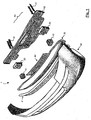
- Fig. 1 shows an exploded view of the bumper assembly according to the present invention;
- Fig. 2 shows a perspective view of the bumper assembly in the assembled condition;
- Fig. 3 shows an embodiment of a crash box integrally constrained to a connecting plate; and
- Fig. 4 shows a cross-section through the bumper assembly according to the present invention assembled with a vehicle chassis.
- With reference to Fig. 1 and Fig. 2, the
bumper assembly 1 according to the present invention comprises at least twocrash boxes 10, at least two respective substantially indeformable connectingdevices 20 for rigidly fixing said cross member to said chassis of the vehicle and across member 30. Profitably, the substantially indeformable connectingdevices 20 are in the form of connectingplates 20. Conveniently, thebumper assembly 1 also comprises abumper shield 40 which is suitably shaped. - Preferably, the
bumper assembly 1 according to the invention also comprises animpact cushioning element 41 applied distally to thecross member 30. - Preferably, the
bumper assembly 1 according to the invention also comprises a reinforcingelement 42 applied proximally or distally to thecross member 30. - According to the present invention, the
cross member 30 and, at least partially, the connectingplates 20, are made of a plastic material or the like. For the purpose of the present patent application, the term "plastic material" is intended to mean primarily a material different from metal and in particular a substantially thermoplastic material with elongation at break values ≥ 50% (for tensile tests on test pieces at 5 mm/min.) such as polycarbonate, polyester, polybutylene terephthalate, polypropylene, polyamide and derivatives thereof, EPDM reinforced polypropylene or the like and any combination thereof. The Applicant has ascertained in particular that a material particularly suitable for manufacture of the present invention is XENOY® PC/PBT marketed by GE Plastics. The resin XENOY® is already used in the motor car sector and ensures optimum resistance to motor fuels as well as a high level of resistance to impacts also at low temperatures and strength over time. For the purpose of the present patent application, the term "substantially indeformable" used in connection with "connecting devices" is intended to mean connecting devices which do not result in a visible deformation when they are subject to pressures of the order of at least 20 N/mm2. - In order to increase the Young's modulus and yield point values of the plastic materials used, the present invention envisages optionally reinforcing the plastic materials with long or short glass fibres.
- According to one embodiment of the invention (Fig. 3), each of the
crash boxes 10 essentially comprises a plurality ofelongated elements 11 with a hexagonal cross-section, joined together so as to form a body of the parallelepiped type, the cross-section of which substantially corresponds to the combination of the plurality of hexagonal cross-sections. In one embodiment of the invention, shown in Figures 3 and 4, there are twenty threeelongated elements 11 with a hexagonal cross-section, arranged in a "5-4-5-4-5" configuration, but it will be understood that other configurations (for example "3-2-3-2" are nevertheless considered suitable, depending on the applications). Generally, the number of cells is variable depending on the collapse force. The Applicant has ascertained that, in order to obtain a greater strength, it is preferable to increase the number of cells instead of increasing their wall thickness. Preferably, the diameter of the circumference circumscribed around thehexagonal elements 11 is ≥ about 10 mm, more preferably ≥ about 15 mm and the thickness of each cell is ≥ about 0.5 mm, more preferably ≥ about 1.0 mm. Preferably, each of thecrash boxes 10 is obtained by means of injection moulding of a plastic material with internal rake values ≤ 0.5°. - In the embodiment shown (see cross-section in Fig. 4), one
side 12 of thecrash box 10 is substantially flat, while theopposite side 13 is formed in a tapered manner so as to have an initial collapse surface designed to reduce the initial collapse peak. Theflat side 12 is also defined as a proximal side because, when the crash box is mounted on the chassis 50 (longitudinal member 51 of the vehicle and/or dorsal member 52), it is closest thereto; similarly, the taperedside 13 is referred to as the distal side. - The
proximal side 12 of the crash box is substantially closed, but has a plurality ofholes holes 14 for locating/centring pins and holes 15 for pressure fixing pins, which will be described below with reference to the connectingplates 20. Last but not least, theholes - At the
distal side 13 of the crash box there is preferably a fastening system, preferably a system of projecting teeth, for example four projecting teeth arranged on opposite sides of the hexagonal elements (not shown). - According to a preferred embodiment (Fig. 3), the
crash box 10 and the respective connectingplate 20 are formed as one piece or are joined together by means of hot blade welding or a similar joining process. - It will nevertheless be understood that the
crash box 10 may also be made of a metallic material, not necessarily a plastic material and may have a form which is different from that described and shown. - According to a further embodiment of the invention (not shown), the
crash boxes 10 and thecross member 30 are formed as one piece or are joined together by means of hot blade welding or a similar joining process. - The
cross member 30, which is made of a plastic material, as mentioned above, is formed longitudinally in any manner depending on the requirements and the space available in the vehicle on which it will be installed. As regards its cross-section, it may be equally well box-shaped or open, for example substantially in the form of an "Ω" (omega), as clearly shown in Fig. 4, or in the form of an "H". Thecross member 30 has preferably a thickness of between about 2 and 8 mm, preferably between about 3 and 6 mm and even more preferably about 4 mm. In order to increase the rigidity of thecross member 30, internal baffles which are suitably spaced from each other may be envisaged. - In the preferred embodiment, the
cross member 30 has an omega-shaped cross-section so that theflat flanges 31 which extend in opposite directions form a first connecting surface which can be joined to a second corresponding connectingsurface 23 provided directly on the chassis 50 (or better, on the longitudinal member and/or on the dorsal member) or, preferably, on the substantially indeformable connecting devices (connecting plates) 20 which will be described hereinbelow. - The connecting
plates 20 comprise abody 24 which is solid or has a honeycomb cross-section (as shown in Fig. 4) and is substantially rigid with a firstproximal side 25 facing directly the end of thelongitudinal member 51 of the vehicle chassis and adistal side 26 co-operating with theproximal side 12 of thecrash box 10. Depending on the geometry of thelongitudinal member 51, the vehicle and the bumper assembly, the twosides distal side 26 of the connectingplate 20, in the embodiment shown in Fig. 4, there extend locating/centring pins 21 andpressure fixing pins 22 able to engage with therespective holes proximal side 12 of thecrash box 10. The connectingplates 20 are constrained integrally to the ends of thelongitudinal members 51 and/or to thedorsal members 52 by means of any mechanical constraining device, for example by means of screws and bolts. Preferably, the connecting plates have a thickness of between about 10 mm and 100 mm, more preferably between 15 mm and 50 mm. - According to the present invention, each connecting
plate 20 comprises at least one second connectingsurface 23 co-operating with the first connectingsurface 31 on thecross member 30. Preferably two second opposite connectingsurfaces 31 are provided. The area of each of the second surfaces is preferably between about 1000 mm2 and 5000 mm2, more preferably between about 1100 mm2 and 2500 mm2. - Conveniently, according to the present invention, the
cross member 30 and connectingplates 20 are made of the same material or a compatible material which allows them to be joined together in a simple, low-cost and reliable manner. Preferably, the cross member and fixing plate are made of a plastic material, in particular XENOY®. Preferably, the cross member and the fixingplates 20 are joined together by means of welding, more preferably by means of hot blade welding. - According to the present invention, therefore, since the connecting
plates 20 are substantially rigid and indeformable, thecross member 30 is constrained directly to thechassis 50 of the vehicle, for example by means of thelongitudinal members 51 and/or thedorsal members 52 and provides a better impact resistance than the existing solutions. - Conveniently, as mentioned above, the
cross member 30 has a cross-section which is substantially in the form of an "Ω" (omega) and thecrash boxes 10 are housed inside thecross member 30, i.e. inside its hollow part (Fig. 4). The crash boxes may be made of metal or plastic, this latter solution being preferred. Thecrash boxes 10 could be constrained to thecross member 30 by means of interfitting engagement, pressure or in any other manner. Optionally they could also be simply centred. In a solution which is even more preferred, thecrash boxes 10 are integral with thecross member 30 and are obtained by moulding the latter or joined by means of hot blade welding. - In order to improve the strength of the
cross member 30, depending on the circumstances, a reinforcingelement 42 may be conveniently envisaged, being connected to thecross member 30, preferably in a proximal manner. The reinforcingelement 42 is preferably made of plastic or metal (for example steel) and may be connected to thecross member 30 by means of a mechanical connecting system of the screw and bolt type, welding or bonding. - Finally, conveniently, the
bumper assembly 1 according to the present invention comprises animpact cushioning element 41 which is applied distally to the cross member, this element comprising a material such as foam, for example expanded polypropylene, expanded polyurethane, expanded polystyrene and derivatives thereof. Alternatively, the cushioning element comprises a honeycomb thermoplastic absorber. - In a particular embodiment of the present invention, each connecting
plate 20 comprises a hook, for example a hook for towing the vehicle. In the case of plastic connecting plates, these metal hooks connected to metal plates provided with holes opposite the fixing holes 27 of theplate 20 may be embedded in plastic material during production of the said plates by means of injection moulding. - Thus, according to the present invention, at least two substantially indeformable connecting devices 20 (possibly plate shaped) for rigidly fixing the
cross member 30 to the chassis (50, 51, 52) of the vehicle are provided. The at least two substantially indeformable connectingdevices 20 are directly between the chassis and thecross member 30. According to the present invention, thecross member 30 is in contact with the connectingdevices 20 throughsurfaces 23 and 31 (see Figure 4); in turn, the substantially indeformable connectingdevices 20 are in contact with thevehicle chassis cross member 30 andcrash boxes 10 absorb the impact energy for which they are designed. Only after that cross member and crash boxes have become deformed, the connectingdevices 20 will start to become deformed. During such a crash and before any deformation of the connecting device has become, the relative position of the contact surface (23, 31) between the connectingdevices 20 and the cross member is unchanged with respect to at least one of the contact surfaces between the connectingdevices 20 and the vehicle chassis (50, 51, 52). - It is obvious that the embodiments of the bumper assembly according to the present invention may be subject to numerous modifications, adaptations, variations and replacement of parts with others which are functionally equivalent, but that these modifications, adaptations, variations and replacement of parts are to be understood as being within the scope of the present invention which is limited solely by the following claims.
Claims (17)
- Bumper assembly (1) for a vehicle, the vehicle comprising a chassis (50, 51, 52), the bumper assembly (1) being characterized in that it comprises: at least two crash boxes (10); a cross member (30) made of a first plastic material which, during use, extends over a distance at least corresponding to that between the crash boxes (10); and at least two substantially indeformable connecting devices (20) connected to said cross member (30) for rigidly fixing said cross member (30) to said chassis (50, 51, 52) of the vehicle, wherein said at least two substantially indeformable connecting devices (20) are connected to the cross member (30) at positions corresponding to the crash boxes (10).
- Bumper assembly (1) according to Claim 1, characterized in that said at least two substantially indeformable connecting devices (20) are made of a second plastic material.
- Bumper assembly (1) according to Claim 2, characterized in that said first plastic material is the same plastic material as the second plastic material.
- Bumper assembly (1) according to any of preceding Claims, characterized in that said at least two substantially indeformable connecting devices (20) are directly connected to said cross member (30) by a welding process, preferably by an hot blade welding process.
- Bumper assembly (1) according to any one of the preceding claims, characterized in that said first and second plastic materials comprise XENOY®.
- Bumper assembly (1) according to any one of Claims 1 to 5, characterized in that said at least two substantially indeformable connecting devices (20) are substantially solid.
- Bumper assembly (1) according to any one of Claims 1 to 5, characterized in that said at least two substantially indeformable connecting devices (20) have a honeycomb cross-section.
- Bumper assembly (1) according to any one of Claims 1 to 7, characterized in that said cross member (30) comprises at least one first connecting surface (31) and each of said substantially indeformable connecting devices (20) comprises at least one corresponding second surface (23) for surface connecting said cross member to said substantially indeformable connecting devices along said surfaces.
- Bumper assembly (1) according to any one of Claims 2 to 8, characterized in that said cross member (30) has a cross-section which is substantially at least partially open in the form of an "Ω" or "H".
- Bumper assembly (1) according to any one of Claims 1 to 9, characterized in that each of said substantially indeformable connecting devices (20) comprises a fixing device (22) for fixing said substantially indeformable connecting device to a respective crash box (10).
- Bumper assembly (1) according to any one of Claims 1 to 9, characterized in that each of said crash boxes (10) is integral with a respective substantially indeformable connecting device (20).
- Bumper assembly (1) according to any one of Claims 1 to 9, characterized in that said crash boxes (10) are integral with said cross member (30).
- Bumper assembly (1) according to any one of the preceding claims, characterized in that it also comprises a reinforcing element (42).
- Bumper assembly (1) according to any one of the preceding claims, characterized in that it also comprises an impact cushioning element (41).
- Bumper assembly (1) according to any one of the preceding claims, characterized in that it also comprises a bumper shield (40).
- Method for protecting a vehicle from damage caused by impacts, said vehicle comprising a chassis (50, 51, 52), the method comprising the steps of: providing at least two crash boxes (10); providing a cross member (30) made of a first plastic material which extends over a distance at least corresponding to that between the crash boxes (10); and connecting to said cross member (30) at least two substantially indeformable connecting devices (20) for rigidly fixing said cross member (30) to said chassis (50, 51, 52) of the vehicle, wherein said at least two substantially indeformable connecting devices (20) are connected to the cross member (30) at positions corresponding to the crash boxes (10).
- Vehicle comprising a bumper assembly according to any one of Claims 1 to 15.
Priority Applications (1)
| Application Number | Priority Date | Filing Date | Title |
|---|---|---|---|
| PL04077215T PL1504966T3 (en) | 2003-08-06 | 2004-08-02 | Bumper assembly for a vehicle |
Applications Claiming Priority (2)
| Application Number | Priority Date | Filing Date | Title |
|---|---|---|---|
| ITMI20031616 | 2003-08-06 | ||
| IT001616A ITMI20031616A1 (en) | 2003-08-06 | 2003-08-06 | BUMPER COMPLEX FOR VEHICLE AND ITS VEHICLE |
Publications (2)
| Publication Number | Publication Date |
|---|---|
| EP1504966A1 true EP1504966A1 (en) | 2005-02-09 |
| EP1504966B1 EP1504966B1 (en) | 2007-09-19 |
Family
ID=33548864
Family Applications (1)
| Application Number | Title | Priority Date | Filing Date |
|---|---|---|---|
| EP04077215A Expired - Lifetime EP1504966B1 (en) | 2003-08-06 | 2004-08-02 | Bumper assembly for a vehicle |
Country Status (8)
| Country | Link |
|---|---|
| US (1) | US7093866B2 (en) |
| EP (1) | EP1504966B1 (en) |
| AT (1) | ATE373585T1 (en) |
| BR (1) | BRPI0403201B1 (en) |
| DE (1) | DE602004009004T2 (en) |
| ES (1) | ES2293158T3 (en) |
| IT (1) | ITMI20031616A1 (en) |
| PL (1) | PL1504966T3 (en) |
Cited By (4)
| Publication number | Priority date | Publication date | Assignee | Title |
|---|---|---|---|---|
| DE102005049149A1 (en) * | 2005-10-14 | 2007-04-19 | GM Global Technology Operations, Inc., Detroit | Device for impact damping |
| EP1857327A2 (en) | 2006-05-17 | 2007-11-21 | Avelda S.r.l | Vehicle bumper assembly and associated vehicle comprising this bumper assembly |
| EP2039592A1 (en) * | 2007-09-21 | 2009-03-25 | Peguform Gmbh | Front end carrier for a motor vehicle - front end module |
| CN106882139A (en) * | 2017-03-22 | 2017-06-23 | 山东国金汽车制造有限公司 | A kind of automobile rear bumper installs supporting plate |
Families Citing this family (25)
| Publication number | Priority date | Publication date | Assignee | Title |
|---|---|---|---|---|
| FR2829734B1 (en) * | 2001-09-20 | 2004-01-23 | Peguform France | BUMPER BEAM FOR VEHICLE COMPRISING A CROSSING AND TWO SHOCK ABSORBERS |
| SE0400728L (en) * | 2004-03-23 | 2005-06-14 | Gestamp Hardtech Ab | Bumper arrangement for vehicles |
| DE102005034469A1 (en) * | 2005-07-23 | 2007-02-01 | Daimlerchrysler Ag | Front end structure for a commercial vehicle |
| DE102006015876A1 (en) * | 2006-04-05 | 2007-10-11 | GM Global Technology Operations, Inc., Detroit | Crashbox and damping arrangement with Crasbox |
| DE102006048429A1 (en) * | 2006-10-12 | 2008-04-17 | Magna Automotive Services Gmbh | Energy absorption device, in particular for non-axial load |
| FR2910865B1 (en) * | 2006-12-28 | 2009-04-03 | Plastic Omnium Cie | SUPPORT PART FOR A SHOCK ABSORPTION SYSTEM INTENDED TO BE FITTED AT THE END OF A LONGERON OF A MOTOR VEHICLE |
| JP4909092B2 (en) * | 2007-01-10 | 2012-04-04 | 本田技研工業株式会社 | Light alloy extrusion frame |
| JP4815387B2 (en) * | 2007-04-25 | 2011-11-16 | 株式会社イノアックコーポレーション | Shock absorbing member |
| KR101013901B1 (en) * | 2007-12-18 | 2011-02-14 | 현대자동차주식회사 | Bumper device with multi-stage energy buffer structure |
| US7866716B2 (en) | 2008-04-08 | 2011-01-11 | Flex-N-Gate Corporation | Energy absorber for vehicle |
| JP4738474B2 (en) * | 2008-12-26 | 2011-08-03 | 豊田鉄工株式会社 | Shock absorbing member for vehicle |
| IT1395087B1 (en) * | 2009-03-12 | 2012-09-05 | Red Stamp Sas | SHOCK ABSORPTION ELEMENT |
| DE102009040602A1 (en) * | 2009-09-08 | 2011-03-10 | Dr. Ing. H.C. F. Porsche Aktiengesellschaft | Bumpers and bumper kit |
| WO2011058152A1 (en) * | 2009-11-12 | 2011-05-19 | Magna Steyr Fahrzeugtechnik Ag & Co Kg | Modular bumper assembly for a vehicle |
| US8454053B2 (en) * | 2010-02-25 | 2013-06-04 | Ford Global Technologies, Llc | Energy absorbing structure for vehicle knee bolster cover |
| IT1401678B1 (en) * | 2010-07-29 | 2013-08-02 | Tres Srl | POLYMERIC IMPACT ABSORPTION ELEMENT FOR A VEHICLE. |
| DE102010052510A1 (en) * | 2010-11-26 | 2012-05-31 | Daimler Ag | Front end module arrangement for a body of a passenger car |
| KR20120062217A (en) * | 2010-12-06 | 2012-06-14 | 현대자동차주식회사 | Crash Box of Car Bumper |
| EP2786903B1 (en) * | 2011-11-29 | 2018-03-14 | Toyota Shatai Kabushiki Kaisha | Shock-absorbing member for vehicle |
| KR101601428B1 (en) * | 2014-06-03 | 2016-03-09 | 현대자동차주식회사 | Crash box for vehicle |
| DE102015117005A1 (en) * | 2015-10-06 | 2017-04-06 | Benteler Automobiltechnik Gmbh | crash box |
| US10065587B2 (en) | 2015-11-23 | 2018-09-04 | Flex|N|Gate Corporation | Multi-layer energy absorber |
| EP3747736A1 (en) * | 2019-06-07 | 2020-12-09 | SABIC Global Technologies B.V. | Energy absorbing devices and methods of making and using the same |
| DE102020124733B3 (en) | 2020-09-23 | 2021-10-28 | Dr. Ing. H.C. F. Porsche Aktiengesellschaft | Rear body structure of a battery electric automobile |
| CN114151487B (en) * | 2021-11-25 | 2022-10-28 | 湖南大学 | High-energy absorption structure with strong recoverability and manufacturing process |
Citations (4)
| Publication number | Priority date | Publication date | Assignee | Title |
|---|---|---|---|---|
| US3744835A (en) | 1971-11-26 | 1973-07-10 | A Carbone | Shock absorbing honeycomb bumper |
| US5100187A (en) * | 1987-12-28 | 1992-03-31 | Milad Limited Partnership | Vehicle bumper |
| FR2750936A1 (en) * | 1996-07-11 | 1998-01-16 | Plastic Omnium Cie | THERMOPLASTIC BUMPER WITH INTEGRATED BEAM SHIELD |
| FR2763546A1 (en) | 1998-04-07 | 1998-11-27 | Plastic Omnium Cie | BUMPER BEAM AND ITS MANUFACTURING METHOD |
Family Cites Families (7)
| Publication number | Priority date | Publication date | Assignee | Title |
|---|---|---|---|---|
| JPH0620743B2 (en) * | 1985-12-26 | 1994-03-23 | 日本板硝子株式会社 | Composite long fiber reinforced thermoplastic resin stampable sheet and bumper beam formed by molding the same |
| US4950031A (en) * | 1987-07-04 | 1990-08-21 | Mazda Motor Corporation | Automobile rear underbody structure |
| FR2702432B1 (en) * | 1993-03-09 | 1995-06-09 | Profil | SHOCK ABSORBING BEAM, PARTICULARLY FOR MOTOR VEHICLES. |
| FR2763547A1 (en) * | 1997-05-23 | 1998-11-27 | Plastic Omnium Cie | BUMPER WITH LOCAL ABSORBER |
| IT1319048B1 (en) * | 2000-10-18 | 2003-09-23 | Adlev Srl | IMPACT ENERGY ABSORPTION SYSTEM FOR VEHICLES |
| JP2002155981A (en) * | 2000-11-21 | 2002-05-31 | Aisin Seiki Co Ltd | Shock absorbing member and bumper |
| US6938936B2 (en) * | 2001-09-12 | 2005-09-06 | General Electric Company | Energy absorber with crash cans |
-
2003
- 2003-08-06 IT IT001616A patent/ITMI20031616A1/en unknown
-
2004
- 2004-07-30 BR BRPI0403201-2A patent/BRPI0403201B1/en not_active IP Right Cessation
- 2004-08-02 DE DE602004009004T patent/DE602004009004T2/en not_active Expired - Lifetime
- 2004-08-02 AT AT04077215T patent/ATE373585T1/en not_active IP Right Cessation
- 2004-08-02 ES ES04077215T patent/ES2293158T3/en not_active Expired - Lifetime
- 2004-08-02 EP EP04077215A patent/EP1504966B1/en not_active Expired - Lifetime
- 2004-08-02 PL PL04077215T patent/PL1504966T3/en unknown
- 2004-08-04 US US10/910,790 patent/US7093866B2/en not_active Expired - Lifetime
Patent Citations (4)
| Publication number | Priority date | Publication date | Assignee | Title |
|---|---|---|---|---|
| US3744835A (en) | 1971-11-26 | 1973-07-10 | A Carbone | Shock absorbing honeycomb bumper |
| US5100187A (en) * | 1987-12-28 | 1992-03-31 | Milad Limited Partnership | Vehicle bumper |
| FR2750936A1 (en) * | 1996-07-11 | 1998-01-16 | Plastic Omnium Cie | THERMOPLASTIC BUMPER WITH INTEGRATED BEAM SHIELD |
| FR2763546A1 (en) | 1998-04-07 | 1998-11-27 | Plastic Omnium Cie | BUMPER BEAM AND ITS MANUFACTURING METHOD |
Cited By (9)
| Publication number | Priority date | Publication date | Assignee | Title |
|---|---|---|---|---|
| DE102005049149A1 (en) * | 2005-10-14 | 2007-04-19 | GM Global Technology Operations, Inc., Detroit | Device for impact damping |
| EP1775172A3 (en) * | 2005-10-14 | 2008-03-05 | GM Global Technology Operations, Inc. | Device for absorbing shocks |
| DE102005049149B4 (en) * | 2005-10-14 | 2014-10-30 | GM Global Technology Operations LLC (n. d. Ges. d. Staates Delaware) | Device for impact damping |
| EP1857327A2 (en) | 2006-05-17 | 2007-11-21 | Avelda S.r.l | Vehicle bumper assembly and associated vehicle comprising this bumper assembly |
| EP1857327A3 (en) * | 2006-05-17 | 2009-11-11 | Avelda S.r.l | Vehicle bumper assembly and associated vehicle comprising this bumper assembly |
| US8136855B2 (en) | 2006-05-17 | 2012-03-20 | Vm Plastics S.R.L. | Vehicle bumper assembly and associated vehicle comprising this bumper assembly |
| EP2039592A1 (en) * | 2007-09-21 | 2009-03-25 | Peguform Gmbh | Front end carrier for a motor vehicle - front end module |
| WO2009039935A1 (en) * | 2007-09-21 | 2009-04-02 | Peguform Gmbh | Front end mount for a front end module for a motor vehicle |
| CN106882139A (en) * | 2017-03-22 | 2017-06-23 | 山东国金汽车制造有限公司 | A kind of automobile rear bumper installs supporting plate |
Also Published As
| Publication number | Publication date |
|---|---|
| ATE373585T1 (en) | 2007-10-15 |
| US20050062300A1 (en) | 2005-03-24 |
| ES2293158T3 (en) | 2008-03-16 |
| BRPI0403201A (en) | 2005-03-22 |
| DE602004009004T2 (en) | 2008-06-19 |
| EP1504966B1 (en) | 2007-09-19 |
| PL1504966T3 (en) | 2008-02-29 |
| DE602004009004D1 (en) | 2007-10-31 |
| BRPI0403201B1 (en) | 2014-09-23 |
| US7093866B2 (en) | 2006-08-22 |
| ITMI20031616A1 (en) | 2005-02-07 |
Similar Documents
| Publication | Publication Date | Title |
|---|---|---|
| EP1504966B1 (en) | Bumper assembly for a vehicle | |
| EP0854066B1 (en) | Bumper and front rail assembly for vehicle | |
| KR101717511B1 (en) | Unitary energy absorbing assembly and method of making the same | |
| US8136855B2 (en) | Vehicle bumper assembly and associated vehicle comprising this bumper assembly | |
| CN115243912B (en) | Battery pack mounting structure | |
| US5290078A (en) | Integral fasteners for an energy absorber of a vehicular bumper assembly | |
| JP4472898B2 (en) | Shock absorber for motorcycle | |
| JP2779852B2 (en) | Synthetic resin bumper | |
| US7229099B2 (en) | Chassis auxiliary-frame arrangement for improving the safety in a crash | |
| JP2013521194A (en) | Bonnet energy absorber for pedestrians | |
| JP2006506277A (en) | Integrated single bumper beam | |
| CN115776961A (en) | Hybrid side sill reinforcement for small overlap impacts | |
| JP2009515773A (en) | Energy absorbing vehicle fender | |
| WO2018109211A1 (en) | Hybrid towing bumper beam assembly | |
| EP1264739B1 (en) | Protective structure for vehicles | |
| JP2009515772A (en) | Energy absorbing vehicle fender | |
| CN112590700A (en) | Integrated multi-stage buffer automobile lower guard plate device and protection method | |
| KR100883256B1 (en) | Shock Absorption Structure of Subframe Rear Member for Reducing Leg Injury | |
| JP3931419B2 (en) | Body bumper structure | |
| JP4176207B2 (en) | Front bumper mounting structure | |
| JP2002274299A (en) | Frame tip structure | |
| KR100501237B1 (en) | Vehicle bumper for protecting pedestrian | |
| CN222946712U (en) | Buffer device and vehicle | |
| JPH0517330Y2 (en) | ||
| KR19980061146U (en) | Shock Absorber Structure for Automobile |
Legal Events
| Date | Code | Title | Description |
|---|---|---|---|
| PUAI | Public reference made under article 153(3) epc to a published international application that has entered the european phase |
Free format text: ORIGINAL CODE: 0009012 |
|
| AK | Designated contracting states |
Kind code of ref document: A1 Designated state(s): AT BE BG CH CY CZ DE DK EE ES FI FR GB GR HU IE IT LI LU MC NL PL PT RO SE SI SK TR |
|
| AX | Request for extension of the european patent |
Extension state: AL HR LT LV MK |
|
| 17P | Request for examination filed |
Effective date: 20050419 |
|
| AKX | Designation fees paid |
Designated state(s): AT BE BG CH CY CZ DE DK EE ES FI FR GB GR HU IE IT LI LU MC NL PL PT RO SE SI SK TR |
|
| GRAP | Despatch of communication of intention to grant a patent |
Free format text: ORIGINAL CODE: EPIDOSNIGR1 |
|
| RAP1 | Party data changed (applicant data changed or rights of an application transferred) |
Owner name: AVELDA S.R.L |
|
| GRAS | Grant fee paid |
Free format text: ORIGINAL CODE: EPIDOSNIGR3 |
|
| GRAA | (expected) grant |
Free format text: ORIGINAL CODE: 0009210 |
|
| AK | Designated contracting states |
Kind code of ref document: B1 Designated state(s): AT BE BG CH CY CZ DE DK EE ES FI FR GB GR HU IE IT LI LU MC NL PL PT RO SE SI SK TR |
|
| REG | Reference to a national code |
Ref country code: GB Ref legal event code: FG4D |
|
| RIN1 | Information on inventor provided before grant (corrected) |
Inventor name: TONEATTI, JEAN LOUISC/O ADLEV S.R.L. Inventor name: VISMARA, MARIO |
|
| REG | Reference to a national code |
Ref country code: CH Ref legal event code: EP |
|
| REF | Corresponds to: |
Ref document number: 602004009004 Country of ref document: DE Date of ref document: 20071031 Kind code of ref document: P |
|
| REG | Reference to a national code |
Ref country code: IE Ref legal event code: FG4D |
|
| PG25 | Lapsed in a contracting state [announced via postgrant information from national office to epo] |
Ref country code: FI Free format text: LAPSE BECAUSE OF FAILURE TO SUBMIT A TRANSLATION OF THE DESCRIPTION OR TO PAY THE FEE WITHIN THE PRESCRIBED TIME-LIMIT Effective date: 20070919 |
|
| PG25 | Lapsed in a contracting state [announced via postgrant information from national office to epo] |
Ref country code: CH Free format text: LAPSE BECAUSE OF FAILURE TO SUBMIT A TRANSLATION OF THE DESCRIPTION OR TO PAY THE FEE WITHIN THE PRESCRIBED TIME-LIMIT Effective date: 20070919 Ref country code: LI Free format text: LAPSE BECAUSE OF FAILURE TO SUBMIT A TRANSLATION OF THE DESCRIPTION OR TO PAY THE FEE WITHIN THE PRESCRIBED TIME-LIMIT Effective date: 20070919 Ref country code: AT Free format text: LAPSE BECAUSE OF FAILURE TO SUBMIT A TRANSLATION OF THE DESCRIPTION OR TO PAY THE FEE WITHIN THE PRESCRIBED TIME-LIMIT Effective date: 20070919 |
|
| REG | Reference to a national code |
Ref country code: PL Ref legal event code: T3 |
|
| NLV1 | Nl: lapsed or annulled due to failure to fulfill the requirements of art. 29p and 29m of the patents act | ||
| REG | Reference to a national code |
Ref country code: ES Ref legal event code: FG2A Ref document number: 2293158 Country of ref document: ES Kind code of ref document: T3 |
|
| PG25 | Lapsed in a contracting state [announced via postgrant information from national office to epo] |
Ref country code: BE Free format text: LAPSE BECAUSE OF FAILURE TO SUBMIT A TRANSLATION OF THE DESCRIPTION OR TO PAY THE FEE WITHIN THE PRESCRIBED TIME-LIMIT Effective date: 20070919 |
|
| REG | Reference to a national code |
Ref country code: CH Ref legal event code: PL |
|
| PG25 | Lapsed in a contracting state [announced via postgrant information from national office to epo] |
Ref country code: NL Free format text: LAPSE BECAUSE OF FAILURE TO SUBMIT A TRANSLATION OF THE DESCRIPTION OR TO PAY THE FEE WITHIN THE PRESCRIBED TIME-LIMIT Effective date: 20070919 Ref country code: GR Free format text: LAPSE BECAUSE OF FAILURE TO SUBMIT A TRANSLATION OF THE DESCRIPTION OR TO PAY THE FEE WITHIN THE PRESCRIBED TIME-LIMIT Effective date: 20071220 |
|
| EN | Fr: translation not filed | ||
| PG25 | Lapsed in a contracting state [announced via postgrant information from national office to epo] |
Ref country code: PT Free format text: LAPSE BECAUSE OF FAILURE TO SUBMIT A TRANSLATION OF THE DESCRIPTION OR TO PAY THE FEE WITHIN THE PRESCRIBED TIME-LIMIT Effective date: 20080219 Ref country code: SK Free format text: LAPSE BECAUSE OF FAILURE TO SUBMIT A TRANSLATION OF THE DESCRIPTION OR TO PAY THE FEE WITHIN THE PRESCRIBED TIME-LIMIT Effective date: 20070919 Ref country code: CZ Free format text: LAPSE BECAUSE OF FAILURE TO SUBMIT A TRANSLATION OF THE DESCRIPTION OR TO PAY THE FEE WITHIN THE PRESCRIBED TIME-LIMIT Effective date: 20070919 |
|
| PG25 | Lapsed in a contracting state [announced via postgrant information from national office to epo] |
Ref country code: RO Free format text: LAPSE BECAUSE OF FAILURE TO SUBMIT A TRANSLATION OF THE DESCRIPTION OR TO PAY THE FEE WITHIN THE PRESCRIBED TIME-LIMIT Effective date: 20070919 Ref country code: SE Free format text: LAPSE BECAUSE OF FAILURE TO SUBMIT A TRANSLATION OF THE DESCRIPTION OR TO PAY THE FEE WITHIN THE PRESCRIBED TIME-LIMIT Effective date: 20071219 |
|
| PLBE | No opposition filed within time limit |
Free format text: ORIGINAL CODE: 0009261 |
|
| STAA | Information on the status of an ep patent application or granted ep patent |
Free format text: STATUS: NO OPPOSITION FILED WITHIN TIME LIMIT |
|
| PG25 | Lapsed in a contracting state [announced via postgrant information from national office to epo] |
Ref country code: DK Free format text: LAPSE BECAUSE OF FAILURE TO SUBMIT A TRANSLATION OF THE DESCRIPTION OR TO PAY THE FEE WITHIN THE PRESCRIBED TIME-LIMIT Effective date: 20070919 |
|
| 26N | No opposition filed |
Effective date: 20080620 |
|
| PG25 | Lapsed in a contracting state [announced via postgrant information from national office to epo] |
Ref country code: FR Free format text: LAPSE BECAUSE OF FAILURE TO SUBMIT A TRANSLATION OF THE DESCRIPTION OR TO PAY THE FEE WITHIN THE PRESCRIBED TIME-LIMIT Effective date: 20080523 |
|
| ET | Fr: translation filed | ||
| PG25 | Lapsed in a contracting state [announced via postgrant information from national office to epo] |
Ref country code: MC Free format text: LAPSE BECAUSE OF NON-PAYMENT OF DUE FEES Effective date: 20080831 |
|
| GBPC | Gb: european patent ceased through non-payment of renewal fee |
Effective date: 20080802 |
|
| PG25 | Lapsed in a contracting state [announced via postgrant information from national office to epo] |
Ref country code: EE Free format text: LAPSE BECAUSE OF FAILURE TO SUBMIT A TRANSLATION OF THE DESCRIPTION OR TO PAY THE FEE WITHIN THE PRESCRIBED TIME-LIMIT Effective date: 20070919 |
|
| PG25 | Lapsed in a contracting state [announced via postgrant information from national office to epo] |
Ref country code: SI Free format text: LAPSE BECAUSE OF FAILURE TO SUBMIT A TRANSLATION OF THE DESCRIPTION OR TO PAY THE FEE WITHIN THE PRESCRIBED TIME-LIMIT Effective date: 20070919 |
|
| PG25 | Lapsed in a contracting state [announced via postgrant information from national office to epo] |
Ref country code: IE Free format text: LAPSE BECAUSE OF NON-PAYMENT OF DUE FEES Effective date: 20080804 Ref country code: CY Free format text: LAPSE BECAUSE OF FAILURE TO SUBMIT A TRANSLATION OF THE DESCRIPTION OR TO PAY THE FEE WITHIN THE PRESCRIBED TIME-LIMIT Effective date: 20070919 |
|
| PG25 | Lapsed in a contracting state [announced via postgrant information from national office to epo] |
Ref country code: BG Free format text: LAPSE BECAUSE OF FAILURE TO SUBMIT A TRANSLATION OF THE DESCRIPTION OR TO PAY THE FEE WITHIN THE PRESCRIBED TIME-LIMIT Effective date: 20071219 |
|
| PG25 | Lapsed in a contracting state [announced via postgrant information from national office to epo] |
Ref country code: GB Free format text: LAPSE BECAUSE OF NON-PAYMENT OF DUE FEES Effective date: 20080802 |
|
| PG25 | Lapsed in a contracting state [announced via postgrant information from national office to epo] |
Ref country code: HU Free format text: LAPSE BECAUSE OF FAILURE TO SUBMIT A TRANSLATION OF THE DESCRIPTION OR TO PAY THE FEE WITHIN THE PRESCRIBED TIME-LIMIT Effective date: 20080320 Ref country code: LU Free format text: LAPSE BECAUSE OF NON-PAYMENT OF DUE FEES Effective date: 20080802 |
|
| REG | Reference to a national code |
Ref country code: DE Ref legal event code: R082 Ref document number: 602004009004 Country of ref document: DE Representative=s name: WEBER & HEIM PATENTANWAELTE, DE |
|
| REG | Reference to a national code |
Ref country code: ES Ref legal event code: PC2A Owner name: VM PLASTICS S.R.L. Effective date: 20120229 |
|
| REG | Reference to a national code |
Ref country code: DE Ref legal event code: R082 Ref document number: 602004009004 Country of ref document: DE Representative=s name: WEBER & HEIM PATENTANWAELTE, DE Effective date: 20120215 Ref country code: DE Ref legal event code: R081 Ref document number: 602004009004 Country of ref document: DE Owner name: VM PLASTICS S.R.L., IT Free format text: FORMER OWNER: AVELDA S.R.L., MILAN, IT Effective date: 20120215 Ref country code: DE Ref legal event code: R082 Ref document number: 602004009004 Country of ref document: DE Representative=s name: WEBER & HEIM PATENTANWAELTE PARTNERSCHAFTSGESE, DE Effective date: 20120215 Ref country code: DE Ref legal event code: R082 Ref document number: 602004009004 Country of ref document: DE Representative=s name: WUNDERLICH & HEIM PATENTANWAELTE PARTNERSCHAFT, DE Effective date: 20120215 |
|
| REG | Reference to a national code |
Ref country code: FR Ref legal event code: TP Owner name: VM PLASTICS S.R.L., IT Effective date: 20120326 |
|
| REG | Reference to a national code |
Ref country code: FR Ref legal event code: PLFP Year of fee payment: 13 |
|
| REG | Reference to a national code |
Ref country code: FR Ref legal event code: PLFP Year of fee payment: 14 |
|
| REG | Reference to a national code |
Ref country code: DE Ref legal event code: R082 Ref document number: 602004009004 Country of ref document: DE Representative=s name: WUNDERLICH & HEIM PATENTANWAELTE PARTNERSCHAFT, DE |
|
| REG | Reference to a national code |
Ref country code: FR Ref legal event code: PLFP Year of fee payment: 15 |
|
| PGFP | Annual fee paid to national office [announced via postgrant information from national office to epo] |
Ref country code: TR Payment date: 20230801 Year of fee payment: 20 Ref country code: IT Payment date: 20230822 Year of fee payment: 20 |
|
| PGFP | Annual fee paid to national office [announced via postgrant information from national office to epo] |
Ref country code: PL Payment date: 20230721 Year of fee payment: 20 Ref country code: FR Payment date: 20230822 Year of fee payment: 20 Ref country code: DE Payment date: 20230821 Year of fee payment: 20 |
|
| PGFP | Annual fee paid to national office [announced via postgrant information from national office to epo] |
Ref country code: ES Payment date: 20231027 Year of fee payment: 20 |
|
| REG | Reference to a national code |
Ref country code: DE Ref legal event code: R071 Ref document number: 602004009004 Country of ref document: DE |
|
| REG | Reference to a national code |
Ref country code: ES Ref legal event code: FD2A Effective date: 20240826 |
|
| PG25 | Lapsed in a contracting state [announced via postgrant information from national office to epo] |
Ref country code: ES Free format text: LAPSE BECAUSE OF EXPIRATION OF PROTECTION Effective date: 20240803 |
|
| PG25 | Lapsed in a contracting state [announced via postgrant information from national office to epo] |
Ref country code: ES Free format text: LAPSE BECAUSE OF EXPIRATION OF PROTECTION Effective date: 20240803 |