FIELD OF THE INVENTION
The present invention relates to a pressure-sensitive
adhesive sheet for steel plates, more precisely
a pressure-sensitive adhesive sheet for steel plates,
which is used for sticking onto steel plates for various
industrial machinery such as transport machinery.
BACKGROUND ART
Heretofore, in order to reduce automobile body
weight, a steel plate for automobile body is generally
processed to a thin plate of 0.6 to 0.8 mm thick.
Therefore, it is known that the body steel plate is
attempted to be reinforced by sticking a steel plate-reinforcing
sheet onto inner side of the steel plate.
Such steel plate-reinforcing sheet is, for example,
stuck during an assembly step of the body steel plate and
then heated to foam with the heat supplied during
elecrodeposition coating to achieve reinforcement. For
example, there is proposed a steel plate-reinforcing
sheet wherein a foaming resin layer is laminated onto a
backing (for example, cf. JP-A-7-68695).
Moreover, since the body steel plate is a thin
plate, a vibration sound generates while moving and noise
may be generated at door opening and closure. Therefore,
in order to prevent the generation of these vibration
sound and noise, there is proposed a damping sheet
wherein a rubber composition is laminated onto a backing
(for example, cf. JP-A-9-123356).
SUMMARY OF THE INVENTION
In such steel plate-reinforcing sheet and damping
sheet, however, a resin-coated glass cloth wherein a
glass cloth is coated with a resin is employed as a
backing. In particular, in view of thermal resistance,
workability, and adhesiveness between a foaming resin
layer and a damping layer, a resin-coated glass cloth
wherein a glass cloth is coated with a melamine resin is
widely employed.
However, from the viewpoint of recent environmental
measures, it has been required to restrict generation of
organic volatile components from automobile parts and
members strictly. Since harmful substances (VOC) such as
formaldehyde and acetaldehyde are generated from the
resin-coated glass cloth wherein the glass cloth is
coated with a melamine resin, there arises an
inconvenience that the cloth cannot satisfy such
requirement. Formaldehyde and acetaldehyde cause
remarkable deterioration of working environment by their
irritating odor and is a cause for the increase of
allergy-suffering patients.
On the other hand, though weight saving is required
for the resin-coated glass cloth to be used in such steel
plate-reinforcing sheet or damping sheet, there arise
inconveniences that glass filaments become loose from the
glass cloth and properties such as strength and
elasticity as well as adhesiveness with the foaming resin
layer or rubber composition layer to be laminated on the
glass cloth are not satisfactory when an amount of the
coating resin is reduced for saving weight.
The loosing of the glass filaments is problematic
in the case that the steel plate-reinforcing sheet or
damping sheet is processed, for example, punched or cut,
and the insufficient strength and elastic modulus
influence reinforcing and damping properties.
The invention is accomplished in consideration of
such inconveniences and its object is to provide a
pressure-sensitive adhesive sheet for steel plates, which
has an excellent reinforcing and damping properties and
also which reduces generation of organic volatile
components.
Specifically, the present invention has the
following constitution.
In the present invention, loosing of glass
filaments from the glass cloth can be prevented and
rigidity of the glass cloth can be controlled by coating
a glass cloth with the resin emulsion (A), and
furthermore, adhesiveness with other members such as a
foaming resin layer and a damping layer can be improved
by coating the cloth with the resin emulsion (B).
BRIEF DESCRIPTION OF THE DRAWINGS
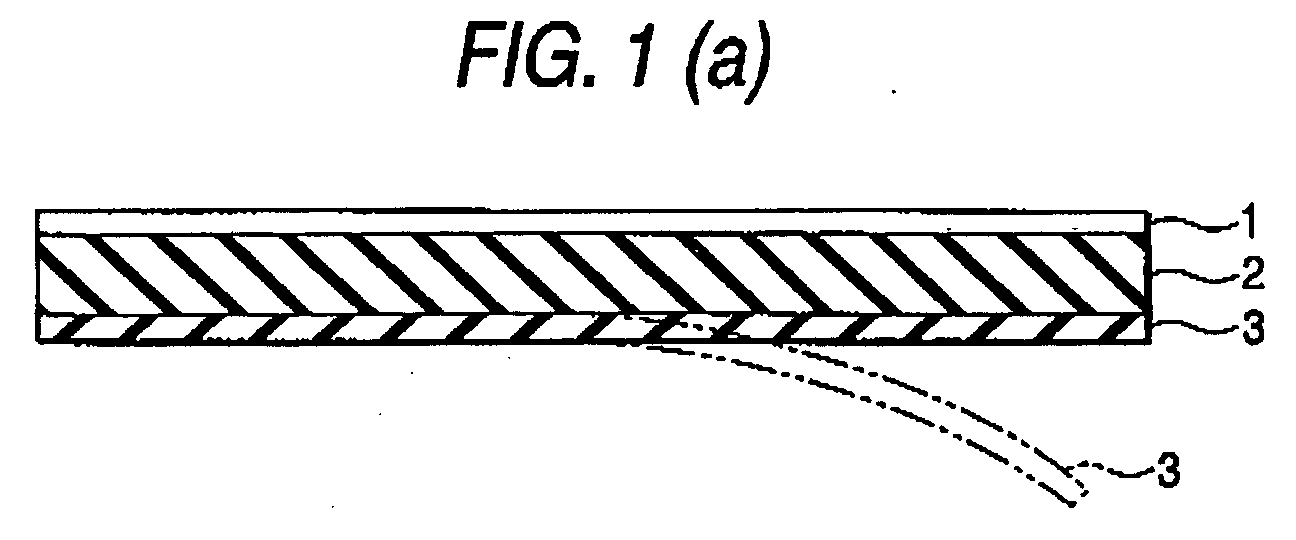
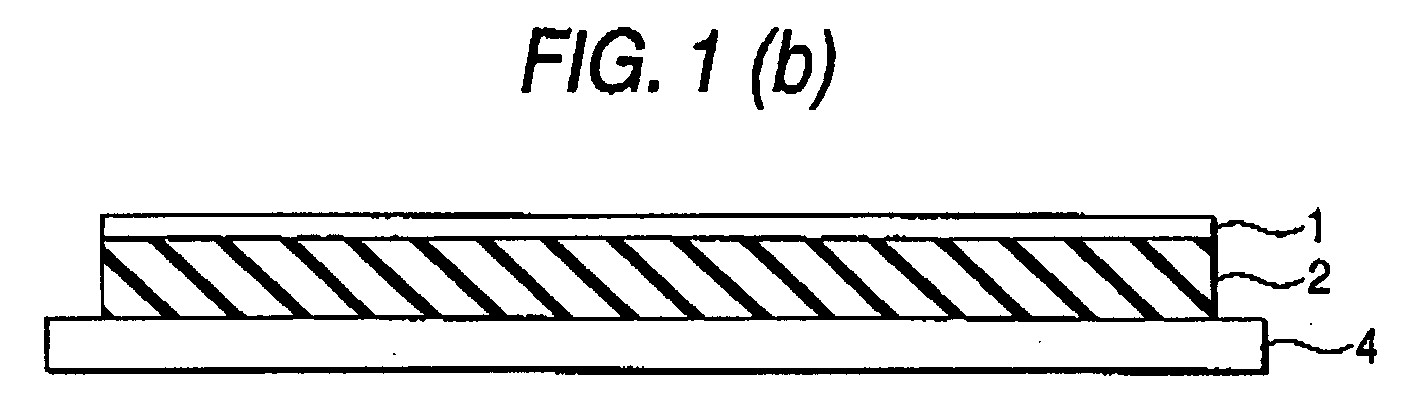
Fig. 1 is a process drawing illustrating one
example of the method for sticking the pressure-sensitive
adhesive sheet for steel plates according to the
invention onto a steel plate, wherein
Fig. 1(a) represents a step of preparing a pressure-sensitive
adhesive sheet for steel plates and peeling off
the releasing paper, Fig. 1(b) represents a step of sticking the pressure-sensitive
adhesive sheet for steel plates to a steel
plate, and Fig. 1(c) represents a step of heating the pressure-sensitive
adhesive sheet for steel plates to effect
foaming.
In Fig., sign 1 is a backing, sign 2 is a resin
layer, sign 3 is a releasing paper, sign 4 is a steel
plate and sign 5 is a foamed layer.
DETAILED DESCRIPTION OF THE INVENTION
The pressure-sensitive adhesive sheet for steel
plates according to the invention comprises a backing and
a resin layer.
In the invention, the backing imparts toughness to
the resin layer and comprises a resin-coated glass cloth
obtainable by coating a glass cloth with a resin emulsion
(A) followed by coating with a resin emulsion (B) which
is different from the resin emulsion (A).
The grass fibers as the warp and weft for use in
weaving the above glass cloth have a single yarn diameter
of about 6 to 11 µm, preferably about 9 to 11 µm and
number of single yarns of about 50 to 800, preferably
about 200 to 800.
Examples of the glass fibers include fibers called
DE300, DE150, DE75, E225, E113, G150, G75, and G37. Of
these, G75 and DE75 are suitably used. As raw glass for
such glass fibers, glass called E glass (no-alkali glass)
is usually employed but, in addition to the glass, silica
glass, D glass (low dielectric property), S glass (high
strength), C glass (alkali lime), H glass (high
dielectric property), and the like can be also employed.
After the glass fibers are subjected to a warping
step and, if desired, a sizing step, weaving of the glass
cloth can be carried out in accordance with a known
method using, for example, a jet loom (air-jet loom,
water-jet loom, etc.), Sulzer loom, or rapier loom. In
the above sizing step, it is preferable to add a sizing
agent (secondary binder) to the warp according to a known
method.
Examples of such sizing agent include starch, a
surfactant, a lubricant, a synthetic oil agent, poval,
and an acrylic polymer. The weave texture of the glass
cloth formed by the weaving of the glass cloth includes
plain fabric, satin fabric, mat weave, twill fabric, and
the like, but plain fabric is preferable.
Moreover, after weaving of the glass cloth using
the above glass yarn or, after heat cleaning or after
treatment with a silane coupling agent, if desired, by
subjecting the cloth to, for example, weave-opening under
pressure of water flow, weave-opening with high-frequency
vibration using a liquid as a medium, processing under
pressure with roll, or the like, the width between yarns
constituting the glass cloth is enlarged to facilitate
the formation of a structure wherein adjacent yarns in
both of the warp and weft are most suitably arranged.
By the above treatment, the yarns become flat and
the shape at cross section of the yarns changes from an
elliptical shape to a nearly flat shape, whereby
distribution of the glass fibers in the glass cloth
becomes more homogeneous.
After weaving, if desired, the above sizing agent
(secondary binder) is removed by subjecting the glass
cloth to heat cleaning treatment or the like according to
a well-known technology. Then, the glass cloth may be
treated with a silane coupling agent. Specific examples
of the silane coupling agent include vinyltrichlorosilane,
vinyltriethoxysilane, vinyltris(β-methoxyethoxy)silane, γ-methacryloxypropyltrimethoxysilane,
γ-aminopropyltriethoxysilane,
γ-anilinoprpyltrimethoxysilane,
N-β-aminoethyl-γ-aminopropyltrimethoxysilane, N-vinylbenzyl-aminoethyl-γ-aminopropyltrimethoxysilane
(hydrochloride), γ-glycidoxypropyltrimethoxysilane, β-(3,4-epoxycyclohexyl)ethyltrimethoxysilane,
γ-mercaptopropyltrimethoxysilane,
and γ-chloropropyltrimethoxysilane.
These silane coupling
agents may be used solely or in combination. Of these, γ-glycidoxypropyltrimethoxysilane
is preferable.
For example, the adhered amount of such coupling
agent to the glass cloth substrate is suitably from about
0.01 to 2% by weight, preferably about 0.05 to 0.5% by
weight based on the total amount of the glass cloth.
As mentioned above, after the glass cloth is, if
desired, subjected to weave-opening treatment and also,
if desired, treated with a silane coupling agent, it is
dried in accordance with a known means. The glass cloth
for use in the invention is a glass cloth wherein a void
ratio X between the warp yarns or weft yarns constituting
the glass cloth is obtained from the following equation
(1) and the void ratio X between the warp yarns or weft
yarns desirably satisfies the following equation (2):
X = (b/a) x 100
X ≤ 5
wherein X represents a void ratio (%) between the
warp or the weft constituting the glass cloth, a
represents a distance (µm) from the center to the center
of the width of two adjacent warp yarns or a distance
(µm) from the center to the center of the width of two
adjacent weft yarns, and b represents a space (µm)
between two adjacent warp yarns or weft yarns.
In the case that the void ratio X between the warp
yarns or weft yarns constituting the glass cloth does not
satisfy the range represented by the equation (2), the
resin layer (foaming resin composition, rubber
composition) may permeate to backside of the resin-coated
glass cloth to cause a risk of poor workability, when
such resin-coated glass cloth is used as the backing of
the pressure-sensitive adhesive sheet for steel plates
according to the invention.
Then, the glass cloth is treated with a resin
emulsion for preventing the loosing of glass filaments
from the glass cloth or for controlling rigidity of the
glass cloth (this treatment is referred to as primary
treatment).
In the invention, as the glass cloth to be
subjected to the primary treatment, any of a raw cloth, a
calcinated cloth, or a heat-cleaned glass cloth may be
used or any of the glass cloths obtained by treating the
raw cloth, calcinated cloth, or heat-cleaned glass cloth
with a silane coupling agent.
Examples of the resin emulsion (A) for the primary
treatment include styrene-based resin emulsions, acrylic
resin emulsions, vinyl acetate resin emulsions, and
ethylene-vinyl acetate (EVA) resin emulsions. Of these
resin emulsions, styrene-based resin emulsions are
preferable in view of prevention of the loosing of glass
cloth filaments and rigidity control of the glass cloth.
The styrene-based resin emulsions include polystyrene or
HIPS resin emulsions and styrene-based emulsions
comprising one or two or more resins selected from the
group consisting of AS resins, ABS resins, ACS resins,
AES resins, MBS resins, or AAS resins. Introduction of a
styrene skeleton into the glass cloth by treating the
glass cloth with the styrene-based resin emulsion
improves rigidity and thermal resistance of the glass
cloth.
The adhered amount of the resin emulsion (A) for
use in the coating as the primary treatment is usually
about 2 to 15% by weight, preferably about 5 to 8 % by
weight as a dry weight based on the total amount of the
glass cloth.
When the adhered amount of the resin component is
less than about 2% by weight as a dry weight based on the
total amount of the glass cloth, the improvement in
rigidity and loosing property (loosing of filaments from
glass cloth) of the coated glass cloth is sometimes poor.
On the other hand, when it exceeds about 15% by weight,
the treated glass cloth is too hard and hence becomes
brittle in some cases.
The treatment with the resin emulsion (A) for the
primary treatment is carried out by applying the treating
agent to one side or both sides of the glass cloth
according to the invention in a desired amount or by
dipping the cloth into the treating agent charged in a
bath, lifting up the cloth, squeezing an excess amount of
the agent, and drying the cloth.
A known method can be employed as the applying
method and examples thereof include methods carried out
using an applicator, a knife coater, a reverse roll
coater, a gravure coater, a flow coater, a rod coater, or
a brush.
After the glass cloth is subjected to the above
primary treatment, the resulting cloth is treated with a
resin emulsion (B), which is different from the resin
emulsion (A), for improving adhesiveness between the
glass cloth and the other members (this treatment is
referred to as secondary treatment). Namely, only the
primary treatment of the glass cloth cannot impart an
excellent adhesiveness and improvement of the
adhesiveness is first attained by the secondary treatment.
In the invention, by adopting the method of
carrying out the secondary treatment subsequently to the
primary treatment, use of only a small amount of an
adhesiveness-improving resin such as an epoxy resin
enables an efficient improvement of the adhesiveness and,
at the same time, cost can be reduced. Also, thereby,
there do not arise problems of complication of blending
operation, generation of precipitation in a blended
solution, and shortened life of the blended solution.
Examples of the resin emulsion (B) for the
secondary treatment include epoxy-based resin emulsions,
urethane-based resin emulsions, and olefin-based resin
emulsions. Of these resin emulsions, epoxy-based resin
emulsions are preferable in view of the adhesiveness. By
treating the glass cloth with an epoxy-based resin
emulsion, the adhesiveness of the glass cloth with the
above resin layer, in particular the adhesiveness at a
low temperature, is improved.
Examples of the epoxy-based resin emulsions for use
in the invention include bisphenol A-type epoxy resins,
bisphenol F-type epoxy resins, co-condensation-type epoxy
resins of bisphenol A and bisphenol F, novolak-type epoxy
resins, biphenyl-type epoxy resins, dicyclopentadiene-phenol-based
co-condensation-type epoxy resins, and
halogen-substituted resins thereof.
The adhered amount of the resin emulsion (B) for
use in the coating as the secondary treatment is usually
from about 0.01 to 5% by weight, preferably from about
0.05 to 2.5% by weight as a dry weight based on the total
amount of the glass cloth.
When the adhered amount of the resin component is
less than about 0.01% by weight as a dry weight based on
the total amount of the glass cloth, the adhesiveness
with the above resin layer, in particular the
adhesiveness at a low temperature, is not improved in
some cases. When it exceeds about 5% by weight, the
level of the adhesiveness is ordinary not varied.
In the invention, when a melamine resin which has
been hitherto widely used is employed as the resin
emulsion (A) for the primary treatment and the resin
emulsion (B) for the secondary treatment, formaldehyde
and acetaldehyde are formed during the processing of the
glass cloth. Therefore, in the invention, the resin
emulsion (A) and the resin emulsion (B) are desirably
comprise substantially no melamine resin.
In the invention, the term "substantially" herein
means an amount of 10% by weight or less, preferably 5%
by weight or less based on the total resin.
The thickness of the backing comprising the resin-coated
glass cloth obtained as above is usually from
about 100 to 300 µm, preferably from about 150 to 250 µm.
In the invention, the resin layer preferably
comprises a foaming composition when the pressure-sensitive
adhesive sheet for steel plates according to
the invention is used for the purpose of reinforcement of
steel plates. Alternatively, when the pressure-sensitive
adhesive sheet for steel plates according to the
invention is used for the purpose of damping of steel
plates, the layer preferably comprises a rubber
composition.
The foaming composition comprises an epoxy resin
and a foaming agent. The epoxy resin is not particularly
limited and includes aliphatic epoxy resins, aromatic
epoxy resins, and modified epoxy resins.
Examples of the aliphatic epoxy resins include
linear aliphatic epoxy resins, cyclic aliphatic epoxy
resins, and heterocyclic aliphatic epoxy resins.
The aromatic epoxy resins are epoxy resins
comprising a benzene ring as a constitutional unit in the
molecular chain and are not particularly limited.
Examples thereof include bisphenol-type epoxy resins such
as bisphenol A-type epoxy resins, dimer acid-modified
bisphenol A-type epoxy resins, bisphenol F-type epoxy
resins, and bisphenol S-type epoxy resins; novolak-type
epoxy resins such as phenol-novolak-type epoxy resins and
cresol-novolak-type epoxy resins; and naphthalene-type
epoxy resins.
Examples of the modified epoxy resins include dimer
acid-modified bisphenol A-type epoxy resins, amine-modified
bisphenol A-type epoxy resins, and alcohol-modified
bisphenol A-type epoxy resins.
These epoxy resins may be used solely or in
combination. Of these epoxy resins, in view of the
reinforcement and adhesiveness, the aromatic epoxy resins
are preferable, and in particular, bisphenol-type epoxy
resins are preferably used.
Moreover, such epoxy resins have an epoxy
equivalent of, for example, 150 to 350 g/eqiv.,
preferably 200 to 300 g/eqiv. In this regard, the epoxy
equivalent can be calculated based on the oxirane oxygen
concentration measured by titration with hydrogen bromide.
As the foaming agent, inorganic foaming agents and
organic foaming agents may be mentioned.
Examples of the inorganic foaming agents include
ammonium carbonate, ammonium hydrogen carbonate, sodium
hydrogen carbonate, ammonium nitrite, sodium borohydride,
and azides.
Examples of the organic foaming agents include N-nitroso
compounds such as N,N'-dinitorosopentamethylenetetramine
and N,N'-dimethyl-N,N'-dinitorsoterephthalamine;
azo compounds such as
azobisisobutyronitrile, azodicarbonamide, and barium
azodicarboxylate; fluorinated alkanes such as
trichloromonofluoromethane and dichloromonofluoromethane;
hydrazine compounds such as p-toluenesulfonyl hydrazide,
diphenylsulfone-3,3'-disulfonyl hydrazide, 4,4'-oxybis(benzenesulfonyl
hydrazide), and allylbis(sulfonyl
hydrazide); semicarbazide compounds such as p-toluylenesulfonyl
semicarbazide and 4,4'-oxybis(benzenesulfonyl
semicarbazide); and triazole
compounds such as 5-morpholyl-1,2,3,4-thiatriazole.
In this regard, as the foaming agent, use may be
made of thermally expansive fine particles wherein a
heat-expansive substance such as isobutane or pentane is
included in microcapsules which are microcapsules made of
a thermoplastic resin such as vinylidene chloride,
acrylonitrile, an acrylate ester, or a methacrylate ester.
As such thermally expansive fine particles, a
commercially available product such as Microsphere (trade
name, manufactured by Matsumoto Yushi-Seiyaku Co., Ltd.)
may be used, for example.
They may be used solely or in combination.
Moreover, of these foaming agents, 4,4'-oxybis(benzenesulfonyl
hydrazide) is preferably used in
view of stable foaming with no influence of external
factors.
The mixing ratio of the foaming agent is, for
example, from 1.0 to 10 parts by weight, preferably 2.0
to 8.0 parts by weight based on 100 parts by weight of
the resin component which refers to the total of the
epoxy resin and styrene-based synthetic rubber to be
mentioned below and refers to only the epoxy resin when
no styrene-based synthetic rubber is included (the same
shall apply to the description hereinafter).
When the mixing ratio of the foaming agent is less
than the range, foaming is insufficient and the
reinforcing property lowers owing to insufficient
thickness in some cases. On the other hand, when the
ratio is more than the range, the density decreases and
hence the reinforcing property lowers in some case.
It is preferable that such foaming agent
composition further comprises a styrene-based synthetic
rubber. The styrene-based synthetic rubber is a
synthetic rubber comprising styrene of a starting
material as a constitutional unit in the molecular chain
and is not particularly limited.
Examples thereof include styrene-butadiene rubbers
such as styrene-butadiene random copolymers, styrene-butadiene-styrene
block copolymers, and styrene-ethylene-butadiene-styrene
block copolymers, and styrene-isoprene
rubbers such as styrene-isoprene-styrene block copolymers.
They may be used solely or in combination. Of these
styrene-based synthetic rubbers, styrene-butadiene
rubbers are preferably used in view of the reinforcing
property and adhesiveness to an oily surface.
As the styrene-based synthetic rubbers, those
having a number-average molecular weight of 30,000 or
more, preferably 50,000 to 1,000,000 may be used. When
the number-average molecular weight is less than 30,000,
the adhesiveness, in particular the adhesiveness to an
oily surface steel plate, lowers in some cases.
Moreover, such styrene-based synthetic rubbers have
a styrene content of preferably 50% by weight or less,
more preferably 35% by weight or less. When the styrene
content is more than the value, the adhesiveness at a low
temperature lowers in some cases.
Furthermore, such styrene-based synthetic rubbers
desirably have a Mooney viscosity of, for example, 20 to
60 (ML1+4 at 100°C), preferably 30 to 50 (ML1+4 at 100°C).
The mixing ratio of the styrene-based synthetic
rubber is, for example, from 30 to 70 parts by weight,
preferably 40 to 60 parts by weight relative to 100 parts
by weight of the resin component which refers to the
total of the epoxy resin and styrene-based synthetic
rubber to be mentioned below and refers to only the epoxy
resin when no styrene-based synthetic rubber is included
(the same shall apply to the description hereinafter).
When the mixing ratio of the styrene-based
synthetic rubber is less than the range, the adhesiveness
to the oily surface steel plate lowers in some cases. On
the other hand, when the ratio is more than the range,
the reinforcing property lowers in some case.
Such foaming composition preferably comprises an
epoxy-modified styrene-based synthetic rubber in addition
to the above components. By incorporating the epoxy-modified
styrene-based synthetic rubber, compatibility
between the styrene-based synthetic rubber and the
aromatic epoxy resin can be improved, whereby the
adhesiveness and reinforcing property can be further
improved.
As the epoxy-modified styrene-based synthetic
rubber, preferably used is, for example, a synthetic
rubber wherein the terminal and inside of the molecular
chain of the above styrene-based synthetic rubber are
modified with epoxy groups and whose epoxy equivalent is,
for example, from 100 to 10,000 g/eqiv., further from 400
to 3,000 g/eqiv. In this regard, a known method is used
for modifying the styrene-based synthetic rubber with
epoxy groups. For example, double bonds in the styrene-based
synthetic rubber may be reacted with an epoxydizing
agent such as a peracid or a hydroperoxide in an inert
solvent.
As the epoxy-modified styrene-based synthetic
rubber, use may be made of, for example, A-B type block
copolymers and A-B-A type block copolymers wherein A
represents a styrene polymer block, B represents a
conjugate diene polymer block such as a butadiene polymer
block or an isoprene polymer block, and epoxy groups are
introduced into the B polymer block.
More specifically, epoxy-modified styrene-butadiene-styrene
block copolymers, epoxy-modified
styrene-ethylene-butadiene-styrene block copolymers, and
epoxy-modified styrene-isoprene-styrene block copolymers
are used, for example. They may be used solely or in
combination. Moreover, of these epoxy-modified styrene-based
synthetic rubbers, epoxy-modified styrene-butadiene-styrene
block copolymers are preferably used in
view of both of the reinforcing property and adhesiveness.
In the above A-B type block copolymers and A-B-A
type block copolymers, the A block which is a styrene
polymer block preferably has a weight-average molecular
weight of about 1,000 to 10,000 and a glass transition
temperature of 7°C or higher. Moreover, the B block which
is a conjugate diene polymer block preferably has a
weight-average molecular weight of about 10,000 to
500,000 and a glass transition temperature of -20°C or
lower. Furthermore, the weight ratio of the A block
copolymer to the B block copolymer is from 2/98 to 50/50,
further from 15/85 to 30/70 as the A block copolymer/the
B block copolymer.
The mixing ratio of the epoxy-modified styrene-based
synthetic rubber is, for example, from 1 to 20
parts by weight, preferably 5 to 15 parts by weight based
on 100 parts by weight of the resin component. When the
mixing ratio of the epoxy-modified styrene-based
synthetic rubber is less than the range, the reinforcing
property and adhesiveness lower in some cases. On the
other hand, when the ratio is more than the range, the
adhesiveness at a low temperature lowers in some case.
Furthermore, such foaming composition preferably
comprises an epoxy resin-curing agent and/or a rubber-crosslinking
agent in addition to the above components.
By incorporating the epoxy resin-curing agent and/or
rubber-crosslinking agent, the reinforcing property can
be improved.
As the epoxy resin-curing agent, a known curing
agent for epoxy resins may be used and examples thereof
include amine compounds, acid anhydride compounds, amide
compounds, hydrazide compounds, imidazole compounds, and
imidazoline compounds. In addition, phenol compounds,
urea compounds, polysulfide compounds, and the like may
be mentioned.
Examples of the amine compounds include
ethylenediamine, propylenediamine, diethylenetriamine,
triethylenetetramine, and amine adducts thereof, as well
as metaphenylenediamine, diaminodiphenylmethane, and
diaminodiphenyl sulfone.
Examples of the acid anhydride compounds include
phthalic anhydride, maleic anhydride, tetrahydrophthalic
anhydride, hexahydrophthalic anhydride, methylnajic
anhydride, pyromellitic anhydride, dodecenylsuccinic
anhydride, dichlorosuccinic anhydride,
benzophenonetetracarboxylic anhydride, and chlorendic
anhydride.
Examples of the amide compounds include
dicyandiamide and polyamide.
Examples of the hydrazides include dihydrazide.
Examples of the imidazole compounds include
methylimidazole, 2-ethyl-4-methylimidazole,
ethylimidazole, isopropylimidazole, 2,4-dimethylimidazole,
phenylimidazole, undecylimidazole, heptadecylimidazole,
and 2-phenyl-4-methylimidazole.
Examples of the imidazoline compounds include
methylimidazoline, 2-ethyl-4-methylimidazoline,
ethylimidazoline, isopropylimidazoline, 2,4-dimethylimidazoline,
phenylimidazoline,
undecylimidazoline, heptadecylimidazoline, and 2-phenyl-4-methylimidazoline.
They may be used solely or in combination.
Moreover, of these epoxy resin-curing agents,
dicyandiamide is preferably used in view of the
adhesiveness.
The mixing ratio of the epoxy resin-curing agent is,
for example, from 0.5 to 15 parts by weight, preferably 1
to 10 parts by weight relative to 100 parts by weight of
the resin component. When the mixing ratio of the epoxy
resin-curing agent is less than the range, the reinforcing
property lowers in some cases. On the other hand, when the
ratio is more than the range, the storage stability becomes
poor in some case.
As the rubber-crosslinking agent, use may be made
of a known rubber-crosslinking agent (vulcanizing agent)
capable of crosslinking styrene-based synthetic rubbers
and epoxy-modified styrene-based synthetic rubbers.
Examples of such rubber-crosslinking agent include
sulfur; sulfur compounds; selenium; magnesium oxide; lead
monoxide; organic peroxides such as dicumyl peroxide,
1,1-di-tert-butylperoxy-3,3,5-trimethylcyclohexane, 2,5-dimethyl-2,5-di-tert-butylperoxyhexyne,
1,3-bis(tert-butylperoxyisopropyl)benzene,
tert-butylperoxy ketone,
and tert-butylperoxy benzoate; polyamines; oximes such as
p-quinone dioxime and p,p'-dibenzoylquinone dioxime;
nitroso compounds such as p-dinitrobenzine; resins such
as alkylphenol-formaldehyde resins and melamine-formaldehyde
condensates; and ammonium salts such as
ammonium benzoate. They may be used solely or in
combination. Moreover, of these rubber-crosslinking
agents, sulfur is preferably used in view of the curing
and reinforcing properties.
The mixing ratio of the rubber-crosslinking agent
is, for example, from 10 to 20 parts by weight,
preferably 2 to 15 parts by weight relative to 100 parts
by weight of the resin component. When the mixing ratio
of the rubber-crosslinking agent is less than the range,
the reinforcing property lowers in some cases. On the
other hand, when the ratio is more than the range, the
adhesiveness lowers and the ratio is disadvantageous in
cost in some case.
Moreover, in addition to the above components, such
foaming composition may suitably comprise known additives
such as a foaming auxiliary, a curing accelerator, a
crosslinking accelerator, a filler, a tackifier, and a
pigment, and also, if necessary, a thixotropic agent such
as montmorillonite, a lubricant such as stearic acid, an
antiscorching agent, a stabilizer, a softener, a
plasticizer, an antiaging agent, an antioxidant, an
ultraviolet absorbent, a colorant, a fungicide, and a
flame retardant.
Examples of the foaming auxiliary include zinc
stearate, urea compounds, salicylic compounds, and
benzoic compounds. These foaming auxiliaries can be used
solely or in combination and the mixing ratio thereof is,
for example, from 0.5 to 10 parts by weight, preferably
from 1 to 5 parts by weight based on 100 parts by weight
of the resin component.
Examples of the curing accelerator include
imidazoles, tertiary amines, phosphorus compounds,
quaternary ammonium salts, and organometallic salts.
These curing accelerators can be used solely or in
combination and the mixing ratio thereof is, for example,
from 0.5 to 20 parts by weight, preferably from 1 to 10
parts by weight based on 100 parts by weight of the resin
component.
Examples of the crosslinking accelerator include
zinc oxide, dithiocarbamates, thiazoles, guanidines,
sulfenamides, thiurams, xanthates, aldehyde ammonias,
aldehyde amines, thioureas. These crosslinking
accelerators can be used solely or in combination and the
mixing ratio thereof is, for example, from 1 to 20 parts
by weight, preferably from 3 to 15 parts by weight based
on 100 parts by weight of the resin component.
Examples of the filler include calcium carbonates
such as calcium bicarbonate, light calcium carbonate, and
white ENKA, talc, mica, clay, mica powder, bentonite,
silica, alumina, aluminum silicate, titanium oxide,
acetylene black, and aluminum powder.
These fillers can be used solely or in combination
and the mixing ratio thereof is, for example, from 50 to
150 parts by weight, preferably from 75 to 125 parts by
weight based on 100 parts by weight of the resin
component.
Examples of the tackifier include rosin resins,
terpene resins such as terpene-aromatic liquid resins,
chroman indene resins, petroleum resins such as C5
petroleum resins and C5/C9 petroleum resins, phenol
resins, xylene resins, and alkyd resins. These
tackifiers can be used solely or in combination and the
mixing ratio thereof is, for example, from 10 to 200
parts by weight, preferably from 20 to 150 parts by
weight based on 100 parts by weight of the resin
component.
Examples of the pigment include carbon black. The
mixing ratio thereof is, for example, from 0.5 to 20
parts by weight, preferably from 2 to 10 parts by weight
based on 100 parts by weight of the resin component.
The foaming composition can be prepared as a
kneaded product by mixing the above respective components
in the above mixing ratios and kneading the mixture using,
e.g., a mixing roll, a pressure kneader, or an extruder
which is not particularly limited thereto. It is
preferable to prepare the kneaded product so as to have a
flow tester viscosity (60°C, 20 kg load) of, for example,
1,000 to 5,000 Pa·s, further 1,500 to 4,000 Pa·s.
Thereafter, the resulting kneaded product is rolled
by, for example, calendar molding, extrusion molding, or
press molding under a temperature condition under which
the foaming agent is substantially not decomposed,
whereby a resin layer comprising the foaming composition
is formed. Then, the resin layer is laminated to the
backing to obtain the pressure-sensitive adhesive sheet
for steel plates.
The thickness of the resin layer comprising the
foaming composition thus formed is, for example, from 0.2
to 3.0 mm, preferably from 0.5 to 1.3 mm. The total
thickness of the backing and the resin layer comprising
the foaming composition is, for example, from 0.3 to 3.3
mm, preferably from 0.65 to 1.55 mm.
Incidentally, to the resulting pressure-sensitive
adhesive sheet for steel plates, a leasing paper may be
stuck onto the surface of the resin layer, if necessary.
In the pressure-sensitive adhesive sheet for steel
plates thus obtained, the volume foaming magnification of
the foaming composition to be used as the resin layer at
foaming is preferably from 1.5 to 4.0, further from 2.0
to 3.5. Moreover, the density (weight (g) of the foamed
layer/volume of the foamed layer (g/cm3)) of the foamed
layer after foaming the resin layer is, for example, from
0.2 to 0.8 g/cm3, further from 0.3 to 0.7 g/cm3.
In the invention, the resin layer comprises a
rubber composition in the case that the pressure-sensitive
adhesive sheet for steel plates is used for the
purpose of damping the steel plate. The rubber
composition comprises at least a rubber.
Examples of the rubber include styrene-butadiene
rubbers such as styrene-butadiene random copolymers,
styrene-butadiene-styrene block copolymers, styrene-ethylene-butadiene
copolymers, and styrene-ethylene-butadiene-styrene
copolymers; styrene-isoprene rubbers
such as styrene-isoprene-styrene block copolymers;
styrene-isoprene-butadiene rubbers; polybutadiene rubbers
such as 1,4-polybutadiene rubbers, syndiotactic 1,2-polybutadiene
rubbers, and acrylonitrile-butadiene
rubbers; polyisobutylene rubber; polyisoprene rubber;
chloroprene rubber; isobutylene-isoprene rubbers; nitrile
rubber; butyl rubber; nitrile butyl rubber; acrylic
rubber; reclaimed rubber; and natural rubber. These
rubbers may be used solely or in combination.
Of these rubbers, styrene-butadiene rubbers and
butyl rubber are preferably used in view of the
adhesiveness, thermal resistance, and damping property.
Moreover, in addition to the above components, such
rubber composition may suitably comprise known additives
such as a filler, a tackifier, a softener, and a pigment,
and also, if necessary, a crosslinking agent such as
sulfur, a crosslinking accelerator, oils and fats such as
animal oils and fats, vegetable oils and fats, and
mineral oils, a thixotropic agent such as montmorillonite,
a lubricant such as stearic acid, an antiscorching agent,
a stabilizer, a plasticizer, an antiaging agent, an
antioxidant, an ultraviolet absorbent, a colorant, a
fungicide, and a flame retardant.
As the filler, fillers similar to the fillers to be
used in the foaming composition may be mentioned, for
example. These fillers may be used solely or in
combination and the mixing ratio thereof is, for example,
from 20 to 250 parts by weight, preferably from 100 to
200 parts by weight relative to 100 parts by weight of
the rubber.
As the tackifier, tackifiers similar to the
tackifiers to be used in the foaming composition may be
mentioned, for example. These tackifiers may be used
solely or in combination'and the mixing ratio thereof is,
for example, from 10 to 150 parts by weight, preferably
from 50 to 100 parts by weight relative to 100 parts by
weight of the rubber.
Examples of the softener include liquid resins,
phthalate esters, phosphate esters, chlorinated paraffins,
polybutene, and polyisobutylene. These softeners may be
used solely or in combination and the mixing ratio
thereof is, for example, from 10 to 150 parts by weight,
preferably from 50 to 100 parts by weight relative to 100
parts by weight of the rubber.
As the pigment, pigments similar to the pigments to
be used in the foaming composition may be mentioned, for
example. These pigments may be used solely or in
combination and the mixing ratio thereof is, for example,
from 2 to 100 parts by weight, preferably from 10 to 50
parts by weight relative to 100 parts by weight of the
rubber.
The rubber composition can be prepared as a kneaded
product by mixing the above respective components in the
above mixing ratios and kneading the mixture using, e.g.,
a mixing roll, a pressure kneader, or an extruder which
is not particularly limited thereto.
It is preferable to prepare the kneaded product
thus obtained so as to have a flow tester viscosity (50°C,
20 kg load) of, for example, 5,000 to 30,000 Pa·s, further
10,000 to 20,000 Pa·s.
Thereafter, the resulting kneaded product is rolled
by, for example, calendar molding, extrusion molding, or
press molding to form a resin layer comprising the rubber
composition, and then the resin layer is laminated to the
backing to obtain the pressure-sensitive adhesive sheet
for steel plates.
The thickness of the resin layer comprising the
rubber composition thus formed is, for example, from 0.8
to 3.0 mm, preferably from 1.0 to 2.0 mm. The total
thickness of the backing and the resin layer comprising
the rubber composition is, for example, from 0.9 to 3.3
mm, preferably from 1.15 to 2.25 mm.
Incidentally, to the resulting pressure-sensitive
adhesive sheet for steel plates, a leasing paper may be
stuck onto the surface of the resin layer, if necessary.
The thus obtained pressure-sensitive adhesive sheet
for steel plates according to the invention is used for
reinforcing or damping the steel plate by sticking it
onto the steel plate of various industrial machinery such
as transport machinery. More specifically, the pressure-sensitive
adhesive sheet for steel plates according to
the invention is a sheet wherein the resin layer 2 is
laminated onto the backing 1 and, if necessary, a
releasing paper is stuck onto the surface of the resin
layer 2 as shown in Fig. 1(a).
At its use, as shown by an imaginary line, the
releasing paper 3 is peeled from the surface of the resin
layer 2 and the surface of the resin layer 2 is stuck
onto a steel plate 4 as shown in Fig. 1(b). Moreover, in
the case that the resin layer 2 comprises the foaming
composition, the layer is subsequently foamed,
crosslinked, and cured by heating it to a predetermined
temperature, e.g., 160 to 210°C to form a foamed layer 5
as shown in Fig. 1(c).
Such pressure-sensitive adhesive sheet for steel
plates according to the invention can be suitably used
for reinforcing and damping body steel plates of
automobiles where weight saving is required. For example,
in the case that it is used for reinforcing body steel
plates of automobiles, after the resin layer is formed
from the foaming composition and is stuck during an
assembly step of the body steel plates, the sheet is used
so as to form the foamed layer by heating it with use of
the heat supplied during electrodeposition coating to
foam, crosslink, and cure the resin layer.
Moreover, in the case that the sheet is used for
damping body steel plates of automobiles, it is used so
as to form the resin layer from the rubber composition
and stick the sheet at the assembly step of the body
steel plates of automobiles.
The pressure-sensitive adhesive sheet for steel
plates according to the invention is characterized in
that the backing comprises a resin-coated glass cloth
obtainable by coating a glass cloth with a resin emulsion
(A) followed by coating with a resin emulsion (B) which
is different from the resin emulsion (A).
In such resin-coated glass cloth, the loosing of
glass filaments from the glass cloth can be prevented
and/or rigidity of the glass cloth can be controlled by
coating the glass cloth with the resin emulsion (A) and
furthermore, the adhesiveness with the foaming resin
layer or rubber composition layer which is the resin
layer constituting the pressure-sensitive adhesive sheet
for steel plates can be improved by coating the resulting
glass cloth with the resin emulsion (B).
Accordingly, the obtained sheet can have
appropriate rigidity and flexibility necessary as a
pressure-sensitive adhesive sheet for steel plates and
further can realize an excellent workability such as
punching and cutting.
Furthermore, use of the styrene-based resin
emulsion as the resin emulsion (A) can impart appropriate
rigidity and flexibility necessary as the backing and
also reduce the generation of organic volatile components
such as formaldehyde and acetaldehyde. Moreover, use of
the epoxy-based resin emulsion as the resin emulsion (B)
can improve the adhesiveness with the foaming resin layer
or rubber composition layer mainly composed of epoxy
resin and also reduce the generation of organic volatile
components such as formaldehyde and acetaldehyde.
Therefore, the pressure-sensitive adhesive sheet
for steel plates according to the invention can be
effectively used as a pressure-sensitive adhesive sheet
for steel plates which has a sufficient reinforcing or
damping property toward steel plates and also which can
sufficiently reduce the generation of organic volatile
components such as formaldehyde and acetaldehyde, the
sheet being stuck onto steel plates of various industrial
machinery, for example, transport machinery such as
automobiles.
EXAMPLES
The following will describe the invention in more
detail with reference to Examples and Comparative
Examples, but the invention is by no means limited
thereto.
(Preparation of backing 1)
Using "G75 1/0 1Z" (manufactured by Unitika Glass
Fiber Co., Ltd.) as the warp and the weft, a glass cloth
having a cloth density of 44 yarns/25 mm for the warp and
33 yarns/25 mm for the weft and a weight of 210 g/cm2 was
weaved by an air-jet type loom. Then, the glass cloth
was thermally treated at 400°C for 30 hours to remove a
sizing agent. Using an emulsion which was adjusted in
such a concentration that the total amount became 1 L by
adding 600 g of "Saibinol EK-61" (manufactured by Saiden
Chemical Industry Co., Ltd., a styrene-acrylic copolymer:
55% by weight of acrylic resin component, 45% by weight
of styrene resin component, and 40% by weight of solid
matter concentration) into water as a treating agent for
primary treatment, the glass cloth obtained after the
above thermal treatment was subjected to dipping
treatment in the emulsion and the liquid was squeezed out
with a mangle.
Then, after drying at 170°C for 90 seconds, the
total adhered amount of the styrene resin component and
the acrylic resin component in the glass cloth was
adjusted to 5% by weight. Separately, there was prepared
an emulsion adjusted in such a concentration that the
total amount became 1 L by adding 20 g of "EpiRez
5003W55" (manufactured by Japan Epoxy Resins Co., Ltd.,
an aqueous epoxy resin and 50% by weight of solid matter
concentration) into water, as a treating agent for
secondary treatment. Using the emulsion, the resulting
glass cloth was subjected to dipping treatment and the
liquid was squeezed out with a mangle.
Then, after drying at 170°C for 90 seconds, the
adhered amount of the epoxy resin component in the glass
cloth was adjusted to 0.05% by weight based on the total
amount of the glass cloth to prepare a backing 1.
(Preparation of backing 2)
A backing 2 was prepared in the same manner as in
Example 1 except that the adhered amount of a melamine
resin component in the glass cloth was adjusted to 5% by
weight using an emulsion adjusted in such a concentration
that the total amount became 1 L by adding 400 g of
"Milben SM850" (manufactured by Showa Hipolymer Co., Ltd.,
a melamine-formaldehyde polycondensate and 80% by weight
of solid matter concentration) into water as a treating
agent for primary treatment instead of "Saibinol EK-61",
an aqueous solution adjusted in such a concentration that
the total amount became 1 L by adding 4 g of "Milben
Fixer LC-5" (manufactured by Showa Hipolymer Co., Ltd., a
higher amine hydrochloride and 50% by weight of solid
matter concentration) into water was used as a melamine
resin-curing agent, and the secondary treatment was
omitted.
(Evaluation of backing)
On the obtained backings 1 and 2, the following
evaluation was carried out. The results are shown in
Table 1.
(Tensile strength)
It was measured in accordance with JIS R3420.
(Tensile modulus)
It was calculated from an initial slope of the SS
curve obtained during the measurement of the above
tensile strength.
(Loosing property)
After the backing was left on standing at an
atmosphere of 210°C for 30 minutes, the presence of
loosing of filaments from the glass cloth was checked. ○
represents no loosing of the filaments and × represents
the presence of loosing of the filaments.
| | | Backing 1 | Backing 2 |
| Tensile strength (N/25 mm) | Longitudinal direction | 680 | 700 |
| Lateral direction | 420 | 440 |
| Tensile modulus (N/mm2) | Longitudinal direction | 12000 | 12500 |
| Lateral direction | 9000 | 9500 |
| Loosing property | Longitudinal direction | ○ | ○ |
| Lateral direction | ○ | ○ |
From Table 1, the backing 1 has a loosing-preventive
property and rigidity nearly equal to those of
the backing 2 where a widely used melamine resin was used.
(Preparation of resin layer)
In the mixing formulations shown in Table 2 for
foaming compositions or in the mixing formulation shown
in Table 3 for a rubber composition, the respective
components were mixed and kneaded in a pressure kneader
to prepare kneaded products 1 to 3.
| Formulation | Kneaded product 1 | Kneaded product 2 |
| Foaming composition mixing formulation | SBR | 50 | - |
| Epoxy resin | A | 50 | - |
| B | - | 100 |
| Epoxy-modified SBS | 10 | - |
| Foaming agent | 1.5 | 8 |
| Epoxy resin-curing agent | 5 | 6.5 |
| Sulfur (rubber crosslinking agent) | 10 | - |
| Zinc oxide (crosslinking accelerator) | 5 | - |
| Crosslinking accelerator | 10 | - |
| Heavy calcium carbonate (filler) | 105 | 110 |
| Terpene-aromatic liquid resin (tackifier) | 20 | - |
| C5/C9 petroleum resin (tackifier) | 40 | - |
| Carbon black (pigment) | 3 | 0.7 |
| Formulation | Kneaded product 3 |
| Rubber composition mixing formulation | Butyl rubber | 100 |
| Heavy calcium carbonate (filler) | 170 |
| C5 petroleum resin (tackifier) | 70 |
| Liquid resin (softener) | 70 |
| Carbon black (pigment) | 50 |
In this regard, the amounts are represented by
"part(s) by weight" in Tables 2 and 3 and details of each
component are shown below.
(Preparation of pressure-sensitive adhesive sheet for
steel plate)
The kneaded products 1 to 3 obtained in the above
were rolled on a calendar roll to a thickness of 0.6 mm
to form respective resin layers. The resin-coated glass
cloths 1 and 2 obtained in the above were laminated to
the respective resin layers in the combinations shown in
Table 4 with pressurizing on a calendar roll and a
releasing paper was stuck onto the surface opposite to
the surface to which the backing in the resin layer was
laminated, whereby pressure-sensitive adhesive sheets for
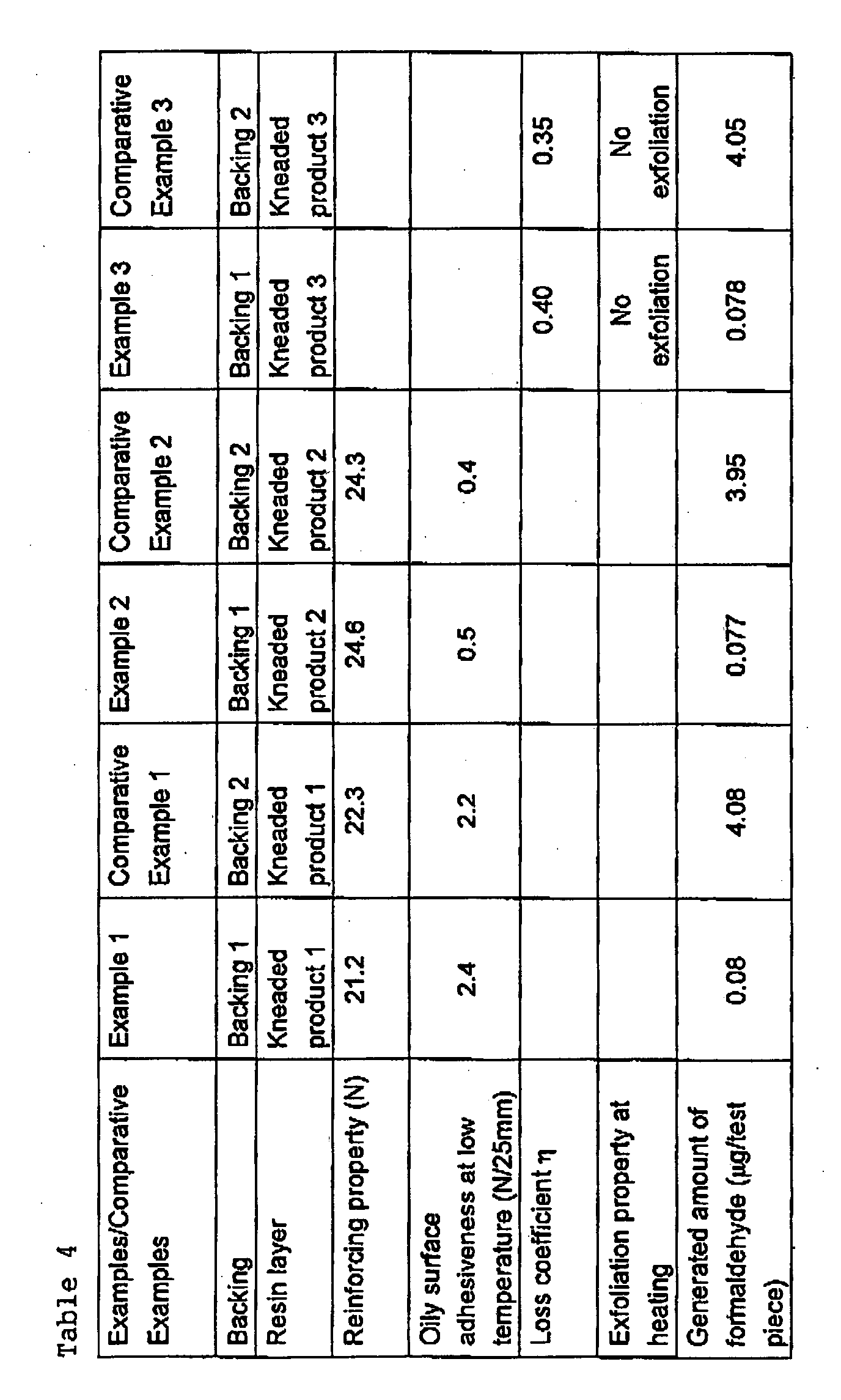
steel plates of Examples 1 to 3 and Comparative Examples
1 to 3 were prepared.
(Evaluation of pressure-sensitive adhesive sheet for
steel plates)
In the resulting pressure-sensitive adhesive sheets
for steel plates of respective Examples and Comparative
Examples, the reinforcing property, oily surface
adhesiveness at a low temperature, and volatile
components were evaluated on Examples 1 and 2 and
Comparative Examples 1 and 2. On Example 3 and
Comparative Example 3, the vibration damping property,
exfoliation property at heating, and volatile components
were evaluated. The results were shown in Table 4.
(Reinforcing property test)
An antirust (Daphne oil Z-5, manufactured by
Idemitsu Kosan Co., Ltd.) was applied onto the surface of
a cold rolled steel plate (SPCC-SD) (manufactured by
Nippon Testpanel Co., Ltd.) and the plate was leaned
against a support at 20°C overnight to effect oily surface
treatment (hereinafter referred to as an oily surface
cold-rolled steel plate).
The releasing paper of each of pressure-sensitive
adhesive sheets for a steel plate of Examples 1 and 2 and
Comparative Examples 1 and 2 was peeled off and each
pressure-sensitive adhesive sheet for steel plates was
stuck onto the oily surface of the oily surface cold-rolled
steel plate having a size of 25 mm wide x 150 mm
long x 0.8 mm thick under an atmosphere of 20°C and heated
at 160°C for 20 minutes to foam the resin layer, whereby
each test piece was obtained.
Thereafter, in the state that the steel plate was
placed upward, each test piece was supported at a span of
100 mm. At the center in the longitudinal direction, a
test bar was let down from above in the perpendicular
direction at a compression rate of 1 mm/minute and
flexural strength (N) at the time when the foamed layer
was displaced by 1 mm since the bar had come into contact
with the steel plate was evaluated as a reinforcing
property.
(Test for oily surface adhesiveness at low temperature)
Each of pressure-sensitive adhesive sheets for
steel plates of Examples 1 and 2 and Comparative Examples
1 and 2 was cut into a width of 25 mm and, after the
releasing paper was peeled off, the sheet was attached by
pressure onto the oily surface of the oily surface cold-rolled
steel plate under an atmosphere of 5°C with a 2 kg
roller.
After 30 minutes, adhesive force (N/25 mm) was
measured by 90° peeling test (drawing rate of 300
mm/minute), the force being evaluated as oily surface
adhesiveness at a low temperature.
(Vibration damping test)
The releasing paper of each of pressure-sensitive
adhesive sheets for steel plates of Example 3 and
Comparative Example 3 was peeled off and each pressure-sensitive
adhesive sheet for steel plates was stuck onto
the oily surface of the oily surface cold-rolled steel
plate having a size of 10 mm wide x 220 mm long x 0.8 mm
thick. After heating at 180°C for 20 minutes, the whole
was cooled to room temperature and loss coefficient η
which was a measure of vibration damping property was
measured by the central vibration method.
(Exfoliation property at heating)
Each of pressure-sensitive adhesive sheets for
steel plates of Example 3 and Comparative Example 3 was
cut into a piece of 50 mm wide x 10 mm long and, after
peeling off the releasing paper, the sheet was attached
by pressure onto the oily surface of the oily surface
cold-rolled steel plate with reciprocating a 2 kg roller
once. Then, the steel plate was placed in a slightly
slant state from the perpendicular direction so that the
side of the steel plate to which the pressure-sensitive
adhesive sheet for steel plates was stuck had an angle of
70° against the placing floor. After baking at 180°C for
3 minutes, deformation and exfoliation of the pressure-sensitive
adhesive sheet for steel plates were
investigated.
(Analysis of volatile components)
Each of pressure-sensitive adhesive sheets for
steel plates of Examples 1 to 3 and Comparative Examples
1 to 3 was cut so as to have an area of 80 cm
2, whereby
test pieces were prepared. Formaldehyde was collected by
the 10 L Tedler bag method and the amount was
quantitatively determined by gas chromatography.
From Table 4, it is revealed that the pressure-sensitive
adhesive sheet for steel plates of each Example
exhibits good oily surface adhesiveness and reinforcing
or damping property nearly equal to those of the melamine
resin-coated glass cloth and also a remarkably reduced
generation of a volatile component (formaldehyde).
As mentioned in the above, the pressure-sensitive
adhesive sheet for steel plates according to the
invention has sufficient reinforcing or damping property
toward steel plates and also can sufficiently reduce the
generation of organic volatile components such as
formaldehyde. Therefore, the pressure-sensitive adhesive
sheet for steel plates according to the invention can be
effectively used with sticking to steel plates for
various industrial machinery, for example transport
machinery such as automobiles.
While the invention has been described in detail and
with reference to specific embodiments thereof, it will be
apparent to one skilled in the art that various changes and
modifications can be made therein without departing from
the scope thereof.
This application is based on Japanese patent
applications No. 2003-206723 filed on August 8, 2003, the
entire contents thereof being hereby incorporated by
reference.