EP1503113A2 - Gear - Google Patents
Gear Download PDFInfo
- Publication number
- EP1503113A2 EP1503113A2 EP04016864A EP04016864A EP1503113A2 EP 1503113 A2 EP1503113 A2 EP 1503113A2 EP 04016864 A EP04016864 A EP 04016864A EP 04016864 A EP04016864 A EP 04016864A EP 1503113 A2 EP1503113 A2 EP 1503113A2
- Authority
- EP
- European Patent Office
- Prior art keywords
- gear
- comparative example
- lubricant
- hard carbon
- carbon film
- Prior art date
- Legal status (The legal status is an assumption and is not a legal conclusion. Google has not performed a legal analysis and makes no representation as to the accuracy of the status listed.)
- Granted
Links
Classifications
-
- F—MECHANICAL ENGINEERING; LIGHTING; HEATING; WEAPONS; BLASTING
- F16—ENGINEERING ELEMENTS AND UNITS; GENERAL MEASURES FOR PRODUCING AND MAINTAINING EFFECTIVE FUNCTIONING OF MACHINES OR INSTALLATIONS; THERMAL INSULATION IN GENERAL
- F16H—GEARING
- F16H57/00—General details of gearing
- F16H57/04—Features relating to lubrication or cooling or heating
- F16H57/041—Coatings or solid lubricants, e.g. anti-seize layers or pastes
-
- C—CHEMISTRY; METALLURGY
- C23—COATING METALLIC MATERIAL; COATING MATERIAL WITH METALLIC MATERIAL; CHEMICAL SURFACE TREATMENT; DIFFUSION TREATMENT OF METALLIC MATERIAL; COATING BY VACUUM EVAPORATION, BY SPUTTERING, BY ION IMPLANTATION OR BY CHEMICAL VAPOUR DEPOSITION, IN GENERAL; INHIBITING CORROSION OF METALLIC MATERIAL OR INCRUSTATION IN GENERAL
- C23C—COATING METALLIC MATERIAL; COATING MATERIAL WITH METALLIC MATERIAL; SURFACE TREATMENT OF METALLIC MATERIAL BY DIFFUSION INTO THE SURFACE, BY CHEMICAL CONVERSION OR SUBSTITUTION; COATING BY VACUUM EVAPORATION, BY SPUTTERING, BY ION IMPLANTATION OR BY CHEMICAL VAPOUR DEPOSITION, IN GENERAL
- C23C14/00—Coating by vacuum evaporation, by sputtering or by ion implantation of the coating forming material
- C23C14/06—Coating by vacuum evaporation, by sputtering or by ion implantation of the coating forming material characterised by the coating material
- C23C14/0605—Carbon
-
- Y—GENERAL TAGGING OF NEW TECHNOLOGICAL DEVELOPMENTS; GENERAL TAGGING OF CROSS-SECTIONAL TECHNOLOGIES SPANNING OVER SEVERAL SECTIONS OF THE IPC; TECHNICAL SUBJECTS COVERED BY FORMER USPC CROSS-REFERENCE ART COLLECTIONS [XRACs] AND DIGESTS
- Y10—TECHNICAL SUBJECTS COVERED BY FORMER USPC
- Y10T—TECHNICAL SUBJECTS COVERED BY FORMER US CLASSIFICATION
- Y10T428/00—Stock material or miscellaneous articles
- Y10T428/30—Self-sustaining carbon mass or layer with impregnant or other layer
-
- Y—GENERAL TAGGING OF NEW TECHNOLOGICAL DEVELOPMENTS; GENERAL TAGGING OF CROSS-SECTIONAL TECHNOLOGIES SPANNING OVER SEVERAL SECTIONS OF THE IPC; TECHNICAL SUBJECTS COVERED BY FORMER USPC CROSS-REFERENCE ART COLLECTIONS [XRACs] AND DIGESTS
- Y10—TECHNICAL SUBJECTS COVERED BY FORMER USPC
- Y10T—TECHNICAL SUBJECTS COVERED BY FORMER US CLASSIFICATION
- Y10T74/00—Machine element or mechanism
- Y10T74/19—Gearing
-
- Y—GENERAL TAGGING OF NEW TECHNOLOGICAL DEVELOPMENTS; GENERAL TAGGING OF CROSS-SECTIONAL TECHNOLOGIES SPANNING OVER SEVERAL SECTIONS OF THE IPC; TECHNICAL SUBJECTS COVERED BY FORMER USPC CROSS-REFERENCE ART COLLECTIONS [XRACs] AND DIGESTS
- Y10—TECHNICAL SUBJECTS COVERED BY FORMER USPC
- Y10T—TECHNICAL SUBJECTS COVERED BY FORMER US CLASSIFICATION
- Y10T74/00—Machine element or mechanism
- Y10T74/19—Gearing
- Y10T74/19991—Lubrication
- Y10T74/19995—Teeth
Definitions
- the present invention relates a gear for a power transmission mechanism, and more particularly to a gear which improves a transmission efficiency.
- gears have been employed in various power transmission mechanisms.
- Representative gears for vehicle transmission mechanisms are mainly made by steel, such as carburized steel, carbonitrided steel, and chromium molybdenum steel.
- Such gears for vehicle transmission mechanisms are required to reduce friction generated at the mesh between the gears in order to improve an output power and a fuel consumption of a vehicle. More specifically, there are a large number of meshes of gears in a planetary mechanism or speed reduction mechanism, and therefore, it has been strongly desired to decrease the frictions at the meshes of the gears in view of improving a power transmission efficiency of such mechanisms.
- An aspect of the present invention resides in a gear which comprises a tooth surface and a hard carbon film formed on at least a part of the tooth surface.
- Gears are generally slidingly contacted with each other during the revolution under an engaged (meshed) state with other gear. Therefore, reducing friction at tooth surfaces of gears is preferable in view of improving a power transmission efficiency of the gears.
- a gear of the present invention is constructed such that a hard carbon film (coating) is formed on at least a part of the gear.
- This hard carbon film is a film of amorphous carbon or hydrogen containing amorphous carbon which is referenced as a-C:H (amorphous carbon or hydrogen containing amorphous carbon), i-C (i carbon) and DLC (diamond-like carbon).
- the friction coefficient of the film in lubricant becomes different from that in the dry condition.
- a normal hard carbon film is made of carbon and unavoidable impurity, or of carbon, hydrogen and unavoidable impurity.
- a reactivity of a surface of the hard carbon film is low, and this property relates to a low-friction and a low-abrasion thereof.
- the hard carbon film has a weak interaction relative to a base oil and additives in lubricant, a reduction merit of the friction coefficient in lubricant is relatively small as compared with that in the dry condition.
- the present invention has been achieved by thorough study as to a hard carbon film having a low-friction coefficient in lubricant, a preferable lubricant, and an additive component.
- a hard carbon film is formed on a tooth surface of a gear.
- the hard carbon film may be formed on a whole surface of the tooth surface of the gear or a partial surface of the tooth surface.
- a forming of a film on a bottom portion of each gear tooth is not easy as compared with that on a top portion of each gear tooth.
- it is not necessary to forcibly form the hard carbon film on the uneasy forming portion since the merit obtained by the hard carbon film is obtained according to a ratio of the film formed area. Further, even if a part of the film is worn out in use, the merit of the hard carbon film is maintained according to a size of the remaining hard carbon film.
- the hard carbon film may be formed on the whole of the tooth surface or may be formed on a part of the tooth surface.
- a film forming area of the hard carbon film may be properly determined upon taking account of a production cost, a productivity and a degree of the obtained merit.
- a base metal of the gear is not basically limited, a carburized steel and a chromium molybdenum steel are preferably used to ensure an impact strength and a bending fatigue strength necessary for a gear. Further, carbonitrided steel is preferably used to suppress the softening of the base metal due to the semi-high-temperature condition during the film production process.
- An intermediate layer may be formed between the base metal and the hard carbon film to decrease the strain between the base metal and the hard carbon film and to improve the adherence of the film relative to the base metal. A commonly known method may be employed to form the intermediate layer.
- the hard carbon film can be produced by a chemical vapor deposition (CVD) process or physical vapor deposition (PVD) process.
- CVD chemical vapor deposition
- PVD physical vapor deposition
- a hard carbon film formed by CVD process contains hydrogen due to raw materials of organic compound, and the hydrogen amount of such produced film ranges from 15 to 40 atom% (atomic percent).
- PVD process is capable of producing the hard carbon film with and/or without hydrogen.
- Various processes of PVD have been proposed and put in practical use.
- the hard carbon film of the gear according to the present invention is preferable to be formed by means of an arc ion plating or spattering, in view of the adherence of the film on the base metal.
- the hydrogen amount in the hard carbon film for the gear is as small as possible since the decrease of the hydrogen amount in the hard carbon film decreases the friction of the gear. Therefore, the hydrogen amount of the hard carbon film of the gear according to the present invention is set to be smaller than 1 atom%, and preferably smaller than 0.3 atom%. That is, it is preferable that the hard carbon film is formed by means of physical vapor deposition (PVC) process.
- PVC physical vapor deposition
- the hydrogen amount in the hard carbon film is capable of being measured by a secondary ion mass spectroscopy (SIMS) or Rutherford backscattering spectroscopy (RBS).
- the gear according to the present invention exhibits an excellent characteristic, particularly when it is used in or with lubricant.
- the lubricant may be properly selected from a lubricant using mineral oil or synthetic oil as base oil, such as gear oil, vehicle engine oil, turbine oil and spindle oil.
- base oil such as gear oil, vehicle engine oil, turbine oil and spindle oil.
- poly- ⁇ -olefin is used as base oil of the lubricant, the friction decreasing merit is further improved. The reason thereof may be thought to be that poly- ⁇ -olefin oil has a property of easy adherence (deposition) onto the hard carbon film formed on the tooth surface of the gear.
- a compound including hydroxy group is added to lubricant as an additive, to further improve the friction reducing merit.
- the reason thereof is guessed that the said additive adheres on to the hard carbon film on the tooth surface of the gear through the hydroxy group.
- the number of the hydroxy groups included in a molecular of the additive is as large as possible, in view of increasing the adsorption strength. However, if the number of the hydroxy groups is too large, there causes a possibility that the additive is separated from the base oil due to the excessive hydrophilicity. Therefore, the molecular structure of the additive should be designed upon taking account of the above-discussed points.
- the molecular structure of the additive is designed such that the hydroxy groups are located as near as possible in the molecular structure in case that the number of the hydroxy groups in one molecular is the same.
- a typical molecular for the additive is secondary alcohol (dihdyric alcohol) and tertiary alcohol (trihydric alcohol).
- the additive amount of the additive may be properly varied according to a usage pattern of the lubricant relative to the gear, it is preferable that the additive amount relative to the lubricant is within a range from 0.5 to 8 weight%. If the additive amount is too small, the friction reducing merit becomes small. If too large, there is a possibility that the additive is separated from the base oil.
- ester is preferable, and monoester of glycerin is more preferable. It is preferable that the number of carbon atoms of fatty acid constructing glycerin monoester is greater than or equal to 8, and preferably greater than or equal to 12. If the molecule size of the fatty acid consisting the ester in the additive is small, a film directly formed on a surface of the hard carbon film due to the additive becomes too thin, and therefore the friction reducing merit is decreased thereby.
- Polyhydric alcohol except for glycerin may be employed as an ingredient for the fatty ester additive of the lubricant although it is disadvantageous in cost.
- lubricant is obtained by adding proper additives in base oil such as mineral oil or synthetic oil.
- base oil such as mineral oil or synthetic oil.
- lubricant including a hydroxy compound as a main component may be used instead of the above-discussed lubricant. If the lubricant including hydroxy compound is employed, the power transmission efficiency is largely improved.
- Alcohol is preferable as the above-discussed hydroxy compound, and particularly, glycerin performs a large friction reducing effect. Further, when the gear slides in ethylene glycol, the excellent friction reducing merit is ensured thereby subsequent to a case that glycerin is used as lubricant for gears.
- lubricant It is not necessary to construct the whole of the lubricant by the hydroxy compound.
- various known additives may be added in lubricant.
- the total amount of such additives in lubricant is normally set to be smaller than or equal to 15 vol.%.
- the gear according to the present invention is employed in a mechanism having a lot of mesh portions of gears, such as a planetary gear mechanism and a speed reducing mechanism, the performance of improving the power transmission efficient thereby is clearly ensured.
- a planetary gear mechanism is employed in a speed reduction mechanism, it is possible to obtain a large speed reduction ratio while suppressing the size of the speed reduction mechanism.
- setting the speed reduction ratio at a large value radically degrades the power transmission efficiency. Accordingly, by using the gear according to the present invention as at least one of a sun gear, planetary gears and a ring gear of a planetary gear mechanism for a speed reduction mechanism, the degradation of the power transmission efficiency in the speed reduction mechanism is suppressed.
- Chromium molybdenum steel defined as SCM420H in JIS (Japan Industrial Standard) was employed as material of the gear of Example 1.
- the material was machined into a gear defined by the following specifications, and the carburizing, quenching and tempering processes were applied to the machined gear.
- Example 1 The above discussed gear of Example 1 was surfaced and degreased. Subsequently, a hard carbon film was formed on a tooth surface of the gear of Example 1 by arc ion plating (AIP) process. A thickness of the hard carbon film at a center portion of each tooth was 1.2 ⁇ m. The hydrogen amount in the hard carbon film was 0.1 atom% (atomic percent) as a result of the measurement using a secondary ion mass spectroscopy (SIMS).
- AIP arc ion plating
- the tooth surface of the gear coated by the hard carbon film was polished to remove droplets of the hard carbon film and to smoothen the surface thereof.
- a surface roughness Ra of the polished tooth portion was 0.04 ⁇ m.
- a gear (drive gear) meshed with the film coated gear was not coated with the hard carbon film.
- a surface roughness Ra of a tooth surface of the meshed (counter) gear was 0.17 ⁇ m.
- tooth portions of Examples and Comparative Examples were finished such that a surface roughness Ra of the gear coated with DLC (diamond-like carbon) ranged from 0.02 ⁇ m to 0.06 ⁇ m, and a surface roughness Ra of the gear without DLC ranged from 0.1 ⁇ m to 0.3 ⁇ m.
- the gear coated with DLC was previously grinded and polished to be smoothed before DLC is formed on the surface of the gear.
- the surface roughness Ra is explained as Ra 75 in JIS (Japanese Industrial Standard) B0601(:2001).
- the power transmission efficiency of the gear was measured using a power circulation type gear test equipment.
- a power circulation type gear test equipment In order to separately obtain a loss of a drive gear and bearings and a loss of the tested gear, it is necessary to execute various adaptations such as a special design of the drive gear (counter gear) and a separate measurement of the bearing loss.
- a special design of the drive gear counter gear
- a separate measurement of the bearing loss since it is possible to determine the advantages gained by the hard carbon film from the magnitude of the total loss without executing the separate detection of the losses of the total loss, the evaluations of Examples and Comparative Examples have been made from the transmission efficiency corresponding to the total loss.
- the total loss of the tested gear was measured under a condition that the tested gear and the counter gear were wholly soaked in poly-alfa( ⁇ )-olefin (PAO) oil and that the drive gear meshed with the tested gear was rotated at a speed of 6000 rpm (the revolution speed of the drive gear).
- PAO poly-alfa( ⁇ )-olefin
- the gear of Comparative Example 1 was the same in shape and in material as that of Example 1 except that no hard carbon film was formed on the gear of Comparative Example 1.
- the total loss of Comparative Example 1 was measured under the condition as same as that of Example 1.
- Chromium molybdenum steel defined as SCM440H in JIS was employed as material of the gear of Example 2.
- the material was machined into a gear defined by the following specifications, and the carburizing, quenching and tempering processes were applied to the machined gear.
- the above discussed gear of Example 2 was degreased and set in a vacuum chamber.
- a hard carbon film was formed on a tooth surface of the gear of Example 2 by arc ion plating (AIP) process in the vacuum chamber.
- a thickness of the hard carbon film at a center portion of each tooth was 1.4 ⁇ m.
- the hydrogen amount in the hard carbon film was 0.1 atom% as a result of the measurement using a secondary ion mass spectroscopy (SIMS).
- SIMS secondary ion mass spectroscopy
- the tooth surface was polished to remove droplets of the hard carbon film and to smoothen the surface.
- a gear (drive gear) meshed with the film coated gear was not coated with the hard carbon film.
- the total loss of the tested gear was measured under a condition that the tested gear and the counter gear were wholly soaked in poly-alfa-olefin (PAO) oil and that the tested gear meshed with the drive gear was rotated at a speed of 6000 rpm (the revolution speed of the drive gear).
- a kinetic viscosity of the employed poly-alfa-olefin was 4.0 cSt at 100°C.
- the evaluation of examples and comparative examples was executed using the poly-alfa-olefin as same as that employed in Example 2.
- the gear of Comparative Example 2 was the same in shape and in material as that of Example 2 except that no hard carbon film was formed on the gear of Comparative Example 2.
- the total loss of Comparative Example 2 was measured under the condition as same as that of Example 2.
- Chromium molybdenum steel defined as SCM420H in JIS (Japan Industrial Standard) was employed as material of the gear of Example 3.
- the material was machined into a gear defined by the following specifications, and the carburizing, quenching and tempering processes were applied to the machined gear. Thereafter, a finishing touch was applied to the processed gear.
- the above discussed gear of Example 3 was degreased and set in a vacuum chamber.
- a hard carbon film was formed on a tooth surface of the gear of Example 3 by arc ion plating (AIP) process in the vacuum chamber.
- a thickness of the hard carbon film at a center portion of each tooth was 0.9 ⁇ m.
- the hydrogen amount in the film was 0.2 atom% as a result of the measurement using a secondary ion mass spectroscopy (SIMS).
- SIMS secondary ion mass spectroscopy
- the tooth surface was polished to remove droplets of the hard carbon film and to smoothen the surface.
- a gear (drive gear) meshed with the coated gear was not coated with the hard carbon film.
- the total loss of the tested gear was measured under a condition that the tested gear and the counter gear were wholly soaked in poly-alfa-olefin (PAO) oil and that the tested gear meshed with the drive gear was rotated at a speed of 9000 rpm (the revolution speed of the drive gear).
- PAO poly-alfa-olefin
- the gear of Comparative Example 3 was the same in shape and in material as that of Example 3 except that no hard carbon film is formed on the gear of Comparative Example 3.
- the total loss of Comparative Example 3 was measured under the condition as same as that of Example 3.
- Chromium molybdenum steel defined as SCM420H in JIS was employed as material of the gear of Example 4.
- the material was machined into a gear defined by the following specifications, and the carburizing, quenching and tempering processes were applied to the machined gear. Thereafter, a finishing touch was applied to the processed gear.
- the above discussed gear of Example 4 was degreased and set in a vacuum chamber.
- a hard carbon film was formed on a tooth surface of the gear of Example 4 by the magnetron spattering process in the vacuum chamber.
- a thickness of the hard carbon film at a center portion of each tooth was 1.3 ⁇ m.
- the hydrogen amount in the film was 0.1 atom% as a result of the measurement using a secondary ion mass spectroscopy (SIMS).
- SIMS secondary ion mass spectroscopy
- the tooth surface was polished to remove droplets of the hard carbon film and to smoothen the surface.
- a gear (drive gear) meshed with the coated gear was not coated with the hard carbon film.
- the total loss of the tested gear was measured under a condition that the tested gear and the counter gear were wholly soaked in poly-alfa-olefin (PAO) oil and that the tested gear meshed with the drive gear was rotated at a speed of 9000 rpm (the revolution speed of the drive gear).
- PAO poly-alfa-olefin
- the gear of Comparative Example 4 was the same in shape and in material as that of Example 4 except that no hard carbon film was formed on the gear of Comparative Example 4.
- the total loss of Comparative Example 4 was measured under the condition as same as that of Example 4.
- Chromium molybdenum steel defined as SCM440H in JIS was employed as material of the gear of Example 5.
- the material was machined into a gear defined by the following specifications, and the carburizing, quenching and tempering processes were applied to the machined gear. Thereafter, a finishing touch was applied to the processed gear.
- the above discussed gear of Example 5 was degreased and set in a vacuum chamber.
- a hard carbon film was formed on a tooth surface of the gear of Example 5 by a plasma CVD process in the vacuum chamber. Gas employed in the CVD process was cyclohexane.
- a thickness of the hard carbon film at a center portion of each tooth was 3.0 ⁇ m.
- the hydrogen amount in the hard carbon film was 25 atom% as a result of the measurement using a secondary ion mass spectroscopy (SIMS).
- SIMS secondary ion mass spectroscopy
- the tooth surface was polished to remove droplets of the hard carbon film and to smoothen the surface.
- a gear (drive gear) meshed with the coated gear was not coated with the hard carbon film.
- the total loss of the tested gear was measured under a condition that the tested gear and the counter gear were wholly soaked in poly-alfa-olefin (PAO) oil and that the tested gear meshed with the drive gear was rotated at a speed of 6000 rpm (the revolution speed of the drive gear).
- PAO poly-alfa-olefin
- the gear of Comparative Example 5 was as same in shape and in material as that of Example 5 except that no hard carbon film is formed on the gear of Comparative Example 5.
- the total loss of Comparative Example 5 was measured under the condition as same as that of Example 5.
- Chromium molybdenum steel defined as SCM420H in JIS was employed as material of the gear of Example 6.
- the material was machined into a gear defined by the following specifications, and the carburizing, quenching and tempering were applied to the machined gear.
- the above discussed gear of Example 6 was surfaced (finished) and degreased. Subsequently, the gear for Example 6 was set in a vacuum chamber, and a hard carbon film was formed on a tooth surface of the gear of Example 6 by arc ion plating (AIP) process in the vacuum chamber. A thickness of the film at a center portion of each tooth was 1.0 ⁇ m. The hydrogen amount in the film was 0.1 atom% as a result of the measurement using a secondary ion mass spectroscopy (SIMS).
- SIMS secondary ion mass spectroscopy
- the tooth surface was polished to remove droplets of the hard carbon film and to smoothen the surface.
- a gear (drive gear) meshed with the coated gear was not coated with the hard carbon film.
- the total loss of the tested gear was measured under a condition that the tested gear and the counter gear were wholly soaked in poly-alfa-olefin (PAO) oil and that the tested gear meshed with the drive gear was rotated at a speed of 6000 rpm (based on the drive gear).
- PAO poly-alfa-olefin
- the gear of Comparative Example 6 was as same in shape and in material as that of Example 6 except that no hard carbon film was formed on the gear of Comparative Example 6.
- the total loss of Comparative Example 6 was measured under the condition as same as that of Example 6.
- Chromium molybdenum steel defined as SCM440H in JIS was employed as material of the gear of Example 3.
- the material was machined into a gear defined by the following specifications, and the carburizing, quenching and tempering processes were applied to the machined gear. Thereafter, a finishing touch was applied to the processed gear.
- the above discussed gear of Example 7 was degreased and set in a vacuum chamber.
- a hard carbon film was formed on a tooth surface of the gear of Example 7 by arc ion plating (AIP) process in the vacuum chamber.
- a thickness of the hard carbon film at a center portion of each tooth was 1.1 ⁇ m.
- the hydrogen amount in the film was 0.1 atom% as a result of the measurement using a secondary ion mass spectroscopy (SIMS).
- SIMS secondary ion mass spectroscopy
- the tooth surface was polished to remove droplets of the film and to smoothen the surface.
- a gear (drive gear) meshed with the coated gear was also coated with the hard carbon film.
- a thickness of the hard carbon film at a center portion of each tooth of the drive gear was 1.0 ⁇ m.
- the hydrogen amount in the hard carbon film of the drive gear was 0.1 atom%.
- the total loss of the tested gear was measured under a condition that the tested gear and the counter gear were wholly soaked in poly-alfa-olefin (PAO) oil and that the tested gear meshed with the drive gear was rotated at a speed of 6000 rpm (the revolution speed of the drive gear).
- PAO poly-alfa-olefin
- the gear of Comparative Example 7 was as same in shape and in material as that of Example 7 except that no hard carbon film is formed on the gear of Comparative Example 7.
- the total loss of Comparative Example 7 was measured under the condition as same as that of Example 7.
- Example 8 and Comparative Example 8 were evaluated under the different test conditions. More specifically, lubricant employed in Example 8 and Comparative Example 8 was lubricant obtained by fully mixing an ester component which was fatty monoglyceride (a main component of fatty acid is oleic acid) of 3 weight% of the total of the lubricant with poly-alfa-olefin. The other conditions of Example 8 and Comparative Example 8 were the same as those of Example 2. The evaluation of Example 8 and Comparative Example 8 were also the same as that of Example 2.
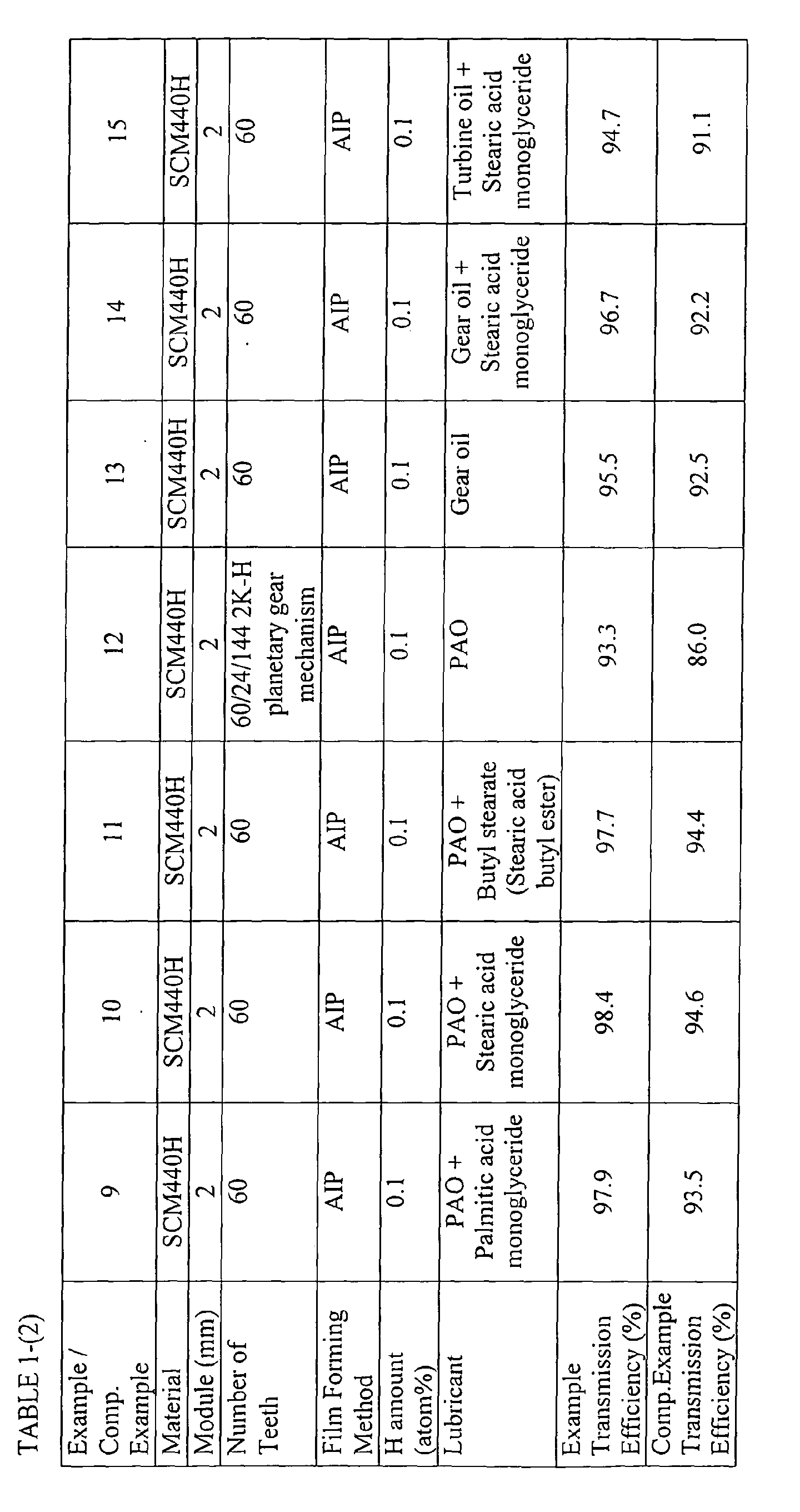
- Example 9 and Comparative Example 9 were lubricant obtained by fully mixing an ester component which was fatty monoglyceride (a main component of fatty acid is palmitic acid) of 2 weight% in the total of the lubricant with poly-alfa-olefin.
- the other conditions of Example 9 and Comparative Example 9 were the same as those of Example 2.
- the evaluation of Example 9 and Comparative Example 9 were also the same as that of Example 2.
- Example 10 and Comparative Example 10 were evaluated under the different test conditions. More specifically, lubricant employed in Example 10 and Comparative Example 10 was lubricant obtained by fully mixing an ester component which was fatty monoglyceride (a main component of fatty acid is stearic acid) of 7 weight% in the total of the lubricant with poly-alfa-olefin. The other conditions of Example 10 and Comparative Example 10 were the same as those of Example 2. The evaluation of Example 10 and Comparative Example 10 were also the same as that of Example 2.
- Example 2 and Comparative Example 2 were evaluated under the different test conditions. More specifically, Lubricant employed in Example I 1 and Comparative Example 11 was lubricant obtained by fully mixing an ester component which was butyl stearate of 2 weight% in the total of the lubricant with poly-alfa-olefin. The other conditions of Example 11 and Comparative Example 11 were the same as those of Example 2. The evaluation of Example 11 and Comparative Example 11 were also the same as that of Example 2.
- Chromium molybdenum steel defined as SCM440H in JIS (Japan Industrial Standard) was employed as material of the gears of Example 12.
- the material was machined into gears defined by the following specifications, and the carburizing, quenching and tempering processes were applied to the machined gears. Thereafter, a finishing touch was applied to the processed gear.
- the gears were assembled into a planetary gear mechanism of 2K-H type. In the evaluation of the gears, a sun gear functioning as an input gear, a ring gear was fixed, and a carrier of planetary gears functioning as an output.
- the sun gear and the planetary gears of Example 12 were degreased and set in a vacuum chamber.
- Hard carbon films were formed on tooth surfaces of the gears by arc ion plating (AIP) process in the vacuum chamber.
- a thickness of the film at a center portion of the sun gear was 1.7 ⁇ m.
- the hydrogen amount in the film was 0.1 atom% as a result of the measurement using a secondary ion mass spectroscopy (SIMS).
- SIMS secondary ion mass spectroscopy
- the tooth surfaces were polished to remove droplets of the film and to smoothen the surface.
- the ring gear was not coated with the hard carbon film.
- the total loss of the tested gear was measured under a condition that the tested gears were wholly soaked in poly-alfa-olefin (PAO) oil and that the tested gear was rotated at a speed of 6000 rpm (the revolution speed of the sun gear).
- PAO poly-alfa-olefin
- the gears of Comparative Example 12 were the same in shape and in material as those of Example 12 except that no hard carbon film was formed on the gears of Comparative Example 12.
- the total loss of Comparative Example 12 was measured under the condition as same as that of Example 12.
- Example 2 and Comparative Example 2 were evaluated under the different test conditions. More specifically, Lubricant employed in Example 13 and Comparative Example 13 was JIS industrial gear oil specified by type 2 and viscosity classification ISO VG 220. The other conditions of Example 13 and Comparative Example 13 were the same as those of Example 2. The evaluation of Example 13 and Comparative Example 13 were also the same as that of Example 2.
- Example 14 and Comparative Example 14 were lubricant obtained by fully mixing an ester component which was fatty monoglyceride (a main component of fatty acid is stearic acid) of 5 weight% in the total of the lubricant with JIS industrial gear oil specified by viscosity classification ISO VG 220 type 2.
- the other conditions of Example 14 and Comparative Example 14 were the same as those of Example 2.
- the evaluation of Example 14 and Comparative Example 14 were also the same as that of Example 2.
- Example 15 and Comparative Example 15 were evaluated under the different test conditions. More specifically, lubricant employed in Example 15 and Comparative Example 15 was lubricant obtained by fully mixing an ester component which was fatty monoglyceride (a main component of fatty acid is stearic acid) of 4 weight% in the total of the lubricant with JIS industrial turbine oil specified by JIS-2213K type 2. The other conditions of Example 15 and Comparative Example 15 were the same as those of Example 2. The evaluation of Example 15 and Comparative Example 15 were also the same as that of Example 2.
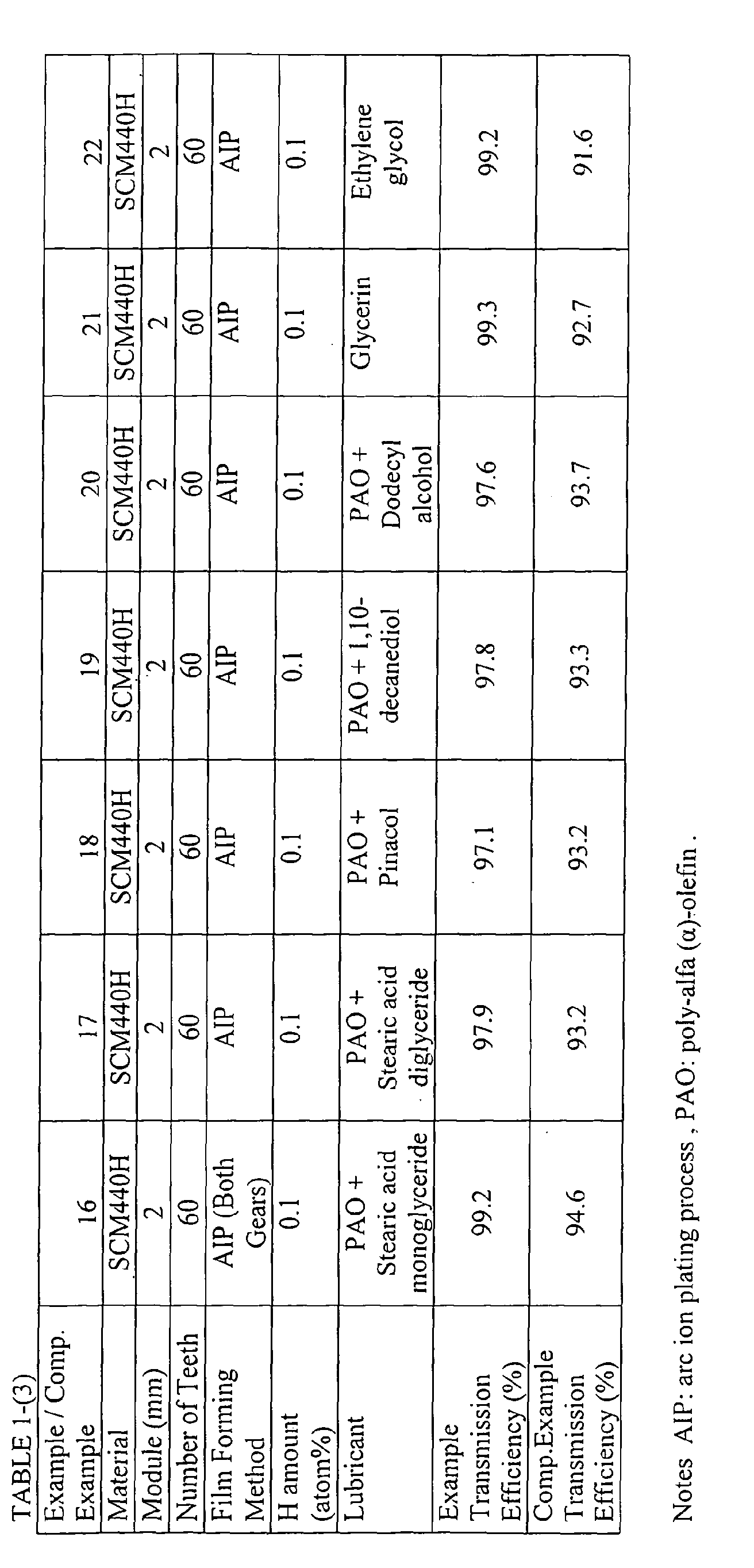
- Example 7 and Comparative Example 7 were evaluated under the different test conditions. More specifically, Lubricant employed in Example 16 and Comparative Example 16 was lubricant obtained by fully mixing an ester component which was fatty monoglyceride (a main component of fatty acid is stearic acid) of 7 weight% with poly-alfa-olefin, as same as that employed in Examples 10 and 11. The other conditions of Example 16 and Comparative Example 16 were the same as those of Example 7. The evaluation of Example 16 and Comparative Example 16 were also the same as that of Example 7 and Comparative Example 7.
- Lubricant employed in Example 16 and Comparative Example 16 was lubricant obtained by fully mixing an ester component which was fatty monoglyceride (a main component of fatty acid is stearic acid) of 7 weight% with poly-alfa-olefin, as same as that employed in Examples 10 and 11.
- the other conditions of Example 16 and Comparative Example 16 were the same as those of Example 7.
- the evaluation of Example 16 and Comparative Example 16 were also the same as that of Example
- Example 17 and Comparative Example 17 were evaluated under the different test conditions. More specifically, lubricant employed in Example 17 and Comparative Example 17 was lubricant obtained by fully mixing an ester component which was fatty diglyceride (a main component of fatty acid is stearic acid) of 2 weight% with poly-alfa-olefin. The other conditions of Example 17 and Comparative Example 17 were the same as those of Example 2. The evaluation of Example 17 and Comparative Example 17 were also the same as that of Example 2.
- Example 18 and Comparative Example 18 were evaluated under the different test conditions. More specifically, lubricant employed in Example 18 and Comparative Example 18 was lubricant obtained by fully mixing pinacol having two hydroxy groups in one molecular at 0.8 weight% with poly-alfa-olefin. The other conditions of Example 18 and Comparative Example 18 were the same as those of Example 2. The evaluation of Example 18 and Comparative Example 18 were also the same as that of Example 2.
- Example 19 and Comparative Example 19 were evaluated under the different test conditions. More specifically, lubricant employed in Example 19 and Comparative Example 19 was lubricant obtained by fully mixing 1,10-decandiol of 2.0 weight% and poly-alfa-olefin. The other conditions of Example 19 and Comparative Example 19 were the same as those of Example 2. The evaluation of Example 19 and Comparative Example 19 were also the same as that of Example 2.
- Example 20 and Comparative Example 20 were evaluated under the different test conditions. More specifically, lubricant employed in Example 20 and Comparative Example 20 was lubricant obtained by fully mixing dodecyl alcohol of 2.0 weight% with poly-alfa-olefin. The other conditions of Example 20 and Comparative Example 20 were the same as those of Example 2. The evaluation of Example 20 and Comparative Example 20 were also the same as that of Example 2.
- Example 21 and Comparative Example 21 were evaluated under the different test conditions. More specifically, lubricant employed in Example 21 and Comparative Example 21 was glycerin. No additive was added in glycerin. The other conditions of Example 21 and Comparative Example 21 were the same as those of Example 2. The evaluation of Example 21 and Comparative Example 21 were also the same as that of Example 2.
- Example 2 and Comparative Example 2 were evaluated under the different test conditions. More specifically, lubricant employed in Example 22 and Comparative Example 22 was ethylene glycol. No additive was added in ethylene glycol. The other conditions of Example 22 and Comparative Example 22 were the same as those of Example 2. The evaluation of Example 22 and Comparative Example 22 were also the same as that of Example 2.
- Example 21 performed the excellent power transmission efficiency.
- Example 16 is subsequently preferable in case that the selection of lubricant is limited such that the lubricant is commonly used in the other sliding pair. In case that both of cost and power transmission efficiency are balancedly minded, Example 8 through 10 are subsequently preferable.
- the gear according to the present invention by film the hard carbon film on al least a part of tooth face of the gear, it becomes possible to largely decrease the friction of the gear relative to the counter gear (meshed gear). Further, by employing a specifically blended lubricant, the friction of the gear is further preferably decreased. This provides the gear further improved in power transmission efficiency. Specifically, in case that lubricant may be freely selected, a largely improved power transmission efficiency is obtained by a lubricant wherein alcohol group is used as a main component of the lubricant. Further, the gear according to the present invention is preferably adapted to a mechanism which has a lot of gear meshing portions, such as a planetary gear mechanism and speed reduction mechanism. When the gear is employed in such mechanisms, the power transmission efficiency is further improved.
Landscapes
- Chemical & Material Sciences (AREA)
- Engineering & Computer Science (AREA)
- Mechanical Engineering (AREA)
- General Engineering & Computer Science (AREA)
- Chemical Kinetics & Catalysis (AREA)
- Materials Engineering (AREA)
- Metallurgy (AREA)
- Organic Chemistry (AREA)
- Gears, Cams (AREA)
- General Details Of Gearings (AREA)
- Lubricants (AREA)
Abstract
Description

Claims (15)
- A gear comprising:a tooth surface; anda hard carbon film formed on at least a part of the tooth surface.
- The gear as claimed in claim 1, wherein a hydrogen amount in the hard carbon film is smaller than or equal to 1 atomic percent.
- The gear as claimed in claim 2, wherein a hydrogen amount in the hard carbon film is smaller than or equal to 0.3 atomic percent.
- The gear as claimed in one of claims 1 through 3, wherein the gear is used as a gear of a planetary gear mechanism.
- The gear as claimed in one of claims 1 through 4, wherein the gear is used as a gear of a speed reduction mechanism.
- The gear as claimed in one of claims 1 through 5, wherein the gear is used in a lubricant.
- The gear as claimed in claim 6, wherein the lubricant includes a mixture employing poly-alfa-olefin (PAO) as a base oil.
- The gear as claimed in one of claims 6 and 7, wherein the lubricant includes an additive including a hydroxyl group.
- The gear as claimed in claim 8, wherein the additive includes two or more hydroxyl groups in a molecule.
- The gear as claimed in one of claims 6 through 9, wherein an additive in the lubricant includes ester.
- The gear as claimed in one of claims 6 through 8, wherein an additive in the lubricant includes monoester of glycerin.
- The gear as claimed in claim 6, wherein a main component of the lubricant is a hydroxy-compound.
- The gear as claimed in claim 12, wherein the hydroxy-compound includes alcohol.
- The gear as claimed in claim 13, wherein the alcohol includes glycerin.
- The gear as claimed in claim 13, wherein the alcohol includes ethylene glycol.
Applications Claiming Priority (4)
| Application Number | Priority Date | Filing Date | Title |
|---|---|---|---|
| JP2003204238 | 2003-07-31 | ||
| JP2003204238 | 2003-07-31 | ||
| JP2004127632 | 2004-04-23 | ||
| JP2004127632A JP4863152B2 (en) | 2003-07-31 | 2004-04-23 | gear |
Publications (3)
| Publication Number | Publication Date |
|---|---|
| EP1503113A2 true EP1503113A2 (en) | 2005-02-02 |
| EP1503113A3 EP1503113A3 (en) | 2005-06-08 |
| EP1503113B1 EP1503113B1 (en) | 2008-05-28 |
Family
ID=33543572
Family Applications (1)
| Application Number | Title | Priority Date | Filing Date |
|---|---|---|---|
| EP04016864A Expired - Lifetime EP1503113B1 (en) | 2003-07-31 | 2004-07-16 | Transmission mechanism |
Country Status (5)
| Country | Link |
|---|---|
| US (2) | US20050025975A1 (en) |
| EP (1) | EP1503113B1 (en) |
| JP (1) | JP4863152B2 (en) |
| CN (1) | CN100394076C (en) |
| DE (1) | DE602004014074D1 (en) |
Cited By (8)
| Publication number | Priority date | Publication date | Assignee | Title |
|---|---|---|---|---|
| WO2007064332A1 (en) | 2005-12-02 | 2007-06-07 | United Technologies Corporation | Metal-free diamond-like-carbon coatings |
| WO2007098523A3 (en) * | 2006-03-03 | 2007-11-08 | Magna Steyr Fahrzeugtechnik Ag | Operable transmission, working fluid for such a transmission, and method for commissioning the same |
| EP1887103A3 (en) * | 2006-07-31 | 2008-09-10 | Nissan Motor Co., Ltd. | High strength gear, power transmission mechanism using the same, and production method for high strength gear |
| EP2345749A1 (en) * | 2010-01-14 | 2011-07-20 | Siemens Aktiengesellschaft | Gear assembly and wind turbine |
| US9139797B2 (en) | 2006-03-03 | 2015-09-22 | Magna Steyr Fahrzeugtechnik Ag & Co. Kg | Operable transmission, working fluid for such a transmission, and method for commissioning the same |
| US9416332B2 (en) | 2010-11-17 | 2016-08-16 | GM Global Technology Operations LLC | Gear assembly and gear oil composition |
| EP3187752A4 (en) * | 2014-08-28 | 2017-08-30 | Nissan Motor Co., Ltd | Gear pair |
| US10604716B2 (en) | 2013-09-30 | 2020-03-31 | Croda International Plc | Gear oil composition |
Families Citing this family (24)
| Publication number | Priority date | Publication date | Assignee | Title |
|---|---|---|---|---|
| JP3555844B2 (en) * | 1999-04-09 | 2004-08-18 | 三宅 正二郎 | Sliding member and manufacturing method thereof |
| US8458879B2 (en) * | 2001-07-03 | 2013-06-11 | Advanced Bio Prosthetic Surfaces, Ltd., A Wholly Owned Subsidiary Of Palmaz Scientific, Inc. | Method of fabricating an implantable medical device |
| JP2004138128A (en) | 2002-10-16 | 2004-05-13 | Nissan Motor Co Ltd | Sliding members for automobile engines |
| US6969198B2 (en) * | 2002-11-06 | 2005-11-29 | Nissan Motor Co., Ltd. | Low-friction sliding mechanism |
| JP3891433B2 (en) * | 2003-04-15 | 2007-03-14 | 日産自動車株式会社 | Fuel injection valve |
| EP1479946B1 (en) * | 2003-05-23 | 2012-12-19 | Nissan Motor Co., Ltd. | Piston for internal combustion engine |
| EP1482190B1 (en) | 2003-05-27 | 2012-12-05 | Nissan Motor Company Limited | Rolling element |
| JP2005008851A (en) * | 2003-05-29 | 2005-01-13 | Nissan Motor Co Ltd | Cutting oil for machining tool with hard carbon thin film and machining tool with hard carbon thin film |
| JP2004360649A (en) | 2003-06-06 | 2004-12-24 | Nissan Motor Co Ltd | Engine piston pin |
| KR101003865B1 (en) * | 2003-08-06 | 2010-12-30 | 닛산 지도우샤 가부시키가이샤 | Low friction sliding mechanism, low friction composition and friction reducing method |
| JP4973971B2 (en) * | 2003-08-08 | 2012-07-11 | 日産自動車株式会社 | Sliding member |
| JP2005054617A (en) | 2003-08-08 | 2005-03-03 | Nissan Motor Co Ltd | Valve mechanism |
| JP4117553B2 (en) * | 2003-08-13 | 2008-07-16 | 日産自動車株式会社 | Chain drive |
| DE602004008547T2 (en) | 2003-08-13 | 2008-05-21 | Nissan Motor Co., Ltd., Yokohama | Structure for connecting a piston to a crankshaft |
| US7771821B2 (en) * | 2003-08-21 | 2010-08-10 | Nissan Motor Co., Ltd. | Low-friction sliding member and low-friction sliding mechanism using same |
| JP4539205B2 (en) | 2003-08-21 | 2010-09-08 | 日産自動車株式会社 | Refrigerant compressor |
| EP1508611B1 (en) * | 2003-08-22 | 2019-04-17 | Nissan Motor Co., Ltd. | Transmission comprising low-friction sliding members and transmission oil therefor |
| JP4696823B2 (en) * | 2005-10-06 | 2011-06-08 | トヨタ自動車株式会社 | Metal composite diamond-like carbon (DLC) film, method for forming the same, and sliding member |
| EP2014748B1 (en) | 2006-04-28 | 2020-09-30 | Nissan Motor Co., Ltd. | Low-friction lubrication assembly |
| JP2009067873A (en) * | 2007-09-12 | 2009-04-02 | Adeka Corp | Lubricant composition and lubricating oil composition containing the same |
| WO2012079163A1 (en) * | 2010-12-17 | 2012-06-21 | Magna International Inc. | Laser beam welding |
| CN103307229A (en) * | 2013-06-28 | 2013-09-18 | 江苏赫夫特齿轮制造有限公司 | Annular gear structure |
| DE102015221654A1 (en) * | 2015-11-04 | 2017-05-04 | Zf Friedrichshafen Ag | Test run with glycerin |
| JP6987510B2 (en) * | 2017-02-21 | 2022-01-05 | 協同油脂株式会社 | Lubricant composition for reducer and reducer |
Family Cites Families (436)
| Publication number | Priority date | Publication date | Assignee | Title |
|---|---|---|---|---|
| US1461A (en) | 1839-12-31 | Improvement in fire-arms | ||
| DE643034C (en) | 1934-09-24 | 1937-03-22 | Tito Brunetti | Safety device for internal combustion engines |
| US2339715A (en) * | 1942-07-13 | 1944-01-18 | Shell Dev | Low temperature grease |
| US2609342A (en) * | 1949-12-03 | 1952-09-02 | Socony Vacuum Oil Co Inc | Lubricant |
| US2716972A (en) | 1952-02-04 | 1955-09-06 | Farny Paul | Lubrication of engine valves by fuel leakage |
| CH316412A (en) | 1952-02-19 | 1956-10-15 | Hoechst Ag | Hydraulic fluid |
| NL104477C (en) | 1957-03-05 | |||
| US5021628A (en) | 1970-11-30 | 1991-06-04 | Lemelson Jerome H | Apparatus and method for reacting on matter |
| US4874596A (en) | 1957-06-27 | 1989-10-17 | Lemelson Jerome H | Production of crystalline structures |
| US4702808A (en) | 1957-06-27 | 1987-10-27 | Lemelson Jerome H | Chemical reaction apparatus and method |
| US5462772A (en) | 1957-06-27 | 1995-10-31 | Lemelson; Jerome H. | Methods for forming artificial diamond |
| US4385880A (en) | 1957-06-27 | 1983-05-31 | Lemelson Jerome H | Shock wave processing apparatus |
| US3211653A (en) | 1958-12-31 | 1965-10-12 | Exxon Research Engineering Co | Hypoid gear lubricants for slip-lock differentials |
| US5131941A (en) | 1959-04-08 | 1992-07-21 | Lemelson Jerome H | Reaction apparatus and method |
| US5552675A (en) | 1959-04-08 | 1996-09-03 | Lemelson; Jerome H. | High temperature reaction apparatus |
| NL296138A (en) | 1963-08-02 | |||
| US3846162A (en) | 1968-10-21 | 1974-11-05 | Texas Instruments Inc | Metal carbonitride coatings |
| SE351012B (en) * | 1970-10-01 | 1972-11-13 | Atlas Copco Ab | |
| US4367130A (en) * | 1970-11-30 | 1983-01-04 | Lemelson Jerome H | Chemical reaction |
| JPS533446B2 (en) * | 1973-11-01 | 1978-02-07 | ||
| US4031023A (en) | 1976-02-19 | 1977-06-21 | The Lubrizol Corporation | Lubricating compositions and methods utilizing hydroxy thioethers |
| US4367160A (en) * | 1979-09-21 | 1983-01-04 | Monsanto Company | Oxidants for gasifying carbon-containing materials |
| AT382215B (en) | 1982-09-20 | 1987-01-26 | Miba Gleitlager Ag | HYDRODYNAMIC SLIDING BEARING |
| US4554208A (en) | 1983-12-27 | 1985-11-19 | General Motors Corporation | Metal bearing surface having an adherent score-resistant coating |
| DE3560285D1 (en) * | 1984-04-20 | 1987-07-30 | Inst Francais Du Petrole | Process for the preparation of polysulfurised olefins, products so obtained and their use as additives for lubricants |
| US4755237A (en) | 1984-11-26 | 1988-07-05 | Lemelson Jerome H | Methods for making cutting tools |
| US4712982A (en) | 1985-03-25 | 1987-12-15 | Kabushiki Kaisha Toyoda Jidoshokki Seisakusho | Variable displacement wobble plate type compressor with guide means for wobble plate |
| EP0221531A3 (en) * | 1985-11-06 | 1992-02-19 | Kanegafuchi Kagaku Kogyo Kabushiki Kaisha | High heat conductive insulated substrate and method of manufacturing the same |
| US4755426A (en) | 1986-01-18 | 1988-07-05 | Hitachi Maxell, Ltd. | Magnetic recording medium and production of the same |
| US4933058A (en) | 1986-01-23 | 1990-06-12 | The Gillette Company | Formation of hard coatings on cutting edges |
| GB8602627D0 (en) | 1986-02-04 | 1986-03-12 | Exxon Chemical Patents Inc | Marine lubricating composition |
| CN1018655B (en) * | 1987-03-23 | 1992-10-14 | 上海工业大学 | Lubricating oil phosphorus nitrogen type ashless antiwear additive |
| US5255929A (en) | 1987-03-31 | 1993-10-26 | Lemelson Jerome H | Blade for ice skate |
| US5360227A (en) | 1987-03-31 | 1994-11-01 | Lemelson Jerome H | Skis and runners |
| US5288556A (en) * | 1987-03-31 | 1994-02-22 | Lemelson Jerome H | Gears and gear assemblies |
| US4859493A (en) | 1987-03-31 | 1989-08-22 | Lemelson Jerome H | Methods of forming synthetic diamond coatings on particles using microwaves |
| US6083570A (en) | 1987-03-31 | 2000-07-04 | Lemelson; Jerome H. | Synthetic diamond coatings with intermediate amorphous metal bonding layers and methods of applying such coatings |
| US5096352A (en) * | 1987-03-31 | 1992-03-17 | Lemelson Jerome H | Diamond coated fasteners |
| US5040501A (en) | 1987-03-31 | 1991-08-20 | Lemelson Jerome H | Valves and valve components |
| US4960643A (en) | 1987-03-31 | 1990-10-02 | Lemelson Jerome H | Composite synthetic materials |
| US5132587A (en) | 1987-03-31 | 1992-07-21 | Lemelson Jerome H | Spark plug electrodes |
| US5332348A (en) | 1987-03-31 | 1994-07-26 | Lemelson Jerome H | Fastening devices |
| US5067826A (en) | 1987-03-31 | 1991-11-26 | Lemelson Jerome H | Ball and roller bearings and bearing components |
| JP2599383B2 (en) | 1987-04-11 | 1997-04-09 | 出光興産 株式会社 | Lubricating oil composition |
| JP2555284B2 (en) | 1987-05-14 | 1996-11-20 | 出光興産株式会社 | Lubricant composition with improved temperature characteristics |
| US4831977A (en) | 1987-07-17 | 1989-05-23 | Ethyl Corporation | Pistons with wear resistant solid film lubricant coatings |
| GB2208753B (en) | 1987-08-13 | 1991-06-26 | Commw Of Australia | Improvements in plasma generators |
| US5000541A (en) * | 1987-09-18 | 1991-03-19 | At&T Bell Laboratories | Hermetically sealed optical fibers |
| DE3885827T2 (en) | 1987-09-18 | 1994-03-17 | American Telephone & Telegraph | Hermetically sealed, optical fibers. |
| EP0413690A4 (en) | 1988-01-04 | 1991-11-27 | The Commonwealth Of Australia | Infrared signature control mechanism |
| FI79351C (en) | 1988-01-18 | 1989-12-11 | Asko Anttila | FOERFARANDE OCH ANORDNING FOER YTBELAEGGNING AV MATERIAL. |
| GB8801366D0 (en) | 1988-01-21 | 1988-02-17 | Secr Defence | Infra red transparent materials |
| US5190824A (en) * | 1988-03-07 | 1993-03-02 | Semiconductor Energy Laboratory Co., Ltd. | Electrostatic-erasing abrasion-proof coating |
| US4834400A (en) | 1988-03-15 | 1989-05-30 | University Of New Mexico | Differential surface roughness dynamic seals and bearings |
| US4898131A (en) | 1988-03-18 | 1990-02-06 | Honda Giken Kogyo K.K. | Valve actuating mechanism for internal combustion mechanism |
| DE3809734C1 (en) | 1988-03-23 | 1989-05-03 | Helmut Prof. Dr. 7805 Boetzingen De Haberland | |
| US5866195A (en) * | 1988-03-31 | 1999-02-02 | Lemelson; Jerome H. | Methods for forming diamond-coated superconductor wire |
| DE3815457A1 (en) * | 1988-05-06 | 1989-11-16 | Sipra Patent Beteiligung | KNITTING MACHINE |
| US5202156A (en) * | 1988-08-16 | 1993-04-13 | Canon Kabushiki Kaisha | Method of making an optical element mold with a hard carbon film |
| GB8821944D0 (en) | 1988-09-19 | 1988-10-19 | Gillette Co | Method & apparatus for forming surface of workpiece |
| GB8826857D0 (en) * | 1988-11-17 | 1988-12-21 | Bp Chem Int Ltd | Water based functional fluids |
| US4992082A (en) * | 1989-01-12 | 1991-02-12 | Ford Motor Company | Method of toughening diamond coated tools |
| US4919974A (en) | 1989-01-12 | 1990-04-24 | Ford Motor Company | Making diamond composite coated cutting tools |
| US4988421A (en) * | 1989-01-12 | 1991-01-29 | Ford Motor Company | Method of toughening diamond coated tools |
| US5187021A (en) * | 1989-02-08 | 1993-02-16 | Diamond Fiber Composites, Inc. | Coated and whiskered fibers for use in composite materials |
| US4981717A (en) | 1989-02-24 | 1991-01-01 | Mcdonnell Douglas Corporation | Diamond like coating and method of forming |
| US4943345A (en) | 1989-03-23 | 1990-07-24 | Board Of Trustees Operating Michigan State University | Plasma reactor apparatus and method for treating a substrate |
| JPH0620464B2 (en) | 1989-04-03 | 1994-03-23 | 信越化学工業株式会社 | Medical incision, press-fitting device and method of manufacturing the same |
| US5087608A (en) * | 1989-12-28 | 1992-02-11 | Bell Communications Research, Inc. | Environmental protection and patterning of superconducting perovskites |
| AU631037B2 (en) | 1989-12-28 | 1992-11-12 | Kabushiki Kaisha Toyota Chuo Kenkyusho | Hard and lubricant thin film of amorphous carbon-hydrogen-silicon, iron base metallic material coated therewith, and the process for producing the same |
| WO1991011793A2 (en) * | 1990-02-01 | 1991-08-08 | Stanton Barry Waltho | Display apparatus |
| US5112025A (en) | 1990-02-22 | 1992-05-12 | Tdk Corporation | Molds having wear resistant release coatings |
| JP2514097B2 (en) | 1990-03-15 | 1996-07-10 | 帝国ピストンリング株式会社 | Cylinder liner |
| US5349265A (en) | 1990-03-16 | 1994-09-20 | Lemelson Jerome H | Synthetic diamond coated electrodes and filaments |
| USH1210H (en) | 1990-04-04 | 1993-07-06 | Surface hardening of reprographic machine components by coating or treatment processes | |
| US5568391A (en) | 1990-05-29 | 1996-10-22 | Mckee; Lance D. | Automated tile mosaic creation system |
| GB9019219D0 (en) | 1990-09-01 | 1990-10-17 | Atomic Energy Authority Uk | Diamond-like carbon coatings |
| JPH0796750B2 (en) * | 1990-10-13 | 1995-10-18 | ワイケイケイ株式会社 | Color changer for continuous spray dyeing |
| US5190807A (en) | 1990-10-18 | 1993-03-02 | Diamonex, Incorporated | Abrasion wear resistant polymeric substrate product |
| EP0484699B1 (en) * | 1990-11-05 | 1993-08-18 | Detlev Dr. Repenning | Friction pairing and its method of manufacture |
| FR2669689B1 (en) | 1990-11-23 | 1994-12-30 | Renault | CONNECTING ROD WITHOUT FOOT PAD AND METHOD FOR PRODUCING THE SAME. |
| US5127314A (en) | 1990-11-30 | 1992-07-07 | General Motors Corporation | Compensating cam socket plate torque restraint assembly for a variable displacement compressor |
| US5143634A (en) | 1991-01-17 | 1992-09-01 | Amoco Corporation | Anti-wear engine and lubricating oil |
| CA2060823C (en) | 1991-02-08 | 2002-09-10 | Naoya Omori | Diamond-or diamond-like carbon-coated hard materials |
| CA2065581C (en) | 1991-04-22 | 2002-03-12 | Andal Corp. | Plasma enhancement apparatus and method for physical vapor deposition |
| US5142785A (en) | 1991-04-26 | 1992-09-01 | The Gillette Company | Razor technology |
| JP3439761B2 (en) | 1991-04-26 | 2003-08-25 | ザ ジレット カンパニー | Razor blade improvements |
| US5352493A (en) | 1991-05-03 | 1994-10-04 | Veniamin Dorfman | Method for forming diamond-like nanocomposite or doped-diamond-like nanocomposite films |
| US5718976A (en) | 1991-05-03 | 1998-02-17 | Advanced Refractory Technologies, Inc. | Erosion resistant diamond-like nanocomposite coatings for optical components |
| US5232568A (en) | 1991-06-24 | 1993-08-03 | The Gillette Company | Razor technology |
| DE4125165A1 (en) | 1991-07-30 | 1993-02-04 | Hoechst Ceram Tec Ag | BURNED, CERAMIC PRODUCT WITH A STRUCTURED SURFACE AND METHOD FOR THE PRODUCTION THEREOF |
| ZA928617B (en) * | 1991-11-15 | 1993-05-11 | Gillette Co | Shaving system. |
| US5669144A (en) | 1991-11-15 | 1997-09-23 | The Gillette Company | Razor blade technology |
| US5334306A (en) | 1991-12-11 | 1994-08-02 | At&T Bell Laboratories | Metallized paths on diamond surfaces |
| US5255783A (en) | 1991-12-20 | 1993-10-26 | Fluoroware, Inc. | Evacuated wafer container |
| US5317938A (en) | 1992-01-16 | 1994-06-07 | Duke University | Method for making microstructural surgical instruments |
| US5295305B1 (en) * | 1992-02-13 | 1996-08-13 | Gillette Co | Razor blade technology |
| US5359170A (en) | 1992-02-18 | 1994-10-25 | At&T Global Information Solutions Company | Apparatus for bonding external leads of an integrated circuit |
| AU651268B2 (en) | 1992-02-18 | 1994-07-14 | Idemitsu Kosan Co. Ltd | Mannich reaction product and process for producing the same and use of the product |
| RU2004586C1 (en) | 1992-04-07 | 1993-12-15 | Транснациональна межотраслева компани "Нокпекс" | Method for production of lubricating oil |
| CN1077736A (en) * | 1992-04-14 | 1993-10-27 | 上海工业大学 | 13, the 14 pairs of docosoic acid used as antiwear agent and using method thereof |
| GB9211402D0 (en) | 1992-05-29 | 1992-07-15 | Univ Manchester | Sensor devices |
| US5443032A (en) | 1992-06-08 | 1995-08-22 | Air Products And Chemicals, Inc. | Method for the manufacture of large single crystals |
| US5299937A (en) * | 1992-07-29 | 1994-04-05 | Si Diamond Technology, Inc. | Dental instruments having diamond-like working surface |
| US5851962A (en) | 1992-08-18 | 1998-12-22 | Ethyl Japan Corporation | Lubricant composition for wet clutch or wet brake |
| US5237967A (en) | 1993-01-08 | 1993-08-24 | Ford Motor Company | Powertrain component with amorphous hydrogenated carbon film |
| US5249554A (en) | 1993-01-08 | 1993-10-05 | Ford Motor Company | Powertrain component with adherent film having a graded composition |
| EP0606553A2 (en) * | 1993-01-11 | 1994-07-20 | Conoco Inc. | An ester base oil for lubricant compounds and process of making an ester base oil from an organic reaction by-product |
| EP0619504A1 (en) | 1993-04-08 | 1994-10-12 | Optische Werke G. Rodenstock | Antireflection coating |
| JPH06320744A (en) | 1993-04-19 | 1994-11-22 | Xerox Corp | Wet wipe maintenance device for full width inkjet printer |
| JPH06340081A (en) | 1993-04-19 | 1994-12-13 | Xerox Corp | Print head maintenance device for full width inkjet printer |
| USH1471H (en) | 1993-04-26 | 1995-08-01 | Braun David J | Metal substrate double sided circuit board |
| USH1461H (en) | 1993-05-10 | 1995-07-04 | The United States Of America As Represented By The Secretary Of The Army | Abrasion resistant diamond like coating for optical fiber and method of forming the coating |
| DE4316012C2 (en) | 1993-05-13 | 1998-09-24 | Gehring Gmbh & Co Maschf | Process for finishing workpiece surfaces |
| US5380196A (en) | 1993-05-13 | 1995-01-10 | Minnesota Mining And Manufacturing Company | Orthodontic bracket with archwire slot liner |
| US5358402A (en) | 1993-05-13 | 1994-10-25 | Minnesota Mining & Manufacturing Company | Ceramic orthodontic bracket with archwire slot liner |
| WO1994026425A1 (en) | 1993-05-17 | 1994-11-24 | Mcdonnell Douglas Corporation | Laser absorption wave deposition process |
| US5433977A (en) | 1993-05-21 | 1995-07-18 | Trustees Of Boston University | Enhanced adherence of diamond coatings by combustion flame CVD |
| KR0134942B1 (en) | 1993-06-11 | 1998-06-15 | 이다가끼 유끼오 | Amorphous hard carbon film and its manufacturing method |
| US5740941A (en) | 1993-08-16 | 1998-04-21 | Lemelson; Jerome | Sheet material with coating |
| BE1008229A3 (en) | 1993-10-29 | 1996-02-20 | Vito | METHOD FOR APPLYING A WEAR PROTECTIVE LAYER TO A SUBSTRATE |
| US5482602A (en) * | 1993-11-04 | 1996-01-09 | United Technologies Corporation | Broad-beam ion deposition coating methods for depositing diamond-like-carbon coatings on dynamic surfaces |
| US5401543A (en) * | 1993-11-09 | 1995-03-28 | Minnesota Mining And Manufacturing Company | Method for forming macroparticle-free DLC films by cathodic arc discharge |
| US5447208A (en) | 1993-11-22 | 1995-09-05 | Baker Hughes Incorporated | Superhard cutting element having reduced surface roughness and method of modifying |
| EP0661470A3 (en) | 1993-12-27 | 1996-08-14 | Starlite Ind | Sliding Bearing and Counter Parts. |
| JPH07197068A (en) * | 1993-12-30 | 1995-08-01 | Tonen Corp | Lubricating oil composition |
| US5731046A (en) * | 1994-01-18 | 1998-03-24 | Qqc, Inc. | Fabrication of diamond and diamond-like carbon coatings |
| US5479069A (en) | 1994-02-18 | 1995-12-26 | Winsor Corporation | Planar fluorescent lamp with metal body and serpentine channel |
| US5541566A (en) | 1994-02-28 | 1996-07-30 | Olin Corporation | Diamond-like carbon coating for magnetic cores |
| US5593719A (en) * | 1994-03-29 | 1997-01-14 | Southwest Research Institute | Treatments to reduce frictional wear between components made of ultra-high molecular weight polyethylene and metal alloys |
| JPH07286649A (en) * | 1994-04-18 | 1995-10-31 | Nippon Seiko Kk | Toroidal type continuously variable transmission |
| CZ293994B6 (en) | 1994-04-25 | 2004-09-15 | The Gillette Company | Razor blade, process for its manufacture and shaving unit |
| BE1008338A5 (en) | 1994-04-26 | 1996-04-02 | Cobrain Nv | Multi-frequency inductive method and device for working material. |
| JP3512231B2 (en) * | 1994-05-10 | 2004-03-29 | 東燃ゼネラル石油株式会社 | Lubricating oil composition for automatic transmission |
| EP0752018A4 (en) | 1994-05-12 | 1998-09-02 | Qqc Inc | Surface treatment techniques |
| US5516729A (en) | 1994-06-03 | 1996-05-14 | Advanced Micro Devices, Inc. | Method for planarizing a semiconductor topography using a spin-on glass material with a variable chemical-mechanical polish rate |
| US5502156A (en) * | 1994-07-28 | 1996-03-26 | The United States Of America As Represented By The Administrator Of The National Aeronautics And Space Administration | Electrically conducting polyimide film containing tin complexes |
| US5464667A (en) | 1994-08-16 | 1995-11-07 | Minnesota Mining And Manufacturing Company | Jet plasma process and apparatus |
| US5630275A (en) | 1994-08-23 | 1997-05-20 | Warner-Lambert Company | Multi-blade razor head with improved performance |
| US5551959A (en) * | 1994-08-24 | 1996-09-03 | Minnesota Mining And Manufacturing Company | Abrasive article having a diamond-like coating layer and method for making same |
| US6197428B1 (en) | 1994-08-26 | 2001-03-06 | Deposition Sciences, Inc. | Gemstones and decorative objects comprising a substrate and an optical interference film |
| US5619889A (en) * | 1994-10-11 | 1997-04-15 | Fed Corporation | Method of making microstructural surgical instruments |
| AU4194896A (en) | 1994-10-18 | 1996-05-06 | Edsi, Inc. | Apparatus for depositing a layer of material on a substrate |
| US5461648A (en) | 1994-10-27 | 1995-10-24 | The United States Of America As Represented By The Secretary Of The Navy | Supercritical water oxidation reactor with a corrosion-resistant lining |
| US5975686A (en) | 1994-10-31 | 1999-11-02 | Hewlett-Packard Company | Regulator for a free-ink inkjet pen |
| US5529815A (en) | 1994-11-03 | 1996-06-25 | Lemelson; Jerome H. | Apparatus and method for forming diamond coating |
| US5641731A (en) | 1994-11-04 | 1997-06-24 | Ashland, Inc. | Motor oil performance-enhancing formulation |
| WO1996024488A1 (en) | 1995-02-01 | 1996-08-15 | Si Diamond Technology, Inc. | Diamond coated copper optics |
| DE19507086C2 (en) | 1995-03-01 | 1997-01-30 | Danfoss As | Water hydraulic control valve |
| US5458927A (en) | 1995-03-08 | 1995-10-17 | General Motors Corporation | Process for the formation of wear- and scuff-resistant carbon coatings |
| US5901021A (en) | 1995-05-19 | 1999-05-04 | Sanyo Electric Co., Ltd. | Thin-film magnetic head |
| US5616372A (en) * | 1995-06-07 | 1997-04-01 | Syndia Corporation | Method of applying a wear-resistant diamond coating to a substrate |
| US5714202A (en) | 1995-06-07 | 1998-02-03 | Lemelson; Jerome H. | Synthetic diamond overlays for gas turbine engine parts having thermal barrier coatings |
| US5688557A (en) | 1995-06-07 | 1997-11-18 | Lemelson; Jerome H. | Method of depositing synthetic diamond coatings with intermediates bonding layers |
| US5834708A (en) | 1995-06-08 | 1998-11-10 | Spectra-Physics Scanning Systems, Inc. | Multiple plane weigh platter for multiple plane scanning systems |
| SE521725C2 (en) | 1995-09-20 | 2003-12-02 | Uponor Innovation Ab | Hollow product of thermoplastic material and methods for extrusion thereof |
| US5927897A (en) | 1995-07-14 | 1999-07-27 | Attar; Adil | Housingless abrasion resistant pavement marker |
| CA2229067A1 (en) | 1995-08-14 | 1997-02-27 | E.I. Du Pont De Nemours And Company | Fluorescent lamp |
| DE19530511C1 (en) | 1995-08-18 | 1997-02-20 | Alcan Gmbh | Pistons for internal combustion engines |
| AUPN547495A0 (en) | 1995-09-15 | 1995-10-12 | Uponor B.V. | Sizing apparatus |
| US6468642B1 (en) | 1995-10-03 | 2002-10-22 | N.V. Bekaert S.A. | Fluorine-doped diamond-like coatings |
| AU7371496A (en) * | 1995-10-03 | 1997-05-07 | Advanced Refractory Technologies, Inc. | Diamond-like nanocomposite thin films for automotive powertrain component coatings |
| DE69625821T2 (en) | 1995-10-18 | 2003-09-04 | Infineum Usa L.P., Linden | AUTOMATIC TRANSMISSION WITH GEARBOX LIQUID WITH IMPROVED FRICTION DURABILITY |
| US6059830A (en) | 1995-11-02 | 2000-05-09 | Wright Medical Technology, Inc. | Low wear ball and cup joint prosthesis |
| KR0152251B1 (en) * | 1995-11-02 | 1998-10-15 | 장진 | Pseudodiamond thin film manufacturing method by layer, layer, and layer manufacturing method |
| JPH09164693A (en) | 1995-11-27 | 1997-06-24 | Xerox Corp | Liquid ink printer with consumables for maintenance |
| US5790146A (en) | 1995-12-04 | 1998-08-04 | Xerox Corporation | Fluid applicator for maintenance of liquid ink printers |
| US5672054A (en) | 1995-12-07 | 1997-09-30 | Carrier Corporation | Rotary compressor with reduced lubrication sensitivity |
| EP0877866B2 (en) | 1996-01-30 | 2004-09-01 | Federal-Mogul Wiesbaden GmbH & Co.KG | Sliding bearing element with lubricating oil pockets |
| US5824387A (en) | 1996-02-05 | 1998-10-20 | Seagate Technology, Inc. | Magnetic disc with carbon protective layer having regions differing in hardness |
| DE19704224A1 (en) | 1996-02-19 | 1997-08-21 | Volkswagen Ag | Connection between lifting piston and connecting rod in vehicle engines |
| WO2000025410A1 (en) | 1998-10-23 | 2000-05-04 | Kuhlmann Wilsdorf Doris | Management of contact spots between an electrical brush and substrate |
| US6753635B2 (en) | 1996-04-05 | 2004-06-22 | Hi Per Con | Management of contact spots between an electrical brush and substrate |
| US5871805A (en) * | 1996-04-08 | 1999-02-16 | Lemelson; Jerome | Computer controlled vapor deposition processes |
| JP3047471B2 (en) | 1996-04-19 | 2000-05-29 | 東レ株式会社 | Aromatic polyamide film, method for producing the same, and magnetic recording medium using the same |
| US5952102A (en) | 1996-05-13 | 1999-09-14 | Ceramatec, Inc. | Diamond coated WC and WC-based composites with high apparent toughness |
| WO1997046484A1 (en) | 1996-06-05 | 1997-12-11 | R. Amtekh International, Inc. | Method for forming conformal diamond-type carbon coatings, hard diamond-type carbon coating and porous filtration element using the same |
| EP0816112A3 (en) | 1996-07-02 | 1998-10-07 | Corning Incorporated | Method and apparatus for printing color filters |
| CN1107742C (en) | 1996-07-08 | 2003-05-07 | 时至准钟表股份有限公司 | Guide bush and method of forming film on guide bush |
| US5783261A (en) | 1996-07-11 | 1998-07-21 | Ford Global Technologies, Inc. | Using a coated fuel injector and method of making |
| WO1998002715A1 (en) | 1996-07-12 | 1998-01-22 | Phase Metrics | Coatings for simultaneous control of tribological and optical properties of interferometric reference surfaces |
| JPH1082390A (en) | 1996-07-18 | 1998-03-31 | Sanyo Electric Co Ltd | Sliding member, compressor and rotary compressor |
| US6656329B1 (en) | 1996-08-28 | 2003-12-02 | Premark Rwp Holdings, Inc. | Coated pressing surfaces for abrasion resistant laminate and making laminates therefrom |
| US5945214C1 (en) | 1996-08-28 | 2002-04-23 | Premark Rwp Holdings Inc | Diboride coated pressing surfaces for abrasion resistant laminate and making pressing surfaces |
| TW385275B (en) | 1996-08-29 | 2000-03-21 | Toray Industries | Aromatic polyamide-based resin molding, a process therefor and magnetic recording medium made from the molding |
| DE19635736C2 (en) * | 1996-09-03 | 2002-03-07 | Saxonia Umformtechnik Gmbh | Diamond-like coating |
| US5976707A (en) | 1996-09-26 | 1999-11-02 | Kennametal Inc. | Cutting insert and method of making the same |
| SE9603540D0 (en) | 1996-09-27 | 1996-09-27 | Ingvar Eriksson | Orthopedic device |
| TW353758B (en) | 1996-09-30 | 1999-03-01 | Motorola Inc | Electron emissive film and method |
| US5910940A (en) | 1996-10-08 | 1999-06-08 | Polaroid Corporation | Storage medium having a layer of micro-optical lenses each lens generating an evanescent field |
| US6311524B1 (en) | 2000-07-14 | 2001-11-06 | 3M Innovative Properties Company | Accelerated method for increasing the photosensitivity of a glassy material |
| US5775817A (en) | 1996-11-04 | 1998-07-07 | General Motors Corporation | Fracture process with bore distortion controls |
| JPH10184914A (en) | 1996-12-26 | 1998-07-14 | Teikoku Piston Ring Co Ltd | Combination of piston ring and cylinder liner |
| KR100247065B1 (en) * | 1997-01-22 | 2000-03-15 | 윤종용 | Optical disc having protective folms |
| US6316392B1 (en) | 1997-01-31 | 2001-11-13 | Elisha Technologies Co Llc | Corrosion resistant lubricants greases and gels |
| US5778841A (en) | 1997-02-26 | 1998-07-14 | Cummins Engine Company, Inc. | Camshaft for internal combustion engines |
| TW385332B (en) | 1997-02-27 | 2000-03-21 | Idemitsu Kosan Co | Refrigerating oil composition |
| US6543394B2 (en) | 1997-03-03 | 2003-04-08 | Science Applications International Corp. | Four-cycle fuel-lubricated internal combustion engine |
| JP3236795B2 (en) | 1997-03-18 | 2001-12-10 | 大同メタル工業株式会社 | Plain bearing |
| US5849675A (en) | 1997-04-10 | 1998-12-15 | Chevron Chemical Company | Hydraulic system using an improved antiwear hydraulic fluid |
| WO1998047141A1 (en) | 1997-04-16 | 1998-10-22 | Digital Papyrus Corporation | Phase change media compatible with air bearing flying head |
| RU2114210C1 (en) | 1997-05-30 | 1998-06-27 | Валерий Павлович Гончаренко | Process of formation of carbon diamond-like coat in vacuum |
| US6030398A (en) | 1997-05-30 | 2000-02-29 | Summit Technology, Inc. | Surgical microtomes |
| US6305416B1 (en) | 1997-06-09 | 2001-10-23 | Flexcon Industries | Actuator valve for pressure switch for a fluidic system |
| US6893720B1 (en) | 1997-06-27 | 2005-05-17 | Nissin Electric Co., Ltd. | Object coated with carbon film and method of manufacturing the same |
| US6377422B1 (en) | 1997-07-08 | 2002-04-23 | Seagate Technology Llc | Disc head with contact protection feature |
| US5958261A (en) | 1997-07-17 | 1999-09-28 | General Electric Company | Apparatus for welding with preheated filler material |
| US6023979A (en) * | 1997-07-21 | 2000-02-15 | Helix Technology | Apparatus and methods for heat loss pressure measurement |
| US6938493B2 (en) | 1997-07-21 | 2005-09-06 | Helix Technology Corporation | Apparatus and methods for heat loss pressure measurement |
| US6658941B1 (en) | 1997-07-21 | 2003-12-09 | Helix Technology Corporation | Apparatus and methods for heat loss pressure measurement |
| DE19882586T1 (en) | 1997-08-15 | 2000-08-03 | Seagate Technology | Slider for data storage system |
| US6071597A (en) | 1997-08-28 | 2000-06-06 | 3M Innovative Properties Company | Flexible circuits and carriers and process for manufacture |
| NL1007046C2 (en) | 1997-09-16 | 1999-03-17 | Skf Ind Trading & Dev | Coated rolling bearing. |
| US5885942A (en) | 1997-09-23 | 1999-03-23 | Nch Corporation | Multifunctional lubricant additive |
| JP3355306B2 (en) | 1997-09-30 | 2002-12-09 | 帝国ピストンリング株式会社 | piston ring |
| US6494881B1 (en) | 1997-09-30 | 2002-12-17 | Scimed Life Systems, Inc. | Apparatus and method for electrode-surgical tissue removal having a selectively insulated electrode |
| JP3885375B2 (en) | 1997-09-30 | 2007-02-21 | 帝国ピストンリング株式会社 | piston ring |
| US6156439A (en) | 1997-10-21 | 2000-12-05 | General Electric Company | Coating for preventing formation of deposits on surfaces contacting hydrocarbon fluids and method therefor |
| JP2002527631A (en) | 1997-10-30 | 2002-08-27 | アール キング,クリストファー | Automatic hair isolation and process system |
| US6015597A (en) * | 1997-11-26 | 2000-01-18 | 3M Innovative Properties Company | Method for coating diamond-like networks onto particles |
| US6726993B2 (en) | 1997-12-02 | 2004-04-27 | Teer Coatings Limited | Carbon coatings, method and apparatus for applying them, and articles bearing such coatings |
| US7094502B2 (en) | 1997-12-12 | 2006-08-22 | Alcon Inc. | Methods for transferring holographic images into metal surfaces |
| US20040003638A1 (en) * | 1997-12-12 | 2004-01-08 | Schaefer Mark W. | Transfer of holographic images into metal sporting and fitness products |
| US5881444A (en) * | 1997-12-12 | 1999-03-16 | Aluminum Company Of America | Techniques for transferring holograms into metal surfaces |
| WO1999034385A1 (en) | 1997-12-23 | 1999-07-08 | Alfar International Ltd. | A field electron emitter and a method for producing it |
| US6190514B1 (en) * | 1997-12-30 | 2001-02-20 | Premark Rwp Holdings, Inc. | Method for high scan sputter coating to produce coated, abrasion resistant press plates with reduced built-in thermal stress |
| US6028393A (en) * | 1998-01-22 | 2000-02-22 | Energy Conversion Devices, Inc. | E-beam/microwave gas jet PECVD method and apparatus for depositing and/or surface modification of thin film materials |
| NL1008593C2 (en) | 1998-03-13 | 1999-09-14 | Skf Eng & Res Centre Bv | Actuator with improved accuracy. |
| WO1999047810A1 (en) | 1998-03-19 | 1999-09-23 | Sumitomo Electric Industries, Ltd. | Combination of shim and cam |
| DE19815989A1 (en) | 1998-04-09 | 1999-10-21 | Uti Holding & Man Ag | Piston-cylinder assembly e.g. for an ic engine |
| US6106919A (en) | 1998-04-16 | 2000-08-22 | Digital Papyrus Corporation | Phase change media compatible with air bearing flying head |
| US6124198A (en) | 1998-04-22 | 2000-09-26 | Cvc, Inc. | Ultra high-speed chip interconnect using free-space dielectrics |
| US6016000A (en) * | 1998-04-22 | 2000-01-18 | Cvc, Inc. | Ultra high-speed chip semiconductor integrated circuit interconnect structure and fabrication method using free-space dielectrics |
| FI980884A7 (en) | 1998-04-22 | 1999-10-23 | Metso Paper Inc | Parts of a paper/board or finishing machine that are subject to high wear and tear and a method for manufacturing these parts |
| CN1279562C (en) | 1998-04-30 | 2006-10-11 | 叶夫根尼·因维维奇·吉瓦吉佐夫 | Stable and controlled electron sources, matrix systems of electron sources and methods for their production |
| TW430827B (en) | 1998-05-22 | 2001-04-21 | Advanced Refractory Tech | Resistors with low temperature coefficient of resistance and methods of making |
| JP4439734B2 (en) | 1998-06-03 | 2010-03-24 | ブルー・メディカル・デバイシーズ・ベスローテン・フェンノートシャップ | Stent with diamond-like coating |
| DE19825860A1 (en) | 1998-06-10 | 1999-12-16 | Elgan Diamantwerkzeuge Gmbh & | Piston ring for piston engine, with diamond-like coating |
| GB2338236B (en) | 1998-06-13 | 2003-04-09 | Aea Technology Plc | Microbiological cell processing |
| JP2000002315A (en) * | 1998-06-15 | 2000-01-07 | Nissan Motor Co Ltd | High surface pressure gear and manufacturing method thereof |
| JP2000064047A (en) * | 1998-06-26 | 2000-02-29 | James A Mclaughlin | Apparatus and method for coating a substrate with diamond-like carbon (DLC) or other vacuum deposited coating |
| US6273793B1 (en) | 1998-09-23 | 2001-08-14 | Seagate Technology Llc | Apparatus and method for reducing disc surface asperities to sub-microinch height |
| JP2000110719A (en) | 1998-10-05 | 2000-04-18 | Matsushita Electric Ind Co Ltd | Hermetic and open compressors |
| JP3737291B2 (en) | 1998-10-12 | 2006-01-18 | 株式会社神戸製鋼所 | Diamond-like carbon hard multilayer film molded body |
| GB2342660B (en) | 1998-10-12 | 2000-09-27 | Univ Houston | Process for producing a carbon film on a substrate |
| US6322431B1 (en) | 1998-10-13 | 2001-11-27 | Seagate Technology Llc | Burnish head with ion milled aerodynamic pads configured in an elliptical pattern |
| CN1322349A (en) | 1998-10-13 | 2001-11-14 | 美国3M公司 | Head suspension with flexible circuit interconnect for reduced moisture permeability |
| JP2000120870A (en) | 1998-10-15 | 2000-04-28 | Teikoku Piston Ring Co Ltd | piston ring |
| AU1213900A (en) * | 1998-10-27 | 2000-05-15 | Mcneil-Ppc, Inc. | Method of forming an improved support member for a fabric and film forming device |
| FI104103B (en) | 1998-11-09 | 1999-11-15 | Valmet Corp | coating Pole |
| US6255262B1 (en) | 1998-11-09 | 2001-07-03 | Exxon Chemical Patents Inc. | High hydroxyl content glycerol di-esters |
| FI982570A7 (en) | 1998-11-27 | 2000-05-28 | Neste Chemicals Oy | Method and apparatus for determining the viscoelastic properties of process fluids and its use |
| AU5265300A (en) | 1998-12-02 | 2000-08-29 | Advanced Refractory Technologies, Inc. | Fluorine-doped diamond-like coatings |
| WO2000035000A1 (en) | 1998-12-08 | 2000-06-15 | Cvc Products, Inc. | Ultra high-speed semiconductor integrated circuit interconnect structure and fabrication method using free-space dielectric |
| KR100325521B1 (en) * | 1998-12-10 | 2002-04-17 | 윤종용 | Method for manufacturing fluid injector and fluid injector manufactured thereby |
| JP2000186293A (en) * | 1998-12-21 | 2000-07-04 | Tonen Corp | Lubricating oil composition for diesel engine |
| JP4251738B2 (en) | 1998-12-25 | 2009-04-08 | 住友電気工業株式会社 | Hard coating and covering member |
| WO2000044032A1 (en) | 1999-01-20 | 2000-07-27 | N.V. Bekaert S.A. | Wear-resistant electromechanical contacts |
| US6296552B1 (en) | 1999-01-29 | 2001-10-02 | Seagate Technology Llc | Burnishing head with fly height control spacer |
| US6401058B1 (en) | 1999-02-12 | 2002-06-04 | Wayne State University | Reciprocating system for simulating friction and wear |
| US6572935B1 (en) | 1999-03-13 | 2003-06-03 | The Regents Of The University Of California | Optically transparent, scratch-resistant, diamond-like carbon coatings |
| GB2348158A (en) | 1999-03-16 | 2000-09-27 | Teer Coatings Ltd | Lubricated cutting |
| JP5021119B2 (en) | 1999-03-24 | 2012-09-05 | セカンド サイト メディカル プロダクツ インコーポレイテッド | Retina artificial color prosthesis for color vision recovery |
| US6170156B1 (en) * | 1999-03-24 | 2001-01-09 | General Motors Corporation | Gear tooth smoothing and shaping process |
| WO2000058956A1 (en) | 1999-03-26 | 2000-10-05 | Pennzoil-Quaker State Company | Lubricant for magnetic recording medium and use thereof |
| JP3927724B2 (en) | 1999-04-01 | 2007-06-13 | 東燃ゼネラル石油株式会社 | Lubricating oil composition for internal combustion engines |
| JP3555844B2 (en) * | 1999-04-09 | 2004-08-18 | 三宅 正二郎 | Sliding member and manufacturing method thereof |
| CA2268659C (en) | 1999-04-12 | 2008-12-30 | Vladimir I. Gorokhovsky | Rectangular cathodic arc source and method of steering an arc spot |
| US6645354B1 (en) | 2000-04-07 | 2003-11-11 | Vladimir I. Gorokhovsky | Rectangular cathodic arc source and method of steering an arc spot |
| US6929727B2 (en) | 1999-04-12 | 2005-08-16 | G & H Technologies, Llc | Rectangular cathodic arc source and method of steering an arc spot |
| US6570172B2 (en) | 1999-05-12 | 2003-05-27 | Plasmion Corporation | Magnetron negative ion sputter source |
| JP3051404B1 (en) | 1999-05-19 | 2000-06-12 | 川崎重工業株式会社 | Tappet |
| JP2000339083A (en) | 1999-05-28 | 2000-12-08 | Sanyo Electric Co Ltd | Input device |
| RU2153782C1 (en) | 1999-06-02 | 2000-07-27 | Закрытое акционерное общество "Патинор Коутингс Лимитед" | Pulse source of carbon plasma |
| GB9913438D0 (en) | 1999-06-09 | 1999-08-11 | Imperial College | A rotary pump |
| WO2000078504A1 (en) | 1999-06-19 | 2000-12-28 | Speedfam-Ipec Corporation | Method and apparatus for increasing the lifetime of a workpiece retaining structure and conditioning a polishing surface |
| MY123377A (en) * | 1999-07-05 | 2006-05-31 | Honda Motor Co Ltd | Sliding members and piston for internal combustion engines |
| DE60040365D1 (en) | 1999-07-08 | 2008-11-13 | Sumitomo Electric Industries | Hard coating and coated component |
| US6626949B1 (en) | 1999-07-14 | 2003-09-30 | Biopro, Inc. | Diamond coated joint implant |
| US6333298B1 (en) | 1999-07-16 | 2001-12-25 | Infineum International Limited | Molybdenum-free low volatility lubricating oil composition |
| US6368676B1 (en) | 1999-07-20 | 2002-04-09 | Diversified Technologies, Inc. | Method of coating an article |
| US6083313A (en) | 1999-07-27 | 2000-07-04 | Advanced Refractory Technologies, Inc. | Hardcoats for flat panel display substrates |
| US6482778B2 (en) * | 1999-08-11 | 2002-11-19 | Ethyl Corporation | Zinc and phosphorus containing transmission fluids having enhanced performance capabilities |
| US6173913B1 (en) | 1999-08-25 | 2001-01-16 | Caterpillar Inc. | Ceramic check for a fuel injector |
| US6205291B1 (en) * | 1999-08-25 | 2001-03-20 | A. O. Smith Corporation | Scale-inhibiting heating element and method of making same |
| JP3748349B2 (en) | 1999-08-26 | 2006-02-22 | 富士写真フイルム株式会社 | Master for lithographic printing plate |
| JP3664058B2 (en) | 1999-09-07 | 2005-06-22 | 日産自動車株式会社 | Rolling element for traction drive and manufacturing method thereof |
| US6439986B1 (en) | 1999-10-12 | 2002-08-27 | Hunatech Co., Ltd. | Conditioner for polishing pad and method for manufacturing the same |
| KR100467112B1 (en) | 1999-10-29 | 2005-01-24 | 닛폰 피스톤 린구 가부시키가이샤 | Combination of cylinder liner and piston ring of internal combustion engine |
| US6733513B2 (en) | 1999-11-04 | 2004-05-11 | Advanced Bioprosthetic Surfaces, Ltd. | Balloon catheter having metal balloon and method of making same |
| US6761736B1 (en) | 1999-11-10 | 2004-07-13 | St. Jude Medical, Inc. | Medical article with a diamond-like carbon coated polymer |
| US6537310B1 (en) * | 1999-11-19 | 2003-03-25 | Advanced Bio Prosthetic Surfaces, Ltd. | Endoluminal implantable devices and method of making same |
| US6379383B1 (en) | 1999-11-19 | 2002-04-30 | Advanced Bio Prosthetic Surfaces, Ltd. | Endoluminal device exhibiting improved endothelialization and method of manufacture thereof |
| US6684759B1 (en) * | 1999-11-19 | 2004-02-03 | Vladimir Gorokhovsky | Temperature regulator for a substrate in vapor deposition processes |
| US6849085B2 (en) * | 1999-11-19 | 2005-02-01 | Advanced Bio Prosthetic Surfaces, Ltd. | Self-supporting laminated films, structural materials and medical devices manufactured therefrom and method of making same |
| US6386468B1 (en) | 1999-11-29 | 2002-05-14 | Ceramoptec Industries, Inc. | Mechano-chemical flourination: improved method of fullerene fluorination |
| AU2905901A (en) | 1999-11-30 | 2001-06-12 | Regents Of The University Of California, The | Method for producing fluorinated diamond-like carbon films |
| TW490703B (en) | 1999-12-13 | 2002-06-11 | Axcelis Tech Inc | Diamond-like coated component in an ion implanter for reduced x-ray emissions |
| EP1278493A4 (en) | 1999-12-29 | 2006-09-27 | Cell Medical Inc X | Apparatus and method for delivering compounds to a living organism |
| US6471979B2 (en) | 1999-12-29 | 2002-10-29 | Estrogen Vascular Technology, Llc | Apparatus and method for delivering compounds to a living organism |
| JP2001214186A (en) | 2000-01-31 | 2001-08-07 | Asahi Denka Kogyo Kk | Lubricating composition |
| WO2001059544A2 (en) | 2000-02-14 | 2001-08-16 | Rainbow Technologies B.V., Netherlands | Security module system, apparatus and process |
| US6715693B1 (en) | 2000-02-15 | 2004-04-06 | Caterpillar Inc | Thin film coating for fuel injector components |
| EP1256124A1 (en) | 2000-02-16 | 2002-11-13 | Fullerene International Corporation | Diamond/carbon nanotube structures for efficient electron field emission |
| ES2312416T3 (en) | 2000-02-23 | 2009-03-01 | Schlom, Leslie | A COOLING AND PRE-COOLING HEAT EXCHANGER FOR THE CONDITIONING OF THE ADMISSION AIR OF A TURBINE. |
| JP4560964B2 (en) | 2000-02-25 | 2010-10-13 | 住友電気工業株式会社 | Amorphous carbon coated member |
| US6684513B1 (en) * | 2000-02-29 | 2004-02-03 | The Gillette Company | Razor blade technology |
| US6316734B1 (en) | 2000-03-07 | 2001-11-13 | 3M Innovative Properties Company | Flexible circuits with static discharge protection and process for manufacture |
| US6695865B2 (en) * | 2000-03-20 | 2004-02-24 | Advanced Bio Prosthetic Surfaces, Ltd. | Embolic protection device |
| JP3630297B2 (en) * | 2000-03-23 | 2005-03-16 | 日産自動車株式会社 | Toroidal continuously variable transmission for automobiles |
| US6439845B1 (en) | 2000-03-23 | 2002-08-27 | Kidney Replacement Services, P.C. | Blood pump |
| JP4730753B2 (en) | 2000-03-23 | 2011-07-20 | 株式会社神戸製鋼所 | Diamond-like carbon hard multilayer film and members with excellent wear resistance and sliding resistance |
| US6399215B1 (en) | 2000-03-28 | 2002-06-04 | The Regents Of The University Of California | Ultrafine-grained titanium for medical implants |
| JP2001280236A (en) | 2000-03-29 | 2001-10-10 | Taiho Kogyo Co Ltd | Swash plate compressor and swash plate compressor |
| JP2001295576A (en) | 2000-04-12 | 2001-10-26 | Japan National Oil Corp | Bit device |
| DE10018143C5 (en) | 2000-04-12 | 2012-09-06 | Oerlikon Trading Ag, Trübbach | DLC layer system and method and apparatus for producing such a layer system |
| WO2001079583A2 (en) | 2000-04-14 | 2001-10-25 | Technology International, Inc. | Diamonds having improved durability |
| GB2376792B (en) | 2000-04-14 | 2003-12-10 | Seagate Technology Llc | Ultrathin protective overcoats for magnetic materials |
| JP4007440B2 (en) * | 2000-04-28 | 2007-11-14 | 三宅 正二郎 | Hard carbon film sliding member |
| US6592519B1 (en) | 2000-04-28 | 2003-07-15 | Medtronic, Inc. | Smart microfluidic device with universal coating |
| US6919001B2 (en) | 2000-05-01 | 2005-07-19 | Intevac, Inc. | Disk coating system |
| US6753042B1 (en) | 2000-05-02 | 2004-06-22 | Itac Limited | Diamond-like carbon thin film coating process |
| GB0011115D0 (en) | 2000-05-09 | 2000-06-28 | Infineum Int Ltd | Lubricating oil compositions |
| US6914919B2 (en) | 2000-06-19 | 2005-07-05 | Cymer, Inc. | Six to ten KHz, or greater gas discharge laser system |
| JP2004506288A (en) | 2000-08-09 | 2004-02-26 | コーニンクレッカ フィリップス エレクトロニクス エヌ ヴィ | Method of manufacturing magnetic head having planar coil |
| US6324060B1 (en) | 2000-08-15 | 2001-11-27 | Hul Chun Hsu | Heat transfer interface |
| IL144688A0 (en) | 2000-09-01 | 2002-06-30 | Premark Rwp Holdings Inc | Polishing of press plates coated with titanium diboride |
| US6303547B1 (en) | 2000-09-19 | 2001-10-16 | Ethyl Corporation | Friction modified lubricants |
| US6444622B1 (en) | 2000-09-19 | 2002-09-03 | Ethyl Corporation | Friction modified lubricants |
| DE60140617D1 (en) | 2000-09-20 | 2010-01-07 | Camco Int Uk Ltd | POLYCRYSTALLINE DIAMOND WITH A SURFACE ENRICHED ON CATALYST MATERIAL |
| JP4954429B2 (en) | 2000-09-20 | 2012-06-13 | キャムコ、インターナショナル、(ユーケイ)、リミテッド | Polycrystalline diamond with a surface depleted of catalytic material |
| EP1190791B1 (en) | 2000-09-20 | 2010-06-23 | Camco International (UK) Limited | Polycrystalline diamond cutters with working surfaces having varied wear resistance while maintaining impact strength |
| US6592985B2 (en) * | 2000-09-20 | 2003-07-15 | Camco International (Uk) Limited | Polycrystalline diamond partially depleted of catalyzing material |
| PT1324960E (en) | 2000-09-20 | 2010-01-20 | Camco Int Uk Ltd | Polycrystalline diamond with a surface depleted of catalyzing material |
| DE10046956C2 (en) | 2000-09-21 | 2002-07-25 | Federal Mogul Burscheid Gmbh | Thermally applied coating for piston rings made of mechanically alloyed powders |
| DE10061397B4 (en) | 2000-09-29 | 2004-04-08 | Desch Antriebstechnik Gmbh & Co. Kg | Planetary gear and planetary bearings and their components |
| US6821189B1 (en) | 2000-10-13 | 2004-11-23 | 3M Innovative Properties Company | Abrasive article comprising a structured diamond-like carbon coating and method of using same to mechanically treat a substrate |
| US20020051286A1 (en) | 2000-10-27 | 2002-05-02 | Honeywell, Inc. | Wavlength specific coating for mirrored optics and method for reducing reflection of white light |
| US6871700B2 (en) | 2000-11-17 | 2005-03-29 | G & H Technologies Llc | Thermal flux regulator |
| US6739238B2 (en) | 2000-11-20 | 2004-05-25 | Nissan Motor Co., Ltd. | Sliding structure for a reciprocating internal combustion engine and a reciprocating internal combustion engine using the sliding structure |
| FR2817267B1 (en) | 2000-11-28 | 2003-08-29 | Essilor Int | METHOD OF DEPOSITING ANTI-REFLECTIVE COLD LAYER ON ORGANIC SUBSTRATE |
| JP4948725B2 (en) | 2000-12-05 | 2012-06-06 | 三星ダイヤモンド工業株式会社 | Chip holder |
| ATE385906T1 (en) | 2000-12-20 | 2008-03-15 | Fujifilm Corp | LITHOGRAPHIC PRINTING PLATE PRECURSOR |
| US6537429B2 (en) * | 2000-12-29 | 2003-03-25 | Lam Research Corporation | Diamond coatings on reactor wall and method of manufacturing thereof |
| US6729527B2 (en) | 2001-01-30 | 2004-05-04 | Kulicke & Soffa Investments, Inc. | Bonding tool with polymer coating |
| WO2002062113A1 (en) * | 2001-02-01 | 2002-08-08 | Zakrytoe Aktsionernoe Obschestvo 'patinor Coatings Limited' | Impulsive source of carbon plasma |
| JP3712052B2 (en) | 2001-02-09 | 2005-11-02 | 日産自動車株式会社 | Low friction sliding member |
| US20020151441A1 (en) | 2001-02-14 | 2002-10-17 | Sanjay Srinivasan | Automatic transmission fluids with improved anti-shudder properties |
| DE10112132A1 (en) * | 2001-03-14 | 2002-09-19 | Bayerische Motoren Werke Ag | Cylinder crankcase for a liquid-cooled internal combustion engine |
| US6761532B2 (en) | 2001-03-14 | 2004-07-13 | Vascor, Inc. | Touch down of blood pump impellers |
| US20020130219A1 (en) | 2001-03-19 | 2002-09-19 | Parseghian Van R. | System for restraining aircraft delivery carts |
| US6855791B2 (en) * | 2002-07-09 | 2005-02-15 | Signature Control Systems | Process and apparatus for improving and controlling the vulcanization of natural and synthetic rubber compounds |
| US20040133301A1 (en) | 2002-07-09 | 2004-07-08 | Signature Control Systems | Process and apparatus for improving and controlling the vulcanization of natural and synthetic rubber compounds |
| JP3292199B2 (en) | 2001-03-22 | 2002-06-17 | 住友電気工業株式会社 | Rubber mold, method for manufacturing rubber mold, and method for molding rubber |
| JP2003113941A (en) | 2001-03-30 | 2003-04-18 | Nippon Piston Ring Co Ltd | Combination structure of piston ring and piston ring and piston ring groove |
| US20020175476A1 (en) | 2001-03-30 | 2002-11-28 | Nippon Piston Ring Co., Ltd. | Piston ring, and combined structure of piston ring and ring groove of piston |
| WO2002080996A1 (en) | 2001-04-03 | 2002-10-17 | Franz Herbst | Medical implant and method for producing the same |
| JP3587379B2 (en) | 2001-04-17 | 2004-11-10 | 日産自動車株式会社 | Automotive engine valve train shims and lifters, and combinations of these with camshafts |
| WO2002085237A2 (en) | 2001-04-25 | 2002-10-31 | General Plasma, Llc | Diamond-like coating, method of its plating and dental bur with the said diamond-like coating |
| JP4578716B2 (en) | 2001-05-08 | 2010-11-10 | 株式会社デンソー | Gasoline lubricated sliding member |
| US6729350B2 (en) | 2001-05-25 | 2004-05-04 | Upchurch Scientific, Inc. | Valve for use with capillary tubing |
| NL1018190C2 (en) | 2001-05-31 | 2002-12-03 | Skf Ab | Coolant lubricated rolling bearing. |
| US7712222B2 (en) | 2001-07-26 | 2010-05-11 | Irwin Industrial Tool Company | Composite utility blade, and method of making such a blade |
| US6701627B2 (en) * | 2001-07-26 | 2004-03-09 | American Saw & Mfg. Company, Inc. | Composite utility knife blade |
| US6666328B2 (en) | 2001-08-07 | 2003-12-23 | Stapell/Guider Corporation | Long wear conveyor assembly |
| JP2003113913A (en) | 2001-10-02 | 2003-04-18 | Tsubakimoto Chain Co | Movable lever for transmission chain |
| AU2002337418A1 (en) | 2001-10-05 | 2003-04-22 | Unichema Chemie B.V. | Lubricant or fuel composition comprising an amide as friction-reducing additive |
| JP2003147508A (en) | 2001-11-07 | 2003-05-21 | Sumitomo Electric Ind Ltd | Carbon film, method for forming carbon film, and carbon film-coated member |
| US7195872B2 (en) | 2001-11-09 | 2007-03-27 | 3D Biosurfaces, Inc. | High surface area substrates for microarrays and methods to make same |
| DE10158683A1 (en) | 2001-11-23 | 2003-06-05 | Tea Gmbh | Functional fluid based on glycols, polyglycols and/or polyol esters, useful for cooling and lubrication, especially in internal combustion engines, includes polysuccinimide |
| JP2003184883A (en) | 2001-12-20 | 2003-07-03 | Nissan Motor Co Ltd | Bearing sliding member |
| US6982510B1 (en) | 2001-12-20 | 2006-01-03 | Seagate Technology Llc | Low profile fluid dynamic bearing |
| JP3555891B2 (en) | 2002-02-22 | 2004-08-18 | 新日本石油株式会社 | Low friction sliding material and lubricating oil composition used therefor |
| US7246699B2 (en) * | 2002-03-08 | 2007-07-24 | Frost Links, Inc. | Conveyor chain |
| CA2774912C (en) | 2002-03-08 | 2016-05-17 | Frost Links, Inc. | Conveyor chain |
| GB0205959D0 (en) | 2002-03-14 | 2002-04-24 | Teer Coatings Ltd | Apparatus and method for applying diamond-like carbon coatings |
| JP2004003435A (en) | 2002-04-23 | 2004-01-08 | Denso Corp | Fuel injection valve for internal combustion engine and method of manufacturing the same |
| US20030202763A1 (en) | 2002-04-24 | 2003-10-30 | Starodubov Dmitry S. | Method for forming a protective coating on an optical fiber |
| CN1164790C (en) * | 2002-04-26 | 2004-09-01 | 邹庆化 | Carbon nitride ultrahard film plated target material and preparation method thereof |
| FI20020909A0 (en) | 2002-05-14 | 2002-05-14 | Perlos Oyj | Inhaler, component of an inhaler and method of manufacturing the same |
| US20040011900A1 (en) * | 2002-05-22 | 2004-01-22 | Jens Gebhardt | Fuel injector assembly |
| WO2003105134A1 (en) | 2002-06-07 | 2003-12-18 | Seagate Technology Llc | Slider deposits for control of pole-to-disc spacing |
| WO2004001804A2 (en) | 2002-06-19 | 2003-12-31 | Ziegler Byron J | Device for generation of reactive ions |
| JP2004033513A (en) | 2002-07-04 | 2004-02-05 | Mizuno Corp | Wood golf club head |
| US7422370B2 (en) * | 2002-08-06 | 2008-09-09 | Seagate Technology Llc | Hydraulic compensation for magnetically biased fluid dynamic bearing motor |
| US6780177B2 (en) | 2002-08-27 | 2004-08-24 | Board Of Trustees Of The University Of Arkansas | Conductive interstitial thermal therapy device |
| AU2003272378A1 (en) | 2002-09-12 | 2004-04-30 | X-Cell Medical, Inc. | Apparatus and method for delivering compounds to a living organism |
| US20040063805A1 (en) | 2002-09-19 | 2004-04-01 | Pacetti Stephen D. | Coatings for implantable medical devices and methods for fabrication thereof |
| GB2410280B (en) | 2002-09-20 | 2007-04-04 | Enventure Global Technology | Self-lubricating expansion mandrel for expandable tubular |
| JP4063026B2 (en) | 2002-09-24 | 2008-03-19 | 日産自動車株式会社 | Control device for internal combustion engine |
| CN1296603C (en) | 2002-09-27 | 2007-01-24 | 日产自动车株式会社 | Comnbination of air-valve parting slip and rod with camshaft, and said slip and rod thereof |
| US6745742B2 (en) | 2002-10-07 | 2004-06-08 | Siegfried Meyer | Connecting rod structure |
| KR20050050670A (en) | 2002-10-12 | 2005-05-31 | 인텔리맷츠, 엘엘씨 | Floor display system with variable image orientation |
| JP2004138128A (en) | 2002-10-16 | 2004-05-13 | Nissan Motor Co Ltd | Sliding members for automobile engines |
| GB0224779D0 (en) | 2002-10-24 | 2002-12-04 | Barnes Charles F J | Information storage system |
| US6969198B2 (en) | 2002-11-06 | 2005-11-29 | Nissan Motor Co., Ltd. | Low-friction sliding mechanism |
| AU2002368353A1 (en) | 2002-11-07 | 2004-06-03 | Honeywell International Inc. | Die cast sputter targets |
| KR20050086775A (en) | 2002-11-26 | 2005-08-30 | 푸로스트 인코포레이티드 | Journal bearing for trolley wheel |
| JP2004217110A (en) * | 2003-01-16 | 2004-08-05 | Nsk Ltd | Electric power steering device |
| US20040146262A1 (en) | 2003-01-23 | 2004-07-29 | 3M Innovative Properties Company | Frozen-fluid fiber guide |
| US7387081B2 (en) | 2003-01-23 | 2008-06-17 | 3M Innovative Properties Company | Plasma reactor including helical electrodes |
| US7299749B2 (en) | 2003-02-10 | 2007-11-27 | Fujifilm Corporation | Lithographic printing plate support and production method thereof |
| GB0303158D0 (en) | 2003-02-12 | 2003-03-19 | Scion Sprays Ltd | An electrostatic atomiser |
| WO2004078424A2 (en) | 2003-03-05 | 2004-09-16 | Irwin Industrial Tool Company | Composite utility blade, and method of making such a blade |
| US20040186585A1 (en) | 2003-03-21 | 2004-09-23 | Lawrence Feiwell | Sphere-on-sphere ankle prosthesis |
| JP3891433B2 (en) * | 2003-04-15 | 2007-03-14 | 日産自動車株式会社 | Fuel injection valve |
| US7327535B2 (en) | 2003-05-08 | 2008-02-05 | Sae Magnetics (H.K.) Ltd. | Hybrid coating for magnetic heads |
| US20040222594A1 (en) | 2003-05-08 | 2004-11-11 | Dresser-Rand Company | Oil film sealing device for a rotating shaft |
| EP1479946B1 (en) * | 2003-05-23 | 2012-12-19 | Nissan Motor Co., Ltd. | Piston for internal combustion engine |
| EP1482190B1 (en) | 2003-05-27 | 2012-12-05 | Nissan Motor Company Limited | Rolling element |
| US20040241019A1 (en) | 2003-05-28 | 2004-12-02 | Michael Goldowsky | Passive non-contacting smart bearing suspension for turbo blood-pumps |
| JP2005008851A (en) | 2003-05-29 | 2005-01-13 | Nissan Motor Co Ltd | Cutting oil for machining tool with hard carbon thin film and machining tool with hard carbon thin film |
| JP2004360649A (en) | 2003-06-06 | 2004-12-24 | Nissan Motor Co Ltd | Engine piston pin |
| US20050001201A1 (en) * | 2003-07-03 | 2005-01-06 | Bocko Peter L. | Glass product for use in ultra-thin glass display applications |
| EP1498597A1 (en) | 2003-07-17 | 2005-01-19 | Sorevi S.A. | Piston with a skirt having a low coefficient of friction |
| DE602004004150T2 (en) | 2003-07-25 | 2007-10-11 | Nv Bekaert Sa | SUBSTRATE WITH INTERMEDIATE COVER AND HARD CARBON COVER |
| US7144403B2 (en) | 2003-07-29 | 2006-12-05 | Alcon, Inc. | Surgical knife |
| JP4824407B2 (en) | 2003-08-06 | 2011-11-30 | Jx日鉱日石エネルギー株式会社 | System having DLC contact surface, method of lubricating the system, and lubricating oil for the system |
| JP2005054617A (en) * | 2003-08-08 | 2005-03-03 | Nissan Motor Co Ltd | Valve mechanism |
| JP4973971B2 (en) | 2003-08-08 | 2012-07-11 | 日産自動車株式会社 | Sliding member |
| JP2005090489A (en) | 2003-08-11 | 2005-04-07 | Nissan Motor Co Ltd | Valve lifter for internal combustion engine |
| DE602004010207T2 (en) | 2003-08-11 | 2008-09-25 | Nissan Motor Co., Ltd., Yokohama | Fuel-lubricated device |
| JP4117553B2 (en) * | 2003-08-13 | 2008-07-16 | 日産自動車株式会社 | Chain drive |
| DE602004008547T2 (en) * | 2003-08-13 | 2008-05-21 | Nissan Motor Co., Ltd., Yokohama | Structure for connecting a piston to a crankshaft |
| DE10337559A1 (en) | 2003-08-14 | 2005-03-10 | Stankiewicz Gmbh | Mold for the production of molded foam bodies |
| JP4539205B2 (en) | 2003-08-21 | 2010-09-08 | 日産自動車株式会社 | Refrigerant compressor |
| US7771821B2 (en) * | 2003-08-21 | 2010-08-10 | Nissan Motor Co., Ltd. | Low-friction sliding member and low-friction sliding mechanism using same |
| EP1508611B1 (en) | 2003-08-22 | 2019-04-17 | Nissan Motor Co., Ltd. | Transmission comprising low-friction sliding members and transmission oil therefor |
| WO2005025844A1 (en) | 2003-09-02 | 2005-03-24 | New Medium Enterprises, Inc | Multilayer reflective information carrier and method for manufacturing thereof |
| WO2005021851A1 (en) | 2003-09-03 | 2005-03-10 | Nv Bekaert Sa | Coated rapier |
| ITTO20030135U1 (en) | 2003-09-04 | 2005-03-05 | Lgl Electronics Spa | SELF-ADJUSTING BRAKING DEVICE FOR WEAVING FRAMES WITH WEAVING FRAMES |
| US20050139395A1 (en) | 2003-10-09 | 2005-06-30 | Farzad Shaygan | Drill bit with a moissanite (silicon carbide) cutting element |
| CA2542041C (en) | 2003-10-10 | 2014-12-09 | Cellular Bioengineering, Inc. | Methods and compositions for growing corneal endothelial and related cells on biopolymers and creation of artifical corneal transplants |
| CA2542124A1 (en) | 2003-10-10 | 2005-04-28 | Cellular Bioengineering, Inc. | Composition and methods for cell culturing and tissue culture platforms |
| WO2005043580A1 (en) | 2003-10-31 | 2005-05-12 | Ventracor Limited | Plasma immersion ion implantation using conductive mesh |
| JP2007513297A (en) | 2003-11-10 | 2007-05-24 | ザ ティムケン カンパニー | Differential having cross-shaft thin film coating and method for manufacturing the same |
-
2004
- 2004-04-23 JP JP2004127632A patent/JP4863152B2/en not_active Expired - Fee Related
- 2004-07-16 EP EP04016864A patent/EP1503113B1/en not_active Expired - Lifetime
- 2004-07-16 DE DE602004014074T patent/DE602004014074D1/en not_active Expired - Lifetime
- 2004-07-30 CN CNB2004100587835A patent/CN100394076C/en not_active Expired - Fee Related
- 2004-07-30 US US10/902,303 patent/US20050025975A1/en not_active Abandoned
-
2008
- 2008-07-23 US US12/177,943 patent/US8096205B2/en not_active Expired - Fee Related
Cited By (11)
| Publication number | Priority date | Publication date | Assignee | Title |
|---|---|---|---|---|
| WO2007064332A1 (en) | 2005-12-02 | 2007-06-07 | United Technologies Corporation | Metal-free diamond-like-carbon coatings |
| EP1954429A4 (en) * | 2005-12-02 | 2011-02-02 | United Technologies Corp | CARBON COATINGS IN METAL-FREE DIAMOND SHAPE |
| WO2007098523A3 (en) * | 2006-03-03 | 2007-11-08 | Magna Steyr Fahrzeugtechnik Ag | Operable transmission, working fluid for such a transmission, and method for commissioning the same |
| US9139797B2 (en) | 2006-03-03 | 2015-09-22 | Magna Steyr Fahrzeugtechnik Ag & Co. Kg | Operable transmission, working fluid for such a transmission, and method for commissioning the same |
| EP1887103A3 (en) * | 2006-07-31 | 2008-09-10 | Nissan Motor Co., Ltd. | High strength gear, power transmission mechanism using the same, and production method for high strength gear |
| US8530051B2 (en) | 2006-07-31 | 2013-09-10 | Nissan Motor Co., Ltd. | High strength gear, power transmission mechanism using same, and production method for high strength gear |
| EP2345749A1 (en) * | 2010-01-14 | 2011-07-20 | Siemens Aktiengesellschaft | Gear assembly and wind turbine |
| US9416332B2 (en) | 2010-11-17 | 2016-08-16 | GM Global Technology Operations LLC | Gear assembly and gear oil composition |
| US10604716B2 (en) | 2013-09-30 | 2020-03-31 | Croda International Plc | Gear oil composition |
| EP3187752A4 (en) * | 2014-08-28 | 2017-08-30 | Nissan Motor Co., Ltd | Gear pair |
| EP3187752B1 (en) | 2014-08-28 | 2019-08-14 | Nissan Motor Co., Ltd | Gear pair |
Also Published As
| Publication number | Publication date |
|---|---|
| EP1503113A3 (en) | 2005-06-08 |
| JP4863152B2 (en) | 2012-01-25 |
| US20050025975A1 (en) | 2005-02-03 |
| CN1580613A (en) | 2005-02-16 |
| US20080276755A1 (en) | 2008-11-13 |
| EP1503113B1 (en) | 2008-05-28 |
| CN100394076C (en) | 2008-06-11 |
| US8096205B2 (en) | 2012-01-17 |
| JP2005061610A (en) | 2005-03-10 |
| DE602004014074D1 (en) | 2008-07-10 |
Similar Documents
| Publication | Publication Date | Title |
|---|---|---|
| US8096205B2 (en) | Gear | |
| JP4007440B2 (en) | Hard carbon film sliding member | |
| US20080076683A1 (en) | Slide member | |
| JP7042760B2 (en) | Friction components that operate in a lubricating medium | |
| US6170156B1 (en) | Gear tooth smoothing and shaping process | |
| JP6114730B2 (en) | Sliding system | |
| Fujii et al. | Influence of DLC coating thickness on tribological characteristics under sliding rolling contact condition | |
| JP2006152428A (en) | Hard carbon coating sliding member | |
| EP1837418B1 (en) | Slide member having a high-hardness carbon coating | |
| JP2000257697A (en) | High surface pressure resistant gear and manufacturing method thereof | |
| Murakawa et al. | Diamondlike carbon-coated dies for deep drawing of aluminum sheets | |
| JP2007291466A (en) | Metal surface treatment method, rolling sliding member and rolling device | |
| Kržan | Load‐carrying capacity of WC/C‐coated gears lubricated with a low‐viscosity oil | |
| JP2005015852A (en) | Hard carbon film and method for producing the same | |
| WO2019107442A1 (en) | Sliding member | |
| JP5854554B2 (en) | Sliding mechanism | |
| US10851776B2 (en) | Sliding member and sliding machine | |
| Michalczewski et al. | The effect of low-friction PVD coatings on scuffing and pitting resistance of spur gears | |
| US20070249507A1 (en) | Hard carbon film and hard carbon film sliding member | |
| JP2005163071A (en) | Hard carbon coating and method for producing the same | |
| Kosarieh | Tribochemistry of boundary lubricated DLC/steel interfaces and their influence in tribological performance | |
| Ribaudo et al. | Engineered Surfaces for Improved Gear Scuffing Resistance | |
| Anderson et al. | Coatings for Automotive Planetary Gearsets | |
| JP2007162470A (en) | Hard carbon coating sliding member | |
| JP2007070702A (en) | Hard carbon coating sliding member |
Legal Events
| Date | Code | Title | Description |
|---|---|---|---|
| PUAI | Public reference made under article 153(3) epc to a published international application that has entered the european phase |
Free format text: ORIGINAL CODE: 0009012 |
|
| 17P | Request for examination filed |
Effective date: 20040716 |
|
| AK | Designated contracting states |
Kind code of ref document: A2 Designated state(s): AT BE BG CH CY CZ DE DK EE ES FI FR GB GR HU IE IT LI LU MC NL PL PT RO SE SI SK TR |
|
| AX | Request for extension of the european patent |
Extension state: AL HR LT LV MK |
|
| PUAL | Search report despatched |
Free format text: ORIGINAL CODE: 0009013 |
|
| AK | Designated contracting states |
Kind code of ref document: A3 Designated state(s): AT BE BG CH CY CZ DE DK EE ES FI FR GB GR HU IE IT LI LU MC NL PL PT RO SE SI SK TR |
|
| AX | Request for extension of the european patent |
Extension state: AL HR LT LV MK |
|
| AKX | Designation fees paid |
Designated state(s): DE FR GB |
|
| 17Q | First examination report despatched |
Effective date: 20051206 |
|
| 17Q | First examination report despatched |
Effective date: 20051206 |
|
| GRAP | Despatch of communication of intention to grant a patent |
Free format text: ORIGINAL CODE: EPIDOSNIGR1 |
|
| RTI1 | Title (correction) |
Free format text: TRANSMISSION MECHANISM |
|
| GRAS | Grant fee paid |
Free format text: ORIGINAL CODE: EPIDOSNIGR3 |
|
| GRAA | (expected) grant |
Free format text: ORIGINAL CODE: 0009210 |
|
| AK | Designated contracting states |
Kind code of ref document: B1 Designated state(s): DE FR GB |
|
| REG | Reference to a national code |
Ref country code: GB Ref legal event code: FG4D |
|
| REF | Corresponds to: |
Ref document number: 602004014074 Country of ref document: DE Date of ref document: 20080710 Kind code of ref document: P |
|
| PLBE | No opposition filed within time limit |
Free format text: ORIGINAL CODE: 0009261 |
|
| STAA | Information on the status of an ep patent application or granted ep patent |
Free format text: STATUS: NO OPPOSITION FILED WITHIN TIME LIMIT |
|
| 26N | No opposition filed |
Effective date: 20090303 |
|
| REG | Reference to a national code |
Ref country code: FR Ref legal event code: PLFP Year of fee payment: 13 |
|
| REG | Reference to a national code |
Ref country code: FR Ref legal event code: PLFP Year of fee payment: 14 |
|
| REG | Reference to a national code |
Ref country code: FR Ref legal event code: PLFP Year of fee payment: 15 |
|
| PGFP | Annual fee paid to national office [announced via postgrant information from national office to epo] |
Ref country code: GB Payment date: 20220526 Year of fee payment: 19 Ref country code: FR Payment date: 20220510 Year of fee payment: 19 |
|
| PGFP | Annual fee paid to national office [announced via postgrant information from national office to epo] |
Ref country code: DE Payment date: 20220524 Year of fee payment: 19 |
|
| REG | Reference to a national code |
Ref country code: DE Ref legal event code: R119 Ref document number: 602004014074 Country of ref document: DE |
|
| GBPC | Gb: european patent ceased through non-payment of renewal fee |
Effective date: 20230716 |
|
| PG25 | Lapsed in a contracting state [announced via postgrant information from national office to epo] |
Ref country code: DE Free format text: LAPSE BECAUSE OF NON-PAYMENT OF DUE FEES Effective date: 20240201 Ref country code: GB Free format text: LAPSE BECAUSE OF NON-PAYMENT OF DUE FEES Effective date: 20230716 |
|
| PG25 | Lapsed in a contracting state [announced via postgrant information from national office to epo] |
Ref country code: FR Free format text: LAPSE BECAUSE OF NON-PAYMENT OF DUE FEES Effective date: 20230731 |