FIELD OF THE INVENTION
The present invention relates to a lithographic
printing process involving on'press development. The invention
also relates to a lithographic printing process
without conducting development.
BACKGROUND OF THE INVENTION
A lithographic printing plate generally comprises a
hydrophobic imaging area, which receives oily ink in a
printing process, and a hydrophilic non-imaging area,
which receives dampening water. A conventional lithographic
process usually comprises steps of masking a presensitized
(PS) plate, which comprises a hydrophilic support
and a hydrophobic photosensitive resin layer, with a
lith film, exposing the plate to light through the lith
film, and then developing the plate to remove a non-imaging
area with a developing solution.
Nowadays a computer electronically processes stores
and outputs image information as digital data. A presensitized
lithographic plate is preferably scanned directly
with a highly directive active radiation such as a laser
beam without use of a lith film to form an image according
to a digital data. The term of Computer to Plate
(CTP) means the lithographic process of forming a printing
plate according to digital image data without use of
a lith film.
The conventional lithographic process of forming a
printing plate has a problem about CTP that a wavelength
region of a laser beam does not match a spectral sensitivity
of a photosensitive resin.
The conventional PS plate requires a step of dissolving
and removing a non-imaging area (namely, developing
step). The developed printing plate should be further
subjected to post-treatments such as a washing
treatment using water, a rinsing treatment using a solution
of a surface-active agent, and a desensitizing
treatment using a solution of gum arabic or a starch derivative.
The additional wet treatments are disadvantageous
to the conventional PS plate. Even if an early
step (image-forming step) in a lithographic process is
simplified according to a digital treatment, the late
step (developing step) comprises such troublesome wet
treatments that the process as a whole cannot be sufficiently
simplified.
The printing industry as well as other industries is
interested in protection of global environment. Wet
treatments inevitably influence global environment. The
wet treatments are preferably simplified, changed into
dry treatments or omitted from a lithographic process to
protect global environment.
For example, a presensitized lithographic printing
plate comprises a hydrophilic layer comprising colloid
such as silica provided on a lipophilic layer (described
in International Patent Application Nos. 94/18005,
98/40212 and 99/19143). The plate was imagewise exposed
to light to abrade the hydrophilic layer within the exposed
area. A heat-sensitive presensitized lithographic
plate comprises a water-soluble or hydrophilic overcoating
layer provided on the hydrophilic layer to prevent
abrasion dust from scattering (described in Japanese Patent
Provisional Publication Nos. 2001-096936 and 2002-086946).
Further, a press development method comprises the
steps of attaching an exposed presensitized printing
plate to a cylinder of a printer, and rotating the cylinder
while supplying dampening water and ink to the plate
to remove a non-imaging area from the plate. Immediately
after exposing the presensitized plate to light, the
plate can be installed in a printer. A lithographic
process can be completed while conducting a usual printing
treatment.
A presensitized lithographic printing plate suitable
for the press development method must have a photosensitive
layer soluble in dampening water or a solvent of
ink. The presensitized plate should easily be treated
under room light to be subjected to a press development
in a printer placed under room light.
A conventional PS plate cannot satisfy the above-described
requirements.
Japanese Patent No. 2,938,397 (corresponding to
European Patent No. 0770494, and US Patent Nos. 6,030,750
and 6,096,481) discloses a method for making a lithographic
printing plate. The method uses an imaging element
(presensitized plate) comprising on a hydrophilic
surface of a lithographic based an image forming layer
comprising hydrophobic thermoplastic polymer particles
capable of coalescing under the influence of heat and
dispersed in a hydrophilic binder and a compound capable
of converting light to heat. The method comprising the
steps of imagewise exposing to light the imaging element;
and developing a thus obtained imagewise exposed imaging
element by mounting it on a print cylinder of a printing
press and supplying an aqueous dampening liquid or ink to
the image forming layer while rotating the printer cylinder.
The imaging element can be treated under room light
because the element has sensitivity within an infrared
region.
Japanese Patent Publication Nos. 2001-277740, 2002-029162,
2002-046361 and 2002-137562 disclose presensitized
lithographic printing plate in which microcapsules
containing a polymerizable compound are dispersed in
place of the thermoplastic polymer particles.
A Computer to Cylinder (CTC) method has been proposed
to advance digitalization from the stage of the CTP
method. The CTC method can prepare a lithographic plate
on a cylinder of a press machine by merely exposing the
plate to light corresponding to digital image data without
conducting development or other processes after the
exposing step. The printing can be conducted immediately
after preparing the lithographic plate.
A presensitized lithographic plate for the CTC
method preferably has a hydrophilic image-forming layer
that can be changed hydrophobic within a heated area, or
have a hydrophobic image-forming layer that can be
changed hydrophilic within a heated area.
When heating a hydrophilic polymer having a carboxyl
group that can be decarboxylated (e.g., a group corresponding
to sulfonylacetic acid), the polymer is changed
to hydrophobic by a decarboxylation reaction. A presensitized
lithographic plate having a hydrophilic image-forming
layer that can be changed to hydrophobic within a
heated area can be formed by using the above-mentioned
hydrophilic polymer (described in Japanese Patent Provisional
Publication Nos. 2000-122272 and 2001-33949). The
hydrophilic polymer is preferably cross-linked or used in
combination with a cross-linked polymer to prepare a
lithographic plate without development.
A presensitized lithographic plate comprises an image-forming
layer containing thermally fusible polymer
particles and a hydrophilic polymer (described in Japanese
Patent Provisional Publication No. 2002-226597).
The plate is imagewise heated to fuse the particles to
form a hydrophobic area as well as a not heated hydrophilic
area in the image-forming layer.
When heating a hydrophobic polymer having a sulfonimido,
disulfone or a sulfonate ester group, the polymer
is changed to a hydrophilic polymer having a sulfo group.
A presensitized lithographic plate having a hydrophobic
image-forming layer that can be changed to hydrophilic
within a heated area can be formed by using the above-mentioned
hydrophobic polymer (described in Japanese Patent
Provisional Publication Nos. 10(1998)-282642,
10(1998)-282644, 10(1998)-282646, 10(1998)-282672 and
11(1999)-309953). The hydrophobic polymer is preferably
cross-linked or used in combination with a cross-linked
polymer to prepare a lithographic plate without development.
A conventional presensitized lithographic plate has
a colored image-forming layer to confirm an image after
processing the plate (after development) and before
printing (mounting the plate on a press machine).
According to a CTP or CTC method, an image cannot be
confirmed before printing (at the stage of imagewise exposure
or heating), even if the image-forming layer is
colored. In the CTP or CTC method, the entire image-forming
layer is still colored before mounting the plate
on a press machine, since the lithographic printing is
developed on a press machine or processed without development.
Therefore, a printing-out agent is usually added
to a presensitized lithographic plate for the CTP or CTC
method. The printing-out agent has a function of forming
a visible image at the imagewise exposing or heating
stage to confirm the formed image.
An example of the printing-out agent is a combination
of a compound forming an acid, a base or a radical
when the compound is heated with another compound having
a color that can be changed when the compound is reacted
with the acid, the base or the radical (described in
Japanese Patent Provisional Publication No. 11(1999)-277927).
Another example of the printing-out agent is a
thermally decomposable dye that is decomposed at a temperature
of not higher than 250°C (described in European
Patent Application No. 1300241).
SUMMARY OF THE INVENTION
An object of the present invention is to confirm an
image after imagewise exposing a presensitized lithographic
plate to light and before mounting the plate on a
press machine.
The present invention provides a lithographic printing
process which comprises the steps of:
The invention also provides a lithographic printing
process which comprises the steps of:
The invention further provides a lithographic printing
process which comprises the steps of:
The invention furthermore provides a lithographic
printing process which comprises the steps of:
The invention still furthermore provides a lithographic
printing process which comprises the steps of:
The visible dye is preferably not decomposed when
the dye is imagewise exposed to infrared light.
The absorption maximum of the visible dye is preferably
shifted by an intramolecular cyclization reaction
of the dye when the dye is imagewise exposed to infrared
light.
The visible dye preferably is a nitrogen-containing
heterocyclic compound substituted with a 2,3-dicyanophenylthio
group.
In the present specification, the change in color in
terms of ΔE means a geometrical distance between two
points (one of which is the original color, and the other
of which is the changed color) in an L*a*b* color space
(CIE 1976 L*a*b*-color space). Accordingly, the color
change of ΔE is represented by the following formula:
ΔE(L*a*b*) = {(ΔL*)2+(Δa*)2+(Δb*)2}1/2
ΔE preferably is at least 20.
DETAILED DESCRIPTION OF THE INVENTION
[Visible dye contained in plate]
In the present invention, at least one layer (preferably
image-forming layer) of a presensitized lithographic
plate contains a visible dye having the absorption
maximum within a visible region. When the visible
dye is heated or exposed to light, the absorption maximum
of the dye is shifted with a change of at least 50 nm in
the wavelength and a change of at least 15 in color in
terms of ΔE. The visible dye functions as a printing-out
agent to confirm the formed image or the kind of the
plate. The visible dye is preferably not decomposed when
the dye is imagewise exposed to infrared light.
Examples of the dyes include a polythiophene compound,
a combination of a spiropyran compound with a
metal salt, a combination of diazonium salt with a coupler
and a compound causing an intramolecular cyclization
reaction.
The polythiophene compound has a molecular structure
in which two ore more thiophene rings are combined by a
single bond. The thiophene rings are preferably combined
at 2-posiiton and 5-position. A substituent group can be
attached to positions of the thiophene ring other the
sulfur atom (1-position) and the positions at which the
rings are combined with each other (3-positon or 4-position
when rings are combined at 2-posiiton and 5-position).
Examples of the substituent groups include a
halogen atom, an aliphatic group, an aromatic group, a
heterocyclic group, -O-R and -S-R. R is an aliphatic
group, an aromatic group or a heterocyclic group. Two
substituent groups can be combined to form a ring, which
is condensed with the thiophene ring.
The polythiophene compound has a number average molecular
weight preferably in the range of 3,000 to
150,000, more preferably in the range of 5,000 to
130,000, further preferably in the range of 7,000 to
100,000, and most preferably in the range of 10,000 to
80,000.
The spiropyran compound has a molecular structure in
which a pyran ring is combined with another ring (an aliphatic
ring or a heterocyclic ring) by a spiro bond. A
still another ring (an aromatic ring, an aliphatic ring,
a heterocyclic ring) can be condensed with the pyran ring
or the ring combined with the pyran ring by the spiro
bond. The pyran ring, the ring combined with the pyran
ring by the spiro bond and the condensed ring can have a
substituent group.
The spiro bond is 2-position (2H-pyran ring) or 4-posiiton
(4H-pyran ring) of the pyran ring. 2-position
is preferred to 4-position. The ring combined with the
pyran ring by the spiro bond preferably is a heterocyclic
ring rather than an aliphatic ring.
The metal salt comprises a metal ion and a counter
anion. The metal ion can form a colored complex with the
above-mentioned spiropyran compound. The term "colored"
means that the complex has absorption within a visible
region that can be confirmed with naked eyes.
The metal preferably is an alkaline earth metal (Ca,
Sr, Ba, Ra), a metal of the chromium group (Cr, Mo, W), a
metal of the iron group (Fe, Co, Ni), a metal of the copper
group (Cu, Ag), a metal of the zinc group (Zn, Cd,
Hg), a metal of the carbon group (Ge, Sn, Pb) or a metal
of the nitrogen group (As, Sb, Bi).
The counter anion preferably is an inorganic ion
rather than an organic ion (e.g., carboxylate ion, sulfonate
ion). The inorganic ion preferably is a halide
ion, sulfate ion or nitrate ion, more preferably is a
halide ion, and most preferably is chloride ion.
The spiropyran compound is separated from the metal
salt in the image-forming layer. For example, one of the
spiropyran compound and the metal salt can be contained
in microcapsules which are dispersed in the image-forming
layer, and the other can be placed outside the microcapsules.
The diazonium salt usually is a salt of an aromatic
diazonium ion (cation) and a counter ion (anion). The
coupler usually is an aromatic oxo compound (phenol), an
aromatic amine or an active methylene compound.
The reaction of the diazonium salt with the aromatic
oxo compound is illustrated below.
Ar1-N+≡N·X-+H-Ar2-OH → Ar1-N=N-Ar2-OH+HX
In the formula, Ar1 is a monovalent aromatic group;
Ar2 is a divalent aromatic group; and X is an anion.
The hydroxyl (-OH) can be changed to a keto-form
(=O).
The aromatic groups include an aromatic heterocyclic
group as well as an aromatic hydrocarbon group. The aromatic
group can have a substituent group.
The reaction of the diazonium salt with the aromatic
amine is illustrated below.
Ar1-N+≡N·X-+H-Ar2-NR2 → Ar1-N=N-Ar2-NR2+HX
In the formula, Ar1 is a monovalent aromatic group;
Ar2 is a divalent aromatic group; R is hydrogen or a
monovalent aliphatic group; and X is an anion.
The aromatic groups include an aromatic heterocyclic
group as well as an aromatic hydrocarbon group.
The aromatic group and the aliphatic group can have
a substituent group.
The reaction of the diazonium salt with the active
methylene compound is illustrated below.
Ar1-N+≡N·X-+H-CR(-Ea)2 → Ar1-N=N-Ar2-CR(-Ea)2+HX
In the formula, Ar1 is a monovalent aromatic group;
Ar2 is a divalent aromatic group; Ea is an electron attractive
group; R is hydrogen or a monovalent aliphatic
group; and X is an anion.
The aromatic groups include an aromatic heterocyclic
group as well as an aromatic hydrocarbon group.
The aromatic group and the aliphatic group can have
a substituent group. Two or more substituent groups can
be combined to form an aliphatic ring (e.g., cyclopentane
ring, cyclohexane ring) or an aromatic ring (e.g., benzene
ring).
The diazonium salt is separated from the coupler in
the image-forming layer. For example, one of the diazonium
salt and the coupler can be contained in microcapsules
which are dispersed in the image-forming layer, and
the other can be placed outside the microcapsules.
The visible dye preferably is a compound causing an
intramolecular cyclization reaction.
The absorption maximum of the visible dye is preferably
shifted by an intramolecular cyclization reaction
of the dye when the dye is imagewise exposed to infrared
light.
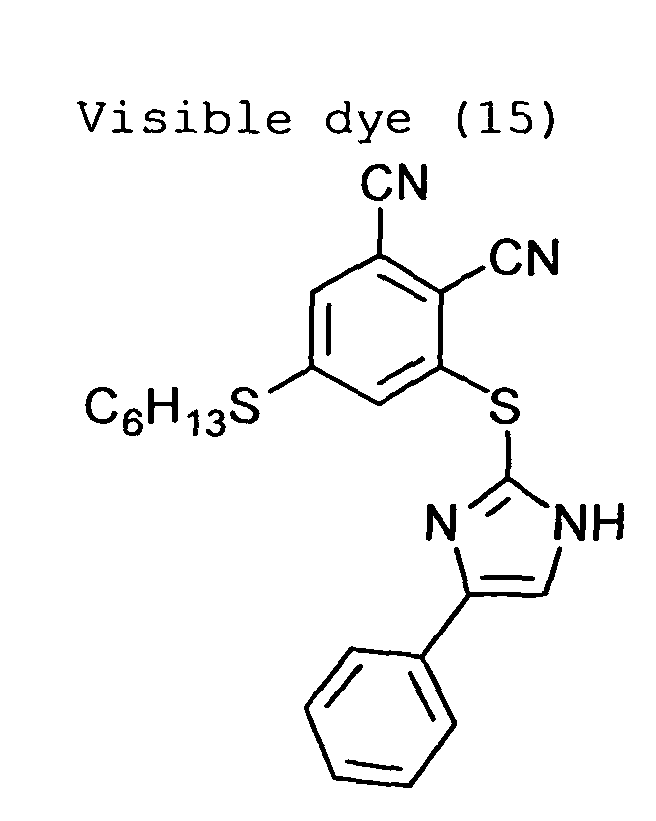
The visible dye preferably is a nitrogen-containing
heterocyclic compound substituted with a 2,3-dicyanophenylthio
group.
The nitrogen-containing heterocyclic ring preferably
is a five-membered ring. The nitrogen-containing heterocyclic
ring preferably is an unsaturated ring, more preferably
is an unsaturated ring having two unsaturated
bonds. One of the two neighboring atoms of the nitrogen
atom in the ring preferably is carbon atom. The 2,3-dicyanophenylthio
group is preferably combined to the
neighboring carbon atom. The other three atoms other
than the above-mentioned nitrogen and carbon atoms preferably
are nitrogen and carbon atoms. A substituent
group can be attached to the carbon atom. Two substituent
group attached to adjacent two carbon atoms can be
combined to form a benzene ring or a six-membered aliphatic
ring. In other words, a benzene ring or a six-membered
aliphatic ring can be condensed with the nitrogen-containing
heterocyclic ring.
A substituent group can be attached to 4-, 5- or 6-posiiton
of the benzene ring contained in the 2,3-dicyanophenylthio
group.
The nitrogen-containing heterocyclic ring, the condensed
benzene ring, the condensed six-membered aliphatic
ring and the benzene ring contained in the 2,3-dicyanophenylthio
group can have a substituent group, as
is described above. Examples of the substituent groups
include a halogen atom, cyano, nitro, hydroxyl, mercapto,
formyl, carboxyl, amino, carbamoyl, an aliphatic group,
an aromatic group, a heterocyclic group, -O-R, -S-R, -CO-R,
-CO-O-R, -NH-R, -N(-R)2, -CO-NH-R, -CO-N(-R)2. R is an
aliphatic group, an aromatic group or a heterocyclic
group.
In the present specification, the aliphatic group
means an alkyl group, a substituted alkyl group, an alkenyl
group, a substituted alkenyl group, an alkynyl
group or a substituted alkynyl group. The aliphatic
group preferably is the alkyl group, the substituted alkyl
group, the alkenyl group or the substituted alkenyl
group, and more preferably is the alkyl group, the substituted
alkyl group.
The aliphatic group can have a cyclic or branched
structure. The aliphatic group preferably has 1 to 100
carbon atoms, more preferably has 1 to 50 carbon atoms,
further preferably has 1 to 30 carbon atoms, furthermore
preferably has 1 to 20 carbon atoms, and most preferably
has 1 to 15 carbon atoms.
Examples of the substituent groups of the aliphatic
group (the substituted alkyl group, the substituted alkenyl
group or the substituted alkynyl group) include a
halogen atom, cyano, nitro, hydroxyl, mercapto, formyl,
carboxyl, amino, carbamoyl, sulfo, sulfamoyl, an aromatic
group, a heterocyclic group, -O-R, -S-R, -CO-R, -SO2-R,
-O-CO-R, -CO-O-R, -NH-R, -N(-R)2, -NH-CO-R, -CO-NH-R, -CO-N(-R)2,
-O-SO2-R, -SO2-O-R, -NH-SO2-R, -SO2-NH-R, -SO2-N(-R)2.
R is an aliphatic group, an aromatic group or a
heterocyclic group.
In the present specification, the aromatic group
means an aryl group or a substituted aryl group. The
aryl group and the aryl moiety of the substituted aryl
group preferably is phenyl or naphthyl, and more preferably
is phenyl.
Examples of the substituent groups of the aromatic
group (the substituted aryl group) include an aliphatic
group in addition to the substituent groups of the aliphatic
group.
In the present specification, the heterocyclic group
means a non-substituted heterocyclic group or a substituted
heterocyclic group. The heterocyclic ring of the
heterocyclic group preferably is four, five, six or
seven-membered ring, more preferably is five or six-membered
ring. The hetero atom of the heterocyclic ring
preferably is nitrogen, oxygen or sulfur. Another heterocyclic
ring, an aliphatic ring or an aromatic ring can
be condensed with the heterocyclic ring.
Examples of the substituent groups of the heterocyclic
group include oxo (=O), thio (=S) and imino (=NH or
=N-R, wherein R is an aliphatic group, an aromatic group
or a heterocyclic group) in addition to the substituent
groups of the aromatic group.
The nitrogen-containing heterocyclic compound substituted
with a 2,3-dicyanophenylthio group is disclosed
in Japanese Patent Provisional Publication No. 7(1995)-2874.
Examples of the nitrogen-containing heterocyclic
compounds substituted with a 2,3-dicyanophenylthio group
are shown below.
The absorption maximum of the nitrogen-containing
heterocyclic compound substituted with a 2,3-dicyanophenylthio
group can be shifted by an intramolecular
cyclization reaction.
In the intramolecular cyclization reaction, the two
cyano groups contained in the phenylthio group are combined
with each other to form an iminopyrrole ring. Further,
the cyano group at the 2-position is combined with
nitrogen atom of the nitrogen-containing heterocyclic
ring to form a heterocyclic ring containing nitrogen and
sulfur atoms (e.g., 1,3-thiazine ring). Therefore, a
tetracyclic condensed ring is formed at the intramolecular
cyclization reaction. The tetracyclic condensed ring
comprises the benzene ring contained in the original
phenylthio group (1), the formed iminopyrrole ring (2),
the formed heterocyclic ring containing nitrogen and sulfur
atoms (3) and the original nitrogen-containing heterocyclic
ring (4). The benzene ring contained in the
original phenylthio group (1) is condensed with the
formed iminopyrrole ring (2) and the formed heterocyclic
ring containing nitrogen and sulfur atoms (3). The
formed iminopyrrole ring (2) is condensed with the benzene
ring contained in the original phenylthio group (1)
and the formed heterocyclic ring containing nitrogen and
sulfur atoms (3). The formed heterocyclic ring containing
nitrogen and sulfur atoms (3) is condensed with the
original phenylthio group (1), the formed iminopyrrole
ring (2) and the original nitrogen-containing heterocyclic
ring (4). The original nitrogen-containing heterocyclic
ring (4) is condensed with the formed iminopyrrole
ring (2), the formed heterocyclic ring containing nitrogen
and sulfur atoms (3).
The image-forming layer contains the visible dye
preferably in an amount of 1 to 20 wt.%, and more preferably
in an amount of 1 to 10 wt.%. The visible dye can
be contained in another optional layer (e.g., overcoating
layer) in addition to the image forming layer.
In the case that the image-forming layer comprises
microcapsules, the visible dye can be contained in the
microcapsules. The dye can also be arranged outside the
microcapsules.
[Lithographic process and image forming layer]
The lithographic printing process can be classified
into five embodiments.
The first embodiment comprises the steps of:
The image-forming layer of the first embodiment can
be formed by using a hydrophilic polymer having a carboxyl
group that can be decarboxylated (e.g., a group
corresponding to α-sulfonylacetic acid) described in
Japanese Patent Provisional Publication No. 2000-122272.
The image-forming layer of the first embodiment can
be a thermally cross-linkable layer comprising an acid
precursor (such as a potential Brønsted acid or s-triazine
compound), a cross-linking agent (rezol resin)
and a binder (not cross-linked polymer) in addition to
the infrared absorbing agent (as is described in Japanese
Patent Provisional Publication Nos. 7(1995)-20629,
7(1995)-271029).
The image-forming layer of the first embodiment can
also be a light-sensitive layer comprising a hydrophilic
resin in which thermally plastic hydrophobic polymer fine
particles are dispersed. The layer is scanned with an
infrared laser beam to fuse the thermally plastic hydrophobic
polymer fine particles to form an image. The non
image area can be removed on a press machine by supplying
dampening water or an ink while mounting the plate on the
press machine (describe in Japanese Patent No. 2938397).
The second embodiment comprises the steps of:
The image-forming layer of the second embodiment can
be formed by using a polymer that can be aggregated (such
as novolak resin). After heating the polymer, the solubility
of the polymer increased. A positive image can be
formed by the formed difference in solubility (described
in Japanese Patent Publication No. 46(1971)-27919 and
Japanese Patent Provisional Publication No. 7(1995)-285275).
The third embodiment comprises the steps of:
The image forming layer of the third embodiment can
be formed by using a hydrophilic polymer having a carboxyl
group that can be decarboxylated (e.g., a group
corresponding to α-sulfonylacetic acid) described in
Japanese Patent Provisional Publication No. 2000-122272.
The hydrophilic polymer is preferably cross-linked or
used in combination with a cross-linked polymer.
The fourth embodiment comprises the steps of:
The image forming layer of the third embodiment can
be formed by using a hydrophobic polymer having a sulfonimido,
disulfone or a sulfonate ester group (described
in Japanese Patent Provisional Publication Nos. 10(1998)-282642,
10(1998)-282644, 10(1998)-282646 and 10(1998)-282672).
The polymer is changed to a hydrophilic polymer
having a sulfo group by heating the polymer. The hydrophobic
polymer is preferably cross-linked or used in combination
with a cross-linked polymer.
The fifth embodiment comprises the steps of:
The ink-receiving layer and the hydrophilic layer of
the fifth embodiment is described in International Patent
Application Nos. 94/18005, 98/40212 and 99/19143). A water-soluble
or hydrophilic overcoating layer can be provided
on the hydrophilic layer to prevent abrasion dust
from scattering (as is described in Japanese Patent Provisional
Publication Nos. 2001-096936 and 2002-086946).
[Infrared absorbing agent]
A presensitized lithographic plate is preferably exposed
to infrared light by scanning the plate with an infrared
laser bean having a wavelength of 760 to 1,200 nm.
Accordingly, an infrared absorbing agent preferably has a
function of absorbing the infrared laser bean having a
wavelength of 760 to 1,200 nm.
The infrared absorbing agent can further have a
function of converting light to heat. The formed thermal
energy can decompose a polymerization initiator (a radical
precursor) to form a radical, which further causes a
polymerization reaction.
The infrared absorbing agent can further have another
function as an infrared sensitizer, which can convert
light to a chemical energy, which excites a polymerization
initiator to cause a polymerization reaction.
The infrared absorbing agent can have two or more
above-mentioned functions.
The infrared absorbing agent preferably is an infrared
absorbing dye. The infrared absorbing agent is commercially
available. The infrared absorbing dyes are described
in "Handbook of Dyes (written in Japanese)",
1970, edited by Association of Organic Synthetic Chemistry.
Examples of the infrared absorbing dyes include azo
dyes, metal complex salt azo dyes, pyrazolone azo dyes,
naphthoquinone dyes (described in Japanese Patent Provisional
Publication Nos. 58(1983)-112793, 58(1983)-224793,
59(1984)-48187, 59(1984)-73996, 60(1985)-52940 and
60(1985)-63744), anthraquinone dyes, phthalocyanine dyes
(described in Japanese Patent Provisional Publication No.
11(1999)-235883), squarilium dyes (described in Japanese
Patent Provisional Publication No. 58(1983)-112792),
pyrylium dyes (U.S. Patent Nos. 3,881,924, 4,283,475,
Japanese Patent Provisional Publication Nos. 57(1982)-142645,
58(1983)-181051, 58(1983)-220143, 59(1984)-41363,
59(1984)-84248, 59(1984)-84249, 59(1984)-146063,
59(1984)-146061, Japanese Patent Publication Nos.
5(1993)-13514 and 5(1993)-19702), carbonium dyes,
quinoneimine dyes and methine dyes (described in Japanese
Patent Provisional Publication Nos. 58(1983)-173696,
58(1983)-181690 and 58(1983)-194595).
Methine dyes are preferred. Cyanine dyes (described
in British Patent No. 434,875, U.S. Patent No. 4,973,572,
Japanese Patent Provisional Publication Nos. 58(1983)-125246,
59(1984)-84356, 59(1984)-216146 and 60(1985)-78787)
are more preferred.
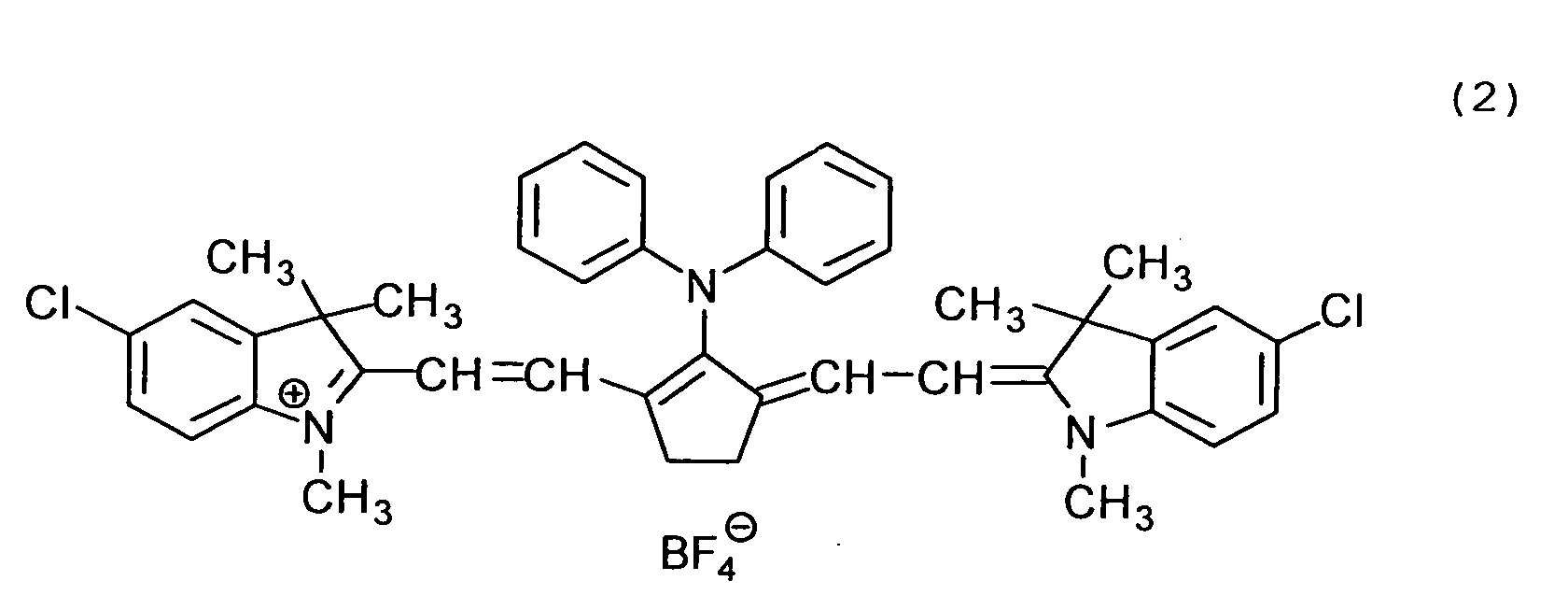
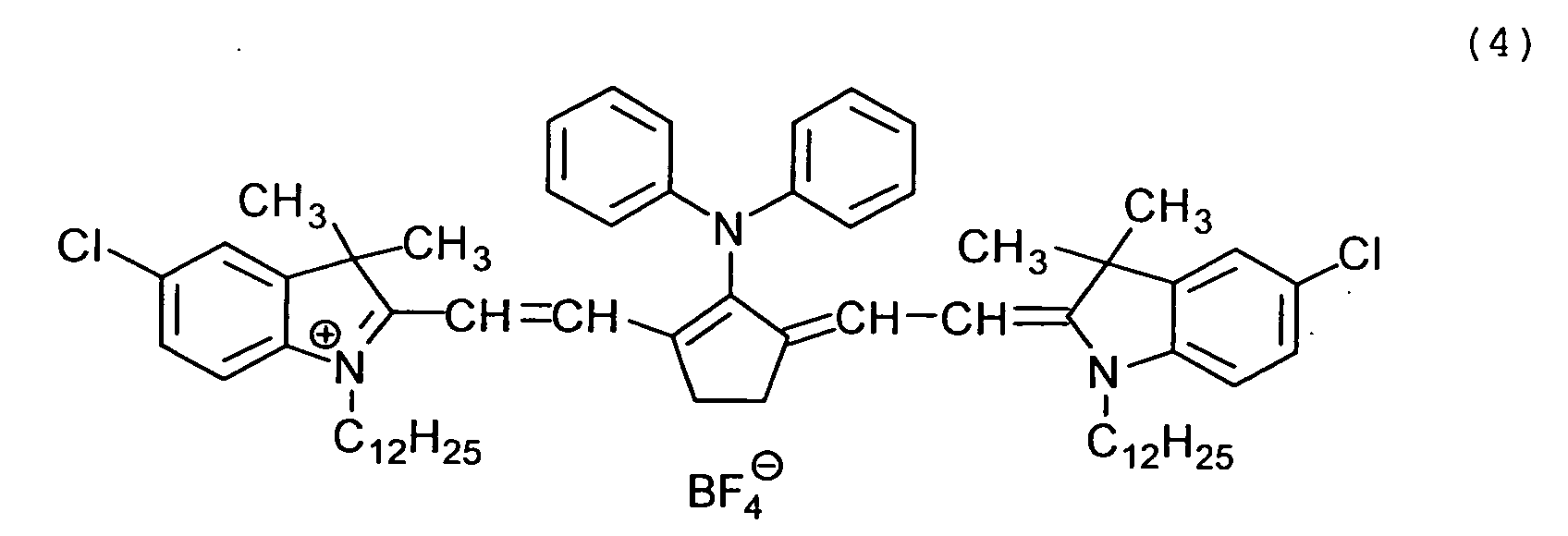
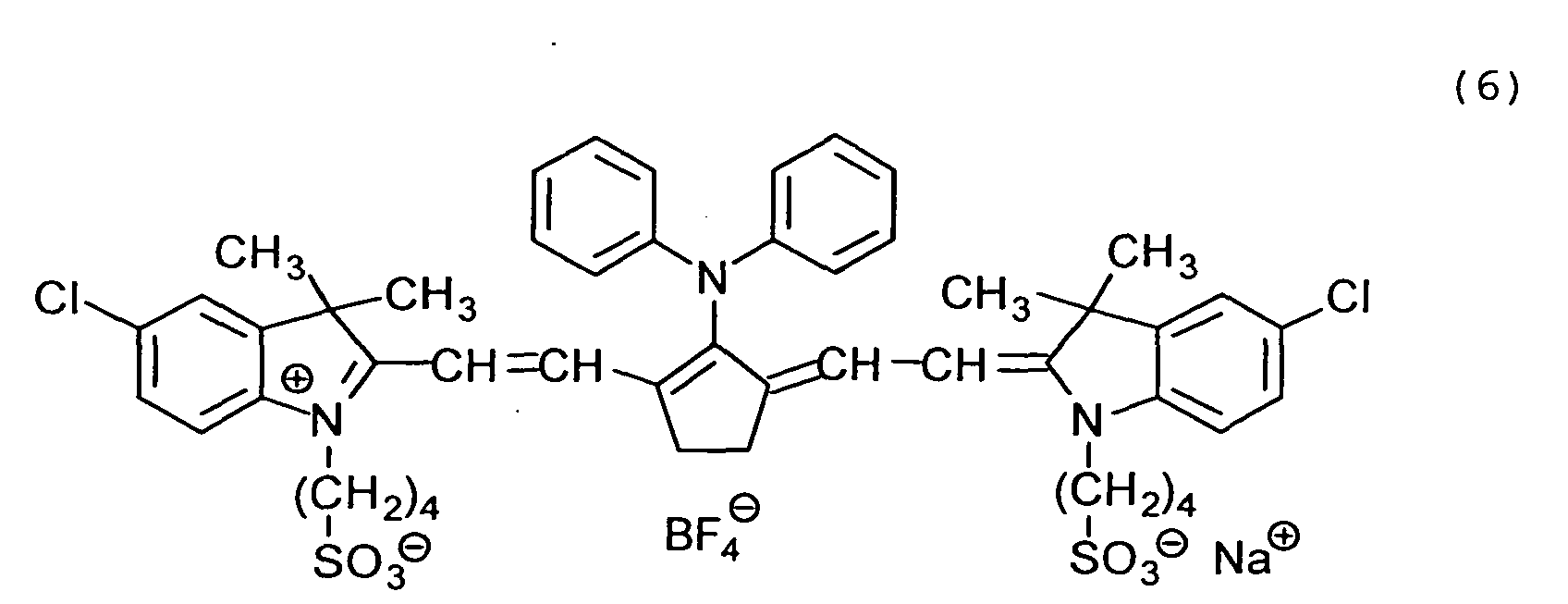
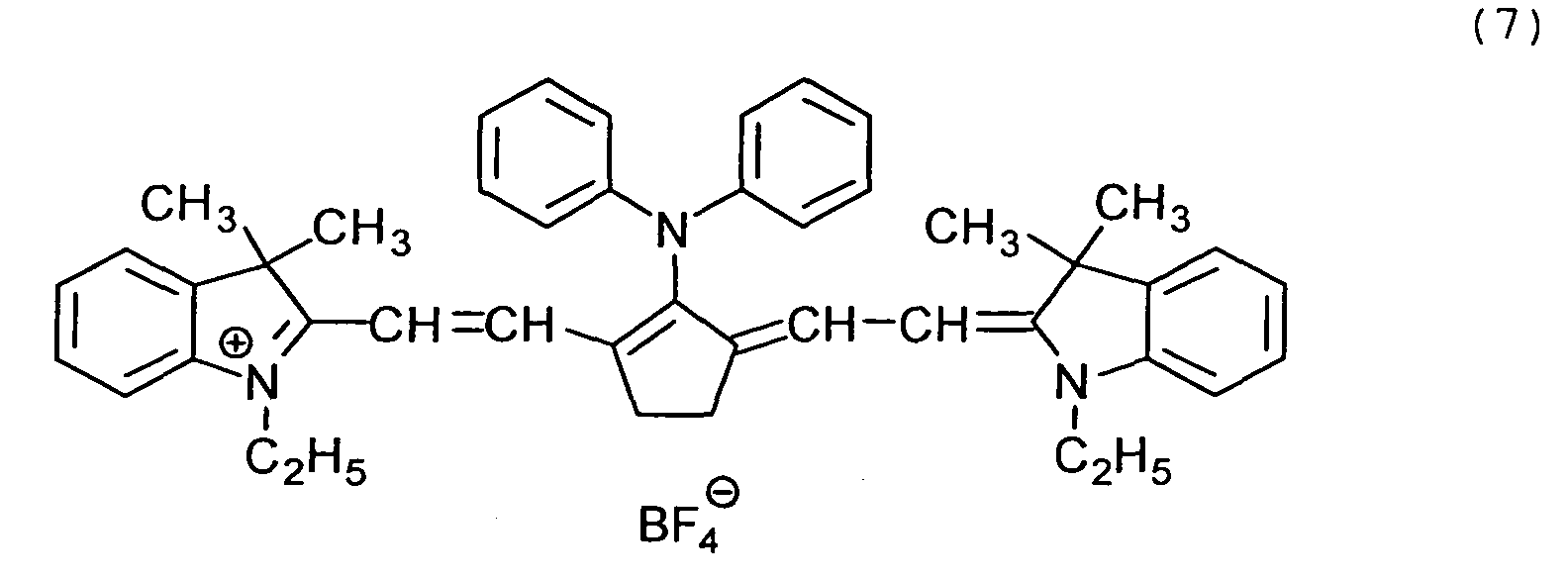
The cyanine dye is defined by the following formula.
(Cyanine dye) Bo-Lo=Bs
In the formula, Bs is a basic nucleus, Bo is an
onium form of a basic nucleus, and Lo is a methine chain
consisting of an odd number of methines.
In the infrared absorbing methine dye, Lo preferably
is a methine chain consisting of seven methines.
The centered methine (at the meso-position) can have
a substituent group. Examples of the substituent groups
include a halogen atom, diphenylamino, -O-R, -S-R, -NH-R
and 1-pyridinio.
R is an aliphatic group (preferably has 1 to 12 carbon
atoms), an aromatic group (preferably has 6 to 12
carbon atoms) and a heterocyclic group (preferably has 1
to 12 carbon atoms).
The 1-pyridinio group can have a substituent group
or a counter anion. Examples of the substituent groups
include an alkyl group, an aryl group, amino, a substituted
amino group and a halogen atom. Examples of the
counter anions include a halide ion, a perchlorate ion,
tetrafluoroborate ion, hexafluorophosphate ion and an
arylsulfonate ion,
The two methins neighboring the centered methine (at
the meso-position) can have a substituent group such as a
hydrocarbon (aliphatic or aromatic) group having 1 to 12
carbon atoms. The two substituent group can be combined
to form a five-membered or six-membered ring.
The other methines of the methine chain may have a
substituent group, such as a hydrocarbon (aliphatic or
aromatic) group having 1 to 12 carbon atoms. However,
the other methines preferably have no substituent groups.
Each of the two basic nuclei preferably has a five-membered
heterocyclic ring containing at least one nitrogen
atom. A hydrocarbon (aliphatic or aromatic) group is
preferably attached to the nitrogen atom. The hydrocarbon
group can have a substituent group. Examples of the
substituent groups include an alkoxy group having 1 to 12
carbon atoms, carboxyl and.sulfo.
The five-membered heterocyclic ring having at least
one nitrogen atom (in which the nitrogen atom is the 1-position)
preferably attached to the methine chain at the
1-position of the heterocyclic ring. The five-membered
heterocyclic ring having at least one nitrogen atom preferably
has sulfur atom or carbon atom substituted with
two alkyl groups having 1 to 12 carbon atoms (dimethyl-methylene)
at 3-position. The five-membered heterocyclic
ring having at least one nitrogen atom is preferably condensed
with an aromatic ring (e.g., benzene ring, naphthalene
ring). The aromatic ring is preferably condensed
between 4-position and 5-position of the five membered
ring. The aromatic ring can have a substituent group.
Examples of the substituent groups include a hydrocarbon
(aliphatic or aromatic) group, a halogen atom, an alkoxy
group having 1 to 12 carbon atoms, an acyl group and a
halogenated alkyl group having 1 to 12 carbon atoms.
The cyanine dye can have a counter anion. The molecular
structure of the cyanine dye can have an anionic
group as a substituent group in place of the counter anion.
Examples of the counter anions include a halide
ion, perchlorate ion, tetrafluoroborate ion, hexafluorophosphate
ion and a sulfonate ion. Perchlorate ion,
hexafluorophosphate ion and an arylsulfonate ion are preferred.
Examples of the cyanine dyes are shown below.
An infrared absorbing pigment can be used as an infrared
absorbing agent.
The pigments are described in "Handbook of Color Index
(CI)", "Latest Handbook of pigments (written in Japanese)",
1977, edited by Japan Association of Pigment
Technology, "Latest Application Technology of Pigment
(written in Japanese)", 1986, published by CMC, and
"Technology of Printing Ink (written in Japanese)", 1984,
published by CMC.
Pigments include black pigments, yellow pigments,
orange pigments, brown pigments, red pigments, purple
pigments, blue pigments, green pigments, fluorescent pigments,
metallic powder pigments, polymer combined pigments,
azo lake pigments, condensed azo pigments, chelate
azo pigment, phthalocyanine pigments, anthraquinone pigments,
perylene pigments, perinone pigments, thioindigo
pigments, quinacridone pigments, dioxazine pigments, iso-indolinone
pigments, quinophthalone pigments, dyed lake
pigments, azine pigments, nitroso pigments, nitro pigments,
natural pigments, inorganic pigments and carbon
black. Carbon black is the most preferred infrared absorbing
pigment.
The infrared absorbing pigment can be subjected to a
surface treatment. Examples of the surface treatments
include a process of coating the surface with a resin or
a wax, a process of attaching a surface active agent to
the surface, a process of combining the pigment surface
with a reactive substance (e.g., silane coupling agent,
an epoxy compound, a polyisocyanate). The surface treatment
is described in "Characteristics and Applications of
Metal Soap (written in Japanese)", edited by Saiwai-Shobo,
"Technology of Printing Ink (written in Japanese)",
1984, published by CMC, and "Latest Application
Technology of Pigment (written in Japanese)", 1986, published
by CMC.
The pigment has an average particle size preferably
in the range of 0.01 to 10 µm, more preferably in the
range of 0.05 to 1 µm, and most preferably in the range
of 0.1 to 1 µm. The average particle size is so adjusted
to improve stability of the pigment particles in a coating
solution or to form a uniform layer.
The pigments can be dispersed by a known dispersing
method, which is usually used in preparation of ink or
toner. The dispersing machines include an ultrasonic
dispersing machine, a sand mill, an Attritor, a pearl
mill, a super mill, a ball mill, an impeller, a disperser,
a KD mill, a colloid mill, Dynatron, a three-rolls
mill and a pressure needer. The dispersing method
is described in "Latest Application Technology of Pigment
(written in Japanese)", 1986, published by CMC.
The image-forming layer contains the infrared absorbing
agent preferably in an amount of 0.1 to 20 wt.%,
and more preferably in an amount of 1 to 10 wt.% based on
the total amount of the image-forming layer.
The image-forming layer can comprises two or more
layers, one of which can contain the infrared absorbing
agent, and the other of which can contain the other components,
such as a polymerization initiator, a polymerizable
compound and a binder polymer.
The absorption at the maximum absorption wavelength
(within the wavelength region of 760 to 1,200 nm) is
preferably adjusted in the range of 0.3 to 1.2, and more
preferably in the range of 0.4 to 1.1 measured according
to a reflection method. The absorption is adjusted to
conduct uniform polymerization reaction throughout the
image-forming layer along the thickness direction, which
improve membrane strength of the image area and adhesion
between the support and the image area.
The absorption of the image-forming layer can be
controlled by adjusting the amount of the infrared absorbing
agent and the thickness of the image-forming
layer. The absorption can be determined according to a
conventional method. For example, the absorption can be
determined by forming an image-forming layer (having a
thickness adjusted to a dry thickness required in a
lithographic plate) on a reflective support (such as an
aluminum plate); and measuring the reflection density by
a densitometer. The absorption can also be measured by a
spectrophotometer according to a reflection method using
an integrated sphere.
[Thermally fusible polymer particles]
The image-forming layer of the first and third embodiments
can contain thermally fusible polymer particles.
The thermally fusible polymer of the particles has a
main chain such as a hydrocarbon (polyolefin), a polyester,
polyamide, polyimide, polyurea, polyurethane, polyether
or a combination thereof. The main chain preferably
is the hydrocarbon or the polyurethane.
The main chain of the thermally fusible polymer can
have a substituent group. Examples of the substituent
groups include a halogen atom (F, Cl, Br, I), hydroxyl,
mercapto, formyl, amino, carboxyl, carbamoyl, sulfo, sulfamoyl,
phosphono, cyano, an aliphatic group, an aromatic
group, a heterocyclic group, -O-R, -S-R, -CO-R, -NH-R,
-N(-R)2, -CO-O-R, -O-CO-R, -CO-NH-R, -NH-CO-R, -SO2-R,
-SO2-O-R, -O-SO2-R, -SO2-NH-R, -NH-SO2-R, -P(=O)(-O-R)2.
R is an aliphatic group, an aromatic group or a heterocyclic
group. The acidic group or the basic group can be
dissociated or in the form of a salt with a counter ion.
Two or more substituent groups of the main chain can
be combined to form an aliphatic ring or a heterocyclic
ring. The formed ring can be combined to the main chain
by a spiro bond. The formed ring can have a substituent
group. Examples of th substituent groups include oxo and
thio in addition to the substituent groups of the main
chain.
The thermally fusible polymer has a weight average
molecular weight preferably in the range of 500 to
1,000,000, more preferably in the range of 1,000 to
500,000, further preferably in the range of 2,000 to
200,000, and most preferably in the range of 5,000 to
100,000.
The thermally fusible polymer is contained in the
image-forming layer preferably in an amount of 5 to 90
wt.%, and more preferably in an amount of 30 to 80 wt.%.
The thermally fusible polymer is preferably prepared
according to an emulsion polymerization reaction to form
particles of the thermally fusible polymer. In the emulsion
polymerization reaction, the particles are formed
simultaneously with synthesis of the polymer. Conditions
for emulsion polymerization reaction are the same as the
usual conditions for preparation of latex.
A surface active agent is preferably used in the
emulsion polymerization reaction to form uniform particles.
The surface active agents include a cationic surface
active agent, an anionic surface active agent, a
nonionic surface active agent and an amphoteric surface
active agent. The amount of the surface active agent is
preferably in the range of 0.01 to 10 wt.% based on the
amount of the monomer.
The polymerization reaction is preferably conducted
by using a polymerization initiator (a chain transfer
agent). The amount of the polymerization initiator is
preferably in the range of 0.05 to 10 wt.% based on the
amount of the monomer.
The thermally fusible polymer particles can also be
prepared by dissolving the thermally fusible polymer in
an organic solvent (which preferably is not miscible with
water), emulsifying the dispersion in an aqueous solution
of a dispersing agent, and heating the emulsion to remove
the solvent and to solidify the polymer as a particle.
The particles have a particle size preferably in the
range of 5 to 500 nm, and more preferably in the range of
10 to 300 nm. The particle size distribution is preferably
uniform.
Two or more fine particles can be used in combination.
[Hydrophilic compound]
In the case that the image-forming layer contains
particles or microcapsules, the image-forming layer preferably
contains a hydrophilic compound as a binder of the
particles or the microcapsules.
The hydrophilic compound preferably is a polymer.
The hydrophilic polymer preferably has hydroxyl, carboxyl,
sulfo, amino, or amido as a hydrophilic group.
Carboxyl and sulfo can be in the form of salt.
Various natural, semi-synthetic or synthetic polymers
can be used as the hydrophilic polymer.
Examples of the natural or semi-synthetic polymers
include polysaccharides (e.g., gum arabic, starch derivatives,
carboxymethyl cellulose, sodium salt thereof, cellulose
acetate, sodium alginate) and proteins (e.g., casein,
gelatin).
Examples of the synthetic polymers having hydroxyl
as the hydrophilic group include polyhydroxyethyl
methacrylate, polyhydroxyethyl acrylate, polyhydroxypropyl
methacrylate, polyhydroxypropyl acrylate, polyhydroxybutyl
methacrylate, polyhydroxybutyl acrylate,
polyallylalcohol, polyvinylalcohol and poly-N-methylolacrylamide.
Examples of the synthetic polymers having carboxyl
as the hydrophilic group include polymaleic acid, polyacrylic
acid, polymethacrylic acid and salts thereof.
Examples of the synthetic polymers having other hydrophilic
groups (e.g., amino, many ether bonds, hydrophilic
heterocyclic groups, amido, sulfo) include polyethylene
glycol, polyvinyl formal, polyvinyl butyral,
polyvinylpyrrolidone, polyacrylamide, polymethacrylamide,
poly(2-acrylamido-2-methylpropanesuldonic acid) and a
salt thereof.
The hydrophilic polymer can be a copolymer comprising
two or more hydrophilic repeating units of the above-mentioned
hydrophilic synthetic polymers. The hydrophilic
polymer can also be a copolymer comprising the hydrophilic
repeating unit and a hydrophobic repeating unit
(for example, repeating units of polyvinyl acetate or
polystyrene). Examples of the copolymers include vinyl
acetate-maleic acid copolymer, styrene-maleic acid copolymer
and vinyl alcohol-vinyl acetate copolymer (partially
saponified polyvinyl acetate). In the case where
polyvinyl acetate is partially saponified into the vinyl
alcohol-vinyl acetate copolymer, the saponification degree
preferably is not less than 60%, and more preferably
is not less than 80%.
Two or more hydrophilic polymers can be used in combination.
The image-forming layer contains the hydrophilic
polymer preferably in an amount of 2 to 40 wt.%, and more
preferably in an amount of 3 to 30 wt.%.
A hydrophilic compound of a low molecular weight
(not polymer) can be used in place of or in addition to
the hydrophilic polymer.
The hydrophilic compound of a low molecular weight
preferably is a surface active agent. The surface active
agents include a nonionic surface active agent (described
in Japanese Patent Provisional Publication Nos. 62(1987)-251740,
3(1991)-208514), an anionic surface active agent,
a cationic surface active agent (described in Japanese
Patent Provisional Publication No. 2(1990)-195356), an
amphoteric surface active agent (described in Japanese
Patent Provisional Publication Nos. 59(1984)-121044,
4(1992)-13149) and a fluorine surface active agent.
The image-forming layer contains the hydrophilic
compound of a low molecular weight preferably in an
amount of 0.05 to 15 wt.%, and more preferably in an
amount of 0.1 to 5 wt.%.
[Polymerizable compound]
The polymerizable compound can be in the form of a
polymer, which is a cross-linkable polymer having a polymerizable
group as a cross-likable functional group.
The polymerizable compound preferably has two or
more polymerizable functional groups.
The polymerizable functional group can be reacted by
heat to be polymerized. A heat-sensitive precursor of a
compound accelerating the polymerization reaction (e.g.,
acid) can be used in combination with a polymerizable
compound (e.g., a vinyl ether or a cyclic ether). Further,
a thermal polymerization initiator (a radical precursor)
can be used in combination with a polymerizable
compound (ethylenically unsaturated polymerizable compound).
The combination of the heat-sensitive acid precursor
and the vinyl ether or the cyclic ether is described in
Japanese Patent Provisional Publication No. 2001-277740,
2002-46361 and 2002-29162.
The combination of the thermal polymerization initiator
(a thermal radical precursor) and the ethylenically
unsaturated polymerizable compound is described in
Japanese Patent Provisional Publication No. 2002-137562.
The cyclic ether preferably is a compound having a
three-membered epoxy group. The compound preferably has
two or more cyclic ether groups. A commercially available
epoxy compound or epoxy resin can be used as the polymerizable
compound.
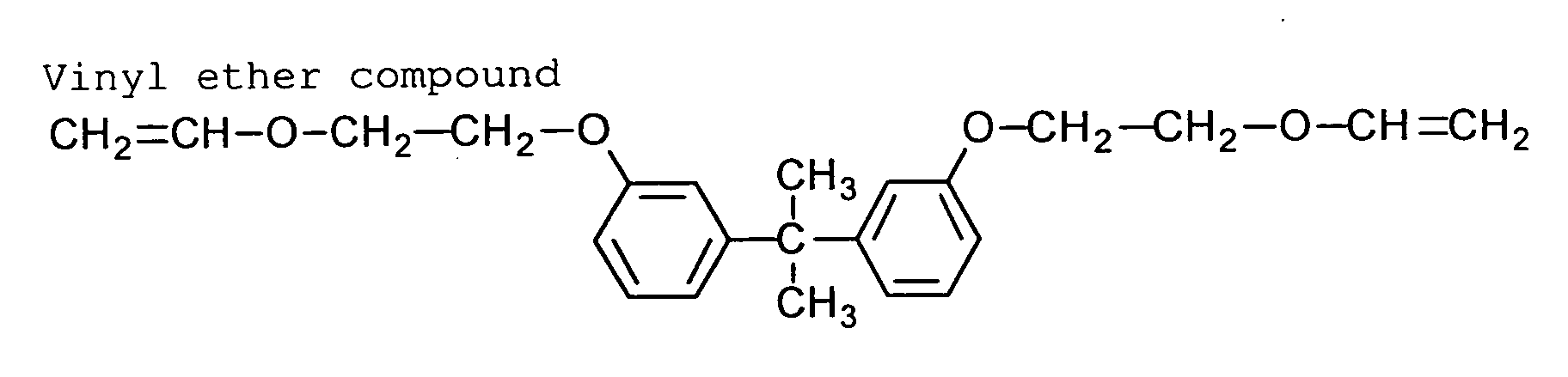
The vinyl ether preferably has two or more vinyl
ether groups. The vinyl ether is preferably represented
by the formula (XI).
(XI) L4(-O-CR5=CR6R7)m
In the formula (XI), L4 is an m-valent linking group,
and m is an integer of 2 or more. Each of R5, R6 and R7
independently is hydrogen, a halogen atom, an alkyl group
or an aryl group.
In the case that m is 2, L4 preferably is a divalent
linking group selected from the group consisting of an
alkylene group, a substituted alkylene group, an arylene
group, a substituted arylene group, a divalent heterocyclic
group, -O-, -S-, -NH-, -CO-, -SO-, -SO2- and a combination
thereof.
The alkylene group and the alkylene moiety of the
substituted alkylene group can have a cyclic or branched
structure. The alkylene group and the alkylene moiety of
the substituted alkylene group preferably have 1 to 20
carbon atoms, more preferably has 1 to 15 carbon atoms,
further preferably has 1 to 10 carbon atoms, and most
preferably has 1 to 8 carbon atoms.
Examples of the substituent groups of the substituted
alkylene group include a halogen atom, an aryl
group, a substituted aryl group and an alkoxy group.
The arylene group and the arylene moiety of the substituted
arylene group preferably is phenylene, and more
preferably is p-phenylene.
The divalent heterocyclic group can have a substituent
group.
Examples of the substituent groups of the substituted
arylene group, the substituted aryl group and the
substituted heterocyclic group include a halogen atom, an
alkyl group, a substituted alkyl group, an aryl group, a
substituted aryl group and an alkoxy group.
Examples of the substituent groups of the
substituted alkyl group are the same as the examples of
the substituent groups of the substituted alkylene group.
In the case the m is 3 or more, L4 preferably is a
trivalent or more aliphatic group, a trivalent or more
aromatic group, a trivalent or more heterocyclic group,
or a combination of a trivalent or more aliphatic group,
a trivalent or more aromatic group or a trivalent or more
heterocyclic group with an alkylene group, a substituted
alkylene group, an arylene group, a substituted arylene
group, a divalent heterocyclic group, -O-, -S-, -NH-,
-CO-, -SO- or -SO2-.
The trivalent or more aliphatic group can have a cyclic
or branched structure. The aliphatic preferably has
1 to 20 carbon atoms, more preferably has 1 to 15 carbon
atoms, further preferably has 1 to 10 carbon atoms, and
most preferably has 1 to 8 carbon atoms.
The aliphatic group can have a substituent group.
Examples of the substituent groups include a halogen atom,
an aryl group, a substituted aryl group and an alkoxy
group.
The aromatic group preferably is a residue (a radical)
of benzene ring. The aromatic group can have a substituent
group. Examples of the substituent groups include
a halogen atom, an alkyl group, a substituted alkyl
group, an aryl group, a substituted aryl group and an
alkoxy group.
The heterocyclic group can have a substituent group.
Examples of the substituent groups include a halogen atom,
an alkyl group, a substituted alkyl group, an aryl group,
a substituted aryl group and an alkoxy group.
L4 can form a main chain of a polymer comprising
repeating units, in which m is a number of the repeating
units.
Each of R5, R6 and R7 preferably is hydrogen, a halogen
atom or an alkyl group, more preferably is hydrogen,
a halogen atom or an alkyl group having 1 to 6 carbon atoms,
further preferably is hydrogen or an alkyl group
having 1 to 3 carbon atoms, furthermore preferably is hydrogen
or methyl, and most preferably is hydrogen.
The ethylenically unsaturated polymerizable compound
preferably has two or more ethylenically unsaturated
groups. The ethylenically unsaturated polymerizable compound
is preferably represented by the formula (XII).
(XII) L4(-CR5=CR6R7)m
In the formula (XII), L4 is an m-valent linking
group, and p is an integer of 2 or more. Each of R5, R6
and R7 independently is hydrogen, a halogen atom, an alkyl
group or an aryl group.
The definitions and examples of L4, m, R5, R6 and R7
are the same as L4, m, R5, R6 and R7 in the formula (XI).
Two or more polymerizable compounds can be used in
combination.
The polymerizable compound is contained in the image-forming
layer preferably in an amount of 5 to 80
wt.%, and more preferably in an amount of 25 to 75 wt.%.
[Heat-sensitive acid precursor]
In the case that a polymerizable compound has a
functional group for a cationic polymerization reaction
(such as a vinyl ether or a cyclic ether), the image-forming
layer preferably further comprises a heat-sensitive
acid precursor.
The heat-sensitive acid precursor is a compound capable
of releasing an acid when the compound is heated.
The formed acid can initiate or accelerate a polymerization
reaction of a vinyl ether or a cyclic ether.
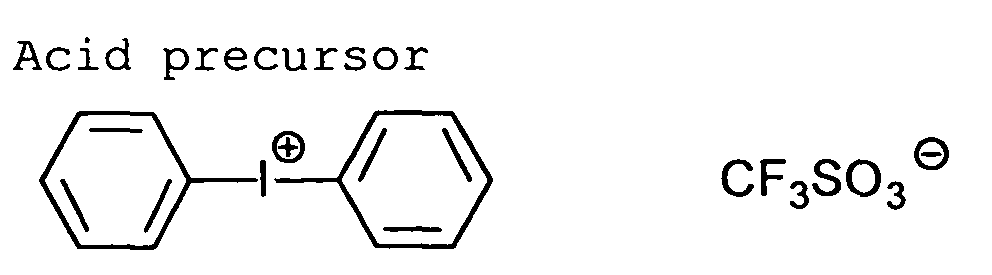
The heat-sensitive acid precursor preferably is an
onium salt.
Examples of the heat-sensitive acid precursors include
a diazonium salt (described in S.I. Schlesinger,
Photogr. Sci. Eng., 18, 387 (1974), and T.S. Bal et al,
Polymer, 21, 423 (1980)), an ammonium salt (described in
U.S. Patent Nos. 4,069,055, 4,069,056, Reissued U.S. Patent
No. 27,992 and Japanese Patent Provisional Publication
No. 4(1992)-365049), a phosphonium salt (described
in D.C. Necker et al, Macromolecules, 17, 2468 (1984),
C.S. Wen et al, Teh, Proc. Conf. Rad, Curing ASIA, p478
Tokyo, Oct (1988), U.S. Patent Nos. 4,069,055 and
4,069,056), an iodonium salt (described in J.V. Crivello
et al, Macromorecules, 10(6), 1307 (1977), Chem. & Eng.
News, Nov. 28, p31 (1988), European Patent No. 104142,
U.S. Patent Nos. 4,339,049, 4,410,201, and Japanese Patent
Provisional Publication Nos. 2(1990)-150848 and
2(1990)-296514), a sulfonium salt (J.V. Crivello et al,
Polymer J. 17, 73 (1985), J.V. Crivello et al, J. Org.
Chem., 43, 3055 (1978), W.R. Watt et al, J. Polymer Sci.,
Polymer Chem. Ed., 22, 1789 (1984), J.V. Crivello et al,
Polymer Bull., 14, 279 (1985), J.V. Crivello et al, Macromolecules,
14(5), 1141 (1981), J.V. Crivello et al, J.
Polymer Sci., Polymer Chem. Ed., 17, 2877 (1979), European
Patent Nos. 370693, 390214, 233567, 297443, 297442,
U.S. Patent Nos. 4,933,377, 4,161,811, 4,410,201,
4,339,049, 4,760,013, 4,734,444, 2,833,827, German Paten
Nos. 2,904,626, 3,604,580 and 3,604,581), a selenonium
salt (described in J.V. Crivello et al, Macromolecules,
10(6), 1307 (1977), J.V. Crivello et al, J. Polymer Sci.,
Polymer Chem. Ed., 17, 1047 (1979) and an arsonium salt
(described in C.S. Wen et al, Teh, Proc. Conf. Rad. Curing
ASIA, p478 Tokyo, Oct (1988)).
Examples of counter anions of the onium salts include
BF4 -, PF6 -, AsF6 - and SbF6 -.
Two or more heat-sensitive acid precursors can be
used in combination.
The heat-sensitive acid precursor is used preferably
in an amount of 0.01 to 20 wt.%, and more preferably in
an amount of 0.1 to 10 wt.% based on the total solid
amount of the image-forming layer.
The heat-sensitive acid precursor can be contained
in microcapsules. In the case that the heat-sensitive
acid precursor is contained in the microcapsules, the
heat-sensitive acid precursor is preferably not soluble
in water. In the case that the heat-sensitive acid precursor
is arranged outside the microcapsules, the heat-sensitive
acid precursor is preferably soluble in water.
[Thermal polymerization initiator]
In the case that a polymerizable compound has a
functional group for a radical polymerization reaction
(such as an ethylenically unsaturated polymerizable compound),
the image-forming layer preferably further comprises
a thermal polymerization initiator.
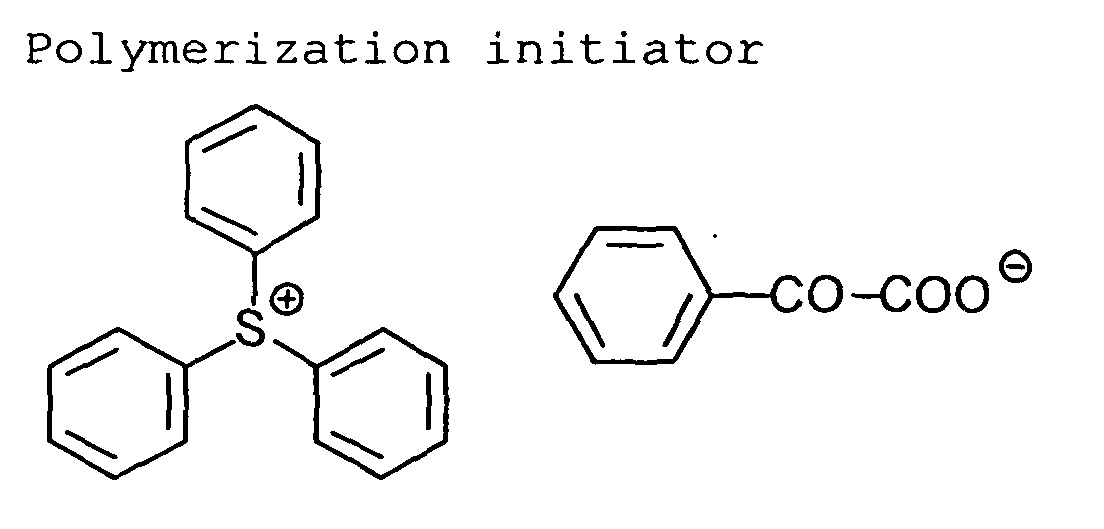
The thermal polymerization initiator is a compound
that releases a radical by a thermal energy to initiate
or accelerate a polymerization of a compound having an
unsaturated polymerizable group. Examples of the thermal
polymerization initiators include an onium salt, a triazine
compound having a trihalomethyl group, a peroxide, an
azo compound, an azido compound, a quinone diazido compound
and a metallocene compound. An onium salt (e.g.,
diazonium salt, iodonium salt, sulfonium salt, ammonium
salt, pyridinium salt) is preferred, an iodonium salt, a
diazonium salt and a sulfonium salt are more preferred.
Two or more thermal polymerization initiators can be
used in combination.
The thermal polymerization initiator (thermal radical
precursor) is described in Japanese Patent Provisional
Publication No. 2002-137562.
The thermal polymerization initiator is used preferably
in an amount of 0.1 to 50 wt.%, and more preferably
in an amount of 0.5 to 30 wt.%, and most preferably
in an amount of 1 to 20 wt.% based on the total solid
amount of the image-forming layer.
The thermal polymerization initiator can be contained
in microcapsules. In the case that the thermal
polymerization initiator is contained in the microcapsules,
the thermal polymerization initiator is preferably
not soluble in water. In the case that the thermal polymerization
initiator is arranged outside the microcapsules,
the thermal polymerization initiator is preferably
soluble in water.
[Microcapsule]
Microcapsules can be dispersed in the image-forming
layer. The microcapsules can contain the polymerizable
compound.
The microcapsules can be prepared according to a
coacervation method (describe in U.S. Patent Nos.
2,800,457, 2,800,458), an interfacial polymerization
method (described in U.S. Patent No. 3,287,154, Japanese
Patent Publication No. 38(1963)-19574, 42(1967)-446), a
polymer precipitation method (described in U.S. Patent
Nos. 3,418,250, 3,660,304), a method using isocyanate-polyol
as wall material (described in U.S. Patent No.
3,796,669), a method using isocyanate as wall material
(described in U.S. Patent No. 3,914,511), a method using
urea-formaldehyde or urea-formaldehyde-resorcinol as wall
material (described in U.S. Patent Nos. 4,001,140,
4,087,376, 4,089,802), a method using melamineformaldehyde
resin or hydroxycellulose as wall material
(described in U.S. Patent No. 4,025,445), an in situ
method of monomer polymerization (described in Japanese
Patent Publication Nos. 36(1961)-9163, 51(1976)-9079), a
spray drying method (described in British Patent No.
930,422, U.S. Patent No., 3,111,407) and an electrophoresis
dispersion cooling method (described in British Patent
Nos. 952,807, 967,074).
The microcapsule shell preferably has a three-dimensional
cross-linking, which can be swelled with a
solvent. The microcapsule shell preferably comprises a
polyurea, a polyurethane, a polyester, a polycarbonate, a
polyamide, a copolymer thereof or a mixture thereof. The
shell more preferably comprises a polyurea, a polyurethane,
a copolymer thereof or a mixture thereof. The
polyurea and the polyurethane are particularly preferred.
A hydrophobic polymer can be used as the microcapsule
shell.
The microcapsules have an average particle size
preferably in the range of 0.01 to 20 µm, more preferably
in the range of 0.05 to 2.0 µm, and most preferably in
the range of 0.10 to 1.0 µm.
The microcapsules can be fused with heat. The contents
of the microcapsules can ooze out or into the shell
of the microcapsules in preparation of the presensitized
lithographic plate. The contents of the microcapsules
can be reacted with a hydrophilic resin or a low molecular
weight compound contained in the image-forming layer.
Two or more different microcapsules can be contained
in the image-forming layer.
The microcapsules are contained in the image-forming
layer preferably in an amount of 10 to 80 wt.%, and more
preferably in an amount of 15 to 60 wt.% based on the total
solid contents of the image-forming layer.
In preparation of the microcapsules, a solvent is
added to microcapsule dispersion. The solvent preferably
swells the microcapsule shell as well as dissolves the
contents of the microcapsules. The solvent having a
function of swelling the microcapsule shell can accelerate
diffusion of the contents into outside the microcapsules.
Examples of the solvents include an alcohol (e.g.,
methanol, ethanol, propanol, t-butanol), an ether (e.g.,
tetrahydrofuran, propylene glycol monomethyl ether, ethylene
glycol diethyl ether, ethylene glycol monomethyl
ether), acetal, an ester (e.g., methyl lactate, ethyl
lactate, γ-butyllactone), a ketone (e.g., methyl ethyl
ketone), a glycol, a polyol, an amide (e.g., dimethylfomamide,
N,N-dimetylacetamide), an amine and an fatty
acid. Two or more solvents can be used in combination.
The solvent is contained in the coating solution of
the image-forming layer preferably in an amount of 5 to
95 wt.%, more preferably in an amount of 10 to 90 wt.%,
and most preferably in an amount of 15 to 85 wt.%.
[Polymer having hydrophilic group convertible to hydrophobic
group]
The image-forming layer of the first and third embodiments
can contain a hydrophilic polymer having a hydrophilic
group that can be converted to a hydrophobic
group when the image-forming layer is heated.
For example, a hydrophilic carboxyl group can be
changed to a hydrophobic hydrocarbon group by heating a
hydrophilic polymer having a carboxyl group that can be
decarboxylated.
The carboxylic acids that can be decarboxylated include
a sulfonylacetic acid, a propionic acid and a dichloroacetic
acid. Therefore, the carboxyl groups that
can be decarboxylated include carboxymethanesulfonyl
group (-SO2-CH2-COOH), carboxyethynyl (-C≡C-COOH) and carboxyldichloromethyl
(-CCl2-COOH). The carboxymethanesulfonyl
group derived from the sulfonylacetic acid is particularly
preferred. Proton can be dissociated from the
carboxyl group. The carboxyl group can form a salt with
a cation.
The two hydrogen atoms contained in the
carboxymethanesulfonyl group can be substituted.
Examples of the substituent groups are the same as the
substituent groups of the aliphatic group (described
aboveThe sulfonyl group (-SO2-) of the carboxymethanesulfonyl
group can be replaced with sulfinyl group (-SO-),
carbonyl group (-CO-), sulfur atom (-S-), oxygen atom (-O-)
or imino group (-NH-). The carboxyl groups formed by
the above-mentioned replacement can also be changed to a
hydrophobic hydrocarbon group by heating.
A sulfonic or phosphoric acid group can also be
changed to a hydrophobic hydrocarbon group by heating.
The hydrophilic group convertible to a hydrophobic
group is preferably contained in a side chain rather than
a main chain of the polymer. The hydrophilic group is
more preferably placed at the end of the side chain. The
side chain, namely the linking group between the hydrophilic
group and the main chain preferably is a divalent
group selected from the group consisting of an alkylene
group, a substituted alkylene group, an arylene group, a
substituted arylene group, a divalent heterocyclic group,
-O-, -S-, -NH-, -CO-, -SO-, -SO2- and a combination
thereof. The definition and examples of the alkylene
group, the substituted alkylene group, the arylene group,
the substituted arylene group and the divalent heterocyclic
group are the same as those of the linking group of
the above-mentioned polymerizable compound.
In the third embodiment, the hydrophilic group convertible
to a hydrophobic group is preferably cross-linked
or used in combination with a cross-linked polymer.
The cross-linking reaction is described below about
the cross-linking polymer.
The main chain of the polymer preferably is hydrocarbon
(polyolefin), polyester, polyamide, polyimide,
polyurea, polyurethane, polyether of a combination
thereof. The hydrocarbon chain is particularly preferred.
The main chain of the polymer can have a substituent
group other than the hydrophilic group convertible to a
hydrophobic group. Examples of the substituent groups
are the same as those of the substituent groups of the
thermally fusible polymer.
The image-forming layer contains a hydrophilic polymer
having a hydrophilic group convertible to a hydrophobic
group preferably in an amount of 10 to 99 wt.%, and
more preferably in an amount of 10 to 95 wt.%.
[Polymer having hydrophobic group convertible to hydrophilic
group]
The image-forming layer of the second and fourth embodiments
can contain a hydrophobic polymer having a hydrophobic
group that can be converted to a hydrophilic
group when the image-forming layer is heated.
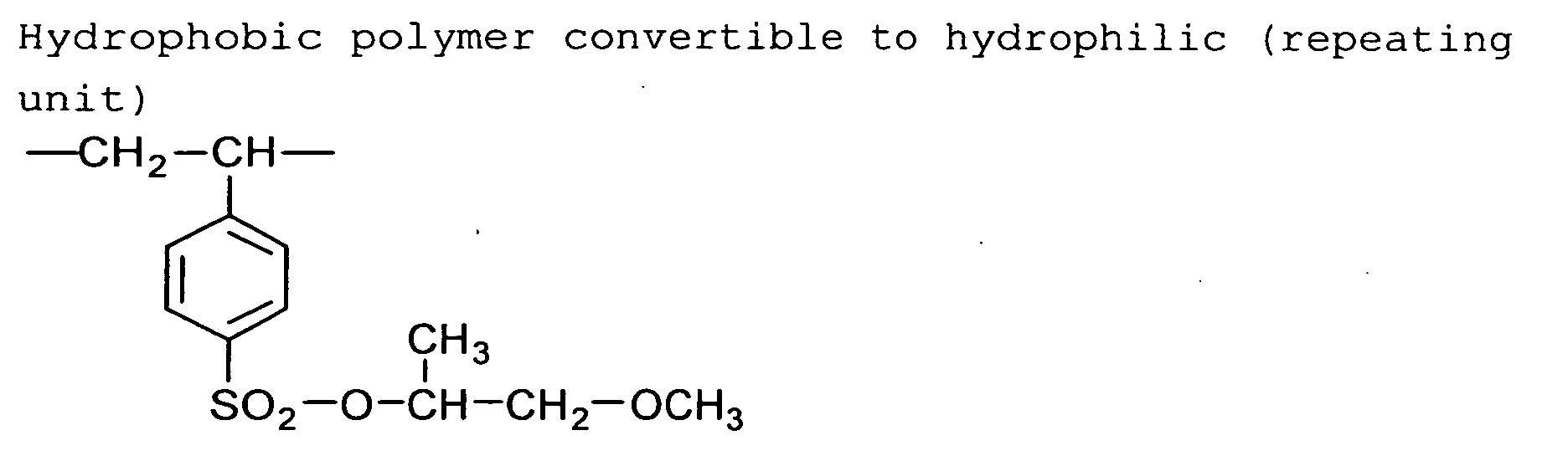
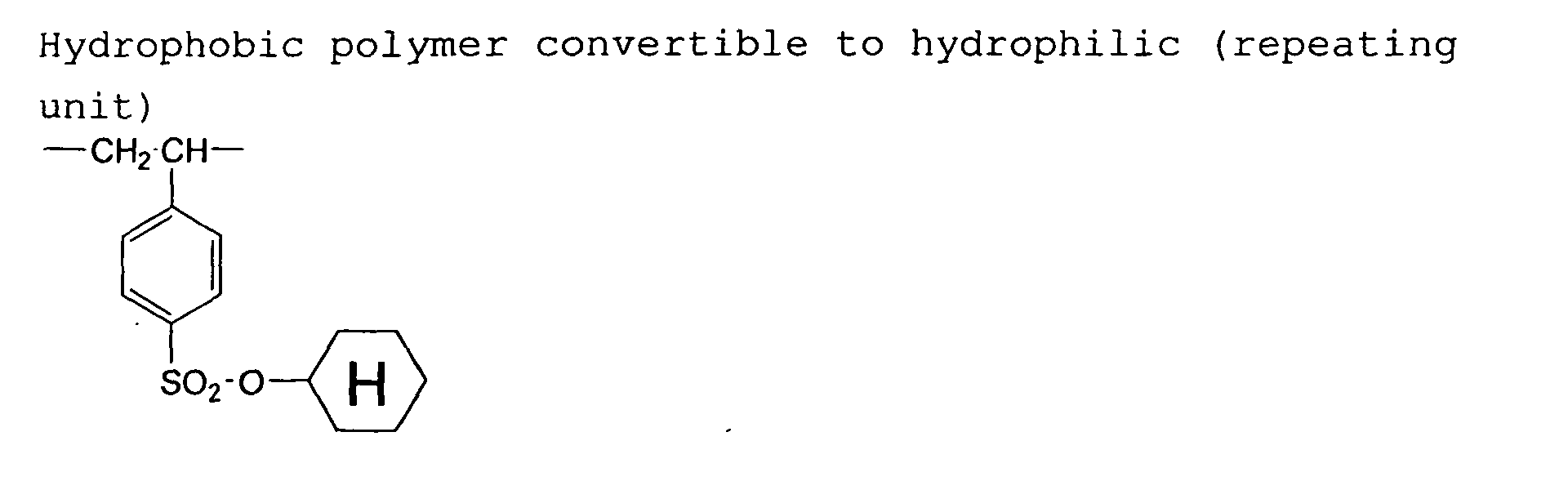
For example, a sulfonimido, disulfone or sulfonate
ester group can be changed to a sulfo group, which is
strongly hydrophilic, by heating a hydrophobic polymer
having the sulfonimidok, disulfone or sulfonate ester
group.
Each of the sulfonimido, disulfone and sulfonate ester
groups is a divalent or trivalent functional group,
which can be placed at a main chain or a side chain of
the polymer.
The hydrophobic group convertible to a hydrophilic
group is preferably contained in a side chain rather than
a main chain of the polymer. The hydrophobic group is
more preferably placed at the end of the side chain. The
hydrophobic group convertible to a hydrophilic group
preferably is -SO2-NR-SO2-R, -SO2-N(-SO2-R)2, -SO2-SO2-R,
-SO2-O-R or -O-SO2-R. R is an aliphatic group, an aromatic
group or a heterocyclic group.
The side chain, namely the linking group between the
hydrophobic group and the main chain preferably is a divalent
group selected from the group consisting of an alkylene
group, a substituted alkylene group, an arylene
group, a substituted arylene group, a divalent heterocyclic
group, -O-, -S-, -NH-, -CO-, -SO-, -SO2- and a combination
thereof. The definition and examples of the alkylene
group, the substituted alkylene group, the arylene
group, the substituted arylene group and the divalent
heterocyclic group are the same as those of the linking
group of the above-mentioned polymerizable compound.
In the fourth embodiment, the hydrophobic group convertible
to a hydrophilic group is preferably cross-linked
or used in combination with a cross-linked polymer.
The cross-linking reaction is described below about
the cross-linking polymer.
The main chain of the polymer preferably is hydrocarbon
(polyolefin), polyester, polyamide, polyimide,
polyurea, polyurethane, polyether of a combination
thereof. The hydrocarbon chain is particularly preferred.
The main chain of the polymer can have a substituent
group other than the hydrophilic group convertible to a
hydrophobic group. Examples of the substituent groups
are the same as those of the substituent groups of the
thermally fusible polymer.
The image-forming layer contains a hydrophobic polymer
having a hydrophobic group convertible to a hydrophilic
group preferably in an amount of 10 to 99 wt.%,
and more preferably in an amount of 20 to 95 wt.%.
[Cross-linked polymer]
The image-forming layer of the third and fourth embodiments
preferably contains a cross-linked polymer to
obtain plate wear. It is very difficult (substantially
impossible) to form an image-forming layer uniformly containing
a cross-linked polymer where the polymer has already
been cross-linked before forming the image-forming
layer (for example, the polymer has been cross-linked in
a coating solution of the layer). Therefore, the polymer
is preferably cross-linked after forming the image-forming
layer (for example, after coating the coating solution
of the layer).
A cross-linkable polymer and a cross-linking agent
(a photo initiator or a thermal initiator) can be added
to a coating solution of the image-forming layer. The
polymer can be cross-linked by the function of the cross-linking
agent after coating the coating solution to form
the image-forming layer and irradiating light to the
layer or heating the layer. The polymer is preferably
cross-linked without need of outer energy (light or
heat). Accordingly, the polymer is preferably cross-linked
by a cross-linking agent that does not require
outer energy.
The cross-linking agent that does not require outer
energy preferably is an hydroxide or an alkoxide compound
of silicon (Si), aluminum (Al), titanium (Ti) or zirconium
(Zr).
The cross-linking agent is preferably represented by
the formula (XIII).
(XIII) (R9O-)p-qM(-R10)q
In the formula, M is silicon (Si), aluminum (Al),
titanium (Ti) or Zirconium (Zr); p is 3 or 4 when M is
aluminum, p is 4 when M is silicon, titanium or zirconium;
q is 0, 1 or 2; each of R9 and R10 independently is
hydrogen, an aliphatic group or an aromatic group. The
aliphatic 'group and the aromatic group are described
above. The aliphatic group preferably has 1 to 4 carbon
atoms.
The compound represented by the formula (XIII) preferably
has a molecular weight of not more than 1,000.
Examples of the alkoxide compounds of silicon include
trimethoxysilane, triethoxysilane, tripropoxysilane,
tetramethoxysilane, tetraethoxysilane, tetrapropoxysilane,
methyltrimethoxysilane, ethyltrimethoxysilane,
propyltrimethoxysilane, methyltriethoxysilane, ethyltriethoxysilane,
propyltriethoxysilane, dimethyldimethoxysilane,
diethyldimethoxysilane, 3-chloropropyltriethoxysilane,
3-mercaptopropyltrimethoxysilane,
3-mercaptopropyltriethoxysilane,
3-aminopropyltriethoxysilane,
phenyltrimethoxysilane,
phenyltriethoxysilane, phenyltripropoxysilane, diphenyldimethoxysilane
and diphenyldiethoxysilane.
Eaxmples of the alkoxide compounds of aluminum include
trimethoxyaluminate, tripropoxyaluminate and tetraethoxyalminate.
Examples of the alkoxide compounds of titanium include
trimethoxytitanate, tetramethoxytitanate, triethoxytitanate,
tetraethoxytitanate, tetrapropoxytitanate,
chlorotrimethoxytitanate, chlorotriethoxytitanate, ehtyltrimethoxytitanate,
methyltriethoxytitanate, ethyltriethoxytitanate,
diethyldiethoxytitanate, phenyltrimethoxytitanate
and phenyltriethoxytitanate.
Examples of the alkoxide compounds of zirconium include
trimethoxyzirconate, tetramethoxyzirconate, triethoxyzirconate,
tetraethoxyzirconate, tetrapropoxyzirconate,
chlorotrimethoxyzirconate, chlorotriethoxyzirconate,
ehtyltrimethoxyzirconate, methyltriethoxyzirconate,
ethyltriethoxyzirconate, diethyldiethoxyzirconate,
phenyltrimethoxyzirconate and phenyltriethoxyzirconate.
The cross-linking agent is used preferably in an
amount of 0.05 to 60 wt.%, and more preferably in an
amount of 0.1 to 30 wt.% based on the amount of the polymer.
The polymer preferably has a functional group that
can be cross-linked by the cross-linking agent. The
functional group is determined depending on the cross-linking
agent. In the case that the cross-linking agent
is a thermal polymerization initiator or a photo polymerization
initiator, the polymer preferably has an ethylenically
unsaturated bond as the functional group that
can be cross-linked by the cross-linking agent. In the
case that the cross-linking agent is a heat-sensitive
acid precursor, the polymer preferably has a vinyl ether
or a cyclic ether as the functional group that can be
cross-linked by the cross-linking agent.
The cross-linking agent preferably is a hydroxide or
an alkoxide compound of silicon, aluminum, titanium or
zirconium, as is mentioned above. Therefore, the polymer
preferably has a functional group that can be cross-linked
by a hydroxide or an alkoxide compound of silicon,
aluminum, titanium or zirconium.
The functional group can be placed at an end of the
polymer or a side chain of the polymer.
The functional group is preferably represented by
the formula (XIV).
(XIV) (R71-)m(R72O)3-mSi-
In the formula, each of R71 and R72 independently is
hydrogen, an aliphatic group having 1 to 8 carbon atoms,
or a aromatic group having 6 to 8 carbon atoms; m is 0, 1
or 2; when m is 2, two groups represented by R71 can be
different from each other; and when m is 0 or 1, three or
two groups represented by R72 can be different from each
other.
The polymer can be a copolymer comprising repeating
units having a functional group that can be cross-linked
by the cross-linking agent and repeating units having
such a functional group. The ratio of the repeating
units (units having a functional group per units having
no functional group) is preferably in the range of 1/99
to 99/1, and more preferably in the range of 30/70 to
90/10 in terms of the weight ratio of the monomers corresponding
to the repeating units.
The main chain of the polymer preferably is hydrocarbon
(polyolefin), polyester, polyamide, polyimide,
polyurea, polyurethane, polyether or a combination
thereof. The main chain particularly preferably is hydrocarbon.
The main chain can have a substituent group other
than the functional group that can be cross-lined by the
cross-linking agent. Examples of the substituent groups
are the same as those of the substituent groups of the
thermally fusible polymer.
The image-forming layer contains the cross-linked
polymer preferably in an amount of 10 to 99 wt.%, and
more preferably in an amount of 20 to 95 wt.%.
[Ink-receiving layer]
The ink-receiving layer contains an organic polymer.
The organic polymer preferably can form a hydrophilic
membrane soluble in a solvent. The polymer more preferably
is not soluble in a solvent of a hydrophilic layer
provided on the ink-receiving layer. In some case, the
polymer is preferably swelled with (not dissolved in) the
solvent of the hydrophilic layer to improve adhesion between
the ink-receiving layer and the hydrophilic layer.
The polymer soluble in the solvent of the hydrophilic
layer is preferably cross-linked to harden the ink-receiving
layer by using a cross-linking agent.
Examples of the organic polymers include polyether,
polyurethane, polyurea, polyimide, polysiloxane, polycarbonate,
phenoxy resin, epoxy resin, novolak resin, resol
resin, condensed resin of phenyl compound and acetone,
polyvinyl acetate, acryl resin or a copolymer thereof,
polyvinyl phenol, halogenated polyvinyl phenol, methacrylic
resin or a copolymer thereof, acrylamide or a
copolymer thereof, methacrylamide or a copolymer thereof,
polyvinyl formal, polyamide, polyvinyl butyral, polystyrene,
cellulose ester resin, polyvinyl chloride and
polyvinylidene chloride.
The polymer preferably has a side chain containing a
functional group such as hydroxyl, carboxyl, sulfonamide
or trialkoxysilyl. The functional group has an affinity
to the support or the hydrophilic layer. The functional
group can also be hardened by using a cross-linking
agent.
Polyacrylonitrile or a copolymer thereof, polyurethane,
a polymer having a side chain containing sulfoamido
or hydroxyl group can be cross-linked by light
exposure in the presence of a diazo resin to be used as
the polymer of the ink-receiving layer.
The epoxy resin preferably is a polyaddition product
of epichlorohydrin with bisphenol A, bisphenol F, halogenated
bisphenol A, bisphenol of biphenyl type or a novolak
resin. The commercially available epoxy resins include
Epicoat 1001 (softening point: 68°C, Mn: about
900), Epicoat 1007 (softening point: 128°C, Mn: about
2,900), Epicoat 1009 (softening point: 144°C, Mn: about
3,750), Epicoat 1010 (softening point: 169°C, Mn: about
5,500), Epicoat 1100L (softening point: 149°C), and Epicoat
YX31575 (softening point: 130°C) of Japan Epoxy
Resin Co., Ltd.
The novolak or resol resins include an addition condensation
product of a phenol with an aldehyde (e.g.,
formaldehyde, paraformaldehyde). Examples of the phenols
include phenol, cresol (e.g., m-cresol, p-cresol, a mixture
thereof), a mixture of phenol and cresol, xylene denatured
with phenol, t-butylphenol, octylphenol, resorcinol,
pyrogallol, catechol, chlorophenol (e.g., m-chlorophenol,
p-chlorophenol), bromophenol (e.g., m-bromophenol,
p-bromophenol), salicylic acid and phloroglucinol.
The other preferred polymers can be obtained by polymerizing
the following monomers classified into the
groups (1) to (12). The polymer preferably has an average
molecular weight of 10,000 to 120,000.
(1) Acrylic monomers having aromatic hydroxyl group
and hydroxylstyrenes
The acrylic monomers include acrylamide (e.g., N-(4-hydroxyphenyl)acrylamide),
methacrylamide (e.g., N-(4-hydroxyphenyl)methacrylamide),
acrylate ester (e.g., o-,
m- or p-hydroxyphenyl acrylate) and methacrylate ester
(e.g., o-, m- or p-hydroxyphenyl methacrylate).
The hydroxystyrenes include o-, m- or p-hydroxystyrene.
(2) Acrylate or methacrylate esters having an aliphatic
hydroxyl group
Examples of the esters include 2-hydroxyethyl acrylate
and 2-hydroxyethyl methacrylate.]
(3) Acrylate esters
Examples of the acrylate esters include methyl acrylate,
ethyl acrylate, propyl acrylate, butyl acrylate,
pentyl acrylate, hexyl acrylate, cyclohexyl acrylate, octyl
acrylate, phenyl acrylate, benzyl acrylate, 2-chloroethyl
acrylate, 4-hydroxybutyl acrylate, glycidyl
acrylate, N,N-dimethylaminoethyl acrylate.
(4) Methacrylate esters
Examples of the methacrylate esters include methyl
methacrylate, ethyl methacrylate, propyl methacrylate,
butyl methacrylate, pentyl methacrylate, hexyl methacrylate,
cyclohexyl methacrylate, octyl methacrylate, phenyl
methacrylate, benzyl methacrylate, 2-chloroethyl
methacrylate, 4-hydroxybutyl methacrylate, glycidyl
methacrylate, N,N-dimethylaminoethyl methacrylate.
(5) (Meth)acrylamides
Examples of the (meth)acrylamides includes acrylamide,
methacrylamide, N-methylolacrylamide, N-methylolmethacrylamide,
N-ethylacrylamide, N-ethylmethacrylamide,
N-hexylacrylamide, N-hexylmethacrylamide,
N-cyclohexylacrylamide, N-cyclohexylmethacrylamide,
N-hydroxyethylacrylamide, N-hydroxyethylmethacrylamide,
N-phenylacrylamide, N-phenylmethacrylamide,
N-benzylacrylamide, N-benzylmethacrylamide,
N-nitrophenylacrylamide, N-nitrphenylmethacrylamide,
N-ethyl-N-phenylacrylamide and
N-ethyl-N-phenylmethacrylamide.
(6) Vinyl ethers
Examples of the vinyl ethers include ethyl vinyl
ether, 2-chloroethyl vinyl ether, hydroxyethyl vinyl
ether, propyl vinyl ether, butyl vinyl ether, octyl vinyl
ether and phenyl vinyl ether.
(7) Vinyl esters
Examples of the vinyl ethers include vinyl acetate,
vinyl chloroacetate, vinyl butyrate and vinyl benzoate.
(8) Styrenes
Examples of the styrenes include styrene, methyl
styrene and chloromethylstyrene.
(9) vinyl ketones
Examples of the vinyl ketones include methyl vinyl
ketone, ethyl vinyl ketone, propyl vinyl ketone and
phenyl vinyl ketone.
(10) Olefins
Examples of the olefins include ethylene, propylene,
isobutylene, butadiene and isoprene.
(11) Vinyl heterocyclic compounds and
(meth)acrylonitriles
Examples of the vinyl heterocyclic compounds include
N-vinylpyrrolidone, N-vinylcarbazole and N-vinylpyridine.
Examples of the (meth)acrylonitriles include acrylonitrile
and methacrylonitrile.
(12) (Meth)acrylamides or (meth)acrylate esters having
sulfonamido group.
Examples of the acrylamides having sulfoamido group
include N-(o-sulfamoylphenyl)acrylamide, N-(m-sulfamoylphenyl)acrylamide,
N-(p-sulfamoylphenyl)acrylamide,
N-[1-(3-sulfamoylethyl)naphthyl]acrylamide
and N-(2-sulfamoylethyl)acrylamide.
Examples of the methacrylamides having sulfoamido
group include N-(o-sulfamoylphenyl)methacrylamide, N-(m-sulfamoylphenyl)methacrylamide,
N-(p-sulfamoylphenyl)methacrylamide,
N-[1-(3-sulfamoylethyl)naphthyl]methacrylamide
and N-(2-sulfamoylethyl)methacrylamide.
Examples of the acrylate esters having sulfonamido
group include o-sulfamoylphenyl acrylate, m-sulfamoylphenyl
acrylate, p-sulfamoylphenyl acrylate and
1-(3-sulfamoylphenynaphthyl) acrylate.
Examples of the methacrylate esters having sulfonamido
group include o-sulfamoylphenyl methacrylate, m-sulfamoylphenyl
methacrylate, p-sulfamoylphenyl methacrylate
and 1-(3-sulfamoylphenynaphthyl) methacrylate.
The polymer can be dissolved in a solvent to prepare
a coating solution. The coating solution can be coated
on a support to form an ink-receiving layer. A cross-linking
agent, an adhesive, a coloring agent, a coating
aid or a plasticizer can be added to the coating solution.
The printing out agent can also be added to the
ink-receiving layer.
The cross-linking agents include a diazo resin, an
aromatic azido compound, an epoxy resin, an isocyanate
compound, a blocked isocyanate compound, an initial hydrolysis
condensation product of tetraalkoxysilane, glyoxal,
an aldehyde compound and amethylol compound.
The diazo resin can also function as an adhesive.
The diazo resin has a function of improving adhesion between
the support and a hydrophilic layer. A silane coupling
agent, an isocyanate compound and a titanium coupling
agent can also be used as the adhesive.
A conventional dye or pigment can be used as the
coloring agent. Examples of the preferred coloring
agents include Rhodamine 6G chloride, Rhodamine B chloride,
Crystal Violet, Malachite Green (oxalate salt),
quinizarin, 2-(α-naphthyl)-5-phneyloxazole. The other
dyes include triphenylmethane dyes, diphenylmethane dyes,
oxazine dyes, xanthene dyes, isonaphthoquinone dyes, azomethine
dyes and anthraquinone dyes. Examples of the
other dyes include Oil Yellow #101, Oil Yellow #103, Oil
Pink #312, Oil Green BG, Oil Blue BOS, Oil Blue #603, Oil
Black BY, Oil Black BS, Oil Black T-505 (Orient Chemical
Industries); Victoria Pure Blue, Crystal Violet (C.I.:
42555), Methyl Violet (C.I.: 42535), Ethyl Violet, Methylene
Blue (C.I.: 52015), Patent Pure Blue (Sumitomo
Mikuni Chemicals); Brilliant Blue, Methyl Green, Erythrycyn
B, Basic Fukucyn, m-Cresol Purple, Auramine, 4-p-diethylaminophenyliminaphthoquinone
and cyano-p-diethylaminophhenylacetoanilide.
The other dyes are described
in Japanese Patent Provisional Publication Nos.
62(1987)-293247 and 9(1997)-179290.
The coloring agent is contained in the ink-receiving
layer preferably in an amount of 0.01 to 10 wt.%, and
more preferably in an amount of 0.1 to 5 wt.% based on
the solid content of the ink-receiving layer.
A fluorine or silicone surface active agent can be
used as the coating aid. The surface active agent preferably
has a perfluoroalkyl group or a dimethylsiloxane
group.
A plasticizer can be added to the ink-receiving
layer to soften the coated layer. Examples of the plasticizers
include polyethylene glycol, tributyl citrate,
diethyl phthalate, dibutyl phthalate, dihexyl phthalate,
dioxtyl phthalate, tricresyl phosphate, tributyl phosphate,
trioctyl phosphate, tetrahydrofurfuryl oleate and
oligomers or polymers of acrylic or methacrylic acid.
The solvents of the ink-receiving layers include an
alcohol (e.g., methanol, ethanol, propanol, ethylene glycol,
diethylene glycol, propylene glycol, dipropylene
glycol, ethylene glycol monomethyl ether, propylene glycol
monomethyl ether, ethylene glycol monoethyl ether),
an ether (e.g., tetrahydrofuran, ethylene glycol dimethyl
ether, propylene glycol dimethyl ether, tetrahydropyran),
a ketone (e.g., acetone, methyl ethyl ketone, acetylacetone),
an ester (e.g., methyl acetate, ethyl acetate,
ethylene glycol monomethyl ether monoacetate, γ-butyrolactone,
methyl lactate, ethyl lactate) and an amide
(e.g., formamide, N-methylformamide, pyrrolidone, N-methylpyrrolidone).
Two or more solvents can be used in
combination. The concentration (solid content including
additives) of the ink-receiving layer is preferably in
the range of 1 to 50 wt.%. The ink-receiving layer can
also be formed by using an emulsion in place of the solution.
The concentration of the emulsion is preferably in
the range of 5 to 50 wt.%.
The dry coating amount of the ink receiving layer is
preferably less than 0.5 g/m2, more preferably in the
range of 0.2 to 0.5 g/m2, and most preferably in the
range of 0.3 to 0.5 g/m2.
The ink-receiving layer has a surface roughness in
terms of center line average height (Ra) preferably in
the range of 0.40 to 0.65 µm, more preferably in the
range of 0.50 to 0.65 µm, and most preferably in the
range of 0.50 to 0.60 µm. The surface roughness is adjusted
as mentioned above to improve the plate wear.
[Hydrophilic layer]
The hydrophilic layer can contain colloidal particles
of oxide or hydroxide of an element, which is selected
from the group consisting of beryllium, magnesium,
aluminum, silicon, titanium, boron, germanium, tin, zirconium,
iron, vanadium, antimony and transition metals.
The colloidal oxide or hydroxide particles can be
prepared by hydrolysis of a halide or an alkoxy compound
or condensation of hydroxide. A colloidal dispersion can
be added to a coating solution of the hydrophilic layer.
The oxide or hydroxide of aluminum, silica, titanium
or zirconium is preferred.
The colloidal silica particles have a particle size
preferably of 5 to 100 nm, and more preferably of 10 to
50 nm. The particle preferably has a sphere shape. The
particles can be connected to each other to form a shape
of 50 to 400 nm like a pearl necklace. A colloidal particle
of aluminum oxide or hydroxide has a shape of 100
nm x 10 nm like a feather. A commercially available colloidal
dispersion (Nissan Chemical Industries) can also
be used.
The dispersing medium of the colloidal particles is
water or an organic solvent such as methanol, ethanol,
ethylene glycol monomethyl ether or methyl ethyl ketone.
The hydrophilic layer can contain a hydrophilic
resin in addition to the colloidal particles. The hydrophilic
resin has a function of enhancing the strength of
the layer to improve plate wear. The hydrophilic resin
is a polymer having a hydrophilic group, such as hydroxyl,
carboxyl, hydroxyethtyl, hydroxypropyl, amino,
aminoethyl, aminopropyl, carboxymethyl.
The hydrophilic resins include gum arabic, casein,
gelatin, starch derivative, carboxymethylcellulose or a
sodium salt thereof, cellulose acetate, sodium alginate,
vinyl acetate-maleic acid copolymer, styrene-maleic acid
copolymer, polyacrylic acid or a salt thereof, polymethacrylic
acid or a salt thereof, polyhydroxyethyl
methacrylate or a copolymer thereof, polyhydroxyethyl
acrylate or a copolymer thereof, polyhydroxybutyl
methacrylate or a copolymer thereof, polyhydroxybutyl
acrylate or a copolymer thereof, polyethylene glycol,
polypropylene oxide, polyvinyl alcohol, polyvinyl acetate
or a partial (at least 60%, more preferably at least 80%)
hydrolysis product thereof, polyvinyl formal, polyvinyl
butyral, polyvinyl pyrrolidone, polyacrylamide or a copolymer
thereof, polymethacrylamide or a copolymer
thereof, poly(N-methylolacrylamide) or a copolymer
thereof.
The hydrophilic layer contains the hydrophilic resin
preferably in an amount of not more than 40 wt.%, and
more preferably in an amount of not more than 20 wt.%
based on the solid content of the hydrophilic layer.
The hydrophilic layer can contain a phenol resin.
The phenol resin has a function of improving the strength
of the layer. The phenol resin has another function of
improving affinity to ink (particularly effective when a
printing process is started). The phenol resin is preferably
soluble in methanol at least 5 wt.% at 25°C. The
phenol resin is also preferably soluble in an alkaline
solution. Examples of the phenol resins include novolak
resin, resol resin, polyvinyl phenol resin and ketone pyrogallol
resin.
The novolak resin usually is an addition condensation
product of a phenol with an aldehyde. The addition
condensation reaction can be conducted in the presence of
an acid catalyst. Examples of the phenols include phenol,
o-cresol, m-cresol, p-cresol, 2,5-xylenol, 3,5-xyleno,
resorcinol. Examples of the aldehydes include
formaldehyde, acetaldehyde, propionaldehyde. Paraformalddehyde
or paraacetaldehyde can be used in place of
formaldehyde or acetaldehyde. The phenol preferably is a
mixture of m-cresol:p-cresol:2,5-xylenol:3,5-xyleno:resorcinol
at a molar ratio of 40 to 100:0 to 50:0
to 20:0 to 20:0 to 20. The phenol also preferably is a
mixture of phenol:m-cresol:p-cresol at a molar ratio of 1
to 100:0 to 70:0 to 60. The aldehyde preferably is formaldehyde.
The novolak resin has a weight average molecular
weight preferably in the range of 1,000 to
15,000, and more preferably in the range of 1,500 to
10,000.
The resol resin usually is an addition condensation
product of a phenol with an aldehyde or ketone. The addition
condensation reaction can be conducted in the
presence of an alkaline catalyst. Examples of the phenols
include phenol, o-cresol, m-cresol, p-cresol, 2,5-xylenol,
3,5-xyleno, resorcinol, pyrogallol, bis(4-hydroxyphenyl)methane,
bisphenol A, o-ethylphenol, methylphenol,
p-ethylphenol, propylphenol, butylphenol, t-butylphenol,
1-naphthol, 2-naphthol. Examples of the aldehydes
include formaldehyde, acetaldehyde, propionaldehyde,
benzaldehyde, furfural. Examples of the ketones
include acetone, methyl ethyl ketone, methyl isobutyl ketone.
Paraformalddehyde or paraacetaldehyde can be used
in place of formaldehyde or acetaldehyde. The resol
resin has a weight average molecular weight preferably in
the range of 500 to 10,000, and more preferably in the
range of 1,000 to 5,000.
The polyvinyl phenol resin preferably is a polymer
of a hydroxystyrene such as o-hydroxystyrene, m-hydroxystyrene,
p-hydroxystyrene, 2-(o-hydroxyphenyl)propylene,
2-(m-hydroxyphenyl)propylene, 2-(p-hydroxyphenyl)propylene.
The aromatic ring of the hydroxystyrene
can have a substituent group, such as a
halogen atom (fluorine, chlorine, bromine, iodine), an
alkyl group having 1 to 4 carbon atoms. The polymer can
be a copolymer comprising two or more repeating units.
The other repeating units can be derived from methacrylic
acid, acrylic acid, an alkyl methacrylate or an alkyl
acrylate. The polyvinyl phenol resin can be obtained by
polymerizing hydroxyl styrene (which can have a substituent
group) in the presence of a radical polymerization
initiator or a cationic polymerization initiator. The
polyvinyl phenol resin can be partially hydrogenised.
The hydroxyl groups of the resin can be partially protected
with t-butoxycarbonyl group, pyranyl group, or furanyl
group. The polyvinyl phenol resin has a weight average
molecular weight preferably in the range of 1,000
to 100,000, and more preferably in the range of 1,500 to
50,000.
The ketone pyrogallol resin preferably is an acetone
pyrogallol resin.
The hydrophilic layer contains the phenol resin
preferably in an amount of not more than 20 wt.%, and
more preferably in an amount of not more than 12 wt.%
based on the solid content of the hydrophilic layer.
The hydrophilic layer can contain a cross-linking
agent, which accelerates a cross-linking reaction of a
colloidal oxide or hydroxide. Examples of the cross-linking
agents include an initial hydrolysis condensation
product of tetraalkoxysilane, trialkoxysiliypropyl-N,N,N-troalkylammonium
halide, and aminopropyltrialkoxysilane.
The hydrophilic layer contains the cross-linking agent
preferably in an amount of not more than 5 wt.% based on
the solid content of the hydrophilic layer.
The hydrophilic layer can also contain another
cross-linking agent, which causes a cross-linking reaction
of the hydrophilic resin or the phenol resin to improve
the plate wear. Examples of the cross-linking
agents of the resins include formaldehyde, glyoxal, polyisocyanate,
an initial hydrolysis condensation product of
tetraalkoxysilane, dimehtylolurea, hexamethylolmelamine.
The hydrophilic layer can contain a surface active
agent, such as a fluorine surface active agent, a silicon
surface active agent or a polyoxyethylene surface active
agent. The surface active agent can function as a coating
aid.
The hydrophilic layer can be formed by dissolving or
dispersing the above-mentioned components in a solvent to
prepare a coating solution, and coating the solution on
the ink-receiving layer. Examples of the solvents include
water or a low-boiling point alcohol such as methanol,
ethanol, propanol. Two or more solvents can be used
in combination.
A solvent of dissolving the lipophilic polymer of
the ink-receiving layer can be added to the coating solution
of the hydrophilic layer to improve plate wear. Examples
of the solvents of the liphophilic polymers include
an alcohol (e.g., ethylene glycol monomethyl ether,
propylene glycol monomethyl ether, ethylene glycol monoethyl
ether), an ether (e.g., tetrahydrofuran, ethylene
glycol dimethyl ether, propylene glycol dimethyl ether,
tetrahydropyran), a ketone (e.g., acetone, methyl ethyl
ketone, methyl isobutyl ketone, acetylacetone, cyclohexanone),
an ester (e.g., methyl acetate, ethyl acetate,
isobutyl acetate, ethylene glycol monomethyl monoacetate,
methyl lactate, ethyl lactate), an amide (e.g., formamide,
N-methyformamide, pyrrolidone, N-methyl pyrrolidone),
γ-butyrolactone.
The hydrophilic layer contains a solvent of the
lipophilic polymer preferably in an amount of 0.4 to 40
wt.%, and more preferably in an amount of 0.4 to 20 wt.%.
The dry coating amount of the hydrophilic layer is
preferably in the range of 0.2 to 0.8 g/m2, and more
preferably in the range of 0.3 to 0.5 g/m2. The coating
amount is adjusted to obtain a function of keeping dampening
water without degrading the on-press development or
the sensitivity.
[Overcoating layer provided on hydrophilic layer]
A hydrophilic overcoating layer can be provided on
the hydrophilic layer. The overcoating layer has a function
of preventing abrasion dust from scattering. The
layer has another function of protecting the hydrophilic
layer from contamination cased by a lipophilic substance
or finger print while storing or handling the lithographic
plate.
The hydrophilic overcoating layer can be removed on
a press machine. The hydrophilic overcoating layer can
contain a water soluble resin or a resin that can be
swelled with water, which can be obtained by partially
cross-linking the water-soluble resin.
The water-soluble resin preferably is a natural or
synthetic polymer. The water-soluble resin can be used
in combination with a cross-linking agent to form a resin
that can be swelled with water (namely cross-linked
resin) after forming and drying the overcoating layer.
Examples of the natural polymers include gum arabic,
water soluble soy bean polysaccharide, cellulose derivatives
(e.g., carboxymethylcellulose, carboxyethylcellulose,
methylcellulose), denatured cellulose, white dextrin,
pullulan, enzyme decomposition product of dextrin
ether. Examples of the synthetic polymers include polyvinyl
alcohol (65 % or more hydrolysis product of polyvinyl
acetate), polyacrylic acid, an alkali metal or amine
salt thereof, or a copolymer thereof, polymethacrylic
acid, an alkali metal or amine salt thereof, or a copolymer
thereof, vinyl alcohol/acrylic acid copolymer or an
alkali metal or amine salt thereof, polyacrylamide or a
copolymer thereof, polyhydroxyethyl acrylate, polyvinyl
pyrrolidone or a copolymer thereof, polyvinyl methyl
ether, vinyl methyl ether/maleic anhydride copolymer,
poly(2-acrylamido-2-methyl-1-propanesulfonic) acid, an
alkali metal or amine salt thereof. Two or more resins
can be used in combination.
The water-soluble resin can be partially cross-linked.
The cross-linking reaction can be caused by the
functional group of the water-soluble resin. The cross-linking
bond can be a covalent bond or an ionic bond.
The cross-linking reaction can decrease adhesiveness
of the overcoating layer to improve handling the plate.
If the cross-linking reaction extremely proceeds, the
overcoating layer might be made lipophilic. It is difficult
to remove lipophilic overcoating layer on a press
machine. Therefore, the hydrophilic polymer should be
partially cross-linked.
An appropriately partial cross-linking can be determined
by immersing a presensitized lithographic plate in
water at 25°C. The hydrophilic overcoating layer obtained
by the appropriately partial cross-linking reaction
is not dissolved in water for 30 seconds to 1 minute,
but is dissolved in water after 10 minutes or more.
The cross-linking agent preferably is a polyfunctional
compounds. The cross-linking agents include
polyepoxy compound, polyisocyanate compound, polyalkoxysilyl
compound, polyvalent metal salt, polyamine compound,
an aldehyde compound, hydrazine. The cross-linking
reaction can be accelerated by using a catalyst.
Examples of the polyepoxy compounds include glycerin
polyglycidyl ether, polyethylene glycol diglycidyl ether,
polypropylene glycol diglycidyl ether, trimethylolpropane
polyglycidyl ether, sorbitol polyglycidyl ether, bisphenols,
hydorogenated product thereof, polycondensation
product with epihalohydrin.
Examples of the polyamine compounds include ethylenediamine
diethylenetriamine, triethylenetetramine, tetraethylenepentamine,
hexamethylenediamine, propylenediamine,
polyethylenimine, polyamidoamine.
) Examples of the isocyanate compounds include
tolylene diisocyanate, diphenylmethane isocyanate, liquid
diphenylmethane isocyanate, polymethylene polyphenyl isocyanate,
xylene diisocyanate, naphthaline-1,5-diisocyanate,
cyclohexane phenylene diisocyanate, isopropylbenzene-2,4-diisocyanate,
hexamethylene diisocyanate,
decamethylene diisocyanate, cyclohexyldiisocyanate, isophorone
diisocyanate, addition product of polypropylene
glycol with tolylene diisocyanate.
Examples of the silane compounds include methyltrimethoxysilane,
methyltriethoxysilane, ethyltriethoxysilane,
phenyltriethoxysilane, vinyltriethoxysilane, γ-aminopropyltriethoxysilane,
N-(β-aminoethyl)-γ-aminopropyltrimethoxysilane,
γ-glycidoxypropyltrimethoxysilane,
γ-methacryloyloxypropyltrimethoxysilane,
γ-mercaptopropyltrimethoxysilane,
β-(3,4-epoxycyclohexyl)ethyltrimethoxsilane,
dimethyldimethoxysilane,
dimethyldiethoxysilane, diphenyldiethoxysilane,
3-chloropropylmethyldimethoxysilane, vinyl-tris(methylethylketoxim)silane,
methyl-tris(methylethylketoxim)silane,
vinyltriacetoxysilane.
Examples of the titanate compounds include tetraethyl
orthotitanate, bis(dioctylpyrophosphato)ethylene
titanate, isopropyl triactanoyl titanate, isopropyl dimethacryloyl
isostearoyl titanate, isopropyl, isostearoyl
diacryloyl titanate, isopropyl(dioctylphosphato) titanate,
isopropyl tricumylphenyl titanate, isopropyl tri(N-aminoethylaminoethyl)
titanate, dicumyl phenoxyaetate titanate,
diisostearoylethylene titanate, isopropyl triinstearoyl
titanate, isopropyl tridodecylbenzenesulfonyl
titanate, isopropyltris(dioxtylphosphato) titanate,
tetraisopropyl bis(dioctylphosphito) titanate, tetraoctyl
bis(ditolidisylphosphito) titanate, tetra(2,2-diallyloxymethyl-1-butyl)
bis(ditridexylphosphito) titanate,
bis(dioxtylpyrophosphato)oxyacetate titanate,
bis(dioctylpyrophosphato)oxyacetate titanate.
Examples of the aldehyde compounds include formaldehyde,
acetaldehyde, propylaldehyde, butylaldehyde, glyoxal,
gluralaldehyde, terephthalaldehyde.
Examples of the polyvalent metal salts include water
soluble salts of zinc, calcium, magnesium, barium, strontium,
cobalt, manganese, nickel.
Two or more cross-linking agents can be used in combination.
The cross-linking agent preferably is soluble
in water. If the cross-linking agent is not soluble in
water, a dispersing agent is preferably used to disperse
the cross-linking agent in water.
A combination of a resin with a cross-linking agent
preferably is a water soluble carboxylic resin with a
polyvalent metal salt, a water soluble carboxylic resin
with a water-soluble epoxy resin, and a hydroxyl resin
with dialdehyde.
The amount of the cross-linking agent is preferably
in the range of 0.5 to 10 wt.% of the water-soluble
resin. The amount is adjusted to improve water-resistance
of the layer while the overcoating layer can
be removed on a press machine.
An aqueous coating solution of the overcoating layer
can contain a nonionic surface active agent to uniformly
coat the layer. Examples of the nonionic surface active
agents include sorbitan tristearate, sorbitan monoparmitate,
sorbitan trioleate, monoglyceride stearate, polyoxyethylene
nonylphenyl ether, polyoxyethylene dodecyl
ether.
The overcoating layer contains the nonionic surface
active agent preferably in an amount of 0.05 to 5 wt.%
based on the total solid content of the overcoating
layer.
The dry coating amount of the overcoating layer is
preferably in the range of 0.1 to 4.0 g/m2, and more
preferably in the range of 0.10 to 0.25 g/m2. The coating
amount is adjusted to protect the hydrophilic layer while
the overcoating layer can be removed on a press machine.
[Optional components of image-forming layer]
The image-forming layer can contain inorganic particles.
The inorganic materials of the particles include
silica, alumina, magnesium oxide, titanium dioxide, magnesium
carbonate and a mixture thereof.
The inorganic particles have an average particle
size preferably in the range of 5 nm to 10 µm, and more
preferably in the range of 10 nm to 1 µm.
The inorganic particles are contained in the image-forming
layer preferably in an amount of 1.0 to 70 wt.%,
and more preferably in an amount of 5.0 to 50 wt.% based
on the total solid contents of the image-forming layer.
The image-forming layer can contain organic particles
(such as calcium alginate particles) in place of the
above-mentioned inorganic particles.
The image-forming layer can contain a surface active
agent. The surface active agents include a nonionic surface
active agent (described in Japanese Patent Provisional
Publication Nos. 62(1987)-251740, 3(1991)-208514),
an anionic surface active agent, a cationic surface active
agent (described in Japanese Patent Provisional Publication
No. 2(1990)-195356), an amphoteric surface active
agent (described in Japanese Patent Provisional Publication
Nos. 59(1984)-121044, 4(1992)-13149) and a fluorine
surface active agent.
[Formation of image-forming layer]
The image-forming layer can be formed by dissolving,
dispersing or emulsifying the contents of the layer in an
solvent to prepare a coating solution and coating the
prepared solution.
Examples of the solvents include halogenated hydrocarbons
(e.g., ethylene chloride), ketones (e.g., cyclohexanone,
methyl ethyl ketones), alcohols (e.g., methanol,
ethanol, propanol, 1-methoxy-2-propanol), ethers
(e.g., dimethoxyethane, ethylene glycol monomethyl
ether), esters (e.g., 2-methoxyetyl acetate, 1-methoxy-2-propyl
acetate, methyl lactate, ethyl lactate), amides
(e.g., N,N-dimethylacetamide, dimethylformamide),
tetramethylurea, N-methylpyrrolidone, dimethyl sulfoxide,
sulfolane, γ-butyrolactone, toluene and water.
The solid content in the coating solution is preferably
in the range of 1 to 50 wt.%.
The image-forming layer can be formed by coating two
or more coating solutions, which can be different from
each other.
After drying the image-forming layer, the coated
amount (solid content) of the image-forming layer is
preferably in the range of 0.5 to 5.0 g/m2. The coating
amount is adjusted to control the sensitivity and the
characteristics of the formed layer.
The image-forming layer can be coated according to a
bar coating method, a rotating coating method, a spray
coating method, a curtain coating method, a dip coating
method, an air-knife coating method, a blade coating
method or a roll coating method.
[Support]
The support preferably is a dimensionally stable
film, plate or sheet.
In the first and second embodiments, a hydrophilic
support is used to form a hydrophilic area.
Examples of the supports include paper, a paper
laminated with a polymer (e.g., polyethylene, polypropylene,
polystyrene) film, a metal (e.g., aluminum, zinc,
copper) plate, a polymer (e.g., cellulose diacetate, cellulose
triacetate, cellulose propionate, cellulose butyrate,
cellulose acetate propionate, cellulose acetate
butyrate, cellulose nitrate, polyethylene terephthalate,
polyethylene, polystyrene, polypropylene, polycarbonate,
polyvinyl acetal) film, a paper laminated with a metal, a
polymer film laminated with a metal, a paper subjected to
vapor deposition of a metal, a polymer film subjected to
vapor deposition of a metal. A polymer film and a metal
plate are preferred, and a polyester film and an aluminum
plate are more preferred, and an aluminum plate is most
preferred.
The aluminum plate subjected to anodic oxidation is
particularly preferred.
The aluminum plate is a plate of pure aluminum or an
alloy plate comprising the main component of aluminum and
a little amount of other metals. Examples of the other
metals include Si, Fe, Mn, Co, Mg, Cr, Zn, Bi, Ni and Ti.
The amount of those metals is preferably of not more than
10 wt.%. It is technically difficult to prepare a pure
aluminum in smelting. Therefore, an aluminum alloy plate
comprising a little amount of other metals has been used
in practice.
The aluminum plate has a thickness preferably of 0.1
to 0.6 mm, more preferably of 0.15 to 0.4 mm, and most
preferably of 0.2 to 0.3 mm.
The surface of the aluminum plate is preferably subjected
to a surface treatment such as a roughing treatment
and an anodic oxidation treatment. The surface
treatment has a function of making the surface more hydrophilic.
The surface treatment has another function of
improving adhesion between the support and the image-forming
layer.
The aluminum plate can be subjected to a defatting
treatment before conducting the surface treatment. The
defatting treatment is conducted by using a surface active
agent, an organic solvent or an aqueous alkaline solution
to remove machine oil from the surface.
The roughing treatments include a mechanical roughing
treatment, an electrochemical roughing treatment
(dissolving the surface electrochemically to form a rough
surface) and a chemical roughing treatment (dissolving
the surface chemically to form a rough surface).
Examples of the mechanical roughing treatment include
a ball grinding method, a brush grinding method, a
blast grinding method and a buff grinding method.
The electrochemical roughing treatment is, for example,
a procedure in which direct or alternative current
is applied to the plate in an electrolysis solution containing
acid such as hydrochloric acid or nitric acid.
The electrochemical roughing treatment can use a mixed
acid, as is described in Japanese Patent Provisional Publication
No. 54(1979)-63902.
After the roughing treatment, the aluminum plate can
be subjected to alkali etching treatment. The alkali
etching liquid preferably is an aqueous solution of potassium
hydroxide or sodium hydroxide. After the alkali
etching treatment, a neutralizing treatment can be conducted.
An anodic oxidation treatment is preferably conducted
to improve the abrasion resistance of the support
after the neutralizing treatment.
An electrolyte is used in the anodic oxidation
treatment to form a porous oxide film. Examples of the
electrolytes include sulfuric acid, hydrochloric acid,
oxalic acid, chromic acid, and a mixture thereof.
The anodic oxidation treatment is generally carried
out under the specific conditions. For example, the
concentration of the electrolytic solution is in the
range of 1 to 80 wt.%, the temperature of the solution is
in the range of 5 to 70°C, the electric current density
is in the range of 5 to 60 A/dm2, the voltage is in the
range of 1 to 100 V, and the time for electrolysis is in
the range of 10 seconds to 5 minutes.
The oxide film formed by the anodic oxidation has a
thickness preferably of 1.0 to 5.0 g/m2, and more preferably
of 1.5 to 4.0 g/m2. The thickness is so adjusted
to improve the abrasion resistance.
After the anodic oxidation treatment, the aluminum
plate can be further subjected to a hydrophilic treatment.
The hydrophilic treatment preferably is an alkali
metal silicate treatment (described in U.S. Patent Publication
Nos. 2,714,066, 3,181,461, 3,280,734 and
3,902,734). In the alkali metal silicate treatment, the
aluminum plate is immersed or subjected to electrolysis
in an aqueous solution of alkali metal silicate (e.g.,
sodium silicate). The hydrophilic treatment can be also
conducted by using a potassium fluorozirconate (described
in Japanese Patent Publication No. 36(1961)-22063) and
polyvinyl phosphonate (described in U.S. Patent Nos.
3,276,868, 4,153,461, 4,689,272).
[Backing layer]
A backing layer can be formed on a back side of the
support. The backing layer is preferably formed by coating
after subjecting the support to a surface treatment
or forming an undercoating layer.
The backing layer preferably is a coating layer containing
an organic polymer (described in Japanese Patent
Provisional Publication No. 5(1993)-45885). The backing
layer can be a coating layer comprising a metal oxide,
which can be formed by hydrolysis or condensation polymerization
of an organic or inorganic metallic compound
(described in Japanese Patent Provisional Publication No.
6(1994)-35174). The organic metallic compound preferably
is an alkoxy silicon compound such as Si(OCH3)4,
Si(OC2H5)4, Si(OC3H7)4, Si(OC4H9)4.
[Undercoating layer]
An undercoating layer can be formed between the support
and the image-forming layer or the backing layer.
The undercoating layer can function as a thermal
barrier layer. The thermal barrier layer can prevent
heat (formed by converting infrared light) diffusing from
the image-forming layer to the support. Therefore, the
thermal barrier layer has a function of improving the
thermal efficiency of the presensitized lithographic
plate. In other words, the sensitivity of the presensitized
lithographic plate can be improved by the thermal
barrier layer as the undercoating layer.
The undercoating layer can have another function of
improving on press development in which the image-forming
layer within the unexposed area is removed from the support.
The undercoating layer can be formed by using a silane
coupling agent or a phosphoric compound having an
ethylenically unsaturated double bond that can be reacted
to cause an addition polymerization (described in Japanese
Patent Provisional Publication No. 10(1998)-282679).
The coating amount (solid contents) of the undercoating
layer is preferably in the range of 0.1 to 100
mg/m2, and more preferably in the range of 3 to 30 mg/m2.
[Overcoating layer provided on image-forming layer]
An overcoating layer can be formed on the image-forming
layer. The overcoating layer can have a function
of protecting the surface of the image-forming layer from
scratch. The overcoating layer can have another function
of preventing oxygen from permeating the image-forming
layer. The overcoating layer can further has a function
of protecting the image-forming layer from abrasion when
the presensitized lithographic plate is scanned with a
laser bean of high illuminance.
The presensitized lithographic plate is exposed to
infrared light usually in the air, which contains oxygen,
which has a function of inhibiting a polymerization reaction.
The overcoating layer preferably has a function of
preventing oxygen or a low molecular weight basic substance
from permeating the image-forming layer. The
overcoating layer preferably has a low permeability to a
substance of a low molecular weight. The overcoating
layer further preferably is transparent to infrared
light. The overcoating layer furthermore has a good adhesion
to the image-forming layer. Moreover, the overcoating
layer preferably is easily removed at on press
development. The overcoating layer is described in U.S.
Patent No. 3,458,311 and Japanese Patent Provisional Publication
No. 55(1980)-49729.
The overcoating layer preferably comprises a water-soluble
polymer that can be crystallized. Examples of
the water-soluble polymers include polyvinyl alcohol,
polyvinyl pyrrolidone, acidic cellulose derivatives,
gelatin, gum arabic and polyacrylic acid. Polyvinyl alcohol
(PVA) is particularly preferred. Polyvinyl alcohol
has an excellent function of preventing oxygen from permeating
the image-forming layer. Polyvinyl alcohol can
be easily removed at on press development. The functions
are given by non-substituted vinyl alcohol units contained
in the polyvinyl alcohol. Alcoholic hydroxyl
groups in polyvinyl alcohol can be substituted with an
ester bond, an ether bond or an acetal bond so long as a
considerable amount of the alcoholic hydroxyl remain in
polyvinyl alcohol. Polyvinyl alcohol can be a copolymer
of vinyl alcohol units with the other repeating units.
Polyvinyl alcohol has a saponification degree preferably
in the range of 71 to 100%. Polyvinyl alcohol has
a polymerization degree preferably in the range of 300 to
2,400. The overcoating layer can be formed by using a
commercially available polyvinyl alcohol (e.g., PVA-105,
PVA-105, PVA-110, PVA-117, PVA-117H, PVA-120, PVA-124,
PVA-124H, PVA-CS, PVA-CST, PVA-HC, PVA-203, PVA-204, PVA-205,
PVA-210, PVA-217, PVA-220, PVA-224, PVA-217EE, PVA-217E,
PVA-220E, PVA-224E, PVA-405, PVA-420, PVA-613, L-8,
Kuraray Co., Ltd.).
Polyvinyl alcohol having a high saponification degree
(in which the ratio of the non-substituted vinyl alcohol
units is high) or a thick overcoating layer has an
excellent function of preventing oxygen from permeating
the image-forming layer to improve the sensitivity. However,
an extremely low permeability to oxygen is not necessary.
Permeability to oxygen at 25°C under ordinary
atmosphere (cc/m2 day) is preferably in the range of 0.2
to 20.
The overcoating layer can contain a polyhydric alcohol
(e.g., glycerin, dipropylene glycol) to improve
flexibility. The overcoating layer contains the polyhydric
alcohol preferably in an amount of 1 to 10 wt.%
based on the amount of the water-soluble polymer.
The overcoating layer can contain an anionic surface
active agent (e.g., sodium alkylsulfate, sodium alkylsulfonate),
an amphoteric surface active agent (e.g., a salt
of alkyl aminocarboxylate, a salt of alkylaminodicarboxylate)
or a nonionic surface active agent (e.g., polyoxyethylene
alkylphenyl ether). The overcoating layer
contain the surface active agent preferably in an amount
of 1 to 10 wt.% based on the amount of the water-soluble
polymer.
The overcoating layer has a thickness preferably in
the range of 0.1 to 5 µm, and more preferably in the
range of 0.2 to 2 µm.
The overcoating layer comprising a water-soluble
polymer, which is a hydrophilic layer tends to be peeled
from the image-forming layer. If the overcoating layer
is peeled from the image-forming layer, the image-forming
layer is not protected from oxygen. The overcoating
layer can further contain an acrylic emulsion or a water
insoluble polymer (such as vinyl pyrrolidone-vinyl acetate
copolymer) in an amount of 20 to 60 wt.% based on
the water-soluble polymer to improve the adhesion between
the overcoating layer and the image-forming layer, as is
described in Japanese Patent Provisional Publication No.
49(1974)-70702 and British Patent Publication No.
1,303,578. A method of coating a overcoating layer is
described in U.S. Patent No. 3,458,311 and Japanese Patent
Provisional Publication No. 55(1980)-49729.
The overcoating layer can function as a color filter
layer. For example, the overcoating layer can contain a
coloring agent (preferably a water-soluble dye) that is
transparent to infrared light (which is used in image
formation) and absorbs the other light. The coloring
agent has a function of decreasing sensitivity to safe
light without decreasing sensitivity to infrared light.
[Step of imagewise exposure]
The presensitized lithographic plate is imagewise
exposed to infrared light. The presensitized lithographic
plate is preferably scanned with infrared laser
beam.
The infrared light has a wavelength preferably in
the range of 700 to 1,200 nm.
The light source of the infrared laser bean preferably
is a solid laser or a semi-conductor laser. Power of
the infrared laser is preferably not less than 100 mW. A
multi-beam laser device can be used to shorten the exposure
time.
The exposure time for one pixel is preferably
shorter than 20 micro seconds. The exposure energy is
preferably in the range of 10 to 300 mJ/cm2.
The presensitized lithographic plate can be imagewise
exposed to infrared light while mounting the lithographic
plate on a cylinder of a printing press (described
in Japanese Patent No. 2,938,398).
In the case that the infrared absorbing agent functions
as an agent of converting light to heat, convert
heat energy is transferred to the polymerization initiator,
which functions as a thermal polymerization initiator.
In the case that the infrared absorbing agent functions
as an infrared sensitizing dye, light energy is
converted to a chemical energy, which is transferred to
the polymerization initiator, which functions as a photopolymerization
initiator. The infrared absorbing agent
can have two or more functions described above.
A presensitized lithographic plate of the first embodiment
is imagewise exposed to infrared light to make
the removable image-forming layer to be irremovable
within the exposed area.
A presensitized lithographic plate of the second embodiment
is imagewise exposed to infrared light to make
the irremovable image-forming layer to be removable
within the exposed area.
A presensitized lithographic plate of the third embodiment
is imagewise exposed to infrared light to make
the hydrophilic image-forming layer to be hydrophobic
within the exposed area.
A presensitized lithographic plate of the fourth
embodiment is imagewise exposed to infrared light to make
the hydrophobic image-forming layer to be hydrophilic
within the exposed area; and then
A presensitized lithographic plate of the fifth embodiment
is imagewise exposed to infrared light to abrade
the hydrophilic layer within the exposed area.
In the third to fifth embodiment, a lithographic
plate can be prepared by conducting only the step of imagewise
exposure.
[Step of on press development]
In the first and second embodiment, the image-forming
layer is removed within the unexposed area while
mounting the lithographic plate on a cylinder of a printing
press after exposing the presensitized lithographic
plate.
At the step of on press development, dampening water
and oily ink are supplied to the lithographic plate.
The image-forming layer within the unexposed area
can be removed by a chemical function, a mechanical force
or a combination thereof. The chemical function is given
by water (in dampening water) or oil (in oily ink).
Namely, the image-forming layer is dissolved or dispersed
in water or oil. The mechanical force is given by cylinders
of the printing press.
After the image-forming layer is removed within the
unexposed area, a hydrophilic surface of the support is
exposed, which forms a hydrophilic (non-image) area. On
the other hand, the image-forming layer remains on the
hydrophilic support within the exposed area, which corresponds
to a hydrophobic (image) area.
[Step of printing]
After the imagewise exposure (third, fourth and
fifth embodiment) or on press development (first and second
embodiment), an image can be printed with the lithographic
plate while mounting the lithographic plate on
the cylinder of the printing press. According, the step
of on press development and the step of printing can be
continuously conducted.
In the printing step, dampening water and oily ink
is supplied to the lithographic plate. The dampening water
is attached to the hydrophilic non-image area, and
the oily ink is attached to the hydrophobic image area.
The oily ink is preferably first supplied to the lithographic
plate to prevent contamination of dampening water
from contents of the image-forming layer within the non-image
area.
As is described above, the lithographic plate is developed,
and printing process is conducted while mounting
the lithographic plate on the cylinder of the printing
press.
EXAMPLE 1
(Preparation of aluminum support)
Melt of JIS-A-1050 alloy containing Al (99.5 wt.% or
more), Fe (0.30 wt.%), Si (0.10 wt.%), Ti (0.02 wt.%), Cu
(0.013 wt.%) and inevitable impurities (the rest) was
cleaned and molded. For cleaning the melt, the melt was
degassed to remove contaminating gases (such as hydrogen
gas), and then filtrated through a ceramic tube filter.
For molding the melt, the DC molding was carried out.
The solidified molded metal was in the form of a plate
having 500 mm thickness. The plate was planed off by 10
mm, and then subjected to uniforming treatment at 550°C
for 10 hours so that the intermetallic compounds might
not agglomerate. After hot rolling at 400°C, the plate
was annealed at 500°C for 60 seconds in an annealing furnace.
The plate was then subjected to cold rolling to
obtain an aluminum plate having 0.30 mm thickness. The
surface of the rolling mill was beforehand controlled to
have such roughness that the aluminum plate might have a
central surface roughness (Ra) of 0.2 µm. The aluminum
plate was then installed in a tension leveler to improve
the planeness.
The obtained plate was subjected to the following
surface treatments, to form a support of lithographic
printing plate.
The rolling oil was removed form the surface of the
plate, The plate was subjected to oil-removing treatment
with a 10 wt.% aqueous solution of sodium aluminate at
50°C for 30 seconds. The plate was then neutralized with
a 30 wt.% aqueous solution of sulfuric acid at 50°C for
30 seconds, and the smut was removed.
Next, the plate surface was subjected to roughing
treatment (what is called sand roughing) to improve adhesion
between the support and the image-forming layer and
to make the non-imaging area keep enough water. In an
aqueous solution containing nitric acid (1 wt.%) and aluminum
nitrate (0.5 wt.%) at 45°C, the plate was subjected
to electrolytic sand roughing treatment. In the treatment,
while an aluminum web was left in the solution, an
indirect power cell supplied an alternative current of
alternative wave under the conditions of the electric
current density of 20 A/dm2, the duty ratio of 1:1 and
the anodic electricity of 240 C/dm2. After the treatment,
the plate was subjected to etching treatment with a 10
wt.% aqueous solution of sodium aluminate at 50°C for 30
seconds. The plate was then neutralized with a 30 wt.%
aqueous solution of sulfuric acid at 50°C for 30 seconds,
and the smut was removed.
Further, for improving the abrasion resistance, the
chemical resistance and the water retainment, an oxide
film was formed on the support by anodic oxidation. In
the film formation, while an aluminum web was left in a
20% aqueous solution of sulfuric acid at 35°C, an indirect
power cell supplied a direct current of 14 A/dm2 to
electrolyze for forming an oxide film of 2.5 g/m2.
The plate was subjected to silicate treatment to
make the non-imaging area more hydrophilic. In the
treatment, the plate was made contact with an aluminum
web for 15 seconds in a 1.5 wt.% aqueous solution of sodium
silicate (No. 3) at 70°C, and washed with water.
The amount of attached Si was 10 mg/m2. The thus-prepared
support had a central surface roughness (Ra) of 0.25 µm.
(Preparation of particle dispersion)
In 18 g of ethyl acetate, 5 g of polystyrene (weight
average molecular weight: 45,000), 1.5 g of the infrared
absorbing agent (5), 0.2 g of an anionic surface active
agent (Pionine A-41C, Takemoto oil & fat Co., Ltd.), and
1.5 g the visible dye (14) was dissolved.
The solution was added to 36 g of 4 wt.% aqueous solution
of polyvinyl alcohol (PVA-205, Kuraray Co., Ltd.).
The mixture was stirred by a homogenizer at 12,000 rpm
for 10 minutes to obtain an emulsion. To the emulsion,
24 g of water was added. The mixture was stirred at 60°C
for 90 minutes to evaporate methyl acetate. Thus, particle
dispersion was prepared. The concentration (solid
content) of the dispersion was 15 wt.%, and the average
particle size was 0.30 µm.
(Formation of image-forming layer)
In 100 g of water, the prepared particle dispersion
(containing 5 g of particles in terms of the solid content)
and 0.5 g of polyvinyl alcohol were mixed to prepare
a coating solution.
The coating solution was coated on the aluminum support,
and dried in an oven at 70°C for 90 seconds to form
an image-forming layer in the dry coating amount of 0.8
g/m2. Thus, a presensitized lithographic plate according
to the first embodiment was produced.
(Process and evaluation)
The above-produced presensitized lithographic plate
was imagewise exposed by means of an image exposing machine
(Trendsetter 3244VX, from Creo) equipped with a water-cooling
semiconductor infrared laser of 40 W. The
exposing conditions were so adjusted that the plate surface
energy was 300 mJ/cm2, and the resolution was 2,400
dpi.
The exposed area was discolored, and a contrast between
the exposed are and the unexposed area was remarkable.
Therefore, the printing out was confirmed with naked
eyes. The refraction and reflection spectrum were
measured before and after the imagewise exposure. As a
result, the absorption maximum was changed to a longer
wavelength with a change of at least 50 nm in the wavelength.
Further, the color was measure by using a color
difference meter (CR-221, Konika Minolta Co., Ltd.). As
a result, the change of color in terms of ΔE was 20.
Without subjecting to the developing treatment, the
exposed plate was immediately installed on the cylinder
of printer (Heidelberg SOR-M). Dampening water was supplied,
an ink was further supplied, and then paper was
supplied to the printer.
20 sheets of paper were used until the press development
was completed. The plate wear was 10,000 sheets.
EXAMPLE 2
(Preparation of microcapsule dispersion)
In 40 g of ethyl acetate, 18 g of an adduct of
trimethylolpropane with xylene diisocyanate (Takenate D-110N,
Mistui-Takeda Chemicals, Inc.), 10 g of the following
vinyl ether compound, 5 g of the infrared absorbing
agent (5), 4 g of the visible dye (14), and 0.2 g of an
anionic surface-active agent (Pionine A-41C, Takemoto oil
& fat Co., Ltd.) were dissolved to prepare an oil phase.
Independently, 80 g of 4 wt.% aqueous solution of
polyvinyl alcohol (PVA-205, Kuraray Co., Ltd.) was prepared
as an aqueous phase.
The oil and aqueous phases were mixed and emulsified
with a homogenizer at 12,000 rpm for 10 minutes. To the
obtained emulsion, 70 g of water was added. The mixture
was stirred at room temperature for 30 minutes, and further
stirred at 40°C for 3 hours to prepare microcapsule
dispersion. The microcapsule dispersion was diluted with
distilled water to adjust the solid content of 18 wt.%.
The average particle size of the microcapsules was 0.35
µm.
(Formation of image-forming layer)
In 100 g of water, the prepared microcapsule dispersion
(containing 5 g of microcapsules in terms of the
solid content), 0.5 g of polyvinyl alcohol and 0.5 g of
the following acid precursor were mixed to prepare a
coating solution.
The coating solution was coated on the aluminum support
prepared in Example 1, and dried in an oven at 80°C
for 90 seconds to form an image-forming layer in the dry
coating amount of 1.0 g/m2. Thus, a presensitized lithographic
plate according to the first embodiment was produced.
(Process and evaluation)
The above-produced presensitized lithographic plate
was imagewise exposed by means of an image exposing machine
(Trendsetter 3244VX, from Creo) equipped with a water-cooling
semiconductor infrared laser of 40 W. The
exposing conditions were so adjusted that the plate surface
energy was 300 mJ/cm2, and the resolution was 2,400
dpi.
The exposed area was discolored, and a contrast between
the exposed are and the unexposed area was remarkable.
Therefore, the printing out was confirmed with naked
eyes. The refraction and reflection spectrum were
measured before and after the imagewise exposure. As a
result, the absorption maximum was changed to a longer
wavelength with a change of at least 50 nm in the wavelength.
Further, the color was measure by using a color
difference meter (CR-221, Konika Minolta Co., Ltd.). As
a result, the change of color in terms of ΔE was 22.
Without subjecting to the developing treatment, the
exposed plate was immediately installed on the cylinder
of printer (Heidelberg SOR-M). Dampening water was supplied,
an ink was further supplied, and then paper was
supplied to the printer.
20 sheets of paper were used until the press development
was completed. The plate wear was 10,000 sheets.
EXAMPLE 3
(Formation of image-forming layer)
The following coating solution was coated on the
aluminum support prepared in Example 1, and dried at 80°C
for 90 seconds in an oven to form an image-forming layer
in the dry coating amount of 1.0 g/m
2. Thus, a presensitized
lithographic plate according to the first embodiment
was produced.
| Coating solution for image-forming layer |
| Infrared absorbing agent (6) | 0.05 g |
| Visible dye (15) | 0.05 g |
| The following polymerization initiator | 0.2 g |
| The following binder polymer (average molecular weight: 80,000) | 0.75 g |
| Triacrylate denatured with ethylene oxide isocyanurate (NK Ester M-315, Shin Nakamura Chemical Industries) | 0.75 g |
| The following fluorine containing surface active agent | 0.1 g |
| Methyl ethyl ketone | 8.0 g |
| Tetrahydrofuran | 10 g |
The above-produced presensitized lithographic plate
was imagewise exposed by means of an image exposing machine
(Trendsetter 3244VX, from Creo) equipped with a water-cooling
semiconductor infrared laser of 40 W. The
exposing conditions were so adjusted that the plate surface
energy was 300 mJ/cm2, and the resolution was 2,400
dpi.
The exposed area was discolored, and a contrast between
the exposed are and the unexposed area was remarkable.
Therefore, the printing out was confirmed with naked
eyes. The refraction and reflection spectrum were
measured before and after the imagewise exposure. As a
result, the absorption maximum was changed to a longer
wavelength with a change of at least 50 nm in the wavelength.
Further, the color was measure by using a color
difference meter (CR-221, Konika Minolta Co., Ltd.). As
a result, the change of color in terms of ΔE was 20.
Without subjecting to the developing treatment, the
exposed plate was immediately installed on the cylinder
of printer (Heidelberg SOR-M). Dampening water was supplied,
an ink was further supplied, and then paper was
supplied to the printer:
20 sheets of paper were used until the press development
was completed. The plate wear was 10,000 sheets.
EXAMPLE 4
(Preparation of aluminum support)
The procedure of Example 1 was repeated except that
the silicate treatment was not conducted.
The thus-prepared support had a central surface
roughness (Ra) of 0.25 µm.
(Preparation sol composition)
The following components were well mixed, and
stirred at room temperature for 2 hours to cause hydrolysis
to prepare a sol composition.
| Sol composition |
| Polyacrylamide having 3-(trimethoxysilyl)propylthio as a terminal group | 21 g |
| Tetramethoxysilane | 62 g |
| Methanol | 470 g |
| 1 N aqueous solution of nitric acid | 10 g |
The following coating solution was coated on the
aluminum support, and dried at 70°C for 10 minutes to
form an image-forming layer in the dry coating amount of
3.0 g/m
2. Thus, a presensitized lithographic plate according
to the third embodiment was produced. The surface
contact angle to water (water drop in air) measured
by using a machine (Contact Angle Meterca Z, Kyowa Surface
Science) was 6.5°, which means a strongly hydrophilic
surface.
| Coating solution for image-forming layer |
| Sol composition | 66 g |
| The particle dispersion prepared in Example 1 | 400 g |
| Water | 374 g |
The above-produced presensitized lithographic plate
was imagewise exposed by means of an image exposing machine
(Trendsetter 3244VX, from Creo) equipped with a water-cooling
semiconductor infrared laser of 40 W. The
exposing conditions were so adjusted that the plate surface
energy was 300 mJ/cm2, and the resolution was 2,400
dpi.
The exposed area was discolored, and a contrast between
the exposed are and the unexposed area was remarkable.
Therefore, the printing out was confirmed with naked
eyes. The refraction and reflection spectrum were
measured before and after the imagewise exposure. As a
result, the absorption maximum was changed to a longer
wavelength with a change of at least 50 nm in the wavelength.
Further, the color was measure by using a color
difference meter (CR-221, Konika Minolta Co., Ltd.). As
a result, the change of color in terms of ΔE was 20.
Without subjecting to the developing treatment, the
exposed plate was immediately installed on the cylinder
of printer (Heidelberg SOR-M). Dampening water was supplied,
an ink was further supplied, and then paper was
supplied to the printer.
The plate wear was 10,000 sheets.
EXAMPLE 5
(Formation of image-forming layer)
The following coating solution was coated on the
aluminum support prepared in Example 1, and dried at 70°C
for 3 minutes to form an image-forming layer in the dry
coating amount of 1.0 g/m
2. Thus, a presensitized lithographic
plate according to the second embodiment was produced.
| Coating solution for image-forming layer |
| The hydrophobic polymer convertible to hydrophilic comprising the following repeating units | 0.450 g |
| Infrared absorbing agent (4) | 0.025 g |
| Visible dye (14) | 0.025 g |
| Methyl ethyl ketone | 3.000 g |
| Tetrahydrofuran | 3.000 g |
The above-produced presensitized lithographic plate
was imagewise exposed by means of an image exposing machine
(Trendsetter 3244VX, from Creo) equipped with a water-cooling
semiconductor infrared laser of 40 W. The
exposing conditions were so adjusted that the plate surface
energy was 300 mJ/cm2, and the resolution was 2,400
dpi.
The exposed area was discolored, and a contrast between
the exposed are and the unexposed area was remarkable.
Therefore, the printing out was confirmed with naked
eyes. The refraction and reflection spectrum were
measured before and after the imagewise exposure. As a
result, the absorption maximum was changed to a longer
wavelength with a change of at least 50 nm in the wavelength.
Further, the color was measure by using a color
difference meter (CR-221, Konika Minolta Co., Ltd.). As
a result, the change of color in terms of ΔE was 15 or
more.
Without subjecting to the developing treatment, the
exposed plate was immediately installed on the cylinder
of printer (Heidelberg SOR-M). Dampening water was supplied,
an ink was further supplied, and then paper was
supplied to the printer.
The plate wear was 10,000 sheets.
EXAMPLE 6
(Formation of ink-receiving layer)
The following coating solution was coated on the
aluminum support prepared in Example 4, and dried at 70°C
for 3 minutes to form an ink-receiving layer in the dry
coating amount of 0.42 g/m
2.
| Coating solution for ink-receiving layer |
| Epicoat 1009 (epoxy resin, Japan Epoxy Resin Co., Ltd.) | 1.2 g |
| Epicoat 1001 (epoxy resin, Japan Epoxy Resin Co., Ltd.) | 0.3 g |
| Infrared absorbing agent used in Example 1 | 0.3 g |
| Visible dye used in Example 1 | 0.1 g |
| Methyl ethyl ketone | 13.5 g |
| Propylene glycol monomethyl ether | 13.5 g |
| Tetrahydrofuran | 13.5 g |
The following coating solution was coated on the
ink-receiving layer, and dried at 80°C for 1 minute to
form a hydrophilic layer in the dry coating amount of
0.40 g/m
2.
| Coating solution for hydrophilic layer |
| Methanol silica sol containing colloidal silica particles of 10 to 20 nm in amount of 30 wt.% (Nissan Chemical Industries) | 3.0 g |
| Polyacrylic acid (weight average molecular weight: 250,000, Wako Junyaku Co., Ltd.) | 0.1 g |
The following coating solution was coated on the hydrophilic
layer, and dried at 90°C for 1.5 minute to form
an overcoating layer in the dry coating amount of 0.15
g/m
2. Thus, a presensitized lithographic plate according
to the fifth embodiment was produced.
| Coating solution for overcoating layer |
| 28 Wt.% aqueous solution of gum arabic | 1.5 g |
| Infrared absorbing agent (7) | 0.042 g |
| Emulex #710 (10 wt.% aqueous solution, Japan Emulsion Co. Ltd.) | 0.168 g |
| Magnesium acetate tetrahydrate (10 wt.% aqueous solution, Wako Junyaku Co., Ltd.) | 0.03 g |
| Distilled water | 30.06 g |
The above-produced presensitized lithographic plate
was imagewise exposed by means of an image exposing machine
(Trendsetter 3244VX, from Creo) equipped with a water-cooling
semiconductor infrared laser of 40 W. The
exposing conditions were so adjusted that the plate surface
energy was 300 mJ/cm2, and the resolution was 2,400
dpi.
The exposed area was discolored, and a contrast between
the exposed are and the unexposed area was remarkable.
Therefore, the printing out was confirmed with naked
eyes. The refraction and reflection spectrum were
measured before and after the imagewise exposure. As a
result, the absorption maximum was changed to a longer
wavelength with a change of at least 50 nm in the wavelength.
Further, the color was measure by using a color
difference meter (CR-221, Konika Minolta Co., Ltd.). As
a result, the change of color in terms of ΔE was 15 or
more.
Without subjecting to the developing treatment, the
exposed plate was immediately installed on the cylinder
of printer (Heidelberg SOR-M). Dampening water was supplied,
an ink was further supplied, and then paper was
supplied to the printer.
The plate wear was 5,000 sheets.
EXAMPLE 7
(Preparation of microcapsule dispersion)
In 17 g of ethyl acetate, 10 g of an adduct of
trimethylolpropane with xylene diisocyanate (Takenate D-110N,
Mistui-Takeda Chemicals, Inc.), 3.15 g of pentaerythritol
triacrylate (SR444, Nippon Kayaku Co., Ltd.),
0.7 g of the infrared absorbing agent (4), 4 g of the
visible dye (14) and 0.1 g of an anionic surface-active
agent (Pionine A-41C, Takemoto oil & fat Co., Ltd.) were
dissolved to prepare an oil phase.
Independently, 40 g of 4 wt.% aqueous solution of
polyvinyl alcohol (PVA-205, Kuraray Co., Ltd.) was prepared
as an aqueous phase.
The oil and aqueous phases were mixed and emulsified
with a homogenizer at 12,000 rpm for 10 minutes. To the
obtained emulsion, 25 g of distilled water was added.
The mixture was stirred at room temperature for 30 minutes,
and further stirred at 40°C for 3 hours to prepare
microcapsule dispersion. The microcapsule dispersion was
diluted with distilled water to adjust the solid content
of 20 wt.%. The average particle size of the microcapsules
was 0.30 µm.
(Formation of image-forming layer)
In 100 g of water, the prepared microcapsule dispersion
(containing 5 g of microcapsule in terms of the
solid content), 0.5 g of the polymerization initiator
used in Example 3 and 0.2 g of the fluorine containing
surface active agent used in Example 3 were mixed to prepare
a coating solution.
The coating solution was coated on the aluminum support
prepared in Example 1 by using a bar coater, and
dried in an oven at 70°C for 60 seconds to form an image-forming
layer. Thus, a presensitized lithographic plate
according to the first embodiment was produced.
(Process and evaluation)
The above-produced presensitized lithographic plate
was imagewise exposed by means of an image exposing machine
(Trendsetter 3244VX, from Creo) equipped with a water-cooling
semiconductor infrared laser of 40 W. The
exposing conditions were so adjusted that the plate surface
energy was 300 mJ/cm2, and the resolution was 2,400
dpi.
The exposed area was discolored, and a contrast between
the exposed are and the unexposed area was remarkable.
Therefore, the printing out was confirmed with naked
eyes. The refraction and reflection spectrum were
measured before and after the imagewise exposure. As a
result, the absorption maximum was changed to a longer
wavelength with a change of at least 50 nm in the wavelength.
Further, the color was measure by using a color
difference meter (CR-221, Konika Minolta Co., Ltd.). As
a result, the change of color in terms of ΔE was 15 or
more.
Without subjecting to the developing treatment, the
exposed plate was immediately installed on the cylinder
of printer (Heidelberg SOR-M). Dampening water was supplied,
an ink was further supplied, and then paper was
supplied to the printer.
20 sheets of paper were used until the press development
was completed. The plate wear was 10,000 sheets.
EXAMPLE 8
(Formation of image-forming layer)
In a reaction vessel, 4 g of tetraethoxysilane and
10 g of methyl ethyl ketone were placed. To the vessel,
1.4 g of 0.05 N hydrochloric acid was further added. The
mixture was well stirred for 30 minutes to cause partial
hydrolysis polymerization to obtain a uniform solution.
The following additional components were added to
the uniform solution to prepare a coating solution. The
coating solution was coated on the aluminum support prepared
in Example 1, and dried at 70°C for 2 minutes to
form an image-forming layer in the dry coating amount of
1.0 g/m
2. Thus, a presensitized lithographic plate according
to the fourth embodiment was produced. The surface
contact angle to water (water drop in air) measured
by using a machine (Contact Angle Meterca Z, Kyowa Surface
Science) was 80°, which means a strongly hydrophobic
surface.
| Additional components for image-forming layer |
| The hydrophobic polymer convertible to hydrophilic comprising the following repeating units | 3 g |
| Visible dye (15) | 0.3 g |
| Infrared absorbing agent (5) | 0.15 g |
| Methyl ethyl ketone | 9 g |
| γ-butyrolactone | 6 g |
The above-produced presensitized lithographic plate
was imagewise exposed by means of an image exposing machine
(Trendsetter 3244VX, from Creo) equipped with a water-cooling
semiconductor infrared laser of 40 W. The
exposing conditions were so adjusted that the plate surface
energy was 300 mJ/cm2, and the resolution was 2,400
dpi. The surface contact angle within the exposed area
was changed to 50°, which means a strongly hydrophilic
surface.
The exposed area was discolored, and a contrast between
the exposed are and the unexposed area was remarkable.
Therefore, the printing out was confirmed with naked
eyes. The refraction and reflection spectrum were
measured before and after the imagewise exposure. As a
result, the absorption maximum was changed to a longer
wavelength with a change of at least 50 nm in the wavelength.
Further, the color was measure by using a color
difference meter (CR-221, Konika Minolta Co., Ltd.). As
a result, the change of color in terms of ΔE was 20.
Without subjecting to the developing treatment, the
exposed plate was immediately installed on the cylinder
of printer (Heidelberg SOR-M). Dampening water was supplied,
an ink was further supplied, and then paper was
supplied to the printer.
The plate wear was 10,000 sheets.