EP1501564B1 - Biomedizinische polymere mit verzweigtem polyethylenoxid-ende und ihre verwendung in biomedizinischen vorrichtungen - Google Patents
Biomedizinische polymere mit verzweigtem polyethylenoxid-ende und ihre verwendung in biomedizinischen vorrichtungen Download PDFInfo
- Publication number
- EP1501564B1 EP1501564B1 EP03747260A EP03747260A EP1501564B1 EP 1501564 B1 EP1501564 B1 EP 1501564B1 EP 03747260 A EP03747260 A EP 03747260A EP 03747260 A EP03747260 A EP 03747260A EP 1501564 B1 EP1501564 B1 EP 1501564B1
- Authority
- EP
- European Patent Office
- Prior art keywords
- polyethylene oxide
- branched polyethylene
- base polymer
- polymer
- medical device
- Prior art date
- Legal status (The legal status is an assumption and is not a legal conclusion. Google has not performed a legal analysis and makes no representation as to the accuracy of the status listed.)
- Expired - Lifetime
Links
Images
Classifications
-
- A—HUMAN NECESSITIES
- A61—MEDICAL OR VETERINARY SCIENCE; HYGIENE
- A61L—METHODS OR APPARATUS FOR STERILISING MATERIALS OR OBJECTS IN GENERAL; DISINFECTION, STERILISATION OR DEODORISATION OF AIR; CHEMICAL ASPECTS OF BANDAGES, DRESSINGS, ABSORBENT PADS OR SURGICAL ARTICLES; MATERIALS FOR BANDAGES, DRESSINGS, ABSORBENT PADS OR SURGICAL ARTICLES
- A61L27/00—Materials for grafts or prostheses or for coating grafts or prostheses
- A61L27/28—Materials for coating prostheses
- A61L27/34—Macromolecular materials
-
- A—HUMAN NECESSITIES
- A61—MEDICAL OR VETERINARY SCIENCE; HYGIENE
- A61L—METHODS OR APPARATUS FOR STERILISING MATERIALS OR OBJECTS IN GENERAL; DISINFECTION, STERILISATION OR DEODORISATION OF AIR; CHEMICAL ASPECTS OF BANDAGES, DRESSINGS, ABSORBENT PADS OR SURGICAL ARTICLES; MATERIALS FOR BANDAGES, DRESSINGS, ABSORBENT PADS OR SURGICAL ARTICLES
- A61L27/00—Materials for grafts or prostheses or for coating grafts or prostheses
- A61L27/50—Materials characterised by their function or physical properties, e.g. injectable or lubricating compositions, shape-memory materials, surface modified materials
- A61L27/54—Biologically active materials, e.g. therapeutic substances
-
- A—HUMAN NECESSITIES
- A61—MEDICAL OR VETERINARY SCIENCE; HYGIENE
- A61L—METHODS OR APPARATUS FOR STERILISING MATERIALS OR OBJECTS IN GENERAL; DISINFECTION, STERILISATION OR DEODORISATION OF AIR; CHEMICAL ASPECTS OF BANDAGES, DRESSINGS, ABSORBENT PADS OR SURGICAL ARTICLES; MATERIALS FOR BANDAGES, DRESSINGS, ABSORBENT PADS OR SURGICAL ARTICLES
- A61L2300/00—Biologically active materials used in bandages, wound dressings, absorbent pads or medical devices
- A61L2300/10—Biologically active materials used in bandages, wound dressings, absorbent pads or medical devices containing or releasing inorganic materials
- A61L2300/112—Phosphorus-containing compounds, e.g. phosphates, phosphonates
-
- A—HUMAN NECESSITIES
- A61—MEDICAL OR VETERINARY SCIENCE; HYGIENE
- A61L—METHODS OR APPARATUS FOR STERILISING MATERIALS OR OBJECTS IN GENERAL; DISINFECTION, STERILISATION OR DEODORISATION OF AIR; CHEMICAL ASPECTS OF BANDAGES, DRESSINGS, ABSORBENT PADS OR SURGICAL ARTICLES; MATERIALS FOR BANDAGES, DRESSINGS, ABSORBENT PADS OR SURGICAL ARTICLES
- A61L2300/00—Biologically active materials used in bandages, wound dressings, absorbent pads or medical devices
- A61L2300/20—Biologically active materials used in bandages, wound dressings, absorbent pads or medical devices containing or releasing organic materials
- A61L2300/204—Biologically active materials used in bandages, wound dressings, absorbent pads or medical devices containing or releasing organic materials with nitrogen-containing functional groups, e.g. aminoxides, nitriles, guanidines
-
- A—HUMAN NECESSITIES
- A61—MEDICAL OR VETERINARY SCIENCE; HYGIENE
- A61L—METHODS OR APPARATUS FOR STERILISING MATERIALS OR OBJECTS IN GENERAL; DISINFECTION, STERILISATION OR DEODORISATION OF AIR; CHEMICAL ASPECTS OF BANDAGES, DRESSINGS, ABSORBENT PADS OR SURGICAL ARTICLES; MATERIALS FOR BANDAGES, DRESSINGS, ABSORBENT PADS OR SURGICAL ARTICLES
- A61L2300/00—Biologically active materials used in bandages, wound dressings, absorbent pads or medical devices
- A61L2300/20—Biologically active materials used in bandages, wound dressings, absorbent pads or medical devices containing or releasing organic materials
- A61L2300/22—Lipids, fatty acids, e.g. prostaglandins, oils, fats, waxes
-
- A—HUMAN NECESSITIES
- A61—MEDICAL OR VETERINARY SCIENCE; HYGIENE
- A61L—METHODS OR APPARATUS FOR STERILISING MATERIALS OR OBJECTS IN GENERAL; DISINFECTION, STERILISATION OR DEODORISATION OF AIR; CHEMICAL ASPECTS OF BANDAGES, DRESSINGS, ABSORBENT PADS OR SURGICAL ARTICLES; MATERIALS FOR BANDAGES, DRESSINGS, ABSORBENT PADS OR SURGICAL ARTICLES
- A61L2300/00—Biologically active materials used in bandages, wound dressings, absorbent pads or medical devices
- A61L2300/20—Biologically active materials used in bandages, wound dressings, absorbent pads or medical devices containing or releasing organic materials
- A61L2300/25—Peptides having up to 20 amino acids in a defined sequence
-
- A—HUMAN NECESSITIES
- A61—MEDICAL OR VETERINARY SCIENCE; HYGIENE
- A61L—METHODS OR APPARATUS FOR STERILISING MATERIALS OR OBJECTS IN GENERAL; DISINFECTION, STERILISATION OR DEODORISATION OF AIR; CHEMICAL ASPECTS OF BANDAGES, DRESSINGS, ABSORBENT PADS OR SURGICAL ARTICLES; MATERIALS FOR BANDAGES, DRESSINGS, ABSORBENT PADS OR SURGICAL ARTICLES
- A61L2300/00—Biologically active materials used in bandages, wound dressings, absorbent pads or medical devices
- A61L2300/40—Biologically active materials used in bandages, wound dressings, absorbent pads or medical devices characterised by a specific therapeutic activity or mode of action
- A61L2300/402—Anaestetics, analgesics, e.g. lidocaine
-
- A—HUMAN NECESSITIES
- A61—MEDICAL OR VETERINARY SCIENCE; HYGIENE
- A61L—METHODS OR APPARATUS FOR STERILISING MATERIALS OR OBJECTS IN GENERAL; DISINFECTION, STERILISATION OR DEODORISATION OF AIR; CHEMICAL ASPECTS OF BANDAGES, DRESSINGS, ABSORBENT PADS OR SURGICAL ARTICLES; MATERIALS FOR BANDAGES, DRESSINGS, ABSORBENT PADS OR SURGICAL ARTICLES
- A61L2300/00—Biologically active materials used in bandages, wound dressings, absorbent pads or medical devices
- A61L2300/40—Biologically active materials used in bandages, wound dressings, absorbent pads or medical devices characterised by a specific therapeutic activity or mode of action
- A61L2300/404—Biocides, antimicrobial agents, antiseptic agents
-
- A—HUMAN NECESSITIES
- A61—MEDICAL OR VETERINARY SCIENCE; HYGIENE
- A61L—METHODS OR APPARATUS FOR STERILISING MATERIALS OR OBJECTS IN GENERAL; DISINFECTION, STERILISATION OR DEODORISATION OF AIR; CHEMICAL ASPECTS OF BANDAGES, DRESSINGS, ABSORBENT PADS OR SURGICAL ARTICLES; MATERIALS FOR BANDAGES, DRESSINGS, ABSORBENT PADS OR SURGICAL ARTICLES
- A61L2300/00—Biologically active materials used in bandages, wound dressings, absorbent pads or medical devices
- A61L2300/40—Biologically active materials used in bandages, wound dressings, absorbent pads or medical devices characterised by a specific therapeutic activity or mode of action
- A61L2300/41—Anti-inflammatory agents, e.g. NSAIDs
-
- A—HUMAN NECESSITIES
- A61—MEDICAL OR VETERINARY SCIENCE; HYGIENE
- A61L—METHODS OR APPARATUS FOR STERILISING MATERIALS OR OBJECTS IN GENERAL; DISINFECTION, STERILISATION OR DEODORISATION OF AIR; CHEMICAL ASPECTS OF BANDAGES, DRESSINGS, ABSORBENT PADS OR SURGICAL ARTICLES; MATERIALS FOR BANDAGES, DRESSINGS, ABSORBENT PADS OR SURGICAL ARTICLES
- A61L2300/00—Biologically active materials used in bandages, wound dressings, absorbent pads or medical devices
- A61L2300/40—Biologically active materials used in bandages, wound dressings, absorbent pads or medical devices characterised by a specific therapeutic activity or mode of action
- A61L2300/45—Mixtures of two or more drugs, e.g. synergistic mixtures
-
- A—HUMAN NECESSITIES
- A61—MEDICAL OR VETERINARY SCIENCE; HYGIENE
- A61L—METHODS OR APPARATUS FOR STERILISING MATERIALS OR OBJECTS IN GENERAL; DISINFECTION, STERILISATION OR DEODORISATION OF AIR; CHEMICAL ASPECTS OF BANDAGES, DRESSINGS, ABSORBENT PADS OR SURGICAL ARTICLES; MATERIALS FOR BANDAGES, DRESSINGS, ABSORBENT PADS OR SURGICAL ARTICLES
- A61L2300/00—Biologically active materials used in bandages, wound dressings, absorbent pads or medical devices
- A61L2300/80—Biologically active materials used in bandages, wound dressings, absorbent pads or medical devices characterised by a special chemical form
- A61L2300/802—Additives, excipients, e.g. cyclodextrins, fatty acids, surfactants
Definitions
- SMEs functional surface modifying endgroups
- hydrocarbons such as hydrocarbons, fluorocarbons, silicones, linear PEOs and sulfonates
- IMD implantable biomedical device
- the surface modifying endgroups migrate to the surface of the polymer.
- the end groups will migrate to the surface of the IMD.
- This surface develops spontaneously by surface-energy-reducing migrations of the SME to the air-facing surface.
- Interfacial energy continues to form the surface in response to a change in environment, e.g., following implantation into a patient and tissue contact.
- Surface modification is thought to reduce protein adsorption and platelet adhesion, possibly minimizing tissue encapsulation.
- current SMEs cannot provide a sufficiently thick cover on the base polymer surfaces because linear molecules are used for the SMEs. It is believed that polymers having low SME coverage may be ineffective in improving long-term biocompatibility and biostability in implantable biomedical devices.
- one possible object of the invention is to provide better coverage of surface modifying end groups on the base polymers to which they are attached.
- This and other objects are accomplished by providing a biomedical polymer having a substantially linear base polymer; and branched polyethylene oxide covalently bonded to the base polymer as surface active end groups.
- the branched polyethylene oxide has at least two, more particularly at least four, and still more particularly at least six branches and is attached to the base polymer by combining it with monomer(s) that form the base polymer whereby the branched polyethylene oxide acts as a chain terminator diving polymerization of the monomer(s).
- Suitable base polymers include polyurethanes, polyurethane copolymers, fluoropolymers, polyolefins and silicone rubbers.
- Biologically active agents may be attached to the branched polyethylene oxide.
- Suitable biologically active agents include microbial peptide agents, detergents, non-steroidal anti-inflammatory drugs, cations, amine-containing organosilicones, diphosphonates, fatty acids, fatty acid salts, heparin and glucocorticosteroids.
- the biological polymer may be used as a casing for a medical unit of an implantable medical device, such as a pacemaker.
- the casing at least partially encloses the medical unit.
- the medical unit may contain a shell, perhaps formed of a different material.
- the polymeric casing is formed on the outer surface of the shell.
- branched PEO molecules to terminate base polymers may significantly increase the density of the functional PEO endgroups on the surface of the implantable medical device. In turn, this may improve biocompatibilty and biostability of the IMD in bodily tissues such as blood.
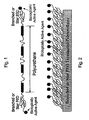
- Fig. 1 is a schematic view of a base polymer having branched or star polyethylene oxide biologically modifying end units.
- the polymer is represented by a polyurethane chain.
- branched or star polyethylene oxide is provided at the terminal ends of the polyurethane.
- Whether the PEO is branched or starred depends of the number of substituents.
- At least two branches, more particularly, at least four branches, and still more particularly, at least six branches are provided.
- the term "star PEO” has been previously defined as requiring at least five branches. However, the invention should not be restricted in the definition. To some extent, the terms “branched PEO” and “star PEO” terms are used interchangeably in this discussion.
- a biologically active agent is attached to the branched or star PEO.
- This biologically active agent is optionally provided, representing one embodiment of the invention.
- the biologically active agent will be described below.
- Fig. 2 is a schematic view of a biological polymer, showing an interface on the polymer, formed of branched or star PEO, as the interface would appear in water or a biological fluid.
- the PEO surface modifying end groups form a protection layer on the base polymer.
- Fig. 2 shows biologically active agents attached to the branched PEO groups. These biologically active agents may or may not be provided. That is, a valuable biomedical polymer casing is produced even if biologically active agents have not been added to the biomedical polymer.
- the branched or star molecules can be synthesized by using dendrimers as cores, and modified polyethylene oxide as the arms extending from the cores.
- Star-shaped polymers comprise several linear chains linked together at one end of each chain, constituting the simplest form of branching.
- the branched PEO can be formed using a plurality of different methods.
- divergent and convergent approaches involve the termination of growing polymer chains with multifunctional terminating agents to form the star-shaped polymer.
- the convergent method combined with anionic living polymerization, a newly developed teclmique, is known to produce a star-shaped polymer of controlled arm length, narrow molecular weight distribution, and easily varied arm number.
- the branched or star PEO can also be made by a divergent approach.
- the divergent approach also called the “core-first method,” starts the synthesis reaction from a plurifunctional initiator and proceeds outward. This technique allows the modification of the branches with functional groups at their outer ends, thus providing the possibility of further reaction for forming block copolymers or selective adsorption. Due to its simplicity, the divergent method has been commonly applied for a variety of star-shaped polymers. Gellation can happen due to a cross linking reaction because proteins, in general, have several accessible amino groups.
- the branched or star PEO can also be formed by a "one-arm-first method," which is described in U.S. Patent No. 6,046,305 to Choi , which patent is hereby incorporated by a reference.
- the "one-arm-first method” is basically an improvement of the "arm-first method” and the "core-first method.”
- one arm bearing a functional group is prepared first by ring-opening polymerization of ethylene oxide initiated with a heterobifunctional compound, and then the growing polymer chain end is terminated by a polyfunctional compound followed by sequential polymerization of ethylene oxide.
- the PEO branched or star molecules After the PEO branched or star molecules are formed, they can be used as surface modifying end groups for a biological polymer.
- the coverage of the PEO surface layer on a base polymer surface can be manipulated in a controlled way by design in the PEO star SME molecules. That is, thickness of the PEO surface layer can be controlled using known techniques to control the amount of branching and chain length in the PEO molecules.
- base polymers can be used with the branched or star PEO.
- silicone rubbers fluoropolymers, epoxies, polyamides, polyimides, polyolefins, polyurethanes and polyurethane copolymers such as polyether polyurethanes, polycarbonate polyurethanes, silicone polyurethane and the like may be used.
- the branched or star PEO is combined with monomer(s) that will form the base polymer. During polymerization of the monomer(s), the branched or star PEO acts as a chain terminator.
- U.S. Patent No. 5,895,563 to Ward et al. issued on December 31, 1996 discloses a method of attaching surface modifying end groups to base polymers for use in biological materials.
- the base polymer may be linear.
- the surface modifying end groups may be covalently bonded to the base polymer. Ward et al.
- the method of Ward et al. can be used to attach the branched or star PEO to the base polymer as a surface modifying end group.
- the outer reactable ends of the branched or star PEO chains can be used for immobilizing biologically active agents, such as heparin to further enhance the biocompatibility and biostability.
- Suitable biologically active agents are microbial peptide agents, detergents, non-steroidal anti-inflammatory drugs, cations, amine-containing organosilicones, diphosphonates, fatty acids fatty acid salts and glucorticosteroids.
- a biologically active agent such as a microbial peptide agent, an antimicrobial agent such as those synthesized with quinolone drugs (e.g. Ciprofloxacin, Norfloxacin), an antibiotic such as Gentamyacin or Zithromax, a biocompatible detergent such as Pluronic® brand PE-EO-block polymer sold by BASF, a non-steroidal anti-inflammatory drug, a cation, an amine-containing organosilicone, a fatty acid or a fatty acid salt, bacterial adhesion to the surface of an IMD may be discouraged.
- a biologically active agent such as a microbial peptide agent, an antimicrobial agent such as those synthesized with quinolone drugs (e.g. Ciprofloxacin, Norfloxacin), an antibiotic such as Gentamyacin or Zithromax, a biocompatible detergent such as Pluronic® brand PE-EO-block polymer sold by BASF, a non-steroidal anti-inflammatory drug,
- polyurethane and silicone rubber polymers used in bradycardia, tachycardia and neurological leads may be modified using certain adhesion reducing biologically active agent such as a detergent, salicylic acids such as aspirin or ibuprofen, other non-steroidal anti-inflammatory agents, fatty acid salts (cations) or amine-containing silicones.
- adhesion reducing biologically active agent such as a detergent, salicylic acids such as aspirin or ibuprofen, other non-steroidal anti-inflammatory agents, fatty acid salts (cations) or amine-containing silicones.
- bacterial adhesion may be reduced acutely, chronically, and many years later when a pacemaker pulse generator is changed-out.
- Such agents may also have a significant benefit in preventing scar tissue adhesion to facilitate chronic removal.
- diphosphonates are in heart valves. Specifically, polymeric heart valves have not been used because of thrombosis. A plastic heart valve could experience mineralization and infection. A leaflet heart valve made of polyurethane, with diphosphonate attached to the polyurethane, would not have the mineralization problem.
- Glucocorticosteroids such as dexamethasone or beclamethasone, are described in U.S. Patent No. 5,282,844 issued to Stokes et al. , which is hereby incorporated herein by reference in its entirety. Used as a biologically active agent attached to a branched or star PEO, glucocortico-steroids may exhibit desirable properties, for example, in relation to pacemaker leads.
- the biologically active agents may be attached to the branched or star PEO SMEs either before or after the polymer is formed. That is, if the biologically active agents can withstand polymerization without degradation, they can be attached to the branched or star PEO prior to addition of the branched or star PEO to the base polymer.
- the decomposition point of dexamethasone is about 240°C which is above any polymerization temperature.
- the arm first polymerization method is not suitable for manipulating the PEO with functional groups.
- either the core-first method or the one-ami-first method should be used in order to add biologically active agents before the branch or star PEO is attached to the base polymer.
- a polyurethane heart valve having a diphosphonate biologically active agent and an antimicrobiol biologically active agent could be made.
- Biologically active agents that would otherwise degrade must be attached to the branched or star PEO after the branched or star PEO is combined with the base polymer.
- the method depends on the functional group of the biologically active agent.
- steroids have three benzene rings, a five member ring and a hydroxyl group attached to the five member ring.
- the hydroxyl group may be a convenient place to attach the steroid to the branched or star PEO.
- branched or star PEO has hydroxyl terminal groups. If the hydroxyl groups are not readily compatible with the functional groups on the biologically active agent, there are at least two possible solutions. First, a heterobifunctional PEO could be provided. In this manner, the PEO would have other functional groups rather than just hydroxyl groups.
- a second way to deal with hydroxyl incompatibility is to add a different functional group to the hydroxyl group, which different functional group would in turn bond to the biologically active agent.
- branched or star PEO could be immersed in a solution containing diisocyannate groups (for example, hexa-methylene diisocyannate) to react the cyannate groups with the PEO hydroxyls. Then, the diiscocyanate treated PEO could be put in another solution to react with the steroid hydroxyls. This would produce two urethane groups and a star PEO having steroid properties.
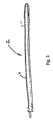
- FIG. 3 is a side cutaway view of a medical lead according to one aspect of the invention.
- the lead which is one example of an IMD, includes an elongated lead body 2, which is covered over at least a portion of its surface with an insulation casing 4.
- the insulation may be made entirely of the SME polymer, or it could have an SME polymer applied as a coating on the insulation. If the SME polymer has a very expensive component, a thin coating may be more desirable.
- the casing 4 is formed of a polymer having branched or star polyethylene oxide surface modifying end groups. Although a lead is shown for discussion purposes, it will be understood that the surface of other IMDs may be used, including surfaces of catheters, stents, drug delivery devices, etc.
- the biomedical polymer having branched or star PEO may form the outer casing of the IMD.
- the IMD may also have a shell formed of a polymeric or non-polymeric material.
- the biomedical polymer casing would be formed on the shell.
- the coating may be formed only on surfaces that do not require a patient-IMD interface.
- the electrodes of a pacemaker lead likely need not be encapsulated with the coating.
Landscapes
- Health & Medical Sciences (AREA)
- Medicinal Chemistry (AREA)
- Life Sciences & Earth Sciences (AREA)
- Chemical & Material Sciences (AREA)
- General Health & Medical Sciences (AREA)
- Dermatology (AREA)
- Oral & Maxillofacial Surgery (AREA)
- Transplantation (AREA)
- Epidemiology (AREA)
- Animal Behavior & Ethology (AREA)
- Public Health (AREA)
- Veterinary Medicine (AREA)
- Biomedical Technology (AREA)
- Molecular Biology (AREA)
- Engineering & Computer Science (AREA)
- Materials For Medical Uses (AREA)
Claims (20)
- Implantierbare medizinische Vorrichtung mit:einer medizinischen Einheit; undeinem Gehäuse, das die medizinische Einheit wenigstens teilweise einschließt, wobei das Gehäuse aus einem Grundpolymer mit einem verzweigten Polyethylenoxid, das an das Grundpolymer in Form von oberflächenmodifizierenden Endgruppen angefügt ist, gebildet ist, wobei das verzweigte Polyethylenoxid wenigstens zwei Zweige bzw. Verzweigungen aufweist, dadurch gekennzeichnet, dass das verzweigte Polyethylenoxid an das Grundpolymer durch Kombinieren desselben mit Monomer(en) angefügt ist, das bzw. die das Grundpolymer bildet bzw. bilden, wodurch das verzweigte Polyethylenoxid während der Polymerisation des Monomers bzw. der Monomere als ein Kettenterminator wirkt.
- Implantierbare medizinische Vorrichtung nach Anspruch 1, bei der:das Gehäuse aus einem Grundpolymer gebildet ist, das aus der Gruppe ausgewählt ist, die aus Polyurethanen, Polyurethan-Copolymeren, Fluorpolymeren, Polyolefinen und Silikongummis besteht,das Gehäuse oberflächenmodifizierende Endgruppen in Form von Stern-Polyethylenoxid aufweist, die an das Grundpolymer kovalent gebunden sind, wobei das Stern-Polyethylenoxid wenigstens fünf Verzweigungen aufweist, wobei die Stern-Polyethylenoxid-Gruppen an das Grundpolymer durch Kombinieren der Gruppen mit Monomer(en) angefügt sind, das bzw. die das Grundpolymer bildet bzw. bilden, wodurch das Stern-Polyethylenoxid während der Polymerisation des Monomers bzw. der Monomere als ein Kettenterminator wirkt, unddas Gehäuse biologisch aktive Wirkstoffe aufweist, die an die oberflächenmodifizierenden Endgruppen angefügt sind, wobei die biologisch aktiven Wirkstoffe aus der Gruppe ausgewählt sind, die aus Antibiotika, antimikrobiellen Wirkstoffen, mikrobiellen Peptidwirkstoffen, biokompatiblen Tensiden, nichtsteroidalen antiinflammatorischen Medikamenten, Kationen, aminhaltigenOrganosiliziumverbindungen, Disphosphonaten, Fettsäuren, Fettsäuresalzen, Heparin und Glucocorticosteroiden besteht.
- Implantierbare medizinische Vorrichtung nach Anspruch 1 oder 2, dadurch gekennzeichnet, dass das Grundpolymer aus der Gruppe ausgewählt ist, die aus Epoxiden bzw. Epoxis, Polyurethanen, Polyurethan-Copolymeren, Fluorpolymeren, Polyolefinen und Silikongummis besteht.
- Implantierbare medizinische Vorrichtung nach Anspruch 1 oder 2, dadurch gekennzeichnet, dass zwei unterschiedliche biologisch aktive Wirkstoffe an das verzweigte Polyethylenoxid angefügt sind.
- Implantierbare medizinische Vorrichtung nach Anspruch 1, dadurch gekennzeichnet, dass
biologisch aktive Wirkstoffe an das verzweigte Polyethylenoxid angefügt sind, und
die biologisch aktiven Wirkstoffe aus der Gruppe ausgewählt sind, die aus antimikrobiellen Wirkstoffen, Antibiotika, mikrobiellen Peptidwirkstoffen, biokompatiblen Tensiden, nichtsteroidalen antiinflammatorischen Medikamenten, Kationen, aminhaltigen Organosiliziumverbindungen, Diphosphonaten, Fettsäuren, Fettsäuresalzen, Heparin und Glucocortikosteroiden besteht. - Implantierbare medizinische Vorrichtung nach Anspruch 1 oder 2, dadurch gekennzeichnet, dass die medizinische Einheit eine Herzschrittmacherleitung ist.
- Implantierbare medizinische Vorrichtung nach Anspruch 1 oder 2, dadurch gekennzeichnet, dass die medizinische Einheit eine Schale mit einer äußeren Oberfläche aufweist, und
das Gehäuse auf der äußeren Oberfläche der Schale ausgebildet ist. - Implantierbare medizinische Vorrichtung nach Anspruch 1, dadurch gekennzeichnet, dass das verzweigte Polyethylenoxid wenigstens vier Verzweigungen aufweist.
- Implantierbare medizinische Vorrichtung nach Anspruch 1, dadurch gekennzeichnet, dass das verzweigte Polyethylenoxid wenigstens sechs Verzweigungen aufweist.
- Implantierbare medizinische Vorrichtung nach Anspruch 1, dadurch gekennzeichnet, dass verzweigte Polyethylenoxid quervernetzte bzw. -verbundene Verzweigungen aufweist.
- Implantierbare medizinische Vorrichtung nach Anspruch 1, dadurch gekennzeichnet, dass das verzweigte Polyethylenoxid ein heterobifunktionelles Molekül ist.
- Biomedizinisches Polymer, das aufweist:ein im wesentlichen lineares bzw. unverzweigtes Grundpolymer; undeine verzweigtes Polyethylenoxid, das kovalent an das Grundpolymer in Form oberflächenaktiver Endgruppen gebunden ist, wobei das verzweige Polyethylenoxid wenigstens zwei Verzweigungen aufweist, dadurch gekennzeichnet, dass das verzweigte Polyethylenoxid an das Grundpolymer durch Kombinieren desselben mit Monomer(en) angefügt ist, das bzw. die das Grundpolymer bildet bzw. bilden, wodurch das verzweigte Polyethylenoxid während der Polymerisation des Monomers bzw. der Monomere als ein Kettenterminator wirkt.
- Biomedizinisches Polymer nach Anspruch 12, dadurch gekennzeichnet, dass das verzweigte Polyethylenoxid ein Stern-Polyethylenoxid ist.
- Biomedizinisches Polymer nach Anspruch 12 oder 13, dadurch gekennzeichnet, dass zwei unterschiedliche biologisch aktive Wirkstoffe an das verzweigte Polyethylenoxid angefügt sind.
- Biomedizinisches Polymer nach Anspruch 12 oder 13, dadurch gekennzeichnet, dass
biologisch aktive Wirkstoffe an das verzweigte Polyethylenoxid angefügt sind, und
die biologisch aktiven Wirkstoffe aus der Gruppe ausgewählt sind, die aus antimikrobiellen Wirkstoffen, Antibiotika, mikrobiellen Peptidwirkstoffen, biokompatiblen Tensiden, nichtsteroidalen antiinflammatorischen Medikamenten, Kationen, aminhaltigen Organosiliziumverbindungen, Diphosphonaten, Fettsäuren, Fettsäuresalzen, Heparin und Glucocortikosteroiden besteht. - Biomedizinisches Polymer nach Anspruch 12 oder 13, dadurch gekennzeichnet, dass das Polymer aus der Gruppe ausgewählt ist, die aus Epoxis, Polyurethanen, Polyurethan-Copolymeren, Fluorpolymeren, Polyolefinen und Silikongummis besteht.
- Biomedizinisches Polymer nach Anspruch 12, dadurch gekennzeichnet, dass das verzweigte Polyethylenoxid wenigstens vier Verzweigungen aufweist.
- Biomedizinisches Polymer nach Anspruch 12, dadurch gekennzeichnet, dass das verzweigte Polyethylenoxid wenigstens sechs Verzweigungen aufweist.
- Biomedizinisches Polymer nach Anspruch 12, dadurch gekennzeichnet, dass das verzweigte Polyethylenoxid quervernetzte Verzweigungen aufweist.
- Biomedizinisches Polymer nach Anspruch 12, dadurch gekennzeichnet, dass das verzweigte Polyethylenoxid ein heterobifunktionelles Molekül ist.
Applications Claiming Priority (3)
| Application Number | Priority Date | Filing Date | Title |
|---|---|---|---|
| US10/131,440 US6961610B2 (en) | 2002-04-25 | 2002-04-25 | Branched polyethylene oxide terminated biomedical polymers and their use in biomedical devices |
| US131440 | 2002-04-25 | ||
| PCT/US2003/009680 WO2003090808A1 (en) | 2002-04-25 | 2003-03-28 | Branched polythylene oxide terminated biomedical polymers and their use in biomedical devices |
Publications (2)
| Publication Number | Publication Date |
|---|---|
| EP1501564A1 EP1501564A1 (de) | 2005-02-02 |
| EP1501564B1 true EP1501564B1 (de) | 2010-09-15 |
Family
ID=29248585
Family Applications (1)
| Application Number | Title | Priority Date | Filing Date |
|---|---|---|---|
| EP03747260A Expired - Lifetime EP1501564B1 (de) | 2002-04-25 | 2003-03-28 | Biomedizinische polymere mit verzweigtem polyethylenoxid-ende und ihre verwendung in biomedizinischen vorrichtungen |
Country Status (6)
| Country | Link |
|---|---|
| US (1) | US6961610B2 (de) |
| EP (1) | EP1501564B1 (de) |
| JP (1) | JP2005530528A (de) |
| CA (1) | CA2483157A1 (de) |
| DE (1) | DE60334201D1 (de) |
| WO (1) | WO2003090808A1 (de) |
Families Citing this family (14)
| Publication number | Priority date | Publication date | Assignee | Title |
|---|---|---|---|---|
| US8673339B2 (en) * | 2003-03-11 | 2014-03-18 | Medtronic, Inc. | Demand-release bioactive composition for implantable medical devices |
| US9561309B2 (en) | 2004-05-27 | 2017-02-07 | Advanced Cardiovascular Systems, Inc. | Antifouling heparin coatings |
| US20080268013A1 (en) * | 2005-02-10 | 2008-10-30 | Emory University | Polyethylene Oxide Polymers Including Anti-Inflammatory Glycodendrons |
| JP5069247B2 (ja) * | 2005-12-08 | 2012-11-07 | ディーエスエム アイピー アセッツ ビー.ブイ. | 重合体用の表面を修飾する末端基としての自己組織化する単量体及びオリゴマー |
| US8535704B2 (en) * | 2005-12-29 | 2013-09-17 | Medtronic, Inc. | Self-assembling cross-linking molecular nano film |
| US8591531B2 (en) | 2006-02-08 | 2013-11-26 | Tyrx, Inc. | Mesh pouches for implantable medical devices |
| AU2007344645B2 (en) | 2006-02-08 | 2012-12-13 | Medtronic, Inc. | Temporarily stiffened mesh prostheses |
| EP2010589A2 (de) * | 2006-04-05 | 2009-01-07 | Advanced Neuromodulation Systems, Inc. | Polyurethane für medizinische implantation |
| US7917229B2 (en) | 2006-08-31 | 2011-03-29 | Cardiac Pacemakers, Inc. | Lead assembly including a polymer interconnect and methods related thereto |
| US9023114B2 (en) | 2006-11-06 | 2015-05-05 | Tyrx, Inc. | Resorbable pouches for implantable medical devices |
| EP2190441A4 (de) * | 2007-05-30 | 2014-03-26 | Dsm Ip Assets Bv | Polymere mit biofunktionalen, sich selbst zusammensetzenden monoschicht-endgruppen für therapeutische anwendungen und blutfiltration |
| US8219209B2 (en) | 2008-08-15 | 2012-07-10 | Cardiac Pacemakers, Inc. | Implantable medical lead having reduced dimension tubing transition |
| EP2358795A1 (de) | 2008-11-17 | 2011-08-24 | DSM IP Assets B.V. | Oberflächenmodifizierung von polymeren über oberflächenaktive und reaktive endgruppen |
| US9861814B2 (en) | 2010-12-23 | 2018-01-09 | Medtronic, Inc. | Medical electrical lead having biological surface and methods of making and using same |
Family Cites Families (10)
| Publication number | Priority date | Publication date | Assignee | Title |
|---|---|---|---|---|
| US5275838A (en) | 1990-02-28 | 1994-01-04 | Massachusetts Institute Of Technology | Immobilized polyethylene oxide star molecules for bioapplications |
| US5282844A (en) | 1990-06-15 | 1994-02-01 | Medtronic, Inc. | High impedance, low polarization, low threshold miniature steriod eluting pacing lead electrodes |
| US5589563A (en) | 1992-04-24 | 1996-12-31 | The Polymer Technology Group | Surface-modifying endgroups for biomedical polymers |
| JPH09507784A (ja) * | 1994-11-16 | 1997-08-12 | アルコン ラボラトリーズ, インコーポレイテッド | 移植可能な医療デバイスの生物学的適合性を改善する架橋ポリエチレンオキシドコーティング |
| US6509098B1 (en) | 1995-11-17 | 2003-01-21 | Massachusetts Institute Of Technology | Poly(ethylene oxide) coated surfaces |
| US5855618A (en) | 1996-09-13 | 1999-01-05 | Meadox Medicals, Inc. | Polyurethanes grafted with polyethylene oxide chains containing covalently bonded heparin |
| US5830986A (en) | 1996-10-28 | 1998-11-03 | Massachusetts Institute Of Technology | Methods for the synthesis of functionalizable poly(ethylene oxide) star macromolecules |
| US6046305A (en) | 1997-12-12 | 2000-04-04 | Macromed, Inc. | Heterofunctionalized star-shaped poly(ethylene gycols) for protein modification |
| US6812217B2 (en) * | 2000-12-04 | 2004-11-02 | Medtronic, Inc. | Medical device and methods of use |
| US6966322B2 (en) * | 2001-04-20 | 2005-11-22 | Medtronic, Inc. | Enhanced chronic lead removal |
-
2002
- 2002-04-25 US US10/131,440 patent/US6961610B2/en not_active Expired - Fee Related
-
2003
- 2003-03-28 DE DE60334201T patent/DE60334201D1/de not_active Expired - Lifetime
- 2003-03-28 JP JP2003587434A patent/JP2005530528A/ja active Pending
- 2003-03-28 WO PCT/US2003/009680 patent/WO2003090808A1/en not_active Ceased
- 2003-03-28 CA CA002483157A patent/CA2483157A1/en not_active Abandoned
- 2003-03-28 EP EP03747260A patent/EP1501564B1/de not_active Expired - Lifetime
Also Published As
| Publication number | Publication date |
|---|---|
| JP2005530528A (ja) | 2005-10-13 |
| WO2003090808A1 (en) | 2003-11-06 |
| US20030204230A1 (en) | 2003-10-30 |
| DE60334201D1 (de) | 2010-10-28 |
| CA2483157A1 (en) | 2003-11-06 |
| US6961610B2 (en) | 2005-11-01 |
| EP1501564A1 (de) | 2005-02-02 |
Similar Documents
| Publication | Publication Date | Title |
|---|---|---|
| EP1501564B1 (de) | Biomedizinische polymere mit verzweigtem polyethylenoxid-ende und ihre verwendung in biomedizinischen vorrichtungen | |
| US6968234B2 (en) | Implantable medical device having biologically active polymeric casing | |
| CA2286644C (en) | Drug delivery via therapeutic hydrogels | |
| US5840387A (en) | Sulfonated multiblock copolymer and uses therefor | |
| EP3389735B1 (de) | Biologisch inerte beschichtung für implantierbare medizinische vorrichtungen | |
| EP1339439B1 (de) | Medizinische vorrichtung und verfahren zur anwendung dieser vorrichtung | |
| KR19990044571A (ko) | 약물 방출 스텐트 피복방법 | |
| US20180280567A1 (en) | Biocompatible implants for nerve re-generation and methods of use thereof | |
| CN108815552A (zh) | 一种多药物可控装载及长效缓释的生物医用涂层材料及其制备方法 | |
| US7553546B1 (en) | Polyethylene oxide and silicone copolymers and their usage on medical devices | |
| CN101765436A (zh) | 包括具有药物溶解度梯度的聚合物药物递送系统的医疗器械 | |
| JP2004530652A (ja) | 哺乳動物細胞増殖の阻害または予防のための方法と臨床装置 | |
| EP1420837A2 (de) | Beschichtungszusammensetzung für einen arzneimittel freisetzenden stent und damit hergestellter, arzneimittel freisetzender stent | |
| Ghosh et al. | Recent development in polyurethanes for biomedical applications | |
| CN113730644B (zh) | 一种具有凝胶涂层的缝合线及其制备方法 | |
| EP3411088B1 (de) | Implantierbare medizinische produkte, verfahren zu deren herstellung und deren verwendung | |
| Sanabria Cala et al. | Study of methodologies for the formation of a layer that inhibits the formation of bacterial strains in cardiac instruments | |
| WO2004058324A2 (en) | Antithrombotic venous access devices and methods | |
| MXPA97004436A (en) | Coating and procedure to cover a farm release fixer | |
| MXPA98001941A (en) | Procedure to cover a farm releasing fastening protesis |
Legal Events
| Date | Code | Title | Description |
|---|---|---|---|
| PUAI | Public reference made under article 153(3) epc to a published international application that has entered the european phase |
Free format text: ORIGINAL CODE: 0009012 |
|
| 17P | Request for examination filed |
Effective date: 20041116 |
|
| AK | Designated contracting states |
Kind code of ref document: A1 Designated state(s): AT BE BG CH CY CZ DE DK EE ES FI FR GB GR HU IE IT LI LU MC NL PT RO SE SI SK TR |
|
| AX | Request for extension of the european patent |
Extension state: AL LT LV MK |
|
| 17Q | First examination report despatched |
Effective date: 20050117 |
|
| GRAP | Despatch of communication of intention to grant a patent |
Free format text: ORIGINAL CODE: EPIDOSNIGR1 |
|
| GRAS | Grant fee paid |
Free format text: ORIGINAL CODE: EPIDOSNIGR3 |
|
| GRAA | (expected) grant |
Free format text: ORIGINAL CODE: 0009210 |
|
| AK | Designated contracting states |
Kind code of ref document: B1 Designated state(s): CH DE FR LI NL SE |
|
| REG | Reference to a national code |
Ref country code: CH Ref legal event code: EP |
|
| REF | Corresponds to: |
Ref document number: 60334201 Country of ref document: DE Date of ref document: 20101028 Kind code of ref document: P |
|
| REG | Reference to a national code |
Ref country code: NL Ref legal event code: VDEP Effective date: 20100915 |
|
| PG25 | Lapsed in a contracting state [announced via postgrant information from national office to epo] |
Ref country code: SE Free format text: LAPSE BECAUSE OF FAILURE TO SUBMIT A TRANSLATION OF THE DESCRIPTION OR TO PAY THE FEE WITHIN THE PRESCRIBED TIME-LIMIT Effective date: 20100915 |
|
| PG25 | Lapsed in a contracting state [announced via postgrant information from national office to epo] |
Ref country code: NL Free format text: LAPSE BECAUSE OF FAILURE TO SUBMIT A TRANSLATION OF THE DESCRIPTION OR TO PAY THE FEE WITHIN THE PRESCRIBED TIME-LIMIT Effective date: 20100915 |
|
| PLBE | No opposition filed within time limit |
Free format text: ORIGINAL CODE: 0009261 |
|
| STAA | Information on the status of an ep patent application or granted ep patent |
Free format text: STATUS: NO OPPOSITION FILED WITHIN TIME LIMIT |
|
| 26N | No opposition filed |
Effective date: 20110616 |
|
| REG | Reference to a national code |
Ref country code: DE Ref legal event code: R097 Ref document number: 60334201 Country of ref document: DE Effective date: 20110616 |
|
| REG | Reference to a national code |
Ref country code: CH Ref legal event code: PL |
|
| PG25 | Lapsed in a contracting state [announced via postgrant information from national office to epo] |
Ref country code: CH Free format text: LAPSE BECAUSE OF NON-PAYMENT OF DUE FEES Effective date: 20110331 Ref country code: LI Free format text: LAPSE BECAUSE OF NON-PAYMENT OF DUE FEES Effective date: 20110331 |
|
| REG | Reference to a national code |
Ref country code: FR Ref legal event code: PLFP Year of fee payment: 14 |
|
| REG | Reference to a national code |
Ref country code: FR Ref legal event code: PLFP Year of fee payment: 15 |
|
| PGFP | Annual fee paid to national office [announced via postgrant information from national office to epo] |
Ref country code: FR Payment date: 20170327 Year of fee payment: 15 |
|
| PGFP | Annual fee paid to national office [announced via postgrant information from national office to epo] |
Ref country code: DE Payment date: 20170329 Year of fee payment: 15 |
|
| REG | Reference to a national code |
Ref country code: DE Ref legal event code: R119 Ref document number: 60334201 Country of ref document: DE |
|
| PG25 | Lapsed in a contracting state [announced via postgrant information from national office to epo] |
Ref country code: DE Free format text: LAPSE BECAUSE OF NON-PAYMENT OF DUE FEES Effective date: 20181002 |
|
| PG25 | Lapsed in a contracting state [announced via postgrant information from national office to epo] |
Ref country code: FR Free format text: LAPSE BECAUSE OF NON-PAYMENT OF DUE FEES Effective date: 20180331 |