EP1501105A2 - Method of manufacturing soft magnetic articles - Google Patents
Method of manufacturing soft magnetic articles Download PDFInfo
- Publication number
- EP1501105A2 EP1501105A2 EP04254410A EP04254410A EP1501105A2 EP 1501105 A2 EP1501105 A2 EP 1501105A2 EP 04254410 A EP04254410 A EP 04254410A EP 04254410 A EP04254410 A EP 04254410A EP 1501105 A2 EP1501105 A2 EP 1501105A2
- Authority
- EP
- European Patent Office
- Prior art keywords
- soft magnetic
- manufacturing
- heat treatment
- magnetic field
- articles
- Prior art date
- Legal status (The legal status is an assumption and is not a legal conclusion. Google has not performed a legal analysis and makes no representation as to the accuracy of the status listed.)
- Withdrawn
Links
- 230000005291 magnetic effect Effects 0.000 title claims abstract description 165
- 238000004519 manufacturing process Methods 0.000 title claims abstract description 54
- 239000006249 magnetic particle Substances 0.000 claims abstract description 56
- 238000000034 method Methods 0.000 claims abstract description 35
- 239000000155 melt Substances 0.000 claims abstract description 23
- 239000000696 magnetic material Substances 0.000 claims abstract description 9
- 238000000889 atomisation Methods 0.000 claims abstract description 4
- 238000007712 rapid solidification Methods 0.000 claims abstract description 4
- 238000010438 heat treatment Methods 0.000 claims description 42
- XEEYBQQBJWHFJM-UHFFFAOYSA-N Iron Chemical compound [Fe] XEEYBQQBJWHFJM-UHFFFAOYSA-N 0.000 claims description 27
- 229910052742 iron Inorganic materials 0.000 claims description 12
- 238000001953 recrystallisation Methods 0.000 claims description 10
- 239000000463 material Substances 0.000 claims description 8
- 239000002887 superconductor Substances 0.000 claims description 4
- 239000006247 magnetic powder Substances 0.000 description 52
- 230000005415 magnetization Effects 0.000 description 25
- 239000013078 crystal Substances 0.000 description 24
- 239000007921 spray Substances 0.000 description 13
- 230000008569 process Effects 0.000 description 9
- 230000006698 induction Effects 0.000 description 8
- 230000000694 effects Effects 0.000 description 7
- 230000035699 permeability Effects 0.000 description 7
- 239000012535 impurity Substances 0.000 description 4
- 239000000843 powder Substances 0.000 description 4
- 230000000052 comparative effect Effects 0.000 description 3
- 238000002425 crystallisation Methods 0.000 description 3
- 230000008025 crystallization Effects 0.000 description 3
- 230000004907 flux Effects 0.000 description 3
- 238000002844 melting Methods 0.000 description 3
- 230000008018 melting Effects 0.000 description 3
- VYPSYNLAJGMNEJ-UHFFFAOYSA-N Silicium dioxide Chemical compound O=[Si]=O VYPSYNLAJGMNEJ-UHFFFAOYSA-N 0.000 description 2
- GWEVSGVZZGPLCZ-UHFFFAOYSA-N Titan oxide Chemical compound O=[Ti]=O GWEVSGVZZGPLCZ-UHFFFAOYSA-N 0.000 description 2
- MCMNRKCIXSYSNV-UHFFFAOYSA-N Zirconium dioxide Chemical compound O=[Zr]=O MCMNRKCIXSYSNV-UHFFFAOYSA-N 0.000 description 2
- 238000010586 diagram Methods 0.000 description 2
- 230000005294 ferromagnetic effect Effects 0.000 description 2
- 229910000859 α-Fe Inorganic materials 0.000 description 2
- 229910000976 Electrical steel Inorganic materials 0.000 description 1
- PNEYBMLMFCGWSK-UHFFFAOYSA-N aluminium oxide Inorganic materials [O-2].[O-2].[O-2].[Al+3].[Al+3] PNEYBMLMFCGWSK-UHFFFAOYSA-N 0.000 description 1
- 229910052681 coesite Inorganic materials 0.000 description 1
- 238000001816 cooling Methods 0.000 description 1
- 229910052593 corundum Inorganic materials 0.000 description 1
- 229910052906 cristobalite Inorganic materials 0.000 description 1
- 238000005520 cutting process Methods 0.000 description 1
- 230000007547 defect Effects 0.000 description 1
- 238000009689 gas atomisation Methods 0.000 description 1
- 239000003779 heat-resistant material Substances 0.000 description 1
- 239000011261 inert gas Substances 0.000 description 1
- 238000009413 insulation Methods 0.000 description 1
- 230000003993 interaction Effects 0.000 description 1
- 230000005381 magnetic domain Effects 0.000 description 1
- 238000012986 modification Methods 0.000 description 1
- 230000004048 modification Effects 0.000 description 1
- 238000005457 optimization Methods 0.000 description 1
- 230000005298 paramagnetic effect Effects 0.000 description 1
- 239000002245 particle Substances 0.000 description 1
- 239000002994 raw material Substances 0.000 description 1
- 239000000377 silicon dioxide Substances 0.000 description 1
- 238000005507 spraying Methods 0.000 description 1
- 229910052682 stishovite Inorganic materials 0.000 description 1
- 229910052905 tridymite Inorganic materials 0.000 description 1
- 238000012795 verification Methods 0.000 description 1
- 238000009692 water atomization Methods 0.000 description 1
- 229910001845 yogo sapphire Inorganic materials 0.000 description 1
Images

Classifications
-
- H—ELECTRICITY
- H01—ELECTRIC ELEMENTS
- H01F—MAGNETS; INDUCTANCES; TRANSFORMERS; SELECTION OF MATERIALS FOR THEIR MAGNETIC PROPERTIES
- H01F41/00—Apparatus or processes specially adapted for manufacturing or assembling magnets, inductances or transformers; Apparatus or processes specially adapted for manufacturing materials characterised by their magnetic properties
- H01F41/02—Apparatus or processes specially adapted for manufacturing or assembling magnets, inductances or transformers; Apparatus or processes specially adapted for manufacturing materials characterised by their magnetic properties for manufacturing cores, coils, or magnets
- H01F41/0206—Manufacturing of magnetic cores by mechanical means
- H01F41/0246—Manufacturing of magnetic circuits by moulding or by pressing powder
-
- H—ELECTRICITY
- H01—ELECTRIC ELEMENTS
- H01F—MAGNETS; INDUCTANCES; TRANSFORMERS; SELECTION OF MATERIALS FOR THEIR MAGNETIC PROPERTIES
- H01F1/00—Magnets or magnetic bodies characterised by the magnetic materials therefor; Selection of materials for their magnetic properties
- H01F1/01—Magnets or magnetic bodies characterised by the magnetic materials therefor; Selection of materials for their magnetic properties of inorganic materials
- H01F1/03—Magnets or magnetic bodies characterised by the magnetic materials therefor; Selection of materials for their magnetic properties of inorganic materials characterised by their coercivity
- H01F1/12—Magnets or magnetic bodies characterised by the magnetic materials therefor; Selection of materials for their magnetic properties of inorganic materials characterised by their coercivity of soft-magnetic materials
- H01F1/14—Magnets or magnetic bodies characterised by the magnetic materials therefor; Selection of materials for their magnetic properties of inorganic materials characterised by their coercivity of soft-magnetic materials metals or alloys
- H01F1/20—Magnets or magnetic bodies characterised by the magnetic materials therefor; Selection of materials for their magnetic properties of inorganic materials characterised by their coercivity of soft-magnetic materials metals or alloys in the form of particles, e.g. powder
- H01F1/22—Magnets or magnetic bodies characterised by the magnetic materials therefor; Selection of materials for their magnetic properties of inorganic materials characterised by their coercivity of soft-magnetic materials metals or alloys in the form of particles, e.g. powder pressed, sintered, or bound together
- H01F1/24—Magnets or magnetic bodies characterised by the magnetic materials therefor; Selection of materials for their magnetic properties of inorganic materials characterised by their coercivity of soft-magnetic materials metals or alloys in the form of particles, e.g. powder pressed, sintered, or bound together the particles being insulated
Definitions
- the present invention relates to a method of manufacturing soft magnetic articles.
- electric and electronic parts such as motors, voltage converters, transformers, noise filters, and choke coils are manufactured using soft magnetic materials.
- the electric and electronic parts can be manufactured by press-forming soft magnetic powders containing iron as a main component so as to form a molded body, and performing appropriate processing on the molded body.
- a magnetic field of 1T (Tesla) is generated by magnetic field-generating coils, and shape-anisotropic soft magnetic powders consisting of iron as a main component are press-formed in the magnetic field.
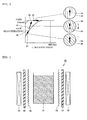
- Figure 1 is a sectional view illustrating an atomizing device used for a method of manufacturing soft magnetic articles according to a first embodiment of the present invention.
- Figure 2 is an enlarged schematic diagram illustrating soft magnetic powders formed using the atomizing device in Fig. 1.
- Figure 3 is a graph illustrating magnetization curves of a single crystal of Fe.
- Figure 4 is a sectional view illustrating a heat treatment device used for manufacturing soft magnetic articles according to the method of a second embodiment of the present invention.
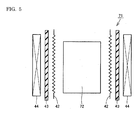
- Figure 5 is a sectional view illustrating a heat treatment device used for manufacturing soft magnetic articles according to the method of a third embodiment of the present invention.
- the inventors of the present invention discovered that it is possible to increase the magnetic permeability of soft magnetic materials and to reduce the coercive force of the soft magnetic materials by the following methods.
- soft magnetic articles includes not only soft magnetic particles and soft magnetic molded bodies obtained by press-forming soft magnetic particles, but also extruded articles produced from the soft magnetic molded bodies by extrusion-processing or the like.
- a method of manufacturing soft magnetic articles according to an aspect of the present invention includes a step of preparing a melt solution containing soft magnetic materials and a step of forming soft magnetic particles from the melt solution in the magnetic field by an atomization rapid solidification method.
- respective crystals constituting soft magnetic particles tend to be magnetized in the direction of an easy axis of magnetization so as to be in a stable state when a magnetic field is applied in the step of crystallizing the soft magnetic particles.
- magnetocrystalline anisotropy it is possible to orient the respective crystals in the soft magnetic particles in the direction of the easy axis of magnetization. Also, since the number of domains in the soft magnetic particles is reduced due to the influence of the magnetic field, it is possible to reduce the grain boundaries.
- the present invention it is possible to provide the soft magnetic articles in which the hysteresis loss is sufficiently reduced.
- the step of forming the soft magnetic particles preferably includes a process of forming the soft magnetic particles in a magnetic field exceeding 8.0 ⁇ 10 5 (A/m) According to the method having such structure as described above for manufacturing soft magnetic articles, it is possible to increase the influence of the magnetic field by applying the magnetic field exceeding 8.0 ⁇ 10 5 (A/m), that is, 10 kOe (kilo oersted). Consequently, soft magnetic articles in which the hysteresis loss is further reduced can be provided.
- a method of manufacturing soft magnetic articles according to another aspect of the present invention includes the steps of forming soft magnetic particles and performing heat treatment on the soft magnetic particles in a magnetic field.
- the method having the above-mentioned structure for manufacturing soft magnetic articles it is possible to orient the respective crystals in the soft magnetic particles in the direction of an easy axis of magnetization by using the magnetocrystalline anisotropy. Also, since the number of domains in the soft magnetic particles is reduced due to the influence of the magnetic field, it is possible to reduce the grain boundaries. Also, it is possible to improve the purity of the soft magnetic particles since the impurities are deposited to the outside by the influence of the magnetic field when the soft magnetic particles are re-crystallized. Furthermore, since the crystal lattice orientation is optimized due to the influence of the magnetic field, it is possible to reduce the dislocation and the stress distortion. Therefore, according to the present invention, it is possible to provide the soft magnetic articles in which the hysteresis loss is sufficiently reduced.
- the step of performing the heat treatment on the soft magnetic particles preferably includes heat-treating the soft magnetic particles in a magnetic field exceeding 8.0 ⁇ 10 5 (A/m). According to the method having the above-mentioned structure for manufacturing soft magnetic articles, it is possible to increase the influence of the magnetic field by applying the magnetic field exceeding 10 (kOe). Therefore, it is possible to provide the soft magnetic articles in which the hysteresis loss is sufficiently reduced.
- a method of manufacturing soft magnetic articles according to another aspect of the present invention comprises the steps of forming a molded body by press-forming soft magnetic particles and performing heat treatment on the molded body in a magnetic field.
- the respective crystals in the soft magnetic particles can be oriented in the direction of an easy axis of magnetization by using the magnetocrystalline anisotropy. Also, since the number of domains is in the soft magnetic particles is reduced due to the influence of the magnetic field, it is possible to reduce the grain boundaries. Also, since the impurities are deposited to the outside due to the influence of the magnetic field when the soft magnetic particles are re-crystallized, it is possible to improve the purity of the soft magnetic particles. Furthermore, since the crystal lattice orientation is optimized due to the influence of the magnetic field, it is possible to reduce the dislocation and the stress distortion. Therefore, according to the present invention, it is possible to provide the soft magnetic articles in which the hysteresis loss is sufficiently reduced.
- the step of performing heat treatment on a molded body preferably includes a process of heat-treating the mold in a magnetic field exceeding 8.0 ⁇ 10 5 (A/m). According to the method having the above-mentioned steps for manufacturing the soft magnetic articles, it is possible to increase the influence of the magnetic field by applying the magnetic field exceeding 10 (kOe). Consequently, the soft magnetic articles in which the hysteresis loss is further reduced can be provided.
- the step of performing the heat treatment preferably includes a process of performing a heat treatment at a temperature higher than the re-crystallization temperature of the soft magnetic particles. According to the method having the above-mentioned steps for manufacturing soft magnetic articles, it is possible to heat to an extent that crystals can easily be oriented.
- the magnetic field is formed with current flowing in a superconducting coil.
- a large magnetic field can easily be formed.
- the superconducting coil consists of a high temperature superconductor made of oxide materials.
- high temperature superconductor means a superconductor that exhibits superconductivity at a relatively high temperature such as 30 K or more. According to the method having such structure as mentioned above for manufacturing the soft magnetic articles, since the cooling device of the superconducting coil is simple, it is possible to reduce the manufacturing cost of the soft magnetic articles.
- the soft magnetic particles preferably includes iron as the main component.
- the soft magnetic particles include iron of 90 atomic % or more. According to the method having such structure as mentioned above for manufacturing the soft magnetic articles, it is possible to obtain soft magnetic articles having a high magnetic flux density. Thus, the sizes of the electric and electronic parts using such soft magnetic articles can be reduced as compared with the case in which ferrite materials are used.
- an insulating film is formed so as to surround the surface of a soft magnetic particle.
- the insulating film is made of non-magnetic articles, it can be expected to improve the magnetic characteristics by applying the magnetic field larger than 10 (kOe).
- the insulating film is preferably made of heat resistant materials that keep the insulating characteristic at a temperature no less than the re-crystallization temperature of the soft magnetic particles (in the case of the iron, about 400°C).
- Such materials are oxide materials, such as SiO 2 , Al 2 O 3 , TiO 2 , or ZrO 2 , for example.
- molded bodies as used herein includes those available immediately after press-forming and those of product-shape formed by a cutting process following the press-forming, for example. It is possible to prepare a plurality of molded bodies and to assemble them in a direction along the magnetic circuit of a product, thereby producing the product.
- the present invention it is possible to provide a method of manufacturing the soft magnetic articles in which the hysteresis loss is sufficiently reduced.
- FIG. 1 is a sectional view illustrating an atomizing device used for a method of manufacturing soft magnetic articles according to a first embodiment of the present invention.
- the atomizing device 11 includes a vacuum induction furnace 12, a funnel 14 provided at a lower part of the vacuum induction furnace 12, a spray tower 20, a melt solution inlet pipe 21 for connecting the funnel 14 to the spray tower 20, and superconducting coils 18 and 19 provided around the melt solution inlet pipe 21 and the spray tower 20, respectively.
- the vacuum induction furnace 12 is surrounded by a melting chamber (not shown) connected to a vacuum pump.
- a spray nozzle 15 is formed in a portion where the melt solution inlet pipe 21 is connected to the spray tower 20.
- a powder recovering pipe 17 is connected to the bottom of the spray tower 20.
- a method of forming soft magnetic powders using the atomizing device 11 in Fig. 1 will now be described below.
- a raw material lump for example an iron lump
- a high frequency power supply is applied to the vacuum induction furnace 12
- the material lump in the vacuum induction furnace 12 is melt to be a melt solution 13.
- the vacuum induction furnace 12 is kept not necessarily at a vacuum atmosphere, but it may be filled with an inert gas.
- a magnetic field is applied to the interior of the melt solution inlet pipe 21 and the spray tower 20 by flowing an electrical current to the superconducting coils 18 and 19.
- the applied magnetic field is preferably larger than 10 (kOe).
- the melt solution 13 in the vacuum induction furnace 12 is supplied to the pouring 14.
- the melt solution 13 passes through the melt solution inlet pipe 21 to which the magnetic field is applied, and is sprayed from the spray nozzle 15 to the inside of the spray tower 20.
- the melt solution 13 is rapidly cooled, while being sprayed, in the spray tower 20 to which the magnetic field is applied.
- soft magnetic powders 26 are formed; and, finally, the soft magnetic powders 26 are recovered through the powder recovering pipe 17.
- FIG. 2 is an enlarged schematic diagram illustrating the soft magnetic powders formed using the atomizing device in Fig. 1.
- the soft magnetic powders 26 are composed of a plurality of crystals 27 partitioned by grain boundaries 27p. Although Fig. 2 simply illustrates three crystals 27, the number of crystals 27 is not limited thereto.
- the respective crystals 27 are oriented in the direction of a magnetization easy axis 28.
- the melt solution 13 in Fig. 1 is cooled after being fed into the pouring 14 so that crystallization occurs in the melt solution 13.
- the magnetic field is applied to the melt solution 13 in which the crystallization occurs, and thus the respective formed crystals 27 are oriented in the direction of the magnetization easy axis 28.
- the principle in which the soft magnetic powders 26 are oriented in the direction of the magnetization easy axis 28 will now be described.
- Figure 3 is a graph illustrating magnetization curves of a single crystal of Fe.
- the vertical axis represents 4 ⁇ M (magnetization) and the horizontal axis represents H (magnetic field).
- a curve 38 denotes a magnetization curve in the direction ⁇ 100> of a magnetization easy axis.
- a curve 39 denotes a magnetization curve in the direction ⁇ 111> of a hard axis of magnetization.
- the soft magnetic powders are magnetized along the magnetization curve in the direction marked with an arrow 31.
- the soft magnetic powders begin to rotate in the direction ⁇ 100> (the direction along a line segment 35) so as to be in a stable state and thus magnetized in the direction marked with an arrow 32.
- the soft magnetic powders stop rotating when the direction of the magnetic moment coincides with the direction ⁇ 100>, and thereafter are magnetized along a magnetization curve in the direction marked with an arrow 33.
- the soft magnetic powders are oriented in the direction ⁇ 100> of the magnetization easy axis.
- the method of manufacturing soft magnetic articles according to the first embodiment of the present invention includes a process of preparing the melt solution 13 containing soft magnetic materials and a process of forming the soft magnetic powders 26 as the soft magnetic particles from the melt solution in the magnetic field by the atomization rapid solidification method.
- the method having the above-mentioned structure for manufacturing a soft magnetic article it is possible to optimize the magnetic characteristics (i.e., to increase the magnetic permeability and to reduce the coercive force) at the stage of soft magnetic powders that are the materials of a soft magnetic molded body. Therefore, by using the soft magnetic powders it is possible to manufacture electric and electronic parts in which the hysteresis loss is sufficiently reduced.
- the superconducting coils 18 and 19 are provided around the melt solution inlet pipe 21 and the spray tower 20, respectively.
- a superconducting coil may be provided in either one of the melt solution inlet pipe 21 and the spray tower 20.
- Means for applying the magnetic field are not restricted to the superconducting coils and common coils may be used.
- the atomizing device 11 may use either a water atomizing method or gas atomizing method.
- the soft magnetic powders 26 are formed as flat-shaped powders by spraying the melt solution 13 from the spray nozzle 15, the optimization of the magnetic characteristics can be more easily achieved since the easy axis of magnetization can be aligned in the longer dimension of the soft magnetic powder 26.
- FIG. 4 is a sectional view illustrating a heat treatment device used in the method of manufacturing the soft magnetic materials according to a second embodiment of the present invention.
- a heat treatment device 40 includes a heater 42 provided so as to surround soft magnetic powders 41 in a container, a superconducting coil 44 provided outside the heater 42, an insulating member 43 interposed between the heater 42 and the superconducting coil 44.
- the soft magnetic powders 41 such as iron powders are manufactured by the atomizing method.
- An insulating film may be formed so as to cover the surface of a particle of soft magnetic powders 41.
- the obtained soft magnetic powders 41 are put in the heat treatment device 40.
- a magnetic field is applied to the soft magnetic powders 41 by introducing an electrical current to the superconducting coil 44. At this time, the applied magnetic field is preferably larger than 10 (kOe).
- the heater 42 is electrically powered on and the heat treatment is performed on the soft magnetic powders 41.
- the soft magnetic powders 41 are heated to a temperature that is higher than the re-crystallization temperature, and subsequently re-crystallization occurs inside the soft magnetic powders 41. Since the magnetic field is applied to the soft magnetic powders 41 in which the re-crystallization takes place, the respective formed crystals are oriented in the direction of the magnetization easy axis.
- the magnetic field As a result of applying the magnetic field, it is possible to reduce the number of crystals in the soft magnetic powders 41. Therefore, it is possible to reduce the grain boundaries that disturb the magnetization. Also, as a result of applying the magnetic field, the purity of the soft magnetic particles in the soft magnetic powders 41 can be increased and the dislocation and the stress distortion can be reduced.
- the method of manufacturing the soft magnetic articles according to the second embodiment of the present invention includes a process of forming the soft magnetic powders 41 and a process of performing the heat treatment on the soft magnetic powders 41 in the magnetic field.
- FIG. 5 is a sectional view illustrating a heat treatment device used for a method of manufacturing the soft magnetic materials according to a third embodiment of the present invention.
- a heat treatment device 71 has the same structure as the structure of the heat treatment device 40 shown in Fig. 4 except that a soft magnetic molded body 72 is positioned at a part surrounded by the heater 42.
- the soft magnetic mold 72 is manufactured by press-forming the prepared soft magnetic powders. Subsequently, the soft magnetic mold 72 is set in a predetermined position in the heat treatment device 71. A magnetic field is applied to the soft magnetic mold 72 by introducing an electrical current to the superconducting coil 44. At this time, the applied magnetic field is preferably larger than 10 (kOe).
- the heater 42 is electrically powered on and the heat treatment is performed on the soft magnetic mold 72.
- the soft magnetic mold 72 is heated to a temperature higher than the re-crystallization temperature. Thereafter, re-crystallization occurs inside the soft magnetic powders that constitute the soft magnetic molded body 72. Since the magnetic field is applied to the soft magnetic powders in which the re-crystallization is performed, the respective formed crystals are oriented in the direction of the magnetization easy axis.
- the magnetic field As a result of applying the magnetic field, it is possible to reduce the number of crystals in the soft magnetic powders that constitute the soft magnetic mold 72. Therefore, it is possible to reduce the grain boundaries that disturb the magnetization. Also, as a result of applying the magnetic field, the purity in the soft magnetic powders can be improved and the dislocation and the stress distortion can be reduced. In this case, it is possible to obtain a definite effect even when the heat treatment temperature is low.
- a method of manufacturing soft magnetic articles according to the third embodiment of the present invention includes a step of forming a soft magnetic molded body 72 by press-forming soft magnetic particles and a step of performing a heat treatment on the soft magnetic molded body 72 in a magnetic field.
- the method having the above-mentioned steps for manufacturing the soft magnetic articles after press-forming the soft magnetic particles, it is possible to make the magnetic characteristics optimized (to increase the magnetic permeability and to reduce the coercive force). Therefore, by using the soft magnetic molded body 72, it is possible to manufacture electric and electronic parts in which the hysteresis loss is sufficiently reduced.
- the first embodiment to the third embodiment of manufacturing methods for soft magnetic articles as described above may be appropriately combined.
- the heat treatment temperature is set to be equal to or more than the melting point (in the case of iron, 1,535°C)
- the internal magnetic field at an atomic level becomes mobile, whereby the internal magnetic field can be optimized.
- the heat treatment temperature is set to be equal to or higher than the Curie temperature (in the case of iron, 770°C) of the soft magnetic powders and lower than the melting point of the soft magnetic powders, the soft magnetic powders are paramagnetic.
- a certain effect can be expected by applying a magnetic field.
- the soft magnetic powders are ferromagnetic, and a considerable effect can be achieved by the application of a magnetic field because of the structure of magnetic domain and exchange interaction between spins.
- a predetermined heat treatment can be performed on ferromagnetic soft magnetic powders, even if the heat treatment temperature is set higher than the Curie temperature (in the case of iron, 770°C).
- the insulating film covering soft magnetic powders can be prevented from being damaged during the heat treatment if the heat treatment temperature is set equal to or less than the heat resistant temperature of the insulating film.
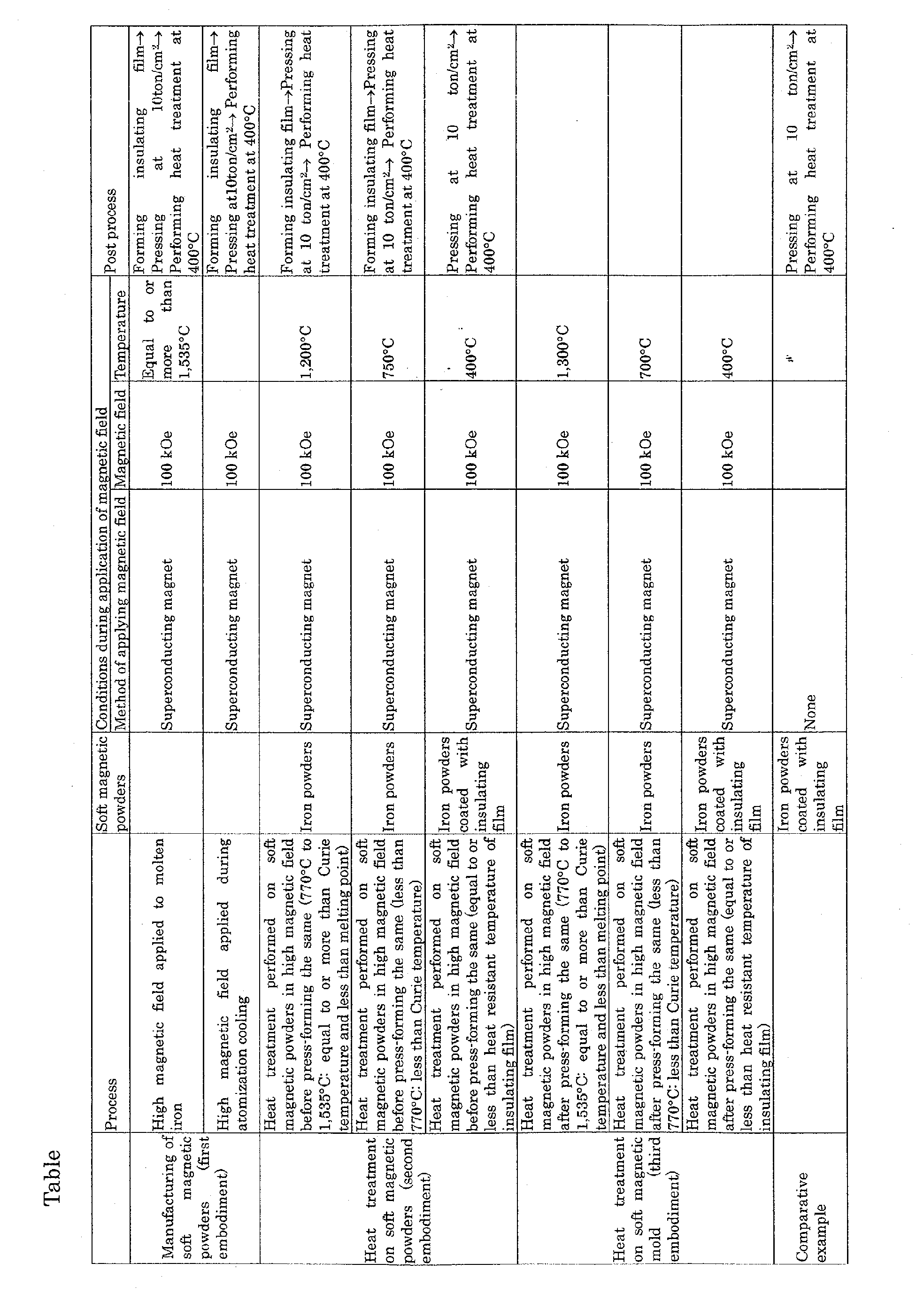
- the soft magnetic molded bodies according to the first to third embodiments of the methods of manufacturing the soft magnetic articles and the soft magnetic molded bodies according to the comparative example were manufactured under the conditions as described in the Table.
- the magnetic characteristics (the magnetic flux density B100 and the magnetic permeability and the coercive force when the magnetic field of 100 (Oe) is applied) of the manufactured soft magnetic mold were measured.
- the magnetic flux density B100 and the magnetic permeability of all of the soft magnetic molds according to the first to third embodiments were larger than those of the soft magnetic mold according to the comparative example and the coercive forces of all of the soft magnetic molds according to the first to third embodiments were smaller than those of the soft magnetic mold according to the comparative example. Therefore, it was confirmed that it is possible to sufficiently reduce the hysteresis loss according to the present invention.
Landscapes
- Engineering & Computer Science (AREA)
- Power Engineering (AREA)
- Chemical & Material Sciences (AREA)
- Dispersion Chemistry (AREA)
- Manufacturing & Machinery (AREA)
- Soft Magnetic Materials (AREA)
- Manufacture Of Metal Powder And Suspensions Thereof (AREA)
- Powder Metallurgy (AREA)
Abstract
The method of manufacturing soft magnetic articles comprises a step of preparing a melt solution containing soft magnetic materials and a step of forming soft magnetic particles from the melt solution in a magnetic field by an atomization rapid solidification method. <IMAGE>
Description
The present invention relates to a method of manufacturing soft
magnetic articles.
Conventionally, electric and electronic parts such as motors, voltage
converters, transformers, noise filters, and choke coils are manufactured using
soft magnetic materials. For example, the electric and electronic parts can be
manufactured by press-forming soft magnetic powders containing iron as a
main component so as to form a molded body, and performing appropriate
processing on the molded body.
Recently, however, there has been demand for performing more precise
control with lower consumption of electric power in order to increase the
densities of the electric and electronic parts and to reduce their sizes. In order
to meet such demand, it is necessary to reduce the hysteresis loss of soft
magnetic articles used for the electric and electronic parts, that is, to increase
the magnetic permeability and to reduce the coercive force of the soft magnetic
articles. A high frequency compacted magnetic powder core in which the
hysteresis loss is reduced and a method of manufacturing the same are
disclosed in Japanese Unexamined Patent Application Publication No. 8-167518.
In the method of manufacturing the high frequency compacted magnetic
powder core disclosed in the Japanese Unexamined Patent Application
Publication No. 8-167518, a magnetic field of 1T (Tesla) is generated by
magnetic field-generating coils, and shape-anisotropic soft magnetic powders
consisting of iron as a main component are press-formed in the magnetic field.
However, as compared with a silicon steel plate or ferrite, soft magnetic
powders including iron as a main component have innately smaller magnetic
permeability and larger coercive force. Therefore, it is not currently possible to
sufficiently reduce the hysteresis loss even by the high frequency compacted
magnetic powder core and the method of manufacturing the same disclosed in
the Japanese Unexamined Patent Application Publication No. 8-167518.
Therefore, in order to solve the above-mentioned problems, it is an object
of the present invention to provide a method of manufacturing soft magnetic
articles in which the hysteresis loss is sufficiently reduced.
Figure 1 is a sectional view illustrating an atomizing device used for a
method of manufacturing soft magnetic articles according to a first
embodiment of the present invention.
Figure 2 is an enlarged schematic diagram illustrating soft magnetic
powders formed using the atomizing device in Fig. 1.
Figure 3 is a graph illustrating magnetization curves of a single crystal
of Fe.
Figure 4 is a sectional view illustrating a heat treatment device used for
manufacturing soft magnetic articles according to the method of a second
embodiment of the present invention.
Figure 5 is a sectional view illustrating a heat treatment device used for
manufacturing soft magnetic articles according to the method of a third
embodiment of the present invention.
The inventors of the present invention discovered that it is possible to
increase the magnetic permeability of soft magnetic materials and to reduce
the coercive force of the soft magnetic materials by the following methods.
On the basis of such discovery, the inventors have completed a
manufacturing method of the present invention for soft magnetic articles. The
term "soft magnetic articles" as used in the present specification includes not
only soft magnetic particles and soft magnetic molded bodies obtained by
press-forming soft magnetic particles, but also extruded articles produced from
the soft magnetic molded bodies by extrusion-processing or the like.
A method of manufacturing soft magnetic articles according to an aspect
of the present invention includes a step of preparing a melt solution containing
soft magnetic materials and a step of forming soft magnetic particles from the
melt solution in the magnetic field by an atomization rapid solidification
method.
According to the method comprising the above-mentioned steps for
manufacturing soft magnetic articles, respective crystals constituting soft
magnetic particles tend to be magnetized in the direction of an easy axis of
magnetization so as to be in a stable state when a magnetic field is applied in
the step of crystallizing the soft magnetic particles. By using such
magnetocrystalline anisotropy, it is possible to orient the respective crystals in
the soft magnetic particles in the direction of the easy axis of magnetization.
Also, since the number of domains in the soft magnetic particles is reduced
due to the influence of the magnetic field, it is possible to reduce the grain
boundaries. Furthermore, it is possible to improve the purity of the soft
magnetic particles since impurities are deposited to the outside by the
influence of the magnetic field during crystallization of the soft magnetic
particles Also, since the crystal lattice orientation is optimized due to the
influence of the magnetic field, the dislocation and stress distortion can be
reduced. Therefore, according to the present invention, it is possible to provide
the soft magnetic articles in which the hysteresis loss is sufficiently reduced.
The step of forming the soft magnetic particles preferably includes a
process of forming the soft magnetic particles in a magnetic field exceeding
8.0×10⁵ (A/m According to the method having such structure as described
above for manufacturing soft magnetic articles, it is possible to increase the
influence of the magnetic field by applying the magnetic field exceeding
8.0×10⁵ (A/m), that is, 10 kOe (kilo oersted). Consequently, soft magnetic
articles in which the hysteresis loss is further reduced can be provided.
A method of manufacturing soft magnetic articles according to another
aspect of the present invention includes the steps of forming soft magnetic
particles and performing heat treatment on the soft magnetic particles in a
magnetic field.
According to the method having the above-mentioned structure for
manufacturing soft magnetic articles, it is possible to orient the respective
crystals in the soft magnetic particles in the direction of an easy axis of
magnetization by using the magnetocrystalline anisotropy. Also, since the
number of domains in the soft magnetic particles is reduced due to the
influence of the magnetic field, it is possible to reduce the grain boundaries.
Also, it is possible to improve the purity of the soft magnetic particles since the
impurities are deposited to the outside by the influence of the magnetic field
when the soft magnetic particles are re-crystallized. Furthermore, since the
crystal lattice orientation is optimized due to the influence of the magnetic
field, it is possible to reduce the dislocation and the stress distortion. Therefore,
according to the present invention, it is possible to provide the soft magnetic
articles in which the hysteresis loss is sufficiently reduced.
The step of performing the heat treatment on the soft magnetic particles
preferably includes heat-treating the soft magnetic particles in a magnetic
field exceeding 8.0×10⁵ (A/m). According to the method having the above-mentioned
structure for manufacturing soft magnetic articles, it is possible to
increase the influence of the magnetic field by applying the magnetic field
exceeding 10 (kOe). Therefore, it is possible to provide the soft magnetic
articles in which the hysteresis loss is sufficiently reduced.
A method of manufacturing soft magnetic articles according to another
aspect of the present invention comprises the steps of forming a molded body
by press-forming soft magnetic particles and performing heat treatment on the
molded body in a magnetic field.
According to the method having the above-mentioned steps for
manufacturing soft magnetic articles, the respective crystals in the soft
magnetic particles can be oriented in the direction of an easy axis of
magnetization by using the magnetocrystalline anisotropy. Also, since the
number of domains is in the soft magnetic particles is reduced due to the
influence of the magnetic field, it is possible to reduce the grain boundaries.
Also, since the impurities are deposited to the outside due to the influence of
the magnetic field when the soft magnetic particles are re-crystallized, it is
possible to improve the purity of the soft magnetic particles. Furthermore,
since the crystal lattice orientation is optimized due to the influence of the
magnetic field, it is possible to reduce the dislocation and the stress distortion.
Therefore, according to the present invention, it is possible to provide the soft
magnetic articles in which the hysteresis loss is sufficiently reduced.
The step of performing heat treatment on a molded body preferably
includes a process of heat-treating the mold in a magnetic field exceeding
8.0×10⁵ (A/m). According to the method having the above-mentioned steps for
manufacturing the soft magnetic articles, it is possible to increase the
influence of the magnetic field by applying the magnetic field exceeding 10
(kOe). Consequently, the soft magnetic articles in which the hysteresis loss is
further reduced can be provided.
The step of performing the heat treatment preferably includes a process
of performing a heat treatment at a temperature higher than the re-crystallization
temperature of the soft magnetic particles. According to the
method having the above-mentioned steps for manufacturing soft magnetic
articles, it is possible to heat to an extent that crystals can easily be oriented.
Preferably, the magnetic field is formed with current flowing in a
superconducting coil. By including such step in the method of manufacturing
soft magnetic articles, a large magnetic field can easily be formed.
Preferably, the superconducting coil consists of a high temperature
superconductor made of oxide materials. The term "high temperature
superconductor" means a superconductor that exhibits superconductivity at a
relatively high temperature such as 30 K or more. According to the method
having such structure as mentioned above for manufacturing the soft
magnetic articles, since the cooling device of the superconducting coil is simple,
it is possible to reduce the manufacturing cost of the soft magnetic articles.
The soft magnetic particles preferably includes iron as the main
component. Here, the soft magnetic particles include iron of 90 atomic % or
more. According to the method having such structure as mentioned above for
manufacturing the soft magnetic articles, it is possible to obtain soft magnetic
articles having a high magnetic flux density. Thus, the sizes of the electric and
electronic parts using such soft magnetic articles can be reduced as compared
with the case in which ferrite materials are used.
In addition, preferably an insulating film is formed so as to surround the
surface of a soft magnetic particle. With such structure of the manufacturing
method for the soft magnetic articles, since the insulation between the soft
magnetic particles is increased, it is possible to reduce the loss caused by eddy
current that flows between the soft magnetic particles. In this case, preferably
the process of performing heat treatment on soft magnetic particles or molded
bodies is accomplished at a temperature lower than the heat resistant
temperature of the insulating film, thereby preventing the insulating
characteristics of the insulating film from being deteriorated by the heat
treatment process.
In the case that the insulating film is made of non-magnetic articles, it
can be expected to improve the magnetic characteristics by applying the
magnetic field larger than 10 (kOe). Also, the insulating film is preferably
made of heat resistant materials that keep the insulating characteristic at a
temperature no less than the re-crystallization temperature of the soft
magnetic particles (in the case of the iron, about 400°C). Such materials are
oxide materials, such as SiO2, Al2O3, TiO2, or ZrO2, for example.
The term "molded bodies" as used herein includes those available
immediately after press-forming and those of product-shape formed by a
cutting process following the press-forming, for example. It is possible to
prepare a plurality of molded bodies and to assemble them in a direction along
the magnetic circuit of a product, thereby producing the product.
As mentioned above, according to the present invention, it is possible to
provide a method of manufacturing the soft magnetic articles in which the
hysteresis loss is sufficiently reduced.
Embodiments of the present invention will now be described with
reference to the drawings.
Figure 1 is a sectional view illustrating an atomizing device used for a
method of manufacturing soft magnetic articles according to a first
embodiment of the present invention. As shown in Fig. 1, the atomizing device
11 includes a vacuum induction furnace 12, a funnel 14 provided at a lower
part of the vacuum induction furnace 12, a spray tower 20, a melt solution
inlet pipe 21 for connecting the funnel 14 to the spray tower 20, and
superconducting coils 18 and 19 provided around the melt solution inlet pipe
21 and the spray tower 20, respectively. The vacuum induction furnace 12 is
surrounded by a melting chamber (not shown) connected to a vacuum pump. A
spray nozzle 15 is formed in a portion where the melt solution inlet pipe 21 is
connected to the spray tower 20. A powder recovering pipe 17 is connected to
the bottom of the spray tower 20.
A method of forming soft magnetic powders using the atomizing device
11 in Fig. 1 will now be described below. First, a raw material lump, for
example an iron lump, to be processed into a material of soft magnetic powders
is put in the vacuum induction furnace 12. A high frequency power supply is
applied to the vacuum induction furnace 12 As a result, the material lump in
the vacuum induction furnace 12 is melt to be a melt solution 13. The vacuum
induction furnace 12 is kept not necessarily at a vacuum atmosphere, but it
may be filled with an inert gas.
Next, a magnetic field is applied to the interior of the melt solution inlet
pipe 21 and the spray tower 20 by flowing an electrical current to the
superconducting coils 18 and 19. At this time, the applied magnetic field is
preferably larger than 10 (kOe). While the magnetic field is applied, the melt
solution 13 in the vacuum induction furnace 12 is supplied to the pouring 14.
The melt solution 13 passes through the melt solution inlet pipe 21 to which
the magnetic field is applied, and is sprayed from the spray nozzle 15 to the
inside of the spray tower 20. The melt solution 13 is rapidly cooled, while being
sprayed, in the spray tower 20 to which the magnetic field is applied. As a
result, soft magnetic powders 26 are formed; and, finally, the soft magnetic
powders 26 are recovered through the powder recovering pipe 17.
Figure 2 is an enlarged schematic diagram illustrating the soft magnetic
powders formed using the atomizing device in Fig. 1. Referring to Fig. 2, the
soft magnetic powders 26 are composed of a plurality of crystals 27 partitioned
by grain boundaries 27p. Although Fig. 2 simply illustrates three crystals 27,
the number of crystals 27 is not limited thereto. The respective crystals 27 are
oriented in the direction of a magnetization easy axis 28. The melt solution 13
in Fig. 1 is cooled after being fed into the pouring 14 so that crystallization
occurs in the melt solution 13. The magnetic field is applied to the melt
solution 13 in which the crystallization occurs, and thus the respective formed
crystals 27 are oriented in the direction of the magnetization easy axis 28.
The principle in which the soft magnetic powders 26 are oriented in the
direction of the magnetization easy axis 28 will now be described.
Figure 3 is a graph illustrating magnetization curves of a single crystal
of Fe. Referring to Fig. 3, the vertical axis represents 4π×M (magnetization)
and the horizontal axis represents H (magnetic field). A curve 38 denotes a
magnetization curve in the direction <100> of a magnetization easy axis. A
curve 39 denotes a magnetization curve in the direction <111> of a hard axis of
magnetization. When the two curves are compared with each other, it is noted
that magnetization can be performed with less energy in the direction <100>
and the difference in energy is represented by a region between the curve 38
and the curve 39.
If the magnetic field is applied to the direction <101> (the direction of a
magnetic moment marked with an arrow 34) by the superconducting coils,
then, at an initial stage the soft magnetic powders are magnetized along the
magnetization curve in the direction marked with an arrow 31. Shortly
thereafter, the soft magnetic powders begin to rotate in the direction <100>
(the direction along a line segment 35) so as to be in a stable state and thus
magnetized in the direction marked with an arrow 32. The soft magnetic
powders stop rotating when the direction of the magnetic moment coincides
with the direction <100>, and thereafter are magnetized along a
magnetization curve in the direction marked with an arrow 33. As a result, the
soft magnetic powders are oriented in the direction <100> of the magnetization
easy axis.
Referring to Fig. 2, as a result of forming the soft magnetic powders in a
state where the magnetic field is applied, it is possible to reduce the number of
crystals 27 in the soft magnetic powders 26. In this case, it is possible to
reduce the grain boundaries 27p that disturbs magnetization. Also, as a result
of applying the magnetic field, the purity of the soft magnetic particles in the
soft magnetic powders 26 can be improved, and the dislocation and the stress
distortion can be reduced.
The method of manufacturing soft magnetic articles according to the
first embodiment of the present invention includes a process of preparing the
melt solution 13 containing soft magnetic materials and a process of forming
the soft magnetic powders 26 as the soft magnetic particles from the melt
solution in the magnetic field by the atomization rapid solidification method.
According to the method having the above-mentioned structure for
manufacturing a soft magnetic article, it is possible to optimize the magnetic
characteristics (i.e., to increase the magnetic permeability and to reduce the
coercive force) at the stage of soft magnetic powders that are the materials of a
soft magnetic molded body. Therefore, by using the soft magnetic powders it is
possible to manufacture electric and electronic parts in which the hysteresis
loss is sufficiently reduced.
In the present embodiment, the superconducting coils 18 and 19 are
provided around the melt solution inlet pipe 21 and the spray tower 20,
respectively. However, a superconducting coil may be provided in either one of
the melt solution inlet pipe 21 and the spray tower 20. Means for applying the
magnetic field are not restricted to the superconducting coils and common coils
may be used. The atomizing device 11 may use either a water atomizing
method or gas atomizing method.
In the case where the soft magnetic powders 26 are formed as flat-shaped
powders by spraying the melt solution 13 from the spray nozzle 15, the
optimization of the magnetic characteristics can be more easily achieved since
the easy axis of magnetization can be aligned in the longer dimension of the
soft magnetic powder 26.
Figure 4 is a sectional view illustrating a heat treatment device used in
the method of manufacturing the soft magnetic materials according to a
second embodiment of the present invention. Referring to Fig. 4, a heat
treatment device 40 includes a heater 42 provided so as to surround soft
magnetic powders 41 in a container, a superconducting coil 44 provided
outside the heater 42, an insulating member 43 interposed between the heater
42 and the superconducting coil 44.
A method of performing the heat treatment on the soft magnetic
powders using the heat treatment device 40 in Fig. 4 will now be described
below. First, the soft magnetic powders 41 such as iron powders are
manufactured by the atomizing method. An insulating film may be formed so
as to cover the surface of a particle of soft magnetic powders 41. Subsequently,
the obtained soft magnetic powders 41 are put in the heat treatment device 40.
A magnetic field is applied to the soft magnetic powders 41 by introducing an
electrical current to the superconducting coil 44. At this time, the applied
magnetic field is preferably larger than 10 (kOe).
Next, in a state where the magnetic field is applied, the heater 42 is
electrically powered on and the heat treatment is performed on the soft
magnetic powders 41. The soft magnetic powders 41 are heated to a
temperature that is higher than the re-crystallization temperature, and
subsequently re-crystallization occurs inside the soft magnetic powders 41.
Since the magnetic field is applied to the soft magnetic powders 41 in which
the re-crystallization takes place, the respective formed crystals are oriented
in the direction of the magnetization easy axis.
As a result of applying the magnetic field, it is possible to reduce the
number of crystals in the soft magnetic powders 41. Therefore, it is possible to
reduce the grain boundaries that disturb the magnetization. Also, as a result
of applying the magnetic field, the purity of the soft magnetic particles in the
soft magnetic powders 41 can be increased and the dislocation and the stress
distortion can be reduced.
The method of manufacturing the soft magnetic articles according to the
second embodiment of the present invention includes a process of forming the
soft magnetic powders 41 and a process of performing the heat treatment on
the soft magnetic powders 41 in the magnetic field. With the method having
the above-mentioned structure for manufacturing soft magnetic articles, it is
possible to obtain the same effects as those obtained in the first embodiment.
Figure 5 is a sectional view illustrating a heat treatment device used for
a method of manufacturing the soft magnetic materials according to a third
embodiment of the present invention. Referring to Fig. 5, a heat treatment
device 71 has the same structure as the structure of the heat treatment device
40 shown in Fig. 4 except that a soft magnetic molded body 72 is positioned at
a part surrounded by the heater 42.
A method of performing the heat treatment on the soft magnetic molded
body using the heat treatment device 71 of Fig. 5 will now be described below.
First, the soft magnetic mold 72 is manufactured by press-forming the
prepared soft magnetic powders. Subsequently, the soft magnetic mold 72 is
set in a predetermined position in the heat treatment device 71. A magnetic
field is applied to the soft magnetic mold 72 by introducing an electrical
current to the superconducting coil 44. At this time, the applied magnetic field
is preferably larger than 10 (kOe).
Next, in a state where the magnetic field is applied, the heater 42 is
electrically powered on and the heat treatment is performed on the soft
magnetic mold 72. The soft magnetic mold 72 is heated to a temperature
higher than the re-crystallization temperature. Thereafter, re-crystallization
occurs inside the soft magnetic powders that constitute the
soft magnetic molded body 72. Since the magnetic field is applied to the
soft magnetic powders in which the re-crystallization is performed, the
respective formed crystals are oriented in the direction of the
magnetization easy axis.
As a result of applying the magnetic field, it is possible to reduce the
number of crystals in the soft magnetic powders that constitute the soft
magnetic mold 72. Therefore, it is possible to reduce the grain boundaries that
disturb the magnetization. Also, as a result of applying the magnetic field, the
purity in the soft magnetic powders can be improved and the dislocation and
the stress distortion can be reduced. In this case, it is possible to obtain a
definite effect even when the heat treatment temperature is low.
A method of manufacturing soft magnetic articles according to the third
embodiment of the present invention includes a step of forming a soft magnetic
molded body 72 by press-forming soft magnetic particles and a step of
performing a heat treatment on the soft magnetic molded body 72 in a
magnetic field. According to the method having the above-mentioned steps for
manufacturing the soft magnetic articles, after press-forming the soft
magnetic particles, it is possible to make the magnetic characteristics
optimized (to increase the magnetic permeability and to reduce the coercive
force). Therefore, by using the soft magnetic molded body 72, it is possible to
manufacture electric and electronic parts in which the hysteresis loss is
sufficiently reduced.
The first embodiment to the third embodiment of manufacturing
methods for soft magnetic articles as described above may be appropriately
combined. In this case, it is possible to manufacture electric and electronic
parts in which the hysteresis loss is reduced due to synergy effects through
combination of the above-mentioned manufacturing methods.
Also, it is possible to obtain the respective predetermined effects by
setting the following heat treatment temperatures in the second and third
embodiments, respectively. First, when the heat treatment temperature is set
to be equal to or more than the melting point (in the case of iron, 1,535°C), the
internal magnetic field at an atomic level becomes mobile, whereby the
internal magnetic field can be optimized. When the heat treatment
temperature is set to be equal to or higher than the Curie temperature (in the
case of iron, 770°C) of the soft magnetic powders and lower than the melting
point of the soft magnetic powders, the soft magnetic powders are
paramagnetic. However, a certain effect can be expected by applying a
magnetic field. When the heat treatment temperature is equal to or more than
the re-crystallization temperature (in the case of iron, about 300°C to 400°C)
and less than the Curie temperature, the soft magnetic powders are
ferromagnetic, and a considerable effect can be achieved by the application of a
magnetic field because of the structure of magnetic domain and exchange
interaction between spins.
In the event that the Curie temperature of the soft magnetic powders is
shifted to higher temperatures by the application of a magnetic field, a
predetermined heat treatment can be performed on ferromagnetic soft
magnetic powders, even if the heat treatment temperature is set higher
than the Curie temperature (in the case of iron, 770°C). The insulating film
covering soft magnetic powders can be prevented from being damaged
during the heat treatment if the heat treatment temperature is set equal to
or less than the heat resistant temperature of the insulating film.
In order to confirm the effects of the first to third embodiments of the
manufacturing method for the soft magnetic articles, the verification was
performed under the conditions represented in the following table.
The soft magnetic molded bodies according to the first to third
embodiments of the methods of manufacturing the soft magnetic articles and
the soft magnetic molded bodies according to the comparative example were
manufactured under the conditions as described in the Table. Next, the
magnetic characteristics (the magnetic flux density B100 and the magnetic
permeability and the coercive force when the magnetic field of 100 (Oe) is
applied) of the manufactured soft magnetic mold were measured. As a result
of measuring them, the magnetic flux density B100 and the magnetic
permeability of all of the soft magnetic molds according to the first to third
embodiments were larger than those of the soft magnetic mold according to the
comparative example and the coercive forces of all of the soft magnetic molds
according to the first to third embodiments were smaller than those of the soft
magnetic mold according to the comparative example. Therefore, it was
confirmed that it is possible to sufficiently reduce the hysteresis loss according
to the present invention.
While this invention has been particularly described with reference to
preferred embodiments thereof, it will be understood by those skilled in the art
that various modifications may be made without departing from the spirits
and scopes of the invention as defined by the appended claims.
Claims (11)
- A method of manufacturing soft magnetic articles, comprising the steps of:preparing a melt solution containing soft magnetic materials; andforming soft magnetic particles from the melt solution in a magnetic field by an atomization rapid solidification method.
- The method of manufacturing soft magnetic articles according to claim 1, wherein the step of forming the soft magnetic particles comprises forming the soft magnetic particles in a magnetic field larger than 8.0×10⁵ (A/m).
- A method of manufacturing soft magnetic articles, comprising the steps of
forming soft magnetic particles; and
performing heat treatment on the soft magnetic particles in a magnetic field. - The method of manufacturing soft magnetic articles according to claim 3, wherein the step of performing heat treatment on the soft magnetic particles comprises performing heat treatment on the soft magnetic particles in a magnetic field larger than 8.0×10⁵ (A/m).
- A method of manufacturing soft magnetic articles, comprising the steps of:press-forming soft magnetic particles to form a mold; andperforming heat treatment on the mold in a magnetic field.
- The method of manufacturing soft magnetic articles according to claim 5, wherein the step of performing heat treatment on the mold comprises performing heat treatment on the mold in a magnetic field larger than 8.0×10⁵ (A/m).
- The method of manufacturing soft magnetic articles according to any one of claims 3 to 6, wherein the step of performing heat treatment comprises performing heat treatment at a temperature higher than the re-crystallization temperature of the soft magnetic particles.
- The method of manufacturing soft magnetic articles according to any one of claims 1 to 7, wherein a magnetic field is formed by flowing current to superconducting coils.
- The method of manufacturing soft magnetic articles according to claim 8, wherein the superconducting coils are formed of a high temperature superconductor made of oxide materials.
- The method of manufacturing soft magnetic articles according to any one of claims 1 to 9, wherein the soft magnetic particles contain iron as a main component thereof.
- The method of manufacturing soft magnetic articles according to any one of claims 1 to 10, wherein an insulating film is formed, surrounding the surface of a soft magnetic particle.
Applications Claiming Priority (4)
| Application Number | Priority Date | Filing Date | Title |
|---|---|---|---|
| JP2003279234 | 2003-07-24 | ||
| JP2003279234 | 2003-07-24 | ||
| JP2003349351 | 2003-10-08 | ||
| JP2003349351A JP2005054265A (en) | 2003-07-24 | 2003-10-08 | Method for producing soft magnetic material |
Publications (1)
| Publication Number | Publication Date |
|---|---|
| EP1501105A2 true EP1501105A2 (en) | 2005-01-26 |
Family
ID=33492507
Family Applications (1)
| Application Number | Title | Priority Date | Filing Date |
|---|---|---|---|
| EP04254410A Withdrawn EP1501105A2 (en) | 2003-07-24 | 2004-07-23 | Method of manufacturing soft magnetic articles |
Country Status (3)
| Country | Link |
|---|---|
| US (1) | US20050016633A1 (en) |
| EP (1) | EP1501105A2 (en) |
| JP (1) | JP2005054265A (en) |
Families Citing this family (3)
| Publication number | Priority date | Publication date | Assignee | Title |
|---|---|---|---|---|
| JP2008181923A (en) * | 2007-01-23 | 2008-08-07 | Fuji Electric Device Technology Co Ltd | Magnetic component and manufacturing method thereof |
| CN102923866A (en) * | 2012-11-22 | 2013-02-13 | 南京大学 | Device for implementing strengthened treatment for sewage through changing magnetic field and sewage treatment method |
| CN109396455A (en) * | 2018-12-29 | 2019-03-01 | 昆山磁通新材料科技有限公司 | A kind of safe, continuous, efficient, environmentally friendly prilling process for soft magnetic metal powder |
-
2003
- 2003-10-08 JP JP2003349351A patent/JP2005054265A/en active Pending
-
2004
- 2004-07-20 US US10/893,965 patent/US20050016633A1/en not_active Abandoned
- 2004-07-23 EP EP04254410A patent/EP1501105A2/en not_active Withdrawn
Also Published As
| Publication number | Publication date |
|---|---|
| JP2005054265A (en) | 2005-03-03 |
| US20050016633A1 (en) | 2005-01-27 |
Similar Documents
| Publication | Publication Date | Title |
|---|---|---|
| Liu et al. | Improved high-frequency magnetic properties of FeSiBCCr amorphous soft magnetic composites by adding carbonyl iron powders | |
| US10991495B2 (en) | Soft magnetic alloy and magnetic component | |
| US7442263B2 (en) | Magnetic amplifier choke (magamp choke) with a magnetic core, use of magnetic amplifiers and method for producing softmagnetic cores for magnetic amplifiers | |
| KR102423591B1 (en) | Soft magnetic alloy and magnetic device | |
| JP4596645B2 (en) | High performance iron-rare earth-boron-refractory-cobalt nanocomposites | |
| JP2022549384A (en) | Iron-based amorphous alloy containing sub-nanoscale ordered clusters, preparation method thereof, and nanocrystalline alloy derivative using the same | |
| TW201932619A (en) | Soft magnetic alloy and magnetic device | |
| JP3983207B2 (en) | Method for producing Fe-based soft magnetic bulk amorphous / nanocrystalline two-phase alloy | |
| JP3719449B2 (en) | Nanocrystalline alloy, method for producing the same, and magnetic core using the same | |
| JP3424767B2 (en) | Nanocrystalline alloy core and heat treatment method for nanocrystalline alloy core | |
| WO2021010714A1 (en) | Method for manufacturing fe-based soft magnetic alloy and fe-based soft magnetic alloy manufactured thereby | |
| WO1980002297A1 (en) | Process for producing permanent magnet alloy | |
| KR102613785B1 (en) | Nanocrystral soft magnetic ribon and method of preparing the same | |
| US20050016633A1 (en) | Method of manufacturing soft magnetic articles | |
| KR101562830B1 (en) | composition comprising Fe based nanocrystalline phase and method for preparing the same | |
| CN114144851B (en) | Iron-based soft magnetic alloy, method for producing same, and magnetic component comprising same | |
| WO2019235574A1 (en) | Powder for magnetic core, and magnetic core and coil component using same | |
| CN109754974B (en) | A kind of nanocrystalline alloy magnetic core and preparation method thereof | |
| JP4703987B2 (en) | Alloy ribbon for rare earth magnet, method for producing the same, and alloy for rare earth magnet | |
| KR20180081685A (en) | Fe based soft magnetic alloy and magnetic materials comprising the same | |
| CN101183583A (en) | A method for preparing oxygen-containing soft magnetic ribbon for high frequency | |
| JP2009293132A (en) | Soft magnetic thin band, magnetic core, magnetic component and method for producing soft magnetic thin band | |
| JP2001316724A (en) | Manufacturing method of magnetic core for high frequency | |
| KR102755913B1 (en) | Nanocrystral soft magnetic ribon with high saturation magnetization comprising heterogeneous transition metal and method of preparing the same | |
| KR100213333B1 (en) | Ultrafine Granular Composite Permanent Magnet Composition and Method of Manufacturing Permanent Magnet Material Using Its Base Material |
Legal Events
| Date | Code | Title | Description |
|---|---|---|---|
| PUAI | Public reference made under article 153(3) epc to a published international application that has entered the european phase |
Free format text: ORIGINAL CODE: 0009012 |
|
| AK | Designated contracting states |
Kind code of ref document: A2 Designated state(s): AT BE BG CH CY CZ DE DK EE ES FI FR GB GR HU IE IT LI LU MC NL PL PT RO SE SI SK TR |
|
| AX | Request for extension of the european patent |
Extension state: AL HR LT LV MK |
|
| STAA | Information on the status of an ep patent application or granted ep patent |
Free format text: STATUS: THE APPLICATION IS DEEMED TO BE WITHDRAWN |
|
| 18D | Application deemed to be withdrawn |
Effective date: 20080201 |