EP1500518A1 - Ink jet recording medium and ink fixer - Google Patents
Ink jet recording medium and ink fixer Download PDFInfo
- Publication number
- EP1500518A1 EP1500518A1 EP03723230A EP03723230A EP1500518A1 EP 1500518 A1 EP1500518 A1 EP 1500518A1 EP 03723230 A EP03723230 A EP 03723230A EP 03723230 A EP03723230 A EP 03723230A EP 1500518 A1 EP1500518 A1 EP 1500518A1
- Authority
- EP
- European Patent Office
- Prior art keywords
- ink
- fixing agent
- jet recording
- recording medium
- ink jet
- Prior art date
- Legal status (The legal status is an assumption and is not a legal conclusion. Google has not performed a legal analysis and makes no representation as to the accuracy of the status listed.)
- Granted
Links
Images

Classifications
-
- B—PERFORMING OPERATIONS; TRANSPORTING
- B41—PRINTING; LINING MACHINES; TYPEWRITERS; STAMPS
- B41M—PRINTING, DUPLICATING, MARKING, OR COPYING PROCESSES; COLOUR PRINTING
- B41M5/00—Duplicating or marking methods; Sheet materials for use therein
- B41M5/50—Recording sheets characterised by the coating used to improve ink, dye or pigment receptivity, e.g. for ink-jet or thermal dye transfer recording
- B41M5/52—Macromolecular coatings
- B41M5/5218—Macromolecular coatings characterised by inorganic additives, e.g. pigments, clays
Definitions
- the present invention relates to an ink jet recording medium for forming a recorded image with a water/oil ink and to an ink fixing agent for use in the recording medium.
- an ink fixing agent for use in ink jet recording media which is excellent in ink absorptivity (color development, resolution) and the fixing stability (water resistance and light resistance) of an image recorded on a medium and to an ink jet recording medium comprising the fixing agent in an ink receiving layer.
- An image displayed on a monitor is now recorded on a recording medium like a silver salt-based photo due to the spread of personal computers, digital cameras, etc.
- An image forming system called “ink jet recording system” is known as a system for recording the above image. Since this ink jet recording system has various advantageous features such as little noise, high-speed recording, ease of recording multiple colors, great versatility of a recording pattern and unnecessary development and fixing steps, it is used in many fields.
- the principle of ink jet recording is that an ink solution is ejected from a nozzle by an electric field, heat or pressure as a drive source and transferred to the receiving layer of a recording medium.
- the ink solution is prepared from a dye, water, polyhydric alcohol, etc., and a water-soluble direct dye or acid dye is mainly used as the above dye.
- a pigment ink fixing agent which is required for an ink jet recording medium for forming a recorded image with a pigment ink needs to spread a pigment component over the surface layer portion of the receiving layer uniformly, fix and anchor it and to have a solvent for the pigment ink quickly absorbed into the inside of the receiving layer.
- synthetic silica which is used in an ink jet recording medium as not only a dye-containing ink fixing agent but also a pigment-containing ink fixing agent is excellent in the physical properties of pores.
- an additive such as a cationic polymer must be added excessively to fix a negatively charged pigment ink as the surface of synthetic silica is negatively charged, and the light resistance of synthetic silica is deteriorated by the cationic polymer.
- the inventors of the present invention have conducted studies for the development of an ink fixing agent which can stably fix various inks, especially a pigment ink in the ink receiving layer of an ink jet recording medium having the ink receiving layer formed on a substrate.
- the inventors have paid attention to serpentine compounds having positively and negatively charged surfaces and investigated the ink absorptivities and fixing stabilities of various serpentine compounds as ink fixing agents.
- the serpentine compounds are closely connected with the absorptivity and fixing stability of an ink, especially a pigment ink, that is, when a serpentine compound is used as a fixing agent, a pigment ink which is negatively charged is adsorbed to the serpentine compound and a solvent contained in the pigment ink is also quickly absorbed. Therefore, it was found that the serpentine compound has excellent pigment ink fixing stability and a high-definition image recording medium is obtained. Since the serpentine compound also shows excellent fixing properties for a dye ink, it can also be used in an ink jet recording system using a dye ink or an ink jet recording system using both dye and pigment inks.
- an ink jet recording medium having an ink receiving layer formed on a substrate, wherein an ink fixing agent contained in the ink receiving layer is a serpentine compound containing at least one metal selected from the group consisting of Mg and Zn.
- an ink fixing agent for use in an ink jet recording medium having an ink receiving layer formed on a substrate, wherein the ink fixing agent contained in the ink receiving layer is a serpentine compound containing at least one metal selected from the group consisting of Mg and Zn.
- the serpentine compound in the present invention may be natural or synthetic but desirably synthetic from the viewpoint of homogeneity and stability for using it as a fixing agent.
- serpentine is ideally and chemically represented by Mg 3 Si 2 O 5 (OH) 4 (or 3MgO ⁇ 2SiO 2 ⁇ 2H 2 O). According to properties under an electron microscope, serpentine is divided into tubular (fibrous) chrysotile, lamellar lizardite and lamellar antigorite having a wavy super structure in the X-axis direction.
- the X-ray powder pattern of serpentine is characterized by bottom reflection at 7.2 to 7.3 ⁇ and (060) reflection at 1.53 to 1.56 ⁇ .
- a synthetic serpentine compound contains water molecules between layers, it is characterized by bottom reflection at 8.5 to 10.0 ⁇ which is wider than the range of general serpentine. Its infrared absorption spectrum is characterized by a strong OH stretching vibration band at around 3,690 cm -1 and a lattice vibration band at 1,200 to 900 cm -1 .
- a synthetic serpentine compound is a laminar silicate mineral consisting of Mg-O octagonal layers and Si-O tetragonal layers in a ratio of 1:1.
- a serpentine compound can be synthesized through a hydrothermal reaction of a mixture of magnesium and silica oxides.
- reaction conditions such as temperature, time and pH
- the conditions described in the above documents may be employed or slightly changed.
- a synthetic serpentine compound is preferred from the viewpoints of homogeneity and stability of quality as a fixing agent.
- the serpentine compound in the present invention may be obtained by substituting some of magnesium (Mg) atoms with zinc (Zn) atoms. That is, the serpentine compound of the present invention is preferably a compound represented by the following chemical formula (1): (Mg a Zn b )Si 2 O 5 (OH) 2(a+b)-2 ⁇ nH 2 O wherein "a", "b” and "n” satisfy 2.7 ⁇ a ⁇ 3.5, 0 ⁇ b ⁇ 0.25 and 0 ⁇ n ⁇ 3, respectively.
- the above chemical formula (1) may be expressed as the following formula in terms of oxide composition. aMgO ⁇ bZnO ⁇ 2SiO 2 ⁇ nH 2 O wherein "a” and “b” are as defined hereinabove, and "n” satisfies 2 ⁇ n ⁇ 5.
- a synthetic serpentine compound in the present invention can be synthesized by carrying out a hydrothermal reaction of a mixture of raw materials at a temperature of 50 to 200° C for 1 to 24 hours and at a pH of 9 to 12 in an aqueous system.
- the surface of the obtained serpentine compound is positively and negatively charged and the form of its particle is not fibrous but massive.
- the serpentine compound used in the present invention has forms and properties having the following values.
- the serpentine compound should have a specific surface area measured by a BET method of 150 to 500 m 2 /g, preferably 200 to 500 m 2 /g. It is desirable that it should have a total pore volume measured by an N 2 gas adsorption method of 0.40 to 1.20 mL/g, preferably 0.45 to 1.20 mL/g. It is advantageous that the serpentine compound should have an average pore diameter measured by the N 2 gas adsorption method of 40 to 150 ⁇ , preferably 50 to 150 ⁇ . It is also advantageous that the serpentine compound should have an average particle diameter of 1 to 15 ⁇ m, preferably 1 to 10 ⁇ m.
- the serpentine compound should have a bottom reflection spacing (d ⁇ ) measured by a powder X-ray diffraction method of 8.5 to 10.0 ⁇ and a (060) reflection spacing (d ⁇ ) of 1.53 to 1.56 ⁇ .
- the powder of the serpentine compound should have a bulk density of 30 to 120 ml/10g, preferably 40 to 120 ml/10 g.
- Fig. 1 shows an X-ray diffraction image of an example of a synthetic serpentine compound of the present invention.
- magnesium oxide is not observed.
- the synthetic serpentine compound of the present invention can be expressed by MgO and SiO 2 in the oxide composition formula, it is understood that it is not a mixture of these oxides but a single compound. The same can be said when ZnO is existent in the oxide composition formula.
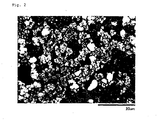
- Fig. 2 shows a scanning electron microphotograph (X2,000).
- the synthetic serpentine compound as a pigment ink fixing agent in the present invention has all of the above advantages, adsorbed pigment particles are stabilized and an image having excellent water resistance and light resistance is obtained.
- the constituents of a coating solution other than the ink fixing agent will be described hereinbelow.
- a coating solution containing a dye or pigment ink fixing agent is used.
- the coating solution contains a polymer adhesive, additives and solvent known per se as the main components, in addition to the ink fixing agent.
- the ink jet recording medium of the present invention may be composed of a single layer or multiple layers, and the corona treatment or anchor coating of the substrate may be carried out to improve adhesion.
- the receiving layer may be composed of a single layer or multiple layers as required.
- An inorganic or organic pigment may be optionally used in the receiving layer as an aid.
- the pigment include inorganic pigments such as synthetic silica, colloidal silica, cationic colloidal silica, alumina sol, pseudo-boehmite gel, talc, kaolin, clay, sintered clay, zinc oxide, zinc sulfide, zinc carbonate, tin oxide, aluminum oxide, aluminum hydroxide, aluminum silicate, calcium carbonate, calcium sulfate, calcium silicate, satin white, barium sulfate, titanium dioxide, magnesium silicate, magnesium carbonate, magnesium oxide, smectite, lithopone, mica, zeolite and diatomaceous earth; and organic pigments such as styrene-based plastic pigments, acryl-based plastic pigments, microcapsule plastic pigments, urea resin-based plastic pigments, melamine resin-based plastic pigments, benzoguanamine-based plastic pigments and acrylonitrile-based plastic pigments, all of
- polymer adhesive examples include (a) starches such as starch, oxidized starch, etherified starch and cationized starch; (b) cellulose derivatives such as methyl cellulose, carboxymethyl cellulose, hydroxyethyl cellulose, hydroxypropyl cellulose and hydroxypropylmethyl cellulose; (c) proteins such as gelatin, casein, soybean protein and synthetic proteins; (d) natural and semi-synthetic adhesives such as agarose, guar gum, chitosan and sodium alginate; (e) polyvinyl alcohol derivatives such as polyvinyl alcohol and cationic polyvinyl alcohol and silicone-containing polyvinyl alcohol; (f) synthetic, water-soluble and solvent-soluble adhesives such as polyethyleneimine-based resins, polyvinylpyrrolidone-based resins, poly(meth)acrylic acid and copolymers thereof, maleic anhydride-based resins, acrylamide-based resins, (meth)acrylate-based resins, poly
- Additives may be added in limits that do not impair fixing properties.
- the additives include a dispersant, anti-foaming agent, thickener, ultraviolet light absorber, fluorescent brightener, antioxidant, water resisting agent, surfactant, fluidity modifier, thermal stabilizer, defoaming agent, foaming agent, adhesion promoter, pH modifier, penetrant, wetting agent, thermal gelling agent, lubricant, colorant, antiseptic agent, mildewproofing agent, antistatic agent and crosslinking agent, all of which have been conventionally known and are commonly used.
- the solvent for the coating solution examples include lower alcohols such as methyl alcohol, ethyl alcohol and propyl alcohol; glycols such as ethylene glycol, diethylene glycol, triethylene glycol and dioxane; lower alkyl esters such as methyl acetate and ethyl acetate; water-soluble organic solvents such as acetonitrile and dimethyl acetamide; and water. They may be used alone or as a mixed solvent of two or more.
- High-quality paper, medium-quality paper, coated paper, artificial paper, cast coated paper, paper board, synthetic resin laminated paper, metal deposited paper, synthetic paper, or white film is used as the substrate for a recording medium which does not need to transmit light and a sheet of glass or OHP sheet such as a film of polyethylene terephthalate, polyester, polystyrene, polyvinyl chloride, polymethyl methacrylate, polycarbonate, polyimide, cellulose triacetate, cellulose diacetate, polyethylene or polypropylene is used as the substrate for a light transmitting recording medium.
- a sheet of glass or OHP sheet such as a film of polyethylene terephthalate, polyester, polystyrene, polyvinyl chloride, polymethyl methacrylate, polycarbonate, polyimide, cellulose triacetate, cellulose diacetate, polyethylene or polypropylene is used as the substrate for a light transmitting recording medium.
- the amount of the ink fixing agent is 10 to 90 wt%, preferably 15 to 90 wt% of the solids content (ink fixing agent, polymer adhesive, solid additives, inorganic or organic pigment, etc.) of the receiving layer.
- the amount of the ink fixing agent is too large, a receiving layer which lacks flexibility is obtained and when the amount is too small, ink fixing properties deteriorate.
- the method and means for forming the ink receiving layer are not particularly limited, a suitable method may be employed according to the material of the substrate.
- the most commonly used coating means such as bar coater, roll coater, air knife coater, blade coater, rod blade coater, brush coater, curtain coater, gravure coater, flexographic coater, cast coater, die coater, lip coater, size press or spray device may be used.
- a recording medium whose ink receiving layer and substrate are integrated such as paper or pulp
- an ink fixing agent between intertwined fibers is obtained by holding an ink fixing agent between intertwined fibers.
- An excellent recorded image forming material can be obtained by containing the ink fixing agent of the present invention in the substrate including the surface.
- a coating solution is prepared from the above ink fixing agent, polymer adhesive, additives, inorganic or organic dye or pigment and solvent.
- the compound obtained by the above method was a serpentine compound represented by the following chemical formula.
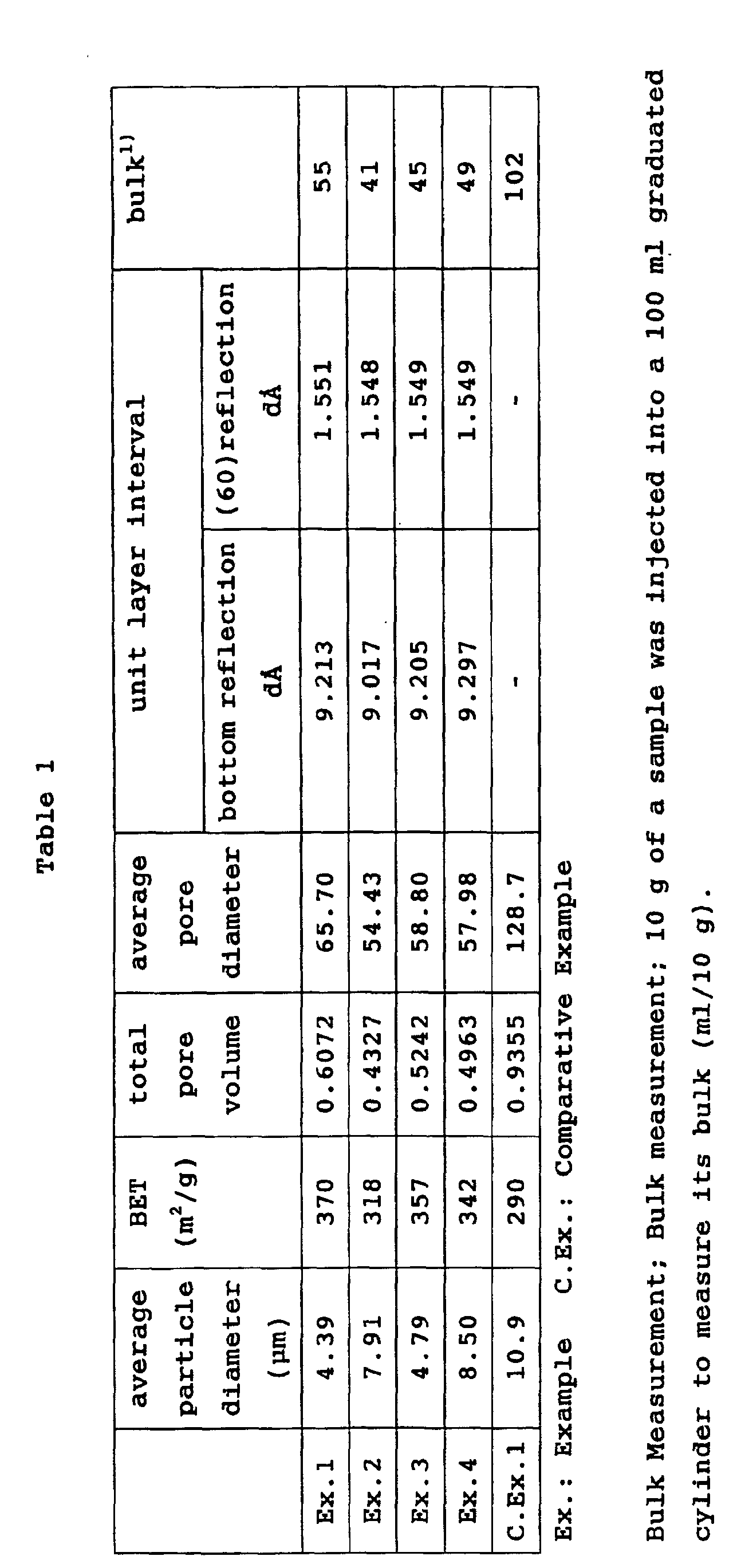
- the X-ray diffraction diagram of this synthetic serpentine compound is shown in Fig. 1, its scanning electron microphotograph is shown in Fig. 2, and its physical properties are shown in Table 1.
- the compound obtained by the above method was a serpentine compound represented by the following chemical formula.
- the physical properties of this synthetic serpentine compound are shown in Table 1. Mg 3.1 Si 2 O 5 (OH) 4.2 ⁇ 1.9H 2 O
- the compound obtained by the above method was a serpentine compound represented by the following chemical formula.
- the physical properties of this synthetic serpentine compound are shown in Table 1. Mg 2.93 Si 2 O 5 (OH) 3.86 ⁇ 1.97H 2 O
- the compound obtained by the above method was a serpentine compound represented by the following chemical formula.
- the physical properties of this synthetic serpentine compound are shown in Table 1. Mg 2.81 Zn 0.12 Si 2 O 5 (OH) 3.86 ⁇ 1.22H 2 O
- Ink jet recording media were prepared from the above serpentine compounds of Examples 1 to 4 and Comparative Example 1 (synthetic silica) in accordance with the following method.
- Printing was made on the obtained ink jet recording media by an ink jet recording device (trade name: MC-2000, manufactured by Epson Co., Ltd.).
- Ink absorptivity color development, resolution
- water resistance water resistance
- light resistance were evaluated in accordance with the following methods.
- a full-color image formed on a printing sheet was observed with the eye.
- the ink absorptivity was evaluated based on the following criteria.
- the printed surface was immersed in water for 1 minute and dried to check the flowing or bleeding of ink.
- Example 9 to 12 and Comparative Example 4 are obtained the same results as those of Example 5, Example 6, Example 7, Example 8 and Comparative Example 2, respectively.
- an ink jet recording medium having excellent ink absorptivitiy (color development, resolution) and excellent water resistance and light resistance for an image recorded on the medium can be provided by using a serpentine compound as an ink fixing agent. That is, according to the present invention, there can be provided an ink jet recording medium which is best suited for recording with a water/oil ink, can record a high-definition image at a high reproducibility and has excellent keeping properties, especially water resistance and light resistance.
Landscapes
- Chemical & Material Sciences (AREA)
- Inorganic Chemistry (AREA)
- Ink Jet Recording Methods And Recording Media Thereof (AREA)
- Ink Jet (AREA)
- Paper (AREA)
- Pigments, Carbon Blacks, Or Wood Stains (AREA)
Abstract
Description

Claims (20)
- An ink jet recording medium having an ink receiving layer formed on a substrate, wherein an ink fixing agent contained in the ink receiving layer is a serpentine compound containing at least one metal selected from the group consisting of Mg and Zn.
- The ink jet recording medium according to claim 1, wherein the serpentine compound has a BET specific surface area of 150 to 500 m2/g.
- The ink jet recording medium according to claim 1, wherein the serpentine compound has a total pore volume (N2 gas adsorption method) of 0.40 to 1.20 mL/g.
- The ink jet recording medium according to claim 1, wherein the serpentine compound has an average pore diameter (N2 gas adsorption method) of 40 to 150 Å.
- The ink jet recording medium according to claim 1, wherein the serpentine compound has a bottom reflection spacing (dÅ) measured by a powder X-ray diffraction method of 8.5 to 10.0 Å and a (060) reflection spacing (dÅ) of 1.53 to 1.56 Å.
- The ink jet recording medium according to claim 1, wherein the serpentine compound has an average particle diameter of 1 to 15 µm.
- The ink jet recording medium according to claim 1, wherein the serpentine compound is represented by the following formula (1):
- The ink jet recording medium according to claim 1, wherein the serpentine compound is synthetic.
- The ink jet recording medium according to claim 1, wherein the ink fixing agent is a fixing agent for a pigment- or dye-containing ink.
- The ink jet recording medium according to claim 1, wherein the ink fixing agent is a fixing agent for a pigment-containing ink.
- An ink fixing agent for use in an ink jet recording medium having an ink receiving layer formed on a substrate, which is contained in the ink receiving layer and a serpentine compound containing at least one metal selected from the group consisting of Mg and Zn.
- The ink fixing agent according to claim 11, wherein the serpentine compound has a BET specific surface area of 150 to 500 m2/g.
- The ink fixing agent according to claim 11, wherein the serpentine compound has a total pore volume (N2 gas adsorption method) of 0.40 to 1.20 mL/g,
- The ink fixing agent according to claim 11, wherein the serpentine compound has an average pore diameter (N2 gas adsorption method) of 40 to 150 Å.
- The ink fixing agent according to claim 11, wherein the serpentine compound has a bottom reflection spacing measured by a powder X-ray diffraction method (dÅ) of 8.5 to 10.0 Å and a (060) reflection spacing (dÅ) of 1.53 to 1.56 Å.
- The ink fixing agent according to claim 11, wherein the serpentine compound has an average particle diameter of 1 to 15 µm.
- The ink fixing agent according to claim 11, wherein the serpentine compound is represented by the following formula (1):
- The ink fixing agent according to claim 11, wherein the serpentine compound is synthetic.
- The ink fixing agent according to claim 11 which is a fixing agent for a pigment- or dye-containing ink.
- The ink fixing agent according to claim 11 which is a fixing agent for a pigment-containing ink.
Applications Claiming Priority (3)
| Application Number | Priority Date | Filing Date | Title |
|---|---|---|---|
| JP2002129073 | 2002-04-30 | ||
| JP2002129073 | 2002-04-30 | ||
| PCT/JP2003/005451 WO2003093022A1 (en) | 2002-04-30 | 2003-04-28 | Ink jet recording medium and ink fixer |
Publications (3)
| Publication Number | Publication Date |
|---|---|
| EP1500518A1 true EP1500518A1 (en) | 2005-01-26 |
| EP1500518A4 EP1500518A4 (en) | 2005-07-20 |
| EP1500518B1 EP1500518B1 (en) | 2007-09-12 |
Family
ID=29397292
Family Applications (1)
| Application Number | Title | Priority Date | Filing Date |
|---|---|---|---|
| EP03723230A Expired - Lifetime EP1500518B1 (en) | 2002-04-30 | 2003-04-28 | Ink jet recording medium |
Country Status (5)
| Country | Link |
|---|---|
| US (1) | US7226160B2 (en) |
| EP (1) | EP1500518B1 (en) |
| CA (1) | CA2483003C (en) |
| DE (1) | DE60316281D1 (en) |
| WO (1) | WO2003093022A1 (en) |
Families Citing this family (2)
| Publication number | Priority date | Publication date | Assignee | Title |
|---|---|---|---|---|
| JP5318674B2 (en) * | 2009-06-23 | 2013-10-16 | セイコーエプソン株式会社 | Inkjet recording sheet |
| CN115515901B (en) | 2020-05-27 | 2024-10-29 | 松下知识产权经营株式会社 | Inorganic structure and method for producing the same |
Family Cites Families (4)
| Publication number | Priority date | Publication date | Assignee | Title |
|---|---|---|---|---|
| JPH08216499A (en) * | 1995-02-13 | 1996-08-27 | Canon Inc | Image forming method, image forming apparatus and image formed article using the same |
| JP3842832B2 (en) * | 1995-10-13 | 2006-11-08 | 三菱製紙株式会社 | Inkjet recording material |
| JP3802950B2 (en) * | 1996-05-21 | 2006-08-02 | 水澤化学工業株式会社 | Inkjet recording filler and recording paper |
| US6341560B1 (en) | 1999-02-04 | 2002-01-29 | Kodak Polychrome Graphics Llc | Imaging and printing methods using clay-containing fluid receiving element |
-
2003
- 2003-04-28 DE DE60316281T patent/DE60316281D1/en not_active Expired - Lifetime
- 2003-04-28 CA CA2483003A patent/CA2483003C/en not_active Expired - Fee Related
- 2003-04-28 US US10/510,158 patent/US7226160B2/en not_active Expired - Lifetime
- 2003-04-28 WO PCT/JP2003/005451 patent/WO2003093022A1/en not_active Ceased
- 2003-04-28 EP EP03723230A patent/EP1500518B1/en not_active Expired - Lifetime
Also Published As
| Publication number | Publication date |
|---|---|
| CA2483003A1 (en) | 2003-11-13 |
| DE60316281D1 (en) | 2007-10-25 |
| US7226160B2 (en) | 2007-06-05 |
| EP1500518A4 (en) | 2005-07-20 |
| US20050200683A1 (en) | 2005-09-15 |
| CA2483003C (en) | 2010-04-27 |
| EP1500518B1 (en) | 2007-09-12 |
| WO2003093022A1 (en) | 2003-11-13 |
Similar Documents
| Publication | Publication Date | Title |
|---|---|---|
| JP2883299B2 (en) | Recording medium, manufacturing method thereof, and ink jet recording method using recording medium | |
| KR20070083432A (en) | Recording Paper for Inkjet Printers | |
| US20040201664A1 (en) | Ink jet printing method | |
| JPH0427953B2 (en) | ||
| US7226160B2 (en) | Ink jet recording medium and ink fixer | |
| US6544631B1 (en) | Fixing agent for dye and ink-jet recording medium | |
| JP2000190629A (en) | Recording medium, method of manufacturing the same, and image forming method | |
| US6982069B2 (en) | Dye fixing agent for water-color ink, ink jet recording medium and porous hydrotalcite compound | |
| JP3811138B2 (en) | Inkjet recording medium and ink fixing agent | |
| JP3847073B2 (en) | Dye fixing agent for water-based ink, inkjet recording medium, and porous hydrotalcite compound | |
| JPH0427952B2 (en) | ||
| JP2000211239A (en) | Recording medium containing near-infrared absorbing compound and image forming method using the medium | |
| EP1502761B1 (en) | Ink jet-recording medium and method for producing the same | |
| JP2003200654A (en) | Pigment ink fixing agent and inkjet recording medium | |
| JP3817128B2 (en) | Dye fixing agent for water-based ink and inkjet recording medium | |
| US20040001926A1 (en) | Ink jet recording element | |
| JP2000079755A (en) | Recording medium and image forming method using the recording medium | |
| EP1375177B1 (en) | Ink jet recording element and printing method | |
| EP1375178B1 (en) | Ink jet recording element and priting method | |
| EP1375179B1 (en) | Ink jet recording element and printing method | |
| EP1375180B1 (en) | Ink jet recording element and printing method | |
| JPH09188063A (en) | Recording medium and inkjet recording method | |
| JP2001278614A (en) | Material for recording medium and method of producing it | |
| JPH072429B2 (en) | Inkjet recording medium | |
| JP2001162923A (en) | Recording medium, inkjet recording method, printed matter, and method of manufacturing recording medium |
Legal Events
| Date | Code | Title | Description |
|---|---|---|---|
| PUAI | Public reference made under article 153(3) epc to a published international application that has entered the european phase |
Free format text: ORIGINAL CODE: 0009012 |
|
| 17P | Request for examination filed |
Effective date: 20041108 |
|
| AK | Designated contracting states |
Kind code of ref document: A1 Designated state(s): AT BE BG CH CY CZ DE DK EE ES FI FR GB GR HU IE IT LI LU MC NL PT RO SE SI SK TR |
|
| A4 | Supplementary search report drawn up and despatched |
Effective date: 20050608 |
|
| 17Q | First examination report despatched |
Effective date: 20060127 |
|
| GRAP | Despatch of communication of intention to grant a patent |
Free format text: ORIGINAL CODE: EPIDOSNIGR1 |
|
| RIC1 | Information provided on ipc code assigned before grant |
Ipc: B41M 5/52 20060101AFI20070208BHEP |
|
| RTI1 | Title (correction) |
Free format text: INK JET RECORDING MEDIUM |
|
| GRAS | Grant fee paid |
Free format text: ORIGINAL CODE: EPIDOSNIGR3 |
|
| GRAA | (expected) grant |
Free format text: ORIGINAL CODE: 0009210 |
|
| AK | Designated contracting states |
Kind code of ref document: B1 Designated state(s): DE ES FR GB IT NL |
|
| REG | Reference to a national code |
Ref country code: GB Ref legal event code: FG4D |
|
| REF | Corresponds to: |
Ref document number: 60316281 Country of ref document: DE Date of ref document: 20071025 Kind code of ref document: P |
|
| NLV1 | Nl: lapsed or annulled due to failure to fulfill the requirements of art. 29p and 29m of the patents act | ||
| PG25 | Lapsed in a contracting state [announced via postgrant information from national office to epo] |
Ref country code: NL Free format text: LAPSE BECAUSE OF FAILURE TO SUBMIT A TRANSLATION OF THE DESCRIPTION OR TO PAY THE FEE WITHIN THE PRESCRIBED TIME-LIMIT Effective date: 20070912 Ref country code: ES Free format text: LAPSE BECAUSE OF FAILURE TO SUBMIT A TRANSLATION OF THE DESCRIPTION OR TO PAY THE FEE WITHIN THE PRESCRIBED TIME-LIMIT Effective date: 20071223 |
|
| PLBE | No opposition filed within time limit |
Free format text: ORIGINAL CODE: 0009261 |
|
| STAA | Information on the status of an ep patent application or granted ep patent |
Free format text: STATUS: NO OPPOSITION FILED WITHIN TIME LIMIT |
|
| PG25 | Lapsed in a contracting state [announced via postgrant information from national office to epo] |
Ref country code: DE Free format text: LAPSE BECAUSE OF FAILURE TO SUBMIT A TRANSLATION OF THE DESCRIPTION OR TO PAY THE FEE WITHIN THE PRESCRIBED TIME-LIMIT Effective date: 20071213 |
|
| 26N | No opposition filed |
Effective date: 20080613 |
|
| PG25 | Lapsed in a contracting state [announced via postgrant information from national office to epo] |
Ref country code: IT Free format text: LAPSE BECAUSE OF NON-PAYMENT OF DUE FEES Effective date: 20080430 |
|
| PG25 | Lapsed in a contracting state [announced via postgrant information from national office to epo] |
Ref country code: FR Free format text: LAPSE BECAUSE OF FAILURE TO SUBMIT A TRANSLATION OF THE DESCRIPTION OR TO PAY THE FEE WITHIN THE PRESCRIBED TIME-LIMIT Effective date: 20070912 |
|
| PGFP | Annual fee paid to national office [announced via postgrant information from national office to epo] |
Ref country code: GB Payment date: 20160427 Year of fee payment: 14 |
|
| GBPC | Gb: european patent ceased through non-payment of renewal fee |
Effective date: 20170428 |
|
| PG25 | Lapsed in a contracting state [announced via postgrant information from national office to epo] |
Ref country code: GB Free format text: LAPSE BECAUSE OF NON-PAYMENT OF DUE FEES Effective date: 20170428 |