EP1499661B1 - Organohydrogensilicon compounds - Google Patents
Organohydrogensilicon compounds Download PDFInfo
- Publication number
- EP1499661B1 EP1499661B1 EP03728589A EP03728589A EP1499661B1 EP 1499661 B1 EP1499661 B1 EP 1499661B1 EP 03728589 A EP03728589 A EP 03728589A EP 03728589 A EP03728589 A EP 03728589A EP 1499661 B1 EP1499661 B1 EP 1499661B1
- Authority
- EP
- European Patent Office
- Prior art keywords
- group
- integer
- sio
- formula
- sih
- Prior art date
- Legal status (The legal status is an assumption and is not a legal conclusion. Google has not performed a legal analysis and makes no representation as to the accuracy of the status listed.)
- Expired - Lifetime
Links
- 150000001875 compounds Chemical class 0.000 title claims abstract description 95
- 125000004435 hydrogen atom Chemical group [H]* 0.000 claims abstract description 21
- -1 chloro, methoxy, isopropoxy Chemical group 0.000 claims description 135
- 238000006243 chemical reaction Methods 0.000 claims description 62
- 125000001931 aliphatic group Chemical group 0.000 claims description 56
- 125000001183 hydrocarbyl group Chemical group 0.000 claims description 46
- 239000003054 catalyst Substances 0.000 claims description 45
- 125000000524 functional group Chemical group 0.000 claims description 39
- 125000004432 carbon atom Chemical group C* 0.000 claims description 36
- 125000002887 hydroxy group Chemical group [H]O* 0.000 claims description 32
- 229910020388 SiO1/2 Inorganic materials 0.000 claims description 27
- KPUWHANPEXNPJT-UHFFFAOYSA-N disiloxane Chemical class [SiH3]O[SiH3] KPUWHANPEXNPJT-UHFFFAOYSA-N 0.000 claims description 26
- 239000011541 reaction mixture Substances 0.000 claims description 26
- 125000002496 methyl group Chemical group [H]C([H])([H])* 0.000 claims description 25
- 125000005843 halogen group Chemical group 0.000 claims description 22
- 125000003700 epoxy group Chemical group 0.000 claims description 21
- 229910020447 SiO2/2 Inorganic materials 0.000 claims description 20
- 125000002252 acyl group Chemical group 0.000 claims description 20
- 125000003545 alkoxy group Chemical group 0.000 claims description 20
- 125000003277 amino group Chemical group 0.000 claims description 20
- 125000001033 ether group Chemical group 0.000 claims description 20
- 238000006459 hydrosilylation reaction Methods 0.000 claims description 20
- 125000003808 silyl group Chemical group [H][Si]([H])([H])[*] 0.000 claims description 20
- 238000000034 method Methods 0.000 claims description 18
- STMDPCBYJCIZOD-UHFFFAOYSA-N 2-(2,4-dinitroanilino)-4-methylpentanoic acid Chemical compound CC(C)CC(C(O)=O)NC1=CC=C([N+]([O-])=O)C=C1[N+]([O-])=O STMDPCBYJCIZOD-UHFFFAOYSA-N 0.000 claims description 16
- 239000003112 inhibitor Substances 0.000 claims description 16
- 239000004215 Carbon black (E152) Substances 0.000 claims description 15
- 229930195733 hydrocarbon Natural products 0.000 claims description 15
- 150000002430 hydrocarbons Chemical class 0.000 claims description 15
- 229910020487 SiO3/2 Inorganic materials 0.000 claims description 14
- 229910020485 SiO4/2 Inorganic materials 0.000 claims description 13
- ZOXJGFHDIHLPTG-UHFFFAOYSA-N Boron Chemical compound [B] ZOXJGFHDIHLPTG-UHFFFAOYSA-N 0.000 claims description 12
- 229910052796 boron Inorganic materials 0.000 claims description 12
- 239000001257 hydrogen Substances 0.000 claims description 10
- 229910052739 hydrogen Inorganic materials 0.000 claims description 10
- 125000004356 hydroxy functional group Chemical group O* 0.000 claims description 8
- 238000002156 mixing Methods 0.000 claims description 8
- UFHFLCQGNIYNRP-UHFFFAOYSA-N Hydrogen Chemical compound [H][H] UFHFLCQGNIYNRP-UHFFFAOYSA-N 0.000 claims description 7
- 125000003342 alkenyl group Chemical group 0.000 claims description 7
- QVGXLLKOCUKJST-UHFFFAOYSA-N atomic oxygen Chemical compound [O] QVGXLLKOCUKJST-UHFFFAOYSA-N 0.000 claims description 7
- 239000001301 oxygen Substances 0.000 claims description 7
- 229910052760 oxygen Inorganic materials 0.000 claims description 7
- CWNOEVURTVLUNV-UHFFFAOYSA-N 2-(propoxymethyl)oxirane Chemical group CCCOCC1CO1 CWNOEVURTVLUNV-UHFFFAOYSA-N 0.000 claims description 6
- 125000000217 alkyl group Chemical group 0.000 claims description 5
- 239000002243 precursor Substances 0.000 claims description 5
- 125000003118 aryl group Chemical group 0.000 claims description 3
- 150000003377 silicon compounds Chemical class 0.000 claims description 3
- HMBNQNDUEFFFNZ-UHFFFAOYSA-N 4-ethenoxybutan-1-ol Chemical compound OCCCCOC=C HMBNQNDUEFFFNZ-UHFFFAOYSA-N 0.000 claims description 2
- 150000002431 hydrogen Chemical class 0.000 claims description 2
- BASFCYQUMIYNBI-UHFFFAOYSA-N platinum Chemical compound [Pt] BASFCYQUMIYNBI-UHFFFAOYSA-N 0.000 description 112
- 229920000642 polymer Polymers 0.000 description 64
- 239000004205 dimethyl polysiloxane Substances 0.000 description 45
- 229920000435 poly(dimethylsiloxane) Polymers 0.000 description 45
- 125000000391 vinyl group Chemical group [H]C([*])=C([H])[H] 0.000 description 35
- 229910052697 platinum Inorganic materials 0.000 description 25
- 229920002554 vinyl polymer Polymers 0.000 description 20
- 238000005227 gel permeation chromatography Methods 0.000 description 18
- 239000000463 material Substances 0.000 description 18
- GVTGUOINIMHIRT-WAYWQWQTSA-N bis(1-methoxypropan-2-yl) (z)-but-2-enedioate Chemical compound COCC(C)OC(=O)\C=C/C(=O)OC(C)COC GVTGUOINIMHIRT-WAYWQWQTSA-N 0.000 description 17
- 238000004448 titration Methods 0.000 description 17
- 238000007142 ring opening reaction Methods 0.000 description 16
- 230000000694 effects Effects 0.000 description 15
- 230000009021 linear effect Effects 0.000 description 15
- 239000000523 sample Substances 0.000 description 15
- 239000000203 mixture Substances 0.000 description 12
- 238000005481 NMR spectroscopy Methods 0.000 description 10
- 238000005133 29Si NMR spectroscopy Methods 0.000 description 8
- 238000004458 analytical method Methods 0.000 description 8
- 238000000576 coating method Methods 0.000 description 8
- 238000001816 cooling Methods 0.000 description 7
- LIKMAJRDDDTEIG-UHFFFAOYSA-N 1-hexene Chemical compound CCCCC=C LIKMAJRDDDTEIG-UHFFFAOYSA-N 0.000 description 6
- OKKJLVBELUTLKV-UHFFFAOYSA-N Methanol Chemical compound OC OKKJLVBELUTLKV-UHFFFAOYSA-N 0.000 description 6
- YXFVVABEGXRONW-UHFFFAOYSA-N Toluene Chemical compound CC1=CC=CC=C1 YXFVVABEGXRONW-UHFFFAOYSA-N 0.000 description 6
- 125000004122 cyclic group Chemical group 0.000 description 6
- 238000004817 gas chromatography Methods 0.000 description 6
- 239000004912 1,5-cyclooctadiene Substances 0.000 description 5
- 0 CC(C)(*[S+]C(C)(C)OC)SNNS(C)(*)OS(*)OS(C)O*(**)[O+] Chemical compound CC(C)(*[S+]C(C)(C)OC)SNNS(C)(*)OS(*)OS(C)O*(**)[O+] 0.000 description 5
- 229910052751 metal Inorganic materials 0.000 description 5
- 239000002184 metal Substances 0.000 description 5
- 239000002904 solvent Substances 0.000 description 5
- 150000001298 alcohols Chemical class 0.000 description 4
- 238000005859 coupling reaction Methods 0.000 description 4
- 238000002360 preparation method Methods 0.000 description 4
- 239000000376 reactant Substances 0.000 description 4
- KWYUFKZDYYNOTN-UHFFFAOYSA-M Potassium hydroxide Chemical compound [OH-].[K+] KWYUFKZDYYNOTN-UHFFFAOYSA-M 0.000 description 3
- 239000003153 chemical reaction reagent Substances 0.000 description 3
- 230000008878 coupling Effects 0.000 description 3
- 238000010168 coupling process Methods 0.000 description 3
- 239000003431 cross linking reagent Substances 0.000 description 3
- 125000006038 hexenyl group Chemical group 0.000 description 3
- KJFMBFZCATUALV-UHFFFAOYSA-N phenolphthalein Chemical compound C1=CC(O)=CC=C1C1(C=2C=CC(O)=CC=2)C2=CC=CC=C2C(=O)O1 KJFMBFZCATUALV-UHFFFAOYSA-N 0.000 description 3
- 229920001296 polysiloxane Polymers 0.000 description 3
- QYLFHLNFIHBCPR-UHFFFAOYSA-N 1-ethynylcyclohexan-1-ol Chemical compound C#CC1(O)CCCCC1 QYLFHLNFIHBCPR-UHFFFAOYSA-N 0.000 description 2
- KWKAKUADMBZCLK-UHFFFAOYSA-N 1-octene Chemical compound CCCCCCC=C KWKAKUADMBZCLK-UHFFFAOYSA-N 0.000 description 2
- NECRQCBKTGZNMH-UHFFFAOYSA-N 3,5-dimethylhex-1-yn-3-ol Chemical compound CC(C)CC(C)(O)C#C NECRQCBKTGZNMH-UHFFFAOYSA-N 0.000 description 2
- 125000006043 5-hexenyl group Chemical group 0.000 description 2
- UXVMQQNJUSDDNG-UHFFFAOYSA-L Calcium chloride Chemical compound [Cl-].[Cl-].[Ca+2] UXVMQQNJUSDDNG-UHFFFAOYSA-L 0.000 description 2
- HEDRZPFGACZZDS-UHFFFAOYSA-N Chloroform Chemical compound ClC(Cl)Cl HEDRZPFGACZZDS-UHFFFAOYSA-N 0.000 description 2
- 239000004971 Cross linker Substances 0.000 description 2
- RTZKZFJDLAIYFH-UHFFFAOYSA-N Diethyl ether Chemical compound CCOCC RTZKZFJDLAIYFH-UHFFFAOYSA-N 0.000 description 2
- LFQSCWFLJHTTHZ-UHFFFAOYSA-N Ethanol Chemical compound CCO LFQSCWFLJHTTHZ-UHFFFAOYSA-N 0.000 description 2
- 239000004944 Liquid Silicone Rubber Substances 0.000 description 2
- IMNFDUFMRHMDMM-UHFFFAOYSA-N N-Heptane Chemical compound CCCCCCC IMNFDUFMRHMDMM-UHFFFAOYSA-N 0.000 description 2
- KDLHZDBZIXYQEI-UHFFFAOYSA-N Palladium Chemical compound [Pd] KDLHZDBZIXYQEI-UHFFFAOYSA-N 0.000 description 2
- 239000002253 acid Substances 0.000 description 2
- 125000002947 alkylene group Chemical group 0.000 description 2
- ZPOLOEWJWXZUSP-WAYWQWQTSA-N bis(prop-2-enyl) (z)-but-2-enedioate Chemical compound C=CCOC(=O)\C=C/C(=O)OCC=C ZPOLOEWJWXZUSP-WAYWQWQTSA-N 0.000 description 2
- UORVGPXVDQYIDP-UHFFFAOYSA-N borane Chemical compound B UORVGPXVDQYIDP-UHFFFAOYSA-N 0.000 description 2
- FUSUHKVFWTUUBE-UHFFFAOYSA-N buten-2-one Chemical compound CC(=O)C=C FUSUHKVFWTUUBE-UHFFFAOYSA-N 0.000 description 2
- 238000009833 condensation Methods 0.000 description 2
- 230000005494 condensation Effects 0.000 description 2
- 229920001577 copolymer Polymers 0.000 description 2
- 238000004132 cross linking Methods 0.000 description 2
- 230000003247 decreasing effect Effects 0.000 description 2
- 150000005690 diesters Chemical class 0.000 description 2
- GCSJLQSCSDMKTP-UHFFFAOYSA-N ethenyl(trimethyl)silane Chemical compound C[Si](C)(C)C=C GCSJLQSCSDMKTP-UHFFFAOYSA-N 0.000 description 2
- 238000011156 evaluation Methods 0.000 description 2
- 239000010408 film Substances 0.000 description 2
- 239000012530 fluid Substances 0.000 description 2
- 238000010438 heat treatment Methods 0.000 description 2
- 239000004615 ingredient Substances 0.000 description 2
- 238000005259 measurement Methods 0.000 description 2
- QSHDDOUJBYECFT-UHFFFAOYSA-N mercury Chemical compound [Hg] QSHDDOUJBYECFT-UHFFFAOYSA-N 0.000 description 2
- 229910052753 mercury Inorganic materials 0.000 description 2
- 239000002994 raw material Substances 0.000 description 2
- 229920002379 silicone rubber Polymers 0.000 description 2
- 239000007787 solid Substances 0.000 description 2
- VZCYOOQTPOCHFL-UHFFFAOYSA-N trans-butenedioic acid Natural products OC(=O)C=CC(O)=O VZCYOOQTPOCHFL-UHFFFAOYSA-N 0.000 description 2
- 125000000026 trimethylsilyl group Chemical group [H]C([H])([H])[Si]([*])(C([H])([H])[H])C([H])([H])[H] 0.000 description 2
- 229930195735 unsaturated hydrocarbon Natural products 0.000 description 2
- 239000003643 water by type Substances 0.000 description 2
- XLYMOEINVGRTEX-ONEGZZNKSA-N (e)-4-ethoxy-4-oxobut-2-enoic acid Chemical compound CCOC(=O)\C=C\C(O)=O XLYMOEINVGRTEX-ONEGZZNKSA-N 0.000 description 1
- DZSAIHPGHBMBKJ-UTCJRWHESA-N (z)-2-(1-methoxypropan-2-yl)but-2-enedioic acid Chemical compound COCC(C)C(\C(O)=O)=C\C(O)=O DZSAIHPGHBMBKJ-UTCJRWHESA-N 0.000 description 1
- IQBLWPLYPNOTJC-FPLPWBNLSA-N (z)-4-(2-ethylhexoxy)-4-oxobut-2-enoic acid Chemical compound CCCCC(CC)COC(=O)\C=C/C(O)=O IQBLWPLYPNOTJC-FPLPWBNLSA-N 0.000 description 1
- FDNBQVCBHKEDOJ-FPLPWBNLSA-N (z)-4-(6-methylheptoxy)-4-oxobut-2-enoic acid Chemical compound CC(C)CCCCCOC(=O)\C=C/C(O)=O FDNBQVCBHKEDOJ-FPLPWBNLSA-N 0.000 description 1
- PRBHEGAFLDMLAL-UHFFFAOYSA-N 1,5-Hexadiene Natural products CC=CCC=C PRBHEGAFLDMLAL-UHFFFAOYSA-N 0.000 description 1
- VYXHVRARDIDEHS-UHFFFAOYSA-N 1,5-cyclooctadiene Chemical compound C1CC=CCCC=C1 VYXHVRARDIDEHS-UHFFFAOYSA-N 0.000 description 1
- SDRZFSPCVYEJTP-UHFFFAOYSA-N 1-ethenylcyclohexene Chemical compound C=CC1=CCCCC1 SDRZFSPCVYEJTP-UHFFFAOYSA-N 0.000 description 1
- IFVMAGPISVKRAR-UHFFFAOYSA-N 1-ethylcyclohexene Chemical compound CCC1=CCCCC1 IFVMAGPISVKRAR-UHFFFAOYSA-N 0.000 description 1
- DKFHWNGVMWFBJE-UHFFFAOYSA-N 1-ethynylcyclohexene Chemical compound C#CC1=CCCCC1 DKFHWNGVMWFBJE-UHFFFAOYSA-N 0.000 description 1
- KUIZKZHDMPERHR-UHFFFAOYSA-N 1-phenylprop-2-en-1-one Chemical compound C=CC(=O)C1=CC=CC=C1 KUIZKZHDMPERHR-UHFFFAOYSA-N 0.000 description 1
- VMAWODUEPLAHOE-UHFFFAOYSA-N 2,4,6,8-tetrakis(ethenyl)-2,4,6,8-tetramethyl-1,3,5,7,2,4,6,8-tetraoxatetrasilocane Chemical compound C=C[Si]1(C)O[Si](C)(C=C)O[Si](C)(C=C)O[Si](C)(C=C)O1 VMAWODUEPLAHOE-UHFFFAOYSA-N 0.000 description 1
- CEBKHWWANWSNTI-UHFFFAOYSA-N 2-methylbut-3-yn-2-ol Chemical compound CC(C)(O)C#C CEBKHWWANWSNTI-UHFFFAOYSA-N 0.000 description 1
- KSLSOBUAIFEGLT-UHFFFAOYSA-N 2-phenylbut-3-yn-2-ol Chemical compound C#CC(O)(C)C1=CC=CC=C1 KSLSOBUAIFEGLT-UHFFFAOYSA-N 0.000 description 1
- 125000003903 2-propenyl group Chemical group [H]C([*])([H])C([H])=C([H])[H] 0.000 description 1
- KGIGUEBEKRSTEW-UHFFFAOYSA-N 2-vinylpyridine Chemical compound C=CC1=CC=CC=N1 KGIGUEBEKRSTEW-UHFFFAOYSA-N 0.000 description 1
- ZCTILCZSUSTVHT-UHFFFAOYSA-N 3,5-dimethylhex-1-yn-3-yloxy(trimethyl)silane Chemical compound CC(C)CC(C)(C#C)O[Si](C)(C)C ZCTILCZSUSTVHT-UHFFFAOYSA-N 0.000 description 1
- HMVBQEAJQVQOTI-UHFFFAOYSA-N 3,5-dimethylhex-3-en-1-yne Chemical compound CC(C)C=C(C)C#C HMVBQEAJQVQOTI-UHFFFAOYSA-N 0.000 description 1
- 125000004975 3-butenyl group Chemical group C(CC=C)* 0.000 description 1
- KYOGSVAQRNIVQL-UHFFFAOYSA-N 3-methylhex-3-en-1-yne Chemical compound CCC=C(C)C#C KYOGSVAQRNIVQL-UHFFFAOYSA-N 0.000 description 1
- LAKYCCVWZNCNIO-UHFFFAOYSA-N 3-methylidenepent-1-yne Chemical compound CCC(=C)C#C LAKYCCVWZNCNIO-UHFFFAOYSA-N 0.000 description 1
- GRGVQLWQXHFRHO-UHFFFAOYSA-N 3-methylpent-3-en-1-yne Chemical compound CC=C(C)C#C GRGVQLWQXHFRHO-UHFFFAOYSA-N 0.000 description 1
- XJBGJIHHXFXOFJ-UHFFFAOYSA-N 5-methyl-3-methylidenehex-1-yne Chemical compound CC(C)CC(=C)C#C XJBGJIHHXFXOFJ-UHFFFAOYSA-N 0.000 description 1
- HGINCPLSRVDWNT-UHFFFAOYSA-N Acrolein Chemical compound C=CC=O HGINCPLSRVDWNT-UHFFFAOYSA-N 0.000 description 1
- WPMOHUDZSSDMKR-UHFFFAOYSA-N CC(C)(C)ONC(C)(C)ON Chemical compound CC(C)(C)ONC(C)(C)ON WPMOHUDZSSDMKR-UHFFFAOYSA-N 0.000 description 1
- NTIZESTWPVYFNL-UHFFFAOYSA-N Methyl isobutyl ketone Chemical compound CC(C)CC(C)=O NTIZESTWPVYFNL-UHFFFAOYSA-N 0.000 description 1
- UIHCLUNTQKBZGK-UHFFFAOYSA-N Methyl isobutyl ketone Natural products CCC(C)C(C)=O UIHCLUNTQKBZGK-UHFFFAOYSA-N 0.000 description 1
- 229920003354 Modic® Polymers 0.000 description 1
- CTQNGGLPUBDAKN-UHFFFAOYSA-N O-Xylene Chemical compound CC1=CC=CC=C1C CTQNGGLPUBDAKN-UHFFFAOYSA-N 0.000 description 1
- 229910019032 PtCl2 Inorganic materials 0.000 description 1
- KJTLSVCANCCWHF-UHFFFAOYSA-N Ruthenium Chemical compound [Ru] KJTLSVCANCCWHF-UHFFFAOYSA-N 0.000 description 1
- 229910020175 SiOH Inorganic materials 0.000 description 1
- VYPSYNLAJGMNEJ-UHFFFAOYSA-N Silicium dioxide Chemical compound O=[Si]=O VYPSYNLAJGMNEJ-UHFFFAOYSA-N 0.000 description 1
- XUIMIQQOPSSXEZ-UHFFFAOYSA-N Silicon Chemical compound [Si] XUIMIQQOPSSXEZ-UHFFFAOYSA-N 0.000 description 1
- HEDRZPFGACZZDS-MICDWDOJSA-N Trichloro(2H)methane Chemical compound [2H]C(Cl)(Cl)Cl HEDRZPFGACZZDS-MICDWDOJSA-N 0.000 description 1
- XTXRWKRVRITETP-UHFFFAOYSA-N Vinyl acetate Chemical compound CC(=O)OC=C XTXRWKRVRITETP-UHFFFAOYSA-N 0.000 description 1
- NOZAQBYNLKNDRT-UHFFFAOYSA-N [diacetyloxy(ethenyl)silyl] acetate Chemical compound CC(=O)O[Si](OC(C)=O)(OC(C)=O)C=C NOZAQBYNLKNDRT-UHFFFAOYSA-N 0.000 description 1
- WRYNUJYAXVDTCB-UHFFFAOYSA-M acetyloxymercury Chemical compound CC(=O)O[Hg] WRYNUJYAXVDTCB-UHFFFAOYSA-M 0.000 description 1
- 239000000654 additive Substances 0.000 description 1
- 239000000853 adhesive Substances 0.000 description 1
- 230000001070 adhesive effect Effects 0.000 description 1
- 150000001336 alkenes Chemical class 0.000 description 1
- 125000003302 alkenyloxy group Chemical group 0.000 description 1
- 125000005133 alkynyloxy group Chemical group 0.000 description 1
- 150000001408 amides Chemical class 0.000 description 1
- 125000003710 aryl alkyl group Chemical group 0.000 description 1
- 125000001797 benzyl group Chemical group [H]C1=C([H])C([H])=C(C([H])=C1[H])C([H])([H])* 0.000 description 1
- JSAYQGVHWNBMNG-UHFFFAOYSA-N bis(2-methylbut-3-yn-2-yloxy)-prop-1-enylsilane Chemical compound CC=C[SiH](OC(C#C)(C)C)OC(C#C)(C)C JSAYQGVHWNBMNG-UHFFFAOYSA-N 0.000 description 1
- QRHCILLLMDEFSD-UHFFFAOYSA-N bis(ethenyl)-dimethylsilane Chemical compound C=C[Si](C)(C)C=C QRHCILLLMDEFSD-UHFFFAOYSA-N 0.000 description 1
- FSIJKGMIQTVTNP-UHFFFAOYSA-N bis(ethenyl)-methyl-trimethylsilyloxysilane Chemical compound C[Si](C)(C)O[Si](C)(C=C)C=C FSIJKGMIQTVTNP-UHFFFAOYSA-N 0.000 description 1
- ZPOLOEWJWXZUSP-AATRIKPKSA-N bis(prop-2-enyl) (e)-but-2-enedioate Chemical compound C=CCOC(=O)\C=C\C(=O)OCC=C ZPOLOEWJWXZUSP-AATRIKPKSA-N 0.000 description 1
- 239000012496 blank sample Substances 0.000 description 1
- 229910000085 borane Inorganic materials 0.000 description 1
- 235000008429 bread Nutrition 0.000 description 1
- RSLWZZXJRRZAOD-UHFFFAOYSA-N but-1-en-3-yn-2-ylbenzene Chemical compound C#CC(=C)C1=CC=CC=C1 RSLWZZXJRRZAOD-UHFFFAOYSA-N 0.000 description 1
- 125000005569 butenylene group Chemical group 0.000 description 1
- 125000000484 butyl group Chemical group [H]C([*])([H])C([H])([H])C([H])([H])C([H])([H])[H] 0.000 description 1
- 239000001110 calcium chloride Substances 0.000 description 1
- 229910001628 calcium chloride Inorganic materials 0.000 description 1
- 238000011088 calibration curve Methods 0.000 description 1
- CREMABGTGYGIQB-UHFFFAOYSA-N carbon carbon Chemical compound C.C CREMABGTGYGIQB-UHFFFAOYSA-N 0.000 description 1
- 239000011203 carbon fibre reinforced carbon Substances 0.000 description 1
- 238000006555 catalytic reaction Methods 0.000 description 1
- 239000003610 charcoal Substances 0.000 description 1
- 125000004218 chloromethyl group Chemical group [H]C([H])(Cl)* 0.000 description 1
- MJSNUBOCVAKFIJ-LNTINUHCSA-N chromium;(z)-4-oxoniumylidenepent-2-en-2-olate Chemical compound [Cr].C\C(O)=C\C(C)=O.C\C(O)=C\C(C)=O.C\C(O)=C\C(C)=O MJSNUBOCVAKFIJ-LNTINUHCSA-N 0.000 description 1
- 238000006482 condensation reaction Methods 0.000 description 1
- 239000000470 constituent Substances 0.000 description 1
- 125000000596 cyclohexenyl group Chemical group C1(=CCCCC1)* 0.000 description 1
- 125000000113 cyclohexyl group Chemical group [H]C1([H])C([H])([H])C([H])([H])C([H])(*)C([H])([H])C1([H])[H] 0.000 description 1
- 230000009849 deactivation Effects 0.000 description 1
- 125000002704 decyl group Chemical group [H]C([H])([H])C([H])([H])C([H])([H])C([H])([H])C([H])([H])C([H])([H])C([H])([H])C([H])([H])C([H])([H])C([H])([H])* 0.000 description 1
- 125000002897 diene group Chemical group 0.000 description 1
- 150000001993 dienes Chemical class 0.000 description 1
- IEPRKVQEAMIZSS-AATRIKPKSA-N diethyl fumarate Chemical compound CCOC(=O)\C=C\C(=O)OCC IEPRKVQEAMIZSS-AATRIKPKSA-N 0.000 description 1
- LDCRTTXIJACKKU-ARJAWSKDSA-N dimethyl maleate Chemical compound COC(=O)\C=C/C(=O)OC LDCRTTXIJACKKU-ARJAWSKDSA-N 0.000 description 1
- RWGWWFFEIPJXAN-UHFFFAOYSA-N dimethyl-bis(3-methylbut-1-ynoxy)silane Chemical compound CC(C)C#CO[Si](C)(C)OC#CC(C)C RWGWWFFEIPJXAN-UHFFFAOYSA-N 0.000 description 1
- ZDSFBVVBFMKMRF-UHFFFAOYSA-N dimethyl-bis(prop-2-enyl)silane Chemical compound C=CC[Si](C)(C)CC=C ZDSFBVVBFMKMRF-UHFFFAOYSA-N 0.000 description 1
- 229920001971 elastomer Polymers 0.000 description 1
- 239000000806 elastomer Substances 0.000 description 1
- 239000003480 eluent Substances 0.000 description 1
- NHOGGUYTANYCGQ-UHFFFAOYSA-N ethenoxybenzene Chemical compound C=COC1=CC=CC=C1 NHOGGUYTANYCGQ-UHFFFAOYSA-N 0.000 description 1
- FFYWKOUKJFCBAM-UHFFFAOYSA-N ethenyl 2-methylprop-2-enoate Chemical compound CC(=C)C(=O)OC=C FFYWKOUKJFCBAM-UHFFFAOYSA-N 0.000 description 1
- CMDXMIHZUJPRHG-UHFFFAOYSA-N ethenyl decanoate Chemical compound CCCCCCCCCC(=O)OC=C CMDXMIHZUJPRHG-UHFFFAOYSA-N 0.000 description 1
- AFSIMBWBBOJPJG-UHFFFAOYSA-N ethenyl octadecanoate Chemical compound CCCCCCCCCCCCCCCCCC(=O)OC=C AFSIMBWBBOJPJG-UHFFFAOYSA-N 0.000 description 1
- BLCTWBJQROOONQ-UHFFFAOYSA-N ethenyl prop-2-enoate Chemical compound C=COC(=O)C=C BLCTWBJQROOONQ-UHFFFAOYSA-N 0.000 description 1
- HBWGDHDXAMFADB-UHFFFAOYSA-N ethenyl(triethyl)silane Chemical compound CC[Si](CC)(CC)C=C HBWGDHDXAMFADB-UHFFFAOYSA-N 0.000 description 1
- NKSJNEHGWDZZQF-UHFFFAOYSA-N ethenyl(trimethoxy)silane Chemical compound CO[Si](OC)(OC)C=C NKSJNEHGWDZZQF-UHFFFAOYSA-N 0.000 description 1
- 125000005678 ethenylene group Chemical group [H]C([*:1])=C([H])[*:2] 0.000 description 1
- 125000001495 ethyl group Chemical group [H]C([H])([H])C([H])([H])* 0.000 description 1
- 238000002474 experimental method Methods 0.000 description 1
- 239000006260 foam Substances 0.000 description 1
- 238000009472 formulation Methods 0.000 description 1
- VZCYOOQTPOCHFL-OWOJBTEDSA-L fumarate(2-) Chemical class [O-]C(=O)\C=C\C([O-])=O VZCYOOQTPOCHFL-OWOJBTEDSA-L 0.000 description 1
- XLYMOEINVGRTEX-UHFFFAOYSA-N fumaric acid monoethyl ester Natural products CCOC(=O)C=CC(O)=O XLYMOEINVGRTEX-UHFFFAOYSA-N 0.000 description 1
- NKHAVTQWNUWKEO-UHFFFAOYSA-N fumaric acid monomethyl ester Natural products COC(=O)C=CC(O)=O NKHAVTQWNUWKEO-UHFFFAOYSA-N 0.000 description 1
- PYGSKMBEVAICCR-UHFFFAOYSA-N hexa-1,5-diene Chemical compound C=CCCC=C PYGSKMBEVAICCR-UHFFFAOYSA-N 0.000 description 1
- 150000004687 hexahydrates Chemical group 0.000 description 1
- 125000004051 hexyl group Chemical group [H]C([H])([H])C([H])([H])C([H])([H])C([H])([H])C([H])([H])C([H])([H])* 0.000 description 1
- 238000004128 high performance liquid chromatography Methods 0.000 description 1
- 150000002432 hydroperoxides Chemical class 0.000 description 1
- 238000002347 injection Methods 0.000 description 1
- 239000007924 injection Substances 0.000 description 1
- 229910052741 iridium Inorganic materials 0.000 description 1
- GKOZUEZYRPOHIO-UHFFFAOYSA-N iridium atom Chemical compound [Ir] GKOZUEZYRPOHIO-UHFFFAOYSA-N 0.000 description 1
- 239000012948 isocyanate Substances 0.000 description 1
- 150000002513 isocyanates Chemical class 0.000 description 1
- 238000012423 maintenance Methods 0.000 description 1
- 150000002688 maleic acid derivatives Chemical class 0.000 description 1
- BRMYZIKAHFEUFJ-UHFFFAOYSA-L mercury diacetate Chemical compound CC(=O)O[Hg]OC(C)=O BRMYZIKAHFEUFJ-UHFFFAOYSA-L 0.000 description 1
- NKHAVTQWNUWKEO-IHWYPQMZSA-N methyl hydrogen fumarate Chemical compound COC(=O)\C=C/C(O)=O NKHAVTQWNUWKEO-IHWYPQMZSA-N 0.000 description 1
- 229940043265 methyl isobutyl ketone Drugs 0.000 description 1
- XJRBAMWJDBPFIM-UHFFFAOYSA-N methyl vinyl ether Chemical compound COC=C XJRBAMWJDBPFIM-UHFFFAOYSA-N 0.000 description 1
- QXLPXWSKPNOQLE-UHFFFAOYSA-N methylpentynol Chemical compound CCC(C)(O)C#C QXLPXWSKPNOQLE-UHFFFAOYSA-N 0.000 description 1
- 229940074369 monoethyl fumarate Drugs 0.000 description 1
- TVMXDCGIABBOFY-UHFFFAOYSA-N n-Octanol Natural products CCCCCCCC TVMXDCGIABBOFY-UHFFFAOYSA-N 0.000 description 1
- 125000001280 n-hexyl group Chemical group C(CCCCC)* 0.000 description 1
- 150000002825 nitriles Chemical class 0.000 description 1
- 238000001208 nuclear magnetic resonance pulse sequence Methods 0.000 description 1
- 125000002347 octyl group Chemical group [H]C([*])([H])C([H])([H])C([H])([H])C([H])([H])C([H])([H])C([H])([H])C([H])([H])C([H])([H])[H] 0.000 description 1
- 150000003961 organosilicon compounds Chemical class 0.000 description 1
- 229910052762 osmium Inorganic materials 0.000 description 1
- SYQBFIAQOQZEGI-UHFFFAOYSA-N osmium atom Chemical compound [Os] SYQBFIAQOQZEGI-UHFFFAOYSA-N 0.000 description 1
- 125000004430 oxygen atom Chemical group O* 0.000 description 1
- 229910052763 palladium Inorganic materials 0.000 description 1
- 125000001997 phenyl group Chemical group [H]C1=C([H])C([H])=C(*)C([H])=C1[H] 0.000 description 1
- 125000000843 phenylene group Chemical group C1(=C(C=CC=C1)*)* 0.000 description 1
- 150000003057 platinum Chemical class 0.000 description 1
- 238000006116 polymerization reaction Methods 0.000 description 1
- 229920001843 polymethylhydrosiloxane Polymers 0.000 description 1
- 239000004810 polytetrafluoroethylene Substances 0.000 description 1
- 229920001343 polytetrafluoroethylene Polymers 0.000 description 1
- 239000000843 powder Substances 0.000 description 1
- 125000001436 propyl group Chemical group [H]C([*])([H])C([H])([H])C([H])([H])[H] 0.000 description 1
- 125000004805 propylene group Chemical group [H]C([H])([H])C([H])([*:1])C([H])([H])[*:2] 0.000 description 1
- MWWATHDPGQKSAR-UHFFFAOYSA-N propyne Chemical group CC#C MWWATHDPGQKSAR-UHFFFAOYSA-N 0.000 description 1
- 230000001681 protective effect Effects 0.000 description 1
- 230000035484 reaction time Effects 0.000 description 1
- 229910052703 rhodium Inorganic materials 0.000 description 1
- 239000010948 rhodium Substances 0.000 description 1
- MHOVAHRLVXNVSD-UHFFFAOYSA-N rhodium atom Chemical compound [Rh] MHOVAHRLVXNVSD-UHFFFAOYSA-N 0.000 description 1
- 229910052707 ruthenium Inorganic materials 0.000 description 1
- 238000000926 separation method Methods 0.000 description 1
- 150000004756 silanes Chemical class 0.000 description 1
- 239000000741 silica gel Substances 0.000 description 1
- 229910002027 silica gel Inorganic materials 0.000 description 1
- 229910052710 silicon Inorganic materials 0.000 description 1
- 239000010703 silicon Substances 0.000 description 1
- XUIMIQQOPSSXEZ-OUBTZVSYSA-N silicon-29 atom Chemical compound [29Si] XUIMIQQOPSSXEZ-OUBTZVSYSA-N 0.000 description 1
- 239000000243 solution Substances 0.000 description 1
- 241000894007 species Species 0.000 description 1
- 238000004611 spectroscopical analysis Methods 0.000 description 1
- 239000007858 starting material Substances 0.000 description 1
- 125000005504 styryl group Chemical group 0.000 description 1
- 239000000758 substrate Substances 0.000 description 1
- 238000010998 test method Methods 0.000 description 1
- JMTMWSZLPHDWBQ-UHFFFAOYSA-N tetrakis[ethenyl(dimethyl)silyl] silicate Chemical compound C=C[Si](C)(C)O[Si](O[Si](C)(C)C=C)(O[Si](C)(C)C=C)O[Si](C)(C)C=C JMTMWSZLPHDWBQ-UHFFFAOYSA-N 0.000 description 1
- CKMVRBFKYLMXHU-UHFFFAOYSA-N tetrakis[hex-1-enyl(dimethyl)silyl] silicate Chemical compound CCCCC=C[Si](C)(C)O[Si](O[Si](C)(C)C=CCCCC)(O[Si](C)(C)C=CCCCC)O[Si](C)(C)C=CCCCC CKMVRBFKYLMXHU-UHFFFAOYSA-N 0.000 description 1
- 239000004753 textile Substances 0.000 description 1
- 239000010409 thin film Substances 0.000 description 1
- 125000003944 tolyl group Chemical group 0.000 description 1
- 125000005628 tolylene group Chemical group 0.000 description 1
- JNRUXZIXAXHXTN-UHFFFAOYSA-N trimethyl(2-methylbut-3-yn-2-yloxy)silane Chemical compound C#CC(C)(C)O[Si](C)(C)C JNRUXZIXAXHXTN-UHFFFAOYSA-N 0.000 description 1
- ZGBHPZUKKNSAOS-UHFFFAOYSA-N tris(ethenyl)borane Chemical compound C=CB(C=C)C=C ZGBHPZUKKNSAOS-UHFFFAOYSA-N 0.000 description 1
- 229940117958 vinyl acetate Drugs 0.000 description 1
- KOZCZZVUFDCZGG-UHFFFAOYSA-N vinyl benzoate Chemical compound C=COC(=O)C1=CC=CC=C1 KOZCZZVUFDCZGG-UHFFFAOYSA-N 0.000 description 1
- 239000003039 volatile agent Substances 0.000 description 1
- XLYOFNOQVPJJNP-UHFFFAOYSA-N water Substances O XLYOFNOQVPJJNP-UHFFFAOYSA-N 0.000 description 1
- 239000008096 xylene Substances 0.000 description 1
- 125000005023 xylyl group Chemical group 0.000 description 1
- 125000006839 xylylene group Chemical group 0.000 description 1
- 229910052727 yttrium Inorganic materials 0.000 description 1
Classifications
-
- C—CHEMISTRY; METALLURGY
- C09—DYES; PAINTS; POLISHES; NATURAL RESINS; ADHESIVES; COMPOSITIONS NOT OTHERWISE PROVIDED FOR; APPLICATIONS OF MATERIALS NOT OTHERWISE PROVIDED FOR
- C09D—COATING COMPOSITIONS, e.g. PAINTS, VARNISHES OR LACQUERS; FILLING PASTES; CHEMICAL PAINT OR INK REMOVERS; INKS; CORRECTING FLUIDS; WOODSTAINS; PASTES OR SOLIDS FOR COLOURING OR PRINTING; USE OF MATERIALS THEREFOR
- C09D4/00—Coating compositions, e.g. paints, varnishes or lacquers, based on organic non-macromolecular compounds having at least one polymerisable carbon-to-carbon unsaturated bond ; Coating compositions, based on monomers of macromolecular compounds of groups C09D183/00 - C09D183/16
-
- C—CHEMISTRY; METALLURGY
- C07—ORGANIC CHEMISTRY
- C07F—ACYCLIC, CARBOCYCLIC OR HETEROCYCLIC COMPOUNDS CONTAINING ELEMENTS OTHER THAN CARBON, HYDROGEN, HALOGEN, OXYGEN, NITROGEN, SULFUR, SELENIUM OR TELLURIUM
- C07F5/00—Compounds containing elements of Groups 3 or 13 of the Periodic Table
- C07F5/02—Boron compounds
-
- C—CHEMISTRY; METALLURGY
- C07—ORGANIC CHEMISTRY
- C07F—ACYCLIC, CARBOCYCLIC OR HETEROCYCLIC COMPOUNDS CONTAINING ELEMENTS OTHER THAN CARBON, HYDROGEN, HALOGEN, OXYGEN, NITROGEN, SULFUR, SELENIUM OR TELLURIUM
- C07F7/00—Compounds containing elements of Groups 4 or 14 of the Periodic Table
- C07F7/02—Silicon compounds
- C07F7/21—Cyclic compounds having at least one ring containing silicon, but no carbon in the ring
-
- C—CHEMISTRY; METALLURGY
- C08—ORGANIC MACROMOLECULAR COMPOUNDS; THEIR PREPARATION OR CHEMICAL WORKING-UP; COMPOSITIONS BASED THEREON
- C08G—MACROMOLECULAR COMPOUNDS OBTAINED OTHERWISE THAN BY REACTIONS ONLY INVOLVING UNSATURATED CARBON-TO-CARBON BONDS
- C08G77/00—Macromolecular compounds obtained by reactions forming a linkage containing silicon with or without sulfur, nitrogen, oxygen or carbon in the main chain of the macromolecule
- C08G77/04—Polysiloxanes
-
- C—CHEMISTRY; METALLURGY
- C08—ORGANIC MACROMOLECULAR COMPOUNDS; THEIR PREPARATION OR CHEMICAL WORKING-UP; COMPOSITIONS BASED THEREON
- C08G—MACROMOLECULAR COMPOUNDS OBTAINED OTHERWISE THAN BY REACTIONS ONLY INVOLVING UNSATURATED CARBON-TO-CARBON BONDS
- C08G77/00—Macromolecular compounds obtained by reactions forming a linkage containing silicon with or without sulfur, nitrogen, oxygen or carbon in the main chain of the macromolecule
- C08G77/04—Polysiloxanes
- C08G77/12—Polysiloxanes containing silicon bound to hydrogen
-
- C—CHEMISTRY; METALLURGY
- C08—ORGANIC MACROMOLECULAR COMPOUNDS; THEIR PREPARATION OR CHEMICAL WORKING-UP; COMPOSITIONS BASED THEREON
- C08G—MACROMOLECULAR COMPOUNDS OBTAINED OTHERWISE THAN BY REACTIONS ONLY INVOLVING UNSATURATED CARBON-TO-CARBON BONDS
- C08G77/00—Macromolecular compounds obtained by reactions forming a linkage containing silicon with or without sulfur, nitrogen, oxygen or carbon in the main chain of the macromolecule
- C08G77/48—Macromolecular compounds obtained by reactions forming a linkage containing silicon with or without sulfur, nitrogen, oxygen or carbon in the main chain of the macromolecule in which at least two but not all the silicon atoms are connected by linkages other than oxygen atoms
- C08G77/50—Macromolecular compounds obtained by reactions forming a linkage containing silicon with or without sulfur, nitrogen, oxygen or carbon in the main chain of the macromolecule in which at least two but not all the silicon atoms are connected by linkages other than oxygen atoms by carbon linkages
Definitions
- the invention relates to organohydrogensilicon compounds containing at least one silicon-bonded hydrogen atom per molecule and at least one cyclosiloxane.
- Hydrosilylation is a well known method for coupling different materials.
- a material having at least one aliphatic unsaturation and a material having at least one SiH group Depending on the average number of SiH to aliphatic unsaturation present in the molecules, this coupling may include chain extension or crosslinking/curing.
- Silicone compositions which cure by hydrosilylation are useful in a wide variety of applications to produce coatings, elastomers, adhesives, foams or fluids.
- the basic constituents of silicone compositions which cure by hydrosilylation include an alkenylated polydiorganosiloxane, typically a linear polymer with terminal alkenyl groups, a polyorganohydrogensiloxane crosslinking agent, designed to cross-link the alkenylated polydiorganosiloxane and a catalyst, to catalyze the aforementioned cross-linking reaction.
- an alkenylated polydiorganosiloxane typically a linear polymer with terminal alkenyl groups
- a polyorganohydrogensiloxane crosslinking agent designed to cross-link the alkenylated polydiorganosiloxane and a catalyst, to catalyze the aforementioned cross-linking reaction.
- Improvements in the performance of compositions which cure by hydrosilylation are continuously being sought with respect to, for example, ease of cure, i.e. the decrease in cure times at relatively low temperatures, extended working time of a formulated bath, i.e. longer thin film and bulk bath life, anchorage of coatings to a substrate ,release performance and particularly for high catalyst coatings such as release coatings, maintenance of exceptional performance in the aforementioned areas with decreased catalyst level and therefore decreased cost.
- a critical parameter in achieving the optimal performance for compositions which cure by hydrosilylation is the structure of the polyorganohydrogensiloxane cross-linking agent.
- Standard structures which are commonly used include trimethylsilyl endcapped methylhydrogensiloxane polymers, trimethylsilyl endcapped methylhydrogen, dimethyl siloxane copolymers and hydrogendimethylsilyl endcapped dimethylsiloxane polymers. Variations to include branching or resinous structures are also known.
- the instant invention teaches novel organohydrogensilicon compounds containing at least one silicon-bonded hydrogen atom per molecule and at least one cyclosiloxane which are useful in hydrosilylation reactions.
- the present invention relates to organohydrogensilicon compounds containing at least one silicon-bonded hydrogen atom per molecule and at least one cyclosiloxane.
- the present invention relates to organohydrogensilicon compounds containing at least one silicon-bonded hydrogen atom per molecule described by formula (I) where each R is independently selected from a hydrogen atom and a monovalent hydrocarbon group comprising 1 to 20 carbon atoms which is free from aliphatic unsaturation, a is an integer from 1 to 18, b is an integer from 1 to 19, a + b is an integer from 3 to 20, each X is an independently selected functional group selected from a halogen atom, an ether group, an alkoxy group, an alkoxyether group, an acyl group, an epoxy group, an amino group, or a silyl group, or a -Z-R 4 group, where each Z is independently selected from an oxygen and a divalent hydrocarbon group comprising 2 to 20 carbon atoms, each R 4 group is independently selected from -BR u Y 2-u , -SiR v Y 3-v , or a group described by formula (II): (Y 3-n R n SiO
- the present invention also relates to organohydrogensilicon compounds containing at least one silicon-bonded hydrogen atom per molecule described by formula (1) where each R is independently selected from a hydrogen atom and a monovalent hydrocarbon group comprising 1 to 20 carbon atoms which is free from aliphatic unsaturation, a is an integer from 1 to 18, b is an integer from 2 to 19, a + b is an integer from 3 to 20, each X is an independently selected functional group selected from a halogen atom, an ether group, an alkoxy group, an alkoxyether group, an acyl group, an epoxy group, an amino group, or a silyl group, or a -Z-R 4 group, where each Z is independently selected from an oxygen and a divalent hydrocarbon group comprising 2 to 20 carbon atoms, each R 4 group is independently selected from -BR u Y 2-u , -SiR v Y 3-v , or a group described by formula (II): (Y 3-n R n SiO 1/2
- aliphatic unsaturation refers to a carbon -carbon multiple bond.
- each R group is independently selected from a hydrogen atom and a monovalent hydrocarbon group comprising 1 to 20 carbon atoms free from aliphatic unsaturation.
- Each monovalent hydrocarbon group of R can be linear, branched or cyclic.
- Each monovalent hydrocarbon group of R can be unsubstituted or substituted with halogen atoms.
- the monovalent hydrocarbon group of R can be exemplified by alkyl groups such as methyl, ethyl, propyl, butyl, hexyl, octyl, 3,3,3-trifluoropropyl, nonafluorobutylethyl, chloromethyl, and decyl, cycloaliphatic groups such as cyclohexyl, aryl groups such as phenyl, tolyl, and xylyl, chorophenyl, and aralkyl groups such as benzyl, styryl and alpha-methylstyryl.
- alkyl groups such as methyl, ethyl, propyl, butyl, hexyl, octyl, 3,3,3-trifluoropropyl, nonafluorobutylethyl, chloromethyl, and decyl
- cycloaliphatic groups such as cyclohexyl
- each R group is independently selected from hydrogen atoms, alkyl groups comprising 1 to 8 carbon atoms, or aryl groups comprising 6 to 9 carbon atoms. It is most preferrred that each R group is independently selected from hydrogen, methyl, alpha-methylstyryl, 3,3,3- trifluoropropyl and nonafluorobutylethyl. Each R can be identical or different, as desired.
- each X is an independently selected functional group selected from a halogen atom, an ether group, an alkoxy group, an alkoxyether group, an acyl group, an epoxy group, an amino group, or a silyl group, or a -Z-R 4 group.
- the functional groups represented by X are selected from halogen atoms, ether groups, alkoxy groups, alkoxyether groups, acyl groups, groups, epoxy groups, amino groups, or silyl groups.
- useful functional groups include chloro, fluoro, bromo, methoxy, ethoxy, isopropoxy, and oxybutylvinyl ether.
- siloxane precursor includes the siloxane material used to make the initial formula (I) or (III) material and any initial formula (I) material which can then be further reacted.
- each X is independently selected from chloro, methoxy, isopropoxy, and groups derived by hydrosilylation of the alkenyl group from hydroxybutylvinyl ether, vinylcyclohexylepoxide, and allylglycidylether with an SiH from the siloxane precursor to formulas (I) or (III), where the term siloxane precursor includes the siloxane material used to make the initial formula (I) or (III) material and any initial formula(l) material which can then be further reacted.
- Each X of formulas (I) and (III) may also comprise a Z-R 4 group. It is preferred that X is a Z-R 4 group. It is more preferred that X includes both -Z-R 4 groups and functional groups derived by hydrosilylation of allylglycidyl ether (ie. propylglycidyl ether) or vinylcyclohexylepoxide.
- Each Z is independently selected from oxygen and divalent hydrocarbon groups comprising 2 to 20 carbon atoms.
- the divalent hydrocarbon group comprising 2 to 20 carbon atoms represented by Z include alkylene radicals such as methylene, ethylene, methylmethylene, propylene, isopropylene, butylene, pentylene, hexylene, and octadecylene; alkenylene radicals such as vinylene, allylene, butenylene, and hexenylene, arylene radicals such as phenylene and xylylene; aralkylene radicals as benzylene; and alkarylene radicals such as tolylene.
- Z is a divalent hydrocarbon group comprising 2 to 18 carbon atoms. It is more preferred for Z to be an alkylene group, with an alkylene group comprising 2 to 8 carbon atoms being most preferred.
- Each R 4 group is selected from -BR u Y 2-u , -SiR v Y 3-v ,or a group described by formula (II) (Y 3-n R n SiO 1/2 ) c (Y 2-o R o SiO 2/2 ) d (Y 1-p R p SiO 3/2 ) e (SiO 4/2 ) f (CR q Y 1-q ) g (CR r Y 2-r ) h (O(CR s Y 2-s ) i (CR t Y 3-t ) j where R, Y, c, d, e, f, g, h, i, j, n, o, p, q, r, s, t, u, v are as described above, provided in formula (II) that one of the Y groups is replaced by the Z group bonding the R 4 group to the cyclosiloxane of formula (I).
- a is an integer from 1 to 18, b is an integer from 1 to 19, preferably from 2 to 19, and a + b is an integer from 3 to 20.
- the sum of c+d+e+f+g+h+i+j is at least 2, preferably from 2 to 5300, more preferably from 2 to 1000.
- subscript c is an integer from 0 to 50, with 2 to 15 being more preferred, and 2 to 10 being most preferred.
- subscript d is an integer from 0 to 5000, with 0 to 1000 being more preferred, and 1 to 50 being most preferred.
- subscript e is an integer from 0 to 48, with 0 to 13 being more preferred, and 0 to 8 being most preferred.
- subscript f is an integer from 0 to 24, with 0 to 6 being more preferred, and 0 to 4 being most preferred.
- subscript g is an integer from 0 to 50, with 0 to 20 being more preferred, and 0 to 10 being most preferred.
- subscript h is an integer from 0 to 50, with 0 to 20 being more preferred, and 0 to 10 being most preferred.
- subscript i is an integer from 0 to 50, with 0 to 20 being more preferred, and 0 to 10 being most preferred.
- subscript j is an integer from 0 to 50, with 0 to 15 being more preferred, and 0 to 10 being most preferred.
- n is an integer from 0 to 3, preferably from 2 to 3; o is an integer from 0 to 2, preferably from 1 to 2; p is an integer from 0 to 1, preferably 1; q is an integer from 0 to 1, preferably 1; r is an integer from 0 to 2, preferably from 1 to 2; s is an integer from 0 to 2, preferably from 1 to 2; and t is an integer from 0 to 3, preferably from 2 to 3.
- each R 4 group is independently selected from -BR u Y 2-u , and -SiR v Y 3-v where B refers to boron, u is an integer from 0 to 2, preferably from I to 2 and v is an integer from 0 to 3, preferably from 2 to 3.
- R 4 groups are derived from borane or silanes, such as for example, trivinylborane, diallyldimethylsilane, divinyldimethylsilane and vinyltrimethylsilane.
- Each Y of R 4 is an independently selected functional group selected from a halogen atom, an ether group, an alkoxy group, an alkoxyether group, an acyl group, an epoxy group, an amino group, or a silyl group, or a -Z-G group.
- the functional groups are exemplified as described above for X.
- the Z group is also as described above.
- Each G is a cyclosiloxane described by formula (III): where R and X are as described above, k is an integer from 0 to 18, m is an integer from 0 to 18, and k+m is an integer from 2 to 20.
- each k is an integer from 0 to 18, preferably from 1 to 3.
- each m is an integer from 0 to 18, preferably from 1 to 10, most preferably from 2 to 4.
- k+m is an integer from 2 to 20, preferably from 2 to 6, most preferably from 2 to 5.
- the Y group of formula (II) is preferably a -Z-G group. Although it is not required for there to be any -Z-G groups in the organohydrogensilicon compound of the present invention, it is preferred that on average the organohydrogensilicon compound contain at least 1 -Z-G group with at least 2 -Z-G groups being more preferred.
- the R 4 group described by formula (II) can be linear, cyclic, branched or resinous.
- the R 4 group described by formula (II) can be a siloxane material where the polymer chain units contain only siloxane units, or it can be a mixture of siloxane units with hydrocarbon units, or oxyhydrocarbon units, where oxyhydrocarbon refers to a hydrocarbon group which also includes at least one oxygen atom. It is preferred that the R 4 group is a siloxane material, and more preferred that R 4 is a linear siloxane material.
- R 4 groups described by formula (II) useful in the invention include -R 2 SiO(R 2 SiO) d SiR 2 -Z-G, -R 2 SiOSiR 3 , -R 2 SiOSiR 2 -Y, -RSi(OSiR 3 ) 2 , where d is an integer from 1 to 50 and Z, G, and R are as described above. More preferred R 4 groups are as described above when R is methyl, and d is an average of 8.
- At least one X group of Formula (I) is a -Z-R 4 group
- at least one d unit ie. Y 2-o R o SiO 2/2
- the c units ie.
- organohydrogensilicon compounds of the present invention have a viscosity from 5 to 50,000 mPa.s, more preferred from 10 to 10,000 mPa.s and most preferred from 25 to 2,000 mPa.s.
- the organohydrogensilicon compounds of the present invention contain at least one silicon-bonded hydrogen atom per molecule.
- the organohydrogensilicon compounds contain at least 2 silicon-bonded hydrogen atoms per molecule. It is most preferred that the organohydrogensilicon compounds contain at least 3 silicon-bonded hydrogen atoms per molecule.
- organohydrogensilicon compounds included in the scope of the present invention are as follows where Me is methyl, d (which equals d 1 + d 2 ) is as described above, and x can range from 1 to 100; preferably 1 to 20.
- SiH bonds are replaced by hydrocarbon, oxyhydrocarbon or functional groups.
- these SiH bonds are replaced with the above-described groups, it is preferred that 5 to 70% of the SiH bonds are replaced with such other groups, more preferably 5 to 50%, most preferably 10 to 30%
- hydrocarbon, oxyhydrocarbon and functional groups described above include the types of groups described later in this specification for group A.
- Preferred groups include functional groups derived by hydrosilylation of allylglycidyl ether (ie. propylglycidyl ether) or vinylcyclohexylepoxide, alkyl groups such as 1-hexyl, 1-octyl, and ethylcyclohexene and alkenyl groups such as 5-hexenyl. It is most preferred that the SiH bonds are replaced by functional groups derived by hydrosilylation of allylglycidyl ether.
- organohydrogensilicon compounds described by formula (I) include the compound described below where Me is methyl, d is an average of 8 and x is an integer from 1 to 15 and the compound described below when 10 to 30% of the SiH bonds are replaced by functional groups derived by hydrosilylation of allylglycidyl ether.
- the compounds described by Formula I can be made in a straightforward manner, for example via a platinum catalyzed coupling of methylhydrogen cyclosiloxanes with a reactant containing aliphatic unsaturation, hydroxy functionalities or a mixture of both.
- the desired product is a function not only of the reactants but also of the reaction stoichiometry.
- the reaction can be conducted by premixing the reactants followed by catalysis or by using one of the reactants as a controlling reagent.
- the ratio of SiH to aliphatic unsaturation or SiH to hydroxy functionality useful to prepare the organohydrogensilicon compounds of the present invention is at least 2.5:1. It is preferred that a ratio of SiH to aliphatic unsaturation ratio or SiH to hydroxy functionality of 20:1 to 2.5:1 be used with a ratio of 4:1 to 3:1 being most preferred.
- organohydrogensilicon compounds described by formula (I) which are prepared using the above ratios are then further hydrosilylated or condensed, for example to convert or replace some of the remaining SiH groups and form other organohydrogensilicon compounds described by formula (I), the ratio of SiH to aliphatic unsaturation or SiH to hydroxy functionality to be used for these subsequent reactions need not follow the above recommendations but rather is limited only by the amount of SiH which is desired on such final organohydrogensilicon compound..
- the organohydrogensilicon compounds having at least one silicon-bonded hydrogen are prepared by (1) mixing (A) at least one organohydrogen cyclosiloxane comprising at least 2 SiH bonds per molecule and having the formula with (B) at least one compound comprising at least one aliphatic unsaturation or at least one hydroxy group per molecule described by BR u A 3-u , SiR V A 4-v , or a group described by formula (A 3-n R n SiO 1/2 ) c (A 2-o R o SiO 2/2 ) d (A 1-p R p SiO 3/2 ) e (SiO 4/2 ) f (CR q A 1-q ) g (CR r A 2 - r ) h (O(CR s A 2-s ) i (CR t A 3-t ) j so that ratio of SiH bonds in component (A) to the aliphatic unsaturation or hydroxy group of component (B) is at least 2.5:1;
- the organohydrogensilicon compounds having at least one silicon-bonded hydrogen are prepared by (1') mixing (A) at least one organohydrogen cyclosiloxane comprising at least 2 SiH bonds per molecule and having the formula with (C) a catalyst to form a SiH premix; (2') effecting a reaction by adding to the SiH premix (B) at least one compound comprising at least one aliphatic unsaturation or at least one hydroxy group per molecule described by BR u A 3-u , SiR v A 4-v , or a group described by formula (A 3-n R n SiO 1/2 ) c (A 2-o R o SiO 2/2 ) d (A 1-p R p SiO 3/2 ) e (SiO 4/2 ) f (CR q A 1-q ) g (CR r A 2-r ) h (O(CR s A 2-s ) i (CR t A 3-t ) j so that ratio of SiH
- the organohydrogensilicon compounds having at least one silicon-bonded hydrogen are prepared by (1") mixing (B) at least one compound comprising at least one aliphatic unsaturation or at least one hydroxy group per molecule described by BR u A 3-u , SiR v A 4-v ,or a group described by formula (A 3-n R n SiO 1/2 ) c (A 2-o R o SiO 2/2 ) d (A 1-p R p SiO 3/2 ) e (SiO 4/2 ) f (CR q A 1-q ) g (CR r A 2-r ) h (O(CR s A 2-s ) i (CR t A 3-t ) j , with (C) a catalyst to form a aliphatic unsaturation premix or hydroxy premix respectively; (2") effecting a reaction by adding the aliphatic unsaturation premix or hydroxy premix to (A) at least one organohydrogen cyclosiloxane
- Each A group may be independently selected from functional groups selected from a halogen atom, an ether group, an alkoxy group, an alkoxyether group, an acyl group, an epoxy group, an amino group, or a silyl group. Examples of such functional groups represented by A are as described above for X.
- Each A group may also be independently selected from hydroxy groups, monovalent hydrocarbon groups comprising 2 to 20 carbon atoms having at least one aliphatic unsaturation and monovalent oxyhydrocarbon groups comprising 2 to 20 carbon atoms having at least one aliphatic saturation.
- the aliphatic unsaturations of A can be found in a pendant position to the hydrocarbon chain, at the end of the hydrocarbon chain, or both, with the terminal position being preferred.
- Each monovalent hydrocarbon group and oxyhydrocarbon group of A can be linear, branched or cyclic and may be unsubstituted or substituted with halogen atoms.
- Examples of monovalent hydrocarbon groups comprising 2 to 20 carbon atoms having aliphatic unsaturation include alkenyl groups such as vinyl, allyl, 3-butenyl, 4-pentenyl, 5-hexenyl, cyclohexenyl, 6-heptenyl, 7-octenyl, 8-nonenyl, 9-decenyl, 10-undecenyl, and diene groups comprising 4 to 20 carbon atoms such as 4,7-octadienyl, 5,8-nonadienyl, 5,9-decadienyl, 6,11-dodecadienyl, 4,8-nonadienyl, and 7,13-tetradecadienyl.
- Examples of monovalent oxyhydrocarbon groups comprising 2 to 20 carbon atoms include alkenyloxy groups such as oxybutylvinylether and alkynyloxy groups such as propargyloxy or hexynyloxy.
- each A is independently selected from a monovalent hydrocarbon group comprising 2 to 20 carbon atoms having aliphatic unsaturation, a hydroxy group, or an epoxy group. It is more preferred for A to be an alkenyl radical, with an alkenyl radical comprising 2 to about 8 carbon atoms being most preferred for A.
- organohydrogensilicon compounds having at least one SiH group per molecule are examples of some preferred methods and are not meant to describe all the various methods of making such materials.
- the initial organohydrogensilicon compound formed may be subjected to subsequent hydrosilylations and/or condensations utilizing at least one hydrocarbon, oxyhydrocarbon or functional compound having at least one aliphatic unsaturation or hydroxy group so to form the desired organohydrogensilicon compound having at least one SiH group per molecule as described by Formula (I).
- the methods described above preferably further comprise step (2a), (2'a) or (2"a) adding at least one hydrocarbon, oxyhydrocarbon or functional compound having at least one aliphatic unsaturation or hydroxy group to the reaction mixture comprising organohydrogensilicon compounds having at least one SiH bond per molecule formed in step (2), (2'), or (2") respectively so to form a second reaction mixture comprising organohydrogensilicon compounds having at least one SiH bond per molecule where a certain percentage of SiH groups have been converted to hydrocarbon, oxyhydrocarbon or functional groups.
- hydrocarbon, oxyhydrocarbon and functional compounds having at least one aliphatic unsaturation or hydroxy group useful for these subsequent reactions include compounds which contain the type of groups described above for A so long as they also include either a aliphatic unsaturation or hydroxy group.
- Preferred compounds include functional compounds such as allylglycidyl ether and vinylcyclohexylepoxide, alkenes such as 1-hexene, 1-octene, and vinylcyclohexene and dienes such as 1, 5-hexadiene.
- the organohydrogensiloxanes of component (A) may be prepared by known methods or are commercially available. It is preferred that the organohydrogen cyclosiloxanes used in the reaction are relatively pure and substantially free from oligomeric linears.
- the compounds of component (B) containing at least one aliphatic unsaturation or hydroxy group may also be prepared by known methods or are commercially available.
- Catalysts typically employed for hydrosilylation and/or condensation reactions are used for the reaction between components (A) and (B). It is preferred to use platinum group metal-containing catalysts.
- platinum group it is meant ruthenium, rhodium, palladium, osmium, iridium and platinum and complexes thereof.
- Platinum group metal-containing catalysts useful in preparing the organohydrogensiloxane are the platinum complexes prepared as described by Willing, U. S. Pat. No. 3,419,593, and Brown et al, U. S. Pat. No. 5,175,325, each of which is hereby incorporated by reference to show such complexes and their preparation.
- the platinum-containing catalyst can be platinum metal, platinum metal deposited on a carrier such as silica gel or powdered charcoal, or a compound or complex of a platinum group metal.
- Preferred platinum-containing catalysts include chloroplatinic acid, either in hexahydrate form or anhydrous form, and or a platinum-containing catalyst which is obtained by a method comprising reacting chloroplatinic acid with an aliphatically unsaturated organosilicon compound such as divinyltetramethyldisiloxane, or alkene-platinum-silyl complexes as described in WO-A-03/050130 (published 19 June 2003) such as (COD)Pt(SiMeCl 2 ) 2 , where COD is 1,5-cyclooctadiene and Me is methyl.
- alkene-platinum-silyl complexes may be prepared, for example by mixing 0.015 mole (COD)PtCl 2 with 0.045 mole COD and 0.0612 moles HMeSiCl 2 .
- the appropriate amount of the catalyst will depend upon the particular catalyst used.
- the platinum catalyst should be present in an amount sufficient to provide at least 2 parts per million (ppm), preferably 5 to 200 ppm of platinum based on total weight percent solids (all non-solvent ingredients) in the composition. It is highly preferred that the platinum is present in an amount sufficient to provide 5 to 150 weight ppm of platinum on the same basis.
- the catalyst may be added as a single species or as a mixture of two or more different species. Adding the catalyst as a single species is preferred.
- Components (A)-(C), and any optional components can be mixed together using any suitable mixing means, such as a spatula, a drum roller, a mechanical stirrer, a three roll mill, a sigma blade mixer, a bread dough mixer, and a two roll mill.
- any suitable mixing means such as a spatula, a drum roller, a mechanical stirrer, a three roll mill, a sigma blade mixer, a bread dough mixer, and a two roll mill.
- the temperature of the reaction is not strictly specified, but generally falls within the range of about 20° to 150° C.
- the length of reaction time is also not critical, and is generally determined by the addition rate of controlling reagent.
- reaction can be run using common solvents such as toluene, xylene, methylisobutylketone, and heptane.
- solvents such as toluene, xylene, methylisobutylketone, and heptane.
- reaction may be conducted by premixing component (A) and (B) and then catalyzing the premix; by pre-catalyzing component (A) followed by controlled introduction of component (B), by precatalyzing component (B) and then add this premix to component (A), or by something in between these three extremes.
- an additional preferred step is to deactivate the catalyst using an inhibitor.
- an inhibitor means a material that retards activity of a catalyst at room temperature but does not interfere with the properties of the catalyst at elevated temperatures. It is preferred to use an inhibitor which will not impact downstream curability. These inhibitors are well known in the art and include maleates, fumarates, acetylenic alcohols, ene-ynes and silylated acetylenic alcohols.
- Suitable inhibitors include ethylenically or aromatically unsaturated amides, acetylenic compounds, silylated acetylenic compounds, ethylenically unsaturated isocyanates, olefinic siloxanes, unsaturated hydrocarbon monoesters and diesters, conjugated ene-ynes, hydroperoxides, nitriles, and diaziridines.
- Preferred inhibitors include acetylenic alcohols exemplified by 1-ethynyl-1-cyclohexanol, 2-methyl-3-butyn-2-ol, 2-phenyl-3-butyn-2-ol, 2-ethynyl-isopropanol, 2-ethynyl-butane-2-ol, and 3,5-dimethyl-1-hexyn-3-ol, silylated acetylenic alcohols exemplified by trimethyl(3,5-dimethyl-1-hexyn-3-oxy)silane, dimethyl-bis-(3-methyl-1-butyn-oxy)silane, methylvinylbis(3-methyl-1-butyn-3-oxy)silane, and ((1,1-dimethyl-2-propynyl)oxy)trimethylsilane, unsaturated hydrocarbon monoesters and diesters exemplified by diallyl maleate, dimethyl maleate, diethyl fum
- inhibitors are diallyl maleate, bis-2-methoxy-1-methylethylmaleate, 1-ethynyl-1-cyclohexanol, and 3,5-dimethyl-1-hexyn-3-ol.
- the optimal level of inhibitor used for deactivation will vary for each inhibitor. Generally, a level of 0.2-1 wt % based on total weight percent solids (all non-solvent ingredients) in the composition is desired.
- organohydrogensilicon compounds comprising at least one silicon-bonded hydrogen described by Formula (1) are useful for a variety of applications involving coupling reactions, in particular hydrosilylation reactions.
- Some of the uses of these organohydrogen silicon compounds include use as a crosslinking agent in the preparation of coatings such as paper or film release coatings, textile coatings or protective electronic coatings; use as a crosslinker for the curing of liquid silicone rubber (LSR) formulations and use as an SiH intermediate for the preparation of functional silicone additives and fluids.
- LSR liquid silicone rubber
- SiH Measurement The material was measured out (according to estimated SiH content) in 125 mL Erlenmeyer flask to nearest 0.01 grams and sample weight recorded. To this was added 20 mL of prepared mercuric acetate solution (4% mercury acetate powder, 96% (1:1 mixture) methanol/chloroform), the flask was then covered and swirled to mix. A blank sample (no SiH containing material added) was also prepared for comparision. After samples stood for 30 minutes, they were quenched with 20 mL of prepared calcium chloride solution (25% calcium chloride, 75% methanol). Then 10 drops of prepared phenolphthalein solution (1% phenolphthalein in ethanol) from small pipet was added. The samples were then titrated with 0.1N methanolic potassium hydroxide and measurements taken.
- prepared mercuric acetate solution 4% mercury acetate powder, 96% (1:1 mixture) methanol/chloroform
- Example 1 To a reaction vessel was added 2947 g of a poly(methylhydrogen) cyclic siloxane (MeH cyclics) having an average Dp of about 4.4 (49.1 moles SiH) and 5053 g of a dimethylvinylsiloxy end-blocked polydimethylsiloxane polymer having an average Dp of about 8 (14.4 moles vinyl) to give an SiH/SiVi ratio of 3.4:1.
- the polymers were well mixed and a vinylsiloxane diluted platinum (Pt) catalyst added to give a Pt content of about 12 ppm. An exothermic reaction was initiated and over a period of 10 minutes the temperature of the vessel contents rose from 25° C to 137° C.
- Pt vinylsiloxane diluted platinum
- Example 2 To a reaction vessel was added 5211 g of a poly(methylhydrogen) cyclic siloxane (MeH cyclics) having an average degree of polymerization (Dp) of about 4.4 (86.7 moles SiH) and 3340 g of a dimethylvinylsiloxy end-blocked polydimethylsiloxane having an average Dp of about 8 (9.6 moles vinyl) to give an SiH/SiVi ratio of 9:1.
- the polymers were well mixed and a vinylsiloxane diluted platinum (Pt) catalyst added to give a Pt content of about 12 ppm. An exothermic reaction was initiated and over a period of 10 minutes the temperature of the vessel contents rose from 23 ° C to 100° C.
- Pt vinylsiloxane diluted platinum
- Example 3 To a reaction vessel was added 11.1 g of a poly(methylhydrogen) cyclosiloxane having an average Dp of about 4.4 and 50 g of a dimethylvinylsiloxy end-blocked polydimethylsiloxane polymer having an average Dp of about 25 to give an SiH/SiVi ratio of 3.5:1.
- the polymers were well mixed and a vinylsiloxane diluted Pt catalyst added to give a Pt content of about 10 ppm. The typical and expected exothermic reaction was observed. The resulting product was not stripped and was used immediately for performance evaluation without the Pt being deactivated. Titration showed that the product had an SiH level of 0.20 wt% (SiH as H).
- Example 4 To a reaction vessel was added 312 g of a poly(methylhydrogen) cyclosiloxane having an average Dp of about 4.4 (5.2 mol SiH) and 3000 g of a dimethylvinylsiloxy end-blocked polydimethylsiloxane polymer having an average Dp of about 60 (1.5 mol Vi) to give an SiH/SiVi ratio of 3.5: 1.
- the polymers were well mixed and a vinylsiloxane diluted Pt catalyst added to give a Pt content of about 10 ppm. The typical and expected exothermic reaction was observed.
- Example 5 To a reaction vessel was added 20.1 g of a poly(methylhydrogen) cyclosiloxane having an average Dp of about 4.4 (0.3 mol SiH) and 50 g of a dimethylvinylsiloxy end-blocked polydimethylsiloxane polymer having an average Dp of about 60 (0.02 mol Vi) to give an SiH/SiVi ratio of 15: 1.
- the polymers were well mixed and a vinylsiloxane diluted Pt catalyst added to give a Pt content of about 10 ppm. The typical and expected exothermic reaction was observed. The resulting polymer was stripped on a rotary evaporator to remove volatiles and was used immediately for performance evaluation without the Pt being deactivated.
- Example 6 To a reaction vessel was added 297.1 g of a poly (methylhydrogen) cyclic siloxane (MeH cyclics) having an average Dp of about 4.4 (5.0 moles of SiH) and 155.3 g of a vinyl endblocked polmer having an average Dp of about 25 (0.15 moles vinyl) to give a SiH/SiVi ratio of 33:1.
- the polymers were well mixed and a vinylsiloxane diluted Platinum (Pt) catalyst added to give a Pt content of about 12 ppm. The exothermic reaction resulted in a small to moderate temperature increase.
- Example 7 To a reaction vessel was added 279.0 g of a poly (methylhydrogen) cyclic siloxane (MeH cyclics) having an average Dp of about 4.4 ( 4.7 moles of SiH) and 175.0 g of 30 dp OH -endblocked polymer ( 0.16 mol OH) to give an SiH/SiOH ratio of 30:1.
- the polymers were well mixed and a vinylsiloxane diluted Platinum (Pt) catalyst added to give a Pt content of about 12 ppm. The exothermic reaction resulted in a small to moderate temperature increase.
- Example 8 To a reaction vessel was added 272.6 g of a poly (methyl hydrogen) cyclic siloxane (MeH cyclics) having an average Dp of about 4.4 ( 4.5 moles of SiH) and 175.0 g of a vinyldimethylsiloxy endblocked poly(dimethylsiloxane-silicate) copolymer having an average dp of 100 ( 0.093 mol vinyl) to give an SiH/SiVi ratio of 49:1.
- the polymers were well mixed and a vinylsiloxane diluted Platinum (Pt) catalyst added to give a Pt content of about 12 ppm. The exothermic reaction resulted in a small to moderate temperature increase.
- Example 9 To a reaction vessel was added 238.2 g of a poly (methylhydrogen) cyclic siloxane (MeH cyclics) having an average Dp of about 4.4 (4.0 moles of SiH) and 175.0 g of an endblocked and vinyl pendant polydimethylsiloxane copolymer (0.08 mol vinyl ) to give an SiH/SiVi ratio of 50:1.
- the polymers were well mixed and a vinylsiloxane diluted Platinum (Pt) catalyst added to give a Pt content of about 12 ppm. The exothermic reaction resulted in a small to moderate temperature increase.
- Example 10 To a reaction vessel was added 236.1 g of a poly (methylhydrogen) cyclic siloxane (MeH cyclics) having an average Dp of about 4.4 (3.9 moles of SiH) and 175.0 g of an endblocked and hexenyl pendant polydimethylsiloxane copolymer (0.076 mol vinyl) to give an SiH/SiVi ratio of 52:1.
- the polymers were well mixed and a vinylsiloxane diluted Platinum (Pt) catalyst added to give a Pt content of about 12 ppm. The exothermic reaction resulted in a small to moderate temperature increase.
- Example 11 To a reaction vessel was added 289.7 g of a poly (methylhydrogen) cyclic siloxane (MeH cyclics) having an average Dp of about 4.4 ( 4.8 moles of SiH) and 175.0 g of a trimethylsiloxy endblocked, vinyl pendant polydimethylsiloxane copolymer having an average Dp of about 165 (0.089 mol vinyl) to give an SiH/SiVi ratio of 54:1.
- the polymers were well mixed and a vinylsiloxane diluted Platinum (Pt) catalyst added to give a Pt content of about 12 ppm. The exothermic reaction resulted in a small to moderate temperature increase.
- Example 12 To a reaction vessel was added 233.9 g of a poly (methylhydrogen) cyclic siloxane (MeH cyclics) having an average Dp of about 4.4 ( 3.9 moles of SiH) and 175.0 g of a trimethylsiloxy endblocked, hexenyl pendant polydimethylsiloxane copolymer (0.076 mol vinyl) to give an SiH/SiVi ratio of 51:1.
- the polymers were well mixed and a vinylsiloxane diluted Platinum (Pt) catalyst added to give a Pt content of about 12 ppm. The exothermic reaction resulted in a small to moderate temperature increase.
- Example 13 To a reaction vessel was added 654.0 g of a poly (methylhydrogen) cyclic siloxane (MeH cyclics) having an average Dp of about 4.4 (6.9 moles of SiH) and 110.0 g of a hexenyl endblocked polydimethylsiloxane polymer(0.25 mol vinyl) to give an SiH/SiVi ratio of 44:1.
- the polymers were well mixed and a vinylsiloxane diluted Platinum (Pt) catalyst added to give a Pt content of about 12 ppm. The exothermic reaction resulted in a small to moderate temperature increase.
- Example 14 To a reaction vessel was added 837.0 g of a poly (methylhydrogen) cyclic siloxane (MeH cyclics) having an average Dp of about 4.4 ( 14.0 moles of SiH) and 65.0 g of tetrakis(vinyldimethylsiloxy)silane (0.60 mol vinyl) to give an SiH/SiVi ratio of 23:1.
- the polymers were well mixed and a vinylsiloxane diluted Platinum (Pt) catalyst added to give a Pt content of about 12 ppm. The exothermic reaction resulted in a small to moderate temperature increase.
- Example 15 To a reaction vessel was added 729.7 g of a poly (methylhydrogen) cyclic siloxane (MeH cyclics) having an average Dp of about 4.4 ( 12.2 moles of SiH) and 85.0 g of tetrakis(hexenyldimethylsiloxy)silane ( 0.52 mol vinyl) to give an SiH/SiVi ratio of 24:1.
- the polymers were well mixed and a vinylsiloxane diluted Platinum (Pt) catalyst added to give a Pt content of about 12 ppm. The exothermic reaction resulted in a small to moderate temperature increase.
- Example 16 To a reaction vessel was added 381.1 g of a poly(methylhydrogen) cyclic siloxane (MeH cyclics) having an average Dp of about 4.4 (6.3 moles SiH) and 80.0 g of a dimethylvinylsiloxy end-blocked polydimethylsiloxane polymer having an average Dp of about 7 (0.29 moles vinyl) to give an SiH/SiVi ratio of about 22:1.
- the polymers were well mixed and a vinylsiloxane diluted platinum (Pt) catalyst was added to give a Pt content of about 4 ppm. An exotherm reaction was initiated and over a period of 10 minutes the temperature of the vessel contents rose to above room temperature.
- Pt vinylsiloxane diluted platinum
- the resulting polymer was stripped in a rotovap at 1 mm Hg and 95C to remove any unreacted poly(methylhydrogen) cyclic siloxane. The material was then allowed to cool to room temperature. After cooling, 150 g of above product was added to another reaction vessel. Then 24.3g (0.29 moles vinyl) of 1-hexene was slowly added to the reaction vessel. An exothermic reaction was initiated with each small addition. After cooling for 2 hours, bis(2-methoxy-1-methylethyl)maleate (0.87g, 0.5 wt%) was added to stabilize the Pt from further activity.
- the resulting polymer was then stripped a second time in a rotovap at I mm Hg and 95 C to remove any unreacted 1-hexene. After cooling to room temperature, bis(2-methoxy-1-methylethyl)maleate (0.87g, 0.5 wt%) was added to stabilize the Pt from further activity. The material was then allowed to cool to room temperature.
- Example 17 To a reaction vessel was added 737 g of a poly(methylhydrogen) cyclic siloxane (MeH cyclics) having an average Dp of about 4.4 (12.2 moles SiH) and 1263 g of a dimethylvinylsiloxy end-blocked polydimethylsiloxane polymer having an average Dp of about 8 (3.6 moles vinyl) to give an SiH/SiVi ratio of 3.4:1.
- the polymers were well mixed and a vinylsiloxane diluted platinum (Pt) catalyst added to give a Pt content of about 4 ppm. An exothermic reaction was initiated and over a period of 10 minutes the temperature of the vessel contents rose from 25° C to 137° C.
- Pt vinylsiloxane diluted platinum
- Example 18 To a reaction vessel was added 737.0 g of a poly(methylhydrogen) cyclic siloxane (MeH cyclics) having an average Dp of about 4.4 (12.2 moles SiH) and 1263.0 g of a dimethylvinylsiloxy end-blocked polydimethylsiloxane polymer having an average Dp of about 8 (3.6 moles vinyl) to give an SiH/SiVi ratio of 3.4:1.
- the polymers were well mixed and a vinylsiloxane diluted platinum (Pt) catalyst added to give a Pt content of about 4 ppm. An exothermic reaction was initiated and over a period of 10 minutes the temperature of the vessel contents rose from 25° C to 137° C.
- Pt vinylsiloxane diluted platinum
Landscapes
- Chemical & Material Sciences (AREA)
- Organic Chemistry (AREA)
- Health & Medical Sciences (AREA)
- Chemical Kinetics & Catalysis (AREA)
- Medicinal Chemistry (AREA)
- Polymers & Plastics (AREA)
- Life Sciences & Earth Sciences (AREA)
- Engineering & Computer Science (AREA)
- Materials Engineering (AREA)
- Wood Science & Technology (AREA)
- Silicon Polymers (AREA)
- Polymers With Sulfur, Phosphorus Or Metals In The Main Chain (AREA)
- Pharmaceuticals Containing Other Organic And Inorganic Compounds (AREA)
Abstract
Description
- The invention relates to organohydrogensilicon compounds containing at least one silicon-bonded hydrogen atom per molecule and at least one cyclosiloxane.
- Hydrosilylation is a well known method for coupling different materials. Generally for hydrosilylation one needs a material having at least one aliphatic unsaturation and a material having at least one SiH group. Depending on the average number of SiH to aliphatic unsaturation present in the molecules, this coupling may include chain extension or crosslinking/curing. Silicone compositions which cure by hydrosilylation are useful in a wide variety of applications to produce coatings, elastomers, adhesives, foams or fluids. The basic constituents of silicone compositions which cure by hydrosilylation include an alkenylated polydiorganosiloxane, typically a linear polymer with terminal alkenyl groups, a polyorganohydrogensiloxane crosslinking agent, designed to cross-link the alkenylated polydiorganosiloxane and a catalyst, to catalyze the aforementioned cross-linking reaction.
- Improvements in the performance of compositions which cure by hydrosilylation are continuously being sought with respect to, for example, ease of cure, i.e. the decrease in cure times at relatively low temperatures, extended working time of a formulated bath, i.e. longer thin film and bulk bath life, anchorage of coatings to a substrate ,release performance and particularly for high catalyst coatings such as release coatings, maintenance of exceptional performance in the aforementioned areas with decreased catalyst level and therefore decreased cost.
- A critical parameter in achieving the optimal performance for compositions which cure by hydrosilylation is the structure of the polyorganohydrogensiloxane cross-linking agent. Standard structures which are commonly used include trimethylsilyl endcapped methylhydrogensiloxane polymers, trimethylsilyl endcapped methylhydrogen, dimethyl siloxane copolymers and hydrogendimethylsilyl endcapped dimethylsiloxane polymers. Variations to include branching or resinous structures are also known.
- The instant invention teaches novel organohydrogensilicon compounds containing at least one silicon-bonded hydrogen atom per molecule and at least one cyclosiloxane which are useful in hydrosilylation reactions.
- The present invention relates to organohydrogensilicon compounds containing at least one silicon-bonded hydrogen atom per molecule and at least one cyclosiloxane.
- The present invention relates to organohydrogensilicon compounds containing at least one silicon-bonded hydrogen atom per molecule described by formula (I)

(Y3-nRnSiO1/2)c(Y2-oRoSiO2/2)d(Y1-pRpSiO3/2)e(SiO4/2)f(CRq Y1-q)g(CRrY2-r)h (O(CRSY2-s)i(CRtY3-t)j
where B refers to boron, each R is as described above, the sum of c+d+e+f+g+h+i+j is at least 2, n is an integer from 0 to 3, o is an integer from 0 to 2, p is an integer from 0 to 1, q is an integer from 0 to 1, r is an integer from 0 to 2, s is an integer from 0 to 2, t is an integer from 0 to 3, u is an integer from 0 to 2, v is an integer from 0 to 3, each Y is an independently selected functional group selected from a halogen atom, an ether group, an alkoxy group, an alkoxyether group, an acyl group, an epoxy group, an amino group, or a silyl group, or a Z-G group, where Z is as described above, each G is a cyclosiloxane described by formula (III):
- The present invention also relates to organohydrogensilicon compounds containing at least one silicon-bonded hydrogen atom per molecule described by formula (1)

(Y3-nRnSiO1/2)c(Y2-oRoSiO2/2)d(Y1-pRpSiO3/2)e(SiO4/2)f(CRqY1-q)g(CRrY2-r)h (O(CRsY2-s)i(CRtY3-t)j
where B refers to boron, each R is as described above, the sum of c+d+e+f+g+h+i+j is at least 2, n is an integer from 0 to 3, o is an integer from 0 to 2, p is an integer from 0 to 1, q is an integer from 0 to 1, r is an integer from 0 to 2, s is an integer from 0 to 2, t is an integer from 0 to 3, u is an integer from 0 to 2, v is an integer from 0 to 3, each Y is an independently selected functional group selected from a halogen atom, an ether group, an alkoxy group, an alkoxyether group, an acyl group, an epoxy group, an amino group, or a silyl group, or a Z-G group, where Z is as described above, each G is a cyclosiloxane described by formula (III):
- As used herein, the term "aliphatic unsaturation" refers to a carbon -carbon multiple bond.
- In formulas (I), (II), and (III), each R group is independently selected from a hydrogen atom and a monovalent hydrocarbon group comprising 1 to 20 carbon atoms free from aliphatic unsaturation. Each monovalent hydrocarbon group of R can be linear, branched or cyclic. Each monovalent hydrocarbon group of R can be unsubstituted or substituted with halogen atoms. The monovalent hydrocarbon group of R can be exemplified by alkyl groups such as methyl, ethyl, propyl, butyl, hexyl, octyl, 3,3,3-trifluoropropyl, nonafluorobutylethyl, chloromethyl, and decyl, cycloaliphatic groups such as cyclohexyl, aryl groups such as phenyl, tolyl, and xylyl, chorophenyl, and aralkyl groups such as benzyl, styryl and alpha-methylstyryl. It is preferred that each R group is independently selected from hydrogen atoms, alkyl groups comprising 1 to 8 carbon atoms, or aryl groups comprising 6 to 9 carbon atoms. It is most preferrred that each R group is independently selected from hydrogen, methyl, alpha-methylstyryl, 3,3,3- trifluoropropyl and nonafluorobutylethyl. Each R can be identical or different, as desired.
- In formulas (I) and (III), each X is an independently selected functional group selected from a halogen atom, an ether group, an alkoxy group, an alkoxyether group, an acyl group, an epoxy group, an amino group, or a silyl group, or a -Z-R4 group.
- The functional groups represented by X are selected from halogen atoms, ether groups, alkoxy groups, alkoxyether groups, acyl groups, groups, epoxy groups, amino groups, or silyl groups. Examples of useful functional groups include chloro, fluoro, bromo, methoxy, ethoxy, isopropoxy, and oxybutylvinyl ether. Other useful functional groups are derived by hydrosilylation of the alkenyl group from methylvinylether, methylvinylketone, vinylacetate, vinylbenzoate, vinylacrylate, vinylstearate, vinyldecanoate, vinylmethacrylate, vinylcyclohexylepoxide, allylglycidylether, vinylcyclohexylepoxidetrimethoxysilane, trimethylvinylsilane, triethylvinylsilane, vinyltrimethoxysilane, vinyltriacetoxysilane, vinylpyridine, phenylvinylether, phenylvinylketone, and allyl aldehyde with an SiH from the siloxane precursor to formulas (I) or (III), where the term siloxane precursor includes the siloxane material used to make the initial formula (I) or (III) material and any initial formula (I) material which can then be further reacted.
- When X is a functional group, it is preferred that each X is independently selected from chloro, methoxy, isopropoxy, and groups derived by hydrosilylation of the alkenyl group from hydroxybutylvinyl ether, vinylcyclohexylepoxide, and allylglycidylether with an SiH from the siloxane precursor to formulas (I) or (III), where the term siloxane precursor includes the siloxane material used to make the initial formula (I) or (III) material and any initial formula(l) material which can then be further reacted.
- Each X of formulas (I) and (III) may also comprise a Z-R4 group. It is preferred that X is a Z-R4 group. It is more preferred that X includes both -Z-R4 groups and functional groups derived by hydrosilylation of allylglycidyl ether (ie. propylglycidyl ether) or vinylcyclohexylepoxide.
- Each Z is independently selected from oxygen and divalent hydrocarbon groups comprising 2 to 20 carbon atoms. Examples of the divalent hydrocarbon group comprising 2 to 20 carbon atoms represented by Z include alkylene radicals such as methylene, ethylene, methylmethylene, propylene, isopropylene, butylene, pentylene, hexylene, and octadecylene; alkenylene radicals such as vinylene, allylene, butenylene, and hexenylene, arylene radicals such as phenylene and xylylene; aralkylene radicals as benzylene; and alkarylene radicals such as tolylene. Preferably, Z is a divalent hydrocarbon group comprising 2 to 18 carbon atoms. It is more preferred for Z to be an alkylene group, with an alkylene group comprising 2 to 8 carbon atoms being most preferred.
- Each R4 group is selected from -BRuY2-u, -SiRvY3-v,or a group described by formula (II) (Y3-nRnSiO1/2)c(Y2-oRoSiO2/2)d(Y1-pRpSiO3/2)e(SiO4/2)f (CRqY1-q)g(CRrY2-r)h(O(CRsY2-s)i(CRtY3-t)j where R, Y, c, d, e, f, g, h, i, j, n, o, p, q, r, s, t, u, v are as described above, provided in formula (II) that one of the Y groups is replaced by the Z group bonding the R4 group to the cyclosiloxane of formula (I).
- In formula (I), a is an integer from 1 to 18, b is an integer from 1 to 19, preferably from 2 to 19, and a + b is an integer from 3 to 20.
- In formula (II), the sum of c+d+e+f+g+h+i+j is at least 2, preferably from 2 to 5300, more preferably from 2 to 1000. Preferably, subscript c is an integer from 0 to 50, with 2 to 15 being more preferred, and 2 to 10 being most preferred. Preferably, subscript d is an integer from 0 to 5000, with 0 to 1000 being more preferred, and 1 to 50 being most preferred. Preferably, subscript e is an integer from 0 to 48, with 0 to 13 being more preferred, and 0 to 8 being most preferred. Preferably, subscript f is an integer from 0 to 24, with 0 to 6 being more preferred, and 0 to 4 being most preferred. Preferably, subscript g is an integer from 0 to 50, with 0 to 20 being more preferred, and 0 to 10 being most preferred. Preferably, subscript h is an integer from 0 to 50, with 0 to 20 being more preferred, and 0 to 10 being most preferred. Preferably, subscript i is an integer from 0 to 50, with 0 to 20 being more preferred, and 0 to 10 being most preferred. Preferably, subscript j is an integer from 0 to 50, with 0 to 15 being more preferred, and 0 to 10 being most preferred.
- In formula (II), n is an integer from 0 to 3, preferably from 2 to 3; o is an integer from 0 to 2, preferably from 1 to 2; p is an integer from 0 to 1, preferably 1; q is an integer from 0 to 1, preferably 1; r is an integer from 0 to 2, preferably from 1 to 2; s is an integer from 0 to 2, preferably from 1 to 2; and t is an integer from 0 to 3, preferably from 2 to 3. Notwithstanding the above, since the R4 group as described by formula (II) is connected to the cyclosiloxane described by formula (I) via a Z group, one of the Y groups present in the R4 group described by formula (II) will be replaced by a Z group.
- In addition to a group described by formula (II) each R4 group is independently selected from -BRuY2-u, and -SiRvY3-v where B refers to boron, u is an integer from 0 to 2, preferably from I to 2 and v is an integer from 0 to 3, preferably from 2 to 3. Examples of these R4 groups are derived from borane or silanes, such as for example, trivinylborane, diallyldimethylsilane, divinyldimethylsilane and vinyltrimethylsilane.
- Each Y of R4 is an independently selected functional group selected from a halogen atom, an ether group, an alkoxy group, an alkoxyether group, an acyl group, an epoxy group, an amino group, or a silyl group, or a -Z-G group. The functional groups are exemplified as described above for X. The Z group is also as described above.
- Each G is a cyclosiloxane described by formula (III):

- In formula (III), each k is an integer from 0 to 18, preferably from 1 to 3.
- In formula (III), each m is an integer from 0 to 18, preferably from 1 to 10, most preferably from 2 to 4.
- The sum of k+m is an integer from 2 to 20, preferably from 2 to 6, most preferably from 2 to 5.
- The Y group of formula (II) is preferably a -Z-G group. Although it is not required for there to be any -Z-G groups in the organohydrogensilicon compound of the present invention, it is preferred that on average the organohydrogensilicon compound contain at least 1 -Z-G group with at least 2 -Z-G groups being more preferred.
- The R4 group described by formula (II) can be linear, cyclic, branched or resinous. The R4 group described by formula (II) can be a siloxane material where the polymer chain units contain only siloxane units, or it can be a mixture of siloxane units with hydrocarbon units, or oxyhydrocarbon units, where oxyhydrocarbon refers to a hydrocarbon group which also includes at least one oxygen atom. It is preferred that the R4 group is a siloxane material, and more preferred that R4 is a linear siloxane material.
- Examples of preferred R4 groups described by formula (II) useful in the invention include -R2SiO(R2SiO)dSiR2-Z-G, -R2SiOSiR3, -R2SiOSiR2-Y, -RSi(OSiR3)2, where d is an integer from 1 to 50 and Z, G, and R are as described above. More preferred R4 groups are as described above when R is methyl, and d is an average of 8.
- With respect to the organohydrogensilicon compounds of the present invention it is preferred that (a) at least one X group of Formula (I) is a -Z-R4 group (b) if Z is a divalent hydrocarbon group, a=1, c = 2, e+f+g+h+i +j = 0 and d>0, then at least one d unit (ie. Y2-oRoSiO2/2) contain a -Z-G group or the c units (ie. Y3-nRnSiO1/2) have no -Z-G group or at least two -Z-G groups, (c) if Z is a divalent hydrocarbon group, a=1, c = 2 and d+e+f+g+h+i +j = 0, then the c units (ie. Y3-nRnSiO1/2) have no -Z-G group or at least two -Z-G groups, and (d) if g+h+i+j >0 then c+d+e+f>0.
- It is also preferred that the organohydrogensilicon compounds of the present invention have a viscosity from 5 to 50,000 mPa.s, more preferred from 10 to 10,000 mPa.s and most preferred from 25 to 2,000 mPa.s.
- The organohydrogensilicon compounds of the present invention contain at least one silicon-bonded hydrogen atom per molecule. Preferably, the organohydrogensilicon compounds contain at least 2 silicon-bonded hydrogen atoms per molecule. It is most preferred that the organohydrogensilicon compounds contain at least 3 silicon-bonded hydrogen atoms per molecule.
- Examples of the types of organohydrogensilicon compounds included in the scope of the present invention are as follows where Me is methyl, d (which equals d1 + d2) is as described above, and x can range from 1 to 100; preferably 1 to 20.


- Other examples include the compounds described above where certain of the SiH bonds are replaced by hydrocarbon, oxyhydrocarbon or functional groups. When these SiH bonds are replaced with the above-described groups, it is preferred that 5 to 70% of the SiH bonds are replaced with such other groups, more preferably 5 to 50%, most preferably 10 to 30%
- Examples of the hydrocarbon, oxyhydrocarbon and functional groups described above include the types of groups described later in this specification for group A. Preferred groups include functional groups derived by hydrosilylation of allylglycidyl ether (ie. propylglycidyl ether) or vinylcyclohexylepoxide, alkyl groups such as 1-hexyl, 1-octyl, and ethylcyclohexene and alkenyl groups such as 5-hexenyl. It is most preferred that the SiH bonds are replaced by functional groups derived by hydrosilylation of allylglycidyl ether.
- The most preferred organohydrogensilicon compounds described by formula (I) include the compound described below where Me is methyl, d is an average of 8 and x is an integer from 1 to 15 and the compound described below when 10 to 30% of the SiH bonds are replaced by functional groups derived by hydrosilylation of allylglycidyl ether.

- The compounds described by Formula I can be made in a straightforward manner, for example via a platinum catalyzed coupling of methylhydrogen cyclosiloxanes with a reactant containing aliphatic unsaturation, hydroxy functionalities or a mixture of both. The desired product is a function not only of the reactants but also of the reaction stoichiometry. The reaction can be conducted by premixing the reactants followed by catalysis or by using one of the reactants as a controlling reagent. Once an initial organohydrogensilicon compound is prepared, subsequent hydrosilylations or condensations may also be done to replace or convert some of the remaining SiH bonds to other types of groups. After the desired organohydrogensilicon compound is made it is preferred to deactivate the catalyst using an inhibitor.
- Generally, the ratio of SiH to aliphatic unsaturation or SiH to hydroxy functionality useful to prepare the organohydrogensilicon compounds of the present invention is at least 2.5:1. It is preferred that a ratio of SiH to aliphatic unsaturation ratio or SiH to hydroxy functionality of 20:1 to 2.5:1 be used with a ratio of 4:1 to 3:1 being most preferred. Notwithstanding the above, if organohydrogensilicon compounds described by formula (I) which are prepared using the above ratios are then further hydrosilylated or condensed, for example to convert or replace some of the remaining SiH groups and form other organohydrogensilicon compounds described by formula (I), the ratio of SiH to aliphatic unsaturation or SiH to hydroxy functionality to be used for these subsequent reactions need not follow the above recommendations but rather is limited only by the amount of SiH which is desired on such final organohydrogensilicon compound..
- In one preferred embodiment, the organohydrogensilicon compounds having at least one silicon-bonded hydrogen are prepared by (1) mixing (A) at least one organohydrogen cyclosiloxane comprising at least 2 SiH bonds per molecule and having the formula

- In another preferred embodiment, the organohydrogensilicon compounds having at least one silicon-bonded hydrogen are prepared by (1') mixing (A) at least one organohydrogen cyclosiloxane comprising at least 2 SiH bonds per molecule and having the formula

- In another preferred embodiment, the organohydrogensilicon compounds having at least one silicon-bonded hydrogen are prepared by (1") mixing (B) at least one compound comprising at least one aliphatic unsaturation or at least one hydroxy group per molecule described by BRuA3-u, SiRvA4-v,or a group described by formula (A3-nRnSiO1/2)c (A2-oRoSiO2/2)d(A1-pRpSiO3/2)e(SiO4/2)f(CRqA 1-q)g(CRrA2-r)h(O(CRsA2-s)i (CRtA3-t)j, with (C) a catalyst to form a aliphatic unsaturation premix or hydroxy premix respectively; (2") effecting a reaction by adding the aliphatic unsaturation premix or hydroxy premix to (A) at least one organohydrogen cyclosiloxane comprising at least 2 SiH bonds per molecule and having the formula

- Each A group may be independently selected from functional groups selected from a halogen atom, an ether group, an alkoxy group, an alkoxyether group, an acyl group, an epoxy group, an amino group, or a silyl group. Examples of such functional groups represented by A are as described above for X.
- Each A group may also be independently selected from hydroxy groups, monovalent hydrocarbon groups comprising 2 to 20 carbon atoms having at least one aliphatic unsaturation and monovalent oxyhydrocarbon groups comprising 2 to 20 carbon atoms having at least one aliphatic saturation. The aliphatic unsaturations of A can be found in a pendant position to the hydrocarbon chain, at the end of the hydrocarbon chain, or both, with the terminal position being preferred. Each monovalent hydrocarbon group and oxyhydrocarbon group of A can be linear, branched or cyclic and may be unsubstituted or substituted with halogen atoms. Examples of monovalent hydrocarbon groups comprising 2 to 20 carbon atoms having aliphatic unsaturation include alkenyl groups such as vinyl, allyl, 3-butenyl, 4-pentenyl, 5-hexenyl, cyclohexenyl, 6-heptenyl, 7-octenyl, 8-nonenyl, 9-decenyl, 10-undecenyl, and diene groups comprising 4 to 20 carbon atoms such as 4,7-octadienyl, 5,8-nonadienyl, 5,9-decadienyl, 6,11-dodecadienyl, 4,8-nonadienyl, and 7,13-tetradecadienyl. Examples of monovalent oxyhydrocarbon groups comprising 2 to 20 carbon atoms include alkenyloxy groups such as oxybutylvinylether and alkynyloxy groups such as propargyloxy or hexynyloxy.
- Preferably, each A is independently selected from a monovalent hydrocarbon group comprising 2 to 20 carbon atoms having aliphatic unsaturation, a hydroxy group, or an epoxy group. It is more preferred for A to be an alkenyl radical, with an alkenyl radical comprising 2 to about 8 carbon atoms being most preferred for A.
- The methods described above for making organohydrogensilicon compounds having at least one SiH group per molecule, are examples of some preferred methods and are not meant to describe all the various methods of making such materials. Depending on the starting materials used and the desired organohydrogensilicon compound, the initial organohydrogensilicon compound formed may be subjected to subsequent hydrosilylations and/or condensations utilizing at least one hydrocarbon, oxyhydrocarbon or functional compound having at least one aliphatic unsaturation or hydroxy group so to form the desired organohydrogensilicon compound having at least one SiH group per molecule as described by Formula (I).
- The methods described above preferably further comprise step (2a), (2'a) or (2"a) adding at least one hydrocarbon, oxyhydrocarbon or functional compound having at least one aliphatic unsaturation or hydroxy group to the reaction mixture comprising organohydrogensilicon compounds having at least one SiH bond per molecule formed in step (2), (2'), or (2") respectively so to form a second reaction mixture comprising organohydrogensilicon compounds having at least one SiH bond per molecule where a certain percentage of SiH groups have been converted to hydrocarbon, oxyhydrocarbon or functional groups.
- Examples of the hydrocarbon, oxyhydrocarbon and functional compounds having at least one aliphatic unsaturation or hydroxy group useful for these subsequent reactions include compounds which contain the type of groups described above for A so long as they also include either a aliphatic unsaturation or hydroxy group. Preferred compounds include functional compounds such as allylglycidyl ether and vinylcyclohexylepoxide, alkenes such as 1-hexene, 1-octene, and vinylcyclohexene and dienes such as 1, 5-hexadiene.
- When these subsequent reactions are utilized it is preferred that 5 to 70% of the SiH groups are replaced or converted to hydrocarbon, oxyhydrocarbon or functional groups, more preferably 5 to 50% and most preferably 10 to 30%.
- The organohydrogensiloxanes of component (A) may be prepared by known methods or are commercially available. It is preferred that the organohydrogen cyclosiloxanes used in the reaction are relatively pure and substantially free from oligomeric linears. The compounds of component (B) containing at least one aliphatic unsaturation or hydroxy group may also be prepared by known methods or are commercially available.
- Catalysts typically employed for hydrosilylation and/or condensation reactions are used for the reaction between components (A) and (B). It is preferred to use platinum group metal-containing catalysts. By platinum group it is meant ruthenium, rhodium, palladium, osmium, iridium and platinum and complexes thereof. Platinum group metal-containing catalysts useful in preparing the organohydrogensiloxane are the platinum complexes prepared as described by Willing, U. S. Pat. No. 3,419,593, and Brown et al, U. S. Pat. No. 5,175,325, each of which is hereby incorporated by reference to show such complexes and their preparation. Other examples of useful platinum group metal-containing catalysts can be found in Lee et al., U. S. Pat. No. 3,989,668; Chang et al., U. S. Pat. No. 5,036,117; Ashby, U. S. Pat. No. 3,159,601; Lamoreaux, U. S. Pat. No. 3,220,972; Chalk et al., U. S. Pat. No. 3,296,291; Modic, U. S. Pat. No. 3,516,946; Karstedt, U. S. Pat. No. 3,814,730; and Chandra et al., U. S. Pat. No. 3,928,629 all of which are hereby incorporated by reference to show useful platinum group metal-containing catalysts and methods for their preparation. The platinum-containing catalyst can be platinum metal, platinum metal deposited on a carrier such as silica gel or powdered charcoal, or a compound or complex of a platinum group metal. Preferred platinum-containing catalysts include chloroplatinic acid, either in hexahydrate form or anhydrous form, and or a platinum-containing catalyst which is obtained by a method comprising reacting chloroplatinic acid with an aliphatically unsaturated organosilicon compound such as divinyltetramethyldisiloxane, or alkene-platinum-silyl complexes as described in WO-A-03/050130 (published 19 June 2003) such as (COD)Pt(SiMeCl2)2, where COD is 1,5-cyclooctadiene and Me is methyl. These alkene-platinum-silyl complexes may be prepared, for example by mixing 0.015 mole (COD)PtCl2 with 0.045 mole COD and 0.0612 moles HMeSiCl2.
- The appropriate amount of the catalyst will depend upon the particular catalyst used. The platinum catalyst should be present in an amount sufficient to provide at least 2 parts per million (ppm), preferably 5 to 200 ppm of platinum based on total weight percent solids (all non-solvent ingredients) in the composition. It is highly preferred that the platinum is present in an amount sufficient to provide 5 to 150 weight ppm of platinum on the same basis. The catalyst may be added as a single species or as a mixture of two or more different species. Adding the catalyst as a single species is preferred.
- Components (A)-(C), and any optional components can be mixed together using any suitable mixing means, such as a spatula, a drum roller, a mechanical stirrer, a three roll mill, a sigma blade mixer, a bread dough mixer, and a two roll mill.
- The temperature of the reaction is not strictly specified, but generally falls within the range of about 20° to 150° C. The length of reaction time is also not critical, and is generally determined by the addition rate of controlling reagent.
- Optionally, the reaction can be run using common solvents such as toluene, xylene, methylisobutylketone, and heptane.
- The manner in which the reaction is conducted is important. Since it is desired to react aliphatically unsaturated groups or hydroxy groups randomly with as many SiH containing molecules as possible, the reaction may be conducted by premixing component (A) and (B) and then catalyzing the premix; by pre-catalyzing component (A) followed by controlled introduction of component (B), by precatalyzing component (B) and then add this premix to component (A), or by something in between these three extremes.
- After the organohydrogensilicon compound having at least one SiH bond is prepared, an additional preferred step is to deactivate the catalyst using an inhibitor. As used herein, the term "inhibitor" means a material that retards activity of a catalyst at room temperature but does not interfere with the properties of the catalyst at elevated temperatures. It is preferred to use an inhibitor which will not impact downstream curability. These inhibitors are well known in the art and include maleates, fumarates, acetylenic alcohols, ene-ynes and silylated acetylenic alcohols. Examples of suitable inhibitors include ethylenically or aromatically unsaturated amides, acetylenic compounds, silylated acetylenic compounds, ethylenically unsaturated isocyanates, olefinic siloxanes, unsaturated hydrocarbon monoesters and diesters, conjugated ene-ynes, hydroperoxides, nitriles, and diaziridines.
- Preferred inhibitors include acetylenic alcohols exemplified by 1-ethynyl-1-cyclohexanol, 2-methyl-3-butyn-2-ol, 2-phenyl-3-butyn-2-ol, 2-ethynyl-isopropanol, 2-ethynyl-butane-2-ol, and 3,5-dimethyl-1-hexyn-3-ol, silylated acetylenic alcohols exemplified by trimethyl(3,5-dimethyl-1-hexyn-3-oxy)silane, dimethyl-bis-(3-methyl-1-butyn-oxy)silane, methylvinylbis(3-methyl-1-butyn-3-oxy)silane, and ((1,1-dimethyl-2-propynyl)oxy)trimethylsilane, unsaturated hydrocarbon monoesters and diesters exemplified by diallyl maleate, dimethyl maleate, diethyl fumarate, diallyl fumarate, and bis-2-methoxy-1-methylethylmaleate, mono-octylmaleate, mono-isooctylmaleate, mono-allyl maleate, mono-methyl maleate, mono-ethyl fumarate, mono-allyl fumarate, and 2-methoxy-1-methylethylmaleate; conjugated ene-ynes exemplified by 2-isobutyl-1-butene-3-yne, 3,5-dimethyl-3-hexene-1-yne, 3-methyl-3-pentene-1-yne, 3-methyl-3-hexene-1-yne, 1-ethynylcyclohexene, 3-ethyl-3-butene-1-yne, and 3-phenyl-3-butene-1-yne, vinylcyclosiloxanes such as 1,3,5,7-tetramethyl-1,3,5,7-tetravinylcyclotetrasiloxane, and a mixture of a conjugated ene-yne as described above and a vinylcyclosiloxane as described above.
- Most preferred inhibitors are diallyl maleate, bis-2-methoxy-1-methylethylmaleate, 1-ethynyl-1-cyclohexanol, and 3,5-dimethyl-1-hexyn-3-ol.
- The optimal level of inhibitor used for deactivation will vary for each inhibitor. Generally, a level of 0.2-1 wt % based on total weight percent solids (all non-solvent ingredients) in the composition is desired.
- Once the platinum catalyst has been deactivated, routine volatile stripping procedures can be used to remove unreacted polyorganohydrogen cyclic siloxanes and any solvent that may have been used.
- The organohydrogensilicon compounds comprising at least one silicon-bonded hydrogen described by Formula (1) are useful for a variety of applications involving coupling reactions, in particular hydrosilylation reactions. Some of the uses of these organohydrogen silicon compounds include use as a crosslinking agent in the preparation of coatings such as paper or film release coatings, textile coatings or protective electronic coatings; use as a crosslinker for the curing of liquid silicone rubber (LSR) formulations and use as an SiH intermediate for the preparation of functional silicone additives and fluids.
- The following examples are disclosed to further teach, but not limit, the invention, which is properly delineated by the appended claims.
- Gas Chromatography (GC) - GC data was collected on an HP5890A equipped with an FID and a J&W Scientific 30 m by 0.25 mm i.d. DB-1 column with 0.25 micron film thickness.
- Gel Permeation Chromatography (GPC) - GPC data was collected using a Waters 515 pump, a Water 717 autosampler and a Waters 2410 differential refractometer. The separation was made with two (300 mm x 7.5 mm) Polymer Laboratories Plgel 5 um Mixed-C columns, preceded by a Plgel 5 um guard column. HPLC grade toluene eluent was used at 1.0 mL/min flowrate and columns and detector were heated to 45° C. An injection volume of 50 uL was used and the sample prefiltered through a 0.45 um PTFE syringe filter. Molecular weight averages were determined relative to a calibration curve(4th order) created using polydimethylsiloxane (PDMS) standards covering the molecular weight range of 1300 - 850,000.
- Silicon 29 Nuclear Magnetic Spectroscopy (29Si NMR) 29Si NMR data was collected on a Varian Mercury 300 using chloroform D solvent. The experiment was conducted with a relaxation delay of 60 sec with a gated decoupled pulse sequence using a 5 mm switchable PFG probe was used. Alternatively, the sample was run on a Mercury 400 using a Nalorac 16 mm silicon free Pulsetune® probe with 0.03 M Cr(acac)3 as a relaxation reagent and gated decoupling to ensure quantitative conditions. Both used 90 degree pulsewidth and the 400 used a 12 sec relaxation delay.
- SiH Measurement - The material was measured out (according to estimated SiH content) in 125 mL Erlenmeyer flask to nearest 0.01 grams and sample weight recorded. To this was added 20 mL of prepared mercuric acetate solution (4% mercury acetate powder, 96% (1:1 mixture) methanol/chloroform), the flask was then covered and swirled to mix. A blank sample (no SiH containing material added) was also prepared for comparision. After samples stood for 30 minutes, they were quenched with 20 mL of prepared calcium chloride solution (25% calcium chloride, 75% methanol). Then 10 drops of prepared phenolphthalein solution (1% phenolphthalein in ethanol) from small pipet was added. The samples were then titrated with 0.1N methanolic potassium hydroxide and measurements taken.
- Example 1: To a reaction vessel was added 2947 g of a poly(methylhydrogen) cyclic siloxane (MeH cyclics) having an average Dp of about 4.4 (49.1 moles SiH) and 5053 g of a dimethylvinylsiloxy end-blocked polydimethylsiloxane polymer having an average Dp of about 8 (14.4 moles vinyl) to give an SiH/SiVi ratio of 3.4:1. The polymers were well mixed and a vinylsiloxane diluted platinum (Pt) catalyst added to give a Pt content of about 12 ppm. An exothermic reaction was initiated and over a period of 10 minutes the temperature of the vessel contents rose from 25° C to 137° C. After cooling for 2 hours, bis(2-methoxy-1-methylethyl)maleate (80 g, 1 wt %) was added to stabilize the Pt from further activity. The resulting polymer was not stripped and was shown by GC to have a remaining unreacted MeH cyclics content of about 4 %. The isolated product had a viscosity of 78 mPa.s, a SiH level of 0.42 wt % (SiH as H) as determined by titration and a GPC Mn = 2810 and Mw = 8115 vs polydimethylsiloxane (PDMS) standards. 29Si NMR analysis of the product demonstrated that all vinyl functionality has been consumed yielding silethylene bridges, no ring opening has occurred and that the resulting molecular structure is consistent with a methylhydrogen cyclic siloxane capped linear siloxane polymer as described below, where Me is methyl, x is an average of 6.5 for Mw and an average of 1.5 for Mn and d is an average of about 8.

- Example 2: To a reaction vessel was added 5211 g of a poly(methylhydrogen) cyclic siloxane (MeH cyclics) having an average degree of polymerization (Dp) of about 4.4 (86.7 moles SiH) and 3340 g of a dimethylvinylsiloxy end-blocked polydimethylsiloxane having an average Dp of about 8 (9.6 moles vinyl) to give an SiH/SiVi ratio of 9:1. The polymers were well mixed and a vinylsiloxane diluted platinum (Pt) catalyst added to give a Pt content of about 12 ppm. An exothermic reaction was initiated and over a period of 10 minutes the temperature of the vessel contents rose from 23 ° C to 100° C. After cooling for 30 minutes, bis(2-methoxy-1-methylethyl)maleate (60 g, 0.7 wt %) was added to stabilize the Pt from further activity. The resulting product was stripped on a roto-vap at 1 mm Hg and 50 °C to remove unreacted poly(methylhydrogen) cyclic siloxane. The isolated product had a viscosity of 23 mPa.s, a SiH level of 0.58 wt % (SiH as H) as determined by titration and a GPC Mn = 1396 and Mw = 2753 vs PDMS standards. 29Si NMR analysis of the crosslinker product demonstrated that all vinyl functionality has been consumed yielding silethylene bridges, no ring opening has occurred and that the resulting molecular structure is consistent with a methylhydrogen cyclic siloxane capped linear siloxane polymer, where Me is methyl, x is an average of 1.5 for Mw and average of 0 for Mn, and d is an average of about 8.

- Example 3: To a reaction vessel was added 11.1 g of a poly(methylhydrogen) cyclosiloxane having an average Dp of about 4.4 and 50 g of a dimethylvinylsiloxy end-blocked polydimethylsiloxane polymer having an average Dp of about 25 to give an SiH/SiVi ratio of 3.5:1. The polymers were well mixed and a vinylsiloxane diluted Pt catalyst added to give a Pt content of about 10 ppm. The typical and expected exothermic reaction was observed. The resulting product was not stripped and was used immediately for performance evaluation without the Pt being deactivated. Titration showed that the product had an SiH level of 0.20 wt% (SiH as H). 29Si NMR analysis of the product would demonstrate that all vinyl functionality has been consumed yielding silethylene bridges, no ring opening has occurred and that the resulting molecular structure is consistent with a methylhydrogen cyclic siloxane capped linear siloxane polymer as described below, where Me is methyl, x is an average of 6.5 for Mw and an average of 1.5 for Mn and d is an average of about 8.

- Example 4: To a reaction vessel was added 312 g of a poly(methylhydrogen) cyclosiloxane having an average Dp of about 4.4 (5.2 mol SiH) and 3000 g of a dimethylvinylsiloxy end-blocked polydimethylsiloxane polymer having an average Dp of about 60 (1.5 mol Vi) to give an SiH/SiVi ratio of 3.5: 1. The polymers were well mixed and a vinylsiloxane diluted Pt catalyst added to give a Pt content of about 10 ppm. The typical and expected exothermic reaction was observed. After cooling for 3 hours, bis(2-methoxy-1-methylethyl)maleate (0.3 % by weight, 9.9 g) was added to deactivate the Pt. The resulting polymer was isolated without stripping and gave a polymer of 1350 cP with a SiH content of 0.09 wt % (SiH as H). 29Si NMR analysis of the product would demonstrate that all vinyl functionality has been consumed yielding silethylene bridges, no ring opening has occurred and that the resulting molecular structure is consistent with a methylhydrogen cyclic siloxane capped linear siloxane polymer as described below, where Me is methyl, x is an average of 6.5 for Mw and an average of 1.5 for Mn and d is an average of about 8.

- Example 5: To a reaction vessel was added 20.1 g of a poly(methylhydrogen) cyclosiloxane having an average Dp of about 4.4 (0.3 mol SiH) and 50 g of a dimethylvinylsiloxy end-blocked polydimethylsiloxane polymer having an average Dp of about 60 (0.02 mol Vi) to give an SiH/SiVi ratio of 15: 1. The polymers were well mixed and a vinylsiloxane diluted Pt catalyst added to give a Pt content of about 10 ppm. The typical and expected exothermic reaction was observed. The resulting polymer was stripped on a rotary evaporator to remove volatiles and was used immediately for performance evaluation without the Pt being deactivated. Titration showed that the product had an SiH level of 0.14 wt% (SiH as H). 29Si NMR analysis of the product would demonstrate that all vinyl functionality has been consumed yielding silethylene bridges, no ring opening has occurred and that the resulting molecular structure is consistent with a methylhydrogen cyclic siloxane capped linear siloxane polymer, where Me is methyl, x is an average of 1.5 for Mw and average of 0 for Mn, and d is an average of about 8.

- Example 6: To a reaction vessel was added 297.1 g of a poly (methylhydrogen) cyclic siloxane (MeH cyclics) having an average Dp of about 4.4 (5.0 moles of SiH) and 155.3 g of a vinyl endblocked polmer having an average Dp of about 25 (0.15 moles vinyl) to give a SiH/SiVi ratio of 33:1. The polymers were well mixed and a vinylsiloxane diluted Platinum (Pt) catalyst added to give a Pt content of about 12 ppm. The exothermic reaction resulted in a small to moderate temperature increase. After allowing the sample to cool for a few hours, bis(2-methoxy-1-methylethyl)maleate (0.4 g, 1 wt %.) was added to stabilize the Pt from further activity. The resulting polymer was stripped on a rotovap at 1 mm Hg and 50 degrees Celsius to remove any unreacted MeH cyclics. The isolated product had a viscosity of 49 mPa.s, a SiH level of 0.28 wt % (SiH as H) as determined by titration and molecular weight as measured by GPC of Mn= 2518 and M=33550 versus polydimethylsiloxane (PDMS) standards. 29 Si and 13 C NMR analysis of the product demonstrated that all vinyl functionality has been consumed yielding silethylene bridges, no ring opening had occurred and that the resulting molecular structure is consistent with a methylhydrogen cyclic siloxane capped linear siloxane polymer as described below, where Me is methyl, x corresponds to 10 for Mw, 0 for Mn and d is an average of about 25.

- Example 7: To a reaction vessel was added 279.0 g of a poly (methylhydrogen) cyclic siloxane (MeH cyclics) having an average Dp of about 4.4 ( 4.7 moles of SiH) and 175.0 g of 30 dp OH -endblocked polymer ( 0.16 mol OH) to give an SiH/SiOH ratio of 30:1. The polymers were well mixed and a vinylsiloxane diluted Platinum (Pt) catalyst added to give a Pt content of about 12 ppm. The exothermic reaction resulted in a small to moderate temperature increase. After allowing the sample to cool for a few hours, bis(2-methoxy-1-methylethyl)maleate (0.40 g, I wt %) was added to stabilize the Pt from further activity. The resulting polymer was stripped on a rotovap at 1 mm Hg and 50 degrees Celsius to remove any unreacted poly(methylhydrogen) cyclic siloxane. The isolated product had a viscosity of 422 mPa.s, a SiH level of 0.22 wt % (SiH as H) as determined by titration and a molecular weight as determined by GPC of Mn= 5510 and Mw= 65260 vs. polydimethylsiloxane (PDMS) standards. 29 Si and 13 C NMR analysis of the product demonstrated that all OH functionality had been consumed yielding SiO3/2 structural units (T), no ring opening had occurred and that the resulting molecular structure is consistent with a methylhydrogen cyclic siloxane capped linear siloxane polymer as described below, where Me is methyl, x is an average of 18 for Mw, an average of 1.5 for Mn and d is an average of about 30.

- Example 8: To a reaction vessel was added 272.6 g of a poly (methyl hydrogen) cyclic siloxane (MeH cyclics) having an average Dp of about 4.4 ( 4.5 moles of SiH) and 175.0 g of a vinyldimethylsiloxy endblocked poly(dimethylsiloxane-silicate) copolymer having an average dp of 100 ( 0.093 mol vinyl) to give an SiH/SiVi ratio of 49:1. The polymers were well mixed and a vinylsiloxane diluted Platinum (Pt) catalyst added to give a Pt content of about 12 ppm. The exothermic reaction resulted in a small to moderate temperature increase. After allowing the sample to cool for a few hours, bis(2-methoxy-1-methylethyl)maleate (0.39 g, 1 wt %) was added to stabilize the Pt from further activity. The resulting polymer was stripped on a rotovap at 1 mm Hg and 50 degrees Celsius to remove any unreacted MeH cyclics. The isolated product had a viscosity of 263 mPa.s, a SiH level of 0.15 wt % (SiH as H) as determined by titration and a molecular weight as determined by GPC of Mn= 5615 and Mw= 30030 vs. polydimethylsiloxane (PDMS) standards. 29Si and 13 C NMR analysis of the product demonstrates that all vinyl functionality had been consumed yielding silethylene bridges, no ring opening had occurred and that the resulting nominal Mn molecular structure is consistent with a methylhydrogen cyclic siloxane capped siloxane polymer as described below, where Me is methyl and d is about 25. Oligomers of this structure can of course grow from any or all of the arms.

- Example 9: To a reaction vessel was added 238.2 g of a poly (methylhydrogen) cyclic siloxane (MeH cyclics) having an average Dp of about 4.4 (4.0 moles of SiH) and 175.0 g of an endblocked and vinyl pendant polydimethylsiloxane copolymer (0.08 mol vinyl ) to give an SiH/SiVi ratio of 50:1. The polymers were well mixed and a vinylsiloxane diluted Platinum (Pt) catalyst added to give a Pt content of about 12 ppm. The exothermic reaction resulted in a small to moderate temperature increase. After allowing the sample to cool for a few hours, bis(2-methoxy-1-methylethyl)maleate (0.39 g, I wt %) was added to stabilize the Pt from further activity. The resulting polymer was stripped on a rotovap at 1 mm Hg and 50 degrees Celsius to remove any unreacted MeH cyclics. The isolated product had a viscosity of 295 mPa.s, a SiH level of 0.15 wt % (SiH as H) as determined by titration and a molecular weight as measured by GPC of Mn= 6872 and Mw= 21960 vs. polydimethylsiloxane (PDMS) standards. 29 Si and 13 C NMR analysis of the product demonstrates that all vinyl functionality had been consumed yielding silethylene bridges, no ring opening had occurred and that the resulting nominal Mn molecular structure is consistent with a methylhydrogen cyclic siloxane capped pendant and endblocked PDMS siloxane polymer as described below, where Me is methyl, d1 is about 97 and d2 is about 1.3. Oligomers of this structure can grow from the endblocked or pendant arms.

- Example 10: To a reaction vessel was added 236.1 g of a poly (methylhydrogen) cyclic siloxane (MeH cyclics) having an average Dp of about 4.4 (3.9 moles of SiH) and 175.0 g of an endblocked and hexenyl pendant polydimethylsiloxane copolymer (0.076 mol vinyl) to give an SiH/SiVi ratio of 52:1. The polymers were well mixed and a vinylsiloxane diluted Platinum (Pt) catalyst added to give a Pt content of about 12 ppm. The exothermic reaction resulted in a small to moderate temperature increase. After allowing the sample to cool for a few hours, bis(2-methoxy-1-methylethyl)maleate (0.39 g, 1 wt %) was added to stabilize the Pt from further activity. The resulting polymer was stripped on a rotovap at 1 mm Hg and 50 degrees Celsius to remove any unreacted poly(methylhydrogen) cyclic siloxane. The isolated product had a viscosity of 284 mPa.s, a SiH level of 0.17 wt % (SiH as H) as determined by titration and a molecular weight as determined by GPC of Mn= 4282 and Mw= 17290 vs. polydimethylsiloxane (PDMS) standards. 29 Si and 13 C NMR analysis of the product demonstrated that all vinyl functionality had been consumed yielding silethylene bridges, no ring opening had occurred and that the resulting nominal Mn molecular structure is consistent with a methylhydrogen cyclic siloxane capped endblocked and pendant siloxane polymer as described below, where Me is methyl, d1 is about 97 and d2 is about 1.3.

- Example 11: To a reaction vessel was added 289.7 g of a poly (methylhydrogen) cyclic siloxane (MeH cyclics) having an average Dp of about 4.4 ( 4.8 moles of SiH) and 175.0 g of a trimethylsiloxy endblocked, vinyl pendant polydimethylsiloxane copolymer having an average Dp of about 165 (0.089 mol vinyl) to give an SiH/SiVi ratio of 54:1. The polymers were well mixed and a vinylsiloxane diluted Platinum (Pt) catalyst added to give a Pt content of about 12 ppm. The exothermic reaction resulted in a small to moderate temperature increase. After allowing the sample to cool for a few hours, bis(2-methoxy-1-methylethyl)maleate (0.40 g, 1 wt %) was added to stabilize the Pt from further activity. The resulting polymer was stripped on a rotovap at 1 mm Hg and 50 degrees Celsius to remove any unreacted poly(methylhydrogen) cyclics. The isolated product had a viscosity of 1020 mPa.s, a SiH level of 0.19 wt % (SiH as H) as determined by titration and a molecular weight as determined by GPC of Mn= 8902 and Mw= 60370 vs polydimethylsiloxane (PDMS) standards. 29 Si and 13 C NMR analysis of the product demonstrates that all vinyl functionality had been consumed yielding silethylene bridges, no ring opening had occurred and that the resulting nominal Mn molecular structure is consistent with a methylhydrogen cyclic siloxane capped vinyl pendant siloxane polymer as described below, where Me is methyl, d1 is about 157 and d2 is about 6.
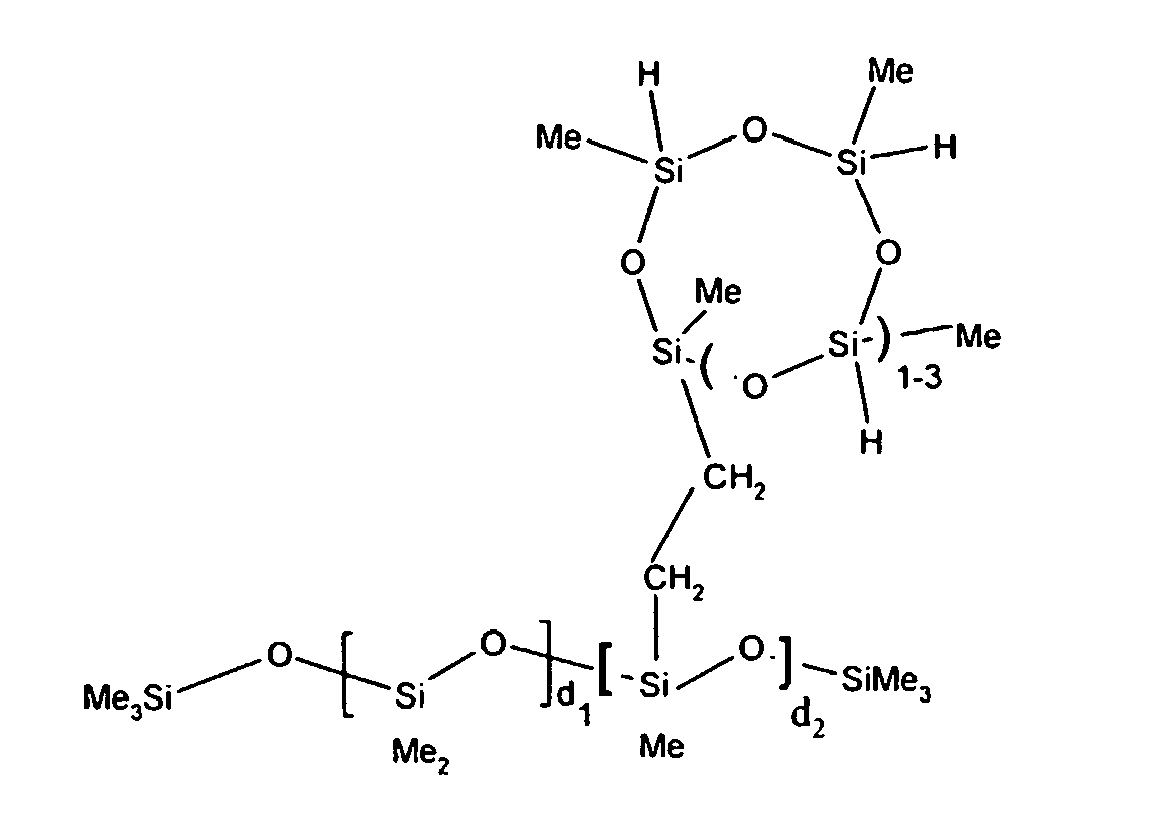
- Example 12: To a reaction vessel was added 233.9 g of a poly (methylhydrogen) cyclic siloxane (MeH cyclics) having an average Dp of about 4.4 ( 3.9 moles of SiH) and 175.0 g of a trimethylsiloxy endblocked, hexenyl pendant polydimethylsiloxane copolymer (0.076 mol vinyl) to give an SiH/SiVi ratio of 51:1. The polymers were well mixed and a vinylsiloxane diluted Platinum (Pt) catalyst added to give a Pt content of about 12 ppm. The exothermic reaction resulted in a small to moderate temperature increase. After allowing the sample to cool for a few hours, bis(2-methoxy-1-methylethyl)maleate (0.39 g, 1 wt %) was added to stabilize the Pt from further activity. The resulting polymer was stripped on a rotovap at 1 mm Hg and 50 degrees Celsius to remove any unreacted poly(methylhydrogen) cyclic. The isolated product had a viscosity of 585 mPa.s, a SiH level of 0.15 wt % (SiH as H) as determined by titration and a molecular weight as determined by GPC of Mn= 7930 and Mw= 50100 vs polydimethylsiloxane (PDMS) standards. 29 Si and 13 C NMR analysis of the product demonstrated that all vinyl functionality had been consumed yielding silethylene bridges, no ring opening had occurred and that the resulting nominal Mn molecular structure is consistent with a methylhydrogen cyclic siloxane capped pendant siloxane polymer as described below, where Me is methyl, d1 is about 143 and d2 is about 5.

- Example 13: To a reaction vessel was added 654.0 g of a poly (methylhydrogen) cyclic siloxane (MeH cyclics) having an average Dp of about 4.4 (6.9 moles of SiH) and 110.0 g of a hexenyl endblocked polydimethylsiloxane polymer(0.25 mol vinyl) to give an SiH/SiVi ratio of 44:1. The polymers were well mixed and a vinylsiloxane diluted Platinum (Pt) catalyst added to give a Pt content of about 12 ppm. The exothermic reaction resulted in a small to moderate temperature increase. After allowing the sample to cool for a few hours, bis(2-methoxy-1-methylethyl)maleate (0.39 g, 1 wt %) was added to stabilize the Pt from further activity. The resulting polymer was stripped on a rotovap at 1 mm Hg and 50 degrees Celsius to remove any unreacted poly(methylhydrogen) cyclic siloxane. The isolated product had a viscosity of 29 mPa.s, a SiH level of 0.50 wt % (SiH as H) as determined by titration and a molecular weight as determined by GPC of Mn= 1648 and Mw=16060 vs polydimethylsiloxane (PDMS) standards. 29 Si and 13 C NMR analysis of the product demonstrated that all vinyl functionality has been consumed yielding silethylene bridges, no ring openings had occurred and that the resulting molecular structure is consistent with a methylhydrogen cyclic siloxane capped linear siloxane polymer as described below, where Me is methyl, x corresponds to 8 for Mw, 0 for Mn and d is an average of about 10.

- Example 14: To a reaction vessel was added 837.0 g of a poly (methylhydrogen) cyclic siloxane (MeH cyclics) having an average Dp of about 4.4 ( 14.0 moles of SiH) and 65.0 g of tetrakis(vinyldimethylsiloxy)silane (0.60 mol vinyl) to give an SiH/SiVi ratio of 23:1. The polymers were well mixed and a vinylsiloxane diluted Platinum (Pt) catalyst added to give a Pt content of about 12 ppm. The exothermic reaction resulted in a small to moderate temperature increase. After allowing the sample to cool for a few hours, bis(2-methoxy-1-methylethyl)maleate (0.40 g, wt %) was added to stabilize the Pt from further activity. The resulting polymer was stripped on a rotovap at 1 mm Hg and 50 degrees Celsius to remove any unreacted poly(methylhydrogen) cyclic siloxane. The isolated product had a viscosity of 81 mPa.s, a SiH level of 0.90 wt % (SiH as H) as determined by titration and a molecular weight as determined by GPC of Mn= 1460 and Mw= 18600 vs polydimethylsiloxane (PDMS) standards. 29 Si and 13 C NMR analysis of the product demonstrated that all vinyl functionality has been consumed yielding silethylene bridges, no ring opening had occurred and that the resulting nominal molecular structure for Mn is consistent with a methylhydrogen cyclic siloxane capped siloxane polymer as described below, where Me is methyl. Higher oligomers can grow from any of the branches.

- Example 15: To a reaction vessel was added 729.7 g of a poly (methylhydrogen) cyclic siloxane (MeH cyclics) having an average Dp of about 4.4 ( 12.2 moles of SiH) and 85.0 g of tetrakis(hexenyldimethylsiloxy)silane ( 0.52 mol vinyl) to give an SiH/SiVi ratio of 24:1. The polymers were well mixed and a vinylsiloxane diluted Platinum (Pt) catalyst added to give a Pt content of about 12 ppm. The exothermic reaction resulted in a small to moderate temperature increase. After allowing the sample to cool for a few hours, bis(2-methoxy-1-methylethyl)maleate (0.40 g, wt %) was added to stabilize the Pt from further activity. The resulting polymer was stripped on a rotovap at 1 mm Hg and 50 degrees Celsius to remove any unreacted poly(methylhydrogen) cyclic. The isolated product had a viscosity of 32 mPa.s, a SiH level of 0.70 wt % (SiH as H) as determined by titration and a molecular weight as determined by GPC of Mn=1453 and Mw= 27690 vs polydimethylsiloxane (PDMS) standards. 29 Si and 13 C NMR analysis of the product demonstrated that all vinyl functionality has been consumed yielding silethylene bridges, no ring opening had occurred and that the resulting nominal molecular structure for Mn is consistent with a methylhydrogen cyclic siloxane capped siloxane polymer as described below, where Me is methyl. Higher oligomers can grow from any of the branches.

- Example 16: To a reaction vessel was added 381.1 g of a poly(methylhydrogen) cyclic siloxane (MeH cyclics) having an average Dp of about 4.4 (6.3 moles SiH) and 80.0 g of a dimethylvinylsiloxy end-blocked polydimethylsiloxane polymer having an average Dp of about 7 (0.29 moles vinyl) to give an SiH/SiVi ratio of about 22:1. The polymers were well mixed and a vinylsiloxane diluted platinum (Pt) catalyst was added to give a Pt content of about 4 ppm. An exotherm reaction was initiated and over a period of 10 minutes the temperature of the vessel contents rose to above room temperature. After cooling for 2 hours, the resulting polymer was stripped in a rotovap at 1 mm Hg and 95C to remove any unreacted poly(methylhydrogen) cyclic siloxane. The material was then allowed to cool to room temperature. After cooling, 150 g of above product was added to another reaction vessel. Then 24.3g (0.29 moles vinyl) of 1-hexene was slowly added to the reaction vessel. An exothermic reaction was initiated with each small addition. After cooling for 2 hours, bis(2-methoxy-1-methylethyl)maleate (0.87g, 0.5 wt%) was added to stabilize the Pt from further activity. The resulting polymer was then stripped a second time in a rotovap at I mm Hg and 95 C to remove any unreacted 1-hexene. After cooling to room temperature, bis(2-methoxy-1-methylethyl)maleate (0.87g, 0.5 wt%) was added to stabilize the Pt from further activity. The material was then allowed to cool to room temperature. The isolated product had a viscosity of 62 mPa.s, a SiH level of 0.32% (SiH as H) as determined by titration and a GPC Mn = 1723 and Mw = 15640 versus polydimethylsiloxane (PDMS) standards. 29Si NMR analysis of the product demonstrates that all vinyl functionality has been consumed yielding silethylene bridges, no ring openings has occurred and that the resulting molecular structure is consistent with a methylhydrogen cyclic siloxane capped linear siloxane polymer as described below, where x is about 1 for Mn , about 9 for Mw and d is an average of about 7.

- Example 17: To a reaction vessel was added 737 g of a poly(methylhydrogen) cyclic siloxane (MeH cyclics) having an average Dp of about 4.4 (12.2 moles SiH) and 1263 g of a dimethylvinylsiloxy end-blocked polydimethylsiloxane polymer having an average Dp of about 8 (3.6 moles vinyl) to give an SiH/SiVi ratio of 3.4:1. The polymers were well mixed and a vinylsiloxane diluted platinum (Pt) catalyst added to give a Pt content of about 4 ppm. An exothermic reaction was initiated and over a period of 10 minutes the temperature of the vessel contents rose from 25° C to 137° C. After the reaction mixture had cooled to 25 C, 91.1 g (0.80 mol) allylglycidylether (AGE) was added. The reaction was then heated via heating mantle to 50 C at which point the heat was turned off. The reaction mixture continued to exotherm to 66 C over 5 minutes and held steady at 66 C for an additional 5 minutes. Analysis by gas chromatography at this point showed no trace of the AGE raw material. When the temperature began to drop, the heat was turned back on and the reaction mixture was maintained at 80 C for 2 hours. The reaction was then allowd to cool to 25 C. To stabilize the product, 4.2g (0.2 wt.%) bis(2-methoxy-1-methylethyl)maleate was then added. The isolated product had a viscosity of 93 mPa.s, a SiH level of 0.36% (SiH as H) as determined by titration and a GPC Mn = 2626 and Mw = 6405 versus polydimethylsiloxane (PDMS) standards. The structure is shown below, where 10% of the SiH functions have been replaced with a propylglycidylether group, x = 1-5 and d = about 8.
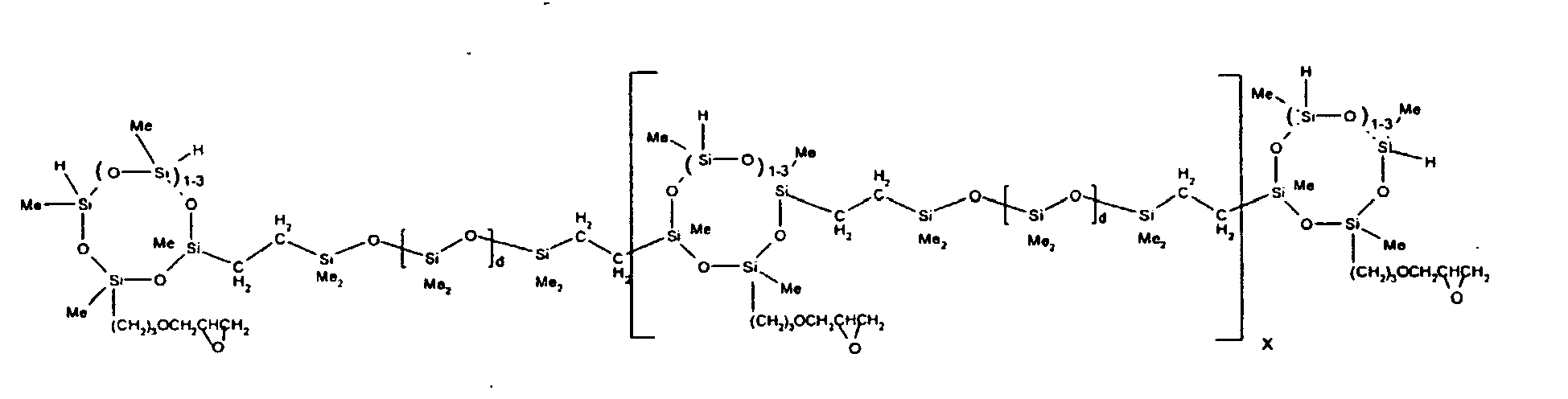
- Example 18: To a reaction vessel was added 737.0 g of a poly(methylhydrogen) cyclic siloxane (MeH cyclics) having an average Dp of about 4.4 (12.2 moles SiH) and 1263.0 g of a dimethylvinylsiloxy end-blocked polydimethylsiloxane polymer having an average Dp of about 8 (3.6 moles vinyl) to give an SiH/SiVi ratio of 3.4:1. The polymers were well mixed and a vinylsiloxane diluted platinum (Pt) catalyst added to give a Pt content of about 4 ppm. An exothermic reaction was initiated and over a period of 10 minutes the temperature of the vessel contents rose from 25° C to 137° C. After the reaction mixture had cooled to 25 C, 227.9g (2.0 mol) AGE was added. The reaction was then heated via heating mantle to 50 C at which point the heat was turned off. The reaction mixture continued to exotherm to 91 C over 10 minutes. Analysis by gas chromatography at this point showed no trace of the AGE raw material. When the reaction temperature had dropped back to 80 C, the heat was turned back on and the reaction mixture was maintained at 80 C for 2 hours. The reaction was then allowd to cool to 25 C. To stabilize the product, 4.2g (0.2 wt.%) bis(2-methoxy-1-methylethyl)maleate was then added. The isolated product had a viscosity of 85 mPa.s, a SiH level of 0.30 % (SiH as H) as determined by titration and a GPC Mn = 2867 and Mw = 7561 versus polydimethylsiloxane (PDMS) standards. The structure is shown below, where 25% of the SiH functions have been replaced with a propylglycidylether group, x = 1-5 and d = about 8.

Claims (22)
- Organohydrogensilicon compounds containing at least one silicon-bonded hydrogen atom per molecule described by formula (1)

(Y3-nRnSiO1/2)c(Y2-oRoSiO2/2)d(Y1-pRpSiO3/2)e(SiO4/2)f(CRqY1-q)g(CRrY2-r)h (O(CRsY2-s)i(CRtY3-t)j
where B refers to boron, each R is as described above, the sum of c+d+e+f+g+h+i+j is at least 2, n is an integer from 0 to 3, o is an integer from 0 to 2, p is an integer from 0 to 1, q is an integer from 0 to 1, r is an integer from 0 to 2, s is an integer from 0 to 2, t is an integer from 0 to 3, u is an integer from 0 to 2, v is an integer from 0 to 3, each Y is an independently selected functional group selected from a halogen atom, an ether group, an alkoxy group, an alkoxyether group, an acyl group, an epoxy group, an amino group, or a silyl group, or a Z-G group, where Z is as described above, each G is a cyclosiloxane described by formula (III):
- The organohydrogensilicon compounds of claim 1 where subscript b is an integer from 2 to 19, subscript c is an integer from 0 to 50, subscript d is an integer from 0 to 5000, subscript e is an integer from 0 to 48, subscript f is an integer from 0 to 24, subscript g is an integer from 0 to 50, subscript h is an integer from 0 to 50, subscript i is an integer from 0 to 50, and subscript j is an integer from 0 to 50.
- The organohydrogen silicon compounds of claims 1 or 2 where subscript c is an integer from 2 to 15, subscript d is an integer from 0 to 1000, subscript e is an integer from 0 to 13, subscript f is an integer from 0 to 6, subscript g is an integer from 0 to 20, subscript h is an integer from 0 to 20, subscript i is an integer from 0 to 20, subscript j is an integer from 0 to 15.
- The organohydrogensilicon compounds of any of claims 1 to 3 where each R group is independently selected from hydrogen atoms, alkyl groups comprising 1 to 8 carbon atoms, or aryl groups comprising 6 to 9 carbon atoms, each X is a Z-R4 group or is independently selected from chloro, methoxy, isopropoxy, and groups derived by are derived by hydrosilylation of the alkenyl group from from hydroxybutylvinyl ether, vinylcyclohexylepoxide, and allylglycidylether with an SiH from the siloxane precursor to formulas (I) or (III), where Z is a divalent hydrocarbon group, and R4 is selected from - R2SiO(R2SiO)dSiR2-Z-G, -R2SiOSiR3, -R2SiOSiR2-Y, -RSi(OSiR3)2, where d is an integer from 1 to 50 and Z, G, and R are as described above.
- The organohydrogensilicon compounds of any of claims 1 to 4 where each R group is independently selected from hydrogen, methyl, alpha-methylstyryl, 3,3,3- trifluoropropyl and nonafluorobutylethyl.
- The organohydrogensilicon compounds of any of claims 1 to 5 where R is methyl, and d is an average of 8.
- The organohydrogensilicon compounds of any of claims 1 to 3 where such compounds are described by the structures below where Me is methyl, d1 + d2 = d, and x can range from 1 to 100:


- The organohydrogensilicon compounds of any of claims 1 or 7 where such compounds are described by the structure below where Me is methyl, d is an average of 8, and x is an integer from 1 to 15:

- The organohydrogensilicon compounds of claims 7 or 8 where 5 to 70 percent of the SiH bonds are replaced by hydrocarbon, oxyhydrocarbon or functional groups.
- The organohydrogensilicon compounds of claims 7 or 8 where 5 to 50 percent of the SiH bonds are replaced by functional groups derived by hydrosilylation of allylglycidyl ether (propylglycidyl ether groups) or vinylcyclohexylepoxide, alkyl groups or alkenyl groups.
- The organohydrogensilicon compounds of Claims 7 or 8 where 10 to 30 percent of the SiH bonds are replaced by functional groups derived by hydrosilylation of allylglycidyl ether (propylglycidyl ether groups).
- The organohydrogensilicon compounds of any of claims 1 to 11 where such organohydrogensilicon compounds contain at least 2 silicon-bonded hydrogen atoms per molecule.
- The organohydrogensilicon compounds of any of claims 1 to 11 where such organohydrogensilicon compounds contain at least 3 silicon-bonded hydrogen atoms per molecule.
- The organohydrogensilicon compounds of any of claims 1 to 13 where such compounds have a viscosity from 5 to 50,000 mPa.s.
- A method of preparing organohydrogensilicon compounds having at least one silicon-bonded hydrogen comprising (1) mixing (A) at least one organohydrogen cyclosiloxane comprising at least 2 SiH bonds per molecule and having the formula


(Y3-nRnSiO1/2)c(Y2-oRoSiO2/2)d(Y1-pRpSiO3/2)e(SiO4/2)f(CRqY1-q)g(CRrY2-r)h (O(CRsY2-s)i(CRtY3-t)j
where B refers to boron, each R is as described above, the sum of c+d+e+f+g+h+i+j is at least 2, n is an integer from 0 to 3, o is an integer from 0 to 2, p is an integer from 0 to 1, q is an integer from 0 to 1, r is an integer from 0 to 2, s is an integer from 0 to 2, t is an integer from 0 to 3, u is an integer from 0 to 2, v is an integer from 0 to 3, each A is independently selected from a hydroxy group, a monovalent hydrocarbon group comprising 2 to about 20 carbon atoms having at least one aliphatic unsaturation, a monovalent oxyhydrocarbon group comprising 2 to about 20 carbon atoms having at least one aliphatic unsaturation, or a functional group selected from a halogen atom, an ether group, an alkoxy group, an alkoxyether group, an acyl group, an epoxy group, an amino group, or a silyl group, provided at least one A group has an aliphatic unsaturation or a hydroxy group, each Y is an independently selected functional group selected from a halogen atom, an ether group, an alkoxy group, an alkoxyether group, an acyl group, an epoxy group, an amino group, or a silyl group, or a Z-G group, where Z is as described above, each G is a cyclosiloxane described by formula (III):
- The method of claim 15 further comprising step (2a) adding at least one hydrocarbon, oxyhydrocarbon or functional compound having at least one aliphatic unsaturation or hydroxy group to the reaction mixture comprising organohydrogensilicon compounds having at least one SiH bond per molecule formed in step 2 so to form a second reaction mixture comprising organohydrogensilicon compounds having at least one SiH bond per molecule where 5 to 70 % of the SiH bonds have been converted to a hydrocarbon, oxyhydrocarbon or functional group.
- A method of preparing organohydrogensilicon compounds having at least one silicon-bonded hydrogen comprising (1') mixing (A) at least one organohydrogen cyclosiloxane comprising at least 2 SiH bonds per molecule and having the formula
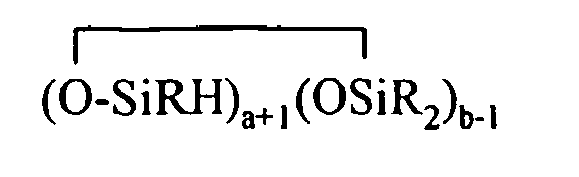

(Y3-nRnSiO1/2)c(Y2-oRoSiO2/2)d(Y1-pRpSiO3/2)e(SiO4/2)f(CRqY1-q)g(CRrY2-r)h (O(CRsY2-s)i(CRtY3-t)j
where B refers to boron, each R is as described above, the sum of c+d+e+f+g+h+i+j is at least 2, n is an integer from 0 to 3, o is an integer from 0 to 2, p is an integer from 0 to 1, q is an integer from 0 to 1, r is an integer from 0 to 2, s is an integer from 0 to 2, t is an integer from 0 to 3, u is an integer from 0 to 2, v is an integer from 0 to 3, each A is independently selected from a hydroxy group, a monovalent hydrocarbon group comprising 2 to about 20 carbon atoms having at least one aliphatic unsaturation, a monovalent oxyhydrocarbon group comprising 2 to about 20 carbon atoms having at least one aliphatic unsaturation, or a functional group selected from a halogen atom, an ether group, an alkoxy group, an alkoxyether group, an acyl group, an epoxy group, an amino group, or a silyl group, provided at least one A group has an aliphatic unsaturation or a hydroxy group, each Y is an independently selected functional group selected from a halogen atom, an ether group, an alkoxy group, an alkoxyether group, an acyl group, an epoxy group, an amino group, or a silyl group, or a Z-G group, where Z is as described above, each G is a cyclosiloxane described by formula (III):
- The method of claim 17 further comprising step (2'a) adding at least one hydrocarbon, oxyhydrocarbon or functional compound having at least one aliphatic unsaturation or hydroxy group to the reaction mixture comprising organohydrogensilicon compounds having at least one SiH bond per molecule formed in step 2' so to form a second reaction mixture comprising organohydrogensilicon compounds having at least one SiH bond per molecule where 5 to 70 % of the SiH bonds have been converted to a hydrocarbon, oxyhydrocarbon or functional group.
- A method of preparing organohydrogensilicon compounds having at least one silicon-bonded hydrogen comprising (1") mixing (B) at least one compound comprising at least one aliphatic unsaturation or at least one hydroxy group per molecule described by BRuA3-u, SiRvA4-v,or a group described by formula (A3-nRnSiO1/2)c (A2-oRoSiO2/2)d(A 1-pRpSiO3/2)e(SiO4/2)f(CRqA 1-q)g(CRrA2-r)h(O(CRsA2-s)i (CRtA3-t)j, with (C) a catalyst to form a aliphatic unsaturation premix or hydroxy premix respectively; (2") effecting a reaction by adding the aliphatic unsaturation premix or hydroxy premix to (A) at least one organohydrogen cyclosiloxane comprising at least 2 SiH bonds per molecule and having the formula


(Y3-nRnSiO1/2)c(Y2-oRoSiO2/2)d(Y1-pRpSiO3/2)e(SiO4/2)f(CRq Y 1-q)g(CRrY2-r)h (O(CRSY2-s)i(CRtY3-t)j
where B refers to boron, each R is as described above, the sum of c+d+e+f+g+h+i+j is at least 2, n is an integer from 0 to 3, o is an integer from 0 to 2, p is an integer from 0 to I, q is an integer from 0 to 1, r is an integer from 0 to 2, s is an integer from 0 to 2, t is an integer from 0 to 3, u is an integer from 0 to 2, v is an integer from 0 to 3, each A is independently selected from a hydroxy group, a monovalent hydrocarbon group comprising 2 to about 20 carbon atoms having at least one aliphatic unsaturation, a monovalent oxyhydrocarbon group comprising 2 to about 20 carbon atoms having at least one aliphatic unsaturation, or a functional group selected from a halogen atom, an ether group, an alkoxy group, an alkoxyether group, an acyl group, an epoxy group, an amino group, or a silyl group, provided at least one A group has an aliphatic unsaturation or a hydroxy group, each Y is an independently selected functional group selected from a halogen atom, an ether group, an alkoxy group, an alkoxyether group, an acyl group, an epoxy group, an amino group, or a silyl group, or a Z-G group, where Z is as described above, each G is a cyclosiloxane described by formula (III):
- The method of claim 19 further comprising step (2"a) adding at least one hydrocarbon, oxyhydrocarbon or functional compound having at least one aliphatic unsaturation or hydroxy group to the reaction mixture comprising organohydrogensilicon compounds having at least one SiH bond per molecule formed in step 2" so to form a second reaction mixture comprising organohydrogensilicon compounds having at least one SiH bond per molecule where 5 to 70 % of the SiH bonds have been converted to a hydrocarbon, oxyhydrocarbon or functional group.
- The method of any of claims 16, 18 and 20 where the hydrocarbon, oxyhydrocarbon or functional compound having at least one aliphatic unsaturation or hydroxy group is allylglycidylether.
- The method of any of claims 12 to 21 where subscript b is 2 to 19.
Applications Claiming Priority (3)
| Application Number | Priority Date | Filing Date | Title |
|---|---|---|---|
| US37742502P | 2002-05-01 | 2002-05-01 | |
| US377425P | 2002-05-01 | ||
| PCT/US2003/013203 WO2003093349A1 (en) | 2002-05-01 | 2003-04-29 | Organohydrogensilicon compounds |
Publications (2)
| Publication Number | Publication Date |
|---|---|
| EP1499661A1 EP1499661A1 (en) | 2005-01-26 |
| EP1499661B1 true EP1499661B1 (en) | 2007-05-30 |
Family
ID=29401492
Family Applications (1)
| Application Number | Title | Priority Date | Filing Date |
|---|---|---|---|
| EP03728589A Expired - Lifetime EP1499661B1 (en) | 2002-05-01 | 2003-04-29 | Organohydrogensilicon compounds |
Country Status (10)
| Country | Link |
|---|---|
| US (1) | US7429636B2 (en) |
| EP (1) | EP1499661B1 (en) |
| JP (1) | JP4755824B2 (en) |
| KR (1) | KR100962056B1 (en) |
| CN (1) | CN100334134C (en) |
| AT (1) | ATE363504T1 (en) |
| AU (1) | AU2003234276A1 (en) |
| DE (1) | DE60314126T2 (en) |
| MY (1) | MY129816A (en) |
| WO (1) | WO2003093349A1 (en) |
Families Citing this family (106)
| Publication number | Priority date | Publication date | Assignee | Title |
|---|---|---|---|---|
| ATE363518T1 (en) * | 2002-05-01 | 2007-06-15 | Dow Corning | COMPOSITIONS WITH EXTENDED PROCESSING TIME |
| AU2003293583A1 (en) * | 2002-12-20 | 2004-07-22 | Dow Corning Corporation | Branched polymers from organohydrogensilicon compounds |
| DE60321218D1 (en) | 2002-12-20 | 2008-07-03 | Dow Corning | BRANCHED POLYMERS FROM ORGANOOHYDROGENSILICONE COMPOSITIONS |
| CN100374525C (en) * | 2003-03-17 | 2008-03-12 | 陶氏康宁公司 | Solvent-free silicone pressure-sensitive adhesives with improved high-temperature bond strength |
| GB0316162D0 (en) | 2003-07-10 | 2003-08-13 | Dow Corning | Silicone release coating compositions |
| JP2006073950A (en) * | 2004-09-06 | 2006-03-16 | Kansai Electric Power Co Inc:The | High heat-resistant semiconductor device |
| US20060134440A1 (en) * | 2004-10-27 | 2006-06-22 | Crivello James V | Silicone encapsulants for light emitting diodes |
| EP1819775B1 (en) * | 2004-11-19 | 2008-09-24 | Dow Corning Corporation | Organohydrogenpoly siloxane resin and silicon composition |
| KR101351815B1 (en) | 2005-07-28 | 2014-01-15 | 다우 코닝 코포레이션 | Release coating compositions having improved release force profiles |
| US7932319B2 (en) | 2005-10-18 | 2011-04-26 | Asahi Kasei Chemicals Corporation | Thermosetting resin composition and semiconductor sealing medium |
| EP1969641A2 (en) * | 2005-11-04 | 2008-09-17 | Dow Corning Corporation | Encapsulation of photovoltaic cells |
| US8110630B2 (en) | 2006-03-21 | 2012-02-07 | Dow Corning Corporation | Silicone elastomer gels |
| WO2007109282A2 (en) | 2006-03-21 | 2007-09-27 | Dow Corning Corporation | Silicone-organic elastomer gels |
| CN101432340B (en) * | 2006-03-21 | 2012-03-28 | 陶氏康宁公司 | Silicone polyether elastomer gel |
| JP5424866B2 (en) * | 2006-03-21 | 2014-02-26 | ダウ・コーニング・コーポレイション | Silicone polyether elastomer gel |
| US7642332B2 (en) * | 2006-08-14 | 2010-01-05 | The University Of Akron | Amphiphilic networks, process for producing same, and products made therefrom |
| WO2008088523A1 (en) | 2006-12-21 | 2008-07-24 | Dow Corning Corporation | Dual curing polymers and methods for their preparation and use |
| US8618233B2 (en) | 2006-12-21 | 2013-12-31 | Dow Corning Corporation | Dual curing polymers and methods for their preparation and use |
| JP2010514763A (en) * | 2006-12-29 | 2010-05-06 | ダウ・コーニング・コーポレイション | Personal care composition comprising silicone elastomer gel |
| KR101186779B1 (en) | 2007-04-17 | 2012-09-27 | 아사히 가세이 케미칼즈 가부시키가이샤 | Epoxy silicone and method for production thereof, and curable resin composition using the same and use thereof |
| JP5248034B2 (en) * | 2007-04-23 | 2013-07-31 | 株式会社Adeka | Silicon-containing compound, curable composition, and cured product |
| JP5248033B2 (en) | 2007-04-23 | 2013-07-31 | 株式会社Adeka | Silicon-containing compound, curable composition, and cured product |
| JP5248032B2 (en) | 2007-04-23 | 2013-07-31 | 株式会社Adeka | Silicon-containing compound, curable composition, and cured product |
| CN101743282B (en) * | 2007-05-30 | 2013-03-27 | 陶氏康宁公司 | Silicone copolymers and elastomers derived from natural oils |
| KR20100075855A (en) | 2007-09-25 | 2010-07-05 | 다우 코닝 코포레이션 | Emulsions of silicone elastomer and silicone organic elastomer gels |
| US8222363B2 (en) | 2007-09-26 | 2012-07-17 | Dow Corning Corporation | Silicone organic elastomer gels from organopolysiloxane resins |
| WO2009063887A1 (en) * | 2007-11-13 | 2009-05-22 | Adeka Corporation | Positive photosensitive composition, positive permanent resist, and method for producing positive permanent resist |
| CN102017066B (en) | 2008-03-14 | 2012-11-21 | 陶氏康宁公司 | Method of forming a photovoltaic cell module |
| JP5139882B2 (en) * | 2008-05-08 | 2013-02-06 | 旭化成ケミカルズ株式会社 | Photosensitive resin composition and method for producing substrate with resin layer using the same |
| DE102008053788A1 (en) * | 2008-10-22 | 2010-04-29 | Beiersdorf Ag | Cosmetic formulation with siloxane elastomers to improve microbiological stability |
| DE102008054434A1 (en) * | 2008-12-09 | 2010-06-10 | Wacker Chemie Ag | Siloxane copolymers and process for their preparation |
| CN102804367A (en) | 2009-06-19 | 2012-11-28 | 道康宁公司 | Use of ionomeric silicone thermoplastic elastomers in electronic devices |
| TWI495666B (en) * | 2009-07-17 | 2015-08-11 | Shinetsu Chemical Co | Organohydrogenpolysiloxane, making method, and addition-cure silicone composition |
| JP5671854B2 (en) * | 2009-07-17 | 2015-02-18 | 信越化学工業株式会社 | Addition-curing silicone composition |
| EP2473561B1 (en) | 2009-09-03 | 2016-11-16 | Dow Corning Corporation | Personal care compositions with pituitous silicone fluids |
| JP5397350B2 (en) * | 2009-09-11 | 2014-01-22 | 信越化学工業株式会社 | Liquid silicone rubber coating composition, curtain airbag and method for producing the same |
| US9593209B2 (en) | 2009-10-22 | 2017-03-14 | Dow Corning Corporation | Process for preparing clustered functional polyorganosiloxanes, and methods for their use |
| TWI502004B (en) * | 2009-11-09 | 2015-10-01 | Dow Corning | Process for preparing clustered functional polyorganosiloxanes, and methods for their use |
| US9175141B2 (en) | 2010-08-05 | 2015-11-03 | Biofilm Ip, Llc | Cyclosiloxane-substituted polysiloxane compounds, compositions containing the compounds and methods of use thereof |
| JP5857039B2 (en) * | 2011-03-30 | 2016-02-10 | 旭化成ケミカルズ株式会社 | Organopolysiloxane, process for producing the same, and curable resin composition containing organopolysiloxane |
| KR101546599B1 (en) * | 2011-03-30 | 2015-08-21 | 아사히 가세이 케미칼즈 가부시키가이샤 | Organopolysiloxane, method for producing same, and curable resin composition containing organopolysiloxane |
| WO2012138755A1 (en) | 2011-04-08 | 2012-10-11 | Dongchan Ahn | Method of preparing gas selective membrane using epoxy-functional siloxanes |
| CN103517884B (en) * | 2011-05-10 | 2016-08-17 | 住友电气工业株式会社 | Optical fiber |
| EP2716687A4 (en) | 2011-05-30 | 2015-02-25 | Dow Corning Toray Co Ltd | BY A MONO / DIGLYCERIN DERIVATIVE MODIFIED ORGANOPOLYSILOXAN ELASTOMER AND ITS USE |
| US20140225027A1 (en) | 2011-09-20 | 2014-08-14 | Dow Corning Corporation | Silver Containing Hydrosilylation Catalysts And Compositions Containing The Catalysts |
| EP2758413B1 (en) | 2011-09-20 | 2018-03-07 | Dow Corning Corporation | Iridium containing hydrosilylation catalysts and compositions containing the catalysts |
| WO2013043799A1 (en) | 2011-09-20 | 2013-03-28 | Dow Corning Corporation | Zirconium containing hydrosilylation catalysts and compositions containing the catalysts |
| EP2758416B8 (en) | 2011-09-20 | 2018-08-01 | Dow Silicones Corporation | Nickel containing hydrosilylation catalysts and compositions containing the catalysts |
| EP2758410A2 (en) | 2011-09-20 | 2014-07-30 | Dow Corning Corporation | Vanadium containing hydrosilylation catalysts and compositions containing the catalysts |
| WO2013043874A2 (en) | 2011-09-20 | 2013-03-28 | Dow Corning Corporation | Manganese containing hydrosilylation catalysts and compositions containing the catalysts |
| US20140200347A1 (en) | 2011-09-20 | 2014-07-17 | Dow Corning Corporation | Rhenium Containing Hydrosilylation Catalysts and Compositions Containing the Catalysts |
| WO2013043797A1 (en) | 2011-09-20 | 2013-03-28 | Dow Corning Corporation | Titanium containing hydrosilylation catalysts and compositions containing the catalysts |
| CN103946228A (en) | 2011-09-20 | 2014-07-23 | 道康宁公司 | Cobalt containing hydrosilylation catalysts and compositions containing the catalysts |
| US20140231703A1 (en) | 2011-09-20 | 2014-08-21 | Dow Corning Corporation | Molybdenum Containing Hydrosilylation Reaction Catalysts and Compositions Containing the Catalysts |
| US20140206863A1 (en) | 2011-09-20 | 2014-07-24 | Dow Corning Corporation | Copper Containing Hydrosilylation Catalysts and Compositions Containing the Catalysts |
| CN104024264A (en) | 2011-09-20 | 2014-09-03 | 道康宁公司 | Ruthenium containing hydrosilylation catalysts and compositions containing catalysts |
| WO2013043912A2 (en) | 2011-09-20 | 2013-03-28 | Dow Corning Corporation | Iron containing hydrosilylation catalysts and compositions containing the catalysts |
| WO2013043798A2 (en) | 2011-09-20 | 2013-03-28 | Dow Corning Corporation | Zinc containing hydrosilylation catalysts and compositions containing the catalysts |
| CN103814038A (en) | 2011-09-20 | 2014-05-21 | 道康宁公司 | Ruthenium containing hydrosilylation catalysts and compositions containing catalysts |
| US20140187783A1 (en) | 2011-09-20 | 2014-07-03 | Dow Corning Corporation | Hafnium Containing Hydrosilylation Catalysts and Compositions Containing the Catalysts |
| US9139699B2 (en) | 2012-10-04 | 2015-09-22 | Dow Corning Corporation | Metal containing condensation reaction catalysts, methods for preparing the catalysts, and compositions containing the catalysts |
| US9073950B2 (en) | 2011-12-01 | 2015-07-07 | Dow Corning Corporation | Hydrosilylation reaction catalysts and curable compositions and methods for their preparation and use |
| JP6369888B2 (en) | 2011-12-27 | 2018-08-08 | 東レ・ダウコーニング株式会社 | Novel liquid organopolysiloxane and use thereof |
| DE102012206209A1 (en) * | 2012-04-16 | 2013-10-17 | Wacker Chemie Ag | organopolysiloxane gels |
| WO2014059132A2 (en) | 2012-10-12 | 2014-04-17 | Dow Corning Corporation | Membranes including polysiloxane-poly(alkylene oxide) copolymers and methods of using the same |
| TW201439264A (en) | 2012-12-20 | 2014-10-16 | 道康寧公司 | Method of manufacturing an electronic device |
| CN105189685B (en) | 2013-02-11 | 2017-08-08 | 道康宁公司 | Method for forming thermally conductive thermal free radical curable silicone composition |
| US9670392B2 (en) | 2013-02-11 | 2017-06-06 | Dow Corning Corporation | Stable thermal radical curable silicone adhesive compositions |
| US9718925B2 (en) | 2013-02-11 | 2017-08-01 | Dow Corning Corporation | Curable silicone compositions comprising clustered functional polyorganosiloxanes and silicone reactive diluents |
| EP2954022B1 (en) | 2013-02-11 | 2019-05-01 | Dow Silicones Corporation | Clustered functional polyorganosiloxanes, processes for forming same and methods for their use |
| ES2895424T3 (en) | 2013-02-11 | 2022-02-21 | Dow Silicones Corp | Moisture curable hot melt silicone adhesive compositions including a reactive siloxane resin with alkoxy functional groups |
| WO2014124388A1 (en) | 2013-02-11 | 2014-08-14 | Dow Corning Corporation | Alkoxy-functional organopolysiloxane resin and polymer and related methods for forming same |
| US9518073B2 (en) * | 2013-04-12 | 2016-12-13 | Milliken & Company | Siloxane compound and process for producing the same |
| WO2015116776A1 (en) | 2014-01-29 | 2015-08-06 | Dow Corning Corporation | Elastomer compositions |
| US9963546B2 (en) | 2014-03-17 | 2018-05-08 | Dow Corning Corporation | Fluorinated compound, curable composition comprising same, and cured product |
| WO2015142558A1 (en) | 2014-03-17 | 2015-09-24 | Dow Corning Corporation | Curable composition cured product formed from the curable composition, and method of forming the cured product |
| US10046318B2 (en) | 2014-12-19 | 2018-08-14 | Dow Silicones Corporation | Ligand components, associated reaction products, activated reaction products, hydrosilylation catalysts and hydrosilylation curable compositions including the ligand components, and associated methods for preparing same |
| KR101987005B1 (en) | 2015-04-08 | 2019-06-10 | 다우 실리콘즈 코포레이션 | Mucilage silicone emulsion |
| EP3196229B1 (en) | 2015-11-05 | 2018-09-26 | Dow Silicones Corporation | Branched polyorganosiloxanes and related curable compositions, methods, uses and devices |
| WO2017160349A1 (en) * | 2016-03-14 | 2017-09-21 | Dow Corning Corporation | Siloxane composition |
| TW201829672A (en) | 2017-02-10 | 2018-08-16 | 美商道康寧公司 | Curable composition and coated substrate |
| DE112018001105B4 (en) * | 2017-03-02 | 2024-12-05 | National Institute Of Advanced Industrial Science And Technology | Manufacturing process for an oligosiloxane |
| WO2018207549A1 (en) * | 2017-05-10 | 2018-11-15 | 国立研究開発法人産業技術総合研究所 | Synthetic lubricating oil |
| JP7256169B2 (en) | 2017-07-25 | 2023-04-11 | ダウ シリコーンズ コーポレーション | Method for preparing graft copolymers having a polyolefin backbone and pendant polyorganosiloxane groups |
| CN109836580A (en) * | 2017-10-12 | 2019-06-04 | 弗洛里光电材料(苏州)有限公司 | Silicone epoxy containing four si-h bonds is applied with it |
| US10876019B2 (en) | 2017-10-19 | 2020-12-29 | Dow Silicones Corporation | Polyorganosiloxane compositions containing a 2-substituted-1-alkynyl-1-cyclohexanol useful as a hydrosilylation reaction inhibitor |
| CA3101628A1 (en) | 2018-03-19 | 2019-09-26 | Dow Silicones Corporation | Hot melt adhesive composition containing a polyolefin - polydiorganoosiloxane copolymer and methods for the preparation and use thereof |
| US11332583B2 (en) | 2018-03-19 | 2022-05-17 | Dow Silicones Corporation | Polyolefin-polydiorganosiloxane block copolymer and hydrosilylation reaction method for the synthesis thereof |
| CA3093558A1 (en) | 2018-03-19 | 2019-09-26 | Dow Silicones Corporation | Polyorganosiloxane hot melt adhesive compositions containing polyolefin - polydiorganoosiloxane copolymers and methods for the preparation and use thereof |
| CN111918904B (en) | 2018-03-19 | 2022-08-19 | 美国陶氏有机硅公司 | Polyolefin-polydiorganosiloxane block copolymers and methods of synthesizing the same |
| JP7334195B2 (en) | 2018-07-17 | 2023-08-28 | ダウ シリコーンズ コーポレーション | Polysiloxane resin-polyolefin copolymer and methods of preparation and use thereof |
| CN113056502B (en) | 2018-12-21 | 2023-01-24 | 美国陶氏有机硅公司 | Multifunctional organosiloxane, composition comprising multifunctional organosiloxane and preparation method thereof |
| EP3898775B1 (en) | 2018-12-21 | 2025-03-12 | Dow Silicones Corporation | Polyfunctional organosiloxanes, compositions containing same, and methods for the preparation thereof |
| EP3898774B1 (en) | 2018-12-21 | 2023-06-07 | Dow Silicones Corporation | Method for preparing a functionalized polyorganosiloxane |
| US12624168B2 (en) | 2018-12-21 | 2026-05-12 | Dow Silicones Corporation | Methods for making polyfunctional organosiloxanes and compositions containing same |
| CN113166419B (en) * | 2018-12-21 | 2023-05-09 | 美国陶氏有机硅公司 | Process for the preparation of multifunctional organosiloxanes and compositions comprising them |
| KR102169052B1 (en) * | 2019-01-15 | 2020-10-22 | 경상대학교산학협력단 | Photocurable composition for 3D printer |
| KR20220010602A (en) | 2019-05-16 | 2022-01-25 | 다우 실리콘즈 코포레이션 | Polysiloxane Controlled Release Additive, Method for Preparing Same, and Release Coating Composition |
| WO2021113317A1 (en) * | 2019-12-02 | 2021-06-10 | Dow Silicones Corporation | Composition for preparing a release coating |
| WO2021262828A1 (en) | 2020-06-24 | 2021-12-30 | Dow Silicones Corporation | Inflatable safety devices |
| US12454617B2 (en) | 2020-06-24 | 2025-10-28 | Dow Silicones Corporation | Silicone elastomer compositions |
| US12570803B2 (en) | 2020-06-24 | 2026-03-10 | Dow Silicones Corporation | Composition, silicone polyether surfactant formed therefrom, and related methods and articles |
| JP2023532860A (en) | 2020-06-24 | 2023-08-01 | ダウ シリコーンズ コーポレーション | Silicone elastomer composition |
| EP3999604B1 (en) | 2020-09-27 | 2023-10-11 | Dow Silicones Corporation | Additive organopolysiloxane composition, curable composition, and film |
| WO2023122364A1 (en) | 2021-12-20 | 2023-06-29 | Dow Silicones Corporation | Silicone polyethers |
| WO2026005871A1 (en) | 2024-06-24 | 2026-01-02 | Dow Silicones Corporation | Organosiloxane and methods for the preparation and use thereof |
Family Cites Families (79)
| Publication number | Priority date | Publication date | Assignee | Title |
|---|---|---|---|---|
| US2868766A (en) * | 1955-07-08 | 1959-01-13 | Dow Corning | Phenylmethylsiloxane diphenylsiloxane copolymers |
| US3002951A (en) * | 1959-04-27 | 1961-10-03 | Dow Corning | Method of polymerizing cyclic diorganosiloxanes |
| US2994684A (en) * | 1959-05-22 | 1961-08-01 | Dow Corning | Method of copolymerizing cyclic phenylsiloxanes |
| US3296291A (en) * | 1962-07-02 | 1967-01-03 | Gen Electric | Reaction of silanes with unsaturated olefinic compounds |
| US3159662A (en) * | 1962-07-02 | 1964-12-01 | Gen Electric | Addition reaction |
| US3159601A (en) * | 1962-07-02 | 1964-12-01 | Gen Electric | Platinum-olefin complex catalyzed addition of hydrogen- and alkenyl-substituted siloxanes |
| US3220972A (en) * | 1962-07-02 | 1965-11-30 | Gen Electric | Organosilicon process using a chloroplatinic acid reaction product as the catalyst |
| US3372178A (en) * | 1965-03-04 | 1968-03-05 | Gen Electric | Aryl-vinyl containing linear disiloxanes and tri- and tetracyclosiloxanes |
| NL131800C (en) * | 1965-05-17 | |||
| US3410886A (en) * | 1965-10-23 | 1968-11-12 | Union Carbide Corp | Si-h to c=c or c=c addition in the presence of a nitrile-platinum (ii) halide complex |
| US3516946A (en) * | 1967-09-29 | 1970-06-23 | Gen Electric | Platinum catalyst composition for hydrosilation reactions |
| US3814730A (en) * | 1970-08-06 | 1974-06-04 | Gen Electric | Platinum complexes of unsaturated siloxanes and platinum containing organopolysiloxanes |
| GB1476314A (en) * | 1973-06-23 | 1977-06-10 | Dow Corning Ltd | Coating process |
| US3996195A (en) * | 1974-11-15 | 1976-12-07 | Shinetsu Chemical Company | Curable organosilicon compositions |
| US3989668A (en) * | 1975-07-14 | 1976-11-02 | Dow Corning Corporation | Method of making a silicone elastomer and the elastomer prepared thereby |
| JPS52146499A (en) * | 1976-05-31 | 1977-12-06 | Shin Etsu Chem Co Ltd | Curable organopolysiloxane composition |
| US4245079A (en) * | 1979-02-16 | 1981-01-13 | Toshiba Silicone Co., Ltd. | Curable organopolysiloxane composition |
| US4427801A (en) * | 1982-04-14 | 1984-01-24 | Dow Corning Corporation | Extrudable silicone elastomer compositions |
| US4525400A (en) * | 1982-09-27 | 1985-06-25 | General Electric Company | Composition for promoting adhesion of curable silicones to substrates |
| US4461867A (en) * | 1982-09-27 | 1984-07-24 | General Electric Company | Composition for promoting adhesion of curable silicones to substrates |
| US4525566A (en) * | 1984-03-02 | 1985-06-25 | Dow Corning Corporation | Coating method and silicone composition for PSA release coating |
| JPS61127733A (en) * | 1984-11-27 | 1986-06-16 | Toray Silicone Co Ltd | Novel organopolysiloxane compound |
| JPS61235461A (en) * | 1985-04-10 | 1986-10-20 | Shin Etsu Chem Co Ltd | Curable organopolysiloxane composition |
| US4681963A (en) * | 1985-12-19 | 1987-07-21 | General Electric Company | Hydrosilylation catalyst, method for making and use |
| US4705765A (en) * | 1985-12-19 | 1987-11-10 | General Electric Company | Hydrosilylation catalyst, method for making and use |
| US4902731A (en) * | 1986-08-27 | 1990-02-20 | Hercules Incorporated | Organosilicon prepolymers |
| US4900779A (en) | 1986-08-27 | 1990-02-13 | Hercules Incorporated | Organosilicon polymers |
| JPS63218763A (en) * | 1987-03-06 | 1988-09-12 | Shin Etsu Chem Co Ltd | Curable organopolysiloxane composition |
| US5430118A (en) * | 1988-05-27 | 1995-07-04 | Exxon Chemical Patents Inc. | Para-alkylstyrene/isoolefin copolymers having substantially homogeneous compositional distribution |
| US5162445A (en) * | 1988-05-27 | 1992-11-10 | Exxon Chemical Patents Inc. | Para-alkylstyrene/isoolefin copolymers and functionalized copolymers thereof |
| JP2732315B2 (en) * | 1989-05-29 | 1998-03-30 | 鐘淵化学工業株式会社 | Curing agent, method for producing the same, and curable composition using the curing agent |
| JP2974692B2 (en) | 1989-08-31 | 1999-11-10 | 東レ・ダウコーニング・シリコーン株式会社 | Platinum catalyst composition, method for producing the same, and curable organopolysiloxane composition containing the platinum catalyst composition |
| US5036117A (en) * | 1989-11-03 | 1991-07-30 | Dow Corning Corporation | Heat-curable silicone compositions having improved bath life |
| JPH06792B2 (en) * | 1989-12-27 | 1994-01-05 | 信越化学工業株式会社 | Method for producing hydrogen siloxane |
| JP3048241B2 (en) * | 1990-03-29 | 2000-06-05 | 東レ・ダウコーニング・シリコーン株式会社 | Curable organopolysiloxane composition |
| JP2712093B2 (en) | 1990-06-29 | 1998-02-10 | 東芝シリコーン株式会社 | UV curable silicone composition |
| JPH054995A (en) * | 1991-01-17 | 1993-01-14 | Shin Etsu Chem Co Ltd | Organosilicon compound and production thereof |
| GB9103191D0 (en) * | 1991-02-14 | 1991-04-03 | Dow Corning | Platinum complexes and use thereof |
| US5290841A (en) * | 1991-03-06 | 1994-03-01 | Dow Corning Toray Silicone Co., Ltd. | Organocyclosiloxane and method for its preparation |
| JPH0517489A (en) * | 1991-07-04 | 1993-01-26 | Shin Etsu Chem Co Ltd | Siloxane compound |
| US5436308A (en) * | 1992-06-03 | 1995-07-25 | Dow Corning Corporation | Cross-linked organofunctional polysiloxanes and method for preparation |
| FI932639A7 (en) * | 1992-06-11 | 1993-12-12 | Gen Electric | Selective catalysts for the synthesis of epoxy silicone monomers and polymers |
| GB9218841D0 (en) * | 1992-09-05 | 1992-10-21 | Dow Corning | Process for producing organosiloxanes |
| US5378790A (en) * | 1992-09-16 | 1995-01-03 | E. I. Du Pont De Nemours & Co. | Single component inorganic/organic network materials and precursors thereof |
| US5523374A (en) | 1992-12-03 | 1996-06-04 | Hercules Incorporated | Curable and cured organosilicon compositions |
| EP0614236B1 (en) * | 1993-03-01 | 2001-01-24 | Matsushita Electric Industrial Co., Ltd. | Method for producing hydrogen storage alloy |
| US5334688A (en) * | 1993-04-19 | 1994-08-02 | Hercules Incorporated | Fully substituted cyclopolysiloxanes and their use for making organosilicon polymers |
| US5510441A (en) * | 1993-07-15 | 1996-04-23 | General Electric Company | Process for producing octamethyltrisiloxane |
| DE69407137T2 (en) * | 1993-10-06 | 1998-04-09 | Dow Corning Toray Silicone | Electrically conductive organosiloxane compositions filled with silver |
| US5545831A (en) * | 1993-10-22 | 1996-08-13 | Dow Corning Toray Silicone Co., Ltd. | Silicone compositions for the formation of cured release coatings |
| DE4336703A1 (en) * | 1993-10-27 | 1995-05-04 | Wacker Chemie Gmbh | Crosslinkable compositions and their use for the production of coatings which repel tacky substances |
| JPH07268100A (en) * | 1994-03-31 | 1995-10-17 | Toray Dow Corning Silicone Co Ltd | Organosilicon polymer and its production |
| JPH07309950A (en) * | 1994-05-17 | 1995-11-28 | Toray Dow Corning Silicone Co Ltd | Organosilicon polymer and method for producing the same |
| US5536803A (en) * | 1994-06-06 | 1996-07-16 | Shin-Etsu Chemical Co., Ltd. | Adhesive silicone compositions |
| JP3317092B2 (en) * | 1994-06-06 | 2002-08-19 | 信越化学工業株式会社 | Silicone adhesive composition and composite of cured silicone and organic resin |
| JPH0841206A (en) * | 1994-07-26 | 1996-02-13 | Toray Dow Corning Silicone Co Ltd | Organosilicon polymer and method for producing the same |
| JPH0841354A (en) * | 1994-07-27 | 1996-02-13 | Kanegafuchi Chem Ind Co Ltd | Curable resin composition with potential |
| JP3239717B2 (en) * | 1995-09-29 | 2001-12-17 | 信越化学工業株式会社 | Curable composition |
| US5691435A (en) * | 1996-01-25 | 1997-11-25 | Wacker-Chemie Gmbh | Crosslinkable compositions |
| DE19637158A1 (en) * | 1996-09-12 | 1998-03-19 | Wacker Chemie Gmbh | Organosilicon compounds containing Si-bonded hydrogen atoms in crosslinkable compositions |
| US5830969A (en) * | 1997-05-28 | 1998-11-03 | Dow Corning Corporation | Silyl ester initiators for ring opening polymerization of cyclosiloxanes |
| GB9703554D0 (en) * | 1997-02-20 | 1997-04-09 | Dow Corning | Polymerisation of cyclosiloxanes |
| JPH111560A (en) * | 1997-06-13 | 1999-01-06 | Toray Dow Corning Silicone Co Ltd | Organocyclosiloxane and method for producing the same |
| FI103051B1 (en) * | 1997-08-22 | 1999-04-15 | Leiras Oy | New block copolymers and their preparation |
| DE59808393D1 (en) * | 1997-12-09 | 2003-06-18 | Wacker Chemie Gmbh | METHOD FOR PRODUCING LINEAR ORGANOPOLYSILOXANS WITH ALPHA-OMEGA-FINAL SI-BONDED ALKENYL GROUPS OR ALPHA, OMEGA-FINAL SI-BONDED HYDROGEN ATOMS |
| DE19755151A1 (en) * | 1997-12-11 | 1999-06-24 | Wacker Chemie Gmbh | Crosslinkable compositions |
| US6184407B1 (en) * | 1998-05-29 | 2001-02-06 | Dow Corning Toray Silicone Co., Ltd. | Carbosiloxane dendrimers |
| US6030919A (en) | 1998-08-13 | 2000-02-29 | General Electric Company | Platinum hydrosilylation catalyst and method for making |
| GB9827085D0 (en) * | 1998-12-09 | 1999-02-03 | Dow Corning | Polymerisation of siloxanes |
| US6313255B1 (en) * | 1998-12-18 | 2001-11-06 | General Electric Company | Telechelic siloxane polymers with multiple epoxy end-groups |
| US6235832B1 (en) * | 1998-12-21 | 2001-05-22 | Dow Corning Corporation | RTV silicone compositions with rapid development of green strength |
| US6127502A (en) * | 1998-12-21 | 2000-10-03 | Dow Corning Corporation | Polyorganosiloxanes having at least one organofunctional group with multiple hydrolyzable groups |
| US6160150A (en) * | 1998-12-21 | 2000-12-12 | Dow Corning Corporation | Cyclic organosilicon endcapper having one silicon-bonded hydrogen atom |
| US6177519B1 (en) * | 1999-03-02 | 2001-01-23 | Exxon Chemical Patents, Inc. | Silane grafted copolymers of an isomonoolefin and a vinyl aromatic monomer |
| JP3651572B2 (en) * | 1999-05-19 | 2005-05-25 | 信越化学工業株式会社 | Process for producing partially added cyclic organohydrogensiloxane |
| JP4066229B2 (en) * | 2001-02-14 | 2008-03-26 | 株式会社カネカ | Curing agent, curable composition, composition for optical material, optical material, method for producing the same, and liquid crystal display device and LED using the same |
| US6528584B2 (en) * | 2001-04-12 | 2003-03-04 | The University Of Akron | Multi-component polymeric networks containing poly(ethylene glycol) |
| US6605734B2 (en) * | 2001-12-07 | 2003-08-12 | Dow Corning Corporation | Alkene-platinum-silyl complexes |
| JP4726383B2 (en) * | 2002-02-15 | 2011-07-20 | 信越化学工業株式会社 | Radiation curable silicone rubber composition and adhesive silicone elastomer film |
-
2003
- 2003-04-29 WO PCT/US2003/013203 patent/WO2003093349A1/en not_active Ceased
- 2003-04-29 EP EP03728589A patent/EP1499661B1/en not_active Expired - Lifetime
- 2003-04-29 AU AU2003234276A patent/AU2003234276A1/en not_active Abandoned
- 2003-04-29 KR KR1020047017589A patent/KR100962056B1/en not_active Expired - Lifetime
- 2003-04-29 US US10/512,750 patent/US7429636B2/en not_active Expired - Lifetime
- 2003-04-29 AT AT03728589T patent/ATE363504T1/en not_active IP Right Cessation
- 2003-04-29 DE DE60314126T patent/DE60314126T2/en not_active Expired - Lifetime
- 2003-04-29 JP JP2004501487A patent/JP4755824B2/en not_active Expired - Lifetime
- 2003-04-29 CN CNB038125099A patent/CN100334134C/en not_active Expired - Lifetime
- 2003-04-30 MY MYPI20031647A patent/MY129816A/en unknown
Also Published As
| Publication number | Publication date |
|---|---|
| US7429636B2 (en) | 2008-09-30 |
| EP1499661A1 (en) | 2005-01-26 |
| JP4755824B2 (en) | 2011-08-24 |
| US20050256286A1 (en) | 2005-11-17 |
| KR20040106442A (en) | 2004-12-17 |
| WO2003093349A1 (en) | 2003-11-13 |
| MY129816A (en) | 2007-05-31 |
| CN1656152A (en) | 2005-08-17 |
| JP2005523980A (en) | 2005-08-11 |
| ATE363504T1 (en) | 2007-06-15 |
| AU2003234276A1 (en) | 2003-11-17 |
| KR100962056B1 (en) | 2010-06-08 |
| DE60314126D1 (en) | 2007-07-12 |
| DE60314126T2 (en) | 2008-01-31 |
| CN100334134C (en) | 2007-08-29 |
Similar Documents
| Publication | Publication Date | Title |
|---|---|---|
| US7429636B2 (en) | Organohydrogensilicon compounds | |
| EP1572779B1 (en) | Branched polymers from organohydrogensilicon compounds | |
| EP1576034B1 (en) | Branched polymers from organohydrogensilicon compounds | |
| EP1499679B1 (en) | Compositions having improved bath life | |
| JP3086258B2 (en) | Functionalized polyorganosiloxanes and one method of making them | |
| JP3086259B2 (en) | Functionalized polyorganosiloxanes and one method of making them | |
| CA2128341A1 (en) | Homogeneous hydrosilylation catalysts | |
| US10513584B2 (en) | Platinum catalyzed hydrosilylation reactions utilizing cyclodiene additives | |
| EP3154991A1 (en) | Platinum catalyzed hydrosilylation reactions utilizing cyclodiene additives |
Legal Events
| Date | Code | Title | Description |
|---|---|---|---|
| PUAI | Public reference made under article 153(3) epc to a published international application that has entered the european phase |
Free format text: ORIGINAL CODE: 0009012 |
|
| 17P | Request for examination filed |
Effective date: 20041117 |
|
| AK | Designated contracting states |
Kind code of ref document: A1 Designated state(s): AT BE BG CH CY CZ DE DK EE ES FI FR GB GR HU IE IT LI LU MC NL PT RO SE SI SK TR |
|
| AX | Request for extension of the european patent |
Extension state: AL LT LV MK |
|
| GRAP | Despatch of communication of intention to grant a patent |
Free format text: ORIGINAL CODE: EPIDOSNIGR1 |
|
| GRAS | Grant fee paid |
Free format text: ORIGINAL CODE: EPIDOSNIGR3 |
|
| GRAA | (expected) grant |
Free format text: ORIGINAL CODE: 0009210 |
|
| AK | Designated contracting states |
Kind code of ref document: B1 Designated state(s): AT BE BG CH CY CZ DE DK EE ES FI FR GB GR HU IE IT LI LU MC NL PT RO SE SI SK TR |
|
| PG25 | Lapsed in a contracting state [announced via postgrant information from national office to epo] |
Ref country code: LI Free format text: LAPSE BECAUSE OF FAILURE TO SUBMIT A TRANSLATION OF THE DESCRIPTION OR TO PAY THE FEE WITHIN THE PRESCRIBED TIME-LIMIT Effective date: 20070530 Ref country code: CH Free format text: LAPSE BECAUSE OF FAILURE TO SUBMIT A TRANSLATION OF THE DESCRIPTION OR TO PAY THE FEE WITHIN THE PRESCRIBED TIME-LIMIT Effective date: 20070530 |
|
| REG | Reference to a national code |
Ref country code: GB Ref legal event code: FG4D |
|
| REG | Reference to a national code |
Ref country code: CH Ref legal event code: EP |
|
| REG | Reference to a national code |
Ref country code: IE Ref legal event code: FG4D |
|
| REF | Corresponds to: |
Ref document number: 60314126 Country of ref document: DE Date of ref document: 20070712 Kind code of ref document: P |
|
| PG25 | Lapsed in a contracting state [announced via postgrant information from national office to epo] |
Ref country code: SE Free format text: LAPSE BECAUSE OF FAILURE TO SUBMIT A TRANSLATION OF THE DESCRIPTION OR TO PAY THE FEE WITHIN THE PRESCRIBED TIME-LIMIT Effective date: 20070830 |
|
| PG25 | Lapsed in a contracting state [announced via postgrant information from national office to epo] |
Ref country code: ES Free format text: LAPSE BECAUSE OF FAILURE TO SUBMIT A TRANSLATION OF THE DESCRIPTION OR TO PAY THE FEE WITHIN THE PRESCRIBED TIME-LIMIT Effective date: 20070910 |
|
| PG25 | Lapsed in a contracting state [announced via postgrant information from national office to epo] |
Ref country code: AT Free format text: LAPSE BECAUSE OF FAILURE TO SUBMIT A TRANSLATION OF THE DESCRIPTION OR TO PAY THE FEE WITHIN THE PRESCRIBED TIME-LIMIT Effective date: 20070530 |
|
| REG | Reference to a national code |
Ref country code: CH Ref legal event code: PL |
|
| PG25 | Lapsed in a contracting state [announced via postgrant information from national office to epo] |
Ref country code: BE Free format text: LAPSE BECAUSE OF FAILURE TO SUBMIT A TRANSLATION OF THE DESCRIPTION OR TO PAY THE FEE WITHIN THE PRESCRIBED TIME-LIMIT Effective date: 20070530 |
|
| PG25 | Lapsed in a contracting state [announced via postgrant information from national office to epo] |
Ref country code: SI Free format text: LAPSE BECAUSE OF FAILURE TO SUBMIT A TRANSLATION OF THE DESCRIPTION OR TO PAY THE FEE WITHIN THE PRESCRIBED TIME-LIMIT Effective date: 20070530 Ref country code: DK Free format text: LAPSE BECAUSE OF FAILURE TO SUBMIT A TRANSLATION OF THE DESCRIPTION OR TO PAY THE FEE WITHIN THE PRESCRIBED TIME-LIMIT Effective date: 20070530 Ref country code: PT Free format text: LAPSE BECAUSE OF FAILURE TO SUBMIT A TRANSLATION OF THE DESCRIPTION OR TO PAY THE FEE WITHIN THE PRESCRIBED TIME-LIMIT Effective date: 20071030 Ref country code: BG Free format text: LAPSE BECAUSE OF FAILURE TO SUBMIT A TRANSLATION OF THE DESCRIPTION OR TO PAY THE FEE WITHIN THE PRESCRIBED TIME-LIMIT Effective date: 20070830 Ref country code: CZ Free format text: LAPSE BECAUSE OF FAILURE TO SUBMIT A TRANSLATION OF THE DESCRIPTION OR TO PAY THE FEE WITHIN THE PRESCRIBED TIME-LIMIT Effective date: 20070530 |
|
| PG25 | Lapsed in a contracting state [announced via postgrant information from national office to epo] |
Ref country code: SK Free format text: LAPSE BECAUSE OF FAILURE TO SUBMIT A TRANSLATION OF THE DESCRIPTION OR TO PAY THE FEE WITHIN THE PRESCRIBED TIME-LIMIT Effective date: 20070530 |
|
| PLBE | No opposition filed within time limit |
Free format text: ORIGINAL CODE: 0009261 |
|
| STAA | Information on the status of an ep patent application or granted ep patent |
Free format text: STATUS: NO OPPOSITION FILED WITHIN TIME LIMIT |
|
| PG25 | Lapsed in a contracting state [announced via postgrant information from national office to epo] |
Ref country code: GR Free format text: LAPSE BECAUSE OF FAILURE TO SUBMIT A TRANSLATION OF THE DESCRIPTION OR TO PAY THE FEE WITHIN THE PRESCRIBED TIME-LIMIT Effective date: 20070831 |
|
| 26N | No opposition filed |
Effective date: 20080303 |
|
| PG25 | Lapsed in a contracting state [announced via postgrant information from national office to epo] |
Ref country code: RO Free format text: LAPSE BECAUSE OF FAILURE TO SUBMIT A TRANSLATION OF THE DESCRIPTION OR TO PAY THE FEE WITHIN THE PRESCRIBED TIME-LIMIT Effective date: 20070530 |
|
| PG25 | Lapsed in a contracting state [announced via postgrant information from national office to epo] |
Ref country code: MC Free format text: LAPSE BECAUSE OF NON-PAYMENT OF DUE FEES Effective date: 20080430 |
|
| PG25 | Lapsed in a contracting state [announced via postgrant information from national office to epo] |
Ref country code: EE Free format text: LAPSE BECAUSE OF FAILURE TO SUBMIT A TRANSLATION OF THE DESCRIPTION OR TO PAY THE FEE WITHIN THE PRESCRIBED TIME-LIMIT Effective date: 20070530 |
|
| PG25 | Lapsed in a contracting state [announced via postgrant information from national office to epo] |
Ref country code: IE Free format text: LAPSE BECAUSE OF NON-PAYMENT OF DUE FEES Effective date: 20080429 |
|
| PG25 | Lapsed in a contracting state [announced via postgrant information from national office to epo] |
Ref country code: CY Free format text: LAPSE BECAUSE OF FAILURE TO SUBMIT A TRANSLATION OF THE DESCRIPTION OR TO PAY THE FEE WITHIN THE PRESCRIBED TIME-LIMIT Effective date: 20070530 |
|
| PG25 | Lapsed in a contracting state [announced via postgrant information from national office to epo] |
Ref country code: LU Free format text: LAPSE BECAUSE OF NON-PAYMENT OF DUE FEES Effective date: 20080429 Ref country code: HU Free format text: LAPSE BECAUSE OF FAILURE TO SUBMIT A TRANSLATION OF THE DESCRIPTION OR TO PAY THE FEE WITHIN THE PRESCRIBED TIME-LIMIT Effective date: 20071201 |
|
| PG25 | Lapsed in a contracting state [announced via postgrant information from national office to epo] |
Ref country code: TR Free format text: LAPSE BECAUSE OF FAILURE TO SUBMIT A TRANSLATION OF THE DESCRIPTION OR TO PAY THE FEE WITHIN THE PRESCRIBED TIME-LIMIT Effective date: 20070530 |
|
| REG | Reference to a national code |
Ref country code: DE Ref legal event code: R082 Ref document number: 60314126 Country of ref document: DE Representative=s name: FLEISCHER, ENGELS & PARTNER MBB, PATENTANWAELT, DE |
|
| REG | Reference to a national code |
Ref country code: FR Ref legal event code: PLFP Year of fee payment: 14 |
|
| REG | Reference to a national code |
Ref country code: FR Ref legal event code: PLFP Year of fee payment: 15 |
|
| REG | Reference to a national code |
Ref country code: FR Ref legal event code: PLFP Year of fee payment: 16 |
|
| PGFP | Annual fee paid to national office [announced via postgrant information from national office to epo] |
Ref country code: FR Payment date: 20190313 Year of fee payment: 17 |
|
| PGFP | Annual fee paid to national office [announced via postgrant information from national office to epo] |
Ref country code: NL Payment date: 20190412 Year of fee payment: 17 |
|
| PGFP | Annual fee paid to national office [announced via postgrant information from national office to epo] |
Ref country code: FI Payment date: 20190409 Year of fee payment: 17 Ref country code: IT Payment date: 20190419 Year of fee payment: 17 |
|
| PGFP | Annual fee paid to national office [announced via postgrant information from national office to epo] |
Ref country code: GB Payment date: 20190424 Year of fee payment: 17 |
|
| REG | Reference to a national code |
Ref country code: FI Ref legal event code: MAE |
|
| REG | Reference to a national code |
Ref country code: NL Ref legal event code: MM Effective date: 20200501 |
|
| PG25 | Lapsed in a contracting state [announced via postgrant information from national office to epo] |
Ref country code: FI Free format text: LAPSE BECAUSE OF NON-PAYMENT OF DUE FEES Effective date: 20200429 Ref country code: FR Free format text: LAPSE BECAUSE OF NON-PAYMENT OF DUE FEES Effective date: 20200430 |
|
| GBPC | Gb: european patent ceased through non-payment of renewal fee |
Effective date: 20200429 |
|
| PG25 | Lapsed in a contracting state [announced via postgrant information from national office to epo] |
Ref country code: NL Free format text: LAPSE BECAUSE OF NON-PAYMENT OF DUE FEES Effective date: 20200501 |
|
| PG25 | Lapsed in a contracting state [announced via postgrant information from national office to epo] |
Ref country code: GB Free format text: LAPSE BECAUSE OF NON-PAYMENT OF DUE FEES Effective date: 20200429 |
|
| PG25 | Lapsed in a contracting state [announced via postgrant information from national office to epo] |
Ref country code: IT Free format text: LAPSE BECAUSE OF NON-PAYMENT OF DUE FEES Effective date: 20200429 |
|
| PGFP | Annual fee paid to national office [announced via postgrant information from national office to epo] |
Ref country code: DE Payment date: 20220309 Year of fee payment: 20 |
|
| REG | Reference to a national code |
Ref country code: DE Ref legal event code: R071 Ref document number: 60314126 Country of ref document: DE |