EP1498974A2 - Fuel cell power generation system with heated reforming unit - Google Patents
Fuel cell power generation system with heated reforming unit Download PDFInfo
- Publication number
- EP1498974A2 EP1498974A2 EP04016372A EP04016372A EP1498974A2 EP 1498974 A2 EP1498974 A2 EP 1498974A2 EP 04016372 A EP04016372 A EP 04016372A EP 04016372 A EP04016372 A EP 04016372A EP 1498974 A2 EP1498974 A2 EP 1498974A2
- Authority
- EP
- European Patent Office
- Prior art keywords
- gas
- fuel cell
- power generation
- generation system
- burner
- Prior art date
- Legal status (The legal status is an assumption and is not a legal conclusion. Google has not performed a legal analysis and makes no representation as to the accuracy of the status listed.)
- Granted
Links
Images


Classifications
-
- H—ELECTRICITY
- H01—ELECTRIC ELEMENTS
- H01M—PROCESSES OR MEANS, e.g. BATTERIES, FOR THE DIRECT CONVERSION OF CHEMICAL ENERGY INTO ELECTRICAL ENERGY
- H01M8/00—Fuel cells; Manufacture thereof
- H01M8/04—Auxiliary arrangements, e.g. for control of pressure or for circulation of fluids
- H01M8/04007—Auxiliary arrangements, e.g. for control of pressure or for circulation of fluids related to heat exchange
- H01M8/04014—Heat exchange using gaseous fluids; Heat exchange by combustion of reactants
- H01M8/04022—Heating by combustion
-
- H—ELECTRICITY
- H01—ELECTRIC ELEMENTS
- H01M—PROCESSES OR MEANS, e.g. BATTERIES, FOR THE DIRECT CONVERSION OF CHEMICAL ENERGY INTO ELECTRICAL ENERGY
- H01M8/00—Fuel cells; Manufacture thereof
- H01M8/04—Auxiliary arrangements, e.g. for control of pressure or for circulation of fluids
- H01M8/04007—Auxiliary arrangements, e.g. for control of pressure or for circulation of fluids related to heat exchange
-
- H—ELECTRICITY
- H01—ELECTRIC ELEMENTS
- H01M—PROCESSES OR MEANS, e.g. BATTERIES, FOR THE DIRECT CONVERSION OF CHEMICAL ENERGY INTO ELECTRICAL ENERGY
- H01M8/00—Fuel cells; Manufacture thereof
- H01M8/04—Auxiliary arrangements, e.g. for control of pressure or for circulation of fluids
- H01M8/04082—Arrangements for control of reactant parameters, e.g. pressure or concentration
- H01M8/04089—Arrangements for control of reactant parameters, e.g. pressure or concentration of gaseous reactants
- H01M8/04119—Arrangements for control of reactant parameters, e.g. pressure or concentration of gaseous reactants with simultaneous supply or evacuation of electrolyte; Humidifying or dehumidifying
- H01M8/04156—Arrangements for control of reactant parameters, e.g. pressure or concentration of gaseous reactants with simultaneous supply or evacuation of electrolyte; Humidifying or dehumidifying with product water removal
- H01M8/04164—Arrangements for control of reactant parameters, e.g. pressure or concentration of gaseous reactants with simultaneous supply or evacuation of electrolyte; Humidifying or dehumidifying with product water removal by condensers, gas-liquid separators or filters
-
- H—ELECTRICITY
- H01—ELECTRIC ELEMENTS
- H01M—PROCESSES OR MEANS, e.g. BATTERIES, FOR THE DIRECT CONVERSION OF CHEMICAL ENERGY INTO ELECTRICAL ENERGY
- H01M8/00—Fuel cells; Manufacture thereof
- H01M8/06—Combination of fuel cells with means for production of reactants or for treatment of residues
- H01M8/0662—Treatment of gaseous reactants or gaseous residues, e.g. cleaning
- H01M8/0668—Removal of carbon monoxide or carbon dioxide
-
- Y—GENERAL TAGGING OF NEW TECHNOLOGICAL DEVELOPMENTS; GENERAL TAGGING OF CROSS-SECTIONAL TECHNOLOGIES SPANNING OVER SEVERAL SECTIONS OF THE IPC; TECHNICAL SUBJECTS COVERED BY FORMER USPC CROSS-REFERENCE ART COLLECTIONS [XRACs] AND DIGESTS
- Y02—TECHNOLOGIES OR APPLICATIONS FOR MITIGATION OR ADAPTATION AGAINST CLIMATE CHANGE
- Y02E—REDUCTION OF GREENHOUSE GAS [GHG] EMISSIONS, RELATED TO ENERGY GENERATION, TRANSMISSION OR DISTRIBUTION
- Y02E60/00—Enabling technologies; Technologies with a potential or indirect contribution to GHG emissions mitigation
- Y02E60/30—Hydrogen technology
- Y02E60/50—Fuel cells
Definitions
- the present invention relates to a fuel cell power generation system configured to generate an electric power using a reformed gas containing hydrogen.
- a hydrogen generator mainly comprises a reforming catalyst body filled with a reforming catalyst that generates a reformed gas containing hydrogen through a steam reforming reaction from a feed gas (hydrocarbon) and water, a burner that generates a combustion gas used for heating the reforming catalyst body by heat exchange, and a CO removing device that removes carbon monoxide contained in the reformed gas generated by the reforming catalyst body.
- the reformed gas from which carbon monoxide has been removed by the CO reducing device is supplied to an anode of a fuel cell. And, the fuel cell consumes the reformed gas (hydrogen) to generate an electric power.
- an off gas containing hydrogen remaining unconsumed within the fuel cell and discharged from the fuel cell is used.
- the off gas typically contains a saturated steam in addition to the remaining hydrogen. For this reason, a passage through which the off gas flows between the fuel cell and the burner is thermally insulated, thereby inhibiting, as much as possible, the steam contained in the off gas from condensing into water.
- temperature of the off gas is, for example, about 70 to 80 ⁇ , which is higher than that of ambient air, and therefore, the off gas unavoidably radiates heat to the ambient air. Consequently, a part of the saturated steam inevitably condenses. The resulting fine water droplets flow within the off gas and are guided to the burner along with the off gas.
- Japanese Laid-Open Patent Application Publication No. 2001-229952 discloses a fuel cell power generation system including a hydrogen generator capable of stable combustion in a burner by inhibiting entry of water droplets flowing within the off gas into the burner (combustor).
- this fuel cell power generation system is configured to cool a high-temperature off gas containing a steam before the off gas is supplied to the burner, condensing and separating the steam contained in the off gas is facilitated before the off gas is supplied to the burner, thus inhibiting combustion in the burner from becoming unstable.
- a fuel cell power generation system comprising a reforming catalyst body configured to generate a reformed gas containing hydrogen from a feed gas and water, a fuel cell configured to generate an electric power by consuming the reformed gas, and a burner configured to combust an off gas containing hydrogen which is sent from the fuel cell as a fuel gas to generate a combustion gas used for heating the reforming catalyst body, wherein the off gas from which a steam has been separated is heated, and the heated off gas is fed to the burner as the fuel gas, the separated steam being condensed into water which is discharged to outside of the system.
- a fuel cell power generation system comprises a reforming catalyst body configured to generate a reformed gas containing hydrogen from a feed gas and water, a fuel cell configured to generate an electric power by consuming the reformed gas, a water separator configured to separate a steam from an off gas containing hydrogen which is sent from the fuel cell and to condense the separated steam into water which is discharged to outside of the system, and a first heat exchanger (heater) configured to heat the off gas sent from the water separator by heat exchange, and a burner configured to combust the off gas heated by the first heat exchanger to generate a combustion gas used for heating the reforming catalyst body.
- a reforming catalyst body configured to generate a reformed gas containing hydrogen from a feed gas and water
- a fuel cell configured to generate an electric power by consuming the reformed gas
- a water separator configured to separate a steam from an off gas containing hydrogen which is sent from the fuel cell and to condense the separated steam into water which is discharged to outside of the system
- the fuel cell power generation system may further comprise a second heat exchanger (cooler) configured to cool the off gas by heat exchange, wherein the steam is separated by cooling the off gas in the second heat exchanger.
- a second heat exchanger configured to cool the off gas by heat exchange, wherein the steam is separated by cooling the off gas in the second heat exchanger.
- the off gas from which the steam has been appropriately separated by the water separator is heated by heat exchange in the heater, fine water droplets flowing along with the off gas can be reliably removed.
- the off gas which has passed through the first heat exchanger and is flowing toward the burner may be heated to a temperature higher than a temperature of the off gas existing at a point located upstream of the first heat exchanger and downstream of the water separator in a flow of the off gas.
- the off gas is heated by the heater to a temperature higher than a dew point, it is possible to appropriately inhibit the off gas that has passed through the heater and is flowing through the fuel pipe from decreasing to less than a dew point while being guided from the heater toward the burner.
- the off gas may be cooled in the second heat exchanger by heat exchange with at least one of cooling media including the feed gas, the water, and fuel cell cooling water.
- the water separator may include a tubular tank that stores condensed water obtained by separating a steam from the off gas, wherein the off gas flowing within the tank is cooled by contact with an outer peripheral surface of the tank which is cooled by the second heat exchanger.
- the water separator may include a tubular tank that stores condensed water obtained by separating a steam from the off gas, wherein a pipe filled with a cooling medium to serve as the second heat exchanger is disposed in a passage within the tank through which the off gas flows.
- a feed pipe through which the off gas is fed to the burner may be located within a passage through which a combustion gas generated by the heater flows to allow the off gas to exchange heat with the combustion gas within the passage.
- the system may further comprise a heat insulator configured to cover a passage through which the combustion gas generated by the burner flows, wherein the feed pipe of the off gas is located within the heat insulator to allow the off gas to exchange heat with the combustion gas within the heat insulator.
- the feed pipe of the off gas may be provided in contact with a wall portion forming the burner, and the off gas exchanges heat with the combustion gas in a portion where the feed pipe is in contact with the wall portion.
- a flame rod configured to detect a combustion state of the burner is suitably used. Since the water droplets of the off gas are evaporated in this system, the flame rod is capable of detecting a current without reducing detection precision.
- the condensed water obtained by removing the steam from the off gas may be supplied to the reforming catalyst body.
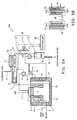
- FIG. 1 is a block diagram showing a construction of a fuel cell power generation system 100 according to a first embodiment of the present invention.
- a supply system of a reformed gas and an oxidizing gas in the fuel cell power generation system 100 mainly comprises a reformer 4 having a reforming catalyst body 5 configured to generate the reformed gas containing hydrogen through a reforming reaction using a feed gas (city gas) and a steam, a city gas feed pipe 1 as a material feed portion configured to feed the city gas to the reformer 4, a water supply pipe 2 as a water supply portion configured to supply water to the reformer 4, an evaporator 3 configured to evaporate the water flowing within the water supply pipe 2, a burner 6 configured to combust a mixture gas including air guided through an air supply pipe 17 and an off gas (to be described later) to generate a combustion gas used for heating the reforming catalyst body 5, a reformed gas pipe 7 through which the reformed gas generated by the reformer 4 is guided to a downstream side in a flow of the reformed gas
- An off gas treatment system in the fuel cell power generation system 100 mainly comprises an off gas pipe 11 through which hydrogen remaining unconsumed within the fuel cell 9 and having a temperature of about 70 to 80 ⁇ is guided from the anode 9a to a downstream side in a flow of the off gas, a cooler (off-gas cooling heat exchanger) 12 connected to the off gas pipe 11 and configured to cool the off gas to lower its temperature by heat exchange with air (cooling medium) blown from an air-cooling fan 13, a tank 14 configured to condense a steam residing in the off gas, to store the resulting condensed water 19, and to discharge the condensed water 19 to outside the tank 14 by opening a discharge valve 32, a fuel pipe 16 through which the off gas is guided from the tank 14 to the burner 6, a combustion gas pipe 18 through which the combustion gas generated by the burner 6 is guided from the reformer 4 to outside, a heater (off-gas heating heat exchanger) 15 connected to the fuel pipe 16 and to the combustion gas pipe 18 and configured to heat the off gas flowing within the fuel pipe
- a water separator 50 is configured to separate a steam from the off gas containing hydrogen which is sent from the fuel cell 9 and to condense the separated steam to discharge the resulting water to the outside.
- the water separator 50 includes the cooler 12, the air-cooling fan 13, and the tank 14.
- the cooler 12 (e.g., pipe or the like within which the off gas flows) connected to the off gas pipe 11 is cooled by the air blown from the air-cooling fan 13. By heat exchange with the air, the off gas flowing within the cooler 12 is cooled to a lowered temperature. Since the cooler 12 facilitates heat radiation from the off gas, the temperature of the off gas quickly decreases to a predetermined value. After the steam contained in the off gas condenses to form water droplets within the off gas, these water droplets gather and are stored in the tank 14 as the condensed water 19.
- the off gas having a temperature of about 70 to 80 ⁇ is sent from the anode 9a of the fuel cell 9.
- the off gas contains hydrogen remaining unconsumed after a reaction in the fuel cell 9, carbon dioxide resulting from hydrogen generation in the reformer 4, a saturated steam, and so on.
- the off gas flows through the off gas pipe 11 and is supplied to the cooler 12, where the off gas is cooled to a temperature of about 50 to 60 ⁇ by heat exchange with air blown from the air-cooling fan 13.
- the steam residing in the off gas condenses and is liquefied.
- the condensed water 19 obtained by separating the steam from the off gas is stored in the tank 14.
- the off gas is supplied to the heater 15, where the off gas is heated to a temperature of about 80 to 90 ⁇ by heat exchange with a high-temperature combustion gas flowing through the combustion gas pipe 18. So, the temperature of the off gas becomes sufficiently higher than a dew point (about 50 to 60 ⁇ ) .
- the off gas in such a state is supplied to the burner 6 through the fuel pipe 16.
- the first meter 30 detects the temperature of the off gas existing in the vicinity of the exit of the tank 14, while the second meter 31 detects the temperature of the off gas which has passed through the heater 15 and is flowing toward the burner 6. And, the controller 33 monitors these detected temperatures and performs control so that proper temperatures are kept. For example, when a temperature of the heated off gas that has passed through the heater 15 varies for some reasons (e.g., variation in a temperature or a flow rate of the off gas and/or the combustion gas), the controller 33 properly controls the flow rate of the off gas and/or the combustion gas so that the temperature of the off gas quickly reaches a target value.
- the off gas is guided to an inside of the burner 6 and mixed with the air flowing into the burner 6 through the air supply pipe 17, and the resulting mixture gas combusts within the burner 6 to be generated into a high-temperature combustion gas. Then, the combustion gas heats the reforming catalyst body 5 by heat exchange and flows through the combustion gas pipe 18. The combustion gas is used to heat the off gas in the heater 15 as described above and thereafter discharged to atmosphere.
- the condensed water 19 stored in the tank 14 may be used as water to be supplied to the reformer 4 (see Fig. 6).
- the off gas by heating the off gas to a temperature sufficiently higher than the dew point, it is possible to inhibit the temperature of the off gas which has passed through the heater 15 and is being guided toward the burner 6 through the fuel pipe 16 from decreasing to less than the dew point even when the off gas radiates from heat.
- the fuel cell power generation system 100 can appropriately deal with the prior art problem that the water droplets flowing along with the off gas causes unstable combustion of the fuel gas in the burner 6.
- the temperature of the off gas which has passed through the heater 15 may vary depending on a construction of the system, although about 80 to 90 ⁇ has been illustrated in the first embodiment.
- a desired heating condition of the off gas is not intended to be limited to such a temperature range.
- Figs. 2 and 3 are cross-sectional views each showing an internal construction of the water separator 50 including the tank 14 to which the heat exchanger 12 is connected.
- the water separator 50 comprises the tubular tank 14 having a lid portion and a bottom portion, and configured to store the condensed water 19 obtained by separating the steam from the off gas, an off gas inlet pipe 40 provided on the lid portion of the tank 14 and connected to the off gas pipe 11 (see Fig. 1) to guide the off gas to an inside of the tank 14, an off gas outlet pipe 41 provided on the lid portion of the tank 14 and connected to the fuel gas pipe 16 (see Fig.
- a baffle plate 42 disposed within the tank 14 in the vicinity of the off gas inlet and outlet pipes 40 and 41 and configured to baffle a flow of the off gas to reduce a flow speed of the off gas to allow water droplets contained in the off gas to easily fall, and a water outlet pipe (not shown) provided on a bottom portion of the tank 14 and connected to the discharge valve 32 (see Fig. 1) to guide the condensed water 19 stored within the tank 14 to outside on a regular basis.
- a passage region 45 (passage through which the off gas flows within the tank 14) through which the off gas flows, is formed.
- a cooling medium passage (off-gas cooling heat exchanger) 43 is disposed along an outer peripheral surface of the tank 14 to form a space within which a cooling medium (liquid or gas) being guided through a cooling medium inlet 46 flows along the outer peripheral surface.
- the off gas flowing within the passage region 45 makes contact with the outer peripheral surface of the tank 14 which is cooled by the cooling medium flowing within the cooling medium passage 43, thereby causing the temperature of the off gas to decrease. That is, the off gas is cooled by heat exchange with the cooling medium flowing within the cooling medium passage 43.
- heat exchange may be conducted using the air (cooling medium) blown from the air-cooling fan 13 toward the outer peripheral surface of the tank 14 so that the off gas is quickly cooled to a lowered temperature.
- the cooling medium passage 43 facilitates heat radiation from the off gas, the temperature of the off gas quickly decreases to a predetermined temperature, thereby causing a steam contained in the off gas to condense within the off gas.
- the resulting water droplets gather and are stored in the tank 14 as the condensed water 19.
- a pipe (off-gas cooling heat exchanger ) 48 filled with a cooling medium extends from outside into the passage region 45 within the tank 14 and further from the passage region 45 to outside. That is, the pipe 48 is substantially U-shaped. In this construction, the off gas flowing within the passage region 45 makes contact with the pipe 48 through which the cooling medium is flowing and thereby is cooled by heat change with the cooling medium.
- a construction of the water separator 50 in Fig. 3, other than the pipe 48, is identical to that of the water separator 50 in Fig. 2, and will not be further described.
- Figs. 4A and 4B are block diagrams showing a construction of a fuel cell power generation system 110 according to a second embodiment of the present invention.
- the construction of the fuel cell power generation system 110 according to the second embodiment differs from that of the fuel cell power generation system 100 according to the first embodiment in that, in the system 110, a tubular evaporator 36 and a heater 20 serving as a feed pipe through which the off gas is fed to the burner 6 are both disposed in a tubular combustion gas flow passage 35 of the reformer 4.
- a tubular evaporator 36 and a heater 20 serving as a feed pipe through which the off gas is fed to the burner 6 are both disposed in a tubular combustion gas flow passage 35 of the reformer 4.
- Fig. 4 B is a schematic view showing the construction of the evaporator 36 and the heater 20 in the combustion gas flow passage 35 of the reformer 4 according to the second embodiment of the present invention.
- a tubular combustion tube 60 is disposed inside the reformer 4 defined by an outer wall 61 and connected to the burner 6 (see Fig. 4(A)) to guide a combustion gas generated by the burner 6 to downstream side in a flow of the combustion gas.
- the combustion gas flow passage 35 is formed between the combustion tube 60 and the outer wall 61.
- the tubular evaporator 36 is disposed in the vicinity of an outer peripheral surface of the combustion tube 60, while a part of the heater 20 is disposed to extend into and through an inside of the combustion gas flow passage 35.
- a connecting portion between the heater 20 and the outer wall 61 is sealed by a proper method to inhibit leakage of the combustion gas.
- the combustion gas flowing out from the combustion tube 60 flows within a tubular space between the combustion tube 60 and the evaporator 36. Then, the combustion gas changes direction 180 degrees and flows through a tubular space between the evaporator 36 and the outer wall 61 to be guided to the combustion gas pipe 18.
- Figs. 5A and 5B are block diagrams showing a construction of a fuel cell power generation system 120 according to a third embodiment of the present invention.
- the same reference numerals as those in Figs. 4A and 4B denote the same or corresponding parts.
- the construction of the fuel cell power generation system 120 according to the third embodiment differs from that of the fuel cell power generation system 110 according to the second embodiment in that, in the system 120, a heat insulator 62 is disposed to enclose the outer wall 61 of the reformer 4, and the heater 20 is disposed within the heat insulator 62 to form a feed pipe through which the off gas is fed to the burner 6.
- the heat insulator 62 is provided with a concave portion in which the heater 20 is stored, and the heater 20 is covered with another heat insulator.
- Fig. 5B is a schematic view showing the construction of the evaporator 36 and the heater 20 in the combustion gas flow passage 35 of the reformer 4 according to a third embodiment of the present invention.
- the tubular combustion gas flow passage 35 is formed between the combustion tube 60 and the outer wall 61 of the reformer 4.
- the heat insulator 62 is disposed in contact with the outer wall 61 so as to cover the outer wall 61, and a part of the heater 20 extends into and through an inside the heat insulator 62.
- the tubular evaporator 36 is disposed in the vicinity of the outer peripheral surface of the combustion tube 60.
- the combustion gas flowing out from the combustion tube 60 flows within a tubular space between the combustion tube 60 and the evaporator 36. Then, the combustion gas changes direction 180 degrees and flows through a tubular space between the evaporator 36 and the outer wall 61 to be guided to the combustion gas pipe 18.
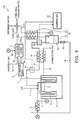
- Fig. 6 is a block diagram showing a construction of a fuel cell power generation system 130 according to a fourth embodiment.
- the construction of the fuel cell power generation system 130 according to the fourth embodiment differs from the construction of the fuel cell power generation system 100 according to the first embodiment in that the system 130 is equipped with a cooler (off-gas cooling heat exchanger) 21 connected to an off gas passage 11-1 through which the off gas flows and a cooling medium passage 11-2 through which a cooling medium flows without providing the air-cooling fan 13, and in the system 130, the discharge pipe 32 is connected to the evaporator 3.
- the water separator 50 configured to separate the steam from the off gas containing hydrogen sent from the fuel cell 9 and to condense the separated steam into water to be discharged outside includes the cooler 21 and the tank 14.
- the off gas flowing through the off gas passage 11-1 is cooled by heat exchange with a cooling medium flowing through the cooling medium 11-2 within the cooler 21.
- the cooling medium passage 11-2 which extends from the cooler 21 to a downstream side, to the city gas feed pipe 1, the city gas (feed gas) to be fed to the reformer 4 can be used as the cooling medium.
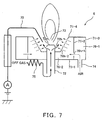
- the burner 6 mainly comprises a burner fuel pipe 72 connected to an off gas pipe extending through the heater 75 and configured to guide the off gas to a flame region 73, air buffers 76-1 and 76-2 formed by a plurality of wall portions 71-1, 71-2, 71-3, and 71-4, and configured to guide air to the flame region 73, a burner air pipe 74 connecting the air supply pipe 17 (see Fig. 1) to the air buffer 76-1 and configured to guide the air to the air buffer 76-1, and a flame rod 70 configured to detect a combustion state of a mixture gas containing the air and the off gas.
- the buffer 76-1 is tubular and the air buffer 76-2 is annular and provided with a concave portion at a center region thereof.
- a lid 72p is attached to a downstream end of the burner fuel pipe 72 in a flow of the off gas so as to block the flow of the off gas.
- a plurality of injection holes 72h are arranged on a side wall of the burner fuel pipe 72 in the vicinity of the lid 72p to be equally spaced apart from one another in a circumferential direction of the pipe 72.
- the air buffer 76-1 and the air buffer 76-2 communicate with each other through injection holes 76h-1 arranged on the tubular wall portion 71-2 to be equally spaced apart in the circumferential direction. And, a plurality of injection holes 76h-2 are arranged on the concave portion of the air buffer 76-2 to be equally spaced apart from one another both in depth and circumferential directions thereof. In such a construction, as indicated by a dotted line in Fig. 7, the air flowing from the air buffer 76-1 to the air buffer 76-2 through the injection holes 76h-1 is injected evenly from the injection holes 76h-2 toward the flame region 73.
- the off gas and the air are mixed with each other in the flame region 73. Then, the mixture gas combusts in the flame region 73 to be generated into a high-temperature combustion gas.
- the combustion state of the mixture gas is detected by the flame rod 70. Based on a detection signal output from the flame rod 70, a controller 33 (see Fig. 1) properly controls combustion of the mixture gas in the flame region 73.
- the heater 75 is disposed in contact with the wall portion 71-1 forming lower walls of the air buffers 76-1 and 76-2 of the burner 6.
- a part of heat generated in the flame region 73 is transmitted to heat the wall portion 71-1, and thereby, the off gas flowing through the heater 20 is heated by heat exchange with the wall portion 71-1.
- the off gas which has passed through the heater 75 and is flowing toward the burner 6 has a temperature sufficiently higher than a dew point.
- the off gas from which the water droplets flowing along with the off gas have been reliably evaporated by the heater 75 is supplied to the flame region 73 of the burner 6. Consequently, it is possible to avoid the prior art problem that combustion of the off gas in the flame region 73 of the burner 6 becomes unstable due to such water droplets.
- the flame rod 70 serves to detect a carbon ion current flowing within the flame by application of a voltage to the flame and to thereby judge the combustion state of the fuel gas in the flame region 73 of the burner 6.
- the off gas as a fuel gas contains a large quantity of hydrogen, and hydrogen ions are more and carbon ions are less in combustion of the off gas than in combustion of the city gas or the like. Under this condition, precision with which the flame rod 70 detects the carbon ion current is low.
- the water droplets contained in the off gas can be reliably removed before the off gas is fed to the burner 6. Thereby, the combustion of the off gas can be stabilized.
- the effect of increasing detection precision in the flame rod 70 can be gained in the fuel cell power generation systems according to the first to fourth embodiments.
Landscapes
- Engineering & Computer Science (AREA)
- Chemical & Material Sciences (AREA)
- Life Sciences & Earth Sciences (AREA)
- Manufacturing & Machinery (AREA)
- Sustainable Development (AREA)
- Sustainable Energy (AREA)
- Chemical Kinetics & Catalysis (AREA)
- Electrochemistry (AREA)
- General Chemical & Material Sciences (AREA)
- Combustion & Propulsion (AREA)
- Fuel Cell (AREA)
- Hydrogen, Water And Hydrids (AREA)
Abstract
Description
- The present invention relates to a fuel cell power generation system configured to generate an electric power using a reformed gas containing hydrogen.
- A hydrogen generator mainly comprises a reforming catalyst body filled with a reforming catalyst that generates a reformed gas containing hydrogen through a steam reforming reaction from a feed gas (hydrocarbon) and water, a burner that generates a combustion gas used for heating the reforming catalyst body by heat exchange, and a CO removing device that removes carbon monoxide contained in the reformed gas generated by the reforming catalyst body.
- The reformed gas from which carbon monoxide has been removed by the CO reducing device is supplied to an anode of a fuel cell. And, the fuel cell consumes the reformed gas (hydrogen) to generate an electric power.
- As a fuel gas to be fed to the burner that generates the combustion gas, an off gas containing hydrogen remaining unconsumed within the fuel cell and discharged from the fuel cell is used.
- The off gas typically contains a saturated steam in addition to the remaining hydrogen. For this reason, a passage through which the off gas flows between the fuel cell and the burner is thermally insulated, thereby inhibiting, as much as possible, the steam contained in the off gas from condensing into water.
- However, regardless of thermal insulation of the passage of the off gas, temperature of the off gas is, for example, about 70 to 80□, which is higher than that of ambient air, and therefore, the off gas unavoidably radiates heat to the ambient air. Consequently, a part of the saturated steam inevitably condenses. The resulting fine water droplets flow within the off gas and are guided to the burner along with the off gas.
- If the water droplets flow into the burner, calories corresponding to evaporation latent heat used to evaporate the water droplets are consumed by the burner. This results in reduced thermal efficiency in the hydrogen generator. In addition, since combustion of the fuel gas in the burner tends to become unstable because of the existence of the water droplets, there is a possibility that a flame of the burner vanishes.
- Accordingly, Japanese Laid-Open Patent Application Publication No. 2001-229952 discloses a fuel cell power generation system including a hydrogen generator capable of stable combustion in a burner by inhibiting entry of water droplets flowing within the off gas into the burner (combustor).
- Since this fuel cell power generation system is configured to cool a high-temperature off gas containing a steam before the off gas is supplied to the burner, condensing and separating the steam contained in the off gas is facilitated before the off gas is supplied to the burner, thus inhibiting combustion in the burner from becoming unstable.
- However, in the fuel cell power generation system disclosed in the above Publication No. 2001-229952, it is difficult to completely remove fine water droplets generated in a heat exchanger (off gas cooler). And, the off gas that has passed through the heat exchanger, is still saturated with a steam, which condenses at a temperature after cooling. So, when the temperature of the off gas flowing within a passage between the heat exchanger and the burner decreases due to, for example, heat radiation from the off gas to ambient air, the saturated steam condenses to form water droplets.
- The present invention has been developed under the circumstances, and an object of the present invention is to provide a fuel cell power generation system configured to appropriately separate and remove a steam from an off gas to thereby inhibit formation of water droplets in the off gas supplied to the burner.
- In order to solve the above-described problem, according to the present invention, there is provided a fuel cell power generation system comprising a reforming catalyst body configured to generate a reformed gas containing hydrogen from a feed gas and water, a fuel cell configured to generate an electric power by consuming the reformed gas, and a burner configured to combust an off gas containing hydrogen which is sent from the fuel cell as a fuel gas to generate a combustion gas used for heating the reforming catalyst body, wherein the off gas from which a steam has been separated is heated, and the heated off gas is fed to the burner as the fuel gas, the separated steam being condensed into water which is discharged to outside of the system.
- More specifically, a fuel cell power generation system comprises a reforming catalyst body configured to generate a reformed gas containing hydrogen from a feed gas and water, a fuel cell configured to generate an electric power by consuming the reformed gas, a water separator configured to separate a steam from an off gas containing hydrogen which is sent from the fuel cell and to condense the separated steam into water which is discharged to outside of the system, and a first heat exchanger (heater) configured to heat the off gas sent from the water separator by heat exchange, and a burner configured to combust the off gas heated by the first heat exchanger to generate a combustion gas used for heating the reforming catalyst body.
- The fuel cell power generation system may further comprise a second heat exchanger (cooler) configured to cool the off gas by heat exchange, wherein the steam is separated by cooling the off gas in the second heat exchanger.
- Since the off gas from which the steam has been appropriately separated by the water separator is heated by heat exchange in the heater, fine water droplets flowing along with the off gas can be reliably removed.
- In this manner, it is possible to achieve the fuel cell power generation system that can appropriately deal with the prior art problem that the water droplets flowing along with the off gas causes unstable combustion of the fuel gas in the burner.
- The off gas which has passed through the first heat exchanger and is flowing toward the burner may be heated to a temperature higher than a temperature of the off gas existing at a point located upstream of the first heat exchanger and downstream of the water separator in a flow of the off gas.
- Since the off gas is heated by the heater to a temperature higher than a dew point, it is possible to appropriately inhibit the off gas that has passed through the heater and is flowing through the fuel pipe from decreasing to less than a dew point while being guided from the heater toward the burner.
- The off gas may be cooled in the second heat exchanger by heat exchange with at least one of cooling media including the feed gas, the water, and fuel cell cooling water.
- In an example, the water separator may include a tubular tank that stores condensed water obtained by separating a steam from the off gas, wherein the off gas flowing within the tank is cooled by contact with an outer peripheral surface of the tank which is cooled by the second heat exchanger.
- In another example, the water separator may include a tubular tank that stores condensed water obtained by separating a steam from the off gas, wherein a pipe filled with a cooling medium to serve as the second heat exchanger is disposed in a passage within the tank through which the off gas flows.
- The first heat exchanger may be configured to heat the off gas by heat exchange with the combustion gas. This simplifies a construction of the first heat exchanger.
- In an example of the first heat exchanger configured to exchange heat with the combustion gas, a feed pipe through which the off gas is fed to the burner may be located within a passage through which a combustion gas generated by the heater flows to allow the off gas to exchange heat with the combustion gas within the passage.
- In another example of the first heat exchanger, the system may further comprise a heat insulator configured to cover a passage through which the combustion gas generated by the burner flows, wherein the feed pipe of the off gas is located within the heat insulator to allow the off gas to exchange heat with the combustion gas within the heat insulator.
- In a further example of the first heat exchanger, the feed pipe of the off gas may be provided in contact with a wall portion forming the burner, and the off gas exchanges heat with the combustion gas in a portion where the feed pipe is in contact with the wall portion.
- In the above system, a flame rod configured to detect a combustion state of the burner is suitably used. Since the water droplets of the off gas are evaporated in this system, the flame rod is capable of detecting a current without reducing detection precision.
- Also, the condensed water obtained by removing the steam from the off gas may be supplied to the reforming catalyst body.
- The above and further objects and features of the invention will be more fully be apparent from the following detailed description with accompanying drawings.
-
- Fig. 1 is a block diagram showing a construction of a fuel cell power generation system according to a first embodiment of the present invention;
- Fig. 2 is a cross-sectional view showing an example of an internal construction of a water separator;
- Fig. 3 is a cross-sectional view showing another example of the internal construction of the water separator;
- Figs. 4A and 4B are block diagrams showing a construction of a fuel cell power generation system according to a second embodiment of the present invention;
- Figs. 5A and 5B are block diagrams showing a construction of a fuel cell power generation system according to a third embodiment of the present invention;
- Fig. 6 is a block diagram showing a construction of a fuel cell power generation system according to a fourth embodiment of the present invention; and
- Fig. 7 is a view showing a construction of a burner according to a fifth embodiment of the present invention.
-
- Preferred embodiments of a fuel cell power generation system of the present invention are characterized in that condensing and separating a steam contained in an off gas containing remaining hydrogen which is sent from a fuel cell is facilitated by cooling the off gas so that the condensed water is discharged to outside of the system, and the off gas from which the steam has been separated is heated to a temperature sufficiently higher than a dew point to allow fine water droplets which would be otherwise flowing along with the off gas to completely evaporate. It should be appreciated that the off gas is sufficiently heated to inhibit temperature of the off gas reaching the burner from decreasing to less than the dew point even when the off gas radiates heat to ambient air while the off gas is flowing toward the burner.
- Hereinafter, embodiments of the present invention will be described with reference to the drawings.
- Fig. 1 is a block diagram showing a construction of a fuel cell
power generation system 100 according to a first embodiment of the present invention. A supply system of a reformed gas and an oxidizing gas in the fuel cellpower generation system 100 mainly comprises areformer 4 having a reformingcatalyst body 5 configured to generate the reformed gas containing hydrogen through a reforming reaction using a feed gas (city gas) and a steam, a citygas feed pipe 1 as a material feed portion configured to feed the city gas to thereformer 4, awater supply pipe 2 as a water supply portion configured to supply water to thereformer 4, anevaporator 3 configured to evaporate the water flowing within thewater supply pipe 2, aburner 6 configured to combust a mixture gas including air guided through anair supply pipe 17 and an off gas (to be described later) to generate a combustion gas used for heating the reformingcatalyst body 5, a reformedgas pipe 7 through which the reformed gas generated by thereformer 4 is guided to a downstream side in a flow of the reformed gas, aCO removing device 8 configured to remove carbon monoxide (CO) contained in the reformed gas sent from thereformer 4, afuel cell 9 configured to generate an electric power in such a manner that an oxidizing gas (air) is consumed in acathode 9c and the reformed gas (hydrogen) is consumed in ananode 9a, an air supply pipe 10-1 through which the oxidizing gas is guided from an oxidizing gas supply means (not shown) to thecathode 9c of thefuel cell 9, and a reformed gas supply pipe 10-2 through which the reformed gas is guided from theCO removing device 8 to theanode 9a of thefuel cell 9. - An off gas treatment system in the fuel cell
power generation system 100 mainly comprises an offgas pipe 11 through which hydrogen remaining unconsumed within thefuel cell 9 and having a temperature of about 70 to 80□ is guided from theanode 9a to a downstream side in a flow of the off gas, a cooler (off-gas cooling heat exchanger) 12 connected to the offgas pipe 11 and configured to cool the off gas to lower its temperature by heat exchange with air (cooling medium) blown from an air-cooling fan 13, atank 14 configured to condense a steam residing in the off gas, to store the resulting condensedwater 19, and to discharge the condensedwater 19 to outside thetank 14 by opening adischarge valve 32, afuel pipe 16 through which the off gas is guided from thetank 14 to theburner 6, acombustion gas pipe 18 through which the combustion gas generated by theburner 6 is guided from thereformer 4 to outside, a heater (off-gas heating heat exchanger) 15 connected to thefuel pipe 16 and to thecombustion gas pipe 18 and configured to heat the off gas flowing within thefuel pipe 16 by heat exchange with the combustion gas flowing within thecombustion gas pipe 18, afirst meter 30 configured to measure a temperature of the off gas at a point located upstream of theheater 15 and downstream of the tank 14 (in the vicinity of an exit), asecond meter 31 configured to measure a temperature of the off gas which has passed through theheater 15 and is flowing toward theburner 6, and acontroller 33 configured to control a flow rate of the off gas or the combustion gas based on the temperatures detected by the first andsecond meters controller 33 is configured to appropriately control an operation of the fuel cellpower generation system 100 based on predetermined detected signals indicating, for example, a gas temperature or gas flow rate. - A
water separator 50 is configured to separate a steam from the off gas containing hydrogen which is sent from thefuel cell 9 and to condense the separated steam to discharge the resulting water to the outside. Thewater separator 50 includes the cooler 12, the air-coolingfan 13, and thetank 14. - The cooler 12 (e.g., pipe or the like within which the off gas flows) connected to the
off gas pipe 11 is cooled by the air blown from the air-coolingfan 13. By heat exchange with the air, the off gas flowing within the cooler 12 is cooled to a lowered temperature. Since the cooler 12 facilitates heat radiation from the off gas, the temperature of the off gas quickly decreases to a predetermined value. After the steam contained in the off gas condenses to form water droplets within the off gas, these water droplets gather and are stored in thetank 14 as thecondensed water 19. - Subsequently, an operation of the off gas treatment system of the fuel cell
power generation system 100 constructed as described above will be described with reference to Fig. 1. - Since power generation in the
fuel cell 9 and gas supply to thefuel cell 9 are carried out by an existing technique, description of these is omitted. - The off gas having a temperature of about 70 to 80□ is sent from the
anode 9a of thefuel cell 9. The off gas contains hydrogen remaining unconsumed after a reaction in thefuel cell 9, carbon dioxide resulting from hydrogen generation in thereformer 4, a saturated steam, and so on. - The off gas flows through the
off gas pipe 11 and is supplied to the cooler 12, where the off gas is cooled to a temperature of about 50 to 60□ by heat exchange with air blown from the air-coolingfan 13. The off gas existing in the vicinity of the exit of thetank 14, from which the steam has been removed, contains a saturated steam having a temperature of about 50 to 60□ . - At this time, the steam residing in the off gas condenses and is liquefied. Thus, the
condensed water 19 obtained by separating the steam from the off gas is stored in thetank 14. - Thereafter, the off gas is supplied to the
heater 15, where the off gas is heated to a temperature of about 80 to 90□ by heat exchange with a high-temperature combustion gas flowing through thecombustion gas pipe 18. So, the temperature of the off gas becomes sufficiently higher than a dew point (about 50 to 60□ ) . The off gas in such a state is supplied to theburner 6 through thefuel pipe 16. - The
first meter 30 detects the temperature of the off gas existing in the vicinity of the exit of thetank 14, while thesecond meter 31 detects the temperature of the off gas which has passed through theheater 15 and is flowing toward theburner 6. And, thecontroller 33 monitors these detected temperatures and performs control so that proper temperatures are kept. For example, when a temperature of the heated off gas that has passed through theheater 15 varies for some reasons (e.g., variation in a temperature or a flow rate of the off gas and/or the combustion gas), thecontroller 33 properly controls the flow rate of the off gas and/or the combustion gas so that the temperature of the off gas quickly reaches a target value. - The off gas is guided to an inside of the
burner 6 and mixed with the air flowing into theburner 6 through theair supply pipe 17, and the resulting mixture gas combusts within theburner 6 to be generated into a high-temperature combustion gas. Then, the combustion gas heats the reformingcatalyst body 5 by heat exchange and flows through thecombustion gas pipe 18. The combustion gas is used to heat the off gas in theheater 15 as described above and thereafter discharged to atmosphere. - It should be appreciated that the
condensed water 19 stored in thetank 14 may be used as water to be supplied to the reformer 4 (see Fig. 6). - In accordance with the operation of the off gas treatment system of the above described fuel cell
power generation system 100, since the off gas from which the steam has been appropriately separated by thewater separator 50, is heated by heat exchange in theheater 15, it is possible to reliably evaporate the water droplets flowing along with the off gas. - Further, by heating the off gas to a temperature sufficiently higher than the dew point, it is possible to inhibit the temperature of the off gas which has passed through the
heater 15 and is being guided toward theburner 6 through thefuel pipe 16 from decreasing to less than the dew point even when the off gas radiates from heat. - In this manner, the fuel cell
power generation system 100 can appropriately deal with the prior art problem that the water droplets flowing along with the off gas causes unstable combustion of the fuel gas in theburner 6. - The temperature of the off gas which has passed through the
heater 15 may vary depending on a construction of the system, although about 80 to 90□ has been illustrated in the first embodiment. A desired heating condition of the off gas is not intended to be limited to such a temperature range. - In brief, it is necessary to heat the off gas to inhibit the temperature of the off gas reaching the
burner 6 from becoming lower than the dew point, due to heat radiation from the off gas. It should be remembered that it is necessary to heat the off gas which has passed through theheater 15 and is flowing toward theburner 6 to a temperature at least higher than that of the off gas existing downstream of the tank 14 (in the vicinity of the exit). - As shown in Fig. 1, the cooler 12 using the air-cooling
fan 13 and thetank 14 may be provided separately. As an alternative example, as shown in Figs. 2 and 3, an off-gas cooling heat exchanger corresponding to the cooler 12 in Fig. 1 may be integrally connected to thetank 14. This simplifies a construction of thewater separator 50 in the fuel cellpower generation system 100. - Figs. 2 and 3 are cross-sectional views each showing an internal construction of the
water separator 50 including thetank 14 to which theheat exchanger 12 is connected. - As shown in Fig. 2, the
water separator 50 comprises thetubular tank 14 having a lid portion and a bottom portion, and configured to store thecondensed water 19 obtained by separating the steam from the off gas, an offgas inlet pipe 40 provided on the lid portion of thetank 14 and connected to the off gas pipe 11 (see Fig. 1) to guide the off gas to an inside of thetank 14, an offgas outlet pipe 41 provided on the lid portion of thetank 14 and connected to the fuel gas pipe 16 (see Fig. 1) to guide the off gas that has passed through the inside of thetank 14 to outside, abaffle plate 42 disposed within thetank 14 in the vicinity of the off gas inlet andoutlet pipes tank 14 and connected to the discharge valve 32 (see Fig. 1) to guide thecondensed water 19 stored within thetank 14 to outside on a regular basis. - In the interior of a substantially upper-half portion of the
tank 14, a passage region 45 (passage through which the off gas flows within the tank 14) through which the off gas flows, is formed. - And, a cooling medium passage (off-gas cooling heat exchanger) 43 is disposed along an outer peripheral surface of the
tank 14 to form a space within which a cooling medium (liquid or gas) being guided through a coolingmedium inlet 46 flows along the outer peripheral surface. In this construction, the off gas flowing within thepassage region 45 makes contact with the outer peripheral surface of thetank 14 which is cooled by the cooling medium flowing within the coolingmedium passage 43, thereby causing the temperature of the off gas to decrease. That is, the off gas is cooled by heat exchange with the cooling medium flowing within the coolingmedium passage 43. - In addition to heat exchange with the cooling medium within the cooling
medium passage 43, as shown in Fig. 2, heat exchange may be conducted using the air (cooling medium) blown from the air-coolingfan 13 toward the outer peripheral surface of thetank 14 so that the off gas is quickly cooled to a lowered temperature. - Since the cooling
medium passage 43 facilitates heat radiation from the off gas, the temperature of the off gas quickly decreases to a predetermined temperature, thereby causing a steam contained in the off gas to condense within the off gas. The resulting water droplets gather and are stored in thetank 14 as thecondensed water 19. - In a further alternative example of the
water separator 50, as shown in Fig. 3, a pipe (off-gas cooling heat exchanger ) 48 filled with a cooling medium extends from outside into thepassage region 45 within thetank 14 and further from thepassage region 45 to outside. That is, thepipe 48 is substantially U-shaped. In this construction, the off gas flowing within thepassage region 45 makes contact with thepipe 48 through which the cooling medium is flowing and thereby is cooled by heat change with the cooling medium. A construction of thewater separator 50 in Fig. 3, other than thepipe 48, is identical to that of thewater separator 50 in Fig. 2, and will not be further described. - Figs. 4A and 4B are block diagrams showing a construction of a fuel cell
power generation system 110 according to a second embodiment of the present invention. - In Figs. 4A and 4B, the same reference numerals as those in Fig. 1 denote the same or corresponding parts.
- Referring to Fig. 1 and Fig. 4A, the construction of the fuel cell
power generation system 110 according to the second embodiment differs from that of the fuel cellpower generation system 100 according to the first embodiment in that, in thesystem 110, atubular evaporator 36 and aheater 20 serving as a feed pipe through which the off gas is fed to theburner 6 are both disposed in a tubular combustiongas flow passage 35 of thereformer 4. By disposing theevaporator 36 in the combustiongas flow passage 35 of thereformer 4, thermal efficiency in the fuel cellpower generation system 110 increases. Also, by disposing theheater 20 in the combustiongas flow passage 35 of thereformer 4, the construction of theheater 20 is simplified. - Referring to Fig. 4B, the construction of the
evaporator 36 and theheater 20 will be described. The other construction is identical to that of the first embodiment and will not be described. - Fig. 4 B is a schematic view showing the construction of the
evaporator 36 and theheater 20 in the combustiongas flow passage 35 of thereformer 4 according to the second embodiment of the present invention. - A
tubular combustion tube 60 is disposed inside thereformer 4 defined by anouter wall 61 and connected to the burner 6 (see Fig. 4(A)) to guide a combustion gas generated by theburner 6 to downstream side in a flow of the combustion gas. Thereby, the combustiongas flow passage 35 is formed between thecombustion tube 60 and theouter wall 61. And, thetubular evaporator 36 is disposed in the vicinity of an outer peripheral surface of thecombustion tube 60, while a part of theheater 20 is disposed to extend into and through an inside of the combustiongas flow passage 35. A connecting portion between theheater 20 and theouter wall 61 is sealed by a proper method to inhibit leakage of the combustion gas. - As indicated by a two-dotted line in Fig. 4B, within the combustion
gas flow passage 35, the combustion gas flowing out from thecombustion tube 60 flows within a tubular space between thecombustion tube 60 and theevaporator 36. Then, the combustion gas changes direction 180 degrees and flows through a tubular space between the evaporator 36 and theouter wall 61 to be guided to thecombustion gas pipe 18. - In this construction, while the combustion gas is flowing within the combustion
gas flow passage 35, water flowing within theevaporator 36 as indicated by a dashed line in Fig. 4B (to be precise, a mixture of the city gas flowing through the citygas feed pipe 1 and the water flowing through the water supply pipe 2) is heated by heat exchange with the combustion gas, and the off gas flowing through theheater 20 as indicated by an arrow in Fig. 4B is heated by heat exchange with the combustion gas. - Figs. 5A and 5B are block diagrams showing a construction of a fuel cell
power generation system 120 according to a third embodiment of the present invention. In Figs. 5A and 5B, the same reference numerals as those in Figs. 4A and 4B denote the same or corresponding parts. - Referring to Figs. 5A and 5B and 4A and 4B, the construction of the fuel cell
power generation system 120 according to the third embodiment differs from that of the fuel cellpower generation system 110 according to the second embodiment in that, in thesystem 120, aheat insulator 62 is disposed to enclose theouter wall 61 of thereformer 4, and theheater 20 is disposed within theheat insulator 62 to form a feed pipe through which the off gas is fed to theburner 6. To be precise, theheat insulator 62 is provided with a concave portion in which theheater 20 is stored, and theheater 20 is covered with another heat insulator. By disposing theheat insulator 62, heat radiation from the combustion gas flowing through the combustiongas flow passage 35 of thereformer 4 is appropriately inhibited. And, by a simple construction in which theheater 20 is disposed within theheat insulator 62, heat exchange between the off gas and the combustion gas can be carried out. That is, it is possible to dispose theheater 20 within theheat insulator 62 without sealing a connecting portion between theheater 20 and theheat insulator 62. - Referring to Fig. 5B, the construction of the
evaporator 36 and theheater 20 will be described. - Fig. 5B is a schematic view showing the construction of the
evaporator 36 and theheater 20 in the combustiongas flow passage 35 of thereformer 4 according to a third embodiment of the present invention. - As in the second embodiment, the tubular combustion
gas flow passage 35 is formed between thecombustion tube 60 and theouter wall 61 of thereformer 4. And, theheat insulator 62 is disposed in contact with theouter wall 61 so as to cover theouter wall 61, and a part of theheater 20 extends into and through an inside theheat insulator 62. - Also, as in the second embodiment, the
tubular evaporator 36 is disposed in the vicinity of the outer peripheral surface of thecombustion tube 60. - As indicated by a two-dotted line in Fig. 5B, within the combustion
gas flow passage 35, the combustion gas flowing out from thecombustion tube 60 flows within a tubular space between thecombustion tube 60 and theevaporator 36. Then, the combustion gas changes direction 180 degrees and flows through a tubular space between the evaporator 36 and theouter wall 61 to be guided to thecombustion gas pipe 18. - In this construction, while the combustion gas is flowing within the combustion
gas flow passage 35, water flowing within theevaporator 36 as indicated by a dashed line in Fig. 5B (to be precise, a mixture of the city gas flowing through the citygas feed pipe 1 and the water flowing through the water supply pipe 2) is heated by heat exchange with the combustion gas, and the off gas flowing through theheater 20 as indicated by an arrow in Fig. 5B is heated by heat exchange with the combustion gas. - Fig. 6 is a block diagram showing a construction of a fuel cell
power generation system 130 according to a fourth embodiment. - In Fig. 6, the same reference numerals as those in Fig. 1 denote the same or corresponding parts.
- Referring to Figs. 1 and 6, the construction of the fuel cell
power generation system 130 according to the fourth embodiment differs from the construction of the fuel cellpower generation system 100 according to the first embodiment in that thesystem 130 is equipped with a cooler (off-gas cooling heat exchanger) 21 connected to an off gas passage 11-1 through which the off gas flows and a cooling medium passage 11-2 through which a cooling medium flows without providing the air-coolingfan 13, and in thesystem 130, thedischarge pipe 32 is connected to theevaporator 3. And, thewater separator 50 configured to separate the steam from the off gas containing hydrogen sent from thefuel cell 9 and to condense the separated steam into water to be discharged outside includes the cooler 21 and thetank 14. - Because of the absence of the air-cooling
fan 13, the number of components can be reduced. And, the off gas flowing through the off gas passage 11-1 is cooled by heat exchange with a cooling medium flowing through the cooling medium 11-2 within the cooler 21. - The other construction is identical to that of the first embodiment, and will not be further described.
- As shown in Fig. 6, by connecting a portion of the cooling medium passage 11-2, which extends from the cooler 21 to a downstream side, to the
water supply pipe 2, the water to be supplied to thereformer 4 can be used as the cooling medium. - And, by connecting a portion of the cooling medium passage 11-2, which extends from the cooler 21 to a downstream side, to the city
gas feed pipe 1, the city gas (feed gas) to be fed to thereformer 4 can be used as the cooling medium. - Also, by connecting a portion of the cooling medium passage 11-2, which extends from the cooler 21 to a downstream side, to a fuel cell cooling
water pipe 80, cooling water to be supplied to thefuel cell 9 can be used as the cooling medium. - Further, as a cooling medium flowing through the cooling
medium passage 43 or thepipe 48 of thetank 14 shown in Fig. 2 or 3, the water to be supplied to thereformer 4, the feed gas to be fed to thereformer 4, or the cooling water to be supplied to thefuel cell 9 can be used. - Moreover, as shown in Fig. 6, by connecting the
discharge valve 32 to thewater supply pipe 2 through awater circulating pipe 81, thecondensed water 19 stored in thetank 14 returns to theevaporator 3 through thewater circulating pipe 81. Thereby, thecondensed water 19 obtained by removing the steam from the off gas can be re-used as the water to be supplied to the reformingcatalyst body 5. - As shown in Fig. 7, a
heater 75 is disposed in contact with a wall portion forming theburner 6. Theheater 75 functions as a feed pipe through which the off gas is fed to theburner 6. In the construction in Fig. 7, theheater 75 replaces theheater 15 in Fig. 1 which is connected to thefuel gas pipe 16 and to thecombustion gas pipe 18. - An internal construction of the
burner 6 will be described with reference to Fig. 7. The other construction is identical to that of the first embodiment, and therefore, will not be described. - The
burner 6 mainly comprises aburner fuel pipe 72 connected to an off gas pipe extending through theheater 75 and configured to guide the off gas to aflame region 73, air buffers 76-1 and 76-2 formed by a plurality of wall portions 71-1, 71-2, 71-3, and 71-4, and configured to guide air to theflame region 73, a burner air pipe 74 connecting the air supply pipe 17 (see Fig. 1) to the air buffer 76-1 and configured to guide the air to the air buffer 76-1, and aflame rod 70 configured to detect a combustion state of a mixture gas containing the air and the off gas. The buffer 76-1 is tubular and the air buffer 76-2 is annular and provided with a concave portion at a center region thereof. - A
lid 72p is attached to a downstream end of theburner fuel pipe 72 in a flow of the off gas so as to block the flow of the off gas. And, a plurality ofinjection holes 72h are arranged on a side wall of theburner fuel pipe 72 in the vicinity of thelid 72p to be equally spaced apart from one another in a circumferential direction of thepipe 72. Thereby, as indicated by an arrow in Fig. 7, the off gas moving upward inside theburner fuel pipe 72 is blocked by thelid 72p, and injected evenly from theinjection holes 72h toward theflame region 73. - The air buffer 76-1 and the air buffer 76-2 communicate with each other through
injection holes 76h-1 arranged on the tubular wall portion 71-2 to be equally spaced apart in the circumferential direction. And, a plurality ofinjection holes 76h-2 are arranged on the concave portion of the air buffer 76-2 to be equally spaced apart from one another both in depth and circumferential directions thereof. In such a construction, as indicated by a dotted line in Fig. 7, the air flowing from the air buffer 76-1 to the air buffer 76-2 through the injection holes 76h-1 is injected evenly from the injection holes 76h-2 toward theflame region 73. - Thus, the off gas and the air are mixed with each other in the
flame region 73. Then, the mixture gas combusts in theflame region 73 to be generated into a high-temperature combustion gas. - The combustion state of the mixture gas is detected by the
flame rod 70. Based on a detection signal output from theflame rod 70, a controller 33 (see Fig. 1) properly controls combustion of the mixture gas in theflame region 73. - As shown in Fig. 7, the
heater 75 is disposed in contact with the wall portion 71-1 forming lower walls of the air buffers 76-1 and 76-2 of theburner 6. In this structure, a part of heat generated in theflame region 73 is transmitted to heat the wall portion 71-1, and thereby, the off gas flowing through theheater 20 is heated by heat exchange with the wall portion 71-1. - In the above construction, the off gas which has passed through the
heater 75 and is flowing toward theburner 6 has a temperature sufficiently higher than a dew point. - Therefore, the off gas from which the water droplets flowing along with the off gas have been reliably evaporated by the
heater 75, is supplied to theflame region 73 of theburner 6. Consequently, it is possible to avoid the prior art problem that combustion of the off gas in theflame region 73 of theburner 6 becomes unstable due to such water droplets. - The
flame rod 70 serves to detect a carbon ion current flowing within the flame by application of a voltage to the flame and to thereby judge the combustion state of the fuel gas in theflame region 73 of theburner 6. - However, the off gas as a fuel gas contains a large quantity of hydrogen, and hydrogen ions are more and carbon ions are less in combustion of the off gas than in combustion of the city gas or the like. Under this condition, precision with which the
flame rod 70 detects the carbon ion current is low. - Under the circumstances, unless the water droplets in the off gas are reliably evaporated by the
heater 75, the precision with which theflame rod 70 detects the carbon ion current becomes lower. - Accordingly, in accordance with the fifth embodiment, the water droplets contained in the off gas can be reliably removed before the off gas is fed to the
burner 6. Thereby, the combustion of the off gas can be stabilized. In addition, it is possible to inhibit reduction in the precision with which theflame rod 70 detects the carbon ion current. As a matter of course, the effect of increasing detection precision in theflame rod 70 can be gained in the fuel cell power generation systems according to the first to fourth embodiments. - Numerous modifications and alternative embodiments of the invention will be apparent to those skilled in the art in the light of the foregoing description. Accordingly, the description is to be construed as illustrative only, and is provided for the purpose of teaching those skilled in the art the best mode of carrying out the invention. The details of the structure and/or function may be varied substantially without departing from the spirit of the invention.
Claims (12)
- A fuel cell power generation system comprising:a reforming catalyst body configured to generate a reformed gas containing hydrogen from a feed gas and water;a fuel cell configured to generate an electric power by consuming the reformed gas;a water separator configured to separate a steam from an off gas containing hydrogen which is sent from said fuel cell and to condense the separated steam into water which is discharged to outside of said system;a first heat exchanger configured to heat the off gas sent from said water separator by heat exchange; anda burner configured to combust the off gas heated by said first heat exchanger to generate a combustion gas used for heating said reforming catalyst body.
- The fuel cell power generation system according to Claim 1, wherein the off gas which has passed through said first heat exchanger and is flowing toward said burner is heated to a temperature higher than a temperature of the off gas existing at a point located upstream of said first heat exchanger and downstream of said water separator in a flow of the off gas.
- The fuel cell power generation system according to Claim 1, further comprising a second heat exchanger configured to cool the off gas by heat exchange, wherein the steam is separated by cooling the off gas in said second heat exchanger.
- The fuel cell power generation system according to Claim 3, wherein the off gas is cooled in said second heat exchanger by heat exchange with at least one of cooling media including the feed gas, the water, and fuel cell cooling water.
- The fuel cell power generation system according to Claim 3, wherein said water separator includes a tubular tank that stores condensed water obtained by separating a steam from the off gas, wherein the off gas flowing within said tank is cooled by contact with an outer peripheral surface of said tank which is cooled by said second heat exchanger.
- The fuel cell power generation system according to Claim 3, wherein said water separator includes a tubular tank that stores condensed water obtained by separating a steam from the off gas, wherein a pipe filled with a cooling medium to serve as the second heat exchanger is disposed in a passage within said tank through which the off gas flows.
- The fuel cell power generation system according to Claim 1, wherein said first heat exchanger is configured to heat the off gas by heat exchange with the combustion gas.
- The fuel cell power generation system according to Claim 7, wherein a feed pipe through which the off gas is fed to said burner is located within a passage through which the combustion gas generated by said burner flows to allow the off gas to exchange heat with the combustion gas within the passage.
- The fuel cell power generation system according to Claim 7, further comprising a heat insulator configured to cover a passage through which the combustion gas generated by said burner flows, wherein the feed pipe of the off gas is located within said heat insulator to allow the off gas to exchange heat with the combustion gas within said heat insulator.
- The fuel cell power generation system according to Claim 7, wherein the feed pipe of the off gas is provided in contact with a wall portion forming said burner, and the off gas exchanges heat with the combustion gas in a portion where the feed pipe is in contact with the wall portion.
- The fuel cell power generation system according to Claim 1, wherein a flame rod is inserted into a flame region of said burner and configured to detect a combustion state of the fuel gas in the flame region.
- The fuel cell power generation system according to Claim 1, wherein condensed water obtained by removing the steam from the off gas is supplied to said reforming catalyst body.
Applications Claiming Priority (2)
| Application Number | Priority Date | Filing Date | Title |
|---|---|---|---|
| JP2003274693 | 2003-07-15 | ||
| JP2003274693 | 2003-07-15 |
Publications (3)
| Publication Number | Publication Date |
|---|---|
| EP1498974A2 true EP1498974A2 (en) | 2005-01-19 |
| EP1498974A3 EP1498974A3 (en) | 2007-03-14 |
| EP1498974B1 EP1498974B1 (en) | 2011-01-26 |
Family
ID=33475554
Family Applications (1)
| Application Number | Title | Priority Date | Filing Date |
|---|---|---|---|
| EP04016372A Expired - Lifetime EP1498974B1 (en) | 2003-07-15 | 2004-07-12 | Fuel cell power generation system with heated reforming unit |
Country Status (4)
| Country | Link |
|---|---|
| US (1) | US7556875B2 (en) |
| EP (1) | EP1498974B1 (en) |
| CN (1) | CN1291514C (en) |
| DE (1) | DE602004031179D1 (en) |
Cited By (3)
| Publication number | Priority date | Publication date | Assignee | Title |
|---|---|---|---|---|
| EP1768206A1 (en) * | 2005-09-23 | 2007-03-28 | LG Electronics Inc. | Fuel cell system with water separator |
| EP1758192A3 (en) * | 2005-08-23 | 2009-04-22 | LG Electronics Inc. | Fuel cell system |
| EP2787568A3 (en) * | 2008-02-07 | 2015-01-14 | Vaillant GmbH | High temperature fuel cell system with exhaust gas reclamation |
Families Citing this family (8)
| Publication number | Priority date | Publication date | Assignee | Title |
|---|---|---|---|---|
| JP5636160B2 (en) * | 2006-03-24 | 2014-12-03 | 日産自動車株式会社 | Gas-liquid separator |
| KR100813244B1 (en) * | 2006-07-11 | 2008-03-13 | 삼성에스디아이 주식회사 | Reformer Burner |
| DE602006020790D1 (en) * | 2006-09-13 | 2011-04-28 | Daimler Ag | |
| US20120045699A1 (en) * | 2010-08-20 | 2012-02-23 | Shailesh Atreya | Fuel Cell Power and Water Generation |
| US9077004B2 (en) * | 2012-04-18 | 2015-07-07 | GM Global Technology Operations LLC | Extended valve orifice for fuel cell |
| US20180026281A1 (en) * | 2016-07-22 | 2018-01-25 | Ford Global Technologies, Llc | Knock-out valve with an extension tube for fuel cell purging |
| CN113426228A (en) * | 2021-07-19 | 2021-09-24 | 河北滦生科技股份有限公司 | Tail liquid recycling and dust suppression device of hydrogen energy power machine |
| KR20230030543A (en) * | 2021-08-23 | 2023-03-06 | 블룸 에너지 코퍼레이션 | Fuel cell system containing catalyst based fuel contamination sensor and method of operating thereof |
Citations (1)
| Publication number | Priority date | Publication date | Assignee | Title |
|---|---|---|---|---|
| JP2001229952A (en) | 2000-02-15 | 2001-08-24 | Sanyo Electric Co Ltd | Hydrogen production apparatus for fuel cell |
Family Cites Families (6)
| Publication number | Priority date | Publication date | Assignee | Title |
|---|---|---|---|---|
| US5360679A (en) * | 1993-08-20 | 1994-11-01 | Ballard Power Systems Inc. | Hydrocarbon fueled solid polymer fuel cell electric power generation system |
| JP4476489B2 (en) * | 1998-10-26 | 2010-06-09 | 株式会社東芝 | Polymer electrolyte fuel cell system |
| JP2000178004A (en) * | 1998-12-15 | 2000-06-27 | Fuji Electric Co Ltd | Fuel reformer for fuel cells |
| JP2001201046A (en) * | 2000-01-18 | 2001-07-27 | Sanyo Electric Co Ltd | Burner and fuel cell generating system |
| DE10196614T1 (en) * | 2000-09-14 | 2003-10-30 | Toshiba Kk | Solid polymer fuel cell system |
| US7494731B2 (en) * | 2001-12-27 | 2009-02-24 | Toyota Jidosha Kabushiki Kaisha | Fuel cell power generation system |
-
2004
- 2004-07-09 CN CNB2004100715477A patent/CN1291514C/en not_active Expired - Fee Related
- 2004-07-12 DE DE602004031179T patent/DE602004031179D1/en not_active Expired - Lifetime
- 2004-07-12 EP EP04016372A patent/EP1498974B1/en not_active Expired - Lifetime
- 2004-07-14 US US10/891,320 patent/US7556875B2/en not_active Expired - Lifetime
Patent Citations (1)
| Publication number | Priority date | Publication date | Assignee | Title |
|---|---|---|---|---|
| JP2001229952A (en) | 2000-02-15 | 2001-08-24 | Sanyo Electric Co Ltd | Hydrogen production apparatus for fuel cell |
Cited By (3)
| Publication number | Priority date | Publication date | Assignee | Title |
|---|---|---|---|---|
| EP1758192A3 (en) * | 2005-08-23 | 2009-04-22 | LG Electronics Inc. | Fuel cell system |
| EP1768206A1 (en) * | 2005-09-23 | 2007-03-28 | LG Electronics Inc. | Fuel cell system with water separator |
| EP2787568A3 (en) * | 2008-02-07 | 2015-01-14 | Vaillant GmbH | High temperature fuel cell system with exhaust gas reclamation |
Also Published As
| Publication number | Publication date |
|---|---|
| US20050053806A1 (en) | 2005-03-10 |
| EP1498974B1 (en) | 2011-01-26 |
| CN1291514C (en) | 2006-12-20 |
| DE602004031179D1 (en) | 2011-03-10 |
| CN1577933A (en) | 2005-02-09 |
| EP1498974A3 (en) | 2007-03-14 |
| US7556875B2 (en) | 2009-07-07 |
Similar Documents
| Publication | Publication Date | Title |
|---|---|---|
| JP5681948B2 (en) | Hydrogen generator and fuel cell system including the same | |
| JP5183931B2 (en) | Fuel cell system and operation method thereof | |
| JP5312476B2 (en) | Fuel cell system | |
| EP1498974B1 (en) | Fuel cell power generation system with heated reforming unit | |
| US20100297512A1 (en) | Fuel cell system | |
| US8815461B2 (en) | Solid electrolyte fuel cell system | |
| JP7031080B1 (en) | Fuel cell system | |
| JP2001325982A (en) | Combined system of fuel cell device and hot water supply device | |
| KR101413388B1 (en) | Fuel cell system | |
| EP3179547B1 (en) | Hydrogen generation system | |
| JP4889207B2 (en) | Fuel cell power generator | |
| JP2008251447A (en) | Drain treatment device of fuel cell power generation device | |
| JP7422007B2 (en) | Solid oxide fuel cell system | |
| US20070048581A1 (en) | Fuel cell system | |
| US8221511B2 (en) | Hydrogen producing apparatus | |
| JP7790224B2 (en) | fuel cell module | |
| JP7800282B2 (en) | fuel cell system | |
| JP7826761B2 (en) | fuel cell module | |
| JP7848515B2 (en) | Modification unit | |
| JP7722242B2 (en) | fuel cell system | |
| US20250250686A1 (en) | Water electrolysis device | |
| JP2010272280A (en) | Pressure detection device | |
| JP2017168345A (en) | Fuel cell system | |
| KR101589178B1 (en) | Heating Apparatus using Fuel Cell | |
| JP2010080319A (en) | Condensing device, and fuel cell power generator |
Legal Events
| Date | Code | Title | Description |
|---|---|---|---|
| PUAI | Public reference made under article 153(3) epc to a published international application that has entered the european phase |
Free format text: ORIGINAL CODE: 0009012 |
|
| AK | Designated contracting states |
Kind code of ref document: A2 Designated state(s): AT BE BG CH CY CZ DE DK EE ES FI FR GB GR HU IE IT LI LU MC NL PL PT RO SE SI SK TR |
|
| AX | Request for extension of the european patent |
Extension state: AL HR LT LV MK |
|
| PUAL | Search report despatched |
Free format text: ORIGINAL CODE: 0009013 |
|
| RIC1 | Information provided on ipc code assigned before grant |
Ipc: H01M 8/04 20060101ALI20070131BHEP Ipc: H01M 8/06 20060101AFI20041020BHEP |
|
| AK | Designated contracting states |
Kind code of ref document: A3 Designated state(s): AT BE BG CH CY CZ DE DK EE ES FI FR GB GR HU IE IT LI LU MC NL PL PT RO SE SI SK TR |
|
| AX | Request for extension of the european patent |
Extension state: AL HR LT LV MK |
|
| 17P | Request for examination filed |
Effective date: 20070816 |
|
| AKX | Designation fees paid |
Designated state(s): DE FR GB |
|
| RAP1 | Party data changed (applicant data changed or rights of an application transferred) |
Owner name: PANASONIC CORPORATION |
|
| 17Q | First examination report despatched |
Effective date: 20081210 |
|
| GRAP | Despatch of communication of intention to grant a patent |
Free format text: ORIGINAL CODE: EPIDOSNIGR1 |
|
| GRAS | Grant fee paid |
Free format text: ORIGINAL CODE: EPIDOSNIGR3 |
|
| GRAA | (expected) grant |
Free format text: ORIGINAL CODE: 0009210 |
|
| AK | Designated contracting states |
Kind code of ref document: B1 Designated state(s): DE FR GB |
|
| REG | Reference to a national code |
Ref country code: GB Ref legal event code: FG4D |
|
| REF | Corresponds to: |
Ref document number: 602004031179 Country of ref document: DE Date of ref document: 20110310 Kind code of ref document: P |
|
| REG | Reference to a national code |
Ref country code: DE Ref legal event code: R096 Ref document number: 602004031179 Country of ref document: DE Effective date: 20110310 |
|
| PLBE | No opposition filed within time limit |
Free format text: ORIGINAL CODE: 0009261 |
|
| STAA | Information on the status of an ep patent application or granted ep patent |
Free format text: STATUS: NO OPPOSITION FILED WITHIN TIME LIMIT |
|
| 26N | No opposition filed |
Effective date: 20111027 |
|
| REG | Reference to a national code |
Ref country code: DE Ref legal event code: R097 Ref document number: 602004031179 Country of ref document: DE Effective date: 20111027 |
|
| REG | Reference to a national code |
Ref country code: FR Ref legal event code: ST Effective date: 20120330 |
|
| PG25 | Lapsed in a contracting state [announced via postgrant information from national office to epo] |
Ref country code: FR Free format text: LAPSE BECAUSE OF NON-PAYMENT OF DUE FEES Effective date: 20110801 |
|
| PGFP | Annual fee paid to national office [announced via postgrant information from national office to epo] |
Ref country code: GB Payment date: 20210616 Year of fee payment: 18 |
|
| PGFP | Annual fee paid to national office [announced via postgrant information from national office to epo] |
Ref country code: DE Payment date: 20220517 Year of fee payment: 19 |
|
| GBPC | Gb: european patent ceased through non-payment of renewal fee |
Effective date: 20220712 |
|
| PG25 | Lapsed in a contracting state [announced via postgrant information from national office to epo] |
Ref country code: GB Free format text: LAPSE BECAUSE OF NON-PAYMENT OF DUE FEES Effective date: 20220712 |
|
| REG | Reference to a national code |
Ref country code: DE Ref legal event code: R119 Ref document number: 602004031179 Country of ref document: DE |
|
| PG25 | Lapsed in a contracting state [announced via postgrant information from national office to epo] |
Ref country code: DE Free format text: LAPSE BECAUSE OF NON-PAYMENT OF DUE FEES Effective date: 20240201 |