EP1498453A1 - Rubber composition and process for production thereof - Google Patents
Rubber composition and process for production thereof Download PDFInfo
- Publication number
- EP1498453A1 EP1498453A1 EP03717719A EP03717719A EP1498453A1 EP 1498453 A1 EP1498453 A1 EP 1498453A1 EP 03717719 A EP03717719 A EP 03717719A EP 03717719 A EP03717719 A EP 03717719A EP 1498453 A1 EP1498453 A1 EP 1498453A1
- Authority
- EP
- European Patent Office
- Prior art keywords
- weight
- rubber composition
- rubber
- less
- component
- Prior art date
- Legal status (The legal status is an assumption and is not a legal conclusion. Google has not performed a legal analysis and makes no representation as to the accuracy of the status listed.)
- Granted
Links
Images
Classifications
-
- A—HUMAN NECESSITIES
- A43—FOOTWEAR
- A43B—CHARACTERISTIC FEATURES OF FOOTWEAR; PARTS OF FOOTWEAR
- A43B1/00—Footwear characterised by the material
- A43B1/0027—Footwear characterised by the material made at least partially from a material having special colours
-
- C—CHEMISTRY; METALLURGY
- C08—ORGANIC MACROMOLECULAR COMPOUNDS; THEIR PREPARATION OR CHEMICAL WORKING-UP; COMPOSITIONS BASED THEREON
- C08L—COMPOSITIONS OF MACROMOLECULAR COMPOUNDS
- C08L25/00—Compositions of, homopolymers or copolymers of compounds having one or more unsaturated aliphatic radicals, each having only one carbon-to-carbon double bond, and at least one being terminated by an aromatic carbocyclic ring; Compositions of derivatives of such polymers
- C08L25/02—Homopolymers or copolymers of hydrocarbons
- C08L25/04—Homopolymers or copolymers of styrene
- C08L25/08—Copolymers of styrene
- C08L25/10—Copolymers of styrene with conjugated dienes
-
- A—HUMAN NECESSITIES
- A43—FOOTWEAR
- A43B—CHARACTERISTIC FEATURES OF FOOTWEAR; PARTS OF FOOTWEAR
- A43B1/00—Footwear characterised by the material
-
- A—HUMAN NECESSITIES
- A43—FOOTWEAR
- A43B—CHARACTERISTIC FEATURES OF FOOTWEAR; PARTS OF FOOTWEAR
- A43B1/00—Footwear characterised by the material
- A43B1/10—Footwear characterised by the material made of rubber
-
- A—HUMAN NECESSITIES
- A43—FOOTWEAR
- A43B—CHARACTERISTIC FEATURES OF FOOTWEAR; PARTS OF FOOTWEAR
- A43B13/00—Soles; Sole-and-heel integral units
- A43B13/02—Soles; Sole-and-heel integral units characterised by the material
- A43B13/04—Plastics, rubber or vulcanised fibre
-
- C—CHEMISTRY; METALLURGY
- C08—ORGANIC MACROMOLECULAR COMPOUNDS; THEIR PREPARATION OR CHEMICAL WORKING-UP; COMPOSITIONS BASED THEREON
- C08K—Use of inorganic or non-macromolecular organic substances as compounding ingredients
- C08K3/00—Use of inorganic substances as compounding ingredients
- C08K3/01—Use of inorganic substances as compounding ingredients characterized by their specific function
- C08K3/013—Fillers, pigments or reinforcing additives
-
- C—CHEMISTRY; METALLURGY
- C08—ORGANIC MACROMOLECULAR COMPOUNDS; THEIR PREPARATION OR CHEMICAL WORKING-UP; COMPOSITIONS BASED THEREON
- C08K—Use of inorganic or non-macromolecular organic substances as compounding ingredients
- C08K3/00—Use of inorganic substances as compounding ingredients
- C08K3/34—Silicon-containing compounds
- C08K3/36—Silica
-
- C—CHEMISTRY; METALLURGY
- C08—ORGANIC MACROMOLECULAR COMPOUNDS; THEIR PREPARATION OR CHEMICAL WORKING-UP; COMPOSITIONS BASED THEREON
- C08L—COMPOSITIONS OF MACROMOLECULAR COMPOUNDS
- C08L21/00—Compositions of unspecified rubbers
-
- C—CHEMISTRY; METALLURGY
- C08—ORGANIC MACROMOLECULAR COMPOUNDS; THEIR PREPARATION OR CHEMICAL WORKING-UP; COMPOSITIONS BASED THEREON
- C08L—COMPOSITIONS OF MACROMOLECULAR COMPOUNDS
- C08L9/00—Compositions of homopolymers or copolymers of conjugated diene hydrocarbons
-
- C—CHEMISTRY; METALLURGY
- C08—ORGANIC MACROMOLECULAR COMPOUNDS; THEIR PREPARATION OR CHEMICAL WORKING-UP; COMPOSITIONS BASED THEREON
- C08L—COMPOSITIONS OF MACROMOLECULAR COMPOUNDS
- C08L9/00—Compositions of homopolymers or copolymers of conjugated diene hydrocarbons
- C08L9/06—Copolymers with styrene
-
- A—HUMAN NECESSITIES
- A43—FOOTWEAR
- A43D—MACHINES, TOOLS, EQUIPMENT OR METHODS FOR MANUFACTURING OR REPAIRING FOOTWEAR
- A43D2200/00—Machines or methods characterised by special features
-
- C—CHEMISTRY; METALLURGY
- C08—ORGANIC MACROMOLECULAR COMPOUNDS; THEIR PREPARATION OR CHEMICAL WORKING-UP; COMPOSITIONS BASED THEREON
- C08L—COMPOSITIONS OF MACROMOLECULAR COMPOUNDS
- C08L2205/00—Polymer mixtures characterised by other features
- C08L2205/02—Polymer mixtures characterised by other features containing two or more polymers of the same C08L -group
Definitions
- the present invention relates to rubber compositions having an excellent transparency, excellent rubber properties, specifically compression-set (c-set) resistance and abrasion resistance, or a high hardness and an excellent transparency, methods of producing them, and footwear comprising said rubber compositions.
- thermoplastic elastic rubber compositions in which an inorganic filler has been blended in a thermoplastic elastic body have conventionally been reported.
- rubber compositions comprising a thermoplastic elastic body and silica
- rubber compositions comprising a thermoplastic elastic body and titanium oxide, and the like.
- JP-A-62-137002 relates to shoe soles having an excellent coloring and abrasion resistance obtained by specifying silica and a silane coupling agent and mixing rubber with a thermoplastic resin, and describes that coloring may be effected without using carbon black.
- JP-A-2000-236905 discloses a light-weight abrasion resistant soling material comprising a high cis-polybutadiene, a styrene resin and silica.
- JP-A-2001-161404 describes shoe soles in which rubber and silica have been and the gravity thereof has been specified.
- Rubber compositions using a thermoplastic elastic body indeed have transparency and coloring to a certain degree, but they have problems of poor c-set and poor abrasion resistance, and poor oil resistance. In rubber compositions for which such transparency and coloring are required, attaining balances between transparency and physical properties such as c-set and abrasion resistance while maintaining sufficient transparency have not been sufficient.
- the present invention relates to the following aspects:
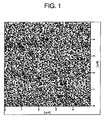
- Fig. 1 is a photograph of an image of a 5 ⁇ m square of the rubber composition in Example 1 determined by a SPM
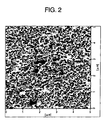
- Fig. 2 is a photograph of an image of a 5 ⁇ m square of the rubber composition in Comparative Example 1 determined by a SPM.
- hard silica particles are indicated in black.
- silica is uniformly dispersed, and there are no regions with a diameter of 0.3 ⁇ m or more having no inorganic fillers.
- silica is not uniformly dispersed, and there can be seen many regions having no inorganic fillers.
- the present invention relates to a rubber composition
- a rubber composition comprising 100 parts by weight of a rubbery polymer and 5-150 parts by weight of an inorganic filler per 100 parts by weight of said rubbery polymer, wherein the haze of said rubber composition having a thickness of 5 mm is 50% or less, and the inorganic filler is dispersed so that the number of circular regions with a diameter of 0.5 ⁇ m having no inorganic fillers is one or less and the number of circular regions with a diameter of 0.3 ⁇ m having no inorganic fillers is three or less in an image of a 5 ⁇ m square of said rubber composition determined by a scanning probe microscope (SPM).
- SPM scanning probe microscope
- the rubbery polymer there can be used, for example, diene polymers, olefin polymers, urethane polymers, and the like.
- Preferred rubbery polymers are diene polymers and olefin polymers.
- Diene polymers are, for example, at least one conjugated diene compound, or a copolymer of said conjugated diene compound and at least one other copolymerizable monomer.
- conjugated diene compounds there can be used, for example, 1,3-butadiene, isoprene, 2,3-dimethyl-1,3-butadiene and the like, and as other copolymerizable monomers, there can be used, for example, styrene, ⁇ -methyl styrene, p-methyl styrene, divinylbenzene, 1,1-diphenyl ethylene, acrylonitrile, acrylic esters, methacrylic esters and the like, with vinyl aromatic compounds being preferred.
- diene polymers there can be used, for example, butadiene rubber (BR), isoprene rubber (IR), styrene-butadiene rubber (SBR), styrene-isoprene-butadiene rubber (SIBR), nitrile-butadiene rubber (NBR), further high purity natural rubber and the like.
- BR butadiene rubber
- IR isoprene rubber
- SBR styrene-butadiene rubber
- SIBR styrene-isoprene-butadiene rubber
- NBR nitrile-butadiene rubber
- Monomer units in the copolymers may be randomly distributed or may be distributed in blocks.
- Olefin polymers may be obtained by polymerizing olefins, and encompass all of the rubbery polymers.
- buthyl rubber (IIR) ethylenepropylene rubber (EPM ⁇ EPDM), ethylene alpha olefin copolymers, ethylene styrene copolymers, and the like.
- ethylene-conjugated diene copolymers may also be included.
- Urethane polymers are, for example, urethane rubber (TPU).
- the rubbery polymers for use in the present invention may be a linear or branched structure.
- modified rubbery polymers in which the ends have been modified by modifying agents are a preferred raw material rubber
- modifying agents include, for example, metal compounds such as tin compounds, hydroxy group-containing compounds, carboxyl group-containing compounds, amine derivatives, amides, imines, silane compounds, epoxy compounds and the like, and specifically there can be preferably used modifying agents containing modifying groups having high affinity for silica such as hydroxy group-containing compounds, amine derivatives, amides, imines, silane compounds, and epoxy compounds. Two or more of such modifying agents may be used in combination, or other modifying agents may also be used.
- the rubbery polymer of the present invention is composed of polymer component (A) and component (B), preferably having different refractive indexes.
- Component (A) has a refractive index of 1.535 or greater and less than 1.600, preferably 1.540 or greater and less than 1.600. Enhancement of the refractive index of a polymer may be accomplished by increasing the amount of monomer components having high refractive index such as vinyl aromatic compounds. Examples of vinyl aromatic compounds having high refractive index include styrene, ⁇ -methyl styrene, p-methyl styrene, divinylbenzene, 1,1-diphenyl ethylene and the like.
- Component (B) is a polymer having a refractive index of 1.400 or greater and less than 1.530. Since the rubbery polymer comprises a polymer of two components having different refractive index, the haze become decreased and thereby a rubber composition having a good transparency can be obtained.
- the difference in refractive index between component (A) and component (B) is 0.010 or greater, and more preferably 0.020 or greater.
- component (A) in the rubbery polymer is 5-80% by weight, preferably 10-75% by weight, and most preferably 15-70% by weight, and component (B) is 20-95% by weight.
- component (A) has a composition of 5-80% by weight, a good transparency can be obtained, and when component (B) has a composition of 20-95% by weight, balance of rubber properties such as abrasion resistance and c-set and transparency becomes favorable.
- a preferred component (A) is a copolymer of a vinyl aromatic compound and a conjugated diene compound.
- Preferred vinyl aromatic compounds include, for example, styrene, ⁇ -methyl styrene, p-methyl styrene, divinylbenzene, and 1,1-diphenyl ethylene, with vinyl styrene most preferred.
- conjugated diene compounds there can be used, for example, 1,3-butadiene, isoprene, 2,3-dimethyl-1,3-butadiene and the like. 1,3-butadiene and isoprene are preferred.
- monomers copolymerizable with conjugated diene compounds there can be mentioned acrylonitrile, acrylic esters, methacrylic esters, and the like.
- component (A) having a refractive index of 1.535 or greater and less than 1.600 of the rubbery polymer of the rubber composition of the present invention is a copolymer comprising a vinyl aromatic compound and a conjugated diene compound
- the amount of the vinyl aromatic compound bound in said copolymer is preferably 26-90% by weight.
- the rubber composition obtained has a good transparency, and thus has favorable gripping properties for use in shoe soles and the like.
- it is 90% by weight or less, the mixing and processing properties of the rubber composition become excellent and favorable dispersibility of the inorganic filler can be obtained.
- the binding structure of the vinyl aromatic compound and the conjugated diene compound in the component (A) copolymer may be a block distribution or a random distribution, and may be selected based on, but not limited to, the purpose of the rubber composition obtained.
- component (B) having a refractive index of 1.400 or greater and less than 1.530 of the rubbery polymer of the rubber composition of the present invention is a diene polymer
- the amount of the vinyl aromatic compound bound is preferably 25% by weight or less. Since the amount of the vinyl aromatic compound bound in the diene polymer of component (B) is 25% by weight or smaller, an excellent transparency can be obtained.
- the binding structure of the vinyl aromatic compound and of the conjugated diene compound in the diene polymer of component (B) may be, but not limited to, a block distribution or a random distribution.
- the amount of the vinyl aromatic compound bound in the rubbery polymer component (A) in the rubber composition of the present invention is greater than in component (B) by 25% by weight or more, in which case rubber compositions having a more excellent transparency can be obtained.
- Component (A) specifically preferred for use as the rubbery polymer of the rubber composition of the present invention is a styrene-butadiene copolymer in which the amount of the styrene bound is 26-90% by weight, and more preferably the amount of the styrene bound is 30-80% by weight.
- the amount of the styrene bound of component (A) is 26-90% by weight, a rubber composition having an excellent balance of transparency and physical properties can be obtained.
- component (A) two or more types of styrene-butadiene copolymers having different amounts of styrene bound can be used.
- the binding of styrene in the styrene-butadiene copolymer may be, but not limited to, a block distribution or a random distribution.
- the distribution of the vinyl bound in the butadiene portion may also be a block distribution or a random distribution, but in order to satisfy abrasion resistance, the amount of the vinyl bound is preferably 80% by weight or less, preferably 60% by weight or less, and more preferably 40% by weight or less.
- the binding of styrene of the styrene-butadiene copolymer having the amount of styrene bound of 25% by weight or less as a preferred component (B) of the present invention can be , but not limited to, a block distribution or a random distribution.
- the distribution of the vinyl bound in the butadiene portion may be, but not limited to, a block distribution or a random distribution.
- the amount of the vinyl bound is preferably 80% by weight or less, preferably 60% by weight or less, and more preferably 40% by weight or less.
- the amount of the vinyl bound is preferably 80% by weight or less, preferably 60% by weight or less, and more preferably 40% by weight or less.
- component (B) for use in the present invention high cis-polybutadiene in which 1,4-cis bond is 80% by weight or more is specifically preferred. In that case, abrasion resistance becomes more excellent in addition to transparency.
- those component (A) and component (B) in which the acetone extract is 2% by weight or less are specifically preferred.
- the components of the acetone extract which are the residue of emulsifying agents, acids, salts etc. used for emulsion polymerization and the like, persist in rubber leading to an enhanced haze and a reduced transparency of the rubber composition, and is also responsible for coloring.
- the preferred rubbery polymers that is used in the present invention are those polymers having very few impurities produced in solution polymerization.
- inorganic fillers of the rubber composition of the present invention there can be used, for example, silica, zinc flower, zinc carbonate, magnesium carbonate, magnesium hydroxide, calcium carbonate, magnesium carbonate, clay etc., and combinations of two or more of them can be used.
- More preferred inorganic fillers are those that have refractive index in the range of 1.450-1.570 from the viewpoint of conferring more favorable transparency, and they include, for example, silica, magnesium carbonate and magnesium hydroxide.
- a specifically preferred inorganic filler is silica.
- silica there can be used those that are called dry silica, wet silica, synthetic silicate white carbon, colloidal silica, and the like.
- silica of which surface has been rendered hydrophobic, and mixtures of silica and an inorganic filler other than silica can be used, but most preferred is dry silica having a small particle size with a specific surface area of 100 m 2 /g or more.
- the mean primary particle diameter of dry silica is preferably 50 nm or smaller, more preferably 40 nm or smaller, most preferably 30 nm or smaller.
- the amount of inorganic fillers used is 5-150 parts by weight per 100 parts by weight of the raw material rubber, the rubbery polymer, preferably 10-120 parts by weight, and most preferably 10-100 parts by weight. Within this range, there can be obtained rubber compositions having an excellent transparency and an excellent balance with abrasion resistance and c-set.
- the transparent rubber composition of the present invention is a rubber composition, wherein the haze is 50% or less, and the inorganic filler is dispersed so that the number of circular regions with a diameter of 0.5 ⁇ m having no inorganic fillers is one or less and the number of circular regions with a diameter of 0.3 ⁇ m having no inorganic fillers is three or less in an image of a 5 ⁇ m square of said rubber composition determined by a scanning probe microscope (SPM).
- SPM scanning probe microscope
- More preferable is a rubber composition having a more preferred haze of 37% or less, and an excellent dispersibility that the number of circular regions with a diameter of 0.5 ⁇ m having no inorganic fillers is zero, the number of circular regions with a diameter of 0.3 ⁇ m having no inorganic fillers is one or less, and the number of circular regions with a diameter of 0.2 ⁇ m having no inorganic fillers is three or less in an image of a 5 ⁇ m square of said rubber composition determined by a scanning probe microscope (SPM).
- SPM scanning probe microscope
- the transparent rubber composition of the present invention observed by SPM is a rubber composition in which the mean dispersed particle diameter of the inorganic fillers is dispersed to the primary particle level of 50nm or less, preferably 30nm or less, and the particles take a homogeneous distribution state in which there are almost no aggregate network of inorganic fillers.
- inorganic filler with a potent aggregating property such as silica there can be usually observed, when observed by SPM, regions in which very few inorganic fillers are present and regions in which they are densely distributed, but in the transparent rubber compositions of the present invention having an excellent transparency, there are almost no regions in which inorganic fillers are not present, and they take a morphology in which inorganic fillers are evenly dispersed.
- the rubbery polymers for use in the present invention are polymers having very few impurities, just as polymers produced by solution polymerization, in order to obtain an excellent transparency and coloring.
- the Mooney viscosity of the rubbery polymer of the transparent rubber compositions of the present invention is not specifically limited, and a preferred range of Mooney viscosity (ML1+4 100°C) is 10-150, and in the case of highly hard polymers it is in the range of 5-120 at the condition of ML5+4 100°C or MS1+4 100°C or the like. Any range of Mooney viscosity may be used as long as it allows processing.
- a non-contaminating oil can be added to the rubber composition of the present invention as a softening agent.
- Such an oil may be a naphthene oil or a paraffin oil, and a preferred amount added is 50 parts by weight or less per 100 parts by weight of the raw material rubber.
- various additives may be added to the rubber composition of the present invention in order to improve the characteristics.
- Additives may include, for example, silane coupling agents that link inorganic fillers to rubber.
- Silane coupling agents include, for example, alkoxysilane compounds such as tetraethoxysilane, vinyl trimethoxysilane, vinyltris(2-methoxyethoxy)silane, 3-aminopropyl triethoxysilane, 3-glycidoxypropylmethyl dimethoxysilane, bis-[3-(triethoxysilyl)-propyl]tetrasulfide, bis-[3-(triethoxysilyl)-propyl]disulfide, triethoxysilylpropyl-methacrylate-monosulfide and the like, and most preferably tetraethoxysilane, vinyl trimethoxysilane, and vinyltris(2-methoxyethoxy)silane.
- alkoxysilane compounds such as tetraethoxysilane, vinyl trimethoxysilane, vinyltris(2-methoxyethoxy)silane, 3-
- the preferred amount of silane coupling agents used according to the present invention is 0-20 parts by weight per 100 parts by weight of raw material rubber, and most preferably 0.5-10 parts by weight, and two types or more may be used in combination.
- silane coupling agents mechanical strength of the rubber composition such as modulus, tensile strength, tear strength etc. can be increased, and c-set, abrasion resistance etc. are enhanced to provide an excellent balance with transparency.
- dispersing agents and activating agents may be added.
- fatty acids such as stearic acid, oleic acid, and lauric acid or derivatives thereof, or diethylene glycol, polyethylene glycol etc. may be added at 5 parts by weight or less per 100 parts by weight of the raw material rubber, and those having as low melting point as possible are more preferred. If the amounts of such dispersing agents and activating agents added exceeds 5 parts by weight, turbidity and bleeding of the rubber compositions obtained may occur, which is not desirable.
- stabilizers such as non-contaminating age resistors, anti-oxidants, antiozonants, and UV absorbers, and pigments depending on uses.
- crosslinking agents and vulcanizing agents may be used. They are, for example, sulfur, sulfur compounds, organic peroxides, oximes, nitroso compounds, polyamines, metal compounds and the like, and they may be used in combination.
- organic peroxides being most preferred such as t-butyl hydroperoxide, cumene hydroperoxide, dicumyl peroxide, di-t-butyl peroxide, 2,5-dimethyl-2,5-(t-butylperoxy)hexane, benzoylperoxide, and 1,1-bis(t-butylperoxy)-3,3,5-trimethylcyclohexane.
- organic peroxides being most preferred such as t-butyl hydroperoxid
- the method of producing the rubber composition of the present invention is a method of producing rubber compositions comprising 100 parts by weight of at least one rubbery polymer and 5-150 parts by weight of at least one inorganic filler per 100 parts by weight of said rubbery polymer, which comprises kneading said rubbery polymer and said inorganic filler at least once for 30 seconds or longer at a rubber temperature of 0-60°C during the step of kneading.
- the method of producing the rubber composition of the present invention is a method of producing rubber compositions, which comprises kneading a rubbery polymer and an inorganic filler at a kneading temperature of 0-60°C, preferably 10-50°C, for 30 seconds or longer, preferably one minute or longer, in the step of kneading, and by kneading within this range, the dispersibility of inorganic fillers is enhanced and balance of transparency with physical properties such as abrasion resistance or c-set becomes more excellent.
- any type of kneading machines may be used.
- a Banbury mixer, a pressure kneader, an internal mixer, an extruder, an open roll, and the like are cited.
- the method of kneading rubber compositions according to the present invention may be a method in which at a temperature range of 0-60°C, all or part of the rubbery polymer and an inorganic filler and, as needed, all or part of other additives may be added and kneaded for 30 seconds or longer, or a method in which kneading is conducted at a given temperature of 60-180°C due to the heat generated by kneading or the like until a given time.
- the method of producing the rubber composition of the present invention may be a method in which, at the first step, blending is effected at a maximum kneading temperature of 60-180°C, and then the rubber composition is kneaded again at 0-60°C for 30 seconds or longer, and during re-kneading, a vulcanizing agent, a crosslinking agent, or another additive may be added.
- it may be a method of producing rubber compositions which comprises adding and kneading rubber and an inorganic filler and, as needed, another additive using a mixing roll etc. at a constant temperature range of 0-60°C, or a method of blending and kneading rubber and an inorganic filler etc. at a high temperature exceeding 60°C as in the conventional method, and blending them at a conventional kneading temperature, followed by kneading again the rubber composition at 0-60°C for 30 seconds or longer, said method comprising adding, during re-kneading another additive such as a vulcanizing agent, a crosslinking agent etc.
- another additive such as a vulcanizing agent, a crosslinking agent etc.
- a highly hard rubber and a less hard kneadable rubber may be blended at a temperature 60°C or higher and then rubber compositions may be produced according to the production method of the present invention.
- methods of producing the rubber compositions of the present invention may be producing rubber compositions which comprises kneading by repeating kneading at a high temperature and kneading at a low temperature such as a method of production comprising kneading simultaneously a material that requires processing at a high temperature, another rubber, and other additives such as an inorganic filler, and a vulcanizing agent at a temperature of 60°C or higher, and then kneading again at a temperature of 0-60°C or a method further comprising kneading them again at a temperature of 60°C or higher, and other methods.
- methods of producing the rubber compositions of the present invention are characterized in that a rubbery polymer and an inorganic filler are kneaded at a temperature range of 0-60°C for 30 seconds or longer in either of the step of kneading continuously, the initial step of kneading in multi-steps, a midway step, and the final step, and intend to enhance dispersibility of the inorganic filler in the rubber composition in order to enhance transparency and physical properties.
- the present invention also relates to a footwear comprising a rubber composition having the haze of the rubber composition 5 mm thick is 50% or less, wherein the number of circular regions with a diameter of 0.5 ⁇ m or more having no inorganic fillers is one or less and the number of circular regions with a diameter of 0.3 ⁇ m or more having no inorganic fillers is three or less in an image of a 5 ⁇ m square determined by a scanning probe microscope (SPM) of a rubber composition comprising 100 parts by weight of at least one rubbery polymer and 5-150 parts by weight of at least one inorganic filler per 100 parts by weight of said rubbery polymer.
- SPM scanning probe microscope
- the rubber compositions of the present invention may be used in any applications making use of transparency, coloring characteristics, abrasion resistance, c-set and rubber elasticity, rubber hardness, and the like.
- a rubbery polymer which is to be a raw material of the rubber composition used in the Examples and Comparative Examples below was prepared in a batch polymerization using a 10 L autoclave equipped with a stirrer that had been replaced with nitrogen according to the polymerization procedure in the following Table 1.
- the total amount of monomer was set at 1.00 kg, which was subjected to copolymerization with a styrene monomer and 1,3-butadiene using n-butyl lithium as a polymerization initiator in a cyclohexane solvent (550 phm) to yield styrene butadiene rubbers SBR-A to -F.
- the conversion rate (measured by gas chromatography) two minutes after reaching the maximum polymerization temperature was 99.5% or more for styrene, and 99.8% or more for 1,3-butadiene.
- SBR-A tin tetrachloride was added at an amount described in (1) of Table 1
- SRB-C tetra glycydyl-1,3-bisaminomethyl cyclohexane was added to a portion of SRB-B at an amount described in (2) of Table 1
- 1,3-dimethyl imidazolydinone was added at an amount described in (3) of Table 1 and was subjected to coupling or denaturation reaction.
- Table 2 shows the amount of styrene bound in the produced styrene-butadiene rubber, the amount of styrene block, the amount of vinyl bound in the bound butadiene, and Mooney viscosity.
- the amount of styrene bound was determined using a UV spectrophotometer (manufactured by JASCO Corporation, V-520 UV) by comparing with the UV absorption intensity of the standard polystyrene.
- the amount of styrene block was determined by dissolving two parts by weight of the copolymer in 100 parts by weight of chloroform, to which five parts by weight of tertiary-butyl hydroperoxide and 0.01 part by weight of osmium tetraoxide were added, which was then decomposed under stirring in a 80°C water bath for 15 minutes, and to the decomposed solution 10 volumes of methanol was added to filter the resulting precipitate (filter mesh size: 0.45 ⁇ m) , which was dried and from which weight the amount of styrene block in the polymer was measured.
- the amount of 1,2-vinyl bound in butadiene was determined using an IR spectrophotometer (manufactured by JASCO Corporation, V-520 UV) according to the Hampton technique.
- Amount of styrene bound (% by weight) Amount of styrene block (% by weight Amount of vinyl bound (% by weight Mooney viscosity (ML1+4 100°C)
- Acetone extract % by weight SBR-A 25 8 19 57 0.7 SBR-B 43 16 28 43 1.0 SBR-C 43 15 28 61 0.9 SBR-D 45 14 34 48 0.8 SBR-E 64 9 13 71 1.2 SBR-F 56 1 35 36 0.9
- the acetone extract was measured by placing a rubber sample sheet with a thickness of 0.5 mm to a 200 mesh metal net sack, drying the sheet under vacuum after extraction under acetone reflux and measuring it from the difference in weight before and after the procedure.
- SBR-G is JSR0202, and the acetone extract 4.1% (manufactured by JSR Corporation, the amount of styrene bound: 46% by weight, emulsion polymerization SBR with Mooney viscosity ML1+4 100°C being 45).
- BR-A is D35R (manufactured by Asahi Kasei Corporation, low-cis BR with Mooney viscosity ML1+4 100° C being 35).
- BR-B is UBEPOL-150 (manufactured by Ube Industries, Ltd., cis 1,4-bond 98% by weight, BR with Mooney viscosity ML1+4 100°C being 43).
- a refractometer manufactured by ATAGO CO., LTD. was used and the index was measured at 23°C according to the JIS-K7105. The result of measurement was: SBR-A 1.538 SBR-B 1.553 SBR-C 1.553 SBR-D 1.555 SBR-E 1.574 SBR-F 1.565 SBR-G 1.557 BR-A 1.519 BR-B 1.523
- a haze meter type NDH-1001DP manufactured by Nippon Denshoku Industries, Co., Ltd., was used to measure the haze and PT (parallel transmission) of sheet samples having a thickness of 5 mm of rubber compositions obtained in each of Examples and Comparative Examples.
- ком ⁇ онент rubber 70 g of SBR-B and 130 g of BR-B were wrapped and mixed by a mixing roll at 35°C, and 70 g of silica-1 (Reorosil QS20, manufactured by Tokuyama Corporation specific surface area 220 m 2 /g), 2 g of an age resistor (NOCRAC SP) and 4 g of a silane coupling agent (Vinyl trimethoxysilane) were added and kneaded at the same roll temperature over about 5 minutes. Then, 1.0 g of dicumyl peroxide was added thereto at the same roll temperature (rubber temperature 46°C), and kneaded again for 2 minutes to prepare a rubber composition.
- silica-1 Reorosil QS20, manufactured by Tokuyama Corporation specific surface area 220 m 2 /g
- NOCRAC SP age resistor
- silane coupling agent Vinyl trimethoxysilane
- ком ⁇ онент rubber 70 g of SBR-C and 130 g of BR-B were wrapped and mixed by a mixing roll at 35°C, and 80 g of silica-1 (Reorosil QS20), 2 g of an age resistor (NOCRAC SP) and 4 g of a silane coupling agent (Vinyl trimethoxysilane) were added and kneaded at the same roll temperature over about 5 minutes (rubber temperature 43°C). Then, 1.0 g of dicumyl peroxide was added thereto, and kneaded again for 2 minutes to prepare a rubber composition.
- silica-1 Rosil QS20
- NOCRAC SP age resistor
- silane coupling agent Vinyl trimethoxysilane
- the rubber blend was removed at an indication temperature of 118°C.
- 30 g of the rubber blend discharged from the kneader was molded by press molding into a sheet 5 mm thick, and the haze thereof was measured. The haze was 43%.
- 0.64 g of dicumyl peroxide was added thereto at a 50°C roll, and kneaded for 2 minutes to prepare a rubber composition.
- the indication temperature reached 129°C and the rubber blend was removed.
- 30 g of the rubber blend discharged from the kneader was molded by press molding into a sheet 5 mm thick, and the haze thereof was measured. The haze was 75%. Then, 0.64 g of dicumyl peroxide was added thereto at a 80°C roll, and kneaded to prepare a rubber composition.
- composition of the rubber compositions prepared in Examples 1-7 are summarized in the following Table 3, and the composition of the rubber compositions prepared in Comparative Examples 1-3 are summarized in the following Table 4.
- silica-1 was Reorosil QS20 manufactured by Tokuyama Corporation and silica-2 was Nipsil VN3 manufactured by Nippon Silica Industries., Co. NOCRAC SP was manufactured by Ouchi Shinko Chemical Industrial Co., Ltd. (Unit: parts by weight) Com. Ex. 1 Com. Ex. 2 Com. Ex.
- silica-1 was Reorosil QS20 manufactured by Tokuyama Corporation and silica-2 was Nipsil VN3 manufactured by Nippon Silica Industries., Co. NOCRAC SP was manufactured by Ouchi Shinko Chemical Industrial Co., Ltd.
- Example 1 the rubber temperature at kneading was 60°C or lower, and the abrasion resistance and c-set of the crosslinked product were good and had a remarkably excellent transparency as compared to Comparative Example 1 in which kneading was carried out at a roll temperature of 100°C.
- the hardness of the crosslinked product of Example 1 had sufficient rubber characteristics with a Shore A of 64, a 300% modulus of 10.6 Mp, a tensile strength of 19.2 Mp, an extension of 510%, a tear strength of 41 N/mm, and a Rupke impact resilience of 52 at a room temperature (23°C).
- Example 2 in which the first step was a high temperature kneading at 100°C and at the second step kneading was carried out at a low temperature, transparency and balance of physical properties were more excellent than that of Comparative Example 1.
- Example 3 exhibited a little coloring at yellow, and the haze was not greater than 50%.
- Example 4 was an example of a modified styrene-butadiene rubber, which had an excellent transparency and good balance with c-set.
- Example 6 a wet type silica was dried prior to use in the blending by a kneader. At a temperature of 60°C or less, a styrene-butadiene rubber and silica were kneaded for 2 minutes or more, and then the temperature started to rise resulting in a high-temperature kneading, but by kneading again at 50°C, transparency and balance of physical properties were more excellent than that of Comparative Example 1 or Comparative Example 2.
- Example 7 two types of styrene-butadiene rubbers were used, but transparency and balance of physical properties were excellent.
- ком ⁇ онент rubber 70 g of SBR-B and 130 g of BR-B were wrapped and mixed by a mixing roll at 65°C, and 140 g of silica-1 (Reorosil QS20), 2 g of an age resistor (NOCRAC SP) and 4 g of a silane coupling agent (Vinyl trimethoxysilane) were added and kneaded at the same roll temperature over about 12 minutes, and after cooling at room temperature, 1.0 g of dicumyl peroxide was added thereto at a roll temperature of 30°C, and kneaded again for 2 minutes to prepare a rubber composition.
- silica-1 Rosil QS20
- NOCRAC SP age resistor
- silane coupling agent Vinyl trimethoxysilane
- the raw material rubber As the raw material rubber, a given amount described in Table 3 of the raw material rubber that was prepared by mixing 40 g of SBR-B and 40 g of SBR-E in a mixing roll at 80°C, and then after cooling at room temperature, premixed at a mixing roll temperature of 35°C, 120 g of BR-B and 80 g of silica-1 (Reorosil QS20), 2 g of an age resistor (NOCRAC SP) and 4 g of a silane coupling agent (Vinyl trimethoxysilane) were added and kneaded for 6 minutes, and then under the same temperature condition (rubber temperature 43°C), 1.0 g of dicumyl peroxide was added thereto, and kneaded again for 2 minutes to prepare a rubber composition.
- silica-1 Reorosil QS20
- NOCRAC SP age resistor
- Vinyl trimethoxysilane silane coupling agent
- a mixing roll temperature of 70°C 20 g of SBR-D, 40 g of SBR-E, 140 g of BR-B, 100 g of silica-1 (Reorosil QS20), 2 g of an age resistor (NOCRAC SP) and 4 g of a silane coupling agent (Vinyl trimethoxysilane) were added and kneaded for 7 minutes, and after cooling at room temperature, 1.0 g of dicumyl peroxide was added thereto at a mixing roll temperature of 35°C (rubber temperature 43°C), and kneaded again for 5 minutes to prepare a rubber composition.
- silica-1 Reorosil QS20
- NOCRAC SP age resistor
- silane coupling agent Vinyl trimethoxysilane
- Example 8 By increasing the amount of silica in Example 8 and adding a styrene-butadiene copolymer having a great amount of styrene bound in Example 9 and 10, rubber compositions having a high hardness and an excellent transparency were obtained.
- the rubber composition of Comparative Example 4 has a high hardness, but the haze is high and transparency is poor.
- the rubber compositions of the present invention have an excellent balance of transparency and physical properties such as c-set, and have an excellent transparency even when converted to highly hard products, they can be used in various applications that require these physical properties of rubber in addition to transparency and beautiful coloring, and are specifically useful in applications for footwear.
Landscapes
- Chemical & Material Sciences (AREA)
- Health & Medical Sciences (AREA)
- Chemical Kinetics & Catalysis (AREA)
- Medicinal Chemistry (AREA)
- Polymers & Plastics (AREA)
- Organic Chemistry (AREA)
- Engineering & Computer Science (AREA)
- Materials Engineering (AREA)
- Compositions Of Macromolecular Compounds (AREA)
- Processes Of Treating Macromolecular Substances (AREA)
Abstract
Description

| Amount of styrene bound (% by weight) | Amount of styrene block (% by weight | Amount of vinyl bound (% by weight | Mooney viscosity (ML1+4 100°C) | Acetone extract (% by weight | |
| SBR-A | 25 | 8 | 19 | 57 | 0.7 |
| SBR-B | 43 | 16 | 28 | 43 | 1.0 |
| SBR-C | 43 | 15 | 28 | 61 | 0.9 |
| SBR-D | 45 | 14 | 34 | 48 | 0.8 |
| SBR-E | 64 | 9 | 13 | 71 | 1.2 |
| SBR-F | 56 | 1 | 35 | 36 | 0.9 |
The result of measurement was:
| SBR-A | 1.538 |
| SBR-B | 1.553 |
| SBR-C | 1.553 |
| SBR-D | 1.555 |
| SBR-E | 1.574 |
| SBR-F | 1.565 |
| SBR-G | 1.557 |
| BR-A | 1.519 |
| BR-B | 1.523 |
Measurement condition: room temperature (23°C)
Cyclic contact mode, phase image

| (Unit: parts by weight) | |||
| Com. Ex. 1 | Com. Ex. 2 | Com. Ex. 3 | |
| SBR-A | |||
| SBR-B | 35 | 100 | 30 |
| SBR-C | |||
| SBR-D | |||
| SBR-F | |||
| SBR-G | |||
| BR-A | |||
| BR-B | 65 | 70 | |
| Silica-1 | 35 | 3 | |
| Silica-2 | 30 | ||
| | 2 | 2 | 2 |
| NOCRAC SP | 1 | 1 | 1 |
| Dicumyl peroxide | 0.5 | 0.43 | 0.5 |


| Com. Ex. 1 | Com. Ex. 2 | Com. Ex. 3 | |
| The number of regions having no inorganic fillers | |||
| Region diameter of 0.5 µm or greater | 0 0 | 1 | |
| Region diameter of 0.3 µm or greater | 6 5 2 | ||
| Region diameter 0.2 µm or greater | 11 | 9 | 18 |
| Haze (%) | 77 | 73 | 72 |
| Parallel transmission (%) | 19 | 15 | 16 |
| c-set(%) | 25 | 27 | 22 |
| Akron abrasion CC/3000 times | 0.046 | 0.053 | 0.114 |
| (Unit: parts by weight) | ||||
| Ex. 8 | Ex. 9 | Ex. 10 | Com. Ex. 4 | |
| SBR-A | ||||
| SBR-B | 35 | 20 | 10 | |
| SBR-C | ||||
| SBR-D | 10 | |||
| SBR-E | 20 | 20 | 20 | |
| BR-B | 65 | 60 | 70 | 70 |
| Silica-1 | 70 | 40 | 50 | 50 |
| | 2 | 2 | 2 | 2 |
| NOCRAC SP | 1 | 1 | 1 | 1 |
| Dicumyl peroxide | 0.5 | 0.5 | 0.5 | 0.5 |
| Ex. 8 | Ex. 9 | Ex. 10 | Com. Ex. 4 | |
| The number of regions having no inorganic fillers | ||||
| Region diameter of 0.5 µm or greater | 0 | 0 | 0 | 0 |
| Region diameter of 0.3 µm or greater | 0 | 0 | 0 | 4 |
| Region diameter of 0.2 µm or greater | 0 | 0 | 2 | 8 |
| Haze (%) | 17 | 28 | 26 | 86 |
| Parallel transmission (%) | 64 | 58 | 59 | 11 |
| Hardness Shore A | 96 | 93 | 92 | 93 |
Claims (12)
- A rubber composition comprising 100 parts by weight of a rubbery polymer and 5-150 parts by weight of an inorganic filler per 100 parts by weight of said rubbery polymer, wherein the haze of said rubbery composition having a thickness of 5 mm is 50% or less, and the inorganic filler is dispersed so that the number of circular regions with a diameter of 0.5 µm having no inorganic fillers is one or less and the number of circular regions with a diameter of 0.3 µm having no inorganic fillers is three or less in an image of a 5 µm square of said rubber composition determined by a scanning probe microscope (SPM).
- The rubbery composition according to claim 1 wherein said rubbery polymer comprises 5-80% by weight of the rubbery polymer component (A) having a refractive index of 1.535 or greater and less than 1.600 and 20-95% by weight of the rubber polymer component (B) having a refractive index of 1.400 or greater and less than 1.530.
- The rubber composition according to claim 2 wherein the difference in refractive index between component (A) and component (B) is 0.010 or greater.
- The rubber composition according to claim 2 or 3 wherein component (A) is a copolymer of a vinyl aromatic compound and a conjugated diene compound in which the amount of the vinyl aromatic compound bound is 26-90% by weight, and component (B) is a diene polymer in which the amount of the vinyl aromatic compound bound is 25% by weight or less, and the haze of said rubber composition having a thickness of 5 mm is 37% or less.
- The rubber composition according to any one of claims 2 to 4 wherein the amount of the vinyl aromatic compound bound in the copolymer of component(A) is greater than that in the polymer of component(B) by 25% by weight or more.
- The rubber composition according to any one of claims 2 to 5 wherein the acetone extract in each of component (A) and component (B) is 2% by weight or less.
- The rubber composition according to any one of claims 2 to 6 wherein component (B) is a polybutadiene in which the amount of 1,4-cis bond is 80% by weight or more.
- The rubber composition according to any one of claims 1 to 7 wherein the inorganic filler is a silica filler having a specific surface area of 100 m2/g or more.
- The rubber composition according to any one of claims 1 to 8 wherein the inorganic filler is a dry silica having a mean primary particle diameter of 30 nm or smaller.
- A method of producing a rubber composition comprising 100 parts by weight of a rubbery polymer and 5-150 parts by weight of an inorganic filler per 100 parts by weight of said rubbery polymer, wherein the haze of said rubber composition having a thickness of 5 mm is 50% or less, and the inorganic filler is dispersed so that the number of circular regions with a diameter of 0.5 µm having no inorganic fillers is one or less and the number of circular regions with a diameter of 0.3 µm having no inorganic fillers is three or less in an image of a 5 µm square of said rubber composition determined by a scanning probe microscope (SPM), said method comprising kneading said rubbery polymer and said inorganic filler for at least 30 seconds or longer per run of kneading at a rubber temperature of 0-60°C.
- The method of producing a rubber composition according to 10 wherein the rubber composition comprises 5-80% by weight of the rubbery polymer component (A) having a refractive index of 1.535 or greater and less than 1.600 and 20-95% by weight of the rubbery polymer component (B) having a refractive index of 1.400 or greater and less than 1.530, and said rubbery polymer and the inorganic filler are kneaded for at least 30 seconds or longer per run of kneading at a rubber temperature of 10-50°C.
- A footwear having excellent designing and functional properties using the rubber composition according to any one of claims 1 to 9.
Applications Claiming Priority (5)
| Application Number | Priority Date | Filing Date | Title |
|---|---|---|---|
| JP2002124169 | 2002-04-25 | ||
| JP2002124169 | 2002-04-25 | ||
| JP2002350983 | 2002-12-03 | ||
| JP2002350983 | 2002-12-03 | ||
| PCT/JP2003/005286 WO2003091327A1 (en) | 2002-04-25 | 2003-04-24 | Rubber composition and process for production thereof |
Publications (3)
| Publication Number | Publication Date |
|---|---|
| EP1498453A1 true EP1498453A1 (en) | 2005-01-19 |
| EP1498453A4 EP1498453A4 (en) | 2006-03-29 |
| EP1498453B1 EP1498453B1 (en) | 2007-01-03 |
Family
ID=29272350
Family Applications (1)
| Application Number | Title | Priority Date | Filing Date |
|---|---|---|---|
| EP03717719A Expired - Lifetime EP1498453B1 (en) | 2002-04-25 | 2003-04-24 | Rubber composition and process for production thereof |
Country Status (9)
| Country | Link |
|---|---|
| US (1) | US7132471B2 (en) |
| EP (1) | EP1498453B1 (en) |
| JP (1) | JP4711390B2 (en) |
| KR (1) | KR100573654B1 (en) |
| CN (1) | CN100351300C (en) |
| AT (1) | ATE350417T1 (en) |
| AU (1) | AU2003227364A1 (en) |
| DE (1) | DE60310909D1 (en) |
| WO (1) | WO2003091327A1 (en) |
Cited By (2)
| Publication number | Priority date | Publication date | Assignee | Title |
|---|---|---|---|---|
| KR100621210B1 (en) | 2005-08-09 | 2006-09-07 | 한국타이어 주식회사 | Method for Analyzing Silanization of Silica Compound Rubber |
| EP3277733A4 (en) * | 2015-03-30 | 2018-09-05 | Kraton Polymers U.S. LLC | A cured transparent rubber article, and manufacturing process for the same |
Families Citing this family (18)
| Publication number | Priority date | Publication date | Assignee | Title |
|---|---|---|---|---|
| JP4909491B2 (en) * | 2003-06-12 | 2012-04-04 | 旭化成ケミカルズ株式会社 | Rubber composition |
| US20060288471A1 (en) * | 2005-06-22 | 2006-12-28 | Kinkopf Edward J | Drain plunger with a see through plunger element |
| US10023723B2 (en) * | 2007-06-05 | 2018-07-17 | Momentive Performance Materials Inc. | Process for preparing rubber compositions and articles made therefrom |
| ES2368865T3 (en) * | 2008-10-15 | 2011-11-23 | Evonik Degussa Gmbh | AUXILIARY TREATMENT AGENT FOR THERMOPLASTIC POLYURETHANS. |
| JP5829056B2 (en) * | 2011-06-07 | 2015-12-09 | 東洋ゴム工業株式会社 | Method for producing rubber composition |
| DE102011051888A1 (en) * | 2011-07-15 | 2013-01-17 | Vera Margraf-Gerdau | Adsorptionsvlies, in particular for the adsorption of petrochemical substances from liquid phases and / or for the adsorption of odors from gas phases with at least one spunbonded fabric and method for producing a Adsorptionsvlieses |
| US9795182B2 (en) * | 2013-04-28 | 2017-10-24 | Hongguang YANG | Silicon rubber healthcare footwear article with silicon rubber insole and its manufacturing method |
| US9226541B2 (en) * | 2013-04-28 | 2016-01-05 | Hongguang YANG | Silicon rubber healthcare footwear article with silicon rubber insole and its manufacturing method |
| KR101572106B1 (en) | 2013-08-20 | 2015-11-26 | 한국타이어 주식회사 | Rubber composition for tire tread and tire manufactured by using the same |
| JP6285743B2 (en) * | 2014-02-19 | 2018-02-28 | 住友ゴム工業株式会社 | How to observe rubber materials |
| JP6424594B2 (en) * | 2014-12-01 | 2018-11-21 | 横浜ゴム株式会社 | Rubber composition and pneumatic tire using the same |
| JP6435818B2 (en) * | 2014-12-03 | 2018-12-12 | 横浜ゴム株式会社 | Rubber composition and pneumatic tire using the same |
| JP6424597B2 (en) * | 2014-12-03 | 2018-11-21 | 横浜ゴム株式会社 | Rubber composition and pneumatic tire using the same |
| JP6485048B2 (en) * | 2015-01-09 | 2019-03-20 | 横浜ゴム株式会社 | Rubber composition and pneumatic tire using the same |
| US20180161688A1 (en) * | 2016-12-13 | 2018-06-14 | Wen Yao Chang | Soft building block assembly |
| KR20190080560A (en) | 2017-12-28 | 2019-07-08 | 평화오일씰공업주식회사 | Rubber composition of O-ring for hydrogen tank of fuel cell electric vehicle |
| JP2019142049A (en) * | 2018-02-19 | 2019-08-29 | 株式会社Ihiエアロスペース | Manufacturing method of thermoplastic resin filler blending rubber, and manufacturing method of rocket motor |
| CN118159601A (en) * | 2021-10-11 | 2024-06-07 | 日本弹性体株式会社 | Cross-linked rubber composition and method for producing the cross-linked rubber composition |
Family Cites Families (37)
| Publication number | Priority date | Publication date | Assignee | Title |
|---|---|---|---|---|
| US3014883A (en) * | 1957-03-21 | 1961-12-26 | Pittsburgh Plate Glass Co | Transparent rubber vulcanizate |
| US4588790A (en) * | 1982-03-24 | 1986-05-13 | Union Carbide Corporation | Method for fluidized bed polymerization |
| US4808561A (en) * | 1985-06-21 | 1989-02-28 | Exxon Chemical Patents Inc. | Supported polymerization catalyst |
| US4897455A (en) * | 1985-06-21 | 1990-01-30 | Exxon Chemical Patents Inc. | Polymerization process |
| US5124418A (en) * | 1985-11-15 | 1992-06-23 | Exxon Chemical Patents Inc. | Supported polymerization catalyst |
| JPS62137002A (en) | 1985-12-11 | 1987-06-19 | 株式会社ブリヂストン | Shoe sole |
| US4874880A (en) * | 1987-03-10 | 1989-10-17 | Chisso Corporation | Bis(di-, tri- or tetra-substituted-cyclopentadienyl)-zirconium dihalides |
| US4931417A (en) * | 1987-11-09 | 1990-06-05 | Chisso Corporation | Transition-metal compound having a bis-substituted-cyclopentadienyl ligand of bridged structure |
| US5017714A (en) * | 1988-03-21 | 1991-05-21 | Exxon Chemical Patents Inc. | Silicon-bridged transition metal compounds |
| US5441920A (en) * | 1989-03-21 | 1995-08-15 | Exxon Chemical Patents Inc. | Silicon-bridged transition metal compounds |
| DE4005947A1 (en) * | 1990-02-26 | 1991-08-29 | Basf Ag | SOLUBLE CATALYST SYSTEMS FOR POLYMERIZING C (DOWN ARROW) 2 (DOWN ARROW) - TO C (DOWN ARROW) 1 (DOWN ARROW) (DOWN ARROW) 0 (DOWN ARROW) -ALK-1-ENEN |
| JP2850454B2 (en) * | 1990-03-08 | 1999-01-27 | ジェイエスアール株式会社 | Rubber crosslinked product |
| US5399636A (en) * | 1993-06-11 | 1995-03-21 | Phillips Petroleum Company | Metallocenes and processes therefor and therewith |
| TW300901B (en) * | 1991-08-26 | 1997-03-21 | Hoechst Ag | |
| CA2077744C (en) * | 1991-09-30 | 2003-04-15 | Edwar Shoukri Shamshoum | Homogeneous-heterogeneous catalyst system for polyolefins |
| US5434115A (en) * | 1992-05-22 | 1995-07-18 | Tosoh Corporation | Process for producing olefin polymer |
| US5332706A (en) * | 1992-12-28 | 1994-07-26 | Mobil Oil Corporation | Process and a catalyst for preventing reactor fouling |
| DE4308311C2 (en) * | 1993-03-16 | 1995-04-06 | Degussa | Use of precipitated silicas with high spec. Surface for improving the transparency and brightness properties of vulcanizable, light rubber mixtures, rubber mixtures containing the precipitated silicas and their production |
| JP3077940B2 (en) * | 1993-04-26 | 2000-08-21 | エクソン・ケミカル・パテンツ・インク | A method for determining stable operating conditions for fluidized bed polymerization. |
| DE4344688A1 (en) * | 1993-12-27 | 1995-06-29 | Hoechst Ag | Metallocene compound |
| EP0693502B1 (en) * | 1994-07-22 | 1997-11-05 | Mitsubishi Chemical Corporation | Catalyst component for the polymerization of alpha-olefins and a process for preparing alpha-olefin polymers with use of same |
| US5763543A (en) * | 1994-09-14 | 1998-06-09 | Exxon Chemical Patents Inc. | Olefin polymerization process with little or no scavenger present |
| US20020143125A1 (en) * | 1995-08-18 | 2002-10-03 | Walter Kaminsky | Catalyst component and catalyst system having a high polymerization activity for preparing polymers |
| US6624220B1 (en) * | 1997-12-15 | 2003-09-23 | Exxonmobil Chemical Patents Inc. | Transparent and colorable elastomeric compositions |
| KR20010032104A (en) * | 1997-12-15 | 2001-04-16 | 엑손 케미칼 패턴츠 인코포레이티드 | Transparent and colorable elastomeric compositions |
| US6069213A (en) * | 1997-12-16 | 2000-05-30 | Union Carbide Chemicals & Plastics Technology Corporation | Mixed catalyst system |
| JPH11263878A (en) * | 1998-03-19 | 1999-09-28 | Sumitomo Rubber Ind Ltd | Rubber product manufacturing method |
| JPH11286575A (en) | 1998-04-01 | 1999-10-19 | Nippon Zeon Co Ltd | Diene rubber composition |
| US6245868B1 (en) * | 1998-05-29 | 2001-06-12 | Univation Technologies | Catalyst delivery method, a catalyst feeder and their use in a polymerization process |
| JP2000236905A (en) | 1999-02-23 | 2000-09-05 | Asics Corp | Shoe soles |
| US6201076B1 (en) * | 1999-04-29 | 2001-03-13 | Equistar Chemicals, L.P. | Olefin polymerization process with fatty amine additives for improved activity and reduced fouling |
| US6303718B1 (en) * | 1999-09-17 | 2001-10-16 | Bayer Aktiengesellschaft | Composition based on fluorine-containing metal complexes |
| KR100487707B1 (en) * | 1999-09-27 | 2005-05-04 | 아사히 가세이 가부시키가이샤 | Process for the preparation of a diene-based rubber polymer and rubber composition |
| EP1113024B1 (en) * | 1999-12-02 | 2003-04-23 | Bridgestone Corporation | Polymer, process for making the polymer, and rubber composition using the polymer |
| JP2001161404A (en) | 1999-12-13 | 2001-06-19 | Sumitomo Rubber Ind Ltd | Shoe sole |
| JP4820530B2 (en) * | 2001-01-02 | 2011-11-24 | ソシエテ ド テクノロジー ミシュラン | Rubber composition based on diene elastomer and reinforced silicon carbide |
| WO2002068529A2 (en) * | 2001-02-27 | 2002-09-06 | Dow Global Technologies Inc. | Fabricated articles prepared from blends of substantially random ethylene/propylene/vinyl aromatic interpolymers with polypropylene |
-
2003
- 2003-04-24 CN CNB038093227A patent/CN100351300C/en not_active Expired - Lifetime
- 2003-04-24 EP EP03717719A patent/EP1498453B1/en not_active Expired - Lifetime
- 2003-04-24 DE DE60310909T patent/DE60310909D1/en not_active Expired - Lifetime
- 2003-04-24 AT AT03717719T patent/ATE350417T1/en not_active IP Right Cessation
- 2003-04-24 WO PCT/JP2003/005286 patent/WO2003091327A1/en not_active Ceased
- 2003-04-24 AU AU2003227364A patent/AU2003227364A1/en not_active Abandoned
- 2003-04-24 KR KR1020047016992A patent/KR100573654B1/en not_active Expired - Fee Related
- 2003-04-24 JP JP2004501958A patent/JP4711390B2/en not_active Expired - Fee Related
- 2003-04-24 US US10/512,283 patent/US7132471B2/en not_active Expired - Lifetime
Cited By (2)
| Publication number | Priority date | Publication date | Assignee | Title |
|---|---|---|---|---|
| KR100621210B1 (en) | 2005-08-09 | 2006-09-07 | 한국타이어 주식회사 | Method for Analyzing Silanization of Silica Compound Rubber |
| EP3277733A4 (en) * | 2015-03-30 | 2018-09-05 | Kraton Polymers U.S. LLC | A cured transparent rubber article, and manufacturing process for the same |
Also Published As
| Publication number | Publication date |
|---|---|
| EP1498453A4 (en) | 2006-03-29 |
| KR100573654B1 (en) | 2006-04-26 |
| KR20040106369A (en) | 2004-12-17 |
| JPWO2003091327A1 (en) | 2005-09-02 |
| ATE350417T1 (en) | 2007-01-15 |
| US7132471B2 (en) | 2006-11-07 |
| DE60310909D1 (en) | 2007-02-15 |
| CN1649952A (en) | 2005-08-03 |
| AU2003227364A1 (en) | 2003-11-10 |
| US20050165153A1 (en) | 2005-07-28 |
| CN100351300C (en) | 2007-11-28 |
| JP4711390B2 (en) | 2011-06-29 |
| EP1498453B1 (en) | 2007-01-03 |
| WO2003091327A1 (en) | 2003-11-06 |
Similar Documents
| Publication | Publication Date | Title |
|---|---|---|
| US7132471B2 (en) | Rubber composition and process for production thereof | |
| US7217775B2 (en) | Emulsion particles as reinforcing fillers | |
| JP7381725B2 (en) | Hydrogenated conjugated diene polymer, hydrogenated conjugated diene polymer composition, rubber composition, and method for producing hydrogenated conjugated diene polymer | |
| JP4088258B2 (en) | Rubber composition and tire using the same | |
| CN110577680A (en) | A kind of light-weight non-slip rubber sole material and its manufacturing method | |
| TWI824674B (en) | Rubber composition, manufacturing method and tire product | |
| JP4909491B2 (en) | Rubber composition | |
| EP3546515B1 (en) | Rubber terpene footwear | |
| KR102122440B1 (en) | Method for preparing conjugated diene copolymer, conjugated diene copolymer by prepared the method and rubber composition comprising the copolymer | |
| CN1637054A (en) | Oil extended rubber and composition containing low PCA oil | |
| JP2014098102A (en) | Rubber composition | |
| KR102319522B1 (en) | Conjugated-diene based copolymer composition, method for preparing the copolymer composition and rubber composition comprising the copolymer composition | |
| KR20200026554A (en) | Rubber composition for shoe sole and molded article comprising the same | |
| KR20190073693A (en) | Conjugated-diene based copolymer composition, method for preparing the copolymer composition and rubber composition comprising the copolymer composition | |
| JP2850454B2 (en) | Rubber crosslinked product | |
| TWI888572B (en) | Silane coupling agent composition and rubber composition containing the same | |
| JP7856471B2 (en) | Rubber composition, outsole, method for manufacturing the rubber composition, and method for manufacturing a crosslinked rubber sheet | |
| KR20230075406A (en) | Partially hydrogenated diene polymer | |
| JP7824309B2 (en) | Crosslinked rubber composition and method for producing crosslinked rubber composition | |
| KR102490383B1 (en) | Conjugated-diene based copolymer composition, method for preparing the copolymer composition and rubber composition comprising the copolymer composition | |
| JPH0655857B2 (en) | Rubber composition for shoe soles | |
| JP2025117902A (en) | Modified conjugated diene polymer, rubber composition for shoes, and outsole | |
| JP2025117871A (en) | Modified conjugated diene polymer, rubber composition for shoes, and outsole | |
| JP5982873B2 (en) | Polybutadiene rubber and method for producing the same | |
| HK40015504A (en) | Rubber terpene footwear |
Legal Events
| Date | Code | Title | Description |
|---|---|---|---|
| PUAI | Public reference made under article 153(3) epc to a published international application that has entered the european phase |
Free format text: ORIGINAL CODE: 0009012 |
|
| 17P | Request for examination filed |
Effective date: 20041014 |
|
| AK | Designated contracting states |
Kind code of ref document: A1 Designated state(s): AT BE BG CH CY CZ DE DK EE ES FI FR GB GR HU IE IT LI LU MC NL PT RO SE SI SK TR |
|
| AX | Request for extension of the european patent |
Extension state: AL LT LV MK |
|
| A4 | Supplementary search report drawn up and despatched |
Effective date: 20060210 |
|
| GRAP | Despatch of communication of intention to grant a patent |
Free format text: ORIGINAL CODE: EPIDOSNIGR1 |
|
| GRAS | Grant fee paid |
Free format text: ORIGINAL CODE: EPIDOSNIGR3 |
|
| GRAA | (expected) grant |
Free format text: ORIGINAL CODE: 0009210 |
|
| AK | Designated contracting states |
Kind code of ref document: B1 Designated state(s): AT BE BG CH CY CZ DE DK EE ES FI FR GB GR HU IE IT LI LU MC NL PT RO SE SI SK TR |
|
| PG25 | Lapsed in a contracting state [announced via postgrant information from national office to epo] |
Ref country code: SI Free format text: LAPSE BECAUSE OF FAILURE TO SUBMIT A TRANSLATION OF THE DESCRIPTION OR TO PAY THE FEE WITHIN THE PRESCRIBED TIME-LIMIT Effective date: 20070103 Ref country code: DK Free format text: LAPSE BECAUSE OF FAILURE TO SUBMIT A TRANSLATION OF THE DESCRIPTION OR TO PAY THE FEE WITHIN THE PRESCRIBED TIME-LIMIT Effective date: 20070103 Ref country code: CH Free format text: LAPSE BECAUSE OF FAILURE TO SUBMIT A TRANSLATION OF THE DESCRIPTION OR TO PAY THE FEE WITHIN THE PRESCRIBED TIME-LIMIT Effective date: 20070103 Ref country code: LI Free format text: LAPSE BECAUSE OF FAILURE TO SUBMIT A TRANSLATION OF THE DESCRIPTION OR TO PAY THE FEE WITHIN THE PRESCRIBED TIME-LIMIT Effective date: 20070103 Ref country code: NL Free format text: LAPSE BECAUSE OF FAILURE TO SUBMIT A TRANSLATION OF THE DESCRIPTION OR TO PAY THE FEE WITHIN THE PRESCRIBED TIME-LIMIT Effective date: 20070103 Ref country code: FI Free format text: LAPSE BECAUSE OF FAILURE TO SUBMIT A TRANSLATION OF THE DESCRIPTION OR TO PAY THE FEE WITHIN THE PRESCRIBED TIME-LIMIT Effective date: 20070103 Ref country code: AT Free format text: LAPSE BECAUSE OF FAILURE TO SUBMIT A TRANSLATION OF THE DESCRIPTION OR TO PAY THE FEE WITHIN THE PRESCRIBED TIME-LIMIT Effective date: 20070103 |
|
| REG | Reference to a national code |
Ref country code: GB Ref legal event code: FG4D |
|
| REF | Corresponds to: |
Ref document number: 60310909 Country of ref document: DE Date of ref document: 20070215 Kind code of ref document: P |
|
| REG | Reference to a national code |
Ref country code: IE Ref legal event code: FG4D |
|
| PG25 | Lapsed in a contracting state [announced via postgrant information from national office to epo] |
Ref country code: SE Free format text: LAPSE BECAUSE OF FAILURE TO SUBMIT A TRANSLATION OF THE DESCRIPTION OR TO PAY THE FEE WITHIN THE PRESCRIBED TIME-LIMIT Effective date: 20070403 |
|
| PG25 | Lapsed in a contracting state [announced via postgrant information from national office to epo] |
Ref country code: BG Free format text: LAPSE BECAUSE OF EXPIRATION OF PROTECTION Effective date: 20070404 |
|
| PG25 | Lapsed in a contracting state [announced via postgrant information from national office to epo] |
Ref country code: ES Free format text: LAPSE BECAUSE OF FAILURE TO SUBMIT A TRANSLATION OF THE DESCRIPTION OR TO PAY THE FEE WITHIN THE PRESCRIBED TIME-LIMIT Effective date: 20070414 |
|
| PG25 | Lapsed in a contracting state [announced via postgrant information from national office to epo] |
Ref country code: PT Free format text: LAPSE BECAUSE OF FAILURE TO SUBMIT A TRANSLATION OF THE DESCRIPTION OR TO PAY THE FEE WITHIN THE PRESCRIBED TIME-LIMIT Effective date: 20070604 |
|
| NLV1 | Nl: lapsed or annulled due to failure to fulfill the requirements of art. 29p and 29m of the patents act | ||
| ET | Fr: translation filed | ||
| REG | Reference to a national code |
Ref country code: CH Ref legal event code: PL |
|
| PLBE | No opposition filed within time limit |
Free format text: ORIGINAL CODE: 0009261 |
|
| STAA | Information on the status of an ep patent application or granted ep patent |
Free format text: STATUS: NO OPPOSITION FILED WITHIN TIME LIMIT |
|
| PG25 | Lapsed in a contracting state [announced via postgrant information from national office to epo] |
Ref country code: SK Free format text: LAPSE BECAUSE OF FAILURE TO SUBMIT A TRANSLATION OF THE DESCRIPTION OR TO PAY THE FEE WITHIN THE PRESCRIBED TIME-LIMIT Effective date: 20070103 |
|
| 26N | No opposition filed |
Effective date: 20071005 |
|
| GBPC | Gb: european patent ceased through non-payment of renewal fee |
Effective date: 20070424 |
|
| PG25 | Lapsed in a contracting state [announced via postgrant information from national office to epo] |
Ref country code: BE Free format text: LAPSE BECAUSE OF FAILURE TO SUBMIT A TRANSLATION OF THE DESCRIPTION OR TO PAY THE FEE WITHIN THE PRESCRIBED TIME-LIMIT Effective date: 20070103 Ref country code: CZ Free format text: LAPSE BECAUSE OF FAILURE TO SUBMIT A TRANSLATION OF THE DESCRIPTION OR TO PAY THE FEE WITHIN THE PRESCRIBED TIME-LIMIT Effective date: 20070103 Ref country code: RO Free format text: LAPSE BECAUSE OF FAILURE TO SUBMIT A TRANSLATION OF THE DESCRIPTION OR TO PAY THE FEE WITHIN THE PRESCRIBED TIME-LIMIT Effective date: 20070103 |
|
| PG25 | Lapsed in a contracting state [announced via postgrant information from national office to epo] |
Ref country code: DE Free format text: LAPSE BECAUSE OF FAILURE TO SUBMIT A TRANSLATION OF THE DESCRIPTION OR TO PAY THE FEE WITHIN THE PRESCRIBED TIME-LIMIT Effective date: 20070404 |
|
| PG25 | Lapsed in a contracting state [announced via postgrant information from national office to epo] |
Ref country code: GB Free format text: LAPSE BECAUSE OF NON-PAYMENT OF DUE FEES Effective date: 20070424 Ref country code: GR Free format text: LAPSE BECAUSE OF FAILURE TO SUBMIT A TRANSLATION OF THE DESCRIPTION OR TO PAY THE FEE WITHIN THE PRESCRIBED TIME-LIMIT Effective date: 20070404 Ref country code: IT Free format text: LAPSE BECAUSE OF NON-PAYMENT OF DUE FEES Effective date: 20070424 |
|
| PG25 | Lapsed in a contracting state [announced via postgrant information from national office to epo] |
Ref country code: IE Free format text: LAPSE BECAUSE OF NON-PAYMENT OF DUE FEES Effective date: 20070424 |
|
| PGRI | Patent reinstated in contracting state [announced from national office to epo] |
Ref country code: IT Effective date: 20081001 |
|
| PG25 | Lapsed in a contracting state [announced via postgrant information from national office to epo] |
Ref country code: EE Free format text: LAPSE BECAUSE OF FAILURE TO SUBMIT A TRANSLATION OF THE DESCRIPTION OR TO PAY THE FEE WITHIN THE PRESCRIBED TIME-LIMIT Effective date: 20070103 |
|
| PG25 | Lapsed in a contracting state [announced via postgrant information from national office to epo] |
Ref country code: MC Free format text: LAPSE BECAUSE OF NON-PAYMENT OF DUE FEES Effective date: 20070430 |
|
| PG25 | Lapsed in a contracting state [announced via postgrant information from national office to epo] |
Ref country code: CY Free format text: LAPSE BECAUSE OF FAILURE TO SUBMIT A TRANSLATION OF THE DESCRIPTION OR TO PAY THE FEE WITHIN THE PRESCRIBED TIME-LIMIT Effective date: 20070103 |
|
| PG25 | Lapsed in a contracting state [announced via postgrant information from national office to epo] |
Ref country code: LU Free format text: LAPSE BECAUSE OF NON-PAYMENT OF DUE FEES Effective date: 20070424 |
|
| PGRI | Patent reinstated in contracting state [announced from national office to epo] |
Ref country code: IT Effective date: 20081001 |
|
| PG25 | Lapsed in a contracting state [announced via postgrant information from national office to epo] |
Ref country code: HU Free format text: LAPSE BECAUSE OF FAILURE TO SUBMIT A TRANSLATION OF THE DESCRIPTION OR TO PAY THE FEE WITHIN THE PRESCRIBED TIME-LIMIT Effective date: 20070704 Ref country code: TR Free format text: LAPSE BECAUSE OF FAILURE TO SUBMIT A TRANSLATION OF THE DESCRIPTION OR TO PAY THE FEE WITHIN THE PRESCRIBED TIME-LIMIT Effective date: 20070103 |
|
| REG | Reference to a national code |
Ref country code: FR Ref legal event code: PLFP Year of fee payment: 14 |
|
| REG | Reference to a national code |
Ref country code: FR Ref legal event code: PLFP Year of fee payment: 15 |
|
| REG | Reference to a national code |
Ref country code: FR Ref legal event code: PLFP Year of fee payment: 16 |
|
| PGFP | Annual fee paid to national office [announced via postgrant information from national office to epo] |
Ref country code: IT Payment date: 20200312 Year of fee payment: 18 |
|
| PGFP | Annual fee paid to national office [announced via postgrant information from national office to epo] |
Ref country code: FR Payment date: 20220308 Year of fee payment: 20 |
|
| PG25 | Lapsed in a contracting state [announced via postgrant information from national office to epo] |
Ref country code: IT Free format text: LAPSE BECAUSE OF NON-PAYMENT OF DUE FEES Effective date: 20210430 |