EP1498355A1 - Biaxially oriented blow-molded bottles and preform thereof - Google Patents
Biaxially oriented blow-molded bottles and preform thereof Download PDFInfo
- Publication number
- EP1498355A1 EP1498355A1 EP03703067A EP03703067A EP1498355A1 EP 1498355 A1 EP1498355 A1 EP 1498355A1 EP 03703067 A EP03703067 A EP 03703067A EP 03703067 A EP03703067 A EP 03703067A EP 1498355 A1 EP1498355 A1 EP 1498355A1
- Authority
- EP
- European Patent Office
- Prior art keywords
- neck
- gas barrier
- barrier layer
- bottle
- preform
- Prior art date
- Legal status (The legal status is an assumption and is not a legal conclusion. Google has not performed a legal analysis and makes no representation as to the accuracy of the status listed.)
- Granted
Links
- 230000004888 barrier function Effects 0.000 claims abstract description 111
- 239000011347 resin Substances 0.000 claims abstract description 46
- 229920005989 resin Polymers 0.000 claims abstract description 46
- 239000000463 material Substances 0.000 claims abstract description 27
- 238000002425 crystallisation Methods 0.000 claims abstract description 8
- 230000008025 crystallization Effects 0.000 claims abstract description 8
- 229920000139 polyethylene terephthalate Polymers 0.000 claims description 50
- 239000005020 polyethylene terephthalate Substances 0.000 claims description 50
- -1 polyethylene terephthalate Polymers 0.000 claims description 9
- KKEYFWRCBNTPAC-UHFFFAOYSA-L terephthalate(2-) Chemical compound [O-]C(=O)C1=CC=C(C([O-])=O)C=C1 KKEYFWRCBNTPAC-UHFFFAOYSA-L 0.000 claims 1
- 238000000465 moulding Methods 0.000 abstract description 8
- 238000002347 injection Methods 0.000 abstract description 7
- 239000007924 injection Substances 0.000 abstract description 7
- 238000000926 separation method Methods 0.000 abstract description 5
- 238000006073 displacement reaction Methods 0.000 abstract description 4
- 230000003247 decreasing effect Effects 0.000 abstract description 2
- 230000002087 whitening effect Effects 0.000 description 21
- 230000035939 shock Effects 0.000 description 8
- 238000005259 measurement Methods 0.000 description 3
- 239000004952 Polyamide Substances 0.000 description 2
- FDLQZKYLHJJBHD-UHFFFAOYSA-N [3-(aminomethyl)phenyl]methanamine Chemical compound NCC1=CC=CC(CN)=C1 FDLQZKYLHJJBHD-UHFFFAOYSA-N 0.000 description 2
- 230000000052 comparative effect Effects 0.000 description 2
- 230000000694 effects Effects 0.000 description 2
- 238000001746 injection moulding Methods 0.000 description 2
- 238000000034 method Methods 0.000 description 2
- 229920002647 polyamide Polymers 0.000 description 2
- 239000004677 Nylon Substances 0.000 description 1
- 125000001931 aliphatic group Chemical group 0.000 description 1
- 229920003231 aliphatic polyamide Polymers 0.000 description 1
- 229920003233 aromatic nylon Polymers 0.000 description 1
- 239000003054 catalyst Substances 0.000 description 1
- 229920001577 copolymer Polymers 0.000 description 1
- 238000010586 diagram Methods 0.000 description 1
- 239000004715 ethylene vinyl alcohol Substances 0.000 description 1
- 230000009969 flowable effect Effects 0.000 description 1
- 229910052742 iron Inorganic materials 0.000 description 1
- 239000007788 liquid Substances 0.000 description 1
- 229910052748 manganese Inorganic materials 0.000 description 1
- 239000011159 matrix material Substances 0.000 description 1
- 229910052751 metal Inorganic materials 0.000 description 1
- 239000002184 metal Substances 0.000 description 1
- 239000000203 mixture Substances 0.000 description 1
- 229910052759 nickel Inorganic materials 0.000 description 1
- 229920001778 nylon Polymers 0.000 description 1
- 239000000126 substance Substances 0.000 description 1
- 229910052719 titanium Inorganic materials 0.000 description 1
- 229910052723 transition metal Inorganic materials 0.000 description 1
- 150000003624 transition metals Chemical class 0.000 description 1
Images


Classifications
-
- B—PERFORMING OPERATIONS; TRANSPORTING
- B65—CONVEYING; PACKING; STORING; HANDLING THIN OR FILAMENTARY MATERIAL
- B65D—CONTAINERS FOR STORAGE OR TRANSPORT OF ARTICLES OR MATERIALS, e.g. BAGS, BARRELS, BOTTLES, BOXES, CANS, CARTONS, CRATES, DRUMS, JARS, TANKS, HOPPERS, FORWARDING CONTAINERS; ACCESSORIES, CLOSURES, OR FITTINGS THEREFOR; PACKAGING ELEMENTS; PACKAGES
- B65D1/00—Rigid or semi-rigid containers having bodies formed in one piece, e.g. by casting metallic material, by moulding plastics, by blowing vitreous material, by throwing ceramic material, by moulding pulped fibrous material or by deep-drawing operations performed on sheet material
- B65D1/02—Bottles or similar containers with necks or like restricted apertures, designed for pouring contents
- B65D1/0207—Bottles or similar containers with necks or like restricted apertures, designed for pouring contents characterised by material, e.g. composition, physical features
- B65D1/0215—Bottles or similar containers with necks or like restricted apertures, designed for pouring contents characterised by material, e.g. composition, physical features multilayered
-
- B—PERFORMING OPERATIONS; TRANSPORTING
- B29—WORKING OF PLASTICS; WORKING OF SUBSTANCES IN A PLASTIC STATE IN GENERAL
- B29C—SHAPING OR JOINING OF PLASTICS; SHAPING OF MATERIAL IN A PLASTIC STATE, NOT OTHERWISE PROVIDED FOR; AFTER-TREATMENT OF THE SHAPED PRODUCTS, e.g. REPAIRING
- B29C49/00—Blow-moulding, i.e. blowing a preform or parison to a desired shape within a mould; Apparatus therefor
- B29C49/071—Preforms or parisons characterised by their configuration, e.g. geometry, dimensions or physical properties
-
- B—PERFORMING OPERATIONS; TRANSPORTING
- B29—WORKING OF PLASTICS; WORKING OF SUBSTANCES IN A PLASTIC STATE IN GENERAL
- B29C—SHAPING OR JOINING OF PLASTICS; SHAPING OF MATERIAL IN A PLASTIC STATE, NOT OTHERWISE PROVIDED FOR; AFTER-TREATMENT OF THE SHAPED PRODUCTS, e.g. REPAIRING
- B29C49/00—Blow-moulding, i.e. blowing a preform or parison to a desired shape within a mould; Apparatus therefor
- B29C49/08—Biaxial stretching during blow-moulding
- B29C49/087—Means for providing controlled or limited stretch ratio
-
- B—PERFORMING OPERATIONS; TRANSPORTING
- B29—WORKING OF PLASTICS; WORKING OF SUBSTANCES IN A PLASTIC STATE IN GENERAL
- B29C—SHAPING OR JOINING OF PLASTICS; SHAPING OF MATERIAL IN A PLASTIC STATE, NOT OTHERWISE PROVIDED FOR; AFTER-TREATMENT OF THE SHAPED PRODUCTS, e.g. REPAIRING
- B29C49/00—Blow-moulding, i.e. blowing a preform or parison to a desired shape within a mould; Apparatus therefor
- B29C49/22—Blow-moulding, i.e. blowing a preform or parison to a desired shape within a mould; Apparatus therefor using multilayered preforms or parisons
-
- B—PERFORMING OPERATIONS; TRANSPORTING
- B65—CONVEYING; PACKING; STORING; HANDLING THIN OR FILAMENTARY MATERIAL
- B65D—CONTAINERS FOR STORAGE OR TRANSPORT OF ARTICLES OR MATERIALS, e.g. BAGS, BARRELS, BOTTLES, BOXES, CANS, CARTONS, CRATES, DRUMS, JARS, TANKS, HOPPERS, FORWARDING CONTAINERS; ACCESSORIES, CLOSURES, OR FITTINGS THEREFOR; PACKAGING ELEMENTS; PACKAGES
- B65D1/00—Rigid or semi-rigid containers having bodies formed in one piece, e.g. by casting metallic material, by moulding plastics, by blowing vitreous material, by throwing ceramic material, by moulding pulped fibrous material or by deep-drawing operations performed on sheet material
- B65D1/02—Bottles or similar containers with necks or like restricted apertures, designed for pouring contents
- B65D1/0223—Bottles or similar containers with necks or like restricted apertures, designed for pouring contents characterised by shape
- B65D1/023—Neck construction
-
- B—PERFORMING OPERATIONS; TRANSPORTING
- B29—WORKING OF PLASTICS; WORKING OF SUBSTANCES IN A PLASTIC STATE IN GENERAL
- B29C—SHAPING OR JOINING OF PLASTICS; SHAPING OF MATERIAL IN A PLASTIC STATE, NOT OTHERWISE PROVIDED FOR; AFTER-TREATMENT OF THE SHAPED PRODUCTS, e.g. REPAIRING
- B29C2949/00—Indexing scheme relating to blow-moulding
- B29C2949/07—Preforms or parisons characterised by their configuration
- B29C2949/0715—Preforms or parisons characterised by their configuration the preform having one end closed
-
- B—PERFORMING OPERATIONS; TRANSPORTING
- B29—WORKING OF PLASTICS; WORKING OF SUBSTANCES IN A PLASTIC STATE IN GENERAL
- B29C—SHAPING OR JOINING OF PLASTICS; SHAPING OF MATERIAL IN A PLASTIC STATE, NOT OTHERWISE PROVIDED FOR; AFTER-TREATMENT OF THE SHAPED PRODUCTS, e.g. REPAIRING
- B29C2949/00—Indexing scheme relating to blow-moulding
- B29C2949/07—Preforms or parisons characterised by their configuration
- B29C2949/072—Preforms or parisons characterised by their configuration having variable wall thickness
-
- B—PERFORMING OPERATIONS; TRANSPORTING
- B29—WORKING OF PLASTICS; WORKING OF SUBSTANCES IN A PLASTIC STATE IN GENERAL
- B29C—SHAPING OR JOINING OF PLASTICS; SHAPING OF MATERIAL IN A PLASTIC STATE, NOT OTHERWISE PROVIDED FOR; AFTER-TREATMENT OF THE SHAPED PRODUCTS, e.g. REPAIRING
- B29C2949/00—Indexing scheme relating to blow-moulding
- B29C2949/07—Preforms or parisons characterised by their configuration
- B29C2949/072—Preforms or parisons characterised by their configuration having variable wall thickness
- B29C2949/0722—Preforms or parisons characterised by their configuration having variable wall thickness at neck portion
-
- B—PERFORMING OPERATIONS; TRANSPORTING
- B29—WORKING OF PLASTICS; WORKING OF SUBSTANCES IN A PLASTIC STATE IN GENERAL
- B29C—SHAPING OR JOINING OF PLASTICS; SHAPING OF MATERIAL IN A PLASTIC STATE, NOT OTHERWISE PROVIDED FOR; AFTER-TREATMENT OF THE SHAPED PRODUCTS, e.g. REPAIRING
- B29C2949/00—Indexing scheme relating to blow-moulding
- B29C2949/07—Preforms or parisons characterised by their configuration
- B29C2949/072—Preforms or parisons characterised by their configuration having variable wall thickness
- B29C2949/0723—Preforms or parisons characterised by their configuration having variable wall thickness at flange portion
-
- B—PERFORMING OPERATIONS; TRANSPORTING
- B29—WORKING OF PLASTICS; WORKING OF SUBSTANCES IN A PLASTIC STATE IN GENERAL
- B29C—SHAPING OR JOINING OF PLASTICS; SHAPING OF MATERIAL IN A PLASTIC STATE, NOT OTHERWISE PROVIDED FOR; AFTER-TREATMENT OF THE SHAPED PRODUCTS, e.g. REPAIRING
- B29C2949/00—Indexing scheme relating to blow-moulding
- B29C2949/07—Preforms or parisons characterised by their configuration
- B29C2949/072—Preforms or parisons characterised by their configuration having variable wall thickness
- B29C2949/0724—Preforms or parisons characterised by their configuration having variable wall thickness at body portion
-
- B—PERFORMING OPERATIONS; TRANSPORTING
- B29—WORKING OF PLASTICS; WORKING OF SUBSTANCES IN A PLASTIC STATE IN GENERAL
- B29C—SHAPING OR JOINING OF PLASTICS; SHAPING OF MATERIAL IN A PLASTIC STATE, NOT OTHERWISE PROVIDED FOR; AFTER-TREATMENT OF THE SHAPED PRODUCTS, e.g. REPAIRING
- B29C2949/00—Indexing scheme relating to blow-moulding
- B29C2949/07—Preforms or parisons characterised by their configuration
- B29C2949/072—Preforms or parisons characterised by their configuration having variable wall thickness
- B29C2949/0725—Preforms or parisons characterised by their configuration having variable wall thickness at bottom portion
-
- B—PERFORMING OPERATIONS; TRANSPORTING
- B29—WORKING OF PLASTICS; WORKING OF SUBSTANCES IN A PLASTIC STATE IN GENERAL
- B29C—SHAPING OR JOINING OF PLASTICS; SHAPING OF MATERIAL IN A PLASTIC STATE, NOT OTHERWISE PROVIDED FOR; AFTER-TREATMENT OF THE SHAPED PRODUCTS, e.g. REPAIRING
- B29C2949/00—Indexing scheme relating to blow-moulding
- B29C2949/07—Preforms or parisons characterised by their configuration
- B29C2949/073—Preforms or parisons characterised by their configuration having variable diameter
-
- B—PERFORMING OPERATIONS; TRANSPORTING
- B29—WORKING OF PLASTICS; WORKING OF SUBSTANCES IN A PLASTIC STATE IN GENERAL
- B29C—SHAPING OR JOINING OF PLASTICS; SHAPING OF MATERIAL IN A PLASTIC STATE, NOT OTHERWISE PROVIDED FOR; AFTER-TREATMENT OF THE SHAPED PRODUCTS, e.g. REPAIRING
- B29C2949/00—Indexing scheme relating to blow-moulding
- B29C2949/07—Preforms or parisons characterised by their configuration
- B29C2949/073—Preforms or parisons characterised by their configuration having variable diameter
- B29C2949/0731—Preforms or parisons characterised by their configuration having variable diameter at neck portion
-
- B—PERFORMING OPERATIONS; TRANSPORTING
- B29—WORKING OF PLASTICS; WORKING OF SUBSTANCES IN A PLASTIC STATE IN GENERAL
- B29C—SHAPING OR JOINING OF PLASTICS; SHAPING OF MATERIAL IN A PLASTIC STATE, NOT OTHERWISE PROVIDED FOR; AFTER-TREATMENT OF THE SHAPED PRODUCTS, e.g. REPAIRING
- B29C2949/00—Indexing scheme relating to blow-moulding
- B29C2949/07—Preforms or parisons characterised by their configuration
- B29C2949/073—Preforms or parisons characterised by their configuration having variable diameter
- B29C2949/0732—Preforms or parisons characterised by their configuration having variable diameter at flange portion
-
- B—PERFORMING OPERATIONS; TRANSPORTING
- B29—WORKING OF PLASTICS; WORKING OF SUBSTANCES IN A PLASTIC STATE IN GENERAL
- B29C—SHAPING OR JOINING OF PLASTICS; SHAPING OF MATERIAL IN A PLASTIC STATE, NOT OTHERWISE PROVIDED FOR; AFTER-TREATMENT OF THE SHAPED PRODUCTS, e.g. REPAIRING
- B29C2949/00—Indexing scheme relating to blow-moulding
- B29C2949/07—Preforms or parisons characterised by their configuration
- B29C2949/073—Preforms or parisons characterised by their configuration having variable diameter
- B29C2949/0733—Preforms or parisons characterised by their configuration having variable diameter at body portion
-
- B—PERFORMING OPERATIONS; TRANSPORTING
- B29—WORKING OF PLASTICS; WORKING OF SUBSTANCES IN A PLASTIC STATE IN GENERAL
- B29C—SHAPING OR JOINING OF PLASTICS; SHAPING OF MATERIAL IN A PLASTIC STATE, NOT OTHERWISE PROVIDED FOR; AFTER-TREATMENT OF THE SHAPED PRODUCTS, e.g. REPAIRING
- B29C2949/00—Indexing scheme relating to blow-moulding
- B29C2949/07—Preforms or parisons characterised by their configuration
- B29C2949/076—Preforms or parisons characterised by their configuration characterised by the shape
- B29C2949/0768—Preforms or parisons characterised by their configuration characterised by the shape characterised by the shape of specific parts of preform
- B29C2949/077—Preforms or parisons characterised by their configuration characterised by the shape characterised by the shape of specific parts of preform characterised by the neck
- B29C2949/0772—Closure retaining means
- B29C2949/0773—Threads
-
- B—PERFORMING OPERATIONS; TRANSPORTING
- B29—WORKING OF PLASTICS; WORKING OF SUBSTANCES IN A PLASTIC STATE IN GENERAL
- B29C—SHAPING OR JOINING OF PLASTICS; SHAPING OF MATERIAL IN A PLASTIC STATE, NOT OTHERWISE PROVIDED FOR; AFTER-TREATMENT OF THE SHAPED PRODUCTS, e.g. REPAIRING
- B29C2949/00—Indexing scheme relating to blow-moulding
- B29C2949/07—Preforms or parisons characterised by their configuration
- B29C2949/076—Preforms or parisons characterised by their configuration characterised by the shape
- B29C2949/0768—Preforms or parisons characterised by their configuration characterised by the shape characterised by the shape of specific parts of preform
- B29C2949/077—Preforms or parisons characterised by their configuration characterised by the shape characterised by the shape of specific parts of preform characterised by the neck
- B29C2949/0777—Tamper-evident band retaining ring
-
- B—PERFORMING OPERATIONS; TRANSPORTING
- B29—WORKING OF PLASTICS; WORKING OF SUBSTANCES IN A PLASTIC STATE IN GENERAL
- B29C—SHAPING OR JOINING OF PLASTICS; SHAPING OF MATERIAL IN A PLASTIC STATE, NOT OTHERWISE PROVIDED FOR; AFTER-TREATMENT OF THE SHAPED PRODUCTS, e.g. REPAIRING
- B29C2949/00—Indexing scheme relating to blow-moulding
- B29C2949/07—Preforms or parisons characterised by their configuration
- B29C2949/081—Specified dimensions, e.g. values or ranges
- B29C2949/0811—Wall thickness
- B29C2949/0819—Wall thickness of a layer
-
- B—PERFORMING OPERATIONS; TRANSPORTING
- B29—WORKING OF PLASTICS; WORKING OF SUBSTANCES IN A PLASTIC STATE IN GENERAL
- B29C—SHAPING OR JOINING OF PLASTICS; SHAPING OF MATERIAL IN A PLASTIC STATE, NOT OTHERWISE PROVIDED FOR; AFTER-TREATMENT OF THE SHAPED PRODUCTS, e.g. REPAIRING
- B29C2949/00—Indexing scheme relating to blow-moulding
- B29C2949/07—Preforms or parisons characterised by their configuration
- B29C2949/081—Specified dimensions, e.g. values or ranges
- B29C2949/0829—Height, length
-
- B—PERFORMING OPERATIONS; TRANSPORTING
- B29—WORKING OF PLASTICS; WORKING OF SUBSTANCES IN A PLASTIC STATE IN GENERAL
- B29C—SHAPING OR JOINING OF PLASTICS; SHAPING OF MATERIAL IN A PLASTIC STATE, NOT OTHERWISE PROVIDED FOR; AFTER-TREATMENT OF THE SHAPED PRODUCTS, e.g. REPAIRING
- B29C2949/00—Indexing scheme relating to blow-moulding
- B29C2949/20—Preforms or parisons whereby a specific part is made of only one component, e.g. only one layer
-
- B—PERFORMING OPERATIONS; TRANSPORTING
- B29—WORKING OF PLASTICS; WORKING OF SUBSTANCES IN A PLASTIC STATE IN GENERAL
- B29C—SHAPING OR JOINING OF PLASTICS; SHAPING OF MATERIAL IN A PLASTIC STATE, NOT OTHERWISE PROVIDED FOR; AFTER-TREATMENT OF THE SHAPED PRODUCTS, e.g. REPAIRING
- B29C2949/00—Indexing scheme relating to blow-moulding
- B29C2949/20—Preforms or parisons whereby a specific part is made of only one component, e.g. only one layer
- B29C2949/22—Preforms or parisons whereby a specific part is made of only one component, e.g. only one layer at neck portion
-
- B—PERFORMING OPERATIONS; TRANSPORTING
- B29—WORKING OF PLASTICS; WORKING OF SUBSTANCES IN A PLASTIC STATE IN GENERAL
- B29C—SHAPING OR JOINING OF PLASTICS; SHAPING OF MATERIAL IN A PLASTIC STATE, NOT OTHERWISE PROVIDED FOR; AFTER-TREATMENT OF THE SHAPED PRODUCTS, e.g. REPAIRING
- B29C2949/00—Indexing scheme relating to blow-moulding
- B29C2949/20—Preforms or parisons whereby a specific part is made of only one component, e.g. only one layer
- B29C2949/28—Preforms or parisons whereby a specific part is made of only one component, e.g. only one layer at bottom portion
-
- B—PERFORMING OPERATIONS; TRANSPORTING
- B29—WORKING OF PLASTICS; WORKING OF SUBSTANCES IN A PLASTIC STATE IN GENERAL
- B29C—SHAPING OR JOINING OF PLASTICS; SHAPING OF MATERIAL IN A PLASTIC STATE, NOT OTHERWISE PROVIDED FOR; AFTER-TREATMENT OF THE SHAPED PRODUCTS, e.g. REPAIRING
- B29C2949/00—Indexing scheme relating to blow-moulding
- B29C2949/30—Preforms or parisons made of several components
- B29C2949/3004—Preforms or parisons made of several components having longitudinally different components within one layer, e.g. tubes with longitudinal stratified layering
-
- B—PERFORMING OPERATIONS; TRANSPORTING
- B29—WORKING OF PLASTICS; WORKING OF SUBSTANCES IN A PLASTIC STATE IN GENERAL
- B29C—SHAPING OR JOINING OF PLASTICS; SHAPING OF MATERIAL IN A PLASTIC STATE, NOT OTHERWISE PROVIDED FOR; AFTER-TREATMENT OF THE SHAPED PRODUCTS, e.g. REPAIRING
- B29C2949/00—Indexing scheme relating to blow-moulding
- B29C2949/30—Preforms or parisons made of several components
- B29C2949/3012—Preforms or parisons made of several components at flange portion
- B29C2949/3014—Preforms or parisons made of several components at flange portion partially
-
- B—PERFORMING OPERATIONS; TRANSPORTING
- B29—WORKING OF PLASTICS; WORKING OF SUBSTANCES IN A PLASTIC STATE IN GENERAL
- B29C—SHAPING OR JOINING OF PLASTICS; SHAPING OF MATERIAL IN A PLASTIC STATE, NOT OTHERWISE PROVIDED FOR; AFTER-TREATMENT OF THE SHAPED PRODUCTS, e.g. REPAIRING
- B29C2949/00—Indexing scheme relating to blow-moulding
- B29C2949/30—Preforms or parisons made of several components
- B29C2949/3016—Preforms or parisons made of several components at body portion
-
- B—PERFORMING OPERATIONS; TRANSPORTING
- B29—WORKING OF PLASTICS; WORKING OF SUBSTANCES IN A PLASTIC STATE IN GENERAL
- B29C—SHAPING OR JOINING OF PLASTICS; SHAPING OF MATERIAL IN A PLASTIC STATE, NOT OTHERWISE PROVIDED FOR; AFTER-TREATMENT OF THE SHAPED PRODUCTS, e.g. REPAIRING
- B29C2949/00—Indexing scheme relating to blow-moulding
- B29C2949/30—Preforms or parisons made of several components
- B29C2949/3016—Preforms or parisons made of several components at body portion
- B29C2949/3018—Preforms or parisons made of several components at body portion partially
-
- B—PERFORMING OPERATIONS; TRANSPORTING
- B29—WORKING OF PLASTICS; WORKING OF SUBSTANCES IN A PLASTIC STATE IN GENERAL
- B29C—SHAPING OR JOINING OF PLASTICS; SHAPING OF MATERIAL IN A PLASTIC STATE, NOT OTHERWISE PROVIDED FOR; AFTER-TREATMENT OF THE SHAPED PRODUCTS, e.g. REPAIRING
- B29C2949/00—Indexing scheme relating to blow-moulding
- B29C2949/30—Preforms or parisons made of several components
- B29C2949/3024—Preforms or parisons made of several components characterised by the number of components or by the manufacturing technique
- B29C2949/3026—Preforms or parisons made of several components characterised by the number of components or by the manufacturing technique having two or more components
- B29C2949/3028—Preforms or parisons made of several components characterised by the number of components or by the manufacturing technique having two or more components having three or more components
-
- B—PERFORMING OPERATIONS; TRANSPORTING
- B29—WORKING OF PLASTICS; WORKING OF SUBSTANCES IN A PLASTIC STATE IN GENERAL
- B29C—SHAPING OR JOINING OF PLASTICS; SHAPING OF MATERIAL IN A PLASTIC STATE, NOT OTHERWISE PROVIDED FOR; AFTER-TREATMENT OF THE SHAPED PRODUCTS, e.g. REPAIRING
- B29C2949/00—Indexing scheme relating to blow-moulding
- B29C2949/30—Preforms or parisons made of several components
- B29C2949/3024—Preforms or parisons made of several components characterised by the number of components or by the manufacturing technique
- B29C2949/3026—Preforms or parisons made of several components characterised by the number of components or by the manufacturing technique having two or more components
- B29C2949/3028—Preforms or parisons made of several components characterised by the number of components or by the manufacturing technique having two or more components having three or more components
- B29C2949/303—Preforms or parisons made of several components characterised by the number of components or by the manufacturing technique having two or more components having three or more components having more than three components
-
- B—PERFORMING OPERATIONS; TRANSPORTING
- B29—WORKING OF PLASTICS; WORKING OF SUBSTANCES IN A PLASTIC STATE IN GENERAL
- B29C—SHAPING OR JOINING OF PLASTICS; SHAPING OF MATERIAL IN A PLASTIC STATE, NOT OTHERWISE PROVIDED FOR; AFTER-TREATMENT OF THE SHAPED PRODUCTS, e.g. REPAIRING
- B29C2949/00—Indexing scheme relating to blow-moulding
- B29C2949/30—Preforms or parisons made of several components
- B29C2949/3032—Preforms or parisons made of several components having components being injected
-
- B—PERFORMING OPERATIONS; TRANSPORTING
- B29—WORKING OF PLASTICS; WORKING OF SUBSTANCES IN A PLASTIC STATE IN GENERAL
- B29C—SHAPING OR JOINING OF PLASTICS; SHAPING OF MATERIAL IN A PLASTIC STATE, NOT OTHERWISE PROVIDED FOR; AFTER-TREATMENT OF THE SHAPED PRODUCTS, e.g. REPAIRING
- B29C2949/00—Indexing scheme relating to blow-moulding
- B29C2949/30—Preforms or parisons made of several components
- B29C2949/3032—Preforms or parisons made of several components having components being injected
- B29C2949/3034—Preforms or parisons made of several components having components being injected having two or more components being injected
- B29C2949/3036—Preforms or parisons made of several components having components being injected having two or more components being injected having three or more components being injected
-
- B—PERFORMING OPERATIONS; TRANSPORTING
- B29—WORKING OF PLASTICS; WORKING OF SUBSTANCES IN A PLASTIC STATE IN GENERAL
- B29C—SHAPING OR JOINING OF PLASTICS; SHAPING OF MATERIAL IN A PLASTIC STATE, NOT OTHERWISE PROVIDED FOR; AFTER-TREATMENT OF THE SHAPED PRODUCTS, e.g. REPAIRING
- B29C49/00—Blow-moulding, i.e. blowing a preform or parison to a desired shape within a mould; Apparatus therefor
- B29C49/02—Combined blow-moulding and manufacture of the preform or the parison
- B29C49/06—Injection blow-moulding
-
- B—PERFORMING OPERATIONS; TRANSPORTING
- B29—WORKING OF PLASTICS; WORKING OF SUBSTANCES IN A PLASTIC STATE IN GENERAL
- B29C—SHAPING OR JOINING OF PLASTICS; SHAPING OF MATERIAL IN A PLASTIC STATE, NOT OTHERWISE PROVIDED FOR; AFTER-TREATMENT OF THE SHAPED PRODUCTS, e.g. REPAIRING
- B29C49/00—Blow-moulding, i.e. blowing a preform or parison to a desired shape within a mould; Apparatus therefor
- B29C49/42—Component parts, details or accessories; Auxiliary operations
- B29C49/4273—Auxiliary operations after the blow-moulding operation not otherwise provided for
- B29C49/4283—Deforming the finished article
- B29C49/42832—Moving or inverting sections, e.g. inverting bottom as vacuum panel
-
- B—PERFORMING OPERATIONS; TRANSPORTING
- B29—WORKING OF PLASTICS; WORKING OF SUBSTANCES IN A PLASTIC STATE IN GENERAL
- B29C—SHAPING OR JOINING OF PLASTICS; SHAPING OF MATERIAL IN A PLASTIC STATE, NOT OTHERWISE PROVIDED FOR; AFTER-TREATMENT OF THE SHAPED PRODUCTS, e.g. REPAIRING
- B29C49/00—Blow-moulding, i.e. blowing a preform or parison to a desired shape within a mould; Apparatus therefor
- B29C49/42—Component parts, details or accessories; Auxiliary operations
- B29C49/64—Heating or cooling preforms, parisons or blown articles
- B29C49/6409—Thermal conditioning of preforms
- B29C49/6436—Thermal conditioning of preforms characterised by temperature differential
- B29C49/6445—Thermal conditioning of preforms characterised by temperature differential through the preform length
- B29C49/6452—Thermal conditioning of preforms characterised by temperature differential through the preform length by heating the neck
-
- B—PERFORMING OPERATIONS; TRANSPORTING
- B29—WORKING OF PLASTICS; WORKING OF SUBSTANCES IN A PLASTIC STATE IN GENERAL
- B29K—INDEXING SCHEME ASSOCIATED WITH SUBCLASSES B29B, B29C OR B29D, RELATING TO MOULDING MATERIALS OR TO MATERIALS FOR MOULDS, REINFORCEMENTS, FILLERS OR PREFORMED PARTS, e.g. INSERTS
- B29K2067/00—Use of polyesters or derivatives thereof, as moulding material
-
- B—PERFORMING OPERATIONS; TRANSPORTING
- B29—WORKING OF PLASTICS; WORKING OF SUBSTANCES IN A PLASTIC STATE IN GENERAL
- B29K—INDEXING SCHEME ASSOCIATED WITH SUBCLASSES B29B, B29C OR B29D, RELATING TO MOULDING MATERIALS OR TO MATERIALS FOR MOULDS, REINFORCEMENTS, FILLERS OR PREFORMED PARTS, e.g. INSERTS
- B29K2995/00—Properties of moulding materials, reinforcements, fillers, preformed parts or moulds
- B29K2995/0037—Other properties
- B29K2995/0065—Permeability to gases
- B29K2995/0067—Permeability to gases non-permeable
-
- B—PERFORMING OPERATIONS; TRANSPORTING
- B65—CONVEYING; PACKING; STORING; HANDLING THIN OR FILAMENTARY MATERIAL
- B65D—CONTAINERS FOR STORAGE OR TRANSPORT OF ARTICLES OR MATERIALS, e.g. BAGS, BARRELS, BOTTLES, BOXES, CANS, CARTONS, CRATES, DRUMS, JARS, TANKS, HOPPERS, FORWARDING CONTAINERS; ACCESSORIES, CLOSURES, OR FITTINGS THEREFOR; PACKAGING ELEMENTS; PACKAGES
- B65D2501/00—Containers having bodies formed in one piece
- B65D2501/0009—Bottles or similar containers with necks or like restricted apertures designed for pouring contents
- B65D2501/0018—Ribs
- B65D2501/0036—Hollow circonferential ribs
-
- B—PERFORMING OPERATIONS; TRANSPORTING
- B65—CONVEYING; PACKING; STORING; HANDLING THIN OR FILAMENTARY MATERIAL
- B65D—CONTAINERS FOR STORAGE OR TRANSPORT OF ARTICLES OR MATERIALS, e.g. BAGS, BARRELS, BOTTLES, BOXES, CANS, CARTONS, CRATES, DRUMS, JARS, TANKS, HOPPERS, FORWARDING CONTAINERS; ACCESSORIES, CLOSURES, OR FITTINGS THEREFOR; PACKAGING ELEMENTS; PACKAGES
- B65D2501/00—Containers having bodies formed in one piece
- B65D2501/0009—Bottles or similar containers with necks or like restricted apertures designed for pouring contents
- B65D2501/0081—Bottles of non-circular cross-section
-
- Y—GENERAL TAGGING OF NEW TECHNOLOGICAL DEVELOPMENTS; GENERAL TAGGING OF CROSS-SECTIONAL TECHNOLOGIES SPANNING OVER SEVERAL SECTIONS OF THE IPC; TECHNICAL SUBJECTS COVERED BY FORMER USPC CROSS-REFERENCE ART COLLECTIONS [XRACs] AND DIGESTS
- Y10—TECHNICAL SUBJECTS COVERED BY FORMER USPC
- Y10T—TECHNICAL SUBJECTS COVERED BY FORMER US CLASSIFICATION
- Y10T428/00—Stock material or miscellaneous articles
- Y10T428/13—Hollow or container type article [e.g., tube, vase, etc.]
-
- Y—GENERAL TAGGING OF NEW TECHNOLOGICAL DEVELOPMENTS; GENERAL TAGGING OF CROSS-SECTIONAL TECHNOLOGIES SPANNING OVER SEVERAL SECTIONS OF THE IPC; TECHNICAL SUBJECTS COVERED BY FORMER USPC CROSS-REFERENCE ART COLLECTIONS [XRACs] AND DIGESTS
- Y10—TECHNICAL SUBJECTS COVERED BY FORMER USPC
- Y10T—TECHNICAL SUBJECTS COVERED BY FORMER US CLASSIFICATION
- Y10T428/00—Stock material or miscellaneous articles
- Y10T428/13—Hollow or container type article [e.g., tube, vase, etc.]
- Y10T428/1352—Polymer or resin containing [i.e., natural or synthetic]
-
- Y—GENERAL TAGGING OF NEW TECHNOLOGICAL DEVELOPMENTS; GENERAL TAGGING OF CROSS-SECTIONAL TECHNOLOGIES SPANNING OVER SEVERAL SECTIONS OF THE IPC; TECHNICAL SUBJECTS COVERED BY FORMER USPC CROSS-REFERENCE ART COLLECTIONS [XRACs] AND DIGESTS
- Y10—TECHNICAL SUBJECTS COVERED BY FORMER USPC
- Y10T—TECHNICAL SUBJECTS COVERED BY FORMER US CLASSIFICATION
- Y10T428/00—Stock material or miscellaneous articles
- Y10T428/13—Hollow or container type article [e.g., tube, vase, etc.]
- Y10T428/1352—Polymer or resin containing [i.e., natural or synthetic]
- Y10T428/139—Open-ended, self-supporting conduit, cylinder, or tube-type article
- Y10T428/1393—Multilayer [continuous layer]
Definitions
- This invention relates to a biaxially drawn, blow-molded bottle and its preform having a gas barrier layer laminated inside the wall.
- PET resin polyethylene terephthalate resin
- the secondary molded products in the shape of bottles are given the gas barrier property in two ways to meet such a request.
- One method is to mold a primary molded product (hereinafter referred to as preform), which is molded into a bottle and has a laminated structure of PET resin/gas barrier material/PET resin.
- the other method is to injection-mold the preform, in which the PET resin is blended with such a gas barrier material as nylon (NIXD-6) and to biaxially draw and blow-mold this preform into a bottle.
- the preform of a laminated structure is molded by injecting the PET resin into the mold cavity through the nozzle of an injection-molding machine that has been adjusted to a predetermined injection pressure, then injecting a gas barrier material over the PET resin in the cavity through the nozzle of another injecting machine, and again injecting into the cavity the PET resin that has been adjusted to a predetermined injection pressure.
- the gas barrier material does not come in contact with the inner mold wall owing to the existence of already injected PET resin, the gas barrier material keeps a less decreased temperature and remains highly flowable. Thus, the gas barrier material moves quickly between two PET layers, and forms a laminated structure of PET/gas barrier/PET.
- the flowability of PET resin and gas barrier material inside the cavity changes depending on various factors, including the temperature of the injecting machine, injection pressure, injection speed, the difference in viscosity between the resin and the gas barrier material, the percentage of moisture in the resin, and manifold temperature. Especially, temperatures have a large effect. Even if set temperatures are specified for the injecting machines, it is difficult to control precisely the temperatures of the PET resin and the gas barrier material inside the injecting machines. The changes in such conditions as the injection pressure, the injection speed, and the temperature of the gas barrier material inevitably give rise to a delicate change in flowability.
- the neck of the injection-molded preform is a portion that is not drawn in the secondary molding operation in which the preform is biaxially drawn and blow-molded into a bottle.
- This neck portion is thicker than any other portions, and has a full gas barrier property with no need of being provided with a gas barrier layer.
- the preform has a laminated structure comprising PET resin layers and a gas barrier layer
- the neck of the bottle molded from such preform is subjected to whitening (thermal crystallization)
- the whitening treatment makes the neck less shrinkable due to a difference in the degrees of shrinkage between the PET resin and the gas barrier material.
- the neck tends to have larger dimensions than the set values after the whitening treatment and to have an elliptic shape.
- the functional portion of the neck is not formed as specified, the screw engagement and the seal of the cap get out of order.
- an object of this invention is to set the position of the leading edge of the gas barrier layer and thereby to solve the problem of changing dimensions of the neck after the whitening treatment.
- Another object of this invention is to solve the problem of damaged transparency and poor outer appearance, which occurs when the PET resin layers and the gas barrier layer peel off from each other at the bottom of the bottle due to the shock of a vertical load, such as the fall of the bottle.
- the leading edge of the gas barrier layer is disposed at the neck position where the most advanced front of the leading edge does not reach a half height of the stop ring of the neck. Even if the leading edge is somewhat displaced from the set position at the time of preform molding, the bottle of the laminated structure can be molded with no leading edge reaching the stop ring and the screw thread, which make up the functional portion of the neck.
- the heat resistant bottle does not have to face the problem of the neck that shrinks less and increases in dimensions, because the problem is caused by a difference in the degrees of shrinkage between the PET resin and the gas barrier material. Instead, the neck can be molded in the right dimensions as designed.
- the means of carrying out the invention of Claim 2 includes the configuration of Claim 1 and also comprises that the leading edge of the gas barrier layer is disposed at the position of the neck where the most advanced front of the leading edge does not reach the functional portion.
- the leading edge of the gas barrier layer is disposed at the neck position where the most advanced front of the leading edge does not reach the functional portion of the neck.
- the functional portion of the neck which comprises the stop ring and the screw thread.
- This functional portion is varied in its length, depending on the type of bottles, including the bottle having a pilfer-proof function. Therefore in this invention, too, the heat resistant bottle does not have to face the problem of the neck that shrinks less and increases in dimensions, after the whitening treatment of the neck, because the problem is caused by a difference in the degrees of shrinkage between the PET resin and the gas barrier material. Instead, the neck can be molded in the right dimensions as designed after the whitening treatment.
- the means of carrying out the invention of Claim 3 includes the configuration of the invention of Claim 1 or 2 and also comprises that the leading edge of the gas barrier layer is disposed at a position within a range of ⁇ 7 mm from a half height of the neck ring.
- the standardized preform has a height of 7 mm or more from a half height of the neck ring to a half height of the stop ring.
- the leading edge of the gas barrier layer has also a vertical width of displacement in the range of ⁇ 7 mm, which is observed when the preform is injection-molded.
- the leading edge of the gas barrier layer is set at the position of a half height of the neck ring.
- the means of carrying out the invention of Claim 4 exists in the configurations that the biaxially drawn, blow-molded bottle comprises at least a layer of the gas barrier material laminated with resin layers mainly made of polyethylene terephthalate and that the trailing edge of the gas barrier layer is set at the position near the lower end of the body where the trailing edge does not reach the bottom of the biaxially drawn, blow-molded bottle.
- the trailing edge of the gas barrier layer is set at the lower end of the body where this edge does not reach the bottom of the biaxially drawn, blow-molded bottle. Thus, there is no gas barrier layer at the bottom of the bottle.
- the means of carrying out the invention of Claim 5 includes the configuration of Claim 1 to 3, and also comprises that the trailing edge of the gas barrier layer is disposed in the lower portion of the body where the trailing edge does not reach the bottom of the biaxially drawn, blow-molded bottle.
- the leading edge is set at the position where the most advanced front of the leading edge neither reaches a half height of the stop ring of the neck nor extends to the functional portion of the neck, and the trailing edge is set at the position where the trailing edge does not reach the bottom. Therefore, after the whitening treatment, the neck can be molded in the right dimensions as designed. In addition, even if the bottle experienced the shock of a vertical load, such as the fall of the bottle, the biaxially drawn, blow-molded bottle thus obtained would not have any damaged transparency and poor outer appearance.
- the leading edge of the gas barrier layer is set at a half height of the neck ring at the stage of molding the preform or the primary molded product.
- the leading edge is positioned at a half height of the stop ring or in the range where the most advanced front of the leading edge neither reaches a half height of the stop ring nor extends to the functional portion of the neck, even if the most advanced front is somewhat displaced.
- the preform thus obtained has no gas barrier layer in the stop ring and the screw thread, which make up the functional portion of the neck.
- the neck can be molded precisely in the specified dimensions without causing any such inconvenience as the functional portion having larger dimensions than specified, after the whitening treatment of this preform.
- the trailing edge of the gas barrier layer is set at the position where the trailing edge does not reach the bottom of the bottle already at the preform-molding stage. Therefore, even if the biaxially drawn, blow-molded bottle experiences the shock of a vertical load, such as the fall of the bottle, it is possible to obtain the preform to be molded into a bottle that is free from damaged transparency and poor outer appearance.
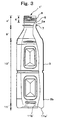
- Fig. 1 shows a front view, with a partial longitudinal section, of the entire preform 1, which is the primary molded product to be used to mold the biaxially drawn, blow-molded bottle.
- the preform 1 has a laminated structure comprising a PET resin layer 2 - a gas barrier layer 3 - a PET resin layer 2.
- the gas barrier material used in this embodiment was a polyamide containing m-xylylene diamine (known under the trade name of MXD-6; Mitsubishi Gas Chemical), taking into consideration the gas barrier property, the difference in viscosity and the difference in the speed of crystallization between the gas barrier material and the PET resin.
- the preform 1 comprises a functional portion 5, which consists of the screw thread 8 raised on the outer wall in the upper portion of the neck 4 and the stop rings 6 circumferentially disposed on the outer wall below the screw thread 8, and also comprises a neck ring 7 disposed in the lower portion of the neck 4.
- the preform 1 comprises the cylindrical shoulder 9, the body 10, and the bottom 11.
- the bottom 11' of the bottle 1' is molded from this bottom 11, and includes a ground contact portion 11a' and a concave portion 11b'.
- Preform 1 is molded in such a manner that the leading edge 3a, the upper end of the gas barrier layer 3, is set at a half height of the neck ring 7.
- the leading edge 3a of the gas barrier layer 3 may be somewhat displaced from the set position of a half height of the neck ring 7. Even if such displacement occurs, the most advanced front of the leading edge 3a does not reach a half height of the stop ring 6 of the neck 4, but can be positioned within ⁇ 7 mm from a half height of the neck ring 7.
- the stop ring 6 has a small height as shown in Fig. 1, the most advanced front of the leading edge 3a does not reach a half height of the stop ring 6 even if the leading edge 3a has been displaced. Therefore, the preform 1 that can be molded has no gas barrier layer in the functional portion 5, which comprises the stop ring 6 and the screw thread 8.
- the preform 1 is molded in such a way that the trailing edge 3b, the lowest end of the gas barrier layer 3, is disposed in the lower portion of the body 10.
- the trailing edge 3b of the gas barrier layer 3 does not reach the bottom 11' of the bottle 1' when the preform 1 has been biaxially drawn and blow-molded into the bottle 1'.
- the bottom 11' of the bottle 1' is defined as the portion comprising the ground contact portion 11a' and the concave portion 11b', including the curved area of the ground contact portion 11a'.
- the above-described preform 1 was molded by the co-injection molding method, and its neck 4 was treated for whitening. After the treatment, the preforms thus obtained were put to a test for the dimensional changes in various portions of the neck 4.
- Fig. 2 shows the results.
- Fig. 2 shows the dimensional changes in various portions of the neck, which have been measured after the whitening treatment, in which the measurements were made by using (a) the preform molded by the PET resin alone (control), (b) the preform of this invention, in which the leading edge 3a has not reached a half height of the stop ring 6 (this invention), and (c) the preform in which the leading edge has reached a position higher than the stop ring 6 (a comparative example).
- vertical axis indicates the dimensional difference, ⁇ d, for the preform (b) and the preform (c), as compared with the preform (a); and the horizontal axis indicates the points of measurements, P, for each preform.
- the preform (b) showed little change in the outer diameter (5) of the screw thread 8 that belonged to the functional portion 5 of the neck 4, the outer diameter (6) of the stop ring 6, the outer diameter (7) in the lower part of the stop ring 6, and the outer diameter (8) of the neck ring 7, as compared with the preform (a).
- the test proved that after the whitening treatment, the neck 4 had been molded in almost the same dimensions as designed.
- the preform (b) also showed little change in (1) the height of the functional portion 5 ranging from the stop ring 6 to the bottle mouth 4a and (2) the neck height ranging from the neck ring 7 to the bottle mouth 4a, as compared with the preform (a) that was molded with the PET resin alone, thus proving that there is no change in the extent of shrinkage for the neck 4.
- the neck of the preform (c) had the leading edge at a position higher than the stop ring 6 and showed larger measurements than in the neck of preform (a) made of PET alone, especially in such items as the outer diameter (5) of the screw thread 8 in the functional portion 5, the outer diameter (6) of the stop ring 6, the outer diameter (7) in the lower part of the stop ring 6, and the outer diameter (8) of the neck ring 7, after the whitening treatment.
- the neck 4 becomes less shrinkable and has larger dimensions than the set values and is unable to have the right dimensions as designed, due to the difference in the degrees of shrinkage between the PET resin and the gas barrier layer 3, which has the leading edge 3a at a position higher than the stop ring 6.
- the neck of the preform (c), with the leading edge 3a extending to a position higher than the stop ring 6, has fairly larger dimensions than the neck of the preform (a) in such items as (1) the height of the functional portion 5 ranging from the stop ring 6 to the bottle mouth 4a and (2) the neck height ranging from the neck ring 7 to the bottle mouth 4a. Since the leading edge 3a of the gas barrier layer 3 has reached the functional portion 5 of the neck 4, it can be clearly confirmed that the whitening treatment makes the neck less shrinkable.
- the neck 4 can be molded precisely in the same dimensions as designed for the preform 1 in which the leading edge 3a of the gas barrier layer 3 has been set at a half height of the neck ring 7 so that even the most advanced front of the leading edge 3a would not reach a half height of the stop ring 6, which is a part of the functional portion 5 of the neck 4.
- the above-described preform 1 was biaxially drawn and blow-molded into the bottle 1'.
- the bottle was filled with a liquid and was put to a test in which a vertical load was applied to the bottle.
- a gas barrier layer 3 with a content of 5.1 wt.% and a thickness of 35 ⁇ m was used, and the trailing edge 3b of this gas barrier layer was set in the lower portion of the body 10.
- the preform 1 having such a gas barrier layer 3 was biaxially drawn and blow-molded into a 500-ml bottle 1' for the test.
- gas barrier materials include gas barrier resins, such as a polyamide containing m-xylylene diamine (known under the trade name of MXD-6), which is used in the embodiment of this invention, and a copolymer of ethylene vinyl alcohol (EVOH); and the mixtures of these gas barrier resins with oxygen-absorbing resins that are commonly used in the form of inorganic or organic metal complexes containing transition metal catalysts (e.g., Co, Fe, Mn, Ni, and Ti) in the matrix of aliphatic and aromatic nylons.
- gas barrier resins such as a polyamide containing m-xylylene diamine (known under the trade name of MXD-6), which is used in the embodiment of this invention, and a copolymer of ethylene vinyl alcohol (EVOH); and the mixtures of these gas barrier resins with oxygen-absorbing resins that are commonly used in the form of inorganic or organic metal complexes containing transition metal catalysts (e.g., Co, Fe, Mn, Ni, and Ti) in the
- the embodiment of this invention shows two types of resins in three layers comprising PET/Gas barrier/PET. It should be understood that this invention is not limited to this embodiment, but it is also possible to use a multilayer structure of two or three types of resins in five layers comprising, for instance, PET/Gas barrier/PET (including recycled material)/Gas barrier/PET.
- the leading edge of the gas barrier layer has been set at the position of the neck where the most advanced front of the leading edge neither reaches a half height of the stop ring that is a part of the functional portion of the neck nor extends to the functional portion of the neck, or has been set at a half height of the neck ring.
- This set position of the leading edge is not affected by the displacement of the leading edge, which is sometimes observed inside the PET resin layers at the preform-molding stage.
- the bottle does not have to face the problem of the neck that shrinks less and increases in dimensions, because the problem is caused simply by the difference in the degrees of shrinkage between the PET resin and the gas barrier material. Instead, the neck can be molded in the right dimensions as designed.
- the functional portion of the neck is treated for whitening without being affected altogether by the gas barrier layer.
- the functional portion can be given the right dimensions as specified.
- the trailing edge of the gas barrier layer is set at the position in the lower portion of the body where the trailing edge does not reach the bottom. Therefore, no gas barrier layer exists in the bottom of the biaxially drawn, blow-molded bottle. Even if the bottle experiences the shock of a vertical load, such as the fall of the bottle, the bottle thus molded is free from any damaged transparency and poor outer appearance that may be caused by the separation of the gas barrier layer from the PET resin layers at the bottom of the bottle.
- the leading edge of the gas barrier layer is set at a half height of the stop ring, which is a part of the functional portion of the neck, or at a position of the neck where the most advanced front of the leading edge does not reach the functional portion of the neck.
- the trailing edge of the gas barrier layer is set at the position in the lower portion of the body.
- the leading edge of the gas barrier layer is positioned at a half height of the neck ring so that the most advanced front of the leading edge neither reaches a half height of the stop ring nor extends to the functional portion of the neck. Because of this setting it is possible, after the whitening treatment, to mold the preform of a laminated structure that can be molded into the bottle with its neck having the right dimensions as designed.
- the trailing edge of the gas barrier layer is set at the position where the trailing edge does not reach the bottom. Therefore, it is possible to mold the preform that in turn can be molded into the biaxially drawn, blow-molded bottle without causing any damaged transparency and poor outer appearance even if the bottle experiences the shock of a vertical load, such as the fall of the bottle.
Landscapes
- Engineering & Computer Science (AREA)
- Mechanical Engineering (AREA)
- Manufacturing & Machinery (AREA)
- Ceramic Engineering (AREA)
- Physics & Mathematics (AREA)
- Geometry (AREA)
- Thermal Sciences (AREA)
- Containers Having Bodies Formed In One Piece (AREA)
- Blow-Moulding Or Thermoforming Of Plastics Or The Like (AREA)
- Laminated Bodies (AREA)
Abstract
Description
Claims (7)
- A biaxially drawn, blow-molded bottle (1') comprising:wherein the leading edge (3a) of said gas barrier layer (3) is disposed at a position of the neck (4') where the most advanced front of the leading edge (3a) does not reach a half height of said stop ring (6) and wherein the neck (4') is treated for thermal crystallization.at least a layer of a gas barrier material (3) laminated inside the layers predominantly made of polyethylene terephthalate (2);a functional portion (5') having a screw thread (8) raised spirally in the upper portion of neck (4') and also having a stop ring (6) disposed under said screw thread (8); anda neck ring (7) disposed at the lower end of the neck (4'),
- The biaxially drawn, blow-molded bottle according to Claim 1, wherein the leading edge (3a) of said gas barrier layer (3) is disposed at a position of the neck (4') where the most advanced front of the leading edge (3a) does not reach the functional portion (5').
- The biaxially drawn, blow-molded bottle according to Claim 1, wherein the leading edge (3a) of said gas barrier layer (3) is disposed at a position within a range of ±7 mm from a half height of the neck ring (7).
- A biaxially drawn, blow-molded bottle (1') comprising at least a layer of a gas barrier material (3) laminated inside layers (2) predominantly made of a polyethylene terephthalate resin, wherein the trailing edge (3b) of said gas barrier layer (3) is disposed in the lower portion of body (10') where said trailing edge (3b) does not reach bottom (11') of said bottle (1').
- The biaxially drawn, blow-molded bottle (1') according to Claim 1, 2, or 3, wherein the trailing edge (3b) of said gas barrier layer (3) is disposed in the lower portion of body (10') where said trailing edge (3b) does not reach the bottom (11') of said bottle (1').
- Preform (1) of a biaxially drawn, blow-molded bottle (1') comprising:wherein the leading edge (3a) of said gas barrier layer (3) is positioned at a half height of the neck ring (7) so that the most advanced front of the leading edge (3a) neither reaches a half height of said stop ring (6) nor extends to said functional portion (5) and wherein the neck (4) is treated for thermal crystallization.at least a layer of a gas barrier material (3) laminated inside the layers (2) predominantly made of a polyethylene terephthalate resin;a functional portion (5) having a screw thread (8) raised spirally in the upper portion of neck (4) and also having a stop ring (6) disposed under said screw thread (8); anda neck ring (7) disposed at the lower end of the neck (4),
- Preform (1) of a biaxially drawn, blow-molded bottle (1') comprising at least a layer of a gas barrier material (3) laminated inside layers (2) predominantly made of a polyethylene terephthalate resin, wherein the trailing edge (3b) of said gas barrier layer (3) is disposed in the lower portion of body (10) so that said trailing edge (3b) does not reach the bottom (11') of said bottle (1').
Priority Applications (1)
| Application Number | Priority Date | Filing Date | Title |
|---|---|---|---|
| EP20070011607 EP1829786B1 (en) | 2002-01-29 | 2003-01-29 | Biaxially drawn, blow-molded bottle and its preform |
Applications Claiming Priority (3)
| Application Number | Priority Date | Filing Date | Title |
|---|---|---|---|
| JP2002019866A JP2003220641A (en) | 2002-01-29 | 2002-01-29 | Biaxially stretched blow molded bottle and its primary molded product |
| JP2002019866 | 2002-01-29 | ||
| PCT/JP2003/000817 WO2003064268A1 (en) | 2002-01-29 | 2003-01-29 | Biaxially oriented blow-molded bottles and preform thereof |
Related Child Applications (2)
| Application Number | Title | Priority Date | Filing Date |
|---|---|---|---|
| EP20070011607 Division EP1829786B1 (en) | 2002-01-29 | 2003-01-29 | Biaxially drawn, blow-molded bottle and its preform |
| EP07011607.4 Division-Into | 2007-06-13 |
Publications (3)
| Publication Number | Publication Date |
|---|---|
| EP1498355A1 true EP1498355A1 (en) | 2005-01-19 |
| EP1498355A4 EP1498355A4 (en) | 2006-05-10 |
| EP1498355B1 EP1498355B1 (en) | 2012-08-08 |
Family
ID=27654301
Family Applications (2)
| Application Number | Title | Priority Date | Filing Date |
|---|---|---|---|
| EP20030703067 Expired - Lifetime EP1498355B1 (en) | 2002-01-29 | 2003-01-29 | Biaxially oriented blow-molded bottles and preform thereof |
| EP20070011607 Expired - Lifetime EP1829786B1 (en) | 2002-01-29 | 2003-01-29 | Biaxially drawn, blow-molded bottle and its preform |
Family Applications After (1)
| Application Number | Title | Priority Date | Filing Date |
|---|---|---|---|
| EP20070011607 Expired - Lifetime EP1829786B1 (en) | 2002-01-29 | 2003-01-29 | Biaxially drawn, blow-molded bottle and its preform |
Country Status (10)
| Country | Link |
|---|---|
| US (2) | US7976918B2 (en) |
| EP (2) | EP1498355B1 (en) |
| JP (1) | JP2003220641A (en) |
| KR (1) | KR20040076578A (en) |
| CN (1) | CN1251931C (en) |
| AU (2) | AU2003208053B2 (en) |
| CA (2) | CA2471581C (en) |
| DE (1) | DE60330920D1 (en) |
| TW (1) | TWI248864B (en) |
| WO (1) | WO2003064268A1 (en) |
Cited By (4)
| Publication number | Priority date | Publication date | Assignee | Title |
|---|---|---|---|---|
| DE102005018245A1 (en) * | 2005-04-19 | 2006-10-26 | Mht Mold & Hotrunner Technology Ag | Multilayer preform, multilayer hollow body and process for their preparation |
| WO2010045325A1 (en) * | 2008-10-15 | 2010-04-22 | The Coca-Cola Company | Plastic bottle with a mouth |
| EP2404838A4 (en) * | 2009-03-03 | 2012-08-29 | Toyo Seikan Kaisha Ltd | MULTILAYER PLASTIC CONTAINER WITH INCREASED FALL AND SHOCK STRENGTH |
| US11951654B2 (en) | 2017-12-13 | 2024-04-09 | Amcor Rigid Packaging Usa, Llc | Passive barrier layer placement within carbonated beverage container wall to improve shelf-life |
Families Citing this family (15)
| Publication number | Priority date | Publication date | Assignee | Title |
|---|---|---|---|---|
| JP2003220641A (en) * | 2002-01-29 | 2003-08-05 | Yoshino Kogyosho Co Ltd | Biaxially stretched blow molded bottle and its primary molded product |
| JP2004160935A (en) * | 2002-11-15 | 2004-06-10 | Mitsubishi Gas Chem Co Inc | Multilayer container |
| US8857637B2 (en) | 2006-03-06 | 2014-10-14 | Plastipak Packaging, Inc. | Lightweight plastic container and preform |
| US10214312B2 (en) | 2006-03-06 | 2019-02-26 | Plastipak Packaging, Inc. | Lightweight plastic container and preform |
| JP4223520B2 (en) * | 2006-06-19 | 2009-02-12 | 中本パックス株式会社 | Heat-resistant transparent container |
| CN100457954C (en) * | 2007-06-22 | 2009-02-04 | 钢铁研究总院 | A high-capacity Mg2Ni type hydrogen storage alloy amorphous strip and its preparation method |
| JP5329120B2 (en) * | 2008-04-30 | 2013-10-30 | 株式会社吉野工業所 | Stacked bottles |
| JP5262407B2 (en) * | 2008-08-05 | 2013-08-14 | 藤森工業株式会社 | Multi-layer liquid container |
| US9221204B2 (en) * | 2013-03-14 | 2015-12-29 | Kortec, Inc. | Techniques to mold parts with injection-formed aperture in gate area |
| EP3231576B1 (en) | 2014-12-08 | 2022-06-01 | Dai Nippon Printing Co., Ltd. | Method for producing composite container |
| WO2016168520A1 (en) * | 2015-04-14 | 2016-10-20 | Medway Plastics Corporation | Receptacle with shield |
| EP3442874A4 (en) * | 2016-04-11 | 2020-01-08 | Dak Americas LLC | POLYESTER CONTAINERS AND FILMS WITH REDUCED GAS PERMEABILITY |
| CN110087518B (en) * | 2016-10-25 | 2022-06-28 | 艾伦·马克·克劳利 | Improvement of Double Wall Containers |
| US10259155B2 (en) * | 2017-06-29 | 2019-04-16 | Discma Ag | Preform for a blow molding operation |
| JP7131122B2 (en) * | 2018-06-22 | 2022-09-06 | 大日本印刷株式会社 | Preform, preform manufacturing method and plastic bottle manufacturing method |
Family Cites Families (25)
| Publication number | Priority date | Publication date | Assignee | Title |
|---|---|---|---|---|
| GB2024087B (en) | 1978-06-29 | 1982-08-25 | Yoshino Kogyosho Co Ltd | Blow moulding polyester container |
| AU549286B2 (en) * | 1981-01-22 | 1986-01-23 | Toyo Boseki K.K. | Blow moulded multiply vessel |
| JPS57189824A (en) * | 1981-05-19 | 1982-11-22 | Yoshino Kogyosho Co Ltd | Method of strengthening cylindrical mouthpiece of bottle made of polyethylene telephthalate resin |
| JPS57128516A (en) | 1981-10-23 | 1982-08-10 | Toyobo Co Ltd | Blow-molded container having multilayer construction and method for producing the same |
| JPS61203332A (en) * | 1985-02-28 | 1986-09-09 | 東洋製罐株式会社 | Shock-resistant plastic vessel |
| JPS61273927A (en) * | 1985-05-30 | 1986-12-04 | Takahiro Sakai | Manufacture of pet bottle having gas barrier property |
| JPH0725097B2 (en) | 1986-08-29 | 1995-03-22 | 大日本インキ化学工業株式会社 | FRP molding method |
| JPH0348015Y2 (en) * | 1986-10-02 | 1991-10-14 | ||
| JPS63294342A (en) * | 1987-05-20 | 1988-12-01 | Toyo Seikan Kaisha Ltd | Injection-blow molding multilayer container |
| DE3740343A1 (en) | 1987-11-27 | 1989-06-08 | Krupp Corpoplast Masch | METHOD FOR PRODUCING A BLOW-MOLDED CONTAINER FROM A THERMOPLASTIC POLYESTER, IN PARTICULAR PET |
| JPH01254539A (en) * | 1988-03-30 | 1989-10-11 | Toyo Seikan Kaisha Ltd | Heat and pressure resistant multiple layer container and its manufacture method |
| US5464106A (en) | 1994-07-06 | 1995-11-07 | Plastipak Packaging, Inc. | Multi-layer containers |
| ATE523315T1 (en) | 1997-04-16 | 2011-09-15 | Husky Injection Molding | INJECTION MOLDING DEVICE WITH COOLING CORE |
| US5927525A (en) * | 1997-04-28 | 1999-07-27 | Plastipak Packaging, Inc. | Multi-layer containers and preforms |
| US6123211A (en) * | 1997-10-14 | 2000-09-26 | American National Can Company | Multilayer plastic container and method of making the same |
| EP1029664A1 (en) * | 1999-02-20 | 2000-08-23 | Karl Hehl | Multilayered hollow plastic article |
| GB9926601D0 (en) * | 1999-11-11 | 2000-01-12 | Crown Cork & Seal Tech Corp | Polyester containers |
| JP3858113B2 (en) * | 1999-11-30 | 2006-12-13 | 株式会社吉野工業所 | Heat resistant polyester resin laminate container and molding method thereof |
| EP1155807B1 (en) * | 1999-11-30 | 2005-02-09 | Yoshino Kogyosho Co., Ltd. | Method for molding a multilayered polyester container |
| AU2001253915A1 (en) * | 2000-04-28 | 2001-11-12 | Advanced Plastics Technologies, Ltd. | Bottles and preforms having a crystalline neck |
| US6596213B2 (en) * | 2001-04-06 | 2003-07-22 | Kortec, Inc. | Method of molding multi-layer polymer plastic articles with control of relative shifting of the core layer |
| JP4547843B2 (en) * | 2001-08-30 | 2010-09-22 | 株式会社吉野工業所 | Primary molded product and casing of biaxially stretched blow molded casing |
| JP2003220641A (en) | 2002-01-29 | 2003-08-05 | Yoshino Kogyosho Co Ltd | Biaxially stretched blow molded bottle and its primary molded product |
| US20080251487A1 (en) | 2002-10-30 | 2008-10-16 | Semersky Frank E | Overmolded container having a foam layer |
| JP4771315B2 (en) | 2006-08-31 | 2011-09-14 | 株式会社吉野工業所 | Multi-layer blow container |
-
2002
- 2002-01-29 JP JP2002019866A patent/JP2003220641A/en active Pending
-
2003
- 2003-01-29 CA CA 2471581 patent/CA2471581C/en not_active Expired - Lifetime
- 2003-01-29 AU AU2003208053A patent/AU2003208053B2/en not_active Ceased
- 2003-01-29 EP EP20030703067 patent/EP1498355B1/en not_active Expired - Lifetime
- 2003-01-29 KR KR10-2003-7014316A patent/KR20040076578A/en not_active Ceased
- 2003-01-29 TW TW92101997A patent/TWI248864B/en not_active IP Right Cessation
- 2003-01-29 CN CNB038001985A patent/CN1251931C/en not_active Expired - Fee Related
- 2003-01-29 EP EP20070011607 patent/EP1829786B1/en not_active Expired - Lifetime
- 2003-01-29 US US10/497,784 patent/US7976918B2/en not_active Expired - Fee Related
- 2003-01-29 WO PCT/JP2003/000817 patent/WO2003064268A1/en not_active Ceased
- 2003-01-29 DE DE60330920T patent/DE60330920D1/en not_active Expired - Lifetime
- 2003-01-29 CA CA 2675421 patent/CA2675421C/en not_active Expired - Lifetime
-
2008
- 2008-05-21 US US12/153,569 patent/US8800794B2/en not_active Expired - Fee Related
-
2009
- 2009-02-18 AU AU2009200632A patent/AU2009200632B2/en not_active Ceased
Cited By (4)
| Publication number | Priority date | Publication date | Assignee | Title |
|---|---|---|---|---|
| DE102005018245A1 (en) * | 2005-04-19 | 2006-10-26 | Mht Mold & Hotrunner Technology Ag | Multilayer preform, multilayer hollow body and process for their preparation |
| WO2010045325A1 (en) * | 2008-10-15 | 2010-04-22 | The Coca-Cola Company | Plastic bottle with a mouth |
| EP2404838A4 (en) * | 2009-03-03 | 2012-08-29 | Toyo Seikan Kaisha Ltd | MULTILAYER PLASTIC CONTAINER WITH INCREASED FALL AND SHOCK STRENGTH |
| US11951654B2 (en) | 2017-12-13 | 2024-04-09 | Amcor Rigid Packaging Usa, Llc | Passive barrier layer placement within carbonated beverage container wall to improve shelf-life |
Also Published As
| Publication number | Publication date |
|---|---|
| JP2003220641A (en) | 2003-08-05 |
| US20080251488A1 (en) | 2008-10-16 |
| CN1507402A (en) | 2004-06-23 |
| AU2009200632A1 (en) | 2009-03-12 |
| TWI248864B (en) | 2006-02-11 |
| CA2471581C (en) | 2012-08-07 |
| EP1498355B1 (en) | 2012-08-08 |
| US20050139566A1 (en) | 2005-06-30 |
| US7976918B2 (en) | 2011-07-12 |
| AU2003208053B2 (en) | 2010-04-08 |
| CA2675421A1 (en) | 2003-08-07 |
| KR20040076578A (en) | 2004-09-01 |
| AU2009200632B2 (en) | 2012-05-17 |
| CN1251931C (en) | 2006-04-19 |
| US8800794B2 (en) | 2014-08-12 |
| WO2003064268A1 (en) | 2003-08-07 |
| EP1829786B1 (en) | 2010-01-06 |
| TW200304868A (en) | 2003-10-16 |
| DE60330920D1 (en) | 2010-02-25 |
| EP1829786A1 (en) | 2007-09-05 |
| EP1498355A4 (en) | 2006-05-10 |
| CA2675421C (en) | 2012-03-06 |
| CA2471581A1 (en) | 2003-08-07 |
Similar Documents
| Publication | Publication Date | Title |
|---|---|---|
| US8800794B2 (en) | Biaxially drawn, blow-molded bottle and its preform | |
| US12060194B2 (en) | Container system and method of manufacture | |
| US6548133B2 (en) | Multilayer container resistant to elevated temperatures and pressures, and method of making the same | |
| EP1344618A1 (en) | Synthetic resin biaxial oriented blow formed preform for forming bottle body | |
| JPH1190975A (en) | Multilayer preform with recovery polyester resin layer, manufacture of the preform, and multilayer container molded from the preform | |
| US8524340B2 (en) | Primary molded product for biaxial stretch blow molded bottle body, and bottle body | |
| EP3991937B1 (en) | Apparatus for producing resin molded article, method for producing resin molded article, and resin molded article | |
| CN108247989A (en) | Moulding article, container and its molding and recovery method | |
| JPH10337770A (en) | Multilayer preform having recovered polyester resin layer, method for producing the same, and multilayer container molded from the multilayer preform | |
| JP2004074614A (en) | Thermal crystallization method for neck and neck of primary molded article of biaxially stretch blow molded bottle and jig used for the method | |
| EP2522479B1 (en) | Plastic prefom or container with a recessed orientation slot, process of manufacturing a rigid container, process for angularly orienting a preform and process of detecting the orientation of a preform | |
| JP7639560B2 (en) | Preform and method for manufacturing synthetic resin container | |
| JP2005239275A (en) | Biaxial stretch blow molding housing | |
| JP3239989B2 (en) | Biaxial stretch blow molded container | |
| JP2025159792A (en) | Synthetic resin containers and preforms | |
| JPH0449010A (en) | Manufacture of preform of biaxially-oriented blow molding vessel | |
| JPH02258543A (en) | Synthetic resin vessel | |
| JPS6394814A (en) | Base cup for carbonated deverage container |
Legal Events
| Date | Code | Title | Description |
|---|---|---|---|
| PUAI | Public reference made under article 153(3) epc to a published international application that has entered the european phase |
Free format text: ORIGINAL CODE: 0009012 |
|
| 17P | Request for examination filed |
Effective date: 20040611 |
|
| AK | Designated contracting states |
Kind code of ref document: A1 Designated state(s): AT BE BG CH CY CZ DE DK EE ES FI FR GB GR HU IE IT LI LU MC NL PT SE SI SK TR |
|
| AX | Request for extension of the european patent |
Extension state: AL LT LV MK RO |
|
| A4 | Supplementary search report drawn up and despatched |
Effective date: 20060324 |
|
| R17C | First examination report despatched (corrected) |
Effective date: 20070126 |
|
| APBK | Appeal reference recorded |
Free format text: ORIGINAL CODE: EPIDOSNREFNE |
|
| APBN | Date of receipt of notice of appeal recorded |
Free format text: ORIGINAL CODE: EPIDOSNNOA2E |
|
| APBR | Date of receipt of statement of grounds of appeal recorded |
Free format text: ORIGINAL CODE: EPIDOSNNOA3E |
|
| APAV | Appeal reference deleted |
Free format text: ORIGINAL CODE: EPIDOSDREFNE |
|
| APBT | Appeal procedure closed |
Free format text: ORIGINAL CODE: EPIDOSNNOA9E |
|
| GRAP | Despatch of communication of intention to grant a patent |
Free format text: ORIGINAL CODE: EPIDOSNIGR1 |
|
| RIN1 | Information on inventor provided before grant (corrected) |
Inventor name: HASHIMOTO, AKIO Inventor name: SHIMURA, HIROMI Inventor name: SUZUKI, MASATO Inventor name: UESUGI, DAISUKE |
|
| GRAS | Grant fee paid |
Free format text: ORIGINAL CODE: EPIDOSNIGR3 |
|
| GRAA | (expected) grant |
Free format text: ORIGINAL CODE: 0009210 |
|
| AK | Designated contracting states |
Kind code of ref document: B1 Designated state(s): DE FR GB |
|
| REG | Reference to a national code |
Ref country code: GB Ref legal event code: FG4D |
|
| REG | Reference to a national code |
Ref country code: DE Ref legal event code: R096 Ref document number: 60341733 Country of ref document: DE Effective date: 20121011 |
|
| PLBE | No opposition filed within time limit |
Free format text: ORIGINAL CODE: 0009261 |
|
| STAA | Information on the status of an ep patent application or granted ep patent |
Free format text: STATUS: NO OPPOSITION FILED WITHIN TIME LIMIT |
|
| 26N | No opposition filed |
Effective date: 20130510 |
|
| REG | Reference to a national code |
Ref country code: DE Ref legal event code: R097 Ref document number: 60341733 Country of ref document: DE Effective date: 20130510 |
|
| REG | Reference to a national code |
Ref country code: FR Ref legal event code: PLFP Year of fee payment: 14 |
|
| REG | Reference to a national code |
Ref country code: FR Ref legal event code: PLFP Year of fee payment: 15 |
|
| REG | Reference to a national code |
Ref country code: FR Ref legal event code: PLFP Year of fee payment: 16 |
|
| PGFP | Annual fee paid to national office [announced via postgrant information from national office to epo] |
Ref country code: FR Payment date: 20201210 Year of fee payment: 19 |
|
| PGFP | Annual fee paid to national office [announced via postgrant information from national office to epo] |
Ref country code: GB Payment date: 20210120 Year of fee payment: 19 Ref country code: DE Payment date: 20210119 Year of fee payment: 19 |
|
| REG | Reference to a national code |
Ref country code: DE Ref legal event code: R119 Ref document number: 60341733 Country of ref document: DE |
|
| GBPC | Gb: european patent ceased through non-payment of renewal fee |
Effective date: 20220129 |
|
| PG25 | Lapsed in a contracting state [announced via postgrant information from national office to epo] |
Ref country code: GB Free format text: LAPSE BECAUSE OF NON-PAYMENT OF DUE FEES Effective date: 20220129 Ref country code: DE Free format text: LAPSE BECAUSE OF NON-PAYMENT OF DUE FEES Effective date: 20220802 |
|
| PG25 | Lapsed in a contracting state [announced via postgrant information from national office to epo] |
Ref country code: FR Free format text: LAPSE BECAUSE OF NON-PAYMENT OF DUE FEES Effective date: 20220131 |