EP1496887B1 - Personal care compositions comprising a zinc containing material in an aqueous surfactant composition - Google Patents
Personal care compositions comprising a zinc containing material in an aqueous surfactant composition Download PDFInfo
- Publication number
- EP1496887B1 EP1496887B1 EP03714275.9A EP03714275A EP1496887B1 EP 1496887 B1 EP1496887 B1 EP 1496887B1 EP 03714275 A EP03714275 A EP 03714275A EP 1496887 B1 EP1496887 B1 EP 1496887B1
- Authority
- EP
- European Patent Office
- Prior art keywords
- zinc
- composition
- compositions
- available
- sodium
- Prior art date
- Legal status (The legal status is an assumption and is not a legal conclusion. Google has not performed a legal analysis and makes no representation as to the accuracy of the status listed.)
- Expired - Lifetime
Links
- UXZFQZANDVDGMM-UHFFFAOYSA-N Oc(c(nccc1)c1c(I)c1)c1I Chemical compound Oc(c(nccc1)c1c(I)c1)c1I UXZFQZANDVDGMM-UHFFFAOYSA-N 0.000 description 1
Classifications
-
- A—HUMAN NECESSITIES
- A61—MEDICAL OR VETERINARY SCIENCE; HYGIENE
- A61Q—SPECIFIC USE OF COSMETICS OR SIMILAR TOILETRY PREPARATIONS
- A61Q5/00—Preparations for care of the hair
- A61Q5/006—Antidandruff preparations
-
- A—HUMAN NECESSITIES
- A61—MEDICAL OR VETERINARY SCIENCE; HYGIENE
- A61K—PREPARATIONS FOR MEDICAL, DENTAL OR TOILETRY PURPOSES
- A61K31/00—Medicinal preparations containing organic active ingredients
- A61K31/28—Compounds containing heavy metals
- A61K31/315—Zinc compounds
-
- A—HUMAN NECESSITIES
- A61—MEDICAL OR VETERINARY SCIENCE; HYGIENE
- A61K—PREPARATIONS FOR MEDICAL, DENTAL OR TOILETRY PURPOSES
- A61K8/00—Cosmetics or similar toiletry preparations
- A61K8/18—Cosmetics or similar toiletry preparations characterised by the composition
- A61K8/19—Cosmetics or similar toiletry preparations characterised by the composition containing inorganic ingredients
- A61K8/27—Zinc; Compounds thereof
-
- A—HUMAN NECESSITIES
- A61—MEDICAL OR VETERINARY SCIENCE; HYGIENE
- A61K—PREPARATIONS FOR MEDICAL, DENTAL OR TOILETRY PURPOSES
- A61K8/00—Cosmetics or similar toiletry preparations
- A61K8/18—Cosmetics or similar toiletry preparations characterised by the composition
- A61K8/30—Cosmetics or similar toiletry preparations characterised by the composition containing organic compounds
- A61K8/49—Cosmetics or similar toiletry preparations characterised by the composition containing organic compounds containing heterocyclic compounds
- A61K8/4906—Cosmetics or similar toiletry preparations characterised by the composition containing organic compounds containing heterocyclic compounds with one nitrogen as the only hetero atom
- A61K8/4933—Cosmetics or similar toiletry preparations characterised by the composition containing organic compounds containing heterocyclic compounds with one nitrogen as the only hetero atom having sulfur as an exocyclic substituent, e.g. pyridinethione
-
- A—HUMAN NECESSITIES
- A61—MEDICAL OR VETERINARY SCIENCE; HYGIENE
- A61P—SPECIFIC THERAPEUTIC ACTIVITY OF CHEMICAL COMPOUNDS OR MEDICINAL PREPARATIONS
- A61P17/00—Drugs for dermatological disorders
-
- A—HUMAN NECESSITIES
- A61—MEDICAL OR VETERINARY SCIENCE; HYGIENE
- A61P—SPECIFIC THERAPEUTIC ACTIVITY OF CHEMICAL COMPOUNDS OR MEDICINAL PREPARATIONS
- A61P31/00—Antiinfectives, i.e. antibiotics, antiseptics, chemotherapeutics
- A61P31/04—Antibacterial agents
-
- A—HUMAN NECESSITIES
- A61—MEDICAL OR VETERINARY SCIENCE; HYGIENE
- A61P—SPECIFIC THERAPEUTIC ACTIVITY OF CHEMICAL COMPOUNDS OR MEDICINAL PREPARATIONS
- A61P31/00—Antiinfectives, i.e. antibiotics, antiseptics, chemotherapeutics
- A61P31/10—Antimycotics
-
- A—HUMAN NECESSITIES
- A61—MEDICAL OR VETERINARY SCIENCE; HYGIENE
- A61Q—SPECIFIC USE OF COSMETICS OR SIMILAR TOILETRY PREPARATIONS
- A61Q17/00—Barrier preparations; Preparations brought into direct contact with the skin for affording protection against external influences, e.g. sunlight, X-rays or other harmful rays, corrosive materials, bacteria or insect stings
- A61Q17/005—Antimicrobial preparations
-
- A—HUMAN NECESSITIES
- A61—MEDICAL OR VETERINARY SCIENCE; HYGIENE
- A61Q—SPECIFIC USE OF COSMETICS OR SIMILAR TOILETRY PREPARATIONS
- A61Q5/00—Preparations for care of the hair
- A61Q5/02—Preparations for cleaning the hair
Definitions
- Certain embodiments of the present invention relate to personal care compositions and methods of treating microbial and fungal infections on the skin or scalp. Additionally, certain embodiments of the present invention relate to methods for the treatment of dandruff and compositions which provide improved anti-dandruff activity.
- the subject-matter of the present invention is defined in claim 1.
- Zinc appears especially important to skin health and has been used (typically in the form of zinc oxide or calamine) for over 3000 years to control a variety of skin problems. Recent data more specifically points to the healing and repairing properties of topical zinc treatment to damaged skin, often resulting in increased rates of healing. There is a growing body of biochemical support for this phenomenon. Since dandruff has been previously shown to represent significant damage to scalp skin, topical zinc treatment could aid in the repair process.
- Inorganic salts such as zinc oxide
- zinc oxide have been employed as bacteriostatic and/or fungistatic compounds in a large variety of products including paints, coatings and antiseptics.
- zinc salts do not possess as high of a level of biocidal efficacy as might be desired for many anti-dandruff and skin care applications.
- An embodiment of the present invention is directed to a composition
- a composition comprising an effective amount of a zinc containing material having an aqueous solubility within the composition of less than about 25% by weight at 25°C in the form zinc oxide, from about 5% to about 50% of a surfactant; and from about 0.1% to about 5% of a zinc ionophoric material; from about 40% to about 95% water; and wherein the pH of the composition is greater than about 7 and wherein the composition further comprises a component selected from the group consisting of sodium bicarbonate, sources of carbonate anions and mixtures thereof.
- anti-dandruff efficacy can be dramatically increased in topical compositions by the use of polyvalent metal salts of pyrithione, such as zinc pyrithione, in combination with zinc oxide. Therefore an embodiment of the present invention provides topical compositions with improved benefits to the skin and scalp (e.g., improved antidandruff efficacy).
- An embodiment of the present invention provides a stable composition for zinc containing material (zinc oxide) dispersion where the zinc containing material resides in a particulate form. It has been shown to be challenging to formulate aqueous systems containing a zinc containing material such as zinc oxide, due to their unique physical and chemical properties. They have a high density (i.e. 3 g/cm3), and needs to be evenly dispersed throughout the product so it will not aggregate or settle. They also have a very-reactive surface chemistry as well as the propensity to dissolve in systems with pH values below 7.5. This has provided a unique understanding concerning the need to control proton sources or other reactive/coordinating species (e.g., EDTA, citrate).
- EDTA reactive/coordinating species
- An embodiment of the present invention provides topical skin and/or hair compositions which provide superior benefits from zinc oxide.
- An embodiment of the present invention also provides a method for cleansing the hair and/or skin.
- the present invention can comprise, consist of, or consist essentially of the essential elements and limitations of the invention described herein, as well any of the additional or optional ingredients, components, or limitations described herein.
- compositions and methods/processes of the present invention can comprise, consist of, and consist essentially of the essential elements and limitations of the invention described herein, as well as any of the additional or optional ingredients, components, steps, or limitations described herein.
- effective means an amount of a subject active high enough to provide a significant positive modification of the condition to be treated.
- An effective amount of the subject active will vary with the particular condition being treated, the severity of the condition, the duration of the treatment, the nature of concurrent treatment, and like factors.
- the zinc containing material is ZnO.
- Preferred embodiments of the present invention include from 0.001% to 10% of a zinc containing material; more preferably from 0.01% to 5%; more preferably still from 0.1% to 3%.
- the zinc containing material has an average particle size of from 100 nm to 30 ⁇ m.
- ZCM Solubility A zinc containing material with a solubility of less than 25% will have a measurable % soluble zinc value below a threshold value determined by the weight percent and molecular weight of the zinc compound.
- the theoretical threshold value can be calculated by the following equation (see examples in the Table): 0.25 * wt.% Zn Compoundin Composition * molesof Zincin Compound* 65.39 (MW of Zn) MW of Zn Compound Zinc Compound Formula % Zn Compound in Composition % soluble Zn +2 ; (if 25 wt.% of zinc source is soluble)* Zinc Oxide ZnO 1.0% 0.20% Zinc Carbonate Basic (Hydrozincite) Zn 5 (CO 3 ) 2 (OH) 6 1.0% 0.15% Zinc Stearate Zn(C 18 H 35 0 2 ) 2 1.0% 0.026%
- ZIM Zinc Ionophoric Material
- the composition further includes a zinc ionophoric material.
- zinc ionophoric material and “ZIM” means a material which is or forms a hydrophobic molecule capable of increasing cell permeability to zinc ions (i.e., exhibiting zinc ionophoric behavior).
- ZIMs shield the charge of the zinc ion to be transported, enabling it to penetrate the hydrophobic interior of the lipid bilayer.
- ZIMs may be channel-forming ionophores or mobile ion carriers.
- ZIMs may be those commonly known as zinc ionophores or those that are hydrophobic zinc chelators that possess zinc ionophoric behavior.
- Hydrophobic zinc chelators are materials that bind zinc and increase hydrophobicity of zinc ions such that, for example, it will partition into nonaqueous solvents.
- ZIMs can be effective including zinc being present in the composition or zinc being available within the system wherein a ZIM is present, yet preferred ZIMs contain zinc ions; i.e, zinc salt forms of materials exhibiting zinc ionophoric behavior.
- Preferred embodiments include from 0.1% to 2% of a ZIM.
- the ratio of zinc containing material to ZIM is preferably from 5:100 to 5:1; more preferably from about 2:10 to 3:1; more preferably still from 1:2 to 2:1.
- the ZIM has a potency against target microorganisms such that the minimum inhibitory concentration ("MIC") is below 5000 parts per million.
- MIC is a measurement well understood by those skilled in the art and is indicative of anti-fungal efficacy.
- the lower the value of the composition the better its anti-fungal efficacy, due to increased inherent ability of the anti-dandruff agent to inhibit the growth of microorganisms.
- the lowest tested dilution of anti-microbial active that yields no growth is defined as the MIC.
- the ZIM is pyrithione or a polyvalent metal salt of pyrithione.
- Any form of polyvalent metal pyrithione salts may be used, including platelet and needle structures.
- Preferred salts for use herein include those formed from the polyvalent metals magnesium, barium, bismuth, strontium, copper, zinc, cadmium, zirconium and mixtures thereof, more preferably zinc.
- Even more preferred for use herein is the zinc salt of 1-hydroxy-2-pyridinethione (known as "zinc pyrithione" or "ZPT"); more preferably ZPT in platelet particle form, wherein the particles have an average size of up to about 20 ⁇ m, preferably up to about 5 ⁇ m, more preferably up to about 2.5 ⁇ m.
- Zinc pyrithione may be made by reacting 1-hydroxy-2-pyridinethione (i.e., pyrithione acid) or a soluble salt thereof with a zinc salt (e.g. zinc sulfate) to form a zinc pyrithione precipitate, as illustrated in U.S. Patent No. 2,809,971 .
- a zinc salt e.g. zinc sulfate
- the composition of the present invention is in the form of a topical compositions, which includes a topical carrier.
- a topical carrier is selected from a broad range of traditional personal care carriers depending on the type of composition to be formed.
- suitable selections of compatible carriers it is contemplated that such a composition is prepared in the form of daily skin or hair products including conditioning treatments, cleansing products, such as hair and/or scalp shampoos, body washes, hand cleansers, water-less hand sanitizer/cleansers, facial cleansers and the like.
- the carrier is water.
- the compositions of the present invention comprise from 40% to 95% water by weight of the composition; preferably from 50% to 85%, more preferably still from 60% to 80%.
- the composition of the present invention includes a detersive surfactant.
- the detersive surfactant component is included to provide cleaning performance to the composition.
- the detersive surfactant component in turn comprises anionic detersive surfactant, zwitterionic or amphoteric detersive surfactant, or a combination thereof.
- Such surfactants should be physically and chemically compatible with the essential components described herein, or should not otherwise unduly impair product stability, aesthetics or performance.
- Suitable anionic detersive surfactant components for use in the composition herein include those which are known for use in hair care or other personal care cleansing compositions.
- concentration of the anionic surfactant component in the composition should be sufficient to provide the desired cleaning and lather performance, and range from about 5% to about 50%, preferably from about 8% to about 30%, more preferably from about 10% to about 25%, even more preferably from about 12% to about 22%.
- Preferred anionic surfactants suitable for use in the compositions are the alkyl and alkyl ether sulfates. These materials have the respective formulae ROSO 3 M and RO(C 2 H 4 O) x SO 3 M, wherein R is alkyl or alkenyl of from about 8 to about 18 carbon atoms, x is an integer having a value of from 1 to 10, and M is a cation such as ammonium, alkanolamines, such as triethanolamine, monovalent metals, such as sodium and potassium, and polyvalent metal cations, such as magnesium, and calcium.
- R alkyl or alkenyl of from about 8 to about 18 carbon atoms
- x is an integer having a value of from 1 to 10
- M is a cation such as ammonium, alkanolamines, such as triethanolamine, monovalent metals, such as sodium and potassium, and polyvalent metal cations, such as magnesium, and calcium.
- R has from about 8 to about 18 carbon atoms, more preferably from about 10 to about 16 carbon atoms, even more preferably from about 12 to about 14 carbon atoms, in both the alkyl and alkyl ether sulfates.
- the alkyl ether sulfates are typically made as condensation products of ethylene oxide and monohydric alcohols having from about 8 to about 24 carbon atoms.
- the alcohols can be synthetic or they can be derived from fats, e.g., coconut oil, palm kernel oil, tallow. Lauryl alcohol and straight chain alcohols derived from coconut oil or palm kernel oil are preferred.
- Such alcohols are reacted with between about 0 and about 10, preferably from about 2 to about 5, more preferably about 3, molar proportions of ethylene oxide, and the resulting mixture of molecular species having, for example, an average of 3 moles of ethylene oxide per mole of alcohol, is sulfated and neutralized.
- Suitable anionic detersive surfactants are the water-soluble salts of organic, sulfuric acid reaction products conforming to the formula [R 1 -SO 3 -M] where R 1 is a straight or branched chain, saturated, aliphatic hydrocarbon radical having from about 8 to about 24, preferably about 10 to about 18, carbon atoms; and M is a cation described hereinbefore.
- anionic detersive surfactants are the reaction products of fatty acids esterified with isethionic acid and neutralized with sodium hydroxide where, for example, the fatty acids are derived from coconut oil or palm kernel oil; sodium or potassium salts of fatty acid amides of methyl tauride in which the fatty acids, for example, are derived from coconut oil or palm kernel oil.
- Other similar anionic surfactants are described in U.S. Pat. Nos. 2,486,921 ; 2,486,922 ; and 2,396,278 .
- anionic detersive surfactants suitable for use in the compositions are the succinnates, examples of which include disodium N-octadecylsulfosuccinnate; disodium lauryl sulfosuccinate; diammonium lauryl sulfosuccinate; tetrasodium N-(1,2-dicarboxyethyl)-N-octadecylsulfosuccinnate; diamyl ester of sodium sulfosuccinic acid; dihexyl ester of sodium sulfosuccinic acid; and dioctyl esters of sodium sulfosuccinic acid.
- succinnates examples of which include disodium N-octadecylsulfosuccinnate; disodium lauryl sulfosuccinate; diammonium lauryl sulfosuccinate; tetrasodium N-(1,2-dicarbox
- Suitable anionic detersive surfactants include olefin sulfonates having about 10 to about 24 carbon atoms.
- the olefin sulfonates can contain minor amounts of other materials, such as alkene disulfonates depending upon the reaction conditions, proportion of reactants, the nature of the starting olefins and impurities in the olefin stock and side reactions during the sulfonation process.
- alpha-olefin sulfonate mixture is described in U.S. Patent 3,332,880 .
- Another class of anionic detersive surfactants suitable for use in the compositions are the beta-alkyloxy alkane sulfonates. These surfactants conform to the formula where R 1 is a straight chain alkyl group having from about 6 to about 20 carbon atoms, R 2 is a lower alkyl group having from about 1 to about 3 carbon atoms, preferably 1 carbon atom, and M is a water-soluble cation as described hereinbefore.
- Preferred anionic detersive surfactants for use in the compositions include sodium lauryl sulfate, sodium laureth sulfate, triethylamine lauryl sulfate, triethylamine laureth sulfate, triethanolamine lauryl sulfate, triethanolamine laureth sulfate, monoethanolamine lauryl sulfate, monoethanolamine laureth sulfate, diethanolamine lauryl sulfate, diethanolamine laureth sulfate, ammonium lauryl sulfate, ammonium laureth sulfate, lauric monoglyceride sodium sulfate, potassium lauryl sulfate, potassium laureth sulfate, sodium lauryl sarcosinate, sodium lauroyl sarcosinate, lauryl sarcosine, cocoyl sarcosine, ammonium cocoyl sulfate, am
- Suitable amphoteric or zwitterionic detersive surfactants for use in the composition herein include those which are known for use in hair care or other personal care cleansing. Concentration of such amphoteric detersive surfactants preferably ranges from about 0.5% to about 20%, preferably from about 1% to about 10%. Non limiting examples of suitable zwitterionic or amphoteric surfactants are described in U.S. Pat. Nos. 5,104,646 (Bolich Jr. et al. ), 5,106,609 (Bolich Jr. et al. ).
- Amphoteric detersive surfactants suitable for use in the composition are well known in the art, and include those surfactants broadly described as derivatives of aliphatic secondary and tertiary amines in which the aliphatic radical can be straight or branched chain and wherein one of the aliphatic substituents contains from about 8 to about 18 carbon atoms and one contains an anionic group such as carboxy, sulfonate, sulfate, phosphate, or phosphonate.
- Preferred amphoteric detersive surfactants for use in the present invention include cocoamphoacetate, cocoamphodiacetate, lauroamphoacetate, lauroamphodiacetate, and mixtures thereof.
- Zwitterionic detersive surfactants suitable for use in the composition are well known in the art, and include those surfactants broadly described as derivatives of aliphatic quaternary ammonium, phosphonium, and sulfonium compounds, in which the aliphatic radicals can be straight or branched chain, and wherein one of the aliphatic substituents contains from about 8 to about 18 carbon atoms and one contains an anionic group such as carboxy, sulfonate, sulfate, phosphate or phosphonate. Zwitterionics such as betaines are preferred.
- compositions of the present invention may further comprise additional surfactants for use in combination with the anionic detersive surfactant component described hereinbefore.
- Suitable optional surfactants include nonionic and cationic surfactants. Any such surfactant known in the art for use in hair or personal care products may be used, provided that the optional additional surfactant is also chemically and physically compatible with the essential components of the composition, or does not otherwise unduly impair product performance, aesthetics or stability.
- concentration of the optional additional surfactants in the composition may vary with the cleansing or lather performance desired, the optional surfactant selected, the desired product concentration, the presence of other components in the composition, and other factors well known in the art.
- Non limiting examples of other anionic, zwitterionic, amphoteric or optional additional surfactants suitable for use in the compositions are described in McCutcheon's, Emulsifiers and Detergents, 2002 Annual, published by M. C. Publishing Co. , and U.S. Pat. Nos. 3,929,678 , 2,658,072 ; 2,438,091 ; 2,528,378 .
- the composition of the present invention may include dispersed particles.
- compositions of the present invention are typically in the form of pourable liquids (under ambient conditions).
- the compositions will therefore typically comprise an aqueous carrier, which is present at a level of preferably from about 60% to about 85%.
- the aqueous carrier may comprise water, or a miscible mixture of water and organic solvent, but preferably comprises water with minimal or no significant concentrations of organic solvent, except as otherwise incidentally incorporated into the composition as minor ingredients of other essential or optional components.
- compositions of the present invention may further comprise one or more optional components known for use in hair care or personal care products, provided that the optional components are physically and chemically compatible with the essential components described herein, or do not otherwise unduly impair product stability, aesthetics or performance. Individual concentrations of such optional components may range from about 0.001% to about 10%.
- Non-limiting examples of optional components for use in the composition include cationic polymers, conditioning agents (hydrocarbon oils, fatty esters, silicones), anti dandruff agents, suspending agents, viscosity modifiers, dyes, nonvolatile solvents or diluents (water soluble and insoluble), pearlescent aids, foam boosters, additional surfactants or nonionic cosurfactants, pediculocides, pH adjusting agents, perfumes, preservatives, chelants, proteins, skin active agents, sunscreens, UV absorbers, vitamins, minerals, herbal/fruit/food extracts, sphingolipids derivatives or synthetical derivative, and clay.
- conditioning agents hydrocarbon oils, fatty esters, silicones
- anti dandruff agents suspending agents
- viscosity modifiers dyes
- nonvolatile solvents or diluents water soluble and insoluble
- pearlescent aids foam boosters
- additional surfactants or nonionic cosurfactants pediculocides
- compositions of the present invention may contain a cationic polymer.
- Concentrations of the cationic polymer in the composition typically range from about 0.05% to about 3%, preferably from about 0.075% to about 2.0%, more preferably from about 0.1% to about 1.0%.
- Preferred cationic polymers will have cationic charge densities of at least about 0.9 meq/gm, preferably at least about 1.2 meq/gm, more preferably at least about 1.5 meq/gm, but also preferably less than about 7 meq/gm, more preferably less than about 5 meq/gm, at the pH of intended use of the composition, which pH will generally range from about pH 3 to about pH 9, preferably between about pH 4 and about pH 8.
- cationic charge density of a polymer refers to the ratio of the number of positive charges on the polymer to the molecular weight of the polymer.
- the average molecular weight of such suitable cationic polymers will generally be between about 10,000 and 10 million, preferably between about 50,000 and about 5 million, more preferably between about 100,000 and about 3 million.
- Suitable cationic polymers for use in the compositions of the present invention contain cationic nitrogen-containing moieties such as quaternary ammonium or cationic protonated amino moieties.
- the cationic protonated amines can be primary, secondary, or tertiary amines (preferably secondary or tertiary), depending upon the particular species and the selected pH of the composition.
- Any anionic counterions can be used in association with the cationic polymers so long as the polymers remain soluble in water, in the composition, or in a coacervate phase of the composition, and so long as the counterions are physically and chemically compatible with the essential components of the composition or do not otherwise unduly impair product performance, stability or aesthetics.
- Non limiting examples of such counterions include halides (e.g., chloride, fluoride, bromide, iodide), sulfate and methylsulfate.
- Non limiting examples of such polymers are described in the CTFA Cosmetic Ingredient Dictionary, 3rd edition, edited by Estrin, Crosley, and Haynes, (The Cosmetic, Toiletry, and Fragrance Association, Inc., Washington, D.C. (1982 )).
- Non limiting examples of suitable cationic polymers include copolymers of vinyl monomers having cationic protonated amine or quaternary ammonium functionalities with water soluble spacer monomers such as acrylamide, methacrylamide, alkyl and dialkyl acrylamides, alkyl and dialkyl methacrylamides, alkyl acrylate, alkyl methacrylate, vinyl caprolactone or vinyl pyrrolidone.
- Suitable cationic protonated amino and quaternary ammonium monomers for inclusion in the cationic polymers of the composition herein, include vinyl compounds substituted with dialkylaminoalkyl acrylate, dialkylaminoalkyl methacrylate, monoalkylaminoalkyl acrylate, monoalkylaminoalkyl methacrylate, trialkyl methacryloxyalkyl ammonium salt, trialkyl acryloxyalkyl ammonium salt, diallyl quaternary ammonium salts, and vinyl quaternary ammonium monomers having cyclic cationic nitrogen-containing rings such as pyridinium, imidazolium, and quaternized pyrrolidone, e.g., alkyl vinyl imidazolium, alkyl vinyl pyridinium, alkyl vinyl pyrrolidone salts.
- Suitable cationic polymers for use in the compositions include copolymers of 1-vinyl-2-pyrrolidone and 1-vinyl-3-methylimidazolium salt (e.g., chloride salt) (referred to in the industry by the Cosmetic, Toiletry, and Fragrance Association, "CTFA", as Polyquaternium-16); copolymers of 1-vinyl-2-pyrrolidone and dimethylaminoethyl methacrylate (referred to in the industry by CTFA as Polyquaternium-11); cationic diallyl quaternary ammonium-containing polymers, including, for example, dimethyldiallylammonium chloride homopolymer, copolymers of acrylamide and dimethyldiallylammonium chloride (referred to in the industry by CTFA as Polyquaternium 6 and Polyquaternium 7, respectively); amphoteric copolymers of acrylic acid including copolymers of acrylic acid and dimethyldiallylammonium chloride (referred to in the industry by CTFA as Polyquaternium
- Preferred cationic substituted monomers are the cationic substituted dialkylaminoalkyl acrylamides, dialkylaminoalkyl methacrylamides, and combinations thereof. These preferred monomers conform the to the formula wherein R 1 is hydrogen, methyl or ethyl; each of R 2 , R 3 and R 4 are independently hydrogen or a short chain alkyl having from about 1 to about 8 carbon atoms, preferably from about 1 to about 5 carbon atoms, more preferably from about 1 to about 2 carbon atoms; n is an integer having a value of from about 1 to about 8, preferably from about 1 to about 4; and X is a counterion.
- the nitrogen attached to R 2 , R 3 and R 4 may be a protonated amine (primary, secondary or tertiary), but is preferably a quaternary ammonium wherein each of R 2 , R 3 and R 4 are alkyl groups a non limiting example of which is polymethyacrylamidopropyl trimonium chloride, available under the trade name Polycare 133, from Rhone-Poulenc, Cranberry, N.J., U.S.A.
- Suitable cationic polymers for use in the composition include polysaccharide polymers, such as cationic cellulose derivatives and cationic starch derivatives.
- Suitable cationic polysaccharide polymers include those which conform to the formula wherein A is an anhydroglucose residual group, such as a starch or cellulose anhydroglucose residual; R is an alkylene oxyalkylene, polyoxyalkylene, or hydroxyalkylene group, or combination thereof; R1, R2, and R3 independently are alkyl, aryl, alkylaryl, arylalkyl, alkoxyalkyl, or alkoxyaryl groups, each group containing up to about 18 carbon atoms, and the total number of carbon atoms for each cationic moiety (i.e., the sum of carbon atoms in R1, R2 and R3) preferably being about 20 or less; and X is an anionic counterion as described in hereinbefore.
- Preferred cationic cellulose polymers are salts of hydroxyethyl cellulose reacted with trimethyl ammonium substituted epoxide, referred to in the industry (CTFA) as Polyquaternium 10 and available from Amerchol Corp. (Edison, N.J., USA) in their Polymer LR, JR, and KG series of polymers.
- CTFA trimethyl ammonium substituted epoxide
- Other suitable types of cationic cellulose includes the polymeric quaternary ammonium salts of hydroxyethyl cellulose reacted with lauryl dimethyl ammonium-substituted epoxide referred to in the industry (CTFA) as Polyquaternium 24. These materials are available from Amerchol Corp. under the tradename Polymer LM-200.
- Suitable cationic polymers include cationic guar gum derivatives, such as guar hydroxypropyltrimonium chloride, specific examples of which include the Jaguar series commercially avaialable from Rhone-Poulenc Incorporated and the N-Hance series commercially available from Aqualon Division of Hercules, Inc.
- Other suitable cationic polymers include quaternary nitrogen-containing cellulose ethers, some examples of which are described in U.S. Pat. No. 3,962,418 .
- Other suitable cationic polymers include copolymers of etherified cellulose, guar and starch, some examples of which are described in U.S. Pat. No. 3,958,581 .
- the cationic polymers herein are either soluble in the composition or are soluble in a complex coacervate phase in the composition formed by the cationic polymer and the anionic, amphoteric and/or zwitterionic detersive surfactant component described hereinbefore.
- Complex coacervates of the cationic polymer can also be formed with other charged materials in the composition.
- Polyalkylene glycols having a molecular weight of more than about 1000 are useful herein. Useful are those having the following general formula: wherein R 95 is selected from the group consisting of H, methyl, and mixtures thereof.
- Polyethylene glycol polymers useful herein are PEG-2M (also known as Polyox WSR ® N-10, which is available from Union Carbide and as PEG-2,000); PEG-5M (also known as Polyox WSR ® N-35 and Polyox WSR ® N-80, available from Union Carbide and as PEG-5,000 and Polyethylene Glycol 300,000); PEG-7M (also known as Polyox WSR ® N-750 available from Union Carbide); PEG-9M (also known as Polyox WSR ® N-3333 available from Union Carbide); and PEG-14 M (also known as Polyox WSR ® N-3000 available from Union Carbide).
- PEG-2M also known as Polyox WSR ® N-10, which is available from Union Car
- Conditioning agents include any material which is used to give a particular conditioning benefit to hair and/or skin.
- suitable conditioning agents are those which deliver one or more benefits relating to shine, softness, combability, antistatic properties, wet-handling, damage, manageability, body, and greasiness.
- the conditioning agents useful in the compositions of the present invention typically comprise a water insoluble, water dispersible, non-volatile, liquid that forms emulsified, liquid particles.
- Suitable conditioning agents for use in the composition are those conditioning agents characterized generally as silicones (e.g., silicone oils, cationic silicones, silicone gums, high refractive silicones, and silicone resins), organic conditioning oils (e.g., hydrocarbon oils, polyolefins, and fatty esters) or combinations thereof, or those conditioning agents which otherwise form liquid, dispersed particles in the aqueous surfactant matrix herein.
- silicones e.g., silicone oils, cationic silicones, silicone gums, high refractive silicones, and silicone resins
- organic conditioning oils e.g., hydrocarbon oils, polyolefins, and fatty esters
- conditioning agents should be physically and chemically compatible with the essential components of the composition, and should not otherwise unduly impair product stability, aesthetics or performance.
- the concentration of the conditioning agent in the composition should be sufficient to provide the desired conditioning benefits, and as will be apparent to one of ordinary skill in the art. Such concentration can vary with the conditioning agent, the conditioning performance desired, the average size of the conditioning agent particles, the type and concentration of other components, and other like factors.
- the conditioning agent of the compositions of the present invention is preferably an insoluble silicone conditioning agent.
- the silicone conditioning agent particles may comprise volatile silicone, non-volatile silicone, or combinations thereof. Preferred are non-volatile silicone conditioning agents. If volatile silicones are present, it will typically be incidental to their use as a solvent or carrier for commercially available forms of non-volatile silicone materials ingredients, such as silicone gums and resins.
- the silicone conditioning agent particles may comprise a silicone fluid conditioning agent and may also comprise other ingredients, such as a silicone resin to improve silicone fluid deposition efficiency or enhance glossiness of the hair.
- the concentration of the silicone conditioning agent typically ranges from about 0.01% to about 10%, preferably from about 0.1% to about 8%, more preferably from about 0.1% to about 5%, more preferably from about 0.2% to about 3%.
- suitable silicone conditioning agents, and optional suspending agents for the silicone are described in U.S. Reissue Pat. No. 34,584 , U.S. Pat. No. 5,104,646 , and U.S. Pat. No. 5,106,609 .
- the silicone conditioning agents for use in the compositions of the present invention preferably have a viscosity, as measured at 25°C, from about 20 to about 2,000,000 centistokes ("csk”), more preferably from about 1,000 to about 1,800,000 csk, even more preferably from about 50,000 to about 1,500,000 csk, more preferably from about 100,000 to about 1,500,000 csk.
- csk centistokes
- the dispersed silicone conditioning agent particles typically have a number average particle diameter ranging from about 0.01 ⁇ m to about 50 ⁇ m.
- the number average particle diameters typically range from about 0.01 ⁇ m to about 4 ⁇ m, preferably from about 0.01 ⁇ m to about 2 ⁇ m, more preferably from about 0.011 ⁇ m to about 0.5 ⁇ m.
- the number average particle diameters typically range from about 4 ⁇ m to about 50 ⁇ m, preferably from about 6 ⁇ m to about 30 ⁇ m, more preferably from about 9 ⁇ m to about 20 ⁇ m, more preferably from about 12 ⁇ m to about 18 ⁇ m.
- Silicone fluids include silicone oils, which are flowable silicone materials having a viscosity, as measured at 25°C, less than 1,000,000 csk, preferably from about 5 csk to about 1,000,000 csk, more preferably from about 100 csk to about 600,000 csk.
- Suitable silicone oils for use in the compositions of the present invention include polyalkyl siloxanes, polyaryl siloxanes, polyalkylaryl siloxanes, polyether siloxane copolymers, and mixtures thereof.
- Other insoluble, non-volatile silicone fluids having hair conditioning properties may also be used.
- Silicone oils include polyalkyl or polyaryl siloxanes which conform to the following Formula (III): wherein R is aliphatic, preferably alkyl or alkenyl, or aryl, R can be substituted or unsubstituted, and x is an integer from 1 to about 8,000.
- Suitable R groups for use in the compositions of the present invention include, but are not limited to: alkoxy, aryloxy, alkaryl, arylalkyl, arylalkenyl, alkamino, and ether-substituted, hydroxyl-substituted, and halogen-substituted aliphatic and aryl groups.
- Suitable R groups also include cationic amines and quaternary ammonium groups.
- Preferred alkyl and alkenyl substituents are C 1 to C 5 alkyls and alkenyls, more preferably from C 1 to C 4 , more preferably from C 1 to C 2 .
- the aliphatic portions of other alkyl-, alkenyl-, or alkynyl-containing groups can be straight or branched chains, and are preferably from C 1 to C 5 , more preferably from C 1 to C 4 , even more preferably from C 1 to C 3 , more preferably from C 1 to C 2 .
- the R substituents can also contain amino functionalities (e.g.
- alkamino groups which can be primary, secondary or tertiary amines or quaternary ammonium. These include mono-, di- and tri- alkylamino and alkoxyamino groups, wherein the aliphatic portion chain length is preferably as described herein.
- Cationic silicone fluids suitable for use in the compositions of the present invention include, but are not limited to, those which conform to the general formula (V): (R 1 ) a G 3-a -Si-(-OSiG 2 ) n -(-OSiG b (R1) 2-b)m -O-SiG 3-a (Ri) a wherein G is hydrogen, phenyl, hydroxy, or C 1 -C 8 alkyl, preferably methyl; a is 0 or an integer having a value from 1 to 3, preferably 0; b is 0 or 1, preferably 1; n is a number from 0 to 1,999, preferably from 49 to 499; m is an integer from 1 to 2,000, preferably from 1 to 10; the sum of n and m is a number from 1 to 2,000, preferably from 50 to 500; R 1 is a monovalent radical conforming to the general formula CqH 2q L, wherein q is an integer having a value from 2 to 8
- silicone cationic polymers which may be used in the compositions of the present invention are represented by the general formula (VII): wherein R 3 is a monovalent hydrocarbon radical from C 1 to C 18 , preferably an alkyl or alkenyl radical, such as methyl; R 4 is a hydrocarbon radical, preferably a C 1 to C 18 alkylene radical or a C 10 to C 18 alkyleneoxy radical, more preferably a C 1 to C 8 alkyleneoxy radical; Q - is a halide ion, preferably chloride; r is an average statistical value from 2 to 20, preferably from 2 to 8; s is an average statistical value from 20 to 200, preferably from 20 to 50.
- a preferred polymer of this class is known as UCARE SILICONE ALE 56TM, available from Union Carbide.
- silicone fluids suitable for use in the compositions of the present invention are the insoluble silicone gums. These gums are polyorganosiloxane materials having a viscosity, as measured at 25°C, of greater than or equal to 1,000,000 csk. Silicone gums are described in U.S. Pat. No. 4,152,416 ; Noll and Walter, Chemistry and Technology of Silicones, New York: Academic Press (1968 ); and in General Electric Silicone Rubber Product Data Sheets SE 30, SE 33, SE 54 and SE 76.
- silicone gums for use in the compositions of the present invention include polydimethylsiloxane, (polydimethylsiloxane) (methylvinylsiloxane) copolymer, poly(dimethylsiloxane) (diphenyl siloxane)(methylvinylsiloxane) copolymer and mixtures thereof.
- non-volatile, insoluble silicone fluid conditioning agents that are suitable for use in the compositions of the present invention are those known as "high refractive index silicones," having a refractive index of at least about 1.46, preferably at least about 1.48, more preferably at least about 1.52, more preferably at least about 1.55.
- the refractive index of the polysiloxane fluid will generally be less than about 1.70, typically less than about 1.60.
- polysiloxane "fluid” includes oils as well as gums.
- the high refractive index polysiloxane fluid includes those represented by general Formula (III) above, as well as cyclic polysiloxanes such as those represented by Formula (VIII) below: wherein R is as defined above, and n is a number from about 3 to about 7, preferably from about 3 to about 5.
- the high refractive index polysiloxane fluids contain an amount of aryl-containing R substituents sufficient to increase the refractive index to the desired level, which is described herein. Additionally, R and n must be selected so that the material is non-volatile.
- Aryl-containing substituents include those which contain alicyclic and heterocyclic five and six member aryl rings and those which contain fused five or six member rings.
- the aryl rings themselves can be substituted or unsubstituted.
- the high refractive index polysiloxane fluids will have a degree of aryl-containing substituents of at least about 15%, preferably at least about 20%, more preferably at least about 25%, even more preferably at least about 35%, more preferably at least about 50%.
- the degree of aryl substitution will be less than about 90%, more generally less than about 85%, preferably from about 55% to about 80%.
- Preferred high refractive index polysiloxane fluids have a combination of phenyl or phenyl derivative substituents (more preferably phenyl), with alkyl substituents, preferably C 1 -C 4 alkyl (more preferably methyl), hydroxy, or C 1 -C 4 alkylamino (especially -R 1 NHR 2 NH2 wherein each R 1 and R 2 independently is a C 1 -C 3 alkyl, alkenyl, and/or alkoxy).
- high refractive index silicones are used in the compositions of the present invention, they are preferably used in solution with a spreading agent, such as a silicone resin or a surfactant, to reduce the surface tension by a sufficient amount to enhance spreading and thereby enhance the glossiness (subsequent to drying) of hair treated with the compositions.
- a spreading agent such as a silicone resin or a surfactant
- Silicone fluids suitable for use in the compositions of the present invention are disclosed in U.S. Pat. No. 2,826,551 , U.S. Pat. No. 3,964,500 , U.S. Pat. No. 4,364,837 , British Pat. No. 849,433 , and Silicon Compounds, Petrarch Systems, Inc. (1984 ).
- Silicone resins may be included in the silicone conditioning agent of the compositions of the present invention. These resins are highly cross-linked polymeric siloxane systems. The cross-linking is introduced through the incorporation of trifunctional and tetrafunctional silanes with monofunctional or difunctional, or both, silanes during manufacture of the silicone resin.
- Silicone materials and silicone resins in particular can conveniently be identified according to a shorthand nomenclature system known to those of ordinary skill in the art as "MDTQ" nomenclature. Under this system, the silicone is described according to presence of various siloxane monomer units which make up the silicone. Briefly, the symbol M denotes the monofunctional unit (CH 3 ) 3 SiO 0.5 ; D denotes the difunctional unit (CH 3 ) 2 SiO; T denotes the trifunctional unit (CH 3 )SiO 1.5 ; and Q denotes the quadra- or tetra-functional unit SiO 2 . Primes of the unit symbols (e.g. M', D', T', and Q') denote substituents other than methyl, and must be specifically defined for each occurrence.
- Preferred silicone resins for use in the compositions of the present invention include, but are not limited to MQ, MT, MTQ, MDT and MDTQ resins.
- Methyl is a preferred silicone substituent.
- Especially preferred silicone resins are MQ resins, wherein the M:Q ratio is from about 0.5:1.0 to about 1.5:1.0 and the average molecular weight of the silicone resin is from about 1000 to about 10,000.
- the weight ratio of the non-volatile silicone fluid, having refractive index below 1.46, to the silicone resin component, when used, is preferably from about 4:1 to about 400:1, more preferably from about 9:1 to about 200:1, more preferably from about 19:1 to about 100:1, particularly when the silicone fluid component is a polydimethylsiloxane fluid or a mixture of polydimethylsiloxane fluid and polydimethylsiloxane gum as described herein.
- the silicone resin forms a part of the same phase in the compositions hereof as the silicone fluid, i.e. the conditioning active, the sum of the fluid and resin should be included in determining the level of silicone conditioning agent in the composition.
- the conditioning component of the compositions of the present invention may also comprise from about 0.05% to about 3%, preferably from about 0.08% to about 1.5%, more preferably from about 0.1 % to about 1%, of at least one organic conditioning oil as the conditioning agent, either alone or in combination with other conditioning agents, such as the silicones (described herein).
- Suitable organic conditioning oils for use as conditioning agents in the compositions of the present invention include, but are not limited to, hydrocarbon oils having at least about 10 carbon atoms, such as cyclic hydrocarbons, straight chain aliphatic hydrocarbons (saturated or unsaturated), and branched chain aliphatic hydrocarbons (saturated or unsaturated), including polymers and mixtures thereof.
- Hydrocarbon oils preferably are from about C 12 to about C 19 .
- Branched chain hydrocarbon oils, including hydrocarbon polymers typically will contain more than 19 carbon atoms.
- hydrocarbon oils include paraffin oil, mineral oil, saturated and unsaturated dodecane, saturated and unsaturated tridecane, saturated and unsaturated tetradecane, saturated and unsaturated pentadecane, saturated and unsaturated hexadecane, polybutene, polydecene, and mixtures thereof.
- Branched-chain isomers of these compounds, as well as of higher chain length hydrocarbons can also be used, examples of which include highly branched, saturated or unsaturated, alkanes such as the permethyl-substituted isomers, e.g., the permethyl-substituted isomers of hexadecane and eicosane, such as 2, 2, 4, 4, 6, 6, 8, 8-dimethyl-10-methylundecane and 2, 2, 4, 4, 6, 6-dimethyl-8-methylnonane, available from Permethyl Corporation.
- Hydrocarbon polymers such as polybutene and polydecene.
- a preferred hydrocarbon polymer is polybutene, such as the copolymer of isobutylene and butene.
- a commercially available material of this type is L-14 polybutene from Amoco Chemical Corporation.
- the concentration of such hydrocarbon oils in the composition preferably range from about 0.05% to about 20%, more preferably from about 0.08% to about 1.5%, and even more preferably from about 0.1% to about 1%.
- Organic conditioning oils for use in the compositions of the present invention can also include liquid polyolefins, more preferably liquid poly- ⁇ -olefins, more preferably hydrogenated liquid poly- ⁇ -olefins.
- Polyolefins for use herein are prepared by polymerization of C 4 to about C 14 olefenic monomers, preferably from about C 6 to about C 12 .
- Non-limiting examples of olefenic monomers for use in preparing the polyolefin liquids herein include ethylene, propylene, 1-butene, 1-pentene, 1-hexene, 1-octene, 1-decene, 1-dodecene, 1-tetradecene, branched chain isomers such as 4-methyl-1-pentene, and mixtures thereof.
- olefin-containing refinery feedstocks or effluents are also suitable for preparing the polyolefin liquids.
- Preferred hydrogenated ⁇ -olefin monomers include, but are not limited to: 1-hexene to 1-hexadecenes, 1-octene to 1-tetradecene, and mixtures thereof.
- Suitable organic conditioning oils for use as the conditioning agent in the compositions of the present invention include, but are not limited to, fatty esters having at least 10 carbon atoms.
- fatty esters include esters with hydrocarbyl chains derived from fatty acids or alcohols (e.g. mono-esters, polyhydric alcohol esters, and di- and tri-carboxylic acid esters).
- the hydrocarbyl radicals of the fatty esters hereof may include or have covalently bonded thereto other compatible functionalities, such as amides and alkoxy moieties (e.g., ethoxy or ether linkages, etc.).
- preferred fatty esters include, but are not limited to: isopropyl isostearate, hexyl laurate, isohexyl laurate, isohexyl palmitate, isopropyl palmitate, decyl oleate, isodecyl oleate, hexadecyl stearate, decyl stearate, isopropyl isostearate, dihexyldecyl adipate, lauryl lactate, myristyl lactate, cetyl lactate, oleyl stearate, oleyl oleate, oleyl myristate, lauryl acetate, cetyl propionate, and oleyl adipate.
- fatty esters suitable for use in the compositions of the present invention are mono-carboxylic acid esters of the general formula R'COOR, wherein R' and R are alkyl or alkenyl radicals, and the sum of carbon atoms in R' and R is at least 10, preferably at least 22.
- Still other fatty esters suitable for use in the compositions of the present invention are di- and tri-alkyl and alkenyl esters of carboxylic acids, such as esters of C 4 to C 8 dicarboxylic acids (e.g. C 1 to C 22 esters, preferably C 1 to C 6 , of succinic acid, glutaric acid, and adipic acid).
- di- and tri- alkyl and alkenyl esters of carboxylic acids include isocetyl stearyol stearate, diisopropyl adipate, and tristearyl citrate.
- fatty esters suitable for use in the compositions of the present invention are those known as polyhydric alcohol esters.
- polyhydric alcohol esters include alkylene glycol esters, such as ethylene glycol mono and di-fatty acid esters, diethylene glycol mono- and di-fatty acid esters, polyethylene glycol mono- and di-fatty acid esters, propylene glycol mono- and di-fatty acid esters, polypropylene glycol monooleate, polypropylene glycol 2000 monostearate, ethoxylated propylene glycol monostearate, glyceryl mono- and di-fatty acid esters, polyglycerol poly-fatty acid esters, ethoxylated glyceryl monostearate, 1,3-butylene glycol monostearate, 1,3-butylene glycol distearate, polyoxyethylene polyol fatty acid ester, sorbitan fatty acid esters, and polyoxyethylene sorbitan fatty acid esters.
- alkylene glycol esters
- Still other fatty esters suitable for use in the compositions of the present invention are glycerides, including, but not limited to, mono-, di-, and tri-glycerides, preferably di- and tri-glycerides, more preferably triglycerides.
- the glycerides are preferably the mono-, di-, and tri-esters of glycerol and long chain carboxylic acids, such as C 10 to C 22 carboxylic acids.
- a variety of these types of materials can be obtained from vegetable and animal fats and oils, such as castor oil, safflower oil, cottonseed oil, corn oil, olive oil, cod liver oil, almond oil, avocado oil, palm oil, sesame oil, lanolin and soybean oil.
- Synthetic oils include, but are not limited to, triolein and tristearin glyceryl dilaurate.
- fatty esters suitable for use in the compositions of the present invention are water insoluble synthetic fatty esters.
- Some preferred synthetic esters conform to the general Formula (IX): wherein R 1 is a C 7 to C 9 alkyl, alkenyl, hydroxyalkyl or hydroxyalkenyl group, preferably a saturated alkyl group, more preferably a saturated, linear, alkyl group; n is a positive integer having a value from 2 to 4, preferably 3; and Y is an alkyl, alkenyl, hydroxy or carboxy substituted alkyl or alkenyl, having from about 2 to about 20 carbon atoms, preferably from about 3 to about 14 carbon atoms.
- R 2 is a C 8 to C 10 alkyl, alkenyl, hydroxyalkyl or hydroxyalkenyl group; preferably a saturated alkyl group, more preferably a saturated, linear, alkyl group; n and Y are as defined above in Formula (X).
- suitable synthetic fatty esters for use in the compositions of the present invention include: P-43 (C 8 -C 10 triester of trimethylolpropane), MCP-684 (tetraester of 3,3 diethanol-1,5 pentadiol), MCP 121 (C 8 -C 10 diester of adipic acid), all of which are available from Mobil Chemical Company.
- conditioning agents are also suitable for use in the compositions herein.
- compositions of the present invention may further include a variety of additional useful components.
- Preferred additional components include those discussed below:
- compositions of the present invention may further include one or more anti-fungal or anti-microbial actives in addition to the metal pyrithione salt actives.
- Suitable anti-microbial actives include coal tar, sulfur, whitfield's ointment, castellani's paint, aluminum chloride, gentian violet, octopirox (piroctone olamine), ciclopirox olamine, undecylenic acid and it's metal salts, potassium permanganate, selenium sulfide, sodium thiosulfate, propylene glycol, oil of bitter orange, urea preparations, griseofulvin, 8-Hydroxyquinoline ciloquinol, thiobendazole, thiocarbamates, haloprogin, polyenes, hydroxypyridone, morpholine, benzylamine, allylamines (such as terbinafine), tea tree oil, clove leaf oil, coriander, palma
- Azole anti-microbials include imidazoles such as benzimidazole, benzothiazole, bifonazole, butaconazole nitrate, climbazole, clotrimazole, croconazole, eberconazole, econazole, elubiol, fenticonazole, fluconazole, flutimazole, isoconazole, ketoconazole, lanoconazole, metronidazole, miconazole, neticonazole, omoconazole, oxiconazole nitrate, sertaconazole, sulconazole nitrate, tioconazole, thiazole, and triazoles such as terconazole and itraconazole, and combinations thereof.
- imidazoles such as benzimidazole, benzothiazole, bifonazole, butaconazole nitrate, climbazole, clotrimazole,
- the azole anti-microbial active is included in an amount from about 0.01% to about 5%, preferably from about 0.1% to about 3%, and more preferably from about 0.3% to about 2%, by weight of the composition.
- Especially preferred herein is ketoconazole.
- Selenium sulfide is a particulate anti-dandruff agent suitable for use in the anti-microbial compositions of the present invention, effective concentrations of which range from about 0.1 % to about 4%, by weight of the composition, preferably from about 0.3% to about 2.5%, more preferably from about 0.5% to about 1.5%.
- Sulfur may also be used as a particulate anti-microbial/anti-dandruff agent in the anti-microbial compositions of the present invention.
- Effective concentrations of the particulate sulfur are typically from about 1% to about 4%, by weight of the composition, preferably from about 2% to about 4%.
- the present invention may further comprise one or more keratolytic agents such as Salicylic Acid.
- Additional anti-microbial actives of the present invention may include extracts of melaleuca (tea tree) and charcoal.
- the present invention may also comprise combinations of anti-microbial actives. Such combinations may include octopirox and zinc pyrithione combinations, pine tar and sulfur combinations, salicylic acid and zinc pyrithione combinations, octopirox and climbasole combinations, and salicylic acid and octopirox combinations, and mixtures thereof.
- the present invention may further comprise materials useful for hair loss prevention and hair growth stimulants or agents.
- agents include AntiAndrogens such as Propecia, Dutasteride, RU5884; Anti-Inflammatories such as Glucocortisoids, Macrolides, Macrolides; Anti-Microbials such as Zinc pyrithione, Ketoconazole, Selenium sulfiled, Acne Treatments; Immunosuppressives such as FK-506, Cyclosporin; vasodilators such as minoxidil, Aminexil ® and combinations thereof.
- AntiAndrogens such as Propecia, Dutasteride, RU5884
- Anti-Inflammatories such as Glucocortisoids, Macrolides, Macrolides
- Anti-Microbials such as Zinc pyrithione, Ketoconazole, Selenium sulfiled, Acne Treatments
- Immunosuppressives such as FK-506, Cyclosporin
- the present invention may further comprise topical sensate materials such as terpenes, vanilloids, alkyl amides, natural extracts and combinations thereof.
- Terpenes can include menthol and derivatives such as menthyl lactate, ethyl menthane carboxamide, and menthoyxypropanediol.
- Other terpenes can include camphor, eucalyptol, carvone, thymol and combinations thereof.
- Vanilloids can include capsaicin, zingerone, eugenol, and vanillyl butyl ether.
- Alkyl amides can include spilanthol, hydroxy alpha-sanschool, pellitorine and combinations thereof.
- Natural extracts can include peppermint oil, eucalyptol, rosemary oil, ginger oil, clove oil, capsicum, jambu extract, cinnamon oil, laricyl and combinations thereof.
- Additional topical sensate materials can include methyl salicylate, anethole, benzocaine, lidocane, phenol, benzyl nicotinate, nicotinic acid, cinnamic aldehyde, cinnamyl alcohol, piperine, and combinations thereof.
- compositions of the present invention may contain a humectant.
- the humectants herein are selected from the group consisting of polyhydric alcohols, water soluble alkoxylated nonionic polymers, and mixtures thereof.
- the humectants, when used herein, are preferably used at levels of from about 0.1% to about 20%, more preferably from about 0.5% to about 5%.
- Polyhydric alcohols useful herein include glycerin, sorbitol, propylene glycol, butylene glycol, hexylene glycol, ethoxylated glucose, 1, 2-hexane diol, hexanetriol, dipropylene glycol, erythritol, trehalose, diglycerin, xylitol, maltitol, maltose, glucose, fructose, sodium chondroitin sulfate, sodium hyaluronate, sodium adenosine phosphate, sodium lactate, pyrrolidone carbonate, glucosamine, cyclodextrin, and mixtures thereof.
- Water soluble alkoxylated nonionic polymers useful herein include polyethylene glycols and polypropylene glycols having a molecular weight of up to about 1000 such as those with CTFA names PEG-200, PEG-400, PEG-600, PEG-1000, and mixtures thereof.
- compositions of the present invention may further comprise a suspending agent at concentrations effective for suspending water-insoluble material in dispersed form in the compositions or for modifying the viscosity of the composition.
- concentrations range from about 0.1% to about 10%, preferably from about 0.3% to about 5.0%.
- Suspending agents useful herein include polymeric suspending agents such as anionic polymers and nonionic polymers.
- vinyl polymers such as cross linked acrylic acid polymers with the CTFA name Carbomer, cellulose derivatives and modified cellulose polymers such as methyl cellulose, ethyl cellulose, hydroxyethyl cellulose, hydroxypropyl methyl cellulose, nitro cellulose, sodium cellulose sulfate, sodium carboxymethyl cellulose, crystalline cellulose, cellulose powder, polyvinylpyrrolidone, polyvinyl alcohol, guar gum, hydroxypropyl guar gum, xanthan gum, arabia gum, tragacanth, galactan, carob gum, guar gum, karaya gum, carragheenin, pectin, agar, quince seed (Cydonia oblonga Mill), starch (rice, corn, potato, wheat), algae colloids (algae extract), microbiological polymers such as dextran, sucrose,
- Viscosity modifiers highly useful herein include Carbomers with tradenames Carbopol 934, Carbopol 940, Carbopol 950, Carbopol 980, and Carbopol 981, all available from B. F.
- suspending agents include crystalline suspending agents which can be categorized as acyl derivatives, long chain amine oxides, and mixtures thereof. These suspending agents are described in U.S. Pat. No. 4,741,855 . These preferred suspending agents include ethylene glycol esters of fatty acids preferably having from about 16 to about 22 carbon atoms. More preferred are the ethylene glycol stearates, both mono and distearate, but particularly the distearate containing less than about 7% of the mono stearate.
- suspending agents include alkanol amides of fatty acids, preferably having from about 16 to about 22 carbon atoms, more preferably about 16 to 18 carbon atoms, preferred examples of which include stearic monoethanolamide, stearic diethanolamide, stearic monoisopropanolamide and stearic monoethanolamide stearate.
- long chain acyl derivatives include long chain esters of long chain fatty acids (e.g., stearyl stearate, cetyl palmitate, etc.); long chain esters of long chain alkanol amides (e.g., stearamide diethanolamide distearate, stearamide monoethanolamide stearate); and glyceryl esters (e.g., glyceryl distearate, trihydroxystearin, tribehenin) a commercial example of which is Thixin R available from Rheox, Inc.
- Long chain acyl derivatives, ethylene glycol esters of long chain carboxylic acids, long chain amine oxides, and alkanol amides of long chain carboxylic acids in addition to the preferred materials listed above may be used as suspending agents.
- acyl derivatives suitable for use as suspending agents include N,N-dihydrocarbyl amido benzoic acid and soluble salts thereof (e.g., Na, K), particularly N,N-di(hydrogenated) C.sub.16, C.sub.18 and tallow amido benzoic acid species of this family, which are commercially available from Stepan Company (Northfield, III., USA).
- suitable long chain amine oxides for use as suspending agents include alkyl dimethyl amine oxides, e.g., stearyl dimethyl amine oxide.
- Other suitable suspending agents include primary amines having a fatty alkyl moiety having at least about 16 carbon atoms, examples of which include palmitamine or stearamine, and secondary amines having two fatty alkyl moieties each having at least about 12 carbon atoms, examples of which include dipalmitoylamine or di(hydrogenated tallow)amine.
- Still other suitable suspending agents include di(hydrogenated tallow)phthalic acid amide, and crosslinked maleic anhydride-methyl vinyl ether copolymer.
- compositions of the present invention may contain also vitamins and amino acids such as: water soluble vitamins such as vitamin B1, B2, B6, B12, C, pantothenic acid, pantothenyl ethyl ether, panthenol, biotin, and their derivatives, water soluble amino acids such as asparagine, alanin, indole, glutamic acid and their salts, water insoluble vitamins such as vitamin A, D, E, and their derivatives, water insoluble amino acids such as tyrosine, tryptamine, and their salts.
- water soluble vitamins such as vitamin B1, B2, B6, B12, C, pantothenic acid, pantothenyl ethyl ether, panthenol, biotin, and their derivatives
- water soluble amino acids such as asparagine, alanin, indole, glutamic acid and their salts
- water insoluble vitamins such as vitamin A, D, E, and their derivatives
- water insoluble amino acids such
- compositions of the present invention may also contain pigment materials such as inorganic, nitroso, monoazo, disazo, carotenoid, triphenyl methane, triaryl methane, xanthene, quinoline, oxazine, azine, anthraquinone, indigoid, thionindigoid, quinacridone, phthalocianine, botanical, natural colors, including: water soluble components such as those having C. I. Names.
- compositions of the present invention may also contain antimicrobial agents which are useful as cosmetic biocides and antidandruff agents including: water soluble components such as piroctone olamine, water insoluble components such as 3,4,4'- trichlorocarbanilide (triclocarban), triclosan and zinc pyrithione.
- antimicrobial agents which are useful as cosmetic biocides and antidandruff agents including: water soluble components such as piroctone olamine, water insoluble components such as 3,4,4'- trichlorocarbanilide (triclocarban), triclosan and zinc pyrithione.
- compositions of the present invention may also contain chelating agents.
- the composition further comprises a coordinating compound with a Log Zn binding constant in a range sufficient to maintain zinc bioavailability.
- a coordinating compound has a Log Zn binding constant less than about 6, preferably less than about 5, more preferable less than about 4, and greater than about -0.5.
- a coordinating compound is an organic acid, strong mineral acid, or coordinating species.
- Preferred examples of such coordinating compounds include the following (respective Log Zn Binding Constant indicated in parenthesis): EDTA (16.5), EDDS (13.5), EDDA (11.1), NTA (10.7), Xylenol Orange (10.3), Cysteine (9.1), Cystine (6.7), Aspartic Acid (Aspartate) (5.9), Glycine (5.0), Citric Acid (Citrate) (4.8), Glutamic Acid (4.5), Methionine (4.4), Arginine (4.2), Carbonic Acid (Carbonate) (3.9), Ornithine (3.8), Tatronic Acid (Tartrate) (3.2), Malic Acid (Malate) (2.9), Malonic Acid (Malonate) (2.9), Tartaric Acid (Tartrate) (2.7), Adipic Acid (Adipate) (2.6),Phosphoric Acid (Phosphate) (2.4), Phthalic Acid (Phthalate) (2.2), Glycolic Acid (Glycolate) (2.0), Lactic Acid
- the pH of the present invention is greater than about 7.
- the graph below demonstrates the relationship between pH and percent (%) soluble zinc.
- An acid level study is demonstrated wherein solubility and pH are measured in a composition. As the pH goes below 7.5, the % soluble zinc measured in a composition begins to rise. In the data below, citric acid appears to dissolve more zinc in the composition when compared to hydrochloric acid (HCl), on a weight basis.
- HCl hydrochloric acid
- Zinc-containing materials differ with respect to how strongly the zinc ion (Zn 2+ ) is held by counterions in the crystal lattice.
- the benefits discussed herein depend upon having available Zn 2+ .
- a test was developed using a metallochromic dye which changes color upon coordinating Zn 2+ .
- the response is a binary visual assessment of whether or not the color changes indicating zinc-binding. If the color changes, the ZCM is classified as having available Zn 2+ whereas if it does not change, the ZCM is not useful for this invention.
- the method is based on the commercial metallochromic dye zincon.
- Zincon changes from an orange color to blue upon binding zinc and provides the basis for detecting available Zn 2+ :
- the specific procedure involves making a stock solution of zincon in ethanol ( ⁇ 50mg/10 ml ethanol).
- the ZCM is then added to water ( ⁇ 30 mg/10 ml water) and agitated (pH range should be 7-11).
- Three to four drops of zincon solution are then added to the ZCM in water, agitated and a visual assessment of color change made.
- ZCM zinc chloride, zinc sulfate, zinc citrate, zinc oxide, zinc acetate, zinc stearate, zinc lactate, zinc salicylate, zinc arginine, zinc histadine, zinc hexaborate, zinc hydroxide, zinc oxalate, zinc monoglycerolate and the like.
- ZCM not having available Zn 2+ are zinc EDTA, zinc sulfide, zinc phytate and other materials with very tightly bound zinc.
- Zinc lability is a measure of the chemical availability of zinc ion. Soluble zinc salts that do not complex with other species in solution have a relative zinc lability, by definition, of 100%. The use of partially soluble forms of zinc salts and/or incorporation in a matrix with potential complexants generally lowers the zinc lability substantially below the defined 100% maximum.
- Zinc lability is assessed by combining a diluted zinc-containing solution or dispersion with the metallochromic dye xylenol orange (XO) and measurement of the degree of color change under specified conditions.
- the magnitude of color formation is proportional to the level of labile zinc.
- the procedure developed has been optimized for aqueous surfactant formulations but may be adapted to other physical product forms as well.
- a spectrophotometer is used to quantify the color change at 572 nm, the wavelength of optimum color change for XO.
- the spectrophotometer is set to zero absorbance at 572nm utilizing a product control as close in composition to the test product except excluding the potentially labile form of zinc.
- the control and test products are then treated identically as follows.
- a 50 ⁇ l product sample is dispensed into a jar and 95 ml of deaerated, distilled water are added and stirred. 5mL of a 23mg/mL xylenol orange stock solution at pH 5.0 is pipetted into the sample jar; this is considered time 0.
- the pH is then adjusted to 5. 50 ⁇ 0.01 using dilute HCl or NaOH.
- the 100% lability control is prepared in a matrix similar to the test products but utilizing a soluble zinc material (such as zinc sulfate) incorporated at an equivalent level on a zinc basis.
- the absorbance of the 100% lability control is measured as above for the test materials.
- the relative zinc lability is preferably greater than about 15%, more preferably greater than about 20%, and even more preferably greater than about 25%.
- the below examples demonstrate a material (hydrozincite) that has intrinsically high lability in an anionic surfactant system compared to one (ZnO) with low intrinsic lability.
- the examples further demonstrate that the low lability of ZnO can be improved substantially by incorporating a protective material such as sodium bicarbonate, a source of carbonate anions and mixtures thereof: Relative Zinc Lability (%) Simple Surfactant System 1 Alone Simple Surfactant System 1 Plus Sodium Bicarbonate 2 Zinc Oxide 1.5 33.2 Hydrozincite 37.0 1 Simple surfactant system: 6% sodium lauryl sulfate 2 Addition of sodium bicarbonate: 0.2% level
- compositions of the present invention may be prepared by any known or otherwise effective technique, suitable for providing an anti-microbial composition provided that the resulting composition provides the excellent anti-microbial benefits described herein.
- Methods for preparing the anti-dandruff and conditioning shampoo embodiments of the present invention include conventional formulation and mixing techniques. A method such as that described in U.S. Pat. No. 5,837,661 , could be employed, wherein the anti-microbial agent of the present invention would typically be added in the same step as the silicone premix is added in the U.S. Pat. No. 5,837,661 description.
- compositions of the present invention may be used in direct application to the skin or in a conventional manner for cleansing skin and hair and controlling microbial infection (including fungal, viral, or bacterial infections) on the skin or scalp.
- the compositions herein are useful for cleansing the hair and scalp, and other areas of the body such as underarm, feet, and groin areas and for any other area of skin in need of treatment.
- the present invention may be used for treating or cleansing of the skin or hair of animals as well.
- An effective amount of the composition typically from about 1g to about 50g, preferably from about 1g to about 20g of the composition, for cleansing hair, skin or other area of the body, is topically applied to the hair, skin or other area that has preferably been wetted, generally with water, and then rinsed off.
- Application to the hair typically includes working the shampoo composition through the hair.
- a preferred method for providing anti-microbial (especially anti-dandruff) efficacy with a shampoo embodiment comprises the steps of: (a) wetting the hair with water, (b) applying an effective amount of the anti-microbial shampoo composition to the hair, and (c) rinsing the anti-microbial shampoo composition from the hair using water. These steps may be repeated as many times as desired to achieve the cleansing, conditioning, and anti-microbial/anti-dandruff benefits sought.
- the anti-microbial compositions of the present invention may, provide for the regulation of growth of the hair.
- the method of regularly using such shampoo compositions comprises repeating steps a, b, and c (above).
- a further embodiment of the present invention comprises a method comprising the steps of (a) wetting the hair with water, (b) applying an effective amount of a shampoo composition comprising a zinc ionophore, (c) rinsing the shampoo compositions from the hair using water; (d) applying an effective amount of a conditioner composition comprising a zinc containing material according to the present invention; (e) rinsing the conditioner composition from the hair using water.
- this method could be conducted wherein steps d and b are reversed.
- steps b and d can vary and be a shampoo, hair lotions, hair sprays, hair tonics, conditioning treatments, gels, mousses and dressings, and the like.
- a preferred embodiment of the above mentioned method includes a shampoo composition comprising zinc pyrithione and a conditioner composition comprising zinc oxide.
- a further embodiment of the present invention comprises a method of treating athlete's foot comprising the use of the composition according to the present invention, a method of treating microbial infections comprising the use of composition as described herein, method of improving the appearance of a scalp comprising the use of the composition according present invention, a method of treating fungal infections comprising the use of the composition according to the present invention, a method of treating dandruff comprising the use of the composition of the present invention, a method of treating diaper dermatitis and candidiasis comprising the use of the compositions of the present invention as described herein, a method of treating tinea capitis comprising the use of the composition according to the present invention, a method of treating yeast infections comprising the use of the composition according to the present invention, a method of treating onychomycosis comprising the use of the composition according to the present invention.
- composition of the invention can be made by mixing one or more selected metal ion sources and one or more metal salts of pyrithione in an appropriate media or carrier, or by adding the individual components separately to the skin or hair cleansing compositions.
- Useful carriers are discussed more fully above.
- compositions can be prepared by conventional formulation and mixing techniques. Component amounts are listed as weight percents and exclude minor materials such as diluents, filler, and so forth. The listed formulations, therefore, comprise the listed components and any minor materials associated with such components.
- minors refers to those optional components such as preservatives, viscosity modifiers, pH modifiers, fragrances, foam boosters, and the like. As is apparent to one of ordinary skill in the art, the selection of these minors will vary depending on the physical and chemical characteristics of the particular ingredients selected to make the present invention as described herein. Other modifications can be undertaken by the skilled artisan without departing from the spirit and scope of this invention.
- These exemplified embodiments of the anti-microbial shampoo, anti-microbial cleansing compositions, anti-microbial cleansing /facial compositions of the present invention provide excellent anti-microbial efficacy.
- Example 11 Example 12
- Example 13 Example 14
- Example 15 Example 16
- Example 17 Example 18
- Example 20 Sodium Laureth Sulfate 10.00 10.00 10.00 10.00 12.50 10.00 10.00 10.00 Sodium Lauryl Sulfate 6.00 6.00 6.00 6.00 6.00 6.00 6.00 6.00 6.00
- Guar Hydroxy Propyl Trimonium Chloride (1) 0.500 0.500 0.500 0.500 0.500 0.500 0.500 0.500 0.500 0.500 0.500 0.500 0.500 0.500 0.500 0.500 0.500 0.500 0.500 0.500 Guar Hydroxy Propyl Trimonium Chloride (2) 0.500 Guar
- Example 51 Example 52
- Example 53 Example 54A
- Example 54B Sodium Laureth Sulfate 10.00 10.00 10.00 10.00 Sodium Lauryl Sulfate 6.00 6.00 6.00 6.00 6.00
- CMEA 0.800 0.800 0.800 0.800 0.800 0.800 Cetyl Alcohol 0.600 0.600 0.600 0.600 0.600 Guar Hydroxy Propyl Trimonium Chloride (1) 0.400 0.500 Guar Hydroxy Propyl Trimonium Chloride (2) 0.500 0.500 0.500 Guar Hydroxy Propyl Trimonium Chloride (3) Polyquaterium-10 (4) Polyquaterium-10 (5) 0.100 PEG-7M (6) 0.100 PEG-14M (7) PEG-45M (8) Dimethicone (9) 0.85 0.85 0.85 0.85 0.85 Dimethicone (10) ZPT(11) 1.00 Zinc Oxide Zinc Hydroxy Carbonate 1.61 1.61 0.80 0.40 1.61 Sodium Bicarbon
- a suitable method for preparing the anti-microbial cleansing/ facial compositions described in Examples 62-75 are known to those skilled in the art, and may be prepared by any known or otherwise effective technique, suitable for providing an anti-microbial cleansing/ facial composition provided that the resulting composition provides the excellent anti-microbial benefits described herein.
- Methods for preparing the anti-microbial cleansing/ facial compositions embodiments of the present invention include conventional formulation and mixing techniques. A method such as that described in U.S. Pat. No. 5,665,364 ,could be employed.
- Example 69 Example 70 Example 71 Example 72 Example 73 Example 74 Example 75 Sodium Laureth Sulfate 8.000 8.000 8.000 8.000 8.000 8.000 8.000 8.000 Disodium Cocamphodiacetate 7.000 7.000 7.000 7.000 7.000 7.000 PEG-80 Glyceryl Cocoate 3.500 3.500 3.500 3.500 3.500 Sodium Chloride 2.170 2.170 2.170 2.170 2.170 Glycol Distearate 2.000 2.000 2.000 2.000 2.000 2.000 Zinc Pyrithione (1) 1.000 Zinc Oxide 1.200 0.600 0.300 1.200 Zinc Hydroxy Carbonate 1.610 0.800 0.400 Dimethicone 0.900 0.900 0.900 0.900 0.900 0.900 Sodium Trideceth-7 Carboxylate 0.502 0.502 0.502 0.502 0.502 0.502 Perfume 0.320 0.320 0.320 0.320 0.320 0.
- the present invention may, in some embodiments, further comprise additional optional components known or otherwise effective for use in hair care or personal care products.
- concentration of such optional ingredients generally ranges from zero to about 25%, more typically from about 0.05% to about 20%, even more typically from about 0.1% to about 15%, by weight of the composition.
- Such optional components should also be physically and chemically compatible with the essential components described herein, and should not otherwise unduly impair product stability, aesthetics or performance.
- Non-limiting examples of optional components for use in the present invention include anti-static agents, foam boosters, anti-dandruff agents in addition to the anti-dandruff agents described above, viscosity adjusting agents and thickeners, suspension materials (e.g. EGDS, thixins), pH adjusting agents (e.g. sodium citrate, citric acid, succinic acid, sodium succinate, sodium maleate, sodium glycolate, malic acid, glycolic acid, hydrochloric acid, sulfuric acid, sodium bicarbonate, sodium hydroxide, and sodium carbonate), preservatives (e.g. DMDM hydantoin), anti-microbial agents (e.g.
- triclosan or triclocarbon dyes, organic solvents or diluents, pearlescent aids, perfumes, fatty alcohols, proteins, skin active agents, sunscreens, vitamins (such as retinoids including retinyl propionate, vitamin E such as tocopherol acetate, panthenol, and vitamin B3 compounds including niacinamide), emulsifiers,volatile carriers, select stability actives, styling polymers, organic styling polymers, silicone-grafted styling polymers, cationic spreading agents, pediculocides, foam boosters, viscosity modifiers and thickeners, polyalkylene glycols and combinations thereof.
- vitamins such as retinoids including retinyl propionate, vitamin E such as tocopherol acetate, panthenol, and vitamin B3 compounds including niacinamide
- emulsifiers such as retinoids including retinyl propionate, vitamin E such as tocopherol acetate, pantheno
- Optional anti-static agents such as water-insoluble cationic surfactants may be used, typically in concentrations ranging from about 0.1% to about 5%, by weight of the composition. Such anti-static agents should not unduly interfere with the in-use performance and end-benefits of the anti-microbial composition; particularly, the anti-static agent should not interfere with the anionic surfactant.
- a specific non-limiting example of a suitable anti-static agents is tricetyl methyl ammonium chloride.
- Optional foam boosters for use in the present invention described herein include fatty ester (e.g. C 8 -C 22 ) mono- and di (C 1 -C 5 , especially C 1 -C 3 ) alkanol amides.
- fatty ester e.g. C 8 -C 22
- di C 1 -C 5
- foam boosters include coconut monoethanolamide, coconut diethanolamide, and mixtures thereof.
- Optional viscosity modifiers and thickeners may be used, typically in amounts effective for the anti-microbial compositions of the present invention to generally have an overall viscosity from about 1,000 csk to about 20,000 csk, preferably from about 3,000 csk to about 10,000 csk.
- Specific non-limiting examples of such viscosity modifiers and thickeners include: sodium chloride, sodium sulfate, and mixtures thereof.
- the zinc containing material has a aqueous solubility within a composition of less than about 25% by weight at 25°C.
- Tthe composition embodiment may be employed to treat a variety of conditions, including: athlete's foot, microbial infections, improving the appearance of a scalp, treating fungal infections, treating dandruff, treating diaper dermatitis and candidiasis, treating tinea capitis, treating yeast infections, treating onychomycosis.
- microbial infections improving the appearance of a scalp
- treating fungal infections treating dandruff
- diaper dermatitis and candidiasis treating tinea capitis
- treating yeast infections treating onychomycosis.
- Preferably such conditions are treated by applying a composition of the present invention to the affected area.
Landscapes
- Health & Medical Sciences (AREA)
- Life Sciences & Earth Sciences (AREA)
- Veterinary Medicine (AREA)
- Public Health (AREA)
- General Health & Medical Sciences (AREA)
- Animal Behavior & Ethology (AREA)
- Chemical & Material Sciences (AREA)
- Epidemiology (AREA)
- Medicinal Chemistry (AREA)
- Pharmacology & Pharmacy (AREA)
- Birds (AREA)
- General Chemical & Material Sciences (AREA)
- Organic Chemistry (AREA)
- Chemical Kinetics & Catalysis (AREA)
- Dermatology (AREA)
- Nuclear Medicine, Radiotherapy & Molecular Imaging (AREA)
- Oncology (AREA)
- Communicable Diseases (AREA)
- Inorganic Chemistry (AREA)
- Engineering & Computer Science (AREA)
- Bioinformatics & Cheminformatics (AREA)
- Cosmetics (AREA)
- Pharmaceuticals Containing Other Organic And Inorganic Compounds (AREA)
- Medicinal Preparation (AREA)
Description
- Certain embodiments of the present invention relate to personal care compositions and methods of treating microbial and fungal infections on the skin or scalp. Additionally, certain embodiments of the present invention relate to methods for the treatment of dandruff and compositions which provide improved anti-dandruff activity. The subject-matter of the present invention is defined in claim 1.
- Of the trace metals, zinc is the second most abundant metal in the human body, catalyzing nearly every bio-process directly or indirectly through inclusion in many different metalloenzymes. The critical role zinc plays can be discerned from the symptoms of dietary deficiency, which include dermatitis, anorexia, alopecia and impaired overall growth. Zinc appears especially important to skin health and has been used (typically in the form of zinc oxide or calamine) for over 3000 years to control a variety of skin problems. Recent data more specifically points to the healing and repairing properties of topical zinc treatment to damaged skin, often resulting in increased rates of healing. There is a growing body of biochemical support for this phenomenon. Since dandruff has been previously shown to represent significant damage to scalp skin, topical zinc treatment could aid in the repair process.
- Inorganic salts, such as zinc oxide, have been employed as bacteriostatic and/or fungistatic compounds in a large variety of products including paints, coatings and antiseptics. However, zinc salts do not possess as high of a level of biocidal efficacy as might be desired for many anti-dandruff and skin care applications.
- While the prior art may have addressed some of the problems of chivying the use of inorganic salts in a large variety of products, they have not addressed the problems to the extent of or in the manner of the present invention. Therefore, there is a need for an improved personal care composition comprising a zinc containing material in an aqueous surfactant composition.
- An embodiment of the present invention is directed to a composition comprising an effective amount of a zinc containing material having an aqueous solubility within the composition of less than about 25% by weight at 25°C in the form zinc oxide, from about 5% to about 50% of a surfactant; and from about 0.1% to about 5% of a zinc ionophoric material; from about 40% to about 95% water; and wherein the pH of the composition is greater than about 7 and wherein the composition further comprises a component selected from the group consisting of sodium bicarbonate, sources of carbonate anions and mixtures thereof.
- These and other features, aspects, and advantages of the present invention will become evident to those skilled in the art from a reading of the present disclosure.
- While the specification concludes with claims which particularly point out and distinctly claim the invention, it is believed the present invention will be better understood from the following description.
- It has now surprisingly been found, in accordance with the present invention, that anti-dandruff efficacy can be dramatically increased in topical compositions by the use of polyvalent metal salts of pyrithione, such as zinc pyrithione, in combination with zinc oxide. Therefore an embodiment of the present invention provides topical compositions with improved benefits to the skin and scalp (e.g., improved antidandruff efficacy).
- An embodiment of the present invention provides a stable composition for zinc containing material (zinc oxide) dispersion where the zinc containing material resides in a particulate form. It has been shown to be challenging to formulate aqueous systems containing a zinc containing material such as zinc oxide, due to their unique physical and chemical properties. They have a high density (i.e. 3 g/cm3), and needs to be evenly dispersed throughout the product so it will not aggregate or settle. They also have a very-reactive surface chemistry as well as the propensity to dissolve in systems with pH values below 7.5. This has provided a unique understanding concerning the need to control proton sources or other reactive/coordinating species (e.g., EDTA, citrate).
- An embodiment of the present invention provides topical skin and/or hair compositions which provide superior benefits from zinc oxide. An embodiment of the present invention also provides a method for cleansing the hair and/or skin. These, and other benefits, will become readily apparent from the detailed description.
- The present invention can comprise, consist of, or consist essentially of the essential elements and limitations of the invention described herein, as well any of the additional or optional ingredients, components, or limitations described herein.
- All percentages, parts and ratios are based upon the total weight of the compositions of the present invention, unless otherwise specified. All such weights as they pertain to listed ingredients are based on the active level and, therefore, do not include carriers or by-products that may be included in commercially available materials.
- The components and/or steps, including those which may optionally be added, of the various embodiments of the present invention, are described in detail below.
- All ratios are weight ratios unless specifically stated otherwise.
- All temperatures are in degrees Celsius, unless specifically stated otherwise.
- Except as otherwise noted, all amounts including quantities, percentages, portions, and proportions, are understood to be modified by the word "about", and amounts are not intended to indicate significant digits.
- Except as otherwise noted, the articles "a", "an", and "the" mean "one or more"
- Herein, "comprising" means that other steps and other ingredients which do not affect the end result can be added. This term encompasses the terms "consisting of' and "consisting essentially of". The compositions and methods/processes of the present invention can comprise, consist of, and consist essentially of the essential elements and limitations of the invention described herein, as well as any of the additional or optional ingredients, components, steps, or limitations described herein.
- Herein, "effective" means an amount of a subject active high enough to provide a significant positive modification of the condition to be treated. An effective amount of the subject active will vary with the particular condition being treated, the severity of the condition, the duration of the treatment, the nature of concurrent treatment, and like factors.
- The zinc containing material is ZnO.
- Preferred embodiments of the present invention include from 0.001% to 10% of a zinc containing material; more preferably from 0.01% to 5%; more preferably still from 0.1% to 3%.
- In a preferred embodiment, the zinc containing material has an average particle size of from 100 nm to 30 µm.
- Definition of ZCM Solubility. A zinc containing material with a solubility of less than 25% will have a measurable % soluble zinc value below a threshold value determined by the weight percent and molecular weight of the zinc compound. The theoretical threshold value can be calculated by the following equation (see examples in the Table):
0.25 * wt.% Zn Compoundin Composition * molesof Zincin Compound* 65.39 (MW of Zn) MW of Zn Compound Zinc Compound Formula % Zn Compound in Composition % soluble Zn+2; (if 25 wt.% of zinc source is soluble)* Zinc Oxide ZnO 1.0% 0.20% Zinc Carbonate Basic (Hydrozincite) Zn5(CO3)2(OH)6 1.0% 0.15% Zinc Stearate Zn(C18H3502)2 1.0% 0.026% - In another embodiment of the present invention, the composition further includes a zinc ionophoric material. Herein, "zinc ionophoric material" and "ZIM" means a material which is or forms a hydrophobic molecule capable of increasing cell permeability to zinc ions (i.e., exhibiting zinc ionophoric behavior). Without being bound by theory, it is believed that ZIMs shield the charge of the zinc ion to be transported, enabling it to penetrate the hydrophobic interior of the lipid bilayer. ZIMs may be channel-forming ionophores or mobile ion carriers. ZIMs may be those commonly known as zinc ionophores or those that are hydrophobic zinc chelators that possess zinc ionophoric behavior. Hydrophobic zinc chelators are materials that bind zinc and increase hydrophobicity of zinc ions such that, for example, it will partition into nonaqueous solvents. ZIMs can be effective including zinc being present in the composition or zinc being available within the system wherein a ZIM is present, yet preferred ZIMs contain zinc ions; i.e, zinc salt forms of materials exhibiting zinc ionophoric behavior.
- Preferred embodiments include from 0.1% to 2% of a ZIM.
- In embodiments having a zinc containing material and a ZIM, the ratio of zinc containing material to ZIM is preferably from 5:100 to 5:1; more preferably from about 2:10 to 3:1; more preferably still from 1:2 to 2:1.
- In preferred embodiments of the present invention, the ZIM has a potency against target microorganisms such that the minimum inhibitory concentration ("MIC") is below 5000 parts per million. The MIC is a measurement well understood by those skilled in the art and is indicative of anti-fungal efficacy. Generally, the lower the value of the composition, the better its anti-fungal efficacy, due to increased inherent ability of the anti-dandruff agent to inhibit the growth of microorganisms. The lowest tested dilution of anti-microbial active that yields no growth is defined as the MIC.
-
Class Name (Synonyms) Structure Lasalocid (X537A) 
Bio-molecules, Peptides and Naturally Occurring Materials and derivatives thereof having zinc ionophoric behavior A23187 (Calcimycin) 
4-Br A23187 
Ionomycin 
Cyclosporin A Cyclic undecapeptide: cyclo-(MeBMT-Abu-Sar-MeLeu-Val-MeLeu-Ala-D-Ala-MeLeu-MeLeu-MeVal) Hydroxyquinolines Diodoquin (Iodoquinol; 5,7-Diiodo-8-hydroxyquinoline) 
Enterovioform (Iodochloro hydroxyquinoline; 5-CI, 7-I- 8-hydroxyquinoline) 
Sterosan (Chloroquinaldol; 2-Me, 5,7-Dichloro-8-hydroxyquinoline) 
5-7-Bibromo-8-hydroxyquinoline 
Sulfur-Based Compounds Tetra-n-butyl thiuram Disulfide (TBTDS) 
Transport Enhancers Albumin, histidine, arachidonic acid, picolinic acid, dihydroxyvitamin D3, ethylmaltol - In a preferred embodiment, the ZIM is pyrithione or a polyvalent metal salt of pyrithione. Any form of polyvalent metal pyrithione salts may be used, including platelet and needle structures. Preferred salts for use herein include those formed from the polyvalent metals magnesium, barium, bismuth, strontium, copper, zinc, cadmium, zirconium and mixtures thereof, more preferably zinc. Even more preferred for use herein is the zinc salt of 1-hydroxy-2-pyridinethione (known as "zinc pyrithione" or "ZPT"); more preferably ZPT in platelet particle form, wherein the particles have an average size of up to about 20µm, preferably up to about 5µm, more preferably up to about 2.5µm.
- Pyridinethione anti-microbial and anti-dandruff agents are described, for example, in
U.S. Pat. No. 2,809,971 ;U.S. Pat. No. 3,236,733 ;U.S. Pat. No. 3,753,196 ;U.S. Pat. No. 3,761,418 ;U.S. Pat. No. 4,345,080 ;U.S. Pat. No. 4,323,683 ;U.S. Pat. No. 4,379,753 ; andU.S. Pat. No. 4,470,982 . - It is further contemplated that when ZPT is used as the anti-microbial particulate in the anti-microbial compositions herein, that an additional benefit of hair growth or regrowth may be stimulated or regulated, or both, or that hair loss may be reduced or inhibited, or that hair may appear thicker or fuller.
- Zinc pyrithione may be made by reacting 1-hydroxy-2-pyridinethione (i.e., pyrithione acid) or a soluble salt thereof with a zinc salt (e.g. zinc sulfate) to form a zinc pyrithione precipitate, as illustrated in
U.S. Patent No. 2,809,971 . - In a preferred embodiment, the composition of the present invention is in the form of a topical compositions, which includes a topical carrier. Preferably, the topical carrier is selected from a broad range of traditional personal care carriers depending on the type of composition to be formed. By suitable selections of compatible carriers, it is contemplated that such a composition is prepared in the form of daily skin or hair products including conditioning treatments, cleansing products, such as hair and/or scalp shampoos, body washes, hand cleansers, water-less hand sanitizer/cleansers, facial cleansers and the like.
- In a preferred embodiment, the carrier is water. The compositions of the present invention comprise from 40% to 95% water by weight of the composition; preferably from 50% to 85%, more preferably still from 60% to 80%.
- The composition of the present invention includes a detersive surfactant. The detersive surfactant component is included to provide cleaning performance to the composition. The detersive surfactant component in turn comprises anionic detersive surfactant, zwitterionic or amphoteric detersive surfactant, or a combination thereof. Such surfactants should be physically and chemically compatible with the essential components described herein, or should not otherwise unduly impair product stability, aesthetics or performance.
- Suitable anionic detersive surfactant components for use in the composition herein include those which are known for use in hair care or other personal care cleansing compositions. The concentration of the anionic surfactant component in the composition should be sufficient to provide the desired cleaning and lather performance, and range from about 5% to about 50%, preferably from about 8% to about 30%, more preferably from about 10% to about 25%, even more preferably from about 12% to about 22%.
- Preferred anionic surfactants suitable for use in the compositions are the alkyl and alkyl ether sulfates. These materials have the respective formulae ROSO3M and RO(C2H4O)xSO3M, wherein R is alkyl or alkenyl of from about 8 to about 18 carbon atoms, x is an integer having a value of from 1 to 10, and M is a cation such as ammonium, alkanolamines, such as triethanolamine, monovalent metals, such as sodium and potassium, and polyvalent metal cations, such as magnesium, and calcium.
- Preferably, R has from about 8 to about 18 carbon atoms, more preferably from about 10 to about 16 carbon atoms, even more preferably from about 12 to about 14 carbon atoms, in both the alkyl and alkyl ether sulfates. The alkyl ether sulfates are typically made as condensation products of ethylene oxide and monohydric alcohols having from about 8 to about 24 carbon atoms. The alcohols can be synthetic or they can be derived from fats, e.g., coconut oil, palm kernel oil, tallow. Lauryl alcohol and straight chain alcohols derived from coconut oil or palm kernel oil are preferred. Such alcohols are reacted with between about 0 and about 10, preferably from about 2 to about 5, more preferably about 3, molar proportions of ethylene oxide, and the resulting mixture of molecular species having, for example, an average of 3 moles of ethylene oxide per mole of alcohol, is sulfated and neutralized.
- Other suitable anionic detersive surfactants are the water-soluble salts of organic, sulfuric acid reaction products conforming to the formula [R1-SO3-M] where R1 is a straight or branched chain, saturated, aliphatic hydrocarbon radical having from about 8 to about 24, preferably about 10 to about 18, carbon atoms; and M is a cation described hereinbefore.
- Still other suitable anionic detersive surfactants are the reaction products of fatty acids esterified with isethionic acid and neutralized with sodium hydroxide where, for example, the fatty acids are derived from coconut oil or palm kernel oil; sodium or potassium salts of fatty acid amides of methyl tauride in which the fatty acids, for example, are derived from coconut oil or palm kernel oil. Other similar anionic surfactants are described in
U.S. Pat. Nos. 2,486,921 ;2,486,922 ; and2,396,278 . - Other anionic detersive surfactants suitable for use in the compositions are the succinnates, examples of which include disodium N-octadecylsulfosuccinnate; disodium lauryl sulfosuccinate; diammonium lauryl sulfosuccinate; tetrasodium N-(1,2-dicarboxyethyl)-N-octadecylsulfosuccinnate; diamyl ester of sodium sulfosuccinic acid; dihexyl ester of sodium sulfosuccinic acid; and dioctyl esters of sodium sulfosuccinic acid.
- Other suitable anionic detersive surfactants include olefin sulfonates having about 10 to about 24 carbon atoms. In addition to the true alkene sulfonates and a proportion of hydroxy-alkanesulfonates, the olefin sulfonates can contain minor amounts of other materials, such as alkene disulfonates depending upon the reaction conditions, proportion of reactants, the nature of the starting olefins and impurities in the olefin stock and side reactions during the sulfonation process. A non limiting example of such an alpha-olefin sulfonate mixture is described in
U.S. Patent 3,332,880 . - Another class of anionic detersive surfactants suitable for use in the compositions are the beta-alkyloxy alkane sulfonates. These surfactants conform to the formula

- Preferred anionic detersive surfactants for use in the compositions include sodium lauryl sulfate, sodium laureth sulfate, triethylamine lauryl sulfate, triethylamine laureth sulfate, triethanolamine lauryl sulfate, triethanolamine laureth sulfate, monoethanolamine lauryl sulfate, monoethanolamine laureth sulfate, diethanolamine lauryl sulfate, diethanolamine laureth sulfate, ammonium lauryl sulfate, ammonium laureth sulfate, lauric monoglyceride sodium sulfate, potassium lauryl sulfate, potassium laureth sulfate, sodium lauryl sarcosinate, sodium lauroyl sarcosinate, lauryl sarcosine, cocoyl sarcosine, ammonium cocoyl sulfate, ammonium lauroyl sulfate, sodium cocoyl sulfate, sodium lauroyl sulfate, potassium cocoyl sulfate, potassium lauryl sulfate, monoethanolamine cocoyl sulfate, monoethanolamine lauryl sulfate, sodium tridecyl benzene sulfonate, sodium dodecyl benzene sulfonate, sodium cocoyl isethionate, and combinations thereof. Most preferred anionic detersive surfactants include sodium lauryl sulfate and sodium laureth sulfate.
- Suitable amphoteric or zwitterionic detersive surfactants for use in the composition herein include those which are known for use in hair care or other personal care cleansing. Concentration of such amphoteric detersive surfactants preferably ranges from about 0.5% to about 20%, preferably from about 1% to about 10%. Non limiting examples of suitable zwitterionic or amphoteric surfactants are described in
U.S. Pat. Nos. 5,104,646 (Bolich Jr. et al. ),5,106,609 (Bolich Jr. et al. ). - Amphoteric detersive surfactants suitable for use in the composition are well known in the art, and include those surfactants broadly described as derivatives of aliphatic secondary and tertiary amines in which the aliphatic radical can be straight or branched chain and wherein one of the aliphatic substituents contains from about 8 to about 18 carbon atoms and one contains an anionic group such as carboxy, sulfonate, sulfate, phosphate, or phosphonate. Preferred amphoteric detersive surfactants for use in the present invention include cocoamphoacetate, cocoamphodiacetate, lauroamphoacetate, lauroamphodiacetate, and mixtures thereof.
- Zwitterionic detersive surfactants suitable for use in the composition are well known in the art, and include those surfactants broadly described as derivatives of aliphatic quaternary ammonium, phosphonium, and sulfonium compounds, in which the aliphatic radicals can be straight or branched chain, and wherein one of the aliphatic substituents contains from about 8 to about 18 carbon atoms and one contains an anionic group such as carboxy, sulfonate, sulfate, phosphate or phosphonate. Zwitterionics such as betaines are preferred.
- The compositions of the present invention may further comprise additional surfactants for use in combination with the anionic detersive surfactant component described hereinbefore. Suitable optional surfactants include nonionic and cationic surfactants. Any such surfactant known in the art for use in hair or personal care products may be used, provided that the optional additional surfactant is also chemically and physically compatible with the essential components of the composition, or does not otherwise unduly impair product performance, aesthetics or stability. The concentration of the optional additional surfactants in the composition may vary with the cleansing or lather performance desired, the optional surfactant selected, the desired product concentration, the presence of other components in the composition, and other factors well known in the art.
- Non limiting examples of other anionic, zwitterionic, amphoteric or optional additional surfactants suitable for use in the compositions are described in McCutcheon's, Emulsifiers and Detergents, 2002 Annual, published by M. C. Publishing Co., and
U.S. Pat. Nos. 3,929,678 ,2,658,072 ;2,438,091 ;2,528,378 . - The composition of the present invention may include dispersed particles. In the compositions of the present invention, it is preferable to incorporate at least 0.025% by weight of the dispersed particles, more preferably at least 0.05%, still more preferably at least 0.1%, even more preferably at least 0.25%, and yet more preferably at least 0.5% by weight of the dispersed particles. In the compositions of the present invention, it is preferable to incorporate no more than about 20% by weight of the dispersed particles, more preferably no more than about 10%, still more preferably no more than 5%, even more preferably no more than 3%, and yet more preferably no more than 2% by weight of the dispersed particles.
- The compositions of the present invention are typically in the form of pourable liquids (under ambient conditions). The compositions will therefore typically comprise an aqueous carrier, which is present at a level of preferably from about 60% to about 85%. The aqueous carrier may comprise water, or a miscible mixture of water and organic solvent, but preferably comprises water with minimal or no significant concentrations of organic solvent, except as otherwise incidentally incorporated into the composition as minor ingredients of other essential or optional components.
- The compositions of the present invention may further comprise one or more optional components known for use in hair care or personal care products, provided that the optional components are physically and chemically compatible with the essential components described herein, or do not otherwise unduly impair product stability, aesthetics or performance. Individual concentrations of such optional components may range from about 0.001% to about 10%.
- Non-limiting examples of optional components for use in the composition include cationic polymers, conditioning agents (hydrocarbon oils, fatty esters, silicones), anti dandruff agents, suspending agents, viscosity modifiers, dyes, nonvolatile solvents or diluents (water soluble and insoluble), pearlescent aids, foam boosters, additional surfactants or nonionic cosurfactants, pediculocides, pH adjusting agents, perfumes, preservatives, chelants, proteins, skin active agents, sunscreens, UV absorbers, vitamins, minerals, herbal/fruit/food extracts, sphingolipids derivatives or synthetical derivative, and clay.
- The compositions of the present invention may contain a cationic polymer. Concentrations of the cationic polymer in the composition typically range from about 0.05% to about 3%, preferably from about 0.075% to about 2.0%, more preferably from about 0.1% to about 1.0%. Preferred cationic polymers will have cationic charge densities of at least about 0.9 meq/gm, preferably at least about 1.2 meq/gm, more preferably at least about 1.5 meq/gm, but also preferably less than about 7 meq/gm, more preferably less than about 5 meq/gm, at the pH of intended use of the composition, which pH will generally range from about pH 3 to about pH 9, preferably between about pH 4 and about pH 8. Herein, "cationic charge density" of a polymer refers to the ratio of the number of positive charges on the polymer to the molecular weight of the polymer. The average molecular weight of such suitable cationic polymers will generally be between about 10,000 and 10 million, preferably between about 50,000 and about 5 million, more preferably between about 100,000 and about 3 million.
- Suitable cationic polymers for use in the compositions of the present invention contain cationic nitrogen-containing moieties such as quaternary ammonium or cationic protonated amino moieties. The cationic protonated amines can be primary, secondary, or tertiary amines (preferably secondary or tertiary), depending upon the particular species and the selected pH of the composition. Any anionic counterions can be used in association with the cationic polymers so long as the polymers remain soluble in water, in the composition, or in a coacervate phase of the composition, and so long as the counterions are physically and chemically compatible with the essential components of the composition or do not otherwise unduly impair product performance, stability or aesthetics. Non limiting examples of such counterions include halides (e.g., chloride, fluoride, bromide, iodide), sulfate and methylsulfate.
- Non limiting examples of such polymers are described in the CTFA Cosmetic Ingredient Dictionary, 3rd edition, edited by Estrin, Crosley, and Haynes, (The Cosmetic, Toiletry, and Fragrance Association, Inc., Washington, D.C. (1982)).
- Non limiting examples of suitable cationic polymers include copolymers of vinyl monomers having cationic protonated amine or quaternary ammonium functionalities with water soluble spacer monomers such as acrylamide, methacrylamide, alkyl and dialkyl acrylamides, alkyl and dialkyl methacrylamides, alkyl acrylate, alkyl methacrylate, vinyl caprolactone or vinyl pyrrolidone.
- Suitable cationic protonated amino and quaternary ammonium monomers, for inclusion in the cationic polymers of the composition herein, include vinyl compounds substituted with dialkylaminoalkyl acrylate, dialkylaminoalkyl methacrylate, monoalkylaminoalkyl acrylate, monoalkylaminoalkyl methacrylate, trialkyl methacryloxyalkyl ammonium salt, trialkyl acryloxyalkyl ammonium salt, diallyl quaternary ammonium salts, and vinyl quaternary ammonium monomers having cyclic cationic nitrogen-containing rings such as pyridinium, imidazolium, and quaternized pyrrolidone, e.g., alkyl vinyl imidazolium, alkyl vinyl pyridinium, alkyl vinyl pyrrolidone salts.
- Other suitable cationic polymers for use in the compositions include copolymers of 1-vinyl-2-pyrrolidone and 1-vinyl-3-methylimidazolium salt (e.g., chloride salt) (referred to in the industry by the Cosmetic, Toiletry, and Fragrance Association, "CTFA", as Polyquaternium-16); copolymers of 1-vinyl-2-pyrrolidone and dimethylaminoethyl methacrylate (referred to in the industry by CTFA as Polyquaternium-11); cationic diallyl quaternary ammonium-containing polymers, including, for example, dimethyldiallylammonium chloride homopolymer, copolymers of acrylamide and dimethyldiallylammonium chloride (referred to in the industry by CTFA as Polyquaternium 6 and Polyquaternium 7, respectively); amphoteric copolymers of acrylic acid including copolymers of acrylic acid and dimethyldiallylammonium chloride (referred to in the industry by CTFA as Polyquaternium 22), terpolymers of acrylic acid with dimethyldiallylammonium chloride and acrylamide (referred to in the industry by CTFA as Polyquaternium 39), and terpolymers of acrylic acid with methacrylamidopropyl trimethylammonium chloride and methylacrylate (referred to in the industry by CTFA as Polyquaternium 47). Preferred cationic substituted monomers are the cationic substituted dialkylaminoalkyl acrylamides, dialkylaminoalkyl methacrylamides, and combinations thereof. These preferred monomers conform the to the formula

- Other suitable cationic polymers for use in the composition include polysaccharide polymers, such as cationic cellulose derivatives and cationic starch derivatives. Suitable cationic polysaccharide polymers include those which conform to the formula

- Preferred cationic cellulose polymers are salts of hydroxyethyl cellulose reacted with trimethyl ammonium substituted epoxide, referred to in the industry (CTFA) as Polyquaternium 10 and available from Amerchol Corp. (Edison, N.J., USA) in their Polymer LR, JR, and KG series of polymers. Other suitable types of cationic cellulose includes the polymeric quaternary ammonium salts of hydroxyethyl cellulose reacted with lauryl dimethyl ammonium-substituted epoxide referred to in the industry (CTFA) as Polyquaternium 24. These materials are available from Amerchol Corp. under the tradename Polymer LM-200.
- Other suitable cationic polymers include cationic guar gum derivatives, such as guar hydroxypropyltrimonium chloride, specific examples of which include the Jaguar series commercially avaialable from Rhone-Poulenc Incorporated and the N-Hance series commercially available from Aqualon Division of Hercules, Inc. Other suitable cationic polymers include quaternary nitrogen-containing cellulose ethers, some examples of which are described in
U.S. Pat. No. 3,962,418 . Other suitable cationic polymers include copolymers of etherified cellulose, guar and starch, some examples of which are described inU.S. Pat. No. 3,958,581 . When used, the cationic polymers herein are either soluble in the composition or are soluble in a complex coacervate phase in the composition formed by the cationic polymer and the anionic, amphoteric and/or zwitterionic detersive surfactant component described hereinbefore. Complex coacervates of the cationic polymer can also be formed with other charged materials in the composition. - Techniques for analysis of formation of complex coacervates are known in the art. For example, microscopic analyses of the compositions, at any chosen stage of dilution, can be utilized to identify whether a coacervate phase has formed. Such coacervate phase will be identifiable as an additional emulsified phase in the composition. The use of dyes can aid in distinguishing the coacervate phase from other insoluble phases dispersed in the composition.
- Polyalkylene glycols having a molecular weight of more than about 1000 are useful herein. Useful are those having the following general formula:

- Conditioning agents include any material which is used to give a particular conditioning benefit to hair and/or skin. In hair treatment compositions, suitable conditioning agents are those which deliver one or more benefits relating to shine, softness, combability, antistatic properties, wet-handling, damage, manageability, body, and greasiness. The conditioning agents useful in the compositions of the present invention typically comprise a water insoluble, water dispersible, non-volatile, liquid that forms emulsified, liquid particles. Suitable conditioning agents for use in the composition are those conditioning agents characterized generally as silicones (e.g., silicone oils, cationic silicones, silicone gums, high refractive silicones, and silicone resins), organic conditioning oils (e.g., hydrocarbon oils, polyolefins, and fatty esters) or combinations thereof, or those conditioning agents which otherwise form liquid, dispersed particles in the aqueous surfactant matrix herein. Such conditioning agents should be physically and chemically compatible with the essential components of the composition, and should not otherwise unduly impair product stability, aesthetics or performance.
- The concentration of the conditioning agent in the composition should be sufficient to provide the desired conditioning benefits, and as will be apparent to one of ordinary skill in the art. Such concentration can vary with the conditioning agent, the conditioning performance desired, the average size of the conditioning agent particles, the type and concentration of other components, and other like factors.
- The conditioning agent of the compositions of the present invention is preferably an insoluble silicone conditioning agent. The silicone conditioning agent particles may comprise volatile silicone, non-volatile silicone, or combinations thereof. Preferred are non-volatile silicone conditioning agents. If volatile silicones are present, it will typically be incidental to their use as a solvent or carrier for commercially available forms of non-volatile silicone materials ingredients, such as silicone gums and resins. The silicone conditioning agent particles may comprise a silicone fluid conditioning agent and may also comprise other ingredients, such as a silicone resin to improve silicone fluid deposition efficiency or enhance glossiness of the hair.
- The concentration of the silicone conditioning agent typically ranges from about 0.01% to about 10%, preferably from about 0.1% to about 8%, more preferably from about 0.1% to about 5%, more preferably from about 0.2% to about 3%. Non-limiting examples of suitable silicone conditioning agents, and optional suspending agents for the silicone, are described in
U.S. Reissue Pat. No. 34,584 ,U.S. Pat. No. 5,104,646 , andU.S. Pat. No. 5,106,609 . The silicone conditioning agents for use in the compositions of the present invention preferably have a viscosity, as measured at 25°C, from about 20 to about 2,000,000 centistokes ("csk"), more preferably from about 1,000 to about 1,800,000 csk, even more preferably from about 50,000 to about 1,500,000 csk, more preferably from about 100,000 to about 1,500,000 csk. - The dispersed silicone conditioning agent particles typically have a number average particle diameter ranging from about 0.01µm to about 50µm. For small particle application to hair, the number average particle diameters typically range from about 0.01µm to about 4µm, preferably from about 0.01µm to about 2µm, more preferably from about 0.011µm to about 0.5µm. For larger particle application to hair, the number average particle diameters typically range from about 4µm to about 50µm, preferably from about 6µm to about 30µm, more preferably from about 9µm to about 20µm, more preferably from about 12µm to about 18µm.
- Background material on silicones including sections discussing silicone fluids, gums, and resins, as well as manufacture of silicones, are found in Encyclopedia of Polymer Science and Engineering, vol. 15, 2d ed., pp 204-308, John Wiley & Sons, Inc. (1989).
- Silicone fluids include silicone oils, which are flowable silicone materials having a viscosity, as measured at 25°C, less than 1,000,000 csk, preferably from about 5 csk to about 1,000,000 csk, more preferably from about 100 csk to about 600,000 csk. Suitable silicone oils for use in the compositions of the present invention include polyalkyl siloxanes, polyaryl siloxanes, polyalkylaryl siloxanes, polyether siloxane copolymers, and mixtures thereof. Other insoluble, non-volatile silicone fluids having hair conditioning properties may also be used.
- Silicone oils include polyalkyl or polyaryl siloxanes which conform to the following Formula (III):

- Preferred alkyl and alkenyl substituents are C1 to C5 alkyls and alkenyls, more preferably from C1 to C4, more preferably from C1 to C2. The aliphatic portions of other alkyl-, alkenyl-, or alkynyl-containing groups (such as alkoxy, alkaryl, and alkamino) can be straight or branched chains, and are preferably from C1 to C5, more preferably from C1 to C4, even more preferably from C1 to C3, more preferably from C1 to C2. As discussed above, the R substituents can also contain amino functionalities (e.g. alkamino groups), which can be primary, secondary or tertiary amines or quaternary ammonium. These include mono-, di- and tri- alkylamino and alkoxyamino groups, wherein the aliphatic portion chain length is preferably as described herein.
- Cationic silicone fluids suitable for use in the compositions of the present invention include, but are not limited to, those which conform to the general formula (V):
(R1)aG3-a-Si-(-OSiG2)n-(-OSiGb(R1)2-b)m-O-SiG3-a(Ri)a
wherein G is hydrogen, phenyl, hydroxy, or C1-C8 alkyl, preferably methyl; a is 0 or an integer having a value from 1 to 3, preferably 0; b is 0 or 1, preferably 1; n is a number from 0 to 1,999, preferably from 49 to 499; m is an integer from 1 to 2,000, preferably from 1 to 10; the sum of n and m is a number from 1 to 2,000, preferably from 50 to 500; R1 is a monovalent radical conforming to the general formula CqH2qL, wherein q is an integer having a value from 2 to 8 and L is selected from the following groups:
-N(R2)CH2-CH2-N(R2)2
-N(R2)2
-N(R2)3A-
-N(R2)CH2-CH2-NR2H2A-
wherein R2 is hydrogen, phenyl, benzyl, or a saturated hydrocarbon radical, preferably an alkyl radical from about C1 to about C20, and A- is a halide ion. - An especially preferred cationic silicone corresponding to formula (V) is the polymer known as "trimethylsilylamodimethicone", which is shown below in formula (VI):

- Other silicone cationic polymers which may be used in the compositions of the present invention are represented by the general formula (VII):

- Other silicone fluids suitable for use in the compositions of the present invention are the insoluble silicone gums. These gums are polyorganosiloxane materials having a viscosity, as measured at 25°C, of greater than or equal to 1,000,000 csk. Silicone gums are described in
U.S. Pat. No. 4,152,416 ; Noll and Walter, Chemistry and Technology of Silicones, New York: Academic Press (1968); and in General Electric Silicone Rubber Product Data Sheets SE 30, SE 33, SE 54 and SE 76. Specific non-limiting examples of silicone gums for use in the compositions of the present invention include polydimethylsiloxane, (polydimethylsiloxane) (methylvinylsiloxane) copolymer, poly(dimethylsiloxane) (diphenyl siloxane)(methylvinylsiloxane) copolymer and mixtures thereof. - Other non-volatile, insoluble silicone fluid conditioning agents that are suitable for use in the compositions of the present invention are those known as "high refractive index silicones," having a refractive index of at least about 1.46, preferably at least about 1.48, more preferably at least about 1.52, more preferably at least about 1.55. The refractive index of the polysiloxane fluid will generally be less than about 1.70, typically less than about 1.60. In this context, polysiloxane "fluid" includes oils as well as gums.
- The high refractive index polysiloxane fluid includes those represented by general Formula (III) above, as well as cyclic polysiloxanes such as those represented by Formula (VIII) below:

- The high refractive index polysiloxane fluids contain an amount of aryl-containing R substituents sufficient to increase the refractive index to the desired level, which is described herein. Additionally, R and n must be selected so that the material is non-volatile.
- Aryl-containing substituents include those which contain alicyclic and heterocyclic five and six member aryl rings and those which contain fused five or six member rings. The aryl rings themselves can be substituted or unsubstituted.
- Generally, the high refractive index polysiloxane fluids will have a degree of aryl-containing substituents of at least about 15%, preferably at least about 20%, more preferably at least about 25%, even more preferably at least about 35%, more preferably at least about 50%. Typically, the degree of aryl substitution will be less than about 90%, more generally less than about 85%, preferably from about 55% to about 80%.
- Preferred high refractive index polysiloxane fluids have a combination of phenyl or phenyl derivative substituents (more preferably phenyl), with alkyl substituents, preferably C1-C4 alkyl (more preferably methyl), hydroxy, or C1-C4 alkylamino (especially -R1NHR2NH2 wherein each R1 and R2 independently is a C1-C3 alkyl, alkenyl, and/or alkoxy).
- When high refractive index silicones are used in the compositions of the present invention, they are preferably used in solution with a spreading agent, such as a silicone resin or a surfactant, to reduce the surface tension by a sufficient amount to enhance spreading and thereby enhance the glossiness (subsequent to drying) of hair treated with the compositions.
- Silicone fluids suitable for use in the compositions of the present invention are disclosed in
U.S. Pat. No. 2,826,551 ,U.S. Pat. No. 3,964,500 ,U.S. Pat. No. 4,364,837 ,British Pat. No. 849,433 - Silicone resins may be included in the silicone conditioning agent of the compositions of the present invention. These resins are highly cross-linked polymeric siloxane systems. The cross-linking is introduced through the incorporation of trifunctional and tetrafunctional silanes with monofunctional or difunctional, or both, silanes during manufacture of the silicone resin.
- Silicone materials and silicone resins in particular, can conveniently be identified according to a shorthand nomenclature system known to those of ordinary skill in the art as "MDTQ" nomenclature. Under this system, the silicone is described according to presence of various siloxane monomer units which make up the silicone. Briefly, the symbol M denotes the monofunctional unit (CH3)3SiO0.5; D denotes the difunctional unit (CH3)2SiO; T denotes the trifunctional unit (CH3)SiO1.5; and Q denotes the quadra- or tetra-functional unit SiO2. Primes of the unit symbols (e.g. M', D', T', and Q') denote substituents other than methyl, and must be specifically defined for each occurrence.
- Preferred silicone resins for use in the compositions of the present invention include, but are not limited to MQ, MT, MTQ, MDT and MDTQ resins. Methyl is a preferred silicone substituent. Especially preferred silicone resins are MQ resins, wherein the M:Q ratio is from about 0.5:1.0 to about 1.5:1.0 and the average molecular weight of the silicone resin is from about 1000 to about 10,000.
- The weight ratio of the non-volatile silicone fluid, having refractive index below 1.46, to the silicone resin component, when used, is preferably from about 4:1 to about 400:1, more preferably from about 9:1 to about 200:1, more preferably from about 19:1 to about 100:1, particularly when the silicone fluid component is a polydimethylsiloxane fluid or a mixture of polydimethylsiloxane fluid and polydimethylsiloxane gum as described herein. Insofar as the silicone resin forms a part of the same phase in the compositions hereof as the silicone fluid, i.e. the conditioning active, the sum of the fluid and resin should be included in determining the level of silicone conditioning agent in the composition.
- The conditioning component of the compositions of the present invention may also comprise from about 0.05% to about 3%, preferably from about 0.08% to about 1.5%, more preferably from about 0.1 % to about 1%, of at least one organic conditioning oil as the conditioning agent, either alone or in combination with other conditioning agents, such as the silicones (described herein).
- Suitable organic conditioning oils for use as conditioning agents in the compositions of the present invention include, but are not limited to, hydrocarbon oils having at least about 10 carbon atoms, such as cyclic hydrocarbons, straight chain aliphatic hydrocarbons (saturated or unsaturated), and branched chain aliphatic hydrocarbons (saturated or unsaturated), including polymers and mixtures thereof. Straight chain hydrocarbon oils preferably are from about C12 to about C19. Branched chain hydrocarbon oils, including hydrocarbon polymers, typically will contain more than 19 carbon atoms.
- Specific non-limiting examples of these hydrocarbon oils include paraffin oil, mineral oil, saturated and unsaturated dodecane, saturated and unsaturated tridecane, saturated and unsaturated tetradecane, saturated and unsaturated pentadecane, saturated and unsaturated hexadecane, polybutene, polydecene, and mixtures thereof. Branched-chain isomers of these compounds, as well as of higher chain length hydrocarbons, can also be used, examples of which include highly branched, saturated or unsaturated, alkanes such as the permethyl-substituted isomers, e.g., the permethyl-substituted isomers of hexadecane and eicosane, such as 2, 2, 4, 4, 6, 6, 8, 8-dimethyl-10-methylundecane and 2, 2, 4, 4, 6, 6-dimethyl-8-methylnonane, available from Permethyl Corporation. Hydrocarbon polymers such as polybutene and polydecene. A preferred hydrocarbon polymer is polybutene, such as the copolymer of isobutylene and butene. A commercially available material of this type is L-14 polybutene from Amoco Chemical Corporation. The concentration of such hydrocarbon oils in the composition preferably range from about 0.05% to about 20%, more preferably from about 0.08% to about 1.5%, and even more preferably from about 0.1% to about 1%.
- Organic conditioning oils for use in the compositions of the present invention can also include liquid polyolefins, more preferably liquid poly-α-olefins, more preferably hydrogenated liquid poly-α-olefins. Polyolefins for use herein are prepared by polymerization of C4 to about C14 olefenic monomers, preferably from about C6 to about C12.
- Non-limiting examples of olefenic monomers for use in preparing the polyolefin liquids herein include ethylene, propylene, 1-butene, 1-pentene, 1-hexene, 1-octene, 1-decene, 1-dodecene, 1-tetradecene, branched chain isomers such as 4-methyl-1-pentene, and mixtures thereof. Also suitable for preparing the polyolefin liquids are olefin-containing refinery feedstocks or effluents. Preferred hydrogenated α-olefin monomers include, but are not limited to: 1-hexene to 1-hexadecenes, 1-octene to 1-tetradecene, and mixtures thereof.
- Other suitable organic conditioning oils for use as the conditioning agent in the compositions of the present invention include, but are not limited to, fatty esters having at least 10 carbon atoms. These fatty esters include esters with hydrocarbyl chains derived from fatty acids or alcohols (e.g. mono-esters, polyhydric alcohol esters, and di- and tri-carboxylic acid esters). The hydrocarbyl radicals of the fatty esters hereof may include or have covalently bonded thereto other compatible functionalities, such as amides and alkoxy moieties (e.g., ethoxy or ether linkages, etc.).
- Specific examples of preferred fatty esters include, but are not limited to: isopropyl isostearate, hexyl laurate, isohexyl laurate, isohexyl palmitate, isopropyl palmitate, decyl oleate, isodecyl oleate, hexadecyl stearate, decyl stearate, isopropyl isostearate, dihexyldecyl adipate, lauryl lactate, myristyl lactate, cetyl lactate, oleyl stearate, oleyl oleate, oleyl myristate, lauryl acetate, cetyl propionate, and oleyl adipate.
- Other fatty esters suitable for use in the compositions of the present invention are mono-carboxylic acid esters of the general formula R'COOR, wherein R' and R are alkyl or alkenyl radicals, and the sum of carbon atoms in R' and R is at least 10, preferably at least 22.
- Still other fatty esters suitable for use in the compositions of the present invention are di- and tri-alkyl and alkenyl esters of carboxylic acids, such as esters of C4 to C8 dicarboxylic acids (e.g. C1 to C22 esters, preferably C1 to C6, of succinic acid, glutaric acid, and adipic acid). Specific non-limiting examples of di- and tri- alkyl and alkenyl esters of carboxylic acids include isocetyl stearyol stearate, diisopropyl adipate, and tristearyl citrate.
- Other fatty esters suitable for use in the compositions of the present invention are those known as polyhydric alcohol esters. Such polyhydric alcohol esters include alkylene glycol esters, such as ethylene glycol mono and di-fatty acid esters, diethylene glycol mono- and di-fatty acid esters, polyethylene glycol mono- and di-fatty acid esters, propylene glycol mono- and di-fatty acid esters, polypropylene glycol monooleate, polypropylene glycol 2000 monostearate, ethoxylated propylene glycol monostearate, glyceryl mono- and di-fatty acid esters, polyglycerol poly-fatty acid esters, ethoxylated glyceryl monostearate, 1,3-butylene glycol monostearate, 1,3-butylene glycol distearate, polyoxyethylene polyol fatty acid ester, sorbitan fatty acid esters, and polyoxyethylene sorbitan fatty acid esters.
- Still other fatty esters suitable for use in the compositions of the present invention are glycerides, including, but not limited to, mono-, di-, and tri-glycerides, preferably di- and tri-glycerides, more preferably triglycerides. For use in the compositions described herein, the glycerides are preferably the mono-, di-, and tri-esters of glycerol and long chain carboxylic acids, such as C10 to C22 carboxylic acids. A variety of these types of materials can be obtained from vegetable and animal fats and oils, such as castor oil, safflower oil, cottonseed oil, corn oil, olive oil, cod liver oil, almond oil, avocado oil, palm oil, sesame oil, lanolin and soybean oil. Synthetic oils include, but are not limited to, triolein and tristearin glyceryl dilaurate.
- Other fatty esters suitable for use in the compositions of the present invention are water insoluble synthetic fatty esters. Some preferred synthetic esters conform to the general Formula (IX):


- Specific non-limiting examples of suitable synthetic fatty esters for use in the compositions of the present invention include: P-43 (C8-C10 triester of trimethylolpropane), MCP-684 (tetraester of 3,3 diethanol-1,5 pentadiol), MCP 121 (C8-C10 diester of adipic acid), all of which are available from Mobil Chemical Company.
- Also suitable for use in the compositions herein are the conditioning agents described by the Procter & Gamble Company in
U.S. Pat. Nos. 5,674,478 , and5,750,122 . Also suitable for use herein are those conditioning agents described inU.S. Pat. Nos. 4,529,586 (Clairol ),4,507,280 (Clairol ),4,663,158 (Clairol ),4,197,865 (L'Oreal ),4,217, 914 (L'Oreal ),4,381,919 (L'Oreal) , and4,422, 853 (L'Oreal ). - The compositions of the present invention may further include a variety of additional useful components. Preferred additional components include those discussed below:
- The compositions of the present invention may further include one or more anti-fungal or anti-microbial actives in addition to the metal pyrithione salt actives. Suitable anti-microbial actives include coal tar, sulfur, whitfield's ointment, castellani's paint, aluminum chloride, gentian violet, octopirox (piroctone olamine), ciclopirox olamine, undecylenic acid and it's metal salts, potassium permanganate, selenium sulfide, sodium thiosulfate, propylene glycol, oil of bitter orange, urea preparations, griseofulvin, 8-Hydroxyquinoline ciloquinol, thiobendazole, thiocarbamates, haloprogin, polyenes, hydroxypyridone, morpholine, benzylamine, allylamines (such as terbinafine), tea tree oil, clove leaf oil, coriander, palmarosa, berberine, thyme red, cinnamon oil, cinnamic aldehyde, citronellic acid, hinokitol, ichthyol pale, Sensiva SC-50, Elestab HP-100, azelaic acid, lyticase, iodopropynyl butylcarbamate (IPBC), isothiazalinones such as octyl isothiazalinone and azoles, and combinations thereof. Preferred anti-microbials include itraconazole, ketoconazole, selenium sulfide and coal tar.
- Azole anti-microbials include imidazoles such as benzimidazole, benzothiazole, bifonazole, butaconazole nitrate, climbazole, clotrimazole, croconazole, eberconazole, econazole, elubiol, fenticonazole, fluconazole, flutimazole, isoconazole, ketoconazole, lanoconazole, metronidazole, miconazole, neticonazole, omoconazole, oxiconazole nitrate, sertaconazole, sulconazole nitrate, tioconazole, thiazole, and triazoles such as terconazole and itraconazole, and combinations thereof. When present in the composition, the azole anti-microbial active is included in an amount from about 0.01% to about 5%, preferably from about 0.1% to about 3%, and more preferably from about 0.3% to about 2%, by weight of the composition. Especially preferred herein is ketoconazole.
- Selenium sulfide is a particulate anti-dandruff agent suitable for use in the anti-microbial compositions of the present invention, effective concentrations of which range from about 0.1 % to about 4%, by weight of the composition, preferably from about 0.3% to about 2.5%, more preferably from about 0.5% to about 1.5%. Selenium sulfide is generally regarded as a compound having one mole of selenium and two moles of sulfur, although it may also be a cyclic structure that conforms to the general formula SexSy, wherein x + y = 8. Average particle diameters for the selenium sulfide are typically less than 15µm, as measured by forward laser light scattering device (e.g. Malvern 3600 instrument), preferably less than 10 µm. Selenium sulfide compounds are described, for example, in
U.S. Pat. No. 2,694,668 ;U.S. Pat. No. 3,152,046 ;U.S. Pat. No. 4,089,945 ; andU.S. Pat. No. 4,885,107 . - Sulfur may also be used as a particulate anti-microbial/anti-dandruff agent in the anti-microbial compositions of the present invention. Effective concentrations of the particulate sulfur are typically from about 1% to about 4%, by weight of the composition, preferably from about 2% to about 4%.
- The present invention may further comprise one or more keratolytic agents such as Salicylic Acid.
- Additional anti-microbial actives of the present invention may include extracts of melaleuca (tea tree) and charcoal. The present invention may also comprise combinations of anti-microbial actives. Such combinations may include octopirox and zinc pyrithione combinations, pine tar and sulfur combinations, salicylic acid and zinc pyrithione combinations, octopirox and climbasole combinations, and salicylic acid and octopirox combinations, and mixtures thereof.
- The present invention may further comprise materials useful for hair loss prevention and hair growth stimulants or agents. Examples of such agents are AntiAndrogens such as Propecia, Dutasteride, RU5884; Anti-Inflammatories such as Glucocortisoids, Macrolides, Macrolides; Anti-Microbials such as Zinc pyrithione, Ketoconazole, Selenium sulfiled, Acne Treatments; Immunosuppressives such as FK-506, Cyclosporin; vasodilators such as minoxidil, Aminexil® and combinations thereof.
- The present invention may further comprise topical sensate materials such as terpenes, vanilloids, alkyl amides, natural extracts and combinations thereof. Terpenes can include menthol and derivatives such as menthyl lactate, ethyl menthane carboxamide, and menthoyxypropanediol. Other terpenes can include camphor, eucalyptol, carvone, thymol and combinations thereof. Vanilloids can include capsaicin, zingerone, eugenol, and vanillyl butyl ether. Alkyl amides can include spilanthol, hydroxy alpha-sanschool, pellitorine and combinations thereof. Natural extracts can include peppermint oil, eucalyptol, rosemary oil, ginger oil, clove oil, capsicum, jambu extract, cinnamon oil, laricyl and combinations thereof. Additional topical sensate materials can include methyl salicylate, anethole, benzocaine, lidocane, phenol, benzyl nicotinate, nicotinic acid, cinnamic aldehyde, cinnamyl alcohol, piperine, and combinations thereof.
- The compositions of the present invention may contain a humectant. The humectants herein are selected from the group consisting of polyhydric alcohols, water soluble alkoxylated nonionic polymers, and mixtures thereof. The humectants, when used herein, are preferably used at levels of from about 0.1% to about 20%, more preferably from about 0.5% to about 5%.
- Polyhydric alcohols useful herein include glycerin, sorbitol, propylene glycol, butylene glycol, hexylene glycol, ethoxylated glucose, 1, 2-hexane diol, hexanetriol, dipropylene glycol, erythritol, trehalose, diglycerin, xylitol, maltitol, maltose, glucose, fructose, sodium chondroitin sulfate, sodium hyaluronate, sodium adenosine phosphate, sodium lactate, pyrrolidone carbonate, glucosamine, cyclodextrin, and mixtures thereof.
- Water soluble alkoxylated nonionic polymers useful herein include polyethylene glycols and polypropylene glycols having a molecular weight of up to about 1000 such as those with CTFA names PEG-200, PEG-400, PEG-600, PEG-1000, and mixtures thereof.
- The compositions of the present invention may further comprise a suspending agent at concentrations effective for suspending water-insoluble material in dispersed form in the compositions or for modifying the viscosity of the composition. Such concentrations range from about 0.1% to about 10%, preferably from about 0.3% to about 5.0%.
- Suspending agents useful herein include polymeric suspending agents such as anionic polymers and nonionic polymers. Useful herein are vinyl polymers such as cross linked acrylic acid polymers with the CTFA name Carbomer, cellulose derivatives and modified cellulose polymers such as methyl cellulose, ethyl cellulose, hydroxyethyl cellulose, hydroxypropyl methyl cellulose, nitro cellulose, sodium cellulose sulfate, sodium carboxymethyl cellulose, crystalline cellulose, cellulose powder, polyvinylpyrrolidone, polyvinyl alcohol, guar gum, hydroxypropyl guar gum, xanthan gum, arabia gum, tragacanth, galactan, carob gum, guar gum, karaya gum, carragheenin, pectin, agar, quince seed (Cydonia oblonga Mill), starch (rice, corn, potato, wheat), algae colloids (algae extract), microbiological polymers such as dextran, succinoglucan, pulleran, starch-based polymers such as carboxymethyl starch, methylhydroxypropyl starch, alginic acid-based polymers such as sodium alginate, alginic acid propylene glycol esters, acrylate polymers such as sodium polyacrylate, polyethylacrylate, polyacrylamide, polyethyleneimine, and inorganic water soluble material such as bentonite, aluminum magnesium silicate, laponite, hectonite, and anhydrous silicic acid.
- Commercially available viscosity modifiers highly useful herein include Carbomers with tradenames Carbopol 934, Carbopol 940, Carbopol 950, Carbopol 980, and Carbopol 981, all available from B. F. Goodrich Company, acrylates/steareth-20 methacrylate copolymer with tradename ACRYSOL 22 available from Rohm and Hass, nonoxynyl hydroxyethylcellulose with tradename AMERCELL POLYMER HM-1500 available from Amerchol, methylcellulose with tradename BENECEL, hydroxyethyl cellulose with tradename NATROSOL, hydroxypropyl cellulose with tradename KLUCEL, cetyl "hydroxyethyl cellulose with tradename POLYSURF 67, all supplied by Hercules, ethylene oxide and/or propylene oxide based polymers with tradenames CARBOWAX PEGs, POLYOX WASRs, and UCON FLUIDS, all supplied by Amerchol.
- Other optional suspending agents include crystalline suspending agents which can be categorized as acyl derivatives, long chain amine oxides, and mixtures thereof. These suspending agents are described in
U.S. Pat. No. 4,741,855 . These preferred suspending agents include ethylene glycol esters of fatty acids preferably having from about 16 to about 22 carbon atoms. More preferred are the ethylene glycol stearates, both mono and distearate, but particularly the distearate containing less than about 7% of the mono stearate. Other suitable suspending agents include alkanol amides of fatty acids, preferably having from about 16 to about 22 carbon atoms, more preferably about 16 to 18 carbon atoms, preferred examples of which include stearic monoethanolamide, stearic diethanolamide, stearic monoisopropanolamide and stearic monoethanolamide stearate. Other long chain acyl derivatives include long chain esters of long chain fatty acids (e.g., stearyl stearate, cetyl palmitate, etc.); long chain esters of long chain alkanol amides (e.g., stearamide diethanolamide distearate, stearamide monoethanolamide stearate); and glyceryl esters (e.g., glyceryl distearate, trihydroxystearin, tribehenin) a commercial example of which is Thixin R available from Rheox, Inc. Long chain acyl derivatives, ethylene glycol esters of long chain carboxylic acids, long chain amine oxides, and alkanol amides of long chain carboxylic acids in addition to the preferred materials listed above may be used as suspending agents. - Other long chain acyl derivatives suitable for use as suspending agents include N,N-dihydrocarbyl amido benzoic acid and soluble salts thereof (e.g., Na, K), particularly N,N-di(hydrogenated) C.sub.16, C.sub.18 and tallow amido benzoic acid species of this family, which are commercially available from Stepan Company (Northfield, III., USA).
- Examples of suitable long chain amine oxides for use as suspending agents include alkyl dimethyl amine oxides, e.g., stearyl dimethyl amine oxide.
Other suitable suspending agents include primary amines having a fatty alkyl moiety having at least about 16 carbon atoms, examples of which include palmitamine or stearamine, and secondary amines having two fatty alkyl moieties each having at least about 12 carbon atoms, examples of which include dipalmitoylamine or di(hydrogenated tallow)amine. Still other suitable suspending agents include di(hydrogenated tallow)phthalic acid amide, and crosslinked maleic anhydride-methyl vinyl ether copolymer. - The compositions of the present invention may contain also vitamins and amino acids such as: water soluble vitamins such as vitamin B1, B2, B6, B12, C, pantothenic acid, pantothenyl ethyl ether, panthenol, biotin, and their derivatives, water soluble amino acids such as asparagine, alanin, indole, glutamic acid and their salts, water insoluble vitamins such as vitamin A, D, E, and their derivatives, water insoluble amino acids such as tyrosine, tryptamine, and their salts.
- The compositions of the present invention may also contain pigment materials such as inorganic, nitroso, monoazo, disazo, carotenoid, triphenyl methane, triaryl methane, xanthene, quinoline, oxazine, azine, anthraquinone, indigoid, thionindigoid, quinacridone, phthalocianine, botanical, natural colors, including: water soluble components such as those having C. I. Names. The compositions of the present invention may also contain antimicrobial agents which are useful as cosmetic biocides and antidandruff agents including: water soluble components such as piroctone olamine, water insoluble components such as 3,4,4'- trichlorocarbanilide (triclocarban), triclosan and zinc pyrithione.
- The compositions of the present invention may also contain chelating agents.
- In an embodiment of the present invention, the composition further comprises a coordinating compound with a Log Zn binding constant in a range sufficient to maintain zinc bioavailability. Preferably, such a coordinating compound has a Log Zn binding constant less than about 6, preferably less than about 5, more preferable less than about 4, and greater than about -0.5. Preferably such a coordinating compound is an organic acid, strong mineral acid, or coordinating species. Preferred examples of such coordinating compounds include the following (respective Log Zn Binding Constant indicated in parenthesis): EDTA (16.5), EDDS (13.5), EDDA (11.1), NTA (10.7), Xylenol Orange (10.3), Cysteine (9.1), Cystine (6.7), Aspartic Acid (Aspartate) (5.9), Glycine (5.0), Citric Acid (Citrate) (4.8), Glutamic Acid (4.5), Methionine (4.4), Arginine (4.2), Carbonic Acid (Carbonate) (3.9), Ornithine (3.8), Tatronic Acid (Tartrate) (3.2), Malic Acid (Malate) (2.9), Malonic Acid (Malonate) (2.9), Tartaric Acid (Tartrate) (2.7), Adipic Acid (Adipate) (2.6),Phosphoric Acid (Phosphate) (2.4), Phthalic Acid (Phthalate) (2.2), Glycolic Acid (Glycolate) (2.0), Lactic Acid (Lactate) (1.9), Succinic Acid (Succinate) (1.8), Acetic Acid (Acetate) (1.0), Sulfuric Acid (Sulfate) (0.9), Boric Acid (Borate) (0.9), Formic Acid (Formate) (0.6), Chloride (-0.3).
- The pH of the present invention is greater than about 7.
- In an embodiment of the present invention, the graph below demonstrates the relationship between pH and percent (%) soluble zinc. An acid level study is demonstrated wherein solubility and pH are measured in a composition. As the pH goes below 7.5, the % soluble zinc measured in a composition begins to rise. In the data below, citric acid appears to dissolve more zinc in the composition when compared to hydrochloric acid (HCl), on a weight basis.
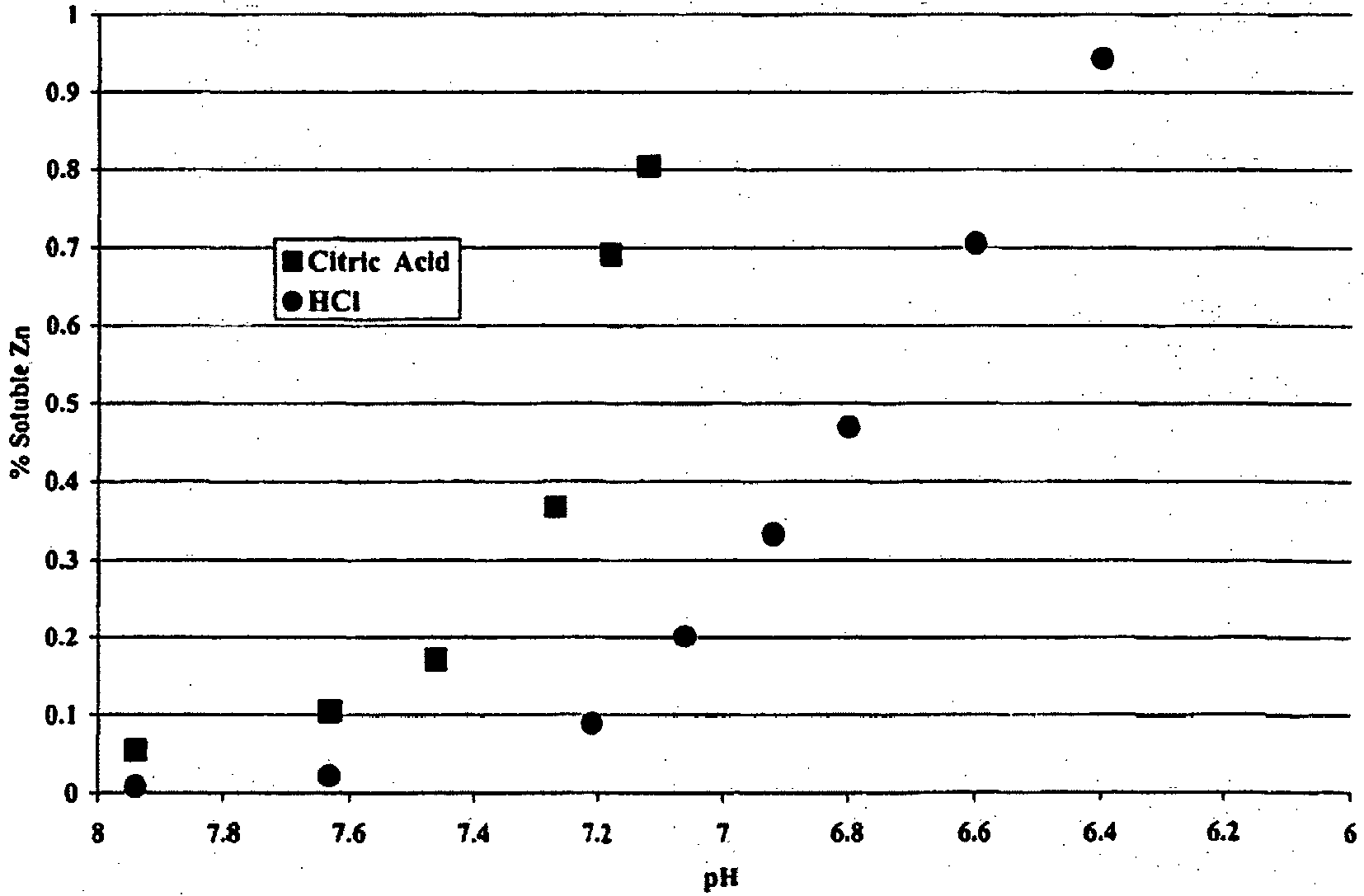
- Zinc-containing materials (ZCMs) differ with respect to how strongly the zinc ion (Zn2+) is held by counterions in the crystal lattice. The benefits discussed herein depend upon having available Zn2+. To determine which ZCMs provide sufficient labile Zn2+ and those that do not, a test was developed using a metallochromic dye which changes color upon coordinating Zn2+. The response is a binary visual assessment of whether or not the color changes indicating zinc-binding. If the color changes, the ZCM is classified as having available Zn2+ whereas if it does not change, the ZCM is not useful for this invention.
- The method is based on the commercial metallochromic dye zincon. Zincon changes from an orange color to blue upon binding zinc and provides the basis for detecting available Zn2+:

- The specific procedure involves making a stock solution of zincon in ethanol (∼50mg/10 ml ethanol). The ZCM is then added to water (∼30 mg/10 ml water) and agitated (pH range should be 7-11). Three to four drops of zincon solution are then added to the ZCM in water, agitated and a visual assessment of color change made.
- Using this methodology, the following ZCM are examples of those that have available zinc: zinc chloride, zinc sulfate, zinc citrate, zinc oxide, zinc acetate, zinc stearate, zinc lactate, zinc salicylate, zinc arginine, zinc histadine, zinc hexaborate, zinc hydroxide, zinc oxalate, zinc monoglycerolate and the like. Examples of ZCM not having available Zn2+ are zinc EDTA, zinc sulfide, zinc phytate and other materials with very tightly bound zinc.
- Zinc lability is a measure of the chemical availability of zinc ion. Soluble zinc salts that do not complex with other species in solution have a relative zinc lability, by definition, of 100%. The use of partially soluble forms of zinc salts and/or incorporation in a matrix with potential complexants generally lowers the zinc lability substantially below the defined 100% maximum.
- Zinc lability is assessed by combining a diluted zinc-containing solution or dispersion with the metallochromic dye xylenol orange (XO) and measurement of the degree of color change under specified conditions. The magnitude of color formation is proportional to the level of labile zinc. The procedure developed has been optimized for aqueous surfactant formulations but may be adapted to other physical product forms as well.
- A spectrophotometer is used to quantify the color change at 572 nm, the wavelength of optimum color change for XO. The spectrophotometer is set to zero absorbance at 572nm utilizing a product control as close in composition to the test product except excluding the potentially labile form of zinc. The control and test products are then treated identically as follows. A 50µl product sample is dispensed into a jar and 95 ml of deaerated, distilled water are added and stirred. 5mL of a 23mg/mL xylenol orange stock solution at pH 5.0 is pipetted into the sample jar; this is considered time 0. The pH is then adjusted to 5. 50±0.01 using dilute HCl or NaOH. After 10.0 minutes, a portion of the sample is filtered (0.45µ) and the absorbance measured at 572nm. The measured absorbance is then compared to a separately measured control to determine the relative zinc lability (zero TO 100%). The 100% lability control is prepared in a matrix similar to the test products but utilizing a soluble zinc material (such as zinc sulfate) incorporated at an equivalent level on a zinc basis. The absorbance of the 100% lability control is measured as above for the test materials. The relative zinc lability is preferably greater than about 15%, more preferably greater than about 20%, and even more preferably greater than about 25%.
- Using this methodology, the below examples demonstrate a material (hydrozincite) that has intrinsically high lability in an anionic surfactant system compared to one (ZnO) with low intrinsic lability. The examples further demonstrate that the low lability of ZnO can be improved substantially by incorporating a protective material such as sodium bicarbonate, a source of carbonate anions and mixtures thereof:
Relative Zinc Lability (%) Simple Surfactant System1 Alone Simple Surfactant System1 Plus Sodium Bicarbonate2 Zinc Oxide 1.5 33.2 Hydrozincite 37.0 1Simple surfactant system: 6% sodium lauryl sulfate
2Addition of sodium bicarbonate: 0.2% level - The compositions of the present invention may be prepared by any known or otherwise effective technique, suitable for providing an anti-microbial composition provided that the resulting composition provides the excellent anti-microbial benefits described herein. Methods for preparing the anti-dandruff and conditioning shampoo embodiments of the present invention include conventional formulation and mixing techniques. A method such as that described in
U.S. Pat. No. 5,837,661 , could be employed, wherein the anti-microbial agent of the present invention would typically be added in the same step as the silicone premix is added in theU.S. Pat. No. 5,837,661 description. - The compositions of the present invention may be used in direct application to the skin or in a conventional manner for cleansing skin and hair and controlling microbial infection (including fungal, viral, or bacterial infections) on the skin or scalp. The compositions herein are useful for cleansing the hair and scalp, and other areas of the body such as underarm, feet, and groin areas and for any other area of skin in need of treatment. The present invention may be used for treating or cleansing of the skin or hair of animals as well. An effective amount of the composition, typically from about 1g to about 50g, preferably from about 1g to about 20g of the composition, for cleansing hair, skin or other area of the body, is topically applied to the hair, skin or other area that has preferably been wetted, generally with water, and then rinsed off. Application to the hair typically includes working the shampoo composition through the hair.
- A preferred method for providing anti-microbial (especially anti-dandruff) efficacy with a shampoo embodiment comprises the steps of: (a) wetting the hair with water, (b) applying an effective amount of the anti-microbial shampoo composition to the hair, and (c) rinsing the anti-microbial shampoo composition from the hair using water. These steps may be repeated as many times as desired to achieve the cleansing, conditioning, and anti-microbial/anti-dandruff benefits sought.
- It is also contemplated that when the anti-microbial active employed is zinc pyrithione, and/or if other optional hair growth regulating agents are employed, the anti-microbial compositions of the present invention, may, provide for the regulation of growth of the hair. The method of regularly using such shampoo compositions comprises repeating steps a, b, and c (above).
- A further embodiment of the present invention comprises a method comprising the steps of (a) wetting the hair with water, (b) applying an effective amount of a shampoo composition comprising a zinc ionophore, (c) rinsing the shampoo compositions from the hair using water; (d) applying an effective amount of a conditioner composition comprising a zinc containing material according to the present invention; (e) rinsing the conditioner composition from the hair using water. In a further embodiment, this method could be conducted wherein steps d and b are reversed. In a further embodiment, steps b and d can vary and be a shampoo, hair lotions, hair sprays, hair tonics, conditioning treatments, gels, mousses and dressings, and the like. A preferred embodiment of the above mentioned method includes a shampoo composition comprising zinc pyrithione and a conditioner composition comprising zinc oxide.
- A further embodiment of the present invention comprises a method of treating athlete's foot comprising the use of the composition according to the present invention, a method of treating microbial infections comprising the use of composition as described herein, method of improving the appearance of a scalp comprising the use of the composition according present invention, a method of treating fungal infections comprising the use of the composition according to the present invention, a method of treating dandruff comprising the use of the composition of the present invention, a method of treating diaper dermatitis and candidiasis comprising the use of the compositions of the present invention as described herein, a method of treating tinea capitis comprising the use of the composition according to the present invention, a method of treating yeast infections comprising the use of the composition according to the present invention, a method of treating onychomycosis comprising the use of the composition according to the present invention.
- The following examples further describe and demonstrate the preferred embodiments within the scope of the present invention. The examples are given solely for the purpose of illustration, and are not to be construed as limitations of the present invention since many variations thereof are possible without departing from its scope.
- The composition of the invention can be made by mixing one or more selected metal ion sources and one or more metal salts of pyrithione in an appropriate media or carrier, or by adding the individual components separately to the skin or hair cleansing compositions. Useful carriers are discussed more fully above.
- All exemplified compositions can be prepared by conventional formulation and mixing techniques. Component amounts are listed as weight percents and exclude minor materials such as diluents, filler, and so forth. The listed formulations, therefore, comprise the listed components and any minor materials associated with such components. As used herein, "minors" refers to those optional components such as preservatives, viscosity modifiers, pH modifiers, fragrances, foam boosters, and the like. As is apparent to one of ordinary skill in the art, the selection of these minors will vary depending on the physical and chemical characteristics of the particular ingredients selected to make the present invention as described herein. Other modifications can be undertaken by the skilled artisan without departing from the spirit and scope of this invention. These exemplified embodiments of the anti-microbial shampoo, anti-microbial cleansing compositions, anti-microbial cleansing /facial compositions of the present invention provide excellent anti-microbial efficacy.
- A suitable method for preparing the anti-microbial shampoo compositions described in Examples 1-54(below) follows:
- About one-third to all of the sodium laureth sulfate (added as 25wt% solution) and acid are added to a jacketed mix tank and heated to about 60°C to about 80°C with slow agitation to form a surfactant solution. The pH of this solution is about 7.5. Sodium benzoate, Cocoamide MEA and fatty alcohols, (where applicable), are added to the tank and allowed to disperse. Ethylene glycol distearate ("EGDS") is added to the mixing vessel and allowed to melt (where applicable). After the EGDS is melted and dispersed, Kathon CG is added to the surfactant solution. The resulting mixture is cooled to about 25°C to about 40°C and collected in a finishing tank. As a result of this cooling step, the EGDS crystallizes to form a crystalline network in the product (where applicable). The remainder of the sodium laureth sulfate and other components, including the silicone and anti-microbial agent(s), are added to the finishing tank with agitation to ensure a homogeneous mixture. Polymers (cationic or nonionic) are dispersed in water or oils as an about 0.1% to about 10% dispersion and/or solution and then added to the final mix. ZnO or Zinc Hydroxy carbonate ("ZHC") can be added to a premix of surfactants or water with or without the aid of a dispersing agent via conventional powder incorporation and mixing techniques into the final mix. Adjustment of ZnO particle size can be affected by various conventional mixing techniques obvious to one skilled in the art. Once all components have been added, additional viscosity modifiers may be added, as needed, to the mixture to adjust product viscosity to the extent desired.
-
Components Example 1 Example 2 Example 3 Example 4 Example 5 Example 6 Example 7 Example 8 Example 9 Example 10 Sodium Laureth Sulfate 10.00 10.00 10.00 10.00 10.00 10.00 10.00 10.00 10.00 10.00 Sodium Lauryl Sulfate 6.00 6.00 6.00 6.00 6.00 6.00 6.00 6.00 6.00 6.00 Cocamidopropyl Betaine Sodium Cocoisethionate EGDS 1.50 1.50 1.50 1.50 1.50 1.50 1.50 1.50 1.50 1.50 CMEA 0.800 0.800 0.800 0.800 0.800 0.800 0.800 0.800 0.800 1.600 Cetyl Alcohol 0.600 0.600 0.600 0.600 0.600 0.600 0.600 0.600 0.600 0.600 Guar Hydroxy Propyl Trimonium Chloride (1) 0.500 0.500 0.500 0.500 0.500 0.500 0.500 0.500 0.500 0.500 Guar Hydroxy Propyl Trimonium Chloride (2) Guar Hydroxy Propyl Trimonium Chloride (3) Polyquaterium-10 (4) Polyquaterium-10 (5) PEG-7M (6) PEG-14M (7) PEG-45M (8) Dimethicone (9) 0.85 0.85 0.85 0.85 0.85 0.85 0.85 0.85 0.85 0.85 Dimethicone (10) ZPT (11) 1.00 2.00 2.00 1.00 1.00 1.00 1.00 1.00 1.00 1.00 Zinc Oxide 1.20 1.20 0.60 0.60 0.30 1.20 1.20 1.20 1.20 1.20 Zinc Hydroxy Carbonate Sodium Bicarbonate 0.20 0.20 0.20 0.20 0.20 0.10 0.05 0.25 0.20 Hydrochloric Acid 0.78 0.78 0.78 0.78 0.78 0.53 0.40 0.91 0.28 0.78 Magnesium Sulfate 0.28 0.28 0.28 0.28 0.28 0.28 0.28 0.28 0.28 0.28 Sodium Chloride 0.800 0.800 0.800 0.800 0.800 0.800 0.800 0.800 0.800 0.800 Sodium Xylenesulfonate Perfume 0.750 0.750 0.750 0.750 0.750 0.750 0.750 0.750 0.750 0.750 Sodium Benzoate 0.250 0.250 0.250 0.250 0.250 0.250 0.250 0.250 0.250 0.250 Kathon 0.0008 0.0008 0.0008 0.0008 0.0008 0.0008 0.0008 0.0008 0.0008 0.0008 Benzyl Alcohol 0.0225 0.0225 0.0225 0.0225 0.0225 0.0225 0.0225 0.0225 0.0225 0.0225 Water Q.S. Q.S. Q.S. Q.S. Q.S. Q.S. Q.S. Q.S. Q.S. Q.S. % Maximum XO Lability 63.2% 38.9% 38.5% 63.9% 23.5% 88.8% % Soluble Zinc 0.024 0.017 2.55x10⁻³ 5.01x10⁻³ 0.011 (1) Guar having a molecular weight of about 400,000, and having a charge density of about 0.84 meq/g, available from Aqualon.
(2) Guar having a molecular weight of about 400,000, and having a charge density of about 2.0 meq/g, available from Aqualon.
(3) Cationic guar Jaguar C17 available from Rhodia
(4) Polymer JR30M available from Amerchol
(5) Polymer LR400 available from Amerchol
(6) Polyox WSR N-750 available from Amerchol
(7) Polyox WSR N-3000 available from Amerchol
(8) Polyox WSR N-60K available from Amerchol
(9) Viscasil 330M available from General Electric Silicones
(10) DC1664 available from Dow Coming Silicones
(11) ZPT having an average particle size of about 2.5µm, available from Arch/Olin. -
Components Example 11 Example 12 Example 13 Example 14 Example 15 Example 16 Example 17 Example 18 Example 19 Example 20 Sodium Laureth Sulfate 10.00 10.00 10.00 10.00 10.00 12.50 10.00 10.00 10.00 10.00 Sodium Lauryl Sulfate 6.00 6.00 6.00 6.00 6.00 1.50 6.00 6.00 6.00 6.00 Cocamidopropyl Betaine 2.00 2.70 Sodium Cocoisethionate EGDS 1.50 1.50 1.50 1.50 1.50 1.50 1.50 1.50 1.50 1.50 CMEA 1.600 0.800 0.800 1.600 0.800 0.800 0.800 0.800 0.800 0.800 Cetyl Alcohol 0.600 0.600 0.600 0.600 0.600 0.600 0.600 0.600 0.600 0.600 Guar Hydroxy Propyl Trimonium Chloride (1) 0.500 0.500 0.500 0.500 0.500 0.500 0.500 0.500 Guar Hydroxy Propyl Trimonium Chloride (2) 0.500 Guar Hydroxy Propyl Trimonium Chloride (3) 0.500 Polvquaterium-10 (4) Polvquaterium-10 (5) PEG-7M (6) 0.200 0.200 PEG-14M (7) PEG-45M (8) 0.200 Dimethicone (9) 0.85 0.85 0.85 0.85 0.85 0.85 0.85 0.85 0.85 0.85 Dimethicone (10) ZPT (11) 1.00 1.00 1.00 1.00 1.00 1.00 1.00 Zinc Oxide 1.20 1.20 1.20 1.20 1.20 1.20 1.20 1.20 0.60 0.30 Zinc Hydroxy Carbonate Sodium Bicarbonate 0.20 0.20 0.20 0.20 0.20 0.20 0.20 Hydrochloric Acid 0.78 0.78 0.78 0.78 0.78 0.78 0.78 0.28 0.28 0.28 Magnesium Sulfate 0.28 0.28 0.28 0.28 0.28 0.28 0.28 0.28 0.28 0.28 Sodium Chloride 0.800 0.800 0.800 0.800 0.800 0.800 0.800 0.800 0.800 0.800 Sodium Xylenesulfonate Perfume 0.750 0.750 0.750 0.750 0.750 0.750 0.750 0.750 0.750 0.750 Sodium Benzoate 0.250 0.250 0.250 0.250 0.250 0.250 0.250 0.250 0.250 0.250 Kathon 0.0008 0.0008 0.0008 0.0008 0.0008 0.0008 0.0008 0.0008 0.0008 0.0008 Benzyl Alcohol 0.0225 0.0225 0.0225 0.0225 0.0225 0.0225 0.0225 0.0225 0.0225 0.0225 Water Q.S. Q.S. Q.S. Q.S. Q.S. Q.S. Q.S. Q.S. Q.S. Q.S. % Maximum XO Lability 59.8% 58.2% 72.9% 71.7% 67.2% % Soluble Zinc (1) Guar having a molecular weight of about 400,000, and having a charge density of about 0.84 meq/g, available from Aqualon.
(2) Guar having a molecular weight of about 400,000, and having a charge density of about 2.0 meq/g, available from Aqualon.
(3) Cationic guar Jaguar C17 available from Rhodia
(4) Polymer JR30M available from Amerchol
(5) Polymer LR400 available from Amerchol
(6) Polyox WSR N-750 available from Amerchol
(7) Polyox WSR N-3000 available from Amerchol
(8) Polyox WSR N-60K available from Amerchol
(9) Viscasil 330M available from General Electric Silicones
(10) DC1664 available from Dow Coming Silicones
(11) ZPT having an average particle size of about 2.5µm, available from Arch/Olin. -
Components Example 21 Example 22 Example 23 Example 24 Example 25 Example 26 Example 27 Example 28 Example 29 Example 30 Sodium Laureth Sulfate 10.00 10.00 10.00 10.00 10.00 10.00 10.00 10.00 10.00 10.00 Sodium Lauryl Sulfate 6.00 6.00 6.00 6.00 6.00 6.00 6.00 6.00 6.00 6.00 Cocamidopropyl Betaine Sodium Cocoisethionate EGDS 1.50 1.50 1.50 1.50 1.50 1.50 1.50 1.50 1.50 1.50 CMEA 0.800 0.800 0.800 0.800 0.800 0.800 0.800 0.800 0.800 0.800 Cetyl Alcohol 0.600 0.600 0.600 0.600 0.600 0.600 0.600 0.600 0.600 0.600 Guar Hydroxy Propyl Trimonium Chloride (1) 0.500 0.400 0.250 0.500 0.500 0.500 0.500 0.500 0.500 Guar Hydroxy Propyl Trimonium Chloride (2) Guar Hydroxy Propyl Trimonium Chloride (3) Polyquaterium-10 (4) Polyquaterium-10 (5) 0.500 0.500 0.100 PEG-7M (6) 0.100 0.100 PEG-14M (7) PEG-45M (8) Dimethicone (9) 0.85 1.40 0.85 0.85 0.85 0.85 1.35 1.00 0.85 0.85 Dimethicone (10) ZPT (11) 1.00 1.00 1.00 1.00 1.00 0.50 1.00 1.00 2.00 2.00 Zinc Oxide 1.20 1.20 1.20 1.20 Zinc Hydroxy Carbonate 1.61 1.61 1.61 1.61 1.61 0.80 Sodium Bicarbonate 0.20 0.20 0.20 0.20 Hydrochloric Acid 0.78 0.78 0.78 0.78 0.42 0.42 0.42 0.42 0.42 0.42 Magnesium Sulfate 0.28 0.28 0.28 0.28 0.28 0.28 0.28 0.28 0.28 0.28 Sodium Chloride 0.800 0.800 0.800 0.800 0.800 0.800 0.800 0.800 0.800 0.800 Sodium Xylenesulfonate Perfume 0.750 0.750 0.750 0.750 0.750 0.750 0.750 0.750 0.750 0.750 Sodium Benzoate 0.250 0.250 0.250 0.250 0.250 0.250 0.250 0.250 0.250 0.250 Kathon 0.0008 0.0008 0.0008 0.0008 0.0008 0.0008 0.0008 0.0008 0.0008 0.0008 Benzyl Alcohol 0.0225 0.0225 0.0225 0.0225 0.0225 0.0225 0.0225 0.0225 0.0225 0.0225 Water Q.S. Q.S. Q.S. Q.S. Q.S. Q.S. Q.S. Q.S. Q.S. Q.S. % Maximum XO Lability 74.0% % Soluble Zinc 0.022 (1) Guar having a molecular weight of about 400,000, and having a charge density of about 0.84 meq/g, available from Aqualon.
(2) Guar having a molecular weight of about 400,000, and having a charge density of about 2.0 meq/g, available from Aqualon.
(3) Cationic guar Jaguar C17 available from Rhodia
(4) Polymer JR30M available from Amerchol
(5) Polymer LR400 available from Amerchol
(6) Polyox WSR N-750 available from Amerchol
(7) Polyox WSR N-3000 available from Amerchol
(8) Polyox WSR N-60K available from Amerchol
(9) Viscasil 330M available from General Electric Silicones
(10) DC1664 available from Dow Corning Silicones
(11) ZPT having an average particle size of about 2.5µm. available from Arch/Olin. -
Components Example 31 Example 32 Example 33 Example 34 Example 35 Example 36 Example 37 Example 38 Example 39 Example 40 Sodium Laureth Sulfate 10.00 10.00 10.00 10.00 10.00 10.00 10.00 10.00 10.00 10.00 Sodium Lauryl Sulfate 6.00 6.00 6.00 6.00 6.00 6.00 6.00 6.00 6.00 6.00 Cocamidopropyl Betaine Sodium Cocoisethionate EGDS 1.50 1.50 1.50 1.50 1.50 1.50 1.50 1.50 1.50 1.50 CMEA 0.800 0.800 1.600 0.800 0.800 1.600 0.800 0.800 0.800 0.800 Cetyl Alcohol 0.600 0.600 0.600 0.600 0.600 0.600 0.600 0.600 0.600 0.600 Guar Hydroxy Propyl Trimonium Chloride (1) 0.500 0.500 0.500 0.500 0.500 0.500 0.500 Guar Hydroxy Propyl Trimonium Chloride (2) 0.500 Guar Hydroxy Propyl Trimonium Chloride (3) 0.500 0.500 Polyquaterium-10 (4) Polyquaterium-10 (5) PEG-7M (6) 0.200 0.100 PEG-14M (7) 0.200 PEG-45M (8) 0.200 Dimethicone (9) 0.85 0.85 0.85 0.85 0.85 0.85 0.85 0.85 0.85 Dimethicone (10) 1.00 ZPT (11) 2.00 1.00 1.00 1.00 1.00 1.00 1.00 1.00 1.00 1.00 Zinc Oxide Zinc Hydroxy Carbonate 0.40 1.61 1.61 1.61 1.61 1.61 1.61 1.61 1.61 1.61 Sodium Bicarbonate Hydrochloric Acid 0.42 0.42 0.42 0.42 0.42 0.42 0.42 0.42 0.42 0.42 Magnesium Sulfate 0.28 0.28 0.28 0.28 0.28 0.28 0.28 0.28 0.28 0.28 Sodium Chloride 0.800 0.800 0.800 0.800 0.800 0.800 0.800 0.800 0.800 0.800 Sodium Xylenesulfonate Perfume 0.750 0.750 0.750 0.750 0.750 0.750 0.750 0.750 0.750 0.750 Sodium Benzoate 0.250 0.250 0.250 0.250 0.250 0.250 0.250 0.250 0.250 0.250 Kathon 0.0008 0.0008 0.0008 0.0008 0.0008 0.0008 0.0008 0.0008 0.0008 0.0008 Benzyl Alcohol 0.0225 0.0225 0.0225 0.0225 0.0225 0.0225 0.0225 0.0225 0.0225 0.0225 Water Q.S. Q.S. Q.S. Q.S. Q.S. Q.S. Q.S. Q.S. Q.S. Q.S. % Maximum XO Lability 65.6% 76.2% % Soluble Zinc (1) Guar having a molecular weight of about 400,000, and having a charge density of about 0.84 meq/g, available from Aqualon.
(2) Guar having a molecular weight of about 400,000, and having a charge density of about 2.0 meq/g, available from Aqualon.
(3) Cationic guar Jaguar C17 available from Rhodia
(4) Polymer JR30M available from Amerchol
(5) Polymer LR400 available from Amerchol
(6) Polyox WSR N-750 available from Amerchol
(7) Polyox WSR N-3000 available from Amerchol
(8) Polyox WSR N-60K available from Amerchol
(9) Viscasil 330M available from General Electric Silicones
(10) DC1664 available from Dow Coming Silicones
(11) ZPT having an average particle size of about 2.5µm, available from Arch/Olin. -
Components Example 41 Example 42 Example 43 Example 44 Example 45 Example 46 Example 47 Example 48 Example 49 Example 50 Sodium Laureth Sulfate 10.00 12.50 10.00 10.00 10.00 10.00 10.00 10.00 10.00 10.00 Sodium Lauryl Sulfate 6.00 1.50 6.00 6.00 6.00 6.00 6.00 6.00 6.00 6.00 Cocamidopropyl Betaine 2.00 2.70 Sodium Cocoisethionate 2.00 EGDS 1.50 1.50 1.50 1.50 1.50 1.50 1.50 1.50 1.50 1.50 CMEA 0.800 0.800 0.800 1.600 1.600 0.800 0.800 0.800 0.800 0.800 Cetyl Alcohol 0.600 0.600 0.600 0.600 0.600 0.600 0.600 0.600 0.600 0.600 Guar Hydroxy Propyl Trimonium Chloride (1) 0.500 0.500 0.500 0.500 Guar Hydroxy Propyl Trimonium Chloride (2) Guar Hydroxy Propyl Trimonium Chloride (3) Polyquaterium-10 (4) 0.500 0.500 Polyquaterium-10 (5) 0.500 0.500 0.500 0.250 PEG-7M (6) 0.200 0.100 0.100 PEG-14M (7) PEG-45M (8) Dimethicone (9) 0.85 0.85 0.85 0.85 1.40 1.40 1.40 1.40 0.85 0.85 Dimethicone (10) ZPT (11) 1.00 1.00 1.00 1.00 1.00 1.00 1.00 1.00 1.00 1.00 Zinc Oxide Zinc Hydroxy Carbonate 1.61 1.61 1.61 1.61 1.61 1.61 1.61 1.61 1.61 1.61 Sodium Bicarbonate Hydrochloric Acid 0.42 0.42 0.42 0.42 0.42 0.42 0.42 0.42 0.42 0.42 Magnesium Sulfate 0.28 0.28 0.28 0.28 0.28 0.28 0.28 0.28 0.28 0.28 Sodium Chloride 0.800 0.800 0.800 0.800 0.800 0.800 0.800 0.800 0.800 0.800 Sodium Xylenesulfonate Perfume 0.750 0.750 0.750 0.750 0.750 0.750 0.750 0.750 0.750 0.750 Sodium Benzoate 0.250 0.250 0.250 0.250 0.250 0.250 0.250 0.250 0.250 0.250 Kathon 0.0008 0.0008 0.0008 0.0008 0.0008 0.0008 0.0008 0.0008 0.0008 0.0008 Benzyl Alcohol 0.0225 0.0225 0.0225 0.0225 0.0225 0.0225 0.0225 0.0225 0.0225 0.0225 Water Q.S. Q.S. Q.S. Q.S. Q.S. Q.S. Q.S. Q.S. Q.S. Q.S. % Maximum XO Lability 66.7% 66.9% % Soluble Zinc (1) Guar having a molecular weight of about 400,000, and having a charge density of about 0.84 meq/g, available from Aqualon.
(2) Guar having a molecular weight of about 400,000, and having a charge density of about 2.0 meq/g, available from Aqualon.
(3) Cationic guar Jaguar C17 available from Rhodia
(4) Polymer JR30M available from Amerchol
(5) Polymer LR400 available from Amerchol
(8) Polyox WSR N-750 available from Amerchol
(7) Polyox WSR N-3000 available from Amerchol
(8) Polyox WSR N-60K available from Amerchol
(9) Viscasil 330M available from General Electric Silicones
(10) DC1664 available from Dow Coming Silicones
(11) ZPT having an average particle size of about 2.5µm, available from Arch/Olin. -
Components Example 51 Example 52 Example 53 Example 54A Example 54B Sodium Laureth Sulfate 10.00 10.00 10.00 10.00 10.00 Sodium Lauryl Sulfate 6.00 6.00 6.00 6.00 6.00 Cocamidopropyl Betaine Sodium Cocoisethionate EGDS 1.50 1.50 1.50 1.50 1.50 CMEA 0.800 0.800 0.800 0.800 0.800 Cetyl Alcohol 0.600 0.600 0.600 0.600 0.600 Guar Hydroxy Propyl Trimonium Chloride (1) 0.400 0.500 Guar Hydroxy Propyl Trimonium Chloride (2) 0.500 0.500 0.500 Guar Hydroxy Propyl Trimonium Chloride (3) Polyquaterium-10 (4) Polyquaterium-10 (5) 0.100 PEG-7M (6) 0.100 PEG-14M (7) PEG-45M (8) Dimethicone (9) 0.85 0.85 0.85 0.85 0.85 Dimethicone (10) ZPT(11) 1.00 Zinc Oxide Zinc Hydroxy Carbonate 1.61 1.61 0.80 0.40 1.61 Sodium Bicarbonate Fumaric Acid 0.53 Hydrochloric Acid 0.42 0.42 0.42 0.42 Magnesium Sulfate 0.28 0.28 0.28 0.28 0.28 Sodium Chloride 0.800 0.800 0.800 0.800 0.800 Sodium Xylenesulfonate Perfume 0.750 0.750 0.750 0.750 0.750 Sodium Benzoate 0.250 0.250 0.250 0.250 0.250 Kathon 0.0008 0.0008 0.0008 0.0008 0.0008 Benzyl Alcohol 0.0225 0.0225 0.0225 0.0225 0.0225 Water Q.S. Q.S. Q.S. Q.S. Q.S. % Maximum XO Lability % Soluble Zinc (1) Guar having a molecular weight of about 400,000, and having a charge density of about 0.84 meq/g, available from Aqualon.
(2) Guar having a molecular weight of about 400,000, and having a charge density of about 2.0 meq/g, available from Aqualon.
(3) Cationic guar Jaguar C17 available from Rhodia
(4) Polymer JR30M available from Amerchol
(5) Polymer LR400 available from Amerchol
(6) Polyox WSR N-750 available from Amerchol
(7) Polyox WSR N-3000 available from Amerchol
(8) Polyox WSR N-60K available from Amerchol
(9) Viscasil 330M available from General Electric Silicones
(10) DC1664 available from Dow Corning Silicones
(11) ZPT having an average particle size of about 2.5µm, available from Arch/Olin. - A suitable method for preparing the anti-microbial cleansing compositions described in Examples 55-61 (below) follows:
- Components 1-3, 9, and 10 are mixed with heating to 190F. Components 4, 12, 15 and 17 are mixed at room temperature in a separate pot. After the first mixture has reached 190F, it is added to the second mixture. After this mixture has cooled below 140 F, components 13 (& 5) is added. In a separate vessel at 160 F, the petrolatum and ZnO or ZHC are mixed. When the aqueous phase has cooled below 110 F, the petrolatum/ZnO or ZHC blend is added and agitated until smooth. ZnO or ZHC can also be added to a premix of surfactants or water with or without the aid of a dispersing agent via conventional powder incorporation and mixing techniques into the cooled mixture. Adjustment of ZnO particle size can be affected by various conventional mixing techniques obvious to one skilled in the art. Finally the perfume is added.
- A suitable method for preparing the anti-microbial cleansing/ facial compositions described in Examples 62-75 are known to those skilled in the art, and may be prepared by any known or otherwise effective technique, suitable for providing an anti-microbial cleansing/ facial composition provided that the resulting composition provides the excellent anti-microbial benefits described herein. Methods for preparing the anti-microbial cleansing/ facial compositions embodiments of the present invention include conventional formulation and mixing techniques. A method such as that described in
U.S. Pat. No. 5,665,364 ,could be employed.Components Example 62 Example 63 Example 64 Example 65 Example 66 Example 67 Example 68 Cetyl Betaine 6.667 6.667 6.667 6.667 6.667 6.667 6.667 PPG-15 Stearyl Ether 4.000 4.000 4.000 4.000 4.000 4.000 4.000 Sodium Lauryl Sulfate 3.571 3.571 3.571 3.571 3.571 3.571 3.571 Distearyldimonium Chloride Glycerin 3.000 3.000 3.000 3.000 3.000 3.000 3.000 Stearyl Alcohol 2.880 2.880 2.880 2.880 2.880 2.880 2.880 Distearyldimonium Chloride 1.500 1.500 1.500 1.500 1.500 1.500 1.500 Oxidized Polyethylene 1.000 1.000 1.000 1.000 1.000 1.000 1.000 Zinc Pyrithione (1) 1.000 Zinc Oxide 1.200 0.600 0.300 1.200 Zinc Hydroxy Carbonate 1.610 0.800 0.400 Cetyl Alcohol 0.800 0.800 0.800 0.800 0.800 0.800 0.800 Steareth-21 0.500 0.500 0.500 0.500 0.500 0.500 0.500 Behenyl Alcohol 0.320 0.320 0.320 0.320 0.320 0.320 0.320 PPG-30 0.250 0.250 0.250 0.250 0.250 0.250 0.250 Steareth-2 0.250 0.250 0.250 0.250 0.250 0.250 0.250 Perfume 0.200 0.200 0.200 0.200 0.200 0.200 0.200 Citric Acid As Needed As Needed As Needed As Needed As Needed As Needed As Needed Sodium Citrate As Needed As Needed As Needed As Needed As Needed As Needed As Needed Water Q.S. Q.S. Q.S. Q.S. Q.S. Q.S. Q.S. Components Example 69 Example 70 Example 71 Example 72 Example 73 Example 74 Example 75 Sodium Laureth Sulfate 8.000 8.000 8.000 8.000 8.000 8.000 8.000 Disodium Cocamphodiacetate 7.000 7.000 7.000 7.000 7.000 7.000 7.000 PEG-80 Glyceryl Cocoate 3.500 3.500 3.500 3.500 3.500 3.500 3.500 Sodium Chloride 2.170 2.170 2.170 2.170 2.170 2.170 2.170 Glycol Distearate 2.000 2.000 2.000 2.000 2.000 2.000 2.000 Zinc Pyrithione (1) 1.000 Zinc Oxide 1.200 0.600 0.300 1.200 Zinc Hydroxy Carbonate 1.610 0.800 0.400 Dimethicone 0.900 0.900 0.900 0.900 0.900 0.900 0.900 Sodium Trideceth-7 Carboxylate 0.502 0.502 0.502 0.502 0.502 0.502 0.502 Perfume 0.320 0.320 0.320 0.320 0.320 0.320 0.320 Citric Acid As needed As needed As needed As needed As needed As needed As needed Quaternium-15 0.150 0.150 0.150 0.150 0.150 0.150 0.150 Polyquaterium-10 0.150 0.150 0.150 0.150 0.150 0.150 0.150 PEG-30 Glyceryl Cocoate As Needed As Needed As Needed As Needed As Needed As Needed As Needed Water Q.S. Q.S. Q.S. Q.S. Q.S. Q.S. Q.S. (1) ZPT having an average particle size of about 2.5µm, available from Arch/Olin. - The present invention may, in some embodiments, further comprise additional optional components known or otherwise effective for use in hair care or personal care products. The concentration of such optional ingredients generally ranges from zero to about 25%, more typically from about 0.05% to about 20%, even more typically from about 0.1% to about 15%, by weight of the composition. Such optional components should also be physically and chemically compatible with the essential components described herein, and should not otherwise unduly impair product stability, aesthetics or performance.
- Non-limiting examples of optional components for use in the present invention include anti-static agents, foam boosters, anti-dandruff agents in addition to the anti-dandruff agents described above, viscosity adjusting agents and thickeners, suspension materials (e.g. EGDS, thixins), pH adjusting agents (e.g. sodium citrate, citric acid, succinic acid, sodium succinate, sodium maleate, sodium glycolate, malic acid, glycolic acid, hydrochloric acid, sulfuric acid, sodium bicarbonate, sodium hydroxide, and sodium carbonate), preservatives (e.g. DMDM hydantoin), anti-microbial agents (e.g. triclosan or triclocarbon), dyes, organic solvents or diluents, pearlescent aids, perfumes, fatty alcohols, proteins, skin active agents, sunscreens, vitamins (such as retinoids including retinyl propionate, vitamin E such as tocopherol acetate, panthenol, and vitamin B3 compounds including niacinamide), emulsifiers,volatile carriers, select stability actives, styling polymers, organic styling polymers, silicone-grafted styling polymers, cationic spreading agents, pediculocides, foam boosters, viscosity modifiers and thickeners, polyalkylene glycols and combinations thereof.
- Optional anti-static agents such as water-insoluble cationic surfactants may be used, typically in concentrations ranging from about 0.1% to about 5%, by weight of the composition. Such anti-static agents should not unduly interfere with the in-use performance and end-benefits of the anti-microbial composition; particularly, the anti-static agent should not interfere with the anionic surfactant. A specific non-limiting example of a suitable anti-static agents is tricetyl methyl ammonium chloride.
- Optional foam boosters for use in the present invention described herein include fatty ester (e.g. C8-C22) mono- and di (C1-C5, especially C1-C3) alkanol amides. Specific non-limiting examples of such foam boosters include coconut monoethanolamide, coconut diethanolamide, and mixtures thereof.
- Optional viscosity modifiers and thickeners may be used, typically in amounts effective for the anti-microbial compositions of the present invention to generally have an overall viscosity from about 1,000 csk to about 20,000 csk, preferably from about 3,000 csk to about 10,000 csk. Specific non-limiting examples of such viscosity modifiers and thickeners include: sodium chloride, sodium sulfate, and mixtures thereof.
- Other preferred embodiments of the present invention include the following:
- Another embodiment of the present invention relates to a composition comprising from about 5% to about 50% of a surfactant; from about 0.001% to about 10% of zinc oxide; and a ZIM; wherein the pH of the composition is greater than about 7; and wherein the ZIM is a zinc ionophore, hydrophobic zinc material, or mixtures thereof. Another embodiment of the present invention relates to a composition comprising from about 5% to about 50% of a surfactant; from about 0.001% to about 10% of zinc hydroxycarbonate, and a ZIM; wherein the pH of the composition is greater than about 7; and wherein the ZIM is a zinc ionophore, hydrophobic zinc material, or mixtures thereof. Preferably the ZIM in such a composition is a polyvalent metal salt of pyrithione, dithiocarbamate, heterocyclic amine, nonsteriodal anti-inflammatory compound, naturally occurring material having zinc ionophoric behavior, derivative of a naturally occurring material having zinc ionophoric behavior, bio-molecule, pepetide, sulfur-based compound, transport enhancer, or mixtures thereof; more preferably a pyrithione or a zinc salt of pyrithione; more preferably still, zinc pyrithione. The pH of such a composition is preferably from about 7.0 to 9. Preferably such a composition comprises a compound having a having a Log zinc binding constant of less than about 6; preferably such a compound is an organic acid, strong mineral acid, zinc coordinating species, or mixtures thereof; more preferably the compound is sodium bicarbonate. Preferably the surfactant in such a composition is anionic, cationic, nonionic, amphoteric, zwitterionic, or mixtures thereof. Preferably the zinc containing material is present in such a composition in an amount of 0.1% to about 3% by weight of the composition. Preferably such a composition further comprises a conditioning agent Preferably such a composition further comprises a cationic deposition polymer.
- In a preferred embodiment, the zinc containing material has a aqueous solubility within a composition of less than about 25% by weight at 25°C.
- Tthe composition embodiment may be employed to treat a variety of conditions, including: athlete's foot, microbial infections, improving the appearance of a scalp, treating fungal infections, treating dandruff, treating diaper dermatitis and candidiasis, treating tinea capitis, treating yeast infections, treating onychomycosis. Preferably such conditions are treated by applying a composition of the present invention to the affected area.
| Components | Example 55 | Example 56 | Example 57 | Example 58 | Example 59 | Example 60 | Example 61 | |
| 1 | Sodium Lauryl Sulfate | 4.000 | 4.000 | 4.000 | 4.000 | 4.000 | 4.000 | 4.000 |
| 2 | Sodium Laureth Sulfate | 3.000 | 3.000 | 3.000 | 3.000 | 3.000 | 3.000 | 3.000 |
| 3 | Sodium Laruroamphoacetate | 4.000 | 4.000 | 4.000 | 4.000 | 4.000 | 4.000 | 4.000 |
| 4 | Sodium Lauroyl Sarcosinate | 2.000 | 2.000 | 2.000 | 2.000 | 2.000 | 2.000 | 2.000 |
| 5 | Zinc Pvrithione (1) | 1.000 | ||||||
| 6 | Zinc Oxide treated with silicone (2) | 2.000 | 6.000 | 6.000 | ||||
| 7 | Zinc Oxide | 2.000 | 5.000 | |||||
| 8 | Zinc Hydroxy Carbonate | 2.000 | 4.000 | |||||
| 9 | Lauric Acid | 1.000 | 1.000 | 1.000 | 1.000 | 1.000 | 1.000 | 1.000 |
| 10 | Trihydroxystearin | 0.650 | 0.650 | 0.650 | 0.650 | 0.650 | 0.650 | 0.65C |
| 11 | Citric Acid | as needed | as needed | as needed | as needed | as needed | as needed | as needed |
| 12 | Sodium Benzoate | 0.250 | 0.250 | 0.250 | 0.250 | 0.250 | 0.250 | 0.250 |
| 13 | Glydant | 0.120 | 0.120 | 0.120 | 0.120 | 0.120 | 0.120 | 0.120 |
| 14 | Perfume | 0.750 | 0.750 | 0.750 | 0.750 | 0.750 | 0.750 | 0.750 |
| 15 | Polyquaterium-10 (3) | 0.750 | 0.750 | 0.750 | 0.750 | 0.750 | 0.750 | 0.750 |
| 16 | Petrolatum | 15.000 | 15.000 | 15.000 | 15.000 | 15.000 | 15.000 | 15.000 |
| 17 | Water | Q.S. | Q.S. | Q.S. | Q.S. | Q.S. | Q.S. | Q.S. |
| (1) ZPT having an average particle size of about 2.5µm, available from Arch/Olin. (2) Z-Cote HP-1 available from BASF (3) Polymer JR30M available from Amerchol |
Claims (2)
- A composition comprising:a. an effective amount of a zinc containing material having an aqueous solubility within the composition of less than 25% by weight at 25°C;b. from 5% to 50% of a surfactant; andc. from 0.1% to 5% of a zinc ionophoric material;d. from 40% to 95% water; andwherein the pH of the composition is greater than 7; and
wherein the zinc containing material is zinc oxide; and
wherein the composition further comprises a component selected from the group consisting of sodium bicarbonate, sources of carbonate anions and mixtures thereof. - The composition according to Claim 1 wherein composition comprises from 0.001% to 10% of the zinc containing material.
Applications Claiming Priority (3)
| Application Number | Priority Date | Filing Date | Title |
|---|---|---|---|
| US37434602P | 2002-04-22 | 2002-04-22 | |
| US374346P | 2002-04-22 | ||
| PCT/US2003/008478 WO2003088957A1 (en) | 2002-04-22 | 2003-03-18 | Personal care compositions comprising a zinc containing material in an aqueous surfactant composition |
Publications (2)
| Publication Number | Publication Date |
|---|---|
| EP1496887A1 EP1496887A1 (en) | 2005-01-19 |
| EP1496887B1 true EP1496887B1 (en) | 2016-08-03 |
Family
ID=29251178
Family Applications (1)
| Application Number | Title | Priority Date | Filing Date |
|---|---|---|---|
| EP03714275.9A Expired - Lifetime EP1496887B1 (en) | 2002-04-22 | 2003-03-18 | Personal care compositions comprising a zinc containing material in an aqueous surfactant composition |
Country Status (9)
| Country | Link |
|---|---|
| US (3) | US8119168B2 (en) |
| EP (1) | EP1496887B1 (en) |
| JP (1) | JP3851312B2 (en) |
| CN (1) | CN100496480C (en) |
| BR (1) | BRPI0309457B1 (en) |
| CA (1) | CA2481994C (en) |
| ES (1) | ES2601463T3 (en) |
| MX (1) | MXPA04009513A (en) |
| WO (1) | WO2003088957A1 (en) |
Families Citing this family (193)
| Publication number | Priority date | Publication date | Assignee | Title |
|---|---|---|---|---|
| US7026308B1 (en) | 1999-06-25 | 2006-04-11 | The Procter & Gamble Company | Topical anti-microbial compositions |
| CN100341408C (en) | 1999-06-25 | 2007-10-10 | 阿奇化工公司 | Pyrithione antimicrobial agents synergized with silver, copper or zinc ions |
| US7674785B2 (en) | 2000-06-22 | 2010-03-09 | The Procter & Gamble Company | Topical anti-microbial compositions |
| JP3851312B2 (en) | 2002-04-22 | 2006-11-29 | ザ プロクター アンド ギャンブル カンパニー | Personal care composition comprising a zinc-containing material in an aqueous surfactant composition |
| US20040058855A1 (en) * | 2002-04-22 | 2004-03-25 | Schwartz James R. | Use of materials having zinc ionophoric behavior |
| US8367048B2 (en) | 2002-06-04 | 2013-02-05 | The Procter & Gamble Company | Shampoo containing a gel network |
| US8349301B2 (en) | 2002-06-04 | 2013-01-08 | The Procter & Gamble Company | Shampoo containing a gel network |
| US8349302B2 (en) | 2002-06-04 | 2013-01-08 | The Procter & Gamble Company | Shampoo containing a gel network and a non-guar galactomannan polymer derivative |
| US9381382B2 (en) | 2002-06-04 | 2016-07-05 | The Procter & Gamble Company | Composition comprising a particulate zinc material, a pyrithione or a polyvalent metal salt of a pyrithione and a gel network |
| US8361450B2 (en) | 2002-06-04 | 2013-01-29 | The Procter & Gamble Company | Shampoo containing a gel network and a non-guar galactomannan polymer derivative |
| US20050202984A1 (en) * | 2003-03-18 | 2005-09-15 | Schwartz James R. | Composition comprising zinc-containing layered material with a high relative zinc lability |
| US8470305B2 (en) | 2002-06-04 | 2013-06-25 | The Procter & Gamble Company | Shampoo containing a gel network |
| US8361448B2 (en) | 2002-06-04 | 2013-01-29 | The Procter & Gamble Company | Shampoo containing a gel network |
| US9381148B2 (en) | 2003-03-18 | 2016-07-05 | The Procter & Gamble Company | Composition comprising particulate zinc material with a high relative zinc lability |
| US8491877B2 (en) * | 2003-03-18 | 2013-07-23 | The Procter & Gamble Company | Composition comprising zinc-containing layered material with a high relative zinc lability |
| JP4036295B2 (en) * | 2003-03-05 | 2008-01-23 | 堀 敏子 | Composition to be applied and adhered to the human body |
| US20040191331A1 (en) * | 2003-03-18 | 2004-09-30 | The Procter & Gamble Company | Composition comprising particulate zinc materials having a defined crystallite size |
| US20040213751A1 (en) * | 2003-03-18 | 2004-10-28 | Schwartz James Robert | Augmentation of pyrithione activity or a polyvalent metal salt of pyrithione activity by zinc-containing layered material |
| EP1778300A1 (en) * | 2004-08-06 | 2007-05-02 | The Procter and Gamble Company | Personal cleansing composition containing a per-alk(en)yl hydrocarbon material |
| EP1791518A1 (en) * | 2004-09-24 | 2007-06-06 | Hercules Incorporated | High ds cationic polygalactomannan for skincare products |
| EP1809107A4 (en) * | 2004-10-25 | 2009-07-22 | Nat Res Lab Ltd | Compositions and methods of dispensing palliative or therapeutic agents |
| US7341734B2 (en) * | 2004-11-23 | 2008-03-11 | Evident Technologies | Personal care compositions comprising semiconductor nanocrystals and methods of making and using the same |
| JP2006176675A (en) * | 2004-12-22 | 2006-07-06 | Riken Koryo Kogyo Kk | Deodorant compounding agent for cleaning agent and cleaning agent composition |
| EP1863466B1 (en) * | 2005-03-03 | 2017-08-09 | Takasago International Corporation (USA) | Synergistic salivation components |
| US20070009472A1 (en) * | 2005-07-06 | 2007-01-11 | Niebauer Michael F | Personal care compositions comprising a non-binding thickener with a metal ion |
| CA2631143A1 (en) * | 2005-12-08 | 2007-06-14 | Unilever Plc | Shampoo compositions containing a combination of cationic polymers |
| US20090176675A1 (en) * | 2006-01-09 | 2009-07-09 | Marjorie Mossman Peffly | Personal Care Compositions Containing Cationically Modified Starch and an Anionic Surfactant System |
| WO2007089267A1 (en) | 2006-02-03 | 2007-08-09 | Jr Chem, Llc | Anti-aging treatment using copper and zinc compositions |
| US7687650B2 (en) | 2006-02-03 | 2010-03-30 | Jr Chem, Llc | Chemical compositions and methods of making them |
| US7897800B2 (en) | 2006-02-03 | 2011-03-01 | Jr Chem, Llc | Chemical compositions and methods of making them |
| US7867522B2 (en) | 2006-09-28 | 2011-01-11 | Jr Chem, Llc | Method of wound/burn healing using copper-zinc compositions |
| US8673274B2 (en) * | 2006-12-15 | 2014-03-18 | The Procter & Gamble Company | Composition comprising pyrithione or a polyvalent metal salt of a pyrithione and furametpyr |
| US20090013481A1 (en) * | 2007-07-12 | 2009-01-15 | Allwyn Colaco | Composition to impart benefit agents to anionic substrates and methods of its use |
| US8273791B2 (en) | 2008-01-04 | 2012-09-25 | Jr Chem, Llc | Compositions, kits and regimens for the treatment of skin, especially décolletage |
| US8765170B2 (en) | 2008-01-30 | 2014-07-01 | The Procter & Gamble Company | Personal care composition in the form of an article |
| EP2666457B1 (en) * | 2008-04-16 | 2020-06-17 | The Procter & Gamble Company | Process for forming a non-lathering personal care article in the form of a dissolvable solid foam |
| US20090269375A1 (en) * | 2008-04-25 | 2009-10-29 | Diahne Patnode | Tanning compositions containing juice concentrate |
| US8481006B2 (en) * | 2008-04-25 | 2013-07-09 | New Sunshine, Llc | Melt formula |
| CA2746317C (en) | 2008-12-08 | 2013-10-29 | The Procter & Gamble Company | Porous, dissolvable solid substrates and surface resident cyclodextrin perfume complexes |
| US8461090B2 (en) | 2008-12-08 | 2013-06-11 | The Procter & Gamble Company | Personal care composition in the form of an article having a porous, dissolvable solid structure |
| CN102245155B (en) * | 2008-12-08 | 2015-11-25 | 宝洁公司 | Personal care composition in the form of an article having a dissolvable porous solid structure |
| BRPI0922333B1 (en) | 2008-12-08 | 2019-01-29 | Procter & Gamble | process of producing an article for dissolution using surfactants |
| US20160184354A1 (en) | 2009-01-23 | 2016-06-30 | Jr Chem, Llc | Rosacea treatments and kits for performing them |
| EP2437720A2 (en) | 2009-06-04 | 2012-04-11 | The Procter & Gamble Company | Multiple product system for hair |
| EP2275466A1 (en) * | 2009-07-16 | 2011-01-19 | Bayer MaterialScience AG | Polyuric-based cloth adhesive |
| WO2011072009A1 (en) | 2009-12-08 | 2011-06-16 | The Procter & Gamble Company | A porous, dissolvable solid substrate and surface resident coating comprising matrix microspheres |
| US20110132387A1 (en) | 2009-12-08 | 2011-06-09 | Ali Abdelaziz Alwattari | Porous, Dissolvable Solid Substrate And Surface Resident Coating Comprising A Skin Treatment Active |
| CN102917683B (en) | 2009-12-08 | 2015-08-05 | 宝洁公司 | Dissolvable porous solid matrix and surface resident coating containing water sensitive actives |
| CN102647974B (en) | 2009-12-08 | 2014-03-12 | 宝洁公司 | Porous, dissolvable solid substrate and cationic surfactant conditioner material |
| MX2012006247A (en) | 2009-12-08 | 2012-06-19 | Procter & Gamble | A SOLUBLE SOLUBLE POROUS SUBSTRATE AND A FIXED COATING OF CATION SURFACTANT CONDITIONER SURFACE. |
| US20110268683A1 (en) * | 2010-01-29 | 2011-11-03 | Rhodia, Inc. | Structured suspending systems |
| WO2011103147A2 (en) | 2010-02-16 | 2011-08-25 | The Procter & Gamble Company | Method for providing maximum malodor and irritation control |
| WO2011103152A1 (en) | 2010-02-16 | 2011-08-25 | The Procter & Gamble Company | A porous, dissolvable solid substrate and surface resident coating comprising a zync pyrithione |
| US8541493B2 (en) * | 2010-02-19 | 2013-09-24 | Arch Chemicals, Inc. | Synthesis of zinc acrylate copolymer from acid functional copolymer, zinc pyrithione, and copper compound |
| US20180163325A1 (en) | 2016-12-09 | 2018-06-14 | Robert Wayne Glenn, Jr. | Dissolvable fibrous web structure article comprising active agents |
| MX360481B (en) | 2010-07-02 | 2018-11-05 | Procter & Gamble | Dissolvable fibrous web structure article comprising active agents. |
| WO2012003351A2 (en) | 2010-07-02 | 2012-01-05 | The Procter & Gamble Company | Web material and method for making same |
| JP5859526B2 (en) | 2010-07-02 | 2016-02-10 | ザ プロクター アンド ギャンブルカンパニー | Filaments containing an activator nonwoven web and methods for making the same |
| CA2803382C (en) | 2010-07-02 | 2015-03-31 | The Procter & Gamble Company | Method for delivering an active agent |
| KR20130136967A (en) | 2010-08-18 | 2013-12-13 | 유니레버 엔.브이. | Anti-dandruff shampoo |
| PH12013500254A1 (en) | 2010-08-18 | 2013-03-18 | Unilever Nv | Anti-dandruff shampoo |
| JP5688947B2 (en) * | 2010-10-27 | 2015-03-25 | 株式会社ミルボン | Hair treatment agent |
| WO2012058557A2 (en) * | 2010-10-28 | 2012-05-03 | The Procter & Gamble Company | Personal care compositions comprising a pyrithione and an iron chelator |
| BR112013013512A2 (en) * | 2010-12-02 | 2016-07-12 | Unilever Nv | "Anti-dandruff shampoo and use of a branched alkyl isethionate" |
| FR2968944B1 (en) * | 2010-12-21 | 2013-07-12 | Oreal | COMPOSITION COMPRISING A NON-NITROGEN ZINC SALT AND A PARTICULAR CATIONIC SURFACTANT |
| US8952057B2 (en) | 2011-01-11 | 2015-02-10 | Jr Chem, Llc | Compositions for anorectal use and methods for treating anorectal disorders |
| JP5815851B2 (en) | 2011-05-27 | 2015-11-17 | ザ プロクター アンド ギャンブルカンパニー | Dissolvable solid hair dyeing article |
| US8425622B2 (en) | 2011-05-27 | 2013-04-23 | The Procter & Gamble Company | Soluble solid hair coloring article |
| EP2723343A2 (en) * | 2011-06-23 | 2014-04-30 | The Procter and Gamble Company | Process of forming crystals for use in a personal care composition |
| WO2013025744A2 (en) | 2011-08-15 | 2013-02-21 | The Procter & Gamble Company | Personal care methods |
| US20130045284A1 (en) * | 2011-08-15 | 2013-02-21 | Qing Stella | Methods of Enhancing Skin Hydration and Treating Non-Diseased Skin |
| WO2013025960A1 (en) | 2011-08-17 | 2013-02-21 | Arch Chemicals, Inc. | Synthesis of copper pyrithione from zinc pyrithione and copper compound |
| BR112014007727B1 (en) | 2011-10-07 | 2019-04-30 | The Procter & Gamble Company | Shampoo Composition and Process for Preparation |
| JP6006326B2 (en) * | 2012-01-18 | 2016-10-12 | エルジー・ケム・リミテッド | Latex composition for dip molding |
| EP2847315B1 (en) | 2012-05-11 | 2018-03-21 | The Procter and Gamble Company | Personal cleansing compositions comprising zinc pyrithione |
| US8444716B1 (en) | 2012-05-23 | 2013-05-21 | The Procter & Gamble Company | Soluble solid hair coloring article |
| WO2014005821A2 (en) * | 2012-07-03 | 2014-01-09 | Unilever N.V. | Premix and composition |
| JP6158935B2 (en) | 2012-10-12 | 2017-07-05 | ザ プロクター アンド ギャンブル カンパニー | Personal care composition in the form of a soluble article |
| EP2925843B1 (en) | 2012-11-29 | 2016-08-31 | Unilever PLC | Polymer structured aqueous detergent compositions |
| JP6368316B2 (en) | 2012-11-29 | 2018-08-01 | ユニリーバー・ナームローゼ・ベンノートシヤープ | Hair care composition |
| CN104812365B (en) * | 2012-11-29 | 2017-10-13 | 荷兰联合利华有限公司 | Hair care composition |
| CA2890684C (en) * | 2012-12-05 | 2021-01-12 | Colgate-Palmolive Company | Zinc phosphate containing compositions |
| WO2014169464A1 (en) | 2013-04-18 | 2014-10-23 | The Procter & Gamble Company | Personal care compositions containing zinc pyrithione and zinc-phosphonate complex |
| MX2015012191A (en) | 2013-03-14 | 2015-11-30 | Procter & Gamble | Solid concentrate compositions containing zinc pyrithione. |
| WO2014139133A1 (en) | 2013-03-14 | 2014-09-18 | The Procter & Gamble Company | Bar soap compositions containing zinc pyrithione and a zinc-pyridine oxide complex |
| US9861531B2 (en) * | 2013-06-18 | 2018-01-09 | Sanko Tekstil Isletmeleri Sanayi Ve Ticaret Anonim Sirketi | Multi-function emergency bandage |
| JP6289079B2 (en) * | 2013-12-24 | 2018-03-07 | 花王株式会社 | Hair cleanser |
| US10201481B2 (en) | 2014-03-07 | 2019-02-12 | The Procter & Gamble Company | Personal care compositions and methods of making same |
| WO2015164227A2 (en) | 2014-04-22 | 2015-10-29 | The Procter & Gamble Company | Compositions in the form of dissolvable solid structures |
| US20160038393A1 (en) * | 2014-04-23 | 2016-02-11 | The Procter & Gamble Company | Hair Care Composition With Sensate Compound |
| US20150313805A1 (en) | 2014-05-05 | 2015-11-05 | The Procter & Gamble Company | Consumer Products |
| US9861559B2 (en) | 2014-05-05 | 2018-01-09 | The Procter & Gamble Company | Consumer product comprising a porous, dissolvable, fibrous web solid structure with a silicone coating |
| US9937111B2 (en) | 2014-05-05 | 2018-04-10 | The Procter & Gamble Company | Consumer product comprising a fibrous web solid structure with a silicone conditioning agent coating |
| US9827173B2 (en) | 2014-05-05 | 2017-11-28 | The Procter & Gamble Company | Porous dissolvable solid structure with two benefit agents and methods of forming an aqueous treatment liquor therefrom |
| US9867762B2 (en) | 2014-05-05 | 2018-01-16 | The Procter & Gamble Company | Consumer product comprising a porous dissolvable solid structure and silicone conditioning agent coating |
| US9861558B2 (en) | 2014-05-05 | 2018-01-09 | The Procter & Gamble Company | Methods of forming an aqueous treatment liquor by dissolving a porous solid with a benefit agent coating |
| US9877899B2 (en) | 2014-05-05 | 2018-01-30 | The Procter & Gamble Company | Consumer product comprising a fibrous web structure with a silicone conditioning agent coating |
| MY176234A (en) | 2014-06-27 | 2020-07-24 | Jubilant Life Sciences Ltd | Synergistic antimicrobial composition of zinc pyrithione |
| US9354219B1 (en) | 2014-12-23 | 2016-05-31 | Colgate-Palmolive Company | Detecting stannous ions |
| US9435745B2 (en) | 2014-12-23 | 2016-09-06 | Colgate-Palmolive Company | Measuring the rate of release of metal ions |
| US9625449B2 (en) | 2014-12-23 | 2017-04-18 | Colgate-Palmolive Company | Determining the bioavailability of zinc (II) ions |
| JP7066412B2 (en) | 2015-04-23 | 2022-05-13 | ザ プロクター アンド ギャンブル カンパニー | Delivery of surfactant-soluble antidandruff agents |
| US9901584B2 (en) | 2015-05-06 | 2018-02-27 | The Procter & Gamble Company | Methods of cosmetically treating skin conditions with a cosmetic personal cleansing composition |
| KR102183402B1 (en) * | 2015-06-12 | 2020-11-26 | 제이에프이미네라르 가부시키가이샤 | Therapeutic agent for skin wound or rough skin |
| ES2879383T3 (en) * | 2015-06-30 | 2021-11-22 | Sequessome Tech Holdings Limited | Mixed formulas |
| ES2893974T3 (en) | 2016-03-03 | 2022-02-10 | Procter & Gamble | Aerosol anti-dandruff composition |
| US10945935B2 (en) | 2016-06-27 | 2021-03-16 | The Procter And Gamble Company | Shampoo composition containing a gel network |
| US20180000706A1 (en) | 2016-06-30 | 2018-01-04 | The Procter & Gamble Company | Conditioner Composition Comprising a Chelant |
| US20180000715A1 (en) | 2016-06-30 | 2018-01-04 | The Procter & Gamble Company | Hair Care Compositions For Calcium Chelation |
| US11786447B2 (en) * | 2016-06-30 | 2023-10-17 | The Procter & Gamble Company | Conditioner composition comprising a chelant |
| US11246816B2 (en) | 2016-06-30 | 2022-02-15 | The Procter And Gamble Company | Shampoo compositions comprising a chelant |
| US20180000705A1 (en) | 2016-06-30 | 2018-01-04 | The Procter & Gamble Company | Shampoo Compositions Comprising a Chelant |
| EP3481787B1 (en) | 2016-07-06 | 2024-02-28 | Huntsman Petrochemical LLC | Halogen-free quaternary aminies and uses thereof |
| WO2018071353A1 (en) | 2016-10-10 | 2018-04-19 | The Procter & Gamble Company | Personal care compositions substantially free of sulfated surfactants and containing a gel network |
| EP3528774A1 (en) | 2016-10-21 | 2019-08-28 | The Procter and Gamble Company | Concentrated shampoo dosage of foam designating hair volume benefits |
| WO2018075846A1 (en) | 2016-10-21 | 2018-04-26 | The Procter & Gamble Company | Concentrated shampoo dosage of foam designating hair conditioning benefits |
| WO2018075850A1 (en) | 2016-10-21 | 2018-04-26 | The Procter & Gamble Company | Dosage of foam for delivering consumer desired dosage volume and surfactant amount in an optimal formulation space |
| CN109843383A (en) | 2016-10-21 | 2019-06-04 | 宝洁公司 | For delivering the foam of the desired dose volume of consumer, amount of surfactant and scalp health dosage in optimal formulation space |
| US20180110690A1 (en) | 2016-10-21 | 2018-04-26 | The Procter & Gamble Company | Concentrated Shampoo Dosage of Foam for Providing Hair Care Benefits |
| US11129783B2 (en) | 2016-10-21 | 2021-09-28 | The Procter And Gamble Plaza | Stable compact shampoo products with low viscosity and viscosity reducing agent |
| EP3528894A1 (en) | 2016-10-21 | 2019-08-28 | The Procter and Gamble Company | Concentrated shampoo dosage of foam for providing hair care benefits |
| US10987380B2 (en) | 2016-12-09 | 2021-04-27 | Jfe Mineral Company, Ltd. | Hydrozincite containing zinc carbonate hydroxide hydrate and method of making |
| MX380727B (en) | 2017-01-27 | 2025-03-12 | Procter & Gamble | COMPOSITIONS IN THE FORM OF SOLUBLE SOLID STRUCTURES COMPRISING EFFERVESCENT AGGLOMERATED PARTICLES. |
| MX380853B (en) | 2017-01-27 | 2025-03-12 | Procter & Gamble | Compositions in the form of dissolvable solid structures |
| MX386122B (en) * | 2017-05-12 | 2025-03-18 | Procter & Gamble | COMPOSITIONS WITH AGENTS FOR SCALP HEALTH WITH INCREASED DEPOSIT. |
| CN110650723A (en) | 2017-05-16 | 2020-01-03 | 宝洁公司 | Conditioning hair care compositions in soluble solid structured form |
| CN109952087B (en) * | 2017-06-05 | 2022-09-27 | 宝洁公司 | Hair care compositions comprising sebum modifying material |
| US11224567B2 (en) | 2017-06-06 | 2022-01-18 | The Procter And Gamble Company | Hair compositions comprising a cationic polymer/silicone mixture providing improved in-use wet feel |
| US11679073B2 (en) | 2017-06-06 | 2023-06-20 | The Procter & Gamble Company | Hair compositions providing improved in-use wet feel |
| US11141370B2 (en) | 2017-06-06 | 2021-10-12 | The Procter And Gamble Company | Hair compositions comprising a cationic polymer mixture and providing improved in-use wet feel |
| WO2019010145A1 (en) | 2017-07-03 | 2019-01-10 | The Procter & Gamble Company | Methods of measuring metal pollutants on skin |
| WO2019074988A1 (en) | 2017-10-10 | 2019-04-18 | The Procter & Gamble Company | A method of treating hair or skin with a personal care composition in a foam form |
| JP2020536876A (en) | 2017-10-10 | 2020-12-17 | ザ プロクター アンド ギャンブル カンパニーThe Procter & Gamble Company | Compact shampoo composition containing amino acid-based anionic surfactant and cationic polymer |
| EP3694483B1 (en) | 2017-10-10 | 2022-09-07 | The Procter & Gamble Company | Sulfate free clear personal cleansing composition comprising low inorganic salt |
| MX388495B (en) | 2017-10-10 | 2025-03-20 | Procter & Gamble | COMPACT SHAMPOO COMPOSITION CONTAINING SULFATE-FREE SURFACTANTS. |
| US10912732B2 (en) | 2017-12-20 | 2021-02-09 | The Procter And Gamble Company | Clear shampoo composition containing silicone polymers |
| US20200397673A1 (en) * | 2017-12-20 | 2020-12-24 | Conopco, Inc., D/B/A Unilever | An antimicrobial composition |
| MX2020006279A (en) * | 2017-12-21 | 2020-09-17 | Unilever Ip Holdings B V | Fast-acting biocidal cleansing composition. |
| EP3793510A1 (en) | 2018-05-15 | 2021-03-24 | The Procter & Gamble Company | Synergistic antioxidant compositions |
| MX2020012529A (en) | 2018-06-04 | 2021-01-20 | Unilever Ip Holdings B V | Preservation compositions. |
| MX2020012640A (en) | 2018-06-04 | 2021-01-29 | Unilever Ip Holdings B V | Preservation compositions. |
| CN112154012B (en) | 2018-06-04 | 2023-10-03 | 联合利华知识产权控股有限公司 | Antiseptic composition |
| WO2019236131A1 (en) * | 2018-06-05 | 2019-12-12 | The Procter & Gamble Company | Rinse-off cleansing compositions comprising materials that modify sebum |
| CN117562814A (en) | 2018-06-05 | 2024-02-20 | 宝洁公司 | Transparent cleaning composition |
| MX2020014144A (en) | 2018-06-29 | 2021-03-25 | Procter & Gamble | ANTI-DANDRUFF COMPOSITION IN AEROSOL WITH LOW SURFACTANT CONTENT. |
| JP1639110S (en) | 2018-07-16 | 2019-08-13 | ||
| EP3613835A1 (en) | 2018-08-24 | 2020-02-26 | The Procter & Gamble Company | Treatment compositions comprising a surfactant system and an oligoamine |
| EP3613834B1 (en) | 2018-08-24 | 2026-04-01 | The Procter & Gamble Company | Treatment compositions comprising low levels of an oligoamine |
| US11666514B2 (en) | 2018-09-21 | 2023-06-06 | The Procter & Gamble Company | Fibrous structures containing polymer matrix particles with perfume ingredients |
| US12226505B2 (en) | 2018-10-25 | 2025-02-18 | The Procter & Gamble Company | Compositions having enhanced deposition of surfactant-soluble anti-dandruff agents |
| WO2020123484A1 (en) | 2018-12-14 | 2020-06-18 | The Procter & Gamble Company | Shampoo composition comprising sheet-like microcapsules |
| CN113194909A (en) * | 2018-12-20 | 2021-07-30 | 宝洁公司 | Scalp care compositions with improved stability |
| US11896689B2 (en) | 2019-06-28 | 2024-02-13 | The Procter & Gamble Company | Method of making a clear personal care comprising microcapsules |
| WO2020264574A1 (en) | 2019-06-28 | 2020-12-30 | The Procter & Gamble Company | Dissolvable solid fibrous articles containing anionic surfactants |
| CN113905715B (en) | 2019-06-28 | 2025-04-15 | 宝洁公司 | Light enhancement processing method |
| MX2021015391A (en) | 2019-07-03 | 2022-01-24 | Procter & Gamble | Fibrous structures containing cationic surfactants and soluble acids. |
| DE102019210156A1 (en) * | 2019-07-10 | 2021-01-14 | Henkel Ag & Co. Kgaa | Solid cosmetic composition |
| US12138334B2 (en) | 2019-08-01 | 2024-11-12 | Conopco, Inc. | Antidandruff composition |
| US20230087131A1 (en) * | 2019-08-08 | 2023-03-23 | Cambridge Enterprise Limited | Liquid dressing compositions and their veterinary uses |
| USD939359S1 (en) | 2019-10-01 | 2021-12-28 | The Procter And Gamble Plaza | Packaging for a single dose personal care product |
| KR102788921B1 (en) | 2019-10-14 | 2025-04-02 | 더 프록터 앤드 갬블 캄파니 | Biodegradable and/or home compostable sachets containing solid items |
| CN114727933B (en) | 2019-11-20 | 2024-03-08 | 宝洁公司 | Porous soluble solid structures |
| EP4065068A1 (en) | 2019-12-01 | 2022-10-05 | The Procter & Gamble Company | Hair conditioner compositions with a preservation system containing sodium benzoate and glycols and/or glyceryl esters |
| JP7410298B2 (en) | 2019-12-06 | 2024-01-09 | ザ プロクター アンド ギャンブル カンパニー | Sulfate-free composition that strengthens the adhesion of scalp active substances |
| KR102405984B1 (en) * | 2020-02-07 | 2022-06-08 | 카오카부시키가이샤 | composition for external use on the skin |
| MX2022008714A (en) | 2020-02-14 | 2022-08-08 | Procter & Gamble | Bottle adapted for storing a liquid composition with an aesthetic design suspended therein. |
| CN115151310B (en) | 2020-02-27 | 2024-12-20 | 宝洁公司 | Sulfur-containing anti-dandruff compositions with enhanced efficacy and aesthetics |
| USD941051S1 (en) | 2020-03-20 | 2022-01-18 | The Procter And Gamble Company | Shower hanger |
| USD962050S1 (en) | 2020-03-20 | 2022-08-30 | The Procter And Gamble Company | Primary package for a solid, single dose beauty care composition |
| EP4127645B1 (en) | 2020-03-24 | 2025-08-13 | The Procter & Gamble Company | Methods for testing skin samples |
| CN111388387A (en) * | 2020-04-07 | 2020-07-10 | 李晓亮 | Anti-allergic shampoo with shampoo and essence separated and preparation method thereof |
| MX2022012789A (en) * | 2020-05-05 | 2022-11-16 | Procter & Gamble | Compositions with non-ethoxylated surfactans and co-surfactants achieving good product consistency and performance. |
| JP7575495B2 (en) | 2020-06-26 | 2024-10-29 | ザ プロクター アンド ギャンブル カンパニー | Synergistic Anti-inflammatory Compositions |
| USD965440S1 (en) | 2020-06-29 | 2022-10-04 | The Procter And Gamble Company | Package |
| US11925698B2 (en) | 2020-07-31 | 2024-03-12 | The Procter & Gamble Company | Water-soluble fibrous pouch containing prills for hair care |
| JP7513835B2 (en) | 2020-08-11 | 2024-07-09 | ザ プロクター アンド ギャンブル カンパニー | Low viscosity hair conditioner composition containing brush silvalinate esylate |
| MX2023001043A (en) | 2020-08-11 | 2023-02-16 | Procter & Gamble | CLEAN RINSE CONDITIONING COMPOSITIONS FOR HAIR CONTAINING BRASSCYL VALINATE ESILATE. |
| US11633338B2 (en) | 2020-08-11 | 2023-04-25 | The Procter & Gamble Company | Moisturizing hair conditioner compositions containing brassicyl valinate esylate |
| JP7614333B2 (en) | 2020-09-10 | 2025-01-15 | ザ プロクター アンド ギャンブル カンパニー | Dissolvable solid article containing antibacterial active substance |
| MX2023005560A (en) | 2020-11-23 | 2023-05-29 | Procter & Gamble | Personal care compositions free of sulfated surfactants. |
| CA3201309A1 (en) | 2020-12-01 | 2022-06-09 | The Procter & Gamble Company | Aqueous hair conditioner compositions containing solubilized anti-dandruff actives |
| US11819474B2 (en) | 2020-12-04 | 2023-11-21 | The Procter & Gamble Company | Hair care compositions comprising malodor reduction materials |
| USD1045064S1 (en) | 2020-12-17 | 2024-10-01 | The Procter & Gamble Company | Single-dose dissolvable personal care unit |
| WO2022159368A1 (en) | 2021-01-21 | 2022-07-28 | The Procter & Gamble Company | Dissolvable solid article containing preservatives |
| US11633072B2 (en) | 2021-02-12 | 2023-04-25 | The Procter & Gamble Company | Multi-phase shampoo composition with an aesthetic design |
| US12053130B2 (en) | 2021-02-12 | 2024-08-06 | The Procter & Gamble Company | Container containing a shampoo composition with an aesthetic design formed by bubbles |
| US11771635B2 (en) | 2021-05-14 | 2023-10-03 | The Procter & Gamble Company | Shampoo composition |
| US11986543B2 (en) | 2021-06-01 | 2024-05-21 | The Procter & Gamble Company | Rinse-off compositions with a surfactant system that is substantially free of sulfate-based surfactants |
| CN117835951A (en) | 2021-08-20 | 2024-04-05 | 宝洁公司 | Soluble solid products containing silicone |
| EP4395730A1 (en) | 2021-08-30 | 2024-07-10 | The Procter & Gamble Company | Dissolvable solid structure comprising first and second polymeric structurants |
| CN118265516A (en) | 2021-12-09 | 2024-06-28 | 宝洁公司 | Sulfate-free personal cleansing compositions containing effective preservatives |
| EP4447893A1 (en) | 2021-12-17 | 2024-10-23 | The Procter & Gamble Company | Dissolvable solid fibrous shampoo articles containing salts |
| WO2023173048A1 (en) | 2022-03-10 | 2023-09-14 | The Procter & Gamble Company | Dissolvable solid structure having first and second layers |
Citations (5)
| Publication number | Priority date | Publication date | Assignee | Title |
|---|---|---|---|---|
| US4161526A (en) | 1978-07-20 | 1979-07-17 | Sterling Drug Inc. | Zinc salt prevention or removal of discoloration in pyrithione, pyrithione salt and dipyrithione compositions |
| US5227156A (en) | 1992-04-14 | 1993-07-13 | Amway Corporation | Use of zinc compounds to stabilize a thiazolinone preservative in an anti-dandruff shampoo |
| WO1994026244A1 (en) | 1993-05-19 | 1994-11-24 | Church & Dwight Co., Inc. | Oral care compositions containing zinc oxide particles and sodium bicarbonate |
| US6015547A (en) | 1997-10-27 | 2000-01-18 | Church & Dwight Co., Inc. | Stable solution of zinc ions and bicarbonate and/or carbonate ions |
| WO2001000151A1 (en) | 1999-06-25 | 2001-01-04 | The Procter & Gamble Company | Topical anti-microbial compositions |
Family Cites Families (180)
| Publication number | Priority date | Publication date | Assignee | Title |
|---|---|---|---|---|
| BE406221A (en) * | 1933-11-15 | |||
| US2438091A (en) * | 1943-09-06 | 1948-03-16 | American Cyanamid Co | Aspartic acid esters and their preparation |
| BE498391A (en) | 1944-10-16 | |||
| BE498392A (en) | 1945-11-09 | |||
| US2528378A (en) | 1947-09-20 | 1950-10-31 | John J Mccabe Jr | Metal salts of substituted quaternary hydroxy cycloimidinic acid metal alcoholates and process for preparation of same |
| US2658072A (en) | 1951-05-17 | 1953-11-03 | Monsanto Chemicals | Process of preparing amine sulfonates and products obtained thereof |
| US2694668A (en) | 1952-03-10 | 1954-11-16 | Abbott Lab | Liquid multiple vitamin preparation and process of preparing the same |
| US2798053A (en) * | 1952-09-03 | 1957-07-02 | Goodrich Co B F | Carboxylic polymers |
| GB761171A (en) | 1953-05-29 | 1956-11-14 | Olin Mathieson | Heavy-metal salts of 2-mercaptopyridine-1-oxides and methods of preparing same |
| US2826551A (en) * | 1954-01-04 | 1958-03-11 | Simoniz Co | Nontangling shampoo |
| US2809971A (en) | 1955-11-22 | 1957-10-15 | Olin Mathieson | Heavy-metal derivatives of 1-hydroxy-2-pyridinethiones and method of preparing same |
| US2951789A (en) * | 1955-12-27 | 1960-09-06 | Pan American Petroleum Corp | Preservative composition for cellulosic materials comprising heavy metal soaps |
| US2786847A (en) * | 1956-07-23 | 1957-03-26 | Reilly Tar & Chem Corp | 2-mercapto, alkanol pyridine-nu-oxides |
| US3152046A (en) | 1956-11-09 | 1964-10-06 | Kapral Ales Maria | Selenium disulfide dispersions |
| GB849433A (en) | 1957-08-22 | 1960-09-28 | Raymond Woolston | Hair washing preparations |
| US3155591A (en) | 1961-12-06 | 1964-11-03 | Witco Chemical Corp | Hair rinse compostions of polyoxypropylene quaternary ammonium compounds |
| US3236733A (en) * | 1963-09-05 | 1966-02-22 | Vanderbilt Co R T | Method of combatting dandruff with pyridinethiones metal salts detergent compositions |
| US3332880A (en) * | 1965-01-04 | 1967-07-25 | Procter & Gamble | Detergent composition |
| US3326733A (en) * | 1966-08-15 | 1967-06-20 | Kelco Co | Gelled explosive composition containing a xanthamonas hydrophilic colloid |
| US3761418A (en) * | 1967-09-27 | 1973-09-25 | Procter & Gamble | Detergent compositions containing particle deposition enhancing agents |
| US3590035A (en) * | 1967-12-21 | 1971-06-29 | Procter & Gamble | Process for preparing pyridine n-oxide carbanion salts |
| US3773770A (en) | 1968-09-30 | 1973-11-20 | Procter & Gamble | Process for preparing pyridine n-oxide carbanion salts and derivatives thereof |
| US3589999A (en) * | 1968-10-25 | 1971-06-29 | Ionics | Deionization process |
| US3852441A (en) | 1970-12-14 | 1974-12-03 | Procter & Gamble | Synergistic mixtures of diphenylbismuth acetate and the zinc salt of 1-hydroxy-2-pyridine thione effect as antibacterial and antifungal agents |
| US3940482A (en) * | 1971-04-21 | 1976-02-24 | Colgate-Palmolive Company | Solubilization of the zinc salt of 1-hydroxy-2-pyridinethione |
| US3753196A (en) * | 1971-10-05 | 1973-08-14 | Kulite Semiconductor Products | Transducers employing integral protective coatings and supports |
| US3958581A (en) | 1972-05-17 | 1976-05-25 | L'oreal | Cosmetic composition containing a cationic polymer and divalent metal salt for strengthening the hair |
| US3964500A (en) * | 1973-12-26 | 1976-06-22 | Lever Brothers Company | Lusterizing shampoo containing a polysiloxane and a hair-bodying agent |
| GB1488993A (en) * | 1974-02-19 | 1977-10-19 | Beckman Instruments Inc | Radiant energy analyzer |
| US4422853A (en) | 1974-05-16 | 1983-12-27 | L'oreal | Hair dyeing compositions containing quaternized polymer |
| US4217914A (en) * | 1974-05-16 | 1980-08-19 | L'oreal | Quaternized polymer for use as a cosmetic agent in cosmetic compositions for the hair and skin |
| US3959461A (en) * | 1974-05-28 | 1976-05-25 | The United States Of America As Represented By The Secretary Of Agriculture | Hair cream rinse formulations containing quaternary ammonium salts |
| US3929678A (en) | 1974-08-01 | 1975-12-30 | Procter & Gamble | Detergent composition having enhanced particulate soil removal performance |
| US3960782A (en) * | 1974-09-27 | 1976-06-01 | The Procter & Gamble Company | Shampoo compositions which impart high luster and manageability to hair |
| US3958591A (en) * | 1975-01-02 | 1976-05-25 | Sun Oil Company Of Pennsylvania | Quick response float valve for use in vapor return lines |
| US4089945A (en) * | 1975-06-30 | 1978-05-16 | The Procter & Gamble Company | Antidandruff shampoos containing metallic cation complex to reduce in-use sulfide odor |
| US4197865A (en) * | 1975-07-04 | 1980-04-15 | L'oreal | Treating hair with quaternized polymers |
| AT365448B (en) * | 1975-07-04 | 1982-01-11 | Oreal | COSMETIC PREPARATION |
| US4055655A (en) | 1975-07-21 | 1977-10-25 | National Research Laboratories | Complexes of heavy metal ions and polyfunctional organic ligands used as antimicrobial agents |
| JPS6041979B2 (en) * | 1976-01-30 | 1985-09-19 | 有限会社野々川商事 | Method for producing aqueous suspension |
| US4152416A (en) * | 1976-09-17 | 1979-05-01 | Marra Dorothea C | Aerosol antiperspirant compositions delivering astringent salt with low mistiness and dustiness |
| DE2965346D1 (en) * | 1978-05-05 | 1983-06-16 | Cuprinol Ltd | Anti-fungal compositions and method of preserving materials therewith |
| US4370325A (en) * | 1979-03-30 | 1983-01-25 | Dermik Laboratories | Pharmaceutical compositions and method of treatment |
| US4235873A (en) | 1979-03-30 | 1980-11-25 | Dermik Laboratories | Antiperspirant-deodorant compositions |
| US4663158A (en) * | 1979-07-02 | 1987-05-05 | Clairol Incorporated | Hair conditioning composition containing cationic polymer and amphoteric surfactant and method for use |
| US4507280A (en) * | 1979-07-02 | 1985-03-26 | Clairol Incorporated | Hair conditioning composition and method for use |
| NZ194560A (en) | 1979-08-10 | 1984-05-31 | Unilever Ltd | Deodorant compositions containing zinc carbonate |
| US4285124A (en) * | 1979-09-21 | 1981-08-25 | Diakonov Yuri G | Safety razor for trimming beards and mustaches |
| US4345080A (en) * | 1980-02-07 | 1982-08-17 | The Procter & Gamble Company | Pyridinethione salts and hair care compositions |
| US4323683A (en) * | 1980-02-07 | 1982-04-06 | The Procter & Gamble Company | Process for making pyridinethione salts |
| US4379753A (en) * | 1980-02-07 | 1983-04-12 | The Procter & Gamble Company | Hair care compositions |
| US4387090A (en) * | 1980-12-22 | 1983-06-07 | The Procter & Gamble Company | Hair conditioning compositions |
| FR2478467A1 (en) | 1980-03-21 | 1981-09-25 | Fabre Sa Pierre | NOVEL COMPOSITIONS USEFUL IN THE TREATMENT AND PREVENTION OF FILM AND CONTAINING METAL DERIVATIVES OF THIOBENZOIC ACID |
| US4529586A (en) * | 1980-07-11 | 1985-07-16 | Clairol Incorporated | Hair conditioning composition and process |
| US4346080A (en) * | 1980-09-30 | 1982-08-24 | International Flavors & Fragrances Inc. | Cyclohexyl phenethylether used for combatting tobacco beetles |
| US4364387A (en) | 1980-12-18 | 1982-12-21 | Abbott Laboratories | Connecting device for medical liquid containers |
| US4470982A (en) | 1980-12-22 | 1984-09-11 | The Procter & Gamble Company | Shampoo compositions |
| DE3129826A1 (en) | 1981-07-29 | 1983-04-28 | Grillo-Werke Ag, 4100 Duisburg | ZINC SALT OF HYDROLIZED TRICARBONIC ACID FROM DIELS-ALDER ADDUCTS OF MALEIC ACID ANHYDRIDE TO UNDECYLENE ACID, METHOD FOR THE PRODUCTION THEREOF AND THEIR USE |
| EP0077630B1 (en) | 1981-10-21 | 1985-04-17 | Beecham Group Plc | Topical antimicrobial compositions |
| US4451453A (en) * | 1982-04-13 | 1984-05-29 | The Dow Chemical Company | Method for treating contact dermatitis |
| GB2141929B (en) | 1983-06-16 | 1986-12-17 | Victoria State | Treatment of footrot |
| EP0133914B1 (en) * | 1983-07-06 | 1988-06-15 | Kao Corporation | Finely powdered polyvalent metal salts of 2-mercaptopyridine-n-oxide, method for producing the same, and antibacterial compositions comprising the same |
| USRE34584E (en) * | 1984-11-09 | 1994-04-12 | The Procter & Gamble Company | Shampoo compositions |
| US4608183A (en) * | 1985-01-14 | 1986-08-26 | Board Of Governors Of Wayne State University | Synergistic antimicrobial or biocidal mixtures including isothiazolones |
| US4788006A (en) | 1985-01-25 | 1988-11-29 | The Procter & Gamble Company | Shampoo compositions containing nonvolatile silicone and xanthan gum |
| US5120831A (en) * | 1985-02-08 | 1992-06-09 | Procyte Corporation | Metal-peptide compositions |
| US4666616A (en) * | 1985-04-30 | 1987-05-19 | Board Of Governers Of Wayne State University | Synergistic antimicrobial or biocidal mixtures |
| US4704272A (en) | 1985-07-10 | 1987-11-03 | The Procter & Gamble Company | Shampoo compositions |
| GB2177108B (en) | 1985-07-10 | 1989-07-19 | Procter & Gamble | Shampoo compositions and method |
| US4686254A (en) * | 1985-08-05 | 1987-08-11 | The B. F. Goodrich Company | Suspension composition for aqueous surfactant systems |
| US4654213A (en) * | 1985-09-11 | 1987-03-31 | Cheesebrough-Pond's Inc. | Novel anti-microbial systems containing the magnesium sulfate adduct of 2,2'-dithiobis-pyridine-1,1'-dioxide and a water soluble zinc salt |
| EP0217975B1 (en) * | 1985-10-08 | 1991-12-04 | Psori-Med Ag | Salt mixture for the treatment of psoriasis and other skin diseases |
| US4834767A (en) * | 1987-06-10 | 1989-05-30 | Gaf Corporation | Compositions used in permanent alteration of hair color |
| US4885107A (en) | 1987-05-08 | 1989-12-05 | The Procter & Gamble Company | Shampoo compositions |
| US4898585A (en) * | 1988-05-18 | 1990-02-06 | Baxter Healthcare Corporation | Implantable patient-activated fluid delivery device with bolus injection port |
| CA1264671A (en) | 1988-06-03 | 1990-01-23 | Fatima Naguib | Scalp-treating composition |
| US4933101A (en) * | 1989-02-13 | 1990-06-12 | The Procter & Gamble Company | Liquid automatic dishwashing compositions compounds providing glassware protection |
| GB2230190A (en) | 1989-03-28 | 1990-10-17 | Ici Plc | Compositions containing an isothiazolin(thi)one derivative and a 2-mercaptopyridine-1-oxide derivative |
| US5580494A (en) | 1989-06-21 | 1996-12-03 | Colgate-Palmolive Company | Hair conditioning shampoo containing high charge density polymers |
| US5726137A (en) * | 1989-06-21 | 1998-03-10 | Colgate-Palmolive Company | Low silicone hair conditioning shampoo and non-silicone hair conditioning/style control shampoo |
| US4997641A (en) * | 1990-04-09 | 1991-03-05 | Colgate-Palmolive Company | Hair conditioning shampoo containing C6 -C10 alkyl sulfate or alkyl alkoxy sulfate |
| US5202048A (en) * | 1989-06-30 | 1993-04-13 | The Procter & Gamble Company | Personal cleansing product with odor compatible bulky amine cationic polymer with reduced odor characteristics |
| US5104646A (en) * | 1989-08-07 | 1992-04-14 | The Procter & Gamble Company | Vehicle systems for use in cosmetic compositions |
| US5106609A (en) * | 1990-05-01 | 1992-04-21 | The Procter & Gamble Company | Vehicle systems for use in cosmetic compositions |
| US5114898A (en) * | 1990-01-18 | 1992-05-19 | Board Of Trustees Operating Michigan State University | Layered double hydroxide sorbents for the removal of SOx from flue gas and other gas streams |
| US5104645A (en) * | 1990-02-02 | 1992-04-14 | The Proctor & Gamble Company | Antidandruff shampoo compositions |
| US5057153A (en) | 1990-05-03 | 1991-10-15 | Olin Corporation | Paint containing high levels of a pyrithione salt plus a copper salt |
| US5034218A (en) * | 1990-07-13 | 1991-07-23 | Helene Curtis, Inc. | Stable conditioning shampoo containing compatible anionic surfactant/cationic conditioning agent-non-volatile silicone emulsion |
| BR9206689A (en) | 1991-10-29 | 1995-05-02 | Procter & Gamble | Shampoo compositions with silicone; cationic polymer and oily liquid conditioning agents |
| AU3073692A (en) * | 1991-11-25 | 1993-06-28 | Richardson-Vicks Inc. | Compositions for regulating skin wrinkles and/or skin atrophy |
| US5248445A (en) | 1992-01-30 | 1993-09-28 | Helene Curtis, Inc. | Stable conditioning shampoo containing fatty acid |
| EP0589047B1 (en) | 1992-03-13 | 1999-06-09 | Otsuka Pharmaceutical Co., Ltd. | Method of treating infectious disease, method of preventing putrefaction of cosmetic, and antibacterial/antifungal agent and cosmetic |
| US5696169A (en) | 1992-03-13 | 1997-12-09 | Otsuka Pharmaceutical Co., Ltd. | Antibacterial and antifungal activity method, therapeutic method of infectious diseases and preserving method of cosmetics |
| ZA931613B (en) | 1992-04-15 | 1993-11-15 | Curtis Helene Ind Inc | Conditioning shampoo composition and method of preparing and using the same |
| US5246489A (en) | 1992-09-04 | 1993-09-21 | Olin Corporation | Process for generating copper pyrithione in-situ in a paint formulation |
| US5284649A (en) * | 1992-09-29 | 1994-02-08 | The Procter & Gamble Company | Deodorant gel sticks containing 1-hydroxy pyridinethione active |
| US5576279A (en) * | 1993-05-17 | 1996-11-19 | Helene Curtis, Inc. | Stable conditioning shampoo containing an anionic surfactant a fatty alcohol, and polyethyleneimine |
| KR100297626B1 (en) | 1993-06-30 | 2001-10-24 | 데이비드 엠 모이어 | Conditioning Shampoo with Multivalent Metal Cation |
| US5462589A (en) * | 1994-02-22 | 1995-10-31 | Mississippi Forest Products Laboratory | Synergistic wood preservative compositions |
| US5478501A (en) | 1994-04-07 | 1995-12-26 | The Andrew Jergens Company | Bathing composition containing coated cationic polymer |
| GB9411698D0 (en) | 1994-06-10 | 1994-08-03 | Exxon Chemical Patents Inc | Improved basic zinc carboxylates |
| US5466425A (en) | 1994-07-08 | 1995-11-14 | Amphion International, Limited | Biological decontamination system |
| CA2132170A1 (en) | 1994-09-15 | 1996-03-16 | Boubaker Boussetta | Medicine for the treatment of alopecia and skin diseases |
| US5614538A (en) | 1994-12-05 | 1997-03-25 | Olin Corporation | Synergistic antimicrobial composition containing pyrithione and alcohol |
| FR2728163A1 (en) | 1994-12-20 | 1996-06-21 | Oreal | STABLE COSMETIC, DERMATOLOGICAL OR PHARMACEUTICAL COMPOSITION CONTAINING SELENIUM DISULPHIDE AND AT LEAST ONE ZINC SALT |
| US5939203A (en) * | 1995-02-03 | 1999-08-17 | Arch Chemicals, Inc. | Discoloration prevention in pyrithione-containing coating compositions |
| US5562995A (en) | 1995-02-03 | 1996-10-08 | Olin Corporation | Discoloration prevention in pyrithione-containing coating compositions |
| GB9503240D0 (en) * | 1995-02-20 | 1995-04-12 | Unilever Plc | Preparation |
| US5928671A (en) * | 1995-04-25 | 1999-07-27 | Winthrop University Hospital | Method and composition for inhibiting bacteria |
| US5518774A (en) * | 1995-06-26 | 1996-05-21 | Olin Corporation | In-can and dry coating antimicrobial |
| JPH11509220A (en) * | 1995-07-14 | 1999-08-17 | ユニリーバー・ナームローゼ・ベンノートシヤープ | Antimicrobial hair treatment composition |
| FR2738482B1 (en) * | 1995-09-07 | 1997-10-24 | Oreal | CONDITIONING AND DETERGENT COMPOSITION FOR HAIR USE |
| AU7435596A (en) * | 1995-10-16 | 1997-05-07 | Procter & Gamble Company, The | Conditioning shampoo compositions |
| BR9611048A (en) | 1995-10-16 | 1999-07-06 | Procter & Gamble | Conditioning shampoos containing polyalkylene glycol |
| WO1997014406A2 (en) | 1995-10-16 | 1997-04-24 | The Procter & Gamble Company | Conditioning shampoo compositions having improved stability |
| US5854319A (en) | 1995-11-30 | 1998-12-29 | Lambent Technologies Inc | Reactive silicone emulsions containing amino acids |
| US5674478A (en) | 1996-01-12 | 1997-10-07 | The Procter & Gamble Company | Hair conditioning compositions |
| US5750122A (en) * | 1996-01-16 | 1998-05-12 | The Procter & Gamble Company | Compositions for treating hair or skin |
| US5874476A (en) | 1997-07-14 | 1999-02-23 | Rohm And Haas Company | Dihaloformaldoxime carbamates as antimicrobial agents |
| DE19646867C1 (en) | 1996-11-13 | 1997-12-04 | Henkel Kgaa | Cosmetic formulation containing silicone compound, especially pearly shampoo, giving stable aqueous formulation |
| DE19710149A1 (en) | 1997-03-12 | 1998-09-17 | Henkel Kgaa | Body cleanser |
| DE19711417A1 (en) | 1997-03-19 | 1998-09-24 | Henkel Kgaa | Cosmetic preparations |
| DE19717191A1 (en) | 1997-04-24 | 1998-10-29 | Basf Ag | Liquid iodophor from poly-N-vinyl lactam, dextrin and alcohols |
| US6017562A (en) * | 1997-04-28 | 2000-01-25 | Arch Chemicals, Inc. | Non-spherical and non-platelet crystalline forms of pyrithione salts |
| US20020012646A1 (en) | 1997-05-06 | 2002-01-31 | Royce Douglas Allan | Shampoo compositions with cationic polymers |
| US5861145A (en) * | 1997-06-09 | 1999-01-19 | The Procter & Gamble Company | Method of reducing body odor using perfumed, odor absorbing, two phase compositions |
| US5880076A (en) | 1997-08-04 | 1999-03-09 | Lever Brothers Company, Division Of Conopco, Inc. | Compositions comprising glycacarbamate and glycaurea compounds |
| US5939059A (en) * | 1997-08-13 | 1999-08-17 | Akzo Nobel Nv | Hair conditioner and 2 in 1 conditioning shampoo |
| FR2772609B1 (en) * | 1997-12-19 | 2004-05-07 | Oreal | USE OF AT LEAST ONE AUXIN IN A COSMETIC COMPOSITION |
| DE19814608C1 (en) | 1998-04-01 | 1999-09-23 | Henkel Kgaa | Preparation of viscosified cosmetic cleansing compositions, e.g. shampoos, hair rinses, shower baths or cleansing lotions, without heating |
| GB9807271D0 (en) * | 1998-04-03 | 1998-06-03 | Unilever Plc | Hair treatment compositions |
| FR2781368B1 (en) | 1998-07-27 | 2000-09-01 | Oreal | COMPOSITION CONTAINING AN OPACIFYING OR NACRANT AGENT AND AT LEAST ONE FATTY ALCOHOL |
| KR100425858B1 (en) * | 1998-07-30 | 2004-08-09 | 엘지.필립스 엘시디 주식회사 | Thin film transistor and its manufacturing method |
| GB9824024D0 (en) * | 1998-11-03 | 1998-12-30 | Unilever Plc | Shampoo compositions |
| EP1145707A4 (en) | 1999-01-28 | 2005-08-31 | Shiseido Co Ltd | Compositions for external use |
| JP2000219607A (en) | 1999-01-28 | 2000-08-08 | Shiseido Co Ltd | Composition for external use |
| DE19904139A1 (en) | 1999-02-03 | 2000-08-10 | Cognis Deutschland Gmbh | Process for the production of overbased zinc soaps |
| US6034043A (en) * | 1999-04-20 | 2000-03-07 | Lever Brothers Company, Division Of Conopco, Inc. | Mild antimicrobial liquid cleansing formulations comprising polyvalent cation or cations for improving an antimicrobial effectiveness |
| FR2795312B1 (en) | 1999-06-23 | 2001-08-10 | Oreal | COMPOSITION CONTAINING AN OPACIFYING OR NACRANT AGENT AND AT LEAST TWO FATTY ALCOHOLS |
| US6495538B2 (en) | 1999-06-23 | 2002-12-17 | Zinc Therapeutics, Canada Inc. | Zinc ionophores as therapeutic agents |
| US7026308B1 (en) * | 1999-06-25 | 2006-04-11 | The Procter & Gamble Company | Topical anti-microbial compositions |
| CN100341408C (en) * | 1999-06-25 | 2007-10-10 | 阿奇化工公司 | Pyrithione antimicrobial agents synergized with silver, copper or zinc ions |
| US20020169283A1 (en) | 1999-10-21 | 2002-11-14 | Lu Peter S. | Clasp-7 transmembrane protein |
| AU2351300A (en) | 1999-12-02 | 2001-06-12 | Procter & Gamble Company, The | Conditioning shampoo compositions |
| JP4669098B2 (en) | 2000-01-11 | 2011-04-13 | 水澤化学工業株式会社 | Zinc borate, its production and use |
| JP4558122B2 (en) * | 2000-01-14 | 2010-10-06 | 株式会社資生堂 | Antibacterial and antifungal agent and antibacterial and antifungal composition |
| DE10005162A1 (en) | 2000-02-08 | 2001-08-09 | Henkel Kgaa | Hair-treating compositions giving improved combability contain fatty acid, oil and zwitterionic) surfactant |
| WO2001078657A1 (en) | 2000-04-12 | 2001-10-25 | P&G - Clairol, Inc. | Cationic emulsifier-enhanced liquid crystal gel network based skin care moisturizing compositions |
| IT1318571B1 (en) * | 2000-06-09 | 2003-08-27 | Farmaka Srl | COSMETIC COMPOSITIONS FOR THE CARE OF HAIR AND HAIR. |
| US7674785B2 (en) * | 2000-06-22 | 2010-03-09 | The Procter & Gamble Company | Topical anti-microbial compositions |
| US20030185779A1 (en) | 2000-09-08 | 2003-10-02 | The Procter & Gamble Company | Hair care kits and heating devices for warming hair care compositions |
| JP2002104940A (en) | 2000-09-28 | 2002-04-10 | Kawaken Fine Chem Co Ltd | Shampoo composition |
| US7001594B1 (en) | 2000-10-10 | 2006-02-21 | The Procter & Gamble Company | Scalp cosmetic compositions and corresponding methods of application to provide scalp moisturization and skin active benefits |
| DE10150728A1 (en) | 2001-10-13 | 2003-04-17 | Cognis Deutschland Gmbh | Glycerol monoalkyl ethers, used as fat-replacement agents in surfactant-containing cosmetic or pharmaceutical compositions, optionally together with fatty alcohols |
| DE10150727A1 (en) | 2001-10-13 | 2003-04-17 | Cognis Deutschland Gmbh | Glycerol monocaprylate is used as fat-replacement agent in surfactant-containing cosmetic or pharmaceutical compositions, optionally together with fatty alcohols |
| DE10150730A1 (en) | 2001-10-13 | 2003-04-17 | Cognis Deutschland Gmbh | Fruit acid esters are used as fat-replacement agents in surfactant-containing cosmetic or pharmaceutical compositions, optionally together with fatty alcohols |
| US6797683B2 (en) | 2002-03-04 | 2004-09-28 | Unilever Home & Personal Care Usa, Division Of Conopco, Inc. | Ordered liquid crystalline cleansing composition with benefit agent particles |
| US6812192B2 (en) | 2002-03-28 | 2004-11-02 | L'oreal S.A. | Foaming cosmetic compositions, uses for cleansing or make-up removal |
| JP4376634B2 (en) * | 2002-03-29 | 2009-12-02 | 株式会社資生堂 | Composite powder and cosmetics containing the same |
| JP3851312B2 (en) | 2002-04-22 | 2006-11-29 | ザ プロクター アンド ギャンブル カンパニー | Personal care composition comprising a zinc-containing material in an aqueous surfactant composition |
| US20040058855A1 (en) * | 2002-04-22 | 2004-03-25 | Schwartz James R. | Use of materials having zinc ionophoric behavior |
| US7210229B2 (en) | 2002-04-24 | 2007-05-01 | Eveready Battery Company, Inc. | Razor cartridge |
| US9381148B2 (en) * | 2003-03-18 | 2016-07-05 | The Procter & Gamble Company | Composition comprising particulate zinc material with a high relative zinc lability |
| US9381382B2 (en) * | 2002-06-04 | 2016-07-05 | The Procter & Gamble Company | Composition comprising a particulate zinc material, a pyrithione or a polyvalent metal salt of a pyrithione and a gel network |
| US8349301B2 (en) * | 2002-06-04 | 2013-01-08 | The Procter & Gamble Company | Shampoo containing a gel network |
| AU2003273285B2 (en) | 2002-06-04 | 2007-01-25 | The Procter & Gamble Company | Shampoo containing a gel network |
| US20050202984A1 (en) | 2003-03-18 | 2005-09-15 | Schwartz James R. | Composition comprising zinc-containing layered material with a high relative zinc lability |
| US8491877B2 (en) | 2003-03-18 | 2013-07-23 | The Procter & Gamble Company | Composition comprising zinc-containing layered material with a high relative zinc lability |
| US20040191331A1 (en) | 2003-03-18 | 2004-09-30 | The Procter & Gamble Company | Composition comprising particulate zinc materials having a defined crystallite size |
| US20040213751A1 (en) | 2003-03-18 | 2004-10-28 | Schwartz James Robert | Augmentation of pyrithione activity or a polyvalent metal salt of pyrithione activity by zinc-containing layered material |
| JP2004307463A (en) | 2003-03-26 | 2004-11-04 | Lion Corp | Shampoo composition |
| JP2004292390A (en) | 2003-03-27 | 2004-10-21 | Lion Corp | Hair cleansing composition |
| JP2004292387A (en) | 2003-03-27 | 2004-10-21 | Lion Corp | Shampoo composition |
| JP2005022983A (en) | 2003-06-30 | 2005-01-27 | Lion Corp | Method for producing shampoo composition |
| US6774096B1 (en) * | 2003-10-09 | 2004-08-10 | Colgate-Palmolive Co. | Zinc oxide containing surfactant solution |
| US7094740B2 (en) * | 2003-10-16 | 2006-08-22 | The Procter & Gamble Company | Zinc corrosion protection agents for treating glassware surfaces |
| US7271138B2 (en) | 2003-10-16 | 2007-09-18 | The Procter & Gamble Company | Compositions for protecting glassware from surface corrosion in automatic dishwashing appliances |
| US20050143268A1 (en) * | 2003-11-14 | 2005-06-30 | The Procter & Gamble Company | Personal care composition containing a cleansing phase and a benefit phase |
| ES2379799T3 (en) * | 2004-08-31 | 2012-05-03 | Hercules Incorporated | Procedure for preparing low molecular weight cationic polygalactomannan with reduced odor |
| US7101833B2 (en) | 2004-10-12 | 2006-09-05 | The Procter & Gamble Company | Methods for treating glassware surfaces using zinc corrosion protection agents |
-
2003
- 2003-03-18 JP JP2003585709A patent/JP3851312B2/en not_active Expired - Lifetime
- 2003-03-18 WO PCT/US2003/008478 patent/WO2003088957A1/en not_active Ceased
- 2003-03-18 MX MXPA04009513A patent/MXPA04009513A/en active IP Right Grant
- 2003-03-18 CA CA002481994A patent/CA2481994C/en not_active Expired - Lifetime
- 2003-03-18 BR BRPI0309457A patent/BRPI0309457B1/en active IP Right Grant
- 2003-03-18 US US10/392,422 patent/US8119168B2/en not_active Expired - Fee Related
- 2003-03-18 EP EP03714275.9A patent/EP1496887B1/en not_active Expired - Lifetime
- 2003-03-18 CN CNB038089254A patent/CN100496480C/en not_active Expired - Lifetime
- 2003-03-18 ES ES03714275.9T patent/ES2601463T3/en not_active Expired - Lifetime
-
2007
- 2007-09-04 US US11/899,106 patent/US20080063618A1/en not_active Abandoned
-
2008
- 2008-02-11 US US12/029,171 patent/US20080138442A1/en not_active Abandoned
Patent Citations (5)
| Publication number | Priority date | Publication date | Assignee | Title |
|---|---|---|---|---|
| US4161526A (en) | 1978-07-20 | 1979-07-17 | Sterling Drug Inc. | Zinc salt prevention or removal of discoloration in pyrithione, pyrithione salt and dipyrithione compositions |
| US5227156A (en) | 1992-04-14 | 1993-07-13 | Amway Corporation | Use of zinc compounds to stabilize a thiazolinone preservative in an anti-dandruff shampoo |
| WO1994026244A1 (en) | 1993-05-19 | 1994-11-24 | Church & Dwight Co., Inc. | Oral care compositions containing zinc oxide particles and sodium bicarbonate |
| US6015547A (en) | 1997-10-27 | 2000-01-18 | Church & Dwight Co., Inc. | Stable solution of zinc ions and bicarbonate and/or carbonate ions |
| WO2001000151A1 (en) | 1999-06-25 | 2001-01-04 | The Procter & Gamble Company | Topical anti-microbial compositions |
Non-Patent Citations (1)
| Title |
|---|
| FEY, OTTE: "Wörterbuch der Kosmetik", 1997, Stuttgart, pages: 149 und 189, XP055375981 |
Also Published As
| Publication number | Publication date |
|---|---|
| EP1496887A1 (en) | 2005-01-19 |
| JP2005524690A (en) | 2005-08-18 |
| US8119168B2 (en) | 2012-02-21 |
| JP3851312B2 (en) | 2006-11-29 |
| WO2003088957A1 (en) | 2003-10-30 |
| CN100496480C (en) | 2009-06-10 |
| CN1646114A (en) | 2005-07-27 |
| US20030215522A1 (en) | 2003-11-20 |
| ES2601463T3 (en) | 2017-02-15 |
| BRPI0309457A2 (en) | 2016-06-28 |
| BRPI0309457B1 (en) | 2017-02-21 |
| HK1080746A1 (en) | 2006-05-04 |
| CA2481994A1 (en) | 2003-10-30 |
| US20080138442A1 (en) | 2008-06-12 |
| MXPA04009513A (en) | 2005-01-25 |
| CA2481994C (en) | 2009-12-08 |
| US20080063618A1 (en) | 2008-03-13 |
| AU2003218281A1 (en) | 2003-11-03 |
Similar Documents
| Publication | Publication Date | Title |
|---|---|---|
| US8119168B2 (en) | Personal care compositions comprising a zinc containing material in an aqueous surfactant composition | |
| US8491877B2 (en) | Composition comprising zinc-containing layered material with a high relative zinc lability | |
| US9381148B2 (en) | Composition comprising particulate zinc material with a high relative zinc lability | |
| EP1496899B1 (en) | Use of materials having zinc ionophoric behavior | |
| EP1603521B1 (en) | Augmentation of pyrithione activity or a polyvalent metal salt of pyrithione activity by zinc-containing layered material | |
| CA2519350C (en) | Composition comprising particulate zinc materials having a defined crystallite size | |
| EP1855645B1 (en) | Diiodomethyl-p-tolylsulfone as a particulate dispersion in a liquid solvent in combination with an anti-dandruff active | |
| US20050202984A1 (en) | Composition comprising zinc-containing layered material with a high relative zinc lability | |
| EP1855646B1 (en) | Diiodomethyl-p-tolylsulfone as a particulate dispersion in a liquid solvent | |
| AU2003218281B2 (en) | Personal care compositions comprising a zinc containing material in an aqueous surfactant composition | |
| AU2007203439A1 (en) | Use of materials having zinc ionophoric behavior | |
| HK1084866A (en) | Augmentation of pyrithione activity or a polyvalent metal salt of pyrithione activity by zinc-containing layered material | |
| HK1084866B (en) | Augmentation of pyrithione activity or a polyvalent metal salt of pyrithione activity by zinc-containing layered material | |
| HK1080746B (en) | Personal care compositions comprising a zinc containing material in an aqueous surfactant composition |
Legal Events
| Date | Code | Title | Description |
|---|---|---|---|
| PUAI | Public reference made under article 153(3) epc to a published international application that has entered the european phase |
Free format text: ORIGINAL CODE: 0009012 |
|
| 17P | Request for examination filed |
Effective date: 20040924 |
|
| AK | Designated contracting states |
Kind code of ref document: A1 Designated state(s): AT BE BG CH CY CZ DE DK EE ES FI FR GB GR HU IE IT LI LU MC NL PT RO SE SI SK TR |
|
| AX | Request for extension of the european patent |
Extension state: AL LT LV MK |
|
| RIN1 | Information on inventor provided before grant (corrected) |
Inventor name: SCHWARTZ, JAMES, ROBERT Inventor name: TORMOS, GREGORY, V. Inventor name: WARNKE, DAVID, THOMAS Inventor name: JOHNSON, ERIC, SCOTT Inventor name: CRANE, ELIZABETH, ANN Inventor name: MARGARF, CARL, HINZ, III |
|
| 17Q | First examination report despatched |
Effective date: 20071102 |
|
| REG | Reference to a national code |
Ref country code: DE Ref legal event code: R079 Ref document number: 60349208 Country of ref document: DE Free format text: PREVIOUS MAIN CLASS: A61K0031315000 Ipc: A61K0008270000 |
|
| GRAP | Despatch of communication of intention to grant a patent |
Free format text: ORIGINAL CODE: EPIDOSNIGR1 |
|
| RIC1 | Information provided on ipc code assigned before grant |
Ipc: A61K 8/27 20060101AFI20160302BHEP Ipc: A61K 31/315 20060101ALI20160302BHEP Ipc: A61Q 5/02 20060101ALI20160302BHEP Ipc: A61Q 17/00 20060101ALI20160302BHEP Ipc: A61K 8/49 20060101ALI20160302BHEP Ipc: A61Q 5/00 20060101ALI20160302BHEP |
|
| INTG | Intention to grant announced |
Effective date: 20160316 |
|
| GRAS | Grant fee paid |
Free format text: ORIGINAL CODE: EPIDOSNIGR3 |
|
| GRAA | (expected) grant |
Free format text: ORIGINAL CODE: 0009210 |
|
| AK | Designated contracting states |
Kind code of ref document: B1 Designated state(s): AT BE BG CH CY CZ DE DK EE ES FI FR GB GR HU IE IT LI LU MC NL PT RO SE SI SK TR |
|
| REG | Reference to a national code |
Ref country code: GB Ref legal event code: FG4D |
|
| REG | Reference to a national code |
Ref country code: CH Ref legal event code: EP Ref country code: AT Ref legal event code: REF Ref document number: 816881 Country of ref document: AT Kind code of ref document: T Effective date: 20160815 |
|
| REG | Reference to a national code |
Ref country code: IE Ref legal event code: FG4D |
|
| REG | Reference to a national code |
Ref country code: DE Ref legal event code: R096 Ref document number: 60349208 Country of ref document: DE |
|
| REG | Reference to a national code |
Ref country code: SE Ref legal event code: TRGR |
|
| REG | Reference to a national code |
Ref country code: NL Ref legal event code: MP Effective date: 20160803 |
|
| REG | Reference to a national code |
Ref country code: AT Ref legal event code: MK05 Ref document number: 816881 Country of ref document: AT Kind code of ref document: T Effective date: 20160803 |
|
| PG25 | Lapsed in a contracting state [announced via postgrant information from national office to epo] |
Ref country code: NL Free format text: LAPSE BECAUSE OF FAILURE TO SUBMIT A TRANSLATION OF THE DESCRIPTION OR TO PAY THE FEE WITHIN THE PRESCRIBED TIME-LIMIT Effective date: 20160803 Ref country code: FI Free format text: LAPSE BECAUSE OF FAILURE TO SUBMIT A TRANSLATION OF THE DESCRIPTION OR TO PAY THE FEE WITHIN THE PRESCRIBED TIME-LIMIT Effective date: 20160803 |
|
| REG | Reference to a national code |
Ref country code: ES Ref legal event code: FG2A Ref document number: 2601463 Country of ref document: ES Kind code of ref document: T3 Effective date: 20170215 |
|
| REG | Reference to a national code |
Ref country code: FR Ref legal event code: PLFP Year of fee payment: 15 |
|
| PG25 | Lapsed in a contracting state [announced via postgrant information from national office to epo] |
Ref country code: PT Free format text: LAPSE BECAUSE OF FAILURE TO SUBMIT A TRANSLATION OF THE DESCRIPTION OR TO PAY THE FEE WITHIN THE PRESCRIBED TIME-LIMIT Effective date: 20161205 Ref country code: AT Free format text: LAPSE BECAUSE OF FAILURE TO SUBMIT A TRANSLATION OF THE DESCRIPTION OR TO PAY THE FEE WITHIN THE PRESCRIBED TIME-LIMIT Effective date: 20160803 Ref country code: GR Free format text: LAPSE BECAUSE OF FAILURE TO SUBMIT A TRANSLATION OF THE DESCRIPTION OR TO PAY THE FEE WITHIN THE PRESCRIBED TIME-LIMIT Effective date: 20161104 |
|
| REG | Reference to a national code |
Ref country code: DE Ref legal event code: R026 Ref document number: 60349208 Country of ref document: DE |
|
| PLBI | Opposition filed |
Free format text: ORIGINAL CODE: 0009260 |
|
| PG25 | Lapsed in a contracting state [announced via postgrant information from national office to epo] |
Ref country code: RO Free format text: LAPSE BECAUSE OF FAILURE TO SUBMIT A TRANSLATION OF THE DESCRIPTION OR TO PAY THE FEE WITHIN THE PRESCRIBED TIME-LIMIT Effective date: 20160803 Ref country code: EE Free format text: LAPSE BECAUSE OF FAILURE TO SUBMIT A TRANSLATION OF THE DESCRIPTION OR TO PAY THE FEE WITHIN THE PRESCRIBED TIME-LIMIT Effective date: 20160803 |
|
| 26 | Opposition filed |
Opponent name: HENKEL AG & CO. KGAA Effective date: 20170410 |
|
| PG25 | Lapsed in a contracting state [announced via postgrant information from national office to epo] |
Ref country code: BE Free format text: LAPSE BECAUSE OF FAILURE TO SUBMIT A TRANSLATION OF THE DESCRIPTION OR TO PAY THE FEE WITHIN THE PRESCRIBED TIME-LIMIT Effective date: 20160803 Ref country code: DK Free format text: LAPSE BECAUSE OF FAILURE TO SUBMIT A TRANSLATION OF THE DESCRIPTION OR TO PAY THE FEE WITHIN THE PRESCRIBED TIME-LIMIT Effective date: 20160803 Ref country code: BG Free format text: LAPSE BECAUSE OF FAILURE TO SUBMIT A TRANSLATION OF THE DESCRIPTION OR TO PAY THE FEE WITHIN THE PRESCRIBED TIME-LIMIT Effective date: 20161103 Ref country code: CZ Free format text: LAPSE BECAUSE OF FAILURE TO SUBMIT A TRANSLATION OF THE DESCRIPTION OR TO PAY THE FEE WITHIN THE PRESCRIBED TIME-LIMIT Effective date: 20160803 Ref country code: SK Free format text: LAPSE BECAUSE OF FAILURE TO SUBMIT A TRANSLATION OF THE DESCRIPTION OR TO PAY THE FEE WITHIN THE PRESCRIBED TIME-LIMIT Effective date: 20160803 |
|
| PLAX | Notice of opposition and request to file observation + time limit sent |
Free format text: ORIGINAL CODE: EPIDOSNOBS2 |
|
| PG25 | Lapsed in a contracting state [announced via postgrant information from national office to epo] |
Ref country code: SI Free format text: LAPSE BECAUSE OF FAILURE TO SUBMIT A TRANSLATION OF THE DESCRIPTION OR TO PAY THE FEE WITHIN THE PRESCRIBED TIME-LIMIT Effective date: 20160803 |
|
| REG | Reference to a national code |
Ref country code: CH Ref legal event code: PL |
|
| PLBB | Reply of patent proprietor to notice(s) of opposition received |
Free format text: ORIGINAL CODE: EPIDOSNOBS3 |
|
| PG25 | Lapsed in a contracting state [announced via postgrant information from national office to epo] |
Ref country code: MC Free format text: LAPSE BECAUSE OF FAILURE TO SUBMIT A TRANSLATION OF THE DESCRIPTION OR TO PAY THE FEE WITHIN THE PRESCRIBED TIME-LIMIT Effective date: 20160803 |
|
| REG | Reference to a national code |
Ref country code: IE Ref legal event code: MM4A |
|
| PG25 | Lapsed in a contracting state [announced via postgrant information from national office to epo] |
Ref country code: LU Free format text: LAPSE BECAUSE OF NON-PAYMENT OF DUE FEES Effective date: 20170318 |
|
| REG | Reference to a national code |
Ref country code: FR Ref legal event code: PLFP Year of fee payment: 16 |
|
| PG25 | Lapsed in a contracting state [announced via postgrant information from national office to epo] |
Ref country code: IE Free format text: LAPSE BECAUSE OF NON-PAYMENT OF DUE FEES Effective date: 20170318 Ref country code: CH Free format text: LAPSE BECAUSE OF NON-PAYMENT OF DUE FEES Effective date: 20170331 Ref country code: LI Free format text: LAPSE BECAUSE OF NON-PAYMENT OF DUE FEES Effective date: 20170331 |
|
| PLCK | Communication despatched that opposition was rejected |
Free format text: ORIGINAL CODE: EPIDOSNREJ1 |
|
| REG | Reference to a national code |
Ref country code: DE Ref legal event code: R100 Ref document number: 60349208 Country of ref document: DE |
|
| PLBN | Opposition rejected |
Free format text: ORIGINAL CODE: 0009273 |
|
| STAA | Information on the status of an ep patent application or granted ep patent |
Free format text: STATUS: OPPOSITION REJECTED |
|
| 27O | Opposition rejected |
Effective date: 20180430 |
|
| PG25 | Lapsed in a contracting state [announced via postgrant information from national office to epo] |
Ref country code: HU Free format text: LAPSE BECAUSE OF FAILURE TO SUBMIT A TRANSLATION OF THE DESCRIPTION OR TO PAY THE FEE WITHIN THE PRESCRIBED TIME-LIMIT; INVALID AB INITIO Effective date: 20030318 |
|
| PG25 | Lapsed in a contracting state [announced via postgrant information from national office to epo] |
Ref country code: CY Free format text: LAPSE BECAUSE OF NON-PAYMENT OF DUE FEES Effective date: 20160803 |
|
| PG25 | Lapsed in a contracting state [announced via postgrant information from national office to epo] |
Ref country code: TR Free format text: LAPSE BECAUSE OF FAILURE TO SUBMIT A TRANSLATION OF THE DESCRIPTION OR TO PAY THE FEE WITHIN THE PRESCRIBED TIME-LIMIT Effective date: 20160803 |
|
| PGFP | Annual fee paid to national office [announced via postgrant information from national office to epo] |
Ref country code: IT Payment date: 20210211 Year of fee payment: 19 |
|
| PGFP | Annual fee paid to national office [announced via postgrant information from national office to epo] |
Ref country code: GB Payment date: 20220203 Year of fee payment: 20 Ref country code: DE Payment date: 20220203 Year of fee payment: 20 |
|
| PGFP | Annual fee paid to national office [announced via postgrant information from national office to epo] |
Ref country code: SE Payment date: 20220210 Year of fee payment: 20 Ref country code: FR Payment date: 20220208 Year of fee payment: 20 |
|
| PGFP | Annual fee paid to national office [announced via postgrant information from national office to epo] |
Ref country code: ES Payment date: 20220404 Year of fee payment: 20 |
|
| REG | Reference to a national code |
Ref country code: DE Ref legal event code: R071 Ref document number: 60349208 Country of ref document: DE |
|
| REG | Reference to a national code |
Ref country code: GB Ref legal event code: PE20 Expiry date: 20230317 |
|
| REG | Reference to a national code |
Ref country code: ES Ref legal event code: FD2A Effective date: 20230426 |
|
| REG | Reference to a national code |
Ref country code: SE Ref legal event code: EUG |
|
| PG25 | Lapsed in a contracting state [announced via postgrant information from national office to epo] |
Ref country code: IT Free format text: LAPSE BECAUSE OF NON-PAYMENT OF DUE FEES Effective date: 20220318 Ref country code: GB Free format text: LAPSE BECAUSE OF EXPIRATION OF PROTECTION Effective date: 20230317 |
|
| P01 | Opt-out of the competence of the unified patent court (upc) registered |
Effective date: 20230429 |
|
| PG25 | Lapsed in a contracting state [announced via postgrant information from national office to epo] |
Ref country code: ES Free format text: LAPSE BECAUSE OF EXPIRATION OF PROTECTION Effective date: 20230319 |