EP1496239A2 - Canister of an evaporated fuel processing system - Google Patents
Canister of an evaporated fuel processing system Download PDFInfo
- Publication number
- EP1496239A2 EP1496239A2 EP04460022A EP04460022A EP1496239A2 EP 1496239 A2 EP1496239 A2 EP 1496239A2 EP 04460022 A EP04460022 A EP 04460022A EP 04460022 A EP04460022 A EP 04460022A EP 1496239 A2 EP1496239 A2 EP 1496239A2
- Authority
- EP
- European Patent Office
- Prior art keywords
- valve
- canister
- adsorbing
- vapour
- perforated plate
- Prior art date
- Legal status (The legal status is an assumption and is not a legal conclusion. Google has not performed a legal analysis and makes no representation as to the accuracy of the status listed.)
- Withdrawn
Links
- 239000000446 fuel Substances 0.000 title claims abstract description 46
- 239000003463 adsorbent Substances 0.000 claims abstract description 14
- 239000002828 fuel tank Substances 0.000 claims abstract description 14
- 238000002485 combustion reaction Methods 0.000 claims abstract description 9
- 230000009471 action Effects 0.000 claims abstract description 5
- 238000003780 insertion Methods 0.000 claims abstract description 4
- 230000037431 insertion Effects 0.000 claims abstract description 4
- 238000005192 partition Methods 0.000 claims description 25
- OKTJSMMVPCPJKN-UHFFFAOYSA-N Carbon Chemical compound [C] OKTJSMMVPCPJKN-UHFFFAOYSA-N 0.000 description 11
- 238000001179 sorption measurement Methods 0.000 description 8
- 238000001914 filtration Methods 0.000 description 5
- 230000002349 favourable effect Effects 0.000 description 4
- OKTJSMMVPCPJKN-BJUDXGSMSA-N carbon-11 Chemical class [11C] OKTJSMMVPCPJKN-BJUDXGSMSA-N 0.000 description 3
- 230000007423 decrease Effects 0.000 description 3
- 229930195733 hydrocarbon Natural products 0.000 description 3
- 150000002430 hydrocarbons Chemical class 0.000 description 3
- 230000000274 adsorptive effect Effects 0.000 description 2
- 239000003245 coal Substances 0.000 description 2
- 230000006835 compression Effects 0.000 description 2
- 238000007906 compression Methods 0.000 description 2
- 238000010276 construction Methods 0.000 description 2
- 239000000945 filler Substances 0.000 description 2
- 239000000463 material Substances 0.000 description 2
- 238000006386 neutralization reaction Methods 0.000 description 2
- 238000000638 solvent extraction Methods 0.000 description 2
- 241000405070 Percophidae Species 0.000 description 1
- 230000033228 biological regulation Effects 0.000 description 1
- 239000003795 chemical substances by application Substances 0.000 description 1
- 238000010586 diagram Methods 0.000 description 1
- 238000007599 discharging Methods 0.000 description 1
- 238000002474 experimental method Methods 0.000 description 1
- 238000000034 method Methods 0.000 description 1
- 230000035515 penetration Effects 0.000 description 1
- 230000008569 process Effects 0.000 description 1
- 238000011084 recovery Methods 0.000 description 1
- 230000009467 reduction Effects 0.000 description 1
- 230000004044 response Effects 0.000 description 1
- 230000006641 stabilisation Effects 0.000 description 1
- 238000011105 stabilization Methods 0.000 description 1
Images



Classifications
-
- B—PERFORMING OPERATIONS; TRANSPORTING
- B01—PHYSICAL OR CHEMICAL PROCESSES OR APPARATUS IN GENERAL
- B01D—SEPARATION
- B01D53/00—Separation of gases or vapours; Recovering vapours of volatile solvents from gases; Chemical or biological purification of waste gases, e.g. engine exhaust gases, smoke, fumes, flue gases, aerosols
- B01D53/02—Separation of gases or vapours; Recovering vapours of volatile solvents from gases; Chemical or biological purification of waste gases, e.g. engine exhaust gases, smoke, fumes, flue gases, aerosols by adsorption, e.g. preparative gas chromatography
- B01D53/04—Separation of gases or vapours; Recovering vapours of volatile solvents from gases; Chemical or biological purification of waste gases, e.g. engine exhaust gases, smoke, fumes, flue gases, aerosols by adsorption, e.g. preparative gas chromatography with stationary adsorbents
- B01D53/0407—Constructional details of adsorbing systems
- B01D53/0415—Beds in cartridges
-
- B—PERFORMING OPERATIONS; TRANSPORTING
- B01—PHYSICAL OR CHEMICAL PROCESSES OR APPARATUS IN GENERAL
- B01D—SEPARATION
- B01D53/00—Separation of gases or vapours; Recovering vapours of volatile solvents from gases; Chemical or biological purification of waste gases, e.g. engine exhaust gases, smoke, fumes, flue gases, aerosols
- B01D53/02—Separation of gases or vapours; Recovering vapours of volatile solvents from gases; Chemical or biological purification of waste gases, e.g. engine exhaust gases, smoke, fumes, flue gases, aerosols by adsorption, e.g. preparative gas chromatography
- B01D53/04—Separation of gases or vapours; Recovering vapours of volatile solvents from gases; Chemical or biological purification of waste gases, e.g. engine exhaust gases, smoke, fumes, flue gases, aerosols by adsorption, e.g. preparative gas chromatography with stationary adsorbents
- B01D53/0407—Constructional details of adsorbing systems
- B01D53/0446—Means for feeding or distributing gases
-
- F—MECHANICAL ENGINEERING; LIGHTING; HEATING; WEAPONS; BLASTING
- F02—COMBUSTION ENGINES; HOT-GAS OR COMBUSTION-PRODUCT ENGINE PLANTS
- F02M—SUPPLYING COMBUSTION ENGINES IN GENERAL WITH COMBUSTIBLE MIXTURES OR CONSTITUENTS THEREOF
- F02M25/00—Engine-pertinent apparatus for adding non-fuel substances or small quantities of secondary fuel to combustion-air, main fuel or fuel-air mixture
- F02M25/08—Engine-pertinent apparatus for adding non-fuel substances or small quantities of secondary fuel to combustion-air, main fuel or fuel-air mixture adding fuel vapours drawn from engine fuel reservoir
- F02M25/0854—Details of the absorption canister
-
- B—PERFORMING OPERATIONS; TRANSPORTING
- B01—PHYSICAL OR CHEMICAL PROCESSES OR APPARATUS IN GENERAL
- B01D—SEPARATION
- B01D2253/00—Adsorbents used in seperation treatment of gases and vapours
- B01D2253/10—Inorganic adsorbents
- B01D2253/102—Carbon
-
- B—PERFORMING OPERATIONS; TRANSPORTING
- B01—PHYSICAL OR CHEMICAL PROCESSES OR APPARATUS IN GENERAL
- B01D—SEPARATION
- B01D2257/00—Components to be removed
- B01D2257/70—Organic compounds not provided for in groups B01D2257/00 - B01D2257/602
- B01D2257/702—Hydrocarbons
-
- B—PERFORMING OPERATIONS; TRANSPORTING
- B01—PHYSICAL OR CHEMICAL PROCESSES OR APPARATUS IN GENERAL
- B01D—SEPARATION
- B01D2258/00—Sources of waste gases
- B01D2258/01—Engine exhaust gases
-
- B—PERFORMING OPERATIONS; TRANSPORTING
- B01—PHYSICAL OR CHEMICAL PROCESSES OR APPARATUS IN GENERAL
- B01D—SEPARATION
- B01D2259/00—Type of treatment
- B01D2259/40—Further details for adsorption processes and devices
- B01D2259/40007—Controlling pressure or temperature swing adsorption
- B01D2259/40009—Controlling pressure or temperature swing adsorption using sensors or gas analysers
-
- B—PERFORMING OPERATIONS; TRANSPORTING
- B01—PHYSICAL OR CHEMICAL PROCESSES OR APPARATUS IN GENERAL
- B01D—SEPARATION
- B01D2259/00—Type of treatment
- B01D2259/45—Gas separation or purification devices adapted for specific applications
- B01D2259/4516—Gas separation or purification devices adapted for specific applications for fuel vapour recovery systems
-
- B—PERFORMING OPERATIONS; TRANSPORTING
- B01—PHYSICAL OR CHEMICAL PROCESSES OR APPARATUS IN GENERAL
- B01D—SEPARATION
- B01D2259/00—Type of treatment
- B01D2259/45—Gas separation or purification devices adapted for specific applications
- B01D2259/4566—Gas separation or purification devices adapted for specific applications for use in transportation means
Definitions
- the invention relates to a canister of an evaporated fuel processing system of an internal combustion engine, that enables both controlled discharge of evaporated fuel into the atmosphere, as well as neutralization of light hydrocarbons contained in evaporated fuel.
- a conventional canister of an evaporated fuel processing system is disclosed e.g. in the patent US 2002/0078931.
- the canister houses a plurality of serially connected adsorbing chambers.
- the first adsorbing chamber is connected to a fuel tank and to an intake pipe of an internal combustion engine and the last one, outlet adsorbing chamber comprises an atmospheric port.
- the fuel vapours after entering into the canister from the fuel tank, are captured by the adsorbent included in the chambers.
- activated carbon is used as the chamber-filling agent.
- the vapours After the start of the engine the vapours are inducted by negative pressure of the intake pipe and then burnt inside the combustion chamber. Once adsorptive capability of the first chamber is exhausted, the vapours pass through to successive adsorbing chambers, and after exceeding adsorptive capabilities of the outlet chamber they are discharged into the atmosphere.
- the emission of evaporated fuel into the atmosphere must be as low as possible.
- the height of adsorbing chambers should be relatively large, as compared with diameters thereof.
- the outlet adsorbing chambers is frequently divided by a partition, thus defining the outer and the inner adsorbing layer. Such a partition produces an additional restraint against vapour flow causing redistribution thereof within the entire volume of the adsorbent below the partition.
- the canisters of the above construction may fail meeting the second requirement that is demanded, which is adsorption of fuel vapour that arises while tank refuelling ( onboard refueling vapor recovery - ORVR), where the low resistance to vapour flow is required due to much higher rates of evaporated fuel flow.
- the activated carbon in the adsorbing outlet chamber generates high flow resistance, which may lead to unfavourable behaviour of the canister during tank refuelling.
- resistance of the canister may even make the refuelling impossible, as the fuel vapour sensor, installed in a pump gun, cuts the fuel flow out. Resistance to fuel vapour flow is even higher for canisters with a partition installed inside the adsorbing outlet chamber.
- the aim of the presented invention is to provide a canister of an evaporated fuel processing system, which would be free of aforementioned disadvantages, and would make it possible to obtain different operational characteristics of the canister adsorption, depending on the intensity of the fuel vapour flow and hence to meet the related emission standards.
- a canister of an evaporated fuel processing system having a housing, inside of which a number of serially connected adsorbing chambers is placed, where the first adsorbing chamber is connected to a fuel tank and to an intake pipe of an internal combustion engine and the last, outlet adsorbing chamber comprises an atmospheric port, where inside the outlet adsorbing chamber across a vapours flow path at least one perforated plate is placed.
- the canister is characterised in that, the perforated plate comprises at least one vapour channel with a valve, inserted inside the outlet adsorbing chamber for a distance less or equal to the thickness of adsorbent layer behind the perforated plate, wherein the valve remains closed when no flow of evaporated fuel through the perforated plate occurs.
- the perforated plate has form of partition with holes; such a partition divides the adsorption outlet chamber to the inner and the outer adsorbing layer.
- valve in the vapour channel is a pressure-controlled direct action valve that opens when the flow restrictions along the adsorbent layer at the lowest distance of the vapour channel insertion exceeds the valve opening pressure.
- valve in the vapour channel is a poppet valve, a duckbill valve, a flapper vale or an umbrella valve.
- valve in the vapour channel is a solenoid valve, actuated by an external signal.
- the external signal that enables opening the valve is advantageously produced by a sensor disposed in a fuel tank.
- the canister according to the present invention is distinguished by particularly good operational characteristic. If flow of evaporated fuel through the canister is low, the entire amount of the adsorbing agent is involved in adsorption process, whereas at high fuel vapour flow, e.g. during tank refuelling (ORVR), the valve opens and stabilization of pressure is reached. The evaporated fuel passes through the vapour channel and the thinner layer of the adsorbent over the vapour channel until the flow rate decreases, which results in valve closing.
- ORVR tank refuelling
- the canister according to the present invention enables meeting both the requirements of emission standards, as well as the ORVR regulations, which was extremely difficult for known constructions of canisters.
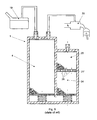
- the canister 1 of an evaporated fuel processing system comprises a housing 2, divided by the wall 3 into two adsorbing chambers 4 and 5 filled with activated carbon.
- the activated carbon 11 a is hold between filtering covers 7 and 8 being permeable for evaporated fuel.
- the squeezing strength is exerted by the perforated plate 9 and the compression spring 10.
- the activated carbon 11 b and 11c in the adsorbing outlet chamber 5 is held between filtering layers 12 and 13 being permeable for evaporated fuel by means of the perforated plate 14 and the compression spring 15.
- Filtering covers 8 and 13 protect orifices in perforated plates 9 and 14 from clogging by activated carbon, as well as prevent penetration of activated coal into the channel 6 below the plates.
- the first adsorption channel 4 is connected with the fuel tank 19 by means of the inlet port 16 and with the intake pipe 20 of an internal combustion engine by means of the outlet port 17.
- the adsorption outlet chamber 5 is discharged to the surrounding atmosphere through the atmospheric port 18.
- the first adsorbing chamber 4 is connected in series with the adsorbing outlet chamber 5 by means of the channel 6 that runs under the wall 3.
- the filtering covers 7 and 12 protect corresponding orifices 16, 17 and 18 from clogging.
- Evaporated fuel which is released from the fuel tank 19, enters the canister 1 through the inlet port 16 and diffuse in the first adsorbing chamber 4 where neutralization of light hydrocarbons is carried out.
- the fuel vapours, collected in the canister are inducted by negative pressure of the intake pipe 20 and then burnt inside the combustion chamber.
- the canister shown in Fig. 1 comprises a partition 21 with holes 28, dividing the adsorbing outlet chamber 5, hence two layers of the adsorbent are defined: the inner layer 24 and the outer layer 25 of thickness H. Filtering covers 22 and 23 protect the holes 28 in the partition 21 from clogging by the activated carbon (cf. drawing Fig. 9).
- the partition 21 serves also as additional restrain for a vapour flow into the outer layer 25 of the adsorbing outlet chamber 5 and brings about redistribution thereof within the entire volume of the activated carbon 11 a and 11 b. As a result, the entire activated coal inside the canister 1 is involved in adsorption of hydrocarbons from fuel vapour.
- the vapour channel 26 inserted inside a depth h into the outer layer 25 is formed in the partition 21.
- the vapour channel 26 comprises a pressure-controlled direct action valve. According to the present embodiment of the invention it has a form of the poppet valve 27a (shown in Fig. 3), which has a closing component 29a mounted on the stem 30a.
- the valve 27a remains closed due to action of the spring 31, which leans against appropriate projections inside the vapour channel 26.
- the valve 27a opens when flow rate reaches a predetermined value, when restrictions of the adsorbent layer along the distance h leads to pressure growth below the partition that exceeds the opening pressure of the valve.
- the vapour channel 26 with the valve is inserted into the outer layer 25 to a certain depth h, the vapour bypasses a part of adsorbent over the partition 21, thus the flow resistance is lower.
- the opening pressure of the valve 27a is adjusted proportionally to the depth h of the vapour channel 26 insertion.
- valve remains open at high flow rates; decrease of the flow rate results in reducing of flow resistance and finally in valve closing.
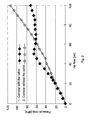
- the Fig. 2 shows the measured, experimental relationship of pressure drop (flow resistance) vs. flow rate of the air stream flowing through the canister according to the present invention (curve 1, drawing Fig. 1) compared to a conventional canister with a partition (curve 2, drawing Fig. 9).
- pressure drop is substantially proportional to the flow rate of the evaporated fuel and at defined flow rate, for a conventional canister, refuelling the vehicle can be even impossible.
- the critical value of flow resistance depends on a number of factors, which include, among others, a capacity of a fuel tank and a shape of a filler neck.
- FIG. 4 to Fig. 6 present other embodiments of the valve, mounted in the partition 21.
- the valve 27b in the drawing Fig. 4 is a flapper valve.
- the elastic closing element 29b made of plastic material is mounted on a tongue 30b attached to an orifice in the vapour channel wall 26.
- the valve 27c in the drawing Fig. 5 is a rather simple valve of duckbill type.
- the valve is made of plastic material and mounted to an orifice in the partition 21.
- Fig. 6 shows the valve 27d, which is of umbrella type.
- the closing element 29d of the valve along with its stem 30d is mounted in an appropriate orifice in the partition 21.
- the drawing Fig. 7 presents another embodiment of a canister according to the present invention.
- the adsorbing outlet chamber 5 has no partition and the vapour channel is defined in the perforated plate 14 over the spring 15.
- valve in the vapour channel is a solenoid valve 27e, connected to the control circuit 32, which actuates the valve and opens it depending on pressure of an evaporated fuel inside the fuel tank 19.
- the pressure value is measured by means of a gauge or sensor 33.
- the drawing Fig. 9 illustrates one more embodiment of a canister, which includes the partition 21 with two vapour channels 26a and 26b of depths h and h1 respectively.
- the presented embodiment comprises two flapper valves, one per each channel, with different values of opening pressure, wherein opening pressure of the valve in the shortest vapour channel 26a is the lowest. Thanks to that, the valve in the vapour channel 26a opens first and the valve in the vapour channel 26b operates as a safety valve, i.e. it opens only in case if reduction of flow resistance, caused by opening the valve in the vapour channel 26a, proves to be insufficient.
Landscapes
- Chemical & Material Sciences (AREA)
- Engineering & Computer Science (AREA)
- Analytical Chemistry (AREA)
- General Chemical & Material Sciences (AREA)
- Oil, Petroleum & Natural Gas (AREA)
- Chemical Kinetics & Catalysis (AREA)
- Combustion & Propulsion (AREA)
- Mechanical Engineering (AREA)
- General Engineering & Computer Science (AREA)
- Supplying Secondary Fuel Or The Like To Fuel, Air Or Fuel-Air Mixtures (AREA)
Abstract
Description
- The invention relates to a canister of an evaporated fuel processing system of an internal combustion engine, that enables both controlled discharge of evaporated fuel into the atmosphere, as well as neutralization of light hydrocarbons contained in evaporated fuel.
- A conventional canister of an evaporated fuel processing system is disclosed e.g. in the patent US 2002/0078931. The canister houses a plurality of serially connected adsorbing chambers. The first adsorbing chamber is connected to a fuel tank and to an intake pipe of an internal combustion engine and the last one, outlet adsorbing chamber comprises an atmospheric port.
- The fuel vapours, after entering into the canister from the fuel tank, are captured by the adsorbent included in the chambers. As a rule, activated carbon is used as the chamber-filling agent. After the start of the engine the vapours are inducted by negative pressure of the intake pipe and then burnt inside the combustion chamber. Once adsorptive capability of the first chamber is exhausted, the vapours pass through to successive adsorbing chambers, and after exceeding adsorptive capabilities of the outlet chamber they are discharged into the atmosphere.
- To ensure that the container meets requirements of related governmental emission standards, e.g the LEV II (Low-Emission Vehicle Program) or the Zero Evap standard, that are in use in the USA, the emission of evaporated fuel into the atmosphere must be as low as possible. For this purpose the height of adsorbing chambers should be relatively large, as compared with diameters thereof. In addition, the outlet adsorbing chambers is frequently divided by a partition, thus defining the outer and the inner adsorbing layer. Such a partition produces an additional restraint against vapour flow causing redistribution thereof within the entire volume of the adsorbent below the partition.
- Unfortunately, the canisters of the above construction may fail meeting the second requirement that is demanded, which is adsorption of fuel vapour that arises while tank refuelling (onboard refueling vapor recovery - ORVR), where the low resistance to vapour flow is required due to much higher rates of evaporated fuel flow. At high intensity of flow the activated carbon in the adsorbing outlet chamber generates high flow resistance, which may lead to unfavourable behaviour of the canister during tank refuelling. In an extreme case, resistance of the canister may even make the refuelling impossible, as the fuel vapour sensor, installed in a pump gun, cuts the fuel flow out. Resistance to fuel vapour flow is even higher for canisters with a partition installed inside the adsorbing outlet chamber.
- The aim of the presented invention is to provide a canister of an evaporated fuel processing system, which would be free of aforementioned disadvantages, and would make it possible to obtain different operational characteristics of the canister adsorption, depending on the intensity of the fuel vapour flow and hence to meet the related emission standards.
- According to the present invention there is provided a canister of an evaporated fuel processing system having a housing, inside of which a number of serially connected adsorbing chambers is placed, where the first adsorbing chamber is connected to a fuel tank and to an intake pipe of an internal combustion engine and the last, outlet adsorbing chamber comprises an atmospheric port, where inside the outlet adsorbing chamber across a vapours flow path at least one perforated plate is placed. The canister is characterised in that, the perforated plate comprises at least one vapour channel with a valve, inserted inside the outlet adsorbing chamber for a distance less or equal to the thickness of adsorbent layer behind the perforated plate, wherein the valve remains closed when no flow of evaporated fuel through the perforated plate occurs.
- It is favourable according to the present invention if the perforated plate has form of partition with holes; such a partition divides the adsorption outlet chamber to the inner and the outer adsorbing layer.
- Furthermore, it is favourable if the valve in the vapour channel is a pressure-controlled direct action valve that opens when the flow restrictions along the adsorbent layer at the lowest distance of the vapour channel insertion exceeds the valve opening pressure.
- In such a case, according to the present invention, it is favourable if the valve in the vapour channel is a poppet valve, a duckbill valve, a flapper vale or an umbrella valve.
- Alternatively, according to the present invention it is advantageous when the valve in the vapour channel is a solenoid valve, actuated by an external signal.
- In such a case the external signal that enables opening the valve is advantageously produced by a sensor disposed in a fuel tank.
- In case if a plurality of fuel vapour channels is applied, it is favourable if individual fuel vapour channels are inserted into the adsorbing outlet chamber to various depths, and the opening pressure values for valves in fuel vapour channels are diversified.
- The canister according to the present invention is distinguished by particularly good operational characteristic. If flow of evaporated fuel through the canister is low, the entire amount of the adsorbing agent is involved in adsorption process, whereas at high fuel vapour flow, e.g. during tank refuelling (ORVR), the valve opens and stabilization of pressure is reached. The evaporated fuel passes through the vapour channel and the thinner layer of the adsorbent over the vapour channel until the flow rate decreases, which results in valve closing.
- The canister according to the present invention enables meeting both the requirements of emission standards, as well as the ORVR regulations, which was extremely difficult for known constructions of canisters.
- The canister of an evaporated fuel processing system of an internal combustion engine, according to the present invention, is shown in its example embodiments with reference to the drawings, of which:
- Fig. 1 shows a schematic lateral cross-section of the first embodiment of the canister of an evaporated fuel processing system according to the present invention along with typical components of an evaporated fuel processing system,
- Fig. 2 shows functions of pressure drop vs. flow rate of fuel vapours through the canister, for the first embodiment of the canister according to the present invention as shown in Fig. 1, and for a typical canister with partition (as shown in Fig. 9),
- Fig. 3 shows a lateral cross-section of the canister valve from the drawing Fig. 1,
- Fig. 4 shows a lateral cross-section of another embodiment of the canister valve,
- Fig. 5 shows a lateral cross-section of one more embodiment of the canister valve,
- Fig. 6 shows a lateral cross-section of a yet another embodiment of the canister valve,
- Fig. 7 shows a schematic lateral cross-section of another embodiment of the canister of an evaporated fuel processing system according to the present invention,
- Fig. 8 shows one more embodiment of the canister of an evaporated fuel processing system according to the present invention, and
- Fig. 9 shows a schematic diagram of a conventional canister with a partition.
-
- As shown in Fig. 1, the
canister 1 of an evaporated fuel processing system comprises ahousing 2, divided by thewall 3 into twoadsorbing chambers adsorbing chamber 4, the activatedcarbon 11 a is hold between filtering covers 7 and 8 being permeable for evaporated fuel. The squeezing strength is exerted by theperforated plate 9 and thecompression spring 10. Similarly, the activatedcarbon outlet chamber 5 is held between filteringlayers perforated plate 14 and thecompression spring 15. Filtering covers 8 and 13 protect orifices inperforated plates channel 6 below the plates. - The
first adsorption channel 4 is connected with thefuel tank 19 by means of theinlet port 16 and with theintake pipe 20 of an internal combustion engine by means of theoutlet port 17. Theadsorption outlet chamber 5 is discharged to the surrounding atmosphere through theatmospheric port 18. Moreover, the firstadsorbing chamber 4 is connected in series with theadsorbing outlet chamber 5 by means of thechannel 6 that runs under thewall 3. The filtering covers 7 and 12 protectcorresponding orifices - Evaporated fuel, which is released from the
fuel tank 19, enters thecanister 1 through theinlet port 16 and diffuse in the firstadsorbing chamber 4 where neutralization of light hydrocarbons is carried out. After the start of the engine, the fuel vapours, collected in the canister are inducted by negative pressure of theintake pipe 20 and then burnt inside the combustion chamber. - If evaporated fuel pressure is high the vapours move to the adsorbing
outlet chamber 5, from which they are discharged into the atmosphere through theatmospheric port 18. The discharging takes pace, especially when a temperature of the ambient environment around the canister grows, as volume of fuel vapours diffused inadsorption chambers - The canister shown in Fig. 1 comprises a
partition 21 withholes 28, dividing the adsorbingoutlet chamber 5, hence two layers of the adsorbent are defined: theinner layer 24 and theouter layer 25 of thickness H. Filtering covers 22 and 23 protect theholes 28 in thepartition 21 from clogging by the activated carbon (cf. drawing Fig. 9). Thepartition 21 serves also as additional restrain for a vapour flow into theouter layer 25 of the adsorbingoutlet chamber 5 and brings about redistribution thereof within the entire volume of the activatedcarbon canister 1 is involved in adsorption of hydrocarbons from fuel vapour. - As shown in Fig. 1, the
vapour channel 26 inserted inside a depth h into theouter layer 25 is formed in thepartition 21. Thevapour channel 26 comprises a pressure-controlled direct action valve. According to the present embodiment of the invention it has a form of thepoppet valve 27a (shown in Fig. 3), which has aclosing component 29a mounted on thestem 30a. Thevalve 27a remains closed due to action of the spring 31, which leans against appropriate projections inside thevapour channel 26. - If a pressure of fuel vapours that reach the
partition 21 is less than the opening pressure of thevalve 27a, the vapour penetrates throughholes 28 and farther through the adsorbent layer of thickness H. The above happens if flow rate of the evaporated fuel is low. In such a case thevalve 27a remains closed and the canister generally behaves as a typical canister with partition, which is shown in Fig. 9. - The
valve 27a opens when flow rate reaches a predetermined value, when restrictions of the adsorbent layer along the distance h leads to pressure growth below the partition that exceeds the opening pressure of the valve. On the other hand, as thevapour channel 26 with the valve is inserted into theouter layer 25 to a certain depth h, the vapour bypasses a part of adsorbent over thepartition 21, thus the flow resistance is lower. In this embodiment the opening pressure of thevalve 27a is adjusted proportionally to the depth h of thevapour channel 26 insertion. - The valve remains open at high flow rates; decrease of the flow rate results in reducing of flow resistance and finally in valve closing.
- The Fig. 2 shows the measured, experimental relationship of pressure drop (flow resistance) vs. flow rate of the air stream flowing through the canister according to the present invention (
curve 1, drawing Fig. 1) compared to a conventional canister with a partition (curve 2, drawing Fig. 9). - As shown, pressure drop is substantially proportional to the flow rate of the evaporated fuel and at defined flow rate, for a conventional canister, refuelling the vehicle can be even impossible. The critical value of flow resistance depends on a number of factors, which include, among others, a capacity of a fuel tank and a shape of a filler neck.
- In case of a canister with a valve, pressure drop increases much faster until a certain value of flow rate is reached, due to less area of orifices available for flow of vapour through the partition, as a fraction of that area is then concealed by the closed valve. At a certain flow rate the valve opens and flow resistance increases much slower. Slight decrease of flow resistance, which is observed immediately after opening of the valve, results from specific circumstances of the executed experiment and can be explained by a presence of non-saturated activated carbon just above the vapour channel.
- The drawings Fig. 4 to Fig. 6 present other embodiments of the valve, mounted in the
partition 21. - The
valve 27b in the drawing Fig. 4 is a flapper valve. Theelastic closing element 29b made of plastic material is mounted on atongue 30b attached to an orifice in thevapour channel wall 26. - The
valve 27c in the drawing Fig. 5 is a rather simple valve of duckbill type. The valve is made of plastic material and mounted to an orifice in thepartition 21. - Fig. 6 shows the
valve 27d, which is of umbrella type. Theclosing element 29d of the valve along with itsstem 30d is mounted in an appropriate orifice in thepartition 21. - The presented embodiments of a valve in the partitioning plate are quoted exclusively to illustrate operation principle of the appliance and in any case cannot be considered as exhausting solutions to which the invention is limited.
- The drawing Fig. 7 presents another embodiment of a canister according to the present invention. As it can be seen, the adsorbing
outlet chamber 5 has no partition and the vapour channel is defined in theperforated plate 14 over thespring 15. - Moreover, in this embodiment the valve in the vapour channel is a
solenoid valve 27e, connected to thecontrol circuit 32, which actuates the valve and opens it depending on pressure of an evaporated fuel inside thefuel tank 19. The pressure value is measured by means of a gauge orsensor 33. - Operating of such a canister is similar to the previous one. If flow rate of evaporated fuel is low the
valve 27e remains closed. Growth of vapour pressure in thefuel tank 19 that occurs during refuelling activates thepressure sensor 33. In response, thecontrol circuit 32 produces a suitable electric signal that actuates solenoid of thevalve 27e and the valve opens. Since, thevapour channel 26, in which the valve is disposed, is inserted to a certain depth h into the adsorbingoutlet chamber 5, the vapour bypasses a part of adsorbent over thepartitioning plate 14. Flow resistance is lower, hence growth of vapour pressure inside thefuel tank 19, which would make refuelling impossible, is disabled. Obviously, drop of evaporated fuel pressure inside thefuel tank 19 is recorded by thesensor 33 and thecontrol circuit 32 provides a suitable signal that closes thevalve 27e. - The drawing Fig. 9 illustrates one more embodiment of a canister, which includes the
partition 21 with twovapour channels shortest vapour channel 26a is the lowest. Thanks to that, the valve in thevapour channel 26a opens first and the valve in thevapour channel 26b operates as a safety valve, i.e. it opens only in case if reduction of flow resistance, caused by opening the valve in thevapour channel 26a, proves to be insufficient. - By appropriate selection of a number of channels as well as height and diameter for each of them together with individual opening pressures, a large variety of operational characteristics of the canister can be obtained. It is also possible to dispose the vapour channels both in the perforated plate, over a compressing spring, and in the partition of the adsorbing outlet chamber.
Claims (10)
- Canister of an evaporated fuel processing system having a housing, inside of which a number of serially connected adsorbing chambers is placed, where the first adsorbing chamber is connected to a fuel tank and to an intake pipe of an internal combustion engine and the last, outlet adsorbing chamber comprises an atmospheric port, where inside the outlet adsorbing chamber across a vapours flow path at least one perforated plate is placed, characterised in that, the perforated plate (14, 21) comprises at least one vapour channel (26) with a valve, inserted inside the outlet adsorbing chamber for a distance (h) less or equal to the thickness (H) of adsorbent layer behind the perforated plate (14, 21), and the valve remains closed when no flow of evaporated fuel through the perforated plate (14, 21) occurs.
- Canister as claimed in claim 1, characterised in that, the perforated plate has a form of partition (21) with holes (28), dividing the outlet adsorbing chamber to inner (24) and outer (25) adsorbing layer.
- Canister as claimed in claim 1 or 2, characterised in that, the valve in the vapour channel (26) is a pressure controlled direct action valve that opens when the flow restriction of adsorbent layer at the lowest distance (h) of the vapour channel (26) insertion exceeds the valve opening pressure.
- Canister as claimed in claim 3, characterised in that the valve in the vapour channel (26) is a poppet valve (27a).
- Canister as claimed in claim 3, characterised in that the valve in the vapour channel (26) is a duckbill valve (27b).
- Canister as claimed in claim 3, characterised in that the valve in the vapour channel (26) is a flapper valve (27c).
- Canister as claimed in claim 3, characterised in that the valve in the vapour channel (26) is an umbrella valve (27d).
- Canister as claimed in claim 1 or 2, characterised in that the valve in the vapour channel (26) is a solenoid valve (27e) actuated by an external signal.
- Canister as claimed in claim 8, characterised in that the external signal for opening the valve (27e) is produced by a sensor (33) disposed in a fuel tank (19).
- Canister as claimed in claim 1 or 2, characterised in that the vapour channels (26a, 26b) are inserted into the outlet adsorbing chamber to various depths, and the opening pressure values of valves in vapour channels (26a, 26b) are diversified.
Applications Claiming Priority (2)
| Application Number | Priority Date | Filing Date | Title |
|---|---|---|---|
| PL03361212A PL361212A1 (en) | 2003-07-11 | 2003-07-11 | Absorber in the fuel vapour evacuation system |
| PL36121203 | 2003-07-11 |
Publications (2)
| Publication Number | Publication Date |
|---|---|
| EP1496239A2 true EP1496239A2 (en) | 2005-01-12 |
| EP1496239A3 EP1496239A3 (en) | 2007-10-31 |
Family
ID=33448595
Family Applications (1)
| Application Number | Title | Priority Date | Filing Date |
|---|---|---|---|
| EP04460022A Withdrawn EP1496239A3 (en) | 2003-07-11 | 2004-06-03 | Canister of an evaporated fuel processing system |
Country Status (3)
| Country | Link |
|---|---|
| US (1) | US6874483B2 (en) |
| EP (1) | EP1496239A3 (en) |
| PL (1) | PL361212A1 (en) |
Cited By (2)
| Publication number | Priority date | Publication date | Assignee | Title |
|---|---|---|---|---|
| EP1788230A1 (en) | 2005-11-19 | 2007-05-23 | Delphi Technologies, Inc. | Canister for evaporated fuel processing system with a monolithically formed block of activated carbon and a method of manufacturing thereof |
| CN103573479A (en) * | 2012-08-08 | 2014-02-12 | 株式会社马勒滤清系统 | Canister |
Families Citing this family (19)
| Publication number | Priority date | Publication date | Assignee | Title |
|---|---|---|---|---|
| DE102004054114A1 (en) * | 2003-12-30 | 2005-08-04 | Hyundai Motor Co. | Canister for vehicle, has partition dividing inner space of canister into first and second spaces, first activated charcoal, second activated charcoal, and diffuser |
| JP2007002709A (en) * | 2005-06-23 | 2007-01-11 | Mahle Filter Systems Japan Corp | Activated carbon, and vapor fuel treatment device using the same |
| US7566358B2 (en) * | 2005-10-05 | 2009-07-28 | Veeder-Root Company | Fuel storage tank pressure management system and method employing a carbon canister |
| JP4718311B2 (en) * | 2005-11-30 | 2011-07-06 | 株式会社マーレ フィルターシステムズ | Canister |
| JP4522967B2 (en) * | 2006-03-31 | 2010-08-11 | 愛三工業株式会社 | Canister |
| US7900607B2 (en) * | 2007-12-20 | 2011-03-08 | Kautex Textron Gmbh & Co. Kg | Fuel vapor storage and recovery apparatus |
| JP5227214B2 (en) * | 2009-02-19 | 2013-07-03 | 株式会社クボタ | Work vehicle |
| DE102009048134B4 (en) * | 2009-10-02 | 2016-03-24 | Audi Ag | Filter device, motor vehicle and method for operating a filter device |
| US8257473B2 (en) * | 2010-07-08 | 2012-09-04 | Airsep Corporation | Sieve bed |
| KR101251052B1 (en) * | 2010-12-06 | 2013-04-05 | 현대자동차주식회사 | Canister with dual air fluid paths |
| JP6017167B2 (en) * | 2012-04-06 | 2016-10-26 | 愛三工業株式会社 | Trap canister |
| US9518538B2 (en) * | 2012-10-05 | 2016-12-13 | Ford Global Technologies, Llc | Variable restriction fuel vapor canister |
| US9359977B2 (en) * | 2013-02-20 | 2016-06-07 | Stant Usa Corp. | Fuel vapor recovery canister |
| WO2015111704A1 (en) * | 2014-01-23 | 2015-07-30 | フタバ産業株式会社 | Grid and canister using said grid |
| US9790898B2 (en) | 2015-04-30 | 2017-10-17 | Ford Global Technologies, Llc | Systems and methods for determining fuel vapor canister capacity |
| JP6544114B2 (en) * | 2015-07-27 | 2019-07-17 | 浜名湖電装株式会社 | Check valve device and evaporated fuel supply system |
| DE102016106920B4 (en) * | 2016-04-14 | 2022-09-29 | Dr. Ing. H.C. F. Porsche Aktiengesellschaft | Filter device for a motor vehicle |
| JP7608319B2 (en) | 2021-11-26 | 2025-01-06 | 愛三工業株式会社 | Canister |
| US12161965B2 (en) | 2022-08-25 | 2024-12-10 | Phinia Jersey Holdngs Llc | Volume compensating device for adsorbent fill compensation in an evaporative emissions canister |
Citations (1)
| Publication number | Priority date | Publication date | Assignee | Title |
|---|---|---|---|---|
| US20020078931A1 (en) | 2000-12-25 | 2002-06-27 | Aisan Kogyo Kabushiki Kaisha | Canister |
Family Cites Families (8)
| Publication number | Priority date | Publication date | Assignee | Title |
|---|---|---|---|---|
| JPS6055706B2 (en) * | 1979-11-09 | 1985-12-06 | 株式会社日本自動車部品総合研究所 | Vehicle fuel evaporation prevention device |
| JP3319108B2 (en) * | 1993-10-05 | 2002-08-26 | 株式会社デンソー | Automotive canister |
| JPH07293364A (en) * | 1994-04-27 | 1995-11-07 | Aisan Ind Co Ltd | Canister |
| JP3465393B2 (en) * | 1995-01-06 | 2003-11-10 | トヨタ自動車株式会社 | Evaporative fuel processor for internal combustion engines |
| JPH09203353A (en) * | 1996-01-26 | 1997-08-05 | Aisan Ind Co Ltd | Vehicular canister |
| US5718209A (en) * | 1996-12-09 | 1998-02-17 | General Motors Corporation | Fuel vapor storage canister |
| JP3727224B2 (en) * | 2000-05-15 | 2005-12-14 | 愛三工業株式会社 | Canister |
| US6537354B2 (en) * | 2001-07-31 | 2003-03-25 | Delphi Technologies, Inc. | Valve assembly for vapor canister |
-
2003
- 2003-07-11 PL PL03361212A patent/PL361212A1/en unknown
-
2004
- 2004-06-03 EP EP04460022A patent/EP1496239A3/en not_active Withdrawn
- 2004-07-09 US US10/888,078 patent/US6874483B2/en not_active Expired - Fee Related
Patent Citations (1)
| Publication number | Priority date | Publication date | Assignee | Title |
|---|---|---|---|---|
| US20020078931A1 (en) | 2000-12-25 | 2002-06-27 | Aisan Kogyo Kabushiki Kaisha | Canister |
Cited By (3)
| Publication number | Priority date | Publication date | Assignee | Title |
|---|---|---|---|---|
| EP1788230A1 (en) | 2005-11-19 | 2007-05-23 | Delphi Technologies, Inc. | Canister for evaporated fuel processing system with a monolithically formed block of activated carbon and a method of manufacturing thereof |
| CN103573479A (en) * | 2012-08-08 | 2014-02-12 | 株式会社马勒滤清系统 | Canister |
| CN103573479B (en) * | 2012-08-08 | 2016-03-02 | 株式会社马勒滤清系统 | Tank |
Also Published As
| Publication number | Publication date |
|---|---|
| EP1496239A3 (en) | 2007-10-31 |
| PL361212A1 (en) | 2005-01-24 |
| US6874483B2 (en) | 2005-04-05 |
| US20050022796A1 (en) | 2005-02-03 |
Similar Documents
| Publication | Publication Date | Title |
|---|---|---|
| EP1496239A2 (en) | Canister of an evaporated fuel processing system | |
| US8888901B2 (en) | Fuel vapor treating apparatus | |
| US5632251A (en) | Engine fuel vapor treating apparatus | |
| US6772741B1 (en) | High vacuum purge arrangement for vapor canisters | |
| US5868120A (en) | Fuel vapor management system for motor vehicles | |
| USRE34518E (en) | Vacuum actuated tank vapor vent valve | |
| US5460136A (en) | Evaporative fuel-adsorbing device and evaporative emission control system including same | |
| US7047952B1 (en) | Canister | |
| US5456236A (en) | Evaporative emission control system for internal combustion engines | |
| EP0514961B1 (en) | Fuel vapour storage canister assembly | |
| EP0955459A2 (en) | Air control valve assembly for fuel evaporative emission storage canister | |
| US6269802B1 (en) | Fuel tank | |
| US4085721A (en) | Evaporation purge control device | |
| US5450833A (en) | Breather for an internal combustion engine fuel tank | |
| US5373830A (en) | Breather for an internal combustion engine fuel tank | |
| JPH08232781A (en) | Evaporative fuel control system for internal combustion engine | |
| US20020078931A1 (en) | Canister | |
| KR100986062B1 (en) | Vehicle Fuel Evaporation Gas Recirculation System | |
| CN111065811B (en) | Fill forming device with electrically actuated steam separator vent valve | |
| US10138848B2 (en) | Canister | |
| JP2002235610A (en) | Canister for automobile | |
| US20130183207A1 (en) | Treatment Apparatus for Evaporated Fuel | |
| KR101251052B1 (en) | Canister with dual air fluid paths | |
| US20150075380A1 (en) | Activated-carbon filter with storage volume for a fuel tank | |
| KR100774244B1 (en) | Liquid fuel removal device contained in fuel evaporation gas in fuel tank of automobile |
Legal Events
| Date | Code | Title | Description |
|---|---|---|---|
| PUAI | Public reference made under article 153(3) epc to a published international application that has entered the european phase |
Free format text: ORIGINAL CODE: 0009012 |
|
| AK | Designated contracting states |
Kind code of ref document: A2 Designated state(s): AT BE BG CH CY CZ DE DK EE ES FI FR GB GR HU IE IT LI LU MC NL PL PT RO SE SI SK TR |
|
| AX | Request for extension of the european patent |
Extension state: AL HR LT LV MK |
|
| PUAL | Search report despatched |
Free format text: ORIGINAL CODE: 0009013 |
|
| AK | Designated contracting states |
Kind code of ref document: A3 Designated state(s): AT BE BG CH CY CZ DE DK EE ES FI FR GB GR HU IE IT LI LU MC NL PL PT RO SE SI SK TR |
|
| AX | Request for extension of the european patent |
Extension state: AL HR LT LV MK |
|
| 17P | Request for examination filed |
Effective date: 20080502 |
|
| AKX | Designation fees paid |
Designated state(s): AT BE BG CH CY CZ DE DK EE ES FI FR GB GR HU IE IT LI LU MC NL PL PT RO SE SI SK TR |
|
| GRAP | Despatch of communication of intention to grant a patent |
Free format text: ORIGINAL CODE: EPIDOSNIGR1 |
|
| STAA | Information on the status of an ep patent application or granted ep patent |
Free format text: STATUS: THE APPLICATION IS DEEMED TO BE WITHDRAWN |
|
| 18D | Application deemed to be withdrawn |
Effective date: 20110917 |