EP1495320B1 - Method for discriminating organic agricultural products from conventional agricultural products by using nitrogen isotope index - Google Patents
Method for discriminating organic agricultural products from conventional agricultural products by using nitrogen isotope index Download PDFInfo
- Publication number
- EP1495320B1 EP1495320B1 EP03746179A EP03746179A EP1495320B1 EP 1495320 B1 EP1495320 B1 EP 1495320B1 EP 03746179 A EP03746179 A EP 03746179A EP 03746179 A EP03746179 A EP 03746179A EP 1495320 B1 EP1495320 B1 EP 1495320B1
- Authority
- EP
- European Patent Office
- Prior art keywords
- crop
- fertilizer
- nitrogen isotope
- organic
- during
- Prior art date
- Legal status (The legal status is an assumption and is not a legal conclusion. Google has not performed a legal analysis and makes no representation as to the accuracy of the status listed.)
- Expired - Lifetime
Links
Images

Classifications
-
- G—PHYSICS
- G01—MEASURING; TESTING
- G01N—INVESTIGATING OR ANALYSING MATERIALS BY DETERMINING THEIR CHEMICAL OR PHYSICAL PROPERTIES
- G01N33/00—Investigating or analysing materials by specific methods not covered by groups G01N1/00 - G01N31/00
- G01N33/02—Food
- G01N33/025—Fruits or vegetables
-
- G—PHYSICS
- G01—MEASURING; TESTING
- G01N—INVESTIGATING OR ANALYSING MATERIALS BY DETERMINING THEIR CHEMICAL OR PHYSICAL PROPERTIES
- G01N33/00—Investigating or analysing materials by specific methods not covered by groups G01N1/00 - G01N31/00
- G01N33/24—Earth materials
-
- Y—GENERAL TAGGING OF NEW TECHNOLOGICAL DEVELOPMENTS; GENERAL TAGGING OF CROSS-SECTIONAL TECHNOLOGIES SPANNING OVER SEVERAL SECTIONS OF THE IPC; TECHNICAL SUBJECTS COVERED BY FORMER USPC CROSS-REFERENCE ART COLLECTIONS [XRACs] AND DIGESTS
- Y10—TECHNICAL SUBJECTS COVERED BY FORMER USPC
- Y10T—TECHNICAL SUBJECTS COVERED BY FORMER US CLASSIFICATION
- Y10T436/00—Chemistry: analytical and immunological testing
- Y10T436/15—Inorganic acid or base [e.g., hcl, sulfuric acid, etc. ]
-
- Y—GENERAL TAGGING OF NEW TECHNOLOGICAL DEVELOPMENTS; GENERAL TAGGING OF CROSS-SECTIONAL TECHNOLOGIES SPANNING OVER SEVERAL SECTIONS OF THE IPC; TECHNICAL SUBJECTS COVERED BY FORMER USPC CROSS-REFERENCE ART COLLECTIONS [XRACs] AND DIGESTS
- Y10—TECHNICAL SUBJECTS COVERED BY FORMER USPC
- Y10T—TECHNICAL SUBJECTS COVERED BY FORMER US CLASSIFICATION
- Y10T436/00—Chemistry: analytical and immunological testing
- Y10T436/17—Nitrogen containing
-
- Y—GENERAL TAGGING OF NEW TECHNOLOGICAL DEVELOPMENTS; GENERAL TAGGING OF CROSS-SECTIONAL TECHNOLOGIES SPANNING OVER SEVERAL SECTIONS OF THE IPC; TECHNICAL SUBJECTS COVERED BY FORMER USPC CROSS-REFERENCE ART COLLECTIONS [XRACs] AND DIGESTS
- Y10—TECHNICAL SUBJECTS COVERED BY FORMER USPC
- Y10T—TECHNICAL SUBJECTS COVERED BY FORMER US CLASSIFICATION
- Y10T436/00—Chemistry: analytical and immunological testing
- Y10T436/17—Nitrogen containing
- Y10T436/172307—Cyanide or isocyanide
-
- Y—GENERAL TAGGING OF NEW TECHNOLOGICAL DEVELOPMENTS; GENERAL TAGGING OF CROSS-SECTIONAL TECHNOLOGIES SPANNING OVER SEVERAL SECTIONS OF THE IPC; TECHNICAL SUBJECTS COVERED BY FORMER USPC CROSS-REFERENCE ART COLLECTIONS [XRACs] AND DIGESTS
- Y10—TECHNICAL SUBJECTS COVERED BY FORMER USPC
- Y10T—TECHNICAL SUBJECTS COVERED BY FORMER US CLASSIFICATION
- Y10T436/00—Chemistry: analytical and immunological testing
- Y10T436/17—Nitrogen containing
- Y10T436/173076—Nitrite or nitrate
-
- Y—GENERAL TAGGING OF NEW TECHNOLOGICAL DEVELOPMENTS; GENERAL TAGGING OF CROSS-SECTIONAL TECHNOLOGIES SPANNING OVER SEVERAL SECTIONS OF THE IPC; TECHNICAL SUBJECTS COVERED BY FORMER USPC CROSS-REFERENCE ART COLLECTIONS [XRACs] AND DIGESTS
- Y10—TECHNICAL SUBJECTS COVERED BY FORMER USPC
- Y10T—TECHNICAL SUBJECTS COVERED BY FORMER US CLASSIFICATION
- Y10T436/00—Chemistry: analytical and immunological testing
- Y10T436/17—Nitrogen containing
- Y10T436/176152—Total nitrogen determined
-
- Y—GENERAL TAGGING OF NEW TECHNOLOGICAL DEVELOPMENTS; GENERAL TAGGING OF CROSS-SECTIONAL TECHNOLOGIES SPANNING OVER SEVERAL SECTIONS OF THE IPC; TECHNICAL SUBJECTS COVERED BY FORMER USPC CROSS-REFERENCE ART COLLECTIONS [XRACs] AND DIGESTS
- Y10—TECHNICAL SUBJECTS COVERED BY FORMER USPC
- Y10T—TECHNICAL SUBJECTS COVERED BY FORMER US CLASSIFICATION
- Y10T436/00—Chemistry: analytical and immunological testing
- Y10T436/24—Nuclear magnetic resonance, electron spin resonance or other spin effects or mass spectrometry
Definitions
- the present invention relates to a method for discriminating an organic crop from a conventional crop, or an organic farmland from a conventional farmland by using a nitrogen isotope index in a soil sample or crop sample.
- Synthesized pesticides can be investigated by monitoring residual pesticides in a crop or soil sample.
- chemical fertilizer can be investigated only by an indirect method such as data on farming and an analysis of chemical properties of corresponding soil.
- data on farming may be arbitrarily made by a farmer, and although the chemical properties of soil are directly affected by the application rates of fertilizers thereto, there is no scientific relationship between the chemical properties of soil and a type of fertilizer (chemical fertilizer or organic fertilizer) applied thereto.
- a type of fertilizer chemical fertilizer or organic fertilizer
- the inventors have statistically analysed distribution of nitrogen isotope in chemical fertilizer and organic fertilizer, and carried out experiments to examine the effect of chemical fertilizer or organic fertilizer on the nitrogen isotope index of a soil and a crop therefrom, and completed the present invention.
- the object of the present invention is to provide a method for discriminating an organic crop from a conventional crop.
- the present invention provides a method for discriminating an organic crop from a conventional crop, comprising;
- step (a) of the present method the amount of nitrogen isotope for a crop is a measured during cultivation period of the crop at appropriate intervals.
- a nitrogen isotope fluctuation patterns can be obtained by measuring the amount of nitrogen isotope.
- the measurement of the amount of a nitrogen isotope may be achieved by using a conventional apparatus which is used in the art, such as a stable isotope ratio mass spectrometer.
- step (c) are based on a result of experiment on the fluctuation pattern of nitrogen index of a crop grown with a chemical or organic fertilizer during cultivation (see Fig.2 ).
- nitrogen isotope refers to nitrogen isotopes including 15 N and 14 N.
- nitrogen isotope ratio refers to a ratio of heavy nitrogen ( 15 N) to total nitrogen ( 15 N+ 14 N), i.e., represented by 15N/( 15 N + 14 N).
- Atmospheric nitrogen (N 2 ) is typically used as reference material.
- the ⁇ 15 N value for atmospheric nitrogen is 0 ⁇ by definition.
- the higher level of nitrogen isotope index means higher level of 15 N in a sample.
- a nitrogen isotope index of an organic fertilizer is higher than that of a chemical fertilizer.
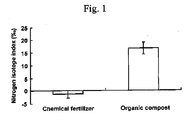
- Fig. 1 illustrates average of the nitrogen isotope index for 8 types of chemical fertilizers and 27 types of organic fertilizers, which are commercially available in Korea. As shown in Fig. 1 , the average nitrogen isotope index for organic fertilizers (16,7 ⁇ 2.3 ⁇ ) is higher than that of chemical fertilizers (-1.5 ⁇ 1.50 ⁇ ).
- the present invention is made based on such differences in the nitrogen isotope index between chemical fertilizer and organic fertilizer.
- organic crop generally refers to a crop that harvested after having been grown by using organic fertilizer and includes an organic crop and transitional organic crop under Quality Standard for crop (Korea).
- Korea Quality Standard for crop
- organic crop is not intended to be limited to the above mentioned meaning since the exact meaning of "organic crop” can be defined by assigning a specific nitrogen isotope index values at a specific application of the present invention.
- organic fertilizer refers to a fertilizer produced by processing a biological materials such as animal manures and plants materials, and includes both an organic fertilizer and byproducts fertilizer under Official Standard for fertilizers (Korea). Urea can be classified as an organic fertilizer if it is derived from an organism, while it can not be classified as an organic fertilizer if it is produced by a synthesis through a chemical engineering process.
- inventions refers to a type of cultivation using a chemical fertilizer, which is a typical type of cultivation.
- the term “conventional crop” generally refers to a crop that harvested after having been grown by using a chemical fertilizer.
- the term “conventional crop” is not intended to be limited to the above mentioned meaning since the exact meaning of "conventional crop” can be defined by assigning a specific nitrogen isotope index values at a specific application of the present invention.
- the present invention may be applied to the crops, for examples, but not limited to, a leaf vegetables such as a Chinese cabbage, greens for pickling, a Brassica campestris (a Chinese spinach-like green vegetable), a cabbage, a cauliflower, a broccoli, a Brussels sprout, an onion, a Welsh onion, a garlic, a scallion, a leek, an asparagus, a lettuce, a green for salad (which is called Saladana in Japan), a celery, a spinach, a crown daisy, a parsley, a trefoil (which is called Mitsuba in Japan and is useful as herb), a dropwort, an udo (which is an Aralia cordata), a Japanese ginger, a Japanese butterbur and a labiate; a fruit vegetables such as a cucumber, a pumpkins, a water melon, a melon, a tomato, an eggplant, a pimento, a strawberry, a kidney bean, a broad bean, a pea
- crops to which the present invention can be applied include a rice, a barley, a wheat and other flowery plants, but not limited to these examples.
- the crops are a leaf vegetables such as a Chinese cabbage, greens for pickling, a Brassica campestris (a Chinese spinach-like green vegetable), a cabbage, a cauliflower, a broccoli, a Brussels sprout, an onion, a Welsh onion, a garlic, a scallion, a leek, an asparagus, a lettuce, a green for salad (which is called Saladana in Japan), a celery, a spinach, a crown daisy, a parsley, a trefoil (which is called Mitsuba in Japan and is useful as herb), a dropwort, an udo (which is an Aralia cordata ) , a Japanese ginger, a Japanese butterbur and a labiate.
- a leaf vegetables such as a Chinese cabbage, greens for pickling, a Brassica campestris (a Chinese spinach-like green
- a nitrogen isotope amount has been measured and a nitrogen isotope index has been determined for 8 types of chemical fertilizers and 27 types of organic fertilizers which are commercially available in Korea.
- the chemical fertilizers were urea, ammonium sulfate and 6 compound fertilizers, and the organic fertilizers were an organic fertilizer or byproducts fertilizer under Official Standard for fertilizers (Korea) including composted pig manure, composted chicken manure, and composted cow manure.
- the nitrogen isotope content and index were measured and determined by using a continous-flow stable isotope ratio mass spectrometer (IsoPrime-EA, Micromass, England) linked with a CN-analyzer ( Limaux et al., 1999; Monaghan and Barraclough, 1995 ).
- the accuracy and reproducibility of the analysis method which were checked with a reference material(RM 8548: IAEA-N2) obtained from International Atomic Energy Agency (IAEA), were better than 0.4% and 0.2%, respectively.
- FIG. 1 illustrates average nitrogen isotope index values for 8 types of chemical fertilizers and 27 types of organic compost fertilizers which are commercially available in Korea.
- the average nitrogen isotope index values for chemical fertilizers and organic fertilizers were -1.54 ⁇ 1.50 ⁇ and 16.69 ⁇ 2.32 ⁇ , respectively.
- the average nitrogen isotope index values for the organic fertilizer was higher than those of the chemical fertilizer.
- the inventors have investigated whether these differences between the nitrogen isotope index values of the organic fertilizer and those of the chemical fertilizer can be applied to a soil and a crop, and successfully discriminated an organic crop from a conventional crop.
- a nitrogen isotope ratio of a crop sample was measured during cultivation period. To this end, the crop was grown with a chemical fertilizer (urea) or an organic fertilizer (composted manure) and a sample was taken for the measurement at appropriate intervals during the cultivation period.
- urea chemical fertilizer
- organic fertilizer compound manure
- the crop used in this Example was a maize plant, grown with fertilizer at a rate of 150 kgNha -1 (In case of split application, basal and additional fertilizer were applied at equal rate; 75 kgNha -1 for each), and the nitrogen isotope ratio of the whole nitrogen was measured for a crop sample at the 30 th , 40 th and 60 th day after sowing.
- the measurement was carried out as follows:
- FiG. 2 illustrates a nitrogen isotope index value of whole nitrogen for a crop (a maize plant) during the cultivation period at appropriate intervals.
- the nitrogen isotope index value for the control remained almost the same, and for the crop grown with only urea as a basal fertilizer, the nitrogen isotope index value for the crop continuously increased from 1.1 ⁇ 0.6 ⁇ at the day 30 th to 4.9 ⁇ 0.4 ⁇ at the day 60 th .
- the nitrogen isotope index decreased slightly from 7.7 ⁇ 0.2 ⁇ at the day 30 th to 7.0 ⁇ 0.2 ⁇ at the day 60 th .
- the nitrogen isotope index value increased from 4.5 ⁇ 0.6 ⁇ at the day 30 th to 6.1 ⁇ 0.2 ⁇ at the day 60 th .
- the nitrogen isotope index value increased from 1.2 ⁇ 0.6 ⁇ at the day 30 th to 3.6 ⁇ 0.4 ⁇ at the day 40 th , and then decreased to 2.1 ⁇ 0.4 ⁇ at the 60 th day.
- the nitrogen isotope index value remained substantially the same at the 30 th (7.8 ⁇ 0.2 ⁇ ) and 40 th day (7.5 ⁇ 0.3 ⁇ ), and then decreased to 5.2 ⁇ 0.2 ⁇ at the 60 th day by applying an additional fertilizer (at 40 th day of growth).
- the crop is determined to be a conventional crop during the cultivation period of which a chemical fertilizer had been used as a sole fertilizer in the early growth period; if the nitrogen isotope index exhibits a decreasing trend after initial increasing trend during cultivation period with time, the crop is determined to be a conventional crop during the cultivation period of which a chemical fertilizer had been used as a basal fertilizer in the early growth period and as an additional fertilizer in the latter growth period; if the nitrogen isotope index exhibits almost no fluctuation or a slight decreasing trend during the cultivation period with time, the crop is determined to be an organic crop during the cultivation period of which an organic fertilizer was used as a sole fertilizer; and if the nitrogen isotope index exhibits a decreasing trend after initial insignificant fluctuating trend during the cultivation period with time, the crop is determined to be a conventional crop during the cultivation period of which an organic fertilizer was used as a basal fertilizer
Landscapes
- Life Sciences & Earth Sciences (AREA)
- Health & Medical Sciences (AREA)
- Engineering & Computer Science (AREA)
- Chemical & Material Sciences (AREA)
- Food Science & Technology (AREA)
- Immunology (AREA)
- Biochemistry (AREA)
- Pathology (AREA)
- General Physics & Mathematics (AREA)
- Medicinal Chemistry (AREA)
- Physics & Mathematics (AREA)
- Analytical Chemistry (AREA)
- General Health & Medical Sciences (AREA)
- Remote Sensing (AREA)
- General Life Sciences & Earth Sciences (AREA)
- Environmental & Geological Engineering (AREA)
- Geology (AREA)
- Other Investigation Or Analysis Of Materials By Electrical Means (AREA)
- Cultivation Of Plants (AREA)
- Fertilizers (AREA)
Description
- The present invention relates to a method for discriminating an organic crop from a conventional crop, or an organic farmland from a conventional farmland by using a nitrogen isotope index in a soil sample or crop sample.
- In conventional cultivation practice, an excess amount of chemical fertilizer and pesticides have been used to increase the production yield. However, those chemical fertilizer and pesticides have caused ecological disturbance such as accumulation of salts and imbalance of nutrients in soil, decrease in the number of soil microorganisms and natural predators; water contamination; and safety problems in agricultural products, etc. With respect to these problems, it is anticipated that international trade volume in organic crop will be increased by way of international efforts to link agriculture, enviroment and trade, and thus to make international regulations to resolve the above problems, Further, a standard for an organic crop will be set up in Codex. OECD is planning to evaluate agricultural policies of each country by developing environmental index of agriculture in 13 divisions.
- In response to these international efforts, "Law for promoting environmentally favorable agriculture" and "enforcement Law thereof"' have been made in Korea to promote agriculture in an environmentally favorable way and to promote the production of value-added agricultural products by introducing a quality certification system therefor. According to the standard adopted in the quality certification system for environmentally favorable agricultural products, i.e., Quality Standard for crop (Korea), agricultural products are classified into four categories: low-pesticide agricultural products (the amount of used synthesized pesticide is 1/2 or lower of the standard amount thereof and the amount of used chemical fertilizer is 1/2 or lower of the recommended amount thereof); pesticide free agricultural products (no use of synthesized pesticides and the amount of used chemical fertilizer is 1/3 or lower of the recommended amount thereof); transitional organic agricultural products (no use of synthesized pesticides more than 1 year and no use of chemical fertilizer); and organic agricultural products (no use of synthesized pesticides more than 3 years and no use of chemical fertilizer). Thus, it is critical to determine whether a synthesized pesticide or a chemical fertilizer has been used or not in evaluating agricultural products according to the quality certification system.
- Synthesized pesticides can be investigated by monitoring residual pesticides in a crop or soil sample. On the contrary, chemical fertilizer can be investigated only by an indirect method such as data on farming and an analysis of chemical properties of corresponding soil. However, there were problems that data on farming may be arbitrarily made by a farmer, and although the chemical properties of soil are directly affected by the application rates of fertilizers thereto, there is no scientific relationship between the chemical properties of soil and a type of fertilizer (chemical fertilizer or organic fertilizer) applied thereto. According to the state of the art, it is impossible to objectively determine whether a chemical fertilizer or an organic fertilizer has been used in a soil. Thus, there is a need for a method for determining whether chemical fertilizer or organic fertilizer has been used in soil of interest. Such a method is also needed to satisfy the consumer's need to know whether an agricultural product of interest was grown with chemical fertilizer or organic fertilizer.
- There has been an attempt to determine the source of water contamination on the basis that a nitrogen isotope ratio of chemical fertilizer is different from that of livestock manure (Kohl et al, 1971, Fertilizer nitrogen: contribution to nitrate in surface water in a corn belt watershed, Science 174: 1331-1334). An analysis for the nitrogen isotope was employed for the purpose of studying the source of water contamination (Iqbal et al, 1997, Nitrogen isotope indicators of seasonal source variability to groundwater, Environmental Geology 32: 210-218).
- A study of the effect of inorganic fertilizer and composted manure on the nitrogen isotope index of a crop or soil has been described (Woo-Jung Choi et al., Plant and Soil, 2002, 245, 223-232). Apart, the measurement of a single value of nitrogen isotope index, at a certain point of time, on a crop, has been described as allowing defining the nature of fertilizer used on said crop (Denton et al., Aust. J. Plant Physiol, 2001, 28, 1005-1012). The inventors have statistically analysed distribution of nitrogen isotope in chemical fertilizer and organic fertilizer, and carried out experiments to examine the effect of chemical fertilizer or organic fertilizer on the nitrogen isotope index of a soil and a crop therefrom, and completed the present invention.
- The object of the present invention is to provide a method for discriminating an organic crop from a conventional crop.
- The present invention provides a method for discriminating an organic crop from a conventional crop, comprising;
- (a) measuring an amount of nitrogen isotope in a crop sample during the cultivation period at appropriate intervals and at from 30 days to 60 days of cultivation time;
- (b) calculating a pattern of nitrogen isotope index according to the formula (I) using each of the obtained nitrogen isotope value:

wherein δ15N is a nitrogen isotope index, R sample and R reference are 15N/(15N + 14N) ratio of sample and reference, respectively; and - (c) determining whether a crop belongs to a organic crop or a conventional crop:
- wherein (c-1) if the nitrogen isotope index exhibits an increasing trend during cultivation period with time, the crop is determined to be a conventional crop during the cultivation period of which a chemical fertilizer had been used as a sole fertilizer source in the early growth period;
- (c-2) if the nitrogen isotope index exhibits a decreasing trend after initial increasing trend, the crop is determined to be a conventional crop during the cultivation period of which a chemical fertilizer had been used as a basal fertilizer in the early growth period and as an additional fertilizer in the latter growth period;
- (c-3) if the nitrogen isotope index exhibits almost insignificant fluctuations or a slight decreasing trend during the cultivation period, the crop is determined to be an organic crop during the cultivation period of which an organic fertilizer had been used as a sole fertilizer; and
- (c-4) if the nitrogen isotope index exhibits a decreasing trend after initial insignificant fluctuation trend during the cultivation period with time, the crop is determined to be a conventional crop during the cultivation period of which an organic fertilizer had been used as a basal fertilizer in the early growth period and a chemical fertilizer had been used as an additional fertilizer in the latter growth period.
- In step (a) of the present method, the amount of nitrogen isotope for a crop is a measured during cultivation period of the crop at appropriate intervals. In this way, a nitrogen isotope fluctuation patterns can be obtained by measuring the amount of nitrogen isotope. The measurement of the amount of a nitrogen isotope may be achieved by using a conventional apparatus which is used in the art, such as a stable isotope ratio mass spectrometer.
- The criteria in step (c) are based on a result of experiment on the fluctuation pattern of nitrogen index of a crop grown with a chemical or organic fertilizer during cultivation (see
Fig.2 ). - The terms, as used herein, are referred to as follows otherwise mentioned. The term "nitrogen isotope" refers to nitrogen isotopes including 15N and 14N. The term "nitrogen isotope ratio" refers to a ratio of heavy nitrogen (15N) to total nitrogen (15N+14N), i.e., represented by 15N/(15N + 14N). Further, the term "nitrogen isotope index(δ15N)(‰)" of a sample refers to a normalized index of a nitrogen isotope ratio of a sample to that of a reference sample defined as following formula (I) :

wherein δ15N is a nitrogen isotope index, R sample and R reference are 15N/(15N + 14N) ratio of sample and reference, respectively. - Atmospheric nitrogen (N2) is typically used as reference material. In this case, the δ15N value for atmospheric nitrogen is 0‰ by definition. The higher level of nitrogen isotope index means higher level of 15N in a sample. Typically, a nitrogen isotope index of an organic fertilizer is higher than that of a chemical fertilizer.
Fig. 1 illustrates average of the nitrogen isotope index for 8 types of chemical fertilizers and 27 types of organic fertilizers, which are commercially available in Korea. As shown inFig. 1 , the average nitrogen isotope index for organic fertilizers (16,7 ± 2.3 ‰) is higher than that of chemical fertilizers (-1.5 ± 1.50‰). The present invention is made based on such differences in the nitrogen isotope index between chemical fertilizer and organic fertilizer.
The term "organic crop" generally refers to a crop that harvested after having been grown by using organic fertilizer and includes an organic crop and transitional organic crop under Quality Standard for crop (Korea). However, the term " "organic crop" is not intended to be limited to the above mentioned meaning since the exact meaning of "organic crop" can be defined by assigning a specific nitrogen isotope index values at a specific application of the present invention. - The term "organic fertilizer" refers to a fertilizer produced by processing a biological materials such as animal manures and plants materials, and includes both an organic fertilizer and byproducts fertilizer under Official Standard for fertilizers (Korea). Urea can be classified as an organic fertilizer if it is derived from an organism, while it can not be classified as an organic fertilizer if it is produced by a synthesis through a chemical engineering process.
- The term "conventional cultivation" refers to a type of cultivation using a chemical fertilizer, which is a typical type of cultivation. The term "conventional crop" generally refers to a crop that harvested after having been grown by using a chemical fertilizer. However, the term "conventional crop" is not intended to be limited to the above mentioned meaning since the exact meaning of "conventional crop" can be defined by assigning a specific nitrogen isotope index values at a specific application of the present invention.
- The present invention may be applied to the crops, for examples, but not limited to, a leaf vegetables such as a Chinese cabbage, greens for pickling, a Brassica campestris (a Chinese spinach-like green vegetable), a cabbage, a cauliflower, a broccoli, a Brussels sprout, an onion, a Welsh onion, a garlic, a scallion, a leek, an asparagus, a lettuce, a green for salad (which is called Saladana in Japan), a celery, a spinach, a crown daisy, a parsley, a trefoil (which is called Mitsuba in Japan and is useful as herb), a dropwort, an udo (which is an Aralia cordata), a Japanese ginger, a Japanese butterbur and a labiate; a fruit vegetables such as a cucumber, a pumpkins, a water melon, a melon, a tomato, an eggplant, a pimento, a strawberry, a kidney bean, a broad bean, a pea, a soybean and a corn; and a root vegetables such as a radish, a turnip, a burdock, a carrot, a potato, a taro, a sweet potato, a ginger, and a lotus. Other crops to which the present invention can be applied, include a rice, a barley, a wheat and other flowery plants, but not limited to these examples. Preferably, the crops are a leaf vegetables such as a Chinese cabbage, greens for pickling, a Brassica campestris (a Chinese spinach-like green vegetable), a cabbage, a cauliflower, a broccoli, a Brussels sprout, an onion, a Welsh onion, a garlic, a scallion, a leek, an asparagus, a lettuce, a green for salad (which is called Saladana in Japan), a celery, a spinach, a crown daisy, a parsley, a trefoil (which is called Mitsuba in Japan and is useful as herb), a dropwort, an udo (which is an Aralia cordata), a Japanese ginger, a Japanese butterbur and a labiate.
- The above and other features and advantages of the present invention will become more apparent by describing in detail exemplary embodiments thereof with reference to the attached drawings in which:
-
FIG. 1 illustrates average nitrogen isotope index values for 8 types of chemical fertilizers and 27 types of organic compost fertilizers which are commercially available in Korea; -
FIG. 2 illustrates a fluctuation in nitrogen isotope index value of a crop (a maize plant) during the cultivation period with time. - The present invention will be described in greater detail with reference to the following examples. The following examples are for illustrative purposes and are not intended to limit the scope of the invention.
- In this example, a nitrogen isotope amount has been measured and a nitrogen isotope index has been determined for 8 types of chemical fertilizers and 27 types of organic fertilizers which are commercially available in Korea.
- The chemical fertilizers were urea, ammonium sulfate and 6 compound fertilizers, and the organic fertilizers were an organic fertilizer or byproducts fertilizer under Official Standard for fertilizers (Korea) including composted pig manure, composted chicken manure, and composted cow manure. The nitrogen isotope content and index were measured and determined by using a continous-flow stable isotope ratio mass spectrometer (IsoPrime-EA, Micromass, England) linked with a CN-analyzer (Limaux et al., 1999; Monaghan and Barraclough, 1995). The accuracy and reproducibility of the analysis method, which were checked with a reference material(RM 8548: IAEA-N2) obtained from International Atomic Energy Agency (IAEA), were better than 0.4% and 0.2%, respectively.
-
FIG. 1 illustrates average nitrogen isotope index values for 8 types of chemical fertilizers and 27 types of organic compost fertilizers which are commercially available in Korea. As shown inFig. 1 , the average nitrogen isotope index values for chemical fertilizers and organic fertilizers were -1.54 ± 1.50‰ and 16.69 ± 2.32‰, respectively. Thus, the average nitrogen isotope index values for the organic fertilizer was higher than those of the chemical fertilizer. The inventors have investigated whether these differences between the nitrogen isotope index values of the organic fertilizer and those of the chemical fertilizer can be applied to a soil and a crop, and successfully discriminated an organic crop from a conventional crop. - A nitrogen isotope ratio of a crop sample was measured during cultivation period. To this end, the crop was grown with a chemical fertilizer (urea) or an organic fertilizer (composted manure) and a sample was taken for the measurement at appropriate intervals during the cultivation period.
- The crop used in this Example was a maize plant, grown with fertilizer at a rate of 150 kgNha-1 (In case of split application, basal and additional fertilizer were applied at equal rate; 75 kgNha-1 for each), and the nitrogen isotope ratio of the whole nitrogen was measured for a crop sample at the 30th, 40th and 60th day after sowing. The measurement was carried out as follows:
- To prepare a sample, a whole part of the maize plant was dried at 60°C and ground to a fine powder. The apparatus used for the analysis of a nitrogen isotope ratio was a continous-flow stable isotope ratio mass spectrometer (IsoPrime-EA, Micromass, England) linked with a CN-analyzer (Limaux et al., 1999; Monaghan and Barraclough, 1995). The accuracy and reproducibility of the analysis method, which were checked with a reference material (RM 8548: IAEA-N2) obtained from International Atomic Energy Agency (IAEA), were better than 0,4% and 0.2%, respectively.
-
FiG. 2 illustrates a nitrogen isotope index value of whole nitrogen for a crop (a maize plant) during the cultivation period at appropriate intervals. As shown inFig. 2 , the nitrogen isotope index value for the control remained almost the same, and for the crop grown with only urea as a basal fertilizer, the nitrogen isotope index value for the crop continuously increased from 1.1 ± 0.6‰ at theday 30th to 4.9 ± 0.4‰ at theday 60th. - On the other hand, for a crop grown with only compost as a basal fertilizer, the nitrogen isotope index decreased slightly from 7.7 ± 0.2‰ at the
day 30th to 7.0 ± 0.2‰ at theday 60th. For a crop grown with urea plus compost as a basal fertilizer, the nitrogen isotope index value increased from 4.5 ± 0.6‰ at theday 30th to 6.1 ± 0.2‰ at theday 60th. - On the other hand, for a crop grown with a urea as a basal and an additional fertilizer, the nitrogen isotope index value increased from 1.2 ± 0.6‰ at the
day 30th to 3.6 ± 0.4‰ at theday 40th, and then decreased to 2.1 ± 0.4‰ at the 60th day. For a crop grown with compost as a basal and urea as an additional fertilizer, the nitrogen isotope index value remained substantially the same at the 30th (7.8±0.2‰) and 40th day (7.5 ± 0.3‰), and then decreased to 5.2 ± 0.2‰ at the 60th day by applying an additional fertilizer (at 40th day of growth). - According to this Example, it is possible to determine that if the nitrogen isotope index exhibits an increasing trend during cultivation period with time, the crop is determined to be a conventional crop during the cultivation period of which a chemical fertilizer had been used as a sole fertilizer in the early growth period; if the nitrogen isotope index exhibits a decreasing trend after initial increasing trend during cultivation period with time, the crop is determined to be a conventional crop during the cultivation period of which a chemical fertilizer had been used as a basal fertilizer in the early growth period and as an additional fertilizer in the latter growth period; if the nitrogen isotope index exhibits almost no fluctuation or a slight decreasing trend during the cultivation period with time, the crop is determined to be an organic crop during the cultivation period of which an organic fertilizer was used as a sole fertilizer; and if the nitrogen isotope index exhibits a decreasing trend after initial insignificant fluctuating trend during the cultivation period with time, the crop is determined to be a conventional crop during the cultivation period of which an organic fertilizer was used as a basal fertilizer and a chemical fertilizer was used as an additional fertilizer.
- According to the present invention, it is also possible to discriminate an organic crop from a conventional crop by using a nitrogen isotope index of a crop sample.
Claims (3)
- A method for discriminating an organic crop from a conventional crop, comprising ;(a) measuring an amount of nitrogen isotope in a crop sample during a single cultivation period at appropriate intervals and at from 30 days to 60 days of cultivation time;(b) calculating a pattern of nitrogen isotope index according to the formula (I) using the obtained nitrogen isotope value:

wherein δ15N is a nitrogen isotope index, R sample and R reference are 15N/(15N + 14N) ratio of sample and reference, respectively; and(c) determining whether the crop belongs to an organic crop or a conventional crop,wherein (c-1) if the nitrogen isotope index exhibits an increasing trend during the cultivation period with time, the crop Is determined to be a conventional crop during the cultivation period of which a chemical fertilizer had been used as a sole fertilizer in the early growth period;(c-2) if the nitrogen isotope index exhibits a decreasing trend after initial increasing trend, the crop is determined to be a conventional crop during the cultivation period of which a chemical fertilizer had been used as a basal fertilizer in the early growth period and as an additional fertilizer in the latter growth period;(c-3) if the nitrogen isotope index exhibits almost insignificant fluctuations or a slight decreasing trend during the cultivation period with time, the crop is determined to be an organic crop during the cultivation period of which an organic fertilizer had been used as a sole fertilizer; and(c-4) if the nitrogen isotope index exhibits a decreasing trend after initial insignificant fluctuating trend during the cultivation period with time, the crop is determined to be a conventional crop during the cultivation period of which an organic fertilizer had been used as a basal fertilizer in the early growth period and a chemical fertilizer had been used as an additional fertilizer in the latter growth period. - The method according to Claim the crop is a maize or leaf vegetables.
- The method according to Claim 1, the crop is selected from the group consisting of a Chinese cabbage, greens for pickling, a Brassica campestris (a Chinese spinach-like green vegetable), a cabbage, a cauliflower, a broccoli, a Brussels sprout, an onion, a Welsh onion, a garlic, a scallion, a leek, an asparagus, a lettuce, a green for salad (which is called Saladana in Japan), a celery, a spinach, a crown daisy, a parsley, a trefoil (which is called Mitsuba in Japan and is useful as herb), a dropwort, an udo (which is an Aralia cordata), a Japanese ginger, a Japanese butterbur and a labiate.
Applications Claiming Priority (3)
| Application Number | Priority Date | Filing Date | Title |
|---|---|---|---|
| KR1020020019956A KR100626789B1 (en) | 2002-04-12 | 2002-04-12 | Identification method of organic produce using nitrogen isotope ratio |
| KR2002019956 | 2002-04-12 | ||
| PCT/KR2003/000740 WO2003087813A1 (en) | 2002-04-12 | 2003-04-12 | Method for discriminating organic agricultural products from conventional agricultural products by using nitrogen isotope index |
Publications (3)
| Publication Number | Publication Date |
|---|---|
| EP1495320A1 EP1495320A1 (en) | 2005-01-12 |
| EP1495320A4 EP1495320A4 (en) | 2011-01-05 |
| EP1495320B1 true EP1495320B1 (en) | 2013-01-09 |
Family
ID=29244724
Family Applications (1)
| Application Number | Title | Priority Date | Filing Date |
|---|---|---|---|
| EP03746179A Expired - Lifetime EP1495320B1 (en) | 2002-04-12 | 2003-04-12 | Method for discriminating organic agricultural products from conventional agricultural products by using nitrogen isotope index |
Country Status (10)
| Country | Link |
|---|---|
| US (1) | US7670842B2 (en) |
| EP (1) | EP1495320B1 (en) |
| JP (1) | JP4201086B2 (en) |
| KR (1) | KR100626789B1 (en) |
| CN (2) | CN101105462B (en) |
| AU (1) | AU2003225374B2 (en) |
| BR (1) | BR0309081A (en) |
| CA (1) | CA2482303C (en) |
| MX (1) | MXPA04009962A (en) |
| WO (1) | WO2003087813A1 (en) |
Cited By (1)
| Publication number | Priority date | Publication date | Assignee | Title |
|---|---|---|---|---|
| CN106248774A (en) * | 2016-08-31 | 2016-12-21 | 成都科源生物技术有限公司 | A kind of method carrying out L leucine product analysis |
Families Citing this family (13)
| Publication number | Priority date | Publication date | Assignee | Title |
|---|---|---|---|---|
| KR100626789B1 (en) * | 2002-04-12 | 2006-09-22 | 재단법인서울대학교산학협력재단 | Identification method of organic produce using nitrogen isotope ratio |
| JP2005130755A (en) * | 2003-10-30 | 2005-05-26 | New Energy & Industrial Technology Development Organization | Method for identifying plant species and plant cultivation areas of agricultural products |
| KR101186478B1 (en) | 2010-08-30 | 2012-09-27 | 한국기초과학지원연구원 | Method for discriminating the geographical origin of Chinese cabbages cultivated in Korea and China using Sr and Ti |
| US8682584B2 (en) * | 2011-08-19 | 2014-03-25 | Brookside Laboratories, Inc. | Nitrogen potential index |
| CN102967648A (en) * | 2012-11-20 | 2013-03-13 | 中国食品发酵工业研究院 | Method for identifying organic hot pepper based on stable isotope ratio |
| CN102980937A (en) * | 2012-11-20 | 2013-03-20 | 中国食品发酵工业研究院 | Method for identifying organic coriander based on stable isotope ratio |
| KR101600888B1 (en) * | 2014-06-20 | 2016-03-09 | 한국과학기술연구원 | Method of identifying cements using isotope ratio mass spectrometer |
| KR102552779B1 (en) * | 2016-08-17 | 2023-07-10 | (주)아모레퍼시픽 | Method for determining an organic ginseng using the organic acid |
| CN108445072B (en) * | 2018-03-01 | 2020-08-07 | 天津师范大学 | A method for the determination of carbon-nitrogen stable isotopes in samples with high carbon-nitrogen ratio |
| JP7054516B2 (en) * | 2018-03-09 | 2022-04-14 | 株式会社関越物産 | Method for determining the origin of konjac flour and processed konjac products |
| CN111869388B (en) * | 2020-07-16 | 2021-11-16 | 中国水利水电科学研究院 | Determination method of fertilizer application amount in farmland |
| CN114813896B (en) * | 2022-04-26 | 2026-02-10 | 中国科学院地理科学与资源研究所 | Isotopic assessment methods for the impact of land use patterns on watershed nitrogen pollution |
| CN115980306A (en) * | 2022-12-08 | 2023-04-18 | 成都理工大学 | A method for measuring nitrogen fixation in mining area soil |
Family Cites Families (4)
| Publication number | Priority date | Publication date | Assignee | Title |
|---|---|---|---|---|
| AU745912B2 (en) * | 1997-03-14 | 2002-04-11 | George Washington University, The | A device for continuous isotope ratio monitoring following fluorine based chemical reactions |
| JP2000290291A (en) * | 1999-03-31 | 2000-10-17 | Nippon Sanso Corp | Stable isotope-labeled oligonucleotide and oligonucleotide detection method |
| AU1850501A (en) * | 1999-12-02 | 2001-06-12 | Riso National Laboratory | Method for determining that a product has been organically produced |
| KR100626789B1 (en) * | 2002-04-12 | 2006-09-22 | 재단법인서울대학교산학협력재단 | Identification method of organic produce using nitrogen isotope ratio |
-
2002
- 2002-04-12 KR KR1020020019956A patent/KR100626789B1/en not_active Expired - Lifetime
-
2003
- 2003-04-12 JP JP2003584707A patent/JP4201086B2/en not_active Expired - Fee Related
- 2003-04-12 CN CN2007101271157A patent/CN101105462B/en not_active Expired - Fee Related
- 2003-04-12 CA CA2482303A patent/CA2482303C/en not_active Expired - Fee Related
- 2003-04-12 MX MXPA04009962A patent/MXPA04009962A/en active IP Right Grant
- 2003-04-12 US US10/510,749 patent/US7670842B2/en not_active Expired - Lifetime
- 2003-04-12 WO PCT/KR2003/000740 patent/WO2003087813A1/en not_active Ceased
- 2003-04-12 EP EP03746179A patent/EP1495320B1/en not_active Expired - Lifetime
- 2003-04-12 BR BR0309081-7A patent/BR0309081A/en not_active IP Right Cessation
- 2003-04-12 AU AU2003225374A patent/AU2003225374B2/en not_active Ceased
- 2003-04-12 CN CNB038136384A patent/CN100380121C/en not_active Expired - Fee Related
Cited By (1)
| Publication number | Priority date | Publication date | Assignee | Title |
|---|---|---|---|---|
| CN106248774A (en) * | 2016-08-31 | 2016-12-21 | 成都科源生物技术有限公司 | A kind of method carrying out L leucine product analysis |
Also Published As
| Publication number | Publication date |
|---|---|
| CN1659433A (en) | 2005-08-24 |
| US20050158871A1 (en) | 2005-07-21 |
| EP1495320A4 (en) | 2011-01-05 |
| JP4201086B2 (en) | 2008-12-24 |
| WO2003087813A1 (en) | 2003-10-23 |
| BR0309081A (en) | 2005-02-09 |
| CN101105462A (en) | 2008-01-16 |
| CN101105462B (en) | 2011-11-23 |
| CA2482303C (en) | 2012-07-31 |
| AU2003225374A1 (en) | 2003-10-27 |
| CN100380121C (en) | 2008-04-09 |
| EP1495320A1 (en) | 2005-01-12 |
| MXPA04009962A (en) | 2004-12-13 |
| KR20030081630A (en) | 2003-10-22 |
| KR100626789B1 (en) | 2006-09-22 |
| AU2003225374B2 (en) | 2006-10-19 |
| CA2482303A1 (en) | 2003-10-23 |
| JP2005523432A (en) | 2005-08-04 |
| US7670842B2 (en) | 2010-03-02 |
Similar Documents
| Publication | Publication Date | Title |
|---|---|---|
| Peltonen et al. | Using a chlorophyll meter to optimize nitrogen fertilizer application for intensively‐managed small‐grain cereals | |
| Thompson et al. | Tools and strategies for sustainable nitrogen fertilisation of vegetable crops | |
| US7670842B2 (en) | Method for discriminating organic agricultural products from conventional agricultural products by using nitrogen isotope index | |
| Rice et al. | Integrating mineralizable nitrogen indices into fertilizer nitrogen recommendations | |
| Rowland et al. | Determination of maturity and degree day indices and their success in predicting peanut maturity | |
| Ryu et al. | Model for predicting the nitrogen content of rice at panicle initiation stage using data from airborne hyperspectral remote sensing | |
| Räsänen et al. | Estimating the development of ecotoxicological pressure on water systems from pesticides in Finland 2000–2011 | |
| CN117016289A (en) | Agronomic methods for the production of vegetables and fungi | |
| Schumann | Precise placement and variable rate fertilizer application technologies for horticultural crops | |
| Brown et al. | Topsoil characteristics from a paired farm survey of organic versus conventional farming in southern England | |
| Nader et al. | Pesticide residue legislations challenge international trade of food and feed | |
| Dao | Sensing soil and foliar phosphorus fluorescence in Zea mays in response to large phosphorus additions | |
| Kitchen et al. | Proven practices and innovative technologies for on-farm crop nitrogen management | |
| Rezaei et al. | Environmental impact assessment (EIA) of alternative potato cropping systems in Hamadan Province, Iran | |
| Gherban | Models for describing the variation in grain weight in wheat ears–analysis of the venezio variety | |
| Williams et al. | Crop/weed outcomes from site-specific and uniform soil-applied herbicide applications | |
| Radke et al. | Application of the nitrogen-tillage-residue-management (NTRM) model for corn grown in low-input and conventional agricultural systems | |
| Sarma et al. | COMPREHENSIVE ASSESSMENT OF VARIOUS SOIL FERTILITY EVALUATION TECHNIQUES FOR ESTIMATING NUTRIENT STATUS OF SOIL: A REVIEW. | |
| RU2787129C1 (en) | Method for determining the lack of nitrogen in the nutrition of winter wheat plants | |
| AZ et al. | Active optical sensors to develop nitrogen fertilizer recommendations for potato crop | |
| Dželetović et al. | Available nitrogen in the surface mineral layer of natural meadows. | |
| O'Neill et al. | Assessment of nitrogen status of soils for cereal crops: use of plant and soil analysis to diagnose nitrogen status of spring barley | |
| Sawyer et al. | Foliar fertilization of corn with mono-potassium phosphate and urea | |
| HAYTOVA et al. | RELATIONSHIP BETWEEN NDVI AND IN SITU DATA IN PEPPER PLANTATIONS ON OPEN FIELD CONDITIONS. | |
| Price | New horizons in soil fertility management |
Legal Events
| Date | Code | Title | Description |
|---|---|---|---|
| PUAI | Public reference made under article 153(3) epc to a published international application that has entered the european phase |
Free format text: ORIGINAL CODE: 0009012 |
|
| 17P | Request for examination filed |
Effective date: 20041008 |
|
| AK | Designated contracting states |
Kind code of ref document: A1 Designated state(s): AT BE BG CH CY CZ DE DK EE ES FI FR GB GR HU IE IT LI LU MC NL PT RO SE SI SK TR |
|
| AX | Request for extension of the european patent |
Extension state: AL LT LV MK |
|
| A4 | Supplementary search report drawn up and despatched |
Effective date: 20101207 |
|
| RIC1 | Information provided on ipc code assigned before grant |
Ipc: G01N 33/24 20060101AFI20031028BHEP Ipc: G01N 33/02 20060101ALI20101201BHEP |
|
| 17Q | First examination report despatched |
Effective date: 20110225 |
|
| REG | Reference to a national code |
Ref country code: DE Ref legal event code: R079 Ref document number: 60343078 Country of ref document: DE Free format text: PREVIOUS MAIN CLASS: G01N0033240000 Ipc: G01N0033020000 |
|
| GRAP | Despatch of communication of intention to grant a patent |
Free format text: ORIGINAL CODE: EPIDOSNIGR1 |
|
| RIC1 | Information provided on ipc code assigned before grant |
Ipc: G01N 33/24 20060101ALI20120627BHEP Ipc: G01N 33/02 20060101AFI20120627BHEP |
|
| GRAS | Grant fee paid |
Free format text: ORIGINAL CODE: EPIDOSNIGR3 |
|
| GRAA | (expected) grant |
Free format text: ORIGINAL CODE: 0009210 |
|
| RAP1 | Party data changed (applicant data changed or rights of an application transferred) |
Owner name: SNU R&DB FOUNDATION |
|
| AK | Designated contracting states |
Kind code of ref document: B1 Designated state(s): AT BE BG CH CY CZ DE DK EE ES FI FR GB GR HU IE IT LI LU MC NL PT RO SE SI SK TR |
|
| REG | Reference to a national code |
Ref country code: GB Ref legal event code: FG4D |
|
| REG | Reference to a national code |
Ref country code: AT Ref legal event code: REF Ref document number: 593029 Country of ref document: AT Kind code of ref document: T Effective date: 20130115 Ref country code: CH Ref legal event code: EP |
|
| REG | Reference to a national code |
Ref country code: IE Ref legal event code: FG4D |
|
| REG | Reference to a national code |
Ref country code: DE Ref legal event code: R096 Ref document number: 60343078 Country of ref document: DE Effective date: 20130307 |
|
| PGFP | Annual fee paid to national office [announced via postgrant information from national office to epo] |
Ref country code: MC Payment date: 20130326 Year of fee payment: 11 |
|
| PG25 | Lapsed in a contracting state [announced via postgrant information from national office to epo] |
Ref country code: SI Free format text: LAPSE BECAUSE OF FAILURE TO SUBMIT A TRANSLATION OF THE DESCRIPTION OR TO PAY THE FEE WITHIN THE PRESCRIBED TIME-LIMIT Effective date: 20130109 |
|
| PGFP | Annual fee paid to national office [announced via postgrant information from national office to epo] |
Ref country code: LU Payment date: 20130415 Year of fee payment: 11 |
|
| REG | Reference to a national code |
Ref country code: NL Ref legal event code: VDEP Effective date: 20130109 |
|
| REG | Reference to a national code |
Ref country code: AT Ref legal event code: MK05 Ref document number: 593029 Country of ref document: AT Kind code of ref document: T Effective date: 20130109 |
|
| PG25 | Lapsed in a contracting state [announced via postgrant information from national office to epo] |
Ref country code: CY Free format text: LAPSE BECAUSE OF FAILURE TO SUBMIT A TRANSLATION OF THE DESCRIPTION OR TO PAY THE FEE WITHIN THE PRESCRIBED TIME-LIMIT Effective date: 20130109 Ref country code: AT Free format text: LAPSE BECAUSE OF FAILURE TO SUBMIT A TRANSLATION OF THE DESCRIPTION OR TO PAY THE FEE WITHIN THE PRESCRIBED TIME-LIMIT Effective date: 20130109 Ref country code: ES Free format text: LAPSE BECAUSE OF FAILURE TO SUBMIT A TRANSLATION OF THE DESCRIPTION OR TO PAY THE FEE WITHIN THE PRESCRIBED TIME-LIMIT Effective date: 20130420 Ref country code: SE Free format text: LAPSE BECAUSE OF FAILURE TO SUBMIT A TRANSLATION OF THE DESCRIPTION OR TO PAY THE FEE WITHIN THE PRESCRIBED TIME-LIMIT Effective date: 20130109 |
|
| PGFP | Annual fee paid to national office [announced via postgrant information from national office to epo] |
Ref country code: BE Payment date: 20130415 Year of fee payment: 11 Ref country code: GB Payment date: 20130410 Year of fee payment: 11 Ref country code: IE Payment date: 20130410 Year of fee payment: 11 Ref country code: CH Payment date: 20130412 Year of fee payment: 11 Ref country code: DE Payment date: 20130508 Year of fee payment: 11 |
|
| PG25 | Lapsed in a contracting state [announced via postgrant information from national office to epo] |
Ref country code: GR Free format text: LAPSE BECAUSE OF FAILURE TO SUBMIT A TRANSLATION OF THE DESCRIPTION OR TO PAY THE FEE WITHIN THE PRESCRIBED TIME-LIMIT Effective date: 20130410 Ref country code: NL Free format text: LAPSE BECAUSE OF FAILURE TO SUBMIT A TRANSLATION OF THE DESCRIPTION OR TO PAY THE FEE WITHIN THE PRESCRIBED TIME-LIMIT Effective date: 20130109 Ref country code: PT Free format text: LAPSE BECAUSE OF FAILURE TO SUBMIT A TRANSLATION OF THE DESCRIPTION OR TO PAY THE FEE WITHIN THE PRESCRIBED TIME-LIMIT Effective date: 20130509 Ref country code: FI Free format text: LAPSE BECAUSE OF FAILURE TO SUBMIT A TRANSLATION OF THE DESCRIPTION OR TO PAY THE FEE WITHIN THE PRESCRIBED TIME-LIMIT Effective date: 20130109 |
|
| PGFP | Annual fee paid to national office [announced via postgrant information from national office to epo] |
Ref country code: NL Payment date: 20130410 Year of fee payment: 11 |
|
| PG25 | Lapsed in a contracting state [announced via postgrant information from national office to epo] |
Ref country code: SK Free format text: LAPSE BECAUSE OF FAILURE TO SUBMIT A TRANSLATION OF THE DESCRIPTION OR TO PAY THE FEE WITHIN THE PRESCRIBED TIME-LIMIT Effective date: 20130109 Ref country code: RO Free format text: LAPSE BECAUSE OF FAILURE TO SUBMIT A TRANSLATION OF THE DESCRIPTION OR TO PAY THE FEE WITHIN THE PRESCRIBED TIME-LIMIT Effective date: 20130109 Ref country code: CZ Free format text: LAPSE BECAUSE OF FAILURE TO SUBMIT A TRANSLATION OF THE DESCRIPTION OR TO PAY THE FEE WITHIN THE PRESCRIBED TIME-LIMIT Effective date: 20130109 Ref country code: DK Free format text: LAPSE BECAUSE OF FAILURE TO SUBMIT A TRANSLATION OF THE DESCRIPTION OR TO PAY THE FEE WITHIN THE PRESCRIBED TIME-LIMIT Effective date: 20130109 Ref country code: EE Free format text: LAPSE BECAUSE OF FAILURE TO SUBMIT A TRANSLATION OF THE DESCRIPTION OR TO PAY THE FEE WITHIN THE PRESCRIBED TIME-LIMIT Effective date: 20130109 |
|
| PLBE | No opposition filed within time limit |
Free format text: ORIGINAL CODE: 0009261 |
|
| STAA | Information on the status of an ep patent application or granted ep patent |
Free format text: STATUS: NO OPPOSITION FILED WITHIN TIME LIMIT |
|
| 26N | No opposition filed |
Effective date: 20131010 |
|
| PG25 | Lapsed in a contracting state [announced via postgrant information from national office to epo] |
Ref country code: IT Free format text: LAPSE BECAUSE OF FAILURE TO SUBMIT A TRANSLATION OF THE DESCRIPTION OR TO PAY THE FEE WITHIN THE PRESCRIBED TIME-LIMIT Effective date: 20130109 |
|
| REG | Reference to a national code |
Ref country code: DE Ref legal event code: R097 Ref document number: 60343078 Country of ref document: DE Effective date: 20131010 |
|
| REG | Reference to a national code |
Ref country code: DE Ref legal event code: R119 Ref document number: 60343078 Country of ref document: DE |
|
| PG25 | Lapsed in a contracting state [announced via postgrant information from national office to epo] |
Ref country code: LU Free format text: LAPSE BECAUSE OF NON-PAYMENT OF DUE FEES Effective date: 20140412 Ref country code: MC Free format text: LAPSE BECAUSE OF NON-PAYMENT OF DUE FEES Effective date: 20140430 |
|
| REG | Reference to a national code |
Ref country code: CH Ref legal event code: PL |
|
| GBPC | Gb: european patent ceased through non-payment of renewal fee |
Effective date: 20140412 |
|
| REG | Reference to a national code |
Ref country code: DE Ref legal event code: R119 Ref document number: 60343078 Country of ref document: DE Effective date: 20141101 |
|
| REG | Reference to a national code |
Ref country code: IE Ref legal event code: MM4A |
|
| PG25 | Lapsed in a contracting state [announced via postgrant information from national office to epo] |
Ref country code: DE Free format text: LAPSE BECAUSE OF NON-PAYMENT OF DUE FEES Effective date: 20141101 Ref country code: LI Free format text: LAPSE BECAUSE OF NON-PAYMENT OF DUE FEES Effective date: 20140430 Ref country code: GB Free format text: LAPSE BECAUSE OF NON-PAYMENT OF DUE FEES Effective date: 20140412 Ref country code: CH Free format text: LAPSE BECAUSE OF NON-PAYMENT OF DUE FEES Effective date: 20140430 |
|
| PG25 | Lapsed in a contracting state [announced via postgrant information from national office to epo] |
Ref country code: IE Free format text: LAPSE BECAUSE OF NON-PAYMENT OF DUE FEES Effective date: 20140412 |
|
| PG25 | Lapsed in a contracting state [announced via postgrant information from national office to epo] |
Ref country code: TR Free format text: LAPSE BECAUSE OF FAILURE TO SUBMIT A TRANSLATION OF THE DESCRIPTION OR TO PAY THE FEE WITHIN THE PRESCRIBED TIME-LIMIT Effective date: 20130109 |
|
| PG25 | Lapsed in a contracting state [announced via postgrant information from national office to epo] |
Ref country code: HU Free format text: LAPSE BECAUSE OF FAILURE TO SUBMIT A TRANSLATION OF THE DESCRIPTION OR TO PAY THE FEE WITHIN THE PRESCRIBED TIME-LIMIT; INVALID AB INITIO Effective date: 20030412 |
|
| REG | Reference to a national code |
Ref country code: FR Ref legal event code: PLFP Year of fee payment: 14 |
|
| PG25 | Lapsed in a contracting state [announced via postgrant information from national office to epo] |
Ref country code: BE Free format text: THE PATENT HAS BEEN ANNULLED BY A DECISION OF A NATIONAL AUTHORITY Effective date: 20130109 Ref country code: AT Free format text: THE PATENT HAS BEEN ANNULLED BY A DECISION OF A NATIONAL AUTHORITY Effective date: 20130109 |
|
| REG | Reference to a national code |
Ref country code: FR Ref legal event code: PLFP Year of fee payment: 15 |
|
| REG | Reference to a national code |
Ref country code: FR Ref legal event code: PLFP Year of fee payment: 16 |
|
| PG25 | Lapsed in a contracting state [announced via postgrant information from national office to epo] |
Ref country code: ES Free format text: THE PATENT HAS BEEN ANNULLED BY A DECISION OF A NATIONAL AUTHORITY Effective date: 20130420 |
|
| PGFP | Annual fee paid to national office [announced via postgrant information from national office to epo] |
Ref country code: BG Payment date: 20191016 Year of fee payment: 17 |
|
| PGFP | Annual fee paid to national office [announced via postgrant information from national office to epo] |
Ref country code: FR Payment date: 20191017 Year of fee payment: 17 |
|
| PG25 | Lapsed in a contracting state [announced via postgrant information from national office to epo] |
Ref country code: BG Free format text: LAPSE BECAUSE OF NON-PAYMENT OF DUE FEES Effective date: 20201130 Ref country code: FR Free format text: LAPSE BECAUSE OF NON-PAYMENT OF DUE FEES Effective date: 20200430 |